EP1521044A2 - Multifocal light concentrator for a device for the conversion of radiation, and in particular for the conversion of solar radiation into electrical, thermal or chemical energy - Google Patents
Multifocal light concentrator for a device for the conversion of radiation, and in particular for the conversion of solar radiation into electrical, thermal or chemical energy Download PDFInfo
- Publication number
- EP1521044A2 EP1521044A2 EP04022511A EP04022511A EP1521044A2 EP 1521044 A2 EP1521044 A2 EP 1521044A2 EP 04022511 A EP04022511 A EP 04022511A EP 04022511 A EP04022511 A EP 04022511A EP 1521044 A2 EP1521044 A2 EP 1521044A2
- Authority
- EP
- European Patent Office
- Prior art keywords
- concentrator
- lens
- fresnel lens
- conversion
- focal distance
- Prior art date
- Legal status (The legal status is an assumption and is not a legal conclusion. Google has not performed a legal analysis and makes no representation as to the accuracy of the status listed.)
- Withdrawn
Links
Images






Classifications
-
- G—PHYSICS
- G02—OPTICS
- G02B—OPTICAL ELEMENTS, SYSTEMS OR APPARATUS
- G02B3/00—Simple or compound lenses
- G02B3/02—Simple or compound lenses with non-spherical faces
- G02B3/08—Simple or compound lenses with non-spherical faces with discontinuous faces, e.g. Fresnel lens
-
- F—MECHANICAL ENGINEERING; LIGHTING; HEATING; WEAPONS; BLASTING
- F24—HEATING; RANGES; VENTILATING
- F24S—SOLAR HEAT COLLECTORS; SOLAR HEAT SYSTEMS
- F24S23/00—Arrangements for concentrating solar-rays for solar heat collectors
- F24S23/30—Arrangements for concentrating solar-rays for solar heat collectors with lenses
- F24S23/31—Arrangements for concentrating solar-rays for solar heat collectors with lenses having discontinuous faces, e.g. Fresnel lenses
-
- H—ELECTRICITY
- H10—SEMICONDUCTOR DEVICES; ELECTRIC SOLID-STATE DEVICES NOT OTHERWISE PROVIDED FOR
- H10F—INORGANIC SEMICONDUCTOR DEVICES SENSITIVE TO INFRARED RADIATION, LIGHT, ELECTROMAGNETIC RADIATION OF SHORTER WAVELENGTH OR CORPUSCULAR RADIATION
- H10F77/00—Constructional details of devices covered by this subclass
- H10F77/40—Optical elements or arrangements
- H10F77/42—Optical elements or arrangements directly associated or integrated with photovoltaic cells, e.g. light-reflecting means or light-concentrating means
- H10F77/484—Refractive light-concentrating means, e.g. lenses
-
- Y—GENERAL TAGGING OF NEW TECHNOLOGICAL DEVELOPMENTS; GENERAL TAGGING OF CROSS-SECTIONAL TECHNOLOGIES SPANNING OVER SEVERAL SECTIONS OF THE IPC; TECHNICAL SUBJECTS COVERED BY FORMER USPC CROSS-REFERENCE ART COLLECTIONS [XRACs] AND DIGESTS
- Y02—TECHNOLOGIES OR APPLICATIONS FOR MITIGATION OR ADAPTATION AGAINST CLIMATE CHANGE
- Y02E—REDUCTION OF GREENHOUSE GAS [GHG] EMISSIONS, RELATED TO ENERGY GENERATION, TRANSMISSION OR DISTRIBUTION
- Y02E10/00—Energy generation through renewable energy sources
- Y02E10/40—Solar thermal energy, e.g. solar towers
-
- Y—GENERAL TAGGING OF NEW TECHNOLOGICAL DEVELOPMENTS; GENERAL TAGGING OF CROSS-SECTIONAL TECHNOLOGIES SPANNING OVER SEVERAL SECTIONS OF THE IPC; TECHNICAL SUBJECTS COVERED BY FORMER USPC CROSS-REFERENCE ART COLLECTIONS [XRACs] AND DIGESTS
- Y02—TECHNOLOGIES OR APPLICATIONS FOR MITIGATION OR ADAPTATION AGAINST CLIMATE CHANGE
- Y02E—REDUCTION OF GREENHOUSE GAS [GHG] EMISSIONS, RELATED TO ENERGY GENERATION, TRANSMISSION OR DISTRIBUTION
- Y02E10/00—Energy generation through renewable energy sources
- Y02E10/50—Photovoltaic [PV] energy
- Y02E10/52—PV systems with concentrators
Definitions
- the present invention refers to a light concentrator, of the type used in particular in devices for the conversion of the radiant energy of the luminous radiation emitted by the sun into chemical, thermal or electrical energy, such as for example photovoltaic cells.
- photovoltaic technology is the most promising, in the medium or long term, by virtue of its characteristics of modularity, simplicity, reliability and reduced requirement for maintenance.
- the photovoltaic process is based on the capacity of some suitably treated semiconductor materials, such as silicon, for generating electrical energy directly when they are exposed to solar radiation.
- each cell is capable of producing around 1.5 watts at voltages of 0.6 volts; tens of electrically connected cells form a module (for 40-50 watts overall), which is the elementary component of the photovoltaic systems; more modules connected in series and/or in parallel are capable of providing the power required by the various applications.
- concentration solution instead of using a photovoltaic cell of large dimensions, the concentration solution uses a concentrator of large dimensions which focuses the solar radiation onto a cell of reduced dimensions. This makes it possible, with parity of the area of the module exposed to radiation, to reduce the dimensions of the cell.
- concentration solution it is necessary that the saving on the cost of the photovoltaic cell is not entirely compensated by increments in the cost of the system.
- a concentration system in fact requires, in addition to the concentrator, a system for following, or "tracking" the solar disc, so that the module is always oriented in the correct direction; tracking the sun permits a doubling of the energy captured compared with concentrators in a fixed position. Tracking may be carried out both by means of analog control of electric motors arranged for movement of the module, and by means of digital control thereof, using a suitably programmed microcontroller. The same microcontroller may also detect the operating characteristics of the panel over time (temperature reached, electrical power produced or amount of water heated per unit of time) which it may then periodically transmit to a processor by means of a serial connection for displaying and storing the data.
- the high density of incident radiation on the cell renders necessary a particularly efficient heat dissipation system in order to avoid loss of efficiency of the cell or even breakage of the latter.
- the concentrator may work by reflection or by transmission.
- Transmission concentrators are typically formed of Fresnel lenses, inasmuch as a Fresnel lens guarantees the same capacity of concentration as conventional lenses but, with parity of diameter, has the advantage of having reduced thicknesses. This factor permits the construction of lenses by means of injection moulding processes without introducing deformations due to the removal of material deriving from the uneven thickness.
- the Fresnel lenses conventionally used as concentrators in photovoltaic cells typically have a single focal length, i.e. focus all the incident radiation at one point of the optical axis placed a predetermined distance from the lens; this is obtained with flat Fresnel lenses, having a profile of the microreliefs of aspheric type, that is, such as to compensate for spherical aberration and to allow focusing of all the incident rays into a single point.
- the focal plane of the lens and the plane in which the cell is positioned are typically sufficient for the focal plane of the lens and the plane in which the cell is positioned to be separated by a certain distance; this is equivalent to introducing a defocus, which produces a uniform distribution of irradiance on the plane of the cell.
- the wavelength at which the focal distance F of the lens is defined being called "reference wavelength" ⁇ 1
- the focal distance at a general wavelength ⁇ 2 in paraxial approximation i.e. with rays which spread at small angles with respect to the optical axis
- F ( ⁇ 2 ) F ( ⁇ 1 ) n ( ⁇ 1 )-1 n ( ⁇ 2 )-1
- the refractive index decreases as the wavelength increases, and therefore the focal length increases.
- the green will then be concentrated in a point region on the plane of the cell, while the red and the blue will have a broader distribution of irradiance; the dimension of the lens being defined, the dimensions of the cell cannot therefore be reduced indefinitely inasmuch as the chromatic dispersion would cause a large part of the red and blue radiation to fall outside the cell, compromising its efficiency.
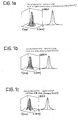
- the value of the focal length is expedient for the value of the focal length to be very close to that of the concentrator-to-cell distance for an intermediate wavelength of the solar spectrum; the result is that the distribution of polychromatic irradiance becomes not very uniform and has a very high central peak; this peak persists even when varying the concentrator-to-cell distance ( Figures 1a, b, c).
- the aim of the present invention is to produce a concentrator in transmission having high efficiency values (above 80%) and at the same time uniformity in the distribution of polychromatic irradiance on the plane of the cell.
- This aim is achieved according to the invention by a light concentrator for a radiation conversion device having the characteristics defined in Claim 1.
- This aim is therefore achieved by means of a Fresnel lens that is multifocal, or having a focal length which is not constant but variable in dependence on the distance from the centre of the lens itself, the variation of said focal length being determined so as to maximise the distribution of polychromatic irradiance on the plane of the cell.
- the concentrator according to the invention is not limited exclusively to the photovoltaic modules described hereinafter, but may also be used in other possible systems for conversion of radiant energy, and in particular of solar radiation, into various forms of energy, for example in systems for converting solar energy into thermal energy, or into chemical energy. It may in fact be used in solar collectors for the direct conversion of the radiant energy of the sun into thermal energy to be used for heating or for inverting a combustion reaction, i.e. for the regeneration of fuel and comburent from products of combustion.
- a concentrator 10 capable of concentrating the luminous (and, if required, infrared and ultraviolet) radiation incident on a conversion device (not illustrated) capable of converting such radiation into another form of energy, for example electrical, thermal or chemical energy.
- a conversion device capable of converting such radiation into another form of energy, for example electrical, thermal or chemical energy.
- the concentrator 10, having a square shape in the present example, is formed substantially of a multifocal Fresnel lens.
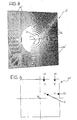
- multifocal means that, given a general point P of the lens placed at a distance r lens from the centre C of the lens itself, the focal distance F is dependent on r lens ; the focal distance F(r lens ) at the point P is defined as the distance between the plane of the lens and the plane perpendicular to the optical axis x and passing through the point of intersection between the optical axis and the ray refracted by the point P (Fig. 4a).
- the Fresnel lens 10 has a face 11, on which annular protruding portions 12, disposed concentrically about the centre C of the lens 10, are provided.
- the section of the Fresnel lens thus has a segmented profile 13 formed by a sequence of crests and valleys, typical of Fresnel lenses; the outermost annular portions 12 may be arranged so as to deflect the light by the effect of a combination of refraction and total internal reflection.
- the focal distance F may be greater than the concentrator-to-cell distance in a radial portion of the lens, whereas it may become less than the concentrator-to-cell distance in the remaining portion of the lens, or vice versa (eg. Figs. 3b, 3c and 3d).
- the transition may take place continuously (Figs. 3b and 3d) or discontinuously (Fig. 3c).
- This makes it possible to achieve a greater tolerance to defocus compared with a system in which F(r lens ) remains less or greater than the concentrator-to-cell distance on the whole surface area of the cell.
- a system tolerant to defocus is a system in which errors of positioning of the plane of the cell with respect to the lens do not compromise either the efficiency or the uniformity of irradiance on the cell.
- the focal distance of the lens is calculated according to this criterion and is optimised so as to produce in the plane of the cell a uniform distribution of irradiance, errors in the positioning of the plane of the cell do not alter to any significant extent the uniformity of irradiance; in fact, if the plane of the cell is moved closer to the lens, the reference rays coming from the outer portion of the lens contribute to the illumination of the central portion of the lens, while the inner portion of the lens contributes to the illumination of the outer portion of the cell. The same phenomenon, but with the parts inverted, occurs in the case where the plane of the cell is moved away from the lens. What is obtained in substance is a circle of minimum confusion which renders the system greatly tolerant to defocus (Fig. 4b). The variation of the focal distance may exhibit discontinuities for the purpose of increasing uniformity, efficiency and tolerance to defocus ( Figure 3c).
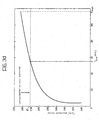
- Figure 3a represents a typical variation of the focal distance F in dependence on the radial distance from the centre of the lens r lens , according to the present invention.
- luminous rays incident parallel to the optical axis on the central region of the concentrator 10 are focused at lesser distances from the concentrator, and rays incident at increasing radial distances are focused at progressively increasing focal distances, up to an asymptotically constant value, close to the value of the concentrator-to-cell distance A'.
- the variation of the focal distance with respect to the radius of the lens must from time to time be optimised in order to guarantee a uniform distribution of polychromatic irradiance on the plane of the cell; it should be observed that the multifocal lens thus calculated generally produces a non-uniform irradiance for the individual wavelengths, but the lens is optimised so that the superposition of the distributions of monochromatic irradiance generates a uniform distribution of polychromatic irradiance.
- the variation of Figures 3a, b, c, d differs in that, with a lens with single focal distance, the variation of the focal distance F with respect to the radial distance r lens is defined by a step function at the radius zero. Therefore, the more rapid the increase or the decrease in the focal distance F (r) with respect to the radial distance r lens , the closer the lens becomes to the behaviour of a lens with single focal distance.
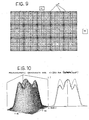
- Figure 10 shows a distribution of polychromatic irradiance on the photovoltaic cell, generated by using a multifocal Fresnel lens according to the invention, having a square shape as in the example described previously, in which the side of the lens is equal to 156 mm, the side of the cell, also square, is equal to 11 mm, and the distance between the concentrator and the cell is equal to 220 mm.
- the graph was obtained in a simulation with the use of a polychromatic beam (with frequencies between 300 and 1150 nm) having an irradiance spectrum AM1.5D and which has an angle of divergence equal to ⁇ 0.275°, or that typical of solar radiation.
- the distribution of illuminance on the cell turns out to have a form substantially identical to that of the aperture of the concentrator itself, i.e. square.
- the variation of the focal distance illustrated in Figures 3a, b, c, d, coupled to a shape of the section of the lens substantially equal to the shape of the conversion cell guarantees uniformity of the distribution of illuminance on the plane of the cell, optimising in this way the concentration factor.
- Figure 11a,b,c This uniformity of distribution may be seen in Figures 11a,b,c, a consequence of a focal distance variation of the type shown in Figure 3c.
- Figure 11b represents the distribution of illuminance on the plane of the cell in the case where the latter is correctly positioned.
- the distribution of illuminance on the plane of the cell is as in Figure 11a.
- the uniformity is maintained and the amount of energy remains substantially unchanged with respect to the case in Figure 11b.
- Figure 11c In the case where the cell is moved away from the lens by three millimetres, the distribution of illuminance on the plane of the cell is shown in Figure 11c. In this case also, the uniformity is maintained and the energy incident on the cell does not vary.
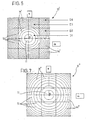
- FIG. 5 illustrates a concentrator 10' formed by a matrix of n x m sectors 14' having the same area, each constructed from a portion of a multifocal Fresnel lens, of the type described with reference to the variant of Figures 2a and 2b.
- the concentrator 10' is formed by a 4 x 4 matrix of sectors 14', each obtained from a portion of Fresnel lens the axis of rotation of which is translated parallel to the optical axis x of the concentrator 10'.
- FIG. 6 shows diagrammatically a photovoltaic cell 20' having a square receiving surface aligned coaxially with the optical axis of the concentrator 10'.
- the photovoltaic cell will have a side significantly less than the side of the concentrator 10', it will consequently be disposed, according to a projection in plan, in the centre C of the concentrator 10'.
- the more marginal sectors 14' In order to reduce as much as possible the effect of chromatic aberration, which becomes more evident at the edges of the concentrator 10' in which the angles of refraction are greater, it is preferable for the more marginal sectors 14' to have a focal distance F as close as possible to that of a Fresnel lens with single focal distance F, having a value close to the distance between cell 20' and concentrator 10'.
- Figure 7 illustrates a variant 10" of the concentrator 10' of Figure 4, formed by a matrix n x m of sectors 14' of Fresnel lens.
- This variant 10" differs from that in Figure 4 solely in that the sectors 14' have surfaces of different area and of different shape, i.e. square and rectangular. This introduces a further degree of freedom to be able to render the distribution of illuminance on the cell 20' more uniform.
- the concentrators 10, 10'; 10" may be used as single elements or may be assembled in a matrix of N x M elements, to which corresponds a matrix of N x M photovoltaic cells (see Figures 9 and 12).
- the concentrators 10''' have a hexagonal symmetry, and are formed by sectors 14''' corresponding to portions of Fresnel lens having axes of rotation translated with respect to the optical axis of the concentrator 10''' and, if required, a different profile of variation of the focal distance F.
- the concentrators 10''' formed by equilateral hexagons may also be disposed in a matrix structure (see Figure 13b), of the honeycomb type.
- the concentrators 10, 10', 10", 10''' may be produced singly by injection moulding or by hot pressing of transparent material, for example plastic or vitreous material.
- transparent material for example plastic or vitreous material.
- the concentrators may be moulded directly on a transparent substrate, starting from a plane substrate and following a hot pressing process of the type known as "step&repeat", in which a single element is moulded at a time and between one pressing and the next the substrate is displaced with respect to the die.
- the single Fresnel concentrators of the variants described previously may be produced according to a plane-convex lens configuration, i.e. of the type described hitherto, or concave-convex, i.e. substantially limited by two curved surfaces so as to maintain the thickness thereof constant, with the convexity facing away from the part of the cell or from the opposite side (see Figures 14a, 14b).
- a plane-convex lens configuration i.e. of the type described hitherto, or concave-convex, i.e. substantially limited by two curved surfaces so as to maintain the thickness thereof constant, with the convexity facing away from the part of the cell or from the opposite side (see Figures 14a, 14b).
- Such a stratagem may make it possible to increase the tolerance to tracking errors.
Landscapes
- Engineering & Computer Science (AREA)
- Physics & Mathematics (AREA)
- Chemical & Material Sciences (AREA)
- Sustainable Development (AREA)
- Sustainable Energy (AREA)
- Thermal Sciences (AREA)
- Life Sciences & Earth Sciences (AREA)
- Combustion & Propulsion (AREA)
- Mechanical Engineering (AREA)
- General Engineering & Computer Science (AREA)
- General Physics & Mathematics (AREA)
- Optics & Photonics (AREA)
- Photovoltaic Devices (AREA)
- Lenses (AREA)
Abstract
Description
Claims (21)
- A light concentrator for a device for the conversion of radiation, in particular for the conversion of solar radiation into electrical, thermal or chemical energy, capable of conveying said radiation towards a surface of said conversion device (20') disposed at a predetermined distance (A') from the concentrator (10, 10', 10", 10''' ), said concentrator (10, 10', 10", 10''') comprising at least one portion of Fresnel lens of rotational symmetry, one face (11) of which has a plurality of crests (12) disposed concentrically about a centre (C) so as to form a segmented transverse profile (13) of said portion of Fresnel lens, characterised in that said segmented profile (13) is formed in such a manner that the focal distance (F) of the Fresnel lens is variable in dependence on the radial distance (rlens) from the centre (C) of symmetry of the Fresnel lens, the variation of said focal distance (F) being determined in such a way that, when said Fresnel lens is illuminated by polychromatic radiation, the superposition of the distributions of irradiance, produced by said Fresnel lens at the individual wavelengths constituting the spectrum of the incident radiation, generates a substantially uniform distribution of polychromatic irradiance on said receiving surface of the conversion device (20').
- A concentrator according to claim 1, wherein said concentrator (10, 10', 10", 10''') has an aperture of a shape substantially equal to that of said receiving surface of the conversion device (20').
- A concentrator according to one of the preceding claims, wherein the focal distance (F) exhibits a variation such that said focal distance (F) is close to zero at the centre (C) of the Fresnel lens, increasing progressively until it reaches a maximum value at the edge (rmax) of the lens element.
- A concentrator according to claim 3, wherein said maximum value of the focal distance (F) is slightly higher than the value of the predetermined distance (A') between concentrator and receiving surface of the conversion device (20').
- A concentrator according to claim 3, wherein said maximum value of the focal distance (F) is substantially equal to said predetermined distance (A') between concentrator and receiving surface of the conversion device (20').
- A concentrator according to claim 1 or 2, wherein the focal distance (F) exhibits a variation such that said focal distance (F) is equal to a maximum value at the centre (C) of the Fresnel lens element, decreasing progressively until it reaches a minimum value at the edge (rmax) of the lens element.
- A concentrator according to claim 6, wherein said minimum value of the focal distance (F) is substantially equal to said predetermined distance (A') between concentrator and receiving surface of the conversion device (20').
- A concentrator according to claim 6, wherein said maximum value of the focal distance (F) is more than 10% of the value of the predetermined distance (A') between concentrator and receiving surface of the conversion device (20').
- A concentrator according to one of claims 6 to 8, wherein said maximum value of the focal distance (F) is greater than the value of the predetermined distance (A') between concentrator and receiving surface of the conversion device (20'), and said minimum value is slightly lower than the value of the predetermined distance (A') between concentrator and receiving surface of the conversion device (20').
- A concentrator according to any one of the preceding claims, wherein the Fresnel lens is characterised by a constant height of the crests (12).
- A concentrator according to any one of the preceding claims, wherein the Fresnel lens is characterised by a constant value of the radial distance between adjacent crests (12) .
- A concentrator according to one of the preceding claims, characterised in that it comprises a plurality of contiguous sectors (14', 14"), each sector (14', 14") being formed by a portion of Fresnel lens of rotational symmetry, the axis of symmetry of which is translated parallel to the optical axis (x) of said concentrator (10,', 10", 10''').
- A concentrator according to claim 12, wherein each sector (14', 14") has a corresponding profile of variation of the focal distance (F) in dependence on the radial distance (rlens) .
- A concentrator according to claim 12 or claim 13, wherein said sectors (14', 14") have surfaces having areas equal to one another.
- A concentrator according to one of the preceding claims, wherein the shape of said Fresnel lens element is square, rectangular, hexagonal or circular.
- A concentrator according to one of the preceding claims, wherein said Fresnel lens has a concave-convex structure defined by a pair of curved surfaces such that the thickness of said lens is substantially constant.
- A concentrator according to one of the preceding claims, wherein said crests (12) of the Fresnel lens are disposed on the surface (11) of said lens facing the conversion device (20').
- A device for the conversion of luminous radiation, in particular for the conversion of solar radiation into electrical, thermal or chemical energy, comprising a light concentrator according to one of the preceding claims.
- A device according to claim 18, wherein said device is a photovoltaic cell.
- A device according to claim 18, wherein said device is a cell capable of converting solar radiation directly into thermal energy.
- An apparatus for the conversion of luminous radiation, in particular for the conversion of solar radiation into electrical, thermal or chemical energy, comprising a plurality of concentrators disposed in a matrix, said concentrators being of the type defined according to one of claims 1 to 17.
Applications Claiming Priority (2)
| Application Number | Priority Date | Filing Date | Title |
|---|---|---|---|
| IT000734A ITTO20030734A1 (en) | 2003-09-24 | 2003-09-24 | MULTIFOCAL LIGHT CONCENTRATOR FOR A DEVICE FOR RADIATION CONVERSION, AND IN PARTICULAR FOR THE CONVERSION OF SOLAR RADIATION IN ELECTRICAL, THERMAL OR CHEMICAL ENERGY. |
| ITTO20030734 | 2003-09-24 |
Publications (2)
| Publication Number | Publication Date |
|---|---|
| EP1521044A2 true EP1521044A2 (en) | 2005-04-06 |
| EP1521044A3 EP1521044A3 (en) | 2008-07-02 |
Family
ID=34308156
Family Applications (1)
| Application Number | Title | Priority Date | Filing Date |
|---|---|---|---|
| EP04022511A Withdrawn EP1521044A3 (en) | 2003-09-24 | 2004-09-22 | Multifocal light concentrator for a device for the conversion of radiation, and in particular for the conversion of solar radiation into electrical, thermal or chemical energy |
Country Status (4)
| Country | Link |
|---|---|
| US (1) | US7952017B2 (en) |
| EP (1) | EP1521044A3 (en) |
| JP (1) | JP2005099802A (en) |
| IT (1) | ITTO20030734A1 (en) |
Cited By (8)
| Publication number | Priority date | Publication date | Assignee | Title |
|---|---|---|---|---|
| WO2008138156A1 (en) * | 2007-05-14 | 2008-11-20 | Heptagon Oy | Illumination system |
| WO2008152157A1 (en) * | 2007-06-12 | 2008-12-18 | Concentración Solar La Mancha, S.L. | Refractive optical system for collecting and concentrating solar energy |
| WO2009112571A3 (en) * | 2008-03-14 | 2010-12-09 | Robert Bosch Gmbh | Photovoltaic solar module |
| WO2011005486A3 (en) * | 2009-06-22 | 2012-01-19 | Solarmation, Inc. | Optics for concentrated photovoltaic cell |
| US20130314774A1 (en) * | 2011-11-16 | 2013-11-28 | Cool Earth Solar Inc. | Inflated tubular solar concentrators |
| US9312805B2 (en) | 2009-01-05 | 2016-04-12 | Vincent K. Gustafson | Systems and methods for concentrated solar photovoltaic power generation with controllable radiation attenuation |
| DE102015213305A1 (en) * | 2015-07-15 | 2017-01-19 | Saint-Augustin Canada Electric Inc. | A light transmission optical element for a solar energy device having a crop region and an alignment control region, and methods of adjusting same |
| WO2021023681A1 (en) | 2019-08-02 | 2021-02-11 | Heliac Aps | Safety lens |
Families Citing this family (37)
| Publication number | Priority date | Publication date | Assignee | Title |
|---|---|---|---|---|
| CN101147032B (en) * | 2003-12-11 | 2012-03-21 | 科技太阳能有限公司 | Energy collection system, collector thereof, and lens and method |
| GB2425884A (en) * | 2005-05-04 | 2006-11-08 | Lontra Environmental Technolog | Photovoltaic module |
| US20060249143A1 (en) * | 2005-05-06 | 2006-11-09 | Straka Christopher W | Reflecting photonic concentrator |
| JP4918769B2 (en) * | 2005-09-22 | 2012-04-18 | 凸版印刷株式会社 | Optical screen, projection screen using the same, and method of manufacturing the optical screen |
| JP4918768B2 (en) * | 2005-09-22 | 2012-04-18 | 凸版印刷株式会社 | Optical screen, projection screen using the same, and method of manufacturing the optical screen |
| US7381886B1 (en) * | 2007-07-30 | 2008-06-03 | Emcore Corporation | Terrestrial solar array |
| WO2009025771A2 (en) * | 2007-08-17 | 2009-02-26 | Brightburst Technologies, Llc | Parameterized optical system and method |
| US20090065053A1 (en) * | 2007-08-24 | 2009-03-12 | Julian Gulbinski | Photovoltaic device |
| US8513514B2 (en) * | 2008-10-24 | 2013-08-20 | Suncore Photovoltaics, Inc. | Solar tracking for terrestrial solar arrays with variable start and stop positions |
| TWM346915U (en) * | 2008-04-09 | 2008-12-11 | Liao Zi Long | Optical structure capable of limiting multi-wavelength light-converging area within the work area and uniformizing the size of regions |
| US8664514B2 (en) * | 2008-10-13 | 2014-03-04 | George M. Watters | Multiplexing solar light chamber |
| US8669461B2 (en) * | 2008-10-17 | 2014-03-11 | Massachusetts Institute Of Technology | Ultra-high efficiency multi-junction solar cells using polychromatic diffractive concentrators |
| US8507837B2 (en) | 2008-10-24 | 2013-08-13 | Suncore Photovoltaics, Inc. | Techniques for monitoring solar array performance and applications thereof |
| US8207481B2 (en) * | 2009-04-21 | 2012-06-26 | Raytheon Company | Projectile guidance system including a compact semi-active laser seeker |
| KR200447171Y1 (en) * | 2009-05-27 | 2009-12-31 | (주) 아주광학 | Condenser Sampler Panel Using Aspherical Fresnel Lens |
| JP5342326B2 (en) * | 2009-05-28 | 2013-11-13 | 株式会社クラレ | Fresnel lens sheet, manufacturing method thereof, manufacturing method of stamper used therefor, and solar power generation apparatus including Fresnel lens sheet |
| EP2437086A4 (en) | 2009-05-29 | 2017-08-09 | Kuraray Co., Ltd. | Fresnel lens sheet for solar collection and design method therefor |
| CN102109622B (en) * | 2009-12-28 | 2012-09-19 | 富士迈半导体精密工业(上海)有限公司 | condenser lens |
| RU2444808C2 (en) * | 2010-03-02 | 2012-03-10 | Российская академия сельскохозяйственных наук Государственное научное учреждение Всероссийский научно-исследовательский институт электрификации сельского хозяйства Российской академии сельскохозяйственных наук (ГНУ ВИЭСХ Россельхозакадемии) | Solar photovoltaic module with concentrator |
| RU2444809C2 (en) * | 2010-06-10 | 2012-03-10 | Российская академия сельскохозяйственных наук Государственное научное учреждение Всероссийский научно-исследовательский институт электрификации сельского хозяйства Российской академии сельскохозяйственных наук (ГНУ ВИЭСХ Россельхозакадемии) | Solar photovoltaic module with concentrator |
| CN101943765B (en) * | 2010-08-27 | 2011-11-16 | 成都钟顺科技发展有限公司 | Condenser lens, multocular lens condenser and multocular condenser solar cell assembly |
| US9893223B2 (en) | 2010-11-16 | 2018-02-13 | Suncore Photovoltaics, Inc. | Solar electricity generation system |
| US20150083193A1 (en) * | 2012-03-30 | 2015-03-26 | Sharp Kabushiki Kaisha | Secondary lens, photovoltaic cell mounting body, concentrating photovoltaic power generation unit, and concentrating photovoltaic power generation module |
| JP6091789B2 (en) * | 2012-05-28 | 2017-03-08 | 株式会社エンプラス | Luminous flux control member, light emitting device, and illumination device |
| US9157660B2 (en) * | 2013-03-15 | 2015-10-13 | George E. Taylor | Solar heating system |
| JP6111154B2 (en) * | 2013-05-02 | 2017-04-05 | 株式会社エンプラス | Luminous flux control member, light emitting device, lighting device, and mold |
| TWI537608B (en) * | 2014-11-21 | 2016-06-11 | 玉晶光電股份有限公司 | Thinner type lens |
| TWI537609B (en) * | 2014-11-21 | 2016-06-11 | 玉晶光電股份有限公司 | Thinner type lens |
| US10690813B2 (en) | 2015-01-21 | 2020-06-23 | Tesseland Llc | Imaging optics adapted to the human eye resolution |
| CN105204098A (en) * | 2015-10-26 | 2015-12-30 | 日芯光伏科技有限公司 | Non-imaging Fresnel lens used for HCPV power generation and design method of non-imaging Fresnel lens |
| CN105607237B (en) * | 2016-02-26 | 2018-02-23 | 陕西科技大学 | Seven focuses applied to concentrating photovoltaic power generation are superimposed uniform condensing Fresnel Lenses |
| DE102016123002A1 (en) * | 2016-11-29 | 2018-05-30 | Osram Opto Semiconductors Gmbh | DEVICE FOR ILLUMINATING A PRESENT AREA AREA |
| JP6572274B2 (en) * | 2017-09-19 | 2019-09-04 | 日本特殊光学樹脂株式会社 | Fresnel lens and lighting device |
| US12189141B2 (en) * | 2018-06-29 | 2025-01-07 | Arizona Board Of Regents On Behalf Of The University Of Arizona | Multi-order diffractive Fresnel lens (MOD-DFL) and systems that incorporate the MOD-DFL |
| GB2576212B (en) * | 2018-08-10 | 2021-12-29 | X Fab Semiconductor Foundries Gmbh | Improvements in lens layers for semiconductor devices |
| AU2020218988B2 (en) * | 2019-02-07 | 2025-07-03 | Toppan Printing Co., Ltd. | Optical structure and artifact reduction method |
| JP7344061B2 (en) * | 2019-09-16 | 2023-09-13 | プレス工業株式会社 | solar cell cover |
Family Cites Families (22)
| Publication number | Priority date | Publication date | Assignee | Title |
|---|---|---|---|---|
| US899533A (en) | 1907-06-24 | 1908-09-29 | Frederic G Hodell | Machine for cutting butter, cheese, and the like. |
| GB375685A (en) * | 1930-11-24 | 1932-06-30 | Jose Ylla Conte | Improvements in lenses for concentrating the solar heat |
| US3234931A (en) * | 1963-02-20 | 1966-02-15 | Gen Motors Corp | Solar energy absorber |
| IL49997A (en) * | 1975-07-14 | 1978-08-31 | Nadaguchi Akira | Solar collector |
| US4210391A (en) * | 1977-09-14 | 1980-07-01 | Cohen Allen L | Multifocal zone plate |
| JPS5834803B2 (en) * | 1978-03-14 | 1983-07-29 | 工業技術院長 | Concentrating solar cell device |
| US4337759A (en) * | 1979-10-10 | 1982-07-06 | John M. Popovich | Radiant energy concentration by optical total internal reflection |
| US4312330A (en) * | 1980-06-26 | 1982-01-26 | Swedlow, Inc. | Focusing device for concentrating radiation |
| JPS57144502A (en) * | 1981-03-02 | 1982-09-07 | Akira Nadaguchi | Composite fresnel condenser |
| IT1138350B (en) | 1981-05-19 | 1986-09-17 | Siv Soc Italiana Vetro | FIXED REFRACTOR WITH ASYMMETRIC PROFILE SUITABLE FOR CONCENTRATION OF SOLAR ENERGY ON AN APPROPRIATE COLLECTION PLAN |
| IT1150272B (en) | 1982-03-11 | 1986-12-10 | Siv Soc Italiana Vetro | PRISM REFRACTOR SUITABLE FOR CONCENTRATING SOLAR ENERGY, ON AN APPROPRIATE COLLECTION PLAN, REMAINING IN A FIXED POSITION OVER TIME |
| FR2546336B1 (en) | 1983-05-19 | 1985-08-30 | Electricite De France | LOW CONCENTRATION SOLAR PANEL WITH PHOTOPILES |
| JPS6161101A (en) | 1984-08-31 | 1986-03-28 | Takashi Mori | Condenser lens |
| US4799778A (en) * | 1986-04-08 | 1989-01-24 | General Electric Company | Fresnel lens concentrator |
| US4779778A (en) * | 1986-11-13 | 1988-10-25 | Nixon Ii George D | Music article jewelry system |
| US5676453A (en) * | 1992-04-16 | 1997-10-14 | Tir Technologies, Inc. | Collimating TIR lens devices employing fluorescent light sources |
| SE508115C2 (en) | 1996-12-18 | 1998-08-31 | Foersvarets Forskningsanstalt | Variable focal length lens |
| JPH1126800A (en) * | 1997-07-07 | 1999-01-29 | Toyota Central Res & Dev Lab Inc | Concentrating solar cell device |
| DE29800874U1 (en) | 1998-01-20 | 1998-05-07 | Basf Ag, 67063 Ludwigshafen | Sealing profile |
| DE10036073A1 (en) | 2000-07-19 | 2002-02-07 | 4D Vision Gmbh | Three-dimensional display of images of objects, comprises reproducing tomographic images of object side-by-side and arranging lens sections with different focal lengths along common optical axis so that new images are produced |
| US6399874B1 (en) * | 2001-01-11 | 2002-06-04 | Charles Dennehy, Jr. | Solar energy module and fresnel lens for use in same |
| DE10203106A1 (en) | 2002-01-25 | 2003-07-31 | Karl Jungbecker Gmbh & Co | Optical system, to gather solar energy, has linear Fresnel's lens focused at absorber, together with angled mirror assembly to bundle light towards absorber and increase solar density from all sun positions |
-
2003
- 2003-09-24 IT IT000734A patent/ITTO20030734A1/en unknown
-
2004
- 2004-09-22 EP EP04022511A patent/EP1521044A3/en not_active Withdrawn
- 2004-09-23 US US10/947,305 patent/US7952017B2/en not_active Expired - Fee Related
- 2004-09-24 JP JP2004277045A patent/JP2005099802A/en not_active Withdrawn
Cited By (14)
| Publication number | Priority date | Publication date | Assignee | Title |
|---|---|---|---|---|
| US9400394B2 (en) | 2007-05-14 | 2016-07-26 | Heptagon Micro Optics Pte. Ltd. | Illumination system |
| WO2008138156A1 (en) * | 2007-05-14 | 2008-11-20 | Heptagon Oy | Illumination system |
| US10345611B2 (en) | 2007-05-14 | 2019-07-09 | Ams Sensors Singapore Pte. Ltd. | Illumination system |
| WO2008152157A1 (en) * | 2007-06-12 | 2008-12-18 | Concentración Solar La Mancha, S.L. | Refractive optical system for collecting and concentrating solar energy |
| WO2008152176A3 (en) * | 2007-06-12 | 2009-03-26 | Concentracion Solar La Mancha | Optical system for capture and concentration of solar energy |
| WO2009112571A3 (en) * | 2008-03-14 | 2010-12-09 | Robert Bosch Gmbh | Photovoltaic solar module |
| US9312805B2 (en) | 2009-01-05 | 2016-04-12 | Vincent K. Gustafson | Systems and methods for concentrated solar photovoltaic power generation with controllable radiation attenuation |
| WO2011005486A3 (en) * | 2009-06-22 | 2012-01-19 | Solarmation, Inc. | Optics for concentrated photovoltaic cell |
| US20130314774A1 (en) * | 2011-11-16 | 2013-11-28 | Cool Earth Solar Inc. | Inflated tubular solar concentrators |
| US10620294B2 (en) | 2011-11-16 | 2020-04-14 | Cool Earth Solar, Inc. | Inflated tubular solar concentrators |
| DE102015213305A1 (en) * | 2015-07-15 | 2017-01-19 | Saint-Augustin Canada Electric Inc. | A light transmission optical element for a solar energy device having a crop region and an alignment control region, and methods of adjusting same |
| US11290055B2 (en) | 2015-07-15 | 2022-03-29 | Saint-Augustin Canada Electric Inc. | Optical light-transmission element for a solar energy assembly comprising a harvesting portion and an alignment control portion, and method for alignment of such |
| WO2021023681A1 (en) | 2019-08-02 | 2021-02-11 | Heliac Aps | Safety lens |
| US12173933B2 (en) | 2019-08-02 | 2024-12-24 | Heliac A/S | Safety lens |
Also Published As
| Publication number | Publication date |
|---|---|
| JP2005099802A (en) | 2005-04-14 |
| US7952017B2 (en) | 2011-05-31 |
| US20050121071A1 (en) | 2005-06-09 |
| EP1521044A3 (en) | 2008-07-02 |
| ITTO20030734A1 (en) | 2005-03-25 |
Similar Documents
| Publication | Publication Date | Title |
|---|---|---|
| US7952017B2 (en) | Multifocal light concentrator for a device for the conversion of radiation, and in particular for the conversion of solar radiation into electrical, thermal or chemical energy | |
| US5153780A (en) | Method and apparatus for uniformly concentrating solar flux for photovoltaic applications | |
| US6469241B1 (en) | High concentration spectrum splitting solar collector | |
| US9086227B2 (en) | Method and system for light collection and light energy converting apparatus | |
| EP0176048B1 (en) | Bi-focussed solar energy concentrator | |
| US8631787B2 (en) | Multi-junction solar cells with a homogenizer system and coupled non-imaging light concentrator | |
| Coughenour et al. | Dish-based high concentration PV system with Köhler optics | |
| US20100180928A1 (en) | Solar arrays and other photovoltaic (pv) devices using pv enhancement films for trapping light | |
| US20130104984A1 (en) | Monolithic photovoltaic solar concentrator | |
| CN1582378A (en) | Multiple reflector solar concentrators and systems | |
| KR20130140690A (en) | Compact optics for concentration and illumination systems | |
| WO2007103994A2 (en) | Multi-junction solar cells with a homogenizer system and coupled non-imaging light concentrator | |
| WO2010056382A1 (en) | Light collection and concentration system | |
| NL1040088C2 (en) | Concentrating solar panel with diffuse light conversion. | |
| RU2611693C1 (en) | Solar concentrator module | |
| Shanks et al. | High-concentration optics for photovoltaic applications | |
| US20120312349A1 (en) | Stationary concentrated solar power module | |
| US20070023079A1 (en) | Beam splitter | |
| Chiromawa et al. | Concept of Bee‐Eyes Array of Fresnel Lenses as a Solar Photovoltaic Concentrator System | |
| JPS61165702A (en) | Solar generator | |
| JP5279244B2 (en) | Condensing device and condensing method | |
| US9244262B2 (en) | Low cost focussing system giving high concentrations | |
| US20120180847A1 (en) | Method for improving solar energy condensation efficiency in solar energy condensation electric power facility | |
| CN103208950A (en) | Off-axis Fresnel reflection condenser-based concentrating photovoltaic power generation device | |
| Hernández et al. | The XR nonimaging photovoltaic concentrator |
Legal Events
| Date | Code | Title | Description |
|---|---|---|---|
| PUAI | Public reference made under article 153(3) epc to a published international application that has entered the european phase |
Free format text: ORIGINAL CODE: 0009012 |
|
| AK | Designated contracting states |
Kind code of ref document: A2 Designated state(s): AT BE BG CH CY CZ DE DK EE ES FI FR GB GR HU IE IT LI LU MC NL PL PT RO SE SI SK TR |
|
| AX | Request for extension of the european patent |
Extension state: AL HR LT LV MK |
|
| PUAL | Search report despatched |
Free format text: ORIGINAL CODE: 0009013 |
|
| AK | Designated contracting states |
Kind code of ref document: A3 Designated state(s): AT BE BG CH CY CZ DE DK EE ES FI FR GB GR HU IE IT LI LU MC NL PL PT RO SE SI SK TR |
|
| AX | Request for extension of the european patent |
Extension state: AL HR LT LV MK |
|
| RIC1 | Information provided on ipc code assigned before grant |
Ipc: H01L 31/052 20060101ALI20080529BHEP Ipc: G02B 3/08 20060101ALI20080529BHEP Ipc: F24J 2/08 20060101AFI20041216BHEP |
|
| 17P | Request for examination filed |
Effective date: 20081231 |
|
| AKX | Designation fees paid |
Designated state(s): AT BE BG CH CY CZ DE DK EE ES FI FR GB GR HU IE IT LI LU MC NL PL PT RO SE SI SK TR |
|
| 17Q | First examination report despatched |
Effective date: 20090713 |
|
| STAA | Information on the status of an ep patent application or granted ep patent |
Free format text: STATUS: THE APPLICATION IS DEEMED TO BE WITHDRAWN |
|
| 18D | Application deemed to be withdrawn |
Effective date: 20140401 |