EP1520903A1 - Use of polyalfaolefins (pao) derived from 1-dodecene or 1-tetradecene to imrove thermal stability of engine oils in internal combustion engines - Google Patents
Use of polyalfaolefins (pao) derived from 1-dodecene or 1-tetradecene to imrove thermal stability of engine oils in internal combustion engines Download PDFInfo
- Publication number
- EP1520903A1 EP1520903A1 EP04027778A EP04027778A EP1520903A1 EP 1520903 A1 EP1520903 A1 EP 1520903A1 EP 04027778 A EP04027778 A EP 04027778A EP 04027778 A EP04027778 A EP 04027778A EP 1520903 A1 EP1520903 A1 EP 1520903A1
- Authority
- EP
- European Patent Office
- Prior art keywords
- pao
- oil
- engine
- viscosity
- derived
- Prior art date
- Legal status (The legal status is an assumption and is not a legal conclusion. Google has not performed a legal analysis and makes no representation as to the accuracy of the status listed.)
- Withdrawn
Links
- 239000010705 motor oil Substances 0.000 title claims abstract description 52
- CRSBERNSMYQZNG-UHFFFAOYSA-N 1-dodecene Chemical compound CCCCCCCCCCC=C CRSBERNSMYQZNG-UHFFFAOYSA-N 0.000 title claims abstract description 48
- 229940069096 dodecene Drugs 0.000 title claims abstract description 24
- HFDVRLIODXPAHB-UHFFFAOYSA-N 1-tetradecene Chemical compound CCCCCCCCCCCCC=C HFDVRLIODXPAHB-UHFFFAOYSA-N 0.000 title claims description 44
- 238000002485 combustion reaction Methods 0.000 title description 2
- AFFLGGQVNFXPEV-UHFFFAOYSA-N 1-decene Chemical compound CCCCCCCCC=C AFFLGGQVNFXPEV-UHFFFAOYSA-N 0.000 claims abstract description 16
- 239000003921 oil Substances 0.000 claims description 71
- 239000000654 additive Substances 0.000 claims description 33
- 239000002199 base oil Substances 0.000 claims description 32
- 230000003647 oxidation Effects 0.000 claims description 24
- 238000007254 oxidation reaction Methods 0.000 claims description 24
- 230000000996 additive effect Effects 0.000 claims description 19
- 239000003599 detergent Substances 0.000 claims description 19
- 239000002270 dispersing agent Substances 0.000 claims description 19
- 239000003112 inhibitor Substances 0.000 claims description 19
- 239000003795 chemical substances by application Substances 0.000 claims description 8
- 239000006260 foam Substances 0.000 claims description 8
- 239000002480 mineral oil Substances 0.000 claims description 6
- 235000010446 mineral oil Nutrition 0.000 claims description 4
- 229920013639 polyalphaolefin Polymers 0.000 abstract description 119
- 239000000203 mixture Substances 0.000 abstract description 15
- 150000001336 alkenes Chemical class 0.000 abstract description 2
- -1 alkenyl aromatic sulfonates Chemical class 0.000 description 21
- 229910052500 inorganic mineral Inorganic materials 0.000 description 12
- 239000011707 mineral Substances 0.000 description 12
- 229910052751 metal Inorganic materials 0.000 description 8
- 239000002184 metal Substances 0.000 description 8
- 125000000217 alkyl group Chemical group 0.000 description 7
- 238000002411 thermogravimetry Methods 0.000 description 7
- WMYJOZQKDZZHAC-UHFFFAOYSA-H trizinc;dioxido-sulfanylidene-sulfido-$l^{5}-phosphane Chemical class [Zn+2].[Zn+2].[Zn+2].[O-]P([O-])([S-])=S.[O-]P([O-])([S-])=S WMYJOZQKDZZHAC-UHFFFAOYSA-H 0.000 description 7
- 229920003171 Poly (ethylene oxide) Polymers 0.000 description 6
- 150000002148 esters Chemical class 0.000 description 6
- 150000001875 compounds Chemical class 0.000 description 5
- 239000012141 concentrate Substances 0.000 description 5
- 229920001577 copolymer Polymers 0.000 description 5
- 150000003839 salts Chemical class 0.000 description 5
- 230000000052 comparative effect Effects 0.000 description 4
- 239000003085 diluting agent Substances 0.000 description 4
- 239000010687 lubricating oil Substances 0.000 description 4
- 238000005461 lubrication Methods 0.000 description 4
- 239000002253 acid Substances 0.000 description 3
- 125000003342 alkenyl group Chemical group 0.000 description 3
- 235000014113 dietary fatty acids Nutrition 0.000 description 3
- DMBHHRLKUKUOEG-UHFFFAOYSA-N diphenylamine Chemical compound C=1C=CC=CC=1NC1=CC=CC=C1 DMBHHRLKUKUOEG-UHFFFAOYSA-N 0.000 description 3
- 238000002474 experimental method Methods 0.000 description 3
- 239000000194 fatty acid Substances 0.000 description 3
- 229930195729 fatty acid Natural products 0.000 description 3
- 229920000642 polymer Polymers 0.000 description 3
- 239000004711 α-olefin Substances 0.000 description 3
- BVUXDWXKPROUDO-UHFFFAOYSA-N 2,6-di-tert-butyl-4-ethylphenol Chemical compound CCC1=CC(C(C)(C)C)=C(O)C(C(C)(C)C)=C1 BVUXDWXKPROUDO-UHFFFAOYSA-N 0.000 description 2
- SZAQZZKNQILGPU-UHFFFAOYSA-N 2-[1-(2-hydroxy-3,5-dimethylphenyl)-2-methylpropyl]-4,6-dimethylphenol Chemical compound C=1C(C)=CC(C)=C(O)C=1C(C(C)C)C1=CC(C)=CC(C)=C1O SZAQZZKNQILGPU-UHFFFAOYSA-N 0.000 description 2
- IJGRMHOSHXDMSA-UHFFFAOYSA-N Atomic nitrogen Chemical compound N#N IJGRMHOSHXDMSA-UHFFFAOYSA-N 0.000 description 2
- RTZKZFJDLAIYFH-UHFFFAOYSA-N Diethyl ether Chemical compound CCOCC RTZKZFJDLAIYFH-UHFFFAOYSA-N 0.000 description 2
- XQVWYOYUZDUNRW-UHFFFAOYSA-N N-Phenyl-1-naphthylamine Chemical compound C=1C=CC2=CC=CC=C2C=1NC1=CC=CC=C1 XQVWYOYUZDUNRW-UHFFFAOYSA-N 0.000 description 2
- 229920002319 Poly(methyl acrylate) Polymers 0.000 description 2
- 150000007513 acids Chemical class 0.000 description 2
- 239000003963 antioxidant agent Substances 0.000 description 2
- 235000006708 antioxidants Nutrition 0.000 description 2
- DKVNPHBNOWQYFE-UHFFFAOYSA-N carbamodithioic acid Chemical compound NC(S)=S DKVNPHBNOWQYFE-UHFFFAOYSA-N 0.000 description 2
- 239000002826 coolant Substances 0.000 description 2
- 230000001351 cycling effect Effects 0.000 description 2
- 239000012990 dithiocarbamate Substances 0.000 description 2
- 150000004665 fatty acids Chemical class 0.000 description 2
- 238000011010 flushing procedure Methods 0.000 description 2
- 239000000446 fuel Substances 0.000 description 2
- 230000001050 lubricating effect Effects 0.000 description 2
- 238000000034 method Methods 0.000 description 2
- 230000003278 mimic effect Effects 0.000 description 2
- 229910052750 molybdenum Inorganic materials 0.000 description 2
- 239000011733 molybdenum Substances 0.000 description 2
- 229910052757 nitrogen Inorganic materials 0.000 description 2
- 230000001590 oxidative effect Effects 0.000 description 2
- 239000010802 sludge Substances 0.000 description 2
- 230000004580 weight loss Effects 0.000 description 2
- 239000011701 zinc Substances 0.000 description 2
- 229910052725 zinc Inorganic materials 0.000 description 2
- MBBWTVUFIXOUBE-UHFFFAOYSA-L zinc;dicarbamodithioate Chemical compound [Zn+2].NC([S-])=S.NC([S-])=S MBBWTVUFIXOUBE-UHFFFAOYSA-L 0.000 description 2
- FFJCNSLCJOQHKM-CLFAGFIQSA-N (z)-1-[(z)-octadec-9-enoxy]octadec-9-ene Chemical compound CCCCCCCC\C=C/CCCCCCCCOCCCCCCCC\C=C/CCCCCCCC FFJCNSLCJOQHKM-CLFAGFIQSA-N 0.000 description 1
- LDVVTQMJQSCDMK-UHFFFAOYSA-N 1,3-dihydroxypropan-2-yl formate Chemical compound OCC(CO)OC=O LDVVTQMJQSCDMK-UHFFFAOYSA-N 0.000 description 1
- 150000005003 1-naphthylamines Chemical class 0.000 description 1
- OPLCSTZDXXUYDU-UHFFFAOYSA-N 2,4-dimethyl-6-tert-butylphenol Chemical compound CC1=CC(C)=C(O)C(C(C)(C)C)=C1 OPLCSTZDXXUYDU-UHFFFAOYSA-N 0.000 description 1
- GSOYMOAPJZYXTB-UHFFFAOYSA-N 2,6-ditert-butyl-4-(3,5-ditert-butyl-4-hydroxyphenyl)phenol Chemical compound CC(C)(C)C1=C(O)C(C(C)(C)C)=CC(C=2C=C(C(O)=C(C=2)C(C)(C)C)C(C)(C)C)=C1 GSOYMOAPJZYXTB-UHFFFAOYSA-N 0.000 description 1
- QHPKIUDQDCWRKO-UHFFFAOYSA-N 2,6-ditert-butyl-4-[2-(3,5-ditert-butyl-4-hydroxyphenyl)propan-2-yl]phenol Chemical compound CC(C)(C)C1=C(O)C(C(C)(C)C)=CC(C(C)(C)C=2C=C(C(O)=C(C=2)C(C)(C)C)C(C)(C)C)=C1 QHPKIUDQDCWRKO-UHFFFAOYSA-N 0.000 description 1
- FUIQBJHUESBZNU-UHFFFAOYSA-N 2-[(dimethylazaniumyl)methyl]phenolate Chemical compound CN(C)CC1=CC=CC=C1O FUIQBJHUESBZNU-UHFFFAOYSA-N 0.000 description 1
- MUHFRORXWCGZGE-KTKRTIGZSA-N 2-hydroxyethyl (z)-octadec-9-enoate Chemical compound CCCCCCCC\C=C/CCCCCCCC(=O)OCCO MUHFRORXWCGZGE-KTKRTIGZSA-N 0.000 description 1
- YFHKLSPMRRWLKI-UHFFFAOYSA-N 2-tert-butyl-4-(3-tert-butyl-4-hydroxy-5-methylphenyl)sulfanyl-6-methylphenol Chemical compound CC(C)(C)C1=C(O)C(C)=CC(SC=2C=C(C(O)=C(C)C=2)C(C)(C)C)=C1 YFHKLSPMRRWLKI-UHFFFAOYSA-N 0.000 description 1
- BGWNOSDEHSHFFI-UHFFFAOYSA-N 2-tert-butyl-4-[(3-tert-butyl-4-hydroxy-5-methylphenyl)methylsulfanylmethyl]-6-methylphenol Chemical compound CC(C)(C)C1=C(O)C(C)=CC(CSCC=2C=C(C(O)=C(C)C=2)C(C)(C)C)=C1 BGWNOSDEHSHFFI-UHFFFAOYSA-N 0.000 description 1
- PFANXOISJYKQRP-UHFFFAOYSA-N 2-tert-butyl-4-[1-(5-tert-butyl-4-hydroxy-2-methylphenyl)butyl]-5-methylphenol Chemical compound C=1C(C(C)(C)C)=C(O)C=C(C)C=1C(CCC)C1=CC(C(C)(C)C)=C(O)C=C1C PFANXOISJYKQRP-UHFFFAOYSA-N 0.000 description 1
- MQWCQFCZUNBTCM-UHFFFAOYSA-N 2-tert-butyl-6-(3-tert-butyl-2-hydroxy-5-methylphenyl)sulfanyl-4-methylphenol Chemical compound CC(C)(C)C1=CC(C)=CC(SC=2C(=C(C=C(C)C=2)C(C)(C)C)O)=C1O MQWCQFCZUNBTCM-UHFFFAOYSA-N 0.000 description 1
- BKZXZGWHTRCFPX-UHFFFAOYSA-N 2-tert-butyl-6-methylphenol Chemical compound CC1=CC=CC(C(C)(C)C)=C1O BKZXZGWHTRCFPX-UHFFFAOYSA-N 0.000 description 1
- MDWVSAYEQPLWMX-UHFFFAOYSA-N 4,4'-Methylenebis(2,6-di-tert-butylphenol) Chemical compound CC(C)(C)C1=C(O)C(C(C)(C)C)=CC(CC=2C=C(C(O)=C(C=2)C(C)(C)C)C(C)(C)C)=C1 MDWVSAYEQPLWMX-UHFFFAOYSA-N 0.000 description 1
- OILMLWAZYNVPMG-UHFFFAOYSA-N 4-methyl-2-nonylphenol Chemical compound CCCCCCCCCC1=CC(C)=CC=C1O OILMLWAZYNVPMG-UHFFFAOYSA-N 0.000 description 1
- LSNNMFCWUKXFEE-UHFFFAOYSA-M Bisulfite Chemical compound OS([O-])=O LSNNMFCWUKXFEE-UHFFFAOYSA-M 0.000 description 1
- NLZUEZXRPGMBCV-UHFFFAOYSA-N Butylhydroxytoluene Chemical compound CC1=CC(C(C)(C)C)=C(O)C(C(C)(C)C)=C1 NLZUEZXRPGMBCV-UHFFFAOYSA-N 0.000 description 1
- 239000004215 Carbon black (E152) Substances 0.000 description 1
- HBEMHMNHYDTVRE-UHFFFAOYSA-N ClC(CCCCCCCCCCCCCCCCC(=O)OC)(Cl)Cl Chemical compound ClC(CCCCCCCCCCCCCCCCC(=O)OC)(Cl)Cl HBEMHMNHYDTVRE-UHFFFAOYSA-N 0.000 description 1
- FBPFZTCFMRRESA-FSIIMWSLSA-N D-Glucitol Natural products OC[C@H](O)[C@H](O)[C@@H](O)[C@H](O)CO FBPFZTCFMRRESA-FSIIMWSLSA-N 0.000 description 1
- LFQSCWFLJHTTHZ-UHFFFAOYSA-N Ethanol Chemical compound CCO LFQSCWFLJHTTHZ-UHFFFAOYSA-N 0.000 description 1
- IAYPIBMASNFSPL-UHFFFAOYSA-N Ethylene oxide Chemical compound C1CO1 IAYPIBMASNFSPL-UHFFFAOYSA-N 0.000 description 1
- ZOKXTWBITQBERF-UHFFFAOYSA-N Molybdenum Chemical compound [Mo] ZOKXTWBITQBERF-UHFFFAOYSA-N 0.000 description 1
- ISWSIDIOOBJBQZ-UHFFFAOYSA-N Phenol Chemical compound OC1=CC=CC=C1 ISWSIDIOOBJBQZ-UHFFFAOYSA-N 0.000 description 1
- 239000002202 Polyethylene glycol Substances 0.000 description 1
- 229920002367 Polyisobutene Polymers 0.000 description 1
- YGSDEFSMJLZEOE-UHFFFAOYSA-N Salicylic acid Natural products OC(=O)C1=CC=CC=C1O YGSDEFSMJLZEOE-UHFFFAOYSA-N 0.000 description 1
- 235000021355 Stearic acid Nutrition 0.000 description 1
- NINIDFKCEFEMDL-UHFFFAOYSA-N Sulfur Chemical compound [S] NINIDFKCEFEMDL-UHFFFAOYSA-N 0.000 description 1
- HCHKCACWOHOZIP-UHFFFAOYSA-N Zinc Chemical compound [Zn] HCHKCACWOHOZIP-UHFFFAOYSA-N 0.000 description 1
- WERKSKAQRVDLDW-ANOHMWSOSA-N [(2s,3r,4r,5r)-2,3,4,5,6-pentahydroxyhexyl] (z)-octadec-9-enoate Chemical compound CCCCCCCC\C=C/CCCCCCCC(=O)OC[C@H](O)[C@@H](O)[C@H](O)[C@H](O)CO WERKSKAQRVDLDW-ANOHMWSOSA-N 0.000 description 1
- 150000005215 alkyl ethers Chemical class 0.000 description 1
- 150000001408 amides Chemical class 0.000 description 1
- 150000001412 amines Chemical class 0.000 description 1
- 238000004458 analytical method Methods 0.000 description 1
- 239000013556 antirust agent Substances 0.000 description 1
- FQUNFJULCYSSOP-UHFFFAOYSA-N bisoctrizole Chemical compound N1=C2C=CC=CC2=NN1C1=CC(C(C)(C)CC(C)(C)C)=CC(CC=2C(=C(C=C(C=2)C(C)(C)CC(C)(C)C)N2N=C3C=CC=CC3=N2)O)=C1O FQUNFJULCYSSOP-UHFFFAOYSA-N 0.000 description 1
- 239000004327 boric acid Substances 0.000 description 1
- 125000005619 boric acid group Chemical group 0.000 description 1
- 235000010354 butylated hydroxytoluene Nutrition 0.000 description 1
- 150000007942 carboxylates Chemical class 0.000 description 1
- 150000001733 carboxylic acid esters Chemical class 0.000 description 1
- 239000003054 catalyst Substances 0.000 description 1
- 230000003749 cleanliness Effects 0.000 description 1
- LMODBLQHQHXPEI-UHFFFAOYSA-N dibutylcarbamothioylsulfanylmethyl n,n-dibutylcarbamodithioate Chemical compound CCCCN(CCCC)C(=S)SCSC(=S)N(CCCC)CCCC LMODBLQHQHXPEI-UHFFFAOYSA-N 0.000 description 1
- 125000000118 dimethyl group Chemical group [H]C([H])([H])* 0.000 description 1
- LTYMSROWYAPPGB-UHFFFAOYSA-N diphenyl sulfide Chemical compound C=1C=CC=CC=1SC1=CC=CC=C1 LTYMSROWYAPPGB-UHFFFAOYSA-N 0.000 description 1
- 229940117927 ethylene oxide Drugs 0.000 description 1
- 238000001704 evaporation Methods 0.000 description 1
- 230000008020 evaporation Effects 0.000 description 1
- 150000002191 fatty alcohols Chemical class 0.000 description 1
- 238000005194 fractionation Methods 0.000 description 1
- 239000007789 gas Substances 0.000 description 1
- 229930195733 hydrocarbon Natural products 0.000 description 1
- 150000002430 hydrocarbons Chemical class 0.000 description 1
- 238000005984 hydrogenation reaction Methods 0.000 description 1
- 238000002347 injection Methods 0.000 description 1
- 239000007924 injection Substances 0.000 description 1
- JEIPFZHSYJVQDO-UHFFFAOYSA-N iron(III) oxide Inorganic materials O=[Fe]O[Fe]=O JEIPFZHSYJVQDO-UHFFFAOYSA-N 0.000 description 1
- GIWKOZXJDKMGQC-UHFFFAOYSA-L lead(2+);naphthalene-2-carboxylate Chemical compound [Pb+2].C1=CC=CC2=CC(C(=O)[O-])=CC=C21.C1=CC=CC2=CC(C(=O)[O-])=CC=C21 GIWKOZXJDKMGQC-UHFFFAOYSA-L 0.000 description 1
- 238000004519 manufacturing process Methods 0.000 description 1
- 238000002156 mixing Methods 0.000 description 1
- 239000003607 modifier Substances 0.000 description 1
- 150000002790 naphthalenes Chemical class 0.000 description 1
- QIQXTHQIDYTFRH-UHFFFAOYSA-N octadecanoic acid Chemical compound CCCCCCCCCCCCCCCCCC(O)=O QIQXTHQIDYTFRH-UHFFFAOYSA-N 0.000 description 1
- OQCDKBAXFALNLD-UHFFFAOYSA-N octadecanoic acid Natural products CCCCCCCC(C)CCCCCCCCC(O)=O OQCDKBAXFALNLD-UHFFFAOYSA-N 0.000 description 1
- 229920002114 octoxynol-9 Polymers 0.000 description 1
- 238000006384 oligomerization reaction Methods 0.000 description 1
- 150000002894 organic compounds Chemical class 0.000 description 1
- FJKROLUGYXJWQN-UHFFFAOYSA-N papa-hydroxy-benzoic acid Natural products OC(=O)C1=CC=C(O)C=C1 FJKROLUGYXJWQN-UHFFFAOYSA-N 0.000 description 1
- 239000006069 physical mixture Substances 0.000 description 1
- 229920003229 poly(methyl methacrylate) Polymers 0.000 description 1
- 229920001223 polyethylene glycol Polymers 0.000 description 1
- 229920000193 polymethacrylate Polymers 0.000 description 1
- 239000004926 polymethyl methacrylate Substances 0.000 description 1
- 229920000259 polyoxyethylene lauryl ether Polymers 0.000 description 1
- 229920000136 polysorbate Polymers 0.000 description 1
- 229960004889 salicylic acid Drugs 0.000 description 1
- 229920005573 silicon-containing polymer Polymers 0.000 description 1
- 239000010454 slate Substances 0.000 description 1
- 239000000344 soap Substances 0.000 description 1
- 239000002904 solvent Substances 0.000 description 1
- 239000000600 sorbitol Substances 0.000 description 1
- 239000008117 stearic acid Substances 0.000 description 1
- 238000003860 storage Methods 0.000 description 1
- 239000000126 substance Substances 0.000 description 1
- 238000006467 substitution reaction Methods 0.000 description 1
- 150000005846 sugar alcohols Polymers 0.000 description 1
- 229910052717 sulfur Inorganic materials 0.000 description 1
- 239000011593 sulfur Substances 0.000 description 1
- 239000004094 surface-active agent Substances 0.000 description 1
- 230000002459 sustained effect Effects 0.000 description 1
- 238000010998 test method Methods 0.000 description 1
Images
Classifications
-
- C—CHEMISTRY; METALLURGY
- C10—PETROLEUM, GAS OR COKE INDUSTRIES; TECHNICAL GASES CONTAINING CARBON MONOXIDE; FUELS; LUBRICANTS; PEAT
- C10M—LUBRICATING COMPOSITIONS; USE OF CHEMICAL SUBSTANCES EITHER ALONE OR AS LUBRICATING INGREDIENTS IN A LUBRICATING COMPOSITION
- C10M107/00—Lubricating compositions characterised by the base-material being a macromolecular compound
- C10M107/02—Hydrocarbon polymers; Hydrocarbon polymers modified by oxidation
- C10M107/10—Hydrocarbon polymers; Hydrocarbon polymers modified by oxidation containing aliphatic monomer having more than 4 carbon atoms
-
- C—CHEMISTRY; METALLURGY
- C10—PETROLEUM, GAS OR COKE INDUSTRIES; TECHNICAL GASES CONTAINING CARBON MONOXIDE; FUELS; LUBRICANTS; PEAT
- C10M—LUBRICATING COMPOSITIONS; USE OF CHEMICAL SUBSTANCES EITHER ALONE OR AS LUBRICATING INGREDIENTS IN A LUBRICATING COMPOSITION
- C10M111/00—Lubrication compositions characterised by the base-material being a mixture of two or more compounds covered by more than one of the main groups C10M101/00 - C10M109/00, each of these compounds being essential
- C10M111/04—Lubrication compositions characterised by the base-material being a mixture of two or more compounds covered by more than one of the main groups C10M101/00 - C10M109/00, each of these compounds being essential at least one of them being a macromolecular organic compound
-
- C—CHEMISTRY; METALLURGY
- C10—PETROLEUM, GAS OR COKE INDUSTRIES; TECHNICAL GASES CONTAINING CARBON MONOXIDE; FUELS; LUBRICANTS; PEAT
- C10N—INDEXING SCHEME ASSOCIATED WITH SUBCLASS C10M RELATING TO LUBRICATING COMPOSITIONS
- C10N2020/00—Specified physical or chemical properties or characteristics, i.e. function, of component of lubricating compositions
- C10N2020/01—Physico-chemical properties
- C10N2020/02—Viscosity; Viscosity index
-
- C—CHEMISTRY; METALLURGY
- C10—PETROLEUM, GAS OR COKE INDUSTRIES; TECHNICAL GASES CONTAINING CARBON MONOXIDE; FUELS; LUBRICANTS; PEAT
- C10N—INDEXING SCHEME ASSOCIATED WITH SUBCLASS C10M RELATING TO LUBRICATING COMPOSITIONS
- C10N2030/00—Specified physical or chemical properties which is improved by the additive characterising the lubricating composition, e.g. multifunctional additives
- C10N2030/08—Resistance to extreme temperature
-
- C—CHEMISTRY; METALLURGY
- C10—PETROLEUM, GAS OR COKE INDUSTRIES; TECHNICAL GASES CONTAINING CARBON MONOXIDE; FUELS; LUBRICANTS; PEAT
- C10N—INDEXING SCHEME ASSOCIATED WITH SUBCLASS C10M RELATING TO LUBRICATING COMPOSITIONS
- C10N2040/00—Specified use or application for which the lubricating composition is intended
- C10N2040/25—Internal-combustion engines
- C10N2040/252—Diesel engines
-
- C—CHEMISTRY; METALLURGY
- C10—PETROLEUM, GAS OR COKE INDUSTRIES; TECHNICAL GASES CONTAINING CARBON MONOXIDE; FUELS; LUBRICANTS; PEAT
- C10N—INDEXING SCHEME ASSOCIATED WITH SUBCLASS C10M RELATING TO LUBRICATING COMPOSITIONS
- C10N2040/00—Specified use or application for which the lubricating composition is intended
- C10N2040/25—Internal-combustion engines
- C10N2040/252—Diesel engines
- C10N2040/253—Small diesel engines
Definitions
- the present invention relates to compositions of automotive engine oils using synthetic poly alpha olefins derived from olefins other than 1-decene, especially 1-dodecene and 1-tetradecene, to improve engine oil performance, as demonstrated by the severe Volkswagen T-4, Volkswagen TDI, and Sequence IIIE tests.
- PAO poly alpha olefins
- PAO is manufactured by oligomerization of linear alpha olefin followed by hydrogenation to remove unsaturated moleties and fractionation to obtain the desired product slate.
- 1-decene is the most commonly used alpha olefin in the manufacture of PAO, but 1-dodecene and 1-tetradecene can also be used.
- PAO's are commonly categorized by the numbers denoting the approximate viscosity in centistokes of the PAO at 100°C. It is known that PAO 2, PAO 2.5, PAO 4, PAO 5, PAO 6, PAO 7, PAO 8, PAO 9 and PAO 10 and combinations thereof can be used in engine oils. The most common of these are PAO 4, PAO 6 and PAO 8.
- base oils of lubricating viscosity used in motor oil compositions may be mineral oil or synthetic oils of viscosity suitable for use in the crankcase of an internal combustion engine.
- Crankcase base oils ordinarily have a viscosity of about 1300 cSt at 0°F (-18°C) to 24 cSt at 210°F (99°C).
- the base oils may be derived from synthetic or natural sources.
- Mineral oil for use as the base oil in this invention includes paraffinic, naphthenic and other oils that are ordinarily used in lubricating oil compositions.
- Synthetic oils include both hydrocarbon synthetic oils and synthetic esters.
- the PV 1449 and Sequence IIIE tests evaluate fully formulated engine oils with respect to high temperature oxidative stability and piston deposits.
- the CEC L-78-T-96 test evaluates fully formulated engine oils with respect to piston cleanliness and piston ring sticking.
- the PV 1449 and CEC L-78-T-96 tests will be referred to hereinafter as the Volkswagen T-4 and TDI engine tests, respectively.
- the Volkswagen T-4 and TDI tests have recently become an important measure of engine lubrication oil quality under very severe conditions.
- the Sequence IIIE test is analogous to a T-4 test but is specifically developed for U.S. built engines.
- the T-4 and Sequence IIIE tests are for gasoline engines and the TDI test is for diesel engines. They replicate the severe engine conditions put on motor lubrication oil by sustained, very high speed driving, as on the German Autobahn. What is needed is a PAO based oil which is able to successfully complete severe engine tests such as the Volkswagen T-4 and TDI tests and the Sequence IIIE test without having to use large quantities of anti-oxidants or a fully synthetic oil.
- the present invention relates to the use of PAO derived from 1-dodecene or 1-tetradecene as the base oil, or a component of the base oil, of an engine oil for the purpose of improving the high temperature stability of the engine oil when compared with the use of a 1-decene derived PAO.
- the present invention relates to the use of PAO derived from 1-dodecene or 1-tetradecene as the base oil, or a component of the base oil, of an engine oil comprised of base oil, dispersants, detergents, oxidation inhibitors, foam inhibitors, anti-wear agents and at least one viscosity index improver, for the purpose of improving the high temperature stability of the engine oil to least the point at which the engine oil is able to pass the VW T-4, VW TDI, or Sequence IIIE tests.
- the base oil is from 15 to 85% of the engine oil and at least 15% of the base oil is derived from 1-dodecene or 1-tetradecene.
- the present invention relates to an engine oil having a SAE viscosity grade of 0W-xx where xx denotes 20-40 comprised of from 15 to 85% base oil having from 50 to 85% PAO at least 15% of which is derived from 1-dodecene or 1-tetradecene, from 0 to 20% of at least one ashless dispersant: from 0 to 30% of detergent; from 0 to 5% of at least one anti-wear agent; from 0 to 10% of at least one oxidation inhibitor; from 0 to 1% of at least one foam inhibitor, and from 0 to 20% of at least one viscosity index improver.
- xx denotes 20-40 comprised of from 15 to 85% base oil having from 50 to 85% PAO at least 15% of which is derived from 1-dodecene or 1-tetradecene, from 0 to 20% of at least one ashless dispersant: from 0 to 30% of detergent; from 0 to 5% of at least one anti-wear agent; from 0
- the present invention relates to an engine oil having a SAE viscosity grade of 5W-xx where xx denotes 20-40 comprised of from 15 to 85% base oil having from 15 to 50% PAO at least 15% of which is derived from 1-dodecene or 1-tetradecene, from 0 to 20% of at least one ashless dispersant; from 0 to 30% of detergent; from 0 to 5% of at least one anti-wear agent; from 0 to 10% of at least one oxidation inhibitor; from 0 to 1% of at least one foam inhibitor, and from 0 to 20% of at least one viscosity index improver.
- xx denotes 20-40 comprised of from 15 to 85% base oil having from 15 to 50% PAO at least 15% of which is derived from 1-dodecene or 1-tetradecene, from 0 to 20% of at least one ashless dispersant; from 0 to 30% of detergent; from 0 to 5% of at least one anti-wear agent; from 0 to 10% of
- the present invention relates to an engine oil having a SAE viscosity grade of 10W-xx where xx denotes 20-50 comprised of from 15 to 85% base oil having from 5 to 35% PAO at least 15% of which is derived from 1-dodecene or 1-tetradecene, from 0 to 20% of at least one ashless dispersant; from 0 to 30% of detergent; from 0 to 5% of at least one anti-wear agent; from 0 to 10% of at least one oxidation inhibitor; from 0 to 1% of at least one foam inhibitor, and from 0 to 20% of at least one viscosity index improver.
- xx denotes 20-50 comprised of from 15 to 85% base oil having from 5 to 35% PAO at least 15% of which is derived from 1-dodecene or 1-tetradecene, from 0 to 20% of at least one ashless dispersant; from 0 to 30% of detergent; from 0 to 5% of at least one anti-wear agent; from 0 to
- the PAO derived from 1-dodecene or 1-tetradecene has an approximate viscosity at 100°C of from 3.5 to 9.5 centistokes.
- the PAO derived from 1-dodecene or 1-tetradecene has an approximate viscosity at 100°C of approximately 5 centistokes or approximately 7 centistokes.
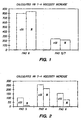
- Figure 1 is a graph comparing the absolute and relative T-4 viscosity increases in PAO 6 and PAO 5/7 based motor oil in an experiment the conditions of which are described in Example 5.
- Figure 2 is a graph comparing the absolute and relative T-4 viscosity increases in PAO 4, PAO 5 and PAO 6 based motor oil in an experiment the conditions of which are described in Example 6.
- the present invention involves improving thermal oxidative stability of engine oil by using PAO derived from a 1-dodecene or 1-tetradecene as a base oil.
- PAO 5/7 offers superior oxidation stability during use in comparison to PAO 4/6.
- improved oxidation stability is found in both gasoline (T-4) and diesel (TDI) engines (especially direct injection diesels).
- T-4 gasoline
- TDI diesel
- the superior oxidation stability qualities are shown in both fully synthetic as well as semi-synthetic engine oils, which are a mixture of PAO's and mineral oils.
- PAO 5/7 has also been shown to be superior over PAO 4/6/8 in PSA TU3M high temperature gasoline tests and Sequence IIIE high temperature oxidation tests.
- additive components are examples of some components that can be favorably employed in the present invention. These examples of additives are provided to illustrate the present invention, but they are not intended to limit it:
- an engine lubricating oil composition would contain:
- an engine lubricating oil composition is produced by blending a mixture of the above components.
- the lubricating oil composition produced by that method might have a slightly different composition than the initial mixture, because the components may interact.
- the components can be blended in any order and can be blended as combinations of components.
- Additive concentrates are also included within the scope of this invention.
- the concentrates of this invention comprise the compounds or compound mixtures of the present invention, with at least one of the additives disclosed above.
- the concentrates typically contain sufficient organic diluent to make them easy to handle during shipping and storage.
- organic diluent From 20% to 80% of the concentrate is organic diluent.
- Suitable organic diluents which can be used include for example, solvent refined 100N, i.e., Cit-Con 100N, and hydrotreated 100N, i.e., RLOP 100N, and the like.
- the organic diluent preferably has a viscosity of from about 1 to about 20 cSt at 100°C.
- Examples 1 through 4 cover bench test data obtained in the proprietary MAO 92 oxidation bench test.
- air is bubbled through an oil sample at elevated temperature.
- the oil sample contains an oxidation catalyst.
- the viscosity of the oil at 40°C is measured at regular intervals until 1000 cSt is reached. The time to reach this value is a measure of the stability. The longer the time, the better the oxidation stability.
- the MAO 92 oxidation test has a repeatability of 7 hours.
- a fully formulated engine oil was prepared, containing an additive package comprised of 6% dispersant, 71.5 mmol detergent, 15.5 mmol zinc dithiophosphate, 0.55% supplementary additives, 2.0% VII, 34.8% Esso 145N, 20.55% Esso 600N and 15% PAO 5 and 15% PAO 7. This oil was subjected to the MAO 92 oxidation test, the result being 125 hours.
- Example 2 As a comparison, a similar engine oil as described in Example 1 was prepared. However, the 15% PAO 5 and 15% PAO 7 were replaced by 30% PAO 6. The result of the oxidation test was only 100 hours.
- Example 1 The experiment of Example 1 was repeated using an additive package comprised of 6% dispersant, 71.5 mmol detergent, 15.5 mmol zinc dithiophosphate, 0.55% supplementary additives, 2.0% VII, 52% PAO 5 and 33.3% PAO 7.
- the result in the oxidation test is 162 hours.
- Example 3 As a comparison to Example 3, the PAO 5 and 7 were replaced by 11.1% PAO 4 and 74.2% PAO 6. The result in the oxidation test, 152 hours, was poor in comparison to the oil of Example 3.
- Example 1 and Comparative Example 2 were subjected to the bench tests used to mimic the viscosity increase of the VW T-4 engine test. The lower the absolute and relative viscosity increase, the better the test result. As can be seen in Figure 1, the oil based on PAO 5/7 is far superior to the oil based on PAO 6. Oil code OIL 10 OIL 11 Additive package AP7 AP7 PAO 5 15 PAO 6 30 PAO 7 15 Calculated T-4 viscosity (cSt) 756.6 201.8 Calculated T-4 viscosity increase (%) 819.0 189.7
- a fully formulated engine oil was prepared containing an additive package comprised of 6% dispersant, 87 mmol detergent, 19 mmol zinc dithiophosphate and 0.35% supplementary additives, 10.3% VII and 30% PAO 5, the balance made up by mineral base stock.
- Two similar engine oils were prepared but the 30% PAO 5 was replaced by 30% PAO 4 and 30% PAO 6, respectively. These three oils were subjected to the bench tests used to mimic the viscosity increase of the VWT-4 engine test. The lower the absolute and relative viscosity increase, the better the test result. As can be seen in Figure 2, the oil based on PAO 5 is far superior to the oils based on PAO 4 and PAO 6.
- a fully formulated engine oil was prepared containing an additive package comprised of 6.5% dispersant, 98 mmol detergent, 5.5 mmol zinc dithiophosphate and 1.8% supplementary additives, 4.0% VI improver and the balance a 57.6/42.4 mixture of PAO 4 and PAO 6.
- This oil was run in the VW TDI engine. The test was aborted after 52 hours, i.e., 8 hours before reaching the end-of-test, as result of iow oil pressure due to a lack of engine oil remaining in the sump.
- a VW TDI test was conducted on a 1.9 liter turbo charged, intercooled DI diesel type engine.
- the engine tested has power of 81 kW at 4150 rpm's.
- EGR is not activated in the engine and the oil charge is 4.5 liters.
- the test procedure had a 5 hour run-in step, a 3 hour power curve step, and a 2 hour flushing step.
- T-4 bench tests and engine tests were performed on oil compositions containing various additives, including viscosity index improvers and various proportions of PAO 4, PAO 5, PAO 6, PAO 7, PAO 8 and mineral stock.
- Tables 4A through 4D show the T-4 bench test and engine test results as well as the MAO 92 results for the compositions. These results show the correlation between the engine test results and the bench test model for both the absolute viscosity at end-of test (EOT) and also for the relative viscosity increase. Both are requirements for the T-4 test.
- EOT absolute viscosity at end-of test
- the Engine Test Conditions for conducting the VW T-4 test are given below in Table 4.
- the test oil charge was 5 liters with no oil top-up allowed.
- the limits on viscosity increase are the most difficult to achieve. Both rotative viscosity increase as well as absolute viscosity increase at EOT are limited. The limits are as follows: EOT Viscosity at 40°C ⁇ 200 cSt.
- PMA polymethylacrylate type polymers
- OCP ethylene propylene copolymers
- TGA DPeak i.e. the temperature at which the weight loss, due to both evaporation and oxidation, of the oil is the most important, which correlates with oil consumption. This test measures the weight variation of a sample as a function of temperature, under a nitrogen flow. At a certain temperature; defined as the DPeak, the weight loss is the most important. The exact DPeak value is determined as the maximum of the derivative curve. The repeatability of the TGA test is equal to 8°C. Table 7 shows the results.
- a fully formulated engine oil was prepared, containing 13.6% of an additive package, 6.9% VI Improver, 10% ester and 35% PAO 5 and 34.5% PAO 7.
- a Seq. IIIE test was run on this oil with a 1986 3.8 liter Buick V6 engine using leaded gasoline. The Initial oil fill is 5.3 liters. Total test duration is 64 hours. The engine speed is 3000 rpm with a load of 50.6 kW. The oil temperature is 149°C. The results of the test were as follows:
Landscapes
- Chemical & Material Sciences (AREA)
- Chemical Kinetics & Catalysis (AREA)
- General Chemical & Material Sciences (AREA)
- Oil, Petroleum & Natural Gas (AREA)
- Organic Chemistry (AREA)
- Lubricants (AREA)
Abstract
Description
- The present invention relates to compositions of automotive engine oils using synthetic poly alpha olefins derived from olefins other than 1-decene, especially 1-dodecene and 1-tetradecene, to improve engine oil performance, as demonstrated by the severe Volkswagen T-4, Volkswagen TDI, and Sequence IIIE tests.
- Today's automobiles tend to have smaller, more demanding engines operating at higher temperatures. Thus, the engine oil has to function in an increasingly severe environment while meeting fuel economy demands. Besides changes in the additive package, increasingly synthetic base oils are being used instead of conventional mineral oils. Of the synthetic oils, poly alpha olefins (PAO) are among the most popular.
- PAO is manufactured by oligomerization of linear alpha olefin followed by hydrogenation to remove unsaturated moleties and fractionation to obtain the desired product slate. 1-decene is the most commonly used alpha olefin in the manufacture of PAO, but 1-dodecene and 1-tetradecene can also be used. PAO's are commonly categorized by the numbers denoting the approximate viscosity in centistokes of the PAO at 100°C. It is known that PAO 2, PAO 2.5,
PAO 4,PAO 5,PAO 6, PAO 7, PAO 8, PAO 9 and PAO 10 and combinations thereof can be used in engine oils. The most common of these arePAO 4,PAO 6 and PAO 8. - Conventionally, base oils of lubricating viscosity used in motor oil compositions may be mineral oil or synthetic oils of viscosity suitable for use in the crankcase of an internal combustion engine. Crankcase base oils ordinarily have a viscosity of about 1300 cSt at 0°F (-18°C) to 24 cSt at 210°F (99°C). The base oils may be derived from synthetic or natural sources. Mineral oil for use as the base oil in this invention includes paraffinic, naphthenic and other oils that are ordinarily used in lubricating oil compositions. Synthetic oils include both hydrocarbon synthetic oils and synthetic esters.
- Although the common 1-decene based
PAO - It has been found to be difficult to blend an engine oil of the desired 0W30 viscosity grade based on
PAO PAO 4/6 based oil which passes the T-4 test is to use an expensive fully synthetic oil. - The Volkswagen T-4 and TDI tests have recently become an important measure of engine lubrication oil quality under very severe conditions. The Sequence IIIE test is analogous to a T-4 test but is specifically developed for U.S. built engines. The T-4 and Sequence IIIE tests are for gasoline engines and the TDI test is for diesel engines. They replicate the severe engine conditions put on motor lubrication oil by sustained, very high speed driving, as on the German Autobahn. What is needed is a PAO based oil which is able to successfully complete severe engine tests such as the Volkswagen T-4 and TDI tests and the Sequence IIIE test without having to use large quantities of anti-oxidants or a fully synthetic oil.
- Surprisingly, it has been found that lubrication oils based on alpha olefins having at least 12 carbons, for example, 1-dodecene, and that have approximate viscosities at 100°C of from 3.5 to 8.5 centistokes successfully pass the T-4 and TDI tests with PAO based oil weight percentages much lower than previously achieved. This represents a major development in the search for an economical lubrication oil that is well suited for modem driving conditions.
- In one embodiment, the present invention relates to the use of PAO derived from 1-dodecene or 1-tetradecene as the base oil, or a component of the base oil, of an engine oil for the purpose of improving the high temperature stability of the engine oil when compared with the use of a 1-decene derived PAO.
- In another embodiment, the present invention relates to the use of PAO derived from 1-dodecene or 1-tetradecene as the base oil, or a component of the base oil, of an engine oil comprised of base oil, dispersants, detergents, oxidation inhibitors, foam inhibitors, anti-wear agents and at least one viscosity index improver, for the purpose of improving the high temperature stability of the engine oil to least the point at which the engine oil is able to pass the VW T-4, VW TDI, or Sequence IIIE tests.
- In a preferred embodiment of either of the above embodiments, the base oil is from 15 to 85% of the engine oil and at least 15% of the base oil is derived from 1-dodecene or 1-tetradecene.
- In another preferred embodiment of the above embodiments, the PAO is from 50 to 85% of the base oil for 0W-xx SAE viscosity grade oils where xx = 20-50, is from 15 to 50% of the base oil for 5W-xx SAE viscosity grade oils where xx = 20-50, or is from 5 to 35% of the base oil for 10W-xx SAE viscosity grade oils where xx = 20-50.
- In still another embodiment, the present invention relates to an engine oil having a SAE viscosity grade of 0W-xx where xx denotes 20-40 comprised of from 15 to 85% base oil having from 50 to 85% PAO at least 15% of which is derived from 1-dodecene or 1-tetradecene, from 0 to 20% of at least one ashless dispersant: from 0 to 30% of detergent; from 0 to 5% of at least one anti-wear agent; from 0 to 10% of at least one oxidation inhibitor; from 0 to 1% of at least one foam inhibitor, and from 0 to 20% of at least one viscosity index improver.
- In yet another embodiment, the present invention relates to an engine oil having a SAE viscosity grade of 5W-xx where xx denotes 20-40 comprised of from 15 to 85% base oil having from 15 to 50% PAO at least 15% of which is derived from 1-dodecene or 1-tetradecene, from 0 to 20% of at least one ashless dispersant; from 0 to 30% of detergent; from 0 to 5% of at least one anti-wear agent; from 0 to 10% of at least one oxidation inhibitor; from 0 to 1% of at least one foam inhibitor, and from 0 to 20% of at least one viscosity index improver.
- In still another embodiment, the present invention relates to an engine oil having a SAE viscosity grade of 10W-xx where xx denotes 20-50 comprised of from 15 to 85% base oil having from 5 to 35% PAO at least 15% of which is derived from 1-dodecene or 1-tetradecene, from 0 to 20% of at least one ashless dispersant; from 0 to 30% of detergent; from 0 to 5% of at least one anti-wear agent; from 0 to 10% of at least one oxidation inhibitor; from 0 to 1% of at least one foam inhibitor, and from 0 to 20% of at least one viscosity index improver.
- In a preferred embodiment of any of the above embodiments, the PAO derived from 1-dodecene or 1-tetradecene has an approximate viscosity at 100°C of from 3.5 to 9.5 centistokes.
- In a more preferred embodiment of the above embodiment, the PAO derived from 1-dodecene or 1-tetradecene has an approximate viscosity at 100°C of approximately 5 centistokes or approximately 7 centistokes.
- In order to assist the understanding of this invention, reference will now be made to the appended drawings. The drawings are exemplary only, and should not be construed as limiting the invention.
- Figure 1 is a graph comparing the absolute and relative T-4 viscosity increases in
PAO 6 andPAO 5/7 based motor oil in an experiment the conditions of which are described in Example 5. - Figure 2 is a graph comparing the absolute and relative T-4 viscosity increases in
PAO 4,PAO 5 andPAO 6 based motor oil in an experiment the conditions of which are described in Example 6. - In its broadest aspect, the present invention involves improving thermal oxidative stability of engine oil by using PAO derived from a 1-dodecene or 1-tetradecene as a base oil.
- The difficulties encountered with the use!of PAO based on 1-decene as feedstock can be avoided by the use instead of
PAO 5 and 7 based on 1-dodecene or 1-tetradecene. - It has also been found that
PAO 5/7 offers superior oxidation stability during use in comparison toPAO 4/6. As the examples below show, such improved oxidation stability is found in both gasoline (T-4) and diesel (TDI) engines (especially direct injection diesels). Furthermore, the superior oxidation stability qualities are shown in both fully synthetic as well as semi-synthetic engine oils, which are a mixture of PAO's and mineral oils. -
PAO 5/7 has also been shown to be superior overPAO 4/6/8 in PSA TU3M high temperature gasoline tests and Sequence IIIE high temperature oxidation tests. - The following additive components are examples of some components that can be favorably employed in the present invention. These examples of additives are provided to illustrate the present invention, but they are not intended to limit it:
- (1) Metal detergents: sulfurized or unsulfurized alkyl or alkenyl phenates, alkyl or alkenyl aromatic sulfonates, sulfurized or unsulfurized metal salts of multi-hydroxy alkyl or alkenyl aromatic compounds, alkyl or alkenyl hydroxy aromatic sulfonates, sulfurized or unsulfurized alkyl or alkenyl naphthenates, metal salts of alkanoic acids, metal salts of an alkyl or alkenyl multi-acid, metal salts of an alkyl salicylic acid, carboxylates, overbased detergents and chemical and physical mixtures thereof.
- (2) Ashless dispersants: alkenyl succinimides, alkenyl succinimides modified with other organic compounds, and alkenyl succinimides modified with boric acid, alkenyl succinic ester.
- (3) Oxidation inhibitors:
- (a) Phenol type oxidation inhibitors: 4,4'-methylenebis (2,6-di-tert-butylphenol), 4,4'-bis(2,6-di-tert-butylphenol), 4,4'-bis(2-methyl-6-tert-butylphenol), 2,2'-(methylenebis (4-methyl-6-tert-butyl-phenol), 4,4'-butylidenebis(3-methyl-6-tert-butylphenol), 4,4'-isopropylidenebis(2,6-di-tert-butylphenol), 2,2'-methylnebis(4-methyl-6-nonylphenol), 2,2'-isobutylidene-bis(4,6-dimethylphenol), 2,2'-methylenebis(4-methyl-6-cyclohaxylphenol), 2,6-di-tert-butyl-4-methylphenol, 2,6-di-tert-butyl-4-ethylphenol, 2,4-dimethyl-6-tert-butyl-phenol, 2,6-di-tert-4-(N,N' dimethylaminomethylphenol), 4,4'-thiobis(2-methyl-6-tert-butylphenol), 2,2'-thiobis(4-methyl-6-tert-butylphenol), bis(3-methyl-4-hydroxy-5-tert-butylbenzyl)-sulfide, and bis (3,5-di-tert-butyl-4-hydroxybenzyl).
- (b) Diphenylamine type oxidation inhibitor: alkylated diphenylamine, phenyl-1-naphthylamine, and alkylated 1-naphthylamine.
- (c) Other types: metal dithiocarbamate (e.g., zinc dithiocarbamate), and methylenebis (dibutyldithiocarbamate).
- (4) Rust inhibitors (Anti-rust agents):
- (a) Nonionic polyoxyethylene surface active agents: polyoxyethylene lauryl ether, polyoxyethylene higher alcohol ether, polyoxyethylene nonylphenyl ether, polyoxyethylene octylphenyl ether, polyoxyethylene octyl stearyl ether, polyoxyethylene oleyl ether, polyoxyethylene sorbitol monostearate, polyoxyethylene sorbitol mono-oleate, and polyethylene glycol monooleate.
- (b) Other compounds: stearic acid and other fatty acids, dicarboxilic acids, metal soaps, fatty acid amine salts, metal salts of heavy sulfonic acid, partial carboxylic acid ester of polyhydric alcohol, and phosphoric ester.
- (5) Demulsifiers: addition product of alkylphenol and ethyleneoxide, polyoxyethylene alkyl ether, and polyoxyethylene sorbitan ester.
- (6) Extreme pressure agents (EP agents): zinc dithiophosphates, zinc dithiocarbamates, zinc dialkyldithiophosphate (primary alkyl type & secondary alkyl type), zinc diaryl dithiophosphate, sulfurized oils, diphenyl sulfide, methyl trichlorostearate, chlorinated naphthalene, fluoroalkylpolysiloxane, and lead naphthenate.
- (7) Friction modifiers: fatty alcohol, fatty acid, amine, borated ester, and other esters.
- (8) Multifunctional additives: sulfurized oxymolybdenum dithiocarbamate, sulfurized oxymolybdenum organo phosphoro dithioate, oxymolybdenum monoglyceride, oxymolybdenum diethylate amide, amine-molybdenum complex compound, and sulfur-containing molybdenum complex compound.
- (9) Viscosity index improvers: polymethacrylate type polymers, ethylenepropylene copolymers, styrene-isoprene copolymers, hydrated styrene-isoprene copolymers, polyisobutylene, and dispersant type viscosity index improvers.
- (10) Pour point depressants: polymethyl methacrylate.
- (11) Foam inhibitors: alkyl methacrylate polymers and dimethyl silicone polymers.
-
- In one embodiment, an engine lubricating oil composition would contain:
- (a) a major part of a base oil of lubricating viscosity, wherein the base oil comprises 1-dodecene and/or 1-tetradecene-derived polyalphaolefins;
- (b) 0% to 20% of at least one ashless dispersant;
- (c) 0% to 30% of the detergent;
- (d) 0% to 5% of at least one zinc dithiophosphate;
- (e) 0% to 10% of at least one oxidation inhibitor;
- (f) 0% to 1% of at least one foam inhibitor; and
- (g) 0% to 20% of at least one viscosity index improver.
-
- In a further embodiment, an engine lubricating oil composition is produced by blending a mixture of the above components. The lubricating oil composition produced by that method might have a slightly different composition than the initial mixture, because the components may interact. The components can be blended in any order and can be blended as combinations of components.
- Additive concentrates are also included within the scope of this invention. The concentrates of this invention comprise the compounds or compound mixtures of the present invention, with at least one of the additives disclosed above. Typically, the concentrates contain sufficient organic diluent to make them easy to handle during shipping and storage.
- From 20% to 80% of the concentrate is organic diluent. Suitable organic diluents which can be used include for example, solvent refined 100N, i.e., Cit-Con 100N, and hydrotreated 100N, i.e., RLOP 100N, and the like. The organic diluent preferably has a viscosity of from about 1 to about 20 cSt at 100°C.
- The invention will be further illustrated by following examples, which set forth particularly advantageous method embodiments. While the Examples are provided to illustrate the present invention, they are not Intended to limit it.
- Examples 1 through 4 cover bench test data obtained in the proprietary MAO 92 oxidation bench test. In this test, air is bubbled through an oil sample at elevated temperature. The oil sample contains an oxidation catalyst. The viscosity of the oil at 40°C is measured at regular intervals until 1000 cSt is reached. The time to reach this value is a measure of the stability. The longer the time, the better the oxidation stability. The MAO 92 oxidation test has a repeatability of 7 hours.
- A fully formulated engine oil was prepared, containing an additive package comprised of 6% dispersant, 71.5 mmol detergent, 15.5 mmol zinc dithiophosphate, 0.55% supplementary additives, 2.0% VII, 34.8% Esso 145N, 20.55% Esso 600N and 15
% PAO 5 and 15% PAO 7. This oil was subjected to the MAO 92 oxidation test, the result being 125 hours. - As a comparison, a similar engine oil as described in Example 1 was prepared. However, the 15
% PAO 5 and 15% PAO 7 were replaced by 30% PAO 6. The result of the oxidation test was only 100 hours. - The experiment of Example 1 was repeated using an additive package comprised of 6% dispersant, 71.5 mmol detergent, 15.5 mmol zinc dithiophosphate, 0.55% supplementary additives, 2.0% VII, 52
% PAO 5 and 33.3% PAO 7. The result in the oxidation test is 162 hours. - As a comparison to Example 3, the
PAO 5 and 7 were replaced by 11.1% PAO 4 and 74.2% PAO 6. The result in the oxidation test, 152 hours, was poor in comparison to the oil of Example 3. - The oils of Example 1 and Comparative Example 2 were subjected to the bench tests used to mimic the viscosity increase of the VW T-4 engine test. The lower the absolute and relative viscosity increase, the better the test result. As can be seen in Figure 1, the oil based on
PAO 5/7 is far superior to the oil based onPAO 6.Oil code OIL 10 OIL 11 Additive package AP7 AP7 PAO 5 15 PAO 630 PAO 7 15 Calculated T-4 viscosity (cSt) 756.6 201.8 Calculated T-4 viscosity increase (%) 819.0 189.7 - A fully formulated engine oil was prepared containing an additive package comprised of 6% dispersant, 87 mmol detergent, 19 mmol zinc dithiophosphate and 0.35% supplementary additives, 10.3% VII and 30
% PAO 5, the balance made up by mineral base stock. Two similar engine oils were prepared but the 30% PAO 5 was replaced by 30% PAO 4 and 30% PAO 6, respectively. These three oils were subjected to the bench tests used to mimic the viscosity increase of the VWT-4 engine test. The lower the absolute and relative viscosity increase, the better the test result. As can be seen in Figure 2, the oil based onPAO 5 is far superior to the oils based onPAO 4 andPAO 6.Oil code OIL 13 OIL 12 OIL 14 Additive package AP4 AP4 AP4 PAO 5 30 PAO 430 PAO 630 Calculated T-4 viscosity (cSt) 99.4 258.2 154.3 Calculated T-4 viscosity increase (%) 10.5 212 79.5 - A fully formulated engine oil was prepared containing an additive package comprised of 6.5% dispersant, 98 mmol detergent, 5.5 mmol zinc dithiophosphate and 1.8% supplementary additives, 4.0% VI improver and the balance a 57.6/42.4 mixture of
PAO 4 andPAO 6. This oil was run in the VW TDI engine. The test was aborted after 52 hours, i.e., 8 hours before reaching the end-of-test, as result of iow oil pressure due to a lack of engine oil remaining in the sump. - A VW TDI test was conducted on a 1.9 liter turbo charged, intercooled DI diesel type engine. The engine tested has power of 81 kW at 4150 rpm's. There are 4 cylinders in the engine measuring 79.5 x 95.5 mm (b x s). EGR is not activated in the engine and the oil charge is 4.5 liters. The test procedure had a 5 hour run-in step, a 3 hour power curve step, and a 2 hour flushing step.
- These steps were followed by a 60 hour cycling step which had two stages: stage 1, the idling stage; and stage 2, the full load stage. One cycle takes three hours and the cycle was repeated 20 times (20 x 3 hrs.). Further facts about the cycling stage are given in Table 3 below.
CEC L-78-T-96 (TDI) Engine Test
Test ConditionsStage 1 Stage 2 Duration (minutes) 30 150 Speed (rpm) Idle 4150 Oil Temperature (°C) 40 145 Coolant Temperature (°C) 30 90 Boost Air Temperature (°C) 30 60 - As a comparison to Example 6, the
PAO % PAO 5 and 91.4% PAO 7. The oil successfully completed the 60 hour VW TDI engine test. - T-4 bench tests and engine tests were performed on oil compositions containing various additives, including viscosity index improvers and various proportions of
PAO 4,PAO 5,PAO 6, PAO 7, PAO 8 and mineral stock. Tables 4A through 4D show the T-4 bench test and engine test results as well as the MAO 92 results for the compositions. These results show the correlation between the engine test results and the bench test model for both the absolute viscosity at end-of test (EOT) and also for the relative viscosity increase. Both are requirements for the T-4 test. - The Engine Test Conditions for conducting the VW T-4 test are given below in Table 4. The total test had a duration of 262 hours (10 hours run-in, + 2 hours power curve, + 2 hours flushing, + 48 x PNK cycles = 48 x 4 = 192 hrs, + 56 hrs N cycle → 262 hours). The test oil charge was 5 liters with no oil top-up allowed. Of the various test requirements, the limits on viscosity increase are the most difficult to achieve. Both rotative viscosity increase as well as absolute viscosity increase at EOT are limited. The limits are as follows: EOT Viscosity at 40°C <200 cSt.
- EOT Viscosity increase <130%.
Oil Code OIL 1 OIL 2 OIL 3 Additive Package AP1 AP 2 AP3 --dispersant (wt%) n.a. 5 6.75 --detergent (mmol) n.a. 84 70 -zinc dithiophosphate (mmol) n.a. 18 18 -supplementary additives (wt%) n.a. 1.6 0.93 VI Improver (%) n.a. 4.7 10.5 VI Improver polymethylacrylate type polymers (PMA) ethylene propylene copolymers (OCP) PAO 4n.a. PAO 5n.a. PAO 6n.a. 62.1 25 PAO 7 n.a. PAO 8 n.a. 20 Mineral Stock (%) n.a. 50.6 Mineral Stock n.a. full synth. Group 1 TGA (°C) 336.8 342.5 312.5 MAO 92-visc. at 100 H (cSt) 69.3 125.9 180.1 MAO 92-visc. increase at 100 H (%) -9.8 65.9 87.1 Calculated VW T-4 viscosity increase (cSt) 107.8 114.1 302.8 Calculated VW T-4 viscosity increase (%) 47.9 55.3 264.0 Act. T-4 visc. increase (cSt) 134.2 107.0 450.9 Act. T-4 visc. increase (%) 74.5 41.0 368.5 Oil Code OIL4 OIL5 OIL6 Additive Package AP2 AP4 AP5 --dispersant (wt%) 5 6 6.5 --detergent (mmol) 84 87 98 -zinc dithiophosphate (mmol) 18 19 15.5 -supplementary additives (wt%) 1.6 0.35 1.8 VI Improver (%) 6.2 9 6.3 VI Improver OCP OCP Styrene isoprene copolymers (Styr.-IP) PAO 445.5 PAO 5PAO 621.8 23.5 13.1 PAO 7 PAO 8 Mineral Stock (%) 58.8 55 20 Mineral Stock Group I Group I Group II TGA (°C) 316.2 318.7 320 MAO 92-visc. at 100 H (cSt) 1344.6 190.9 74 MAO 92-visc. increase at 100 H (%) 1326.5 108.7 32.3 Calculated VW T-4 viscosity increase (cSt) 1017.4 277.2 197.3 Calculated VW T-4 viscosity increase (%) 971.1 236.2 182.7 Act. T-4 visc. increase (cSt) Too viscous to measure 335.4 151.7 Act. T-4 visc. increase (%) 268.0 171.2 Oil Code OIL7 OIL8 OIL9 Additive Package AP5 AP5 AP6 --dispersant (wt%) 6.5 6.5 6 --detergent (mmol) 98 98 93 -zinc dithiophosphate (mmol) 15.5 15.5 19 -supplementary additives (wt%) 1.8 1.8 1.6 VI Improver (%) 5.2 5.0 5.0 VI Improver Styr.-IP Styr.-IP Styr.- IP PAO 4 43 15.98 15.98 PAO 563.92 63.92 PAO 636.7 PAO 7 PAO 8 Mineral Stock (%) Mineral Stock TGA (°C) 314 353 355 MAO 92-visc. at 100 H (cSt) 53.8 51.1 -25.4 MAO 92-visc. increase at 100 H (%) -1.3 50.5 -25.3 Calculated VW T-4 viscosity increase (cSt) 215.5 12.9 -45.6 Calculated VW T-4 viscosity increase (%) 202.1 -22.4 -80.2 Act. T-4 visc. increase (cSt) 118.0 Act. T-4 visc. increase (%) 108.0 Oil Code OIL10 OIL11 Additive Package AP7 AP7 --dispersant (wt%) 6 6 --detergent (mmol) 71.5 71.5 -zinc dithiophosphate (mmol) 15.5 15.5 -supplementary additives (wt%) 0.55 0.55 VI Improver (%) 2.0 2.0 VI Improver OCP OCP PAO 4 PAO 515 PAO 630 PAO 7 15 PAO 8 Mineral Stock (%) 55.3 55.3 Mineral Stock Group I Group I TGA (°C) 310 325 MAO 92-visc. at 100 H (cSt) 880 122 MAO 92-visc. increase at 100 H (%) 1000 99.7 Calculated VW T-4 viscosity increase (cSt) 756.6 201.8 Calculated VW T-4 viscosity increase (%) 819.0 189.7 Act. T-4 visc. increase (cSt) Act. T-4 visc. increase (%) VW PV 1449 ENGINE TEST (T-4)
Test ConditionsPNK Cycles Max Power P Max NOx N Cold Idling K Max NOx N Duration 120 min 72 min 48 min 56 hrs RPM 4300 4300 900 4300 Oil Sump Temp °C 133 130 40 130 Coolant Temp ° C 100 100 30 100 Power kW 62 34 0 34 Torque Nm 140 75 0 75 Fuel Cons. kg/h 19.4 10.8 1.1 10.8 Exh. Gas Temp °C 820 763 292 763 Oil Code Oil 12 Oil 13 Oil 14 ADDITIVE PACKAGE AP4 AP4 AP4 -dispersant (wt%) 6 6 6 -detergent (mmol) 87 87 87 -zinc dithiophosphate (mmol) 19 19 19 -supplementary additives (wt%) 0.35 0.35 0.35 VI IMPROVER (%) 10.4 10.3 10.7 VI IMPROVER OCP OCP OCP PAO 4 30 PAO 530 PAO 630 PAO 7 PAO 8 MINERAL STOCK (%) 47.1 47.2 46.8 MINERAL STOCK Gr. I/III Gr. I/III Gr. I/III - Bench test analysis was performed on four different samples of oil to find the TGA DPeak (i.e. the temperature at which the weight loss, due to both evaporation and oxidation, of the oil is the most important, which correlates with oil consumption). This test measures the weight variation of a sample as a function of temperature, under a nitrogen flow. At a certain temperature; defined as the DPeak, the weight loss is the most important. The exact DPeak value is determined as the maximum of the derivative curve. The repeatability of the TGA test is equal to 8°C. Table 7 shows the results.
Test 1 Test 2 Test 3 Test 4Dispersant wt% 6.5 6.5 6 6 Detergent mmol 98 98 71.5 71.5 Zinc dithiophosphate mmol 15.5 15.5 15.5 15.5 Supplementary additives wt% 1.8 1.8 0.55 0.55 VII wt% 5.2 5.2 2.0 2.0 PAO 4/6 wt %43/36.7 PAO 4/5 wt %15.98/63.92 PAO 6 wt %30 PAO 5/7 wt %30 Mineralstock wt % 55.3 Esso 55.3 Esso TGA (°C) 314 353 310 325 - A fully formulated engine oil was prepared, containing 13.6% of an additive package, 6.9% VI Improver, 10% ester and 35
% PAO 5 and 34.5% PAO 7. A Seq. IIIE test was run on this oil with a 1986 3.8 liter Buick V6 engine using leaded gasoline. The Initial oil fill is 5.3 liters. Total test duration is 64 hours. The engine speed is 3000 rpm with a load of 50.6 kW. The oil temperature is 149°C. The results of the test were as follows: - viscosity increase: -11%
- time to 375% vis. incr.: 87.3 hours
- Aver. engine sludge: 9.7
- oil consumption, liter 0.67
- As a comparison, a similar engine oil as described above was prepared. However, the 35
% PAO 5 and 34.5% PAO 7 were replaced by 69.5% PAO 6. Again, a Seq. IIIE was run, resulting in: - viscosity increase: 1%
- time to 375% vis. incr.: 85.8 hours
- Aver. engine sludge: 9.6
- oil consumption, liter 1.14
- While the present invention has been described with reference to specific embodiments, this application is intended to cover those various changes and substitutions that may be made by those skilled in the art without departing from the spirit and scope of the appended claims.
Claims (19)
- The use, in an engine oil base oil, of a PAO base oil derived from 1-dodecene or 1-tetradecene having a viscosity of from 3.5 to 9.5 mm2s-1, for the purpose of improving the high temperature stability of the engine oil as measured using the VW T-4 engine test when compared with the use of a 1-decene derived PAO.
- The use according to claim 1, wherein the PAO is from 50 to 85% of the base oil for 0W-xx SAE viscosity grade oils where xx = 20-40.
- The use according to claim 1, wherein the PAO is from 15 to 50% of the base oil for 5W-xx SAE viscosity grade oils where xx = 20-50.
- The use according to claim 1, wherein the PAO is from 5 to 35% of the base oil for 10W-xx SAE viscosity grade oils where xx = 20-50.
- The use according to any preceding claim, wherein the PAO derived from 1-dodecene or 1-tetradecene has a viscosity of from 5 to 9.5 mm2s-1,
- The use according to any preceding claim, wherein the PAO derived from 1-dodecene or 1-tetradecene has a viscosity at 100°C of no greater than 7 mm2s-1.
- The use according claim 6, wherein the PAO derived from 1-dodecene or 1-tetradecene has a viscosity at 100°C of 5 mm2s-1 or 7 mm2s-1.
- The use according to any one of the preceding claims, wherein the engine oil further comprises one or more additive selected from dispersants, detergents, oxidation inhibitors, foam inhibitors, anti-wear agents and viscosity index improvers.
- The use according to any one of the preceding claims, wherein the high temperature stability of the engine oil is improved to at least the point at which the engine oil is able to pass the VW T-4 engine test.
- An engine oil comprising a base oil, wherein the base oil comprises a PAO base oil derived from 1-dodecene or 1-tetradecene having a viscosity of from 3.5 to 9.5 mm2s-1 and having improved high temperature stability of the engine oil as measured using the VW T-4 engine test when compared with the use of a 1-decene derived PAO.
- The engine oil according to claim 10, wherein the PAO is from 50 to 85% of the base oil for 0W-xx SAE viscosity grade oils where xx = 20-40.
- The engine oil according to claim 10, wherein the PAO is from 15 to 50% of the base oil for 5W-xx SAE viscosity grade oils where xx = 20-50.
- The engine oil according to claim 10, wherein the PAO is from 5 to 35% of the base oil for 10W-xx SAE viscosity grade oils where xx = 20-50.
- The engine oil according to any one of claims 10 to 13, wherein the PAO derived from 1-dodecene or 1-tetradecene has a viscosity of from 5 to 9.5 mm2s-1,
- The engine oil according to any one of claims 10 to 14, wherein the PAO derived from 1-dodecene or 1-tetradecene has a viscosity at 100°C of no greater than 7 mm2s-1.
- The engine oil according claim 15, wherein the PAO derived from 1-dodecene or 1-tetradecene has a viscosity at 100°C of 5 mm2s-1 or 7 mm2s-1.
- The engine oil according to any one of claims 10 to 16, further comprising a mineral oil.
- The engine oil according to any one of claims 10 to 17, further comprising one or more additive selected from dispersants, detergents, oxidation inhibitors, foam inhibitors, anti-wear agents and viscosity index improvers.
- The engine oil according to any one of claims 10 to 18, wherein the high temperature stability of the engine oil is improved to at least the point at which the engine oil is able to pass the VW T-4 engine test.
Priority Applications (1)
| Application Number | Priority Date | Filing Date | Title |
|---|---|---|---|
| EP04027778A EP1520903A1 (en) | 1998-01-30 | 1999-01-27 | Use of polyalfaolefins (pao) derived from 1-dodecene or 1-tetradecene to imrove thermal stability of engine oils in internal combustion engines |
Applications Claiming Priority (4)
| Application Number | Priority Date | Filing Date | Title |
|---|---|---|---|
| EP98400204A EP0933416A1 (en) | 1998-01-30 | 1998-01-30 | Use of polyalfaolefins (PAO) derived from 1-dodecene or 1-tetradecene to improve thermal stability in engine oil in internal combustion engine |
| EP98400204 | 1998-01-30 | ||
| EP99900590A EP1051466B1 (en) | 1998-01-30 | 1999-01-27 | Use of polyalfaolefins (pao) derived from 1-dodecene or 1-tetradecene to imrove thermal stability in engine oil in an internal combustion engine |
| EP04027778A EP1520903A1 (en) | 1998-01-30 | 1999-01-27 | Use of polyalfaolefins (pao) derived from 1-dodecene or 1-tetradecene to imrove thermal stability of engine oils in internal combustion engines |
Related Parent Applications (1)
| Application Number | Title | Priority Date | Filing Date |
|---|---|---|---|
| EP99900590A Division EP1051466B1 (en) | 1998-01-30 | 1999-01-27 | Use of polyalfaolefins (pao) derived from 1-dodecene or 1-tetradecene to imrove thermal stability in engine oil in an internal combustion engine |
Publications (1)
| Publication Number | Publication Date |
|---|---|
| EP1520903A1 true EP1520903A1 (en) | 2005-04-06 |
Family
ID=34315363
Family Applications (1)
| Application Number | Title | Priority Date | Filing Date |
|---|---|---|---|
| EP04027778A Withdrawn EP1520903A1 (en) | 1998-01-30 | 1999-01-27 | Use of polyalfaolefins (pao) derived from 1-dodecene or 1-tetradecene to imrove thermal stability of engine oils in internal combustion engines |
Country Status (1)
| Country | Link |
|---|---|
| EP (1) | EP1520903A1 (en) |
Citations (6)
| Publication number | Priority date | Publication date | Assignee | Title |
|---|---|---|---|---|
| GB1264981A (en) * | 1968-03-15 | 1972-02-23 | ||
| US3763244A (en) * | 1971-11-03 | 1973-10-02 | Ethyl Corp | Process for producing a c6-c16 normal alpha-olefin oligomer having a pour point below about- f. |
| US4218330A (en) * | 1978-06-26 | 1980-08-19 | Ethyl Corporation | Lubricant |
| GB2078776A (en) * | 1980-06-03 | 1982-01-13 | Nippon Petrochemicals Co Ltd | Method for producing fluid for use as lubricating oil |
| JPH05331483A (en) * | 1992-06-01 | 1993-12-14 | Tonen Corp | Lubricating oil composition for internal combustion engine |
| GB2307243A (en) * | 1995-11-14 | 1997-05-21 | Albemarle S A | Biodegradable polyalphaolefin fluids |
-
1999
- 1999-01-27 EP EP04027778A patent/EP1520903A1/en not_active Withdrawn
Patent Citations (6)
| Publication number | Priority date | Publication date | Assignee | Title |
|---|---|---|---|---|
| GB1264981A (en) * | 1968-03-15 | 1972-02-23 | ||
| US3763244A (en) * | 1971-11-03 | 1973-10-02 | Ethyl Corp | Process for producing a c6-c16 normal alpha-olefin oligomer having a pour point below about- f. |
| US4218330A (en) * | 1978-06-26 | 1980-08-19 | Ethyl Corporation | Lubricant |
| GB2078776A (en) * | 1980-06-03 | 1982-01-13 | Nippon Petrochemicals Co Ltd | Method for producing fluid for use as lubricating oil |
| JPH05331483A (en) * | 1992-06-01 | 1993-12-14 | Tonen Corp | Lubricating oil composition for internal combustion engine |
| GB2307243A (en) * | 1995-11-14 | 1997-05-21 | Albemarle S A | Biodegradable polyalphaolefin fluids |
Non-Patent Citations (1)
| Title |
|---|
| DATABASE WPI Section Ch Week 9403, Derwent World Patents Index; Class A17, AN 94-023131, XP002068813 * |
Similar Documents
| Publication | Publication Date | Title |
|---|---|---|
| EP1051466B1 (en) | Use of polyalfaolefins (pao) derived from 1-dodecene or 1-tetradecene to imrove thermal stability in engine oil in an internal combustion engine | |
| JP3615267B2 (en) | Engine oil composition | |
| KR102649415B1 (en) | Lubricating oil composition | |
| CA2390743C (en) | Lubricating oil compositions | |
| JPH09111275A (en) | Diesel engine oil composition | |
| US10227546B2 (en) | Multifunctional molybdenum containing compounds, method of making and using, and lubricating oil compositions containing same | |
| JPH05163497A (en) | Engine oil composition | |
| JP5330716B2 (en) | Lubricating oil composition | |
| KR102691225B1 (en) | Lubricating oil compositions | |
| JPH10183154A (en) | Lubricating oil composition | |
| KR20200071741A (en) | Antioxidant polymeric diphenylamine composition | |
| US20010001804A1 (en) | Polyalphaolefins with improved oxidative stability and the process of making thereof | |
| JPH08209178A (en) | Lubricating oil composition | |
| JPH1135962A (en) | Lubricating oil composition | |
| AU2002346577A1 (en) | Sulfur containing lubricating oil additive system particularly useful for natural gas fueled engines | |
| JP2006182986A (en) | Lubricating oil composition | |
| JP4038388B2 (en) | Engine oil composition | |
| CA2316997A1 (en) | Use of polyalfaolefins (pao) derived from 1-dodecene or 1-tetradecene to improve thermal stability in engine oil in an internal combustion engine | |
| CN105296062A (en) | Preparation method of anti-oxidative natural gas engine lubricating oil | |
| JP7672409B2 (en) | Lubricating oil composition containing polyalphaolefins | |
| JP2019502851A (en) | Separation lubrication method for drive system for electric vehicle | |
| CN112280609A (en) | Lubricating oil composition | |
| CA3163425C (en) | Lubricating oil compositions comprising a polyalphaolefin | |
| JP4632465B2 (en) | Lubricating oil composition | |
| KR20160074557A (en) | Lubricating oil composition for protection of silver bearings in medium speed diesel engines |
Legal Events
| Date | Code | Title | Description |
|---|---|---|---|
| PUAI | Public reference made under article 153(3) epc to a published international application that has entered the european phase |
Free format text: ORIGINAL CODE: 0009012 |
|
| AC | Divisional application: reference to earlier application |
Ref document number: 1051466 Country of ref document: EP Kind code of ref document: P |
|
| AK | Designated contracting states |
Kind code of ref document: A1 Designated state(s): AT BE DE FI FR GB NL |
|
| 17P | Request for examination filed |
Effective date: 20051004 |
|
| AKX | Designation fees paid |
Designated state(s): AT BE DE FR GB |
|
| STAA | Information on the status of an ep patent application or granted ep patent |
Free format text: STATUS: THE APPLICATION IS DEEMED TO BE WITHDRAWN |
|
| 18D | Application deemed to be withdrawn |
Effective date: 20110802 |