EP1520098B1 - Geführter gleitschuh für eine radialkolbenpumpe - Google Patents
Geführter gleitschuh für eine radialkolbenpumpe Download PDFInfo
- Publication number
- EP1520098B1 EP1520098B1 EP03742355A EP03742355A EP1520098B1 EP 1520098 B1 EP1520098 B1 EP 1520098B1 EP 03742355 A EP03742355 A EP 03742355A EP 03742355 A EP03742355 A EP 03742355A EP 1520098 B1 EP1520098 B1 EP 1520098B1
- Authority
- EP
- European Patent Office
- Prior art keywords
- piston
- pump
- shoe
- arms
- drive member
- Prior art date
- Legal status (The legal status is an assumption and is not a legal conclusion. Google has not performed a legal analysis and makes no representation as to the accuracy of the status listed.)
- Expired - Lifetime
Links
- 238000005086 pumping Methods 0.000 claims description 30
- 230000015572 biosynthetic process Effects 0.000 claims description 11
- 238000005755 formation reaction Methods 0.000 claims description 11
- 230000000295 complement effect Effects 0.000 claims description 5
- 238000004891 communication Methods 0.000 claims description 3
- 239000012530 fluid Substances 0.000 claims description 3
- 239000000446 fuel Substances 0.000 description 14
- 238000000926 separation method Methods 0.000 description 9
- 239000007787 solid Substances 0.000 description 4
- 238000002485 combustion reaction Methods 0.000 description 3
- 101150027068 DEGS1 gene Proteins 0.000 description 2
- 230000009286 beneficial effect Effects 0.000 description 2
- 238000006243 chemical reaction Methods 0.000 description 2
- 238000006073 displacement reaction Methods 0.000 description 2
- 230000000717 retained effect Effects 0.000 description 2
- 230000001627 detrimental effect Effects 0.000 description 1
- 230000000694 effects Effects 0.000 description 1
- 238000002347 injection Methods 0.000 description 1
- 239000007924 injection Substances 0.000 description 1
- 239000007788 liquid Substances 0.000 description 1
- 230000001050 lubricating effect Effects 0.000 description 1
- 238000005461 lubrication Methods 0.000 description 1
- 238000000034 method Methods 0.000 description 1
Images


Classifications
-
- F—MECHANICAL ENGINEERING; LIGHTING; HEATING; WEAPONS; BLASTING
- F02—COMBUSTION ENGINES; HOT-GAS OR COMBUSTION-PRODUCT ENGINE PLANTS
- F02M—SUPPLYING COMBUSTION ENGINES IN GENERAL WITH COMBUSTIBLE MIXTURES OR CONSTITUENTS THEREOF
- F02M59/00—Pumps specially adapted for fuel-injection and not provided for in groups F02M39/00 -F02M57/00, e.g. rotary cylinder-block type of pumps
- F02M59/02—Pumps specially adapted for fuel-injection and not provided for in groups F02M39/00 -F02M57/00, e.g. rotary cylinder-block type of pumps of reciprocating-piston or reciprocating-cylinder type
- F02M59/04—Pumps specially adapted for fuel-injection and not provided for in groups F02M39/00 -F02M57/00, e.g. rotary cylinder-block type of pumps of reciprocating-piston or reciprocating-cylinder type characterised by special arrangement of cylinders with respect to piston-driving shaft, e.g. arranged parallel to that shaft or swash-plate type pumps
- F02M59/06—Pumps specially adapted for fuel-injection and not provided for in groups F02M39/00 -F02M57/00, e.g. rotary cylinder-block type of pumps of reciprocating-piston or reciprocating-cylinder type characterised by special arrangement of cylinders with respect to piston-driving shaft, e.g. arranged parallel to that shaft or swash-plate type pumps with cylinders arranged radially to driving shaft, e.g. in V or star arrangement
-
- F—MECHANICAL ENGINEERING; LIGHTING; HEATING; WEAPONS; BLASTING
- F02—COMBUSTION ENGINES; HOT-GAS OR COMBUSTION-PRODUCT ENGINE PLANTS
- F02M—SUPPLYING COMBUSTION ENGINES IN GENERAL WITH COMBUSTIBLE MIXTURES OR CONSTITUENTS THEREOF
- F02M59/00—Pumps specially adapted for fuel-injection and not provided for in groups F02M39/00 -F02M57/00, e.g. rotary cylinder-block type of pumps
- F02M59/02—Pumps specially adapted for fuel-injection and not provided for in groups F02M39/00 -F02M57/00, e.g. rotary cylinder-block type of pumps of reciprocating-piston or reciprocating-cylinder type
- F02M59/10—Pumps specially adapted for fuel-injection and not provided for in groups F02M39/00 -F02M57/00, e.g. rotary cylinder-block type of pumps of reciprocating-piston or reciprocating-cylinder type characterised by the piston-drive
- F02M59/102—Mechanical drive, e.g. tappets or cams
-
- F—MECHANICAL ENGINEERING; LIGHTING; HEATING; WEAPONS; BLASTING
- F04—POSITIVE - DISPLACEMENT MACHINES FOR LIQUIDS; PUMPS FOR LIQUIDS OR ELASTIC FLUIDS
- F04B—POSITIVE-DISPLACEMENT MACHINES FOR LIQUIDS; PUMPS
- F04B1/00—Multi-cylinder machines or pumps characterised by number or arrangement of cylinders
- F04B1/04—Multi-cylinder machines or pumps characterised by number or arrangement of cylinders having cylinders in star- or fan-arrangement
- F04B1/0404—Details or component parts
- F04B1/0408—Pistons
-
- F—MECHANICAL ENGINEERING; LIGHTING; HEATING; WEAPONS; BLASTING
- F04—POSITIVE - DISPLACEMENT MACHINES FOR LIQUIDS; PUMPS FOR LIQUIDS OR ELASTIC FLUIDS
- F04B—POSITIVE-DISPLACEMENT MACHINES FOR LIQUIDS; PUMPS
- F04B1/00—Multi-cylinder machines or pumps characterised by number or arrangement of cylinders
- F04B1/04—Multi-cylinder machines or pumps characterised by number or arrangement of cylinders having cylinders in star- or fan-arrangement
- F04B1/0404—Details or component parts
- F04B1/0426—Arrangements for pressing the pistons against the actuated cam; Arrangements for connecting the pistons to the actuated cam
Definitions
- the present invention relates to radial piston pumps and more particularly, to radial piston pumps of the type used in fuel supply systems for internal combustion engines.
- Radial piston pumps particularly the type used for pressurizing fuel for delivery to the combustion chambers of internal combustion engines, typically have a housing defining a central cavity and a drive member mounted about a drive axis for rotation in the cavity. At least one piston bore extends radially relative to the axis, through the housing to the cavity.
- a piston oriented radially within the piston bore has a radially outer pumping end and a radially inner driven end cooperating with the drive member for reciprocal movement in the piston bore between top dead center and bottom dead center travel limits.
- a sliding shoe engages the driven end of the piston and bears on the drive member, for providing the cooperation whereby the rotary movement of the drive member is converted to the reciprocal movement of the piston.
- a return spring urges the driven end of the piston toward the shoe and the drive member.
- the drive member is eccentric, i.e., it has an outer circular surface with a center that is offset with respect to the drive axis.
- the driven end of the piston bears pivotally against, without being rigidly attached to, the shoe, to accommodate the eccentric path of the drive member.
- the projecting rim is in the form of guide arms that are spaced apart to form a castellated, substantially annular rim around the socket portion, such that in the event of separation of the driven end of the piston from the socket and the bottom side of the shoe from the drive member, with a resulting "floating" and misorientation of the shoe, at least a portion of one and preferably two of the guide arms, remains within the mounting bore of the piston, thereby preventing the shoe from experiencing excessive misorientation or displacement into the cavity.
- Figure 1 shows a pump housing 10 having a bore 12 in which is mounted a pumping chamber assembly 14, for example, via a threaded connection 16 with associated seals 18 and cap 20.
- the assembly includes a generally cylindrical piston chamber wall 22, in which the pumping piston or plunger 24 is oriented for reciprocal motion.
- the portion 26 of the chamber In a retracted or bottom dead center position, the portion 26 of the chamber is filled, or partially filled with relatively low pressure feed fuel.
- the fuel in the pumping chamber 26 is highly pressurized and discharged for ultimately delivery, such as by injection, to the engine cylinders.
- the piston mounting bore 12 opens to a cavity 28 of the housing where feed fuel is maintained at a relatively low pressure and where a rotating drive member, especially an eccentric drive member 30, is mounted for rotation about a drive axis.
- the piston bore extends radially, relative to the drive axis, through the housing to the cavity, and the piston 24 is oriented radially within the piston bore.
- the piston has a radially inner, driven end 32, preferably in the form of a bulb or portion of a sphere, and a radially outer pumping end 34.
- a sliding shoe 36 is provided for pivotally engaging the driven end 32 of the piston while sliding on the outer surface of the drive member 30, to convert the radial motion of the drive member to the reciprocal motion of the piston.
- one or more charging orifices 38 are situated at the driven end, adjacent the spherical head 32, for fluid communication with the low-pressure fuel and cavity 28.
- This orifice 38 can be formed in a notch or neck 40, from which the head 32 extends downwardly.
- a charging passage 42 extends from the charging orifice 38 in fluid communication with the pumping chamber 26, through the center of the piston 24.
- a check valve 44 with associated spring 46 are mounted in the charging passage 42, for permitting fuel flow therein during charging from the cavity, but preventing fuel from flowing back into the cavity 28 during pressurization of the fuel in the pumping chamber 26.
- a piston return spring such as a coil spring, is mounted at one end 48 to a shoulder on the cylinder wall 22, concentrically but exterior to the lower portion of piston 24, and has another end 50 bearing on a rim or flange portion 52 of a spring seat which has a inner portion 54 bearing on a shoulder of the notch 40 associated with head 32.
- the sliding shoe 36 has an upper or top side on which a socket 56 is formed for the pivotal engagement via complementary concave surface to the convex surface formed by driven end 32 of the piston.
- the socket 56 and the spherical end 32 are both preferably formed at the surfaces of rotation about a common axis, e.g., the piston reciprocation axis.
- the shoe has an outer region 58 surrounding the driven end 32 of the piston and projecting into the piston bore 12. As will be described in greater detail below, all or some of such projection remains in the piston bore 12 during all positions of the piston 24 relative to the drive member 30.
- the return spring 50 extends longitudinally along a portion of the piston bore 12 externally of the piston 24 and acts on the driven end of the piston, and the outer region of shoe 58 projects into the piston bore in overlapped relation to the return spring when the piston bears against the central region of the shoe, as shown.
- the outer region 58 of the shoe overlaps the return spring 50 when the piston is at the bottom dead center position.
- the outer region 58 overlaps the return spring 50 when the piston is at the top dead center position as well.
- This is preferably implemented by configuring the piston 24 and shoe 36 in relation to the drive member 30, such that when the complementary surfaces or formations of the piston head 32 and the shoe socket 56 are engaged, these formation are in the piston bore 12 and the outer region 58 on the shoe extends into the piston bore 12 a greater distance than the engagement of the complementary formations.
- the outer region 58 of the shoe is annularly spaced about the socket 56 formed in the central region of the shoe, thereby defining an annular space between the central region and the outer region of the shoe.
- the rim portion 52 of the return spring seat, and the radially inner end 50 of the return spring, are situated in the space when the head 32 is fully engaged with the socket 56.
- the sliding shoe 36 preferably has top 60 and bottom 62 sides for cooperatively connecting the piston at the top with the drive member at the bottom.
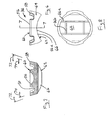
- the sliding shoe 36 can be considered as having a base 64 having a concave bottom surface 66, a socket portion 56 projecting centrally on the top side, and a plurality of guide arms 58 projecting upwardly on the top side and spaced laterally from the socket portion.
- the plurality of guide arms preferably form a castellated, substantially annular rim around the socket portion.
- the upper surface 70 of the base is generally convex, and the arms project obliquely away from each other from the upper surface.
- the convex upper surface 70 of the base spans a first included solid angle 72 centered on the socket axis, and the arms project obliquely away from each other from the upper surface and span a second included solid angle 74 less than the first solid included angle.
- the plurality of guide arms preferably consists of four spaced apart arms 58a, 58b, 58c and 58d which together span a total of between 180 and 270 degs, of the rim circumference, with the spaces 76a, 76b, 76c and 76d between the arms together spanning a total of about 90 to 180 degs, of the circumference.
- each arm has substantially the same span.
- At least two of the arms can project from the top surface a greater distance than the projection of the socket.
- the relative length of the arms depends on the maximum piston travel.
- the shoes as shown on Figure 3 allow for larger eccentricity and by that for higher pump output, without the danger of ever leaving the bore. For smaller eccentricity the arms can be made shorter.
- the castellated arms 58 define U-shaped spaces 76a, 76b, 76c and 76d between adjacent arms, where the horizontal portion 78 of the U is defined by the top surface 70 of a step that projects a relatively shorter distance from the top surface of the base, and two facing side walls 82 and 84 of adjacent arms 58a, 58b that project a relatively longer distance from the base.
- two of the four castellated guide arms could be of lesser height, or could be eliminated.
- the bottom surface 66 of the shoe has plural grooves 86a,b to facilitate lubrication at the sliding interface
- the drive member 30 may be a cylinder having a drive member axis that is offset from the drive shaft axis (not shown), such that the drive member has an outer surface that is not circular with respect to the drive axis.
- Figures 6, 7 and 8 show that the bottom surface 66 of the shoe is also not circularly symmetric.
- neither the drive member surface nor the concave bottom surface 60 of the shoe 36 is circularly symmetric about the axis of socket 56.
- FIGs 1, 2A, 2B and 3 illustrate the problem solved by the present invention whereby in a control scheme where the inlet flow through the feed orifice 38 such as shown in Figure 1 or in some other manner, a smaller quantity of fuel is charged into the pumping chamber 26, relative to the full available charging volume defined by the difference in the top dead center and bottom dead center positions of the piston.
- a force component F1 originating from the pressure drop across the piston inlet (metering orifice plus opening pressure of the inlet check valve) acting over the effective area of the piston, trying to counter act the piston return spring force F2.
- the projecting arms of the sliding shoe according to applicant's invention not only physically retain the shoe within the piston mounting bore in the event of such misalignment or displacement of the shoe, but furthermore, the castellation of the arms by which spaces are present between adjacent arms, significantly reduces the hydraulic forces caused by the axial motion of the shoe through the liquid, which would otherwise further aggravate the problem described with respect to Figure 2A and 2B .
- FIGS 3 and 4 further illustrate the effect of the operation of the invention. These figures show that even in the unlikely event of the maximum possible separation (piston in top dead center position and drive member in bottom dead center position) the outer region of the shoe not only prevents the shoe from leaving the piston mounting bore, but also ensures that the ball or similar formation at the driven end of the piston finds its socket in the shoe as the eccentric again moves into what should be the top dead center position for the piston.
- the phantom line for the drive member in Figure 3 represents the maximum pumping position corresponding to top dead center of the piston, where the shoe would be engaged with the piston and the drive member would be engaged with the shoe.
- the return spring is not fully effective as the eccentric continues rotating to the position corresponding to the solid eccentric surface in Figure 3 , the shoe may remain on the surface of the eccentric while detaching from the piston. If this continues, the worst scenario the eccentric reaches the position corresponding to the bottom dead center of the piston, but the piston is still in its top dead center position.
- the phantom line show the position of the shoe if it continues to be carried away from the piston by the eccentric.
Landscapes
- Engineering & Computer Science (AREA)
- Mechanical Engineering (AREA)
- General Engineering & Computer Science (AREA)
- Chemical & Material Sciences (AREA)
- Combustion & Propulsion (AREA)
- Details Of Reciprocating Pumps (AREA)
- Reciprocating Pumps (AREA)
Claims (16)
- Radialkolbenpumpe, mit einem Gehäuse (10), das einen zentralen Hohlraum (28) definiert; einem Antriebselement (30), das angebracht ist, um sich im Hohlraum (28) um eine Antriebsachse zu drehen; wenigstens einer Pumpkammer-Montagebohrung (12), die sich in Bezug auf die Achse radial durch das Gehäuse (10) zum Hohlraum (28) erstreckt; einem Kolben (24), der in der Pumpkammer-Montagebohrung (12) radial orientiert ist und ein radial äußeres Pumpende (34) sowie ein radial inneres angetriebenes Ende (32), das mit dem Antriebselement (30) zusammenwirkt, um sich in der Pumpkammer-Montagebohrung (12) zwischen Bewegungsgrenzen eines oberen Totpunkts und eines unteren Totpunkts hin und her zu bewegen, besitzt; einem Gleitschuh (36), der mit dem angetriebenen Ende (32) des Kolbens (24) in Eingriff ist und an dem Antriebselement (30) anliegt, um die Zusammenwirkung zu schaffen, wodurch die Drehbewegung des Antriebselements (30) in die hin und her gehende Bewegung des Kolbens (24) umgesetzt wird; und einer Rückstellfeder (50), um das angetriebene Ende (32) des Kolbens (24) zum Schuh (36) und zum Antriebselement (30) zu drängen, wobei
der Gleitschuh (36) einen zentralen Bereich (56), der einen Buchsenabschnitt aufweist, der mit dem angetriebenen Ende (32) des Kolbens (24) in Eingriff ist, und einen äußeren Bereich (58), der das angetriebene Ende (32) des Kolbens (24) umgibt und in die Pumpkammer-Montagebohrung (12) über eine Strecke vorsteht, derart, dass für alle Positionen des Kolbens (24) relativ zum Antriebselement (30) wenigstens ein Abschnitt des äußeren Bereichs (58) in der Pumpkammer-Montagebohrung (12) bleibt, besitzt, wobei das Antriebselement (30) eine äußere kreisförmige Oberfläche besitzt, die in Bezug auf die Achse versetzt ist;
das angetriebene Ende (32) des Kolbens (24) am zentralen Bereich (56) des Schuhs (36) schwenkbar anliegt, ohne daran starr befestigt zu sein;
die Rückstellfeder (50) sich longitudinal längs eines Abschnitts der Pumpkammer-Montagebohrung (12) erstreckt und auf das angetriebene Ende (32) des Kolbens (24) wirkt;
der äußere Bereich (58) in die Pumpkammer-Montagebohrung (12) in einer überlappenden Beziehung mit der Rückstellfeder (50) vorsteht, wenn der Kolben (24) an dem zentralen Bereich (56) des Schuhs (36) anliegt,
wobei der äußere Bereich (58) mit der Rückstellfeder (50) überlappt, wenn sich der Kolben (24) an seinem unteren Totpunkt befindet; und
der Vorsprung des äußeren Bereichs (58) mit der Rückstellfeder (50) überlappt, wenn sich der Kolben (24) an seinem oberen Totpunkt befindet,
dadurch gekennzeichnet, dass
die Rückstellfeder (50) sich außerhalb des Kolbens (24) befindet und
der äußere Bereich (58) mehrere Führungsarme (58a, 58b, 58c, 58d) aufweist, die von einer oberen Seite des Gleitschuhs (36) nach oben vorstehen und von dem Buchsenabschnitt (56) seitlich beabstandet sind. - Pumpe nach Anspruch 1, wobei
der Kolben (24) eine im Wesentlichen sphärische Ausformung am angetriebenen Ende (32), um an einer komplementären Ausformung im Schuh (36) zu sitzen, eine Beschickungsöffnung (38) benachbart zu der sphärischen Ausformung für eine Fluidkommunikation mit dem Hohlraum (28) und einen Beschickungsdurchlass (42) im Kolben (24) von der Öffnung (38) zu einer Pumpkammer (26) am Pumpende (34) des Kolbens (24) besitzt; und
die Ausformungen sich dann, wenn sie in Eingriff sind, in der Pumpkammer-Montagebohrung (12) befinden und der äußere Bereich (58) am Schuh (36) sich in die Pumpkammer-Montagebohrung (12) über eine größere Strecke als die komplementäre Ausformung erstreckt. - Pumpe nach Anspruch 4, wobei
der Kolben (24) einen Halsabschnitt (40) aufweist, von dem sich die sphärische Ausformung als ein konvexer Kopfabschnitt erstreckt;
ein Federsitz in dem Halsabschnitt (40) unterstützt ist;
die Rückstellfeder (50) auf dem Federsitz sitzt; und
der äußere Bereich (58) mit dem Federsitz überlappt. - Pumpe nach Anspruch 3, wobei
der Federsitz einen ringförmigen Randabschnitt (52) besitzt, um mit der Rückstellfeder (50) in Eingriff zu gelangen; und
der Randabschnitt (52) des Federsitzes sich in dem ringförmigen Raum befindet. - Pumpe nach Anspruch 1, wobei
das Antriebselement (30) eine äußere kreisförmige Oberfläche besitzt, die in Bezug auf die Achse versetzt ist;
das angetriebene Ende (32) des Kolbens (24) einen Halsabschnitt (40) aufweist, von dem sich ein konvexer Kopfabschnitt in einen Schwenkeingriff mit dem zentralen Bereich (56) des Schuhs (36) erstreckt, ohne daran starr befestigt zu sein;
ein Federsitz im Halsabschnitt (40) unterstützt ist;
die Rückstellfeder (50) auf dem Federsitz sitzt; und
der äußere Bereich (58) den Federsitz umgibt, wenn der Kopf in dem zentralen Bereich (56) des Schuhs (36) sitzt. - Pumpe nach Anspruch 1, wobei der äußere Bereich (58) eine ringförmige Anordnung von Führungsarmen (58a, 58b, 58c, 58d) ist, die einen zinnenkranzförmigen Rand um die Buchse bilden.
- Pumpe nach Anspruch 6, wobei der zinnenkranzförmige Rand aus vier voneinander beabstandeten Armen (58) besteht, die zusammen insgesamt einen Bereich von etwa 180 bis etwa 270 Grad des Ringraums überspannen, wobei die Zwischenräume zwischen den Armen (58) zusammen insgesamt einen Bereich von etwa 90 bis 180 Grad des Ringraums überspannen.
- Pumpe nach einem der Ansprüche 1 bis 7, wobei der Gleitschuh (36) eine Basis (64) mit einer konkaven Bodenoberfläche (66) aufweist.
- Pumpe nach Anspruch 8, wobei die mehreren Führungsarme (58a, 58b, 58c, 58d) einen zinnenkranzförmigen, im Wesentlichen ringförmigen Rand um den Buchsenabschnitt (56) bilden.
- Pumpe nach Anspruch 9, wobei die Basis (64) eine konvexe obere Oberfläche besitzt und die Arme (58a, 58b, 58c, 58d) von der oberen Oberfläche schräg voneinander weg stehen.
- Pumpe nach Anspruch 8, wobei die Bodenoberfläche (66) wenigstens eine Nut aufweist.
- Pumpe nach Anspruch 9, wobei die mehreren Führungsarme (58a, 58b, 58c, 58d) vier voneinander beabstandete Arme (58) umfassen, die zusammen insgesamt einen Bereich von etwa 180 bis 270 Grad des Ringraums überspannen, wobei die Zwischenräume zwischen den Armen (58) zusammen insgesamt einen Bereich von etwa 90 bis 180 Grad des Ringraums überspannen.
- Pumpe nach Anspruch 12, wobei jeder Arm (58a, 58b, 58c, 58d) im Wesentlichen die gleiche Überspannbreite besitzt.
- Pumpe nach Anspruch 8, wobei die Basis (64) eine obere Oberfläche besitzt, von der die Buchse (56) vorsteht, und die Arme (58) von der oberen Oberfläche über eine Strecke vorstehen, die größer als die Buchse (56) ist.
- Pumpe nach Anspruch 14, wobei ein "U"-förmiger Raum zwischen benachbarten Armen (58a, 58b, 58c, 58d) durch eine Stufe, die um eine verhältnismäßig kürzere Strecke von der oberen Oberfläche der Basis (64) vorsteht, und durch zwei einander zugewandte Seitenwände benachbarter Arme (58a, 58b, 58c, 58d), die um eine verhältnismäßig längere Strecke von der oberen Oberfläche der Basis (64) vorstehen, definiert ist.
- Pumpe nach Anspruch 1, wobei die mehreren Führungsarme (58a, 58b, 58c, 58d) zwei diametral entgegengesetzte Arme (58) umfassen.
Applications Claiming Priority (5)
| Application Number | Priority Date | Filing Date | Title |
|---|---|---|---|
| US187823 | 2002-07-02 | ||
| US10/187,823 US6694950B2 (en) | 1999-02-17 | 2002-07-02 | Hybrid control method for fuel pump using intermittent recirculation at low and high engine speeds |
| US217831 | 2002-08-12 | ||
| US10/217,831 US6901844B2 (en) | 2002-07-02 | 2002-08-12 | Guided shoe for radial piston pump |
| PCT/US2003/020663 WO2004005701A1 (en) | 2002-07-02 | 2003-07-01 | Guided shoe for radial piston pump |
Publications (2)
| Publication Number | Publication Date |
|---|---|
| EP1520098A1 EP1520098A1 (de) | 2005-04-06 |
| EP1520098B1 true EP1520098B1 (de) | 2010-03-10 |
Family
ID=30117794
Family Applications (1)
| Application Number | Title | Priority Date | Filing Date |
|---|---|---|---|
| EP03742355A Expired - Lifetime EP1520098B1 (de) | 2002-07-02 | 2003-07-01 | Geführter gleitschuh für eine radialkolbenpumpe |
Country Status (4)
| Country | Link |
|---|---|
| US (1) | US6901844B2 (de) |
| EP (1) | EP1520098B1 (de) |
| AU (1) | AU2003281333A1 (de) |
| WO (1) | WO2004005701A1 (de) |
Families Citing this family (6)
| Publication number | Priority date | Publication date | Assignee | Title |
|---|---|---|---|---|
| DE69915466T2 (de) | 1998-05-05 | 2005-01-20 | Massachusetts Institute Of Technology, Cambridge | Lichtemittierende polymere und vorrichtungen, die diese enthalten |
| DE102005043266A1 (de) * | 2004-10-15 | 2006-04-20 | Continental Teves Ag & Co. Ohg | Kolbenpumpe |
| WO2015031884A1 (en) | 2013-08-30 | 2015-03-05 | Flow Control Llc. | High viscosity portion pump |
| DE102014220839B4 (de) * | 2014-10-15 | 2016-07-21 | Continental Automotive Gmbh | Hochdruckpumpe für ein Kraftstoffeinspritzsystem einer Brennkraftmaschine |
| DE102014220937B4 (de) | 2014-10-15 | 2016-06-30 | Continental Automotive Gmbh | Antriebsvorrichtung zum Antreiben einer Kraftstoffhochdruckpumpe sowie Kraftstoffhochdruckpumpe |
| WO2016102114A1 (en) * | 2014-12-24 | 2016-06-30 | Robert Bosch Gmbh | High pressure pump for supplying fuel, preferably diesel, to an internal combustion engine |
Family Cites Families (6)
| Publication number | Priority date | Publication date | Assignee | Title |
|---|---|---|---|---|
| US5364234A (en) * | 1992-05-20 | 1994-11-15 | Karl Eickmann | High pressure devices |
| DE19523283B4 (de) * | 1995-06-27 | 2006-01-19 | Robert Bosch Gmbh | Pumpe, insbesondere Hochdruckpumpe für eine Kraftstoffeinspritzvorrichtung eines Verbrennungsmotors |
| US6183212B1 (en) * | 1999-02-17 | 2001-02-06 | Stanadyne Automotive Corp. | Snap-in connection for pumping plunger sliding shoes |
| US6694950B2 (en) * | 1999-02-17 | 2004-02-24 | Stanadyne Corporation | Hybrid control method for fuel pump using intermittent recirculation at low and high engine speeds |
| US6460510B1 (en) | 2000-05-30 | 2002-10-08 | Robert H. Breeden | Pump assembly and method |
| JP2003074439A (ja) * | 2001-06-19 | 2003-03-12 | Denso Corp | 燃料噴射ポンプ |
-
2002
- 2002-08-12 US US10/217,831 patent/US6901844B2/en not_active Expired - Lifetime
-
2003
- 2003-07-01 EP EP03742355A patent/EP1520098B1/de not_active Expired - Lifetime
- 2003-07-01 WO PCT/US2003/020663 patent/WO2004005701A1/en not_active Ceased
- 2003-07-01 AU AU2003281333A patent/AU2003281333A1/en not_active Abandoned
Also Published As
| Publication number | Publication date |
|---|---|
| US6901844B2 (en) | 2005-06-07 |
| WO2004005701A1 (en) | 2004-01-15 |
| US20040025684A1 (en) | 2004-02-12 |
| EP1520098A1 (de) | 2005-04-06 |
| AU2003281333A1 (en) | 2004-01-23 |
Similar Documents
| Publication | Publication Date | Title |
|---|---|---|
| US7152518B2 (en) | Structure of fuel injection pump for extending service life | |
| US7524171B2 (en) | Radial piston fuel supply pump | |
| KR20130086542A (ko) | 펌프, 특히 고압 연료 펌프 | |
| JP3852756B2 (ja) | 燃料噴射ポンプ | |
| US20120180764A1 (en) | High Pressure Fuel Supply Pump | |
| US20120103179A1 (en) | Pump unit | |
| US5772413A (en) | Bellows type pump | |
| US20240263626A1 (en) | Hydraulic Linkage Plunger Pushing Mechanism and Plunger Diaphragm Pump Using Same | |
| WO1999043957A1 (en) | High capacity supply pump with simultaneous directly actuated plungers | |
| EP1520098B1 (de) | Geführter gleitschuh für eine radialkolbenpumpe | |
| KR20040035730A (ko) | 고압 급송 펌프 | |
| US20170089311A1 (en) | Single piston pump with reduced piston side loads | |
| US20090101860A1 (en) | Pump assembly and tappet therefor | |
| US20040089146A1 (en) | Pump element and piston pump for generating high fuel pressure | |
| US6358024B1 (en) | High capacity supply pump with simultaneous directly actuated plungers | |
| EP2492506B1 (de) | Pumpkopf | |
| US6488478B2 (en) | High pressure fuel pump | |
| US6835053B2 (en) | Check valve | |
| EP2189658B1 (de) | Flüssigkeitspumpenanordnung | |
| WO2003078822A1 (en) | Pump components and method | |
| US6205980B1 (en) | High-pressure delivery pump | |
| EP2184491A1 (de) | Pumpenkopf für eine Brennstoffpumpenanordnung | |
| CN1795327A (zh) | 止回阀、尤其是用于内燃机燃料喷射装置的高压泵的止回阀 | |
| EP1318302B1 (de) | Kraftstoffeinspritzpumpe | |
| JP2008511787A (ja) | 内燃機関の燃料噴射装置のための高圧ポンプ |
Legal Events
| Date | Code | Title | Description |
|---|---|---|---|
| PUAI | Public reference made under article 153(3) epc to a published international application that has entered the european phase |
Free format text: ORIGINAL CODE: 0009012 |
|
| 17P | Request for examination filed |
Effective date: 20050126 |
|
| AK | Designated contracting states |
Kind code of ref document: A1 Designated state(s): AT BE BG CH CY CZ DE DK EE ES FI FR GB GR HU IE IT LI LU MC NL PT RO SE SI SK TR |
|
| AX | Request for extension of the european patent |
Extension state: AL LT LV MK |
|
| DAX | Request for extension of the european patent (deleted) | ||
| RBV | Designated contracting states (corrected) |
Designated state(s): DE FR GB IT |
|
| 17Q | First examination report despatched |
Effective date: 20050916 |
|
| GRAP | Despatch of communication of intention to grant a patent |
Free format text: ORIGINAL CODE: EPIDOSNIGR1 |
|
| GRAS | Grant fee paid |
Free format text: ORIGINAL CODE: EPIDOSNIGR3 |
|
| GRAA | (expected) grant |
Free format text: ORIGINAL CODE: 0009210 |
|
| AK | Designated contracting states |
Kind code of ref document: B1 Designated state(s): DE FR GB IT |
|
| REG | Reference to a national code |
Ref country code: GB Ref legal event code: FG4D |
|
| REF | Corresponds to: |
Ref document number: 60331650 Country of ref document: DE Date of ref document: 20100422 Kind code of ref document: P |
|
| PLBE | No opposition filed within time limit |
Free format text: ORIGINAL CODE: 0009261 |
|
| STAA | Information on the status of an ep patent application or granted ep patent |
Free format text: STATUS: NO OPPOSITION FILED WITHIN TIME LIMIT |
|
| 26N | No opposition filed |
Effective date: 20101213 |
|
| REG | Reference to a national code |
Ref country code: FR Ref legal event code: PLFP Year of fee payment: 14 |
|
| REG | Reference to a national code |
Ref country code: FR Ref legal event code: PLFP Year of fee payment: 15 |
|
| REG | Reference to a national code |
Ref country code: FR Ref legal event code: PLFP Year of fee payment: 16 |
|
| PGFP | Annual fee paid to national office [announced via postgrant information from national office to epo] |
Ref country code: IT Payment date: 20220721 Year of fee payment: 20 Ref country code: GB Payment date: 20220727 Year of fee payment: 20 Ref country code: DE Payment date: 20220727 Year of fee payment: 20 |
|
| PGFP | Annual fee paid to national office [announced via postgrant information from national office to epo] |
Ref country code: FR Payment date: 20220725 Year of fee payment: 20 |
|
| P01 | Opt-out of the competence of the unified patent court (upc) registered |
Effective date: 20230523 |
|
| REG | Reference to a national code |
Ref country code: DE Ref legal event code: R071 Ref document number: 60331650 Country of ref document: DE |
|
| REG | Reference to a national code |
Ref country code: GB Ref legal event code: PE20 Expiry date: 20230630 |
|
| PG25 | Lapsed in a contracting state [announced via postgrant information from national office to epo] |
Ref country code: GB Free format text: LAPSE BECAUSE OF EXPIRATION OF PROTECTION Effective date: 20230630 |