EP1519544A2 - Dispositif et procédé de commande d'un terminal portable et sans fil de type coulissant - Google Patents
Dispositif et procédé de commande d'un terminal portable et sans fil de type coulissant Download PDFInfo
- Publication number
- EP1519544A2 EP1519544A2 EP04021453A EP04021453A EP1519544A2 EP 1519544 A2 EP1519544 A2 EP 1519544A2 EP 04021453 A EP04021453 A EP 04021453A EP 04021453 A EP04021453 A EP 04021453A EP 1519544 A2 EP1519544 A2 EP 1519544A2
- Authority
- EP
- European Patent Office
- Prior art keywords
- sub
- motor
- wireless terminal
- portable wireless
- gear
- Prior art date
- Legal status (The legal status is an assumption and is not a legal conclusion. Google has not performed a legal analysis and makes no representation as to the accuracy of the status listed.)
- Withdrawn
Links
Images


Classifications
-
- H—ELECTRICITY
- H04—ELECTRIC COMMUNICATION TECHNIQUE
- H04B—TRANSMISSION
- H04B1/00—Details of transmission systems, not covered by a single one of groups H04B3/00 - H04B13/00; Details of transmission systems not characterised by the medium used for transmission
- H04B1/38—Transceivers, i.e. devices in which transmitter and receiver form a structural unit and in which at least one part is used for functions of transmitting and receiving
-
- H—ELECTRICITY
- H04—ELECTRIC COMMUNICATION TECHNIQUE
- H04M—TELEPHONIC COMMUNICATION
- H04M1/00—Substation equipment, e.g. for use by subscribers
- H04M1/02—Constructional features of telephone sets
- H04M1/0202—Portable telephone sets, e.g. cordless phones, mobile phones or bar type handsets
- H04M1/0206—Portable telephones comprising a plurality of mechanically joined movable body parts, e.g. hinged housings
- H04M1/0208—Portable telephones comprising a plurality of mechanically joined movable body parts, e.g. hinged housings characterized by the relative motions of the body parts
- H04M1/0235—Slidable or telescopic telephones, i.e. with a relative translation movement of the body parts; Telephones using a combination of translation and other relative motions of the body parts
- H04M1/0237—Sliding mechanism with one degree of freedom
-
- H—ELECTRICITY
- H04—ELECTRIC COMMUNICATION TECHNIQUE
- H04M—TELEPHONIC COMMUNICATION
- H04M1/00—Substation equipment, e.g. for use by subscribers
- H04M1/02—Constructional features of telephone sets
- H04M1/0202—Portable telephone sets, e.g. cordless phones, mobile phones or bar type handsets
- H04M1/0206—Portable telephones comprising a plurality of mechanically joined movable body parts, e.g. hinged housings
- H04M1/0241—Portable telephones comprising a plurality of mechanically joined movable body parts, e.g. hinged housings using relative motion of the body parts to change the operational status of the telephone set, e.g. switching on/off, answering incoming call
- H04M1/0245—Portable telephones comprising a plurality of mechanically joined movable body parts, e.g. hinged housings using relative motion of the body parts to change the operational status of the telephone set, e.g. switching on/off, answering incoming call using open/close detection
Definitions
- the present invention relates to a portable wireless terminal, and more particularly to a sliding-type portable wireless terminal capable of opening and closing a keypad of a main body through a sliding movement of a sub-body.
- portable wireless terminals may be classified into bar-type, flip-type, and folder-type portable wireless terminals in accordance with external appearance thereof.
- a bar-type portable wireless terminal has a transmitting/receiving unit and a data input/output device installed in a single housing, in which a keypad, which is a type of data input device, is always exposed to exterior elements, which increases the likelihood that the keypad will malfunction.
- a keypad which is a type of data input device
- miniaturization of bar-type portable wireless terminals is restricted.
- a flip-type portable wireless terminal includes a body, a flip, and a hinge module connecting the body to the flip.
- a transmitting/receiving unit and a data input/output device are installed in the body.
- the flip covers the keypad and/or other data input device, thereby reducing malfunction of the keypad.
- the flip-type portable wireless terminal is also required to ensure an interval between a transmitting unit and a receiving unit, so miniaturization of flip-type portable wireless terminals is also restricted.
- a folder-type portable wireless terminal includes a body, a folder, and a hinge module for rotatably connecting the body and the folder to each other.
- the folder-type terminal is opened and closed as the folder is rotatably moved toward and away from the body.
- the folder-type portable wireless terminal In a state in which the folder is in a closed position with respect to the body, the folder-type portable wireless terminal is in a call-waiting mode. In this state, malfunction of the keypad is prevented.
- the folder-type portable wireless terminal can sufficiently ensure a distance between the transmitting unit and the receiving unit, so that it is possible to minimize the size of the folder-type portable wireless terminal. For this reason, folder-type terminals have been widely used as portable wireless terminals.
- a sliding-type portable wireless terminal which includes a main body and a sub-body slidably mounted on the main body in order to open and close a keypad installed on the main body, has been suggested and commercially used.
- a conventional sliding-type portable wireless terminal has a problem in that a user must manually operate the sub-body to open or close the sub-body.
- an object of the present invention is to provide a sliding-type portable wireless terminal capable of easily opening and closing a sub-body and a method for controlling a sliding movement thereof.
- Another object of the present invention is to provide a sliding-type portable wireless terminal capable of automatically opening and closing a sub-body and a method for controlling a sliding movement thereof.
- a sliding type portable wireless terminal including a main body and a sub-body movable from an open position to a closed position with respect to the main body by slidably moving in a lengthwise direction with respect to the main body, the sliding type portable wireless terminal comprising: a first gear installed on an upper portion of the main body; a second gear provided at a rear portion of the sub-body in a lengthwise direction of the sub-body in such a manner that the second gear is engaged with the first gear; a motor connected to the first gear so as to provide rotational force to rotate the first gear; and a control unit for controlling an operation of the motor in response to a predetermined key input signal by a user for controlling a sliding movement of the sub-body.
- FIG. 1 is a block diagram of a sliding type portable wireless terminal 100 according to a preferred embodiment of the present invention.
- the sliding type portable wireless terminal 100 includes a control unit 10, a wireless unit 20, a voice processing unit 30 (not shown), a memory unit 40, and a keypad unit 103.
- the sliding type portable wireless terminal 100 includes a motor driving unit 60 and a motor 115 for providing a sliding action of the sliding type portable wireless terminal 100.
- the control unit 10 controls an operation of the sliding type portable wireless terminal 100.
- the control unit 10 of the present invention provides a control signal to the motor driving unit 60 when the control unit 10 receives a slide-up signal or a slide-down signal from a user, thereby driving the motor 115 in an appropriate direction.
- the control unit 10 determines whether a sub-body is opened or closed if the control unit 10 receives the slide-up signal or the slide-down signal from the user.
- the control unit 10 provides the control signal to the motor driving unit 60 in such a manner that the motor 115 drives the sub-body to close the sub-body.
- the control unit 10 provides the control signal to the motor driving unit 60 in such a manner that the motor 115 drives the sub-body in order to open the sub-body.
- the motor driving unit 60 preferably includes an analog switch, and the motor 115 is preferably a DC motor.
- Such an analog switch can convert a rotating direction of the DC motor by converting polarities applied to the terminals of the DC motor based on a control signal of the control unit 10.
- a predetermined sliding movement operating key can be provided so as to allow the user to input the sliding-up signal and the sliding-down signal.
- the sliding movement operating key can be provided in a keypad 103a of the sub-body 102, as shown in Fig. 2.
- the sliding movement operating key is provided only for a sliding operation of the sub-body.
- a conventional key that is otherwise provided for performing a predetermined function can act as the sliding movement operating key.
- the sliding movement operating key must be mounted at a position that the user can operate regardless of an opened/closed state of the sub-body.
- the call response manner is typically provided in such a manner that the call response is performed only when the sliding movement operating key is operated by user.
- the user can also set the call response manner in relation to an incoming call.
- the call response can be performed either by pressing a call key or by pressing the sliding movement operating key for the slide-up. If the user sets the call response manner such that the call response can be performed only when the user presses the call key, the call response will not be carried out when the user presses the sliding movement operating key. In addition, if the user sets the call response manner such that the call response can be performed only when the user presses the sliding movement operating key, the call response can only be performed when the user presses the sliding movement operating key.
- the call response manner such that the call response is carried out when the user presses the sliding movement operating key
- the call response can be performed by pressing any key, including the sliding movement operating key.
- the wireless unit 20 of the wireless terminal controls transmitting/receiving voice and character data under the control of the control unit 10.
- the memory unit 40 stores program data required to control the mobile communication terminal and data generated when the mobile communication terminal is controlled or operated by the user.
- the keypad unit 103 includes a plurality of numeric and function keys, and outputs inputted data corresponding to a key selected by the user to the control unit 10.
- a transmitting unit 104 converts an inputted voice signal of the user to an electrical signal
- a receiving unit 107 outputs a voice signal transmitted thereto from another wireless terminal, typically via a base station.
- a sliding operation principle of the sliding type portable wireless terminal will be explained below with reference to FIGs. 2 to 5.
- FIG. 2 is a perspective view showing a main body 101 separated from a sub-body 102 of a sliding type portable wireless terminal 100 according to the present invention
- FIG. 3 is an exploded perspective view showing the sub-body 102 of the sliding type portable wireless terminal 100 shown in FIG. 2
- FIG. 4 is a perspective view showing the sliding type portable wireless terminal 100 shown in FIG. 2 with the terminal 100 assembled and closed
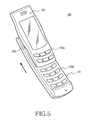
- FIG. 5 is a perspective view showing a keypad 103b of the main body of the sliding type portable wireless terminal shown in FIG. 2.
- the sliding type portable wireless terminal includes the main body 101, the sub-body 102 capable of opening or closing a keypad 103b of the main body 101 by slidably moving in a lengthwise direction (see arrow in Figs. 4 and 5) with respect the main body 101, and an opening/closing device for opening or closing the sub-body 102.
- the main body 101 has provided at a lower front portion thereof keypad 103b and transmitting unit 104, which has a microphone, and has formed at an upper front portion thereof a slot 109, within which the opening/closing device is installed.
- the main body 101 preferably has provided at each side of the upper front portion thereof with a guide-rail 133 in a longitudinal, i.e. lengthwise direction thereof.
- the pair of guide-rails 133 extend a predetermined height beyond on the front surface of the main body 101, i.e. toward the main body, and are inwardly bent so as to guide a sliding movement of and retain the sub-body 102.
- the sub-body 102 is provided at a front portion thereof, i.e. a portion facing away from the main body 101, with a display unit 105, a keypad 103a, and a receiving unit 107, which has a speaker therein.
- the sub-body 102 has formed at each side of a rear portion thereof with a guide-slot 123 (FIG. 3), which oppose respective guide-rails 133 of the main body 101 in a longitudinal direction thereof. Accordingly, the guide-slots 123 guide the sliding movement of the sub-body 102 from a first position closing the keypad 103b of the main body 101 to a second position opening the keypad 103b.
- the opening/closing device includes a pinion gear 111, the motor 115 and a reduction module 117 accommodated in the slot 109 formed at the upper front portion of the main body 101, and a rack gear 121 longitudinally formed at the rear portion of the sub-body 102. It is understood from the structure of the opening/closing device that rotational force provided by the motor 115 is converted into a linear motion via the pinion gear 111 and the rack gear 121.
- the motor 115 rotates such that the sub-body 102 opens, i.e. exposes, the keypad 103b.
- Rotational force of the motor 115 rotates the pinion gear 111 so as to move the rack gear 121 formed at the rear portion of the sub-body 102, thereby moving the sub-body 102.
- the reduction module 117 is coupled with the other side of the pinion gear 111. The reduction module 117 prevents a sudden speed change of the sub-body 102 while the sub-body 102 is being moved from a start position to a stop position.
- a locking device is provided to lock the sub-body 102 to prevent the sub-body 102 from moving when in a closed state
- a stopper is also provided to restrict movement of the sub-body 102 to within a predetermined range (not shown in FIGs. 2 to 5), the operation and position thereof will be clearly understood to those skilled in the art.
- a key located at a side of the main body 101 and indicated by reference number 255 in FIGs. 2, 4 and 5 can act as the above-mentioned sliding movement operating key.
- the sliding movement operating key may be included in the keypad 103a provided on the sub-body 102.
- the sliding type portable wireless terminal 100 is constructed in such a manner that the keypad 103b can be exposed or concealed, depending on the sliding movement of the sub-body 102 with respect to the main body 101.
- the sub-body of the sliding type portable wireless terminal is moved by receiving rotational force of the motor 115.
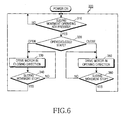
- a method for controlling the sliding movement of such sliding type portable wireless terminal will be explained below with reference to FIGs. 6 and 7.
- FIG. 6 is a flowchart 300 explaining a method for controlling the sliding movement of the sliding type portable wireless terminal according to a preferred embodiment of the present invention.
- the control unit 10 of the sliding type portable wireless terminal controls the sliding movement of the sub-body in response to user selection of the sliding movement operating key 255. Therefore, the control unit 10 determines whether the sliding movement operating key 255 is pressed (S310). Then, if the sliding movement operating key 255 is pressed, the control unit 10 proceeds to step 320. The control unit 10 determines whether the keypad 103b provided on the main body 101 is opened or closed (S320).
- the motor 115 drives the sub-body to move the sub-body into a closed position with respect to the main body.
- the motor 115 drives the sub-body to move the sub-body into the open position.
- the control unit 10 determines whether the sliding movement of the sub-body stops (S340). If the sliding movement stops, the control unit 10 returns to step 310. It will be known to those skilled in the art that the sliding movement may be stopped by a stopper or limit switch.
- the control unit 10 determines whether the sliding movement of the sub-body stops (S360). If the sliding movement stops, the control unit 10 returns to step 310.
- the sliding type portable wireless terminal performs the slide up action and the slide down action in response to operation of a predetermined key.
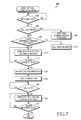
- FIG. 7 is a flowchart 400 explaining a method for controlling a sliding movement when the sliding type portable wireless terminal receives an incoming call according to a preferred embodiment of the present invention.
- the control unit 10 of the sliding type portable wireless terminal performs the call response.
- the call response manner can be pre-set by the user in such a manner that the call response is performed by the operation of the sliding movement operating key 255. Therefore, if the user sets the call response manner such that the call response is carried out by pressing the sliding movement operating key 255, the call response can be performed by pressing only the sliding movement operating key 255.
- FIG. 7 shows the flowchart 400 when the call response manner set by the user is accomplished by pressing the sliding movement operating key 255.
- the control unit 10 of the sliding type portable wireless terminal will preferably perform the control procedure shown in FIG. 7 when the call signal is received and the sub-body 102 covers the keypad 103b of the main body 101.
- a method for controlling the sliding movement when the incoming call is received according to a preferred embodiment of the present invention will be explained with reference to FIG. 7.
- the control unit 10 of the sliding type portable wireless terminal 100 determines whether the call signal is received (S402). If the call signal is received, the control unit 10 proceeds to step 404. Also, the control unit 10 determines in step 404 whether a predetermined call key is pressed by the user. For example, in a slide-up call connecting mode, although a response for the incoming call can be performed by means of the sliding movement operating key 255, the response for the incoming call can be also performed by pressing the predetermined call key, which is a key other than the sliding movement operating key 255.
- the control unit 10 may check whether the predetermined call key is pressed by the user. If the predetermined call key is pressed by the user, the control unit 10 performs a general call communication process in step 406.
- step 408 determines whether the sliding movement operating key 255 is pressed by the user. If the sliding movement operating key 255 is not pressed by the user, the control unit 10 is converted into a call-wait mode, without performing the response to the incoming call, in step 410. However, if the sliding movement operating key 255 is pressed by the user, the control unit 10 proceeds to step 412.
- step 412 the control unit 10 provides a control signal to the motor driving unit 60 in order to drive the motor 115 to open the keypad 103b of the main body 101, that is, in order to drive the motor 115 in a slide-up direction.
- the control unit 10 determines in step 414 whether the sliding movement has or should be stopped. That is, the control unit 10 determines whether the sub-body 102 has opened the whole area of the keypad 103b of the main body 101. If the sliding movement stops, the control unit 10 proceeds to step 416 to transmit the response for the incoming call to the base station, thereby connecting the call in step 418. Also, if the sliding movement operating key 255 is pressed, the control unit 10 does not refuse the incoming call until the sliding movement stops.
- the control unit 10 determines in step 420 whether the call communication is finished.
- the finish of the call communication may be recognized when the user pushes a call-off key or when a call-off signal is transmitted from the base station. Also, the call-off may be recognized when the user presses the sliding movement operating key 255. It will be clear to those skilled in the art that various devices for terminating a call can be selectively installed in a wireless terminal by manufacturers of wireless terminals.
- step 422 the control unit 10 provides a control signal to the motor driving unit 60 in order to drive the motor 115 to close that the keypad 103b of the main body 101, that is, the motor 115 is driven in a slide-down direction.
- the control unit 10 controls the motor driving unit 60 in such a manner that the motor 115 can be continuously driven until the sliding movement stops.
- the control unit 10 determines in step 424 whether the sliding movement stops. Next, if the sliding movement stops, that is, if the sub-body closes the whole area of the keypad 103b of the main body 101, the control unit 10 finishes the control procedure.
- the slide-up or slide-down operation is automatically carried out in the sliding type portable wireless terminal. Therefore, it is not necessary for the user to manually operate the sliding movement of the sub-body.
- the response to an incoming call is performed by automatically moving the sub-body into the slide-up state if the user presses the sliding movement operating key when the incoming call is received.
- the sub-body can be moved into the slide-up state to perform the response for the incoming call even if the user presses the call key to initiate a call.
- the present invention describes that the sub-body is automatically moved into the slide-up state in response to the operation of the sliding movement operating key and is automatically moved into the slide-down state when the call is off, it will be appreciated that the slide-up state can be maintained when the call is off.
Landscapes
- Engineering & Computer Science (AREA)
- Signal Processing (AREA)
- Computer Networks & Wireless Communication (AREA)
- Telephone Set Structure (AREA)
- Telephone Function (AREA)
Applications Claiming Priority (2)
| Application Number | Priority Date | Filing Date | Title |
|---|---|---|---|
| KR1020030066392A KR100703339B1 (ko) | 2003-09-24 | 2003-09-24 | 슬라이딩 타입 휴대용 무선 단말기 및 이 무선단말기에서의 슬라이딩 제어 방법 |
| KR2003066392 | 2003-09-24 |
Publications (2)
| Publication Number | Publication Date |
|---|---|
| EP1519544A2 true EP1519544A2 (fr) | 2005-03-30 |
| EP1519544A3 EP1519544A3 (fr) | 2008-10-29 |
Family
ID=34192266
Family Applications (1)
| Application Number | Title | Priority Date | Filing Date |
|---|---|---|---|
| EP04021453A Withdrawn EP1519544A3 (fr) | 2003-09-24 | 2004-09-09 | Dispositif et procédé de commande d'un terminal portable et sans fil de type coulissant |
Country Status (4)
| Country | Link |
|---|---|
| US (1) | US20050064921A1 (fr) |
| EP (1) | EP1519544A3 (fr) |
| KR (1) | KR100703339B1 (fr) |
| CN (1) | CN1602027A (fr) |
Cited By (4)
| Publication number | Priority date | Publication date | Assignee | Title |
|---|---|---|---|---|
| EP1720325A1 (fr) * | 2005-05-03 | 2006-11-08 | Siemens Aktiengesellschaft | Appareil électronique portable |
| WO2007035008A1 (fr) * | 2005-09-23 | 2007-03-29 | Amphenol Phoenix Co., Ltd. | Dispositif d’ouverture et de fermeture de type coulissant pour téléphone portable |
| WO2007065130A1 (fr) | 2005-12-01 | 2007-06-07 | Agere Systems Inc. | Appareil et procede destines a empecher une activation involontaire d’un dispositif de communication mobile |
| EP1783986A3 (fr) * | 2005-11-07 | 2007-12-12 | Samsung Electronics Co., Ltd. | Appareil de coulissement pour un terminal portable du type coulissant |
Families Citing this family (22)
| Publication number | Priority date | Publication date | Assignee | Title |
|---|---|---|---|---|
| USD526298S1 (en) * | 2004-09-10 | 2006-08-08 | Hitachi, Ltd. | Mobile telephone |
| USD532766S1 (en) * | 2004-12-02 | 2006-11-28 | Samsung Electronics Co., Ltd. | Cellular phone |
| KR100721337B1 (ko) * | 2004-12-22 | 2007-05-28 | 엘지전자 주식회사 | 사이드 슬라이딩형 전자장치 |
| US7181257B2 (en) * | 2004-12-28 | 2007-02-20 | Motorola, Inc. | Slider mechanism for handheld devices |
| USD529472S1 (en) * | 2005-02-17 | 2006-10-03 | Samsung Electronics Co., Ltd. | Mobile phone |
| JP4530218B2 (ja) * | 2005-03-07 | 2010-08-25 | ソニー・エリクソン・モバイルコミュニケーションズ株式会社 | 携帯端末装置 |
| USD529891S1 (en) * | 2005-04-06 | 2006-10-10 | Samsung Electronics Co., Ltd. | Portable phone |
| USD553595S1 (en) * | 2005-06-09 | 2007-10-23 | Nokia Corporation | Handset |
| KR101113869B1 (ko) * | 2005-07-25 | 2012-02-29 | 엘지전자 주식회사 | 슬라이드형 단말기 및 이를 이용한 착신신호 알림 방법 |
| KR100713411B1 (ko) * | 2005-10-07 | 2007-05-04 | 삼성전자주식회사 | 휴대용 통신 장치 |
| KR20080044729A (ko) * | 2006-11-17 | 2008-05-21 | 엘지전자 주식회사 | 슬라이드형 휴대 단말기 |
| CN101522005B (zh) | 2008-02-25 | 2012-03-07 | 深圳富泰宏精密工业有限公司 | 滑盖机构及应用该滑盖机构的便携式电子装置 |
| CN101742859A (zh) * | 2008-11-20 | 2010-06-16 | 深圳富泰宏精密工业有限公司 | 便携式电子装置 |
| KR101562582B1 (ko) * | 2008-12-30 | 2015-10-22 | 엘지전자 주식회사 | 플렉시블 디스플레이를 적용한 이동 단말기 및 그의 화면확장방법 |
| US8102675B2 (en) * | 2009-04-15 | 2012-01-24 | Nokia Corporation | Apparatus, method, and computer program for using a driver wheel to provide a plurality of housing configurations |
| US8725223B2 (en) * | 2010-02-08 | 2014-05-13 | Nokia Corporation | Apparatus for a portable electronic device |
| TWM388826U (en) * | 2010-04-30 | 2010-09-11 | Hon Hai Prec Ind Co Ltd | Sliding apparatus |
| CN104301457A (zh) * | 2013-07-15 | 2015-01-21 | 鸿富锦精密工业(深圳)有限公司 | 滑盖式电子设备 |
| KR102662327B1 (ko) * | 2020-07-24 | 2024-04-30 | 엘지전자 주식회사 | 이동 단말기 |
| KR102711607B1 (ko) * | 2020-07-24 | 2024-09-30 | 엘지전자 주식회사 | 이동 단말기 |
| KR102902110B1 (ko) * | 2020-11-26 | 2025-12-19 | 엘지전자 주식회사 | 이동 단말기 |
| TWI812108B (zh) * | 2022-03-24 | 2023-08-11 | 宏碁股份有限公司 | 可攜式電子裝置 |
Family Cites Families (5)
| Publication number | Priority date | Publication date | Assignee | Title |
|---|---|---|---|---|
| JP2000114829A (ja) * | 1998-10-02 | 2000-04-21 | Marantz Japan Inc | 携帯電話装置 |
| KR20010084260A (ko) * | 2000-02-24 | 2001-09-06 | 허진호 | 이동통신 단말기 커버의 슬라이드 방식 개폐장치 |
| FI20000931A7 (fi) * | 2000-04-18 | 2001-10-19 | Nokia Corp | Kannettava elektroninen laite |
| EP1182849A1 (fr) * | 2000-08-25 | 2002-02-27 | Roulements Miniatures S.A. | Dispositif de communication électronique mobile comprenant une unité de vibration |
| JP2003258944A (ja) * | 2002-02-28 | 2003-09-12 | Nec Saitama Ltd | 折り畳み式携帯電話機およびスライド式携帯電話機 |
-
2003
- 2003-09-24 KR KR1020030066392A patent/KR100703339B1/ko not_active Expired - Fee Related
-
2004
- 2004-09-09 EP EP04021453A patent/EP1519544A3/fr not_active Withdrawn
- 2004-09-24 CN CNA2004100798925A patent/CN1602027A/zh active Pending
- 2004-09-24 US US10/949,840 patent/US20050064921A1/en not_active Abandoned
Cited By (7)
| Publication number | Priority date | Publication date | Assignee | Title |
|---|---|---|---|---|
| EP1720325A1 (fr) * | 2005-05-03 | 2006-11-08 | Siemens Aktiengesellschaft | Appareil électronique portable |
| WO2007035008A1 (fr) * | 2005-09-23 | 2007-03-29 | Amphenol Phoenix Co., Ltd. | Dispositif d’ouverture et de fermeture de type coulissant pour téléphone portable |
| CN101248585B (zh) * | 2005-09-23 | 2011-01-26 | 安费诺凤凰株式会社 | 在便携式电话中使用的滑动式开启和关闭装置 |
| EP1783986A3 (fr) * | 2005-11-07 | 2007-12-12 | Samsung Electronics Co., Ltd. | Appareil de coulissement pour un terminal portable du type coulissant |
| US7529573B2 (en) | 2005-11-07 | 2009-05-05 | Samsung Electronics Co., Ltd | Slide apparatus of slide-type portable terminal |
| WO2007065130A1 (fr) | 2005-12-01 | 2007-06-07 | Agere Systems Inc. | Appareil et procede destines a empecher une activation involontaire d’un dispositif de communication mobile |
| US7570978B2 (en) | 2005-12-01 | 2009-08-04 | Agere Systems Inc. | Apparatus and method for preventing an unintentional activation of a mobile communication device |
Also Published As
| Publication number | Publication date |
|---|---|
| CN1602027A (zh) | 2005-03-30 |
| KR20050030074A (ko) | 2005-03-29 |
| EP1519544A3 (fr) | 2008-10-29 |
| US20050064921A1 (en) | 2005-03-24 |
| KR100703339B1 (ko) | 2007-04-03 |
Similar Documents
| Publication | Publication Date | Title |
|---|---|---|
| EP1519544A2 (fr) | Dispositif et procédé de commande d'un terminal portable et sans fil de type coulissant | |
| KR100608726B1 (ko) | 양방향 슬라이드형 휴대용 단말기 | |
| CN100463463C (zh) | 便携式通信终端设备 | |
| KR100575999B1 (ko) | 바 타입 휴대용 무선 단말기 | |
| JP3209150B2 (ja) | 折り畳み式携帯無線通信装置 | |
| EP1422913B1 (fr) | Equipement terminal portable d'information | |
| CN1694468A (zh) | 手持移动终端 | |
| KR100663572B1 (ko) | 자동 접이형 휴대용 단말기 | |
| US8831695B2 (en) | Hinge unit and portable terminal using the same | |
| KR101566281B1 (ko) | 슬라이드 모듈 및 이를 구비하는 휴대 단말기 | |
| EP1345389B1 (fr) | Terminal radio pliable, procede de commencement d'une conversation et programme de commencement d'une conversation | |
| KR100312546B1 (ko) | 외면에 디스플레이가 장착된 덮개가 슬라이딩개폐되는 폴더형휴대폰 | |
| JP4039796B2 (ja) | 無線情報端末機 | |
| KR100347712B1 (ko) | 드로어 타입 휴대전화기 | |
| KR20040098979A (ko) | 양방향 슬라이드형 이동통신 단말기 및 그 방법 | |
| EP1783986B1 (fr) | Appareil de coulissement pour un terminal portable du type coulissant | |
| KR200376791Y1 (ko) | 슬라이드 폴더형 이동통신 단말기 | |
| KR101545571B1 (ko) | 휴대 단말기 | |
| KR200241947Y1 (ko) | 슬라이드형 휴대용 전화기 | |
| KR200214829Y1 (ko) | 엘씨디 부분이 움직이는 슬라이더형 휴대폰 | |
| KR100712206B1 (ko) | 슬라이딩 개폐되는 이동통신단말기 | |
| KR200205597Y1 (ko) | 자동 폴더의 슬라이딩 방식 입력장치 | |
| KR200374460Y1 (ko) | 휴대전화기 및 휴대전화기용 슬라이딩 조립체 | |
| KR100617145B1 (ko) | 오토 슬라이드형 이동통신 단말기 | |
| KR200334345Y1 (ko) | 슬라이딩 개폐되는 이동통신단말기 |
Legal Events
| Date | Code | Title | Description |
|---|---|---|---|
| PUAI | Public reference made under article 153(3) epc to a published international application that has entered the european phase |
Free format text: ORIGINAL CODE: 0009012 |
|
| 17P | Request for examination filed |
Effective date: 20040909 |
|
| AK | Designated contracting states |
Kind code of ref document: A2 Designated state(s): AT BE BG CH CY CZ DE DK EE ES FI FR GB GR HU IE IT LI LU MC NL PL PT RO SE SI SK TR |
|
| AX | Request for extension of the european patent |
Extension state: AL HR LT LV MK |
|
| PUAL | Search report despatched |
Free format text: ORIGINAL CODE: 0009013 |
|
| AK | Designated contracting states |
Kind code of ref document: A3 Designated state(s): AT BE BG CH CY CZ DE DK EE ES FI FR GB GR HU IE IT LI LU MC NL PL PT RO SE SI SK TR |
|
| AX | Request for extension of the european patent |
Extension state: AL HR LT LV MK |
|
| RTI1 | Title (correction) |
Free format text: SLIDING-TYPE PORTABLE WIRELESS TERMINAL AND METHOD FOR CONTROLLING SLIDING MOVEMENT IN THE SAME |
|
| 17Q | First examination report despatched |
Effective date: 20090212 |
|
| AKX | Designation fees paid |
Designated state(s): DE FR GB |
|
| STAA | Information on the status of an ep patent application or granted ep patent |
Free format text: STATUS: THE APPLICATION IS DEEMED TO BE WITHDRAWN |
|
| 18D | Application deemed to be withdrawn |
Effective date: 20090623 |