EP1517447A1 - Vorrichtung und Verfahren zur Pulspositionsmodulation - Google Patents
Vorrichtung und Verfahren zur Pulspositionsmodulation Download PDFInfo
- Publication number
- EP1517447A1 EP1517447A1 EP04021394A EP04021394A EP1517447A1 EP 1517447 A1 EP1517447 A1 EP 1517447A1 EP 04021394 A EP04021394 A EP 04021394A EP 04021394 A EP04021394 A EP 04021394A EP 1517447 A1 EP1517447 A1 EP 1517447A1
- Authority
- EP
- European Patent Office
- Prior art keywords
- pulses
- pulse
- sequence
- frequency
- modulating signal
- Prior art date
- Legal status (The legal status is an assumption and is not a legal conclusion. Google has not performed a legal analysis and makes no representation as to the accuracy of the status listed.)
- Withdrawn
Links
- 238000000034 method Methods 0.000 title claims abstract description 25
- 230000001934 delay Effects 0.000 claims description 13
- 230000001360 synchronised effect Effects 0.000 claims description 5
- 238000010586 diagram Methods 0.000 description 19
- 238000001228 spectrum Methods 0.000 description 10
- 230000003111 delayed effect Effects 0.000 description 8
- 230000002123 temporal effect Effects 0.000 description 6
- 230000008901 benefit Effects 0.000 description 3
- 230000000630 rising effect Effects 0.000 description 3
- 230000015556 catabolic process Effects 0.000 description 2
- 238000004891 communication Methods 0.000 description 2
- 230000003247 decreasing effect Effects 0.000 description 2
- 238000006731 degradation reaction Methods 0.000 description 2
- XUIMIQQOPSSXEZ-UHFFFAOYSA-N Silicon Chemical compound [Si] XUIMIQQOPSSXEZ-UHFFFAOYSA-N 0.000 description 1
- 238000009825 accumulation Methods 0.000 description 1
- 238000006243 chemical reaction Methods 0.000 description 1
- 230000008878 coupling Effects 0.000 description 1
- 238000010168 coupling process Methods 0.000 description 1
- 238000005859 coupling reaction Methods 0.000 description 1
- 238000010295 mobile communication Methods 0.000 description 1
- 230000000737 periodic effect Effects 0.000 description 1
- 239000004065 semiconductor Substances 0.000 description 1
- 229910052710 silicon Inorganic materials 0.000 description 1
- 239000010703 silicon Substances 0.000 description 1
- 230000003595 spectral effect Effects 0.000 description 1
- 238000006467 substitution reaction Methods 0.000 description 1
Images




Classifications
-
- H—ELECTRICITY
- H03—ELECTRONIC CIRCUITRY
- H03K—PULSE TECHNIQUE
- H03K7/00—Modulating pulses with a continuously-variable modulating signal
- H03K7/04—Position modulation, i.e. PPM
-
- H—ELECTRICITY
- H03—ELECTRONIC CIRCUITRY
- H03K—PULSE TECHNIQUE
- H03K5/00—Manipulating of pulses not covered by one of the other main groups of this subclass
- H03K5/13—Arrangements having a single output and transforming input signals into pulses delivered at desired time intervals
- H03K5/133—Arrangements having a single output and transforming input signals into pulses delivered at desired time intervals using a chain of active delay devices
-
- H—ELECTRICITY
- H03—ELECTRONIC CIRCUITRY
- H03K—PULSE TECHNIQUE
- H03K5/00—Manipulating of pulses not covered by one of the other main groups of this subclass
- H03K2005/00013—Delay, i.e. output pulse is delayed after input pulse and pulse length of output pulse is dependent on pulse length of input pulse
- H03K2005/0015—Layout of the delay element
- H03K2005/00156—Layout of the delay element using opamps, comparators, voltage multipliers or other analog building blocks
Definitions
- the invention relates to a pulse modulator.
- the invention relates equally to a modulating system comprising such a pulse modulator and to a method for modulating pulses.
- Pulse modulators are known in the art for example in form of pulse position modulation (PPM) modulators and pulse width modulation (PWM) modulators.
- PPM modulator codes a modulating signal into a two-level signal that has pulses at varying positions
- PWM modulator codes a modulating signal into a two-level signal that has pulses of varying widths.
- PPM modulators and PWM modulators are utilized for instance in new transmitter architectures employed in mobile devices.
- TX transmitter
- Such optimized transmitter chains comprise usually high efficiency switching mode power amplifiers, which do not affect the phase of an input signal, but which are very non-linear concerning the amplitude of an input signal.
- the input signal of a high efficiency switching mode power amplifier should be a phase modulated constant envelope signal, as provided e.g. by a pulse modulator or a bandpass delta-sigma modulator.
- Switching mode power amplifiers using PPM or PWM for generating bandpass signals in a multimode mobile device transmitter have been described for instance in U.S. patent application 2003/0058956 A1.
- the use of a bandpass delta-sigma modulator has been described for example by A. Jayaraman in the article "Linear high efficiency microwave power amplifiers using bandpass delta-sigma modulators", IEEE microwave and guided wave letters, vol. 8, No. 3, March 1998.
- the carrier frequencies are specified to lie in a region of 1-2 GHz.
- a common obstacle for the systems of both of the above cited documents is a need of a very high frequency clock, in case the specified carrier frequencies are to be supported.
- a clock In order to implement a PPM modulator or a PWM modulator which supports a modulating signal in a frequency range of 1-2 GHz, usually a clock is needed which has a frequency from eight to sixteen times the carrier frequency, that is a frequency of 8-16 GHz. This required very high clock frequency is presently an obstacle for implementing a transmitter architecture for mobile devices which is based on PPM or PWM.
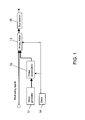
- the modulator 1 comprises a word generator 11, which is connected to a phase accumulator 12.
- the phase accumulator 12 is connected to a signal input of a binary adder 13.
- a modulating signal is applied to another signal input of the binary adder 13.
- a clock signal generator 14 is connected to a clock input of the phase accumulator 12 and to a clock input of the binary adder 13.
- the output of the binary adder is connected to a bus branch 15, which provides the output signal of the modulator 1.
- the modulator 1 operates as follows.
- the word generator 11 provides a generated phase word to the phase accumulator 12.
- the phase accumulator 12 creates a digital sawtooth wave, the frequency of the sawtooth wave being determined by the provided phase word.
- the clock signal generator 14 provides a clock to the clock input of the phase accumulator 12 and defines thereby the accumulation rate of the phase accumulator 12.
- the generated sawtooth wave is fed to the binary adder 13 together with a modulating signal.
- the modulating signal and the sawtooth wave are then added in the binary adder 13.
- the digital sawtooth wave cause the binary adder to overflow at periodic moments depending on the respective level of the modulating signal.
- the bus branch 15 is then used for choosing a single bit output from the binary adder indicating the time of this overflow. As a result, a PPM modulation is obtained.
- the clock frequency has to be at least eighth times higher than the carrier frequency, i.e. than the frequency with which a new value of the modulating signal is provided.
- a digital PPM or PWM is therefore usually not used for high carrier frequencies. Instead, the PPM or PWM is usually created in an analogue domain.
- FIG. 2a and 2b A known method to produce a PPM and a PWM in an analogue domain is illustrated in figures 2a and 2b, which were taken from the document "Communication systems, An introduction to signals and noise in electrical communication", 3 rd edition, McGRAW-HILL 1986, ISBN 0-007-100560-9, by A.B.Carlson.
- FIG. 2a is a block diagram of an analog pulse position modulator.
- a comparator 21 comprises a first input for receiving a modulating signal x(t) and a second, inverting input to which a sawtooth generator 22 is connected.
- the output of the comparator 21 constitutes on the one hand a first output of the modulator.
- the output of the comparator 21 is connected via a monostable 23 to a second output of the modulator.
- Figure 2b presents three diagrams with signals occurring in the modulator of figure 2a.
- An upper diagram shows an analog modulating signal x(t) input to the first input of the comparator 21 over time t.
- the upper diagram shows an analog sawtooth waveform over time t, which is generated by the sawtooth generator 22 and provided to the second, inverting input of the comparator 21.
- the comparator 21 compares the received signals to produce the sequence of PWM pulses shown in a middle diagram of figure 2b over time t.
- the PWM pulses are referred to as pulse density modulation (PDM) pulses. More specifically, a respective pulse has a rising edge when the sawtooth waveform has a falling edge, and a falling edge when the amplitude of the subsequent rising flank of the sawtooth waveform becomes equal to the modulating signal.
- PPM pulses are desired instead of PWM pulses
- the generated PWM pulses are fed to the monostable 23, which produces equal length pulses whenever the comparator 21 detects that a rising flank of the sawtooth waveform becomes equal to the modulating signal, i.e. whenever there is a falling edge of a PWM pulse.
- the resulting PPM pulses are shown in a lower diagram of figure 2b over time t.
- the frequency of the sawtooth waveform has to be about eight times higher than the modulation frequency.
- a pulse modulator which comprises a delay arrangement for receiving a first regular sequence of pulses and for delaying each received pulse several times to obtain a plurality of regular sequences of pulses having different phases.
- the proposed pulse modulator further comprises a selection component for receiving from the delay arrangement a plurality of regular sequences of pulses having different phases, for receiving a modulating signal, wherein each possible value of the modulating signal is associated to one of the different phases, for selecting for each pulse of the first regular sequence of pulses a pulse of the respective regular sequence of pulses which sequence of pulses has a phase associated to a current value of the modulating signal, and for outputting the selected pulse as part of a pulse position modulated sequence of pulses.
- a modulating system comprising such a pulse modulator is proposed.
- a modulating system can be, for example, a transmitter or a mobile device.
- the proposed method comprises a step of generating a first regular sequence of pulses.
- the proposed method further comprises a step of delaying each of the generated pulses several times to obtain a plurality of regular sequences of pulses having different phases, wherein each possible value of a provided modulating signal is associated to one of these different phases.
- the proposed method further comprises a step of selecting for each pulse of the first regular sequence of pulses a pulse of the respective regular sequence of pulses which sequence of pulses has a phase associated to a current value of the modulating signal.
- the proposed method moreover comprises a step of providing the respectively selected pulse as part of a pulse position modulated sequence of pulses.
- the invention proceeds from the consideration that the frequency of a signal which forms the basis of a pulse position modulated sequence of pulses can be reduced significantly, if this signal is a sequence of pulses which is delayed several times. Each delayed pulse constitutes an additional pulse at a different temporal position relative to the original pulse. If an original regular sequence of pulses is delayed several times, the delay results in several regular sequence of pulses having different phases. The frequency of the pulses of all resulting regular sequences of pulses together is obviously much higher than the frequency of the pulses of the original regular sequences of pulses. A respective pulse of one of these achieved regular sequences of pulses can then be selected depending on the current value of a modulating signal with the frequency of the pulses of the original regular sequence of pulses.
- the modulation can be based on pulses which are provided with the same frequency as the modulating signal.
- the frequency of the provided pulses can thus be at least eight times lower than the frequency employed by a clock signal generator in conventional solutions.
- the invention is primarily suited for obtaining a PPM modulation.
- the achieved PPM modulation can be converted easily to a PWM modulation or any other pulse modulation.
- the delay arrangement may comprise a synchronization input for enabling a synchronization of delays applied by the delay arrangement to received pulses by means of an applied clock signal.
- the clock signal has preferably a frequency which exceeds the frequency of pulses of the first regular sequence of pulses by a factor which is equal to the number of the different phases generated by the delay arrangement.
- a conventional pulse modulator which uses a phase accumulator and adders as shown in figure 1, has the benefit that the frequency channel of the PPM/PWM-modulation can be changed easily by applying a new control word to the phase accumulator.
- the conventional pulse modulator also provides dither to the created sawtooth signal, because the phase accumulator overflow occurs at different moments depending on the applied phase word. This dither improves the adjacent channel power (ACP) figures of the PPM/PWM-modulation, which provide an indication of the spectral purity of the modulation.
- a good modulator implementation causes only little power on adjacent channels.
- the pulse modulator according to the invention can be designed to offer the same functions via a different technique.
- the frequency channel can be changed by changing the frequency of the pulses of the first regular sequence of pulses, for example such that this frequency is always the same as the carrier frequency of the modulating signal.
- the delays applied by the delay arrangement have to be adjusted accordingly to correspond to a right dividend of the frequency of the received pulses. More specifically, the delay is increased if the carrier frequency is decreased and decreased if the carrier frequency is increased.
- a delay adjustment can be achieved for example with a control current or a control voltage applied to delay elements of the delay arrangement. If synchronous delays are applied by the delay arrangement, e.g. by a shift register, the delays can be changed by changing the frequency of a clock signal which is used for the synchronization.
- the invention can be employed for realizing a digital pulse modulation or an analog pulse modulation.
- the delays can be created in the delay arrangement of the proposed pulse modulator for instance by means of a high frequency clocked register chain.
- the delays can be created in the delay arrangement for instance by means of analog delay nodes functioning as delay elements. In the latter case, no high frequency clock is present.
- FIG. 3 schematically presents an embodiment of a digital PPM modulator 30 according to the invention.
- the digital PPM modulator 30 can be integrated for example in a transmitter chain of a mobile device 3.
- the digital PPM modulator 30 comprises a clock signal generator 31, which is connected to a delay line 32 and in addition to a clock input of the multiplexer 33.
- the delay line has sixteen outputs, which are connected via a bus to a further input of the multiplexer 33.
- the multiplexer 33 moreover comprises a 4-bit selection input for a modulating signal.
- the principle structure of the delay line 32 is shown in more detail in figure 4.
- the delay line 32 comprises sixteen delay elements 401 to 416, which are connected to each other in series. Only the first two delay elements 401, 402 and the last two delay elements 415, 416 of the sixteen delay elements are depicted.
- the input of the delay line 32 is connected to the input of the first one of the delay elements 401.
- the respective output Nro1 to Nro16 of each of the delay elements 401 to 416 is connected to the bus of figure 3.
- the clock signal generator 31 generates clock signals CLK with a frequency corresponding to the carrier frequency employed for a modulating signal.
- the clock signals CLK have the form of pulses and are fed to the delay line 32 and to a clock input of the multiplexer 33.
- the clock signal generator 31 thus constitutes a pulse generator.
- Each received pulse is split up by the delay line 32 to sixteen pulses at different temporal positions. More specifically, each generated pulse is provided to the first delay element 401, which delays the received pulse. The delayed pulse is then fed via the bus 34 to the multiplexer 33. In addition, the delayed pulse is provided to the second delay element 402. The second delay element 402 delays the received pulse further. The twice delayed pulse is equally fed via the bus 34 to the multiplexer 33 and in addition to the next delay element. This procedure is repeated for all delay elements 401 to 416, until the sixteenth delay element 416 is reached. The sixteenth delay element 416 delays the received pulse once further. The sixteen-fold delayed pulse is only fed via the bus 34 to the multiplexer 33. Considering the entire sequences of pulses provided by the clock signal generator 31 to the delay line 32, the delay line 32 thus outputs sixteen identical sequences of pulses having sixteen different phases.
- the multiplexer 33 thus receives after each clock signal CLK from the clock signal generator 31 sixteen pulses at sixteen different temporal positions via the bus 34.
- the multiplexer 33 receives in addition a 4-bit modulating signal with a frequency which corresponds to the clock frequency.
- the respective value of the modulating signal is used for selecting one of the delayed pulses as the output signal.
- the number of delay elements 401 to 416 in the delay line 32 and thus the number of the different pulse positions determines the accuracy of the modulation of the output signal.
- each one of the 16 possible values of the modulating signal is associated to another one of the temporal pulse positions.
- groups of neighboring values could be associated to a respective one of the temporal pulse positions.
- the signal output by the multiplexer 33 is a PPM modulated signal which has a frequency which corresponds to the clock frequency and the carrier frequency. Thus, no high frequency clock signal is required for the actual PPM modulation.
- the delay line depicted in figure 4 can be realized for instance with a shift register. Such a shift register can be synchronized by means of a high frequency clock signal, as illustrated in figure 5.
- Figure 5 shows again the delay line 32 with sixteen delay elements 501 to 516 connected to each other in series. These delay elements 501 to 516 form a shift register. Only the first two delay elements 501, 502 and the last two delay elements 515, 516 of the shift register are depicted.
- the delay line 32 has in addition a high frequency clock input, which is connected to a respective synchronization input of each of the delay elements 501 to 516.
- a high frequency clock signal is fed via the high frequency clock input of the delay line 32 as synchronization signal to the synchronization inputs of the delay elements 501 to 516.
- the synchronization signal indicates when a pulse which has been received by one of the delay elements 501 to 516 is to be output again.
- the high frequency clock signal used as the synchronization signal has to be sixteen times as high as the clock frequency of the clock signal generator 31. However, the amount of logic to be clocked with this high frequency clock is significantly reduced compared to conventional PPM modulators.
- the performance of the PPM modulator 30 of figure 3 using the synchronous delay line of figure 5 has been tested with an FPGA (field-programmable gate array) circuit.
- the PPM modulator 30 was employed for testing more specifically in a system described in the above cited document US 2003/0058956 A1, and for comparison, the conventional PPM modulator depicted in figure 1 was employed in a system described in the above cited document US 2003/0058956 A1.
- the system comprises a transmitter with a modulator to which in-phase and quadrature components of a modulating signal are fed.
- the modulator is divided into three portions, namely a low-frequency portion, a radiofrequency portion and a local oscillator, for generating bandpass signals.
- a balanced switching mode amplifier is coupled to the modulator output to amplify the bandpass signals.
- a balanced coupling circuit means delivers the amplified bandpass signals to a load.
- the low-frequency portion of the modulator comprises means for determining the amplitude and the phase information content encoded in the in-phase and quadrature components.
- the amplitude and the phase content signals are encoded as PPM modulated signals by the PPM modulator according to figure 1 and figure 3, respectively.
- Figure 6 is a first diagram presenting the output spectrum of the system resulting with the conventional PPM modulator depicted in figure 1. More specifically, the attenuation in dBm versus a reference level of 0dBm is depicted over frequency for a center frequency of 12.50024 MHz and a span of 200 kHz. The scale on the x-axis is 20 kHz per line.
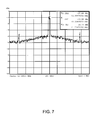
- Figure 7 is a second diagram presenting the output spectrum of the system resulting with the conventional PPM modulator depicted in figure 1. More specifically, the attenuation in dBm versus a reference level of 0dBm is depicted over frequency for a center frequency of 12.50024 MHz and a span of 2 MHz. The scale on the x-axis is 200 kHz per line.
- Figure 8 is a first diagram presenting the output spectrum of the system resulting with the PPM modulator 30 presented in figure 3.
- the attenuation in dBm versus a reference level of 10dBm is depicted over frequency for a center frequency of 12.50024 MHz and a span of 200 kHz.
- the scale on the x-axis is 20 kHz per line.
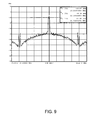
- Figure 9 is a second diagram presenting the output spectrum of the system resulting with the PPM modulator 30 presented in figure 3.
- the attenuation in dBm versus a reference level of 10dBm is depicted over frequency for a center frequency of 12.50024 MHz and a span of 2 MHz.
- the scale on the x-axis is 200 kHz per line.
- the output spectrum was almost the same with the presented PPM modulator 30 as with the conventional PPM modulator. There is only a slight degradation of the spectrum with the proposed PPM modulator due to the reduced pulse resolution compared to the conventional solution. This is caused by the limited clock frequency of the employed FPGA circuit.
- the proposed PPM modulator thus constitutes an advantageous alternative to the conventional PPM modulator.
- the PPM-modulation achieved with the PPM modulator 30 of figure 3 can be converted easily into a PWM-modulation, for instance by adding the logic circuit depicted in figure 10 to the PPM modulator 30.
- the logic circuit of figure 10 comprises an XOR-gate 101, to which the PPM-modulated signal output by the multiplexer 33 is fed.
- the clock signal CLK provided by the clock signal generator 31 is fed to the second input of the XOR-gate 101.
- the clock signal CLK is provided in addition to a buffer B 102.
- the output of the XOR-gate 101 and the buffered clock signal output by the buffer 102 are fed to an AND-gate 103 to form the PWM-modulation.
- the buffer 102 is used to compensate for the delay in the XOR-gate 101.
Landscapes
- Physics & Mathematics (AREA)
- Nonlinear Science (AREA)
- Digital Transmission Methods That Use Modulated Carrier Waves (AREA)
Applications Claiming Priority (2)
| Application Number | Priority Date | Filing Date | Title |
|---|---|---|---|
| US663350 | 2003-09-16 | ||
| US10/663,350 US7002425B2 (en) | 2003-09-16 | 2003-09-16 | Pulse modulation |
Publications (1)
| Publication Number | Publication Date |
|---|---|
| EP1517447A1 true EP1517447A1 (de) | 2005-03-23 |
Family
ID=34194723
Family Applications (1)
| Application Number | Title | Priority Date | Filing Date |
|---|---|---|---|
| EP04021394A Withdrawn EP1517447A1 (de) | 2003-09-16 | 2004-09-09 | Vorrichtung und Verfahren zur Pulspositionsmodulation |
Country Status (2)
| Country | Link |
|---|---|
| US (1) | US7002425B2 (de) |
| EP (1) | EP1517447A1 (de) |
Cited By (2)
| Publication number | Priority date | Publication date | Assignee | Title |
|---|---|---|---|---|
| EP1732222A3 (de) * | 2005-05-03 | 2008-08-20 | M/A-Com, Inc. | Generierung eines präzisen Zeitoffsets mit einem SiGe-Pulsegenerator |
| WO2014207436A1 (en) * | 2013-06-25 | 2014-12-31 | Amantys Ltd | Low-skew communication system |
Families Citing this family (7)
| Publication number | Priority date | Publication date | Assignee | Title |
|---|---|---|---|---|
| FI20065260A0 (fi) * | 2006-04-24 | 2006-04-24 | Nokia Corp | Vaihdemodulaattori |
| US20110159817A1 (en) * | 2009-12-29 | 2011-06-30 | Pirelli Tyre S.P.A. | Method and system for managing communications between sensor devices included in a tyre and a sensor coordinator device |
| EP2395664A1 (de) | 2010-06-14 | 2011-12-14 | IHP GmbH-Innovations for High Performance Microelectronics / Leibniz-Institut für innovative Mikroelektronik | Verfahren und Vorrichtung zur Phasen- und /oder Pulsweitenmodulation |
| WO2014032693A1 (en) * | 2012-08-27 | 2014-03-06 | Telefonaktiebolaget L M Ericsson (Publ) | Transmission of pulse length modulation information |
| WO2017147886A1 (en) * | 2016-03-03 | 2017-09-08 | Qualcomm Incorporated | Method for robust phase-locked loop design |
| US10523190B2 (en) * | 2017-11-28 | 2019-12-31 | Infineon Technologies Ag | Pulse density modulation adjustment |
| JP7119757B2 (ja) * | 2018-08-21 | 2022-08-17 | 富士通株式会社 | パルス位置変調回路及び送信回路 |
Citations (6)
| Publication number | Priority date | Publication date | Assignee | Title |
|---|---|---|---|---|
| JPH06326574A (ja) * | 1993-05-18 | 1994-11-25 | Mega Chips:Kk | 制御信号発生回路,パルス幅変調回路,遅延制御回路およびクロック発生回路 |
| JPH0851346A (ja) * | 1994-06-02 | 1996-02-20 | Advantest Corp | タイミング信号発生回路 |
| JPH08102660A (ja) * | 1994-10-03 | 1996-04-16 | Nippon Steel Corp | 信号変調回路 |
| EP0712211A2 (de) * | 1994-11-14 | 1996-05-15 | Tektronix, Inc. | Phasenmodulation mit individuell gesetzten Flanken |
| US5699005A (en) * | 1994-11-30 | 1997-12-16 | Deutsche Itt Industries Gmbh | Clock generator for generating a system clock causing minimal electromagnetic interference |
| US6439679B1 (en) * | 2001-06-22 | 2002-08-27 | Hewlett-Packard Company | Pulse with modulation signal generating methods and apparatuses |
Family Cites Families (23)
| Publication number | Priority date | Publication date | Assignee | Title |
|---|---|---|---|---|
| US58956A (en) * | 1866-10-16 | Improved car-brake | ||
| US1730259A (en) * | 1924-07-25 | 1929-10-01 | Wright Rubber Products Company | Pavement |
| US1660480A (en) * | 1925-03-13 | 1928-02-28 | Daniels Ernest Stuart | Parquet-floor panels |
| US1778068A (en) * | 1928-03-07 | 1930-10-14 | Cellized Oak Flooring Inc | Wood-block flooring |
| US1929871A (en) * | 1931-08-20 | 1933-10-10 | Berton W Jones | Parquet flooring |
| US2027292A (en) * | 1932-03-25 | 1936-01-07 | Bradley Lumber Company Of Arka | Block flooring |
| US3298272A (en) * | 1964-10-20 | 1967-01-17 | Harold P Henderson | Protective and decorative cap for screw and bolt heads |
| US3271916A (en) * | 1965-01-27 | 1966-09-13 | Powerlock Floors Inc | Uniformly resilient flooring systems |
| US3892099A (en) * | 1970-07-16 | 1975-07-01 | Rolls Royce | Means for fastening of sandwich panels to supports |
| US4056878A (en) * | 1974-09-17 | 1977-11-08 | Ciba-Geigy Ag | Method of fixing a sandwich panel to a support |
| FR2440485A1 (fr) * | 1978-11-06 | 1980-05-30 | Shur Lok International Sa | Dispositif d'assemblage pour panneau en nid d'abeilles utilise notamment dans la construction aeronautique |
| US5016413A (en) * | 1990-02-14 | 1991-05-21 | James Counihan | Resilient floor system |
| FI912773A0 (fi) * | 1991-06-10 | 1991-06-10 | Shippax Ltd Oy | Foerfarande foer beslaoende av fartygsdaeck och daeckelement. |
| US5609000A (en) * | 1992-07-13 | 1997-03-11 | Robbins, Inc. | Anchored/resilient hardwood floor system |
| US5412917A (en) * | 1993-10-14 | 1995-05-09 | Shelton; Floyd | Fixed resilient sleeper athletic flooring system |
| US5570554A (en) * | 1994-05-16 | 1996-11-05 | Fas Industries, Inc. | Interlocking stapled flooring |
| SE503973C2 (sv) * | 1994-12-13 | 1996-10-07 | Dan Johansson | Sätt att lägga golv där golvbrädorna är belagda med ett friktionsskikt |
| US6194971B1 (en) * | 1997-04-21 | 2001-02-27 | Ati Technologies, Inc. | Method and apparatus for phase shifting a controlled oscillator and applications thereof |
| US6122873A (en) * | 1998-06-12 | 2000-09-26 | Connor/Aga Sports Flooring Corporation | Subfloor assembly for athletic playing surface having improved deflection characteristics |
| US5988966A (en) * | 1998-08-14 | 1999-11-23 | Chen; Antony | Antitheft device for use with a bolt |
| US6164031A (en) * | 1999-04-12 | 2000-12-26 | Counihan; James | Resilient flooring |
| FR2801943B1 (fr) * | 1999-12-03 | 2002-02-08 | Didier Faure | Dispositif d'assemblage sans vis apparente pour des lames de bois |
| US6993087B2 (en) | 2001-06-29 | 2006-01-31 | Nokia Mobile Phones Ltd. | Switching mode power amplifier using PWM and PPM for bandpass signals |
-
2003
- 2003-09-16 US US10/663,350 patent/US7002425B2/en not_active Expired - Fee Related
-
2004
- 2004-09-09 EP EP04021394A patent/EP1517447A1/de not_active Withdrawn
Patent Citations (6)
| Publication number | Priority date | Publication date | Assignee | Title |
|---|---|---|---|---|
| JPH06326574A (ja) * | 1993-05-18 | 1994-11-25 | Mega Chips:Kk | 制御信号発生回路,パルス幅変調回路,遅延制御回路およびクロック発生回路 |
| JPH0851346A (ja) * | 1994-06-02 | 1996-02-20 | Advantest Corp | タイミング信号発生回路 |
| JPH08102660A (ja) * | 1994-10-03 | 1996-04-16 | Nippon Steel Corp | 信号変調回路 |
| EP0712211A2 (de) * | 1994-11-14 | 1996-05-15 | Tektronix, Inc. | Phasenmodulation mit individuell gesetzten Flanken |
| US5699005A (en) * | 1994-11-30 | 1997-12-16 | Deutsche Itt Industries Gmbh | Clock generator for generating a system clock causing minimal electromagnetic interference |
| US6439679B1 (en) * | 2001-06-22 | 2002-08-27 | Hewlett-Packard Company | Pulse with modulation signal generating methods and apparatuses |
Non-Patent Citations (4)
| Title |
|---|
| DANCY A.P.; CHANDRAKASAN A.P.: "Ultra low power control circuits for PWM converters", POWER ELECTRONICS SPECIALISTS CONFERENCE, 1997. PESC '97 RECORD., 28TH ANNUAL IEEE ST. LOUIS, MO, USA, 22-27 JUNE 1997, 22 June 1997 (1997-06-22), NEW YORK, NY, USA, pages 21 - 27, XP010241523 * |
| PATENT ABSTRACTS OF JAPAN vol. 1995, no. 02 31 March 1995 (1995-03-31) * |
| PATENT ABSTRACTS OF JAPAN vol. 1996, no. 06 28 June 1996 (1996-06-28) * |
| PATENT ABSTRACTS OF JAPAN vol. 1996, no. 08 30 August 1996 (1996-08-30) * |
Cited By (2)
| Publication number | Priority date | Publication date | Assignee | Title |
|---|---|---|---|---|
| EP1732222A3 (de) * | 2005-05-03 | 2008-08-20 | M/A-Com, Inc. | Generierung eines präzisen Zeitoffsets mit einem SiGe-Pulsegenerator |
| WO2014207436A1 (en) * | 2013-06-25 | 2014-12-31 | Amantys Ltd | Low-skew communication system |
Also Published As
| Publication number | Publication date |
|---|---|
| US20050057319A1 (en) | 2005-03-17 |
| US7002425B2 (en) | 2006-02-21 |
Similar Documents
| Publication | Publication Date | Title |
|---|---|---|
| US7206356B2 (en) | Wireless transmitter with reduced power consumption | |
| US6836517B2 (en) | Distortion compensating apparatus | |
| US4933890A (en) | Digital frequency synthesizer | |
| US8233579B2 (en) | Devices comprising delay line for applying variable delay to clock signal | |
| JP5749372B2 (ja) | アナログディザリングを用いる時間/デジタル変換 | |
| US7143125B2 (en) | Method and apparatus for noise shaping in direct digital synthesis circuits | |
| US20080198939A1 (en) | Transmitter circuit and radio transmission apparatus for transmitting data via radio by using impulses | |
| EP2342827B1 (de) | Digital-analog-umsetzung mit linearer interpolation und niedrigem stromverbrauch | |
| EP3210299A1 (de) | Hochfrequenzverstärker | |
| EP1150422B1 (de) | Adaptive Kompensation der Phasenverzerrung eines Trägersignals | |
| US7002425B2 (en) | Pulse modulation | |
| KR20210003223A (ko) | G급 무선주파수 전력 증폭기를 위한 베이스밴드 선형화 시스템 및 방법 | |
| Keyzer et al. | Generation of RF pulsewidth modulated microwave signals using delta-sigma modulation | |
| US10177774B2 (en) | Digital time converter systems and methods | |
| US20160330053A1 (en) | Method and apparatus for spectrum spreading of a pulse-density modulated waveform | |
| US9191190B2 (en) | Methods and apparatus for digital host-lock mode in a transceiver | |
| US9397689B2 (en) | Interpolator systems and methods | |
| US20050197076A1 (en) | Radio communication device and control method of amplification circuit thereof | |
| Kuo et al. | A dual-phase center-aligned 7-bit digital pulsewidth modulator for polar transmitters | |
| US6987473B1 (en) | Digital signal-rate converter and systems incorporating same | |
| EP3996340B1 (de) | Asynchroner polarer sender und betriebsverfahren dafür | |
| US8217818B2 (en) | Digital RF converter and RF converting method thereof | |
| US20040174222A1 (en) | Phase modulating system | |
| US5686869A (en) | Pulse-width modulating device | |
| US20170230055A1 (en) | Methods and devices for an energy efficient digital to analog conversion |
Legal Events
| Date | Code | Title | Description |
|---|---|---|---|
| PUAI | Public reference made under article 153(3) epc to a published international application that has entered the european phase |
Free format text: ORIGINAL CODE: 0009012 |
|
| AK | Designated contracting states |
Kind code of ref document: A1 Designated state(s): AT BE BG CH CY CZ DE DK EE ES FI FR GB GR HU IE IT LI LU MC NL PL PT RO SE SI SK TR |
|
| AX | Request for extension of the european patent |
Extension state: AL HR LT LV MK |
|
| 17P | Request for examination filed |
Effective date: 20050908 |
|
| AKX | Designation fees paid |
Designated state(s): DE FI FR GB NL |
|
| GRAP | Despatch of communication of intention to grant a patent |
Free format text: ORIGINAL CODE: EPIDOSNIGR1 |
|
| STAA | Information on the status of an ep patent application or granted ep patent |
Free format text: STATUS: THE APPLICATION IS DEEMED TO BE WITHDRAWN |
|
| 18D | Application deemed to be withdrawn |
Effective date: 20080717 |