EP1515931B1 - 3,3,4,4-tetrafluorcyclopentanverbindungen als komponenten flüssigkristalliner medien - Google Patents
3,3,4,4-tetrafluorcyclopentanverbindungen als komponenten flüssigkristalliner medien Download PDFInfo
- Publication number
- EP1515931B1 EP1515931B1 EP03760649A EP03760649A EP1515931B1 EP 1515931 B1 EP1515931 B1 EP 1515931B1 EP 03760649 A EP03760649 A EP 03760649A EP 03760649 A EP03760649 A EP 03760649A EP 1515931 B1 EP1515931 B1 EP 1515931B1
- Authority
- EP
- European Patent Office
- Prior art keywords
- compounds
- liquid
- radical
- diyl
- bis
- Prior art date
- Legal status (The legal status is an assumption and is not a legal conclusion. Google has not performed a legal analysis and makes no representation as to the accuracy of the status listed.)
- Expired - Lifetime
Links
- 239000004973 liquid crystal related substance Substances 0.000 title claims abstract description 8
- GCVFCJIFJCONOT-UHFFFAOYSA-N 1,1,2,2-tetrafluorocyclopentane Chemical class FC1(F)CCCC1(F)F GCVFCJIFJCONOT-UHFFFAOYSA-N 0.000 title claims abstract description 4
- 150000001875 compounds Chemical class 0.000 claims abstract description 67
- -1 piperidine-1,4-diyl Chemical group 0.000 claims description 115
- 125000004432 carbon atom Chemical group C* 0.000 claims description 11
- 125000000217 alkyl group Chemical group 0.000 claims description 8
- 125000003342 alkenyl group Chemical group 0.000 claims description 6
- 125000003545 alkoxy group Chemical group 0.000 claims description 6
- 229910052736 halogen Inorganic materials 0.000 claims description 5
- 229910052731 fluorine Inorganic materials 0.000 claims description 4
- 125000003302 alkenyloxy group Chemical group 0.000 claims description 3
- 125000001153 fluoro group Chemical group F* 0.000 claims description 3
- KWKAKUADMBZCLK-UHFFFAOYSA-N 1-octene Chemical group CCCCCCC=C KWKAKUADMBZCLK-UHFFFAOYSA-N 0.000 claims description 2
- 125000005843 halogen group Chemical group 0.000 claims description 2
- 229910052739 hydrogen Inorganic materials 0.000 claims description 2
- 229910052757 nitrogen Inorganic materials 0.000 claims description 2
- 125000004430 oxygen atom Chemical group O* 0.000 claims description 2
- 0 *C(CC1)CCC1C(CC1)CCC1C(CC1(F)F)CC1(F)F Chemical compound *C(CC1)CCC1C(CC1)CCC1C(CC1(F)F)CC1(F)F 0.000 description 22
- 150000003254 radicals Chemical class 0.000 description 18
- OKKJLVBELUTLKV-UHFFFAOYSA-N Methanol Chemical compound OC OKKJLVBELUTLKV-UHFFFAOYSA-N 0.000 description 15
- 239000000203 mixture Substances 0.000 description 11
- BZLVMXJERCGZMT-UHFFFAOYSA-N Methyl tert-butyl ether Chemical compound COC(C)(C)C BZLVMXJERCGZMT-UHFFFAOYSA-N 0.000 description 8
- 239000012071 phase Substances 0.000 description 7
- JOXIMZWYDAKGHI-UHFFFAOYSA-N toluene-4-sulfonic acid Chemical compound CC1=CC=C(S(O)(=O)=O)C=C1 JOXIMZWYDAKGHI-UHFFFAOYSA-N 0.000 description 7
- YMWUJEATGCHHMB-UHFFFAOYSA-N Dichloromethane Chemical compound ClCCl YMWUJEATGCHHMB-UHFFFAOYSA-N 0.000 description 6
- YXFVVABEGXRONW-UHFFFAOYSA-N Toluene Chemical compound CC1=CC=CC=C1 YXFVVABEGXRONW-UHFFFAOYSA-N 0.000 description 6
- CSJLBAMHHLJAAS-UHFFFAOYSA-N diethylaminosulfur trifluoride Chemical compound CCN(CC)S(F)(F)F CSJLBAMHHLJAAS-UHFFFAOYSA-N 0.000 description 5
- 239000000126 substance Substances 0.000 description 5
- CYSGHNMQYZDMIA-UHFFFAOYSA-N 1,3-Dimethyl-2-imidazolidinon Chemical compound CN1CCN(C)C1=O CYSGHNMQYZDMIA-UHFFFAOYSA-N 0.000 description 4
- GVNVAWHJIKLAGL-UHFFFAOYSA-N 2-(cyclohexen-1-yl)cyclohexan-1-one Chemical compound O=C1CCCCC1C1=CCCCC1 GVNVAWHJIKLAGL-UHFFFAOYSA-N 0.000 description 4
- CSCPPACGZOOCGX-UHFFFAOYSA-N Acetone Chemical compound CC(C)=O CSCPPACGZOOCGX-UHFFFAOYSA-N 0.000 description 4
- 101150065749 Churc1 gene Proteins 0.000 description 4
- 102100038239 Protein Churchill Human genes 0.000 description 4
- 239000000463 material Substances 0.000 description 4
- 230000003287 optical effect Effects 0.000 description 4
- NZNMSOFKMUBTKW-UHFFFAOYSA-N Cyclohexanecarboxylic acid Natural products OC(=O)C1CCCCC1 NZNMSOFKMUBTKW-UHFFFAOYSA-N 0.000 description 3
- RTZKZFJDLAIYFH-UHFFFAOYSA-N Diethyl ether Chemical compound CCOCC RTZKZFJDLAIYFH-UHFFFAOYSA-N 0.000 description 3
- HEMHJVSKTPXQMS-UHFFFAOYSA-M Sodium hydroxide Chemical compound [OH-].[Na+] HEMHJVSKTPXQMS-UHFFFAOYSA-M 0.000 description 3
- 125000004183 alkoxy alkyl group Chemical group 0.000 description 3
- 238000006243 chemical reaction Methods 0.000 description 3
- 125000001309 chloro group Chemical group Cl* 0.000 description 3
- 239000000470 constituent Substances 0.000 description 3
- 125000000113 cyclohexyl group Chemical group [H]C1([H])C([H])([H])C([H])([H])C([H])(*)C([H])([H])C1([H])[H] 0.000 description 3
- 230000000694 effects Effects 0.000 description 3
- 150000002367 halogens Chemical class 0.000 description 3
- 238000000034 method Methods 0.000 description 3
- 125000001997 phenyl group Chemical group [H]C1=C([H])C([H])=C(*)C([H])=C1[H] 0.000 description 3
- 238000002360 preparation method Methods 0.000 description 3
- 125000001424 substituent group Chemical group 0.000 description 3
- 238000006467 substitution reaction Methods 0.000 description 3
- SJSRFXJWBKOROD-UHFFFAOYSA-N 1,1'-bi(cyclohexyl)-1-carboxylic acid Chemical class C1CCCCC1C1(C(=O)O)CCCCC1 SJSRFXJWBKOROD-UHFFFAOYSA-N 0.000 description 2
- 125000001140 1,4-phenylene group Chemical group [H]C1=C([H])C([*:2])=C([H])C([H])=C1[*:1] 0.000 description 2
- VEXZGXHMUGYJMC-UHFFFAOYSA-N Hydrochloric acid Chemical compound Cl VEXZGXHMUGYJMC-UHFFFAOYSA-N 0.000 description 2
- OFBQJSOFQDEBGM-UHFFFAOYSA-N Pentane Chemical compound CCCCC OFBQJSOFQDEBGM-UHFFFAOYSA-N 0.000 description 2
- NQRYJNQNLNOLGT-UHFFFAOYSA-N Piperidine Chemical compound C1CCNCC1 NQRYJNQNLNOLGT-UHFFFAOYSA-N 0.000 description 2
- 239000004990 Smectic liquid crystal Substances 0.000 description 2
- 239000000654 additive Substances 0.000 description 2
- VZFUCHSFHOYXIS-UHFFFAOYSA-N cycloheptane carboxylic acid Natural products OC(=O)C1CCCCCC1 VZFUCHSFHOYXIS-UHFFFAOYSA-N 0.000 description 2
- 239000002019 doping agent Substances 0.000 description 2
- 125000000959 isobutyl group Chemical group [H]C([H])([H])C([H])(C([H])([H])[H])C([H])([H])* 0.000 description 2
- 125000001972 isopentyl group Chemical group [H]C([H])([H])C([H])(C([H])([H])[H])C([H])([H])C([H])([H])* 0.000 description 2
- 125000002496 methyl group Chemical group [H]C([H])([H])* 0.000 description 2
- 230000007935 neutral effect Effects 0.000 description 2
- 125000002914 sec-butyl group Chemical group [H]C([H])([H])C([H])([H])C([H])(*)C([H])([H])[H] 0.000 description 2
- WHRNULOCNSKMGB-UHFFFAOYSA-N tetrahydrofuran thf Chemical compound C1CCOC1.C1CCOC1 WHRNULOCNSKMGB-UHFFFAOYSA-N 0.000 description 2
- XLYOFNOQVPJJNP-UHFFFAOYSA-N water Substances O XLYOFNOQVPJJNP-UHFFFAOYSA-N 0.000 description 2
- IWIOHRVOBOYWQE-UHFFFAOYSA-N (1-cyclohexylcyclohexyl)benzene Chemical class C1CCCCC1C1(C=2C=CC=CC=2)CCCCC1 IWIOHRVOBOYWQE-UHFFFAOYSA-N 0.000 description 1
- JYNLTWJPPFIEFR-UHFFFAOYSA-N 1,2-dicyclohexylcyclohexene Chemical class C1CCCCC1C1=C(C2CCCCC2)CCCC1 JYNLTWJPPFIEFR-UHFFFAOYSA-N 0.000 description 1
- QWUWMCYKGHVNAV-UHFFFAOYSA-N 1,2-dihydrostilbene Chemical compound C=1C=CC=CC=1CCC1=CC=CC=C1 QWUWMCYKGHVNAV-UHFFFAOYSA-N 0.000 description 1
- QQFSIGWYINAJOB-UHFFFAOYSA-N 1,4-dicyclohexylbenzene Chemical class C1CCCCC1C1=CC=C(C2CCCCC2)C=C1 QQFSIGWYINAJOB-UHFFFAOYSA-N 0.000 description 1
- ZKHVVTHZAODGRM-UHFFFAOYSA-N 1-bromo-4-(2,2,3,3-tetrafluorocyclopentyl)benzene Chemical compound FC1(F)C(F)(F)CCC1C1=CC=C(Br)C=C1 ZKHVVTHZAODGRM-UHFFFAOYSA-N 0.000 description 1
- YQSAPDQJFZPHOJ-UHFFFAOYSA-N 2-cyclohexyl-1,3-dithiane Chemical compound C1CCCCC1C1SCCCS1 YQSAPDQJFZPHOJ-UHFFFAOYSA-N 0.000 description 1
- SMHSPYVJAUGNOI-UHFFFAOYSA-N 2-cyclohexyl-1,4-dioxane Chemical class C1CCCCC1C1OCCOC1 SMHSPYVJAUGNOI-UHFFFAOYSA-N 0.000 description 1
- ZKTFZNPTAJIXMK-UHFFFAOYSA-N 2-cyclohexylbenzoic acid Chemical compound OC(=O)C1=CC=CC=C1C1CCCCC1 ZKTFZNPTAJIXMK-UHFFFAOYSA-N 0.000 description 1
- HYYFAYFMSHAWFA-UHFFFAOYSA-N 2-cyclohexylethylbenzene Chemical compound C1CCCCC1CCC1=CC=CC=C1 HYYFAYFMSHAWFA-UHFFFAOYSA-N 0.000 description 1
- IBLVSWYGUFGDMF-UHFFFAOYSA-N 2-cyclohexylethylcyclohexane Chemical compound C1CCCCC1CCC1CCCCC1 IBLVSWYGUFGDMF-UHFFFAOYSA-N 0.000 description 1
- HUTHUTALXJNNRS-UHFFFAOYSA-N 2-cyclohexylpyridine Chemical class C1CCCCC1C1=CC=CC=N1 HUTHUTALXJNNRS-UHFFFAOYSA-N 0.000 description 1
- YJDDXMSIMBMMGY-UHFFFAOYSA-N 2-cyclohexylpyrimidine Chemical class C1CCCCC1C1=NC=CC=N1 YJDDXMSIMBMMGY-UHFFFAOYSA-N 0.000 description 1
- 125000004200 2-methoxyethyl group Chemical group [H]C([H])([H])OC([H])([H])C([H])([H])* 0.000 description 1
- 125000004493 2-methylbut-1-yl group Chemical group CC(C*)CC 0.000 description 1
- 125000005916 2-methylpentyl group Chemical group 0.000 description 1
- UFQBSPGKRRSATO-UHFFFAOYSA-N 3,3-dimethoxybutan-2-one Chemical compound COC(C)(OC)C(C)=O UFQBSPGKRRSATO-UHFFFAOYSA-N 0.000 description 1
- 125000004975 3-butenyl group Chemical group C(CC=C)* 0.000 description 1
- 125000005917 3-methylpentyl group Chemical group 0.000 description 1
- ZRYZBQLXDKPBDU-UHFFFAOYSA-N 4-bromobenzaldehyde Chemical compound BrC1=CC=C(C=O)C=C1 ZRYZBQLXDKPBDU-UHFFFAOYSA-N 0.000 description 1
- QNGKGXNZGWIDGS-UHFFFAOYSA-N 6-cyclohexyl-5-ethyl-5-phenylcyclohexa-1,3-diene Chemical class C=1C=CC=CC=1C1(CC)C=CC=CC1C1CCCCC1 QNGKGXNZGWIDGS-UHFFFAOYSA-N 0.000 description 1
- AOCAMJWICBPTMK-UHFFFAOYSA-N CC(CC1(F)F)CC1(F)F Chemical compound CC(CC1(F)F)CC1(F)F AOCAMJWICBPTMK-UHFFFAOYSA-N 0.000 description 1
- KAHZFCWHUOVCPU-UHFFFAOYSA-N CC(CC1)CCC1C1COC(c(cc2F)cc(F)c2F)OC1 Chemical compound CC(CC1)CCC1C1COC(c(cc2F)cc(F)c2F)OC1 KAHZFCWHUOVCPU-UHFFFAOYSA-N 0.000 description 1
- SNRUBQQJIBEYMU-UHFFFAOYSA-N Dodecane Natural products CCCCCCCCCCCC SNRUBQQJIBEYMU-UHFFFAOYSA-N 0.000 description 1
- 229920000106 Liquid crystal polymer Polymers 0.000 description 1
- 101100521345 Mus musculus Prop1 gene Proteins 0.000 description 1
- 102100035593 POU domain, class 2, transcription factor 1 Human genes 0.000 description 1
- 101710084414 POU domain, class 2, transcription factor 1 Proteins 0.000 description 1
- 108700017836 Prophet of Pit-1 Proteins 0.000 description 1
- CDBYLPFSWZWCQE-UHFFFAOYSA-L Sodium Carbonate Chemical compound [Na+].[Na+].[O-]C([O-])=O CDBYLPFSWZWCQE-UHFFFAOYSA-L 0.000 description 1
- PMZURENOXWZQFD-UHFFFAOYSA-L Sodium Sulfate Chemical compound [Na+].[Na+].[O-]S([O-])(=O)=O PMZURENOXWZQFD-UHFFFAOYSA-L 0.000 description 1
- QEYYGOMUSLDSJM-UHFFFAOYSA-N [2-(4-propylcyclohexyl)phenyl]boronic acid Chemical compound C1CC(CCC)CCC1C1=CC=CC=C1B(O)O QEYYGOMUSLDSJM-UHFFFAOYSA-N 0.000 description 1
- ADIAPCNCEHFEPJ-UHFFFAOYSA-N [4-(2-cyclohexylethyl)cyclohexyl]benzene Chemical class C1CCCCC1CCC(CC1)CCC1C1=CC=CC=C1 ADIAPCNCEHFEPJ-UHFFFAOYSA-N 0.000 description 1
- 125000004423 acyloxy group Chemical group 0.000 description 1
- 239000003963 antioxidant agent Substances 0.000 description 1
- 150000001482 benzyl phenyl ethers Chemical class 0.000 description 1
- 235000010290 biphenyl Nutrition 0.000 description 1
- 150000004074 biphenyls Chemical class 0.000 description 1
- 238000007664 blowing Methods 0.000 description 1
- 238000009835 boiling Methods 0.000 description 1
- 125000000484 butyl group Chemical group [H]C([*])([H])C([H])([H])C([H])([H])C([H])([H])[H] 0.000 description 1
- 125000004744 butyloxycarbonyl group Chemical group 0.000 description 1
- 239000003054 catalyst Substances 0.000 description 1
- 238000004587 chromatography analysis Methods 0.000 description 1
- 235000013985 cinnamic acid Nutrition 0.000 description 1
- WBYWAXJHAXSJNI-UHFFFAOYSA-N cinnamic acid group Chemical class C(C=CC1=CC=CC=C1)(=O)O WBYWAXJHAXSJNI-UHFFFAOYSA-N 0.000 description 1
- 238000004440 column chromatography Methods 0.000 description 1
- 238000001816 cooling Methods 0.000 description 1
- 229920001577 copolymer Chemical group 0.000 description 1
- 238000002425 crystallisation Methods 0.000 description 1
- 230000008025 crystallization Effects 0.000 description 1
- DQZKGSRJOUYVPL-UHFFFAOYSA-N cyclohexyl benzoate Chemical class C=1C=CC=CC=1C(=O)OC1CCCCC1 DQZKGSRJOUYVPL-UHFFFAOYSA-N 0.000 description 1
- IGARGHRYKHJQSM-UHFFFAOYSA-N cyclohexylbenzene Chemical class C1CCCCC1C1=CC=CC=C1 IGARGHRYKHJQSM-UHFFFAOYSA-N 0.000 description 1
- WVIIMZNLDWSIRH-UHFFFAOYSA-N cyclohexylcyclohexane Chemical class C1CCCCC1C1CCCCC1 WVIIMZNLDWSIRH-UHFFFAOYSA-N 0.000 description 1
- 101150047356 dec-1 gene Proteins 0.000 description 1
- 125000002704 decyl group Chemical group [H]C([H])([H])C([H])([H])C([H])([H])C([H])([H])C([H])([H])C([H])([H])C([H])([H])C([H])([H])C([H])([H])C([H])([H])* 0.000 description 1
- 238000004821 distillation Methods 0.000 description 1
- 125000003438 dodecyl group Chemical group [H]C([H])([H])C([H])([H])C([H])([H])C([H])([H])C([H])([H])C([H])([H])C([H])([H])C([H])([H])C([H])([H])C([H])([H])C([H])([H])C([H])([H])* 0.000 description 1
- 239000000975 dye Substances 0.000 description 1
- 229940052296 esters of benzoic acid for local anesthesia Drugs 0.000 description 1
- 125000003754 ethoxycarbonyl group Chemical group C(=O)(OCC)* 0.000 description 1
- 125000005745 ethoxymethyl group Chemical group [H]C([H])([H])C([H])([H])OC([H])([H])* 0.000 description 1
- 125000001495 ethyl group Chemical group [H]C([H])([H])C([H])([H])* 0.000 description 1
- 239000011737 fluorine Substances 0.000 description 1
- 239000007789 gas Substances 0.000 description 1
- 125000003187 heptyl group Chemical group [H]C([*])([H])C([H])([H])C([H])([H])C([H])([H])C([H])([H])C([H])([H])C([H])([H])[H] 0.000 description 1
- 125000004051 hexyl group Chemical group [H]C([H])([H])C([H])([H])C([H])([H])C([H])([H])C([H])([H])C([H])([H])* 0.000 description 1
- 125000003707 hexyloxy group Chemical group [H]C([H])([H])C([H])([H])C([H])([H])C([H])([H])C([H])([H])C([H])([H])O* 0.000 description 1
- 125000001449 isopropyl group Chemical group [H]C([H])([H])C([H])(*)C([H])([H])[H] 0.000 description 1
- 239000007788 liquid Substances 0.000 description 1
- CRGZYKWWYNQGEC-UHFFFAOYSA-N magnesium;methanolate Chemical compound [Mg+2].[O-]C.[O-]C CRGZYKWWYNQGEC-UHFFFAOYSA-N 0.000 description 1
- 238000004519 manufacturing process Methods 0.000 description 1
- 238000002844 melting Methods 0.000 description 1
- 230000008018 melting Effects 0.000 description 1
- 125000001160 methoxycarbonyl group Chemical group [H]C([H])([H])OC(*)=O 0.000 description 1
- 125000004184 methoxymethyl group Chemical group [H]C([H])([H])OC([H])([H])* 0.000 description 1
- 125000001421 myristyl group Chemical group [H]C([*])([H])C([H])([H])C([H])([H])C([H])([H])C([H])([H])C([H])([H])C([H])([H])C([H])([H])C([H])([H])C([H])([H])C([H])([H])C([H])([H])C([H])([H])C([H])([H])[H] 0.000 description 1
- UVEWQKMPXAHFST-UHFFFAOYSA-N n,1-diphenylmethanimine Chemical class C=1C=CC=CC=1C=NC1=CC=CC=C1 UVEWQKMPXAHFST-UHFFFAOYSA-N 0.000 description 1
- XXZNFWHGOMHWCO-UHFFFAOYSA-N n,n-diethylthiohydroxylamine Chemical compound CCN(S)CC XXZNFWHGOMHWCO-UHFFFAOYSA-N 0.000 description 1
- 125000001400 nonyl group Chemical group [H]C([*])([H])C([H])([H])C([H])([H])C([H])([H])C([H])([H])C([H])([H])C([H])([H])C([H])([H])C([H])([H])[H] 0.000 description 1
- 125000002347 octyl group Chemical group [H]C([*])([H])C([H])([H])C([H])([H])C([H])([H])C([H])([H])C([H])([H])C([H])([H])C([H])([H])[H] 0.000 description 1
- 239000012074 organic phase Substances 0.000 description 1
- 125000005740 oxycarbonyl group Chemical group [*:1]OC([*:2])=O 0.000 description 1
- 229910052760 oxygen Inorganic materials 0.000 description 1
- 125000002958 pentadecyl group Chemical group [H]C([*])([H])C([H])([H])C([H])([H])C([H])([H])C([H])([H])C([H])([H])C([H])([H])C([H])([H])C([H])([H])C([H])([H])C([H])([H])C([H])([H])C([H])([H])C([H])([H])C([H])([H])[H] 0.000 description 1
- 125000001147 pentyl group Chemical group C(CCCC)* 0.000 description 1
- 125000001148 pentyloxycarbonyl group Chemical group 0.000 description 1
- 238000006068 polycondensation reaction Methods 0.000 description 1
- 238000006116 polymerization reaction Methods 0.000 description 1
- LPNYRYFBWFDTMA-UHFFFAOYSA-N potassium tert-butoxide Chemical compound [K+].CC(C)(C)[O-] LPNYRYFBWFDTMA-UHFFFAOYSA-N 0.000 description 1
- 125000001436 propyl group Chemical group [H]C([*])([H])C([H])([H])C([H])([H])[H] 0.000 description 1
- 125000004742 propyloxycarbonyl group Chemical group 0.000 description 1
- 125000004309 pyranyl group Chemical group O1C(C=CC=C1)* 0.000 description 1
- 239000011541 reaction mixture Substances 0.000 description 1
- 238000001953 recrystallisation Methods 0.000 description 1
- 229910052938 sodium sulfate Inorganic materials 0.000 description 1
- 235000011152 sodium sulphate Nutrition 0.000 description 1
- 239000003381 stabilizer Substances 0.000 description 1
- 150000001629 stilbenes Chemical class 0.000 description 1
- 150000001911 terphenyls Chemical class 0.000 description 1
- 150000001608 tolans Chemical class 0.000 description 1
- 125000005407 trans-1,4-cyclohexylene group Chemical group [H]C1([H])C([H])([H])[C@]([H])([*:2])C([H])([H])C([H])([H])[C@@]1([H])[*:1] 0.000 description 1
- 230000009466 transformation Effects 0.000 description 1
- 230000007704 transition Effects 0.000 description 1
- 125000002889 tridecyl group Chemical group [H]C([*])([H])C([H])([H])C([H])([H])C([H])([H])C([H])([H])C([H])([H])C([H])([H])C([H])([H])C([H])([H])C([H])([H])C([H])([H])C([H])([H])C([H])([H])[H] 0.000 description 1
- 125000002948 undecyl group Chemical group [H]C([*])([H])C([H])([H])C([H])([H])C([H])([H])C([H])([H])C([H])([H])C([H])([H])C([H])([H])C([H])([H])C([H])([H])C([H])([H])[H] 0.000 description 1
- 125000000391 vinyl group Chemical group [H]C([*])=C([H])[H] 0.000 description 1
- 229920002554 vinyl polymer Polymers 0.000 description 1
- 238000010626 work up procedure Methods 0.000 description 1
Classifications
-
- C—CHEMISTRY; METALLURGY
- C09—DYES; PAINTS; POLISHES; NATURAL RESINS; ADHESIVES; COMPOSITIONS NOT OTHERWISE PROVIDED FOR; APPLICATIONS OF MATERIALS NOT OTHERWISE PROVIDED FOR
- C09K—MATERIALS FOR MISCELLANEOUS APPLICATIONS, NOT PROVIDED FOR ELSEWHERE
- C09K19/00—Liquid crystal materials
- C09K19/04—Liquid crystal materials characterised by the chemical structure of the liquid crystal components, e.g. by a specific unit
- C09K19/06—Non-steroidal liquid crystal compounds
- C09K19/34—Non-steroidal liquid crystal compounds containing at least one heterocyclic ring
- C09K19/3402—Non-steroidal liquid crystal compounds containing at least one heterocyclic ring having oxygen as hetero atom
-
- C—CHEMISTRY; METALLURGY
- C07—ORGANIC CHEMISTRY
- C07C—ACYCLIC OR CARBOCYCLIC COMPOUNDS
- C07C17/00—Preparation of halogenated hydrocarbons
- C07C17/093—Preparation of halogenated hydrocarbons by replacement by halogens
- C07C17/18—Preparation of halogenated hydrocarbons by replacement by halogens of oxygen atoms of carbonyl groups
-
- C—CHEMISTRY; METALLURGY
- C07—ORGANIC CHEMISTRY
- C07C—ACYCLIC OR CARBOCYCLIC COMPOUNDS
- C07C17/00—Preparation of halogenated hydrocarbons
- C07C17/26—Preparation of halogenated hydrocarbons by reactions involving an increase in the number of carbon atoms in the skeleton
- C07C17/263—Preparation of halogenated hydrocarbons by reactions involving an increase in the number of carbon atoms in the skeleton by condensation reactions
-
- C—CHEMISTRY; METALLURGY
- C07—ORGANIC CHEMISTRY
- C07C—ACYCLIC OR CARBOCYCLIC COMPOUNDS
- C07C23/00—Compounds containing at least one halogen atom bound to a ring other than a six-membered aromatic ring
- C07C23/18—Polycyclic halogenated hydrocarbons
-
- C—CHEMISTRY; METALLURGY
- C07—ORGANIC CHEMISTRY
- C07C—ACYCLIC OR CARBOCYCLIC COMPOUNDS
- C07C45/00—Preparation of compounds having >C = O groups bound only to carbon or hydrogen atoms; Preparation of chelates of such compounds
- C07C45/51—Preparation of compounds having >C = O groups bound only to carbon or hydrogen atoms; Preparation of chelates of such compounds by pyrolysis, rearrangement or decomposition
- C07C45/511—Preparation of compounds having >C = O groups bound only to carbon or hydrogen atoms; Preparation of chelates of such compounds by pyrolysis, rearrangement or decomposition involving transformation of singly bound oxygen functional groups to >C = O groups
- C07C45/515—Preparation of compounds having >C = O groups bound only to carbon or hydrogen atoms; Preparation of chelates of such compounds by pyrolysis, rearrangement or decomposition involving transformation of singly bound oxygen functional groups to >C = O groups the singly bound functional group being an acetalised, ketalised hemi-acetalised, or hemi-ketalised hydroxyl group
-
- C—CHEMISTRY; METALLURGY
- C07—ORGANIC CHEMISTRY
- C07C—ACYCLIC OR CARBOCYCLIC COMPOUNDS
- C07C45/00—Preparation of compounds having >C = O groups bound only to carbon or hydrogen atoms; Preparation of chelates of such compounds
- C07C45/61—Preparation of compounds having >C = O groups bound only to carbon or hydrogen atoms; Preparation of chelates of such compounds by reactions not involving the formation of >C = O groups
- C07C45/67—Preparation of compounds having >C = O groups bound only to carbon or hydrogen atoms; Preparation of chelates of such compounds by reactions not involving the formation of >C = O groups by isomerisation; by change of size of the carbon skeleton
-
- C—CHEMISTRY; METALLURGY
- C07—ORGANIC CHEMISTRY
- C07D—HETEROCYCLIC COMPOUNDS
- C07D239/00—Heterocyclic compounds containing 1,3-diazine or hydrogenated 1,3-diazine rings
- C07D239/02—Heterocyclic compounds containing 1,3-diazine or hydrogenated 1,3-diazine rings not condensed with other rings
- C07D239/24—Heterocyclic compounds containing 1,3-diazine or hydrogenated 1,3-diazine rings not condensed with other rings having three or more double bonds between ring members or between ring members and non-ring members
- C07D239/26—Heterocyclic compounds containing 1,3-diazine or hydrogenated 1,3-diazine rings not condensed with other rings having three or more double bonds between ring members or between ring members and non-ring members with only hydrogen atoms, hydrocarbon or substituted hydrocarbon radicals, directly attached to ring carbon atoms
-
- C—CHEMISTRY; METALLURGY
- C07—ORGANIC CHEMISTRY
- C07D—HETEROCYCLIC COMPOUNDS
- C07D265/00—Heterocyclic compounds containing six-membered rings having one nitrogen atom and one oxygen atom as the only ring hetero atoms
- C07D265/04—1,3-Oxazines; Hydrogenated 1,3-oxazines
- C07D265/06—1,3-Oxazines; Hydrogenated 1,3-oxazines not condensed with other rings
-
- C—CHEMISTRY; METALLURGY
- C07—ORGANIC CHEMISTRY
- C07D—HETEROCYCLIC COMPOUNDS
- C07D309/00—Heterocyclic compounds containing six-membered rings having one oxygen atom as the only ring hetero atom, not condensed with other rings
- C07D309/02—Heterocyclic compounds containing six-membered rings having one oxygen atom as the only ring hetero atom, not condensed with other rings having no double bonds between ring members or between ring members and non-ring members
- C07D309/04—Heterocyclic compounds containing six-membered rings having one oxygen atom as the only ring hetero atom, not condensed with other rings having no double bonds between ring members or between ring members and non-ring members with only hydrogen atoms, hydrocarbon or substituted hydrocarbon radicals, directly attached to ring carbon atoms
- C07D309/06—Radicals substituted by oxygen atoms
-
- C—CHEMISTRY; METALLURGY
- C09—DYES; PAINTS; POLISHES; NATURAL RESINS; ADHESIVES; COMPOSITIONS NOT OTHERWISE PROVIDED FOR; APPLICATIONS OF MATERIALS NOT OTHERWISE PROVIDED FOR
- C09K—MATERIALS FOR MISCELLANEOUS APPLICATIONS, NOT PROVIDED FOR ELSEWHERE
- C09K19/00—Liquid crystal materials
- C09K19/04—Liquid crystal materials characterised by the chemical structure of the liquid crystal components, e.g. by a specific unit
- C09K19/06—Non-steroidal liquid crystal compounds
- C09K19/08—Non-steroidal liquid crystal compounds containing at least two non-condensed rings
- C09K19/30—Non-steroidal liquid crystal compounds containing at least two non-condensed rings containing saturated or unsaturated non-aromatic rings, e.g. cyclohexane rings
-
- C—CHEMISTRY; METALLURGY
- C09—DYES; PAINTS; POLISHES; NATURAL RESINS; ADHESIVES; COMPOSITIONS NOT OTHERWISE PROVIDED FOR; APPLICATIONS OF MATERIALS NOT OTHERWISE PROVIDED FOR
- C09K—MATERIALS FOR MISCELLANEOUS APPLICATIONS, NOT PROVIDED FOR ELSEWHERE
- C09K19/00—Liquid crystal materials
- C09K19/04—Liquid crystal materials characterised by the chemical structure of the liquid crystal components, e.g. by a specific unit
- C09K19/06—Non-steroidal liquid crystal compounds
- C09K19/34—Non-steroidal liquid crystal compounds containing at least one heterocyclic ring
- C09K19/3441—Non-steroidal liquid crystal compounds containing at least one heterocyclic ring having nitrogen as hetero atom
- C09K19/345—Non-steroidal liquid crystal compounds containing at least one heterocyclic ring having nitrogen as hetero atom the heterocyclic ring being a six-membered aromatic ring containing two nitrogen atoms
- C09K19/3458—Uncondensed pyrimidines
-
- C—CHEMISTRY; METALLURGY
- C07—ORGANIC CHEMISTRY
- C07C—ACYCLIC OR CARBOCYCLIC COMPOUNDS
- C07C2601/00—Systems containing only non-condensed rings
- C07C2601/06—Systems containing only non-condensed rings with a five-membered ring
- C07C2601/08—Systems containing only non-condensed rings with a five-membered ring the ring being saturated
-
- C—CHEMISTRY; METALLURGY
- C07—ORGANIC CHEMISTRY
- C07C—ACYCLIC OR CARBOCYCLIC COMPOUNDS
- C07C2601/00—Systems containing only non-condensed rings
- C07C2601/12—Systems containing only non-condensed rings with a six-membered ring
- C07C2601/14—The ring being saturated
-
- C—CHEMISTRY; METALLURGY
- C09—DYES; PAINTS; POLISHES; NATURAL RESINS; ADHESIVES; COMPOSITIONS NOT OTHERWISE PROVIDED FOR; APPLICATIONS OF MATERIALS NOT OTHERWISE PROVIDED FOR
- C09K—MATERIALS FOR MISCELLANEOUS APPLICATIONS, NOT PROVIDED FOR ELSEWHERE
- C09K19/00—Liquid crystal materials
- C09K19/04—Liquid crystal materials characterised by the chemical structure of the liquid crystal components, e.g. by a specific unit
- C09K19/0403—Liquid crystal materials characterised by the chemical structure of the liquid crystal components, e.g. by a specific unit the structure containing one or more specific, optionally substituted ring or ring systems
- C09K2019/0407—Liquid crystal materials characterised by the chemical structure of the liquid crystal components, e.g. by a specific unit the structure containing one or more specific, optionally substituted ring or ring systems containing a carbocyclic ring, e.g. dicyano-benzene, chlorofluoro-benzene or cyclohexanone
-
- C—CHEMISTRY; METALLURGY
- C09—DYES; PAINTS; POLISHES; NATURAL RESINS; ADHESIVES; COMPOSITIONS NOT OTHERWISE PROVIDED FOR; APPLICATIONS OF MATERIALS NOT OTHERWISE PROVIDED FOR
- C09K—MATERIALS FOR MISCELLANEOUS APPLICATIONS, NOT PROVIDED FOR ELSEWHERE
- C09K19/00—Liquid crystal materials
- C09K19/04—Liquid crystal materials characterised by the chemical structure of the liquid crystal components, e.g. by a specific unit
- C09K19/06—Non-steroidal liquid crystal compounds
- C09K19/34—Non-steroidal liquid crystal compounds containing at least one heterocyclic ring
- C09K19/3402—Non-steroidal liquid crystal compounds containing at least one heterocyclic ring having oxygen as hetero atom
- C09K2019/3422—Non-steroidal liquid crystal compounds containing at least one heterocyclic ring having oxygen as hetero atom the heterocyclic ring being a six-membered ring
Definitions
- the invention further relates to the use of these compounds as components of liquid-crystalline media and to liquid-crystal and electro-optical display elements which contain the liquid-crystalline media according to the invention.
- the compounds of the formula I can be used as components of liquid-crystalline media, in particular for displays which are based on the principle of the twisted cell, the guest-host effect, the effect of deformation of upright phases or the effect of dynamic scattering.
- the invention had the object of finding new stable liquid-crystalline or mesogenic compounds which are suitable as components of liquid-crystalline media and, in particular, at the same time have a comparatively low viscosity and a relatively high dielectric anisotropy.
- the compounds of the formula I have a wide range of applications. Depending on the choice of substituents, these compounds may serve as base materials from which liquid crystalline media are predominantly composed; However, it is also possible to add compounds of the formula I to liquid-crystalline base materials from other classes of compounds in order, for example, to influence the dielectric and / or optical anisotropy of such a dielectric and / or to optimize its threshold voltage and / or its viscosity.
- the compounds of the formula I are colorless in the pure state and form liquid-crystalline mesophases in a temperature range which is favorably located for the electro-optical use. Chemically, thermally and against light, they are stable.
- the invention thus relates to the compounds of the formula I and the use of these compounds as components of liquid-crystalline media.
- the invention further liquid-crystalline media containing at least one compound of formula I and liquid crystal display elements, in particular electroopic display elements containing such media.
- a 3 in the following mean a radical of the formula Cyc is a 1,4-cyclohexyl radical
- Che is a 1,4-cyclohexenylene radical
- Dio is a 1,3-dioxane-2,5-diyl radical
- Dit is a 1,3-dithiane-2,5-diyl radical
- Phe is a 1,4- Phenylene radical
- Pyd is a pyridine-2,5-diyl radical
- Pyr is a pyrimidine-2,5-diyl radical
- Bi is a bicyclo (2,2,2) -octylene radical, where Cyc and / or Phe are unsubstituted or monosubstituted or disubstituted by F. could be.
- a 1 and A 2 are preferably selected from the group Cyc, Che, Phe, Pyr, Pyd and Dio.
- the compounds of the formula I accordingly comprise compounds having two rings of the subformulae Ia and Ib: R 1 -A 2 -A 3 Ia R 1 -A 2 -Z 2 -A 3 Ib
- these are 2-fluoro-1,4-phenylene, 3-fluoro-1,4-phenylene and 3,5-difluoro-1,4-phenylene.
- R 1 is preferably alkyl, alkoxy, alkenyl or alkenyloxy having up to 7 carbon atoms.
- m is preferably 0 or 1.
- R 1 is an alkyl radical and / or an alkoxy radical, this may be straight-chain or branched. Preferably, it is straight-chain, has 1, 2, 3, 5, 6 or 7 C atoms and therefore preferably denotes methyl, ethyl, propyl, pentyl, heptyl, butyl, hexyl, ethoxy, propoxy, butoxy, pentoxy,
- Hexoxy or heptoxy furthermore octyl, nonyl, decyl, undecyl, dodecyl, tridecyl, tetradecyl, pentadecyl, methoxy, octoxy, nonoxy, decoxy, undecoxy, dodecoxy, tridecoxy or tetradecoxy.
- R 1 is an alkyl radical in which one CH 2 group is replaced by -O- and one by -CO-, these are preferably adjacent.
- these include an acyloxy group -CO-O- or an oxycarbonyl group -O-CO-.
- these are straight-chain and have 2 to 6 carbon atoms.
- acryloyloxymethyl 2-acryloyloxyethyl, 3-acryloyloxypropyl, 4-acryloyloxybutyl, 5-acryloyloxypentyl, 6-acryloyloxyhexyl, 7-acryloyloxyheptyl, 8-acryloyloxyoctyl, 9-acryloyloxynonyl, 10-acryloyloxydecyl, methacryloyloxymethyl, 2-methacryloyloxyethyl, 3 Methacryloyloxypropyl, 4-methacryloyloxybutyl, 5-methacryloyloxypentyl, 6-methacryloyloxyhexyl, 7-methacryloyloxyheptyl, 8-methacryloyloxyoctyl, 9-methacryloyloxynonyl.
- R 1 is a monosubstituted by CN or CF 3 alkyl or alkenyl radical, this radical is preferably straight-chain and the substitution by CN or CF 3 in the co-position.
- R 1 is an alkyl or alkenyl radical which is at least monosubstituted by halogen
- this radical is preferably straight-chain and halogen is preferably F or Cl.
- halogen is preferably F.
- the resulting radicals also include perfluorinated radicals.
- the fluoro or chloro substituent may be in any position, but preferably in the ⁇ position.
- Branched groups of this type usually contain no more than one chain branch.
- R 1 represents an alkyl radical in which two or more CH 2 groups have been replaced by -O- and / or -CO-O-, this may be straight-chain or branched. Preferably, it is branched and has 3 to 12 carbon atoms.
- Formula I includes both the racemates of these compounds and the optical antipodes and mixtures thereof.
- Preferred smaller groups of compounds are those of sub-formulas 11 to 130:
- the 1,4-cyclohexenylene group preferably has the following structures:
- the compounds of the formula I are prepared by methods known per se, as described in the literature (for example in the standard works such as Houben-Weyl, Methods of Organic Chemistry, Georg Thieme Verlag, Stuttgart), under reaction conditions, the known and suitable for the reactions mentioned.
- the liquid-crystalline media according to the invention preferably contain, in addition to one or more compounds according to the invention, as further constituents 2 to 40, in particular 4 to 30 components. With very particular preference these media contain, in addition to one or more compounds according to the invention, 7 to 25 components.
- nematic or nematogenic (monotropic or isotropic) substances are preferably selected from nematic or nematogenic (monotropic or isotropic) substances, in particular substances from the classes of azoxybenzenes, benzylideneanilines, biphenyls, terphenyls, phenyl or cyclohexyl benzoates, cyclohexanecarboxylic acid phenyl or cyclohexyl esters, phenyl or cyclohexyl esters of cyclohexylbenzoic acid, phenyl or cyclohexyl esters of cyclohexylcyclohexanecarboxylic acid, cyclohexyl phenyl esters of benzoic acid, of cyclohexanecarboxylic acid or of cyclohexylcyclohexanecarboxylic acid, phenylcyclohexanes, cyclohe
- L and E which may be the same or different, each independently represents a bivalent radical selected from the group consisting of -Phe-, -Cyc-, -Phe-Phe-, -Phe- Cyc, -Cyc-Cyc, -Pyr-, -Dio, -G-Phe- and -G-Cyc- and their mirror images formed group, wherein Phe is unsubstituted or substituted by fluorine 1,4-phenylene, Cyc trans- 1,4-cyclohexylene or 1,4-cyclohexenylene, Pyr pyrimidine-2,5-diyl or pyridine-2,5-diyl, dio-1,3-dioxane-2,5-diyl and G 2- (trans-1, 4-cyclohexyl) -ethyl, Pyr pyrimidine-2,5-diyl, Pyd pyridine-2,5----N-
- one of L and E is Cyc, Phe or Pyr.
- E is preferably Cyc, Phe or Phe-Cyc.
- the media according to the invention contain one or more components selected from the compounds of the formulas 1, 2, 3, 4 and 5, wherein L and E are selected from the group Cyc, Phe, Py and Pyr and simultaneously one or more components selected from among Compounds of the formulas 1, 2, 3, 4 and 5, in which one of the radicals L and E is selected from the group consisting of Cyc, Phe and Pyr and the other radical is selected from the group -Phe-Phe-, -Phe-Cyc- , -Cyc-Cyc, -G-Phe and -G-Cyc-, and optionally one or more components selected from Compounds of formulas 1, 2, 3, 4 and 5, wherein the radicals L and E are selected from the group -Phe-Cyc, -Cyc-Cyc, -G-Phe and -G-Cyc-, and
- R 'and R each independently represent alkyl, alkenyl, alkoxy, alkoxyalkyl, alkenyloxy or alkanoyloxy having up to 8 carbon atoms in a smaller subset of the compounds of formulas 1, 2, 3, 4 and 5.
- this smaller subgroup will be group A and the compounds are designated by the subformulae 1a, 2a, 3a, 4a and 5a
- R 'and R are different from one another, one of these radicals usually being alkyl, alkenyl, alkoxy or alkoxyalkyl.
- R " is -F, -Cl, -NCS or - (O) i CH3 - (k + 1) F k Cl l , where i is 0 or 1 and k + I is 1, 2 or 3, the compounds in which R "has this meaning are designated by the subformulae 1 b, 2b, 3b, 4b and 5b. Particular preference is given to those compounds of the subformulae 1 b, 2b, 3b, 4b and 5b in which R "has the meaning -F, -Cl, -NCS, -CF 3 , -OCHF 2 or -OCF 3 .
- R ' has the meaning given for the compounds of the subformulae 1a-5a and is preferably alkyl, alkenyl, alkoxy or alkoxyalkyl.
- R ' has the meaning given for the compounds of sub-formulas 1a-5a and is preferably alkyl, alkoxy or alkenyl.
- the media according to the invention preferably contain 1 to 40%, in particular preferably 5 to 30%, of compounds according to the invention. Also preferred are media containing more than 40%, in particular 45 to 90%, of compounds according to the invention.
- the media preferably contain three, four or five compounds according to the invention.
- the preparation of the media according to the invention is carried out in a conventional manner.
- the components are dissolved in each other, useful at elevated temperature.
- the liquid-crystalline phases according to the invention can be modified so that they can be used in all hitherto known types of liquid-crystal display elements.
- Such additives are known to the person skilled in the art and are described in detail in the literature (H. Kelker / R. Hatz, Handbook of Liquid Crystals, Verlag Chemie, Weinheim, 1980).
- pleochroic dyes can be added to produce colored guest-host systems or to modify the dielectric anisotropy, viscosity and / or orientation of the nematic phases.
- stabilizers and antioxidants can be added.
- the mixtures according to the invention are suitable for TN, STN, ECB, IPS applications, in particular for TFT applications.
- a code for the substituents R 1 , R 2 , L 1 and L 2 follows separately from the acronym for the main body with a dash: Code for R 1 , R 2 , L 1 , L 2 R 1 R 2 L 1 L 2 nm C n H 2n + 1 C m H 2m + 1 H H n Om C n H 2n + 1 OC m H 2m + 1 H H nO.m OC n H 2n + 1 C m H 2m + 1 H H n C n H 2n + 1 CN H H nN.F C n H 2n + 1 CN H F nF C n H 2n + 1 F H H nOF OC n H 2n + 1 F H H n Cl C n H 2n + 1 Cl H H nF.F C n H 2n + 1 F H F nF.FF C n H 2n + 1 F F F nCF 3 C n H 2n + 1 CF 3 H
- liquid-crystalline mixtures contain, in addition to one or more compounds of the formula I, two, three or more components selected from Tables A and B.
- ⁇ b> ⁇ u> Table A: ⁇ / u> ⁇ /b> (L ⁇ sup> 1 ⁇ / sup>, L ⁇ sup> 2 ⁇ / sup>, L ⁇ sup> 3 ⁇ / sup> H or F)
- a mixture of 0.195 mol of 4-bromobenzaldehyde and 0.185 mol of 3,3-dimethoxy-2-butanone in 200 ml of methanol is mixed with 150 ml of 20% sodium hydroxide solution and stirred for 10 hours at room temperature.
- the methanol is distilled off in vacuo, extracted with methyl tert-butyl ether, dried over sodium sulfate and evaporated.
- the residue is distilled in vacuo.
- the distillate is stirred with 10 g of p-toluenesulfonic acid and 1 1 acetone for 15 hours at room temperature, the acetone evaporated, the residue taken up in methyl tert-butyl ether and washed neutral with water.
- the mixture is evaporated and the residue is crystallized from pentane.
Landscapes
- Chemical & Material Sciences (AREA)
- Organic Chemistry (AREA)
- Crystallography & Structural Chemistry (AREA)
- Engineering & Computer Science (AREA)
- Materials Engineering (AREA)
- Chemical Kinetics & Catalysis (AREA)
- Liquid Crystal Substances (AREA)
- Organic Low-Molecular-Weight Compounds And Preparation Thereof (AREA)
- Heterocyclic Compounds That Contain Two Or More Ring Oxygen Atoms (AREA)
Description
- Die Erfindung betrifft 3,3,4,4-Tetrafluorcyclopentanverbindungen der Formel I,

- R1
- H, einen unsubstituierten, einen einfach durch CN oder CF3 oder einen mindestens einfach durch Halogen substituierten Alkylrest mit bis zu 15 C-Atomen, wobei in diesen Resten auch eine oder mehrere CH2-Gruppen jeweils unabhängig voneinander durch -O-, -CH=CH-, -S-,

- A1 und A2
- jeweils unabhängig voneinander
- (a) trans-1,4-Cyclohexylenrest, worin auch eine oder mehrere nicht benachbarte CH2-Gruppen durch -O- und/oder -S-ersetzt sein können,
- (b) 1,4-Phenylenrest, worin auch eine oder zwei CH-Gruppen durch N ersetzt sein können,
- (c) 1,4-Cyclohexenylen,
- (d) Rest aus der Gruppe 1,4-Bicyclo(2,2,2)-octylen, Piperidin-1,4-diyl, Naphthalin-2,6-diyl, Decahydronaphthalin-2,6-diyl und 1,2,3,4-Tetrahydronaphthalin-2,6-diyl,
- Z1 und Z2
- jeweils unabhängig voneinander -CO-O-, -O-CO-, -CH2O-, -OCH2-, -CH2CH2-, -CH=CH-, -C=C-, -(CH2)4-, -CF2O-, -OCF2-, -C2F4-, -CH=CH-CH2CH2- oder eine Einfachbindung,
- m
- 0, 1 oder 2,
- Die Erfindung betrifft weiterhin die Verwendung dieser Verbindungen als Komponenten flüssigkristalliner Medien sowie Flüssigkristall- und elektrooptische Anzeigeelemente, die die erfindungsgemäßen flüssigkristallinen Medien enthalten.
- Die Verbindungen der Formel I können als Komponenten flüssigkristalliner Medien verwendet werden, insbesondere für Displays, die auf dem Prinzip der verdrillten Zelle, dem Guest-Host-Effekt, dem Effekt der Deformation aufgerichteter Phasen oder dem Effekt der dynamischen Streuung beruhen.
- Der Erfindung lag die Aufgabe zugrunde, neue stabile flüssigkristalline oder mesogene Verbindungen aufzufinden, die als Komponenten flüssigkristalliner Medien geeignet sind und insbesondere gleichzeitig eine vergleichsweise geringe Viskosität besitzen sowie eine relativ hohe dielektrische Anisotropie.
- Im Hinblick auf die verschiedensten Einsatzbereiche derartiger Verbindungen mit hohem Δε war es jedoch wünschenswert, weitere Verbindungen mit hoher Nematogenität zur Verfügung zu haben, die auf die jeweiligen Anwendungen genau maßgeschneiderte Eigenschaften aufweisen.
- Es wurde nun gefunden, dass Verbindungen der Formel I als Komponenten flüssigkristalliner Medien vorzüglich geeignet sind. Insbesondere verfügen sie über vergleichsweise niedrige Viskositäten. Mit den erfindungsgemäßen Verbindungen ist es möglich Mischungen mit einem sehr niedrigen Δn, hohem positiven Δε und sehr hoher Voltage Holding Ratio herzustellen. Derartige Mischungen sind insbesondere für reflektive Anwendungen geeignet. Mit ihrer Hilfe lassen sich stabile flüssigkristalline Medien mit breitem Mesophasenbereich und vorteilhaften Werten für die optische Anisotropie (Δn) und dielektrische Anisotropie (Δε) erhalten. Die erfindungsgemäßen Medien weisen ferner ein sehr gutes Tieftemperaturverhalten auf.
- Mit der Bereitstellung von Verbindungen der Formel I wird außerdem ganz allgemein die Palette der flüssigkristallinen Substanzen, die sich unter verschiedenen anwendungstechnischen Gesichtspunkten zur Herstellung flüssigkristalliner Gemische eignen, erheblich verbreitert.
- Die Verbindungen der Formel I besitzen einen breiten Anwendungsbereich. In Abhängigkeit von der Auswahl der Substituenten können diese Verbindungen als Basismaterialien dienen, aus denen flüssigkristalline Medien zum überwiegenden Teil zusammengesetzt sind; es können aber auch Verbindungen der Formel I flüssigkristallinen Basismaterialien aus anderen Verbindungsklassen zugesetzt werden, um beispielsweise die dielektrische und/oder optische Anisotropie eines solchen Dielektrikums zu beeinflussen und/oder um dessen Schwellenspannung und/oder dessen Viskosität zu optimieren.
- Die Verbindungen der Formel I sind in reinem Zustand farblos und bilden flüssigkristalline Mesophasen in einem für die elektrooptische Verwendung günstig gelegenen Temperaturbereich. Chemisch, thermisch und gegen Licht sind sie stabil.
- Gegenstand der Erfindung sind somit die Verbindungen der Formel I sowie die Verwendung dieser Verbindungen als Komponenten flüssigkristalliner Medien. Gegenstand der Erfindung sind ferner flüssigkristalline Medien mit einem Gehalt an mindestens einer Verbindung der Formel I sowie Flüssigkristallanzeigeelemente, insbesondere elektroopische Anzeigeelemente, die derartige Medien enthalten.
- Der Einfachheit halber bedeuten im folgenden A3 einen Rest der Formel

- A1 und A2 sind vorzugsweise ausgewählt aus der Gruppe Cyc, Che, Phe, Pyr, Pyd und Dio.
- Die Verbindungen der Formel I umfassen dementsprechend Verbindungen mit zwei Ringen der Teilformeln Ia und Ib:
R1-A2-A3 Ia
R1-A2-Z2-A3 Ib
- Verbindungen mit drei Ringen der Teilformeln Ic bis le:
R1-A1-A2-A3 Ic
R1-A1-Z1-A2-A3 Id
R1-A1-A2-Z2-A3 Ie
sowie Verbindungen mit vier Ringen der Teilformeln If bis Ii:
R1-A1-A1-A2-A3 If
R1-A1-Z1-A1-A2-A3 Ig
R1-A1-A1-A2-Z2-A3 Ih
R1-A1-Z1-A1-A2-Z2-A3 Ii
- Bevorzugt sind auch Verbindungen der Formel I sowie aller Teilformeln, in denen A1 und/oder A2 ein- oder zweifach durch F substituiertes 1,4-Phenylen bedeutet. Insbesondere sind dies 2-Fluor-1,4-phenylen, 3-Fluor-1,4-phenylen und 3,5-Difluor-1,4-phenylen.
- A1 und A2 bedeuten vorzugsweise


- R1 bedeutet vorzugsweise Alkyl, Alkoxy, Alkenyl oder Alkenyloxy mit bis zu 7 C-Atomen.
- m ist vorzugsweise 0 oder 1.
- Falls R1 einen Alkylrest und/oder einen Alkoxyrest bedeutet, so kann dieser geradkettig oder verzweigt sein. Vorzugsweise ist er geradkettig, hat 1, 2, 3, 5, 6 oder 7 C-Atome und bedeutet demnach bevorzugt Methyl, Ethyl, Propyl, Pentyl, Heptyl, Butyl, Hexyl, Ethoxy, Propoxy, Butoxy, Pentoxy,
- Hexoxy oder Heptoxy, ferner Octyl, Nonyl, Decyl, Undecyl, Dodecyl, Tridecyl, Tetradecyl, Pentadecyl, Methoxy, Octoxy, Nonoxy, Decoxy, Undecoxy, Dodecoxy, Tridecoxy oder Tetradecoxy.
- Oxaalkyl bedeutet vorzugsweise geradkettiges 2-Oxapropyl (= Methoxymethyl), 2- (= Ethoxymethyl) oder 3-Oxabutyl (= 2-Methoxyethyl), 2-, 3-oder 4-Oxapentyl, 2-, 3-, 4- oder 5-Oxahexyl, 2-, 3-, 4-, 5- oder 6-Oxaheptyl, 2-, 3-, 4-, 5-, 6- oder 7-Oxaoctyl, 2-, 3-, 4-, 5-, 6-, 7- oder 8-Oxanonyl, 2-, 3-, 4-, 5-, 6-, 7-, 8- oder 9-Oxadecyl.
- Falls R1 einen Alkylrest bedeutet, in dem eine CH2-Gruppe durch -CH=CH-ersetzt ist, so kann dieser geradkettig oder verzweigt sein. Vorzugsweise ist er geradkettig und hat 2 bis 10 C-Atome. Er bedeutet demnach besonders Vinyl, Prop-1-, oder Prop-2-enyl, But-1-, 2- oder But-3-enyl, Pent-1-, 2-, 3- oder Pent-4-enyl, Hex-1-, 2-, 3-, 4- oder Hex-5-enyl, Hept-1-, 2-, 3-, 4-, 5- oder Hept-6-enyl, Oct-1-, 2-, 3-, 4-, 5-, 6- oder Oct-7-enyl, Non-1-, 2-, 3-, 4-, 5-, 6-, 7- oder Non-8-enyl, Dec-1-, 2-, 3-, 4-, 5-, 6-, 7-, 8- oder Dec-9-enyl.
- Falls R1 einen Alkylrest bedeutet, in dem eine CH2-Gruppe durch -O- und eine durch -CO- ersetzt ist, so sind diese bevorzugt benachbart. Somit beeinhalten diese eine Acyloxygruppe -CO-O- oder eine Oxycarbonylgruppe -O-CO-. Vorzugsweise sind diese geradkettig und haben 2 bis 6 C-Atome.
- Sie bedeuten demnach besonders Acetyloxy, Propionyloxy, Butyryloxy, Pentanoyloxy, Hexanoyloxy, Acetyloxymethyl, Propionyloxymethyl, Butyryloxymethyl, Pentanoyloxymethyl, 2-Acetyloxyethyl, 2-Propionyloxyethyl, 2-Butyryloxyethyl, 3-Acetyloxypropyl, 3-Propionyloxypropyl, 4-Acetyloxybutyl, Methoxycarbonyl, Ethoxycarbonyl, Propoxycarbonyl, Butoxycarbonyl, Pentoxycarbonyl, Methoxycarbonylmethyl, Ethoxycarbonylmethyl, Propoxycarbonylmethyl, Butoxycarbonylmethyl, 2-(Methoxycarbonyl)ethyl, 2-(Ethoxycarbonyl)ethyl, 2-(Propoxycarbonyl)ethyl, 3-(Methoxycarbonyl)propyl, 3-(Ethoxycarbonyl)propyl, 4-(Methoxycarbonyl)-butyl.
- Falls R1 einen Alkylrest bedeutet, in dem eine CH2-Gruppe durch unsubstituiertes oder substituiertes -CH=CH- und eine benachbarte CH2-Gruppe durch CO oder CO-O oder O-CO ersetzt ist, so kann dieser geradkettig oder verzweigt sein. Vorzugsweise ist er geradkettig und hat 4 bis 13 C-Atome. Er bedeutet demnach besonders Acryloyloxymethyl, 2-Acryloyloxyethyl, 3-Acryloyloxypropyl, 4-Acryloyloxybutyl, 5-Acryloyloxypentyl, 6-Acryloyloxyhexyl, 7-Acryloyloxyheptyl, 8-Acryloyloxyoctyl, 9-Acryloyloxynonyl, 10-Acryloyloxydecyl, Methacryloyloxymethyl, 2-Methacryloyloxyethyl, 3-Methacryloyloxypropyl, 4-Methacryloyloxybutyl, 5-Methacryloyloxypentyl, 6-Methacryloyloxyhexyl, 7-Methacryloyloxyheptyl, 8-Methacryloyloxyoctyl, 9-Methacryloyloxynonyl.
- Falls R1 einen einfach durch CN oder CF3 substituierten Alkyl- oder Alkenylrest bedeutet, so ist dieser Rest vorzugsweise geradkettig und die Substitution durch CN oder CF3 in ω̅-Position.
- Falls R1 einen mindestens einfach durch Halogen substituierten Alkyl- oder Alkenylrest bedeutet, so ist dieser Rest vorzugsweise geradkettig und Halogen ist vorzugsweise F oder Cl. Bei Mehrfachsubstitution ist Halogen vorzugsweise F. Die resultierenden Reste schließen auch perfluorierte Reste ein. Bei Einfachsubstitution kann der Fluor- oder Chlorsubstituent in beliebiger Position sein, vorzugsweise jedoch in ω-Position.
- Verbindungen der Formel I, die über für Polymerisationsreaktionen geeignete Flügelgruppen R1 verfügen, eignen sich zur Darstellung flüssigkristalliner Polymerer.
- Verbindungen der Formel I mit verzweigten Flügelgruppen R können gelegentlich wegen einer besseren Löslichkeit in den üblichen flüssigkristallinen Basismaterialien von Bedeutung sein, insbesondere aber als chirale Dotierstoffe, wenn sie optisch aktiv sind. Smektische Verbindungen dieser Art eignen sich als Komponenten für ferroelektrische Materialien.
- Verbindungen der Formel I mit SA-Phasen eignen sich beispielsweise für thermisch adressierte Displays.
- Verzweigte Gruppen dieser Art enthalten in der Regel nicht mehr als eine Kettenverzweigung. Bevorzugte verzweigte Reste R sind Isopropyl, 2-Butyl (= 1-Methylpropyl), Isobutyl (= 2-Methylpropyl), 2-Methylbutyl, Isopentyl (= 3-Methylbutyl), 2-Methylpentyl, 3-Methylpentyl, 2 Ethylhexyl, 2-Propylpentyl, Isopropoxy, 2-Methylpropoxy, 2-Methylbutoxy, 3-Methylbutoxy, 2-Methylpentoxy, 3-Methylpentoxy, 2-Ethylhexoxy, 1-Methylhexoxy, 1-Methylheptoxy.
- Falls R1 einen Alkylrest darstellt, in dem zwei oder mehr CH2-Gruppen durch -O- und/oder -CO-O- ersetzt sind, so kann dieser geradkettig oder verzweigt sein. Vorzugsweise ist er verzweigt und hat 3 bis 12 C-Atome. Er bedeutet demnach besonders Bis-carboxy-methyl, 2,2-Bis-carboxyethyl, 3,3-Bis-carboxy-propyl, 4,4-Bis-carboxy-butyl, 5,5-Bis-carboxy-pentyl, 6,6-Bis-carboxy-hexyl, 7,7-Bis-carboxy-heptyl, 8,8-Bis-carboxy-octyl, 9,9-Bis-carboxy-nonyl, 10,10-Bis-carboxy-decyl, Bis-(methoxycarbonyl)-methyl, 2,2-Bis-(methoxycarbonyl)-ethyl, 3,3-Bis-(methoxycarbonyl)-propyl, 4,4-Bis-(methoxycarbonyl)-butyl, 5,5-Bis-(methoxy-carbonyl)-pentyl, 6,6-Bis-(methoxycarbonyl)-hexyl, 7,7-Bis-(methoxycarbonyl)-heptyl, 8,8-Bis-(methoxycarbonyl)-octyl, Bis-(ethoxycarbonyl)-methyl, 2,2-Bis-(ethoxycarbonyl)-ethyl, 3,3-Bis-(ethoxycarbonyl)-propyl, 4,4-Bis-(ethoxycarbonyl)-butyl, 5,5-Bis-(ethoxycarbonyl)-hexyl.
- Verbindungen der Formel I, die über für Polykondensationen geeignete Flügelgruppen R1 verfügen, eignen sich zur Darstellung flüssigkristalliner Polykondensate.
- Formel I umfaßt sowohl die Racemate dieser Verbindungen als auch die optischen Antipoden sowie deren Gemische.
- Unter diesen Verbindungen der Formel I sowie den Unterformeln sind diejenigen bevorzugt, in denen mindestens einer der darin enthaltenden Reste eine der angegebenen bevorzugten Bedeutungen hat.
- In den Verbindungen der Formel I sind diejenigen Stereoisomeren bevorzugt, in denen die Ringe Cyc und Piperidin trans-1,4-disubstituiert sind.
- Diejenigen der vorstehend genannten Formeln, die eine oder mehrere Gruppen Pyd, Pyr und/oder Dio enthalten, umschließen jeweils die beiden 2,5-Stellungsisomeren.
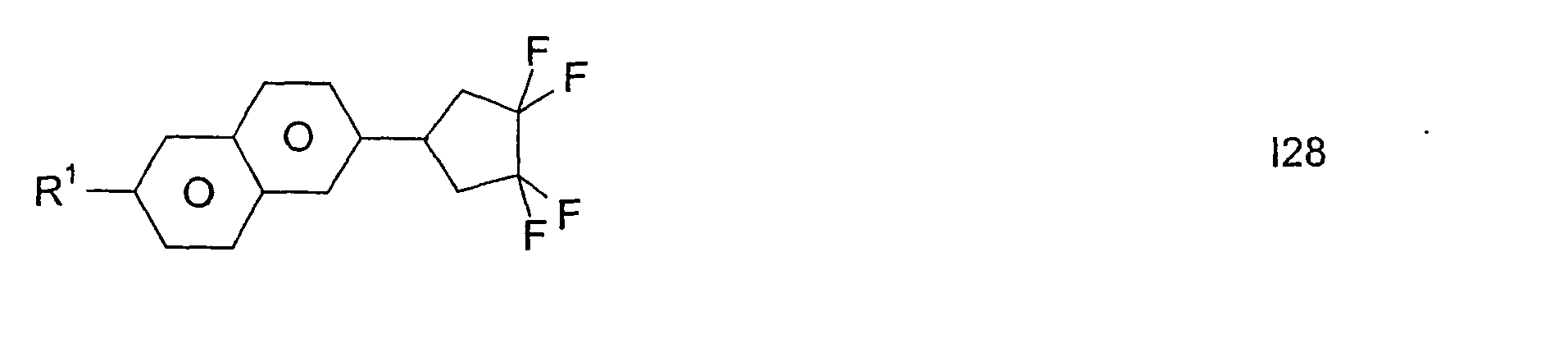
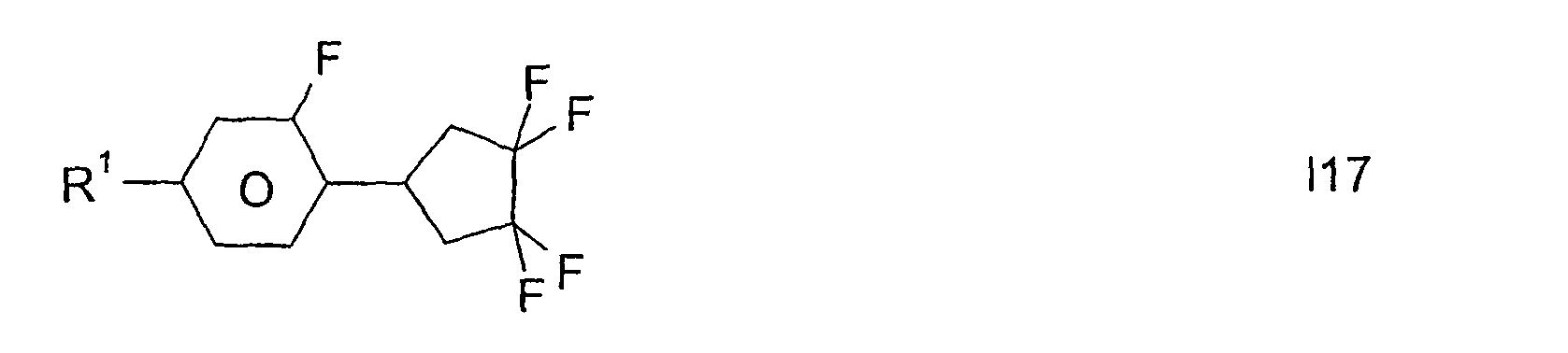
- Bevorzugte kleinere Gruppen von Verbindungen sind diejenigen der Teilformeln 11 bis 130:













- Die 1,4-Cyclohexenylen-Gruppe hat vorzugsweise folgende Strukturen:

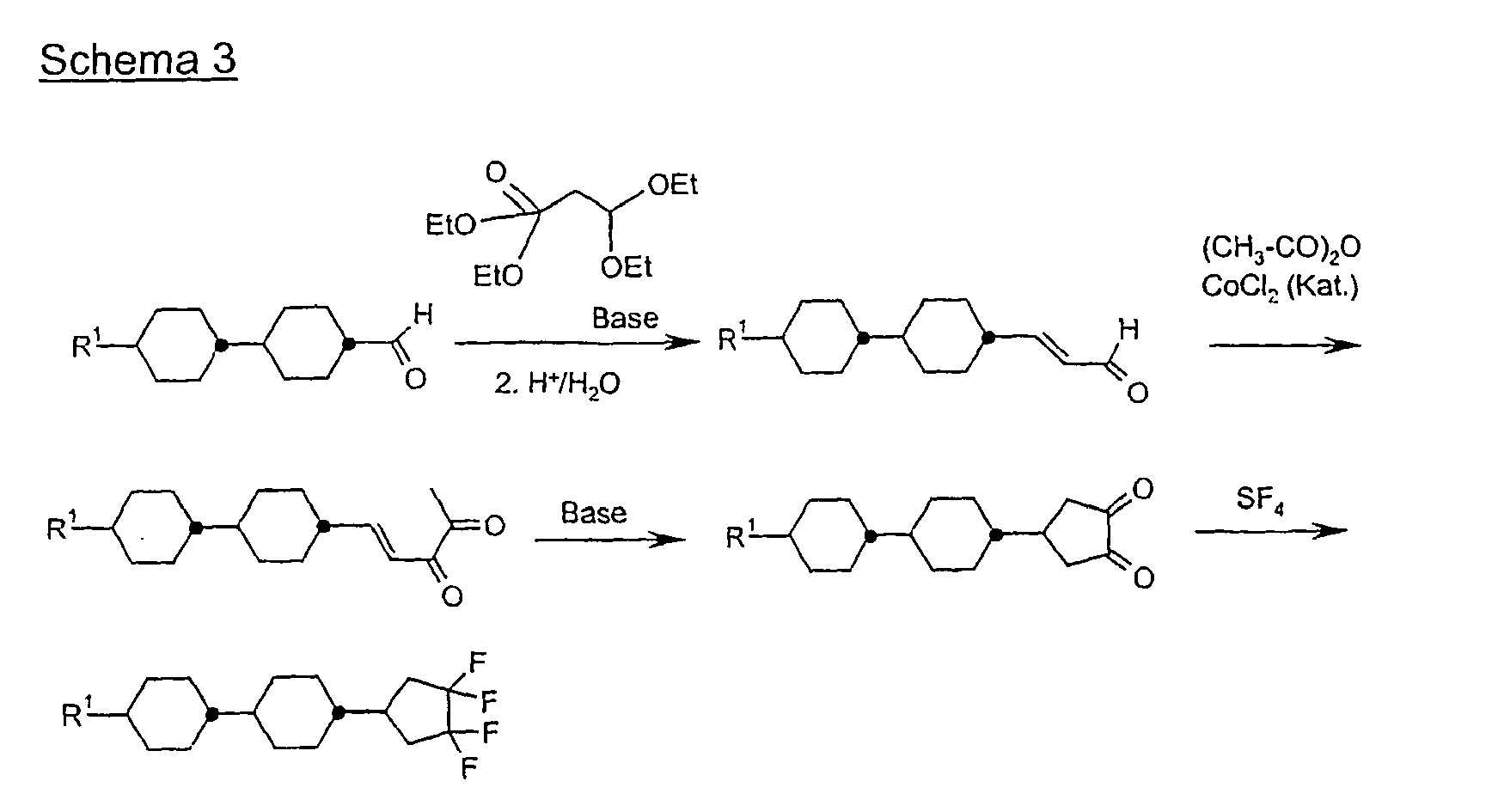
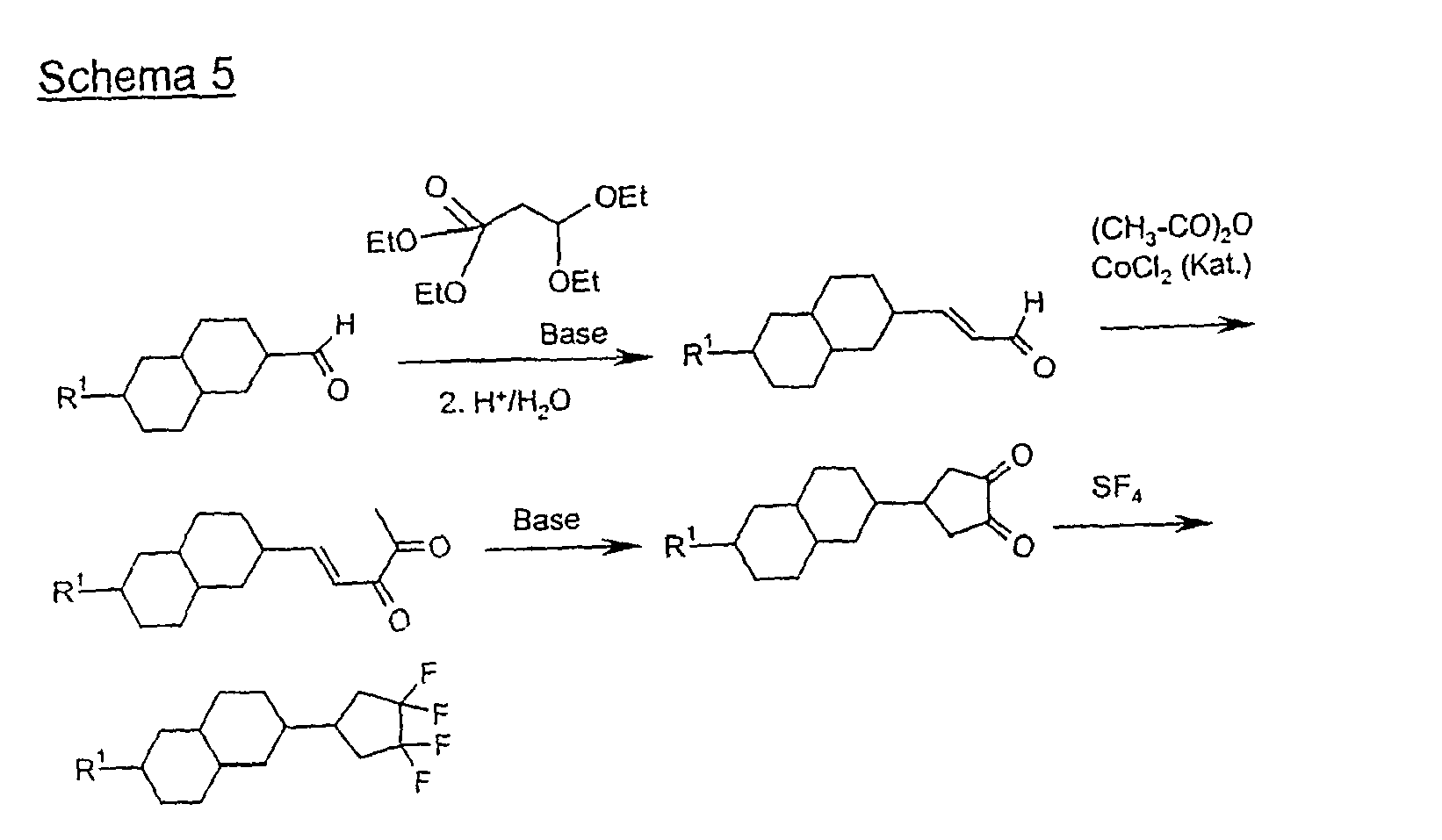
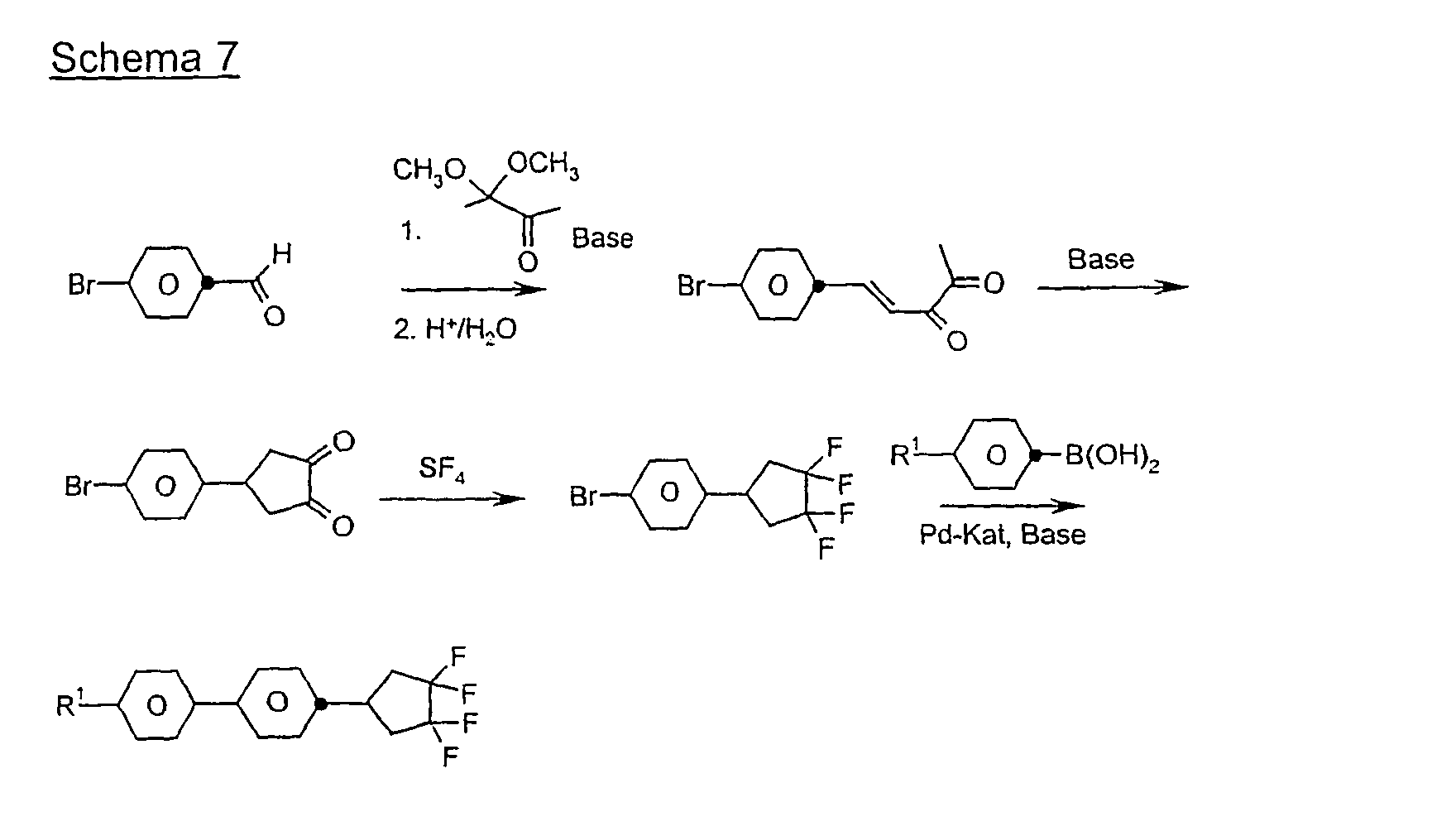
- Die Verbindungen der Formel I werden nach an sich bekannten Methoden dargestellt, wie sie in der Literatur (z.B. in den Standardwerken wie Houben-Weyl, Methoden der Organischen Chemie, Georg-Thieme-Verlag, Stuttgart) beschrieben sind, und zwar unter Reaktionsbedingungen, die für die genannten Umsetzungen bekannt und geeignet sind.
- Dabei kann man auch von an sich bekannten, hier nicht näher erwähnten Varianten Gebrauch machen.






- Die erfindungsgemäßen flüssigkristallinen Medien enthalten vorzugsweise neben einer oder mehreren erfindungsgemäßen Verbindungen als weitere Bestandteile 2 bis 40, insbesondere 4 bis 30 Komponenten. Ganz besonders bevorzugt enthalten diese Medien neben einer oder mehreren erfindungsgemäßen Verbindungen 7 bis 25 Komponenten. Diese weiteren Bestandteile werden vorzugsweise ausgewählt aus nematischen oder nematogenen (monotropen oder isotropen) Substanzen, insbesondere Substanzen aus den Klassen der Azoxybenzole, Benzylidenaniline, Biphenyle, Terphenyle, Phenyl- oder Cyclohexylbenzoate, Cyclohexancarbonsäure-phenyl- oder cyclohexyl-ester, Phenyl- oder Cyclohexyl-ester der Cyclohexylbenzoesäure, Phenyl- oder Cyclohexyl-ester der Cyclohexylcyclohexancarbonsäure, Cyclohexyl-phenylester der Benzoesäure, der Cyclohexancarbonsäure, bzw. der Cyclohexylcyclohexancarbonsäure, Phenylcyclohexane, Cyclohexylbiphenyle, Phenylcyclohexylcyclohexane, Cyclohexylcyclohexane, Cyclohexylcyclohexylcyclohexene, 1,4-Biscyclohexylbenzole, 4,4'-Bis-cyclohexylbiphenyle, Phenyl- oder Cyclohexylpyrimidine, Phenyl- oder Cyclohexylpyridine, Phenyl- oder Cyclohexyldioxane, Phenyl- oder Cyclohexyl-1,3-dithiane, 1,2-Diphenylethane, 1,2-Dicyclohexylethane, 1-Phenyl-2-cyclohexylethane, 1-Cyclohexyl-2-(4-phenylcyclohexyl)-ethane, 1-Cyclohexyl-2-biphenylylethane, 1-Phenyl-2-cyclohexyl-phenylethane, gegebenenfalls halogenierten Stilbene, Benzylphenylether, Tolane und substituierten Zimtsäuren. Die 1,4-Phenylengruppen in diesen Verbindungen können auch fluoriert sein.
- Die wichtigsten als weitere Bestandteile erfindungsgemäßer Medien in Frage kommenden Verbindungen lassen sich durch die Formeln 1, 2, 3, 4 und 5 charakterisieren:
R'-L-E-R" 1
R'-L-COO-E-R" 2
R'-L-OOC-E-R" 3
R'-L-CH2CH2-E-R" 4
R'-L-C≡C-E-R" 5
- In den Formeln 1, 2, 3, 4 und 5 bedeuten L und E, die gleich oder verschieden sein können, jeweils unabhängig voneinander einen bivalenten Rest aus der aus -Phe-, -Cyc-, -Phe-Phe-, -Phe-Cyc-, -Cyc-Cyc-, -Pyr-, -Dio-, -G-Phe- und -G-Cyc- sowie deren Spiegelbilder gebildeten Gruppe, wobei Phe unsubstituiertes oder durch Fluor substituiertes 1,4-Phenylen, Cyc trans-1,4-Cyclohexylen oder 1,4-Cyclohexenylen, Pyr Pyrimidin-2,5-diyl oder Pyridin-2,5-diyl, Dio 1,3-Dioxan-2,5-diyl und G 2-(trans-1,4-Cyclohexyl)-ethyl, Pyr Pyrimidin-2,5-diyl, Pyd Pyridin-2,5-diyl oder Py einen Pyranring bedeuten.
- Vorzugsweise ist einer der Reste L und E Cyc, Phe oder Pyr. E ist vorzugsweise Cyc, Phe oder Phe-Cyc. Vorzugsweise enthalten die erfindungsgemäßen Medien eine oder mehrere Komponenten ausgewählt aus den Verbindungen der Formeln 1, 2, 3, 4 und 5, worin L und E ausgewählt sind aus der Gruppe Cyc, Phe, Py und Pyr und gleichzeitig eine oder mehrere Komponenten ausgewählt aus den Verbindungen der Formeln 1, 2, 3, 4 und 5, worin einer der Reste L und E ausgewählt ist aus der Gruppe Cyc, Phe und Pyr und der andere Rest ausgewählt ist aus der Gruppe -Phe-Phe-, -Phe-Cyc-, -Cyc-Cyc-, -G-Phe- und -G-Cyc-, und gegebenenfalls eine oder mehrere Komponenten ausgewählt aus den Verbindungen der Formeln 1, 2, 3, 4 und 5, worin die Reste L und E ausgewählt sind aus der Gruppe -Phe-Cyc-, -Cyc-Cyc-, -G-Phe- und -G-Cyc-.
- R' und R" bedeuten in einer kleineren Untergruppe der Verbindungen der Formeln 1, 2, 3, 4 und 5 jeweils unabhängig voneinander Alkyl, Alkenyl, Alkoxy, Alkoxyalkyl, Alkenyloxy oder Alkanoyloxy mit bis zu 8 Kohlenstoffatomen. Im folgenden wird diese kleinere Untergruppe Gruppe A genannt und die Verbindungen werden mit den Teilformeln 1 a, 2a, 3a, 4a und 5a bezeichnet. Bei den meisten dieser Verbindungen sind R' und R" voneinander verschieden, wobei einer dieser Reste meist Alkyl, Alkenyl, Alkoxy oder Alkoxyalkyl ist.
- In einer anderen als Gruppe B bezeichneten kleineren Untergruppe der Verbindungen der Formeln 1, 2, 3, 4 und 5 bedeutet R" -F, -Cl, -NCS oder -(O)i CH3-(k+l) FkCll, wobei i 0 oder 1 und k+I 1, 2 oder 3 sind; die Verbindungen, in denen R" diese Bedeutung hat, werden mit den Teilformeln 1 b, 2b, 3b, 4b und 5b bezeichnet. Besonders bevorzugt sind solche Verbindungen der Teilformeln 1 b, 2b, 3b, 4b und 5b, in denen R" die Bedeutung -F, -Cl, -NCS, -CF3, -OCHF2 oder -OCF3 hat.
- In den Verbindungen der Teilformeln 1 b, 2b, 3b, 4b und 5b hat R' die bei den Verbindungen der Teilformeln 1a-5a angegebene Bedeutung und ist vorzugsweise Alkyl, Alkenyl, Alkoxy oder Alkoxyalkyl.
- In einer weiteren kleineren Untergruppe der Verbindungen der Formeln 1, 2, 3, 4 und 5 bedeutet R" -CN; diese Untergruppe wird im folgenden als Gruppe C bezeichnet und die Verbindungen dieser Untergruppe werden entsprechend mit Teilformeln 1 c, 2c, 3c, 4c und 5c beschrieben. In den Verbindungen der Teilformeln 1c, 2c, 3c, 4c und 5c hat R' die bei den Verbindungen der Teilformeln 1 a-5a angegebene Bedeutung und ist vorzugsweise Alkyl, Alkoxy oder Alkenyl.
- Neben den bevorzugten Verbindungen der Gruppen A, B und C sind auch andere Verbindungen der Formeln 1, 2, 3, 4 und 5 mit anderen Varianten der vorgesehenen Substituenten gebräuchlich. Alle diese Substanzen sind nach literaturbekannten Methoden oder in Analogie dazu erhältlich.
- Die erfindungsgemäßen Medien enthalten neben erfindungsgemäßen Verbindungen der Formel I vorzugsweise eine oder mehrere Verbindungen, welche ausgewählt werden aus der Gruppe A und/oder Gruppe B und/oder Gruppe C. Die Massenanteile der Verbindungen aus diesen Gruppen an den erfindungsgemäßen Medien sind vorzugsweise
- Gruppe A:
- 0 bis 90 %, vorzugsweise 20 bis 90 %, insbesondere 30 bis 90 %
- Gruppe B:
- 0 bis 80 %, vorzugsweise 10 bis 80 %, insbesondere 10 bis 65 %
- Gruppe C:
- 0 bis 80 %, vorzugsweise 5 bis 80 %, insbesondere 5 bis 50 %
- Die erfindungsgemäßen Medien enthalten vorzugsweise 1 bis 40 %, insbesondere vorzugsweise 5 bis 30 % an erfindungsgemäßen Verbindungen. Weiterhin bevorzugt sind Medien, enthaltend mehr als 40 %, insbesondere 45 bis 90 % an erfindungsgemäßen Verbindungen. Die Medien enthalten vorzugsweise drei, vier oder fünf erfindungsgemäße Verbindungen.
- Die Herstellung der erfindungsgemäßen Medien erfolgt in an sich üblicher Weise. In der Regel werden die Komponenten ineinander gelöst, zweckmäßig bei erhöhter Temperatur. Durch geeignete Zusätze können die flüssigkristallinen Phasen nach der Erfindung so modifiziert werden, dass sie in allen bisher bekannt gewordenen Arten von Flüssigkristallanzeigeelementen verwendet werden können. Derartige Zusätze sind dem Fachmann bekannt und in der Literatur ausführlich beschrieben (H. Kelker/R. Hatz, Handbook of Liquid Crystals, Verlag Chemie, Weinheim, 1980). Beispielsweise können pleochroitische Farbstoffe zur Herstellung farbiger Guest-Host-Systeme oder Substanzen zur Veränderung der dielektrischen Anisotropie, der Viskosität und/oder der Orientierung der nematischen Phasen zugesetzt werden. Weiterhin können Stabilisatoren sowie Antioxidantien zugesetzt werden.
- Die erfindungsgemäßen Mischungen sind für TN-, STN-, ECB-, IPS-Anwendungen, insbesondere für TFT-Anwendungen, geeignet.
- In der vorliegenden Anmeldung und in den folgenden Beispielen sind die Strukturen der Flüssigkristallverbindungen durch Acronyme angegeben, wobei die Transformation in chemische Formeln gemäß folgender Tabellen A und B erfolgt. Alle Reste CnH2n+1 und CmH2m+1 sind geradkettige Alkylreste mit n bzw. m C-Atomen. Die Codierung gemäß Tabelle B versteht sich von selbst. In Tabelle A ist nur das Acronym für den Grundkörper angegeben. Im Einzelfall folgt getrennt vom Acronym für den Grundkörper mit einem Strich ein Code für die Substituenten R1, R2, L1 und L2:
Code für R1, R2, L1, L2 R1 R2 L1 L2 nm CnH2n+1 CmH2m+1 H H nOm CnH2n+1 OCmH2m+1 H H nO.m OCnH2n+1 CmH2m+1 H H n CnH2n+1 CN H H nN.F CnH2n+1 CN H F nF CnH2n+1 F H H nOF OCnH2n+1 F H H nCl CnH2n+1 Cl H H nF.F CnH2n+1 F H F nF.F.F CnH2n+1 F F F nCF3 CnH2n+1 CF3 H H nOCF3 CnH2n+1 OCF3 H H nOCF2 CnH2n+1 OCHF2 H H nS CnH2n+1 NCS H H rVsN CrH2r+1-CH=CH-CsH2s- CN H H rEsN CrH2r+1-O-CsH2s- CN H H nAm CnH2n+1 COOCmH2m+1 H H - Erfindungsgemäße flüssigkristalline Mischungen enthalten neben ein oder mehreren Verbindungen der Formel I, zwei, drei oder mehr Komponenten ausgewählt aus den Tabellen A und B.
Tabelle A: (L1, L2, L3 = H oder F) 


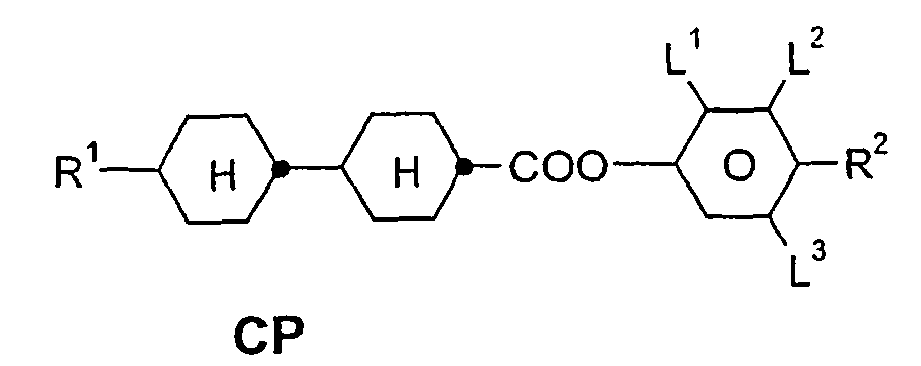


Tabelle B: 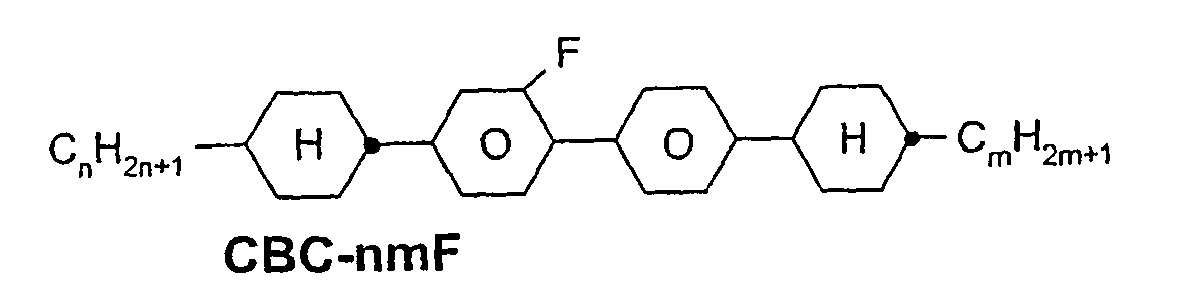
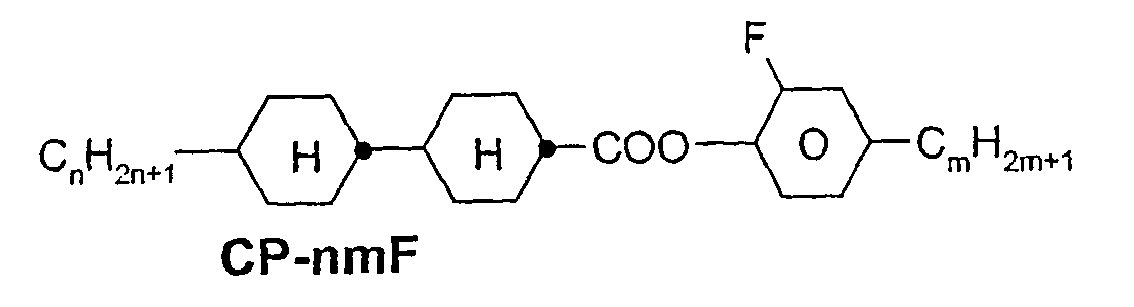

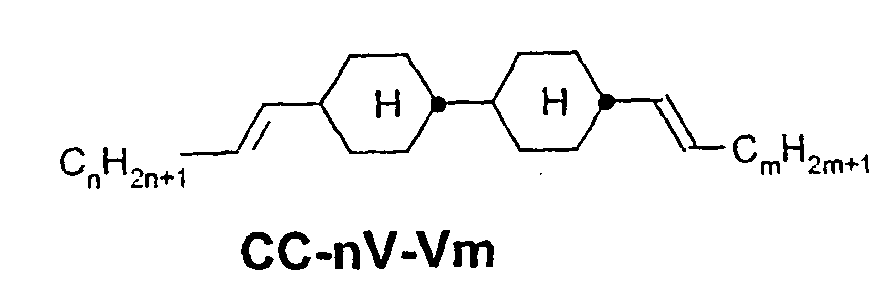

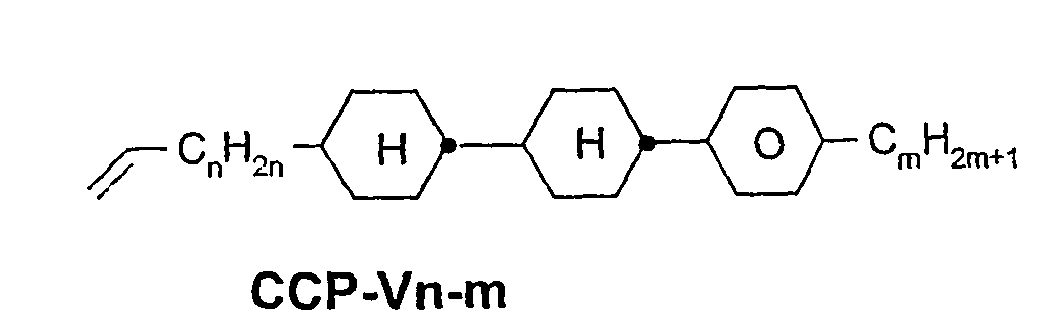


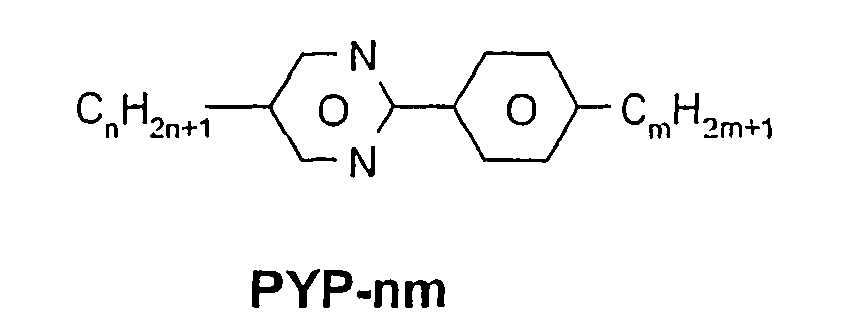


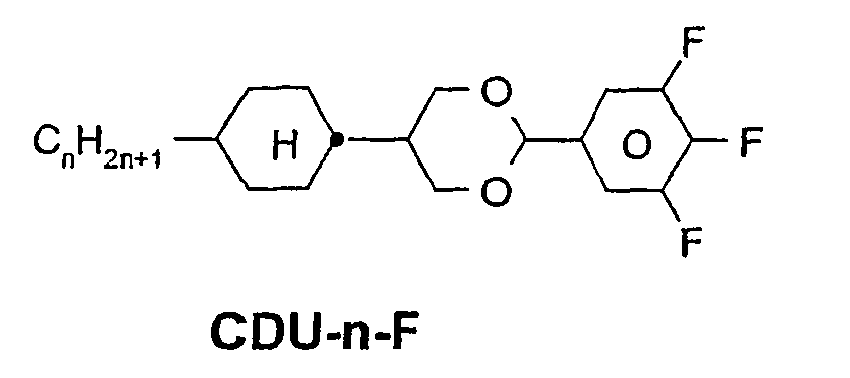


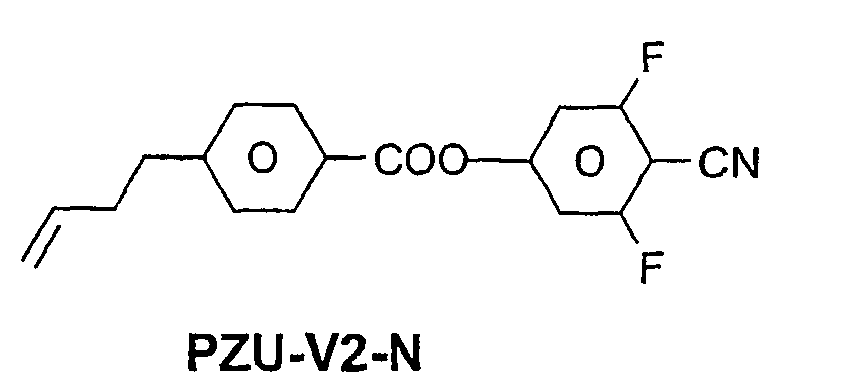


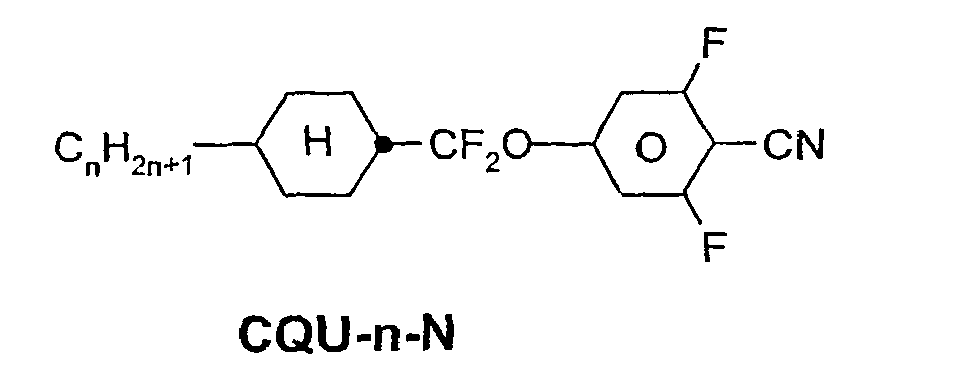
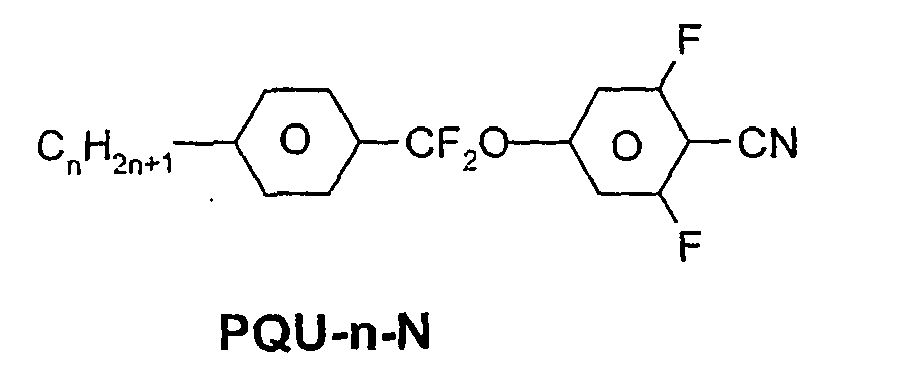


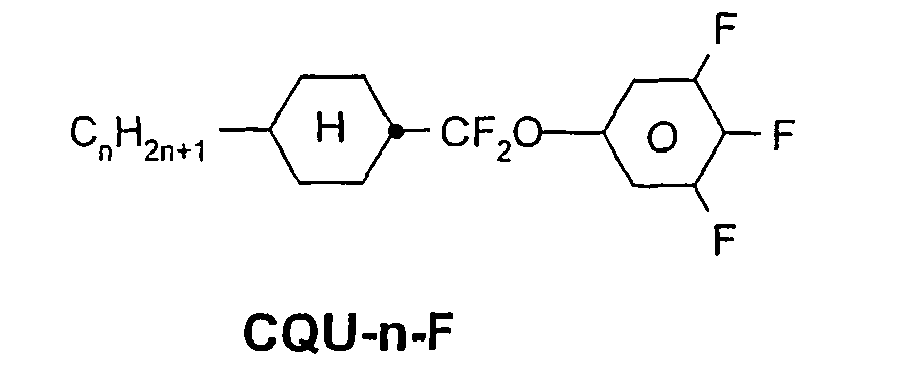

- In der Tabelle C werden mögliche Dotierstoffe angegeben, die in der Regel den erfindungsgemäßen Mischungen zugesetzt werden.


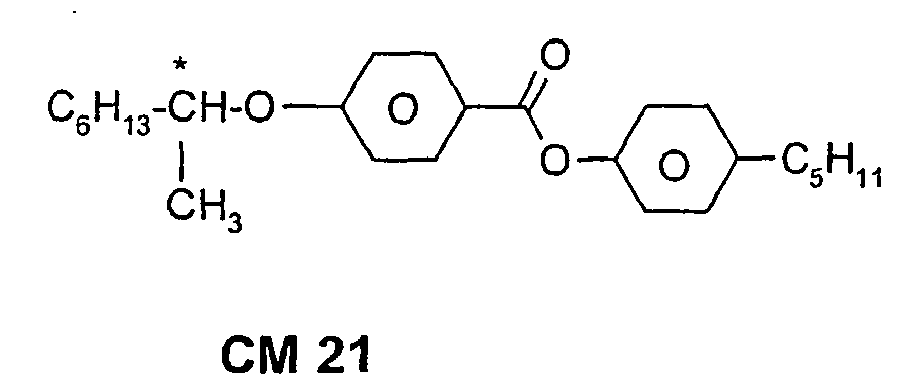
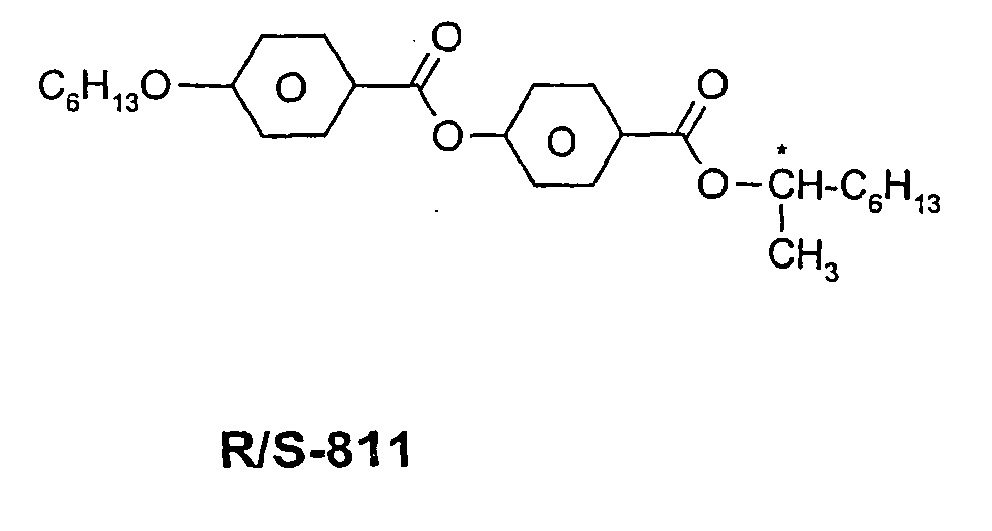


- Die folgenden Beispiele sollen die Erfindung erläutern, ohne sie zu begrenzen. Vor- und nachstehend bedeuten Prozentangaben Gewichtsprozent. Alle Temperaturen sind in Grad Celsius angegeben. Fp. bedeutet Schmelzpunkt, Kp. = Klärpunkt. Ferner bedeuten K = kristalliner Zustand, N = nematische Phase, S = smektische Phase und I = isotrope Phase. Die Angaben zwischen diesen Symbolen stellen die Übergangstemperaturen dar. Δn bedeutet optische Anisotropie (589 nm, 20 °C) und die Fließviskosität ν20 (mm2/sec) und die Rotationsviskosität γ1 [mPa·s] wurden jeweils bei 20 °C bestimmt.
- "Übliche Aufarbeitung" bedeutet: man gibt gegebenenfalls Wasser hinzu, extrahiert mit Dichlormethan, Diethylether, Methyl-tert.Butylether oder Toluol, trennt ab, trocknet die organische Phase, dampft ein und reinigt das Produkt durch Destillation unter reduziertem Druck oder Kristallisation und/oder Chromatographie. Folgende Abkürzungen werden verwendet:
- DAST
- Diethylaminoschwefeltrifluorid
- DMEU
- 1,3-Dimethyl-2-imidazolidinon
- KOT
- Kalium-tertiär-butanolat
- THF
- Tetrahydrofuran
- pTsOH
- p-Toluolsulfonsäure
-

-

- Eine Mischung aus 0,195 mol 4-Brombenzaldehyd und 0,185 mol 3,3-Dimethoxy-2-butanon in 200 ml Methanol wird mit 150 ml 20 %iger Natronlauge versetzt und 10 Stunden bei Raumtemperatur gerührt. Man destilliert das Methanol im Vakuum ab, extrahiert mit Methyl-tert.Butylether, trocknet über Natriumsulfat und dampft ein. Der Rückstand wird im Vakuum destilliert. Das Destillat wird mit 10 g p-Toluolsulfonsäure und 1 1 Aceton 15 Stunden bei Raumtemperatur gerührt, das Aceton abgedampft, der Rückstand in Methyl-tert.Butylether aufgenommen und mit Wasser neutral gewaschen. Man dampft ein und kristallisiert den Rückstand aus Pentan.
-

- 40 g Dion A werden in 400 ml Methanol gelöst und zu einer Lösung von 20 g Magnesiummethanolat in Methanol bei Siedehietze getropft. Man kocht 1 h, dampft das Methanol ab und säuert mit verd. Salzsäure an. Man extrahiert mit Methyl-tert.Butylether, trocknet und dampft ein. Der Rückstand wird durch Umkristallisieren aufgereinigt.
-

- 0,1 mol Bromphenylcyclopentadion B werden in einem Autoklaven mit 0,7 mol SF4 bei 50 °C 12 h zur Reaktion gebracht. Nach dem Abkühlen auf Raumtemperatur und Ablasen der Reaktionsgase wird das Reaktionsgemisch in Dichlormethan aufgenommen, neutral gewaschen und das unpolare Produkt mittels Säulenchromatographie abgetrennt.
-

- 0,1 mol 4-Bromphenyltetrafluorcyclopentan C werden mit 0,1 mol 4-Propylcyclohexylphenylboronsäure in 200 ml Toluol gelöst und mit 100 ml 2 molarer Sodalösung und 0,002 mol Pd(PPh3)4-Katalysator versetzt. Man kocht 12 h am Rückfluß und arbeitet zuletzt wie üblich auf.
- Analog werden die folgenden Verbindungen der Formel

R1 -(A1-Z1)m- CH3 
C2H5 
n-C4H9 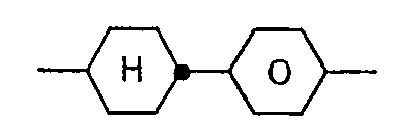
n-C5H11 
n-C6H13 
n-C7H15 
CH2=CH 
CH3CH=CH 
CH2=CHCH2CH2 
CH3CH=CHCH2CH2 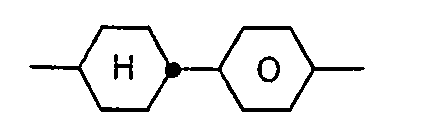
CH3 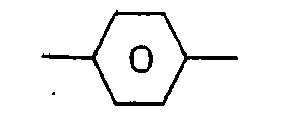
C2H5 
n-C3H7 
n-C4H9 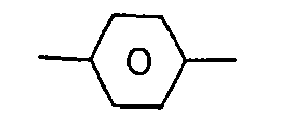
n-C5H11 
n-C6H13 
n-C7H15 
CH2=CH 
CH3-CH=CH2 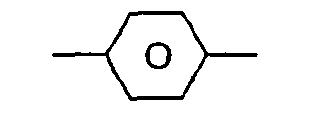
CH2=CHCH2CH2 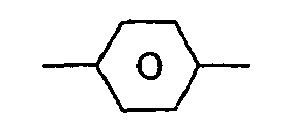
CH3CH=CHCH2CH2 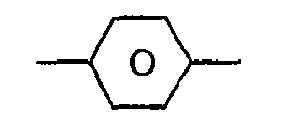
CH3 
C2H5 
n-C3H7 
n-C5H11 
CH3 
C2H5 
n-C3H7 
n-C5H11 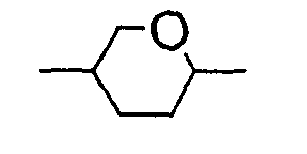
Claims (7)
- 3,3,4,4-Tetrafluorcyclopentanverbindungen der Formel I,
 R1 H, einen unsubstituierten, einen einfach durch CN oder CF3 oder einen mindestens einfach durch Halogen substituierten Alkylrest mit bis zu 15 C-Atomen, wobei in diesen Resten auch eine oder mehrere CH2-Gruppen jeweils unabhängig voneinander durch -O-, -CH=CH-,
 A1 und A2 jeweils unabhängig voneinander(a) trans-1,4-Cyclohexylenrest, worin auch eine oder mehrere nicht benachbarte CH2-Gruppen durch -O- und/oder -S-ersetzt sein können,(b) 1,4-Phenylenrest, worin auch eine oder zwei CH-Gruppen durch N ersetzt sein können,(c) 1,4-Cyclohexenylen,(d) Rest aus der Gruppe 1,4-Bicyclo(2,2,2)-octylen, Piperidin-1,4-diyl, Naphthalin-2,6-diyl, Decahydronaphthalin-2,6-diyl und 1,2,3,4-Tetrahydronaphthalin-2,6-diyl,wobei die Reste (a) bis (d) durch ein oder mehrere Fluoratome substituiert sein können,Z1 und Z2 jeweils unabhängig voneinander -CO-O-, -O-CO-, -CH2O-, -OCH2-, -CH2CH2-, -CH=CH-, -C≡C-, -(CH2)4-, -CF2O-, -OCF2-, -C2F4-, -CH=CH-CH2CH2-, oder eine Einfachbindung, undm 0, 1 oder 2bedeuten.
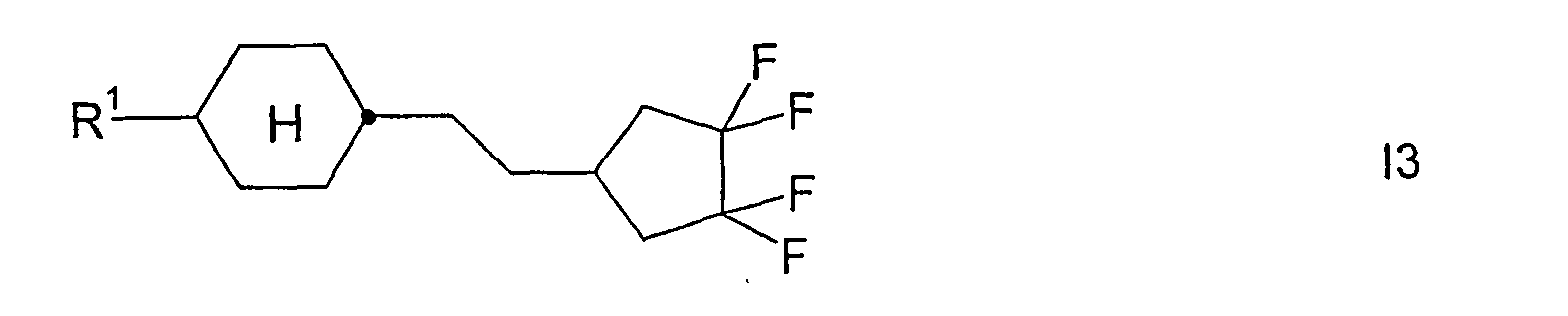
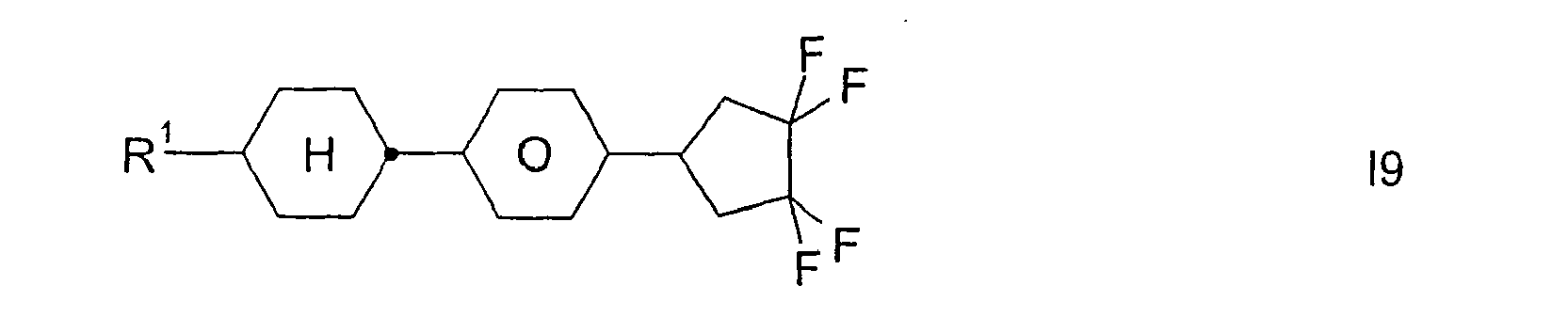
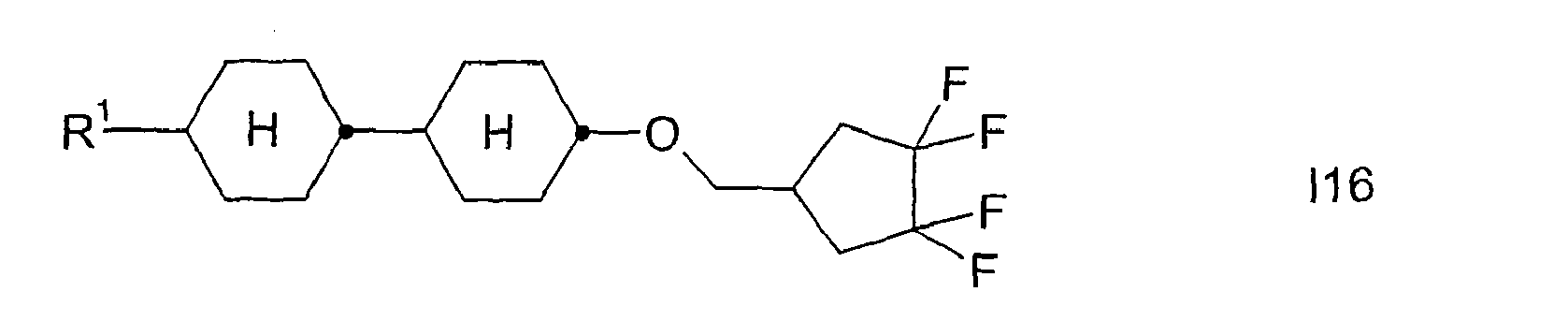
 - Verbindungen der Formeln I1-I30 gemäß Anspruch 1:














- Verbindungen nach Anspruch 1 oder 2, dadurch gekennzeichnet, dass R1 Alkyl, Alkoxy, Alkenyl oder Alkenyloxy mit bis zu 7 C-Atomen ist.
- Verwendung von Verbindungen der Formel I als Komponenten flüssigkristalliner Medien.
- Flüssigkristallines Medium mit mindestens zwei flüssigkristallinen Komponenten, dadurch gekennzeichnet, dass es mindestens eine Verbindung der Formel I enthält.
- Flüssigkristall-Anzeigeelement, dadurch gekennzeichnet, dass es ein flüssigkristallines Medium nach Anspruch 5 enthält.
- Elektrooptisches Anzeigeelement, dadurch gekennzeichnet, dass es als Dielektrikum ein flüssigkristallines Medium nach Anspruch 5 enthält.
Applications Claiming Priority (3)
| Application Number | Priority Date | Filing Date | Title |
|---|---|---|---|
| DE10228183 | 2002-06-24 | ||
| DE10228183A DE10228183A1 (de) | 2002-06-24 | 2002-06-24 | 3,3,4,4-Tetrafluorcyclopentanverbindungen |
| PCT/EP2003/006447 WO2004000771A1 (de) | 2002-06-24 | 2003-06-18 | 3,3,4,4-tetrafluorcyclopentanverbindungen als komponenten flüssigkristalliner medien |
Publications (2)
| Publication Number | Publication Date |
|---|---|
| EP1515931A1 EP1515931A1 (de) | 2005-03-23 |
| EP1515931B1 true EP1515931B1 (de) | 2006-11-22 |
Family
ID=29761361
Family Applications (1)
| Application Number | Title | Priority Date | Filing Date |
|---|---|---|---|
| EP03760649A Expired - Lifetime EP1515931B1 (de) | 2002-06-24 | 2003-06-18 | 3,3,4,4-tetrafluorcyclopentanverbindungen als komponenten flüssigkristalliner medien |
Country Status (8)
| Country | Link |
|---|---|
| US (1) | US20050224756A1 (de) |
| EP (1) | EP1515931B1 (de) |
| JP (1) | JP2005530832A (de) |
| AT (1) | ATE346029T1 (de) |
| AU (1) | AU2003242730A1 (de) |
| DE (2) | DE10228183A1 (de) |
| TW (1) | TW200400166A (de) |
| WO (1) | WO2004000771A1 (de) |
Cited By (1)
| Publication number | Priority date | Publication date | Assignee | Title |
|---|---|---|---|---|
| CN109575936A (zh) * | 2017-09-29 | 2019-04-05 | 达兴材料股份有限公司 | 液晶化合物、液晶组合物以及液晶显示元件 |
Families Citing this family (6)
| Publication number | Priority date | Publication date | Assignee | Title |
|---|---|---|---|---|
| CN102660295A (zh) * | 2012-04-11 | 2012-09-12 | 华南师范大学 | 一种含氟氮杂环液晶化合物及其合成方法与应用 |
| WO2014010665A1 (ja) * | 2012-07-13 | 2014-01-16 | Agcセイミケミカル株式会社 | 誘電率異方性が負の環構造を有する新規な化合物およびその製造方法、液晶組成物および液晶電気光学素子 |
| TW201414817A (zh) * | 2012-10-15 | 2014-04-16 | Daxin Materials Corp | 負介電異方性液晶化合物及包含其的液晶組成物 |
| KR20160132230A (ko) * | 2015-05-07 | 2016-11-17 | 삼성디스플레이 주식회사 | 액정 조성물 및 이를 포함하는 액정 표시 장치 |
| KR102668909B1 (ko) | 2016-08-11 | 2024-05-24 | 티씨엘 차이나 스타 옵토일렉트로닉스 테크놀로지 컴퍼니 리미티드 | 액정 표시 장치 및 이에 포함되는 액정 조성물 |
| KR102639180B1 (ko) | 2016-08-25 | 2024-02-23 | 삼성디스플레이 주식회사 | 액정 표시 장치 및 이에 포함되는 액정 조성물 |
Family Cites Families (5)
| Publication number | Priority date | Publication date | Assignee | Title |
|---|---|---|---|---|
| JPH09227422A (ja) * | 1996-02-12 | 1997-09-02 | Rolic Ag | シクロペンチル誘導体 |
| DE19607999A1 (de) * | 1996-03-04 | 1997-09-11 | Merck Patent Gmbh | Substituierte Cyclopent-3-en-l-yl-Derivate |
| DE19918009B4 (de) * | 1999-03-31 | 2010-05-12 | Merck Patent Gmbh | Fluorierte Cyclohexan-Derivate und flüssigkristallines Medium |
| DE50002103D1 (de) * | 1999-09-01 | 2003-06-12 | Clariant Internat Ltd Muttenz | Fünfring-verbindungen und ihre verwendung in flüssigkristallinen mischungen |
| DE19941654A1 (de) * | 1999-09-01 | 2001-03-08 | Clariant Gmbh | Cyclopentan-Derivate und ihre Verwendung in flüssigkristallinen Mischungen |
-
2002
- 2002-06-24 DE DE10228183A patent/DE10228183A1/de not_active Withdrawn
-
2003
- 2003-06-18 US US10/518,925 patent/US20050224756A1/en not_active Abandoned
- 2003-06-18 EP EP03760649A patent/EP1515931B1/de not_active Expired - Lifetime
- 2003-06-18 JP JP2004514775A patent/JP2005530832A/ja active Pending
- 2003-06-18 DE DE50305762T patent/DE50305762D1/de not_active Expired - Lifetime
- 2003-06-18 WO PCT/EP2003/006447 patent/WO2004000771A1/de not_active Ceased
- 2003-06-18 AT AT03760649T patent/ATE346029T1/de not_active IP Right Cessation
- 2003-06-18 AU AU2003242730A patent/AU2003242730A1/en not_active Abandoned
- 2003-06-23 TW TW092117006A patent/TW200400166A/zh unknown
Cited By (2)
| Publication number | Priority date | Publication date | Assignee | Title |
|---|---|---|---|---|
| CN109575936A (zh) * | 2017-09-29 | 2019-04-05 | 达兴材料股份有限公司 | 液晶化合物、液晶组合物以及液晶显示元件 |
| CN109575936B (zh) * | 2017-09-29 | 2020-11-03 | 达兴材料股份有限公司 | 液晶化合物、液晶组合物以及液晶显示元件 |
Also Published As
| Publication number | Publication date |
|---|---|
| DE10228183A1 (de) | 2004-01-22 |
| DE50305762D1 (de) | 2007-01-04 |
| TW200400166A (en) | 2004-01-01 |
| EP1515931A1 (de) | 2005-03-23 |
| ATE346029T1 (de) | 2006-12-15 |
| US20050224756A1 (en) | 2005-10-13 |
| JP2005530832A (ja) | 2005-10-13 |
| AU2003242730A1 (en) | 2004-01-06 |
| WO2004000771A1 (de) | 2003-12-31 |
Similar Documents
| Publication | Publication Date | Title |
|---|---|---|
| EP0462237B1 (de) | 1,4-disubstituierte 2,6-difluorbenzolverbindungen und flüssigkristallines medium | |
| DE19531165A1 (de) | Benzolderivate und flüssigkristallines Medium | |
| DE4445224B4 (de) | Benzolderivate | |
| DE4426799A1 (de) | Benzolderivate und flüssigkristallines Medium | |
| EP0663941B1 (de) | 2-fluorcycloyhexen-derivate | |
| DE4416256B4 (de) | Partiell fluorierte Benzolderivate und flüssigkristallines Medium | |
| EP0781770B1 (de) | 1,3-Dioxane und flüssigkristallines Medium | |
| EP0998452B1 (de) | Flüssigkristalline propen- oder propynylnitrilderivate | |
| EP0449015B1 (de) | Difluormethylverbindungen und flüssigkristallines Medium | |
| WO1994026839A1 (de) | Partiell fluorierte benzolderivate | |
| DE4414647A1 (de) | Cyclohexanderivate und flüssigkristallines Medium | |
| DE19607996B4 (de) | Flüssigkristallines Medium enthaltend mindestens ein substituiertes Cyclohex-3-en-yl-Derivat | |
| EP1515931A1 (de) | 3,3,4,4-tetrafluorcyclopentanverbindungen als komponenten flüssigkristalliner medien | |
| DE4000535B4 (de) | 1,4-Disubstituierte 2,6-Difluorbenzolverbindungen und flüssigkristallines Medium | |
| DE4441963B4 (de) | Cyclohexanderivate und flüssigkristallines Medium | |
| DE19504518A1 (de) | Partiell fluorierte Benzolderivate | |
| DE4425642A1 (de) | Partiell fluorierte Benzolderivate | |
| DE19607999A1 (de) | Substituierte Cyclopent-3-en-l-yl-Derivate | |
| DE4409526A1 (de) | Indan-Derivate | |
| DE4218976B4 (de) | Benzolderivate | |
| DE4000534C2 (de) | 1,4-Disubstituierte 2,6-Difluorbenzolverbindungen und flüssigkristallines Medium | |
| DE4344422B4 (de) | Pyri(mi)din-Derivate und flüssigkristallines Medium | |
| DE19522529B4 (de) | 1,3-Dioxane und deren Verwendung | |
| DE4408418C2 (de) | Flüssigkristalline Spiroverbindungen | |
| DE4325985A1 (de) | Cyanobiphenyle und flüssigkristallines Medium |
Legal Events
| Date | Code | Title | Description |
|---|---|---|---|
| PUAI | Public reference made under article 153(3) epc to a published international application that has entered the european phase |
Free format text: ORIGINAL CODE: 0009012 |
|
| 17P | Request for examination filed |
Effective date: 20041109 |
|
| AK | Designated contracting states |
Kind code of ref document: A1 Designated state(s): AT BE BG CH CY CZ DE DK EE ES FI FR GB GR HU IE IT LI LU MC NL PT RO SE SI SK TR |
|
| AX | Request for extension of the european patent |
Extension state: AL LT LV MK |
|
| RIN1 | Information on inventor provided before grant (corrected) |
Inventor name: LUESSEM, GEORG Inventor name: REIFFENRATH, VOLKER |
|
| DAX | Request for extension of the european patent (deleted) | ||
| GRAP | Despatch of communication of intention to grant a patent |
Free format text: ORIGINAL CODE: EPIDOSNIGR1 |
|
| GRAS | Grant fee paid |
Free format text: ORIGINAL CODE: EPIDOSNIGR3 |
|
| GRAA | (expected) grant |
Free format text: ORIGINAL CODE: 0009210 |
|
| AK | Designated contracting states |
Kind code of ref document: B1 Designated state(s): AT BE BG CH CY CZ DE DK EE ES FI FR GB GR HU IE IT LI LU MC NL PT RO SE SI SK TR |
|
| PG25 | Lapsed in a contracting state [announced via postgrant information from national office to epo] |
Ref country code: IT Free format text: LAPSE BECAUSE OF FAILURE TO SUBMIT A TRANSLATION OF THE DESCRIPTION OR TO PAY THE FEE WITHIN THE PRESCRIBED TIME-LIMIT;WARNING: LAPSES OF ITALIAN PATENTS WITH EFFECTIVE DATE BEFORE 2007 MAY HAVE OCCURRED AT ANY TIME BEFORE 2007. THE CORRECT EFFECTIVE DATE MAY BE DIFFERENT FROM THE ONE RECORDED. Effective date: 20061122 Ref country code: FI Free format text: LAPSE BECAUSE OF FAILURE TO SUBMIT A TRANSLATION OF THE DESCRIPTION OR TO PAY THE FEE WITHIN THE PRESCRIBED TIME-LIMIT Effective date: 20061122 Ref country code: IE Free format text: LAPSE BECAUSE OF FAILURE TO SUBMIT A TRANSLATION OF THE DESCRIPTION OR TO PAY THE FEE WITHIN THE PRESCRIBED TIME-LIMIT Effective date: 20061122 Ref country code: SK Free format text: LAPSE BECAUSE OF FAILURE TO SUBMIT A TRANSLATION OF THE DESCRIPTION OR TO PAY THE FEE WITHIN THE PRESCRIBED TIME-LIMIT Effective date: 20061122 Ref country code: NL Free format text: LAPSE BECAUSE OF FAILURE TO SUBMIT A TRANSLATION OF THE DESCRIPTION OR TO PAY THE FEE WITHIN THE PRESCRIBED TIME-LIMIT Effective date: 20061122 Ref country code: CZ Free format text: LAPSE BECAUSE OF FAILURE TO SUBMIT A TRANSLATION OF THE DESCRIPTION OR TO PAY THE FEE WITHIN THE PRESCRIBED TIME-LIMIT Effective date: 20061122 Ref country code: SI Free format text: LAPSE BECAUSE OF FAILURE TO SUBMIT A TRANSLATION OF THE DESCRIPTION OR TO PAY THE FEE WITHIN THE PRESCRIBED TIME-LIMIT Effective date: 20061122 Ref country code: RO Free format text: LAPSE BECAUSE OF FAILURE TO SUBMIT A TRANSLATION OF THE DESCRIPTION OR TO PAY THE FEE WITHIN THE PRESCRIBED TIME-LIMIT Effective date: 20061122 |
|
| REG | Reference to a national code |
Ref country code: GB Ref legal event code: FG4D Free format text: NOT ENGLISH |
|
| REG | Reference to a national code |
Ref country code: CH Ref legal event code: EP |
|
| REG | Reference to a national code |
Ref country code: IE Ref legal event code: FG4D Free format text: LANGUAGE OF EP DOCUMENT: GERMAN |
|
| REF | Corresponds to: |
Ref document number: 50305762 Country of ref document: DE Date of ref document: 20070104 Kind code of ref document: P |
|
| PG25 | Lapsed in a contracting state [announced via postgrant information from national office to epo] |
Ref country code: BG Free format text: LAPSE BECAUSE OF FAILURE TO SUBMIT A TRANSLATION OF THE DESCRIPTION OR TO PAY THE FEE WITHIN THE PRESCRIBED TIME-LIMIT Effective date: 20070222 Ref country code: DK Free format text: LAPSE BECAUSE OF FAILURE TO SUBMIT A TRANSLATION OF THE DESCRIPTION OR TO PAY THE FEE WITHIN THE PRESCRIBED TIME-LIMIT Effective date: 20070222 Ref country code: SE Free format text: LAPSE BECAUSE OF FAILURE TO SUBMIT A TRANSLATION OF THE DESCRIPTION OR TO PAY THE FEE WITHIN THE PRESCRIBED TIME-LIMIT Effective date: 20070222 |
|
| PG25 | Lapsed in a contracting state [announced via postgrant information from national office to epo] |
Ref country code: ES Free format text: LAPSE BECAUSE OF FAILURE TO SUBMIT A TRANSLATION OF THE DESCRIPTION OR TO PAY THE FEE WITHIN THE PRESCRIBED TIME-LIMIT Effective date: 20070305 |
|
| PG25 | Lapsed in a contracting state [announced via postgrant information from national office to epo] |
Ref country code: PT Free format text: LAPSE BECAUSE OF FAILURE TO SUBMIT A TRANSLATION OF THE DESCRIPTION OR TO PAY THE FEE WITHIN THE PRESCRIBED TIME-LIMIT Effective date: 20070423 |
|
| NLV1 | Nl: lapsed or annulled due to failure to fulfill the requirements of art. 29p and 29m of the patents act | ||
| GBV | Gb: ep patent (uk) treated as always having been void in accordance with gb section 77(7)/1977 [no translation filed] |
Effective date: 20061122 |
|
| REG | Reference to a national code |
Ref country code: IE Ref legal event code: FD4D |
|
| EN | Fr: translation not filed | ||
| PLBE | No opposition filed within time limit |
Free format text: ORIGINAL CODE: 0009261 |
|
| STAA | Information on the status of an ep patent application or granted ep patent |
Free format text: STATUS: NO OPPOSITION FILED WITHIN TIME LIMIT |
|
| 26N | No opposition filed |
Effective date: 20070823 |
|
| PG25 | Lapsed in a contracting state [announced via postgrant information from national office to epo] |
Ref country code: GB Free format text: LAPSE BECAUSE OF FAILURE TO SUBMIT A TRANSLATION OF THE DESCRIPTION OR TO PAY THE FEE WITHIN THE PRESCRIBED TIME-LIMIT Effective date: 20061122 |
|
| BERE | Be: lapsed |
Owner name: MERCK PATENT G.M.B.H. Effective date: 20070630 |
|
| PG25 | Lapsed in a contracting state [announced via postgrant information from national office to epo] |
Ref country code: MC Free format text: LAPSE BECAUSE OF NON-PAYMENT OF DUE FEES Effective date: 20070630 |
|
| REG | Reference to a national code |
Ref country code: CH Ref legal event code: PL |
|
| PG25 | Lapsed in a contracting state [announced via postgrant information from national office to epo] |
Ref country code: BE Free format text: LAPSE BECAUSE OF NON-PAYMENT OF DUE FEES Effective date: 20070630 |
|
| PG25 | Lapsed in a contracting state [announced via postgrant information from national office to epo] |
Ref country code: LI Free format text: LAPSE BECAUSE OF NON-PAYMENT OF DUE FEES Effective date: 20070630 Ref country code: CH Free format text: LAPSE BECAUSE OF NON-PAYMENT OF DUE FEES Effective date: 20070630 Ref country code: FR Free format text: LAPSE BECAUSE OF FAILURE TO SUBMIT A TRANSLATION OF THE DESCRIPTION OR TO PAY THE FEE WITHIN THE PRESCRIBED TIME-LIMIT Effective date: 20070713 Ref country code: GR Free format text: LAPSE BECAUSE OF FAILURE TO SUBMIT A TRANSLATION OF THE DESCRIPTION OR TO PAY THE FEE WITHIN THE PRESCRIBED TIME-LIMIT Effective date: 20070223 |
|
| PG25 | Lapsed in a contracting state [announced via postgrant information from national office to epo] |
Ref country code: AT Free format text: LAPSE BECAUSE OF NON-PAYMENT OF DUE FEES Effective date: 20070618 |
|
| PG25 | Lapsed in a contracting state [announced via postgrant information from national office to epo] |
Ref country code: FR Free format text: LAPSE BECAUSE OF FAILURE TO SUBMIT A TRANSLATION OF THE DESCRIPTION OR TO PAY THE FEE WITHIN THE PRESCRIBED TIME-LIMIT Effective date: 20061122 |
|
| PG25 | Lapsed in a contracting state [announced via postgrant information from national office to epo] |
Ref country code: EE Free format text: LAPSE BECAUSE OF FAILURE TO SUBMIT A TRANSLATION OF THE DESCRIPTION OR TO PAY THE FEE WITHIN THE PRESCRIBED TIME-LIMIT Effective date: 20061122 |
|
| PG25 | Lapsed in a contracting state [announced via postgrant information from national office to epo] |
Ref country code: CY Free format text: LAPSE BECAUSE OF FAILURE TO SUBMIT A TRANSLATION OF THE DESCRIPTION OR TO PAY THE FEE WITHIN THE PRESCRIBED TIME-LIMIT Effective date: 20061122 Ref country code: LU Free format text: LAPSE BECAUSE OF NON-PAYMENT OF DUE FEES Effective date: 20070618 |
|
| PG25 | Lapsed in a contracting state [announced via postgrant information from national office to epo] |
Ref country code: TR Free format text: LAPSE BECAUSE OF FAILURE TO SUBMIT A TRANSLATION OF THE DESCRIPTION OR TO PAY THE FEE WITHIN THE PRESCRIBED TIME-LIMIT Effective date: 20061122 Ref country code: HU Free format text: LAPSE BECAUSE OF FAILURE TO SUBMIT A TRANSLATION OF THE DESCRIPTION OR TO PAY THE FEE WITHIN THE PRESCRIBED TIME-LIMIT Effective date: 20070523 |
|
| PGFP | Annual fee paid to national office [announced via postgrant information from national office to epo] |
Ref country code: DE Payment date: 20140611 Year of fee payment: 12 |
|
| REG | Reference to a national code |
Ref country code: DE Ref legal event code: R119 Ref document number: 50305762 Country of ref document: DE |
|
| PG25 | Lapsed in a contracting state [announced via postgrant information from national office to epo] |
Ref country code: DE Free format text: LAPSE BECAUSE OF NON-PAYMENT OF DUE FEES Effective date: 20160101 |