EP1514908A2 - Process for preparing concentrated flowable dispersions and prepared dispersion based products thereof - Google Patents
Process for preparing concentrated flowable dispersions and prepared dispersion based products thereof Download PDFInfo
- Publication number
- EP1514908A2 EP1514908A2 EP04019881A EP04019881A EP1514908A2 EP 1514908 A2 EP1514908 A2 EP 1514908A2 EP 04019881 A EP04019881 A EP 04019881A EP 04019881 A EP04019881 A EP 04019881A EP 1514908 A2 EP1514908 A2 EP 1514908A2
- Authority
- EP
- European Patent Office
- Prior art keywords
- particles
- class
- suspension
- fibrous
- original
- Prior art date
- Legal status (The legal status is an assumption and is not a legal conclusion. Google has not performed a legal analysis and makes no representation as to the accuracy of the status listed.)
- Granted
Links
Images
Classifications
-
- A—HUMAN NECESSITIES
- A23—FOODS OR FOODSTUFFS; TREATMENT THEREOF, NOT COVERED BY OTHER CLASSES
- A23G—COCOA; COCOA PRODUCTS, e.g. CHOCOLATE; SUBSTITUTES FOR COCOA OR COCOA PRODUCTS; CONFECTIONERY; CHEWING GUM; ICE-CREAM; PREPARATION THEREOF
- A23G1/00—Cocoa; Cocoa products, e.g. chocolate; Substitutes therefor
- A23G1/30—Cocoa products, e.g. chocolate; Substitutes therefor
- A23G1/32—Cocoa products, e.g. chocolate; Substitutes therefor characterised by the composition containing organic or inorganic compounds
- A23G1/44—Cocoa products, e.g. chocolate; Substitutes therefor characterised by the composition containing organic or inorganic compounds containing peptides or proteins
-
- A—HUMAN NECESSITIES
- A23—FOODS OR FOODSTUFFS; TREATMENT THEREOF, NOT COVERED BY OTHER CLASSES
- A23G—COCOA; COCOA PRODUCTS, e.g. CHOCOLATE; SUBSTITUTES FOR COCOA OR COCOA PRODUCTS; CONFECTIONERY; CHEWING GUM; ICE-CREAM; PREPARATION THEREOF
- A23G1/00—Cocoa; Cocoa products, e.g. chocolate; Substitutes therefor
- A23G1/30—Cocoa products, e.g. chocolate; Substitutes therefor
- A23G1/32—Cocoa products, e.g. chocolate; Substitutes therefor characterised by the composition containing organic or inorganic compounds
- A23G1/46—Cocoa products, e.g. chocolate; Substitutes therefor characterised by the composition containing organic or inorganic compounds containing dairy products
-
- A—HUMAN NECESSITIES
- A23—FOODS OR FOODSTUFFS; TREATMENT THEREOF, NOT COVERED BY OTHER CLASSES
- A23G—COCOA; COCOA PRODUCTS, e.g. CHOCOLATE; SUBSTITUTES FOR COCOA OR COCOA PRODUCTS; CONFECTIONERY; CHEWING GUM; ICE-CREAM; PREPARATION THEREOF
- A23G1/00—Cocoa; Cocoa products, e.g. chocolate; Substitutes therefor
- A23G1/30—Cocoa products, e.g. chocolate; Substitutes therefor
- A23G1/56—Liquid products; Solid products in the form of powders, flakes or granules for making liquid products, e.g. for making chocolate milk, drinks and the products for their preparation, pastes for spreading or milk crumb
-
- C—CHEMISTRY; METALLURGY
- C09—DYES; PAINTS; POLISHES; NATURAL RESINS; ADHESIVES; COMPOSITIONS NOT OTHERWISE PROVIDED FOR; APPLICATIONS OF MATERIALS NOT OTHERWISE PROVIDED FOR
- C09C—TREATMENT OF INORGANIC MATERIALS, OTHER THAN FIBROUS FILLERS, TO ENHANCE THEIR PIGMENTING OR FILLING PROPERTIES ; PREPARATION OF CARBON BLACK ; PREPARATION OF INORGANIC MATERIALS WHICH ARE NO SINGLE CHEMICAL COMPOUNDS AND WHICH ARE MAINLY USED AS PIGMENTS OR FILLERS
- C09C3/00—Treatment in general of inorganic materials, other than fibrous fillers, to enhance their pigmenting or filling properties
-
- A—HUMAN NECESSITIES
- A23—FOODS OR FOODSTUFFS; TREATMENT THEREOF, NOT COVERED BY OTHER CLASSES
- A23G—COCOA; COCOA PRODUCTS, e.g. CHOCOLATE; SUBSTITUTES FOR COCOA OR COCOA PRODUCTS; CONFECTIONERY; CHEWING GUM; ICE-CREAM; PREPARATION THEREOF
- A23G2200/00—COCOA; COCOA PRODUCTS, e.g. CHOCOLATE; SUBSTITUTES FOR COCOA OR COCOA PRODUCTS; CONFECTIONERY; CHEWING GUM; ICE-CREAM; PREPARATION THEREOF containing organic compounds, e.g. synthetic flavouring agents
- A23G2200/10—COCOA; COCOA PRODUCTS, e.g. CHOCOLATE; SUBSTITUTES FOR COCOA OR COCOA PRODUCTS; CONFECTIONERY; CHEWING GUM; ICE-CREAM; PREPARATION THEREOF containing organic compounds, e.g. synthetic flavouring agents containing amino-acids, proteins, e.g. gelatine, peptides, polypeptides
-
- A—HUMAN NECESSITIES
- A23—FOODS OR FOODSTUFFS; TREATMENT THEREOF, NOT COVERED BY OTHER CLASSES
- A23G—COCOA; COCOA PRODUCTS, e.g. CHOCOLATE; SUBSTITUTES FOR COCOA OR COCOA PRODUCTS; CONFECTIONERY; CHEWING GUM; ICE-CREAM; PREPARATION THEREOF
- A23G2200/00—COCOA; COCOA PRODUCTS, e.g. CHOCOLATE; SUBSTITUTES FOR COCOA OR COCOA PRODUCTS; CONFECTIONERY; CHEWING GUM; ICE-CREAM; PREPARATION THEREOF containing organic compounds, e.g. synthetic flavouring agents
- A23G2200/12—COCOA; COCOA PRODUCTS, e.g. CHOCOLATE; SUBSTITUTES FOR COCOA OR COCOA PRODUCTS; CONFECTIONERY; CHEWING GUM; ICE-CREAM; PREPARATION THEREOF containing organic compounds, e.g. synthetic flavouring agents containing dairy products
-
- A—HUMAN NECESSITIES
- A23—FOODS OR FOODSTUFFS; TREATMENT THEREOF, NOT COVERED BY OTHER CLASSES
- A23V—INDEXING SCHEME RELATING TO FOODS, FOODSTUFFS OR NON-ALCOHOLIC BEVERAGES AND LACTIC OR PROPIONIC ACID BACTERIA USED IN FOODSTUFFS OR FOOD PREPARATION
- A23V2002/00—Food compositions, function of food ingredients or processes for food or foodstuffs
Definitions
- the invention relates to a process for the preparation of flowable suspension systems.
- the invention relates to suspension-based prepared by this method Products.
- Suspensions are multiphase disperse material systems. Solid particles one or several types of material (disperse phase) are suspended in a continuous Fluid phase ago, which in turn from a liquid or a Liquid mixture may exist.
- both the particle properties Size / size distribution, particle morphology, particle shape, surface properties
- the fluid properties viscosity, non-newtonicity
- WW interactions between the particles (van der Waals, electrostatic) and between fluid and particles (eg hydrophobic interactions) relevant.
- the presence of surfactants The interactions between particles as well as between fluid phase and Change particles significantly.
- suspensions are diluted in dilute, divided into half diluted and concentrated suspensions.
- concentrated Suspensions have emphasized as opposed to diluted suspensions one stress and time dependent flow behavior.
- concentration of suspensions is through the maximum packing density of the suspended particles limited upwards. These for monodisperse spherical particles lies between 0.63 (random packing) and 0.74 (hexagonal densest sphere packing). By using polydispers present solid particles can increase the maximum packing density, or the viscosity of the suspension are lowered at the same concentration.
- the particle shape has an influence on the maximum packing density.
- fibrous Particle takes the maximum packing density of random packing with increasing Length to diameter ratio from. Accordingly, for suspensions with fibrous particles have higher viscosities than correspondingly concentrated Suspensions with spherical particles to be expected.
- fibrous or platelet-shaped particles tend to flow in the direction of flow to orient at laminar flow conditions. With increasing Orientation decreases the flow resistance and thus the viscosity of the suspension.
- the exemplarily selected food system chocolate /, chocolate-like Bulk refers to concentrated suspensions.
- the disperse phase consists of Sugar, particulate cocoa ingredients and milk powder, while the continuous Phase usually mainly of cocoa butter and possibly shares other fats.
- surface-active Substances eg emulsifier: lecithin
- emulsifiers lecithin
- the rheological and sensory Properties should remain as optimal as possible.
- / 1 / exemplifies the use of special particle size distributions for changing the rheological Properties of chocolates and chocolate-like products described.
- Patents or publications which refer to the defined mixture certain, at least two particle collectives with different characteristic particle shapes (different shape classes) to the flow properties describe such mixtures or specifically to use not yet available.
- DE 42 07 722 A1 discloses surface-modified platelet-shaped pigments previously known to improve the Aufrlick s with a modifying reagent consisting of a polyacrylate or polymethacrylate or their water-soluble salts are coated. This is intended to redispersion be improved without other properties such as gloss and print behavior be adversely affected.
- the surface-modified pigments should not dust and are available as free-flowing material.
- platelet-shaped metals such as metal oxides, mica pigments and other platelet-shaped substrates are coated. Examples are Mica, talc, kaolin and other similar minerals as well as platelet-shaped Iron oxide and bismuth oxychloride.
- the starting pigments in a mixing vessel, for example a tumble, impeller, Blade or fluid mixer with stirring with the modifying reagent added.
- a mixing vessel for example a tumble, impeller, Blade or fluid mixer with stirring with the modifying reagent added.
- the pigments are used especially in the case of colors, Printing inks, paints and for cosmetic preparation.
- a heating-cooling Thermostatraum which has an inlet connection and an outlet for a heating-cooling Thermostatleiterswashkeit having.
- the device should be advantageous, inter alia, that the reduction of the viscosity value by a simple and appropriate Transmission of mechanical energy to the treated chocolate mass, which should lead to a possible change of certain solid particles.
- the invention is based on the object, the flow properties concentrated To improve suspensions while keeping the volume solids content constant. Among them is primarily a reduction of the stationary dynamic shear viscosity Understood.
- the invention is based on the object, highly concentrated suspension-based Creating products whose flow properties without recipe change significantly compared to corresponding conventional products are improved.
- Concentrated suspension systems can be found in most industrial sectors (Chemical, Food, Pharmaceutical, Mining, Oil Production / Petrochemicals) as a starting point, Intermediate or end products.
- the flow of these systems is special Importance of hydraulic transport as well as shaping, dosing and Filling processes. If products are in the form of concentrated suspensions, their application properties are governed by the flow properties influenced. In the food sector, the consumption behavior is one of the most important Quality characteristics. Determine the flow properties of the product the consistency behavior during the movement in the mouth as well as swallowing.
- the inventive method can be followed Nature of the solid particles to modify so that they have a reduced Forming flow resistance in the suspension flow.
- the known flow improving measures of the use of larger Particles and / or broader particle size distribution in particular the setting the particle shape particularly pronounced for a particular solid particle fraction Effects of viscosity reduction allows.
- it turned out doing that not the shape adjustment of the whole or a predominant one Proportion of the particle collective, but only a solids content of up to 30% (According to the invention preferably between 5 and 30%) to set a flow optimum with minimal viscosity.
- the set for this solid particle content Particle shape is fibrous or platelet-shaped.
- the flow properties can be highly concentrated suspension systems improve without any formulation changes must be made. Solely the replacement of part of the Solid components, by those of the same material nature, however, with fiber / platelet shape provides the advantage of the invention.
- Fluid phase eg cocoa butter in confectionary products
- solids content comparable flow properties to the fluid-rich conventional product
- the mixing of particles of equal or comparable mean Particle diameter of at least two different shape classes A and B is the viscosity of the suspension system at a constant total solids volume concentration if one of the two particle shape classes (eg, form class B) includes those particle shapes that are laminar Flows of the corresponding concentrated suspensions in the flow direction partially or completely oriented.
- Shape class A which is e.g. possess spherical or cubic cubic shape (no preference orientation in laminar flows possible) against fiber or platelet-shaped particles of a class B (preferred orientation of the longest particle axis in the flow direction possible) can be the stationary Suspension viscosity for constant volume solids concentration significantly, d. H. by more than 5%, in some cases by more than 25%.
- Example 1 is based on a model system of glass spheres / glass fibers with approx. 10 to 15 ⁇ m (microns) in diameter.
- Example 2 relates to a real chocolate system in which parts of the cube-shaped / cubic sugar component by milk protein fibers with respective ones Diameters of about 20 microns were replaced.
- Example 1 Model System Glass Beads / Glass Fibers
- Suspensions with different fiber volume fraction and a total solids content of 50 vol.% Were prepared.
- the continuous phase used was silicone oil with Newtonian flow behavior and a viscosity of 1.94 Pas (25 ° C.).
- the disperse constituents were composed of hollow glass spheres with an average diameter x 50.3 of 11 ⁇ m and glass fibers with a comparable mean diameter x 50.0 of 13.3 ⁇ m and a mean length to diameter ratio of 7.6.
- Example 2 Model chocolate with milk protein fibers
- a model chocolate mass consisting of 59% sugar, 11% cocoa powder, 29.5% cocoa butter (fluid fat phase in the molten state) and 0.5% lecithin were prepared on a pilot plant scale.
- the solids volume fraction was adjusted to 50%.
- a fibrous component a fibrous milk powder (obtained by a spinning process) having an average fiber diameter x 50.0 of 18.5 ⁇ m and a length to diameter ratio of about 4 was used.
- the flow behavior of the model chocolate was in a deformation-controlled Rotation rheometer determined. As measuring geometry became a concentric Cylinder gap used with a gap width of 1 mm. The chocolate samples were melted before the measurement at a temperature of 50 ° C. The Measurements were made at a temperature of 40 ° C.
- Fig. 3 shows the shear stress curve depending on the shear rate for these model chocolates with different fiber volume fraction. In Fig. 4, the relative viscosity in the range of high shear rates as a function of fiber content in the Model chocolate shown. From Fig. 3 and Fig. 4 it is clear that when rising Proportion of elongated (fibrous) particles the viscosity of the model chocolate decreases.
Landscapes
- Chemical & Material Sciences (AREA)
- Life Sciences & Earth Sciences (AREA)
- Food Science & Technology (AREA)
- Polymers & Plastics (AREA)
- Engineering & Computer Science (AREA)
- Inorganic Chemistry (AREA)
- Proteomics, Peptides & Aminoacids (AREA)
- Organic Chemistry (AREA)
- Confectionery (AREA)
- Paper (AREA)
- Processing And Handling Of Plastics And Other Materials For Molding In General (AREA)
- Colloid Chemistry (AREA)
- Dairy Products (AREA)
- Medicinal Preparation (AREA)
Abstract
Die Erfindung betrifft ein Verfahren zur Herstellung fließfähiger konzentrierter Suspensionssysteme mit verbesserter Fließfähigkeit und ein nach diesem Verfahren hergestelltes Produkt.The invention relates to a process for producing flowable concentrated Suspension systems with improved flowability and one after this Process manufactured product.
Description
Die Erfindung betrifft ein Verfahren zur Herstellung fließfähiger Suspensionssysteme.The invention relates to a process for the preparation of flowable suspension systems.
Des weiteren betrifft die Erfindung nach diesem Verfahren hergestellte suspensionsbasierte Produkte.Furthermore, the invention relates to suspension-based prepared by this method Products.
Suspensionen sind mehrphasige disperse Stoffsysteme. Feststoffpartikel einer oder mehrerer Stoffarten (disperse Phase) liegen dabei suspendiert in einer kontinuierlichen Fluidphase vor, welche ihrerseits aus einer Flüssigkeit oder einem Flüssigkeitsgemisch bestehen kann. Das Fliessverhalten von Suspensionen steht wie bei allen komplex strukturierten Fluidsystemen in engem Zusammenhang mit deren disperser Struktur und deren Verhalten unter Wirkung von hydrodynamischen Spannungen (= vom Fluid in Strömung übertragene Schub/Normalspannungen). Dabei leisten sowohl die Partikeleigenschaften (Größe/Größenverteilung, Partikelmorphologie, Partikelform, Oberflächeneigenschaften) als auch die Fluideigenschaften (Viskosität, Nicht-Newtonizität) wichtige Beiträge. Ferner sind Wechselwirkungen (WW) zwischen den Partikeln (van der Waals, elektrostatisch) und zwischen Fluid und Partikeln (z. B. hydrophobe Wechselwirkungen) von Belang. Die Anwesenheit von grenzflächenaktiven Substanzen kann die Wechselwirkungen zwischen Partikeln als auch zwischen Fluidphase und Partikeln maßgeblich verändern.Suspensions are multiphase disperse material systems. Solid particles one or several types of material (disperse phase) are suspended in a continuous Fluid phase ago, which in turn from a liquid or a Liquid mixture may exist. The flow behavior of suspensions is as with all complex structured fluid systems in close connection with their disperse structure and their behavior under the influence of hydrodynamic Voltages (= thrust / normal stresses transmitted by the fluid in the flow). In doing so, both the particle properties (Size / size distribution, particle morphology, particle shape, surface properties) as well as the fluid properties (viscosity, non-newtonicity) important Posts. Furthermore, interactions (WW) between the particles (van der Waals, electrostatic) and between fluid and particles (eg hydrophobic interactions) relevant. The presence of surfactants The interactions between particles as well as between fluid phase and Change particles significantly.
Allgemein ausgedrückt hängen die Fliesseigenschaften von Suspensionen von mechanischen / fluidmechanischen und physiko-chemischen Einflussfaktoren ab.Generally speaking, the flow properties of suspensions depend on mechanical / fluidmechanical and physicochemical influencing factors.
Abhängig von der Feststoffvolumenkonzentration werden Suspensionen in verdünnte, halb verdünnte und konzentrierte Suspensionen eingeteilt. Konzentrierte Suspensionen haben im Gegensatz zu verdünnten Suspensionen ein betont beanspruchungs- und zeitabhängiges Fliessverhalten. In konzentrierten Systemen kann die Erhöhung des Feststoffgehaltes um wenige Prozente zu einer Vervielfachung der Viskosität führen. Die Konzentration von Suspensionen ist durch die maximale Packungsdichte der suspendierten Partikel nach oben begrenzt. Diese liegt für monodisperse kugelförmige Partikel zwischen 0.63 (Zufallspackung) und 0.74 (hexagonal dichteste Kugelpackung). Durch die Verwendung von polydispers vorliegenden Feststoffpartikeln kann die maximale Packungsdichte erhöht, bzw. die Viskosität der Suspension bei gleich bleibender Konzentration erniedrigt werden.Depending on the solids volume concentration, suspensions are diluted in dilute, divided into half diluted and concentrated suspensions. concentrated Suspensions have emphasized as opposed to diluted suspensions one stress and time dependent flow behavior. In concentrated systems Increasing the solids content by a few percent can lead to a multiplication lead the viscosity. The concentration of suspensions is through the maximum packing density of the suspended particles limited upwards. These for monodisperse spherical particles lies between 0.63 (random packing) and 0.74 (hexagonal densest sphere packing). By using polydispers present solid particles can increase the maximum packing density, or the viscosity of the suspension are lowered at the same concentration.
Die Partikelform hat Einfluss auf die maximale Packungsdichte. Für faserförmige Partikel nimmt die maximale Packungsdichte der Zufallspackung mit steigendem Längen- zu Durchmesserverhältnis ab. Entsprechend sind für Suspensionen mit faserförmigen Partikeln höhere Viskositäten gegenüber entsprechend konzentrierten Suspensionen mit kugelförmigen Partikeln zu erwarten.The particle shape has an influence on the maximum packing density. For fibrous Particle takes the maximum packing density of random packing with increasing Length to diameter ratio from. Accordingly, for suspensions with fibrous particles have higher viscosities than correspondingly concentrated Suspensions with spherical particles to be expected.
Faser- oder plättchenförmige Partikel neigen jedoch dazu sich in Strömungsrichtung bei laminaren Strömungsverhältnissen zu orientieren. Mit zunehmendem Orientierungsgrad sinkt der Fliesswiderstand und damit die Viskosität der Suspension.However, fibrous or platelet-shaped particles tend to flow in the direction of flow to orient at laminar flow conditions. With increasing Orientation decreases the flow resistance and thus the viscosity of the suspension.
Für verschiedene Partikelformen wie Plättchen, Ellipsen, Fasern, Würfel/Quader, etc. können experimentell und teilweise auch theoretisch ermittelte Daten zur Konzentrationsabhängigkeit der Viskosität in der Fachliteratur gefunden werden. Diese Daten beziehen sich auf Stoffsysteme mit nur einer Partikel-Formklasse. For various particle shapes such as platelets, ellipses, fibers, cubes / cuboids, etc. can be used experimentally and partly also theoretically determined data for Concentration dependence of the viscosity can be found in the literature. These data refer to material systems with only one particle shape class.
Das beispielhaft ausgewählte Lebensmittelsystem Schokolade/, schokoladenähnliche Massen betrifft konzentrierte Suspensionen. Die disperse Phase besteht aus Zucker, partikulären Kakaobestandteilen und Milchpulver, während die kontinuierliche Phase meist hauptsächlich aus Kakaobutter und gegebenenfalls Anteilen anderer Fette besteht. Zur Verminderung der interpartikulären Wechselwirkungen und damit der Viskosität werden in Schokoladen in der Regel grenzflächenaktive Substanzen (z. B. Emulgator: Lecithin) zugesetzt. Bei der Herstellung von Schokoladen mit reduziertem Fettgehalt, bzw. erhöhtem Gehalt an Feststoffen, werden entweder optimierte Emulgatoren eingesetzt oder die Partikelgrößenverteilung verändert. Eine Reduktion an Feingut, d. h. eine Erhöhung der mittleren Partikelgröße wirkt sich viskositätserniedrigend aus. Die rheologischen und sensorischen Eigenschaften sollen möglichst optimal bleiben. In /1/ wird beispielhaft die Verwendung von speziellen Partikelgrößenverteilungen zur Veränderung der rheologischen Eigenschaften von Schokoladen und schokoladenähnlichen Produkten beschrieben.The exemplarily selected food system chocolate /, chocolate-like Bulk refers to concentrated suspensions. The disperse phase consists of Sugar, particulate cocoa ingredients and milk powder, while the continuous Phase usually mainly of cocoa butter and possibly shares other fats. To reduce interparticle interactions and hence the viscosity in chocolates is usually surface-active Substances (eg emulsifier: lecithin) are added. In the production of chocolates with reduced fat content or increased solids content either optimized emulsifiers used or the particle size distribution changed. A reduction in fines, d. H. an increase in mean particle size has a viscosity-reducing effect. The rheological and sensory Properties should remain as optimal as possible. In / 1 / exemplifies the use of special particle size distributions for changing the rheological Properties of chocolates and chocolate-like products described.
Patente bzw. Veröffentlichungen, welche Bezug nehmen auf die definierte Mischung bestimmter, mindestens zweier Partikelkollektive mit unterschiedlichen charakteristischen Partikelformen (unterschiedliche Formklassen), um die Fliesseigenschaften solcher Mischungen zu beschreiben bzw. gezielt zu nutzen liegen bislang nicht vor. Patents or publications which refer to the defined mixture certain, at least two particle collectives with different characteristic particle shapes (different shape classes) to the flow properties describe such mixtures or specifically to use not yet available.
Aus der DE 42 07 722 A1 sind oberflächenmodifizierte plättchenförmige Pigmente vorbekannt, die zur Verbesserung des Aufrührverhaltens mit einem Modifizierungsreagenz bestehend aus einem Polyacrylat oder Polymethacrylat bzw. deren wasserlöslichen Salze beschichtet sind. Dadurch soll das Redispergierverhalten verbessert werden, ohne dass andere Eigenschaften wie Glanz- und Ausdruckverhalten nachteilig beeinflusst werden. Die so oberflächenmodifizierten Pigmente sollen nicht stauben und liegen als frei fließendes Material vor. Danach sollen alle bekannten plättchenförmigen Metalle wie Metalloxyde, Glimmerpigmente und sonstigen plättchenförmigen Substrate beschichtet werden. Beispiele hierfür seien Glimmer, Talkum, Kaolin und andere vergleichbare Mineralien sowie plättchenförmiges Eisenoxid und Wismutoxychlorid. Zur Herstellung der Pigmente werden die Ausgangspigmente in einem Mischgefäß, zum Beispiel einem Taumel-, Flügelrad-, Schaufel- oder Fluidmischer unter Rühren mit dem Modifizierungsreagenz versetzt. Verwendet werden danach die Pigmente insbesondere bei Farben, Druckfarben, Lacken und zur Kosmetikpräparation.DE 42 07 722 A1 discloses surface-modified platelet-shaped pigments previously known to improve the Aufrührverhaltens with a modifying reagent consisting of a polyacrylate or polymethacrylate or their water-soluble salts are coated. This is intended to redispersion be improved without other properties such as gloss and print behavior be adversely affected. The surface-modified pigments should not dust and are available as free-flowing material. After that, everyone should known platelet-shaped metals such as metal oxides, mica pigments and other platelet-shaped substrates are coated. Examples are Mica, talc, kaolin and other similar minerals as well as platelet-shaped Iron oxide and bismuth oxychloride. For the preparation of the pigments the starting pigments in a mixing vessel, for example a tumble, impeller, Blade or fluid mixer with stirring with the modifying reagent added. After that, the pigments are used especially in the case of colors, Printing inks, paints and for cosmetic preparation.
Die DE 198 01 809 A1 beschreibt ebenfalls oberflächenmodifizierte Pigmente, welche auf plättchenförmigen Substraten basieren, die zur Verbesserung des Absetz- und Aufrührverhaltens mit einem Schichtsilikat mit einem Durchmesser von 0,1 - 25 nm beschichtet sind. Dadurch habe sich überraschend gezeigt, dass Pigmente, welche auf plättchenförmigen Substraten basieren und mit einem Schichtsilikat vorzugsweise aus der Gruppe der Smectite mit einem Durchmesser von 0,1 - 25 nm (Teilchengröße im aktivierten, vollständig dispergierten Zustand) beschichtet sind, ein verbessertes Absetz- und Aufrührverhalten in Beschichtungsmassen zeigten.DE 198 01 809 A1 also describes surface-modified pigments, which are based on platelet-shaped substrates which are used to improve settling and Aufrührverhaltens with a layered silicate with a diameter of 0.1 - 25 nm are coated. As a result, it has surprisingly been found that Pigments which are based on platelet-shaped substrates and with a Phyllosilicate preferably from the group of smectites with a diameter from 0.1 to 25 nm (particle size in the activated, fully dispersed state) coated, an improved settling and Aufrührverhalten in coating compositions showed.
Aus der US 6,391,373 B1 ist es bekannt, die rheologischen Eigenschaften von Lebensmitteln, z. B. Schokolade, durch Variierung der Partikelgröße der Inhaltsstoffe zu beeinflussen.From US 6,391,373 B1 it is known the rheological properties of Food, z. As chocolate, by varying the particle size of the ingredients to influence.
Aus Zorrl, Ulrich (Hrsg.) Römpp-Lexikon Lacke und Farben, Georg Thieme Verlag, Stuttgart, 1998, Seite 63, Spalte 2, ist es bekannt, Bentonite als Gelier- und Thixotropiermittel in Druckfarben und Lacken, vornehmlich in Grundierungen, Primern, aber auch in Decklacken, zu verwenden. Durch Eindringen von Löse- und Bindemittel in die kapillaren Zwischenräume der Bentonite-Plättchenstapel erfolgt unter Einwirkung von Scherkräften eine Benetzung. Dies führt zur Zerteilung der Agglomerate und zu einem merklichen Anstieg der Viskosität. Die Adhäsion, die die Plättchen zusammenhält, wird bei fortgesetzter Schereinwirkung durch Einfluss von polaren Zusatzmitteln (Aufschlussmitteln), z. B. Alkohol/Wasser, Propylencarbonat/Wasser, speziellen grenzflächenaktiven Dispergier- und Antiabsetzmitteln, überwunden. Im Ruhezustand bildet sich die ursprüngliche rheologische Struktur durch den Aufbau von Wasserstoff-Brückenbindungen zwischen den Plättchenkanten wieder voll aus. From Zorrl, Ulrich (ed.) Römpp Lexicon Lacke and Colors, Georg Thieme Verlag, Stuttgart, 1998, page 63, column 2, it is known that bentonites as gelling and Thixotropic agents in printing inks and varnishes, mainly in primers, primers, but also in topcoats, to use. By penetration of solvent and Binder into the capillary spaces of the bentonite platelet stack takes place wetting under the action of shear forces. This leads to the fragmentation of Agglomerates and a significant increase in viscosity. The adhesion, the holding the platelets together, will be influenced by continued shear of polar additives (disintegrating agents), e.g. As alcohol / water, propylene carbonate / water, special surfactant dispersing and anti-settling agents, overcome. At rest, the original rheological forms Structure through the construction of hydrogen bonds between the Platelet edges full again.
Aus der EP 0 279 255 A1 ist eine Vorrichtung zur Herabsetzung der Viskosität in
Suspensionen von Feststoffen im fetten Träger, wie Schokoladenmassen und
dergleichen, vorbekannt, wobei dieselbe einen mantelartigen Behälter aufweist,
der in seinem Innern eine Anzahl von untereinander mit einer Teilung entfernt angeordneten
und aus Elementen bestehenden Kränzen sowie einen Eingangsstutzen
und einen Ausgangsstutzen für das Produkt aufweist. In dem mantelartigen
Behälter ist ein Rotor gelagert, der eine Anzahl von aus Elementen bestehenden
Kränzen besitzt, wobei die genannten aus den Elementen bestehenden Kränze
untereinander mit der gleichen Teilung der aus den Elementen des mantelartigen
Behälters bestehenden Kränzen des mantelartigen Behälters alternierend angeordnet
sind, wobei dem Rotor Antriebsmittel mit regelbarer Geschwindigkeit zugeordnet
sind. Zwischen dem mantelartigen Behälter und einer äußeren Umhüllung
ist ein Heizung-Kühlung-Thermostatisierungsraum vorgesehen, der einen Einlaufstutzen
und einen Auslaufstutzen für eine Heizung-Kühlung-Thermostatisierungsflüssigkeit
aufweist. Die Vorrichtung soll unter anderem dadurch vorteilhaft sein,
dass die Herabsetzung des Viskositätswertes durch eine einfache und passende
Übertragung mechanischer Energie an die behandelte Schokoladenmasse erfolgt,
was zu einer möglichen Veränderung bestimmter Feststoffpartikel führen soll. From
Der Erfindung liegt die Aufgabe zugrunde, die Fliesseigenschaften konzentrierter Suspensionen unter Konstanthaltung des Feststoffvolumenanteils zu verbessern. Hierunter wird in erster Linie eine Reduktion der stationären dynamischen Scherviskosität verstanden.The invention is based on the object, the flow properties concentrated To improve suspensions while keeping the volume solids content constant. Among them is primarily a reduction of the stationary dynamic shear viscosity Understood.
Des weiteren liegt der Erfindung die Aufgabe zugrunde, hochkonzentrierte suspensionsbasierte Produkte zu kreieren, deren Fliesseigenschaften ohne Rezepturänderung im Vergleich zu entsprechenden herkömmlichen Produkten deutlich verbessert sind.Furthermore, the invention is based on the object, highly concentrated suspension-based Creating products whose flow properties without recipe change significantly compared to corresponding conventional products are improved.
Hinsichtlich des Verfahrens wird die Aufgabe durch die in den Patentansprüchen
1 oder 2 wiedergegebenen Merkmale gelöst.With regard to the method, the object is achieved by the in the
Es konnte gefunden werden, dass durch die Beimischung eines bestimmten Anteils von länglichen, faserförmigen Partikeln zu einer konzentrierten Suspension deren Fliessverhalten gezielt verbessert werden kann. Dies bedeutet im Detail, dass in Abhängigkeit von Durchmesser, Längen- zu Durchmesserverhältnis (UD) und Anteil der beigemischten faserförmigen Partikeln eine beträchtliche Erniedrigung der stationären Scherviskosität des Suspensionssystems erzielt werden kann. Daraus resultieren bessere Produkteigenschaften wie z. B eine bessere Handhabung der Suspensionen in der Herstellung/Verarbeitung und verbesserte Konsistenz-/Fliesseigenschaften bei der Anwendung bzw. beim Konsum. Grundsätzlich ist auch die Möglichkeit geboten mit entsprechend reduziertem Fluidphasenanteil vergleichbare Eigenschaften zu einer nicht erfindungsgemäß modifizierten Suspension einzustellen.It could be found that by admixing a certain proportion from elongated, fibrous particles to a concentrated suspension whose flow behavior can be specifically improved. This means in detail, that depending on diameter, length to diameter ratio (UD) and proportion of the admixed fibrous particles a considerable reduction the stationary shear viscosity of the suspension system can be achieved can. This results in better product properties such. B a better one Handling of the suspensions in the production / processing and improved Consistency / flow properties during use or consumption. in principle is also the opportunity offered with correspondingly reduced fluid phase content comparable properties to a non-inventively modified Adjust suspension.
Konzentrierte Suspensionssysteme finden sich in den meisten Industriebereichen (Chemie, Food, Pharma, Bergbau, Ölförderung / Petrochemie) als Ausgangs-, Zwischen- oder Endprodukte. Das Fliessen dieser Systeme ist von besonderer Wichtigkeit beim hydraulischen Transport sowie bei Formgebungs-, Dosier- und Abfüllprozessen. Sofern Produkte in Form konzentrierter Suspensionen vorliegen, werden deren Anwendungseigenschaften von den Fliesseigenschaften maßgeblich mitbestimmt. Im Lebensmittelbereich zählt das Verzehrverhalten zu den wichtigsten Qualitätscharakteristika. Die Fliesseigenschaften des Produktes bestimmen das Konsistenzverhalten bei der Bewegung im Mundraum sowie beim Schlucken. Concentrated suspension systems can be found in most industrial sectors (Chemical, Food, Pharmaceutical, Mining, Oil Production / Petrochemicals) as a starting point, Intermediate or end products. The flow of these systems is special Importance of hydraulic transport as well as shaping, dosing and Filling processes. If products are in the form of concentrated suspensions, their application properties are governed by the flow properties influenced. In the food sector, the consumption behavior is one of the most important Quality characteristics. Determine the flow properties of the product the consistency behavior during the movement in the mouth as well as swallowing.
Für die Herstellung bestimmter Lebensmittelprodukte, wie beispielsweise Schokolade und schokoladenähnliche Massen, besteht das Bestreben, mit möglichst weitgehend reduziertem Fettgehalt (Fluidphase im geschmolzenen Zustand), bzw. erhöhtem Gehalt an Feststoffen, dennoch gute rheologische und damit gekoppelte gute sensorische Eigenschaften zu erzielen.For the production of certain food products, such as chocolate and chocolate-like masses, there is an endeavor with as much as possible largely reduced fat content (fluid phase in the molten state), or increased content of solids, yet good theological and thus coupled to achieve good sensory properties.
Um dies zu erreichen kann der erfindungsgemäße Weg beschritten werden die Natur der Feststoffpartikeln derart zu modifizieren, dass sie einen reduzierten Fliesswiderstand in der Suspensionsströmung ausbilden. In den der Erfindung zugrundeliegenden experimentellen Untersuchungen hat sich gezeigt, dass neben den bekannten fließverbessernd wirkenden Maßnahmen des Einsatzes größerer Partikel und/oder breiterer Partikelgrößenverteilung, insbesondere die Einstellung der Partikelform für eine bestimmte Feststoffpartikelteilfraktion besonders ausgeprägte Effekte der Viskositätsreduktion zulässt. Überraschenderweise zeigte sich dabei, dass nicht die Formanpassung des gesamten oder eines überwiegenden Anteils des Partikelkollektivs, sondern nur eines Feststoffanteiles bis ca. 30% (erfindungsgemäss bevorzugt zwischen 5 und 30%) zur Einstellung eines Fliessoptimums mit minimaler Viskosität führt. Die für diesen Feststoffpartikelanteil eingestellte Partikelform ist faser- oder plättchenförmig.To achieve this, the inventive method can be followed Nature of the solid particles to modify so that they have a reduced Forming flow resistance in the suspension flow. In the invention Underlying experimental studies have shown that in addition the known flow improving measures of the use of larger Particles and / or broader particle size distribution, in particular the setting the particle shape particularly pronounced for a particular solid particle fraction Effects of viscosity reduction allows. Surprisingly, it turned out doing that, not the shape adjustment of the whole or a predominant one Proportion of the particle collective, but only a solids content of up to 30% (According to the invention preferably between 5 and 30%) to set a flow optimum with minimal viscosity. The set for this solid particle content Particle shape is fibrous or platelet-shaped.
Mittels des erfindungsgemäßen Verfahrens lassen sich die Fliesseigenschaften hochkonzentrierter Suspensionssysteme verbessern ohne dass Rezepturänderungen vorgenommen werden müssen. Alleine der Ersatz eines Teils der Feststoffbestandteile, durch solche gleicher stofflicher Natur jedoch mit Faser/Plättchenform liefert den erfindungsgemäßen Vorteil.By means of the method according to the invention, the flow properties can be highly concentrated suspension systems improve without any formulation changes must be made. Solely the replacement of part of the Solid components, by those of the same material nature, however, with fiber / platelet shape provides the advantage of the invention.
Hiermit bietet sich auch unter Einsparung der in vielen Produktanwendungen teuren Fluidphase (z. B. Kakaobutter in Confectionary Produkten) die Möglichkeit bei damit erhöhtem Feststoffanteil vergleichbare Fliesseigenschaften zum fluidreicheren herkömmlichen Produkt einzustellen.This also saves on the cost in many product applications Fluid phase (eg cocoa butter in confectionary products) the possibility thus increased solids content comparable flow properties to the fluid-rich conventional product.
Weiterhin von Vorteil ist für bestimmte Produkte aus dem Bereich Lebensmittel, dass eine weitgehende Faser-/Plättchenorientierung beim Verzehr im Mundraum (Scherströmung zwischen Zunge und Gaumen) die Verbesserungen der Fliesseigenschaften auch eine Verbesserung sensorischer Qualitätsmerkmale (z. B. Softness, Kremigkeit) nach sich zieht.It is also advantageous for certain food products, that a substantial fiber / platelet orientation when consumed in the mouth (Scherströmung between tongue and palate) the improvements of the flow properties also an improvement of sensory quality features (eg Softness, creaminess).
Für verschiedene konzentrierte Suspensionen wurde überraschenderweise herausgefunden, dass das Mischen von Partikeln gleicher bzw. vergleichbarer mittlerer Partikeldurchmesser mindestens zweier unterschiedlicher Formklassen A und B die Viskosität des Suspensionssystems bei gleichbleibender Gesamtfeststoffvolumenkonzentration erniedrigen lässt, sofern eine der beiden Partikel-Formklassen (z. B. Formklasse B) solche Partikelformen beinhaltet, die sich in laminaren Strömungen der entsprechenden konzentrierten Suspensionen in Strömungsrichtung teilweise oder vollständig orientieren können.For various concentrated suspensions it has surprisingly been found that the mixing of particles of equal or comparable mean Particle diameter of at least two different shape classes A and B is the viscosity of the suspension system at a constant total solids volume concentration if one of the two particle shape classes (eg, form class B) includes those particle shapes that are laminar Flows of the corresponding concentrated suspensions in the flow direction partially or completely oriented.
Durch das gezielte Ersetzen eines Volumenanteils der vorliegenden Partikel einer Formklasse A, welche z.B. kugelförmige oder kubisch würfelförmige Form besitzen (keine Vorzugsorientierung in laminaren Strömungen möglich) gegen faseroder plättchenförmige Partikeln einer Formklasse B (Vorzugsorientierung der längsten Partikelachse in Strömungsrichtung möglich) lässt sich die stationäre Suspensionsviskosität für konstant gehaltene Feststoffvolumenkonzentration signifikant, d. h. um mehr als 5%, in manchen Fällen um mehr als 25% erniedrigen.By deliberately replacing a volume fraction of the present particles one Shape class A, which is e.g. possess spherical or cubic cubic shape (no preference orientation in laminar flows possible) against fiber or platelet-shaped particles of a class B (preferred orientation of the longest particle axis in the flow direction possible) can be the stationary Suspension viscosity for constant volume solids concentration significantly, d. H. by more than 5%, in some cases by more than 25%.
Dieser erfindungsgemäße Sachverhalt wird nachfolgend mittels zweier Beispiele ausgeführt.This situation according to the invention will be described below by means of two examples executed.
Beispiel 1 legt ein Modellsystem von Glaskugeln /Glasfasern zu Grunde mit je ca. 10 bis 15 µm (Mikrometer) Durchmesser.Example 1 is based on a model system of glass spheres / glass fibers with approx. 10 to 15 μm (microns) in diameter.
Beispiel 2 bezieht sich auf ein reales Schokoladensystem, in welchem Teile der würfelförmig/kubischen Zuckerkomponente durch Milchproteinfasern mit jeweiligen Durchmessern von ca. 20 µm ersetzt wurden. Example 2 relates to a real chocolate system in which parts of the cube-shaped / cubic sugar component by milk protein fibers with respective ones Diameters of about 20 microns were replaced.
Suspensionen mit unterschiedlichem Faservolumenanteil und einem Gesamtfeststoffgehalt von 50 vol.-% wurden hergestellt. Als kontinuierliche Phase wurde Silikonöl mit Newton'schem Fliessverhalten und einer Viskosität von 1.94 Pas (25°C) eingesetzt. Die dispersen Bestandteile setzten sich zusammen aus Glashohlkugeln mit einem mittleren Durchmesser x50,3 von 11 µm und Glasfasern mit einem vergleichbaren mittleren Durchmesser x50,0 von 13.3 µm sowie einem mittleren Längen- zu Durchmesserverhältnis von 7.6.Suspensions with different fiber volume fraction and a total solids content of 50 vol.% Were prepared. The continuous phase used was silicone oil with Newtonian flow behavior and a viscosity of 1.94 Pas (25 ° C.). The disperse constituents were composed of hollow glass spheres with an average diameter x 50.3 of 11 μm and glass fibers with a comparable mean diameter x 50.0 of 13.3 μm and a mean length to diameter ratio of 7.6.
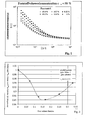
Das Fliessverhalten dieser Suspensionen wurde in einem deformationsgesteuerten Rotationsrheometer ermittelt. Als Messgeometrie wurde ein konzentrischer Zylinderspalt mit einer Spaltweite von 1 mm verwendet. Fig. 1 zeigt den Schubspannungsverlauf in Abhängigkeit der Schergeschwindigkeit für Suspensionen mit unterschiedlichem Faservolumenanteil.The flow behavior of these suspensions was in a deformation-controlled Rotation rheometer determined. As measuring geometry became a concentric Cylinder gap used with a gap width of 1 mm. Fig. 1 shows the shear stress curve depending on the shear rate for suspensions with different fiber volume fraction.
In Fig. 2 ist die relative Viskosität im Bereich mittlerer Schergeschwindigkeiten (1.0 1/s) als Funktion des Faseranteils in der Suspension dargestellt. In Fig. 2, the relative viscosity in the range of average shear rates (1.0 1 / s) as a function of the fiber content in the suspension.
In Fig. 1 und Fig. 2 lässt sich deutlich erkennen, dass für die Suspensionen bei denen ein Volumenanteil im Bereich von 1/6 (16.7%) mit faserförmigen Partikeln ersetzt wurde, die kleinsten Schubspannungen, bzw. Viskositäten gemessen werden. Bei höheren Faseranteilen zeigt sich hier wieder ein Viskositätsanstieg.In Fig. 1 and Fig. 2 can be clearly seen that for the suspensions at those with a volume fraction in the range of 1/6 (16.7%) with fibrous particles was replaced, the smallest shear stresses, or viscosities are measured. At higher fiber contents here again shows an increase in viscosity.
50 kg einer Modellschokoladenmasse bestehend aus 59 % Zucker, 11 % Kakaopulver, 29.5 % Kakaobutter (fluide Fettphase im geschmolzenen Zustand) und 0.5% Lecithin wurden im Pilot Plant Maßstab hergestellt. Die Feststoffkomponenten wurden dabei mit einem Teil der Kakaobutter fein gewalzt (X50,3 = 6µm; X95,3 = 21µm) und conchiert (überlagerte thermische, mechanische Knet/Mischbehandlung). Am Ende des Conchierens wurden zur Verflüssigung weitere Kakaobutter und Lecithin zugegeben. Zur rheologischen Untersuchung des Einflusses des Faservolumenanteils auf das Fliessverhalten der Modellschokoladensuspensionen wurde der Feststoffvolumenanteil auf 50 % eingestellt. Als faserförmiger Bestandteil wurde ein faserförmiges Milchpulver (gewonnen mittels eines Spinnprozesses) mit einem mittleren Faserdurchmesser x50,0 von 18.5µm und einem Längen- zu Durchmesserverhältnis von ca. 4 verwendet.50 kg of a model chocolate mass consisting of 59% sugar, 11% cocoa powder, 29.5% cocoa butter (fluid fat phase in the molten state) and 0.5% lecithin were prepared on a pilot plant scale. The solid components were finely rolled with a portion of the cocoa butter (X 50.3 = 6 μm, X 95.3 = 21 μm) and conched (superimposed thermal, mechanical kneading / mixing treatment). At the end of the conching, additional cocoa butter and lecithin were added for liquefaction. For the rheological investigation of the influence of the fiber volume fraction on the flow behavior of the model chocolate suspensions, the solids volume fraction was adjusted to 50%. As a fibrous component, a fibrous milk powder (obtained by a spinning process) having an average fiber diameter x 50.0 of 18.5 μm and a length to diameter ratio of about 4 was used.
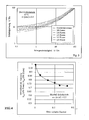
Das Fliessverhalten der Modellschokoladen wurde in einem deformationsgesteuerten Rotationsrheometer ermittelt. Als Messgeometrie wurde ein konzentrischer Zylinderspalt mit einer Spaltweite von 1 mm verwendet. Die Schokoladenproben wurden vor der Messung bei einer Temperatur von 50°C aufgeschmolzen. Die Messungen erfolgten bei einer Temperatur von 40°C. Fig. 3 zeigt den Schubspannungsverlauf in Abhängigkeit der Schergeschwindigkeit für diese Modellschokoladen mit unterschiedlichem Faservolumenanteil. In Fig. 4 ist die relative Viskosität im Bereich hoher Schergeschwindigkeiten als Funktion des Faseranteils in der Modellschokolade dargestellt. Aus Fig. 3 und Fig. 4 wird deutlich, dass bei steigendem Anteil länglicher (faserförmiger) Partikel die Viskosität der Modellschokoladen abnimmt.The flow behavior of the model chocolate was in a deformation-controlled Rotation rheometer determined. As measuring geometry became a concentric Cylinder gap used with a gap width of 1 mm. The chocolate samples were melted before the measurement at a temperature of 50 ° C. The Measurements were made at a temperature of 40 ° C. Fig. 3 shows the shear stress curve depending on the shear rate for these model chocolates with different fiber volume fraction. In Fig. 4, the relative viscosity in the range of high shear rates as a function of fiber content in the Model chocolate shown. From Fig. 3 and Fig. 4 it is clear that when rising Proportion of elongated (fibrous) particles the viscosity of the model chocolate decreases.
Weitere erfinderische Ausführungsformen sind in den Patentansprüchen 3 bis 6 beschrieben.Further inventive embodiments are described in the claims 3 to 6 .
Diese Aufgabe wird durch die in Patentansprüche 7 oder 8 beschriebenen Merkmale gelöst. This object is achieved by the features described in claims 7 or 8 .
Weitere erfinderische Ausgestaltungen sind in den Patentansprüchen 9 bis 13 beschrieben.Further inventive embodiments are described in the claims 9 to 13 .
Die in der Zusammenfassung, in den Patentansprüchen und in der Beschreibung beschriebenen sowie aus der Zeichnung ersichtlichen Merkmale können sowohl einzeln als auch in beliebigen Kombinationen für die Verwirklichung der Erfindung wesentlich sein.Those in the abstract, in the claims and in the description described as well as apparent from the drawing features can both individually as well as in any combination for the realization of the invention be essential.
Claims (13)
Priority Applications (1)
| Application Number | Priority Date | Filing Date | Title |
|---|---|---|---|
| PL04019881T PL1514908T3 (en) | 2003-09-10 | 2004-08-21 | Process for preparing concentrated flowable dispersions and prepared dispersion based products thereof |
Applications Claiming Priority (2)
| Application Number | Priority Date | Filing Date | Title |
|---|---|---|---|
| DE10342114 | 2003-09-10 | ||
| DE10342114A DE10342114B3 (en) | 2003-09-10 | 2003-09-10 | Process for the preparation of flowable concentrated suspension systems and suspension-based products prepared by this process |
Publications (3)
| Publication Number | Publication Date |
|---|---|
| EP1514908A2 true EP1514908A2 (en) | 2005-03-16 |
| EP1514908A3 EP1514908A3 (en) | 2005-07-13 |
| EP1514908B1 EP1514908B1 (en) | 2007-08-01 |
Family
ID=34129772
Family Applications (1)
| Application Number | Title | Priority Date | Filing Date |
|---|---|---|---|
| EP04019881A Expired - Lifetime EP1514908B1 (en) | 2003-09-10 | 2004-08-21 | Process for preparing concentrated flowable dispersions and prepared dispersion based products thereof |
Country Status (10)
| Country | Link |
|---|---|
| EP (1) | EP1514908B1 (en) |
| AR (1) | AR045618A1 (en) |
| AT (1) | ATE368387T1 (en) |
| BR (1) | BRPI0403967A (en) |
| DE (2) | DE10342114B3 (en) |
| DK (1) | DK1514908T3 (en) |
| ES (1) | ES2288654T3 (en) |
| NO (1) | NO335621B1 (en) |
| PL (1) | PL1514908T3 (en) |
| RU (1) | RU2288027C2 (en) |
Cited By (1)
| Publication number | Priority date | Publication date | Assignee | Title |
|---|---|---|---|---|
| RU2546836C2 (en) * | 2008-03-26 | 2015-04-10 | Экопьюро | Constructively improved plastics, characterised by reinforcing action of filling agent |
Families Citing this family (1)
| Publication number | Priority date | Publication date | Assignee | Title |
|---|---|---|---|---|
| WO2024192180A1 (en) * | 2023-03-13 | 2024-09-19 | Shiru, Inc. | Structured protein particulate in fibre or sheet form that forms oleogels and macrocolloids for replacing fats and thickeners in food and cosmetic products |
Family Cites Families (5)
| Publication number | Priority date | Publication date | Assignee | Title |
|---|---|---|---|---|
| IT1202466B (en) * | 1987-02-03 | 1989-02-09 | Carle & Montanari Spa | DEVICE FOR THE VISCOSITY REDUCTION IN SOLID SUSPENSIONS IN FAT VEHICLES, SUCH AS MASSES OF CHOCOLATE AND SIMILAR |
| DE4207722A1 (en) * | 1991-05-28 | 1992-12-03 | Merck Patent Gmbh | SURFACE-MODIFIED PLAIN-SHAPED PIGMENTS WITH IMPROVED REALLY BEHAVIOR |
| DE19801809A1 (en) * | 1997-09-26 | 1999-04-01 | Merck Patent Gmbh | Surface-modified platelet-shaped substrates |
| AU757089B2 (en) * | 1998-03-12 | 2003-01-30 | Mars, Incorporated | Rheologically modified confectioneries produced by employing particular particle size distributions |
| GB9807269D0 (en) * | 1998-04-03 | 1998-06-03 | Unilever Plc | Detergent compositions |
-
2003
- 2003-09-10 DE DE10342114A patent/DE10342114B3/en not_active Expired - Fee Related
-
2004
- 2004-08-21 AT AT04019881T patent/ATE368387T1/en active
- 2004-08-21 DK DK04019881T patent/DK1514908T3/en active
- 2004-08-21 ES ES04019881T patent/ES2288654T3/en not_active Expired - Lifetime
- 2004-08-21 PL PL04019881T patent/PL1514908T3/en unknown
- 2004-08-21 DE DE502004004494T patent/DE502004004494D1/en not_active Expired - Lifetime
- 2004-08-21 EP EP04019881A patent/EP1514908B1/en not_active Expired - Lifetime
- 2004-08-27 NO NO20043584A patent/NO335621B1/en not_active IP Right Cessation
- 2004-09-08 AR ARP040103228A patent/AR045618A1/en unknown
- 2004-09-09 BR BRPI0403967-0A patent/BRPI0403967A/en not_active IP Right Cessation
- 2004-09-09 RU RU2004127165/13A patent/RU2288027C2/en not_active IP Right Cessation
Cited By (1)
| Publication number | Priority date | Publication date | Assignee | Title |
|---|---|---|---|---|
| RU2546836C2 (en) * | 2008-03-26 | 2015-04-10 | Экопьюро | Constructively improved plastics, characterised by reinforcing action of filling agent |
Also Published As
| Publication number | Publication date |
|---|---|
| ATE368387T1 (en) | 2007-08-15 |
| DE502004004494D1 (en) | 2007-09-13 |
| NO20043584L (en) | 2005-03-11 |
| EP1514908B1 (en) | 2007-08-01 |
| BRPI0403967A (en) | 2006-02-21 |
| DE10342114B3 (en) | 2005-04-07 |
| ES2288654T3 (en) | 2008-01-16 |
| AR045618A1 (en) | 2005-11-02 |
| RU2288027C2 (en) | 2006-11-27 |
| PL1514908T3 (en) | 2007-10-31 |
| NO335621B1 (en) | 2015-01-12 |
| EP1514908A3 (en) | 2005-07-13 |
| DK1514908T3 (en) | 2007-10-15 |
| RU2004127165A (en) | 2006-02-20 |
Similar Documents
| Publication | Publication Date | Title |
|---|---|---|
| EP2091643B1 (en) | Method for production of a mini suspoemulsion or suspension of sub-micron core/shell particles | |
| DE69313988T2 (en) | Controlled melting point matrix formed by mixing a "shearform" matrix with an oily material | |
| DE69727032T2 (en) | MANUFACTURING PROCESS FOR EMULSIONS | |
| DE69606437T2 (en) | GROUND SILICATES AND SILICA FOR INK JET PRINTING | |
| DE69531785T2 (en) | CONCENTRATED FILLING SILICON SUSPENSION, METHOD FOR THE PRODUCTION AND USE OF THIS SUSPENSION | |
| EP1292539A1 (en) | Micronised barium sulphate | |
| EP1997787A2 (en) | Pigment preparations of paste-like or gel-form consistency | |
| DE69803180T2 (en) | ULTRAFINE-MICROCRYSTALLINE CELLULOSE COMPOSITIONS AND METHOD FOR THEIR PRODUCTION | |
| DE3886667T2 (en) | Shredding process. | |
| EP1995283A1 (en) | Pigment preparations of paste-like or gel-form consistency | |
| DE2844052A1 (en) | AQUEOUS DISPERSION OF A HYDROPHOBIC SILICA | |
| DE60116076T2 (en) | SCHERFLUIDISING WRITING COMPOSITIONS, WRITING INSTRUMENTS AND METHOD | |
| DE60221896T2 (en) | METHOD FOR PRODUCING HIERARCHIC POROUS BEADS | |
| EP0905204B1 (en) | Surface-modified platy substrates | |
| DE1467418C3 (en) | Process for the preparation of carbon black slurries for incorporation into rubber latex | |
| DE69217745T2 (en) | Food or cosmetic cream with gas bubbles in an aqueous medium | |
| DE69101004T2 (en) | Dry base material made from crystallized sugar, cocoa and other ingredients and process for its manufacture. | |
| DE10342114B3 (en) | Process for the preparation of flowable concentrated suspension systems and suspension-based products prepared by this process | |
| WO2020259864A1 (en) | Product containing cocoa and one or more sweetening agents, method for the production of such products, in particular chocolate products or chocolate-like products, use of products of said type, for example to make chocolate products or chocolate like products | |
| DE1592865C3 (en) | Process for the production of organically modified silicas | |
| DE1767332A1 (en) | Process for the production of finely divided, amorphous silicic acids with a high structure | |
| EP1215249A1 (en) | Pearly Carbon Black | |
| WO2004065507A1 (en) | Agglomerated gelatin powder and method for the production thereof | |
| DE3718661C2 (en) | Aqueous methylene bisthiocyanate dispersion | |
| DE3606356A1 (en) | Process for measuring the oil absorption capacity of rubber powder batch |
Legal Events
| Date | Code | Title | Description |
|---|---|---|---|
| PUAI | Public reference made under article 153(3) epc to a published international application that has entered the european phase |
Free format text: ORIGINAL CODE: 0009012 |
|
| 17P | Request for examination filed |
Effective date: 20040902 |
|
| AK | Designated contracting states |
Kind code of ref document: A2 Designated state(s): AT BE BG CH CY CZ DE DK EE ES FI FR GB GR HU IE IT LI LU MC NL PL PT RO SE SI SK TR |
|
| AX | Request for extension of the european patent |
Extension state: AL HR LT LV MK |
|
| PUAL | Search report despatched |
Free format text: ORIGINAL CODE: 0009013 |
|
| AK | Designated contracting states |
Kind code of ref document: A3 Designated state(s): AT BE BG CH CY CZ DE DK EE ES FI FR GB GR HU IE IT LI LU MC NL PL PT RO SE SI SK TR |
|
| AX | Request for extension of the european patent |
Extension state: AL HR LT LV MK |
|
| RIC1 | Information provided on ipc code assigned before grant |
Ipc: 7A 23G 1/00 A |
|
| AKX | Designation fees paid |
Designated state(s): AT BE BG CH CY CZ DE DK EE ES FI FR GB GR HU IE IT LI LU MC NL PL PT RO SE SI SK TR |
|
| GRAP | Despatch of communication of intention to grant a patent |
Free format text: ORIGINAL CODE: EPIDOSNIGR1 |
|
| GRAS | Grant fee paid |
Free format text: ORIGINAL CODE: EPIDOSNIGR3 |
|
| GRAA | (expected) grant |
Free format text: ORIGINAL CODE: 0009210 |
|
| AK | Designated contracting states |
Kind code of ref document: B1 Designated state(s): AT BE BG CH CY CZ DE DK EE ES FI FR GB GR HU IE IT LI LU MC NL PL PT RO SE SI SK TR |
|
| REG | Reference to a national code |
Ref country code: GB Ref legal event code: FG4D Free format text: NOT ENGLISH |
|
| REG | Reference to a national code |
Ref country code: CH Ref legal event code: EP Ref country code: CH Ref legal event code: NV Representative=s name: ISLER & PEDRAZZINI AG |
|
| REG | Reference to a national code |
Ref country code: IE Ref legal event code: FG4D Free format text: LANGUAGE OF EP DOCUMENT: GERMAN |
|
| REG | Reference to a national code |
Ref country code: SE Ref legal event code: TRGR |
|
| REF | Corresponds to: |
Ref document number: 502004004494 Country of ref document: DE Date of ref document: 20070913 Kind code of ref document: P |
|
| REG | Reference to a national code |
Ref country code: CH Ref legal event code: PCAR Free format text: ISLER & PEDRAZZINI AG;POSTFACH 1772;8027 ZUERICH (CH) |
|
| REG | Reference to a national code |
Ref country code: DK Ref legal event code: T3 |
|
| REG | Reference to a national code |
Ref country code: PL Ref legal event code: T3 |
|
| GBT | Gb: translation of ep patent filed (gb section 77(6)(a)/1977) |
Effective date: 20071107 |
|
| REG | Reference to a national code |
Ref country code: ES Ref legal event code: FG2A Ref document number: 2288654 Country of ref document: ES Kind code of ref document: T3 |
|
| REG | Reference to a national code |
Ref country code: HU Ref legal event code: AG4A Ref document number: E002196 Country of ref document: HU |
|
| PG25 | Lapsed in a contracting state [announced via postgrant information from national office to epo] |
Ref country code: BG Free format text: LAPSE BECAUSE OF FAILURE TO SUBMIT A TRANSLATION OF THE DESCRIPTION OR TO PAY THE FEE WITHIN THE PRESCRIBED TIME-LIMIT Effective date: 20071101 Ref country code: FI Free format text: LAPSE BECAUSE OF FAILURE TO SUBMIT A TRANSLATION OF THE DESCRIPTION OR TO PAY THE FEE WITHIN THE PRESCRIBED TIME-LIMIT Effective date: 20070801 |
|
| ET | Fr: translation filed | ||
| PG25 | Lapsed in a contracting state [announced via postgrant information from national office to epo] |
Ref country code: GR Free format text: LAPSE BECAUSE OF FAILURE TO SUBMIT A TRANSLATION OF THE DESCRIPTION OR TO PAY THE FEE WITHIN THE PRESCRIBED TIME-LIMIT Effective date: 20071102 Ref country code: MC Free format text: LAPSE BECAUSE OF NON-PAYMENT OF DUE FEES Effective date: 20070831 |
|
| PG25 | Lapsed in a contracting state [announced via postgrant information from national office to epo] |
Ref country code: SK Free format text: LAPSE BECAUSE OF FAILURE TO SUBMIT A TRANSLATION OF THE DESCRIPTION OR TO PAY THE FEE WITHIN THE PRESCRIBED TIME-LIMIT Effective date: 20070801 Ref country code: PT Free format text: LAPSE BECAUSE OF FAILURE TO SUBMIT A TRANSLATION OF THE DESCRIPTION OR TO PAY THE FEE WITHIN THE PRESCRIBED TIME-LIMIT Effective date: 20080102 Ref country code: CZ Free format text: LAPSE BECAUSE OF FAILURE TO SUBMIT A TRANSLATION OF THE DESCRIPTION OR TO PAY THE FEE WITHIN THE PRESCRIBED TIME-LIMIT Effective date: 20070801 |
|
| PLBE | No opposition filed within time limit |
Free format text: ORIGINAL CODE: 0009261 |
|
| STAA | Information on the status of an ep patent application or granted ep patent |
Free format text: STATUS: NO OPPOSITION FILED WITHIN TIME LIMIT |
|
| PG25 | Lapsed in a contracting state [announced via postgrant information from national office to epo] |
Ref country code: RO Free format text: LAPSE BECAUSE OF FAILURE TO SUBMIT A TRANSLATION OF THE DESCRIPTION OR TO PAY THE FEE WITHIN THE PRESCRIBED TIME-LIMIT Effective date: 20070801 |
|
| 26N | No opposition filed |
Effective date: 20080506 |
|
| PG25 | Lapsed in a contracting state [announced via postgrant information from national office to epo] |
Ref country code: EE Free format text: LAPSE BECAUSE OF FAILURE TO SUBMIT A TRANSLATION OF THE DESCRIPTION OR TO PAY THE FEE WITHIN THE PRESCRIBED TIME-LIMIT Effective date: 20070801 |
|
| PG25 | Lapsed in a contracting state [announced via postgrant information from national office to epo] |
Ref country code: SI Free format text: LAPSE BECAUSE OF FAILURE TO SUBMIT A TRANSLATION OF THE DESCRIPTION OR TO PAY THE FEE WITHIN THE PRESCRIBED TIME-LIMIT Effective date: 20070801 |
|
| PG25 | Lapsed in a contracting state [announced via postgrant information from national office to epo] |
Ref country code: CY Free format text: LAPSE BECAUSE OF FAILURE TO SUBMIT A TRANSLATION OF THE DESCRIPTION OR TO PAY THE FEE WITHIN THE PRESCRIBED TIME-LIMIT Effective date: 20070801 |
|
| PG25 | Lapsed in a contracting state [announced via postgrant information from national office to epo] |
Ref country code: LU Free format text: LAPSE BECAUSE OF NON-PAYMENT OF DUE FEES Effective date: 20070821 |
|
| PG25 | Lapsed in a contracting state [announced via postgrant information from national office to epo] |
Ref country code: TR Free format text: LAPSE BECAUSE OF FAILURE TO SUBMIT A TRANSLATION OF THE DESCRIPTION OR TO PAY THE FEE WITHIN THE PRESCRIBED TIME-LIMIT Effective date: 20070801 |
|
| PGFP | Annual fee paid to national office [announced via postgrant information from national office to epo] |
Ref country code: CH Payment date: 20140827 Year of fee payment: 11 Ref country code: DK Payment date: 20140825 Year of fee payment: 11 Ref country code: DE Payment date: 20140827 Year of fee payment: 11 Ref country code: IE Payment date: 20140827 Year of fee payment: 11 Ref country code: NL Payment date: 20140826 Year of fee payment: 11 |
|
| PGFP | Annual fee paid to national office [announced via postgrant information from national office to epo] |
Ref country code: ES Payment date: 20140826 Year of fee payment: 11 Ref country code: HU Payment date: 20140813 Year of fee payment: 11 Ref country code: GB Payment date: 20140827 Year of fee payment: 11 Ref country code: AT Payment date: 20140801 Year of fee payment: 11 Ref country code: FR Payment date: 20140818 Year of fee payment: 11 Ref country code: SE Payment date: 20140827 Year of fee payment: 11 Ref country code: PL Payment date: 20140804 Year of fee payment: 11 |
|
| PGFP | Annual fee paid to national office [announced via postgrant information from national office to epo] |
Ref country code: IT Payment date: 20140825 Year of fee payment: 11 |
|
| PGFP | Annual fee paid to national office [announced via postgrant information from national office to epo] |
Ref country code: BE Payment date: 20140829 Year of fee payment: 11 |
|
| REG | Reference to a national code |
Ref country code: DE Ref legal event code: R119 Ref document number: 502004004494 Country of ref document: DE |
|
| REG | Reference to a national code |
Ref country code: DK Ref legal event code: EBP Effective date: 20150831 |
|
| REG | Reference to a national code |
Ref country code: SE Ref legal event code: EUG |
|
| REG | Reference to a national code |
Ref country code: CH Ref legal event code: PL |
|
| REG | Reference to a national code |
Ref country code: AT Ref legal event code: MM01 Ref document number: 368387 Country of ref document: AT Kind code of ref document: T Effective date: 20150821 |
|
| GBPC | Gb: european patent ceased through non-payment of renewal fee |
Effective date: 20150821 |
|
| PG25 | Lapsed in a contracting state [announced via postgrant information from national office to epo] |
Ref country code: CH Free format text: LAPSE BECAUSE OF NON-PAYMENT OF DUE FEES Effective date: 20150831 Ref country code: IT Free format text: LAPSE BECAUSE OF NON-PAYMENT OF DUE FEES Effective date: 20150821 Ref country code: LI Free format text: LAPSE BECAUSE OF NON-PAYMENT OF DUE FEES Effective date: 20150831 |
|
| REG | Reference to a national code |
Ref country code: NL Ref legal event code: MM Effective date: 20150901 |
|
| PG25 | Lapsed in a contracting state [announced via postgrant information from national office to epo] |
Ref country code: AT Free format text: LAPSE BECAUSE OF NON-PAYMENT OF DUE FEES Effective date: 20150821 Ref country code: HU Free format text: LAPSE BECAUSE OF NON-PAYMENT OF DUE FEES Effective date: 20150822 Ref country code: SE Free format text: LAPSE BECAUSE OF NON-PAYMENT OF DUE FEES Effective date: 20150822 |
|
| REG | Reference to a national code |
Ref country code: IE Ref legal event code: MM4A |
|
| REG | Reference to a national code |
Ref country code: FR Ref legal event code: ST Effective date: 20160429 |
|
| PG25 | Lapsed in a contracting state [announced via postgrant information from national office to epo] |
Ref country code: NL Free format text: LAPSE BECAUSE OF NON-PAYMENT OF DUE FEES Effective date: 20150901 |
|
| PG25 | Lapsed in a contracting state [announced via postgrant information from national office to epo] |
Ref country code: DE Free format text: LAPSE BECAUSE OF NON-PAYMENT OF DUE FEES Effective date: 20160301 Ref country code: IE Free format text: LAPSE BECAUSE OF NON-PAYMENT OF DUE FEES Effective date: 20150821 Ref country code: GB Free format text: LAPSE BECAUSE OF NON-PAYMENT OF DUE FEES Effective date: 20150821 |
|
| PG25 | Lapsed in a contracting state [announced via postgrant information from national office to epo] |
Ref country code: FR Free format text: LAPSE BECAUSE OF NON-PAYMENT OF DUE FEES Effective date: 20150831 Ref country code: DK Free format text: LAPSE BECAUSE OF NON-PAYMENT OF DUE FEES Effective date: 20150831 |
|
| REG | Reference to a national code |
Ref country code: ES Ref legal event code: FD2A Effective date: 20160927 |
|
| PG25 | Lapsed in a contracting state [announced via postgrant information from national office to epo] |
Ref country code: PL Free format text: LAPSE BECAUSE OF NON-PAYMENT OF DUE FEES Effective date: 20150821 |
|
| PG25 | Lapsed in a contracting state [announced via postgrant information from national office to epo] |
Ref country code: ES Free format text: LAPSE BECAUSE OF NON-PAYMENT OF DUE FEES Effective date: 20150822 |
|
| PG25 | Lapsed in a contracting state [announced via postgrant information from national office to epo] |
Ref country code: BE Free format text: LAPSE BECAUSE OF NON-PAYMENT OF DUE FEES Effective date: 20150831 |