EP1514873A1 - Verfahren zur Oxidation organischer Substrate und Katalysatorzusammensetzung zur Durchführung des Verfahrens - Google Patents
Verfahren zur Oxidation organischer Substrate und Katalysatorzusammensetzung zur Durchführung des Verfahrens Download PDFInfo
- Publication number
- EP1514873A1 EP1514873A1 EP04013059A EP04013059A EP1514873A1 EP 1514873 A1 EP1514873 A1 EP 1514873A1 EP 04013059 A EP04013059 A EP 04013059A EP 04013059 A EP04013059 A EP 04013059A EP 1514873 A1 EP1514873 A1 EP 1514873A1
- Authority
- EP
- European Patent Office
- Prior art keywords
- catalyst composition
- compound
- reo
- catalyst
- organylating
- Prior art date
- Legal status (The legal status is an assumption and is not a legal conclusion. Google has not performed a legal analysis and makes no representation as to the accuracy of the status listed.)
- Granted
Links
- 239000003054 catalyst Substances 0.000 title claims abstract description 123
- 239000000203 mixture Substances 0.000 title claims abstract description 94
- 238000007254 oxidation reaction Methods 0.000 title claims abstract description 45
- 238000000034 method Methods 0.000 title claims abstract description 36
- 230000003647 oxidation Effects 0.000 title claims abstract description 25
- 239000000758 substrate Substances 0.000 title claims abstract description 16
- 230000008569 process Effects 0.000 title claims description 17
- 239000002904 solvent Substances 0.000 claims abstract description 38
- 239000003795 chemical substances by application Substances 0.000 claims abstract description 36
- 150000001875 compounds Chemical class 0.000 claims abstract description 36
- MHAJPDPJQMAIIY-UHFFFAOYSA-N Hydrogen peroxide Chemical compound OO MHAJPDPJQMAIIY-UHFFFAOYSA-N 0.000 claims abstract description 32
- 238000006243 chemical reaction Methods 0.000 claims abstract description 18
- 239000003446 ligand Substances 0.000 claims abstract description 18
- 239000000460 chlorine Substances 0.000 claims abstract description 15
- 238000000859 sublimation Methods 0.000 claims abstract description 11
- 230000008022 sublimation Effects 0.000 claims abstract description 11
- 238000002425 crystallisation Methods 0.000 claims abstract description 10
- 238000004519 manufacturing process Methods 0.000 claims abstract description 10
- 229910052725 zinc Inorganic materials 0.000 claims abstract description 10
- 125000000217 alkyl group Chemical group 0.000 claims abstract description 9
- 125000000129 anionic group Chemical group 0.000 claims abstract description 9
- 238000004821 distillation Methods 0.000 claims abstract description 9
- 239000000010 aprotic solvent Substances 0.000 claims abstract description 8
- 150000004795 grignard reagents Chemical class 0.000 claims abstract description 8
- 125000001190 organyl group Chemical group 0.000 claims abstract description 8
- DYIZHKNUQPHNJY-UHFFFAOYSA-N oxorhenium Chemical compound [Re]=O DYIZHKNUQPHNJY-UHFFFAOYSA-N 0.000 claims abstract description 8
- 229910052801 chlorine Inorganic materials 0.000 claims abstract description 7
- 229910052744 lithium Inorganic materials 0.000 claims abstract description 7
- 239000011777 magnesium Substances 0.000 claims abstract description 7
- 229910052749 magnesium Inorganic materials 0.000 claims abstract description 7
- ZAMOUSCENKQFHK-UHFFFAOYSA-N Chlorine atom Chemical compound [Cl] ZAMOUSCENKQFHK-UHFFFAOYSA-N 0.000 claims abstract description 6
- 229910052782 aluminium Inorganic materials 0.000 claims abstract description 6
- 229910052736 halogen Inorganic materials 0.000 claims abstract description 5
- 150000002367 halogens Chemical class 0.000 claims abstract description 5
- 229910052700 potassium Inorganic materials 0.000 claims abstract description 3
- 229910052708 sodium Inorganic materials 0.000 claims abstract description 3
- -1 peroxy compound Chemical class 0.000 claims description 24
- 238000002360 preparation method Methods 0.000 claims description 24
- 239000011541 reaction mixture Substances 0.000 claims description 14
- 150000001336 alkenes Chemical class 0.000 claims description 11
- IJGRMHOSHXDMSA-UHFFFAOYSA-N Atomic nitrogen Chemical compound N#N IJGRMHOSHXDMSA-UHFFFAOYSA-N 0.000 claims description 10
- 239000000470 constituent Substances 0.000 claims description 10
- 229910052757 nitrogen Inorganic materials 0.000 claims description 8
- 150000001412 amines Chemical class 0.000 claims description 7
- 125000003118 aryl group Chemical group 0.000 claims description 7
- 230000008025 crystallization Effects 0.000 claims description 7
- CCERQOYLJJULMD-UHFFFAOYSA-M magnesium;carbanide;chloride Chemical compound [CH3-].[Mg+2].[Cl-] CCERQOYLJJULMD-UHFFFAOYSA-M 0.000 claims description 7
- XLYOFNOQVPJJNP-UHFFFAOYSA-N water Substances O XLYOFNOQVPJJNP-UHFFFAOYSA-N 0.000 claims description 7
- 238000000605 extraction Methods 0.000 claims description 6
- 239000007787 solid Substances 0.000 claims description 6
- 125000002252 acyl group Chemical group 0.000 claims description 5
- 150000004791 alkyl magnesium halides Chemical class 0.000 claims description 5
- 239000002585 base Substances 0.000 claims description 4
- 239000007864 aqueous solution Substances 0.000 claims description 3
- 125000003710 aryl alkyl group Chemical group 0.000 claims description 3
- 150000001735 carboxylic acids Chemical class 0.000 claims description 3
- 125000000753 cycloalkyl group Chemical group 0.000 claims description 3
- 150000002009 diols Chemical class 0.000 claims description 3
- 150000002443 hydroxylamines Chemical class 0.000 claims description 3
- 125000002496 methyl group Chemical group [H]C([H])([H])* 0.000 claims description 3
- 150000003335 secondary amines Chemical class 0.000 claims description 3
- 238000006220 Baeyer-Villiger oxidation reaction Methods 0.000 claims description 2
- 239000002253 acid Substances 0.000 claims description 2
- 150000007513 acids Chemical class 0.000 claims description 2
- 150000001298 alcohols Chemical class 0.000 claims description 2
- 125000001797 benzyl group Chemical group [H]C1=C([H])C([H])=C(C([H])=C1[H])C([H])([H])* 0.000 claims description 2
- 235000010338 boric acid Nutrition 0.000 claims description 2
- 125000005619 boric acid group Chemical class 0.000 claims description 2
- 229910052794 bromium Inorganic materials 0.000 claims description 2
- 150000003997 cyclic ketones Chemical class 0.000 claims description 2
- 229910052731 fluorine Inorganic materials 0.000 claims description 2
- 229910052500 inorganic mineral Inorganic materials 0.000 claims description 2
- 150000002596 lactones Chemical class 0.000 claims description 2
- 239000011707 mineral Substances 0.000 claims description 2
- 239000003960 organic solvent Substances 0.000 claims description 2
- 150000004053 quinones Chemical class 0.000 claims description 2
- 125000005624 silicic acid group Chemical class 0.000 claims description 2
- 235000012239 silicon dioxide Nutrition 0.000 claims description 2
- 125000003903 2-propenyl group Chemical group [H]C([*])([H])C([H])=C([H])[H] 0.000 claims 1
- VEXZGXHMUGYJMC-UHFFFAOYSA-M Chloride anion Chemical compound [Cl-] VEXZGXHMUGYJMC-UHFFFAOYSA-M 0.000 claims 1
- 239000007900 aqueous suspension Substances 0.000 claims 1
- 230000000536 complexating effect Effects 0.000 claims 1
- 229940125904 compound 1 Drugs 0.000 claims 1
- 125000001495 ethyl group Chemical group [H]C([H])([H])C([H])([H])* 0.000 claims 1
- 125000001449 isopropyl group Chemical group [H]C([H])([H])C([H])(*)C([H])([H])[H] 0.000 claims 1
- 235000010755 mineral Nutrition 0.000 claims 1
- 125000004108 n-butyl group Chemical group [H]C([H])([H])C([H])([H])C([H])([H])C([H])([H])* 0.000 claims 1
- 125000004123 n-propyl group Chemical group [H]C([H])([H])C([H])([H])C([H])([H])* 0.000 claims 1
- 125000002914 sec-butyl group Chemical group [H]C([H])([H])C([H])([H])C([H])(*)C([H])([H])[H] 0.000 claims 1
- 229910052702 rhenium Inorganic materials 0.000 abstract description 12
- WUAPFZMCVAUBPE-UHFFFAOYSA-N rhenium atom Chemical compound [Re] WUAPFZMCVAUBPE-UHFFFAOYSA-N 0.000 abstract description 12
- 239000011701 zinc Substances 0.000 abstract description 9
- 238000000354 decomposition reaction Methods 0.000 abstract description 5
- 239000007818 Grignard reagent Substances 0.000 abstract description 4
- FYYHWMGAXLPEAU-UHFFFAOYSA-N Magnesium Chemical compound [Mg] FYYHWMGAXLPEAU-UHFFFAOYSA-N 0.000 abstract description 4
- HCHKCACWOHOZIP-UHFFFAOYSA-N Zinc Chemical compound [Zn] HCHKCACWOHOZIP-UHFFFAOYSA-N 0.000 abstract description 4
- 229910003449 rhenium oxide Inorganic materials 0.000 abstract description 4
- 239000003153 chemical reaction reagent Substances 0.000 abstract description 3
- WHXSMMKQMYFTQS-UHFFFAOYSA-N Lithium Chemical compound [Li] WHXSMMKQMYFTQS-UHFFFAOYSA-N 0.000 abstract description 2
- XAGFODPZIPBFFR-UHFFFAOYSA-N aluminium Chemical compound [Al] XAGFODPZIPBFFR-UHFFFAOYSA-N 0.000 abstract description 2
- 239000011734 sodium Substances 0.000 abstract description 2
- DGAQECJNVWCQMB-PUAWFVPOSA-M Ilexoside XXIX Chemical compound C[C@@H]1CC[C@@]2(CC[C@@]3(C(=CC[C@H]4[C@]3(CC[C@@H]5[C@@]4(CC[C@@H](C5(C)C)OS(=O)(=O)[O-])C)C)[C@@H]2[C@]1(C)O)C)C(=O)O[C@H]6[C@@H]([C@H]([C@@H]([C@H](O6)CO)O)O)O.[Na+] DGAQECJNVWCQMB-PUAWFVPOSA-M 0.000 abstract 1
- 239000002879 Lewis base Substances 0.000 abstract 1
- ZLMJMSJWJFRBEC-UHFFFAOYSA-N Potassium Chemical compound [K] ZLMJMSJWJFRBEC-UHFFFAOYSA-N 0.000 abstract 1
- 229910010272 inorganic material Inorganic materials 0.000 abstract 1
- 239000011147 inorganic material Substances 0.000 abstract 1
- 150000007527 lewis bases Chemical class 0.000 abstract 1
- 150000002894 organic compounds Chemical class 0.000 abstract 1
- 150000002978 peroxides Chemical class 0.000 abstract 1
- 239000011591 potassium Substances 0.000 abstract 1
- WYURNTSHIVDZCO-UHFFFAOYSA-N Tetrahydrofuran Chemical compound C1CCOC1 WYURNTSHIVDZCO-UHFFFAOYSA-N 0.000 description 28
- VZSXFJPZOCRDPW-UHFFFAOYSA-N carbanide;trioxorhenium Chemical compound [CH3-].O=[Re](=O)=O VZSXFJPZOCRDPW-UHFFFAOYSA-N 0.000 description 28
- 239000000243 solution Substances 0.000 description 25
- JUJWROOIHBZHMG-UHFFFAOYSA-N Pyridine Chemical compound C1=CC=NC=C1 JUJWROOIHBZHMG-UHFFFAOYSA-N 0.000 description 18
- YLQBMQCUIZJEEH-UHFFFAOYSA-N tetrahydrofuran Natural products C=1C=COC=1 YLQBMQCUIZJEEH-UHFFFAOYSA-N 0.000 description 14
- LIKMAJRDDDTEIG-UHFFFAOYSA-N 1-hexene Chemical compound CCCCC=C LIKMAJRDDDTEIG-UHFFFAOYSA-N 0.000 description 10
- 230000003197 catalytic effect Effects 0.000 description 9
- 238000006735 epoxidation reaction Methods 0.000 description 9
- UMJSCPRVCHMLSP-UHFFFAOYSA-N pyridine Natural products COC1=CC=CN=C1 UMJSCPRVCHMLSP-UHFFFAOYSA-N 0.000 description 9
- YMWUJEATGCHHMB-UHFFFAOYSA-N Dichloromethane Chemical compound ClCCl YMWUJEATGCHHMB-UHFFFAOYSA-N 0.000 description 8
- RTZKZFJDLAIYFH-UHFFFAOYSA-N Diethyl ether Chemical compound CCOCC RTZKZFJDLAIYFH-UHFFFAOYSA-N 0.000 description 7
- MELPJGOMEMRMPL-UHFFFAOYSA-N 9-oxabicyclo[6.1.0]nonane Chemical compound C1CCCCCC2OC21 MELPJGOMEMRMPL-UHFFFAOYSA-N 0.000 description 5
- 229910019571 Re2O7 Inorganic materials 0.000 description 5
- 230000029936 alkylation Effects 0.000 description 5
- 238000005804 alkylation reaction Methods 0.000 description 5
- 150000004982 aromatic amines Chemical class 0.000 description 5
- 230000008901 benefit Effects 0.000 description 5
- 230000000052 comparative effect Effects 0.000 description 5
- 239000012074 organic phase Substances 0.000 description 5
- 150000003282 rhenium compounds Chemical class 0.000 description 5
- 238000000926 separation method Methods 0.000 description 5
- 150000007514 bases Chemical class 0.000 description 4
- JRZJOMJEPLMPRA-UHFFFAOYSA-N olefin Natural products CCCCCCCC=C JRZJOMJEPLMPRA-UHFFFAOYSA-N 0.000 description 4
- 230000035484 reaction time Effects 0.000 description 4
- WHNBDXQTMPYBAT-UHFFFAOYSA-N 2-butyloxirane Chemical compound CCCCC1CO1 WHNBDXQTMPYBAT-UHFFFAOYSA-N 0.000 description 3
- IBZKBSXREAQDTO-UHFFFAOYSA-N 2-methoxy-n-(2-methoxyethyl)ethanamine Chemical compound COCCNCCOC IBZKBSXREAQDTO-UHFFFAOYSA-N 0.000 description 3
- 239000002168 alkylating agent Substances 0.000 description 3
- 229940100198 alkylating agent Drugs 0.000 description 3
- URYYVOIYTNXXBN-UPHRSURJSA-N cyclooctene Chemical compound C1CCC\C=C/CC1 URYYVOIYTNXXBN-UPHRSURJSA-N 0.000 description 3
- 239000004913 cyclooctene Substances 0.000 description 3
- 238000001914 filtration Methods 0.000 description 3
- 238000002955 isolation Methods 0.000 description 3
- 238000005649 metathesis reaction Methods 0.000 description 3
- 230000011987 methylation Effects 0.000 description 3
- 238000007069 methylation reaction Methods 0.000 description 3
- 150000002902 organometallic compounds Chemical class 0.000 description 3
- 239000007800 oxidant agent Substances 0.000 description 3
- 239000012071 phase Substances 0.000 description 3
- 238000011403 purification operation Methods 0.000 description 3
- 238000006722 reduction reaction Methods 0.000 description 3
- 238000003756 stirring Methods 0.000 description 3
- 239000000126 substance Substances 0.000 description 3
- 229910052718 tin Inorganic materials 0.000 description 3
- 231100000331 toxic Toxicity 0.000 description 3
- 230000002588 toxic effect Effects 0.000 description 3
- NLXLAEXVIDQMFP-UHFFFAOYSA-N Ammonia chloride Chemical compound [NH4+].[Cl-] NLXLAEXVIDQMFP-UHFFFAOYSA-N 0.000 description 2
- 150000001204 N-oxides Chemical class 0.000 description 2
- UFWIBTONFRDIAS-UHFFFAOYSA-N Naphthalene Chemical compound C1=CC=CC2=CC=CC=C21 UFWIBTONFRDIAS-UHFFFAOYSA-N 0.000 description 2
- VYPSYNLAJGMNEJ-UHFFFAOYSA-N Silicium dioxide Chemical compound O=[Si]=O VYPSYNLAJGMNEJ-UHFFFAOYSA-N 0.000 description 2
- CIUQDSCDWFSTQR-UHFFFAOYSA-N [C]1=CC=CC=C1 Chemical compound [C]1=CC=CC=C1 CIUQDSCDWFSTQR-UHFFFAOYSA-N 0.000 description 2
- 125000001931 aliphatic group Chemical group 0.000 description 2
- 229910052783 alkali metal Inorganic materials 0.000 description 2
- 150000001340 alkali metals Chemical class 0.000 description 2
- 239000006227 byproduct Substances 0.000 description 2
- 229910052791 calcium Inorganic materials 0.000 description 2
- 239000011575 calcium Substances 0.000 description 2
- IJOOHPMOJXWVHK-UHFFFAOYSA-N chlorotrimethylsilane Chemical compound C[Si](C)(C)Cl IJOOHPMOJXWVHK-UHFFFAOYSA-N 0.000 description 2
- 238000004140 cleaning Methods 0.000 description 2
- 238000001816 cooling Methods 0.000 description 2
- JHIVVAPYMSGYDF-UHFFFAOYSA-N cyclohexanone Chemical compound O=C1CCCCC1 JHIVVAPYMSGYDF-UHFFFAOYSA-N 0.000 description 2
- BGTOWKSIORTVQH-UHFFFAOYSA-N cyclopentanone Chemical compound O=C1CCCC1 BGTOWKSIORTVQH-UHFFFAOYSA-N 0.000 description 2
- 239000000839 emulsion Substances 0.000 description 2
- 150000002170 ethers Chemical class 0.000 description 2
- 230000007717 exclusion Effects 0.000 description 2
- 150000004820 halides Chemical class 0.000 description 2
- 238000011065 in-situ storage Methods 0.000 description 2
- 239000007788 liquid Substances 0.000 description 2
- SQDFHQJTAWCFIB-UHFFFAOYSA-N n-methylidenehydroxylamine Chemical compound ON=C SQDFHQJTAWCFIB-UHFFFAOYSA-N 0.000 description 2
- 238000005191 phase separation Methods 0.000 description 2
- 238000000746 purification Methods 0.000 description 2
- 238000012552 review Methods 0.000 description 2
- 239000007858 starting material Substances 0.000 description 2
- 238000006467 substitution reaction Methods 0.000 description 2
- BGHCVCJVXZWKCC-UHFFFAOYSA-N tetradecane Chemical compound CCCCCCCCCCCCCC BGHCVCJVXZWKCC-UHFFFAOYSA-N 0.000 description 2
- 238000012546 transfer Methods 0.000 description 2
- QAEDZJGFFMLHHQ-UHFFFAOYSA-N trifluoroacetic anhydride Chemical compound FC(F)(F)C(=O)OC(=O)C(F)(F)F QAEDZJGFFMLHHQ-UHFFFAOYSA-N 0.000 description 2
- QDZOFZFDBDYWJX-UHFFFAOYSA-N 2-ethoxy-n-(2-ethoxyethyl)ethanamine Chemical compound CCOCCNCCOCC QDZOFZFDBDYWJX-UHFFFAOYSA-N 0.000 description 1
- 125000006227 2-n-butoxyethyl group Chemical group [H]C([H])([H])C([H])([H])C([H])([H])C([H])([H])OC([H])([H])C([H])([H])* 0.000 description 1
- XSVSPKKXQGNHMD-UHFFFAOYSA-N 5-bromo-3-methyl-1,2-thiazole Chemical compound CC=1C=C(Br)SN=1 XSVSPKKXQGNHMD-UHFFFAOYSA-N 0.000 description 1
- ZCYVEMRRCGMTRW-UHFFFAOYSA-N 7553-56-2 Chemical compound [I] ZCYVEMRRCGMTRW-UHFFFAOYSA-N 0.000 description 1
- ROFVEXUMMXZLPA-UHFFFAOYSA-N Bipyridyl Chemical compound N1=CC=CC=C1C1=CC=CC=N1 ROFVEXUMMXZLPA-UHFFFAOYSA-N 0.000 description 1
- WKBOTKDWSSQWDR-UHFFFAOYSA-N Bromine atom Chemical compound [Br] WKBOTKDWSSQWDR-UHFFFAOYSA-N 0.000 description 1
- LIFHERHELLBGSR-UHFFFAOYSA-L C[Re](Cl)(Cl)=O Chemical compound C[Re](Cl)(Cl)=O LIFHERHELLBGSR-UHFFFAOYSA-L 0.000 description 1
- OYPRJOBELJOOCE-UHFFFAOYSA-N Calcium Chemical compound [Ca] OYPRJOBELJOOCE-UHFFFAOYSA-N 0.000 description 1
- 238000005698 Diels-Alder reaction Methods 0.000 description 1
- PXGOKWXKJXAPGV-UHFFFAOYSA-N Fluorine Chemical compound FF PXGOKWXKJXAPGV-UHFFFAOYSA-N 0.000 description 1
- WTKZEGDFNFYCGP-UHFFFAOYSA-N Pyrazole Chemical compound C=1C=NNC=1 WTKZEGDFNFYCGP-UHFFFAOYSA-N 0.000 description 1
- 241000220317 Rosa Species 0.000 description 1
- XSQUKJJJFZCRTK-UHFFFAOYSA-N Urea Chemical compound NC(N)=O XSQUKJJJFZCRTK-UHFFFAOYSA-N 0.000 description 1
- QWQOLXDTTZSJBQ-UHFFFAOYSA-M [Cl-].CC(C)[Zn+] Chemical compound [Cl-].CC(C)[Zn+] QWQOLXDTTZSJBQ-UHFFFAOYSA-M 0.000 description 1
- 125000002777 acetyl group Chemical group [H]C([H])([H])C(*)=O 0.000 description 1
- 150000001338 aliphatic hydrocarbons Chemical class 0.000 description 1
- 150000001345 alkine derivatives Chemical class 0.000 description 1
- 125000006231 alkoxy propyl group Chemical group 0.000 description 1
- 235000019270 ammonium chloride Nutrition 0.000 description 1
- 150000008064 anhydrides Chemical class 0.000 description 1
- 150000001454 anthracenes Chemical class 0.000 description 1
- 239000012736 aqueous medium Substances 0.000 description 1
- 150000004945 aromatic hydrocarbons Chemical class 0.000 description 1
- 150000005840 aryl radicals Chemical class 0.000 description 1
- QVGXLLKOCUKJST-UHFFFAOYSA-N atomic oxygen Chemical compound [O] QVGXLLKOCUKJST-UHFFFAOYSA-N 0.000 description 1
- 230000009286 beneficial effect Effects 0.000 description 1
- 125000003236 benzoyl group Chemical group [H]C1=C([H])C([H])=C(C([H])=C1[H])C(*)=O 0.000 description 1
- 230000015572 biosynthetic process Effects 0.000 description 1
- 230000002051 biphasic effect Effects 0.000 description 1
- GDTBXPJZTBHREO-UHFFFAOYSA-N bromine Substances BrBr GDTBXPJZTBHREO-UHFFFAOYSA-N 0.000 description 1
- 229910052793 cadmium Inorganic materials 0.000 description 1
- 239000004202 carbamide Substances 0.000 description 1
- 238000006555 catalytic reaction Methods 0.000 description 1
- 230000008859 change Effects 0.000 description 1
- 238000004587 chromatography analysis Methods 0.000 description 1
- 238000007796 conventional method Methods 0.000 description 1
- 229910052802 copper Inorganic materials 0.000 description 1
- 150000004292 cyclic ethers Chemical class 0.000 description 1
- 230000007423 decrease Effects 0.000 description 1
- 230000006866 deterioration Effects 0.000 description 1
- 150000001983 dialkylethers Chemical class 0.000 description 1
- FAMGJMYDHOESPR-UHFFFAOYSA-M dilithium;carbanide;bromide Chemical compound [Li+].[Li+].[CH3-].[Br-] FAMGJMYDHOESPR-UHFFFAOYSA-M 0.000 description 1
- VTIIJXUACCWYHX-UHFFFAOYSA-L disodium;carboxylatooxy carbonate Chemical compound [Na+].[Na+].[O-]C(=O)OOC([O-])=O VTIIJXUACCWYHX-UHFFFAOYSA-L 0.000 description 1
- 238000004090 dissolution Methods 0.000 description 1
- 230000000694 effects Effects 0.000 description 1
- 238000011156 evaluation Methods 0.000 description 1
- 230000005284 excitation Effects 0.000 description 1
- 239000011737 fluorine Substances 0.000 description 1
- 125000002485 formyl group Chemical class [H]C(*)=O 0.000 description 1
- 239000005350 fused silica glass Substances 0.000 description 1
- 238000004817 gas chromatography Methods 0.000 description 1
- 239000011521 glass Substances 0.000 description 1
- 125000000623 heterocyclic group Chemical group 0.000 description 1
- 230000007062 hydrolysis Effects 0.000 description 1
- 238000006460 hydrolysis reaction Methods 0.000 description 1
- 230000003301 hydrolyzing effect Effects 0.000 description 1
- 125000002887 hydroxy group Chemical group [H]O* 0.000 description 1
- 125000002768 hydroxyalkyl group Chemical group 0.000 description 1
- 230000033444 hydroxylation Effects 0.000 description 1
- 238000005805 hydroxylation reaction Methods 0.000 description 1
- 239000004615 ingredient Substances 0.000 description 1
- 238000009413 insulation Methods 0.000 description 1
- PNDPGZBMCMUPRI-UHFFFAOYSA-N iodine Chemical compound II PNDPGZBMCMUPRI-UHFFFAOYSA-N 0.000 description 1
- 229910052740 iodine Inorganic materials 0.000 description 1
- 239000011630 iodine Substances 0.000 description 1
- 238000006317 isomerization reaction Methods 0.000 description 1
- 125000006229 isopropoxyethyl group Chemical group [H]C([H])([H])C([H])(OC([H])([H])C([H])([H])*)C([H])([H])[H] 0.000 description 1
- BXBLTKZWYAHPKM-UHFFFAOYSA-M magnesium;methanidyl(trimethyl)silane;chloride Chemical compound [Mg+2].[Cl-].C[Si](C)(C)[CH2-] BXBLTKZWYAHPKM-UHFFFAOYSA-M 0.000 description 1
- 229910052753 mercury Inorganic materials 0.000 description 1
- XTTMNDFFWSZHCZ-UHFFFAOYSA-N n-(2-methoxyethyl)aniline Chemical compound COCCNC1=CC=CC=C1 XTTMNDFFWSZHCZ-UHFFFAOYSA-N 0.000 description 1
- WLBZYKIKOMBOJH-UHFFFAOYSA-N n-(2-methoxyethyl)hydroxylamine Chemical compound COCCNO WLBZYKIKOMBOJH-UHFFFAOYSA-N 0.000 description 1
- 150000002831 nitrogen free-radicals Chemical class 0.000 description 1
- QJGQUHMNIGDVPM-UHFFFAOYSA-N nitrogen group Chemical group [N] QJGQUHMNIGDVPM-UHFFFAOYSA-N 0.000 description 1
- 150000002832 nitroso derivatives Chemical class 0.000 description 1
- XKLJHFLUAHKGGU-UHFFFAOYSA-N nitrous amide Chemical class ON=N XKLJHFLUAHKGGU-UHFFFAOYSA-N 0.000 description 1
- 150000002924 oxiranes Chemical class 0.000 description 1
- 239000001301 oxygen Substances 0.000 description 1
- 229910052760 oxygen Inorganic materials 0.000 description 1
- JRKICGRDRMAZLK-UHFFFAOYSA-L persulfate group Chemical group S(=O)(=O)([O-])OOS(=O)(=O)[O-] JRKICGRDRMAZLK-UHFFFAOYSA-L 0.000 description 1
- 125000003170 phenylsulfonyl group Chemical group C1(=CC=CC=C1)S(=O)(=O)* 0.000 description 1
- 230000001376 precipitating effect Effects 0.000 description 1
- SBYHFKPVCBCYGV-UHFFFAOYSA-N quinuclidine Chemical compound C1CC2CCN1CC2 SBYHFKPVCBCYGV-UHFFFAOYSA-N 0.000 description 1
- 239000000376 reactant Substances 0.000 description 1
- 230000001603 reducing effect Effects 0.000 description 1
- 230000009467 reduction Effects 0.000 description 1
- 239000000741 silica gel Substances 0.000 description 1
- 229910002027 silica gel Inorganic materials 0.000 description 1
- 239000012418 sodium perborate tetrahydrate Substances 0.000 description 1
- 229940045872 sodium percarbonate Drugs 0.000 description 1
- IBDSNZLUHYKHQP-UHFFFAOYSA-N sodium;3-oxidodioxaborirane;tetrahydrate Chemical compound O.O.O.O.[Na+].[O-]B1OO1 IBDSNZLUHYKHQP-UHFFFAOYSA-N 0.000 description 1
- 238000006561 solvent free reaction Methods 0.000 description 1
- 239000011877 solvent mixture Substances 0.000 description 1
- 125000001424 substituent group Chemical group 0.000 description 1
- 150000003457 sulfones Chemical class 0.000 description 1
- 150000003462 sulfoxides Chemical class 0.000 description 1
- VXKWYPOMXBVZSJ-UHFFFAOYSA-N tetramethyltin Chemical compound C[Sn](C)(C)C VXKWYPOMXBVZSJ-UHFFFAOYSA-N 0.000 description 1
- 150000003568 thioethers Chemical class 0.000 description 1
- 125000004044 trifluoroacetyl group Chemical group FC(C(=O)*)(F)F 0.000 description 1
- PZJJKWKADRNWSW-UHFFFAOYSA-N trimethoxysilicon Chemical group CO[Si](OC)OC PZJJKWKADRNWSW-UHFFFAOYSA-N 0.000 description 1
- 239000005051 trimethylchlorosilane Substances 0.000 description 1
- 125000000026 trimethylsilyl group Chemical group [H]C([H])([H])[Si]([*])(C([H])([H])[H])C([H])([H])[H] 0.000 description 1
- AQLJVWUFPCUVLO-UHFFFAOYSA-N urea hydrogen peroxide Chemical compound OO.NC(N)=O AQLJVWUFPCUVLO-UHFFFAOYSA-N 0.000 description 1
- 238000002061 vacuum sublimation Methods 0.000 description 1
- 238000010626 work up procedure Methods 0.000 description 1
- 150000003751 zinc Chemical class 0.000 description 1
- NMLXKNNXODLJIN-UHFFFAOYSA-M zinc;carbanide;chloride Chemical compound [CH3-].[Zn+]Cl NMLXKNNXODLJIN-UHFFFAOYSA-M 0.000 description 1
Classifications
-
- B—PERFORMING OPERATIONS; TRANSPORTING
- B01—PHYSICAL OR CHEMICAL PROCESSES OR APPARATUS IN GENERAL
- B01J—CHEMICAL OR PHYSICAL PROCESSES, e.g. CATALYSIS OR COLLOID CHEMISTRY; THEIR RELEVANT APPARATUS
- B01J31/00—Catalysts comprising hydrides, coordination complexes or organic compounds
- B01J31/02—Catalysts comprising hydrides, coordination complexes or organic compounds containing organic compounds or metal hydrides
- B01J31/12—Catalysts comprising hydrides, coordination complexes or organic compounds containing organic compounds or metal hydrides containing organo-metallic compounds or metal hydrides
- B01J31/122—Metal aryl or alkyl compounds
-
- B—PERFORMING OPERATIONS; TRANSPORTING
- B01—PHYSICAL OR CHEMICAL PROCESSES OR APPARATUS IN GENERAL
- B01J—CHEMICAL OR PHYSICAL PROCESSES, e.g. CATALYSIS OR COLLOID CHEMISTRY; THEIR RELEVANT APPARATUS
- B01J31/00—Catalysts comprising hydrides, coordination complexes or organic compounds
- B01J31/16—Catalysts comprising hydrides, coordination complexes or organic compounds containing coordination complexes
- B01J31/18—Catalysts comprising hydrides, coordination complexes or organic compounds containing coordination complexes containing nitrogen, phosphorus, arsenic or antimony as complexing atoms, e.g. in pyridine ligands, or in resonance therewith, e.g. in isocyanide ligands C=N-R or as complexed central atoms
- B01J31/1805—Catalysts comprising hydrides, coordination complexes or organic compounds containing coordination complexes containing nitrogen, phosphorus, arsenic or antimony as complexing atoms, e.g. in pyridine ligands, or in resonance therewith, e.g. in isocyanide ligands C=N-R or as complexed central atoms the ligands containing nitrogen
-
- C—CHEMISTRY; METALLURGY
- C07—ORGANIC CHEMISTRY
- C07D—HETEROCYCLIC COMPOUNDS
- C07D301/00—Preparation of oxiranes
- C07D301/02—Synthesis of the oxirane ring
- C07D301/03—Synthesis of the oxirane ring by oxidation of unsaturated compounds, or of mixtures of unsaturated and saturated compounds
- C07D301/12—Synthesis of the oxirane ring by oxidation of unsaturated compounds, or of mixtures of unsaturated and saturated compounds with hydrogen peroxide or inorganic peroxides or peracids
-
- B—PERFORMING OPERATIONS; TRANSPORTING
- B01—PHYSICAL OR CHEMICAL PROCESSES OR APPARATUS IN GENERAL
- B01J—CHEMICAL OR PHYSICAL PROCESSES, e.g. CATALYSIS OR COLLOID CHEMISTRY; THEIR RELEVANT APPARATUS
- B01J2231/00—Catalytic reactions performed with catalysts classified in B01J31/00
- B01J2231/70—Oxidation reactions, e.g. epoxidation, (di)hydroxylation, dehydrogenation and analogues
-
- B—PERFORMING OPERATIONS; TRANSPORTING
- B01—PHYSICAL OR CHEMICAL PROCESSES OR APPARATUS IN GENERAL
- B01J—CHEMICAL OR PHYSICAL PROCESSES, e.g. CATALYSIS OR COLLOID CHEMISTRY; THEIR RELEVANT APPARATUS
- B01J2231/00—Catalytic reactions performed with catalysts classified in B01J31/00
- B01J2231/70—Oxidation reactions, e.g. epoxidation, (di)hydroxylation, dehydrogenation and analogues
- B01J2231/72—Epoxidation
-
- B—PERFORMING OPERATIONS; TRANSPORTING
- B01—PHYSICAL OR CHEMICAL PROCESSES OR APPARATUS IN GENERAL
- B01J—CHEMICAL OR PHYSICAL PROCESSES, e.g. CATALYSIS OR COLLOID CHEMISTRY; THEIR RELEVANT APPARATUS
- B01J2231/00—Catalytic reactions performed with catalysts classified in B01J31/00
- B01J2231/70—Oxidation reactions, e.g. epoxidation, (di)hydroxylation, dehydrogenation and analogues
- B01J2231/74—Aziridination
Definitions
- the invention relates to a process for the oxidation of organic substrates, wherein these are reacted in a solvent system in the presence of a Organylrheniumoxid compound as a catalyst with a peroxo compound, in particular hydrogen peroxide or a source of hydrogen peroxide.
- a catalyst composition is used, as obtainable in the organylation of a rhenium compound of the general formula ReO m A n , wherein A is an anionic leaving group, with an organometallic compound without isolation and purification of the Organylrheniumoxiditati contained in the reaction mixture.
- Another subject matter is a catalyst composition obtained using a Grignard compound for carrying out the process.
- Organylrhenium (VII) oxides in particular methylrhenium trioxide, which is usually referred to as MTO for short, have recently found increasing interest as catalysts for oxidation reactions, such as the oxidation of olefins to epoxides and diols (US 5,166,372), oxidation of aromatics to quinones (DE 44 197 99), oxidation of aromatic amines to nitroso compounds or N-oxides and isomerizations and the metathesis of olefins (WO 91/14665).
- oxidation of olefins to epoxides and diols US 5,166,372
- oxidation of aromatics to quinones DE 44 197 99
- oxidation of aromatic amines to nitroso compounds or N-oxides and isomerizations WO 91/14665.
- alkylrhenium trioxide such as MTO as the main body of Organylrheniumtrioxide
- three synthetic routes have been established:
- a first way involves direct alkylation of dirhenium heptoxide (Re 2 O 7 ) with tetraalkyltin or dialkylzinc (WA Herrmann, J. Organomet, Chem. 1995, 500, 149-174).
- 50% of the rhenium is converted into unreactive trialkylstannyl perrhenate or zinc perrhenate.
- a major disadvantage of this method is that the per se very effective alkyltin compounds are highly toxic.
- a second route involves the alkylation of Re 2 O 7 in the presence of trifluoroacetic anhydride, whereby while the formation of rhenium-containing byproducts, ie the perrhenates, is largely avoided, on the other hand, the water-sensitive and expensive anhydride makes the process more expensive. Again, generally toxic tin alkyls are used for alkylation.
- MTO in a third process without exclusion of moisture by reacting perrhenates of the formula M (ReO 4 ) or M '(ReO 4 ) 2 , where M is an alkali metal, NH 4 , Ag or (CH 3 ) 3 Sn and M 'is Zn or Ca, with tetramethyltin and trimethylchlorosilane.
- M is an alkali metal, NH 4 , Ag or (CH 3 ) 3 Sn and M 'is Zn or Ca
- Another disadvantage is the need to use a volatile highly toxic alkylating agent.
- the MTO-containing reaction mixture must be filtered, then freed from the solvent under reduced pressure and finally the crude MTO be purified by sublimation under high vacuum, which makes the production more expensive.
- R is an organyl radical
- a is an integer from 1 to 6
- b is an integer from 1 to 4
- c is an integer from 1 to 12
- d is an integer from 0 to 4
- L is a Lewis basic ligand and Re is pentavalent to pentavalent.
- Organylating reagents in this document are organometallic compounds of Sn, Zn, Al, Mg, Li, Cu, Cd and Hg, but preferably those of Sn and Zn.
- organometallic compounds of magnesium are mentioned, there is no suggestion to use a Grignard compound as the sole organylating agent. Namely, this document only teaches that the preferred zinc alkylating agents (ZnR 2 ) can be formed by a situ reaction of ZnCl 2 and alkyllithium (RLi) or a Grignard compound (RMgX). The need to use both a zinc salt and additionally a Grignard compound, but expensive the process. Although the perrhenates obtained in the work-up of reaction mixtures for the purpose of recovering re-catalysts need not be purified before the organylation, the organylrhenium oxide to be used as catalyst is itself purified by sublimation or by crystallization.
- a rhenium catalyst of the aforementioned type R a Re b O c such as (CH 3 ) ReO 3 or (CH 3 ) 4 Re 2 O 4 , is bound here to an oxidic support , always used in a purified form.
- References to use a composition obtained in the preparation of the organylating agent without complex purification operation as a catalyst composition can not be found in this document.
- organorhenium (VII) oxides can also be prepared by catalytic oxidation of organorhenium alkyls with H 2 O 2 and iodine as catalyst.
- This document also teaches that using Grignard reagents or alkyllithium of OReCl 3 (PPh 3 ) 2 or OReCl 4 , each with subsequent oxidation of the Re (V) intermediate, alkylrhenium (VI) oxides of the formula R 4 ReO can be obtained are.
- An excitation to alkylate a compound of the type ReO m A n in which Re is pentavalent and A is an anionic leaving group, by means of a Grignard compound can not be deduced from this document.
- Object of the present invention is accordingly, a another method of performing Oxidation reactions of organic substrates in the presence of Organylrheniumoxiden and derivatives thereof show, wherein a readily available rhenium catalyst for Application should arrive to the total cost of the Catalyst supply and the oxidation reaction too to reduce.
- the object of a further subject of the invention is a catalyst composition containing a Organylrhenium oxide, show that without consuming Purification operations used in Oxidationsreationen can be.
- the invention provides a process for the oxidation of organic substrates, comprising reacting the organic substrate in a solvent system with a peroxy compound, in particular hydrogen peroxide, in the presence of an organylrhenium oxide of the formula R a Re b O c L d , where R is an organyl radical, a is an integer from 1 to 6, b is an integer of 1 to 4, c is an integer of 1 to 12, d is an integer of 0 to 4, L is a Lewis basic ligand and Re is five to seven valent, as a catalyst, thereby characterized in that a catalyst composition K1 or a catalyst composition K2, K3 or K4 obtained therefrom is used, the preparation of K1 the reaction of an oxorhenium compound of the general formula ReO m A n , in which Re is pentavalent to pentavalent, A is an anionic leaving group, m is the number 1, 2 or 3 and n is the number 0, 1, 2 or 3, with 0.5 to 10 organyl equivalents per mole
- the subclaims are directed to preferred Embodiments of the method with regard to Preparation of the catalyst composition to be used and the oxidation of special substrates.
- An essential characteristic of the invention Procedure is that to carry out the Oxidation a catalyst composition K1 or a From this in a simple manner available Katalysatorzusmmen applicant K2, K3 or K4 is used.
- These compositions are Reaction mixtures, which directly from the reaction an oxorhenium compound with an organylating agent result (K1), wherein one contained in the reaction mixture Excess of organylating agent by means of a protic Systems may have been destroyed (K2) and solvents and / or inorganic constituents in per se known can be easily separated (K3 or K4).
- the separation of inorganic constituents can be, for example comprise a filtration or extraction, wherein a Extraction is particularly advantageous if the Reaction mixture after the reaction with an aqueous Medium was added to excess Destroy organylating agent.
- An essential advantage of the invention is thus that that on the insulation previously considered necessary and purification of the catalyst effective Organylrheniumoxids by consuming procedures, such as Sublimation, crystallization or distillation under High vacuum can be dispensed with.
- Catalyst composition Use catalyst composition K1, K2, K3 or K4, without that against purified Organylrheniumoxid at same re-use amount a reduction of the catalytic Effectiveness must be accepted. It is believed that the organylating agent is a more or less strong has pronounced reducing effect, the Catalyst composition more than a single Contains organylrhenium oxide.
- an oxorhenium compound of the general formula ReO m A n with the meanings already mentioned for the valency of Re, A, m and n is used.
- the rhenium oxides Re 2 O 5 , ReO 3 and Re 2 O 7 are used , the latter being particularly preferred.
- the leaving anionic grouping is the perrhenation or rhenation.
- n is 0.
- Suitable rhenium compounds for the preparation of the catalyst compositions are substances from the series HalReO 3 , Hal 2 ReO 2 , HalReO 2 , Hal 3 ReO and Hal 3 ReO 2 , where Hal is a halogen from the series fluorine, chlorine, bromine or iodine, but chlorine is particularly preferred.
- oxorhenium compounds are in particular those of the general formula ReO 3 -O-acyl and ReO 2 -O-acyl, the class of the 7-valent rhenium compounds being preferred.
- Acyl is preferably a grouping from the series RC (O) -, aryl-SO 2 -, -P (O) (OR ') 2 , -Si (OR') 3 , -P (O) R " 2 and -SiR " 3 , wherein R is optionally fluorinated alkyl and R 'and R" are alkyl, cycloalkyl, arylalkyl or aryl, which may also be fluorinated Examples of these acyl groups are acetyl, trifluoroacetyl, benzoyl and benzenesulfonyl, wherein the Phenyl radical may also be substituted, such as fluorinated or methylated, trimethoxysilyl, triethoxys
- the oxorhenium compound is reacted with a Organylating reacted, this reaction in an aprotic solvent or solvent mixture, especially an ether, at a temperature in the range from about -70 ° C to about + 80 ° C, preferably in the range of -25 to + 60 ° C, and especially about 0 ° C to 40 ° C is carried out.
- Suitable organylating agents for preparing the catalyst compositions to be used according to the invention are organylmetal compounds of alkali metals, magnesium, calcium, aluminum and zinc.
- the organylating agent used is an organylmagnesium halide.
- suitable organylating agents are LiR, NaR, KR, MgR 2 , ZnR 2 , AlR 3 and Al (O) R, but in particular RMgHal, Hal being a halogen, in particular chlorine.
- the organyl radical R 1 denotes linear, branched or cyclic alkyl, in particular unbranched C 1 - to C 4 -alkyl, more preferably methyl; However, R can also be benzyl or aryl, where the phenyl radical or aryl radical can be substituted.
- Organylating agent is a lithium alkyl compound or a Grignard reagent, especially an alkylmagnesium halide particularly preferably used methylmagnesium chloride.
- the Selection of the organyl radical will be chosen by one skilled in the art, that the obtained catalyst composition is the highest has catalytic activity.
- a particularly high one Efficacy include organylrhenium oxides or complexes thereof which contains one or more methyl groups as the organyl radical contain.
- alkylmagnesium halides As stated above, oxorhenium compounds of the general formula ReO m A n with a seven-valent Re have not hitherto been alkylated with the sole use of alkylmagnesium halides, ie without the detour via the preparation of zinc alkyls.
- alkylmagnesium halides is particularly advantageous because this class of substances can be produced and used under easily manageable conditions.
- organylation of the oxorhenium compound per mole of thereof generally 1 to 10 organyl equivalents, preferably 1 to 5 equivalents and in particular> 1 to 3 Organyl equivalents used.
- An insert amount outside of said area, for example 0.5 Organyl equivalents per mole of rhenium compound is indeed possible, but offers no special advantages.
- the reaction of the oxorhenium compound with the Organylating agent usually takes place in one aprotic solvent instead.
- Suitable are ethers, such as Dialkyl ethers and cyclic ethers, ether mixtures and Mixtures of ethers with aliphatic and / or aromatic Hydrocarbons. Since Grignard reagents are commonly used in an ethereal solvent, it is especially convenient, in the same solvent system too to carry out the organylation of the Rheniumoxojur. But it can also be beneficial during the Grignard reagent-making present essential Solvent before or after the reaction with the Oxorhenium compound against a non-ethereal exchange aprotic solvent.
- composition K1 While it is in the composition K1 in general it is a solvent-containing system in the case of the catalyst system K3 is one of solvents at least partially liberated and / or inorganic Ingredients at least partially liberated Catalyst system.
- the separation of solvents takes place in a conventional manner, usually by Distilling off under reduced pressure.
- the Separation of inorganic constituents present in a solvent-containing catalyst system K1 can effected by conventional methods for solid-liquid separation be, including filtration methods, or by dissolution that in an organic contained in K1 Solvent system insoluble inorganic constituents in an added aqueous system with following Phase separation and extraction with one if necessary water-insoluble or sparingly water-soluble organic Solvent.
- the organylation of the rhenium compound Organylating agent is used in excess, It is recommended that this surplus after implementation by adding a protic agent to destroy and at Also requires the precipitating solids of the Separate Organylrheniumoxid formed.
- the protic agent in at least Stoichiometric amount used.
- suitable protic agents are solvents from the series water, Alcohols, carboxylic acids, silicas, boric acids and Mineral acids.
- Excess of organylating agent may also be solids which have either hydroxyl functions
- examples include silicas and aluminas, and / or water adsorbed on its surface.
- An advantage of such solid decomposers is that these easily from the catalyst composition K2 can be separated, with a Catalyst composition K4 is formed. If necessary can out the composition K4 also contained therein Solvent completely or partially removed or against other solvent has been replaced. The Removal of the solvent is especially then necessary if the oxidation reaction in another Solvent system as that from the production of containing catalyst composition should.
- the preparation of the catalyst composition containing at least one organylrhenium compound can be carried out in the presence of a ligand for the organylrhenium oxide Lewis basic compound;
- a ligand for the organylrhenium oxide Lewis basic compound In this case d in the general formula R a Re b O c L d is not equal to 0.
- Suitable ligands are aliphatic and aromatic amines and in particular N-heteroaromatic compounds. Expediently, those ligands are used which are not attacked under the conditions of the subsequent oxidation reaction or other reactions in the presence of a catalyst of the formula R a Re b O c L d and thus reduce the activity of the catalyst or lead to undesirable by-products.
- the inventive method using a The catalyst composition according to the invention can be used for Oxidation of very different organic substrates use.
- Oxidation reactions are in the state of Technique has already been described, but the as Catalyst used organyloxorhenium compound, such as Methyltrioxorhenium (MTO) was used in pure form.
- MTO Methyltrioxorhenium
- Examples of oxidation-capable substrates are olefins, which depending on the applied temperature and Solvent conditions epoxidized and / or vicinal Diols can be hydroxylated.
- the principle and the Reaction conditions are exemplary of EP-B 0 380 085 can be seen.
- a catalyst composition according to K1, K2, K3 or K4 which is already a Lewis basic compound may contain in complexed form or such Complex first in situ by the addition of a ligand L at the application of the catalyst composition is formed, without isolation of a contained therein catalytically effective organyloxorhenium oxide or complex thereof as Catalyst for the oxidation reactions according to the invention to use.
- a catalyst composition according to K1, K2, K3 or K4 which is already a Lewis basic compound may contain in complexed form or such Complex first in situ by the addition of a ligand L at the application of the catalyst composition is formed, without isolation of a contained therein catalytically effective organyloxorhenium oxide or complex thereof as Catalyst for the oxidation reactions according to the invention to use.
- Catalyst composition as well as a Lewis basic Compound given, with the catalytically active Complex in situ.
- the Lewis basic compounds are preferably nitrogen bases, in particular Nitrogen heterocycles, in particular pyridine, pyrazole or dipyridine, which heterocycles are also substituted could be.
- nitrogen bases are 1-azabicyclo [2,2,2] octane and various aromatic amines, wherein the suitability of the latter partly depends which reaction conditions are desired since these aromatic amines depending on the chosen Reaction conditions themselves can be oxidized.
- the amine to be hydroxylated is a bis (hydroxyalkyl) amine, for example, bis (2-methoxyethyl) amine, Bis (2-ethoxyethyl) amine, bis (2-n- or iso-propoxyethyl) amine and bis (2-n-butoxyethyl) amine and the analogues Bis (alkoxypropyl) and bis (alkoxybutyl) amines.
- secondary amines with an aliphatic and a aromatic residue such as N-methoxyethylaniline, can be transfer well into the corresponding hydroxylamines.
- Oxidation reactions based on the Baeyer-Villiger reaction wherein cyclic ketones, such as cyclopentanone or Cyclohexanone, which in turn may be substituted, to be oxidized to the corresponding lactones.
- cyclic ketones such as cyclopentanone or Cyclohexanone
- an inventive Catalyst composition can also aromatics, in particular polynuclear aromatics, such as naphthalene, Alkylnaphthalenes, anthracenes and alkylantracenes in the transfer appropriate Chinon Economics.
- aromatics in particular polynuclear aromatics, such as naphthalene, Alkylnaphthalenes, anthracenes and alkylantracenes in the transfer appropriate Chinon Economics.
- the catalyst compositions of the invention are suitable like the isolated known organylrhenium oxides except as a catalyst for oxidation reactions as well Catalyst for aldehyde definition, olefin methathesis as well as for Diels-Alder reactions.
- the oxidation reactions of the invention are in known manner in a solvent system carried out, and the solvent system can be on or be multi-phase and also contain water.
- the water content is low held to a hydrolytic decomposition of the catalytic effective system to be avoided or minimized.
- Oxidizing agent in the process according to the invention is a peroxo compound, in particular a source of hydrogen peroxide, which is capable of liberating hydrogen peroxide under the reaction conditions, or directly hydrogen peroxide.
- Hydrogen peroxide is preferably used as an aqueous solution, in particular as an aqueous solution having an H 2 O 2 content of from 35 to 80% by weight.
- sources of hydrogen peroxide are persalts such as sodium perborate monohydrate, sodium perborate tetrahydrate, sodium percarbonate, persulfates and persilicates. If basic persalts are used, it may be necessary to lower the pH before contacting with the catalyst composition.
- the oxidizing agent is used in at least stoichiometrically required amount, however, a certain excess has proven in many cases to be advantageous.
- the invention further provides a catalyst composition, in particular suitable for carrying out oxidation reactions, comprising at least one organylrhenium oxide of the formula R a Re b O c L d , where R is an organyl radical, a is an integer from 1 to 6, b is a whole Number from 1 to 4, c is an integer from 1 to 12, d is an integer from 0 to 4, L is a Lewis basic ligand and Re is pentavalent to pentavalent, and present as catalyst composition K1 or one thereof obtained catalyst composition K2 to K4, characterized in that it has been obtained by a process comprising organylating an oxorhenium compound of the general formula ReO m A n , where Re is pentavalent to pentavalent, A is an anionic leaving group, m is an integer 1, 2 or 3 and n is an integer 0, 1, 2 or 3 with a Grignard compound of the formula RMgHal or RZnHal, in which R is an organyl radical, in particular alkyl
- the subclaims are directed to preferred Embodiments of the catalyst composition, wherein with respect to the reactants for the preparation of Catalyst composition K1 to K4 to the above Embodiments is taken.
- the invention using a Grignard compound prepared catalyst composition in the Embodiment K1 to K4 usually contains several Organyloxorheniumharmen. It is an advantage of catalyst composition of the invention that the Organylrhenium contained therein not from the Mixture must be isolated and cleaned to can be effectively used as a catalyst.
- One Another advantage is the easy accessibility and easy handling of Grignard reagents.
- Table 1 shows the molar amounts used in the preparation of the catalyst compositions, the amount of catalyst in the epoxidation and the yields of cyclooctene oxide obtained in the epoxidation: Reactor no. R methylation Yield cyclooctene oxide (%) Re 2 O 7 mol% Re Pyridine mol / mol Re 2 O 7 CH 3 MX mol / mol Re 2 O 7 1 0.5 1 65.4 2 0.5 3 92.4 3 0.5 5 96.0 4 0.5 10 1 72.7 5 0.5 10 3 90.4 6 0.5 10 5 94.7 7 2.6 1 95.0 8th 2.6 3 96.2 9 2.6 5 95.3 10 2.6 10 1 97.1 11 2.6 10 3 97.0 12 2.6 10 5 95.9
- Table 2 shows the molar amounts used in the preparation of the catalyst compositions and the yields of cyclooctene oxide obtained in the epoxidation: Reactor No.
- Table 3 shows the results VB-No. Re catalyst Mol% Re, bez. on olefin CH 3 MgCl mol / mol Re Yield cyclooctene oxide (%) 1 MTO 0.5 - 94.8 2 MTO / KReO 4 (1: 1) 0.5 - 89.1 3 Re 2 O 7 0.5 - 0.2 4 KReO 4 0.5 - 0.2 5 "KReO 4 methylated" 2.5 1 0.2 6 "KReO 4 methylated” 2.5 5 0
- the preparation of the catalyst solution takes place under oxygen and moisture exclusion.
- 2.5 ml of the solution V1, V2, V3 or V4 are introduced and cooled to 0 ° C.
- a 3-molar solution of methylmagnesium chloride in tetrahydrofuran is added carefully, per mole of Re 2 O 7 3 mol (A), 4.5 mol (B), 6 mol (C) or 12 mol (D) CH 3 MgCl ,
- the solvent formed from V1C was used liberated catalyst composition. The implementation took place thus in the absence of a solvent.
Landscapes
- Chemical & Material Sciences (AREA)
- Organic Chemistry (AREA)
- Engineering & Computer Science (AREA)
- Materials Engineering (AREA)
- Chemical Kinetics & Catalysis (AREA)
- Inorganic Chemistry (AREA)
- Organic Low-Molecular-Weight Compounds And Preparation Thereof (AREA)
- Catalysts (AREA)
- Low-Molecular Organic Synthesis Reactions Using Catalysts (AREA)
- Epoxy Compounds (AREA)
- Pyrane Compounds (AREA)
Abstract
Description
umfassend Organylierung einer Oxorheniumverbindung der allgemeinen Formel ReOmAn , wobei Re fünf- bis siebenwertig ist, A für eine anionische Abgangsgruppe, m für eine ganze Zahl 1, 2 oder 3 und n für eine ganze Zahl 0, 1, 2 oder 3 stehen, mit einer Grignardverbindung der Formel RMgHal oder RZnHal, worin R für einen Organylrest, insbesondere Alkyl, und Hal für ein Halogen, insbesondere Chlor, stehen, und wobei pro Mol ReOmAn 0,5 bis 10 Mol der Grignardverbindung eingesetzt werden,
in einem aprotischen Lösungsmittelsystem in An- oder Abwesenheit einer Lewis-basischen Ligandenverbindung L unter Erhalt einer Katalysatorzusammensetzung K1, Zersetzung überschüssiger Grignardverbindung in der Katalysatorzusammensetzung K1 durch Zugabe eines protischen Mittels unter Erhalt einer Katalysatorzusammensetzung K2, mindestens teilweises Entfernen von Lösungsmitteln und/oder anorganischen Bestandteilen aus K1 beziehungsweise K2 unter Erhalt einer Katalysatorzusammensetzung K3 beziehungsweise K4, wobei die Herstellung von K1 bis K4 eine Sublimation, Kristallisation oder Destillation der darin enthaltenen Organylrheniumoxide der Formel RaRebOcLd ausschließt.
| Reaktor-Nr. R | Methylierung | Ausbeute Cyclooctenoxid (%) | ||
| Re2O7 mol-%Re | Pyridin mol/mol Re2O7 | CH3MX mol/mol Re2O7 | ||
| 1 | 0,5 | 1 | 65,4 | |
| 2 | 0,5 | 3 | 92,4 | |
| 3 | 0,5 | 5 | 96,0 | |
| 4 | 0,5 | 10 | 1 | 72,7 |
| 5 | 0,5 | 10 | 3 | 90,4 |
| 6 | 0,5 | 10 | 5 | 94,7 |
| 7 | 2,6 | 1 | 95,0 | |
| 8 | 2,6 | 3 | 96,2 | |
| 9 | 2,6 | 5 | 95,3 | |
| 10 | 2,6 | 10 | 1 | 97,1 |
| 11 | 2,6 | 10 | 3 | 97,0 |
| 12 | 2,6 | 10 | 5 | 95,9 |
| Reaktor-Nr | Methylierung | Ausbeute Cyclooctenoxid (%) | ||
| Re2O7 mol-%Re | Pyridin mol/mol Re2O7 | LiCH3 mol/mol Re2O7 | ||
| 1 | 0,5 | 1 | 96,3 | |
| 2 | 0,5 | 3 | ||
| 3 | 0,5 | 5 | ||
| 4 | 0,5 | 10 | 1 | 76,9 |
| 5 | 0,5 | 10 | 3 | |
| 6 | 0,5 | 10 | 5 | 82,8 |
| 7 | 2,6 | 1 | 94,1 | |
| 8 | 2,6 | 3 | 92,6 | |
| 9 | 2,6 | 5 | 95,3 | |
| 10 | 2,6 | 10 | 1 | 92,3 |
| 11 | 2,6 | 10 | 3 | 96, |
| 12 | 2,6 | 10 | 5 | 94,3 |
| VB-Nr. | Re-Katalysator | Mol-% Re, bez. auf Olefin | CH3MgCl mol/mol Re | Ausbeute Cyclooctenoxid (%) |
| 1 | MTO | 0,5 | - | 94,8 |
| 2 | MTO/KReO4 (1:1) | 0,5 | - | 89,1 |
| 3 | Re2O7 | 0,5 | - | 0,2 |
| 4 | KReO4 | 0,5 | - | 0,2 |
| 5 | "KReO4 methyliert" | 2,5 | 1 | 0,2 |
| 6 | "KReO4 methyliert" | 2,5 | 5 | 0 |
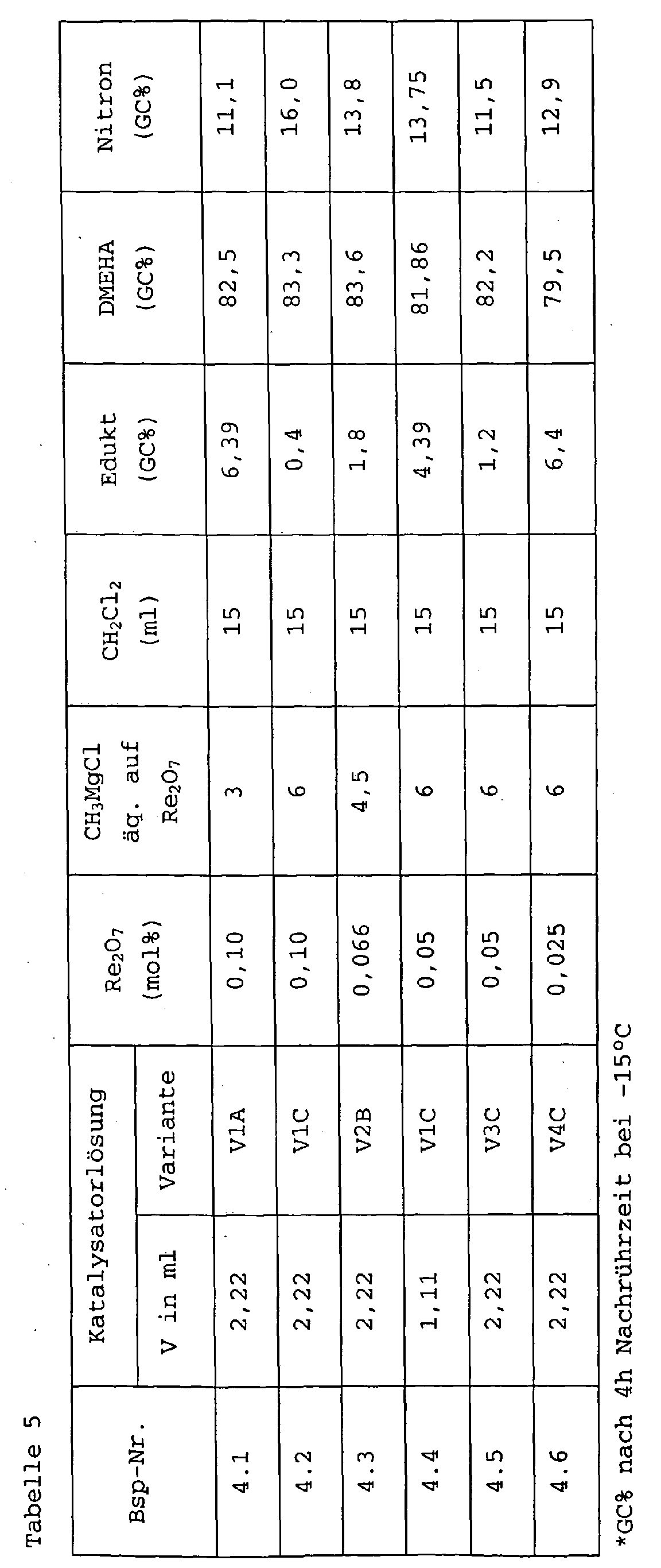
Die Oxidation erfolgte bei einem Molverhältnis H2O2/Olefin von 1,25, also einem wesentlich geringerem Verhältnis als in den Beispielen 3.1 bis 3.6. Wie die Tabelle zeigt, wird jedoch eine wesentlich höhere Ausbeute erzielt als im Beispiel 3.1 mit der gleichen Katalysatorart und -menge aber höherem Molverhältnis H2O2/Olefin.
| Bsp-Nr. | Katalysatorlösung | Re2O7 mol% | CH3MgCl äq. auf Re2O7 | CH2Cl2 ml | Hexenoxid (GC%) | |
| in ml | Variante | |||||
| 3.1 | 6,5 | V1A | 1,30 | 3 | - | 52,5 |
| 3.2 | 6,5 | V1A | 1,30 | 3 | 4 | 82,2 |
| 3.3 | 6,5 | V1A | 0,651 | 6 | - | 78,2 |
| 3.4 | 6,5 | V1C | 1,30 | 6 | 4 | 87,2 |
| 3.5 | 6,5 | V1A | 1,30 | 6 | - | 93,2 |
| 3.6 | 6,5 | V1C | 1,30 | 6 | - | 82,6 |
| 3.7 | 6,5 | V1A | 1,30 | 3 | - | 78,8 |
Claims (19)
- Verfahren zur Oxidation organischer Substrate, umfassend Umsetzung des organischen Substrats in einem Lösungsmittelsystem mit einer Peroxoverbindung, insbesondere Wasserstoffperoxid, in Gegenwart eines Organylrheniumoxids der Formel RaRebOcLd, worin R ein Organylrest, a eine ganze Zahl von 1 bis 6, b eine ganze Zahl von 1 bis 4, c eine ganze Zahl von 1 bis 12, d eine ganze Zahl von 0 bis 4, L ein Lewis-basischer Ligand und Re fünf- bis siebenwertig ist, als Katalysator, dadurch gekennzeichnet, dass man eine Katalysatorzusammensetzung K1 oder eine daraus gewonnene Katalysatorzusammensetzung K2, K3 oder K4 einsetzt, wobei die Herstellung von K1 die Umsetzung einer Oxorheniumverbindung der allgemeinen Formel ReOmAn, worin Re fünf- bis siebenwertig ist, A für eine anionische Abgangsgruppe, m für die Zahl 1, 2 oder 3 und n für die Zahl 0, 1, 2 oder 3 stehen, mit 1 bis 10 Organyläquivalenten pro Mol ReOmAn eines Organylierungsmittels eines Elements aus der Reihe Li, Na, K, Mg, Al und Zn in einem aprotischen Lösungsmittel in An- oder Abwesenheit eines Lewis-basischen Liganden umfasst, die Herstellung von K2 die Zugabe eines protischen Mittels zu einer überschüssiges Organylierungsmittel enthaltenden Zusammensetzung K1 und die Herstellung von K3 beziehungsweise K4 mindestens teilweises Entfernen von Lösungsmitteln und/oder anorganischen Bestandteilen aus K1 beziehungsweise K2 umfasst, die Herstellung von K1 bis K4 aber eine Sublimation, Kristallisation oder Destillation des oder der darin enthaltenen Organylrheniumoxide der Formel RaRebOcLd ausschließt.
- Verfahren nach Anspruch 1, dadurch gekennzeichnet, dass man Olefine als Substrat epoxidiert oder zu Diolen hydroxyliert.
- Verfahren nach Anspruch 1, dadurch gekennzeichnet, dass man Amine als Substrat oxidiert, insbesondere sekundäre Amine zu disubstituierten Hydroxylaminen oxidiert.
- Verfahren nach Anspruch 1, dadurch gekennzeichnet, dass man cyclische Ketone als Substrat einsetzt und diese nach Baeyer-Villiger zu Lactonen oxidiert.
- Verfahren nach Anspruch 1, dadurch gekennzeichnet, dass man Aromaten, insbesondere mehrkernige Aromaten als Substrat einsetzt und diese zu Chinonen oxidiert.
- Verfahren nach einem der Ansprüche 1 bis 5, dadurch gekennzeichnet, dass man als Oxorheniumverbindung eine Verbindung aus der Reihe ReO3 , Re2O7 , Hal-ReO3, Hal2ReO2, ReO3-O-Acyl einsetzt, wobei Hal für F, Cl, Br oder J und Acyl für eine Gruppe aus der Reihe R-C(O)-, Aryl-SO2-, -P(O)(OR')2, -Si(OR')3, -P(O)R''2 und -SiR''3, worin R für gegebenenfalls fluoriertes Alkyl und R' und R" für Alkyl, Cycloalkyl, Arylalkyl oder Aryl stehen, die auch fluoriert sein können.
- Verfahren nach einem der Ansprüche 1 bis 6, dadurch gekennzeichnet, dass man als Organylierungsmittel eine Verbindung aus der Reihe LiR, NaR, KR, MgR2, RMgHal, ZnR2, AlR3 und Al(O)R einsetzt, wobei R für lineares, verzweigtes oder cyclisches Alkyl, insbesondere unverzweigtes C1-C4-Alkyl, Benzyl oder Aryl, das alkylsubstituiert sein kann, steht.
- Verfahren nach einem der Ansprüche 1 bis 6, dadurch gekennzeichnet, dass man als Organylierungsmittel eine Verbindung aus der Reihe der Lithiumalkylverbindungen und der Grignard-Reagenzien einsetzt, insbesondere ein Alkylmagnesiumhalogenid, und besonders bevorzugt Methylmagnesiumchlorid.
- Verfahren nach einem der Ansprüche 1 bis 8, dadurch gekennzeichnet, dass man pro Mol Oxorheniumverbindung 1 bis 5, insbesondere >1 bis 3 Organyläquivalente einsetzt.
- Verfahren nach einem der Ansprüche 1 bis 9, dadurch gekennzeichnet, dass man die Organylierung der Oxorheniumverbindung und/oder die Oxidationsreaktion in Gegenwart einer Stickstoffbase als Ligand L , die mit in der Katalysatorzusammensetzung enthaltenen Organylrheniumoxiden Komplexe der Formel RaRebOcLd bilden kann, durchführt.
- Verfahren nach einem der Ansprüche 1 bis 10, dadurch gekennzeichnet, dass man im Reaktionsgemisch K1 enthaltene überschüssige Organylierungsmittel durch Zugabe einer mindestens stöchiometrischen Menge eines Lösungsmittels aus der Reihe Wasser, Alkohole, Carbonsäuren, Kieselsäuren, Borsäuren und Mineralsäuren zersetzt, wobei die Katalysatorzusammensetzung K2 gebildet wird.
- Verfahren nach einem der Ansprüche 1 bis 10, dadurch gekennzeichnet, dass man überschüssiges Organylierungsmittel in einer Katalysatorzusammensetzung K1 durch Zugabe einer wirksamen Menge eines teilchenförmigen Feststoffs mit Hydroxylfunktionen oder adsorbiertem Wasser zersetzt, den Feststoff von der erhaltenen bei Bedarf mit einem Lösungsmittel verdünnten Katalysatorzusammensetzung K2 abtrennt und so eine Katalysatorzusammensetzung K4 erhält.
- Verfahren nach einem der Ansprüche 1 bis 12, dadurch gekennzeichnet, dass man eine von Lösungsmittel und anorganischen Bestandteilen zumindest teilweise, bevorzugt im Wesentlichen vollständig befreite Katalysatorzusammensetzung K3 oder K4 verwendet, wobei die Überführung von K1 in K4 eine Zugabe von Wasser und eine Extraktion der wässrigen Lösung oder Suspension mit einem organischen Lösungsmittel umfasst.
- Katalysatorzusammensetzung , insbesondere geeignet zur Durchführung von Oxidationsreaktionen nach einem der Ansprüche 1 bis 13, enthaltend mindestens ein Organylrheniumoxid der Formel RaRebOcLd, worin R für einen Organylrest, a für eine ganze Zahl von 1 bis 6, b für eine ganze Zahl von 1 bis 4, c für eine ganze Zahl von 1 bis 12, d für eine ganze Zahl von 0 bis 4 und L für einen Lewis-basischen Liganden stehen und Re fünfbis siebenwertig, insbesondere aber siebenwertig ist, und vorliegend als Katalysatorzusammensetzung K1 oder einer daraus gewonnenen Katalysatorzusammensetzung K2 bis K4, dadurch gekennzeichnet, dass sie erhalten worden ist durch ein Verfahren, umfassend Organylierung einer Oxorheniumverbindung der allgemeinen Formel ReOmAn, wobei Re fünf bis siebenwertig ist, A für eine anionische Abgangsgruppe, m für eine ganze Zahl 1, 2 oder 3 und n für eine ganze Zahl 0, 1, 2 oder 3 stehen, mit einer Grignardverbindung der Formel RMgHal oder RZnHal, worin R für einen Organylrest, insbesondere Alkyl, und Hal für ein Halogen, insbesondere Chlor, stehen, und wobei pro Mol ReOmAn 0,5 bis 10 Mol der Grignardverbindung eingesetzt werden, in einem aprotischen Lösungsmittelsystem in An- oder Abwesenheit einer Lewis-basischen Ligandenverbindung L unter Erhalt einer Katalysatorzusammensetzung K1, Zersetzung überschüssiger Grignardverbindung in der Katalysatorzusammensetzung K1 durch Zugabe eines protischen Mittels unter Erhalt einer Katalysatorzusammensetzung K2, mindestens teilweises Entfernen von Lösungsmitteln und/oder anorganischen Bestandteilen aus K1 beziehungsweise K2 unter Erhalt einer Katalysatorzusammensetzung K3 beziehungsweise K4, wobei die Herstellung von K1 bis K4 eine Sublimation, Kristallisation oder Destillation der darin enthaltenen Organylrheniumoxide der Formel RaRebOcLd ausschließt.
- Katalysatorzusammensetzung nach Anspruch 14, dadurch gekennzeichnet, dass bei ihrer Herstellung als Oxorheniumverbindung eine Verbindung aus der Reihe ReO3, Re2O7, Hal-ReO3, Hal2ReO2, ReO3-O-Acyl, wobei Acyl eine ggf. fluorierte Alkanoylgruppe, Aryl-SO2-, -P(O)(OR')2, -Si(OR')3, -P(O)R"2 und -SiR"3, worin R' und R" für Alkyl, Cycloalkyl, Arylalkyl oder Aryl stehen, die auch fluoriert sein können, eingesetzt wurde.
- Katalysatorzusammensetzung nach Anspruch 14 oder 15, dadurch gekennzeichnet, dass bei ihrer Herstellung ein Organylmagnesiumchlorid eingesetzt wurde, wobei Organyl ausgewählt ist aus der Reihe Methyl, Ethyl, n-Propyl, Isopropyl, n-Butyl, sek.-Butyl und Allyl.
- Katalysatorzusammensetzung nach einem der Ansprüche 14 bis 16, dadurch gekennzeichnet, dass pro Mol Oxorheniumverbindung 1 bis 5, insbesondere >1 bis 3 Mol Grignardverbindung eingesetzt wurden.
- Katalysatorzusammensetzung nach einem der Ansprüche 14 bis 17, dadurch gekennzeichnet, dass sie zusätzlich mindestens eine zur Komplexbildung der in der Katalysatorzusammensetzung enthaltenen Organylrheniumoxide befähigte Stickstoffbase L enthält.
- Katalysatorzusammensetzung nach einem der Ansprüche 14 bis 18, dadurch gekennzeichnet, dass es sich um eine von Lösungsmitteln und anorganischen Bestandteilen befreite Katalysatorzusammensetzung K3 oder K4 handelt.
Applications Claiming Priority (2)
| Application Number | Priority Date | Filing Date | Title |
|---|---|---|---|
| DE10342150A DE10342150A1 (de) | 2003-09-12 | 2003-09-12 | Verfahren zur Oxidation organischer Substrate und Katalysatorzusammensetzung zur Durchführung des Verfahrens |
| DE10342150 | 2003-09-12 |
Publications (2)
| Publication Number | Publication Date |
|---|---|
| EP1514873A1 true EP1514873A1 (de) | 2005-03-16 |
| EP1514873B1 EP1514873B1 (de) | 2008-03-19 |
Family
ID=34129780
Family Applications (1)
| Application Number | Title | Priority Date | Filing Date |
|---|---|---|---|
| EP04013059A Expired - Lifetime EP1514873B1 (de) | 2003-09-12 | 2004-06-03 | Verfahren zur Oxidation organischer Substrate und Katalysatorzusammensetzung zur Durchführung des Verfahrens |
Country Status (5)
| Country | Link |
|---|---|
| US (1) | US20050075514A1 (de) |
| EP (1) | EP1514873B1 (de) |
| JP (1) | JP2005089458A (de) |
| AT (1) | ATE389664T1 (de) |
| DE (2) | DE10342150A1 (de) |
Cited By (1)
| Publication number | Priority date | Publication date | Assignee | Title |
|---|---|---|---|---|
| US11261198B2 (en) | 2016-06-20 | 2022-03-01 | Shionogi & Co., Ltd. | Process for preparing substituted polycyclic pyridone derivative and crystal thereof |
Families Citing this family (2)
| Publication number | Priority date | Publication date | Assignee | Title |
|---|---|---|---|---|
| CN113004135A (zh) * | 2021-03-03 | 2021-06-22 | 南京林业大学 | 一种利用mto催化制备罗汉柏木烷酮的方法 |
| CN114231333B (zh) * | 2022-01-10 | 2024-08-16 | 安徽海螺科创材料有限责任公司 | 一种液体煤炭燃烧促进剂及其制备方法 |
Citations (2)
| Publication number | Priority date | Publication date | Assignee | Title |
|---|---|---|---|---|
| US5155247A (en) * | 1989-01-27 | 1992-10-13 | Hoechst Aktiengesellschaft | Use of organorhenium compounds for the oxidation of multiple C--C-bonds, oxidation processes based theron and novel organorhenium compounds |
| US5939568A (en) * | 1997-01-31 | 1999-08-17 | The Scripps Research Institute | Accelerated catalysis of olefinic epoxidations |
Family Cites Families (5)
| Publication number | Priority date | Publication date | Assignee | Title |
|---|---|---|---|---|
| US5166372A (en) * | 1992-02-07 | 1992-11-24 | Arco Chemical Technology, L.P. | Epoxidation process |
| DE59504369D1 (de) * | 1994-01-27 | 1999-01-14 | Hoechst Ag | Verfahren zur katalytischen Oxidation von aromatischen Verbindungen |
| FR2726563B1 (fr) * | 1994-11-04 | 1996-12-13 | Inst Francais Du Petrole | Nouveaux composes du rhenium et de l'aluminium, leur preparation et leur utilisation en tant que catalyseurs |
| JPH1059916A (ja) * | 1996-08-20 | 1998-03-03 | Fuji Photo Film Co Ltd | N,n−ジアルキルヒドロキシルアミン化合物の製造方法 |
| DE19717178A1 (de) * | 1997-04-24 | 1998-10-29 | Hoechst Ag | Direktsynthese von Organorhenium(VII)oxiden aus rheniumhaltigen Verbindungen |
-
2003
- 2003-09-12 DE DE10342150A patent/DE10342150A1/de not_active Withdrawn
-
2004
- 2004-06-03 EP EP04013059A patent/EP1514873B1/de not_active Expired - Lifetime
- 2004-06-03 AT AT04013059T patent/ATE389664T1/de not_active IP Right Cessation
- 2004-06-03 DE DE502004006554T patent/DE502004006554D1/de not_active Expired - Fee Related
- 2004-09-03 JP JP2004257458A patent/JP2005089458A/ja active Pending
- 2004-09-10 US US10/938,039 patent/US20050075514A1/en not_active Abandoned
Patent Citations (2)
| Publication number | Priority date | Publication date | Assignee | Title |
|---|---|---|---|---|
| US5155247A (en) * | 1989-01-27 | 1992-10-13 | Hoechst Aktiengesellschaft | Use of organorhenium compounds for the oxidation of multiple C--C-bonds, oxidation processes based theron and novel organorhenium compounds |
| US5939568A (en) * | 1997-01-31 | 1999-08-17 | The Scripps Research Institute | Accelerated catalysis of olefinic epoxidations |
Non-Patent Citations (2)
| Title |
|---|
| HERMANN ET AL: "Multiple Bonds between Main-Group Elements and Transition Metals", ORGANOMETALLICS, vol. 11, 1992, pages 1072 - 1081, XP002294045 * |
| STRAVROPOULOS, PERICLES ET AL: "Oxoaryls of rhenium(V) and -(VI) and osmium(VI). X-ray crystal structures of dimesityldioxorhenium(VI), tetramesityloxorhenium(VI), and dimesityldioxoosmium(VI)", JOURNAL OF THE CHEMICAL SOCIETY, DALTON TRANSACTIONS: INORGANIC CHEMISTRY (1972-1999) , (1), 169-75 CODEN: JCDTBI; ISSN: 0300-9246, 1987, XP002294046 * |
Cited By (2)
| Publication number | Priority date | Publication date | Assignee | Title |
|---|---|---|---|---|
| US11261198B2 (en) | 2016-06-20 | 2022-03-01 | Shionogi & Co., Ltd. | Process for preparing substituted polycyclic pyridone derivative and crystal thereof |
| US11807648B2 (en) | 2016-06-20 | 2023-11-07 | Shionogi & Co., Ltd. | Process for preparing substituted polycyclic pyridone derivative and crystal thereof |
Also Published As
| Publication number | Publication date |
|---|---|
| JP2005089458A (ja) | 2005-04-07 |
| DE10342150A1 (de) | 2005-04-28 |
| ATE389664T1 (de) | 2008-04-15 |
| US20050075514A1 (en) | 2005-04-07 |
| EP1514873B1 (de) | 2008-03-19 |
| DE502004006554D1 (de) | 2008-04-30 |
Similar Documents
| Publication | Publication Date | Title |
|---|---|---|
| EP0380085B1 (de) | Verwendung von rheniumorganischen Verbindungen zur Oxidation von C-C-Mehrfachbindungen, darauf basierende Oxidationsverfahren und neue rheniumorganische Verbindungen | |
| EP2380152B1 (de) | Verfahren zur herstellung von 3,7-diaza-bicycloý3.3.1¨nonan-metall-komplexen | |
| DE19711650C1 (de) | Verfahren zur Herstellung SiOH-funktioneller Carbosilan-Dendrimere | |
| EP1414833B1 (de) | Neue übergangsmetall-komplexe und deren einsatz in übergangsmetall-katalysierten reaktionen | |
| DE19523891C1 (de) | Chirale Mangan-triazanonankomplexe und Verfahren zu ihrer Herstellung | |
| EP1514873B1 (de) | Verfahren zur Oxidation organischer Substrate und Katalysatorzusammensetzung zur Durchführung des Verfahrens | |
| EP1324964A2 (de) | Verfahren zur herstellung von arylverbindungen | |
| EP0977761B1 (de) | Direktsynthese von organorheniumoxiden aus rheniumhaltigen verbindungen | |
| DE69306117T2 (de) | Epoxydierungskatalysator | |
| EP1302473B1 (de) | Herstellungsverfahren für Platin-Alkenylpolysiloxan-Komplexe, insbesondere Platin-Divinyltetramethyldisoloxan | |
| EP0885207A1 (de) | Verfahren zur herstellung von epoxiden aus olefinen mit bis(triorganosilyl)peroxiden in gegenwart von aktivatoren auf basis von metallsäurederivaten | |
| DD149368A5 (de) | Verfahren zur herstellung von organolithiumverbindungen neben lithiumhydrid | |
| DE4415725C2 (de) | Nickel (II) Komplexe, Verfahren zur Herstellung von Komplexen des Nickel(II), enthaltend einen heterodifunktionellen Chelatliganden und Verwendung der derart erhaltenen Komplexe zur Polymerisation von Ethylen | |
| EP1919925B1 (de) | Hochreaktive zinkform, verfahren zu deren herstellung und verwendung der hochreaktiven zinkform | |
| EP1174435B1 (de) | Verfahren zur Herstellung von Platin-Alkenylpolysiloxan-Komplexen, insbesondere von Platin-Divinyltetramethyldisiloxan | |
| EP0778281B1 (de) | Verfahren zur Herstellung methylenverbrückter Heteroverbindungen sowie neue Bis(diorganylphosphino)methane | |
| WO2003037848A1 (de) | Verfahren zur herstellung von biphenyl-4-carbonitril | |
| DD268956A1 (de) | Verfahren zur herstellung von cholesterolderivaten mit einer sauerstoffunktion am c-25 | |
| DE2455217C3 (de) | Verfahren zur Herstellung von metallorganischen Kupferverbindungen | |
| DE3942789A1 (de) | Sulfoniertes triphenylphosphan enthaltende komplexverbindung des rhodiums | |
| DE19625167C1 (de) | Neue einen 2,2'-Biarylrest enthaltende Bisether und ein Verfahren zu ihrer Herstellung | |
| EP2227477B1 (de) | Ortho-metallierte, chelatstabilisierte benzylamine der seltenerdmetalle (se) | |
| DD251140A1 (de) | Verfahren zur herstellung von cholesterolderivaten mit sauerstoffunktionen am c-22 und c-25 | |
| DD251558A1 (de) | Verfahren zur darstellung von trimesitylvanadium-1-tetrahydrofuran | |
| DD274228A1 (de) | Verfahren zur synthese niedervalenter gemischtligandnickelkomplexe |
Legal Events
| Date | Code | Title | Description |
|---|---|---|---|
| PUAI | Public reference made under article 153(3) epc to a published international application that has entered the european phase |
Free format text: ORIGINAL CODE: 0009012 |
|
| 17P | Request for examination filed |
Effective date: 20040603 |
|
| AK | Designated contracting states |
Kind code of ref document: A1 Designated state(s): AT BE BG CH CY CZ DE DK EE ES FI FR GB GR HU IE IT LI LU MC NL PL PT RO SE SI SK TR |
|
| AX | Request for extension of the european patent |
Extension state: AL HR LT LV MK |
|
| AKX | Designation fees paid |
Designated state(s): AT BE BG CH CY CZ DE DK EE ES FI FR GB GR HU IE IT LI LU MC NL PL PT RO SE SI SK TR |
|
| 17Q | First examination report despatched |
Effective date: 20060621 |
|
| 17Q | First examination report despatched |
Effective date: 20060621 |
|
| RAP1 | Party data changed (applicant data changed or rights of an application transferred) |
Owner name: DEGUSSA GMBH |
|
| GRAP | Despatch of communication of intention to grant a patent |
Free format text: ORIGINAL CODE: EPIDOSNIGR1 |
|
| RAP1 | Party data changed (applicant data changed or rights of an application transferred) |
Owner name: EVONIK DEGUSSA GMBH |
|
| GRAS | Grant fee paid |
Free format text: ORIGINAL CODE: EPIDOSNIGR3 |
|
| GRAA | (expected) grant |
Free format text: ORIGINAL CODE: 0009210 |
|
| AK | Designated contracting states |
Kind code of ref document: B1 Designated state(s): AT BE BG CH CY CZ DE DK EE ES FI FR GB GR HU IE IT LI LU MC NL PL PT RO SE SI SK TR |
|
| REG | Reference to a national code |
Ref country code: GB Ref legal event code: FG4D Free format text: NOT ENGLISH |
|
| REG | Reference to a national code |
Ref country code: CH Ref legal event code: EP |
|
| REF | Corresponds to: |
Ref document number: 502004006554 Country of ref document: DE Date of ref document: 20080430 Kind code of ref document: P |
|
| REG | Reference to a national code |
Ref country code: IE Ref legal event code: FG4D Free format text: LANGUAGE OF EP DOCUMENT: GERMAN |
|
| PG25 | Lapsed in a contracting state [announced via postgrant information from national office to epo] |
Ref country code: FI Free format text: LAPSE BECAUSE OF FAILURE TO SUBMIT A TRANSLATION OF THE DESCRIPTION OR TO PAY THE FEE WITHIN THE PRESCRIBED TIME-LIMIT Effective date: 20080319 |
|
| RAP2 | Party data changed (patent owner data changed or rights of a patent transferred) |
Owner name: EVONIK DEGUSSA GMBH |
|
| PG25 | Lapsed in a contracting state [announced via postgrant information from national office to epo] |
Ref country code: PL Free format text: LAPSE BECAUSE OF FAILURE TO SUBMIT A TRANSLATION OF THE DESCRIPTION OR TO PAY THE FEE WITHIN THE PRESCRIBED TIME-LIMIT Effective date: 20080319 Ref country code: SI Free format text: LAPSE BECAUSE OF FAILURE TO SUBMIT A TRANSLATION OF THE DESCRIPTION OR TO PAY THE FEE WITHIN THE PRESCRIBED TIME-LIMIT Effective date: 20080319 |
|
| NLT2 | Nl: modifications (of names), taken from the european patent patent bulletin |
Owner name: EVONIK DEGUSSA GMBH Effective date: 20080806 |
|
| REG | Reference to a national code |
Ref country code: IE Ref legal event code: FD4D |
|
| PG25 | Lapsed in a contracting state [announced via postgrant information from national office to epo] |
Ref country code: ES Free format text: LAPSE BECAUSE OF FAILURE TO SUBMIT A TRANSLATION OF THE DESCRIPTION OR TO PAY THE FEE WITHIN THE PRESCRIBED TIME-LIMIT Effective date: 20080630 Ref country code: PT Free format text: LAPSE BECAUSE OF FAILURE TO SUBMIT A TRANSLATION OF THE DESCRIPTION OR TO PAY THE FEE WITHIN THE PRESCRIBED TIME-LIMIT Effective date: 20080826 Ref country code: SK Free format text: LAPSE BECAUSE OF FAILURE TO SUBMIT A TRANSLATION OF THE DESCRIPTION OR TO PAY THE FEE WITHIN THE PRESCRIBED TIME-LIMIT Effective date: 20080319 Ref country code: SE Free format text: LAPSE BECAUSE OF FAILURE TO SUBMIT A TRANSLATION OF THE DESCRIPTION OR TO PAY THE FEE WITHIN THE PRESCRIBED TIME-LIMIT Effective date: 20080619 Ref country code: CZ Free format text: LAPSE BECAUSE OF FAILURE TO SUBMIT A TRANSLATION OF THE DESCRIPTION OR TO PAY THE FEE WITHIN THE PRESCRIBED TIME-LIMIT Effective date: 20080319 |
|
| ET | Fr: translation filed | ||
| PG25 | Lapsed in a contracting state [announced via postgrant information from national office to epo] |
Ref country code: RO Free format text: LAPSE BECAUSE OF FAILURE TO SUBMIT A TRANSLATION OF THE DESCRIPTION OR TO PAY THE FEE WITHIN THE PRESCRIBED TIME-LIMIT Effective date: 20080319 |
|
| BERE | Be: lapsed |
Owner name: EVONIK DEGUSSA G.M.B.H. Effective date: 20080630 |
|
| PLBE | No opposition filed within time limit |
Free format text: ORIGINAL CODE: 0009261 |
|
| STAA | Information on the status of an ep patent application or granted ep patent |
Free format text: STATUS: NO OPPOSITION FILED WITHIN TIME LIMIT |
|
| PG25 | Lapsed in a contracting state [announced via postgrant information from national office to epo] |
Ref country code: MC Free format text: LAPSE BECAUSE OF NON-PAYMENT OF DUE FEES Effective date: 20080630 Ref country code: DK Free format text: LAPSE BECAUSE OF FAILURE TO SUBMIT A TRANSLATION OF THE DESCRIPTION OR TO PAY THE FEE WITHIN THE PRESCRIBED TIME-LIMIT Effective date: 20080319 Ref country code: IE Free format text: LAPSE BECAUSE OF FAILURE TO SUBMIT A TRANSLATION OF THE DESCRIPTION OR TO PAY THE FEE WITHIN THE PRESCRIBED TIME-LIMIT Effective date: 20080319 |
|
| 26N | No opposition filed |
Effective date: 20081222 |
|
| PG25 | Lapsed in a contracting state [announced via postgrant information from national office to epo] |
Ref country code: BE Free format text: LAPSE BECAUSE OF NON-PAYMENT OF DUE FEES Effective date: 20080630 |
|
| PG25 | Lapsed in a contracting state [announced via postgrant information from national office to epo] |
Ref country code: BG Free format text: LAPSE BECAUSE OF FAILURE TO SUBMIT A TRANSLATION OF THE DESCRIPTION OR TO PAY THE FEE WITHIN THE PRESCRIBED TIME-LIMIT Effective date: 20080619 Ref country code: EE Free format text: LAPSE BECAUSE OF FAILURE TO SUBMIT A TRANSLATION OF THE DESCRIPTION OR TO PAY THE FEE WITHIN THE PRESCRIBED TIME-LIMIT Effective date: 20080319 |
|
| PGFP | Annual fee paid to national office [announced via postgrant information from national office to epo] |
Ref country code: NL Payment date: 20090616 Year of fee payment: 6 |
|
| PG25 | Lapsed in a contracting state [announced via postgrant information from national office to epo] |
Ref country code: AT Free format text: LAPSE BECAUSE OF NON-PAYMENT OF DUE FEES Effective date: 20080603 |
|
| PGFP | Annual fee paid to national office [announced via postgrant information from national office to epo] |
Ref country code: FR Payment date: 20090615 Year of fee payment: 6 Ref country code: IT Payment date: 20090620 Year of fee payment: 6 |
|
| PG25 | Lapsed in a contracting state [announced via postgrant information from national office to epo] |
Ref country code: CY Free format text: LAPSE BECAUSE OF FAILURE TO SUBMIT A TRANSLATION OF THE DESCRIPTION OR TO PAY THE FEE WITHIN THE PRESCRIBED TIME-LIMIT Effective date: 20080319 |
|
| PGFP | Annual fee paid to national office [announced via postgrant information from national office to epo] |
Ref country code: CH Payment date: 20090617 Year of fee payment: 6 |
|
| PGFP | Annual fee paid to national office [announced via postgrant information from national office to epo] |
Ref country code: DE Payment date: 20090622 Year of fee payment: 6 Ref country code: GB Payment date: 20090618 Year of fee payment: 6 |
|
| PG25 | Lapsed in a contracting state [announced via postgrant information from national office to epo] |
Ref country code: LU Free format text: LAPSE BECAUSE OF NON-PAYMENT OF DUE FEES Effective date: 20080603 Ref country code: HU Free format text: LAPSE BECAUSE OF FAILURE TO SUBMIT A TRANSLATION OF THE DESCRIPTION OR TO PAY THE FEE WITHIN THE PRESCRIBED TIME-LIMIT Effective date: 20080920 |
|
| PG25 | Lapsed in a contracting state [announced via postgrant information from national office to epo] |
Ref country code: TR Free format text: LAPSE BECAUSE OF FAILURE TO SUBMIT A TRANSLATION OF THE DESCRIPTION OR TO PAY THE FEE WITHIN THE PRESCRIBED TIME-LIMIT Effective date: 20080319 |
|
| PG25 | Lapsed in a contracting state [announced via postgrant information from national office to epo] |
Ref country code: GR Free format text: LAPSE BECAUSE OF FAILURE TO SUBMIT A TRANSLATION OF THE DESCRIPTION OR TO PAY THE FEE WITHIN THE PRESCRIBED TIME-LIMIT Effective date: 20080620 |
|
| REG | Reference to a national code |
Ref country code: NL Ref legal event code: V1 Effective date: 20110101 |
|
| REG | Reference to a national code |
Ref country code: CH Ref legal event code: PL |
|
| GBPC | Gb: european patent ceased through non-payment of renewal fee |
Effective date: 20100603 |
|
| REG | Reference to a national code |
Ref country code: FR Ref legal event code: ST Effective date: 20110228 |
|
| PG25 | Lapsed in a contracting state [announced via postgrant information from national office to epo] |
Ref country code: IT Free format text: LAPSE BECAUSE OF NON-PAYMENT OF DUE FEES Effective date: 20100603 |
|
| PG25 | Lapsed in a contracting state [announced via postgrant information from national office to epo] |
Ref country code: LI Free format text: LAPSE BECAUSE OF NON-PAYMENT OF DUE FEES Effective date: 20100630 Ref country code: DE Free format text: LAPSE BECAUSE OF NON-PAYMENT OF DUE FEES Effective date: 20110101 Ref country code: CH Free format text: LAPSE BECAUSE OF NON-PAYMENT OF DUE FEES Effective date: 20100630 |
|
| PG25 | Lapsed in a contracting state [announced via postgrant information from national office to epo] |
Ref country code: NL Free format text: LAPSE BECAUSE OF NON-PAYMENT OF DUE FEES Effective date: 20110101 Ref country code: FR Free format text: LAPSE BECAUSE OF NON-PAYMENT OF DUE FEES Effective date: 20100630 |
|
| PG25 | Lapsed in a contracting state [announced via postgrant information from national office to epo] |
Ref country code: GB Free format text: LAPSE BECAUSE OF NON-PAYMENT OF DUE FEES Effective date: 20100603 |