EP1514585A1 - Game control method - Google Patents
Game control method Download PDFInfo
- Publication number
- EP1514585A1 EP1514585A1 EP03730543A EP03730543A EP1514585A1 EP 1514585 A1 EP1514585 A1 EP 1514585A1 EP 03730543 A EP03730543 A EP 03730543A EP 03730543 A EP03730543 A EP 03730543A EP 1514585 A1 EP1514585 A1 EP 1514585A1
- Authority
- EP
- European Patent Office
- Prior art keywords
- game
- data
- game data
- character
- player
- Prior art date
- Legal status (The legal status is an assumption and is not a legal conclusion. Google has not performed a legal analysis and makes no representation as to the accuracy of the status listed.)
- Granted
Links
Images















Classifications
-
- A63F13/10—
-
- A—HUMAN NECESSITIES
- A63—SPORTS; GAMES; AMUSEMENTS
- A63F—CARD, BOARD, OR ROULETTE GAMES; INDOOR GAMES USING SMALL MOVING PLAYING BODIES; VIDEO GAMES; GAMES NOT OTHERWISE PROVIDED FOR
- A63F13/00—Video games, i.e. games using an electronically generated display having two or more dimensions
- A63F13/45—Controlling the progress of the video game
- A63F13/49—Saving the game status; Pausing or ending the game
- A63F13/493—Resuming a game, e.g. after pausing, malfunction or power failure
-
- A—HUMAN NECESSITIES
- A63—SPORTS; GAMES; AMUSEMENTS
- A63F—CARD, BOARD, OR ROULETTE GAMES; INDOOR GAMES USING SMALL MOVING PLAYING BODIES; VIDEO GAMES; GAMES NOT OTHERWISE PROVIDED FOR
- A63F13/00—Video games, i.e. games using an electronically generated display having two or more dimensions
- A63F13/45—Controlling the progress of the video game
-
- A—HUMAN NECESSITIES
- A63—SPORTS; GAMES; AMUSEMENTS
- A63F—CARD, BOARD, OR ROULETTE GAMES; INDOOR GAMES USING SMALL MOVING PLAYING BODIES; VIDEO GAMES; GAMES NOT OTHERWISE PROVIDED FOR
- A63F13/00—Video games, i.e. games using an electronically generated display having two or more dimensions
- A63F13/70—Game security or game management aspects
- A63F13/75—Enforcing rules, e.g. detecting foul play or generating lists of cheating players
-
- A—HUMAN NECESSITIES
- A63—SPORTS; GAMES; AMUSEMENTS
- A63F—CARD, BOARD, OR ROULETTE GAMES; INDOOR GAMES USING SMALL MOVING PLAYING BODIES; VIDEO GAMES; GAMES NOT OTHERWISE PROVIDED FOR
- A63F13/00—Video games, i.e. games using an electronically generated display having two or more dimensions
- A63F13/85—Providing additional services to players
-
- A—HUMAN NECESSITIES
- A63—SPORTS; GAMES; AMUSEMENTS
- A63F—CARD, BOARD, OR ROULETTE GAMES; INDOOR GAMES USING SMALL MOVING PLAYING BODIES; VIDEO GAMES; GAMES NOT OTHERWISE PROVIDED FOR
- A63F2300/00—Features of games using an electronically generated display having two or more dimensions, e.g. on a television screen, showing representations related to the game
- A63F2300/60—Methods for processing data by generating or executing the game program
- A63F2300/63—Methods for processing data by generating or executing the game program for controlling the execution of the game in time
- A63F2300/636—Methods for processing data by generating or executing the game program for controlling the execution of the game in time involving process of starting or resuming a game
-
- A—HUMAN NECESSITIES
- A63—SPORTS; GAMES; AMUSEMENTS
- A63F—CARD, BOARD, OR ROULETTE GAMES; INDOOR GAMES USING SMALL MOVING PLAYING BODIES; VIDEO GAMES; GAMES NOT OTHERWISE PROVIDED FOR
- A63F2300/00—Features of games using an electronically generated display having two or more dimensions, e.g. on a television screen, showing representations related to the game
- A63F2300/80—Features of games using an electronically generated display having two or more dimensions, e.g. on a television screen, showing representations related to the game specially adapted for executing a specific type of game
- A63F2300/807—Role playing or strategy games
Definitions
- the present invention relates to a game control method for controlling a game that a plurality of players take part in.
- An example of such games is an online game in which respective players produce their own characters and connect to a communication network to make a team of their characters to make adventures. In the online game, making the adventures, each player tries to reinforce his character by increasing his items by picking up rare items, exchanging items with other players or increasing his own power level.
- a player has his own memory card. Not only in online games but also in many games, when he interrupts a game, he stores game data, such as his own character, etc. in his own memory card connected to a game apparatus, and when he resumes the game, he reads the game data from the memory card and resumes the game where he has interrupted the game.
- game data such as his own character, etc.
- the so-called offline mode in which the online game can be played without being connected to a communication network is provided.
- the offline mode is used to practice the online game to know the outline of the online game or to raise in advance the level of the game player to some extent.
- game data such as his own character data, etc.
- the changed game data can be stored in the memory card.
- the game player takes part in the online game, using the stored character data.
- a multimode in which a plurality of players gather at one place, and the characters of the plurality of players make a team tomake adventures without connecting to a communication network.
- Such multimode if realized, permits friends to enjoy playing games without being concerned about the communication fees.
- An object of the present invention is to provide a game control method which is suitable for the offline mode of a game which a plurality of players take part in.
- a game control method for controlling a game in which a plurality of players take part in comprising the steps of: before a start of the game, copying game data from the memory region of each player to store in a prescribed memory region; playing the game based on the game data of each player stored in the prescribed memory region; and after an end of the game, returning the game data of each player stored in the prescribed memory region to the memory region of each player.
- the above-described object is attained by a game control method for controlling a game in which a plurality of players take part, wherein each player can select an item related only to his own game character, and in the game, the exchange of the item with items of the other players is prohibited.
- a game control method for controlling a game proceeded with characters respectively operated by a plurality of players comprising the steps of: deciding on an item which is to be owned by a character, which is selected by each player before a start of the game; and restricting the item of one character from being owned by another character, after the start of the game.
- a program is a program which can be executed by a computer, for controlling game data to resume a game in which a plurality of players take part, where the game has been paused, the game data including at least a first parameter associated with a player character who appears in the game and a second parameter associated with an item used by the player character in the game, the program comprising the steps of: before a start of the game, reading first game data and second game data respectively from a first record medium and a second record medium and storing the first game data and the second game data in a prescribed memory region; recording data for restricting the use of the game data recorded in the first record medium and the second record medium, in the first and the second record medium; executing the game, based on the first game data and the second game data stored in the prescribed memory region; renewing the first game data and the second game data corresponding to proceeding of the game respectively to third game data and fourth game data; transferring the second parameter associated with the item included in the second game data read from the second record medium to the first
- a program is a program which can be executed by a computer, for controlling game data to resume a game in which a plurality of players take part, where the game has been paused, the program comprising the steps of: before a start of the game, reading a first game data from a first record medium with the first game data recorded to store the first game data in a second record medium with second game data recorded in; recording a data for restricting use of the game data recorded in the first record medium to the first record medium; executing the game, based on the first game data and the second game data stored in the second record medium; renewing the first game data and the second game data respectively to third game data and fourth game data in accordance with proceeding of the game; and after an end of the game, recording in the first record medium the renewed third data, replacing the first game data to delete the data for restricting the use of the game data.
- the game data includes at least a parameter associated with a player character appearing in the game, and a parameter associated with an item used by the player character in the game
- the program further comprises the steps of: transferring the parameter associated with the item included in the second game data read from the second record medium to the first game data to restrict the third game data from being renewed; and transferring the parameter associated with the item included in the fourth game data renewed in accordance with the proceeding of the game and excluded in the second game data, to the first game data in response to an operation signal generated by an operation of the game player to renew the third game data.
- the method comprises the steps of: before a start of the game, copying game data from the memory region of each player to store in a prescribed memory region; playing the game based on the game data of each player stored in the prescribed memory region; and after an end of the game, returning the game data of each player stored in the prescribed memory region to the memory region of each player, whereby the game data can be suitably controlled in the online mode of a game in which a plurality of players take part.
- FIG. 1 is a diagrammatic view of the game apparatus according to the present embodiment.
- FIG. 2 is a block diagram of the game apparatus according to the present embodiment.
- the game apparatus body 10 is substantially cubic in shape.
- a CD-ROM drive 12 for mounting a CD-ROM 8 storing a game program is provided.
- controller connectors 1, 2, 3, 4 and two memory slots A, B are disposed on the front side of the game apparatus body 10. Controllers 20 can be connected respectively to the controller connectors 1, 2, 3, 4. Memory cards 30 can be inserted respectively into the memory slots A, B.
- a CD-ROM drive 12 for mounting the CD-ROM 8, and a game processing unit 14 for executing the game are provided.
- the four controllers 20 can be connected to the game processing unit 14 via the controller connectors 1, 2, 3, 4, and the two memory cards 30, i.e., the memory card 30 as a first storage medium and the memory card 30 as a second storage medium can be mounted on the processing unit 14 via the memory slots A, B.
- an 8 cm-diameter DVD-ROM or a 12 cm-DVD-ROM may be used, and a DVD-ROM drive may be used in place of the CD-ROM drive 12.
- FIG. 3 is a block diagram of the game processing unit 14 which is mainly for the game apparatus for the consumer use.
- the game processing unit 14 controls the respective blocks and comprises a CPU 141 which computes display positions, sizes, etc. of objects to be displayed on the screen, a system memory 142 which stores program data used by CPU 141, a BOOTROM 143 which stores BOOT programs which actuate the game apparatus after a power injection and a reset, a bus arbiter 144 which controls buses transmitting the programs and data between the respective blocks, a video display processor 145 which produces images, a graphic memory 146 which is connected to the video display processor 145 and stores data for forming images and images to be displayed, an audio processor 147 which produces sounds, an audio memory 148 which is connected to the audio processor 147 and stores data for producing sounds and sounds to be outputted, a communication interface 149 which transmits and receives programs and data to and from electronic devices outside the game apparatus, a controller interface 150 which receives operation signals from the controllers operated by players and outputs the operation signals to the CPU, and a memory interface 151 which transmits and receives programs and data to and from the controller interface 150.
- the video display processor 145 and the audio video processor 146 are connected to a TV monitor 40.
- a modem 50 is connected to a communication interface 149.
- the game processing unit 14 is connected to an outside network via the communication interface 149 and the modem 50.
- the memory cards 30 store results of the game where the game is paused, and when the game is resumed in the next play, the results are read, whereby the game can be resumed.
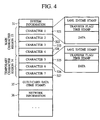
- FIG. 4 is a view of the memory structure of each memory card 30.
- Each memory card 30 includes a system region 31 which stores system information, a character data region 32 which stores character data, a guild card region 35 which stores guild card data, a snap region 36 which stores snap files, a network region 37 which stores network information, etc.
- a character region 32 includes regions 321 - 327 which can store data of seven characters, and the regions 321 - 324 which store data of the characters 1 - 4 are a main character region 33, and the regions 325 - 327 which store data of the characters 5 - 7 are a temporary character region 34.
- the main character region 33 stores character data of a player owning the memory card 30, and the temporary character region 34 stores character data copied from another backup memory. With the main character region 33 and the temporary character region 34 of each memory card 30, the multimode game is played.
- Each character data includes a save ID which is an ID at the time when a character has been produced, an on-trip (in-transfer) flag indicating the character is on trip (in-transfer) to another backup memory, and data of character information.
- a time stamp indicating the time information at the time when the character has been produced is appended to the save ID.
- a time stamp indicating the time information at the time when the character has tripped (moved) is appended to the on-trip (in-transfer) flag.
- the game played on the game apparatus will be summarized.
- the game program is stored in the CD-ROM 8.
- the CD-ROM 8 is mounted on the CD-ROM drive 12 of the gate apparatus body 10, and the game program is read. Whereby the game processing unit 14 can execute the game.
- the respective players connect the controller 20 to the controller connector 1 and insert his own memory card 35 into the memory slot A, and connect the game apparatus body 10 to the communication network to connect the server (not shown).
- the respective players execute the online game with other players making a team.
- the player connects the controller 20 to the controller connector 1 and inserts his own memory card 30 into the memory slot A, and plays the offline game without connecting the game apparatus body 10 to the communication network.
- the respective players bring in their own controllers 20 and memory cards 30 to play the game on one game apparatus.
- the game apparatus body 10 of the present embodiment has four controller connectors 1, 2, 3, 4 but has only two memory slots A, B. Therefore the memory cards 30 that the players have brought with them cannot be inserted in the gate apparatus body 10 at once.
- the present embodiment has various contrivances.
- the present embodiment has various contrivances.
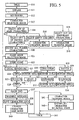
- FIG. 5 is a flow chart of the multimode.
- Step 10 offline is selected in the online/offline selection image (Step S11), and then multimode is selected in the single mode/multimode selection image (Step S12).
- the multimode is established.
- one memory card 30 can store data of up to four characters as the main characters.
- the multimode can be played, using the character data as the main characters.
- character data transferred from another memory card 30 can be used.
- another memory card 30 is inserted into the memory slot B to transfer the character data to the memory card 30 inserted in the memory slot A.
- the character selection image is displayed (Step S13), and a character to be used as the main character is decided (Step S14).
- the main character may be selected out of the existing main characters (Step S15), or an empty one of the main character regions of the memory card 30 is selected (Step S16), and a new character may be produced (Step S17).
- Step S18 When a main character of another memory card 30 is used, said another memory card 30 is inserted into the memory slot B, and a temporary character to be used is selected out of the main characters stored in said another memory card 30 (Step S18) and is transferred to a temporary character region of the memory card 30 inserted in the memory slot A (Step S19).
- Step S20 the game of the multimode is started.
- a game mode is selected (Step S21).
- a difficulty of the game either of normal/hard/very hard/ultimate is selected, and as a game mode, either of usual adventure/challenge/battle is selected.
- the difficulty of the game is agreed with either of the participating characters, whose level is lowest. When characters of low levels are contained, the high difficulty, such as the ultimate mode, cannot be selected.
- Player 1 is the leader (host), and the flags and the section IDs are matched.
- the game of the multimode is started (Step S22).
- Each game mode comprises a plurality of stages.
- Step S23 The usual adventure (Step S23) has the stages of a city (Step S24), a dungeon (Step S25) and a city (Step S26), and the additional stages of a hunter guild (Step S27) and a quest (Step S28).
- the challenge mode has the stages of a hunter guild (Step S30), a dungeon (Step S31) and a hunter guild (Step S32).
- the battle mode has the stages of a hunter guild (Step S34), a dungeon (Step S35) and a hunter guild (Step S36).
- the screen is automatically divided in accordance with a number of the characters taking part in the game; when two characters take part in, the screen is bisected; and when four characters take part in, the screen is quartered.
- the screen may be trisected, or the screen may be quartered but one of the quartered sections is not be used.
- all the status data, such as level, etc., of the character data can be brought in.
- added status can be brought out after the game is over.
- the multimode equipments of the characters can be brought in. However, the equipments cannot be left for the other players to pick up them. In the multimode, the exchange of the items is prohibited to prevent the multiplication of the items. In the multimode, items obtained in the multimode game can be brought out. Items obtained in the multimode game can be exchanged with the items of the other players.
- the equipments of the characters can be brought in, but items other than the equipments of the characters, e.g., items held by the characters in the hands, items related to the characters, items not related directly to the characters, etc. may be brought in.
- a certain restriction is applied to the function of the city.
- shops can be used, and a connoisseur can be also used.
- the guild counter can be used only in the challenge mode and the battle mode.
- the medical center can be used.
- the checkroom can be used only to check in items but the items checked in cannot be checked out, so that the unfair transfer of the items among the players is prevented.
- the movement device in the city when all the characters are on board, a dungeon list is displayed, and the player of a character who lastly went on board selects/decides a map, and the movement is made.
- the movement of the movement device special for the boss is the same as that of the movement device in the dungeon described above. No warning window is displayed, as is in the single play.
- a window "Return to City Yes/No" is displayed. When "Yes” is selected, all the characters return to the city. When returning from the city, all the characters are on board and push the A button. Then, the movement is made.
- Step S37 When the respective stages of the respective game modes end, the multimode game is finished (Step S37). Subsequently, a warning message is displayed (Step S38), and then the character data is saved in the memory card 30 (Step S39).
- Step S40 When the character/game modes are changed (Step S40), the step is returned to Step S13 (Select characters) or Step S21 (Select a game mode).
- Step S41 When the character/game modes are not changed, the character data stored in a temporary character region is transferred to the initial memory card 30 (Step S41). When the transfer is completed for all the characters (Step S42), the title image is displayed, and the game ends (Step S43).
- the data of the main character of another memory card 30 is read in to use.
- the memory card 30 to be used in the game is inserted in the slot A, and said another memory card 30 is inserted into the slot B to transfer the character data.
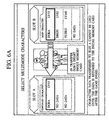
- FIG. 6A illustrates an image for selecting a character in the multimode.
- the temporary character region 34 of the memory card 20 inserted in the slot A is displayed, and on the righthand side of the image, the main character region 33 of the memory card 30 inserted in the slot B is displayed.
- the first region of the temporary character region 34 of the memory card in the slot A displaced on the lefthand side of the image, i.e., the region 325 of the character 5 is selected, and the first region of the main character region 33 of the memory card in the slot B, displayed on the righthand side of the image, i.e., the region 321 of the character 1 is selected.
- the execution button is pushed, the character data stored in the region 321 of the character 1 is transferred to the region 325 of the character 5 in the slot A.
- a warning "In transfer. Don't insert in/out the memory card” is displayed, and at the bottom of the screen, a warning "The character data transferred to the memory card in the slot A cannot be used until the data is returned to the initial memory card.” is displayed.
- the in-transfer flag of the character data in the memory card 30 in the slot B is turned on to make the character data unavailable.
- the initial character data remains in the memory card 30 in the slot B but is made unavailable by turning on the in-transfer flag.
- the information of the time is recorded as a time stamp. Also when character data is transferred from the slot B to the slot A, the in-transfer flags of both the transferrer character data and the transferee character data are turned on, and the time of the transfer is recorded as a time stamp. Based on these two time stamps, the character data are identified.
- the "in-transfer flag" can be removed under the condition of "character data grown in the multimode is not returned to the transferee".
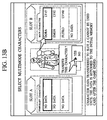
- FIG. 6B is an image of selecting a character.
- the initial memory card 30 is inserted into the slot A of another game apparatus 10, and the character data in transfer is selected. Then, at the center of the screen, "This character is “in transfer” to another memory card as a temporary character. “In transfer” can be released, and then the data in transfer cannot be returned to this memory card. Is it all right?" is displayed. A selection image "Yes, No" is displayed.
- the in-transfer flag of the character data in the region 321 of the character 1 of the memory card 30 is turned off, concurrently the time stamp being deleted.
- the character data can be used as the usual character date.
- the character data stored in the temporary character region 34 of the transferee memory card 30 is returned to the initial memory card 30.
- the initial memory card 30 cannot be found at hand. It is not practical that in such cases, the character data cannot be returned to the initial memory card.
- FIG. 7 is an image for the character selection.
- the memory card 30 is inserted in the slot A of the game apparatus 10, and the main character region 33 and the temporary character region 34 are displayed.
- a window "Decide the character as player's character, Return the character to the initial memory card, Delete, or Cancel" is displayed, and the player selects one of them.
- the data of the temporary character is decided as it is as the data of the player character.
- the image of the transfer to the slot B illustrated in FIG. 6A is displayed. In the transfer image, the player returns the temporary character data to the initial memory card.
- a confirmation display “Really delete? Yes or No” is displayed. In the confirmation display “Yes” is selected in, and the character data is deleted.
- the image is returned to the image previous to the image illustrated in FIG. 7.
- a player who operates the controller 20 connected to the controller connector 1 is Player 1.
- Players who operate the controllers 20 connected to the controller connectors 2, 3, 4 are sequentially Player 2, Player 3 and Player 4.
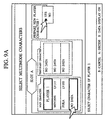
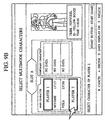
- the cursor is placed on an arbitrary character in the main character region 33.
- the cursor is placed on the region 321 of Character 1.
- Characters 1 - 4 in the main character region 33 or Characters 5 - 7 can be selected here as long as character data are present.
- the decision button A of the controller is pushed, and then as illustrated in FIG. 8A, the character data with the cursor placed on, the data of the region 321 of the Character 1 here, is decided as the character data of Player 1.
- the cursor is placed on the region of the main character region 33 indicated with "NO DATA", e.g., the region 234 of Character 4, and the decision button A of the controller 20 is pushed.
- the character producing image follows, and the character of Player 2 is produced new.
- Various parameters of the character are decided to produce the character, and the image is returned to the character selection image illustrated in FIG. 9B.
- the cursor is placed on the region 234 of Character 4, and the decision button A of the controller 20 is pushed. Then the character of Player 2 is decided.
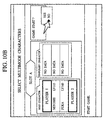
- the game can be played in the multimode, and as illustrated in FIG. 10A, an indication "Start button: Start Game” is displayed onthescreen.
- Start button is pushedhere, as illustrated in FIG. 10B, "Game start?" and “Yes/No” are displayed.
- “Yes” is selected here, the game is started by two players. In the following, "No” is selected to select a character of Player 3.
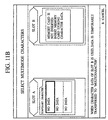
- the cursor is placed on the region of the temporary character region 34 of the slot A, where "NO DATA" is indicated, the region 235 of Character 5, and the decision button A of the controller 20 is pushed. Then, the image of the slot B illustrated in FIG. 11B follows. The part of the main character region 33 of the slot A slides to the left, and the image of the slot B appears.
- the memory card 30 is not inserted in the slot B here, as illustrated in FIG. 11B, "No memory card inserted. Insert memory card with character data" is displayed.
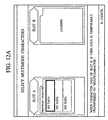
- the indicator of the slot B is brightened to indicate that the memory card 30 is inserted, and "Loading" is displayed to indicate that the data in the memory card 30 is being loading.
- the indicator of the slot B is brightened to indicate the main character region 33 of the memory card 30 is displayed.
- the character data of the slot B is selected, and a character data region of the slot A for the selected character data to be stored in is selected.
- a window "Transfer this character? Yes/No" is displayed at the center of the screen.
- the time stamp is recorded in the character data of the slot B, and then the character data is transferred. As described above, based on the time stamp recorded when the character data was produced, and the time stamp recorded when the character data was transferred, the transferred data is identified. Character data is identified when these two time stamps agree with each other.
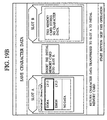
- FIG. 15A With the characters of three players decided, asillustrated in FIG. 15A, "Start button: Start game” is displayed on the screen. When the start button is pushed, as illustrated in FIG. 15B, "The game starts?" and “Yes/No” are displayed. When “Yes” is selected, the game is started by 3 players. “Yes” is selected here, and the game is started.
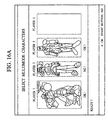
- the character confirmation image illustrated in FIG. 16A follows, and the characters of Players 1 to 3 which have been selected by the above-described operation are displayed for confirmation.
- the three players watch their own player characters. When there is no problem, they push the button A (OK). If there is a problem then the players push the start button (NG). In FIG. 16A, Player 1 and Player 3 push the button A, and Player 2 pushes the start button. Player 2, who has pushed the start button (NG), again selects a character. When all the players push button A (OK), the game is started.
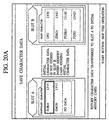
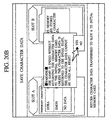
- the character data stored in the temporary character region 34 used in the multimode is returned to the initial memory card.
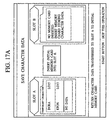
- the data save image of FIG. 17A is displayed.
- "Insert the initial memory card into the slot B" is displayed.
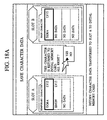
- buttons A When “No” is selected, the button A is pushed to open the window of the above image. Then the start button is pushed to skip the operational image. When “Yes” is selected, the image of FIG. 18B is displayed on the screen to indicate the data is being transferred.
- the take in/out of items in the multimode is partially restricted so as to prevent unfair copy and multiplication of items.
- Major items whose data can be taken in are as follows.
- the items obtained in the multimode game can be left or can be exchanged with those of other players.
- the items obtained in the multimode can be taken out, but they are checked at the checker.
- the money (meseta) cannot be taken in the game in the multimode.
- the money (meseta) obtained in the multimode can be taken out but only checked in the checker.
- the results in the online mode cannot be taken into the multimode and cannot be taken out.
- the result in the online mode and the result in the multimode are saved and managed as separate data.
- the items to be taken out are checked in the check room.
- the items which have been initially in the check room cannot be taken out but can be thrown away.
- the check room can be thus made any room.
- the present invention is applied to the case that the number of the memory slots of the game apparatus is insufficient for the number of players.
- the present application is applicable to the case that a number of the memory slots agrees with a number of players, and the game data may be stored in one memory card.
- the prescribed memory regions are provided in a memory card inserted in a specific slot, i.e., the slot A but may be provided in other regions, e.g., the memory regions of the game apparatus or the regions in the memory server.
- the memory region of each player is provided in the memory card of the player but may be provided in other regions, e.g., the region in the memory server for the player, or other regions.
- the present invention is suitable for game control methods, more specifically a game control method suitable for games in online mode which a plurality of players take part in.
Landscapes
- Engineering & Computer Science (AREA)
- Multimedia (AREA)
- Business, Economics & Management (AREA)
- Computer Security & Cryptography (AREA)
- General Business, Economics & Management (AREA)
- Management, Administration, Business Operations System, And Electronic Commerce (AREA)
Abstract
Description
Claims (14)
- A game control method for controlling a game in which a plurality of players take part, comprising the steps of:before a start of the game, copying game data from the memory region of each player to store in a prescribed memory region;playing the game based on the game data of each player stored in the prescribed memory region; andafter an end of the game, returning the game data of each player stored in the prescribed memory region to the memory region of each player.
- A game control method according to claim 1, wherein
when the game data of each player is returned from the prescribed memory region to the memory region of each player, it is confirmed whether or not copy information given when the game data was copied from the memory region of each player to the prescribed memory region agrees. - A game control method according to claim 1 or 2, wherein
the use of the game data remaining in the memory region of each player is restricted. - A game control method according to claim 3, wherein the use of the game data remaining in the memory region of each player is permitted on the conditions that the game data stored in the prescribed memory region is not used.
- A game control method according to any one of claims 1 to 4, wherein
the memory region of one player is used as said prescribed memory region. - A game control method for controlling a game in which a plurality of players take part, wherein
each player can take in an item related only to his own game character, and
in the game, the exchange of the item with items of the other players is prohibited. - A game control method according to claim 6, wherein
an item obtained in said game is not restricted from being exchanged with the items of the other players. - A game control method for controlling a game with characters respectively operated by a plurality of players, comprising the steps of:deciding on an item which is to be owned by a character, which is selected by each player before a start of the game; andrestricting the item of one character from being owned by other character, after the start of the game.
- An electronic device for executing a method according to any one of claims 1 to 8.
- A program for executing a method according to any one of claims 1 to 8.
- A program which can be executed by a computer, for controlling game data to resume a game in which a plurality of players take part, where the game has been paused,
the game data including at least a first parameter associated with a player character who appears in the game and a second parameter associated with an item used by the player character in the game,
the program comprising the steps of:before a start of the game, reading first game data and second game data respectively from a first record medium and a second record medium and storing the first game data and the second game data in a prescribed memory region;recording data for restricting the use of the game data recorded in the first record medium and the second record medium in the first and the second record medium;executing the game, based on the first game data and the second game data stored in the prescribed memory region;renewing the first game data and the second game data corresponding to proceeding of the game respectively to third game data and fourth game data;transferring the second parameter associated with the item included in the second game data read from the second record medium to the first game data to restrict the third game data from being renewed;transferring the second parameter associated with the item included in the fourth game data renewed in accordance with the proceeding of the game and excluded in the second game data to the first game data in response to an operation signal generated by an operation of the game player to renew the third game data; andafter an end of the game, recording in the first and the second record medium the renewed third data and the renewed fourth data, replacing the first game data and the second game data to delete data for restricting the use of the game data. - A program which can be executed by a computer, for controlling game data to resume a game in which a plurality of players take part in where the game has been paused,
the program comprising the steps of:before a start of the game, reading a first game data from a first record medium with the first game data recorded to store the first game data in a second record medium with second game data recorded in;recording a data for restricting use of the game data recorded in the first record medium to the first record medium;executing the game, based on the first game data and the second game data stored in the second record medium;renewing the first game data and the second game data respectively to third game data and fourth game data in accordance with proceeding of the game; andafter an end of the game, recording in the first record medium the renewed third data, replacing the first game data to delete the data for restricting the use of the game data. - A program which can be executed by a computer, according to claim 12,
the game data including at least a parameter associated with a player character appearing in the game, and a parameter associated with an item used by the player character in the game,
the program further comprising the steps of:transferring the parameter associated with the item included in the second game data read from the second record medium to the first game data to restrict the third game data from being renewed; andtransferring the parameter associated with the item included in the fourth game data renewed in accordance with the proceeding of the game and excluded in the second game data, to the first game data in response to an operation signal generated by an operation of the game player to renew the third game data. - A record medium for storing a program according to any one of claims 10 to 13.
Applications Claiming Priority (3)
| Application Number | Priority Date | Filing Date | Title |
|---|---|---|---|
| JP2002146984 | 2002-05-21 | ||
| JP2002146984 | 2002-05-21 | ||
| PCT/JP2003/006338 WO2003097197A1 (en) | 2002-05-21 | 2003-05-21 | Game control method |
Publications (3)
| Publication Number | Publication Date |
|---|---|
| EP1514585A1 true EP1514585A1 (en) | 2005-03-16 |
| EP1514585A4 EP1514585A4 (en) | 2005-06-08 |
| EP1514585B1 EP1514585B1 (en) | 2007-08-15 |
Family
ID=29545154
Family Applications (1)
| Application Number | Title | Priority Date | Filing Date |
|---|---|---|---|
| EP03730543A Expired - Lifetime EP1514585B1 (en) | 2002-05-21 | 2003-05-21 | Game control method |
Country Status (6)
| Country | Link |
|---|---|
| US (1) | US7582018B2 (en) |
| EP (1) | EP1514585B1 (en) |
| JP (1) | JP4229066B2 (en) |
| AU (1) | AU2003242366A1 (en) |
| DE (1) | DE60315645T2 (en) |
| WO (1) | WO2003097197A1 (en) |
Families Citing this family (11)
| Publication number | Priority date | Publication date | Assignee | Title |
|---|---|---|---|---|
| JP2001344372A (en) * | 2000-03-30 | 2001-12-14 | Sega Corp | Online organization method |
| WO2003097197A1 (en) * | 2002-05-21 | 2003-11-27 | Sega Corporation | Game control method |
| JP4597617B2 (en) * | 2004-09-14 | 2010-12-15 | 株式会社カプコン | GAME SYSTEM, GAME PROGRAM, AND RECORDING MEDIUM |
| TWM275131U (en) * | 2004-12-31 | 2005-09-11 | Mai Sz Wei Technology Co Ltd | Rearview mirror with navigation function |
| US9205329B2 (en) * | 2006-07-25 | 2015-12-08 | Mga Entertainment, Inc. | Virtual world electronic game |
| US10272333B2 (en) * | 2007-04-18 | 2019-04-30 | Sony Interactive Entertainment Inc. | Game system |
| JP5227980B2 (en) * | 2010-01-18 | 2013-07-03 | 株式会社カプコン | GAME SYSTEM, GAME PROGRAM, AND RECORDING MEDIUM |
| JP5581434B1 (en) * | 2013-10-31 | 2014-08-27 | 株式会社 ディー・エヌ・エー | GAME PROGRAM AND INFORMATION PROCESSING DEVICE |
| JP6151407B1 (en) * | 2016-05-12 | 2017-06-21 | グリー株式会社 | Program, information processing apparatus, and control method |
| US11607613B2 (en) * | 2021-03-01 | 2023-03-21 | Shanghai Yiyu Network Technology Co., Ltd. | Method and apparatus for switching game mode, and electronic device |
| CN114632325B (en) * | 2022-03-17 | 2025-10-17 | 网易(杭州)网络有限公司 | Virtual resource transfer method, device, equipment and storage medium |
Family Cites Families (27)
| Publication number | Priority date | Publication date | Assignee | Title |
|---|---|---|---|---|
| US4948138A (en) * | 1982-12-06 | 1990-08-14 | Igt | Device for maintaining game state audit trail upon instantaneous power failure |
| JP2610694B2 (en) | 1990-05-22 | 1997-05-14 | 株式会社ナムコ | Game cartridge and home video game device using the same |
| US5261820A (en) * | 1990-12-21 | 1993-11-16 | Dynamix, Inc. | Computer simulation playback method and simulation |
| US5273294A (en) * | 1991-02-04 | 1993-12-28 | Tengen Ltd. | Game memory |
| JPH07313730A (en) * | 1994-05-27 | 1995-12-05 | Sony Corp | Equipment for game consoles |
| US6200216B1 (en) * | 1995-03-06 | 2001-03-13 | Tyler Peppel | Electronic trading card |
| JP2845175B2 (en) * | 1995-08-25 | 1999-01-13 | 株式会社オプテック | Game console controller |
| JPH09155065A (en) * | 1995-12-12 | 1997-06-17 | Hudson Soft Co Ltd | Match type computer game system capable of exchanging specified intrinsic data |
| JP3549971B2 (en) * | 1995-12-25 | 2004-08-04 | 株式会社ハドソン | Video game progress backup method and video game machine |
| JP3594400B2 (en) * | 1996-03-19 | 2004-11-24 | 株式会社ナムコ | Game device |
| US5810666A (en) * | 1996-05-08 | 1998-09-22 | Mero; George T. | Role playing game |
| CN1178724C (en) * | 1996-07-01 | 2004-12-08 | 世嘉企业股份有限公司 | Video game machine, control method thereof, and environment image device |
| US5752883A (en) * | 1996-07-25 | 1998-05-19 | Triptic Mind, Inc. | Method and system for managing role playing game information |
| US6478679B1 (en) * | 1997-08-08 | 2002-11-12 | Sega Enterprises, Ltd. | Memory device, controller and electronic device |
| JPH11128533A (en) * | 1997-10-30 | 1999-05-18 | Nintendo Co Ltd | Video game device and memory media for the same |
| JP4105788B2 (en) * | 1997-11-14 | 2008-06-25 | 任天堂株式会社 | Video game apparatus and storage medium thereof |
| JPH11207034A (en) * | 1997-11-20 | 1999-08-03 | Nintendo Co Ltd | A game system that can be played between different types of game machines using backup data |
| JP3228216B2 (en) | 1998-03-05 | 2001-11-12 | ヤマハ株式会社 | Card game system |
| JP2000116940A (en) * | 1998-10-15 | 2000-04-25 | Seta Corp | Two-way communication game system |
| TW502520B (en) * | 1998-12-28 | 2002-09-11 | Sega Enterprises Kk | Backup memory managing device, backup memory managing method, game machine, and recorded medium |
| JP3998858B2 (en) * | 1999-05-28 | 2007-10-31 | 株式会社バンダイナムコゲームス | GAME DEVICE, GAME DEVICE IMAGE PROCESSING METHOD, AND RECORDING MEDIUM |
| GB9913295D0 (en) * | 1999-06-09 | 1999-08-11 | Leda Media Products Ltd | Game controller |
| US6270416B1 (en) * | 1999-10-25 | 2001-08-07 | Square Co., Ltd. | Video game apparatus and method, and storage medium |
| US7081033B1 (en) * | 2000-03-07 | 2006-07-25 | Hasbro, Inc. | Toy figure for use with multiple, different game systems |
| JP3333773B2 (en) * | 2000-04-14 | 2002-10-15 | コナミ株式会社 | GAME DEVICE, GAME DEVICE CONTROL METHOD, AND INFORMATION STORAGE MEDIUM |
| WO2003097197A1 (en) * | 2002-05-21 | 2003-11-27 | Sega Corporation | Game control method |
| JP3500379B1 (en) * | 2002-06-28 | 2004-02-23 | 株式会社コナミコンピュータエンタテインメント東京 | GAME DEVICE, PROGRAM, AND GAME DEVICE CONTROL METHOD |
-
2003
- 2003-05-21 WO PCT/JP2003/006338 patent/WO2003097197A1/en not_active Ceased
- 2003-05-21 JP JP2004505186A patent/JP4229066B2/en not_active Expired - Fee Related
- 2003-05-21 US US10/515,065 patent/US7582018B2/en not_active Expired - Lifetime
- 2003-05-21 EP EP03730543A patent/EP1514585B1/en not_active Expired - Lifetime
- 2003-05-21 DE DE60315645T patent/DE60315645T2/en not_active Expired - Fee Related
- 2003-05-21 AU AU2003242366A patent/AU2003242366A1/en not_active Abandoned
Also Published As
| Publication number | Publication date |
|---|---|
| WO2003097197A1 (en) | 2003-11-27 |
| US7582018B2 (en) | 2009-09-01 |
| EP1514585B1 (en) | 2007-08-15 |
| DE60315645D1 (en) | 2007-09-27 |
| AU2003242366A1 (en) | 2003-12-02 |
| JPWO2003097197A1 (en) | 2005-09-15 |
| JP4229066B2 (en) | 2009-02-25 |
| US20050233804A1 (en) | 2005-10-20 |
| DE60315645T2 (en) | 2008-06-05 |
| EP1514585A4 (en) | 2005-06-08 |
Similar Documents
| Publication | Publication Date | Title |
|---|---|---|
| US7357719B2 (en) | Game system, game device, and storage medium | |
| JP4203523B2 (en) | GAME SYSTEM AND GAME DEVICE INCLUDING THE SAME | |
| KR102003483B1 (en) | Game system, computer device, method for controlling computer device, and recording medium | |
| KR100570055B1 (en) | Computer device for implementing a trading card game and control method therefor, program executed by computer device, controller, system, and game cards | |
| EP1552864A1 (en) | Target time setting game system considering network game | |
| JP4203524B2 (en) | GAME SYSTEM AND GAME DEVICE INCLUDING THE SAME | |
| US20110098117A1 (en) | Network game system, method for controlling network game system, program, and information storage medium | |
| AU761347B2 (en) | Game system operable with backup data on different kind game machines | |
| EP1514585B1 (en) | Game control method | |
| US7549923B2 (en) | Game apparatus and storage medium storing game program | |
| US7540805B2 (en) | Game device, game control method, program and storage medium | |
| KR101091421B1 (en) | Game system, game machine included in same, and external device for game machines | |
| US7108604B2 (en) | Game machine, method of controlling operation of the game machine, and computer readable medium having recorded thereon operation control program for controlling the game machine | |
| JP2002360933A (en) | Game device, game processing method, program, recording medium, and network game system | |
| AU2005202727A1 (en) | Game system | |
| JP7426017B2 (en) | Program and control method | |
| JP5044171B2 (en) | GAME DEVICE, GAME DEVICE CONTROL METHOD, AND PROGRAM | |
| JP2002177640A (en) | Competitive game consoles and systems | |
| JP3500535B2 (en) | Network game system, server and terminal used in the system, and program used in the system | |
| JP2003079956A (en) | Game system, control device, game unit, control method, and program | |
| KR20250127706A (en) | Program, game device, and providing management device | |
| KR100682370B1 (en) | Computer equipment, its control method and storage medium | |
| JP4171051B2 (en) | GAME SYSTEM AND GAME DEVICE INCLUDING THE SAME | |
| JP2006280397A (en) | Game system, control method of game system, and program | |
| KR100610707B1 (en) | Game device, arcade game machine, and game operating method and recording medium |
Legal Events
| Date | Code | Title | Description |
|---|---|---|---|
| PUAI | Public reference made under article 153(3) epc to a published international application that has entered the european phase |
Free format text: ORIGINAL CODE: 0009012 |
|
| 17P | Request for examination filed |
Effective date: 20041220 |
|
| AK | Designated contracting states |
Kind code of ref document: A1 Designated state(s): AT BE BG CH CY CZ DE DK EE ES FI FR GB GR HU IE IT LI LU MC NL PT RO SE SI SK TR |
|
| AX | Request for extension of the european patent |
Extension state: AL LT LV MK |
|
| A4 | Supplementary search report drawn up and despatched |
Effective date: 20050427 |
|
| 16A | New documents despatched to applicant after publication of the search report |
Effective date: 20050531 |
|
| DAX | Request for extension of the european patent (deleted) | ||
| RBV | Designated contracting states (corrected) |
Designated state(s): DE ES FR GB IT |
|
| GRAP | Despatch of communication of intention to grant a patent |
Free format text: ORIGINAL CODE: EPIDOSNIGR1 |
|
| GRAS | Grant fee paid |
Free format text: ORIGINAL CODE: EPIDOSNIGR3 |
|
| GRAA | (expected) grant |
Free format text: ORIGINAL CODE: 0009210 |
|
| AK | Designated contracting states |
Kind code of ref document: B1 Designated state(s): DE ES FR GB IT |
|
| REG | Reference to a national code |
Ref country code: GB Ref legal event code: FG4D |
|
| REF | Corresponds to: |
Ref document number: 60315645 Country of ref document: DE Date of ref document: 20070927 Kind code of ref document: P |
|
| PG25 | Lapsed in a contracting state [announced via postgrant information from national office to epo] |
Ref country code: ES Free format text: LAPSE BECAUSE OF FAILURE TO SUBMIT A TRANSLATION OF THE DESCRIPTION OR TO PAY THE FEE WITHIN THE PRESCRIBED TIME-LIMIT Effective date: 20071126 |
|
| ET | Fr: translation filed | ||
| PLBE | No opposition filed within time limit |
Free format text: ORIGINAL CODE: 0009261 |
|
| STAA | Information on the status of an ep patent application or granted ep patent |
Free format text: STATUS: NO OPPOSITION FILED WITHIN TIME LIMIT |
|
| 26N | No opposition filed |
Effective date: 20080516 |
|
| PGFP | Annual fee paid to national office [announced via postgrant information from national office to epo] |
Ref country code: DE Payment date: 20090523 Year of fee payment: 7 Ref country code: FR Payment date: 20090513 Year of fee payment: 7 |
|
| PGFP | Annual fee paid to national office [announced via postgrant information from national office to epo] |
Ref country code: GB Payment date: 20090522 Year of fee payment: 7 |
|
| GBPC | Gb: european patent ceased through non-payment of renewal fee |
Effective date: 20100521 |
|
| REG | Reference to a national code |
Ref country code: FR Ref legal event code: ST Effective date: 20110131 |
|
| PG25 | Lapsed in a contracting state [announced via postgrant information from national office to epo] |
Ref country code: IT Free format text: LAPSE BECAUSE OF NON-PAYMENT OF DUE FEES Effective date: 20080531 |
|
| PG25 | Lapsed in a contracting state [announced via postgrant information from national office to epo] |
Ref country code: DE Free format text: LAPSE BECAUSE OF NON-PAYMENT OF DUE FEES Effective date: 20101201 |
|
| PG25 | Lapsed in a contracting state [announced via postgrant information from national office to epo] |
Ref country code: FR Free format text: LAPSE BECAUSE OF NON-PAYMENT OF DUE FEES Effective date: 20100531 |
|
| PG25 | Lapsed in a contracting state [announced via postgrant information from national office to epo] |
Ref country code: GB Free format text: LAPSE BECAUSE OF NON-PAYMENT OF DUE FEES Effective date: 20100521 |