EP1512810A2 - Appareil et procédé de nettoyage de piscine - Google Patents
Appareil et procédé de nettoyage de piscine Download PDFInfo
- Publication number
- EP1512810A2 EP1512810A2 EP04027384A EP04027384A EP1512810A2 EP 1512810 A2 EP1512810 A2 EP 1512810A2 EP 04027384 A EP04027384 A EP 04027384A EP 04027384 A EP04027384 A EP 04027384A EP 1512810 A2 EP1512810 A2 EP 1512810A2
- Authority
- EP
- European Patent Office
- Prior art keywords
- robot
- pool
- wall
- leg
- predetermined
- Prior art date
- Legal status (The legal status is an assumption and is not a legal conclusion. Google has not performed a legal analysis and makes no representation as to the accuracy of the status listed.)
- Granted
Links
Images



Classifications
-
- E—FIXED CONSTRUCTIONS
- E04—BUILDING
- E04H—BUILDINGS OR LIKE STRUCTURES FOR PARTICULAR PURPOSES; SWIMMING OR SPLASH BATHS OR POOLS; MASTS; FENCING; TENTS OR CANOPIES, IN GENERAL
- E04H4/00—Swimming or splash baths or pools
- E04H4/14—Parts, details or accessories not otherwise provided for
- E04H4/16—Parts, details or accessories not otherwise provided for specially adapted for cleaning
- E04H4/1654—Self-propelled cleaners
-
- G—PHYSICS
- G05—CONTROLLING; REGULATING
- G05D—SYSTEMS FOR CONTROLLING OR REGULATING NON-ELECTRIC VARIABLES
- G05D1/00—Control of position, course, altitude or attitude of land, water, air or space vehicles, e.g. using automatic pilots
- G05D1/60—Intended control result
- G05D1/648—Performing a task within a working area or space, e.g. cleaning
-
- G—PHYSICS
- G05—CONTROLLING; REGULATING
- G05D—SYSTEMS FOR CONTROLLING OR REGULATING NON-ELECTRIC VARIABLES
- G05D2105/00—Specific applications of the controlled vehicles
- G05D2105/10—Specific applications of the controlled vehicles for cleaning, vacuuming or polishing
-
- G—PHYSICS
- G05—CONTROLLING; REGULATING
- G05D—SYSTEMS FOR CONTROLLING OR REGULATING NON-ELECTRIC VARIABLES
- G05D2107/00—Specific environments of the controlled vehicles
- G05D2107/25—Aquatic environments
- G05D2107/29—Swimming pools
-
- G—PHYSICS
- G05—CONTROLLING; REGULATING
- G05D—SYSTEMS FOR CONTROLLING OR REGULATING NON-ELECTRIC VARIABLES
- G05D2109/00—Types of controlled vehicles
- G05D2109/10—Land vehicles
Definitions
- the present invention relates to pool cleaning robots. More particularly it relates to apparatus and method for cleaning the bottom of a pool.
- an automatic swimming pool cleaning device which includes a flexible cleaning member designed to contact an underwater surface of the swimming pool.
- a tube is coupled to the cleaning member for connecting the cleaning device to a water vacuum hose via hose adaptor. Water and pool surface contamination is drawn from underneath the cleaning member up through the tube by suction to a water filter system before being returned to the pool.
- a flexible valve member is mounted proximate a throat region of the tube wherein as water is drawn up through the tube a decrease in pressure in the throat region causes the valve member to flex and momentarily interrupt the flow of water. The interruption to the flow of water through the tube results in a momentary differential of ambient pressure underneath the flexible cleaning member which enables the device to move forwards incrementally along the underwater surface of the pool.
- US Patent No. 6,099,658 (Porat), titled Apparatus and Method of Operation for High-Speed swimming Pool Cleaner disclosed an apparatus and method for cleaning the bottom and vertical side walls of a swimming pool, pond or tank employing a robotic, self-propelled cleaner.
- the robot has a protective housing of conventional design, the cleaner being operated at a primary cleaning speed as it traverses the surfaces to be cleaned and until the cleaner housing emerges from the water along a sidewall of the pool; thereafter the cleaner operates at a secondary drive speed that is relatively slower than the primary speed and the cleaner thereafter reverses direction and descends for a pre-determined period of time at the slower secondary speed in order to permit the air entrained under the housing to escape without destabilizing the cleaner during descent. After the predetermined period of time, the cleaner resumes operation at the more rapid primary speed until the cleaner housing once again emerges from the water's surface, after which the cycle is repeated.
- a machine for treating a surface area within a boundary perimeter includes a self propelled chassis having a surface treating device mounted on it.
- a computing section is mounted on the chassis and a powered wheel (or each of plural powered wheels) has a motor module for receiving command signals from the computing section.
- a position sensor is coupled to the computing section for generating a feedback signal representing the actual position of the machine.
- a data loading device coacts with the computing section for transmitting data to such computing section.
- a data file stores graphic data developed from a graphic depiction representing the surface area to be treated as well as other data developed in other ways.
- the data file coacts with the computing section and transmits graphic and other data to it.
- the computing section is arranged for processing the data and the feedback signal and responsively generating command signals directed to each motor module. Such modules, and the motors controlled thereby, propel the machine over the surface area selected to be treated.
- US Patent No. 5,569,371 (Perling) titled System For Underwater Navigation and Control of Mobile swimming Pool Filter, disclosed an underwater navigation and control system for a swimming pool cleaning robot, having a driver, an impeller, a filter and a processor for controlling the driver and a signal-producing circuit.
- the system further includes a signal-detecting circuit mounted on the pool, an interface located on the ground in proximity to the pool and comprising a detector for receiving and processing data from the detecting circuit and for transmitting signals to the robot's processor. Determination of the actual robot location is performed by triangulation in which the stationary triangulation base is defined by at least two spaced-apart signal detectors and the mobile triangle apex is constituted by the signal-producing circuit carried by the robot.
- US Patent No. 5,197,158 (Moini) titled swimming Pool Cleaner, disclosed a vacuum powered automatic swimming pool cleaning device having a hollow housing supported on two pairs of device mover wheels.
- the housing includes a central water suction chamber in water flow communication with a water suction trough at the bottom of the housing and in water outlet communication with an external vacuum line, a gear train for driving one of the pairs of mover wheels, and pivoted directional control floats.
- the water suction chamber houses an axle mounted turbine wheel bearing water driven vanes with the turbine being rotated in one direction only by water flow through the chamber.
- the turbine axle bears a turbine power output drive gear which intermeshes with one or the other of two shift gears which in turn reversibly drive the gear train as dictated by the position of the directional control floats within the housing.
- the floats swing shift within the housing to shift the shift gears in response to the impact of the cleaning device on an obstruction on the pool floor or by the device impacting a vertical pool wall.
- the swing shift of the control floats reverses the rotation of the mover wheels and thus the direction of movement of the cleaning device on the pool floor.
- US Patent No. 4,786,334 (Nystrom) titled Method of Cleaning the Bottom of a Pool, disclosed a method of cleaning the bottom of a pool with the aid of a pool cleaner.
- the pool cleaner travels along the bottom of the pool and collects material lying at the bottom of the pool.
- the pool cleaner is arranged to travel to and fro in straight, parallel paths between two opposite walls of the pool. At the walls the pool cleaner is turned by rotating a half turn so that, after turning, it will have been displaced laterally perpendicular to the initial direction of travel.
- US Patent No. 4,700,427 (Kneppers), titled Method of Automatically Steering Self-Propelled Floor-Cleaning Machines and Floor-Cleaning Machine for Practicing the Method, disclosed a method of automatically steering a self-propelled floor-cleaning machine along a predetermined path of motion on a limited area to be worked.
- a sequence of path segments stored in a data memory is retrieved, and the path segments travelled by the machine. Markings are recognized by at least one sensor and converted into course-correcting control commands actuating and/or steering the machine.
- US Patent No. 3,979,788 (Strausak) titled mobile machine for cleaning swimming pools, disclosed a Mobile Machine for Cleaning swimming Pools by suction removal of sediment from the bottom of the swimming pools comprises a water turbine driving a drive wheel in such a way that the machine follows a self-steered path on the bottom of the swimming pools.
- the drive wheel is capable of rotating about a vertical steering axle to prevent the machine from becoming blocked at a wall or in a comer of the swimming pools.
- Yet another purpose of the present invention to provide a method and an apparatus for navigating a pool cleaning robot that allow efficient and fast cleaning of the bottom and side walls of a pool.
- Still another aim of the present invention is to provide such method and apparatus that allow high performance and coverage in cleaning irregularly shaped pools.
- a method for sweeping the floor of a pool by a pool cleaning robot initially set at an arbitrary position on the floor of the pool comprising:
- the predetermined angle of turn varies in some turns during the sweeping of the floor.
- the robot is initially positioned near a side end of the wall.
- the robot is initially positioned within a distance of 1 to 3 times the width of the robot from the side end of the wall.
- the angle of turn is substantially a right angle turn.
- the robot is turned in an angle of turn positioning the robot in a perpendicular direction to a facing wall.
- the alteration of the predetermined distance of the leg consists of increasing the length.
- the length of the leg is increased up to about half the length of the pool.
- the alteration of the predetermined distance of the leg consists of decreasing the length.
- the initial position of the robot at the commencing of the sweeping of the pool is about half way across the wall.
- the turn is taken constantly to the right with respect to the traveling robot.
- the turn is taken constantly to the left with respect to the traveling robot.
- the predetermined number of wall encounters counted prior to alteration of the length of the leg is 7.
- the alteration of the length of the leg is done in steps of constant lengths.
- the robot is a single motor driven robot having a powered horizontal impeller, and wherein the robot is turned by applying at least one of a plurality of predetermined number of interrupts in the impeller power thus causing the robot to acquire bias momentum directed sideways and hence move in the direction of the bias.
- the predetermined number of interrupts is between 15 to 25.
- the duration of the series of predetermined number of interrupts is in the range of about 10 to 20 seconds.
- each interrupt lasts about 0.5 to 0.8 seconds.
- a method for turning sideways a pool cleaning robot having a single motor drive and a powered horizontal impeller comprising applying at least one of a plurality of predetermined number of interrupts in the impeller power thus causing the robot to acquire bias momentum directed sideways and hence move in the direction of the bias.
- a pool cleaning robot comprising:
- the wall encounter sensor comprises a proximity sensor or a collision sensor or a tilt sensor or a sonar sensor.
- the reversible motorized drive is a reversible motorized caterpillar drive.
- the robot further comprises a GPS receiver for determining its position and direction.
- a pool cleaning robot comprising:
- a main aspect of the present invention is the navigation algorithm disclosed in the present invention that introduces a systematic sweep of the bottom of the pool in a predetermined manner.
- Another main aspect of the present invention is the provision of a pool-cleaning robot with a novel and unique steering mechanism exploiting imparted changes in the angular momentum of an impeller in the robot.
- the sweeping of the pool's bottom is carried out by making the pool cleaning robot follow a series of paths across the bottom of the pool, from one side of the pool to the opposite side. After each crossing the robot reverses, traveling a leg (or step) of predetermined distance back, substantially on its previous track and then turns sideways in a predetermined angle of turn and the robot moves on to reach the wall, reverse and cross from that wall to the opposite wall. Each time the robot encounters a wall it senses this event and counts the number of wall encounters. After a predetermined number of wall encounters was counted, the predetermined distance of the leg is altered and the routine is continues until the entire area of the bottom of the pool was covered.
- Figure 1 illustrating an example of a path traveled by a pool cleaning robot in accordance with a preferred embodiment of the present invention. It is noted that the lines with the arrowheads represent the direction of travel by the robot, and in order to show clearly the direction of travel do not over lap, although in fact it is anticipated that the robot will follow its tracks on its reverse course. The dashed line represents the actual path on which the robot is supposed to travel.
- a pool's rectangular floor 10 is shown, with four surrounding walls arranged in two pairs of parallel opposite walls (12, 14, 16, 18).
- a pool cleaning robot 20 typically having a motor-driven caterpillar drive (but other drive types are possible too) is initially set to start crossing in a straight path 22 on the pool's floor 10, commencing its trip at the side of the pool adjacent wall 14.
- the initial position may be chosen arbitrarily, even somewhere in the middle of the pool.
- it is recommended to position the robot initially near one side end of the wall preferably within a distance of 1 to 3 times the width of the robot, bearing in mind the effective cleaning area covered by the robot as its pumps dirt and foliage.
- side end of the wall it is meant one of the ends of a wall on either side, as opposed to its top and bottom ends.
- the robot 20 crosses over to the other side of the pool, traveling in a substantially straight line 22 on the floor 10 until it encounters wall 12. Once the robot has encountered a wall the motor drive is reversed, and the robot is driven in substantially the opposite direction. After a leg of predetermined length 24 was traveled, the robot is turned sideways in a predetermined angle 26 (substantially at right angle in the example of Figure 1) and then travels substantially straight until a wall 16 is encountered. For polygonal pools turns it is recommended to aim at making the turn angle such that the robot then traverses perpendicular to a facing wall of the pool, but that is not a compulsory requirement.
- the drive motor Upon encountering the wall the drive motor if the robot is again reversed, and after the robot has traveled the leg of predetermined length 24 it is again turned sideways in a predetermined angle 26 directing the robot to a wall 18 of the pool.
- the length of the leg After a predetermined number of wall encounters the length of the leg is altered to a new length of leg 30 (and then 32, 34), thus substantially preventing the robot from following the same path it has previously taken, hence and enhancing its coverage of the pool's floor.
- the counter is reset and starts counting wall encounters until the same number of predetermined wall encounters was counted, upon which the length of the leg is again altered.
- the alteration of the length of the leg traveled by the robot after it was reversed upon encountering a wall may consist of either increasing or decreasing the length.
- the leg length is increased. It is possible to set the leg length to be decreased instead of increased. In such a case the initial position of the robot at the commencing of the sweeping of the pool is preferably about half way across the wall at the side.
- the turn may be taken in any direction (i.e. right or left), but preferably same direction of turn is taken throughout the sweeping procedure to ensure efficient coverage of the pool's floor.
- the predetermined number of wall encounters counted prior to alteration of the length of the leg is preferably 7, for if the length of the leg is not altered after 7 wall encounters the robot may be found traveling substantially on its previous tracks following the same initial path 22.
- the varying length of the leg traveled by the robot after it was reversed upon encountering a wall may be set arbitrarily. In the example exhibited in Figure 1, the length is increased at steps of constant lengths, but that is not imperative.
- the predetermined angle of turn may also vary in some turns - or all of them - during the sweeping process, either in a predetermined manner (such as programmed in advance) or arbitrarily.
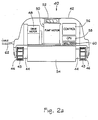
- a pool cleaning robot in accordance with a preferred embodiment of the present invention may be any such robot adapted to perform the steering algorithm of the present invention.
- a robot housing 42 houses a motor drive 48 for driving the axles 44 (in axle cover 54) on which ends wheels 46 are attached to the caterpillar tracks, an impeller 52 oriented horizontally (to pump water from the pool's floor upwards into the robot), driven by a pump motor 50, control unit 56, central processing unit (CPU) 58 and wall encounter sensor 60.
- the pumped dirt and foliage are collected inside a filter bag that is positioned inside the housing along the pump.
- Power cable 62 goes through the housing 42 to provide power to the robot electric components. In other preferred embodiments of the present invention no power cable is provided and instead the robot is powered by battery.
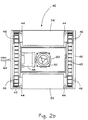
- FIG. 2b illustrates the bottom view of a pool cleaning robot in accordance with the present invention.
- Twin parallel caterpillar tracks 43 are provided, stretched over and motivated by wheels 46.
- the robot shown in Figures 2a and 2b is driven by a single motor (drive motor 48).
- a single motor drive motor 48
- twin motor drive is popular in large pools cleaning robots.
- Single motor drive can be reversed by employing provided transmission to reverse the direction of the rotation of the wheel axles, but it cannot be used to turn the robot sideways. It takes two separate motors to maneuver sideways, as each track is operated separately, either by stopping one track and driving the other, or by pirouetting (driving tracks in opposite directions).
- a series of intentional interrupts in the impeller rotation thus causing the robot to acquire bias momentum directed sideways and hence move in that direction. This method takes advantage of the fact that impellers are inherently biased and it was found by the inventor of the present invention that a series imparted interrupts in the impeller rotation cause the robot to acquire momentum directed sideways.
- the number of interrupts - which may vary from a single interrupt to a series of interrupts, as well as their cycle and duration are empirically found for every robot, and depend on factors such as the robot weight, type, type of pump, size, weight and rotational velocity of the impeller, speed of robot when driven on its caterpillar tracks, the desired angle of turn etc.
- Figure 3 illustrates a plot of the impeller power versus time before, during and after a turn maneuver.
- the X axis represents time and the Y axis represents the power status of the impeller.
- Portion 70 of the plot represents the power of the impeller as the robot with its impeller power on approaches a wall.
- the robot detects wall encounter and its drive is reversed. It then travels a leg of predetermined length during time duration 74 (the length is easily determined as being the product of the robots known speed by a predetermined time duration).
- time duration 74 the length is easily determined as being the product of the robots known speed by a predetermined time duration.
- the sweeping method of the present invention is independent of the navigational nature of the pool cleaning robots, and certainly not limited to single motor robots in general or to single motor robots maneuvered using the interrupted impeller rotation as disclosed herein. Other types of pool cleaning robots navigated in various navigation methods, such as GPS or others are all covered by the scope of this invention.
- FIG. 4 illustrates a schematic diagram of the electric features of a pool cleaning robot 80 in accordance with the present invention.
- the pool cleaning robot Powered by power supply 90, either externally (through a cable) or internally (battery) the pool cleaning robot comprises a reversible drive motor 82 and impeller motor 84 independently controlled by a control unit 86.
- the control unit is connected to a processing unit (CPU) 94 that dictates the operation of the control and consequently of the entire robot.
- the robot has a wall encounter sensor 92 that senses a wall encounter and generates a signal that is received by the processing unit.
- the event of encountering a wall may be sensed by a sensor provided on the robot, such as a proximity sensor or collision sensor, or sonar sensor, and the drive motor of the robot is switched to the reverse direction.
- a sensor provided on the robot, such as a proximity sensor or collision sensor, or sonar sensor
- a proximity sensor - an optical sensor typically operating in the infrared range - or a tilt sensor, such as mercury sensor ⁇ a sensor actuated by a balanced tiltable mechanism that senses the tilting of the robot as it attempts to climb a wall, may be used.
- a sonar sensor is used one can obtain better direction control too.
- the processing unit is programmed to actuate the drive motor and impeller motor, via the control unit, in a predetermined manner following an algorithm such as explained with reference to Figure 1 and figure 3, switching the drive motor between forward and reverse modes, and applying the interrupt sequences scheme to the impeller motor.
- An optional GPS receiver 95 communicating with the CPU may be incorporated in the robot to allow determining its position and direction.
- the GPS is provided with a floating antenna 97 or an antenna is incorporated in the power cable from the remote power supply unit.
- the events of wall encounters are counted by a counter 96 incorporated with a central processing unit of the robot.
- the method and apparatus for automated pool cleaning of the present invention may be implemented on pools of any shapes, whether rectangular, polygonal, circular, oval and even irregularly shaped ones.
- the step of varying the length of the legs of the present invention ensures that substantially the entire pool floor be efficiently covered and thereby cleaned in a relatively short time.
- the apparatus and method for pool cleaning robot of the present invention allow covering efficiently and relatively quickly the bottom of a pool of any shape, depth and size.
Landscapes
- Engineering & Computer Science (AREA)
- Architecture (AREA)
- Civil Engineering (AREA)
- Structural Engineering (AREA)
- Physics & Mathematics (AREA)
- General Physics & Mathematics (AREA)
- Automation & Control Theory (AREA)
- Radar, Positioning & Navigation (AREA)
- Aviation & Aerospace Engineering (AREA)
- Remote Sensing (AREA)
- Control Of Position, Course, Altitude, Or Attitude Of Moving Bodies (AREA)
- Manipulator (AREA)
- Cleaning In General (AREA)
- Electric Suction Cleaners (AREA)
- Devices For Medical Bathing And Washing (AREA)
- Massaging Devices (AREA)
Applications Claiming Priority (5)
| Application Number | Priority Date | Filing Date | Title |
|---|---|---|---|
| IL14593001A IL145930A0 (en) | 2001-10-15 | 2001-10-15 | Pool cleaning method and apparatus |
| IL14593001 | 2001-10-15 | ||
| US10/209,164 US6815918B2 (en) | 2001-10-15 | 2002-07-30 | Pool cleaning method and apparatus |
| US209164 | 2002-07-30 | ||
| EP02019189A EP1302611B1 (fr) | 2001-10-15 | 2002-09-02 | Appareil et procédé de nettoyage de piscine |
Related Parent Applications (1)
| Application Number | Title | Priority Date | Filing Date |
|---|---|---|---|
| EP02019189A Division EP1302611B1 (fr) | 2001-10-15 | 2002-09-02 | Appareil et procédé de nettoyage de piscine |
Publications (3)
| Publication Number | Publication Date |
|---|---|
| EP1512810A2 true EP1512810A2 (fr) | 2005-03-09 |
| EP1512810A3 EP1512810A3 (fr) | 2005-05-25 |
| EP1512810B1 EP1512810B1 (fr) | 2008-11-26 |
Family
ID=26324047
Family Applications (2)
| Application Number | Title | Priority Date | Filing Date |
|---|---|---|---|
| EP02019189A Expired - Lifetime EP1302611B1 (fr) | 2001-10-15 | 2002-09-02 | Appareil et procédé de nettoyage de piscine |
| EP04027384A Expired - Lifetime EP1512810B1 (fr) | 2001-10-15 | 2002-09-02 | Appareil et procédé de nettoyage de piscine |
Family Applications Before (1)
| Application Number | Title | Priority Date | Filing Date |
|---|---|---|---|
| EP02019189A Expired - Lifetime EP1302611B1 (fr) | 2001-10-15 | 2002-09-02 | Appareil et procédé de nettoyage de piscine |
Country Status (4)
| Country | Link |
|---|---|
| EP (2) | EP1302611B1 (fr) |
| AT (1) | ATE283949T1 (fr) |
| DE (1) | DE60202117D1 (fr) |
| ES (2) | ES2318230T3 (fr) |
Families Citing this family (13)
| Publication number | Priority date | Publication date | Assignee | Title |
|---|---|---|---|---|
| DE102007053311A1 (de) | 2007-06-21 | 2008-12-24 | Robert Bosch Gmbh | Ansteuersystem für ein Roboterfahrzeug |
| DE102007053310A1 (de) | 2007-11-08 | 2009-06-10 | Robert Bosch Gmbh | Roboterfahrzeug sowie Ansteuerverfahren für ein Roboterfahrzeug |
| FR2929311A1 (fr) * | 2008-03-27 | 2009-10-02 | Zodiac Pool Care Europ Soc Par | Appareil roulant nettoyeur de surface immergee a entrainement mixte hydraulique et electrique et procede correspondant |
| CA138256S (fr) | 2010-06-30 | 2012-06-28 | Zodiac Pool Care Europ Soc Par Actions Simplifiee Unipersonnelle | Robot pour nettoyer les piscines |
| US10167650B2 (en) | 2016-08-10 | 2019-01-01 | Aquatron Robotic Technology Ltd. | Concurrent operation of multiple robotic pool cleaners |
| WO2023155159A1 (fr) * | 2022-02-18 | 2023-08-24 | Beijing Smorobot Technology Co., Ltd | Procédé et appareil de demi-tour pour collision avec le mur pour robot de nettoyage de piscine, et procédé et appareil de nettoyage de bords de piscine |
| CN118805014A (zh) * | 2022-02-18 | 2024-10-18 | 智橙动力(苏州)科技有限公司 | 泳池清扫方法、装置、电子设备及存储介质 |
| CN116927553B (zh) * | 2022-04-01 | 2025-07-01 | 深圳市元鼎智能创新有限公司 | 一种具有运动状态检测功能的泳池清洁机器人 |
| CN115338879B (zh) * | 2022-08-10 | 2025-04-08 | 浙江斯普智能科技股份有限公司 | 防电线打结的机器人控制方法 |
| CN115685994B (zh) * | 2022-10-08 | 2025-04-01 | 佛山市顺德区一拓电气有限公司 | 一种水下清洁机器人及其控制方法和控制装置 |
| CN117738504A (zh) * | 2023-12-01 | 2024-03-22 | 深圳市思傲拓科技有限公司 | 一种游泳池机器人避免撞墙方法、系统及存储介质 |
| CN120066058B (zh) * | 2025-04-29 | 2025-08-26 | 深圳潜行创新科技有限公司 | 基于清洗机器人的弓字形路径规划方法、系统及设备 |
| CN120741041B (zh) * | 2025-09-03 | 2025-11-11 | 紫光未来科技(杭州)有限公司 | 泳池机智能撞边检测方法、装置、设备及可读介质 |
Family Cites Families (13)
| Publication number | Priority date | Publication date | Assignee | Title |
|---|---|---|---|---|
| US2988762A (en) * | 1960-02-08 | 1961-06-20 | Hugh H Babcock | Self-steering submarine suction cleaner |
| US3892282A (en) * | 1970-04-14 | 1975-07-01 | Total Enterprises Inc | Random motion suction cleaner |
| AT340099B (de) | 1974-07-05 | 1977-11-25 | Bieri Pumpenbau Ag | Fahrbare maschine zum reinigen eines schwimmbeckens |
| CH656665A5 (de) * | 1982-07-05 | 1986-07-15 | Sommer Schenk Ag | Verfahren und reinigungsgeraet zum reinigen eines wasserbeckens. |
| JPS6063618A (ja) | 1983-09-17 | 1985-04-12 | Tsubakimoto Chain Co | 無人走行車の走行制御方法 |
| US4700427A (en) | 1985-10-17 | 1987-10-20 | Knepper Hans Reinhard | Method of automatically steering self-propelled floor-cleaning machines and floor-cleaning machine for practicing the method |
| SE465629B (sv) | 1986-08-20 | 1991-10-07 | Mikael Nystroem | Foerfarande foer rengoering av en bassaengbotten |
| US5086535A (en) | 1990-10-22 | 1992-02-11 | Racine Industries, Inc. | Machine and method using graphic data for treating a surface |
| US5197158A (en) | 1992-04-07 | 1993-03-30 | Philip L. Leslie | Swimming pool cleaner |
| IL109394A (en) | 1994-04-22 | 1997-03-18 | Maytronics Ltd | Swimming pool cleaning, navigational control system and method |
| ES2177352B1 (es) | 1997-11-03 | 2004-09-01 | Summer Moon Pty Ltd | Dispositivo automatico de limpieza de piscinas y conjunto de valvulas correspondiente. |
| US6094764A (en) * | 1998-06-04 | 2000-08-01 | Polaris Pool Systems, Inc. | Suction powered pool cleaner |
| US6099658A (en) | 1998-09-29 | 2000-08-08 | Aqua Products Inc. | Apparatus and method of operation for high-speed swimming pool cleaner |
-
2002
- 2002-09-02 DE DE60202117T patent/DE60202117D1/de not_active Expired - Lifetime
- 2002-09-02 ES ES04027384T patent/ES2318230T3/es not_active Expired - Lifetime
- 2002-09-02 EP EP02019189A patent/EP1302611B1/fr not_active Expired - Lifetime
- 2002-09-02 ES ES02019189T patent/ES2234962T3/es not_active Expired - Lifetime
- 2002-09-02 EP EP04027384A patent/EP1512810B1/fr not_active Expired - Lifetime
- 2002-09-02 AT AT02019189T patent/ATE283949T1/de not_active IP Right Cessation
Also Published As
| Publication number | Publication date |
|---|---|
| EP1302611B1 (fr) | 2004-12-01 |
| ES2318230T3 (es) | 2009-05-01 |
| ES2234962T3 (es) | 2005-07-01 |
| DE60202117D1 (de) | 2005-01-05 |
| EP1512810B1 (fr) | 2008-11-26 |
| HK1057075A1 (en) | 2004-03-12 |
| EP1302611A3 (fr) | 2003-05-02 |
| ATE283949T1 (de) | 2004-12-15 |
| EP1302611A2 (fr) | 2003-04-16 |
| EP1512810A3 (fr) | 2005-05-25 |
Similar Documents
| Publication | Publication Date | Title |
|---|---|---|
| US6815918B2 (en) | Pool cleaning method and apparatus | |
| US20090301522A1 (en) | Customized Programmable Pool Cleaner Method and Apparatus | |
| EP1041220B1 (fr) | Méthode de contrôle directionel d'un nettoyeur de bassin | |
| EP1512810B1 (fr) | Appareil et procédé de nettoyage de piscine | |
| US20060059637A1 (en) | Apparatus for improved subaqueous stability | |
| EP2263510B1 (fr) | Robot nettoyeur et son procédé de commande de l'itinéraire | |
| EP2325714B1 (fr) | Procédé de commande pour réaliser le déplacement rotatif d'un robot nettoyeur | |
| US8595880B2 (en) | Rolling apparatus for cleaning an immersed surface with orientatable driving flux | |
| EP1593011B1 (fr) | Machine autonome | |
| CN100586356C (zh) | 机器人清洁设备 | |
| US7769490B2 (en) | Robotic vacuum cleaner | |
| CN103534659A (zh) | 覆盖机器人导航 | |
| US20070067930A1 (en) | Cordless pool cleaning robot | |
| CN101714000B (zh) | 一种自动吸尘器的路径规划方法 | |
| KR20100136885A (ko) | 로봇청소기 및 그 주행 제어 방법 | |
| JPH07295636A (ja) | ロボット掃除機の走行制御装置およびその制御方法 | |
| TW201737853A (zh) | 自主行走型清掃機 | |
| JPH0561545A (ja) | 移動作業ロボツト | |
| KR100576315B1 (ko) | 수류에 따른 장애물 감지구조를 갖는 수영장 청소로봇 | |
| HK1057075B (en) | Pool cleaning method and apparatus | |
| JP2669071B2 (ja) | 自走式掃除機 | |
| JP2007286730A (ja) | 自走式掃除機 | |
| WO2005028780A2 (fr) | Appareil assurant une stabilite subaquatique amelioree | |
| KR200325878Y1 (ko) | 수류에 따른 장애물 감지구조를 갖는 수영장 청소로봇 | |
| JP2002355205A (ja) | 移動作業ロボット |
Legal Events
| Date | Code | Title | Description |
|---|---|---|---|
| PUAI | Public reference made under article 153(3) epc to a published international application that has entered the european phase |
Free format text: ORIGINAL CODE: 0009012 |
|
| AC | Divisional application: reference to earlier application |
Ref document number: 1302611 Country of ref document: EP Kind code of ref document: P |
|
| AK | Designated contracting states |
Kind code of ref document: A2 Designated state(s): AT BE BG CH CY CZ DE DK EE ES FI FR GB GR IE IT LI LU MC NL PT SE SK TR |
|
| PUAL | Search report despatched |
Free format text: ORIGINAL CODE: 0009013 |
|
| AK | Designated contracting states |
Kind code of ref document: A3 Designated state(s): AT BE BG CH CY CZ DE DK EE ES FI FR GB GR IE IT LI LU MC NL PT SE SK TR |
|
| RIN1 | Information on inventor provided before grant (corrected) |
Inventor name: PORAT, JOSEPH Inventor name: FRIDMAN, IGOR |
|
| 17P | Request for examination filed |
Effective date: 20051125 |
|
| AKX | Designation fees paid |
Designated state(s): ES FR IT |
|
| REG | Reference to a national code |
Ref country code: DE Ref legal event code: 8566 |
|
| 17Q | First examination report despatched |
Effective date: 20070820 |
|
| GRAP | Despatch of communication of intention to grant a patent |
Free format text: ORIGINAL CODE: EPIDOSNIGR1 |
|
| GRAS | Grant fee paid |
Free format text: ORIGINAL CODE: EPIDOSNIGR3 |
|
| GRAA | (expected) grant |
Free format text: ORIGINAL CODE: 0009210 |
|
| AC | Divisional application: reference to earlier application |
Ref document number: 1302611 Country of ref document: EP Kind code of ref document: P |
|
| AK | Designated contracting states |
Kind code of ref document: B1 Designated state(s): ES FR IT |
|
| REG | Reference to a national code |
Ref country code: ES Ref legal event code: FG2A Ref document number: 2318230 Country of ref document: ES Kind code of ref document: T3 |
|
| PLBE | No opposition filed within time limit |
Free format text: ORIGINAL CODE: 0009261 |
|
| STAA | Information on the status of an ep patent application or granted ep patent |
Free format text: STATUS: NO OPPOSITION FILED WITHIN TIME LIMIT |
|
| 26N | No opposition filed |
Effective date: 20090827 |
|
| PG25 | Lapsed in a contracting state [announced via postgrant information from national office to epo] |
Ref country code: IT Free format text: LAPSE BECAUSE OF FAILURE TO SUBMIT A TRANSLATION OF THE DESCRIPTION OR TO PAY THE FEE WITHIN THE PRESCRIBED TIME-LIMIT Effective date: 20081126 |
|
| REG | Reference to a national code |
Ref country code: FR Ref legal event code: PLFP Year of fee payment: 15 |
|
| REG | Reference to a national code |
Ref country code: FR Ref legal event code: PLFP Year of fee payment: 16 |
|
| REG | Reference to a national code |
Ref country code: FR Ref legal event code: PLFP Year of fee payment: 17 |
|
| REG | Reference to a national code |
Ref country code: ES Ref legal event code: PC2A Owner name: AQUATRON ROBOTIC TECHNOLOGY, LTD. Effective date: 20191120 |
|
| PGFP | Annual fee paid to national office [announced via postgrant information from national office to epo] |
Ref country code: FR Payment date: 20210927 Year of fee payment: 20 |
|
| PGFP | Annual fee paid to national office [announced via postgrant information from national office to epo] |
Ref country code: ES Payment date: 20211001 Year of fee payment: 20 |
|
| REG | Reference to a national code |
Ref country code: ES Ref legal event code: FD2A Effective date: 20220926 |
|
| PG25 | Lapsed in a contracting state [announced via postgrant information from national office to epo] |
Ref country code: ES Free format text: LAPSE BECAUSE OF EXPIRATION OF PROTECTION Effective date: 20220903 |