EP1511476B1 - Nota-ähnliche makrocyclische liganden, komplexe und zusammensetzungen daraus, und anwendungsverfahren dafür - Google Patents
Nota-ähnliche makrocyclische liganden, komplexe und zusammensetzungen daraus, und anwendungsverfahren dafür Download PDFInfo
- Publication number
- EP1511476B1 EP1511476B1 EP03734363A EP03734363A EP1511476B1 EP 1511476 B1 EP1511476 B1 EP 1511476B1 EP 03734363 A EP03734363 A EP 03734363A EP 03734363 A EP03734363 A EP 03734363A EP 1511476 B1 EP1511476 B1 EP 1511476B1
- Authority
- EP
- European Patent Office
- Prior art keywords
- compound
- formula
- complex
- host
- alkyl
- Prior art date
- Legal status (The legal status is an assumption and is not a legal conclusion. Google has not performed a legal analysis and makes no representation as to the accuracy of the status listed.)
- Expired - Lifetime
Links
- 0 C[C@]1[C@](*)C=CC1 Chemical compound C[C@]1[C@](*)C=CC1 0.000 description 6
Images
Classifications
-
- C—CHEMISTRY; METALLURGY
- C07—ORGANIC CHEMISTRY
- C07D—HETEROCYCLIC COMPOUNDS
- C07D255/00—Heterocyclic compounds containing rings having three nitrogen atoms as the only ring hetero atoms, not provided for by groups C07D249/00 - C07D253/00
- C07D255/02—Heterocyclic compounds containing rings having three nitrogen atoms as the only ring hetero atoms, not provided for by groups C07D249/00 - C07D253/00 not condensed with other rings
-
- A—HUMAN NECESSITIES
- A61—MEDICAL OR VETERINARY SCIENCE; HYGIENE
- A61K—PREPARATIONS FOR MEDICAL, DENTAL OR TOILETRY PURPOSES
- A61K49/00—Preparations for testing in vivo
- A61K49/0002—General or multifunctional contrast agents, e.g. chelated agents
-
- A—HUMAN NECESSITIES
- A61—MEDICAL OR VETERINARY SCIENCE; HYGIENE
- A61K—PREPARATIONS FOR MEDICAL, DENTAL OR TOILETRY PURPOSES
- A61K51/00—Preparations containing radioactive substances for use in therapy or testing in vivo
- A61K51/02—Preparations containing radioactive substances for use in therapy or testing in vivo characterised by the carrier, i.e. characterised by the agent or material covalently linked or complexing the radioactive nucleus
- A61K51/04—Organic compounds
- A61K51/0474—Organic compounds complexes or complex-forming compounds, i.e. wherein a radioactive metal (e.g. 111In3+) is complexed or chelated by, e.g. a N2S2, N3S, NS3, N4 chelating group
- A61K51/0482—Organic compounds complexes or complex-forming compounds, i.e. wherein a radioactive metal (e.g. 111In3+) is complexed or chelated by, e.g. a N2S2, N3S, NS3, N4 chelating group chelates from cyclic ligands, e.g. DOTA
-
- A—HUMAN NECESSITIES
- A61—MEDICAL OR VETERINARY SCIENCE; HYGIENE
- A61P—SPECIFIC THERAPEUTIC ACTIVITY OF CHEMICAL COMPOUNDS OR MEDICINAL PREPARATIONS
- A61P35/00—Antineoplastic agents
Definitions
- This invention pertains to substituted 1,4,7-triazacyclononane-N,N',N"-triacetic acid compounds with a pendant donor amino group, metal complexes thereof, compositions thereof and said complexes for use in diagnostic imaging and/or therapy of cellular disorders.
- mAbs Monoclonal antibodies
- RIT radioimmunotherapy
- Numerous clinical trials have been performed to validate this modality of cancer therapy (see, for example, Parker et al., Pure Appl. Chem., 1991, 63, 427-463 ; Chakrabarti et al., J. Nuc. Med., 1996, 37, 1384-1388 ; Sharkey et al., Cancer Res., 1988, 48, 3270-3275 ; Sharkey et al., Cancer Res., 1988, 48, 3270-3275 ; and Lee et al., Cancer Res., 1990, 50, 4546-4551 ).
- the macrocyclic chelating agent 1,4,7,10-tetraazacyclododecane-N,N',N',N"'-tetraacetic acid (“DOTA”) is well-known to be an effective chelator of Y(III) and lanthanides.
- DOTA diox et al.
- Numerous bifunctional analogs of DOTA suitable for protein conjugation have been reported in the literature ( Szilágyi et al., Inorg. Chim. Acta., 2000, 298, 226-234 ; Kodama et al., Inorg. Chem., 1991, 30, 1270-1273 ; Kasprzyk et al., Inorg. Chem., 1982, 21, 3349-3352 ; Cox et al., J. Chem.
- DOTA conjugated to mAbs displays relatively slow and inefficient radiolabeling with Y(III) isotopes under mild conditions. This is contrary to the rapid and high-yield radiolabeling (> 90%) of mAbs conjugated with bifunctional derivatives of the acyclic chelating agent diethylenetriaminepentaacetic acid (DTPA) (skyl et al., Bioconjugate Chem., 1995, 6, 219-225 ; and Harrison et al., Nucl. Med Biol., 1991, 18, 469-476 ). Low-yield radiolabeling requires chromatographic purification of the product to separate unchelated Y(III), which is not always practical for RIT applications.
- DTPA diethylenetriaminepentaacetic acid
- a chelate that forms a kinetically inert complex with the radiometal is critical for successful targeted radiotherapy.
- Complex stability comparable to that of DOTA and complexation kinetics characteristics of DTPA are also desirable.
- Efforts to achieve a chelate with these characteristics have resulted in the synthesis and evaluation of several chelates including CHX-DTPA: ( Kobayashi et al., J. Nucl. Med., 1997, 38(suppl), 824-824 ; McMurry et al., J. Med Chern., 1998, 41, 3546-3549 ; Camera et al., J.
- WO 95/19347 describes 1,4,7-triazacyclononane- N,N',N "-triacetic acid ("NOTA”) compounds and uses therefore. WO 95/19347 further describes the synthesis of selected NOTA-based compounds.
- the invention provides substituted 1,4,7-triazacyclononane- N,N',N" -triacetic acid compounds with a pendant donor amino group, metal complexes thereof, compositions thereof and said complexes for use in diagnostic imaging and/or therapy of cellular disorders, according the claims.
- the compounds of the present invention possess the same octadentate coordinating groups as DOTA and DTPA; however, these compounds have a combined macrocyclic and acyclic character.
- the macrocyclic component chosen is based upon 1,4,7-triazacyclononane- N,N',N" -triacetic acid ("NOTA"), while the acyclic component is a pendant bis(carboxymethyl)amino donor group that is connected by an alkylene bridge that is optionally substituted with an aralkyl group according to the claims.
- NOTA 1,4,7-triazacyclononane- N,N',N" -triacetic acid
- the cooperative binding of the pendant donor groups coupled with the pre-organization and macrocyclic effect of the NOTA sub-structure accelerates complexation with metal ions and isotopes (e.g., Y(III) or Gd(III) ) while maintaining a high level of stability of the complexes.
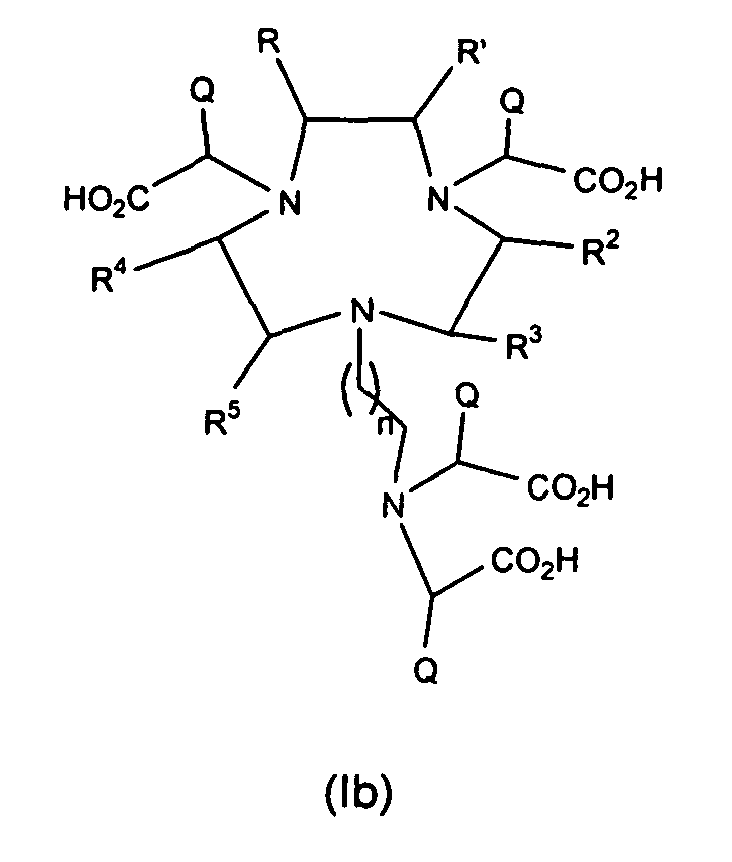
- the present invention provides a compound of the formula (Ib): wherein
- a pharmaceutical composition comprising a pharmaceutically acceptable carrier and a compound of Formula (Ib) or (II), or a metal complex thereof is also provided.
- the complex according to the claims for use in diagnostic imaging of a host is further provided, wherein the complex of formula (Ib)/or (II) is to be administered to the host in an amount effective to provide an image; and exposing the host to an energy source, whereupon a diagnostic image of the host is obtained.
- a complex of formula (Ib)/or (II) for use in the treatment of a cellular disorder in a mammal is further provided.
- the present invention further provides a method of preparing a compound of the formula (Ib): wherein
- the invention further provides a method of preparing a compound of the formula (II): wherein each of R, R', R 2-5 , Q and X are as defined in the claims; n is 1 or 2; and m is 1-5, comprising the following:
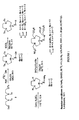
- Figure 1 illustrates the chemical synthesis of [2-(4,7-bis-carboxymethyl)-[1,4,7]triazacyclononan-1-yl-ethyl]-carbonylmethyl-amino]-acetic acid tetrahydrochloride (1) and [3-(4,7-bis-carboxymethyl)-[1,4,7]triazacyclononan-1-yl-propyl]-carbonyl-methylamino]-acetic acid tetrahydrochloride (2).
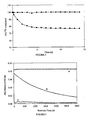
- Figure 2 is a line graph of complexed 88 Y (%) vs. time (d), which illustrates the serum stability of 88 Y-1 ( ⁇ ) and 88 Y-2 ( ⁇ ) at pH 7 and 37°C.
- Figure 3 is a line graph of absorbance at 652 nm vs. reaction time (s) for Y-1 (curve c), Y-2 (curve a), and Y-DOTA (curve b) at pH 4 and 25 °C.
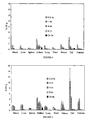
- Figure 4 is a bar graph of %ID/g vs. sample source, which illustrates the biodistribution of 86 Y-1 in Balb/c mice following intravenous (i.v.) injection.
- Figure 5 is a bar graph of %ID/g vs. sample source, which illustrates the biodistribution of 86 Y-DOTA in Balb/c mice following i.v. injection.
- the present invention provides a compound of the formula (Ib): wherein
- a preferred compound of formula (Ib) is one in which R and R' are methyl.
- R and R' may be methyl groups that are trans to one another.
- the invention also provides a compound of the formula (II): wherein
- a preferred compound of formula (II) is one in which R and R' are methyl.
- alkyl means a straight-chain or branched alkyl substituent containing from, for example, about 1 to about 12 carbon atoms, preferably from about 1 to about 8 carbon atoms, more preferably from about 1 to about 6 carbon atoms.
- substituents include methyl, ethyl, propyl, isopropyl, n -butyl, sec -butyl, isobutyl, tert -butyl, pentyl, isoamyl, hexyl, octyl or dodecanyl.
- cycloalkyl means a cyclic alkyl substituent containing from, for example, about 3 to about 30 carbon atoms, preferably from about 5 to about 14 carbon atoms, more preferably from about 5 to about 10 carbon atoms, and most preferably from about 5 to about 7 carbon atoms.
- substituents include cyclopropyl, cyclobutyl, cyclopentyl or cyclohexyl.
- the halo is bromine or iodine.
- aryl refers to an unsubstituted or substituted aromatic carbocyclic substituent, as commonly understood in the art, and includes monocyclic and polycyclic aromatics such as, for example, phenyl, biphenyl, toluenyl, anisolyl, naphthyl or anthracenyl .
- An aryl substituent generally contains from, for example, about 3 to about 30 carbon atoms, preferably from about 6 to about 18 carbon atoms, more preferably from about 6 to about 14 carbon atoms and most preferably from about 6 to about 10 carbon atoms. It is understood that the term aryl applies to cyclic substituents that are planar and comprise 4n+2 ⁇ electrons, according to Hückel's Rule.
- heteroaryl means a substituent defined by an aromatic heterocyclic ring, as is commonly understood in the art, including monocyclic and polycyclic heteroaryls containing from, for example, about 3 to about 30 carbon atoms, preferably from about 5 to about 10 carbon atoms, more preferably from about 5 to about 6 carbon atoms.
- Monocyclic heteroaryls include, for example, imidazolyl, thiazolyl, pyrazolyl, pyrrolyl, furanyl, pyrazolinyl, thiophenyl, oxazolyl, isoxazolyl, pyridinyl, pyridonyl, pyrimidinyl, pyrazinyl, and triazinyl substituents.
- Polycyclic heteroaryls include, for example, quinolinyl, isoquinolinyl, indolyl, purinyl, benzimidazolyl, benzopyrrolyl, and benzothiazolyl.
- alkoxy embraces linear or branched alkyl groups that are attached to divalent oxygen.
- the alkyl group is the same as described herein. Examples of such substituents include methoxy, ethoxy or t-butox.
- aryloxy refers to substituents that have an aryl group attached to divalent oxygen. The aryl group is the same as described herein. Examples of such substituents include phenoxy.
- alkylthio denotes a substituent with an alkyl group directly attached to a divalent sulfur atom.
- the alkyl group is the same as described herein. Examples of such substituents include methylthio or ethylthio.
- arylthio denotes a substituent with an aryl group directly attached to a divalent sulfur atom. The aryl group is the same as described herein.
- Carboxyl refers to the group -C(O)OH.
- Carboxyalkyl refers to the group -RC(O)OH that is connected to the compound through the alkyl R group.
- carboxy refers to the group -ORC(O)OH, in which the R is an alkyl (e.g., (CH 2 ) n alkylene group, n is 1 to 12) group.
- alkylamino refers to a secondary amine substituent with one hydrogen and one alkyl group directly attached to a trivalent nitrogen atom.
- alkylamino also refers to a tertiary amine substituent with two of the same or different alkyl groups directly attached to a trivalent nitrogen atom.
- the alkyl group is the same as described herein.
- alkylamido refers to substituents of the formula, -C(O)NRR' or -NRC(O)R', in which R and R' are the same or different and each is a hydrogen or alkyl group, as described herein.
- haloalkylamido is an alkylamido as described above, in which one or more of the alkyl groups is substituted with a halo moiety, such as, for example, chlorine, bromine or iodine.
- the present invention further provides a method of preparing a compound of the formula (Ib): wherein R, R', R 2-5 and Q as defined according to the claims, ; and n is 1 or 2, comprising the following:
- the above methods optionally further comprise the step of deprotecting the compound of formula (Ia-4) or (Ib-4) before alkylating to form the compound of formula (Ia) or (Ib).
- the compound of formula (Ia-4) or (Ib-4) preferably is alkylated with a compound of formula (I-5) in which Z is a leaving group, and R 10 is C 1-12 alkyl, C 6-14 aryl -C 1-12 alkyl or C 1-12 Trialkylsilyl.
- the method can further comprise removing R 10 through standard deprotection methods to form the compound of formula (Ia) or (Ib).
- the invention further provides a method of preparing a compound of the formula (II): wherein each of R, R', R 2-5 , and X are as defined in the claims ; n is 1 or 2; and m is 1-5, comprising the following:
- the above method optionally further comprises the step of deprotecting the compound of formula (II-4) before alkylating to form the compound of formula (II).
- the compound of formula (II-4) preferably is alkylated with a compound of formula (II-5) in which Z is a leaving group, and R 10 is C 1-2 alkyl, C 6-14 aryl -C 1+12 alkyl or C 1-12 trialkylsilyl.
- the method can further comprise removing R 10 through standard deprotection methods to form the compound of formula (II).
- a compound of formula (II) wherein X is NO 2 to may further be converted a compound wherein X is NH 2 .
- the compound wherein X is NH 2 can be further converted to a compound wherein X is isothiocyano. Any of these compounds can be linked to a biomolecule.
- Suitable protecting groups for R 8 and R 9 are well-known in the art and include any suitable nitrogen-protecting group, for example, tosyl, nosyl, and trifluoroacetamide.
- suitable leaving groups for R 6 and R 7 include those known in the art, such as halogens (e.g., Br, I, Cl) and other groups such as tosyl.
- halogens e.g., Br, I, Cl
- the distal hydroxyl group on the compound of formula (Ia-3), (Ib-3) or (II-3) can be converted to an amino group using conventional chemistry, such as halogenation, azide formation, or the Staudinger reaction.
- the amino group on the compound of formula (Ia-4), (Ib-4) or (II-4) can be alkylated with an ester-protected haloacetic acid of the formula (I-5) or (II-5) in which Q is as defined in the claims , Z is a leaving group such as tosyl or halogen, and R 10 is C 1-2 alkyl, C 6-14 aryl-C 1+12 alkyl or C 1-12 trialkylsilyl .
- the ester can be removed at this point post-purification, and the protein-linking moiety can be unmasked from the aryl substitution introduced from the appropriately substituted hydroxyalkylamine of formula (II-2) in the condensation step via reduction of a nitro group followed by, for example, activation of the resultant amine by treatment with thiophosgene, conversion to haloacetamides, conversion to maleimide, or conversion to vinyl sulfonamides.
- the ester resulting from the alkylation step can be retained, and all of the protein-linking moiety unmasking from the aryl substitution introduced from the appropriately substituted hydroxyalkylamine of formula (II-2) in the condensation step can be performed prior to the removal of the ester. Either route can be employed to reach the final desired product.
- the synthetic methods offer a convenient approach to cyclization by employing primary amines with a pendant hydrox-yl functional group as a precursor molecule.
- primary amines bearing a distal hydroxyl group are reacted with an N tosyl protected ditosylate to provide a 1,4,7-triazacyclononane macrocyclic ring.
- the pendant hydroxyl group is available for further chemistry to introduce additional pendant donor groups as desired.
- This cyclization method is a convenient, clean, and high-yield route using readily available starting materials.
- This strategy can be directly applied to construct a wide range of macrocyclic rings by using functionalized primary amines (e.g., alkyl substituted, aryl substituted, etc.).
- functionalized primary amines e.g., alkyl substituted, aryl substituted, etc.
- the requisite substituted diamines and subsequent substituted diethanolamines are readily available from extensive literature and the host of possibilities associated with amino acids to provide not only desired substituents and the appropriate regiochemistry, but also to provide them in desirable stereochemistry. This is equally the case for the other cyclization component.
- the stereoselective introduction of substituents on the carboxylate functional groups is also readily available from routine, well-established amino acid chemistry.
- biomolecule refers to all natural and synthetic molecules that play a role in biological systems.
- Biomolecules include hormones, amino acids, peptides, peptidomimetics, proteins, deoxyribonucleic acid (DNA), ribonucleic acid (RNA), lipids, albumins, polyclonal antibodies, receptor molecules, receptor binding molecules, haptens, monoclonal antibodies and aptamers.
- Specific examples of biomolecules include insulins, prostaglandins, growth factors, liposomes and nucleic acid probes.
- Any suitable hapten can be linked with a compound of formula (Ib) or (II).
- Haptens such as hormones, steroids, enzymes and proteins are desirable in some applications because of their site specificity to tumors and/or various organs of the body.
- a hapten for use in treating cellular disorders may be a monoclonal antibody. Methods of bonding a macrocyclic compound to a hapten are described in U.S. Patent No. 5,428,154
- Coupling of a compound of formula (Ib) or (II) to one or more biomolecules can be accomplished by several known methods (see, for example, Krejcarek et al., Biochem. Biophys. Res. Commun., 1977, 30, 581 ; Hnatowich et al., Science, 1983, 220, 613 ).
- a reactive moiety present in one of the substituents i.e., R, R', R 2-5 , Q or X
- a nucleophilic group may be reacted with an electrophilic group to form a covalent bond between a biomolecule and a compound of formula (Ib) or (II).
- nucleophilic groups include amines, anilines, alcohols, phenols, thiols and hydrazines.
- electrophilic groups include halides, disulfides, epoxides, maleimides, acid chlorides, anhydrides, mixed anhydrides, activated esters, imidates, isocyanates and isothiocyanates.
- a compound of formula (II) may be bonded to a biomolecule through the X substituent.
- This substituent is desirably a free-end nitro group, which can be reduced to an amine.
- the amine then can be activated with a compound, such as thionyl chloride, to form a reactive chemical group, such as an isothiocyanate.
- An isothiocyanate is preferred because it links directly to an amino residue of a hapten, such as an mAb.
- the aniline group can be linked to an oxidized carbohydrate on the protein and, subsequently, the linkage fixed by reduction with cyanoborohydride.
- the amino group also can be reacted with bromoacetyl chloride or iodoacetyl chloride to form -NHCOCH 2 Z, with Z being bromide or iodide.
- This group reacts with any available amine or sulfhydryl group on a hapten to form a stable covalent bond. If tyrosine is used in the formulation of the macromolecule, a carboxylic acid or methoxy carboxylate group can be in this position of the compound.
- the invention also relates to a complex comprising the compound of formula (Ib) or (II) and a metal ion, in which the metal ion is optionally radioactive.
- the metal ion is any metal ion that is suitable for the desired end use of the complex.
- paramagnetic metal atoms such as gadolinium (III), manganese(II), manganese(III), chromium(III), iron(II), iron(III), cobalt(II), nickel(II), copper(II), praseodymium(III), neodymium(III), samarium(III), ytterbium(III), terbium(III), dysprosium(III), holmium(III), and erbium(III) (all are paramagnetic metal atoms with favorable electronic properties) are preferred as metals .
- paramagnetic metal atoms such as gadolinium (III), manganese(II), manganese(III), chromium(III), iron(II), iron(III), cobalt(II), nickel(II), copper(II), praseodymium(III), neodymium(III), samarium(III), ytterbium(III), terbium
- Gadolinium(III) is a suitable metal due to the fact that it has the highest paramagnetism, low toxicity when complexed to a suitable ligand, and high lability of coordinated water.
- Typical metal ions for forming a complex of the invention include Bi, Pb, Y, Mn, Cr, Fe, Co, Ni, Tc, In, Ga, Cu, Re, Sm, a lanthanide (i.e., any element with atomic number 57 to 71, inclusive) and an actinide (i.e., any element with atomic number 89 to 103, inclusive).
- the metal ion For use as x-ray contrast agents, the metal ion must be able to absorb adequate amounts of x-rays (i.e., radio-opaque), such as, for example, indium, yttrium, lead, bismuth, gadolinium, dysprosium, holmium and praseodymium.
- x-rays i.e., radio-opaque
- Radioisotopes of any suitable metal ion are acceptable for forming metal complexes of the invention.
- typical radioisotopes include technetium, bismuth, lead, actinium, carbon, nitrogen, iodine, fluorine, oxygen, tellurium, helium, indium, gallium, copper, rhenium, yttrium, samarium, zirconium, lutetium and holmium.
- radionuclides suitable for complexing to a compound of formula (Ib) or (II) for various therapeutic applications and imaging techniques, including single photon emission computed spectroscopy are, for example, 213 Bi, 212 Bi, 212 Pb, 225 Ac, 177 Lu, 111 In, 166 Ho, 90 Y, 153 Sm, 67 Cu, 64 Cu, 66 Ga, 68 Ga, 86 Y, 89 Zr and 67 Ga.
- compounds of formula (Ib) or (II) are complexed with an appropriate metal or metal ion.
- the metal can be added to water in the form of an oxide, halide, nitrate or acetate (e.g., yttrium acetate, bismuth iodide) and treated with an equimolar amount of a compound of formula (Ib) or (II).
- the compound can be added as an aqueous solution or suspension.
- Dilute acid or base can be added (where appropriate) to maintain a suitable pH. Heating at temperatures as high as 100 °C for periods of up to 24 hours or more can be employed to facilitate complexation, depending on the metal, the compound, and their concentrations.
- salts of the metal complexes of the compounds of formula (Ib) or (II) are also useful as imaging agents. These salts can be prepared by using a base (e.g., an alkali metal hydroxide, meglumine, arginine or lysine) to neutralize the above-prepared metal complexes, while they are still in solution. Some of the metal complexes are formally uncharged and do not need cations as counterions. Such neutral complexes may be preferred as intravenously administered x-ray and NMR imaging agents over charged complexes because they may provide solutions of greater physiologic tolerance due to their lower osmolality. However, for use as hepatobiliary agents, negatively charged ligands are preferred.
- a base e.g., an alkali metal hydroxide, meglumine, arginine or lysine
- Some of the metal complexes are formally uncharged and do not need cations as counterions.
- Such neutral complexes may be preferred as intra
- the invention provides a pharmaceutical composition
- a pharmaceutical composition comprising a pharmaceutically acceptable carrier and a compound of formula (Ib) or (II), or a metal complex thereof.
- the pharmaceutical composition further comprises a pharmaceutically acceptable carrier.
- the pharmaceutically acceptable carriers described herein, for example, vehicles, adjuvants, excipients, and diluents, are well-known to those skilled in the art and are readily available to the public. The choice of carrier will be determined, in part, by the particular composition and by the particular method used to administer the composition. Accordingly, there are a wide variety of suitable formulations of the pharmaceutical compositions of the present invention.
- compositions of the present invention are also known.
- a particular route can be used to administer a particular composition, a particular route can provide a more immediate and more effective result than another route.
- Formulations suitable for oral administration can consist of (a) liquid solutions, such as an effective amount of the compound of formula (Ib) or (II) dissolved in a diluent, such as water or saline, (b) capsules, sachets or tablets, each containing a predetermined amount of the active ingredient, as solids or granules, (c) suspensions in an appropriate liquid, and (d) suitable emulsions.
- a liquid solutions such as an effective amount of the compound of formula (Ib) or (II) dissolved in a diluent, such as water or saline
- a diluent such as water or saline
- capsules, sachets or tablets each containing a predetermined amount of the active ingredient, as solids or granules
- suspensions in an appropriate liquid and (d) suitable emulsions.
- Tablet forms can include one or more of lactose, mannitol, cornstarch, potato starch, microcrystalline cellulose, acacia, gelatin, colloidal silicon dioxide, croscarmellose sodium, talc, magnesium stearate, stearic acid, and other excipients, colorants, diluents, buffering agents, moistening agents, preservatives, flavoring agents, and pharmacologically compatible carriers.
- Lozenge forms can comprise the active ingredient in a flavor, usually sucrose and acacia or tragacanth, as well as pastilles comprising the active ingredient in an inert base, such as gelatin and glycerin or sucrose and acacia emulsions or gels containing, in addition to the active ingredient, such carriers as are known in the art.
- a flavor usually sucrose and acacia or tragacanth
- pastilles comprising the active ingredient in an inert base, such as gelatin and glycerin or sucrose and acacia emulsions or gels containing, in addition to the active ingredient, such carriers as are known in the art.
- the compounds of formula (Ib) or (II), alone or in combination with other suitable components, can be made into aerosol formulations to be administered via inhalation.
- aerosol formulations can be placed into pressurized acceptable propellants, such as dichlorodifluoromethane, hydrofluorocarbon (such as HFC 134a and/or 227), propane or nitrogen.
- Formulations suitable for parenteral administration include aqueous and non-aqueous solutions, isotonic sterile injection solutions, which can contain anti-oxidants, buffers, bacteriostats, and solutes that render the formulation isotonic with the blood of the intended recipient, and aqueous and non-aqueous sterile suspensions that can include suspending agents, solubilizers, thickening agents, stabilizers, and preservatives.
- the formulations can be presented in unit-dose or multi-dose sealed containers, such as ampules and vials, and can be stored in a freeze-dried (lyophilized) condition requiring only the addition of the sterile liquid carrier, for example, water, for injections, immediately prior to use.
- Extemporaneous injection solutions and suspensions can be prepared from sterile powders, granules, and tablets of the kind previously described.
- the dose administered to an animal, particularly a human, in the context of the present invention should be sufficient to effect a therapeutic response in the animal over a reasonable time frame or an amount sufficient to allow for diagnostic imaging of the desired tissue or organ.
- the dose will be determined by the strength of the particular compositions employed and the condition of the animal (e.g., human), as well as the body weight of the animal (e.g., human) to be treated.
- the size of the dose also will be determined by the existence, nature, and extent of any adverse side effects that might accompany the administration of a particular composition.
- a suitable dosage for internal administration is 0.01 to 100 mg/kg of body weight per day, such as 0.01 to 35 mg/kg of body weight per day or 0.05 to 5 mg/kg of body weight per day.
- a suitable concentration of the compound in pharmaceutical compositions for topical administration is 0.05 to 15% (by weight), preferably 0.02 to 5%, and more preferably 0.1 to 3%.
- a complex of formula (Ib) or (II) according to the claims may be useful in diagnostic imaging of a host.
- the diagnostic image can be, for example, a magnetic resonance image, an x-ray contrast image or a single photon emission computed spectroscopy (SPECT) image.
- SPECT single photon emission computed spectroscopy
- the compounds of formula (Ib) or (II) can be complexed with a paramagnetic metal atom and used as relaxation enhancement agents for magnetic resonance imaging.
- These agents when administered to a host (e.g., a mammal such as a human) distribute in various concentrations to different tissues, and catalyze the relaxation of protons in the tissues that have been excited by the absorption of radiofrequency energy from a magnetic resonance imager. This acceleration of the rate of relaxation of the excited protons provides for an image of different contrast when the host is scanned with a magnetic resonance imager.
- the magnetic resonance imager is used to record images at various times, generally either before and after administration of the agents, or after administration only, and the differences in the images created by the presence of the agent in tissues are used in diagnosis. Guidelines for performing imaging techniques can be found in Stark et al., Magnetic Resonance Imaging, Mosbey Year Book: St. Louis, 1992 .
- a complex according to the claims may be useful in a method for magnetic resonance imaging of a host (e.g., mammal, such as a human).
- the method comprises administering to the host a complex of any of formula (Ib) or (II), in which the metal is paramagnetic, in an amount effective to provide an image; and exposing the host to a magnet, whereupon a magnetic resonance image of the host is obtained.
- a complex used in obtaining a magnetic resonance image comprises Gd.
- Paramagnetic metal complexes of the present invention are particularly useful as hepatobiliary agents, i.e., for magnetic resonance imaging of the liver and bile ducts.
- a complex according to the claims may be useful in a method for x-ray imaging of a host.
- the method comprises administering to the host a complex of any of formula (Ib) or (II), in which the metal ion is radio-opaque, in an amount effective to provide an image; and exposing the host to x-rays, whereupon an x-ray contrast image of the host is obtained.
- formula (Ib) or (II) in which the metal ion is radio-opaque
- Especially useful metal ions are 111 In and/or 177 Lu.
- the radioactive probe 111 In decays with a half life of 2.8 days (67 hours) to an excited state of the daughter nucleus 111 Cd. From this excited state, a cascade of two gamma-rays is emitted, encompassing an isomeric state with a half life of 85 ns.
- 111 In is useful for single photon emission computed spectroscopy (SPECT), which is a diagnostic tool.
- SPECT single photon emission computed spectroscopy
- 111 In (or 177 Lu) may be complexed to a compound of Formula (Ib) or (II) and linked to a biomolecule, such as a hapten, which specifically localizes in a tumor, so that particular localization can be three-dimensionally mapped for diagnostic purposes in vivo by single photon emission tomography.
- the emission can be used in vitro in radioimmunoassays.
- a complex according to claims may be useful in a method for SPECT imaging of a host (e.g., mammal, such as a human).
- the method comprises administering to the host a complex of any of formula (Ib) or (II), in which the metal emits a single photon, in an amount effective to provide an image; and exposing the host to an energy source, whereupon a SPECT image of the host is obtained.
- a complex according to claims may be useful in the treatment of a cellular disorber in a mammal.
- a preferred complex comprises Pb or Y, in particular 90 Y.
- the treatment can be prophylactic or therapeutic.
- prophylactic is meant any degree in inhibition of the onset of the cellular disorder, including complete inhibition.
- therapeutic is meant any degree in inhibition or any degree of beneficial effects on the disorder in the mammal (e.g., human), e.g., inhibition of the growth or metastasis of a tumor.
- a metal complex according to the claims may be bound to a hapten having a selective binding site on a cell affected by the disorder.
- Q can be bound to an mAb, wherein the antibody is directed and created against an epitope found specifically on tumor cells.
- a beta irradiation is produced from the lead disintegration.
- a beta radiation is produced by the bismuth daughters. This beta radiation is similar to the beta radiation from 90 Y but, in addition, each disintegration of bismuth also produces an alpha particle. In this manner, a radiotherapy is provided with a radiation dose from an alpha particle and a beta particle.
- 212 Bi can be introduced in those cases where the disorder to be treated, such as with leukemic cells, can be easily reached within the 1 hour half-life of 212 Bi.
- Suitable procedures using radiopharmaceuticals can be found in the literature (see, for example, Mettler Jr. et al., Essentials of Nuclear Medicine Imaging, Grune and Stratton, Inc.: New York, 1983 ).
- Cancers suitable for treatment with complexes of the invention include, for example, lymphomas, leukemias, colo-rectal cancer, ovarian cancer, breast cancer, and prostate cancer.
- the Bi 212 is retained inside the chelate after the beta emission in varying amounts. Most desirably, at least 95% of Bi 212 remains in the metal complex.
- an acidic medium such as the stomach, at least about 70% of the Bi 212 is retained. Retaining at least about 80% or 90%, Bi 212 is also desirable depending on the medium.
- Bismuth-labeled HuM195, an anti-CD33 antibody demonstrated specific and potent cell killing ability when directed against a leukemia cell line (see, for example, Nikula et al., J. Nucl. Med, 1999, 40, 166-176 ).
- the chelating agent N-[2-amino-3-(p-isothiocyanatophen-yl)propyl]-trans-cyclohexane-1,2-diamine-N,N',N',N",N"-pentaacetic acid, was appended to J591 mAb to bind stably the 213 Bi radiometal ion.
- the J591 mAb construct was used to target the external domain of Prostate Specific Membrane Antigen (PSMA) and to treat prostate cancer (see, for example, McDevitt et al., Cancer Res., 2000, 60(21), 6095-6100 ). Therefore, 213 Bi can be complexed to a compound of Formula (Ib) or (II] and linked to a biomolecule, such as an mAb, and used to prophylactically or therapeutically treat cancer, in particular, leukemia and prostate cancer.
- PSMA Prostate Specific Membrane Antigen
- FAB-MS Fast atom bombardment mass spectra
- SE-HPLC Size exclusion high performance liquid chromatograms
- SE-HPLC Size exclusion high performance liquid chromatograms
- Time scan measurements were obtained using HP-8452A diode array spectrophotometer.
- the 88 Y was obtained from Los Alamos National Laboratory and purified as previously reported ( Camera et al., J. Nuc. Med., 1994, 35, 882-889 ).
- PBS Phosphate buffered saline
- pH 7.4 consisted of 0.08 M Na 2 HPO 4 , 0.02 M KH 2 PO 4 , 0.01 M KCl, and 0.14 M NaCl.
- This example describes a general procedure for synthesis of macrocyclics 4a and 4b ( Fig. 1 ).
- This example describes the purification of 2-[-4,7-bis-( p -toluene-4-sulfonyl)-[1,4,7]triazacyclononan-1-yl]-ethanol ( 4a ) ( Fig. 1 ).
- This example describes the purification of 3-[-4,7-bis-( p -toluene-4-sulfonyl)-[1,4,7]triazacyclononan-1-yl]-propan-1-ol ( 4b ) ( Fig. 1 ).
- This example describes a general procedure for chlorination of 5a and 5b ( Fig. 1 ).
- This example describes the purification of 1-(2-chloro-ethyl)-bis-( p -toluene-4-sulfonyl)-[1,4,7]triazacyclononane ( 5a ) ( Fig. 1 ).
- This example describes the purification of 1-(3-chloro-propyl)-bis-(p-toluene-4-sulfonyl)-[1,4,7]triazacyclononane ( 5b ) ( Fig. 1 ).
- This example describes a general procedure for the reaction of 5a and 5b with azide ( Fig. 1 ).
- This example describes the purification of 1-(2-azido-ethyl)-4,7-bis-( p -toluene-4-sulfonyl)-[1,4,7]triazacyclononane ( 6a ) ( Fig. 1 ).
- This example describes the purification of 1-(3-azido-propyl)-4,7-bis-(p-toluene-4-sulfonyl)-[1,4,7]triazacyclononane ( 6b ) ( Fig. 1 ).
- This example describes a general procedure for the reduction of azides 6a and 6b ( Fig. 1 ).
- This example describes the purification of 2-[4,7-bis-( p -toluene-4-sulfonyl)-[1,4,7]triazacyclononan-1-yl]-ethylamine ( 7a ) ( Fig. 1 ).
- This example describes the purification of 3-[4,7-bis-(p-toluene-4-sulfonyl)-[1,4,7]triazacyclononan-1-yl]-propylamine ( 7b ) ( Fig. 1 ).
- This example describes a general procedure for detosylation of 7a and 7b ( Fig. 1 ).
- This example describes the purification of 2-[1,4,7]triazacyclononan-1-yl-ethylamine ( 8a ) ( Fig. 1 ).
- Example 13 The crude 8a was obtained in Example 13 as a pale yellow oil (159 mg, 92%): 1 H NMR (CDCl 3 ) ⁇ 2.27-2.41 (m, 16 H), 3.72 (4 H); 13 C NMR (CDCl 3 ) ⁇ 39.4 (t), 45.8 (t), 46.0 (t), 52.4 (t), 59.7 (t). This material was observed to be unstable; accordingly, it was used immediately as obtained in the next step.
- This example describes the purification of 3-[1,4,7]triazacyclononan-1-yl-propylamine (8b) ( Fig. 1 ).
- This example describes a general procedure for alkylation of tetra -amines 8a and 8b ( Fig. 1 ).
- This example describes the synthesis of ⁇ [3-(4,7-bis- tert -butoxycarbomethyl)-[1,4,7]triazacyclononan-1-yl-ethyl]- tert -butoxycarbonylmethyl-amino]-acetic acid tert -butyl ester ( 9a ).
- This example describes the purification of ⁇ [3-(4,7-bis- tert -butoxycarbomethyl)-[1,4,7]triazacyclononan-1-yl-propyl]- tert -butoxycarbonylmethyl-amino]-acetic acid tert- butyl ester ( 9b ) ( Fig. 1 ).
- This example describes the deprotection of tetra- tert -butyl esters 9a and 9b ( Fig. 1 ).
- This example describes the synthesis of ⁇ [2-(4,7-bis-carboxymethyl)-[1,4,7]triazacyclononan-1-yl-ethyl]-carbonylmethyl-amino]-acetic acid tetrahydrochloride ( 1 ) ( Fig. 1 ).
- This example describes the synthesis of ⁇ [3-(4,7-bis-carboxymethyl)-[1,4,7]triazacyclononan-1-yl-propyl]-carbonyl-methylamino]-acetic acid tetrahydrochloride (2) ( Fig. 1 ).
- This example describes the synthesis of radiolabeled 1 and 2 ( Fig. 1 ) and the stability of 1 and 2 in serum.
- the 88 Y complexes of 1 and 2 were prepared by the addition of 350 ⁇ Ci of 88 Y (0.1 M HCl adjusting the pH to 4.5 with 5 M NH 4 OAc) to 20 ⁇ L of 0.2 M ligand solution in 0.15 M NH 4 OAc of pH 4.5.
- the reactions were forced to completion by heating the reaction mixture at 80 °C for 18 h, after which they were loaded onto a column of Chelex-100 resin (1 mL volume bed, equilibrated with 0.15 M NH 4 OAc).
- the complexes were eluted from the resin with 0.15 M NH 4 Ac, while the resin retained the free 88 Y.
- the stability of the corresponding 88 Y-labeled complexes formed with chelators 1 and 2 in human serum was assessed by measuring the release of 88 Y from the complexes at 37°C over 14 days.
- the pH of the 88 Y complex solutions was adjusted to 7.0 with PBS buffer and 250 ⁇ Ci of either complex were added to 1 mL of human serum incubated at 37 °C.
- An aliquot of the serum (5-10 ⁇ L) was taken at selected times and analyzed by SE-HPLC with a TSK-3000 column eluted with PBS at a 1 mL/min flow rate.
- the serum stability of the 88 Y complexes was assessed by measuring the release of 88 Y radionuclide from the complexes to serum proteins. The results are shown in Fig. 2 , which is a line graph of 88 Y (%) vs. time (d), in which ⁇ represents the serum stability of 88 Y- 1 and ⁇ represents the serum stability of 88 Y
- Fig. 2 show that 88 Y-labeled ligand 1 having an ethylene-bridge is stable in serum for up to 14 days with no measurable loss of radioactivity. However, considerable release of radioactivity was observed from the 88 Y chelate formed with 2 , which possesses the longer propylene bridge. The percentage of 88 Y released from this complex at 14 days was about 25%. It seems likely that the stability of the Y(III) radiolabeled complex in serum is dependent on the length of the carbon chain between the pendant donor groups and the macrocyclic ring.
- the observed release of radioactivity from the chelate 2 might also be a consequence of the formation of a six-membered chelate ring as opposed to what is generally considered to be the more stable arrangement of donors, i.e., a five-membered chelate ring for complexation of Y(III).
- This example describes the formation kinetics of radiolabeled 1 , 2 ( Fig. 1 ) and DOTA.
- Formation kinetics of Y(III) complexes of 1 , 2 , and DOTA was measured by monitoring the absorption at 652 nm.
- This example demonstrates the complexation kinetics of metal complexes of 1 , 2 ( Fig. 1 ) and DOTA as prepared in Example 22.
- mice Female Balb/c mice were obtained from Charles River Laboratories (Wilmington, MA) at 4-6 weeks of age.
- the pH of the 86 Y-labeled ligands was adjusted to pH ⁇ 7.0 with 0.5 M sodium bicarbonate (pH 10.5) and diluted in PBS.
- the radiolabeled ligands (5.9 ⁇ Ci of 86 Y-DOTA, 5.0 ⁇ Ci of 86 Y-1) were administered to the mice in 200 ⁇ L volumes via tail vein injection.
- the mice (5 per data point) were sacrificed by exsanguination at 0.5 h, 1 h, 4 h, 8 h, and 24 h.
- FIG. 4 is a bar graph of %ID/g vs. selected organs, which illustrates the biodistribution of 86 Y- 1 in Balb/c mice following i.v. injection.
- Figure 5 is a bar graph of %ID/g vs.
- Figs. 4 and 5 show that the accumulated radioactivity in the organs at 4 h post-injection of the complexes is negligible for both 86 Y- 1 and 86 Y-DOTA.
- Both 86 Y- 1 and 86 Y-DOTA display a slightly higher radioactivity level in the kidney as compared to that in other organs, no doubt associated with whole body clearance and elimination of these complexes.
- radioactivity that accumulated in kidney was 0.54 ⁇ 0.13 percent injected dose per gram (%ID/gm) and 0.84 ⁇ 0.16 %ID/gm for 86 Y- 1 and 86 Y-DOTA, respectively.
Landscapes
- Health & Medical Sciences (AREA)
- Chemical & Material Sciences (AREA)
- Organic Chemistry (AREA)
- Life Sciences & Earth Sciences (AREA)
- Public Health (AREA)
- Veterinary Medicine (AREA)
- Animal Behavior & Ethology (AREA)
- General Health & Medical Sciences (AREA)
- Epidemiology (AREA)
- Medicinal Chemistry (AREA)
- Pharmacology & Pharmacy (AREA)
- Optics & Photonics (AREA)
- Proteomics, Peptides & Aminoacids (AREA)
- Physics & Mathematics (AREA)
- Nuclear Medicine, Radiotherapy & Molecular Imaging (AREA)
- General Chemical & Material Sciences (AREA)
- Chemical Kinetics & Catalysis (AREA)
- Medicines Containing Antibodies Or Antigens For Use As Internal Diagnostic Agents (AREA)
- Pharmaceuticals Containing Other Organic And Inorganic Compounds (AREA)
- Medicines That Contain Protein Lipid Enzymes And Other Medicines (AREA)
Claims (31)
- Verbindung der Formel (Ib):
 einer von R, R', R2-5 und Q ausgewählt ist aus der Gruppe bestehend aus C1-12 -Alkyl, C3-30 -Cycloalkyl, C1-12 -Alkoxy, C1-12 -Hydroxyalkyl, C6-14 -Aryl, C6-14 -Aryloxy, C6-14 -Hydroxyaryl, Heteroaryl, C1-12 - Thioalkyl und C6-14 -Thioaryl, unddie restlichen Substituenten jeweils unabhängig voneinander Wasserstoff, C1-12 -Alkyl, C3-30 - Cycloalkyl, C1-12 -Alkoxy, C1-12 -Hydroxyalkyl, C6-14 -Aryl, C6-14 -Aryloxy, C6-14 -Hydroxyaryl, Heteroaryl, C1-12 -Thioalkyl oder C6-14 -Thioaryl sind; undn 1 oder 2 ist.
 - Verbindung der Formel (II):
 jeder von R, R', R2-5 und Q unabhängig voneinander Wasserstoff, C1-12 -Alkyl, C3-30 -Cycloalkyl, C1-12 -Alkoxy, C1-12 -Hydroxyalkyl, C6-14 -Aryl, C6-14 -Aryloxy, C6-14 -Hydroxyaryl, Heteroaryl, C1-12 - Thioalkyl oder C6-14 Thioaryl sind;X Wasserstoff, Halogen, C1-12 -Alkyl, Hydroxy, Nitro, Amino, C1-12 -Alkylamino, Thiocyano, Isothiocyano, C1-12 -Alkoxy, C6-14 -Aryloxy, C6-14 -Aryl-C1-12 -Alkoxy, Carboxyl, C1-12 -Carboxyalkyl, C1-12 -Carboxyalkyloxy, Amido, C1-12 -Alkylamido oder C1-12 -Halogenalkylamido ist;n 1 oder 2 ist; undm 1-5 ist.
 - Komplex umfassend die Verbindung nach Anspruch 1 oder 2 und ein Metallion, worin das Metallion gegebenenfalls radioaktiv ist.
- Komplex nach Anspruch 3, worin das Metallion ausgewählt ist aus der Gruppe bestehend aus Bi, Pb, Y, Mn, Cr, Fe, Co, Ni, Tc, In, Ga, Cu, Re, Sm, einem Lanthanoid und einem Actinid.
- Komplex nach Anspruch 4, worin das Lanthanoid Gd(III) ist.
- Pharmazeutische Zusammensetzung umfassend einen pharmazeutisch verträglichen Träger und die Verbindung nach Anspruch 1 oder 2.
- Pharmazeutische Zusammensetzung umfassend einen pharmazeutisch verträglichen Träger und den Komplex nach einem der Ansprüche 3-5.
- Komplex nach einem der Ansprüche 3-5 zur Verwendung in der diagnostischen Bildgebung eines Wirts,
worin (i) der Komplex nach einem der Ansprüche 3-5 dem Wirt in einer wirksamen Menge verabreicht werden soll um ein Bild zu liefern; und
worin (ii) der Wirt einer Energiequelle ausgesetzt werden soll, wonach ein diagnostisches Bild des Wirts erhalten wird. - Komplex zur Verwendung nach Anspruch 8, worin das diagnostische Bild ausgewählt ist aus der Gruppe bestehend aus einem Magnetresonanzbild, einem Röntgenkontrastbild und einem Bild einer Single-Photon-Emission-Tomographie (SPECT).
- Komplex nach einem der Ansprüche 3-5 zur Verwendung in der Magnetresonanz-Tomographie eines Wirts,
worin (i) der Komplex nach einem der Ansprüche 3-5, in dem das Metallion paramagnetisch ist, dem Wirt in einer wirksamen Menge verabreicht werden soll um ein Bild zu liefern; und
worin (ii) der Wirt einem Magneten ausgesetzt werden soll, wonach ein Magnetresonanzbild des Wirts erhalten wird. - Komplex nach einem der Ansprüche 3-5 zur Verwendung in der Röntgenbildgebung eines Wirts,
worin (i) der Komplex nach einem der Ansprüche 3-5, in dem das Metall röntgendicht ist, dem Wirt in einer wirksamen Menge verabreicht werden soll um ein Bild zu liefern; und
worin (ii) der Wirt Röntgenstrahlen ausgesetzt werden soll, wonach ein Röntgenkontrastbild des Wirts erhalten wird. - Komplex nach einem der Ansprüche 3-5 zur Verwendung in der Single-Photon-Emission-Tomographie (SPECT)-Bildgebung,
worin (i) der Komplex nach einem der Ansprüche 3-5, in dem das Metall ein einzelnes Photon emittiert, dem Wirt in einer wirksamen Menge verabreicht werden soll um ein Bild zu liefern; und
worin (ii) der Wirt einer Energiequelle ausgesetzt werden soll, wonach ein SPECT-Bild des Wirts erhalten wird. - Verwendung eines Komplexes nach einem der Ansprüche 3-5 zur Herstellung einer pharmazeutischen Zusammensetzung zur Behandlung einer zellulären Erkrankung eines Säugers.
- Komplex zur Verwendung nach Anspruch 10, worin der Komplex Gd umfasst.
- Komplex zur Verwendung nach Anspruch 11, worin der Komplex 111In oder 177Lu umfasst.
- Komplex zur Verwendung nach Anspruch 12 worin der Komplex 111In oder 177Lu umfasst.
- Verwendung nach Anspruch 13, worin die zelluläre Erkrankung Krebs ist.
- Verwendung nach Anspruch 13, worin der Komplex 90Y umfasst.
- Verwendung nach Anspruch 13, worin der Komplex 213Bi umfasst.
- Verfahren zum Herstellen einer Verbindung der Formel (Ib):
 einer von R, R', R2-5 und Q ausgewählt ist aus der Gruppe bestehend aus C1-12 -Alkyl, C3-30 - Cycloalkyl, C1-12 -Alkoxy, C1-12 -Hydroxyalkyl, C6-14 -Aryl, C6-14 -Aryloxy, C6-14 -Hydroxyaryl, Heteroaryl, C1-12 -Thioalkyl und C6-14 -Thioaryl, unddie restlichen Substituenten unabhängig voneinander jeweils Wassersoff, C1-12 -Alkyl, C3-30 - Cycloalkyl, C1-12 -Alkoxy, C1-12 -Hydroxyalkyl, C6-14 -Aryl, C6-14 -Aryloxy, C6-14 -Hydroxyaryl, Heteroaryl, C1-12 -Thioalkyl oder C6-14 -Thioaryl sind; undn 1 oder 2 ist,umfassend die folgenden:(a) Kombinieren einer Verbindung der Formel (Ib-1)
 worin R, R' und R2-5 wie oben definiert sind,R6 und R7 gleich oder unterschiedlich sind und jeweils eine Abgangsgruppe sind, undR8 und R9 gleich oder unterschiedlich sind und eine Schutzgruppe sind,mit einer Verbindung der Formel (Ib-2)
 (b) Umwandeln der Verbindung der Formel (Ib-3) in eine Verbindung der Formel (Ib-4)
 (c) Alkylieren der Verbindung der Formel (Ib-4) um die Verbindung der Formel (Ib) zu bilden.
 - Verfahren nach Anspruch 20, das weiterhin den Schritt des Entfernens der Schutzgruppe der Verbindung der Formel (Ib-4) vor dem Alkylieren umfasst, um die Verbindung der Formel (Ib) zu bilden.
- Verfahren nach Anspruch 20, worin die Verbindung der Formel (Ib-4) mit einer Verbindung der Formel (I-5) alkyliert wird
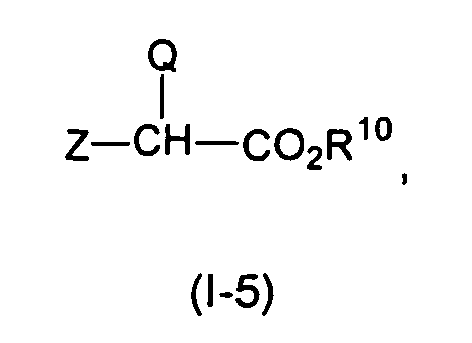 worin Z eine Abgangsgruppe ist, undR10 C1-12 -Alkyl, C6-14 -Aryl-C1-12 -Alkyl oder C1-12 -Trialkylsilyl ist.
 - Verfahren nach Anspruch 22, das weiterhin das Entfernen von R10 umfasst um die Verbindung der Formel (Ib) zu bilden.
- Verfahren nach Anspruch 22, worin die Abgangsgruppe Tosyl oder ein Halogen ist.
- Verfahren zum Herstellen einer Verbindung der Formel (II):
 jeder von R, R', R2-5 und Q unabhängig voneinander Wasserstoff, C1-12 -Alkyl, C3-30 -Cycloalkyl, C1-12 -Alkoxy, C1-12 -Hydroxyalkyl, C6-14 -Aryl, C6-14 -Aryloxy, C6-14 -Hydroxyaryl, Heteroaryl, C1-12 - Thioalkyl oder C6-14 Thioaryl sind;X Wasserstoff, Halogen, C1-12 -Alkyl, Hydroxy, Nitro, Amino, C1-12 -Alkylamino, Thiocyano, Isothiocyano, C1-12 -Alkoxy, C6-14 -Aryloxy, C6-14 -Aryl-C1-12 -Alkoxy, Carboxyl, C1-12 -Carboxyalkyl, C1-12 -Carboxyalkyloxy, Amido, C1-12 -Alkylamido oder C1-12 -Halogenalkylamido ist;n 1 oder 2 ist; undm 1-5 ist,umfassend die folgenden Scritte:(a) Kombinieren einer Verbindung der Formel (II-1)
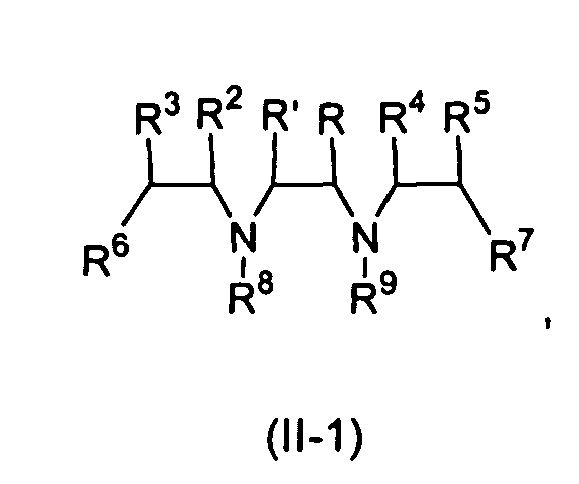 worin R, R' und R2-5 wie oben definiert sind,R6 und R7 gleich oder unterschiedlich sind und jeweils eine Abgangsgruppe sind, undR8 und R9 gleich oder unterschiedlich sind und jeweils eine Schutzgruppe sind,mit einer Verbindung der Formel (II-2)
 (b) Umwandeln der Verbindung der Formel (II-3) in eine Verbindung der Formel (II-4)
 (c) Alkylieren der Verbindung der Formel (II-4) um die Verbindung der Formel (II) zu bilden.
 - Verfahren nach Anspruch 25, das weiterhin den Schritt des Entfernens der Schutzgruppe der Verbindung der Formel (II-4) vor dem Alkylieren umfasst um die Verbindung der Formel (II) zu bilden.
- Verfahren nach Anspruch 25, worin die Verbindung der Formel (II-4) mit einer Verbindung der Formel (II-5) alkyliert wird
 worin Z eine Abgangsgruppe ist, undR10 C1-12 -Alkyl, C6-14 -Aryl-C1-12 -Alkyl oder C1-12 -Trialkylsilyl ist.
 - Verfahren nach Anspruch 27, das weiterhin das Entfernen von R10 umfasst um die Verbindung der Formel (II) zu bilden.
- Verfahren nach Anspruch 25, umfassend das Umwandeln einer Verbindung worin X NO2 ist in eine Verbindung worin X NH2 ist.
- Verfahren nach Anspruch 29, umfassend das Umwandeln einer Verbindung worin X NH2 ist in eine Verbindung worin X Isothiocyano ist.
- Verfahren nach Anspruch 27, worin die Abgangsgruppe Tosyl oder ein Halogen ist.
Applications Claiming Priority (5)
| Application Number | Priority Date | Filing Date | Title |
|---|---|---|---|
| US318821 | 1989-03-03 | ||
| US38537102P | 2002-06-03 | 2002-06-03 | |
| US385371P | 2002-06-03 | ||
| US10/318,821 US7081452B2 (en) | 2002-06-03 | 2002-12-13 | Scorpionate-like pendant macrocyclic ligands, complexes and compositions thereof, and methods of using same |
| PCT/US2003/017460 WO2003101919A2 (en) | 2002-06-03 | 2003-06-03 | Scorpionate-like pendant macrocyclic ligands, complexes and compositions thereof, and methods of using same |
Publications (3)
| Publication Number | Publication Date |
|---|---|
| EP1511476A2 EP1511476A2 (de) | 2005-03-09 |
| EP1511476A4 EP1511476A4 (de) | 2009-01-21 |
| EP1511476B1 true EP1511476B1 (de) | 2012-11-07 |
Family
ID=29714979
Family Applications (1)
| Application Number | Title | Priority Date | Filing Date |
|---|---|---|---|
| EP03734363A Expired - Lifetime EP1511476B1 (de) | 2002-06-03 | 2003-06-03 | Nota-ähnliche makrocyclische liganden, komplexe und zusammensetzungen daraus, und anwendungsverfahren dafür |
Country Status (5)
| Country | Link |
|---|---|
| US (2) | US7081452B2 (de) |
| EP (1) | EP1511476B1 (de) |
| AU (1) | AU2003239952B2 (de) |
| CA (1) | CA2487908C (de) |
| WO (1) | WO2003101919A2 (de) |
Families Citing this family (24)
| Publication number | Priority date | Publication date | Assignee | Title |
|---|---|---|---|---|
| US7993626B2 (en) * | 2007-01-11 | 2011-08-09 | Immunomedics, Inc. | Methods and compositions for F-18 labeling of proteins, peptides and other molecules |
| US7597876B2 (en) * | 2007-01-11 | 2009-10-06 | Immunomedics, Inc. | Methods and compositions for improved F-18 labeling of proteins, peptides and other molecules |
| US7563433B2 (en) | 2007-01-11 | 2009-07-21 | Immunomedics, Inc. | Methods and compositions for F-18 labeling of proteins, peptides and other molecules |
| US7368100B2 (en) | 2002-09-06 | 2008-05-06 | The United States Of America, Represented By The Secretary, Department Of Health And Human Services | Backbone-substituted bifunctional DOTA ligands, complexes and compositions thereof, and methods of using same |
| US20050171424A1 (en) * | 2004-01-13 | 2005-08-04 | The Gov. Of The Usa As Rep. By The Secretary Of The Dept. Of Health And Human Services | Methods for imaging the lymphatic system using dendrimer-based contrast agents |
| US8288530B2 (en) * | 2006-11-06 | 2012-10-16 | The United States Of America, As Represented By The Department Of Health And Human Services | Method of preparing macromolecular contrast agents and uses thereof |
| US8889100B2 (en) | 2007-01-11 | 2014-11-18 | Immunomedics, Inc. | Methods and compositions for improved F-18 labeling of proteins, peptides and other molecules |
| US8545809B2 (en) | 2007-01-11 | 2013-10-01 | Immunomedics, Inc. | Methods and compositions for improved 18F labeling of proteins, peptides and other molecules |
| US8709382B2 (en) | 2007-01-11 | 2014-04-29 | Immunomedics, Inc. | Methods and compositions for improved F-18 labeling of proteins, peptides and other molecules |
| US8153100B2 (en) * | 2007-01-11 | 2012-04-10 | Immunomedics, Inc. | Methods and compositions for F-18 labeling of proteins, peptides and other molecules |
| US8398956B2 (en) | 2007-01-11 | 2013-03-19 | Immunomedics, Inc. | In vivo copper-free click chemistry for delivery of therapeutic and/or diagnostic agents |
| US20100092384A1 (en) * | 2007-03-19 | 2010-04-15 | The Junited States Of America As Represented By Secretary, Dept. Of Health And Human Service | Multifunctional nanoparticles and compositions and methods of use thereof |
| WO2009012288A2 (en) * | 2007-07-17 | 2009-01-22 | Government Of The United States Of America, Represented By The Secretary, Department Of Health And Human Services | Trifunctional imaging agent for monoclonal antibody tumor-targeted imaging |
| US10556873B2 (en) * | 2008-02-22 | 2020-02-11 | Illinois Institute Of Technology | Bimodal ligands with macrocyclic and acyclic binding moieties, complexes and compositions thereof, and methods of using |
| US9446995B2 (en) | 2012-05-21 | 2016-09-20 | Illinois Institute Of Technology | Synthesis of therapeutic and diagnostic drugs centered on regioselective and stereoselective ring opening of aziridinium ions |
| US10189803B2 (en) | 2008-02-22 | 2019-01-29 | Illinois Institute Of Technology | Synthesis of therapeutic and diagnostic drugs centered on regioselective and stereoselective ring opening of aziridinium ions |
| WO2010011367A2 (en) * | 2008-02-22 | 2010-01-28 | Illinois Institute Of Technology | Bimodal ligands with macrocyclic and acyclic binding moieties, complexes and compositions thereof, and methods of using |
| JP5789821B2 (ja) | 2009-12-04 | 2015-10-07 | イミューノメディクス、インコーポレイテッドImmunomedics, Inc. | タンパク質、ペプチドおよび他の分子の改善されたf−18標識化のための方法および組成物 |
| EP2651411B1 (de) * | 2010-12-13 | 2020-09-16 | Immunomedics, Inc. | Verfahren und zusammensetzung für verbesserte f-18-markierung von proteinen, peptiden und anderen molekülen |
| US9463254B2 (en) | 2013-06-07 | 2016-10-11 | The Board Of Regents Of The University Of Texas System | Molecular design toward dual-modality probes for radioisotope-based imaging (PET or SPECT) and MRI |
| WO2015051362A1 (en) | 2013-10-04 | 2015-04-09 | Illinois Institute Of Technology | Multifunctional chelators, complexes, and compositions thereof, and methods of using same |
| FR3017386B1 (fr) * | 2014-02-13 | 2016-03-04 | Ecole Norm Superieure Lyon | Nouveau procede de preparation de 1,4,7-triazacyclononane (i) dissymetriques et intermediaires de synthese associes |
| CN104529922A (zh) * | 2014-12-12 | 2015-04-22 | 沈阳感光化工研究院有限公司 | 一种1,4,7-三氮杂环壬烷盐酸盐的制备方法 |
| EP3203256A1 (de) * | 2016-02-02 | 2017-08-09 | B. Braun Melsungen AG | Kalibrierung von mrt-systemen mit vorbestimmten konzentrationen von 19f-isotopen als referenz |
Family Cites Families (1)
| Publication number | Priority date | Publication date | Assignee | Title |
|---|---|---|---|---|
| US5554749A (en) | 1994-01-14 | 1996-09-10 | Mallinckrodt Medical, Inc. | Functionalized macrocyclic ligands for imaging applications |
-
2002
- 2002-12-13 US US10/318,821 patent/US7081452B2/en not_active Expired - Fee Related
-
2003
- 2003-06-03 EP EP03734363A patent/EP1511476B1/de not_active Expired - Lifetime
- 2003-06-03 US US10/516,047 patent/US7163935B2/en not_active Expired - Fee Related
- 2003-06-03 CA CA2487908A patent/CA2487908C/en not_active Expired - Fee Related
- 2003-06-03 AU AU2003239952A patent/AU2003239952B2/en not_active Ceased
- 2003-06-03 WO PCT/US2003/017460 patent/WO2003101919A2/en not_active Ceased
Non-Patent Citations (1)
| Title |
|---|
| BRECHBIEL M W ET AL: "A DIRECT SYNTHESIS OF A BIFUNCTIONAL CHELATING AGENT FOR RADIOLABELING PROTEINS", TETRAHEDRON LETTERS, ELSEVIER, AMSTERDAM, NL, vol. 34, no. 23, 4 June 1993 (1993-06-04), pages 3691 - 3694, XP000369567, ISSN: 0040-4039 * |
Also Published As
| Publication number | Publication date |
|---|---|
| WO2003101919A2 (en) | 2003-12-11 |
| AU2003239952A1 (en) | 2003-12-19 |
| US7163935B2 (en) | 2007-01-16 |
| CA2487908A1 (en) | 2003-12-11 |
| AU2003239952B2 (en) | 2008-05-22 |
| EP1511476A2 (de) | 2005-03-09 |
| WO2003101919A3 (en) | 2004-07-22 |
| CA2487908C (en) | 2013-02-12 |
| EP1511476A4 (de) | 2009-01-21 |
| US20050123473A1 (en) | 2005-06-09 |
| US20030228262A1 (en) | 2003-12-11 |
| US7081452B2 (en) | 2006-07-25 |
Similar Documents
| Publication | Publication Date | Title |
|---|---|---|
| EP1511476B1 (de) | Nota-ähnliche makrocyclische liganden, komplexe und zusammensetzungen daraus, und anwendungsverfahren dafür | |
| Chappell et al. | Synthesis, characterization, and evaluation of a novel bifunctional chelating agent for the lead isotopes 203Pb and 212Pb | |
| JP2831073B2 (ja) | 大環状二官能キレート剤、その錯体及びそれらの抗体接合体 | |
| US9115094B2 (en) | Bimodal ligands with macrocyclic and acyclic binding moieties, complexes and compositions thereof, and methods of using | |
| Bailey et al. | H2azapa: a versatile acyclic multifunctional chelator for 67Ga, 64Cu, 111In, and 177Lu | |
| JP2833766B2 (ja) | アミノポリカルボン酸およびその誘導体 | |
| JP3850870B2 (ja) | カルボキシアミド変性ポリアミンキレート化剤及び放射性錯体及び結合体 | |
| US10842893B2 (en) | Multifunctional chelators, complexes, and compositions thereof, and methods of using same | |
| Le Fur et al. | Stable and inert yttrium (III) complexes with pyclen-based ligands bearing pendant picolinate arms: toward new pharmaceuticals for β-radiotherapy | |
| JP2021006542A (ja) | 放射性医薬品錯体 | |
| JPH075527B2 (ja) | 二官能性dtpa型リガンド | |
| HK1006632B (en) | Carboxamide modified polyamine chelators and radioactive complexes and conjugates | |
| Chappell et al. | Synthesis and evaluation of novel bifunctional chelating agents based on 1, 4, 7, 10-tetraazacyclododecane-N, N′, N ″, N‴-tetraacetic acid for radiolabeling proteins | |
| US10556873B2 (en) | Bimodal ligands with macrocyclic and acyclic binding moieties, complexes and compositions thereof, and methods of using | |
| US6005083A (en) | Bridged aromatic substituted amine ligands with donor atoms | |
| CA2495442C (en) | Backbone-substituted bifunctional dota ligands, complexes and compositions thereof, and methods of using same | |
| KR0153468B1 (ko) | 오르토 결합 작용기를 갖는 킬란트 및 그의 착물 | |
| Joaqui-Joaqui et al. | Catechol-based functionalizable ligands for gallium-68 positron emission tomography imaging | |
| Toporivska et al. | Thermodynamic stability and speciation of Ga (III) and Zr (IV) complexes with high-denticity hydroxamate chelators | |
| US10450336B2 (en) | Nitrogen-rich macrocyclic ligands, chelation complexes thereof, and process for selective chelation of radioactive bismuth ions with the ligands | |
| KR100367264B1 (ko) | 거대환상킬레이트화제의제조방법및킬레이트의형성방법,및그방법에의해제조된결합체 | |
| KR0153501B1 (ko) | 오르토 결합 작용기를 갖는 킬란트 및 그의 착물 | |
| Jowanaridhi | Development of Zirconium-89 Chelators for Use in Positron Emission Tomography Imaging | |
| Foster | Tailored metal complexes for imaging applications | |
| Craig | Tumour targeting with indium and silver labelled macrocycles |
Legal Events
| Date | Code | Title | Description |
|---|---|---|---|
| PUAI | Public reference made under article 153(3) epc to a published international application that has entered the european phase |
Free format text: ORIGINAL CODE: 0009012 |
|
| 17P | Request for examination filed |
Effective date: 20041213 |
|
| AK | Designated contracting states |
Kind code of ref document: A2 Designated state(s): AT BE BG CH CY CZ DE DK EE ES FI FR GB GR HU IE IT LI LU MC NL PT RO SE SI SK TR |
|
| AX | Request for extension of the european patent |
Extension state: AL LT LV MK |
|
| A4 | Supplementary search report drawn up and despatched |
Effective date: 20081218 |
|
| 17Q | First examination report despatched |
Effective date: 20090325 |
|
| GRAP | Despatch of communication of intention to grant a patent |
Free format text: ORIGINAL CODE: EPIDOSNIGR1 |
|
| RIC1 | Information provided on ipc code assigned before grant |
Ipc: C07D 225/00 20060101ALI20111118BHEP Ipc: A61K 31/33 20060101AFI20111118BHEP Ipc: A61K 49/06 20060101ALI20111118BHEP Ipc: A61P 35/00 20060101ALI20111118BHEP Ipc: A61K 51/04 20060101ALI20111118BHEP Ipc: C07D 255/02 20060101ALI20111118BHEP |
|
| RTI1 | Title (correction) |
Free format text: NOTA-LIKE MACROCYCLIC LIGANDS, COMPLEXES AND COMPOSITIONS THEREOF, AND METHODS OF USING SAME |
|
| GRAS | Grant fee paid |
Free format text: ORIGINAL CODE: EPIDOSNIGR3 |
|
| GRAA | (expected) grant |
Free format text: ORIGINAL CODE: 0009210 |
|
| AK | Designated contracting states |
Kind code of ref document: B1 Designated state(s): AT BE BG CH CY CZ DE DK EE ES FI FR GB GR HU IE IT LI LU MC NL PT RO SE SI SK TR |
|
| AX | Request for extension of the european patent |
Extension state: AL LT LV MK |
|
| REG | Reference to a national code |
Ref country code: GB Ref legal event code: FG4D |
|
| REG | Reference to a national code |
Ref country code: CH Ref legal event code: EP Ref country code: AT Ref legal event code: REF Ref document number: 582701 Country of ref document: AT Kind code of ref document: T Effective date: 20121115 |
|
| REG | Reference to a national code |
Ref country code: IE Ref legal event code: FG4D |
|
| REG | Reference to a national code |
Ref country code: DE Ref legal event code: R096 Ref document number: 60342531 Country of ref document: DE Effective date: 20130103 |
|
| REG | Reference to a national code |
Ref country code: AT Ref legal event code: MK05 Ref document number: 582701 Country of ref document: AT Kind code of ref document: T Effective date: 20121107 |
|
| REG | Reference to a national code |
Ref country code: NL Ref legal event code: VDEP Effective date: 20121107 |
|
| REG | Reference to a national code |
Ref country code: LT Ref legal event code: MG9D |
|
| PG25 | Lapsed in a contracting state [announced via postgrant information from national office to epo] |
Ref country code: FI Free format text: LAPSE BECAUSE OF FAILURE TO SUBMIT A TRANSLATION OF THE DESCRIPTION OR TO PAY THE FEE WITHIN THE PRESCRIBED TIME-LIMIT Effective date: 20121107 Ref country code: SE Free format text: LAPSE BECAUSE OF FAILURE TO SUBMIT A TRANSLATION OF THE DESCRIPTION OR TO PAY THE FEE WITHIN THE PRESCRIBED TIME-LIMIT Effective date: 20121107 Ref country code: NL Free format text: LAPSE BECAUSE OF FAILURE TO SUBMIT A TRANSLATION OF THE DESCRIPTION OR TO PAY THE FEE WITHIN THE PRESCRIBED TIME-LIMIT Effective date: 20121107 |
|
| PG25 | Lapsed in a contracting state [announced via postgrant information from national office to epo] |
Ref country code: GR Free format text: LAPSE BECAUSE OF FAILURE TO SUBMIT A TRANSLATION OF THE DESCRIPTION OR TO PAY THE FEE WITHIN THE PRESCRIBED TIME-LIMIT Effective date: 20130208 Ref country code: SI Free format text: LAPSE BECAUSE OF FAILURE TO SUBMIT A TRANSLATION OF THE DESCRIPTION OR TO PAY THE FEE WITHIN THE PRESCRIBED TIME-LIMIT Effective date: 20121107 Ref country code: CY Free format text: LAPSE BECAUSE OF FAILURE TO SUBMIT A TRANSLATION OF THE DESCRIPTION OR TO PAY THE FEE WITHIN THE PRESCRIBED TIME-LIMIT Effective date: 20121107 Ref country code: PT Free format text: LAPSE BECAUSE OF FAILURE TO SUBMIT A TRANSLATION OF THE DESCRIPTION OR TO PAY THE FEE WITHIN THE PRESCRIBED TIME-LIMIT Effective date: 20130307 Ref country code: BE Free format text: LAPSE BECAUSE OF FAILURE TO SUBMIT A TRANSLATION OF THE DESCRIPTION OR TO PAY THE FEE WITHIN THE PRESCRIBED TIME-LIMIT Effective date: 20121107 |
|
| PG25 | Lapsed in a contracting state [announced via postgrant information from national office to epo] |
Ref country code: AT Free format text: LAPSE BECAUSE OF FAILURE TO SUBMIT A TRANSLATION OF THE DESCRIPTION OR TO PAY THE FEE WITHIN THE PRESCRIBED TIME-LIMIT Effective date: 20121107 |
|
| PG25 | Lapsed in a contracting state [announced via postgrant information from national office to epo] |
Ref country code: CZ Free format text: LAPSE BECAUSE OF FAILURE TO SUBMIT A TRANSLATION OF THE DESCRIPTION OR TO PAY THE FEE WITHIN THE PRESCRIBED TIME-LIMIT Effective date: 20121107 Ref country code: BG Free format text: LAPSE BECAUSE OF FAILURE TO SUBMIT A TRANSLATION OF THE DESCRIPTION OR TO PAY THE FEE WITHIN THE PRESCRIBED TIME-LIMIT Effective date: 20130207 Ref country code: DK Free format text: LAPSE BECAUSE OF FAILURE TO SUBMIT A TRANSLATION OF THE DESCRIPTION OR TO PAY THE FEE WITHIN THE PRESCRIBED TIME-LIMIT Effective date: 20121107 Ref country code: EE Free format text: LAPSE BECAUSE OF FAILURE TO SUBMIT A TRANSLATION OF THE DESCRIPTION OR TO PAY THE FEE WITHIN THE PRESCRIBED TIME-LIMIT Effective date: 20121107 Ref country code: SK Free format text: LAPSE BECAUSE OF FAILURE TO SUBMIT A TRANSLATION OF THE DESCRIPTION OR TO PAY THE FEE WITHIN THE PRESCRIBED TIME-LIMIT Effective date: 20121107 |
|
| PG25 | Lapsed in a contracting state [announced via postgrant information from national office to epo] |
Ref country code: IT Free format text: LAPSE BECAUSE OF FAILURE TO SUBMIT A TRANSLATION OF THE DESCRIPTION OR TO PAY THE FEE WITHIN THE PRESCRIBED TIME-LIMIT Effective date: 20121107 Ref country code: RO Free format text: LAPSE BECAUSE OF FAILURE TO SUBMIT A TRANSLATION OF THE DESCRIPTION OR TO PAY THE FEE WITHIN THE PRESCRIBED TIME-LIMIT Effective date: 20121107 |
|
| PLBE | No opposition filed within time limit |
Free format text: ORIGINAL CODE: 0009261 |
|
| STAA | Information on the status of an ep patent application or granted ep patent |
Free format text: STATUS: NO OPPOSITION FILED WITHIN TIME LIMIT |
|
| 26N | No opposition filed |
Effective date: 20130808 |
|
| PG25 | Lapsed in a contracting state [announced via postgrant information from national office to epo] |
Ref country code: ES Free format text: LAPSE BECAUSE OF FAILURE TO SUBMIT A TRANSLATION OF THE DESCRIPTION OR TO PAY THE FEE WITHIN THE PRESCRIBED TIME-LIMIT Effective date: 20130218 |
|
| REG | Reference to a national code |
Ref country code: DE Ref legal event code: R097 Ref document number: 60342531 Country of ref document: DE Effective date: 20130808 |
|
| PG25 | Lapsed in a contracting state [announced via postgrant information from national office to epo] |
Ref country code: MC Free format text: LAPSE BECAUSE OF FAILURE TO SUBMIT A TRANSLATION OF THE DESCRIPTION OR TO PAY THE FEE WITHIN THE PRESCRIBED TIME-LIMIT Effective date: 20121107 |
|
| REG | Reference to a national code |
Ref country code: CH Ref legal event code: PL |
|
| REG | Reference to a national code |
Ref country code: IE Ref legal event code: MM4A |
|
| PG25 | Lapsed in a contracting state [announced via postgrant information from national office to epo] |
Ref country code: CH Free format text: LAPSE BECAUSE OF NON-PAYMENT OF DUE FEES Effective date: 20130630 Ref country code: LI Free format text: LAPSE BECAUSE OF NON-PAYMENT OF DUE FEES Effective date: 20130630 Ref country code: IE Free format text: LAPSE BECAUSE OF NON-PAYMENT OF DUE FEES Effective date: 20130603 |
|
| PGFP | Annual fee paid to national office [announced via postgrant information from national office to epo] |
Ref country code: GB Payment date: 20140627 Year of fee payment: 12 |
|
| PGFP | Annual fee paid to national office [announced via postgrant information from national office to epo] |
Ref country code: DE Payment date: 20140627 Year of fee payment: 12 |
|
| PGFP | Annual fee paid to national office [announced via postgrant information from national office to epo] |
Ref country code: FR Payment date: 20140617 Year of fee payment: 12 |
|
| PG25 | Lapsed in a contracting state [announced via postgrant information from national office to epo] |
Ref country code: TR Free format text: LAPSE BECAUSE OF FAILURE TO SUBMIT A TRANSLATION OF THE DESCRIPTION OR TO PAY THE FEE WITHIN THE PRESCRIBED TIME-LIMIT Effective date: 20121107 |
|
| PG25 | Lapsed in a contracting state [announced via postgrant information from national office to epo] |
Ref country code: LU Free format text: LAPSE BECAUSE OF NON-PAYMENT OF DUE FEES Effective date: 20130603 Ref country code: HU Free format text: LAPSE BECAUSE OF FAILURE TO SUBMIT A TRANSLATION OF THE DESCRIPTION OR TO PAY THE FEE WITHIN THE PRESCRIBED TIME-LIMIT; INVALID AB INITIO Effective date: 20030603 |
|
| REG | Reference to a national code |
Ref country code: DE Ref legal event code: R119 Ref document number: 60342531 Country of ref document: DE |
|
| GBPC | Gb: european patent ceased through non-payment of renewal fee |
Effective date: 20150603 |
|
| REG | Reference to a national code |
Ref country code: FR Ref legal event code: ST Effective date: 20160229 |
|
| PG25 | Lapsed in a contracting state [announced via postgrant information from national office to epo] |
Ref country code: DE Free format text: LAPSE BECAUSE OF NON-PAYMENT OF DUE FEES Effective date: 20160101 Ref country code: GB Free format text: LAPSE BECAUSE OF NON-PAYMENT OF DUE FEES Effective date: 20150603 |
|
| PG25 | Lapsed in a contracting state [announced via postgrant information from national office to epo] |
Ref country code: FR Free format text: LAPSE BECAUSE OF NON-PAYMENT OF DUE FEES Effective date: 20150630 |