EP1511089A2 - Weiss-Licht emittierende Diode, Phosphor und Phosphor-Herstellungsverfahren. - Google Patents
Weiss-Licht emittierende Diode, Phosphor und Phosphor-Herstellungsverfahren. Download PDFInfo
- Publication number
- EP1511089A2 EP1511089A2 EP04019511A EP04019511A EP1511089A2 EP 1511089 A2 EP1511089 A2 EP 1511089A2 EP 04019511 A EP04019511 A EP 04019511A EP 04019511 A EP04019511 A EP 04019511A EP 1511089 A2 EP1511089 A2 EP 1511089A2
- Authority
- EP
- European Patent Office
- Prior art keywords
- phosphor
- white
- light
- zns
- light emitting
- Prior art date
- Legal status (The legal status is an assumption and is not a legal conclusion. Google has not performed a legal analysis and makes no representation as to the accuracy of the status listed.)
- Pending
Links
Images



Classifications
-
- H—ELECTRICITY
- H10—SEMICONDUCTOR DEVICES; ELECTRIC SOLID-STATE DEVICES NOT OTHERWISE PROVIDED FOR
- H10H—INORGANIC LIGHT-EMITTING SEMICONDUCTOR DEVICES HAVING POTENTIAL BARRIERS
- H10H20/00—Individual inorganic light-emitting semiconductor devices having potential barriers, e.g. light-emitting diodes [LED]
- H10H20/80—Constructional details
- H10H20/85—Packages
- H10H20/851—Wavelength conversion means
- H10H20/8511—Wavelength conversion means characterised by their material, e.g. binder
- H10H20/8512—Wavelength conversion materials
-
- C—CHEMISTRY; METALLURGY
- C09—DYES; PAINTS; POLISHES; NATURAL RESINS; ADHESIVES; COMPOSITIONS NOT OTHERWISE PROVIDED FOR; APPLICATIONS OF MATERIALS NOT OTHERWISE PROVIDED FOR
- C09K—MATERIALS FOR MISCELLANEOUS APPLICATIONS, NOT PROVIDED FOR ELSEWHERE
- C09K11/00—Luminescent materials, e.g. electroluminescent or chemiluminescent
- C09K11/08—Luminescent materials, e.g. electroluminescent or chemiluminescent containing inorganic luminescent materials
- C09K11/88—Luminescent materials, e.g. electroluminescent or chemiluminescent containing inorganic luminescent materials containing selenium, tellurium or unspecified chalcogen elements
- C09K11/881—Chalcogenides
- C09K11/883—Chalcogenides with zinc or cadmium
-
- C—CHEMISTRY; METALLURGY
- C30—CRYSTAL GROWTH
- C30B—SINGLE-CRYSTAL GROWTH; UNIDIRECTIONAL SOLIDIFICATION OF EUTECTIC MATERIAL OR UNIDIRECTIONAL DEMIXING OF EUTECTOID MATERIAL; REFINING BY ZONE-MELTING OF MATERIAL; PRODUCTION OF A HOMOGENEOUS POLYCRYSTALLINE MATERIAL WITH DEFINED STRUCTURE; SINGLE CRYSTALS OR HOMOGENEOUS POLYCRYSTALLINE MATERIAL WITH DEFINED STRUCTURE; AFTER-TREATMENT OF SINGLE CRYSTALS OR A HOMOGENEOUS POLYCRYSTALLINE MATERIAL WITH DEFINED STRUCTURE; APPARATUS THEREFOR
- C30B23/00—Single-crystal growth by condensing evaporated or sublimed materials
-
- C—CHEMISTRY; METALLURGY
- C30—CRYSTAL GROWTH
- C30B—SINGLE-CRYSTAL GROWTH; UNIDIRECTIONAL SOLIDIFICATION OF EUTECTIC MATERIAL OR UNIDIRECTIONAL DEMIXING OF EUTECTOID MATERIAL; REFINING BY ZONE-MELTING OF MATERIAL; PRODUCTION OF A HOMOGENEOUS POLYCRYSTALLINE MATERIAL WITH DEFINED STRUCTURE; SINGLE CRYSTALS OR HOMOGENEOUS POLYCRYSTALLINE MATERIAL WITH DEFINED STRUCTURE; AFTER-TREATMENT OF SINGLE CRYSTALS OR A HOMOGENEOUS POLYCRYSTALLINE MATERIAL WITH DEFINED STRUCTURE; APPARATUS THEREFOR
- C30B29/00—Single crystals or homogeneous polycrystalline material with defined structure characterised by the material or by their shape
- C30B29/10—Inorganic compounds or compositions
- C30B29/46—Sulfur-, selenium- or tellurium-containing compounds
- C30B29/48—AIIBVI compounds wherein A is Zn, Cd or Hg, and B is S, Se or Te
-
- H—ELECTRICITY
- H10—SEMICONDUCTOR DEVICES; ELECTRIC SOLID-STATE DEVICES NOT OTHERWISE PROVIDED FOR
- H10W—GENERIC PACKAGES, INTERCONNECTIONS, CONNECTORS OR OTHER CONSTRUCTIONAL DETAILS OF DEVICES COVERED BY CLASS H10
- H10W72/00—Interconnections or connectors in packages
- H10W72/50—Bond wires
- H10W72/551—Materials of bond wires
- H10W72/552—Materials of bond wires comprising metals or metalloids, e.g. silver
- H10W72/5522—Materials of bond wires comprising metals or metalloids, e.g. silver comprising gold [Au]
-
- H—ELECTRICITY
- H10—SEMICONDUCTOR DEVICES; ELECTRIC SOLID-STATE DEVICES NOT OTHERWISE PROVIDED FOR
- H10W—GENERIC PACKAGES, INTERCONNECTIONS, CONNECTORS OR OTHER CONSTRUCTIONAL DETAILS OF DEVICES COVERED BY CLASS H10
- H10W90/00—Package configurations
- H10W90/701—Package configurations characterised by the relative positions of pads or connectors relative to package parts
- H10W90/751—Package configurations characterised by the relative positions of pads or connectors relative to package parts of bond wires
- H10W90/756—Package configurations characterised by the relative positions of pads or connectors relative to package parts of bond wires between a chip and a stacked lead frame, conducting package substrate or heat sink
-
- Y—GENERAL TAGGING OF NEW TECHNOLOGICAL DEVELOPMENTS; GENERAL TAGGING OF CROSS-SECTIONAL TECHNOLOGIES SPANNING OVER SEVERAL SECTIONS OF THE IPC; TECHNICAL SUBJECTS COVERED BY FORMER USPC CROSS-REFERENCE ART COLLECTIONS [XRACs] AND DIGESTS
- Y02—TECHNOLOGIES OR APPLICATIONS FOR MITIGATION OR ADAPTATION AGAINST CLIMATE CHANGE
- Y02B—CLIMATE CHANGE MITIGATION TECHNOLOGIES RELATED TO BUILDINGS, e.g. HOUSING, HOUSE APPLIANCES OR RELATED END-USER APPLICATIONS
- Y02B20/00—Energy efficient lighting technologies, e.g. halogen lamps or gas discharge lamps
Definitions
- the present invention relates to white-light emitting devices, phosphors utilized in the devices, and to methods of manufacturing the phosphors.
- Fig. 11 a view depicting an example of a conventional white-light emitting device.
- a YAG yttrium-aluminum-garnet
- a molded synthetic-polymer seal 116 seals the casting 106, metal wires 105, and the lead frame.
- the tie line joining the blue light and yellow light is at an incline with respect to the locus for white.
- white light of a color temperature of choice cannot be synthesized, and in particular is prohibitive of synthesizing white light of color temperature lower than the proximity of 5000 K.
- the color temperature of white electric-light bulbs is a low 3500 K or thereabouts
- InGaN white-light emitting devices white light of the same color temperature as with white light bulbs cannot be realized and only white light of color temperature differing from that of white light bulbs is feasible. Consequently, white light bulb replacements by means of InGaN white-light emitting devices, despite having superior lifespan and efficiency characteristics, have not made sufficient progress.
- the white LEDs in any of the foregoing cases synthesize white by mixing together blue light and yellow or yellow-green light. Nevertheless, because green light and red light are deficient in these cases, one would be hard-pressed to suggest that the LEDs would be an ideal illuminant as a backlight for color liquid crystal displays or a light source in lighting applications. Given the circumstances, with the aim of achieving white LEDs in which three primary colors, red-green-blue, are blended, at present the development of methods that employ ultraviolet-light-emitting LEDs to blend fluorescence of three kinds is intensively underway. One roadblock, however, is that because the emission efficiency of ultraviolet LEDs is lower than the efficiency of blue light LEDs the efficiency with which white light is emitted ends up being as a consequence low.
- An object of the present invention is by utilizing phosphors of superior temperature characteristics and high light-emitting efficiency to afford a white-light emitting device that excels in emission efficiency and temperature stability and that can produce white light of a color temperature of choice, and to make available the phosphors and a method of manufacturing the phosphors.
- a white-light emitting device in one aspect of the present invention is furnished with: an LED; and a phosphor ZnS x Se 1-x (0 ⁇ x ⁇ 1) that contains at least one activating agent (activator) among Cu, Ag and Au and that, stimulated by rays irradiated from the LED, sends forth light.
- This configuration provides for constructing a white-light emitting device whose temperature characteristics are stable and that utilizes a phosphor of high emission efficiency, which thus allows high-efficiency white-light emitting devices whose hue does not alter from long-term use to be achieved.
- the abovementioned phosphor may be ZnS x Se 1-x (0.2 ⁇ x ⁇ 0.9), and may be rendered so that, stimulated by rays in a range of wavelengths 380 nm to 500 nm irradiated from the LED, the phosphor sends forth light.
- this configuration enables a white-light emitting device of stabilized hue to be achieved.
- the foregoing phosphor ZnS x Se 1-x (0 ⁇ x ⁇ 1) further may contain at least one coactivator among Cl, Br, I, Al, In and Ga.
- Utilizing the coactivator allows the light-emission efficiency to be heightened further.
- the foregoing phosphor ZnS x Se 1-x (0 ⁇ x ⁇ 1) may be in either a clumplike or powdered form.
- a foregoing phosphor ZnS x Se 1-x may contain at least one of the activators Au and Cu, and be rendered so that, stimulated by rays in a range of wavelengths 410 nm to 490 nm irradiated from the LED, the phosphor sends forth light.
- An aforementioned phosphor ZnS x Se 1 - x may contain the activator Ag and, stimulated by rays in a range of wavelengths 410 nm to 490 nm irradiated from the LED, sends forth light.
- This configuration viewed in terms of efficiency given that Ag is employed for the activator, enables an optimal combination constituting the white-light emitting device to be formed.
- a white-light emitting device in another aspect of the invention may include, as the phosphor ZnS x Se 1-x (0 ⁇ x ⁇ 1), at least one of a phosphor Zn S x Se 1-x (0.7 ⁇ x ⁇ 0.9) containing at least one of the activators Au and Cu, and a phosphor ZnS x Se 1-x (0.5 ⁇ x ⁇ 0.8) containing the activator Ag, and may be furnished with an LED that irradiates light in a range of wavelengths 410 nm to 490 nm, and a separate LED that irradiates red light.
- an RGB white-light emitting device can be constituted with the green (G) role being taken on by either of the phosphors just noted, and with a blue LED and a red LED. With red light therefore also being included, white light that for all applications is trouble-free can be made available.
- a white-light emitting device in a further aspect of the present invention may include as the phosphor ZnS x Se 1-x (0 ⁇ x ⁇ 1), at least one of a phosphor ZnS x Se 1-x (0.7 ⁇ x ⁇ 0.9) containing at least one of the activators Au and Cu, and a phosphor ZnS x Se 1-x (0.5 ⁇ x ⁇ 0.8) containing the activator Ag, and be additionally furnished with a separate phosphor that sends forth light of wavelength longer than that from the phosphor just noted, and may be rendered so that, stimulated by rays in a range of wavelengths 410 nm to 490 nm irradiated from an LED, both the phosphors send forth light.
- a white-light emitting device in yet another aspect may include as the phosphor ZnS x Se 1-x (0 ⁇ x ⁇ 1), at least one of a phosphor ZnS x Se 1-x (0.7 ⁇ x ⁇ 0.9) containing at least one of the activators Au and Cu, and a phosphor ZnS x Se 1-x (0.5 ⁇ x ⁇ 0.8) containing the activator Ag, and additionally be furnished with, as a separate phosphor, ZnS x Se 1-x (0.2 ⁇ x ⁇ 0.4) containing at least one of the activators Au and Cu, and may be rendered so that, stimulated by rays in a range of wavelengths 410 nm to 490 nm irradiated from an LED, both the phosphors send forth light.
- the red-light and green-light roles are taken on by ZnSSe phosphors and are brought together with blue light from a blue LED, wherein an RGB type of white-light emitting device applicable to any use whatever can be formed.
- a white-light emitting device may be furnished with, as the phosphor ZnS x Se 1-x (0 ⁇ x ⁇ 1), a phosphor ZnS x Se 1-x (0.2 ⁇ x ⁇ 0.4) containing at least one of the activators Au and Cu, and also be furnished with a separate phosphor that sends forth green light, and may be rendered so that, stimulated by rays in a range of wavelengths 410 nm to 490 nm irradiated from an LED, both the phosphors send forth light.
- This configuration brings together red-light whose role is taken on by the phosphor ZnS x Se 1-x (0.2 ⁇ x ⁇ 0.4) and green light that is allotted to another suitable phosphor with blue light from a blue LED to enable an RGB white-light emitting device to be formed.
- the phosphor ZnS x Se 1-x (0 ⁇ x ⁇ 1) may be in clumplike form, and may be mounted on, so as to mate surfaces with, either the blue LED or a heat-dissipating member furnished in the white-light emitting device.
- An InGaN LED may be utilized for the foregoing blue LED. That makeup provides for a stable, low-cost blue LED, which contributes to achieving a highly reliable white-light emitting device.
- the foregoing phosphors ZnS x Se 1-x (0 ⁇ x ⁇ 1) be heat-treated in an atmosphere containing Zn vapor.
- a phosphor-manufacturing method of the present invention includes: a step of forming a phosphor ZnS x Se 1-x (0 ⁇ x ⁇ 1) containing at least one among coactivators Cl, Br, I, Al, In and Ga; and a step of carrying out a process, within a vaporous mixture of a vapor of at least one of activators Au, Cu and Ag and a vapor of Zn, of heating the coactivator-containing phosphor ZnS x Se 1-x (0 ⁇ x ⁇ 1) to the vaporous mixture temperature.
- This method yields a phosphor ZuS x Se 1-x (0 ⁇ x ⁇ 1) of high light-emission efficiency, containing activators and coactivators.
- a white-light emitting device of the present invention by utilizing fluorescing materials such as phosphors, makes it possible stably to produce, with good efficiency and without altering of hue relative to changes in temperature, white light of a color temperature of choice.
- the excitation-emission properties In developing phosphors, crucial characteristics are the excitation-emission properties, and the emission efficiency. As far as the excitation-emission properties are concerned, in instances in which blue LEDs, which have seen significant advances in recent years, are employed as an optical excitation source the phosphors must be efficiently stimulated by blue light and exhibit fluorescence in yellow, which is blue's complementary color. If white LEDs of the RGB type are to be manufactured, then it is necessary for the phosphors to express by blue light red and green fluorescence.
- the emission efficiency of a phosphor can be evaluated according to the dependence of its fluorescent intensity on temperature. In general, at low temperature phosphors have high emission efficiency, while their fluorescing efficiency drops with elevations in temperature.
- the temperature be raised before the efficiency drops differs depending on the kind of phosphor. Accordingly, if the fluorescence efficiency of a phosphor does not vary from low temperature to the temperature zone in which phosphors are employed, then its temperature characteristics are satisfactory and its emission efficiency is high.
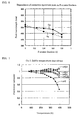
- ZnSe phosphors demonstrate emission that is convenient in terms of synthesizing white light of a color temperature of choice, but the wavelength of the excitation beam is restricted to 485 nm or thereabouts, and in that wavelength band the emission efficiency of an InGaN LED ends up being rather low. Consequently, the combination of wavelengths from YAG and ZnSe phosphors is not necessarily optimal. Moreover, the temperature behavior of ZnSe phosphor was assayed, which indicated, as shown in Fig. 1, that the temperature characteristics of ZnSe phosphor are not necessarily the best.
- ZnSe phosphor already exhibits remarkable temperature quenching, and not only is the efficiency not high, according as the LED temperature changes the proportions of blue and yellow light change, which ends up altering the hue (color temperature, etc.) of the white.
- ZnS phosphors are similar phosphors in which only the Se and S are interchanged.
- ZnS on account of its wider band gap than that of ZnSe, excitation light from violet to ultraviolet would be necessary in order to propose ZnS luminophors. Consequently, ZnS is not usable in white LEDs of the blue-light-excitation type.
- ZnS phosphors have superlative temperature characteristics, and thus are widely used as phosphors for electron-beam excitation such as in television cathode-ray tubes. In light of these considerations, as represented in Fig.
- ZnSe phosphors and “ZnS phosphors” have been referred to, in order for ZnSe and ZnS to operate as phosphors, it is necessary to disperse activators and coactivators into the parent material (in this case ZnSe and ZnS).
- activators for ZnS luminophors the Group Ib elements Ag, Cu and Au are known.
- coactivators the Group VIIa elements F, Cl, Br and I, as well as the Group IIIa elements Al, In and Ga are known.
- the phosphor emission behavior does not change much no matter what element is used.
- activators As far as activators are concerned, it is known that the fluorescent wavelength shortens when Ag is used, and lengthens when Cu or Au is used. There is no major difference between Cu and Au. Given these considerations, activators and coactivators were introduced into ZnS x Se 1-x of a variety of S atomic fractions ( x ) to prepare phosphors, and their excitation-emission properties and temperature characteristics were investigated to find out whether they could be exploited in fabricating white LEDs.
- ZnSSe into which iodine was incorporated by the iodine transport method was composed.
- ZnSSe phosphors were prepared by diffusing Cu or Ag into the ZnSSe within a Zn atmosphere. The results are set forth in the following.
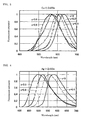
- the S atomic fraction is enlarged the peak in the excitation spectrum is shortened in wavelength.
- a measurement was not made on a phosphor in which the S atomic fraction is 1 ⁇ that is, on ZnS ⁇ extrapolating from the data in Fig. 6, it may be inferred that up until the S atomic fraction is about 0.9, the phosphor may be stimulated with visible rather than ultraviolet light.
- the foregoing phosphors may also be employed as the green phosphor and red phosphor for a white LED of the RGB type.
- ZnS x Se 1-x (0.7 ⁇ x ⁇ 0.9) may be utilized for the green phosphor.
- ZnS x Se 1-x 0.5 ⁇ x ⁇ 0.8
- ZnSSe phosphors may be used for both the red phosphor and the green phosphor, or for one or the other a different phosphor may equally well be used.
- red LED may be employed instead of a red phosphor.
- a problem in that case, however, is that since the deterioration rates of blue LEDs and red LEDs are different, the hue of the white will end up varying over time. All told, it would seem that combining slow-to-deteriorate phosphors would be advantageous over blue LEDs as an optical excitation source.
- activators were dispersed into the foregoing phosphors within a Zn atmosphere, they may equally well be dispersed within for example an Se atmosphere. Nevertheless, empirically there is a likelihood that the fluorescing efficiency of phosphors into which activators have been dispersed within an Se atmosphere will turn out low.
- ZnSSe phosphors include, to name examples, the fact that the source materials are modestly priced and that clumplike rather than powdered phosphors can easily be synthesized. Routinely, phosphors have been rendered into powder form, and have been spread onto a glass substrate or have been dispersed into a synthetic polymer. With ZnSSe phosphors, nevertheless, the phosphors can be employed in clump form without making them into a powder, eliminating cost problems.
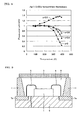
- FIG. 9 a view illustrating the configuration of a white-light emitting device in Embodiment 1 of the present invention.
- a blue LED 1 is attached to a mounting portion 9 of a lead frame so that their like surfaces are matched. Through wires 5 out of external electrodes 7a, 7b, electric current is conducted into (not-illustrated) chip electrodes on the blue LED 1.
- a heat-dissipating member 11 made of aluminum is disposed encompassing the blue LED.
- a transparent polymer 6 into which a diffusant is dispersed is disposed covering the blue LED, and a phosphor plate 3 is arranged atop the transparent polymer 6.
- the phosphor 3 is established from ZnS x Se 1-x of S atomic fraction x , and an activator, and is adjusted so as to lead to white light of a predetermined color temperature. Adjusting the composition of and the activator in the phosphor ZnS x Se 1-x to attain white light of a predetermined color temperature is an important element of the present invention. Furthermore, what with the specific weights for adjustment being small and the breadth of the adjustment being limited, in some cases the emission spectrum of the blue LED is also an object of adjustment.
- the blue LED into which current has been fed through the external electrodes 7a, 7b emits light of a blue color, shining the light onto the phosphor 3.
- the light irradiated from the blue LED 1 is shone onto the phosphor plate 3, and this fluorescent emission material is stimulated to give off fluorescence.
- the rays irradiated from the blue LED 3 illuminate the phosphor plate 3, this does not mean that all are utilized in excitation; some pass through the phosphor plate 3 without contributing to excitation. Consequently, fluorescence of a predetermined wavelength and blue light emitted from the blue LED are combined to create white light of a predetermined color temperature.
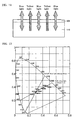
- Fig. 10 a view representing a white-light emitting device in Embodiment 2 of the present invention.
- the first phosphor 3 is a green phosphor, and is formed for example by a ZnSSe plate (ZnS atomic fraction 0.6).
- the second phosphor 13 is a red phosphor, and is formed for example by ZnSSe crystal (ZnS atomic fraction: 0.25).
- An RGB-type of white-light emitting device can be configured by the blue LED 1, and the foregoing red phosphor 13 and green phosphor 3.
- the white-light emitting device depicted in Fig. 9 was prepared.
- a ZnSSe crystal was grown using the iodine transport method and subsequently underwent heat treatment within a 1000°C atmosphere in which Zn and Cu vapors were mixed, whereby a ZnS 0.6 Se 0.4 crystal of predetermined composition (ZnS atomic fraction 0.6) was prepared.
- This phosphor corresponds to the rhombic mark for ZnS atomic fraction 0.6 nearby wavelength 570 nm on the chromaticity diagram, and is a yellow-light emitting phosphor.
- a ZnSSe plate of 250 microns thickness was cut out from the ZnS 0.6 Se 0.4 crystal. Both sides of the ZnSSe plate were polished to a mirror-like finish, bringing the thickness down to 200 ⁇ m, and the polished plate was sliced into a 3 mm square to produce a ZnS 0.6 Se 0.4 phosphor plate.
- a blue LED chip of 450 nm emission wavelength, having an InGaN active layer, was readied.
- An Ag paste was employed to bond the LED chip onto a chip die (lead-frame mounting portion) 9, as shown in Fig. 9, made of Al.
- the LED-chip electrodes and the chip-die electrodes were wire-bonded with Au wire.
- a white-light emitting device was fabricated. Current was passed into the white-light emitting device to cause it to emit light, giving rise to blue light issuing from the LED and yellow fluorescence sent forth by excitation via the blue light, whereby emission of white light of 5000 K color temperature could be produced.
- the white-light emitting device depicted in Fig. 10 was prepared.
- a ZnSSe plate of 250 microns thickness was cut out from a ZnS 0.6 Se 0.4 crystal (ZnS atomic fraction 0.6) at first being grown using the iodine transport method, and subsequently undergoing heat treatment within a 1000°C atmosphere in which Zn and Ag vapors were mixed.
- This phosphor corresponds to the black-dot mark for ZnS atomic fraction 0.6 on the chromaticity diagram, and is a green-light emitting phosphor.
- Both sides of the ZnSSe plate were polished to a mirror-like finish, bringing the thickness down to 200 microns, and the polished plate was sliced into a 3 mm square to produce a ZnSSe phosphor plate (green phosphor: first phosphor).
- a 400-micron square, 250-micron thick ZnS 0.25 Se 0.75 phosphor plate (red phosphor: second phosphor) was prepared from a ZnS 0.25 Se 0.75 crystal (ZnS atomic fraction 0.25) that was grown using the iodine transport method and subsequently underwent heat treatment within a 1000°C atmosphere in which Zn and Cu vapors were mixed.
- This phosphor corresponds to the rhombic mark for ZnS atomic fraction 0.25 on the chromaticity diagram and is a red-light emitting phosphor.
- a blue LED chip of 450 nm emission wavelength, having an InGaN active layer, was readied.
- An Ag paste was employed to bond the LED chip onto the chip die (mounting portion of a lead frame) 9, as shown in Fig. 10, made of Al, and further the LED-chip electrodes and the chip-die electrodes were wire-bonded with Au wire.
- the second phosphor was also bonded to the chip die.
- a white-light emitting device of the present invention by utilizing fluorescing materials such as phosphors, makes it possible stably to produce, with good efficiency and without altering of hue relative to changes in temperature, white light of a color temperature of choice, and therefore is expected to find wide-ranging uses in commercial applications and industrial applications in which great importance is attached to hue.
Landscapes
- Chemical & Material Sciences (AREA)
- Engineering & Computer Science (AREA)
- Materials Engineering (AREA)
- Organic Chemistry (AREA)
- Crystallography & Structural Chemistry (AREA)
- Metallurgy (AREA)
- Inorganic Chemistry (AREA)
- Luminescent Compositions (AREA)
- Led Device Packages (AREA)
- Led Devices (AREA)
Applications Claiming Priority (2)
| Application Number | Priority Date | Filing Date | Title |
|---|---|---|---|
| JP2003303210 | 2003-08-27 | ||
| JP2003303210A JP2005072479A (ja) | 2003-08-27 | 2003-08-27 | 白色発光素子、蛍光体およびその製造方法 |
Publications (1)
| Publication Number | Publication Date |
|---|---|
| EP1511089A2 true EP1511089A2 (de) | 2005-03-02 |
Family
ID=34101200
Family Applications (1)
| Application Number | Title | Priority Date | Filing Date |
|---|---|---|---|
| EP04019511A Pending EP1511089A2 (de) | 2003-08-27 | 2004-08-17 | Weiss-Licht emittierende Diode, Phosphor und Phosphor-Herstellungsverfahren. |
Country Status (7)
| Country | Link |
|---|---|
| US (2) | US20050046334A1 (de) |
| EP (1) | EP1511089A2 (de) |
| JP (1) | JP2005072479A (de) |
| KR (1) | KR20050022361A (de) |
| CN (1) | CN1591919A (de) |
| CA (1) | CA2475289A1 (de) |
| TW (1) | TW200509419A (de) |
Cited By (1)
| Publication number | Priority date | Publication date | Assignee | Title |
|---|---|---|---|---|
| GB2410833A (en) * | 2004-01-21 | 2005-08-10 | Agilent Technologies Inc | Device and method for emitting light |
Families Citing this family (20)
| Publication number | Priority date | Publication date | Assignee | Title |
|---|---|---|---|---|
| CN100508227C (zh) * | 2005-03-18 | 2009-07-01 | 三菱化学株式会社 | 发光装置、白光发光装置、照明装置及图像显示装置 |
| EP1865564B1 (de) | 2005-03-18 | 2014-11-19 | Mitsubishi Chemical Corporation | Licht emittierendes bauelement, weisses licht emittierendes bauelement, illuminator und bildanzeige |
| KR101142519B1 (ko) * | 2005-03-31 | 2012-05-08 | 서울반도체 주식회사 | 적색 형광체 및 녹색 형광체를 갖는 백색 발광다이오드를채택한 백라이트 패널 |
| EP1715521B1 (de) * | 2005-04-21 | 2012-02-22 | C.R.F. Società Consortile per Azioni | Anwendung einer transparenten Leuchtdiodenanzeigevorrichtung in einem Kraftfahrzeug |
| TWI323947B (en) * | 2005-05-24 | 2010-04-21 | Seoul Semiconductor Co Ltd | Light emitting device and phosphor of alkaline earth sulfide therefor |
| CN100365837C (zh) * | 2005-06-13 | 2008-01-30 | 北京有色金属研究总院 | 一种发光装置及其制造方法 |
| KR100601200B1 (ko) * | 2005-06-17 | 2006-07-13 | 서울반도체 주식회사 | 적색 형광체와 이를 이용한 발광 다이오드 |
| US20070007542A1 (en) * | 2005-07-07 | 2007-01-11 | Sumitomo Electric Industries,Ltd. | White-Light Emitting Device |
| KR100724591B1 (ko) * | 2005-09-30 | 2007-06-04 | 서울반도체 주식회사 | 발광 소자 및 이를 포함한 led 백라이트 |
| KR100735453B1 (ko) | 2006-02-22 | 2007-07-04 | 삼성전기주식회사 | 백색 발광 장치 |
| WO2007105845A1 (en) * | 2006-03-16 | 2007-09-20 | Seoul Semiconductor Co., Ltd. | Fluorescent material and light emitting diode using the same |
| WO2009099250A1 (ja) * | 2008-02-06 | 2009-08-13 | National University Corporation Kumamoto University | Ii-vi族化合物半導体の製造方法、ii-vi族化合物半導体蛍光体の製造方法、および六方晶ii-vi族化合物半導体 |
| TW200949896A (en) * | 2008-05-27 | 2009-12-01 | Tatung Co | A device with electron beam excitation for making white light source |
| JP2009289961A (ja) * | 2008-05-29 | 2009-12-10 | Wade Lee Wang | 紫ledによる白光の製造方法 |
| JP2010092705A (ja) | 2008-10-08 | 2010-04-22 | Sony Corp | 照明装置及びこれを用いた表示装置 |
| US9082349B2 (en) * | 2011-08-30 | 2015-07-14 | Sharp Laboratories Of America, Inc. | Multi-primary display with active backlight |
| US10125971B2 (en) * | 2013-02-19 | 2018-11-13 | Michael Graziano | LED lamp integrated to electric fan |
| JP7561481B2 (ja) * | 2018-02-05 | 2024-10-04 | 日本電気硝子株式会社 | 蛍光体ガラス薄板の個片の製造方法 |
| US10371325B1 (en) | 2018-06-25 | 2019-08-06 | Intematix Corporation | Full spectrum white light emitting devices |
| US11887973B2 (en) | 2019-07-09 | 2024-01-30 | Intematix Corporation | Full spectrum white light emitting devices |
Family Cites Families (6)
| Publication number | Priority date | Publication date | Assignee | Title |
|---|---|---|---|---|
| US2623858A (en) * | 1949-01-14 | 1952-12-30 | Hartford Nat Bank & Trust Co | Zinc sulfide phosphors containing aluminum |
| US2948635A (en) * | 1959-01-12 | 1960-08-09 | Gen Electric | Phosphor evaporation method and apparatus |
| JP3940596B2 (ja) * | 2001-05-24 | 2007-07-04 | 松下電器産業株式会社 | 照明光源 |
| US6987353B2 (en) * | 2003-08-02 | 2006-01-17 | Phosphortech Corporation | Light emitting device having sulfoselenide fluorescent phosphor |
| US7488990B2 (en) * | 2004-04-02 | 2009-02-10 | Avago Technologies Ecbu Ip (Singapore) Pte. Ltd. | Using multiple types of phosphor in combination with a light emitting device |
| US20060006397A1 (en) * | 2004-07-09 | 2006-01-12 | Chua Janet B Y | Device and method for emitting output light using group IIA/IIB selenide sulfur-based phosphor material |
-
2003
- 2003-08-27 JP JP2003303210A patent/JP2005072479A/ja active Pending
-
2004
- 2004-07-16 CA CA002475289A patent/CA2475289A1/en not_active Abandoned
- 2004-07-20 TW TW093121659A patent/TW200509419A/zh unknown
- 2004-07-23 CN CNA2004100713838A patent/CN1591919A/zh active Pending
- 2004-08-17 EP EP04019511A patent/EP1511089A2/de active Pending
- 2004-08-20 US US10/711,063 patent/US20050046334A1/en not_active Abandoned
- 2004-08-24 KR KR1020040066705A patent/KR20050022361A/ko not_active Withdrawn
-
2007
- 2007-04-27 US US11/740,948 patent/US20070194282A1/en not_active Abandoned
Cited By (1)
| Publication number | Priority date | Publication date | Assignee | Title |
|---|---|---|---|---|
| GB2410833A (en) * | 2004-01-21 | 2005-08-10 | Agilent Technologies Inc | Device and method for emitting light |
Also Published As
| Publication number | Publication date |
|---|---|
| JP2005072479A (ja) | 2005-03-17 |
| KR20050022361A (ko) | 2005-03-07 |
| US20070194282A1 (en) | 2007-08-23 |
| US20050046334A1 (en) | 2005-03-03 |
| TW200509419A (en) | 2005-03-01 |
| CA2475289A1 (en) | 2005-02-27 |
| CN1591919A (zh) | 2005-03-09 |
Similar Documents
| Publication | Publication Date | Title |
|---|---|---|
| US20070194282A1 (en) | White-Light Emitting Device, and Phosphor and Method of Its Manufacture | |
| EP1339109B1 (de) | Licht emittierende Vorrichtung mit Rot-Mangel kompensierendem Leuchtstoff | |
| JP5005712B2 (ja) | 発光装置 | |
| US20070090381A1 (en) | Semiconductor light emitting device | |
| US7026755B2 (en) | Deep red phosphor for general illumination applications | |
| TWI394818B (zh) | 包含缺色補償發光材料的發光系統 | |
| US11320100B2 (en) | Crisp white tuning | |
| JP2008140704A (ja) | Ledバックライト | |
| US20050156510A1 (en) | Device and method for emitting output light using group IIB element selenide-based and group IIA element gallium sulfide-based phosphor materials | |
| JP2012191225A (ja) | 発光装置 | |
| JP7454785B2 (ja) | 蛍光体およびそれを使用した発光装置 | |
| US20050242360A1 (en) | White light apparatus with adjustable color temperature and method of producing white light thereof | |
| CN101271939B (zh) | 具有开回路控制的发光装置及其制造方法 | |
| TWI412784B (zh) | Led光源裝置及其出光方法 | |
| KR100902988B1 (ko) | 백색광 발광 다이오드의 제조 방법 | |
| JP2005079500A (ja) | 白色光発光装置 | |
| CN105793391A (zh) | 发光材料混合物、具有发光材料混合物的发光半导体器件和具有发光材料混合物的路灯 | |
| JP2014150293A (ja) | 発光装置 | |
| CN1464568A (zh) | 一种白光发光二极管的制造方法 | |
| JP2018053202A (ja) | 量子ドット蛍光体及びそれを用いた発光装置 | |
| JP2008074890A (ja) | 発光モジュール | |
| KR20150045650A (ko) | 녹색 발광 형광체, 그 제조 방법 및 이를 이용한 발광 소자 패키지 | |
| KR102372071B1 (ko) | 시안색 인광체 변환 led 모듈 | |
| JP2007277277A (ja) | 蛍光体混合物、発光装置、画像表示装置、及び照明装置 | |
| JP4219621B2 (ja) | 白色光発光ダイオードの製造方法 |
Legal Events
| Date | Code | Title | Description |
|---|---|---|---|
| PUAI | Public reference made under article 153(3) epc to a published international application that has entered the european phase |
Free format text: ORIGINAL CODE: 0009012 |
|
| AK | Designated contracting states |
Kind code of ref document: A2 Designated state(s): AT BE BG CH CY CZ DE DK EE ES FI FR GB GR HU IE IT LI LU MC NL PL PT RO SE SI SK TR |
|
| AX | Request for extension of the european patent |
Extension state: AL HR LT LV MK |
|
| STAA | Information on the status of an ep patent application or granted ep patent |
Free format text: STATUS: THE APPLICATION IS DEEMED TO BE WITHDRAWN |