EP1510805A1 - Method and apparatus for diagnosing residual life of rolling element bearing - Google Patents
Method and apparatus for diagnosing residual life of rolling element bearing Download PDFInfo
- Publication number
- EP1510805A1 EP1510805A1 EP03733110A EP03733110A EP1510805A1 EP 1510805 A1 EP1510805 A1 EP 1510805A1 EP 03733110 A EP03733110 A EP 03733110A EP 03733110 A EP03733110 A EP 03733110A EP 1510805 A1 EP1510805 A1 EP 1510805A1
- Authority
- EP
- European Patent Office
- Prior art keywords
- service life
- rolling bearings
- residual service
- vibration
- wear particle
- Prior art date
- Legal status (The legal status is an assumption and is not a legal conclusion. Google has not performed a legal analysis and makes no representation as to the accuracy of the status listed.)
- Withdrawn
Links
Images






Classifications
-
- G—PHYSICS
- G01—MEASURING; TESTING
- G01M—TESTING STATIC OR DYNAMIC BALANCE OF MACHINES OR STRUCTURES; TESTING OF STRUCTURES OR APPARATUS, NOT OTHERWISE PROVIDED FOR
- G01M13/00—Testing of machine parts
- G01M13/04—Bearings
-
- G—PHYSICS
- G01—MEASURING; TESTING
- G01M—TESTING STATIC OR DYNAMIC BALANCE OF MACHINES OR STRUCTURES; TESTING OF STRUCTURES OR APPARATUS, NOT OTHERWISE PROVIDED FOR
- G01M13/00—Testing of machine parts
- G01M13/04—Bearings
- G01M13/045—Acoustic or vibration analysis
-
- F—MECHANICAL ENGINEERING; LIGHTING; HEATING; WEAPONS; BLASTING
- F04—POSITIVE - DISPLACEMENT MACHINES FOR LIQUIDS; PUMPS FOR LIQUIDS OR ELASTIC FLUIDS
- F04D—NON-POSITIVE-DISPLACEMENT PUMPS
- F04D29/00—Details, component parts, or accessories
- F04D29/04—Shafts or bearings, or assemblies thereof
-
- G—PHYSICS
- G01—MEASURING; TESTING
- G01H—MEASUREMENT OF MECHANICAL VIBRATIONS OR ULTRASONIC, SONIC OR INFRASONIC WAVES
- G01H1/00—Measuring characteristics of vibrations in solids by using direct conduction to the detector
- G01H1/003—Measuring characteristics of vibrations in solids by using direct conduction to the detector of rotating machines
-
- G—PHYSICS
- G01—MEASURING; TESTING
- G01H—MEASUREMENT OF MECHANICAL VIBRATIONS OR ULTRASONIC, SONIC OR INFRASONIC WAVES
- G01H13/00—Measuring resonant frequency
-
- G—PHYSICS
- G01—MEASURING; TESTING
- G01H—MEASUREMENT OF MECHANICAL VIBRATIONS OR ULTRASONIC, SONIC OR INFRASONIC WAVES
- G01H17/00—Measuring mechanical vibrations or ultrasonic, sonic or infrasonic waves, not provided for in the other groups of this subclass
-
- G—PHYSICS
- G01—MEASURING; TESTING
- G01M—TESTING STATIC OR DYNAMIC BALANCE OF MACHINES OR STRUCTURES; TESTING OF STRUCTURES OR APPARATUS, NOT OTHERWISE PROVIDED FOR
- G01M99/00—Subject matter not provided for in other groups of this subclass
- G01M99/008—Subject matter not provided for in other groups of this subclass by doing functionality tests
Definitions
- the present invention is related to a method of predicting residual service life for rolling bearings and a device for predicting residual service life for rolling bearings that estimates the remaining service life of rolling bearings residing on mechanical rotating devices such as pumps and fans.
- Rolling bearings in large numbers are found being used in the rotating components of a wide variety of machineries, and when these rolling bearings fail to work properly, various inconveniences can result, such as interruption in operation of the machinery.
- rolling bearings provide superb performance, and have, when used under proper conditions, long service lives, which last until repeated stress causes spalling.
- service life varies not only according to usage conditions and environment; it can even vary within identical machinery and bearings.
- the most common prediction methods used are those that utilize predictions of the rate of increase in bearing vibration readings. These methods predict the rate of increase in vibration acceleration of bearings through the use of linear, quadratic and exponential curves, and calculate the time until the vibration readings reach a preset activation barrier.
- the Shock Pulse Method is a method of prediction that utilizes shock pulses (intense compression waves) to discover rolling bearing defects in the early stages and to predict lubricant degradation levels.
- shock pulses intense compression waves
- the rolling element (or roller) and the bearing ring of a rolling bearing come into direct contact, unique vibrations occur, and large amounts of stress focalize under the surface of the material, creating pressure waves in the material. If the contact surface has an irregular dispersion of asperities, large numbers of irregular pressure waves are created at the moment of contact.
- Each of these pressure waves is called an intense compression wave (or shock pulse), and dissipates as they propagate in the form of ultrasonic waves, from the point of contact throughout the rest of the bearing and the inside of the bearing housing.
- shock pulse activity predictions are made regarding the thickness of the lubricant film in the bearing and the degree to which the bearing has been damaged, enabling prediction of lubricant degradation levels and allowing the determination of appropriate intervals between lubricant supplementations.
- the AE Method is a method of predicting residual service life that utilizes AE signals in a frequency higher than the acceleration to discover early-stage rolling bearing defects.
- the AE Method is a method of prediction that uses AE signals, which are created when built-up strain energy is released in the form of sound as solid objects undergo changes in shape or physical breakdown. These AE signals, which are transmissions of elastic waves, are released when elastic energy is released from inside a material, not necessarily only during physical breakdown, but also when dislocation or transformation of crystal structures in a material occurs.
- the AE signals are processed while the rolling bearing is in operation through the use of an AE sensor, and, by observing how often AE waves occur, predictions can be made regarding the rolling bearing.
- the most common kinds of statistical prediction for vibration acceleration utilize, as a parameter, readings of vibrations until fulfillment of the predicted service life, and carry out curvilinear regression using quadratic and exponential curves so as to define residual service life as the period until vibration readings reach some activation barrier.
- the frequency of shock pulses can be used to predict lubricant degradation levels, enabling the determination of appropriate intervals for lubricant supplementation.
- the AE Method predicts residual service life in the same way as statistical predictions that use vibration acceleration.
- the said traditional AE Method can predict residual service life at an earlier stage than the said statistical methods using vibration acceleration, the AE (Acoustic Emission) sensor and the signal processing circuit that are used for predictions are cost-prohibitive; in addition, AE waves are very faint, making the method prone to noise interference.
- the object of the present invention is to provide a method of predicting residual service life for rolling bearings and a device for predicting residual service life for rolling bearings that can, in a cost-effective manner, utilize signals in resonant frequency bands or signals in high frequency bands obtained via an accelerometer in order to detect wear particle penetration in the lubricant, as well as lubricant degradation, both of which greatly affect rolling bearing service life, and that can in the early stages, using the wear particle penetration and lubricant degradation as a basis, accurately estimate service life for rolling bearings.
- the present invention provides a method of predicting residual service life for rolling bearings being comprised of the following: a means of obtaining fundamental data that uses a testing device to obtain data regarding the relationship, for rolling bearings (3), of wear particle penetration levels to vibration levels and service life, and to obtain data regarding the relationship, for rolling bearings (3), of lubricant degradation levels to vibration levels and service life; a means of measurement, where an accelerometer (4) is used to obtain vibration signals of diagnostic rolling bearings (3) residing on mechanical rotating devices (1, 2), such as pumps and fans, for the purpose of measuring signals in resonant frequency bands only detectable at extremely high levels of sensitivity or vibration acceleration signals in high frequency bands; and a means of prediction that uses readings obtained via said means of measurement and data obtained via said means of obtaining fundamental data to predict, for said diagnostic rolling bearings (3), wear particle penetration levels and lubricant degradation levels, and to calculate residual service life for said diagnostic rolling bearings (3).
- Said means of obtaining fundamental data involves affecting indentations upon the rolling contact surfaces of said rolling bearings (3) in order to simulate wear particle penetration, for the purpose of quantifying the relationship of wear particle penetration to bearing vibration and service life.
- An alternate method for simulating wear particle penetration involves introducing a foreign substance into the lubricant of said rolling bearings (3) and changing the volume, size, viscosity or elasticity of the substance, for the purpose of quantifying the relationship of wear particle penetration to bearing vibration and service life.
- the volume of lubricant in said rolling bearings (3) is reduced, for the purpose of quantifying the relationship of lubricant degradation to bearing vibration and service life.
- Alternate methods for simulating lubricant degradation include affecting oxidative degradation upon lubricant in rolling bearings (3), and introducing water into lubricant existent in said rolling bearings (3), for the purpose of quantifying the relationship of lubricant degradation to bearing vibration and service life.
- vibration signals from an accelerometer (4) in resonant frequency bands only detectable at extremely high levels of sensitivity are used to quantify the relationship of wear particle penetration to vibration and service life.
- vibration signals from an accelerometer (4) in high frequency bands are used to quantify the relationship of wear particle penetration to vibration and service life.
- vibration signals from an accelerometer (4) in resonant frequency bands only detectable at extremely high levels of sensitivity are utilized to quantify the relationship of lubricant degradation to vibration and service life.
- vibration signals from an accelerometer (4) in high frequency bands are utilized to quantify the relationship of lubricant degradation to vibration and service life.
- Said means of measurement utilizes vibration signals from an accelerometer (4) in resonant frequency bands only detectable at extremely high levels of sensitivity to measure wear particle penetration, the density of wear particle indentations, and further, the size of wear particle indentations.
- said means of measurement utilizes vibration signals from an accelerometer (4) in high frequency bands to measure wear particle penetration, the density of wear particle indentations, and further, the size of wear particle indentations.
- Said means of measurement utilizes vibration signals from an accelerometer (4) in resonant frequency bands only detectable at extremely high levels of sensitivity to measure lubricant degradation.
- said means of measurement utilizes vibration signals from an accelerometer (4) in high frequency bands to measure lubricant degradation.
- Said means of prediction utilizes vibration signals from an accelerometer (4) in resonant frequency bands only detectable at extremely high levels of sensitivity to estimate wear particle penetration, the density of wear particle indentations, and further, the size of wear particle indentations, as well as to do calculations regarding residual service life.
- said means of prediction utilizes vibration signals from an accelerometer (4) in high frequency bands to estimate wear particle penetration, the density of wear particle indentations, and further, the size of wear particle indentations, as well as to do calculations regarding residual service life.
- vibration signals from an accelerometer (4) in resonant frequency bands only detectable at extremely high levels of sensitivity and vibration signals from an accelerometer (4) in high frequency bands are used to make estimates regarding lubricant degradation levels and calculations regarding residual service life.
- Said means of prediction utilizes data obtained via said means of measurement and pre-measured vibration data of diagnostic rolling bearings (3) in a state of normal fatigue to, by calculating the rate of increase of vibration signals in low frequency bands of vibration acceleration, judge whether said diagnostic rolling bearings (3) are in the stage of first signs of fatigue or in the stage of total fatigue failure.
- Said means of prediction utilizes signals from an accelerometer (4) in resonant or high frequency bands of diagnostic rolling bearings (3) obtained via said means of measurement, and pre-measured vibration data of diagnostic rolling bearings (3) in a state of normal fatigue to judge whether said diagnostic rolling bearings (3) are undergoing a process of normal fatigue, a process of wear particle penetration, or a process of lubricant degradation.
- said diagnostic rolling bearings (3) have been judged to be in a state of normal fatigue, meaning there has been no wear particle penetration or lubricant degradation, the rating life is calculated, and the residual service life is defined as the rating life. Further, if it has been judged that said diagnostic rolling bearings (3) have undergone wear particle penetration and are in the stage of first signs of fatigue, vibration data obtained during said means of obtaining fundamental data is utilized to estimate the size of the penetrating wear particles and to calculate residual service life.
- vibration data obtained during said means of obtaining fundamental data is utilized to estimate said lubricant's degradation levels and to calculate residual service life.
- an accelerometer (4) is utilized to obtain vibration signals from diagnostic rolling bearings (3), used to make predictions of residual service life, that reside on mechanical rotating devices (1, 2), for the purpose of measuring signals in resonant frequency bands only detectable at extremely high levels of sensitivity or signals in high frequency bands.
- the means of prediction utilizes readings obtained via said means of measurement and data obtained via said means of obtaining fundamental data, as well as pre-measured vibration data of diagnostic rolling bearings (3) in a state of normal fatigue, related to bearing load, rolling speed, operating time and rolling bearing designation to estimate, for said diagnostic rolling bearings (3), wear particle penetration levels and lubricant degradation levels, and to calculate, for said diagnostic rolling bearings (3), residual service life.
- the means of prediction utilizes the rate of increase in vibration to judge whether said diagnostic rolling bearings (3) are in the stage of first signs of fatigue or in the stage of total fatigue failure.
- prediction is further carried out as follows: first, data obtained via said means of measurement from an accelerometer (4), related to vibration signals from diagnostic rolling bearings (3) in resonant frequency bands or high frequency bands, as well as pre-measured vibration data from diagnostic rolling bearings (3) in a state of normal fatigue, is utilized to judge whether said diagnostic rolling bearings (3) are undergoing a process of normal fatigue, are undergoing a process of wear particle penetration, or whether lubricant is undergoing a process of degradation.
- diagnostic rolling bearings (3) are judged to be in the stage of first signs of fatigue, but are still in a state of normal fatigue, meaning there is no wear particle penetration and no lubricant degradation, the rating life is calculated, and the residual service life is defined as the rating life. Subsequently, if it is judged that diagnostic rolling bearings (3) have undergone wear particle penetration and are in the stage of first signs of fatigue, vibration data obtained during said means of obtaining fundamental data is utilized to estimate the size of penetrating wear particles and to calculate the residual service life.
- vibration data obtained during said means of obtaining fundamental data is utilized to estimate said lubricant's degradation levels and to calculate residual service life.
- the residual service life is calculated, using as a basis the said rate of increase in low frequency bands of vibration acceleration.
- the method of prediction for the present invention not only predicts the rate of increase in vibration, but it also utilizes measurements of the interval between initial wear particle penetration and a rapid increase in acceleration or the interval between initial lubricant degradation and a rapid increase in acceleration to calculate residual service life more precisely.
- the present invention accordingly, regularizes replacement cycles, enabling more efficient maintenance of mechanical rotating devices (1, 2), because the residual service life of rolling bearings (3) residing on a mechanical rotating device (1, 2) can be predicted while the device is in operation. For instance, a schedule can be easily implemented to replace rolling bearings (3) residing on mechanical rotating devices (1, 2) in power plants in autumn, instead of summer, where operating rates are higher, enabling more efficient maintenance.
- the present invention makes it possible to predict residual service life earlier, meaning the interval between regular inspections can be extended, and data related to the degradation of rolling bearings can be made more readily available; thus, a more efficient system of maintenance can be anticipated when moving from a traditional system of regularly scheduled inspections to a maintenance system based on the specific condition of each machine.
- the device for predicting residual service life for rolling bearings (3) for the present invention includes, the following: an accelerometer (4) that measures vibration signals from diagnostic rolling bearings (3) to predict residual service life; an analogue/digital converter (5) that converts data obtained via said accelerometer (4); a quantitative feature extraction device (6) that extracts vibration signals converted by said analogue/digital converter (5) from vibration signals in resonant frequency bands only detectable at extremely high levels of sensitivity or signals in high frequency bands; a database of resulting measurements (7) that has saved in it fundamental data, including the relationship, for rolling bearings (3), of wear particle penetration levels to vibration and bearing service life, the relationship of lubricant degradation to vibration and bearing service life, has saved in it vibration data of diagnostic rolling bearings (3) residing on mechanical rotating devices (1, 2), such as pumps and fans, obtained when said diagnostic rolling bearings (3) are in a state of normal fatigue, and has saved in it data related to bearing load, rolling speed, operating time and rolling bearing designation; a device for predicting residual service life (8) that, utilizing data stored
- the device for predicting residual service life as comprised above uses signals from an accelerometer (4) in resonant frequencies or high frequencies to detect, in a cost-effective manner, lubricant penetration by wear particles and lubricant degradation, and in the early stages accurately estimates rolling bearing (3) service life, using as a basis the measured wear particle penetration levels and lubricant degradation levels.
- an output device for inspection schedules and diagnostic reports (10) that outputs schedules for ensuing inspection times and diagnostic results reports for said diagnostic rolling bearings (3), using as a basis diagnostic results from said device for predicting residual service life (8).
- the output device for inspection schedules and diagnostic reports (10) can be a printer (12) or monitor.
- the present invention accordingly, regularizes replacement cycles and extends replacement intervals through use of the output device for inspection schedules and diagnostic reports (10), enabling more efficient maintenance of mechanical rotating devices (1, 2), because the residual service life of rolling bearings (3) residing on a mechanical rotating device (1, 2) can be predicted while the device is in operation. For instance, a schedule can be easily implemented to replace rolling bearings (3) residing on mechanical rotating devices (1, 2) in power plants in autumn, instead of summer, where operating rates are higher.
- the present invention makes it possible to predict residual service life earlier, meaning the interval between regular inspections can be extended, and data related to the degradation of rolling bearings can be made more readily available; thus, a more efficient system of maintenance can be anticipated when moving from a traditional system of regularly scheduled inspections to a maintenance system based on the specific condition of each machine.
- a data transmission modem (11) that connects said waveform data and diagnostic results to the Internet network is further included.
- Using said data transmission modem (11) enables acquisition of simply vibration data alone from a remote location, and prediction of residual service life for rolling bearings (3) located in a fixed location can be accomplished from remote locations, further simplifying management of diagnostic results.
- Fig. 1 is a block diagram illustrating the method of predicting residual service life for rolling bearings for the present invention.
- Fig. 2 is a cross-sectional example of the rolling bearings that reside on electric machinery or mechanical rotating devices, and that are the object of the predictions for the method of predicting residual service life.
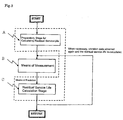
- Fig. 3 is a flow chart illustrating the method of predicting residual service life for rolling bearings.
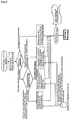
- Fig. 4 is a flow chart illustrating Step A (the preparatory stage for calculating residual service life used for the means of prediction) of the flow chart shown in Fig. 3.
- Fig. 5 is a flow chart illustrating Step B (the means of measurement) of the flow chart shown in Fig. 3.
- Fig. 6 is a flow chart illustrating Step C (the residual service life calculation stage used for the means of prediction) of the flow chart as shown in Fig. 3.
- the method of predicting residual service life for rolling bearings for the present invention is comprised of the following: a means of obtaining fundamental data that uses a testing device to obtain in advance data related to the relationship of wear particle penetration to vibration and service life, and the relationship of lubricant degradation to vibration and service life; a means of measurement that measures signals in resonant frequency bands or high frequency bands from diagnostic rolling bearings (3) in order to predict residual service life, where the diagnostic rolling bearings (3) reside on mechanical rotating devices (1), such as pumps and fans, and the rotational units of moving electric machinery (2), as well as other such devices; and a means of prediction that predicts residual service life for diagnostic rolling bearings (3).
- the present invention considers these types of degradation in rolling bearings (3), and, in order to predict residual service life earlier and more precisely than was traditionally possible, utilizes, as a foundation, said means of obtaining fundamental data.
- the preparatory stage for calculating residual service life and the means of measurement are carried out upon diagnostic rolling bearings (3) residing on mechanical rotating devices (1, 2), where the diagnostic rolling bearings (3) are used to make predictions of residual service life.
- data is obtained related to bearing load, rolling speed, operating time and the rolling bearing designation for diagnostic rolling bearings (3), and an accelerometer (4) is used to measure vibration data for diagnostic rolling bearings (3) in a state of normal fatigue.
- an accelerometer (4) is used to obtain vibration signals, and signals in resonant frequency bands only detectable at extremely high levels of sensitivity or signals in high frequency bands are measured.
- Data obtained via the means of obtaining fundamental data and the preparatory step for calculating residual service life is utilized to predict whether diagnostic rolling bearings (3) are in the stage of first signs of fatigue or in the stage of total fatigue failure.
- the rate of increase in vibration signals is calculated in order to judge whether the diagnostic rolling bearings (3) are in the stage of first signs of fatigue or in the stage of total fatigue failure.
- vibration signals of diagnostic rolling bearings (3) in resonant frequency bands or high frequency bands obtained during the means of measurement via an accelerometer, as well as data obtained during the preparatory stage for calculating residual service life that is related to vibration signals of diagnostic rolling bearings (3) in a state of normal fatigue are utilized to judge whether the diagnostic rolling bearing (3) is undergoing a process of normal fatigue, whether the rolling bearing (3) is undergoing a process of penetration by wear particles, or whether the lubricant is undergoing a process of degradation;
- Rating Life L 10 10 6 /60n(C/P) P
- vibration data obtained during the means of obtaining fundamental data is utilized to estimate the size of particles that have penetrated the diagnostic rolling bearings (3) and to calculate residual service life.
- vibration data obtained during the means of obtaining fundamental data is utilized to estimate lubricant degradation levels and to calculate residual service life.
- residual service life is calculated using as a basis the said rate of increase in vibration signals at low frequencies of vibration acceleration and the interval between initial wear particle penetration and total fatigue failure, or the interval between initial lubricant degradation and total fatigue failure.
- the method of prediction for the present invention includes the utilization of measurements of the interval between initial wear particle penetration and a rapid increase in vibration acceleration to calculate residual service life more precisely.
- the present invention accordingly, regularizes replacement cycles, enabling more efficient maintenance of mechanical rotating devices (1, 2), because the residual service life of rolling bearings (3) residing on a mechanical rotating device (1, 2) can be predicted while the device is in operation. For instance, a schedule can be easily implemented to replace rolling bearings (3) residing on mechanical rotating devices (1, 2) in power plants in autumn, instead of summer, where operating rates are higher.
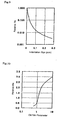
- Fig. 7 is a graph illustrating the relationship of the size of indentations for the purpose of simulating the presence of wear particles to vibration signals from an accelerometer in resonant frequency bands only detectable at extremely high levels of sensitivity.
- the present invention utilizes vibration signals from an accelerometer (4) in resonant frequency bands only detectable at extremely high levels of sensitivity to detect outbreaks of wear particle indentations during the means of obtaining fundamental data, the means of measurement, and the means of prediction.
- vibration signals from an accelerometer (4) in high frequency bands can be utilized to obtain the size of indentations.
- vibration acceleration signals in high frequency bands in the range of 20kHz to 40kHz increase dramatically, as compared to the state of normal fatigue, where indentation size is 0 ⁇ m; this shows that detection of an outbreak of indentations can be easily accomplished.
- Fig. 8 is a graph illustrating the relationship of the size of indentations created for the purpose of simulating wear particle penetration to vibration signals from an accelerometer in high frequency bands.
- vibration acceleration signals in high frequency bands in the range of 5kHz to 20kHz increase proportionally as the size of indentations increases from 0mm; this shows that measuring the size of indentations can be easily accomplished.
- Fig. 9 is a graph illustrating the effects of the outbreak of indentations on residual service life of rolling bearings.
- the service life of rolling bearings affected with indentations is much shorter than the relative life, sometimes as much as 1/100th less than the relative life.
- the cause of flaking on diagnostic rolling bearings (3) is without exception formation of indentations; it is widely acknowledged that the range of service life in this kind of situation is extremely limited.
- the means of prediction for the present invention utilizes these relationships between the size of indentations and residual service life to generate predictions.
- Fig. 10 is a graph illustrating the relationship between lubricant film pressure and residual service life.
- the means of prediction for the present invention in the same way that wear particle penetration levels are utilized to predict residual service life for rolling bearings (3), utilizes vibration signals from an accelerometer (4) in resonant frequency bands only detectable at extremely high levels of sensitivity or signals in high frequency bands in order to estimate lubricant degradation levels (the oil film parameter), and, for cases where lubricant is undergoing degradation, in order to calculate residual service life.
- Fig. 11 is a block diagram illustrating the composition of the device for predicting residual service life.
- the device for predicting residual service life for rolling bearings is comprised of an accelerometer (4), an analogue/digital converter (5), a quantitative feature extraction device (6), a database of resulting measurements (7), a device for predicting residual service life (8), a display device for predictions (9), an output device for inspection schedules and diagnostic reports (10), and a data transmission modem (11).
- the analogue/digital converter (5) converts data obtained via the accelerometer (4) related to, but not limited to, the said diagnostic rolling bearings (3) used to make predictions of residual service life.
- the quantitative feature extraction device (6) extracts vibration signals in resonant frequency bands only detectable at extremely high levels of sensitivity from the vibration signals converted by the analogue/digital converter (5).
- the database of resulting measurements (7) obtains and saves in it, in the manner previously mentioned, the following: fundamental data obtained in advance via a testing device related to the relationship of wear particle penetration to vibration and service life, and of lubricant degradation to vibration and service life; data related to bearing load, rolling speed, operating time and the rolling bearing designation of diagnostic rolling bearings (3), used to make predictions of residual service life, that reside on mechanical rotating devices (1), such as pumps and fans, and the rotational units of moving electric machinery (2), as well as other such devices; and vibration data of diagnostic rolling bearings (3) when in a state of normal fatigue.
- the device for predicting residual service life (8) utilizes data stored in the database of resulting measurements (7) to predict wear particle penetration and lubricant degradation levels for diagnostic rolling bearings (3), for the purpose of predicting residual service life, using as a basis vibration signals of diagnostic rolling bearings (3) extracted via the quantitative feature extraction device (6).
- the display device for predictions (9) displays results from the device for predicting residual service life (8).
- the output device for inspection schedules and diagnostic reports (10) outputs to devices such as printers (12) schedules for ensuing inspection times and diagnostic results reports for diagnostic rolling bearings (3), based on the results of predictions carried out by the device for predicting residual service life (8).
- the present invention utilizes predictions of residual service life for rolling bearings (3) while mechanical rotating devices (1,2) are in operation in order to enable the regularization of replacement cycles and replacement intervals, using the output device for inspection schedules and diagnostic reports (10), and resulting in more efficient maintenance of machinery.
- a schedule can be easily implemented to replace rolling bearings (3) residing on mechanical rotating devices (1, 2) in power plants in autumn, instead of summer, where operating rates are higher.
- the device for predicting residual service life as comprised above uses signals from an accelerometer (4) in resonant frequencies or high frequencies to detect, in a cost effective manner, lubricant penetration by wear particles and lubricant degradation, and accurately estimates rolling bearing service life, using as a basis the measured wear particle penetration levels and lubricant degradation levels.
- the data transmission modem (11) links the waveform data and diagnostic results to the Internet network.
- the Internet network By accessing the Internet network in this way, prediction of residual service life for rolling bearings (3) in a fixed location from a remote location becomes feasible.
- the present invention is not limited to the embodiments as described above. If the present invention is applied to a method that judges whether diagnostic rolling bearings (3) are in the stage of first signs of fatigue or in the stage of total fatigue failure, and that calculates residual service life for diagnostic rolling bearings (3), the present invention is not limited to the composition as detailed above; it will be understood that various changes may be made without departing from the scope of the invention.
- any composition that predicts residual service life is such that data related to the relationship of wear particle penetration or lubricant degradation to factors such as acceleration and indentation size is obtained in advance, and data that has been obtained related to the relationship of wear particle penetration and lubricant degradation to acceleration and service life is compared to and judged against vibration signals of diagnostic rolling bearings (3) extracted by the quantitative feature extraction device (6), for the purpose of estimating wear particle penetration and lubricant degradation and predicting residual service life for diagnostic rolling bearings (3)
- the present invention is not limited to the composition as detailed in the drawings; it will be understood that various changes may be made without departing from the scope of the invention.
- the method for predicting residual service life for the present invention utilizes signals from an accelerometer in resonant frequency bands or high frequency bands to, in a cost-effective manner, measure wear particle penetration of lubricant and lubricant degradation, both of which greatly affect prediction of residual service life for rolling bearings; and, using as a basis these measurements of wear particle penetration and lubricant degradation, the method of predicting service life for the present invention enables accurate estimation of residual service life for diagnostic rolling bearings.
- the present invention accordingly, regularizes replacement cycles and replacement intervals for rolling bearings, enabling more efficient maintenance of machinery. For instance, a schedule can be easily implemented to replace rolling bearings residing on mechanical rotating devices in power plants in autumn, instead of summer, where operating rates are higher.
- the present invention makes it possible to predict residual service life earlier, meaning the interval between regular inspections can be extended, and data related to the degradation of rolling bearings can be made more readily available; thus, a more efficient system of maintenance can be anticipated when moving from a traditional system of regularly scheduled inspections to a maintenance system based on the specific condition of each machine.
- the device for predicting residual service life for the present invention enables easy and accurate estimation of service life for rolling bearings, with excellent precision, while being compact in form; further, by accessing the Internet network, and prediction of residual service life for rolling bearings located in a fixed location from remote locations becomes feasible.
Landscapes
- Physics & Mathematics (AREA)
- General Physics & Mathematics (AREA)
- Acoustics & Sound (AREA)
- Engineering & Computer Science (AREA)
- Mechanical Engineering (AREA)
- General Engineering & Computer Science (AREA)
- Testing Of Devices, Machine Parts, Or Other Structures Thereof (AREA)
- Measurement Of Mechanical Vibrations Or Ultrasonic Waves (AREA)
- Rolling Contact Bearings (AREA)
Abstract
Description
Claims (43)
- A method of predicting residual service life for rolling bearings comprised of the following: a means of obtaining fundamental data that uses a testing device to obtain data regarding the relationship for rolling bearings (3) of wear particle penetration levels to vibration levels and service life, and to obtain data regarding the relationship, for rolling bearings (3), of lubricant degradation levels to vibration levels and service life; a means of measurement where an accelerometer (4) is used to obtain vibration signals of diagnostic rolling bearings (3) residing on mechanical rotating devices (1, 2), such as pumps and fans, for the purpose of measuring signals in resonant frequency bands only detectable at extremely high levels of sensitivity; and a means of prediction that uses readings obtained via said means of measurement and data obtained via said means of obtaining fundamental data to predict, for said diagnostic rolling bearings (3), wear particle penetration levels and lubricant degradation levels, and to calculate residual service life for said diagnostic rolling bearings (3).
- A method of predicting residual service life for rolling bearings comprised of the following: a means of obtaining fundamental data that uses a testing device to obtain data regarding the relationship, for rolling bearings (3), of wear particle penetration levels to vibration levels and service life, and to obtain data regarding the relationship, for rolling bearings (3), of lubricant degradation levels to vibration levels and service life; a means of measurement where, for diagnostic rolling bearings (3) residing on mechanical rotating devices (1, 2) such as pumps and fans, vibration acceleration signals in high frequency bands are measured; and a means of prediction that uses readings obtained via said means of measurement and data obtained via said means of obtaining fundamental data to predict, for said diagnostic rolling bearings (3), wear particle penetration levels and lubricant degradation levels, and to calculate residual service life for said diagnostic rolling bearings (3).
- The method of predicting residual service life for rolling bearings according to claims 1 or 2, where said means of obtaining fundamental data involves affecting the rolling contact surfaces of said rolling bearings (3) with indentations in order to simulate wear particle penetration, for the purpose of quantifying the relationship of wear particle penetration to bearing vibration and service life.
- The method of predicting residual service life for rolling bearings according to claims 1 or 2, where said means of obtaining fundamental data involves introducing a foreign substance into the lubricant of said rolling bearings (3) and varying the volume or size of the substance in order to simulate wear particle penetration, for the purpose of quantifying the relationship of wear particle penetration to bearing vibration and service life.
- The method of predicting residual service life for rolling bearings according to claims 1 or 2, where said means of obtaining fundamental data involves introducing a foreign substance into the lubricant of said rolling bearings (3), and varying the viscosity or elasticity of the foreign substance in order to simulate wear particle penetration, for the purpose of quantifying the relationship of wear particle penetration to bearing vibration and service life.
- The method of predicting residual service life for rolling bearings according to claims 1 or 2, where said means of obtaining fundamental data involves reducing the volume of lubricant in said rolling bearings (3) in order to simulate lubricant degradation, for the purpose of quantifying the relationship of lubricant degradation to bearing vibration and service life.
- The method of predicting residual service life for rolling bearings according to claims 1 or 2, where said means of obtaining fundamental data involves affecting oxidative degradation upon lubricant in said rolling bearings (3) in order to simulate lubricant degradation, for the purpose of quantifying the relationship of lubricant degradation to bearing vibration and service life.
- The method of predicting residual service life for rolling bearings according to claims 1 or 2, where said means of obtaining fundamental data involves introducing water into the lubricant in said rolling bearings (3) in order to simulate lubricant degradation, for the purpose of quantifying the relationship of lubricant degradation to bearing vibration and service life.
- The method of predicting residual service life for rolling bearings according to claims 1, 2, 3, 4 or 5, where, for said means of obtaining fundamental data, vibration signals from an accelerometer (4) in resonant frequency bands only detectable at extremely high levels of sensitivity are used to quantify the relationship of wear particle penetration to vibration and service life.
- The method of predicting residual service life for rolling bearings according to claims 1, 2, 3, 4 or 5, where, for said means of obtaining fundamental data, vibration signals from an accelerometer (4) in high frequency bands are used to quantify the relationship of wear particle penetration to vibration and service life.
- The method of predicting residual service life for rolling bearings according to claims 1, 2, 6, 7 or 8 where, for said means of obtaining fundamental data, vibration signals from an accelerometer (4) in resonant frequency bands only detectable at extremely high levels of sensitivity are used to quantify the relationship of lubricant degradation to vibration and service life.
- The method of predicting residual service life for rolling bearings according to claims 1, 2, 6, 7 or 8 where, for said means of obtaining fundamental data, vibration signals from an accelerometer (4) in high frequency bands are used to quantify the relationship of lubricant degradation to vibration and service life
- The method of predicting residual service life for rolling bearings according to claim 1 where said means of measurement utilizes vibration signals from an accelerometer (4) in resonant frequency bands only detectable at extremely high levels of sensitivity to measure wear particle penetration.
- The method of predicting residual service life for rolling bearings according to claim 12 where said means of measurement utilizes vibration signals from an accelerometer (4) in resonant frequency bands only detectable at extremely high levels of sensitivity to measure the density of wear particle indentations.
- The method of predicting residual service life for rolling bearings according to claim 12 where said means of measurement utilizes vibration signals from an accelerometer (4) in resonant frequency bands only detectable at extremely high levels of sensitivity to measure the size of wear particle indentations.
- The method of predicting residual service life for rolling bearings according to claim 2, where said means of measurement utilizes vibration signals from an accelerometer (4) in high frequency bands to measure wear particle penetration.
- The method of predicting residual service life for rolling bearings according to claim 2, where said means of measurement utilizes vibration signals from an accelerometer (4) in high frequency bands to measure the density of wear particle indentations.
- The method of predicting residual service life for rolling bearings according to claim 2, where said means of measurement utilizes vibration signals from an accelerometer (4) in high frequency bands to measure the size of wear particle indentations.
- The method of predicting residual service life for rolling bearings according to claim 1, where said means of measurement utilizes vibration signals from an accelerometer (4) in resonant frequency bands only detectable at extremely high levels of sensitivity to measure lubricant degradation.
- The method of predicting residual service life for rolling bearings according to claim 2, where said means of measurement utilizes vibration signals from an accelerometer (4) in high frequency bands to measure lubricant degradation.
- The method of predicting residual service life for rolling bearings according to claim 1, where said means of prediction utilizes vibration signals from an accelerometer (4) in resonant frequency bands only detectable at extremely high levels of sensitivity to estimate wear particle penetration levels and to calculate residual service life.
- The method of predicting residual service life for rolling bearings according to claim 1, where said means of prediction utilizes vibration signals from an accelerometer (4) in resonant frequency bands only detectable at extremely high levels of sensitivity to detect the presence of wear particle indentations and to calculate residual service life.
- The method of predicting residual service life for rolling bearings according to claim 1, where said means of prediction utilizes vibration signals from an accelerometer (4) in resonant frequency bands only detectable at extremely high levels of sensitivity to estimate the size of wear particle indentations and to calculate residual service life.
- The method of predicting residual service life for rolling bearings according to claim 2 where said means of prediction utilizes vibration signals from an accelerometer (4) in high frequency bands to estimate wear particle penetration levels and to calculate residual service life.
- The method of predicting residual service life for rolling bearings according to claim 2 where said means of prediction utilizes vibration signals from an accelerometer (4) in high frequency bands to detect the presence of wear particle indentations and to calculate residual service life.
- The method of predicting residual service life for rolling bearings according to claim 2 where said means of prediction utilizes vibration signals from an accelerometer (4) in high frequency bands to estimate the size of wear particle indentations and to calculate residual service life.
- The method of predicting residual service life for rolling bearings according to claim 1, where, for said means of prediction, vibration signals from an accelerometer (4) in resonant frequency bands only detectable at extremely high levels of sensitivity are utilized to obtain estimates regarding lubricant degradation levels, and calculations regarding residual service life.
- The method of predicting residual service life for rolling bearings according to claim 2, where, for said means of prediction, vibration signals from an accelerometer (4) in high frequency bands are used to obtain estimates regarding lubricant degradation levels, and calculations regarding residual service life.
- The method of predicting residual service life for rolling bearings according to claims 1 or 2, where said means of prediction utilizes pre-measured data regarding diagnostic rolling bearings (3) in a state of normal fatigue, including,, bearing load, rolling speed, operating time and rolling bearing designation.
- The method of predicting residual service life for rolling bearings according to claims 1 or 2, where said means of prediction utilizes data obtained via said means of measurement and pre-measured vibration data of diagnostic rolling bearings (3) in a state of normal fatigue in order to, by calculating the rate of increase in vibration signals at low frequencies of vibration acceleration, judge whether said diagnostic rolling bearing (3) is in the stage of first signs of fatigue or in the stage of total fatigue failure.
- The method of predicting residual service life for rolling bearings according to claims 1 or 2, where said means of prediction utilizes vibration signals from an accelerometer (4) in resonant frequency bands only detectable at extremely high levels of sensitivity to judge whether wear particle penetration has occurred, whether lubricant degradation has occurred, and to judge whether diagnostic rolling bearings (3) are undergoing a process of normal fatigue, a process of wear particle penetration, or a process of lubricant degradation.
- The method of predicting residual service life for rolling bearings according to claims 1 or 2, where said means of prediction utilizes vibration signals from an accelerometer (4) in high frequency bands to judge whether wear particle penetration has occurred, whether lubricant degradation has occurred, and to judge whether diagnostic rolling bearings (3) are undergoing a process of normal fatigue, a process of wear particle penetration, or a process of lubricant degradation.
- The method of predicting residual service life for rolling bearings according to claims 1 or 2, where said means of prediction calculates the rating life, and defines residual service life as the rating life of said diagnostic rolling bearings (3) judged to be in a state of normal fatigue, meaning there has been no wear particle penetration or lubricant degradation.
- The method of predicting residual service life for rolling bearings according to claims 1 or 2, where said means of prediction utilizes vibration data obtained via said means of obtaining fundamental data to, if it has been judged that said diagnostic rolling bearings (3) have undergone wear particle penetration and are in the stage of first signs of fatigue, estimate wear particle size and calculate residual service life.
- The method of predicting residual service life for rolling bearings according to claims 1 or 2, where said means of prediction utilizes vibration data obtained via said means of obtaining fundamental data to, if it has been judged that lubricant existent in said diagnostic rolling bearings (3) has undergone degradation and that said diagnostic rolling bearings (3) are in the stage of first signs of fatigue, estimate said lubricant's degradation levels and calculate residual service life.
- The method of predicting residual service life for rolling bearings according to claims 1 or 2, where said means of prediction, if it has been judged that the stage of total fatigue failure has been reached, calculates the residual service life, using as a basis the rate of increase in said vibration signals at low frequencies of vibration acceleration.
- The method of predicting residual service life for rolling bearings according to claims 1 or 2, where said means of prediction, if it has been judged that the stage of total fatigue failure has been reached, calculates residual service life, using as a basis the interval between initial wear particle penetration and the stage of total fatigue failure, or the interval between initial lubricant degradation and the stage of total fatigue failure.
- A device for predicting residual service life for rolling bearings comprised of the following: an accelerometer (4) that measures vibration signals from diagnostic rolling bearings (3) to predict residual service life; an analogue/digital converter (5) that converts data obtained via said accelerometer (4); a quantitative feature extraction device (6) that extracts vibration signals in resonant frequency bands only detectable at extremely high levels of sensitivity from vibration signals converted by said analogue/digital converter (5); a database of resulting measurements (7) that has saved in it fundamental data records related to the relationship, for rolling bearings (3), of wear particle penetration to vibration and bearing service life, and the relationship of lubricant degradation to vibration and bearing service life, has saved in it vibration data of diagnostic rolling bearings (3) residing on mechanical rotating devices (1, 2), such as pumps and fans, obtained when said diagnostic rolling bearings (3) are in a state of normal fatigue, and has saved in it data related to bearing load, rolling speed, operating time and rolling bearing designation; a device for predicting residual service life (8) that, utilizing data stored in said database of resulting measurements (7), predicts wear particle penetration levels and lubricant degradation levels in said diagnostic rolling bearings (3), using as a basis vibration signals from said diagnostic rolling bearings (3) extracted via said quantitative feature extraction device (6) to predict residual service life; and a display device for predictions (9) that displays the resulting predictions of said device for predicting residual service life (8).
- A device for predicting residual service life for rolling bearings comprised of the following: an accelerometer (4) that measures vibration signals from diagnostic rolling bearings (3) to predict residual service life; an analogue/digital converter (5) that converts data obtained via said accelerometer (4); a quantitative feature extraction device (6) that extracts vibration signals in high frequency bands from the vibration signals converted by said analogue/digital converter (5); a database of resulting measurements (7) that has saved in it fundamental data records related to the relationship, for rolling bearings (3), of wear particle penetration to vibration and bearing service life, and the relationship of lubricant degradation to vibration and bearing service life, has saved in it vibration data of diagnostic rolling bearings (3) residing on mechanical rotating devices (1, 2), such as pumps and fans, obtained when said diagnostic rolling bearings (3) are in a state of normal fatigue, and has saved in it data related to bearing load, rolling speed, operating time and rolling bearing designation; a device for predicting residual service life (8) that, utilizing data stored in said database of resulting measurements (7), predicts wear particle penetration levels and lubricant degradation levels in said diagnostic rolling bearings (3), using as a basis vibration signals from said diagnostic rolling bearings (3) extracted via said quantitative feature extraction device (6) to predict residual service life; and a display device for predictions (9) that displays the resulting predictions of said device for predicting residual service life (8).
- The device for predicting residual service life for rolling bearings according to claims 38 or 39 that further includes the following: an output device for inspection schedules and diagnostic reports (10) that outputs schedules for ensuing inspection times and diagnostic results reports for said diagnostic rolling bearings (3), using as a basis diagnostic results from said device for predicting residual service life (8).
- The device for predicting residual service life for rolling bearings according to claim 40, where said output device for inspection schedules and diagnostic reports (10) is a printer (12).
- The device for predicting residual service life for rolling bearings according to claim 40, where said output device for inspection schedules and diagnostic reports (10) is a monitor.
- The device for predicting residual service life for rolling bearings according to claims 38 or 39 that further includes, but is not limited to, the following: a data transmission modem (11) that connects said waveform data and diagnostic results to the Internet network.
Applications Claiming Priority (3)
| Application Number | Priority Date | Filing Date | Title |
|---|---|---|---|
| JP2002160752A JP3880455B2 (en) | 2002-05-31 | 2002-05-31 | Rolling bearing remaining life diagnosis method and remaining life diagnosis apparatus |
| JP2002160752 | 2002-05-31 | ||
| PCT/JP2003/006652 WO2003106960A1 (en) | 2002-05-31 | 2003-05-28 | Method and apparatus for diagnosing residual life of rolling element bearing |
Publications (2)
| Publication Number | Publication Date |
|---|---|
| EP1510805A1 true EP1510805A1 (en) | 2005-03-02 |
| EP1510805A4 EP1510805A4 (en) | 2006-07-26 |
Family
ID=29727536
Family Applications (1)
| Application Number | Title | Priority Date | Filing Date |
|---|---|---|---|
| EP03733110A Withdrawn EP1510805A4 (en) | 2002-05-31 | 2003-05-28 | Method and apparatus for diagnosing residual life of rolling element bearing |
Country Status (9)
| Country | Link |
|---|---|
| US (1) | US7813906B2 (en) |
| EP (1) | EP1510805A4 (en) |
| JP (1) | JP3880455B2 (en) |
| KR (1) | KR100715252B1 (en) |
| CN (1) | CN100451600C (en) |
| AU (1) | AU2003241825A1 (en) |
| CA (1) | CA2491985C (en) |
| TW (1) | TWI258581B (en) |
| WO (1) | WO2003106960A1 (en) |
Cited By (12)
| Publication number | Priority date | Publication date | Assignee | Title |
|---|---|---|---|---|
| DE102004048649A1 (en) * | 2004-10-06 | 2006-04-20 | Fag Kugelfischer Ag & Co. Ohg | Checking method, for monitoring condition of roller bearing in device with roller bearings and for forecasting its service life, uses computer evaluation with measured variable |
| WO2007006691A1 (en) * | 2005-07-13 | 2007-01-18 | Siemens Aktiengesellschaft | Interface module of an electric motor for calculating the service life of a bearing |
| CN102735446A (en) * | 2012-06-14 | 2012-10-17 | 钱潮轴承有限公司 | Stepping enhancement test method for tapered roller bearings |
| DE102012015457A1 (en) * | 2012-06-12 | 2013-12-12 | Robert Bosch Gmbh | Device for determining wear of machine, comprises sensor units adapted to determine measurement values characterized for rotation of bearing elements and lubrication state of bearing unit, detection unit and processor unit |
| DE102015002016A1 (en) | 2015-02-20 | 2016-08-25 | Senvion Gmbh | Test procedure for a rolling bearing |
| WO2019149324A1 (en) * | 2018-02-05 | 2019-08-08 | Ziehl-Abegg Se | Method for determining operating states of a fan |
| US10533928B2 (en) | 2016-10-11 | 2020-01-14 | Abb Schweiz Ag | Prediction of remaining useful lifetime for bearings |
| EP3627134A1 (en) * | 2018-09-21 | 2020-03-25 | Siemens Gamesa Renewable Energy A/S | Method for detecting an incipient damage in a bearing |
| EP2360463B1 (en) * | 2010-01-20 | 2020-04-01 | Honeywell International Inc. | Method and system for characterizing wear damage on a rolling-element bearing |
| EP3855153A1 (en) * | 2020-01-23 | 2021-07-28 | Siemens Aktiengesellschaft | Method for determining a remaining useful life of a bearing |
| EP3758219A4 (en) * | 2018-02-21 | 2021-11-03 | Kabushiki Kaisha Yaskawa Denki | ENGINE CONTROL SYSTEM, ENGINE CONTROL DEVICE AND DIAGNOSTIC PROCEDURES FOR BEARING LIFE |
| RU2778874C2 (en) * | 2018-02-05 | 2022-08-26 | Циль-Абегг СЕ | Method for determination of operational conditions of fan |
Families Citing this family (88)
| Publication number | Priority date | Publication date | Assignee | Title |
|---|---|---|---|---|
| US7318007B2 (en) * | 2003-12-31 | 2008-01-08 | United Technologies Corporation | Real time gear box health management system and method of using the same |
| JP4504065B2 (en) * | 2004-03-31 | 2010-07-14 | 中国電力株式会社 | Rolling bearing remaining life diagnosis method |
| JP4502780B2 (en) * | 2004-10-29 | 2010-07-14 | 株式会社松浦機械製作所 | Bearing abnormality diagnosis method, lubricating oil supply control method employing the method |
| EP1836634A2 (en) * | 2004-12-06 | 2007-09-26 | United Technologies Corporation | Method and system for developing lubricants, lubricant additives, and lubricant base stocks utilizing atomistic modeling tools |
| KR100774009B1 (en) * | 2005-10-14 | 2007-11-08 | 삼성전자주식회사 | Rigidity Tester for Air Bearing |
| JP2007310611A (en) * | 2006-05-18 | 2007-11-29 | Ntn Corp | System for monitoring and diagnosing equipment using bearing |
| CN100443876C (en) * | 2006-07-13 | 2008-12-17 | 杭州轴承试验研究中心有限公司 | Rolling bearing life and reliability enhanced testing machine and its test method |
| JP4767148B2 (en) * | 2006-10-23 | 2011-09-07 | 中国電力株式会社 | Rolling bearing remaining life diagnosis method using normal database, remaining life diagnosis system, and computer program used for remaining life diagnosis |
| US7914250B2 (en) * | 2006-12-08 | 2011-03-29 | General Electric Company | Method and system for estimating life of a gearbox |
| US20090006006A1 (en) * | 2007-06-29 | 2009-01-01 | Eric Jonathan Bauer | Method and Apparatus For Determining An End of Service Life |
| JP5455298B2 (en) * | 2007-11-06 | 2014-03-26 | オークマ株式会社 | Bearing condition diagnosis device |
| TWI382324B (en) * | 2008-10-03 | 2013-01-11 | Univ Southern Taiwan Tech | Envelope analysis method for amendment of resonance frequencies with resonance on bases of resonance modes |
| CN102308194B (en) * | 2008-12-22 | 2014-10-22 | S.P.M.仪器公司 | An analysis system |
| EP3306294B1 (en) | 2008-12-22 | 2025-01-29 | S.P.M. Instrument AB | An analysis system |
| BRPI0923419B1 (en) | 2008-12-22 | 2020-05-19 | Spm Instr Ab | apparatus and method for analyzing the condition of a machine, and, computer program. |
| US8810396B2 (en) | 2008-12-22 | 2014-08-19 | S.P.M. Instrument Ab | Analysis system |
| US8640528B2 (en) * | 2009-01-28 | 2014-02-04 | Aktiebolaget Skf | Lubrication condition monitoring |
| CN102449445B (en) | 2009-05-05 | 2014-12-17 | S.P.M.仪器公司 | An apparatus and a method for analysing the vibration of a machine having a rotating part |
| CN101726413B (en) * | 2009-12-18 | 2011-05-18 | 北京工业大学 | Method of fault diagnosis on ball socketed bearing of steel-making converter by comprehensive analysis |
| SE535559C2 (en) | 2010-01-18 | 2012-09-25 | Spm Instr Ab | Method and apparatus for analyzing the condition of rotating part machine |
| JP4787904B2 (en) * | 2010-03-17 | 2011-10-05 | 中国電力株式会社 | Rolling bearing remaining life diagnosis method |
| US20120101863A1 (en) * | 2010-10-22 | 2012-04-26 | Byron Edwin Truax | Machine-management system |
| JP5615726B2 (en) * | 2011-01-17 | 2014-10-29 | Ntn株式会社 | Life estimation apparatus and life estimation method for rolling bearing |
| US10203242B2 (en) | 2011-07-14 | 2019-02-12 | S.P.M. Instrument Ab | Method and a system for analysing the condition of a rotating machine part |
| CN102589885B (en) * | 2012-03-09 | 2014-04-09 | 北京航空航天大学 | Predication method of abrasion service life of foil sheet dynamic pressure radial gas bearing |
| AU2013251976B2 (en) * | 2012-04-24 | 2016-03-31 | Aktiebolaget Skf | Bearing monitoring method and system |
| JP5908356B2 (en) * | 2012-07-12 | 2016-04-26 | Ntn株式会社 | Life estimation apparatus and life estimation method for rolling bearing |
| CN102901651B (en) * | 2012-10-16 | 2015-12-16 | 南京航空航天大学 | Electronic product fractional order neural network performance degradation model and life-span prediction method |
| US9235820B2 (en) * | 2012-11-01 | 2016-01-12 | Fluor Technologies Corporation | Systems and methods for modifying an operating parameter of a coking system and adding a coke drum |
| JP6196093B2 (en) * | 2012-12-25 | 2017-09-13 | Ntn株式会社 | Vibration analysis method for bearing device, vibration analysis device for bearing device, and state monitoring device for rolling bearing |
| US10677685B2 (en) | 2013-04-05 | 2020-06-09 | Aktiebolaget Skf | Method, computer program product and system |
| WO2014161590A1 (en) * | 2013-04-05 | 2014-10-09 | Aktiebolaget Skf | Method for processing data obtained from a condition monitoring system |
| EP3029449A4 (en) * | 2013-08-01 | 2017-03-15 | NTN Corporation | Bearing-device vibration analysis method, bearing-device vibration analysis device, and rolling-bearing status-monitoring device |
| JP6192414B2 (en) * | 2013-08-05 | 2017-09-06 | Ntn株式会社 | Rolling bearing condition monitoring device |
| JP6192413B2 (en) * | 2013-08-01 | 2017-09-06 | Ntn株式会社 | Vibration analysis method for bearing device, vibration analysis device for bearing device, and state monitoring device for rolling bearing |
| GB2521359A (en) * | 2013-12-17 | 2015-06-24 | Skf Ab | Viscosity estimation from demodulated acoustic emission |
| CN103954450A (en) * | 2014-05-19 | 2014-07-30 | 重庆交通大学 | Bearing life degradation performance evaluation index construction method based on main component analysis |
| GB2527770A (en) * | 2014-07-01 | 2016-01-06 | Skf Ab | System of components with sensors and method for monitoring the system of components |
| KR101473237B1 (en) | 2014-08-08 | 2014-12-16 | 주식회사 두크 | Booster pump bearing replacement cycle detection device |
| US11639881B1 (en) | 2014-11-19 | 2023-05-02 | Carlos A. Rosero | Integrated, continuous diagnosis, and fault detection of hydrodynamic bearings by capacitance sensing |
| US12264986B1 (en) | 2014-11-19 | 2025-04-01 | Carlos A. Rosero | Integrated, continuous diagnosis, and fault detection of hydrodynamic bearings by capacitance sensing |
| CN105758640B (en) * | 2014-12-19 | 2018-07-17 | 安徽容知日新科技股份有限公司 | Slewing characteristic frequency computational methods |
| CN104535322A (en) * | 2014-12-23 | 2015-04-22 | 马单 | One-time lubricating service life testing method of motor rotor bearing |
| CN104964824B (en) * | 2015-06-29 | 2017-10-24 | 中国人民解放军空军装备研究院航空装备研究所 | The aeroplane engine main bearing exerciser with outer casing is supported with turbine |
| US10082443B2 (en) | 2016-02-26 | 2018-09-25 | General Electric Technology Gmbh | System and method for monitoring bearing health in a journal assembly |
| CN105631238B (en) * | 2016-03-24 | 2018-05-04 | 河南科技大学 | A kind of detection method and system of bearing vibration performance variation |
| SE543580C2 (en) | 2016-05-25 | 2021-04-06 | Hitachi Ltd | Rolling bearing fatigue state prediction device and rolling bearing fatigue state prediction method |
| CN107462417B (en) * | 2016-06-02 | 2019-07-26 | 株洲时代新材料科技股份有限公司 | A kind of low floor vehicle fixes the service life detection method of metal joint bearing in hinge |
| JP6557183B2 (en) * | 2016-06-28 | 2019-08-07 | ファナック株式会社 | Cutting tool life judging device, life judging method and program |
| CN107843369A (en) * | 2016-09-19 | 2018-03-27 | 舍弗勒技术股份两合公司 | Method and device for monitoring real-time dynamic load of bearing and method for evaluating service life of bearing |
| CN107843426B (en) | 2016-09-19 | 2021-08-06 | 舍弗勒技术股份两合公司 | Monitoring method and monitoring device for bearing remaining life |
| EP3309530A1 (en) * | 2016-10-11 | 2018-04-18 | ABB Schweiz AG | Detection of bearing fault |
| CN106769032B (en) * | 2016-11-28 | 2018-11-02 | 南京工业大学 | A Prediction Method of Service Life of Slewing Bearing |
| CN108132148A (en) * | 2016-12-01 | 2018-06-08 | 舍弗勒技术股份两合公司 | Bearing life evaluation method and device |
| JP6404893B2 (en) | 2016-12-22 | 2018-10-17 | ファナック株式会社 | Tool life estimation device |
| CN106908141B (en) * | 2017-01-20 | 2019-10-15 | 北京必可测科技股份有限公司 | A kind of monitoring of lubrication and diagnostic method and device |
| US10353005B2 (en) | 2017-07-13 | 2019-07-16 | Itt Manufacturing Enterprises Llc | Technique for self learning motor load profile |
| CN107526922B (en) * | 2017-07-28 | 2021-03-23 | 华为技术有限公司 | Method and apparatus for determining the remaining life of a fan |
| DE102019201121A1 (en) | 2018-02-01 | 2019-08-01 | Aktiebolaget Skf | Rolling bearing assembly, apparatus and method for determining a used and / or remaining period of a grease service life |
| CN110608179A (en) * | 2018-06-14 | 2019-12-24 | 株式会社岛津制作所 | vacuum pump |
| CN110926588A (en) * | 2018-09-19 | 2020-03-27 | 长鑫存储技术有限公司 | Method and system for monitoring performance of vibration element of semiconductor equipment |
| TWI669617B (en) | 2018-10-12 | 2019-08-21 | 財團法人工業技術研究院 | Health monitor method for an equipment and system thereof |
| KR102103331B1 (en) * | 2018-11-26 | 2020-04-23 | 주식회사 원프레딕트 | Apparatus and method for predicting breakdown of the bearing |
| KR102223994B1 (en) * | 2019-02-21 | 2021-03-09 | 한국과학기술연구원 | The system of condition monitoring of self power-generated Bearing Module |
| JP2020158942A (en) * | 2019-03-22 | 2020-10-01 | 津田駒工業株式会社 | Abnormality diagnostic equipment for weaving-related equipment on looms |
| CN109900476A (en) * | 2019-04-03 | 2019-06-18 | 华能淮阴第二发电有限公司 | A kind of rolling bearing life consume state monitoring method and system |
| CN111855166B (en) * | 2019-04-26 | 2024-07-26 | 博世力士乐(常州)有限公司 | Linear motion system and monitoring device thereof |
| KR102193584B1 (en) | 2019-05-28 | 2020-12-21 | 주식회사 티스마트 | Method and Apparatus for Predicting Fault Region Using Machine Learning Method |
| KR20210021645A (en) | 2019-08-19 | 2021-03-02 | 퓨처메인 주식회사 | Equipment abnormality prediction system and method thereof for vacuum pump |
| US11714028B2 (en) * | 2019-09-05 | 2023-08-01 | Simmonds Precision Products, Inc. | System and method for health monitoring of a bearing system |
| JP7290221B2 (en) * | 2019-09-30 | 2023-06-13 | 国立大学法人大阪大学 | Remaining life prediction system, remaining life prediction device, and remaining life prediction program |
| TWI728535B (en) * | 2019-10-31 | 2021-05-21 | 國立勤益科技大學 | Monitor system and method thereof |
| CN111414703B (en) * | 2020-03-27 | 2023-04-07 | 河南科技大学 | Method and device for predicting residual life of rolling bearing |
| DE102020204425A1 (en) * | 2020-04-06 | 2021-10-07 | Aktiebolaget Skf | Device and method for monitoring the use of a machine component |
| MX2022012460A (en) | 2020-04-09 | 2023-01-11 | Spm Instr Ab | System for controlling an internal state of a tumbling mill. |
| JP7392615B2 (en) * | 2020-09-18 | 2023-12-06 | トヨタ自動車株式会社 | Belt remaining life diagnosis device |
| CN113092115B (en) * | 2021-04-09 | 2022-10-11 | 重庆大学 | Digital twin model construction method of digital-analog combined drive full-life rolling bearing |
| CN117120171B (en) | 2021-04-09 | 2026-07-10 | S.P.M.仪器公司 | Methods and systems for operating the pulverizing process in a ball mill |
| CN113465923B (en) * | 2021-06-08 | 2023-04-11 | 华能国际电力股份有限公司上海石洞口第一电厂 | Residual life prediction method for grinding roller bearing of coal mill |
| MX2024004089A (en) | 2021-10-09 | 2024-04-30 | Spm Instr Ab | SYSTEM AND METHOD FOR MONITORING PUMP VIBRATIONS. |
| CA3232805A1 (en) | 2021-10-09 | 2023-04-13 | Tim Sundstrom | System and method for pump control based on pump vibrations |
| CN114034772B (en) * | 2021-10-18 | 2023-09-19 | 武汉科技大学 | An expert system for roll potential failure detection and remaining service life prediction |
| KR102634666B1 (en) * | 2021-12-03 | 2024-02-07 | 건국대학교 산학협력단 | Method for building predictive model of roll bearing life in the roll-to-roll process |
| CN114216935B (en) * | 2021-12-24 | 2023-11-21 | 沃伯瑞新材料(江苏)有限公司 | Device for detecting lubricating oil performance based on electrostatic induction |
| US12210340B2 (en) * | 2022-06-28 | 2025-01-28 | Saudi Arabian Oil Company | Method for vibration measurement and diagnostics using single vibration measurement probe |
| CN115050460B (en) * | 2022-08-17 | 2022-11-15 | 深圳市三维医疗设备有限公司 | Medical equipment full life cycle supervision system and method based on big data |
| CN115575126B (en) * | 2022-09-29 | 2026-05-19 | 华电电力科学研究院有限公司 | A rolling bearing grease filling management method based on information fusion |
| CN116204766B (en) * | 2022-12-31 | 2025-09-16 | 中国航发沈阳发动机研究所 | Rolling bearing residual life prediction method based on deep learning and particle filtering |
Family Cites Families (14)
| Publication number | Priority date | Publication date | Assignee | Title |
|---|---|---|---|---|
| US3705516A (en) * | 1971-09-30 | 1972-12-12 | Northrop Corp | Method and apparatus for testing the condition of a machine |
| JPH0641769B2 (en) * | 1985-02-20 | 1994-06-01 | 株式会社日立製作所 | Plain bearing protection device |
| US5058434A (en) * | 1990-02-27 | 1991-10-22 | Carl Schenck Ag | Process for early detection of damage to machine parts |
| JPH07218334A (en) * | 1994-02-07 | 1995-08-18 | Nippon Steel Corp | Bearing abnormality diagnosis method and device |
| JPH07311082A (en) | 1994-05-20 | 1995-11-28 | Omron Corp | Abnormality diagnosis device for rotating equipment |
| JPH09113416A (en) * | 1995-10-17 | 1997-05-02 | Nippon Steel Corp | Rolling bearing damage diagnosis method |
| JPH112239A (en) * | 1997-06-13 | 1999-01-06 | Nippon Seiko Kk | Device for measuring various state values of rolling bearings |
| JP3827896B2 (en) * | 1999-10-29 | 2006-09-27 | 株式会社東芝 | Rolling bearing diagnostic device |
| JP2002023841A (en) * | 2000-07-04 | 2002-01-25 | Asahi Eng Co Ltd | Equipment diagnostic system |
| JP3855651B2 (en) * | 2000-08-29 | 2006-12-13 | 日本精工株式会社 | Rolling bearing life prediction method, life prediction device, rolling bearing selection device using the life prediction device, and storage medium |
| US6967586B2 (en) * | 2000-10-20 | 2005-11-22 | Sankyo Seiki Mfg. Co., Ltd. | Bearing test method, bearing test device, bearing monitoring device and storage device |
| JP2003130048A (en) * | 2001-10-26 | 2003-05-08 | Nsk Ltd | Rolling bearing life prediction method, life prediction apparatus, rolling bearing selection apparatus using life prediction apparatus, program, and environmental coefficient determination method |
| US6763312B1 (en) * | 2003-01-11 | 2004-07-13 | Dynamic Measurement Consultants, Llc | Multiple discriminate analysis and data integration of vibration in rotation machinery |
| JP4504065B2 (en) * | 2004-03-31 | 2010-07-14 | 中国電力株式会社 | Rolling bearing remaining life diagnosis method |
-
2002
- 2002-05-31 JP JP2002160752A patent/JP3880455B2/en not_active Expired - Lifetime
-
2003
- 2003-05-14 TW TW092113032A patent/TWI258581B/en not_active IP Right Cessation
- 2003-05-28 CN CNB038124688A patent/CN100451600C/en not_active Expired - Fee Related
- 2003-05-28 AU AU2003241825A patent/AU2003241825A1/en not_active Abandoned
- 2003-05-28 CA CA002491985A patent/CA2491985C/en not_active Expired - Fee Related
- 2003-05-28 EP EP03733110A patent/EP1510805A4/en not_active Withdrawn
- 2003-05-28 WO PCT/JP2003/006652 patent/WO2003106960A1/en not_active Ceased
- 2003-05-28 US US10/515,182 patent/US7813906B2/en not_active Expired - Fee Related
- 2003-05-28 KR KR1020047017405A patent/KR100715252B1/en not_active Expired - Fee Related
Cited By (22)
| Publication number | Priority date | Publication date | Assignee | Title |
|---|---|---|---|---|
| DE102004048649A1 (en) * | 2004-10-06 | 2006-04-20 | Fag Kugelfischer Ag & Co. Ohg | Checking method, for monitoring condition of roller bearing in device with roller bearings and for forecasting its service life, uses computer evaluation with measured variable |
| WO2007006691A1 (en) * | 2005-07-13 | 2007-01-18 | Siemens Aktiengesellschaft | Interface module of an electric motor for calculating the service life of a bearing |
| US7712367B2 (en) | 2005-07-13 | 2010-05-11 | Siemens Aktiengesellschaft | Interface module apparatus for an electrical machine, for calculating the life of a bearing |
| CN101213436B (en) * | 2005-07-13 | 2011-06-08 | 西门子公司 | Motor Interface Module device for calculating bearing life |
| EP2360463B1 (en) * | 2010-01-20 | 2020-04-01 | Honeywell International Inc. | Method and system for characterizing wear damage on a rolling-element bearing |
| DE102012015457A1 (en) * | 2012-06-12 | 2013-12-12 | Robert Bosch Gmbh | Device for determining wear of machine, comprises sensor units adapted to determine measurement values characterized for rotation of bearing elements and lubrication state of bearing unit, detection unit and processor unit |
| CN102735446A (en) * | 2012-06-14 | 2012-10-17 | 钱潮轴承有限公司 | Stepping enhancement test method for tapered roller bearings |
| CN102735446B (en) * | 2012-06-14 | 2014-12-24 | 钱潮轴承有限公司 | Stepping enhancement test method for tapered roller bearings |
| DE102015002016A1 (en) | 2015-02-20 | 2016-08-25 | Senvion Gmbh | Test procedure for a rolling bearing |
| US10533928B2 (en) | 2016-10-11 | 2020-01-14 | Abb Schweiz Ag | Prediction of remaining useful lifetime for bearings |
| WO2019149324A1 (en) * | 2018-02-05 | 2019-08-08 | Ziehl-Abegg Se | Method for determining operating states of a fan |
| JP2021512420A (en) * | 2018-02-05 | 2021-05-13 | ジール・アベッグ エスエー | How to determine the operating status of the fan |
| US11795958B2 (en) | 2018-02-05 | 2023-10-24 | Ziehl-Abegg Se | Method for determining operating states of a fan |
| RU2778874C2 (en) * | 2018-02-05 | 2022-08-26 | Циль-Абегг СЕ | Method for determination of operational conditions of fan |
| EP3758219A4 (en) * | 2018-02-21 | 2021-11-03 | Kabushiki Kaisha Yaskawa Denki | ENGINE CONTROL SYSTEM, ENGINE CONTROL DEVICE AND DIAGNOSTIC PROCEDURES FOR BEARING LIFE |
| US11398789B2 (en) | 2018-02-21 | 2022-07-26 | Kabushiki Kaisha Yaskawa Denki | Motor control system, motor control apparatus, and bearing lifetime diagnosis method |
| EP3627134A1 (en) * | 2018-09-21 | 2020-03-25 | Siemens Gamesa Renewable Energy A/S | Method for detecting an incipient damage in a bearing |
| US11010568B2 (en) | 2018-09-21 | 2021-05-18 | Siemens Gamesa Renewable Energy A/S | Method for detecting an incipient damage in a bearing |
| WO2021148170A1 (en) * | 2020-01-23 | 2021-07-29 | Siemens Aktiengesellschaft | Method for determining a remaining useful life of a bearing |
| EP3855153A1 (en) * | 2020-01-23 | 2021-07-28 | Siemens Aktiengesellschaft | Method for determining a remaining useful life of a bearing |
| CN115023598A (en) * | 2020-01-23 | 2022-09-06 | 西门子股份公司 | Method for determining the remaining useful life of a bearing |
| US11885708B2 (en) | 2020-01-23 | 2024-01-30 | Siemens Aktiengesellschaft | Method for determining a remaining useful life of a bearing |
Also Published As
| Publication number | Publication date |
|---|---|
| CA2491985C (en) | 2008-07-29 |
| TWI258581B (en) | 2006-07-21 |
| CA2491985A1 (en) | 2003-12-24 |
| CN100451600C (en) | 2009-01-14 |
| EP1510805A4 (en) | 2006-07-26 |
| TW200400347A (en) | 2004-01-01 |
| CN1659427A (en) | 2005-08-24 |
| JP2004003891A (en) | 2004-01-08 |
| AU2003241825A1 (en) | 2003-12-31 |
| US7813906B2 (en) | 2010-10-12 |
| AU2003241825A8 (en) | 2003-12-31 |
| WO2003106960A1 (en) | 2003-12-24 |
| US20050246150A1 (en) | 2005-11-03 |
| JP3880455B2 (en) | 2007-02-14 |
| KR20050042079A (en) | 2005-05-04 |
| KR100715252B1 (en) | 2007-05-08 |
Similar Documents
| Publication | Publication Date | Title |
|---|---|---|
| US7813906B2 (en) | Method of predicting residual service life for rolling bearings and a device for predicting residual service life for rolling bearings | |
| US7559240B2 (en) | Method and device for assessing residual service life of rolling bearing | |
| US7505852B2 (en) | Probabilistic stress wave analysis system and method | |
| CN102301149B (en) | Lubrication Condition Monitoring | |
| Nabhan et al. | Bearing fault detection techniques-a review | |
| US8214160B2 (en) | State detection device, state detection method, state detection program, and information recording medium | |
| JP4787904B2 (en) | Rolling bearing remaining life diagnosis method | |
| JP2017219469A (en) | State monitoring device and state monitoring method | |
| CN101010578B (en) | State detection device, state detection method, state display device and state display method | |
| JP5990729B1 (en) | General-purpose deterioration curve creation method and machine life prediction method, and general-purpose deterioration curve creation program and machine life prediction program | |
| Rahman et al. | Incipient damage detection and its propagation monitoring of rolling contact fatigue by acoustic emission | |
| KR20150004845A (en) | Bearing monitoring method and system | |
| Kurfess et al. | Advanced diagnostic and prognostic techniques for rolling element bearings | |
| Prasad et al. | Life estimation of shafts using vibration based fatigue analysis | |
| Jakobsen et al. | Detecting insufficient lubrication in rolling bearings, using a low cost MEMS microphone to measure vibrations | |
| US20220334027A1 (en) | Systems and methods for predicting and updating gearbox lifetime expectancy | |
| US20060171625A1 (en) | Method and apparatus for sensing the condition of a device, process material or structure | |
| Tatzgern et al. | Tribo-acoustic tachometer: A novel ultrasonic device for the simultaneous operando measurement of grease film thickness and cage rotational speed in rolling element bearings | |
| JPH01172621A (en) | Detection of anomaly of roller bearing | |
| RU2735130C1 (en) | Method of estimating service life of a rolling bearing | |
| Haneef et al. | Integrated Approach for Health Assessment of IC Engine Bearings through Numerical Simulation | |
| Solazzi et al. | Rolling contact fatigue damage detected by correlation between experimental and numerical analyses | |
| Parikka et al. | Towards adaptive grease lubrication |
Legal Events
| Date | Code | Title | Description |
|---|---|---|---|
| PUAI | Public reference made under article 153(3) epc to a published international application that has entered the european phase |
Free format text: ORIGINAL CODE: 0009012 |
|
| 17P | Request for examination filed |
Effective date: 20041120 |
|
| AK | Designated contracting states |
Kind code of ref document: A1 Designated state(s): AT BE BG CH CY CZ DE DK EE ES FI FR GB GR HU IE IT LI LU MC NL PT RO SE SI SK TR |
|
| AX | Request for extension of the european patent |
Extension state: AL LT LV MK |
|
| RAP1 | Party data changed (applicant data changed or rights of an application transferred) |
Owner name: NTN CORPORATION Owner name: THE CHUGOKU ELECTRIC POWER CO., INC. Owner name: IWATSUBO, TAKUZO |
|
| DAX | Request for extension of the european patent (deleted) | ||
| RBV | Designated contracting states (corrected) |
Designated state(s): DE FR GB IT |
|
| A4 | Supplementary search report drawn up and despatched |
Effective date: 20060628 |
|
| 17Q | First examination report despatched |
Effective date: 20071024 |
|
| REG | Reference to a national code |
Ref country code: DE Ref legal event code: R003 |
|
| APBK | Appeal reference recorded |
Free format text: ORIGINAL CODE: EPIDOSNREFNE |
|
| APBN | Date of receipt of notice of appeal recorded |
Free format text: ORIGINAL CODE: EPIDOSNNOA2E |
|
| APBR | Date of receipt of statement of grounds of appeal recorded |
Free format text: ORIGINAL CODE: EPIDOSNNOA3E |
|
| APAF | Appeal reference modified |
Free format text: ORIGINAL CODE: EPIDOSCREFNE |
|
| APBT | Appeal procedure closed |
Free format text: ORIGINAL CODE: EPIDOSNNOA9E |
|
| APAM | Information on closure of appeal procedure modified |
Free format text: ORIGINAL CODE: EPIDOSCNOA9E |
|
| STAA | Information on the status of an ep patent application or granted ep patent |
Free format text: STATUS: THE APPLICATION HAS BEEN WITHDRAWN |
|
| 18R | Application refused |
Effective date: 20111118 |
|
| 18W | Application withdrawn |
Effective date: 20130904 |
|
| D18R | Application refused (deleted) |