-
The present application is based on Japanese Patent
Applications Nos. 2003-305663 and 2004-089327, the
entire contents of which are incorporated herein by
reference.
BACKGROUND OF THE INVENTION
1. Field of the Invention
-
The present invention relates to a glass run.
2. Description of the Related Art
-
A glass run has a body portion and a pair of sealing
lips. The body portion is constituted by a base portion
and a pair of side wall portions extending from the base
portion so that the body portion is substantially formed
into a U-shape cross section. The sealing lips extend
from nearly chip ends of the two side wall portions toward
an inner side of the body portion. The body portion of
the glass run is attached to sashes provided in a body
or a door of a vehicle, and sealing is secured between
the vehicle interior side and the vehicle exterior side
of a glass by the pair of sealing lips.
-
Generally, the glass run is defined into extruded
portions extending in the longitudinal direction and
molded portions provided in corner portions. That is,
each of the extruded portions is formed into a
substantially linear (long) shape by an extruder. For
example, each of the molded portions corresponding to
a corner portion is formed by a predetermined mold so
that the molded portion connects two extruded portions
to each other at a predetermined angle with respect to
each other.
-
As a material for forming the glass run, an
ethylene-α-olefin-nonconjugated-diene copolymer (EPDM,
hereinafter referred to as "EPDM" simply), a
thermoplastic olefin-based elastomer (TPO, hereinafter
referred to as "TPO" simply), etc. have been heretofore
known.
-
Stress or moving strength may act on the glass run
when the glass is opened and closed. In this event, there
is a fear that the glass run may be displaced. As a
technique for preventing such displacement, it is known
that a movement preventing stopper is provided integrally
with each corner portion, etc. The stopper is made to
engage with an engagement portion of a sash so as to
restrict the movement of the glass run (e.g. see Japanese
Patent Publications Nos. JP 2000-158950A, JP
2000-103242A, JP 2003-118372A, H08-216694A, H09-39579A
and H09-300979A).
-
In the aforementioned technique, there is a
possibility that the stopper may be softened together
with the body portion of the molded portion of the glass
run in a high temperature atmosphere of about 80°C, apart
from a normal temperature atmosphere. when stress is
applied to the stopper under such a condition, the stopper
may be broken or deviated from its engagement.
SUMMARY OF THE INVENTION
-
In consideration of such circumstances, an object
of the invention is to provide a glass run which can be
prevented from being displaced even under a high
temperature atmosphere due to stress applied when a glass
is opened and closed.
-
Various means suitable for achieving the foregoing
object will be described below topically. Incidentally,
an operation and an effect peculiar to corresponding
means will be noted additionally if necessary.
- (1) A glass run has: a body portion including a base
portion and a pair of side wall portions extending from
the base portion so that the body portion is substantially
formed into a U-shape cross section; and a pair of sealing
lips extending from nearly chip ends of the two side wall
portions toward an inner side of the U-shaped body
portion; wherein the body portion is attached into sashes
provided in a' body or a door of a vehicle, and portions
of the glass run corresponding to corner portions are
formed by molded portions; and wherein the glass run
further has a hard member provided with an insert member
which is made of a material harder than a material of
each molded portion and which is embedded in at least
the base portion of the molded portion, the insert member
including a plate insert body, and a protrusion
protruding from the insert body toward the sash side so
as to be capable of being locked with or being engaged
with corresponding one of the sashes.
According to the invention, the insert member is
embedded in at least the base portion of the molded
portion of the glass run so that the protrusion protruding
from the plate insert body toward the sash side can be
locked with a corresponding sash. Thus, restriction can
be placed on displacement of the glass run even when
stress is applied to the glass run due to opening and
closing of the glass. Particularly in the invention, the
aforementioned restriction can be attained more surely
because the insert member is made of a material harder
than that of the molded portion. Moreover, since the
insert member is harder than the molded portion under
a relatively high temperature atmosphere, the protrusion
of the insert member is hardly deformed or broken even
when the stress is applied repeatedly thereto. Thus,
displacement caused by the stress when the glass is opened
and closed can be prevented more reliably under a high
temperature atmosphere.
- (2) A glass run has: a body portion including a base
portion and a pair of side wall portions extending from
the base portion so that the body portion is substantially
formed into a U-shape cross section; and a pair of sealing
lips extending from nearly chip ends of the two side wall
portions toward an inner side of the body portion; wherein
the body portion is attached to sashes provided in a body
or a door of a vehicle, and portions of the glass run
corresponding to corner portions are formed by molded
portions while the other portions of the glass run are
formed by extruded portions; and wherein the glass run
further has an insert member which is made of a material
harder than a material of each molded portion and which
is embedded in at least the base portion of the molded
portion at the time of molding the molded portion, the
insert member including a plate insert body, and a
protrusion protruding from the insert body toward the
sash side so as to be capable of being inserted into an
opening (hole, recess or concave etc.) of corresponding
one of the sashes or engaging with an edge of
corresponding one of the sashes to be thereby locked with
the sash.
According to the invention, the insert member is
embedded in the molded portion at the time of molding
the molded portion, so that special labor such as labor
for attaching the insert member can be saved so that
workability in manufacturing can be prevented from being
lowered. Incidentally, the shape of the protrusion does
not have to be matched with the shape of the opening of
the sash accurately but may be locked with the edge
portion of the opening after the protrusion has moved
to some extent.
- (3) In a glass run according to the invention, the
insert member may be made of a material compatible with
a material of the molded portion.
According to the invention, the insert member is
made of a material compatible with a material of the
molded portion. Accordingly, in the molded portion,
there hardly occurs a situation that the insert member
is separated or detached from the material of the molded
portion. Thus, a firm attachment state (embedded state)
can be retained without perforating the insert body of
the insert member and coupling it with the molded portion
through a material the same as that of the molded portion.
In order to secure a firmer embedded state, however, the
insert bodies may be perforated.
- (4) In a glass run according to the invention, each
molded portion may be made of a TPO and each insert member
is made of a polyolefin-based resin such as polypropylene
or high density polyethylene.
According to the invention, as the molded portion
and the insert member are compatible with each other,
predetermined elasticity can be secured in the molded
portion so that the function of a glass run can be exerted
satisfactorily.
- (5) In a glass run according to the invention, a
plurality of insert members in place of the insert member
are embedded in each of the molded portions, and a
protrusion of one of the insert members is different in
protruding direction from that of another.
According to the invention, displacement of the
glass run can be restricted more reliably even when stress
is applied to the glass run in a plurality of directions.
When the insert members are embedded in the molded portion
at the time of molding the molded portion, the
aforementioned operation and effect can be obtained
without requiring much labor.
- (6) In a glass run according to the invention, each
insert member is harder than each molded portion under
a high temperature atmosphere of 80°C.
In order to obtain the operation and effect more
reliably, it is preferable that the insert member is
harder than the molded portion under a high temperature
atmosphere of 80°C.
- (7) A glass run has: a body portion including a base
portion and a pair of side wall portions extending from
the base portion so that the body portion is substantially
formed into a U-shape cross section; and a pair of sealing
lips extending from nearly chip ends of the two side wall
portions toward an inner side of the body portion; wherein
the body portion is attached to sashes provided in a body
or a door of a vehicle, and portions of the glass run
corresponding to corner portions are formed by molded
portions; and wherein the glass run further has a hard
member which is provided in at least the base portion
of each of the molded portions and which is made of a
material harder than a material of the molded portion,
the hard member including a protrusion protruding toward
the sash side so as to be capable of being locked with
corresponding one of the sashes, the hard member being
higher in hardness than the molded portion under a high
temperature atmosphere of 80°C.
According to the invention, the hard member is
provided in at least the base portion of the molded
portion of the glass run so that the protrusion of the
hard member can be locked with a corresponding sash.
Thus, restriction can be placed on displacement of the
glass run even when stress is applied to the glass run
due to opening and closing of the glass. Particularly,
such restriction can be attained more surely because the
hard member is made of a material harder than a material
of the molded portion. The hard member is harder than
the molded portion under a high temperature atmosphere
of 80°C so that the hard member is hardly deformed or
broken even when the stress is applied repeatedly thereto.
Thus, displacement caused by the stress when the glass
is opened and closed can be prevented more reliably under
a high temperature atmosphere. Not to say, the
expression "the hard member including a protrusion" may
imply the case in which the hard member is constituted
by only a protrusion.
- (8) In a glass run of the invention, most of the
hard member excluding the protrusion may be embedded in
the molded portion at the time of molding the molded
portion, or the hard member is welded or bonded to the
molded portion after the molded portion has been molded;
and wherein the protrusion is inserted into an opening
(hole, recess or concave etc.) of the sash or engages
with an edge of the sash so to be locked with the sash.
According to the invention, most of the hard member
excluding the protrusion is embedded in the molded
portion at the time of molding the molded portion or the
hard member is welded or bonded to the molded portion
after the molded portion has been molded. Accordingly,
the hard member is firmly fixed to the molded portion.
Thus, a situation that the hard member is detached from
the molded portion can be prevented.
- (9) In a glass run according to the invention, a
plurality of hard members in place of the hard member
are provided in each of the molded portions, and a
protrusion of one of the plurality of hard members is
different in protruding direction from that of another.
According to the invention, even when stress is
applied to the glass run in a plurality of directions,
a situation that the glass run is displaced can be
restricted more reliably.
-
BRIEF DESCRIPTION OF THE DRAWINGS
-
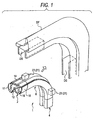
- Fig. 1 is a partial perspective view showing the
attachment state of a molded portion of a glass run
according a first embodiment;
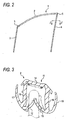
- Fig. 2 is a front typical view showing the schematic
configuration of the glass run;
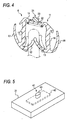
- Fig. 3 is a sectional view showing an extruded
portion of the glass run;
- Fig. 4 is a sectional view showing the molded
portion of the glass run;
- Fig. 5 is a perspective view showing a piece member
for confirming an operation and an effect;
- Fig. 6 is a perspective view typically showing a
test system for confirming an operation and an effect;
- Fig. 7 is a graph showing test results indicating
the relation between an upper limit of a tensile load
and the number of cycles;
- Fig. 8 is a partial perspective view showing a
molded portion and so on of a glass run according to a
second embodiment; and
- Fig. 9 is a sectional view showing the molded
portion of the glass run.
-
DETAILED DESCRIPTION OF THE PREFERRED EMBODIMENTS
(First Embodiment)
-
A first embodiment will be described below with
reference to the drawings.
-
In a car having doors, glass runs are attached to
outer circumferences of window glass opening portions
of the doors correspondingly. More specifically, sashes
DS are provided in each door DF so as to follow the outer
circumferential shape of the door DF, and a glass run
1 according to the embodiment is attached to the inner
circumferences of the sashes DS, as shown in Fig. 1.
-
As shown in Fig. 2, the glass run 1 is defined into
an extruded portion 2 corresponding to an upper side
portion in longitudinal view, extruded portions 3 and
4 corresponding to front and rear long side portions
likewise respectively, and molded portions 5 and 6
(dotted portions in Fig. 2) for making a connection
between end portions of the extruded portions 2 and 3
and a connection between end portions of the extruded
portions 2 and 4 respectively. Each of the extruded
portions 2 to 4 is formed into a substantially linear
(long) shape by a not-shown extruder. Each molded
portion 5, 6 is molded by a not-shown molding device so
that the two extruded portions 2 and 3, 2 and 4 are
connected to each other through the molded portion 5,
6 at a predetermined angle with respect to each other.
The molded portions 5 and 6 according to this embodiment
correspond to corner portions.
-
Fig. 3 is a sectional view showing the extruded
portion 2. Fig. 4 is a sectional view showing the molded
portion 6. As shown in Figs. 3 and 4, each of the extruded
portions 2 to 4 and the molded portions 5 and 6 has a
body portion 11 and a pair of sealing lips 12 and 13.
The body portion 11 is constituted by a base portion 14
fitted to the sash DS, and a vehicle-exterior-side side
wall portion 15 and a vehicle-interior-side side wall
portion 16 both extending from the base portion 14. The
sealing lips 12 and 13 respectively extend from nearly
chip ends of the two side wall portions 15 and 16 toward
the inner side of the body portion 11 (in the direction
toward the base portion 14) so that the vehicle exterior
side and the vehicle interior side of a not-shown glass
are sealed by the sealing lips 12 and 13 respectively.
In addition, in this embodiment, a vehicle-exterior-side
design lip 17 is formed to extend from the
vehicle-exterior-side side wall portion 15 toward the
outside (i.e. vehicle exterior side) and a
vehicle-interior-side design lip 18 is formed to extend
from the vehicle-interior-side side wall portion 16
toward the outside (i.e. vehicle interior side).
-
In this embodiment, the extruded portions 2, 3 and
4 are made of TPO. On the other hand, the molded portions
5 and 6 are also made of TPO.
-
Next, characterizing portions of the embodiment
will be described.
-
As described above, the glass run 1 is attached into
the sashes DS. In the glass run 1, there are however areas
where the sashes DS are absent, such as the corner
portions. In other wards, the corner portions of the
glass run 1 can be regarded as portions where displacement
occurs easily. To cope with this problem, in this
embodiment, as shown in Figs. 1 and 4, insert members
21 serving as hard members as well as insert members are
embedded in the base portion 14 correspondingly to the
long side portion and the upper side portion of the molded
portion 6 (in Fig. 4, only the upper side portion is
illustrated). Each of these insert members 21 includes
a plate insert body 22, and a protrusion 23 formed
integrally with the insert body 22 so as to protrude from
the insert member 22 toward the sash DS (in the fitting
direction). When the glass run 1 is attached, the
protrusion 23 protruding from the base portion 14 can
engage with or stand close to an edge portion (portion
to be locked) of the sash DS so that the protrusion 23
can be locked with the sash DS. In this embodiment, the
insert member 21 is made of polypropylene (PP) harder
than TPO. More specifically, the hardness of TPO is
70-86° in Shore A type at normal temperature while the
hardness of PP is 80° in Rockwell type at normal
temperature.
-
The embodiment has been described specifically
particularly on the molded portion 6. Similarly, insert
members 21 having protrusions 23 are provided at two
places in the front molded portion 5. Each of the
protrusions 23 is not always limited to the type in which
the protrusion 23 is locked with an edge portion of a
sash DS. That is, the protrusion 23 may be designed to
be locked to be inserted (or fitted) into an opening like
through hole, notch, recess, concave or the like formed
in the sash DS. In this embodiment, the insert members
21 are embedded in the molded portion 5, 6 by means of
so-called insert molding at the time of molding the molded
portion 5, 6.
-
Next, the operation and effect of the embodiment
configured as described above will be described.
-
In this embodiment, the insert members 21 are
embedded in the base portion 14 of the molded portion
5, 6 of the glass run 1 so that the protrusions 23
protruding from the insert bodies 22 toward the sashes
DS are locked with the sashes DS respectively. Thus,
even if stress is applied to the glass run 1 due to opening
and closing of the glass, restriction can be placed on
displacement of the glass run 1 caused by the stress.
Particularly in this embodiment, since each of the insert
members 21 is made of a material (PP) harder than a
material (TPO) of the molded portion 5, 6, the
aforementioned restriction can be attained more surely.
Also in a relatively high temperature atmosphere, each
of the insert members 21 is harder than the molded portion
5, 6. Accordingly, the insert member 21 is hardly
deformed or broken even when the stress is applied
repeatedly thereto. Thus, displacement caused by the
stress when the glass is opened and closed can be
prevented more reliably under a high temperature
atmosphere.
-
Since the insert members 21 are embedded in the
molded portion 5, 6 at the time of molding the molded
portion 5, 6, special labor such as labor for attaching
the insert members can be saved so that workability in
manufacturing can be prevented from being lowered.
-
Further, in this embodiment, since each of the
insert members 21 is made of a material compatible with
that of the molded portion 5, 6, there hardly occurs a
situation that the insert member 21 is separated or
detached from the molded portion 5, 6. Without
perforating each insert body and coupling it with the
molded portion through a material the same as that of
the molded portion, a firm attachment state (embedded
state) can be retained. In order to secure a firmer
embedded state, however, the insert bodies 22 may be
perforated.
-
Next, the following test was carried out for
confirming the aforementioned operation and effect.
That is, as shown in Fig. 5, a plate piece member 31 molded
out of TPO was regarded as a molded portion 5, 6 of the
glass run 1 and an insert member 41 made of PP was embedded
in the plate piece member 31 at the time of molding the
plate piece member 31. The insert member 41 had an insert
body 42 and a protrusion 43 in the same manner as in the
embodiment. The piece member 31 was formed as a sample
according to the inventive example. Another piece
member made of TPO and formed integrally with a protrusion
having the same shape as that of the protrusion 43 was
prepared as a sample according to a comparative example.
As shown in Fig. 6, each of the two piece members was
held by a not-shown holding jig, and the protrusion was
locked (inserted) into a long hole 52 of a metal plate
51 regarded as a corresponding sash DS. The piece member
locked with the long hole 52 of the metal plate 51 was
pulled and moved with a predetermined tensile load and
then restored (see the arrow directions in Fig. 6). Such
an operation was performed repeatedly. During the test,
the ambient temperature was set at a comparatively high
value, that is, 80°C. The relation of durability (number
of cycles) to the tensile load in the test is shown in
the graph of Fig. 7.
-
As is apparent from the graph, when a tensile test
was performed on the sample according to the comparative
example with the tensile force set at 25 (N), the
protrusion was broken in about 300 cycles. When a
tensile test was performed on the same with the tensile
force larger than 30 (N), the protrusion was broken in
one cycle or several cycles. On the other hand, it is
apparent that the sample according to the inventive
example could endure about 500 cycles even when a tensile
test was performed on the sample with the tensile force
set at 35 (N). It is also apparent that the sample
according to the inventive example could endure about
150 cycles even when a tensile test was performed on the
sample with the tensile force set at 40 (N). In addition,
the sample according to the inventive example was broken
not because the protrusion 43 was broken but because the
piece member 31 per se was torn. Incidentally, though
not shown in Fig. 7, the sample according to the inventive
example could endure a durability test over 1, 000 cycles
when a tensile test was performed with the tensile force
of 30 (N).
-
As described above, it is apparent that the glass
run according to the embodiment is hardly deformed or
broken even when stress is repeatedly applied to the glass
run due to opening and closing of the glass in a relatively
high temperature atmosphere, so that displacement of the
glass run can be prevented more reliably.
(Second Embodiment)
-
Next, a second embodiment will be described with
reference with Figs. 8 and 9.
-
In this embodiment, an upper side portion in the
front molded portion 5 will be described in detail. Also
in the embodiment, the molded portion 5 is made of TPO
and has a body portion 11 and a pair of not-shown sealing
lips. The body portion 11 has a base portion 14 fitted
into a sash, and a vehicle-exterior-side side wall
portion 15 and a vehicle-interior-side side wall portion
16 both extending from the base portion 14.
-
In this embodiment, as shown in Figs. 8 and 9, a
hard member 71 is provided in the base portion 14
correspondingly to the upper side portion of the molded
portion 5. The hard member 71 has a plate portion 72 and
a protrusion 73 formed integrally with the plate portion
72 so as to protrude from the plate portion 72 toward
the sash (in the fitting direction). When the glass run
1 is attached, the protrusion 73 protruding from the base
portion 14 can engage with or stand close to an edge
portion (portion to be locked) of the sash so that the
protrusion 73 can be locked with the sash. In the
embodiment, the hard member 71 is made of polypropylene
(PP) harder than TPO in the same manner as the insert
member 21 according to the first embodiment.
-
Incidentally, the protrusion 7'3 according to the
embodiment is not always limited to the type in which
the protrusion 73 is locked with the edge portion of the
sash. That is, the protrusion 73 may be designed to be
locked to be inserted (or fitted) into an opening like
through hole, notch, recess, concave or the like formed
in the sash DS.
-
Further, although the insert member 21 according
to the first embodiment is embedded in the molded portion
5, 6 by means of so-called insert molding at the time
of molding the molded portion 5, 6, the hard member 71
(particularly the plate portion 72) in this embodiment
is integrated with the molded portion 5 at the time of
molding the molded portion 5 so that the hard member 71
is fixedly attached to the molded portion 5. The hard
member 71 according to the embodiment is different from
the insert member 21 according to the first embodiment
in the following point. That is, the upper surface of
the plate portion 72 of the hard member 71 is exposed
to the outside while the insert body 22 of the insert
member 21 is completely embedded in the molded portion
5.
-
Incidentally, in place of the configuration in
which the hard member 71 is fixedly attached to the molded
portion 5 at the time of molding the molded portion 5,
the hard member 71 (plate portion 72) may be joined to
an attachment portion (attachment hole, attachment
groove, or attachment recess) formed in the molded
portion 5, by means of welding, bonding, etc. Examples
of the welding include vibration welding and hot plate
welding. On the other hand, "bonding" is implied
specifically as a bonding with adhesive.
-
According to the second embodiment configured as
described above, the hard member 71 is provided in the
base portion 14 of the molded portion 5 of the glass run
1 so that the protrusion 73 protruding from the plate
portion 72 toward the sash is locked with the sash. Thus,
even if stress is applied to the glass run 1 due to opening
and closing of the glass, restriction can be placed on
displacement of the glass run 1 caused by the stress in
the same manner as in the first embodiment. Particularly
in this embodiment, since the hard member 71 is made of
a material (PP) harder than a material (TPO) of the molded
portion 5, the aforementioned restriction can be attained
more surely. Under a relatively high temperature
atmosphere, the hard member 71 is harder than the molded
portion 5 so that the hard member 71 is hardly deformed
or broken even when the stress is applied repeatedly
thereto. Thus, displacement caused by the stress
applied when the glass is opened and closed can be
prevented more reliably under the high temperature
atmosphere.
-
Incidentally, the invention is not limited to the
descriptions of the embodiments but may be carried out,
for example, in the following manner. It is a matter of
course that other non-illustrative applications or
modifications than the following examples can be made.
- (a) Although the first embodiment has been
described on the case where the insert members 21 are
embedded at two places in each of the molded portions
5 and 6, the insert member 21 may be provided at only
one place in each of the molded portions 5 and 6.
Alternatively, the insert members 21 may be provided in
only one of the molded portions 5 and 6. Further, the
insert member may be provided integrally in an L-shape.
Although the second embodiment has been described on the
case where the hard member 71 is provided at one place
in the front molded portion 5, the hard members 71 may
be provided at two places, that is, in the long side
portion and the upper side portion. The hard member 71
may be provided in the rear molded portion 6
correspondingly. - (b) Although the first embodiment has been
described on the case where the protrusion 23 is shaped
into a square rod, the protrusion 23 may be shaped into
an oval cylinder (the same thing may be also applied to
the protrusion 73 in the second embodiment). The shape
of the protrusion is however not particularly limited.
- (c) Although each of the embodiments has been
described on the configuration where the protrusion 23
is locked with the edge of the sash DS, the protrusion
may be locked to be inserted into the lock hole formed
in the sash as described above. Alternatively, a
plurality of protrusions may be provided.
- (d) Although the two embodiments have been
described on the case where the extruded portions 2 to
4 are made of TPO, the extruded portions 2 to 4 may be
made of another material such as EPDM. The same thing
can be also applied to the insert members. (Accordingly,
the insert members may be made of another olefin-based
polymer such as high density polyethylene, another resin
material such as polyester or polyamide, or a metal
material.) In short, the insert members may be made of
a material harder than that of the molded portions.
- (e) The first embodiment has been described on the
case where the glass run 1 is provided with both the
vehicle-exterior-side design lip 17 and the
vehicle-interior-side design lip 18, the invention may
be applicable to the case where at least one of the lips
is omitted.
- (f) An insert member (hard member) may be fitted
into a groove formed in each of the extruded portions,
and a coating layer made of the same material as that
of each molded portion may be provided on the insert
member. In short, the insert member (hard member) may
be formed not only in the molded portion but also
partially in the extruded portion.
- (g) Lock or engagement between the protrusion and
the edge may be made directly or indirectly (through a
coating layer formed by coating the protrusion with the
same material as that of the molded portion).
- (h) Although the second embodiment has been
described on the case where an attachment portion
(attachment hole, attachment groove, or attachment
recess) is formed in the molded portion 5 and the hard
member 71 (plate portion 72) is joined to the attachment
portion by welding, bonding, etc., a hard member
constituted by only a protrusion may be joined to the
base portion of the molded portion 5 or 6 by welding,
bonding, etc.
-
-
It is explicitly stated that all features disclosed in the description and/or the claims are
intended to be disclosed separately and independently from each other for the purpose of
original disclosure as well as for the purpose of restricting the claimed invention independent
of the composition of the features in the embodiments and/or the claims. It is explicitly stated
that all value ranges or indications of groups of entities disclose every possible intermediate
value or intermediate entity for the purpose of original disclosure as well as for the purpose of
restricting the claimed invention, in particular as limits of value ranges.