EP1507197A2 - Printer side techniques for network cluster printing - Google Patents
Printer side techniques for network cluster printing Download PDFInfo
- Publication number
- EP1507197A2 EP1507197A2 EP04013769A EP04013769A EP1507197A2 EP 1507197 A2 EP1507197 A2 EP 1507197A2 EP 04013769 A EP04013769 A EP 04013769A EP 04013769 A EP04013769 A EP 04013769A EP 1507197 A2 EP1507197 A2 EP 1507197A2
- Authority
- EP
- European Patent Office
- Prior art keywords
- printer
- printers
- network
- print job
- particular printer
- Prior art date
- Legal status (The legal status is an assumption and is not a legal conclusion. Google has not performed a legal analysis and makes no representation as to the accuracy of the status listed.)
- Granted
Links
Images



Classifications
-
- H—ELECTRICITY
- H04—ELECTRIC COMMUNICATION TECHNIQUE
- H04L—TRANSMISSION OF DIGITAL INFORMATION, e.g. TELEGRAPHIC COMMUNICATION
- H04L67/00—Network arrangements or protocols for supporting network services or applications
- H04L67/01—Protocols
- H04L67/02—Protocols based on web technology, e.g. hypertext transfer protocol [HTTP]
-
- H—ELECTRICITY
- H04—ELECTRIC COMMUNICATION TECHNIQUE
- H04L—TRANSMISSION OF DIGITAL INFORMATION, e.g. TELEGRAPHIC COMMUNICATION
- H04L67/00—Network arrangements or protocols for supporting network services or applications
- H04L67/01—Protocols
- H04L67/10—Protocols in which an application is distributed across nodes in the network
- H04L67/1001—Protocols in which an application is distributed across nodes in the network for accessing one among a plurality of replicated servers
-
- H—ELECTRICITY
- H04—ELECTRIC COMMUNICATION TECHNIQUE
- H04L—TRANSMISSION OF DIGITAL INFORMATION, e.g. TELEGRAPHIC COMMUNICATION
- H04L69/00—Network arrangements, protocols or services independent of the application payload and not provided for in the other groups of this subclass
- H04L69/30—Definitions, standards or architectural aspects of layered protocol stacks
- H04L69/32—Architecture of open systems interconnection [OSI] 7-layer type protocol stacks, e.g. the interfaces between the data link level and the physical level
- H04L69/322—Intralayer communication protocols among peer entities or protocol data unit [PDU] definitions
- H04L69/329—Intralayer communication protocols among peer entities or protocol data unit [PDU] definitions in the application layer [OSI layer 7]
Definitions
- the present invention relates generally to printer systems and, more specifically, to techniques for printer-side network cluster printing.
- LDAP Lightweight Directory Access Protocol
- RIP software may be required for processing (e.g., rasterizing) and managing print jobs to multiple computers.
- One possible configuration that a network of printers may take is a cluster configuration.
- a cluster of printers With a cluster of printers, a user sends a print job to the cluster and it is typically transparent to the user as to the determination of which printer or printers actually receives the job.
- known approaches to cluster printing require unique printer drivers to manage the cluster.
- such drivers are unique to particular models or brands of printers. Hence, management of multiple sets of drivers on a given workstation becomes a challenge. Therefore, such printer clusters are considered inflexible and lacking scalability.
- cluster agents are installed on each printer of the cluster and configured to perform processes described herein.
- one printer acts as a master printer and the other printers act as slave printers.
- a method for printing using a network of printers comprises receiving a print job at a master printer that is configured with a virtual network address.
- the virtual network address is associated with a plurality of networked printers, including the master printer.
- the received print job is addressed to the virtual network address, which is bound to a network interface of the master printer.
- the master printer determines to which printer the print job should be sent, and sends the print job to the appropriate printer according to the determination. In embodiments, the determination is based on attribute information relating to the printers, which is maintained by the master printer.
- print jobs that are addressed to a real network address associated with a particular printer instead of the virtual network address are simply processed and printed at the particular printer.
- a method for managing a network of printers comprises transmitting, by a particular printer of the network of printers, a signal to a virtual network address. If the signal is acknowledged, that means that a printer has already assumed the role of the master. Thus, if the signal is acknowledged, then the particular printer assumes a role as a slave printer. If the signal is not acknowledged and there are no other cluster printers that are active on the network, then the particular printer assumes the role as the master printer. If the signal is not acknowledged and there are other cluster printers that are active on the network, then the particular printer negotiates with the active printers to determine which one should assume the role as the master printer. In embodiments, attribute information regarding the particular printer, acting as a slave printer, is transmitted to the master printer and is broadcast to and stored at the slave printers.
- FIG. 1 is a block diagram that illustrates an example operating environment for techniques described herein.
- FIG. 1 illustrates workstations 102 communicatively coupled to a virtual printer 104 via a communication network 106.
- workstations 102 may be conventional desktop computers and communication network 106 is a conventional LAN.
- Virtual printer 104 includes a network of printers 108a, 108b, 108n (referred to herein collectively as 108a-108n).
- Printers 108a-108n are printers that are capable of receiving, interpreting and servicing print jobs sent from a workstation 102 through the network 106.
- Printers 108a-108n primarily include conventional hardware and software, with the exception of a cluster agent software application, described in detail below.
- the plurality of printers 108a-108n that are constituent to the virtual printer 104 may comprise multiple print engines and/or mechanisms that are components of a single printing machine.
- Printers 108a-108n are further capable of communicating with each other through the network 106, using one or more standard or proprietary printer communication protocols.
- printers 108a-108n may communicate through network 106 using the Internet Protocol (IP) at the network layer of the OSI (Open System Interconnection) reference model.
- IP Internet Protocol
- OSI Open System Interconnection
- any suitable network communication protocol may be utilized, including protocols that may not yet be developed.
- Printers 108a-108n are configured with appropriate hardware and software so that at least two network addresses can be assigned to a physical network interface(s) of each of the printers.
- the BSD Unix operating system which can be run on printers 108a-108n, handles multiple network addresses.
- printers 108a-108n assumes the role of a master printer (108M of FIG. 2) and the other printers assume roles of slave printers (108S of FIG. 2) that are associated with the master printer.
- Each of printers 108a-108n has its own unique network address, referred to as the real network address, and shares a common network address, referred to as the virtual network address.
- the real and virtual network addresses may be IP addresses if the network 106 is an IP-based network.
- the virtual network address is common to the printers that are configured to perform as a cluster, such as printers 108a-108n.
- the printers of virtual printer 104 may be configured with the virtual address by, for example, a network administrator.
- the real network addresses may be dynamically assigned addresses and, therefore, may change from time to time.
- the virtual network address for a given cluster remains relatively static in that they may be reconfigured for a given cluster, but it is not common to do so on a frequent basis.
- Communication network 106 is any network suitable for transmitting messages via signals.
- network 106 may be a LAN using Ethernet or other suitable technology, over which network entities communicate according to various communication protocols associated with respective layers, such as IP at the network layer.
- FIG. 2 is a block diagram that illustrates an architecture for network cluster printers, such as printers 108a-108n (FIG. 1).
- FIG. 2 includes a master printer 108M and a slave printer 108S, each of which includes a cluster agent 202.
- Cluster agents 202 implement the cluster printing functions and the techniques described herein.
- Cluster agents 202 comprise software code that executes at a layer between printer applications 204 and network interfaces 206, such as real network interface 206r and virtual network interface 206v. Therefore, there is no need to modify the existing printer applications 204 to implement the techniques described herein.
- the cluster agents in the master printer 108M and in the slave printers 108S comprise the same code. Hence, any of printers 108a-108n can perform as either the master printer 108M or as a slave printer 108S.
- Each slave printer 108S and the master printer 108M comprise a real network interface 206r.
- Real network interface 206r comprises a conventional physical network interface, such as a network interface card (NIC), which is compatible with the technology employed by the network 106 (FIG. 1). For example, if network 106 employs Ethernet technology, then real network interface 206r should support the same technology so that the printers 108a-108n can communicate with each other and with workstations 102 (FIG. 1) via the network 106.
- Real network interface 206r includes at least one physical port, through which communication occurs.
- the network interfaces 206r, 206v provide a communication coupling to a network link that is connected to communication network 106 (FIG. 1). Wireless links may be implemented. In any such implementation, network interfaces send and receive electrical, electromagnetic or optical-signals that carry digital data streams representing various types of information.
- a printer When acting as the master printer 108M, a printer additionally comprises a virtual network interface 206v.
- the real network interface 206r and the virtual network interface 206v are the same physical interface and are distinguishable with and by software.
- the same port of a NIC can be configured to receive packets addressed to both the real network interface and the virtual network interface.
- interfaces 206r and 206v may be different physical interfaces.
- cluster agent 202 is able to discriminate between packets addressed to the real network interface 206r and packets addressed to the virtual network interface 206v, and route them accordingly.
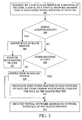
- FIG. 3 is a flow diagram that illustrates a method for managing a network of printers.
- a cluster agent 202 (FIG. 2) of a cluster printer typically performs the method of FIG. 3.
- the term "cluster printer” is used herein in reference to any of printers 108a-108n of virtual printer 104 (FIG. 1).
- the method of FIG. 3 may be performed, for example,.(1) when a cluster printer comes on-line on the network; (2) when a cluster printer is assigned or otherwise obtains a new real network address; or (3) periodically, to ensure that the cluster includes a master printer for managing print jobs sent to the cluster.
- the method illustrated in FIG. 3 includes various embodiments of the invention. Therefore, not all the blocks need be performed in order to use the invention and the blocks need not necessarily be performed in the order in which they are described below.
- a signal is transmitted from a particular printer of the network of printers to a virtual network address that is associated with the network of printers. For example, when configuring multiple printers as a networked cluster, each printer in the cluster is configured with a common virtual network address. When a cluster printer comes on-line, changes real addresses or periodically, it sends a signal to the virtual address. Such a signal is used to determine whether any of the cluster printers has the virtual address bound to its network interface and, therefore, has assumed the role of the master printer.
- the printer assumes a role as a slave printer at block 306. If the signal is acknowledged, that means that the virtual address is already bound to the network interface of one of the cluster printers, which has assumed the role of the master printer. In an embodiment in which there is only one master printer, the printer performing the method of FIG. 3 becomes a slave printer, block 306.
- the printer assuming the role as a slave printer registers with the master printer, at block 307.
- registration with the master printer includes transmitting printer attribute information to the master printer.
- Printer attribute information for any of the printers 108a-108n may include, for non-limiting examples, (1) the availability of the printer; (2) printing or post-printing features provided by the printer; (3) types and sizes of media available from the printer; (4) the current real network address for the printer; (5) the amount of memory available in the printer; (6) a timestamp associated with the printer's "booting up" on the network and/or registering with the master printer; and the like.
- the printer assuming the role of a slave printer receives a print job request that is addressed to a network address associated only with the particular slave printer and not with any of the other cluster printers.
- the network address to which the job is addressed is referred to as the real network address of the particular slave printer, and is different than the virtual network address.
- the particular slave printer then services, or prints, the print job.
- cluster printers assuming the role of slave printers can receive_print _ jobs directly addressed to their respective real network addresses, or they can receive print jobs that are addressed to the virtual network address and routed to their real network address by the associated master printer. In both scenarios, the slave printers service the job in the same manner regardless of whether the job was originally addressed to a real or virtual network address.
- the printer negotiates with the other active cluster printers to determine which of them should assume the role of master printer, at block 312.
- the non-acknowledgement of a block 302 signal e.g., a ping
- the printer assumes the role of master printer for processing print jobs sent to the virtual printer 104 (FIG. 1), which are received at the virtual address.
- the negotiation of block 312 may consider the attribute information associated with each of the active cluster printers, which have already registered with a master printer and therefore have had their attribute information broadcast to the peer cluster printers. For example, the amount of available memory may be considered when negotiating and determining which cluster printer should assume the role of the master printer.
- the printer assumes the role as the master printer, at block 310.
- the non-acknowledgement of a block 302 signal coupled with the absence of other active printers on the network may mean that the present printer is the only currently active printer on the network.
- the printer should assume the role of master printer so that it is available for processing print jobs sent to the virtual printer 104 (FIG. 1), which are received at the virtual address.
- the virtual network address is bound to the network interface of the master printer, at block 314. Therefore, the network interface of the master printer can receive and recognize print jobs sent to the virtual address and process them accordingly, such as according to the method illustrated in FIG. 4A.
- a cluster printer has assumed the role of the master printer 108M (FIG. 2) for the cluster of printers 108a-108n constituent to the virtual printer 104 (FIG. 1). Therefore, other cluster printers can register as slave printers with the master printer, such as according to blocks 302-307.
- FIG. 4A is a flow diagram that illustrates a method for printing using a network of printers.
- a cluster agent 202 (FIG. 2) of a cluster printer typically performs the method of FIG. 4A.
- the method illustrated in FIG. 4A includes various embodiments of the invention. Therefore, not all the blocks need be performed in order to use the invention and the blocks need not necessarily be performed in the order in which they are described below.
- a print job is received at a master printer that is configured with a virtual network address.
- the virtual network address is associated with a plurality of printers, such as printers 108a-108n of virtual printer 104 (FIG. 1), and the print job is addressed to the virtual network address.
- a user working at workstation 102 (FIG. 1) sends a print job to the virtual printer 104 through the network 106 (FIG. 1).
- a portion of the method of FIG. 4A is performed to process the print job and send it to one of the cluster printers.
- the master printer determines to which of the plurality of printers the print job should be sent. In an embodiment, the determination is based on attribute information that is associated with the cluster printers. Examples of types of attribute information that may be considered is described above in reference to block 307 of FIG. 3. In furtherance of such determination, the master printer may reference the job headers and the printer attribute information. For example, the header information contains specifications for the print job, such as type of media, number of pages, post-processing, and the like. Thus, referencing and interpreting such specifications allows the master printer to match the print job with the available printer that is most suitable for servicing the job, including itself. A user does not need to know to which printer the job is sent, in order to avail of the improved availability and expanded feature set of printer services offered by the virtual printer 104 (FIG. 1).
- the master printer sends the print job to the appropriate printer for servicing.
- the job may be sent to a slave printer or to the master printer's own application set, such as applications 204 (FIG. 2), for processing and printing.
- Blocks 404 and 406 of FIG. 4A are optional steps that may be performed by the master printer, according to embodiments.
- the master printer receives at the virtual address the registration of a particular printer of the plurality of cluster printers, e.g., a slave printer.
- the registration of the slave printer includes registration of attribute information associated with the slave printer, as described above in reference to FIG. 3.
- the master printer maintains the attribute information associated with the cluster printers. In an embodiment, the master printer receives, perhaps periodically, and maintains such attribute information for each of the slave printers. The manner in which the attribute information is maintained in not important and may vary from implementation to implementation. For example, the master printer locally maintains a table of information that represents the current attributes of each of the registered slave printers. For another example, the master printer maintains in a networked database, in any form of data construct, the current attribute information for each of the registered slave printers, where it is available to each of the cluster printers.
- the master printer broadcasts the attribute information for the registered slave printers, as well as the attribute information regarding itself, to cluster printers, at block 406.
- the master printer broadcasts the attribute information to each of the registered slave printers.
- the master printer transmits the attribute information to each of the real network addresses of the registered slave printers, using appropriate printer and network communication protocols. The broadcasting may occur, for example, periodically or upon registration of a new slave printer.
- the slave printers each locally maintains a version of a attribute table or other data construct that contains the attribute information for each of the cluster printers, which was broadcast by the master printer.
- the attribute information may be maintained by the master printer at a central repository from which each cluster printer can access such information.
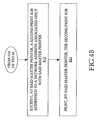
- FIG. 4B is a flow diagram that illustrates a method for printing using a network of printers.
- the method represents an embodiment of the invention, with steps being performed in continuation of or independently of the method of FIG. 4A. Therefore, although blocks 412 and 414 are graphically depicted as a continuation of the method of FIG. 4A, they need not be performed in such a manner.
- a cluster agent 202 (FIG. 2) of a cluster printer, such as any of printers 108a-108n of virtual printer 104 of FIG. 1, typically performs the method of FIG. 4B.
- a second print job is received at the master printer.
- the second print job is addressed to a network address associated only with the master printer and not with any of the other cluster printers.
- the network address to which the second job is addressed is referred to as the real network address of the master printer and is different than the virtual network address.
- the master printer services, or prints, the second print job.
- a master printer can receive print jobs addressed to its real network address, at block 412, whereby it will service the print job accordingly, at block 414. Further; it can receive print jobs addressed to the virtual network address, at block 402, whereby it will process the print job accordingly, at blocks 408 and 410.
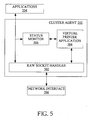
- FIG. 5 is a block diagram that illustrates an example architecture for a cluster agent, according to an embodiment of the invention.
- Cluster agent 202 comprises a raw socket handler 502, a virtual printer application 504 and a status monitor 506.
- raw socket handler 502 searches for the virtual address on the network, as in blocks 302 and 304 (FIG. 3). If it finds no such address, the printer claims to be the master, such as in blocks 308, 310 and 314 (FIG. 3). It then directs raw packets received from network interface 206 to the real printer applications 204 if their destination is the real network address of the printer, as in blocks 412 and 414 (FIG. 4B) and to the virtual printer application 504 if their destination is the virtual network address. Otherwise, if it finds the virtual address on the network, it becomes a slave printer, as in blocks 306 and 307 (FIG.
- raw socket handler 502 receives print jobs originally addressed to the virtual network address which are forwarded to its real network address from the virtual printer application 504 of the master printer.
- Status monitor 506 maintains the status and attributes of each cluster printer, such as attribute information received as part of a registration, as in block 404 (FIG. 4A).
- status monitor 506 works with virtual printer application 504 and the raw socket handler 502, in conjunction with the network interface 206, to broadcast attribute information to the cluster printers, as in block 406 (FIG. 4A).
- virtual printer application 504 receives the print jobs addressed to the virtual network address of the virtual printer 104 (FIG. 1) and make decisions as to which cluster printer is most suitable for a given print job, as in blocks 402 and 408 (FIG. 4A). In addition, virtual printer application 504 works with the raw socket handler 502, in conjunction with network interface 206, to direct the print jobs to the suitable printer, as in block 410 (FIG. 4A).
- virtual printer application 504 negotiates a new master printer, as in blocks 308 and 312 (FIG. 3). Furthermore, as a master printer, virtual printer application 504 binds the virtual network address to the printer's network interface 206, as in block 314 (Fig. 3).
- FIG. 6 is a block diagram that illustrates a system 600 upon which an embodiment of the invention may be implemented.
- System 600 represents a generalized computing system and, therefore, implementations of the techniques described herein may vary from system 600. Hence, some components illustrated in system 600 may be eliminated, or others added, in implementations of these techniques.
- embodiments are implemented using one or more sequences of instructions executing on a printer machine. Thus, in this embodiment, system 600 is a printer machine.
- System 600 includes a bus 602 or other communication mechanism for communicating information, and a processor 604 coupled with bus 602 for processing information.
- System 600 also includes a main memory 606, such as a random access memory (RAM) or other dynamic storage device, coupled to bus 602 for storing information and instructions to be executed by processor 604.
- Main memory 606 also may be used for storing temporary variables or other intermediate information during execution of instructions to be executed by processor 604.
- System 600 further includes a read only memory (ROM) 608 or other static storage device coupled to bus 602 for storing static information and instructions for processor 604.
- ROM read only memory
- a storage device 610 such as a magnetic disk or optical disk, is provided and coupled to bus 602 for storing information and instructions.
- System 600 may be coupled via bus 602 to a display 612, such as a cathode ray tube (CRT), for displaying information to a user.
- a display 612 such as a cathode ray tube (CRT)
- An input device 614 is coupled to bus 602 for communicating information and command selections to processor 604.
- cursor control 616 is Another type of user input device
- cursor control 616 such as a mouse, a trackball, or cursor direction keys for communicating direction information and command selections to processor 604 and for controlling cursor movement on display 612.
- This input device typically has two degrees of freedom in two axes, a first axis (e.g., x) and a second axis (e.g., y), that allows the device to specify positions in a plane. '
- the invention is related to the use of system 600 for managing a network of printers and for printing using a network of printers.
- the techniques described herein are provided by system 600 in response to processor 604 executing one or more sequences of one or more instructions contained in main memory 606.
- Such instructions may be read into main memory 606 from another computer-readable medium, such as storage device 610.
- Execution of the sequences of instructions contained in main memory 606 causes processor 604 to perform the process steps described herein.
- processors in a multi-processing arrangement may also be employed to execute the sequences of instructions contained in main memory 606.
- hard-wired circuitry may be used in place of or in combination with software instructions to implement the invention.
- embodiments of the invention are not limited to any specific combination of hardware circuitry and software.
- Non-volatile media includes, for example, optical or magnetic disks, such as storage device 610.
- Volatile media includes dynamic memory, such as main memory 606.
- Transmission media includes coaxial cables, copper wire and fiber optics, including the wires that comprise bus 602. Transmission media can also take the form of acoustic or light waves, such as those generated during radio wave and infrared data communications.
- Computer-readable media include, for example, a floppy disk, a flexible disk, hard disk, magnetic tape, or any other magnetic medium, a CD-ROM, any other optical medium, punch cards, paper tape, any other physical medium with patterns of holes, a RAM, a PROM, and EPROM, a FLASH-EPROM, any other memory chip or cartridge, a carrier wave as described hereinafter, or any other medium from which a computer can read.
- Various forms of computer readable media may be involved in carrying one or more sequences of one or more instructions to processor 604 for execution.
- the instructions may initially be carried on a magnetic disk of a remote computer.
- the remote computer can load the instructions into its dynamic memory and send the instructions over a telephone line using a modem.
- a modem local to system 600 can receive the data on the telephone line and use an infrared transmitter to convert the data to an infrared signal.
- An infrared detector coupled to bus 602 can receive the data carried in the infrared signal and place the data on bus 602.
- Bus 602 carries the data to main memory 606, from which processor 604 retrieves and executes the instructions.
- the instructions received by main memory 606 may optionally be stored on storage device 610 either before or after execution by processor 604.
- System 600 also includes a communication interface 618 coupled to bus 602.
- Communication interface 618 provides a two-way data communication coupling to a network link 620 that is connected to a network 622.
- communication interface 618 may be an integrated services digital network (ISDN) card or a modem to provide a data communication connection to a corresponding type of telephone line.
- ISDN integrated services digital network
- communication interface 618 may be a local area network (LAN) card to provide a data communication connection to a compatible LAN.
- LAN local area network
- Wireless links may also be implemented.
- communication interface 618 sends and receives electrical, electromagnetic or optical signals that carry digital data streams representing various types of information.
- Network link 620 typically provides data communication through one or more networks to other data devices.
- network link 620 may provide a connection through network 622 to another printer device.
- Network 622 uses electrical, electromagnetic or optical signals that carry digital data streams.
- the signals through the various networks and the signals on network link 620 and through communication interface 618, which carry the digital data to and from system 600, are exemplary forms of carrier waves transporting the information.
- System 600 can send messages and receive data, including program code, through the network(s), network link 620 and communication interface 618.
- a server might transmit a requested code for an application program through the Internet, network 622 and communication interface 618.
- one such downloaded application provides for performing the techniques as described herein.
- the received code may be executed by processor 604 as it is received, and/or stored in storage device 610, or other non-volatile storage for later execution. In this manner, system 600 may obtain application code in the form of a carrier wave.
- System 600 further includes a controller 650 for controlling at least the printer mechanism 656, which is operable to print in response to print jobs.
- Controller 650 may be a specialized microprocessor, embedded code, or a processor that executes code stored in memory 606, for example, in response to reception, interpretation and processing of print jobs.
- the invention in a first embodiment (A) relates to a method for printing, the method comprising the computer-implemented steps of: receiving, at a first printer of a plurality of printers that are configured with a same virtual network address, a print job request that is addressed to said virtual network address; and sending, by said first printer, the print job request to a particular printer of said plurality of printers.
- the method of A further comprises the step of: determining, by said first printer, said particular printer to which said print job request is sent.
- More preferable said step of determining is based on attribute information associated with one or more printers of the plurality of printers.
- the method of A further comprises the step of: maintaining, at said first printer, attribute information associated with one or more printers of the plurality of printers.
- the method of A further comprises the computer-implemented steps of:
- the method of A further comprises the step of: receiving, at said first printer at said virtual address, a registration of a particular printer of said plurality of printers.
- said registration includes attribute information associated with said particular printer, the method further comprising the step of: broadcasting said attribute information to one or more printers of said plurality of printers, wherein said attribute information is stored at said one or more printers.
- said particular printer is the first printer.
- the method of A further comprises the computer-implemented steps of:
- the invention in a second embodiment (B) relates to a method of managing a network of two or more printers, the method comprising: transmitting, by a particular printer of said network of printers, a signal to a virtual network address that is associated with said network of printers; if said signal is acknowledged, then assuming a role as a slave printer by said particular printer; if said signal is not acknowledged and one or more other printers of said network of printers are active on said network, then negotiating with said one or more other printers to determine which one of said printers should assume a role as a master printer; and if said signal is not acknowledged and no other printers of said network of printers are active on said network, then assuming the role as said master printer.
- the method of (B) in an embodiment B1 further comprises the step of: if said particular printer assumes the role as a slave printer, then registering with said master printer.
- said registering includes registering attribute information associated with said particular printer, the method further comprising the step of: broadcasting, by said master printer, said attribute information to one or more printers of said network of printers.
- the method of B1 further comprises the computer-implemented steps of:
- the method of B in an embodiment B2 further comprises the step of:
- the method of B2 further comprises the computer-implemented steps of: receiving, at said particular printer, a first print job request that is addressed to a network address associated only with said particular printer of said network of printers; and processing, at said particular printer, said first print job request.
- the method of B2 further comprising the computer-implemented steps of: receiving, at said particular printer, a second print job request that is addressed to said virtual network address; and sending, by said particular printer, the second print job request to any printer of said network of printers.
- the method of B2 further comprises the computer-implemented steps of: receiving, at said particular printer, a print job request that is addressed to said virtual network address; and sending, by said particular printer, the print job request to a printer of said network of printers.
- the method of B2 further comprises the step of: determining, by said particular printer, said printer to which said print job request is sent.
- the method of B further comprises the step of: binding, by said master printer, said virtual network address to a network interface of said master printer.
- the invention in a third embodiment (C) relates to a computer-readable medium carrying one or more sequences of instructions for printing, wherein execution of the one or more sequences of instructions by one or more processors causes the one or more processors to perform the steps of: receiving, at a first printer of a plurality of printers that are configured with a same virtual network address, a print job request that is addressed to said virtual network address; and sending, by said first printer, the print job request to a particular printer of said plurality of printers.
- the instructions cause the processors to perform the step of: determining, by said first printer, said particular printer to which said print job request is sent.
- More preferably said step of determining is based on attribute information associated with one or more printers of the plurality of printers.
- the instructions cause the processors to perform the step of: maintaining, at said first printer, attribute information associated with one or more printers of the plurality of printers.
- the instructions cause the processors to perform the steps of: receiving, at said first printer, a second print job request that is addressed to a network address associated only with said first printer of said plurality of printers and that is different than said virtual network address; and processing said second print job request.
- the instructions cause the processors to perform the step of: receiving, by said first printer at said virtual address, a registration of a particular printer of said plurality of printers.
- said registration includes attribute information associated with said particular printer, and wherein the instructions cause the processors to perform the step of:
- said particular printer is the first printer.
- the instructions cause the processors to perform the steps of: transmitting, by a particular printer of said plurality of printers, a signal to said virtual network address; if said signal is acknowledged, then assuming a role as a slave printer by said particular printer; if said signal is not acknowledged and one or more other printers of said plurality of printers are active on said network, then negotiating with said one or more other printers to determine which one of said plurality of printers should assume a role as said first printer; and if said signal is not acknowledged and no other printers of said plurality of printers are active on said network, then assuming the role as said master printer.
- the instructions cause the processors to perform the step of: based on said negotiating, assuming the role as said first printer by said particular printer.
- the invention in a fourth embodiment (D) relates to a computer-readable medium carrying one or more sequences of instructions for managing a network of two or more printers, wherein execution of the one or more sequences of instructions by one or more processors causes the one or more processors to perform the steps of: transmitting, by a particular printer of said network of printers, a signal to a virtual network address that is associated with said network of printers; if said signal is acknowledged, then assuming a role as a slave printer by said particular printer; if said signal is not acknowledged and one or more other printers of said network of printers are active on said network, then negotiating with said one or more other printers to determine which one of said printers should assume a role as a master printer; and if said signal is not acknowledged and no other printers of said network of printers are active on said network, then assuming the role as said master printer.
- the instructions cause the processors to perform the step of: if said particular printer assumes the role as a slave printer, then registering with said master printer.
- said registering includes registering attribute information associated with said particular printer, and wherein the instructions cause the processors to perform the step of: broadcasting, by said master printer, said attribute information to one or more printers of said network of printers.
- the instructions cause the processors to perform the steps of: receiving, at said particular printer, a print job request that is addressed to a network address associated only with said particular printer of said network of printers; and processing, at said particular printer, said print job request.
- the instructions cause the processors to perform the step of: if said particular printer is determined to assume the role as said master printer, then binding, by said particular printer, said virtual network address to a network interface of said particular printer.
- the instructions cause the processors to perform the steps of: receiving, at said particular printer, a first print job request that is addressed to a network address associated only with said particular printer of said network of printers; and processing, at said particular printer, said first print job request.
- the instructions cause the processors to perform the steps of: receiving, at said particular printer, a second print job request that is addressed to said virtual network address; and sending, by said particular printer, the second print job request to any printer of said network of printers.
- the instructions cause the processors to perform the steps of: receiving, at said particular printer, a print job request that is addressed to said virtual network address; and sending, by said particular printer, the print job request to a printer of said network of printers.
- the instructions cause the processors to perform the step of: determining, by said particular printer, said printer to which said print job request is sent.
- the instructions cause the processors to perform the step of: binding, by said master printer, said virtual network address to a network interface of said master printer.
- the invention also relates to a printing system configured to: receive, at a first printer of a plurality of printers that are configured with a same virtual network address, a print job request that is addressed to said virtual network address; and send, by said first printer, the print job request to a particular printer of said plurality of printers.
- system of E is configured to: determine, by said first printer, said particular printer to which said print job request is sent.
- this system of E is configured to determine said particular printer based on attribute Information associated with one or more printers of the plurality of printers.
- system of E is configured to: maintain, at said first printer, attribute Information associated with one or more printers of the plurality of printers.
- the system of E is configured to: receive, at said first printer, a second print job request that is addressed to a network address associated only with said first printer of said plurality of printers and that is different than said virtual network address; and process said second print job request.
- the system of E is in an embodiment E1 configured to: receive, by said first printer at said virtual address, a registration of a particular printer of said plurality of printers.
- said registration includes attribute information associated with said particular printer, the system configured to: broadcast said attribute information to one or more printers of said plurality of printers, wherein said attribute information is stored at said one or more printers.
- said particular printer is the first printer.
- the system of E is in an embodiment E2 configured to: transmit, by a particular printer of said plurality of printers, a signal to said virtual network address; if said signal is acknowledged, then assume a role as a slave printer by said particular printer; if said signal is not acknowledged and one or more other printers of said plurality of printers are active on said network, then negotiate with said one or more other printers to determine which one of said plurality of printers should assume a role as said first printer; and if said signal is not acknowledged and no other printers of said plurality of printers are active on said network, then assume the role as said master printer.
- the system of E2 is configured to: based on said negotiating, assume the role as said first printer by said particular printer.
- the invention in a sixth embodiment (F) relates to a printing system configured to: transmit, by a particular printer of a network of printers, a signal to a virtual network address that is associated with said network of printers; if said signal is acknowledged, then assume a role as a slave printer by said particular printer; if said signal is not acknowledged and one or more other printers of said network of printers are active on said network, then negotiate with said one or more other printers to determine which one of said printers should assume a role as a master printer; and if said signal is not acknowledged and no other printers of said network of printers are active on said network, then assume the role as said master printer.
- the system of F is in an embodiment F1 configured to: if said particular printer assumes the role as a slave printer, then register with said master printer.
- said registering includes registering attribute Information associated with said particular printer, the system configured to:
- the system of F1 is configured to: receive, at said particular printer, a print job request that is addressed to a network address associated only with said particular printer of said network of printers; and process, at said particular printer, said print job request.
- the system of F is in an embodiment F2 configured to: if said particular printer is determined to assume the role as said master printer, then bind, by said particular printer, said virtual network address to a network Interface of said particular printer.
- the system of F2 is configured to: receive, at said particular printer, a first print job request that is addressed to a network address associated only with said particular printer of said network of printers; and process, at said particular printer, said first print job request.
- the latter system of F2 is configured to: receive, at said particular printer, a second print job request that is addressed to said virtual network address; and send, by said particular printer, the second print job request to any printer of said network of printers.
- the system of F2 is configured to: receive, at said particular printer, a print job request that is addressed to said virtual network address; and send, by said particular printer, the print job request to a printer of said network of printers.
- the latter system of F2 is configured to: determine, by said particular printer, said printer to which said print job request is sent.
- the system of F may also be configured to: bind, by said master printer, said virtual network address to a network interface of said master printer.
Landscapes
- Engineering & Computer Science (AREA)
- Computer Networks & Wireless Communication (AREA)
- Signal Processing (AREA)
- Computer Security & Cryptography (AREA)
- Accessory Devices And Overall Control Thereof (AREA)
Abstract
Description
processing, at said particular printer, said first print job request.
if said signal is not acknowledged and one or more other printers of said plurality of printers are active on said network, then negotiate with said one or more other printers to determine which one of said plurality of printers should assume a role as said first printer; and if said signal is not acknowledged and no other printers of said plurality of printers are active on said network, then assume the role as said master printer.
send, by said particular printer, the second print job request to any printer of said network of printers.
Claims (60)
- A method for printing, the method comprising the computer-implemented steps of:receiving, at a first printer of a plurality of printers that are configured with a same virtual network address, a print job request that is addressed to said virtual network address; andsending, by said first printer, the print job request to a particular printer of said plurality of printers.
- The method of claim 1, further comprising the step of:determining, by said first printer, said particular printer to which said print job request is sent.
- The method of claim 2, wherein said step of determining is based on attribute information associated with one or more printers of the plurality of printers.
- The method of claim 1, further comprising the step of:maintaining, at said first printer, attribute information associated with one or more printers of the plurality of printers.
- The method of claim 1, further comprising the computer-implemented steps of:receiving, at said first printer, a second print job request that is addressed to a network address associated only with said first printer of said plurality of printers and that is different than said virtual network address; andprocessing said second print job request.
- The method of claim 1, further comprising the step of:receiving, by said first printer at said virtual address, a registration of a particular printer of said plurality of printers.
- The method of claim 6, wherein said registration includes attribute information associated with said particular printer, the method further comprising the step of:broadcasting said attribute information to one or more printers of said plurality of printers, wherein said attribute information is stored at said one or more printers.
- The method of claim 1, wherein said particular printer is the first printer.
- The method of claim 1, further comprising the computer-implemented steps of:transmitting, by a particular printer of said plurality of printers, a signal to said virtual network address;if said signal is acknowledged, then assuming a role as a slave printer by said particular printer;if said signal is not acknowledged and one or more other printers of said plurality of printers are active on said network, then negotiating with said one or more other printers to determine which one of said plurality of printers should assume a role as said first printer; andif said signal is not acknowledged and no other printers of said plurality of printers are active on said network, then assuming the role as said master printer.
- The method of claim 9, further comprising the step of:based on said negotiating, assuming the role as said first printer by said particular printer.
- A method of managing a network of two or more printers, the method comprising:transmitting, by a particular printer of said network of printers, a signal to a virtual network address that is associated with said network of printers;if said signal is acknowledged, then assuming a role as a slave printer by said particular printer;if said signal is not acknowledged and one or more other printers of said network of printers are active on said network, then negotiating with said one or more other printers to determine which one of said printers should assume a role as a master printer; andif said signal is not acknowledged and no other printers of said network of printers are active on said network, then assuming the role as said master printer.
- The method of claim 11, further comprising the step of:if said particular printer assumes the role as a slave printer, then registering with said master printer.
- The method of claim 12, wherein said registering includes registering attribute information associated with said particular printer, the method further comprising the step of:broadcasting, by said master printer, said attribute information to one or more printers of said network of printers.
- The method of claim 12, further comprising the computer-implemented steps of:receiving, at said particular printer, a print job request that is addressed to a network address associated only with said particular printer of said network of printers; andprocessing, at said particular printer, said print job request.
- The method of claim 11, further comprising the step of:if said particular printer is determined to assume the role as said master printer, then binding, by said particular printer, said virtual network address to a network interface of said particular printer.
- The method of claim 15, further comprising the computer-implemented steps of:receiving, at said particular printer, a first print job request that is addressed to a network address associated only with said particular printer of said network of printers; andprocessing, at said particular printer, said first print job request.
- The method of claim 16, further comprising the computer-implemented steps of:receiving, at said particular printer, a second print job request that is addressed to said virtual network address; andsending, by said particular printer, the second print job request to any printer of said network of printers.
- The method of claim 15, further comprising the computer-implemented steps of:receiving, at said particular printer, a print job request that is addressed to said virtual network address; andsending, by said particular printer, the print job request to a printer of said network of printers.
- The method of claim 18, further comprising the step of:determining, by said particular printer, said printer to which said print job request is sent.
- The method of claim 11, further comprising the step of:binding, by said master printer, said virtual network address to a network interface of said master printer.
- A computer-readable medium carrying one or more sequences of instructions for printing, wherein execution of the one or more sequences of instructions by one or more processors causes the one or more processors to perform the steps of:receiving, at a first printer of a plurality of printers that are configured with a same virtual network address, a print job request that is addressed to said virtual network address; andsending, by said first printer, the print job request to a particular printer of said plurality of printers.
- The computer-readable medium of claim 21, wherein the instructions cause the processors to perform the step of:determining, by said first printer, said particular printer to which said print job request is sent.
- The computer-readable medium of claim 22, wherein said step of determining is based on attribute information associated with one or more printers of the plurality of printers.
- The computer-readable medium of claim 21, wherein the instructions cause the processors to perform the step of:maintaining, at said first printer, attribute information associated with one or more printers of the plurality of printers.
- The computer-readable medium of claim 21, wherein the instructions cause the processors to perform the steps of:receiving, at said first printer, a second print job request that is addressed to a network address associated only with said first printer of said plurality of printers and that is different than said virtual network address; andprocessing said second print job request.
- The computer-readable medium of claim 21, wherein the instructions cause the processors to perform the step of:receiving, by said first printer at said virtual address, a registration of a particular printer of said plurality of printers.
- The computer-readable medium of claim 26, wherein said registration includes attribute information associated with said particular printer, and wherein the instructions cause the processors to perform the step of:broadcasting said attribute information to one or more printers of said plurality of printers, wherein said attribute information is stored at said one or more printers.
- The computer-readable medium of claim 21, wherein said particular printer is the first printer.
- The computer-readable medium of claim 21, wherein the instructions cause the processors to perform the steps of:transmitting, by a particular printer of said plurality of printers, a signal to said virtual network address;if said signal is acknowledged, then assuming a role as a slave printer by said particular printer;if said signal is not acknowledged and one or more other printers of said plurality of printers are active on said network, then negotiating with said one or more other printers to determine which one of said plurality of printers should assume a role as said first printer; andif said signal is not acknowledged and no other printers of said plurality of printers are active on said network, then assuming the role as said master printer.
- , The computer-readable medium of claim 29, wherein the instructions cause the processors to perform the step of:based on said negotiating, assuming the role as said first printer by said particular printer.
- A computer-readable medium carrying one or more sequences of instructions for managing a network of two or more printers, wherein execution of the one or more sequences of instructions by one or more processors causes the one or more processors to perform the steps of:transmitting, by a particular printer of said network of printers, a signal to a virtual network address that is associated with said network of printers;if said signal is acknowledged, then assuming a role as a slave printer by said particular printer;if said signal is not acknowledged and one or more other printers of said network of printers are active on said network, then negotiating with said one or more other printers to determine which one of said printers should assume a role as a master printer; andif said signal is not acknowledged and no other printers of said network of printers are active on said network, then assuming the role as said master printer.
- The computer-readable medium of claim 31, wherein the instructions cause the processors to perform the step of:if said particular printer assumes the role as a slave printer, then registering with said master printer.
- The computer-readable medium of claim 32, wherein said registering includes registering attribute information associated with said particular printer, and wherein the instructions cause the processors to perform the step of:broadcasting, by said master printer, said attribute information to one or more printers of said network of printers.
- The computer-readable medium of claim 32, wherein the instructions cause the processors to perform the steps of:receiving, at said particular printer, a print job request that is addressed to a network address associated only with said particular printer of said network of printers; andprocessing, at said particular printer, said print job request.
- The computer-readable medium of claim 31, wherein the instructions cause the processors to perform the step of:if said particular printer is determined to assume the role as said master printer, then binding, by said particular printer, said virtual network address to a network interface of said particular printer.
- The computer-readable medium of claim 35, wherein the instructions cause the processors to perform the steps of:receiving, at said particular printer, a first print job request that is addressed to a network address associated only with said particular printer of said network of printers; andprocessing, at said particular printer, said first print job request.
- The computer-readable medium of claim 36, wherein the instructions cause the processors to perform the steps of:receiving, at said particular printer, a second print job request that is addressed to said virtual network address; andsending, by said particular printer, the second print job request to any printer of said network of printers.
- The computer-readable medium of claim 35, wherein the instructions cause the processors to perform the steps of:receiving, at said particular printer, a print job request that is addressed to said virtual network address; andsending, by said particular printer, the print job request to a printer of said network of printers.
- The computer-readable medium of claim 38, wherein the instructions cause the processors to perform the step of:determining, by said particular printer, said printer to which said print job request is sent.
- The computer-readable medium of claim 31, wherein the instructions cause the processors to perform the step of:binding, by said master printer, said virtual network address to a network interface of said master printer.
- A printing system configured to:receive, at a first printer of a plurality of printers that are configured with a same virtual network address, a print job request that is addressed to said virtual network address; andsend, by said first printer, the print job request to a particular printer of said plurality of printers.
- The system of claim 41, configured to:determine, by said first printer, said particular printer to which said print job request is sent.
- The system of claim 42, configured to determine said particular printer based on attribute information associated with one or more printers of the plurality of printers.
- The system of claim 41, configured to:maintain, at said first printer, attribute information associated with one or more printers of the plurality of printers.
- The system of claim 41, configured to:receive, at said first printer, a second print job request that is addressed to a network address associated only with said first printer of said plurality of printers and that is different than said virtual network address; andprocess said second print job request.
- The system of claim 41, configured to:receive, by said first printer at said virtual address, a registration of a particular printer of said plurality of printers.
- The system of claim 46, wherein said registration includes attribute information associated with said particular printer, the system configured to:broadcast said attribute information to one or more printers of said plurality of printers, wherein said attribute information is stored at said one or more printers.
- The system of claim 41, wherein said particular printer is the first printer.
- The system of claim 41, configured to:transmit, by a particular printer of said plurality of printers, a signal to said virtual network address;if said signal is acknowledged, then assume a role as a slave printer by said particular printer;if said signal is not acknowledged and one or more other printers of said plurality of printers are active on said network, then negotiate with said one or more other printers to determine which one of said plurality of printers should assume a role as said first printer; andif said signal is not acknowledged and no other printers of said plurality of printers are active on said network, then assume the role as said master printer.
- The system of claim 49, configured to:based on said negotiating, assume the role as said first printer by said particular printer.
- A printing system configured to:transmit, by a particular printer of a network of printers, a signal to a virtual network address that is associated with said network of printers;if said signal is acknowledged, then assume a role as a slave printer by said particular printer;if said signal is not acknowledged and one or more other printers of said network of printers are active on said network, then negotiate with said one or more other printers to determine which one of said printers should assume a role as a master printer; andif said signal is not acknowledged and no other printers of said network of printers are active on said network, then assume the role as said master printer.
- The system of claim 51, configured to:if said particular printer assumes the role as a slave printer, then register with said master printer.
- The system of claim 52, wherein said registering includes registering attribute information associated with said particular printer, the system configured to:broadcast, by said master printer, said attribute information to one or more printers of said network of printers.
- The system of claim 52, configured to:receive, at said particular printer, a print job request that is addressed to a network address associated only with said particular printer of said network of printers; andprocess, at said particular printer, said print job request.
- The system of claim 51, configured to: .if said particular printer is determined to assume the role as said master printer, then bind; by said particular printer, said virtual network address to a network interface of said particular printer.
- The system of claim 55, configured to:receive, at said particular printer, a first print job request that is addressed to a network address associated only with said particular printer of said network of printers; andprocess, at said particular printer, said first print job request.
- The system of claim 56, configured to:receive, at said particular printer, a second print job request that is addressed to said virtual network address; andsend, by said particular printer, the second print job request to any printer of said network of printers.
- The system of claim 55, configured to:receive, at said particular printer, a print job request that is addressed to said virtual network address; andsend, by said particular printer, the print job request to a printer of said network of printers.
- The system of claim 58, configured to:determine, by said particular printer, said printer to which said print job request is sent.
- The system of claim 51, configured to:bind, by said master printer, said virtual network address to a network interface of said master printer.
Applications Claiming Priority (2)
| Application Number | Priority Date | Filing Date | Title |
|---|---|---|---|
| US461197 | 2003-06-12 | ||
| US10/461,197 US7468804B2 (en) | 2003-06-12 | 2003-06-12 | Techniques for printer-side network cluster printing |
Publications (3)
| Publication Number | Publication Date |
|---|---|
| EP1507197A2 true EP1507197A2 (en) | 2005-02-16 |
| EP1507197A3 EP1507197A3 (en) | 2005-05-18 |
| EP1507197B1 EP1507197B1 (en) | 2010-03-10 |
Family
ID=33511204
Family Applications (1)
| Application Number | Title | Priority Date | Filing Date |
|---|---|---|---|
| EP04013769A Expired - Lifetime EP1507197B1 (en) | 2003-06-12 | 2004-06-11 | Printer side techniques for network cluster printing |
Country Status (3)
| Country | Link |
|---|---|
| US (1) | US7468804B2 (en) |
| EP (1) | EP1507197B1 (en) |
| DE (1) | DE602004025884D1 (en) |
Families Citing this family (19)
| Publication number | Priority date | Publication date | Assignee | Title |
|---|---|---|---|---|
| CN1527232A (en) * | 2002-10-16 | 2004-09-08 | �ֹ��� | Method ad apparatus for realizing distribution preset service, automatic supply maintenance and irrelevant service implementation with equipment |
| US20050268151A1 (en) * | 2004-04-28 | 2005-12-01 | Nokia, Inc. | System and method for maximizing connectivity during network failures in a cluster system |
| JP2006313526A (en) * | 2005-04-07 | 2006-11-16 | Canon Inc | Software evaluation method and software evaluation system |
| US20060274370A1 (en) * | 2005-06-03 | 2006-12-07 | Seiko Epson Corporation | Control technology used in distributed printing for printing control device and printer |
| JP4485997B2 (en) * | 2005-06-13 | 2010-06-23 | 株式会社リコー | Print control apparatus, print control system, print control method, print control program, and recording medium |
| US20070014612A1 (en) * | 2005-07-18 | 2007-01-18 | Seong Kim | Parallel printing solution |
| JP2008059150A (en) * | 2006-08-30 | 2008-03-13 | Fuji Xerox Co Ltd | Information processing program, image reading program, information processor, image reader and information processing system |
| JP4838692B2 (en) * | 2006-11-27 | 2011-12-14 | キヤノン株式会社 | Image forming system, image forming apparatus, control method therefor, and program |
| US20080180725A1 (en) * | 2007-01-26 | 2008-07-31 | Levin Burton L | User-defined cluster printing |
| US20090119422A1 (en) * | 2007-11-07 | 2009-05-07 | International Business Machines Corporation | Method and apparatus for performing maintenance operations on peripheral devices |
| JP2009207091A (en) * | 2008-02-29 | 2009-09-10 | Canon Inc | Image forming apparatus and method, control program for implementing the method, and medium with the program stored thereon |
| US8125684B2 (en) * | 2008-08-05 | 2012-02-28 | Xerox Corporation | Method and system for printing using selecting printing configuration based on attribute rating |
| JP5199827B2 (en) * | 2008-10-28 | 2013-05-15 | 理想科学工業株式会社 | Image forming apparatus and printing system |
| JP5017237B2 (en) * | 2008-11-11 | 2012-09-05 | シャープ株式会社 | Image forming apparatus with printer server function |
| US20100220350A1 (en) * | 2009-02-27 | 2010-09-02 | Konica Minolta Systems Laboratory, Inc. | Systems and Methods for Configuration of Networked Printers |
| JP5659555B2 (en) * | 2010-05-17 | 2015-01-28 | 株式会社リコー | Image processing apparatus, image processing system, image processing method, and program |
| WO2015142262A1 (en) * | 2014-03-17 | 2015-09-24 | Cirrato Technologies Ab | A method for controlling transfer of print data, a client controller arrangement, a print arrangement and a network |
| US10289369B2 (en) * | 2016-10-27 | 2019-05-14 | Dell Products, L.P. | Managing print jobs using peer-to-peer techniques |
| JP6939312B2 (en) * | 2017-09-21 | 2021-09-22 | コニカミノルタ株式会社 | Image-forming device, image-forming system, and control program for image-forming device |
Family Cites Families (8)
| Publication number | Priority date | Publication date | Assignee | Title |
|---|---|---|---|---|
| US6657741B1 (en) | 1995-08-07 | 2003-12-02 | Tr Systems, Inc. | Multiple print engine system with selectively distributed ripped pages |
| JPH11215358A (en) * | 1997-11-14 | 1999-08-06 | Canon Inc | Image processing apparatus, control method therefor, and image processing system |
| US6418493B1 (en) * | 1997-12-29 | 2002-07-09 | Intel Corporation | Method and apparatus for robust addressing on a dynamically configurable bus |
| US6055574A (en) * | 1998-03-10 | 2000-04-25 | Unisys Corporation | Method of providing a service through a server with a virtual single network address |
| US6449054B1 (en) * | 1998-08-01 | 2002-09-10 | Canon Kabushiki Kaisha | Dynamic assignment of group addresses for controlling parallel peripheral devices |
| JP2001296982A (en) * | 2000-04-14 | 2001-10-26 | Hitachi Koki Co Ltd | Document printing system and control method, and storage medium storing the same |
| US7102778B2 (en) * | 2002-01-11 | 2006-09-05 | Hewlett-Packard Development Company, L.P. | Printer selection system and method with print request distribution |
| US20040190042A1 (en) * | 2003-03-27 | 2004-09-30 | Ferlitsch Andrew Rodney | Providing enhanced utilization of printing devices in a cluster printing environment |
-
2003
- 2003-06-12 US US10/461,197 patent/US7468804B2/en not_active Expired - Fee Related
-
2004
- 2004-06-11 DE DE602004025884T patent/DE602004025884D1/en not_active Expired - Lifetime
- 2004-06-11 EP EP04013769A patent/EP1507197B1/en not_active Expired - Lifetime
Also Published As
| Publication number | Publication date |
|---|---|
| EP1507197B1 (en) | 2010-03-10 |
| US20040252331A1 (en) | 2004-12-16 |
| US7468804B2 (en) | 2008-12-23 |
| EP1507197A3 (en) | 2005-05-18 |
| DE602004025884D1 (en) | 2010-04-22 |
Similar Documents
| Publication | Publication Date | Title |
|---|---|---|
| US7468804B2 (en) | Techniques for printer-side network cluster printing | |
| US7111303B2 (en) | Virtual machine operating system LAN | |
| US7133929B1 (en) | System and method for providing detailed path information to clients | |
| US7546365B2 (en) | Network device management system and method of controlling same | |
| JP4603737B2 (en) | COMMUNICATION DEVICE, NETWORK DEVICE MANAGEMENT METHOD, PROGRAM, AND STORAGE MEDIUM | |
| US6330615B1 (en) | Method of using address resolution protocol for constructing data frame formats for multiple partitions host network interface communications | |
| JP5743589B2 (en) | Web service system, server management apparatus, and Web service providing method | |
| US7532620B2 (en) | Routing table synchronization method, network apparatus, and routing table synchronization program | |
| US20030174360A1 (en) | Output management device setting apparatus and setting method | |
| US20030093496A1 (en) | Resource service and method for location-independent resource delivery | |
| CN110099076A (en) | A kind of method and its system that mirror image pulls | |
| KR100611172B1 (en) | Network printer control system and its data reception control method | |
| US8832312B2 (en) | Communication apparatus and communication control method | |
| US7580146B2 (en) | Hierarchical architecture for a distributed and scalable network printing system | |
| CN116931846A (en) | Method for finding and using local network printer by cloud desktop and storage medium | |
| EP1562348B1 (en) | Method and Apparatus for Connecting Heterogeneous Protocol Nodes | |
| US20020199022A1 (en) | System and method for establishing and managing communications between mangement protocol different system | |
| US7934218B2 (en) | Interprocess communication management using a socket layer | |
| JP5524606B2 (en) | Communication method between modules in virtual environment, information processing apparatus and control method thereof, client apparatus, information processing system, and program | |
| JPH076138A (en) | Subentry point interface architecture for change control in computer network | |
| CN110798513A (en) | Internet of things equipment interconnection system and method | |
| JP3977135B2 (en) | Network device management system and control method thereof | |
| JP2006031283A (en) | Printer network cluster printing method | |
| CN115134406A (en) | Managing inter-service communication | |
| KR960010924B1 (en) | Printer-installing method in lan |
Legal Events
| Date | Code | Title | Description |
|---|---|---|---|
| PUAI | Public reference made under article 153(3) epc to a published international application that has entered the european phase |
Free format text: ORIGINAL CODE: 0009012 |
|
| 17P | Request for examination filed |
Effective date: 20040611 |
|
| AK | Designated contracting states |
Kind code of ref document: A2 Designated state(s): AT BE BG CH CY CZ DE DK EE ES FI FR GB GR HU IE IT LI LU MC NL PL PT RO SE SI SK TR |
|
| AX | Request for extension of the european patent |
Extension state: AL HR LT LV MK |
|
| PUAL | Search report despatched |
Free format text: ORIGINAL CODE: 0009013 |
|
| AK | Designated contracting states |
Kind code of ref document: A3 Designated state(s): AT BE BG CH CY CZ DE DK EE ES FI FR GB GR HU IE IT LI LU MC NL PL PT RO SE SI SK TR |
|
| AX | Request for extension of the european patent |
Extension state: AL HR LT LV MK |
|
| AKX | Designation fees paid |
Designated state(s): DE ES FR GB IT NL |
|
| GRAP | Despatch of communication of intention to grant a patent |
Free format text: ORIGINAL CODE: EPIDOSNIGR1 |
|
| GRAS | Grant fee paid |
Free format text: ORIGINAL CODE: EPIDOSNIGR3 |
|
| GRAA | (expected) grant |
Free format text: ORIGINAL CODE: 0009210 |
|
| AK | Designated contracting states |
Kind code of ref document: B1 Designated state(s): DE ES FR GB IT NL |
|
| REG | Reference to a national code |
Ref country code: GB Ref legal event code: FG4D |
|
| REF | Corresponds to: |
Ref document number: 602004025884 Country of ref document: DE Date of ref document: 20100422 Kind code of ref document: P |
|
| REG | Reference to a national code |
Ref country code: NL Ref legal event code: VDEP Effective date: 20100310 |
|
| PG25 | Lapsed in a contracting state [announced via postgrant information from national office to epo] |
Ref country code: NL Free format text: LAPSE BECAUSE OF FAILURE TO SUBMIT A TRANSLATION OF THE DESCRIPTION OR TO PAY THE FEE WITHIN THE PRESCRIBED TIME-LIMIT Effective date: 20100310 Ref country code: ES Free format text: LAPSE BECAUSE OF FAILURE TO SUBMIT A TRANSLATION OF THE DESCRIPTION OR TO PAY THE FEE WITHIN THE PRESCRIBED TIME-LIMIT Effective date: 20100621 |
|
| PLBE | No opposition filed within time limit |
Free format text: ORIGINAL CODE: 0009261 |
|
| STAA | Information on the status of an ep patent application or granted ep patent |
Free format text: STATUS: NO OPPOSITION FILED WITHIN TIME LIMIT |
|
| 26N | No opposition filed |
Effective date: 20101213 |
|
| PG25 | Lapsed in a contracting state [announced via postgrant information from national office to epo] |
Ref country code: IT Free format text: LAPSE BECAUSE OF FAILURE TO SUBMIT A TRANSLATION OF THE DESCRIPTION OR TO PAY THE FEE WITHIN THE PRESCRIBED TIME-LIMIT Effective date: 20100310 |
|
| REG | Reference to a national code |
Ref country code: FR Ref legal event code: PLFP Year of fee payment: 13 |
|
| REG | Reference to a national code |
Ref country code: FR Ref legal event code: PLFP Year of fee payment: 14 |
|
| PGFP | Annual fee paid to national office [announced via postgrant information from national office to epo] |
Ref country code: FR Payment date: 20170621 Year of fee payment: 14 Ref country code: GB Payment date: 20170620 Year of fee payment: 14 Ref country code: DE Payment date: 20170621 Year of fee payment: 14 |
|
| REG | Reference to a national code |
Ref country code: DE Ref legal event code: R119 Ref document number: 602004025884 Country of ref document: DE |
|
| GBPC | Gb: european patent ceased through non-payment of renewal fee |
Effective date: 20180611 |
|
| PG25 | Lapsed in a contracting state [announced via postgrant information from national office to epo] |
Ref country code: GB Free format text: LAPSE BECAUSE OF NON-PAYMENT OF DUE FEES Effective date: 20180611 Ref country code: FR Free format text: LAPSE BECAUSE OF NON-PAYMENT OF DUE FEES Effective date: 20180630 Ref country code: DE Free format text: LAPSE BECAUSE OF NON-PAYMENT OF DUE FEES Effective date: 20190101 |