EP1503343B1 - Verfahren und System zur Einbettung und Detektion von Wasserzeichen in digitalen Daten - Google Patents
Verfahren und System zur Einbettung und Detektion von Wasserzeichen in digitalen Daten Download PDFInfo
- Publication number
- EP1503343B1 EP1503343B1 EP20040011175 EP04011175A EP1503343B1 EP 1503343 B1 EP1503343 B1 EP 1503343B1 EP 20040011175 EP20040011175 EP 20040011175 EP 04011175 A EP04011175 A EP 04011175A EP 1503343 B1 EP1503343 B1 EP 1503343B1
- Authority
- EP
- European Patent Office
- Prior art keywords
- data
- watermark
- encoded
- watermarked
- ica
- Prior art date
- Legal status (The legal status is an assumption and is not a legal conclusion. Google has not performed a legal analysis and makes no representation as to the accuracy of the status listed.)
- Expired - Lifetime
Links
Images





Classifications
-
- G—PHYSICS
- G06—COMPUTING OR CALCULATING; COUNTING
- G06T—IMAGE DATA PROCESSING OR GENERATION, IN GENERAL
- G06T1/00—General purpose image data processing
- G06T1/0021—Image watermarking
- G06T1/0028—Adaptive watermarking, e.g. Human Visual System [HVS]-based watermarking
-
- H—ELECTRICITY
- H04—ELECTRIC COMMUNICATION TECHNIQUE
- H04N—PICTORIAL COMMUNICATION, e.g. TELEVISION
- H04N19/00—Methods or arrangements for coding, decoding, compressing or decompressing digital video signals
- H04N19/46—Embedding additional information in the video signal during the compression process
- H04N19/467—Embedding additional information in the video signal during the compression process characterised by the embedded information being invisible, e.g. watermarking
-
- G—PHYSICS
- G06—COMPUTING OR CALCULATING; COUNTING
- G06T—IMAGE DATA PROCESSING OR GENERATION, IN GENERAL
- G06T2201/00—General purpose image data processing
- G06T2201/005—Image watermarking
- G06T2201/0051—Embedding of the watermark in the spatial domain
-
- G—PHYSICS
- G06—COMPUTING OR CALCULATING; COUNTING
- G06T—IMAGE DATA PROCESSING OR GENERATION, IN GENERAL
- G06T2201/00—General purpose image data processing
- G06T2201/005—Image watermarking
- G06T2201/0052—Embedding of the watermark in the frequency domain
-
- G—PHYSICS
- G06—COMPUTING OR CALCULATING; COUNTING
- G06T—IMAGE DATA PROCESSING OR GENERATION, IN GENERAL
- G06T2201/00—General purpose image data processing
- G06T2201/005—Image watermarking
- G06T2201/0061—Embedding of the watermark in each block of the image, e.g. segmented watermarking
-
- G—PHYSICS
- G06—COMPUTING OR CALCULATING; COUNTING
- G06T—IMAGE DATA PROCESSING OR GENERATION, IN GENERAL
- G06T2201/00—General purpose image data processing
- G06T2201/005—Image watermarking
- G06T2201/0081—Image watermarking whereby both original and watermarked images are required at decoder, e.g. destination-based, non-blind, non-oblivious
-
- G—PHYSICS
- G06—COMPUTING OR CALCULATING; COUNTING
- G06T—IMAGE DATA PROCESSING OR GENERATION, IN GENERAL
- G06T2201/00—General purpose image data processing
- G06T2201/005—Image watermarking
- G06T2201/0083—Image watermarking whereby only watermarked image required at decoder, e.g. source-based, blind, oblivious
Definitions
- the present invention relates to techniques for embedding and detecting watermarks in digital data, particularly image data.
- a watermarking system usually has two stages: (i) watermark embedding and (ii) watermark detection/extraction. When it is required to protect the ownership of the image, the embedded watermark is detected and extracted from the modified image.
- a first key issue in technology for embedding watermarks is the choice of the domain ("workspace") in which watermark embedding should be performed.
- DCT discrete cosine transform
- Mellin-Fourier transform domain wavelet domain
- a further key issue is the selection of the pixels, blocks or transform coefficients where the watermarks should be hidden.
- a watermark is embedded in a host image by modifying the image so that the modifications in the image are not visible.
- Such "imperceptibility" is one of the most important requirements in image watermarking systems.
- the watermark should be hard to remove (to "attack”).
- HVS Human Vision System
- the invention aims to provide new and useful techniques for embedding watermarks in data, such as image data, and to provide new and useful devices for carrying out this process.
- the invention further aims to provide new and useful methods and apparatus for recognising the watermarks.
- the invention proposes that data (particularly, image data) is analysed to derive a transform matrix which encodes statistically mutually independent components of the data. Applying this transform to the data results in the amplitudes of these statistically independent components.
- the watermark is added by modifying these amplitudes, and then the inverse of the transform matrix is applied to obtain the watermarked data.
- the presence of the watermark is found by applying the transform matrix again, and examining the result for the presence of the watermark.
- the present technique is "image-adaptive". This may make the watermark hard to remove (to "attack"), and improves image imperceptibility.
- the transform process is the one commonly known as an Independent Component Analysis (ICA), so that the transform matrix (the ICA analysis filters) transforms the original image data (the "host image") into the ICA domain for the watermark embedding, and the inverse of the transform matrix (the ICA synthesis filters) transforms it back into the space domain.
- ICA Independent Component Analysis
- the ICA analysis and synthesis filters have the properties of spatial-domain localization, orientation and frequency-domain band-pass.
- the primary cells of human visual cortex exhibit similar properties: they are localized, oriented and band-pass [2][3].
- most of the ICA image features obtained by an ICA transform represent the edge details that are the most essential elements in images, referred to as perceptually significant components. It is known that when an image is modified to add a feature which is similar to an existing perceptually significant feature, that added factor is hardly visible (it is "masked"). Thus, basing the watermarks on the visually significant features implies good imperceptibility.
- ICA coefficients are "sparse", in the sense that there are few large coefficients, implying that these large values are statistically significant.
- this ICA-based watermarking technique is robust against any image processing technique (e.g. compression) which does not inflict significant damage to the image. For example, most conventional image operations remove high-frequency components in images because of they are not significant to the quality of the viewed image, but ICA features are band-passed in the mid-band-frequency.
- the ICA transform is preferably found from analysis of a number of "patches", that is sections of the host image. These patches may be obtained from the host image at random. In general the ICA transform based on any given set of patches tends to be statistically very independent from those through other ICA transforms.
- the present watermark embedding and detection scheme uses a pseudo-random sequence with a private key to spread the watermark bits to multiple ICA features.
- the length of a WM pattern is also preferably kept as long as possible to reduce mismatch problem due to the strong alternations from image operations.
- the compressed images can be decompressed and treated as the target host images, the same watermarking system can be applied to them, then they can be compressed again.
- the method can be applied directly on the compressed images.
- the watermark detection method may be performed, in different embodiments of the invention, either employing the original host image, or not doing so.
- the embedding method may vary according to which of these two approaches is to be used for detecting the watermark.
- Another expression of the invention is the method used to detect the watermark image from the watermarked data.
- the means may be a processing device (not necessarily a single physical unit; optionally the processor may be made up of multiple individual integrated circuits).
- the ICA technique is a signal processing method that transforms a signal to mutually independent components in the complete statistical sense.
- image processing the image coefficients obtained from one ICA feature (transform) are statistically independent from those from other ICA features.
- each ICA feature (transform) consisting of an analysis filter and a synthesis filter, uniquely and accurately represents a particular common shape in the image very well, and in an way which is very different from other features. This kind of transform gives a set of features with the least representation redundancy among them.
- X is an observation matrix with each row x i as an observed vector.
- each ICA-transformed component usually have a probability density function (pdf) which is a very sparse distribution, also known as a super-Gaussian distribution.
- PDF probability density function
- the properties of this probability distribution are 1) a very high peak appearing at the mean value of the distribution, 2) a long tail appearing at the two sides.
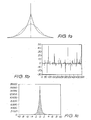
- Figure 1(a) shows a typical super-Gaussian distribution (shown as "line 1") compared to Gaussian distribution (shown as "line 2").
- Figure 1 (b) shows an example of ICA coefficients and Fig. 1 (c) is a corresponding histogram with a super-Gaussian distribution.
- the ICA transform picks out many kinds of different ICA features from each individual image, they all have in common that that the features are spatially oriented, band-passed, and localized both in the spatial and frequency domains [3][8]. In other words, they are some edges and bars with certain angles, widths and lengths. These are actually the essential elements or significant shapes in 2D images. Interestingly, these are also matched with the primary neural cell patterns in the human visual cortex.
- the HVS splits visual stimuli from the retina of the eye into many different components. These components pass by different tuned channels from the retina to the cortex, each channel being tuned to a different respective component [2][4][5].
- the characteristics of a component in the visual field are:
- a perceptive channel can only be stimulated by a signal whose characteristics are tuned to its own characteristics. Different channels have different characteristics. Moreover, according to the perceptive model of human vision [5], signals that have similar characteristics use the same channels from the eye to the cortex. It appears that such signals interact and are subject to non-linear effects. Masking is one of those effects. Masking occurs when a signal cannot be seen because of another signal with close characteristics but at a higher energy level [6][7].
- Fig. 1 shows a part of the transform W for a typical image, and Fig. 1 (e) the Fourier transform of it. In both cases amplitude values are represented as grey-scale values. Fig. 1 (d) high amplitudes are white, whereas in Fig. 1 (e) high amplitudes are dark.
- FIG. 2 the method which is an embodiment of the invention of embedding and detection of watermarks in images is illustrated schematically, acting on an image taken from a database 1.
- ICA feature learning the image from the database 1 is used by a unit marked as 4 to obtain an ICA transform and an ICA inverse transform (as described below in detail with reference to Fig. 3 ).
- ICA-WM embedding the ICA transform is used together with the image from the database 1 to generate ICA-based coefficients (by a unit shown as 7).
- a watermark from a second database 3 and a key from a third database 5 are used by a unit shown as 9 to produce a watermark pattern, which is combined by a unit shown as 11 with the ICA-based coefficients to form watermarked coefficients.
- the watermarked coefficients are then transformed by a unit 13 using the inverse ICA transform to produce the watermarked image.
- ICA-WM detection there is a first pre-processing stage, performed by a unit 14, of compensating the image for any distortion it may have received in the public domain (e.g. geometrical distortion, digital-to-analogue or analogue-to-digital effects, luminance variation effects, etc).
- a unit 15 uses the ICA transform to convert the watermarked image into warped watermarked data.
- a unit 17 uses the warped watermarked data and the watermark pattern to produce a result indicative of the presence of the watermark in the watermarked image.
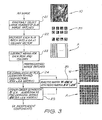
- the ICA-based watermark embedding procedure includes five stages: (31) pre-processing the host image in the spatial domain, (32) ICA transforming the pre-processed host image into the ICA domain to derive ICA coefficients, by making use of the analysis matrix W, (33) watermark embedding onto the ICA coefficients, (34) an inverse ICA transform from ICA coefficients back to image intensities by making use of the synthesis matrix A, (35) post-processing in the spatial domain.
- Pre-processing in spatial domain is performed by obtaining the global mean value of the host image, subtracting it from each pixel value of the image, and also recording it for image restoration later (step 36).
- the host image is then divided into continuous blocks of 8 pixels by 8 pixels (step 37), illustrated as 30.
- the number of such blocks N depends upon the size of the host image (as shown in Fig. 4 , N is 64, but the invention is not limited in this respect).
- the local means of these blocks are obtained, subtracted from each pixel of the blocks, and recorded for image restoration later (step 38).
- the 8x8 pixel blocks are vectorized into N respective column vectors, each having 64 components (step 39), and the N columns vectors are put together to a 64 N matrix, Z.
- the portion of the matrix C corresponding to each block represents 64 ICA coefficients c.
- the 64 coefficients c of each block are normalized to zero mean and unit variance with the original mean and variance recorded for later restoration (step 41).
- stage 33 We turn now to the watermark embedding-stage (stage 33).
- stage 33 Some important issues here are the selection of ICA coefficients for WM embedding, the formulation of WM patterns and their modulations with ICA coefficients.
- step 42 we select which of the ICA coefficients in the image obtained in step 41 are suitable to be used for embedding watermarks.
- two schemes for selection of ICA coefficients for embedding are described here as follows (although the invention is not limited to these schemes and many other schemes may be developed for selecting the ICA coefficients to watermark embedding):
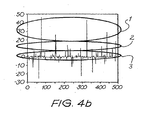
- Fig. 4(b) shows a typical distribution of ICA coefficients.
- the coefficients labelled as class 1 have big magnitudes, which means that they are robust in image operations (image processing operations try to avoid removing the large ICA coefficients). However, this may occasionally cause a big unexpected self-interference in correlation detection. Therefore, coefficients in class 1 are not desired to be used in this watermarking embodiment.
- the ICA coefficients of class 3 are usually high-frequency features or noises, having small magnitudes, close to zero. They are the least robust components, and the embodiment does not perform watermarking of such coefficients. For example, the ICA coefficients with values less than 1% of maximum coefficients are preferably not used in the watermarking.
- an optional enhancement to this strategy for the selection is to select coefficients within the class 2 which have further desired properties.
- the ICA analysis and synthesis functions derived in step 41 are ordered according to their three main properties: the edge's spatial location, orientation and its frequency magnitude. They are arranged so that the parameters of these properties change continuously and smoothly.
- the functions may be mainly ordered from low-frequency to high-frequency, but those functions with similar frequencies are ordered according to direction of their phase in the range of angles 0 to 2 ⁇ and with those functions with similar spatial locations also being placed adjacently. The purpose of this arrangement is to maximise the masking effect between components with similar characteristics.
- the watermark patterns will be embedded into a set of coefficients with adjacently arranged functions, and this set of coefficients is chosen such that all the coefficients are in class 2.
- a masking threshold can also be applied here for guaranteeing imperceptibility [6][7].
- Properly choosing a certain range in this ordered function list could ensure the robustness under attacks. For example, functions within the lower-to-middle frequency range survive relatively well under image compressions. This technique provides good masking based on the known "neighbour masking" effect: the small scale watermarks cannot be seen because of other ICA components obtained through nearby ICA features with similar characteristics at a higher energy level.
- the present embodiment employs a "spread spectrum" technique for generating the watermark patterns, which is commonly used in the fields of signal coding and watermarking.
- a key point of watermark pattern formulation in spread spectrum techniques is to transform narrow-band original watermark bits into wide-spectrum patterns.
- a private key is provided to keep the watermark pattern secure.
- step 43 (which corresponds to unit 9 of Fig. 2 ) we generate several series of wide-band Gaussian distributed pseudo-random numbers, using a private key obtained from database 5 of Fig. 2 , these series of numbers are modulated with respective ones of watermark bits, to transform the narrow-band original watermark bits to respective wide-spectrum patterns.
- these watermark patterns are uncorrelated to ICA coefficients on which the watermark patterns are to be embedded.
- This process is also known as direct-sequence Code Division Multiple Access (CDMA).
- CDMA direct-sequence Code Division Multiple Access
- This scheme also has the benefit of ensuring that the ICA-based watermarking is a secure system since only the party who has the private key is able to detect or remove the watermarks.
- the scheme for generating the watermark patterns can be varied by optionally inserting some error-correcting codes (ECC) into the watermark bits to improve the robustness and extraction accuracy. Because of the CDMA, it is also possible to embed multiple watermark patterns onto the same portion of the ICA coefficients as long as the watermark patterns for different watermark bits are all orthogonal so that they do not interfere with each other.
- ECC error-correcting codes
- the watermark bits are binary, the watermark patterns are real valued (or, rather, are one of a large number of intensity values).
- the total intensity of the watermark pattern is determined by a watermark strength parameter ⁇ , which is used as a control variable to select a trade-off between watermark imperceptibility and robustness.
- the watermark patterns generated as shown above are statistically orthogonal to each other. This is beneficial, for example, if multiple watermarks are to be embedded in the same piece of data.
- the embodiment is not limited in this respect.
- orthogonal binary patterns e.g. having the values +1/-1 or having the values 1/0
- Some such known series, suitable for use in the embodiment are referred to as "m-sequences, "hadamard sequences", or "gold sequences”.
- Fig. 10(a) illustrates a technique for making it more secure.
- an m-sequence is input to a unit 80 which also receives a random sequence of +1/-1 bits (which may for example be produced by applying a sign operation to a sequence of real-valued random numbers having a zero means).
- the unit 80 performs an individual component-wise multiplication, to generate an encoded binary sequence which can be used as a watermark pattern.
- step 44 the watermark patterns obtained in step 43 are embedded in the ICA coefficients selected in step 42 to obtain watermarked coefficients.
- the watermark pattern is a sequence of N numbers ⁇ i , where i is an integer in the range 1 ... N and each value ⁇ i is a binary value.
- the ICA coefficients are denoted as f(n), where n is an integer running from 1 to N' (where N' is the total number of ICA coefficients).
- the watermark pattern is to be embedded in selected ICA coefficients such that n runs from j+1 to j+N.
- a number of patch blocks may be defined within the host data with the ICA analysis being performed block-by-block, and in step (44) any given watermark bit (0/1) is encoded in multiple blocks.
- the number of blocks used is selected based on the size of the host image. Experiment shows that in the embodiment a suitable number of blocks for one watermark bit is from 50 to 100. Sometimes, the number of watermark bits is too large to keep large number of blocks for one watermark bit, e.g. if there are less than 10 blocks per watermark bit.
- Another way to increase the robustness is to cluster several watermark bits together to share watermark patterns.
- one watermark bit may be embedded in two watermark patterns which respectively represent zero (0) or one (1).
- Trowo watermark bits may be embedded in four watermark patterns , which respectively represent 00, 01, 10 and 11.
- 2 n watermark patterns are needed to represent respective possibilities for the realisations of the watermark bits.
- the length of the watermark patterns increases with n (e.g. in proportion to 2 n ), and so the correlation is more robust. In such a way, the detection rate for each watermark bit is increased.
- the ICA components are not embedded in the ICA components of very small energy (e.g. those components having an intensity which is less than 1% of the intensity of the components of maximum intensity), or of very high energy (e.g. these components having an intensity more than 30% of the intensity of the components of maximum intensity).
- Stage 35 of post-processing in the spatial domain, includes a step 48 of reshaping the vectors in the matrix Z to form 8 x 8 blocks, and then a step 49 in which each of the pixels of each block are increased by the respective local mean of that block obtained in step 38.
- step 50 the blocks are arranged to form a complete image.
- step 51 the global mean obtained in step 36 is added to each pixel value to obtain a final watermarked image.
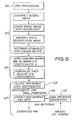
- ICA watermark detection is the counterpart of the embedding process, and aims to detect the embedded watermark from the watermarked image obtained in Fig. 4 (or a version of it which has been processed in the public domain by unknown techniques).
- the procedure of the detection process includes the general stages of: pre-processing to compensate for any distortion to the image while it was in the public domain (e.g. to compensate for geometric distortion, digital-to-analogue or analogue-to-digital distortion, luminance modification) which is performed by the unit 14 in Fig. 2 (step 60); pre-processing in spatial domain (stage 61), an ICA transform (stage 62) and watermark detection (stage 63). Note that this method does not employ any knowledge of the original image 10, although it assumed that there is access to the databases 3 and 5.
- the pre-processing (stage 61) is exactly same as the pre-processing procedure 31 of Fig. 4 , and results in is a data matrix Z", which may or may not be the same as the watermarked data matrix Z'.
- ICA coefficients are selected in step 64 by the same method as in step 42 of Fig. 4 .
- Watermark patterns are generated in step 65 according to same key and ECC method as in step 43 of Fig. 4 , but not using the parameter ⁇ .
- the detection threshold may be selected, for example, such that if we consider two different watermark patterns ⁇ i 0 and ⁇ i 1 then the threshold value for watermark pattern ⁇ i 0 may be the average value of the autocorrelation of ⁇ i 0 and the correlation of ⁇ i 0 and ⁇ i 1 . Conversely, the then the threshold value for watermark pattern ⁇ i 1 may be the average value of the autocorrelation of ⁇ i 1 and the correlation of ⁇ i 0 and ⁇ i 1 . This technique relies on an assumption that the similarity of one watermark pattern to itself in terms of correlation is always greater than that to the host image patch and other watermark patterns.
- the detection steps 65 and 66 are replaced by the process shown in Fig. 10(b) .
- the encoded binary sequence is obtained fom the coefficients selected in step 64.
- This sequence is input to a unit 80 performing the same function as the unit 80 of Fig. 10(a) .
- Also input to the unit 80 is the same random sequence used in Fig. 10(a) .
- the unit 80 thus outputs the m-sequence used to produce the watermark data by cross-correlating the extracted binary sequence with the random sequence.
- the present technique is not limited to watermarking raw images. Rather, compressed images also can be treated as the host images. This is illustrated in Fig. 6 .
- this watermark embedding process two additional steps are necessary: first the compressed image is de-compressed (step 71), then the watermark embedding process is carried out (step 72), and the resultant watermarked image recompressed (step 73) to give a compressed watermarked image with proper settings of image size and quality.
- the compressed images may for example be in the formats JPEG, JPEG2000 etc.
- the corresponding watermark detection process illustrated in Fig. 7 , includes a step 75 of image de-compression, prior to a watermark detection process (step 76) which is identical to the process shown in Fig. 5 .
- image compression other operations conventionally performed on images, such as geometric distortion, image recapturing, digital-to-analogue (DA) and analogue-to-digital (AD) conversion, etc, may also intentionally or accidentally alter the watermarked image.
- These operations usually can be corrected by using some standard image restoration methods as a pre-processing step before the watermark detection procedure. For example, image normalization based on spatial moments can be used for removing geometric distortion; digital filtering on different colour channels and pixel luminance has been used to remove noise introduced in an DA/AD process.
- image normalization based on spatial moments can be used for removing geometric distortion; digital filtering on different colour channels and pixel luminance has been used to remove noise introduced in an DA/AD process.
- the host images contained in the database 1 are original images in the pixel domain, and in the embodiments shown in Figs. 6 and 7 a de-compressed image in the pixel domain is used as the host image for ICA-watermarking, then compressed again.
- the data contained in the database 1 is transformed/compressed image data itself, not de-compressed image data obtained from it.
- the data may be multi-resolution wavelet coefficients in a JPEG2000 compressed image. These coefficients are available in the JPEG2000 image file, and a skilled reader will be aware of techniques for extracting them from the JPEG2000 file and restoring them to the JPEG2000 file after watermarking. Let us assume that these wavelet coefficients are contained in the database 1.
- Figure 8 is a typical example of multi-resolution wavelet coefficients produced by a known JPEG2000 algorithm.
- the coefficients are in 6 levels with size in 4:1 ratio between adjacent levels.
- Each level has horizontal (H), vertical (V) and diagonal (D) blocks.
- H1, V1 and D1 are respectively 1st-level horizontal, vertical and diagonal blocks, and
- H2, V2 and D2 are respectively 2nd-level horizontal, vertical and diagonal blocks.
- the stage of ICA feature learning is performed individually for each block, e.g. H1 or V1, as the source to produce the corresponding ICA analysis and synthesis filters ( W and A ).
- Figure 9 shows a typical example for a set of 64 analysis filters, W .
- the steps 7 and 15 are performed separately for each block.
- the filters corresponding to each block are used to transform or inverse-transform that block.
- Figs. 2 to 5 does not use the original host image during the detection process (so-called “blind detection”).
- the embodiment now described does use the original host image in the detection process (so-called “non-blind detection”).
- This embodiment still has the general structure shown in Figs. 2 to 5 but the detection process of Fig. 5 is modified by replacing the use of Eqn. (3) in step 66 by the steps of: (1) obtaining the ICA coefficients from the host image, and (2) subtracting them from the ICA coefficients obtained in step 64 to obtain WM patterns close to original WM patterns.
- the interference from the host image in spread spectrum's correlation calculation can be reduced to a minimum by subtracting the host image's coefficients. Additionally, the more significant functions are used in WM embedding, the less distortion may be resulted due to any imaging operations.
- the embedding process is slightly different from the embodiment of Figs. 2 to 5 .
- detection methods which do not use the original host image in the detection stage, we are usually careful to avoid using large ICA coefficients, because this may occasionally cause a big interference in correlation detection, in contrast, for method using host image, large coefficients are desired to be used for watermarking. Interference is kept at minimum due to subtracting host image's coefficients.
- step 44 of Fig. 4 the watermark patterns are added to the selected ICA coefficients by linear addition.
- the present embodiment uses a quantization method to embed the watermark patterns.
- the embodiment uses pre-selected individual ICA. coefficients, or sets of ICA coefficients, and sets these pre-selected ICA coefficients ("reconstruction points") according to the watermark data.
- scaling quantization In the case that individual ICA coefficients are modified, this is referred to here as "scalar quantization”.
- vector quantatization In the case that sets of ICA coefficients are modified, this is referred to here as "vector quantatization”.
- the detection process in this embodiment detects the watermarks by modifying step 66 of Fig. 5 by mapping the reconstruction points and determining what watermark bits are stored there. This process is referred to here as a "quantize-and-replace" strategy.
- This scheme can be simply extended to vector quantization method as follows.
- 2 ⁇ m coefficients are chosen as f 1 ( i ) ... f m (i) and f 1 ( j ) ... f m ( j ).
- and f total ( j )
- w n which may be 0 or 1
- ⁇ f total i ⁇ - Q ⁇ f total i f total i + f total j
- ⁇ f total j ⁇ - Q ⁇ f total j f total i + f total j
- ⁇ f l i ⁇ f total i ⁇ f l i f total i
- coefficients' modification in vector quantization can be smaller than those in scalar quantization for the same robustness parameter value Q .
- vector quantization provides better imperceptibility and better robustness
- the WM bit W n is simply detected by comparing the coefficient pair or two coefficient groups. Specifically, if
- (in the case of scalar quantization) or f total ( i ) ⁇ f total ( j ) (in the case of vector quantiztion) then this implies that w n 0. Conversely, if
- (in the case of scalar quantization) or f total ( i ) > f total ( j ) (in the case of vector quantization) then this implies that w n 1.
- the technique explained here can be easily extended to embedding multiple watermark bits in one quantize-and-replace step.
- three of the selected ICA coefficients having respective intensities f(i), f(j) and f(k). These three intensities may be modified so that they are each at least Q apart, and such that the order of the intensities encodes the watermark bit. For example, if the highest modified intensity is written as H, the lowest modified intensity is written as L, and the other modified intensity is written as M, then the correspondence of the watermark bits to be encoded ( w n ) may be as given in Table 1. Table 1 w n f ( i ) f ( j ) f ( k ) 00 H M L 01 M H L 10 H L M 11 L H M XX M L H XX L M H
- XX means a pattern reserved for future use. In other words, there never are occasion on which the value of the ICA coefficients are quantized such that f(k) becomes the highest.
- step 42 The strategy of energy sorting in step 42 is suitable in this embodiment, since the quantization scheme suppresses the image self-noise (interference), so that it is desirable to use the high-energy ICA coefficients.
- Significant features imply good self-masking effect for quantization changes. Because of their large magnitude, a large quantization tolerance is available to enlarge the distance between reconstruction points but still keep the imperceptibility of the watermarking. Additionally, these significant features have less distortion under imaging operations, e.g. compression.
- the embodiment therefore performs its equivalent of step 42 by sorting the ICA coefficients in order of their average energy, and the watermark patters may be embedded in the ICA coefficients of class 1 and the highest energy components in class 2 in Figure 7 , e.g. 1 st -10 th ICA coefficients.
- a private key is used to generate a sequence of pseudo-random numbers, in a way similar to the spread spectrum technique for generating the watermarks described above.
- pseudo-random numbers are not necessarily used to make the watermark patterns, but alternatively or additional are used to select, from the ICA coefficients selected in step 42, the ICA coefficients where the watermark embedding quantize-and-replace process will place and which class the coefficients belong to, i.e. i, j or k.
- each pair of odd and even numbers is the selected coefficients for quantization embedding in each block, where odd number belongs to group i and even is group j.
- the sequence is different, and therefore the watermarking is secure from attacks.
- alternative embodiments of the invention may derive the transforms W and A by less computationally intensive and time intensive techniques.
- the data may be analysed to make a selection from a library of previously determined sets of transforms W and A . This selection is much faster than deriving the transforms W and A constructively.
- the transforms W and A may be modified based on the image, e.g. making use of Gabor functions, since the properties of an ICA are quite close to those of Gabor functions.
- the derivation of W and A may be considered as "semi-adaptive". (Note that this possibility has the further advantage that less memory is required to store W and A for use in the detection step, since it is only necessary to store, for a given image, which of the previously determined transforms were used to watermark it, and how they were adapted.)
- the techniques described above may be extended to watermarking data which is audio data or video data, making use of known ICA techniques for these forms of data.
- the present invention be applied to many areas.
- it can be used for copyright protection: embedding copyright information as a watermark into the host image to be protected, so that the copyright information can be extracted later to claim the ownership of the host image.
- image authentication the embedded watermark information can also be used to identify any alteration in the image itself and altered locations by detecting the existence of ICA-based WM patterns.
- data hiding in image information such as a description, related knowledge about the image or indexing data can be embedded as a watermark so that such information is protected and attached.
- image transaction tracking the transaction path of the image can be traced by embedding a watermark into the image whenever it is transmitted, and extracting this data later.
Landscapes
- Engineering & Computer Science (AREA)
- Multimedia (AREA)
- Signal Processing (AREA)
- Physics & Mathematics (AREA)
- General Physics & Mathematics (AREA)
- Theoretical Computer Science (AREA)
- Editing Of Facsimile Originals (AREA)
- Image Processing (AREA)
- Television Systems (AREA)
Claims (28)
- Verfahren zum Einbetten eines Wasserzeichens in Daten, das die folgenden Schritte umfasst:(i) Anwenden einer Independent Component Analysis (ICA) auf die Daten, um eine Transformationsmatrix (W) abzuleiten zum Extrahieren aus den Daten der Amplituden von statistisch gegenseitig unabhängigen Komponenten der Daten (32, 40), wobei die ICA unter Verwendung von mehreren zufällig ausgewählten Patches der Daten durchgeführt wird;(ii) Codieren der Daten unter Verwendung der Transformationsmatrix (W) (41);(iii) Auswählen mindestens eines Abschnitts der codierten Daten, wobei der mindestens eine Abschnitt der codierten Daten in einem mittleren Amplitudenbereich (2) liegt (33, 42);(iv) Erzeugen eines Wasserzeichenmusters durch Anwenden eines Frequenzspreizungsverfahrens unter Verwendung von Wasserzeichendaten und eines Schlüssels zum Erzeugen von mindestens einem pseudozufälligen Muster, wobei das pseudozufällige Muster mit den Wasserzeichendaten moduliert wird, wodurch ein zu den codierten Daten unkorreliertes Wasserzeichenmuster erzeugt wird (33, 43);(v) Modifizieren der Amplituden des mindestens einen Abschnitts der codierten Daten unter Verwendung des Wasserzeichenmusters; und(vi) Decodieren der modifizierten codierten Daten unter Verwendung einer Inversen (A) der Transformationsmatrix (W), um mit einem Wasserzeichen versehene Daten zu erhalten, in denen das Wasserzeichenmuster eingebettet ist (34, 46, 47).
- Verfahren nach Anspruch 1, das ein Durchführen einer Hauptkomponentenanalyse einer Matrix umfasst, die unter Verwendung der Patches der Daten geformt wird.
- Verfahren nach Anspruch 1 oder 2, in dem das Auswählen des mindestens einen Abschnitts der codierten Daten ein Ordnen der Komponenten nach ihren Amplituden und ein Auswählen von Komponenten umfasst, die Amplituden innerhalb des mittleren Amplitudenbereichs (2) aufweisen.
- Verfahren nach Anspruch 3, in dem das Auswählen des mindestens einen Abschnitts der codierten Daten ferner basierend auf einem Komponentenähnlichkeitskriterium durchgeführt wird.
- Verfahren nach einem der vorhergehenden Ansprüche, in dem die Daten Bilddaten sind und die mit einem Wasserzeichen versehenen Daten mit einem Wasserzeichen versehene Bilddaten sind.
- Verfahren nach Anspruch 5, in dem die Bilddaten durch Dekomprimieren von komprimierten Bilddaten erhalten werden, wobei das Verfahren ferner einen Schritt zum Komprimieren der mit einem Wasserzeichen versehenen Bilddaten umfasst.
- Verfahren nach einem der vorhergehenden Ansprüche, in dem die Daten komprimierte Bilddaten sind.
- Verfahren nach einem der vorhergehenden Ansprüche, in dem die Amplituden des mindestens einen Abschnitts der codierten Daten durch ein lineares Addieren des Wasserzeichenmusters zu diesen modifiziert werden.
- Verfahren nach einem der vorhergehenden Ansprüche, in dem die Amplituden des mindestens einen Abschnitts der codierten Daten modifiziert werden, so dass sich die Werte der Gruppen von zwei oder mehr Einträgen der codierten Daten um Werte unterscheiden, die in vorher festgelegten Bereichen liegen.
- Verfahren zum Erkennen des Vorliegens des Wasserzeichenmusters in mit einem Wasserzeichen versehenen Daten, die aus einem Verfahren gemäß einem der vorhergehenden Ansprüche abgeleitet werden, wobei das Erkennungsverfahren folgende Schritte umfasst:(a) Codieren der mit einem Wasserzeichen versehenen Daten unter Verwendung der Transformationsmatrix (W), die im Schritt (i) von Anspruch 1 erhalten wird (62);(b) Auswählen mindestens eines Abschnitts der codierten mit einem Wasserzeichen versehenen Daten, wobei der mindestens eine Abschnitt der codierten mit einem Wasserzeichen versehenen Daten in einem mittleren Amplitudenbereich (2) liegt (63, 64);(c) Erzeugen eines Wasserzeichenmusters durch Anwenden eines Frequenzspreizungsverfahrens (63, 65); und(d) Berechnen einer Korrelation zwischen dem Wasserzeichenmuster und dem mindestens einen Abschnitt der codierten mit einem Wasserzeichen versehenen Daten und Bestimmen, ob die Korrelation oberhalb eines Schwellwerts liegt (63, 66).
- Verfahren nach Anspruch 10, in dem der Schritt (c) ein Erzeugen des Wasserzeichenmusters aus Wasserzeichendaten und einem Schlüssel (65) umfasst.
- Verfahren nach Anspruch 10 oder 11, in dem im Schritt (b) der mindestens eine Abschnitt der codierten mit einem Wasserzeichen versehenen Daten ferner basierend auf Eigenschaften der codierten mit einem Wasserzeichen versehenen Daten ausgewählt wird (64).
- Verfahren nach einem der Ansprüche 10 bis 12, in dem der Schritt (d) ein Vergleichen der Werte von unterschiedlichen der vorher festgelegten Einträge der codierten mit einem Wasserzeichen versehenen Daten (66) umfasst.
- Verfahren nach einem der Ansprüche 10 bis 13, in dem der Schritt (b) ein Subtrahieren von den codierten mit einem Wasserzeichen versehenen Daten entsprechender Werte von codierten Daten umfasst, die im Schritt (ii) von Anspruch 1 erhalten werden.
- Vorrichtung zum Einbetten eines Wasserzeichens in Daten, die einen Prozessor aufweist, der Folgendes umfasst:(i) eine Einheit (4) zum Anwenden einer Independent Component Analysis (ICA) auf die Daten, um eine Transformationsmatrix (W) abzuleiten zum Extrahieren aus den Daten der Amplituden von statistisch gegenseitig unabhängigen Komponenten der Daten, wobei die ICA unter Verwendung von mehreren zufällig ausgewählten Patches der Daten durchgeführt wird,(ii) eine Einheit (7) zum Codieren der Daten unter Verwendung der Transformationsmatrix (W),(iii) eine Einheit (7) zum Auswählen mindestens eines Abschnitts der codierten Daten, wobei der mindestens eine Abschnitt der codierten Daten in einem mittleren Amplitudenbereich (2) liegt;(iv) eine Einheit (9) zum Erzeugen eines Wasserzeichenmusters durch Anwenden eines Frequenzspreizungsverfahrens, eine Datenbank (3) zum Speichern von Wasserzeichendaten und eine Datenbank (5), die einen Schlüssel aufweist, wobei die Einheit (9) eingerichtet ist, um mindestens ein pseudozufälliges Muster unter Verwendung der Wasserzeichendaten und des Schlüssels zu erzeugen und um das pseudozufällige Muster unter Verwendung der Wasserzeichendaten zu modulieren, wodurch ein zu den codierten Daten unkorreliertes Wasserzeichenmuster erzeugt wird;(v) eine Einheit (11) zum Modifizieren der Amplituden des mindestens einen Abschnitts der codierten Daten unter Verwendung des Wasserzeichenmusters; und(vi) eine Einheit (13) zum Decodieren der modifizierten codierten Daten unter Verwendung einer Inversen (A) der Transformationsmatrix (W), um mit einem Wasserzeichen versehene Daten zu erhalten, in denen das Wasserzeichenmuster eingebettet ist.
- Vorrichtung nach Anspruch 15, in der die Einheit (4) zum Anwenden einer Independent Component Analysis eingerichtet ist, um eine Hauptkomponentenanalyse einer Matrix durchzuführen, die unter Verwendung der Patches der Daten gebildet wird.
- Vorrichtung nach Anspruch 15 oder 16, in der die Einheit (7) zum Auswählen mindestens eines Abschnitts der codierten Daten eingerichtet ist, um die Komponenten nach ihren Amplituden zu ordnen und um Komponenten auszuwählen, die Amplituden innerhalb des mittleren Amplitudenbereichs (2) aufweisen.
- Vorrichtung nach Anspruch 17, in der die Einheit (7) zum Auswählen mindestens eines Abschnitts der codierten Daten eingerichtet ist, um den mindestens einen Abschnitt der codierten Daten basierend auf einem Komponentenähnlichkeitskriterium auszuwählen.
- Vorrichtung nach einem der Ansprüche 15 bis 18 zum Versehen von Bilddaten mit einem Wasserzeichen.
- Vorrichtung nach Anspruch 19, die Dekomprimierungsmittel zum Erhalten der Bilddaten durch Dekomprimieren von komprimierten Bilddaten und Komprimierungsmittel zum Komprimieren der mit einem Wasserzeichen versehenen Bilddaten umfasst.
- Vorrichtung nach einem der vorhergehenden Ansprüche 15 bis 20, in der die Amplituden des mindestens einen Abschnitts der codierten Daten durch ein lineares Addieren des Wasserzeichenmusters zu diesen modifiziert werden.
- Vorrichtung nach einem der vorhergehenden Ansprüche 15 bis 20, in der die Amplituden des mindestens einen Abschnitts der codierten Daten modifiziert werden, so dass sich die Werte der Gruppen von zwei oder mehr Einträgen der codierten Daten durch Werte unterscheiden, die in vorher festgelegten Bereichen liegen.
- Vorrichtung zum Erkennen des Vorliegens des Wasserzeichenmusters in mit einem Wasserzeichen versehenen Daten, die aus einem Verfahren gemäß einem der vorhergehenden Ansprüche 1 bis 9 abgeleitet werden, wobei die Vorrichtung einen Prozessor umfasst, der Folgendes umfasst:(a) eine Einheit zum Codieren der mit einem Wasserzeichen versehenen Daten unter Verwendung der Transformationsmatrix (W), die im Schritt (i) von Anspruch 1 erhalten wird;(b) eine Einheit (15) zum Auswählen mindestens eines Abschnitts der codierten mit einem Wasserzeichen versehenen Daten, wobei der mindestens eine Abschnitt der codierten mit einem Wasserzeichen versehenen Daten in einem mittleren Amplitudenbereich (2) liegt;(c) eine Einheit zum Erzeugen eines Wasserzeichenmusters durch Anwenden eines Frequenzspreizungsverfahrens; und(d) eine Einheit (17) zum Berechnen einer Korrelation zwischen dem Wasserzeichenmuster und dem mindestens einen Abschnitt der codierten mit einem Wasserzeichen versehenen Daten und zum Bestimmen, ob die Korrelation oberhalb eines Schwellwerts liegt.
- Vorrichtung nach Anspruch 23, in der die Einheit zum Erzeugen eines Wasserzeichenmusters eingerichtet ist, um das Wasserzeichenmuster aus Wasserzeichendaten und einem Schlüssel zu erzeugen.
- Vorrichtung nach Anspruch 23 oder 24, in der die Einheit (15) zum Auswählen mindestens eines Abschnitts der codierten mit einem Wasserzeichen versehenen Daten eingerichtet ist, um ferner den mindestens einen Abschnitt der codierten mit einem Wasserzeichen versehenen Daten basierend auf Eigenschaften der codierten mit einem Wasserzeichen versehenen Daten auszuwählen.
- Vorrichtung nach einem der Ansprüche 23 bis 25, in der die Einheit (17) zum Berechnen einer Korrelation eingerichtet ist, um die Werte von unterschiedlichen der vorher festgelegten Einträge der codierten mit einem Wasserzeichen versehenen Daten zu vergleichen.
- Vorrichtung nach einem der Ansprüche 23 bis 26, in der der Prozessor eingerichtet ist, um von den codierten mit einem Wasserzeichen versehenen Daten entsprechende Werte von codierten Daten zu subtrahieren, die im Schritt (ii) von Anspruch 1 erhalten werden.
- Vorrichtung nach einem der Ansprüche 23 bis 27, in der der Teil des mindestens einen Abschnitts der codierten mit einem Wasserzeichen versehenen Daten basierend auf Eigenschaften der codierten mit einem Wasserzeichen versehenen Daten ausgewählt wird.
Applications Claiming Priority (2)
| Application Number | Priority Date | Filing Date | Title |
|---|---|---|---|
| SG200304195A SG121783A1 (en) | 2003-07-29 | 2003-07-29 | Techniques and systems for embedding and detectingwatermarks in digital data |
| SG200304195 | 2003-07-29 |
Publications (3)
| Publication Number | Publication Date |
|---|---|
| EP1503343A2 EP1503343A2 (de) | 2005-02-02 |
| EP1503343A3 EP1503343A3 (de) | 2005-07-27 |
| EP1503343B1 true EP1503343B1 (de) | 2009-08-19 |
Family
ID=33538441
Family Applications (1)
| Application Number | Title | Priority Date | Filing Date |
|---|---|---|---|
| EP20040011175 Expired - Lifetime EP1503343B1 (de) | 2003-07-29 | 2004-05-11 | Verfahren und System zur Einbettung und Detektion von Wasserzeichen in digitalen Daten |
Country Status (5)
| Country | Link |
|---|---|
| US (1) | US7496209B2 (de) |
| EP (1) | EP1503343B1 (de) |
| JP (1) | JP2005051785A (de) |
| DE (1) | DE602004022616D1 (de) |
| SG (1) | SG121783A1 (de) |
Families Citing this family (30)
| Publication number | Priority date | Publication date | Assignee | Title |
|---|---|---|---|---|
| US7856116B2 (en) | 2004-11-09 | 2010-12-21 | Digimarc Corporation | Authenticating identification and security documents |
| US20060239500A1 (en) * | 2005-04-20 | 2006-10-26 | Meyer Thomas W | Method of and apparatus for reversibly adding watermarking data to compressed digital media files |
| EP1729285A1 (de) * | 2005-06-02 | 2006-12-06 | Deutsche Thomson-Brandt Gmbh | Verfahren und Vorrichtung zur Wasserzeichenmarkierung eines Audio-Video-Signals mittels Wasserzeichendaten unter Verwendung eines gespreizten Spektrums |
| WO2007040112A1 (ja) * | 2005-10-03 | 2007-04-12 | Mitsubishi Electric Corporation | 電子透かし埋め込み装置及び電子透かし検出装置 |
| KR100814793B1 (ko) | 2005-12-08 | 2008-03-19 | 한국전자통신연구원 | 특정 클래스 정보를 갖는 선형투영기반 ica를 이용한얼굴인식 방법 및 그 시스템 |
| US20090003701A1 (en) * | 2007-06-30 | 2009-01-01 | Lucent Technologies, Inc. | Method and apparatus for applying steganography to digital image files |
| EP2071822A1 (de) * | 2007-12-13 | 2009-06-17 | Thomson Licensing | Verfahren und Vorrichtung zum Einfügen eines entfernbaren, sichtbaren Wasserzeichens in einem Bild und Verfahren und Vorrichtung zur Entfernung derartiger Wasserzeichen |
| KR101577953B1 (ko) * | 2008-12-16 | 2015-12-17 | 삼성디스플레이 주식회사 | 접촉 감지 기능이 있는 표시 장치 및 접촉 판단 방법 |
| US8578404B2 (en) | 2011-06-30 | 2013-11-05 | The Nielsen Company (Us), Llc | Program telecast monitoring using watermarks |
| CN102592256B (zh) * | 2011-12-28 | 2015-02-18 | 辽宁师范大学 | 基于支持向量机校正的数字图像水印检测方法 |
| US9094873B2 (en) * | 2012-05-14 | 2015-07-28 | Wei Lu | Classified relation networking optimization platform in open wireless architecture (OWA) mobile cloud terminal device |
| US20140267679A1 (en) * | 2013-03-13 | 2014-09-18 | Leco Corporation | Indentation hardness test system having an autolearning shading corrector |
| EP2833628B1 (de) * | 2013-08-02 | 2017-10-11 | Application Solutions (Electronics and Vision) Limited | Videokamera und Videoempfänger eines Videoüberwachungssystems |
| US9058517B1 (en) * | 2014-04-16 | 2015-06-16 | I.R.I.S. | Pattern recognition system and method using Gabor functions |
| US9311558B2 (en) * | 2014-04-16 | 2016-04-12 | I.R.I.S. | Pattern recognition system |
| CN105224833B (zh) * | 2014-06-30 | 2018-03-30 | 北京金山安全软件有限公司 | 利用数字水印识别应用程序是否是正版的方法及系统 |
| US9747656B2 (en) * | 2015-01-22 | 2017-08-29 | Digimarc Corporation | Differential modulation for robust signaling and synchronization |
| CN105915911B (zh) * | 2016-04-13 | 2019-03-15 | 厦门理工学院 | 一种基于并行压缩感知和阿诺德置乱的图像压缩加密算法 |
| US10609714B2 (en) * | 2017-07-12 | 2020-03-31 | Qualcomm Incorporated | Spatial listen before talk |
| CN109064375B (zh) * | 2018-07-23 | 2023-05-09 | 北京信息科技大学 | 一种基于零水印的大数据产权辨识方法及系统 |
| US11501108B2 (en) * | 2018-07-24 | 2022-11-15 | Nxp B.V. | Adding a fingerprint to a machine learning model |
| US11004169B2 (en) | 2018-08-29 | 2021-05-11 | Nokia Technologies Oy | Neural network watermarking |
| CN109740615B (zh) * | 2018-12-29 | 2023-04-07 | 武汉大学 | 一种对抗攻击样本扰动的去除方法 |
| CN111062854B (zh) * | 2019-12-26 | 2023-08-25 | Oppo广东移动通信有限公司 | 检测水印的方法、装置、终端及存储介质 |
| CN113643173B (zh) * | 2021-08-19 | 2025-04-25 | 广东小天才科技有限公司 | 水印去除方法、装置、终端设备及可读存储介质 |
| US12189727B2 (en) * | 2021-09-17 | 2025-01-07 | Omnivision Technologies, Inc. | Sensor watermarking on raw images |
| CN114422651B (zh) * | 2022-01-11 | 2022-09-16 | 北京邮电大学 | 图像信息隐藏方法、溯源方法、隐藏装置和溯源装置 |
| CN117217973B (zh) * | 2023-09-14 | 2024-06-07 | 兰州交通大学 | 运用马氏距离和iss特征点的三维点云数据水印方法 |
| CN118333831B (zh) * | 2024-06-17 | 2024-09-24 | 清华大学 | 语义素描图的数字水印处理方法和装置 |
| CN120672553B (zh) * | 2025-06-13 | 2025-12-16 | 大连理工大学 | 基于小波域统计特征的不可见水印嵌入方法 |
Family Cites Families (9)
| Publication number | Priority date | Publication date | Assignee | Title |
|---|---|---|---|---|
| US6049627A (en) * | 1997-05-28 | 2000-04-11 | Thomason Information Services, Inc. | Covert digital identifying indicia for digital image |
| US6359998B1 (en) * | 1998-04-23 | 2002-03-19 | 3Com Corporation | Method and apparatus for wavelet-based digital watermarking |
| US6847376B2 (en) * | 1998-11-13 | 2005-01-25 | Lightsurf Technologies, Inc. | Method and system for characterizing color display monitor output |
| US6556688B1 (en) * | 1999-03-15 | 2003-04-29 | Seiko Epson Corporation | Watermarking with random zero-mean patches for printer tracking |
| US6512836B1 (en) * | 2000-07-28 | 2003-01-28 | Verizon Laboratories Inc. | Systems and methods for etching digital watermarks |
| TW484325B (en) * | 2000-08-29 | 2002-04-21 | Wen-Shing Shiu | Digital watermark |
| US7137005B2 (en) * | 2001-03-28 | 2006-11-14 | Lg Electronics Inc. | Method of watermarking digital data |
| US7046818B2 (en) * | 2001-07-20 | 2006-05-16 | Seiko Epson Corporation | Standards compliant watermarking for access management |
| US7187806B2 (en) * | 2001-08-23 | 2007-03-06 | Hewlett-Packard Development Company, L.P. | System and method for embedding information within a printed image using block error diffusion halftoning |
-
2003
- 2003-07-29 SG SG200304195A patent/SG121783A1/en unknown
-
2004
- 2004-05-11 EP EP20040011175 patent/EP1503343B1/de not_active Expired - Lifetime
- 2004-05-11 DE DE200460022616 patent/DE602004022616D1/de not_active Expired - Lifetime
- 2004-07-27 US US10/900,738 patent/US7496209B2/en not_active Expired - Fee Related
- 2004-07-29 JP JP2004222386A patent/JP2005051785A/ja not_active Withdrawn
Also Published As
| Publication number | Publication date |
|---|---|
| EP1503343A2 (de) | 2005-02-02 |
| SG121783A1 (en) | 2006-05-26 |
| US7496209B2 (en) | 2009-02-24 |
| DE602004022616D1 (de) | 2009-10-01 |
| US20050025337A1 (en) | 2005-02-03 |
| EP1503343A3 (de) | 2005-07-27 |
| JP2005051785A (ja) | 2005-02-24 |
Similar Documents
| Publication | Publication Date | Title |
|---|---|---|
| EP1503343B1 (de) | Verfahren und System zur Einbettung und Detektion von Wasserzeichen in digitalen Daten | |
| Ali et al. | Differential evolution algorithm for the selection of optimal scaling factors in image watermarking | |
| Song et al. | A robust region-adaptive dual image watermarking technique | |
| Hien et al. | Robust multi-logo watermarking by RDWT and ICA | |
| Jane et al. | A new approach of nonblind watermarking methods based on DWT and SVD via LU decomposition | |
| Yin et al. | Color image watermarking algorithm based on DWT-SVD | |
| Assini et al. | A robust hybrid watermarking technique for securing medical image | |
| Bhatnagar | A new facet in robust digital watermarking framework | |
| Meenakshi et al. | A robust watermarking scheme based Walsh-Hadamard transform and SVD using ZIG ZAG scanning | |
| Savakar et al. | Digital image watermarking using DWT and FWHT | |
| Senapati et al. | RST invariant blind image watermarking schemes based on discrete tchebichef transform and singular value decomposition | |
| Hamad et al. | A blind high-capacity wavelet-based steganography technique for hiding images into other images | |
| Zargar et al. | Robust and imperceptible image watermarking in DWT-BTC domain | |
| El Hossaini et al. | A New Robust Blind Watermarking Scheme Based on Steerable pyramid and DCT using Pearson product moment correlation. | |
| Klington et al. | Cost-Effective watermarking scheme for authentication of digital fundus images in healthcare data management | |
| Yavuz et al. | Digital watermarking with PCA based reference Images | |
| Kaviani et al. | Elevating watermark robustness by data diffusion in Contourlet coefficients | |
| Huang et al. | A lossless data hiding based on discrete Haar wavelet transform | |
| Thapa et al. | On secure digital image watermarking techniques | |
| Gupta et al. | DWT-SVD based watermarking scheme of JPEG images using elliptic curve cryptography | |
| Thomas et al. | Reversible color image watermarking scheme based on contourlet transform and principal component analysis | |
| Taouil et al. | A data hiding scheme based on the Haar discrete wavelet transform and the K-LSB | |
| Nguyen et al. | A new image watermarking scheme using contourlet transforms | |
| Sever et al. | Block size analysis for discrete wavelet watermarking and embedding a vector image as a watermark. | |
| Shankar et al. | A robust video watermarking scheme using sparse principal component analysis and wavelet transform |
Legal Events
| Date | Code | Title | Description |
|---|---|---|---|
| PUAI | Public reference made under article 153(3) epc to a published international application that has entered the european phase |
Free format text: ORIGINAL CODE: 0009012 |
|
| AK | Designated contracting states |
Kind code of ref document: A2 Designated state(s): AT BE BG CH CY CZ DE DK EE ES FI FR GB GR HU IE IT LI LU MC NL PL PT RO SE SI SK TR |
|
| AX | Request for extension of the european patent |
Extension state: AL HR LT LV MK |
|
| PUAL | Search report despatched |
Free format text: ORIGINAL CODE: 0009013 |
|
| RIC1 | Information provided on ipc code assigned before grant |
Ipc: 7G 06T 1/00 A |
|
| AK | Designated contracting states |
Kind code of ref document: A3 Designated state(s): AT BE BG CH CY CZ DE DK EE ES FI FR GB GR HU IE IT LI LU MC NL PL PT RO SE SI SK TR |
|
| AX | Request for extension of the european patent |
Extension state: AL HR LT LV MK |
|
| 17P | Request for examination filed |
Effective date: 20051122 |
|
| AKX | Designation fees paid |
Designated state(s): DE FR GB |
|
| GRAP | Despatch of communication of intention to grant a patent |
Free format text: ORIGINAL CODE: EPIDOSNIGR1 |
|
| GRAS | Grant fee paid |
Free format text: ORIGINAL CODE: EPIDOSNIGR3 |
|
| GRAA | (expected) grant |
Free format text: ORIGINAL CODE: 0009210 |
|
| AK | Designated contracting states |
Kind code of ref document: B1 Designated state(s): DE FR GB |
|
| REG | Reference to a national code |
Ref country code: GB Ref legal event code: FG4D |
|
| REF | Corresponds to: |
Ref document number: 602004022616 Country of ref document: DE Date of ref document: 20091001 Kind code of ref document: P |
|
| PLBE | No opposition filed within time limit |
Free format text: ORIGINAL CODE: 0009261 |
|
| STAA | Information on the status of an ep patent application or granted ep patent |
Free format text: STATUS: NO OPPOSITION FILED WITHIN TIME LIMIT |
|
| 26N | No opposition filed |
Effective date: 20100520 |
|
| PGFP | Annual fee paid to national office [announced via postgrant information from national office to epo] |
Ref country code: FR Payment date: 20110607 Year of fee payment: 8 |
|
| PGFP | Annual fee paid to national office [announced via postgrant information from national office to epo] |
Ref country code: GB Payment date: 20110520 Year of fee payment: 8 |
|
| PGFP | Annual fee paid to national office [announced via postgrant information from national office to epo] |
Ref country code: DE Payment date: 20110520 Year of fee payment: 8 |
|
| GBPC | Gb: european patent ceased through non-payment of renewal fee |
Effective date: 20120511 |
|
| REG | Reference to a national code |
Ref country code: FR Ref legal event code: ST Effective date: 20130131 |
|
| REG | Reference to a national code |
Ref country code: DE Ref legal event code: R119 Ref document number: 602004022616 Country of ref document: DE Effective date: 20121201 |
|
| PG25 | Lapsed in a contracting state [announced via postgrant information from national office to epo] |
Ref country code: FR Free format text: LAPSE BECAUSE OF NON-PAYMENT OF DUE FEES Effective date: 20120531 Ref country code: GB Free format text: LAPSE BECAUSE OF NON-PAYMENT OF DUE FEES Effective date: 20120511 |
|
| PG25 | Lapsed in a contracting state [announced via postgrant information from national office to epo] |
Ref country code: DE Free format text: LAPSE BECAUSE OF NON-PAYMENT OF DUE FEES Effective date: 20121201 |