EP1501166A1 - Schaltungsanordnung zur Uberprüfung der Versorgung einer elektrischen Last und Verfahren hierfür - Google Patents
Schaltungsanordnung zur Uberprüfung der Versorgung einer elektrischen Last und Verfahren hierfür Download PDFInfo
- Publication number
- EP1501166A1 EP1501166A1 EP03291825A EP03291825A EP1501166A1 EP 1501166 A1 EP1501166 A1 EP 1501166A1 EP 03291825 A EP03291825 A EP 03291825A EP 03291825 A EP03291825 A EP 03291825A EP 1501166 A1 EP1501166 A1 EP 1501166A1
- Authority
- EP
- European Patent Office
- Prior art keywords
- voltage
- load
- diode
- circuit arrangement
- current
- Prior art date
- Legal status (The legal status is an assumption and is not a legal conclusion. Google has not performed a legal analysis and makes no representation as to the accuracy of the status listed.)
- Granted
Links
- 238000000034 method Methods 0.000 title claims abstract description 5
- 238000012544 monitoring process Methods 0.000 claims abstract description 25
- 238000012806 monitoring device Methods 0.000 claims abstract description 9
- 238000005259 measurement Methods 0.000 claims abstract description 4
- 230000008878 coupling Effects 0.000 claims description 7
- 238000010168 coupling process Methods 0.000 claims description 7
- 238000005859 coupling reaction Methods 0.000 claims description 7
- 239000008186 active pharmaceutical agent Substances 0.000 claims description 6
- 238000000926 separation method Methods 0.000 claims description 3
- 230000002427 irreversible effect Effects 0.000 claims description 2
- 230000003247 decreasing effect Effects 0.000 claims 1
- 238000012360 testing method Methods 0.000 description 5
- 238000010586 diagram Methods 0.000 description 4
- 230000007257 malfunction Effects 0.000 description 3
- 230000001419 dependent effect Effects 0.000 description 2
- 238000005516 engineering process Methods 0.000 description 2
- 230000011664 signaling Effects 0.000 description 2
- XUIMIQQOPSSXEZ-UHFFFAOYSA-N Silicon Chemical compound [Si] XUIMIQQOPSSXEZ-UHFFFAOYSA-N 0.000 description 1
- 238000006243 chemical reaction Methods 0.000 description 1
- 239000004020 conductor Substances 0.000 description 1
- 238000001514 detection method Methods 0.000 description 1
- 238000011161 development Methods 0.000 description 1
- 230000000694 effects Effects 0.000 description 1
- 230000005611 electricity Effects 0.000 description 1
- 230000004907 flux Effects 0.000 description 1
- 238000002844 melting Methods 0.000 description 1
- 230000008018 melting Effects 0.000 description 1
- 238000005070 sampling Methods 0.000 description 1
- 229910052710 silicon Inorganic materials 0.000 description 1
- 239000010703 silicon Substances 0.000 description 1
Images

Classifications
-
- H—ELECTRICITY
- H02—GENERATION; CONVERSION OR DISTRIBUTION OF ELECTRIC POWER
- H02H—EMERGENCY PROTECTIVE CIRCUIT ARRANGEMENTS
- H02H1/00—Details of emergency protective circuit arrangements
- H02H1/0038—Details of emergency protective circuit arrangements concerning the connection of the detecting means, e.g. for reducing their number
- H02H1/0046—Commutating the detecting means in dependance of the fault, e.g. for reducing their number
-
- B—PERFORMING OPERATIONS; TRANSPORTING
- B60—VEHICLES IN GENERAL
- B60L—PROPULSION OF ELECTRICALLY-PROPELLED VEHICLES; SUPPLYING ELECTRIC POWER FOR AUXILIARY EQUIPMENT OF ELECTRICALLY-PROPELLED VEHICLES; ELECTRODYNAMIC BRAKE SYSTEMS FOR VEHICLES IN GENERAL; MAGNETIC SUSPENSION OR LEVITATION FOR VEHICLES; MONITORING OPERATING VARIABLES OF ELECTRICALLY-PROPELLED VEHICLES; ELECTRIC SAFETY DEVICES FOR ELECTRICALLY-PROPELLED VEHICLES
- B60L3/00—Electric devices on electrically-propelled vehicles for safety purposes; Monitoring operating variables, e.g. speed, deceleration or energy consumption
-
- H—ELECTRICITY
- H02—GENERATION; CONVERSION OR DISTRIBUTION OF ELECTRIC POWER
- H02H—EMERGENCY PROTECTIVE CIRCUIT ARRANGEMENTS
- H02H3/00—Emergency protective circuit arrangements for automatic disconnection directly responsive to an undesired change from normal electric working condition with or without subsequent reconnection ; integrated protection
- H02H3/12—Emergency protective circuit arrangements for automatic disconnection directly responsive to an undesired change from normal electric working condition with or without subsequent reconnection ; integrated protection responsive to underload or no-load
-
- H—ELECTRICITY
- H02—GENERATION; CONVERSION OR DISTRIBUTION OF ELECTRIC POWER
- H02H—EMERGENCY PROTECTIVE CIRCUIT ARRANGEMENTS
- H02H3/00—Emergency protective circuit arrangements for automatic disconnection directly responsive to an undesired change from normal electric working condition with or without subsequent reconnection ; integrated protection
- H02H3/20—Emergency protective circuit arrangements for automatic disconnection directly responsive to an undesired change from normal electric working condition with or without subsequent reconnection ; integrated protection responsive to excess voltage
- H02H3/207—Emergency protective circuit arrangements for automatic disconnection directly responsive to an undesired change from normal electric working condition with or without subsequent reconnection ; integrated protection responsive to excess voltage also responsive to under-voltage
Definitions
- the invention relates to a circuit arrangement according to the preamble of Claim 1 and a method according to the preamble of claim 10th therefor.
- the power supply has an input or Output fuse, which limits the maximum current. at Exceeding this fuse separates the corresponding circuit, z. B. by melting a security thread or by pressing a Switch.
- WO92 / 17830 describes an interface unit which is a Monitoring both the voltage and the current of an analogue Output signal provides. This voltage and current are each individually compared with predetermined voltage or current values. at Deviation over a respectively defined measure is in each case a switch to Disconnect the signal driven by the output.
- a disadvantage of the above-described prior art is in the relative high cost of separate monitoring of voltage and current.
- a high effort at the same time means a high susceptibility to errors.
- the invention is based on the object, a simple Circuitry to create, which still has a precise current and Voltage monitoring allows.
- the basic idea of the invention is to test for a load applied input voltage, d. H. essentially the Output voltage of a load supplying electrical Energy supply and testing the load current to combine.
- a measuring voltage is applied across one to the power supply of the load connected voltage divider tapped and a Monitoring device is supplied.
- the voltage divider contains a switchable element, whereby two different division ratios of Voltage can be adjusted.
- the load current is tapped, and rated; upon reaching a predetermined current value is a Switching the switchable element and thus changing the Measuring voltage.
- the switchable element can be a mechanical relay, which then, when a certain current value is reached in the relay coil, it switches.
- the switchable element is formed by a switching transistor realized. In this case, the base of this transistor via a coupling circuit coupled with a voltage derived from the load current. These Voltage is tapped across a device, which in the Load circuit is connected.
- This element is advantageously used as in Flow direction switched diode executed because the falling over Voltage a maximum value, about 0.7 V in silicon technology, independent does not exceed the load current.
- the non-switchable elements of the voltage divider are preferably in Series switched resistors. The ratio of these resistance values then reflects the ratio of the measuring voltage to the input voltage again, as long as the switchable element does not turn on.
- the coupling circuit has a Operational amplifier, which with a first input with the Cathode of the diode, with a second input via another diode, which has a lower forward voltage with respect to the diode, with the anode of the diode and with the output with the base of the diode Switching transistor is connected.
- the coupling circuit at least two interconnected transistors, which with so the anode, the cathode of the diode and the base of the switching transistor connected to a voltage drop across the diode to a Locking the switching transistor leads.
- the to second resistor of the voltage divider with collector and emitter in parallel switched switching transistor conducts and thus forms a relation to the first resistor of the voltage divider very low resistance (near zero ohms). The measuring voltage is correspondingly low.
- the voltage monitoring is the Supplied measuring voltage.
- This measuring voltage is then checked whether it is within predetermined limits. For example, a upper and lower voltage check threshold predetermined become. As long as the measuring voltage is between these thresholds the supply of the load is considered correct, i. H. it flows a sufficiently high current and the input voltage is in one allowed area.
- a switch is between the load and the power supply switched, whose switching input is connected to the voltage monitoring. As soon as the voltage is outside the permitted range, a Separation of the power supply from the load. Alternatively it is possible to switch the switch into a supply line for power supply, if this energy supply itself from another energy supply is supplied.
- a logical shutdown in a central module for example in a central module Vehicle module of a train control device showing the results the monitored module, for example, path and speed data a path and speed measuring module processed, take place to let.
- a signaling is carried out by the monitoring device to the central module.
- the circuit arrangement, monitoring device and load circuit can each be realized as individual modules or partially or all together in one unit.
- FIG. 1 shows a circuit diagram with a power supply PS, a circuit arrangement SC according to the invention for the combined voltage and current monitoring, a voltage monitoring SU and a not closer considered load RL, which is shown as a load resistor RL.
- the power supply PS is represented by an ideal voltage source Ui and an internal resistance RI.
- One pole of the ideal voltage source Ui is connected to the ground and another via the internal resistance RI to a (load) input P of a circuit SC. Between the input P and the ground is an input voltage U P.
- the circuit arrangement has a load output A, which is connected to the ground via the load RL, and a monitoring or measuring output S, which is connected to a voltage monitor SU. Between the measuring output S and the ground is a measuring voltage U S on.
- the input P is connected to the load output A via a component B.
- a voltage divider branches with two series-connected resistors R1 and R2 to ground. Between these resistors the measuring output S branches off.
- the current switch CS has two inputs for sampling the component voltage U F dropped across the component B, which are each connected to the input P and the load output A.
- the monitoring of the input voltage U P by means of a voltage monitoring SU, which determines whether the applied voltage U P assumes certain values, for example, as described in more detail in Fig. 2, whether this voltage within a predetermined range is located.
- the voltage applied to the voltage monitoring SU measuring voltage is obtained by means of the voltage divider from the applied voltage U P , here proportional to the ratio of the second resistor R2 to the resistor chain R1 / R2.
- this circuit the monitoring output S at the voltage divider R1 / R2 having, expanded by a current sensor CS.
- a component B is inserted into the current path from the power supply PS to the load RL, ie between the input P and the load output A of the circuit arrangement.
- the component B has the property that at current flow, a certain voltage U F drops.
- This voltage drop is fed to the current sensor CS, which, with the knowledge of the properties of the component (eg current-voltage characteristic), closes back to the load current I.
- the current sensor is connected to the control input of the switching element X. As long as no load current I flows or the load current is low, the switching element X remains closed.
- the switch is opened.
- the switch can be thought of as shown in FIG. 1 as a relay contact, which is connected by a coil, which is traversed by a dependent of the load current I coil current. As soon as this current reaches a certain value, switching takes place and thus opening of the relay contact. In the ideal case, the relay contact has a resistance of 0 ohms in the closed state.
- the measuring voltage Us then assumes the value 0 as long as the load current is below the determined value and jumps to the value U P * R2 / (R1 + R2) as soon as the load current I exceeds this value.
- FIGS. 3 and 4 embodiments for implementations with electronic components for the component B, the current sensor CS and the switching element X are described. In these examples, the switching element X has a low resistance even in the closed state.
- the voltage divider described above can also be made from a Resistor chain composed of more than two resistors and the tap of the measuring voltage can be between any resistors this resistor chain done.
- the switching element X can be parallel to one or more of these resistors are located.
- the resistors can Take values between 0 ohms and infinity.
- FIG. 2 shows an exemplary current-voltage diagram with an allowable range AR.
- the abscissa shows the load current I and the ordinate the measured voltage U S.
- the permitted area is limited on three sides: a minimum current I min , a minimum measuring voltage U Smin and a maximum measuring voltage U Smax .
- Fig. 2 shows an example of how the common current and voltage monitoring affect the voltage at the monitoring output S.
- I min When the current drops below the threshold of I min , a voltage below U Smin at the output S is detected. Above this current then takes place known from the prior art monitoring of the voltage with a minimum threshold U Smin and a maximum threshold U Smax instead.
- a monitoring is on a maximum current, for example, to short circuits detect. In this case, then a renewed closing of the switch at a current above the maximum allowable current.
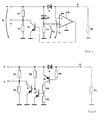
- FIG. 3 shows a first exemplary embodiment of a circuit according to FIG. 1.
- the component B is designed as a diode D in FIG.
- the Current sensor CS is connected through a circuit with a Schottky diode DS, an operational amplifier OP.
- the switching contact X is as (NPN) transistor, hereinafter referred to as switching transistor T1, realized.
- the Schottky diode DS is connected with its anode to the anode of the diode D and with its cathode to the negative input of the operational amplifier OP and a resistor RS, which is connected to the ground.
- the positive input of the operational amplifier OP is connected to the cathode of the diode D.
- the output of the operational amplifier OP is connected to the base of the switching transistor T1.
- the collector of this transistor is connected to the measuring output S and the emitter to the ground.
- the operational amplifier OP is fed by the power supply with the voltage U P. Between the positive input of the operational amplifier OP and the ground, a voltage U D falls and between the negative input of the operational amplifier OP and the ground, a voltage U RS drops.
- the Schottky diode DS has a lower flux voltage than the diode D. During operation, therefore, a lower voltage is applied to the Schottky diode DS than to the diode D.
- the output S is a voltage proportional to the supply voltage U P , the load current I has no effect on the voltage test in the voltage monitoring SU or, in other words, the result of the current test is positive.
- the load circuit is interrupted; there is no current flow via the load RL.
- U RS ⁇ U D the switching transistor T1 becomes conductive.
- U P the minimum preset threshold U Smin .
- the voltage test in the voltage monitor SU is negative irrespective of whether the supply voltage is within the tolerated limits.
- FIG. 4 shows a second exemplary embodiment of a circuit according to FIG. 2.
- the component B is diode D and the switchable Element X designed as a switching transistor T1.
- the current sensor CS is as Circuit consisting of two further transistors T2 and T3 and four Resistors R3 - R6.
- the third resistor R3 connects the input P to the base of the Switching transistor T1, which continues to the collector of the second (NPN) Transistor T2 is connected.
- the emitter of the second transistor T2 is on Ground.
- the emitter of the third (PNP) transistor is connected to the anode the diode D, the base is on the sixth resistor R6 with the Cathode of the diode and the collector is connected in series (fourth and fifth) resistors R4 and R5 connected to the ground. Of the Point between the fourth and fifth resistor R4 and R5 is connected to the Base of the second transistor T2 connected.
- the third transistor T3 is conductive. Due to the voltage drop across the fifth resistor R5, the second transistor T2 is also conductive; so that the switching transistor T1 is blocked.
- a voltage proportional to the supply voltage U P is present. If the supply voltage is within the predetermined limits, the measurement voltage is within the allowable range AR; the power supply of the load RL is recognized as faultless.
- the third transistor T3 and thus also the second transistor T2 are turned off.
- the switching transistor T1 becomes conductive.
- At the output S is a measuring voltage near 0 and thus below the minimum preset threshold U Smin . The energy supply is thus considered faulty or disturbed.
Landscapes
- Engineering & Computer Science (AREA)
- Life Sciences & Earth Sciences (AREA)
- Sustainable Development (AREA)
- Sustainable Energy (AREA)
- Power Engineering (AREA)
- Transportation (AREA)
- Mechanical Engineering (AREA)
- Testing Electric Properties And Detecting Electric Faults (AREA)
- Measurement Of Current Or Voltage (AREA)
- Power Conversion In General (AREA)
- Control Of Voltage And Current In General (AREA)
Abstract
Description
- Fig.1
- zeigt ein Prinzipschaltbild mit einer erfindungsgemäßen Schaltungsanordnung zur kombinierten Spannungs- und Stromüberwachung einer Versorgung einer Last mit elektrischer Energie,
- Fig.2
- zeigt ein beispielhaftes Strom- Spannungsdiagramm mit einem erlaubten Bereich AR,
- Fig.3
- zeigt ein erstes Ausführungsbeispiel zu einer Schaltung nach Fig.1 und
- Fig.4
- zeigt ein zweites Ausführungsbeispiel zu einer Schaltung nach Fig.1.
Claims (10)
- Schaltungsanordnung (SC) zur Überprüfung der Versorgung einer elektrischen Last (RL), mit einem Eingang (P) zum Anschließen an eine elektrische Energieversorgung (PS) und einem Spannungsteiler mit einem Messausgang (S) zur Ansteuerung einer Spannungsüberwachung (SU), dadurch gekennzeichnet, dass diese Schaltungsanordnung einen Stromfühler (D, CS) zur Ermittlung eines Laststroms (I) aufweist, dass der Spannungsteiler ein schaltbares Element (X) enthält und dieses schaltbare Element (X) so mit dem Stromfühler gekoppelt ist, dass bei einem bestimmten Laststromwert (IMIN) ein Umschalten des schaltbaren Elements (X) erfolgt, so dass sich eine Spannungsänderung am Messausgang (S) ergibt.
- Schaltungsanordnung (SC) nach Anspruch 1, wobei das schaltbare Element (X) einen Schalttransistor (T1) darstellt, der Stromfühler einen aus einer in den Laststromkreis geschalteten Diode (D) und eine Kopplungsschaltung (OP, DS, RS) zur Kopplung der über der Diode (D) abfallenden Spannung mit der Basis des Schalttransistors (T1) aufweist.
- Schaltungsanordnung (SC) nach Anspruch 1, wobei die nicht schaltbaren Elemente des Spannungsteilers in Reihe geschaltete Widerstände (R1, R2) darstellen.
- Schaltungsanordnung (SC) nach Anspruch 2, wobei die Kopplungsschaltung einen Operationsverstärker (OP) aufweist, welchermit einem ersten Eingang mit der Kathode der Diode (D),mit einem zweiten Eingang über eine weitere Diode (DS), welche gegenüber der Diode (D) eine geringere Flussspannung aufweist, mit der Anode der Diode (D) undmit dem Ausgang mit der Basis des Schalttransistors (T1) verbunden ist.
- Schaltungsanordnung (SC) nach Anspruch 2, wobei die Kopplungsschaltung mindestens zwei miteinander verbundene Transistoren (T2, T3) aufweist, welche so mit der Anode, der Kathode der Diode (D) und der Basis des Schalttransistors (T1) verbunden sind, dass ein Spannungsabfall über der Diode (D) zu einem Sperren des Schalttransistors (T1) führt.
- Überwachungseinrichtung mit einer Schaltungsanordnung (SC) nach Anspruch 1 und mit einer Spannungsüberwachung (SU), welche so ausgestaltet sind, dass die Spannung des Messausgangs (P) darauf überprüft wird, ob sie innerhalb vorbestimmter Grenzen liegt.
- Überwachungseinrichtung nach Anspruch 6, mit einem ansteuerbaren Schalter zwischen der Last (RL) und der Energieversorgung (PS), dessen Ansteuerung mit der mit Spannungsüberwachung (SU) so gekoppelt ist, dass eine Trennung der Energieversorgung (PS) von der Last (RL) erfolgt, falls die Spannung des Messausgangs (P) außerhalb der vorbestimmten Grenzen liegt.
- Überwachungseinrichtung nach Anspruch 6, wobei Ansteuerung so ausgestaltet ist, dass eine bis zu einem Neustart irreversible Trennung erfolgt.
- Elektrische Energieversorgung (PS) mit einer integrierten Schaltungsanordnung (SC) nach Anspruch 1.
- Verfahren zur Überprüfung der Versorgung einer elektrischen Last (RL) mit elektrischer Energie einer Energieversorgung (PS), wobei eine Messspannung (Us) über einem an die Energieversorgung (PS) angeschlossenen Spannungsteiler (R1, R2) abgegriffen und einer Überwachungseinrichtung zugeführt wird, dadurch gekennzeichnet, dass der Spannungsteiler ein schaltbares Element (X) enthält, dass der über eine Last (RL) fließende Laststrom (I) abgegriffen wird, und dass der Laststrom mit dem Schalter in Wirkkontakt steht, so dass bei einem bestimmten Laststromwert (I) ein Umschalten des Schalters und damit eine Änderung der Messspannung (Us) erfolgt.
Priority Applications (3)
| Application Number | Priority Date | Filing Date | Title |
|---|---|---|---|
| AT03291825T ATE304744T1 (de) | 2003-07-24 | 2003-07-24 | Schaltungsanordnung zur uberprüfung der versorgung einer elektrischen last und verfahren hierfür |
| EP03291825A EP1501166B1 (de) | 2003-07-24 | 2003-07-24 | Schaltungsanordnung zur Uberprüfung der Versorgung einer elektrischen Last und Verfahren hierfür |
| DE50301198T DE50301198D1 (de) | 2003-07-24 | 2003-07-24 | Schaltungsanordnung zur Uberprüfung der Versorgung einer elektrischen Last und Verfahren hierfür |
Applications Claiming Priority (1)
| Application Number | Priority Date | Filing Date | Title |
|---|---|---|---|
| EP03291825A EP1501166B1 (de) | 2003-07-24 | 2003-07-24 | Schaltungsanordnung zur Uberprüfung der Versorgung einer elektrischen Last und Verfahren hierfür |
Publications (2)
| Publication Number | Publication Date |
|---|---|
| EP1501166A1 true EP1501166A1 (de) | 2005-01-26 |
| EP1501166B1 EP1501166B1 (de) | 2005-09-14 |
Family
ID=33484050
Family Applications (1)
| Application Number | Title | Priority Date | Filing Date |
|---|---|---|---|
| EP03291825A Expired - Lifetime EP1501166B1 (de) | 2003-07-24 | 2003-07-24 | Schaltungsanordnung zur Uberprüfung der Versorgung einer elektrischen Last und Verfahren hierfür |
Country Status (3)
| Country | Link |
|---|---|
| EP (1) | EP1501166B1 (de) |
| AT (1) | ATE304744T1 (de) |
| DE (1) | DE50301198D1 (de) |
Citations (4)
| Publication number | Priority date | Publication date | Assignee | Title |
|---|---|---|---|---|
| GB1151336A (en) * | 1966-05-03 | 1969-05-07 | English Electric Co Ltd | Improvements in or relating to Electric Circuits |
| US4161760A (en) * | 1978-05-22 | 1979-07-17 | The United States Of America As Represented By The Secretary Of The Army | Short circuit protection of regulated power supplies |
| DE3801776A1 (de) * | 1988-01-22 | 1989-07-27 | Vdo Schindling | Schutzschaltung fuer einen an der kraftfahrzeug-batterie angeschlossenen lastwiderstand (verbraucher) und seine schaltendstufe |
| DE19538368C1 (de) * | 1995-10-14 | 1996-11-28 | Bosch Gmbh Robert | Schutzschaltung für einen Lastwiderstand (Verbraucher) mit vorgeschaltetem Transistor |
-
2003
- 2003-07-24 EP EP03291825A patent/EP1501166B1/de not_active Expired - Lifetime
- 2003-07-24 DE DE50301198T patent/DE50301198D1/de not_active Expired - Lifetime
- 2003-07-24 AT AT03291825T patent/ATE304744T1/de not_active IP Right Cessation
Patent Citations (4)
| Publication number | Priority date | Publication date | Assignee | Title |
|---|---|---|---|---|
| GB1151336A (en) * | 1966-05-03 | 1969-05-07 | English Electric Co Ltd | Improvements in or relating to Electric Circuits |
| US4161760A (en) * | 1978-05-22 | 1979-07-17 | The United States Of America As Represented By The Secretary Of The Army | Short circuit protection of regulated power supplies |
| DE3801776A1 (de) * | 1988-01-22 | 1989-07-27 | Vdo Schindling | Schutzschaltung fuer einen an der kraftfahrzeug-batterie angeschlossenen lastwiderstand (verbraucher) und seine schaltendstufe |
| DE19538368C1 (de) * | 1995-10-14 | 1996-11-28 | Bosch Gmbh Robert | Schutzschaltung für einen Lastwiderstand (Verbraucher) mit vorgeschaltetem Transistor |
Also Published As
| Publication number | Publication date |
|---|---|
| ATE304744T1 (de) | 2005-09-15 |
| EP1501166B1 (de) | 2005-09-14 |
| DE50301198D1 (de) | 2006-01-26 |
Similar Documents
| Publication | Publication Date | Title |
|---|---|---|
| DE19723456C2 (de) | Fehlschlußerkennungseinrichtung für elektrische Verbraucher | |
| DE102015121568A1 (de) | System und verfahren für eine kontaktmessschaltung | |
| EP3379725A1 (de) | Verfahren zum steuern eines gleichstromschalters, gleichstromschalter und gleichspannungssystem | |
| DE102020131060A1 (de) | Intelligenter elektronischer schalter | |
| EP0890220A1 (de) | Elektronisches abzweigschaltgerät | |
| DE102016105036A1 (de) | Leistungsschaltervorrichtung | |
| DE102011107734B4 (de) | Schaltungsanordnung zum Schalten eines Relais in einen sicheren Schaltzustand | |
| WO2009053161A1 (de) | Verfahren zum erkennen eines lastabfalls | |
| EP0025913A2 (de) | Sicherheitsschaltung zur Überwachung von Magnetventilen von Fahrzeugen | |
| DE102021208466B4 (de) | Trennschaltereinheit | |
| EP0755581B1 (de) | Überspannungsschutzeinrichtung | |
| EP0973239B1 (de) | Schutzschalteinrichtung | |
| DE102015104275B4 (de) | Absicherungsvorrichtung und absicherungsverfahren für ein fahrzeug-bordnetz und damit ausgestattetes fahrzeug-bordnetz | |
| EP1501166B1 (de) | Schaltungsanordnung zur Uberprüfung der Versorgung einer elektrischen Last und Verfahren hierfür | |
| DE10343179A1 (de) | Vorrichtung zur Strommessung | |
| EP2117094B1 (de) | Überwachungsschaltung und Verfahren zum Prüfen der Schaltung | |
| EP0031471A2 (de) | Einrichtung zum Überwachen des Betriebszustandes eines elektrischen Verbrauchers | |
| DE102017108872B4 (de) | High-Side-Schaltvorrichtung und Herstellungsverfahren für eine solche | |
| WO2024175235A1 (de) | Vorrichtung zur energieversorgung eines sicherheitsrelevanten verbrauchers in einem kraftfahrzeug | |
| WO2024175233A1 (de) | Vorrichtung zur energieversorgung zumindest eines sicherheitsrelevanten verbrauchers in einem kraftfahrzeug | |
| DE19816942B4 (de) | Schaltungsanordnung zur Überwachung eines Stromkreises auf Leitungsbruch | |
| DE3515133A1 (de) | Kurzschlussfeste transistorendstufe | |
| EP3709513B1 (de) | Schaltvorrichtung sowie verfahren zum betrieb einer schaltvorrichtung | |
| EP0125404B1 (de) | Schaltung zur Fehlermeldung bei einem über eine steuerbare Schalteinrichtung geschalteten Stromverbraucher | |
| EP0160235A1 (de) | Ueberwachungseinrichtung für den Auslösekreis eines elektrischen Leistungsschalters |
Legal Events
| Date | Code | Title | Description |
|---|---|---|---|
| PUAI | Public reference made under article 153(3) epc to a published international application that has entered the european phase |
Free format text: ORIGINAL CODE: 0009012 |
|
| 17P | Request for examination filed |
Effective date: 20040310 |
|
| AK | Designated contracting states |
Kind code of ref document: A1 Designated state(s): AT BE BG CH CY CZ DE DK EE ES FI FR GB GR HU IE IT LI LU MC NL PT RO SE SI SK TR |
|
| AX | Request for extension of the european patent |
Extension state: AL LT LV MK |
|
| GRAP | Despatch of communication of intention to grant a patent |
Free format text: ORIGINAL CODE: EPIDOSNIGR1 |
|
| GRAS | Grant fee paid |
Free format text: ORIGINAL CODE: EPIDOSNIGR3 |
|
| GRAA | (expected) grant |
Free format text: ORIGINAL CODE: 0009210 |
|
| AK | Designated contracting states |
Kind code of ref document: B1 Designated state(s): AT BE BG CH CY CZ DE DK EE ES FI FR GB GR HU IE IT LI LU MC NL PT RO SE SI SK TR |
|
| AX | Request for extension of the european patent |
Extension state: AL LT LV MK |
|
| PG25 | Lapsed in a contracting state [announced via postgrant information from national office to epo] |
Ref country code: CZ Free format text: LAPSE BECAUSE OF FAILURE TO SUBMIT A TRANSLATION OF THE DESCRIPTION OR TO PAY THE FEE WITHIN THE PRESCRIBED TIME-LIMIT Effective date: 20050914 Ref country code: NL Free format text: LAPSE BECAUSE OF FAILURE TO SUBMIT A TRANSLATION OF THE DESCRIPTION OR TO PAY THE FEE WITHIN THE PRESCRIBED TIME-LIMIT Effective date: 20050914 Ref country code: IE Free format text: LAPSE BECAUSE OF FAILURE TO SUBMIT A TRANSLATION OF THE DESCRIPTION OR TO PAY THE FEE WITHIN THE PRESCRIBED TIME-LIMIT Effective date: 20050914 Ref country code: FI Free format text: LAPSE BECAUSE OF FAILURE TO SUBMIT A TRANSLATION OF THE DESCRIPTION OR TO PAY THE FEE WITHIN THE PRESCRIBED TIME-LIMIT Effective date: 20050914 Ref country code: RO Free format text: LAPSE BECAUSE OF FAILURE TO SUBMIT A TRANSLATION OF THE DESCRIPTION OR TO PAY THE FEE WITHIN THE PRESCRIBED TIME-LIMIT Effective date: 20050914 Ref country code: SK Free format text: LAPSE BECAUSE OF FAILURE TO SUBMIT A TRANSLATION OF THE DESCRIPTION OR TO PAY THE FEE WITHIN THE PRESCRIBED TIME-LIMIT Effective date: 20050914 Ref country code: SI Free format text: LAPSE BECAUSE OF FAILURE TO SUBMIT A TRANSLATION OF THE DESCRIPTION OR TO PAY THE FEE WITHIN THE PRESCRIBED TIME-LIMIT Effective date: 20050914 |
|
| REG | Reference to a national code |
Ref country code: GB Ref legal event code: FG4D Free format text: NOT ENGLISH |
|
| REG | Reference to a national code |
Ref country code: CH Ref legal event code: EP |
|
| AKX | Designation fees paid |
Designated state(s): AT BE BG CH CY CZ DE DK EE ES FI FR GB GR HU IE IT LI LU MC NL PT RO SE SI SK TR |
|
| REG | Reference to a national code |
Ref country code: IE Ref legal event code: FG4D Free format text: LANGUAGE OF EP DOCUMENT: GERMAN |
|
| REF | Corresponds to: |
Ref document number: 50301198 Country of ref document: DE Date of ref document: 20051020 Kind code of ref document: P |
|
| GBT | Gb: translation of ep patent filed (gb section 77(6)(a)/1977) |
Effective date: 20051007 |
|
| PG25 | Lapsed in a contracting state [announced via postgrant information from national office to epo] |
Ref country code: DK Free format text: LAPSE BECAUSE OF FAILURE TO SUBMIT A TRANSLATION OF THE DESCRIPTION OR TO PAY THE FEE WITHIN THE PRESCRIBED TIME-LIMIT Effective date: 20051214 Ref country code: BG Free format text: LAPSE BECAUSE OF FAILURE TO SUBMIT A TRANSLATION OF THE DESCRIPTION OR TO PAY THE FEE WITHIN THE PRESCRIBED TIME-LIMIT Effective date: 20051214 Ref country code: GR Free format text: LAPSE BECAUSE OF FAILURE TO SUBMIT A TRANSLATION OF THE DESCRIPTION OR TO PAY THE FEE WITHIN THE PRESCRIBED TIME-LIMIT Effective date: 20051214 Ref country code: SE Free format text: LAPSE BECAUSE OF FAILURE TO SUBMIT A TRANSLATION OF THE DESCRIPTION OR TO PAY THE FEE WITHIN THE PRESCRIBED TIME-LIMIT Effective date: 20051214 |
|
| PG25 | Lapsed in a contracting state [announced via postgrant information from national office to epo] |
Ref country code: ES Free format text: LAPSE BECAUSE OF FAILURE TO SUBMIT A TRANSLATION OF THE DESCRIPTION OR TO PAY THE FEE WITHIN THE PRESCRIBED TIME-LIMIT Effective date: 20051225 |
|
| REF | Corresponds to: |
Ref document number: 50301198 Country of ref document: DE Date of ref document: 20060126 Kind code of ref document: P |
|
| PG25 | Lapsed in a contracting state [announced via postgrant information from national office to epo] |
Ref country code: PT Free format text: LAPSE BECAUSE OF FAILURE TO SUBMIT A TRANSLATION OF THE DESCRIPTION OR TO PAY THE FEE WITHIN THE PRESCRIBED TIME-LIMIT Effective date: 20060214 |
|
| NLV1 | Nl: lapsed or annulled due to failure to fulfill the requirements of art. 29p and 29m of the patents act | ||
| PG25 | Lapsed in a contracting state [announced via postgrant information from national office to epo] |
Ref country code: HU Free format text: LAPSE BECAUSE OF FAILURE TO SUBMIT A TRANSLATION OF THE DESCRIPTION OR TO PAY THE FEE WITHIN THE PRESCRIBED TIME-LIMIT Effective date: 20060315 |
|
| ET | Fr: translation filed | ||
| REG | Reference to a national code |
Ref country code: IE Ref legal event code: FD4D |
|
| PLBE | No opposition filed within time limit |
Free format text: ORIGINAL CODE: 0009261 |
|
| STAA | Information on the status of an ep patent application or granted ep patent |
Free format text: STATUS: NO OPPOSITION FILED WITHIN TIME LIMIT |
|
| PG25 | Lapsed in a contracting state [announced via postgrant information from national office to epo] |
Ref country code: MC Free format text: LAPSE BECAUSE OF NON-PAYMENT OF DUE FEES Effective date: 20060731 Ref country code: BE Free format text: LAPSE BECAUSE OF NON-PAYMENT OF DUE FEES Effective date: 20060731 |
|
| 26N | No opposition filed |
Effective date: 20060615 |
|
| PG25 | Lapsed in a contracting state [announced via postgrant information from national office to epo] |
Ref country code: AT Free format text: LAPSE BECAUSE OF NON-PAYMENT OF DUE FEES Effective date: 20060724 |
|
| BERE | Be: lapsed |
Owner name: ALCATEL Effective date: 20060731 |
|
| REG | Reference to a national code |
Ref country code: CH Ref legal event code: PL |
|
| PG25 | Lapsed in a contracting state [announced via postgrant information from national office to epo] |
Ref country code: LI Free format text: LAPSE BECAUSE OF NON-PAYMENT OF DUE FEES Effective date: 20070731 Ref country code: CH Free format text: LAPSE BECAUSE OF NON-PAYMENT OF DUE FEES Effective date: 20070731 |
|
| PG25 | Lapsed in a contracting state [announced via postgrant information from national office to epo] |
Ref country code: EE Free format text: LAPSE BECAUSE OF FAILURE TO SUBMIT A TRANSLATION OF THE DESCRIPTION OR TO PAY THE FEE WITHIN THE PRESCRIBED TIME-LIMIT Effective date: 20050914 |
|
| PG25 | Lapsed in a contracting state [announced via postgrant information from national office to epo] |
Ref country code: TR Free format text: LAPSE BECAUSE OF FAILURE TO SUBMIT A TRANSLATION OF THE DESCRIPTION OR TO PAY THE FEE WITHIN THE PRESCRIBED TIME-LIMIT Effective date: 20050914 Ref country code: LU Free format text: LAPSE BECAUSE OF NON-PAYMENT OF DUE FEES Effective date: 20060724 |
|
| PG25 | Lapsed in a contracting state [announced via postgrant information from national office to epo] |
Ref country code: CY Free format text: LAPSE BECAUSE OF FAILURE TO SUBMIT A TRANSLATION OF THE DESCRIPTION OR TO PAY THE FEE WITHIN THE PRESCRIBED TIME-LIMIT Effective date: 20050914 |
|
| REG | Reference to a national code |
Ref country code: FR Ref legal event code: PLFP Year of fee payment: 14 |
|
| REG | Reference to a national code |
Ref country code: FR Ref legal event code: PLFP Year of fee payment: 15 |
|
| REG | Reference to a national code |
Ref country code: FR Ref legal event code: PLFP Year of fee payment: 16 |
|
| PGFP | Annual fee paid to national office [announced via postgrant information from national office to epo] |
Ref country code: DE Payment date: 20200714 Year of fee payment: 18 Ref country code: GB Payment date: 20200713 Year of fee payment: 18 Ref country code: FR Payment date: 20200724 Year of fee payment: 18 |
|
| PGFP | Annual fee paid to national office [announced via postgrant information from national office to epo] |
Ref country code: IT Payment date: 20200728 Year of fee payment: 18 |
|
| REG | Reference to a national code |
Ref country code: DE Ref legal event code: R119 Ref document number: 50301198 Country of ref document: DE |
|
| GBPC | Gb: european patent ceased through non-payment of renewal fee |
Effective date: 20210724 |
|
| PG25 | Lapsed in a contracting state [announced via postgrant information from national office to epo] |
Ref country code: GB Free format text: LAPSE BECAUSE OF NON-PAYMENT OF DUE FEES Effective date: 20210724 Ref country code: DE Free format text: LAPSE BECAUSE OF NON-PAYMENT OF DUE FEES Effective date: 20220201 |
|
| PG25 | Lapsed in a contracting state [announced via postgrant information from national office to epo] |
Ref country code: FR Free format text: LAPSE BECAUSE OF NON-PAYMENT OF DUE FEES Effective date: 20210731 |
|
| PG25 | Lapsed in a contracting state [announced via postgrant information from national office to epo] |
Ref country code: IT Free format text: LAPSE BECAUSE OF NON-PAYMENT OF DUE FEES Effective date: 20210724 |