EP1498776A2 - Method for forming pattern, and optical element - Google Patents
Method for forming pattern, and optical element Download PDFInfo
- Publication number
- EP1498776A2 EP1498776A2 EP04016471A EP04016471A EP1498776A2 EP 1498776 A2 EP1498776 A2 EP 1498776A2 EP 04016471 A EP04016471 A EP 04016471A EP 04016471 A EP04016471 A EP 04016471A EP 1498776 A2 EP1498776 A2 EP 1498776A2
- Authority
- EP
- European Patent Office
- Prior art keywords
- coating film
- resin
- ether
- refractive index
- solution
- Prior art date
- Legal status (The legal status is an assumption and is not a legal conclusion. Google has not performed a legal analysis and makes no representation as to the accuracy of the status listed.)
- Withdrawn
Links
Images


Classifications
-
- G—PHYSICS
- G02—OPTICS
- G02B—OPTICAL ELEMENTS, SYSTEMS OR APPARATUS
- G02B1/00—Optical elements characterised by the material of which they are made; Optical coatings for optical elements
- G02B1/04—Optical elements characterised by the material of which they are made; Optical coatings for optical elements made of organic materials, e.g. plastics
-
- G—PHYSICS
- G03—PHOTOGRAPHY; CINEMATOGRAPHY; ANALOGOUS TECHNIQUES USING WAVES OTHER THAN OPTICAL WAVES; ELECTROGRAPHY; HOLOGRAPHY
- G03F—PHOTOMECHANICAL PRODUCTION OF TEXTURED OR PATTERNED SURFACES, e.g. FOR PRINTING, FOR PROCESSING OF SEMICONDUCTOR DEVICES; MATERIALS THEREFOR; ORIGINALS THEREFOR; APPARATUS SPECIALLY ADAPTED THEREFOR
- G03F7/00—Photomechanical, e.g. photolithographic, production of textured or patterned surfaces, e.g. printing surfaces; Materials therefor, e.g. comprising photoresists; Apparatus specially adapted therefor
- G03F7/0005—Production of optical devices or components in so far as characterised by the lithographic processes or materials used therefor
- G03F7/001—Phase modulating patterns, e.g. refractive index patterns
-
- G—PHYSICS
- G03—PHOTOGRAPHY; CINEMATOGRAPHY; ANALOGOUS TECHNIQUES USING WAVES OTHER THAN OPTICAL WAVES; ELECTROGRAPHY; HOLOGRAPHY
- G03F—PHOTOMECHANICAL PRODUCTION OF TEXTURED OR PATTERNED SURFACES, e.g. FOR PRINTING, FOR PROCESSING OF SEMICONDUCTOR DEVICES; MATERIALS THEREFOR; ORIGINALS THEREFOR; APPARATUS SPECIALLY ADAPTED THEREFOR
- G03F7/00—Photomechanical, e.g. photolithographic, production of textured or patterned surfaces, e.g. printing surfaces; Materials therefor, e.g. comprising photoresists; Apparatus specially adapted therefor
- G03F7/0005—Production of optical devices or components in so far as characterised by the lithographic processes or materials used therefor
- G03F7/0007—Filters, e.g. additive colour filters; Components for display devices
-
- G—PHYSICS
- G03—PHOTOGRAPHY; CINEMATOGRAPHY; ANALOGOUS TECHNIQUES USING WAVES OTHER THAN OPTICAL WAVES; ELECTROGRAPHY; HOLOGRAPHY
- G03F—PHOTOMECHANICAL PRODUCTION OF TEXTURED OR PATTERNED SURFACES, e.g. FOR PRINTING, FOR PROCESSING OF SEMICONDUCTOR DEVICES; MATERIALS THEREFOR; ORIGINALS THEREFOR; APPARATUS SPECIALLY ADAPTED THEREFOR
- G03F7/00—Photomechanical, e.g. photolithographic, production of textured or patterned surfaces, e.g. printing surfaces; Materials therefor, e.g. comprising photoresists; Apparatus specially adapted therefor
- G03F7/004—Photosensitive materials
- G03F7/0046—Photosensitive materials with perfluoro compounds, e.g. for dry lithography
-
- G—PHYSICS
- G03—PHOTOGRAPHY; CINEMATOGRAPHY; ANALOGOUS TECHNIQUES USING WAVES OTHER THAN OPTICAL WAVES; ELECTROGRAPHY; HOLOGRAPHY
- G03F—PHOTOMECHANICAL PRODUCTION OF TEXTURED OR PATTERNED SURFACES, e.g. FOR PRINTING, FOR PROCESSING OF SEMICONDUCTOR DEVICES; MATERIALS THEREFOR; ORIGINALS THEREFOR; APPARATUS SPECIALLY ADAPTED THEREFOR
- G03F7/00—Photomechanical, e.g. photolithographic, production of textured or patterned surfaces, e.g. printing surfaces; Materials therefor, e.g. comprising photoresists; Apparatus specially adapted therefor
- G03F7/004—Photosensitive materials
- G03F7/038—Macromolecular compounds which are rendered insoluble or differentially wettable
-
- G—PHYSICS
- G03—PHOTOGRAPHY; CINEMATOGRAPHY; ANALOGOUS TECHNIQUES USING WAVES OTHER THAN OPTICAL WAVES; ELECTROGRAPHY; HOLOGRAPHY
- G03F—PHOTOMECHANICAL PRODUCTION OF TEXTURED OR PATTERNED SURFACES, e.g. FOR PRINTING, FOR PROCESSING OF SEMICONDUCTOR DEVICES; MATERIALS THEREFOR; ORIGINALS THEREFOR; APPARATUS SPECIALLY ADAPTED THEREFOR
- G03F7/00—Photomechanical, e.g. photolithographic, production of textured or patterned surfaces, e.g. printing surfaces; Materials therefor, e.g. comprising photoresists; Apparatus specially adapted therefor
- G03F7/004—Photosensitive materials
- G03F7/038—Macromolecular compounds which are rendered insoluble or differentially wettable
- G03F7/0382—Macromolecular compounds which are rendered insoluble or differentially wettable the macromolecular compound being present in a chemically amplified negative photoresist composition
-
- G—PHYSICS
- G03—PHOTOGRAPHY; CINEMATOGRAPHY; ANALOGOUS TECHNIQUES USING WAVES OTHER THAN OPTICAL WAVES; ELECTROGRAPHY; HOLOGRAPHY
- G03F—PHOTOMECHANICAL PRODUCTION OF TEXTURED OR PATTERNED SURFACES, e.g. FOR PRINTING, FOR PROCESSING OF SEMICONDUCTOR DEVICES; MATERIALS THEREFOR; ORIGINALS THEREFOR; APPARATUS SPECIALLY ADAPTED THEREFOR
- G03F7/00—Photomechanical, e.g. photolithographic, production of textured or patterned surfaces, e.g. printing surfaces; Materials therefor, e.g. comprising photoresists; Apparatus specially adapted therefor
- G03F7/26—Processing photosensitive materials; Apparatus therefor
- G03F7/40—Treatment after imagewise removal, e.g. baking
Definitions
- the present invention relates to a method for forming a pattern having two regions of different refractive indices and an optical material having a pattern formed by the method. More specifically, it relates to a method for forming a refractive index pattern which is applied to an optical electronics field and a display field and an optical material comprising the refractive index pattern.
- a refractive-index-distributed optical molded article comprising regions of different refractive indices is in significantly great demand.
- optical materials such as an optical waveguide which transmits data and microlens arrays for image devices using a semiconductor such as a CCD (Charge Coupled Device) image sensor and a CMOS (Complementary Metal Oxide Semiconductor) image sensor, and an organic EL or liquid crystal display in which a high refractive index portion and a low refractive index portion are formed on a pixel to improve brightness and contrast so as to prevent color leakage between pixels as described in JP-A 2002-164180 (the term "JP-A" as used herein means an "unexamined published Japanese patent application”) are known.
- An example of a method for coating and forming these two distinct regions having different refractive indices is a method comprising the steps of performing patterning with a radiation sensitive material, applying a radiation sensitive material having a different refractive index thereon and then performing patterning again.
- the regions can be formed by a method comprising the steps of performing patterning with a radiation sensitive material, applying a material having a different refractive index thereon, and performing surface polishing by a dry etching or CMP (Chemical Mechanical Planarization) process or by using a material which undergoes a change in refractive index through exposure as described in JP-A 62-25705, JP-A 7-92313 and JP-A 11-060803.
- CMP Chemical Mechanical Planarization
- the methods using two types of radiation sensitive materials and the method involving surface polishing have such problems in terms of processes as complicated processes and high costs and have such a limitation that only materials suited for surface polishing can be used.
- the maximum refractive index difference is as large as about 0.001 to 0.02, and it is difficult to achieve much wider refractive index distribution for the purposes of preventing an optical loss in an optical waveguide and improving the light converging rate of microlens.
- An object of the present invention is to provide a method for forming a pattern having two regions of different refractive indices easily.
- Another object of the present invention is to provide an optical element using a refractive index pattern formed by the above method.
- a method for forming a pattern having. two regions of different refractive indices which comprises the steps of (1) coating a substrate with a radiation sensitive resin composition, (2) exposing a portion of the coating film to radiation to form an exposed coating film, (3) developing the exposed coating film to form a pattern having a first coating film region and a non-coating film region, and (4) coating the above pattern with a resin solution prepared by dissolving a resin that has a higher refractive index than that of the first coating film region in a solvent having low wettability to the first coating film region, thereby converting the non-coating film region into a second coating film region, to form two different refractive index regions which are the first coating film region and the second coating film region.
- a water-shedding and oil-shedding resin composition is preferably used.
- a preferred example of the resin composition is a water-shedding oil-shedding radiation sensitive resin composition comprising:
- the component (IA) used in the water-shedding oil-shedding radiation sensitive resin composition is a copolymer of (a-1) hexafluoropropylene (hereinafter may be referred to as "monomer (a-1)"), (a-2) an unsaturated carboxylic acid and/or an unsaturated carboxylic anhydride (hereinafter may be referred to as “monomer(s) (a-2)”), and (a-3) an unsaturated compound other than the components (a-1) and (a-2) (hereinafter may be referred to as "monomer (a-3)").
- unsaturated carboxylic acid and/or unsaturated carboxylic anhydride which are/is the monomer(s) (a-2) constituting the copolymer include unsaturated mono-or di-carboxylic acids such as crotonic acid, maleic acid, 3-butenoic acid, 4-pentenoic acid and itaconic acid; (meth)acrylates of hydroxyfatty acids such as (meth)acryloyloxyacetic acid, 3-(meth)acryloyloxypropionic acid, 2-(meth)acryloy-loxypropionic acid and 4-(meth)acryloyloxybutanoic acid; (meth)acrylates of aromatic hydroxycarboxylic acids such as 4-(meth)acryloyloxybenzoic acid, 3-(meth)acryloyloxybenzoic acid, 2-(meth)acryloyloxybenzoic acid, 4-(meth)acryloyloxyphthalic acid, 3-(meth) acryloyloxyphthalic acid, 3-(meth
- the unsaturated mono- or di-carboxylic acids are preferably used.
- crotonic acid, maleic acid and itaconic acid are suitably used.
- These monomers (a-2) may be used alone or in combination of two or more.
- Illustrative examples of the above monomer (a-3) include hydroxyl-group-containing vinyl ethers such as 2-hydroxyethyl vinyl ether, 3-hydroxypropyl vinyl ether, 2-hydroxypropyl vinyl ether, 4-hydroxybutyl vinyl ether, 3-hydroxybutyl vinyl ether, 5-hydroxypentyl vinyl ether and 6-hydroxyhexyl vinyl ether; hydroxyl-group-containing allyl ethers such as 2-hydroxyethyl allyl ether, 4-hydroxybutyl allyl ether and glycerol monoallyl ether; allyl alcohols; alkyl vinyl ethers or cycloalkyl vinyl ethers such as methyl vinyl ether, ethyl vinyl ether, n-propyl vinyl ether, isopropyl vinyl ether, n-butyl vinyl ether, isobutyl vinyl ether, t-butyl vinyl ether, n-pentyl vinyl ether, n-hexyl vinyl ether,
- alkyl vinyl ethers cycloalkyl vinyl ethers, vinyl carboxylates, (fluoroalkyl)vinyl ethers and (fluoroalkoxyalkyl)vinyl ethers are suitably used.
- These monomers (a-3) may be used alone or in combination of two or more.
- the amount of the monomer (a-1) is preferably 20 to 70 wt%, more preferably 25 to 55 wt%
- the amount of the monomer (a-2) is preferably 1 to 40 wt%, more preferably 10 to 30 wt%
- the amount of the monomer (a-3) is preferably 10 to 70 wt%, based on the total of the monomers (a-1), (a-2) and (a-3).
- the amount of the monomer (a-1) is smaller than 53 wt%, it is desirable to use a fluorine-containing monomer such as perfluoro(alkyl vinyl ether) or perfluoro(alkoxyalkyl vinyl ether) as the monomer (a-3) so as to increase a fluorine content.
- a fluorine-containing monomer such as perfluoro(alkyl vinyl ether) or perfluoro(alkoxyalkyl vinyl ether) as the monomer (a-3) so as to increase a fluorine content.
- the total content of fluorine in the component (IA) is preferably 40 wt% or higher, more preferably 45 wt% or higher.
- a first coating film region which is a cured product obtained by irradiation of radiation is such that a resin residue hardly remains on the water-shedding oil-shedding pattern in a subsequent step of applying a resin solution.
- the amount of the monomer (a-2) is smaller than 1 wt%, the alkali solubility of the polymer is liable to lower, and a satisfactory crosslink density is difficult to attain, so that sensitivity to radiation and a film remaining rate may lower.
- this value is larger than 40 wt%, such an inconvenience that a pattern is difficult to form may occur.
- the component (IA) is produced by radical polymerizing the above monomers ( a-1 ) , (a-2) and (a-3) in a polymerization solvent. Further, if necessary, it may be produced by polymerizing these monomers with functional groups in the monomers protected, carrying out a deprotection treatment and then removing protective groups.
- Illustrative examples of the polymerization solvent used to produce the component (IA) include alcohols such as methyl alcohol, ethyl alcohol, propyl alcohol and butyl alcohol; cyclic ethers such as tetrahydrofuran and dioxane; aromatic hydrocarbons such as benzene, toluene and xylene; amide-based aprotic polar solvents such as N,N-dimethylformamide and N-methyl-2-pyrrolidone; esters such as ethyl acetate, butyl acetate, isoamyl acetate and ethyl lactate; alkoxy esters such as methyl 3-methoxypropionate, methyl 2-methoxypropionate, ethyl 3-methoxypropionate, ethyl 2-methoxypropionate, ethyl 3-ethoxypropionate and ethyl 2-ethoxypropionate; (di)glycol dialkyl esters
- the proportions of the polymerization solvent and the reaction materials are not particularly limited.
- the amount of the polymerization solvent is preferably 20 to 1,000 parts by weight based on 100 parts by weight of the total amount of the monomers (a-1) , (a-2) and (a-3).
- Illustrative examples of a polymerization initiator for radical polymerization include azo compounds such as 2,2'-azobisisobutyronitrile, 2,2'-azobis-(2,4-dimethylvaleronitrile), 2,2'-azobis(4-me.thoxy-2,4-dimethylvaleronitrile) and organic peroxides or hydrogen peroxides such as benzoyl peroxide, lauroyl peroxide, tert-butyl peroxypivalate and 1,1-bis-(tert-butylperoxy)cliclohexane.
- the peroxide may be combined with a reducing agent so as to be used as a redox-type polymerization initiator.
- the number average molecular weight in terms of polystyrene of the component (IA) is preferably 1,000 to 100,000, more preferably 1,000 to 50,000.
- a fluorine-containing copolymer having a number average molecular weight in terms of polystyrene of lower than 1,000 is used, a pattern with a poor shape may be obtained, the film remaining rate of pattern may lower or the heat resistance of a pattern may deteriorate.
- the number average molecular weight in terms of polystyrene is higher than 100,000, the coatability of the radiation sensitive resin composition may become poor, its developability may deteriorate or a pattern with a poor shape may be obtained.
- the compound (acid generating compound) which generates acid when irradiated with radiation i.e., the component (IB)
- trichloromethyl-s-triazines, diaryl iodonium salts and triaryl sulfonium salts can be used, for example.
- Illustrative examples of the above trichloromethyl-s-triazines include 2,4,6-tris(trichloromethyl)-s-triazine, 2-phenyl-4,6-bis(trichloromethyl) -s-triazine, 2-(4-chlorophenyl)-4,6-bis(trichloromethyl)-s-triazine, 2-(3-chlorophenyl)-4,6-bis(trichloromethyl)-s-triazine, 2-('2-chlorophenyl)-4,6-bis(trichloromethyl)-s-triazine, 2-(4-methoxyphenyl)-4,6-bis(trichloromethyl)-s-triazine, 2-(3-methoxyphenyl)-4,6-bis(trichloromethyl)-s-triazine, 2-(2-methoxyphenyl)-4,6-bis(trichloromethyl)-s-triazine, 2-
- diaryl iodonium salts include diphenyl iodonium tetrafluoroborate, diphenyl iodonium hexafluorophosphonate, diphenyl iodonium hexafluoroarsenate, diphenyl iodonium trifluoromethane sulfonate, diphenyl iodonium trifluoroacetate, diphenyl iodonium-p-toluene sulfonate, 4-methoxyphenylphenyl iodonium tetrafluoroborate, 4-methoxyphenylphenyl iodonium hexafluorophosphonate, 4-methoxyphenylphenyl iodonium hexafluoroarsenate, 4-methoxyphenylphenyl iodonium trifluoromethane sulfonate, 4-methoxyphenylphenyl iodonium
- triaryl sulfonium salts include triphenyl sulfonium tetrafluoroborate, triphenyl sulfonium hexafluorophosphonate, triphenyl sulfonium hexafluoroarsenate, triphenyl sulfonium trifluoromethane sulfonate, triphenyl sulfonium trifluoroacetate, triphenyl sulfonium-p-toluene sulfonate, 4-methoxyphenyldiphenyl sulfonium tetrafluoroborate, 4-methoxyphenyldiphenyl sulfonium hexafluorophosphonate, 4-methoxyphenyldiphenyl sulfonium hexafluoroarsenate, 4-methoxyphenyldiphenyl sulfonium trifluoromethane sulf
- the component (IB) is preferably used in an amount of 0.001 to 30 parts by weight, more preferably 0.01 to 10 parts by weight, based on 100 parts by weight of the component (IA).
- the amount of the component (IB) is smaller than 0.001 parts by weight based on 100 parts by weight of the component (IA), the amount of acids generated when subjected to irradiation of radiation is so small that crosslinking of the molecules of the component (IA) does not proceed to a satisfactory extent, so that a film remaining rate after a development treatment and the heat resistance, chemical resistance and adhesion to a substrate of a pattern to be obtained may be low.
- the amount of the component (IB) is larger than 30 parts by weight based on 100 parts by weight of the component (IA), unsatisfactory formability of a pattern may result.
- the crosslinkable compound (IC) is a compound having, in a molecule, at least one group (hereinafter referred to as "crosslinkable group") which can be crosslinked by the action of an acid generated from the above component (IB).
- this crosslinkable group include an amino group, an alkoxyalkyl group and an epoxy group.
- an alkoxymethyl group include a methoxymethyl group, an ethoxybutyl group, a propoxybutyl group, a butoxymethyl group and a t-butoxymethyl group.
- Illustrative examples of a compound containing at least one amino group and/or alkoxyalkyl group in a molecule include a melamine resin, a benzoguanamine resin, a glycol uryl resin, an urea resin, an alkoxymethylated melamine resin, an alkoxymethylated benzoguanamine resin, an alkoxymethylated glycol uryl resin and an alkoxymethylated urea resin.
- the above alkoxymethylated melamine resin, alkoxymethylated benzoguanamine resin, alkoxymethylated glycol uryl resin and alkoxymethylated urea resin can be obtained by converting methylol groups in a methylolated melamine resin, a methylolated benzoguanamine resin, a methylolated glycol uryl resin and a methylolated urea resin into an alkoxymethyl group, respectively.
- the type of the alkoxymethyl group is not particularly limited, and illustrative examples thereof include a methoxymethyl group, an ethoxymethyl group, a propoxymethyl group, a butoxymethyl group and a t-butoxymethyl group.
- Cymel 300, 301, 303, 370, 325, 327, 701, 266, 267, 238, 1141, 272, 202, 1156, 1158, 1123, 1170, 1174, UFR65 and 300 products of Mitsui Cyanamid Co., Ltd.
- Nikalac Mx-750, Mx-032, Mx-706, Mx-708, Mx-40, Mx-31, Ms-11 and Mw-30 products of Sanwa Chemical Co., Ltd.
- a compound containing at least one epoxy group in a molecule a compound containing two or more epoxy groups in a molecule is preferred.
- Specific examples thereof include a bisphenol A type epoxy resin, a bisphenol F type epoxy resin, a phenol novolak type epoxy resin, a cresol novolak type epoxy resin, an alicyclic epoxy resin and an aliphatic polyglycidyl ether.
- Illustrative examples of commercial products of the bisphenol A type epoxy resin include EPIKOTE 1001, 1002, 1003, 1004, 1007, 1009, 1010 and 828 (products of Japan Epoxy Resins Co., Ltd.).
- Illustrative examples of commercial products of the bisphenol F type epoxy resin include EPIKOTE 807 (product of Japan Epoxy Resins Co., Ltd.).
- Illustrative examples of commercial products of the phenol novolak type epoxy resin include EPIKOTE 152 and 154 (products of Japan Epoxy Resins Co. , Ltd. ) and EPPN 201 and 202 (products of Nippon Kayaku Co., Ltd.).
- Illustrative examples of commercial products of the cresol novolak type epoxy resin include EOCN-102, EOCN-103S, EOCN-104S, EOCN-1020, EOCN-1025 and EOCN-1027 (products of Nippon Kayaku Co., Ltd.) and EPIKOTE 180S75 (product of Japan Epoxy Resins Co., Ltd.).
- Illustrative examples of commercial products of the alicyclic epoxy resin include CY175, CY177 and CY179 (products of CIBA-GEIGY AG), ERL-4234, ERL-4299, ERL-4221 and ERL-4206 (products of U. C.
- SHODINE 509 product of Showa Denko Co., Ltd.
- ARALDITE CY-182, CY-192 and CY-184 products of CIBA-GEIGY AG
- EPICLON 200 and 400 products of DAINIPPON INK AND CHEMICALS, INC.
- EPIKOTE 871 and 872 products of Japan Epoxy Resins Co., Ltd.
- ED-5661 and ED-5662 products of Celanese Coating Co., Ltd.
- Illustrative examples of commercial products of the aliphatic polyglycidyl ether include EPOLIGHT 100MF (product of KYOEISHA CHEMICAL CO., LTD.) and EPIOL TMP (product of NOF Corporation).
- glycidyl ether of bisphenol A or bisphenol F can also be suitably used.
- alkoxymethylated melamine resin alkoxymethylated benzoguanamine resin
- bisphenol A type epoxy resin bisphenol A type epoxy resin
- phenol novolak type epoxy resin phenol novolak type epoxy resin
- cresol novolak type epoxy resin are preferred.
- crosslinkable compounds can be used alone or in combination of two or more.
- the component (IA) can also be called "crosslinkable compound".
- the component (IA) differs from the component (IC) in that the component (IA) contains a substantial amount of fluorine and has alkali solubility.
- the component (IC) is preferably used in an amount of 1 to 100 parts by weight, more preferably 5 to 50 parts by weight, based on 100 parts by weight of the component (IA).
- the amount of the component (IC) is smaller than 1 part by weight based on 100 parts by weight of the component (IA), crosslinking of the system does not proceed to a satisfactory degree, so that pattern formation itself may be difficult to carry out successfully.
- the amount of the component (IC) is larger than 100 parts by weight based on 100 parts by weight of the component (IA), the film remaining rate after the development treatment is liable to lower.
- component (ID) which is a fluorine-containing organic compound other than the component (IA)
- component (ID) which is a fluorine-containing organic compound other than the component (IA)
- a perfluoroalkylsulfonic acid a perfluoroalkylcarboxylic acid, a perfluoroalkylalkylene oxide adduct, a perfluoroalkyltrialkyl ammonium salt
- an oligomer containing a perfluoroalkyl group and a hydrophilic group an oligomer containing a perfluoroalkyl group and a lipophilic group
- an urethane containing a perfluoroalkyl group and a hydrophilic group a perfluoroalkyl ester, a perfluoroalkylphosphate, methyl trifluorosilane
- perfluoroalkylcarboxylic acid and (3,3,3-trifluoropropyl)trimethoxysilane are preferred.
- fluorine-containing organic compounds can be used alone or in combination of two or more.
- the component (ID) is preferably used in an amount of 0.001 to 15 parts by weight, more preferably 0.01 to 10 parts by weight, based on 100 parts by weight of the component (IA) .
- the amount of the component (ID) is smaller than 0.001 parts by weight based on 100 parts by weight of the component (IA)
- the contact angle of a resin solution for the second coating film region to the first coating film region becomes so small that the resin solution for the second coating film region is liable to spread out of a region for the second coating film region.
- the amount of the component (ID) is larger than 15 parts by weight based on 100 parts by weight of the component (IA) , the film remaining rate after the development treatment may lower. Further, coatability may be degraded by the influence of generated foams.
- IC bisphenol F type epoxy resin or glycidyl ether of bisphenol F
- these can also be called "fluorine -containing. organic compound other than the component (IA)".
- they are different from the component (ID) in that they have a crosslinkable group.
- the radiation sensitive resin composition of the present invention may contain a sensitizer.
- the sensitizer include flavones, dibenzalacetones, dibenzalcyclohexanes, chalcones, xanthenes, thioxanthenes, porphyrins, phthalocyanines, acridines, anthracenes, benzophenones, acetophenones, and coumarins having a substituent at the position 3 and/or the position 7.
- the sensitizer is preferably used in an amount of not larger than 30 parts by weight, more preferably 0.1 to 20 parts by weight, based on 100 parts by weight of the component (IA).
- the radiation sensitive resin composition of the present invention may contain a surfactant other than a fluorine-based surfactant so as to improve coatability (for example, to prevent striation) and to improve developability.
- Illustrative examples of the surfactant other than fluorine-based surfactants include nonionic surfactants, e.g., polyoxyethylene alkyl ethers such as a polyoxyethylene lauryl ether, polyoxyethylene stearyl ether and polyoxyethylene oleyl ether, polyoxyethylene aryl ethers such as a polyoxyethylene octylphenyl ether and polyoxyethylene nonylphenyl ether, and polyethylene glycol dialkyl esters such as a polyethylene glycol dilaurate and polyethylene glycol distearate; and other surfactants which are commercially available under trade names such as organosiloxane polymer KP341 (product of Shin-Etsu Chemical Co., Ltd.) and acrylic acid or methacrylic acid based (co)polymer POLYFLOW Nos. 57 and 95 (products of Kyoei Yushi Kagaku Kogyo Co., Ltd.).
- nonionic surfactants e
- surfactants other than fluorine-based surfactants are preferably used in an amount of not larger than 2 parts by weight, more preferably not larger than 1 part by weight, based on 100 parts by weight of solids in the composition.
- the radiation sensitive resin composition of the present invention may also contain an adhesive aid such as a silane coupling agent so as to improve adhesion to a substrate and an unsaturated compound such as a polyvalent acrylate so as to improve heat resistance.
- an adhesive aid such as a silane coupling agent so as to improve adhesion to a substrate and an unsaturated compound such as a polyvalent acrylate so as to improve heat resistance.
- the radiation sensitive resin composition of the present invention may also contain an antistatic agent, a storage stabilizer, a halation inhibitor, an antifoaming agent, a pigment, a thermally acid generating agent and the like as required.
- the radiation sensitive resin composition of the present invention is prepared by uniformly mixing the copolymer ( IA ) , the acid generating compound ( IB ) which. generates acid when irradiated with radiation, the crosslinkable compound (IC), the fluorine-containing organic compound (ID) other than the component (IA), and other components which are optionally added.
- the radiation sensitive resin composition of the present invention is preferably dissolved in a proper solvent and used in the state of solution.
- the radiation sensitive resin composition in the state of solution can be prepared by adding given amounts of the components (IA) to (ID) and the optionally added components to an appropriate solvent and mixing them together.
- a solvent which uniformly dissolves the components (IA) to (ID) and the optionally added components and does not react with the components is preferably used.
- the same solvents as those presented as examples of the polymerization solvent used to produce the above fluorine-containing copolymer can be used.
- a high boiling point solvent such as benzyl ethyl ether, dihexyl ether, diethylene glycol monomethyl ether, diethylene glycol monoethyl ether, diethylene glycol monobutyl ether, acetonylacetone, isophorone, caproic acid, caprylic acid, 1-octanol, 1-nonanol, benzyl alcohol, benzyl acetate, ethyl benzoate, diethyl oxalate, diethyl maleate, ⁇ -butyrolactone, ethylene carbonate, propylene carbonate, phenyl cellosolve acetate or carbitol acetate may also be added.
- benzyl ethyl ether dihexyl ether, diethylene glycol monomethyl ether, diethylene glycol monoethyl ether, diethylene glycol monobutyl ether, acetonylacetone, isophorone, caproic acid, cap
- the amount of the solvent used in the present invention is not particularly limited and may be changed as appropriate according to the type of substrate to be used and a desired film thickness.
- the total amount of the components (IA) to (ID) and the optionally added components in the composition solution is 5 to 60 parts by weight, preferably 10 to 50 parts by weight, more preferably 20 to 40 parts by weight, for example.
- composition solution prepared as described above can be used after filtered with a filter having openings of about 0.2 to 10 ⁇ m in size.
- the radiation sensitive resin composition of the present invention is applied to a surface of a substrate which is then preferably prebaked to remove a solvent, thereby forming a coating film.
- glass silicon, polycarbonate, polyester, aromatic polyamide, polyamide imide or polyimide can be used, for example.
- a variety of methods including a spray coating method, a roll coating method, a spin coating method, an ink-jet method and a slit method can be employed.
- conditions for the above prebaking vary according to the types and amounts of the components, the conditions may be 50 to 150°C and about 0.5 to 10 minutes, for example.
- the film thickness after the prebaking may be any appropriate value according to the application purpose of a refractive index pattern to be formed. For example, it is 0.3 to 15 ⁇ m, preferably 0.5 to 10 ⁇ m.
- a portion of the coating film is irradiated with radiation such as visible light, ultraviolet light, far ultraviolet light, an electron beam or an X-ray via a pattern mask so as to form an exposed coating film.
- radiation including a wavelength of 190 to 450 nm is preferably used, and radiation (ultraviolet radiation) including a wavelength of 365 nm is more preferred.
- the exposure dose is 1 to 10,000 J/m 2 , preferably 100 to 5,000 J/m 2 , particularly preferably 100 to 3,000 J/m 2 , for example.
- PEB treatment a post-exposure baking treatment
- the PEB treatment can be carried out at a temperature of 70 to 160°C, preferably 80 to 140°C, more preferably 90 to 110° C, for 0.5 to 30 minutes, preferably 1 to 10 minutes, more preferably 1 to 5 minutes, for example.
- the exposed coating film is developed with a developer, and unnecessary portions are removed so as to form a given pattern.
- the development method may be any of methods such as a liquid piling method, a dipping method and a showering method, and the development time is 10 to 300 seconds, for example.
- an alkali aqueous solution as exemplified by an aqueous solution of an inorganic alkali such as sodium hydroxide, potassium hydroxide, sodium carbonate, sodium silicate, sodium metasilicate or ammonia; a primary amine such as ethylamine or n-propylamine; a secondary amine such as diethylamine or di-n-propylamine; a tertiary amine such as trimethylamine, methyl diethylamine, dimethyl ethylamine or triethylamine; a tertiary ethanolamine such as dimethyl ethanolamine, methyl diethanolamine or triethanolamine; a cyclic tertiary amine such as pyrrole, piperidine, N-methyl piperidine, N-methyl pyrrolidine, 1,8-diazabicyclo[5.4.0]-7-undecene or 1,5-diazabicyclo[4.3.0]-5-nonene
- the resulting coating film is preferably rinsed with running water for 30 to 90 seconds and then air-dried by compressed air or compressed nitrogen.
- the postbaking treatment can be carried out by use of a heating device such as a hot plate or an oven at a predetermined temperature, e.g., 150 to 250°C, for a predetermined time, e.g., 5 to 30 minutes on a hot plate or 30 to 90 minutes in an oven.
- a heating device such as a hot plate or an oven at a predetermined temperature, e.g., 150 to 250°C, for a predetermined time, e.g., 5 to 30 minutes on a hot plate or 30 to 90 minutes in an oven.
- the first coating film region formed as described above has a large contact angle to the resin solution used in the step (4).
- This contact angle varies according to the types and concentrations of a resin and solvent to be used and can be evaluated based on contact angles to three kinds of compounds, i.e. , water, methylene iodide and n-hexadecane.
- the first coating film region in the present invention can have a contact angle to water of 80° or larger, preferably 90° or larger, more preferably 100° or larger, for example. Further, the first coating film region can have a contact angle to methylene iodide of 50° or larger, preferably 60° or larger, more preferably 70° or larger, for example. In addition, the first coating film region can have a contact angle to n-hexadecane of 20° or larger, preferably 30° or larger, more preferably 40° or larger, for example.
- the contact angle can be measured by use of a commercial goniometer or the like.
- the falling angle of the resin solution that is, the angle at which droplets of the resin solution dropped on the first coating film region in the horizontal position start to move as the coating film is inclined, is small. This falling angle also varies according to the type of a solution to be used and can be evaluated based on the falling angles of water and toluene.
- the first coating film region in the present invention can have a falling angle of water of 70° or smaller, preferably 65° or smaller, for example. Further, the first coating film region can have a falling angle of toluene of 20° or smaller, preferably 10° or smaller, for example.
- the resin solution to be used in the step (4) is a resin solution (hereinafter simply referred to as "high refractive index resin solution”) prepared by dissolving a resin (hereinafter simply referred to as “high refractive index resin”) having a higher refractive index than the refractive index of the first coating film region in a solvent having low wettability to the first coating film region.
- high refractive index resin solution a resin solution prepared by dissolving a resin (hereinafter simply referred to as “high refractive index resin”) having a higher refractive index than the refractive index of the first coating film region in a solvent having low wettability to the first coating film region.
- the components of the high refractive index resin solution are selected such that the refractive index after the solution is formed into a film is 1. 6 or higher, preferably 1. 7 or higher, more preferably 1. 8 or higher.
- the high refractive index resin examples include an acrylic resin, urethane resin, polyester resin, polycarbonate resin, norbornene resin, styrene resin, polyether sulfone resin, silicon resin, polyamide resin, polyimide resin, polysiloxane resin, fluorine resin, polybutadiene resin, vinyl ether resin and vinyl ester resin.
- a preferable high refractive index resin solution can be selected and used, depending on the refractive index of the first coating film region.
- resin components including aromatics, halogen atoms and a sulfur atom may be suitably used for the purpose of achieving a large difference in refractive index between the first coating film region and the resin solution.
- the resin components include the following polymers, with the numbers in parentheses representing the values of refractive indices by the d radiation; that is, a poly(2-aminoethyl methacrylate) (1.54), polyfurfuryl methacrylate (1.54), polybutyl mercaptyl methacrylate (1.54), poly(l-phenyl-n-amyl methacrylate) (1.54), poly(N-methyl-methacrylamide) (1.54), cellulose (1.54), polyvinyl chloride (1.54 to 1.55), urea formaldehyde resin (1.54 to 1.56), poly(sec-butyl ⁇ -bromoacrylate) (1.54), poly (cyclohexyl ⁇ -bromoacrylate) (1.54), poly(2-bromoethyl methacrylate) (1.54), polydihydroabietic acid (1.54), polyabietic acid (1.546), polymethylphenylsilsesquioxane (methyl)
- the high refractive index resin components can be used alone or in admixture of two or more.
- the following inorganic oxide particles can be added so as to achieve a high refractive index.
- oxide particles inorganic oxide particles can be used.
- the particles are preferably those which do hot absorb light of a wavelength range used when the light passes through the particles and are optically highly transparent.
- the refractive index of the oxide particles the particles having a favorable value can be selected and used according to applications thereof.
- oxide particles oxides containing atoms such as Be, Mg, Ca, Sr, Ba, Sc, Y, La, Ce, Gd, Tb, Dy, Yb, Lu, Ti, Zr, Hf, Nb, Mo, W, Zn, B, Al, Si, Ge, Sn, Pb, Bi and Te are suitably used.
- oxides containing atoms such as Be, Mg, Ca, Sr, Ba, Sc, Y, La, Ce, Gd, Tb, Dy, Yb, Lu, Ti, Zr, Hf, Nb, Mo, W, Zn, B, Al, Si, Ge, Sn, Pb, Bi and Te are suitably used.
- oxide particles include oxides such as BeO, MgO, CaO, SrO, BaO, Sc 2 O 3 , Y 2 O 3 , La 2 O 3 , Ce 2 O 3 , Gd 2 O 3 , Tb 2 O 3 , Dy 2 O 3 , Yb 2 O 3 , LU 2 O 3 , TiO 2 , ZrO 2 , HfO 2 , Nb 2 O 5 , MoO 3 , WO 3 , ZnO, B 2 O 3 , Al 2 O 3 , SiO 2 , GeO 2 , SnO 2 , PbO, Bi 2 O 3 and TeO 2 ; and complex oxides comprising the above oxides, such as Al 2 O 3 -MgO, Al 2 O 3 -SiO 2 , ZnO-Y 2 O 3 , ZrO 2 -Ce 2 O 3 , ZrO 2 -TiO 2 -SnO 2 , TeO 2 -Bao-
- the particle diameters of the oxide particles are preferably smaller than the wavelength of visible light and can be, for example, 2 ⁇ m or smaller, more preferably 0.2 ⁇ m or smaller, particularly preferably 0.1 ⁇ m or smaller.
- the transparency of refractive index pattern formed by the method of the present invention may lower or a problem may occur with respect to the surface conditions of the film.
- the shape of the oxide particles is not particularly limited. However, nearly spherical oxide particles are preferably used because they hardly cause scattering of incident light.
- the above oxide particles can be brought into contact with, for example, a silane coupling agent, a surfactant or a coordinatable compound which can be coordinated to metal atoms constituting the oxide so as to be used as surface-modified particles.
- a silane coupling agent for example, a silane coupling agent, a surfactant or a coordinatable compound which can be coordinated to metal atoms constituting the oxide so as to be used as surface-modified particles.
- the oxide particles can be used alone or in combination of two or more.
- the resin component is preferably 10.to 90 parts by weight, more preferably 20 to 70 parts by weight, based on 100 parts by weight of the total of the inorganic oxide particles and the resin component.
- the resin component is smaller than 10 parts by weight, a brittle cured film is liable to be obtained.
- the solvent used in the high refractive index resin solution has a contact angle to the first coating film region of preferably 30° or larger, more preferably 45° or larger. Further, when a solvent which uniformly dissolves the above resin component and each component of other additives which are optionally added, uniformly disperses inorganic oxide particles and the inorganic oxide particles are used, the solvent which does not react with the components is used.
- the solvent include alcohols such as methanol, ethanol, propanol, iso-propanol, butanol, ethylene glycol and propylene glycol; ethers such as tetrahydrofuran; glycol ethers such as ethylene glycol monomethyl ether and ethylene glycol monoethyl ether; ethylene glycol alkyl ether acetates such as methyl cellosolve acetate and ethyl cellosolve acetate; diethylene glycols such as diethylene glycol monomethyl ether, diethylene glycol monoethyl ether, diethylene glycol dimethyl ether and diethylene glycol ethylmethyl ether; propylene glycol monoalkyl ethers such as propylene glycol methyl ether, propylene glycol ethyl ether, propylene glycol propyl ether, and propylene glycol butyl ether; propylene glycol alkyl ether acetates such as propylene glycol
- alcohols glycol ethers, ethylene glycol alkyl ether acetates, propylene glycol alkyl ether acetates, ketones, esters and diethyl glycols are preferably used in view of solubility, reactivities with the components and ease of formation of the coating film.
- high boiling point solvents can be used in combination with the above solvents.
- Illustrative examples of high boiling point solvents that can be used for this purpose include N-methyl formamide, N,N-dimethyl formamide, N-methyl formanilide, N-methyl acetamide, N,N-dimethyl acetamide, N-methyl pyrrolidone, dimethyl sulfoxide, benzyl ethyl ether, dihexyl ether, acetonyl acetone, isophorone, caproic acid, caprylic acid, 1-octanol, 1-nonanol, benzyl alcohol, benzyl acetate, ethyl benzoate, diethyl oxalate, diethyl maleate, ⁇ -butyrolactone, ethylene carbonate, propylene carbonate, and phenyl cellosolve acetate.
- the high refractive index resin solution may contain other additives.
- additives include a surfactant, a heat resistance modifier, and an adhesive aid.
- Illustrative examples of the surfactant include nonionic surfactants such as polyoxyethylene alkyl ethers, e.g., polyoxyethylene lauryl ether, polyoxyethylene stearyl ether and polyoxyethylene oleyl ether, polyoxyethylene aryl ethers, e.g., polyoxyethylene octylphenyl ether and polyoxyethylene nonylphenyl ether, and polyethylene glycol dialkyl esters, e.g., polyethylene glycol dilaurate and polyethylene glycol distearate; fluorine-based surfactants which are commercially available under trade names such as EFTOP EF301, EF303 and EF352 (products of Shin Akita Kasei Co., Ltd.
- nonionic surfactants such as polyoxyethylene alkyl ethers, e.g., polyoxyethylene lauryl ether, polyoxyethylene stearyl ether and polyoxyethylene oleyl ether, polyoxyethylene aryl
- the surfactant is preferably used in an amount of 2 parts by weight or less, more preferably 1 part by weight, based on 100 parts by weight of the resin component.
- the above adhesive aid can be added so as to improve adhesion to a substrate, and a silane coupling agent or the like can be preferably used.
- an unsaturated compound such as a polyvalent acrylate can be added.
- the high refractive index resin solution used in the present invention may also contain an antistatic agent, a storage stabilizer, a halation inhibitor, an antifoaming agent, a pigment, a thermally acid generating agent and the like as required.
- the amount of the solvent used is not particularly limited and may be changed as appropriate according to the type of substrate to be used and a desired film thickness.
- the amount of the solvent is such that the total content of the resin component, the inorganic oxide particles and the optionally added components in the resin solution is preferably 5 to 60 wt%, more preferably 10 to 50 wt%, much more preferably 20 to 40 wt%.
- the resin solution prepared as described above can be used after filtered with a filter having openings of about 0.2 to 10 ⁇ m in size.
- a high refractive index resin solution prepared by the above method is applied to the patterned substrate, and the substrate is then preferably prebaked so as to remove the solvent, thereby forming the coating film.
- a variety of appropriate methods such as a spray coating method, a roll coating method, a spin coating method, an ink-jet method and a slit method can be employed.
- conditions for the above prebaking vary according to the types and amounts of the components, the conditions may be 50 to 150° C and about 0.5 to 10 minutes, for example.
- the film thickness after the prebaking may be any appropriate value according to the application purpose of a pattern (hereinafter referred to as "refractive index pattern") to be formed which has two regions of different refractive indices.
- a pattern hereinafter referred to as "refractive index pattern”
- it may be 0.3 to 15 ⁇ m, preferably 0.5 to 10 ⁇ m.
- the postbaking treatment can be carried out by use of a heating device such as a hot plate or an oven at a given temperature, e.g., 150 to 250°C, for a given time, e.g. , 5 to 30 minutes on a hot plate or 30 to 90 minutes in an oven.
- a heating device such as a hot plate or an oven at a given temperature, e.g., 150 to 250°C, for a given time, e.g. , 5 to 30 minutes on a hot plate or 30 to 90 minutes in an oven.
- the number average molecular weight in terms of polystyrene of a polymer was measured by use of GPC chromatograph SYSTEM-21 of Showa Denko Co. , Ltd. and tetrahydrofuran (THF) as a carrier solvent at a flow rate of 1 ml/min and 40° C.
- HFP hexafluoropropylene
- the pressure when the internal temperature of the autoclave reached 70° C was 8.2 kgf/cm 2 . Thereafter, the reaction was continued under agitation at 70° C for 12 hours, and the autoclave was water-cooled when the pressure was lowered to 7.5 kgf/cm 2 so as to terminate the reaction. After the temperature reached room temperature, unreacted monomers were discharged and the autoclave was opened, thereby obtaining a polymer solution having a solid concentration of 16.0%.
- the substrate was prebaked on a hot plate at 110° C for 2 minutes so as to form a coating film having a thickness of 3.0 ⁇ m.
- the substrate was heated on a hot plate at 200° C for 1 hour so as to form a substrate (1) for evaluation.
- the thickness of the cured film obtained from the radiation sensitive resin composition 1 on the substrate (1) was 2.7 ⁇ m.
- the transmittance of the substrate (1) was measured by use of a spectrophotometer "150-20 type double beam (product of Hitachi Ltd.)" at wavelengths of 400 to 800 nm.
- the lowest measured transmittance is shown in Table 1.
- this value is higher than 95%, transparency is said to be excellent, when it is 90 to 95%, the transparency is said to be good, and when it is lower than 90%, the transparency is said to be poor.
- the substrate (1) was placed in a horizontal position, 10 mg of water was dropped thereon, and the substrate was inclined so as to measure the angle at which droplets started to move. The result is shown in Table 1. When this angle is 70° or smaller, it is good.
- the substrate was prebaked on a hot plate at 110° C for 2 minutes so as to form a coating film having a thickness of 3.0 ⁇ m.
- the resulting coating film was subjected to a PEB treatment on a hot plate at 110° C for 2 minutes.
- the treated film was developed by use of a 0.5-wt% tetramethylammonium hydroxide aqueous solution at 25° C for 1 minute, rinsed with water, and then dried.
- the dried film was heated on a hot plate at 200° C for 1 hour so as to be postbaked, thereby forming, on the glass substrate, a first coating film region A(X 2 ) of three types of patterns having a grid pattern B(X1) and A(X2) shown in Fig. 1, i.e., B(20 ⁇ m) and A(100 ⁇ m) , B(10 ⁇ m) and A(50 ⁇ m), and B(5 ⁇ m) and A(25 ⁇ m).
- a radiation sensitive resin composition 2 was prepared and evaluated in the same manner as in Preparation Example 1 except that the resin (2) was used as the component (IA). The results are shown in Table 1.
- a radiation sensitive resin composition 3 was prepared and a cured film was formed and evaluated in the same manner as in Preparation Example 1 except that the resin (3) was used as the component (IA) and 3 parts by weight of AY43-158E (silicon-containing fluorine based surface modifier of Dow Corning Toray Silicone Co., Ltd.) was dissolved as the component (ID). The results are shown in Table 1.
- a radiation sensitive resin composition 4 was prepared and a cured film was formed and evaluated in the same manner as in Preparation Example 1 except that the resin (4) was used as the component (IA) and 3 parts by weight of perfluoroalkyl-group-containing oligomer (MEGAFAC F172 of DAINIPPON INK AND CHEMICALS, INC.) was dissolved as the component (ID) .
- the results are shown in Table 1.
- a radiation sensitive resin composition 5 was prepared and a cured film was formed and evaluated in the same manner as in Preparation Example 1 except that the resin (5) was used as the component (IA) and 3 parts by weight of FS1265 (silicon-containing fluorine based surface modifier of Dow Corning Toray Silicone Co., Ltd. ) was dissolved as the component (ID) .
- the results are shown in Table 1.
- a high refractive index resin solution 2 was prepared in the same manner as in Preparation Example 6 except that 300 parts by weight of ZrO 2 particles were added by a dispersion solution using 10 parts by weight of special polycarboxylic acid type polymer surfactant HOMOGENOL L-18 (product of Kao Corporation) as a dispersant and methyl propylene glycol was used as a solvent.
- HOMOGENOL L-18 product of Kao Corporation
- a high refractive index resin solution 3 was prepared in the same manner as in Preparation Example 6 except that 300 parts by weight of TiO 2 particles were added by a dispersion solution using 20 parts by weight of polyethylene glycol-polypropylene glycol block copolymer PE-62 (product of Sanyo Chemical Industries, Ltd.) as a dispersant and methyl isobutyl ketone was used as a solvent.
- PE-62 polyethylene glycol-polypropylene glycol block copolymer
- a high refractive index resin solution 4 was prepared in the same manner as in Preparation Example 6 except that 100 parts by weight of polyphenylsilsesquioxane (GR-950 of Showa Denko Co., Ltd. ) was used as a resin component, 0.1 parts by weight of organosiloxane polymer KP341 (product of Shin-Etsu Chemical Co., Ltd.) was used as a surfactant and ethyl lactate was used as a solvent.
- polyphenylsilsesquioxane GR-950 of Showa Denko Co., Ltd.
- organosiloxane polymer KP341 product of Shin-Etsu Chemical Co., Ltd.
- a high refractive index resin solution 5 was prepared in the same manner as in Preparation Example 6 except that 300 parts by weight of ZrO 2 particles were added by a dispersion solution using 10 parts by weight of special polycarboxylic acid type polymer surfactant HOMOGENOL L-18 (product of Kao Corporation) as a dispersant and methyl propylene glycol was used as a solvent.
- HOMOGENOL L-18 product of Kao Corporation
- a high refractive index resin solution 6 was prepared in the same manner as in Preparation Example 6 except that 300 parts by weight of Ti-O 2 particles were added by a dispersion solution using 20 parts by weight of polyethylene glycol-polypropylene glycol block copolymer PE-62 (product of Sanyo Chemical Industries, Ltd. ) as a dispersant and butyl cellosolve was used as a solvent.
- PE-62 polyethylene glycol-polypropylene glycol block copolymer
- the substrate (2) for evaluation patterned by use of the solution of the radiation sensitive resin composition 1 was coated with the high refractive index resin solution 1 by means of a spinner at 1,000 revolutions/30 seconds, the substrate was prebaked on a hot plate at 90° C for 2 minute so as to form a coating film having a thickness of 1.5 ⁇ m.
- the substrate was heated in an oven at 200° C for 1 hour so as to form a substrate for evaluation coated as shown in Fig. 2.
- the cured film (second coating film region B(X 1 )) of the high refractive index resin had a thickness of 1.3 ⁇ m.
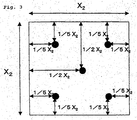
- the film thickness was measured at 5 different positions shown in Fig. 3 in the grid pattern of the first coating film region.
- a variation in the film thickness is shown in Table 2.
- this value is less than 2%, pixel surface uniformity is said to be significantly excellent.
- the value is 2% to less than 3%, the pixel surface uniformity is said to be excellent.
- the value is 3% to less than 5%, the pixel surface uniformity is said to be good.
- the value is 5% or more, the pixel surface uniformity is said to be poor.
- Table 2 The results are shown in Table 2.
- the substrate (2) for evaluation patterned by use of the solution of the radiation sensitive resin composition 1 was coated with the high refractive index resin solution 2 by means of a spinner at 1,000 revolutions/30 seconds, the substrate was prebaked on a hot plate at 90° C for 2 minute so as to form a coating film having a thickness of 1.4 ⁇ m.
- the substrate was heated in an oven at 200° C for 1 hour, thereby forming a substrate for evaluation.
- the cured film of the high refractive index resin had a thickness of 1.3 ⁇ m. Evaluations were made in the same manner as in Example 1. The results are shown in Table 2.
- the substrate (2) for evaluation patterned by use of the solution of the radiation sensitive resin composition 1 was coated with the high refractive index resin solution 3 by means of a spinner at 1,000 revolutions/30 seconds, the substrate was prebaked on a hot plate at 90° C for 2 minute so as to form a coating film having a thickness of 1.6 ⁇ m.
- the substrate was heated in an oven at 200° C for 1 hour, thereby forming a substrate for evaluation.
- the cured film of the high refractive index resin had a thickness of 1.5 ⁇ m. Evaluations were made in the same manner as in Example 1. The results are shown in Table 2.
- the substrate (2) for evaluation patterned by use of the solution of the radiation sensitive resin composition 1 was coated with the high refractive index resin solution 4 by means of a spinner at 1,000 revolutions/30 seconds, the substrate was prebaked on a hot plate at 90° C for 2 minute so as to form a coating film having a thickness of 1.4 ⁇ m.
- the substrate was heated in an oven at 200° C for 1 hour, thereby forming a substrate for evaluation.
- the cured film of the high refractive index resin had a thickness of 1.2 ⁇ m. Evaluations were made in the same manner as in Example 1. The results are shown in Table 2.
- the substrate (2) for evaluation patterned by use of the solution of the radiation sensitive resin composition 1 was coated with the high refractive index resin solution 5 by means of a spinner at 1,000 revolutions/30 seconds, the substrate was prebaked on a hot plate at 90° C for 2 minute so as to form a coating film having a thickness of 1.3 ⁇ m.
- the substrate was heated in an oven at 200° C for 1 hour, thereby forming a substrate for evaluation.
- the cured film of the high refractive index resin had a thickness of 1.2 ⁇ m. Evaluations were made in the same manner as in Example 1. The results are shown in Table 2.
- the substrate (2) for evaluation patterned by use of the solution of the radiation sensitive resin composition 1 was coated with the high refractive index resin solution 6 by means of a spinner at 1,000 revolutions/30 seconds, the substrate was prebaked on a hot plate at 90° C for 2 minute so as to form a coating film having a thickness of 1.6 ⁇ m.
- the substrate was heated in an oven at 200° C for 1 hour, thereby forming a substrate for evaluation.
- the cured film of the high refractive index resin had a thickness of 1.5 ⁇ m. Evaluations were made in the same manner as in Example 1. The results are shown in Table 2.
- two distinct regions having different refractive indices can be coated and formed by a simple method, and a pattern in which a difference in refractive index between a high refractive index region and a low refractive index region is 0.1 or larger can be prepared easily due to broad range of electing materials to be used.
- a method for forming a pattern comprising two regions of different refractive indices easily that is, a method comprising the steps of forming a-pattern having a water-shedding oil-shedding region by use of a radiation sensitive resin composition and coating the pattern with a high refractive index resin solution using a solvent having low wettability to the water-shedding oil-shedding region so as to form two regions of different refractive indices.
Landscapes
- Physics & Mathematics (AREA)
- General Physics & Mathematics (AREA)
- Spectroscopy & Molecular Physics (AREA)
- Optics & Photonics (AREA)
- Materials For Photolithography (AREA)
- Exposure Of Semiconductors, Excluding Electron Or Ion Beam Exposure (AREA)
- Optical Integrated Circuits (AREA)
- Photosensitive Polymer And Photoresist Processing (AREA)
- Treatments Of Macromolecular Shaped Articles (AREA)
Abstract
Description
2,4,6-tris(trichloromethyl)-s-triazine,
2-phenyl-4,6-bis(trichloromethyl) -s-triazine,
2-(4-chlorophenyl)-4,6-bis(trichloromethyl)-s-triazine,
2-(3-chlorophenyl)-4,6-bis(trichloromethyl)-s-triazine,
2-('2-chlorophenyl)-4,6-bis(trichloromethyl)-s-triazine,
2-(4-methoxyphenyl)-4,6-bis(trichloromethyl)-s-triazine,
2-(3-methoxyphenyl)-4,6-bis(trichloromethyl)-s-triazine,
2-(2-methoxyphenyl)-4,6-bis(trichloromethyl)-s-triazine,
2-(4-methylthiophenyl)-4,6-bis(trichloromethyl)-s-triazine,
2-(3-methylthiophenyl)-4,6-bis(trichloromethyl)-s-triazine,
2-(2-methylthiophenyl)-4,6-bis(trichloromethyl)-s-triazine,
2-(4-methoxynaphthyl)-4,6-bis(trichloromethyl)-s-triazine,
2-(3-methoxynaphthyl) -4,6-bis(trichloromethyl)-s-triazine,
2-(2-methoxynaphthyl)-4,6-bis(trichloromethyl)-s-triazine,
2-(4-methoxy-β-styryl)-4,6-bis(trichloromethyl)-s-triazine,
2-(3-methoxy-β-styryl)-4,6-bis(trichloromethyl)-s-triazine,
2-(2-methoxy-p-styryl)-4,6-bis(trichloromethyl)-s-triazine, 2-(3,4,5-trimethoxy-β-styryl)-4,6-bis (trichloromethyl)-s-triazine,
2-(4-methylthio-β-styryl)-4,6-bis (trichloromethyl)-s-triazine,
2-(3-methylthio-β-styryl)-4,6-bis (trichloromethyl)-s-triazine,
2-piperonyl-4,6-bis(trichloromethyl)-s-triazine,
2-[2-(furan-2-yl)ethenyl]-4,6-bis(trichloromethyl)-s-triazine,
2.-[2-(5-methylfuran-2-yl)ethenyl]-4,6-bis (trichloromethyl)-s-triazine, and
2-[2-(4-diethylamino-2-methylphenyl)ethenyl]-4,6-bis(trichloromethyl)-s-triazine.
2-(3-chlorophenyl)-4,6-bis(trichloromethyl)-s-triazine,
2-(4-methoxyphenyl)-4,6-bis(trichloromethyl)-s-triazine,
2-(4-methylthiophenyl)-4,6-bis(trichloromethyl)-s-triazine,
2-(4-methoxy-β-styryl)-4,6-bis(trichloromethyl)-s-triazine,
2-piperonyl-4,6-bis(trichloromethyl)-s-triazine,
2-[2-(furan-2-yl)ethenyl]-4,6-bis(trichloromethyl)-s-triazine,
2-[2-(5-methylfuran-2-yl)ethenyl]-4,6-bis (trichloromethyl)-s-triazine,
2-[2-(4-diethylamino-2-methylphenyl)ethenyl]-4,6-bis(trichloromethyl)-s-triazine and
2-(4-methoxynaphthyl)-4,6-bis(trichloromethyl)-s-triazine are preferred as the trichloromethyl-s-triazines; diphenyl iodonium trifluoroacetate, diphenyl iodonium trifluoromethane sulfonate, 4-methoxyphenylphenyl iodonium trifluoromethane sulfonate and 4-methoxyphenylphenyl iodonium trifluoroacetate are preferred as the diaryl iodonium salts; and triphenyl sulfonium trifluoromethane sulfonate, triphenyl sulfonium trifluoroacetate, 4-methoxyphenyldiphenyl sulfonium trifluoromethane sulfonate, 4-methoxyphenyldiphenyl sulfonium trifluoroacetate,
4-phenylthiophenyldiphenyl trifluoromethane sulfonate and 4-phenylthiophenyldiphenyl trifluoroacetate are preferred as the triaryl sulfonium salts.


Claims (4)
- A method for forming a pattern having two regions of different refractive indices which comprises the steps of:(1) coating a substrate with a radiation sensitive resin composition,(2) exposing a portion of the coating film to radiation to form an exposed coating film,(3) developing the exposed coating film to form a pattern comprising a first coating film region and a non-coating film region, and(4) coating the pattern with a resin solution prepared by dissolving a resin having a higher refractive index than that of the first coating film region in a solvent having low wettability to the first coating film region, thereby converting the non-coating film region into a second coating film region, to form two different refractive index regions which are the first coating film region and the second coating film region.
- The method of claim 1, wherein the refractive index of the first coating film region is 1.5 or lower, and the refractive index of the second coating film region is 1.6 or higher.
- The method of claim 1, wherein the solvent of the resin solution has a contact angle to the first coating film region of 30° or larger.
- An optical element comprising a pattern formed by the method of claim 1.
Applications Claiming Priority (2)
| Application Number | Priority Date | Filing Date | Title |
|---|---|---|---|
| JP2003274280 | 2003-07-14 | ||
| JP2003274280A JP2005037668A (en) | 2003-07-14 | 2003-07-14 | Pattern forming method and optical element |
Publications (2)
| Publication Number | Publication Date |
|---|---|
| EP1498776A2 true EP1498776A2 (en) | 2005-01-19 |
| EP1498776A3 EP1498776A3 (en) | 2005-02-09 |
Family
ID=33475548
Family Applications (1)
| Application Number | Title | Priority Date | Filing Date |
|---|---|---|---|
| EP04016471A Withdrawn EP1498776A3 (en) | 2003-07-14 | 2004-07-13 | Method for forming pattern, and optical element |
Country Status (6)
| Country | Link |
|---|---|
| US (1) | US7378224B2 (en) |
| EP (1) | EP1498776A3 (en) |
| JP (1) | JP2005037668A (en) |
| KR (1) | KR20050010500A (en) |
| CN (1) | CN1598695A (en) |
| TW (1) | TW200506525A (en) |
Families Citing this family (5)
| Publication number | Priority date | Publication date | Assignee | Title |
|---|---|---|---|---|
| JP4696647B2 (en) * | 2005-03-31 | 2011-06-08 | 住友ベークライト株式会社 | Optical waveguide forming substrate |
| JP2009286981A (en) * | 2008-06-02 | 2009-12-10 | Toppan Printing Co Ltd | Hard coat coating, hard coat film, polarizing plate, and transmissive liquid crystal display |
| TWI503334B (en) | 2009-02-19 | 2015-10-11 | Jsr Corp | Polymer, radiation-sensitive composition and monomer |
| JP2011141521A (en) * | 2009-12-09 | 2011-07-21 | Jsr Corp | Coloring composition, color filter and display element |
| CN103213940B (en) * | 2013-03-15 | 2016-04-06 | 北京工业大学 | One makes material have two kinds of infiltrating methods of difference based on micro-nano-scale |
Family Cites Families (7)
| Publication number | Priority date | Publication date | Assignee | Title |
|---|---|---|---|---|
| JPH0638125B2 (en) | 1985-07-26 | 1994-05-18 | 三菱電機株式会社 | Method for producing light-focusing plastic |
| JPH0792313A (en) | 1993-09-20 | 1995-04-07 | Toshiba Corp | Optical fiber type diffraction grating |
| JPH1160803A (en) | 1997-08-11 | 1999-03-05 | Tomoegawa Paper Co Ltd | Refractive index changing material and its refractive index changing method |
| JP4541531B2 (en) | 2000-11-22 | 2010-09-08 | 大日本印刷株式会社 | EL element provided with a refractive index changing material layer by light irradiation |
| JP2003082042A (en) | 2001-09-07 | 2003-03-19 | Jsr Corp | A radiation-sensitive resin composition for forming a partition, a partition, and a display element. |
| JP2003185820A (en) | 2001-12-21 | 2003-07-03 | Jsr Corp | Radiation-sensitive refractive index changing composition and refractive index changing method |
| JP2003282260A (en) * | 2002-03-26 | 2003-10-03 | Dainippon Printing Co Ltd | Electroluminescence display device |
-
2003
- 2003-07-14 JP JP2003274280A patent/JP2005037668A/en active Pending
-
2004
- 2004-07-13 EP EP04016471A patent/EP1498776A3/en not_active Withdrawn
- 2004-07-13 US US10/888,985 patent/US7378224B2/en not_active Expired - Lifetime
- 2004-07-13 KR KR1020040054321A patent/KR20050010500A/en not_active Withdrawn
- 2004-07-14 CN CNA2004100640644A patent/CN1598695A/en active Pending
- 2004-07-14 TW TW093121009A patent/TW200506525A/en unknown
Also Published As
| Publication number | Publication date |
|---|---|
| TW200506525A (en) | 2005-02-16 |
| JP2005037668A (en) | 2005-02-10 |
| US20050014100A1 (en) | 2005-01-20 |
| US7378224B2 (en) | 2008-05-27 |
| EP1498776A3 (en) | 2005-02-09 |
| KR20050010500A (en) | 2005-01-27 |
| CN1598695A (en) | 2005-03-23 |
Similar Documents
| Publication | Publication Date | Title |
|---|---|---|
| JP3650985B2 (en) | Negative-type radiation-sensitive resin composition and pattern production method | |
| JP3644243B2 (en) | Radiation sensitive resin composition, color filter and liquid crystal display element | |
| KR101579270B1 (en) | Photosensitive composition utilizing photopolymerizable polymer having fluorene skeleton | |
| KR101466147B1 (en) | Photosensitive resin composition for color filter and color filter using the same | |
| JP7812354B2 (en) | Photosensitive resin composition | |
| EP1296186B1 (en) | Radiation sensitive resin composition, rib, rib forming method and display element | |
| JP3873263B2 (en) | Radiation-sensitive resin composition, protective film, interlayer insulating film, and method for forming these films | |
| KR100789582B1 (en) | Radiation-sensitive refractive index variable composition | |
| US7378224B2 (en) | Method for forming pattern, and optical element | |
| JP3622201B2 (en) | Radiation sensitive refractive index changing composition | |
| JP3937890B2 (en) | Ink-jet color filter partition and method for forming the same | |
| JP3873261B2 (en) | Radiation-sensitive resin composition, protective film, interlayer insulating film, and method for forming these films | |
| KR101618689B1 (en) | Photosensitive resin composition for color filter and color filter using the same | |
| JP3082179B2 (en) | Photosensitive resin composition for lenses | |
| KR20220122187A (en) | Novel polymer and photosensitive resin composition comprising same | |
| JP3683285B2 (en) | Composition for antihalation film of solid-state imaging device and antihalation film of solid-state imaging device formed therefrom | |
| JP2008214495A (en) | Curable composition for solid-state image sensor and solid-state image sensor using the same | |
| JP3751686B2 (en) | Photosensitive resin composition | |
| KR20240110279A (en) | Photosensitive resin composition, cured film prepared therefrom, and organic electronic device including the same | |
| WO2023140248A1 (en) | Method for producing lens, radiation-sensitive composition for producing lens, lens, imaging element, imaging device, display element, and display device | |
| KR20230004263A (en) | Novel polymer and photosensitive resin composition comprising the same | |
| KR20220167545A (en) | Novel polymer and photosensitive resin composition comprising the same | |
| KR20100012960A (en) | I-line chemically amplified positive photoreist for microlens, microlens fabricated thereby and liquid crystal display device comprising the lens |
Legal Events
| Date | Code | Title | Description |
|---|---|---|---|
| PUAI | Public reference made under article 153(3) epc to a published international application that has entered the european phase |
Free format text: ORIGINAL CODE: 0009012 |
|
| PUAL | Search report despatched |
Free format text: ORIGINAL CODE: 0009013 |
|
| AK | Designated contracting states |
Kind code of ref document: A2 Designated state(s): AT BE BG CH CY CZ DE DK EE ES FI FR GB GR HU IE IT LI LU MC NL PL PT RO SE SI SK TR |
|
| AX | Request for extension of the european patent |
Extension state: AL HR LT LV MK |
|
| AK | Designated contracting states |
Kind code of ref document: A3 Designated state(s): AT BE BG CH CY CZ DE DK EE ES FI FR GB GR HU IE IT LI LU MC NL PL PT RO SE SI SK TR |
|
| AX | Request for extension of the european patent |
Extension state: AL HR LT LV MK |
|
| 17P | Request for examination filed |
Effective date: 20050311 |
|
| AKX | Designation fees paid |
Designated state(s): DE GB |
|
| 17Q | First examination report despatched |
Effective date: 20150331 |
|
| STAA | Information on the status of an ep patent application or granted ep patent |
Free format text: STATUS: THE APPLICATION IS DEEMED TO BE WITHDRAWN |
|
| 18D | Application deemed to be withdrawn |
Effective date: 20150811 |