EP1497392B1 - Hydro-insensitive electroluminescent devices and methods of manufacture thereof - Google Patents
Hydro-insensitive electroluminescent devices and methods of manufacture thereof Download PDFInfo
- Publication number
- EP1497392B1 EP1497392B1 EP20030718333 EP03718333A EP1497392B1 EP 1497392 B1 EP1497392 B1 EP 1497392B1 EP 20030718333 EP20030718333 EP 20030718333 EP 03718333 A EP03718333 A EP 03718333A EP 1497392 B1 EP1497392 B1 EP 1497392B1
- Authority
- EP
- European Patent Office
- Prior art keywords
- composite
- protective layer
- dynes
- polymeric material
- inches
- Prior art date
- Legal status (The legal status is an assumption and is not a legal conclusion. Google has not performed a legal analysis and makes no representation as to the accuracy of the status listed.)
- Expired - Lifetime
Links
Images


Classifications
-
- H—ELECTRICITY
- H05—ELECTRIC TECHNIQUES NOT OTHERWISE PROVIDED FOR
- H05B—ELECTRIC HEATING; ELECTRIC LIGHT SOURCES NOT OTHERWISE PROVIDED FOR; CIRCUIT ARRANGEMENTS FOR ELECTRIC LIGHT SOURCES, IN GENERAL
- H05B33/00—Electroluminescent light sources
- H05B33/02—Details
- H05B33/04—Sealing arrangements, e.g. against humidity
-
- C—CHEMISTRY; METALLURGY
- C09—DYES; PAINTS; POLISHES; NATURAL RESINS; ADHESIVES; COMPOSITIONS NOT OTHERWISE PROVIDED FOR; APPLICATIONS OF MATERIALS NOT OTHERWISE PROVIDED FOR
- C09K—MATERIALS FOR MISCELLANEOUS APPLICATIONS, NOT PROVIDED FOR ELSEWHERE
- C09K11/00—Luminescent materials, e.g. electroluminescent or chemiluminescent
- C09K11/06—Luminescent materials, e.g. electroluminescent or chemiluminescent containing organic luminescent materials
-
- H—ELECTRICITY
- H05—ELECTRIC TECHNIQUES NOT OTHERWISE PROVIDED FOR
- H05B—ELECTRIC HEATING; ELECTRIC LIGHT SOURCES NOT OTHERWISE PROVIDED FOR; CIRCUIT ARRANGEMENTS FOR ELECTRIC LIGHT SOURCES, IN GENERAL
- H05B33/00—Electroluminescent light sources
- H05B33/10—Apparatus or processes specially adapted to the manufacture of electroluminescent light sources
-
- H—ELECTRICITY
- H05—ELECTRIC TECHNIQUES NOT OTHERWISE PROVIDED FOR
- H05B—ELECTRIC HEATING; ELECTRIC LIGHT SOURCES NOT OTHERWISE PROVIDED FOR; CIRCUIT ARRANGEMENTS FOR ELECTRIC LIGHT SOURCES, IN GENERAL
- H05B33/00—Electroluminescent light sources
- H05B33/12—Light sources with substantially two-dimensional [2D] radiating surfaces
- H05B33/20—Light sources with substantially two-dimensional [2D] radiating surfaces characterised by the chemical or physical composition or the arrangement of the material in which the electroluminescent material is embedded
-
- Y—GENERAL TAGGING OF NEW TECHNOLOGICAL DEVELOPMENTS; GENERAL TAGGING OF CROSS-SECTIONAL TECHNOLOGIES SPANNING OVER SEVERAL SECTIONS OF THE IPC; TECHNICAL SUBJECTS COVERED BY FORMER USPC CROSS-REFERENCE ART COLLECTIONS [XRACs] AND DIGESTS
- Y10—TECHNICAL SUBJECTS COVERED BY FORMER USPC
- Y10S—TECHNICAL SUBJECTS COVERED BY FORMER USPC CROSS-REFERENCE ART COLLECTIONS [XRACs] AND DIGESTS
- Y10S428/00—Stock material or miscellaneous articles
- Y10S428/917—Electroluminescent
-
- Y—GENERAL TAGGING OF NEW TECHNOLOGICAL DEVELOPMENTS; GENERAL TAGGING OF CROSS-SECTIONAL TECHNOLOGIES SPANNING OVER SEVERAL SECTIONS OF THE IPC; TECHNICAL SUBJECTS COVERED BY FORMER USPC CROSS-REFERENCE ART COLLECTIONS [XRACs] AND DIGESTS
- Y10—TECHNICAL SUBJECTS COVERED BY FORMER USPC
- Y10T—TECHNICAL SUBJECTS COVERED BY FORMER US CLASSIFICATION
- Y10T428/00—Stock material or miscellaneous articles
- Y10T428/14—Layer or component removable to expose adhesive
-
- Y—GENERAL TAGGING OF NEW TECHNOLOGICAL DEVELOPMENTS; GENERAL TAGGING OF CROSS-SECTIONAL TECHNOLOGIES SPANNING OVER SEVERAL SECTIONS OF THE IPC; TECHNICAL SUBJECTS COVERED BY FORMER USPC CROSS-REFERENCE ART COLLECTIONS [XRACs] AND DIGESTS
- Y10—TECHNICAL SUBJECTS COVERED BY FORMER USPC
- Y10T—TECHNICAL SUBJECTS COVERED BY FORMER US CLASSIFICATION
- Y10T428/00—Stock material or miscellaneous articles
- Y10T428/249921—Web or sheet containing structurally defined element or component
- Y10T428/249953—Composite having voids in a component [e.g., porous, cellular, etc.]
- Y10T428/249982—With component specified as adhesive or bonding agent
- Y10T428/249983—As outermost component
-
- Y—GENERAL TAGGING OF NEW TECHNOLOGICAL DEVELOPMENTS; GENERAL TAGGING OF CROSS-SECTIONAL TECHNOLOGIES SPANNING OVER SEVERAL SECTIONS OF THE IPC; TECHNICAL SUBJECTS COVERED BY FORMER USPC CROSS-REFERENCE ART COLLECTIONS [XRACs] AND DIGESTS
- Y10—TECHNICAL SUBJECTS COVERED BY FORMER USPC
- Y10T—TECHNICAL SUBJECTS COVERED BY FORMER US CLASSIFICATION
- Y10T428/00—Stock material or miscellaneous articles
- Y10T428/31504—Composite [nonstructural laminate]
-
- Y—GENERAL TAGGING OF NEW TECHNOLOGICAL DEVELOPMENTS; GENERAL TAGGING OF CROSS-SECTIONAL TECHNOLOGIES SPANNING OVER SEVERAL SECTIONS OF THE IPC; TECHNICAL SUBJECTS COVERED BY FORMER USPC CROSS-REFERENCE ART COLLECTIONS [XRACs] AND DIGESTS
- Y10—TECHNICAL SUBJECTS COVERED BY FORMER USPC
- Y10T—TECHNICAL SUBJECTS COVERED BY FORMER US CLASSIFICATION
- Y10T428/00—Stock material or miscellaneous articles
- Y10T428/31504—Composite [nonstructural laminate]
- Y10T428/31786—Of polyester [e.g., alkyd, etc.]
-
- Y—GENERAL TAGGING OF NEW TECHNOLOGICAL DEVELOPMENTS; GENERAL TAGGING OF CROSS-SECTIONAL TECHNOLOGIES SPANNING OVER SEVERAL SECTIONS OF THE IPC; TECHNICAL SUBJECTS COVERED BY FORMER USPC CROSS-REFERENCE ART COLLECTIONS [XRACs] AND DIGESTS
- Y10—TECHNICAL SUBJECTS COVERED BY FORMER USPC
- Y10T—TECHNICAL SUBJECTS COVERED BY FORMER US CLASSIFICATION
- Y10T428/00—Stock material or miscellaneous articles
- Y10T428/31504—Composite [nonstructural laminate]
- Y10T428/31855—Of addition polymer from unsaturated monomers
- Y10T428/31938—Polymer of monoethylenically unsaturated hydrocarbon
Definitions
- the invention relates to luminescent materials and relates in particular to electro-luminescent devices that include luminescent materials.
- Electroluminescent materials generally include phosphorescent particles that are suspended within or coated by a polymeric material. Electroluminescent devices typically provide an electric field in the area of the phosphorescent particles to cause the particles to glow. Such devices may be used for a wide variety of uses such as advertising, lighted keyboards and other such displays, accent lighting in automobiles, backlighting for liquid crystals displays, nightlights, etc.
- Such devices typically include a protective layer that used to keep water vapor from entering the polymeric material.
- a protective layer that used to keep water vapor from entering the polymeric material.
- Patent No. U.S. 6,207,077 discloses a luminescent thermosetting polyester blend that is water resistant; and U.S.
- Patent No. 6,198,216 discloses a polymeric matrix that includes luminescent particles and a fluoride resin binder as well as protective layer. Because the dielectric properties and chemical properties of such luminescent materials typically rely on the exclusion of water vapor, devices incorporating such luminescent materials typically include a moisture barrier. Such moisture barriers may be relatively expensive for certain devices, and may limit the uses of such devices.
- US 4 687 968 describes a barrier for an electroluminescent lamp having a phosphor-particle-containing layer disposed between corresponding electrodes consists of an integral multilayer polymeric film.
- a first layer of barrier material is interally bonded in face-to-face contact with the exposed outer surface of the lamp body and the material has a characteristic vapor transmission rate significantly below the vapor transmission rate of the material of the lamp body.
- a second layer of barrier material is integrally bonded in face-to face contact with the first barrier layer and the material has a vapor transmission rate significantly greater than the vapoer transmission rate of the material of the first barrier layer.
- a third layer of barrier material is integrally bonded in face-to-face contact with the second barrier layer and the material has a vapor transmission rate significantly less than the vapor transmission rate of the material of the second barrier layer.
- a composite for use in electroluminescent devices.
- the composite includes polymeric material having a first surface energy, and phosphorescent material dispersed within said polymeric material.
- the phosphorescent material has a second surface energy, and the first and second surface energies are each between 0.032 N/m (32 dynes/cm) and 0.046 N/m (46 dynes/cm).
- the polymeric material has a moisture vapor transmission rate of at least 0.000394 g/m 2 (one gram / 100 sq. inches) for a 24 hour period at 38 °C (100 °F) for a one mil thick barrier.
- water vapor does not substantially condense at the interfaces between the phosphorescent material and the polymeric material. Water vapor, therefore, may pass through the composite without adversely affecting the operation of an electroluminescent device that includes a composite of an embodiment of the invention.
- an electroluminescent composite 10 may include phosphorescent particles 12 that are dispersed within a polymeric material 14 as shown in Figure 1 . It is preferred that all of the phosphorescent particles be coated by the polymeric material, even near the surface of the composite.
- the polymeric material permits water vapor to pass through the polymeric material as indicated at A and B.
- the polymeric and phosphorescent particles are chosen so that the surface energies of each material are each within a range of 0.032 to 0.046 N/m (32 to 46 dynes/cm). Water vapor, therefore, will not condense at the interface between the polymeric material and the phosphorescent particles.
- the composite 10 may be provided as a product in itself, or may be provide with a carrier (that may or may not be removable) and/or may be provided with one or more adhesive layers on the outer surface of the composite.
- an electroluminescent device using a composite 10 may also include a protective coating 16 and optionally may include a pair of conductors 18A and 18B that are respectively electrically coupled to alternating current sources 20A and 20B as shown in Figure 2 .
- the composite 10 and coating 16 may be placed onto conductors or buss bars at a point of application or use of the device.
- the protective coating 16 and conductors 18A and 18B have a sufficiently high moisture vapor transmission rate that water vapor may pass through these materials as well.
- the surface energies of each of protective coating 16 and conductors 18A and 18B are between 0.032 to 0.046 N/m (32 to 46 dynes/cm).
- the difference between the surface energy of the polymeric material and the protective coating remain relatively small, and the difference between the surface energy of the protective coating and the conductors remain relatively small. Water vapor, therefore, will not condense at the interface between the polymeric material and the protective coating, or at the interface between the polymeric material and the conductors. Because of this, water vapor will not remain within the electroluminescent device, and the presence or absence of water vapor therefore, will not substantially affect the performance of the electroluminescence device.
- the polymeric material may comprise a pressure sensitive acrylic adhesive films such polyester (PET), polymethylmethacrylate (PMMA), or a thermoplastic coating, polyamides, amorphous polyester resins, acrylic resins, or any other material that provides sufficient moisture vapor transmission and has an appropriate surface energy.
- PET polyester
- PMMA polymethylmethacrylate
- thermoplastic coating polyamides
- amorphous polyester resins acrylic resins, or any other material that provides sufficient moisture vapor transmission and has an appropriate surface energy.
- the properties of the continuous polymer layer should be such that the polymeric material has a low enough specific surface energy that water vapor does not condense at the interface of the phosphors and the polymer, polymer and conductive layer, or polymer and polymer layers, yet the layers may allow water vapor to move freely through the composite.
- the polymeric material preferably may include untreated polyvinyl chloride, or slip treated polyesters with specific surface energies of less than (46 dynes/cm) 0.046 N/m with preferred specific surface energies of less than 0.046 N/m (46 dynes /cm).
- indium tin oxide may be used, having a surface energy of 0.036 N/m (36 dynes/cm).
- lightly metallized conductive layers with a specific surface energy of 0.040 - 0.043 N/m (40 - 42 dynes/cm) may be used. It is preferred, however, that the surface energy be between 0.032 N/m and 0.040 N/m.
- Table 1 Material Specific Surface Energy N m ⁇ / dynes c ⁇ m MVTR g m 2 ⁇ / gram ⁇ mils s ⁇ q .
- Polyester (41 - 44) 0.041-0.044 (2.2) 0.0008668 Polyester (amorphous) (36 - 38) 0.036 - 0.038 (2.6) 0.001024 Polymethylmethacrylate (PMMA) (41) 0.041 (3) 0.001182 Electroluminescent Phosphors (35 - 40) 0.035 - 0.040 n/a Polycarbonate (46) 0.046 (11) 0.004334 Polystyrene (38) 0.038 (8.5) 0.003349 RigidPVC (39) 0.039 (3.0) 0.001182 Silicone (24 - 28) 0.024-0.028 (40) 0.01576 Acrylic pressure sensitive adhesives (32 - 38) 0.032-0.038 (15 - 40) 0.00511-0.01576
- Materials having a surface energy below 0.032 N/m may have difficultly adhering to other materials in forming an electroluminescent device, although the use of silanes or other adhesion promoters may facilitate overcoming a low surface energy adhesion problem.
- the use of such a surface treatment e.g., with silanes
- a coating of reactive silanes such as a 3/1-ratio gamma glycidyoxypropyl trimethoxy silane to a propyl amino silane, in a concentration of 0.1 -5.0 % on weight in a dry (water free) solvent on the surface of a higher specific surface energy material such as Aluminum may reduce the surface energy to a non-condensing level (down to the low to mid0.030s N/m (30s dynes/cm)). It should be noted that such specific surface energy reductions, which prevent a condensation to water, may also be of value in preventing electrolytic corrosion of metals as the galvanic effect needs water to function.
- a high moisture barrier as part of the dielectric matrix may have an adverse effect on the performance of an electroluminescent device of the invention.
- Such barriers may lead to an out-gassing effect (e.g., bubbles forming in the adhesive layer for example).
- bubbles once formed, change the "K” (dielectric constant) and change the separation between conductive layers, thus having an adverse effect on the total capacitance and thus the performance of the electro-luminescent device.
- an electroluminescent device of the invention have no layer with an MVTR of less than 0.000394 g/m 2 / 24 hrs (1 gram mil/100sq. inches/24hrs) (Lyssy test at 38°C and 90% relative humidity), and that no two successive polymer layers differ by more than 0.002364 g/m 2 /24 hrs (6 gram mil/100sq. inches/24hrs), and more preferably not differing by more than 0.001182 g/m 2 /24 hrs (3-gram mil/100 sq. inches/24hrs).
- the polymeric material should not have its dielectric value substantially changed by the presence of water vapor, particularly if the polymeric material has a relatively low surface energy level.
- a rubber-bped adhesive may show a reduction in dielectric constant of about 50% after 3 days at 38 °C(100° F) and 95% relative humidity.
- the increase in dielectric constant may result in a dielectric breakdown within the structure effectively shorting out of the device.
- Devices of the invention may be coated or printed as desired in various applications in which the device will be coupled to a power supply. Again, there is no need to exclude water from the device, and in fact, it is preferred that water vapor be permitted to freely pass through each of the layers of the device.
- the devices may be tested for water sensitivity by placing the devices in a high humidity environment 38° C (100° F and about 100% relative humidity). The devices should then be periodically analyzed for illumination stability.
- an electroluminescent device in accordance with another embodiment of the invention includes a pair of conductive layers 22 and 24 on either side of the composite 10, as well as a protective layer 26.
- the conductive layer 24 is preferably a transparent conductive layer such as InTO or a lightly metallized aluminum on the order of an optical density of between 0.07 - 1.0 and preferably between 0.15 and 0.30.
- the transparent conductor layer may include conductive polymers or carbon nanotubes.
- the transparent conductive layer should include a sufficient concentration of conductive material such that the conductive layers' product of their resistance and capacitance (RC time constant) defines the frequency of the resistance capacitance layer, and this frequency should be higher than the frequency needed to illuminate the device. As the resistance of the electrically conductive material decreases, the capacitive impedance also decreases as does the total current that is needed to light the phosphors.
- the protective layer 26 and conductive layers 22 and 24 have a sufficiently high moisture vapor transmission rate that water vapor may pass through these materials.
- the surface energies of each of protective coating 26 and conductive layers 22 and 24 are between 0.032 to 0.046 N/m (32 to 46 dynes/cm).
- it is preferred that the difference between the surface energies of each pair of adjoining layer remain relatively small, preferably less than 6 dynes/cm. Water vapor, therefore, should not condense at any of the interfaces within the device, so water vapor will not remain within the electroluminescent device.
- the device may also include one or two additional dielectric layers 28 and 30 (e.g., between 0.02 - 0.5 mil) between the composite and either or both of the conductive layers to ensure that the phosphorescent particles do not contact directly a conductive layer as shown in Figure 4 .
- the protective film 26 may further serve to protect persons from directly contacting any conductor or underlying buss bar or other alternating current source, and may also provide additional structural integrity to the device. Further, a clear protective film may be used to keep dust and scratches out and to lend further structural support for the electroluminescent device.
- Such films may include polyester, polyolefins, PVC, PVF, polycarbonate, etc. as long as the conditions for adhesion, surface energy and moisture vapor transmission rate are met.
- a transfer component may be constructed such that thermal transfer printers, or a hot stamping machine may be used to place an electroluminescent composite on a graphic display (e.g., keys on a key board, instrument panel display, etc.).
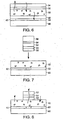
- a transfer component may include a composite 10, a transparent conductive layer 32, a protective layer 34, a release layer 36 and a carrier layer 38, as well as an adhesive layer 40 on the opposite side of the composite 10 as shown in Figure 5 .
- the transfer component may be applied to one or more conductors 42 and 44 on a graphic display 46 followed by removal of the carrier and release layers 36 and 38 as shown in Figure 6 .
- the carrier layer 36 may serve to provide structural support to an otherwise frangible component that becomes transferred to the display 46.
- the polymeric material in composite 10 may include adhesive properties that a separate adhesive 40 is not required.
- the conductive layer 32 may include sufficient protective properties that a separate protective coating 34 is not required.
- the conductive layer may include a coating of a dielectric to ensure that no phosphorescent particles contact the conductive layer.
- the release layer or break coat layer may remain with the composite following transfer in certain embodiments and may itself serve as a protective layer in the final device. The "break coat" can, and sometimes does, also act as the "Protective Coating".
- the transfer component may include a conductive layer 50 and a protective layer 52 in addition to the release layer 54, the carrier layer 56, and the adhesive layer, 58, but not a luminescent composite 10.
- the receiving substrate 60 including one or more conductors 62 would already include a luminescent composite 10. This process of transferring a conductive layer to a luminescent composite may permit discrete transfer of various desired indicia or other graphics that need not be coupled to directly to an alternating current power supply since their role is to bridge an existing gap in the receiving substrate.
- the composite 10 may provide sufficient adhesive, for example by including (of 1% to 45% and preferably 2% - 6 %) of an antistatic agent such as CYASTAT sold by Cytec Industries, Inc. of West Paterson, NJ:
- Salt may also be employed as an alternating current receptor material in further embodiments of the invention.
- employing such a material in the bonding adhesive that affixing the luminescent composite to a conductive substrate may increase the field strength of the electroluminescent device.
- Alternating current voltages in the range of 100 volts - 2500 volts (and preferably between 400 volts and 30 800 volts) at a frequency of 60 Hz to 14000 Hz (and preferably between 1000 Hz and 5000 Hz) has been found to be effective in devices of the invention.
- the electrical potential and frequency may be varied for different applications based on, for example, the color desired, the size of the electroluminescent device, the total thickness of the electroluminescent material, the brightness, and the internal impendence and capacitance.
- salts such as these which can be reasonably uniformly dispersed within a polymeric matrix, may facilitate the transfer an alternating current signal, which may complete the electroluminescent device circuit.
- the addition of these charge carrying components may be used either by themselves or in combination with other conductive materials such as the previously discussed vacuum deposited light metal (having an optical density of 0.15 - 0.40), Indium/Tin Oxide (having resistance between 25 ohms to 400 ohms) or other such conductive layer that will allow for the passage of the light generated by the EL device.
- conductive salts such as CYSTAT discussed above
- other salt like conductive polymers may also be employed. While one charged portion of the conductive polymer (e.g., the cationic portion) is of fairly large molecular weight, the other charge center is typically of low molecular weight.
- Further techniques for creating graphic electroluminescent displays may involve masking out with a stencil the graphic items, or even cutting out the graphics from an electroluminescent composite.
- the desired graphics may then be affixed to a conductor. Since such devices are relatively insensitive to water vapor, they may be used in environments that were previously considered too hostile to electroluminescent devices, such as billboards, sides of busses, airport runways, and floors of retail stores.
- Such devices may be employed on original documents for security purposes. Such devices may be transferred onto the original document.
- the device may be designed to provide luminescence only when placed under an alternating current source of a specific frequency.
Landscapes
- Engineering & Computer Science (AREA)
- Chemical & Material Sciences (AREA)
- Manufacturing & Machinery (AREA)
- Materials Engineering (AREA)
- Organic Chemistry (AREA)
- Electroluminescent Light Sources (AREA)
- Luminescent Compositions (AREA)
Applications Claiming Priority (5)
| Application Number | Priority Date | Filing Date | Title |
|---|---|---|---|
| US37137502P | 2002-04-10 | 2002-04-10 | |
| US371375P | 2002-04-10 | ||
| US40442002P | 2002-08-19 | 2002-08-19 | |
| US404420P | 2002-08-19 | ||
| PCT/US2003/011150 WO2003087257A1 (en) | 2002-04-10 | 2003-04-10 | Hydro-insensitive electroluminescent devices and methods of manufacture thereof |
Publications (2)
| Publication Number | Publication Date |
|---|---|
| EP1497392A1 EP1497392A1 (en) | 2005-01-19 |
| EP1497392B1 true EP1497392B1 (en) | 2013-05-29 |
Family
ID=29254441
Family Applications (1)
| Application Number | Title | Priority Date | Filing Date |
|---|---|---|---|
| EP20030718333 Expired - Lifetime EP1497392B1 (en) | 2002-04-10 | 2003-04-10 | Hydro-insensitive electroluminescent devices and methods of manufacture thereof |
Country Status (7)
| Country | Link |
|---|---|
| US (3) | US7279831B2 (https=) |
| EP (1) | EP1497392B1 (https=) |
| JP (1) | JP2005522834A (https=) |
| KR (1) | KR100658030B1 (https=) |
| CN (1) | CN100408650C (https=) |
| AU (1) | AU2003221876A1 (https=) |
| WO (1) | WO2003087257A1 (https=) |
Families Citing this family (11)
| Publication number | Priority date | Publication date | Assignee | Title |
|---|---|---|---|---|
| JP2005522834A (ja) * | 2002-04-10 | 2005-07-28 | フレックスコン・カンパニー・インコーポレーテッド | 水不感応性エレクトロルミネッセンスデバイス及びその製造方法 |
| DE102004004311A1 (de) * | 2004-01-28 | 2005-08-18 | Fer Fahrzeugelektrik Gmbh | Herstellungsverfahren für eine El-Lampe |
| US20060188721A1 (en) * | 2005-02-22 | 2006-08-24 | Eastman Kodak Company | Adhesive transfer method of carbon nanotube layer |
| KR101252083B1 (ko) * | 2005-12-22 | 2013-04-12 | 엘지디스플레이 주식회사 | 유기 전계발광 표시장치 및 그 제조방법 |
| DE102006013834A1 (de) * | 2006-03-23 | 2007-09-27 | Tesa Ag | Elektrolumineszierende Haftklebemassen |
| WO2008091796A2 (en) * | 2007-01-26 | 2008-07-31 | Flexcon Company, Inc. | System and method of improving the dielectric properties of laminates |
| JP5325608B2 (ja) * | 2008-05-22 | 2013-10-23 | リンテック株式会社 | 発光性組成物、それを用いる電界発光シート及びその製造方法 |
| US9341792B2 (en) | 2010-06-29 | 2016-05-17 | Cisco Technology, Inc. | Vent structures for encapsulated components on an SOI-based photonics platform |
| AU2012301903B2 (en) | 2011-08-30 | 2015-07-09 | Watlow Electric Manufacturing Company | High definition heater system having a fluid medium |
| EP2794814B1 (de) | 2011-12-19 | 2017-10-18 | InovisCoat GmbH | Leuchtelemente mit einer elektrolumineszenzanordnung sowie verfahren zur herstellung eines leuchtelements |
| WO2014030146A1 (en) * | 2012-08-24 | 2014-02-27 | Koninklijke Philips N.V. | Wavelength converting element comprising organic phosphor |
Family Cites Families (22)
| Publication number | Priority date | Publication date | Assignee | Title |
|---|---|---|---|---|
| US4188449A (en) | 1977-08-04 | 1980-02-12 | Eastman Kodak Company | Phosphorescent screens |
| US4417174A (en) * | 1980-10-03 | 1983-11-22 | Alps Electric Co., Ltd. | Electroluminescent cell and method of producing the same |
| US4816717A (en) * | 1984-02-06 | 1989-03-28 | Rogers Corporation | Electroluminescent lamp having a polymer phosphor layer formed in substantially a non-crossed linked state |
| US4647337A (en) * | 1984-12-03 | 1987-03-03 | Luminescent Electronics, Inc. | Method of making electroluminescent panels |
| US4687968A (en) | 1985-08-12 | 1987-08-18 | Rogers Corporation | Encapsulated electroluminescent lamp |
| CA2004530A1 (en) | 1988-12-16 | 1990-06-16 | Larry A. Nativi | Desiccant for el lamps |
| US5246782A (en) | 1990-12-10 | 1993-09-21 | The Dow Chemical Company | Laminates of polymers having perfluorocyclobutane rings and polymers containing perfluorocyclobutane rings |
| US5479070A (en) * | 1990-05-18 | 1995-12-26 | Fuji Xerox Co., Ltd. | Light-emitting element device |
| US5352951A (en) * | 1991-06-03 | 1994-10-04 | Bkl, Inc. | Electroluminescent device |
| US5321069A (en) | 1992-11-25 | 1994-06-14 | Afterglow Accent Yarns, Inc. | Process for producing phosphorescent yarn and yarn produced by the process |
| JPH0821469B2 (ja) * | 1993-06-28 | 1996-03-04 | 出光興産株式会社 | 有機el素子の封止方法およびこの封止方法により得られた発光装置 |
| US5552679A (en) * | 1993-07-15 | 1996-09-03 | International En-R-Tech Incorporated | Electroluminescent and light reflective panel |
| DE19630016C2 (de) | 1996-07-25 | 2000-10-12 | Daimler Chrysler Ag | Verfahren zur Herstellung einer Leuchtstoffschicht einer Kathodenstrahlröhre |
| US5821691A (en) * | 1997-03-14 | 1998-10-13 | Durel Corporation | EL panel with continuous contacts on back of panel |
| TW379513B (en) * | 1997-04-17 | 2000-01-11 | Kureha Chemical Ind Co Ltd | Moisture-proof film and electro-luminescent element |
| WO1999035889A1 (en) * | 1998-01-06 | 1999-07-15 | Rogers Corporation | Electroluminescent lamps having improved interfacial adhesion |
| US6207077B1 (en) | 2000-02-18 | 2001-03-27 | Orion 21 A.D. Pty Ltd | Luminescent gel coats and moldable resins |
| GB9824818D0 (en) | 1998-11-12 | 1999-01-06 | Zeneca Ltd | Composition,process and use |
| JP2000260561A (ja) * | 1999-03-05 | 2000-09-22 | Toshiba Corp | Elパネル |
| AU2001247610A1 (en) | 2000-03-24 | 2001-10-08 | World Properties Inc. | Polymeric organic coatings and method of manufacture thereof |
| WO2002019020A1 (en) | 2000-08-29 | 2002-03-07 | Freelight Systems Limited | Display comprising a fluorescent dye doped polymer |
| JP2005522834A (ja) * | 2002-04-10 | 2005-07-28 | フレックスコン・カンパニー・インコーポレーテッド | 水不感応性エレクトロルミネッセンスデバイス及びその製造方法 |
-
2003
- 2003-04-10 JP JP2003584203A patent/JP2005522834A/ja active Pending
- 2003-04-10 AU AU2003221876A patent/AU2003221876A1/en not_active Abandoned
- 2003-04-10 CN CNB038114550A patent/CN100408650C/zh not_active Expired - Fee Related
- 2003-04-10 EP EP20030718333 patent/EP1497392B1/en not_active Expired - Lifetime
- 2003-04-10 WO PCT/US2003/011150 patent/WO2003087257A1/en not_active Ceased
- 2003-04-10 US US10/410,920 patent/US7279831B2/en not_active Expired - Fee Related
- 2003-04-10 KR KR1020047016113A patent/KR100658030B1/ko not_active Expired - Fee Related
-
2007
- 2007-09-05 US US11/850,182 patent/US20070298203A1/en not_active Abandoned
-
2011
- 2011-03-15 US US13/048,414 patent/US20110168429A1/en not_active Abandoned
Also Published As
| Publication number | Publication date |
|---|---|
| US20110168429A1 (en) | 2011-07-14 |
| AU2003221876A1 (en) | 2003-10-27 |
| CN100408650C (zh) | 2008-08-06 |
| KR20050005439A (ko) | 2005-01-13 |
| EP1497392A1 (en) | 2005-01-19 |
| KR100658030B1 (ko) | 2006-12-15 |
| CN1656193A (zh) | 2005-08-17 |
| US20030222573A1 (en) | 2003-12-04 |
| JP2005522834A (ja) | 2005-07-28 |
| US20070298203A1 (en) | 2007-12-27 |
| WO2003087257A1 (en) | 2003-10-23 |
| US7279831B2 (en) | 2007-10-09 |
Similar Documents
| Publication | Publication Date | Title |
|---|---|---|
| US20110168429A1 (en) | Hydro-insensitive electroluminescent devices and methods of manufacture thereof | |
| EP1386340B1 (en) | Illuminated display system and process | |
| DE69806263D1 (de) | Verbundscheibe mit einem dünnen borosilikatglassubstrat als eine bildende schicht | |
| KR960702727A (ko) | 박층의 칼라 전기발광 디스플레이(color thin film electro-luminescent display) | |
| KR20120089471A (ko) | 유기 발광 표시 장치를 포함하는 장치 | |
| KR960700622A (ko) | 전계발광 디스플레이 패널(sunlight viewable thin film electr oluminescent display) | |
| JPH10335064A (ja) | エレクトロルミネッセンス素子およびその製造方法 | |
| EP0998836B1 (en) | Electroluminescent device and apparatus | |
| US20070087153A1 (en) | Electrically conductive release liner | |
| EP1135973B1 (en) | Electroluminescent device and method for the production of the same | |
| JP2005522834A5 (https=) | ||
| US20060022591A1 (en) | Light-emitting, transparent film system based on polymers, and process for its production | |
| JP2020128511A (ja) | 粘着シート、導電性材料 | |
| TW200832299A (en) | Luminescent sheet having see-through property, luminescent decorative material, and method of producing the same | |
| US20090206750A1 (en) | Method for the Production of an Electroluminescence Apparatus and an Electroluminescence Apparatus Produced According to Said Method | |
| JP2760370B2 (ja) | 分散型電界発光パネル | |
| KR100571094B1 (ko) | 교류구동 분말 el 소자 및 그 제조방법 | |
| JPS63170894A (ja) | 薄膜el素子 | |
| JPH10244615A (ja) | 透明導電性積層体およびel素子 |
Legal Events
| Date | Code | Title | Description |
|---|---|---|---|
| PUAI | Public reference made under article 153(3) epc to a published international application that has entered the european phase |
Free format text: ORIGINAL CODE: 0009012 |
|
| 17P | Request for examination filed |
Effective date: 20041007 |
|
| AK | Designated contracting states |
Kind code of ref document: A1 Designated state(s): AT BE BG CH CY CZ DE DK EE ES FI FR GB GR HU IE IT LI LU MC NL PT RO SE SI SK TR |
|
| AX | Request for extension of the european patent |
Extension state: AL LT LV MK |
|
| RIN1 | Information on inventor provided before grant (corrected) |
Inventor name: PENNACE, JOHN, R. Inventor name: HILTON, IRIS, E. Inventor name: MCDONOUGH, NEIL Inventor name: SEGALL, DANIEL, P. |
|
| 17Q | First examination report despatched |
Effective date: 20070208 |
|
| GRAP | Despatch of communication of intention to grant a patent |
Free format text: ORIGINAL CODE: EPIDOSNIGR1 |
|
| GRAJ | Information related to disapproval of communication of intention to grant by the applicant or resumption of examination proceedings by the epo deleted |
Free format text: ORIGINAL CODE: EPIDOSDIGR1 |
|
| GRAP | Despatch of communication of intention to grant a patent |
Free format text: ORIGINAL CODE: EPIDOSNIGR1 |
|
| GRAS | Grant fee paid |
Free format text: ORIGINAL CODE: EPIDOSNIGR3 |
|
| GRAA | (expected) grant |
Free format text: ORIGINAL CODE: 0009210 |
|
| AK | Designated contracting states |
Kind code of ref document: B1 Designated state(s): AT BE BG CH CY CZ DE DK EE ES FI FR GB GR HU IE IT LI LU MC NL PT RO SE SI SK TR |
|
| REG | Reference to a national code |
Ref country code: GB Ref legal event code: FG4D |
|
| REG | Reference to a national code |
Ref country code: CH Ref legal event code: EP |
|
| REG | Reference to a national code |
Ref country code: AT Ref legal event code: REF Ref document number: 614407 Country of ref document: AT Kind code of ref document: T Effective date: 20130615 |
|
| REG | Reference to a national code |
Ref country code: IE Ref legal event code: FG4D |
|
| REG | Reference to a national code |
Ref country code: DE Ref legal event code: R096 Ref document number: 60344168 Country of ref document: DE Effective date: 20130725 |
|
| REG | Reference to a national code |
Ref country code: AT Ref legal event code: MK05 Ref document number: 614407 Country of ref document: AT Kind code of ref document: T Effective date: 20130529 |
|
| PG25 | Lapsed in a contracting state [announced via postgrant information from national office to epo] |
Ref country code: SE Free format text: LAPSE BECAUSE OF FAILURE TO SUBMIT A TRANSLATION OF THE DESCRIPTION OR TO PAY THE FEE WITHIN THE PRESCRIBED TIME-LIMIT Effective date: 20130529 Ref country code: SI Free format text: LAPSE BECAUSE OF FAILURE TO SUBMIT A TRANSLATION OF THE DESCRIPTION OR TO PAY THE FEE WITHIN THE PRESCRIBED TIME-LIMIT Effective date: 20130529 Ref country code: ES Free format text: LAPSE BECAUSE OF FAILURE TO SUBMIT A TRANSLATION OF THE DESCRIPTION OR TO PAY THE FEE WITHIN THE PRESCRIBED TIME-LIMIT Effective date: 20130909 Ref country code: PT Free format text: LAPSE BECAUSE OF FAILURE TO SUBMIT A TRANSLATION OF THE DESCRIPTION OR TO PAY THE FEE WITHIN THE PRESCRIBED TIME-LIMIT Effective date: 20130930 Ref country code: AT Free format text: LAPSE BECAUSE OF FAILURE TO SUBMIT A TRANSLATION OF THE DESCRIPTION OR TO PAY THE FEE WITHIN THE PRESCRIBED TIME-LIMIT Effective date: 20130529 Ref country code: FI Free format text: LAPSE BECAUSE OF FAILURE TO SUBMIT A TRANSLATION OF THE DESCRIPTION OR TO PAY THE FEE WITHIN THE PRESCRIBED TIME-LIMIT Effective date: 20130529 Ref country code: GR Free format text: LAPSE BECAUSE OF FAILURE TO SUBMIT A TRANSLATION OF THE DESCRIPTION OR TO PAY THE FEE WITHIN THE PRESCRIBED TIME-LIMIT Effective date: 20130830 |
|
| REG | Reference to a national code |
Ref country code: NL Ref legal event code: VDEP Effective date: 20130529 |
|
| PG25 | Lapsed in a contracting state [announced via postgrant information from national office to epo] |
Ref country code: BG Free format text: LAPSE BECAUSE OF FAILURE TO SUBMIT A TRANSLATION OF THE DESCRIPTION OR TO PAY THE FEE WITHIN THE PRESCRIBED TIME-LIMIT Effective date: 20130829 |
|
| PG25 | Lapsed in a contracting state [announced via postgrant information from national office to epo] |
Ref country code: BE Free format text: LAPSE BECAUSE OF FAILURE TO SUBMIT A TRANSLATION OF THE DESCRIPTION OR TO PAY THE FEE WITHIN THE PRESCRIBED TIME-LIMIT Effective date: 20130529 Ref country code: SK Free format text: LAPSE BECAUSE OF FAILURE TO SUBMIT A TRANSLATION OF THE DESCRIPTION OR TO PAY THE FEE WITHIN THE PRESCRIBED TIME-LIMIT Effective date: 20130529 Ref country code: EE Free format text: LAPSE BECAUSE OF FAILURE TO SUBMIT A TRANSLATION OF THE DESCRIPTION OR TO PAY THE FEE WITHIN THE PRESCRIBED TIME-LIMIT Effective date: 20130529 Ref country code: DK Free format text: LAPSE BECAUSE OF FAILURE TO SUBMIT A TRANSLATION OF THE DESCRIPTION OR TO PAY THE FEE WITHIN THE PRESCRIBED TIME-LIMIT Effective date: 20130529 Ref country code: CZ Free format text: LAPSE BECAUSE OF FAILURE TO SUBMIT A TRANSLATION OF THE DESCRIPTION OR TO PAY THE FEE WITHIN THE PRESCRIBED TIME-LIMIT Effective date: 20130529 |
|
| PG25 | Lapsed in a contracting state [announced via postgrant information from national office to epo] |
Ref country code: NL Free format text: LAPSE BECAUSE OF FAILURE TO SUBMIT A TRANSLATION OF THE DESCRIPTION OR TO PAY THE FEE WITHIN THE PRESCRIBED TIME-LIMIT Effective date: 20130529 Ref country code: IT Free format text: LAPSE BECAUSE OF FAILURE TO SUBMIT A TRANSLATION OF THE DESCRIPTION OR TO PAY THE FEE WITHIN THE PRESCRIBED TIME-LIMIT Effective date: 20130529 Ref country code: RO Free format text: LAPSE BECAUSE OF FAILURE TO SUBMIT A TRANSLATION OF THE DESCRIPTION OR TO PAY THE FEE WITHIN THE PRESCRIBED TIME-LIMIT Effective date: 20130529 |
|
| PLBE | No opposition filed within time limit |
Free format text: ORIGINAL CODE: 0009261 |
|
| STAA | Information on the status of an ep patent application or granted ep patent |
Free format text: STATUS: NO OPPOSITION FILED WITHIN TIME LIMIT |
|
| 26N | No opposition filed |
Effective date: 20140303 |
|
| REG | Reference to a national code |
Ref country code: DE Ref legal event code: R097 Ref document number: 60344168 Country of ref document: DE Effective date: 20140303 |
|
| REG | Reference to a national code |
Ref country code: DE Ref legal event code: R119 Ref document number: 60344168 Country of ref document: DE |
|
| PG25 | Lapsed in a contracting state [announced via postgrant information from national office to epo] |
Ref country code: MC Free format text: LAPSE BECAUSE OF FAILURE TO SUBMIT A TRANSLATION OF THE DESCRIPTION OR TO PAY THE FEE WITHIN THE PRESCRIBED TIME-LIMIT Effective date: 20130529 Ref country code: LU Free format text: LAPSE BECAUSE OF FAILURE TO SUBMIT A TRANSLATION OF THE DESCRIPTION OR TO PAY THE FEE WITHIN THE PRESCRIBED TIME-LIMIT Effective date: 20140410 |
|
| REG | Reference to a national code |
Ref country code: CH Ref legal event code: PL |
|
| GBPC | Gb: european patent ceased through non-payment of renewal fee |
Effective date: 20140410 |
|
| REG | Reference to a national code |
Ref country code: DE Ref legal event code: R119 Ref document number: 60344168 Country of ref document: DE Effective date: 20141101 |
|
| REG | Reference to a national code |
Ref country code: FR Ref legal event code: ST Effective date: 20141231 |
|
| REG | Reference to a national code |
Ref country code: IE Ref legal event code: MM4A |
|
| PG25 | Lapsed in a contracting state [announced via postgrant information from national office to epo] |
Ref country code: LI Free format text: LAPSE BECAUSE OF NON-PAYMENT OF DUE FEES Effective date: 20140430 Ref country code: GB Free format text: LAPSE BECAUSE OF NON-PAYMENT OF DUE FEES Effective date: 20140410 Ref country code: CH Free format text: LAPSE BECAUSE OF NON-PAYMENT OF DUE FEES Effective date: 20140430 Ref country code: DE Free format text: LAPSE BECAUSE OF NON-PAYMENT OF DUE FEES Effective date: 20141101 |
|
| PG25 | Lapsed in a contracting state [announced via postgrant information from national office to epo] |
Ref country code: FR Free format text: LAPSE BECAUSE OF NON-PAYMENT OF DUE FEES Effective date: 20140430 |
|
| PG25 | Lapsed in a contracting state [announced via postgrant information from national office to epo] |
Ref country code: IE Free format text: LAPSE BECAUSE OF NON-PAYMENT OF DUE FEES Effective date: 20140410 |
|
| PG25 | Lapsed in a contracting state [announced via postgrant information from national office to epo] |
Ref country code: CY Free format text: LAPSE BECAUSE OF FAILURE TO SUBMIT A TRANSLATION OF THE DESCRIPTION OR TO PAY THE FEE WITHIN THE PRESCRIBED TIME-LIMIT Effective date: 20130529 |
|
| PG25 | Lapsed in a contracting state [announced via postgrant information from national office to epo] |
Ref country code: HU Free format text: LAPSE BECAUSE OF FAILURE TO SUBMIT A TRANSLATION OF THE DESCRIPTION OR TO PAY THE FEE WITHIN THE PRESCRIBED TIME-LIMIT; INVALID AB INITIO Effective date: 20030410 Ref country code: TR Free format text: LAPSE BECAUSE OF FAILURE TO SUBMIT A TRANSLATION OF THE DESCRIPTION OR TO PAY THE FEE WITHIN THE PRESCRIBED TIME-LIMIT Effective date: 20130529 |