EP1496333A1 - Procédé et installation de destruction de moteurs à propergol solide - Google Patents
Procédé et installation de destruction de moteurs à propergol solide Download PDFInfo
- Publication number
- EP1496333A1 EP1496333A1 EP04291225A EP04291225A EP1496333A1 EP 1496333 A1 EP1496333 A1 EP 1496333A1 EP 04291225 A EP04291225 A EP 04291225A EP 04291225 A EP04291225 A EP 04291225A EP 1496333 A1 EP1496333 A1 EP 1496333A1
- Authority
- EP
- European Patent Office
- Prior art keywords
- propellant
- engine
- sections
- envelope
- section
- Prior art date
- Legal status (The legal status is an assumption and is not a legal conclusion. Google has not performed a legal analysis and makes no representation as to the accuracy of the status listed.)
- Granted
Links
- 238000000034 method Methods 0.000 title claims abstract description 39
- 239000004449 solid propellant Substances 0.000 title claims abstract description 21
- 239000003380 propellant Substances 0.000 claims abstract description 80
- 239000007788 liquid Substances 0.000 claims abstract description 29
- 230000006378 damage Effects 0.000 claims abstract description 13
- 238000005520 cutting process Methods 0.000 claims abstract description 7
- 239000012634 fragment Substances 0.000 claims description 20
- 230000001590 oxidative effect Effects 0.000 claims description 13
- 238000001816 cooling Methods 0.000 claims description 7
- IJGRMHOSHXDMSA-UHFFFAOYSA-N Atomic nitrogen Chemical compound N#N IJGRMHOSHXDMSA-UHFFFAOYSA-N 0.000 claims description 6
- 238000000227 grinding Methods 0.000 claims description 6
- 239000011230 binding agent Substances 0.000 claims description 5
- 230000005489 elastic deformation Effects 0.000 claims description 4
- 238000013467 fragmentation Methods 0.000 claims description 4
- 238000006062 fragmentation reaction Methods 0.000 claims description 4
- 238000007654 immersion Methods 0.000 claims description 4
- 230000009477 glass transition Effects 0.000 claims description 3
- 229910052757 nitrogen Inorganic materials 0.000 claims description 3
- 230000000295 complement effect Effects 0.000 claims description 2
- 239000003517 fume Substances 0.000 claims description 2
- 238000002360 preparation method Methods 0.000 claims description 2
- 238000011084 recovery Methods 0.000 claims 2
- 238000002791 soaking Methods 0.000 claims 1
- 238000005406 washing Methods 0.000 claims 1
- 238000009434 installation Methods 0.000 abstract description 9
- XLYOFNOQVPJJNP-UHFFFAOYSA-N water Substances O XLYOFNOQVPJJNP-UHFFFAOYSA-N 0.000 description 12
- 238000011282 treatment Methods 0.000 description 6
- 230000009849 deactivation Effects 0.000 description 5
- 238000004090 dissolution Methods 0.000 description 5
- 238000000605 extraction Methods 0.000 description 4
- 230000005484 gravity Effects 0.000 description 4
- 239000000446 fuel Substances 0.000 description 3
- 238000005336 cracking Methods 0.000 description 2
- 230000000694 effects Effects 0.000 description 2
- 239000007800 oxidant agent Substances 0.000 description 2
- 230000035939 shock Effects 0.000 description 2
- 239000007787 solid Substances 0.000 description 2
- 239000007921 spray Substances 0.000 description 2
- GDDNTTHUKVNJRA-UHFFFAOYSA-N 3-bromo-3,3-difluoroprop-1-ene Chemical group FC(F)(Br)C=C GDDNTTHUKVNJRA-UHFFFAOYSA-N 0.000 description 1
- 239000004429 Calibre Substances 0.000 description 1
- 230000006978 adaptation Effects 0.000 description 1
- 238000006065 biodegradation reaction Methods 0.000 description 1
- 239000002131 composite material Substances 0.000 description 1
- 230000006835 compression Effects 0.000 description 1
- 238000007906 compression Methods 0.000 description 1
- 230000008602 contraction Effects 0.000 description 1
- 238000009792 diffusion process Methods 0.000 description 1
- 238000007598 dipping method Methods 0.000 description 1
- 238000006073 displacement reaction Methods 0.000 description 1
- 239000000945 filler Substances 0.000 description 1
- 238000010438 heat treatment Methods 0.000 description 1
- 238000004519 manufacturing process Methods 0.000 description 1
- 239000000463 material Substances 0.000 description 1
- 239000011159 matrix material Substances 0.000 description 1
- 239000002184 metal Substances 0.000 description 1
- 239000007769 metal material Substances 0.000 description 1
- 230000007935 neutral effect Effects 0.000 description 1
- 230000000803 paradoxical effect Effects 0.000 description 1
- VLTRZXGMWDSKGL-UHFFFAOYSA-M perchlorate Inorganic materials [O-]Cl(=O)(=O)=O VLTRZXGMWDSKGL-UHFFFAOYSA-M 0.000 description 1
- VLTRZXGMWDSKGL-UHFFFAOYSA-N perchloric acid Chemical group OCl(=O)(=O)=O VLTRZXGMWDSKGL-UHFFFAOYSA-N 0.000 description 1
- 230000001141 propulsive effect Effects 0.000 description 1
- 238000004064 recycling Methods 0.000 description 1
- 238000005096 rolling process Methods 0.000 description 1
- 238000003860 storage Methods 0.000 description 1
- 238000001356 surgical procedure Methods 0.000 description 1
- 230000007704 transition Effects 0.000 description 1
- 239000002699 waste material Substances 0.000 description 1
- 239000003643 water by type Substances 0.000 description 1
Images

Classifications
-
- F—MECHANICAL ENGINEERING; LIGHTING; HEATING; WEAPONS; BLASTING
- F42—AMMUNITION; BLASTING
- F42B—EXPLOSIVE CHARGES, e.g. FOR BLASTING, FIREWORKS, AMMUNITION
- F42B33/00—Manufacture of ammunition; Dismantling of ammunition; Apparatus therefor
- F42B33/06—Dismantling fuzes, cartridges, projectiles, missiles, rockets or bombs
Definitions
- the present invention is in the field of solid propellant engines. It concerns more especially the destruction of reformed engines including engines that have reached the limit operational use and which are removed from service.
- a solid propellant engine includes basically a cylindrical shell hollow to inside which is placed at least one block of solid propellant, to simplify we will say by the following a block of propellant.
- One end of the envelope is closed by a dome and the opposite end by a nozzle; the dome and the nozzle will be considered as part of the envelope.
- the engines considered here are engines for which the solid propellant block has been joined with the envelope and can not be removed simply from the envelope. It's basically engine said "molded-glued" for which the block of propellant is molded and glued during the manufacture of the engine in the envelope properly prepared for this purpose. We assimilate to this type of engine those for which the propellant block, prepared otherwise, is introduced and stuck irreversibly in the envelope, this wedging being wanted or accidental. We will keep the expression engine molded glued to designate the motors treated in this invention.
- the destruction of an engine consists of first time to put it in such a state that it does not can ensure its propulsion function and then in a second step to separate the envelope and the propellant to treat them separately, given that only the propellant presents a pyrotechnic hazard that requires precautions and special conditions in his treatment for the purpose of scrapping or recycling certain elements.
- the process and the destruction facility must be able to operate at a very high cadence: it is therefore requested a process with steps simple and fast and a rustic installation.
- US Patent 5,220,107 discloses fragmentation of a block of naked propellant, that is to say not glued to inside the casing of an engine, by cooling at very low temperature of the propellant block and use of a grinder or press for fragment.
- U.S. Patent 5,025,632 discloses the extraction of propellant of a molded-glued engine with a central channel using at least one jet of cryogenic liquid. This destruction process derived from the "water knife”, is very long and does not meet the need for great pace of work. Moreover, it is potentially dangerous because we work on a whole engine.
- U.S. Patent 5,552,093 discloses the extraction of propellant of a molded-and-glued engine that has been cooled by immersion in liquid nitrogen: the block is fragmented by shocks applied in particular to the block of propellant.
- the application of shocks on propellant even cooled remains potentially dangerous and this danger is increased by the fact that, here again, an entire engine.
- fragments get stuck in the envelope and require manipulations to extract them from the envelope.
- the present invention aims to solve difficulties which are not taken into account by these various processes when one is led to design a destruction process at a very high rate and this without unreasonably multiplying the facilities running in parallel to destroy a lot engines.
- the present method therefore relates to solid propellant for which the propellant block is integral with the envelope; the engines that go into this method does not include an ignition device: it is disassembled and removed from the engine in an operation preparation before delivery of the engines to the site of destruction.
- the engine casing is either fully metal, or composite material.
- the block of propellant has a central channel that spans whole length or only part of it: in this last case the portion of the side opposite the nozzle no channel.
- the propellant block can be possibly full over its entire length, that is to say does not have a central channel.
- the sections containing propellant have a ratio length "1" of the section on outside diameter "d" of the section less than or equal to 2.5, (1 / d ⁇ 2.5).
- the process uses several jets arranged in parallel and prepositioned with respect to the motor to cut the different sections into one surgery.
- the sections containing propellant are, using appropriate means of handling, transported and immersed in a bath of a neutral cryogenic liquid vis-à-vis the section components; usually the Cryogenic liquid used is liquid nitrogen.
- the immersion of the sections lasts long enough to that the cooling of the envelope and the propellant be quite important and that the contractions differentials of the envelope and propellant create tensions cracking and cracking the propellant and also taking off from the envelope.
- the target end temperature for the engine section is at least 20 ° C below glass transition temperature range of the binder propellant.
- the sufficiently cooled sections are directed to a station to extract the propellant, weakened by the cold.
- the propellant is extracted imposing slight deformations on the envelope: these deformations remain in the elastic domain of deformation of the envelope at this temperature.
- the propellant breaks into fairly large fragments, typically the size of a closed fist.
- the stretch has been arranged vertical axis and the propellant fragments fall by gravity and are recovered either on a conveyor belt or in a receptacle containing water to render inert the propellant fragments.
- the engine section having a relatively small length compared to its diameter, 1 / d ⁇ 2.5, the propellant fragments do not get stuck in the envelope.
- the engine section cooled, vertical axis and opening of larger diameter directed downwards is arranged between a stop and a cylinder head.
- the cylinder axis is horizontal and perpendicular to the axis of the section of engine.
- the displacement of the cylinder head is calculated so that the deformation of the envelope remains in the field of elastic deformation of the envelope.
- the engine section cooled is driven between two rollers rolling mill, these rollers are suitably spaced for impose, again, a deformation that remains in the field of elastic deformation of the envelope.
- the rollers drive and slightly deform the section from the bottom of said section to its part high which facilitates the extraction of fragments of propellant by gravity.
- the empty envelope section optionally comprises some residual traces of thin propellant remained stuck in certain points of inside the envelope.
- the empty stretch is recovered for a subsequent step of disabling such residues.
- this deactivation is done in a closed chamber that includes burners whose flames burn the traces of propellant.
- the fumes are folded and washed with water: therefore no gaseous effluent is not released into the atmosphere.
- the wash waters are collected to be processed and decontaminated according to known methods.
- the deactivation any propellant residues adhering to the inside of the envelope is done by dipping the empty envelope section in said liquid.
- the oxidizing charge is dissolved in the liquid, it does not remains more on the inner wall of the envelope than matrix flaps consisting of binder and filler fuel without pyrotechnic danger.
- the kinetics of diffusion of the oxidizing charge and its dissolution in the liquid is advantageously accelerated in heating the liquid.
- the liquid containing the charge oxidant in solution is recovered for treatment subsequently by known methods. Frequently the charge oxidant is ammonium perchlorate and the liquid used to dissolve it is water.
- the propellant fragments obtained after the elastic deformation of the envelope are usually pretty big: a few inches, about the size with a closed fist.
- To move to the next stage of propellant treatment it is necessary to proceed to finer grinding of said fragments so as to obtain grains of propellant, grains whose dimensions are of the order of not more than one centimeter and preferentially a few millimeters.
- This grinding can be done in different ways but preferentially we use grinders to knives and advantageously grinding is done under water spray.
- the next stage of propellant treatment, as well put in grains, is the dissolution of the oxidizing charge in a suitable liquid, for example water when the oxidizing charge is perchlorate.
- the liquid that contains the oxidative charge in solution is separated from the solid residue; this last includes the binder and the possible fuel charge, it does not present a pyrotechnic hazard.
- the residue solid is either directly landfilled in a landfill, be upgraded to extract the metal fuel charge after known and conventional treatments for waste industrial.
- the liquid is either treated by biodegradation such as that described in the patent FR 2 788 055 or its correspondent US 6 328 891 for degrade the oxidative charge, be treated for revalorize said oxidizing charge and recrystallize it by known methods.
- Figure 1 schematically represents a installation for the implementation of the method.
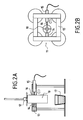
- Figure 2 is a blueprint of a propellant fragmentation facility after cooling of the section.
- Figure 1 schematically represents the succession of different posts for the implementation of the process.
- the engines are brought to a storage workshop, identified for the traceability of the operation and are placed one by one on a conveyor and are introduced, one to one, through a first airlock in the facility.
- the engine is immersed in a tray containing water and positioned on a bench turning in relation to a ramp of several jets to high pressure suitably arranged: the engine is cut into sections.
- the high pressure ramps are made with standard equipment eg DIGITAL CONTROL, supplying high-pressure jets, approximately 300 MPa using two pumps. In general, there is a section that does not contain propellant but a great part of the nozzle, that section not containing pyrotechnic product is removed from the sequence.
- this post essentially includes a bath of great length in which are immersed several sections suitably spaced; the sections move as the process unfolds and so stay long in the liquid which promotes cooling to temperatures about -100 ° C.
- the suitably oriented section is deformed by compression of the envelope: the propellant, weakened, cracked and cracked by cooling fragments.
- the fragments are recovered for a further processing.
- the sections of empty propellant casing are directed to a residue deactivation station 6.
- the deactivation of sections is, in this example, made by immersing said sections in a vessel containing some water.
- the propellant fragments are directed to a fine grinding station 4 using knife mills with water spray.
- Standard devices powerful, with some security adaptations, can treat up to 1000kg / hour of propellant.
- the grains obtained after fine grinding are introduced to the dissolution station 5 in a reactor of large volume, said reactor is perfectly agitated and thermoregulated to increase the kinetics of dissolution the oxidizing charge in the water.
- Figure 2 schematically represents views a) in profile and b) in plan of an extraction apparatus 11 of the propellant of a cooled engine section 10.
- the apparatus essentially comprises a frame rectangular 13, anchored on four feet with a stop 14 on one side of the frame and a hydropneumatic cylinder 15 fixed on the opposite side; the cylinder is arranged horizontally.
- the motor section 10 to be treated is hooked, vertical axis to a handling means schematized by the reference 12. Said handling means brings the section motor 10 between the stop 14 and the cylinder rod 16.
- the cylinder rod 16 is supported on the envelope from the engine section to about one-third of its height from the bottom of the section. Moving the stem jack 16 is determined to impose a deformation to the envelope that remains in the elastic domain of deformations of it and fragment the propellant cold and separate it from the envelope.
- a receptacle 17, containing water to make inert the propellant fragments that fall by simple effect of gravity is placed under the stretch of engine; said receptacle 17 is only shown in Figure 2a).
- This unit is placed in a suitable room with entry and exit lockers and all easements necessary for remote operation.
Landscapes
- Engineering & Computer Science (AREA)
- Manufacturing & Machinery (AREA)
- General Engineering & Computer Science (AREA)
- Processing Of Solid Wastes (AREA)
- Solid Fuels And Fuel-Associated Substances (AREA)
- Disintegrating Or Milling (AREA)
- Transition And Organic Metals Composition Catalysts For Addition Polymerization (AREA)
- Drilling And Exploitation, And Mining Machines And Methods (AREA)
Abstract
Description
- le moteur est découpé en tronçons perpendiculairement à l'axe du moteur,
- les tronçons ne contenant pas de propergol sont retirés de la suite de la séquence,
- les tronçons contenant du propergol sont refroidis à une température très inférieure au domaine de température de transition vitreuse du liant du propergol,
- le propergol est séparé de l'enveloppe de chaque tronçon, le tronçon est ainsi vidé du propergol qu'il contenait,
- les tronçons d'enveloppe vides sont récupérés pour une étape complémentaire de désactivation des éventuels résidus de propergol,
- le propergol fragmenté est récupéré pour un traitement ultérieur.
- des tronçons sans propergol : en général il y a un seul tronçon de ce type par moteur, ce tronçon porte tout ou partie de la tuyère, il ne contient pas de matériau pyrotechnique, ce type de tronçon est retiré de la présente séquence,
- des tronçons avec du propergol : la portion découpée du bloc est restée collée à la portion découpée de l'enveloppe, ce type de tronçon va suivre les autres étapes du procédé. Au moins une des extrémités du tronçon est grande ouverte : c'est-à-dire que le diamètre de l'ouverture est sensiblement égal au calibre du moteur.
- les tronçons sont refroidis plus rapidement qu'un moteur entier : masse plus faible, surface d'échange thermique avec le liquide cryogénique plus importante,
- les tronçons étant court les fragments tombent par gravité et ne présentent pas de risque de coincement existant sur un moteur complet,
- la désactivation des résidus de propergol faite sur des tronçons d'enveloppe vides est plus facile que celle faite sur l'enveloppe complète d'un moteur et cela quel que soit le procédé adopté.
Claims (12)
- Procédé de destruction de moteur à propergol solide, ledit moteur moulé-collé étant essentiellement constitué par un bloc de propergol et une enveloppe, ledit procédé est caractérisé en ce qu'il comporte les étapes suivantes :le moteur est découpé en tronçons perpendiculairement à l'axe du moteur,les tronçons ne contenant pas de propergol sont retirés de la suite de la séquence,les tronçons contenant du propergol sont refroidis à une température très inférieure au domaine de température de transition vitreuse du liant du propergol,le propergol est fragmenté et séparé de l'enveloppe de chaque tronçon, le tronçon est ainsi vidé du propergol qu'il contenait,les tronçons d'enveloppe vides sont récupérés pour une étape complémentaire de désactivation des résidus,le propergol fragmenté est récupéré pour un traitement ultérieur.
- Procédé de destruction de moteur à propergol solide selon la revendication 1 caractérisé en ce que les tronçons contenant du propergol ont un rapport longueur sur diamètre extérieur inférieur ou égal à 2,5.
- Procédé de destruction de moteur à propergol solide selon la revendication 1 ou 2 caractérisé en ce que le découpage du moteur se fait par au moins un jet de liquide à haute pression.
- Procédé de destruction de moteur à propergol solide selon la revendication 3 caractérisé en ce que pour le découpage le moteur est immergé dans un bac contenant le même liquide que celui utilisé pour alimenter une rampe de plusieurs jets prépositionnés par rapport au moteur.
- Procédé de destruction de moteur à propergol solide selon la revendication 1 ou 2 caractérisé en ce que les tronçons contenant du propergol sont refroidis par immersion dans un liquide cryogénique.
- Procédé de destruction de moteur à propergol solide selon la revendication 5 caractérisé en ce que le liquide de cryogénique est de l'azote liquide.
- Procédé de destruction de moteur à propergol solide selon la revendication 5 caractérisé en ce que le tronçon est refroidi à une température comprise entre environ -100°C et environ -80°C.
- Procédé de destruction de moteur à propergol solide selon la revendication 5 caractérisé en ce que l'enveloppe de chaque tronçon refroidi est soumise à des efforts de déformation élastique pour fragmenter le propergol dont les fragments sont recueillis dans un réceptacle.
- Procédé de destruction de moteur à propergol solide selon la revendication 5 caractérisé en ce que chaque tronçon vide est désactivé par brûlage des traces de résidus de propergol avec récupération et lavage des fumées.
- Procédé de destruction de moteur à propergol solide selon la revendication 5 caractérisé en ce que chaque tronçon vide est désactivé par trempage du tronçon dans un liquide dissolvant la charge oxydante.
- Installation pour la destruction de moteur à propergol solide, ledit moteur étant essentiellement constitué par un bloc de propergol collé dans une enveloppe, caractérisée en ce qu'elle comprend :un poste de préparation des moteurs communiquant par un sas de découplage avec,un poste de découpage (1) en tronçons dudit moteur,un poste de refroidissement (2) des tronçons contenant du propergol,au moins un poste de fragmentation (3) du propergol avec récupération des fragments de propergol et des tronçons d'enveloppe vides,un poste (6) de désactivation des résidus de propergol des tronçons d'enveloppe vides.
- Installation pour la destruction de moteur à propergol solide selon la revendication 11 caractérisée en ce qu'elle comprend :un poste (4) de broyage fin des fragments de propergol,un poste (5) de dissolution de la charge oxydante du propergol broyé finement.
Applications Claiming Priority (2)
| Application Number | Priority Date | Filing Date | Title |
|---|---|---|---|
| FR0308474A FR2857357B1 (fr) | 2003-07-10 | 2003-07-10 | Procede et installation de destruction de moteurs a propergol solide |
| FR0308474 | 2003-07-10 |
Publications (2)
| Publication Number | Publication Date |
|---|---|
| EP1496333A1 true EP1496333A1 (fr) | 2005-01-12 |
| EP1496333B1 EP1496333B1 (fr) | 2006-08-16 |
Family
ID=33443260
Family Applications (1)
| Application Number | Title | Priority Date | Filing Date |
|---|---|---|---|
| EP04291225A Expired - Lifetime EP1496333B1 (fr) | 2003-07-10 | 2004-05-13 | Procédé et installation de destruction de moteurs à propergol solide |
Country Status (6)
| Country | Link |
|---|---|
| US (1) | US7249553B1 (fr) |
| EP (1) | EP1496333B1 (fr) |
| AT (1) | ATE336707T1 (fr) |
| DE (1) | DE602004001938T2 (fr) |
| ES (1) | ES2270306T3 (fr) |
| FR (1) | FR2857357B1 (fr) |
Families Citing this family (6)
| Publication number | Priority date | Publication date | Assignee | Title |
|---|---|---|---|---|
| DE102004034784B4 (de) * | 2004-07-09 | 2009-08-27 | Spreewerk Lübben GmbH | Verfahren und Vorrichtung zur Delaborierung von explosivstoffhaltigen Körpern |
| DE102008041973A1 (de) * | 2008-09-10 | 2010-03-11 | Grv Luthe Kampfmittelbeseitigung Gmbh | Verfahren und Vorrichtung zur Delaborierung von Munition mit brennbarem Inhalt und zur Rückgewinnung des Munitionshüllenmaterials |
| US8661960B2 (en) | 2009-08-21 | 2014-03-04 | Dynasafe International Ab | Closed vessel arrangement for safe destruction of rocket motors |
| FR2976659B1 (fr) | 2011-06-15 | 2013-07-19 | Roxel France | Procede alternatif de demantelement de moteurs a propergol solide |
| CN110030886B (zh) * | 2019-05-22 | 2024-03-22 | 中国人民解放军32181部队 | 火箭炮弹推进剂自动倒出装置及火箭炮弹分解设备 |
| CN110006298B (zh) * | 2019-05-22 | 2023-10-13 | 中国人民解放军32181部队 | 火箭炮弹自动化分解作业线 |
Citations (6)
| Publication number | Priority date | Publication date | Assignee | Title |
|---|---|---|---|---|
| US3075461A (en) * | 1960-10-28 | 1963-01-29 | Bilker & Moyerman | Method and apparatus for detonating radio frequency sensitive blasting caps |
| FR1358860A (fr) * | 1962-07-16 | 1964-04-17 | Bj Service | Procédé et appareil pour enlever d'un cylindre un propergol solide |
| US5025632A (en) | 1989-06-13 | 1991-06-25 | General Atomics | Method and apparatus for cryogenic removal of solid materials |
| US5220107A (en) | 1987-10-19 | 1993-06-15 | United Technologies Corporation | Process for the preparation of solid rocket propellant and other solid explosives for thermal disposal or reclamation |
| US5552093A (en) | 1989-06-05 | 1996-09-03 | Lee; David E. | Process for the removal of a solid rocket propellant from a rocket motor case |
| US6245958B1 (en) * | 1997-09-12 | 2001-06-12 | Lockheed Martin Corporation | Methods for non-incendiary disposal of rockets, projectiles, missiles and parts thereof |
Family Cites Families (13)
| Publication number | Priority date | Publication date | Assignee | Title |
|---|---|---|---|---|
| US3440096A (en) | 1962-07-16 | 1969-04-22 | Byron Jackson Inc | Method of removing solid propellant |
| US4376666A (en) * | 1980-10-06 | 1983-03-15 | The United States Of America As Represented By The Secretary Of The Army | Process for the recovery of carborane from reject propellant |
| DE3447647C1 (de) * | 1984-12-28 | 1986-05-07 | Fraunhofer-Gesellschaft zur Förderung der angewandten Forschung e.V., 8000 München | Verfahren und Vorrichtung zum Auftrennen von Raketen |
| US4854982A (en) * | 1989-01-31 | 1989-08-08 | The United States Of America As Represented By The Secretary Of The Army | Method to dimilitarize extract, and recover ammonium perchlorate from composite propellants using liquid ammonia |
| US4909868A (en) * | 1989-10-16 | 1990-03-20 | The United States Of America As Represented By The Secretary Of The Army | Extraction and recovery of plasticizers from solid propellants and munitions |
| US5370845A (en) * | 1991-08-30 | 1994-12-06 | Alliant Techsystems | Process and apparatus for photolytic degradation of explosives |
| US5331106A (en) * | 1992-02-04 | 1994-07-19 | Aerojet General Corporation | Resource recovery system |
| US5430229A (en) * | 1992-12-30 | 1995-07-04 | Hercules Incorporated | Chemical process for disposal of rocket propellant containing nitrate ester |
| US5284995A (en) * | 1993-03-08 | 1994-02-08 | The United States Of America As Represented By The Secretary Of The Army | Method to extract and recover nitramine oxidizers from solid propellants using liquid ammonia |
| US5501132A (en) * | 1994-08-31 | 1996-03-26 | Global Environmental Solutions, Inc. | Dry preparation of particulate solid energetic material |
| DE4440208A1 (de) * | 1994-11-10 | 1996-05-15 | Alba Ind & Umweltschutzservice | Verfahren und Vorrichtung zum Zerschneiden eines Körpers aus festen Explosivstoffen, insbesondere Composite-Raketentreibstoffen |
| RU2143660C1 (ru) * | 1998-04-28 | 1999-12-27 | Федеральный центр двойных технологий "Союз" | Способ ликвидации зарядов твердого ракетного топлива (трт) |
| JP3565769B2 (ja) * | 2000-08-03 | 2004-09-15 | 川崎重工業株式会社 | 砲弾解体方法に使用するウォータジェットノズル |
-
2003
- 2003-07-10 FR FR0308474A patent/FR2857357B1/fr not_active Expired - Fee Related
-
2004
- 2004-05-13 ES ES04291225T patent/ES2270306T3/es not_active Expired - Lifetime
- 2004-05-13 DE DE602004001938T patent/DE602004001938T2/de not_active Expired - Lifetime
- 2004-05-13 AT AT04291225T patent/ATE336707T1/de not_active IP Right Cessation
- 2004-05-13 EP EP04291225A patent/EP1496333B1/fr not_active Expired - Lifetime
- 2004-05-28 US US10/855,322 patent/US7249553B1/en not_active Expired - Fee Related
Patent Citations (6)
| Publication number | Priority date | Publication date | Assignee | Title |
|---|---|---|---|---|
| US3075461A (en) * | 1960-10-28 | 1963-01-29 | Bilker & Moyerman | Method and apparatus for detonating radio frequency sensitive blasting caps |
| FR1358860A (fr) * | 1962-07-16 | 1964-04-17 | Bj Service | Procédé et appareil pour enlever d'un cylindre un propergol solide |
| US5220107A (en) | 1987-10-19 | 1993-06-15 | United Technologies Corporation | Process for the preparation of solid rocket propellant and other solid explosives for thermal disposal or reclamation |
| US5552093A (en) | 1989-06-05 | 1996-09-03 | Lee; David E. | Process for the removal of a solid rocket propellant from a rocket motor case |
| US5025632A (en) | 1989-06-13 | 1991-06-25 | General Atomics | Method and apparatus for cryogenic removal of solid materials |
| US6245958B1 (en) * | 1997-09-12 | 2001-06-12 | Lockheed Martin Corporation | Methods for non-incendiary disposal of rockets, projectiles, missiles and parts thereof |
Also Published As
| Publication number | Publication date |
|---|---|
| EP1496333B1 (fr) | 2006-08-16 |
| DE602004001938D1 (de) | 2006-09-28 |
| US7249553B1 (en) | 2007-07-31 |
| ATE336707T1 (de) | 2006-09-15 |
| US20070161844A1 (en) | 2007-07-12 |
| FR2857357A1 (fr) | 2005-01-14 |
| ES2270306T3 (es) | 2007-04-01 |
| DE602004001938T2 (de) | 2007-03-08 |
| FR2857357B1 (fr) | 2005-08-19 |
Similar Documents
| Publication | Publication Date | Title |
|---|---|---|
| EP1347840B1 (fr) | Procede, dispositif et installation de nettoyage de pieces contaminees, par un fluide dense sous pression | |
| EP1496333B1 (fr) | Procédé et installation de destruction de moteurs à propergol solide | |
| EP1409923B1 (fr) | Procede de traitement des dechets industriels et/ou menagers et installation de traitement des dechets industriels et/ou menagers | |
| EP1395791B1 (fr) | Procede et installation de destruction de fusee montee sur une munition | |
| FR2992577A1 (fr) | Procede pour executer un grenaillage | |
| EP0002664A1 (fr) | Procédé de traitement de déchets métalliques et dispositif de mise en oeuvre | |
| EP2983884B1 (fr) | Dispositif de traitement par solvolyse d'un materiau solide composite en vue d'extraire des fibres du materiau traite | |
| EP3122706B1 (fr) | Procédé et dispositif pour la récupération, a partir de suspensions renfermant des charges explosives, desdites charges explosives, sèches. | |
| US6245958B1 (en) | Methods for non-incendiary disposal of rockets, projectiles, missiles and parts thereof | |
| US9102575B2 (en) | Propellant disposal device for a propulsion system | |
| EP0501863B1 (fr) | Procédé et installation de destruction de déchets de laboratoire | |
| EP2721367B1 (fr) | Procede alternatif de demantelement de moteurs a propergol solide | |
| FR2685548A1 (fr) | Procede et dispositif de retraitement de batteries d'appareils usees. | |
| FR2820642A1 (fr) | Procede ameliore de decontamination sans incineration de materiaux contenant des agents dangereux | |
| JP2002195800A (ja) | 化学弾解体システムおよび化学弾解体方法 | |
| EP1445023B1 (fr) | Procédé de recyclage de boites de conserve et installation pour la mise en oeuvre du procédé | |
| WO2014188120A1 (fr) | Procede de traitement de sables bitumineux et dispositif de mise en oeuvre d'un tel procede | |
| EP3440677B1 (fr) | Procédé de traitement amélioré d'un conteneur de déchets | |
| FR3077020A1 (fr) | Procede de decapage d'une piece portant un revetement amiante | |
| FR2793172A1 (fr) | Procede de valorisation de matiere | |
| FR3150858A1 (fr) | Installation pour la destruction d'un article par explosion | |
| EP1078024A1 (fr) | Installation de traitement de dechets par thermolyse a moyens de transport sous atmosphere inerte | |
| CA3229207A1 (fr) | Ligne de refusion de scrap en alliage d'aluminium eco-responsable | |
| FR3073369A1 (fr) | Enoiseuse pour ouvrir des fruits a coque | |
| FR2785571A1 (fr) | Procede de decapage d'objets peints en bois |
Legal Events
| Date | Code | Title | Description |
|---|---|---|---|
| PUAI | Public reference made under article 153(3) epc to a published international application that has entered the european phase |
Free format text: ORIGINAL CODE: 0009012 |
|
| AK | Designated contracting states |
Kind code of ref document: A1 Designated state(s): AT BE BG CH CY CZ DE DK EE ES FI FR GB GR HU IE IT LI LU MC NL PL PT RO SE SI SK TR |
|
| AX | Request for extension of the european patent |
Extension state: AL HR LT LV MK |
|
| 17P | Request for examination filed |
Effective date: 20050412 |
|
| AKX | Designation fees paid |
Designated state(s): AT BE BG CH CY CZ DE DK EE ES FI FR GB GR HU IE IT LI LU MC NL PL PT RO SE SI SK TR |
|
| GRAP | Despatch of communication of intention to grant a patent |
Free format text: ORIGINAL CODE: EPIDOSNIGR1 |
|
| GRAS | Grant fee paid |
Free format text: ORIGINAL CODE: EPIDOSNIGR3 |
|
| GRAA | (expected) grant |
Free format text: ORIGINAL CODE: 0009210 |
|
| AK | Designated contracting states |
Kind code of ref document: B1 Designated state(s): AT BE BG CH CY CZ DE DK EE ES FI FR GB GR HU IE IT LI LU MC NL PL PT RO SE SI SK TR |
|
| PG25 | Lapsed in a contracting state [announced via postgrant information from national office to epo] |
Ref country code: IT Free format text: LAPSE BECAUSE OF FAILURE TO SUBMIT A TRANSLATION OF THE DESCRIPTION OR TO PAY THE FEE WITHIN THE PRESCRIBED TIME-LIMIT;WARNING: LAPSES OF ITALIAN PATENTS WITH EFFECTIVE DATE BEFORE 2007 MAY HAVE OCCURRED AT ANY TIME BEFORE 2007. THE CORRECT EFFECTIVE DATE MAY BE DIFFERENT FROM THE ONE RECORDED. Effective date: 20060816 Ref country code: RO Free format text: LAPSE BECAUSE OF FAILURE TO SUBMIT A TRANSLATION OF THE DESCRIPTION OR TO PAY THE FEE WITHIN THE PRESCRIBED TIME-LIMIT Effective date: 20060816 Ref country code: SK Free format text: LAPSE BECAUSE OF FAILURE TO SUBMIT A TRANSLATION OF THE DESCRIPTION OR TO PAY THE FEE WITHIN THE PRESCRIBED TIME-LIMIT Effective date: 20060816 Ref country code: AT Free format text: LAPSE BECAUSE OF FAILURE TO SUBMIT A TRANSLATION OF THE DESCRIPTION OR TO PAY THE FEE WITHIN THE PRESCRIBED TIME-LIMIT Effective date: 20060816 Ref country code: SI Free format text: LAPSE BECAUSE OF FAILURE TO SUBMIT A TRANSLATION OF THE DESCRIPTION OR TO PAY THE FEE WITHIN THE PRESCRIBED TIME-LIMIT Effective date: 20060816 Ref country code: IE Free format text: LAPSE BECAUSE OF FAILURE TO SUBMIT A TRANSLATION OF THE DESCRIPTION OR TO PAY THE FEE WITHIN THE PRESCRIBED TIME-LIMIT Effective date: 20060816 Ref country code: NL Free format text: LAPSE BECAUSE OF FAILURE TO SUBMIT A TRANSLATION OF THE DESCRIPTION OR TO PAY THE FEE WITHIN THE PRESCRIBED TIME-LIMIT Effective date: 20060816 Ref country code: CZ Free format text: LAPSE BECAUSE OF FAILURE TO SUBMIT A TRANSLATION OF THE DESCRIPTION OR TO PAY THE FEE WITHIN THE PRESCRIBED TIME-LIMIT Effective date: 20060816 Ref country code: PL Free format text: LAPSE BECAUSE OF FAILURE TO SUBMIT A TRANSLATION OF THE DESCRIPTION OR TO PAY THE FEE WITHIN THE PRESCRIBED TIME-LIMIT Effective date: 20060816 Ref country code: FI Free format text: LAPSE BECAUSE OF FAILURE TO SUBMIT A TRANSLATION OF THE DESCRIPTION OR TO PAY THE FEE WITHIN THE PRESCRIBED TIME-LIMIT Effective date: 20060816 |
|
| REG | Reference to a national code |
Ref country code: GB Ref legal event code: FG4D Free format text: NOT ENGLISH |
|
| REG | Reference to a national code |
Ref country code: CH Ref legal event code: EP |
|
| REG | Reference to a national code |
Ref country code: IE Ref legal event code: FG4D Free format text: LANGUAGE OF EP DOCUMENT: FRENCH |
|
| REF | Corresponds to: |
Ref document number: 602004001938 Country of ref document: DE Date of ref document: 20060928 Kind code of ref document: P |
|
| PG25 | Lapsed in a contracting state [announced via postgrant information from national office to epo] |
Ref country code: BG Free format text: LAPSE BECAUSE OF FAILURE TO SUBMIT A TRANSLATION OF THE DESCRIPTION OR TO PAY THE FEE WITHIN THE PRESCRIBED TIME-LIMIT Effective date: 20061116 Ref country code: DK Free format text: LAPSE BECAUSE OF FAILURE TO SUBMIT A TRANSLATION OF THE DESCRIPTION OR TO PAY THE FEE WITHIN THE PRESCRIBED TIME-LIMIT Effective date: 20061116 Ref country code: SE Free format text: LAPSE BECAUSE OF FAILURE TO SUBMIT A TRANSLATION OF THE DESCRIPTION OR TO PAY THE FEE WITHIN THE PRESCRIBED TIME-LIMIT Effective date: 20061116 |
|
| GBT | Gb: translation of ep patent filed (gb section 77(6)(a)/1977) |
Effective date: 20061107 |
|
| PG25 | Lapsed in a contracting state [announced via postgrant information from national office to epo] |
Ref country code: PT Free format text: LAPSE BECAUSE OF FAILURE TO SUBMIT A TRANSLATION OF THE DESCRIPTION OR TO PAY THE FEE WITHIN THE PRESCRIBED TIME-LIMIT Effective date: 20070116 |
|
| NLV1 | Nl: lapsed or annulled due to failure to fulfill the requirements of art. 29p and 29m of the patents act | ||
| REG | Reference to a national code |
Ref country code: IE Ref legal event code: FD4D |
|
| REG | Reference to a national code |
Ref country code: ES Ref legal event code: FG2A Ref document number: 2270306 Country of ref document: ES Kind code of ref document: T3 |
|
| PLBE | No opposition filed within time limit |
Free format text: ORIGINAL CODE: 0009261 |
|
| STAA | Information on the status of an ep patent application or granted ep patent |
Free format text: STATUS: NO OPPOSITION FILED WITHIN TIME LIMIT |
|
| 26N | No opposition filed |
Effective date: 20070518 |
|
| PG25 | Lapsed in a contracting state [announced via postgrant information from national office to epo] |
Ref country code: MC Free format text: LAPSE BECAUSE OF NON-PAYMENT OF DUE FEES Effective date: 20070531 |
|
| PG25 | Lapsed in a contracting state [announced via postgrant information from national office to epo] |
Ref country code: GR Free format text: LAPSE BECAUSE OF FAILURE TO SUBMIT A TRANSLATION OF THE DESCRIPTION OR TO PAY THE FEE WITHIN THE PRESCRIBED TIME-LIMIT Effective date: 20061117 |
|
| PG25 | Lapsed in a contracting state [announced via postgrant information from national office to epo] |
Ref country code: EE Free format text: LAPSE BECAUSE OF FAILURE TO SUBMIT A TRANSLATION OF THE DESCRIPTION OR TO PAY THE FEE WITHIN THE PRESCRIBED TIME-LIMIT Effective date: 20060816 |
|
| PGRI | Patent reinstated in contracting state [announced from national office to epo] |
Ref country code: IT Effective date: 20081001 |
|
| REG | Reference to a national code |
Ref country code: CH Ref legal event code: PL |
|
| PG25 | Lapsed in a contracting state [announced via postgrant information from national office to epo] |
Ref country code: LI Free format text: LAPSE BECAUSE OF NON-PAYMENT OF DUE FEES Effective date: 20080531 Ref country code: CH Free format text: LAPSE BECAUSE OF NON-PAYMENT OF DUE FEES Effective date: 20080531 |
|
| PG25 | Lapsed in a contracting state [announced via postgrant information from national office to epo] |
Ref country code: CY Free format text: LAPSE BECAUSE OF FAILURE TO SUBMIT A TRANSLATION OF THE DESCRIPTION OR TO PAY THE FEE WITHIN THE PRESCRIBED TIME-LIMIT Effective date: 20060816 Ref country code: LU Free format text: LAPSE BECAUSE OF NON-PAYMENT OF DUE FEES Effective date: 20070513 |
|
| PG25 | Lapsed in a contracting state [announced via postgrant information from national office to epo] |
Ref country code: TR Free format text: LAPSE BECAUSE OF FAILURE TO SUBMIT A TRANSLATION OF THE DESCRIPTION OR TO PAY THE FEE WITHIN THE PRESCRIBED TIME-LIMIT Effective date: 20060816 Ref country code: HU Free format text: LAPSE BECAUSE OF FAILURE TO SUBMIT A TRANSLATION OF THE DESCRIPTION OR TO PAY THE FEE WITHIN THE PRESCRIBED TIME-LIMIT Effective date: 20070217 |
|
| REG | Reference to a national code |
Ref country code: DE Ref legal event code: R082 Ref document number: 602004001938 Country of ref document: DE Representative=s name: CBDL PATENTANWAELTE, DE |
|
| REG | Reference to a national code |
Ref country code: FR Ref legal event code: CA Effective date: 20130213 Ref country code: FR Ref legal event code: CD Owner name: HERAKLES, FR Effective date: 20130213 |
|
| REG | Reference to a national code |
Ref country code: DE Ref legal event code: R082 Ref document number: 602004001938 Country of ref document: DE Representative=s name: CBDL PATENTANWAELTE, DE |
|
| REG | Reference to a national code |
Ref country code: DE Ref legal event code: R082 Ref document number: 602004001938 Country of ref document: DE Representative=s name: CBDL PATENTANWAELTE, DE Effective date: 20130425 Ref country code: DE Ref legal event code: R082 Ref document number: 602004001938 Country of ref document: DE Representative=s name: CBDL PATENTANWAELTE, DE Effective date: 20130215 Ref country code: DE Ref legal event code: R082 Ref document number: 602004001938 Country of ref document: DE Representative=s name: CBDL PATENTANWAELTE, DE Effective date: 20130528 Ref country code: DE Ref legal event code: R081 Ref document number: 602004001938 Country of ref document: DE Owner name: HERAKLES, FR Free format text: FORMER OWNER: SME, PARIS, FR Effective date: 20130528 Ref country code: DE Ref legal event code: R081 Ref document number: 602004001938 Country of ref document: DE Owner name: HERAKLES, FR Free format text: FORMER OWNER: SNPE MATERIAUX ENERGETIQUES, PARIS, FR Effective date: 20130513 |
|
| REG | Reference to a national code |
Ref country code: ES Ref legal event code: PC2A Owner name: HERAKLES Effective date: 20130708 |
|
| PGFP | Annual fee paid to national office [announced via postgrant information from national office to epo] |
Ref country code: GB Payment date: 20140425 Year of fee payment: 11 |
|
| PGFP | Annual fee paid to national office [announced via postgrant information from national office to epo] |
Ref country code: IT Payment date: 20140424 Year of fee payment: 11 Ref country code: ES Payment date: 20140529 Year of fee payment: 11 Ref country code: DE Payment date: 20140424 Year of fee payment: 11 |
|
| PGFP | Annual fee paid to national office [announced via postgrant information from national office to epo] |
Ref country code: BE Payment date: 20140423 Year of fee payment: 11 |
|
| PGFP | Annual fee paid to national office [announced via postgrant information from national office to epo] |
Ref country code: FR Payment date: 20140515 Year of fee payment: 11 |
|
| REG | Reference to a national code |
Ref country code: DE Ref legal event code: R119 Ref document number: 602004001938 Country of ref document: DE |
|
| GBPC | Gb: european patent ceased through non-payment of renewal fee |
Effective date: 20150513 |
|
| PG25 | Lapsed in a contracting state [announced via postgrant information from national office to epo] |
Ref country code: IT Free format text: LAPSE BECAUSE OF FAILURE TO SUBMIT A TRANSLATION OF THE DESCRIPTION OR TO PAY THE FEE WITHIN THE PRESCRIBED TIME-LIMIT Effective date: 20150513 |
|
| REG | Reference to a national code |
Ref country code: FR Ref legal event code: ST Effective date: 20160129 |
|
| PG25 | Lapsed in a contracting state [announced via postgrant information from national office to epo] |
Ref country code: DE Free format text: LAPSE BECAUSE OF NON-PAYMENT OF DUE FEES Effective date: 20151201 Ref country code: GB Free format text: LAPSE BECAUSE OF NON-PAYMENT OF DUE FEES Effective date: 20150513 |
|
| PG25 | Lapsed in a contracting state [announced via postgrant information from national office to epo] |
Ref country code: FR Free format text: LAPSE BECAUSE OF NON-PAYMENT OF DUE FEES Effective date: 20150601 |
|
| REG | Reference to a national code |
Ref country code: ES Ref legal event code: FD2A Effective date: 20160805 |
|
| PG25 | Lapsed in a contracting state [announced via postgrant information from national office to epo] |
Ref country code: ES Free format text: LAPSE BECAUSE OF NON-PAYMENT OF DUE FEES Effective date: 20150514 |
|
| PG25 | Lapsed in a contracting state [announced via postgrant information from national office to epo] |
Ref country code: BE Free format text: LAPSE BECAUSE OF NON-PAYMENT OF DUE FEES Effective date: 20150531 |