EP1496041A1 - Novel aromatic compound and organic electroluminescnet element containing the same - Google Patents
Novel aromatic compound and organic electroluminescnet element containing the same Download PDFInfo
- Publication number
- EP1496041A1 EP1496041A1 EP03723137A EP03723137A EP1496041A1 EP 1496041 A1 EP1496041 A1 EP 1496041A1 EP 03723137 A EP03723137 A EP 03723137A EP 03723137 A EP03723137 A EP 03723137A EP 1496041 A1 EP1496041 A1 EP 1496041A1
- Authority
- EP
- European Patent Office
- Prior art keywords
- group
- substituted
- carbon atoms
- unsubstituted
- phenanthrolin
- Prior art date
- Legal status (The legal status is an assumption and is not a legal conclusion. Google has not performed a legal analysis and makes no representation as to the accuracy of the status listed.)
- Withdrawn
Links
- 0 Cc1ccc(CN(*)*)cc1 Chemical compound Cc1ccc(CN(*)*)cc1 0.000 description 3
- YXFVVABEGXRONW-UHFFFAOYSA-N Cc1ccccc1 Chemical compound Cc1ccccc1 YXFVVABEGXRONW-UHFFFAOYSA-N 0.000 description 1
Classifications
-
- C—CHEMISTRY; METALLURGY
- C07—ORGANIC CHEMISTRY
- C07C—ACYCLIC OR CARBOCYCLIC COMPOUNDS
- C07C15/00—Cyclic hydrocarbons containing only six-membered aromatic rings as cyclic parts
- C07C15/20—Polycyclic condensed hydrocarbons
- C07C15/27—Polycyclic condensed hydrocarbons containing three rings
- C07C15/28—Anthracenes
-
- C—CHEMISTRY; METALLURGY
- C07—ORGANIC CHEMISTRY
- C07C—ACYCLIC OR CARBOCYCLIC COMPOUNDS
- C07C15/00—Cyclic hydrocarbons containing only six-membered aromatic rings as cyclic parts
- C07C15/40—Cyclic hydrocarbons containing only six-membered aromatic rings as cyclic parts substituted by unsaturated carbon radicals
- C07C15/56—Cyclic hydrocarbons containing only six-membered aromatic rings as cyclic parts substituted by unsaturated carbon radicals polycyclic condensed
- C07C15/60—Cyclic hydrocarbons containing only six-membered aromatic rings as cyclic parts substituted by unsaturated carbon radicals polycyclic condensed containing three rings
-
- C—CHEMISTRY; METALLURGY
- C07—ORGANIC CHEMISTRY
- C07C—ACYCLIC OR CARBOCYCLIC COMPOUNDS
- C07C13/00—Cyclic hydrocarbons containing rings other than, or in addition to, six-membered aromatic rings
- C07C13/28—Polycyclic hydrocarbons or acyclic hydrocarbon derivatives thereof
- C07C13/32—Polycyclic hydrocarbons or acyclic hydrocarbon derivatives thereof with condensed rings
- C07C13/54—Polycyclic hydrocarbons or acyclic hydrocarbon derivatives thereof with condensed rings with three condensed rings
- C07C13/547—Polycyclic hydrocarbons or acyclic hydrocarbon derivatives thereof with condensed rings with three condensed rings at least one ring not being six-membered, the other rings being at the most six-membered
- C07C13/567—Polycyclic hydrocarbons or acyclic hydrocarbon derivatives thereof with condensed rings with three condensed rings at least one ring not being six-membered, the other rings being at the most six-membered with a fluorene or hydrogenated fluorene ring system
-
- C—CHEMISTRY; METALLURGY
- C07—ORGANIC CHEMISTRY
- C07C—ACYCLIC OR CARBOCYCLIC COMPOUNDS
- C07C13/00—Cyclic hydrocarbons containing rings other than, or in addition to, six-membered aromatic rings
- C07C13/28—Polycyclic hydrocarbons or acyclic hydrocarbon derivatives thereof
- C07C13/32—Polycyclic hydrocarbons or acyclic hydrocarbon derivatives thereof with condensed rings
- C07C13/62—Polycyclic hydrocarbons or acyclic hydrocarbon derivatives thereof with condensed rings with more than three condensed rings
- C07C13/66—Polycyclic hydrocarbons or acyclic hydrocarbon derivatives thereof with condensed rings with more than three condensed rings the condensed ring system contains only four rings
-
- C—CHEMISTRY; METALLURGY
- C07—ORGANIC CHEMISTRY
- C07D—HETEROCYCLIC COMPOUNDS
- C07D209/00—Heterocyclic compounds containing five-membered rings, condensed with other rings, with one nitrogen atom as the only ring hetero atom
- C07D209/56—Ring systems containing three or more rings
- C07D209/80—[b, c]- or [b, d]-condensed
- C07D209/82—Carbazoles; Hydrogenated carbazoles
-
- C—CHEMISTRY; METALLURGY
- C09—DYES; PAINTS; POLISHES; NATURAL RESINS; ADHESIVES; COMPOSITIONS NOT OTHERWISE PROVIDED FOR; APPLICATIONS OF MATERIALS NOT OTHERWISE PROVIDED FOR
- C09K—MATERIALS FOR MISCELLANEOUS APPLICATIONS, NOT PROVIDED FOR ELSEWHERE
- C09K11/00—Luminescent materials, e.g. electroluminescent or chemiluminescent
- C09K11/06—Luminescent materials, e.g. electroluminescent or chemiluminescent containing organic luminescent materials
-
- H—ELECTRICITY
- H10—SEMICONDUCTOR DEVICES; ELECTRIC SOLID-STATE DEVICES NOT OTHERWISE PROVIDED FOR
- H10K—ORGANIC ELECTRIC SOLID-STATE DEVICES
- H10K50/00—Organic light-emitting devices
- H10K50/10—OLEDs or polymer light-emitting diodes [PLED]
- H10K50/14—Carrier transporting layers
- H10K50/16—Electron transporting layers
- H10K50/165—Electron transporting layers comprising dopants
-
- H—ELECTRICITY
- H10—SEMICONDUCTOR DEVICES; ELECTRIC SOLID-STATE DEVICES NOT OTHERWISE PROVIDED FOR
- H10K—ORGANIC ELECTRIC SOLID-STATE DEVICES
- H10K85/00—Organic materials used in the body or electrodes of devices covered by this subclass
- H10K85/60—Organic compounds having low molecular weight
- H10K85/615—Polycyclic condensed aromatic hydrocarbons, e.g. anthracene
-
- H—ELECTRICITY
- H10—SEMICONDUCTOR DEVICES; ELECTRIC SOLID-STATE DEVICES NOT OTHERWISE PROVIDED FOR
- H10K—ORGANIC ELECTRIC SOLID-STATE DEVICES
- H10K85/00—Organic materials used in the body or electrodes of devices covered by this subclass
- H10K85/60—Organic compounds having low molecular weight
- H10K85/615—Polycyclic condensed aromatic hydrocarbons, e.g. anthracene
- H10K85/626—Polycyclic condensed aromatic hydrocarbons, e.g. anthracene containing more than one polycyclic condensed aromatic rings, e.g. bis-anthracene
-
- H—ELECTRICITY
- H10—SEMICONDUCTOR DEVICES; ELECTRIC SOLID-STATE DEVICES NOT OTHERWISE PROVIDED FOR
- H10K—ORGANIC ELECTRIC SOLID-STATE DEVICES
- H10K85/00—Organic materials used in the body or electrodes of devices covered by this subclass
- H10K85/60—Organic compounds having low molecular weight
- H10K85/631—Amine compounds having at least two aryl rest on at least one amine-nitrogen atom, e.g. triphenylamine
-
- H—ELECTRICITY
- H10—SEMICONDUCTOR DEVICES; ELECTRIC SOLID-STATE DEVICES NOT OTHERWISE PROVIDED FOR
- H10K—ORGANIC ELECTRIC SOLID-STATE DEVICES
- H10K85/00—Organic materials used in the body or electrodes of devices covered by this subclass
- H10K85/60—Organic compounds having low molecular weight
- H10K85/649—Aromatic compounds comprising a hetero atom
- H10K85/657—Polycyclic condensed heteroaromatic hydrocarbons
- H10K85/6572—Polycyclic condensed heteroaromatic hydrocarbons comprising only nitrogen in the heteroaromatic polycondensed ring system, e.g. phenanthroline or carbazole
-
- C—CHEMISTRY; METALLURGY
- C09—DYES; PAINTS; POLISHES; NATURAL RESINS; ADHESIVES; COMPOSITIONS NOT OTHERWISE PROVIDED FOR; APPLICATIONS OF MATERIALS NOT OTHERWISE PROVIDED FOR
- C09K—MATERIALS FOR MISCELLANEOUS APPLICATIONS, NOT PROVIDED FOR ELSEWHERE
- C09K2211/00—Chemical nature of organic luminescent or tenebrescent compounds
- C09K2211/10—Non-macromolecular compounds
- C09K2211/1003—Carbocyclic compounds
-
- C—CHEMISTRY; METALLURGY
- C09—DYES; PAINTS; POLISHES; NATURAL RESINS; ADHESIVES; COMPOSITIONS NOT OTHERWISE PROVIDED FOR; APPLICATIONS OF MATERIALS NOT OTHERWISE PROVIDED FOR
- C09K—MATERIALS FOR MISCELLANEOUS APPLICATIONS, NOT PROVIDED FOR ELSEWHERE
- C09K2211/00—Chemical nature of organic luminescent or tenebrescent compounds
- C09K2211/10—Non-macromolecular compounds
- C09K2211/1003—Carbocyclic compounds
- C09K2211/1007—Non-condensed systems
-
- C—CHEMISTRY; METALLURGY
- C09—DYES; PAINTS; POLISHES; NATURAL RESINS; ADHESIVES; COMPOSITIONS NOT OTHERWISE PROVIDED FOR; APPLICATIONS OF MATERIALS NOT OTHERWISE PROVIDED FOR
- C09K—MATERIALS FOR MISCELLANEOUS APPLICATIONS, NOT PROVIDED FOR ELSEWHERE
- C09K2211/00—Chemical nature of organic luminescent or tenebrescent compounds
- C09K2211/10—Non-macromolecular compounds
- C09K2211/1003—Carbocyclic compounds
- C09K2211/1011—Condensed systems
-
- C—CHEMISTRY; METALLURGY
- C09—DYES; PAINTS; POLISHES; NATURAL RESINS; ADHESIVES; COMPOSITIONS NOT OTHERWISE PROVIDED FOR; APPLICATIONS OF MATERIALS NOT OTHERWISE PROVIDED FOR
- C09K—MATERIALS FOR MISCELLANEOUS APPLICATIONS, NOT PROVIDED FOR ELSEWHERE
- C09K2211/00—Chemical nature of organic luminescent or tenebrescent compounds
- C09K2211/10—Non-macromolecular compounds
- C09K2211/1003—Carbocyclic compounds
- C09K2211/1014—Carbocyclic compounds bridged by heteroatoms, e.g. N, P, Si or B
-
- C—CHEMISTRY; METALLURGY
- C09—DYES; PAINTS; POLISHES; NATURAL RESINS; ADHESIVES; COMPOSITIONS NOT OTHERWISE PROVIDED FOR; APPLICATIONS OF MATERIALS NOT OTHERWISE PROVIDED FOR
- C09K—MATERIALS FOR MISCELLANEOUS APPLICATIONS, NOT PROVIDED FOR ELSEWHERE
- C09K2211/00—Chemical nature of organic luminescent or tenebrescent compounds
- C09K2211/10—Non-macromolecular compounds
- C09K2211/1018—Heterocyclic compounds
- C09K2211/1025—Heterocyclic compounds characterised by ligands
- C09K2211/1029—Heterocyclic compounds characterised by ligands containing one nitrogen atom as the heteroatom
-
- H—ELECTRICITY
- H10—SEMICONDUCTOR DEVICES; ELECTRIC SOLID-STATE DEVICES NOT OTHERWISE PROVIDED FOR
- H10K—ORGANIC ELECTRIC SOLID-STATE DEVICES
- H10K2102/00—Constructional details relating to the organic devices covered by this subclass
- H10K2102/10—Transparent electrodes, e.g. using graphene
- H10K2102/101—Transparent electrodes, e.g. using graphene comprising transparent conductive oxides [TCO]
- H10K2102/103—Transparent electrodes, e.g. using graphene comprising transparent conductive oxides [TCO] comprising indium oxides, e.g. ITO
-
- H—ELECTRICITY
- H10—SEMICONDUCTOR DEVICES; ELECTRIC SOLID-STATE DEVICES NOT OTHERWISE PROVIDED FOR
- H10K—ORGANIC ELECTRIC SOLID-STATE DEVICES
- H10K50/00—Organic light-emitting devices
- H10K50/10—OLEDs or polymer light-emitting diodes [PLED]
- H10K50/11—OLEDs or polymer light-emitting diodes [PLED] characterised by the electroluminescent [EL] layers
-
- H—ELECTRICITY
- H10—SEMICONDUCTOR DEVICES; ELECTRIC SOLID-STATE DEVICES NOT OTHERWISE PROVIDED FOR
- H10K—ORGANIC ELECTRIC SOLID-STATE DEVICES
- H10K50/00—Organic light-emitting devices
- H10K50/10—OLEDs or polymer light-emitting diodes [PLED]
- H10K50/14—Carrier transporting layers
-
- H—ELECTRICITY
- H10—SEMICONDUCTOR DEVICES; ELECTRIC SOLID-STATE DEVICES NOT OTHERWISE PROVIDED FOR
- H10K—ORGANIC ELECTRIC SOLID-STATE DEVICES
- H10K71/00—Manufacture or treatment specially adapted for the organic devices covered by this subclass
- H10K71/30—Doping active layers, e.g. electron transporting layers
-
- H—ELECTRICITY
- H10—SEMICONDUCTOR DEVICES; ELECTRIC SOLID-STATE DEVICES NOT OTHERWISE PROVIDED FOR
- H10K—ORGANIC ELECTRIC SOLID-STATE DEVICES
- H10K85/00—Organic materials used in the body or electrodes of devices covered by this subclass
- H10K85/30—Coordination compounds
- H10K85/321—Metal complexes comprising a group IIIA element, e.g. Tris (8-hydroxyquinoline) gallium [Gaq3]
- H10K85/324—Metal complexes comprising a group IIIA element, e.g. Tris (8-hydroxyquinoline) gallium [Gaq3] comprising aluminium, e.g. Alq3
-
- H—ELECTRICITY
- H10—SEMICONDUCTOR DEVICES; ELECTRIC SOLID-STATE DEVICES NOT OTHERWISE PROVIDED FOR
- H10K—ORGANIC ELECTRIC SOLID-STATE DEVICES
- H10K85/00—Organic materials used in the body or electrodes of devices covered by this subclass
- H10K85/60—Organic compounds having low molecular weight
- H10K85/615—Polycyclic condensed aromatic hydrocarbons, e.g. anthracene
- H10K85/622—Polycyclic condensed aromatic hydrocarbons, e.g. anthracene containing four rings, e.g. pyrene
-
- H—ELECTRICITY
- H10—SEMICONDUCTOR DEVICES; ELECTRIC SOLID-STATE DEVICES NOT OTHERWISE PROVIDED FOR
- H10K—ORGANIC ELECTRIC SOLID-STATE DEVICES
- H10K85/00—Organic materials used in the body or electrodes of devices covered by this subclass
- H10K85/60—Organic compounds having low molecular weight
- H10K85/631—Amine compounds having at least two aryl rest on at least one amine-nitrogen atom, e.g. triphenylamine
- H10K85/633—Amine compounds having at least two aryl rest on at least one amine-nitrogen atom, e.g. triphenylamine comprising polycyclic condensed aromatic hydrocarbons as substituents on the nitrogen atom
-
- H—ELECTRICITY
- H10—SEMICONDUCTOR DEVICES; ELECTRIC SOLID-STATE DEVICES NOT OTHERWISE PROVIDED FOR
- H10K—ORGANIC ELECTRIC SOLID-STATE DEVICES
- H10K85/00—Organic materials used in the body or electrodes of devices covered by this subclass
- H10K85/60—Organic compounds having low molecular weight
- H10K85/631—Amine compounds having at least two aryl rest on at least one amine-nitrogen atom, e.g. triphenylamine
- H10K85/636—Amine compounds having at least two aryl rest on at least one amine-nitrogen atom, e.g. triphenylamine comprising heteroaromatic hydrocarbons as substituents on the nitrogen atom
-
- Y—GENERAL TAGGING OF NEW TECHNOLOGICAL DEVELOPMENTS; GENERAL TAGGING OF CROSS-SECTIONAL TECHNOLOGIES SPANNING OVER SEVERAL SECTIONS OF THE IPC; TECHNICAL SUBJECTS COVERED BY FORMER USPC CROSS-REFERENCE ART COLLECTIONS [XRACs] AND DIGESTS
- Y10—TECHNICAL SUBJECTS COVERED BY FORMER USPC
- Y10S—TECHNICAL SUBJECTS COVERED BY FORMER USPC CROSS-REFERENCE ART COLLECTIONS [XRACs] AND DIGESTS
- Y10S428/00—Stock material or miscellaneous articles
- Y10S428/917—Electroluminescent
Definitions
- the present invention relates to a novel aromatic compound and an organic electroluminescent ("electroluminescent” and “electroluminescence” will be referred to as "EL", hereinafter) device containing the compound and, more particularly, to a novel aromatic compound which can provide an organic EL device exhibiting a great luminance of emitted light, a great efficiency of light emission and a high purity of color, emitting bluish light, excellent in stability at high temperatures and having a long life and an organic EL device utilizing the compound.
- organic electroluminescent electroluminescent
- EL organic electroluminescent
- An organic EL device is a spontaneous light emitting device which utilizes the principle that a fluorescent substance emits light by energy of recombination of holes injected from an anode and electrons injected from a cathode when an electric field is applied. Since an organic EL device of the laminate type driven under a low electric voltage was reported by C. W. Tang of Eastman Kodak Company (C. W. Tang and S. A. Vanslyke, Applied Physics Letters, Volume 51, Pages 913, 1987), many studies have been conducted on organic EL devices using organic materials as the constituting materials. Tang et al.
- the laminate structure using tris(8-hydroxyquinolinol)aluminum for the light emitting layer and a triphenyldiamine derivative for the hole transporting layer.
- Advantages of the laminate structure are that the efficiency of hole injection into the light emitting layer can be increased, that the efficiency of forming excited particles which are formed by blocking and recombining electrons injected from the cathode can be increased, and that excited particles formed within the light emitting layer can be enclosed.
- a two-layered structure having a hole transporting (injecting) layer and an electron transporting and light emitting layer and a three-layered structure having a hole transporting (injecting) layer, a light emitting layer and an electron transporting (injecting) layer are well known.
- the structure of the device and the process for forming the device have been studied.
- chelate complexes such as tris(8-quinolinolato)aluminum, coumarine derivatives, tetraphenylbutadiene derivatives, bisstyrylarylene derivatives and oxadiazole derivatives are known. It is reported that light in the visible region ranging from blue light to red light can be obtained by using these light emitting materials, and development of a device exhibiting color images is expected (For example, Japanese Patent Application Laid-Open Nos. Heisei 8(1996)-239655, Heisei 7(1995)-138561 and Heisei 3(1991)-200289).
- a device using a phenylanthracene derivative as the light emitting material is disclosed in Japanese Patent Application Laid-Open No. Heisei 8(1996)-012600.
- the anthracene derivative is used as the material for emitting bluish light, a further improvement in the efficiency of light emission has been desired.
- an improvement in the stability of the thin film has been desired so that the life of the device is increased.
- heretofore known anthracene derivatives form crystals in many cases to cause fracture of the thin film, and the improvement has been desired.
- a dinaphthylanthracene compound is disclosed in the United States Patent No. 0593571.
- Japanese Patent Application Laid-Open No. Heisei 2000-273056 discloses an allylanthracene compound asymmetric in the horizontal direction.
- one of the groups as substituents to the anthracendiyl group is a simple group such as phenyl group and biphenyl group, and the crystallization cannot be prevented.
- the present invention has been made to overcome the above problems and has an object of providing a novel aromatic compound which can provide an organic EL device exhibiting a great luminance of emitted light, a great efficiency of light emission and a high purity of color, emitting bluish light, excellent in stability at high temperatures and having a long life and an organic EL device utilizing the compound.
- the present invention provides a novel aromatic compound represented by following general formula (A) or (B).
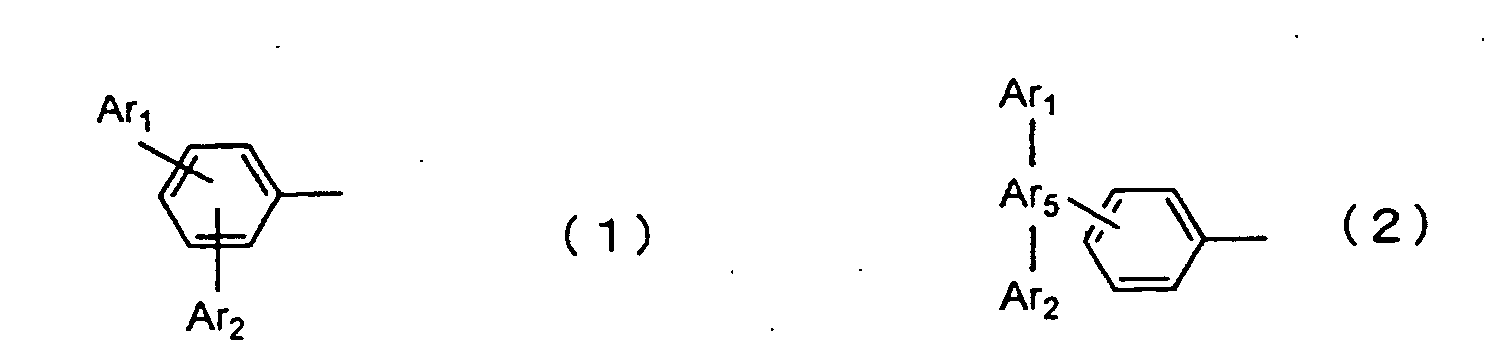
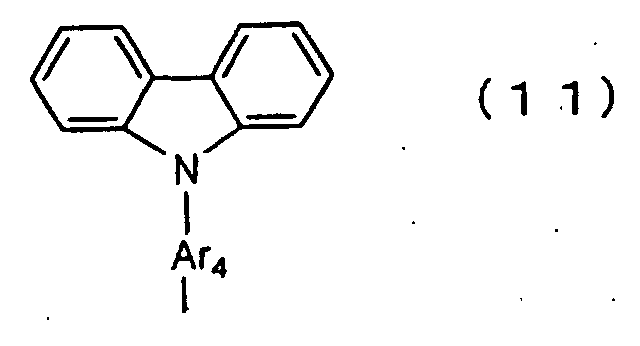
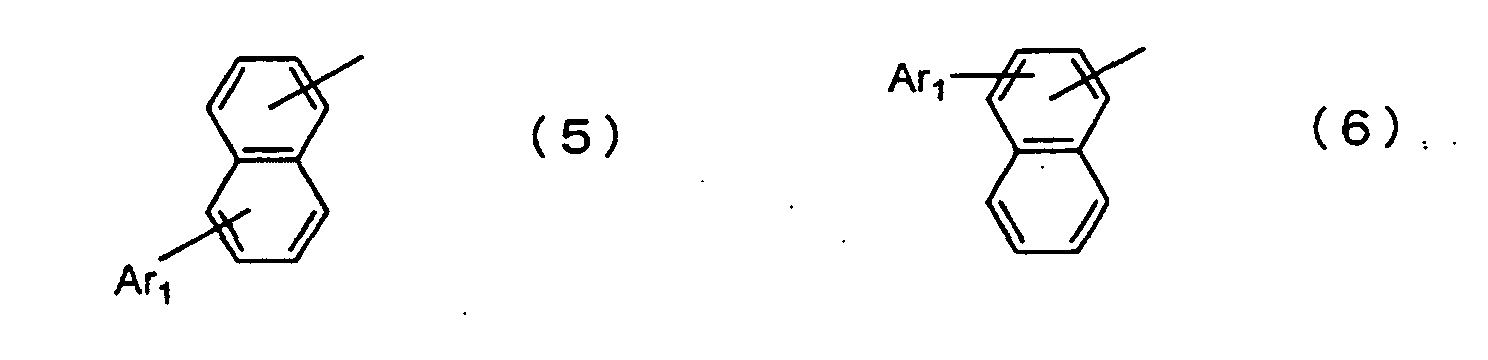
- General formula (A) is: A-Ar-B wherein Ar represents a substituted or unsubstituted anthracendiyl group, B represents a heterocyclic group which has 2 to 60 carbon atoms or a substituted or unsubstituted aryl group having 5 to 60 carbon atoms each of which is mono-substituted with an alkenyl group or an arylamino group, A represents a group which is selected from groups represented by the following general formulae (1) to (11): wherein Ar 1 to Ar 3 each independently represent a substituted or unsubstituted aryl group having 6 to 30 carbon atoms, Ar 4 represents a substituted or unsubstituted arylene group having 6 to 30 carbon atoms, Ar 5 represents a substituted or unsubstituted trivalent aromatic residue group having 6 to 30 carbon atoms, R 1 and R 2 each independently represent hydrogen atom, a halogen atom, hydroxyl group, a substituted or unsubstituted amino group
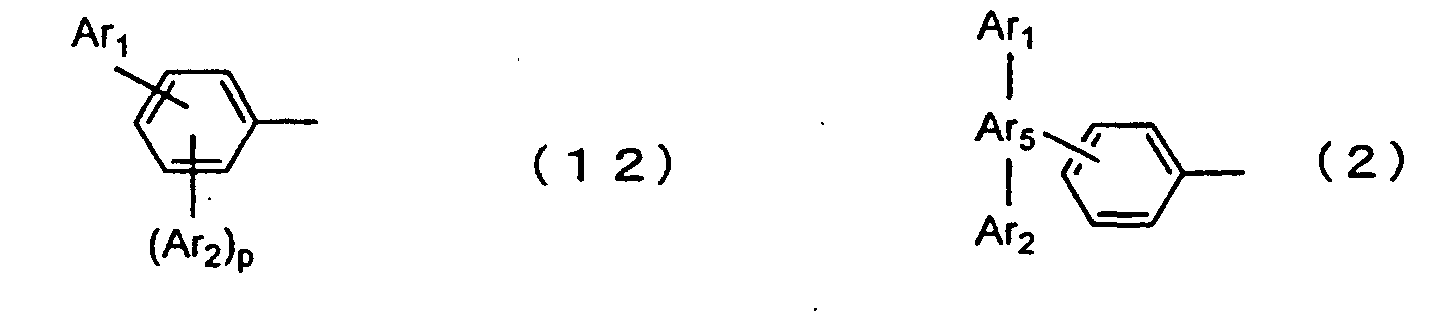
- General formula (B) is: A'-Ar-Ar-B wherein Ar represents a substituted or unsubstituted anthracendiyl group, B represents a heterocyclic group which has 2 to 60 carbon atoms or a substituted or unsubstituted aryl group having 5 to 60 carbon atoms each of which is mono-substituted with an alkenyl group or an arylamino group, A' represents a group which is selected from groups represented by the following general formulae (2) to (12): wherein Ar 1 to Ar 3 each independently represent a substituted or unsubstituted aryl group having 6 to 30 carbon atoms, Ar 4 represents a substituted or unsubstituted arylene group having 6 to 30 carbon atoms, Ar 5 represents a substituted or unsubstituted trivalent aromatic residue group having 6 to 30 carbon atoms, R 1 and R 2 each independently represent hydrogen atom, a halogen atom, hydroxyl group, a substituted or unsubsti
- the present invention also provides an organic EL device which comprises a cathode, an anode and an organic thin film layer comprising at least one layer containing a light emitting layer and sandwiched between the cathode and the anode, wherein at least one layer in the organic thin film layer comprises a novel aromatic compound represented by general formula (A) or (B) singly or as a component of a mixture.
- an organic EL device which comprises a cathode, an anode and an organic thin film layer comprising at least one layer containing a light emitting layer and sandwiched between the cathode and the anode, wherein at least one layer in the organic thin film layer comprises a novel aromatic compound represented by general formula (A) or (B) singly or as a component of a mixture.
- the present invention provides a novel compound represented by the following general formula (A) or (B): A-Ar-B A'-Ar-Ar-B
- Ar represents a substituted or unsubstituted anthracendiyl group.
- B represents a heterocyclic group which has 2 to 60 carbon atoms or a substituted or unsubstituted aryl group having 5 to 60 carbon atoms each of which is monosubstituted with an alkenyl group or an arylamino group. It is preferable that B represents a heterocyclic group which has 2 to 60 carbon atoms and is monosubstituted with an alkenyl group or an arylamino group or an aryl group which has 5 to 60 carbon atoms and is monosubstituted with an alkenyl group or an arylamino group.
- alkenyl group as the substituent in the group represented by B examples include vinyl group, allyl group, 1-butenyl group, 2-butenyl group, 3-butenyl group, 1,3-butadienyl group, 1-methylvinyl group, styryl group, 2,2-diphenylvinyl group, 2,2-ditolylvinyl group, 1,2-ditolylvinyl group, 1-methylallyl group, 1,1-dimethylallyl group, 2-methylallyl group, 1-phenylallyl group, 2-phenylallyl group, 3-phenylallyl group, 3,3-diphenylallyl group, 1,2-dimethylallyl group, 1-phenyl-1-butenyl group and 3-phenyl-1-butenyl group.
- Examples of the arylamino group as the substituent in the group represented by B include phenylamino group, diphenylamino group, biphenylamino group, naphthylamino group, anthranylamino group, ditolylamino group, dinaphthylamino group, phenylnaphthylamino group, phenylmethylamino group, pyrenylphenylamino group, biphenylamino group and biphenylnaphthylamino group.
- Examples of the substituted or unsubstituted heterocyclic group as the substituent in the group represented by B include 1-pyrrolyl group, 2-pyrrolyl group, 3-pyrrolyl group, pyradinyl group, 2-pyridinyl group, 3-pyridinyl group, 4-pyridinyl group, 1-indolyl group, 2-indolyl group, 3-indolyl group, 4-indolyl group, 5-indolyl group, 6-indolyl group, 7-indolyl group, 1-isoindolyl group, 2-isoindolyl group, 3-isoindolyl group, 4-isoindolyl group, 5-isoindolyl group, 6-isoindolyl group, 7-isoindolyl group, 2-furyl group, 3-furyl group, 2-benzofuranyl group, 3-benzofuranyl group, 4-benzofuranyl group, 5-benzofuranyl group, 6-benz
- Examples of the aryl group represented by B include phenyl group, naphthyl group, anthranyl group, phenanthryl group, pyrenyl group, coronyl group, biphenyl group, terphenyl group, pyrrolyl group, furanyl group, thiophenyl group, benzothiophenyl group, oxadiazolyl group, diphenylanthranyl group, indolyl group, carbazolyl group, pyridyl group, benzoquinolyl group, fluoranthenyl group and acenaphthofluoranthenyl group.
- the above group has 5 to 60 carbon atoms including the above substituents.
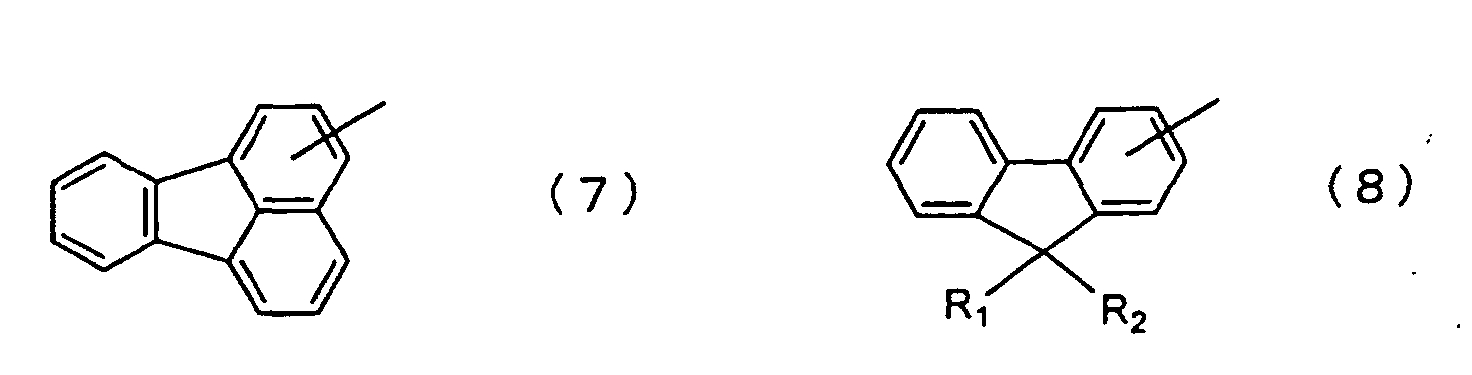
- A represents a group which is selected from groups represented by general formulae (1) to (11):
- Ar 1 to Ar 3 each independently represent a substituted or unsubstituted aryl group having 6 to 30 carbon atoms
- Ar 4 represents a substituted or unsubstituted arylene group having 6 to 30 carbon atoms
- Ar 5 represents a substituted or unsubstituted trivalent aromatic residue group having 6 to 30 carbon atoms
- R 1 and R 2 each independently represent hydrogen atom, a halogen atom, hydroxyl group, a substituted or unsubstituted amino group, nitro group, cyano group, a substituted or unsubstituted alkyl group having 1 to 30 carbon atoms, a substituted or unsubstituted alkenyl group having 2 to 40 carbon atoms, a substituted or unsubstituted cycloalkyl group having 5 to 40 carbon atoms, a substituted or unsubstituted alkoxyl group having 1 to 30 carbon atoms, a substituted or unsubstituted
- the foregoing general formulae (1) to (11) may be substituted with substituted or unsubstituted alkyl groups having 1 to 30 carbon atoms or substituted or unsubstituted phenyl group, and in the above general formula (A), A does not represent phenyl group substituted with an arylamino group when the group represented by B is substituted with an arylamino group.
- Examples of the substituted or unsubstituted aryl groups having 6 to 30 carbon atoms which is represented by Ar 1 to Ar 3 include phenyl group, naphthyl group, anthranyl group, phenanthryl group, pyrenyl group, coronyl group, biphenyl group, terphenyl group, pyrrolyl group, furanyl group, thiophenyl group, benzothiophenyl group, oxathiazolyl group, diphenylanthranyl group, indolyl group, carbazolyl group, pyridyl group, benzoquinolyl group, fluoranthenyl group and acenaphthofluoranthenyl group.
- Examples of the substituted or unsubstituted arylene groups having 6 to 30 carbon atoms which is represented by Ar 4 include phenylene group, naphthylene group, anthranylene group, phenanthrylene group, pyrenylene group, coronylene group, biphenylene group, terphenylene group, pyrrolylene group, furanylene group, thiophenylene group, benzothiophenylene group, oxadiazolylene group, diphenylanthranylene group, indolylene group, carbazolylene group, pyridylene group, benzoquinolylene group, fluoranthenylene group and acenaphthofluoranthenylene group.
- halogen atom represented by R 1 and R 2 examples include fluorine atom, chlorine atom, bromine atom and iodine atom.
- Examples of the substituted or unsubstituted amino groups represented by R 1 and R 2 are groups represented by -NX 1 X 2 .
- X 1 and X 2 each independently represent hydrogen atom, methyl group, ethyl group, propyl group, isopropyl group, n-butyl group, s-butyl group, isobutyl group, t-butyl group, n-pentyl group, n-hexyl group, n-heptyl group, n-octyl group, hydroxymethyl group, 1-hydroxyethyl group, 2-hydroxyethyl group, 2-hydroxyisobutyl group, 1,2-dihydroxyethyl group, 1,3-dihydroxyisopropyl group, 2,3-dihydroxy-t-butyl group, 1,2,3-trihydroxypropyl group, chloromethyl group, 1-chloroethyl group, 2-chloroethyl group, 2-chloroisobuty
- Examples of the substituted or unsubstituted alkyl groups having 1 to 30 carbon atoms which are represented by R 1 and R 2 include methyl group, ethyl group, propyl group, isopropyl group, n-butyl group, s-butyl group, isobutyl group, t-butyl group, n-pentyl group, n-hexyl group, n-heptyl group, n-octyl group, hydroxymethyl group, 1-hydroxyethyl group, 2-hydroxyethyl group, 2-hydroxyisobutyl group, 1,2-dihydroxyethyl group, 1,3-dihydroxyisopropyl group, 2,3-dihydroxy-t-butyl group, 1,2,3-trihydroxypropyl group, chloromethyl group, 1-chloroethyl group, 2-chloroethyl group, 2-chloroisobutyl group, 1,2-dichloroethyl group, 1,3
- Examples of the substituted or unsubstituted alkenyl groups having 2 to 40 carbon atoms which are represented by R 1 and R 2 include vinyl group, allyl group, 1-butenyl group, 2-butenyl group, 3-butenyl group, 1,3-butadienyl group, 1-methylvinyl group, styryl group, 2,2-diphenylvinyl group, 2,2-ditolylvinyl group, 1,2-ditolylvinyl group, 1-methylallyl group, 1,1-dimethylallyl group, 2-methylallyl group, 1-phenylallyl group, 2-phenylallyl group, 3-phenylallyl group, 3,3-diphenylallyl group, 1,2-dimethylallyl group, 1-phenyl-1-butenyl group and 3-phenyl-1-butenyl group.
- Examples of the substituted or unsubstituted cycloalkyl groups having 5 to 40 carbon atoms which are represented by R 1 and R 2 include cyclopropyl group, cyclobutyl group, cyclopentyl group, cyclohexyl group and 4-methylcyclohexyl group.
- the substituted or unsubstituted alkoxyl groups having 1 to 30 carbon atoms which are represented by R 1 and R 2 are represented by -OY.
- Examples of the group represented by Y include methyl group, ethyl group, propyl group, isopropyl group, n-butyl group, s-butyl group, isobutyl group, t-butyl group, n-pentyl group, n-hexyl group, n-heptyl group, n-octyl group, hydroxymethyl group, 1-hydroxyethyl group, 2-hydroxyethyl group, 2-hydroxyisobutyl group, 1,2-dihydroxyethyl group, 1,3-dihydroxyisopropyl group, 2,3-dihydroxy-t-butyl group, 1,2,3-trihydroxypropyl group, chloromethyl group, 1-chloroethyl group, 2-chloroethyl group, 2-chloroisobuty
- Examples of the substituted or unsubstituted aromatic hydrocarbon groups having 5 to 40 carbon atoms which are represented by R 1 and R 2 include phenyl group, 1-naphthyl group, 2-naphthyl group, 1-anthryl group, 2-anthryl group, 9-anthryl group, 1-phenanthryl group, 2-phenanthryl group, 3-phenanthryl group, 4-phenanthryl group, 9-phenanthryl group, 1-naphthacenyl group, 2-naphthacenyl group, 9-naphthacenyl group, 1-pyrenyl group, 2-pyrenyl group, 4-pyrenyl group, 2-biphenylyl group, 3-biphenylyl group, 4-biphenylyl group, p-terphenyl-4-yl group, p-terphenyl-3-yl group, p-terphenyl-2-yl group, m-terphenyl-4-yl group, m
- Examples of the substituted or unsubstituted aromatic heterocyclic groups having 2 to 40 carbon atoms which are represented by R 1 and R 2 include 1-pyrrolyl group, 2-pyrrolyl group, 3-pyrrolyl group, pyradinyl group, 2-pyridinyl group, 3-pyridinyl group, 4-pyridinyl group, 1-indolyl group, 2-indolyl group, 3-indolyl group, 4-indolyl group, 5-indolyl group, 6-indolyl group, 7-indolyl group, 1-isoindolyl group, 2-isoindolyl group, 3-isoindolyl group, 4-isoindolyl group, 5-isoindolyl group, 6-isoindolyl group, 7-isoindolyl group, 2-furyl group, 3-furyl group, 2-benzofuranyl group, 3-benzofuranyl group, 4-benzofuranyl group, 5-benz
- Examples of the substituted or unsubstituted aralkyl groups having 7 to 40 carbon atoms which are represented by R 1 and R 2 include benzyl group, 1-phenylethyl group, 2-phenylethyl group, 1-phenyl- isopropyl group, 2-phenylisopropyl group, phenyl-t-butyl group, ⁇ -naphthylmethyl group, 1- ⁇ -naphthylethyl group, 2- ⁇ -naphthylethyl group, 1- ⁇ -naphthylisopropyl group, 2- ⁇ -naphthylisopropyl group, ⁇ -naphthylmethyl group, 1- ⁇ -naphthylethyl group, 2- ⁇ -naphthylethyl group, 1- ⁇ -naphthylisopropyl group, 2- ⁇ -naphthylisopropyl group, 1-pyrrolyl
- the substituted or unsubstituted aryloxyl groups having 6 to 40 carbon atoms which are represented by R 1 and R 2 are represented by -OZ.
- Examples of the group represented by Z include phenyl group, 1-naphthyl group, 2-naphthyl group, 1-anthryl group, 2-anthryl group, 9-anthryl group, 1-phenanthryl group, 2-phenanthryl group, 3-phenanthryl group, 4-phenanthryl group, 9-phenanthryl group, 1-naphthacenyl group, 2-naphthacenyl group, 9-naphthacenyl group, 1-pyrenyl group, 2-pyrenyl group, 4-pyrenyl group, 2-biphenylyl group, 3-biphenylyl group, 4-biphenylyl group, p-terphenyl-4-yl group, p-terphenyl-3-yl group, p-terphenyl-2-yl
- the substituted or unsubstituted alkoxycarbonyl groups having 2 to 30 carbon atoms which are represented by R 1 and R 2 are represented by -COOY.
- Examples of the group represented by Y include methyl group, ethyl group, propyl group, isopropyl group, n-butyl group, s-butyl group, isobutyl group, t-butyl group, n-pentyl group, n-hexyl group, n-heptyl group, n-octyl group, hydroxymethyl group, 1-hydroxyethyl group, 2-hydroxyethyl group, 2-hydroxyisobutyl group, 1,2-dihydroxyethyl group, 1,3-dihydroxy-isopropyl group, 2,3-dihydroxy-t-butyl group, 1,2,3-trihydroxypropyl group, chloromethyl group, 1-chloroethyl group, 2-chloroethyl group, 2-chloro
- Examples of the substituted or unsubstituted silyl groups having 3 to 40 carbon atoms which are represented by R 1 and R 2 include trialkylsilyl groups such as trimethylsilyl group, triethylsilyl group, tripropylsilyl group, tributylsilyl group, tripentylsilyl group, trihexylsilyl group and t-butyldimethylsilyl group, dialkylarylsilyl groups, alkyldiarylsilyl groups and triarylsilyl groups.
- Examples of the alkyl group and the aryl group include the same groups as those described above.
- examples of the formed structures include the following structures:
- A' represents a group which is selected from groups represented by general formulae (2) to (12):
- Ar 1 to Ar 3 each independently represent a substituted or unsubstituted aryl group having 6 to 30 carbon atoms
- Ar 4 represents a substituted or unsubstituted arylene group having 6 to 30 carbon atoms
- Ar 5 represents a substituted or unsubstituted trivalent aromatic residue group having 6 to 30 carbon atoms
- R 1 and R 2 each independently represent hydrogen atom, a halogen atom, hydroxyl group, a substituted or unsubstituted amino group, nitro group, cyano group, a substituted or unsubstituted alkyl group having 1 to 30 carbon atoms, a substituted or unsubstituted alkenyl group having 2 to 40 carbon atoms, a substituted or unsubstituted cycloalkyl group having 5 to 40 carbon atoms, a substituted or unsubstituted alkoxyl group having 1 to 30 carbon atoms, a substituted or unsubstituted
- the foregoing general formulae (2) to (12) may be substituted with substituted or unsubstituted alkyl groups having 1 to 30 carbon atoms or substituted or unsubstituted phenyl group, and in the foregoing general formula (B), A' does not represent phenyl group substituted with an arylamino group when the group represented by B is substituted with an arylamino group.
- Examples of the atoms and groups represented by Ar 1 to Ar 5 , R 1 and R 2 include the atoms and groups described as the examples of the atoms and groups represented by Ar 1 to Ar 5 , R 1 and R 2 in the foregoing general formulae (1) to (11) in general formula (A).
- Examples of the substituent in the groups in general formulae (A) and (B) include halogen atoms, hydroxyl group, substituted or unsubstituted amino groups, nitro group, cyano group, substituted or unsubstituted alkyl groups, substituted or unsubstituted alkenyl groups, substituted or unsubstituted cycloalkyl groups, substituted or unsubstituted alkoxyl groups, substituted or unsubstituted aromatic hydrocarbon groups, substituted or unsubstituted aromatic heterocyclic groups, substituted or unsubstituted aralkyl groups, substituted or unsubstituted aryloxyl groups, substituted or unsubstituted alkoxycarbonyl groups and carboxyl group.
- the groups represented by general formulae (1) to (11) in general formula (A) and groups represented by general formulae (2) to (12) in general formula (B) are each independently substituted with an alkyl group having 1 to 30 carbon atoms or a cycloalkyl groups having 5 to 30 carbon atoms.
- novel aromatic compound represented by general formula (A) or (B) are shown in the following. However, the novel compound is not limited to the compounds shown as the examples.
- the above aromatic compound represented by general formula (A) or (B) of the present invention is used as a material for organic EL devices.
- the organic EL device of the present invention comprises a cathode, an anode and an organic thin film layer comprising at least one layer containing a light emitting layer and sandwiched between the cathode and the anode, wherein at least one layer in the organic thin film layer comprises the aromatic compound represented by general formula (A) or (B) singly or as a component of a mixture.
- the organic thin film layer comprises at least one of an electron transporting layer and a hole transporting layer, and at least one of the electron transporting layer and the hole transporting layer comprises the aromatic compound represented by general formula (A) or (B) singly or as a component of a mixture.
- the light emitting layer further comprises an arylamine compound and/or a styrylamine compound.
- arylamine compounds represented by the following general formula (C) are preferable.
- Ar 6 represents an aromatic group having 6 to 40 carbon atoms
- Ar 7 and Ar 8 each independently represent hydrogen atom or an aromatic group having 6 to 20 carbon atoms
- m represents an integer of 1 to 4.
- Examples of the aromatic group having 6 to 40 carbon atoms which is represented by Ar 6 include aryl groups having 6 to 40 carbon atoms such as phenyl group, naphthyl group, anthranyl group, phenanthryl group, pyrenyl group, coronyl group, biphenyl group, terphenyl group, pyrrolyl group, furanyl group, thiophenyl group, benzothiophenyl group, oxadiazolyl group, diphenylanthranyl group, indolyl group, carbazolyl group, pyridyl group, benzoquinolyl group, fluoranthenyl group and acenaphthofluoranthenyl group; and arylene groups having 6 to 40 carbon atoms such as phenylene group, naphthylene group, anthranylene group, phenanthrylene group, pyrenylene group, coronylene group, biphenylene group, terphenylene
- the aromatic group having 6 to 40 carbon atoms may be substituted with substituents.
- substituents include alkyl groups having 1 to 6 carbon atoms such as ethyl group, methyl group, i-propyl group, n-propyl group, s-butyl group, t-butyl group, pentyl group, hexyl group, cyclopentyl group and cyclohexyl group; alkoxyl groups having 1 to 6 carbon atoms such as ethoxyl group, methoxyl group, i-propoxyl group, n-propoxyl group, s-butoxyl group, t-butoxyl group, pentoxyl group, hexyloxyl group, cyclopentoxyl group and cyclohexyloxyl group; aryl groups having nuclei having 5 to 40 atoms; amino groups substituted with an aryl group having nuclei having 5 to 40 atoms; ester groups having an aryl group
- Examples of the aromatic group having 6 to 20 carbon atoms which is represented by Ar 7 or Ar 8 include the compounds having 6 to 20 carbon atoms among the compounds having 6 to 40 carbon atoms which are represented by Ar 6 .
- Examples of the above arylamine compound include triphenylamine, diphenylnaphthylamine and diphenylpyrenylamine.
- styrylamine compounds represented by the following general formula (D) are preferable: wherein Ar 9 represents a divalent group selected from phenylene group, terphenylene group, stilbene group and distyrylarylene groups, Ar 10 and Ar 11 each independently represent hydrogen atom or an aromatic group having 6 to 30 carbon atoms, the groups represented by Ar 9 , Ar 10 or Ar 11 may be substituted, at least one of the groups represented by Ar 10 and Ar 11 is substituted with styryl group, and n represents an integer of 1 to 4.
- Ar 9 represents a divalent group selected from phenylene group, terphenylene group, stilbene group and distyrylarylene groups
- Ar 10 and Ar 11 each independently represent hydrogen atom or an aromatic group having 6 to 30 carbon atoms
- the groups represented by Ar 9 , Ar 10 or Ar 11 may be substituted, at least one of the groups represented by Ar 10 and Ar 11 is substituted with styryl group
- n represents an integer of 1 to 4.
- Examples of the substituent to the groups represented by Ar 9 , Ar 10 and Ar 11 include the above substituents to the groups represented by Ar 6 in general formula (C).
- Examples of the organic EL device of the present invention include organic EL devices having a laminate structure having one or more organic layers laminated between the electrodes.
- Examples of the structure include structures of an anode / a light emitting layer / a cathode, an anode / a hole transporting layer / a light emitting layer / an electron transporting layer / a cathode, an anode / a hole transporting layer / a light emitting layer / a cathode and an anode / a light emitting layer / an electron transporting layer / a cathode.
- the aromatic compound of the present invention may be used in any of the layers in the above organic thin film layer and may also be used by doping other hole transporting materials, light emitting materials and electron transporting materials.
- a region transporting electrons or an interface region between the cathode and a layer of an organic thin film comprises a reducing dopant.
- the reducing dopant is defined as a substance which can reduce the electron transporting compound. Therefore, various types of substances can be used as long as the substance has the specific reducing property.
- the reducing dopant include at least one alkali metal selected from the group consisting of Na (the work function: 2.36 eV), K (the work function: 2.28 eV), Rb (the work function: 2.16 eV) and Cs (the work function: 1.95 eV) and at least one alkaline earth metal selected from the group consisting of Ca (the work function: 2.9 eV), Sr (the work function: 2.0 to 2.5 eV) and Ba (the work function: 2.52 eV).
- reducing dopants having a work function of 2.9 eV or smaller are preferable.
- the reducing dopant is at least one alkali metal selected from the group consisting of K, Rb and Cs, still more preferably Rb or Cs, and most preferably Cs.
- alkali metals have particularly great reducing ability, and the luminance of emitted light and the life of the organic EL device are improved by adding these alkali metals in a relatively small amount into the region of electron injection.
- the reducing dopant having a work function of 2.9 eV or smaller combinations of two or more alkali metals are also preferable, and combinations including Cs such as combinations of Cs and Na, Cs and K, Cs and Rb, and Cs, Na and K are more preferable.
- Cs is include in the combination, the reducing ability can be efficiently exhibited, and the luminance of emitted light and the life of the organic EL device can be improved by adding the combination into the region of electron injection.
- the organic EL device of the present invention may further comprises an electron injecting layer constituted with an insulating material or a semiconductor and disposed between the cathode and the organic thin film layer. Due to the electron injecting layer, leak of electric current can be effectively prevented, and the electron injecting property can be improved. It is preferable that at least one metal compound selected from the group consisting of alkali metal chalcogenides, alkaline earth metal chalcogenides, alkali metal halides and alkaline earth metal halides is used as the insulating material. It is preferable that the electron injecting layer is constituted with the alkali metal chalcogenide or the like material since the electron injecting property can be further improved.
- alkali metal chalcogenide examples include Li 2 O, LiO, Na 2 S, Na 2 Se and NaO.
- Preferable examples of the alkaline earth metal chalcogenide include CaO, BaO, SrO, BeO, BaS and CaSe.
- Examples of the alkali metal halide include LiF, NaF, KF, LiCl, KCl and NaCl.
- Examples of the alkaline earth metal halide include fluorides such as CaF 2 , BaF 2 , SrF 2 , MgF 2 and BeF 2 and halides other than the fluorides.
- the semiconductor constituting the electron transporting layer examples include oxides, nitrides and oxide nitrides containing at least one element selected from Ba, Ca, Sr, Yb, Al, Ga, In, Li, Na, Cd, Mg, Si, Ta, Sb and Zn, which are used singly or as a combination of two or more. It is preferable that the inorganic compound constituting the electron transporting layer is in the form of a fine crystalline or amorphous insulating thin film. When the electron transporting layer is constituted with the above insulating thin film, a more uniform thin film can be formed and defective pixels such as dark spots can be decreased.
- the inorganic compound include the alkali metal chalcogenides, the alkaline earth metal chalcogenides, the alkali metal halides and the alkaline earth metal halides which are described above.
- the anode of the organic EL device plays the role of injecting holes into the hole transporting layer or the light emitting layer. It is effective that the anode has a work function of 4.5 eV or greater.
- the material of the anode used in the present invention include indium tin oxide alloys (ITO), tin oxides (NESA), gold, silver, platinum and copper.
- ITO indium tin oxide alloys
- NESA tin oxides
- gold silver
- platinum platinum
- copper copper
- a material having a small work function is preferable so that electrons can be injected into the electron transporting layer or the light emitting layer.
- the process for forming the layers in the organic EL device of the present invention is not particularly limited.
- a conventional process such as the vacuum vapor deposition process and the spin coating process can be used.
- the organic thin film layer comprising the compound represented by the above general formula (A) or (B) can be formed in accordance with the vacuum vapor deposition process, the molecular beam epitaxy process (the MBE process) or, using a solution prepared by dissolving the compound into a solvent, in accordance with a conventional coating process such as the dipping process, the spin coating process, the casting process, the bar coating process and the roll coating process.
- each layer in the organic thin film layer in the organic EL device of the present invention is not particularly limited.
- an excessively thin layer tends to have defects such as pin holes, and an excessively thick layer requires a high applied voltage to decrease the efficiency. Therefore, a thickness in the range of several nm to 1 ⁇ m is preferable.
- the organic EL device which exhibits a great luminance of emitted light, a great efficiency of light emission and a high purity of color, emits bluish light, is excellent in stability at high temperatures and has a long life can be obtained.
- This organic EL device can be advantageously used for a photosensitive member for electronic photograph, a planar light emitting member such as a flat panel display of wall televisions, a back light of copiers, printers and liquid crystal displays, a light source for instruments, a display panel, a marking light and an accessory.
- the solid substance was suspended in boiling dimethoxy- ethane (30 ml), cooled while being left standing, filtered and washed with dimethoxyethane and acetone, and a gray solid substance (82% crude) was obtained.
- This solid substance was purified using a short column (silica gel/dichloroethane), and a light yellow solid substance (2.7 g, the yield: 74%) was obtained.
- the obtained product was identified to be 9-(2-naphthyl)anthracene in accordance with 1 H-NMR.
- the obtained reaction mixture was filtered and washed with toluene, water and methanol, and a light yellow solid substance (3.7 g) was obtained.
- the solid substance was suspended in boiling toluene (40 ml), cooled while being left standing and filtered, and a light yellow solid substance (3.4 g, the yield: 73%) was obtained.
- the result of examination of the obtained product in accordance with 1 H-NMR was as follows:
- the obtained solid substance (3.4 g) was purified by sublimation at 340°C/10 -6 Torr for 1 hour, and a light yellow substance (2.9 g) was obtained. It was confirmed in accordance with the field desorption mass analysis (FDMS) that the obtained product was the object compound (Compound (A1)).
- FDMS field desorption mass analysis
- 9-iodoanthracene (8.7 g, 29 mmole, 1.1 eq), 3,5-dibromophenylboric acid (7.3 g, 26 mmole) and tetrakis-(triphenylphosphine)palladium(0) (0.67 g, 0.58 mmole, 2% Pd) were suspended in toluene (80 ml).
- a 2M aqueous solution of sodium carbonate (8.3 g, 78 mmole, 3 eq/40 ml) was added, and the resultant mixture was refluxed for 10 hours.
- the filtrate was purified in accordance with the column chromatography (silica gel/hexane, hexane + 5% dichloromethane), and a light yellow solid substance (4.2 g, the yield: 39%, the second crop) was obtained.
- the yellow solid substances of the first crop and the second crop were combined (9.3 g, the yield: 87%).
- the obtained product was identified to be 9-(3,5-dibromophenyl)anthracene in accordance with 1 H-NMR.
- 9-(3,5-dibromophenyl)anthracene (5 g, 12 mmole), phenylboric acid (4.4 g, 36 mmole, 3 eq) and tetrakis(triphenylphosphine)palladium(0) (0.55 g, 0.48 mmole, 2% Pd) were dissolved in toluene (100 ml).
- a 2M aqueous solution of sodium carbonate 11 g, 0.10 moles, 3 eq/50 ml was added, and the resultant mixture was refluxed for 10 hours.
- the obtained reaction mixture was filtered, and an organic layer was separated from the filtrate, washed with a saturated aqueous solution of sodium chloride (50 ml) and dried with magnesium sulfate. After the solvent was removed by distillation, a black oily substance was obtained.
- the obtained oily substance was purified in accordance with the column chromatography (silica gel/hexane, hexane + 3% dichloromethane, hexane + 10% dichloromethane in the final step), and a light yellow amorphous solid substance (3.6 g, 74%) was obtained.
- the obtained product was identified to be 9-(3,5-diphenyl- phenyl)anthracene in accordance with 1 H-NMR and FDMS.
- the obtained solid substance (4.3 g) was purified by sublimation at 360°C/10 -6 Torr for 1 hour, and a light yellow substance (3.2 g) was obtained. It was confirmed in accordance with FDMS that the obtained product was the object compound (Compound (A2)).
- the results of measurements of Eg, Ip and Tg are also shown in the following.
- the reaction mixture was filtered to remove Pd black, and an organic layer was separated from the filtrate, washed with a saturated aqueous solution of sodium chloride (30 ml) and dried with magnesium sulfate. After the solvent was removed by distillation, a light brown oily substance was obtained. When a small amount of methanol was added to the obtained oily substance and the wall of the flask was rubbed, crystals were formed. The formed crystals were separated by filtration and washed with methanol, and a light yellow solid substance (3.7 g, the yield: 88%) was obtained. The obtained product was identified to be 9-(3,4-dichlorophenyl)anthracene in accordance with 1 H-NMR.
- phenylboric acid (3.6 g, 30 mmole, 2.7 eq), 9-(3,4-dichlorophenyl)anthracene (3.7 g, 11 mmole) and dichlorobis(triphenylphosphine)nickel(II) (0.72 g, 1.1 mmole, 5% Ni), triphenylphosphine (0.58 g, 2.2 mmole, 2 eq to Ni) and potassium phosphate hydrate (16 g, 60 mmole, 2 eq) were suspended in anhydrous toluene (80 ml), and the obtained suspension was heated at 80°C for 10 hours..
- the reaction mixture was filtered and washed with water and methanol, and a light yellow solid substance (3.7 g) was obtained.
- the obtained solid substance was suspended in boiling toluene (40 ml). After the suspension was cooled while being left standing, the suspension was filtered, and a light yellow solid substance (3.6 g, the yield: 88%) was obtained.
- the result of examination of the obtained product in accordance with 1 H-NMR was as follows:
- the obtained solid substance (3.6 g) was purified by sublimation at 340°C/10 -6 Torr for 1 hour, and a light yellow solid substance (2.1 g) was obtained. It was confirmed in accordance with FDMS that the obtained product was the object compound (Compound (A3)).
- the results of measurements of Eg, Ip and Tg are also shown in the following.
- 3-chlorophenylboric acid 3.3 g, 21 mmole, 1.1 eq
- 9-bromoanthracene 5.0 g, 19 mmole
- tetrakis-(triphenylphosphine)palladium(0) 0.5 g, 0.43 mmole, 2% Pd
- toluene 60 ml
- a 2M aqueous solution of sodium carbonate (6.8 g, 64 mmole, 3 eq/35 ml) was added, and the resultant mixture was refluxed for 10 hours.
- the obtained solid substance (3.0 g) was purified by sublimation at 340°C/10 -6 Torr for 1 hour, and a light yellow solid substance (2.6 g) was obtained. It was confirmed in accordance with FDMS that the obtained product was the object compound (Compound (A4)).
- the results of measurements of Eg, Ip and Tg are also shown in the following.
- the reaction mixture was filtered to remove Pd black, and an organic layer was separated from the filtrate, washed with a saturated aqueous solution of sodium chloride (30 ml) and dried with magnesium sulfate. After the solvent was removed by distillation, a white solid substance was obtained. The obtained solid substance was suspended in boiling ethanol (50 ml). After the mixture was cooled while being left standing, the mixture was filtered and washed with ethanol, and a white solid substance (7.7 g, the yield: 92%) was obtained. The obtained product was identified to be 9-(4-chlorophenyl)anthracene in accordance with 1 H-NMR.
- 9-(4-Chlorophenyl)anthracene (4.0 g, 14 mmole) was suspended in anhydrous DMF (60 ml). After an anhydrous DMF solution (10 ml) of NBS (2.5 g, 14 mmole, 1 eq) was added, the resultant mixture was stirred at the room temperature for 7 hours and then left standing for one night. The reaction mixture was diluted with water (70 ml). The formed solid substance was separated by filtration and washed with methanol, and a light yellow solid substance (4.6 g, the yield: 89%) was obtained. The obtained product was identified to be 9-(4-chlorophenyl)-10-bromoanthracene in accordance with 1 H-NMR.
- the reaction mixture was filtered and washed with water and methanol, and a light yellow solid substance (2.4 g, the yield: 82%) was obtained.
- the obtained product was identified to be 9-(4-chlorophenyl)-10-(4-(2,2-diphenylvinyl)phenyl)anthracene in accordance with 1 H-NMR.
- the resultant suspension was refluxed for 8 hours.
- the reaction mixture was filtered and washed with toluene, water and methanol, and a green solid substance was obtained.
- the obtained solid substance was suspended in boiling toluene (40 ml). After the suspension was cooled while being left standing, the suspension was filtered, and a green solid substance (2.4 g, 81%) was obtained.
- the result of examination of the obtained product in accordance with 1 H-NMR was as follows:
- the obtained solid substance (2.4 g) was purified by sublimation at 360°C/10 -6 Torr for 1 hour, and a light yellow solid substance (1.9 g) was obtained. It was confirmed in accordance with FDMS that the obtained product was the object compound (Compound (A5)). The results of measurements of Eg, Ip and Tg are also shown in the following.
- 9-(4-chlorophenyl)-10-(3,4-diphenylphenyl)anthracene (2.3 g, 4.4 mmole), diphenylamine (0.9 g, 5.3 mmole, 1.2 eq), tris(dibenzylideneacetone)dipalladium(0) (0.1 g, 0.11 mmole, 5% Pd), a toluene solution of tri-t-butylphosphine (66% by weight, 0.05 ml, 0.16 mmole, 0.7 eq to Pd) and sodium t-butoxide (0.6 g, 6.3 mmole, 1.4 eq) were suspended in anhydrous toluene (20 ml).
- the resultant mixture was refluxed for 8 hours.
- the reaction mixture was filtered and washed with toluene, water and methanol, and a light yellow solid substance was obtained.
- the obtained solid substance was suspended in boiling toluene (40 ml). After the suspension was cooled while being left standing, the suspension was filtered, and a light yellow solid substance (2.2 g, the yield: 78%) was obtained. It was confirmed in accordance with 1 H-NMR and FDMS that the obtained product was Compound (A11).
- 9-(4-chlorophenyl)-10-(3,5-diphenylphenyl)anthracene (2.3 g, 4.4 mmole), diphenylamine (0.9 g, 5.3 mmole, 1.2 eq), tris(dibenzylideneacetone)dipalladium(0) (0.1 g, 0.11 mmole, 5% Pd), a toluene solution of tri-t-butylphosphine (66% by weight, 0.05 ml, 0.16 mmole, 0.7 eq to Pd) and sodium t-butoxide (0.6 g, 6.3 mmole, 1.4 eq) were suspended in anhydrous toluene (20 ml).
- the resultant mixture was refluxed for 8 hours.
- the reaction mixture was filtered and washed with toluene, water and methanol, and a light yellow solid substance was obtained.
- the obtained solid substance was suspended in boiling toluene (40 ml). After the suspension was cooled while being left standing, the suspension was filtered, and a light yellow solid substance (2.5 g, the yield: 86%) was obtained. It was confirmed in accordance with 1 H-NMR and FDMS that the obtained product was Compound (A14).
- the reaction mixture was filtered and washed with water and methanol, and a light yellow solid substance was obtained.
- the obtained solid substance was suspended in boiling toluene (30 ml). After the suspension was cooled while being left standing, the suspension was filtered, and a light yellow solid substance (3.0 g, the yield: 78%) was obtained. It was confirmed in accordance with 1 H-NMR and FDMS that the obtained product was Compound (A20).
- a glass substrate (manufactured by GEOMATEC Company) of 25 mm ⁇ 75 mm ⁇ 1.1 mm (thickness) having an ITO transparent electrode was cleaned by application of ultrasonic wave in isopropyl alcohol for 5 minutes and then by exposure to ozone generated by ultraviolet light for 30 minutes.
- the glass substrate having the transparent electrode lines which had been cleaned was attached to a substrate holder of a vacuum vapor deposition apparatus.
- a film of N,N'-bis(N,N'-diphenyl-4-aminophenyl)-N,N- ⁇ -naphthyl-4,4'-diamino-1,1'-biphenyl (a film of TPD232) having a thickness of 60 nm was formed in a manner such that the formed film covered the transparent electrode.
- the formed film of TPD232 worked as the hole injecting layer.
- a film of N,N,N',N'-tetrakis(4-biphenyl)-4,4'-benzidine (a film of BPTPD) having a thickness of 20 nm was formed.
- the formed film of BPTPD worked as the hole transporting layer.
- a film of the above Compound (A1) having a thickness of 40 nm was formed by vapor deposition.
- the formed film of Compound (A1) worked as the light emitting layer.
- a film of Alq shown in the following having a thickness of 10 nm was formed.
- the film of Alq worked as the electron injecting layer.
- Li the source of lithium: manufactured by SAES GETTERS Company
- Alq binary vapor deposited
- an Alq:Li film the thickness: 10 nm
- metallic aluminum was vapor deposited to form a metal cathode, and an organic EL device was prepared.
- the device was then subjected to the evaluation by the storage test at a high temperature. Namely, after the above device was sealed, the device was left standing in a thermostatic oven kept at 100°C for 500 hours, and it was examined whether defects such as changes in the bright spots and the color were found on the light emitting surface by observation using a stereomicroscope of a magnification of 200 times. The results are shown in Table 1.
- Organic EL devices were prepared in accordance with the same procedures as those conducted in Example 1 except that compounds shown in Table 1 were used in place of Compound (A1) used in Example 1.
- the voltage applied to the devices, the luminance of emitted light, the efficiency of light emission and the color of emitted light of the devices, the glass transition temperature Tg of the used compound and the results of the storage test of the devices at a high temperature are shown in Table 1.
- An organic EL device was prepared in accordance with the same procedures as those conducted in Example 1 except that Compound (C1) shown in the following, which is an arylanthracene compound described in the United States Patent No. 05935721, was used in place of Compound (A1) used in Example 1.
- the voltage applied to the device, the luminance of emitted light, the efficiency of light emission and the color of emitted light of the devices, the glass transition temperature Tg of the used compound and the results of the storage test of the device at a high temperature are shown in Table 1.
- An organic EL device was prepared in accordance with the same procedures as those conducted in Example 1 except that Compound (C2) shown in the following, which is an arylanthracene compound described in Japanese Patent Application Laid-Open No. 2000-273056, was used in place of Compound (A1) used in Example 1.
- Compound (C2) shown in the following which is an arylanthracene compound described in Japanese Patent Application Laid-Open No. 2000-273056, was used in place of Compound (A1) used in Example 1.
- the voltage applied to the device, the luminance of emitted light, the efficiency of light emission and the color of emitted light of the device, the glass transition temperature Tg of the used compound and the results of the storage test of the device at a high temperature are shown in Table 1.
- An organic EL device was prepared in accordance with the same procedures as those conducted in Example 1 except that Compound (C3) shown in the following, which is another arylanthracene compound described in Japanese Patent Application Laid-Open No. 2000-273056, was used in place of Compound (A1) used in Example 1.
- the voltage applied to the device, the luminance of emitted light, the efficiency of light emission and the color of emitted light of the device, the glass transition temperature Tg of the used compound and the results of the storage test of the device at a high temperature are shown in Table 1.
- Comparative Example 1 in which Compound (C1) having an excellent symmetry was used, defects appeared on the light emitting surface due to crystallization, and the emitted light was bluish green, i.e., the purity of the blue color was not excellent.
- Comparative Examples 2 and 3 crystallization took place even though Compounds (C2) and (C3) had asymmetric molecular structure in the horizontal direction. This is considered to have taken place due to low glass transition temperatures. Since the compounds of the present invention were asymmetric and had relatively high glass transition temperatures, the results of the storage test at a high temperature were excellent.
- a glass substrate (manufactured by GEOMATEC Company) of 25 mm ⁇ 75 mm ⁇ 1.1 mm (thickness) having an ITO transparent electrode was cleaned by application of ultrasonic wave in isopropyl alcohol for 5 minutes and then by exposure to ozone generated by ultraviolet light for 30 minutes.
- the glass substrate having the transparent electrode lines which had been cleaned was attached to a substrate holder of a vacuum vapor deposition apparatus.
- a film of TPD232 having a thickness of 60 nm was formed in a manner such that the formed film covered the transparent electrode.
- the formed film of TPD232 worked as the hole injecting layer.
- a film of BPTPD having a thickness of 20 nm was formed on the formed film of TPD232.
- the formed film of BPTPD worked as the hole transporting layer.
- a film of the above Compound (A1) having a thickness of 40 nm was formed by vapor deposition.
- the formed film of Compound (A1) worked as the light emitting layer.
- a styrylamine-based light emitting molecule (D1) shown in the following was added in an amount of 7% by weight.
- a film of Alq having a thickness of 20 nm was formed on the film formed above.
- the film of Alq worked as the electron injecting layer.
- Li the source of lithium: manufactured by SAES GETTERS Company
- Alq the electron injecting layer
- An organic EL device was prepared in accordance with the same procedures as those conducted in Example 1 except that Compound (C1) shown in the above, which is an arylanthracene compound described in the United States Patent No. 05935721, was used in place of Compound (A1) used in Example 1.
- the voltage applied to the device, the luminance of emitted light, the efficiency of light emission and the color of emitted light of the device, the glass transition temperature Tg of the used compound and the results of the storage test of the device at a high temperature are shown in Table 1.
- the organic EL device which exhibits a great luminance of emitted light, a great efficiency of light emission and a high purity of color, emits bluish light, is excellent in stability at high temperatures and has a long life can be obtained by utilizing the novel aromatic compound of the present invention. Therefore, the organic EL device of the present invention is very useful as the light source for various electronic instruments.
Landscapes
- Chemical & Material Sciences (AREA)
- Organic Chemistry (AREA)
- Engineering & Computer Science (AREA)
- Materials Engineering (AREA)
- Physics & Mathematics (AREA)
- Spectroscopy & Molecular Physics (AREA)
- Optics & Photonics (AREA)
- Electroluminescent Light Sources (AREA)
- Organic Low-Molecular-Weight Compounds And Preparation Thereof (AREA)
Abstract
A novel aromatic compound having an anthracene skeleton structure and an asymmetric molecular structure; and an organic electroluminescence device which comprises a cathode, an anode and an organic thin film layer comprising at least one layer containing a light emitting layer and sandwiched between the cathode and the anode in which at least one layer in the organic thin film layer contains the above novel aromatic compound singly or as a component of a mixture. The organic electroluminescence device exhibits a great luminance of emitted light, a great efficiency of light emission and a high purity of color, emits bluish light, is excellent in stability at high temperatures and has a long life. The organic electroluminescence device can be provided by utilizing the novel aromatic compound.
Description
The present invention relates to a novel aromatic compound and an
organic electroluminescent ("electroluminescent" and "electroluminescence"
will be referred to as "EL", hereinafter) device containing
the compound and, more particularly, to a novel aromatic compound
which can provide an organic EL device exhibiting a great luminance of
emitted light, a great efficiency of light emission and a high purity of color,
emitting bluish light, excellent in stability at high temperatures and
having a long life and an organic EL device utilizing the compound.
An organic EL device is a spontaneous light emitting device which
utilizes the principle that a fluorescent substance emits light by energy of
recombination of holes injected from an anode and electrons injected from
a cathode when an electric field is applied. Since an organic EL device of
the laminate type driven under a low electric voltage was reported by C.
W. Tang of Eastman Kodak Company (C. W. Tang and S. A. Vanslyke,
Applied Physics Letters, Volume 51, Pages 913, 1987), many studies have
been conducted on organic EL devices using organic materials as the
constituting materials. Tang et al. used a laminate structure using
tris(8-hydroxyquinolinol)aluminum for the light emitting layer and a
triphenyldiamine derivative for the hole transporting layer. Advantages
of the laminate structure are that the efficiency of hole injection into the
light emitting layer can be increased, that the efficiency of forming excited
particles which are formed by blocking and recombining electrons injected
from the cathode can be increased, and that excited particles formed
within the light emitting layer can be enclosed. As the structure of the
organic EL device, a two-layered structure having a hole transporting
(injecting) layer and an electron transporting and light emitting layer and
a three-layered structure having a hole transporting (injecting) layer, a
light emitting layer and an electron transporting (injecting) layer are well
known. To increase the efficiency of recombination of injected holes and
electrons in the devices of the laminate type, the structure of the device
and the process for forming the device have been studied.
As the light emitting material, chelate complexes such as
tris(8-quinolinolato)aluminum, coumarine derivatives, tetraphenylbutadiene
derivatives, bisstyrylarylene derivatives and oxadiazole
derivatives are known. It is reported that light in the visible region
ranging from blue light to red light can be obtained by using these light
emitting materials, and development of a device exhibiting color images is
expected (For example, Japanese Patent Application Laid-Open Nos.
Heisei 8(1996)-239655, Heisei 7(1995)-138561 and Heisei 3(1991)-200289).
A device using a phenylanthracene derivative as the light emitting
material is disclosed in Japanese Patent Application Laid-Open No. Heisei
8(1996)-012600. Although the anthracene derivative is used as the
material for emitting bluish light, a further improvement in the efficiency
of light emission has been desired. On the other hand, an improvement
in the stability of the thin film has been desired so that the life of the
device is increased. However, heretofore known anthracene derivatives
form crystals in many cases to cause fracture of the thin film, and the
improvement has been desired. For example, a dinaphthylanthracene
compound is disclosed in the United States Patent No. 0593571.
However, since this compound has a symmetric molecular structure in the
horizontal and vertical directions, the molecules are easily arranged to
form crystals during storage at high temperatures and driving at high
temperatures. Japanese Patent Application Laid-Open No. Heisei
2000-273056 discloses an allylanthracene compound asymmetric in the
horizontal direction. However, one of the groups as substituents to the
anthracendiyl group is a simple group such as phenyl group and biphenyl
group, and the crystallization cannot be prevented.
The present invention has been made to overcome the above
problems and has an object of providing a novel aromatic compound which
can provide an organic EL device exhibiting a great luminance of emitted
light, a great efficiency of light emission and a high purity of color,
emitting bluish light, excellent in stability at high temperatures and
having a long life and an organic EL device utilizing the compound.
As the result of intensive studies by the present inventors to
overcome the above problems, it was found that the above problems could
be overcome by using a compound which has a high glass transition
temperature and an asymmetric molecular structure as the material for
the organic thin film layer of an organic EL device. The present
invention has been completed based on this knowledge.
The present invention provides a novel aromatic compound
represented by following general formula (A) or (B).
General formula (A) is:
A-Ar-B
wherein Ar represents a substituted or unsubstituted anthracendiyl group,
B represents a heterocyclic group which has 2 to 60 carbon atoms or a
substituted or unsubstituted aryl group having 5 to 60 carbon atoms each
of which is mono-substituted with an alkenyl group or an arylamino group,
A represents a group which is selected from groups represented by the
following general formulae (1) to (11):



 wherein Ar1 to Ar3 each independently represent a substituted or
unsubstituted aryl group having 6 to 30 carbon atoms, Ar4 represents a
substituted or unsubstituted arylene group having 6 to 30 carbon atoms,
Ar5 represents a substituted or unsubstituted trivalent aromatic residue
group having 6 to 30 carbon atoms, R1 and R2 each independently
represent hydrogen atom, a halogen atom, hydroxyl group, a substituted
or unsubstituted amino group, nitro group, cyano group, a substituted or
unsubstituted alkyl group having 1 to 30 carbon atoms, a substituted or
unsubstituted alkenyl group having 2 to 40 carbon atoms, a substituted or
unsubstituted cycloalkyl group having 5 to 40 carbon atoms, a substituted
or unsubstituted alkoxyl group having 1 to 30 carbon atoms, a substituted
or unsubstituted aromatic hydrocarbon group having 5 to 40 carbon atoms,
a substituted or unsubstituted aromatic heterocyclic group having 2 to 40
carbon atoms, a substituted or unsubstituted aralkyl group having 7 to 40
carbon atoms, a substituted or unsubstituted aryloxyl group having 6 to
40 carbon atoms, a substituted or unsubstituted alkoxycarbonyl group
having 2 to 30 carbon atoms, a substituted or unsubstituted silyl group
having 3 to 40 carbon atoms or carboxyl group, and groups represented by
Ar1 and Ar2 and groups represented by R1 and R2 each independently
may be bonded to each other and form a cyclic structure;
the foregoing general formulae (1) to (11) may be substituted with
substituted or unsubstituted alkyl groups having 1 to 30 carbon atoms or
substituted or unsubstituted phenyl group; and
A does not represent phenyl group substituted with an arylamino group
when the group represented by B is substituted with an arylamino group.
wherein Ar1 to Ar3 each independently represent a substituted or
unsubstituted aryl group having 6 to 30 carbon atoms, Ar4 represents a
substituted or unsubstituted arylene group having 6 to 30 carbon atoms,
Ar5 represents a substituted or unsubstituted trivalent aromatic residue
group having 6 to 30 carbon atoms, R1 and R2 each independently
represent hydrogen atom, a halogen atom, hydroxyl group, a substituted
or unsubstituted amino group, nitro group, cyano group, a substituted or
unsubstituted alkyl group having 1 to 30 carbon atoms, a substituted or
unsubstituted alkenyl group having 2 to 40 carbon atoms, a substituted or
unsubstituted cycloalkyl group having 5 to 40 carbon atoms, a substituted
or unsubstituted alkoxyl group having 1 to 30 carbon atoms, a substituted
or unsubstituted aromatic hydrocarbon group having 5 to 40 carbon atoms,
a substituted or unsubstituted aromatic heterocyclic group having 2 to 40
carbon atoms, a substituted or unsubstituted aralkyl group having 7 to 40
carbon atoms, a substituted or unsubstituted aryloxyl group having 6 to
40 carbon atoms, a substituted or unsubstituted alkoxycarbonyl group
having 2 to 30 carbon atoms, a substituted or unsubstituted silyl group
having 3 to 40 carbon atoms or carboxyl group, and groups represented by
Ar1 and Ar2 and groups represented by R1 and R2 each independently
may be bonded to each other and form a cyclic structure;
the foregoing general formulae (1) to (11) may be substituted with
substituted or unsubstituted alkyl groups having 1 to 30 carbon atoms or
substituted or unsubstituted phenyl group; and
A does not represent phenyl group substituted with an arylamino group
when the group represented by B is substituted with an arylamino group.
General formula (B) is:
A'-Ar-Ar-B
wherein Ar represents a substituted or unsubstituted anthracendiyl group,
B represents a heterocyclic group which has 2 to 60 carbon atoms or a
substituted or unsubstituted aryl group having 5 to 60 carbon atoms each
of which is mono-substituted with an alkenyl group or an arylamino group,
A' represents a group which is selected from groups represented by the
following general formulae (2) to (12):


 wherein Ar1 to Ar3 each independently represent a substituted or
unsubstituted aryl group having 6 to 30 carbon atoms, Ar4 represents a
substituted or unsubstituted arylene group having 6 to 30 carbon atoms,
Ar5 represents a substituted or unsubstituted trivalent aromatic residue
group having 6 to 30 carbon atoms, R1 and R2 each independently
represent hydrogen atom, a halogen atom, hydroxyl group, a substituted
or unsubstituted amino group, nitro group, cyano group, a substituted or
unsubstituted alkyl group having 1 to 30 carbon atoms, a substituted or
unsubstituted alkenyl group having 2 to 40 carbon atoms, a substituted or
unsubstituted cycloalkyl group having 5 to 40 carbon atoms, a substituted
or unsubstituted alkoxyl group having 1 to 30 carbon atoms, a substituted
or unsubstituted aromatic hydrocarbon group having 5 to 40 carbon atoms,
a substituted or unsubstituted aromatic heterocyclic group having 2 to 40
carbon atoms, a substituted or unsubstituted aralkyl group having 7 to 40
carbon atoms, a substituted or unsubstituted aryloxyl group having 6 to
40 carbon atoms, a substituted or unsubstituted alkoxycarbonyl group
having 2 to 30 carbon atoms, a substituted or unsubstituted silyl group
having 3 to 40 carbon atoms or carboxyl group, groups represented by Ar1
and Ar2 and groups represented by R1 and R2 each independently may be
bonded to each other and form a cyclic structure, and p in general formula
(12) represents 0 or 1;
the foregoing general formulae (1) to (11) may be substituted with
substituted or unsubstituted alkyl groups having 1 to 30 carbon atoms or
substituted or unsubstituted phenyl group; and
A does not represent phenyl group substituted with an arylamino group
when the group represented by B is substituted with an arylamino group.
wherein Ar1 to Ar3 each independently represent a substituted or
unsubstituted aryl group having 6 to 30 carbon atoms, Ar4 represents a
substituted or unsubstituted arylene group having 6 to 30 carbon atoms,
Ar5 represents a substituted or unsubstituted trivalent aromatic residue
group having 6 to 30 carbon atoms, R1 and R2 each independently
represent hydrogen atom, a halogen atom, hydroxyl group, a substituted
or unsubstituted amino group, nitro group, cyano group, a substituted or
unsubstituted alkyl group having 1 to 30 carbon atoms, a substituted or
unsubstituted alkenyl group having 2 to 40 carbon atoms, a substituted or
unsubstituted cycloalkyl group having 5 to 40 carbon atoms, a substituted
or unsubstituted alkoxyl group having 1 to 30 carbon atoms, a substituted
or unsubstituted aromatic hydrocarbon group having 5 to 40 carbon atoms,
a substituted or unsubstituted aromatic heterocyclic group having 2 to 40
carbon atoms, a substituted or unsubstituted aralkyl group having 7 to 40
carbon atoms, a substituted or unsubstituted aryloxyl group having 6 to
40 carbon atoms, a substituted or unsubstituted alkoxycarbonyl group
having 2 to 30 carbon atoms, a substituted or unsubstituted silyl group
having 3 to 40 carbon atoms or carboxyl group, groups represented by Ar1
and Ar2 and groups represented by R1 and R2 each independently may be
bonded to each other and form a cyclic structure, and p in general formula
(12) represents 0 or 1;
the foregoing general formulae (1) to (11) may be substituted with
substituted or unsubstituted alkyl groups having 1 to 30 carbon atoms or
substituted or unsubstituted phenyl group; and
A does not represent phenyl group substituted with an arylamino group
when the group represented by B is substituted with an arylamino group.
The present invention also provides an organic EL device which
comprises a cathode, an anode and an organic thin film layer comprising
at least one layer containing a light emitting layer and sandwiched
between the cathode and the anode, wherein at least one layer in the
organic thin film layer comprises a novel aromatic compound represented
by general formula (A) or (B) singly or as a component of a mixture.
The present invention provides a novel compound represented by
the following general formula (A) or (B):
A-Ar-B
A'-Ar-Ar-B
In the above general formulae (A) and (B), Ar represents a
substituted or unsubstituted anthracendiyl group.
In the above general formulae (A) and (B), B represents a
heterocyclic group which has 2 to 60 carbon atoms or a substituted or
unsubstituted aryl group having 5 to 60 carbon atoms each of which is
monosubstituted with an alkenyl group or an arylamino group. It is
preferable that B represents a heterocyclic group which has 2 to 60 carbon
atoms and is monosubstituted with an alkenyl group or an arylamino
group or an aryl group which has 5 to 60 carbon atoms and is
monosubstituted with an alkenyl group or an arylamino group.
Examples of the alkenyl group as the substituent in the group
represented by B include vinyl group, allyl group, 1-butenyl group,
2-butenyl group, 3-butenyl group, 1,3-butadienyl group, 1-methylvinyl
group, styryl group, 2,2-diphenylvinyl group, 2,2-ditolylvinyl group,
1,2-ditolylvinyl group, 1-methylallyl group, 1,1-dimethylallyl group, 2-methylallyl
group, 1-phenylallyl group, 2-phenylallyl group, 3-phenylallyl
group, 3,3-diphenylallyl group, 1,2-dimethylallyl group, 1-phenyl-1-butenyl
group and 3-phenyl-1-butenyl group.
Examples of the arylamino group as the substituent in the group
represented by B include phenylamino group, diphenylamino group,
biphenylamino group, naphthylamino group, anthranylamino group,
ditolylamino group, dinaphthylamino group, phenylnaphthylamino group,
phenylmethylamino group, pyrenylphenylamino group, biphenylamino
group and biphenylnaphthylamino group.
Examples of the substituted or unsubstituted heterocyclic group as
the substituent in the group represented by B include 1-pyrrolyl group,
2-pyrrolyl group, 3-pyrrolyl group, pyradinyl group, 2-pyridinyl group,
3-pyridinyl group, 4-pyridinyl group, 1-indolyl group, 2-indolyl group,
3-indolyl group, 4-indolyl group, 5-indolyl group, 6-indolyl group, 7-indolyl
group, 1-isoindolyl group, 2-isoindolyl group, 3-isoindolyl group,
4-isoindolyl group, 5-isoindolyl group, 6-isoindolyl group, 7-isoindolyl
group, 2-furyl group, 3-furyl group, 2-benzofuranyl group, 3-benzofuranyl
group, 4-benzofuranyl group, 5-benzofuranyl group, 6-benzofuranyl group,
7-benzofuranyl group, 1-isobenzofuranyl group, 3-isobenzofuranyl group,
4-isobenzofuranyl group, 5-isobenzofuranyl group, 6-isobenzofuranyl
group, 7-isobenzofuranyl group, 2-quinolyl group, 3-quinolyl group,
4-quinolyl group, 5-quinolyl group, 6-quinolyl group, 7-quinolyl group,
8-quinolyl group, 1-isoquinolyl group, 3-isoquinolyl group, 4-isoquinolyl
group, 5-isoquinolyl group, 6-isoquinolyl group, 7-isoquinolyl group,
8-isoquinolyl group, 2-quinoxanyl group, 5-quinoxanyl group,
6-quinoxanyl group, 1-carbazolyl group, 2-carbazolyl group, 3-carbazolyl
group, 4-carbazolyl group, 9-carbazolyl group, 1-phenanthridinyl group,
2-phenanthridinyl group, 3-phenanthridinyl group, 4-phenanthridinyl
group, 6-phenanthridinyl group, 7-phenanthridinyl group,
8-phenanthridinyl group, 9-phenanthridinyl group, 10-phenanthridinyl
group, 1-acridinyl group, 2-acridinyl group, 3-acridinyl group, 4-acridinyl
group, 9-acridinyl group, 1,7-phenanthrolin-2-yl group, 1,7-phenanthrolin-3-yl
group, 1,7-phenanthrolin-4-yl group, 1,7-phenanthrolin-5-yl group,
1,7-phenanthrolin-6-yl group, 1,7-phenanthrolin-8-yl group,
1,7-phenanthrolin-9-yl group, 1,7-phenanthrolin-10-yl group,
1,8-phenanthrolin-2-yl group, 1,8-phenanthrolin-3-yl group,
1,8-phenanthrolin-4-yl group, 1,8-phenanthrolin-5-yl group,
1,8-phenanthrolin-6-yl group, 1,8-phenanthrolin-7-yl group,
1,8-phenanthrolin-9-yl group, 1,8-phenanthrolin-10-yl group,
1,9-phenanthrolin-2-yl group, 1,9-phenanthrolin-3-yl group,
1,9-phenanthrolin-4-yl group, 1,9-phenanthrolin-5-yl group,
1,9-phenanthrolin-6-yl group, 1,9-phenanthrolin-7-yl group,
1,9-phenanthrolin-8-yl group, 1,9-phenanthrolin-10-yl group,
1,10-phenanthrolin-2-yl group, 1,10-phenanthrolin-3-yl group,
1,10-phenanthrolin-4-yl group, 1,10-phenanthrolin-5-yl group,
2,9-phenanthrolin-1-yl group, 2,9-phenanthrolin-3-yl group,
2,9-phenanthrolin-4-yl group, 2,9-phenanthrolin-5-yl group,
2,9-phenanthrolin-6-yl group, 2,9-phenanthrolin-7-yl group,
2,9-phenanthrolin-8-yl group, 2,9-phenanthrolin-10-yl group,
2,8-phenanthrolin-1-yl group, 2,8-phenanthrolin-3-yl group,
2,8-phenanthrolin-4-yl group, 2,8-phenanthrolin-5-yl group,
2,8-phenanthrolin-6-yl group, 2,8-phenanthrolin-7-yl group,
2,8-phenanthrolin-9-yl group, 2,8-phenanthrolin-10-yl group,
2,7-phenanthrolin-1-yl group, 2,7-phenanthrolin-3-yl group,
2,7-phenanthrolin-4-yl group, 2,7-phenanthrolin-5-yl group,
2,7-phenanthrolin-6-yl group, 2,7-phenanthrolin-8-yl group,
2,7-phenanthrolin-9-yl group, 2,7-phenanthrolin-10-yl group, 1-phenazinyl
group, 2-phenazinyl group, 1-phenothiazinyl group, 2-phenothiazinyl
group, 3-phenothiazinyl group, 4-phenothiazinyl group, 10-phenothiazinyl
group, 1-phenoxazinyl group, 2-phenoxazinyl group, 3-phenoxazinyl group,
4-phenoxazinyl group, 10-phenoxazinyl group, 2-oxazolyl group, 4-oxazolyl
group, 5-oxazolyl group, 2-oxadiazolyl group, 5-oxadiazolyl group,
3-furazanyl group, 2-thienyl group, 3-thienyl group, 2-methylpyrrol-1-yl
group, 2-methylpyrrol-3-yl group, 2-methylpyrrol-4-yl group, 2-methylpyrrol-5-yl
group, 3-methylpyrrol-1-yl group, 3-methylpyrrol-2-yl group,
3-methylpyrrol-4-yl group, 3-methylpyrrol-5-yl group, 2-t-butylpyrrol-4-yl
group, 3-(2-phenylpropyl)pyrrol-1-yl group, 2-methyl-1-indolyl group,
4-methyl-1-indolyl group, 2-methyl-3-indolyl group, 4-methyl-3-indolyl
group, 2-t-butyl-1-indolyl group, 4-t-butyl-1-indolyl group, 2-t-butyl-3-indolyl
group and 4-t-butyl-3-indolyl group. The above group has 2 to
60 carbon atoms including the above substituents.
Examples of the aryl group represented by B include phenyl group,
naphthyl group, anthranyl group, phenanthryl group, pyrenyl group,
coronyl group, biphenyl group, terphenyl group, pyrrolyl group, furanyl
group, thiophenyl group, benzothiophenyl group, oxadiazolyl group,
diphenylanthranyl group, indolyl group, carbazolyl group, pyridyl group,
benzoquinolyl group, fluoranthenyl group and acenaphthofluoranthenyl
group. The above group has 5 to 60 carbon atoms including the above
substituents.
In the above general formula (A), A represents a group which is
selected from groups represented by general formulae (1) to (11):


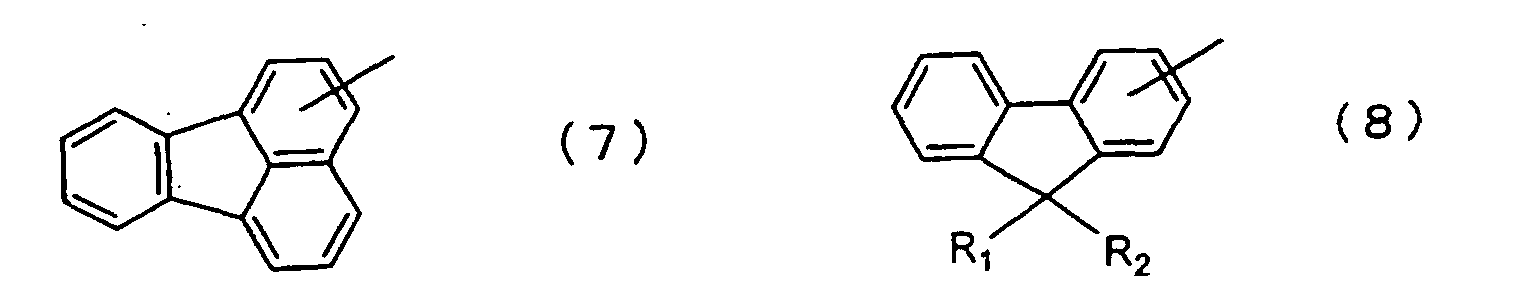
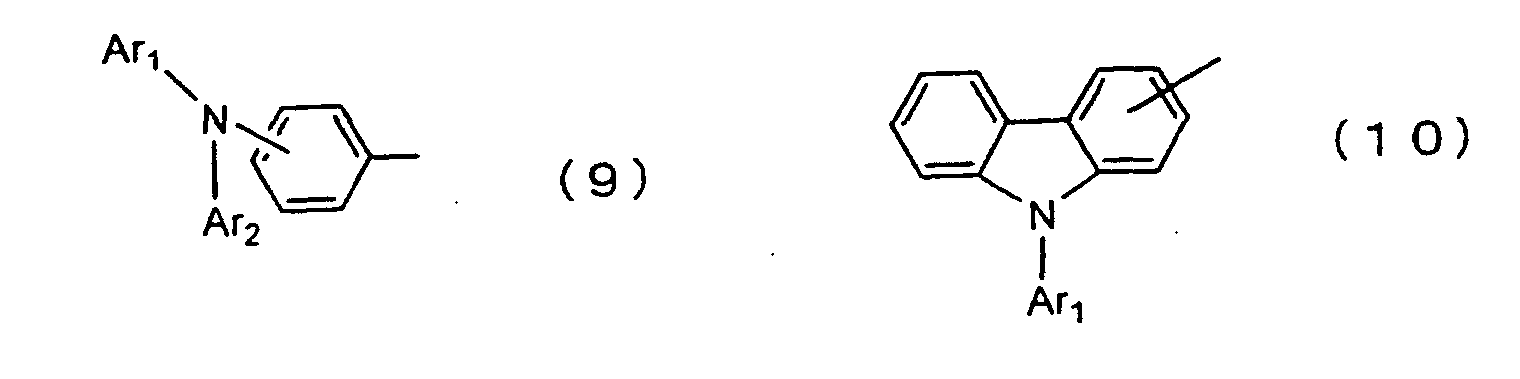

In general formulae (1) to (11), Ar1 to Ar3 each independently
represent a substituted or unsubstituted aryl group having 6 to 30 carbon
atoms, Ar4 represents a substituted or unsubstituted arylene group
having 6 to 30 carbon atoms, Ar5 represents a substituted or
unsubstituted trivalent aromatic residue group having 6 to 30 carbon
atoms, and R1 and R2 each independently represent hydrogen atom, a
halogen atom, hydroxyl group, a substituted or unsubstituted amino
group, nitro group, cyano group, a substituted or unsubstituted alkyl
group having 1 to 30 carbon atoms, a substituted or unsubstituted alkenyl
group having 2 to 40 carbon atoms, a substituted or unsubstituted
cycloalkyl group having 5 to 40 carbon atoms, a substituted or
unsubstituted alkoxyl group having 1 to 30 carbon atoms, a substituted or
unsubstituted aromatic hydrocarbon group having 5 to 40 carbon atoms, a
substituted or unsubstituted aromatic heterocyclic group having 2 to 40
carbon atoms, a substituted or unsubstituted aralkyl group having 7 to 40
carbon atoms, a substituted or unsubstituted aryloxyl group having 6 to
40 carbon atoms, a substituted or unsubstituted alkoxycarbonyl group
having 2 to 30 carbon atoms, a substituted or unsubstituted silyl group
having 3 to 40 carbon atoms or carboxyl group. Groups represented by
Ar1 and Ar2 and groups represented by R1 and R2 each independently
may be bonded to each other and form a cyclic structure.
The foregoing general formulae (1) to (11) may be substituted with
substituted or unsubstituted alkyl groups having 1 to 30 carbon atoms or
substituted or unsubstituted phenyl group, and in the above general
formula (A), A does not represent phenyl group substituted with an
arylamino group when the group represented by B is substituted with an
arylamino group.
Examples of the substituted or unsubstituted aryl groups having 6
to 30 carbon atoms which is represented by Ar1 to Ar3 include phenyl
group, naphthyl group, anthranyl group, phenanthryl group, pyrenyl
group, coronyl group, biphenyl group, terphenyl group, pyrrolyl group,
furanyl group, thiophenyl group, benzothiophenyl group, oxathiazolyl
group, diphenylanthranyl group, indolyl group, carbazolyl group, pyridyl
group, benzoquinolyl group, fluoranthenyl group and
acenaphthofluoranthenyl group.
Examples of the substituted or unsubstituted arylene groups
having 6 to 30 carbon atoms which is represented by Ar4 include
phenylene group, naphthylene group, anthranylene group, phenanthrylene
group, pyrenylene group, coronylene group, biphenylene group,
terphenylene group, pyrrolylene group, furanylene group, thiophenylene
group, benzothiophenylene group, oxadiazolylene group, diphenylanthranylene
group, indolylene group, carbazolylene group, pyridylene
group, benzoquinolylene group, fluoranthenylene group and acenaphthofluoranthenylene
group.
Examples of the halogen atom represented by R1 and R2 include
fluorine atom, chlorine atom, bromine atom and iodine atom.
Examples of the substituted or unsubstituted amino groups
represented by R1 and R2 are groups represented by -NX1X2. For
example, X1 and X2 each independently represent hydrogen atom, methyl
group, ethyl group, propyl group, isopropyl group, n-butyl group, s-butyl
group, isobutyl group, t-butyl group, n-pentyl group, n-hexyl group,
n-heptyl group, n-octyl group, hydroxymethyl group, 1-hydroxyethyl group,
2-hydroxyethyl group, 2-hydroxyisobutyl group, 1,2-dihydroxyethyl group,
1,3-dihydroxyisopropyl group, 2,3-dihydroxy-t-butyl group, 1,2,3-trihydroxypropyl
group, chloromethyl group, 1-chloroethyl group,
2-chloroethyl group, 2-chloroisobutyl group, 1,2-dichloroethyl group,
1,3-dichloroisopropyl group, 2,3-dichloro-t-butyl group, 1,2,3-trichloropropyl
group, bromomethyl group, 1-bromoethyl group,
2-bromoethyl group, 2-bromoisobutyl group, 1,2-dibromoethyl group,
1,3-dibromoisopropyl group, 2,3-dibromo-t-butyl group, 1,2,3-tribromopropyl
group, iodomethyl group, 1-iodoethyl group, 2-iodoethyl
group, 2-iodoisobutyl group, 1,2-diiodoethyl group, 1,3-diiodoisopropyl
group, 2,3-diiodo-t-butyl group, 1,2,3-triiodopropyl group, aminomethyl
group, 1-aminoethyl group, 2-aminoethyl group, 2-aminoisobutyl group,
1,2-diaminoethyl group, 1,3-diaminoisopropyl group, 2,3-diamino-t-butyl
group, 1,2,3-triaminopropyl group, cyanomethyl group, 1-cyanoethyl group,
2-cyanoethyl group, 2-cyanoisobutyl group, 1,2-dicyanoethyl group,
1,3-dicyanoisopropyl group, 2,3-dicyano-t-butyl group, 1,2,3- tricyanopropyl
group, nitromethyl group, 1-nitroethyl group, 2-nitroethyl group,
2-nitroisobutyl group, 1,2-dinitroethyl group, 1,3-dinitroisopropyl group,
2,3-dinitro-t-butyl group, 1,2,3-trinitropropyl group, phenyl group,
1-naphthyl group, 2-naphthyl group, 1-anthryl group, 2-anthryl group,
9-anthryl group, 1-phenanthryl group, 2-phenanthryl group,
3-phenanthryl group, 4-phenanthryl group, 9-phenanthryl group,
1-naphthacenyl group, 2-naphthacenyl group, 9-naphthacenyl group,
4-styrylphenyl group, 1-pyrenyl group, 2-pyrenyl group, 4-pyrenyl group,
2-biphenylyl group, 3-biphenylyl group, 4-biphenylyl group,
p-terphenyl-4-yl group, p-terphenyl-3-yl group, p-terphenyl-2-yl group,
m-terphenyl-4-yl group, m-terphenyl-3-yl group, m-terphenyl-2-yl group,
o-tolyl group, m-tolyl group, p-tolyl group, p-t-butylphenyl group,
p-(2-phenylpropyl)phenyl group, 3-methyl-2-naphthyl group, 4-methyl-1-naphthyl
group, 4-methyl-1-anthryl group, 4'-methyl-biphenylyl group,
4"-t-butyl-p-terphenyl-4-yl group, 2-pyrrolyl group, 3-pyrrolyl group,
pyradinyl group, 2-pyridinyl group, 3-pyridinyl group, 4-pyridinyl group,
2-indolyl group, 3-indolyl group, 4-indolyl group, 5-indolyl group, 6-indolyl
group, 7-indolyl group, 1-isoindolyl group, 3-isoindolyl group, 4-isoindolyl
group, 5-isoindolyl group, 6-isoindolyl group, 7-isoindolyl group, 2-furyl
group, 3-furyl group, 2-benzofuranyl group, 3-benzofuranyl group,
4-benzofuranyl group, 5-benzofuranyl group, 6-benzofuranyl group,
7-benzofuranyl group, 1-isobenzofuranyl group, 3-isobenzofuranyl group,
4-isobenzofuranyl group, 5-isobenzofuranyl group, 6-isobenzofuranyl
group, 7-isobenzofuranyl group, 2-quinolyl group, 3-quinolyl group,
4-quinolyl group, 5-quinolyl group, 6-quinolyl group, 7-quinolyl group,
8-quinolyl group, 1-isoquinolyl group, 3-isoquinolyl group, 4-isoquinolyl
group, 5-isoquinolyl group, 6-isoquinolyl group, 7-isoquinolyl group,
8-isoquinolyl group, 2-quinoxanyl group, 5-quinoxanyl group,
6-quinoxanyl group, 1-carbazolyl group, 2-carbazolyl group, 3-carbazolyl
group, 4-carbazolyl group, 1-phenanthridinyl group, 2-phenanthridinyl
group, 3-phenanthridinyl group, 4-phenanthridinyl group, 6-phenanthridinyl
group, 7-phenanthridinyl group, 8-phenanthridinyl group,
9-phenanthridinyl group, 10-phenanthridinyl group, 1-acridinyl group,
2-acridinyl group, 3-acridinyl group, 4-acridinyl group, 9-acridinyl group,
1,7-phenanthrolin-2-yl group, 1,7-phenanthrolin- 3-yl group,
1,7-phenanthrolin-4-yl group, 1,7-phenanthrolin-5-yl group,
1,7-phenanthrolin-6-yl group, 1,7-phenanthrolin-8-yl group,
1,7-phenanthrolin-9-yl group, 1,7-phenanthrolin-10-yl group,
1,8-phenanthrolin-2-yl group, 1,8-phenanthrolin-3-yl group,
1,8-phenanthrolin-4-yl group, 1,8-phenanthrolin-5-yl group,
1,8-phenanthrolin-6-yl group, 1,8-phenanthrolin-7-yl group,
1,8-phenanthrolin-9-yl group, 1,8-phenanthrolin-10-yl group,
1,9-phenanthrolin-2-yl group, 1,9-phenanthrolin-3-yl group,
1,9-phenanthrolin-4-yl group, 1,9-phenanthrolin-5-yl group,
1,9-phenanthrolin-6-yl group, 1,9-phenanthrolin-7-yl group,
1,9-phenanthrolin-8-yl group, 1,9-phenanthrolin-10-yl group,
1,10-phenanthrolin-2-yl group, 1,10-phenanthrolin-3-yl group,
1,10-phenanthrolin-4-yl group, 1,10-phenanthrolin-5-yl group,
2,9-phenanthrolin-1-yl group, 2,9-phenanthrolin-3-yl group,
2,9-phenanthrolin-4-yl group, 2,9-phenanthrolin-5-yl group,
2,9-phenanthrolin-6-yl group, 2,9-phenanthrolin-7-yl group,
2,9-phenanthrolin-8-yl group, 2,9-phenanthrolin-10-yl group,
2,8-phenanthrolin-1-yl group, 2,8-phenanthrolin-3-yl group,
2,8-phenanthrolin-4-yl group, 2,8-phenanthrolin-5-yl group,
2,8-phenanthrolin-6-yl group, 2,8-phenanthrolin-7-yl group,
2,8-phenanthrolin-9-yl group, 2,8-phenanthrolin-10-yl group,
2,7-phenanthrolin-1-yl group, 2,7-phenanthrolin-3-yl group,
2,7-phenanthrolin-4-yl group, 2,7-phenanthrolin-5-yl group,
2,7-phenanthrolin-6-yl group, 2,7-phenanthrolin-8-yl group,
2,7-phenanthrolin-9-yl group, 2,7-phenanthrolin-10-yl group, 1-phenazinyl
group, 2-phenazinyl group, 1-phenothiazinyl group, 2-phenothiazinyl
group, 3-phenothiazinyl group, 4-phenothiazinyl group, 1-phenoxazinyl
group, 2-phenoxazinyl group, 3-phenoxazinyl group, 4-phenoxazinyl group,
2-oxazolyl group, 4-oxazolyl group, 5-oxazolyl group, 2-oxadiazolyl group,
5-oxadiazolyl group, 3-furazanyl group, 2-thienyl group, 3-thienyl group,
2-methylpyrrol-1-yl group, 2-methylpyrrol-3-yl group, 2-methylpyrrol-4-yl
group, 2-methylpyrrol-5-yl group, 3-methylpyrrol-1-yl group, 3-methylpyrrol-2-yl
group, 3-methylpyrrol-4-yl group, 3-methylpyrrol-5-yl group,
2-t-butylpyrrol-4-yl group, 3-(2-phenylpropyl)pyrrol-1-yl group, 2-methyl-1-indolyl
group, 4-methyl-1-indolyl group, 2-methyl-3-indolyl group,
4-methyl-3-indolyl group, 2-t-butyl-1-indolyl group, 4-t-butyl-1-indolyl
group, 2-t-butyl-3-indolyl group or 4-t-butyl-3-indolyl group.
Examples of the substituted or unsubstituted alkyl groups having 1
to 30 carbon atoms which are represented by R1 and R2 include methyl
group, ethyl group, propyl group, isopropyl group, n-butyl group, s-butyl
group, isobutyl group, t-butyl group, n-pentyl group, n-hexyl group,
n-heptyl group, n-octyl group, hydroxymethyl group, 1-hydroxyethyl group,
2-hydroxyethyl group, 2-hydroxyisobutyl group, 1,2-dihydroxyethyl group,
1,3-dihydroxyisopropyl group, 2,3-dihydroxy-t-butyl group, 1,2,3-trihydroxypropyl
group, chloromethyl group, 1-chloroethyl group,
2-chloroethyl group, 2-chloroisobutyl group, 1,2-dichloroethyl group,
1,3-dichloroisopropyl group, 2,3-dichloro-t-butyl group, 1,2,3- trichloropropyl
group, bromomethyl group, 1-bromoethyl group, 2-bromoethyl
group, 2-bromoisobutyl group, 1,2-dibromoethyl group, 1,3-dibromoisopropyl
group, 2,3-dibromo-t-butyl group, 1,2,3- tribromopropyl group,
iodomethyl group, 1-iodoethyl group, 2-iodoethyl group, 2-iodoisobutyl
group, 1,2-diiodoethyl group, 1,3-diiodoisopropyl group, 2,3-diiodo-t-butyl
group, 1,2,3-triiodopropyl group, aminomethyl group, 1-aminoethyl group,
2-aminoethyl group, 2-aminoisobutyl group, 1,2-diaminoethyl group,
1,3-diaminoisopropyl group, 2,3-diamino-t-butyl group, 1,2,3-triaminopropyl
group, cyanomethyl group, 1-cyanoethyl group, 2-cyanoethyl group,
2-cyanoisobutyl group, 1,2-dicyanoethyl group, 1,3-dicyanoisopropyl group,
2,3-dicyano-t-butyl group, 1,2,3- tricyanopropyl group, nitromethyl group,
1-nitroethyl group, 2-nitroethyl group, 2-nitroisobutyl group,
1,2-dinitroethyl group, 1,3-dinitroisopropyl group, 2,3-dinitro-t-butyl
group and 1,2,3-trinitropropyl group.
Examples of the substituted or unsubstituted alkenyl groups
having 2 to 40 carbon atoms which are represented by R1 and R2 include
vinyl group, allyl group, 1-butenyl group, 2-butenyl group, 3-butenyl
group, 1,3-butadienyl group, 1-methylvinyl group, styryl group,
2,2-diphenylvinyl group, 2,2-ditolylvinyl group, 1,2-ditolylvinyl group,
1-methylallyl group, 1,1-dimethylallyl group, 2-methylallyl group,
1-phenylallyl group, 2-phenylallyl group, 3-phenylallyl group,
3,3-diphenylallyl group, 1,2-dimethylallyl group, 1-phenyl-1-butenyl group
and 3-phenyl-1-butenyl group.
Examples of the substituted or unsubstituted cycloalkyl groups
having 5 to 40 carbon atoms which are represented by R1 and R2 include
cyclopropyl group, cyclobutyl group, cyclopentyl group, cyclohexyl group
and 4-methylcyclohexyl group.
The substituted or unsubstituted alkoxyl groups having 1 to 30
carbon atoms which are represented by R1 and R2 are represented by -OY.
Examples of the group represented by Y include methyl group, ethyl group,
propyl group, isopropyl group, n-butyl group, s-butyl group, isobutyl group,
t-butyl group, n-pentyl group, n-hexyl group, n-heptyl group, n-octyl group,
hydroxymethyl group, 1-hydroxyethyl group, 2-hydroxyethyl group,
2-hydroxyisobutyl group, 1,2-dihydroxyethyl group, 1,3-dihydroxyisopropyl
group, 2,3-dihydroxy-t-butyl group, 1,2,3-trihydroxypropyl group,
chloromethyl group, 1-chloroethyl group, 2-chloroethyl group,
2-chloroisobutyl group, 1,2-dichloroethyl group, 1,3-dichloroisopropyl
group, 2,3-dichloro-t-butyl group, 1,2,3-trichloropropyl group,
bromomethyl group, 1-bromoethyl group, 2-bromoethyl group,
2-bromoisobutyl group, 1,2-dibromoethyl group, 1,3-dibromoisopropyl
group, 2,3-dibromo-t-butyl group, 1,2,3-tribromopropyl group, iodomethyl
group, 1-iodoethyl group, 2-iodoethyl group, 2-iodoisobutyl group,
1,2-diiodoethyl group, 1,3-diiodoisopropyl group, 2,3-diiodo-t-butyl group,
1,2,3-triiodopropyl group, aminomethyl group, 1-aminoethyl group,
2-aminoethyl group, 2-aminoisobutyl group, 1,2-diaminoethyl group,
1,3-diaminoisopropyl group, 2,3-diamino-t-butyl group, 1,2,3-triaminopropyl
group, cyanomethyl group, 1-cyanoethyl group, 2-cyanoethyl group,
2-cyanoisobutyl group, 1,2-dicyanoethyl group, 1,3-dicyanoisopropyl group,
2,3-dicyano-t-butyl group, 1,2,3- tricyanopropyl group, nitromethyl group,
1-nitroethyl group, 2-nitroethyl group, 2-nitroisobutyl group, 1,2-dinitroethyl
group, 1,3-dinitroisopropyl group, 2,3-dinitro-t-butyl group and
1,2,3-trinitropropyl group.
Examples of the substituted or unsubstituted aromatic hydrocarbon
groups having 5 to 40 carbon atoms which are represented by R1 and R2
include phenyl group, 1-naphthyl group, 2-naphthyl group, 1-anthryl
group, 2-anthryl group, 9-anthryl group, 1-phenanthryl group,
2-phenanthryl group, 3-phenanthryl group, 4-phenanthryl group,
9-phenanthryl group, 1-naphthacenyl group, 2-naphthacenyl group,
9-naphthacenyl group, 1-pyrenyl group, 2-pyrenyl group, 4-pyrenyl group,
2-biphenylyl group, 3-biphenylyl group, 4-biphenylyl group,
p-terphenyl-4-yl group, p-terphenyl-3-yl group, p-terphenyl-2-yl group,
m-terphenyl-4-yl group, m-terphenyl-3-yl group, m-terphenyl-2-yl group,
o-tolyl group, m-tolyl group, p-tolyl group, p-t-butylphenyl group,
p-(2-phenylpropyl)phenyl group, 3-methyl-2-naphthyl group, 4-methyl-1-naphthyl
group, 4-methyl-1-anthryl group, 4'-methylbiphenylyl group
and 4"-t-butyl-p-terphenyl-4-yl group.
Examples of the substituted or unsubstituted aromatic heterocyclic
groups having 2 to 40 carbon atoms which are represented by R1 and R2
include 1-pyrrolyl group, 2-pyrrolyl group, 3-pyrrolyl group, pyradinyl
group, 2-pyridinyl group, 3-pyridinyl group, 4-pyridinyl group, 1-indolyl
group, 2-indolyl group, 3-indolyl group, 4-indolyl group, 5-indolyl group,
6-indolyl group, 7-indolyl group, 1-isoindolyl group, 2-isoindolyl group,
3-isoindolyl group, 4-isoindolyl group, 5-isoindolyl group, 6-isoindolyl
group, 7-isoindolyl group, 2-furyl group, 3-furyl group, 2-benzofuranyl
group, 3-benzofuranyl group, 4-benzofuranyl group, 5-benzofuranyl group,
6-benzofuranyl group, 7-benzofuranyl group, 1-isobenzofuranyl group,
3-isobenzofuranyl group, 4-isobenzofuranyl group, 5-isobenzofuranyl
group, 6-isobenzofuranyl group, 7-isobenzo- furanyl group, 2-quinolyl
group, 3-quinolyl group, 4-quinolyl group, 5-quinolyl group, 6-quinolyl
group, 7-quinolyl group, 8-quinolyl group, 1-isoquinolyl group,
3-isoquinolyl group, 4-isoquinolyl group, 5-isoquinolyl group, 6-isoquinolyl
group, 7-isoquinolyl group, 8-isoquinolyl group, 2-quinoxanyl group,
5-quinoxanyl group, 6-quinoxanyl group, 1-carbazolyl group, 2-carbazolyl
group, 3-carbazolyl group, 4-carbazolyl group, 9-carbazolyl group,
1-phenanthridinyl group, 2-phenanthridinyl group, 3-phenanthridinyl
group, 4-phenanthridinyl group, 6-phenanthridinyl group,
7-phenanthridinyl group, 8-phenanthridinyl group, 9-phenanthridinyl
group, 10-phenanthridinyl group, 1-acridinyl group, 2-acridinyl group,
3-acridinyl group, 4-acridinyl group, 9-acridinyl group,
1,7-phenanthrolin-2-yl group, 1,7-phenanthrolin-3-yl group,
1,7-phenanthrolin-4-yl group, 1,7-phenanthrolin-5-yl group,
1,7-phenanthrolin-6-yl group, 1,7-phenanthrolin-8-yl group,
1,7-phenanthrolin-9-yl group, 1,7-phenanthrolin-10-yl group,
1,8-phenanthrolin-2-yl group, 1,8-phenanthrolin-3-yl group,
1,8-phenanthrolin-4-yl group, 1,8-phenanthrolin-5-yl group,
1,8-phenanthrolin-6-yl group, 1,8-phenanthrolin-7-yl group,
1,8-phenanthrolin-9-yl group, 1,8-phenanthrolin-10-yl group,
1,9-phenanthrolin-2-yl group, 1,9-phenanthrolin-3-yl group,
1,9-phenanthrolin-4-yl group, 1,9-phenanthrolin-5-yl group,
1,9-phenanthrolin-6-yl group, 1,9-phenanthrolin-7-yl group,
1,9-phenanthrolin-8-yl group, 1,9-phenanthrolin-10-yl group,
1,10-phenanthrolin-2-yl group, 1,10-phenanthrolin-3-yl group,
1,10-phenanthrolin-4-yl group, 1,10-phenanthrolin-5-yl group,
2,9-phenanthrolin-1-yl group, 2,9-phenanthrolin-3-yl group,
2,9-phenanthrolin-4-yl group, 2,9-phenanthrolin-5-yl group,
2,9-phenanthrolin-6-yl group, 2,9-phenanthrolin-7-yl group,
2,9-phenanthrolin-8-yl group, 2,9-phenanthrolin-10-yl group,
2,8-phenanthrolin-1-yl group, 2,8-phenanthrolin-3-yl group,
2,8-phenanthrolin-4-yl group, 2,8-phenanthrolin-5-yl group,
2,8-phenanthrolin-6-yl group, 2,8-phenanthrolin-7-yl group,
2,8-phenanthrolin-9-yl group, 2,8-phenanthrolin-10-yl group,
2,7-phenanthrolin-1-yl group, 2,7-phenanthrolin-3-yl group,
2,7-phenanthrolin-4-yl group, 2,7-phenanthrolin-5-yl group,
2,7-phenanthrolin-6-yl group, 2,7-phenanthrolin-8-yl group,
2,7-phenanthrolin-9-yl group, 2,7-phenanthrolin-10-yl group, 1-phenazinyl
group, 2-phenazinyl group, 1-phenothiazinyl group, 2-phenothiazinyl
group, 3-phenothiazinyl group, 4-phenothiazinyl group, 10-phenothiazinyl
group, 1-phenoxazinyl group, 2-phenoxazinyl group, 3-phenoxazinyl group,
4-phenoxazinyl group, 10-phenoxazinyl group, 2-oxazolyl group, 4-oxazolyl
group, 5-oxazolyl group, 2-oxadiazolyl group, 5-oxadiazolyl group,
3-furazanyl group, 2-thienyl group, 3-thienyl group, 2-methylpyrrol-1-yl
group, 2-methylpyrrol-3-yl group, 2-methylpyrrol-4-yl group, 2-methylpyrrol-5-yl
group, 3-methylpyrrol-1-yl group, 3-methylpyrrol-2-yl group,
3-methylpyrrol-4-yl group, 3-methylpyrrol-5-yl group, 2-t-butylpyrrol-4-yl
group, 3-(2-phenylpropyl)pyrrol-1-yl group, 2-methyl-1-indolyl group,
4-methyl-1-indolyl group, 2-methyl-3-indolyl group, 4-methyl-3-indolyl
group, 2-t-butyl-1-indolyl group, 4-t-butyl-1-indolyl group, 2-t-butyl-3-indolyl
group and 4-t-butyl-3-indolyl group.
Examples of the substituted or unsubstituted aralkyl groups having
7 to 40 carbon atoms which are represented by R1 and R2 include benzyl
group, 1-phenylethyl group, 2-phenylethyl group, 1-phenyl- isopropyl
group, 2-phenylisopropyl group, phenyl-t-butyl group, α-naphthylmethyl
group, 1-α-naphthylethyl group, 2-α-naphthylethyl group,
1-α-naphthylisopropyl group, 2-α-naphthylisopropyl group,
β-naphthylmethyl group, 1-β-naphthylethyl group, 2-β-naphthylethyl
group, 1-β-naphthylisopropyl group, 2-β-naphthylisopropyl group,
1-pyrrolylmethyl group, 2-(1-pyrrolyl)ethyl group, p-methylbenzyl group,
m-methylbenzyl group, o-methylbenzyl group, p-chlorobenzyl group,
m-chlorobenzyl group, o-chlorobenzyl group, p-bromobenzyl group,
m-bromobenzyl group, o-bromobenzyl group, p-iodobenzyl group,
m-iodobenzyl group, o-iodobenzyl group, p-hydroxybenzyl group,
m-hydroxybenzyl group, o-hydroxybenzyl group, p-aminobenzyl group,
m-aminobenzyl group, o-aminobenzyl group, p-nitrobenzyl group,
m-nitrobenzyl group, o-nitrobenzyl group, p-cyanobenzyl group,
m-cyanobenzyl group, o-cyanobenzyl group, 1-hydroxy-2-phenylisopropyl
group and 1-chloro-2-phenylisopropyl group.
The substituted or unsubstituted aryloxyl groups having 6 to 40
carbon atoms which are represented by R1 and R2 are represented by -OZ.
Examples of the group represented by Z include phenyl group, 1-naphthyl
group, 2-naphthyl group, 1-anthryl group, 2-anthryl group, 9-anthryl
group, 1-phenanthryl group, 2-phenanthryl group, 3-phenanthryl group,
4-phenanthryl group, 9-phenanthryl group, 1-naphthacenyl group,
2-naphthacenyl group, 9-naphthacenyl group, 1-pyrenyl group, 2-pyrenyl
group, 4-pyrenyl group, 2-biphenylyl group, 3-biphenylyl group,
4-biphenylyl group, p-terphenyl-4-yl group, p-terphenyl-3-yl group,
p-terphenyl-2-yl group, m-terphenyl-4-yl group, m-terphenyl-3-yl group,
m-terphenyl-2-yl group, o-tolyl group, m-tolyl group, p-tolyl group,
p-t-butylphenyl group, p-(2-phenylpropyl)phenyl group, 3-methyl-2-naphthyl
group, 4-methyl-1-naphthyl group, 4-methyl-1-anthryl group,
4'-methylbiphenylyl group, 4"-t-butyl- p-terphenyl-4-yl group, 2-pyrrolyl
group, 3-pyrrolyl group, pyradinyl group, 2-pyridinyl group, 3-pyridinyl
group, 4-pyridinyl group, 2-indolyl group, 3-indolyl group, 4-indolyl group,
5-indolyl group, 6-indolyl group, 7-indolyl group, 1-isoindolyl group,
3-isoindolyl group, 4-isoindolyl group, 5-isoindolyl group, 6-isoindolyl
group, 7-isoindolyl group, 2-furyl group, 3-furyl group, 2-benzofuranyl
group, 3-benzofuranyl group, 4-benzofuranyl group, 5-benzofuranyl group,
6-benzofuranyl group, 7-benzofuranyl group, 1-isobenzofuranyl group,
3-isobenzofuranyl group, 4-isobenzofuranyl group, 5-isobenzofuranyl
group, 6-isobenzofuranyl group, 7-isobenzo- furanyl group, 2-quinolyl
group, 3-quinolyl group, 4-quinolyl group, 5-quinolyl group, 6-quinolyl
group, 7-quinolyl group, 8-quinolyl group, 1-isoquinolyl group,
3-isoquinolyl group, 4-isoquinolyl group, 5-isoquinolyl group, 6-isoquinolyl
group, 7-isoquinolyl group, 8-isoquinolyl group, 2-quinoxanyl group,
5-quinoxanyl group, 6-quinoxanyl group, 1-carbazolyl group, 2-carbazolyl
group, 3-carbazolyl group, 4-carbazolyl group, 1-phenanthridinyl group,
2-phenanthridinyl group, 3-phenanthridinyl group, 4-phenanthridinyl
group, 6-phenanthridinyl group, 7-phenanthridinyl group,
8-phenanthridinyl group, 9-phenanthridinyl group, 10-phenanthridinyl
group, 1-acridinyl group, 2-acridinyl group, 3-acridinyl group, 4-acridinyl
group, 9-acridinyl group, 1,7-phenanthrolin-2-yl group,
1,7-phenanthrolin-3-yl group, 1,7-phenanthrolin-4-yl group,
1,7-phenanthrolin-5-yl group, 1,7-phenanthrolin-6-yl group,
1,7-phenanthrolin-8-yl group, 1,7-phenanthrolin-9-yl group,
1,7-phenanthrolin-10-yl group, 1,8-phenanthrolin-2-yl group,
1,8-phenanthrolin-3-yl group, 1,8-phenanthrolin-4-yl group,
1,8-phenanthrolin-5-yl group, 1,8-phenanthrolin-6-yl group,
1,8-phenanthrolin-7-yl group, 1,8-phenanthrolin-9-yl group,
1,8-phenanthrolin- 10-yl group, 1,9-phenanthrolin-2-yl group,
1,9-phenanthrolin-3-yl group, 1,9-phenanthrolin-4-yl group,
1,9-phenanthrolin-5-yl group, 1,9-phenanthrolin-6-yl group,
1,9-phenanthrolin-7-yl group, 1,9-phenanthrolin-8-yl group,
1,9-phenanthrolin-10-yl group, 1,10-phenanthrolin-2-yl group,
1,10-phenanthrolin-3-yl group, 1,10-phenanthrolin-4-yl group,
1,10-phenanthrolin-5-yl group, 2,9-phenanthrolin-1-yl group,
2,9-phenanthrolin-3-yl group, 2,9-phenanthrolin-4-yl group,
2,9-phenanthrolin-5-yl group, 2,9-phenanthrolin-6-yl group,
2,9-phenanthrolin-7-yl group, 2,9-phenanthrolin-8-yl group,
2,9-phenanthrolin- 10-yl group, 2,8-phenanthrolin-1-yl group,
2,8-phenanthrolin-3-yl group, 2,8-phenanthrolin-4-yl group,
2,8-phenanthrolin-5-yl group, 2,8-phenanthrolin-6-yl group,
2,8-phenanthrolin-7-yl group, 2,8-phenanthrolin-9-yl group,
2,8-phenanthrolin-10-yl group, 2,7-phenanthrolin-1-yl group,
2,7-phenanthrolin-3-yl group, 2,7-phenanthrolin-4-yl group,
2,7-phenanthrolin-5-yl group, 2,7-phenanthrolin-6-yl group,
2,7-phenanthrolin-8-yl group, 2,7-phenanthrolin-9-yl group,
2,7-phenanthrolin-10-yl group, 1-phenazinyl group, 2-phenazinyl group,
1-phenothiazinyl group, 2-phenothiazinyl group, 3-phenothiazinyl group,
4-phenothiazinyl group, 1-phenoxazinyl group, 2-phenoxazinyl group,
3-phenoxazinyl group, 4-phenoxazinyl group, 2-oxazolyl group, 4-oxazolyl
group, 5-oxazolyl group, 2-oxadiazolyl group, 5-oxadiazolyl group,
3-furazanyl group, 2-thienyl group, 3-thienyl group, 2-methylpyrrol-1-yl
group, 2-methylpyrrol-3-yl group, 2-methylpyrrol-4-yl group, 2-methylpyrrol-5-yl
group, 3-methylpyrrol-1-yl group, 3-methyl- pyrrol-2-yl group,
3-methylpyrrol-4-yl group, 3-methylpyrrol-5-yl group, 2-t-butylpyrrol-4-yl
group, 3-(2-phenylpropyl)pyrrol-1-yl group, 2-methyl- 1-indolyl group,
4-methyl-1-indolyl group, 2-methyl-3-indolyl group, 4-methyl-3-indolyl
group, 2-t-butyl-1-indolyl group, 4-t-butyl-1-indolyl group, 2-t-butyl-3-indolyl
group and 4-t-butyl-3-indolyl group.
The substituted or unsubstituted alkoxycarbonyl groups having 2 to
30 carbon atoms which are represented by R1 and R2 are represented by
-COOY. Examples of the group represented by Y include methyl group,
ethyl group, propyl group, isopropyl group, n-butyl group, s-butyl group,
isobutyl group, t-butyl group, n-pentyl group, n-hexyl group, n-heptyl
group, n-octyl group, hydroxymethyl group, 1-hydroxyethyl group,
2-hydroxyethyl group, 2-hydroxyisobutyl group, 1,2-dihydroxyethyl group,
1,3-dihydroxy-isopropyl group, 2,3-dihydroxy-t-butyl group, 1,2,3-trihydroxypropyl
group, chloromethyl group, 1-chloroethyl group,
2-chloroethyl group, 2-chloroisobutyl group, 1,2-dichloroethyl group,
1,3-dichloroisopropyl group, 2,3-dichloro-t-butyl group, 1,2,3-trichloropropyl
group, bromomethyl group, 1-bromoethyl group,
2-bromoethyl group, 2-bromoisobutyl group, 1,2-dibromoethyl group,
1,3-dibromoisopropyl group, 2,3-dibromo-t-butyl group, 1,2,3-tribromopropyl
group, iodomethyl group, 1-iodoethyl group, 2-iodoethyl
group, 2-iodoisobutyl group, 1,2-diiodoethyl group, 1,3-diiodoisopropyl
group, 2,3-diiodo-t-butyl group, 1,2,3-triiodopropyl group, aminomethyl
group, 1-aminoethyl group, 2-aminoethyl group, 2-aminoisobutyl group,
1,2-diaminoethyl group, 1,3-diaminoisopropyl group, 2,3-diamino-t-butyl
group, 1,2,3-triaminopropyl group, cyanomethyl group, 1-cyanoethyl group,
2-cyanoethyl group, 2-cyanoisobutyl group, 1,2-dicyanoethyl group,
1,3-dicyanoisopropyl group, 2,3-dicyano-t-butyl group, 1,2,3-tricyanopropyl
group, nitromethyl group, 1-nitroethyl group, 2-nitroethyl
group, 2-nitroisobutyl group, 1,2-dinitroethyl group, 1,3-dinitroisopropyl
group, 2,3-dinitro-t-butyl group and 1,2,3-trinitropropyl group.
Examples of the substituted or unsubstituted silyl groups having 3
to 40 carbon atoms which are represented by R1 and R2 include
trialkylsilyl groups such as trimethylsilyl group, triethylsilyl group,
tripropylsilyl group, tributylsilyl group, tripentylsilyl group, trihexylsilyl
group and t-butyldimethylsilyl group, dialkylarylsilyl groups,
alkyldiarylsilyl groups and triarylsilyl groups. Examples of the alkyl
group and the aryl group include the same groups as those described
above.
When the groups represented by Ar1 and Ar2 or the groups
represented by R1 and R2 each independently are bonded to each other
and form a cyclic structure, examples of the formed structures include the
following structures:
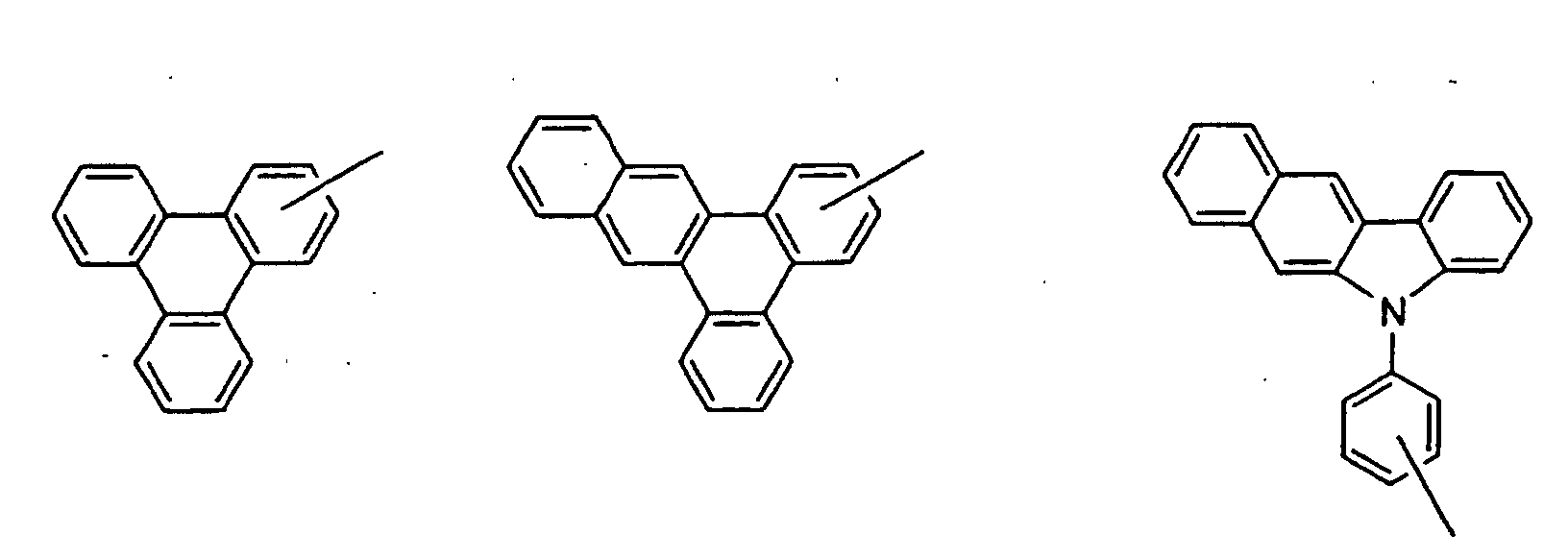


In the foregoing general formula (B), A' represents a group which is
selected from groups represented by general formulae (2) to (12):


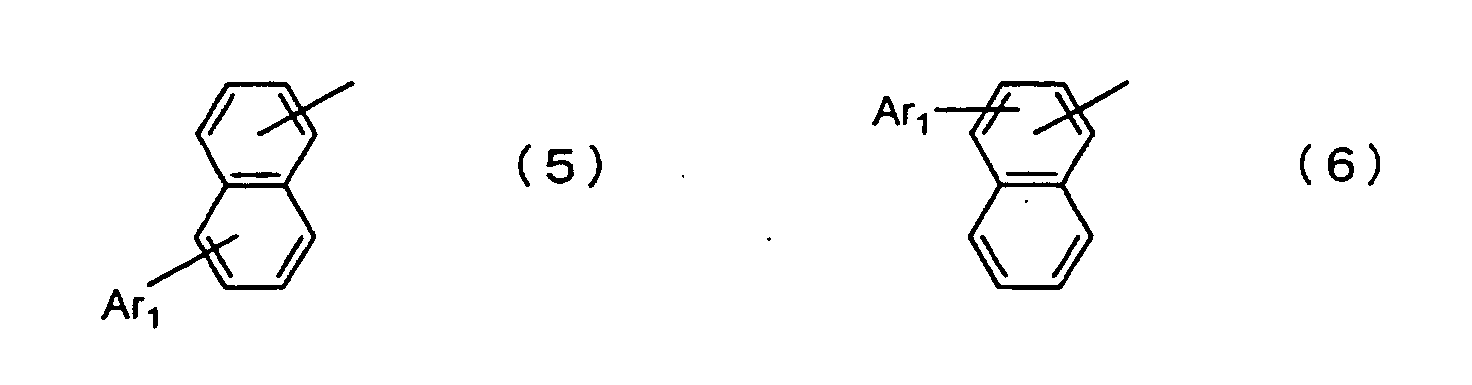

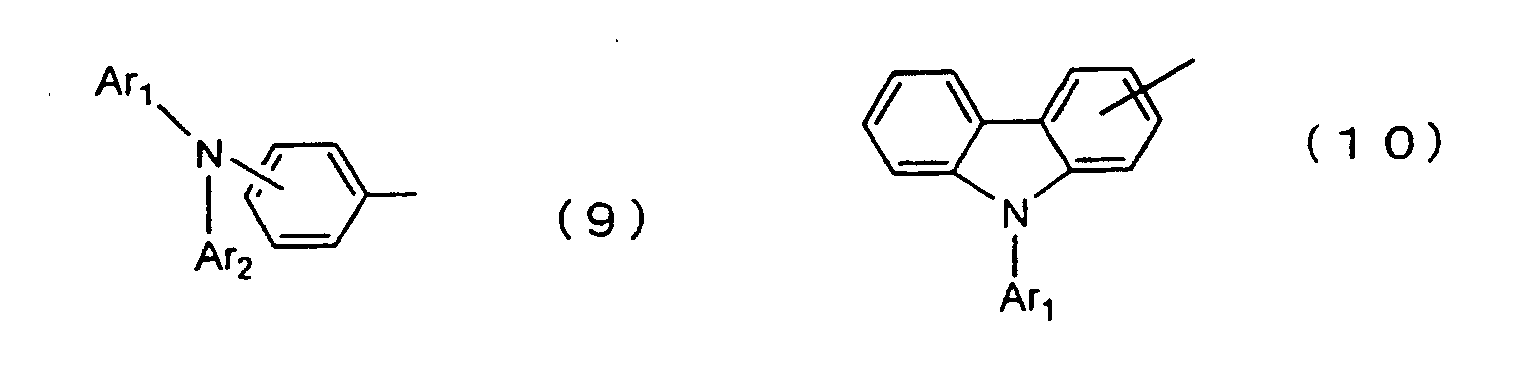
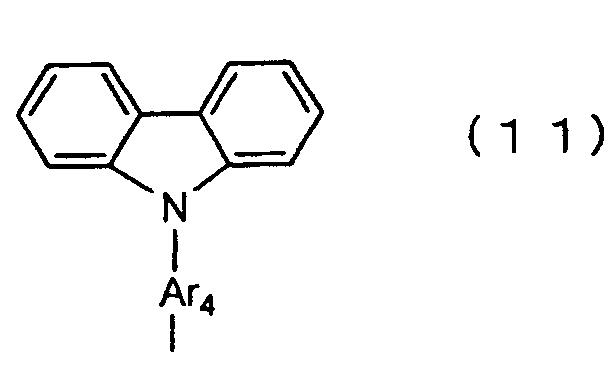
In general formulae (2) to (12), Ar1 to Ar3 each independently
represent a substituted or unsubstituted aryl group having 6 to 30 carbon
atoms, Ar4 represents a substituted or unsubstituted arylene group
having 6 to 30 carbon atoms, Ar5 represents a substituted or
unsubstituted trivalent aromatic residue group having 6 to 30 carbon
atoms, and R1 and R2 each independently represent hydrogen atom, a
halogen atom, hydroxyl group, a substituted or unsubstituted amino
group, nitro group, cyano group, a substituted or unsubstituted alkyl
group having 1 to 30 carbon atoms, a substituted or unsubstituted alkenyl
group having 2 to 40 carbon atoms, a substituted or unsubstituted
cycloalkyl group having 5 to 40 carbon atoms, a substituted or
unsubstituted alkoxyl group having 1 to 30 carbon atoms, a substituted or
unsubstituted aromatic hydrocarbon group having 5 to 40 carbon atoms, a
substituted or unsubstituted aromatic heterocyclic group having 2 to 40
carbon atoms, a substituted or unsubstituted aralkyl group having 7 to 40
carbon atoms, a substituted or unsubstituted aryloxyl group having 6 to
40 carbon atoms, a substituted or unsubstituted alkoxycarbonyl group
having 2 to 30 carbon atoms, a substituted or unsubstituted silyl group
having 3 to 40 carbon atoms or carboxyl group. Groups represented by
Ar1 and Ar2 and groups represented by R1 and R2 each independently
may be bonded to each other and form a cyclic structure. p in general
formula (12) represents 0 or 1.
The foregoing general formulae (2) to (12) may be substituted with
substituted or unsubstituted alkyl groups having 1 to 30 carbon atoms or
substituted or unsubstituted phenyl group, and in the foregoing general
formula (B), A' does not represent phenyl group substituted with an
arylamino group when the group represented by B is substituted with an
arylamino group.
Examples of the atoms and groups represented by Ar1 to Ar5, R1
and R2 include the atoms and groups described as the examples of the
atoms and groups represented by Ar1 to Ar5, R1 and R2 in the foregoing
general formulae (1) to (11) in general formula (A).
Examples of the substituent in the groups in general formulae (A)
and (B) include halogen atoms, hydroxyl group, substituted or
unsubstituted amino groups, nitro group, cyano group, substituted or
unsubstituted alkyl groups, substituted or unsubstituted alkenyl groups,
substituted or unsubstituted cycloalkyl groups, substituted or
unsubstituted alkoxyl groups, substituted or unsubstituted aromatic
hydrocarbon groups, substituted or unsubstituted aromatic heterocyclic
groups, substituted or unsubstituted aralkyl groups, substituted or
unsubstituted aryloxyl groups, substituted or unsubstituted
alkoxycarbonyl groups and carboxyl group.
It is preferable that the groups represented by general formulae (1)
to (11) in general formula (A) and groups represented by general formulae
(2) to (12) in general formula (B) are each independently substituted with
an alkyl group having 1 to 30 carbon atoms or a cycloalkyl groups having
5 to 30 carbon atoms.
Examples of the novel aromatic compound represented by general
formula (A) or (B) are shown in the following. However, the novel
compound is not limited to the compounds shown as the examples.


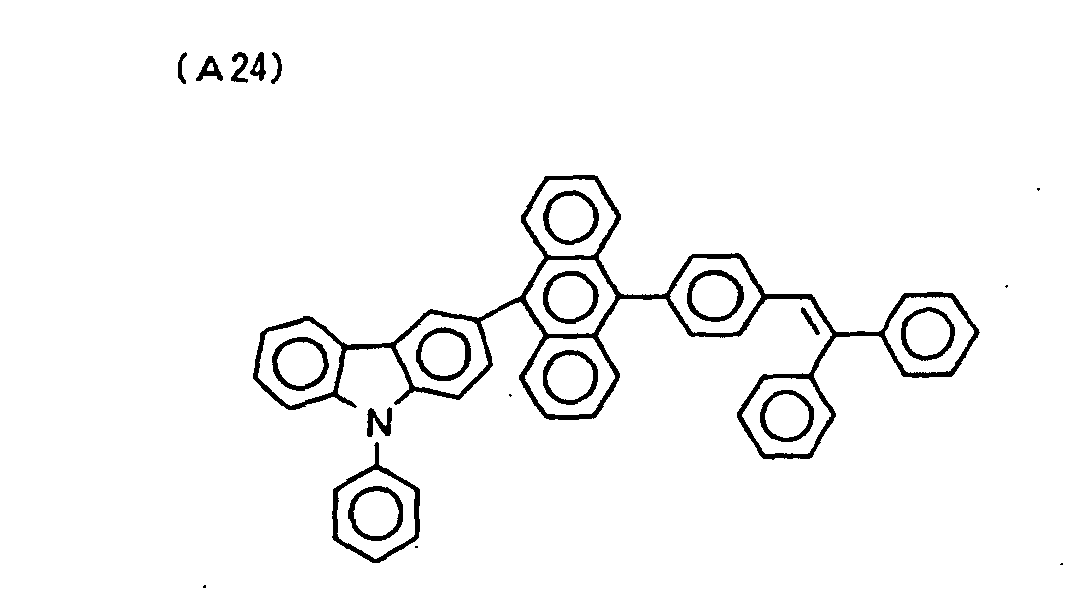

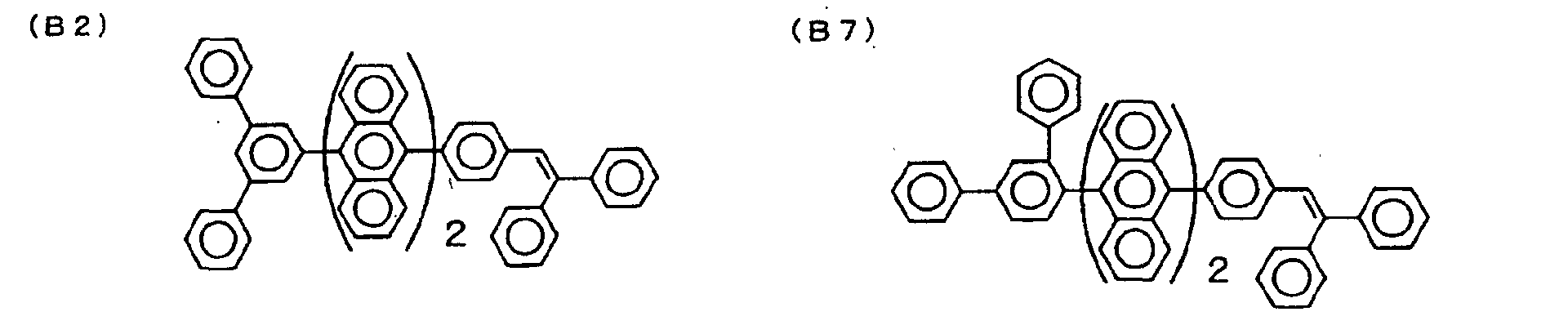
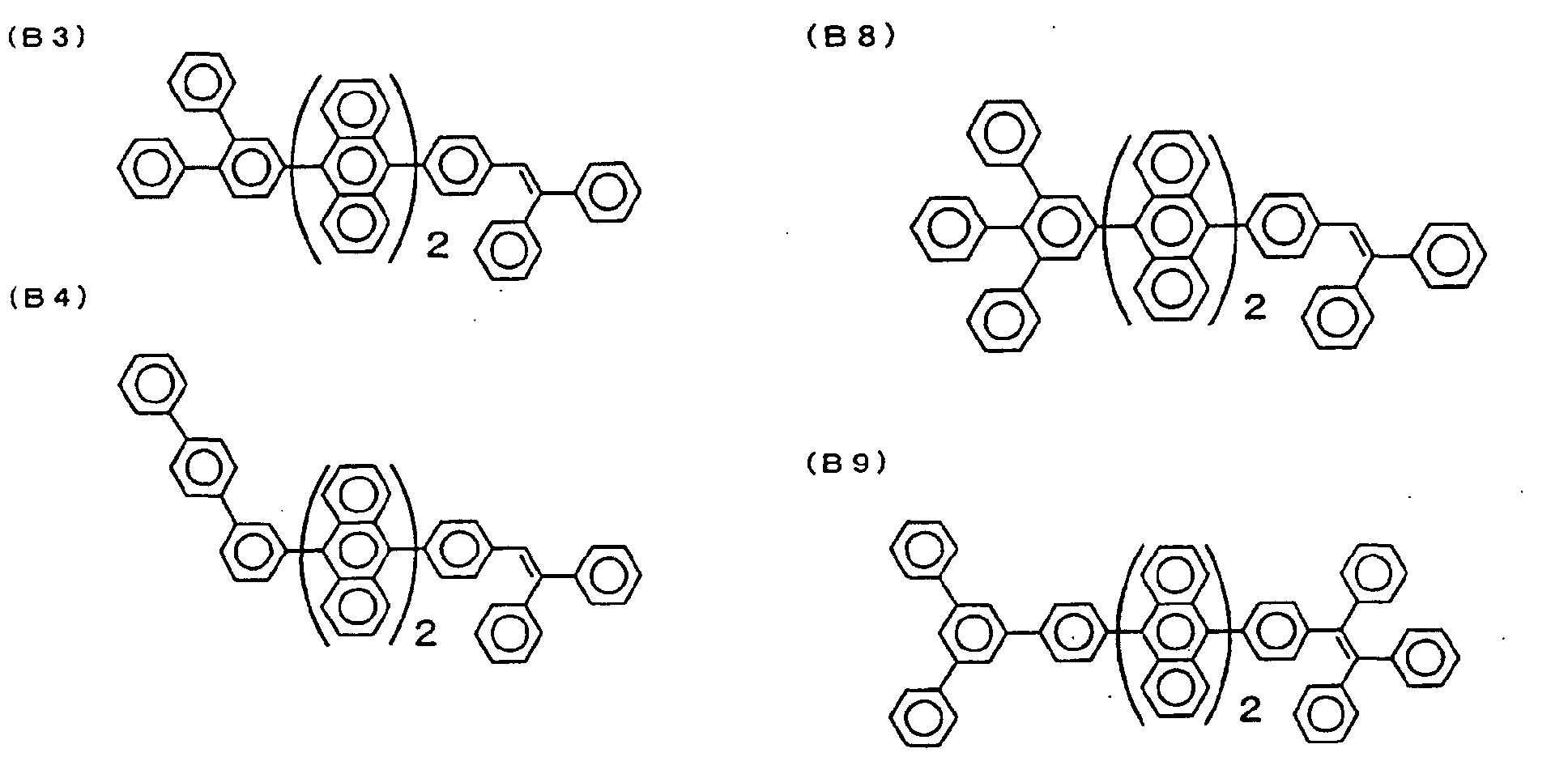


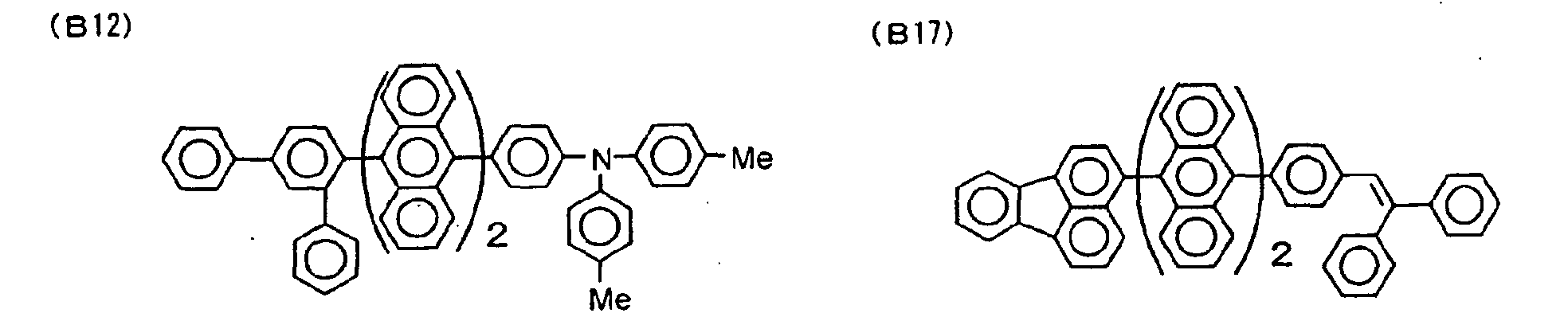
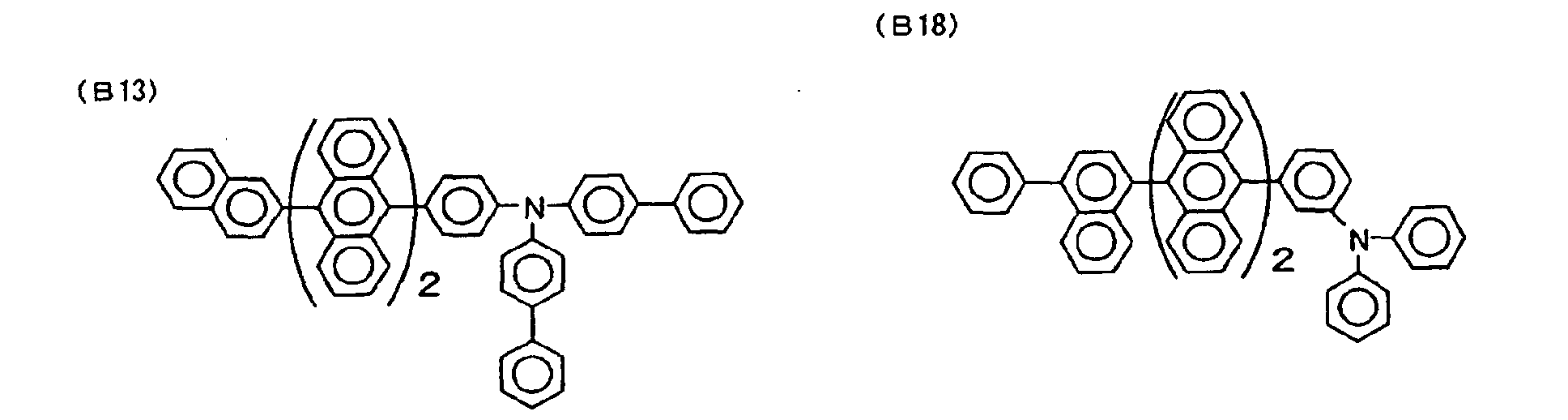
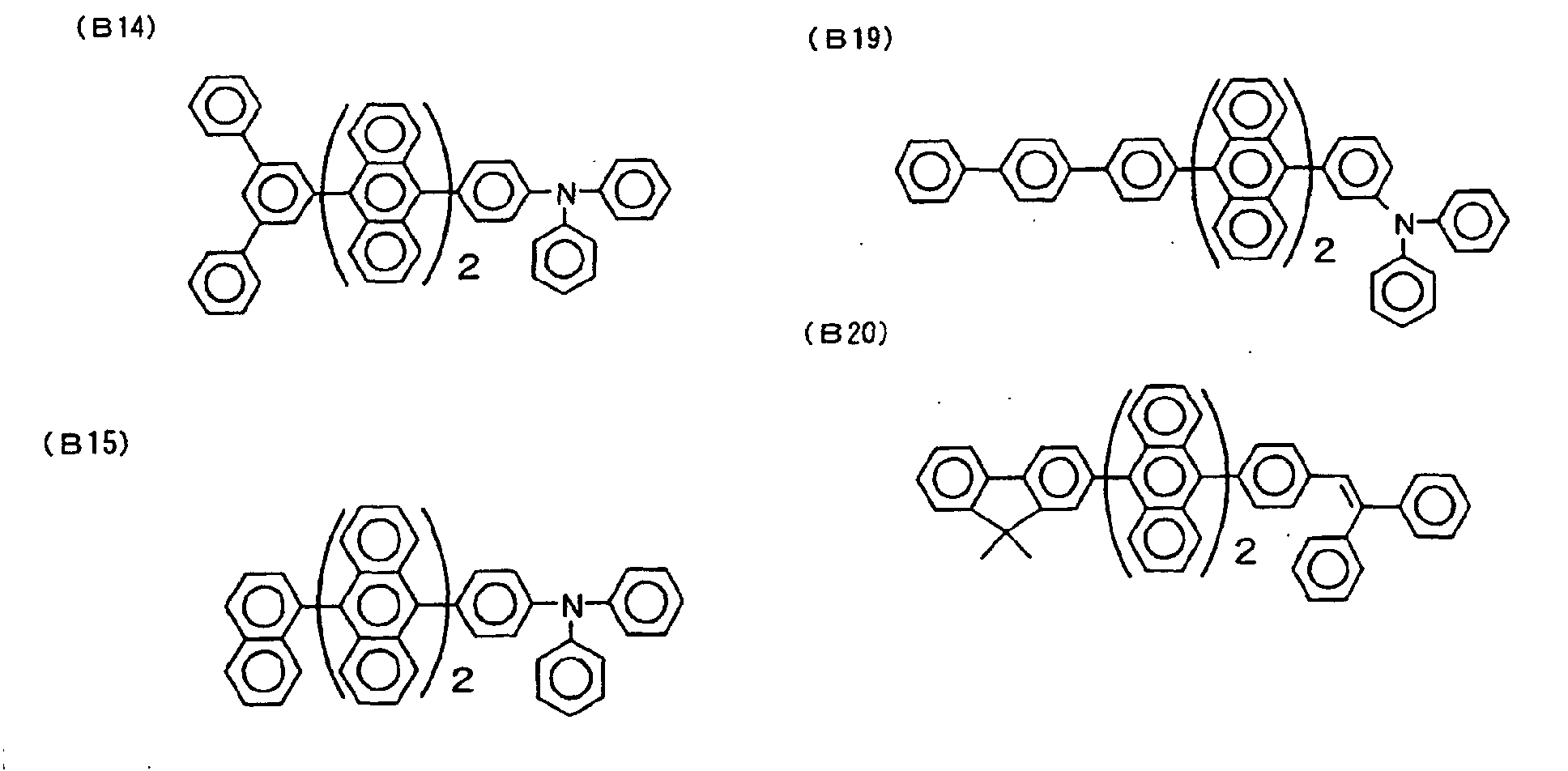
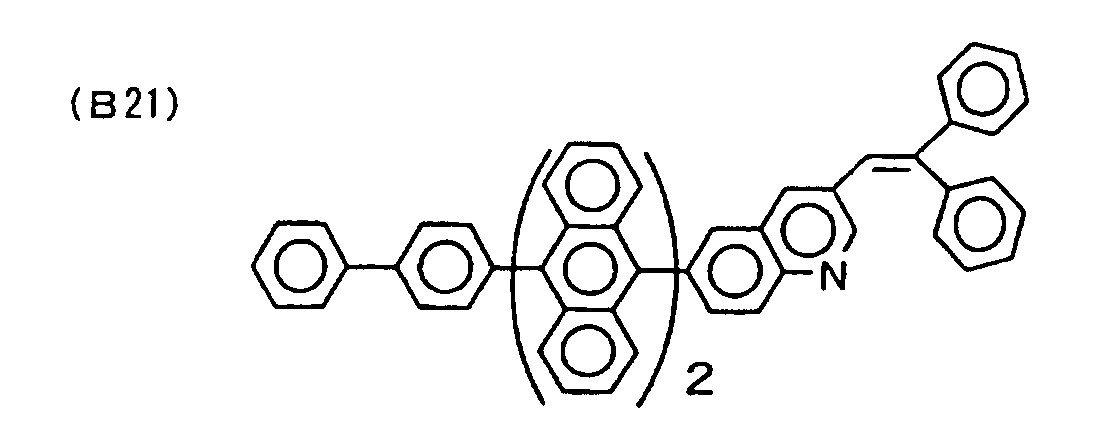


It is preferable that the above aromatic compound represented by
general formula (A) or (B) of the present invention is used as a material
for organic EL devices.
The organic EL device of the present invention comprises a cathode,
an anode and an organic thin film layer comprising at least one layer
containing a light emitting layer and sandwiched between the cathode
and the anode, wherein at least one layer in the organic thin film layer
comprises the aromatic compound represented by general formula (A) or
(B) singly or as a component of a mixture.
It is preferable that the organic thin film layer comprises at least
one of an electron transporting layer and a hole transporting layer, and at
least one of the electron transporting layer and the hole transporting layer
comprises the aromatic compound represented by general formula (A) or
(B) singly or as a component of a mixture.
It is preferable that the light emitting layer further comprises an
arylamine compound and/or a styrylamine compound.
As the arylamine compound, arylamine compounds represented by
the following general formula (C) are preferable.
 wherein Ar6 represents an aromatic group having 6 to 40 carbon atoms,
Ar7 and Ar8 each independently represent hydrogen atom or an aromatic
group having 6 to 20 carbon atoms, and m represents an integer of 1 to 4.
wherein Ar6 represents an aromatic group having 6 to 40 carbon atoms,
Ar7 and Ar8 each independently represent hydrogen atom or an aromatic
group having 6 to 20 carbon atoms, and m represents an integer of 1 to 4.
Examples of the aromatic group having 6 to 40 carbon atoms which
is represented by Ar6 include aryl groups having 6 to 40 carbon atoms
such as phenyl group, naphthyl group, anthranyl group, phenanthryl
group, pyrenyl group, coronyl group, biphenyl group, terphenyl group,
pyrrolyl group, furanyl group, thiophenyl group, benzothiophenyl group,
oxadiazolyl group, diphenylanthranyl group, indolyl group, carbazolyl
group, pyridyl group, benzoquinolyl group, fluoranthenyl group and
acenaphthofluoranthenyl group; and arylene groups having 6 to 40 carbon
atoms such as phenylene group, naphthylene group, anthranylene group,
phenanthrylene group, pyrenylene group, coronylene group, biphenylene
group, terphenylene group, pyrrolylene group, furanylene group,
thiophenylene group, benzothiophenylene group, oxadiazolylene group,
diphenylanthranylene group, indolylene group, carbazolylene group,
pyridylene group, benzoquinolylene group, fluoranthenylene group and
acenaphtho- fluoranthenylene group.
The aromatic group having 6 to 40 carbon atoms may be
substituted with substituents. Examples of the substituent include alkyl
groups having 1 to 6 carbon atoms such as ethyl group, methyl group,
i-propyl group, n-propyl group, s-butyl group, t-butyl group, pentyl group,
hexyl group, cyclopentyl group and cyclohexyl group; alkoxyl groups
having 1 to 6 carbon atoms such as ethoxyl group, methoxyl group,
i-propoxyl group, n-propoxyl group, s-butoxyl group, t-butoxyl group,
pentoxyl group, hexyloxyl group, cyclopentoxyl group and cyclohexyloxyl
group; aryl groups having nuclei having 5 to 40 atoms; amino groups
substituted with an aryl group having nuclei having 5 to 40 atoms; ester
groups having an aryl group having nuclei having 5 to 40 atoms; ester
groups having an alkyl group having 1 to 6 carbon atoms; cyano group;
nitro group; and halogen atoms.
Examples of the aromatic group having 6 to 20 carbon atoms which
is represented by Ar7 or Ar8 include the compounds having 6 to 20 carbon
atoms among the compounds having 6 to 40 carbon atoms which are
represented by Ar6.
Examples of the above arylamine compound include triphenylamine,
diphenylnaphthylamine and diphenylpyrenylamine.
As the styrylamine compound, styrylamine compounds represented
by the following general formula (D) are preferable:
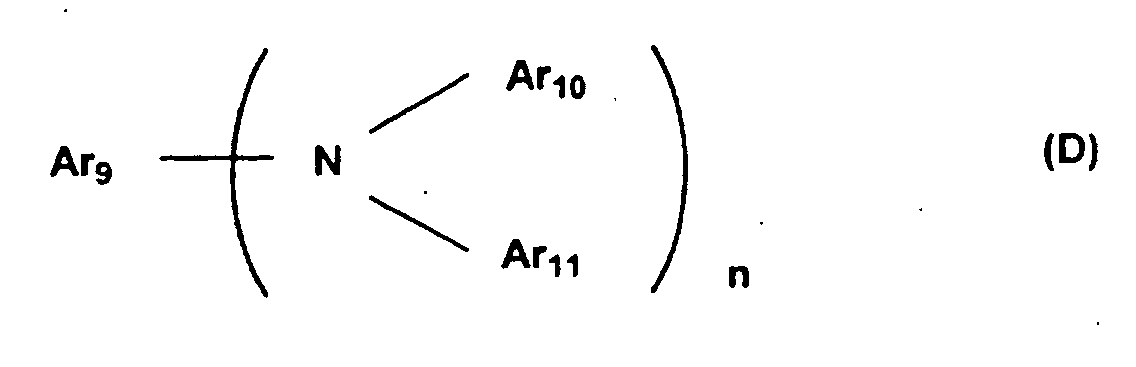 wherein Ar9 represents a divalent group selected from phenylene group,
terphenylene group, stilbene group and distyrylarylene groups, Ar10 and
Ar11 each independently represent hydrogen atom or an aromatic group
having 6 to 30 carbon atoms, the groups represented by Ar9, Ar10 or Ar11
may be substituted, at least one of the groups represented by Ar10 and
Ar11 is substituted with styryl group, and n represents an integer of 1 to
4.
wherein Ar9 represents a divalent group selected from phenylene group,
terphenylene group, stilbene group and distyrylarylene groups, Ar10 and
Ar11 each independently represent hydrogen atom or an aromatic group
having 6 to 30 carbon atoms, the groups represented by Ar9, Ar10 or Ar11
may be substituted, at least one of the groups represented by Ar10 and
Ar11 is substituted with styryl group, and n represents an integer of 1 to
4.
Examples of the substituent to the groups represented by Ar9, Ar10
and Ar11 include the above substituents to the groups represented by Ar6
in general formula (C).
Examples of the organic EL device of the present invention include
organic EL devices having a laminate structure having one or more
organic layers laminated between the electrodes. Examples of the
structure include structures of an anode / a light emitting layer / a cathode,
an anode / a hole transporting layer / a light emitting layer / an electron
transporting layer / a cathode, an anode / a hole transporting layer / a
light emitting layer / a cathode and an anode / a light emitting layer / an
electron transporting layer / a cathode. The aromatic compound of the
present invention may be used in any of the layers in the above organic
thin film layer and may also be used by doping other hole transporting
materials, light emitting materials and electron transporting materials.
In the organic EL device of the present invention, it is preferable
that a region transporting electrons or an interface region between the
cathode and a layer of an organic thin film comprises a reducing dopant.
The reducing dopant is defined as a substance which can reduce the
electron transporting compound. Therefore, various types of substances
can be used as long as the substance has the specific reducing property.
For example, at least one substance selected from the group consisting of
alkali metals, alkaline earth metals, rare earth metals, oxides of alkali
metals, halides of alkali metals, oxides of alkaline earth metals, halides of
alkaline earth metals, oxides of rare earth metals, halides of rare earth
metals, organic complexes of alkali metals, organic complexes of alkaline
earth metals and organic complexes of rare earth metals, can be used.
Specific examples of the reducing dopant include at least one alkali
metal selected from the group consisting of Na (the work function: 2.36
eV), K (the work function: 2.28 eV), Rb (the work function: 2.16 eV) and Cs
(the work function: 1.95 eV) and at least one alkaline earth metal selected
from the group consisting of Ca (the work function: 2.9 eV), Sr (the work
function: 2.0 to 2.5 eV) and Ba (the work function: 2.52 eV). Among these
reducing dopants, reducing dopants having a work function of 2.9 eV or
smaller are preferable. It is more preferable that the reducing dopant is
at least one alkali metal selected from the group consisting of K, Rb and
Cs, still more preferably Rb or Cs, and most preferably Cs. These alkali
metals have particularly great reducing ability, and the luminance of
emitted light and the life of the organic EL device are improved by adding
these alkali metals in a relatively small amount into the region of electron
injection. As the reducing dopant having a work function of 2.9 eV or
smaller, combinations of two or more alkali metals are also preferable,
and combinations including Cs such as combinations of Cs and Na, Cs and
K, Cs and Rb, and Cs, Na and K are more preferable. When Cs is include
in the combination, the reducing ability can be efficiently exhibited, and
the luminance of emitted light and the life of the organic EL device can be
improved by adding the combination into the region of electron injection.
The organic EL device of the present invention may further
comprises an electron injecting layer constituted with an insulating
material or a semiconductor and disposed between the cathode and the
organic thin film layer. Due to the electron injecting layer, leak of
electric current can be effectively prevented, and the electron injecting
property can be improved. It is preferable that at least one metal
compound selected from the group consisting of alkali metal chalcogenides,
alkaline earth metal chalcogenides, alkali metal halides and alkaline
earth metal halides is used as the insulating material. It is preferable
that the electron injecting layer is constituted with the alkali metal
chalcogenide or the like material since the electron injecting property can
be further improved. Examples of the alkali metal chalcogenide include
Li2O, LiO, Na2S, Na2Se and NaO. Preferable examples of the alkaline
earth metal chalcogenide include CaO, BaO, SrO, BeO, BaS and CaSe.
Examples of the alkali metal halide include LiF, NaF, KF, LiCl, KCl and
NaCl. Examples of the alkaline earth metal halide include fluorides such
as CaF2, BaF2, SrF2, MgF2 and BeF2 and halides other than the fluorides.
Examples of the semiconductor constituting the electron
transporting layer include oxides, nitrides and oxide nitrides containing at
least one element selected from Ba, Ca, Sr, Yb, Al, Ga, In, Li, Na, Cd, Mg,
Si, Ta, Sb and Zn, which are used singly or as a combination of two or
more. It is preferable that the inorganic compound constituting the
electron transporting layer is in the form of a fine crystalline or
amorphous insulating thin film. When the electron transporting layer is
constituted with the above insulating thin film, a more uniform thin film
can be formed and defective pixels such as dark spots can be decreased.
Examples of the inorganic compound include the alkali metal
chalcogenides, the alkaline earth metal chalcogenides, the alkali metal
halides and the alkaline earth metal halides which are described above.
The anode of the organic EL device plays the role of injecting holes
into the hole transporting layer or the light emitting layer. It is effective
that the anode has a work function of 4.5 eV or greater. Examples of the
material of the anode used in the present invention include indium tin
oxide alloys (ITO), tin oxides (NESA), gold, silver, platinum and copper.
As the cathode, a material having a small work function is preferable so
that electrons can be injected into the electron transporting layer or the
light emitting layer.
The process for forming the layers in the organic EL device of the
present invention is not particularly limited. A conventional process
such as the vacuum vapor deposition process and the spin coating process
can be used. The organic thin film layer comprising the compound
represented by the above general formula (A) or (B) can be formed in
accordance with the vacuum vapor deposition process, the molecular beam
epitaxy process (the MBE process) or, using a solution prepared by
dissolving the compound into a solvent, in accordance with a conventional
coating process such as the dipping process, the spin coating process, the
casting process, the bar coating process and the roll coating process.
The thickness of each layer in the organic thin film layer in the
organic EL device of the present invention is not particularly limited. In
general, an excessively thin layer tends to have defects such as pin holes,
and an excessively thick layer requires a high applied voltage to decrease
the efficiency. Therefore, a thickness in the range of several nm to 1 µm
is preferable.
As described above, by using the novel aromatic compound of the
present invention for the organic thin film layer of the organic EL device
of the present invention, the organic EL device which exhibits a great
luminance of emitted light, a great efficiency of light emission and a high
purity of color, emits bluish light, is excellent in stability at high
temperatures and has a long life can be obtained. This organic EL device
can be advantageously used for a photosensitive member for electronic
photograph, a planar light emitting member such as a flat panel display of
wall televisions, a back light of copiers, printers and liquid crystal
displays, a light source for instruments, a display panel, a marking light
and an accessory.
The present invention will be described more specifically with
reference to examples in the following. However, the present invention is
not limited to the examples.
Under an atmosphere of argon, 9-bromoanthracene (3 g, 12 mmole),
2-naphthaleneboric acid (2.4 g, 14 mmole, 1.2 eq) and tetrakis-(triphenylphosphine)palladium(0)
(0.28 g, 0.24 mmole, 2% Pd) were
suspended in dimethoxyethane (40 ml). To the obtained suspension, a
2M aqueous solution of sodium carbonate (4.5 g, 42 mmole, 3 eq/20 ml)
was added, and the resultant mixture was refluxed for 10 hours. The
obtained reaction mixture was filtered and washed with water and
methanol, and a light yellow solid substance was obtained. The solid
substance was suspended in boiling dimethoxy- ethane (30 ml), cooled
while being left standing, filtered and washed with dimethoxyethane and
acetone, and a gray solid substance (82% crude) was obtained. This solid
substance was purified using a short column (silica gel/dichloroethane),
and a light yellow solid substance (2.7 g, the yield: 74%) was obtained.
The obtained product was identified to be 9-(2-naphthyl)anthracene in
accordance with 1H-NMR.
1H-NMR (CDCl3, TMS) δ: 7.2-7.7 (9H, m), 7.8-8.1 (6H, m), 8.51
(1H, s).
9-(2-Naphthyl)anthracene (2.7 g, 8.9 mmole) was suspended in
anhydrous N,N-dimethylformamide (DMF) (50 ml). To the obtained
suspension, an anhydrous DMF solution (6 ml) of N-bromosuccinimide
(NBS) (1.7 g, 9.6 ml, 1.1 eq) was added, and the resultant mixture was
stirred at the room temperature for 10 hours and then left standing for
one night. The reaction mixture was diluted with water (50 ml). The
formed solid substance was separated by filtration and washed with
methanol, and a light yellow solid substance (3.2 g, the yield: 94%) was
obtained. The obtained product was identified to be 9-bromo-10-(2-naphthyl)anthracene
in accordance with 1H-NMR.
1H-NMR (CDCl3, TMS) δ: 7.2-7.7 (9H, m), 7.8-8.1 (4H, m), 8.62
(2H, d, J=8 Hz).
Under an atmosphere of argon, 9-bromo-10-(2-naphthyl)anthracene
(3.2 g, 8.4 mmole), 4-(2,2diphenylvinyl)phenylboric acid (2.8 g, 9.3 mmole,
1.1 eq) and tetrakis(triphenylphosphine)palladium(0) (0.19 g, 0.16 mmole,
2% Pd) were suspended in toluene (30 ml). To the obtained suspension, a
2M aqueous solution of sodium carbonate (3 g, 28 mmole, 3 eq/15 ml) was
added, and the resultant mixture was refluxed for 10 hours. The
obtained reaction mixture was filtered and washed with toluene, water
and methanol, and a light yellow solid substance (3.7 g) was obtained.
The solid substance was suspended in boiling toluene (40 ml), cooled while
being left standing and filtered, and a light yellow solid substance (3.4 g,
the yield: 73%) was obtained. The result of examination of the obtained
product in accordance with 1H-NMR was as follows:
1H-NMR (CDCl3, TMS) δ: 7.15 (1H, s), 7.2-7.4 (17H, m), 7.5-7.8
(8H, m), 7.8-8.1 (4H, m).
The obtained solid substance (3.4 g) was purified by sublimation at
340°C/10-6 Torr for 1 hour, and a light yellow substance (2.9 g) was
obtained. It was confirmed in accordance with the field desorption mass
analysis (FDMS) that the obtained product was the object compound
(Compound (A1)). The results of measurements of the energy gap Eg, the
ionization potential Ip and the glass transition temperature Tg are also
shown in the following.
Under an atmosphere of argon, 9-iodoanthracene (8.7 g, 29 mmole,
1.1 eq), 3,5-dibromophenylboric acid (7.3 g, 26 mmole) and tetrakis-(triphenylphosphine)palladium(0)
(0.67 g, 0.58 mmole, 2% Pd) were
suspended in toluene (80 ml). To the obtained suspension, a 2M aqueous
solution of sodium carbonate (8.3 g, 78 mmole, 3 eq/40 ml) was added, and
the resultant mixture was refluxed for 10 hours. An organic layer was
separated from the obtained reaction mixture, washed with a saturated
aqueous solution of sodium chloride and dried with magnesium sulfate.
After the solvent was removed by distillation, a yellow solid substance was
obtained and, then, the obtained solid substance was suspended in
dichloromethane (20 ml). The solid component was separated by
filtration and washed with a mixed solution of dichloromethane and
hexane, and a light yellow solid substance (5.1 g, the yield: 48%, the first
crop) was obtained. The filtrate was purified in accordance with the
column chromatography (silica gel/hexane, hexane + 5% dichloromethane),
and a light yellow solid substance (4.2 g, the yield: 39%, the second crop)
was obtained. The yellow solid substances of the first crop and the
second crop were combined (9.3 g, the yield: 87%). The obtained product
was identified to be 9-(3,5-dibromophenyl)anthracene in accordance with
1H-NMR.
1H-NMR (CDCl3, TMS) δ: 7.3-7.6 (8H, m), 7.85 (1H, t, J=2 Hz),
8.0-8.1 (2H, m), 8.49 (1H, s).
Under an atmosphere of argon, 9-(3,5-dibromophenyl)anthracene (5
g, 12 mmole), phenylboric acid (4.4 g, 36 mmole, 3 eq) and
tetrakis(triphenylphosphine)palladium(0) (0.55 g, 0.48 mmole, 2% Pd)
were dissolved in toluene (100 ml). To the obtained solution, a 2M
aqueous solution of sodium carbonate (11 g, 0.10 moles, 3 eq/50 ml) was
added, and the resultant mixture was refluxed for 10 hours. The
obtained reaction mixture was filtered, and an organic layer was
separated from the filtrate, washed with a saturated aqueous solution of
sodium chloride (50 ml) and dried with magnesium sulfate. After the
solvent was removed by distillation, a black oily substance was obtained.
The obtained oily substance was purified in accordance with the column
chromatography (silica gel/hexane, hexane + 3% dichloromethane, hexane
+ 10% dichloromethane in the final step), and a light yellow amorphous
solid substance (3.6 g, 74%) was obtained. The obtained product was
identified to be 9-(3,5-diphenyl- phenyl)anthracene in accordance with
1H-NMR and FDMS.
1H-NMR (CDCl3, TMS) δ: 7.3-7.6 (10H, m), (1H, s), 7.7-7.9 (8H, m),
8.01 (1H, s), 8.05 (2H, dd, J=9 Hz, 2 Hz), 8.52 (1H, s).
FDMS: calcd. for C32H22=406, found m/z=406 (M+, 100)
9-(3,5-Diphenylphenyl)anthracene (3.6 g, 8.9 mmole) was
suspended in anhydrous DMF (60 ml). After an anhydrous DMF solution
(7 ml) of NBS (1.9 g, 11 mmole, 1.2 eq) was added, the resultant mixture
was stirred at the room temperature for 10 hours and then left standing
for one night. The reaction mixture was diluted with water (50 ml).
The formed solid substance was separated by filtration and washed with
methanol, and a light yellow solid substance (3.9 g, the yield: 90%) was
obtained. The obtained product was identified to be 9-bromo-10-(3,5-diphenylphenyl)anthracene
in accordance with 1H-NMR.
1H-NMR (CDCl3, TMS) δ: 7.3-7.9 (18H, m), 8.01 (1H, t, J=2 Hz),
8.62 (2H, d, J=9 Hz).
Under an atmosphere of argon, 9-bromo-10-(3,5-diphenylphenyl)-anthracene
(3.9 g, 8.0 mmole), 4-(2,2-diphenylvinyl)phenylboric acid (2.7 g,
9.0 mmole, 1.1 eq) and tetrakis(triphenylphosphine)palladium(0) (0.18 g,
0.16 mmole, 2% Pd) were suspended in toluene (30 ml). To the obtained
suspension, a 2M aqueous solution of sodium carbonate (2.9 g, 27 mmole,
3 eq/15 ml) was added, and the resultant mixture was refluxed for 10
hours. An organic layer was separated from the reaction mixture,
washed with a saturated aqueous solution of sodium chloride (30 ml) and
dried with magnesium sulfate. After the solvent was removed by
distillation, a brown solid substance was obtained. The obtained solid
substance was purified in accordance with the column chromatography
(silica gel/hexane + 10% dichloromethane, hexane + 20% dichloromethane),
and a white solid substance (4.3 g, the yield: 81%) was obtained. The
result of examination of the obtained product in accordance with 1H-NMR
was as follows:
1H-NMR (CDCl3, TMS) δ: 7.15 (1H, s), 7.2-7.5 (24H, m), 7.7-7.9
(10H, m), 8.02 (1H, t, J=2 Hz).
The obtained solid substance (4.3 g) was purified by sublimation at
360°C/10-6 Torr for 1 hour, and a light yellow substance (3.2 g) was
obtained. It was confirmed in accordance with FDMS that the obtained
product was the object compound (Compound (A2)). The results of
measurements of Eg, Ip and Tg are also shown in the following.
Under an atmosphere of argon, 3,4-dichlorophenylboric acid (2.7 g,
14 mmole, 1.1 eq), 9-bromoanthracene (3.3 g, 13 mmole) and
tetrakis(triphenylphosphine)palladium(0) (0.3 g, 0.26 mmole, 2% Pd) were
suspended in toluene (40 ml). To the obtained suspension, a 2M aqueous
solution of sodium carbonate (4.5 g, 42 mmole, 3 eq/20 ml) was added, and
the resultant mixture was refluxed for 10 hours. The reaction mixture
was filtered to remove Pd black, and an organic layer was separated from
the filtrate, washed with a saturated aqueous solution of sodium chloride
(30 ml) and dried with magnesium sulfate. After the solvent was
removed by distillation, a light brown oily substance was obtained.
When a small amount of methanol was added to the obtained oily
substance and the wall of the flask was rubbed, crystals were formed.
The formed crystals were separated by filtration and washed with
methanol, and a light yellow solid substance (3.7 g, the yield: 88%) was
obtained. The obtained product was identified to be
9-(3,4-dichlorophenyl)anthracene in accordance with 1H-NMR.
1H-NMR (CDCl3, TMS) δ: 7.2-7.7 (9H, m), 8.02 (2H, dd, J=7 Hz, 2
Hz), 8.48 (1H, s).
Under an atmosphere of argon, phenylboric acid (3.6 g, 30 mmole,
2.7 eq), 9-(3,4-dichlorophenyl)anthracene (3.7 g, 11 mmole) and
dichlorobis(triphenylphosphine)nickel(II) (0.72 g, 1.1 mmole, 5% Ni),
triphenylphosphine (0.58 g, 2.2 mmole, 2 eq to Ni) and potassium
phosphate hydrate (16 g, 60 mmole, 2 eq) were suspended in anhydrous
toluene (80 ml), and the obtained suspension was heated at 80°C for 10
hours.. To the reaction mixture, water (50 ml) was added, and insoluble
components were removed by filtration. An organic layer was separated
from the filtrate, washed with a saturated aqueous solution of sodium
chloride (30 ml) and dried with magnesium sulfate. After the solvent
was removed by distillation, a light brown oily substance was obtained.
The obtained oily substance was purified in accordance with the column
chromatography (silica gel/hexane + 10% dichloromethane, hexane + 20%
dichloromethane, hexane + 30% dichloromethane in the final step), and a
white solid substance (3.7 g, the yield: 83%) was obtained. The obtained
product was identified to be 9-(3,4-diphenylphenyl)anthracene in
accordance with 1H-NMR and FDMS.
1H-NMR (CDCl3, TMS) δ: 7.1-7.7 (17H, m), 7.8-8.1 (4H, m), 8.49
(1H, s).
FDMS: calcd. for C32H22=406, found m/z=406 (M+, 100).
9-(3,4-Diphenylphenyl)anthracene (3.7 g, 9.1 mmole) was
suspended in anhydrous DMF (50 ml). After an anhydrous DMF solution
(10 ml) of NBS (1.8 g, 10 mmole, 1.1 eq) was added, the resultant mixture
was heated at 55°C for 5 minutes so that the reaction mixture became a
homogeneous solution. The obtained solution was stirred at the room
temperature for 4 hours and then left standing for one night. The
reaction mixture was diluted with water (50 ml). The formed solid
substance was separated by filtration and washed with methanol, and a
light yellow solid substance (4.2 g, the yield: 95%) was obtained. The
obtained product was identified to be 9-(3,4-diphenylphenyl)-10-bromoanthracene
in accordance with 1H-NMR.
1H-NMR (CDCl3, TMS) δ: .2-7.7 (17H, m), 7.85 (2H, d, J=8 Hz),
8.61 (2H, d, J=8 Hz).
Under an atmosphere of argon, 9-(3,4-diphenylphenyl)-10-bromoanthracene
(3.0 g, 6.2 mmole), 4-(2,2-diphenylvinyl)phenylboric acid (2.0 g,
6.7 mmole, 1.1 eq) and tetrakis(triphenylphosphine)palladium(0) (0.14 g,
0.12 mmole, 2% Pd) were suspended in toluene (20 ml). To the obtained
suspension, a 2M aqueous solution of sodium carbonate (2.1 g, 20 mmole,
3 eq/10 ml) was added, and the resultant mixture was refluxed for 10
hours. The reaction mixture was filtered and washed with water and
methanol, and a light yellow solid substance (3.7 g) was obtained. The
obtained solid substance was suspended in boiling toluene (40 ml). After
the suspension was cooled while being left standing, the suspension was
filtered, and a light yellow solid substance (3.6 g, the yield: 88%) was
obtained. The result of examination of the obtained product in
accordance with 1H-NMR was as follows:
1H-NMR (CDCl3, TMS) δ: .0-7.9 (36H, m), all-H.
The obtained solid substance (3.6 g) was purified by sublimation at
340°C/10-6 Torr for 1 hour, and a light yellow solid substance (2.1 g) was
obtained. It was confirmed in accordance with FDMS that the obtained
product was the object compound (Compound (A3)). The results of
measurements of Eg, Ip and Tg are also shown in the following.
Under an atmosphere of argon, 3-chlorophenylboric acid (3.3 g, 21
mmole, 1.1 eq), 9-bromoanthracene (5.0 g, 19 mmole) and tetrakis-(triphenylphosphine)palladium(0)
(0.5 g, 0.43 mmole, 2% Pd) were
suspended in toluene (60 ml). To the obtained suspension, a 2M aqueous
solution of sodium carbonate (6.8 g, 64 mmole, 3 eq/35 ml) was added, and
the resultant mixture was refluxed for 10 hours. An organic layer was
separated from the filtrate, washed with a saturated aqueous solution of
sodium chloride (30 ml) and dried with magnesium sulfate. After the
solvent was removed by distillation, a yellow oily substance was obtained.
The obtained oily substance was purified in accordance with the column
chromatography (silica gel/hexane + 5% dichloromethane), and a light
yellow solid substance (5.2 g, the yield: 95%) was obtained. The obtained
product was identified to be 9-(3-chlorophenyl)anthracene in accordance
with 1H-NMR.
1H-NMR (CDCl3, TMS) δ: .2-7.7 (10H, m), 7.7-7.8 (2H, m), 8.48
(1H, s).
Under an atmosphere of argon, 4-biphenylboric acid (3.6 g, 18
mmole, 1.3 eq), 9-(3-chlorophenyl)anthracene (4.1 g, 14 mmole),
dichloro(1,1'-bis(diphenylphosphino)ferrocene)nickel(II) (0.3 g, 0.44 mmole,
3% Ni) and anhydrous potassium phosphate (10 g, 47 mmole, 2.7 eq) were
suspended in anhydrous dioxane (70 ml), and the obtained suspension was
heated at 90°C for 7 hours.. To the reaction mixture, water (50 ml) and
toluene (100 ml) were added. An organic layer was separated, washed
with a saturated aqueous solution of sodium chloride (30 ml) and dried
with magnesium sulfate. After the solvent was removed by distillation, a
light brown solid substance was obtained. The obtained solid substance
was suspended in a boiling mixture of ethanol (50 ml) and toluene (10 ml).
After the resultant mixture was cooled while being left standing, the
mixture was filtered and washed with ethanol, and a white solid
substance (4.8 g, the yield: 84%) was obtained. The obtained product was
identified to be 9-(3-(4-phenylphenyl)phenyl)anthracene in accordance
with 1H-NMR.
1H-NMR (CDCl3, TMS) δ: .3-7.8 (19H, m), 8.03 (2H, d, J=7 Hz),
8.49 (1H, s).
9-(3-(4-Phenylphenyl)phenyl)anthracene (4.8 g, 12 mmole) was
suspended in anhydrous DMF (70 ml). After an anhydrous DMF solution
(15 ml) of NBS (2.3 g, 13 mmole, 1.1 eq) was added, the resultant mixture
was heated at 40°C for 15 minutes so that the reaction mixture became a
homogeneous solution. The obtained solution was stirred at the room
temperature for 7 hours and then left standing for one night. The
reaction mixture was diluted with water (50 ml). The formed solid
substance was separated by filtration and washed with methanol, and a
light yellow solid substance (5.2 g, the yield: 89%) was obtained. The
obtained product was identified to be 9-(3-(4-phenylphenyl)phenyl)-10-bromoanthracene
in accordance with 1H-NMR.
1H-NMR (CDCl3, TMS) δ: 7.3-7.8 (19H, m), 8.61 (2H, d, J=9 Hz).
Under an atmosphere of argon, 9-(3-(4-phenylphenyl)phenyl)-10-bromoanthracene
(3.0 g, 6.2 mmole), 4-(2,2-diphenylvinyl)phenylboric
acid (2.0 g, 6.7 mmole, 1.1 eq) and tetrakis(triphenylphosphine)-palladium(0)
(0.14 g, 0.12 mmole, 2% Pd) were suspended in toluene (20
ml). To the obtained suspension, a 2M aqueous solution of sodium
carbonate (2.1 g, 20 mmole, 3 eq/10 ml) was added, and the resultant
mixture was refluxed for 10 hours. The reaction mixture was filtered
and washed with water and methanol, and a light yellow solid substance
was obtained. The obtained solid substance was suspended in boiling
toluene (30 ml). After the suspension was cooled while being left
standing, the suspension was filtered, and a light yellow solid substance
(3.0 g, the yield: 73%) was obtained. The result of examination of the
obtained product in accordance with 1H-NMR was as follows:
1H-NMR (CDCl3, TMS) δ: 7.15 (1H, s), 7.2-7.4 (22H, m), 7.6-7.8
(13H, m).
The obtained solid substance (3.0 g) was purified by sublimation at
340°C/10-6 Torr for 1 hour, and a light yellow solid substance (2.6 g) was
obtained. It was confirmed in accordance with FDMS that the obtained
product was the object compound (Compound (A4)). The results of
measurements of Eg, Ip and Tg are also shown in the following.
Under an atmosphere of argon, 4-chlorophenylboric acid (5.0 g, 32
mmole, 1.1 eq), 9-bromoanthracene (7.5 g, 29 mmole) and tetrakis-(triphenylphosphine)palladium(0)
(0.7 g, 0.61 mmole, 2% Pd) were
suspended in toluene (100 ml). To the obtained suspension, a 2M
aqueous solution of sodium carbonate (10 g, 94 mmole, 3 eq/50 ml) was
added, and the resultant mixture was refluxed for 10 hours. The reaction
mixture was filtered to remove Pd black, and an organic layer was
separated from the filtrate, washed with a saturated aqueous solution of
sodium chloride (30 ml) and dried with magnesium sulfate. After the
solvent was removed by distillation, a white solid substance was obtained.
The obtained solid substance was suspended in boiling ethanol (50 ml).
After the mixture was cooled while being left standing, the mixture was
filtered and washed with ethanol, and a white solid substance (7.7 g, the
yield: 92%) was obtained. The obtained product was identified to be
9-(4-chlorophenyl)anthracene in accordance with 1H-NMR.
1H-NMR (CDCl3, TMS) δ: 7.2-7.7 (10H, m), 8.02 (2H, dd, J=7 Hz,
2 Hz), 8.48 (1H, s).
9-(4-Chlorophenyl)anthracene (4.0 g, 14 mmole) was suspended in
anhydrous DMF (60 ml). After an anhydrous DMF solution (10 ml) of
NBS (2.5 g, 14 mmole, 1 eq) was added, the resultant mixture was stirred
at the room temperature for 7 hours and then left standing for one night.
The reaction mixture was diluted with water (70 ml). The formed solid
substance was separated by filtration and washed with methanol, and a
light yellow solid substance (4.6 g, the yield: 89%) was obtained. The
obtained product was identified to be 9-(4-chlorophenyl)-10-bromoanthracene
in accordance with 1H-NMR.
1H-NMR (CDCl3, TMS) δ: 7.3-7.7 (10H, m), 8.60 (2H, d, J=9 Hz).
Under an atmosphere of argon, 9-(4-chlorophenyl)-10-bromoanthracene
(2.0 g, 5.4 mmole), 4-(2,2-diphenylvinyl)phenylboric acid (1.8 g,
6.0 mmole, 1.1 eq) and tetrakis(triphenylphosphine)palladium(0) (0.12 g,
0.10 mmole, 2% Pd) were suspended in toluene (20 ml). To the obtained
suspension, a 2M aqueous solution of sodium carbonate (1.9 g, 18 mmole,
3 eq/10 ml) was added, and the resultant mixture was refluxed for 10
hours. The reaction mixture was filtered and washed with water and
methanol, and a light yellow solid substance (2.4 g, the yield: 82%) was
obtained. The obtained product was identified to be
9-(4-chlorophenyl)-10-(4-(2,2-diphenylvinyl)phenyl)anthracene in accordance
with 1H-NMR.
1H-NMR (CDCl3, TMS) δ: 7.14 (1H, s), 7.2-7.4 (20H, m), 7.5-7.7
(6H, m).
Under an atmosphere of argon, 9-(4-chlorophenyl)-10-(4-(2,2-diphenylvinyl)phenyl)anthracene
(2.4 g, 4.4 mmole), diphenylamine (0.9 g,
5.3 mmole, 1.2 eq), tris(dibenzylideneacetone)dipalladium(0) (0.1 g, 0.11
mmole, 5% Pd), a toluene solution of tri-t-butylphosphine (66% by weight,
0.05 ml, 0.16 mmole, 0.7 eq to Pd) and sodium t-butoxide (0.6 g, 6.3 mmole,
1.4 eq) were suspended in anhydrous toluene (20 ml). The resultant
suspension was refluxed for 8 hours. The reaction mixture was filtered
and washed with toluene, water and methanol, and a green solid
substance was obtained. The obtained solid substance was suspended in
boiling toluene (40 ml). After the suspension was cooled while being left
standing, the suspension was filtered, and a green solid substance (2.4 g,
81%) was obtained. The result of examination of the obtained product in
accordance with 1H-NMR was as follows:
1H-NMR (CDCl3, TMS) δ: 7.0-7.4 (33H, m), 7.6-7.9 (4H, m).
The obtained solid substance (2.4 g) was purified by sublimation at
360°C/10-6 Torr for 1 hour, and a light yellow solid substance (1.9 g) was
obtained. It was confirmed in accordance with FDMS that the obtained
product was the object compound (Compound (A5)). The results of
measurements of Eg, Ip and Tg are also shown in the following.
Under an atmosphere of argon, 9-(4-chlorophenyl)-10-(3,4-diphenylphenyl)anthracene
(2.3 g, 4.4 mmole), diphenylamine (0.9 g, 5.3 mmole,
1.2 eq), tris(dibenzylideneacetone)dipalladium(0) (0.1 g, 0.11 mmole, 5%
Pd), a toluene solution of tri-t-butylphosphine (66% by weight, 0.05 ml,
0.16 mmole, 0.7 eq to Pd) and sodium t-butoxide (0.6 g, 6.3 mmole, 1.4 eq)
were suspended in anhydrous toluene (20 ml). The resultant mixture
was refluxed for 8 hours. The reaction mixture was filtered and washed
with toluene, water and methanol, and a light yellow solid substance was
obtained. The obtained solid substance was suspended in boiling toluene
(40 ml). After the suspension was cooled while being left standing, the
suspension was filtered, and a light yellow solid substance (2.2 g, the
yield: 78%) was obtained. It was confirmed in accordance with 1H-NMR
and FDMS that the obtained product was Compound (A11).
Under an atmosphere of argon, 9-(4-chlorophenyl)-10-(3,5-diphenylphenyl)anthracene
(2.3 g, 4.4 mmole), diphenylamine (0.9 g, 5.3 mmole,
1.2 eq), tris(dibenzylideneacetone)dipalladium(0) (0.1 g, 0.11 mmole, 5%
Pd), a toluene solution of tri-t-butylphosphine (66% by weight, 0.05 ml,
0.16 mmole, 0.7 eq to Pd) and sodium t-butoxide (0.6 g, 6.3 mmole, 1.4 eq)
were suspended in anhydrous toluene (20 ml). The resultant mixture
was refluxed for 8 hours. The reaction mixture was filtered and washed
with toluene, water and methanol, and a light yellow solid substance was
obtained. The obtained solid substance was suspended in boiling toluene
(40 ml). After the suspension was cooled while being left standing, the
suspension was filtered, and a light yellow solid substance (2.5 g, the
yield: 86%) was obtained. It was confirmed in accordance with 1H-NMR
and FDMS that the obtained product was Compound (A14).
Under an atmosphere of argon, 9-(9,9-dimethylfluoren-2-yl)-10-bromoanthracene
(2.8 g, 6.2 mmole), 4-(2,2-diphenylvinyl)phenylboric acid
(2.0 g, 6.7 mmole, 1.1 eq) and tetrakis(triphenylphosphine)palladium(0)
(0.14 g, 0.12 mmole, 2% Pd) were suspended in toluene (20 ml). To the
obtained suspension, a 2M aqueous solution of sodium carbonate (2.1 g, 20
mmole, 3 eq/10 ml) was added, and the resultant mixture was refluxed for
10 hours. The reaction mixture was filtered and washed with water and
methanol, and a light yellow solid substance was obtained. The obtained
solid substance was suspended in boiling toluene (30 ml). After the
suspension was cooled while being left standing, the suspension was
filtered, and a light yellow solid substance (3.0 g, the yield: 78%) was
obtained. It was confirmed in accordance with 1H-NMR and FDMS that
the obtained product was Compound (A20).
A glass substrate (manufactured by GEOMATEC Company) of 25
mm×75 mm×1.1 mm (thickness) having an ITO transparent electrode
was cleaned by application of ultrasonic wave in isopropyl alcohol for 5
minutes and then by exposure to ozone generated by ultraviolet light for
30 minutes. The glass substrate having the transparent electrode lines
which had been cleaned was attached to a substrate holder of a vacuum
vapor deposition apparatus. On the surface of the cleaned substrate at
the side having the transparent electrode, a film of N,N'-bis(N,N'-diphenyl-4-aminophenyl)-N,N-β-naphthyl-4,4'-diamino-1,1'-biphenyl
(a
film of TPD232) having a thickness of 60 nm was formed in a manner
such that the formed film covered the transparent electrode. The formed
film of TPD232 worked as the hole injecting layer. On the formed film of
TPD232, a film of N,N,N',N'-tetrakis(4-biphenyl)-4,4'-benzidine (a film of
BPTPD) having a thickness of 20 nm was formed. The formed film of
BPTPD worked as the hole transporting layer. On the formed film of
BPTPD, a film of the above Compound (A1) having a thickness of 40 nm
was formed by vapor deposition. The formed film of Compound (A1)
worked as the light emitting layer. On the film formed above, a film of
Alq shown in the following having a thickness of 10 nm was formed. The
film of Alq worked as the electron injecting layer. Thereafter, Li (the
source of lithium: manufactured by SAES GETTERS Company) as the
reducing dopant and Alq were binary vapor deposited, and an Alq:Li film
(the thickness: 10 nm) was formed as the electron injecting layer (cathode).
On the formed Alq:Li film, metallic aluminum was vapor deposited to
form a metal cathode, and an organic EL device was prepared.
When a direct current voltage of 6 V was applied to the organic EL
device prepared above, blue light was emitted at a luminance of 176 cd/m2
and an efficiency of the light emission of 2.2 cd/A.
The device was then subjected to the evaluation by the storage test
at a high temperature. Namely, after the above device was sealed, the
device was left standing in a thermostatic oven kept at 100°C for 500
hours, and it was examined whether defects such as changes in the bright
spots and the color were found on the light emitting surface by
observation using a stereomicroscope of a magnification of 200 times.
The results are shown in Table 1.

Organic EL devices were prepared in accordance with the same
procedures as those conducted in Example 1 except that compounds
shown in Table 1 were used in place of Compound (A1) used in Example 1.
The voltage applied to the devices, the luminance of emitted light, the
efficiency of light emission and the color of emitted light of the devices, the
glass transition temperature Tg of the used compound and the results of
the storage test of the devices at a high temperature are shown in Table 1.
An organic EL device was prepared in accordance with the same
procedures as those conducted in Example 1 except that Compound (C1)
shown in the following, which is an arylanthracene compound described in
the United States Patent No. 05935721, was used in place of Compound
(A1) used in Example 1. The voltage applied to the device, the luminance
of emitted light, the efficiency of light emission and the color of emitted
light of the devices, the glass transition temperature Tg of the used
compound and the results of the storage test of the device at a high
temperature are shown in Table 1.
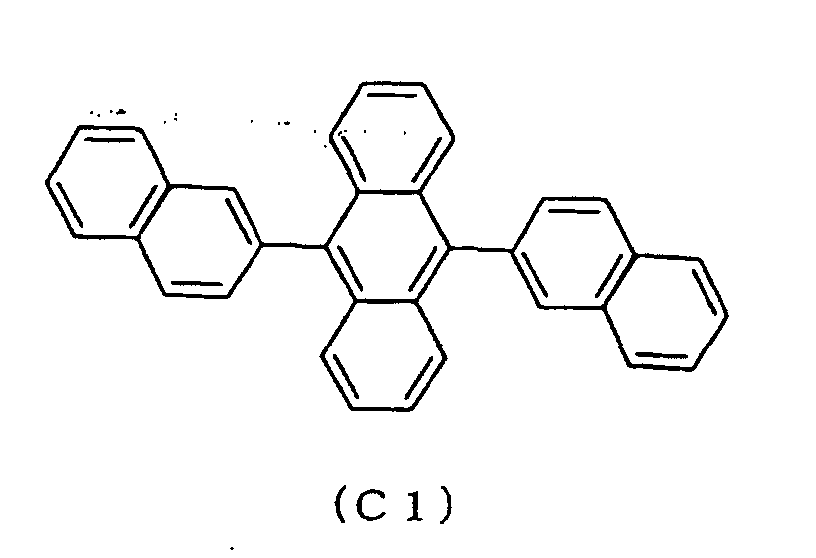
An organic EL device was prepared in accordance with the same
procedures as those conducted in Example 1 except that Compound (C2)
shown in the following, which is an arylanthracene compound described in
Japanese Patent Application Laid-Open No. 2000-273056, was used in
place of Compound (A1) used in Example 1. The voltage applied to the
device, the luminance of emitted light, the efficiency of light emission and
the color of emitted light of the device, the glass transition temperature
Tg of the used compound and the results of the storage test of the device
at a high temperature are shown in Table 1.
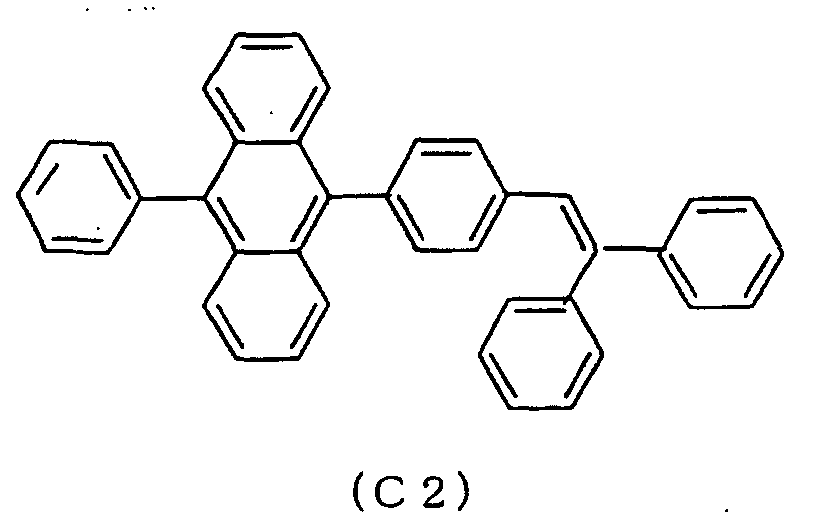
An organic EL device was prepared in accordance with the same
procedures as those conducted in Example 1 except that Compound (C3)
shown in the following, which is another arylanthracene compound
described in Japanese Patent Application Laid-Open No. 2000-273056,
was used in place of Compound (A1) used in Example 1. The voltage
applied to the device, the luminance of emitted light, the efficiency of light
emission and the color of emitted light of the device, the glass transition
temperature Tg of the used compound and the results of the storage test
of the device at a high temperature are shown in Table 1.

| Compound of light emitting layer | Voltage (V) | Luminance of emitted light (cd/m2) | Efficiency of light emission (cd/A) | Color of emitted light | Tg of compound (°C) | Storage test at high temperature | |
| Example 1 | (A1) | 6.0 | 176 | 2.2 | blue | 108 | good |
| Example 2 | (A2) | 6.0 | 200 | 2.3 | blue | 120 | good |
| Example 3 | (A3) | 6.0 | 161 | 3.1 | blue | 122 | good |
| Example 4 | (A4) | 6.0 | 110 | 2.3 | blue | 115 | good |
| Example 5 | (A5) | 6.0 | 780 | 2.0 | blue | 114 | good |
| Example 6 | (A6) | 6.0 | 180 | 2.8 | bluish | 112 | good |
| green | |||||||
| Example 7 | (A10) | 6.0 | 250 | 2.9 | blue | 128 | good |
| Example 8 | (A20) | 6.0 | 180 | 3.1 | blue | 124 | good |
| Example 9 | (B1) | 6.0 | 260 | 2.2 | blue | 156 | good |
| Example 10 | (B2) | 6.0 | 313 | 3.1 | blue | 152 | good |
| Comparative Example 1 | (C1) | 6.0 | 120 | 2.1 | bluish green | ND | crystallized |
| Comparative Example 2 | (C2) | 6.0 | 125 | 2.1 | blue | 95 | crystallized |
| Comparative Example 3 | (C3) | 6.0 | 153 | 2.5 | blue | 109 | crystallized |
| * In the test of storage at a high temperature, the result was evaluated as "good" when no defects such as changes in the bright spots and the color on the light emitting surface were found, and as "crystallized" when defects such as changes in the bright spots and the color on the light emitting surface were found. In the column of Tg, ND means that no Tg was observed in the measurement in accordance with the differential scanning calorimetry (DSC). |
As shown in Table 1, in Comparative Example 1 in which
Compound (C1) having an excellent symmetry was used, defects appeared
on the light emitting surface due to crystallization, and the emitted light
was bluish green, i.e., the purity of the blue color was not excellent. In
Comparative Examples 2 and 3, crystallization took place even though
Compounds (C2) and (C3) had asymmetric molecular structure in the
horizontal direction. This is considered to have taken place due to low
glass transition temperatures. Since the compounds of the present
invention were asymmetric and had relatively high glass transition
temperatures, the results of the storage test at a high temperature were
excellent.
A glass substrate (manufactured by GEOMATEC Company) of 25
mm×75 mm ×1.1 mm (thickness) having an ITO transparent electrode
was cleaned by application of ultrasonic wave in isopropyl alcohol for 5
minutes and then by exposure to ozone generated by ultraviolet light for
30 minutes. The glass substrate having the transparent electrode lines
which had been cleaned was attached to a substrate holder of a vacuum
vapor deposition apparatus. On the surface of the cleaned substrate at
the side having the transparent electrode, a film of TPD232 having a
thickness of 60 nm was formed in a manner such that the formed film
covered the transparent electrode. The formed film of TPD232 worked as
the hole injecting layer. On the formed film of TPD232, a film of BPTPD
having a thickness of 20 nm was formed. The formed film of BPTPD
worked as the hole transporting layer. On the formed film of BPTPD, a
film of the above Compound (A1) having a thickness of 40 nm was formed
by vapor deposition. The formed film of Compound (A1) worked as the
light emitting layer. At the same time, a styrylamine-based light
emitting molecule (D1) shown in the following was added in an amount of
7% by weight. On the film formed above, a film of Alq having a thickness
of 20 nm was formed. The film of Alq worked as the electron injecting
layer. Thereafter, Li (the source of lithium: manufactured by SAES
GETTERS Company) as the reducing dopant and Alq were binary vapor
deposited, and an Alq:Li film (the thickness: 10 nm) was formed as the
electron injecting layer (cathode). On the formed Alq:Li film, metallic
aluminum was vapor deposited to form a metal cathode, and an organic
EL device was prepared.
When a direct current voltage of 5.5 V was applied to the organic
EL device prepared above, blue light was emitted at a luminance of 200
cd/m2 and an efficiency of the light emission of 5.5 cd/A. When the device
was driven at an initial luminance of 500 cd/m2 under a constant electric
current, the time before the luminance decreased to a half of the initial
value (the half life) was 3,000 hours.

An organic EL device was prepared in accordance with the same
procedures as those conducted in Example 1 except that Compound (C1)
shown in the above, which is an arylanthracene compound described in
the United States Patent No. 05935721, was used in place of Compound
(A1) used in Example 1. The voltage applied to the device, the luminance
of emitted light, the efficiency of light emission and the color of emitted
light of the device, the glass transition temperature Tg of the used
compound and the results of the storage test of the device at a high
temperature are shown in Table 1.
When a direct current voltage of 5.5 V was applied to the organic
EL device prepared above, blue light was emitted at a luminance of 180
cd/m2 and an efficiency of the light emission of 5.0 cd/A. When the device
was driven at an initial luminance of 500 cd/m2 under a constant electric
current, the time before the luminance decreased to a half of the initial
value (the half life) was as short as 1,500 hours.
As described in detail in the above, the organic EL device which
exhibits a great luminance of emitted light, a great efficiency of light
emission and a high purity of color, emits bluish light, is excellent in
stability at high temperatures and has a long life can be obtained by
utilizing the novel aromatic compound of the present invention.
Therefore, the organic EL device of the present invention is very useful as
the light source for various electronic instruments.
Claims (11)
- A novel aromatic compound represented by following general formula (A):

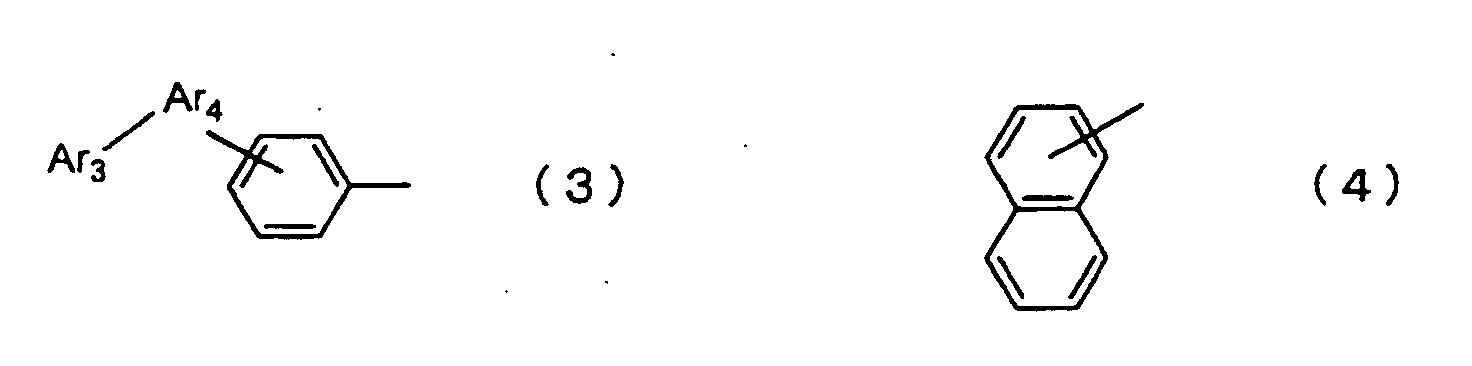


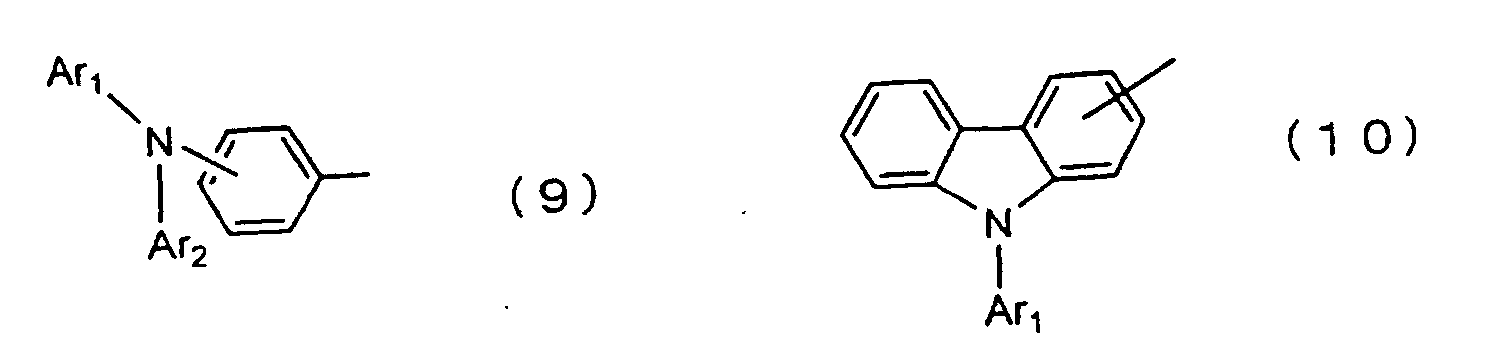 wherein Ar1 to Ar3 each independently represent a substituted or unsubstituted aryl group having 6 to 30 carbon atoms, Ar4 represents a substituted or unsubstituted arylene group having 6 to 30 carbon atoms, Ar5 represents a substituted or unsubstituted trivalent aromatic residue group having 6 to 30 carbon atoms, R1 and R2 each independently represent hydrogen atom, a halogen atom, hydroxyl group, a substituted or unsubstituted amino group, nitro group, cyano group, a substituted or unsubstituted alkyl group having 1 to 30 carbon atoms, a substituted or unsubstituted alkenyl group having 2 to 40 carbon atoms, a substituted or unsubstituted cycloalkyl group having 5 to 40 carbon atoms, a substituted or unsubstituted alkoxyl group having 1 to 30 carbon atoms, a substituted or unsubstituted aromatic hydrocarbon group having 5 to 40 carbon atoms, a substituted or unsubstituted aromatic heterocyclic group having 2 to 40 carbon atoms, a substituted or unsubstituted aralkyl group having 7 to 40 carbon atoms, a substituted or unsubstituted aryloxyl group having 6 to 40 carbon atoms, a substituted or unsubstituted alkoxycarbonyl group having 2 to 30 carbon atoms, a substituted or unsubstituted silyl group having 3 to 40 carbon atoms or carboxyl group, and groups represented by Ar1 and Ar2 and groups represented by R1 and R2 each independently may be bonded to each other and form a cyclic structure;
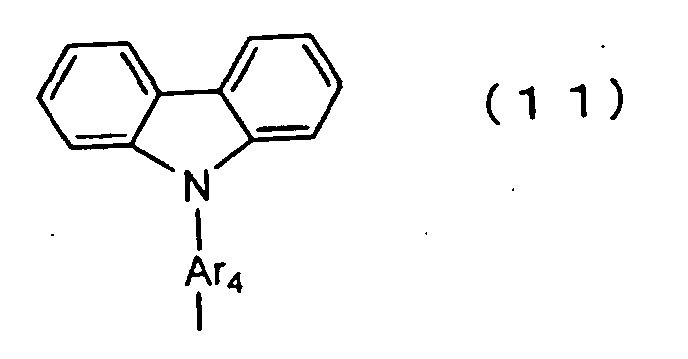 the foregoing general formulae (1) to (11) may be substituted with substituted or unsubstituted alkyl groups having 1 to 30 carbon atoms or substituted or unsubstituted phenyl group; andA does not represent phenyl group substituted with an arylamino group when the group represented by B is substituted with an arylamino group.
 - A novel aromatic compound according to Claim 1, wherein B in general formula (A) represents a heterocyclic group which has 2 to 60 carbon atoms and is mono-substituted with an alkenyl group or an arylamino group or an aryl group which has 5 to 60 carbon atoms and is mono-substituted with an alkenyl group or an arylamino group.
- A novel aromatic compound represented by following general formula (B):

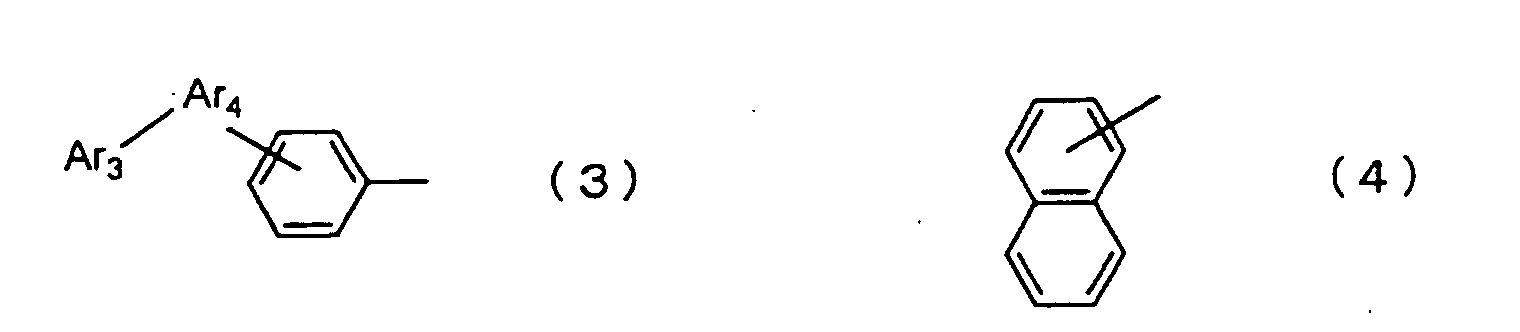


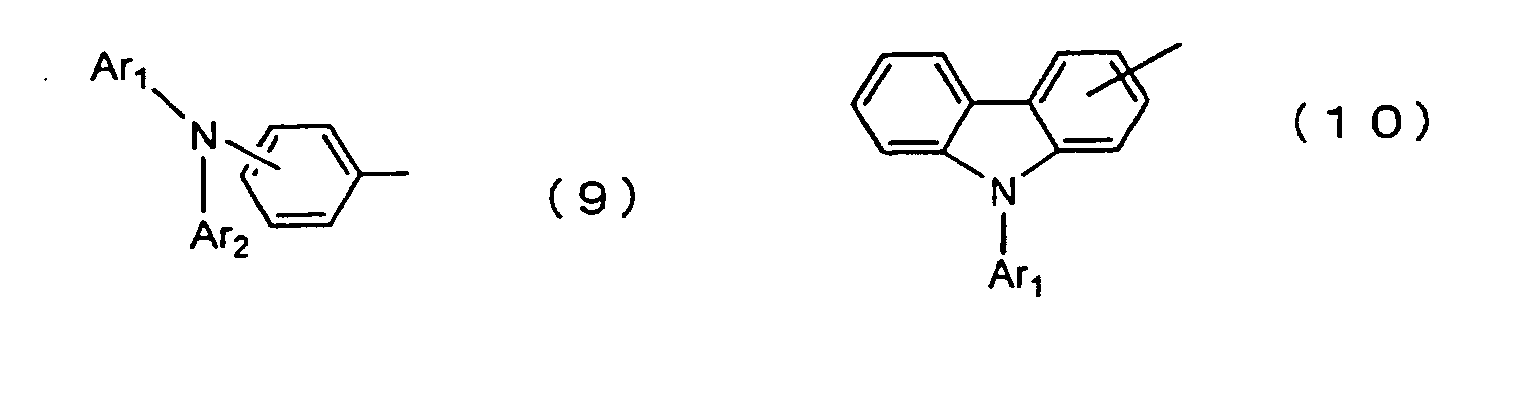 wherein Ar1 to Ar3 each independently represent a substituted or unsubstituted aryl group having 6 to 30 carbon atoms, Ar4 represents a substituted or unsubstituted arylene group having 6 to 30 carbon atoms, Ar5 represents a substituted or unsubstituted trivalent aromatic residue group having 6 to 30 carbon atoms, R1 and R2 each independently represent hydrogen atom, a halogen atom, hydroxyl group, a substituted or unsubstituted amino group, nitro group, cyano group, a substituted or unsubstituted alkyl group having 1 to 30 carbon atoms, a substituted or unsubstituted alkenyl group having 2 to 40 carbon atoms, a substituted or unsubstituted cycloalkyl group having 5 to 40 carbon atoms, a substituted or unsubstituted alkoxyl group having 1 to 30 carbon atoms, a substituted or unsubstituted aromatic hydrocarbon group having 5 to 40 carbon atoms, a substituted or unsubstituted aromatic heterocyclic group having 2 to 40 carbon atoms, a substituted or unsubstituted aralkyl group having 7 to 40 carbon atoms, a substituted or unsubstituted aryloxyl group having 6 to 40 carbon atoms, a substituted or unsubstituted alkoxycarbonyl group having 2 to 30 carbon atoms, a substituted or unsubstituted silyl group having 3 to 40 carbon atoms or carboxyl group, groups represented by Ar1 and Ar2 and groups represented by R1 and R2 each independently may be bonded to each other and form a cyclic structure, and p in general formula (12) represents 0 or 1; the foregoing general formulae (2) to (12) may be substituted with substituted or unsubstituted alkyl groups having 1 to 30 carbon atoms or substituted or unsubstituted phenyl group; and A does not represent phenyl group substituted with an arylamino group when the group represented by B is substituted with an arylamino group.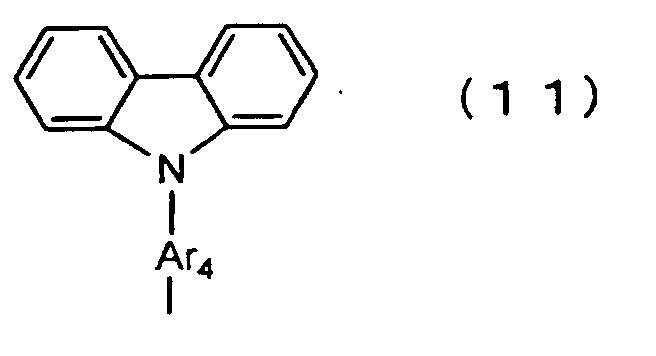
- A novel aromatic compound according to Claim 3, wherein B in general formula (A) represents a heterocyclic group which has 2 to 60 carbon atoms and is mono-substituted with an alkenyl group or an arylamino group or an aryl group which has 5 to 60 carbon atoms and is mono-substituted with an alkenyl group or an arylamino group.
- A novel aromatic compound according to any one of Claims 1 to 4, which is a material for organic electroluminescence devices.
- An organic electroluminescence device which comprises a cathode, an anode and an organic thin film layer comprising at least one layer containing a light emitting layer and sandwiched between the cathode and the anode, wherein at least one layer in the organic thin film layer comprises a novel aromatic compound described in any one of Claims 1 to 4 singly or as a component of a mixture.
- An organic electroluminescence device which comprises a cathode, an anode and an organic thin film layer comprising at least one layer containing a light emitting layer and sandwiched between the cathode and the anode, wherein the organic thin film layer comprises at least one of an electron transporting layer and a hole transporting layer, and at least one of the electron transporting layer and the hole transporting layer comprises a novel aromatic compound described in any one of Claims 1 to 4 singly or as a component of a mixture.
- An organic electroluminescence device according to Claim 6, wherein the light emitting layer further comprises an arylamine compound.
- An organic electroluminescence device according to Claim 6, wherein the light emitting layer further comprises a styrylamine compound.
- An organic electroluminescence device according to Claim 6, wherein an electron transporting region or an interface region between the cathode and the organic thin film layer comprises a reducing dopant.
- An organic electroluminescence device according to Claim 6, which emits bluish light.
Applications Claiming Priority (3)
| Application Number | Priority Date | Filing Date | Title |
|---|---|---|---|
| JP2002114400A JP4170655B2 (en) | 2002-04-17 | 2002-04-17 | Novel aromatic compound and organic electroluminescence device using the same |
| JP2002114400 | 2002-04-17 | ||
| PCT/JP2003/004905 WO2003087023A1 (en) | 2002-04-17 | 2003-04-17 | Novel aromatic compound and organic electroluminescnet element containing the same |
Publications (2)
| Publication Number | Publication Date |
|---|---|
| EP1496041A1 true EP1496041A1 (en) | 2005-01-12 |
| EP1496041A4 EP1496041A4 (en) | 2005-11-02 |
Family
ID=29243386
Family Applications (1)
| Application Number | Title | Priority Date | Filing Date |
|---|---|---|---|
| EP03723137A Withdrawn EP1496041A4 (en) | 2002-04-17 | 2003-04-17 | NOVEL AROMATIC COMPOUND AND ORGANIC ELECTROLUMINESCENT ELEMENT CONTAINING SAID COMPOUND |
Country Status (7)
| Country | Link |
|---|---|
| US (2) | US7790892B2 (en) |
| EP (1) | EP1496041A4 (en) |
| JP (1) | JP4170655B2 (en) |
| KR (1) | KR100985942B1 (en) |
| CN (3) | CN1876610A (en) |
| TW (1) | TW200401022A (en) |
| WO (1) | WO2003087023A1 (en) |
Cited By (10)
| Publication number | Priority date | Publication date | Assignee | Title |
|---|---|---|---|---|
| WO2008010171A3 (en) * | 2006-07-19 | 2008-04-03 | Philips Intellectual Property | Highly doped electro-optically active organic diode with short protection layer |
| EP1696015A4 (en) * | 2003-12-19 | 2009-01-28 | Idemitsu Kosan Co | ELECTROLUMINESCENT MATERIAL FOR ORGANIC ELECTROLUMINESCENT DEVICE AND ORGANIC ELECTROLUMINESCENT DEVICE USING SUCH MATERIAL |
| EP1864962A4 (en) * | 2005-03-28 | 2009-04-01 | Idemitsu Kosan Co | ANTHRYLARYLENE DERIVATIVE, MATERIAL FOR ORGANIC ELECTROLUMINESCENT DEVICE, AND ORGANIC LIGHT EMITTING DEVICE USING THE SAME |
| EP1533289A4 (en) * | 2002-08-02 | 2009-08-12 | Idemitsu Kosan Co | ANTHRACENE DERIVATIVES AND ORGANIC ELECTROLUMINESCENT DEVICES MADE USING THESE DERIVATIVES |
| WO2009112854A1 (en) * | 2008-03-11 | 2009-09-17 | Merck Patent Gmbh | Compounds having electroluminescent or electron transport properties |
| US8039122B2 (en) | 2005-03-28 | 2011-10-18 | Semiconductor Energy Laboratory Co., Ltd. | Anthracene derivative, material for light emitting element, light emitting element, light emitting device, and electronic device |
| US8231942B2 (en) | 2008-05-16 | 2012-07-31 | Semiconductor Energy Laboratory Co., Ltd. | Composition, method for manufacturing thin film, and method for manufacturing light-emitting element |
| US8722904B2 (en) | 2008-04-02 | 2014-05-13 | Semiconductor Energy Laboratory Co., Ltd. | Anthracene derivative, light-emitting device and electronic appliance |
| EP2145937B2 (en) † | 2002-08-23 | 2016-03-02 | Idemitsu Kosan Co., Ltd. | Organic electroluminescence device and anthracene derivative |
| US9972790B2 (en) | 2007-12-21 | 2018-05-15 | Semiconductor Energy Laboratory Co., Ltd. | Anthracene derivative, and light-emitting material, light-emitting element, light-emitting device, and electronic device using the same |
Families Citing this family (73)
| Publication number | Priority date | Publication date | Assignee | Title |
|---|---|---|---|---|
| US7056601B2 (en) * | 2003-10-24 | 2006-06-06 | Eastman Kodak Company | OLED device with asymmetric host |
| US7887931B2 (en) | 2003-10-24 | 2011-02-15 | Global Oled Technology Llc | Electroluminescent device with anthracene derivative host |
| KR101156241B1 (en) | 2003-12-01 | 2012-06-13 | 이데미쓰 고산 가부시키가이샤 | Asymmetric monoanthracene derivative, material for organic electroluminescent device and organic electroluminescent device utilizing the same |
| WO2005081587A1 (en) * | 2004-02-19 | 2005-09-01 | Idemitsu Kosan Co., Ltd. | White color organic electroluminescence device |
| US20070216289A1 (en) * | 2004-04-21 | 2007-09-20 | Idemitsu Kosan Co., Ltd | Organic Electroluminescence Display Device |
| TWI373506B (en) | 2004-05-21 | 2012-10-01 | Toray Industries | Light-emitting element material and light-emitting material |
| KR20070033339A (en) * | 2004-05-27 | 2007-03-26 | 이데미쓰 고산 가부시키가이샤 | White organic electroluminescent device |
| JP4925569B2 (en) * | 2004-07-08 | 2012-04-25 | ローム株式会社 | Organic electroluminescent device |
| KR100700425B1 (en) | 2004-12-14 | 2007-03-27 | 네오뷰코오롱 주식회사 | Blue light emitting organic compound and organic light emitting diode comprising the same |
| US7622619B2 (en) * | 2005-07-20 | 2009-11-24 | Lg Display Co., Ltd. | Synthesis process |
| JP5317386B2 (en) * | 2005-08-05 | 2013-10-16 | 出光興産株式会社 | Nitrogen-containing heterocyclic derivative and organic electroluminescence device using the same |
| DE102005040411A1 (en) | 2005-08-26 | 2007-03-01 | Merck Patent Gmbh | New materials for organic electroluminescent devices |
| KR101359412B1 (en) * | 2005-08-31 | 2014-02-27 | 가부시키가이샤 한도오따이 에네루기 켄큐쇼 | Carbazole derivative, Material for light emitting element, Light emitting element, Light emitting device, and Electronic device |
| CN100486398C (en) * | 2005-09-06 | 2009-05-06 | 中华映管股份有限公司 | Organic electroluminescent element and hole transport layer material |
| KR101425378B1 (en) * | 2005-10-05 | 2014-08-01 | 가부시키가이샤 한도오따이 에네루기 켄큐쇼 | Stilbene derivatives, light-emitting element and light-emitting device |
| KR100827917B1 (en) * | 2005-11-18 | 2008-05-07 | 주식회사 엘지화학 | Emitting material and organic light emitting diode using the same |
| WO2007065550A1 (en) * | 2005-12-08 | 2007-06-14 | Merck Patent Gmbh | Novel materials for organic electroluminescent devices |
| JP4979247B2 (en) * | 2006-03-08 | 2012-07-18 | 三井化学株式会社 | Anthracene compound and organic electroluminescence device containing the compound |
| US7731377B2 (en) * | 2006-03-21 | 2010-06-08 | Semiconductor Energy Laboratory Co., Ltd. | Backlight device and display device |
| DE102006013802A1 (en) | 2006-03-24 | 2007-09-27 | Merck Patent Gmbh | New materials for organic electroluminescent devices |
| DE102006031990A1 (en) | 2006-07-11 | 2008-01-17 | Merck Patent Gmbh | New materials for organic electroluminescent devices |
| CN101506163B (en) * | 2006-08-30 | 2012-05-02 | 株式会社半导体能源研究所 | Method for synthesizing anthracene derivative and anthracene derivative, light emitting element, light emitting device, electronic device |
| US8911882B2 (en) * | 2006-09-28 | 2014-12-16 | Semiconductor Energy Laboratory Co., Ltd. | Stilbene derivative, light-emitting element, light-emitting device, and electronic device |
| JP2008195841A (en) * | 2007-02-14 | 2008-08-28 | Toray Ind Inc | Light emitting device material and light emitting device |
| US7723722B2 (en) | 2007-03-23 | 2010-05-25 | Semiconductor Energy Laboratory Co., Ltd. | Organic compound, anthracene derivative, and light-emitting element, light-emitting device, and electronic device using anthracene derivative |
| KR101393880B1 (en) * | 2007-03-28 | 2014-05-12 | 동우 화인켐 주식회사 | Organosilane Compounds, Electroluminescent Materials Comprising The Same, and Organic Electroluminescent Device |
| KR100857024B1 (en) * | 2007-04-13 | 2008-09-05 | (주)그라쎌 | High performance electroluminescent compound and organic light emitting device employing the same |
| US20080286445A1 (en) * | 2007-05-17 | 2008-11-20 | Semiconductor Energy Laboratory Co., Ltd. | Composition, and method of fabricating light-emitting element |
| DE102007024850A1 (en) | 2007-05-29 | 2008-12-04 | Merck Patent Gmbh | New materials for organic electroluminescent devices |
| JP5399920B2 (en) * | 2007-11-21 | 2014-01-29 | 出光興産株式会社 | Condensed aromatic derivative and organic electroluminescence device using the same |
| DE102008008953B4 (en) * | 2008-02-13 | 2019-05-09 | Merck Patent Gmbh | New materials for organic electroluminescent devices |
| JP5490095B2 (en) * | 2008-04-11 | 2014-05-14 | ボード・オブ・リージェンツ・オブ・ザ・ユニバーシティ・オブ・テキサス・システム | Method and apparatus for amplifying electrochemiluminescence by nanoparticles |
| DE102008018670A1 (en) | 2008-04-14 | 2009-10-15 | Merck Patent Gmbh | New materials for organic electroluminescent devices |
| WO2009137002A2 (en) * | 2008-05-08 | 2009-11-12 | Board Of Regents Of The University Of Texas System | Luminescent nanostructured materials for use in electrogenerated chemiluminescence |
| CN102089282A (en) * | 2008-07-08 | 2011-06-08 | 株式会社半导体能源研究所 | Carbazole derivative, light-emitting element material, light-emitting element, and light-emitting device |
| EP2166001B1 (en) * | 2008-09-19 | 2011-07-20 | Semiconductor Energy Laboratory Co., Ltd. | Carbazole Derivative and Method for Producing the Same |
| DE102008054141A1 (en) | 2008-10-31 | 2010-05-06 | Merck Patent Gmbh | New materials for organic electroluminescent devices |
| DE102009005746A1 (en) | 2009-01-23 | 2010-07-29 | Merck Patent Gmbh | Materials for organic electroluminescent devices |
| DE102009033371A1 (en) | 2009-07-16 | 2011-05-12 | Merck Patent Gmbh | Materials for electronic devices |
| DE102009034625A1 (en) | 2009-07-27 | 2011-02-03 | Merck Patent Gmbh | New materials for organic electroluminescent devices |
| US8771030B2 (en) | 2009-08-19 | 2014-07-08 | Sharp Kabushiki Kaisha | Color conversion layer and manufacturing method for same |
| DE102009051172A1 (en) | 2009-10-29 | 2011-05-05 | Merck Patent Gmbh | Materials for electronic devices |
| DE102009053191A1 (en) | 2009-11-06 | 2011-05-12 | Merck Patent Gmbh | Materials for electronic devices |
| DE102009052428A1 (en) | 2009-11-10 | 2011-05-12 | Merck Patent Gmbh | Connection for electronic devices |
| EP2518038A4 (en) * | 2009-12-21 | 2013-06-26 | Idemitsu Kosan Co | PYRENE DERIVATIVE AND ORGANIC ELECTROLUMINESCENT ELEMENT USING THE DERIVATIVE |
| DE102010005697A1 (en) | 2010-01-25 | 2011-07-28 | Merck Patent GmbH, 64293 | Connections for electronic devices |
| JP5783173B2 (en) * | 2010-06-02 | 2015-09-24 | Jnc株式会社 | Carbazole compounds having substituents containing electron-accepting nitrogen-containing heteroaryl and organic electroluminescent devices |
| DE102010048074A1 (en) | 2010-10-09 | 2012-04-12 | Merck Patent Gmbh | Materials for electronic devices |
| DE102010054316A1 (en) | 2010-12-13 | 2012-06-14 | Merck Patent Gmbh | Substituted tetraarylbenzenes |
| DE102011011104A1 (en) | 2011-02-12 | 2012-08-16 | Merck Patent Gmbh | Substituted dibenzonaphthacenes |
| CN102491881B (en) * | 2011-12-12 | 2013-09-11 | 南京信息工程大学 | Dibromo anthracene compound and preparation method and application thereof |
| KR101993491B1 (en) * | 2012-01-10 | 2019-06-26 | 제이엔씨 주식회사 | Material for light emitting layers and organic electroluminescent element using same |
| JP2015534258A (en) | 2012-08-21 | 2015-11-26 | チェイル インダストリーズ インコーポレイテッド | Compound for organic optoelectronic device, organic light emitting device including the same, and display device including the organic light emitting device |
| US9312500B2 (en) | 2012-08-31 | 2016-04-12 | Idemitsu Kosan Co., Ltd. | Organic electroluminescence device |
| KR102050484B1 (en) | 2013-03-04 | 2019-12-02 | 삼성디스플레이 주식회사 | Anthracene derivatives and organic light emitting diodes comprising the derivatives |
| KR102107106B1 (en) | 2013-05-09 | 2020-05-07 | 삼성디스플레이 주식회사 | Styryl-based compound and organic light emitting diode comprising the same |
| KR102269131B1 (en) | 2013-07-01 | 2021-06-25 | 삼성디스플레이 주식회사 | Compound and organic light emitting device comprising same |
| KR102202756B1 (en) | 2013-07-30 | 2021-01-13 | 메르크 파텐트 게엠베하 | Materials for electronic devices |
| KR102717935B1 (en) | 2013-07-30 | 2024-10-16 | 메르크 파텐트 게엠베하 | Materials for electronic devices |
| US10062850B2 (en) | 2013-12-12 | 2018-08-28 | Samsung Display Co., Ltd. | Amine-based compounds and organic light-emitting devices comprising the same |
| CN106255687B (en) | 2014-04-30 | 2020-06-05 | 默克专利有限公司 | Material for electronic devices |
| KR20150132795A (en) | 2014-05-16 | 2015-11-26 | 삼성디스플레이 주식회사 | Organic light emitting device |
| KR102327086B1 (en) | 2014-06-11 | 2021-11-17 | 삼성디스플레이 주식회사 | Organic light-emitting devices |
| DE102014008722B4 (en) | 2014-06-18 | 2024-08-22 | Merck Patent Gmbh | Compositions for electronic devices, formulation containing them, use of the composition, use of the formulation and organic electronic device containing the composition |
| KR102343145B1 (en) | 2015-01-12 | 2021-12-27 | 삼성디스플레이 주식회사 | Condensed compound and organic light-emitting device comprising the same |
| KR102844041B1 (en) | 2016-02-26 | 2025-08-11 | 가부시키가이샤 한도오따이 에네루기 켄큐쇼 | Organic compound, light-emitting element, light-emitting device, electronic device, and lighting device |
| US11778907B2 (en) | 2017-04-13 | 2023-10-03 | Merck Patent Gmbh | Composition for organic electronic devices |
| KR102563713B1 (en) | 2017-04-26 | 2023-08-07 | 오티아이 루미오닉스 인크. | Methods of patterning the coating of a surface and apparatus comprising the patterned coating |
| US11751415B2 (en) | 2018-02-02 | 2023-09-05 | Oti Lumionics Inc. | Materials for forming a nucleation-inhibiting coating and devices incorporating same |
| KR20250160226A (en) | 2019-03-07 | 2025-11-11 | 오티아이 루미오닉스 인크. | Materials for forming a nucleation-inhibiting coating and devices incorporating same |
| JP7555600B2 (en) | 2019-04-18 | 2024-09-25 | オーティーアイ ルミオニクス インコーポレーテッド | Materials for forming nucleation-inhibiting coatings and devices incorporating same - Patents.com |
| JP7576337B2 (en) | 2019-05-08 | 2024-11-01 | オーティーアイ ルミオニクス インコーポレーテッド | Materials for forming nucleation-inhibiting coatings and devices incorporating same - Patents.com |
| US11985841B2 (en) | 2020-12-07 | 2024-05-14 | Oti Lumionics Inc. | Patterning a conductive deposited layer using a nucleation inhibiting coating and an underlying metallic coating |
Family Cites Families (13)
| Publication number | Priority date | Publication date | Assignee | Title |
|---|---|---|---|---|
| US593571A (en) | 1897-11-16 | Magnetic clutch | ||
| JP2897138B2 (en) | 1989-06-30 | 1999-05-31 | 株式会社リコー | EL device |
| JPH07138561A (en) | 1993-11-17 | 1995-05-30 | Idemitsu Kosan Co Ltd | Organic electroluminescent device |
| DE69511755T2 (en) | 1994-04-26 | 2000-01-13 | Tdk Corp | Phenylanthracene derivative and organic EL element |
| JP3816969B2 (en) | 1994-04-26 | 2006-08-30 | Tdk株式会社 | Organic EL device |
| JP3724833B2 (en) | 1995-03-06 | 2005-12-07 | 出光興産株式会社 | Organic electroluminescence device |
| JP3769934B2 (en) * | 1998-05-20 | 2006-04-26 | 凸版印刷株式会社 | Organic thin film EL device |
| JP4429438B2 (en) | 1999-01-19 | 2010-03-10 | 出光興産株式会社 | Amino compound and organic electroluminescence device using the same |
| JP2001097897A (en) | 1999-09-30 | 2001-04-10 | Idemitsu Kosan Co Ltd | Organic compound and organic electroluminescent device using the same |
| EP1182183B1 (en) * | 2000-03-29 | 2009-12-09 | Idemitsu Kosan Co., Ltd. | Anthracene derivatives and organic electroluminescent devices made by using the same |
| JP4094203B2 (en) * | 2000-03-30 | 2008-06-04 | 出光興産株式会社 | Organic electroluminescence device and organic light emitting medium |
| WO2002014244A1 (en) * | 2000-08-10 | 2002-02-21 | Mitsui Chemicals, Inc. | Hydrocarbon compound, material for organic electroluminescent element and organic electroluminescent element |
| KR20050040835A (en) | 2001-10-31 | 2005-05-03 | 이데미쓰 고산 가부시키가이샤 | Novel soluble compound and organic electroluminescent devices |
-
2002
- 2002-04-17 JP JP2002114400A patent/JP4170655B2/en not_active Expired - Fee Related
-
2003
- 2003-04-17 TW TW092108959A patent/TW200401022A/en unknown
- 2003-04-17 WO PCT/JP2003/004905 patent/WO2003087023A1/en not_active Ceased
- 2003-04-17 CN CNA200610092401XA patent/CN1876610A/en active Pending
- 2003-04-17 CN CNB038085453A patent/CN100475759C/en not_active Expired - Fee Related
- 2003-04-17 EP EP03723137A patent/EP1496041A4/en not_active Withdrawn
- 2003-04-17 US US10/508,602 patent/US7790892B2/en not_active Expired - Fee Related
- 2003-04-17 KR KR1020047016530A patent/KR100985942B1/en not_active Expired - Fee Related
- 2003-04-17 CN CNA2006101598446A patent/CN1939884A/en active Pending
-
2010
- 2010-08-09 US US12/805,603 patent/US20110049482A1/en not_active Abandoned
Cited By (23)
| Publication number | Priority date | Publication date | Assignee | Title |
|---|---|---|---|---|
| EP1533289A4 (en) * | 2002-08-02 | 2009-08-12 | Idemitsu Kosan Co | ANTHRACENE DERIVATIVES AND ORGANIC ELECTROLUMINESCENT DEVICES MADE USING THESE DERIVATIVES |
| EP2145937B2 (en) † | 2002-08-23 | 2016-03-02 | Idemitsu Kosan Co., Ltd. | Organic electroluminescence device and anthracene derivative |
| US10069074B2 (en) | 2003-12-19 | 2018-09-04 | Idemitsu Kosan Co., Ltd. | Light-emitting material for organic electroluminescent device, organic electroluminescent device using same, and material for organic electroluminescent device |
| US9219234B2 (en) | 2003-12-19 | 2015-12-22 | Idemitsu Kosan Co., Ltd. | Light-emitting material for organic electroluminescent device, organic electroluminescent device using same, and material for organic electroluminescent device |
| US10205101B2 (en) | 2003-12-19 | 2019-02-12 | Idemitsu Kosan Co., Ltd. | Light-emitting material for organic electroluminescent device, organic electroluminescent device using same, and material for organic electroluminescent device |
| US8853675B2 (en) | 2003-12-19 | 2014-10-07 | Idemitsu Kosan Co., Ltd. | Light-emitting material for organic electroluminescent device, organic electroluminescent device using same, and material for organic electroluminescent device |
| EP1696015A4 (en) * | 2003-12-19 | 2009-01-28 | Idemitsu Kosan Co | ELECTROLUMINESCENT MATERIAL FOR ORGANIC ELECTROLUMINESCENT DEVICE AND ORGANIC ELECTROLUMINESCENT DEVICE USING SUCH MATERIAL |
| US9786846B2 (en) | 2003-12-19 | 2017-10-10 | Idemitsu Kosan Co., Ltd. | Light-emitting material for organic electroluminescent device, organic electroluminescent device using same, and material for organic electroluminescent device |
| US8603647B2 (en) | 2005-03-28 | 2013-12-10 | Semiconductor Energy Laboratory Co., Ltd. | Anthracene derivative, material for light emitting element, light emitting element, light emitting device, and electronic device |
| US8298687B2 (en) | 2005-03-28 | 2012-10-30 | Semiconductor Energy Laboratory Co., Ltd. | Anthracene derivative, material for light emitting element, light emitting element, light emitting device, and electronic device |
| EP1864962A4 (en) * | 2005-03-28 | 2009-04-01 | Idemitsu Kosan Co | ANTHRYLARYLENE DERIVATIVE, MATERIAL FOR ORGANIC ELECTROLUMINESCENT DEVICE, AND ORGANIC LIGHT EMITTING DEVICE USING THE SAME |
| US8039122B2 (en) | 2005-03-28 | 2011-10-18 | Semiconductor Energy Laboratory Co., Ltd. | Anthracene derivative, material for light emitting element, light emitting element, light emitting device, and electronic device |
| US7985491B2 (en) | 2005-03-28 | 2011-07-26 | Idemitsu Kosan Co., Ltd. | Anthrylarylene derivative, material for organic electroluminescence device and organic electroluminescence device using same |
| WO2008010171A3 (en) * | 2006-07-19 | 2008-04-03 | Philips Intellectual Property | Highly doped electro-optically active organic diode with short protection layer |
| US8692460B2 (en) | 2006-07-19 | 2014-04-08 | Koninklijke Philips N.V. | Highly doped electro-optically active organic diode with short protection layer |
| CN101490865B (en) * | 2006-07-19 | 2011-09-07 | 皇家飞利浦电子股份有限公司 | Highly doped electro-optically active organic diode with short protection layer |
| US9972790B2 (en) | 2007-12-21 | 2018-05-15 | Semiconductor Energy Laboratory Co., Ltd. | Anthracene derivative, and light-emitting material, light-emitting element, light-emitting device, and electronic device using the same |
| US8507896B2 (en) | 2008-03-11 | 2013-08-13 | Merck Patent Gmbh | Compounds having electroluminescent or electron transport properties |
| WO2009112854A1 (en) * | 2008-03-11 | 2009-09-17 | Merck Patent Gmbh | Compounds having electroluminescent or electron transport properties |
| US8722904B2 (en) | 2008-04-02 | 2014-05-13 | Semiconductor Energy Laboratory Co., Ltd. | Anthracene derivative, light-emitting device and electronic appliance |
| US8845926B2 (en) | 2008-05-16 | 2014-09-30 | Semiconductor Energy Laboratory Co., Ltd. | Composition, method for manufacturing thin film, and method for manufacturing light-emitting element |
| US8518492B2 (en) | 2008-05-16 | 2013-08-27 | Semiconductor Energy Laboratory Co., Ltd. | Composition, method for manufacturing thin film, and method for manufacturing light-emitting element |
| US8231942B2 (en) | 2008-05-16 | 2012-07-31 | Semiconductor Energy Laboratory Co., Ltd. | Composition, method for manufacturing thin film, and method for manufacturing light-emitting element |
Also Published As
| Publication number | Publication date |
|---|---|
| KR20050000520A (en) | 2005-01-05 |
| WO2003087023A1 (en) | 2003-10-23 |
| CN1876610A (en) | 2006-12-13 |
| KR100985942B1 (en) | 2010-10-06 |
| CN100475759C (en) | 2009-04-08 |
| US20110049482A1 (en) | 2011-03-03 |
| CN1646456A (en) | 2005-07-27 |
| EP1496041A4 (en) | 2005-11-02 |
| CN1939884A (en) | 2007-04-04 |
| TW200401022A (en) | 2004-01-16 |
| JP2003306454A (en) | 2003-10-28 |
| US20050214565A1 (en) | 2005-09-29 |
| US7790892B2 (en) | 2010-09-07 |
| JP4170655B2 (en) | 2008-10-22 |
Similar Documents
| Publication | Publication Date | Title |
|---|---|---|
| US7790892B2 (en) | Aromatic compound and organic electroluminescent element containing the same | |
| US10217943B2 (en) | Organic electroluminescence device and anthracene derivative | |
| US7829206B2 (en) | Benzanthracene derivative and electroluminescence device using the same | |
| US7087322B2 (en) | Organic electroluminescence device | |
| US20080160344A1 (en) | Novel soluble compound and organic electroluminescent devices | |
| US20050233165A1 (en) | Anthracene derivatives and organic electroluminescent devices made by using the same | |
| US20070285009A1 (en) | Bisanthracene derivative and organic electroluminescence device using the same | |
| US7985491B2 (en) | Anthrylarylene derivative, material for organic electroluminescence device and organic electroluminescence device using same | |
| US20070167654A1 (en) | Aromatic amine derivative and organic electroluminescence device employing the same | |
| EP1584614A1 (en) | Aromatic amine derivative and organic electroluminescence element | |
| US20060216633A1 (en) | Bisanthracene derivative and organic electroluminescence device using the same | |
| EP1903020B1 (en) | Biphenyl derivatives, organic electroluminescent materials, and organic electroluminescent devices made by using the same | |
| JP2002124385A (en) | Organic electroluminescence device |
Legal Events
| Date | Code | Title | Description |
|---|---|---|---|
| PUAI | Public reference made under article 153(3) epc to a published international application that has entered the european phase |
Free format text: ORIGINAL CODE: 0009012 |
|
| 17P | Request for examination filed |
Effective date: 20040909 |
|
| AK | Designated contracting states |
Kind code of ref document: A1 Designated state(s): AT BE BG CH CY CZ DE DK EE ES FI FR GB GR HU IE IT LI LU MC NL PT RO SE SI SK TR |
|
| A4 | Supplementary search report drawn up and despatched |
Effective date: 20050920 |
|
| 17Q | First examination report despatched |
Effective date: 20081127 |
|
| STAA | Information on the status of an ep patent application or granted ep patent |
Free format text: STATUS: THE APPLICATION IS DEEMED TO BE WITHDRAWN |
|
| 18D | Application deemed to be withdrawn |
Effective date: 20090408 |