EP1492597B2 - Training device - Google Patents
Training device Download PDFInfo
- Publication number
- EP1492597B2 EP1492597B2 EP03727176A EP03727176A EP1492597B2 EP 1492597 B2 EP1492597 B2 EP 1492597B2 EP 03727176 A EP03727176 A EP 03727176A EP 03727176 A EP03727176 A EP 03727176A EP 1492597 B2 EP1492597 B2 EP 1492597B2
- Authority
- EP
- European Patent Office
- Prior art keywords
- training
- training apparatus
- frame part
- joint
- arm
- Prior art date
- Legal status (The legal status is an assumption and is not a legal conclusion. Google has not performed a legal analysis and makes no representation as to the accuracy of the status listed.)
- Expired - Lifetime
Links
Images
Classifications
-
- A—HUMAN NECESSITIES
- A63—SPORTS; GAMES; AMUSEMENTS
- A63B—APPARATUS FOR PHYSICAL TRAINING, GYMNASTICS, SWIMMING, CLIMBING, OR FENCING; BALL GAMES; TRAINING EQUIPMENT
- A63B22/00—Exercising apparatus specially adapted for conditioning the cardio-vascular system, for training agility or co-ordination of movements
- A63B22/0048—Exercising apparatus specially adapted for conditioning the cardio-vascular system, for training agility or co-ordination of movements with cantilevered support elements pivoting about an axis
- A63B22/0056—Exercising apparatus specially adapted for conditioning the cardio-vascular system, for training agility or co-ordination of movements with cantilevered support elements pivoting about an axis the pivoting movement being in a vertical plane, e.g. steppers with a horizontal axis
-
- A—HUMAN NECESSITIES
- A63—SPORTS; GAMES; AMUSEMENTS
- A63B—APPARATUS FOR PHYSICAL TRAINING, GYMNASTICS, SWIMMING, CLIMBING, OR FENCING; BALL GAMES; TRAINING EQUIPMENT
- A63B22/00—Exercising apparatus specially adapted for conditioning the cardio-vascular system, for training agility or co-ordination of movements
- A63B22/06—Exercising apparatus specially adapted for conditioning the cardio-vascular system, for training agility or co-ordination of movements with support elements performing a rotating cycling movement, i.e. a closed path movement
-
- A—HUMAN NECESSITIES
- A63—SPORTS; GAMES; AMUSEMENTS
- A63B—APPARATUS FOR PHYSICAL TRAINING, GYMNASTICS, SWIMMING, CLIMBING, OR FENCING; BALL GAMES; TRAINING EQUIPMENT
- A63B22/00—Exercising apparatus specially adapted for conditioning the cardio-vascular system, for training agility or co-ordination of movements
- A63B22/0002—Exercising apparatus specially adapted for conditioning the cardio-vascular system, for training agility or co-ordination of movements involving an exercising of arms
-
- A—HUMAN NECESSITIES
- A63—SPORTS; GAMES; AMUSEMENTS
- A63B—APPARATUS FOR PHYSICAL TRAINING, GYMNASTICS, SWIMMING, CLIMBING, OR FENCING; BALL GAMES; TRAINING EQUIPMENT
- A63B22/00—Exercising apparatus specially adapted for conditioning the cardio-vascular system, for training agility or co-ordination of movements
- A63B22/0002—Exercising apparatus specially adapted for conditioning the cardio-vascular system, for training agility or co-ordination of movements involving an exercising of arms
- A63B22/0005—Exercising apparatus specially adapted for conditioning the cardio-vascular system, for training agility or co-ordination of movements involving an exercising of arms with particular movement of the arms provided by handles moving otherwise than pivoting about a horizontal axis parallel to the body-symmetrical-plane
-
- A—HUMAN NECESSITIES
- A63—SPORTS; GAMES; AMUSEMENTS
- A63B—APPARATUS FOR PHYSICAL TRAINING, GYMNASTICS, SWIMMING, CLIMBING, OR FENCING; BALL GAMES; TRAINING EQUIPMENT
- A63B22/00—Exercising apparatus specially adapted for conditioning the cardio-vascular system, for training agility or co-ordination of movements
- A63B22/0002—Exercising apparatus specially adapted for conditioning the cardio-vascular system, for training agility or co-ordination of movements involving an exercising of arms
- A63B22/001—Exercising apparatus specially adapted for conditioning the cardio-vascular system, for training agility or co-ordination of movements involving an exercising of arms by simultaneously exercising arms and legs, e.g. diagonally in anti-phase
-
- A—HUMAN NECESSITIES
- A63—SPORTS; GAMES; AMUSEMENTS
- A63B—APPARATUS FOR PHYSICAL TRAINING, GYMNASTICS, SWIMMING, CLIMBING, OR FENCING; BALL GAMES; TRAINING EQUIPMENT
- A63B22/00—Exercising apparatus specially adapted for conditioning the cardio-vascular system, for training agility or co-ordination of movements
- A63B22/0002—Exercising apparatus specially adapted for conditioning the cardio-vascular system, for training agility or co-ordination of movements involving an exercising of arms
- A63B22/001—Exercising apparatus specially adapted for conditioning the cardio-vascular system, for training agility or co-ordination of movements involving an exercising of arms by simultaneously exercising arms and legs, e.g. diagonally in anti-phase
- A63B22/0012—Exercising apparatus specially adapted for conditioning the cardio-vascular system, for training agility or co-ordination of movements involving an exercising of arms by simultaneously exercising arms and legs, e.g. diagonally in anti-phase the exercises for arms and legs being functionally independent
-
- A—HUMAN NECESSITIES
- A63—SPORTS; GAMES; AMUSEMENTS
- A63B—APPARATUS FOR PHYSICAL TRAINING, GYMNASTICS, SWIMMING, CLIMBING, OR FENCING; BALL GAMES; TRAINING EQUIPMENT
- A63B22/00—Exercising apparatus specially adapted for conditioning the cardio-vascular system, for training agility or co-ordination of movements
- A63B22/06—Exercising apparatus specially adapted for conditioning the cardio-vascular system, for training agility or co-ordination of movements with support elements performing a rotating cycling movement, i.e. a closed path movement
- A63B22/0605—Exercising apparatus specially adapted for conditioning the cardio-vascular system, for training agility or co-ordination of movements with support elements performing a rotating cycling movement, i.e. a closed path movement performing a circular movement, e.g. ergometers
-
- A—HUMAN NECESSITIES
- A63—SPORTS; GAMES; AMUSEMENTS
- A63B—APPARATUS FOR PHYSICAL TRAINING, GYMNASTICS, SWIMMING, CLIMBING, OR FENCING; BALL GAMES; TRAINING EQUIPMENT
- A63B22/00—Exercising apparatus specially adapted for conditioning the cardio-vascular system, for training agility or co-ordination of movements
- A63B22/20—Exercising apparatus specially adapted for conditioning the cardio-vascular system, for training agility or co-ordination of movements using rollers, wheels, castors or the like, e.g. gliding means, to be moved over the floor or other surface, e.g. guide tracks, during exercising
- A63B22/201—Exercising apparatus specially adapted for conditioning the cardio-vascular system, for training agility or co-ordination of movements using rollers, wheels, castors or the like, e.g. gliding means, to be moved over the floor or other surface, e.g. guide tracks, during exercising for moving a support element in reciprocating translation, i.e. for sliding back and forth on a guide track
- A63B22/205—Exercising apparatus specially adapted for conditioning the cardio-vascular system, for training agility or co-ordination of movements using rollers, wheels, castors or the like, e.g. gliding means, to be moved over the floor or other surface, e.g. guide tracks, during exercising for moving a support element in reciprocating translation, i.e. for sliding back and forth on a guide track in a substantially vertical plane, e.g. for exercising against gravity
-
- A—HUMAN NECESSITIES
- A63—SPORTS; GAMES; AMUSEMENTS
- A63B—APPARATUS FOR PHYSICAL TRAINING, GYMNASTICS, SWIMMING, CLIMBING, OR FENCING; BALL GAMES; TRAINING EQUIPMENT
- A63B23/00—Exercising apparatus specially adapted for particular parts of the body
- A63B23/02—Exercising apparatus specially adapted for particular parts of the body for the abdomen, the spinal column or the torso muscles related to shoulders (e.g. chest muscles)
- A63B23/0205—Abdomen
- A63B23/0222—Abdomen moving torso and lower limbs
-
- A—HUMAN NECESSITIES
- A63—SPORTS; GAMES; AMUSEMENTS
- A63B—APPARATUS FOR PHYSICAL TRAINING, GYMNASTICS, SWIMMING, CLIMBING, OR FENCING; BALL GAMES; TRAINING EQUIPMENT
- A63B23/00—Exercising apparatus specially adapted for particular parts of the body
- A63B23/02—Exercising apparatus specially adapted for particular parts of the body for the abdomen, the spinal column or the torso muscles related to shoulders (e.g. chest muscles)
- A63B23/0205—Abdomen
- A63B23/0227—Abdomen moving torso or lower limbs laterally, i.e. substantially in the frontal plane
-
- A—HUMAN NECESSITIES
- A63—SPORTS; GAMES; AMUSEMENTS
- A63B—APPARATUS FOR PHYSICAL TRAINING, GYMNASTICS, SWIMMING, CLIMBING, OR FENCING; BALL GAMES; TRAINING EQUIPMENT
- A63B22/00—Exercising apparatus specially adapted for conditioning the cardio-vascular system, for training agility or co-ordination of movements
- A63B22/06—Exercising apparatus specially adapted for conditioning the cardio-vascular system, for training agility or co-ordination of movements with support elements performing a rotating cycling movement, i.e. a closed path movement
- A63B22/0605—Exercising apparatus specially adapted for conditioning the cardio-vascular system, for training agility or co-ordination of movements with support elements performing a rotating cycling movement, i.e. a closed path movement performing a circular movement, e.g. ergometers
- A63B2022/0611—Particular details or arrangement of cranks
- A63B2022/0629—Particular details or arrangement of cranks each pedal being supported by two or more cranks
-
- A—HUMAN NECESSITIES
- A63—SPORTS; GAMES; AMUSEMENTS
- A63B—APPARATUS FOR PHYSICAL TRAINING, GYMNASTICS, SWIMMING, CLIMBING, OR FENCING; BALL GAMES; TRAINING EQUIPMENT
- A63B22/00—Exercising apparatus specially adapted for conditioning the cardio-vascular system, for training agility or co-ordination of movements
- A63B22/06—Exercising apparatus specially adapted for conditioning the cardio-vascular system, for training agility or co-ordination of movements with support elements performing a rotating cycling movement, i.e. a closed path movement
- A63B22/0605—Exercising apparatus specially adapted for conditioning the cardio-vascular system, for training agility or co-ordination of movements with support elements performing a rotating cycling movement, i.e. a closed path movement performing a circular movement, e.g. ergometers
- A63B2022/0635—Exercising apparatus specially adapted for conditioning the cardio-vascular system, for training agility or co-ordination of movements with support elements performing a rotating cycling movement, i.e. a closed path movement performing a circular movement, e.g. ergometers specially adapted for a particular use
- A63B2022/0652—Exercising apparatus specially adapted for conditioning the cardio-vascular system, for training agility or co-ordination of movements with support elements performing a rotating cycling movement, i.e. a closed path movement performing a circular movement, e.g. ergometers specially adapted for a particular use for cycling in a recumbent position
-
- A—HUMAN NECESSITIES
- A63—SPORTS; GAMES; AMUSEMENTS
- A63B—APPARATUS FOR PHYSICAL TRAINING, GYMNASTICS, SWIMMING, CLIMBING, OR FENCING; BALL GAMES; TRAINING EQUIPMENT
- A63B23/00—Exercising apparatus specially adapted for particular parts of the body
- A63B2023/003—Exercising apparatus specially adapted for particular parts of the body by torsion of the body part around its longitudinal axis
-
- A—HUMAN NECESSITIES
- A63—SPORTS; GAMES; AMUSEMENTS
- A63B—APPARATUS FOR PHYSICAL TRAINING, GYMNASTICS, SWIMMING, CLIMBING, OR FENCING; BALL GAMES; TRAINING EQUIPMENT
- A63B69/00—Training appliances or apparatus for special sports
- A63B69/16—Training appliances or apparatus for special sports for cycling, i.e. arrangements on or for real bicycles
- A63B2069/167—Training appliances or apparatus for special sports for cycling, i.e. arrangements on or for real bicycles on rollers without further support
-
- A—HUMAN NECESSITIES
- A63—SPORTS; GAMES; AMUSEMENTS
- A63B—APPARATUS FOR PHYSICAL TRAINING, GYMNASTICS, SWIMMING, CLIMBING, OR FENCING; BALL GAMES; TRAINING EQUIPMENT
- A63B21/00—Exercising apparatus for developing or strengthening the muscles or joints of the body by working against a counterforce, with or without measuring devices
- A63B21/22—Resisting devices with rotary bodies
- A63B21/225—Resisting devices with rotary bodies with flywheels
-
- A—HUMAN NECESSITIES
- A63—SPORTS; GAMES; AMUSEMENTS
- A63B—APPARATUS FOR PHYSICAL TRAINING, GYMNASTICS, SWIMMING, CLIMBING, OR FENCING; BALL GAMES; TRAINING EQUIPMENT
- A63B22/00—Exercising apparatus specially adapted for conditioning the cardio-vascular system, for training agility or co-ordination of movements
- A63B22/02—Exercising apparatus specially adapted for conditioning the cardio-vascular system, for training agility or co-ordination of movements with movable endless bands, e.g. treadmills
-
- A—HUMAN NECESSITIES
- A63—SPORTS; GAMES; AMUSEMENTS
- A63B—APPARATUS FOR PHYSICAL TRAINING, GYMNASTICS, SWIMMING, CLIMBING, OR FENCING; BALL GAMES; TRAINING EQUIPMENT
- A63B2208/00—Characteristics or parameters related to the user or player
- A63B2208/12—Characteristics or parameters related to the user or player specially adapted for children
-
- A—HUMAN NECESSITIES
- A63—SPORTS; GAMES; AMUSEMENTS
- A63B—APPARATUS FOR PHYSICAL TRAINING, GYMNASTICS, SWIMMING, CLIMBING, OR FENCING; BALL GAMES; TRAINING EQUIPMENT
- A63B2225/00—Miscellaneous features of sport apparatus, devices or equipment
- A63B2225/15—Miscellaneous features of sport apparatus, devices or equipment with identification means that can be read by electronic means
-
- A—HUMAN NECESSITIES
- A63—SPORTS; GAMES; AMUSEMENTS
- A63B—APPARATUS FOR PHYSICAL TRAINING, GYMNASTICS, SWIMMING, CLIMBING, OR FENCING; BALL GAMES; TRAINING EQUIPMENT
- A63B24/00—Electric or electronic controls for exercising apparatus of preceding groups; Controlling or monitoring of exercises, sportive games, training or athletic performances
Definitions
- the invention relates to a training device for a targeted training of the human body according to the preamble of the main claim.
- Such training devices are used to develop and strengthen the muscles or joints of the body by overcoming resistance on the one hand but also to increase the condition and endurance.
- a disadvantage of the known methods and training devices is that always only individual parts of the body operate and not the entire body, so that a variety of different devices are offered to achieve a total body workout. For example, many devices hold the upper body, arms, and neck unchanged during exercise, while the legs and lower body are active.
- the upper body is active and the lower body and legs are passive. Last but not least, no mental training takes place in these known methods and training devices.
- the training device has the advantage that with a device can take place a whole body workout, namely a proprioceptively oriented training of the entire body and especially the trunk area between shoulder and pelvic girdle, whereby the natural dynamics of movement of humans is simulated.
- the resulting mutual but harmonious activity of the brain halves to control these movements leads to an intense training of the mental area.
- the hands, arms and shoulders are twisted in one direction, the hip, pelvic girdle and legs are twisted in the other direction.
- the simultaneous counter-rotation of the different parts of the body is made possible by the rotation and a simultaneous lateral tilting movement of the spine.
- the training device is therefore optimal for proprioception training and body dynamic training in muscle chains, especially back training.
- the movements supported by the training device allow and stimulate the mental performance of the person and thus lead to the said mental training. In the same way, the device can be used for children.
- the relative rotation is superimposed with a Seitneige-, or curvature movement of the spine in relation to the longitudinal axis.
- This lateral tilting is also present in some exercise devices according to the invention.
- a constantly changing load is achieved in the invention due to the given superposition of relative rotation and lateral inclination, which also benefits the strengthening of the muscle bands effective here.
- the activity of arms or legs determines the relative rotation of shoulder girdle to pelvic girdle, or the tilting movement of the spine, in the sense of a natural dynamic torque compensation.
- a natural torque balance corresponds to the human movement principle, for example when running, in which the left shoulder and the right hip are rotated backwards under load of the left foot and the right shoulder, or left hip accordingly forwards, then under load of the right To move the foot vice versa.
- the input by the limb activity work is used as an energy source.
- This can be done in many different ways, but in particular by converting into electrical energy, for example by means of an eddy current brake.
- the Electrical energy can be stored in a known manner and used at a later time. Also, this work, especially in conjunction with other characteristics such as time, be displayed on a display for the trainees, which is known in many ways.
- oxygen-enriched respiratory air is inhaled during training and given physical activity, the oxygen content of which is preferably adjustable.
- the oxygen content of the oxygen-air mixture to be provided can be controlled depending on the given physical performance of the person to be trained to be supplied, for example, in which the oxygen volume fraction increases with increasing physical power, but decreases with decreasing power.
- the body can absorb a larger amount of oxygen in power increase, thereby increasing the arterial oxygen pressure.
- the oxygen volume fraction can be up to 75% of the inspired oxygen air at high powers.
- the Ardenne scientist has stated, the quality of oxygen uptake in the blood is directly proportional to the person's performance. This can also lead to a longer-term increase in the oxygen partial pressure in the blood.
- the oxygen-enriched breathing air is ionized.
- a better absorption of oxygen is achieved by the body of the human.
- the alternating relative rotation can be effected at least in a direction of rotation arbitrarily by the trainees.
- the training also mentally affects, in the form of strengthening the mental area of the exerciser.
- the alternating relative rotation is externally controlled at least in a direction of rotation and / or operated, said foreign control or third-party drive in certain training situations is advantageous, for. B. to optimize control and motion sequences.
- the relative rotation in one direction of rotation can be effected arbitrarily and in the other foreign, whereby certain physical areas, a mental strengthening and other areas only a physical strengthening is achievable.
- a deeper set seat is provided with or without backrest on the device foot.
- This embodiment is intended primarily for those exercisers in which such a deep seat at least temporarily makes sense during training.
- the seat of the training device in the usual way also be adjustable in height.
- an action element provided with crank handles is provided on the device arm part, in particular as an alternative or as a supplement to a rigid link or pivoting levers.
- this can be used here for arm training.
- the frame consists of two frame parts, with a front serving as Alarmteil frame member the Handlebar carries and a rear serving as Artificialfußteil frame member carrying the saddle and the drive unit, wherein also the two frame parts are interconnected by the connecting joint and the hinge axis is almost vertical, wherein the front end of the front frame member and / or the rear end of the rear frame member are laterally deflected by bearings laterally and / or forwardly provided with the connecting joint approximately in the middle between the bearing of the front frame member and the bearing of the rear frame member.
- the front and rear frame part must be movably mounted.
- the hinge is located approximately in the middle between the bearing of the front and the bearing of the rear frame part. The central position does not have to be exactly maintained. A deviation of the position of the joint from the exact center by up to about 5% with respect to the total distance between the front and rear bearings is possible. Larger variations are not useful, since otherwise the typical buckling principle is no longer met.
- the axis of the joint is almost vertical. Again, slight deviations are possible.
- the hinge axis can also be inclined by a certain angle to the vertical.
- the bearing of the front frame part is rotatable about a vertical axis, but beyond stationary.
- the mode of operation may be referred to as active or active mobilization training, since the exerciser must normally actively induce deflection of the joint between the two frame members by rotating their pelvis and using the back, abdominal and arm muscles.
- both the bearing of the front and the rear frame part interacts directly or indirectly with a laterally and / or longitudinally displaceable carriage. If the user pushes one of the pedals downwards, the joint between the front and rear frame part deviates laterally. If the user steps down with the other pedal, the joint deviates in the opposite direction. Since the articulation deflection is a consequence of pedaling and need not be actively effected by the user, this functionality may be referred to as reactive, reactive stabilization training. This active or reactive training form can be achieved in all subsequent training devices by appropriate technical configurations.
- either only the bearing of the rear frame part or the bearings of the front and rear frame part are connected directly or indirectly with a laterally and / or longitudinally displaceable slide. Since a deflection of the connecting joint between the two frame parts leads to a shortening of the distance between the bearings of the front and rear frame part, a displacement in the longitudinal direction is necessary for at least one of the two bearings.
- the lateral pivoting of the rear frame part allows special training effects.
- front and / or rear frame part can rest on the axis of a rotatable wheel or a roller. Wheel and roller are guided in this case in the sliding carriage and roll on this.
- the wheel or the roller of the rear frame part is in this case connected to the drive unit and is driven by the drive unit for rotation.
- On the sides of the carriage limitations may be provided to guide the wheel.
- This lateral pivoting of the front and / or rear axis of rotation can be realized in all corresponding suitable training devices according to the invention, for example by a double-joint bearing.
- the bearing of the front frame part is rotatable about a vertical axis
- only the rear frame part can be equipped with a guided on a slide wheel.
- a carriage for guiding the connecting joint between the front and rear frame part.
- the deflection of this joint is supported by the guide.
- the carriage moves along a path with a parabolic course.
- This guide allows both a lateral displacement and a shift in height.
- both the front and the rear frame part can be provided with a wheel. If both wheels are guided in laterally displaceable carriages, they can be coupled in order to realize the kink principle.
- the Artificialfußteil a drive unit of bottom bracket, crank, pedals and a drive train, which is connected to the wheel or the roller on the rear frame part.
- a drive train is for example a chain, a cardan, a toothed belt or the like.
- a bottom bracket with a rotating axis and a bottom bracket may be provided which allows only the up and stepping of the pedals.
- a force acting on the wheel or pulley is manually adjustable so that the user can vary the power he needs to pedal while pedaling.
- power measuring devices such as pulse counters can also be provided here.
- the force acting on the wheel or roller is automatically controlled by a corresponding control set depending on the determined performance of the training person.
- the drive unit can be optionally equipped with or without freewheel.
- the sliding carriage on which the wheel rolls, may have one or more rollers, so that the rolling of the wheel is simulated on solid ground.
- roles or wheels can be used.
- the wheels of the carriage, on which the wheel unwinds, can actively drive the wheel with the aid of a shiftable drive.
- the handlebar and the saddle in height and at a distance from each other are adjustably arranged on the frame. In this way, the exercise device can be adapted to different users.
- the axis of rotation of the hinge-like connection joint runs largely vertically, and it is the Artificialfußteil and / or the device arm part can be displaced on the stand in a direction of the training device predetermined by the running direction.
- the connection joint can be arranged stationary on the stand, so that in the course also here yielding bending movement between Artificialfußteil and Adjustarmteil a corresponding displacement of the ends, in particular on a circular path, results of Artificialfußteil and Adjustarmteil. It is decisive that in this relative rotation of the device arm part to the device foot part, a corresponding relative rotation takes place within the spinal axis between the shoulder girdle and the pelvic girdle.
- the running device on a treadmill may be driven if necessary, but it may also be powered by the running motion of the exerciser.
- Treadmills are known per se in many ways, but also applies to the application of the invention that between Alarmteil and Adjustfußteil the "articulation" must be present to achieve the relation twist between shoulder belt and pelvic girdle.
- the running device on foot plates or a pedal system in this respect, the running device on foot plates or a pedal system.
- a flywheel can be arranged in the base part of the foot with these pedal plates or the pedal system, which can be connected according to an additional embodiment of the invention like a crank with the foot plates, or the pedal system.
- the device arm part due to the relative rotation, forces the shoulder girdle to assume a different rotational position than the pelvic girdle.
- crank on Tretplatten to the arm bars such synchronization can be done via cable or the like.
- the arm rods are pivotable synchronously with the running movement.
- the pivoting resistance of the arm rods is adjustable. This can be achieved especially with the training and muscle building.
- the Trainingfußteil and Actarmteil each have a portion of a transversely divided training bench, wherein between the parts in the division a running in the longitudinal extension of the training bench rotation axis serves as a connection joint and wherein cranking at the respective training bench section as action elements, Levers and other actuators are arranged.
- a training device is primarily used for special training measures.
- the training bench can be turned over its ends by a corresponding device rotated by 180 ° degrees to allow in one position training in prone position and in the other position in the supine position.
- the training bench is adjustable in terms of their longitudinal extent obliquely. This can be particularly advantageous for special training tasks.
- vertically actuated handles are present on the Adjustarmteil whose adjustment is synchronized with the tread or pivot plates.
- This synchronization should primarily correspond to the normal human rhythm of movement, ie, the left arm approaches with the right foot and vice versa right arm with left foot.
- this movement can be observed while walking, whereby, among other things, a natural torque compensation of the dynamic movement is given.
- each training device on a pedestal or stand a, whereby the training device is placed stationary.
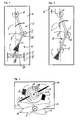
- each training device has a device foot part b and a device arm part c, which are each exposed to the action of the feet or legs, or hands or arms of the exerciser. Between the device foot part b and the device arm part c, a rotary joint d connecting the two parts is arranged with the axis of rotation I.
- Fig. 1 and 2 are shown basic examples in which the swivel joint d also acts as an articulated joint, ie it is moved back and forth during training according to the double arrow II, so that device foot part b and arm arm part c in the region of the torsion d perform a bending motion with constantly changing angle.
- the total length between a front support joint e of the Adjustarmteils c and a rear support joint f of the Adjustfußteils b is changed continuously. For this reason, at least one of these support joints e and f must be able to slide back and forth with respect to the longitudinal extent of the device.
- the front support joint e is arranged stationary, while the rear support joint f is mounted on a carriage g, which is according to the arrow III in the longitudinal direction of the base a back and forth adjustable.
- Fig. 3 the inventive principle is shown on the basis of the construction of a training device in plan view, in which the exercising person is arranged largely vertically, the axis I here as a central axis between the shoulder belt shown only in principle h and pelvic girdle i. During exercise, these two belts are twisted back and forth relative to each other around the axis I. From the shoulder g h grab the arms to handles k and the feet kicked from the pelvic girdle i over the legs on pedals 1. The swivel d falls in this Representation in the vertical axis IV, which runs parallel to the spine axis I in this training system.
- Adjustment b and Adjust c are stacked here, which Fig.
- Fig. 3 can not be removed with the swivel joint d in between, the pedals 1 on the foot part b and the handles k are arranged on the arm part c. Again Fig. 3 is removable, whenever the shoulder belt h is twisted with the handles k in one direction, the pelvic girdle i is twisted with the pedals 1 in the other direction (see also Fig. 14 ).
- the movement principle has a positive effect on the intestinal function, in particular by the rhythmic reciprocation, in addition to the initially described advantage of a variety of muscular training and mental training.
- this relative rotation between the shoulder girdle and the pelvic girdle corresponds to the human movement pattern, as can be observed in the development of the human being from the toddler to the adult.
- the right foot is set with the left arm and vice versa, which corresponds to this Relativvercardtouch the inventive principle.
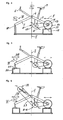
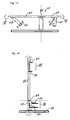
- Fig. 4 shows a first embodiment of a fixed training device 1 after the above in Fig. 1 described active principle of operation.
- a front frame part 2 (equipment arm part) and a rear frame part 3 (equipment foot part) are connected to each other via a joint 4 (swivel joint d) with a vertically extending joint axis V.
- a handlebar 6 is arranged at the front frame part 2 .
- a saddle 7 is attached.
- the rear frame part 3 is equipped with a drive unit 8. This consists of a not recognizable in the drawing bottom bracket, cranks 9, pedals 10, sprockets 11 and a chain 12.
- a wheel 14 which via the drive unit 8 for rotation is driven.
- the wheel roll on a carriage 15 from which is mounted longitudinally and laterally displaceable. The displaceability in the longitudinal direction is indicated by the arrow III.
- the carriage 15 is equipped with two rollers 17 on which the wheel 14 rolls.
- the front end of the front frame part 2 is rotatably mounted on a support 18 about a vertical axis. The rotation about the axis is illustrated by the arrows VI in the drawing. A deflection of the joint 4 leads to a rotation of the front frame part 2 about a vertical axis on the support 18.
- the distance between the front end of the front frame part 2 and the rear end of the rear frame part 3 is shortened. This leads to a displacement of the Slide 15 forward.
- a lateral deflection of the carriage 15 can be provided according to the arrow VII in FIG Fig. 1 ,
- Fig. 5 shows a variant of this first embodiment, in which the reactive functional principle is realized.
- the two embodiments differ only in the storage of the front frame part 2. All other parts are identical and therefore provided with the same reference numerals.
- the support 19 of the front frame part 2 is also mounted on a movable carriage 20. This carriage 20 is movable in the longitudinal direction. This shift is indicated by the arrow VIII.
- a rotation about the supports 21 is possible. This rotation is indicated by the arrows VI.
- Fig. 6 shows an additional variant of this first embodiment, in contrast to the variant according to Fig. 5 instead of a handlebar a hand crank system 22 is provided, which is connected via a chain or a belt 23 with the neutrkurbelsystem 9 to 11. This is especially true here Fig. 3 described action system of the fundamental counter-rotation and the physical offset of arm movement and leg movement.
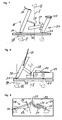
- Fig. 7 shows an embodiment in which the Adjustfußteil 24 is equipped with a saddle 25 a rotational axis 26 and a supplementkurbelsystem 27 and wherein this Adjustfußteil 24 is coupled to a Trainingarmteil 28 via a pivot joint 29, which is a rotation about the axis V corresponding to the double arrow IV allows.
- the Actarmteil 28 has a handlebar 30 and a rotation axis 31 which is slidably disposed in a base plate 32 in the longitudinal direction of the device, of course, such a storage in the lower portion of the Ararmteils 28 may be arranged.
- the thus enabled movement of the Adjustarmteils 28 corresponds to the double arrows VI and VIII.
- a crank system can serve as well Fig. 6 described works in a natural synchronization with the comfortablykurbelsystem.
- dashed lines for the rehabilitation drive devices for the crank system.
- Fig. 8 again shows another training device, which is called in a similar structure as an Elysée trainer.
- a device foot part 24 and a device arm part 28 are mounted on a base plate 32 and coupled to one another via a rotary joint 29.
- the Adjustarmteil 28 via its axis of rotation 31 in the base plate 32 perform the corresponding to the double arrows VIII and VI symptomatic movement.
- the exerciser engages arm bars 33, which are either rigidly arranged or pivotally mounted in alternation.
- a running device 34 is provided which consists of an oval track following tread plates, which may also be designed as a treadmill. Also in this embodiment, the in Fig. 2 used principle shown.
- a so-called stepper is, in principle, as far as the Adjustfußteil 24 and the Adjustarmteil 28 and the base plate and the pivot joint 29, constructed as the embodiment according to Fig. 7 ,
- arm rods 35 are provided, which are pivotable by the trainee per rod in different directions of rotation after double arrow X back and forth, and with foot plates 36 on Adjustfußteil whose Tretschwenkamba is matched according to the double arrow XI with the movement of the arm rods 35 so that it corresponds to the natural movement during running or walking.
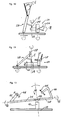
- the training device after Fig. 11 serves primarily Recumbanten why the seat 37 is provided with a backrest 38 and the Alarmteil 28 is inclined so that easy access by the possibly disabled trainees or older People are given easily.
- the hand crank 39 shown there may also be provided an arm lever system or a rigid handlebar and instead of the toe crank 40 foot plates may be present.
- Fig. 12 shows a training bench 41 which is formed in two parts and of which the Automaticfußteil 24 are connected to the Adjustarmteil 28 via the swivel joint 42 with each other.
- the two parts can be rotated relative to each other via the rotary joint 42 in their respective plane corresponding to the double arrows XII, so that in the person exercising the shoulder belt lying on the part 28 is rotated relative to the lap belt lying on the part 24.
- the swivel joint 42 is mounted correspondingly on a block 43, which in turn is arranged on the base plate 32.
- an additional arm 44 with a hand crank system 45 is arranged on the device arm part and an arm 45 with foot crank system 46 on the device foot part 24.
- the inclined position of the training bench 41, ie the pivot 42 to the base plate 32 is basically adjustable. Instead of hand or Wegkurbeln other actuators may be present.
- a training bench 47 is shown, which is constructed in the same way with respect to the two-part as the training bench Fig. 12 , In contrast to that is exercised lying on the building here, the actuators is located below the unit foot 24 and device arm 28. Again, special arms 48 and 49 are arranged on the bank parts, which each have a hand crank 45, ormajkurbel 46. In order to achieve the inventive therapy, the two bank parts 24 and 28 are also rotatable relative to one another according to the double arrows XII.
- the training device shown is a so-called climber, in which the trainee is vertically on according to the double arrow XIII up and down movable treads 50 and holds with his hands on handles 51 which are movable according to the double arrow XIV up and down.
- the pivot joint 54 is arranged between the arranged on the base plate 32 .
- the training principle realized on this device is too Fig. 3 explained in detail.
Landscapes
- Health & Medical Sciences (AREA)
- General Health & Medical Sciences (AREA)
- Physical Education & Sports Medicine (AREA)
- Cardiology (AREA)
- Vascular Medicine (AREA)
- Biomedical Technology (AREA)
- Engineering & Computer Science (AREA)
- Neurology (AREA)
- Orthopedic Medicine & Surgery (AREA)
- Pulmonology (AREA)
- Rehabilitation Tools (AREA)
- Percussion Or Vibration Massage (AREA)
- Electrotherapy Devices (AREA)
- Massaging Devices (AREA)
- Electrophonic Musical Instruments (AREA)
Abstract
Description
Die Erfindung geht aus von einem Trainingsgerät für ein gezieltes Training des menschlichen Körpers nach der Gattung des Hauptanspruchs.The invention relates to a training device for a targeted training of the human body according to the preamble of the main claim.
Derartige Trainingsgeräte dienen zur Entwicklung und Stärkung der Muskeln oder Gelenke des Körpers durch Überwinden von Widerständen einerseits aber auch zur Steigerung der Kondition und der Ausdauer. Nachteilig bei den bekannten Verfahren und Trainingsgeräten ist, dass immer nur einzelne Teile des Körpers sich betätigen und nicht der gesamte Körper, so dass eine Vielzahl von verschiedenen Geräten angeboten werden um ein Ganzkörpertraining zu erzielen. So werden bei vielen Geräten Oberkörper, Arme und Nacken während des Trainings unverändert in ihrer Lage gehalten, während Beine und Unterkörper aktiv sind.Such training devices are used to develop and strengthen the muscles or joints of the body by overcoming resistance on the one hand but also to increase the condition and endurance. A disadvantage of the known methods and training devices is that always only individual parts of the body operate and not the entire body, so that a variety of different devices are offered to achieve a total body workout. For example, many devices hold the upper body, arms, and neck unchanged during exercise, while the legs and lower body are active.
Bei anderen Geräten wiederum ist der Oberkörper aktiv und der Unterkörper und die Beine passiv. Nicht zuletzt findet bei diesen bekannten Verfahren und Trainingsgeräten kein mentales Training statt.On other devices, the upper body is active and the lower body and legs are passive. Last but not least, no mental training takes place in these known methods and training devices.
Bei einem bekannten Trainingsgerät der gattungsgemäßen Art (
Bei einem anderen bekannten Trainingsgerät der gattungsgemäßen Art (
In der
Das erfindungsgemäße Trainingsgerät hat demgegenüber den Vorteil, dass mit einem Gerät ein Ganzkörpertraining stattfinden kann, nämlich ein propriozeptiv orientiertes Training des gesamten Körpers und speziell des Rumpfbereiches zwischen Schulter- und Beckengürtel, wobei die natürliche Bewegungsdynamik des Menschen simuliert wird. Die dadurch gegebene wechselseitige aber harmonische Aktivität der Gehirnhälften zur Steuerung dieser Bewegungen führt zu einem intensiven Training des mentalen Bereichs. Werden Hände, Arme und Schultern in die eine Richtung verdreht, so werden Hüfte, Beckengürtel und Beine in die andere Richtung verdreht. Die dabei stattfindende gleichzeitige Gegenverdrehung der unterschiedlichen Körperbereiche wird durch die Verdrehung und eine gleichzeitige seitliche Neigebewegung der Wirbelsäule ermöglicht. Diese gleichzeitige Gegenbewegung (Gegenrotation) unterschiedlicher Körperbereiche entspricht in besonderem Maße der dem Menschen eigenen Propriozeption (der neuronalen Steuerung des Muskel-Skelettapparates). Das Trainingsgerät ist daher für ein Propriozeptionstraining und für ein körperdynamisches Training in Muskelketten, insbesondere Rückentraining, optimal. Die durch das Trainingsgerät unterstützten Bewegungen ermöglichen und regen die geistige Leistung der Person an und führen damit zu dem genannten mentalen Training. In gleicher Weise kann das Gerät für Kinder eingesetzt werden.The training device according to the invention has the advantage that with a device can take place a whole body workout, namely a proprioceptively oriented training of the entire body and especially the trunk area between shoulder and pelvic girdle, whereby the natural dynamics of movement of humans is simulated. The resulting mutual but harmonious activity of the brain halves to control these movements leads to an intense training of the mental area. When the hands, arms and shoulders are twisted in one direction, the hip, pelvic girdle and legs are twisted in the other direction. The simultaneous counter-rotation of the different parts of the body is made possible by the rotation and a simultaneous lateral tilting movement of the spine. This simultaneous counter-movement (counter-rotation) of different areas of the body corresponds in particular to the human proprioception (the neuronal control of the musculoskeletal system). The training device is therefore optimal for proprioception training and body dynamic training in muscle chains, especially back training. The movements supported by the training device allow and stimulate the mental performance of the person and thus lead to the said mental training. In the same way, the device can be used for children.
Nach einer vorteilhaften Ausgestaltung der Erfindung ist die Relativverdrehung überlagert mit einer Seitneige-, bzw. Krümmungsbewegung der Wirbelsäule in Bezug auf deren Längsachse. Dieses seitliche Neigen ist auch bei einigen erfindungsgemäßen Trainingsgeräten gegeben. In jedem Fall wird bei der Erfindung aufgrund der gegebenen Überlagerung von Relativverdrehung und Seitneigung eine sich laufend ändernde Belastung erzielt, was auch der Stärkung der hier wirksamen Muskelbänder zugute kommt.According to an advantageous embodiment of the invention, the relative rotation is superimposed with a Seitneige-, or curvature movement of the spine in relation to the longitudinal axis. This lateral tilting is also present in some exercise devices according to the invention. In any case, a constantly changing load is achieved in the invention due to the given superposition of relative rotation and lateral inclination, which also benefits the strengthening of the muscle bands effective here.
Nach einer zusätzlichen vorteilhaften Ausgestaltung bestimmt die Tätigkeit von Armen oder Beinen die Relativverdrehung von Schultergürtel zu Beckengürtel, bzw. die Neigebewegung der Wirbelsäule, und zwar im Sinne eines natürlichen dynamischen Drehmomentausgleichs. Ein solcher natürlicher Drehmomentausgleich entspricht dem menschlichen Bewegungsprinzip, beispielsweise beim Laufen, bei dem bei Belastung des linken Fußes die linke Schulter und die rechte Hüfte nach hinten verdreht werden und die rechte Schulter, bzw. linke Hüfte entsprechend nach vorne, um dann bei Belastung des rechten Fußes umgekehrt zu verfahren.According to an additional advantageous embodiment, the activity of arms or legs determines the relative rotation of shoulder girdle to pelvic girdle, or the tilting movement of the spine, in the sense of a natural dynamic torque compensation. Such a natural torque balance corresponds to the human movement principle, for example when running, in which the left shoulder and the right hip are rotated backwards under load of the left foot and the right shoulder, or left hip accordingly forwards, then under load of the right To move the foot vice versa.
Nach einer zusätzlichen vorteilhaften Ausgestaltung wird die durch die Gliedmaßentätigkeit eingegebene Arbeit als Energiequelle genutzt. Dies kann in unterschiedlichster Weise erfolgen, insbesondere jedoch durch Umsetzen in elektrische Energie, beispielsweise mittels einer Wirbelstrombremse. Die elektrische Energie kann in bekannterweise gespeichert und zu einem späteren Zeitpunkt genutzt werden. Auch kann diese Arbeit, insbesondere in Verbindung mit anderen Kenngrößen wie der Zeit, auf einem Display für den Trainierenden dargestellt werden, was in vielfältiger Weise bekannt ist.According to an additional advantageous embodiment, the input by the limb activity work is used as an energy source. This can be done in many different ways, but in particular by converting into electrical energy, for example by means of an eddy current brake. The Electrical energy can be stored in a known manner and used at a later time. Also, this work, especially in conjunction with other characteristics such as time, be displayed on a display for the trainees, which is known in many ways.
Nach einer zusätzlichen vorteilhaften Ausgestaltung kann dieses unter Wasser durchgeführt werden, wobei mindestens der Beckengürtel eingetaucht sein sollte. Durch die Bewegung im Wasser entsteht ein weicher Bremseffekt. Besondere Vorteile sind erzielbar durch eine präzise steuerbare Wassertemperatur, Trainingseinflüsse des umgebenden Wasserdrucks sowie des Auftriebs und durch die Zusammensetzung des Wassers.According to an additional advantageous embodiment of this can be carried out under water, wherein at least the pelvic girdle should be immersed. The movement in the water creates a soft braking effect. Particular advantages can be achieved by a precisely controllable water temperature, training influences of the surrounding water pressure and the buoyancy and by the composition of the water.
Nach einer zusätzlichen Ausgestaltung der Erfindung wird während des Trainings und der dabei gegebenen körperlichen Betätigung mit Sauerstoff angereicherte Atmungsluft eingeatmet, deren Sauerstoffanteil vorzugsweise einstellbar ist. So kann der Sauerstoffanteil des bereitzustellenden Sauerstoff-LuftGemisches abhängig von der gegebenen zu messenden körperlichen Leistung der zu versorgenden trainierenden Person gesteuert werden, beispielsweise in dem bei zunehmender körperlicher Leistung der Sauerstoffvolumenanteil zunimmt, hingegen bei abnehmender Leistung abnimmt. Bekanntlich kann der Körper bei Leistungssteigerung eine größere Menge Sauerstoff aufnehmen, wodurch sich der arterielle Sauerstoffdruck erhöht. Der Sauerstoffvolumenanteil kann bei Hochleistungen bis zu 75% der eingeatmeten Sauerstoffluft betragen. Wie der Wissenschaftler von Ardenne festgestellt hat, ist die Qualität der Sauerstoffaufnahme im Blut unmittelbar proportional der Leistung der Person. Dies kann auch zu einer längerfristigen Erhöhung des Sauerstoffpartialdruckes im Blut führen.According to an additional embodiment of the invention, oxygen-enriched respiratory air is inhaled during training and given physical activity, the oxygen content of which is preferably adjustable. Thus, the oxygen content of the oxygen-air mixture to be provided can be controlled depending on the given physical performance of the person to be trained to be supplied, for example, in which the oxygen volume fraction increases with increasing physical power, but decreases with decreasing power. As you know, the body can absorb a larger amount of oxygen in power increase, thereby increasing the arterial oxygen pressure. The oxygen volume fraction can be up to 75% of the inspired oxygen air at high powers. As the Ardenne scientist has stated, the quality of oxygen uptake in the blood is directly proportional to the person's performance. This can also lead to a longer-term increase in the oxygen partial pressure in the blood.
Nach einer diesbezüglichen vorteilhaften Ausgestaltung der Erfindung ist die mit Sauerstoff angereicherte Atmungsluft ionisiert. Hierdurch wird eine bessere Aufnahme des Sauerstoffs durch den Körper des Menschen erzielt.According to a related advantageous embodiment of the invention, the oxygen-enriched breathing air is ionized. As a result, a better absorption of oxygen is achieved by the body of the human.
Nach einer vorteilhaften Ausgestaltung des Trainingsgerätes kann die abwechselnde Relativverdrehung mindestens in einer Verdrehrichtung willkürlich durch den Trainierenden bewirkt werden. Durch diese aktive willentliche Tätigkeit wirkt sich das Trainieren auch mental aus, in Form einer Stärkung des mentalen Bereichs des Trainierenden.According to an advantageous embodiment of the training device, the alternating relative rotation can be effected at least in a direction of rotation arbitrarily by the trainees. Through this active voluntary activity, the training also mentally affects, in the form of strengthening the mental area of the exerciser.
Nach einer zusätzlichen Ausgestaltung des erfindungsgemäßen Trainingsgeräts wird die abwechselnde Relativverdrehung mindestens in einer Verdrehrichtung fremdgesteuert und/oder betrieben, wobei diese Fremdsteuerung oder dieser Fremdantrieb in gewissen Trainingssituationen vorteilhaft ist, z. B. zum Optimieren von Steuerungs- und Bewegungsabläufen. So kann beispielsweise die Relativverdrehung in der einen Verdrehrichtung willkürlich und in der anderen fremd bewirkt sein, wodurch auch bestimmte körperliche Bereiche eine Mentalstärkung und andere Bereiche nur eine physische Stärkung erzielbar ist.According to an additional embodiment of the exercise device according to the invention, the alternating relative rotation is externally controlled at least in a direction of rotation and / or operated, said foreign control or third-party drive in certain training situations is advantageous, for. B. to optimize control and motion sequences. Thus, for example, the relative rotation in one direction of rotation can be effected arbitrarily and in the other foreign, whereby certain physical areas, a mental strengthening and other areas only a physical strengthening is achievable.
Nach einer zusätzlichen vorteilhaften Ausgestaltung des erfindungsgemäßen Trainingsgeräts ist am Gerätefußteil ein tiefer gesetzter Sitz mit oder ohne Rückenlehne vorgesehen. Auch diese Ausgestaltung ist in erster Linie für solche Trainierenden gedacht, bei denen ein solcher tiefer Sitz mindestens zeitweise während des Trainierens sinnvoll ist. Entsprechend der Person des Trainierenden kann der Sitz des Trainingsgeräts in üblicher Weise auch höhenverstellbar sein.According to an additional advantageous embodiment of the exercise device according to the invention a deeper set seat is provided with or without backrest on the device foot. This embodiment is intended primarily for those exercisers in which such a deep seat at least temporarily makes sense during training. According to the person of the exerciser, the seat of the training device in the usual way also be adjustable in height.
Nach einer zusätzlichen das erfindungsgemäße Trainingsgerät betreffenden Ausgestaltung der Erfindung ist am Gerätearmteil ein mit Handkurbeln versehenes Einwirkungselement vorgesehen, insbesondere als Alternative oder auch als Ergänzung zu einem starren Lenker, bzw. Schwenkhebeln. Bei Geräten mit Wirbelstrombremse kann diese hier zum Armtraining eingesetzt werden.According to an embodiment of the invention relating to the training device according to the invention, an action element provided with crank handles is provided on the device arm part, in particular as an alternative or as a supplement to a rigid link or pivoting levers. For devices with eddy current brake this can be used here for arm training.
Nach einer zusätzlichen das erfindungsgemäße Trainingsgerät betreffenden vorteilhaften Ausgestaltung der Erfindung sind zusätzliche Geber, Rechner und Darstellungsgeräte (Displays) für Puls, Blutdruck, Trainingsdauer und dergleichen vorhanden. Hierbei handelt es sich um eine Ausgestaltung, die weitgehend in den Zubehörbereich gehört aber die speziellen Vorteile des erfindungsgemäßen Trainingsgeräts untermauert. Im Rechner kann die unterschiedlichste Software, insbesondere können spezielle Motivationsprogramme oder sonstige Auswertungsprogramme verarbeitbar sein - insbesondere auch die Auswertung und ein update vom Internet. So können auch personenbezogene Chipkarten eingesetzt werden udgl. mehr.After an additional training device according to the invention concerned advantageous embodiment of the invention, additional donors, computers and display devices (displays) for pulse, blood pressure, exercise duration and the like are available. This is a design that largely belongs in the accessories but underpins the special advantages of the training device according to the invention. In the computer, the most diverse software, in particular special motivational programs or other evaluation programs can be processed - especially the evaluation and an update from the Internet. So also personal chip cards can be used udgl. more.
Nach einer speziellen vorteilhaften Ausgestaltung des erfindungsgemäßen Trainingsgeräts mit einem an dem Ständer angeordneten Rahmen, mit einem Sattel an dem Rahmen, mit einem Lenker an dem Rahmen und mit einer Antriebseinheit mit Pedalen besteht der Rahmen aus zwei Rahmenteilen, wobei ein Vorderes als Gerätearmteil dienendes Rahmenteil den Lenker trägt und ein Hinteres als Gerätefußteil dienendes Rahmenteil den Sattel und die Antriebseinheit trägt, wobei außerdem die beiden Rahmenteile durch das Verbindungsgelenk miteinander verbunden sind und dessen Gelenkachse nahezu vertikal verläuft, wobei das vordere Ende des vorderen Rahmenteils und/oder das hintere Ende des hinteren Rahmenteils durch Lager seitlich und/oder nach vorne hinten auslenkbar gelagert sind wobei das Verbindungsgelenk ungefähr in der Mitte zwischen dem Lager des vorderen Rahmenteils und dem Lager des hinteren Rahmenteils vorgesehen ist. Es ist zwar ein Ergometer gestellt zur Halterung eines Fahrradrahmens mit aus Ständern und Sockeln bestehenden Gestellteilen und elastischer Lagerung der Vorderradgabel bekannt, wobei der Ständer des die Hinterradgabel aufnehmenden Gestellteils beidseitig quer zum Fahrradrahmen elastisch mit Schwenkfreiheit in seinem Sockel gelagert ist (
Da bei dieser Ausgestaltung der Erfindung eine seitliche Auslenkung des Drehgelenks mit einer Positionsänderung des vorderen und hinteren Rahmenteils verbunden ist (Knickprinzip), müssen das vordere und hintere Rahmenteil beweglich gelagert sein. Hierzu sind insbesondere am vorderen Ende des vorderen Rahmenteils und am hinteren Ende des hinteren Rahmenteils seitlich und nach vorne bzw. hinten auslenkbare Lager vorgesehen. Das Gelenk befindet sich etwa in der Mitte zwischen dem Lager des vorderen und dem Lager des hinteren Rahmenteils. Die mittige Position muss nicht exakt eingehalten werden. Eine Abweichung der Position des Gelenkes von der exakten Mitte um bis zu etwa 5% bezüglich des Gesamtabstandes zwischen vorderen und hinteren Lager ist möglich. Größere Variationen sind jedoch nicht sinnvoll, da ansonsten das hier typische Knickprinzip nicht mehr erfüllt ist. Die Achse des Gelenkes verläuft nahezu vertikal. Auch hier sind leichte Abweichungen möglich. So kann die Gelenkachse auch um einen gewissen Winkel gegen die Vertikale geneigt sein.Since in this embodiment of the invention, a lateral deflection of the rotary joint with a change in position of the front and rear frame part is connected (buckling principle), the front and rear frame part must be movably mounted. For this purpose, in particular at the front end of the front frame part and at the rear end of the rear frame part laterally and forwardly or rearwardly deflectable bearings are provided. The hinge is located approximately in the middle between the bearing of the front and the bearing of the rear frame part. The central position does not have to be exactly maintained. A deviation of the position of the joint from the exact center by up to about 5% with respect to the total distance between the front and rear bearings is possible. Larger variations are not useful, since otherwise the typical buckling principle is no longer met. The axis of the joint is almost vertical. Again, slight deviations are possible. Thus, the hinge axis can also be inclined by a certain angle to the vertical.
Nach einer vorteilhaften Ausgestaltung hierzu ist das Lager des vorderen Rahmenteils um eine vertikale Achse verdrehbar, darüber hinaus jedoch ortsfest. Eine seitliche Auslenkung erfahren lediglich das Gelenk zwischen dem vorderen und hinteren Rahmenteil und das Lager des hinteren Rahmenteils. Dies entspricht einer ersten Ausführungsform des Trainingsgerätes. Die Funktionsweise kann als aktiv, bzw. aktives Mobilisationstraining bezeichnet werden, da die Trainingsperson normalerweise durch das Drehen ihres Beckens und den Einsatz der Rücken- Bauch- und Armmuskulatur aktiv eine Auslenkung des Gelenks zwischen den beiden Rahmenteilen herbeiführen muss.According to an advantageous embodiment of this, the bearing of the front frame part is rotatable about a vertical axis, but beyond stationary. A lateral deflection experienced only the joint between the front and rear frame part and the bearing of the rear frame part. This corresponds to a first embodiment of the training device. The mode of operation may be referred to as active or active mobilization training, since the exerciser must normally actively induce deflection of the joint between the two frame members by rotating their pelvis and using the back, abdominal and arm muscles.
Bei einer zweiten Ausführungsform dieser Ausgestaltung des Trainingsgeräts wirkt sowohl das Lager des vorderen als auch des hinteren Rahmenteils direkt oder indirekt mit einem seitlich und/oder in Längsrichtung verschiebbaren Schlitten zusammen. Drückt der Benutzer eines der Pedale nach unten, so weicht das Gelenk zwischen dem vorderen und hinteren Rahmenteil seitlich aus. Tritt der Benutzer mit dem anderen Pedal nach unten, so weicht das Gelenk in die entgegengesetzte Richtung aus. Da die Auslenkung des Gelenks eine Folge des Tretens der Pedale ist und durch den Benutzer nicht aktiv herbeigeführt werden muss, kann diese Funktionsweise als reaktiv, reaktives Stabilisationstraining bezeichnet werden. Diese aktive oder reaktive Trainingsform kann bei allen folgenden Trainingsgeräten durch entsprechende technische Ausgestaltungen erreicht werden.In a second embodiment of this embodiment of the training device, both the bearing of the front and the rear frame part interacts directly or indirectly with a laterally and / or longitudinally displaceable carriage. If the user pushes one of the pedals downwards, the joint between the front and rear frame part deviates laterally. If the user steps down with the other pedal, the joint deviates in the opposite direction. Since the articulation deflection is a consequence of pedaling and need not be actively effected by the user, this functionality may be referred to as reactive, reactive stabilization training. This active or reactive training form can be achieved in all subsequent training devices by appropriate technical configurations.
Je nach Ausführungsform sind entweder nur das Lager des hinteren Rahmenteils oder die Lager des vorderen und hinteren Rahmenteils direkt oder indirekt mit einem seitlich und/oder in Längsrichtung verschiebbaren Schlitten verbunden. Da eine Auslenkung des Verbindungsgelenks zwischen den beiden Rahmenteilen zu einer Verkürzung des Abstands zwischen den Lagern des vorderen und hinteren Rahmenteils führt, ist eine Verschiebung in Längsrichtung zumindest für eines der beiden Lager notwendig. Das seitliche Ausschwenken des hinteren Rahmenteils ermöglicht spezielle Trainingseffekte. Dabei können vorderes und/oder hinteres Rahmenteil auf der Achse eines drehbaren Rades oder einer Rolle aufliegen. Rad und Rolle sind in diesem Fall in dem verschiebbaren Schlitten geführt und rollen auf diesem ab. Das Rad oder die Rolle des hinteren Rahmenteils ist in diesem Fall mit der Antriebseinheit verbunden und wird durch die Antriebseinheit zur Rotation angetrieben. An den Seiten des Schlittens können Begrenzungen zur Führung des Rades vorgesehen sein.
Dieses seitliche Ausschwenken der vorderen und/oder hinteren Verdrehachse kann bei allen entsprechenden geeigneten erfindungsgemäßen Trainingsgeräten, beispielsweise durch eine Doppelgelenklagerung, verwirklicht sein.Depending on the embodiment, either only the bearing of the rear frame part or the bearings of the front and rear frame part are connected directly or indirectly with a laterally and / or longitudinally displaceable slide. Since a deflection of the connecting joint between the two frame parts leads to a shortening of the distance between the bearings of the front and rear frame part, a displacement in the longitudinal direction is necessary for at least one of the two bearings. The lateral pivoting of the rear frame part allows special training effects. In this case, front and / or rear frame part can rest on the axis of a rotatable wheel or a roller. Wheel and roller are guided in this case in the sliding carriage and roll on this. The wheel or the roller of the rear frame part is in this case connected to the drive unit and is driven by the drive unit for rotation. On the sides of the carriage limitations may be provided to guide the wheel.
This lateral pivoting of the front and / or rear axis of rotation can be realized in all corresponding suitable training devices according to the invention, for example by a double-joint bearing.
Bei der ersten Ausführungsform mit der aktiven Funktionsweise, bei der das Lager des vorderen Rahmenteils um eine vertikale Achse verdrehbar ist, kann beispielsweise ausschließlich das hintere Rahmenteil mit einem auf einem Schlitten geführten Rad ausgestattet sein.In the first embodiment with the active mode of operation, in which the bearing of the front frame part is rotatable about a vertical axis, for example, only the rear frame part can be equipped with a guided on a slide wheel.
Nach einer zusätzlichen dieses Trainingsgerät betreffenden vorteilhaften Ausgestaltung der Erfindung ist ein Schlitten zur Führung des Verbindungsgelenkes zwischen dem vorderen und hinteren Rahmenteil vorgesehen. Die Auslenkung dieses Gelenkes wird dabei durch die Führung unterstützt. Dabei bewegt sich der Schlitten entlang einer Bahn mit parabelförmigem Verlauf. Diese Führung erlaubt sowohl eine seitliche Verschiebung als auch eine Verschiebung in der Höhe. Bei entsprechend stabiler Führung können sowohl das vordere als auch das hintere Rahmenteil mit einem Rad versehen sein. Werden beide Räder in seitlich verschiebbaren Schlitten geführt, so können diese gekoppelt sein, um das Knickprinzip zu realisieren.After an additional advantageous embodiment of the invention relating to this training device, a carriage is provided for guiding the connecting joint between the front and rear frame part. The deflection of this joint is supported by the guide. The carriage moves along a path with a parabolic course. This guide allows both a lateral displacement and a shift in height. With a correspondingly stable guidance, both the front and the rear frame part can be provided with a wheel. If both wheels are guided in laterally displaceable carriages, they can be coupled in order to realize the kink principle.
Nach einer zusätzlichen vorteilhaften Ausgestaltung dieses Trainingsgerätes weist der Gerätefußteil eine Antriebseinheit aus Tretlager, Kurbel, Pedalen und einem Antriebsstrang auf, welcher mit dem Rad oder der Rolle an dem hinteren Rahmenteil verbunden ist. Als Antriebsstrang dient beispielsweise eine Kette, ein Kardan, ein Zahnriemen oder ähnliches. Außerdem kann anstelle eines Tretlagers mit einer sich drehenden Achse auch ein Tretlager vorgesehen sein, das lediglich das Auf- und Abtreten der Pedale ermöglicht.According to an additional advantageous embodiment of this training device, the Gerätefußteil a drive unit of bottom bracket, crank, pedals and a drive train, which is connected to the wheel or the roller on the rear frame part. As a drive train is for example a chain, a cardan, a toothed belt or the like. In addition, instead of a bottom bracket with a rotating axis and a bottom bracket may be provided which allows only the up and stepping of the pedals.
Eine auf das Rad oder die Rolle einwirkende Kraft ist manuell einstellbar, so dass der Benutzer die von ihm beim Treten aufzubringende Leistung variieren kann. Darüber hinaus können auch hier Leistungsmessvorrichtungen wie beispielsweise Pulszähler vorgesehen sein. Die auf das Rad oder die Rolle einwirkende Kraft wird durch eine entsprechende Steuerung automatisch in Abhängigkeit von der ermittelten Leistung der Trainingsperson eingestellt. Die Antriebseinheit kann wahlweise mit oder ohne Freilauf ausgestattet sein.A force acting on the wheel or pulley is manually adjustable so that the user can vary the power he needs to pedal while pedaling. In addition, power measuring devices such as pulse counters can also be provided here. The force acting on the wheel or roller is automatically controlled by a corresponding control set depending on the determined performance of the training person. The drive unit can be optionally equipped with or without freewheel.
Der verschiebbare Schlitten, auf welchem das Rad abrollt, kann eine oder mehrere Rollen aufweisen, so dass das Abrollen des Rades auf festem Untergrund simuliert wird. Durch seitlich angebrachte in ihrem Abstand verstellbare Begrenzungen wird das Abrutschen des Rades von den Rollen verhindert. Als Begrenzungen können wiederum Rollen oder Räder eingesetzt werden. Die Rollen des Schlittens, auf welchem das Rad abrollt, können mit Hilfe eines zuschaltbaren Antriebs das Rad aktiv antreiben.The sliding carriage, on which the wheel rolls, may have one or more rollers, so that the rolling of the wheel is simulated on solid ground. By laterally mounted adjustable in their limits boundaries slipping of the wheel is prevented by the rollers. As limitations in turn roles or wheels can be used. The wheels of the carriage, on which the wheel unwinds, can actively drive the wheel with the aid of a shiftable drive.
Nach einer zusätzlichen vorteilhaften Ausgestaltung dieses erfindungsgemäßen Gerätes sind der Lenker und der Sattel in der Höhe und in ihrem Abstand zueinander verstellbar am Rahmen angeordnet. Auf diese Weise kann das Trainingsgerät an unterschiedliche Benutzer angepasst werden.According to an additional advantageous embodiment of this device according to the invention, the handlebar and the saddle in height and at a distance from each other are adjustably arranged on the frame. In this way, the exercise device can be adapted to different users.
Nach einer anderen speziellen und vorteilhaften Ausgestaltung des Trainingsgerätes mit einer weitgehend horizontal verlaufenden Laufeinrichtung im Gerätefußteil, beispielsweise ähnlich dem sogenannten Ellipsentrainer, und mit weitgehend vertikal verlaufenden Armstangen im Gerätearmteil, verläuft die Verdrehachse des scharnierartig wirkenden Verbindungsgelenks weitgehend vertikal, und es ist der Gerätefußteil und/oder der Gerätearmteil in durch die Laufrichtung vorgegebener Richtung des Trainingsgeräts auf dem Ständer verschiebbar. Erforderlichenfalls kann auch das Verbindungsgelenk auf dem Ständer ortsfest angeordnet sein, so dass bei der sich natürlich auch hier ergebenen Knickbewegung zwischen Gerätefußteil und Gerätearmteil eine entsprechende Verschiebung der Enden, insbesondere auf einer Kreisbahn, von Gerätefußteil und Gerätearmteil ergibt. Maßgebend ist, dass bei dieser Relativverdrehung von Gerätearmteil zu Gerätefußteil eine entsprechende Relativverdrehung innerhalb der Wirbelsäulenachse zwischen Schultergürtel und Beckengürtel stattfindet.According to another specific and advantageous embodiment of the training device with a largely horizontally extending running device in the device foot, for example, similar to the so-called elliptical trainers, and with largely vertically extending arm rods in Gerätearmteil, the axis of rotation of the hinge-like connection joint runs largely vertically, and it is the Gerätefußteil and / or the device arm part can be displaced on the stand in a direction of the training device predetermined by the running direction. If necessary, the connection joint can be arranged stationary on the stand, so that in the course also here yielding bending movement between Gerätefußteil and Gerätearmteil a corresponding displacement of the ends, in particular on a circular path, results of Gerätefußteil and Gerätearmteil. It is decisive that in this relative rotation of the device arm part to the device foot part, a corresponding relative rotation takes place within the spinal axis between the shoulder girdle and the pelvic girdle.
Nach einer diesbezüglichen vorteilhaften Ausgestaltung der Erfindung weist die Laufeinrichtung ein Laufband auf. Ein solches Laufband kann erforderlichenfalls angetrieben sein, aber es kann auch durch die Laufbewegung der Trainingsperson angetrieben werden. Laufbänder sind an sich in vielfältiger Weise bekannt, allerdings gilt auch für die erfindungsgemäße Anwendung, dass zwischen Gerätearmteil und Gerätefußteil das "Knickgelenk" vorhanden sein muss um die Relationsverdrehung zwischen Schultergürtel und Beckengürtel zu erzielen.According to a related advantageous embodiment of the invention, the running device on a treadmill. Such a treadmill may be driven if necessary, but it may also be powered by the running motion of the exerciser. Treadmills are known per se in many ways, but also applies to the application of the invention that between Gerätearmteil and Gerätefußteil the "articulation" must be present to achieve the relation twist between shoulder belt and pelvic girdle.
Nach einer alternativen diesbezüglichen vorteilhaften Ausgestaltung der Erfindung weist die Laufeinrichtung Tretplatten oder ein Pedalsystem auf. In bekannter Weise kann im Gerätefußteil mit diesen Tretplatten oder dem Pedalsystem eine Schwungmasse angeordnet sein, die nach einer zusätzlichen Ausgestaltung der Erfindung kurbelartig mit den Tretplatten, bzw. dem Pedalsystem verbunden sein kann. Maßgebend ist auch hier, dass bei einem solchen in vielfältiger Weise bekannten System der Gerätearmteil aufgrund der Relativverdrehung den Schultergürtel zwingt eine andere Drehlage einzunehmen als der Beckengürtel. Statt der bekannten Ankoppelung von Schwungmasse, Kurbel über Tretplatten an die Armstangen kann eine solche Synchronisierung über Kabelzüge oder dergleichen erfolgen.According to an alternative advantageous embodiment of the invention in this respect, the running device on foot plates or a pedal system. In a known manner, a flywheel can be arranged in the base part of the foot with these pedal plates or the pedal system, which can be connected according to an additional embodiment of the invention like a crank with the foot plates, or the pedal system. Decisive here too is that in such a system known in many ways, the device arm part, due to the relative rotation, forces the shoulder girdle to assume a different rotational position than the pelvic girdle. Instead of the known coupling of flywheel, crank on Tretplatten to the arm bars such synchronization can be done via cable or the like.
Nach einer diesbezüglichen zusätzlichen vorteilhaften Ausgestaltung der Erfindung sind die Armstangen synchron zur Laufbewegung schwenkbar.After a related additional advantageous embodiment of the invention, the arm rods are pivotable synchronously with the running movement.
Nach einer diesbezüglichen vorteilhaften Ausgestaltung der Erfindung ist der Schwenkwiderstand der Armstangen einstellbar. Hierdurch kann vor allem mit dem Training auch ein Muskelaufbau erzielt werden.After a related advantageous embodiment of the invention, the pivoting resistance of the arm rods is adjustable. This can be achieved especially with the training and muscle building.
Nach einer anderen speziellen und auch vorteilhaften Ausgestaltung des erfindungsgemäßen Trainingsgerätes weist der Gerätefußteil und Gerätearmteil jeweils einen Abschnitt einer quergeteilten Trainingsbank auf, wobei zwischen den Teilen im Teilungsbereich eine in Längsausdehnung der Trainingsbank verlaufende Verdrehachse als Verbindungsgelenk dient und wobei an dem jeweiligen Trainingsbankabschnitt als Einwirkungselemente Kurbeln, Hebel und sonstige Betätigungsvorrichtungen angeordnet sind. Ein solches Trainingsgerät findet in erster Linie Anwendung bei speziellen Trainingsmaßnahmen.According to another particular and advantageous embodiment of the exercise device according to the invention the Gerätefußteil and Gerätearmteil each have a portion of a transversely divided training bench, wherein between the parts in the division a running in the longitudinal extension of the training bench rotation axis serves as a connection joint and wherein cranking at the respective training bench section as action elements, Levers and other actuators are arranged. Such a training device is primarily used for special training measures.
Nach einer diesbezüglichen Ausgestaltung der Erfindung kann die Trainingsbank an ihren Enden über eine entsprechende Vorrichtung gelagert um 180° Grad gewendet werden, um in der einen Stellung ein Training in Bauchlage und in der anderen Stellung in Rückenlage zu ermöglichen.According to a related embodiment of the invention, the training bench can be turned over its ends by a corresponding device rotated by 180 ° degrees to allow in one position training in prone position and in the other position in the supine position.
Nach einer zusätzlichen diesbezüglichen vorteilhaften Ausgestaltung der Erfindung ist die Trainingsbank im Bezug auf ihre Längsausdehnung schräg stellbar. Dies kann insbesondere bei speziellen Trainingsaufgaben von Vorteil sein.After an additional relevant advantageous embodiment of the invention, the training bench is adjustable in terms of their longitudinal extent obliquely. This can be particularly advantageous for special training tasks.
Nach wieder einer anderen speziellen und vorteilhaften Ausgestaltung des erfindungsgemäßen Trainingsgeräts sind Gerätefußteil und Gerätearmteil an einer vertikalen aber quergeteilten Säule angeordnet, wobei zwischen den Teilen als Verbindungsgelenk eine ebenfalls vertikal verlaufende Verdrehachse angeordnet ist und wobei am Gerätefußteil vertikal betätigbare aber horizontal herausragende Tritt- oder Schwenkplatten vorhanden sind. Ein solches auch als Climber bezeichnetes Trainingsgerät ermöglicht Konditionstrainingsmethoden und Relativverdrehung von Schultergürtel und Beckengürtel, die den Bedingungen in der Praxis eines Bergsteigers sehr nahe kommen.After again another specific and advantageous embodiment of the training device according to the invention Gerätefußteil and Gerätearmteil are arranged on a vertical but transversely divided column, between the parts as a connecting joint a vertically extending axis of rotation is arranged and wherein the device foot vertically actuated but horizontally outstanding tread or pivot plates available are. Such a training device, also referred to as a climber, enables condition training methods and relative rotation of the shoulder girdle and pelvic girdle that are very close to the conditions of a climber's practice.
Nach einer diesbezüglichen vorteilhaften Ausgestaltung der Erfindung sind am Gerätearmteil vertikal betätigbare Griffe vorhanden, deren Verstellbewegung mit der der Tritt- oder Schwenkplatten synchronisiert ist. Diese Synchronisation soll in erster Linie dem normalen menschlichen Bewegungsrhythmus entsprechen, d. h. dass sich linker Arm mit rechtem Fuß nähert und umgekehrt rechter Arm mit linkem Fuß. Typisch kann diese Bewegung beim Gehen beobachtet werden, wodurch u. a. ein natürlicher Drehmomentausgleich der dynamischen Bewegung gegeben ist.According to a related advantageous embodiment of the invention vertically actuated handles are present on the Gerätearmteil whose adjustment is synchronized with the tread or pivot plates. This synchronization should primarily correspond to the normal human rhythm of movement, ie, the left arm approaches with the right foot and vice versa right arm with left foot. Typically, this movement can be observed while walking, whereby, among other things, a natural torque compensation of the dynamic movement is given.
Weitere Vorteile und vorteilhafte Ausgestaltungen der Erfindung sind im Längsschnitt der nachfolgenden Beschreibung, der Zeichnung und den Ansprüchen entnehmbar.Further advantages and advantageous embodiments of the invention can be removed in the longitudinal section of the following description, the drawings and the claims.
Sieben Ausführungsbeispiele des Gegenstandes der Erfindung sind stark vereinfacht in der Zeichnung dargestellt und im folgenden näher beschrieben.Seven embodiments of the subject matter of the invention are shown greatly simplified in the drawing and described in more detail below.
Es zeigen:
- Fig. 1 bis 3
- das erfinderische Funktionsprinzip in der Draufsicht
- Fig. 4 bis 6
- ein erstes Ausführungsbeispiel in Seitenansicht
- Fig.7
- ein zweites Ausführungsbeispiel in Seitenansicht
- Fig. 8 und 9
- ein drittes Ausführungsbeispiel jeweils in Seitenansicht und Draufsicht
- Fig. 10
- ein viertes Ausführungsbeispiel in der Seitenansicht
- Fig. 11
- als fünftes Ausführungsbeispiel eine spezielle Ausgestaltung von Ausführung nach
Fig. 7 - Fig. 12
und 13 - ein Banktrainer als sechstes Ausführungsbeispiel und
- Fig. 14
- ein siebtes Ausführungsbeispiel für ein Klettertraining.
- Fig. 1 to 3
- the inventive working principle in plan view
- 4 to 6
- a first embodiment in side view
- Figure 7
- a second embodiment in side view
- 8 and 9
- a third embodiment in each case in side view and top view
- Fig. 10
- A fourth embodiment in side view
- Fig. 11
- as a fifth embodiment, a special embodiment of embodiment according to
Fig. 7 - FIGS. 12 and 13
- a bank trainer as the sixth embodiment and
- Fig. 14
- a seventh embodiment of a climbing training.
Das Funktionsprinzip der Erfindung ist in
In den
Bei dem in
Bei dem in
In
Das Bewegungsprinzip hat außer dem eingangs beschriebenen Vorteil eines vielfältigen muskularen Trainings und auch mentalen Trainings eine positive Auswirkung auf die Darmfunktion, insbesondere durch das rhythmische Hin- und Herbewegen. Grundsätzlich entspricht diese Relativverdrehung zwischen Schultergürtel und Beckengürtel, beispielsweise durch das Knickprinzip am Gerät, dem menschlichen Bewegungsmuster, wie man es bei der Entwicklung des Menschen vom Kleinkind zum Erwachsenen beobachten kann. So wird beim Gehen der rechte Fuß mit dem linken Arm vorgesetzt und umgekehrt, was dieser Relativverdrehbewegung beim erfinderischen Prinzip entspricht.The movement principle has a positive effect on the intestinal function, in particular by the rhythmic reciprocation, in addition to the initially described advantage of a variety of muscular training and mental training. Basically, this relative rotation between the shoulder girdle and the pelvic girdle, for example due to the kink principle on the device, corresponds to the human movement pattern, as can be observed in the development of the human being from the toddler to the adult. Thus, when walking, the right foot is set with the left arm and vice versa, which corresponds to this Relativverdrehbewegung the inventive principle.
Erfindungsgemäß kann statt dem Lenker auch ein Kurbelsystem dienen, das wie zu
Der Trainierende greift an Armstangen 33, die entweder starr angeordnet sind oder im Wechsel zueinander schwenkbar gelagert sind. Im Gerätefußteil 24 ist eine Laufeinrichtung 34 vorgesehen, die aus einer ovalen Bahn folgenden Trittplatten besteht, die aber auch als Laufband ausgebildet sein kann. Auch bei diesem Ausführungsbeispiel wird das in
Das in
Durch das erfindungsgemäße Verdrehen des Verdrehgelenks 29 um die Verdrehachse V wird dann die erfindungsgemäße Therapie erreicht.By twisting the pivot joint 29 according to the invention about the axis of rotation V, the therapy according to the invention is then achieved.
Das Trainingsgerät nach
In
Bei dem in
Alle in der Beschreibung, den nachfolgenden Ansprüchen und der Zeichnung dargestellten Merkmale können sowohl einzeln als auch in beliebiger Kombination miteinander erfindungswesentlich sein.All in the description, the following claims and the drawings illustrated features may be essential to the invention both individually and in any combination.
- aa
- Sockel oder StänderSocket or stand
- bb
- GerätefußteilGerätefußteil
- cc
- GerätearmteilGerätearmteil
- dd
- VerdrehgelenkVerdrehgelenk
- ee
- vorderes Stützgelenkfront support joint
- ff
- hinteres Stützgelenkrear support joint
- gG
- Schlittencarriage
- hH
- Schultergürtelshoulder
- ii
- Beckengürtelpelvic girdle
- kk
- Handgriffehandles
- 11
- Pedalepedals
- II
- Wirbelsäulenachse / VerdrehachseSpine axis / rotation axis
- IIII
- Knicklinienweg des VerdrehgelenksCrease path of the torsion joint
- IIIIII
- horizontale Verstellrichtunghorizontal adjustment direction
- IVIV
- Vertikalachsevertical axis
- VV
- Mittelachse des VerdrehgelenksCenter axis of the torsion joint
- VIVI
- Verdrehrichtung vorneTwist direction at the front
- VIIVII
- seitliche Verschiebung des Schlittenslateral displacement of the carriage
- VIIIVIII
- Verschieberichtung vorneDisplacement direction at the front
- IXIX
- Verdrehrichtungen des VerdrehgelenksVerdrehrichtungen the Verdrehgelenks
- XX
- Schwenkrichtungen der ArmstangenSwivel directions of the arm bars
- XIXI
- Schwenkrichtungen der TretplattenPivoting directions of the footplates
- XIIXII
- Verdrehrichtungen der BankteileDestruction of bank parts
- XIIIXIII
- Hubrichtungen der TretplattenLifting directions of the footplates
- XIVXIV
- Hubrichtungen der HandgriffeLifting directions of the handles
- 11
- Trainingsgerätexerciser
- 22
- vorderes Rahmenteilfront frame part
- 33
- hinteres Rahmenteilrear frame part
- 44
- Gelenkjoint
- 55
- 66
- Lenkerhandlebars
- 77
- Sattelsaddle
- 88th
- Antriebseinheitdrive unit
- 99
- Kurbelcrank
- 1010
- Pedalpedal
- 1111
- Zahnkranzsprocket
- 1212
- KetteChain
- 1313
- Achseaxis
- 1414
- Radwheel
- 1515
- Schlittencarriage
- 1616
- 1717
- Walzeroller
- 1818
- Stützesupport
- 1919
- Stützesupport
- 2020
- Schlittencarriage
- 2121
- Längsverschiebung des SchlittensLongitudinal displacement of the carriage
- 2222
- HandkurbelsystemWinch System
- 2323
- KetteChain
- 2424
- GerätefußteilGerätefußteil
- 2525
- Sattelsaddle
- 2626
- Drehachseaxis of rotation
- 2727
- FußkurbelsystemFußkurbelsystem
- 2828
- GerätearmteilGerätearmteil
- 2929
- VerdrehgelenkVerdrehgelenk
- 3030
- Lenkerhandlebars
- 3131
- Verdrehachseaxis of rotation
- 3232
- Sockelplatteplinth
- 3333
- Armstangenarm bars
- 3434
- Laufeinrichtungrunning device
- 3535
- Armstangenarm bars
- 3636
- TretplattenTretplatten
- 3737
- SitzSeat
- 3838
- Rückenlehnebackrest
- 3939
- HandkurbelsystemWinch System
- 4040
- FußkurbelsystemFußkurbelsystem
- 4141
- Trainingsbanktraining bench
- 4242
- VerdrehgelenkVerdrehgelenk
- 4343
- Bockbuck
- 4444
- Armpoor
- 4545
- Handkurbelwinch
- 4646
- FußkurbelsystemFußkurbelsystem
- 4747
- Trainingsbanktraining bench
- 4848
- Armepoor
- 4949
- Armepoor
- 5050
- Trittplattentread plates
- 5151
- Griffehandles
- 5252
- GerätefußteilGerätefußteil
- 5353
- GerätearmteilGerätearmteil
- 5454
- VerdrehgelenkVerdrehgelenk
Claims (16)
Applications Claiming Priority (5)
| Application Number | Priority Date | Filing Date | Title |
|---|---|---|---|
| DE10215622 | 2002-04-09 | ||
| DE10215622 | 2002-04-09 | ||
| DE10300253 | 2003-01-03 | ||
| DE10300253 | 2003-01-03 | ||
| PCT/DE2003/001123 WO2003084616A1 (en) | 2002-04-09 | 2003-04-04 | Method for conducting a targeted training and a corresponding training device |
Publications (3)
| Publication Number | Publication Date |
|---|---|
| EP1492597A1 EP1492597A1 (en) | 2005-01-05 |
| EP1492597B1 EP1492597B1 (en) | 2009-01-21 |
| EP1492597B2 true EP1492597B2 (en) | 2012-06-13 |
Family
ID=28792826
Family Applications (1)
| Application Number | Title | Priority Date | Filing Date |
|---|---|---|---|
| EP03727176A Expired - Lifetime EP1492597B2 (en) | 2002-04-09 | 2003-04-04 | Training device |
Country Status (11)
| Country | Link |
|---|---|
| US (2) | US7691033B2 (en) |
| EP (1) | EP1492597B2 (en) |
| JP (1) | JP4452512B2 (en) |
| KR (1) | KR20050006150A (en) |
| CN (1) | CN1658929A (en) |
| AT (1) | ATE421366T1 (en) |
| AU (1) | AU2003233927A1 (en) |
| DE (2) | DE50311119D1 (en) |
| DK (1) | DK1492597T4 (en) |
| ES (1) | ES2318132T5 (en) |
| WO (1) | WO2003084616A1 (en) |
Families Citing this family (34)
| Publication number | Priority date | Publication date | Assignee | Title |
|---|---|---|---|---|
| DE102005017330B4 (en) * | 2005-04-14 | 2007-10-11 | Schönenberger, Willi | Walker for a mechanically driven treadmill |
| FR2915401A1 (en) * | 2007-04-26 | 2008-10-31 | P & F Brother Ind Corp | Elliptical machine for creating torsion movement, has left and right shafts respectively rotated around horizontal rotational axes that are inclined with respect to line parallel to another rotational axis, and pedal forming unit |
| FR2916645A1 (en) * | 2007-05-31 | 2008-12-05 | Gilbert Guy Douyere | MUSCULATION TOOL |
| DE102007032148B4 (en) | 2007-07-04 | 2010-12-16 | Mehrdad Rahimi | Training device, in particular for training the back muscles |
| US7896782B2 (en) | 2008-03-09 | 2011-03-01 | Tamari Ran | Exercising machine |
| US7976433B2 (en) * | 2009-09-25 | 2011-07-12 | Kenyon Todd N | Biomechanical diagnostic machine for bicycle fitting, rehabilitation and training |
| KR101149896B1 (en) * | 2010-12-21 | 2012-06-11 | 한국생산기술연구원 | Ergometer Measurement Apparatus |
| KR101265918B1 (en) | 2011-03-28 | 2013-05-30 | 최경철 | Kinetic structure and moving structure using the same |
| TWI449554B (en) * | 2012-04-02 | 2014-08-21 | Rexon Ind Corp Ltd | An exercise apparatus |
| US8864628B2 (en) | 2013-03-12 | 2014-10-21 | Robert B. Boyette | Rehabilitation device and method |
| CN104884133B (en) | 2013-03-14 | 2018-02-23 | 艾肯运动与健康公司 | Force exercise equipment with flywheel |
| US9403047B2 (en) | 2013-12-26 | 2016-08-02 | Icon Health & Fitness, Inc. | Magnetic resistance mechanism in a cable machine |
| WO2015191445A1 (en) | 2014-06-09 | 2015-12-17 | Icon Health & Fitness, Inc. | Cable system incorporated into a treadmill |
| US10940360B2 (en) | 2015-08-26 | 2021-03-09 | Icon Health & Fitness, Inc. | Strength exercise mechanisms |
| TWI644702B (en) | 2015-08-26 | 2018-12-21 | 美商愛康運動與健康公司 | Strength exercise mechanisms |
| US10293211B2 (en) | 2016-03-18 | 2019-05-21 | Icon Health & Fitness, Inc. | Coordinated weight selection |
| US10441840B2 (en) | 2016-03-18 | 2019-10-15 | Icon Health & Fitness, Inc. | Collapsible strength exercise machine |
| US10252109B2 (en) | 2016-05-13 | 2019-04-09 | Icon Health & Fitness, Inc. | Weight platform treadmill |
| US10661114B2 (en) | 2016-11-01 | 2020-05-26 | Icon Health & Fitness, Inc. | Body weight lift mechanism on treadmill |
| TWI672164B (en) | 2016-12-05 | 2019-09-21 | 美商愛康運動與健康公司 | Tread belt locking mechanism |
| TWI648081B (en) | 2016-12-05 | 2019-01-21 | 美商愛康運動與健康公司 | Pull rope resistance mechanism in treadmill |
| CN106823290A (en) * | 2017-04-13 | 2017-06-13 | 合肥工业大学 | A kind of healthy image training robot of many poses |
| CN106861134A (en) * | 2017-04-13 | 2017-06-20 | 合肥工业大学 | A kind of healthy trainer of lower limb |
| DE102017209989A1 (en) * | 2017-06-13 | 2018-12-13 | Icaros Gmbh | training device |
| US11071921B2 (en) * | 2018-05-21 | 2021-07-27 | Wonderides, Inc. | Ride-on toy |
| US11298577B2 (en) | 2019-02-11 | 2022-04-12 | Ifit Inc. | Cable and power rack exercise machine |
| CN113262433A (en) * | 2020-02-17 | 2021-08-17 | 阿鲁亚英工程公司 | Indoor bicycle stand with lateral motion |
| CN111514531B (en) * | 2020-06-15 | 2021-09-28 | 南京信息工程大学 | Yoga formula intelligence vertebra extends, twists reverse auxiliary device |
| CN112274849A (en) * | 2020-07-06 | 2021-01-29 | 叶朝霞 | Body coordination trainer |
| US12090379B2 (en) * | 2020-12-24 | 2024-09-17 | Elite S.R.L. | Support device for bicycle front wheel |
| US12109472B2 (en) * | 2020-12-24 | 2024-10-08 | Elite S.R.L. | Support device for the front wheel of a bicycle |
| RU2766793C1 (en) * | 2021-12-07 | 2022-03-15 | Марат Мударисович Ильясов | Spine strengthening simulator turning and method for its use |
| KR102479547B1 (en) * | 2022-04-18 | 2022-12-20 | 주식회사 지아이 | Whole body surfriding exercise equipment |
| ES1301483Y (en) * | 2023-05-09 | 2023-09-26 | Sorondo Benat Azurmendi | DYNAMIC PLATFORM FOR CYCLING TRAINING |
Family Cites Families (69)
| Publication number | Priority date | Publication date | Assignee | Title |
|---|---|---|---|---|
| US554754A (en) * | 1896-02-18 | Bicycle training device | ||
| NL106927C (en) * | 1958-04-03 | 1900-01-01 | ||
| US3213852A (en) * | 1963-07-29 | 1965-10-26 | Lawson J Zent | Exercising apparatus |
| US3307534A (en) * | 1963-08-05 | 1967-03-07 | Thomas T Gibbs | Exercising machine |
| US3572699A (en) * | 1969-05-21 | 1971-03-30 | Harry B Nies | Bicycle exerciser with interconnected hand and foot pedals |
| IT995937B (en) * | 1973-10-17 | 1975-11-20 | Carnielli G | DEVICE FOR PERFORMING ACTIVE PHYSIOLOGICAL EXERCISES AND STEPS BEHAVIORING ALTERNATIVE MOVEMENTS OF THE FOUR LIMBS |
| US3905597A (en) * | 1974-04-12 | 1975-09-16 | Lester M Tabb | Bicycle roller system |
| US4417745A (en) * | 1981-03-16 | 1983-11-29 | Shomo Robert D | Folding bicycle |
| US4402502A (en) * | 1981-04-03 | 1983-09-06 | Industrial Energy Specialists, Inc. | Exerciser for disabled persons |
| US4436097A (en) * | 1982-06-07 | 1984-03-13 | Cunningham Patrick J | Cardiovascular exercise apparatus |
| US4579360A (en) * | 1983-06-11 | 1986-04-01 | Bridgestone Cycle Co., Ltd. | Foldable bicycle frame |
| USD279918S (en) * | 1983-11-28 | 1985-07-30 | Stumbaugh Paul D | Physical exerciser |
| US4580983A (en) * | 1984-03-23 | 1986-04-08 | C.I.M. Costruzioni Industriali Metalliche S.N.C. Di Germano Cassini & C. | Stand device for holding a bicycle stationary while simulating road running conditions |
| US4846156A (en) * | 1984-04-06 | 1989-07-11 | Kopnicky Robert J | Quadra-limbular therapeutic exercise machine |
| DE3447829A1 (en) | 1984-12-29 | 1986-07-10 | Walter Dipl.-Ing. 6908 Wiesloch Brunnenkant | Exercise equipment for muscle training |
| US4705269A (en) * | 1985-10-25 | 1987-11-10 | William M. DeBoer | Exercise apparatus |
| US4743010A (en) * | 1986-08-11 | 1988-05-10 | Alexander Geraci | Dynamic powered rowing machine |
| DE8623738U1 (en) | 1986-09-01 | 1987-03-05 | Sohm, Peter, 7933 Schelklingen | Disc training device |
| US4958832A (en) * | 1987-06-01 | 1990-09-25 | Kim Sang Sup | Stationary exercising bicycle apparatus |
| US4925183A (en) * | 1987-06-01 | 1990-05-15 | Kim Sang Sup | Indoor-rollbike apparatus |
| DE68905707T2 (en) * | 1988-08-10 | 1993-08-19 | Tokyo Sintered Metals Corp | BIKE-LIKE TRAINING DEVICE. |
| US5044627A (en) * | 1990-01-25 | 1991-09-03 | Huang Gwo Ming | Multi-functional stationary bike for gymnastic purpose |
| US5141483A (en) * | 1991-01-14 | 1992-08-25 | Smith David C | Exercise apparatus for lumbar and truncal regions |
| US5232422A (en) * | 1991-08-23 | 1993-08-03 | Bishop Jr Thomas M | Exercise device |
| US5330402A (en) * | 1993-05-11 | 1994-07-19 | Johnson Kimball W | Exercising device |
| DE4321558A1 (en) | 1993-06-29 | 1994-05-05 | Tom Waldemar | Body-building bicycle assembly - has triangular frame with shoulder height front crank for hand drive to front wheel via gearing. |
| US5336147A (en) * | 1993-12-03 | 1994-08-09 | Sweeney Iii Edward C | Exercise machine |
| US5338272A (en) * | 1993-12-03 | 1994-08-16 | Sweeney Iii Edward C | Exercise machine |
| US5569128A (en) * | 1994-02-03 | 1996-10-29 | Icon Health & Fitness, Inc. | Leg and upper body exerciser |
| US5419573A (en) * | 1994-04-08 | 1995-05-30 | Kao; Fu-Hsiung | Folding bicycle |
| GB9517520D0 (en) * | 1995-08-25 | 1995-10-25 | Noel Robert | Device for coupling bicycles |
| US5545111A (en) * | 1995-12-15 | 1996-08-13 | Wang; Mei-San | Stepping machine |
| US7179205B2 (en) * | 1996-05-31 | 2007-02-20 | David Schmidt | Differential motion machine |
| US5645512A (en) * | 1996-07-29 | 1997-07-08 | Yu; Hui-Nan | Step exercising machine |
| US5860899A (en) * | 1996-10-07 | 1999-01-19 | New Back Technologies, L.L.C. | Back manipulating apparatus |
| US5908373A (en) * | 1997-04-09 | 1999-06-01 | Pitre; John | Full body exercise apparatus |
| US5800313A (en) * | 1997-05-01 | 1998-09-01 | Yu; Hui-Nan | Skiing exercise apparatus |
| US5749809A (en) * | 1997-06-20 | 1998-05-12 | Lin; Ting Fung | Stepping and swinging exerciser |
| DE29711645U1 (en) | 1997-07-03 | 1999-10-28 | Siebold, Dirk-Horst, 33758 Schloß Holte-Stukenbrock | Training device |
| US6036623A (en) * | 1998-01-06 | 2000-03-14 | Mitchell; John R. | Collapsible machine for exercising the whole body of an exerciser in a wheelchair |
| US5947873A (en) * | 1998-05-05 | 1999-09-07 | Sands; Leonard | Climber with a swivel handlebar unit |
| US5980431A (en) * | 1998-06-24 | 1999-11-09 | Miller, Jr.; John | Multi-cycle |
| US5931765A (en) * | 1998-07-31 | 1999-08-03 | Huang; Chin-Lien | Exercise machine capable of simulating bicycling |
| GB2341332B (en) * | 1998-09-08 | 2000-08-23 | Wang Mei San | Stepping exerciser |
| US6132341A (en) * | 1998-11-30 | 2000-10-17 | Lin; Ting Fung | Cycling exerciser having a rotatable handle |
| US6149552A (en) * | 1999-04-05 | 2000-11-21 | Chen; Paul | Rowing and swimming exerciser |
| RU2155622C1 (en) | 1999-04-26 | 2000-09-10 | Ахметов Зиннур Борисович | Exerciser for working and strengthening of intervertebral joints, locomotor system, and for correcting posture (versions) |
| DE29913080U1 (en) | 1999-07-27 | 1999-09-16 | Chang, Horng Jiun, Yuan Lin, Changhua | Treadmill |
| US6712737B1 (en) * | 1999-10-06 | 2004-03-30 | Neil Nusbaum | Exercise apparatus with video effects synchronized to exercise parameters |
| US6648802B2 (en) * | 2000-01-04 | 2003-11-18 | John Scott Ware | Variable pitch stationary exercise bicycle |
| FR2804036A3 (en) | 2000-01-20 | 2001-07-27 | Chang Yu Lin | Exercise machine, especially for rotating upper part of body, comprises basis frame with two rotatable discs to stand on and vertical rotatable rod with handle |
| US6220991B1 (en) * | 2000-01-22 | 2001-04-24 | David H. Sellers | Motorized exercise bike |
| US20020004439A1 (en) * | 2000-02-09 | 2002-01-10 | Galbraith Richard Scott | Multi-position exercise bicycle |
| US6309326B1 (en) * | 2000-07-24 | 2001-10-30 | Jui-Chang Huang | Exercise machine with means to twirl the waist of a user |
| JP2004504921A (en) * | 2000-08-14 | 2004-02-19 | ネオプラクシス プロプライエタリイ リミテッド | Exercise equipment for people who lack muscle |
| NO315933B1 (en) * | 2000-12-22 | 2003-11-17 | Flexiped As | Exercise device with imbalance to train a person's musculature |
| US6561952B2 (en) * | 2000-12-27 | 2003-05-13 | Tonic Fitness Technology, Inc. | Turning control device for a virtual stationary bike |
| DE10131377A1 (en) | 2001-06-28 | 2003-01-16 | Daum Electronic Gmbh | Training appliance, esp. elliptical trainer has foot bar hinged to flywheel shaft via additional pivot bearing |
| US6764432B2 (en) * | 2001-11-10 | 2004-07-20 | Hippensteel Joseph B | Antigravity full range of motion four limb dry swim exercise machine |
| DE20200580U1 (en) | 2002-01-15 | 2002-05-02 | Wang, Ping-Tien, Tainan | Leisure wheel |
| US7147593B2 (en) * | 2002-04-02 | 2006-12-12 | Vittone William M | Balance apparatus for use during an exercise routine |
| KR200280261Y1 (en) * | 2002-04-12 | 2002-07-02 | 김이도 | genitals training equipment for a sphincter |
| US6857992B1 (en) * | 2002-05-13 | 2005-02-22 | Saris Cysling Group, Inc. | Magnetic resistance system for a roller-type bicycle trainer |
| CA2397438A1 (en) * | 2002-08-14 | 2004-02-14 | Nash Nizamuddin | Multi-mode exerciser |
| US7147589B2 (en) * | 2003-04-03 | 2006-12-12 | Hee-Seon Chae | Twist machine for whole body exercise |
| US6918861B2 (en) * | 2003-09-19 | 2005-07-19 | Chung Min Liao | Exerciser having rotatable seat device |
| US20050101460A1 (en) * | 2003-10-16 | 2005-05-12 | Lobban Mark J. | Multi directional abdominal exercise device |
| DE102007032148B4 (en) * | 2007-07-04 | 2010-12-16 | Mehrdad Rahimi | Training device, in particular for training the back muscles |
| US7608025B1 (en) * | 2008-04-30 | 2009-10-27 | Best Martin C | Compact exercise and strength measuring device |
-
2003
- 2003-04-04 KR KR10-2004-7016166A patent/KR20050006150A/en not_active Ceased
- 2003-04-04 DE DE50311119T patent/DE50311119D1/en not_active Expired - Lifetime
- 2003-04-04 EP EP03727176A patent/EP1492597B2/en not_active Expired - Lifetime
- 2003-04-04 AT AT03727176T patent/ATE421366T1/en active
- 2003-04-04 US US10/510,815 patent/US7691033B2/en not_active Expired - Fee Related
- 2003-04-04 DK DK03727176.4T patent/DK1492597T4/en active
- 2003-04-04 JP JP2003581851A patent/JP4452512B2/en not_active Expired - Fee Related
- 2003-04-04 CN CN038133571A patent/CN1658929A/en active Pending
- 2003-04-04 ES ES03727176T patent/ES2318132T5/en not_active Expired - Lifetime
- 2003-04-04 DE DE10315723A patent/DE10315723B4/en not_active Expired - Fee Related
- 2003-04-04 WO PCT/DE2003/001123 patent/WO2003084616A1/en not_active Ceased
- 2003-04-04 AU AU2003233927A patent/AU2003233927A1/en not_active Abandoned
-
2010
- 2010-03-18 US US12/726,698 patent/US7942786B2/en not_active Expired - Fee Related
Also Published As
| Publication number | Publication date |
|---|---|
| CN1658929A (en) | 2005-08-24 |
| EP1492597A1 (en) | 2005-01-05 |
| WO2003084616A1 (en) | 2003-10-16 |
| ATE421366T1 (en) | 2009-02-15 |
| KR20050006150A (en) | 2005-01-15 |
| EP1492597B1 (en) | 2009-01-21 |
| DK1492597T4 (en) | 2012-08-27 |
| ES2318132T5 (en) | 2012-10-30 |
| US20100173752A1 (en) | 2010-07-08 |
| AU2003233927A1 (en) | 2003-10-20 |
| US20050245365A1 (en) | 2005-11-03 |
| DE10315723A1 (en) | 2003-12-11 |
| ES2318132T3 (en) | 2009-05-01 |
| DE10315723B4 (en) | 2005-11-17 |
| US7691033B2 (en) | 2010-04-06 |
| DE50311119D1 (en) | 2009-03-12 |
| US7942786B2 (en) | 2011-05-17 |
| JP2005522247A (en) | 2005-07-28 |
| DK1492597T3 (en) | 2009-05-18 |
| JP4452512B2 (en) | 2010-04-21 |
Similar Documents
| Publication | Publication Date | Title |
|---|---|---|
| EP1492597B2 (en) | Training device | |
| DE69630704T2 (en) | LOW PUSH SIMULATED PACIFIER | |
| DE69912627T2 (en) | EXERCISES FOR THE WHOLE BODY | |
| EP2830565B1 (en) | Standing-up trainer | |
| DE69626363T2 (en) | Sprint training device | |
| DE602004003332T2 (en) | Multifunctional training device with a swinging frame and handles with ball joints | |
| DE3941498A1 (en) | RIDING SIMULATOR | |
| DE3343387A1 (en) | EXERCISE DEVICE FOR CERTAIN BODY MUSCLES | |
| DE202005020185U1 (en) | Improved fitness bike | |
| DE69733216T2 (en) | Stationary training device | |
| EP0354555B1 (en) | Training apparatus and wheelchair for the handicapped | |
| DE1578547A1 (en) | Improved device for the execution of the physiological cycling exercise on a fixed position | |
| DE3610570C2 (en) | ||
| DE202008001590U1 (en) | Multifunctional training device for human gait variations | |
| DE102008007580A1 (en) | Multi-functional training device for human gait variations, is provided for training particularly sports persons and persons with weak ambulation or lower limb prosthesis in movement function of running in slanting level | |
| EP1075857A1 (en) | Training apparatus | |
| DE4114264C2 (en) | ||
| EP0167845A2 (en) | Apparatus using a crank for applying a cycling movement to the legs | |
| DE1174227B (en) | Exercise machine for performing active and passive movements of the body | |
| DE4404855C2 (en) | Sprint strength training device | |
| AT398532B (en) | Power training apparatus | |
| DE69811175T2 (en) | Cross Country exerciser | |
| DE102005017330B4 (en) | Walker for a mechanically driven treadmill | |
| DE602004007396T2 (en) | Multifunctional exerciser with swinging foot and several handles | |
| DE60222398T2 (en) | Device for muscle training of a person |
Legal Events
| Date | Code | Title | Description |
|---|---|---|---|
| PUAI | Public reference made under article 153(3) epc to a published international application that has entered the european phase |
Free format text: ORIGINAL CODE: 0009012 |
|
| 17P | Request for examination filed |
Effective date: 20040924 |
|
| AK | Designated contracting states |
Kind code of ref document: A1 Designated state(s): AT BE BG CH CY CZ DE DK EE ES FI FR GB GR HU IE IT LI LU MC NL PT RO SE SI SK TR |
|
| AX | Request for extension of the european patent |
Extension state: AL LT LV MK |
|
| 17Q | First examination report despatched |
Effective date: 20070215 |
|
| GRAP | Despatch of communication of intention to grant a patent |
Free format text: ORIGINAL CODE: EPIDOSNIGR1 |
|
| GRAS | Grant fee paid |
Free format text: ORIGINAL CODE: EPIDOSNIGR3 |
|
| GRAA | (expected) grant |
Free format text: ORIGINAL CODE: 0009210 |
|
| AK | Designated contracting states |
Kind code of ref document: B1 Designated state(s): AT BE BG CH CY CZ DE DK EE ES FI FR GB GR HU IE IT LI LU MC NL PT RO SE SI SK TR |
|
| REG | Reference to a national code |
Ref country code: GB Ref legal event code: FG4D Free format text: NOT ENGLISH |
|
| REG | Reference to a national code |
Ref country code: CH Ref legal event code: EP Ref country code: CH Ref legal event code: NV Representative=s name: ROTTMANN, ZIMMERMANN + PARTNER AG |
|
| REG | Reference to a national code |
Ref country code: IE Ref legal event code: FG4D Free format text: LANGUAGE OF EP DOCUMENT: GERMAN |
|
| REF | Corresponds to: |
Ref document number: 50311119 Country of ref document: DE Date of ref document: 20090312 Kind code of ref document: P |
|
| REG | Reference to a national code |
Ref country code: ES Ref legal event code: FG2A Ref document number: 2318132 Country of ref document: ES Kind code of ref document: T3 |
|
| REG | Reference to a national code |
Ref country code: SE Ref legal event code: TRGR |
|
| REG | Reference to a national code |
Ref country code: DK Ref legal event code: T3 |
|
| PG25 | Lapsed in a contracting state [announced via postgrant information from national office to epo] |
Ref country code: FI Free format text: LAPSE BECAUSE OF FAILURE TO SUBMIT A TRANSLATION OF THE DESCRIPTION OR TO PAY THE FEE WITHIN THE PRESCRIBED TIME-LIMIT Effective date: 20090121 Ref country code: SI Free format text: LAPSE BECAUSE OF FAILURE TO SUBMIT A TRANSLATION OF THE DESCRIPTION OR TO PAY THE FEE WITHIN THE PRESCRIBED TIME-LIMIT Effective date: 20090121 |
|
| REG | Reference to a national code |
Ref country code: IE Ref legal event code: FD4D |
|
| PG25 | Lapsed in a contracting state [announced via postgrant information from national office to epo] |
Ref country code: PT Free format text: LAPSE BECAUSE OF FAILURE TO SUBMIT A TRANSLATION OF THE DESCRIPTION OR TO PAY THE FEE WITHIN THE PRESCRIBED TIME-LIMIT Effective date: 20090622 |
|
| PLBI | Opposition filed |
Free format text: ORIGINAL CODE: 0009260 |
|
| PG25 | Lapsed in a contracting state [announced via postgrant information from national office to epo] |
Ref country code: IE Free format text: LAPSE BECAUSE OF FAILURE TO SUBMIT A TRANSLATION OF THE DESCRIPTION OR TO PAY THE FEE WITHIN THE PRESCRIBED TIME-LIMIT Effective date: 20090121 Ref country code: EE Free format text: LAPSE BECAUSE OF FAILURE TO SUBMIT A TRANSLATION OF THE DESCRIPTION OR TO PAY THE FEE WITHIN THE PRESCRIBED TIME-LIMIT Effective date: 20090121 Ref country code: CZ Free format text: LAPSE BECAUSE OF FAILURE TO SUBMIT A TRANSLATION OF THE DESCRIPTION OR TO PAY THE FEE WITHIN THE PRESCRIBED TIME-LIMIT Effective date: 20090121 |
|
| BERE | Be: lapsed |
Owner name: ROLLI, ENGELBERT Effective date: 20090430 |
|
| PLAX | Notice of opposition and request to file observation + time limit sent |
Free format text: ORIGINAL CODE: EPIDOSNOBS2 |
|
| 26 | Opposition filed |
Opponent name: LAUTENSCHLAEGER, PETER Effective date: 20091016 |
|
| PG25 | Lapsed in a contracting state [announced via postgrant information from national office to epo] |
Ref country code: SK Free format text: LAPSE BECAUSE OF FAILURE TO SUBMIT A TRANSLATION OF THE DESCRIPTION OR TO PAY THE FEE WITHIN THE PRESCRIBED TIME-LIMIT Effective date: 20090121 Ref country code: RO Free format text: LAPSE BECAUSE OF FAILURE TO SUBMIT A TRANSLATION OF THE DESCRIPTION OR TO PAY THE FEE WITHIN THE PRESCRIBED TIME-LIMIT Effective date: 20090121 |
|
| PG25 | Lapsed in a contracting state [announced via postgrant information from national office to epo] |
Ref country code: BG Free format text: LAPSE BECAUSE OF FAILURE TO SUBMIT A TRANSLATION OF THE DESCRIPTION OR TO PAY THE FEE WITHIN THE PRESCRIBED TIME-LIMIT Effective date: 20090421 |
|
| NLR1 | Nl: opposition has been filed with the epo |
Opponent name: LAUTENSCHLAEGER, PETER |
|
| PLAF | Information modified related to communication of a notice of opposition and request to file observations + time limit |
Free format text: ORIGINAL CODE: EPIDOSCOBS2 |
|
| PG25 | Lapsed in a contracting state [announced via postgrant information from national office to epo] |
Ref country code: MC Free format text: LAPSE BECAUSE OF NON-PAYMENT OF DUE FEES Effective date: 20090430 |
|
| PG25 | Lapsed in a contracting state [announced via postgrant information from national office to epo] |
Ref country code: BE Free format text: LAPSE BECAUSE OF NON-PAYMENT OF DUE FEES Effective date: 20090430 |
|
| PLBB | Reply of patent proprietor to notice(s) of opposition received |
Free format text: ORIGINAL CODE: EPIDOSNOBS3 |
|
| PG25 | Lapsed in a contracting state [announced via postgrant information from national office to epo] |
Ref country code: GR Free format text: LAPSE BECAUSE OF FAILURE TO SUBMIT A TRANSLATION OF THE DESCRIPTION OR TO PAY THE FEE WITHIN THE PRESCRIBED TIME-LIMIT Effective date: 20090422 |
|
| PG25 | Lapsed in a contracting state [announced via postgrant information from national office to epo] |
Ref country code: LU Free format text: LAPSE BECAUSE OF NON-PAYMENT OF DUE FEES Effective date: 20090404 |
|
| PLAB | Opposition data, opponent's data or that of the opponent's representative modified |
Free format text: ORIGINAL CODE: 0009299OPPO |
|
| PG25 | Lapsed in a contracting state [announced via postgrant information from national office to epo] |
Ref country code: HU Free format text: LAPSE BECAUSE OF FAILURE TO SUBMIT A TRANSLATION OF THE DESCRIPTION OR TO PAY THE FEE WITHIN THE PRESCRIBED TIME-LIMIT Effective date: 20090722 |
|
| R26 | Opposition filed (corrected) |
Opponent name: LAUTENSCHLAEGER, PETER Effective date: 20091016 |
|
| PG25 | Lapsed in a contracting state [announced via postgrant information from national office to epo] |
Ref country code: TR Free format text: LAPSE BECAUSE OF FAILURE TO SUBMIT A TRANSLATION OF THE DESCRIPTION OR TO PAY THE FEE WITHIN THE PRESCRIBED TIME-LIMIT Effective date: 20090121 |
|
| REG | Reference to a national code |
Ref country code: CH Ref legal event code: PFA Owner name: ROLLI, ENGELBERT Free format text: ROLLI, ENGELBERT#IM SCHUELE 38A#70192 STUTTGART (DE) -TRANSFER TO- ROLLI, ENGELBERT#IM SCHUELE 38A#70192 STUTTGART (DE) |
|
| PG25 | Lapsed in a contracting state [announced via postgrant information from national office to epo] |
Ref country code: CY Free format text: LAPSE BECAUSE OF FAILURE TO SUBMIT A TRANSLATION OF THE DESCRIPTION OR TO PAY THE FEE WITHIN THE PRESCRIBED TIME-LIMIT Effective date: 20090121 |
|
| PUAH | Patent maintained in amended form |
Free format text: ORIGINAL CODE: 0009272 |
|
| STAA | Information on the status of an ep patent application or granted ep patent |
Free format text: STATUS: PATENT MAINTAINED AS AMENDED |
|
| 27A | Patent maintained in amended form |
Effective date: 20120613 |
|
| AK | Designated contracting states |
Kind code of ref document: B2 Designated state(s): AT BE BG CH CY CZ DE DK EE ES FI FR GB GR HU IE IT LI LU MC NL PT RO SE SI SK TR |
|
| REG | Reference to a national code |
Ref country code: CH Ref legal event code: AEN Free format text: AUFRECHTERHALTUNG DES PATENTES IN GEAENDERTER FORM |
|
| REG | Reference to a national code |
Ref country code: DE Ref legal event code: R102 Ref document number: 50311119 Country of ref document: DE Effective date: 20120613 |
|
| REG | Reference to a national code |
Ref country code: DK Ref legal event code: T4 |
|
| REG | Reference to a national code |
Ref country code: SE Ref legal event code: RPEO |
|
| REG | Reference to a national code |
Ref country code: NL Ref legal event code: T3 |
|
| REG | Reference to a national code |
Ref country code: ES Ref legal event code: DC2A Ref document number: 2318132 Country of ref document: ES Kind code of ref document: T5 Effective date: 20121030 |
|
| PGFP | Annual fee paid to national office [announced via postgrant information from national office to epo] |
Ref country code: ES Payment date: 20120425 Year of fee payment: 10 |
|
| PGFP | Annual fee paid to national office [announced via postgrant information from national office to epo] |
Ref country code: AT Payment date: 20120411 Year of fee payment: 10 |
|
| PGFP | Annual fee paid to national office [announced via postgrant information from national office to epo] |
Ref country code: DK Payment date: 20130429 Year of fee payment: 11 Ref country code: SE Payment date: 20130429 Year of fee payment: 11 Ref country code: GB Payment date: 20130521 Year of fee payment: 11 |
|
| PGFP | Annual fee paid to national office [announced via postgrant information from national office to epo] |
Ref country code: FR Payment date: 20130610 Year of fee payment: 11 Ref country code: IT Payment date: 20130430 Year of fee payment: 11 Ref country code: NL Payment date: 20130429 Year of fee payment: 11 |
|
| PGFP | Annual fee paid to national office [announced via postgrant information from national office to epo] |
Ref country code: CH Payment date: 20130710 Year of fee payment: 11 |
|
| REG | Reference to a national code |
Ref country code: DK Ref legal event code: EBP Effective date: 20140430 |
|
| REG | Reference to a national code |
Ref country code: NL Ref legal event code: V1 Effective date: 20141101 |
|
| REG | Reference to a national code |
Ref country code: CH Ref legal event code: PL |
|
| REG | Reference to a national code |
Ref country code: SE Ref legal event code: EUG |
|
| REG | Reference to a national code |
Ref country code: AT Ref legal event code: MM01 Ref document number: 421366 Country of ref document: AT Kind code of ref document: T Effective date: 20140404 |
|
| GBPC | Gb: european patent ceased through non-payment of renewal fee |
Effective date: 20140404 |
|
| REG | Reference to a national code |
Ref country code: FR Ref legal event code: ST Effective date: 20141231 |
|
| PG25 | Lapsed in a contracting state [announced via postgrant information from national office to epo] |
Ref country code: LI Free format text: LAPSE BECAUSE OF NON-PAYMENT OF DUE FEES Effective date: 20140430 Ref country code: SE Free format text: LAPSE BECAUSE OF NON-PAYMENT OF DUE FEES Effective date: 20140405 Ref country code: CH Free format text: LAPSE BECAUSE OF NON-PAYMENT OF DUE FEES Effective date: 20140430 Ref country code: GB Free format text: LAPSE BECAUSE OF NON-PAYMENT OF DUE FEES Effective date: 20140404 |
|
| PG25 | Lapsed in a contracting state [announced via postgrant information from national office to epo] |
Ref country code: AT Free format text: LAPSE BECAUSE OF NON-PAYMENT OF DUE FEES Effective date: 20140404 Ref country code: FR Free format text: LAPSE BECAUSE OF NON-PAYMENT OF DUE FEES Effective date: 20140430 Ref country code: NL Free format text: LAPSE BECAUSE OF NON-PAYMENT OF DUE FEES Effective date: 20141101 |
|
| PG25 | Lapsed in a contracting state [announced via postgrant information from national office to epo] |
Ref country code: IT Free format text: LAPSE BECAUSE OF NON-PAYMENT OF DUE FEES Effective date: 20140404 |
|
| PG25 | Lapsed in a contracting state [announced via postgrant information from national office to epo] |
Ref country code: DK Free format text: LAPSE BECAUSE OF NON-PAYMENT OF DUE FEES Effective date: 20140430 |
|
| REG | Reference to a national code |
Ref country code: ES Ref legal event code: FD2A Effective date: 20150731 |
|
| PG25 | Lapsed in a contracting state [announced via postgrant information from national office to epo] |
Ref country code: ES Free format text: LAPSE BECAUSE OF NON-PAYMENT OF DUE FEES Effective date: 20140405 |
|
| PGFP | Annual fee paid to national office [announced via postgrant information from national office to epo] |
Ref country code: DE Payment date: 20200331 Year of fee payment: 18 |
|
| REG | Reference to a national code |
Ref country code: DE Ref legal event code: R119 Ref document number: 50311119 Country of ref document: DE |
|
| PG25 | Lapsed in a contracting state [announced via postgrant information from national office to epo] |
Ref country code: DE Free format text: LAPSE BECAUSE OF NON-PAYMENT OF DUE FEES Effective date: 20211103 |