EP1486580A1 - Atmosphere corrosion resisting steel plate having high strength and excellent bending formability and method for production thereof - Google Patents
Atmosphere corrosion resisting steel plate having high strength and excellent bending formability and method for production thereof Download PDFInfo
- Publication number
- EP1486580A1 EP1486580A1 EP03742886A EP03742886A EP1486580A1 EP 1486580 A1 EP1486580 A1 EP 1486580A1 EP 03742886 A EP03742886 A EP 03742886A EP 03742886 A EP03742886 A EP 03742886A EP 1486580 A1 EP1486580 A1 EP 1486580A1
- Authority
- EP
- European Patent Office
- Prior art keywords
- steel material
- strength
- high strength
- less
- weather
- Prior art date
- Legal status (The legal status is an assumption and is not a legal conclusion. Google has not performed a legal analysis and makes no representation as to the accuracy of the status listed.)
- Granted
Links
Images


Classifications
-
- C—CHEMISTRY; METALLURGY
- C22—METALLURGY; FERROUS OR NON-FERROUS ALLOYS; TREATMENT OF ALLOYS OR NON-FERROUS METALS
- C22C—ALLOYS
- C22C38/00—Ferrous alloys, e.g. steel alloys
- C22C38/02—Ferrous alloys, e.g. steel alloys containing silicon
-
- C—CHEMISTRY; METALLURGY
- C21—METALLURGY OF IRON
- C21D—MODIFYING THE PHYSICAL STRUCTURE OF FERROUS METALS; GENERAL DEVICES FOR HEAT TREATMENT OF FERROUS OR NON-FERROUS METALS OR ALLOYS; MAKING METAL MALLEABLE, e.g. BY DECARBURISATION OR TEMPERING
- C21D8/00—Modifying the physical properties of ferrous metals or ferrous alloys by deformation combined with, or followed by, heat treatment
- C21D8/02—Modifying the physical properties of ferrous metals or ferrous alloys by deformation combined with, or followed by, heat treatment during manufacturing of plates or strips
- C21D8/0221—Modifying the physical properties of ferrous metals or ferrous alloys by deformation combined with, or followed by, heat treatment during manufacturing of plates or strips characterised by the working steps
- C21D8/0226—Hot rolling
-
- C—CHEMISTRY; METALLURGY
- C21—METALLURGY OF IRON
- C21D—MODIFYING THE PHYSICAL STRUCTURE OF FERROUS METALS; GENERAL DEVICES FOR HEAT TREATMENT OF FERROUS OR NON-FERROUS METALS OR ALLOYS; MAKING METAL MALLEABLE, e.g. BY DECARBURISATION OR TEMPERING
- C21D9/00—Heat treatment, e.g. annealing, hardening, quenching or tempering, adapted for particular articles; Furnaces therefor
- C21D9/46—Heat treatment, e.g. annealing, hardening, quenching or tempering, adapted for particular articles; Furnaces therefor for sheet metals
-
- C—CHEMISTRY; METALLURGY
- C22—METALLURGY; FERROUS OR NON-FERROUS ALLOYS; TREATMENT OF ALLOYS OR NON-FERROUS METALS
- C22C—ALLOYS
- C22C38/00—Ferrous alloys, e.g. steel alloys
- C22C38/18—Ferrous alloys, e.g. steel alloys containing chromium
- C22C38/40—Ferrous alloys, e.g. steel alloys containing chromium with nickel
- C22C38/42—Ferrous alloys, e.g. steel alloys containing chromium with nickel with copper
-
- C—CHEMISTRY; METALLURGY
- C22—METALLURGY; FERROUS OR NON-FERROUS ALLOYS; TREATMENT OF ALLOYS OR NON-FERROUS METALS
- C22C—ALLOYS
- C22C38/00—Ferrous alloys, e.g. steel alloys
- C22C38/18—Ferrous alloys, e.g. steel alloys containing chromium
- C22C38/40—Ferrous alloys, e.g. steel alloys containing chromium with nickel
- C22C38/48—Ferrous alloys, e.g. steel alloys containing chromium with nickel with niobium or tantalum
-
- C—CHEMISTRY; METALLURGY
- C22—METALLURGY; FERROUS OR NON-FERROUS ALLOYS; TREATMENT OF ALLOYS OR NON-FERROUS METALS
- C22C—ALLOYS
- C22C38/00—Ferrous alloys, e.g. steel alloys
- C22C38/18—Ferrous alloys, e.g. steel alloys containing chromium
- C22C38/40—Ferrous alloys, e.g. steel alloys containing chromium with nickel
- C22C38/50—Ferrous alloys, e.g. steel alloys containing chromium with nickel with titanium or zirconium
-
- C—CHEMISTRY; METALLURGY
- C22—METALLURGY; FERROUS OR NON-FERROUS ALLOYS; TREATMENT OF ALLOYS OR NON-FERROUS METALS
- C22C—ALLOYS
- C22C38/00—Ferrous alloys, e.g. steel alloys
- C22C38/18—Ferrous alloys, e.g. steel alloys containing chromium
- C22C38/40—Ferrous alloys, e.g. steel alloys containing chromium with nickel
- C22C38/58—Ferrous alloys, e.g. steel alloys containing chromium with nickel with more than 1.5% by weight of manganese
Definitions
- the present invention relates to a steel material, used for railcars and containers for land or marine transportation, required to have strength, workability after blasting or the like and weather resistance, and a method for producing the steel material.
- a material having the properties of low weight, long life and weather resistance has heretofore been desired for containers and thus a material produced using aluminum has mainly been used for such applications.
- a material has the disadvantages of a high cost and low strength and therefore a steel material having both high strength and weather resistance has been sought.
- As a conventional weather-resistant steel material there is a highly-weather-resistant rolled steel material of the 50 kgf/mm 2 (490 MPa) class in tensile strength as stipulated in JIS G3125. With regard to a steel material having a higher strength than that, Japanese unexamined Patent Publication No. H3-2321 discloses a method for producing a weather-resistant steel sheet having a tensile strength of 60 kgf/mm 2 or higher and good cold-workability.
- Japanese Unexamined Patent Publication No. S63-72853 discloses that a life-span increase can be realized by adding Nb, Ti, v and B to a high-p steel.
- the object of the present invention is, by solving the aforementioned problems, to provide: a steel material withstanding bending work after blasting or the like and having weather resistance while securing an ultra-high strength of 700 MPa or higher in yield strength; and a method for producing the steel material.
- the means for attaining the above object according to the present invention is;
- the present inventors investigated and studied methods for producing steel sheets comprising various kinds of steels in order to solve the aforementioned problems and thus established the present invention.
- the present invention is hereunder explained in detail.
- the material is brittle because of the addition of P and therefore the workability thereof is poor.
- the strength of a steel material increases, the elongation thereof lowers. Therefore, the workability of a P-added material further lowers and moreover, as the object material is subjected to bending work after shot blasting or the like, the material is very susceptible to bend cracking.
- weld cracking is likely to occur when such a steel material is fabricated into a container by welding.
- weather resistance can be secured by the use of Ni instead of P
- bendability can be secured by lowering C to improve workability, reducing the addition of P to the utmost, and reducing S to the utmost to suppress the formation of MnS that adversely affects bendability
- the adjustment of strength can be attained by utilizing a precipitation effect caused by combining one or more of Ti, Nb, V and B.
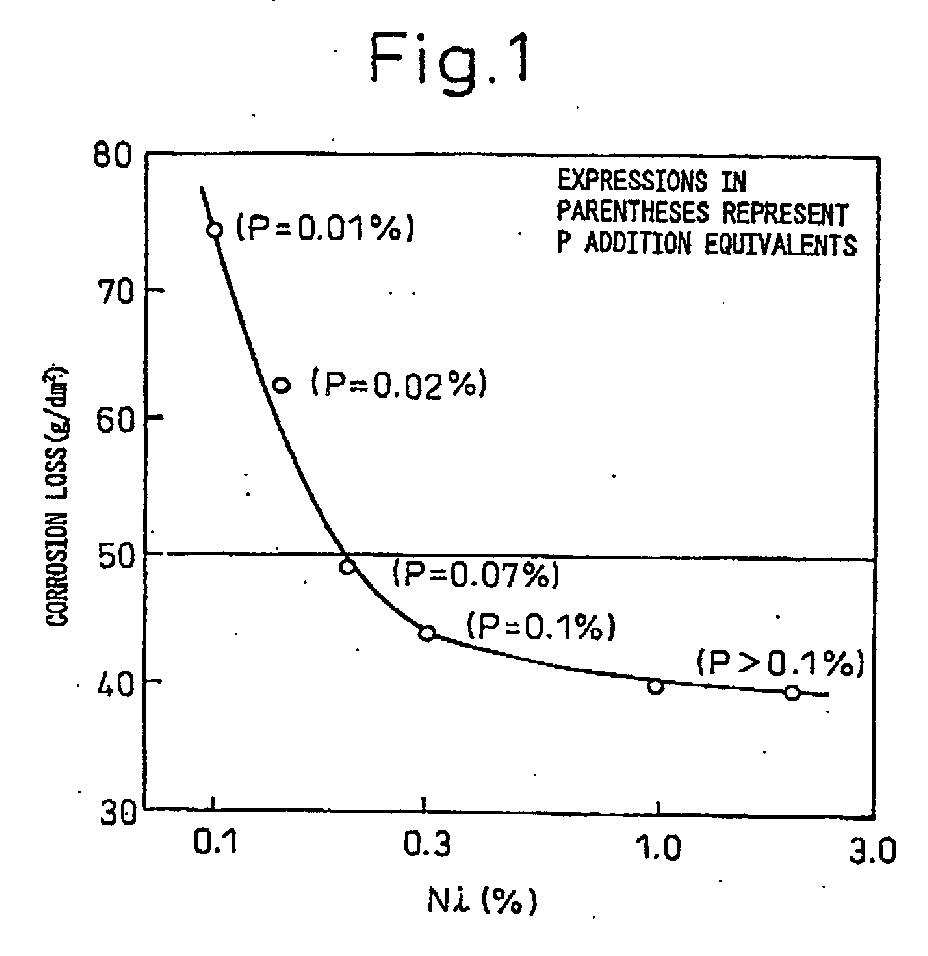
- Fig. 1 shows the effect of an Ni amount on a corrosion loss in comparison with the effect of a P amount. It has been found that, as an Ni amount increases, a corrosion loss decreases and an effect similar to the case of P addition is obtained.
- Ni in contrast with P, does not segregate during the casting of a slab, slab cracking does not matter, and also a yield is good. Furthermore, Ni causes no problem in workability and weldability and therefore bending work after shot blasting or the like and weld cracking do not matter. Accordingly, Ni is an element very suitable for the production of a weather-resistant high strength steel sheet excellent in bendability. With regard to weather resistance, Ni exhibits the effect by the joint use with Cu and Cr.
- C is exploited as an element for enhancing strength. It is utilized not only as a solid solution strengthening element but also, by combining with Ti and Nb and forming carbide, as a precipitation strengthening element.
- C when C is used excessively, workability deteriorates. Since workability lowers as the strength of a steel material increases, a low C amount is desirable.
- the reason why the lower limit of a C amount is set at 0.05% is that, when it is lower than that amount, a yield strength of 700 MPa or higher is hardly secured.
- the reason why a C amount is limited to 0.15% or lower is to prevent cracking caused by bending work.
- Si is an element that is likely to form fayalite (2FeO ⁇ SiO 2 ) on the surface of a steel sheet, make fine Fe 2 O 3 remain on the most surface, and generate red scale. When red scale is created on the surface of a steel sheet, mottling appears and the product is not accepted by users. In order to avoid the problem, the upper limit of an Si amount is set at 0.5%.
- Mn is an element necessary for enhancing the strength of a steel material.
- an Mn amount is less than 0.5%, a high strength steel material is hardly produced.
- Mn is added in excess of 2.0%, workability is hardly secured.
- an Mn amount is limited in the range from 0.5 to 2.0%.
- P is an element effective in the enhancement of strength and beneficial to the improvement of weather resistance and has heretofore been exploited for a weather-resistant steel material.
- P causes slab embrittlement during the production of the steel material and also deteriorates weldability.
- P also deteriorates bendability, and therefore a P amount should be as low as possible. Accordingly, the upper limit of a P amount is set at 0.02%.
- S forms sulfide MnS combining with Mn.
- This sulfide is easy to deform, is elongated by rolling and is present in a steel material.
- MnS deteriorates the bendability and workability of a steel material.
- S should be reduced to the utmost because it raises cracking susceptibility. Therefore, the upper limit of an S amount is set at 0.005% as the commercially attainable limit.
- Ni is an element that enhances strength and weather resistance and is also effective in the prevention of embrittlement.
- Ni is effective in weather resistance under an environment largely influenced by salinity.
- P that is effective in weather resistance badly affects workability and thus cannot be utilized.
- Ni can be utilized as an element substituting for p and neither causes slab cracking nor deteriorates the workability of a steel material in contrast with P.
- Ni must be added by 0.2% or more in order to effectively utilize the feature of weather resistance.
- Ni is an expensive metal and moreover the effect does not improve any more even when an Ni amount exceeds 2.0%. Therefore, the upper limit of an Ni amount is set at 2.0%.
- Containers are used for both land and marine transportation and are affected by the salinity of seawater in the case of the marine transportation and by salinity from snowmelt salt scattered in a cold region in the case of land transportation. Therefore, Ni is an element important for weather resistance. In an environment other than a saline environment, the elements Cu and Cr, which are described below, are effective and therefore the combined addition of those elements is also effective.
- Cu is important in improving weather resistance and is an element effective in forming stable rust.
- a Cu amount of 0.2% or more is necessary for securing the effect against a corrosive environment.
- a Cu amount exceeds 0.5%, surface defects are likely to appear.
- a Cu amount is limited in the range from 0.2 to 0.5%.
- Cr is also important in improving weather resistance and is an element effective in forming stable rust.
- a Cr amount of 0.2% or more is necessary for securing the effect against a corrosive environment. However, the effect does not improve any more even if a Cr amount exceeds 1.0%. For those reasons, a Cr amount is limited in the range from 0.2 to 1.0%.
- a steel material having a yield strength of 700 MPa or higher is produced, the exploitation of precipitation strengthening is effective.
- the following four elements that allow a precipitation effect to appear compensate the insufficiency of strength and the compensation can be attained by using one or more of those elements.
- Ti forms a carbide and a nitride by combining with C and N and thus enhances the strength of a steel material. The effect appears when Ti is added by 0.03% or more and does not improve any more even if Ti is added by 0.2% or more.
- Nb also forms a carbide and a nitride by combining with C and N and thus enhances the strength of a steel material. The effect appears when Nb is added by 0.01% or more and does not improve any more even if Nb is added by 0.07% or more.
- V also forms a carbide and a nitride by combining with C and N and thus enhances the strength of a steel material. The effect appears when V is added by 0.01% or more and does not improve any more even if V is added by 0.07% or more.
- B is an element that forms a carbide and a nitride and is effective in enhancing hardenability and strength. The effect appears when B is added by 0.0005% or more and the effect does not improve any more even if B is added by 0.0050% or more.
- the purpose of limiting a reheating temperature to 1,200°C or higher is to dissolve carbide and nitride at the stage of a slab in order to make use of the precipitation effect of Ti, Nb, V and B, and by so doing to form fine precipitates during the production of a steel sheet so that the precipitation effect may be fully utilized.
- a rolling finish temperature is limited in the range from 850°C to 950°C.
- a coiling temperature affects the size of precipitates and the degree of precipitation effect varies in accordance with a coiling temperature.
- a coiling temperature is limited in the range from 504°C to 650°C as an appropriate temperature range wherein the enhancement of strength is expected.
- Weldability was judged by the existence of weld cracks after arc welding was applied.
- salt water spray treatment was applied and, thereafter, corrosion accelerating tests, wherein wet and dry were alternately repeated, were applied, the weight of each sample was measured before the test was applied and after rust was removed after the test, and resultantly each corrosion loss was obtained.
- a commercially available 490 MPa class Corten steel was employed and the data thereof were used as the standard, and then each sample was evaluated as ⁇ when the corrosion loss of the sample was larger than the standard and as ⁇ when the corrosion loss thereof was equal to or smaller than the standard.
- Test Nos. 18 to 20 were the cases where, in the hot rolling process, descaling treatment was utilized in order to remove surface scale from each of the rough bars by high-pressure descaling after rough rolling and further continuous-continuous hot rolling was utilized, wherein rough bars were heated with a bar heater and jointed.
- the material properties stipulated in the present invention were satisfied and the effects of the utilization of the above process means were obtained.
- the bar heater was used, and resultantly the temperature of a rough bar before finish rolling was high and uniform, thus precipitation was controlled evenly, the quality deviation of the material decreased, and the deviation of elongation was reduced to 3.8% whereas the elongation deviation of a steel of this class was usually about 6%.
- Test No. 19 was the case where a high-pressure descaling apparatus and continuous-continuous hot rolling were applied. By the adoption of the high-pressure descaling, the surface appearance of the steel material improved remarkably. In addition, by the adoption of continuous-continuous hot rolling, the shapes at the ends of a coil improved and the material yield improved up to 97% whereas the material yield was usually about 95%. Further, Test No. 20 was the case where a bar heater and continuous-continuous hot rolling were utilized. The deviation of elongation decreased to 3.2% and the material yield improved up to 98%.
- a steel material according to the present invention has bendability and weather resistance simultaneously while also having a high strength.
- the weight reduction of a steel material for a container or the like that requires weather resistance can be realized and a longer service life is also realized because of the weather resistance. Therefore, the present invention makes it possible to provide environment-friendliness by the weight reduction and economic effect by the longer service life.
Landscapes
- Chemical & Material Sciences (AREA)
- Engineering & Computer Science (AREA)
- Materials Engineering (AREA)
- Mechanical Engineering (AREA)
- Metallurgy (AREA)
- Organic Chemistry (AREA)
- Physics & Mathematics (AREA)
- Thermal Sciences (AREA)
- Crystallography & Structural Chemistry (AREA)
- Heat Treatment Of Sheet Steel (AREA)
- Heat Treatment Of Steel (AREA)
Abstract
- Ti: 0.03 to 0.2%,
- Nb: 0.01 to 0.07%,
- V: 0.01 to 0.07%, and
- B: 0.0005 to 0.0050%,
Description
- The present invention relates to a steel material, used for railcars and containers for land or marine transportation, required to have strength, workability after blasting or the like and weather resistance, and a method for producing the steel material.
- A material having the properties of low weight, long life and weather resistance has heretofore been desired for containers and thus a material produced using aluminum has mainly been used for such applications. However, such a material has the disadvantages of a high cost and low strength and therefore a steel material having both high strength and weather resistance has been sought. As a conventional weather-resistant steel material, there is a highly-weather-resistant rolled steel material of the 50 kgf/mm2 (490 MPa) class in tensile strength as stipulated in JIS G3125. With regard to a steel material having a higher strength than that, Japanese unexamined Patent Publication No. H3-2321 discloses a method for producing a weather-resistant steel sheet having a tensile strength of 60 kgf/mm2 or higher and good cold-workability.
- In the meantime, with the increasing use of marine containers, the environment becomes even move severe and instances where even a painted container suffers local corrosion and cannot withstand long-term use are increasing. To cope with the problem, Japanese Unexamined Patent Publication No. S63-72853 discloses that a life-span increase can be realized by adding Nb, Ti, v and B to a high-p steel.
- In recent years, however, a high strength and low weight container is further desired and an ultra-high strength weather-resistant steel material having a yield strength of 700 MPa or higher and good bendability has been sought. Moreover, as bending work is applied after a steel material is subjected to blasting or the like, with the aim of improving paintability at the time of painting, fatigue properties and surface hardenability, the levels of both the strength and workability required of the steel material are very high. The reason why the required strength is not expressed in terms of tensile strength but yield strength is that it must be assured to maintain stiffness even when the thickness of a material is reduced in order to obtain both ultra-high strength and low weight. Therefore, such specifications are not fulfilled by the components and production method disclosed in Japanese Unexamined Patent Publication No. H3-2321.
- Further, with such component types as proposed in Japanese Unexamined Patent Publication No. S63-72853 that is aimed at a longer life, though the longer life due to weather resistance is secured, cracking occurs during blasting and bending in the process of the manufacturing of a container and therefore the requirements have not been satisfied. The object of the present invention is, by solving the aforementioned problems, to provide: a steel material withstanding bending work after blasting or the like and having weather resistance while securing an ultra-high strength of 700 MPa or higher in yield strength; and a method for producing the steel material.
- The means for attaining the above object according to the present invention is;
- (1) a weather-resistant high strength steel sheet
excellent in bendability, characterized by containing, in
mass,
- C: 0.05 to 0.15%,
- Si: 0.5% or less,
- Mn: 0.5 to 2.0%,
- P: 0.02% or less,
- S: 0.005% or less,
- Ni: 0.2 to 2.0%,
- Cu: 0.2 to 0.5%, and
- Cr: 0.2 to 1.0%, and one or more of
- Ti: 0.03 to 0.2%,
- Nb: 0.01 to 0.07%,
- V: 0.01 to 0.07%, and
- B: 0.0005 to 0.0050%,
- (2) a method for producing a weather-resistant high
strength steel sheet excellent in bendability,
characterized by:
- heating a steel material containing, in mass,
- C: 0.05 to 0.1%,
- Si: 0.5% or less,
- Mn: 0.5 to 2.0%,
- P: 0.02% or less,
- S: 0.005% or less,
- Ni: 0.2 to 2.0%,
- Cu: 0.2 to 0.5%, and
- Cr: 0.2 to 1.0%, and one or more of
- Ti: 0.03 to 0.2%,
- Nb: 0.01 to 0.07%,
- V: 0.01 to 0.07%, and
- B: 0.0005 to 0.0050%,
- thereafter, finish-rolling the steel material in the temperature range from 850°C to 950°C; and
- coiling the rolled steel material in the temperature range from 500°C to 650°C.
-
- The reasons for limiting a steel sheet and a production method according to the present invention are hereunder explained in detail.
-
- Fig. 1 is a graph showing the effects of an Ni amount and a P amount on a corrosion loss.
- Fig. 2 is a schematic showing the outline of a press bending test.
- Fig. 3 is a graph showing the influence of a P amount on a corrosion loss and a bend R (radius).
-
- The present inventors investigated and studied methods for producing steel sheets comprising various kinds of steels in order to solve the aforementioned problems and thus established the present invention. The present invention is hereunder explained in detail.
- In general, the same kind of rust appears on a weather-resistant steel material as appears on an ordinary steel during an early stage of exposure in the atmosphere. However, it is said that, thereafter, some of the rust of a weather-resistant steel material forms dense rust closely adhering to the base material, the rust plays the role of a protective film and, as a result the progress of rust caused by an environment is prevented. It is also said that it is effective. to contain Cu,.Cr and P in order to create such rust.
- In the case of a conventional material having a tensile strength of 50 to 60 kgf/mm2 (490 to 590 MPa), by containing such types of components, the material has been applicable to a container as a weather-resistant steel material. In recent years, coupled with global environmental issues, the weight reduction of an automobile aimed at the improvement of a fuel efficiency has been publicized and there is a strong need also for the weight reduction of a container used for land or marine transportation. The target thickness of a steel material has become thinner for the purpose of a greater weight reduction than ever and a yield strength of 700 MPa or higher is required for the purpose of the securement of stiffness. Meanwhile, in the production of a container, roughness is applied on the surface of a steel sheet, by blasting, wherein shot, sand, grit or the like is blown on the steel sheet in order to improve descaling performance and paintability. The process makes the surface thereof hard and therefore bend cracking tends to occur at the subsequent bend forming. In the case of a steel material having a yield strength exceeding 700 MPa, in particular, cracking susceptibility appears conspicuously and the selection of additive elements has a large influence.
- As it has been explained above, in order to produce a weather-resistant steal material, having a yield strength exceeding 700 MPa and capable of withstanding bending work after subjected to blasting, it is necessary to fulfill the following requirements simultaneously;
- 1 ○ Enhancement of material strength,
- 2 ○ Securement of bendability, and
- 3 ○ Securement of weather resistance.
-
- when P is used abundantly in the production of such a high strength steel material having weather resistance, various problems arise. Firstly, when a slab 200 to 300 mm in thickness is cast in a production process, p tends to cause center segregation and concentrates at the thickness center portion which is the finally solidified portion. The portion where P concentrates is likely to cause embrittlement cracking. Further, as a high strength steel material itself has a high cracking susceptibility, a P-added weather-resistant high-strength steel sheet causes slab cracking frequently and also a very low yield.
- Furthermore, even if a steel sheet can be produced, the material is brittle because of the addition of P and therefore the workability thereof is poor. Generally speaking, as the strength of a steel material increases, the elongation thereof lowers. Therefore, the workability of a P-added material further lowers and moreover, as the object material is subjected to bending work after shot blasting or the like, the material is very susceptible to bend cracking. In addition, weld cracking is likely to occur when such a steel material is fabricated into a container by welding. As a result of investigating precisely the characteristics of Cu, Cr and P that have been utilised as weather-resistant elements in a conventional steel, it has been clarified that P adversely influences the above requirement 2 ○ very much and cannot be utilized in a high strength steel material. The present inventors investigated the relationship between a P amount and the conditions of generating bend cracking in the 90-degree press bending test shown in Fig. 2 while the R (radius) of the punch tip was varied. At the same time, the present inventors investigated the relationship between P addition and a corrosion loss and showed the results in Fig. 3. It is obvious that, though a corrosion loss decreases and weather resistance improves as a P amount increases, the increase of a P amount causes the critical bend R (radius), below which bend cracking occurs, to increase and the bendability of a steel sheet deteriorates. Therefore, in order to secure bendability, it is necessary to study a method of securing weather resistance without the use of P. Cu and Cr less adversely influence bendability. However, merely with the increase of their amounts, weather resistance is hardly secured. Moreover, the steel material cannot withstand bending work after blasting or the like.
- In this light, as a result of repeating various tests, the present inventors have found that: weather resistance can be secured by the use of Ni instead of P; bendability can be secured by lowering C to improve workability, reducing the addition of P to the utmost, and reducing S to the utmost to suppress the formation of MnS that adversely affects bendability; and the adjustment of strength can be attained by utilizing a precipitation effect caused by combining one or more of Ti, Nb, V and B.
- Fig. 1 shows the effect of an Ni amount on a corrosion loss in comparison with the effect of a P amount. It has been found that, as an Ni amount increases, a corrosion loss decreases and an effect similar to the case of P addition is obtained.
- Further, Ni, in contrast with P, does not segregate during the casting of a slab, slab cracking does not matter, and also a yield is good. Furthermore, Ni causes no problem in workability and weldability and therefore bending work after shot blasting or the like and weld cracking do not matter. Accordingly, Ni is an element very suitable for the production of a weather-resistant high strength steel sheet excellent in bendability. With regard to weather resistance, Ni exhibits the effect by the joint use with Cu and Cr.
- The present inventors repeated experiments on the basis of the above conditions and established the present invention. The reasons for limiting the additive elements according to the present invention are hereunder described in detail. C:
- C is exploited as an element for enhancing strength. It is utilized not only as a solid solution strengthening element but also, by combining with Ti and Nb and forming carbide, as a precipitation strengthening element. However, when C is used excessively, workability deteriorates. Since workability lowers as the strength of a steel material increases, a low C amount is desirable. The reason why the lower limit of a C amount is set at 0.05% is that, when it is lower than that amount, a yield strength of 700 MPa or higher is hardly secured. On the other hand, the reason why a C amount is limited to 0.15% or lower is to prevent cracking caused by bending work.
- Si is an element that is likely to form fayalite (2FeO·SiO2) on the surface of a steel sheet, make fine Fe2O3 remain on the most surface, and generate red scale. When red scale is created on the surface of a steel sheet, mottling appears and the product is not accepted by users. In order to avoid the problem, the upper limit of an Si amount is set at 0.5%.
- Mn is an element necessary for enhancing the strength of a steel material. When an Mn amount is less than 0.5%, a high strength steel material is hardly produced. In contrast, when Mn is added in excess of 2.0%, workability is hardly secured. For those reasons, an Mn amount is limited in the range from 0.5 to 2.0%.
- P is an element effective in the enhancement of strength and beneficial to the improvement of weather resistance and has heretofore been exploited for a weather-resistant steel material. However, in the production of an ultra-high strength steel material having a yield strength exceeding 700 MPa, P causes slab embrittlement during the production of the steel material and also deteriorates weldability. On top of that, P also deteriorates bendability, and therefore a P amount should be as low as possible. Accordingly, the upper limit of a P amount is set at 0.02%.
- S forms sulfide MnS combining with Mn. This sulfide is easy to deform, is elongated by rolling and is present in a steel material. MnS deteriorates the bendability and workability of a steel material. In the case of a high strength steel material in particular, S should be reduced to the utmost because it raises cracking susceptibility. Therefore, the upper limit of an S amount is set at 0.005% as the commercially attainable limit.
- Ni is an element that enhances strength and weather resistance and is also effective in the prevention of embrittlement. In particular, Ni is effective in weather resistance under an environment largely influenced by salinity. As it has been explained earlier, in a high strength steel material, P that is effective in weather resistance badly affects workability and thus cannot be utilized. Ni can be utilized as an element substituting for p and neither causes slab cracking nor deteriorates the workability of a steel material in contrast with P. Ni must be added by 0.2% or more in order to effectively utilize the feature of weather resistance. On the other hand, Ni is an expensive metal and moreover the effect does not improve any more even when an Ni amount exceeds 2.0%. Therefore, the upper limit of an Ni amount is set at 2.0%. Containers are used for both land and marine transportation and are affected by the salinity of seawater in the case of the marine transportation and by salinity from snowmelt salt scattered in a cold region in the case of land transportation. Therefore, Ni is an element important for weather resistance. In an environment other than a saline environment, the elements Cu and Cr, which are described below, are effective and therefore the combined addition of those elements is also effective.
- Cu is important in improving weather resistance and is an element effective in forming stable rust. A Cu amount of 0.2% or more is necessary for securing the effect against a corrosive environment. However, when a Cu amount exceeds 0.5%, surface defects are likely to appear. For those reasons, a Cu amount is limited in the range from 0.2 to 0.5%.
- Cr is also important in improving weather resistance and is an element effective in forming stable rust. A Cr amount of 0.2% or more is necessary for securing the effect against a corrosive environment. However, the effect does not improve any more even if a Cr amount exceeds 1.0%. For those reasons, a Cr amount is limited in the range from 0.2 to 1.0%. When a steel material having a yield strength of 700 MPa or higher is produced, the exploitation of precipitation strengthening is effective. The following four elements that allow a precipitation effect to appear compensate the insufficiency of strength and the compensation can be attained by using one or more of those elements.
- Ti forms a carbide and a nitride by combining with C and N and thus enhances the strength of a steel material. The effect appears when Ti is added by 0.03% or more and does not improve any more even if Ti is added by 0.2% or more.
- Nb also forms a carbide and a nitride by combining with C and N and thus enhances the strength of a steel material. The effect appears when Nb is added by 0.01% or more and does not improve any more even if Nb is added by 0.07% or more.
- V also forms a carbide and a nitride by combining with C and N and thus enhances the strength of a steel material. The effect appears when V is added by 0.01% or more and does not improve any more even if V is added by 0.07% or more.
- B is an element that forms a carbide and a nitride and is effective in enhancing hardenability and strength. The effect appears when B is added by 0.0005% or more and the effect does not improve any more even if B is added by 0.0050% or more.
- Next, the reasons for limiting production conditions are explained hereunder.
- The purpose of limiting a reheating temperature to 1,200°C or higher is to dissolve carbide and nitride at the stage of a slab in order to make use of the precipitation effect of Ti, Nb, V and B, and by so doing to form fine precipitates during the production of a steel sheet so that the precipitation effect may be fully utilized.
- It is necessary to keep a rolling finish temperature at 850°C or higher in order to fractionize precipitates. However, when a rolling finish temperature exceeds 950°C, problems such as increased likeliness of the coarsening of crystal grains, the formation of scale defects, etc. arise. Therefore, a rolling finish temperature is limited in the range from 850°C to 950°C.
- A coiling temperature affects the size of precipitates and the degree of precipitation effect varies in accordance with a coiling temperature. When a coil is coiled at a high temperature, precipitates grow too large and a strengthening effect lowers. In contrast, when a coiling temperature is too low, the growth of precipitates is insufficient and the enhancement of strength is not expected. For those reasons, a coiling temperature is limited in the range from 504°C to 650°C as an appropriate temperature range wherein the enhancement of strength is expected.
- In production processes, there is no restriction on the use of a high-pressure descaling device and a bar heater, and the application of continuous-continuous hot rolling wherein bar-joint materials after subjected to rough rolling are rolled continuously. Rather, by using those apparatuses, it is possible to prevent scale defects from forming and to improve a yield while improving process capability in temperature control.
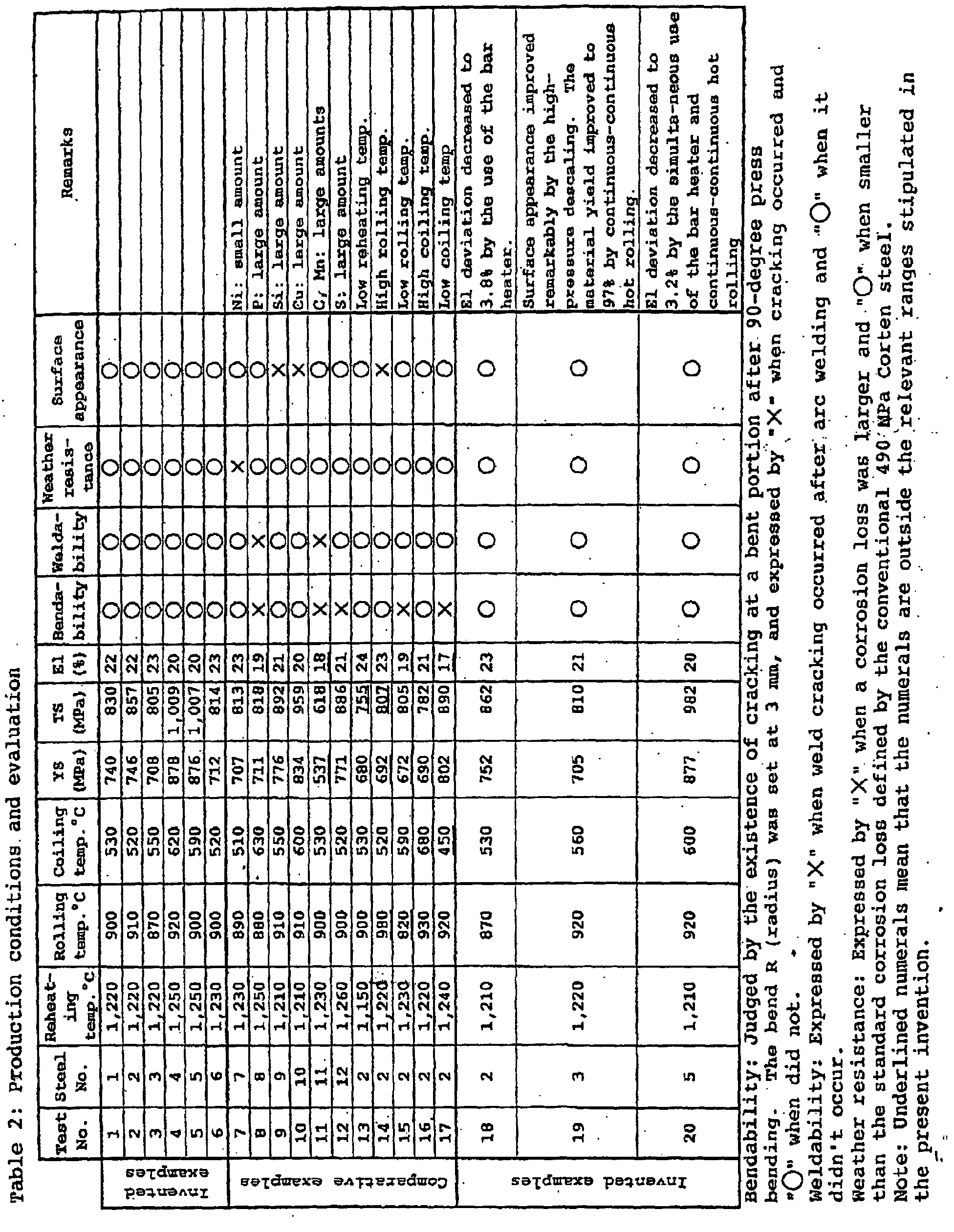
- Steels of Steel Nos. 1 to 12 having various components as shown in Table 1 were tapped and, thereafter, steel materials were produced under the rolling conditions shown in Table 2, samples were taken and shot blasting treatment was applied to the surfaces thereof, and subsequently properties of the samples were evaluated. In the evaluation, tensile tests were applied and yield strength, tensile strength and total elongation were measured. In addition, bending work was applied with the bend angle of 90 degrees by using a punch the tip radius (R) of which was 3 mm and the existence of cracks at a bent portion was examined.
- Weldability was judged by the existence of weld cracks after arc welding was applied. with regard to weather resistance, salt water spray treatment was applied and, thereafter, corrosion accelerating tests, wherein wet and dry were alternately repeated, were applied, the weight of each sample was measured before the test was applied and after rust was removed after the test, and resultantly each corrosion loss was obtained. As a comparative example, a commercially available 490 MPa class Corten steel was employed and the data thereof were used as the standard, and then each sample was evaluated as × when the corrosion loss of the sample was larger than the standard and as ○ when the corrosion loss thereof was equal to or smaller than the standard.
- Further, a surface appearance was evaluated by observing the surface of each steel material after rolling. The rolling conditions of Test Nos. 1 to 12 were all within the ranges stipulated in the present invention. In the case of Test No. 7, the Ni amount was small and thus the weather resistance thereof was poor. In the case of Test No. 8, though the weather resistance was good, the P amount was large and therefore the weldability was poor and cracking appeared at the bending work. As the Si amount was large in the case of Test No. 9 and the Cu amount was too large in the case of Test No. 10, scabs and mottling appeared on the surfaces and thus surface appearance was poor in both the cases. In the case of Test No. 11, the amounts of C and Mn were too large and therefore the bendability and the weldability were poor. In the case of Test No. 12, the S amount was large and therefore cracking appeared at the bending test.
- In the cases of Test Nos. 13 to 17, the steel material of Steel No. 2 produced within the ranges stipulate in the present invention was used and'the rolling conditions were varied. In the case of Test No. 13, the reheating temperature was too low, and therefore precipitation strengthening could not be utilized and the yield strength thereof could not exceed the target value 700 MPa. In the case of Test No. 14, the rolling temperature was high and therefore the surface appearance was poor. In the case of Test No. 15, the rolling temperature was low and therefore the strengthening by the fractionization of precipitates did not show up and the target strength could not be obtained. In the case of Test No. 16, the coiling temperature was high and therefore the steel material softened and the target strength could not be obtained likewise. In the case of Test No. 17, the coiling temperature was too low, and therefore; though the strength increased, a hardened layer developed and cracking occurred after bending work.
- In the cases of Test Nos.1 to 6 that fulfilled the ranges of components and the rolling conditions stipulated in the present invention, any of the properties was acceptable and good evaluation results were obtained.
- Further, Test Nos. 18 to 20 according to the present invention were the cases where, in the hot rolling process, descaling treatment was utilized in order to remove surface scale from each of the rough bars by high-pressure descaling after rough rolling and further continuous-continuous hot rolling was utilized, wherein rough bars were heated with a bar heater and jointed. In any of the cases, the material properties stipulated in the present invention were satisfied and the effects of the utilization of the above process means were obtained. In the case of Test No. 18, the bar heater was used, and resultantly the temperature of a rough bar before finish rolling was high and uniform, thus precipitation was controlled evenly, the quality deviation of the material decreased, and the deviation of elongation was reduced to 3.8% whereas the elongation deviation of a steel of this class was usually about 6%. Test No. 19 was the case where a high-pressure descaling apparatus and continuous-continuous hot rolling were applied. By the adoption of the high-pressure descaling, the surface appearance of the steel material improved remarkably. In addition, by the adoption of continuous-continuous hot rolling, the shapes at the ends of a coil improved and the material yield improved up to 97% whereas the material yield was usually about 95%. Further, Test No. 20 was the case where a bar heater and continuous-continuous hot rolling were utilized. The deviation of elongation decreased to 3.2% and the material yield improved up to 98%.

- A steel material according to the present invention has bendability and weather resistance simultaneously while also having a high strength. By using the steel material, the weight reduction of a steel material for a container or the like that requires weather resistance can be realized and a longer service life is also realized because of the weather resistance. Therefore, the present invention makes it possible to provide environment-friendliness by the weight reduction and economic effect by the longer service life.
Claims (2)
- A weather-resistant high strength steel sheet excellent in bendability, characterized by containing, in mass,one or more ofC: 0.05 to 0.15%,Si: 0.5% or less,Mn: 0.5 to 2.0%,P: 0.02% or less,S: 0.005% or less,Ni: 0.2 to 2.0%,Cu: 0.2 to 0.5%, andCr: 0.2 to 1.0%, andwith the balance consisting of Fe and unavoidable impurities.Ti: 0.03 to 0.2%,Nb: 0.01 to 0.07%,V: 0.01 to 0.07%, andB: 0.0005 to 0.0050%,
- A method for producing a weather-resistant high strength steel sheet excellent in bendability,
characterized by;one or more ofheating a steel material containing, in mass, C: 0.05 to 0.15%,Si: 0.5% or less,Mn: 0.5 to 2.0%,P: 0.02% or less,S: 0.005% or less,Ni: 0.2 to 2.0%,Cu: 0.2 to 0.5%, andCr: 0.2 to 1.0%, andwith the balance consisting of Fe and unavoidableTi: 0.03 to 0.2%,Nb: 0.01 to 0.07%,V: 0.01 to 0.07%, andB: 0.0005 to 0.0050%,
impurities to a temperature of 1,200°C or higher;thereafter, finish-rolling the steel material in the temperature range from 850°C to 950°C; andcoiling the rolled steel material in the temperature range from 500°C to 650°C.
Applications Claiming Priority (3)
| Application Number | Priority Date | Filing Date | Title |
|---|---|---|---|
| JP2002050869A JP3940301B2 (en) | 2002-02-27 | 2002-02-27 | Blasting weathering high-strength steel plate with excellent bending resistance and method for producing the same |
| JP2002050869 | 2002-02-27 | ||
| PCT/JP2003/000676 WO2003072841A1 (en) | 2002-02-27 | 2003-01-24 | Atmosphere corrosion resisting steel plate having high strength and excellent bending formability and method for production thereof |
Publications (5)
| Publication Number | Publication Date |
|---|---|
| EP1486580A1 true EP1486580A1 (en) | 2004-12-15 |
| EP1486580A4 EP1486580A4 (en) | 2006-08-30 |
| EP1486580B1 EP1486580B1 (en) | 2012-03-07 |
| EP1486580B9 EP1486580B9 (en) | 2015-04-22 |
| EP1486580B2 EP1486580B2 (en) | 2016-09-07 |
Family
ID=27764290
Family Applications (1)
| Application Number | Title | Priority Date | Filing Date |
|---|---|---|---|
| EP03742886.9A Expired - Lifetime EP1486580B2 (en) | 2002-02-27 | 2003-01-24 | Atmosphere corrosion resisting steel plate having high strength and excellent bending formability and method for production thereof |
Country Status (6)
| Country | Link |
|---|---|
| EP (1) | EP1486580B2 (en) |
| JP (1) | JP3940301B2 (en) |
| CN (1) | CN1297681C (en) |
| ES (1) | ES2381356T5 (en) |
| TW (1) | TWI284154B (en) |
| WO (1) | WO2003072841A1 (en) |
Cited By (2)
| Publication number | Priority date | Publication date | Assignee | Title |
|---|---|---|---|---|
| CN100535134C (en) * | 2007-06-27 | 2009-09-02 | 攀钢集团攀枝花钢铁研究院 | Copper-containing steel heating method and copper-containing steel produced therewith |
| EP2154262A4 (en) * | 2007-05-29 | 2016-01-20 | Jfe Steel Corp | ABRASION RESISTANT STEEL SHEET EXTREMELY EASY TO APPLY AND METHOD FOR PRODUCING SAME |
Families Citing this family (20)
| Publication number | Priority date | Publication date | Assignee | Title |
|---|---|---|---|---|
| CN1330789C (en) * | 2005-07-19 | 2007-08-08 | 武汉钢铁(集团)公司 | 600MPa grade low temperature high toughness weather corrosion resistant steel and its production method |
| KR100815709B1 (en) | 2006-12-12 | 2008-03-20 | 주식회사 포스코 | High strength cold rolled steel with excellent weatherability and workability and its manufacturing method |
| KR100815799B1 (en) * | 2006-12-12 | 2008-03-20 | 주식회사 포스코 | High yield ratio cold rolled steel with excellent weatherability |
| KR100925639B1 (en) * | 2007-12-24 | 2009-11-06 | 주식회사 포스코 | High strength cold rolled steel sheet with excellent weather resistance and manufacturing method |
| CN101343713B (en) * | 2008-08-19 | 2010-12-22 | 攀钢集团研究院有限公司 | High-strength atmospheric corrosion resistant hot-rolled strip steel and method of manufacturing the same |
| CN101921965A (en) * | 2010-08-06 | 2010-12-22 | 莱芜钢铁股份有限公司 | Low-cost non-quenched and tempered high-strength weathering steel with yield strength level of 700MPa and manufacturing method thereof |
| CN102080191B (en) * | 2010-12-03 | 2012-07-11 | 北京科技大学 | A niobium-boron composite hot-rolled high-strength container steel plate and its preparation method |
| CN102796967B (en) * | 2012-08-31 | 2014-04-16 | 济钢集团有限公司 | 800 MPa economic corrosion-resistance and high-strength steel plate |
| CN104313486A (en) * | 2014-11-14 | 2015-01-28 | 武汉钢铁(集团)公司 | Atmospheric corrosion-resistant steel and production process thereof |
| CN104593698B (en) * | 2015-01-22 | 2017-05-17 | 首钢总公司 | Method for manufacturing high-strength cold-rolled weather resisting steel plates and high-strength cold-rolled weather resisting steel plates |
| CN104988418A (en) * | 2015-05-26 | 2015-10-21 | 四川鸿舰重型机械制造有限责任公司 | Vanadium-titanium alloy semi-autogenous mill wear-resisting liner plate |
| CN106481247A (en) * | 2015-08-26 | 2017-03-08 | 郑飞 | A kind of sandwich fire resistant doorsets of steel pipe |
| CN105200300A (en) * | 2015-09-07 | 2015-12-30 | 宣化钢铁集团有限责任公司 | Production method of low-alloy weather-proof angle steel |
| CN106435366B (en) * | 2016-11-16 | 2018-06-12 | 攀钢集团攀枝花钢铁研究院有限公司 | The think gauge weathering steel of vanadium containing niobium and its milling method |
| CN106893950A (en) * | 2017-01-13 | 2017-06-27 | 唐山钢铁集团有限责任公司 | Low yield strength ratio cold rolling weather resisting steel and its production method |
| CN108342662B (en) * | 2018-02-23 | 2020-03-10 | 柳州钢铁股份有限公司 | High-strength weathering steel with yield strength of 550MPa |
| CN109046582A (en) * | 2018-07-27 | 2018-12-21 | 安徽卓煌机械设备有限公司 | A kind of low cost composite wear-resistant layer cement raw material grinding roller |
| CN112375966B (en) * | 2020-10-19 | 2022-08-09 | 邯郸钢铁集团有限责任公司 | Container plate with good toughness and production method thereof |
| CN113234988B (en) * | 2021-04-15 | 2022-06-10 | 华南理工大学 | Method for producing weathering steel with yield strength of 700MPa grade by online quenching and product thereof |
| CN115821152A (en) * | 2021-09-16 | 2023-03-21 | 宝山钢铁股份有限公司 | A kind of high corrosion-resistant and weather-resistant steel with a yield strength of 350MPa and its manufacturing method |
Citations (1)
| Publication number | Priority date | Publication date | Assignee | Title |
|---|---|---|---|---|
| WO2000043561A1 (en) | 1999-01-20 | 2000-07-27 | Bethlehem Steel Corporation | Method of making an as-rolled multi-purpose weathering steel plate and product therefrom |
Family Cites Families (11)
| Publication number | Priority date | Publication date | Assignee | Title |
|---|---|---|---|---|
| JPH06104858B2 (en) * | 1989-05-30 | 1994-12-21 | 新日本製鐵株式会社 | Method for producing high strength weather resistant hot rolled steel sheet |
| CA2123470C (en) * | 1993-05-19 | 2001-07-03 | Yoshihiro Yazawa | Ferritic stainless steel exhibiting excellent atmospheric corrosion resistance and crevice corrosion resistance |
| JPH101745A (en) * | 1996-06-11 | 1998-01-06 | Nippon Steel Corp | Weather resistant steel with excellent heat input characteristics |
| JP2000063981A (en) * | 1998-08-20 | 2000-02-29 | Nippon Steel Corp | Weather resistant steel with a blackish color tone from initial rust and excellent appearance and color tone stability |
| US6238493B1 (en) * | 1999-02-05 | 2001-05-29 | Bethlehem Steel Corporation | Method of making a weathering grade plate and product thereform |
| JP2000319750A (en) * | 1999-05-10 | 2000-11-21 | Kawasaki Steel Corp | High tensile strength steel for large heat input welding with excellent toughness in the heat affected zone |
| JP3417878B2 (en) * | 1999-07-02 | 2003-06-16 | 株式会社神戸製鋼所 | High-strength hot-rolled steel sheet excellent in stretch flangeability and fatigue properties and its manufacturing method |
| JP4144123B2 (en) * | 1999-07-07 | 2008-09-03 | Jfeスチール株式会社 | Non-tempered high-tensile steel with excellent base material and weld heat-affected zone toughness |
| JP4206642B2 (en) * | 2000-02-23 | 2009-01-14 | Jfeスチール株式会社 | High tensile hot-rolled steel sheet with excellent strain age hardening characteristics and method for producing the same |
| KR100371960B1 (en) * | 2000-09-29 | 2003-02-14 | 주식회사 포스코 | High atmosphere corrosion resting and workability hot rolled strip having tensile strength of 60 kg/㎟ and method for manufacturing it |
| JP6104858B2 (en) * | 2014-08-20 | 2017-03-29 | 株式会社東芝 | Semiconductor device and manufacturing method of semiconductor device |
-
2002
- 2002-02-27 JP JP2002050869A patent/JP3940301B2/en not_active Expired - Lifetime
-
2003
- 2003-01-24 WO PCT/JP2003/000676 patent/WO2003072841A1/en not_active Ceased
- 2003-01-24 ES ES03742886.9T patent/ES2381356T5/en not_active Expired - Lifetime
- 2003-01-24 CN CNB03804658XA patent/CN1297681C/en not_active Expired - Fee Related
- 2003-01-24 EP EP03742886.9A patent/EP1486580B2/en not_active Expired - Lifetime
- 2003-02-10 TW TW092102678A patent/TWI284154B/en not_active IP Right Cessation
Patent Citations (1)
| Publication number | Priority date | Publication date | Assignee | Title |
|---|---|---|---|---|
| WO2000043561A1 (en) | 1999-01-20 | 2000-07-27 | Bethlehem Steel Corporation | Method of making an as-rolled multi-purpose weathering steel plate and product therefrom |
Non-Patent Citations (2)
| Title |
|---|
| J.R. DAVIS: "Metals Handbook Desk Edition, Second Edition", 1 January 1998, ASM INTERNATIONAL, article BRAMFITT: "Structure/Property Relationships in Irons and Steels", pages: 153 - 173, XP055227265 |
| See also references of WO03072841A1 |
Cited By (2)
| Publication number | Priority date | Publication date | Assignee | Title |
|---|---|---|---|---|
| EP2154262A4 (en) * | 2007-05-29 | 2016-01-20 | Jfe Steel Corp | ABRASION RESISTANT STEEL SHEET EXTREMELY EASY TO APPLY AND METHOD FOR PRODUCING SAME |
| CN100535134C (en) * | 2007-06-27 | 2009-09-02 | 攀钢集团攀枝花钢铁研究院 | Copper-containing steel heating method and copper-containing steel produced therewith |
Also Published As
| Publication number | Publication date |
|---|---|
| TW200303367A (en) | 2003-09-01 |
| EP1486580B1 (en) | 2012-03-07 |
| TWI284154B (en) | 2007-07-21 |
| EP1486580B2 (en) | 2016-09-07 |
| CN1297681C (en) | 2007-01-31 |
| JP3940301B2 (en) | 2007-07-04 |
| WO2003072841A1 (en) | 2003-09-04 |
| ES2381356T5 (en) | 2017-04-05 |
| CN1639371A (en) | 2005-07-13 |
| JP2003253382A (en) | 2003-09-10 |
| EP1486580B9 (en) | 2015-04-22 |
| EP1486580A4 (en) | 2006-08-30 |
| ES2381356T3 (en) | 2012-05-25 |
Similar Documents
| Publication | Publication Date | Title |
|---|---|---|
| EP1486580A1 (en) | Atmosphere corrosion resisting steel plate having high strength and excellent bending formability and method for production thereof | |
| JP7654559B2 (en) | High-hardness steel material and its manufacturing method | |
| KR101930186B1 (en) | High-strength galvanized steel sheet and method for producing the same | |
| KR101930185B1 (en) | High-strength galvanized steel sheet and method for producing the same | |
| KR101047901B1 (en) | Ultra high strength steel products and manufacturing method thereof | |
| CN101514427B (en) | High strenght steel sheet having superior ductility and method for manufacturing the same | |
| CN103348020B (en) | Ultra-high-strength structural steel and method for producing ultra-high-strength structural steel | |
| KR20130004605A (en) | Hot-rolled shape steel for ships and process for manufacturing the same | |
| KR20140084313A (en) | High-strength hot-rolled steel sheet and process for producing same | |
| JP7322932B2 (en) | Thick steel plate, manufacturing method thereof, and structure | |
| JP2002180187A (en) | High-strength, high-toughness weather-resistant steel with excellent shade weather resistance | |
| CN115698363A (en) | High strength steel product and method for manufacturing same | |
| CN109790607A (en) | Ballast tank of ship steel and ship | |
| TWI605134B (en) | Fertilizer-grained stainless steel hot-rolled steel sheet and hot-rolled annealing sheet, and methods for producing the same | |
| EP3674435A1 (en) | Low-alloy steel sheet having excellent strength and ductility and manufacturing method therefor | |
| JP2018178216A (en) | Corrosion resistant steel for ballast tank | |
| WO2016157257A1 (en) | High-strength steel sheet and production method therefor | |
| CN115443344B (en) | Steel plate and manufacturing method thereof | |
| JP7332692B2 (en) | High-strength structural steel and its manufacturing method | |
| JP4494237B2 (en) | Austenitic stainless steel material excellent in corrosion resistance, toughness and hot workability, and method for producing the same | |
| JPH06320234A (en) | Method for manufacturing coastal high weathering clad steel sheet | |
| JP4419572B2 (en) | Method for producing a composite steel sheet having excellent fatigue properties | |
| JP7548275B2 (en) | Heavy-duty steel plate, manufacturing method thereof, and structure | |
| JP2025534517A (en) | Steel plate and its manufacturing method | |
| JP2022014894A (en) | Thick steel plate, method for manufacturing thick steel plate, and structure |
Legal Events
| Date | Code | Title | Description |
|---|---|---|---|
| PUAI | Public reference made under article 153(3) epc to a published international application that has entered the european phase |
Free format text: ORIGINAL CODE: 0009012 |
|
| 17P | Request for examination filed |
Effective date: 20040924 |
|
| AK | Designated contracting states |
Kind code of ref document: A1 Designated state(s): AT BE BG CH CY CZ DE DK EE ES FI FR GB GR HU IE IT LI LU MC NL PT SE SI SK TR |
|
| AX | Request for extension of the european patent |
Extension state: AL LT LV MK RO |
|
| A4 | Supplementary search report drawn up and despatched |
Effective date: 20060727 |
|
| REG | Reference to a national code |
Ref country code: DE Ref legal event code: 8566 |
|
| 17Q | First examination report despatched |
Effective date: 20100126 |
|
| GRAP | Despatch of communication of intention to grant a patent |
Free format text: ORIGINAL CODE: EPIDOSNIGR1 |
|
| GRAS | Grant fee paid |
Free format text: ORIGINAL CODE: EPIDOSNIGR3 |
|
| RAP1 | Party data changed (applicant data changed or rights of an application transferred) |
Owner name: NIPPON STEEL CORPORATION |
|
| GRAA | (expected) grant |
Free format text: ORIGINAL CODE: 0009210 |
|
| AK | Designated contracting states |
Kind code of ref document: B1 Designated state(s): BE ES FR |
|
| REG | Reference to a national code |
Ref country code: ES Ref legal event code: FG2A Ref document number: 2381356 Country of ref document: ES Kind code of ref document: T3 Effective date: 20120525 |
|
| PLBI | Opposition filed |
Free format text: ORIGINAL CODE: 0009260 |
|
| PLAX | Notice of opposition and request to file observation + time limit sent |
Free format text: ORIGINAL CODE: EPIDOSNOBS2 |
|
| 26 | Opposition filed |
Opponent name: THYSSENKRUPP STEEL EUROPE AG Effective date: 20121207 |
|
| RAP2 | Party data changed (patent owner data changed or rights of a patent transferred) |
Owner name: NIPPON STEEL & SUMITOMO METAL CORPORATION |
|
| PLAF | Information modified related to communication of a notice of opposition and request to file observations + time limit |
Free format text: ORIGINAL CODE: EPIDOSCOBS2 |
|
| PLBB | Reply of patent proprietor to notice(s) of opposition received |
Free format text: ORIGINAL CODE: EPIDOSNOBS3 |
|
| TPAC | Observations filed by third parties |
Free format text: ORIGINAL CODE: EPIDOSNTIPA |
|
| TPAC | Observations filed by third parties |
Free format text: ORIGINAL CODE: EPIDOSNTIPA |
|
| REG | Reference to a national code |
Ref country code: FR Ref legal event code: PLFP Year of fee payment: 14 |
|
| RIC2 | Information provided on ipc code assigned after grant |
Ipc: C21D 8/02 20060101AFI20151208BHEP Ipc: C21D 9/46 20060101ALI20151208BHEP Ipc: C22C 38/48 20060101ALI20151208BHEP Ipc: C22C 38/58 20060101ALI20151208BHEP Ipc: C22C 38/02 20060101ALI20151208BHEP Ipc: C22C 38/50 20060101ALI20151208BHEP Ipc: C22C 38/42 20060101ALI20151208BHEP |
|
| PUAH | Patent maintained in amended form |
Free format text: ORIGINAL CODE: 0009272 |
|
| STAA | Information on the status of an ep patent application or granted ep patent |
Free format text: STATUS: PATENT MAINTAINED AS AMENDED |
|
| 27A | Patent maintained in amended form |
Effective date: 20160907 |
|
| AK | Designated contracting states |
Kind code of ref document: B2 Designated state(s): BE ES FR |
|
| REG | Reference to a national code |
Ref country code: FR Ref legal event code: PLFP Year of fee payment: 15 |
|
| PGFP | Annual fee paid to national office [announced via postgrant information from national office to epo] |
Ref country code: FR Payment date: 20161215 Year of fee payment: 15 Ref country code: ES Payment date: 20161213 Year of fee payment: 15 Ref country code: BE Payment date: 20161213 Year of fee payment: 15 |
|
| REG | Reference to a national code |
Ref country code: ES Ref legal event code: DC2A Ref document number: 2381356 Country of ref document: ES Kind code of ref document: T5 Effective date: 20170405 |
|
| PG25 | Lapsed in a contracting state [announced via postgrant information from national office to epo] |
Ref country code: FR Free format text: LAPSE BECAUSE OF NON-PAYMENT OF DUE FEES Effective date: 20180131 |
|
| REG | Reference to a national code |
Ref country code: FR Ref legal event code: ST Effective date: 20180928 |
|
| REG | Reference to a national code |
Ref country code: BE Ref legal event code: FP Effective date: 20161129 Ref country code: BE Ref legal event code: MM Effective date: 20180131 |
|
| PG25 | Lapsed in a contracting state [announced via postgrant information from national office to epo] |
Ref country code: BE Free format text: LAPSE BECAUSE OF NON-PAYMENT OF DUE FEES Effective date: 20180131 |
|
| REG | Reference to a national code |
Ref country code: ES Ref legal event code: FD2A Effective date: 20190731 |
|
| PG25 | Lapsed in a contracting state [announced via postgrant information from national office to epo] |
Ref country code: ES Free format text: LAPSE BECAUSE OF NON-PAYMENT OF DUE FEES Effective date: 20180125 |