EP1486552A1 - Organic electroluminescent material, organic electroluminescent device, and heterocycle-containing iridium complex compound - Google Patents
Organic electroluminescent material, organic electroluminescent device, and heterocycle-containing iridium complex compound Download PDFInfo
- Publication number
- EP1486552A1 EP1486552A1 EP04013470A EP04013470A EP1486552A1 EP 1486552 A1 EP1486552 A1 EP 1486552A1 EP 04013470 A EP04013470 A EP 04013470A EP 04013470 A EP04013470 A EP 04013470A EP 1486552 A1 EP1486552 A1 EP 1486552A1
- Authority
- EP
- European Patent Office
- Prior art keywords
- organic electroluminescent
- iridium complex
- complex compound
- heterocycle
- electroluminescent device
- Prior art date
- Legal status (The legal status is an assumption and is not a legal conclusion. Google has not performed a legal analysis and makes no representation as to the accuracy of the status listed.)
- Granted
Links
Images
Classifications
-
- C—CHEMISTRY; METALLURGY
- C07—ORGANIC CHEMISTRY
- C07F—ACYCLIC, CARBOCYCLIC OR HETEROCYCLIC COMPOUNDS CONTAINING ELEMENTS OTHER THAN CARBON, HYDROGEN, HALOGEN, OXYGEN, NITROGEN, SULFUR, SELENIUM OR TELLURIUM
- C07F15/00—Compounds containing elements of Groups 8, 9, 10 or 18 of the Periodic Table
- C07F15/0006—Compounds containing elements of Groups 8, 9, 10 or 18 of the Periodic Table compounds of the platinum group
- C07F15/0033—Iridium compounds
-
- C—CHEMISTRY; METALLURGY
- C09—DYES; PAINTS; POLISHES; NATURAL RESINS; ADHESIVES; COMPOSITIONS NOT OTHERWISE PROVIDED FOR; APPLICATIONS OF MATERIALS NOT OTHERWISE PROVIDED FOR
- C09K—MATERIALS FOR MISCELLANEOUS APPLICATIONS, NOT PROVIDED FOR ELSEWHERE
- C09K11/00—Luminescent materials, e.g. electroluminescent or chemiluminescent
- C09K11/06—Luminescent materials, e.g. electroluminescent or chemiluminescent containing organic luminescent materials
-
- H—ELECTRICITY
- H05—ELECTRIC TECHNIQUES NOT OTHERWISE PROVIDED FOR
- H05B—ELECTRIC HEATING; ELECTRIC LIGHT SOURCES NOT OTHERWISE PROVIDED FOR; CIRCUIT ARRANGEMENTS FOR ELECTRIC LIGHT SOURCES, IN GENERAL
- H05B33/00—Electroluminescent light sources
- H05B33/12—Light sources with substantially two-dimensional [2D] radiating surfaces
- H05B33/14—Light sources with substantially two-dimensional [2D] radiating surfaces characterised by the chemical or physical composition or the arrangement of the electroluminescent material, or by the simultaneous addition of the electroluminescent material in or onto the light source
-
- H—ELECTRICITY
- H10—SEMICONDUCTOR DEVICES; ELECTRIC SOLID-STATE DEVICES NOT OTHERWISE PROVIDED FOR
- H10K—ORGANIC ELECTRIC SOLID-STATE DEVICES
- H10K50/00—Organic light-emitting devices
- H10K50/10—OLEDs or polymer light-emitting diodes [PLED]
- H10K50/11—OLEDs or polymer light-emitting diodes [PLED] characterised by the electroluminescent [EL] layers
-
- H—ELECTRICITY
- H10—SEMICONDUCTOR DEVICES; ELECTRIC SOLID-STATE DEVICES NOT OTHERWISE PROVIDED FOR
- H10K—ORGANIC ELECTRIC SOLID-STATE DEVICES
- H10K85/00—Organic materials used in the body or electrodes of devices covered by this subclass
- H10K85/30—Coordination compounds
- H10K85/321—Metal complexes comprising a group IIIA element, e.g. Tris (8-hydroxyquinoline) gallium [Gaq3]
- H10K85/324—Metal complexes comprising a group IIIA element, e.g. Tris (8-hydroxyquinoline) gallium [Gaq3] comprising aluminium, e.g. Alq3
-
- H—ELECTRICITY
- H10—SEMICONDUCTOR DEVICES; ELECTRIC SOLID-STATE DEVICES NOT OTHERWISE PROVIDED FOR
- H10K—ORGANIC ELECTRIC SOLID-STATE DEVICES
- H10K85/00—Organic materials used in the body or electrodes of devices covered by this subclass
- H10K85/30—Coordination compounds
- H10K85/341—Transition metal complexes, e.g. Ru(II)polypyridine complexes
- H10K85/342—Transition metal complexes, e.g. Ru(II)polypyridine complexes comprising iridium
-
- H—ELECTRICITY
- H10—SEMICONDUCTOR DEVICES; ELECTRIC SOLID-STATE DEVICES NOT OTHERWISE PROVIDED FOR
- H10K—ORGANIC ELECTRIC SOLID-STATE DEVICES
- H10K85/00—Organic materials used in the body or electrodes of devices covered by this subclass
- H10K85/60—Organic compounds having low molecular weight
- H10K85/631—Amine compounds having at least two aryl rest on at least one amine-nitrogen atom, e.g. triphenylamine
-
- C—CHEMISTRY; METALLURGY
- C09—DYES; PAINTS; POLISHES; NATURAL RESINS; ADHESIVES; COMPOSITIONS NOT OTHERWISE PROVIDED FOR; APPLICATIONS OF MATERIALS NOT OTHERWISE PROVIDED FOR
- C09K—MATERIALS FOR MISCELLANEOUS APPLICATIONS, NOT PROVIDED FOR ELSEWHERE
- C09K2211/00—Chemical nature of organic luminescent or tenebrescent compounds
- C09K2211/10—Non-macromolecular compounds
- C09K2211/1018—Heterocyclic compounds
- C09K2211/1025—Heterocyclic compounds characterised by ligands
- C09K2211/1044—Heterocyclic compounds characterised by ligands containing two nitrogen atoms as heteroatoms
-
- C—CHEMISTRY; METALLURGY
- C09—DYES; PAINTS; POLISHES; NATURAL RESINS; ADHESIVES; COMPOSITIONS NOT OTHERWISE PROVIDED FOR; APPLICATIONS OF MATERIALS NOT OTHERWISE PROVIDED FOR
- C09K—MATERIALS FOR MISCELLANEOUS APPLICATIONS, NOT PROVIDED FOR ELSEWHERE
- C09K2211/00—Chemical nature of organic luminescent or tenebrescent compounds
- C09K2211/18—Metal complexes
- C09K2211/185—Metal complexes of the platinum group, i.e. Os, Ir, Pt, Ru, Rh or Pd
-
- H—ELECTRICITY
- H10—SEMICONDUCTOR DEVICES; ELECTRIC SOLID-STATE DEVICES NOT OTHERWISE PROVIDED FOR
- H10K—ORGANIC ELECTRIC SOLID-STATE DEVICES
- H10K2101/00—Properties of the organic materials covered by group H10K85/00
- H10K2101/10—Triplet emission
-
- Y—GENERAL TAGGING OF NEW TECHNOLOGICAL DEVELOPMENTS; GENERAL TAGGING OF CROSS-SECTIONAL TECHNOLOGIES SPANNING OVER SEVERAL SECTIONS OF THE IPC; TECHNICAL SUBJECTS COVERED BY FORMER USPC CROSS-REFERENCE ART COLLECTIONS [XRACs] AND DIGESTS
- Y10—TECHNICAL SUBJECTS COVERED BY FORMER USPC
- Y10S—TECHNICAL SUBJECTS COVERED BY FORMER USPC CROSS-REFERENCE ART COLLECTIONS [XRACs] AND DIGESTS
- Y10S428/00—Stock material or miscellaneous articles
- Y10S428/917—Electroluminescent
Definitions
- the present invention relates to an organic electroluminescent material, an organic electroluminescent device, and a heterocycle-containing iridium complex compound having light emission properties in the region from green to blue, which is advantageously used as an organic electroluminescent material.
- An organic electroluminescent (organic EL) display has advantages in that the colors are clear and the panel can be manufactured so as to have reduced thickness, and has as a consequence received attention as a candidate for the next-generation flat panel display.
- organic EL organic electroluminescent
- the present invention has been conceived in view of the above-mentioned problems in the related art, and it is aimed to provide a novel iridium complex compound which emits light in the region from green to blue, and to provide an organic EL device using the iridium complex compound providing higher efficiency and extended lifespan.
- the inventors of the present invention have conducted intensive studies with a view toward developing a iridium complex material having phosphorescence in the region from green to blue. As a result, they have found that, by introducing a plurality of nitrogen atoms into the heterocycle in the molecule of a ligand and substituting the two benzene rings in the ligand with an electron attractive substituent and an electron-donating substituent to control the electronic state of the ligand, a novel heterocycle-containing iridium complex compound having excellent light emission properties can be obtained.
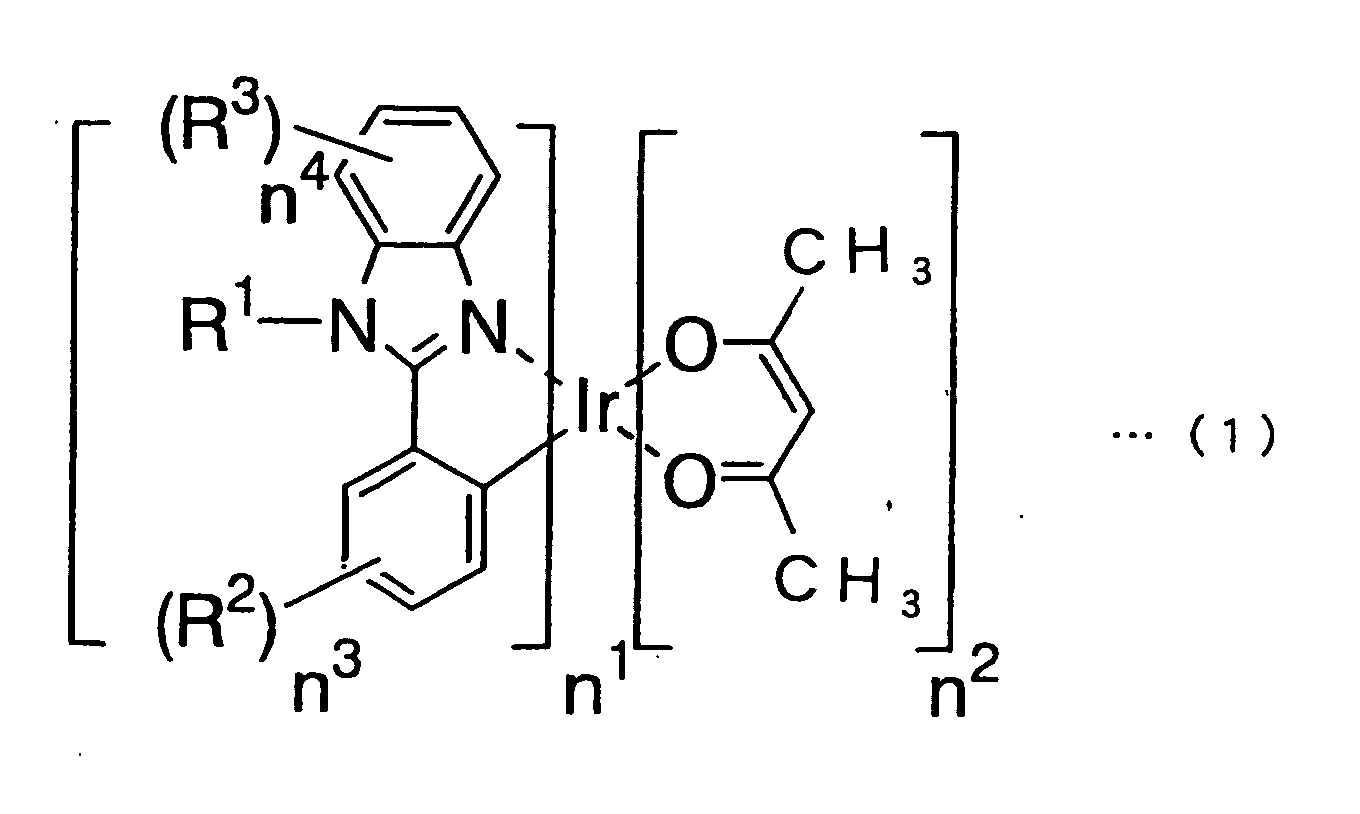
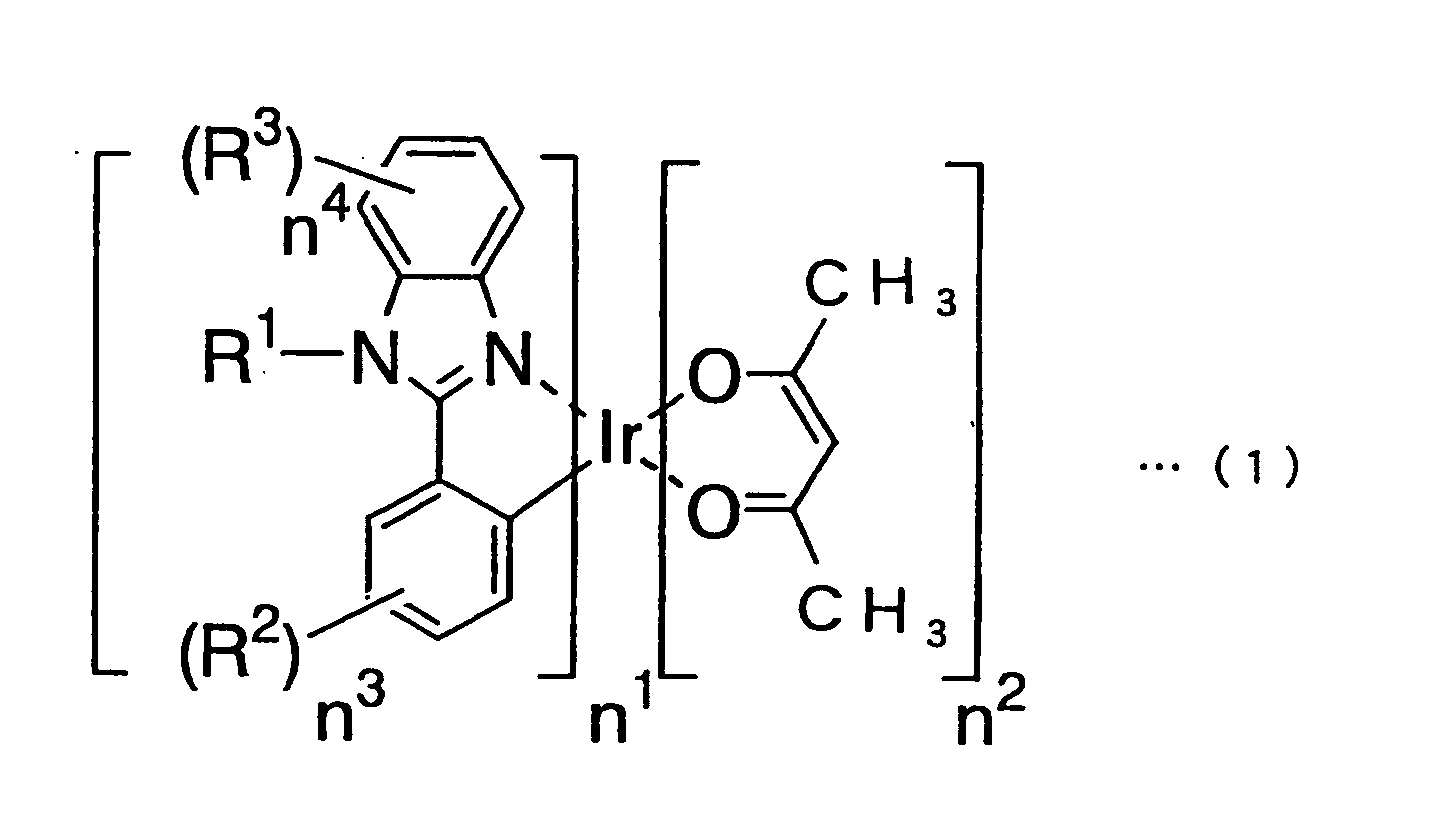
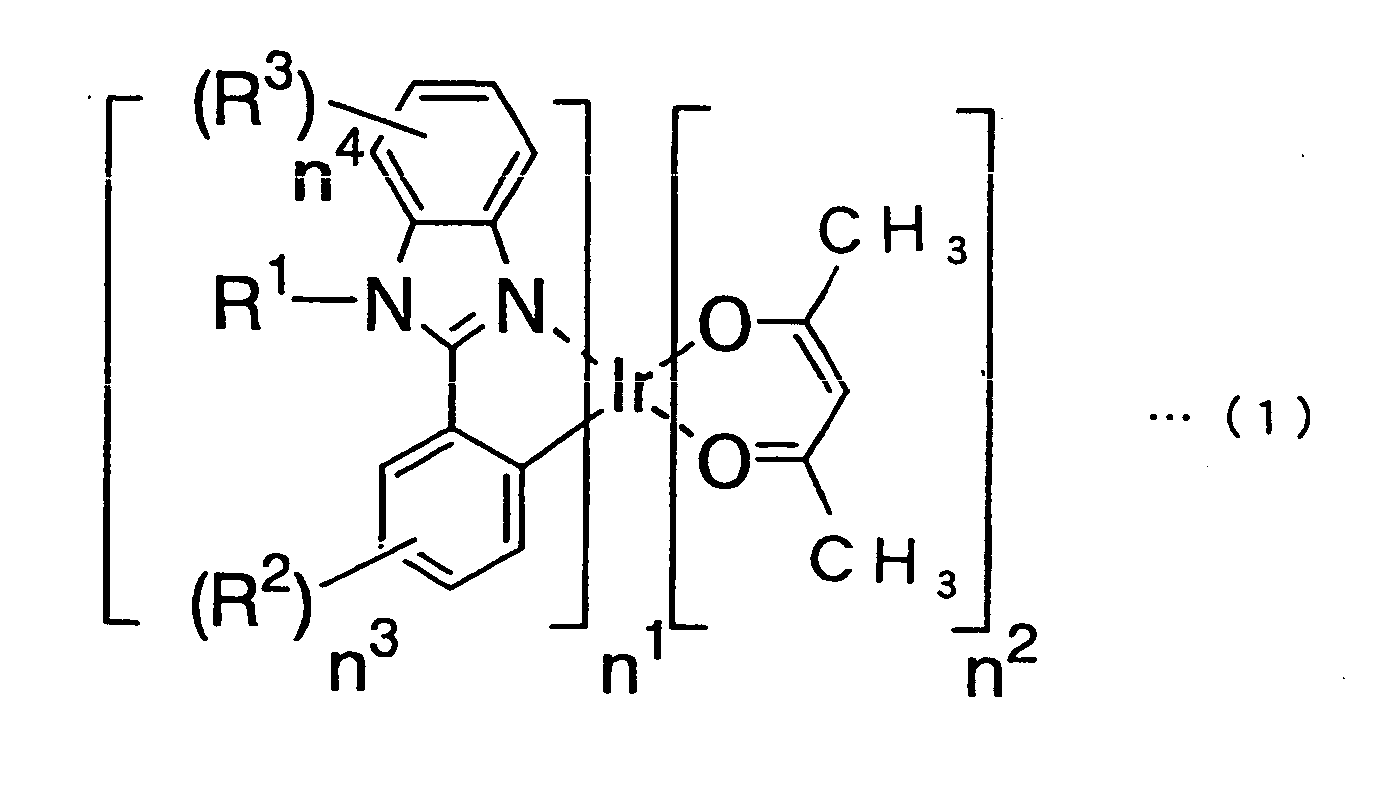
- the present invention first provides an organic electroluminescent material comprising a heterocycle-containing iridium complex compound represented by the following general formula (1):
- R 1 represents any one of a lower alkyl group, a phenyl group, and a substituted phenyl group
- R 2 and R 3 are the same or different and selected from an alkyl group, an alkyloxy group, and a cyano group
- each of n 3 and n 4 independently represents an integer from 0 to 4.
- R 1 represents any one of a lower alkyl group, a phenyl group, and a substituted phenyl group
- R 2 and R 3 are
- R 1 represents any one of a lower alkyl group, a phenyl group, and a substituted phenyl group
- R 2 and R 3 are the same or different and selected from an alkyl group, an alkyloxy group, and a cyano group
- novel heterocycle-containing iridium complex compound represented by the general formula (1) above.
- the novel heterocycle-containing iridium complex compound is advantageously used as an organic electroluminescent material having excellent light emission properties in the region from green to blue.
- an organic layer containing a light emission region using an organic electroluminescent material comprising the heterocycle-containing iridium complex compound according to a preferred embodiment of the present invention, there can be provided an EL device which emits light in the region from green to blue with high efficiency and extended lifespan.
- the heterocycle-containing iridium complex compound represented by the general formula (1) above used in the present invention is a novel compound, which is prepared by the present inventor for the first time.
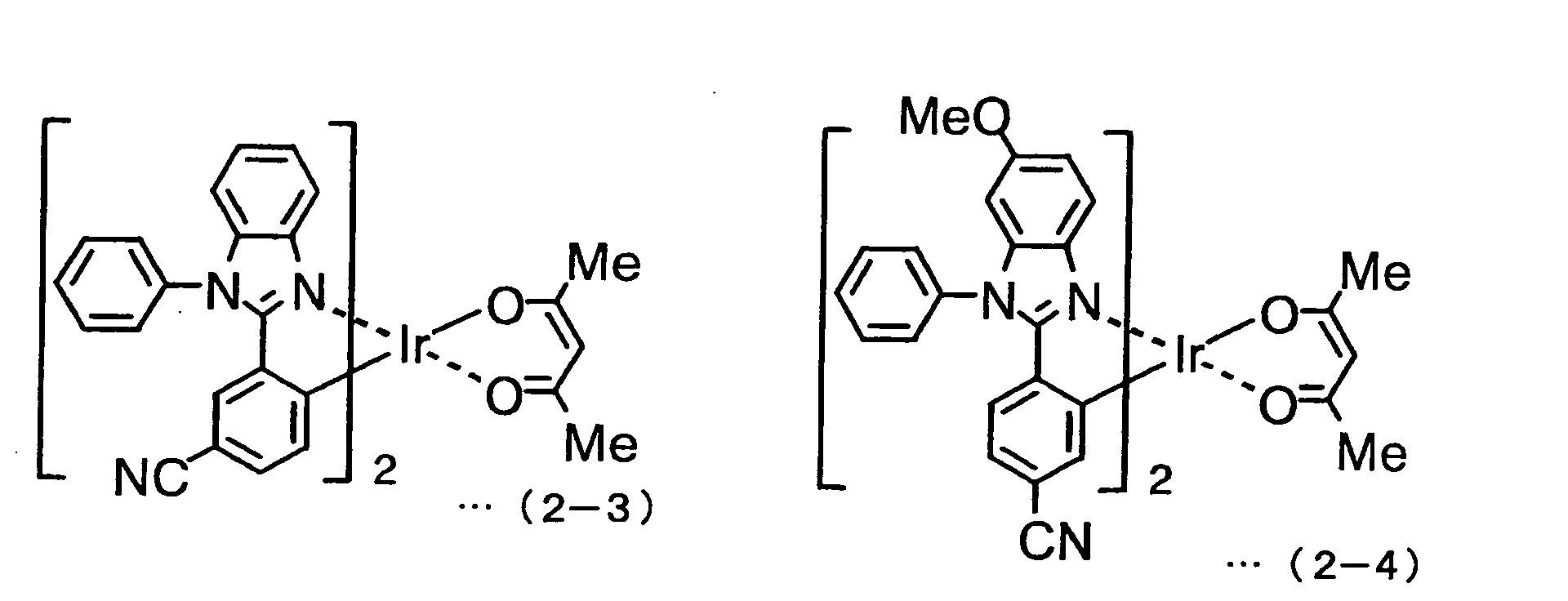
- An especially preferred heterocycle-containing iridium complex compound is represented by any one of the following structural formulae (2-1) to (2-4).
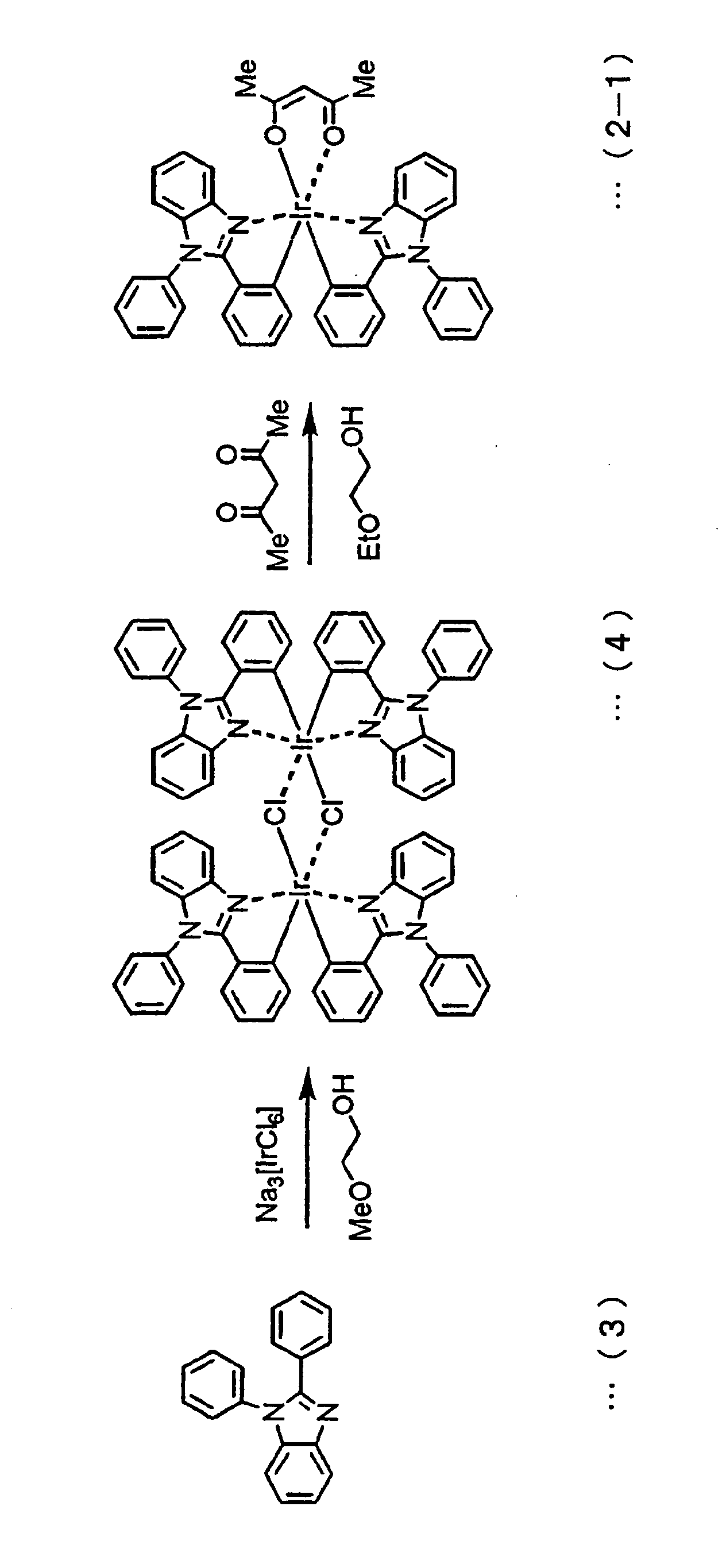
- the heterocycle-containing iridium complex compound according to a preferred embodiment of the present invention can be obtained by, for example, a preparation method in which monomers corresponding to the degree of polymerization n 1 in the general formula (1) above are reacted in sodium hexachloroiridate and 2-methoxyethanol (Nonoyama's method (Bull. Chem. Soc. Jpn. 1794, 47, 767.)), and then heated in 2-ethoxyethanol, together with 1,4-pentanedione and sodium carbonate, followed by purification (Lamansky et al. method (Inorg. Chem. 2001, 40, 1704.)).
- a novel heterocycle-containing iridium complex compound according to a preferred embodiment of the present invention can be advantageously used as an organic electroluminescent material which emits light in the region from green to blue, and, using an organic electroluminescent material comprising the iridium complex compound, an organic electroluminescent device having high light emission efficiency and extended lifespan can be provided.
- the heterocycle-containing iridium complex compound according to a preferred embodiment of the present invention can be used not only as a material for the above-mentioned organic electroluminescent device but also in medical applications, a fluorescent brightener, a material for photography, a UV absorbing material, a laser dye, a dye for color filter, and a color conversion filter.
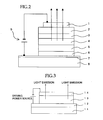
- FIG. 3 shows a diagrammatic cross-sectional view of an example of the organic electroluminescent device according to a preferred embodiment of the present invention.
- This organic electroluminescent device comprises an anode 12, an organic layer 13 containing a light emission region, and a cathode 14 formed in this order on a substrate 11.
- This organic electroluminescent device is a top emission type organic electroluminescent device which emits light from the cathode side.
- the organic electroluminescent device may have, between the electrodes, an organic layer, such as a light emitting layer, a hole injection layer, a hole transport layer, a hole blocking layer, or an electron transport layer, and a protecting layer, and the like, and, by appropriately selecting the material, a layer other than the light emitting layer in these layers or the interface between the layers may emit light.
- an organic layer such as a light emitting layer, a hole injection layer, a hole transport layer, a hole blocking layer, or an electron transport layer, and a protecting layer, and the like, and, by appropriately selecting the material, a layer other than the light emitting layer in these layers or the interface between the layers may emit light.
- the substrate 11 glass, a plastic, or another appropriate material can be used, but preferred is glass which most advantageously suppresses penetration of moisture from the outside.
- the substrate 11 can be common to them.
- a stacked structure comprising a highly reflective metal material, such as chromium (Cr) , or an ITO layer and an Ag alloy can be used.
- the organic layer 13 contains an organic electroluminescent material comprising the heterocycle-containing iridium complex compound represented by the general formula (1) above.
- the heterocycle-containing iridium complex compound according to a preferred embodiment of the present invention as an organic electroluminescent material has properties such that it emits blue light with high efficiency, and therefore, when the compound is contained in the light emitting layer in the organic layer, the electroluminescent device can be improved in light emission efficiency.
- the heterocycle-containing iridium complex compound has excellent charge transportability, and therefore, when the compound is contained in the charge transport layer, the electroluminescent device can be improved in light emission efficiency. Therefore, there can be provided an electroluminescent device which is advantageous not only in that it can reduce energy consumption during the light emission, but also in that it can continue blue light emission with high luminance for a long time.
- Appropriate materials can be used in the individual layers.
- the heterocycle-containing iridium complex compound can be contained not only in the light emitting layer in the organic layer as a light emitting material, but also in the charge transport layer in the organic layer.
- a vacuum deposition method an LB method, a resistive heating deposition method, an electron beam method, a sputtering method, a molecule stacking method, a coating method (e. g., a spin coating method, a casting method, or a dip coating method), an ink-jet method, and a printing method, can be employed, and, from the viewpoint of obtaining excellent properties and facilitating the preparation, a resistive heating deposition method is preferred.
- an alloy of an active metal, such as Li, Mg, or Ca, and a metal, such as Ag, Al, or In, or a stacked structure comprising these metals can be used.
- the thickness of the cathode is controlled to obtain a thickness such that the device transmits light emitted from the cathode side.
- the organic electroluminescent device which emits light from the cathode side on top
- the organic electroluminescent device according to a preferred embodiment of the present invention is not limited to this type and can also be applied to a so-called bottom emission type organic electroluminescent device which emits light from the anode side on bottom.
- the bottom emission type organic electroluminescent device comprises, for example, a light transmitting anode comprised of ITO or the like formed on a glass substrate, a light emitting layer formed on the anode, and a light reflecting cathode formed on the light emitting layer.
- the organic electroluminescent device can be applied to a transmission type organic electroluminescent device comprising an anode and a cathode both of which are comprised of a light transmitting material, such as ITO.
- the organic electroluminescent device can be used in applications in a wide variety of fields, such as display device, display, backlight, electrophotography, illuminating light source, recording light source, exposure light source, reading light source, sign, advertising board, interior, and optical communication.
- a heterocycle-containing iridium complex compound represented by the structural formula (2-1) above was synthesized in accordance with the following reaction formula.
- the compound represented by the structural formula 4 in the above reaction formula was synthesized from the compound represented by the structural formula 3 in the same reaction formula in accordance with the Nonoyama's method (Bull. Chem. Soc. Jpn. 1794, 47, 767.).
- the heterocycle-containing iridium complex compound represented by the structural formula (2-1) above was synthesized from the compound of the structural formula 4 above in accordance with the method of Lamansky et al. (Inorg. Chem. 2001, 40, 1704.).
- the compound of the structural formula 3 (2.7 g, 9.9 mmol ) and sodium hexachloroiridate (1.6 g, 3.3 mmol) were stirred in 2-methoxyethanol for 24 hours.
- the resultant precipitate (compound of the structural formula 4) was washed with ethanol again, and then heated under reflux in 2-ethoxyethanol for 15 hours, together with 1,4-pentanedione (6.7 g, 66 mmol) and sodium carbonate (1.4 g, 13 mmol).
- the resultant insoluble substance was collected by filtration, and washed with water, ethanol, ether, and hexane.
- the residue was purified by silica gel chromatography (developing solvent: methylene chloride), and permitted to undergo sublimation to obtain the compound of the structural formula (2-1) (410 mg; yield based on sodium hexachloroiridate: 15%).
- a heterocycle-containing iridium complex compound represented by the structural formula (2-2) above was synthesized in accordance with substantially the same procedure as in Example 1 except that, instead of the compound of the structural formula 3 in Example 1, a compound of the structural formula below was used. As a result, the yield (based on sodium hexachloroiridate) of the iridium complex compound was found to be 12%.
- a heterocycle-containing iridium complex compound represented by the structural formula (2-3) above was synthesized in accordance with substantially the same procedure as in Example 1 except that, instead of the compound of the structural formula 3 in Example 1, a compound of the structural formula below was used (CAS No. 175712-80-8). As a result, the yield (based on sodium hexachloroiridate) of the iridium complex compound was found to be 15%.
- a compound represented by the structural formula 6 below was synthesized from a compound represented by the structural formula 5 below in accordance with the following reaction formula.
- the compound of the structural formula 5 above (synthesized in accordance with Eur. J. Med. Chem. 1996, 31, 635.)(5.0 g, 19 mmol) and copper(I) cyanide (8.7 g, 98 mmol) were heated under reflux in 500 ml of dioxane for 12 hours.
- the reaction solution was concentrated, washed with water, and dried, and to the resultant solid were added iodobenzene (3.9 g, 19 mmol ) , cesium carbonate (19 g, 58 mmol), copper(I) iodide (370 mg, 1.9 mmol), 1,10-phenanthroline (700 mg, 3.
- the present example is an example in which an organic electroluminescent device was prepared using the heterocycle-containing iridium complex compound represented by the structural formula (2-1) above prepared in Example 1 as a light emitting material.
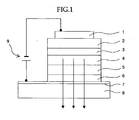
- the structure of this electroluminescent device is diagrammatically shown in FIG. 1, and the reference numerals are as follows: 1: cathode; 2: electron transport layer; 3: hole blocking layer; 4: light emitting layer; 5: hole transport layer; 6: hole injection layer; 7: anode; 8: substrate; and 9: power source.
- a 30 mm ⁇ 30 mm glass substrate having formed on one surface an anode comprised of ITO having a thickness of 100 nm was set in a vacuum deposition machine.
- a metal mask having a plurality of 2.0 mm ⁇ 2.0 mm unit apertures was disposed near the substrate, and CuPc (copper phthalocyanine) was deposited as a hole injection layer by a vacuum deposition method in a vacuum at 10 -4 Pa or less so that the thickness of the resultant layer became 10 nm.
- the deposition rate was 0.1 nm/second.
- ⁇ -NPD represented by the structural formula below was deposited as a hole transport layer material directly on the hole injection layer.
- the thickness of the hole transport layer comprised of ⁇ -NPD was 30 nm, and the deposition rate was 0.1 nm/second.
- a light emitting layer comprised of the iridium complex represented by the structural formula (2-1) above and CBP (carbazolebiphenyl), which were mixed in a 94:6 weight ratio, was deposited directly on the hole transport layer.
- the thickness of the light emitting layer was 40 nm.
- BCP bathhocuproine
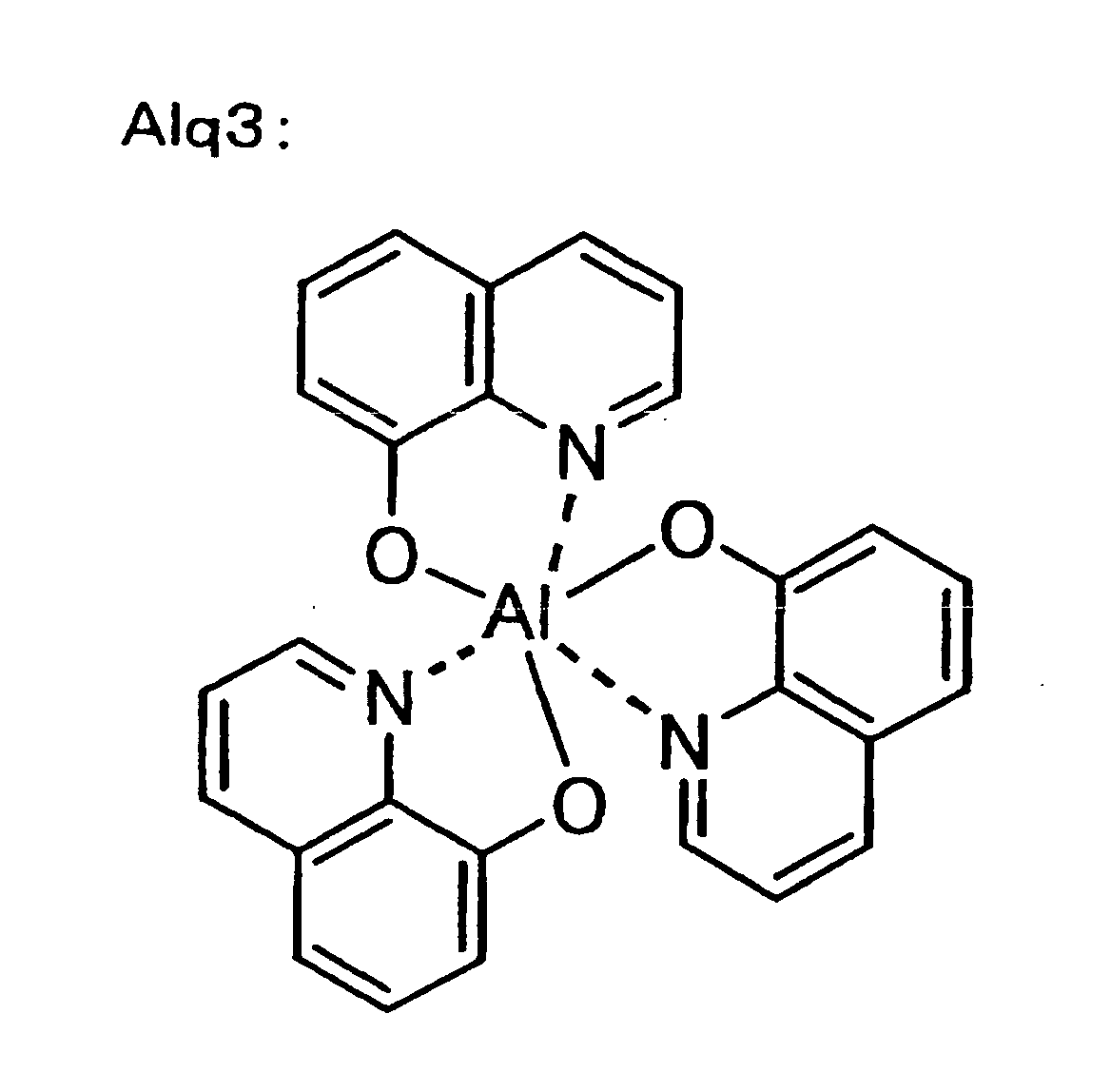
- Alq 3 ⁇ tris(8-hydroxyquinolinato)aluminum ⁇ represented by the structural formula below was deposited as an electron transport layer material directly on the hole blocking layer.
- the thickness of the electron transport layer comprised of Alq 3 was 30 nm, and the deposition rate was 0.2 nm/second.
- a Mg and Ag co-deposited film was used and deposited at a deposition rate of 1 nm/second so that the thickness of the resultant film became 200 nm, thus preparing an organic electroluminescent device having the stacked structure shown in FIG. 1.
- a forward bias direct voltage was applied to the thus prepared organic electroluminescent device in Example 5 in a nitrogen gas atmosphere to evaluate the light emission properties.
- the light emitted was green, and a spectrophotometry measurement offered a spectrum having an emission peak around 505 nm.
- a spectrophotometer using a photodiode array, manufactured and sold by Otsuka Electronics Co., Ltd., as a detector was used.
- a voltage-luminance measurement was carried out, and, as a result, a luminance of 800 cd/m 2 was obtained at 8 V.
- the organic electroluminescent device prepared was allowed to stand in a nitrogen gas atmosphere for one month, but no deterioration was observed in the device. Further, a fixed current was permitted to flow through the organic electroluminescent device at an initial luminance of 500 cd/m 2 so that the device continuously emitted light and suffered forced deterioration. As a result, it was found that a 900-hour period of time was required until the luminance reduced by half. The results are summarized in the Table 1 below.
- the present Example is an example in which a top emission type organic electroluminescent device was prepared using the iridium complex compound represented by the structural formula (2-1) above as a light emitting material.
- the structure of this electroluminescent device is diagrammatically shown in FIG. 2, and like parts or portions are indicated by like reference numerals in FIG. 1 and FIG. 2.
- an organic electroluminescent device having the stacked structure shown in FIG. 2 was prepared.
- the other procedure for preparing the device and the materials are substantially the same as those in Example 1, except for the device structure.
- a constituent material for the cathode a Mg/Ag co-deposited film was used. The thickness of the co-deposited film was 11 nm.
- a forward bias direct voltage was applied to the thus prepared organic electroluminescent device in Example 6 in a nitrogen gas atmosphere to evaluate the light emission properties.
- the light emitted was bluish green, and a spectrophotometry measurement offered a spectrum having an emission peak around 505 nm.
- a spectrophotometer using a photodiode array, manufactured and sold by Otsuka Electronics Co., Ltd., as a detector was used.
- a voltage-luminance measurement was carried out, and, as a result, a luminance of 570 cd/m 2 was obtained at 8 V.
- the organic electroluminescent device prepared was allowed to stand in a nitrogen gas atmosphere for one month, but no deterioration was observed in the device. Further, a fixed current was permitted to flow through the organic electroluminescent device at an initial luminance of 500 cd/m 2 so that the device continuously emitted light and suffered forced deterioration. As a result, it was found that a 780-hour period of time was required until the luminance reduced by half. The results are summarized in the Table 1 below.
- the present Example is an example in which an organic electroluminescent device having the structure shown in FIG. 1 was prepared using the iridium complex compound represented by the structural formula (2-2) above as a light emitting material.
- the procedure for preparing the device, the device structure, and the materials are substantially the same as those in Example 5, except for the light emitting material. The results are summarized in the Table 1 below.
- the present Example is an example in which an organic electroluminescent device having the structure shown in FIG. 2 was prepared using the iridium complex compound represented by the structural formula (2-2) above as a light emitting material.
- the procedure for preparing the device, the device structure, and the materials are substantially the same as those in Example 6, except for the light emitting material. The results are summarized in the Table 1 below.
- the present Example is an example in which an organic electroluminescent device having the structure shown in FIG. 1 was prepared using the iridium complex compound represented by the structural formula (2-3) above as a light emitting material.
- the procedure for preparing the device, the device structure, and the materials are substantially the same as those in Example 5, except for the light emitting material.
- the results are summarized in the Table 1 below.
- the present Example is an example in which an organic electroluminescent device having the structure shown in FIG. 2 was prepared using the iridium complex compound represented by the structural formula (2-3) above as a light emitting material.
- the procedure for preparing the device, the device structure, and the materials are substantially the same as those in Example 6, except for the light emitting material. The results are summarized in the Table 1 below.
- the present Example is an example in which an organic electroluminescent device having the structure shown in FIG. 1 was prepared using the iridium complex compound represented by the structural formula (2-4) above as a light emitting material.
- the procedure for preparing the device, the device structure, and the materials are substantially the same as those in Example 5, except for the light emitting material. The results are summarized in the Table 1 below.
- Example 1 An organic electroluminescent device having the structure shown in FIG. 2 was prepared using the iridium complex compound represented by the structural formula (2-4) above as a light emitting material.
- the procedure for preparing the device, the device structure, and the materials are substantially the same as those in Example 6, except for the light emitting material.
- the results are summarized in the Table 1 below.
- FIG. 1 505 nm (Green) 800 cd/m 2 (8 V) 900 hr (500 Cd/m 2 ) 2
- FIG. 1 505 nm (Green) 800 cd/m 2 (8 V) 900 hr (500 Cd/m 2 ) 2
- FIG. 1 505 nm (Green) 800 cd/m 2 (8 V) 900 hr (500 Cd/m 2 ) 2
- FIG. 1 505 nm (Green) 800 cd/m
- FIG. 1 505 nm (Green) 780 cd/m 2 (8 V) 910 hr (500 cd/m 2 ) 4
- FIG. 2 505 nm (Green) 580 cd/m 2 (8 V) 800 hr (500 cd/m 2 ) 5 Structural formula (2-3)
- FIG. 1 500 nm (Green) 850 cd/m 2 (8 V) 830 hr (500 cd/m 2 ) 6 FIG.
- FIG. 1 500 nm (Green) 595 cd/m 2 (8 V) 710 hr (500 cd/m 2 ) 7 Structural formula (2-4)
- FIG. 1 480 nm (Green) 900 cd/m 2 (8 V) 600 hr (500 cd/m 2 ) 8
- FIG. 2 480 nm (Green) 610 cd/m 2 (8 V) 540 hr (500 cd/m 2 )
Landscapes
- Chemical & Material Sciences (AREA)
- Organic Chemistry (AREA)
- Engineering & Computer Science (AREA)
- Materials Engineering (AREA)
- Inorganic Chemistry (AREA)
- Crystallography & Structural Chemistry (AREA)
- Physics & Mathematics (AREA)
- Optics & Photonics (AREA)
- Spectroscopy & Molecular Physics (AREA)
- Electroluminescent Light Sources (AREA)
- Organic Low-Molecular-Weight Compounds And Preparation Thereof (AREA)
Abstract
Description




| Example | Compound | Device structure | Color of emitted light | Voltage- | Lifespan | |
| 1 | Structural formula (2-1) | FIG. 1 | 505 nm (Green) | 800 cd/m2 (8 V) | 900 hr (500 Cd/m2) | |
| 2 | FIG. 2 | 505 nm (Green) | 570 cd/m2 (8 V) | 780 hr (500 cd/m2) | ||
| 3 | Structural formula (2-2) | FIG. 1 | 505 nm (Green) | 780 cd/m2 (8 V) | 910 hr (500 cd/m2) | |
| 4 | FIG. 2 | 505 nm (Green) | 580 cd/m2 (8 V) | 800 hr (500 cd/m2) | ||
| 5 | Structural formula (2-3) | FIG. 1 | 500 nm (Green) | 850 cd/m2 (8 V) | 830 hr (500 cd/m2) | |
| 6 | FIG. 2 | 500 nm (Green) | 595 cd/m2 (8 V) | 710 hr (500 cd/m2) | ||
| 7 | Structural formula (2-4) | FIG. 1 | 480 nm (Green) | 900 cd/m2 (8 V) | 600 hr (500 cd/m2) | |
| 8 | FIG. 2 | 480 nm (Green) | 610 cd/m2 (8 V) | 540 hr (500 cd/m2) |
Claims (4)
- An organic electroluminescent material comprising a heterocycle-containing an iridium complex compound represented by the following general formula (1):wherein:
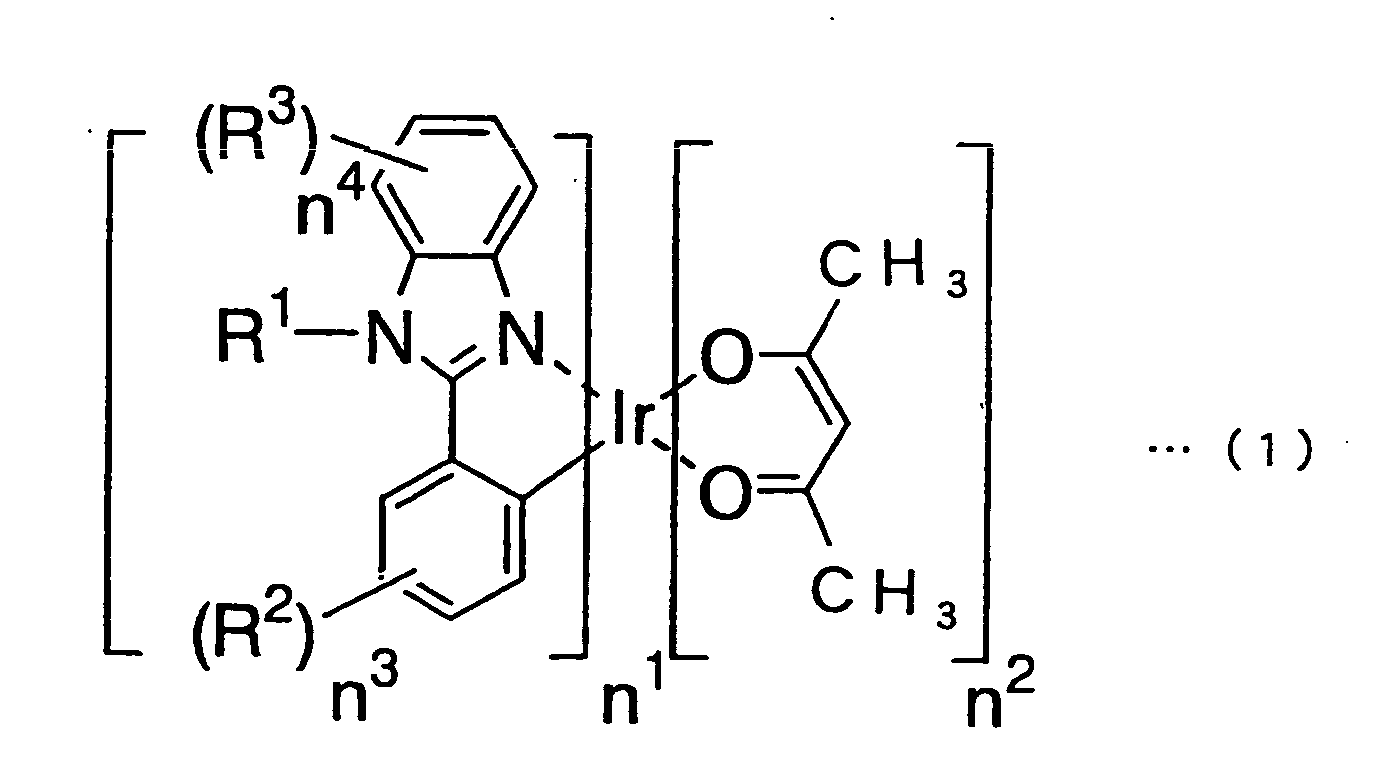 R1 represents either a lower alkyl group, a phenyl group, or a substituted phenyl group;R2 and R3 can be different and are selected from an alkyl group, an alkyloxy group, and a cyano group;each of n1 and n2 represents an integer number selected from the combinations [n1 = 2, n2 = 1] and [n1 = 3, n2 = 0]; andeach of n3 and n4 independently represents an integer from 0 to 4.
 - An organic electroluminescent device provided with an organic layer having a plurality of layers and having between a pair of electrodes at least a light emission region, said organic electroluminescent device having at least a layer of said organic layer including at least one heterocycle-containing iridium complex compound represented by the following general formula (1):wherein R1 represents either a lower alkyl group, a phenyl group, or a substituted phenyl group;
R2 and R3 can be equal or different and selected from an alkyl group, an alkyloxy group, and a cyano group;
each of n1 and n2 represents an integer selected from the combinations [n1 = 2, n2 = 1] and [n1 = 3, n2 = 0]; and
each of n3 and n4 independently represents an integer from 0 to 4. - A heterocycle-containing iridium complex compound represented by the following general formula (1):wherein R1 represents either a lower alkyl group, a phenyl group, or a substituted phenyl group;

R2 and R3 can be equal or different and selected from an alkyl group, an alkyloxy group, and a cyano group;
each of n1 and n2 represents an integer selected from the combinations [n1 = 2, n2 = 1] and [n1 = 3, n2 = 0]; and
each of n3 and n4 independently represents an integer from 0 to 4. - The heterocycle-containing iridium complex compound according to claim 3, further represented by any one of the following structural formulae (2-1) to (2-4):


Applications Claiming Priority (2)
| Application Number | Priority Date | Filing Date | Title |
|---|---|---|---|
| JP2003167828 | 2003-06-12 | ||
| JP2003167828A JP4203732B2 (en) | 2003-06-12 | 2003-06-12 | Organic electroluminescent material, organic electroluminescent element, and heterocyclic iridium complex compound |
Publications (2)
| Publication Number | Publication Date |
|---|---|
| EP1486552A1 true EP1486552A1 (en) | 2004-12-15 |
| EP1486552B1 EP1486552B1 (en) | 2007-12-19 |
Family
ID=33296874
Family Applications (1)
| Application Number | Title | Priority Date | Filing Date |
|---|---|---|---|
| EP04013470A Expired - Lifetime EP1486552B1 (en) | 2003-06-12 | 2004-06-08 | Organic electroluminescent material, organic electroluminescent device, and heterocycle-containing iridium complex compound |
Country Status (7)
| Country | Link |
|---|---|
| US (1) | US20050008895A1 (en) |
| EP (1) | EP1486552B1 (en) |
| JP (1) | JP4203732B2 (en) |
| KR (1) | KR20040106236A (en) |
| CN (1) | CN100471930C (en) |
| DE (1) | DE602004010746T2 (en) |
| TW (1) | TWI280267B (en) |
Cited By (8)
| Publication number | Priority date | Publication date | Assignee | Title |
|---|---|---|---|---|
| CN1321125C (en) * | 2005-04-30 | 2007-06-13 | 中国科学院长春应用化学研究所 | Complexes of red light iridium by using nitrogen heterocycles in quinoline as ligand, and application |
| EP1647554A4 (en) * | 2003-07-22 | 2008-02-20 | Idemitsu Kosan Co | METAL COMPLEX COMPOUND AND ORGANIC ELECTROLUMINESCENT DEVICE CONTAINING THE SAME |
| WO2008043815A1 (en) * | 2006-10-12 | 2008-04-17 | Solvay (Societe Anonyme) | Light-emitting material |
| EP1640365A4 (en) * | 2003-07-02 | 2008-09-17 | Idemitsu Kosan Co | METAL COMPLEX COMPOUND AND ORGANIC ELECTROLUMINESCENT DEVICE COMPRISING THE SAME |
| EP1988143A4 (en) * | 2006-02-20 | 2009-11-25 | Konica Minolta Holdings Inc | Organic electroluminescence element, white light emitting element, display device and illuminating device |
| US8541112B2 (en) | 2006-12-13 | 2013-09-24 | Konica Minolta Holdings, Inc. | Organic electroluminescent element, display device and lighting device |
| US9012038B2 (en) | 2008-07-18 | 2015-04-21 | Osram Gmbh | Phosphorescent metal complex compound, method for the preparation thereof and radiating component |
| US9735397B2 (en) | 2010-12-17 | 2017-08-15 | Osram Oled Gmbh | Radiation-emitting organic-electronic device and method for the production thereof |
Families Citing this family (27)
| Publication number | Priority date | Publication date | Assignee | Title |
|---|---|---|---|---|
| TWI245068B (en) * | 2003-11-18 | 2005-12-11 | Chi Mei Optoelectronics Corp | Iridium complex as light emitting material and organic light emitting diode device |
| JP2006310479A (en) * | 2005-04-27 | 2006-11-09 | Fuji Photo Film Co Ltd | Organic electroluminescence device |
| WO2006132012A1 (en) * | 2005-06-09 | 2006-12-14 | Konica Minolta Holdings, Inc. | Organic electroluminescence element, lighting apparatus and display device |
| CN100503771C (en) * | 2005-06-28 | 2009-06-24 | 友达光电股份有限公司 | Light-emitting material and organic electroluminescent module using the same |
| CN100366128C (en) * | 2005-07-14 | 2008-01-30 | 上海大学 | blue organic light emitting device |
| JP5076899B2 (en) * | 2005-09-02 | 2012-11-21 | コニカミノルタホールディングス株式会社 | ORGANIC ELECTROLUMINESCENT ELEMENT, ITS MANUFACTURING METHOD, DISPLAY DEVICE AND LIGHTING DEVICE HAVING THE ORGANIC ELECTROLUMINESCENT ELEMENT |
| JP4994688B2 (en) * | 2006-03-27 | 2012-08-08 | 昭和電工株式会社 | Organic light emitting device using compound having carrier transport property and phosphorescent property |
| JP5104060B2 (en) * | 2007-06-25 | 2012-12-19 | コニカミノルタホールディングス株式会社 | ORGANIC ELECTROLUMINESCENT ELEMENT MATERIAL, ORGANIC ELECTROLUMINESCENT ELEMENT, DISPLAY DEVICE AND LIGHTING DEVICE |
| JP5115061B2 (en) * | 2007-07-09 | 2013-01-09 | コニカミノルタホールディングス株式会社 | Organic electroluminescence element, display device and lighting device |
| WO2009060757A1 (en) * | 2007-11-08 | 2009-05-14 | Konica Minolta Holdings, Inc. | Organic electroluminescent device, display device and illuminating device |
| JP5691170B2 (en) * | 2007-11-08 | 2015-04-01 | コニカミノルタ株式会社 | Method for manufacturing organic electroluminescence element |
| KR100952966B1 (en) * | 2007-12-31 | 2010-04-15 | 제일모직주식회사 | Organometallic complex compound for organic photoelectric device, and organic photoelectric device comprising same |
| DE102009031683A1 (en) | 2009-07-03 | 2011-03-24 | Siemens Aktiengesellschaft | Phophorescent metal complex compound, process for the preparation thereof and radiation-emitting component |
| US8993754B2 (en) | 2009-08-27 | 2015-03-31 | National Institute Of Advanced Industrial Science And Technology | Iridium complex and light emitting material formed from same |
| EP2471889A4 (en) | 2009-08-27 | 2013-06-26 | Sumitomo Chemical Co | METAL COMPLEX COMPOSITION AND COMPLEX POLYMER |
| JP5316583B2 (en) * | 2011-05-24 | 2013-10-16 | コニカミノルタ株式会社 | ORGANIC ELECTROLUMINESCENT ELEMENT, DISPLAY DEVICE AND LIGHTING DEVICE USING THE SAME |
| EP2882763B1 (en) | 2012-08-07 | 2018-08-22 | Merck Patent GmbH | Metal complexes |
| JP5266540B2 (en) * | 2012-10-03 | 2013-08-21 | コニカミノルタ株式会社 | Organic electroluminescence element material |
| JP5472430B2 (en) * | 2012-11-20 | 2014-04-16 | コニカミノルタ株式会社 | Organic electroluminescence element material |
| KR102086554B1 (en) | 2013-06-12 | 2020-03-10 | 삼성디스플레이 주식회사 | Iridium complex and Organic light emitting device comprising the same |
| CN104650067B (en) * | 2014-08-05 | 2017-11-21 | 吉林奥来德光电材料股份有限公司 | A kind of green light material and its preparation method and application |
| US10326086B2 (en) | 2015-02-06 | 2019-06-18 | Samsung Electronics Co., Ltd. | Organometallic compound, composition containing the organometallic compound, and organic light-emitting device including the organometallic compound or composition |
| US10457864B2 (en) | 2016-02-09 | 2019-10-29 | Universal Display Corporation | Organic electroluminescent materials and devices |
| KR102718623B1 (en) * | 2016-12-16 | 2024-10-16 | 가부시키가이샤 한도오따이 에네루기 켄큐쇼 | Organometallic complex, light-emitting element, light-emitting device, electronic device, and lighting device |
| CN112209973B (en) * | 2020-11-05 | 2022-06-24 | 北京燕化集联光电技术有限公司 | Oxygen-containing organic electrophosphorescent material and application thereof |
| CN112175017B (en) * | 2020-11-05 | 2022-06-14 | 北京燕化集联光电技术有限公司 | Organic electrophosphorescent material and application thereof |
| US20220384742A1 (en) * | 2021-04-14 | 2022-12-01 | Universal Display Corporation | Organic electroluminescent materials and devices |
Citations (5)
| Publication number | Priority date | Publication date | Assignee | Title |
|---|---|---|---|---|
| WO2001041512A1 (en) * | 1999-12-01 | 2001-06-07 | The Trustees Of Princeton University | Complexes of form l2mx as phosphorescent dopants for organic leds |
| US20010019782A1 (en) * | 1999-12-27 | 2001-09-06 | Tatsuya Igarashi | Light-emitting material comprising orthometalated iridium complex, light-emitting device, high efficiency red light-emitting device, and novel iridium complex |
| US20020094453A1 (en) * | 2000-11-29 | 2002-07-18 | Takao Takiguchi | Metal coordination compound, luminescence device and display apparatus |
| US20020100906A1 (en) * | 2000-11-29 | 2002-08-01 | Takao Takiguchi | Metal coordination compound, luminescence device and display apparatus |
| WO2004045002A1 (en) * | 2002-11-08 | 2004-05-27 | Universal Display Corporation | Organic light emitting materials and devices |
Family Cites Families (6)
| Publication number | Priority date | Publication date | Assignee | Title |
|---|---|---|---|---|
| DE69305262T2 (en) * | 1992-07-13 | 1997-04-30 | Eastman Kodak Co | Internal transition organic electroluminescent device with a new composition |
| JP3929690B2 (en) * | 1999-12-27 | 2007-06-13 | 富士フイルム株式会社 | Light emitting device material, light emitting device and novel iridium complex comprising orthometalated iridium complex |
| JP5135660B2 (en) * | 2001-09-27 | 2013-02-06 | コニカミノルタホールディングス株式会社 | Organic electroluminescence device |
| US6916554B2 (en) * | 2002-11-06 | 2005-07-12 | The University Of Southern California | Organic light emitting materials and devices |
| TWI245068B (en) * | 2003-11-18 | 2005-12-11 | Chi Mei Optoelectronics Corp | Iridium complex as light emitting material and organic light emitting diode device |
| TWI237524B (en) * | 2004-05-17 | 2005-08-01 | Au Optronics Corp | Organometallic compound and organic electroluminescent device including the same |
-
2003
- 2003-06-12 JP JP2003167828A patent/JP4203732B2/en not_active Expired - Fee Related
-
2004
- 2004-06-08 EP EP04013470A patent/EP1486552B1/en not_active Expired - Lifetime
- 2004-06-08 DE DE602004010746T patent/DE602004010746T2/en not_active Expired - Fee Related
- 2004-06-08 US US10/864,112 patent/US20050008895A1/en not_active Abandoned
- 2004-06-10 KR KR1020040042587A patent/KR20040106236A/en not_active Ceased
- 2004-06-11 TW TW093116985A patent/TWI280267B/en not_active IP Right Cessation
- 2004-06-14 CN CNB200410083270XA patent/CN100471930C/en not_active Expired - Fee Related
Patent Citations (5)
| Publication number | Priority date | Publication date | Assignee | Title |
|---|---|---|---|---|
| WO2001041512A1 (en) * | 1999-12-01 | 2001-06-07 | The Trustees Of Princeton University | Complexes of form l2mx as phosphorescent dopants for organic leds |
| US20010019782A1 (en) * | 1999-12-27 | 2001-09-06 | Tatsuya Igarashi | Light-emitting material comprising orthometalated iridium complex, light-emitting device, high efficiency red light-emitting device, and novel iridium complex |
| US20020094453A1 (en) * | 2000-11-29 | 2002-07-18 | Takao Takiguchi | Metal coordination compound, luminescence device and display apparatus |
| US20020100906A1 (en) * | 2000-11-29 | 2002-08-01 | Takao Takiguchi | Metal coordination compound, luminescence device and display apparatus |
| WO2004045002A1 (en) * | 2002-11-08 | 2004-05-27 | Universal Display Corporation | Organic light emitting materials and devices |
Cited By (17)
| Publication number | Priority date | Publication date | Assignee | Title |
|---|---|---|---|---|
| EP1640365A4 (en) * | 2003-07-02 | 2008-09-17 | Idemitsu Kosan Co | METAL COMPLEX COMPOUND AND ORGANIC ELECTROLUMINESCENT DEVICE COMPRISING THE SAME |
| US8106390B2 (en) | 2003-07-22 | 2012-01-31 | Idemitsu Kosan Co., Ltd. | Metal complex compound and organic electroluminescent device using same |
| EP2336142A3 (en) * | 2003-07-22 | 2011-12-21 | Idemitsu Kosan Co., Ltd. | Iridium organic complex and electroluminescent device using same |
| EP1647554A4 (en) * | 2003-07-22 | 2008-02-20 | Idemitsu Kosan Co | METAL COMPLEX COMPOUND AND ORGANIC ELECTROLUMINESCENT DEVICE CONTAINING THE SAME |
| US7667228B2 (en) | 2003-07-22 | 2010-02-23 | Idemitsu Kosan Co., Ltd. | Metal complex compound and organic electroluminescent device using same |
| US8178874B2 (en) | 2003-07-22 | 2012-05-15 | Idemitsu Kosan Co., Ltd. | Metal complex compound and organic electroluminescent device using same |
| CN1321125C (en) * | 2005-04-30 | 2007-06-13 | 中国科学院长春应用化学研究所 | Complexes of red light iridium by using nitrogen heterocycles in quinoline as ligand, and application |
| EP1988143A4 (en) * | 2006-02-20 | 2009-11-25 | Konica Minolta Holdings Inc | Organic electroluminescence element, white light emitting element, display device and illuminating device |
| US8518557B2 (en) | 2006-10-12 | 2013-08-27 | Solvay (Societe Anonyme) | Light emitting materials comprising novel ortho-metalated transition metal complexes |
| WO2008043815A1 (en) * | 2006-10-12 | 2008-04-17 | Solvay (Societe Anonyme) | Light-emitting material |
| EP1918349A1 (en) * | 2006-10-12 | 2008-05-07 | SOLVAY (Société Anonyme) | Light-emitting material |
| US8541112B2 (en) | 2006-12-13 | 2013-09-24 | Konica Minolta Holdings, Inc. | Organic electroluminescent element, display device and lighting device |
| US9048434B2 (en) | 2006-12-13 | 2015-06-02 | Konica Minolta, Inc. | Organic electroluminescent element, display device and lighting device |
| US9627630B2 (en) | 2006-12-13 | 2017-04-18 | Konica Minolta, Inc. | Organic electroluminescent element, display device and lighting device |
| US10109800B2 (en) | 2006-12-13 | 2018-10-23 | Konica Minolta, Inc. | Organic electroluminescent element, display device and lighting device |
| US9012038B2 (en) | 2008-07-18 | 2015-04-21 | Osram Gmbh | Phosphorescent metal complex compound, method for the preparation thereof and radiating component |
| US9735397B2 (en) | 2010-12-17 | 2017-08-15 | Osram Oled Gmbh | Radiation-emitting organic-electronic device and method for the production thereof |
Also Published As
| Publication number | Publication date |
|---|---|
| CN100471930C (en) | 2009-03-25 |
| DE602004010746D1 (en) | 2008-01-31 |
| EP1486552B1 (en) | 2007-12-19 |
| JP4203732B2 (en) | 2009-01-07 |
| DE602004010746T2 (en) | 2008-12-04 |
| CN1618926A (en) | 2005-05-25 |
| JP2005002053A (en) | 2005-01-06 |
| TW200510506A (en) | 2005-03-16 |
| US20050008895A1 (en) | 2005-01-13 |
| KR20040106236A (en) | 2004-12-17 |
| TWI280267B (en) | 2007-05-01 |
Similar Documents
| Publication | Publication Date | Title |
|---|---|---|
| EP1486552B1 (en) | Organic electroluminescent material, organic electroluminescent device, and heterocycle-containing iridium complex compound | |
| KR101005160B1 (en) | Compound for organic electroluminescent device and organic electroluminescent device | |
| JP5165854B2 (en) | Silyl-substituted cyclometalated transition metal complex and organic electroluminescent device using the same | |
| JP3445315B2 (en) | Aluminum chelate compound and internal junction type organic electroluminescent device | |
| TW565604B (en) | Pyrromethene metal complex, material of luminescent element using it and luminescent element | |
| JP3215510B2 (en) | Internal junction type organic electroluminescent device | |
| KR101338343B1 (en) | Organic electroluminescent device material and organic electroluminescent device | |
| JP4129745B2 (en) | Phenylpyridine-iridium metal complex compound for organic electroluminescence device, production method thereof, and organic electroluminescence device using the same | |
| EP2521196B1 (en) | Organic electroluminescent element | |
| US20030085646A1 (en) | Metal coordination compound, luminescence device and display apparatus | |
| WO2003000661A1 (en) | Metal coordination compound and electroluminescence device | |
| JP4470508B2 (en) | Adamantane derivative and organic electroluminescence device using the same | |
| KR20110134923A (en) | Phosphorescent light emitting device material and organic electroluminescent device using the same | |
| US20070057250A1 (en) | Light-emitting device, organic compound and display | |
| EP1493797B1 (en) | Organic electroluminescence element | |
| JP4115788B2 (en) | ORGANIC LIGHT EMITTING MATERIAL, ORGANIC LIGHT EMITTING ELEMENT AND DISPLAY USING THE SAME | |
| JP4576141B2 (en) | Carbazole derivatives containing fluorene groups | |
| KR100686109B1 (en) | Iridium complex compound and organic light emitting device comprising the same | |
| KR100596132B1 (en) | Phenylpyridine-iridium metal complex compound for organic electroluminescent device, preparation method thereof and organic electroluminescent device using same | |
| KR100564918B1 (en) | Organic electroluminescent device using arylpyridine-iridium metal complex | |
| KR100662605B1 (en) | Phenylisoquinoline-iridium metal complex compound for organic electroluminescent device, preparation method thereof and organic electroluminescent device using same | |
| KR100596134B1 (en) | Phenylpyridine-iridium metal complex compound for organic electroluminescent device, preparation method thereof and organic electroluminescent device using same | |
| KR100662618B1 (en) | Phenylisoquinoline-iridium metal complex compound for organic electroluminescent device, preparation method thereof and organic electroluminescent device using same | |
| JP2018111751A (en) | Light emitting material, compound and organic light emitting element | |
| KR20050005084A (en) | Green color emitting compounds for organic electroluminescent device, process for preparing them and organic electroluminescent device using them |
Legal Events
| Date | Code | Title | Description |
|---|---|---|---|
| PUAI | Public reference made under article 153(3) epc to a published international application that has entered the european phase |
Free format text: ORIGINAL CODE: 0009012 |
|
| AK | Designated contracting states |
Kind code of ref document: A1 Designated state(s): AT BE BG CH CY CZ DE DK EE ES FI FR GB GR HU IE IT LI LU MC NL PL PT RO SE SI SK TR |
|
| AX | Request for extension of the european patent |
Extension state: AL HR LT LV MK |
|
| 17P | Request for examination filed |
Effective date: 20050601 |
|
| AKX | Designation fees paid |
Designated state(s): DE FR GB |
|
| 17Q | First examination report despatched |
Effective date: 20050919 |
|
| GRAP | Despatch of communication of intention to grant a patent |
Free format text: ORIGINAL CODE: EPIDOSNIGR1 |
|
| RIC1 | Information provided on ipc code assigned before grant |
Ipc: C07D 235/22 20060101ALI20070718BHEP Ipc: H01L 51/30 20060101ALI20070718BHEP Ipc: H01L 51/50 20060101ALI20070718BHEP Ipc: H05B 33/14 20060101ALI20070718BHEP Ipc: C09K 11/06 20060101AFI20070718BHEP |
|
| GRAS | Grant fee paid |
Free format text: ORIGINAL CODE: EPIDOSNIGR3 |
|
| GRAA | (expected) grant |
Free format text: ORIGINAL CODE: 0009210 |
|
| AK | Designated contracting states |
Kind code of ref document: B1 Designated state(s): DE FR GB |
|
| REG | Reference to a national code |
Ref country code: GB Ref legal event code: FG4D |
|
| REF | Corresponds to: |
Ref document number: 602004010746 Country of ref document: DE Date of ref document: 20080131 Kind code of ref document: P |
|
| ET | Fr: translation filed | ||
| PLBE | No opposition filed within time limit |
Free format text: ORIGINAL CODE: 0009261 |
|
| STAA | Information on the status of an ep patent application or granted ep patent |
Free format text: STATUS: NO OPPOSITION FILED WITHIN TIME LIMIT |
|
| PGFP | Annual fee paid to national office [announced via postgrant information from national office to epo] |
Ref country code: DE Payment date: 20080612 Year of fee payment: 5 |
|
| 26N | No opposition filed |
Effective date: 20080922 |
|
| PGFP | Annual fee paid to national office [announced via postgrant information from national office to epo] |
Ref country code: FR Payment date: 20080617 Year of fee payment: 5 |
|
| PGFP | Annual fee paid to national office [announced via postgrant information from national office to epo] |
Ref country code: GB Payment date: 20080611 Year of fee payment: 5 |
|
| GBPC | Gb: european patent ceased through non-payment of renewal fee |
Effective date: 20090608 |
|
| REG | Reference to a national code |
Ref country code: FR Ref legal event code: ST Effective date: 20100226 |
|
| PG25 | Lapsed in a contracting state [announced via postgrant information from national office to epo] |
Ref country code: FR Free format text: LAPSE BECAUSE OF NON-PAYMENT OF DUE FEES Effective date: 20090630 |
|
| PG25 | Lapsed in a contracting state [announced via postgrant information from national office to epo] |
Ref country code: GB Free format text: LAPSE BECAUSE OF NON-PAYMENT OF DUE FEES Effective date: 20090608 |
|
| PG25 | Lapsed in a contracting state [announced via postgrant information from national office to epo] |
Ref country code: DE Free format text: LAPSE BECAUSE OF NON-PAYMENT OF DUE FEES Effective date: 20100101 |