EP1482731A2 - Broadcast program contents menu creation apparatus and method - Google Patents
Broadcast program contents menu creation apparatus and method Download PDFInfo
- Publication number
- EP1482731A2 EP1482731A2 EP04011426A EP04011426A EP1482731A2 EP 1482731 A2 EP1482731 A2 EP 1482731A2 EP 04011426 A EP04011426 A EP 04011426A EP 04011426 A EP04011426 A EP 04011426A EP 1482731 A2 EP1482731 A2 EP 1482731A2
- Authority
- EP
- European Patent Office
- Prior art keywords
- telop
- broadcast program
- condition
- video signal
- decision
- Prior art date
- Legal status (The legal status is an assumption and is not a legal conclusion. Google has not performed a legal analysis and makes no representation as to the accuracy of the status listed.)
- Withdrawn
Links
- 238000000034 method Methods 0.000 title claims description 10
- 238000001514 detection method Methods 0.000 claims description 60
- 230000008034 disappearance Effects 0.000 claims description 18
- 238000000605 extraction Methods 0.000 claims description 15
- 238000003708 edge detection Methods 0.000 claims description 11
- 239000000284 extract Substances 0.000 claims description 4
- 230000007423 decrease Effects 0.000 claims 1
- 238000010586 diagram Methods 0.000 description 7
- 230000003247 decreasing effect Effects 0.000 description 2
- 230000004044 response Effects 0.000 description 2
- 230000000694 effects Effects 0.000 description 1
- 230000003203 everyday effect Effects 0.000 description 1
- 230000006870 function Effects 0.000 description 1
- 238000010191 image analysis Methods 0.000 description 1
- 230000005236 sound signal Effects 0.000 description 1
Images




Classifications
-
- H—ELECTRICITY
- H04—ELECTRIC COMMUNICATION TECHNIQUE
- H04N—PICTORIAL COMMUNICATION, e.g. TELEVISION
- H04N5/00—Details of television systems
- H04N5/76—Television signal recording
-
- H—ELECTRICITY
- H04—ELECTRIC COMMUNICATION TECHNIQUE
- H04N—PICTORIAL COMMUNICATION, e.g. TELEVISION
- H04N21/00—Selective content distribution, e.g. interactive television or video on demand [VOD]
- H04N21/40—Client devices specifically adapted for the reception of or interaction with content, e.g. set-top-box [STB]; Operations thereof
- H04N21/43—Processing of content or additional data, e.g. demultiplexing additional data from a digital video stream; Elementary client operations, e.g. monitoring of home network or synchronising decoder's clock; Client middleware
- H04N21/431—Generation of visual interfaces for content selection or interaction; Content or additional data rendering
- H04N21/4312—Generation of visual interfaces for content selection or interaction; Content or additional data rendering involving specific graphical features, e.g. screen layout, special fonts or colors, blinking icons, highlights or animations
-
- H—ELECTRICITY
- H04—ELECTRIC COMMUNICATION TECHNIQUE
- H04N—PICTORIAL COMMUNICATION, e.g. TELEVISION
- H04N21/00—Selective content distribution, e.g. interactive television or video on demand [VOD]
- H04N21/40—Client devices specifically adapted for the reception of or interaction with content, e.g. set-top-box [STB]; Operations thereof
- H04N21/43—Processing of content or additional data, e.g. demultiplexing additional data from a digital video stream; Elementary client operations, e.g. monitoring of home network or synchronising decoder's clock; Client middleware
- H04N21/44—Processing of video elementary streams, e.g. splicing a video clip retrieved from local storage with an incoming video stream or rendering scenes according to encoded video stream scene graphs
- H04N21/44008—Processing of video elementary streams, e.g. splicing a video clip retrieved from local storage with an incoming video stream or rendering scenes according to encoded video stream scene graphs involving operations for analysing video streams, e.g. detecting features or characteristics in the video stream
-
- H—ELECTRICITY
- H04—ELECTRIC COMMUNICATION TECHNIQUE
- H04N—PICTORIAL COMMUNICATION, e.g. TELEVISION
- H04N21/00—Selective content distribution, e.g. interactive television or video on demand [VOD]
- H04N21/40—Client devices specifically adapted for the reception of or interaction with content, e.g. set-top-box [STB]; Operations thereof
- H04N21/47—End-user applications
-
- H—ELECTRICITY
- H04—ELECTRIC COMMUNICATION TECHNIQUE
- H04N—PICTORIAL COMMUNICATION, e.g. TELEVISION
- H04N21/00—Selective content distribution, e.g. interactive television or video on demand [VOD]
- H04N21/40—Client devices specifically adapted for the reception of or interaction with content, e.g. set-top-box [STB]; Operations thereof
- H04N21/47—End-user applications
- H04N21/472—End-user interface for requesting content, additional data or services; End-user interface for interacting with content, e.g. for content reservation or setting reminders, for requesting event notification, for manipulating displayed content
- H04N21/47217—End-user interface for requesting content, additional data or services; End-user interface for interacting with content, e.g. for content reservation or setting reminders, for requesting event notification, for manipulating displayed content for controlling playback functions for recorded or on-demand content, e.g. using progress bars, mode or play-point indicators or bookmarks
-
- H—ELECTRICITY
- H04—ELECTRIC COMMUNICATION TECHNIQUE
- H04N—PICTORIAL COMMUNICATION, e.g. TELEVISION
- H04N21/00—Selective content distribution, e.g. interactive television or video on demand [VOD]
- H04N21/40—Client devices specifically adapted for the reception of or interaction with content, e.g. set-top-box [STB]; Operations thereof
- H04N21/47—End-user applications
- H04N21/488—Data services, e.g. news ticker
- H04N21/4882—Data services, e.g. news ticker for displaying messages, e.g. warnings, reminders
-
- H—ELECTRICITY
- H04—ELECTRIC COMMUNICATION TECHNIQUE
- H04N—PICTORIAL COMMUNICATION, e.g. TELEVISION
- H04N21/00—Selective content distribution, e.g. interactive television or video on demand [VOD]
- H04N21/80—Generation or processing of content or additional data by content creator independently of the distribution process; Content per se
- H04N21/83—Generation or processing of protective or descriptive data associated with content; Content structuring
- H04N21/84—Generation or processing of descriptive data, e.g. content descriptors
-
- H—ELECTRICITY
- H04—ELECTRIC COMMUNICATION TECHNIQUE
- H04N—PICTORIAL COMMUNICATION, e.g. TELEVISION
- H04N21/00—Selective content distribution, e.g. interactive television or video on demand [VOD]
- H04N21/80—Generation or processing of content or additional data by content creator independently of the distribution process; Content per se
- H04N21/83—Generation or processing of protective or descriptive data associated with content; Content structuring
- H04N21/845—Structuring of content, e.g. decomposing content into time segments
- H04N21/8455—Structuring of content, e.g. decomposing content into time segments involving pointers to the content, e.g. pointers to the I-frames of the video stream
-
- H—ELECTRICITY
- H04—ELECTRIC COMMUNICATION TECHNIQUE
- H04N—PICTORIAL COMMUNICATION, e.g. TELEVISION
- H04N5/00—Details of television systems
- H04N5/14—Picture signal circuitry for video frequency region
- H04N5/147—Scene change detection
-
- H—ELECTRICITY
- H04—ELECTRIC COMMUNICATION TECHNIQUE
- H04N—PICTORIAL COMMUNICATION, e.g. TELEVISION
- H04N5/00—Details of television systems
- H04N5/76—Television signal recording
- H04N5/78—Television signal recording using magnetic recording
- H04N5/781—Television signal recording using magnetic recording on disks or drums
-
- Y—GENERAL TAGGING OF NEW TECHNOLOGICAL DEVELOPMENTS; GENERAL TAGGING OF CROSS-SECTIONAL TECHNOLOGIES SPANNING OVER SEVERAL SECTIONS OF THE IPC; TECHNICAL SUBJECTS COVERED BY FORMER USPC CROSS-REFERENCE ART COLLECTIONS [XRACs] AND DIGESTS
- Y10—TECHNICAL SUBJECTS COVERED BY FORMER USPC
- Y10S—TECHNICAL SUBJECTS COVERED BY FORMER USPC CROSS-REFERENCE ART COLLECTIONS [XRACs] AND DIGESTS
- Y10S345/00—Computer graphics processing and selective visual display systems
- Y10S345/902—Menu display
-
- Y—GENERAL TAGGING OF NEW TECHNOLOGICAL DEVELOPMENTS; GENERAL TAGGING OF CROSS-SECTIONAL TECHNOLOGIES SPANNING OVER SEVERAL SECTIONS OF THE IPC; TECHNICAL SUBJECTS COVERED BY FORMER USPC CROSS-REFERENCE ART COLLECTIONS [XRACs] AND DIGESTS
- Y10—TECHNICAL SUBJECTS COVERED BY FORMER USPC
- Y10S—TECHNICAL SUBJECTS COVERED BY FORMER USPC CROSS-REFERENCE ART COLLECTIONS [XRACs] AND DIGESTS
- Y10S707/00—Data processing: database and file management or data structures
- Y10S707/99941—Database schema or data structure
- Y10S707/99943—Generating database or data structure, e.g. via user interface
Definitions
- the present invention relates to a broadcast program contents menu creation apparatus which creates a menu indicating contents of a broadcast program such as a news program.
- broadcast programs are recorded over, for example, 24 hours. Later, the user can select an arbitrary program from among the recorded programs and view it.
- Such a video recording apparatus has a function of displaying a menu which indicates broadcast contents as to a program, such as a news program, which changes in broadcast contents every day and which includes a plurality of items, it becomes possible for the user to select and view only interesting items in the program.
- the convenience in use of the video recording apparatus can be improved by leaps and bounds.
- An object of the present invention is to provide a broadcast program contents menu creation apparatus, andmethod, for automatically creating a menu which represents contents of a broadcast program.
- a broadcast program contents menu creation apparatus which creates a menu concerning contents of a broadcast program provided with: a storage device which stores a video signal of a broadcast program; a genre decision device which makes a decision whether the broadcast program having a video signal stored in the storage device is a broadcast program of a predetermined genre; a feature image detection device which detects a predetermined feature image portion of each of frames in the video signal of the broadcast program of the predetermined genre from the video signal stored in the storage device; a video extraction device which extracts video data of only a feature image portion of a frame satisfying a predetermined appearance condition from the predetermined feature image portion detected by the feature image detection device; and a menu creation device which creates and outputs a video signal representing an image including a feature image portion represented by video data as the menu, each time video data is extracted by the video extraction device.
- a broadcast program contents menu creation method which creates a menu concerning contents of a broadcast program, provided with processes of: storing a video signal of a broadcast program; determining whether the broadcast program of the stored video signal is a broadcast program of a predetermined genre; detecting a predetermined feature image portion of each of frames in the video signal of the broadcast program of the predetermined genre from the stored video signal; extracting video data of only a feature image portion of a frame satisfying a predetermined appearance condition from the detected predetermined feature image portion; and creating and outputting a video signal representing an image including a feature image portion represented by the video data as the menu, each time the video data is extracted.
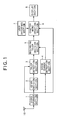
- FIG. 1 shows a news program contents menu creation apparatus according to the present invention.
- This news program contents menu creation apparatus includes a video storage section 1, a genre decision section 2 , a telop detection section 3, a scene change detection section 4, a beginning telop decision section 5, a chapter menu creation section 6, a user interface section 7 and a display section 8.
- the video storage section 1 receives an arbitrary television broadcast wave via an antenna 10, demodulates the received signal, obtains at least a video signal (in some cases, an audio signal) and stores the video signal internally. Furthermore, the video storage section 1 extracts program information such as the EPG (electronic program guide) included in a television broadcast wave or a different broadcast wave, and stores the extracted program information as data.
- the video storage section 1 includes, for example, a hard disk drive.
- the genre decision section 2 judges a genre of a program represented by a video signal stored in the video storage section 1.
- the telop detection section 3 detects telop information, such as a position of a telop appearing in the program represented by the video signal, its character size, and a frame including the telop.
- the telop detection section 3 may be supplied from the genre decision section 2 with a video signal judged to be a news program by the genre decision section 2.
- the telop detection section 3 may take in a video signal judged to be a news program by the genre decision section 2, from the video storage section 1.
- the scene change detection section 4 detects a point in time (a gap between scenes) at which a scene in a program represented by a video signal changes, as scene change information.
- the beginning telop decision section 5 judges the beginning telop of a news program according to the telop information detected by the telop detection section 3 and the scene change information detected by the scene change detection section 4. "The beginning telop" means a telop indicating a header of news which appears in the first scene of each news item in the news program. The beginning telop decision section 5 also extracts the beginning telop judged by the beginning telop decision section 5, from a frame including the telop in the telop information as image data.
- the chapter menu creation section 6 creates a chapter menu of the news program.
- the chapter menu creation section 6 mixes a video signal including the chapter menu with a video signal corresponding to a telop stored in the video storage section 1, and outputs a resultant video signal to the display section 8.
- the user interface section 7 is an operation section for selecting an item (contracted telop) in the chapter menu displayed on a monitor screen of the display section 8.
- the user interface section 7 can be operated by the user.
- the telop detection section 3 detects telop information in the video signal stored in the video storage section 1, i.e., in the video signal of the news program. For example, by detecting an intra-frame edge or an inter-frame edge in the video signal, the telop detection section detects a telop.
- the intra-frame edge is a portion where a luminance difference between adj acent pixels in the frame is high.
- the inter-frame edge is a portion where edges exist in the same pixel portion, when intra-edges are compared between adjacent frames.
- edges are portions which form edges of one video piece in the screen.
- the telop detection section 3 first takes out a start frame of one news program from the video signal stored in the video storage section 1 as shown in FIG. 2 (step S1). An intra-frame edge in the latest frame taken out is detected (step S2). An inter-frame edge of the latest frame and an immediately preceding frame is detected (step S3). If the latest frame is the start frame, the step S3 is disregarded. After execution of the step S3, it is determined whether all frames of the news program have been taken out from the video storage section 1 (step S4). If all frames have not been taken out, then the next frame is taken out from the video storage section 1 (step S5) and the telop detection section 3 returns to the step S2. Thus, detections of the intra-frame edge and of the inter-frame edge are conducted.
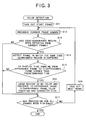
- telop detection operation is conducted to obtain telop information from all edge detection contents.
- a start frame of the news program is taken out from the video signal stored in the video storage section 1 (step S11).
- the start frame at the step S11 is the oldest frame in time among the frames having detected edges.
- a frame number of the start frame is preserved (step S12).
- It is determined whether a region surrounded by edges is detected from the current frame (step S13). If a region surrounded by edges, i.e., an edge-surrounded region is detected, then a frame which is subsequent to the current frame and in which edges in the same region as the edge-surrounded region in the current frame disappear is detected (step S14).
- step S15 It is determined whether a display time ranging from the edge-surrounded region appearance frame to the edge-surrounded region disappearance frame is longer than a predetermined time (step S15). If the display time of the edge-surrounded region is judged to be longer than the predetermined time, then the edge-surrounded region is regarded as a telop region, and its ID (number), its appearance frame, its disappearance frame, a telop position, and its character size in its frame are preserved (step S16). At the step S16, the inside of the telop region is scanned to detect the character size. For detection of the character size, a known character string information extraction method can be used. See, for example, Japanese Patent Application Laid-Open Publication No. 2001-76094.
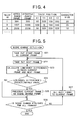
- the telop information preserved at the step S16 is written into an internal memory (not illustrated) every telop as a data table including the ID, the appearance frame, the disappearance frame, the telop position and the character size of the telop.
- each telop takes the shape of a rectangle, which is a typical shape.
- X1 and Y1 in the telop position represent coordinates of the left upper corner of the telop
- X2 and Y2 represent coordinates of the right lower corner of the telop.
- step S16 After the execution of the step S16, it is determined whether all frames having edges detected have been taken out from the video storage section 1 (step S17). If all frames have not been taken out, the next frame having detected edges is taken out (step S18) and the processing is returned to the step S12 to repeat the above-described telop region decision.
- the scene change detection section 4 conducts operation as shown in FIG. 5.
- the scene change detection section 4 takes out a start frame of the news program from the video signal stored in the video storage section 1 (step S21).
- the next frame to the current frame taken out is taken out (step S22).
- a difference between the sum total value of luminance values of all pixels in the current frame and the sum total of luminance values of all pixels in the next frame, i.e., a luminance difference is calculated (step S23). It is determined whether the luminance difference is greater than a predetermined value (step S24). If the luminance difference is greater than the predetermined value, the current frame is preserved as a frame of a scene change where the scene changes (step S25).
- step S26 After execution of the step S25, it is determined whether all frames have been taken out from the video storage section 1 (step S26). If all frames have not been taken out, the next frame is set to the current frame (step S27). Thereafter, the processing returns to the step S22, where a next frame is taken out from the video storage section 1 and the above-described scene change detection operation is repeated.
- the beginning telop decision section 5 makes a decision on a beginning telop of the news program on the basis of the information. For the decision on the beginning telop, the following four conditions are determined.
- the beginning telop decision section 5 conducts the following telop decision operation in order to extract a telop which satisfies all of the conditions (a) to (d).
- a character size X is set equal to a maximum value MAX (step S31) as shown in FIG. 6, and all telops having the character size X are extracted from the telop information detected by the telop detection section 3 (step S32). It is determined whether the number of telops having the character size X is greater than a first predetermined number TH1 (step S33). If the number of telops having the character size X is greater than the first predetermined number TH1, the above described conditions (a) and (b) are satisfied.
- telops having the character size X are extracted (step S34). It is determined whether the number of extracted telops is greater than a second predetermined number TH2 (step S35).
- step S36 If the number of the extracted telops is greater than the second predetermined number TH2, it means that the condition (c) is satisfied and an appearance frame and a disappearance frame of one telop included in those telops are acquired (step S36).
- the appearance frame and the disappearance frame of one telop can be read out from the data table and then can be obtained.
- step S37 it is determined whether a scene change is present between an appearance frame and a disappearance frame of one telop (step S37). If a scene change is present between the appearance frame and the disappearance frame of one telop, it is determined whether the decision concerning the presence of the scene change has been finished for all telops extracted at the step S34 (step S38). When the decision is not finished, the processing is returned to the step S36, where an appearance frame and a disappearance frame of one of the remaining telops are acquired.
- step S39 If a scene change is not present between the appearance frame and the disappearance frame of one telop, it means that the condition (d) is satisfied and the beginning telop is set to the one telop (step S39). Thereafter, the step S38 is executed.
- step S40 it is determined whether a beginning telop has been detected. In other words, it is determined whether the step S39 has been executed. If the number of telops having the character size X is judged at the step S33 to be equal to or less than the first predetermined number TH1, or if the number of telops is judged at the step S35 to be equal to or less than the second predetermined number TH2, the processing at the step S40 is immediately executed.
- the character size X is decreased by one and the processing is returned to the step S32 where the above-described operation is repeated. In other words, the character size is decreased by one size and the beginning telop detection is conducted in the same way.
- an image portion (image data) of the beginning telop determined at the step S39 and the beginning telop information indicating the frame number are output to the chapter menu creation section 6 (step S41) ; and the beginning telop decision operation is finished.
- the frame number of the beginning telop information is the number of the appearance frame including the beginning telop.
- the coincidence condition on the character size and the position may be relaxed.
- the chapter menu creation section 6 creates a chapter menu of a news program according to the beginning telop information supplied from the beginning telop decision section 5. Each time one piece of the beginning telop information is supplied, one item of the chapter menu is added and formed in the beginning telop image. The one item of the chapter menu represents an outline or a title concerning one news item. Respective items are displayed on the monitor of the display section 8 in a contracted image form of the beginning telop video image. The chapter menu is displayed on the monitor as represented by a symbol A in FIG. 7.
- the user selects a desired item from among a plurality of items (represented by a symbol B in FIG. 7) in the chapter menu displayed on the monitor via the user interface section 7.
- the chapter menu creation section 6 reads out the video signal beginning with the frame number over a predetermined interval from the video storage section 1, mixes the video signal with a video signal of the chapter menu, and supplies a resultant signal to the display section 8.
- an image (symbol C) concerning the selected item "Shuttle launching has succeeded" is displayed on themonitor screen of the display section 8.
- the predetermined interval over which the contents of the selected item are displayed on the monitor as a video image may be an interval over which the beginning telop is displayed (an interval ranging from the appearance frame to the disappearance frame), or may be a constant interval irrespective thereof.
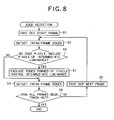
- pixels having intermediate luminance may be omitted at the time of edge detection conducted by the telop detection section 3.
- the telop detection section 3 detects edges in the current frame taken at the step S2 as shown in FIG. 8, and thereafter determines whether edge pixels include pixels having intermediate luminance (step S6).
- edge pixels include pixels having intermediate luminance (step S6).
- the edge is removed and edges having luminance other than the intermediate luminance, i.e., edges having high luminance or low luminance are left (step S7). Thereafter, the processing proceeds to the step S3.
- Other steps in the edge operation are the same as those shown in FIG. 2.
- pixels having intermediate luminance are excluded at the time of edge detection.
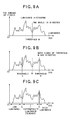
- a luminance histogram of edge pixels is created and two thresholds are set in order to divide the edge pixels into three luminance regions, i.e., a high luminance region, a low luminance region and an intermediate luminance region according to the histogram. By using the thresholds, it is determined whether an edge pixel has intermediate luminance.
- a threshold M is obtained by bisecting the whole luminance histogram.
- FIG. 9B by bisecting a low luminance region having low luminance lower than the threshold M and bisecting a high luminance region higher than the threshold M, thresholds L and H are obtained.
- FIG. 9C by the thresholds L and H, the luminance histogram is divided into three luminance regions, i.e., a high luminance region, a low luminance region and an intermediate luminance region.
- M is set as a certain value in luminance and M is defined as the threshold when the "dissemination" of the luminance histogram for M becomes the minimum. Specifically, supposing that the luminance histogram is formed of N pixels and each pixel has luminance of LUM i (1 ⁇ i ⁇ N), is calculated. M minimizing this calculated value is defined as the threshold.
- Edges belonging to the intermediate luminance region are excluded at the step S7, and only edges belonging to the high luminance region or the low luminance region are adopted for the beginning telop decision. As a result, the precision of the beginning telop decision can be improved.
- FIG. 10 shows the beginning telop decision operation conducted by the beginning telop decision section 5 when the condition (e) is added.
- step S32 all telops having the character size X are extracted from the telop information detected by the telop detection section 3.
- step S51 one telop is selected from among the telops.
- step S52 A decision is made whether the selected one telop is located in a lower half range of the screen (step S52).
- the decision is made by obtaining a telop position from telop information concerning the one telop. If the one telop is not located in the lower half range of the screen, the one telop is removed from the telops extracted at the step S32 (step S53) and subsequently the processing proceeds to step S54. If the one telop is located in the lower half range of the screen, the processing immediately proceeds to the step S54. At the step S54, it is determined whether processing has been conducted for all telops extracted at the step S32. In other words, it is determined whether the decision at the step S52 has been made on all extracted telops.
- the processing returns to the step S51 and one new telop is selected from among remaining telops. If the processing for all extracted telops has been finished, operation of the step 33 and subsequent steps is conducted for the telops which are extracted at the step S32 and which remain without being removed at the step S53.
- the lower part of the screen is defined as the lower half range of the screen.
- the lower part of the screen may also be, for example, a lower one-third range of the screen.
- a condition (f) that telops appearing at short time intervals are not beginning telops may be further added to the four conditions (a) to (d). That is, the condition (f) is that beginning telops appear at long time intervals.
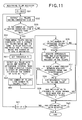
- FIG. 11 shows the beginning telop decision operation conducted by the beginning telop decision section 5 when the condition (f) is added.
- step S34 from among the telops having the character size X, all telops which are the same in telop position and which are in a position where the number of telops is maximized are extracted.
- a frame threshold Fr is set with respect to the extracted telops (step S61).
- the frame threshold Fr is set on the basis of typical beginning telop appearance interval, and it is, for example, one minute.
- the frame threshold Fr its initial value may be used as it is without being set at the step S61.
- telop sets which are shorter in appearance interval than the frame threshold Fr are detected from the extracted telops in the order of telop appearance, and the number "Pair" of telop sets is found (step S62). For example, if a second telop appears after disappearance of a first telop, the appearance interval is detected on the basis of the number of difference frames between a disappearance frame of the first telop and an appearance frame of the second telop.
- step S62 After execution of the step S62, the number of telop sets "Pair" is subtracted from the number of extracted telops and a result of the calculation is defined as the number of telops (step S63). Furthermore, from among the telops extracted at the step 34, telops later in time than a telop set which is shorter in appearance interval than the frame threshold Fr are removed. Operation of the step S35 and subsequent steps is conducted on telops obtained after the removal.
- beginning telops appear at time intervals of some degree.
- a condition (g) that telops appearing in the former half of the news program are defined as beginning telops may be further added to the four conditions (a) to (d) .
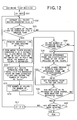
- FIG. 12 shows the beginning telop decision operation conducted by the beginning telop decision section 5 when the condition (g) is added.
- broadcast time of a subject news program in which beginning telops are to be judged is acquired as "TOTAL" (step S71). This can be obtained from the above-described program information.
- the character size X is set to a maximum value MAX in the same way as the beginning telop decision operation shown in FIG. 6 (step S31).
- telops which are the same in telop position and which are in a position where the number of telops is maximized are extracted.
- all numbers "Later” of telops appearing in the latter half of the broadcast time "TOTAL" (beginning at "TOTAL” /2 after the start of broadcast) are acquired (step S72).
- the number "Later” of telops is subtracted from the number of extracted telops and a result of the calculation is defined as the number of telops (step S73).
- telops appearing in the latter half of the broadcast time "TOTAL” are removed, and operation of the step S35 and subsequent steps is conducted for telops left after the removal.
- the former half typically includes ordinary news and the latter half includes other items (such as a special edition, sports and a weather forecast). Therefore, the possibility that the beginning telop will appear in the former half of the news program inevitably becomes high.
- a telop appearing in the former half of the news program is defined as a beginning telop to the beginning telop decision, the precision of the decision of the beginning telop can be further improved.
- the latter half is defined to start when the time "TOTAL"/2 has elapsed since the broadcast start of the news program.
- the number "Later” of telops appearing in the latter half may also be found, defining the latter half to start when the thirty minutes have elapsed since the broadcast start of the news program.
- beginning telop detection may be conducted by dividing the time into parts.
- a news program broadcasted in the early morning such as between 5 a.m. and 8 a.m. has a long broadcast time such as two to three hours.
- the telop configuration (such as the background of the studio and the pattern around the telop) is changed slightly every several tens minutes, and similar news items are broadcasted repetitively.
- the precision of the beginning telop decision can be further improved by dividing the broadcast time every constant time (for example, one hour) and conducting the beginning telop detection in each of resultant time zones.
- a beginning telop is extracted from a frame including the beginning telop and used as an item of the chapter menu. Therefore, heavy-load processing such as character recognition, image recognition and speech recognition is not needed. In implementing the chapter menu display, therefore, resources can be held down. Furthermore, even if the configuration of a news program differs, it can be coped with.
- images indicated by image data of only the beginning telop portion are contracted and used. Therefore, a plurality of items can be displayed in the menu as shown in FIG. 7. Furthermore, even if the images are contracted to a relatively small size, it is possible to facilitate recognition of respective items.
- the genre of the broadcast program is news has been described.
- this is not restrictive.
- the present invention can be applied to broadcast programs of other genres such as sports programs and song programs.
- ring names of fighting sumo wrestlers are displayed as telops. Therefore, each fight can be displayed as a menu by detecting the telops in the same way as the above-described embodiments.
- a predetermined feature image portion of each frame in the video signal of the news program is a telop.
- the predetermined feature image portion may be a still image.
- the predetermined feature image portion may be an image of a face of a specific person.
- the apparatus includes a genre decision device which makes a decision whether the broadcast program having a video signal in a storage device is a broadcast program of a predetermined genre, a feature image detection device which detects a predetermined feature image portion of each of frames in the video signal of the broadcast program of the predetermined genre from the video signal stored in the storage device, a video extraction device which extracts video data of only a feature image portion of a frame satisfying a predetermined appearance condition from the predetermined feature image portion detected by the feature image detection device, and a menu creation device which creates and outputs a video signal representing an image including a feature image portion represented by video data as the menu, each time video data is extracted by the video extraction device. Therefore, a menu representing contents of the broadcast program can be created automatically. Furthermore, the present invention can be applied to a video recording apparatus such as a hard disk recorder.
- a video storage section 1 serves as a storage device according to the present invention
- a genre decision section 2 serves as a genre decision device according to the present invention
- a telop detection section 3 serves as a telop detection device according to the present invention
- the telop detection device includes a feature image detection device, an edge region detection device, an edge detection device, and a telop decision device according to the present invention.
- a scene change detection section 4 and a beginning telop decision section 5 serve as a video extraction device according to the present invention.
- the scene change detection section 4 serves as a scene detection device, a luminance average calculation device, and a judging device according to the present invention
- the beginning telop decision section 5 serves as a character size setting device, a first decision device, a second decision device, a third decision device, a fourth decision device, a fifth decision device, and a sixth decision device according to the present invention.
- a chapter menu creation section 6 according to this embodiment serves as a menu creation device according to the present invention
- a user interface section 7 serves as an operation device according to the present invention.
Landscapes
- Engineering & Computer Science (AREA)
- Multimedia (AREA)
- Signal Processing (AREA)
- Databases & Information Systems (AREA)
- Human Computer Interaction (AREA)
- Television Signal Processing For Recording (AREA)
- Television Systems (AREA)
Applications Claiming Priority (4)
| Application Number | Priority Date | Filing Date | Title |
|---|---|---|---|
| JP2003136908 | 2003-05-15 | ||
| JP2003136908 | 2003-05-15 | ||
| JP2003306780 | 2003-08-29 | ||
| JP2003306780A JP2004364234A (ja) | 2003-05-15 | 2003-08-29 | 放送番組内容メニュー作成装置及び方法 |
Publications (1)
| Publication Number | Publication Date |
|---|---|
| EP1482731A2 true EP1482731A2 (en) | 2004-12-01 |
Family
ID=33134359
Family Applications (1)
| Application Number | Title | Priority Date | Filing Date |
|---|---|---|---|
| EP04011426A Withdrawn EP1482731A2 (en) | 2003-05-15 | 2004-05-13 | Broadcast program contents menu creation apparatus and method |
Country Status (4)
| Country | Link |
|---|---|
| US (1) | US7519264B2 (enExample) |
| EP (1) | EP1482731A2 (enExample) |
| JP (1) | JP2004364234A (enExample) |
| CN (1) | CN1551624A (enExample) |
Families Citing this family (24)
| Publication number | Priority date | Publication date | Assignee | Title |
|---|---|---|---|---|
| US8126055B2 (en) * | 2004-08-19 | 2012-02-28 | Pioneer Corporation | Telop detecting method, telop detecting program, and telop detecting device |
| WO2007013238A1 (ja) * | 2005-07-27 | 2007-02-01 | Pioneer Corporation | 映像処理装置及び映像処理方法 |
| KR100717402B1 (ko) | 2005-11-14 | 2007-05-11 | 삼성전자주식회사 | 멀티미디어 데이터의 장르를 판단하는 장치 및 방법 |
| CN100490532C (zh) * | 2006-04-30 | 2009-05-20 | 华为技术有限公司 | 一种视频码流过滤方法和过滤节点 |
| JP2008085700A (ja) * | 2006-09-28 | 2008-04-10 | Sanyo Electric Co Ltd | 映像再生装置及び再生用プログラム |
| JP4917867B2 (ja) * | 2006-11-14 | 2012-04-18 | シャープ株式会社 | テロップ検出装置及び方法、並びに画像表示装置及び方法 |
| EP1926104B1 (en) * | 2006-11-27 | 2016-06-29 | Thomson Licensing | Encoding device, decoding device, recording device, audio/video data transmission system |
| FR2910769B1 (fr) * | 2006-12-21 | 2009-03-06 | Thomson Licensing Sas | Procede de creation d'un resume d'un document audiovisuel comportant un sommaire et des reportages, et recepteur mettant en oeuvre le procede |
| JP2008166988A (ja) | 2006-12-27 | 2008-07-17 | Sony Corp | 情報処理装置および方法、並びにプログラム |
| US8254648B2 (en) * | 2007-01-04 | 2012-08-28 | General Electric Company | Method for providing adaptive hanging protocols for image reading |
| JP4861845B2 (ja) * | 2007-02-05 | 2012-01-25 | 富士通株式会社 | テロップ文字抽出プログラム、記録媒体、方法及び装置 |
| JP4428424B2 (ja) * | 2007-08-20 | 2010-03-10 | ソニー株式会社 | 情報処理装置、情報処理方法、プログラムおよび記録媒体 |
| JP2009118205A (ja) * | 2007-11-07 | 2009-05-28 | Hitachi Ltd | 動画処理装置及び動画処理方法 |
| JP4245645B1 (ja) * | 2007-12-22 | 2009-03-25 | 株式会社東芝 | 記憶装置及び記憶方法 |
| US8249423B2 (en) * | 2008-05-08 | 2012-08-21 | Sony Ericsson Mobile Communications Ab | Electronic devices and methods that insert addressable chapter marks relative to advertising content in video streams |
| JP4469905B2 (ja) * | 2008-06-30 | 2010-06-02 | 株式会社東芝 | テロップ収集装置およびテロップ収集方法 |
| CN101764950B (zh) * | 2008-11-10 | 2013-08-14 | 新奥特(北京)视频技术有限公司 | 一种基于区域划分的节目下字幕的冲突检测方法 |
| CN101764949B (zh) * | 2008-11-10 | 2013-05-01 | 新奥特(北京)视频技术有限公司 | 一种基于区域划分的定时字幕的冲突检测方法 |
| US20100299627A1 (en) * | 2009-05-20 | 2010-11-25 | Qualcomm Incorporated | Method and apparatus for content boundary detection and scaling |
| JP5349649B1 (ja) * | 2012-05-25 | 2013-11-20 | 株式会社東芝 | 電子機器、電子機器の制御方法、電子機器の制御プログラム |
| JP6080667B2 (ja) * | 2013-04-18 | 2017-02-15 | 三菱電機株式会社 | 映像信号処理装置及び方法、並びにプログラム及び記録媒体 |
| CN105635789B (zh) * | 2015-12-29 | 2018-09-25 | 深圳Tcl数字技术有限公司 | 降低视频图像中osd亮度的方法和装置 |
| US11036996B2 (en) * | 2019-07-02 | 2021-06-15 | Baidu Usa Llc | Method and apparatus for determining (raw) video materials for news |
| JP7455545B2 (ja) * | 2019-09-30 | 2024-03-26 | キヤノン株式会社 | 情報処理装置、情報処理方法、およびプログラム |
Family Cites Families (4)
| Publication number | Priority date | Publication date | Assignee | Title |
|---|---|---|---|---|
| US6996572B1 (en) * | 1997-10-08 | 2006-02-07 | International Business Machines Corporation | Method and system for filtering of information entities |
| US6366296B1 (en) * | 1998-09-11 | 2002-04-02 | Xerox Corporation | Media browser using multimodal analysis |
| JP3544324B2 (ja) | 1999-09-08 | 2004-07-21 | 日本電信電話株式会社 | 文字列情報抽出装置及び方法及びその方法を記録した記録媒体 |
| JP2002044572A (ja) * | 2000-07-21 | 2002-02-08 | Sony Corp | 情報信号処理装置及び情報信号処理方法および情報信号記録装置 |
-
2003
- 2003-08-29 JP JP2003306780A patent/JP2004364234A/ja active Pending
-
2004
- 2004-05-10 US US10/841,470 patent/US7519264B2/en not_active Expired - Fee Related
- 2004-05-13 EP EP04011426A patent/EP1482731A2/en not_active Withdrawn
- 2004-05-13 CN CNA2004100445529A patent/CN1551624A/zh active Pending
Also Published As
| Publication number | Publication date |
|---|---|
| CN1551624A (zh) | 2004-12-01 |
| US20040228616A1 (en) | 2004-11-18 |
| JP2004364234A (ja) | 2004-12-24 |
| US7519264B2 (en) | 2009-04-14 |
Similar Documents
| Publication | Publication Date | Title |
|---|---|---|
| EP1482731A2 (en) | Broadcast program contents menu creation apparatus and method | |
| EP2337345B1 (en) | Video identifier extracting device | |
| US8014566B2 (en) | Image processing apparatus | |
| EP0729117A1 (en) | Method and apparatus for detecting a point of change in moving images | |
| US20030061612A1 (en) | Key frame-based video summary system | |
| JP2006510072A (ja) | 一様なカラーセグメントを検出するための方法及びシステム | |
| US9414025B2 (en) | Method for intelligently displaying sports game video for multimedia mobile terminal | |
| US20070291134A1 (en) | Image editing method and apparatus | |
| KR20070112130A (ko) | 그래픽 객체를 검출하기 위한 방법 및 전자 디바이스 | |
| US20060159370A1 (en) | Video retrieval system and video retrieval method | |
| JP2007060392A (ja) | 画像記憶装置及び方法 | |
| JP2004364234A5 (enExample) | ||
| US9137562B2 (en) | Method of viewing audiovisual documents on a receiver, and receiver for viewing such documents | |
| JP3728775B2 (ja) | 動画像の特徴場面検出方法及び装置 | |
| US8600219B2 (en) | Video-signal recording and playback apparatus, video-signal recording and playback method, and recording medium | |
| US8311269B2 (en) | Blocker image identification apparatus and method | |
| EP1484763A1 (en) | Music program contents menu creation apparatus and method | |
| US7398003B2 (en) | Index data generation apparatus, index data generation method, index data generation program and recording medium on which the program is recorded | |
| JP3379453B2 (ja) | 字幕領域検出方法及びその装置、並びに動画像検索方法及びその装置 | |
| JP3625935B2 (ja) | 動画像の重要画像抽出装置および重要画像抽出方法 | |
| JP3498875B2 (ja) | 動画像処理システム | |
| JP3513011B2 (ja) | 映像テロップ領域判別方法、装置、および映像テロップ領域判別プログラムを記録した記録媒体 | |
| JP3906854B2 (ja) | 動画像の特徴場面検出方法及び装置 | |
| JPH11252501A (ja) | 動画像の特殊効果検出装置 | |
| EP1557783A2 (en) | Image processing apparatus, image processing method, image processing program, and information record medium storing program |
Legal Events
| Date | Code | Title | Description |
|---|---|---|---|
| PUAI | Public reference made under article 153(3) epc to a published international application that has entered the european phase |
Free format text: ORIGINAL CODE: 0009012 |
|
| AK | Designated contracting states |
Kind code of ref document: A2 Designated state(s): AT BE BG CH CY CZ DE DK EE ES FI FR GB GR HU IE IT LI LU MC NL PL PT RO SE SI SK TR |
|
| AX | Request for extension of the european patent |
Extension state: AL HR LT LV MK |
|
| RAP1 | Party data changed (applicant data changed or rights of an application transferred) |
Owner name: PIONEER CORPORATION |
|
| STAA | Information on the status of an ep patent application or granted ep patent |
Free format text: STATUS: THE APPLICATION IS DEEMED TO BE WITHDRAWN |
|
| 18D | Application deemed to be withdrawn |
Effective date: 20101201 |