EP1480927B1 - A method for cleavage of labile functional groups from chemical compounds - Google Patents
A method for cleavage of labile functional groups from chemical compounds Download PDFInfo
- Publication number
- EP1480927B1 EP1480927B1 EP03706599A EP03706599A EP1480927B1 EP 1480927 B1 EP1480927 B1 EP 1480927B1 EP 03706599 A EP03706599 A EP 03706599A EP 03706599 A EP03706599 A EP 03706599A EP 1480927 B1 EP1480927 B1 EP 1480927B1
- Authority
- EP
- European Patent Office
- Prior art keywords
- thioxanthone
- preparing
- electromagnetic radiation
- molecules
- cleavage
- Prior art date
- Legal status (The legal status is an assumption and is not a legal conclusion. Google has not performed a legal analysis and makes no representation as to the accuracy of the status listed.)
- Expired - Lifetime
Links
- 238000000034 method Methods 0.000 title claims description 41
- 150000001875 compounds Chemical class 0.000 title claims description 32
- 238000003776 cleavage reaction Methods 0.000 title claims description 22
- 230000007017 scission Effects 0.000 title claims description 17
- 125000000524 functional group Chemical group 0.000 title claims description 16
- YRHRIQCWCFGUEQ-UHFFFAOYSA-N thioxanthen-9-one Chemical compound C1=CC=C2C(=O)C3=CC=CC=C3SC2=C1 YRHRIQCWCFGUEQ-UHFFFAOYSA-N 0.000 claims description 28
- 125000006239 protecting group Chemical group 0.000 claims description 25
- 238000000018 DNA microarray Methods 0.000 claims description 22
- 230000005670 electromagnetic radiation Effects 0.000 claims description 15
- 230000015572 biosynthetic process Effects 0.000 claims description 14
- 230000005855 radiation Effects 0.000 claims description 13
- 238000003786 synthesis reaction Methods 0.000 claims description 12
- 150000007523 nucleic acids Chemical class 0.000 claims description 11
- 108020004707 nucleic acids Proteins 0.000 claims description 10
- 102000039446 nucleic acids Human genes 0.000 claims description 10
- 239000000126 substance Substances 0.000 claims description 10
- 108091034117 Oligonucleotide Proteins 0.000 claims description 9
- 239000000203 mixture Substances 0.000 claims description 8
- 239000000758 substrate Substances 0.000 claims description 8
- 239000002777 nucleoside Substances 0.000 claims description 7
- JLCPHMBAVCMARE-UHFFFAOYSA-N [3-[[3-[[3-[[3-[[3-[[3-[[3-[[3-[[3-[[3-[[3-[[5-(2-amino-6-oxo-1H-purin-9-yl)-3-[[3-[[3-[[3-[[3-[[3-[[5-(2-amino-6-oxo-1H-purin-9-yl)-3-[[5-(2-amino-6-oxo-1H-purin-9-yl)-3-hydroxyoxolan-2-yl]methoxy-hydroxyphosphoryl]oxyoxolan-2-yl]methoxy-hydroxyphosphoryl]oxy-5-(5-methyl-2,4-dioxopyrimidin-1-yl)oxolan-2-yl]methoxy-hydroxyphosphoryl]oxy-5-(6-aminopurin-9-yl)oxolan-2-yl]methoxy-hydroxyphosphoryl]oxy-5-(6-aminopurin-9-yl)oxolan-2-yl]methoxy-hydroxyphosphoryl]oxy-5-(6-aminopurin-9-yl)oxolan-2-yl]methoxy-hydroxyphosphoryl]oxy-5-(6-aminopurin-9-yl)oxolan-2-yl]methoxy-hydroxyphosphoryl]oxyoxolan-2-yl]methoxy-hydroxyphosphoryl]oxy-5-(5-methyl-2,4-dioxopyrimidin-1-yl)oxolan-2-yl]methoxy-hydroxyphosphoryl]oxy-5-(4-amino-2-oxopyrimidin-1-yl)oxolan-2-yl]methoxy-hydroxyphosphoryl]oxy-5-(5-methyl-2,4-dioxopyrimidin-1-yl)oxolan-2-yl]methoxy-hydroxyphosphoryl]oxy-5-(5-methyl-2,4-dioxopyrimidin-1-yl)oxolan-2-yl]methoxy-hydroxyphosphoryl]oxy-5-(6-aminopurin-9-yl)oxolan-2-yl]methoxy-hydroxyphosphoryl]oxy-5-(6-aminopurin-9-yl)oxolan-2-yl]methoxy-hydroxyphosphoryl]oxy-5-(4-amino-2-oxopyrimidin-1-yl)oxolan-2-yl]methoxy-hydroxyphosphoryl]oxy-5-(4-amino-2-oxopyrimidin-1-yl)oxolan-2-yl]methoxy-hydroxyphosphoryl]oxy-5-(4-amino-2-oxopyrimidin-1-yl)oxolan-2-yl]methoxy-hydroxyphosphoryl]oxy-5-(6-aminopurin-9-yl)oxolan-2-yl]methoxy-hydroxyphosphoryl]oxy-5-(4-amino-2-oxopyrimidin-1-yl)oxolan-2-yl]methyl [5-(6-aminopurin-9-yl)-2-(hydroxymethyl)oxolan-3-yl] hydrogen phosphate Polymers Cc1cn(C2CC(OP(O)(=O)OCC3OC(CC3OP(O)(=O)OCC3OC(CC3O)n3cnc4c3nc(N)[nH]c4=O)n3cnc4c3nc(N)[nH]c4=O)C(COP(O)(=O)OC3CC(OC3COP(O)(=O)OC3CC(OC3COP(O)(=O)OC3CC(OC3COP(O)(=O)OC3CC(OC3COP(O)(=O)OC3CC(OC3COP(O)(=O)OC3CC(OC3COP(O)(=O)OC3CC(OC3COP(O)(=O)OC3CC(OC3COP(O)(=O)OC3CC(OC3COP(O)(=O)OC3CC(OC3COP(O)(=O)OC3CC(OC3COP(O)(=O)OC3CC(OC3COP(O)(=O)OC3CC(OC3COP(O)(=O)OC3CC(OC3COP(O)(=O)OC3CC(OC3COP(O)(=O)OC3CC(OC3COP(O)(=O)OC3CC(OC3CO)n3cnc4c(N)ncnc34)n3ccc(N)nc3=O)n3cnc4c(N)ncnc34)n3ccc(N)nc3=O)n3ccc(N)nc3=O)n3ccc(N)nc3=O)n3cnc4c(N)ncnc34)n3cnc4c(N)ncnc34)n3cc(C)c(=O)[nH]c3=O)n3cc(C)c(=O)[nH]c3=O)n3ccc(N)nc3=O)n3cc(C)c(=O)[nH]c3=O)n3cnc4c3nc(N)[nH]c4=O)n3cnc4c(N)ncnc34)n3cnc4c(N)ncnc34)n3cnc4c(N)ncnc34)n3cnc4c(N)ncnc34)O2)c(=O)[nH]c1=O JLCPHMBAVCMARE-UHFFFAOYSA-N 0.000 claims description 6
- 239000007795 chemical reaction product Substances 0.000 claims description 6
- 239000007787 solid Substances 0.000 claims description 6
- 125000003835 nucleoside group Chemical group 0.000 claims description 5
- 239000002904 solvent Substances 0.000 claims description 5
- 150000003833 nucleoside derivatives Chemical class 0.000 claims description 4
- 230000009471 action Effects 0.000 claims description 3
- 230000001678 irradiating effect Effects 0.000 claims description 3
- 238000004519 manufacturing process Methods 0.000 claims description 3
- 239000003153 chemical reaction reagent Substances 0.000 claims description 2
- 125000002887 hydroxy group Chemical group [H]O* 0.000 claims description 2
- 238000006243 chemical reaction Methods 0.000 description 14
- 239000002773 nucleotide Substances 0.000 description 9
- -1 3',5'-dimethoxy benzoinyloxycarbonyl Chemical group 0.000 description 8
- 125000003729 nucleotide group Chemical group 0.000 description 8
- 238000012546 transfer Methods 0.000 description 8
- 108091033319 polynucleotide Proteins 0.000 description 7
- 102000040430 polynucleotide Human genes 0.000 description 7
- 239000002157 polynucleotide Substances 0.000 description 7
- 238000002360 preparation method Methods 0.000 description 5
- 150000003254 radicals Chemical class 0.000 description 5
- 238000007086 side reaction Methods 0.000 description 5
- IJGRMHOSHXDMSA-UHFFFAOYSA-N Atomic nitrogen Chemical compound N#N IJGRMHOSHXDMSA-UHFFFAOYSA-N 0.000 description 4
- 238000010276 construction Methods 0.000 description 4
- OPTASPLRGRRNAP-UHFFFAOYSA-N cytosine Chemical compound NC=1C=CNC(=O)N=1 OPTASPLRGRRNAP-UHFFFAOYSA-N 0.000 description 4
- UYTPUPDQBNUYGX-UHFFFAOYSA-N guanine Chemical compound O=C1NC(N)=NC2=C1N=CN2 UYTPUPDQBNUYGX-UHFFFAOYSA-N 0.000 description 4
- RWQNBRDOKXIBIV-UHFFFAOYSA-N thymine Chemical compound CC1=CNC(=O)NC1=O RWQNBRDOKXIBIV-UHFFFAOYSA-N 0.000 description 4
- WEVYAHXRMPXWCK-UHFFFAOYSA-N Acetonitrile Chemical compound CC#N WEVYAHXRMPXWCK-UHFFFAOYSA-N 0.000 description 3
- IAZDPXIOMUYVGZ-UHFFFAOYSA-N Dimethylsulphoxide Chemical compound CS(C)=O IAZDPXIOMUYVGZ-UHFFFAOYSA-N 0.000 description 3
- 238000010521 absorption reaction Methods 0.000 description 3
- 238000003491 array Methods 0.000 description 3
- 229920001222 biopolymer Polymers 0.000 description 3
- 238000010511 deprotection reaction Methods 0.000 description 3
- 230000005284 excitation Effects 0.000 description 3
- 238000004128 high performance liquid chromatography Methods 0.000 description 3
- QSHDDOUJBYECFT-UHFFFAOYSA-N mercury Chemical compound [Hg] QSHDDOUJBYECFT-UHFFFAOYSA-N 0.000 description 3
- 229910052753 mercury Inorganic materials 0.000 description 3
- 238000002493 microarray Methods 0.000 description 3
- 229920000642 polymer Polymers 0.000 description 3
- VKVLTUQLNXVANB-UHFFFAOYSA-N 1-ethenyl-2-nitrobenzene Chemical class [O-][N+](=O)C1=CC=CC=C1C=C VKVLTUQLNXVANB-UHFFFAOYSA-N 0.000 description 2
- HGINCPLSRVDWNT-UHFFFAOYSA-N Acrolein Chemical compound C=CC=O HGINCPLSRVDWNT-UHFFFAOYSA-N 0.000 description 2
- QGZKDVFQNNGYKY-UHFFFAOYSA-N Ammonia Chemical compound N QGZKDVFQNNGYKY-UHFFFAOYSA-N 0.000 description 2
- IQFYYKKMVGJFEH-XLPZGREQSA-N Thymidine Chemical class O=C1NC(=O)C(C)=CN1[C@@H]1O[C@H](CO)[C@@H](O)C1 IQFYYKKMVGJFEH-XLPZGREQSA-N 0.000 description 2
- 238000000862 absorption spectrum Methods 0.000 description 2
- OIRDTQYFTABQOQ-KQYNXXCUSA-N adenosine Chemical compound C1=NC=2C(N)=NC=NC=2N1[C@@H]1O[C@H](CO)[C@@H](O)[C@H]1O OIRDTQYFTABQOQ-KQYNXXCUSA-N 0.000 description 2
- 235000014633 carbohydrates Nutrition 0.000 description 2
- 150000001720 carbohydrates Chemical class 0.000 description 2
- 229940104302 cytosine Drugs 0.000 description 2
- 230000005281 excited state Effects 0.000 description 2
- 238000002474 experimental method Methods 0.000 description 2
- 238000005259 measurement Methods 0.000 description 2
- 229910052757 nitrogen Inorganic materials 0.000 description 2
- 108090000765 processed proteins & peptides Proteins 0.000 description 2
- 108090000623 proteins and genes Proteins 0.000 description 2
- 102000004169 proteins and genes Human genes 0.000 description 2
- 239000000523 sample Substances 0.000 description 2
- 230000001235 sensitizing effect Effects 0.000 description 2
- 235000000346 sugar Nutrition 0.000 description 2
- 229940113082 thymine Drugs 0.000 description 2
- 0 *c1c(C(COC(O)OCC(C(C2)O)OC2*(C=C(C(*2)=O)N)C2=O)*[U])cccc1 Chemical compound *c1c(C(COC(O)OCC(C(C2)O)OC2*(C=C(C(*2)=O)N)C2=O)*[U])cccc1 0.000 description 1
- IANQTJSKSUMEQM-UHFFFAOYSA-N 1-benzofuran Chemical class C1=CC=C2OC=CC2=C1 IANQTJSKSUMEQM-UHFFFAOYSA-N 0.000 description 1
- 229930024421 Adenine Natural products 0.000 description 1
- GFFGJBXGBJISGV-UHFFFAOYSA-N Adenine Chemical compound NC1=NC=NC2=C1N=CN2 GFFGJBXGBJISGV-UHFFFAOYSA-N 0.000 description 1
- 108010006654 Bleomycin Proteins 0.000 description 1
- 239000002126 C01EB10 - Adenosine Substances 0.000 description 1
- 238000001712 DNA sequencing Methods 0.000 description 1
- 230000006820 DNA synthesis Effects 0.000 description 1
- 230000004568 DNA-binding Effects 0.000 description 1
- 101000812677 Homo sapiens Nucleotide pyrophosphatase Proteins 0.000 description 1
- 102100039306 Nucleotide pyrophosphatase Human genes 0.000 description 1
- 102000015636 Oligopeptides Human genes 0.000 description 1
- 108010038807 Oligopeptides Proteins 0.000 description 1
- 150000007960 acetonitrile Chemical class 0.000 description 1
- 230000004913 activation Effects 0.000 description 1
- 229960000643 adenine Drugs 0.000 description 1
- 229960005305 adenosine Drugs 0.000 description 1
- 229910021529 ammonia Inorganic materials 0.000 description 1
- 230000008901 benefit Effects 0.000 description 1
- 230000027455 binding Effects 0.000 description 1
- 229960001561 bleomycin Drugs 0.000 description 1
- OYVAGSVQBOHSSS-UAPAGMARSA-O bleomycin A2 Chemical compound N([C@H](C(=O)N[C@H](C)[C@@H](O)[C@H](C)C(=O)N[C@@H]([C@H](O)C)C(=O)NCCC=1SC=C(N=1)C=1SC=C(N=1)C(=O)NCCC[S+](C)C)[C@@H](O[C@H]1[C@H]([C@@H](O)[C@H](O)[C@H](CO)O1)O[C@@H]1[C@H]([C@@H](OC(N)=O)[C@H](O)[C@@H](CO)O1)O)C=1N=CNC=1)C(=O)C1=NC([C@H](CC(N)=O)NC[C@H](N)C(N)=O)=NC(N)=C1C OYVAGSVQBOHSSS-UAPAGMARSA-O 0.000 description 1
- 238000010504 bond cleavage reaction Methods 0.000 description 1
- 230000015556 catabolic process Effects 0.000 description 1
- 230000000052 comparative effect Effects 0.000 description 1
- JNGZXGGOCLZBFB-IVCQMTBJSA-N compound E Chemical compound N([C@@H](C)C(=O)N[C@@H]1C(N(C)C2=CC=CC=C2C(C=2C=CC=CC=2)=N1)=O)C(=O)CC1=CC(F)=CC(F)=C1 JNGZXGGOCLZBFB-IVCQMTBJSA-N 0.000 description 1
- ARUVKPQLZAKDPS-UHFFFAOYSA-L copper(II) sulfate Chemical compound [Cu+2].[O-][S+2]([O-])([O-])[O-] ARUVKPQLZAKDPS-UHFFFAOYSA-L 0.000 description 1
- 229910000366 copper(II) sulfate Inorganic materials 0.000 description 1
- 238000006731 degradation reaction Methods 0.000 description 1
- 238000013461 design Methods 0.000 description 1
- 239000006185 dispersion Substances 0.000 description 1
- 239000003814 drug Substances 0.000 description 1
- 238000005516 engineering process Methods 0.000 description 1
- 238000011010 flushing procedure Methods 0.000 description 1
- 239000012634 fragment Substances 0.000 description 1
- 239000007789 gas Substances 0.000 description 1
- 230000014509 gene expression Effects 0.000 description 1
- 238000012252 genetic analysis Methods 0.000 description 1
- 239000011521 glass Substances 0.000 description 1
- 238000009396 hybridization Methods 0.000 description 1
- 230000000977 initiatory effect Effects 0.000 description 1
- 238000004020 luminiscence type Methods 0.000 description 1
- 230000007246 mechanism Effects 0.000 description 1
- 230000001404 mediated effect Effects 0.000 description 1
- 229930014626 natural product Natural products 0.000 description 1
- 239000012454 non-polar solvent Substances 0.000 description 1
- 238000002515 oligonucleotide synthesis Methods 0.000 description 1
- 230000003287 optical effect Effects 0.000 description 1
- 125000005740 oxycarbonyl group Chemical group [*:1]OC([*:2])=O 0.000 description 1
- 239000002245 particle Substances 0.000 description 1
- 239000002798 polar solvent Substances 0.000 description 1
- 229920000307 polymer substrate Polymers 0.000 description 1
- 102000004196 processed proteins & peptides Human genes 0.000 description 1
- 238000003908 quality control method Methods 0.000 description 1
- 238000006862 quantum yield reaction Methods 0.000 description 1
- 238000007347 radical substitution reaction Methods 0.000 description 1
- 230000035484 reaction time Effects 0.000 description 1
- 230000009467 reduction Effects 0.000 description 1
- 238000011160 research Methods 0.000 description 1
- 150000003839 salts Chemical class 0.000 description 1
- 229920006395 saturated elastomer Polymers 0.000 description 1
- 238000001228 spectrum Methods 0.000 description 1
- 238000005507 spraying Methods 0.000 description 1
- 238000006467 substitution reaction Methods 0.000 description 1
- 150000008163 sugars Chemical class 0.000 description 1
- 239000000725 suspension Substances 0.000 description 1
- 238000010345 tape casting Methods 0.000 description 1
- 238000012360 testing method Methods 0.000 description 1
- 230000007704 transition Effects 0.000 description 1
- YIIYNAOHYJJBHT-UHFFFAOYSA-N uranium;dihydrate Chemical compound O.O.[U] YIIYNAOHYJJBHT-UHFFFAOYSA-N 0.000 description 1
- XLYOFNOQVPJJNP-UHFFFAOYSA-N water Substances O XLYOFNOQVPJJNP-UHFFFAOYSA-N 0.000 description 1
Images

Classifications
-
- C—CHEMISTRY; METALLURGY
- C07—ORGANIC CHEMISTRY
- C07H—SUGARS; DERIVATIVES THEREOF; NUCLEOSIDES; NUCLEOTIDES; NUCLEIC ACIDS
- C07H21/00—Compounds containing two or more mononucleotide units having separate phosphate or polyphosphate groups linked by saccharide radicals of nucleoside groups, e.g. nucleic acids
-
- C—CHEMISTRY; METALLURGY
- C07—ORGANIC CHEMISTRY
- C07B—GENERAL METHODS OF ORGANIC CHEMISTRY; APPARATUS THEREFOR
- C07B2200/00—Indexing scheme relating to specific properties of organic compounds
- C07B2200/11—Compounds covalently bound to a solid support
-
- C—CHEMISTRY; METALLURGY
- C40—COMBINATORIAL TECHNOLOGY
- C40B—COMBINATORIAL CHEMISTRY; LIBRARIES, e.g. CHEMICAL LIBRARIES
- C40B40/00—Libraries per se, e.g. arrays, mixtures
-
- Y—GENERAL TAGGING OF NEW TECHNOLOGICAL DEVELOPMENTS; GENERAL TAGGING OF CROSS-SECTIONAL TECHNOLOGIES SPANNING OVER SEVERAL SECTIONS OF THE IPC; TECHNICAL SUBJECTS COVERED BY FORMER USPC CROSS-REFERENCE ART COLLECTIONS [XRACs] AND DIGESTS
- Y02—TECHNOLOGIES OR APPLICATIONS FOR MITIGATION OR ADAPTATION AGAINST CLIMATE CHANGE
- Y02P—CLIMATE CHANGE MITIGATION TECHNOLOGIES IN THE PRODUCTION OR PROCESSING OF GOODS
- Y02P20/00—Technologies relating to chemical industry
- Y02P20/50—Improvements relating to the production of bulk chemicals
- Y02P20/55—Design of synthesis routes, e.g. reducing the use of auxiliary or protecting groups
Definitions
- the present invention relates to a method for cleavage of labile functional groups from molecules by the action of electromagnetic radiation as well as to a method for preparing DNA chips by spatially addressed, light-controlled nucleotide synthesis on solid substrates, further to a chemical composition as well as to the use of said chemical composition in preparing DNA chips.
- biomolecules designates compounds of the classes of nucleic acids and their derivatives, proteins, peptides and carbohydrates.
- DNA chips i.e. so-called microarrays of fields on a glass or polymer substrate of immobilized DNA or randomly selected oligonucleotides functioning as super-multiplex probes for molecular recognition by hybridization, ( S.P.A. Fodor, Science 277 (1997) 393 , DNA Sequencing Massively Parallel Genomics) have long since been employed, for example, in medicine and in pharmaceutical research.
- DNA chips again play an important role in genetic analysis and diagnostics.
- the most wide-spread technique for preparing such DNA chips is the so-called spatially addressed, parallel, light-controlled oligonucleotide synthesis on solid substrates (see e.g. S.P.A. Fodor et al, Nature 364 (1993) 555 , Multiplexed Biochemical Arrays with Biological chips) using photolabile protective groups, i.e. protective groups for reactive functionalities of nucleoside or nucleotide units which can be selectively cleaved again under the action of, in most cases, UV light of a certain wavelength, so that the protected functionalities are available again for further reaction.
- Thymidin derivatives with photolabile groups are known from WO0132671 .
- the afore-mentioned, so-called photolithographic technique serves to prepare said DNA chips.
- the synthetic construction of the desired oligonucleotide chains on the substrate is controlled by suitable labile protective groups, which release the linkage site for the respective next nucleotide, for example, upon exposure to light.
- These protective groups have hitherto been preferably photolabile.
- a combinatorial strategy can be developed by means of spatially selective exposure to light, said strategy allowing to generate extremely dense, spatially addressable microarrays of oligonucleotides whose number increases exponentially with the number of synthesis cycles ("split and pool").
- a central point in photolithographic synthesis consists in the use of the photolabile protective groups, which can be used in numerous chemical variants in organic and bioorganic chemistry ( V.N.R. Pillay, Photolithic Deprotection and Activation of Functional Groups; in: Organic Photochemistry, Vol. 9 ed. A. Padwa (Marcel Dekker, New York and Basel, 1987), page 225 et seq.).
- the most common protective groups are photolabile protective groups on the basis of the 2-nitrobenzyl group.
- J.E.T. Corrie and D.R. Trentham Caged Nucleotides and Neurotransmitters; in: Biological Applications of Photochemical Switches, in: Bioorganic Photochemistry Series, Vol. 2 ed. Harry Morrison (Wiley Interscience, 1993), page 243 et seq.).
- the preferred protective group among the protective groups of the 2-nitrobenzyl type has hitherto been, above all, the MeNPOC ( ⁇ -methyl-nitropiperonyloxycarbonyl) protective group which has long since been the standard protective group in DNA chip preparation ( S.P.A. Fodor, et al, Science 251 (1991), 767 , Light Directed, Spatially Adressable Parallel Chemical Synthesis).
- Both of the presently known photolabile protective groups require irradiation times of several minutes under the usual irradiation intensities with the 365 nm line of a mercury lamp, in order to react quantitatively.
- 2-(2-nitrophenyl)-ethoxycarbonyl compounds are known in the preparation of DNA chips, wherein the protective groups are cleaved as 2-nitrostyrene derivatives (German Patent Nos. 44 44 996 and 196 20 170 , and US-5,763,599 ). Also, these compounds are somewhat less prone to error than the aforementioned compounds in terms of disturbing side reactions due to cleavage of generally somewhat less reactive 2-nitrostyrenes.
- the method, according to the invention, for cleavage of labile functional groups from molecules comprises the following steps:
- the method according to the invention allows to achieve excitation of the triplet state of the selected chemical compound Thioxanthone and to transfer the electromagnetic radiation thus absorbed by the selected chemical compound (also termed as "sensitizer") to the labile functional group via a triplet-triplet transition, which labile functional group may be subsequently cleaved in an efficient and rapid manner.
- nucleic acids which are instable when brought together with the radicals which are generated in the method according to the invention during the excitation of the sensitizer.
- the sensitizer in its excited state is a radical.
- many polymers, especially biopolymers are instable when reacting with or brought in contact with radicals.
- nucleic acids will react with radicals via a radical substitution at the position of the bases or by breaking nucleic acids at its sugar positions in small fragments. The cleavage of a nucleic acid yields to free nucleic bases (adenine, cytosine, guanine and thymine) which are the reaction product of the radicalic substitution of the bases of nucleic acid.
- the method according to the invention provides a surprising finding that those polymers, being destroyed during or after formation can be synthesized according to the method of the invention by using radicalic sensitizers, which overcomes a long prejudice in the art.
- steps b) - c) makes particularly good use of the radiation energy, since, in addition to the conventional reaction of the photolabile group, sensitizing via triplet-triplet energy transfer is also used.
- the contacting is effected by methods essentially known to the person skilled in the art. Both compounds, i.e. the molecules comprising the labile functional groups and the chemical compound Thioxanthone (also referred to in the following as "sensitizer or sensitizer compound”), are advantageously present in the same phase.
- cleavage is also successful where only the sensitizer compound is activated by said electromagnetic radiation, i.e. for a sequence of steps c) - b) of the method according to the invention.
- the sensitizer compound then transfers its triplet energy very efficiently to the functional protective group. This advantageously results in molecules being subjected to a cleavage reaction which would otherwise be unsuitable for such reactions, which are provided with functional protective groups and which would be destroyed, for example, by electromagnetic radiation having a defined wavelength initiating cleavage.
- the sensitizer compound can be activated by prior radiation with a laser or other high-energy radiation, such as X-ray, electron or particle beams, such as a or ⁇ -rays.
- steps b) and c) are carried out simultaneously.
- the labile group is photolabile, so that the method according to the invention can be easily employed, in particular, in known methods for the preparation of DNA chips.
- the electromagnetic radiation is preferably within the wavelength range of UV/VIS radiation (210 - 450 nm). This allows the method according to the invention to be used preferably in the preparation of DNA chips using conventional mercury vapour lamps.
- the singlet state of the chemical compound thioxanthone is as high as or lower than the singlet state of the labile functional group.
- the wavelength, and thus the energy of the incident light may be shifted within a certain range, i.e. to a so-called “window" of the electromagnetic spectrum, in which the side reactions to be expected, in particular in preparing the DNA chips, can be minimized.
- the triplet-singlet energy gap of the chemical compound Thioxanthone is smaller than the triplet-singlet energy gap of the labile functional group.
- the object of the above invention is further achieved by a method for preparing molecular libraries containing biomolecules, in particular for preparing DNA chips and peptide chips as well as their analogous and mimetic forms, by means of spatially addressed light-controlled synthesis on solid substrates, said method comprising the following steps:
- the compound Thioxanthone is applied by common methods, such as knife coating, atomising, spraying, dropwise addition, etc., wherein the chemical compound may be added in a pure state, in solution, as a suspension or as a dispersion.
- the object of the present invention is achieved by providing a chemical composition which comprises a molecule of formula: and Thioxanthone.
- the combination of the two different compounds allows a virtually loss-free transfer of triplet excitation energy from Thioxanthone to the labile functional group, which picks up said energy and is then more easily cleaved without itself having to be excited by electromagnetic radiation.
- nucleoside bases guanine, thymine, cytosine and adenosine are represented by their usual abbreviations G, T, C and A.
- Use is preferably made of solutions comprising, based on the solvent employed, 0.001 to 5 weight-%, particularly preferably between 0.005 and 0.05 weight-% of the chemical compound Thioxanthone.
- an amount of more than 5 weight-% of the chemical compound (sensitizer) Thioxanthone leads to unwanted chemical reactions.
- One reaction is the reaction between an excited sensitizer and a non-excited sensitizer molecule.
- the sensitizer is a radical in its excited state.
- the chemical composition according to the invention is preferably used for preparing DNA chips, since it allows an easy transfer of energy between the triplet state of the sensitizer compound and of the photolabile protective group and thus the photochemical cleavage reaction can be initiated in a particularly rapid and complete manner.
- nucleotide means both polynucleotides comprising two to 10 nucleosides which are linked with each other via both 3'-5' and 5'-3' phosphoric acid ester bonds.
- nucleotides according to the invention also comprise polynucleotides consisting of more than 10 nucleoside units.
- the methods according to the invention are suitable for DNA- nucleotide synthesis.
- the methods according to the invention are particularly suitable to carry out an automated method.
- Such automated method is preferably embodied as a parallel synthesis for preparing a nucleotide library.
- the present invention comprises a kit comprising the chemical composition of the present invention containing some or all reagents and/or auxiliaries and/or solvents and/or a working instruction for carrying out a method according to the invention in one spatial unit, said kit comprising at least one or more selected nucleotides.
- the present invention comprises the use of the method according to the invention preparing of oligonucleotides or nucleic acid chips, preferably for the automated manufacture of oligonucleotides or nucleic acid chips.
- Figure 1 shows the reaction rate of the cleavage reaction in a method according to the invention.
- Fig. 1 the abscissa indicates the relative concentration of the compound provided with a protective group, as determined by HPLC, plotted as a function of the radiation time (t R /min) in minutes (ordinate).
- Graph 1 represents the radiation of compound T07 (2-(5-iodo-2-nitrophenyl)propylthymidine-5'-yl-carbonate) (0.096 mM) at 366 nm and an intensity of 4.98 x 10 -3 W/cm -2 .
- Graph 2 shows the radiation of compound T02 (2-(2-chloro-6-nitrophenyl)ethylthymidine-5'-yl-carbonate) (0.091 mM) at the same wavelength and an intensity of 6.39 x 10 -3 W/cm -2 in the presence of thioxanthone (0.113 mM) as the sensitizer in ammonia-saturated acetonitrile.
- the light intensity in the case of Experiment 2 is only 25% higher, the reaction rate is six times as high.
- Table 1 Molecule containing a protolabile protective group used in a method according to the invention T0 2
- the triplet state of Thioxantone is above the triplet state of the compound comprising the photolabile protective group, and is at most energetically similar to the latter.
- the singlet-triplet energy gap of the sensitizer is preferably smaller than that of the labile protective group.
- the chemical compound Thioxanthone further has a high triplet formation quantum yield ⁇ T , which linearly enters as a factor in sensitizing efficiency.
- Table 3 Chemical compounds Thioxanthone ("sensitizer compound") used in a method according to the invention : Compound E(S 1 ) kJ/mol ⁇ max M -1 xcm -1 E(T 1 ) kJ/mol ⁇ T ⁇ T Thioxanthone p 6800 265 ⁇ 0.88 73 ⁇ s n/b (380 nm) 95 ⁇ s
- the energy (E) of the singlet and triplet states is indicated in kJ/mol.
- the absorption coeffcient ⁇ is indicated as M -1 x cm -1 at the respective wavelength.
- n refers to a non-polar solvent
- p refers to a polar solvent
- b is a benzene-like solvent.
- ⁇ refers to the lifetime of the triplet state in ⁇ s.
- UV-VIS-absorption measurements were carried out using a UV-VIS spectrometer Lambda 18 (Perkin-Elmer) running under the UV Winlab software, fluorescence measurements were carried out using a luminescence spectrometer LS 50 (Perkin-Elmer) running under the FL Winlab software.
- the radiation equipment consisted of a high-pressure mercury lamp (200 W), a heat filter (optical path length: 5 cm, filled with 0.3 M CuSO 4 solution in water), a collecting lens, an electronically controlled shutter, a 366 nm interference filter (Schott) and a temperature-controlled cell holder for light exposure cells (Hellma QS, 1 cm).
- the solution was then flushed with nitrogen (saturated with acetonitrile) for ca. 15 minutes. Upon said nitrogen flushing, an absorption spectrum was measured again, and the solution was finally separated into its components in HPLC. These components were characterized using a UV-diode array detector.
- the deprotection reaction was carried out under standard test conditions for DNA chip syntheses in a MAS 2.0 or 3.0 of Nimblegen Systems, Madison, USA.
- the design of the DNA chips to be prepared exhibited a standard array as usually employed in quality control tests.
- Said spot consisted of the image (1:1) of 4 micromirrors arranged in a square (Texas Instrument Digital Light Processor) (each mirror having an edge length of 16 ⁇ m x 16 ⁇ m), each mirror being spaced apart by 1 ⁇ m.
- thioxanthone 0.01 weight-% thioxanthone was used as sensitizer, based on the solvent employed, i.e. DMSO. This resulted in a reduction of the light dose until complete cleavage of the protective group, from 7.5 W/cm 2 , without a sensitizer molecule, to a value of 3 W/cm 2 at an effective lamp power of ca. 0.2 - 0.6 W/cm 2 .
- the lamp power is independent of the MAS-type and is determined during radiation in each case.
Landscapes
- Chemical & Material Sciences (AREA)
- Health & Medical Sciences (AREA)
- Life Sciences & Earth Sciences (AREA)
- Biochemistry (AREA)
- Molecular Biology (AREA)
- Organic Chemistry (AREA)
- Engineering & Computer Science (AREA)
- Biotechnology (AREA)
- General Health & Medical Sciences (AREA)
- Genetics & Genomics (AREA)
- Saccharide Compounds (AREA)
Description
- The present invention relates to a method for cleavage of labile functional groups from molecules by the action of electromagnetic radiation as well as to a method for preparing DNA chips by spatially addressed, light-controlled nucleotide synthesis on solid substrates, further to a chemical composition as well as to the use of said chemical composition in preparing DNA chips.
- Easy cleavage of functional groups from molecules plays an important role in many fields of chemistry and biology, for example, in the construction of larger chemical units, such as in the synthesis of polymers, natural products, etc. In doing so, particularly reactive groups which may affect or disturb the respective intended linking of two molecules by undesired side reactions, are temporarily "masked" or protected in a selective manner by chemically or physically cleavable functional protective groups to prevent them from participating in the desired linking reaction.
- The use of large combinatorial libraries of binding partners, immobilized on a substrate, of the biomolecules provided in solution is of great advantage in a comparative study of molecular recognition between biomolecules of the same or different structural classes.
- To the person skilled in the art, the term "biomolecules" designates compounds of the classes of nucleic acids and their derivatives, proteins, peptides and carbohydrates.
- This principle of mutual molecular recognition is applied, in particular, in the selective construction of polynucleotides from nucleoside units and/or oligonucleotide units. The selective construction of polynucleotides, in turn, is of decisive importance in preparing DNA chips having a high density ("high-density DNA-chip") of polynucleotides arranged thereon.
- DNA chips, i.e. so-called microarrays of fields on a glass or polymer substrate of immobilized DNA or randomly selected oligonucleotides functioning as super-multiplex probes for molecular recognition by hybridization, (S.P.A. Fodor, Science 277 (1997) 393, DNA Sequencing Massively Parallel Genomics) have long since been employed, for example, in medicine and in pharmaceutical research.
- In said fields, DNA chips again play an important role in genetic analysis and diagnostics. The most wide-spread technique for preparing such DNA chips is the so-called spatially addressed, parallel, light-controlled oligonucleotide synthesis on solid substrates (see e.g. S.P.A. Fodor et al, Nature 364 (1993) 555, Multiplexed Biochemical Arrays with Biological chips) using photolabile protective groups, i.e. protective groups for reactive functionalities of nucleoside or nucleotide units which can be selectively cleaved again under the action of, in most cases, UV light of a certain wavelength, so that the protected functionalities are available again for further reaction. Thymidin derivatives with photolabile groups are known from
WO0132671 - In this case, the afore-mentioned, so-called photolithographic technique serves to prepare said DNA chips. For this purpose, the synthetic construction of the desired oligonucleotide chains on the substrate is controlled by suitable labile protective groups, which release the linkage site for the respective next nucleotide, for example, upon exposure to light. These protective groups have hitherto been preferably photolabile. With the help of these photolabile protective groups, a combinatorial strategy can be developed by means of spatially selective exposure to light, said strategy allowing to generate extremely dense, spatially addressable microarrays of oligonucleotides whose number increases exponentially with the number of synthesis cycles ("split and pool"). For a currently achievable surface area of each element of less than 50 (µm)2, more than 106 probe fields may be theoretically arranged on 1 (cm)2. Light exposure has hitherto been effected with the help of micromirror arrays (S. Singh-Gasson, et al, Nature Biotechn. 17 (1999) 974, Maskless Fabrication of Light Directed Olignucleotide Microarrays using a Digital Micromirror Array), as used in digital projection technology. This saves the time- and cost-intensive preparation of exposure masks and has made it possible to prepare the DNA chips more rapidly using said photolithographic technique.
- Currently employed photolabile protective groups do not yield satisfactory results in terms of the error rate of the thus-synthesized DNA chips (D.J. Lockheart and E.A. Winseler, Nature 405 (2000) 827, Genomics, Gene expression and DNA arrays). Cleavage of the protective groups does not take place sufficiently completely; moreover, there are disturbing side reactions with undesired reaction products, so that a large number of the oligonucleotides on the DNA chips can not be used.
- A central point in photolithographic synthesis consists in the use of the photolabile protective groups, which can be used in numerous chemical variants in organic and bioorganic chemistry (V.N.R. Pillay, Photolithic Deprotection and Activation of Functional Groups; in: Organic Photochemistry, Vol. 9 ed. A. Padwa (Marcel Dekker, New York and Basel, 1987), page 225 et seq.). The most common protective groups are photolabile protective groups on the basis of the 2-nitrobenzyl group. (J.E.T. Corrie and D.R. Trentham, Caged Nucleotides and Neurotransmitters; in: Biological Applications of Photochemical Switches, in: Bioorganic Photochemistry Series, Vol. 2 ed. Harry Morrison (Wiley Interscience, 1993), page 243 et seq.).
- In the preparation of DNA chips, for example when protecting the terminal 5'-OH group in the oligonucleotide construction from the 3' end to the 5' end or from the 5' end to the 3' end, the preferred protective group among the protective groups of the 2-nitrobenzyl type has hitherto been, above all, the MeNPOC (α-methyl-nitropiperonyloxycarbonyl) protective group which has long since been the standard protective group in DNA chip preparation (S.P.A. Fodor, et al, Science 251 (1991), 767, Light Directed, Spatially Adressable Parallel Chemical Synthesis).
- A disadvantage of this type of protective groups is the formation, upon irradiation, of the aromatic nitrosoketone which represents a very reactive leaving group. This results in undesired consequent reactions which often cause errors in the nucleotide structure of the resulting oligonucleotide or polynucleotide.
- Use has recently been made also of the DMBOC group (3',5'-dimethoxy benzoinyloxycarbonyl) as a protective group (M.C.Pirrung et al, J.Org. Chem. 63 (1998), 241, Proofing of Photolithographic DNA synthesis with 3',5'-Dimethoxybenzoinyloxycarbonyl-protected Deoxynucleosidephosphoramidites) in selective polynucleotide synthesis. The cleavage of the DMBOC protective group produces a benzofurane derivative whose intense fluorescence may be used, for example, as an indicator of the progress of the photoreaction.
- Both of the presently known photolabile protective groups require irradiation times of several minutes under the usual irradiation intensities with the 365 nm line of a mercury lamp, in order to react quantitatively.
- Further, 2-(2-nitrophenyl)-ethoxycarbonyl compounds are known in the preparation of DNA chips, wherein the protective groups are cleaved as 2-nitrostyrene derivatives (German Patent Nos.
44 44 996 and196 20 170 , andUS-5,763,599 ). Also, these compounds are somewhat less prone to error than the aforementioned compounds in terms of disturbing side reactions due to cleavage of generally somewhat less reactive 2-nitrostyrenes. - Therefore, it was an object of the present invention to find a method wherein the cleavage of labile groups was considerably reduced in terms of reaction time of the cleavage reaction and allowing the cleavage reaction to be optimised in terms of its yield. A further object was to reduce the risk of undesired side reactions during cleavage of the labile protective group.
- The above object of the present invention is achieved in that the method, according to the invention, for cleavage of labile functional groups from molecules comprises the following steps:
- a) taking Thioxanthone
- b) contacting it with the molecules comprising said labile functional groups,
wherein said molecules are molecules of following formula:
- c) exposure to electromagnetic radiation, the sequence of steps b) and c) being optional, wherein in case step c) is carried out prior to step b), the chemical compound Thioxanthone is activated by said electromagnetic radiation.
- The method according to the invention allows to achieve excitation of the triplet state of the selected chemical compound Thioxanthone and to transfer the electromagnetic radiation thus absorbed by the selected chemical compound (also termed as "sensitizer") to the labile functional group via a triplet-triplet transition, which labile functional group may be subsequently cleaved in an efficient and rapid manner.
- This finding is particularly surprising, especially in the synthesis of nucleic acids, which are instable when brought together with the radicals which are generated in the method according to the invention during the excitation of the sensitizer. The sensitizer in its excited state is a radical. It is well known in the art that many polymers, especially biopolymers are instable when reacting with or brought in contact with radicals. Especially nucleic acids will react with radicals via a radical substitution at the position of the bases or by breaking nucleic acids at its sugar positions in small fragments. The cleavage of a nucleic acid yields to free nucleic bases (adenine, cytosine, guanine and thymine) which are the reaction product of the radicalic substitution of the bases of nucleic acid. The scission of nucleic acids leads to a large variety of different nucleic acid fragments thus not yielding the desired biopolymer. (See e.g. G.H. McGall et al., "New Insight into the Mechanism of Base Propenal Formation during Bleomycin-Mediated DNA Degradation", J. Am. Chem. Soc. 1992, 114, 4958-4967 and P. E. Nielsen et al., "DNA Binding and Photocleavage by Uranyl(VI) (UO22+) Salts", J. Am. Chem Soc. 1992,114,4967-4975).
- Similar reactions are known from other biopolymers like e.g. oligopeptides, proteins and sugars (carbohydrates).
- Therefore, the method according to the invention provides a surprising finding that those polymers, being destroyed during or after formation can be synthesized according to the method of the invention by using radicalic sensitizers, which overcomes a long prejudice in the art.
- The term "very similar triplet state" as used herein means that "very similar" comprises an energy range around the triplet state which is a multiple n of the average thermal energy RT with an order of magnitude of ca. 2.5 kJ of the triplet state of the chemical compound according to the invention, wherein n=8, preferably n=4.
- The sequence of steps b) - c) makes particularly good use of the radiation energy, since, in addition to the conventional reaction of the photolabile group, sensitizing via triplet-triplet energy transfer is also used.
- The contacting is effected by methods essentially known to the person skilled in the art. Both compounds, i.e. the molecules comprising the labile functional groups and the chemical compound Thioxanthone (also referred to in the following as "sensitizer or sensitizer compound"), are advantageously present in the same phase.
- However, cleavage is also successful where only the sensitizer compound is activated by said electromagnetic radiation, i.e. for a sequence of steps c) - b) of the method according to the invention. The sensitizer compound then transfers its triplet energy very efficiently to the functional protective group. This advantageously results in molecules being subjected to a cleavage reaction which would otherwise be unsuitable for such reactions, which are provided with functional protective groups and which would be destroyed, for example, by electromagnetic radiation having a defined wavelength initiating cleavage. This is effected by taking thioxanthone and irradiating it at an uncritical wavelength which does not destroy the molecules and only activates the sensitizer compound which subsequently transfers said energy, by means of said triplet-triplet transfer, to the sensitive molecules, so that the functional groups can be cleaved nevertheless. For example, the sensitizer compound can be activated by prior radiation with a laser or other high-energy radiation, such as X-ray, electron or particle beams, such as a or γ-rays.
- Also, a further advantageous embodiment allows steps b) and c) to be carried out simultaneously.
- The labile group is photolabile, so that the method according to the invention can be easily employed, in particular, in known methods for the preparation of DNA chips. The electromagnetic radiation is preferably within the wavelength range of UV/VIS radiation (210 - 450 nm). This allows the method according to the invention to be used preferably in the preparation of DNA chips using conventional mercury vapour lamps.
- It is disclosed that, the singlet state of the chemical compound thioxanthone is as high as or lower than the singlet state of the labile functional group. Under these prerequisites, the wavelength, and thus the energy of the incident light may be shifted within a certain range, i.e. to a so-called "window" of the electromagnetic spectrum, in which the side reactions to be expected, in particular in preparing the DNA chips, can be minimized.
- It is disclosed that, the triplet-singlet energy gap of the chemical compound Thioxanthone is smaller than the triplet-singlet energy gap of the labile functional group.
- The object of the above invention is further achieved by a method for preparing molecular libraries containing biomolecules, in particular for preparing DNA chips and peptide chips as well as their analogous and mimetic forms, by means of spatially addressed light-controlled synthesis on solid substrates, said method comprising the following steps:
- a) reacting the unprotected terminal 5' hydroxy group of a nucleoside located on the solid substrate under usual conditions with a photolabile protective group and optionally purifying the reaction product,
wherein the reaction product is a molecule of following formula:
- b) applying Thioxanthone on the surface of the carrier, said surface comprising the nucleosides modified in step a);
- c) irradiating, in a spatially selective manner, the surface of the carrier treated in step b), with electromagnetic radiation in the UV/VIS range;
- d) reacting with the molecule produced in step a);
- e) optionally repeating steps b) to d).
- The compound Thioxanthone is applied by common methods, such as knife coating, atomising, spraying, dropwise addition, etc., wherein the chemical compound may be added in a pure state, in solution, as a suspension or as a dispersion.
- This results in an increase in the overall absorption of electromagnetic radiation, since the light absorbed by the sensitizer has a very effective impact on the cleavage reaction due to the transfer of its triplet energy to the labile protective group. At a given radiation intensity, cleavage, therefore, takes place faster in the presence of the sensitizer.
- Further, the object of the present invention is achieved by providing a chemical composition which comprises a molecule of formula:
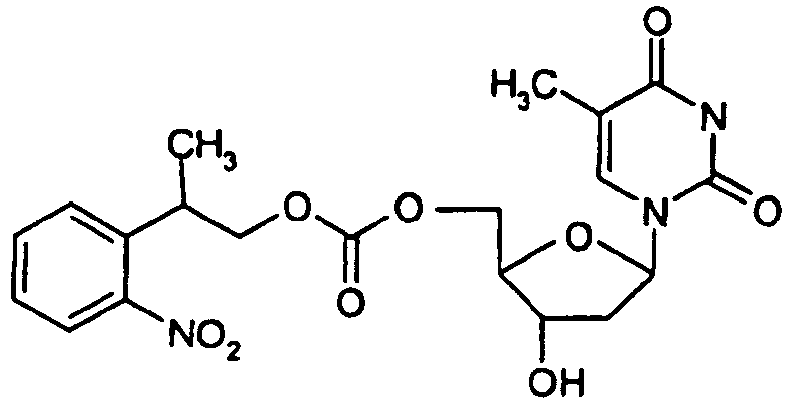
- The combination of the two different compounds allows a virtually loss-free transfer of triplet excitation energy from Thioxanthone to the labile functional group, which picks up said energy and is then more easily cleaved without itself having to be excited by electromagnetic radiation.
- The abbreviations have the following meanings herein:
NPPOC 2-(2-nitrophenyl)propyloxycarbonyl MeNPPOC 2-(3, 4-methylenedioxy-2-nitrophenyl) propyloxycarbonyl MeNPOC 2-(3, 4-methylenedioxy-2-nitrophenyl) oxycarbonyl DMBOC Dimethoxybenzoinylyloxycarbonyl NPES 2-(2-nitrophenyl)ethylsulfonyl NPPS 2-(2-nitrophenyl)propylsulfonyl PhNPPOC 2-(5-phenyl-2-nitrophenyl)-propyloxycarbonyl - The nucleoside bases guanine, thymine, cytosine and adenosine are represented by their usual abbreviations G, T, C and A.
- Use is made of thioxanthen-9-one (thioxenthone), as chemical Compound.
- Use is preferably made of solutions comprising, based on the solvent employed, 0.001 to 5 weight-%, particularly preferably between 0.005 and 0.05 weight-% of the chemical compound Thioxanthone.
- In many cases, an amount of more than 5 weight-% of the chemical compound (sensitizer) Thioxanthone leads to unwanted chemical reactions. One reaction is the reaction between an excited sensitizer and a non-excited sensitizer molecule. The sensitizer is a radical in its excited state.
- The other reaction often encountered is the reaction of the excited sensitizer Thioxanthane with the molecule comprising the photolabile group described above and may destroy them. Therefore, lower concentrations are preferred in most cases. The precise selection of the suitable concentration is easy to determine by the person skilled in the art using few prior experiments known per se to the person skilled in the art.
- The chemical composition according to the invention is preferably used for preparing DNA chips, since it allows an easy transfer of energy between the triplet state of the sensitizer compound and of the photolabile protective group and thus the photochemical cleavage reaction can be initiated in a particularly rapid and complete manner.
- According to the invention, the term "nucleotide" means both polynucleotides comprising two to 10 nucleosides which are linked with each other via both 3'-5' and 5'-3' phosphoric acid ester bonds. However, the nucleotides according to the invention also comprise polynucleotides consisting of more than 10 nucleoside units.
- The methods according to the invention are suitable for DNA- nucleotide synthesis.
- The methods according to the invention are particularly suitable to carry out an automated method. Such automated method is preferably embodied as a parallel synthesis for preparing a nucleotide library.
- In a further embodiment, the present invention comprises a kit comprising the chemical composition of the present invention containing some or all reagents and/or auxiliaries and/or solvents and/or a working instruction for carrying out a method according to the invention in one spatial unit, said kit comprising at least one or more selected nucleotides.
- According to a still further embodiment, the present invention comprises the use of the method according to the invention preparing of oligonucleotides or nucleic acid chips, preferably for the automated manufacture of oligonucleotides or nucleic acid chips.
-
Figure 1 shows the reaction rate of the cleavage reaction in a method according to the invention. - In
Fig. 1 the abscissa indicates the relative concentration of the compound provided with a protective group, as determined by HPLC, plotted as a function of the radiation time (tR/min) in minutes (ordinate). Graph 1 represents the radiation of compound T07 (2-(5-iodo-2-nitrophenyl)propylthymidine-5'-yl-carbonate) (0.096 mM) at 366 nm and an intensity of 4.98 x 10⁻³ W/cm-2.Graph 2 shows the radiation of compound T02 (2-(2-chloro-6-nitrophenyl)ethylthymidine-5'-yl-carbonate) (0.091 mM) at the same wavelength and an intensity of 6.39 x 10⁻³ W/cm-2 in the presence of thioxanthone (0.113 mM) as the sensitizer in ammonia-saturated acetonitrile. Although the light intensity in the case ofExperiment 2 is only 25% higher, the reaction rate is six times as high.Table 1: Molecule containing a protolabile protective group used in a method according to the invention 
T02 - The triplet state of Thioxantone is above the triplet state of the compound comprising the photolabile protective group, and is at most energetically similar to the latter. Thus, the singlet-triplet energy gap of the sensitizer is preferably smaller than that of the labile protective group.
- The chemical compound Thioxanthone further has a high triplet formation quantum yield φT, which linearly enters as a factor in sensitizing efficiency.
Table 3: Chemical compounds Thioxanthone ("sensitizer compound") used in a method according to the invention : Compound E(S1) kJ/mol εmax M-1xcm-1 E(T1) kJ/mol φT τT Thioxanthone p 6800 265 <0.88 73 µs 
n/b (380 nm) 95 µs - The energy (E) of the singlet and triplet states is indicated in kJ/mol. The absorption coeffcient ε is indicated as M-1 x cm-1 at the respective wavelength. n refers to a non-polar solvent, p refers to a polar solvent, b is a benzene-like solvent.
- τ refers to the lifetime of the triplet state in µs.
- The term "conventional conditions known to the person skilled in the art " as used hereinbefore and hereinafter, is described, for example in
US-5,763,599 or inDE 4,444,956 . - UV-VIS-absorption measurements were carried out using a UV-VIS spectrometer Lambda 18 (Perkin-Elmer) running under the UV Winlab software, fluorescence measurements were carried out using a luminescence spectrometer LS 50 (Perkin-Elmer) running under the FL Winlab software.
- The radiation equipment consisted of a high-pressure mercury lamp (200 W), a heat filter (optical path length: 5 cm, filled with 0.3 M CuSO4 solution in water), a collecting lens, an electronically controlled shutter, a 366 nm interference filter (Schott) and a temperature-controlled cell holder for light exposure cells (Hellma QS, 1 cm).
- HPLC examinations were carried out using Merck-Hitachi equipment. Said equipment consisted of an L-7100 pump, an L-7200 autosampler, an L-7450A UV-diode array detector and an L-7000 interface.
Merck LiChrospher 100 RP-18 (5 µm) was used as the column. Control was effected using the HSM manager on a Compaq computer. - 3 ml of a solution of thymidine derivative T02 (Tablet 1) (0.091 mM) and thioxanthone (0.113 mM) was pipetted into a cuvette and flushed for ca. 15 minutes with ammonia by passing the gas through the solution. Said solution was irradiated with light at a wavelength of 366 nm for different periods of time. Absorption spectra were respectively measured before and after radiation.
- The solution was then flushed with nitrogen (saturated with acetonitrile) for ca. 15 minutes. Upon said nitrogen flushing, an absorption spectrum was measured again, and the solution was finally separated into its components in HPLC. These components were characterized using a UV-diode array detector.
- The deprotection reaction was carried out under standard test conditions for DNA chip syntheses in a MAS 2.0 or 3.0 of Nimblegen Systems, Madison, USA. The design of the DNA chips to be prepared exhibited a standard array as usually employed in quality control tests.
- There was a typical density of some 10,000 to 100,000 oligomers per (cm)2, mostly present as 18-25 mers. The size or the surface area of an individual synthesis spot was 35 µm x 35 µm. Said spot consisted of the image (1:1) of 4 micromirrors arranged in a square (Texas Instrument Digital Light Processor) (each mirror having an edge length of 16 µm x 16 µm), each mirror being spaced apart by 1 µm.
- 0.01 weight-% thioxanthone was used as sensitizer, based on the solvent employed, i.e. DMSO. This resulted in a reduction of the light dose until complete cleavage of the protective group, from 7.5 W/cm2, without a sensitizer molecule, to a value of 3 W/cm2 at an effective lamp power of ca. 0.2 - 0.6 W/cm2. The lamp power is independent of the MAS-type and is determined during radiation in each case.
MAS-type 2.0: 1,000 Watts Hg lamp MAS-type 3.0 200 Watts Hg lamp -
Lamp power W/cm2 Duration (s) Without thioxanthone 0.2 37.5 Without thioxanthone 0.6 12.5 With thioxanthone (0.01 wight-%) 0.2 15 With thioxanthone (0.01 weight-%) 0.6 5
Claims (12)
- A method for cleavage of photolabile functional groups from molecules by the action of electromagnetic radiation which method comprises the following steps:a) taking Thioxanthone;b) contacting it with the molecules comprising said photolabile functional groups, wherein said molecules are molecules of following formula:
 c) exposure to electromagnetic radiation, the sequence of steps b) and c) being optional, wherein in case step c) is carried out prior to step b), the chemical compound Thioxanthone is activated by said electromagnetic radiation.
 - The method as claimed in Claim 1 characterized in that step c) and step b) are carried out at the same time.
- The method as claimed in any one of Claims 1 and 2, characterized in that the electromagnetic radiation is radiation in the wavelength region of UV/VIS radiation.
- Use of the method as claimed in any one of the preceding Claims for preparing spatially addressed molecule libraries.
- A method for preparing molecular libraries containing biomolecules, in particular for preparing DNA chips, by means of spatially addressed, light-controlled synthesis from individual structural units of the biomolecules on solid substrates, which method comprises the following steps:a) reacting the unprotected terminal 5' hydroxy group of a nucleoside located on the solid substrate under usual conditions with a photolabile protective group, and optionally purifying the reaction product, wherein the reaction product is a molecule of following formula:
 b) applying Thioxanthone, on the surface of the carrier comprising the nucleosides modified in step a),c) irradiating, in a spatially selective manner, the surface of the carrier treated in step b), with electromagnetic radiation in the UVNIS range;d) reacting with the molecule produced in step a);e) optionally repeating steps b) to d).
 - A chemical composition, comprising a molecule of formula:

- The use of the chemical composition of Claim 6 for the manufacture of DNA chips.
- A kit comprising the chemical composition of Claim 6.
- A kit according to claim 8 containing, in one spatial unit, part of or all reagents and/or auxiliaries and/or solvents and/or a working instruction which are for carrying out a method as claimed in any one of Claims 1 to 3 and/or 5.
- Use of the method as claimed in claim 5 for preparing oligonucleotides, or nucleic acid chips.
- Use of the method as claimed in any one of Claims 1 to 3 for preparing spatially addressed molecular libraries.
- Use of a kit as claimed in Claim 8 and/or 9 in a method of any of claims 1 to 3 for preparing spatially addressed molecular libraries.
Applications Claiming Priority (5)
| Application Number | Priority Date | Filing Date | Title |
|---|---|---|---|
| US36156202P | 2002-03-04 | 2002-03-04 | |
| DE10209203A DE10209203A1 (en) | 2002-03-04 | 2002-03-04 | Composition useful for preparing DNA chips comprises compound with labile functional group and a sensitizer that acts by triplet-triplet energy transfer |
| DE10209203 | 2002-03-04 | ||
| US361562P | 2002-03-04 | ||
| PCT/EP2003/002208 WO2003074542A2 (en) | 2002-03-04 | 2003-03-04 | A method for cleavage of labile functional groups from chemical compounds |
Publications (2)
| Publication Number | Publication Date |
|---|---|
| EP1480927A2 EP1480927A2 (en) | 2004-12-01 |
| EP1480927B1 true EP1480927B1 (en) | 2012-12-26 |
Family
ID=27789720
Family Applications (1)
| Application Number | Title | Priority Date | Filing Date |
|---|---|---|---|
| EP03706599A Expired - Lifetime EP1480927B1 (en) | 2002-03-04 | 2003-03-04 | A method for cleavage of labile functional groups from chemical compounds |
Country Status (5)
| Country | Link |
|---|---|
| EP (1) | EP1480927B1 (en) |
| JP (1) | JP4593928B2 (en) |
| AU (1) | AU2003208784A1 (en) |
| CA (1) | CA2474683A1 (en) |
| WO (1) | WO2003074542A2 (en) |
Families Citing this family (6)
| Publication number | Priority date | Publication date | Assignee | Title |
|---|---|---|---|---|
| DE10209203A1 (en) | 2002-03-04 | 2003-09-25 | Ulrich Steiner | Composition useful for preparing DNA chips comprises compound with labile functional group and a sensitizer that acts by triplet-triplet energy transfer |
| DE10227814A1 (en) * | 2002-06-21 | 2004-01-08 | Chemogenix Gmbh | Process for the separation of labile functional groups from chemical compounds |
| DE10237704A1 (en) * | 2002-08-09 | 2004-03-11 | Chemogenix Gmbh | Method and device for the intermolecular transfer of activation energy for bond cleavage through space |
| DE10315772A1 (en) * | 2003-04-07 | 2004-11-04 | Ulrich Prof. Dr. Steiner | Chemical compound and method for intramolecular energy transfer to cleave labile functional groups from chemical compounds |
| DE102004019098A1 (en) | 2004-04-20 | 2005-11-10 | Chemogenix Gmbh | Photolabile protecting groups |
| US11034858B2 (en) * | 2018-12-21 | 2021-06-15 | Kraton Polymers Llc | Light-colored rosin and rosin ester compositions |
Citations (1)
| Publication number | Priority date | Publication date | Assignee | Title |
|---|---|---|---|---|
| WO2004001033A2 (en) * | 2002-06-21 | 2003-12-31 | Chemogenix Gmbh | A method of cleaving labile functional groups from chemical compounds |
Family Cites Families (5)
| Publication number | Priority date | Publication date | Assignee | Title |
|---|---|---|---|---|
| DE3471486D1 (en) * | 1983-08-15 | 1988-06-30 | Ciba Geigy Ag | PHOTOCURABLE COMPOSITIONS |
| JP2829234B2 (en) | 1993-12-28 | 1998-11-25 | 三菱電機株式会社 | AC generator for vehicles |
| DE4444996A1 (en) | 1994-12-16 | 1996-06-20 | Wolfgang Prof Dr Dr Pfleiderer | Nucleoside derivatives with photolabile protecting groups |
| DE10011400A1 (en) * | 1999-03-11 | 2000-10-05 | Nigu Chemie Gmbh | Targeted photolytic deprotection of nucleoside derivatives, useful for synthesis of DNA chips, includes coating with a gel or viscous liquid before illumination |
| DE19952113A1 (en) * | 1999-10-29 | 2001-05-03 | Nigu Chemie Gmbh | Nucleoside derivatives with photolabile protecting groups |
-
2003
- 2003-03-04 WO PCT/EP2003/002208 patent/WO2003074542A2/en not_active Ceased
- 2003-03-04 JP JP2003573008A patent/JP4593928B2/en not_active Expired - Fee Related
- 2003-03-04 EP EP03706599A patent/EP1480927B1/en not_active Expired - Lifetime
- 2003-03-04 AU AU2003208784A patent/AU2003208784A1/en not_active Abandoned
- 2003-03-04 CA CA002474683A patent/CA2474683A1/en not_active Abandoned
Patent Citations (1)
| Publication number | Priority date | Publication date | Assignee | Title |
|---|---|---|---|---|
| WO2004001033A2 (en) * | 2002-06-21 | 2003-12-31 | Chemogenix Gmbh | A method of cleaving labile functional groups from chemical compounds |
Also Published As
| Publication number | Publication date |
|---|---|
| WO2003074542A3 (en) | 2003-12-24 |
| EP1480927A2 (en) | 2004-12-01 |
| JP4593928B2 (en) | 2010-12-08 |
| JP2006508325A (en) | 2006-03-09 |
| AU2003208784A1 (en) | 2003-09-16 |
| WO2003074542A2 (en) | 2003-09-12 |
| CA2474683A1 (en) | 2003-09-12 |
Similar Documents
| Publication | Publication Date | Title |
|---|---|---|
| JP3364230B2 (en) | Chemical amplification for the synthesis of patterned arrays | |
| US6147205A (en) | Photocleavable protecting groups and methods for their use | |
| EP2360270B1 (en) | Combinatorial decoding of random nucleic acid arrays | |
| US20040185473A1 (en) | Releasable polymer arrays | |
| JP4593928B2 (en) | Method for cleaving unstable functional groups from compounds | |
| US7598019B2 (en) | Method for cleavage of labile functional groups from chemical compounds | |
| US20050170281A1 (en) | Method of cleaving labile functional groups from chemical compounds | |
| EP1589024B1 (en) | Photolabile protecting groups | |
| US7144700B1 (en) | Photolithographic solid-phase polymer synthesis | |
| Pirrung et al. | Photoremovable protecting groups in DNA synthesis and microarray fabrication | |
| JP2005321378A (en) | Releasable polymer array | |
| CH693202A5 (en) | Cleaving photolabile functional group, useful particularly in preparation of DNA chips, using sensitizer with higher triplet state energy than the labile group | |
| Solomun et al. | A fluorescence-based method for detection of electron damage to DNA | |
| DE20210018U1 (en) | Chemical composition for the production of nucleic acid chips | |
| WO2004089529A1 (en) | Method for the intramolecular energy transfer for the cleavage of labile functional group from biomolecules and the protected biomolecules | |
| Pirrung et al. | Photoremovable protecting groups in DNA synthesis and microarray fabrication | |
| US20060154253A1 (en) | Method for the validated construction of arrays | |
| HK1025064B (en) | Chemical amplification for the synthesis of patterned arrays |
Legal Events
| Date | Code | Title | Description |
|---|---|---|---|
| PUAI | Public reference made under article 153(3) epc to a published international application that has entered the european phase |
Free format text: ORIGINAL CODE: 0009012 |
|
| 17P | Request for examination filed |
Effective date: 20040818 |
|
| AK | Designated contracting states |
Kind code of ref document: A2 Designated state(s): AT BE BG CH CY CZ DE DK EE ES FI FR GB GR HU IE IT LI LU MC NL PT RO SE SI SK TR |
|
| AX | Request for extension of the european patent |
Extension state: AL LT LV MK RO |
|
| 17Q | First examination report despatched |
Effective date: 20101126 |
|
| GRAP | Despatch of communication of intention to grant a patent |
Free format text: ORIGINAL CODE: EPIDOSNIGR1 |
|
| GRAS | Grant fee paid |
Free format text: ORIGINAL CODE: EPIDOSNIGR3 |
|
| GRAA | (expected) grant |
Free format text: ORIGINAL CODE: 0009210 |
|
| AK | Designated contracting states |
Kind code of ref document: B1 Designated state(s): CH DE FR GB LI SE |
|
| REG | Reference to a national code |
Ref country code: GB Ref legal event code: FG4D |
|
| REG | Reference to a national code |
Ref country code: CH Ref legal event code: EP |
|
| REG | Reference to a national code |
Ref country code: DE Ref legal event code: R096 Ref document number: 60342939 Country of ref document: DE Effective date: 20130307 |
|
| PG25 | Lapsed in a contracting state [announced via postgrant information from national office to epo] |
Ref country code: SE Free format text: LAPSE BECAUSE OF FAILURE TO SUBMIT A TRANSLATION OF THE DESCRIPTION OR TO PAY THE FEE WITHIN THE PRESCRIBED TIME-LIMIT Effective date: 20121226 |
|
| REG | Reference to a national code |
Ref country code: CH Ref legal event code: PL |
|
| PLBE | No opposition filed within time limit |
Free format text: ORIGINAL CODE: 0009261 |
|
| STAA | Information on the status of an ep patent application or granted ep patent |
Free format text: STATUS: NO OPPOSITION FILED WITHIN TIME LIMIT |
|
| GBPC | Gb: european patent ceased through non-payment of renewal fee |
Effective date: 20130326 |
|
| 26N | No opposition filed |
Effective date: 20130927 |
|
| REG | Reference to a national code |
Ref country code: FR Ref legal event code: ST Effective date: 20131129 |
|
| REG | Reference to a national code |
Ref country code: DE Ref legal event code: R119 Ref document number: 60342939 Country of ref document: DE Effective date: 20131001 |
|
| REG | Reference to a national code |
Ref country code: DE Ref legal event code: R097 Ref document number: 60342939 Country of ref document: DE Effective date: 20130927 |
|
| PG25 | Lapsed in a contracting state [announced via postgrant information from national office to epo] |
Ref country code: DE Free format text: LAPSE BECAUSE OF NON-PAYMENT OF DUE FEES Effective date: 20131001 Ref country code: GB Free format text: LAPSE BECAUSE OF NON-PAYMENT OF DUE FEES Effective date: 20130326 Ref country code: CH Free format text: LAPSE BECAUSE OF NON-PAYMENT OF DUE FEES Effective date: 20130331 Ref country code: FR Free format text: LAPSE BECAUSE OF NON-PAYMENT OF DUE FEES Effective date: 20130402 Ref country code: LI Free format text: LAPSE BECAUSE OF NON-PAYMENT OF DUE FEES Effective date: 20130331 |