EP1480229A1 - Piezoelectric ceramic composition and piezoelectric ceramic device composed of same - Google Patents
Piezoelectric ceramic composition and piezoelectric ceramic device composed of same Download PDFInfo
- Publication number
- EP1480229A1 EP1480229A1 EP04009980A EP04009980A EP1480229A1 EP 1480229 A1 EP1480229 A1 EP 1480229A1 EP 04009980 A EP04009980 A EP 04009980A EP 04009980 A EP04009980 A EP 04009980A EP 1480229 A1 EP1480229 A1 EP 1480229A1
- Authority
- EP
- European Patent Office
- Prior art keywords
- piezoelectric ceramic
- mol
- ceramic composition
- metallic element
- composition according
- Prior art date
- Legal status (The legal status is an assumption and is not a legal conclusion. Google has not performed a legal analysis and makes no representation as to the accuracy of the status listed.)
- Granted
Links
- 239000000919 ceramic Substances 0.000 title claims abstract description 83
- 239000000203 mixture Substances 0.000 title claims abstract description 35
- 229910052751 metal Inorganic materials 0.000 claims abstract description 18
- 150000001622 bismuth compounds Chemical class 0.000 claims abstract description 6
- QVGXLLKOCUKJST-UHFFFAOYSA-N atomic oxygen Chemical compound [O] QVGXLLKOCUKJST-UHFFFAOYSA-N 0.000 claims abstract description 3
- 229910052760 oxygen Inorganic materials 0.000 claims abstract description 3
- 239000001301 oxygen Substances 0.000 claims abstract description 3
- 229910052712 strontium Inorganic materials 0.000 claims abstract description 3
- 229910052684 Cerium Inorganic materials 0.000 claims description 3
- 229910052692 Dysprosium Inorganic materials 0.000 claims description 3
- 229910052691 Erbium Inorganic materials 0.000 claims description 3
- 229910052688 Gadolinium Inorganic materials 0.000 claims description 3
- 229910052779 Neodymium Inorganic materials 0.000 claims description 3
- 229910052772 Samarium Inorganic materials 0.000 claims description 3
- 229910052769 Ytterbium Inorganic materials 0.000 claims description 3
- 229910052746 lanthanum Inorganic materials 0.000 claims description 3
- 229910052758 niobium Inorganic materials 0.000 claims description 3
- 229910052706 scandium Inorganic materials 0.000 claims description 3
- 229910052727 yttrium Inorganic materials 0.000 claims description 3
- 229910052715 tantalum Inorganic materials 0.000 claims description 2
- 239000000463 material Substances 0.000 abstract description 7
- 230000000694 effects Effects 0.000 abstract description 4
- 150000002611 lead compounds Chemical class 0.000 abstract description 2
- CDBYLPFSWZWCQE-UHFFFAOYSA-L Sodium Carbonate Chemical compound [Na+].[Na+].[O-]C([O-])=O CDBYLPFSWZWCQE-UHFFFAOYSA-L 0.000 description 2
- WMWLMWRWZQELOS-UHFFFAOYSA-N bismuth(iii) oxide Chemical compound O=[Bi]O[Bi]=O WMWLMWRWZQELOS-UHFFFAOYSA-N 0.000 description 2
- 238000001354 calcination Methods 0.000 description 2
- 238000010304 firing Methods 0.000 description 2
- 229910000464 lead oxide Inorganic materials 0.000 description 2
- 239000011572 manganese Substances 0.000 description 2
- 239000011656 manganese carbonate Substances 0.000 description 2
- 229910000016 manganese(II) carbonate Inorganic materials 0.000 description 2
- ZKATWMILCYLAPD-UHFFFAOYSA-N niobium pentoxide Chemical compound O=[Nb](=O)O[Nb](=O)=O ZKATWMILCYLAPD-UHFFFAOYSA-N 0.000 description 2
- YEXPOXQUZXUXJW-UHFFFAOYSA-N oxolead Chemical compound [Pb]=O YEXPOXQUZXUXJW-UHFFFAOYSA-N 0.000 description 2
- BWHMMNNQKKPAPP-UHFFFAOYSA-L potassium carbonate Chemical compound [K+].[K+].[O-]C([O-])=O BWHMMNNQKKPAPP-UHFFFAOYSA-L 0.000 description 2
- PWHULOQIROXLJO-UHFFFAOYSA-N Manganese Chemical compound [Mn] PWHULOQIROXLJO-UHFFFAOYSA-N 0.000 description 1
- 229910003781 PbTiO3 Inorganic materials 0.000 description 1
- -1 SrBi2Nb2O9 Chemical class 0.000 description 1
- 230000002411 adverse Effects 0.000 description 1
- 239000002518 antifoaming agent Substances 0.000 description 1
- 239000011230 binding agent Substances 0.000 description 1
- 229910000421 cerium(III) oxide Inorganic materials 0.000 description 1
- 150000001875 compounds Chemical class 0.000 description 1
- NKZSPGSOXYXWQA-UHFFFAOYSA-N dioxido(oxo)titanium;lead(2+) Chemical compound [Pb+2].[O-][Ti]([O-])=O NKZSPGSOXYXWQA-UHFFFAOYSA-N 0.000 description 1
- 239000002270 dispersing agent Substances 0.000 description 1
- NLQFUUYNQFMIJW-UHFFFAOYSA-N dysprosium(III) oxide Inorganic materials O=[Dy]O[Dy]=O NLQFUUYNQFMIJW-UHFFFAOYSA-N 0.000 description 1
- 238000003912 environmental pollution Methods 0.000 description 1
- VQCBHWLJZDBHOS-UHFFFAOYSA-N erbium(III) oxide Inorganic materials O=[Er]O[Er]=O VQCBHWLJZDBHOS-UHFFFAOYSA-N 0.000 description 1
- CMIHHWBVHJVIGI-UHFFFAOYSA-N gadolinium(III) oxide Inorganic materials [O-2].[O-2].[O-2].[Gd+3].[Gd+3] CMIHHWBVHJVIGI-UHFFFAOYSA-N 0.000 description 1
- MRELNEQAGSRDBK-UHFFFAOYSA-N lanthanum oxide Inorganic materials [O-2].[O-2].[O-2].[La+3].[La+3] MRELNEQAGSRDBK-UHFFFAOYSA-N 0.000 description 1
- HFGPZNIAWCZYJU-UHFFFAOYSA-N lead zirconate titanate Chemical compound [O-2].[O-2].[O-2].[O-2].[O-2].[Ti+4].[Zr+4].[Pb+2] HFGPZNIAWCZYJU-UHFFFAOYSA-N 0.000 description 1
- 229910052451 lead zirconate titanate Inorganic materials 0.000 description 1
- 229910052808 lithium carbonate Inorganic materials 0.000 description 1
- XGZVUEUWXADBQD-UHFFFAOYSA-L lithium carbonate Chemical compound [Li+].[Li+].[O-]C([O-])=O XGZVUEUWXADBQD-UHFFFAOYSA-L 0.000 description 1
- 229910052748 manganese Inorganic materials 0.000 description 1
- 238000004519 manufacturing process Methods 0.000 description 1
- PLDDOISOJJCEMH-UHFFFAOYSA-N neodymium oxide Inorganic materials [O-2].[O-2].[O-2].[Nd+3].[Nd+3] PLDDOISOJJCEMH-UHFFFAOYSA-N 0.000 description 1
- KTUFCUMIWABKDW-UHFFFAOYSA-N oxo(oxolanthaniooxy)lanthanum Chemical compound O=[La]O[La]=O KTUFCUMIWABKDW-UHFFFAOYSA-N 0.000 description 1
- 230000010287 polarization Effects 0.000 description 1
- 229910000027 potassium carbonate Inorganic materials 0.000 description 1
- FKTOIHSPIPYAPE-UHFFFAOYSA-N samarium(III) oxide Inorganic materials [O-2].[O-2].[O-2].[Sm+3].[Sm+3] FKTOIHSPIPYAPE-UHFFFAOYSA-N 0.000 description 1
- HYXGAEYDKFCVMU-UHFFFAOYSA-N scandium(III) oxide Inorganic materials O=[Sc]O[Sc]=O HYXGAEYDKFCVMU-UHFFFAOYSA-N 0.000 description 1
- 239000002002 slurry Substances 0.000 description 1
- 229910000029 sodium carbonate Inorganic materials 0.000 description 1
- 239000007858 starting material Substances 0.000 description 1
- LEDMRZGFZIAGGB-UHFFFAOYSA-L strontium carbonate Chemical compound [Sr+2].[O-]C([O-])=O LEDMRZGFZIAGGB-UHFFFAOYSA-L 0.000 description 1
- 229910000018 strontium carbonate Inorganic materials 0.000 description 1
- 239000004094 surface-active agent Substances 0.000 description 1
- PBCFLUZVCVVTBY-UHFFFAOYSA-N tantalum pentoxide Inorganic materials O=[Ta](=O)O[Ta](=O)=O PBCFLUZVCVVTBY-UHFFFAOYSA-N 0.000 description 1
- XLYOFNOQVPJJNP-UHFFFAOYSA-N water Substances O XLYOFNOQVPJJNP-UHFFFAOYSA-N 0.000 description 1
- FIXNOXLJNSSSLJ-UHFFFAOYSA-N ytterbium(III) oxide Inorganic materials O=[Yb]O[Yb]=O FIXNOXLJNSSSLJ-UHFFFAOYSA-N 0.000 description 1
- RUDFQVOCFDJEEF-UHFFFAOYSA-N yttrium(III) oxide Inorganic materials [O-2].[O-2].[O-2].[Y+3].[Y+3] RUDFQVOCFDJEEF-UHFFFAOYSA-N 0.000 description 1
Images

Classifications
-
- C—CHEMISTRY; METALLURGY
- C04—CEMENTS; CONCRETE; ARTIFICIAL STONE; CERAMICS; REFRACTORIES
- C04B—LIME, MAGNESIA; SLAG; CEMENTS; COMPOSITIONS THEREOF, e.g. MORTARS, CONCRETE OR LIKE BUILDING MATERIALS; ARTIFICIAL STONE; CERAMICS; REFRACTORIES; TREATMENT OF NATURAL STONE
- C04B35/00—Shaped ceramic products characterised by their composition; Ceramics compositions; Processing powders of inorganic compounds preparatory to the manufacturing of ceramic products
- C04B35/01—Shaped ceramic products characterised by their composition; Ceramics compositions; Processing powders of inorganic compounds preparatory to the manufacturing of ceramic products based on oxide ceramics
- C04B35/495—Shaped ceramic products characterised by their composition; Ceramics compositions; Processing powders of inorganic compounds preparatory to the manufacturing of ceramic products based on oxide ceramics based on vanadium, niobium, tantalum, molybdenum or tungsten oxides or solid solutions thereof with other oxides, e.g. vanadates, niobates, tantalates, molybdates or tungstates
-
- B—PERFORMING OPERATIONS; TRANSPORTING
- B65—CONVEYING; PACKING; STORING; HANDLING THIN OR FILAMENTARY MATERIAL
- B65G—TRANSPORT OR STORAGE DEVICES, e.g. CONVEYORS FOR LOADING OR TIPPING, SHOP CONVEYOR SYSTEMS OR PNEUMATIC TUBE CONVEYORS
- B65G7/00—Devices for assisting manual moving or tilting heavy loads
- B65G7/02—Devices adapted to be interposed between loads and the ground or floor, e.g. crowbars with means for assisting conveyance of loads
- B65G7/06—Devices adapted to be interposed between loads and the ground or floor, e.g. crowbars with means for assisting conveyance of loads using fluid at high pressure supplied from an independent source to provide a cushion between load and ground
-
- B—PERFORMING OPERATIONS; TRANSPORTING
- B32—LAYERED PRODUCTS
- B32B—LAYERED PRODUCTS, i.e. PRODUCTS BUILT-UP OF STRATA OF FLAT OR NON-FLAT, e.g. CELLULAR OR HONEYCOMB, FORM
- B32B18/00—Layered products essentially comprising ceramics, e.g. refractory products
-
- H—ELECTRICITY
- H10—SEMICONDUCTOR DEVICES; ELECTRIC SOLID-STATE DEVICES NOT OTHERWISE PROVIDED FOR
- H10N—ELECTRIC SOLID-STATE DEVICES NOT OTHERWISE PROVIDED FOR
- H10N30/00—Piezoelectric or electrostrictive devices
- H10N30/80—Constructional details
- H10N30/85—Piezoelectric or electrostrictive active materials
- H10N30/853—Ceramic compositions
-
- B—PERFORMING OPERATIONS; TRANSPORTING
- B32—LAYERED PRODUCTS
- B32B—LAYERED PRODUCTS, i.e. PRODUCTS BUILT-UP OF STRATA OF FLAT OR NON-FLAT, e.g. CELLULAR OR HONEYCOMB, FORM
- B32B2311/00—Metals, their alloys or their compounds
- B32B2311/02—Noble metals
- B32B2311/06—Platinum
-
- B—PERFORMING OPERATIONS; TRANSPORTING
- B63—SHIPS OR OTHER WATERBORNE VESSELS; RELATED EQUIPMENT
- B63C—LAUNCHING, HAULING-OUT, OR DRY-DOCKING OF VESSELS; LIFE-SAVING IN WATER; EQUIPMENT FOR DWELLING OR WORKING UNDER WATER; MEANS FOR SALVAGING OR SEARCHING FOR UNDERWATER OBJECTS
- B63C3/00—Launching or hauling-out by landborne slipways; Slipways
- B63C3/08—Tracks on slipways
-
- B—PERFORMING OPERATIONS; TRANSPORTING
- B65—CONVEYING; PACKING; STORING; HANDLING THIN OR FILAMENTARY MATERIAL
- B65G—TRANSPORT OR STORAGE DEVICES, e.g. CONVEYORS FOR LOADING OR TIPPING, SHOP CONVEYOR SYSTEMS OR PNEUMATIC TUBE CONVEYORS
- B65G2201/00—Indexing codes relating to handling devices, e.g. conveyors, characterised by the type of product or load being conveyed or handled
- B65G2201/02—Articles
- B65G2201/0214—Articles of special size, shape or weigh
- B65G2201/0223—Heavy
-
- C—CHEMISTRY; METALLURGY
- C04—CEMENTS; CONCRETE; ARTIFICIAL STONE; CERAMICS; REFRACTORIES
- C04B—LIME, MAGNESIA; SLAG; CEMENTS; COMPOSITIONS THEREOF, e.g. MORTARS, CONCRETE OR LIKE BUILDING MATERIALS; ARTIFICIAL STONE; CERAMICS; REFRACTORIES; TREATMENT OF NATURAL STONE
- C04B2235/00—Aspects relating to ceramic starting mixtures or sintered ceramic products
- C04B2235/02—Composition of constituents of the starting material or of secondary phases of the final product
- C04B2235/30—Constituents and secondary phases not being of a fibrous nature
- C04B2235/32—Metal oxides, mixed metal oxides, or oxide-forming salts thereof, e.g. carbonates, nitrates, (oxy)hydroxides, chlorides
- C04B2235/3201—Alkali metal oxides or oxide-forming salts thereof
-
- C—CHEMISTRY; METALLURGY
- C04—CEMENTS; CONCRETE; ARTIFICIAL STONE; CERAMICS; REFRACTORIES
- C04B—LIME, MAGNESIA; SLAG; CEMENTS; COMPOSITIONS THEREOF, e.g. MORTARS, CONCRETE OR LIKE BUILDING MATERIALS; ARTIFICIAL STONE; CERAMICS; REFRACTORIES; TREATMENT OF NATURAL STONE
- C04B2235/00—Aspects relating to ceramic starting mixtures or sintered ceramic products
- C04B2235/02—Composition of constituents of the starting material or of secondary phases of the final product
- C04B2235/30—Constituents and secondary phases not being of a fibrous nature
- C04B2235/32—Metal oxides, mixed metal oxides, or oxide-forming salts thereof, e.g. carbonates, nitrates, (oxy)hydroxides, chlorides
- C04B2235/3201—Alkali metal oxides or oxide-forming salts thereof
- C04B2235/3203—Lithium oxide or oxide-forming salts thereof
-
- C—CHEMISTRY; METALLURGY
- C04—CEMENTS; CONCRETE; ARTIFICIAL STONE; CERAMICS; REFRACTORIES
- C04B—LIME, MAGNESIA; SLAG; CEMENTS; COMPOSITIONS THEREOF, e.g. MORTARS, CONCRETE OR LIKE BUILDING MATERIALS; ARTIFICIAL STONE; CERAMICS; REFRACTORIES; TREATMENT OF NATURAL STONE
- C04B2235/00—Aspects relating to ceramic starting mixtures or sintered ceramic products
- C04B2235/02—Composition of constituents of the starting material or of secondary phases of the final product
- C04B2235/30—Constituents and secondary phases not being of a fibrous nature
- C04B2235/32—Metal oxides, mixed metal oxides, or oxide-forming salts thereof, e.g. carbonates, nitrates, (oxy)hydroxides, chlorides
- C04B2235/3205—Alkaline earth oxides or oxide forming salts thereof, e.g. beryllium oxide
- C04B2235/3213—Strontium oxides or oxide-forming salts thereof
-
- C—CHEMISTRY; METALLURGY
- C04—CEMENTS; CONCRETE; ARTIFICIAL STONE; CERAMICS; REFRACTORIES
- C04B—LIME, MAGNESIA; SLAG; CEMENTS; COMPOSITIONS THEREOF, e.g. MORTARS, CONCRETE OR LIKE BUILDING MATERIALS; ARTIFICIAL STONE; CERAMICS; REFRACTORIES; TREATMENT OF NATURAL STONE
- C04B2235/00—Aspects relating to ceramic starting mixtures or sintered ceramic products
- C04B2235/02—Composition of constituents of the starting material or of secondary phases of the final product
- C04B2235/30—Constituents and secondary phases not being of a fibrous nature
- C04B2235/32—Metal oxides, mixed metal oxides, or oxide-forming salts thereof, e.g. carbonates, nitrates, (oxy)hydroxides, chlorides
- C04B2235/3224—Rare earth oxide or oxide forming salts thereof, e.g. scandium oxide
-
- C—CHEMISTRY; METALLURGY
- C04—CEMENTS; CONCRETE; ARTIFICIAL STONE; CERAMICS; REFRACTORIES
- C04B—LIME, MAGNESIA; SLAG; CEMENTS; COMPOSITIONS THEREOF, e.g. MORTARS, CONCRETE OR LIKE BUILDING MATERIALS; ARTIFICIAL STONE; CERAMICS; REFRACTORIES; TREATMENT OF NATURAL STONE
- C04B2235/00—Aspects relating to ceramic starting mixtures or sintered ceramic products
- C04B2235/02—Composition of constituents of the starting material or of secondary phases of the final product
- C04B2235/30—Constituents and secondary phases not being of a fibrous nature
- C04B2235/32—Metal oxides, mixed metal oxides, or oxide-forming salts thereof, e.g. carbonates, nitrates, (oxy)hydroxides, chlorides
- C04B2235/3224—Rare earth oxide or oxide forming salts thereof, e.g. scandium oxide
- C04B2235/3225—Yttrium oxide or oxide-forming salts thereof
-
- C—CHEMISTRY; METALLURGY
- C04—CEMENTS; CONCRETE; ARTIFICIAL STONE; CERAMICS; REFRACTORIES
- C04B—LIME, MAGNESIA; SLAG; CEMENTS; COMPOSITIONS THEREOF, e.g. MORTARS, CONCRETE OR LIKE BUILDING MATERIALS; ARTIFICIAL STONE; CERAMICS; REFRACTORIES; TREATMENT OF NATURAL STONE
- C04B2235/00—Aspects relating to ceramic starting mixtures or sintered ceramic products
- C04B2235/02—Composition of constituents of the starting material or of secondary phases of the final product
- C04B2235/30—Constituents and secondary phases not being of a fibrous nature
- C04B2235/32—Metal oxides, mixed metal oxides, or oxide-forming salts thereof, e.g. carbonates, nitrates, (oxy)hydroxides, chlorides
- C04B2235/3224—Rare earth oxide or oxide forming salts thereof, e.g. scandium oxide
- C04B2235/3227—Lanthanum oxide or oxide-forming salts thereof
-
- C—CHEMISTRY; METALLURGY
- C04—CEMENTS; CONCRETE; ARTIFICIAL STONE; CERAMICS; REFRACTORIES
- C04B—LIME, MAGNESIA; SLAG; CEMENTS; COMPOSITIONS THEREOF, e.g. MORTARS, CONCRETE OR LIKE BUILDING MATERIALS; ARTIFICIAL STONE; CERAMICS; REFRACTORIES; TREATMENT OF NATURAL STONE
- C04B2235/00—Aspects relating to ceramic starting mixtures or sintered ceramic products
- C04B2235/02—Composition of constituents of the starting material or of secondary phases of the final product
- C04B2235/30—Constituents and secondary phases not being of a fibrous nature
- C04B2235/32—Metal oxides, mixed metal oxides, or oxide-forming salts thereof, e.g. carbonates, nitrates, (oxy)hydroxides, chlorides
- C04B2235/3224—Rare earth oxide or oxide forming salts thereof, e.g. scandium oxide
- C04B2235/3229—Cerium oxides or oxide-forming salts thereof
-
- C—CHEMISTRY; METALLURGY
- C04—CEMENTS; CONCRETE; ARTIFICIAL STONE; CERAMICS; REFRACTORIES
- C04B—LIME, MAGNESIA; SLAG; CEMENTS; COMPOSITIONS THEREOF, e.g. MORTARS, CONCRETE OR LIKE BUILDING MATERIALS; ARTIFICIAL STONE; CERAMICS; REFRACTORIES; TREATMENT OF NATURAL STONE
- C04B2235/00—Aspects relating to ceramic starting mixtures or sintered ceramic products
- C04B2235/02—Composition of constituents of the starting material or of secondary phases of the final product
- C04B2235/30—Constituents and secondary phases not being of a fibrous nature
- C04B2235/32—Metal oxides, mixed metal oxides, or oxide-forming salts thereof, e.g. carbonates, nitrates, (oxy)hydroxides, chlorides
- C04B2235/3231—Refractory metal oxides, their mixed metal oxides, or oxide-forming salts thereof
- C04B2235/3251—Niobium oxides, niobates, tantalum oxides, tantalates, or oxide-forming salts thereof
-
- C—CHEMISTRY; METALLURGY
- C04—CEMENTS; CONCRETE; ARTIFICIAL STONE; CERAMICS; REFRACTORIES
- C04B—LIME, MAGNESIA; SLAG; CEMENTS; COMPOSITIONS THEREOF, e.g. MORTARS, CONCRETE OR LIKE BUILDING MATERIALS; ARTIFICIAL STONE; CERAMICS; REFRACTORIES; TREATMENT OF NATURAL STONE
- C04B2235/00—Aspects relating to ceramic starting mixtures or sintered ceramic products
- C04B2235/02—Composition of constituents of the starting material or of secondary phases of the final product
- C04B2235/30—Constituents and secondary phases not being of a fibrous nature
- C04B2235/32—Metal oxides, mixed metal oxides, or oxide-forming salts thereof, e.g. carbonates, nitrates, (oxy)hydroxides, chlorides
- C04B2235/3262—Manganese oxides, manganates, rhenium oxides or oxide-forming salts thereof, e.g. MnO
-
- C—CHEMISTRY; METALLURGY
- C04—CEMENTS; CONCRETE; ARTIFICIAL STONE; CERAMICS; REFRACTORIES
- C04B—LIME, MAGNESIA; SLAG; CEMENTS; COMPOSITIONS THEREOF, e.g. MORTARS, CONCRETE OR LIKE BUILDING MATERIALS; ARTIFICIAL STONE; CERAMICS; REFRACTORIES; TREATMENT OF NATURAL STONE
- C04B2235/00—Aspects relating to ceramic starting mixtures or sintered ceramic products
- C04B2235/02—Composition of constituents of the starting material or of secondary phases of the final product
- C04B2235/30—Constituents and secondary phases not being of a fibrous nature
- C04B2235/32—Metal oxides, mixed metal oxides, or oxide-forming salts thereof, e.g. carbonates, nitrates, (oxy)hydroxides, chlorides
- C04B2235/3298—Bismuth oxides, bismuthates or oxide forming salts thereof, e.g. zinc bismuthate
-
- C—CHEMISTRY; METALLURGY
- C04—CEMENTS; CONCRETE; ARTIFICIAL STONE; CERAMICS; REFRACTORIES
- C04B—LIME, MAGNESIA; SLAG; CEMENTS; COMPOSITIONS THEREOF, e.g. MORTARS, CONCRETE OR LIKE BUILDING MATERIALS; ARTIFICIAL STONE; CERAMICS; REFRACTORIES; TREATMENT OF NATURAL STONE
- C04B2235/00—Aspects relating to ceramic starting mixtures or sintered ceramic products
- C04B2235/60—Aspects relating to the preparation, properties or mechanical treatment of green bodies or pre-forms
- C04B2235/602—Making the green bodies or pre-forms by moulding
- C04B2235/6025—Tape casting, e.g. with a doctor blade
-
- C—CHEMISTRY; METALLURGY
- C04—CEMENTS; CONCRETE; ARTIFICIAL STONE; CERAMICS; REFRACTORIES
- C04B—LIME, MAGNESIA; SLAG; CEMENTS; COMPOSITIONS THEREOF, e.g. MORTARS, CONCRETE OR LIKE BUILDING MATERIALS; ARTIFICIAL STONE; CERAMICS; REFRACTORIES; TREATMENT OF NATURAL STONE
- C04B2237/00—Aspects relating to ceramic laminates or to joining of ceramic articles with other articles by heating
- C04B2237/30—Composition of layers of ceramic laminates or of ceramic or metallic articles to be joined by heating, e.g. Si substrates
- C04B2237/32—Ceramic
- C04B2237/34—Oxidic
- C04B2237/345—Refractory metal oxides
-
- C—CHEMISTRY; METALLURGY
- C04—CEMENTS; CONCRETE; ARTIFICIAL STONE; CERAMICS; REFRACTORIES
- C04B—LIME, MAGNESIA; SLAG; CEMENTS; COMPOSITIONS THEREOF, e.g. MORTARS, CONCRETE OR LIKE BUILDING MATERIALS; ARTIFICIAL STONE; CERAMICS; REFRACTORIES; TREATMENT OF NATURAL STONE
- C04B2237/00—Aspects relating to ceramic laminates or to joining of ceramic articles with other articles by heating
- C04B2237/30—Composition of layers of ceramic laminates or of ceramic or metallic articles to be joined by heating, e.g. Si substrates
- C04B2237/40—Metallic
-
- C—CHEMISTRY; METALLURGY
- C04—CEMENTS; CONCRETE; ARTIFICIAL STONE; CERAMICS; REFRACTORIES
- C04B—LIME, MAGNESIA; SLAG; CEMENTS; COMPOSITIONS THEREOF, e.g. MORTARS, CONCRETE OR LIKE BUILDING MATERIALS; ARTIFICIAL STONE; CERAMICS; REFRACTORIES; TREATMENT OF NATURAL STONE
- C04B2237/00—Aspects relating to ceramic laminates or to joining of ceramic articles with other articles by heating
- C04B2237/30—Composition of layers of ceramic laminates or of ceramic or metallic articles to be joined by heating, e.g. Si substrates
- C04B2237/40—Metallic
- C04B2237/408—Noble metals, e.g. palladium, platina or silver
-
- C—CHEMISTRY; METALLURGY
- C04—CEMENTS; CONCRETE; ARTIFICIAL STONE; CERAMICS; REFRACTORIES
- C04B—LIME, MAGNESIA; SLAG; CEMENTS; COMPOSITIONS THEREOF, e.g. MORTARS, CONCRETE OR LIKE BUILDING MATERIALS; ARTIFICIAL STONE; CERAMICS; REFRACTORIES; TREATMENT OF NATURAL STONE
- C04B2237/00—Aspects relating to ceramic laminates or to joining of ceramic articles with other articles by heating
- C04B2237/50—Processing aspects relating to ceramic laminates or to the joining of ceramic articles with other articles by heating
- C04B2237/70—Forming laminates or joined articles comprising layers of a specific, unusual thickness
- C04B2237/704—Forming laminates or joined articles comprising layers of a specific, unusual thickness of one or more of the ceramic layers or articles
Definitions
- the present invention relates to a piezoelectric ceramic composition and a piezoelectric ceramic device composed of the piezoelectric ceramic composition.
- the present invention relates to a piezoelectric ceramic composition that is useful as a material for piezoelectric ceramic devices, such as a piezoelectric ceramic filter, a piezoelectric ceramic resonator and a piezoelectric ceramic oscillator, and to a piezoelectric ceramic device composed of the piezoelectric ceramic composition.
- a lead zirconate titanate, (Pb(Ti x Zr 1-x )O 3 ) or a lead titanate- (PbTiO 3 ) based piezoelectric ceramic composition has been widely used in piezoelectric ceramic devices, such as a piezoelectric ceramic filter, a piezoelectric ceramic resonator and a piezoelectric ceramic oscillator.
- the lead zirconate titanate- or the lead titanate-based piezoelectric ceramic composition contains a large amount of lead, which vaporizes as lead oxide during production of the piezoelectric ceramic device, and thereby results in poor product uniformity.
- a piezoelectric ceramic composition that contains little or no lead is desired to overcome this problem.
- a lower amount of lead is also desirable in view of environmental pollution.
- a piezoelectric ceramic composition based on a layered bismuth compound, such as SrBi 2 Nb 2 O 9 is free of lead oxide and does not cause such problems.
- SrBi 2 Nb 2 O 9 -based materials exhibit a significantly small change in frequency when temperature changes, and therefore have received attention as piezoelectric materials for resonators recently.
- the piezoelectric ceramic device is typically used at a temperature range, for example, from 60°C to 200°C, those that can be used at a higher temperature of, for example, about 400°C, are desired for use in a resonator. Since the piezoelectric ceramic resonator cannot be used above its Curie point, where it has no piezoelectric effect, the piezoelectric ceramic resonator must has a Curie point higher than operating temperatures.
- SrBi 2 Nb 2 O 9 has a Curie point of 418°C and has a lowered piezoelectric effect when used for a piezoelectric ceramic resonator at a temperature close to 400°C.
- a preferred Curie point in this case is at least 430°C.
- a piezoelectric ceramic composition that is based on a layered bismuth compound composed of Sr, Bi, Nb, oxygen, and an additional monovalent metallic element.
- the piezoelectric ceramic composition has an elevated Curie point, is highly reliable at higher temperatures, that is, minimizes the reduction in the piezoelectric effect, and is useful as a material for piezoelectric ceramic devices that contain little or no lead or lead compounds.
- the piezoelectric ceramic composition according to the present invention contains not more than about 0.125 mol (and more than 0 mol) of monovalent metallic element per 1 mol of Nb. This amount of monovalent metallic element leads to an increased Curie point of the piezoelectric ceramic composition. However, more than about 0.125 mol of monovalent metallic element will adversely decrease the Curie point of the piezoelectric ceramic composition.
- the monovalent metallic element used in the present invention is at least one selected from the group consisting of Li, Na and K, which give further advantages of the present invention.
- the piezoelectric ceramic composition according to the present invention preferably contains not more than about 0.175 mol (and more than 0 mol) of trivalent metallic element other than Bi per 1 mol of Nb.
- this amount of trivalent metallic element other than Bi gives a practicable Q max factor (the maximum electrical quality factor Q (1/tan ⁇ ) within a band, that is, at frequencies between the resonance frequency and the anti-resonance frequency).
- the trivalent metallic element other than Bi is at least one selected from the group consisting of Sc, Y, La, Ce, Nd, Sm, Gd, Dy, Er and Yb, which give further advantages of the present invention. More preferably, the trivalent metallic element other than Bi is Nd, which give still further advantages of the present invention.
- not more than about 10 molar percent (and more than 0 molar percent) of Nb may be replaced with Ta.
- the amount of Ta will be up to 10% based on the total mols of Nb and Ta present.
- Replacing more than about 10 molar percent of Nb with Ta will result in a too low Q max factor for the piezoelectric ceramic composition to function as a resonator.
- the main component of the piezoelectric ceramic composition according to the present invention may contain not more than about 0.01 mol (and more than 0 mol) of Mn per 1mol of the main component. Manganese in amounts larger than that will result in a too low Q max factor for the piezoelectric ceramic composition to function as a resonator.
- the piezoelectric ceramic device includes a piezoelectric ceramic that is composed of piezoelectric ceramic composition according to the present invention, and electrodes on the piezoelectric ceramic.
- SrCO 3 , Bi 2 O 3 , Nb 2 O 5 , Ta 2 O 5 , Na 2 CO 3 , K 2 CO 3 , Li 2 CO 3 , Nd 2 O 3 , La 2 O 3 , Ce 2 O 3 , Sc 2 O 3 , Y 2 O 3 , Sm 2 O 3 , Gd 2 O 3 , Dy 2 O 3 , Er 2 O 3 , Yb 2 O 3 and MnCO 3 were firstly prepared as starting materials.
- the product was mixed with an organic binder, a dispersant, an anti-foaming agent, a surfactant and pure water in proper quantities, and was pulverized in the ball mill.
- the resulting slurry was applied with a doctor blade into sheets 40 to 80 ⁇ m in thickness. Electrodes were printed on some of these sheets with a Pt paste, and then the printed sheets were dried. The printed sheets and other sheets were stacked. The resulting laminate was compacted and was baked at 1100 to 1300°C.
- the laminate was polarized in an insulating oil at 100 to 200°C under 5 to 10 kV/mm dc voltage for 10 to 30 min, yielding an energy-confinement piezoelectric ceramic oscillator 10 (sample) shown in Figs. 1 and 2.
- a piezoelectric ceramic oscillator 10 shown in Figs. 1 and 2 includes a piezoelectric ceramic 12 in, for example, a rectangular parallelepiped shape.
- the piezoelectric ceramic 12 is polarized in the direction from the bottom face to the top face as indicated by an arrow.
- the piezoelectric ceramic 12 has vibrating electrodes 14a and 14b on its top and bottom faces, respectively.
- the vibrating electrodes 14a and 14b are of, for example, a circular shape and are disposed at the center of each face. Thus, the vibrating electrode 14b is disposed right below the vibrating electrode 14a.
- the piezoelectric ceramic 12 also has an internal vibrating electrode 14c in, for example, a circular shape.
- the vibrating electrode 14c is disposed in the middle of the vibrating electrodes 14a and 14b.
- the vibrating electrodes 14a, 14b and 14c are vertically aligned.
- Leading electrodes 16a, 16b and 16c in, for example, a T shape are disposed between their respective vibrating electrodes 14a, 14b and 14c, and a side face of the piezoelectric ceramic 12.
- the leading electrodes 16a and 16b are disposed between their respective vibrating electrodes 14a and 14b, and one side face of the piezoelectric ceramic 12, and the leading electrode 16c is disposed between the vibrating electrode 14c and the other side face of the piezoelectric ceramic 12.
- a voltage is applied between the leading electrodes 16a and 16b and the leading electrode 16c to cause electric potential difference between the exterior vibrating electrodes 14a and 14b and the interior vibrating electrode 14c, and thus to excite a thickness-longitudinal vibration second harmonic mode.
- the piezoelectric ceramic oscillator 10 (sample) was tested for the Q max factor at room temperature in the thickness-longitudinal vibration second harmonic mode. In addition, the temperature dependence of permittivity and the Curie point were measured. The results are shown in Tables 1 and 2.
- the Q max factor was determined for each sample under the conditions (calcination temperature, firing temperature, temperature of insulating oil during polarization, and dc voltage) that exhibited the largest Q max factor.
- the Q max factor depended on the shape of the sample, the mode of vibration and the type of the electrode.
- the applications of the piezoelectric ceramic device, in particular, a piezoelectric ceramic resonator, at a higher temperature according to the present invention are of very special use, and a high Q max factor as required in general-purpose piezoelectric ceramic devices, in particular, piezoelectric ceramic resonators that are used in household electric appliances, is not required. This is because even a low Q max factor is practicable depending on the circuit design. Under the present conditions, a Q max factor of at least 10 at room temperature is a practical level.
- the Curie points in Tables 1 and 2 were determined for each sample under the conditions (calcination temperature and firing temperature) that gave the highest density.
- a Curie point of at least 430°C is required for practical use.
- the piezoelectric ceramic compositions within the scope of the present invention have Curie points higher than 430°C and thus are useful materials for piezoelectric ceramic devices, in particular, piezoelectric ceramic resonators at a high temperature close to 400°C.
- samples that are within the scope of the present invention and contain not more than about 0.175 mol (and more than 0 mol) of trivalent metallic elements other than Bi per 1 mol of Nb have Q max factors of not less than the practical level of 10, and thus are useful materials particularly for piezoelectric ceramic resonators.
- the piezoelectric ceramic composition according to the present invention is not limited to the embodiment described above, and is effective within the scope of the present invention.
- the present invention can be applied not only to the piezoelectric ceramic oscillator 10 described above, but also to other piezoelectric ceramic devices, such as piezoelectric ceramic oscillators, piezoelectric ceramic filters and piezoelectric ceramic resonators.
Landscapes
- Engineering & Computer Science (AREA)
- Chemical & Material Sciences (AREA)
- Ceramic Engineering (AREA)
- Manufacturing & Machinery (AREA)
- Materials Engineering (AREA)
- Structural Engineering (AREA)
- Organic Chemistry (AREA)
- Compositions Of Oxide Ceramics (AREA)
- Piezo-Electric Or Mechanical Vibrators, Or Delay Or Filter Circuits (AREA)
Abstract
Description
- The present invention relates to a piezoelectric ceramic composition and a piezoelectric ceramic device composed of the piezoelectric ceramic composition. In particular, the present invention relates to a piezoelectric ceramic composition that is useful as a material for piezoelectric ceramic devices, such as a piezoelectric ceramic filter, a piezoelectric ceramic resonator and a piezoelectric ceramic oscillator, and to a piezoelectric ceramic device composed of the piezoelectric ceramic composition.
- Hitherto, a lead zirconate titanate, (Pb(TixZr1-x)O3) or a lead titanate- (PbTiO3) based piezoelectric ceramic composition has been widely used in piezoelectric ceramic devices, such as a piezoelectric ceramic filter, a piezoelectric ceramic resonator and a piezoelectric ceramic oscillator. However, the lead zirconate titanate- or the lead titanate-based piezoelectric ceramic composition contains a large amount of lead, which vaporizes as lead oxide during production of the piezoelectric ceramic device, and thereby results in poor product uniformity. Thus, a piezoelectric ceramic composition that contains little or no lead is desired to overcome this problem. In addition, a lower amount of lead is also desirable in view of environmental pollution.
- On the other hand, a piezoelectric ceramic composition based on a layered bismuth compound, such as SrBi2Nb2O9, is free of lead oxide and does not cause such problems.
- In addition, SrBi2Nb2O9-based materials, as disclosed in Japanese Unexamined Patent Application Publication No. 2001-328865, exhibit a significantly small change in frequency when temperature changes, and therefore have received attention as piezoelectric materials for resonators recently.
- While the piezoelectric ceramic device is typically used at a temperature range, for example, from 60°C to 200°C, those that can be used at a higher temperature of, for example, about 400°C, are desired for use in a resonator. Since the piezoelectric ceramic resonator cannot be used above its Curie point, where it has no piezoelectric effect, the piezoelectric ceramic resonator must has a Curie point higher than operating temperatures.
- According to M. J. Forbess et al. (Applied Physics Letters, Vol. 76, 2943, (2000)), SrBi2Nb2O9 has a Curie point of 418°C and has a lowered piezoelectric effect when used for a piezoelectric ceramic resonator at a temperature close to 400°C. A preferred Curie point in this case is at least 430°C.
- Accordingly, it is an object of the present invention to provide a piezoelectric ceramic composition that is based on a layered bismuth compound composed of Sr, Bi, Nb, oxygen, and an additional monovalent metallic element. The piezoelectric ceramic composition has an elevated Curie point, is highly reliable at higher temperatures, that is, minimizes the reduction in the piezoelectric effect, and is useful as a material for piezoelectric ceramic devices that contain little or no lead or lead compounds.
- The piezoelectric ceramic composition according to the present invention contains not more than about 0.125 mol (and more than 0 mol) of monovalent metallic element per 1 mol of Nb. This amount of monovalent metallic element leads to an increased Curie point of the piezoelectric ceramic composition. However, more than about 0.125 mol of monovalent metallic element will adversely decrease the Curie point of the piezoelectric ceramic composition.
- Preferably, the monovalent metallic element used in the present invention is at least one selected from the group consisting of Li, Na and K, which give further advantages of the present invention.
- Furthermore, the piezoelectric ceramic composition according to the present invention preferably contains not more than about 0.175 mol (and more than 0 mol) of trivalent metallic element other than Bi per 1 mol of Nb. When the ceramic device composed of the piezoelectric ceramic composition is used as a resonator, this amount of trivalent metallic element other than Bi gives a practicable Qmax factor (the maximum electrical quality factor Q (1/tan δ) within a band, that is, at frequencies between the resonance frequency and the anti-resonance frequency).
- Preferably, the trivalent metallic element other than Bi is at least one selected from the group consisting of Sc, Y, La, Ce, Nd, Sm, Gd, Dy, Er and Yb, which give further advantages of the present invention. More preferably, the trivalent metallic element other than Bi is Nd, which give still further advantages of the present invention.
- In the main component of the piezoelectric ceramic composition according to the present invention, not more than about 10 molar percent (and more than 0 molar percent) of Nb may be replaced with Ta. As a result, the amount of Ta will be up to 10% based on the total mols of Nb and Ta present. Replacing more than about 10 molar percent of Nb with Ta will result in a too low Qmax factor for the piezoelectric ceramic composition to function as a resonator.
- Further, the main component of the piezoelectric ceramic composition according to the present invention may contain not more than about 0.01 mol (and more than 0 mol) of Mn per 1mol of the main component. Manganese in amounts larger than that will result in a too low Qmax factor for the piezoelectric ceramic composition to function as a resonator.
- The piezoelectric ceramic device according to the present invention includes a piezoelectric ceramic that is composed of piezoelectric ceramic composition according to the present invention, and electrodes on the piezoelectric ceramic.
- The foregoing and other objects, features, and advantages of the present invention will be more apparent from the detailed description of the following embodiment according to the present invention.
-
- Fig. 1 is a perspective view of a piezoelectric ceramic oscillator according to an embodiment of the present invention; and
- Fig. 2 is a sectional view of the piezoelectric ceramic oscillator shown in Fig. 1.
-
- SrCO3, Bi2O3, Nb2O5, Ta2O5, Na2CO3, K2CO3, Li2CO3, Nd2O3, La2O3, Ce2O3, Sc2O3, Y2O3, Sm2O3, Gd2O3, Dy2O3, Er2O3, Yb2O3 and MnCO3 were firstly prepared as starting materials. These compounds were weighed to meet the composition formula (SraBibNbcO9 + w mol M1 + x mol M3 + y mol Ta + z mol MnCO3 (wherein, M1 is Na, K or Li, M3 is Nd, La, Ce, Sc, Y, Sm, Gd, Dy, Er or Yb, and a, b, c, w, x, y and z are as shown in Tables 1 and 2)) and were wet-blended in a ball mill for about 16 hours. The resulting mixture was dried, and was then calcined at 800 to 1000°C. The product was mixed with an organic binder, a dispersant, an anti-foaming agent, a surfactant and pure water in proper quantities, and was pulverized in the ball mill. The resulting slurry was applied with a doctor blade into sheets 40 to 80 µm in thickness. Electrodes were printed on some of these sheets with a Pt paste, and then the printed sheets were dried. The printed sheets and other sheets were stacked. The resulting laminate was compacted and was baked at 1100 to 1300°C. Then, the laminate was polarized in an insulating oil at 100 to 200°C under 5 to 10 kV/mm dc voltage for 10 to 30 min, yielding an energy-confinement piezoelectric ceramic oscillator 10 (sample) shown in Figs. 1 and 2.
- A piezoelectric
ceramic oscillator 10 shown in Figs. 1 and 2 includes a piezoelectric ceramic 12 in, for example, a rectangular parallelepiped shape. Thepiezoelectric ceramic 12 is polarized in the direction from the bottom face to the top face as indicated by an arrow. The piezoelectric ceramic 12 has vibratingelectrodes electrodes electrode 14b is disposed right below the vibratingelectrode 14a. Thepiezoelectric ceramic 12 also has an internal vibratingelectrode 14c in, for example, a circular shape. The vibratingelectrode 14c is disposed in the middle of the vibratingelectrodes electrodes electrodes electrodes piezoelectric ceramic 12. Specifically, the leadingelectrodes electrodes piezoelectric ceramic 12, and the leadingelectrode 16c is disposed between the vibratingelectrode 14c and the other side face of thepiezoelectric ceramic 12. A voltage is applied between the leadingelectrodes electrode 16c to cause electric potential difference between the exterior vibratingelectrodes electrode 14c, and thus to excite a thickness-longitudinal vibration second harmonic mode. - The piezoelectric ceramic oscillator 10 (sample) was tested for the Qmax factor at room temperature in the thickness-longitudinal vibration second harmonic mode. In addition, the temperature dependence of permittivity and the Curie point were measured. The results are shown in Tables 1 and 2.

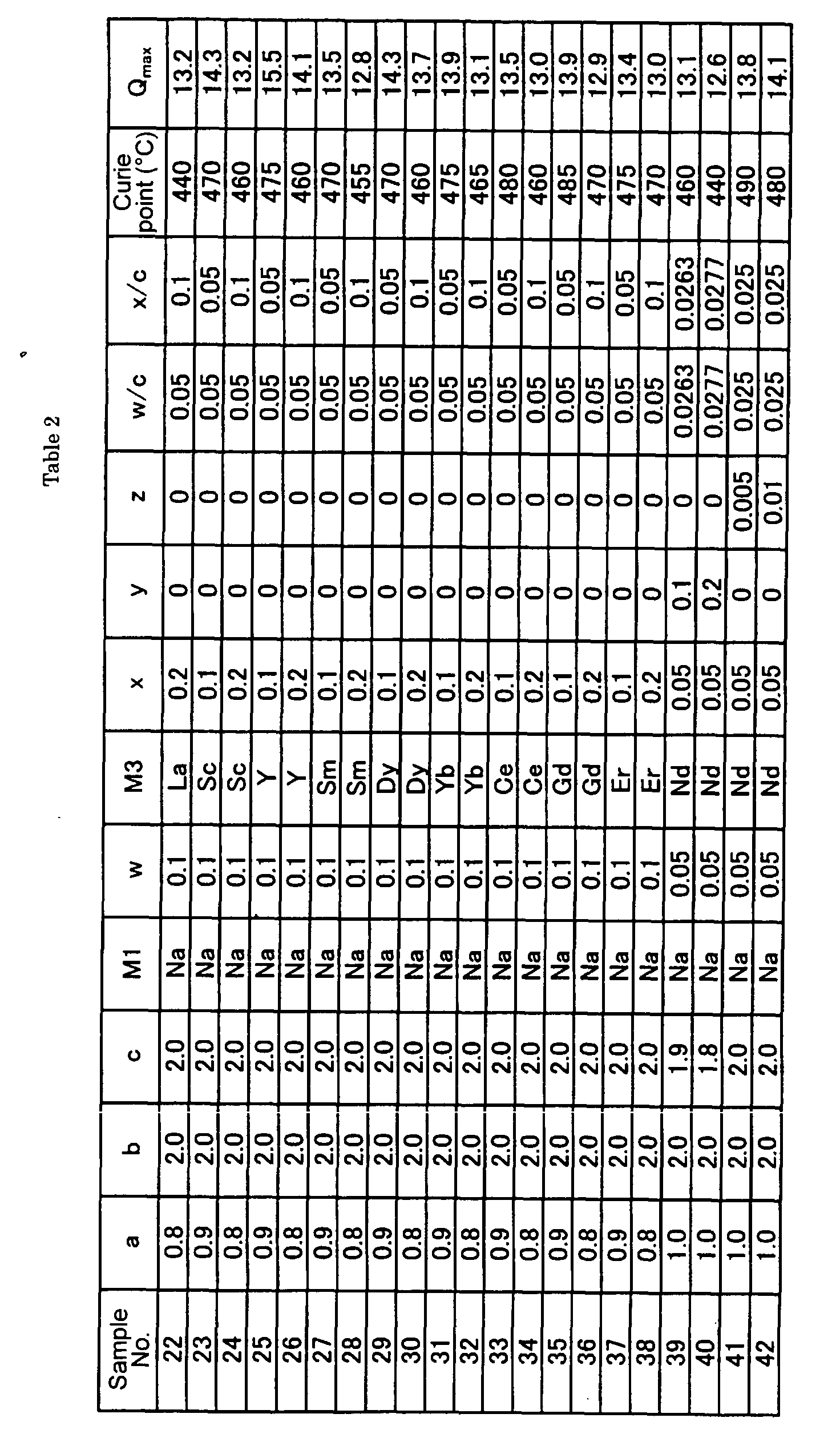
- The Qmax factor was determined for each sample under the conditions (calcination temperature, firing temperature, temperature of insulating oil during polarization, and dc voltage) that exhibited the largest Qmax factor. The Qmax factor depended on the shape of the sample, the mode of vibration and the type of the electrode. The applications of the piezoelectric ceramic device, in particular, a piezoelectric ceramic resonator, at a higher temperature according to the present invention are of very special use, and a high Qmax factor as required in general-purpose piezoelectric ceramic devices, in particular, piezoelectric ceramic resonators that are used in household electric appliances, is not required. This is because even a low Qmax factor is practicable depending on the circuit design. Under the present conditions, a Qmax factor of at least 10 at room temperature is a practical level.
- The Curie points in Tables 1 and 2 were determined for each sample under the conditions (calcination temperature and firing temperature) that gave the highest density. When the piezoelectric ceramic device is used at a high temperature close to 400°C, a Curie point of at least 430°C is required for practical use.
- It is apparent from Tables 1 and 2 that the piezoelectric ceramic compositions within the scope of the present invention have Curie points higher than 430°C and thus are useful materials for piezoelectric ceramic devices, in particular, piezoelectric ceramic resonators at a high temperature close to 400°C.
- The samples that are within the scope of the present invention and contain not more than about 0.175 mol (and more than 0 mol) of trivalent metallic elements other than Bi per 1 mol of Nb have Qmax factors of not less than the practical level of 10, and thus are useful materials particularly for piezoelectric ceramic resonators.
- The piezoelectric ceramic composition according to the present invention is not limited to the embodiment described above, and is effective within the scope of the present invention.
- The present invention can be applied not only to the piezoelectric
ceramic oscillator 10 described above, but also to other piezoelectric ceramic devices, such as piezoelectric ceramic oscillators, piezoelectric ceramic filters and piezoelectric ceramic resonators.
Claims (9)
- A piezoelectric ceramic composition comprising a layered bismuth compound comprising Sr, Bi, Nb and oxygen, and a positive amount of monovalent metallic element, wherein the amount of monovalent metallic element is not more than about 0.125 mol for each mol ofNb.
- The piezoelectric ceramic composition according to Claim 1, wherein the monovalent metallic element is at least one member selected from the group consisting of Li, Na and K.
- The piezoelectric ceramic composition according to Claims 1 or 2, wherein the layered bismuth compound further comprises a positive amount of not more than about 0.175 mol of trivalent metallic element other than Bi for each mol of Nb.
- The piezoelectric ceramic composition according to Claim 3, wherein the trivalent metallic element is at least one member selected from the group consisting of Sc, Y, La, Ce, Nd, Sm, Gd, Dy, Er and Yb.
- The piezoelectric ceramic composition according to Claim 3, wherein the trivalent metallic element is Nd.
- The piezoelectric ceramic composition according to at least one of Claims 1 to 5, further comprising a positive amount Ta up to about 10 molar percent based on the moles of Nb and Ta present.
- The piezoelectric ceramic composition according to at least one of Claims Ito 6, further comprising a positive amount Mn up to about 0.01 mol.
- A piezoelectric ceramic according to at least one of Claims 1 to 7 having a Curie point of at least about 430°C and a Qmax of at least about 10.
- A piezoelectric ceramic device comprising a piezoelectric ceramic composed of the piezoelectric ceramic composition according to at least one of Claims 1 to 8 in combination with electrodes.
Applications Claiming Priority (2)
| Application Number | Priority Date | Filing Date | Title |
|---|---|---|---|
| JP2003143086A JP4396136B2 (en) | 2003-05-21 | 2003-05-21 | Piezoelectric ceramic composition and piezoelectric ceramic element using the same |
| JP2003143086 | 2003-05-21 |
Publications (2)
| Publication Number | Publication Date |
|---|---|
| EP1480229A1 true EP1480229A1 (en) | 2004-11-24 |
| EP1480229B1 EP1480229B1 (en) | 2006-06-28 |
Family
ID=33095430
Family Applications (1)
| Application Number | Title | Priority Date | Filing Date |
|---|---|---|---|
| EP04009980A Expired - Lifetime EP1480229B1 (en) | 2003-05-21 | 2004-04-27 | Piezoelectric ceramic composition and piezoelectric ceramic device composed of same |
Country Status (8)
| Country | Link |
|---|---|
| US (1) | US7049731B2 (en) |
| EP (1) | EP1480229B1 (en) |
| JP (1) | JP4396136B2 (en) |
| KR (1) | KR100610495B1 (en) |
| CN (1) | CN1304323C (en) |
| AT (1) | ATE332007T1 (en) |
| DE (1) | DE602004001361T2 (en) |
| TW (1) | TWI262512B (en) |
Cited By (1)
| Publication number | Priority date | Publication date | Assignee | Title |
|---|---|---|---|---|
| KR100610495B1 (en) | 2003-05-21 | 2006-08-08 | 가부시키가이샤 무라타 세이사쿠쇼 | Piezoelectric ceramic composition and piezoelectric ceramic device composed of same |
Families Citing this family (6)
| Publication number | Priority date | Publication date | Assignee | Title |
|---|---|---|---|---|
| CN100522873C (en) * | 2005-12-30 | 2009-08-05 | 中国科学院上海硅酸盐研究所 | Bismuth layer structure relaxation ferroelectrical ceramic material and preparation process thereof |
| WO2008090758A1 (en) * | 2007-01-24 | 2008-07-31 | Murata Manufacturing Co., Ltd. | Resonant actuator |
| WO2009072369A1 (en) * | 2007-12-06 | 2009-06-11 | Konica Minolta Holdings, Inc. | Piezoelectric porcelain composition |
| US8235507B2 (en) | 2007-12-06 | 2012-08-07 | Konica Minolta Holdings, Inc. | Liquid droplet ejection head |
| CN108083839A (en) * | 2017-12-01 | 2018-05-29 | 高俊 | A kind of preparation method of high intensity, porous piezoelectric ceramics |
| CN109503161A (en) * | 2018-11-30 | 2019-03-22 | 赵娟 | A kind of scandium tantalum codope type bismuth niobate rubidium piezoceramic material and preparation method thereof |
Citations (3)
| Publication number | Priority date | Publication date | Assignee | Title |
|---|---|---|---|---|
| EP0820968A1 (en) * | 1996-07-26 | 1998-01-28 | Murata Manufacturing Co., Ltd. | Dielectric ceramic composition |
| EP0875493A1 (en) * | 1997-04-28 | 1998-11-04 | Murata Manufacturing Co., Ltd. | Piezoelectric ceramic composition |
| US20020060306A1 (en) * | 2000-05-30 | 2002-05-23 | Matsushita Electric Industrial Co., Ltd. | Piezoelectric ceramic composition and piezoelectric element containing the same |
Family Cites Families (20)
| Publication number | Priority date | Publication date | Assignee | Title |
|---|---|---|---|---|
| CN85100426B (en) * | 1985-04-01 | 1987-09-02 | 中国科学院上海硅酸盐研究所 | Piezoelectric ceramic material for bismuth sodium potassium titanate system ultrasound |
| JPH111368A (en) * | 1997-06-12 | 1999-01-06 | Tdk Corp | Piezoelectric porcelain composition |
| JP4052612B2 (en) * | 1998-11-10 | 2008-02-27 | Necトーキン株式会社 | Piezoelectric ceramic composition |
| JP3671791B2 (en) | 1999-02-08 | 2005-07-13 | 株式会社村田製作所 | Piezoelectric ceramic composition and piezoelectric ceramic element using the same |
| JP3830298B2 (en) | 1999-03-30 | 2006-10-04 | 京セラ株式会社 | Piezoelectric ceramic composition |
| GB2350359B (en) * | 1999-05-24 | 2001-07-11 | Murata Manufacturing Co | Piezoelectric ceramic composition and piezoelectric ceramic element using the same |
| JP3646619B2 (en) | 1999-08-26 | 2005-05-11 | 株式会社村田製作所 | Piezoelectric ceramic composition and piezoelectric ceramic element using the same |
| JP2001345669A (en) | 2000-03-27 | 2001-12-14 | Murata Mfg Co Ltd | Piezoelectric element |
| EP1087525A3 (en) * | 1999-09-22 | 2008-01-09 | Murata Manufacturing Co., Ltd. | Piezoelectric device |
| JP4355084B2 (en) * | 2000-02-29 | 2009-10-28 | 京セラ株式会社 | Piezoelectric ceramic composition and piezoelectric resonator |
| JP2001253772A (en) * | 2000-03-10 | 2001-09-18 | Kyocera Corp | Piezoelectric ceramic composition and method for producing the same |
| JP3791299B2 (en) | 2000-05-18 | 2006-06-28 | 株式会社村田製作所 | Piezoelectric ceramic composition and piezoelectric ceramic element using the same |
| JP3617411B2 (en) | 2000-05-18 | 2005-02-02 | 株式会社村田製作所 | Piezoelectric ceramic vibrator |
| JP2002173369A (en) * | 2000-07-28 | 2002-06-21 | Tdk Corp | Piezoelectric ceramic |
| CN1295046A (en) * | 2000-12-05 | 2001-05-16 | 上海联能科技有限公司 | High-curie temperature bismuth layer (BLSF) piezoelectric ceramic synthesizing and sintering process |
| US6764609B2 (en) * | 2001-10-11 | 2004-07-20 | Matsushita Electric Industrial Co., Ltd. | Piezoelectric ceramic composition and piezoelectric element using the same |
| JP4492022B2 (en) * | 2001-11-02 | 2010-06-30 | 株式会社村田製作所 | Multilayer piezoelectric ceramic element |
| JP2003176176A (en) | 2001-12-12 | 2003-06-24 | Foundation For The Promotion Of Industrial Science | Bismuth layered structure ferroelectric, method of manufacturing the same, memory device and piezoelectric / electrostrictive device using the same |
| JP2004331463A (en) | 2003-05-08 | 2004-11-25 | Matsushita Electric Ind Co Ltd | Piezoelectric ceramic composition |
| JP4396136B2 (en) | 2003-05-21 | 2010-01-13 | 株式会社村田製作所 | Piezoelectric ceramic composition and piezoelectric ceramic element using the same |
-
2003
- 2003-05-21 JP JP2003143086A patent/JP4396136B2/en not_active Expired - Fee Related
-
2004
- 2004-04-26 US US10/831,195 patent/US7049731B2/en not_active Expired - Fee Related
- 2004-04-27 EP EP04009980A patent/EP1480229B1/en not_active Expired - Lifetime
- 2004-04-27 DE DE602004001361T patent/DE602004001361T2/en not_active Expired - Lifetime
- 2004-04-27 AT AT04009980T patent/ATE332007T1/en not_active IP Right Cessation
- 2004-05-07 TW TW093112965A patent/TWI262512B/en not_active IP Right Cessation
- 2004-05-20 KR KR1020040035939A patent/KR100610495B1/en not_active Expired - Fee Related
- 2004-05-20 CN CNB2004100456523A patent/CN1304323C/en not_active Expired - Fee Related
Patent Citations (3)
| Publication number | Priority date | Publication date | Assignee | Title |
|---|---|---|---|---|
| EP0820968A1 (en) * | 1996-07-26 | 1998-01-28 | Murata Manufacturing Co., Ltd. | Dielectric ceramic composition |
| EP0875493A1 (en) * | 1997-04-28 | 1998-11-04 | Murata Manufacturing Co., Ltd. | Piezoelectric ceramic composition |
| US20020060306A1 (en) * | 2000-05-30 | 2002-05-23 | Matsushita Electric Industrial Co., Ltd. | Piezoelectric ceramic composition and piezoelectric element containing the same |
Non-Patent Citations (1)
| Title |
|---|
| FORBESS M J ET AL: "Dielectric properties of layered perovskite Sr1-x Ax Bi2Nb2O9 ferroelectrics", APPLIED PHYSICS LETTERS, AMERICAN INSTITUTE OF PHYSICS. NEW YORK, US, vol. 76, no. 20, 15 May 2000 (2000-05-15), pages 2934 - 2936, XP012025337, ISSN: 0003-6951 * |
Cited By (1)
| Publication number | Priority date | Publication date | Assignee | Title |
|---|---|---|---|---|
| KR100610495B1 (en) | 2003-05-21 | 2006-08-08 | 가부시키가이샤 무라타 세이사쿠쇼 | Piezoelectric ceramic composition and piezoelectric ceramic device composed of same |
Also Published As
| Publication number | Publication date |
|---|---|
| JP4396136B2 (en) | 2010-01-13 |
| TWI262512B (en) | 2006-09-21 |
| CN1572751A (en) | 2005-02-02 |
| DE602004001361T2 (en) | 2006-11-09 |
| ATE332007T1 (en) | 2006-07-15 |
| TW200426858A (en) | 2004-12-01 |
| EP1480229B1 (en) | 2006-06-28 |
| KR100610495B1 (en) | 2006-08-08 |
| JP2004345886A (en) | 2004-12-09 |
| US7049731B2 (en) | 2006-05-23 |
| KR20040101016A (en) | 2004-12-02 |
| CN1304323C (en) | 2007-03-14 |
| US20040251791A1 (en) | 2004-12-16 |
| DE602004001361D1 (en) | 2006-08-10 |
Similar Documents
| Publication | Publication Date | Title |
|---|---|---|
| Hirose et al. | Piezoelectric properties of SrBi4Ti4O15-based ceramics | |
| US7910016B2 (en) | Piezoelectric ceramic composition and piezoelectric ceramic electronic component | |
| US7468143B2 (en) | Piezoelectric ceramic composition and piezoelectric element | |
| JP2001316182A (en) | Piezoelectric ceramics and piezoelectric resonators | |
| JP4493226B2 (en) | Piezoelectric ceramic and piezoelectric element | |
| EP1480229B1 (en) | Piezoelectric ceramic composition and piezoelectric ceramic device composed of same | |
| US6503416B2 (en) | Piezoelectric ceramic composition and piezoelectric ceramic element using the same | |
| US20110234046A1 (en) | Piezoelectric ceramic composition, piezoelectric element, and resonator | |
| US6558567B2 (en) | Piezoelectric ceramic compact and piezoelectric ceramic device using the same | |
| JP3613140B2 (en) | Piezoelectric ceramic composition and piezoelectric ceramic element using the same | |
| JP2004323325A (en) | Piezoelectric ceramic and piezoelectric ceramic element using the same | |
| JP3815197B2 (en) | Piezoelectric ceramic composition and piezoelectric ceramic element using the same | |
| US6488864B2 (en) | Piezoelectric ceramic compact and piezoelectric ceramic device | |
| KR100379201B1 (en) | Piezoelectric ceramic composition and piezoelectric ceramic device using the same | |
| JP4355115B2 (en) | Piezoelectric ceramic and piezoelectric element | |
| US6734606B2 (en) | Piezoelectric ceramic composition and piezoelectric ceramic element using the same | |
| KR100380109B1 (en) | Piezoelectric Ceramic Composition and Piezoelectric Ceramic Element using the Same | |
| JP4467168B2 (en) | Piezoelectric ceramic and piezoelectric element | |
| JP4244571B2 (en) | Piezoelectric ceramic composition and piezoelectric ceramic element using the same |
Legal Events
| Date | Code | Title | Description |
|---|---|---|---|
| PUAI | Public reference made under article 153(3) epc to a published international application that has entered the european phase |
Free format text: ORIGINAL CODE: 0009012 |
|
| 17P | Request for examination filed |
Effective date: 20040427 |
|
| AK | Designated contracting states |
Kind code of ref document: A1 Designated state(s): AT BE BG CH CY CZ DE DK EE ES FI FR GB GR HU IE IT LI LU MC NL PL PT RO SE SI SK TR |
|
| AX | Request for extension of the european patent |
Extension state: AL HR LT LV MK |
|
| 17Q | First examination report despatched |
Effective date: 20050119 |
|
| AKX | Designation fees paid |
Designated state(s): AT BE BG CH CY CZ DE DK EE ES FI FR GB GR HU IE IT LI LU MC NL PL PT RO SE SI SK TR |
|
| GRAP | Despatch of communication of intention to grant a patent |
Free format text: ORIGINAL CODE: EPIDOSNIGR1 |
|
| GRAS | Grant fee paid |
Free format text: ORIGINAL CODE: EPIDOSNIGR3 |
|
| GRAA | (expected) grant |
Free format text: ORIGINAL CODE: 0009210 |
|
| AK | Designated contracting states |
Kind code of ref document: B1 Designated state(s): AT BE BG CH CY CZ DE DK EE ES FI FR GB GR HU IE IT LI LU MC NL PL PT RO SE SI SK TR |
|
| PG25 | Lapsed in a contracting state [announced via postgrant information from national office to epo] |
Ref country code: CH Free format text: LAPSE BECAUSE OF FAILURE TO SUBMIT A TRANSLATION OF THE DESCRIPTION OR TO PAY THE FEE WITHIN THE PRESCRIBED TIME-LIMIT Effective date: 20060628 Ref country code: RO Free format text: LAPSE BECAUSE OF FAILURE TO SUBMIT A TRANSLATION OF THE DESCRIPTION OR TO PAY THE FEE WITHIN THE PRESCRIBED TIME-LIMIT Effective date: 20060628 Ref country code: FI Free format text: LAPSE BECAUSE OF FAILURE TO SUBMIT A TRANSLATION OF THE DESCRIPTION OR TO PAY THE FEE WITHIN THE PRESCRIBED TIME-LIMIT Effective date: 20060628 Ref country code: NL Free format text: LAPSE BECAUSE OF FAILURE TO SUBMIT A TRANSLATION OF THE DESCRIPTION OR TO PAY THE FEE WITHIN THE PRESCRIBED TIME-LIMIT Effective date: 20060628 Ref country code: LI Free format text: LAPSE BECAUSE OF FAILURE TO SUBMIT A TRANSLATION OF THE DESCRIPTION OR TO PAY THE FEE WITHIN THE PRESCRIBED TIME-LIMIT Effective date: 20060628 Ref country code: AT Free format text: LAPSE BECAUSE OF FAILURE TO SUBMIT A TRANSLATION OF THE DESCRIPTION OR TO PAY THE FEE WITHIN THE PRESCRIBED TIME-LIMIT Effective date: 20060628 Ref country code: SK Free format text: LAPSE BECAUSE OF FAILURE TO SUBMIT A TRANSLATION OF THE DESCRIPTION OR TO PAY THE FEE WITHIN THE PRESCRIBED TIME-LIMIT Effective date: 20060628 Ref country code: BE Free format text: LAPSE BECAUSE OF FAILURE TO SUBMIT A TRANSLATION OF THE DESCRIPTION OR TO PAY THE FEE WITHIN THE PRESCRIBED TIME-LIMIT Effective date: 20060628 Ref country code: SI Free format text: LAPSE BECAUSE OF FAILURE TO SUBMIT A TRANSLATION OF THE DESCRIPTION OR TO PAY THE FEE WITHIN THE PRESCRIBED TIME-LIMIT Effective date: 20060628 Ref country code: CZ Free format text: LAPSE BECAUSE OF FAILURE TO SUBMIT A TRANSLATION OF THE DESCRIPTION OR TO PAY THE FEE WITHIN THE PRESCRIBED TIME-LIMIT Effective date: 20060628 Ref country code: PL Free format text: LAPSE BECAUSE OF FAILURE TO SUBMIT A TRANSLATION OF THE DESCRIPTION OR TO PAY THE FEE WITHIN THE PRESCRIBED TIME-LIMIT Effective date: 20060628 Ref country code: IT Free format text: LAPSE BECAUSE OF FAILURE TO SUBMIT A TRANSLATION OF THE DESCRIPTION OR TO PAY THE FEE WITHIN THE PRESCRIBED TIME-LIMIT;WARNING: LAPSES OF ITALIAN PATENTS WITH EFFECTIVE DATE BEFORE 2007 MAY HAVE OCCURRED AT ANY TIME BEFORE 2007. THE CORRECT EFFECTIVE DATE MAY BE DIFFERENT FROM THE ONE RECORDED. Effective date: 20060628 |
|
| REG | Reference to a national code |
Ref country code: GB Ref legal event code: FG4D |
|
| REG | Reference to a national code |
Ref country code: CH Ref legal event code: EP |
|
| REG | Reference to a national code |
Ref country code: IE Ref legal event code: FG4D |
|
| REF | Corresponds to: |
Ref document number: 602004001361 Country of ref document: DE Date of ref document: 20060810 Kind code of ref document: P |
|
| PG25 | Lapsed in a contracting state [announced via postgrant information from national office to epo] |
Ref country code: SE Free format text: LAPSE BECAUSE OF FAILURE TO SUBMIT A TRANSLATION OF THE DESCRIPTION OR TO PAY THE FEE WITHIN THE PRESCRIBED TIME-LIMIT Effective date: 20060928 Ref country code: DK Free format text: LAPSE BECAUSE OF FAILURE TO SUBMIT A TRANSLATION OF THE DESCRIPTION OR TO PAY THE FEE WITHIN THE PRESCRIBED TIME-LIMIT Effective date: 20060928 |
|
| PG25 | Lapsed in a contracting state [announced via postgrant information from national office to epo] |
Ref country code: ES Free format text: LAPSE BECAUSE OF FAILURE TO SUBMIT A TRANSLATION OF THE DESCRIPTION OR TO PAY THE FEE WITHIN THE PRESCRIBED TIME-LIMIT Effective date: 20061009 |
|
| PG25 | Lapsed in a contracting state [announced via postgrant information from national office to epo] |
Ref country code: PT Free format text: LAPSE BECAUSE OF FAILURE TO SUBMIT A TRANSLATION OF THE DESCRIPTION OR TO PAY THE FEE WITHIN THE PRESCRIBED TIME-LIMIT Effective date: 20061128 |
|
| NLV1 | Nl: lapsed or annulled due to failure to fulfill the requirements of art. 29p and 29m of the patents act | ||
| REG | Reference to a national code |
Ref country code: CH Ref legal event code: PL |
|
| ET | Fr: translation filed | ||
| PLBE | No opposition filed within time limit |
Free format text: ORIGINAL CODE: 0009261 |
|
| STAA | Information on the status of an ep patent application or granted ep patent |
Free format text: STATUS: NO OPPOSITION FILED WITHIN TIME LIMIT |
|
| 26N | No opposition filed |
Effective date: 20070329 |
|
| PG25 | Lapsed in a contracting state [announced via postgrant information from national office to epo] |
Ref country code: GR Free format text: LAPSE BECAUSE OF FAILURE TO SUBMIT A TRANSLATION OF THE DESCRIPTION OR TO PAY THE FEE WITHIN THE PRESCRIBED TIME-LIMIT Effective date: 20060929 |
|
| PG25 | Lapsed in a contracting state [announced via postgrant information from national office to epo] |
Ref country code: IE Free format text: LAPSE BECAUSE OF NON-PAYMENT OF DUE FEES Effective date: 20070427 |
|
| PG25 | Lapsed in a contracting state [announced via postgrant information from national office to epo] |
Ref country code: BG Free format text: LAPSE BECAUSE OF FAILURE TO SUBMIT A TRANSLATION OF THE DESCRIPTION OR TO PAY THE FEE WITHIN THE PRESCRIBED TIME-LIMIT Effective date: 20060928 |
|
| PG25 | Lapsed in a contracting state [announced via postgrant information from national office to epo] |
Ref country code: EE Free format text: LAPSE BECAUSE OF FAILURE TO SUBMIT A TRANSLATION OF THE DESCRIPTION OR TO PAY THE FEE WITHIN THE PRESCRIBED TIME-LIMIT Effective date: 20060628 |
|
| PG25 | Lapsed in a contracting state [announced via postgrant information from national office to epo] |
Ref country code: MC Free format text: LAPSE BECAUSE OF NON-PAYMENT OF DUE FEES Effective date: 20070430 |
|
| PG25 | Lapsed in a contracting state [announced via postgrant information from national office to epo] |
Ref country code: CY Free format text: LAPSE BECAUSE OF FAILURE TO SUBMIT A TRANSLATION OF THE DESCRIPTION OR TO PAY THE FEE WITHIN THE PRESCRIBED TIME-LIMIT Effective date: 20060628 Ref country code: LU Free format text: LAPSE BECAUSE OF NON-PAYMENT OF DUE FEES Effective date: 20070427 |
|
| PG25 | Lapsed in a contracting state [announced via postgrant information from national office to epo] |
Ref country code: HU Free format text: LAPSE BECAUSE OF FAILURE TO SUBMIT A TRANSLATION OF THE DESCRIPTION OR TO PAY THE FEE WITHIN THE PRESCRIBED TIME-LIMIT Effective date: 20061229 Ref country code: TR Free format text: LAPSE BECAUSE OF FAILURE TO SUBMIT A TRANSLATION OF THE DESCRIPTION OR TO PAY THE FEE WITHIN THE PRESCRIBED TIME-LIMIT Effective date: 20060628 |
|
| REG | Reference to a national code |
Ref country code: FR Ref legal event code: PLFP Year of fee payment: 13 |
|
| REG | Reference to a national code |
Ref country code: FR Ref legal event code: PLFP Year of fee payment: 14 |
|
| PGFP | Annual fee paid to national office [announced via postgrant information from national office to epo] |
Ref country code: GB Payment date: 20170419 Year of fee payment: 14 Ref country code: DE Payment date: 20170419 Year of fee payment: 14 Ref country code: FR Payment date: 20170419 Year of fee payment: 14 |
|
| REG | Reference to a national code |
Ref country code: DE Ref legal event code: R119 Ref document number: 602004001361 Country of ref document: DE |
|
| GBPC | Gb: european patent ceased through non-payment of renewal fee |
Effective date: 20180427 |
|
| PG25 | Lapsed in a contracting state [announced via postgrant information from national office to epo] |
Ref country code: DE Free format text: LAPSE BECAUSE OF NON-PAYMENT OF DUE FEES Effective date: 20181101 |
|
| PG25 | Lapsed in a contracting state [announced via postgrant information from national office to epo] |
Ref country code: GB Free format text: LAPSE BECAUSE OF NON-PAYMENT OF DUE FEES Effective date: 20180427 |
|
| PG25 | Lapsed in a contracting state [announced via postgrant information from national office to epo] |
Ref country code: FR Free format text: LAPSE BECAUSE OF NON-PAYMENT OF DUE FEES Effective date: 20180430 |