EP1478141A2 - Verbesserte Bestimmung der durchschnittlichen Schlangenlängen für RED - Google Patents
Verbesserte Bestimmung der durchschnittlichen Schlangenlängen für RED Download PDFInfo
- Publication number
- EP1478141A2 EP1478141A2 EP04300138A EP04300138A EP1478141A2 EP 1478141 A2 EP1478141 A2 EP 1478141A2 EP 04300138 A EP04300138 A EP 04300138A EP 04300138 A EP04300138 A EP 04300138A EP 1478141 A2 EP1478141 A2 EP 1478141A2
- Authority
- EP
- European Patent Office
- Prior art keywords
- queue
- avg
- depth
- average
- discard
- Prior art date
- Legal status (The legal status is an assumption and is not a legal conclusion. Google has not performed a legal analysis and makes no representation as to the accuracy of the status listed.)
- Withdrawn
Links
- 230000003247 decreasing effect Effects 0.000 claims abstract description 22
- 238000000034 method Methods 0.000 claims description 86
- 238000012544 monitoring process Methods 0.000 claims description 8
- 238000004891 communication Methods 0.000 claims description 5
- 230000009471 action Effects 0.000 claims description 3
- 239000003086 colorant Substances 0.000 claims description 3
- 230000001419 dependent effect Effects 0.000 abstract description 2
- 238000004422 calculation algorithm Methods 0.000 description 17
- 230000006870 function Effects 0.000 description 15
- 230000008569 process Effects 0.000 description 7
- 238000004088 simulation Methods 0.000 description 7
- 238000004364 calculation method Methods 0.000 description 5
- 238000012545 processing Methods 0.000 description 3
- 230000007423 decrease Effects 0.000 description 2
- 230000007246 mechanism Effects 0.000 description 2
- 241000725101 Clea Species 0.000 description 1
- VVNCNSJFMMFHPL-VKHMYHEASA-N D-penicillamine Chemical compound CC(C)(S)[C@@H](N)C(O)=O VVNCNSJFMMFHPL-VKHMYHEASA-N 0.000 description 1
- 241000289690 Xenarthra Species 0.000 description 1
- 230000003044 adaptive effect Effects 0.000 description 1
- 238000013459 approach Methods 0.000 description 1
- 230000009286 beneficial effect Effects 0.000 description 1
- 230000008901 benefit Effects 0.000 description 1
- 230000008859 change Effects 0.000 description 1
- 229940075911 depen Drugs 0.000 description 1
- 230000000694 effects Effects 0.000 description 1
- 239000004744 fabric Substances 0.000 description 1
- 230000006872 improvement Effects 0.000 description 1
- 230000009467 reduction Effects 0.000 description 1
- 230000004044 response Effects 0.000 description 1
- 230000032258 transport Effects 0.000 description 1
- 238000009827 uniform distribution Methods 0.000 description 1
Images



Classifications
-
- H—ELECTRICITY
- H04—ELECTRIC COMMUNICATION TECHNIQUE
- H04L—TRANSMISSION OF DIGITAL INFORMATION, e.g. TELEGRAPHIC COMMUNICATION
- H04L47/00—Traffic control in data switching networks
- H04L47/10—Flow control; Congestion control
- H04L47/27—Evaluation or update of window size, e.g. using information derived from acknowledged [ACK] packets
-
- H—ELECTRICITY
- H04—ELECTRIC COMMUNICATION TECHNIQUE
- H04L—TRANSMISSION OF DIGITAL INFORMATION, e.g. TELEGRAPHIC COMMUNICATION
- H04L47/00—Traffic control in data switching networks
- H04L47/10—Flow control; Congestion control
-
- H—ELECTRICITY
- H04—ELECTRIC COMMUNICATION TECHNIQUE
- H04L—TRANSMISSION OF DIGITAL INFORMATION, e.g. TELEGRAPHIC COMMUNICATION
- H04L47/00—Traffic control in data switching networks
- H04L47/10—Flow control; Congestion control
- H04L47/19—Flow control; Congestion control at layers above the network layer
- H04L47/193—Flow control; Congestion control at layers above the network layer at the transport layer, e.g. TCP related
-
- H—ELECTRICITY
- H04—ELECTRIC COMMUNICATION TECHNIQUE
- H04L—TRANSMISSION OF DIGITAL INFORMATION, e.g. TELEGRAPHIC COMMUNICATION
- H04L47/00—Traffic control in data switching networks
- H04L47/10—Flow control; Congestion control
- H04L47/29—Flow control; Congestion control using a combination of thresholds
-
- H—ELECTRICITY
- H04—ELECTRIC COMMUNICATION TECHNIQUE
- H04L—TRANSMISSION OF DIGITAL INFORMATION, e.g. TELEGRAPHIC COMMUNICATION
- H04L47/00—Traffic control in data switching networks
- H04L47/10—Flow control; Congestion control
- H04L47/30—Flow control; Congestion control in combination with information about buffer occupancy at either end or at transit nodes
-
- H—ELECTRICITY
- H04—ELECTRIC COMMUNICATION TECHNIQUE
- H04L—TRANSMISSION OF DIGITAL INFORMATION, e.g. TELEGRAPHIC COMMUNICATION
- H04L47/00—Traffic control in data switching networks
- H04L47/10—Flow control; Congestion control
- H04L47/32—Flow control; Congestion control by discarding or delaying data units, e.g. packets or frames
-
- H—ELECTRICITY
- H04—ELECTRIC COMMUNICATION TECHNIQUE
- H04L—TRANSMISSION OF DIGITAL INFORMATION, e.g. TELEGRAPHIC COMMUNICATION
- H04L47/00—Traffic control in data switching networks
- H04L47/10—Flow control; Congestion control
- H04L47/32—Flow control; Congestion control by discarding or delaying data units, e.g. packets or frames
- H04L47/326—Flow control; Congestion control by discarding or delaying data units, e.g. packets or frames with random discard, e.g. random early discard [RED]
Definitions
- the invention resides in the field of alleviating traffic congestion by selectively discarding packets of telecommunications traffic in a communication s switch or router. More particularly, the invention is directed to the problem of calculating average queue depth for RED, particularly in a manner that effectively responds to very rapid increases and decreases in the instantaneous queue depth.
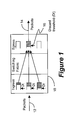
- FIG. 1 shows a simplified architecture of a communications switch 10 or a router.
- Packets 12 of traffic arrive at ingress queues and are switched by a switching fabric to egress queues before departing from an output port 14 of the switch.
- Dt discard threshold
- packets arriving at that queue may be dropped in accordance with a tail drop procedure. That is, packets at the end of the queue are dropped until the queue depth (also call ed the queue occupancy) recedes below the discard threshold.
- Dt discard threshold
- a problem with this procedure in the case of TCP connections, is that packets can be dropped from a single TCP connection because of the nature of the protocol.
- RED random early packet discard
- queue depth queue occupancy
- RED uses the queue depth (queue occupancy) to determine whether to keep or discard each packet as it arrives at the queue. This is done by determining a discard probability, which is dependent on the average depth of the queue (also called average queue depth or average queue occupancy), and comparing the discard probability to a random number. If the discard probability is greater than t he random number the packet is discarded.
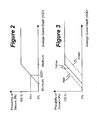
- Figure 2 shows a graph of an example discard probability function versus average queue depth. According to this function, the discard probability is zero until a minimum threshold is reached, thereafter the disca rd probability increases linearly until a maximum threshold is reached. For average queue depths greater than the maximum threshold the discard probability is 100%.
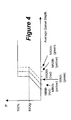
- Figure 3 shows graphs of discard probability functions for a variation of RED, known as, weighted RED.
- RED weighted RED
- the particular discard probability function that is used for a pa cket depends on the drop precedence (colour) of the packet.
- the drop precedence (DP) is determined by examining the DiffServ Code Point (DSCP) field in the IP header of the packet. Packets that exceed agreements on their connections have their drop prece dence (colour) changed by an IP policing procedure.
- DSCP DiffServ Code Point
- the determination to keep or discard a packet is made by comparing the discard probability of the packet to a random number, discarding the packet when the prob ability exceeds the number. Variations of this procedure include having more discard probability functions, and having different probability curves in accordance with a class of service (CoS) to which the packet belongs.
- the CoS of a packet is also deter mined by examining the DSCP field in the IP header.
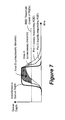
- Figure 4 shows another example of weighted RED with the discard probability functions having shapes that are generally accepted to work well.
- the figure includes three graphs for three colours. For each colour, its function provides the discard probability that increases linearly from 0% to MAXp, as the average queue depth increases from its minimum threshold (MINth) to its maximum threshold (MAXth). Above MAXth, the discard probability is 100%.
- MINth minimum threshold
- MAXth maximum threshold
- Differ ent vendors and different drop precedence (colour) functions will have different values for MAXp, MINth, and MAXth shown in the figure. In the figure, MAXp, which is less than 100%, is same for all the colours. Discard probability functions having differ ent shapes and curves are possible.
- the determination of whether to discard or keep a packet is made by comparing the discard probability of the packet to a random number (RN).
- RN random number
- Figures 5 and 6 show a comparison of the results of the GRV and URV methods with a con stant average queue depth.
- Figure 5 is the GRV method and
- Figure 6 is the URV method.
- the horizontal lines depict time and the small vertical lines depict packet discards.
- GRV geometric random variable
- a new ran dom number is selected for each packet arriving at a queue. If the discard probability for the packet exceeds the random number then the packet is discarded.
- the resulting discards are randomly distributed in time.
- the URV method selects a new random number only after a packet has been discarded.
- the URV method therefore, counts the number of packets (count) since the last discard and multiplies the count by the discard probability. If the resulting product is gre ater than the random number then the packet is discarded, the count set to zero, and a new random number is generated. Otherwise the packet is accepted and the count is incremented.
- the URV method provides the desirable result of uniformly distributing packet discards in time, it requires an additional multiply operation over the GRV method. This extra multiply operation takes a significant amount of processing time. As an example, assume that a typical network processor has 56 cycles to process a 40-byte packet at 9.14Gbps (equivalent to OC -192) rate. Each multiplication operation takes 6 cycles to complete. This yields a total of 12 cycles for the multiplication part of the discard calculations. A problem with this approach is that, in the case of packets arriving at OC-192 rate, the URV discard procedure leaves only 44 cycles for the remainder of the discard processing, such as threshold checking, given the processors currently available today. At these rates, every cycle is precious and new ways need to be found to conserve them.
- discard pro bability P(colour) which depends on average queue depth N avg .
- P(colour) which depends on average queue depth N avg .
- a background process is invoked every T seconds. This process calculates average queue depth and discard probability using formulae (1) and (2) respectively. The obtained values are then used to determine a fate of every pa cket that arrives to the system during the next T seconds. After that time, the background process is called again, the current queue depth is fetched, and new average queue depth and discard probability are computed.
- Applicant's another application filed concurrently herewith describes an improved technique of performing URV scheme of RED more efficiently without shortcomings mentioned above.
- the discard probabilities are summed for each colour, instead of counting the number of packets (count) and multiplying that by the current discard probability P(colour), as in the prior art.
- the resulting sum is compared to the random number to perform discard/accept operation.
- the low weight W means that the average queue depth will slowly react to changes of the actual queue depth. Thi s is beneficial when the queue grows. The average on the basis of which the RED algorithm makes a discard decision lags behind the actual queue depth. This means that temporary bursts of traffic that suddenly fill the queue will not trigger excessive dis cards because the (average) queue depth perceived by the algorithm is still low. This property of low weight, however, loses its appeal when the queue depth drops. When that happens, it is desirable that the average queue depth follows closely the actual queue depth so that the packet loss is minimized.
- the present invention provides novel ways of calculating the average queue depth which produce more desirable characteristics, whether the queue depth is increasing or decreasing, resulting in better perf ormance of RED.
- the invention is directed to an improved technique of selectively discarding packets of traffic depending on the fill level, or depth, of queues in the communications switch.
- the invention uses the summed discard probabilities, instead of counting the number of packets (count) and multiplying that by the current discard probability, as in the prior art. The resulting sum is compared to the random number for discard operation.
- the invention provides a better way of calculating average depth of a queue to help RED to perform more effectively.
- the invention is directed to a RED implementation.
- the implementation of RED requires calculating the average depth of the queue to which RED is being applied.
- a weight is introduced.
- the invention uses a plurality of weights to be used depending on the st atus of the queue.
- two-weight scheme there are two weights. A smaller weight is used for an increasing queue depth, and a larger one is used for a decreasing queue depth.
- the invention is directed to a method of continuously calculating an average depth of a queue in the telecommunications system.
- the method includes steps of measuring a current queue depth, N cur , and calculating an average queue depth, N avg .
- the invention is directed to a method of controlling a queue of a communications system by a random early packet discard procedure.
- the method comprises steps of receiving a packet at the queue and decid ing an accept/discard action on the packet based on a discard probability for the packet.
- the invention uses a step of comparing N cur and N avg to determine whether the queue is increasing or decreasing.
- the invention uses different values of weight, depending on the dynamics of the queue occupancy, which are more suitable for calculating the average queue depth more correctly.
- Figure 7 shows two plots, plots 1 and 2, of the average queue depth calculated by formula (1) using two different values of W.
- the value of W affects the amount of weight ing that the previous average queue depth is given in relation to the current (instantaneous) queue depth in calculating the new average queue depth.
- the instantaneous queue depth is also shown as a reference.
- the plots are displayed as average/instantan eous queue depth versus time.
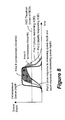
- Figure 8 shows graphs of the queue depth which the present invention is expected to produce in calculating the average queue depth, using two weight values.
- weight W is 1/2 M , M>0.
- Other weight values can be contemplated, for example, 1/3 M or 1/2 2M , but 1/2 M is presently an industry standard practice.
- the novel technique of calculating the average queue depth is applicable to any RED schemes to realize a benefit of more efficient discard operation. It is however noted that the novel scheme of RED describ ed in the above-mentioned application can also incorporate the present invention. As mentioned earlier, the application describes the novel RED scheme in which the discard probabilities are summed for each colour, instead of counting the number of packets (count) and multiplying that by the current discard probability P(colour), as in the prior art. The resulting sum (discard probability sum or P sum (colour)) is compared to the random number (RN).
- P sum (colour) P sum (colour)+P(colour)
- OPNET is used to simulate a simple scenario in which a single non -responsive (UDP) stream is processed by the RED system.
- the capacity of the system is 5 85kb/s (equivalent to OC12).
- Queue threshold, MlNth for the red traffic is set at 44,000B. This means that as long as the queue depth is below 44,0008, no packets are discarded. Above that threshold, a discard probability increases linearly up to 1.0 (1 00%) for the depth of MAXth of 620,000B.
- a UDP traffic source sends red packets at the following rates:
- Figures 9 and 10 show simulation results of the average queue depth and actual queue depth in the environment described above.
- the weight W used to calculate the moving average is 0.25.
- Figure 9 shows the single - weight RED which uses this value all the time
- Figure 10 shows the results of double-weight algorithm of the present invention which uses the value only when the queue depth increases.
- the figures clea rly show that when the queue depth increases, both algorithms behave similarly, with the average queue depth lagging behind the actual queue depth.
- the average queue depth in the single -weight RED still lags behind assuming values larger than the current queue depth.
- the average queue depth in the double-weight RED on the other hand, closely follows the actual queue depth. This difference in the behaviour helps double weight RED to achieve a lower packet loss.
- about 6% less packets were dropped by the double - weight RED than by the traditional, single -weight RED.
- the complexity of a double-weight RED algorithm is not much higher than that of the single weight algorithm.
- the algorithm of the in vention still requires one value of weight, in the case when W and 1 -W are used.
- the only additional complexity lies in a single condition that compares the average queue depth with the current (actual) queue depth.
- FIG. 13 is a schematic illustration of a discard mechanism according to the above-described embodiment of the invention.
- the figure only shows one queue associated with a variety of modules. It should be noted that a plurality of queues are in a switch or a router and they may share some o r all modules.
- a receiver 80 receives a packet and sends over to the queue 82 for storage from which a transmitter 84 transports a stored packet downstream. The receiver checks the drop precedence (colour) of the packet, if there are more than one level of precedence.
- a discard probability calculation module 86 continuously monitors the queue depth. It also calculates average queue depth and determines discard probability.
- the discard probability calculation module further makes a decisi on of accept/discard the packet in response to comparison between the discard probability for the colour of the packet and a random number obtained from random number generator 88.
- Discard module 90 drops off the packet from the tail of the queue when instructed by the discard probability calculation module.
- the invention provides a more accurate technique of calculating the average queue depth for periods of short idle time, thereby preventing unnecessary discards that could otherwise result. It is impo rtant that RED responds to rapid changes in queue depth more effectively, thereby reducing unnecessary packet discards.
- the invention makes RED more adaptive to bursty traffic.
Landscapes
- Engineering & Computer Science (AREA)
- Computer Networks & Wireless Communication (AREA)
- Signal Processing (AREA)
- Data Exchanges In Wide-Area Networks (AREA)
Applications Claiming Priority (2)
| Application Number | Priority Date | Filing Date | Title |
|---|---|---|---|
| US386652 | 2003-03-13 | ||
| US10/386,652 US20040179479A1 (en) | 2003-03-13 | 2003-03-13 | Determination of average queue depth for RED (random early packet discard) |
Publications (2)
| Publication Number | Publication Date |
|---|---|
| EP1478141A2 true EP1478141A2 (de) | 2004-11-17 |
| EP1478141A3 EP1478141A3 (de) | 2006-03-15 |
Family
ID=32961724
Family Applications (1)
| Application Number | Title | Priority Date | Filing Date |
|---|---|---|---|
| EP04300138A Withdrawn EP1478141A3 (de) | 2003-03-13 | 2004-03-12 | Verbesserte Bestimmung der durchschnittlichen Schlangenlängen für RED |
Country Status (2)
| Country | Link |
|---|---|
| US (1) | US20040179479A1 (de) |
| EP (1) | EP1478141A3 (de) |
Cited By (1)
| Publication number | Priority date | Publication date | Assignee | Title |
|---|---|---|---|---|
| CN102461093A (zh) * | 2009-06-29 | 2012-05-16 | 阿尔卡特朗讯公司 | 管理业务负荷的方法 |
Families Citing this family (3)
| Publication number | Priority date | Publication date | Assignee | Title |
|---|---|---|---|---|
| US20110299400A1 (en) * | 2010-06-04 | 2011-12-08 | Leanics Corporation | System for congestion control in packet networks |
| EP2823610B1 (de) | 2012-03-09 | 2019-01-02 | British Telecommunications public limited company | Überlastungssignalisierung |
| US10776162B2 (en) * | 2018-02-12 | 2020-09-15 | Atlassian Pty Ltd | Load shedding in a distributed system |
Family Cites Families (16)
| Publication number | Priority date | Publication date | Assignee | Title |
|---|---|---|---|---|
| US6463068B1 (en) * | 1997-12-31 | 2002-10-08 | Cisco Technologies, Inc. | Router with class of service mapping |
| US6556578B1 (en) * | 1999-04-14 | 2003-04-29 | Lucent Technologies Inc. | Early fair drop buffer management method |
| WO2001005107A1 (en) * | 1999-07-13 | 2001-01-18 | Alteon Web Systems, Inc. | Apparatus and method to minimize congestion in an output queuing switch |
| US6674718B1 (en) * | 2000-04-11 | 2004-01-06 | International Business Machines Corporation | Unified method and system for scheduling and discarding packets in computer networks |
| US7023864B2 (en) * | 2000-05-01 | 2006-04-04 | Riverdelta Networks, Inc | Data packet discarding |
| US6987732B2 (en) * | 2000-12-15 | 2006-01-17 | Tellabs San Jose, Inc. | Apparatus and methods for scheduling packets in a broadband data stream |
| US7002980B1 (en) * | 2000-12-19 | 2006-02-21 | Chiaro Networks, Ltd. | System and method for router queue and congestion management |
| US6996062B1 (en) * | 2001-02-28 | 2006-02-07 | 3Com Corporation | Policy-based weighted random early detection method for avoiding congestion in internet traffic |
| JP2002330165A (ja) * | 2001-04-27 | 2002-11-15 | Fujitsu Ltd | 輻輳制御装置 |
| US7203170B2 (en) * | 2001-05-01 | 2007-04-10 | Integrated Device Technology, Inc. | Network switch port with weighted random early discard |
| US6901593B2 (en) * | 2001-05-08 | 2005-05-31 | Nortel Networks Limited | Active queue management with flow proportional buffering |
| US6798741B2 (en) * | 2001-12-05 | 2004-09-28 | Riverstone Networks, Inc. | Method and system for rate shaping in packet-based computer networks |
| US7286550B2 (en) * | 2001-12-14 | 2007-10-23 | Tundra Semiconductor Corporation | Single cycle weighted random early detection circuit and method |
| US7349336B2 (en) * | 2002-06-04 | 2008-03-25 | Lucent Technologies Inc. | Random early drop with per hop behavior biasing |
| US7280477B2 (en) * | 2002-09-27 | 2007-10-09 | International Business Machines Corporation | Token-based active queue management |
| JP4291664B2 (ja) * | 2003-10-14 | 2009-07-08 | 株式会社日立製作所 | 通信バッファ予約機能を備えるストレージ装置およびシステム |
-
2003
- 2003-03-13 US US10/386,652 patent/US20040179479A1/en not_active Abandoned
-
2004
- 2004-03-12 EP EP04300138A patent/EP1478141A3/de not_active Withdrawn
Non-Patent Citations (1)
| Title |
|---|
| None * |
Cited By (2)
| Publication number | Priority date | Publication date | Assignee | Title |
|---|---|---|---|---|
| CN102461093A (zh) * | 2009-06-29 | 2012-05-16 | 阿尔卡特朗讯公司 | 管理业务负荷的方法 |
| CN102461093B (zh) * | 2009-06-29 | 2014-09-10 | 阿尔卡特朗讯公司 | 管理业务负荷的方法 |
Also Published As
| Publication number | Publication date |
|---|---|
| US20040179479A1 (en) | 2004-09-16 |
| EP1478141A3 (de) | 2006-03-15 |
Similar Documents
| Publication | Publication Date | Title |
|---|---|---|
| EP2823610B1 (de) | Überlastungssignalisierung | |
| KR100656509B1 (ko) | 비디오 서비스 대역폭 보장을 위한 패킷 체증제어 방법 | |
| CN102223675B (zh) | 拥塞告警及处理方法、系统和设备 | |
| US20090010165A1 (en) | Apparatus and method for limiting packet transmission rate in communication system | |
| Stanojevic et al. | Adaptive tuning of drop-tail buffers for reducing queueing delays | |
| JP2009207208A (ja) | Tcp接続の性能改善方法 | |
| Ahammed et al. | Anakyzing the performance of active queue management algorithms | |
| US7636307B2 (en) | Random early packet discard (RED) | |
| US20050185581A1 (en) | Active flow management with hysteresis | |
| Aweya et al. | Enhancing TCP performance with a load‐adaptive RED mechanism | |
| EP1478141A2 (de) | Verbesserte Bestimmung der durchschnittlichen Schlangenlängen für RED | |
| Grazia et al. | Which AQM fits IoT better? | |
| De Cnodder et al. | Effect of different packet sizes on RED performance | |
| CA2301433A1 (en) | Method and system for flow control in a telecommunications network | |
| Singh et al. | Comparing different active queue management techniques | |
| Kiran et al. | Hybrid Reno-Vegas for Efficient Congestion Control | |
| XJ et al. | A performance comparison study of DCCP and a method with non-binary congestion metrics for streaming media rate control | |
| Chitra et al. | Behavior and Performance Evaluation of the Random Early Detection Algorithm | |
| Hassan | OPTIMAL RED PARAMETERIZATION FOR TCP-FRIENDLINESS | |
| Venkatesh et al. | Performance evaluation of high speed TCP over optical burst switching networks | |
| Kantawala et al. | Intelligent Packet Discard Policies for Improved TCP Queue Management | |
| AL-Raddady et al. | A new active congestion control mechanism for the Internet | |
| Nabeshima | Adaptive CSFQ: a new fair queuing mechanism for SCORE networks | |
| Zheng et al. | Adaptive explicit congestion notification | |
| Dimitriou et al. | Equilibrium-RED: Adjusting RED's Dropping Probability for Maximum Fairness and Performance |
Legal Events
| Date | Code | Title | Description |
|---|---|---|---|
| PUAI | Public reference made under article 153(3) epc to a published international application that has entered the european phase |
Free format text: ORIGINAL CODE: 0009012 |
|
| AK | Designated contracting states |
Kind code of ref document: A2 Designated state(s): AT BE BG CH CY CZ DE DK EE ES FI FR GB GR HU IE IT LI LU MC NL PL PT RO SE SI SK TR |
|
| AX | Request for extension of the european patent |
Extension state: AL HR LT LV MK |
|
| PUAL | Search report despatched |
Free format text: ORIGINAL CODE: 0009013 |
|
| AK | Designated contracting states |
Kind code of ref document: A3 Designated state(s): AT BE BG CH CY CZ DE DK EE ES FI FR GB GR HU IE IT LI LU MC NL PL PT RO SE SI SK TR |
|
| AX | Request for extension of the european patent |
Extension state: AL LT LV MK |
|
| 17P | Request for examination filed |
Effective date: 20060915 |
|
| AKX | Designation fees paid |
Designated state(s): DE ES FR GB IT |
|
| 17Q | First examination report despatched |
Effective date: 20061106 |
|
| RAP1 | Party data changed (applicant data changed or rights of an application transferred) |
Owner name: ALCATEL LUCENT |
|
| STAA | Information on the status of an ep patent application or granted ep patent |
Free format text: STATUS: THE APPLICATION IS DEEMED TO BE WITHDRAWN |
|
| 18D | Application deemed to be withdrawn |
Effective date: 20070517 |