EP1477211A1 - Game program and game apparatus - Google Patents
Game program and game apparatus Download PDFInfo
- Publication number
- EP1477211A1 EP1477211A1 EP02781783A EP02781783A EP1477211A1 EP 1477211 A1 EP1477211 A1 EP 1477211A1 EP 02781783 A EP02781783 A EP 02781783A EP 02781783 A EP02781783 A EP 02781783A EP 1477211 A1 EP1477211 A1 EP 1477211A1
- Authority
- EP
- European Patent Office
- Prior art keywords
- item
- game
- price
- player
- transfer
- Prior art date
- Legal status (The legal status is an assumption and is not a legal conclusion. Google has not performed a legal analysis and makes no representation as to the accuracy of the status listed.)
- Ceased
Links
- 238000012546 transfer Methods 0.000 claims abstract description 43
- 238000000034 method Methods 0.000 claims abstract description 30
- 230000000694 effects Effects 0.000 abstract description 5
- 230000015654 memory Effects 0.000 description 13
- 238000004891 communication Methods 0.000 description 10
- 238000012545 processing Methods 0.000 description 8
- 239000004973 liquid crystal related substance Substances 0.000 description 2
- 230000003247 decreasing effect Effects 0.000 description 1
- 238000011161 development Methods 0.000 description 1
- 230000018109 developmental process Effects 0.000 description 1
- 238000010586 diagram Methods 0.000 description 1
- 230000003287 optical effect Effects 0.000 description 1
- 230000002093 peripheral effect Effects 0.000 description 1
- 230000011514 reflex Effects 0.000 description 1
- 239000004065 semiconductor Substances 0.000 description 1
- 230000009466 transformation Effects 0.000 description 1
- 238000000844 transformation Methods 0.000 description 1
Images


Classifications
-
- A—HUMAN NECESSITIES
- A63—SPORTS; GAMES; AMUSEMENTS
- A63F—CARD, BOARD, OR ROULETTE GAMES; INDOOR GAMES USING SMALL MOVING PLAYING BODIES; VIDEO GAMES; GAMES NOT OTHERWISE PROVIDED FOR
- A63F13/00—Video games, i.e. games using an electronically generated display having two or more dimensions
- A63F13/90—Constructional details or arrangements of video game devices not provided for in groups A63F13/20 or A63F13/25, e.g. housing, wiring, connections or cabinets
- A63F13/92—Video game devices specially adapted to be hand-held while playing
-
- A—HUMAN NECESSITIES
- A63—SPORTS; GAMES; AMUSEMENTS
- A63F—CARD, BOARD, OR ROULETTE GAMES; INDOOR GAMES USING SMALL MOVING PLAYING BODIES; VIDEO GAMES; GAMES NOT OTHERWISE PROVIDED FOR
- A63F13/00—Video games, i.e. games using an electronically generated display having two or more dimensions
- A63F13/60—Generating or modifying game content before or while executing the game program, e.g. authoring tools specially adapted for game development or game-integrated level editor
- A63F13/69—Generating or modifying game content before or while executing the game program, e.g. authoring tools specially adapted for game development or game-integrated level editor by enabling or updating specific game elements, e.g. unlocking hidden features, items, levels or versions
-
- A—HUMAN NECESSITIES
- A63—SPORTS; GAMES; AMUSEMENTS
- A63F—CARD, BOARD, OR ROULETTE GAMES; INDOOR GAMES USING SMALL MOVING PLAYING BODIES; VIDEO GAMES; GAMES NOT OTHERWISE PROVIDED FOR
- A63F13/00—Video games, i.e. games using an electronically generated display having two or more dimensions
- A63F13/55—Controlling game characters or game objects based on the game progress
- A63F13/58—Controlling game characters or game objects based on the game progress by computing conditions of game characters, e.g. stamina, strength, motivation or energy level
-
- A—HUMAN NECESSITIES
- A63—SPORTS; GAMES; AMUSEMENTS
- A63F—CARD, BOARD, OR ROULETTE GAMES; INDOOR GAMES USING SMALL MOVING PLAYING BODIES; VIDEO GAMES; GAMES NOT OTHERWISE PROVIDED FOR
- A63F13/00—Video games, i.e. games using an electronically generated display having two or more dimensions
- A63F13/70—Game security or game management aspects
- A63F13/79—Game security or game management aspects involving player-related data, e.g. identities, accounts, preferences or play histories
-
- A—HUMAN NECESSITIES
- A63—SPORTS; GAMES; AMUSEMENTS
- A63F—CARD, BOARD, OR ROULETTE GAMES; INDOOR GAMES USING SMALL MOVING PLAYING BODIES; VIDEO GAMES; GAMES NOT OTHERWISE PROVIDED FOR
- A63F13/00—Video games, i.e. games using an electronically generated display having two or more dimensions
- A63F13/80—Special adaptations for executing a specific game genre or game mode
- A63F13/822—Strategy games; Role-playing games
-
- A—HUMAN NECESSITIES
- A63—SPORTS; GAMES; AMUSEMENTS
- A63F—CARD, BOARD, OR ROULETTE GAMES; INDOOR GAMES USING SMALL MOVING PLAYING BODIES; VIDEO GAMES; GAMES NOT OTHERWISE PROVIDED FOR
- A63F2300/00—Features of games using an electronically generated display having two or more dimensions, e.g. on a television screen, showing representations related to the game
- A63F2300/20—Features of games using an electronically generated display having two or more dimensions, e.g. on a television screen, showing representations related to the game characterised by details of the game platform
- A63F2300/206—Game information storage, e.g. cartridges, CD ROM's, DVD's, smart cards
- A63F2300/208—Game information storage, e.g. cartridges, CD ROM's, DVD's, smart cards for storing personal settings or data of the player
-
- A—HUMAN NECESSITIES
- A63—SPORTS; GAMES; AMUSEMENTS
- A63F—CARD, BOARD, OR ROULETTE GAMES; INDOOR GAMES USING SMALL MOVING PLAYING BODIES; VIDEO GAMES; GAMES NOT OTHERWISE PROVIDED FOR
- A63F2300/00—Features of games using an electronically generated display having two or more dimensions, e.g. on a television screen, showing representations related to the game
- A63F2300/50—Features of games using an electronically generated display having two or more dimensions, e.g. on a television screen, showing representations related to the game characterized by details of game servers
- A63F2300/55—Details of game data or player data management
- A63F2300/5513—Details of game data or player data management involving billing
-
- A—HUMAN NECESSITIES
- A63—SPORTS; GAMES; AMUSEMENTS
- A63F—CARD, BOARD, OR ROULETTE GAMES; INDOOR GAMES USING SMALL MOVING PLAYING BODIES; VIDEO GAMES; GAMES NOT OTHERWISE PROVIDED FOR
- A63F2300/00—Features of games using an electronically generated display having two or more dimensions, e.g. on a television screen, showing representations related to the game
- A63F2300/50—Features of games using an electronically generated display having two or more dimensions, e.g. on a television screen, showing representations related to the game characterized by details of game servers
- A63F2300/55—Details of game data or player data management
- A63F2300/5546—Details of game data or player data management using player registration data, e.g. identification, account, preferences, game history
-
- A—HUMAN NECESSITIES
- A63—SPORTS; GAMES; AMUSEMENTS
- A63F—CARD, BOARD, OR ROULETTE GAMES; INDOOR GAMES USING SMALL MOVING PLAYING BODIES; VIDEO GAMES; GAMES NOT OTHERWISE PROVIDED FOR
- A63F2300/00—Features of games using an electronically generated display having two or more dimensions, e.g. on a television screen, showing representations related to the game
- A63F2300/50—Features of games using an electronically generated display having two or more dimensions, e.g. on a television screen, showing representations related to the game characterized by details of game servers
- A63F2300/57—Features of games using an electronically generated display having two or more dimensions, e.g. on a television screen, showing representations related to the game characterized by details of game servers details of game services offered to the player
- A63F2300/575—Features of games using an electronically generated display having two or more dimensions, e.g. on a television screen, showing representations related to the game characterized by details of game servers details of game services offered to the player for trading virtual items
Definitions
- This invention relates to game program of a role-playing game, a card game and the like, and a game machine functioning on the basis of the game program, wherein price of items, such as cards, arms, and magic to be used in the game can be changed.
- the items to be used in a virtual world in the game such as cards, arms and magic, are transferred by buying or selling at an item shop set in the virtual world with currency or points passing in the virtual world, and the price of transfer is always fixed.
- the invention is game program for changing representation on a display on the basis of predetermined program, through which a player can execute a game; comprising:
- the program for determining item price determines the price for transfer of the item, being changed by the individual data.set for each item (such as, data concerning name of each card, individual parameter data representing individual characteristic, such as strength or value of each card, and data concerning number of the cards (items) in a game and distribution of their possession state, as shown in Fig. 3) so as to show to the player, so that the player can buy or sell the item with reality similar to the economical activities in the actual world, thereby increasing the reality and the fun of the game.
- individual data.set for each item such as, data concerning name of each card, individual parameter data representing individual characteristic, such as strength or value of each card, and data concerning number of the cards (items) in a game and distribution of their possession state, as shown in Fig. 3
- the individual data include data concerning number of each item and distribution of its possession state (such as player possession data representing the number of the cards owned by a player, another player possession data representing the number of the cards owned by an another player excluding the player, a virtual player behaving by the CPU 11 as a player on the basis of the game program CGP, for instance, and transferable number data representing the number of the cards set by the game program as a stock at a shop where transfer action is executed).
- the price for transfer of the item is changed according to the data concerning the number of each item and distribution of its possession state, so that the relation between demand and supply influences the price so as to be determined, thereby increasing the reality of the game.
- the individual data include individual parameter data (such as name of each card, and strength or value of each card) for representing individual characteristic of each item.
- the individual parameter data of each item can change the price for transfer of the item, so that the price can be set, making'the best use of the characteristic of each item.
- the change of possession state of the item includes change by a procedure for registering an item newly produced by the game program on the basis of data inputted by the player through input means as player' s possession (such as card producing program in the game program).
- the price for transfer of the item can be changed even if the game machine accepts the item which the player bought at an outside shop so that the number of the items in the game can be changed. Then, the game can be made more attractive.
- the change of possession state of the item include change made by a procedure for moving item on the basis of the game program, which occurs between the player and an opponent player as a battle result between both players.
- the change of the possession state of the item in the game by moving the item between the player and the other player can also influence the price for transfer of the item, so that the game can be made more attractive.
- the change of possession state of the item include change made by a procedure for exchanging item on the basis of the game program, which occurs between the player and an opponent player as a result of exchanging item between both players.
- the change of the possession state of the item in the game by exchange of the item between the player and the other player can also influence the price for transfer of the item, so that the game can be made more attractive.
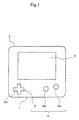
- FIG.1 shows a portable game machine as a game machine comprising a game system.
- a portable game machine 1 has a main body 2, a liquid crystal display 3 as a display unit, attached to the main body 2 and an input device 4.
- the input device 4 has a direction indicator switch 5 and a plurality of push button switches 6a, 6b.
- the direction indicator switch 5 has a cross type of operation member 5a, for instance, and outputs a signal corresponding to an operation in up and down directions and in right and left directions of the operation member 5a (the operation of pushing down the end portion of the upper portion, the lower portion, the right portion or the left portion of the operation member).
- a structure of such input device 4 is well-known, so various transformations are possible.
- four push buttons may be respectively located in upper and lower hands and in right and left hands, in place of the operation member 5a.
- the number of the push button switches 6a, 6b and their location may be changed in various forms.
- the push button switch 6a is referred to as A button
- the push button switch 6b is referred to as B button.
- both push button switches are expressed as a push button switch 6 when it is not necessary to differentiate both from each other.
- the game machine 1 is provided with a power switch, an operation member for adjusting sound volume and the like, but these are omitted.
- Fig.2 shows a structure of a control unit 10 provided at the game machine 1.
- the control unit 10 is a computer making use of a microprocessor, main body of which is a CPU 11.
- a ROM 12 read only memory
- a RAM 13 random access memory
- an image processing circuit 14 and a sound processing circuit 15 are respectively connected with the CPU 11 through a bus 16.
- a program necessary for basic control of the game machine 1 (for instance, booting processing) is stored in the ROM 12.
- a work area with respect to the CPU 11 is secured in the RAM 13.
- the image processing circuit 14 controls the liquid crystal display 3 according to a picturing instruction from the CPU 11 so as to display a predetermined image on its picture.
- the sound processing circuit 15 produces an analog voice signal according to a pronouncing instruction from the CPU 11 so as to output to a speaker 7.
- the respective switches 5, 6 of the input device 4 are connected with the CPU 11 through the bus 16, and the CPU 11 can thereby judge the state of operation of the respective switches 5, 6.
- an external memory 17 which is an object different from the control unit 10, is connected with the bus 16.
- the external memory 17 is comprised of a cartridge detachably attaching to the main body 2, for instance, and a ROM 18 as memory medium and a RAM 19 (readable and writable storage element) as a reloadable user memory are provided therein. Programs, such as a game program, and various data necessary for executing these programs are registered in the ROM 18 in advance.
- the reloadable ROM such as a flash memory
- the reloadable ROM is used as the memory 19, and save data of a game, for instance, are stored in the memory according to necessity.
- Various storage mediums such as a magnetic storage medium, an optical storage medium and a photoelectric magnetic storage medium, may be used as the storage medium of the external memory 17, in addition to a semiconductor storage element.
- An interface circuit intervenes between the bus 16 and each element, if necessary, but this is not shown.
- Various kinds of the control units 10 may be used without limiting to the above-mentioned structure.
- a communication control circuit 20 is connected with the CPU 11 through the bus 16 in order to connect the game machine 1 with a predetermined communication line, an another game machine or the like.
- a communication connector 22 is connected with the communication control circuit 20 through a communication interface 21.
- the communication control circuit 20 one functioning as a modem or a network interface by combining a DSP (digital signal processor) and software with each other, for instance, may be utilized.
- the communication connector 22 and/or the interface 21 may be provided as a peripheral equipment to be connected with the game machine 1 outside.
- the program stored in the ROM 18 of the external memory 17 is loaded to the RAM 13 so as to execute this program by the CPU 11 in the game machine 1 having the above-mentioned structure, and people can play various kinds of games on the scope of the display 3, thereby.
- the game machine 1 is connected with a predetermined network, controlling the communication control circuit 20, thereby messages can be exchanged and a pitched battle type of game can be enjoyed between this game machine 1 and an another game machine.
- the CPU 11 When a predetermined initializing operation (power-on operation, for instance) is executed in the game machine 1, the CPU 11 firstly executes predetermined initializing processing according to the program of the ROM 12. When initializing is finished, the CPU 11 starts to read game program CGP stored in the RAM 18 of the external memory 17, and starts game processing according to the program. When a player operates the input device 4 so as to execute a predetermined game start operation, the CPU 11 starts various kinds of control necessary for the execution of the game according to the procedures of the game program CGP.
- a predetermined initializing operation power-on operation, for instance
- various items such as cards , arms , accessories, magic, are sometimes transferred by buying or selling in a virtual game world which is structured with the game program CGP.
- a picture showing transfer of an item is displayed on the display 3 on the basis of the game program CGP. This picture is concretely an image showing an item shop or some kind of event, and various kinds of situations can be set therein.
- the CPU 11 reads out an item price determination program IVD which is stored in the game program CGP, and computes and determines the item price when executing the item transfer step on the basis of the item price determination program IVD.
- the item price determination program IVD immediately reads individual data IDC of the card which is a subject for transfer out of the RAM 19 by a flag or a signal which informs of execution of a step for transfer of the item in the game program CGP.
- cards are transferred as items.
- the items are not limited to the cards, but may be ones which are set as subjects for transfer during the game, such as magic, accessories and arms, as already mentioned.
- the individual data IDC of the card include data of name NAM of the respective cards, individual parameter data IPD for representing individual characteristic, such as strength and value of each card, and data concerning number of the cards (the items) in the game and the distribution of their possession state. That is, total number data HND for representing the total number of cards in the game, player possession data PHD for representing the number of the cards owned by a player, another player possession data AHD for representing the number of the cards owned by an another player excluding the player, a virtual player behaving by the CPU 11 as a player on the basis of the game program CGP, for instance, and transferable number data ACD for representing the number of the cards set by the game program CGP as a stock at a shop where transfer action is executed are stored. All or a part of the individual data IDC may be stored in the proper memories 12, 13 in the control unit 10, in addition to in the RAM 19.
- the individual data IDC are successively changed as the game proceeds on the basis of the game program CGP.
- the data concerning the number of the items such as the total number data HND, the player possession data PHD, the another player possession data AHD, and the transferrable number data ACD, and the distribution of their possession state are always changed by the action of transfer of the card, the action of acceptance of the card and the action of battle between players.
- the change of the number of the items and their possession state by the action of acceptance of the card is made by the procedure wherein the player inputs a code shown on a card (a sheet shaped card made of paper or the like), which the player can buy at an outside store, in the portable game machine 1 through the input device 4, so that a new card to be used in the game with the game program CGP is produced by the CPU 11 on the basis of a card producing program CPP which is stored in the game program CGP so as to be registered as the player's possession card.
- a card a sheet shaped card made of paper or the like
- the change by the action of battle between players is made by the procedure of movement of the card between the player and the virtual player by the CPU 11 or the other player connected through the communication connector 22 on the basis of the game program CGP by obtaining or giving the card from or to the other player due to the winning or défeat of the battle between both players.
- the change by the action of transfer also includes the change of the player's possession cards by executing the procedure for exchange of the cards between the player and the other player connected through the communication connector 22 on the basis of the game program CGP.
- the CPU 11 executes a procedure for writing and storing the individual data IDC concerning each card so as to correspond to the movement on the basis of the item price determination program IVD so that the individual data IDC of each card in the RAM 19 can be always a proper reflex of the game proceeding state.
- the item price determination program IVD gets the CPU 11 to compute the price of each item at the time of transfer, that is, sale price at an item shop when executing the step of transfer in the game program CGP at the item shop.
- the method of computing the price at the time of transfer is not limited to the above-shown equation.
- the higher the rate of stock cards (S) with respect to total number (T) is during the game that is, the higher the rate of stock at item shop is, the cheaper the sale price is.
- the lower the rate of stock cards (S) with respect to total number (T) that is, the lower the rate of stock at item shop is, the dearer the sale price is.
- the sale price is set so as to be dearer in case where the individual parameter (P) of the card is high, through which big effects can be exhibited in a battle, for instance. Furthermore, the smaller the total number of cards which circulates in a game world is (fifty cards or lower), the dearer the sale price is owing to (50 - T).
- the item price determination program IVD When the item price determination program IVD computes and determines the price of item for transfer at some point of time during the game developed on the basis of the game program CGP, the item price determination program IVD displays the determined price of the item at a proper display position on the display 3 through the CPU 11 and the image processing circuit 14.
- the player operates the input device 4 to determine the card which he or she buys or sells, so that the player executes the action of transfer.
- the price of the item is computed and determined by the item price determination program IVD every each item when the game program CGP executes the step of transfer of the item, so that the transfer price is fluctuated by the individual data IDC at the point of time concerning each item. Therefore, the player can buy or sell the item with reality similar to the actual economical activities.
- the CPU 11 executes a computing procedure for adding or subtracting an amount of money corresponding to the transfer price of the item (sale price) which is computed by the item price determination program IVD concerning the item to or from money which the player is to own in the game world, the money being stored in the RAM 19 so as to execute a procedure for renewing the money in possession by the player.
- the CPU 11 is the game control device, and the combination of the CPU 11. and specified software comprises various kinds of means of the game control device. But, at least a part of such means may be replaced with a logical circuit.
- the item price determination program/means determines the price for transfer of the item, being changing by the individual data set for each item (such as, data concerning name of each card, individual parameter data representing individual characteristic, such as strength or value of each card, and data concerning number of the cards (items) in a game and distribution of their possession state, as shown in Fig.3) so as to show to the player. Then, the player can buy or sell the item with reality similar to economical activities in the actual world, thereby increasing the reality and fun of the game.
- individual data set for each item such as, data concerning name of each card, individual parameter data representing individual characteristic, such as strength or value of each card, and data concerning number of the cards (items) in a game and distribution of their possession state, as shown in Fig.3
Landscapes
- Engineering & Computer Science (AREA)
- Multimedia (AREA)
- Theoretical Computer Science (AREA)
- Human Computer Interaction (AREA)
- Business, Economics & Management (AREA)
- Computer Security & Cryptography (AREA)
- General Business, Economics & Management (AREA)
- Management, Administration, Business Operations System, And Electronic Commerce (AREA)
Abstract
Description
Claims (7)
- Game program for changing representation on a display connected with a computer on the basis of predetermined program, through which a player can execute a game; comprising:said game program being program for getting said computer to execute the following procedures;
procedure for determining item price, for respectively computing prices for transfer of a plurality of items to be used in said game every each item;
procedure for executing said procedure for determining item price when executing a step where possession state of said item to be used in said game is likely to be changed in said game program, and;
procedur'e for rewriting individual data, for rewriting and changing said individual data concerning said each item when changing said possession state of said item;said procedure for determining item price having a procedure for computing price for transfer of said item on the basis of said individual data concerning each item and for displaying said price computed on said display. - The game program according to claim 1, wherein said individual data include data concerning number of said each item and distribution of its possession state.
- The game program according to claim 1, wherein said individual data include individual parameter data for representing individual characteristic of said each item.
- The game program according to claim 1, wherein said change of possession state of said item includes change by a procedure for registering an item newly produced by said game program on the basis of data inputted by said player through input means as player's possession.
- The game program according to claim 1, wherein said change of possession state of said item include change made by a procedure for moving item on the basis of said game program, which occurs between said player and an opponent player as a battle result between said both players.
- The game program according to claim 1, wherein said change of possession state of said item include change made by a procedure for exchanging item on the basis of said game program, which occurs between said player and an opponent player as a result of exchange of said item between said both players.
- A game machine for changing representation on a display on the basis of predetermined program, through which a player can execute a game; comprising:means for determining item price, for respectively computing prices for transfer of a plurality of items to be used in said game every each item;means for instructing to compute item transfer price, for instructing said means for determining item price to compute said price for transfer of said item when possession state of said item to be used in said game is likely to be changed, and;means for determining item price having means for displaying item transfer price, for computing said price for transfer of said item on the basis of said individual data concerning each item and for displaying said price computed on said display;said game machine further having means for rewriting individual data, for rewriting and changing said individual data when changing said possession state of said item.
Applications Claiming Priority (3)
| Application Number | Priority Date | Filing Date | Title |
|---|---|---|---|
| JP2002027885 | 2002-02-05 | ||
| JP2002027885A JP3491281B2 (en) | 2002-02-05 | 2002-02-05 | Game program |
| PCT/JP2002/011929 WO2003066183A1 (en) | 2002-02-05 | 2002-11-15 | Game program and game apparatus |
Publications (2)
| Publication Number | Publication Date |
|---|---|
| EP1477211A1 true EP1477211A1 (en) | 2004-11-17 |
| EP1477211A4 EP1477211A4 (en) | 2005-04-13 |
Family
ID=27677848
Family Applications (1)
| Application Number | Title | Priority Date | Filing Date |
|---|---|---|---|
| EP02781783A Ceased EP1477211A4 (en) | 2002-02-05 | 2002-11-15 | Game program and game apparatus |
Country Status (6)
| Country | Link |
|---|---|
| US (1) | US7291064B2 (en) |
| EP (1) | EP1477211A4 (en) |
| JP (1) | JP3491281B2 (en) |
| AU (1) | AU2002349664A1 (en) |
| TW (1) | TWI282515B (en) |
| WO (1) | WO2003066183A1 (en) |
Families Citing this family (22)
| Publication number | Priority date | Publication date | Assignee | Title |
|---|---|---|---|---|
| US7713116B2 (en) * | 2003-06-30 | 2010-05-11 | Microsoft Corporation | Inventory management of virtual items in computer games |
| US7517282B1 (en) | 2003-08-04 | 2009-04-14 | Microsoft Corporation | Methods and systems for monitoring a game to determine a player-exploitable game condition |
| JP3703825B2 (en) * | 2004-01-16 | 2005-10-05 | 株式会社スクウェア・エニックス | GAME DEVICE, GAME PROGRESS METHOD, PROGRAM, AND RECORDING MEDIUM |
| JP4963851B2 (en) * | 2006-03-22 | 2012-06-27 | 株式会社コナミデジタルエンタテインメント | GAME SERVER, GAME SERVER CONTROL METHOD AND PROGRAM |
| US9704174B1 (en) | 2006-05-25 | 2017-07-11 | Sean I. Mcghie | Conversion of loyalty program points to commerce partner points per terms of a mutual agreement |
| US10062062B1 (en) | 2006-05-25 | 2018-08-28 | Jbshbm, Llc | Automated teller machine (ATM) providing money for loyalty points |
| US8342399B1 (en) | 2006-05-25 | 2013-01-01 | Mcghie Sean I | Conversion of credits to funds |
| US7703673B2 (en) | 2006-05-25 | 2010-04-27 | Buchheit Brian K | Web based conversion of non-negotiable credits associated with an entity to entity independent negotiable funds |
| US8267315B1 (en) | 2006-05-25 | 2012-09-18 | Mcghie Sean I | Exchange of non-negotiable credits for entity independent funds |
| US8376224B2 (en) | 2006-05-25 | 2013-02-19 | Sean I. Mcghie | Self-service stations for utilizing non-negotiable credits earned from a game of chance |
| US8162209B2 (en) | 2006-05-25 | 2012-04-24 | Buchheit Brian K | Storefront purchases utilizing non-negotiable credits earned from a game of chance |
| US8684265B1 (en) | 2006-05-25 | 2014-04-01 | Sean I. Mcghie | Rewards program website permitting conversion/transfer of non-negotiable credits to entity independent funds |
| US8668146B1 (en) | 2006-05-25 | 2014-03-11 | Sean I. Mcghie | Rewards program with payment artifact permitting conversion/transfer of non-negotiable credits to entity independent funds |
| JP2008082840A (en) * | 2006-09-27 | 2008-04-10 | National Institute Of Advanced Industrial & Technology | Formaldehyde detector, formaldehyde detector, formaldehyde detection method and formaldehyde detection reagent |
| JP4137157B2 (en) * | 2006-12-07 | 2008-08-20 | 株式会社スクウェア・エニックス | Video game processing apparatus, video game processing method, and video game processing program |
| US9280875B2 (en) * | 2009-03-06 | 2016-03-08 | Zynga Inc. | Virtual playing chips in a multiuser online game network |
| JP5378467B2 (en) * | 2011-08-03 | 2013-12-25 | 株式会社バンダイナムコゲームス | Information providing apparatus, information providing system, and program |
| KR101201596B1 (en) * | 2011-09-08 | 2012-11-14 | (주)네오위즈게임즈 | Method, server, terminal, and recording medium for providing game |
| JP5793592B2 (en) | 2014-02-25 | 2015-10-14 | グリー株式会社 | GAME CONTROL METHOD, SERVER DEVICE, AND PROGRAM |
| JP6404435B1 (en) * | 2017-10-24 | 2018-10-10 | 株式会社 ディー・エヌ・エー | Item transaction system and item transaction program |
| KR102569674B1 (en) * | 2017-12-12 | 2023-08-24 | 주식회사 넥슨코리아 | Apparatus, method and computer program for game service |
| US20200286173A1 (en) * | 2017-12-22 | 2020-09-10 | Bellion Clofe Technologies (Pte. Ltd.) | System and method for determining a price of an object in a restricted environment |
Family Cites Families (6)
| Publication number | Priority date | Publication date | Assignee | Title |
|---|---|---|---|---|
| US6179713B1 (en) * | 1997-06-18 | 2001-01-30 | Circadence Corporation | Full-time turn based network multiplayer game |
| US5829747A (en) * | 1997-09-02 | 1998-11-03 | Nebel; Stephen E. | Stock market big board game |
| JP2001259228A (en) | 2000-03-16 | 2001-09-25 | Enix Corp | Mobile phone communication game system and game method |
| JP2001340656A (en) | 2000-06-01 | 2001-12-11 | Kddi Corp | Game system, game server and game terminal thereof |
| JP3380533B2 (en) | 2000-07-28 | 2003-02-24 | コナミ株式会社 | GAME SYSTEM, GAME CONTROL METHOD, AND INFORMATION STORAGE MEDIUM |
| JP2002200352A (en) | 2000-12-27 | 2002-07-16 | Aruze Corp | GAME DEVICE, GAME PROGRAM, AND RECORDING MEDIUM RECORDING THE GAME PROGRAM |
-
2002
- 2002-02-05 JP JP2002027885A patent/JP3491281B2/en not_active Expired - Fee Related
- 2002-09-30 TW TW091122504A patent/TWI282515B/en not_active IP Right Cessation
- 2002-11-15 EP EP02781783A patent/EP1477211A4/en not_active Ceased
- 2002-11-15 AU AU2002349664A patent/AU2002349664A1/en not_active Abandoned
- 2002-11-15 US US10/474,056 patent/US7291064B2/en not_active Expired - Lifetime
- 2002-11-15 WO PCT/JP2002/011929 patent/WO2003066183A1/en not_active Ceased
Also Published As
| Publication number | Publication date |
|---|---|
| JP3491281B2 (en) | 2004-01-26 |
| WO2003066183A1 (en) | 2003-08-14 |
| JP2003225459A (en) | 2003-08-12 |
| EP1477211A4 (en) | 2005-04-13 |
| TWI282515B (en) | 2007-06-11 |
| AU2002349664A1 (en) | 2003-09-02 |
| US20040137975A1 (en) | 2004-07-15 |
| US7291064B2 (en) | 2007-11-06 |
Similar Documents
| Publication | Publication Date | Title |
|---|---|---|
| US7291064B2 (en) | Game program and game apparatus | |
| US7371165B2 (en) | Card game program and card game machine | |
| EP1435598A2 (en) | Gaming machine | |
| KR20150141933A (en) | Game device, program, system, and game device for business | |
| JP7562817B2 (en) | Game server, game program, and information processing method | |
| CN108472543A (en) | Game device, program and item providing system | |
| KR20130122613A (en) | Gaming point exchange system and method | |
| WO2008010372A1 (en) | Game machine | |
| WO2016125693A1 (en) | Game device, program, and arcade game device | |
| JP4731547B2 (en) | GAME SYSTEM, PROGRAM, AND INFORMATION STORAGE MEDIUM | |
| JP2009000568A (en) | GAME DEVICE AND INFORMATION STORAGE MEDIUM | |
| TWI734311B (en) | Game device, game system and program | |
| JP2023014327A (en) | Game devices, programs, systems and arcade game devices | |
| CN101304794B (en) | Street game machine and game system | |
| JP7002687B1 (en) | Game programs and game equipment | |
| WO2025177764A1 (en) | Program, game device, and provision management device | |
| JP3534341B2 (en) | GAME PROGRAM AND EXTERNAL STORAGE DEVICE RECORDING THE GAME PROGRAM | |
| JP7731226B2 (en) | Game device | |
| JP2000262744A (en) | Amusement machine, game control method, amusement system and portable storage medium for amusement machine | |
| JP7851441B2 (en) | Program, game device, and provision management device | |
| JP7754977B1 (en) | Program and game device | |
| JP7636607B1 (en) | Game device and program | |
| JP7778829B2 (en) | Program, provision management device, and game device | |
| KR20250126607A (en) | Computer-readable storage medium for storing program, providing management device, and game device | |
| JP6656577B2 (en) | Game device, program, and arcade game device |
Legal Events
| Date | Code | Title | Description |
|---|---|---|---|
| PUAI | Public reference made under article 153(3) epc to a published international application that has entered the european phase |
Free format text: ORIGINAL CODE: 0009012 |
|
| 17P | Request for examination filed |
Effective date: 20040906 |
|
| AK | Designated contracting states |
Kind code of ref document: A1 Designated state(s): AT BE BG CH CY CZ DE DK EE ES FI FR GB GR IE IT LI LU MC NL PT SE SK TR |
|
| AX | Request for extension of the european patent |
Extension state: AL LT LV MK RO SI |
|
| A4 | Supplementary search report drawn up and despatched |
Effective date: 20050224 |
|
| 17Q | First examination report despatched |
Effective date: 20050622 |
|
| 17Q | First examination report despatched |
Effective date: 20050622 |
|
| STAA | Information on the status of an ep patent application or granted ep patent |
Free format text: STATUS: THE APPLICATION HAS BEEN REFUSED |
|
| 18R | Application refused |
Effective date: 20080523 |