EP1475729A1 - Speichereinheit, in der ein Computerprogramm um ein Risiko zu schätzen, das mit einer Datenverteilung beginnt, aufgezeichnet ist, und Vorrichtung der Schätzung des Risikos von Angaben, die zufällig mit einer Kohärenzverbindung verteilt wurden - Google Patents
Speichereinheit, in der ein Computerprogramm um ein Risiko zu schätzen, das mit einer Datenverteilung beginnt, aufgezeichnet ist, und Vorrichtung der Schätzung des Risikos von Angaben, die zufällig mit einer Kohärenzverbindung verteilt wurden Download PDFInfo
- Publication number
- EP1475729A1 EP1475729A1 EP03291092A EP03291092A EP1475729A1 EP 1475729 A1 EP1475729 A1 EP 1475729A1 EP 03291092 A EP03291092 A EP 03291092A EP 03291092 A EP03291092 A EP 03291092A EP 1475729 A1 EP1475729 A1 EP 1475729A1
- Authority
- EP
- European Patent Office
- Prior art keywords
- price
- volume
- order
- market
- duration
- Prior art date
- Legal status (The legal status is an assumption and is not a legal conclusion. Google has not performed a legal analysis and makes no representation as to the accuracy of the status listed.)
- Withdrawn
Links
Images

Classifications
-
- G—PHYSICS
- G06—COMPUTING OR CALCULATING; COUNTING
- G06Q—INFORMATION AND COMMUNICATION TECHNOLOGY [ICT] SPECIALLY ADAPTED FOR ADMINISTRATIVE, COMMERCIAL, FINANCIAL, MANAGERIAL OR SUPERVISORY PURPOSES; SYSTEMS OR METHODS SPECIALLY ADAPTED FOR ADMINISTRATIVE, COMMERCIAL, FINANCIAL, MANAGERIAL OR SUPERVISORY PURPOSES, NOT OTHERWISE PROVIDED FOR
- G06Q40/00—Finance; Insurance; Tax strategies; Processing of corporate or income taxes
- G06Q40/08—Insurance
Definitions
- the present invention relates to the field of estimating a risk from a data distribution to be able to estimate conditions for the conduct of a future action or estimate the quality of unfolding of a past action.
- the invention can be applied to financial, short or long term, especially in the markets stocks, bonds, commodities or consumer goods, derivatives, etc.
- the invention can also be applied to the market real estate, insurance, machine maintenance, etc.
- the trading step of the stock market order In a financial market, the next step after a decision investment is the trading step of the stock market order corresponding.
- the terms of execution of the order depend on the size of the order, market liquidity, factors motivating the order, etc.
- the execution methods are likely to have an impact important on the costs generated by the completion of the transaction and on financial performance. For example, a transaction cost 4% requires an investment of 100 to invest 96. The placement will have to achieve a performance of 4.17% to regain the amount invested at the start.
- the invention aims to remedy the above drawbacks.
- the invention aims to provide a price reference substantially independent of an order.
- the distribution law is a stable law.
- the law stable can be a Lévy-stable law.
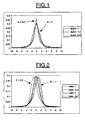
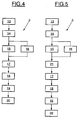
- the parameters ⁇ , ⁇ and ⁇ of the Lévy-stable law We thus obtain a suitable representation of the occurrence of rare events.
- said program determines the price P d of the demand and the price P f of the supply at the time of the start of an order on the market, from a base of course history data.
- said program subtracts from the volume V o of the order, the volume V d of the request at the price P d in the case of a sale order, and subtracts from the volume V o from the order, the volume V f of the offer at the price P f in the case of a purchase order, to obtain a corrected volume V c to be processed at an unknown price, the theoretical volume V t being determined from corrected volume V c .
- the volume V d or the volume V o appearing in the order book can be executed without risk.
- said program selects a sufficient population latest prices in an elementary duration D é elapsed, and calculates the average volume V é exchanged elementary duration.
- An observation database is filled in, an observation comprising a date, a volume, a price and a number of transactions carried out in the basic elapsed period D é .
- an observation is a transaction selected from a set of transactions according to a time criterion.
- An observation includes data relating to the last of the transaction (s) that occurred during a predetermined minimum time interval. The minimum time interval is preferably constant, for example one minute, one hour, etc.
- the time interval is advantageously equal to the elementary duration D e so that at least one transaction has taken place during the time interval.
- the elementary duration D é is therefore variable according to the frequency of transactions.
- the elementary duration D e is generally equal to the minimum predetermined time interval in a liquid market where the transactions are numerous and can be much greater than the minimum predetermined time interval in an illiquid market where the transactions are rare.
- said program selects Qu elementary elapsed times so that each elementary duration Qu comprises a transaction, and said program calculates the volume V means ed exchanged elementary duration.
- said program calculates the instantaneous return R i by dividing a market price at an instant i at the end of an elementary duration by the market price at an earlier instant i- ⁇ with ⁇ a predetermined duration.
- ⁇ can be expressed in units of elementary duration D é .
- said program simulates price deviation from real historical price series of said value.
- said program calculates a range of variation of prices with a predetermined probability.
- the probability predetermined can be between 60% and 99%.
- said program calculates the risk of variation of the market value over the duration D t taking into account the volume V o or volume V c .
- said program calculates a price to be reached during the execution of the order by adding the range of variation of the market and a reference price of said value.
- the reference price can be equal to the price P d of the request in the case of a sale order and to the price P f of the offer in the case of a buy order, at the start time d 'a market order.
- said order program estimates the quality of execution of the order by comparing the price means of executing said order, a reference price of said value, and a price to be reached taking into account the characteristics of the order and the market.
- the parameter ⁇ of the Lévy-stable law can also be taken into account to estimate the quality.
- said program classifies the execution of the order according to whether the execution price is included in the range defined between the target price and the reference price, greater than said range, or less than said range.
- the device includes means for taking into account the parameter ⁇ for quality estimation in the case of a Lévy-stable law.
- a means of choosing a distribution and determination law parameters of said law can be expected.
- a significant change is understood to mean a change likely to influence the behavior of other operators on the market, for example a price change of 2%.
- the means for calculating the theoretical volume V t comprises means for determining, before calculating the theoretical volume V t , the price P d of demand and the price P f of supply at the time of the start of an order on the market, from a price history database.
- the device comprises a subtractor for subtracting from the volume V o of the order, a volume V m calculated from an average of volumes treated on the market over a short period preceding the instant of start of the order on the market, to obtain a corrected volume V c to be processed at an unknown price, the theoretical volume V t being determined from the corrected volume V c .
- the device comprises a selector of sufficient population latest prices in an elementary duration D é elapsed, from the basis of historical data classes, and a calculator of average volume V é exchanged elementary duration.
- D é D é .
- the device comprises a selector D é elapsed elementary periods, from the basis of historical data of the course, so that each elementary duration Qu comprises a transaction and a calculator average volume V ed exchanged elementary duration.
- the device comprises a calculator of the instantaneous yield R i by dividing a market price at an instant i at the end of an elementary duration by the market price at the instant iD t , for obtain a distribution of elementary returns.
- the device includes a price deviation simulator from actual series price histories of said value.
- the device comprises a calculator of the risk of market variation over time D t taking into account the volume V o or the volume V c according to the risk of market variation over the duration of predetermined basis.
- the device includes a summator of the range of market variation and a price of reference of said value to determine a price to be reached during execution of the order.
- the invention also proposes the use of said device for the measure of the quality of execution of an order on the market having for aim to minimize the friction costs associated with negotiation.
- the invention is particularly applicable to series which are a case particular distribution whose frequency is 1.
- transaction we mean here an exchange of material goods or intangible against a reference quantity, usually a sum monetary, in execution of an order.
- the transaction is defined by a date defined in year-month-day-hour-minute-second, possibly millisecond, by a price, generally a unit price, by a quantity and by a name of the goods exchanged.
- the invention provides a tool adapted to markets led by orders.
- the invention is based on the fact that it is necessary to spread out the execution of an order in time so as not to influence the market and that this time spread creates a performance risk. We thus benefit a risk estimate before the execution of the order and we can compare the execution performed with the risk estimated beforehand. It is possible to objectively estimate the quality of execution of an order in a market.
- the invention also applies to markets led by price, fixing, and tender, insofar as a history statistically sufficient observations exist.
- An order is characterized by a date t o , a quantity also called volume N o , a direction, purchase or sale, and a value represented by a code, for example a Sicovam code.
- step 1 the computer on which the program is stored receives an order 1 in the form of a message comprising a time indication t o , in particular a date, for example the date of receipt of the order by said computer or the date of issue of the order by a processing device to which said computer is connected.
- a time indication t o in particular a date
- the date is assigned to the order when it is received.
- the message also includes a quantity V o , a direction, purchase or sale, and an identifier of the value to be processed.
- step 2 the computer queries a database in using said identifier and in return receives a price history of the value identified by the identifier, said history forming a distribution of data including dates, volumes, prices, etc.
- step 3 the computer calculates a theoretical volume V t equal to the quotient of the volume V o of the order by a predetermined coefficient, for example of the order of 10 to 25%, chosen such that the order of volume V o does not significantly modify a market with volume V t .
- the duration D t of processing of the theoretical volume V t on the market of the identified value is also calculated.
- the duration D t to take into account so that the order considered can be processed in one or more transactions without significantly disrupting the market. Indeed, we consider that in general an order representing more than 25% of the market, has a decisive influence on the price of the identified value and is therefore too important compared to the liquidity offered by the market relative to said order.
- step 4 the choice of a distribution law is made. Of preferably, we will choose a stable law, in particular a Lévy-stable law. However, one can also consider using other laws of distribution. Step 4 therefore includes the reception 4a of a Lévy-stable law or the reception 4b of a stable law or the reception 4c of a normal law. Optionally, step 4 can be omitted if the same law distribution is used systematically and prerecorded.
- step 5 is omitted.
- step 6 of elimination extreme values of the distribution beyond a quantile predetermined. For example, we can keep 95% of the values of distribution and eliminate the extreme 5% to be able to establish a 95% probability.
- step 7 a range of market variations is calculated over a predetermined base period.
- a price variation or yield envelope denoted E v is determined , in which a probability of 95% may lie during the base duration.
- E v a probability of 95% may lie during the base duration.
- the identified value has a 95% chance of seeing its course evolve between 100 + E v % and 100-E v %, E v being therefore determined in step 7.
- the probable variation of the market over the duration D t is calculated, taking account of the volume V o of the order, see step 8. If we have treated a population of yields, the quantity “price” is then reintroduced in step 8.
- a price to be reached during the execution of the transaction is calculated by adding the range of variation of the market and a benchmark value.
- the reference price will generally be equal to the price P d of the request in the case of a sale order and to the price P f of the offer in the case of a purchase order, at time t o from the start of the order on the market.
- the steps just described can, advantageously be re-executed after an order has started to be dealt in a market in order to have an updated target price.
- This update can be performed at regular time intervals, or after processing a given section of the order depending on the order volume.
- step 10 is performed to estimate the quality of execution of the order by comparison of the average price of execution of the order, a reference price of said value, for example the price P d or the price P f and a price to be reached, taking into account the respective characteristics of the order and the market.
- the target price can be calculated in the case of a purchase order by adding the reference price and the 95% probable variation envelope calculated in step 8.
- step 12 we perform a price comparison of execution at the target price and at the reference price to determine a classification of the quality of execution.
- the quality of execution is considered very good if, in the case of a purchase order, it is lower than the reference price, correct if it is between the reference price and the price to reach, mediocre if it is higher than the price to reach.
- step 3 is illustrated in more detail. breaks down into sub-steps 13 to 20.
- step 13 the computer selects from the course history received in step 2, a population of observations to fill in an observation database.
- An observation is characterized by a date, a volume and a price.
- the price used is the price of the last transaction for an elementary duration D e last variable, during which at least one transaction was executed.
- the computer calculates in step 14 the average volume V é exchanged elementary duration D e. The calculation is made by adding the volumes of observations and dividing the sum thus obtained by the number of observations of the population concerned.
- step 15 the computer determines from the price history the volume V d of the request at the price P d .
- step 16 the volume V f of the offer at the price P f is selected.
- the corrected volume V c is calculated by subtracting from the volume of the order V o the volume V d if step 15 has been executed, and the volume V f if step 16 has been executed.
- the corrected volume V c corresponds to the volume which must be treated at an unknown price, the volume V d , or respectively the volume V f , which can be treated at a known price, and therefore without risk. It follows that, if the volume of the order V o is less than the volume V d or, respectively, the volume V f , the risk of executing the order is very low.
- step 18 the theoretical volume V t is calculated by dividing the corrected volume V c from step 17 by a coefficient I expressed as a percentage and which represents the relative volume limit of an order compared to a market not disturbed by the execution of the order. It is generally considered that an order, the volume of which is greater than 25% by market volume, has a very strong influence on the market and cannot be executed under good conditions.
- step 19 from the calculation of the theoretical volume V t , the computer calculates the theoretical duration D t necessary to execute the order, taking into account the market volume from the price history.
- the theoretical duration D t can be expressed in time units of the international system, for example in minutes or seconds. However, it is preferable to express the duration D t on the basis of the elementary duration D é described in relation to step 13 above.
- the theoretical duration D t is equal to the quotient of the theoretical volume V t by the average elementary volume V é .
- step 20 the computer calculates the instantaneous yield R i by dividing the price of an observation by the price of a previous observation, for example older than the first of duration D t .
- the instantaneous return R i can be seen as resulting from the division of a market price at an instant t at the end of an elementary duration by the market price at the instant tD t , to obtain a distribution of returns elementary. It is in fact interesting to carry out the following steps, see FIG. 1, by treating a population of instantaneous returns R i and by reintroducing the price variables in step 8.
- step 20 is optional and it is possible omit it by performing steps 4 to 8 on a price population.
- FIG. 3 a variant of FIG. 2 is illustrated, in which a step 21 is added before step 17 of determining the corrected volume V c and after steps 15 and 16 of determining the prices P d and P f .
- a volume V m is determined from an average of the volume traded on the market over a short period preceding the instant t o of the start of the order on the market. Said short duration can be expressed in time units or in elementary durations D é .
- the determination of the volume V m is advantageous in certain cases of imbalance between the volume V d of the request and the volume V f of the order.
- step 17 which follows, the volume V m is subtracted from the volume of the order V o to obtain the corrected volume V c .
- the other steps are similar to those illustrated in Figure 2.
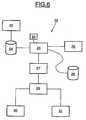
- Figure 4 is schematically illustrated a mode of implementation of a system for estimating the risk scale of data randomly distributed with a consistency link.
- the system 22 comprises a calculator 23 of the theoretical volume V t , a price history database 24 linked to a price history supplier 25 which is generally a remote system.
- the computer 23 is also connected to a command transmitter 26, generally remote.
- the system 22 further comprises a filter 27 connected to the computer 23, and capable of filtering the distribution for remove the expected proportion of extreme values.
- the system 22 also includes a database additional 28 capable of storing the observations made, a observation being characterized at least by a date, a price, a volume and a value identifier.
- the system 22 optionally includes a storage 29 distribution laws related to the computer 23.
- a distribution law for example the Lévy-stable law, is stored directly in a memory of the computer 23, the computer 23 comprising at least one random access memory, at least one read only memory, at least one central processing unit and interfaces input / output.
- the system 22 is completed by a calculator of ranges of market variations 29 connected to the filter 27, the calculator 29 being moreover capable of calculating the variation of the market over the duration D t and, if necessary, of reintroducing the price quantity from the variation in yields by multiplying the yield by the price at the start of the corresponding yield calculation period.
- the system may include a 30 risk estimator prior to the execution of a transaction and / or an estimator of the quality of execution of an a posteriori order 31.
- the estimators 30 and 31 are provided with graphical means making it possible to present the results of the estimate.
- the invention can be implemented works in various ways. However, for applications particular, it is interesting to make the computer 23, the filter 27, the calculator 29 or the estimators 30 and 31, in the form particularly reliable programmable or preprogrammed circuits and having the necessary computing power.
- the database 24 can be remote. However, we generally prefer a base of 24 local data for faster access to Classes.
Landscapes
- Business, Economics & Management (AREA)
- Accounting & Taxation (AREA)
- Finance (AREA)
- Engineering & Computer Science (AREA)
- Development Economics (AREA)
- Economics (AREA)
- Marketing (AREA)
- Strategic Management (AREA)
- Technology Law (AREA)
- Physics & Mathematics (AREA)
- General Business, Economics & Management (AREA)
- General Physics & Mathematics (AREA)
- Theoretical Computer Science (AREA)
- Financial Or Insurance-Related Operations Such As Payment And Settlement (AREA)
Priority Applications (1)
| Application Number | Priority Date | Filing Date | Title |
|---|---|---|---|
| EP03291092A EP1475729A1 (de) | 2003-05-07 | 2003-05-07 | Speichereinheit, in der ein Computerprogramm um ein Risiko zu schätzen, das mit einer Datenverteilung beginnt, aufgezeichnet ist, und Vorrichtung der Schätzung des Risikos von Angaben, die zufällig mit einer Kohärenzverbindung verteilt wurden |
Applications Claiming Priority (1)
| Application Number | Priority Date | Filing Date | Title |
|---|---|---|---|
| EP03291092A EP1475729A1 (de) | 2003-05-07 | 2003-05-07 | Speichereinheit, in der ein Computerprogramm um ein Risiko zu schätzen, das mit einer Datenverteilung beginnt, aufgezeichnet ist, und Vorrichtung der Schätzung des Risikos von Angaben, die zufällig mit einer Kohärenzverbindung verteilt wurden |
Publications (1)
| Publication Number | Publication Date |
|---|---|
| EP1475729A1 true EP1475729A1 (de) | 2004-11-10 |
Family
ID=32981983
Family Applications (1)
| Application Number | Title | Priority Date | Filing Date |
|---|---|---|---|
| EP03291092A Withdrawn EP1475729A1 (de) | 2003-05-07 | 2003-05-07 | Speichereinheit, in der ein Computerprogramm um ein Risiko zu schätzen, das mit einer Datenverteilung beginnt, aufgezeichnet ist, und Vorrichtung der Schätzung des Risikos von Angaben, die zufällig mit einer Kohärenzverbindung verteilt wurden |
Country Status (1)
| Country | Link |
|---|---|
| EP (1) | EP1475729A1 (de) |
-
2003
- 2003-05-07 EP EP03291092A patent/EP1475729A1/de not_active Withdrawn
Non-Patent Citations (1)
| Title |
|---|
| No Search * |
Similar Documents
| Publication | Publication Date | Title |
|---|---|---|
| Dewan et al. | Adverse selection in electronic markets: Evidence from online stamp auctions | |
| JP5538582B2 (ja) | オプションを価格設定するための方法およびシステム | |
| Serrano | Estimating the gains from trade in the market for patent rights | |
| BE1011671A5 (fr) | Processeur de donnees de dilution d'actions. | |
| EP1355233A1 (de) | Verfahren und System für Ressourcenallokation in Echtzeit zwischen mehreren Einheiten | |
| US20100063852A1 (en) | Automated Insurance Services System | |
| US12333604B2 (en) | Systems and methods for transacting of units derived from non-commodifiable work products | |
| JP2000353196A (ja) | 有価証券トレード支援システム | |
| JP2010507872A (ja) | 取引費用の取引後取引費用予測のためのシステム及び方法 | |
| US20050246261A1 (en) | Method and system for block trading of securities | |
| CN110310076B (zh) | 合同管理方法及装置 | |
| EP2062111B1 (de) | Verfahren und automatisierungsgerät zur regelung einer stufenförmigen industriellen fertigung mit umfassender kontrolle über zufällig miteinander verkettete belastung, anwendung zur steuerung des rauschens und das var-risiko eines kompensationsraums | |
| CN110458704B (zh) | 基于订阅的交易订单生成方法及装置 | |
| EP1475729A1 (de) | Speichereinheit, in der ein Computerprogramm um ein Risiko zu schätzen, das mit einer Datenverteilung beginnt, aufgezeichnet ist, und Vorrichtung der Schätzung des Risikos von Angaben, die zufällig mit einer Kohärenzverbindung verteilt wurden | |
| CN113935844A (zh) | 一种基于大数据和人工智能的金融风控系统 | |
| FR3111219A1 (fr) | Procédé de négociation automatisée et produit de programme informatique pour la mise en œuvre de ce procédé | |
| FR2829851A1 (fr) | Procede et systeme d'aide a la decision pour investisseurs | |
| FR2979449A1 (fr) | Systeme de financement de la chaine d'approvisionnement | |
| Gorgieva-Trajkovska et al. | Fair value accounting–pros and cons | |
| FR3077405A1 (fr) | Procede de gestion des risques lies aux creances d'une chaine d'approvisionnement | |
| CN114092282A (zh) | 一种专利质押系统、方法及计算机可读存储介质 | |
| WO2006002171A9 (en) | Dynamic liquidity management system | |
| US10460389B1 (en) | System and method for operating a family of mutual funds or ETFs | |
| US8868459B2 (en) | System and method for adjusting asset value and availability in data records for mitigating speculative trading in a prediction market | |
| CN110135995A (zh) | 融资评价处理方法、装置、计算机设备和存储介质 |
Legal Events
| Date | Code | Title | Description |
|---|---|---|---|
| PUAI | Public reference made under article 153(3) epc to a published international application that has entered the european phase |
Free format text: ORIGINAL CODE: 0009012 |
|
| AK | Designated contracting states |
Kind code of ref document: A1 Designated state(s): AT BE BG CH CY CZ DE DK EE ES FI FR GB GR HU IE IT LI LU MC NL PT RO SE SI SK TR |
|
| AX | Request for extension of the european patent |
Extension state: AL LT LV MK |
|
| 17P | Request for examination filed |
Effective date: 20050509 |
|
| AKX | Designation fees paid |
Designated state(s): AT BE BG CH CY CZ DE DK EE ES FI FR GB GR HU IE IT LI LU MC NL PT RO SE SI SK TR |
|
| 17Q | First examination report despatched |
Effective date: 20061115 |
|
| STAA | Information on the status of an ep patent application or granted ep patent |
Free format text: STATUS: THE APPLICATION IS DEEMED TO BE WITHDRAWN |
|
| 18D | Application deemed to be withdrawn |
Effective date: 20081202 |