EP1470877A1 - Micro-porous noble metal material and method for preparation thereof - Google Patents
Micro-porous noble metal material and method for preparation thereof Download PDFInfo
- Publication number
- EP1470877A1 EP1470877A1 EP20030734614 EP03734614A EP1470877A1 EP 1470877 A1 EP1470877 A1 EP 1470877A1 EP 20030734614 EP20030734614 EP 20030734614 EP 03734614 A EP03734614 A EP 03734614A EP 1470877 A1 EP1470877 A1 EP 1470877A1
- Authority
- EP
- European Patent Office
- Prior art keywords
- noble metal
- nano
- silica
- aggregate
- metal compound
- Prior art date
- Legal status (The legal status is an assumption and is not a legal conclusion. Google has not performed a legal analysis and makes no representation as to the accuracy of the status listed.)
- Withdrawn
Links
Images

Classifications
-
- B—PERFORMING OPERATIONS; TRANSPORTING
- B01—PHYSICAL OR CHEMICAL PROCESSES OR APPARATUS IN GENERAL
- B01J—CHEMICAL OR PHYSICAL PROCESSES, e.g. CATALYSIS OR COLLOID CHEMISTRY; THEIR RELEVANT APPARATUS
- B01J37/00—Processes, in general, for preparing catalysts; Processes, in general, for activation of catalysts
- B01J37/0009—Use of binding agents; Moulding; Pressing; Powdering; Granulating; Addition of materials ameliorating the mechanical properties of the product catalyst
- B01J37/0018—Addition of a binding agent or of material, later completely removed among others as result of heat treatment, leaching or washing,(e.g. forming of pores; protective layer, desintegrating by heat)
-
- B—PERFORMING OPERATIONS; TRANSPORTING
- B01—PHYSICAL OR CHEMICAL PROCESSES OR APPARATUS IN GENERAL
- B01J—CHEMICAL OR PHYSICAL PROCESSES, e.g. CATALYSIS OR COLLOID CHEMISTRY; THEIR RELEVANT APPARATUS
- B01J21/00—Catalysts comprising the elements, oxides, or hydroxides of magnesium, boron, aluminium, carbon, silicon, titanium, zirconium, or hafnium
- B01J21/06—Silicon, titanium, zirconium or hafnium; Oxides or hydroxides thereof
- B01J21/08—Silica
-
- B—PERFORMING OPERATIONS; TRANSPORTING
- B01—PHYSICAL OR CHEMICAL PROCESSES OR APPARATUS IN GENERAL
- B01J—CHEMICAL OR PHYSICAL PROCESSES, e.g. CATALYSIS OR COLLOID CHEMISTRY; THEIR RELEVANT APPARATUS
- B01J23/00—Catalysts comprising metals or metal oxides or hydroxides, not provided for in group B01J21/00
- B01J23/38—Catalysts comprising metals or metal oxides or hydroxides, not provided for in group B01J21/00 of noble metals
- B01J23/40—Catalysts comprising metals or metal oxides or hydroxides, not provided for in group B01J21/00 of noble metals of the platinum group metals
-
- B—PERFORMING OPERATIONS; TRANSPORTING
- B01—PHYSICAL OR CHEMICAL PROCESSES OR APPARATUS IN GENERAL
- B01J—CHEMICAL OR PHYSICAL PROCESSES, e.g. CATALYSIS OR COLLOID CHEMISTRY; THEIR RELEVANT APPARATUS
- B01J23/00—Catalysts comprising metals or metal oxides or hydroxides, not provided for in group B01J21/00
- B01J23/38—Catalysts comprising metals or metal oxides or hydroxides, not provided for in group B01J21/00 of noble metals
- B01J23/40—Catalysts comprising metals or metal oxides or hydroxides, not provided for in group B01J21/00 of noble metals of the platinum group metals
- B01J23/42—Platinum
-
- B—PERFORMING OPERATIONS; TRANSPORTING
- B01—PHYSICAL OR CHEMICAL PROCESSES OR APPARATUS IN GENERAL
- B01J—CHEMICAL OR PHYSICAL PROCESSES, e.g. CATALYSIS OR COLLOID CHEMISTRY; THEIR RELEVANT APPARATUS
- B01J23/00—Catalysts comprising metals or metal oxides or hydroxides, not provided for in group B01J21/00
- B01J23/38—Catalysts comprising metals or metal oxides or hydroxides, not provided for in group B01J21/00 of noble metals
- B01J23/40—Catalysts comprising metals or metal oxides or hydroxides, not provided for in group B01J21/00 of noble metals of the platinum group metals
- B01J23/44—Palladium
-
- B—PERFORMING OPERATIONS; TRANSPORTING
- B01—PHYSICAL OR CHEMICAL PROCESSES OR APPARATUS IN GENERAL
- B01J—CHEMICAL OR PHYSICAL PROCESSES, e.g. CATALYSIS OR COLLOID CHEMISTRY; THEIR RELEVANT APPARATUS
- B01J35/00—Catalysts, in general, characterised by their form or physical properties
- B01J35/40—Catalysts, in general, characterised by their form or physical properties characterised by dimensions, e.g. grain size
- B01J35/45—Nanoparticles
-
- B—PERFORMING OPERATIONS; TRANSPORTING
- B01—PHYSICAL OR CHEMICAL PROCESSES OR APPARATUS IN GENERAL
- B01J—CHEMICAL OR PHYSICAL PROCESSES, e.g. CATALYSIS OR COLLOID CHEMISTRY; THEIR RELEVANT APPARATUS
- B01J35/00—Catalysts, in general, characterised by their form or physical properties
- B01J35/60—Catalysts, in general, characterised by their form or physical properties characterised by their surface properties or porosity
-
- B—PERFORMING OPERATIONS; TRANSPORTING
- B01—PHYSICAL OR CHEMICAL PROCESSES OR APPARATUS IN GENERAL
- B01J—CHEMICAL OR PHYSICAL PROCESSES, e.g. CATALYSIS OR COLLOID CHEMISTRY; THEIR RELEVANT APPARATUS
- B01J37/00—Processes, in general, for preparing catalysts; Processes, in general, for activation of catalysts
- B01J37/06—Washing
-
- B—PERFORMING OPERATIONS; TRANSPORTING
- B01—PHYSICAL OR CHEMICAL PROCESSES OR APPARATUS IN GENERAL
- B01J—CHEMICAL OR PHYSICAL PROCESSES, e.g. CATALYSIS OR COLLOID CHEMISTRY; THEIR RELEVANT APPARATUS
- B01J37/00—Processes, in general, for preparing catalysts; Processes, in general, for activation of catalysts
- B01J37/08—Heat treatment
- B01J37/082—Decomposition and pyrolysis
- B01J37/086—Decomposition of an organometallic compound, a metal complex or a metal salt of a carboxylic acid
-
- B—PERFORMING OPERATIONS; TRANSPORTING
- B22—CASTING; POWDER METALLURGY
- B22F—WORKING METALLIC POWDER; MANUFACTURE OF ARTICLES FROM METALLIC POWDER; MAKING METALLIC POWDER; APPARATUS OR DEVICES SPECIALLY ADAPTED FOR METALLIC POWDER
- B22F3/00—Manufacture of workpieces or articles from metallic powder characterised by the manner of compacting or sintering; Apparatus specially adapted therefor ; Presses and furnaces
- B22F3/10—Sintering only
- B22F3/11—Making porous workpieces or articles
- B22F3/1121—Making porous workpieces or articles by using decomposable, meltable or sublimatable fillers
- B22F3/1134—Inorganic fillers
-
- B—PERFORMING OPERATIONS; TRANSPORTING
- B22—CASTING; POWDER METALLURGY
- B22F—WORKING METALLIC POWDER; MANUFACTURE OF ARTICLES FROM METALLIC POWDER; MAKING METALLIC POWDER; APPARATUS OR DEVICES SPECIALLY ADAPTED FOR METALLIC POWDER
- B22F3/00—Manufacture of workpieces or articles from metallic powder characterised by the manner of compacting or sintering; Apparatus specially adapted therefor ; Presses and furnaces
- B22F3/10—Sintering only
- B22F3/11—Making porous workpieces or articles
- B22F3/1143—Making porous workpieces or articles involving an oxidation, reduction or reaction step
-
- B—PERFORMING OPERATIONS; TRANSPORTING
- B22—CASTING; POWDER METALLURGY
- B22F—WORKING METALLIC POWDER; MANUFACTURE OF ARTICLES FROM METALLIC POWDER; MAKING METALLIC POWDER; APPARATUS OR DEVICES SPECIALLY ADAPTED FOR METALLIC POWDER
- B22F9/00—Making metallic powder or suspensions thereof
- B22F9/16—Making metallic powder or suspensions thereof using chemical processes
- B22F9/18—Making metallic powder or suspensions thereof using chemical processes with reduction of metal compounds
- B22F9/20—Making metallic powder or suspensions thereof using chemical processes with reduction of metal compounds starting from solid metal compounds
-
- B—PERFORMING OPERATIONS; TRANSPORTING
- B01—PHYSICAL OR CHEMICAL PROCESSES OR APPARATUS IN GENERAL
- B01J—CHEMICAL OR PHYSICAL PROCESSES, e.g. CATALYSIS OR COLLOID CHEMISTRY; THEIR RELEVANT APPARATUS
- B01J35/00—Catalysts, in general, characterised by their form or physical properties
- B01J35/60—Catalysts, in general, characterised by their form or physical properties characterised by their surface properties or porosity
- B01J35/61—Surface area
- B01J35/615—100-500 m2/g
-
- B—PERFORMING OPERATIONS; TRANSPORTING
- B22—CASTING; POWDER METALLURGY
- B22F—WORKING METALLIC POWDER; MANUFACTURE OF ARTICLES FROM METALLIC POWDER; MAKING METALLIC POWDER; APPARATUS OR DEVICES SPECIALLY ADAPTED FOR METALLIC POWDER
- B22F2998/00—Supplementary information concerning processes or compositions relating to powder metallurgy
- B22F2998/10—Processes characterised by the sequence of their steps
-
- Y—GENERAL TAGGING OF NEW TECHNOLOGICAL DEVELOPMENTS; GENERAL TAGGING OF CROSS-SECTIONAL TECHNOLOGIES SPANNING OVER SEVERAL SECTIONS OF THE IPC; TECHNICAL SUBJECTS COVERED BY FORMER USPC CROSS-REFERENCE ART COLLECTIONS [XRACs] AND DIGESTS
- Y10—TECHNICAL SUBJECTS COVERED BY FORMER USPC
- Y10T—TECHNICAL SUBJECTS COVERED BY FORMER US CLASSIFICATION
- Y10T428/00—Stock material or miscellaneous articles
- Y10T428/12—All metal or with adjacent metals
- Y10T428/12479—Porous [e.g., foamed, spongy, cracked, etc.]
Definitions
- the present invention relates to a noble metal porous body with high surface activity useful as various functional elements, e.g. catalysts, adsorbents, gas-occluding elements and permselective membranes, and also relates to a method of producing such a porous body.
- various functional elements e.g. catalysts, adsorbents, gas-occluding elements and permselective membranes
- Activated carbon has a pore structure capable of drawing material in pores, regardless inactivity of carbon itself. Due to the characteristics of the pore structure, the active carbon has been used as a catalyst in a reactive system such as rapid reduction of nitrogen oxide. The feature is originated in a nano-pore structure. If such a nano-pore structure is realized in a noble metal body, e.g. Pt , Pd or Rh , instead of carbon, it is estimated to provide a small-sized element with high functionality due to high catalytic-activity of the noble metal.
- a noble metal body e.g. Pt , Pd or Rh
- Platinum black and palladium black are well-known as noble metal material with a large specific surface area, but the specific surface area of platinum black or palladium black is fairly smaller than that of activated carbon.
- platinum black which is prepared from a platinum compound precipitated by addition of a reducing agent to a platinum solution, has a specific surface area of 30 mm 2 /g or so.
- a method of producing a composite of a chemical species e.g. an atom, ion or molecule
- a chemical species e.g. an atom, ion or molecule
- a macromolecule or an oxide of such a chemical species is also proposed, wherein the chemical species is dispersed in a macromolecular matrix and sintered at a high temperature.
- a chemical species e.g. an atom, ion or molecule
- a noble metal porous body Another method for production of a noble metal porous body is disclosed in Chemical Communication, vol. 12 (1999) pp. 391-392 , wherein an inorganic or organic adsorbent is used as a molecular mold. After a noble metal source in an atomic, ionic or molecular state is adsorbed to the adsorbent, the adsorbent is vanished or decomposed by high-temperature sintering. However, coalescence of noble metal atoms is unavoidable during the high-temperature sintering, so that a nano-pore structure is hardly realized in a sintered body.
- a noble metal porous body In order to enhance functionality of a noble metal porous body, its activity shall be raised by formation of a nano-pore structure. For instance, there is a demand for provision of a noble metal body with a nano-pore structure in various industrial fields, e.g. hydrogen-storage elements and fuel cells aimed at miniaturization with high performance. If such a nano-pore structure is realized in a separator of a fuel cell, processing performance is remarkably improved. If a Pd or Pt alloy useful as a hydrogen-occluding element is reformed to such a nano-pore structure, a large volume of hydrogen can be stored in a relatively small amount of the noble metal due to a remarkable increase of a specific surface area.
- the present invention aims at provision of a noble metal porous body, which exhibits an exceptionally high surface activity due to a nano-pore structure effective for performance of an intrinsic activity of a noble metal such as Pt , Pd or Rh .
- An object of the present invention is to form such a nano-pore structure using a nano-silica aggregate as a molecular mold (i.e. an adsorbent).
- the present invention proposes a noble metal porous body, which is produced by reduction of a noble metal compound adsorbed to a nano-silica aggregate with nanometer order distribution. Nano-pores, which are present in the noble metal body, are originated in traces of silica particles.
- the noble metal may be one or two of Pd , Pt and Rh .
- the noble metal porous body is produced by adsorbing a noble metal compound to a nano-silica aggregate with nanometer order distribution, reducing the noble metal compound to a metallic state and then dissolving the nano-silica particles.
- the noble metal compound may be one or more selected from organic and inorganic salts of Pd , Pt and Rh .
- the present invention uses an aggregate of nano-silica particles with comparatively few pores as a molecular mold.
- a noble metal compound is adsorbed to the molecular mold with nanometer order distribution, and then reduced to a metallic state.
- the nano-silica is provided by a dry process, a wet process or a sol gel process.
- Dry silica so-called “fumed silica” is generally synthesized by burning silicon tetrachloride with an oxy-hydrogen flame. Its specific surface area is conditioned to a value within a range of 50-500 m 2 /g by controlling manufacturing conditions. Its primary particle size is supposed to be a value within a range of 5-500 nm from the specific surface area.
- the dry silica is commonly offered as an aggregate of 1 ⁇ m or more in secondary particle size.
- wet silica so-called “white carbon” is representatively prepared by a precipitation method, wherein a sodium silicate solution is neutralized with a mineral acid so as to precipitate silica in the solution.
- Gel-derived silica which is prepared by neutralization of sodium silicate with an acid, also belongs to the wet silica.
- the wet silica is commonly offered as powder by filtering, washing, drying and optionally milling the neutralization product. Available wet silica has an average particle size within a range of from a few to hundreds nanometers and a specific surface area conditioned to 50-500 m 2 /g by control of manufacturing conditions. Namely, primary particles of 3-50 nm are probably aggregated together during synthesis.
- a nano-silica aggregate is also prepared by a sol gel process, wherein a silicon alkoxide such as tetramethoxysilane or tetraethoxysilane is hydrolyzed in an acidic or alkaline hydrated organic liquid.
- the sol gel process is suitable for preparation of high-purity silica, since raw material can be purified by distillation regardless consumption of an expensive silicon alkoxide.
- silica is synthesized in a bulk state. The bulk silica is reformed to amorphous silica of a few to hundreds ⁇ m useful as a nano-silica aggregate.
- a molecular noble metal compound is dispersively adsorbed to the nano-silica aggregate as a mold.
- the nanometer order distribution of the noble metal compound may be explained as follows:
- the nano-silica aggregate exhibits both hydrophobic and hydrophilic characters due to presence of many -OH groups on its surface, and so preferentially adsorbs water in a state contact with a solvent, which contains both of water and an organic solvent.
- the adsorbed water forms a liquid membrane on a surface of the nano-silica aggregate at first, when a hydrated noble metal compound dissolved in an organic solvent is held in contact with the nano-silica aggregate.
- the noble metal compound When the hydrated nano-silica aggregate is vacuum-dried for removal of the organic solvent, the noble metal compound is re-crystallized through the adsorbed water on the nano-silica aggregate. Since recrystallization of the noble metal compound is promoted by the adsorbed water, which exists only on the surface of the nano-silica aggregate, a film of the noble metal compound is formed with a profile, which imitates the surface of the nano-silica aggregate, resulting in nanometer order distribution of the noble metal compound. That is, many -OH groups, which are present on the surface of the nano-silica aggregate, interact with the organic solvent and the crystal water, so as to form a molecular film of the molecular noble metal compound, i.e. adsorption of the noble metal compound with nanometer order distribution, after removal of the organic solvent and the crystal water.
- the nano-silica aggregate is a coalescent body of nanometer-sized (10-30 nm) primary silica particles. Each primary particle, which has a structure with comparatively few pores, is easily dissolved under a moderate condition by chemical treatment with an alkali such as NaOH. In this sense, the nano-silica aggregate is advantageous as a molecular mold in comparison with other aggregates.
- the primary silica particles have a quasi-spherical shape free of micropores with anti-blocking, so as to facilitate adsorption of the noble metal compound with nanometer order distribution to a whole surface of the nano-silica aggregate.
- openings of pores in the fiber bundle are clogged in short time. Once the openings are clogged, the noble metal compound does not invade into the fiber bundle any more.
- Adsorption of the noble metal compound with nanometer order distribution is assured by removing gaseous components such as H 2 and H 2 O from the nano-silica aggregate by vacuum-drying and then holding the dried nano-silica aggregate in contact with a noble metal compound-containing liquid.
- the noble metal compound may be one or more of organic and inorganic salts of Pd , Pt and Rh .
- the nano-silica aggregate is vacuum-impregnated with a palladium acetate solution, the palladium acetate solution penetrates into pores of the nano-silica aggregate, and palladium acetate is adsorbed to a surface of each silica particle.
- the noble metal compound When the nano-silica aggregate, to which the noble metal compound is adsorbed with nanometer order distribution, is heated, the noble metal compound is pyrolyzed to a metallic state.
- the noble metal compound is decomposed to a metallic state by heating the nano-silica aggregate in a vacuum atmosphere at a temperature higher by 50°C or so than a pyrolysis temperature of the noble metal compound at an ordinary pressure.
- reductive reaction occurs around adsorbed water just on a surface of the nano-silica aggregate.
- a molecular film of the noble metal compound which imitates a surface profile of the nano-silica aggregate, is converted as such to a metallic state.
- the nano-silica aggregate After reduction of the noble metal compound, the nano-silica aggregate is subjected to chemical treatment with an alkali such as NaO H, KOH or aqueous ammonia for dissolution of silica particles. Consequently, a noble metal body with a nano-pore structure, wherein nano-pores are formed at traces of silica particles, is produced. Since the nano-silica aggregate is used as a molecular mold (in other words, an adsorbent), it is advantageous to facilitate dissolution of the molecular mold under a moderate condition with an alkali.
- an alkali such as NaO H, KOH or aqueous ammonia
- the noble metal porous body which is obtained after dissolution of the nano-silica aggregate, involves nano-pores corresponding to silica particles and also much finer pores therein. It is useful as high-functional elements in various industrial fields, e.g. catalysts, adsorbents, gas-occluding elements and permselective membranes, due to its peculiar nano-pore structure effective for realization of intrinsic activity of a noble metal such as Pt , Pd or Rh .
- Silica (offered as "fine seal X-37" by Tokuyama Corporation) of 20 ⁇ m in averaged primary particle size with purity of 94.43 % was weighed, and 184 mg silica was put in a vacuum vessel. The silica was heated 2 hours at 150°C in a vacuum atmosphere of 0.133 Pa to vanish adsorbed water and gaseous components from surfaces of silica particles. Thereafter, a palladium acetate solution, which was prepared by dissolving 987 mg palladium acetate in 30 ml acetone, was poured in the vacuum vessel and stirred 2 days in an open air so as to adsorb palladium acetate to silica particles.
- the vacuum vessel was held as such at a room temperature and then re-evacuated for vaporization of acetone (as a solvent). The re-evacuation was continued 6 hours, so as to concentrate and exsiccate the nano-silica aggregate impregnated with palladium acetate.
- Palladium acetate was reduced to metallic palladium by heating the dry nano-silica aggregate in a vacuum atmosphere at a heating temperature of 250°C higher than a pyrolysis temperature (200°C) of palladium acetate. The heat-treatment was continued 2 hours for complete reduction of palladium acetate.
- the metallic palladium/nano-silica composite was dipped in a 1.0 N- NaOH solution and subjected as such to 7 days-stirring for dissolution of the nano-silica aggregate. Thereafter, the metallic palladium was washed with deionized water and held 24 hours at 60°C for vaporization of water. Thus, a dry sample 278 mg was produced at a yield ratio of 60%.
- the dry sample had peaks at 340.32 eV and 335.17 eV without any peaks originated in Si according to XPS analysis, as shown in Fig. 4 . Since the values of 340.32 eV and 335.17 eV correspond to 340 eV (3d3/2) and 335 eV (3d5/2), respectively, of metallic palladium, the XPS analytical results means conversion of palladium to a metallic state.
- the dry sample is a palladium body with a nano-pore structure, which imitates a structure of the nano-silica aggregate.
- silica 370 mg
- Example 1 The same silica (370 mg) as in Example 1 was subjected to vacuum drying for removal of adsorbed water and gaseous components, vacuum impregnated with a solution, which was prepared by dissolving 4.9 g platinum chloride hexahydrate in 30 ml acetone, and stirred 48 hours to adsorb the platinum chloride hexahydrate to silica particles. Thereafter, the impregnated silica was conditioned to a dry platinum chloride hexahydrate/nano-silica aggregate by 6 hours-vacuum suction at a room temperature for removal of acetone.
- the dry aggregate was heated 2 hours at 450°C in a vacuum atmosphere, so as to convert platinum chloride hexahydrate to metallic platinum by pyrolysis. Adsorption of metallic platinum to each silica particle without filling pore spaces was recognized by FE-SEM observation of the heated aggregate.
- the metallic platinum/nano-silica aggregate was then dipped 7 days in a 0.1 N-NaOH solution for dissolution of silica particles, washed with distilled water and dried 24 hours at 60°C.
- a platinum porous body was produced at a yield ratio of 86.3%.
- the platinum porous body had a specific surface area of 150 m 2 /g (i.e. 5.8 times higher than conventional platinum black, which is a representative platinum compound) according to a volumetric method at -196°C.
- the higher specific area means that the platinum porous body had a nano-pore structure.
- the porous noble metal bodies prepared by Examples 1 and 2 were evaluated by hydrogenation of ethylene as follows: 10 mg each of the noble metal body of Example 1 , the noble metal body of Example 2 and platinum black were individually put in quartz tubes. A gaseous mixture of ethylene and hydrogen at a ratio of 1:1.8 was fed into each quartz tube, which was held at 0°C, at a flow rate of 50 ml/minute. After the gaseous mixture was reacted with the fillers, a reaction product was analyzed by gas chromatography. Analytical results show that hydrogenation of ethylene to ethane was promoted in any case. However, the inventive noble metal bodies exhibited activity, which was judged from a volume of the reaction product, fairly superior to activity of platinum black, as shown in Table 1 . Activity of Porous Bodies evaluated by Hydrogenation of Ethylene Kind of Porous Body A Pd porous body (Ex. 1) A Pt porous body (Ex. 2) Platinum black (conventional) Activity (mmol/minute/g) 25 63.2 13.1
- the noble metal porous body proposed by the present invention as the above has a nano-pore structure, which derives from traces of nano-silica particles. Due to the peculiar structure, the porous body well exhibits intrinsic characteristics of an active noble metal such as Pd , Pt or Rh suitable for functional elements such as catalysts, adsorbents, gas-occluding elements and permselective membranes. Application of the noble metal porous body to elements using an electric conductive skeletal structure is also estimated due to its electronic state originated in the noble metal. Moreover, the noble porous metal body is produced by a process suitable for mass-production, so that material excellent in functionality can be offered at a low cost.
- an active noble metal such as Pd , Pt or Rh suitable for functional elements such as catalysts, adsorbents, gas-occluding elements and permselective membranes.
- Application of the noble metal porous body to elements using an electric conductive skeletal structure is also estimated due to its electronic state originated in the noble metal.
Landscapes
- Chemical & Material Sciences (AREA)
- Engineering & Computer Science (AREA)
- Chemical Kinetics & Catalysis (AREA)
- Organic Chemistry (AREA)
- Materials Engineering (AREA)
- Manufacturing & Machinery (AREA)
- Mechanical Engineering (AREA)
- Inorganic Chemistry (AREA)
- General Chemical & Material Sciences (AREA)
- Physics & Mathematics (AREA)
- Thermal Sciences (AREA)
- Solid-Sorbent Or Filter-Aiding Compositions (AREA)
- Catalysts (AREA)
- Separation Using Semi-Permeable Membranes (AREA)
- Manufacture Of Metal Powder And Suspensions Thereof (AREA)
- Powder Metallurgy (AREA)
Abstract
An aggregate of silica particles, which has a primary particle size
within a nanometer range, is used as a molecular mold (a dispersion medium).
A noble metal compound is adsorbed to the nano-silica aggregate with
nanometer order distribution and then reduced to a metallic state. Thereafter,
silica particles are dissolved. A noble metal porous body produced in this way
has a nano-pore structure with a large specific surface area. The nano-pore
structure involves nano-pores as traces of silica particles therein, so as to
effectively realize intrinsic activity of a noble metal such as Pd, Pt or Rh. The
porous noble metal is useful as functional elements, e.g. catalysts, adsorbents,
gas-occluding elements and permselective membranes.
Description
- The present invention relates to a noble metal porous body with high surface activity useful as various functional elements, e.g. catalysts, adsorbents, gas-occluding elements and permselective membranes, and also relates to a method of producing such a porous body.
- Activated carbon has a pore structure capable of drawing material in pores, regardless inactivity of carbon itself. Due to the characteristics of the pore structure, the active carbon has been used as a catalyst in a reactive system such as rapid reduction of nitrogen oxide. The feature is originated in a nano-pore structure. If such a nano-pore structure is realized in a noble metal body, e.g. Pt, Pd or Rh, instead of carbon, it is estimated to provide a small-sized element with high functionality due to high catalytic-activity of the noble metal.
- Platinum black and palladium black are well-known as noble metal material with a large specific surface area, but the specific surface area of platinum black or palladium black is fairly smaller than that of activated carbon. For instance, platinum black, which is prepared from a platinum compound precipitated by addition of a reducing agent to a platinum solution, has a specific surface area of 30 mm2/g or so.
- A method of producing a composite of a chemical species (e.g. an atom, ion or molecule) with a macromolecule or an oxide of such a chemical species is also proposed, wherein the chemical species is dispersed in a macromolecular matrix and sintered at a high temperature. However, there are no reports, which refer to applicability of such a method to production of a noble metal porous body.
- Another method for production of a noble metal porous body is disclosed in Chemical Communication, vol. 12 (1999) pp. 391-392, wherein an inorganic or organic adsorbent is used as a molecular mold. After a noble metal source in an atomic, ionic or molecular state is adsorbed to the adsorbent, the adsorbent is vanished or decomposed by high-temperature sintering. However, coalescence of noble metal atoms is unavoidable during the high-temperature sintering, so that a nano-pore structure is hardly realized in a sintered body.
- In order to enhance functionality of a noble metal porous body, its activity shall be raised by formation of a nano-pore structure. For instance, there is a demand for provision of a noble metal body with a nano-pore structure in various industrial fields, e.g. hydrogen-storage elements and fuel cells aimed at miniaturization with high performance. If such a nano-pore structure is realized in a separator of a fuel cell, processing performance is remarkably improved. If a Pd or Pt alloy useful as a hydrogen-occluding element is reformed to such a nano-pore structure, a large volume of hydrogen can be stored in a relatively small amount of the noble metal due to a remarkable increase of a specific surface area.
- The present invention aims at provision of a noble metal porous body, which exhibits an exceptionally high surface activity due to a nano-pore structure effective for performance of an intrinsic activity of a noble metal such as Pt, Pd or Rh. An object of the present invention is to form such a nano-pore structure using a nano-silica aggregate as a molecular mold (i.e. an adsorbent).
- The present invention proposes a noble metal porous body, which is produced by reduction of a noble metal compound adsorbed to a nano-silica aggregate with nanometer order distribution. Nano-pores, which are present in the noble metal body, are originated in traces of silica particles. The noble metal may be one or two of Pd, Pt and Rh.
- The noble metal porous body is produced by adsorbing a noble metal compound to a nano-silica aggregate with nanometer order distribution, reducing the noble metal compound to a metallic state and then dissolving the nano-silica particles. The noble metal compound may be one or more selected from organic and inorganic salts of Pd, Pt and Rh.
-
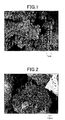
- Fig. 1 is a FE-SEM (Field Emission Scanning Electron Microscope) image showing a morphology of a metallic palladium/nano-silica composite.
- Fig. 2 is another FE-SEM image showing a morphology of a metallic palladium/nano-silica composite.
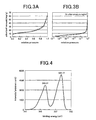
- Fig. 3 is a graph showing a nitrogen adsorption isotherm of a palladium porous body detected by a volumetric method.
- Fig. 4 is a graph showing energy distribution of a palladium porous body by XPS (X-ray Photoelectron Spectroscopy) analysis.
- Fig. 5 is a FE-SEM image showing a morphology of a metallic platinum/nano-silica composite.
- Fig. 6 is another FE-SEM image showing a morphology of a metallic platinum/nano-silica composite.
-
- The present invention uses an aggregate of nano-silica particles with comparatively few pores as a molecular mold. A noble metal compound is adsorbed to the molecular mold with nanometer order distribution, and then reduced to a metallic state.
- The nano-silica is provided by a dry process, a wet process or a sol gel process.
- Dry silica, so-called "fumed silica", is generally synthesized by burning silicon tetrachloride with an oxy-hydrogen flame. Its specific surface area is conditioned to a value within a range of 50-500 m2/g by controlling manufacturing conditions. Its primary particle size is supposed to be a value within a range of 5-500 nm from the specific surface area. The dry silica is commonly offered as an aggregate of 1 µm or more in secondary particle size.
- Wet silica, so-called "white carbon", is representatively prepared by a precipitation method, wherein a sodium silicate solution is neutralized with a mineral acid so as to precipitate silica in the solution. Gel-derived silica, which is prepared by neutralization of sodium silicate with an acid, also belongs to the wet silica. The wet silica is commonly offered as powder by filtering, washing, drying and optionally milling the neutralization product. Available wet silica has an average particle size within a range of from a few to hundreds nanometers and a specific surface area conditioned to 50-500 m2/g by control of manufacturing conditions. Namely, primary particles of 3-50 nm are probably aggregated together during synthesis.
- A nano-silica aggregate is also prepared by a sol gel process, wherein a silicon alkoxide such as tetramethoxysilane or tetraethoxysilane is hydrolyzed in an acidic or alkaline hydrated organic liquid. The sol gel process is suitable for preparation of high-purity silica, since raw material can be purified by distillation regardless consumption of an expensive silicon alkoxide. When hydrolysis is performed in a concentrated acidic or alkaline liquid, silica is synthesized in a bulk state. The bulk silica is reformed to amorphous silica of a few to hundreds µm useful as a nano-silica aggregate.
- A molecular noble metal compound is dispersively adsorbed to the nano-silica aggregate as a mold. The nanometer order distribution of the noble metal compound may be explained as follows:
- The nano-silica aggregate exhibits both hydrophobic and hydrophilic characters due to presence of many -OH groups on its surface, and so preferentially adsorbs water in a state contact with a solvent, which contains both of water and an organic solvent. The adsorbed water forms a liquid membrane on a surface of the nano-silica aggregate at first, when a hydrated noble metal compound dissolved in an organic solvent is held in contact with the nano-silica aggregate.
- When the hydrated nano-silica aggregate is vacuum-dried for removal of the organic solvent, the noble metal compound is re-crystallized through the adsorbed water on the nano-silica aggregate. Since recrystallization of the noble metal compound is promoted by the adsorbed water, which exists only on the surface of the nano-silica aggregate, a film of the noble metal compound is formed with a profile, which imitates the surface of the nano-silica aggregate, resulting in nanometer order distribution of the noble metal compound. That is, many -OH groups, which are present on the surface of the nano-silica aggregate, interact with the organic solvent and the crystal water, so as to form a molecular film of the molecular noble metal compound, i.e. adsorption of the noble metal compound with nanometer order distribution, after removal of the organic solvent and the crystal water.
- The nano-silica aggregate is a coalescent body of nanometer-sized (10-30 nm) primary silica particles. Each primary particle, which has a structure with comparatively few pores, is easily dissolved under a moderate condition by chemical treatment with an alkali such as NaOH. In this sense, the nano-silica aggregate is advantageous as a molecular mold in comparison with other aggregates.
- Furthermore, the primary silica particles have a quasi-spherical shape free of micropores with anti-blocking, so as to facilitate adsorption of the noble metal compound with nanometer order distribution to a whole surface of the nano-silica aggregate. For comparison, when an active carbon fiber bundle is used as a molecular mold, openings of pores in the fiber bundle are clogged in short time. Once the openings are clogged, the noble metal compound does not invade into the fiber bundle any more.
- Adsorption of the noble metal compound with nanometer order distribution is assured by removing gaseous components such as H2 and H2O from the nano-silica aggregate by vacuum-drying and then holding the dried nano-silica aggregate in contact with a noble metal compound-containing liquid. The noble metal compound may be one or more of organic and inorganic salts of Pd, Pt and Rh. For instance, when the nano-silica aggregate is vacuum-impregnated with a palladium acetate solution, the palladium acetate solution penetrates into pores of the nano-silica aggregate, and palladium acetate is adsorbed to a surface of each silica particle.
- When the nano-silica aggregate, to which the noble metal compound is adsorbed with nanometer order distribution, is heated, the noble metal compound is pyrolyzed to a metallic state. In fact, the noble metal compound is decomposed to a metallic state by heating the nano-silica aggregate in a vacuum atmosphere at a temperature higher by 50°C or so than a pyrolysis temperature of the noble metal compound at an ordinary pressure. During pyrolysis of the noble metal compound, reductive reaction occurs around adsorbed water just on a surface of the nano-silica aggregate. As a result, a molecular film of the noble metal compound, which imitates a surface profile of the nano-silica aggregate, is converted as such to a metallic state.
- After reduction of the noble metal compound, the nano-silica aggregate is subjected to chemical treatment with an alkali such as NaOH, KOH or aqueous ammonia for dissolution of silica particles. Consequently, a noble metal body with a nano-pore structure, wherein nano-pores are formed at traces of silica particles, is produced. Since the nano-silica aggregate is used as a molecular mold (in other words, an adsorbent), it is advantageous to facilitate dissolution of the molecular mold under a moderate condition with an alkali.
- The noble metal porous body, which is obtained after dissolution of the nano-silica aggregate, involves nano-pores corresponding to silica particles and also much finer pores therein. It is useful as high-functional elements in various industrial fields, e.g. catalysts, adsorbents, gas-occluding elements and permselective membranes, due to its peculiar nano-pore structure effective for realization of intrinsic activity of a noble metal such as Pt, Pd or Rh.
- The other features of the present invention will be more clearly understood from the following examples, however these examples do not put any restriction on a scope of the present invention.
- Silica (offered as "fine seal X-37" by Tokuyama Corporation) of 20 µm in averaged primary particle size with purity of 94.43 % was weighed, and 184 mg silica was put in a vacuum vessel. The silica was heated 2 hours at 150°C in a vacuum atmosphere of 0.133 Pa to vanish adsorbed water and gaseous components from surfaces of silica particles. Thereafter, a palladium acetate solution, which was prepared by dissolving 987 mg palladium acetate in 30 ml acetone, was poured in the vacuum vessel and stirred 2 days in an open air so as to adsorb palladium acetate to silica particles.
- After 2 days-stirring, the vacuum vessel was held as such at a room temperature and then re-evacuated for vaporization of acetone (as a solvent). The re-evacuation was continued 6 hours, so as to concentrate and exsiccate the nano-silica aggregate impregnated with palladium acetate.
- Palladium acetate was reduced to metallic palladium by heating the dry nano-silica aggregate in a vacuum atmosphere at a heating temperature of 250°C higher than a pyrolysis temperature (200°C) of palladium acetate. The heat-treatment was continued 2 hours for complete reduction of palladium acetate.
- When a surface of the obtained metallic palladium/nano-silica composite was observed by FE-SEM, an aggregate, which comprised primary particles of 15-25 nm in size, was detected. Metallic palladium, which was adsorbed to a surface of each silica particle without filling pore spaces, was noted, as shown in Figs. 1 and 2.
- The metallic palladium/nano-silica composite was dipped in a 1.0 N-NaOH solution and subjected as such to 7 days-stirring for dissolution of the nano-silica aggregate. Thereafter, the metallic palladium was washed with deionized water and held 24 hours at 60°C for vaporization of water. Thus, a dry sample 278 mg was produced at a yield ratio of 60%.
- An adsorbing rate of nitrogen to the dry sample was measured by a volumetric method. Results are shown as a nitrogen adsorption isotherm in Fig. 3. It is noted that the adsorbing rate rises with steep inclination at a low relative pressure. The steep inclination derives from a nano-pore structure of the dry sample, but does not appear in conventional palladium black. BET (Brunauer-Emmett-Teller) analytical results proved that the dry sample was a porous body with a specific surface area of 29.6 m2/g.
- The dry sample had peaks at 340.32 eV and 335.17 eV without any peaks originated in Si according to XPS analysis, as shown in Fig. 4. Since the values of 340.32 eV and 335.17 eV correspond to 340 eV (3d3/2) and 335 eV (3d5/2), respectively, of metallic palladium, the XPS analytical results means conversion of palladium to a metallic state.
- The above results prove that the dry sample is a palladium body with a nano-pore structure, which imitates a structure of the nano-silica aggregate.
- The same silica (370 mg) as in Example 1 was subjected to vacuum drying for removal of adsorbed water and gaseous components, vacuum impregnated with a solution, which was prepared by dissolving 4.9 g platinum chloride hexahydrate in 30 ml acetone, and stirred 48 hours to adsorb the platinum chloride hexahydrate to silica particles. Thereafter, the impregnated silica was conditioned to a dry platinum chloride hexahydrate/nano-silica aggregate by 6 hours-vacuum suction at a room temperature for removal of acetone.
- The dry aggregate was heated 2 hours at 450°C in a vacuum atmosphere, so as to convert platinum chloride hexahydrate to metallic platinum by pyrolysis. Adsorption of metallic platinum to each silica particle without filling pore spaces was recognized by FE-SEM observation of the heated aggregate.
- The metallic platinum/nano-silica aggregate was then dipped 7 days in a 0.1 N-NaOH solution for dissolution of silica particles, washed with distilled water and dried 24 hours at 60°C. Thus, 1.585 g a platinum porous body was produced at a yield ratio of 86.3%. The platinum porous body had a specific surface area of 150 m2/g (i.e. 5.8 times higher than conventional platinum black, which is a representative platinum compound) according to a volumetric method at -196°C. The higher specific area means that the platinum porous body had a nano-pore structure.
- The porous noble metal bodies prepared by Examples 1 and 2 were evaluated by hydrogenation of ethylene as follows: 10 mg each of the noble metal body of Example 1, the noble metal body of Example 2 and platinum black were individually put in quartz tubes. A gaseous mixture of ethylene and hydrogen at a ratio of 1:1.8 was fed into each quartz tube, which was held at 0°C, at a flow rate of 50 ml/minute. After the gaseous mixture was reacted with the fillers, a reaction product was analyzed by gas chromatography. Analytical results show that hydrogenation of ethylene to ethane was promoted in any case. However, the inventive noble metal bodies exhibited activity, which was judged from a volume of the reaction product, fairly superior to activity of platinum black, as shown in Table 1.
Activity of Porous Bodies evaluated by Hydrogenation of Ethylene Kind of Porous Body A Pd porous body (Ex. 1) A Pt porous body (Ex. 2) Platinum black (conventional) Activity (mmol/minute/g) 25 63.2 13.1 - The noble metal porous body proposed by the present invention as the above has a nano-pore structure, which derives from traces of nano-silica particles. Due to the peculiar structure, the porous body well exhibits intrinsic characteristics of an active noble metal such as Pd, Pt or Rh suitable for functional elements such as catalysts, adsorbents, gas-occluding elements and permselective membranes. Application of the noble metal porous body to elements using an electric conductive skeletal structure is also estimated due to its electronic state originated in the noble metal. Moreover, the noble porous metal body is produced by a process suitable for mass-production, so that material excellent in functionality can be offered at a low cost.
Claims (4)
- A noble metal porous body
comprising a noble metal, which is a reduction product of a noble metal compound adsorbed to a nano-silica aggregate with nanometer order distribution; and
involving nano-pores, which derive from nano-silica particles, therein. - The noble metal porous body defined by Claim 1, wherein the noble metal is one or more selected from the group consisting of Pd, Pt and Rh.
- A method of producing a noble metal porous body, which comprises the steps of:providing an aggregate of silica particles, which have primary particle size within a nanometer range;adsorbing a noble metal compound to said aggregate with nanometer order distribution;reducing said noble metal compound to a metallic state; and thendissolving said silica particles.
- The method defined by Claim 3, wherein the noble metal compound is an organic or inorganic salt of a noble metal selected from the group consisting of Pd, Pt and Rh.
Applications Claiming Priority (3)
| Application Number | Priority Date | Filing Date | Title |
|---|---|---|---|
| JP2002023966A JP3932478B2 (en) | 2002-01-31 | 2002-01-31 | Noble metal pore body and method for producing the same |
| JP2002023966 | 2002-01-31 | ||
| PCT/JP2003/000715 WO2003064081A1 (en) | 2002-01-31 | 2003-01-27 | Micro-porous noble metal material and method for preparation thereof |
Publications (1)
| Publication Number | Publication Date |
|---|---|
| EP1470877A1 true EP1470877A1 (en) | 2004-10-27 |
Family
ID=27654472
Family Applications (1)
| Application Number | Title | Priority Date | Filing Date |
|---|---|---|---|
| EP20030734614 Withdrawn EP1470877A1 (en) | 2002-01-31 | 2003-01-27 | Micro-porous noble metal material and method for preparation thereof |
Country Status (4)
| Country | Link |
|---|---|
| US (1) | US20050079374A1 (en) |
| EP (1) | EP1470877A1 (en) |
| JP (1) | JP3932478B2 (en) |
| WO (1) | WO2003064081A1 (en) |
Cited By (2)
| Publication number | Priority date | Publication date | Assignee | Title |
|---|---|---|---|---|
| CN104014809A (en) * | 2014-05-29 | 2014-09-03 | 燕山大学 | Method for synthesizing platinum nanometer spherical shell with adenovirus shuttle vector-GFP as template |
| CN109136305A (en) * | 2017-06-19 | 2019-01-04 | 卢松 | A kind of separation purifying technique of glucose |
Families Citing this family (26)
| Publication number | Priority date | Publication date | Assignee | Title |
|---|---|---|---|---|
| US7666807B2 (en) * | 2004-09-21 | 2010-02-23 | Savannah River Nuclear Solutions, Llc | Hollow porous-wall glass microspheres for hydrogen storage |
| JP5054912B2 (en) * | 2004-10-28 | 2012-10-24 | 三星エスディアイ株式会社 | Catalyst for fuel cell, method for producing the same, and fuel cell system including the same |
| JP4599223B2 (en) * | 2005-05-16 | 2010-12-15 | 行政院原子能委員會核能研究所 | A method for producing a highly efficient catalyst of platinum and a platinum alloy having a nanonetwork structure. |
| JP2007044675A (en) * | 2005-08-12 | 2007-02-22 | Canon Inc | Structure manufacturing method, structure, and fuel cell using the structure |
| US7491448B2 (en) * | 2006-01-05 | 2009-02-17 | Energy Conversion Devices, Inc. | Reticulated foam-like structure formed of nano-scale particulate |
| KR100838644B1 (en) | 2007-01-29 | 2008-06-16 | 충남대학교산학협력단 | Hollow metal sphere nanostructure and manufacturing method using carbon template |
| WO2008118097A1 (en) * | 2007-03-23 | 2008-10-02 | Agency For Science, Technology And Research | Palladium catalysts |
| EP2276691B1 (en) * | 2008-05-05 | 2020-04-15 | Jawaharlal Nehru Centre for Advanced Scientific Research | A template free and polymer free metal nanosponge and a process for preparation thereof |
| JP5451083B2 (en) * | 2009-01-13 | 2014-03-26 | 株式会社フルヤ金属 | Platinum black powder, colloid of platinum black and process for producing them |
| JP5641385B2 (en) * | 2009-07-27 | 2014-12-17 | 独立行政法人物質・材料研究機構 | Metal nanoparticles having dendritic parts and method for producing the same |
| US8574340B2 (en) * | 2011-02-27 | 2013-11-05 | Board Of Trustees Of The University Of Alabama | Methods for preparing and using metal and/or metal oxide porous materials |
| WO2012174335A2 (en) | 2011-06-15 | 2012-12-20 | Stc.Unm | Cathode catalysts for fuel cell application derived from polymer precursors |
| US9425464B2 (en) | 2012-07-11 | 2016-08-23 | Stc.Unm | Carbendazim-based catalytic materials |
| US9233366B2 (en) | 2012-10-16 | 2016-01-12 | Board Of Trustees Of The University Of Alabama | Catalysis by metal nanoparticles dispersed within a hierarchically porous carbon material |
| US9359681B1 (en) * | 2013-03-11 | 2016-06-07 | Alexey Serov | CO2 electroreduction on metals and metal alloys prepared by a sacrificial support-based method |
| JP6255683B2 (en) * | 2013-03-14 | 2018-01-10 | 王子ホールディングス株式会社 | Base paper for wallpaper |
| JP6086497B2 (en) | 2013-10-04 | 2017-03-01 | 国立大学法人東京工業大学 | Catalyst layer for gas diffusion electrode, production method thereof, membrane electrode assembly and fuel cell |
| WO2015111589A1 (en) | 2014-01-21 | 2015-07-30 | 三菱化学株式会社 | Electrophotographic photoreceptor, electrophotographic cartridge, image formation device, and charge transport substance |
| JP6497092B2 (en) * | 2014-01-31 | 2019-04-10 | 三菱ケミカル株式会社 | Electrophotographic photoreceptor, electrophotographic cartridge, image forming apparatus, method for producing electrophotographic photoreceptor, and charge transport material |
| CN103862031B (en) * | 2014-02-20 | 2017-01-18 | 天津大学 | Composite nano metal materials prepared in combination with ordered porous support or rough surface and method thereof |
| ES2975058T3 (en) | 2016-02-02 | 2024-07-03 | Univ Washington | Selective ceramic membranes |
| US10195587B2 (en) | 2016-03-04 | 2019-02-05 | The Board Of Trustees Of The University Of Alabama | Synthesis of hierarchically porous monoliths by a co-gelation method |
| US10814288B2 (en) * | 2016-08-04 | 2020-10-27 | Exxonmobil Research And Engineering Company | Separation of gases using reactive adsorbents and membranes |
| CN107234246B (en) * | 2017-07-25 | 2019-08-20 | 陕西师范大学 | A kind of preparation method of the nano flower of ultra-thin Rh nanometer sheet composition |
| BR112020013645A2 (en) | 2018-01-04 | 2020-12-01 | University Of Washington | nanoporous selective sol-gel ceramic membrane, selective membrane structures and related methods |
| CN114433187B (en) * | 2020-10-30 | 2023-12-12 | 中国石油化工股份有限公司 | Post-modification method of hierarchical porous catalyst, hydrocracking catalyst obtained by the method and its application |
Family Cites Families (15)
| Publication number | Priority date | Publication date | Assignee | Title |
|---|---|---|---|---|
| US2930767A (en) * | 1957-08-26 | 1960-03-29 | Ohio Commw Eng Co | Metal particles and method of making |
| US3578395A (en) * | 1967-12-26 | 1971-05-11 | Chevron Res | Recovery of metals |
| GB1263131A (en) * | 1968-04-01 | 1972-02-09 | Exxon Research Engineering Co | Process for removal of trace quantities of oxygen from inert gases |
| JPS5237976B2 (en) * | 1971-12-20 | 1977-09-26 | ||
| US3843341A (en) * | 1972-03-02 | 1974-10-22 | Ppg Industries Inc | Method of making thermally stable and crush resistant microporous glass catalyst supports |
| US4248679A (en) * | 1979-01-24 | 1981-02-03 | Ppg Industries, Inc. | Electrolysis of alkali metal chloride in a cell having a nickel-molybdenum cathode |
| US4289802A (en) * | 1979-11-28 | 1981-09-15 | General Motors Corporation | Porous cermet electrode and method of making same |
| JPS56124447A (en) * | 1980-03-05 | 1981-09-30 | Hitachi Ltd | Manufacture of catalyst |
| US4608357A (en) * | 1984-02-06 | 1986-08-26 | Engelhard Corporation | Catalytic cracking with mullite composition promoted combustion of carbon monoxide |
| US4977038A (en) * | 1989-04-14 | 1990-12-11 | Karl Sieradzki | Micro- and nano-porous metallic structures |
| DE19734974A1 (en) * | 1997-08-13 | 1999-02-25 | Hoechst Ag | Production of supported catalyst for vinyl acetate production |
| EP0934819A4 (en) * | 1997-08-27 | 2000-06-07 | Toyoda Chuo Kenkyusho Kk | COATED OBJECT AND METHOD FOR MANUFACTURING THE OBJECT |
| US6589883B2 (en) * | 2000-03-29 | 2003-07-08 | Georgia Tech Research Corporation | Enhancement, stabilization and metallization of porous silicon |
| US20030012942A1 (en) * | 2001-05-03 | 2003-01-16 | The Board Of Regents Of The University Of Nebraska | Sol-gel preparation of porous solids using dendrimers |
| US6805972B2 (en) * | 2002-08-27 | 2004-10-19 | Johns Hopkins University | Method of forming nanoporous membranes |
-
2002
- 2002-01-31 JP JP2002023966A patent/JP3932478B2/en not_active Expired - Fee Related
-
2003
- 2003-01-27 US US10/502,987 patent/US20050079374A1/en not_active Abandoned
- 2003-01-27 EP EP20030734614 patent/EP1470877A1/en not_active Withdrawn
- 2003-01-27 WO PCT/JP2003/000715 patent/WO2003064081A1/en not_active Ceased
Non-Patent Citations (1)
| Title |
|---|
| See references of WO03064081A1 * |
Cited By (3)
| Publication number | Priority date | Publication date | Assignee | Title |
|---|---|---|---|---|
| CN104014809A (en) * | 2014-05-29 | 2014-09-03 | 燕山大学 | Method for synthesizing platinum nanometer spherical shell with adenovirus shuttle vector-GFP as template |
| CN104014809B (en) * | 2014-05-29 | 2015-11-18 | 燕山大学 | A kind of with the method for adenovirus shuttle vector-GFP for templated synthesis platinum nano ball shell |
| CN109136305A (en) * | 2017-06-19 | 2019-01-04 | 卢松 | A kind of separation purifying technique of glucose |
Also Published As
| Publication number | Publication date |
|---|---|
| JP2003221601A (en) | 2003-08-08 |
| WO2003064081A1 (en) | 2003-08-07 |
| JP3932478B2 (en) | 2007-06-20 |
| US20050079374A1 (en) | 2005-04-14 |
Similar Documents
| Publication | Publication Date | Title |
|---|---|---|
| US20050079374A1 (en) | Micro-porous noble metal material and method for preparation thereof | |
| Lin et al. | Facile controlled synthesis of core–shell/yolk–shell/hollow ZIF-67@ Co-LDH/SiO2 via a self-template method | |
| EP4433205B1 (en) | A process of making an adsorbent body | |
| Zhang et al. | One-step co-precipitation synthesis of novel BiOCl/CeO2 composites with enhanced photodegradation of rhodamine B | |
| JP4478766B2 (en) | Spherical silica porous particles and method for producing the same | |
| Eid et al. | Scalable nitrogen-enriched porous sub-100 nm graphitic carbon nanocapsules for efficient oxygen reduction reaction in different media | |
| CN101054171A (en) | Layer combination controllable carbon material with nano pole of different scale, preparation method and application | |
| WO2023282036A1 (en) | C/sic composite particles and their manufacturing method, electrode catalyst and polymer electrolyte fuel cell comprising the c/sic composite particles | |
| CN1840480A (en) | Cerium oxide nano materials and its preparation and use | |
| Kaur et al. | Synthesis, characterization and electrochemical evaluation of hydrogen storage capacity of graphitic carbon nitride and its nanocomposites in an alkaline environment | |
| Wang et al. | Template-induced synthesis of hierarchical SiO2@ γ-AlOOH spheres and their application in Cr (VI) removal | |
| CN104959123A (en) | Preparation method and application of novel hierarchical pore composite material | |
| CN112138696A (en) | A kind of preparation method of transition metal-supported nitrogen-modified ordered mesoporous carbon nanospheres | |
| Zhou et al. | Modification of BiOBr with cellulose nanocrystals to improve the photocatalytic performance under visible light | |
| CN114262034A (en) | A method for separating rubidium in salt lake brine by utilizing polyvinyl alcohol/chitosan/graphene/nickel-copper ferrocyanide composite | |
| JP4692921B2 (en) | Monodispersed spherical carbon porous body | |
| Velásquez et al. | Structure and texture of self-assembled nanoporous SnO2 | |
| KR100525209B1 (en) | Metal-incorporated nanoporous materials, Metal-VSB-5 molecular sieve and their preparation methods | |
| JP5176161B2 (en) | Metal fiber nonwoven immobilization mesostructure | |
| JPH0672005B2 (en) | Method for adsorption and separation of carbon monoxide | |
| KR101562559B1 (en) | Method of manufacturing of porous metal oxide and the porous metal oxide thereby | |
| KR100911575B1 (en) | Titania-palladium complex and preparation method thereof | |
| JP3980370B2 (en) | Method for producing Ni porous body having nanopore structure | |
| CN108714422B (en) | A hybrid titanate nanobelt supported metal palladium nanoparticle monolithic catalyst and its preparation method and application | |
| JP2008230876A (en) | Method for producing metal oxide porous body having mesopores and micropores, metal oxide porous body having mesopores and micropores, and gas purification material using the same |
Legal Events
| Date | Code | Title | Description |
|---|---|---|---|
| PUAI | Public reference made under article 153(3) epc to a published international application that has entered the european phase |
Free format text: ORIGINAL CODE: 0009012 |
|
| 17P | Request for examination filed |
Effective date: 20040617 |
|
| AK | Designated contracting states |
Kind code of ref document: A1 Designated state(s): AT BE BG CH CY CZ DE DK EE ES FI FR GB GR HU IE IT LI LU MC NL PT SE SI SK TR |
|
| AX | Request for extension of the european patent |
Extension state: AL LT LV MK RO |
|
| STAA | Information on the status of an ep patent application or granted ep patent |
Free format text: STATUS: THE APPLICATION HAS BEEN WITHDRAWN |
|
| 18W | Application withdrawn |
Effective date: 20070906 |