EP1470760A1 - Cigarette and cigarette filter - Google Patents
Cigarette and cigarette filter Download PDFInfo
- Publication number
- EP1470760A1 EP1470760A1 EP03701019A EP03701019A EP1470760A1 EP 1470760 A1 EP1470760 A1 EP 1470760A1 EP 03701019 A EP03701019 A EP 03701019A EP 03701019 A EP03701019 A EP 03701019A EP 1470760 A1 EP1470760 A1 EP 1470760A1
- Authority
- EP
- European Patent Office
- Prior art keywords
- cigarette
- amino acid
- basic amino
- filter
- arginine
- Prior art date
- Legal status (The legal status is an assumption and is not a legal conclusion. Google has not performed a legal analysis and makes no representation as to the accuracy of the status listed.)
- Withdrawn
Links
Images
Classifications
-
- A—HUMAN NECESSITIES
- A24—TOBACCO; CIGARS; CIGARETTES; SIMULATED SMOKING DEVICES; SMOKERS' REQUISITES
- A24B—MANUFACTURE OR PREPARATION OF TOBACCO FOR SMOKING OR CHEWING; TOBACCO; SNUFF
- A24B15/00—Chemical features or treatment of tobacco; Tobacco substitutes, e.g. in liquid form
- A24B15/18—Treatment of tobacco products or tobacco substitutes
- A24B15/28—Treatment of tobacco products or tobacco substitutes by chemical substances
- A24B15/30—Treatment of tobacco products or tobacco substitutes by chemical substances by organic substances
- A24B15/32—Treatment of tobacco products or tobacco substitutes by chemical substances by organic substances by acyclic compounds
-
- A—HUMAN NECESSITIES
- A24—TOBACCO; CIGARS; CIGARETTES; SIMULATED SMOKING DEVICES; SMOKERS' REQUISITES
- A24D—CIGARS; CIGARETTES; TOBACCO SMOKE FILTERS; MOUTHPIECES OF CIGARS OR CIGARETTES; MANUFACTURE OF TOBACCO SMOKE FILTERS OR MOUTHPIECES
- A24D3/00—Tobacco smoke filters, e.g. filter tips or filtering inserts; Filters specially adapted for simulated smoking devices; Mouthpieces of cigars or cigarettes
- A24D3/06—Use of materials for tobacco smoke filters
- A24D3/14—Use of materials for tobacco smoke filters of organic materials as additive
-
- A—HUMAN NECESSITIES
- A24—TOBACCO; CIGARS; CIGARETTES; SIMULATED SMOKING DEVICES; SMOKERS' REQUISITES
- A24B—MANUFACTURE OR PREPARATION OF TOBACCO FOR SMOKING OR CHEWING; TOBACCO; SNUFF
- A24B15/00—Chemical features or treatment of tobacco; Tobacco substitutes, e.g. in liquid form
- A24B15/18—Treatment of tobacco products or tobacco substitutes
- A24B15/28—Treatment of tobacco products or tobacco substitutes by chemical substances
- A24B15/30—Treatment of tobacco products or tobacco substitutes by chemical substances by organic substances
Definitions
- the present invention relates to a cigarette low in the amounts of aldehydes contained in the mainstream smoke and to a cigarette filter that permits lowering the amounts of aldehydes contained in the mainstream smoke of a cigarette.
- An object of the present invention is to provide a cigarette and a cigarette filter, which permit effectively lowering the aldehyde content in the mainstream smoke of a cigarette and which also permit suppressing the detrimental effects such as degradation of the cigarette taste.
- a cigarette containing a basic amino acid or a basic amino acid salt.
- a cigarette filter containing a basic amino acid or a basic amino acid salt.
- a basic amino acid or a basic amino acid salt it is desirable for a basic amino acid or a basic amino acid salt to be contained in an amount of at least 1 mg/cigarette.
- the basic amino acid or the basic amino acid salt it is desirable for the basic amino acid or the basic amino acid salt to be contained in the cigarette or the cigarette filter in the form of an aqueous solution. It is also desirable for the cigarette or the cigarette filter of the present invention to further contain a surfactant.
- the basic amino acid or the basic amino acid salt includes, for example, arginine, arginine salt, lysine, lysine salt, histidine, histidine salt, ornithine, ornithine salt, citrulline, citrulline salt, hydroxyzine and hydroxyzine salt.
- arginine and a salt thereof are admitted as food additives.
- that portion of the cigarette to which the basic amino acid or the basic amino acid salt is added is not particularly limited.
- the basic amino acid or the basic amino acid salt can be added to any of the cut tobacco, the cigarette wrapper and the filter.
- the cigarette filter of the present invention is a filter attached to the inhaling side of the tobacco portion of the cigarette or to be a filter in the form of a cigarette holder.
- the basic amino acid or the basic amino acid salt is contained in an amount of at least 1 mg/cigarette. If the amount of the basic amino acid or the basic amino acid salt is smaller than the amount noted above, it is difficult to obtain a sufficient effect of lowering the aldehyde content in the mainstream smoke of the cigarette.
- the effect of lowering the aldehyde content in the mainstream smoke of the cigarette can be increased in the present invention.
- the effect of lowering the aldehyde content in the mainstream smoke of the cigarette can also be increased in the case where the basic amino acid or the basic amino acid salt is used together with a surfactant. It is considered reasonable to understand that an aqueous solution containing a surfactant and a basic amino acid or a basic amino acid salt exhibits an improved wettability so as to permit the basic amino acid or the basic amino acid salt to be dispersed sufficiently, with the result that the aldehyde content in the mainstream smoke of the cigarette is lowered.
- the surfactant used in the present invention includes ionic surfactants such as potassium sorbate, sodium oleate and sodium laurate, and nonionic surfactants such as sucrose laurate, sucrose myristate, sucrose palmitate, and sucrose stearate, though the surfactant used in the present invention is not limited to those exemplified above.
- the derivative of 2,4-dinitrophenyl hydrazine (DNPH), a trapping substance was measured by high-speed liquid chromatography (HPLC).
- the substances that can be measured simultaneously by this method are eight components including formaldehyde, acetaldehyde, acetone, acrolein, propionaldehyde, crotonaldehyde, methyl ethyl ketone and n-butylaldehyde.
- the description is directed to formaldehyde among the aldehydes (carbonyl compounds) that were to be measured.
- a trapping solution was prepared by dissolving 9.51 g of 2,4-dinitrophenyl hydrazine (DNPH) in 1L of acetonitrile, followed by adding 5.6 mL of 60% perchloric acid and subsequently diluting the resultant solution with ultra pure water to 2L.
- DNPH 2,4-dinitrophenyl hydrazine
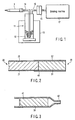
- a DNPH trapping solution 12 is put in a Drechsel type trap 11.
- the Drechsel type trap 11 had an inner volume of 250 mL, the amount of the DNPH trapping solution was 100 mL, and the dead volume was 150 mL.
- the Drechsel type trap 11 was put in an ice water bath 13 so as to cool the trap 11.
- the lower end of a glass pipe 14 having a cigarette 1 mounted in the tip is dipped in the trapping solution 12 housed in the Drechsel type trap 11.
- a glass pipe 15 having a Cambridge pad 16 mounted thereto is mounted to communicate with the dead volume of the Drechsel type trap 11, and a smoking machine 17 was connected to the Cambridge pad 16.
- the cigarette 1 was attached to the glass pipe 14 so as to permit the cigarette 1 to be automatically smoked under the standard smoking conditions specified in ISO standards. To be more specific, the operation of sucking 35 mL of the smoke in a single puff for two seconds for a single cigarette was repeated at an interval of 58 seconds. While the mainstream smoke was being bubbled, formaldehyde was converted into a derivative of DNPH. Two cigarettes were used for the measurement.
- the formaldehyde derivative thus formed was measured by HPLC.
- the trapping solution was filtered, followed by diluting the filtered trapping solution with a Trizma Base solution (4 mL of trapping solution : 6 mL of Trizma Base solution). Then, the diluted solution was measured by HPLC.
- the measuring conditions of the HPLC were as follows:
- the cigarette having comprised a cigarette section 20 in which cut tobacco 21 was wrapped with a cigarette wrapper 22, and a filter section 30 in which a filter 31 was wrapped with a forming paper 32.
- the filter section 30 was mounted on the cigarette section 20 by using a tipping paper 40. It is possible to use, for example, cellulose acetate tow as the material of the filter.
- the individual filter plugs are wrapped with an individual plug wrap paper, followed by wrapping integrally the filter plugs with a forming paper so as to obtain the filter section 30.
- a tobacco section was taken out by cutting the acetate filter from a cigarette available on the market, which contained 6 mg of tar, and a sample was prepared by connecting the tobacco section to the filter for the testing.
- An atomizer was used for adding a basic amino acid or a basic amino acid salt to the filter for the testing.
- the cut tobacco was once taken out of a cigarette available on the market. Then, a basic amino acid or a basic amino acid salt was added to the cut tobacco by using a sprayer, followed by wrapping again the cut tobacco with a cigarette wrapper so as to obtain a tobacco section sample.
- the formaldehyde content in the mainstream smoke of the cigarette was measured by the measuring method described above with the number of puffs set at 7.
- the formaldehyde content was found to be 110 ⁇ g.
- An acetate filter without a plasticizer was prepared as base filter A.
- a filter for the testing was prepared by adding 35 mg of an aqueous solution containing 10% by weight of arginine to base filter A by using an atomizer, followed by drying the base filter A for 48 hours, the prepared filter containing 3.5 mg of arginine.
- another filter for the testing was prepared by adding 35 mg of an aqueous solution containing 10% by weight of arginine glutamate to base filter A by using an atomizer, followed by drying base filter A for 48 hours, the prepared filter containing 3.5 mg of arginine glutamate.
- Base filter B was prepared by adding 6% by weight of triacetin as a plasticizer to base filter A.
- Base filter B is equal to the filter used in the cigarette product.
- a filter for the testing was prepared by adding 35 mg of an aqueous solution containing 10% by weight of arginine to base filter B, followed by drying base filter B for 48 hours, the prepared filter containing 3.5 mg of arginine.
- another filter for the testing was prepared by adding 35 mg of an aqueous solution containing 10% by weight of arginine glutamate to base filter B, followed by drying base filter B for 48 hours, the prepared filter containing 3.5 mg of arginine glutamate.
- aqueous solution containing 20% by weight of arginine was added in an amount of 20% by weight by spraying to cut tobacco put in a mixing drum by using a hand sprayer, followed by drying the cut tobacco at 80°C for 5 minutes in a dryer. Then, the cut tobacco was conditioned for 48 hours so as to prepare a tobacco section consisting of 690 mg of the cut tobacco and having a length of 59 mm. Cigarette wrapper 4P35 manufactured by Mishima Seishi K.K. was used as the cigarette wrapper. The arginine addition amount was 4% by weight (27.6 mg) based on the amount of cut tobacco.
- the amount of formaldehyde contained in the mainstream smoke of the cigarette was measured at the outlet of the tobacco section as above without attaching a filter to the tobacco section.
- the base cut tobacco used for comparison was prepared by adding 20% by weight of water alone to the cut tobacco by spraying.
- the amount of formaldehyde contained in the mainstream smoke of the cigarette was also measured as above at the outlet of the tobacco section using the base cut tobacco noted above.
- Table 5 shows the result.
- the formaldehyde content in the mainstream smoke of the cigarette can also be lowered markedly by adding arginine to the cut tobacco.
- FA at outlet of tobacco section [ ⁇ g] reduction rate [%] base cut tobacco 121.3 -10.3 addition of 27.6 mg of arginine 23.9 78.3
- Example 4 A measurement similar to that for Example 4 was performed in order to evaluate the effect of lowering the formaldehyde content produced by various basic amino acids or basic amino acid salts in the presence of water.
- Example 2 A measurement similar to that for Example 2 was performed in order to evaluate the effect of lowering the formaldehyde content produced by various basic amino acids or basic amino acid salts in the presence of a surfactant.
- a prescribed amount of an aqueous solution containing arginine alone or an aqueous solution containing both arginine and each of various surfactants was added to base filter B, as shown in Table 7, followed by conditioning for 48 hours and subsequently measuring the formaldehyde content (FA) in the mainstream smoke and the increase in water content ( ⁇ W).
- the surfactants used included ionic surfactants of potassium sorbate, sodium oleate and sodium laurate and nonionic surfactants of sucrose laurate, sucrose myristate, sucrose palmitate, and sucrose stearate. Table 7 shows the result.
- the effect of lowering the formaldehyde content in the mainstream smoke of the cigarette can be obtained in the case of using a basic amino acid or a basic amino acid salt together with a surfactant even if water is not present together with the basic amino acid or the basic amino acid salt. It is considered reasonable to understand that, in the case of using an aqueous solution containing both arginine and a surfactant, the wettability of the aqueous solution with the filter is improved so as to improve the dispersion capability of arginine.
- the cigarette filter of the present invention can also be used in the form of a cigarette holder constructed as shown in FIG. 3.
- the cigarette filter comprises a cylindrical cigarette holder body 41 and a filter 31 arranged within the cigarette holder body 41.
- a basic amino acid or a basic amino acid salt is contained in the filter 31.
- the cigarette holder body 41 is formed integral with a mouthpiece section 42.
- the aldehyde content in the mainstream smoke of the cigarette can also be lowered in the case of using the cigarette filter of the particular construction.
- using the cigarette and the cigarette filter of the present invention can effectively lower the content of aldehydes in the mainstream smoke of a cigarette.
Landscapes
- Chemical & Material Sciences (AREA)
- Engineering & Computer Science (AREA)
- Toxicology (AREA)
- General Health & Medical Sciences (AREA)
- Chemical Kinetics & Catalysis (AREA)
- General Chemical & Material Sciences (AREA)
- Health & Medical Sciences (AREA)
- Materials Engineering (AREA)
- Treatments For Attaching Organic Compounds To Fibrous Goods (AREA)
- Cigarettes, Filters, And Manufacturing Of Filters (AREA)
- Disinfection, Sterilisation Or Deodorisation Of Air (AREA)
- Paper (AREA)
- Manufacture Of Tobacco Products (AREA)
Abstract
A basic amino acid or a basic amino acid salt is
added to a cigarette or a cigarette filter. It is
desirable for the basic amino acid or the basic
amino acid salt to be added in an amount of at least
1 mg/cigarette. It is also desirable for the basic
amino acid or the basic amino acid salt to be added
to the cigarette or the cigarette filter in the form
of an aqueous solution. Also, it is possible to add
a surfactant to the cigarette or the cigarette filter
together with the basic amino acid or the basic amino
acid salt.
Description
The present invention relates to a cigarette low
in the amounts of aldehydes contained in the mainstream
smoke and to a cigarette filter that permits lowering
the amounts of aldehydes contained in the mainstream
smoke of a cigarette.
Various chemical components are contained in
the mainstream smoke inhaled by the smoker in smoking
a cigarette. Among these chemical components, it
was difficult to remove by adsorption the aldehydes
represented by formaldehyde by the ordinary cigarette
filter. Therefore, it is desirable to remove the
aldehydes from the mainstream smoke of the cigarette.
It was attempted in the past to use various
additives in the cigarette filter in order to remove by
adsorption the aldehydes contained in the mainstream
smoke of the cigarette. However, the use of the
additives available in the past gives rise to problems.
For example, the taste of the cigarette is impaired.
An object of the present invention is to provide
a cigarette and a cigarette filter, which permit
effectively lowering the aldehyde content in the
mainstream smoke of a cigarette and which also permit
suppressing the detrimental effects such as degradation
of the cigarette taste.
According to a first aspect of the present
invention, there is provided a cigarette containing
a basic amino acid or a basic amino acid salt.
According to a second aspect of the present
invention, there is provided a cigarette filter
containing a basic amino acid or a basic amino acid
salt.
In the present invention, it is desirable for
a basic amino acid or a basic amino acid salt to be
contained in an amount of at least 1 mg/cigarette.
In the present invention, it is desirable for the basic
amino acid or the basic amino acid salt to be contained
in the cigarette or the cigarette filter in the form
of an aqueous solution. It is also desirable for
the cigarette or the cigarette filter of the present
invention to further contain a surfactant.
As a result of extensive research conducted from
various viewpoints in an attempt to lower the aldehyde
content in the mainstream smoke of a cigarette, the
present inventors have found that a basic amino acid
or a basic amino acid salt is effective in lowering
the aldehyde content in the mainstream smoke of the
cigarette. The basic amino acid or the basic amino
acid salt includes, for example, arginine, arginine
salt, lysine, lysine salt, histidine, histidine salt,
ornithine, ornithine salt, citrulline, citrulline salt,
hydroxyzine and hydroxyzine salt. Particularly,
arginine and a salt thereof are admitted as food
additives.
In the present invention, that portion of the
cigarette to which the basic amino acid or the basic
amino acid salt is added is not particularly limited.
For example, the basic amino acid or the basic amino
acid salt can be added to any of the cut tobacco, the
cigarette wrapper and the filter.
It is possible for the cigarette filter of the
present invention to be a filter attached to the
inhaling side of the tobacco portion of the cigarette
or to be a filter in the form of a cigarette holder.
In the cigarette or the cigarette filter of the
present invention, the basic amino acid or the basic
amino acid salt is contained in an amount of at least
1 mg/cigarette. If the amount of the basic amino acid
or the basic amino acid salt is smaller than the amount
noted above, it is difficult to obtain a sufficient
effect of lowering the aldehyde content in the
mainstream smoke of the cigarette.
If the basic amino acid or the basic amino acid
salt is used in the presence of water, the effect of
lowering the aldehyde content in the mainstream smoke
of the cigarette can be increased in the present
invention.
The effect of lowering the aldehyde content in the
mainstream smoke of the cigarette can also be increased
in the case where the basic amino acid or the basic
amino acid salt is used together with a surfactant.
It is considered reasonable to understand that
an aqueous solution containing a surfactant and a basic
amino acid or a basic amino acid salt exhibits
an improved wettability so as to permit the basic amino
acid or the basic amino acid salt to be dispersed
sufficiently, with the result that the aldehyde content
in the mainstream smoke of the cigarette is lowered.
The surfactant used in the present invention includes
ionic surfactants such as potassium sorbate, sodium
oleate and sodium laurate, and nonionic surfactants
such as sucrose laurate, sucrose myristate, sucrose
palmitate, and sucrose stearate, though the surfactant
used in the present invention is not limited to those
exemplified above.
In the method of measuring the aldehydes contained
in the mainstream smoke of a cigarette, which was
used in the following Examples, the derivative of
2,4-dinitrophenyl hydrazine (DNPH), a trapping
substance, was measured by high-speed liquid
chromatography (HPLC). The substances that can be
measured simultaneously by this method are eight
components including formaldehyde, acetaldehyde,
acetone, acrolein, propionaldehyde, crotonaldehyde,
methyl ethyl ketone and n-butylaldehyde. In the
following Examples, the description is directed to
formaldehyde among the aldehydes (carbonyl compounds)
that were to be measured.
In the first step, a trapping solution was
prepared by dissolving 9.51 g of 2,4-dinitrophenyl
hydrazine (DNPH) in 1L of acetonitrile, followed by
adding 5.6 mL of 60% perchloric acid and subsequently
diluting the resultant solution with ultra pure water
to 2L.
The construction of the measuring apparatus will
now be described with reference to FIG. 1. As shown
in FIG. 1, a DNPH trapping solution 12 is put in
a Drechsel type trap 11. The Drechsel type trap 11
had an inner volume of 250 mL, the amount of the DNPH
trapping solution was 100 mL, and the dead volume was
150 mL. The Drechsel type trap 11 was put in an ice
water bath 13 so as to cool the trap 11. The lower end
of a glass pipe 14 having a cigarette 1 mounted in the
tip is dipped in the trapping solution 12 housed in the
Drechsel type trap 11. Further, a glass pipe 15 having
a Cambridge pad 16 mounted thereto is mounted to
communicate with the dead volume of the Drechsel type
trap 11, and a smoking machine 17 was connected to the
Cambridge pad 16.
The cigarette 1 was attached to the glass pipe 14
so as to permit the cigarette 1 to be automatically
smoked under the standard smoking conditions specified
in ISO standards. To be more specific, the operation
of sucking 35 mL of the smoke in a single puff for two
seconds for a single cigarette was repeated at an
interval of 58 seconds. While the mainstream smoke
was being bubbled, formaldehyde was converted into
a derivative of DNPH. Two cigarettes were used for
the measurement.
The formaldehyde derivative thus formed was
measured by HPLC. In the first step, the trapping
solution was filtered, followed by diluting the
filtered trapping solution with a Trizma Base solution
(4 mL of trapping solution : 6 mL of Trizma Base
solution). Then, the diluted solution was measured by
HPLC. The measuring conditions of the HPLC were as
follows:
The construction of the cigarette used as a
sample will now be described with reference to the
cross-sectional view shown in FIG. 2. As shown in
FIG. 2, the cigarette having comprised a cigarette
section 20 in which cut tobacco 21 was wrapped with
a cigarette wrapper 22, and a filter section 30 in
which a filter 31 was wrapped with a forming paper 32.
The filter section 30 was mounted on the cigarette
section 20 by using a tipping paper 40. It is possible
to use, for example, cellulose acetate tow as the
material of the filter.
Incidentally, it is possible to use a plurality
of divided plugs of the filter. In this case, the
individual filter plugs are wrapped with an individual
plug wrap paper, followed by wrapping integrally the
filter plugs with a forming paper so as to obtain the
filter section 30.
In testing a cigarette prepared by using a filter
for the testing having a basic amino acid or a basic
amino acid salt added thereto, a tobacco section
was taken out by cutting the acetate filter from
a cigarette available on the market, which contained
6 mg of tar, and a sample was prepared by connecting
the tobacco section to the filter for the testing.
An atomizer was used for adding a basic amino acid or
a basic amino acid salt to the filter for the testing.
Also, where a basic amino acid or a basic amino acid
salt was added to the cut tobacco, the cut tobacco was
once taken out of a cigarette available on the market.
Then, a basic amino acid or a basic amino acid salt was
added to the cut tobacco by using a sprayer, followed
by wrapping again the cut tobacco with a cigarette
wrapper so as to obtain a tobacco section sample.
Incidentally, in respect of a tobacco section
prepared by cutting away the filter section of a
cigarette available on the market, which contained 6 mg
of tar, the formaldehyde content in the mainstream
smoke of the cigarette was measured by the measuring
method described above with the number of puffs set at
7. The formaldehyde content was found to be 110 µg.
An acetate filter without a plasticizer was
prepared as base filter A. Also, a filter for the
testing was prepared by adding 35 mg of an aqueous
solution containing 10% by weight of arginine to base
filter A by using an atomizer, followed by drying
the base filter A for 48 hours, the prepared filter
containing 3.5 mg of arginine. Likewise, another
filter for the testing was prepared by adding 35 mg
of an aqueous solution containing 10% by weight of
arginine glutamate to base filter A by using an
atomizer, followed by drying base filter A for
48 hours, the prepared filter containing 3.5 mg of
arginine glutamate.
Each of the filters thus prepared was connected to
the tobacco section noted above, and the formaldehyde
content (FA) in the mainstream smoke of the cigarette
was measured by the measuring method described above.
Table 1 shows the results. As apparent from Table 1,
the cigarette using the filter prepared by adding
arginine or arginine glutamate to base filter A
exhibits a sufficient effect of lowering the
formaldehyde content in the mainstream smoke of
the cigarette, compared with the cigarette using base
filter A.
| FA [µg] | filtering rate [%] | |
| base filter A | 36.5 | 66.8 |
| addition of 3.5 mg of arginine | 21.9 | 80.3 |
| addition of 3.5 mg of arginine glutamate | 28.3 | 74.3 |
Base filter B was prepared by adding 6% by weight
of triacetin as a plasticizer to base filter A. Base
filter B is equal to the filter used in the cigarette
product. Also, a filter for the testing was prepared
by adding 35 mg of an aqueous solution containing 10%
by weight of arginine to base filter B, followed by
drying base filter B for 48 hours, the prepared filter
containing 3.5 mg of arginine. Likewise, another
filter for the testing was prepared by adding 35 mg
of an aqueous solution containing 10% by weight of
arginine glutamate to base filter B, followed by drying
base filter B for 48 hours, the prepared filter
containing 3.5 mg of arginine glutamate.
Each of the filters thus prepared was connected to
the tobacco section noted above, and the formaldehyde
content (FA) in the mainstream smoke of the cigarette
was measured by the measuring method described above.
Table 2 shows the results. As apparent from Table 2,
the cigarette using the filter prepared by adding
arginine or arginine glutamate to base filter B having
a plasticizer added thereto also exhibits a sufficient
effect of lowering the formaldehyde content in the
mainstream smoke of the cigarette.
| FA [µg] | filtering rate [%] | |
| base filter B | 44.0 | 60.0 |
| addition of 3.5 mg of arginine | 21.1 | 80.8 |
| addition of 3.5 mg of arginine glutamate | 34.1 | 69.0 |
Three kinds of filter containing 3.5 mg of
arginine, 7.0 mg of arginine and 10.5 mg of arginine,
respectively, were prepared by adding 35 mg of an
aqueous solution containing 10% by weight of arginine,
35 mg of an aqueous solution containing 20% by weight
of arginine, and 35 mg of an aqueous solution
containing 30% by weight of arginine, respectively, to
base filters B, followed by drying base filters B for
48 hours.
Each of the filters thus prepared was connected to
the tobacco section noted above, and the formaldehyde
content (FA) in the mainstream smoke of the cigarette
was measured by the measuring method described above.
Table 3 shows the results. As apparent from Table 3,
the effect of lowering the formaldehyde content in the
mainstream smoke of the cigarette is improved with
increase in the amount of arginine added to the base
filter B, though a sufficient effect can be obtained if
3.5 mg of arginine is added to base filter B.
| FA [µg] | filtering rate [%] | |
| base filter B | 44.0 | 60.0 |
| addition of 3.5 mg of arginine | 21.1 | 80.8 |
| addition of 7.0 mg of arginine | 25.0 | 77.3 |
| addition of 10.5 mg of arginine | 20.2 | 81.6 |
The following measurement was performed in order
to evaluate the effect of lowering the formaldehyde
content in the mainstream smoke of the cigarette that
is produced by arginine or arginine glutamate in the
presence of water.
Specifically, 35 mg of an aqueous solution
containing 10% by weight of arginine or 35 mg of an
aqueous solution containing 10% by weight of arginine
glutamate was added to base filter A or base filter B
as in Example 1 or Example 2, followed by measuring the
formaldehyde content (FA) in the mainstream smoke of
the cigarette immediately after the addition of the
aqueous solution as in Example 1 or Example 2. In each
case, the addition amount of arginine or arginine
glutamate was 3.5 mg. Table 4 shows the result.
As apparent from comparison between Table 4 and Table 1
or Table 2, the effect of lowering the formaldehyde
content in the mainstream smoke of the cigarette is
increased in the case where arginine or arginine
glutamate is present together with water.
| FA [µg] | filtering rate [%] | |
| base filter A | 36.5 | 66.8 |
| addition of 35 mg of arginine aqueous solution | 14.3 | 87.0 |
| addition of 35 mg of arginine glutamate aqueous solution | 14.9 | 86.5 |
| base filter B | 44.0 | 60.0 |
| addition of 35 mg of arginine aqueous solution | 11.6 | 89.5 |
| addition of 35 mg of arginine glutamate aqueous solution | 17.8 | 83.8 |
An aqueous solution containing 20% by weight of
arginine was added in an amount of 20% by weight by
spraying to cut tobacco put in a mixing drum by using
a hand sprayer, followed by drying the cut tobacco at
80°C for 5 minutes in a dryer. Then, the cut tobacco
was conditioned for 48 hours so as to prepare a tobacco
section consisting of 690 mg of the cut tobacco and
having a length of 59 mm. Cigarette wrapper 4P35
manufactured by Mishima Seishi K.K. was used as the
cigarette wrapper. The arginine addition amount was 4%
by weight (27.6 mg) based on the amount of cut tobacco.
Under this condition, the amount of formaldehyde
contained in the mainstream smoke of the cigarette was
measured at the outlet of the tobacco section as above
without attaching a filter to the tobacco section.
On the other hand, the base cut tobacco used for
comparison was prepared by adding 20% by weight of
water alone to the cut tobacco by spraying. The amount
of formaldehyde contained in the mainstream smoke of
the cigarette was also measured as above at the outlet
of the tobacco section using the base cut tobacco noted
above. Table 5 shows the result. As apparent from
Table 5, the formaldehyde content in the mainstream
smoke of the cigarette can also be lowered markedly by
adding arginine to the cut tobacco.
| FA at outlet of tobacco section [µg] | reduction rate [%] | |
| base cut tobacco | 121.3 | -10.3 |
| addition of 27.6 mg of arginine | 23.9 | 78.3 |
A measurement similar to that for Example 4 was
performed in order to evaluate the effect of lowering
the formaldehyde content produced by various basic
amino acids or basic amino acid salts in the presence
of water.
Specifically, a prescribed amount of an aqueous
solution containing each of the various basic amino
acids or various basic amino acid salts shown in
Table 6 was added to base filter B, followed by
measuring, as above, the formaldehyde content (FA) in
the mainstream smoke of the cigarette immediately after
addition of the aqueous solution. In each of these
cases, the addition amount of the basic amino acid or
the basic amino acid salt was 3.5 mg. Table 6 shows
the result. As apparent from Table 6, the basic amino
acid or the basic amino acid salt other than arginine
also produces the effect of lowering the formaldehyde
content in the mainstream smoke of the cigarette.
| FA [µg] | filtering rate [%] | |
| base filter B | 44.0 | 60.0 |
| addition of 35 mg of aqueous solution containing 10 wt% of arginine | 11.6 | 89.5 |
| addition of 35 mg of aqueous solution containing 10 wt% of lysine | 13.1 | 88.1 |
| addition of 35 mg of aqueous solution containing 10 wt% of lysine hydrochloride | 18.1 | 83.6 |
| addition of 70 mg of aqueous solution containing 5 wt% of histidine | 12.7 | 88.5 |
| addition of 35 mg of aqueous solution containing 10 wt% of citrulline | 17.7 | 83.9 |
| addition of 35 mg of aqueous solution containing 10 wt% of ornithine | 15.7 | 85.7 |
A measurement similar to that for Example 2 was
performed in order to evaluate the effect of lowering
the formaldehyde content produced by various basic
amino acids or basic amino acid salts in the presence
of a surfactant.
Specifically, a prescribed amount of an aqueous
solution containing arginine alone or an aqueous
solution containing both arginine and each of various
surfactants was added to base filter B, as shown in
Table 7, followed by conditioning for 48 hours and
subsequently measuring the formaldehyde content (FA) in
the mainstream smoke and the increase in water content
(ΔW). The surfactants used included ionic surfactants
of potassium sorbate, sodium oleate and sodium laurate
and nonionic surfactants of sucrose laurate, sucrose
myristate, sucrose palmitate, and sucrose stearate.
Table 7 shows the result. As apparent from Table 7,
the effect of lowering the formaldehyde content in the
mainstream smoke of the cigarette can be obtained in
the case of using a basic amino acid or a basic amino
acid salt together with a surfactant even if water is
not present together with the basic amino acid or the
basic amino acid salt. It is considered reasonable
to understand that, in the case of using an aqueous
solution containing both arginine and a surfactant, the
wettability of the aqueous solution with the filter is
improved so as to improve the dispersion capability of
arginine.
Sucrose laurate: available from Mitsubishi-Kagaku Foods
Corporation under the trade name of L-1695;
Sucrose myristate: available from Mitsubishi-Kagaku
Foods Corporation under the trade name of M-1695;
Sucrose palmitate: available from Mitsubishi-Kagaku
Foods Corporation under the trade name of P-1670;
Sucrose stearate: available from Mitsubishi-Kagaku
Foods Corporation under the trade name of S-1670;
Glycerin fatty acid ester (decaglycerin monolaurate):
available from Riken Vitamin under the trade name of
Poem J-0021.
| FA [µg] | filtering rate [%] | ΔW [mg] | |
| base filter B | 44.0 | 60.0 | 0 |
| addition of 35 mg of aqueous solution containing 10 wt% of arginine | 23.2 | 78.9 | 2.06 |
| addition of 35 mg of aqueous solution containing 10 wt% of arginine and 20 wt% of potassium sorbate | 17.9 | 83.7 | 3.35 |
| addition of 35 mg of aqueous solution containing 10 wt% of arginine and 2 wt% of sodium oleate | 18.9 | 82.9 | 1.49 |
| addition of 35 mg of aqueous solution containing 10 wt% of arginine and 2 wt% of sodium laurate | 18.0 | 83.6 | 1.71 |
| addition of 35 mg of aqueous solution containing 10 wt% of arginine and 1 wt% of sucrose laurate | 20.3 | 81.6 | - |
| addition of 35 mg of aqueous solution containing 10 wt% of arginine and 1 wt% of sucrose myristate | 20.9 | 81.0 | - |
| addition of 35 mg of aqueous solution containing 10 wt% of arginine and 0.5 wt% of sucrose palmitate | 21.4 | 80.6 | - |
| addition of 35 mg of aqueous solution containing 10 wt% of arginine and 0.5 wt% of sucrose stearate | 22.5 | 79.6 | - |
| addition of 35 mg of aqueous solution containing 10 wt% of arginine and 1 wt% of glycerin fatty acid ester | 20.9 | 81.0 | - |
The cigarette filter of the present invention
can also be used in the form of a cigarette holder
constructed as shown in FIG. 3. As shown in the
drawing, the cigarette filter comprises a cylindrical
cigarette holder body 41 and a filter 31 arranged
within the cigarette holder body 41. A basic amino
acid or a basic amino acid salt is contained in the
filter 31. The cigarette holder body 41 is formed
integral with a mouthpiece section 42. The aldehyde
content in the mainstream smoke of the cigarette can
also be lowered in the case of using the cigarette
filter of the particular construction.
As described above in detail, using the cigarette
and the cigarette filter of the present invention can
effectively lower the content of aldehydes in the
mainstream smoke of a cigarette.
Claims (10)
- A cigarette containing a basic amino acid or a basic amino acid salt.
- A cigarette according to claim 1, characterized in that the basic amino acid or the basic amino acid salt is contained in an amount of at least 1 mg/cigarette.
- A cigarette according to claim 1, characterized in that the basic amino acid or the basic amino acid salt is added in the form of an aqueous solution.
- A cigarette according to claim 1, characterized in that the basic amino acid or the basic amino acid salt is selected from the group consisting of arginine, arginine salt, lysine, lysine salt, histidine, histidine salt, ornithine, ornithine salt, citrulline, citrulline salt, hydroxyzine and hydroxyzine salt.
- A cigarette according to any one of claims 1 to 4, further containing a surfactant.
- A cigarette filter containing a basic amino acid or a basic amino acid salt.
- A cigarette filter according to claim 6, characterized in that the basic amino acid or the basic amino acid salt is contained in an amount of at least 1 mg/cigarette.
- A cigarette filter according to claim 6, characterized in that the basic amino acid or the basic amino acid salt is added in the form of an aqueous solution.
- A cigarette filter according to claim 6, characterized in that the basic amino acid or the basic amino acid salt is selected from the group consisting of arginine, arginine salt, lysine, lysine salt, histidine, histidine salt, ornithine, ornithine salt, citrulline, citrulline salt, hydroxyzine and hydroxyzine salt.
- A cigarette filter according to any one of claims 6 to 9, further containing a surfactant.
Applications Claiming Priority (5)
| Application Number | Priority Date | Filing Date | Title |
|---|---|---|---|
| JP2002001508 | 2002-01-08 | ||
| JP2002001508 | 2002-01-08 | ||
| JP2002128953 | 2002-04-30 | ||
| JP2002128953 | 2002-04-30 | ||
| PCT/JP2003/000040 WO2003056945A1 (en) | 2002-01-08 | 2003-01-07 | Cigarette and cigarette filter |
Publications (2)
| Publication Number | Publication Date |
|---|---|
| EP1470760A1 true EP1470760A1 (en) | 2004-10-27 |
| EP1470760A4 EP1470760A4 (en) | 2011-05-11 |
Family
ID=26625449
Family Applications (1)
| Application Number | Title | Priority Date | Filing Date |
|---|---|---|---|
| EP03701019A Withdrawn EP1470760A4 (en) | 2002-01-08 | 2003-01-07 | Cigarette and cigarette filter |
Country Status (10)
| Country | Link |
|---|---|
| US (1) | US20050000526A1 (en) |
| EP (1) | EP1470760A4 (en) |
| JP (1) | JP3905886B2 (en) |
| KR (1) | KR100596552B1 (en) |
| CN (1) | CN1313038C (en) |
| AU (1) | AU2003202480A1 (en) |
| CA (1) | CA2472386C (en) |
| RU (1) | RU2273448C2 (en) |
| TW (1) | TW200302057A (en) |
| WO (1) | WO2003056945A1 (en) |
Cited By (4)
| Publication number | Priority date | Publication date | Assignee | Title |
|---|---|---|---|---|
| WO2008139042A1 (en) * | 2007-05-16 | 2008-11-20 | Biohit Oyj | Filter for a tobacco product |
| WO2008073216A3 (en) * | 2006-12-08 | 2008-11-27 | Eastman Chem Co | Tobacco smoke filter and method for removal of aldehydes from tobacco smoke |
| US7855261B2 (en) | 2006-12-08 | 2010-12-21 | Eastman Chemical Company | Aldehyde removal |
| US10070664B2 (en) | 2014-07-17 | 2018-09-11 | Nicoventures Holdings Limited | Electronic vapor provision system |
Families Citing this family (15)
| Publication number | Priority date | Publication date | Assignee | Title |
|---|---|---|---|---|
| US8100134B2 (en) * | 2006-02-22 | 2012-01-24 | Philip Morris Usa Inc. | Ventilated smoking article |
| JP5317394B2 (en) * | 2006-05-30 | 2013-10-16 | 株式会社ダイセル | Tobacco filter material and tobacco filter |
| WO2009031246A1 (en) * | 2007-09-05 | 2009-03-12 | Daicel Chemical Industries, Ltd. | Tobacco filter material and tobacco filter |
| US8434496B2 (en) * | 2009-06-02 | 2013-05-07 | R. J. Reynolds Tobacco Company | Thermal treatment process for tobacco materials |
| US8944072B2 (en) | 2009-06-02 | 2015-02-03 | R.J. Reynolds Tobacco Company | Thermal treatment process for tobacco materials |
| US8991403B2 (en) | 2009-06-02 | 2015-03-31 | R.J. Reynolds Tobacco Company | Thermal treatment process for tobacco materials |
| JP5623875B2 (en) | 2010-11-11 | 2014-11-12 | 株式会社ダイセル | COMPOSITE PARTICLE, TOBACCO FILTER, ITS MANUFACTURING METHOD, AND TOBACCO |
| CN102499476A (en) * | 2011-11-03 | 2012-06-20 | 湖南中烟工业有限责任公司 | Composite cigarette filter tip containing harm reducing particles as well as preparation method and application method of composite cigarette filter tip |
| CN102499479A (en) * | 2011-11-03 | 2012-06-20 | 湖南中烟工业有限责任公司 | Complex adsorbent capable of reducing release amount of heavy metals in mainstream smoke of cigarettes, preparation method for complex adsorbent and application of complex adsorbent |
| CN102499477B (en) * | 2011-11-03 | 2014-04-16 | 湖南中烟工业有限责任公司 | Additive with harm reducing function for cigarette filter tip as well as preparation method and application method of additive |
| ES2922732T3 (en) | 2013-06-26 | 2022-09-19 | Mauduit Papeteries | Filter element comprising a base web and a method for manufacturing a paper having filtering properties and forming said base web |
| CN109105946A (en) * | 2017-06-22 | 2019-01-01 | 中国烟草总公司广东省公司 | Cigarette mouth filter material and preparation method thereof |
| CN109588772A (en) * | 2018-11-27 | 2019-04-09 | 韩庆斌 | Cigarette filter tip materials and preparation method thereof and the cigarette filter being made from it |
| JP2023505449A (en) * | 2019-12-17 | 2023-02-09 | フィリップ・モーリス・プロダクツ・ソシエテ・アノニム | Aerosol-forming substrates with nitrogen-containing nucleophilic compounds |
| CN116725226B (en) * | 2023-07-25 | 2025-12-16 | 武汉力诚生物科技有限公司 | Biodegradable polysaccharide-based fiber filter tip and preparation method thereof |
Family Cites Families (12)
| Publication number | Priority date | Publication date | Assignee | Title |
|---|---|---|---|---|
| US2968306A (en) * | 1956-02-29 | 1961-01-17 | Eastman Kodak Co | Tobacco smoke filter capable of selective removal of aldehydes |
| ZA792187B (en) * | 1978-05-16 | 1980-05-28 | British American Tobacco Co | Tobacco smoke filters |
| US4333484A (en) * | 1978-08-02 | 1982-06-08 | Philip Morris Incorporated | Modified cellulosic smoking material and method for its preparation |
| JPS6214774A (en) * | 1985-07-10 | 1987-01-23 | 中島 三夫 | Agent for removing harmful substance of tobacco |
| JPH0775535B2 (en) * | 1986-03-31 | 1995-08-16 | 三井東圧化学株式会社 | Filter for cigarette combustion gas |
| CN1044583A (en) * | 1989-02-02 | 1990-08-15 | 欧内斯特·C·森纳斯 | Method for treating tobacco leaves and tobacco leaves produced by the method |
| HU201865B (en) * | 1989-04-28 | 1991-01-28 | Pecsi Dohanygyar | Tobacco-smoke filter of high efficiency |
| JP2613652B2 (en) * | 1989-05-30 | 1997-05-28 | 長谷川香料株式会社 | Method for producing dried fruit extract and flavor modulator |
| CA2466075C (en) * | 1992-03-25 | 2007-05-01 | Japan Tobacco, Inc. | Components for smoking articles and process for making same |
| US5501238A (en) * | 1993-01-11 | 1996-03-26 | Von Borstel; Reid W. | Cigarette filter containing a humectant |
| US5746231A (en) * | 1993-01-11 | 1998-05-05 | Craig Lesser | Tobacco smoke filter for removing toxic compounds |
| US5829449A (en) * | 1997-09-19 | 1998-11-03 | Thione International, Inc. | Smoking products containing antioxidants |
-
2003
- 2003-01-07 WO PCT/JP2003/000040 patent/WO2003056945A1/en not_active Ceased
- 2003-01-07 EP EP03701019A patent/EP1470760A4/en not_active Withdrawn
- 2003-01-07 CN CNB038019736A patent/CN1313038C/en not_active Expired - Fee Related
- 2003-01-07 AU AU2003202480A patent/AU2003202480A1/en not_active Abandoned
- 2003-01-07 KR KR1020047010407A patent/KR100596552B1/en not_active Expired - Fee Related
- 2003-01-07 JP JP2003557317A patent/JP3905886B2/en not_active Expired - Fee Related
- 2003-01-07 RU RU2004124063/12A patent/RU2273448C2/en not_active IP Right Cessation
- 2003-01-07 CA CA2472386A patent/CA2472386C/en not_active Expired - Fee Related
- 2003-01-15 TW TW092100005A patent/TW200302057A/en unknown
-
2004
- 2004-07-07 US US10/885,027 patent/US20050000526A1/en not_active Abandoned
Cited By (6)
| Publication number | Priority date | Publication date | Assignee | Title |
|---|---|---|---|---|
| WO2008073216A3 (en) * | 2006-12-08 | 2008-11-27 | Eastman Chem Co | Tobacco smoke filter and method for removal of aldehydes from tobacco smoke |
| US7855261B2 (en) | 2006-12-08 | 2010-12-21 | Eastman Chemical Company | Aldehyde removal |
| WO2008139042A1 (en) * | 2007-05-16 | 2008-11-20 | Biohit Oyj | Filter for a tobacco product |
| RU2463930C2 (en) * | 2007-05-16 | 2012-10-20 | Биохит Оий | Tobacco product filter |
| EP2152103A4 (en) * | 2007-05-16 | 2014-07-09 | Biohit Oyj | FILTER FOR A TOBACCO PRODUCT |
| US10070664B2 (en) | 2014-07-17 | 2018-09-11 | Nicoventures Holdings Limited | Electronic vapor provision system |
Also Published As
| Publication number | Publication date |
|---|---|
| CN1313038C (en) | 2007-05-02 |
| CA2472386C (en) | 2010-03-30 |
| WO2003056945A1 (en) | 2003-07-17 |
| JP3905886B2 (en) | 2007-04-18 |
| AU2003202480A1 (en) | 2003-07-24 |
| KR20040066936A (en) | 2004-07-27 |
| TW200302057A (en) | 2003-08-01 |
| JPWO2003056945A1 (en) | 2005-05-12 |
| RU2273448C2 (en) | 2006-04-10 |
| RU2004124063A (en) | 2005-03-10 |
| EP1470760A4 (en) | 2011-05-11 |
| KR100596552B1 (en) | 2006-07-06 |
| CA2472386A1 (en) | 2003-07-17 |
| US20050000526A1 (en) | 2005-01-06 |
| CN1612699A (en) | 2005-05-04 |
Similar Documents
| Publication | Publication Date | Title |
|---|---|---|
| CA2472386C (en) | Cigarette and cigarette filter containing a basic amino acid or a basic amino acid salt | |
| US7487782B2 (en) | Cigarette filter | |
| JP2002233351A (en) | Tobacco smoke filter for removing toxic compound | |
| US7104265B2 (en) | Filter containing a metal phthalocyanine and a polycationic polymer | |
| CA2499648C (en) | Cigarette filter | |
| US20050211260A1 (en) | Cigarette filter | |
| HK1079059B (en) | Cigarette filter | |
| JPH03219860A (en) | Filter for tobacco smoke | |
| HK1079058B (en) | Cigarette filter | |
| UA76021C2 (en) | Cigarette filter and a cigarette filter |
Legal Events
| Date | Code | Title | Description |
|---|---|---|---|
| PUAI | Public reference made under article 153(3) epc to a published international application that has entered the european phase |
Free format text: ORIGINAL CODE: 0009012 |
|
| 17P | Request for examination filed |
Effective date: 20040712 |
|
| AK | Designated contracting states |
Kind code of ref document: A1 Designated state(s): AT BE BG CH CY CZ DE DK EE ES FI FR GB GR HU IE IT LI LU MC NL PT SE SI SK TR |
|
| AX | Request for extension of the european patent |
Extension state: AL LT LV MK RO |
|
| A4 | Supplementary search report drawn up and despatched |
Effective date: 20110408 |
|
| STAA | Information on the status of an ep patent application or granted ep patent |
Free format text: STATUS: THE APPLICATION HAS BEEN WITHDRAWN |
|
| 18W | Application withdrawn |
Effective date: 20110518 |