EP1469353A1 - Two-layer film and method of forming pattern with the same - Google Patents
Two-layer film and method of forming pattern with the same Download PDFInfo
- Publication number
- EP1469353A1 EP1469353A1 EP02781788A EP02781788A EP1469353A1 EP 1469353 A1 EP1469353 A1 EP 1469353A1 EP 02781788 A EP02781788 A EP 02781788A EP 02781788 A EP02781788 A EP 02781788A EP 1469353 A1 EP1469353 A1 EP 1469353A1
- Authority
- EP
- European Patent Office
- Prior art keywords
- layer
- resist
- laminate
- solvent
- resist layer
- Prior art date
- Legal status (The legal status is an assumption and is not a legal conclusion. Google has not performed a legal analysis and makes no representation as to the accuracy of the status listed.)
- Withdrawn
Links
- 238000000034 method Methods 0.000 title claims abstract description 69
- 239000000758 substrate Substances 0.000 claims abstract description 61
- 230000005855 radiation Effects 0.000 claims abstract description 32
- 238000000059 patterning Methods 0.000 claims abstract description 30
- 239000011342 resin composition Substances 0.000 claims abstract description 30
- 238000004544 sputter deposition Methods 0.000 claims abstract description 19
- 238000000151 deposition Methods 0.000 claims abstract description 18
- 229920000642 polymer Polymers 0.000 claims description 77
- 239000002904 solvent Substances 0.000 claims description 57
- 150000001875 compounds Chemical class 0.000 claims description 54
- 125000002887 hydroxy group Chemical group [H]O* 0.000 claims description 32
- CATSNJVOTSVZJV-UHFFFAOYSA-N heptan-2-one Chemical compound CCCCCC(C)=O CATSNJVOTSVZJV-UHFFFAOYSA-N 0.000 claims description 18
- ISWSIDIOOBJBQZ-UHFFFAOYSA-N phenol group Chemical group C1(=CC=CC=C1)O ISWSIDIOOBJBQZ-UHFFFAOYSA-N 0.000 claims description 16
- 125000003178 carboxy group Chemical group [H]OC(*)=O 0.000 claims description 14
- 239000007864 aqueous solution Substances 0.000 claims description 13
- XLYOFNOQVPJJNP-UHFFFAOYSA-N water Substances O XLYOFNOQVPJJNP-UHFFFAOYSA-N 0.000 claims description 13
- OKTJSMMVPCPJKN-UHFFFAOYSA-N Carbon Chemical compound [C] OKTJSMMVPCPJKN-UHFFFAOYSA-N 0.000 claims description 5
- 229910052799 carbon Inorganic materials 0.000 claims description 5
- 229910003460 diamond Inorganic materials 0.000 claims description 5
- 239000010432 diamond Substances 0.000 claims description 5
- 238000000609 electron-beam lithography Methods 0.000 claims description 3
- 238000011161 development Methods 0.000 abstract description 20
- 239000010410 layer Substances 0.000 description 247
- 239000000203 mixture Substances 0.000 description 85
- 239000000178 monomer Substances 0.000 description 55
- 238000004519 manufacturing process Methods 0.000 description 40
- OKKJLVBELUTLKV-UHFFFAOYSA-N Methanol Chemical compound OC OKKJLVBELUTLKV-UHFFFAOYSA-N 0.000 description 30
- 150000003254 radicals Chemical class 0.000 description 27
- -1 s Chemical class 0.000 description 23
- RLSSMJSEOOYNOY-UHFFFAOYSA-N m-cresol Chemical compound CC1=CC=CC(O)=C1 RLSSMJSEOOYNOY-UHFFFAOYSA-N 0.000 description 22
- 229920005989 resin Polymers 0.000 description 21
- 239000011347 resin Substances 0.000 description 21
- 230000018109 developmental process Effects 0.000 description 19
- LZCLXQDLBQLTDK-UHFFFAOYSA-N ethyl 2-hydroxypropanoate Chemical compound CCOC(=O)C(C)O LZCLXQDLBQLTDK-UHFFFAOYSA-N 0.000 description 18
- 229920003986 novolac Polymers 0.000 description 18
- 150000002989 phenols Chemical class 0.000 description 18
- 239000004094 surface-active agent Substances 0.000 description 18
- 230000015572 biosynthetic process Effects 0.000 description 16
- 239000000243 solution Substances 0.000 description 14
- QWBBPBRQALCEIZ-UHFFFAOYSA-N 2,3-dimethylphenol Chemical compound CC1=CC=CC(O)=C1C QWBBPBRQALCEIZ-UHFFFAOYSA-N 0.000 description 13
- CSCPPACGZOOCGX-UHFFFAOYSA-N Acetone Chemical compound CC(C)=O CSCPPACGZOOCGX-UHFFFAOYSA-N 0.000 description 12
- LFQSCWFLJHTTHZ-UHFFFAOYSA-N Ethanol Chemical compound CCO LFQSCWFLJHTTHZ-UHFFFAOYSA-N 0.000 description 12
- MUBZPKHOEPUJKR-UHFFFAOYSA-N Oxalic acid Chemical compound OC(=O)C(O)=O MUBZPKHOEPUJKR-UHFFFAOYSA-N 0.000 description 12
- 230000008021 deposition Effects 0.000 description 12
- 150000002148 esters Chemical class 0.000 description 10
- 235000019441 ethanol Nutrition 0.000 description 10
- 238000002360 preparation method Methods 0.000 description 10
- XEKOWRVHYACXOJ-UHFFFAOYSA-N Ethyl acetate Chemical compound CCOC(C)=O XEKOWRVHYACXOJ-UHFFFAOYSA-N 0.000 description 9
- WSFSSNUMVMOOMR-UHFFFAOYSA-N Formaldehyde Chemical compound O=C WSFSSNUMVMOOMR-UHFFFAOYSA-N 0.000 description 9
- PNEYBMLMFCGWSK-UHFFFAOYSA-N aluminium oxide Inorganic materials [O-2].[O-2].[O-2].[Al+3].[Al+3] PNEYBMLMFCGWSK-UHFFFAOYSA-N 0.000 description 9
- 239000007795 chemical reaction product Substances 0.000 description 9
- 238000004528 spin coating Methods 0.000 description 9
- OGRAOKJKVGDSFR-UHFFFAOYSA-N 2,3,5-trimethylphenol Chemical compound CC1=CC(C)=C(C)C(O)=C1 OGRAOKJKVGDSFR-UHFFFAOYSA-N 0.000 description 8
- OZAIFHULBGXAKX-UHFFFAOYSA-N 2-(2-cyanopropan-2-yldiazenyl)-2-methylpropanenitrile Chemical compound N#CC(C)(C)N=NC(C)(C)C#N OZAIFHULBGXAKX-UHFFFAOYSA-N 0.000 description 8
- YCOXTKKNXUZSKD-UHFFFAOYSA-N 3,4-xylenol Chemical compound CC1=CC=C(O)C=C1C YCOXTKKNXUZSKD-UHFFFAOYSA-N 0.000 description 8
- WYURNTSHIVDZCO-UHFFFAOYSA-N Tetrahydrofuran Chemical compound C1CCOC1 WYURNTSHIVDZCO-UHFFFAOYSA-N 0.000 description 8
- 239000003513 alkali Substances 0.000 description 8
- 238000011156 evaluation Methods 0.000 description 8
- FUZZWVXGSFPDMH-UHFFFAOYSA-N hexanoic acid Chemical compound CCCCCC(O)=O FUZZWVXGSFPDMH-UHFFFAOYSA-N 0.000 description 8
- 238000003786 synthesis reaction Methods 0.000 description 8
- JAGRUUPXPPLSRX-UHFFFAOYSA-N 4-prop-1-en-2-ylphenol Chemical compound CC(=C)C1=CC=C(O)C=C1 JAGRUUPXPPLSRX-UHFFFAOYSA-N 0.000 description 7
- CQEYYJKEWSMYFG-UHFFFAOYSA-N butyl acrylate Chemical compound CCCCOC(=O)C=C CQEYYJKEWSMYFG-UHFFFAOYSA-N 0.000 description 7
- 239000011248 coating agent Substances 0.000 description 7
- 238000000576 coating method Methods 0.000 description 7
- BHXIWUJLHYHGSJ-UHFFFAOYSA-N ethyl 3-ethoxypropanoate Chemical compound CCOCCC(=O)OCC BHXIWUJLHYHGSJ-UHFFFAOYSA-N 0.000 description 7
- NIXOWILDQLNWCW-UHFFFAOYSA-M Acrylate Chemical compound [O-]C(=O)C=C NIXOWILDQLNWCW-UHFFFAOYSA-M 0.000 description 6
- ZMXDDKWLCZADIW-UHFFFAOYSA-N N,N-Dimethylformamide Chemical compound CN(C)C=O ZMXDDKWLCZADIW-UHFFFAOYSA-N 0.000 description 6
- 239000003377 acid catalyst Substances 0.000 description 6
- JHIVVAPYMSGYDF-UHFFFAOYSA-N cyclohexanone Chemical compound O=C1CCCCC1 JHIVVAPYMSGYDF-UHFFFAOYSA-N 0.000 description 6
- XLLIQLLCWZCATF-UHFFFAOYSA-N ethylene glycol monomethyl ether acetate Natural products COCCOC(C)=O XLLIQLLCWZCATF-UHFFFAOYSA-N 0.000 description 6
- 238000010030 laminating Methods 0.000 description 6
- 239000000047 product Substances 0.000 description 6
- WQGWDDDVZFFDIG-UHFFFAOYSA-N pyrogallol Chemical compound OC1=CC=CC(O)=C1O WQGWDDDVZFFDIG-UHFFFAOYSA-N 0.000 description 6
- WGTYBPLFGIVFAS-UHFFFAOYSA-M tetramethylammonium hydroxide Chemical compound [OH-].C[N+](C)(C)C WGTYBPLFGIVFAS-UHFFFAOYSA-M 0.000 description 6
- ZWEHNKRNPOVVGH-UHFFFAOYSA-N 2-Butanone Chemical compound CCC(C)=O ZWEHNKRNPOVVGH-UHFFFAOYSA-N 0.000 description 5
- WXYSZTISEJBRHW-UHFFFAOYSA-N 4-[2-[4-[1,1-bis(4-hydroxyphenyl)ethyl]phenyl]propan-2-yl]phenol Chemical compound C=1C=C(C(C)(C=2C=CC(O)=CC=2)C=2C=CC(O)=CC=2)C=CC=1C(C)(C)C1=CC=C(O)C=C1 WXYSZTISEJBRHW-UHFFFAOYSA-N 0.000 description 5
- NIXOWILDQLNWCW-UHFFFAOYSA-N acrylic acid group Chemical group C(C=C)(=O)O NIXOWILDQLNWCW-UHFFFAOYSA-N 0.000 description 5
- 150000001298 alcohols Chemical class 0.000 description 5
- 238000006243 chemical reaction Methods 0.000 description 5
- 238000009833 condensation Methods 0.000 description 5
- 230000005494 condensation Effects 0.000 description 5
- 125000001997 phenyl group Chemical group [H]C1=C([H])C([H])=C(*)C([H])=C1[H] 0.000 description 5
- 239000003505 polymerization initiator Substances 0.000 description 5
- 238000006116 polymerization reaction Methods 0.000 description 5
- 239000007787 solid Substances 0.000 description 5
- KBPLFHHGFOOTCA-UHFFFAOYSA-N 1-Octanol Chemical compound CCCCCCCCO KBPLFHHGFOOTCA-UHFFFAOYSA-N 0.000 description 4
- OJVAMHKKJGICOG-UHFFFAOYSA-N 2,5-hexanedione Chemical compound CC(=O)CCC(C)=O OJVAMHKKJGICOG-UHFFFAOYSA-N 0.000 description 4
- SMZOUWXMTYCWNB-UHFFFAOYSA-N 2-(2-methoxy-5-methylphenyl)ethanamine Chemical compound COC1=CC=C(C)C=C1CCN SMZOUWXMTYCWNB-UHFFFAOYSA-N 0.000 description 4
- OMIGHNLMNHATMP-UHFFFAOYSA-N 2-hydroxyethyl prop-2-enoate Chemical compound OCCOC(=O)C=C OMIGHNLMNHATMP-UHFFFAOYSA-N 0.000 description 4
- QQOMQLYQAXGHSU-UHFFFAOYSA-N 236TMPh Natural products CC1=CC=C(C)C(O)=C1C QQOMQLYQAXGHSU-UHFFFAOYSA-N 0.000 description 4
- TUAMRELNJMMDMT-UHFFFAOYSA-N 3,5-xylenol Chemical compound CC1=CC(C)=CC(O)=C1 TUAMRELNJMMDMT-UHFFFAOYSA-N 0.000 description 4
- YEJRWHAVMIAJKC-UHFFFAOYSA-N 4-Butyrolactone Chemical compound O=C1CCCO1 YEJRWHAVMIAJKC-UHFFFAOYSA-N 0.000 description 4
- HCFAJYNVAYBARA-UHFFFAOYSA-N 4-heptanone Chemical compound CCCC(=O)CCC HCFAJYNVAYBARA-UHFFFAOYSA-N 0.000 description 4
- QTBSBXVTEAMEQO-UHFFFAOYSA-N Acetic acid Chemical compound CC(O)=O QTBSBXVTEAMEQO-UHFFFAOYSA-N 0.000 description 4
- IJGRMHOSHXDMSA-UHFFFAOYSA-N Atomic nitrogen Chemical compound N#N IJGRMHOSHXDMSA-UHFFFAOYSA-N 0.000 description 4
- DKPFZGUDAPQIHT-UHFFFAOYSA-N Butyl acetate Natural products CCCCOC(C)=O DKPFZGUDAPQIHT-UHFFFAOYSA-N 0.000 description 4
- SOGAXMICEFXMKE-UHFFFAOYSA-N Butylmethacrylate Chemical compound CCCCOC(=O)C(C)=C SOGAXMICEFXMKE-UHFFFAOYSA-N 0.000 description 4
- IAZDPXIOMUYVGZ-UHFFFAOYSA-N Dimethylsulphoxide Chemical compound CS(C)=O IAZDPXIOMUYVGZ-UHFFFAOYSA-N 0.000 description 4
- CERQOIWHTDAKMF-UHFFFAOYSA-M Methacrylate Chemical compound CC(=C)C([O-])=O CERQOIWHTDAKMF-UHFFFAOYSA-M 0.000 description 4
- ATHHXGZTWNVVOU-UHFFFAOYSA-N N-methylformamide Chemical compound CNC=O ATHHXGZTWNVVOU-UHFFFAOYSA-N 0.000 description 4
- 150000001252 acrylic acid derivatives Chemical class 0.000 description 4
- 150000001408 amides Chemical class 0.000 description 4
- QUKGYYKBILRGFE-UHFFFAOYSA-N benzyl acetate Chemical compound CC(=O)OCC1=CC=CC=C1 QUKGYYKBILRGFE-UHFFFAOYSA-N 0.000 description 4
- 230000000052 comparative effect Effects 0.000 description 4
- 238000007796 conventional method Methods 0.000 description 4
- SWXVUIWOUIDPGS-UHFFFAOYSA-N diacetone alcohol Chemical compound CC(=O)CC(C)(C)O SWXVUIWOUIDPGS-UHFFFAOYSA-N 0.000 description 4
- 238000004090 dissolution Methods 0.000 description 4
- GFUIDHWFLMPAGY-UHFFFAOYSA-N ethyl 2-hydroxy-2-methylpropanoate Chemical compound CCOC(=O)C(C)(C)O GFUIDHWFLMPAGY-UHFFFAOYSA-N 0.000 description 4
- MTZQAGJQAFMTAQ-UHFFFAOYSA-N ethyl benzoate Chemical compound CCOC(=O)C1=CC=CC=C1 MTZQAGJQAFMTAQ-UHFFFAOYSA-N 0.000 description 4
- 238000010438 heat treatment Methods 0.000 description 4
- NGAZZOYFWWSOGK-UHFFFAOYSA-N heptan-3-one Chemical compound CCCCC(=O)CC NGAZZOYFWWSOGK-UHFFFAOYSA-N 0.000 description 4
- HJOVHMDZYOCNQW-UHFFFAOYSA-N isophorone Chemical compound CC1=CC(=O)CC(C)(C)C1 HJOVHMDZYOCNQW-UHFFFAOYSA-N 0.000 description 4
- 238000003475 lamination Methods 0.000 description 4
- BDJSOPWXYLFTNW-UHFFFAOYSA-N methyl 3-methoxypropanoate Chemical compound COCCC(=O)OC BDJSOPWXYLFTNW-UHFFFAOYSA-N 0.000 description 4
- ZWRUINPWMLAQRD-UHFFFAOYSA-N nonan-1-ol Chemical compound CCCCCCCCCO ZWRUINPWMLAQRD-UHFFFAOYSA-N 0.000 description 4
- WWZKQHOCKIZLMA-UHFFFAOYSA-N octanoic acid Chemical compound CCCCCCCC(O)=O WWZKQHOCKIZLMA-UHFFFAOYSA-N 0.000 description 4
- 235000006408 oxalic acid Nutrition 0.000 description 4
- 229920000139 polyethylene terephthalate Polymers 0.000 description 4
- 239000005020 polyethylene terephthalate Substances 0.000 description 4
- 238000010526 radical polymerization reaction Methods 0.000 description 4
- 239000012429 reaction media Substances 0.000 description 4
- 239000000126 substance Substances 0.000 description 4
- 238000006467 substitution reaction Methods 0.000 description 4
- 230000002194 synthesizing effect Effects 0.000 description 4
- YLQBMQCUIZJEEH-UHFFFAOYSA-N tetrahydrofuran Natural products C=1C=COC=1 YLQBMQCUIZJEEH-UHFFFAOYSA-N 0.000 description 4
- RYHBNJHYFVUHQT-UHFFFAOYSA-N 1,4-Dioxane Chemical compound C1COCCO1 RYHBNJHYFVUHQT-UHFFFAOYSA-N 0.000 description 3
- KUFFULVDNCHOFZ-UHFFFAOYSA-N 2,4-xylenol Chemical compound CC1=CC=C(O)C(C)=C1 KUFFULVDNCHOFZ-UHFFFAOYSA-N 0.000 description 3
- SBASXUCJHJRPEV-UHFFFAOYSA-N 2-(2-methoxyethoxy)ethanol Chemical compound COCCOCCO SBASXUCJHJRPEV-UHFFFAOYSA-N 0.000 description 3
- XNWFRZJHXBZDAG-UHFFFAOYSA-N 2-METHOXYETHANOL Chemical compound COCCO XNWFRZJHXBZDAG-UHFFFAOYSA-N 0.000 description 3
- ZNQVEEAIQZEUHB-UHFFFAOYSA-N 2-ethoxyethanol Chemical compound CCOCCO ZNQVEEAIQZEUHB-UHFFFAOYSA-N 0.000 description 3
- SVONRAPFKPVNKG-UHFFFAOYSA-N 2-ethoxyethyl acetate Chemical compound CCOCCOC(C)=O SVONRAPFKPVNKG-UHFFFAOYSA-N 0.000 description 3
- QTWJRLJHJPIABL-UHFFFAOYSA-N 2-methylphenol;3-methylphenol;4-methylphenol Chemical compound CC1=CC=C(O)C=C1.CC1=CC=CC(O)=C1.CC1=CC=CC=C1O QTWJRLJHJPIABL-UHFFFAOYSA-N 0.000 description 3
- FUGYGGDSWSUORM-UHFFFAOYSA-N 4-hydroxystyrene Chemical compound OC1=CC=C(C=C)C=C1 FUGYGGDSWSUORM-UHFFFAOYSA-N 0.000 description 3
- IEPRKVQEAMIZSS-UHFFFAOYSA-N Di-Et ester-Fumaric acid Natural products CCOC(=O)C=CC(=O)OCC IEPRKVQEAMIZSS-UHFFFAOYSA-N 0.000 description 3
- IEPRKVQEAMIZSS-WAYWQWQTSA-N Diethyl maleate Chemical compound CCOC(=O)\C=C/C(=O)OCC IEPRKVQEAMIZSS-WAYWQWQTSA-N 0.000 description 3
- LYCAIKOWRPUZTN-UHFFFAOYSA-N Ethylene glycol Chemical compound OCCO LYCAIKOWRPUZTN-UHFFFAOYSA-N 0.000 description 3
- WOBHKFSMXKNTIM-UHFFFAOYSA-N Hydroxyethyl methacrylate Chemical compound CC(=C)C(=O)OCCO WOBHKFSMXKNTIM-UHFFFAOYSA-N 0.000 description 3
- KFZMGEQAYNKOFK-UHFFFAOYSA-N Isopropanol Chemical compound CC(C)O KFZMGEQAYNKOFK-UHFFFAOYSA-N 0.000 description 3
- NTIZESTWPVYFNL-UHFFFAOYSA-N Methyl isobutyl ketone Chemical compound CC(C)CC(C)=O NTIZESTWPVYFNL-UHFFFAOYSA-N 0.000 description 3
- UIHCLUNTQKBZGK-UHFFFAOYSA-N Methyl isobutyl ketone Natural products CCC(C)C(C)=O UIHCLUNTQKBZGK-UHFFFAOYSA-N 0.000 description 3
- IMNFDUFMRHMDMM-UHFFFAOYSA-N N-Heptane Chemical compound CCCCCCC IMNFDUFMRHMDMM-UHFFFAOYSA-N 0.000 description 3
- SECXISVLQFMRJM-UHFFFAOYSA-N N-Methylpyrrolidone Chemical compound CN1CCCC1=O SECXISVLQFMRJM-UHFFFAOYSA-N 0.000 description 3
- KWYUFKZDYYNOTN-UHFFFAOYSA-M Potassium hydroxide Chemical compound [OH-].[K+] KWYUFKZDYYNOTN-UHFFFAOYSA-M 0.000 description 3
- DNIAPMSPPWPWGF-UHFFFAOYSA-N Propylene glycol Chemical compound CC(O)CO DNIAPMSPPWPWGF-UHFFFAOYSA-N 0.000 description 3
- HEMHJVSKTPXQMS-UHFFFAOYSA-M Sodium hydroxide Chemical compound [OH-].[Na+] HEMHJVSKTPXQMS-UHFFFAOYSA-M 0.000 description 3
- YXFVVABEGXRONW-UHFFFAOYSA-N Toluene Chemical compound CC1=CC=CC=C1 YXFVVABEGXRONW-UHFFFAOYSA-N 0.000 description 3
- ZMANZCXQSJIPKH-UHFFFAOYSA-N Triethylamine Chemical compound CCN(CC)CC ZMANZCXQSJIPKH-UHFFFAOYSA-N 0.000 description 3
- 239000000654 additive Substances 0.000 description 3
- 230000000996 additive effect Effects 0.000 description 3
- 230000001476 alcoholic effect Effects 0.000 description 3
- 238000006555 catalytic reaction Methods 0.000 description 3
- 229940125904 compound 1 Drugs 0.000 description 3
- 229930003836 cresol Natural products 0.000 description 3
- 150000004292 cyclic ethers Chemical class 0.000 description 3
- 235000014113 dietary fatty acids Nutrition 0.000 description 3
- MTHSVFCYNBDYFN-UHFFFAOYSA-N diethylene glycol Chemical compound OCCOCCO MTHSVFCYNBDYFN-UHFFFAOYSA-N 0.000 description 3
- XXJWXESWEXIICW-UHFFFAOYSA-N diethylene glycol monoethyl ether Chemical compound CCOCCOCCO XXJWXESWEXIICW-UHFFFAOYSA-N 0.000 description 3
- 229940075557 diethylene glycol monoethyl ether Drugs 0.000 description 3
- 238000007598 dipping method Methods 0.000 description 3
- 230000000694 effects Effects 0.000 description 3
- CKSRFHWWBKRUKA-UHFFFAOYSA-N ethyl 2-ethoxyacetate Chemical compound CCOCC(=O)OCC CKSRFHWWBKRUKA-UHFFFAOYSA-N 0.000 description 3
- ZANNOFHADGWOLI-UHFFFAOYSA-N ethyl 2-hydroxyacetate Chemical compound CCOC(=O)CO ZANNOFHADGWOLI-UHFFFAOYSA-N 0.000 description 3
- IJUHLFUALMUWOM-UHFFFAOYSA-N ethyl 3-methoxypropanoate Chemical compound CCOC(=O)CCOC IJUHLFUALMUWOM-UHFFFAOYSA-N 0.000 description 3
- 229930195729 fatty acid Natural products 0.000 description 3
- 239000000194 fatty acid Substances 0.000 description 3
- 150000004665 fatty acids Chemical class 0.000 description 3
- 238000005194 fractionation Methods 0.000 description 3
- 239000007789 gas Substances 0.000 description 3
- 239000011229 interlayer Substances 0.000 description 3
- 150000002576 ketones Chemical class 0.000 description 3
- 239000012528 membrane Substances 0.000 description 3
- YSGBMDFJWFIEDF-UHFFFAOYSA-N methyl 2-hydroxy-3-methylbutanoate Chemical compound COC(=O)C(O)C(C)C YSGBMDFJWFIEDF-UHFFFAOYSA-N 0.000 description 3
- NWVVVBRKAWDGAB-UHFFFAOYSA-N p-methoxyphenol Chemical compound COC1=CC=C(O)C=C1 NWVVVBRKAWDGAB-UHFFFAOYSA-N 0.000 description 3
- 239000011148 porous material Substances 0.000 description 3
- 229940079877 pyrogallol Drugs 0.000 description 3
- 239000000376 reactant Substances 0.000 description 3
- 239000011369 resultant mixture Substances 0.000 description 3
- 229920001567 vinyl ester resin Polymers 0.000 description 3
- 125000000391 vinyl group Chemical group [H]C([*])=C([H])[H] 0.000 description 3
- UAJRSHJHFRVGMG-UHFFFAOYSA-N 1-ethenyl-4-methoxybenzene Chemical compound COC1=CC=C(C=C)C=C1 UAJRSHJHFRVGMG-UHFFFAOYSA-N 0.000 description 2
- BPIUIOXAFBGMNB-UHFFFAOYSA-N 1-hexoxyhexane Chemical compound CCCCCCOCCCCCC BPIUIOXAFBGMNB-UHFFFAOYSA-N 0.000 description 2
- ARXJGSRGQADJSQ-UHFFFAOYSA-N 1-methoxypropan-2-ol Chemical compound COCC(C)O ARXJGSRGQADJSQ-UHFFFAOYSA-N 0.000 description 2
- DMFAHCVITRDZQB-UHFFFAOYSA-N 1-propoxypropan-2-yl acetate Chemical compound CCCOCC(C)OC(C)=O DMFAHCVITRDZQB-UHFFFAOYSA-N 0.000 description 2
- CPEXFJVZFNYXGU-UHFFFAOYSA-N 2,4,6-trihydroxybenzophenone Chemical compound OC1=CC(O)=CC(O)=C1C(=O)C1=CC=CC=C1 CPEXFJVZFNYXGU-UHFFFAOYSA-N 0.000 description 2
- NKTOLZVEWDHZMU-UHFFFAOYSA-N 2,5-xylenol Chemical compound CC1=CC=C(C)C(O)=C1 NKTOLZVEWDHZMU-UHFFFAOYSA-N 0.000 description 2
- JESXATFQYMPTNL-UHFFFAOYSA-N 2-ethenylphenol Chemical compound OC1=CC=CC=C1C=C JESXATFQYMPTNL-UHFFFAOYSA-N 0.000 description 2
- LREHGXOCZVBABG-UHFFFAOYSA-N 2-methoxy-6-prop-2-enylphenol Chemical compound COC1=CC=CC(CC=C)=C1O LREHGXOCZVBABG-UHFFFAOYSA-N 0.000 description 2
- WHFKYDMBUMLWDA-UHFFFAOYSA-N 2-phenoxyethyl acetate Chemical compound CC(=O)OCCOC1=CC=CC=C1 WHFKYDMBUMLWDA-UHFFFAOYSA-N 0.000 description 2
- IAVREABSGIHHMO-UHFFFAOYSA-N 3-hydroxybenzaldehyde Chemical compound OC1=CC=CC(C=O)=C1 IAVREABSGIHHMO-UHFFFAOYSA-N 0.000 description 2
- UNDXPKDBFOOQFC-UHFFFAOYSA-N 4-[2-nitro-4-(trifluoromethyl)phenyl]morpholine Chemical compound [O-][N+](=O)C1=CC(C(F)(F)F)=CC=C1N1CCOCC1 UNDXPKDBFOOQFC-UHFFFAOYSA-N 0.000 description 2
- FWMPKHMKIJDEMJ-UHFFFAOYSA-N 4-allyl-2,6-dimethoxyphenol Chemical compound COC1=CC(CC=C)=CC(OC)=C1O FWMPKHMKIJDEMJ-UHFFFAOYSA-N 0.000 description 2
- RGHHSNMVTDWUBI-UHFFFAOYSA-N 4-hydroxybenzaldehyde Chemical compound OC1=CC=C(C=O)C=C1 RGHHSNMVTDWUBI-UHFFFAOYSA-N 0.000 description 2
- PAYRUJLWNCNPSJ-UHFFFAOYSA-N Aniline Chemical compound NC1=CC=CC=C1 PAYRUJLWNCNPSJ-UHFFFAOYSA-N 0.000 description 2
- XKRFYHLGVUSROY-UHFFFAOYSA-N Argon Chemical compound [Ar] XKRFYHLGVUSROY-UHFFFAOYSA-N 0.000 description 2
- LSNNMFCWUKXFEE-UHFFFAOYSA-M Bisulfite Chemical compound OS([O-])=O LSNNMFCWUKXFEE-UHFFFAOYSA-M 0.000 description 2
- 229920002799 BoPET Polymers 0.000 description 2
- KAKZBPTYRLMSJV-UHFFFAOYSA-N Butadiene Chemical compound C=CC=C KAKZBPTYRLMSJV-UHFFFAOYSA-N 0.000 description 2
- 239000005635 Caprylic acid (CAS 124-07-2) Substances 0.000 description 2
- CURLTUGMZLYLDI-UHFFFAOYSA-N Carbon dioxide Chemical compound O=C=O CURLTUGMZLYLDI-UHFFFAOYSA-N 0.000 description 2
- ZAMOUSCENKQFHK-UHFFFAOYSA-N Chlorine atom Chemical compound [Cl] ZAMOUSCENKQFHK-UHFFFAOYSA-N 0.000 description 2
- XTHFKEDIFFGKHM-UHFFFAOYSA-N Dimethoxyethane Chemical compound COCCOC XTHFKEDIFFGKHM-UHFFFAOYSA-N 0.000 description 2
- XXRCUYVCPSWGCC-UHFFFAOYSA-N Ethyl pyruvate Chemical compound CCOC(=O)C(C)=O XXRCUYVCPSWGCC-UHFFFAOYSA-N 0.000 description 2
- QUSNBJAOOMFDIB-UHFFFAOYSA-N Ethylamine Chemical compound CCN QUSNBJAOOMFDIB-UHFFFAOYSA-N 0.000 description 2
- KMTRUDSVKNLOMY-UHFFFAOYSA-N Ethylene carbonate Chemical compound O=C1OCCO1 KMTRUDSVKNLOMY-UHFFFAOYSA-N 0.000 description 2
- YCKRFDGAMUMZLT-UHFFFAOYSA-N Fluorine atom Chemical compound [F] YCKRFDGAMUMZLT-UHFFFAOYSA-N 0.000 description 2
- VEXZGXHMUGYJMC-UHFFFAOYSA-N Hydrochloric acid Chemical compound Cl VEXZGXHMUGYJMC-UHFFFAOYSA-N 0.000 description 2
- MHAJPDPJQMAIIY-UHFFFAOYSA-N Hydrogen peroxide Chemical compound OO MHAJPDPJQMAIIY-UHFFFAOYSA-N 0.000 description 2
- QIGBRXMKCJKVMJ-UHFFFAOYSA-N Hydroquinone Chemical compound OC1=CC=C(O)C=C1 QIGBRXMKCJKVMJ-UHFFFAOYSA-N 0.000 description 2
- RRHGJUQNOFWUDK-UHFFFAOYSA-N Isoprene Chemical compound CC(=C)C=C RRHGJUQNOFWUDK-UHFFFAOYSA-N 0.000 description 2
- XNWPXDGRBWJIES-UHFFFAOYSA-N Maclurin Chemical compound OC1=CC(O)=CC(O)=C1C(=O)C1=CC=C(O)C(O)=C1 XNWPXDGRBWJIES-UHFFFAOYSA-N 0.000 description 2
- CERQOIWHTDAKMF-UHFFFAOYSA-N Methacrylic acid Chemical class CC(=C)C(O)=O CERQOIWHTDAKMF-UHFFFAOYSA-N 0.000 description 2
- AFVFQIVMOAPDHO-UHFFFAOYSA-N Methanesulfonic acid Chemical compound CS(O)(=O)=O AFVFQIVMOAPDHO-UHFFFAOYSA-N 0.000 description 2
- FXHOOIRPVKKKFG-UHFFFAOYSA-N N,N-Dimethylacetamide Chemical compound CN(C)C(C)=O FXHOOIRPVKKKFG-UHFFFAOYSA-N 0.000 description 2
- LRHPLDYGYMQRHN-UHFFFAOYSA-N N-Butanol Chemical compound CCCCO LRHPLDYGYMQRHN-UHFFFAOYSA-N 0.000 description 2
- OHLUUHNLEMFGTQ-UHFFFAOYSA-N N-methylacetamide Chemical compound CNC(C)=O OHLUUHNLEMFGTQ-UHFFFAOYSA-N 0.000 description 2
- 241000047703 Nonion Species 0.000 description 2
- NQRYJNQNLNOLGT-UHFFFAOYSA-N Piperidine Chemical compound C1CCNCC1 NQRYJNQNLNOLGT-UHFFFAOYSA-N 0.000 description 2
- RVGRUAULSDPKGF-UHFFFAOYSA-N Poloxamer Chemical compound C1CO1.CC1CO1 RVGRUAULSDPKGF-UHFFFAOYSA-N 0.000 description 2
- 239000004793 Polystyrene Substances 0.000 description 2
- KAESVJOAVNADME-UHFFFAOYSA-N Pyrrole Chemical compound C=1C=CNC=1 KAESVJOAVNADME-UHFFFAOYSA-N 0.000 description 2
- XUIMIQQOPSSXEZ-UHFFFAOYSA-N Silicon Chemical compound [Si] XUIMIQQOPSSXEZ-UHFFFAOYSA-N 0.000 description 2
- CDBYLPFSWZWCQE-UHFFFAOYSA-L Sodium Carbonate Chemical compound [Na+].[Na+].[O-]C([O-])=O CDBYLPFSWZWCQE-UHFFFAOYSA-L 0.000 description 2
- 239000004115 Sodium Silicate Substances 0.000 description 2
- PPBRXRYQALVLMV-UHFFFAOYSA-N Styrene Chemical compound C=CC1=CC=CC=C1 PPBRXRYQALVLMV-UHFFFAOYSA-N 0.000 description 2
- QAOWNCQODCNURD-UHFFFAOYSA-N Sulfuric acid Chemical compound OS(O)(=O)=O QAOWNCQODCNURD-UHFFFAOYSA-N 0.000 description 2
- XTXRWKRVRITETP-UHFFFAOYSA-N Vinyl acetate Chemical compound CC(=O)OC=C XTXRWKRVRITETP-UHFFFAOYSA-N 0.000 description 2
- 230000001070 adhesive effect Effects 0.000 description 2
- 150000005215 alkyl ethers Chemical class 0.000 description 2
- 125000000217 alkyl group Chemical group 0.000 description 2
- 125000003118 aryl group Chemical group 0.000 description 2
- HUMNYLRZRPPJDN-UHFFFAOYSA-N benzaldehyde Chemical compound O=CC1=CC=CC=C1 HUMNYLRZRPPJDN-UHFFFAOYSA-N 0.000 description 2
- 229940007550 benzyl acetate Drugs 0.000 description 2
- 238000009835 boiling Methods 0.000 description 2
- 235000011089 carbon dioxide Nutrition 0.000 description 2
- YCIMNLLNPGFGHC-UHFFFAOYSA-N catechol Chemical compound OC1=CC=CC=C1O YCIMNLLNPGFGHC-UHFFFAOYSA-N 0.000 description 2
- RGIBXDHONMXTLI-UHFFFAOYSA-N chavicol Chemical compound OC1=CC=C(CC=C)C=C1 RGIBXDHONMXTLI-UHFFFAOYSA-N 0.000 description 2
- 239000000460 chlorine Substances 0.000 description 2
- 229910052801 chlorine Inorganic materials 0.000 description 2
- 238000004140 cleaning Methods 0.000 description 2
- 150000001993 dienes Chemical class 0.000 description 2
- WYACBZDAHNBPPB-UHFFFAOYSA-N diethyl oxalate Chemical compound CCOC(=O)C(=O)OCC WYACBZDAHNBPPB-UHFFFAOYSA-N 0.000 description 2
- 238000010894 electron beam technology Methods 0.000 description 2
- 229940117360 ethyl pyruvate Drugs 0.000 description 2
- RRAFCDWBNXTKKO-UHFFFAOYSA-N eugenol Chemical compound COC1=CC(CC=C)=CC=C1O RRAFCDWBNXTKKO-UHFFFAOYSA-N 0.000 description 2
- 229910052731 fluorine Inorganic materials 0.000 description 2
- 239000011737 fluorine Substances 0.000 description 2
- LNTHITQWFMADLM-UHFFFAOYSA-N gallic acid Chemical compound OC(=O)C1=CC(O)=C(O)C(O)=C1 LNTHITQWFMADLM-UHFFFAOYSA-N 0.000 description 2
- 230000009477 glass transition Effects 0.000 description 2
- LEQAOMBKQFMDFZ-UHFFFAOYSA-N glyoxal Chemical compound O=CC=O LEQAOMBKQFMDFZ-UHFFFAOYSA-N 0.000 description 2
- 125000002768 hydroxyalkyl group Chemical group 0.000 description 2
- 239000007788 liquid Substances 0.000 description 2
- 239000000463 material Substances 0.000 description 2
- 238000005259 measurement Methods 0.000 description 2
- BDAGIHXWWSANSR-UHFFFAOYSA-N methanoic acid Natural products OC=O BDAGIHXWWSANSR-UHFFFAOYSA-N 0.000 description 2
- 125000002496 methyl group Chemical group [H]C([H])([H])* 0.000 description 2
- CWKLZLBVOJRSOM-UHFFFAOYSA-N methyl pyruvate Chemical compound COC(=O)C(C)=O CWKLZLBVOJRSOM-UHFFFAOYSA-N 0.000 description 2
- 239000012046 mixed solvent Substances 0.000 description 2
- VLKZOEOYAKHREP-UHFFFAOYSA-N n-Hexane Chemical compound CCCCCC VLKZOEOYAKHREP-UHFFFAOYSA-N 0.000 description 2
- JIKUXBYRTXDNIY-UHFFFAOYSA-N n-methyl-n-phenylformamide Chemical compound O=CN(C)C1=CC=CC=C1 JIKUXBYRTXDNIY-UHFFFAOYSA-N 0.000 description 2
- 125000002560 nitrile group Chemical group 0.000 description 2
- 229910052757 nitrogen Inorganic materials 0.000 description 2
- 229960002446 octanoic acid Drugs 0.000 description 2
- IWDCLRJOBJJRNH-UHFFFAOYSA-N p-cresol Chemical compound CC1=CC=C(O)C=C1 IWDCLRJOBJJRNH-UHFFFAOYSA-N 0.000 description 2
- WVDDGKGOMKODPV-ZQBYOMGUSA-N phenyl(114C)methanol Chemical compound O[14CH2]C1=CC=CC=C1 WVDDGKGOMKODPV-ZQBYOMGUSA-N 0.000 description 2
- 238000000206 photolithography Methods 0.000 description 2
- 239000003504 photosensitizing agent Substances 0.000 description 2
- 238000005240 physical vapour deposition Methods 0.000 description 2
- 229920001296 polysiloxane Polymers 0.000 description 2
- 229920002223 polystyrene Polymers 0.000 description 2
- 238000012545 processing Methods 0.000 description 2
- WGYKZJWCGVVSQN-UHFFFAOYSA-N propylamine Chemical compound CCCN WGYKZJWCGVVSQN-UHFFFAOYSA-N 0.000 description 2
- RUOJZAUFBMNUDX-UHFFFAOYSA-N propylene carbonate Chemical compound CC1COC(=O)O1 RUOJZAUFBMNUDX-UHFFFAOYSA-N 0.000 description 2
- LLHKCFNBLRBOGN-UHFFFAOYSA-N propylene glycol methyl ether acetate Chemical compound COCC(C)OC(C)=O LLHKCFNBLRBOGN-UHFFFAOYSA-N 0.000 description 2
- 238000010992 reflux Methods 0.000 description 2
- 230000002441 reversible effect Effects 0.000 description 2
- SMQUZDBALVYZAC-UHFFFAOYSA-N salicylaldehyde Chemical compound OC1=CC=CC=C1C=O SMQUZDBALVYZAC-UHFFFAOYSA-N 0.000 description 2
- 229910052710 silicon Inorganic materials 0.000 description 2
- 239000010703 silicon Substances 0.000 description 2
- NTHWMYGWWRZVTN-UHFFFAOYSA-N sodium silicate Chemical compound [Na+].[Na+].[O-][Si]([O-])=O NTHWMYGWWRZVTN-UHFFFAOYSA-N 0.000 description 2
- 229910052911 sodium silicate Inorganic materials 0.000 description 2
- JOXIMZWYDAKGHI-UHFFFAOYSA-N toluene-4-sulfonic acid Chemical compound CC1=CC=C(S(O)(=O)=O)C=C1 JOXIMZWYDAKGHI-UHFFFAOYSA-N 0.000 description 2
- 229920002554 vinyl polymer Polymers 0.000 description 2
- 238000009736 wetting Methods 0.000 description 2
- XEDWWPGWIXPVRQ-UHFFFAOYSA-N (2,3,4-trihydroxyphenyl)-(3,4,5-trihydroxyphenyl)methanone Chemical compound OC1=C(O)C(O)=CC=C1C(=O)C1=CC(O)=C(O)C(O)=C1 XEDWWPGWIXPVRQ-UHFFFAOYSA-N 0.000 description 1
- QWRVAXMLZCMVSL-UHFFFAOYSA-N (2,4,6-trihydroxyphenyl)-(3,4,5-trihydroxyphenyl)methanone Chemical compound OC1=CC(O)=CC(O)=C1C(=O)C1=CC(O)=C(O)C(O)=C1 QWRVAXMLZCMVSL-UHFFFAOYSA-N 0.000 description 1
- GBQZZLQKUYLGFT-UHFFFAOYSA-N (2,4-dihydroxyphenyl)-(2,3,4-trihydroxyphenyl)methanone Chemical compound OC1=CC(O)=CC=C1C(=O)C1=CC=C(O)C(O)=C1O GBQZZLQKUYLGFT-UHFFFAOYSA-N 0.000 description 1
- OKJFKPFBSPZTAH-UHFFFAOYSA-N (2,4-dihydroxyphenyl)-(4-hydroxyphenyl)methanone Chemical compound C1=CC(O)=CC=C1C(=O)C1=CC=C(O)C=C1O OKJFKPFBSPZTAH-UHFFFAOYSA-N 0.000 description 1
- GVZIBGFELWPEOC-UHFFFAOYSA-N (2-hydroxy-4-prop-2-enoxyphenyl)-phenylmethanone Chemical compound OC1=CC(OCC=C)=CC=C1C(=O)C1=CC=CC=C1 GVZIBGFELWPEOC-UHFFFAOYSA-N 0.000 description 1
- GKQOIQKMFFMJLF-UHFFFAOYSA-N (2-hydroxyphenyl)-(2,3,4,5-tetrahydroxyphenyl)methanone Chemical compound OC1=C(O)C(O)=CC(C(=O)C=2C(=CC=CC=2)O)=C1O GKQOIQKMFFMJLF-UHFFFAOYSA-N 0.000 description 1
- XLBGWOVCPLFKCQ-UHFFFAOYSA-N (2-methylphenyl)-(2,3,4-trihydroxyphenyl)methanone Chemical compound CC1=CC=CC=C1C(=O)C1=CC=C(O)C(O)=C1O XLBGWOVCPLFKCQ-UHFFFAOYSA-N 0.000 description 1
- APPOKADJQUIAHP-GGWOSOGESA-N (2e,4e)-hexa-2,4-diene Chemical compound C\C=C\C=C\C APPOKADJQUIAHP-GGWOSOGESA-N 0.000 description 1
- ZRDYULMDEGRWRC-UHFFFAOYSA-N (4-hydroxyphenyl)-(2,3,4-trihydroxyphenyl)methanone Chemical compound C1=CC(O)=CC=C1C(=O)C1=CC=C(O)C(O)=C1O ZRDYULMDEGRWRC-UHFFFAOYSA-N 0.000 description 1
- JHVQWALHXJPODC-ALCCZGGFSA-N (z)-2-[2-(2-methylprop-2-enoyloxy)ethyl]but-2-enedioic acid Chemical compound CC(=C)C(=O)OCC\C(C(O)=O)=C\C(O)=O JHVQWALHXJPODC-ALCCZGGFSA-N 0.000 description 1
- QYGBYAQGBVHMDD-XQRVVYSFSA-N (z)-2-cyano-3-thiophen-2-ylprop-2-enoic acid Chemical compound OC(=O)C(\C#N)=C/C1=CC=CS1 QYGBYAQGBVHMDD-XQRVVYSFSA-N 0.000 description 1
- LZDKZFUFMNSQCJ-UHFFFAOYSA-N 1,2-diethoxyethane Chemical compound CCOCCOCC LZDKZFUFMNSQCJ-UHFFFAOYSA-N 0.000 description 1
- JZHGRUMIRATHIU-UHFFFAOYSA-N 1-ethenyl-3-methylbenzene Chemical compound CC1=CC=CC(C=C)=C1 JZHGRUMIRATHIU-UHFFFAOYSA-N 0.000 description 1
- RRQYJINTUHWNHW-UHFFFAOYSA-N 1-ethoxy-2-(2-ethoxyethoxy)ethane Chemical compound CCOCCOCCOCC RRQYJINTUHWNHW-UHFFFAOYSA-N 0.000 description 1
- JOLQKTGDSGKSKJ-UHFFFAOYSA-N 1-ethoxypropan-2-ol Chemical compound CCOCC(C)O JOLQKTGDSGKSKJ-UHFFFAOYSA-N 0.000 description 1
- LIPRQQHINVWJCH-UHFFFAOYSA-N 1-ethoxypropan-2-yl acetate Chemical compound CCOCC(C)OC(C)=O LIPRQQHINVWJCH-UHFFFAOYSA-N 0.000 description 1
- KJCVRFUGPWSIIH-UHFFFAOYSA-N 1-naphthol Chemical compound C1=CC=C2C(O)=CC=CC2=C1 KJCVRFUGPWSIIH-UHFFFAOYSA-N 0.000 description 1
- GQHTUMJGOHRCHB-UHFFFAOYSA-N 2,3,4,6,7,8,9,10-octahydropyrimido[1,2-a]azepine Chemical compound C1CCCCN2CCCN=C21 GQHTUMJGOHRCHB-UHFFFAOYSA-N 0.000 description 1
- HTQNYBBTZSBWKL-UHFFFAOYSA-N 2,3,4-trihydroxbenzophenone Chemical compound OC1=C(O)C(O)=CC=C1C(=O)C1=CC=CC=C1 HTQNYBBTZSBWKL-UHFFFAOYSA-N 0.000 description 1
- KLIDCXVFHGNTTM-UHFFFAOYSA-N 2,6-dimethoxyphenol Chemical compound COC1=CC=CC(OC)=C1O KLIDCXVFHGNTTM-UHFFFAOYSA-N 0.000 description 1
- FPZWZCWUIYYYBU-UHFFFAOYSA-N 2-(2-ethoxyethoxy)ethyl acetate Chemical compound CCOCCOCCOC(C)=O FPZWZCWUIYYYBU-UHFFFAOYSA-N 0.000 description 1
- XKZQKPRCPNGNFR-UHFFFAOYSA-N 2-(3-hydroxyphenyl)phenol Chemical compound OC1=CC=CC(C=2C(=CC=CC=2)O)=C1 XKZQKPRCPNGNFR-UHFFFAOYSA-N 0.000 description 1
- OEPOKWHJYJXUGD-UHFFFAOYSA-N 2-(3-phenylmethoxyphenyl)-1,3-thiazole-4-carbaldehyde Chemical compound O=CC1=CSC(C=2C=C(OCC=3C=CC=CC=3)C=CC=2)=N1 OEPOKWHJYJXUGD-UHFFFAOYSA-N 0.000 description 1
- PFHOSZAOXCYAGJ-UHFFFAOYSA-N 2-[(2-cyano-4-methoxy-4-methylpentan-2-yl)diazenyl]-4-methoxy-2,4-dimethylpentanenitrile Chemical compound COC(C)(C)CC(C)(C#N)N=NC(C)(C#N)CC(C)(C)OC PFHOSZAOXCYAGJ-UHFFFAOYSA-N 0.000 description 1
- WYGWHHGCAGTUCH-UHFFFAOYSA-N 2-[(2-cyano-4-methylpentan-2-yl)diazenyl]-2,4-dimethylpentanenitrile Chemical compound CC(C)CC(C)(C#N)N=NC(C)(C#N)CC(C)C WYGWHHGCAGTUCH-UHFFFAOYSA-N 0.000 description 1
- LBNDGEZENJUBCO-UHFFFAOYSA-N 2-[2-(2-methylprop-2-enoyloxy)ethyl]butanedioic acid Chemical compound CC(=C)C(=O)OCCC(C(O)=O)CC(O)=O LBNDGEZENJUBCO-UHFFFAOYSA-N 0.000 description 1
- LJBWJFWNFUKAGS-UHFFFAOYSA-N 2-[bis(2-hydroxyphenyl)methyl]phenol Chemical class OC1=CC=CC=C1C(C=1C(=CC=CC=1)O)C1=CC=CC=C1O LJBWJFWNFUKAGS-UHFFFAOYSA-N 0.000 description 1
- WREVCRYZAWNLRZ-UHFFFAOYSA-N 2-allyl-6-methyl-phenol Chemical compound CC1=CC=CC(CC=C)=C1O WREVCRYZAWNLRZ-UHFFFAOYSA-N 0.000 description 1
- QIRNGVVZBINFMX-UHFFFAOYSA-N 2-allylphenol Chemical compound OC1=CC=CC=C1CC=C QIRNGVVZBINFMX-UHFFFAOYSA-N 0.000 description 1
- UGTLUFFXPPWXTO-UHFFFAOYSA-N 2-cyclohexyl-4-[(3-cyclohexyl-4-hydroxy-5-methylphenyl)-(2-hydroxyphenyl)methyl]-6-methylphenol Chemical compound OC=1C(C)=CC(C(C=2C=C(C(O)=C(C)C=2)C2CCCCC2)C=2C(=CC=CC=2)O)=CC=1C1CCCCC1 UGTLUFFXPPWXTO-UHFFFAOYSA-N 0.000 description 1
- MNTAGVBVGOTZSS-UHFFFAOYSA-N 2-cyclohexyl-4-[(3-cyclohexyl-4-hydroxy-5-methylphenyl)-(3-hydroxyphenyl)methyl]-6-methylphenol Chemical compound OC=1C(C)=CC(C(C=2C=C(O)C=CC=2)C=2C=C(C(O)=C(C)C=2)C2CCCCC2)=CC=1C1CCCCC1 MNTAGVBVGOTZSS-UHFFFAOYSA-N 0.000 description 1
- BSPVVAVVKFMKIB-UHFFFAOYSA-N 2-cyclohexyl-4-[(3-cyclohexyl-4-hydroxy-5-methylphenyl)-(4-hydroxyphenyl)methyl]-6-methylphenol Chemical compound OC=1C(C)=CC(C(C=2C=CC(O)=CC=2)C=2C=C(C(O)=C(C)C=2)C2CCCCC2)=CC=1C1CCCCC1 BSPVVAVVKFMKIB-UHFFFAOYSA-N 0.000 description 1
- YBEBOWPOGZFUTF-UHFFFAOYSA-N 2-cyclohexyl-4-[(3-cyclohexyl-4-hydroxyphenyl)-(2-hydroxyphenyl)methyl]phenol Chemical compound OC1=CC=CC=C1C(C=1C=C(C(O)=CC=1)C1CCCCC1)C1=CC=C(O)C(C2CCCCC2)=C1 YBEBOWPOGZFUTF-UHFFFAOYSA-N 0.000 description 1
- LKLREKOGUCIQMG-UHFFFAOYSA-N 2-cyclohexyl-4-[(3-cyclohexyl-4-hydroxyphenyl)-(3-hydroxyphenyl)methyl]phenol Chemical compound OC1=CC=CC(C(C=2C=C(C(O)=CC=2)C2CCCCC2)C=2C=C(C(O)=CC=2)C2CCCCC2)=C1 LKLREKOGUCIQMG-UHFFFAOYSA-N 0.000 description 1
- HPUBZSPPCQQOIB-UHFFFAOYSA-N 2-cyclohexyl-4-[(3-cyclohexyl-4-hydroxyphenyl)-(4-hydroxyphenyl)methyl]phenol Chemical compound C1=CC(O)=CC=C1C(C=1C=C(C(O)=CC=1)C1CCCCC1)C1=CC=C(O)C(C2CCCCC2)=C1 HPUBZSPPCQQOIB-UHFFFAOYSA-N 0.000 description 1
- AFIAIUIEAKCWCD-UHFFFAOYSA-N 2-cyclohexyl-4-[(5-cyclohexyl-4-hydroxy-2-methylphenyl)-(2-hydroxyphenyl)methyl]-5-methylphenol Chemical compound CC1=CC(O)=C(C2CCCCC2)C=C1C(C=1C(=CC(O)=C(C2CCCCC2)C=1)C)C1=CC=CC=C1O AFIAIUIEAKCWCD-UHFFFAOYSA-N 0.000 description 1
- XYIJEFGAYUMNPF-UHFFFAOYSA-N 2-cyclohexyl-4-[(5-cyclohexyl-4-hydroxy-2-methylphenyl)-(3-hydroxyphenyl)methyl]-5-methylphenol Chemical compound CC1=CC(O)=C(C2CCCCC2)C=C1C(C=1C(=CC(O)=C(C2CCCCC2)C=1)C)C1=CC=CC(O)=C1 XYIJEFGAYUMNPF-UHFFFAOYSA-N 0.000 description 1
- TUBNHXBTFDDYPI-UHFFFAOYSA-N 2-cyclohexyl-4-[(5-cyclohexyl-4-hydroxy-2-methylphenyl)-(4-hydroxyphenyl)methyl]-5-methylphenol Chemical compound CC1=CC(O)=C(C2CCCCC2)C=C1C(C=1C(=CC(O)=C(C2CCCCC2)C=1)C)C1=CC=C(O)C=C1 TUBNHXBTFDDYPI-UHFFFAOYSA-N 0.000 description 1
- GXYCPGOCXLHIAT-UHFFFAOYSA-N 2-cyclohexyl-6-[(3-cyclohexyl-2-hydroxyphenyl)-(2-hydroxyphenyl)methyl]phenol Chemical compound OC1=CC=CC=C1C(C=1C(=C(C2CCCCC2)C=CC=1)O)C1=CC=CC(C2CCCCC2)=C1O GXYCPGOCXLHIAT-UHFFFAOYSA-N 0.000 description 1
- ATANJDDBSMUMAH-UHFFFAOYSA-N 2-cyclohexyl-6-[(3-cyclohexyl-2-hydroxyphenyl)-(3-hydroxyphenyl)methyl]phenol Chemical compound OC1=CC=CC(C(C=2C(=C(C3CCCCC3)C=CC=2)O)C=2C(=C(C3CCCCC3)C=CC=2)O)=C1 ATANJDDBSMUMAH-UHFFFAOYSA-N 0.000 description 1
- RIILRBVOKGATOA-UHFFFAOYSA-N 2-cyclohexyl-6-[(3-cyclohexyl-2-hydroxyphenyl)-(4-hydroxyphenyl)methyl]phenol Chemical compound C1=CC(O)=CC=C1C(C=1C(=C(C2CCCCC2)C=CC=1)O)C1=CC=CC(C2CCCCC2)=C1O RIILRBVOKGATOA-UHFFFAOYSA-N 0.000 description 1
- BIELMPXFSWMESJ-UHFFFAOYSA-N 2-cyclohexyl-6-[(3-cyclohexyl-2-hydroxyphenyl)-hydroxy-phenylmethyl]phenol Chemical class OC1=C(C2CCCCC2)C=CC=C1C(O)(C=1C(=C(C2CCCCC2)C=CC=1)O)C1=CC=CC=C1 BIELMPXFSWMESJ-UHFFFAOYSA-N 0.000 description 1
- VHSHLMUCYSAUQU-UHFFFAOYSA-N 2-hydroxypropyl methacrylate Chemical compound CC(O)COC(=O)C(C)=C VHSHLMUCYSAUQU-UHFFFAOYSA-N 0.000 description 1
- WUQYBSRMWWRFQH-UHFFFAOYSA-N 2-prop-1-en-2-ylphenol Chemical compound CC(=C)C1=CC=CC=C1O WUQYBSRMWWRFQH-UHFFFAOYSA-N 0.000 description 1
- YNGIFMKMDRDNBQ-UHFFFAOYSA-N 3-ethenylphenol Chemical compound OC1=CC=CC(C=C)=C1 YNGIFMKMDRDNBQ-UHFFFAOYSA-N 0.000 description 1
- REWLXMVGEZMKSG-UHFFFAOYSA-N 3-prop-1-en-2-ylphenol Chemical compound CC(=C)C1=CC=CC(O)=C1 REWLXMVGEZMKSG-UHFFFAOYSA-N 0.000 description 1
- SGJZXXPWUDGJSV-UHFFFAOYSA-N 4,6-bis[2-(4-hydroxyphenyl)propan-2-yl]benzene-1,3-diol Chemical compound C=1C(C(C)(C)C=2C=CC(O)=CC=2)=C(O)C=C(O)C=1C(C)(C)C1=CC=C(O)C=C1 SGJZXXPWUDGJSV-UHFFFAOYSA-N 0.000 description 1
- OSWFIVFLDKOXQC-UHFFFAOYSA-N 4-(3-methoxyphenyl)aniline Chemical compound COC1=CC=CC(C=2C=CC(N)=CC=2)=C1 OSWFIVFLDKOXQC-UHFFFAOYSA-N 0.000 description 1
- JLBJTVDPSNHSKJ-UHFFFAOYSA-N 4-Methylstyrene Chemical compound CC1=CC=C(C=C)C=C1 JLBJTVDPSNHSKJ-UHFFFAOYSA-N 0.000 description 1
- NBLFJUWXERDUEN-UHFFFAOYSA-N 4-[(2,3,4-trihydroxyphenyl)methyl]benzene-1,2,3-triol Chemical compound OC1=C(O)C(O)=CC=C1CC1=CC=C(O)C(O)=C1O NBLFJUWXERDUEN-UHFFFAOYSA-N 0.000 description 1
- FNFYXIMJKWENNK-UHFFFAOYSA-N 4-[(2,4-dihydroxyphenyl)methyl]benzene-1,3-diol Chemical compound OC1=CC(O)=CC=C1CC1=CC=C(O)C=C1O FNFYXIMJKWENNK-UHFFFAOYSA-N 0.000 description 1
- YNICUQBUXHBYCH-UHFFFAOYSA-N 4-[(4-hydroxy-2,5-dimethylphenyl)-(2-hydroxyphenyl)methyl]-2,5-dimethylphenol Chemical compound C1=C(O)C(C)=CC(C(C=2C(=CC=CC=2)O)C=2C(=CC(O)=C(C)C=2)C)=C1C YNICUQBUXHBYCH-UHFFFAOYSA-N 0.000 description 1
- PFYOKZAFMIWTQL-UHFFFAOYSA-N 4-[(4-hydroxy-2,5-dimethylphenyl)-(4-hydroxyphenyl)methyl]-2,5-dimethylphenol Chemical compound C1=C(O)C(C)=CC(C(C=2C=CC(O)=CC=2)C=2C(=CC(O)=C(C)C=2)C)=C1C PFYOKZAFMIWTQL-UHFFFAOYSA-N 0.000 description 1
- BMCUJWGUNKCREZ-UHFFFAOYSA-N 4-[(4-hydroxy-3,5-dimethylphenyl)-(2-hydroxyphenyl)methyl]-2,6-dimethylphenol Chemical compound CC1=C(O)C(C)=CC(C(C=2C=C(C)C(O)=C(C)C=2)C=2C(=CC=CC=2)O)=C1 BMCUJWGUNKCREZ-UHFFFAOYSA-N 0.000 description 1
- OHKTUDSKDILFJC-UHFFFAOYSA-N 4-[(4-hydroxy-3,5-dimethylphenyl)-(4-hydroxyphenyl)methyl]-2,6-dimethylphenol Chemical compound CC1=C(O)C(C)=CC(C(C=2C=CC(O)=CC=2)C=2C=C(C)C(O)=C(C)C=2)=C1 OHKTUDSKDILFJC-UHFFFAOYSA-N 0.000 description 1
- LBTKCODMGNUISP-UHFFFAOYSA-N 4-[1-(4-hydroxyphenyl)-2-[4-[2-(4-hydroxyphenyl)propan-2-yl]phenyl]ethyl]phenol Chemical compound C=1C=C(CC(C=2C=CC(O)=CC=2)C=2C=CC(O)=CC=2)C=CC=1C(C)(C)C1=CC=C(O)C=C1 LBTKCODMGNUISP-UHFFFAOYSA-N 0.000 description 1
- NYIWTDSCYULDTJ-UHFFFAOYSA-N 4-[2-(2,3,4-trihydroxyphenyl)propan-2-yl]benzene-1,2,3-triol Chemical compound C=1C=C(O)C(O)=C(O)C=1C(C)(C)C1=CC=C(O)C(O)=C1O NYIWTDSCYULDTJ-UHFFFAOYSA-N 0.000 description 1
- YMSALPCDWZMQQG-UHFFFAOYSA-N 4-[2-(2,4-dihydroxyphenyl)propan-2-yl]benzene-1,3-diol Chemical compound C=1C=C(O)C=C(O)C=1C(C)(C)C1=CC=C(O)C=C1O YMSALPCDWZMQQG-UHFFFAOYSA-N 0.000 description 1
- QADWFOCZWOGZGV-UHFFFAOYSA-N 4-[bis(4-hydroxy-2,5-dimethylphenyl)methyl]benzene-1,2-diol Chemical compound C1=C(O)C(C)=CC(C(C=2C=C(O)C(O)=CC=2)C=2C(=CC(O)=C(C)C=2)C)=C1C QADWFOCZWOGZGV-UHFFFAOYSA-N 0.000 description 1
- UWFUILMHBCVIMK-UHFFFAOYSA-N 4-[bis(4-hydroxy-3,5-dimethylphenyl)methyl]benzene-1,2-diol Chemical compound CC1=C(O)C(C)=CC(C(C=2C=C(O)C(O)=CC=2)C=2C=C(C)C(O)=C(C)C=2)=C1 UWFUILMHBCVIMK-UHFFFAOYSA-N 0.000 description 1
- WFCQTAXSWSWIHS-UHFFFAOYSA-N 4-[bis(4-hydroxyphenyl)methyl]phenol Chemical compound C1=CC(O)=CC=C1C(C=1C=CC(O)=CC=1)C1=CC=C(O)C=C1 WFCQTAXSWSWIHS-UHFFFAOYSA-N 0.000 description 1
- VHCLPTYUMDNFFR-UHFFFAOYSA-N 4-cyclohexyl-2-[(5-cyclohexyl-2-hydroxy-4-methylphenyl)-(2-hydroxyphenyl)methyl]-5-methylphenol Chemical compound CC1=CC(O)=C(C(C=2C(=CC=CC=2)O)C=2C(=CC(C)=C(C3CCCCC3)C=2)O)C=C1C1CCCCC1 VHCLPTYUMDNFFR-UHFFFAOYSA-N 0.000 description 1
- NRQDOYYENOERHE-UHFFFAOYSA-N 4-cyclohexyl-2-[(5-cyclohexyl-2-hydroxy-4-methylphenyl)-(4-hydroxyphenyl)methyl]-5-methylphenol Chemical compound CC1=CC(O)=C(C(C=2C=CC(O)=CC=2)C=2C(=CC(C)=C(C3CCCCC3)C=2)O)C=C1C1CCCCC1 NRQDOYYENOERHE-UHFFFAOYSA-N 0.000 description 1
- HRPVXLWXLXDGHG-UHFFFAOYSA-N Acrylamide Chemical compound NC(=O)C=C HRPVXLWXLXDGHG-UHFFFAOYSA-N 0.000 description 1
- NLHHRLWOUZZQLW-UHFFFAOYSA-N Acrylonitrile Chemical compound C=CC#N NLHHRLWOUZZQLW-UHFFFAOYSA-N 0.000 description 1
- VHUUQVKOLVNVRT-UHFFFAOYSA-N Ammonium hydroxide Chemical compound [NH4+].[OH-] VHUUQVKOLVNVRT-UHFFFAOYSA-N 0.000 description 1
- 239000004342 Benzoyl peroxide Substances 0.000 description 1
- OMPJBNCRMGITSC-UHFFFAOYSA-N Benzoylperoxide Chemical compound C=1C=CC=CC=1C(=O)OOC(=O)C1=CC=CC=C1 OMPJBNCRMGITSC-UHFFFAOYSA-N 0.000 description 1
- XDTMQSROBMDMFD-UHFFFAOYSA-N Cyclohexane Chemical compound C1CCCCC1 XDTMQSROBMDMFD-UHFFFAOYSA-N 0.000 description 1
- LCGLNKUTAGEVQW-UHFFFAOYSA-N Dimethyl ether Chemical compound COC LCGLNKUTAGEVQW-UHFFFAOYSA-N 0.000 description 1
- SXRSQZLOMIGNAQ-UHFFFAOYSA-N Glutaraldehyde Chemical compound O=CCCCC=O SXRSQZLOMIGNAQ-UHFFFAOYSA-N 0.000 description 1
- YIVJZNGAASQVEM-UHFFFAOYSA-N Lauroyl peroxide Chemical compound CCCCCCCCCCCC(=O)OOC(=O)CCCCCCCCCCC YIVJZNGAASQVEM-UHFFFAOYSA-N 0.000 description 1
- VVQNEPGJFQJSBK-UHFFFAOYSA-N Methyl methacrylate Chemical compound COC(=O)C(C)=C VVQNEPGJFQJSBK-UHFFFAOYSA-N 0.000 description 1
- GYCMBHHDWRMZGG-UHFFFAOYSA-N Methylacrylonitrile Chemical compound CC(=C)C#N GYCMBHHDWRMZGG-UHFFFAOYSA-N 0.000 description 1
- UEEJHVSXFDXPFK-UHFFFAOYSA-N N-dimethylaminoethanol Chemical compound CN(C)CCO UEEJHVSXFDXPFK-UHFFFAOYSA-N 0.000 description 1
- GRYLNZFGIOXLOG-UHFFFAOYSA-N Nitric acid Chemical compound O[N+]([O-])=O GRYLNZFGIOXLOG-UHFFFAOYSA-N 0.000 description 1
- CTQNGGLPUBDAKN-UHFFFAOYSA-N O-Xylene Chemical compound CC1=CC=CC=C1C CTQNGGLPUBDAKN-UHFFFAOYSA-N 0.000 description 1
- 229930040373 Paraformaldehyde Natural products 0.000 description 1
- GSEJCLTVZPLZKY-UHFFFAOYSA-N Triethanolamine Chemical compound OCCN(CCO)CCO GSEJCLTVZPLZKY-UHFFFAOYSA-N 0.000 description 1
- BZHJMEDXRYGGRV-UHFFFAOYSA-N Vinyl chloride Chemical compound ClC=C BZHJMEDXRYGGRV-UHFFFAOYSA-N 0.000 description 1
- IKHGUXGNUITLKF-XPULMUKRSA-N acetaldehyde Chemical compound [14CH]([14CH3])=O IKHGUXGNUITLKF-XPULMUKRSA-N 0.000 description 1
- 235000011054 acetic acid Nutrition 0.000 description 1
- 230000002411 adverse Effects 0.000 description 1
- 150000001335 aliphatic alkanes Chemical class 0.000 description 1
- 125000005250 alkyl acrylate group Chemical group 0.000 description 1
- XYLMUPLGERFSHI-UHFFFAOYSA-N alpha-Methylstyrene Chemical compound CC(=C)C1=CC=CC=C1 XYLMUPLGERFSHI-UHFFFAOYSA-N 0.000 description 1
- 125000003277 amino group Chemical group 0.000 description 1
- QGZKDVFQNNGYKY-UHFFFAOYSA-N ammonia Natural products N QGZKDVFQNNGYKY-UHFFFAOYSA-N 0.000 description 1
- 229910052786 argon Inorganic materials 0.000 description 1
- 150000004945 aromatic hydrocarbons Chemical class 0.000 description 1
- IZALUMVGBVKPJD-UHFFFAOYSA-N benzene-1,3-dicarbaldehyde Chemical compound O=CC1=CC=CC(C=O)=C1 IZALUMVGBVKPJD-UHFFFAOYSA-N 0.000 description 1
- 235000019400 benzoyl peroxide Nutrition 0.000 description 1
- 125000001797 benzyl group Chemical group [H]C1=C([H])C([H])=C(C([H])=C1[H])C([H])([H])* 0.000 description 1
- WXNRYSGJLQFHBR-UHFFFAOYSA-N bis(2,4-dihydroxyphenyl)methanone Chemical compound OC1=CC(O)=CC=C1C(=O)C1=CC=C(O)C=C1O WXNRYSGJLQFHBR-UHFFFAOYSA-N 0.000 description 1
- ZLSMCQSGRWNEGX-UHFFFAOYSA-N bis(4-aminophenyl)methanone Chemical compound C1=CC(N)=CC=C1C(=O)C1=CC=C(N)C=C1 ZLSMCQSGRWNEGX-UHFFFAOYSA-N 0.000 description 1
- IISBACLAFKSPIT-UHFFFAOYSA-N bisphenol A Chemical compound C=1C=C(O)C=CC=1C(C)(C)C1=CC=C(O)C=C1 IISBACLAFKSPIT-UHFFFAOYSA-N 0.000 description 1
- 238000000861 blow drying Methods 0.000 description 1
- 239000011203 carbon fibre reinforced carbon Substances 0.000 description 1
- 239000003054 catalyst Substances 0.000 description 1
- 239000003638 chemical reducing agent Substances 0.000 description 1
- 238000003776 cleavage reaction Methods 0.000 description 1
- 229940125773 compound 10 Drugs 0.000 description 1
- 239000007859 condensation product Substances 0.000 description 1
- 238000006482 condensation reaction Methods 0.000 description 1
- 229920001577 copolymer Polymers 0.000 description 1
- 238000007334 copolymerization reaction Methods 0.000 description 1
- LDHQCZJRKDOVOX-NSCUHMNNSA-N crotonic acid Chemical class C\C=C\C(O)=O LDHQCZJRKDOVOX-NSCUHMNNSA-N 0.000 description 1
- 229960002887 deanol Drugs 0.000 description 1
- 150000001991 dicarboxylic acids Chemical class 0.000 description 1
- ZEFVHSWKYCYFFL-UHFFFAOYSA-N diethyl 2-methylidenebutanedioate Chemical compound CCOC(=O)CC(=C)C(=O)OCC ZEFVHSWKYCYFFL-UHFFFAOYSA-N 0.000 description 1
- IEPRKVQEAMIZSS-AATRIKPKSA-N diethyl fumarate Chemical compound CCOC(=O)\C=C\C(=O)OCC IEPRKVQEAMIZSS-AATRIKPKSA-N 0.000 description 1
- HPNMFZURTQLUMO-UHFFFAOYSA-N diethylamine Chemical compound CCNCC HPNMFZURTQLUMO-UHFFFAOYSA-N 0.000 description 1
- 229940019778 diethylene glycol diethyl ether Drugs 0.000 description 1
- 238000009792 diffusion process Methods 0.000 description 1
- SBZXBUIDTXKZTM-UHFFFAOYSA-N diglyme Chemical compound COCCOCCOC SBZXBUIDTXKZTM-UHFFFAOYSA-N 0.000 description 1
- 239000012972 dimethylethanolamine Substances 0.000 description 1
- WEHWNAOGRSTTBQ-UHFFFAOYSA-N dipropylamine Chemical compound CCCNCCC WEHWNAOGRSTTBQ-UHFFFAOYSA-N 0.000 description 1
- 238000005516 engineering process Methods 0.000 description 1
- 230000002708 enhancing effect Effects 0.000 description 1
- GFJVXXWOPWLRNU-UHFFFAOYSA-N ethenyl formate Chemical compound C=COC=O GFJVXXWOPWLRNU-UHFFFAOYSA-N 0.000 description 1
- UIWXSTHGICQLQT-UHFFFAOYSA-N ethenyl propanoate Chemical compound CCC(=O)OC=C UIWXSTHGICQLQT-UHFFFAOYSA-N 0.000 description 1
- SUPCQIBBMFXVTL-UHFFFAOYSA-N ethyl 2-methylprop-2-enoate Chemical compound CCOC(=O)C(C)=C SUPCQIBBMFXVTL-UHFFFAOYSA-N 0.000 description 1
- 229940116333 ethyl lactate Drugs 0.000 description 1
- 125000000219 ethylidene group Chemical group [H]C(=[*])C([H])([H])[H] 0.000 description 1
- 235000019253 formic acid Nutrition 0.000 description 1
- 229940074391 gallic acid Drugs 0.000 description 1
- 235000004515 gallic acid Nutrition 0.000 description 1
- 229940015043 glyoxal Drugs 0.000 description 1
- 229920001519 homopolymer Polymers 0.000 description 1
- 230000007062 hydrolysis Effects 0.000 description 1
- 238000006460 hydrolysis reaction Methods 0.000 description 1
- 125000004464 hydroxyphenyl group Chemical group 0.000 description 1
- 125000001449 isopropyl group Chemical group [H]C([H])([H])C([H])(*)C([H])([H])[H] 0.000 description 1
- LVHBHZANLOWSRM-UHFFFAOYSA-N itaconic acid Chemical class OC(=O)CC(=C)C(O)=O LVHBHZANLOWSRM-UHFFFAOYSA-N 0.000 description 1
- QSHDDOUJBYECFT-UHFFFAOYSA-N mercury Chemical compound [Hg] QSHDDOUJBYECFT-UHFFFAOYSA-N 0.000 description 1
- 229910052753 mercury Inorganic materials 0.000 description 1
- 229910001507 metal halide Inorganic materials 0.000 description 1
- 150000005309 metal halides Chemical class 0.000 description 1
- FQPSGWSUVKBHSU-UHFFFAOYSA-N methacrylamide Chemical compound CC(=C)C(N)=O FQPSGWSUVKBHSU-UHFFFAOYSA-N 0.000 description 1
- 125000005395 methacrylic acid group Chemical group 0.000 description 1
- 229940098779 methanesulfonic acid Drugs 0.000 description 1
- WSFSSNUMVMOOMR-NJFSPNSNSA-N methanone Chemical compound O=[14CH2] WSFSSNUMVMOOMR-NJFSPNSNSA-N 0.000 description 1
- FODYBPARYHUQAR-UHFFFAOYSA-N methyl 2,2-bis(4-hydroxy-1,3-dimethylcyclohexa-2,4-dien-1-yl)propanoate Chemical compound C1C=C(O)C(C)=CC1(C)C(C)(C(=O)OC)C1(C)CC=C(O)C(C)=C1 FODYBPARYHUQAR-UHFFFAOYSA-N 0.000 description 1
- HSDFKDZBJMDHFF-UHFFFAOYSA-N methyl 3-ethoxypropanoate Chemical compound CCOCCC(=O)OC HSDFKDZBJMDHFF-UHFFFAOYSA-N 0.000 description 1
- 238000002156 mixing Methods 0.000 description 1
- 150000002763 monocarboxylic acids Chemical class 0.000 description 1
- 125000004108 n-butyl group Chemical group [H]C([H])([H])C([H])([H])C([H])([H])C([H])([H])* 0.000 description 1
- GNVRJGIVDSQCOP-UHFFFAOYSA-N n-ethyl-n-methylethanamine Chemical compound CCN(C)CC GNVRJGIVDSQCOP-UHFFFAOYSA-N 0.000 description 1
- 229910017604 nitric acid Inorganic materials 0.000 description 1
- 239000002736 nonionic surfactant Substances 0.000 description 1
- 150000001451 organic peroxides Chemical class 0.000 description 1
- 239000003960 organic solvent Substances 0.000 description 1
- ATGUVEKSASEFFO-UHFFFAOYSA-N p-aminodiphenylamine Chemical compound C1=CC(N)=CC=C1NC1=CC=CC=C1 ATGUVEKSASEFFO-UHFFFAOYSA-N 0.000 description 1
- QNGNSVIICDLXHT-UHFFFAOYSA-N para-ethylbenzaldehyde Natural products CCC1=CC=C(C=O)C=C1 QNGNSVIICDLXHT-UHFFFAOYSA-N 0.000 description 1
- 229920002866 paraformaldehyde Polymers 0.000 description 1
- 150000002978 peroxides Chemical class 0.000 description 1
- LSSGAGGYJWTEPQ-UHFFFAOYSA-N phenyl-(2,3,6-trihydroxyphenyl)methanone Chemical compound OC1=CC=C(O)C(C(=O)C=2C=CC=CC=2)=C1O LSSGAGGYJWTEPQ-UHFFFAOYSA-N 0.000 description 1
- 229920002120 photoresistant polymer Polymers 0.000 description 1
- 239000002685 polymerization catalyst Substances 0.000 description 1
- 230000002035 prolonged effect Effects 0.000 description 1
- HJWLCRVIBGQPNF-UHFFFAOYSA-N prop-2-enylbenzene Chemical compound C=CCC1=CC=CC=C1 HJWLCRVIBGQPNF-UHFFFAOYSA-N 0.000 description 1
- BDERNNFJNOPAEC-UHFFFAOYSA-N propan-1-ol Chemical compound CCCO BDERNNFJNOPAEC-UHFFFAOYSA-N 0.000 description 1
- 239000007870 radical polymerization initiator Substances 0.000 description 1
- 230000009257 reactivity Effects 0.000 description 1
- 239000012966 redox initiator Substances 0.000 description 1
- 230000007261 regionalization Effects 0.000 description 1
- 238000005096 rolling process Methods 0.000 description 1
- 230000007017 scission Effects 0.000 description 1
- 125000002914 sec-butyl group Chemical group [H]C([H])([H])C([H])([H])C([H])(*)C([H])([H])[H] 0.000 description 1
- 230000035945 sensitivity Effects 0.000 description 1
- 238000000926 separation method Methods 0.000 description 1
- 229910000029 sodium carbonate Inorganic materials 0.000 description 1
- 235000019795 sodium metasilicate Nutrition 0.000 description 1
- KUCOHFSKRZZVRO-UHFFFAOYSA-N terephthalaldehyde Chemical compound O=CC1=CC=C(C=O)C=C1 KUCOHFSKRZZVRO-UHFFFAOYSA-N 0.000 description 1
- OPQYOFWUFGEMRZ-UHFFFAOYSA-N tert-butyl 2,2-dimethylpropaneperoxoate Chemical compound CC(C)(C)OOC(=O)C(C)(C)C OPQYOFWUFGEMRZ-UHFFFAOYSA-N 0.000 description 1
- 125000000999 tert-butyl group Chemical group [H]C([H])([H])C(*)(C([H])([H])[H])C([H])([H])[H] 0.000 description 1
- 229940073455 tetraethylammonium hydroxide Drugs 0.000 description 1
- LRGJRHZIDJQFCL-UHFFFAOYSA-M tetraethylazanium;hydroxide Chemical compound [OH-].CC[N+](CC)(CC)CC LRGJRHZIDJQFCL-UHFFFAOYSA-M 0.000 description 1
- 229910021642 ultra pure water Inorganic materials 0.000 description 1
- 239000012498 ultrapure water Substances 0.000 description 1
- 238000001771 vacuum deposition Methods 0.000 description 1
- 238000010792 warming Methods 0.000 description 1
- 239000008096 xylene Substances 0.000 description 1
Images


Classifications
-
- G—PHYSICS
- G03—PHOTOGRAPHY; CINEMATOGRAPHY; ANALOGOUS TECHNIQUES USING WAVES OTHER THAN OPTICAL WAVES; ELECTROGRAPHY; HOLOGRAPHY
- G03F—PHOTOMECHANICAL PRODUCTION OF TEXTURED OR PATTERNED SURFACES, e.g. FOR PRINTING, FOR PROCESSING OF SEMICONDUCTOR DEVICES; MATERIALS THEREFOR; ORIGINALS THEREFOR; APPARATUS SPECIALLY ADAPTED THEREFOR
- G03F7/00—Photomechanical, e.g. photolithographic, production of textured or patterned surfaces, e.g. printing surfaces; Materials therefor, e.g. comprising photoresists; Apparatus specially adapted therefor
- G03F7/26—Processing photosensitive materials; Apparatus therefor
-
- G—PHYSICS
- G03—PHOTOGRAPHY; CINEMATOGRAPHY; ANALOGOUS TECHNIQUES USING WAVES OTHER THAN OPTICAL WAVES; ELECTROGRAPHY; HOLOGRAPHY
- G03F—PHOTOMECHANICAL PRODUCTION OF TEXTURED OR PATTERNED SURFACES, e.g. FOR PRINTING, FOR PROCESSING OF SEMICONDUCTOR DEVICES; MATERIALS THEREFOR; ORIGINALS THEREFOR; APPARATUS SPECIALLY ADAPTED THEREFOR
- G03F7/00—Photomechanical, e.g. photolithographic, production of textured or patterned surfaces, e.g. printing surfaces; Materials therefor, e.g. comprising photoresists; Apparatus specially adapted therefor
- G03F7/004—Photosensitive materials
- G03F7/022—Quinonediazides
- G03F7/023—Macromolecular quinonediazides; Macromolecular additives, e.g. binders
- G03F7/0233—Macromolecular quinonediazides; Macromolecular additives, e.g. binders characterised by the polymeric binders or the macromolecular additives other than the macromolecular quinonediazides
- G03F7/0236—Condensation products of carbonyl compounds and phenolic compounds, e.g. novolak resins
-
- G—PHYSICS
- G03—PHOTOGRAPHY; CINEMATOGRAPHY; ANALOGOUS TECHNIQUES USING WAVES OTHER THAN OPTICAL WAVES; ELECTROGRAPHY; HOLOGRAPHY
- G03F—PHOTOMECHANICAL PRODUCTION OF TEXTURED OR PATTERNED SURFACES, e.g. FOR PRINTING, FOR PROCESSING OF SEMICONDUCTOR DEVICES; MATERIALS THEREFOR; ORIGINALS THEREFOR; APPARATUS SPECIALLY ADAPTED THEREFOR
- G03F7/00—Photomechanical, e.g. photolithographic, production of textured or patterned surfaces, e.g. printing surfaces; Materials therefor, e.g. comprising photoresists; Apparatus specially adapted therefor
- G03F7/004—Photosensitive materials
- G03F7/022—Quinonediazides
- G03F7/023—Macromolecular quinonediazides; Macromolecular additives, e.g. binders
- G03F7/0233—Macromolecular quinonediazides; Macromolecular additives, e.g. binders characterised by the polymeric binders or the macromolecular additives other than the macromolecular quinonediazides
-
- G—PHYSICS
- G03—PHOTOGRAPHY; CINEMATOGRAPHY; ANALOGOUS TECHNIQUES USING WAVES OTHER THAN OPTICAL WAVES; ELECTROGRAPHY; HOLOGRAPHY
- G03F—PHOTOMECHANICAL PRODUCTION OF TEXTURED OR PATTERNED SURFACES, e.g. FOR PRINTING, FOR PROCESSING OF SEMICONDUCTOR DEVICES; MATERIALS THEREFOR; ORIGINALS THEREFOR; APPARATUS SPECIALLY ADAPTED THEREFOR
- G03F7/00—Photomechanical, e.g. photolithographic, production of textured or patterned surfaces, e.g. printing surfaces; Materials therefor, e.g. comprising photoresists; Apparatus specially adapted therefor
- G03F7/004—Photosensitive materials
- G03F7/09—Photosensitive materials characterised by structural details, e.g. supports, auxiliary layers
- G03F7/095—Photosensitive materials characterised by structural details, e.g. supports, auxiliary layers having more than one photosensitive layer
-
- G—PHYSICS
- G03—PHOTOGRAPHY; CINEMATOGRAPHY; ANALOGOUS TECHNIQUES USING WAVES OTHER THAN OPTICAL WAVES; ELECTROGRAPHY; HOLOGRAPHY
- G03F—PHOTOMECHANICAL PRODUCTION OF TEXTURED OR PATTERNED SURFACES, e.g. FOR PRINTING, FOR PROCESSING OF SEMICONDUCTOR DEVICES; MATERIALS THEREFOR; ORIGINALS THEREFOR; APPARATUS SPECIALLY ADAPTED THEREFOR
- G03F7/00—Photomechanical, e.g. photolithographic, production of textured or patterned surfaces, e.g. printing surfaces; Materials therefor, e.g. comprising photoresists; Apparatus specially adapted therefor
- G03F7/26—Processing photosensitive materials; Apparatus therefor
- G03F7/40—Treatment after imagewise removal, e.g. baking
Definitions
- the present invention relates to photofabrication, in other words precision microfabrication by photolithography technique. More particularly, the invention relates to a lift-off process using a two-layer resist.
- Lift-off is a general term for a process of forming a pattern of organic or inorganic thin layers by:
- the organic or inorganic substance found in the orifices of the resist layer remains there to form a desired pattern.
- the resist pattern profile is very important.
- positive resists will typically produce a pattern which tapers forward as shown in Fig. 2(c). Releasing of this forward tapered resist will result in a pattern of layers having burrs on their edges as shown in Fig. 2(d).
- the aforesaid lift-off process is used to form a DLC (diamond like carbon) layer on an ABS (air bearing surface) for the purpose of pad protection.
- the lift-off process can produce burrs on the edges of DLC layers.
- the burrs on the DLC layers can scratch the magnetic recording disks of HDD (hard disk drive) or can be a foreign object to cause HDD failures.
- this method in general has a difficult control of the resist pattern profile. Further, it is difficult to observe the resist pattern with a light microscope and also to release the resist layer which has been hardened.
- the present inventors studied earnestly in view of the aforesaid circumstances. As a result, they have developed a two-layer laminate that comprises a resist layer (I) formed from a specific positive radiation-sensitive resin composition 1 and a resist layer (II) formed from a specific positive radiation-sensitive resin composition 2.
- This two-layer laminate can be formed into an undercut resist pattern by single photoexposure and development. Thus, the patterning method using the two-layer laminate can produce a burr-free layer with ease.
- the present invention has been completed based on these findings.
- the two-layer laminate according to the invention comprises:
- the patterning method according to the invention comprises a step of forming a two-layer laminate comprising:
- the patterning method preferably comprises the steps of:
- the radical polymer (A) is preferably insoluble in water, soluble in an alkaline aqueous solution and insoluble or hardly soluble in the solvent (F).
- the solvent (F) is preferably 2-heptanone.
- the resist layer (I) has a thickness of 0.1 to 3 ⁇ m and the resist layer (II) has a thickness of 1 to 20 ⁇ m.
- the substrate in the step (a) is preferably an ABS (air bearing surface) of magnetic head slider and the organic thin layer in the step (d) is preferably a DLC (diamond like carbon) layer.
- the two-layer laminate according to the invention comprises:
- composition 1 for lower layer production
- composition 1 desirably comprises:
- the radical polymer containing a hydroxyl group and/or a carboxyl group (hereinafter the "polymer (A)") comprises repeating units that result from the cleavage of carbon-carbon double bonds among:
- Examples of the monomers with an alcoholic hydroxyl group include hydroxyalkyl esters, such as 2-hydroxyethyl acrylate, 2-hydroxyethyl methacrylate and 2-hydroxypropyl methacrylate; and vinyl esters of fatty acids that will produce an alcoholic hydroxyl group upon hydrolysis after polymerization, such as vinyl formate, vinyl acetate and vinyl propionate. These compounds may be used either individually or in combination of two or more kinds. Of the compounds, the hydroxyalkyl esters are preferable, and 2-hydroxyethyl methacrylate and 2-hydroxyethyl acrylate are more preferable.
- Examples of the monomers with a phenolic hydroxyl group include p-hydroxystyrene, m-hydroxystyrene, o-hydroxystyrene, ⁇ -methyl-p-hydroxystyrene, ⁇ -methyl-m-hydroxystyrene, ⁇ -methyl-o-hydroxystyrene, 4-isopropenylphenol, 2-allylphenol, 4-allylphenol, 2-allyl-6-methylphenol, 2-allyl-6-methoxyphenol, 4-allyl-2-methoxyphenol, 4-allyl-2,6-dimethoxyphenol and 4-allyloxy-2-hydroxybenzophenone. These compounds may be used either individually or in combination of two or more kinds. Of the compounds, p-hydroxystyrene and 4-isopropenylphenol are preferred.
- the radically polymerizable compound having a carboxyl group (monomer II) may be exemplified with:
- These compounds may be used either individually or in combination of two or more kinds.
- acrylic acid, methacrylic acid and 2-hexahydrophthaloylethyl methacrylate are preferred.
- the another radically polymerizable compound (monomer III) is used for the main purpose of appropriately controlling mechanical properties of the polymer; in other words, for controlling the glass transition temperature of the polymer.
- the “another” refers that it is of a different kind from the monomers I and II.
- the monomer III may be exemplified with alkyl (meth)acrylates, aryl (meth)acrylates, dicarboxylic acid diesters, aromatic vinyls, conjugated diolefins, nitrile group-containing polymerizable compounds, chlorine-containing polymerizable compounds, polymerizable compounds having amide linkages, and vinyl esters of fatty acids.
- alkyl (meth)acrylates aryl (meth)acrylates
- dicarboxylic acid diesters aromatic vinyls
- conjugated diolefins nitrile group-containing polymerizable compounds
- chlorine-containing polymerizable compounds polymerizable compounds having amide linkages
- vinyl esters of fatty acids include:
- alkyl acrylates particularly n-butyl acrylate, can be suitably used.
- the radical copolymerization of both or either the monomer I and/or the monomer II, and the monomer III produces the polymer (A) for use in the invention.
- the monomers I to III will be radically copolymerized to give the polymer.
- the polymer (A) When the polymer (A) has been obtained by the radical polymerization of the monomers I, II and III, the polymer (A) desirably has the proportions of structural units derived from the monomers I to III (hereinafter the monomer I (II or III) unit content) of:
- the polymer (A) when the polymer (A) has been obtained by the radical polymerization of either the monomer I or the monomer II and the monomer III, the polymer (A) desirably has:
- the synthesis of the polymer (A) may be carried out in a polymerization solvent.
- the solvent include:
- the catalyst used in the above radical polymerization may be a conventional radical polymerization initiator.
- examples of such polymerization catalysts include:
- the polymer (A) preferably has a weight-average molecular weight of 2,000 to 100,000, and more preferably 5,000 to 50,000.
- the weight-average molecular weight less than 2,000 will cause the development to proceed too quickly; whereas that exceeding 100,000 will result in too long a development time. In any cases, the resolution will be remarkably deteriorated.
- all the weight-average molecular weights are the values in terms of polystyrene according to GPC.
- the polymer (A) preferably is insoluble in water but is soluble in an alkaline aqueous solution. Since the resist layer (I) is laminated with the resist layer (II) , the polymer (A) is preferably insoluble or hardly soluble in a solvent (F) so that these layers will not mix with each other.
- the solvent (F) will be described later.
- the polymer (A) being insoluble in water means that it has substantially no solubility in water. Hence, the polymer may dissolve in an amount of 0.1g or less when it is in 100g of water at 25C°.
- the polymer (A) being soluble in an alkaline aqueous solution means that the alkali development may be suitably carried out.
- an alkaline aqueous solution for example 100g of an aqueous solution of 2.38 wt% of tetramethylammonium hydroxide having a temperature of 25°C, will dissolve the polymer (A) in an amount of preferably 5g or more.
- the alkali to make the alkaline aqueous solution is not particularly limited. Exemplary alkalis will be listed later with respect to the preparation of alkaline developer.
- the polymer (A) Since the polymer (A) has no or little solubility in the solvent (F), it will not substantially dissolve or will dissolve very slightly in the solvent. Specifically, the polymer (A) may dissolve in an amount of not more than 0.1g in the solvent (F), for example 100g of 2-heptanone at 25°C.
- the quinonediazido group-containing compound works as a photosensitizer. It is used for the purpose that the development of the two-layer resist film will proceed properly to allow for a margin time for controlling the depth of recessed space W in the undercut.
- the recessed space W of the undercut indicates an area in the bottom orifice in the lower layer 2 that does not overlap with the top orifice in the upper layer 3 (see Fig. 1(d)).
- Exemplary quinonediazido group-containing compounds include esters, partial esters, amides and partial amides formed between:
- the resin composition 1 for lower layer production contains at least one of the above quinonediazido group-containing compounds.
- the quinonediazido group-containing compound (B) will be used in an amount of 5 to 60 parts by weight, preferably 10 to 50 parts by weight, and more preferably 15 to 30 parts by weight based on 100 parts by weight of the radical polymer (A).
- the amount is less than 5 parts by weight, the dissolution rate toward the alkali developer will hardly differ between exposed and non-exposed areas.
- the amount exceeding 60 parts by weight may result in lowered adhesive properties of the resultant resist layer (I) to the substrate.
- the solvent (C) used in the composition 1 may be exemplified with ethylene glycol monomethyl ether, ethylene glycol monoethyl ether, ethylene glycol monomethyl ether acetate, ethylene glycol monoethyl ether acetate, diethylene glycol monomethyl ether, diethylene glycol monoethyl ether, propylene glycol monomethyl ether acetate, propylene glycol monopropyl ether acetate, ethyl 2-hydroxypropionate, ethyl 2-hydroxy-2-methylpropionate, ethyl ethoxyacetate, ethyl hydroxyacetate, methyl 2-hydroxy-3-methylbutanoate, methyl 3-methoxypropionate, ethyl 3-ethoxypropionate, ethyl 3-methoxypropionate, butyl acetate, methyl pyruvate, ethyl pyruvate and so forth.
- the above solvent may be used with a high boiling solvent, such as N-methylformamide, N,N-dimethylformamide, N-methylformanilide, N-methylacetamide, N,N-dimethylacetamide, N-methylpyrrolidone, dimethylsulfoxide, benzyl ethyl ether, dihexyl ether, acetonylacetone, isophorone, caproic acid, caprylic acid, 1-octanol, 1-nonanol, benzyl alcohol, benzyl acetate, ethyl benzoate, diethyl oxalate, diethyl maleate, ⁇ -butyrolactone, ethylene carbonate, propylene carbonate or ethylene glycol monophenyl ether acetate.
- solvents may be used either individually or in combination of two or more kinds. Of the solvents, ethyl 2-hydroxypropionate is preferred.
- the solvent is desirably added to make the composition 1 have a solids content of 5 to 50 wt%, and more preferably 10 to 25 wt%. That is, the solvent is desirably used in an amount of 100 to 1900 parts by weight, and preferably 300 to 900 parts by weight based on 100 parts by weight of the components (A) and (B).
- the composition 1 may contain another additive.
- a surfactant may be added to improve application, defoaming and leveling properties of the composition.
- Suitable surfactants include:
- the surfactant (s) will be used in an amount of not more than 5 parts by weight, and more preferably from 0.01 to 2 parts by weight based on 100 parts by weight of the radical polymer (A).
- composition 2 for upper layer production
- composition 2 for upper layer production desirably comprises:
- the another component is preferably a radical polymer with a hydroxyl and/or carboxyl group or an additive such as a surfactant.
- the polymer containing a phenolic hydroxyl group may be exemplified with the following novolak resins, polyhydroxystyrenes and derivatives thereof. These may be used either individually or in combination.
- the novolak resin used in the invention has an alkali solubility and is obtained as a condensation product of m-cresol, one or more other phenols and an aldehyde compound.
- the alkali soluble novolak resin is not particularly limited, provided that the m-cresol has a proportion of 40 to 90 mol% of all the phenols.
- the one or more other phenols used in the production of novolak resins may be selected from, for example, 2, 3-xylenol, 2,4-xylenol, 2,5-xylenol, 3,4-xylenol, 3,5-xylenol and 2,3,5-trimethylphenol. Thesemay be used either individually or in combination.
- m-cresol/phehol(s) combinations include m-cresol/2,3-xylenol, m-cresol/2,4-xylenol, m-cresol/2,3-xylenol/3,4-xylenol, m-cresol/2,3,5-trimethylphenol and m-cresol/2,3-xylenol/2,3,5-trimethylphenol.
- Suitable aldehyde compounds for the condensation include formaldehyde, paraformaldehyde, acetaldehyde, benzaldehyde, o-hydroxybenzaldehyde, m-hydroxybenzaldehyde, p-hydroxybenzaldehyde, glyoxal, glutaraldehyde, terephthalaldehyde and isophthalaldehyde.
- formaldehyde and o-hydroxybenzaldehyde are particularly suitable for use.
- aldehyde compounds may be used either individually or in combination or two or more kinds.
- the aldehyde compound (s) will be used in an amount of 0.4 to 2 mol, and more preferably 0. 6 to 1. 5 mol based on 1 mol of the phenols.
- the condensation between the phenols and the aldehyde compound is usually carried out in the presence of an acid catalyst.
- acid catalysts include hydrochloric acid, nitric acid, sulfuric acid, formic acid, oxalic acid, acetic acid, methanesulfonic acid and p-toluenesulfonic acid.
- the acid catalyst may be used in an amount of 1 ⁇ 10 -5 to 5 ⁇ 10 -1 mol based on 1 mol of the phenols.
- the condensation will be usually conducted in water as reaction medium.
- the water as the reaction medium may be replaced by:
- the reaction medium may be used in an amount of 20 to 1,000 parts by weight based on 100 parts by weight of the reactants.
- condensation temperature may be appropriately controlled depending on the reactivity of the reactants, it is generally in the range of 10 to 200°C.
- the condensation reaction may be carried out in an appropriate manner; for example either:
- the objective novolak resin will be obtained by separating it from the unreacted reactants, the acid catalyst, the reaction medium, etc. remaining in the system. For example, this separation can be made through a process in which:
- the above good solvents include ethylene glycol monomethyl ether acetate, methyl 3-methoxypropionate, ethyl lactate, methyl isobutyl ketone, 2-heptanone, dioxane, methanol and ethyl acetate.
- the novolak resin preferably has a weight-average molecular weight in terms of polystyrene (hereinafter the "Mw") of 2,000 to 20,000, and particularly preferably from 3,000 to 15,000; these ranges are preferable in view of good workability of the composition 2, and also developability, sensitivity and heat resistance of the resulting resist layer.
- Mw weight-average molecular weight in terms of polystyrene
- Suitable polyhydroxystyrenes include those commercially available resins: MARUKA LYNCUR M, MARUKA LYNCUR CMM, MARUKA LYNCUR CHM, MARUKA LYNCUR MB, MARUKA LYNCUR PHM-C, MARUKA LYNCUR CST and MARUKA LYNCUR CBA (Maruzen Petrochemical Co., Ltd.)
- the quinonediazido group-containing compound (E) may be selected from the quinonediazido group-containing compounds (B) listed with respect to the composition 1.
- preferred reaction products as the quinonediazido group-containing compounds (E) include an ester formed between 1 mol of 4,4'-[1-[4-[1-(4-hydroxyphenyl)-1-methylethyl]phenyl]ethylidene]diphenol and 2.0 mol of naphthoquinone-1,2-diazido-5-sulfonyl chloride; and an ester formed between 1 mol of 7-hydroxy-4-(4'-hydroxyphenyl)-2-methyl-2-(2',4'-dihydroxy)phenylcoumarone and 2.0 mol of naphthoquinone-1,2-diazido-5-sulfonyl chloride.
- composition 2 for upper layer production contains at least one of the quinonediazido group-containing compounds.
- the quinonediazido group-containing compound (E) will be used in an amount of 5 to 60 parts by weight, preferably 10 to 50 parts by weight, and more preferably 15 to 35 parts by weight based on 100 parts by weight of the polymer (D).
- the amount is less than 5 parts by weight, the dissolution rate toward the alkali developer will hardly differ between exposed and non-exposed areas.
- the amount exceeding 60 parts by weight may result in a less homogeneous resist layer (II). Thus, the resolution tends to worsen in any case.
- the solvent may be selected from the solvents (C) listed with respect to the composition 1, and further from 2-heptanone, 3-heptanone, 4-heptanone and cyclohexanone.
- the solvent (F) preferably does not or hardly dissolve the polymer (A) so that these layers will not mix with each other.
- 2-heptanone, 3-heptanone, 4-heptanone and cyclohexanone are preferable for use.
- the solvent is desirably added to make the composition 2 have a solids content of preferably 5 to 50 wt%, and more preferably 10 to 40 wt%. That is, the solvent is desirably used in an amount of 100 to 1900 parts by weight, and preferably 150 to 900 parts by weight based on 100 parts by weight of the components (D) and (E).
- composition 2 may contain another component. Examples are:
- This polymer is not an essential component for the composition 2, the use thereof leads to enhancements in application properties and crack resistance.
- This polymer may be the same as the polymer (A) used in the composition 1, in which case it is needless to say that the solvent (F) should be used that can dissolve the polymer (A).
- the polymer (A) (as the component (H)) may be used in an amount of not more than 50 parts by weight, and preferably not more than 30 parts by weight based on 100 parts by weight of the polymer (D) with a phenolic hydroxyl group.
- the polynuclear phenolic compound may be defined as a compound with two or more independent benzene rings in the molecule, at least two of which benzene rings form phenolic hydroxyl groups as a result of the linkage of a hydroxyl group somewhere in the benzene ring. Specific examples include 4,4'-[1-[4-[1-(4-hydroxyphenyl)-1-methylethyl]phenyl].
- the polynuclear phenolic compound will be used in an amount of 1 to 30 parts by weight, and preferably 5 to 20 parts by weight based on 100 parts by weight of the polymer (D).
- the surfactant for use herein may be selected from the surfactants listed with respect to the composition 1.
- the surfactant will be used in an amount of not more than 5 parts by weight, and preferably from 0.01 to 2 parts by weight based on 100 parts by weight of the polymer (D).
- the two-layer laminate according to the invention comprises a resist layer (I) formed from the aforesaid composition 1 and a resist layer (II) formed from the aforesaid composition 2.
- the patterning method of the invention comprises a step of forming the above two-layer laminate.
- the patterning method will be explained with reference to Fig. 1.
- the method comprises:
- Step (a) an appropriate selection of the combination of the resin compositions 1 and 2 makes it possible to form the two-layer laminate by the method of:
- the resist layers (I) and (II) may be formed by a combined process of spin coating/spin coating or laminating/spin coating (lower layer/upper layer).
- the method (1) may be selected to simplify the process. For this reason, the former is generally employed favorably.
- the latter method (2) may be favorably employed to obtain the laminate in a uniform thickness in the case where:
- the lower layer 2 When the lower layer 2 is formed by the laminating method, it is laminated on the surface of substrate (workpiece) with heating or warming.
- the substrates (workpieces) have an upper limit of endurable temperature that varies from type to type. For example, heating an MR magnetic head slider as the substrate at over 100°C is not acceptable since elements found therein may be damaged by the heat. In such cases, it will be desired to set the glass transition temperature of the lower layer 2 formed from the composition 1 rather low in order that the lower layer 2 may be laminated with heating at 100°C or below.
- the resist layer (I) (lower layer) thus obtained preferably has a thickness of 0.1 to 3 ⁇ m, and more preferably 0.3 to 2 ⁇ m in terms of control of the resist layer thickness and control of the size of the deposited and/or sputtered layer.
- control of the layer thickness becomes difficult and pinholes may arise.
- the lower layer thickness is over 3 ⁇ m, the deposition and/or sputtering will accompany a noticeable diffusion in the undercut area. As a consequence, difficulties may be caused in controlling the size of the pattern layer resulting from the deposition and/or sputtering.
- the resist layer (II) (upper layer) preferably has a thickness of 1 to 20 ⁇ m in view of performance of patterning and resistance to heat distortion during the deposition and/or sputtering for pattern formation.
- the upper layer has a thickness less than 1 ⁇ m, it will be bent due to the heat in the deposition and/or sputtering so that the sagged upper part of the undercut may touch the substrate surface.
- the upper layer thickness is over 20 ⁇ m, the time for forming the pattern layer may be prolonged and difficulties may be caused in controlling the size of the pattern layer formed by the deposition and/or sputtering.
- Step (a) If the lower layer 2 and the upper layer 3 formed in Step (a) mix together, such a mixed layer tends to be developed to leave an undercut that has post development resides on the side of substrate. Whereas when these two layers do not mix together at all and do have an interface between them, a developer will interpenetrate along the interface. The interpenetrated developer will accelerate the development in the horizontal direction of the lower layer 2 and the control of the lateral size of the undercut becomes difficult.
- the mixing of the layers may be prevented by providing an interlayer of water-soluble organic substance. However, this provision increases a process step. Also, a variable thickness of the interlayer makes an appropriate development time different from place to place. Therefore, the resultant resist is liable to give orifices in variable size. Due to these reasons, the materials for the lower layer 2 and the upper layer 3 are preferably selected so that the combination will allow for appropriate intermixing between the layers.
- Step (c) the two-layer laminate is developed to form an undercut resist pattern in which the orifices have a larger size in the bottom than in the top.
- the resist layer (I) preferably has a higher dissolution rate than the resist layer (II) toward the same developer, i.e. an alkaline aqueous solution.
- organic or inorganic thin layers 4a and 4b are formed on the resist pattern laminate and the exposed substrate by deposition and/or sputtering.
- This deposition and/or sputtering step (d) involves heating of the laminate surface.
- the upper layer 3 is insufficient in heat resistance and/or when the recessed space W of the undercut is large, the upper periphery of the undercut will be bent due to the heat. This sagged part may give rise to burrs on the organic or inorganic thin layer 4b during the deposition and/or sputtering.
- the composition 2 for the production of the upper layer 3 desirably has an enough heat resistance whereby it can undergo Step (d) without any adverse results.
- the lower and upper layers 2 and 3 have a developability enough to allow for a margin time for controlling the depth of recessed space W of the undercut.
- the recessed space W of the undercut indicates an area in the bottom orifice in the lower layer 2 that does not overlap with the top orifice in the upper layer 3 (see Fig. 1(d)).
- compositions 1 and 2 preferably satisfies the aforesaid conditions.
- the composition 1 is formed into the resist layer (I) (lower layer 2 in Fig. 1) on the substrate.
- the composition 1 solids content: 5 to 50 wt%) may be spin coated onto the substrate 1.
- the resulting coating (lower layer 2) formed on the substrate may be dried at 200°C or below, preferably from 70 to 130°C, to produce the lower layer 2.
- the lower layer 2 may be formed through lamination.
- lamination In this case:
- Laminating conditions may be appropriately determined based on the material for the substrate 1 and so forth.
- the composition 2 is formed into the resist layer (II) (upper layer) over the resist layer (I).
- the composition 2 will be spin coated onto the resist layer (I) (lower layer 2 in Fig. 1) and the resultant coating will be dried at 200°C or below, preferably from 70 to 130°C, to produce the resist layer (II) (upper layer 3 in Fig. 1).
- the resist layer (II) (upper layer 3 in Fig. 1) also may be formed through lamination. In this case:
- the lower and upper layers 2 and 3 may be formed on the substrate 1 by a single lamination process, in which the compositions are successively formed into the lower and upper layers on a substrate, such as PET, and the bilayer film is laminated on the substrate 1 with a laminator.
- Radiation sources include low-pressure, high-pressure and super-high-pressure mercury lamps, metal halide lamps and argon gas lasers.
- the radiation includes ultraviolet rays (UV light), visible rays, far ultraviolet rays, X rays and electron beams. Of these radiations, UV light and electron beams are preferred for their handling properties.
- UV light ultraviolet rays
- the radiation is preferably applied to the laminate in a dose of 100 to 1500 mJ/cm 2 , and more preferably 300 to 1000 mJ/cm 2 .
- the exposed laminate is then developed with an alkaline developer.
- exemplary developing methods include dipping, paddling and showering.
- the exposed area of the laminate alone is dissolved and removed to leave a desired resist pattern as shown in Fig. 1(c).
- This resist pattern has an undercut profile which is wider in the bottom than in the top.
- the developer used herein may be an alkaline aqueous solution, such as of sodium hydroxide, potassium hydroxide, sodium carbonate, sodium silicate, sodium metasilicate, aqueous ammonia, ethylamine, n-propylamine, diethylamine, di-n-propylamine, triethylamine, methyldiethylamine, dimethylethanolamine, triethanolamine, tetramethylammonium hydroxide, tetraethylammonium hydroxide, pyrrole, piperidine, 1,8-diazabicyclo[5,4,0]-7-undecene or 1,5-diazabicyclo[4,3,0]-5-nonane.
- alkaline aqueous solution such as of sodium hydroxide, potassium hydroxide, sodium carbonate, sodium silicate, sodium metasilicate, aqueous ammonia, ethylamine, n-propylamine, diethylamine, di-n-
- the alkaline aqueous solution may be mixed with an appropriate amount of water-soluble organic solvent, such as methanol or ethanol, or water-soluble surfactant. After the development, the substrate and the resist pattern are rinsed with water or the like and then dried.
- water-soluble organic solvent such as methanol or ethanol, or water-soluble surfactant.
- a further step may be incorporated between the above steps; for example the following may be appropriately carried out:
- compositions 1 and 2 have a very good alkali solubility, thus so do the resist layers (I) and (II). Further, the resist layer (I) has a higher dissolution rate than the resist layer (II) toward the same developer. These features make it possible to form an undercut resist pattern with high reproducibility.
- the resist pattern is easy to release. Moreover, it is possible to observe the resist pattern with a light microscope to confirm the undercut profile. These features allows for easy pattern release and re-patterning when the resist obtained does not have a desired undercut profile.
- the organic or inorganic thin layers 4a and 4b are formed by deposition and/or sputtering through the undercut resist pattern obtained above.
- the thickness of these organic or inorganic thin layers is not particularly limited, but is preferably smaller than the thickness of the lower layer 2 in order to control the shape of the thin layers.
- the deposition and/or sputtering can cause a vertical anisotropy in the resultant thin layer. Therefore, the diameter of the orifice in positive resist upper layer 3 and the thickness of the lower layer 2 should be determined carefully. This is important to form the thin layer 4b in a controlled shape.
- Effective deposition and/or sputtering methods include PVD (physical vapor deposition) such as vacuum deposition and sputtering.
- Step (d) After the thin layers 4a and 4b have been formed in above Step (d), the laminate is released together with the thin layer 4a found on the laminate. As a consequence, the thin layer 4b alone remains to define an objective pattern.
- the releasing of the resist together with the thin layer 4a to form the pattern 4b may be carried out using a solvent which has been conventionally used in the releasing of positive resists.
- solvents include ethylene glycol monomethyl ether, ethylene glycol monoethyl ether, ethylene glycol monomethyl ether acetate, ethylene glycol monoethyl ether acetate, diethylene glycol monomethyl ether, diethylene glycol monoethyl ether, propylene glycol monomethyl ether acetate, propylene glycol monopropyl ether acetate, acetone, ethyl 2-hydroxypropionate, ethyl 2-hydroxy-2-methylpropionate, ethyl ethoxyacetate, ethyl hydroxyacetate, methyl 2-hydroxy-3-methylbutanoate, methyl 3-methoxypropionate, ethyl 3-ethoxypropionate, ethyl 3-methoxypropionate, butyl acetate, methyl pyr
- high boiling solvents such as N-methylformamide, N,N-dimethylformamide, N-methylformanilide, N-methylacetamide, N,N-dimethylacetamide, N-methylpyrrolidone, dimethylsulfoxide, benzyl ethyl ether, dihexyl ether, acetonylacetone, isophorone, caproic acid, caprylic acid, 1-octanol, 1-nonanol, benzyl alcohol, benzyl acetate, ethyl benzoate, diethyl oxalate, diethyl maleate, ⁇ -butyrolactone, ethylene carbonate, propylene carbonate and ethylene glycol monophenyl ether acetate.
- solvents such as N-methylformamide, N,N-dimethylformamide, N-methylformanilide, N-methylacetamide, N,N-dimethylacetamide, N-methylpyrrolidone, di
- the releasing of the resist pattern can be made at room temperature, the releasability may be increased by raising the temperature.
- the substrate with the resist pattern may be overall exposed to UV light before the releasing.
- the photosensitizer contained either in both the upper and lower layers or in the upper layer will decompose to make the resist pattern easily releasable.
- the releasing may be accomplished at room temperature only by dipping the substrate in the aforesaid developer or a solvent which has little corrosiveness, such as ethyl alcohol or isopropyl alcohol.
- a fine resist pattern having an undercut cross section may be formed on a substrate by single exposure and development.
- the lift-off process using the resist pattern can produce a desired pattern of (organic or inorganic) thin layers on the substrate.
- the fine resist pattern with an undercut cross section can be obtained by single photoexposure and development, can be observed with a light microscope to confirm the undercut profile, and can be released easily.
- the patterning method of the invention is suitable for the production of DLC (diamond like carbon) layers on ABS (air bearing surfaces) of magnetic heads.
- compositions (1-1) to (1-7) for lower layer production
- compositions (2-1) to (2-2) for upper layer production.
- a flask equipped with a dry ice/methanol reflux condenser and a thermometer was purged with nitrogen.
- the flask was charged with a polymerization initiator: 3.0g of 2,2'-azobisisobutyronitrile, and a solvent: 150g of ethyl 2-hydroxypropionate. They were stirred together until the polymerization initiator dissolved in the solvent. Subsequently, 43g of 4-isopropenylphenol (monomer I), 30.8g of n-butyl acrylate (monomer III), 2.9g of acrylic acid (monomer II) and 23. 3g of 2-hydroxyethyl acrylate (monomer I) were introduced into the flask.
- reaction product was washed with water, redissolved in tetrahydrofuran of equal weight as the reaction product, and resolidified in a large amount of methanol. This operation through redissolution to resolidification was repeated three times. The solidified product thus obtained was vacuum dried at 40°C for 48 hours to yield a radical polymer A-1.
- a flask equipped with a dry ice/methanol reflux condenser and a thermometer was purged with nitrogen.
- the flask was charged with a polymerization initiator: 3.0g of 2,2'-azobisisobutyronitrile, and a solvent: 225g of ethyl 2-hydroxypropionate. They were stirred together until the polymerization initiator dissolved in the solvent. Subsequently, 75.0g of 2-hydroxyethyl methacrylate (monomer I), 60.0g of n-butyl acrylate (monomer III) and 15.0g of 2-hexahydrophthaloylethyl methacrylate (monomer II) were introduced into the flask.
- the solvent used was:
- m-Cresol and p-cresol were mixed together in a proportion of 40:60 (by weight).
- formalin After addition of formalin, the resultant mixture was condensed by a conventional method under catalysis by oxalic acid to give a cresol novolak.
- the resin was then subjected to fractionation to remove low molecular weight fractions.
- a novolak resin D-2 with a weight-average molecular weight of 15,000 was obtained.
- m-Cresol and 3,5-xylenol were mixed together in a proportion of 80:20 (by weight).
- formalin After addition of formalin, the resultant mixture was condensed by a conventional method under catalysis by oxalic acid to give a cresol novolak.
- the resin was then subjected to fractionation to remove low molecular weight fractions.
- a novolak resin D-3 with a weight-average molecular weight of 15,000 was obtained.
- the solvent used was either:
- the surfactant used was:
- the polynuclear phenolic compound used was the following.
- the solution was filtered through a membrane filter with pores of 1 ⁇ m diameter.
- the composition (1-1) was thus obtained.
- compositions were prepared from the components given in Table 1 in the same manner as for the composition (1-1).
- a uniform solution was prepared from:
- composition (2-1) was obtained in 35% solids content.
- a solution was prepared from:
- composition (2-2) was obtained in 38% solids content.
- composition (1-1) was dropped on a silicon wafer and spin coated thereon.
- the resultant coating was baked on a hot plate at 100°C for 10 minutes to give a resist layer (I) (under layer).
- the composition (2-1) was dropped and spin coated on the above-formed under layer.
- the coating was baked on a hot plate at 100°C for 5 minutes to give a resist layer (II) (upper layer).
- a two-layer laminate was thus obtained.
- the substrate having the layers evaluated above as A (good application properties) was then subjected to a measurement of the thicknesses of lower and upper layers.
- the measurement was made with a stylus-type film thickness gauge.
- the thickness of the upper layer was obtained by subtracting the thickness of the lower layer from the thickness of the two-layer laminate. The results are set forth in Table 3.
- the substrate having the layers evaluated above as A (good application properties) was photoexposed and thereafter developed with an alkaline aqueous solution. This patterning process was carried out under the conditions of:
- the pattern profile obtained was evaluated through observation with a light microscope, and also with a scanning electron microscope depending on the need. The evaluation was made with respect to the round holes which have a diameter of 20 ⁇ m and which are away from the neighboring holes at a spacing of 40 ⁇ m (60 ⁇ m pitch).
- the substrate with the resist pattern evaluated above as A (good developability) was post baked on a hot plate at 80°C for 10 minutes. This substrate was used to form a DLC layer thereon and to evaluate the DLC layer.
- the DLC layer was manufactured with use of DLC-150S (available from Shimadzu Corporation).
- the substrate having the pattern was first pretreated.
- the pretreatment was made by cleaning their surfaces by sputtering, and depositing on the cleaned surfaces Si in an approximate thickness of 20 ⁇ .
- a DLC layer was deposited in a thickness of 250 to 300 ⁇ .
- the degree of vacuum was 5 ⁇ 10 -3 Torr.
- the substrate which then had the DLC layer on the surface, was dipped in N-methylpyrrolidone at 100°C for about 10 minutes. As a result, the resist released. The substrate was then rinsed several times with acetone and thereafter blow dried.
- the thus-obtained DLC pattern was observed with an AFM (atomic force microscope) to evaluate the figuration of the pattern based on the following criteria.
- the results are set forth in Table 3.
- the substrate with the resist pattern evaluated above as A (good developability) was post baked on a hot plate at 80°C for 10 minutes. This substrate was used to form an alumina layer thereon and to evaluate the alumina layer.
- the alumina layers are used as insulating layers in gaps between GMR elements.
- the alumina layer was manufactured with use of MPS-GA-LTS (available from Nippon Inc.).
- the substrate having the pattern was first pretreated.
- the pretreatment was made by cleaning their surfaces by sputtering, and depositing on the cleaned surfaces an alumina layer in a thickness of 1500 to 1600 ⁇ .
- the degree of vacuum was 5 ⁇ 10 -5 Torr and the substrate temperature was set at about 70°C.
- the rate in forming the alumina layer was about 100 ⁇ /min.
- Example 1 The procedure of Example 1 was repeated except that the composition 1 for lower layer production was changed from (1-1) to (1-2). The composition 2 for upper layer production was unchanged. These are specified in Tables 1 and 2. The results are set forth in Table 3.
- Example 1 The procedure of Example 1 was repeated except that the composition 1 for lower layer production was changed from (1-1) to (1-3). The composition 2 for upper layer production was unchanged. These are specified in Tables 1 and 2. The results are set forth in Table 3.
- Example 1 The procedure of Example 1 was repeated except that the composition 1 for lower layer production was changed from (1-1) to (1-4) and that the layers thickness was altered. The composition 2 for upper layer production was unchanged. These are specified in Tables 1 and 2. The results are set forth in Table 3.
- Example 1 The procedure of Example 1 was repeated except that the composition 1 for lower layer production was changed from (1-1) to (1-4), that the lower layer was produced through lamination as described below, and that the layers thickness was altered.
- the composition 2 for upper layer production was unchanged. These are specified in Tables 1 and 2. The results are set forth in Table 3.
- the composition (1-4) was dropped on a PET film and spin coated thereon.
- the resultant coating was baked in an oven at 100°C for 5 minutes to give a film.
- the film was laminated on a silicon wafer and the PET film was released from the laminate.
- a resist layer (I) under layer was formed on the substrate.
- the laminating conditions were as follows:
- composition (2-1) was dropped and spin coated on the above-formed under layer.
- the coating was baked on a hot plate at 100°C for 5 minutes to give a resist layer (II) (upper layer). A two-layer laminate was thus obtained.
- Example 4 The procedure of Example 4 was repeated except that the composition 2 for upper layer production was changed from (2-1) to (2-2). The composition 1 for lower layer production was unchanged. These are specified in Tables 1 and 2. The results are set forth in Table 3.
- Example 5 The procedure of Example 5 was repeated except that the composition 2 for upper layer production was changed from (2-1) to (2-2). The composition 1 for lower layer production was unchanged. These are specified in Tables 1 and 2. The results are set forth in Table 3.
- Example 5 The procedure of Example 5 was repeated except that the composition 1 for lower layer production was changed from (1-4) to (1-5) and that the composition 2 for upper layer production was changed from (2-1) to (2-2). These are specified in Tables 1 and 2. The results are set forth in Table 3.
- Example 5 The procedure of Example 5 was repeated except that the composition 1 for lower layer production was changed from (1-4) to (1-6) and that the composition 2 for upper layer production was changed from (2-1) to (2-2). These are specified in Tables 1 and 2. The results are set forth in Table 3.
- Example 4 The procedure of Example 4 was repeated except that the composition 1 for lower layer production was changed from (1-4) to (1-7). The composition 2 for upper layer production was unchanged. These are specified in Tables 1 and 2. The results are set forth in Table 3.
- Example 5 The procedure of Example 5 was repeated except that the composition 1 for lower layer production was changed from (1-4) to (1-7). The composition 2 for upper layer production was unchanged. These are specified in Tables 1 and 2. The results are set forth in Table 3.
- Example 6 The procedure of Example 6 was repeated except that the composition 1 for lower layer production was changed from (1-4) to (1-7). The composition 2 for upper layer production was unchanged. These are specified in Tables 1 and 2. The results are set forth in Table 3.
- Example 7 The procedure of Example 7 was repeated except that the composition 1 for lower layer production was changed from (1-4) to (1-7). The composition 2 for upper layer production was unchanged. These are specified in Tables 1 and 2. The results are set forth in Table 3. Composition 1 (lower layer) Sample No.
- Radical polymer (A) Quinonediazido group-containing compound (B) Solvent (C) Surfactant (G) 1-1 A-1/ 100 parts B-1/ 20 parts EL/ 680 parts NBX-15/ 0.2 part 1-2 A-2/ 100 parts B-1/ 20 parts EL/ 680 parts NBX-15/ 0.2 part 1-3 A-3/ 100 parts B-1/ 20 parts EL/ 680 parts NBX-15/ 0.2 part 1-4 A-4/ 100 parts B-1/ 20 parts EL/ 480 parts NBX-15/ 0.2 part 1-5 A-5/ 100 parts B-1/ 20 parts EL/ 480 parts NBX-15/ 0.2 part 1-6 A-6/ 100 parts B-1/ 20 parts EL/ 480 parts NBX-15/ 0.2 part 1-7 A-4/ 100 parts None EL/ 400 parts NBX-15/ 0.2 part Composition 2 (upper layer) Sample No.
- the two-layer laminate and the patterning method of the invention make it possible to form on a substrate a fine resist pattern having an undercut cross section by single exposure and development.
- the lift-off process using the resist pattern can produce desired a pattern of (organic or inorganic) thin layers on the substrate without any occurrence of burrs.
- the resist pattern can be observed with a light microscope to confirm the undercut profile, and can be released easily.
- the two-layer laminate and the patterning method of the invention are particularly suitable for the production of DLC (diamond like carbon) layers on ABS (air bearing surfaces) of magnetic heads.
Landscapes
- Physics & Mathematics (AREA)
- Spectroscopy & Molecular Physics (AREA)
- General Physics & Mathematics (AREA)
- Engineering & Computer Science (AREA)
- Architecture (AREA)
- Structural Engineering (AREA)
- Materials For Photolithography (AREA)
- Photosensitive Polymer And Photoresist Processing (AREA)
Abstract
The invention concerns a lift-off process for patterning
layers that are deposited and/or sputtered. The invention
provides a two-layer resist and a patterning method using the
resist. The patterning method can readily produce burr-free
layers on a substrate.
The method comprises the steps of:
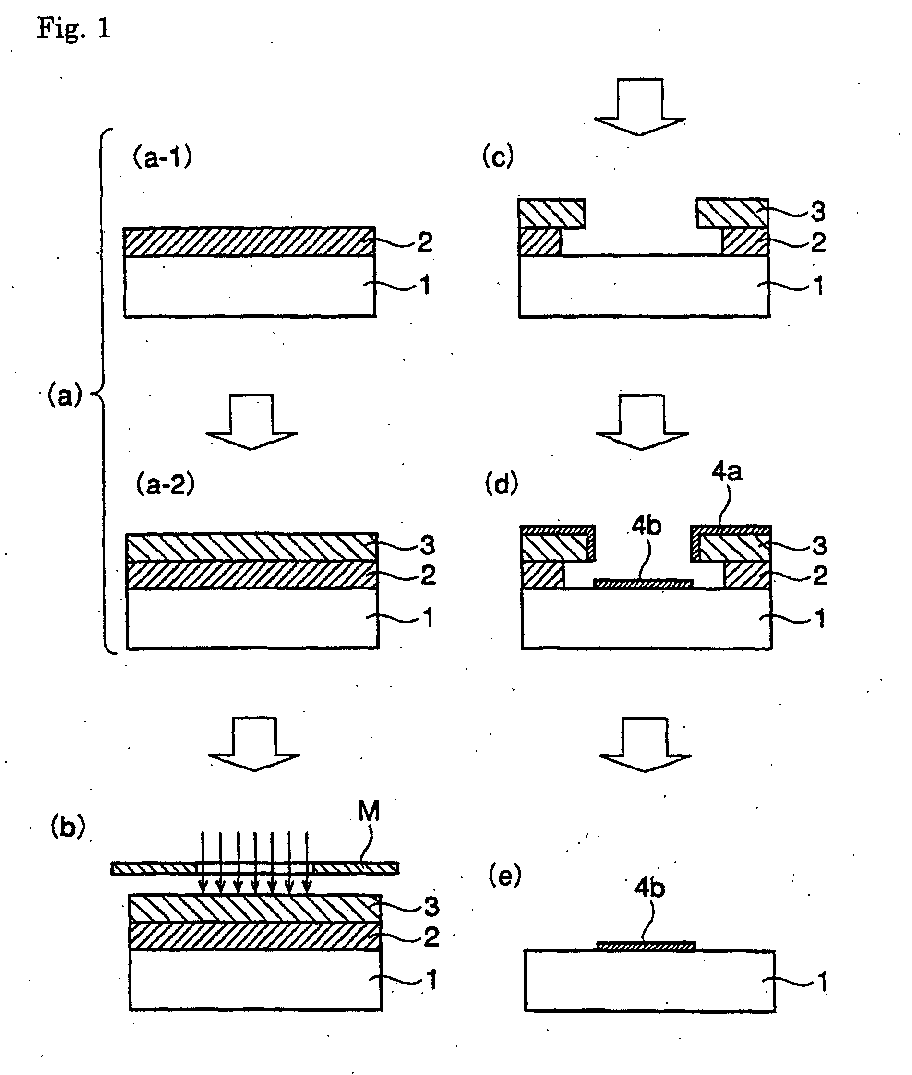
Description
The present invention relates to photofabrication, in
other words precision microfabrication by photolithography
technique. More particularly, the invention relates to a
lift-off process using a two-layer resist.
Lift-off is a general term for a process of forming a
pattern of organic or inorganic thin layers by:
As a consequence, the organic or inorganic substance
found in the orifices of the resist layer remains there to form
a desired pattern.
In this lift-off process, the resist pattern profile is
very important. For example, positive resists will typically
produce a pattern which tapers forward as shown in Fig. 2(c).
Releasing of this forward tapered resist will result in a
pattern of layers having burrs on their edges as shown in Fig.
2(d).
A specific example will be given with respect to the
processing of MR magnetic head sliders. Here, the aforesaid
lift-off process is used to form a DLC (diamond like carbon)
layer on an ABS (air bearing surface) for the purpose of pad
protection. As described above, the lift-off process can
produce burrs on the edges of DLC layers. The burrs on the
DLC layers can scratch the magnetic recording disks of HDD (hard
disk drive) or can be a foreign object to cause HDD failures.
With such problems, it will be effective to use negative
resists or image reversal resists which can be formed into a
reverse tapered pattern. As shown in Fig. 3(c), the orifices
of this reverse tapered layer have a larger size in the bottom
than in the top, so that the formation of burrs can be prevented.
However, this method in general has a difficult control
of the resist pattern profile. Further, it is difficult to
observe the resist pattern with a light microscope and also
to release the resist layer which has been hardened.
In respect to the workpiece surface as a substrate, it
will usually have irregularities, which are relatively large
for the thickness of applied resist, as a result of the process
steps the workpiece has undergone. Because of this, it has
been difficult to form a resist layer in uniform thickness.
In the above processing of MR magnetic heads, a number
of strip pieces called row bars are processed as being stuck
on a jog with their ABS upward. Since these row bars have a
gap between the neighboring ones, a direct application of a
liquid resist is impossible; therefore, a resist film such as
a dry film is generally employed instead.
From the viewpoint of improving the productivity of
workpieces, there has been a need for a technology which can
be incorporated into the production process without disrupting
the flow of process steps and by which a pattern can be readily
formed on a workpiece surface.
The present inventors studied earnestly in view of the
aforesaid circumstances. As a result, they have developed a
two-layer laminate that comprises a resist layer (I) formed
from a specific positive radiation-sensitive resin
composition 1 and a resist layer (II) formed from a specific
positive radiation-sensitive resin composition 2. This
two-layer laminate can be formed into an undercut resist
pattern by single photoexposure and development. Thus, the
patterning method using the two-layer laminate can produce a
burr-free layer with ease. The present invention has been
completed based on these findings.
It is an object of the invention to provide a resist layer
which can leave a burr-free layer on a substrate with ease,
and a patterning method using the same.
The two-layer laminate according to the invention
comprises:
The patterning method according to the invention
comprises a step of forming a two-layer laminate comprising:
The patterning method preferably comprises the steps of:
In the positive radiation-sensitive resin composition
1, the radical polymer (A) is preferably insoluble in water,
soluble in an alkaline aqueous solution and insoluble or hardly
soluble in the solvent (F).
In the positive radiation-sensitive resin composition
2, the solvent (F) is preferably 2-heptanone.
Preferably, the resist layer (I) has a thickness of 0.1
to 3µm and the resist layer (II) has a thickness of 1 to 20µm.
In the above patterning method, the substrate in the step
(a) is preferably an ABS (air bearing surface) of magnetic head
slider and the organic thin layer in the step (d) is preferably
a DLC (diamond like carbon) layer.
The two-layer laminate according to the invention
comprises:
First, these resin compositions 1 and 2 will be described
in detail.
The positive radiation-sensitive resin composition 1
(hereinafter the "composition 1") desirably comprises:
The radical polymer containing a hydroxyl group and/or
a carboxyl group (hereinafter the "polymer (A)") comprises
repeating units that result from the cleavage of carbon-carbon
double bonds among:
There are broadly two types of the radically
polymerizable compounds having a hydroxyl group (monomer I) :
monomers with an alcoholic hydroxyl group and monomers with
a phenolic hydroxyl group.
Examples of the monomers with an alcoholic hydroxyl group
include hydroxyalkyl esters, such as 2-hydroxyethyl acrylate,
2-hydroxyethyl methacrylate and 2-hydroxypropyl
methacrylate; and vinyl esters of fatty acids that will produce
an alcoholic hydroxyl group upon hydrolysis after
polymerization, such as vinyl formate, vinyl acetate and vinyl
propionate. These compounds may be used either individually
or in combination of two or more kinds. Of the compounds, the
hydroxyalkyl esters are preferable, and 2-hydroxyethyl
methacrylate and 2-hydroxyethyl acrylate are more preferable.
Examples of the monomers with a phenolic hydroxyl group
include p-hydroxystyrene, m-hydroxystyrene, o-hydroxystyrene,
α-methyl-p-hydroxystyrene, α-methyl-m-hydroxystyrene,
α-methyl-o-hydroxystyrene, 4-isopropenylphenol,
2-allylphenol, 4-allylphenol, 2-allyl-6-methylphenol,
2-allyl-6-methoxyphenol, 4-allyl-2-methoxyphenol,
4-allyl-2,6-dimethoxyphenol and
4-allyloxy-2-hydroxybenzophenone. These compounds may be
used either individually or in combination of two or more kinds.
Of the compounds, p-hydroxystyrene and 4-isopropenylphenol
are preferred.
The radically polymerizable compound having a carboxyl
group (monomer II) may be exemplified with:
These compounds may be used either individually or in
combination of two or more kinds. Of the compounds, acrylic
acid, methacrylic acid and 2-hexahydrophthaloylethyl
methacrylate are preferred.
The another radically polymerizable compound (monomer
III) is used for the main purpose of appropriately controlling
mechanical properties of the polymer; in other words, for
controlling the glass transition temperature of the polymer.
The "another" refers that it is of a different kind from the
monomers I and II.
The monomer III may be exemplified with alkyl
(meth)acrylates, aryl (meth)acrylates, dicarboxylic acid
diesters, aromatic vinyls, conjugated diolefins, nitrile
group-containing polymerizable compounds,
chlorine-containing polymerizable compounds, polymerizable
compounds having amide linkages, and vinyl esters of fatty
acids. Specific examples include:
These compounds may be used either individually or in
combination of two or more kinds. Of the compounds, the alkyl
acrylates, particularly n-butyl acrylate, can be suitably
used.
The radical copolymerization of both or either the
monomer I and/or the monomer II, and the monomer III produces
the polymer (A) for use in the invention. Preferably, all the
monomers I to III will be radically copolymerized to give the
polymer.
When the polymer (A) has been obtained by the radical
polymerization of the monomers I, II and III, the polymer (A)
desirably has the proportions of structural units derived from
the monomers I to III (hereinafter the monomer I (II or III)
unit content) of:
Further, when the polymer (A) has been obtained by the
radical polymerization of either the monomer I or the monomer
II and the monomer III, the polymer (A) desirably has:
The synthesis of the polymer (A) may be carried out in
a polymerization solvent. Examples of the solvent include:
The catalyst used in the above radical polymerization
may be a conventional radical polymerization initiator.
Examples of such polymerization catalysts include:
In view of developability and adhesive properties of the
resist layer (I) formed from the composition 1, the polymer
(A) preferably has a weight-average molecular weight of 2,000
to 100,000, and more preferably 5,000 to 50,000. The
weight-average molecular weight less than 2,000 will cause the
development to proceed too quickly; whereas that exceeding
100,000 will result in too long a development time. In any
cases, the resolution will be remarkably deteriorated. In the
present specification, all the weight-average molecular
weights are the values in terms of polystyrene according to
GPC.
In order to obtain good developability and to form a
desirable undercut resist pattern, the polymer (A) preferably
is insoluble in water but is soluble in an alkaline aqueous
solution. Since the resist layer (I) is laminated with the
resist layer (II) , the polymer (A) is preferably insoluble or
hardly soluble in a solvent (F) so that these layers will not
mix with each other. The solvent (F) will be described later.
The polymer (A) being insoluble in water means that it
has substantially no solubility in water. Hence, the polymer
may dissolve in an amount of 0.1g or less when it is in 100g
of water at 25C°.
The polymer (A) being soluble in an alkaline aqueous
solution means that the alkali development may be suitably
carried out. Specifically, an alkaline aqueous solution, for
example 100g of an aqueous solution of 2.38 wt% of
tetramethylammonium hydroxide having a temperature of 25°C,
will dissolve the polymer (A) in an amount of preferably 5g
or more. The alkali to make the alkaline aqueous solution is
not particularly limited. Exemplary alkalis will be listed
later with respect to the preparation of alkaline developer.
Since the polymer (A) has no or little solubility in the
solvent (F), it will not substantially dissolve or will
dissolve very slightly in the solvent. Specifically, the
polymer (A) may dissolve in an amount of not more than 0.1g
in the solvent (F), for example 100g of 2-heptanone at 25°C.
The quinonediazido group-containing compound works as
a photosensitizer. It is used for the purpose that the
development of the two-layer resist film will proceed properly
to allow for a margin time for controlling the depth of recessed
space W in the undercut. The recessed space W of the undercut
indicates an area in the bottom orifice in the lower layer 2
that does not overlap with the top orifice in the upper layer
3 (see Fig. 1(d)).
Exemplary quinonediazido group-containing compounds
include esters, partial esters, amides and partial amides
formed between:
The resin composition 1 for lower layer production
contains at least one of the above quinonediazido
group-containing compounds.
Of the above reaction products, an ester formed between
1 mol of 4,4'-[1-[4-[1-(4-hydroxyphenyl)-1-methylethyl]phenyl]ethylidene]diphenol
and 1.0 mol of
naphthoquinone-1,2-diazido-5-sulfonyl chloride, is
preferred.
Desirably, the quinonediazido group-containing
compound (B) will be used in an amount of 5 to 60 parts by weight,
preferably 10 to 50 parts by weight, and more preferably 15
to 30 parts by weight based on 100 parts by weight of the radical
polymer (A). When the amount is less than 5 parts by weight,
the dissolution rate toward the alkali developer will hardly
differ between exposed and non-exposed areas. On the other
hand, the amount exceeding 60 parts by weight may result in
lowered adhesive properties of the resultant resist layer (I)
to the substrate.
The solvent (C) used in the composition 1 may be
exemplified with ethylene glycol monomethyl ether, ethylene
glycol monoethyl ether, ethylene glycol monomethyl ether
acetate, ethylene glycol monoethyl ether acetate, diethylene
glycol monomethyl ether, diethylene glycol monoethyl ether,
propylene glycol monomethyl ether acetate, propylene glycol
monopropyl ether acetate, ethyl 2-hydroxypropionate, ethyl
2-hydroxy-2-methylpropionate, ethyl ethoxyacetate, ethyl
hydroxyacetate, methyl 2-hydroxy-3-methylbutanoate, methyl
3-methoxypropionate, ethyl 3-ethoxypropionate, ethyl
3-methoxypropionate, butyl acetate, methyl pyruvate, ethyl
pyruvate and so forth. The above solvent may be used with a
high boiling solvent, such as N-methylformamide,
N,N-dimethylformamide, N-methylformanilide,
N-methylacetamide, N,N-dimethylacetamide,
N-methylpyrrolidone, dimethylsulfoxide, benzyl ethyl ether,
dihexyl ether, acetonylacetone, isophorone, caproic acid,
caprylic acid, 1-octanol, 1-nonanol, benzyl alcohol, benzyl
acetate, ethyl benzoate, diethyl oxalate, diethyl maleate,
γ-butyrolactone, ethylene carbonate, propylene carbonate or
ethylene glycol monophenyl ether acetate. These solvents may
be used either individually or in combination of two or more
kinds. Of the solvents, ethyl 2-hydroxypropionate is
preferred.
Since the composition 1 will be spin coated to a thickness
of 5µm or less, the solvent is desirably added to make the
composition 1 have a solids content of 5 to 50 wt%, and more
preferably 10 to 25 wt%. That is, the solvent is desirably
used in an amount of 100 to 1900 parts by weight, and preferably
300 to 900 parts by weight based on 100 parts by weight of the
components (A) and (B).
The composition 1 may contain another additive. For
example, a surfactant may be added to improve application,
defoaming and leveling properties of the composition.
Suitable surfactants include:
Preferably, the surfactant (s) will be used in an amount
of not more than 5 parts by weight, and more preferably from
0.01 to 2 parts by weight based on 100 parts by weight of the
radical polymer (A).
The positive radiation-sensitive resin composition 2
(hereinafter the "composition 2") for upper layer production
desirably comprises:
The another component is preferably a radical polymer
with a hydroxyl and/or carboxyl group or an additive such as
a surfactant.
The polymer containing a phenolic hydroxyl group may be
exemplified with the following novolak resins,
polyhydroxystyrenes and derivatives thereof. These may be
used either individually or in combination.
The novolak resin used in the invention has an alkali
solubility and is obtained as a condensation product of
m-cresol, one or more other phenols and an aldehyde compound.
The alkali soluble novolak resin is not particularly limited,
provided that the m-cresol has a proportion of 40 to 90 mol%
of all the phenols.
The one or more other phenols used in the production of
novolak resins may be selected from, for example, 2, 3-xylenol,
2,4-xylenol, 2,5-xylenol, 3,4-xylenol, 3,5-xylenol and
2,3,5-trimethylphenol. Thesemay be used either individually
or in combination.
Of the above phenols, 2,3-xylenol, 2,4-xylenol,
3,4-xylenol and 2,3,5-trimethylphenol are preferable.
Preferred examples of m-cresol/phehol(s) combinations
include m-cresol/2,3-xylenol, m-cresol/2,4-xylenol,
m-cresol/2,3-xylenol/3,4-xylenol,
m-cresol/2,3,5-trimethylphenol and
m-cresol/2,3-xylenol/2,3,5-trimethylphenol.
Suitable aldehyde compounds for the condensation
include formaldehyde, paraformaldehyde, acetaldehyde,
benzaldehyde, o-hydroxybenzaldehyde, m-hydroxybenzaldehyde,
p-hydroxybenzaldehyde, glyoxal, glutaraldehyde,
terephthalaldehyde and isophthalaldehyde. Of these,
formaldehyde and o-hydroxybenzaldehyde are particularly
suitable for use.
These aldehyde compounds may be used either individually
or in combination or two or more kinds. Preferably, the
aldehyde compound (s) will be used in an amount of 0.4 to 2 mol,
and more preferably 0. 6 to 1. 5 mol based on 1 mol of the phenols.
The condensation between the phenols and the aldehyde
compound is usually carried out in the presence of an acid
catalyst. Exemplary acid catalysts include hydrochloric acid,
nitric acid, sulfuric acid, formic acid, oxalic acid, acetic
acid, methanesulfonic acid and p-toluenesulfonic acid.
Generally, the acid catalyst may be used in an amount of 1×10⁻⁵
to 5×10⁻¹ mol based on 1 mol of the phenols.
The condensation will be usually conducted in water as
reaction medium. When it is expected that a heterogeneous
system should be caused from an early stage of the reaction,
the water as the reaction medium may be replaced by:
The reaction medium may be used in an amount of 20 to
1,000 parts by weight based on 100 parts by weight of the
reactants.
Although the condensation temperature may be
appropriately controlled depending on the reactivity of the
reactants, it is generally in the range of 10 to 200°C.
The condensation reaction may be carried out in an
appropriate manner; for example either:
After completion of the condensation, the objective
novolak resin will be obtained by separating it from the
unreacted reactants, the acid catalyst, the reaction medium,
etc. remaining in the system. For example, this separation
can be made through a process in which:
The above good solvents include ethylene glycol
monomethyl ether acetate, methyl 3-methoxypropionate, ethyl
lactate, methyl isobutyl ketone, 2-heptanone, dioxane,
methanol and ethyl acetate.
The novolak resin preferably has a weight-average
molecular weight in terms of polystyrene (hereinafter the
"Mw") of 2,000 to 20,000, and particularly preferably from
3,000 to 15,000; these ranges are preferable in view of good
workability of the composition 2, and also developability,
sensitivity and heat resistance of the resulting resist layer.
Suitable polyhydroxystyrenes include those
commercially available resins: MARUKA LYNCUR M, MARUKA LYNCUR
CMM, MARUKA LYNCUR CHM, MARUKA LYNCUR MB, MARUKA LYNCUR PHM-C,
MARUKA LYNCUR CST and MARUKA LYNCUR CBA (Maruzen Petrochemical
Co., Ltd.)
The quinonediazido group-containing compound (E) may be
selected from the quinonediazido group-containing compounds
(B) listed with respect to the composition 1.
Here, preferred reaction products as the quinonediazido
group-containing compounds (E) include an ester formed between
1 mol of 4,4'-[1-[4-[1-(4-hydroxyphenyl)-1-methylethyl]phenyl]ethylidene]diphenol
and 2.0 mol of
naphthoquinone-1,2-diazido-5-sulfonyl chloride; and an ester
formed between 1 mol of 7-hydroxy-4-(4'-hydroxyphenyl)-2-methyl-2-(2',4'-dihydroxy)phenylcoumarone
and 2.0 mol of
naphthoquinone-1,2-diazido-5-sulfonyl chloride.
The composition 2 for upper layer production contains
at least one of the quinonediazido group-containing compounds.
Desirably, the quinonediazido group-containing
compound (E) will be used in an amount of 5 to 60 parts by weight,
preferably 10 to 50 parts by weight, and more preferably 15
to 35 parts by weight based on 100 parts by weight of the polymer
(D). When the amount is less than 5 parts by weight, the
dissolution rate toward the alkali developer will hardly
differ between exposed and non-exposed areas. On the other
hand, the amount exceeding 60 parts by weight may result in
a less homogeneous resist layer (II). Thus, the resolution
tends to worsen in any case.
Here, the solvent may be selected from the solvents (C)
listed with respect to the composition 1, and further from
2-heptanone, 3-heptanone, 4-heptanone and cyclohexanone.
Since the resist layer (I) is laminated with the resist
layer (II), the solvent (F) preferably does not or hardly
dissolve the polymer (A) so that these layers will not mix with
each other. In view of that, 2-heptanone, 3-heptanone,
4-heptanone and cyclohexanone are preferable for use.
Taking into the account the fact that the composition
2 will be spin coated to a thickness of 5µm or less, the solvent
is desirably added to make the composition 2 have a solids
content of preferably 5 to 50 wt%, and more preferably 10 to
40 wt%. That is, the solvent is desirably used in an amount
of 100 to 1900 parts by weight, and preferably 150 to 900 parts
by weight based on 100 parts by weight of the components (D)
and (E).
The composition 2 may contain another component.
Examples are:
Although this polymer is not an essential component for
the composition 2, the use thereof leads to enhancements in
application properties and crack resistance. This polymer may
be the same as the polymer (A) used in the composition 1, in
which case it is needless to say that the solvent (F) should
be used that can dissolve the polymer (A).
In the composition 2, the polymer (A) (as the component
(H)) may be used in an amount of not more than 50 parts by weight,
and preferably not more than 30 parts by weight based on 100
parts by weight of the polymer (D) with a phenolic hydroxyl
group.
Although this compound is not an essential component for
the composition 2, the addition thereof improves alkali
solubility and thereby eases control of the resist pattern
profile. The polynuclear phenolic compound may be defined as
a compound with two or more independent benzene rings in the
molecule, at least two of which benzene rings form phenolic
hydroxyl groups as a result of the linkage of a hydroxyl group
somewhere in the benzene ring. Specific examples include
4,4'-[1-[4-[1-(4-hydroxyphenyl)-1-methylethyl]phenyl].
ethylidene]diphenol, methyl 2,2-bis(1,5-dimethyl-4-hydroxyphenyl)propionate
and 4,6-bis[1-(4-hydroxyphenyl)-1-methylethyl]-1,3-benzenediol.
Desirably, the polynuclear phenolic compound will be
used in an amount of 1 to 30 parts by weight, and preferably
5 to 20 parts by weight based on 100 parts by weight of the
polymer (D).
The surfactant for use herein may be selected from the
surfactants listed with respect to the composition 1.
Desirably, the surfactant will be used in an amount of
not more than 5 parts by weight, and preferably from 0.01 to
2 parts by weight based on 100 parts by weight of the polymer
(D).
Next, the two-layer laminate and the patterning method
using the laminate will be described.
The two-layer laminate according to the invention
comprises a resist layer (I) formed from the aforesaid
composition 1 and a resist layer (II) formed from the aforesaid
composition 2.
The patterning method of the invention comprises a step
of forming the above two-layer laminate.
Thus, the two-layer laminate and the patterning method
will be discussed together in the following description.
The patterning method will be explained with reference
to Fig. 1. The method comprises:
In Step (a), an appropriate selection of the combination
of the resin compositions 1 and 2 makes it possible to form
the two-layer laminate by the method of:
That is, the resist layers (I) and (II) may be formed
by a combined process of spin coating/spin coating or
laminating/spin coating (lower layer/upper layer).
For example, when the workpiece surface (substrate) has
relatively minor irregularities, the method (1) may be
selected to simplify the process. For this reason, the former
is generally employed favorably.
The latter method (2) may be favorably employed to obtain
the laminate in a uniform thickness in the case where:
When the lower layer 2 is formed by the laminating method,
it is laminated on the surface of substrate (workpiece) with
heating or warming. The substrates (workpieces) have an upper
limit of endurable temperature that varies from type to type.
For example, heating an MR magnetic head slider as the substrate
at over 100°C is not acceptable since elements found therein
may be damaged by the heat. In such cases, it will be desired
to set the glass transition temperature of the lower layer 2
formed from the composition 1 rather low in order that the lower
layer 2 may be laminated with heating at 100°C or below.
The resist layer (I) (lower layer) thus obtained
preferably has a thickness of 0.1 to 3µm, and more preferably
0.3 to 2µm in terms of control of the resist layer thickness
and control of the size of the deposited and/or sputtered layer.
When the lower layer has a thickness less than 0.1µm, control
of the layer thickness becomes difficult and pinholes may arise.
When the lower layer thickness is over 3µm, the deposition
and/or sputtering will accompany a noticeable diffusion in the
undercut area. As a consequence, difficulties may be caused
in controlling the size of the pattern layer resulting from
the deposition and/or sputtering.
The resist layer (II) (upper layer) preferably has a
thickness of 1 to 20µm in view of performance of patterning
and resistance to heat distortion during the deposition and/or
sputtering for pattern formation. When the upper layer has
a thickness less than 1µm, it will be bent due to the heat in
the deposition and/or sputtering so that the sagged upper part
of the undercut may touch the substrate surface. When the
upper layer thickness is over 20µm, the time for forming the
pattern layer may be prolonged and difficulties may be caused
in controlling the size of the pattern layer formed by the
deposition and/or sputtering.
If the lower layer 2 and the upper layer 3 formed in Step
(a) mix together, such a mixed layer tends to be developed to
leave an undercut that has post development resides on the side
of substrate. Whereas when these two layers do not mix
together at all and do have an interface between them, a
developer will interpenetrate along the interface. The
interpenetrated developer will accelerate the development in
the horizontal direction of the lower layer 2 and the control
of the lateral size of the undercut becomes difficult. The
mixing of the layers may be prevented by providing an interlayer
of water-soluble organic substance. However, this provision
increases a process step. Also, a variable thickness of the
interlayer makes an appropriate development time different
from place to place. Therefore, the resultant resist is liable
to give orifices in variable size. Due to these reasons, the
materials for the lower layer 2 and the upper layer 3 are
preferably selected so that the combination will allow for
appropriate intermixing between the layers.
In Step (c), the two-layer laminate is developed to form
an undercut resist pattern in which the orifices have a larger
size in the bottom than in the top. For successful formation
of such an undercut profile, the resist layer (I) preferably
has a higher dissolution rate than the resist layer (II) toward
the same developer, i.e. an alkaline aqueous solution.
In subsequent Step (d), organic or inorganic thin layers
4a and 4b are formed on the resist pattern laminate and the
exposed substrate by deposition and/or sputtering. This
deposition and/or sputtering step (d) involves heating of the
laminate surface. When the upper layer 3 is insufficient in
heat resistance and/or when the recessed space W of the undercut
is large, the upper periphery of the undercut will be bent due
to the heat. This sagged part may give rise to burrs on the
organic or inorganic thin layer 4b during the deposition and/or
sputtering.
As such, the composition 2 for the production of the upper
layer 3 desirably has an enough heat resistance whereby it can
undergo Step (d) without any adverse results. Preferably, the
lower and upper layers 2 and 3 have a developability enough
to allow for a margin time for controlling the depth of recessed
space W of the undercut.
As has been explained above, the recessed space W of the
undercut indicates an area in the bottom orifice in the lower
layer 2 that does not overlap with the top orifice in the upper
layer 3 (see Fig. 1(d)).
The combination of the compositions 1 and 2 preferably
satisfies the aforesaid conditions.
Each step of the patterning method according to the
invention will be described in more detail with reference to
Fig. 1.
As shown in Fig. 1(a-1), the composition 1 is formed into
the resist layer (I) (lower layer 2 in Fig. 1) on the substrate.
When the substrate has a relatively flat surface, the
composition 1 (solids content: 5 to 50 wt%) may be spin coated
onto the substrate 1. Then the resulting coating (lower layer
2) formed on the substrate may be dried at 200°C or below,
preferably from 70 to 130°C, to produce the lower layer 2.
When the substrate 1 has irregularities on the surface,
the lower layer 2 may be formed through lamination. In this
case:
Laminating conditions may be appropriately determined
based on the material for the substrate 1 and so forth.
Next, as Fig. 1(a-2) illustrates, the composition 2 is
formed into the resist layer (II) (upper layer) over the resist
layer (I). Desirably, for example, the composition 2 will be
spin coated onto the resist layer (I) (lower layer 2 in Fig.
1) and the resultant coating will be dried at 200°C or below,
preferably from 70 to 130°C, to produce the resist layer (II)
(upper layer 3 in Fig. 1).
The resist layer (II) (upper layer 3 in Fig. 1) also may
be formed through lamination. In this case:
Further, the lower and upper layers 2 and 3 may be formed
on the substrate 1 by a single lamination process, in which
the compositions are successively formed into the lower and
upper layers on a substrate, such as PET, and the bilayer film
is laminated on the substrate 1 with a laminator.
Next, the laminate comprising the lower and upper layers
2 and 3 is exposed through a given mask M to radiation, thereby
forming a latent pattern. Radiation sources include
low-pressure, high-pressure and super-high-pressure mercury
lamps, metal halide lamps and argon gas lasers. The radiation
includes ultraviolet rays (UV light), visible rays, far
ultraviolet rays, X rays and electron beams. Of these
radiations, UV light and electron beams are preferred for their
handling properties. In the above exposure for latent
patterning, the radiation is preferably applied to the
laminate in a dose of 100 to 1500 mJ/cm2, and more preferably
300 to 1000 mJ/cm2.
The exposed laminate is then developed with an alkaline
developer. Exemplary developing methods include dipping,
paddling and showering. As a consequence, the exposed area
of the laminate alone is dissolved and removed to leave a
desired resist pattern as shown in Fig. 1(c). This resist
pattern has an undercut profile which is wider in the bottom
than in the top.
The developer used herein may be an alkaline aqueous
solution, such as of sodium hydroxide, potassium hydroxide,
sodium carbonate, sodium silicate, sodium metasilicate,
aqueous ammonia, ethylamine, n-propylamine, diethylamine,
di-n-propylamine, triethylamine, methyldiethylamine,
dimethylethanolamine, triethanolamine, tetramethylammonium
hydroxide, tetraethylammonium hydroxide, pyrrole, piperidine,
1,8-diazabicyclo[5,4,0]-7-undecene or
1,5-diazabicyclo[4,3,0]-5-nonane.
The alkaline aqueous solution may be mixed with an
appropriate amount of water-soluble organic solvent, such as
methanol or ethanol, or water-soluble surfactant. After the
development, the substrate and the resist pattern are rinsed
with water or the like and then dried.
A further step may be incorporated between the above
steps; for example the following may be appropriately carried
out:
The compositions 1 and 2 have a very good alkali
solubility, thus so do the resist layers (I) and (II). Further,
the resist layer (I) has a higher dissolution rate than the
resist layer (II) toward the same developer. These features
make it possible to form an undercut resist pattern with high
reproducibility.
The resist pattern is easy to release. Moreover, it is
possible to observe the resist pattern with a light microscope
to confirm the undercut profile. These features allows for
easy pattern release and re-patterning when the resist
obtained does not have a desired undercut profile.
As shown in Fig. 1(d), the organic or inorganic thin
layers 4a and 4b are formed by deposition and/or sputtering
through the undercut resist pattern obtained above. The
thickness of these organic or inorganic thin layers is not
particularly limited, but is preferably smaller than the
thickness of the lower layer 2 in order to control the shape
of the thin layers.
The deposition and/or sputtering can cause a vertical
anisotropy in the resultant thin layer. Therefore, the
diameter of the orifice in positive resist upper layer 3 and
the thickness of the lower layer 2 should be determined
carefully. This is important to form the thin layer 4b in a
controlled shape. Effective deposition and/or sputtering
methods include PVD (physical vapor deposition) such as vacuum
deposition and sputtering.
After the thin layers 4a and 4b have been formed in above
Step (d), the laminate is released together with the thin layer
4a found on the laminate. As a consequence, the thin layer
4b alone remains to define an objective pattern.
The releasing of the resist together with the thin layer
4a to form the pattern 4b may be carried out using a solvent
which has been conventionally used in the releasing of positive
resists. Exemplary solvents include ethylene glycol
monomethyl ether, ethylene glycol monoethyl ether, ethylene
glycol monomethyl ether acetate, ethylene glycol monoethyl
ether acetate, diethylene glycol monomethyl ether, diethylene
glycol monoethyl ether, propylene glycol monomethyl ether
acetate, propylene glycol monopropyl ether acetate, acetone,
ethyl 2-hydroxypropionate, ethyl
2-hydroxy-2-methylpropionate, ethyl ethoxyacetate, ethyl
hydroxyacetate, methyl 2-hydroxy-3-methylbutanoate, methyl
3-methoxypropionate, ethyl 3-ethoxypropionate, ethyl
3-methoxypropionate, butyl acetate, methyl pyruvate, ethyl
pyruvate and so forth. Also usable are high boiling solvents,
such as N-methylformamide, N,N-dimethylformamide,
N-methylformanilide, N-methylacetamide,
N,N-dimethylacetamide, N-methylpyrrolidone,
dimethylsulfoxide, benzyl ethyl ether, dihexyl ether,
acetonylacetone, isophorone, caproic acid, caprylic acid,
1-octanol, 1-nonanol, benzyl alcohol, benzyl acetate, ethyl
benzoate, diethyl oxalate, diethyl maleate, γ-butyrolactone,
ethylene carbonate, propylene carbonate and ethylene glycol
monophenyl ether acetate.
Although the releasing of the resist pattern can be made
at room temperature, the releasability may be increased by
raising the temperature.
Otherwise, the substrate with the resist pattern may be
overall exposed to UV light before the releasing. Upon UV
light exposure, the photosensitizer contained either in both
the upper and lower layers or in the upper layer will decompose
to make the resist pattern easily releasable. After this
treatment, the releasing may be accomplished at room
temperature only by dipping the substrate in the aforesaid
developer or a solvent which has little corrosiveness, such
as ethyl alcohol or isopropyl alcohol.
According to the invention, a fine resist pattern having
an undercut cross section may be formed on a substrate by single
exposure and development. The lift-off process using the
resist pattern can produce a desired pattern of (organic or
inorganic) thin layers on the substrate.
The fine resist pattern with an undercut cross section
can be obtained by single photoexposure and development, can
be observed with a light microscope to confirm the undercut
profile, and can be released easily. With these advantages
in the production process, the use of the invention leads to
enhancement in productivity of workpieces.
Having the above effects, the patterning method of the
invention is suitable for the production of DLC (diamond like
carbon) layers on ABS (air bearing surfaces) of magnetic heads.
The present invention will be hereinafter described in
detail by the following Examples, but it should be construed
that the invention is in no way limited to those Examples.
Hereinafter, "parts" and "%" are by weight unless otherwise
mentioned.
The following is a description of the components (A) to
(H) that were used in the preparation of compositions (1-1)
to (1-7) for lower layer production and compositions (2-1) to
(2-2) for upper layer production.
A flask equipped with a dry ice/methanol reflux condenser
and a thermometer was purged with nitrogen. The flask was
charged with a polymerization initiator: 3.0g of
2,2'-azobisisobutyronitrile, and a solvent: 150g of ethyl
2-hydroxypropionate. They were stirred together until the
polymerization initiator dissolved in the solvent.
Subsequently, 43g of 4-isopropenylphenol (monomer I), 30.8g
of n-butyl acrylate (monomer III), 2.9g of acrylic acid
(monomer II) and 23. 3g of 2-hydroxyethyl acrylate (monomer I)
were introduced into the flask. The contents were stirred
slowly to give a solution, which thereafter was heated to 70°C.
Thus, polymerization was carried out at the temperature for
3 hours. The polymerization initiator
2,2'-azobisisobutyronitrile was further added in an amount of
1.5g, and the polymerization was continued for another 3 hours
at 70°C. Then, the solution was allowed to cool to room
temperature. The gas in the flask was replaced with air.
After addition of 150mg of p-methoxyphenol, the solution
obtained by the above reaction was added dropwise to a large
quantity of methanol to solidify the reaction product. The
reaction product was washed with water, redissolved in
tetrahydrofuran of equal weight as the reaction product, and
resolidified in a large amount of methanol. This operation
through redissolution to resolidification was repeated three
times. The solidified product thus obtained was vacuum dried
at 40°C for 48 hours to yield a radical polymer A-1.
The above procedure for synthesizing the polymer A-1 was
repeated except that:
The above procedure for synthesizing the polymer A-1 was
repeated except that:
A flask equipped with a dry ice/methanol reflux condenser
and a thermometer was purged with nitrogen. The flask was
charged with a polymerization initiator: 3.0g of
2,2'-azobisisobutyronitrile, and a solvent: 225g of ethyl
2-hydroxypropionate. They were stirred together until the
polymerization initiator dissolved in the solvent.
Subsequently, 75.0g of 2-hydroxyethyl methacrylate (monomer
I), 60.0g of n-butyl acrylate (monomer III) and 15.0g of
2-hexahydrophthaloylethyl methacrylate (monomer II) were
introduced into the flask. The contents were stirred slowly
to give a solution, which thereafter was heated to 80°C. Thus,
polymerization was carried out at the temperature for 4 hours.
Then, the solution was allowed to cool to room temperature.
The gas in the flask was replaced with air. After addition
of 150mg of p-methoxyphenol, the solution obtained by the above
reaction was added dropwise to a large quantity of methanol
to solidify the reaction product. The reaction product was
washed with water, redissolved in tetrahydrofuran of equal
weight as the reaction product, and resolidified in a large
amount of methanol. This operation through redissolution to
resolidification was repeated three times. The solidified
product thus obtained was vacuum dried at 40°C for 48 hours
to yield a radical polymer A-4.
The above procedure for synthesizing the polymer A-4 was
repeated except that:
The above procedure for synthesizing the polymer A-4 was
repeated except that:
As the quinonediazido group-containing compound, use
was made of:
The solvent used was:
m-Cresol, 2,3-xylenol and 3,4-xylenol were mixed
together in a proportion of 80:10:10 (by weight). After
addition of formalin, the resultant mixture was condensed by
a conventional method under catalysis by oxalic acid to give
a cresol novolak. The resin was then subjected to
fractionation to remove low molecular weight fractions. Thus,
a novolak resin D-1 with a weight-average molecular weight of
10,000 was obtained.
m-Cresol and p-cresol were mixed together in a proportion
of 40:60 (by weight). After addition of formalin, the
resultant mixture was condensed by a conventional method under
catalysis by oxalic acid to give a cresol novolak. The resin
was then subjected to fractionation to remove low molecular
weight fractions. Thus, a novolak resin D-2 with a
weight-average molecular weight of 15,000 was obtained.
m-Cresol and 3,5-xylenol were mixed together in a
proportion of 80:20 (by weight). After addition of formalin,
the resultant mixture was condensed by a conventional method
under catalysis by oxalic acid to give a cresol novolak. The
resin was then subjected to fractionation to remove low
molecular weight fractions. Thus, a novolak resin D-3 with
a weight-average molecular weight of 15,000 was obtained.
The solvent used was either:
The surfactant used was:
The polynuclear phenolic compound used was the
following.
Polynuclear phenolic compound 1: 4,4'-[1-[4-[1-(4-hydroxyphenyl)-1-methylethyl]phenyl]ethylidene]diphenol
A solution was made from:
The solution was filtered through a membrane filter with
pores of 1µm diameter. The composition (1-1) was thus
obtained.
These compositions were prepared from the components
given in Table 1 in the same manner as for the composition (1-1).
A uniform solution was prepared from:
The solution was filtered through a membrane filter with
pores of 3µm diameter. Thus, the composition (2-1) was
obtained in 35% solids content.
A solution was prepared from:
The solution was filtered through a membrane filter with
pores of 3µm diameter. Thus, the composition (2-2) was
obtained in 38% solids content.
The composition (1-1) was dropped on a silicon wafer and
spin coated thereon. The resultant coating was baked on a hot
plate at 100°C for 10 minutes to give a resist layer (I) (under
layer). Thereafter, the composition (2-1) was dropped and
spin coated on the above-formed under layer. The coating was
baked on a hot plate at 100°C for 5 minutes to give a resist
layer (II) (upper layer). A two-layer laminate was thus
obtained.
After the lower and upper layers had been formed on the
substrate, the top surface of the laminate was observed with
a light microscope. The surface condition was evaluated as
either A or B based on the following criteria. The results
are set forth in Table 3.
- Application properties
-
- A: the layers were uniform overall on the substrate
- B: the layers had released partially and had holes, i.e., the layers were not uniform overall on the substrate
The substrate having the layers evaluated above as A
(good application properties) was then subjected to a
measurement of the thicknesses of lower and upper layers. The
measurement was made with a stylus-type film thickness gauge.
The thickness of the upper layer was obtained by subtracting
the thickness of the lower layer from the thickness of the
two-layer laminate. The results are set forth in Table 3.
The substrate having the layers evaluated above as A
(good application properties) was photoexposed and thereafter
developed with an alkaline aqueous solution. This patterning
process was carried out under the conditions of:
After the development, the pattern profile obtained was
evaluated through observation with a light microscope, and
also with a scanning electron microscope depending on the need.
The evaluation was made with respect to the round holes which
have a diameter of 20µm and which are away from the neighboring
holes at a spacing of 40µm (60µm pitch).
The developability was evaluated as either A or B based
on the following criteria. The results are set forth in Table
3.
The substrate with the resist pattern evaluated above
as A (good developability) was post baked on a hot plate at
80°C for 10 minutes. This substrate was used to form a DLC
layer thereon and to evaluate the DLC layer.
The DLC layer was manufactured with use of DLC-150S
(available from Shimadzu Corporation).
In the formation of the DLC layer, the substrate having
the pattern was first pretreated. The pretreatment was made
by cleaning their surfaces by sputtering, and depositing on
the cleaned surfaces Si in an approximate thickness of 20Å.
Thereafter, a DLC layer was deposited in a thickness of 250
to 300Å. Here, the degree of vacuum was 5×10⁻³ Torr.
Thereafter, the substrate, which then had the DLC layer
on the surface, was dipped in N-methylpyrrolidone at 100°C for
about 10 minutes. As a result, the resist released. The
substrate was then rinsed several times with acetone and
thereafter blow dried.
After the release of the resist layer, the revealed
surface was observed with a light microscope. The surface
state was evaluated based on the following criteria. The
results are set forth in Table 3.
- Releasability
-
- A: release treatment left no residues on the substrate surface
- B: release treatment left residues on the substrate surface
The thus-obtained DLC pattern was observed with an AFM
(atomic force microscope) to evaluate the figuration of the
pattern based on the following criteria. The results are set
forth in Table 3.
The substrate with the resist pattern evaluated above
as A (good developability) was post baked on a hot plate at
80°C for 10 minutes. This substrate was used to form an alumina
layer thereon and to evaluate the alumina layer. The alumina
layers are used as insulating layers in gaps between GMR
elements.
The alumina layer was manufactured with use of MPS-GA-LTS
(available from Nippon Inc.).
In the formation of the alumina layer, the substrate
having the pattern was first pretreated. The pretreatment was
made by cleaning their surfaces by sputtering, and depositing
on the cleaned surfaces an alumina layer in a thickness of 1500
to 1600Å. Here, the degree of vacuum was 5×10⁻⁵ Torr and the
substrate temperature was set at about 70°C. The rate in
forming the alumina layer was about 100Å/min.
The evaluations of the figuration of the alumina layer
and the releasability of the resist layer were made exactly
in the same manners as for the DLC layer. The results are set
forth in Table 3.
The procedure of Example 1 was repeated except that the
composition 1 for lower layer production was changed from (1-1)
to (1-2). The composition 2 for upper layer production was
unchanged. These are specified in Tables 1 and 2. The results
are set forth in Table 3.
The procedure of Example 1 was repeated except that the
composition 1 for lower layer production was changed from (1-1)
to (1-3). The composition 2 for upper layer production was
unchanged. These are specified in Tables 1 and 2. The results
are set forth in Table 3.
The procedure of Example 1 was repeated except that the
composition 1 for lower layer production was changed from (1-1)
to (1-4) and that the layers thickness was altered. The
composition 2 for upper layer production was unchanged. These
are specified in Tables 1 and 2. The results are set forth
in Table 3.
The procedure of Example 1 was repeated except that the
composition 1 for lower layer production was changed from (1-1)
to (1-4), that the lower layer was produced through lamination
as described below, and that the layers thickness was altered.
The composition 2 for upper layer production was unchanged.
These are specified in Tables 1 and 2. The results are set
forth in Table 3.
The composition (1-4) was dropped on a PET film and spin
coated thereon. The resultant coating was baked in an oven
at 100°C for 5 minutes to give a film. Thereafter, the film
was laminated on a silicon wafer and the PET film was released
from the laminate. Thus, a resist layer (I) (under layer) was
formed on the substrate. The laminating conditions were as
follows:
Thereafter, the composition (2-1) was dropped and spin
coated on the above-formed under layer. The coating was baked
on a hot plate at 100°C for 5 minutes to give a resist layer
(II) (upper layer). A two-layer laminate was thus obtained.
The procedure of Example 4 was repeated except that the
composition 2 for upper layer production was changed from (2-1)
to (2-2). The composition 1 for lower layer production was
unchanged. These are specified in Tables 1 and 2. The results
are set forth in Table 3.
The procedure of Example 5 was repeated except that the
composition 2 for upper layer production was changed from (2-1)
to (2-2). The composition 1 for lower layer production was
unchanged. These are specified in Tables 1 and 2. The results
are set forth in Table 3.
The procedure of Example 5 was repeated except that the
composition 1 for lower layer production was changed from (1-4)
to (1-5) and that the composition 2 for upper layer production
was changed from (2-1) to (2-2). These are specified in Tables
1 and 2. The results are set forth in Table 3.
The procedure of Example 5 was repeated except that the
composition 1 for lower layer production was changed from (1-4)
to (1-6) and that the composition 2 for upper layer production
was changed from (2-1) to (2-2). These are specified in Tables
1 and 2. The results are set forth in Table 3.
The procedure of Example 4 was repeated except that the
composition 1 for lower layer production was changed from (1-4)
to (1-7). The composition 2 for upper layer production was
unchanged. These are specified in Tables 1 and 2. The results
are set forth in Table 3.
The procedure of Example 5 was repeated except that the
composition 1 for lower layer production was changed from (1-4)
to (1-7). The composition 2 for upper layer production was
unchanged. These are specified in Tables 1 and 2. The results
are set forth in Table 3.
The procedure of Example 6 was repeated except that the
composition 1 for lower layer production was changed from (1-4)
to (1-7). The composition 2 for upper layer production was
unchanged. These are specified in Tables 1 and 2. The results
are set forth in Table 3.
The procedure of Example 7 was repeated except that the
composition 1 for lower layer production was changed from (1-4)
to (1-7). The composition 2 for upper layer production was
unchanged. These are specified in Tables 1 and 2. The results
are set forth in Table 3.

| Composition 1 (lower layer) | ||||
| Sample No. | Radical polymer (A) | Quinonediazido group-containing compound (B) | Solvent (C) | Surfactant (G) |
| 1-1 | A-1/ 100 parts | B-1/ 20 parts | EL/ 680 parts | NBX-15/ 0.2 part |
| 1-2 | A-2/ 100 parts | B-1/ 20 parts | EL/ 680 parts | NBX-15/ 0.2 part |
| 1-3 | A-3/ 100 parts | B-1/ 20 parts | EL/ 680 parts | NBX-15/ 0.2 part |
| 1-4 | A-4/ 100 parts | B-1/ 20 parts | EL/ 480 parts | NBX-15/ 0.2 part |
| 1-5 | A-5/ 100 parts | B-1/ 20 parts | EL/ 480 parts | NBX-15/ 0.2 part |
| 1-6 | A-6/ 100 parts | B-1/ 20 parts | EL/ 480 parts | NBX-15/ 0.2 part |
| 1-7 | A-4/ 100 parts | None | EL/ 400 parts | NBX-15/ 0.2 part |
| Composition 2 (upper layer) | |||||
| Sample No. | Polymer containing a phenolic hydroxyl group (D) | Quinonediazido group-containing compound (E) | Solvent (F) (F) | Surfactant (H) (H) | Another additive (H) |
| 2-1 2-1 | D-1/ 90 parts | E-1/ 20 parts E-2/ 10 parts | MAK/ 180 parts | NBX-15/ 0.2 part | Polynuclear |
| 2-2 | D-2/ 25 parts D-3/ 75 parts MARUKA LYNCUR PHM-C/ 50 parts | B-1/ 35 parts | EL/ 179 parts EEP/ 179 parts | SF-8428/ 0.05 part | A-4/ 10 parts |
As described above, the two-layer laminate and the
patterning method of the invention make it possible to form
on a substrate a fine resist pattern having an undercut cross
section by single exposure and development. The lift-off
process using the resist pattern can produce desired a pattern
of (organic or inorganic) thin layers on the substrate without
any occurrence of burrs. The resist pattern can be observed
with a light microscope to confirm the undercut profile, and
can be released easily. With these advantages in the
production process, the use of the invention leads to
enhancement in productivity of workpieces.
Having the above effects, the two-layer laminate and the
patterning method of the invention are particularly suitable
for the production of DLC (diamond like carbon) layers on ABS
(air bearing surfaces) of magnetic heads.
Claims (10)
- A two-layer laminate comprising:a resist layer (I) formed from a positive radiation-sensitive resin composition 1 which comprises a radical polymer containing a hydroxyl group and/or a carboxyl group (A), a quinonediazido group-containing compound (B) and a solvent (C); anda resist layer (II) formed from a positive radiation-sensitive resin composition 2 which comprises a polymer containing a phenolic hydroxyl group (D), a quinonediazido group-containing compound (E) and a solvent (F).
- The two-layer laminate according to Claim 1, wherein in the positive radiation-sensitive resin composition 1, the radical polymer (A) is insoluble in water, soluble in an alkaline aqueous solution and insoluble or hardly soluble in the solvent (F).
- The two-layer laminate according to Claim 1 or 2, wherein in the positive radiation-sensitive resin composition 2, the solvent (F) is 2-heptanone.
- The two-layer laminate according to any one of Claims 1 to 3, wherein the resist layer (I) has a thickness of 0.1 to 3µm and the resist layer (II) has a thickness of 1 to 20µm.
- A patterning method comprising a step of forming a two-layer laminate comprising:a resist layer (I) formed from a positive radiation-sensitive resin composition 1 which comprises a radical polymer containing a hydroxyl group and/or a carboxyl group (A), a quinonediazido group-containing compound (B) and a solvent (C); anda resist layer (II) formed from a positive radiation-sensitive resin composition 2 which comprises a polymer containing a phenolic hydroxyl group (D), a quinonediazido group-containing compound (E) and a solvent (F).
- The patterning method according to Claim 5, comprising the steps of:(a) forming on a substrate a resist layer (I) from the positive radiation-sensitive resin composition 1 and forming on the resist layer (I) a resist layer (II) from the positive radiation-sensitive resin composition 2 to produce a two-layer laminate;(b) forming a latent pattern in the laminate by UV light exposure and/or electron beam lithography;(c) developing the laminate to form an undercut resist pattern in which the orifices have a larger size in the bottom than in the top;(d) depositing and/or sputtering an organic or inorganic thin layer on the resist pattern laminate and on the exposed substrate; and(e) releasing the laminate together with the overlying thin layer deposited and/or sputtered on the laminate.
- The patterning method according to Claim 5 or 6, wherein in the positive radiation-sensitive resin composition 1, the radical polymer (A) is insoluble in water, soluble in an alkaline aqueous solution and insoluble or hardly soluble in the solvent (F).
- The patterning method according to any one of Claims 5 to 7, wherein in the positive radiation-sensitive resin composition 2, the solvent (F) is 2-heptanone.
- The patterning method according to any one of Claims 5 to 8, wherein the resist layer (I) has a thickness of 0.1 to 3µm and the resist layer (II) has a thickness of 1 to 20µm.
- The patterning method according to Claim 6, wherein the substrate in the step (a) is an ABS (air bearing surface) of magnetic head slider and the organic thin layer in the step (d) is a DLC (diamond like carbon) layer.
Applications Claiming Priority (3)
| Application Number | Priority Date | Filing Date | Title |
|---|---|---|---|
| JP2002017311 | 2002-01-25 | ||
| JP2002017311 | 2002-01-25 | ||
| PCT/JP2002/011936 WO2003065124A1 (en) | 2002-01-25 | 2002-11-15 | Two-layer film and method of forming pattern with the same |
Publications (2)
| Publication Number | Publication Date |
|---|---|
| EP1469353A1 true EP1469353A1 (en) | 2004-10-20 |
| EP1469353A4 EP1469353A4 (en) | 2007-09-19 |
Family
ID=27653052
Family Applications (1)
| Application Number | Title | Priority Date | Filing Date |
|---|---|---|---|
| EP02781788A Withdrawn EP1469353A4 (en) | 2002-01-25 | 2002-11-15 | Two-layer film and method of forming pattern with the same |
Country Status (6)
| Country | Link |
|---|---|
| US (2) | US7247420B2 (en) |
| EP (1) | EP1469353A4 (en) |
| KR (1) | KR100944313B1 (en) |
| CN (2) | CN101231465A (en) |
| TW (1) | TWI285591B (en) |
| WO (1) | WO2003065124A1 (en) |
Families Citing this family (25)
| Publication number | Priority date | Publication date | Assignee | Title |
|---|---|---|---|---|
| KR101118348B1 (en) * | 2004-02-20 | 2012-03-09 | 제이에스알 가부시끼가이샤 | 2-layer laminated film for bump formation, and bump formation method |
| CN100447672C (en) * | 2005-03-04 | 2008-12-31 | 中芯国际集成电路制造(上海)有限公司 | Minute pattern photoetching method |
| KR100772639B1 (en) * | 2005-10-18 | 2007-11-02 | 한국기계연구원 | Stamp for fine imprint lithography using diamond-like carbon thin film and its manufacturing method |
| GB2442030A (en) * | 2006-09-19 | 2008-03-26 | Innos Ltd | Resist exposure and patterning process |
| KR101301080B1 (en) * | 2008-03-17 | 2013-09-03 | 삼성전자주식회사 | Method of Fabricating Triode-structure Field-emission device |
| KR101473675B1 (en) * | 2008-07-07 | 2014-12-18 | 삼성디스플레이 주식회사 | Thin film transistor array panel and manufacturing method of the same |
| JP5482067B2 (en) * | 2008-10-06 | 2014-04-23 | 大日本印刷株式会社 | Manufacturing method of multilayer coating film |
| CN101713910B (en) * | 2008-10-06 | 2013-12-18 | 大日本印刷株式会社 | Method of producing multilayer coating film |
| JP5578044B2 (en) * | 2010-11-19 | 2014-08-27 | 信越化学工業株式会社 | Positive lift-off resist composition and pattern forming method |
| CN102443281B (en) * | 2011-07-25 | 2014-03-26 | 甄健 | Method for transferring photochemical relief miniature image onto pigment surface |
| TWI705150B (en) * | 2012-01-12 | 2020-09-21 | 日商大日本印刷股份有限公司 | Manufacturing method of vapor deposition mask, laminate, pattern manufacturing method, and organic semiconductor element manufacturing method |
| CN103365094B (en) * | 2012-04-09 | 2015-09-02 | 中芯国际集成电路制造(上海)有限公司 | Dual photoresist structure and disposal route thereof |
| JP6075724B2 (en) * | 2012-10-01 | 2017-02-08 | アーゼッド・エレクトロニック・マテリアルズ(ルクセンブルグ)ソシエテ・ア・レスポンサビリテ・リミテ | Composition for forming fine resist pattern and pattern forming method using the same |
| CN103869637A (en) * | 2014-03-10 | 2014-06-18 | 中国电子科技集团公司第五十五研究所 | Technique method of preparing slope-edged metal film by using photoresist stripping |
| TWI584967B (en) * | 2015-07-16 | 2017-06-01 | 許銘案 | Device with colored photoresist pattern and manufacturing method thereof |
| CN106206274A (en) * | 2016-07-29 | 2016-12-07 | 中国电子科技集团公司第十三研究所 | A kind of preparation method of nanometer grid |
| TWI600072B (en) * | 2017-01-23 | 2017-09-21 | Linco Technology Co Ltd | Coated film burr removal method |
| CN107664926B (en) * | 2017-11-16 | 2020-04-21 | 成都海威华芯科技有限公司 | Burr-free photoetching method |
| CN108107673A (en) * | 2017-12-12 | 2018-06-01 | 深圳市晶特智造科技有限公司 | photoresist processing method |
| CN109817605B (en) * | 2018-05-29 | 2025-02-28 | 苏州能讯高能半导体有限公司 | Semiconductor device and method for manufacturing the same |
| CN110379707B (en) * | 2019-08-21 | 2024-05-28 | 无锡英菲感知技术有限公司 | A metal patterned lift-off structure and manufacturing method thereof |
| KR102863895B1 (en) | 2019-11-14 | 2025-09-23 | 메르크 파텐트 게엠베하 | DNQ-type photoresist composition comprising alkali-soluble acrylic resin |
| JP7338482B2 (en) * | 2020-01-14 | 2023-09-05 | 住友電気工業株式会社 | Semiconductor device manufacturing method |
| CN112530795A (en) * | 2020-08-21 | 2021-03-19 | 中国工程物理研究院电子工程研究所 | Silicon carbide power device terminal based on small-angle deep etching process and manufacturing method |
| CN118119605A (en) * | 2021-09-01 | 2024-05-31 | 诺华股份有限公司 | Crystalline forms of biaryl YAP/TAZ-TEAD protein-protein interaction inhibitors |
Family Cites Families (10)
| Publication number | Priority date | Publication date | Assignee | Title |
|---|---|---|---|---|
| US4180604A (en) | 1977-12-30 | 1979-12-25 | International Business Machines Corporation | Two layer resist system |
| DE3340154A1 (en) * | 1983-11-07 | 1985-05-15 | Basf Ag, 6700 Ludwigshafen | METHOD FOR PRODUCING IMAGERALLY STRUCTURED RESIST LAYERS AND DRY FILM RESIST SUITABLE FOR THIS METHOD |
| US4571374A (en) * | 1984-12-27 | 1986-02-18 | Minnesota Mining And Manufacturing Company | Multilayer dry-film positive-acting laminable photoresist with two photoresist layers wherein one layer includes thermal adhesive |
| JPH0798500A (en) | 1993-09-28 | 1995-04-11 | Konica Corp | Photosensitive lithographic printing plate |
| JP3633179B2 (en) * | 1997-01-27 | 2005-03-30 | Jsr株式会社 | Positive photoresist composition |
| JPH10239849A (en) * | 1997-03-03 | 1998-09-11 | Konica Corp | Photosensitive resin composition |
| US5986851A (en) * | 1997-08-15 | 1999-11-16 | Seagate Technology, Inc. | Selective carbon overcoat of the trailing edge of MR sliders |
| US6395449B1 (en) * | 2000-03-31 | 2002-05-28 | Microchem Corp. | Poly-hydroxy aromatic dissolution modifiers for lift-off resists |
| JP3343341B2 (en) * | 2000-04-28 | 2002-11-11 | ティーディーケイ株式会社 | Fine pattern forming method, developing / cleaning apparatus used therefor, plating method using the same, and method of manufacturing thin film magnetic head using the same |
| CN1327293C (en) * | 2001-07-26 | 2007-07-18 | 西巴特殊化学品控股有限公司 | Photosensitive resin composition |
-
2002
- 2002-11-15 CN CNA2008100051756A patent/CN101231465A/en active Pending
- 2002-11-15 US US10/475,096 patent/US7247420B2/en not_active Expired - Lifetime
- 2002-11-15 WO PCT/JP2002/011936 patent/WO2003065124A1/en not_active Ceased
- 2002-11-15 KR KR1020037013922A patent/KR100944313B1/en not_active Expired - Fee Related
- 2002-11-15 CN CNB028087275A patent/CN100472330C/en not_active Expired - Lifetime
- 2002-11-15 EP EP02781788A patent/EP1469353A4/en not_active Withdrawn
- 2002-11-21 TW TW091133997A patent/TWI285591B/en not_active IP Right Cessation
-
2007
- 2007-06-14 US US11/763,011 patent/US20070248905A1/en not_active Abandoned
Also Published As
| Publication number | Publication date |
|---|---|
| CN101231465A (en) | 2008-07-30 |
| KR100944313B1 (en) | 2010-02-24 |
| US20070248905A1 (en) | 2007-10-25 |
| KR20040083336A (en) | 2004-10-01 |
| US20040131963A1 (en) | 2004-07-08 |
| EP1469353A4 (en) | 2007-09-19 |
| TWI285591B (en) | 2007-08-21 |
| US7247420B2 (en) | 2007-07-24 |
| WO2003065124A1 (en) | 2003-08-07 |
| CN100472330C (en) | 2009-03-25 |
| CN1503930A (en) | 2004-06-09 |
| TW200302161A (en) | 2003-08-01 |
Similar Documents
| Publication | Publication Date | Title |
|---|---|---|
| US20070248905A1 (en) | Two-layer film and method of forming pattern with the same | |
| EP0855620B1 (en) | Positive photoresist composition | |
| JP4899986B2 (en) | Two-layer laminated film and pattern forming method using the same | |
| US6641972B2 (en) | Positive photoresist composition for the formation of thick films, photoresist film and method of forming bumps using the same | |
| JP4978800B2 (en) | Manufacturing method of substrate with metal wiring | |
| TWI398725B (en) | A photosensitive resin composition and a photosensitive resin laminate using the same | |
| JP4063053B2 (en) | Two-layer laminated film and pattern forming method using the same | |
| JP4752754B2 (en) | Two-layer laminated film and pattern forming method using the same | |
| TWI483077B (en) | Positive resist composition and process for formation of resist pattern using the same | |
| JPWO2007066661A1 (en) | Positive photoresist composition and photoresist pattern forming method using the same | |
| JP4275519B2 (en) | Method for forming fine pattern and method for manufacturing liquid crystal display element | |
| JP7603383B2 (en) | Positive-type photosensitive resin composition, method for forming patterned resist film, and patterned resist film | |
| JP7066038B1 (en) | Method for manufacturing a resin composition and a substrate with a pattern resist film | |
| KR20210142544A (en) | Positive-type photosensitive resin composition, method of manufacturing patterned resist film, and patterned resist film | |
| JP2024085295A (en) | Laminate film, method for manufacturing laminate film, and method for manufacturing substrate with pattern resist film | |
| CN117850163A (en) | Positive photosensitive resin composition, method for forming pattern by photoresist, and printed circuit board | |
| JP2008241797A (en) | Resist pattern forming method using novel positive photosensitive resin composition | |
| JP2004045618A (en) | Positive photoresist composition and method for forming resist pattern | |
| JP2008241799A (en) | Resist pattern forming method using novel positive photosensitive resin composition | |
| JP2005099829A (en) | Positive photoresist composition | |
| JPH0651507A (en) | Positive resist for modified light source exposure |
Legal Events
| Date | Code | Title | Description |
|---|---|---|---|
| PUAI | Public reference made under article 153(3) epc to a published international application that has entered the european phase |
Free format text: ORIGINAL CODE: 0009012 |
|
| 17P | Request for examination filed |
Effective date: 20031023 |
|
| AK | Designated contracting states |
Kind code of ref document: A1 Designated state(s): AT BE BG CH CY CZ DE DK EE ES FI FR GB GR IE IT LI LU MC NL PT SE SK TR |
|
| AX | Request for extension of the european patent |
Extension state: AL LT LV MK RO SI |
|
| A4 | Supplementary search report drawn up and despatched |
Effective date: 20070822 |
|
| 17Q | First examination report despatched |
Effective date: 20110524 |
|
| STAA | Information on the status of an ep patent application or granted ep patent |
Free format text: STATUS: THE APPLICATION IS DEEMED TO BE WITHDRAWN |
|
| 18D | Application deemed to be withdrawn |
Effective date: 20110505 |