EP1464328A1 - Composition de coloration pour matieres kéranitiques humaines comprenant un colorant fluorescent et un agent conditionneur insoluble, procédé et utilisation - Google Patents
Composition de coloration pour matieres kéranitiques humaines comprenant un colorant fluorescent et un agent conditionneur insoluble, procédé et utilisation Download PDFInfo
- Publication number
- EP1464328A1 EP1464328A1 EP04290871A EP04290871A EP1464328A1 EP 1464328 A1 EP1464328 A1 EP 1464328A1 EP 04290871 A EP04290871 A EP 04290871A EP 04290871 A EP04290871 A EP 04290871A EP 1464328 A1 EP1464328 A1 EP 1464328A1
- Authority
- EP
- European Patent Office
- Prior art keywords
- radical
- composition
- carbon atoms
- composition according
- heteroatom
- Prior art date
- Legal status (The legal status is an assumption and is not a legal conclusion. Google has not performed a legal analysis and makes no representation as to the accuracy of the status listed.)
- Granted
Links
- 0 C*[n]1c[n+](C)cc1 Chemical compound C*[n]1c[n+](C)cc1 0.000 description 1
- URLKBWYHVLBVBO-UHFFFAOYSA-N Cc1ccc(C)cc1 Chemical compound Cc1ccc(C)cc1 URLKBWYHVLBVBO-UHFFFAOYSA-N 0.000 description 1
- IVSZLXZYQVIEFR-UHFFFAOYSA-N Cc1cccc(C)c1 Chemical compound Cc1cccc(C)c1 IVSZLXZYQVIEFR-UHFFFAOYSA-N 0.000 description 1
- CTQNGGLPUBDAKN-UHFFFAOYSA-N Cc1ccccc1C Chemical compound Cc1ccccc1C CTQNGGLPUBDAKN-UHFFFAOYSA-N 0.000 description 1
Classifications
-
- A—HUMAN NECESSITIES
- A61—MEDICAL OR VETERINARY SCIENCE; HYGIENE
- A61Q—SPECIFIC USE OF COSMETICS OR SIMILAR TOILETRY PREPARATIONS
- A61Q5/00—Preparations for care of the hair
- A61Q5/10—Preparations for permanently dyeing the hair
-
- A—HUMAN NECESSITIES
- A61—MEDICAL OR VETERINARY SCIENCE; HYGIENE
- A61K—PREPARATIONS FOR MEDICAL, DENTAL OR TOILETRY PURPOSES
- A61K8/00—Cosmetics or similar toiletry preparations
- A61K8/18—Cosmetics or similar toiletry preparations characterised by the composition
- A61K8/30—Cosmetics or similar toiletry preparations characterised by the composition containing organic compounds
- A61K8/49—Cosmetics or similar toiletry preparations characterised by the composition containing organic compounds containing heterocyclic compounds
- A61K8/4906—Cosmetics or similar toiletry preparations characterised by the composition containing organic compounds containing heterocyclic compounds with one nitrogen as the only hetero atom
- A61K8/4926—Cosmetics or similar toiletry preparations characterised by the composition containing organic compounds containing heterocyclic compounds with one nitrogen as the only hetero atom having six membered rings
-
- A—HUMAN NECESSITIES
- A61—MEDICAL OR VETERINARY SCIENCE; HYGIENE
- A61K—PREPARATIONS FOR MEDICAL, DENTAL OR TOILETRY PURPOSES
- A61K8/00—Cosmetics or similar toiletry preparations
- A61K8/18—Cosmetics or similar toiletry preparations characterised by the composition
- A61K8/30—Cosmetics or similar toiletry preparations characterised by the composition containing organic compounds
- A61K8/49—Cosmetics or similar toiletry preparations characterised by the composition containing organic compounds containing heterocyclic compounds
- A61K8/494—Cosmetics or similar toiletry preparations characterised by the composition containing organic compounds containing heterocyclic compounds with more than one nitrogen as the only hetero atom
- A61K8/4946—Imidazoles or their condensed derivatives, e.g. benzimidazoles
-
- A—HUMAN NECESSITIES
- A61—MEDICAL OR VETERINARY SCIENCE; HYGIENE
- A61K—PREPARATIONS FOR MEDICAL, DENTAL OR TOILETRY PURPOSES
- A61K8/00—Cosmetics or similar toiletry preparations
- A61K8/18—Cosmetics or similar toiletry preparations characterised by the composition
- A61K8/30—Cosmetics or similar toiletry preparations characterised by the composition containing organic compounds
- A61K8/49—Cosmetics or similar toiletry preparations characterised by the composition containing organic compounds containing heterocyclic compounds
- A61K8/4973—Cosmetics or similar toiletry preparations characterised by the composition containing organic compounds containing heterocyclic compounds with oxygen as the only hetero atom
- A61K8/498—Cosmetics or similar toiletry preparations characterised by the composition containing organic compounds containing heterocyclic compounds with oxygen as the only hetero atom having 6-membered rings or their condensed derivatives, e.g. coumarin
-
- A—HUMAN NECESSITIES
- A61—MEDICAL OR VETERINARY SCIENCE; HYGIENE
- A61K—PREPARATIONS FOR MEDICAL, DENTAL OR TOILETRY PURPOSES
- A61K8/00—Cosmetics or similar toiletry preparations
- A61K8/18—Cosmetics or similar toiletry preparations characterised by the composition
- A61K8/92—Oils, fats or waxes; Derivatives thereof, e.g. hydrogenation products thereof
- A61K8/922—Oils, fats or waxes; Derivatives thereof, e.g. hydrogenation products thereof of vegetable origin
-
- A—HUMAN NECESSITIES
- A61—MEDICAL OR VETERINARY SCIENCE; HYGIENE
- A61Q—SPECIFIC USE OF COSMETICS OR SIMILAR TOILETRY PREPARATIONS
- A61Q19/00—Preparations for care of the skin
- A61Q19/02—Preparations for care of the skin for chemically bleaching or whitening the skin
-
- A—HUMAN NECESSITIES
- A61—MEDICAL OR VETERINARY SCIENCE; HYGIENE
- A61Q—SPECIFIC USE OF COSMETICS OR SIMILAR TOILETRY PREPARATIONS
- A61Q5/00—Preparations for care of the hair
- A61Q5/08—Preparations for bleaching the hair
-
- A—HUMAN NECESSITIES
- A61—MEDICAL OR VETERINARY SCIENCE; HYGIENE
- A61K—PREPARATIONS FOR MEDICAL, DENTAL OR TOILETRY PURPOSES
- A61K2800/00—Properties of cosmetic compositions or active ingredients thereof or formulation aids used therein and process related aspects
- A61K2800/40—Chemical, physico-chemical or functional or structural properties of particular ingredients
- A61K2800/42—Colour properties
- A61K2800/43—Pigments; Dyes
- A61K2800/434—Luminescent, Fluorescent; Optical brighteners; Photosensitizers
Definitions
- the invention relates to a composition comprising at least one fluorescent dye and minus a particular insoluble conditioning agent, as well as the methods and device using these compositions. It also concerns the use of these compositions for coloring human light keratin materials with a lightening effect and more particularly keratin fibers such as pigmented or colored hair artificially, as well as dark skin.
- compositions containing bleaching agents containing bleaching agents.
- the substances most used as a bleaching agent are hydroquinone and its derivatives, kojic acid and its derivatives, azelaic acid, arbutin and its derivatives, alone or in combination with other active agents.
- these agents are not without drawbacks.
- hydroquinone and its derivatives are used in an effective amount to see appearing a whitening effect.
- hydroquinone is known for its cytotoxicity towards the melanocyte.
- kojic acid and its derivatives have the disadvantage of being costly and of not being able, for this reason, to be used in large quantities in products with wide commercial distribution.
- the hair field there are mainly two main types of hair coloring.
- the first is semi-permanent coloring or direct coloring which uses dyes capable of bringing to the natural coloring of the hair, a more or less marked modification resistant to several shampoos. These dyes are called direct dyes and can be used in two different ways.
- the colorings can be carried out by direct application to the keratin fibers of the composition containing the direct dye (s) or by application of a mixture produced extemporaneously with a composition containing the direct dye (s) with a composition containing an oxidizing bleaching agent which is preferably hydrogen peroxide. We then speak of lightening direct coloring.
- the second is permanent coloring or oxidation coloring.
- oxidation dyes which are colorless or weakly colored compounds which, when mixed with oxidizing products, at the time of use, can give rise to a process of oxidative condensation. colored and coloring compounds.
- direct dyes it is often necessary to combine with the oxidation bases and couplers, one or more direct dyes in order to neutralize or reduce the shades too much in red, orange or golden reflections, or on the contrary to accentuate these red, orange or golden reflections .
- the direct dyes available the benzene nitro direct dyes are not sufficiently powerful, the indoamines, the quinone dyes as well as the natural dyes have a low affinity for keratin fibers and therefore lead to dyes which are not sufficiently resistant. with respect to the different treatments that the fibers can undergo, and in particular with respect to shampoos.
- the object of the present invention is to solve the problems mentioned above and in particular to propose a composition which has a good tinctorial affinity for keratin materials and in particular keratin fibers, good properties of tenacity towards external agents, and in particular vis-à-vis shampoos, and which also make it possible to obtain a lightening without alteration of the treated material, more particularly keratin fiber.
- the present invention therefore has for first object a composition
- a composition comprising, in a cosmetically acceptable medium, at least one fluorescent dye soluble in said medium and at least one conditioning agent insoluble in said medium, chosen from synthetic oils; mineral oils; vegetable oils; animal oils; fluorinated or perfluorinated oils; natural or synthetic waxes; esters of carboxylic acids; the compounds of formula R 3 CHOH-CH (NHCOR 1 ) -CH 2 OR 2 in which R 1 is a C 14 -C 30 alkyl radical, optionally substituted in position ⁇ by a hydroxyl radical, or in position ⁇ by a radical hydroxyl esterified by a C 16 -C 30 fatty acid, R 2 denotes a hydrogen atom or a (glycosyl) n or (galactosyl) radical m with n varying from 1 to 4 and m from 1 to 8, R denotes a C 15 -C 26 hydrocarbon radical optionally substituted by an alkyl radical, or a C
- Another subject of the invention relates to the use of the composition for coloring with a lightening effect on human keratin materials.
- a multi-compartment device for coloring and lightening fibers keratin comprising at least one compartment containing the composition according to the invention, and at least one other compartment containing a composition containing at least one oxidizing agent constitutes another object of the invention.
- compositions of the invention allow in particular better fixation of the fluorescent dye in keratin materials which results in an increased fluorescence effect and a lightening effect greater than that obtained with the fluorescent dye used alone. There is also a better tenacity of the result vis-à-vis washes or shampoos.
- composition according to the invention comprises at least at least one fluorescent dye and at least one particular insoluble conditioning agent.
- fluorescent dye is meant within the meaning of the present invention a dye which is a molecule that colors by itself, and therefore absorbs light from the visible spectrum and possibly ultraviolet (wavelengths ranging from 360 to 760 nanometers) but which, unlike a conventional dye, transforms the absorbed energy into light longer wavelength fluorescent emitted in the visible part of the spectrum.
- a fluorescent dye according to the invention is to be distinguished from a lightening agent optical.
- Optical brighteners generally called optical brighteners, or “brighteners”, or “fluorescent brighteners”, or “fluorescent brightening agents”, or “fluorescent whitening agents”, or “whiteners”, or even “fluorescent whiteners” in Anglo-Saxon terminology, are transparent colorless compounds, which do not color not, because it does not absorb in visible light, but only in Ultra Violets (wavelengths ranging from 200 to 400 nanometers), and transform the energy absorbed in longer wavelength fluorescent light emitted in the visible part of the spectrum; the color impression is then only generated by the light purely fluorescent, predominantly blue (wavelengths from 400 to 500 nanometers).
- the fluorescent dye used in the composition is soluble in the medium of composition. Note that the fluorescent dye is different in this from a fluorescent pigment which is not soluble in the medium of the composition.
- the fluorescent dye used in the context of the present invention is soluble in the medium of the composition to at minus 0.001 g / l, more particularly at least 0.5 g / l, preferably at least 1 g / l and according to an even more preferred embodiment, at least 5 g / l at the temperature between 15 and 25 ° C.
- fluorescent dyes As examples of fluorescent dyes that can be used, it is possible to cite the fluorescent dyes belonging to the following families: naphthalimides; cationic or non-cationic coumarins; xanthenodiquinolizines (such as sulforhodamines); azaxanthenes; naphtholactams; azlactones; the oxazines; thiazines; dioxazines; monocent fluorescent dyes or polycationics of azo, azomethine or methine type, alone or in mixtures; preferably to the following families: naphthalimides; cationic coumarins or no ; azaxanthenes; naphtholactams; azlactones; oxazines; the thiazines; dioxazines; monocationic or polycationic fluorescent dyes of azo, azomethine, or methine type, alone or in mixtures.
- the fluorescent dyes preferably used according to the present invention are dyes in the orange range.
- the fluorescent dyes of the invention lead to a maximum of reflectance in the wavelength range from 500 to 650 nanometers, and preferably in the wavelength range from 550 to 620 nanometers.
- fluorescent dyes according to the present invention are compounds known in themselves.
- heteroatoms represent an oxygen or nitrogen atom.
- groups carrying such atoms there may be mentioned, inter alia, hydroxyl, alkoxy, carbonyl, amino, ammonium, amido (-N-CO-), carboxyl (-O-CO- or -CO-O-) groups.
- the radicals carried by the nitrogen atom may or may not be identical and more particularly represent a hydrogen atom, a C 1 -C 10 , preferably C, alkyl radical. 1 -C 4 , an arylalkyl radical in which, more especially, the aryl radical comprises 6 carbon atoms and the alkyl radical 1 to 10 carbon atoms, preferably 1 to 4 carbon atoms.
- the radicals R 1 and R 2 represent a hydrogen atom; a linear or branched C 1 -C 6 alkyl radical; a C 2 -C 6 alkyl radical substituted by a hydroxyl radical; a C 2 -C 6 alkyl radical bearing an amino or ammonium group; a C 2 -C 6 chloroalkyl radical; a C 2 -C 6 alkyl radical interrupted by an oxygen atom or group by carrying a (for example ester); an aromatic radical such as phenyl, benzyl, 4-methylphenyl; a heterocyclic radical such as the pyrrolo, pyrrolidino, imidazolo, imidazolino, imidazolium, pifugrazino, morpholo, morphollino, pyrazolo, triazolo radicals, optionally substituted by at least one C 1 -C 6 alkyl or aromatic radical.
- the radicals R 1 and R 2 which are identical or different, represent a hydrogen atom, a linear or branched C 1 -C 6 alkyl radical such as the methyl, ethyl, n-butyl, n-propyl radicals; 2-hydroxyethyl; an alkyltrimethylammonium or alkyltriethylammonium radical, the alkyl radical being linear in C 2 -C 6 ; a (di) alkylmethylamino or (di) alkylethylamino radical, the alkyl radical being linear in C 2 -C 6 ; -CH 2 CH 2 Cl; - (CH 2 ) n -OCH 3 or - (CH 2 ) n -OCH 2 CH 3 with n whole number varying from 2 to 6; -CH 2 CH 2 -OCOCH 3 ; -CH 2 CH 2 COOCH 3 .
- the radicals R 1 and R 2 identical or not
- the radicals R 1 and R 2 can also represent a heterocyclic radical of the pyrrolidino, 3-amino pyrrolidino, 3- (dimethyl) amino pyrrolidino, 3- (trimethyl) amino pyrrolidino, 2,5-dimethylpyrrolo, type. 1H-imidazole, 4-methyl piperazino, 4-benzyl piperazino, morpholo, 3,5- (ter-butyl) -1H-pyrazolo, 1H-pyrazolo, 1H-1,2,4-triazolo.
- R 1 and R 2 can also represent be linked so as to form a heterocycle of formulas (I) and (II) below: in which R 'represents a hydrogen atom, a C 1 -C 3 alkyl radical, -CH 2 CH 2 OH, -CH 2 CH 2 OCH 3 .
- R 5 which may or may not be identical, represents a hydrogen atom, a fluorine or chlorine atom, a linear or branched alkyl radical comprising 1 to 4 carbon atoms which may be interrupted by an oxygen or nitrogen atom. It is specified that the substituent R 5 , if it is different from hydrogen, is advantageously in position (s) 3 and / or 5 relative to the carbon of the ring carrying nitrogen substituted by the radicals R 1 and R 2 , and preferably in position 3 relative to this carbon.
- the radicals R 5 which may or may not be identical, represent a hydrogen atom; a linear or branched C 1 -C 4 alkyl radical; -OR 51 with R 51 representing a linear C 1 -C 4 alkyl radical; -R 52 -O-CH 3 with R 52 representing a linear C 2 -C 3 alkyl radical; -R 53 - N (R 54 ) 2 in which R 53 represents a linear C 2 -C 3 alkyl radical, R 54 , identical or different, represent a hydrogen atom or a methyl radical.
- R 5 identical or not, represent hydrogen, methyl, methoxy, and preferably, R 5 represents a hydrogen atom.
- the radicals R 6 represent a hydrogen atom; a linear or branched C 1 -C 4 alkyl radical; -X with X representing a chlorine, bromine or fluorine atom; -R 61 -OR 62 with R 61 representing a linear C 2 -C 3 alkyl radical and R 62 represents the methyl radical; -R 63 -N (R 64 ) 2 with R 63 representing a linear C 2 -C 3 alkyl radical, R 64 , identical or different, represent a hydrogen atom or a methyl radical, -N (R 65 ) 2 in which R 65 , identical or different, represents a hydrogen atom, a linear C 2 -C 3 alkyl radical; -NHCO R 66 with R 66 representing an alkyl radical in C 1 -C 2 alkyl, chloroalkyl radical C 1 -C 2 alkyl, a radical -R 67 -R 67 -NH
- radicals R 6 which may or may not be identical, represent a hydrogen atom or a methyl or ethyl radical, and preferably, R 6 represents a hydrogen atom.
- radicals R 3 , R 4 which may or may not be identical, advantageously represent a hydrogen atom, an alkyl radical comprising 1 to 4 carbon atoms, more especially a methyl radical.
- R 3 and R 4 each represent a hydrogen atom.
- group X can carry one or more charges Cationic.
- X can represent an alkyl radical, linear or branched, comprising 1 to 14 carbon atoms, or alkenyl comprising 2 to 14 carbon atoms, and can be substituted and / or interrupted by one or more oxygen atoms and / or nitrogen, and / or by one or more groups carrying at least one heteroatom, and / or by a fluorine, chlorine atom. Mention may very particularly be made, among groups of this type, of hydroxyl, alkoxy (with in particular a radical R of C 1 -C 4 alkyl type), amino, ammonium, amido, carbonyl, carboxyl (-COO-, -O -CO-) with in particular an alkyloxy type radical.
- the nitrogen atom if present, can be in a quaternized form or not.
- the one or two other radicals carried by the quaternized nitrogen atom or not are identical or not and can be a hydrogen atom, a C 1 -C 4 alkyl radical, preferably methyl.
- the group X represents a heterocyclic radical comprising 5 or 6 chains, of the imidazolo, pyrazolo, triazino, pyridino type, optionally substituted by at least one linear or branched alkyl radical comprising 1 with 14 carbon atoms, more particularly 1 to 10 carbon atoms, preferably from 1 to 4 carbon atoms; by at least one linear or branched aminoalkyl radical, comprising 1 to 10 carbon atoms, preferably 1 to 4 carbon atoms, optionally substituted by a group comprising at least one heteroatom (of preferably a hydroxyl radical), or by a halogen atom.
- the grouping amino is preferably linked to the heterocycle.
- the group X represents an aromatic (preferably comprising 6 carbon atoms) or diaromatic radical, condensed or not (notably comprising from 10 to 12 carbon atoms), separated or not by an alkyl radical comprising 1 to 4 carbon atoms, the aryl radical (s) being optionally substituted by at least at least one halogen atom and / or by at least one alkyl radical comprising 1 to 10 carbon atoms, preferably 1 to 4 carbon atoms, optionally interrupted by at least one oxygen and / or nitrogen atom, and / or group comprising at least one heteroatom (such as a carbonyl, carboxyl, amido, amino, ammonium radical).
- an aromatic (preferably comprising 6 carbon atoms) or diaromatic radical condensed or not (notably comprising from 10 to 12 carbon atoms), separated or not by an alkyl radical comprising 1 to 4 carbon atoms
- the aryl radical (s) being optionally substituted by at least at least one halogen atom and / or
- the aromatic radical preferably a phenyl radical
- the aromatic radical is linked to the CR 3 R 4 groups via bonds in positions 1,2; 1.3 or 1.4; preferably in positions 1.3 and 1.4. If the phenyl radical linked via bonds in positions 1,4 carries one or two substituents, this or these are preferably located in position 1,4 with respect to one of the groups CR 3 R 4 . If the phenyl radical linked via bonds in positions 1,3 carries one or two substituents, this or these are preferably located in position 1 and / or 3 with respect to one of the groups CR 3 R 4 .
- the radical is diaromatic, it is preferably non-condensed and comprises two phenyl radicals separated or not by a single bond (either a carbon of each of the two rings) or by an alkyl radical, preferably of the CH 2 or C type (CH 3 ) 2 .
- the aromatic radicals do not carry a substituent.
- said diaromatic radical is linked to groups CR 3 R 4 by means of bonds in positions 4,4 '.
- suitable X groups mention may be made in particular of linear or branched alkyl radicals comprising 1 to 13 carbon atoms such as methylene, ethylene, propylene, isopropylene, n-butylene, pentylene, hexylene; 2-hydroxypropylene, 2-hydroxy n-butylene; C 1 -C 13 alkylene radicals, substituted or interrupted by one or more nitrogen and / or oxygen atoms, and / or groups carrying at least one heteroatom (hyroxyl, amino, ammonium, carbonyl, carboxyl, for example ) such as -CH 2 CH 2 OCH 2 CH 2 -, 1,6-dideoxy-d-mannitol, -CH 2 N + (CH 3 ) 2 CH 2 -, -CH 2 CH 2 N + (CH 3 ) 2 - (CH 2 ) 6 N + (CH 3 ) 2 -CH 2 CH 2 -, CO-CO-, 3,3-dimethylpentylene, 2-
- X represents, according to a more particular embodiment of the invention, a linear or branched C 1 -C 13 alkyl radical; -CH 2 CH (OH) CH 2 -; -CH 2 CH (Cl) CH 2 -; -CH 2 CH 2 -OCOCH 2 -; -CH 2 CH 2 COOCH 2 -; -Ra-O- Rb- with Ra representing a linear C 2 -C 6 alkyl radical and Rb represents a linear C 1 -C 2 alkyl radical; - Rc-N (Rd) -Re-with Rc representing a C 2 -C 9 alkyl radical, Rd representing a hydrogen atom, a C 1 -C 2 alkyl radical and Re representing a C 1 alkyl radical - C 6 ; -Rf-N + (Rg) 2 -Rh- with Rf representing a linear C 2 -C 9 alkyl radical, Rg, preferably identical, represent a C 1 -C 2 alky
- X can represent the following aromatic divalent radicals:
- Y- represents an anion organic or mineral. If there are several Y- anions, these may or may not be identical.
- anions of mineral origin there may be mentioned without intending to be limited thereto anions originating from halogen atoms, such as preferably chlorides, iodides, sulfates or bisulfates, nitrates, phosphates, hydrogenophosphates, dihydrogenophosphates, carbonate, bicarbonates.
- halogen atoms such as preferably chlorides, iodides, sulfates or bisulfates, nitrates, phosphates, hydrogenophosphates, dihydrogenophosphates, carbonate, bicarbonates.
- anions of organic origin there may be mentioned the anions originating from the salts of mono- or polycarboxylic acids, sulfonic, sulfuric, saturated or unsaturated, aromatic or not, optionally substituted with at least one hydroxyl, amino or atomic radical 'halogen.
- suitable are the acetates, hydroxyactetates, aminoacetates, (tri) chloroacetates, benzoxyactetates, propionates and derivatives carrying a chlorine atom, fumarates, oxalates, acrylates, malonates, succinates, lactates, tartrates, glycollates citrates, benzoates and derivatives carrying a methyl or amino radical, alkyl sulfates, tosylates, benzenesulfonates, toluenesulfonates, etc.
- the anion (s) Y which may or may not be identical, are chosen from chlorine, sulfate, methosulfate, ethosulfate.
- the entire number is at least 2 and at most equal to the number of cationic charges present in the fluorescent compound.
- the fluorescent compounds which have just been detailed are symmetrical compounds.
- These compounds can be synthesized by reacting in a first step of ⁇ -picoline with a reagent comprising two leaving groups which can be chosen from halogen atoms, preferably bromine, optionally chlorine, or groups of the type tolylsulfonyl or methylsulfonyl.
- This first step can take place in the presence of a solvent, although it is not compulsory, such as for example dimethylformamide.
- the number of moles of ⁇ -picoline is generally close to 2 for one mole of reagent comprising the leaving groups.
- the reaction is usually carried out at reflux of the reagent and / or of the solvent if it is present.
- R represents a methyl or ethyl radical
- R ' represents a methyl radical, X- a chloride, iodide, sulfate, methosulfate, acetate, perchlorate type anion
- Photosensitiving Dye NK-557 sold by the company UBICHEM, for which R represents an ethyl radical, R 'a methyl radical and X- an iodide.
- the fluorescent dyes are chosen from naphthalimides; cationic or non-cationic coumarins; xanthenodiquinolizines (such as in particular sulforhodamines); azaxanthenes; naphtholactams; azlactones; oxazines; thiazines; dioxazines; monocentic or polycationic fluorescent dyes of the azo, azomethine or methine type, alone or in mixtures; preferably naphthalimides; cationic or non-cationic coumarins; azaxanthenes; naphtholactams; azlactones; oxazines; thiazines; dioxazines; the mono-cationic or polycationic fluorescent dyes of the azo, azomethine or methine type, alone or in mixtures.
- xanthenodiquinolizines such as in particular sulforhodamines
- the fluorescent dye (s) present in the composition according to the invention advantageously represent from 0.01 to 20% by weight, more particularly from 0.05 to 10% by weight, and preferably 0.1 to 5% by weight, of the total weight of the composition.
- composition according to the invention comprises, in addition to the dye fluorescent, at least one conditioning agent insoluble in the medium of the composition.
- conditioning agent means any agent having the function of improving the cosmetic properties of keratin materials such as the hair, in particular the softness, the disentangling and the feel. , smoothing, static electricity.
- insoluble in the medium of the composition means any compound which in all or part of a concentration range of between 0.01 and 20% by weight, room temperature, in the middle of the composition, does not form, in these conditions, of macroscopically isotropic transparent solution.
- the insoluble conditioners are found in particular in a form dispersed in the medium of the composition in the form of particles generally having a size number average between 2 nanometers and 100 microns, preferably between 30 nanometers and 20 microns (measured with a granulometer).
- the conditioning agent is more particularly chosen from synthetic oils; mineral oils; vegetable oils; animal oils; fluorinated or perfluorinated oils; natural or synthetic waxes; esters of carboxylic acids; the compounds of formula R 3 CHOH-CH (NHCOR 1 ) -CH 2 OR 2 ; alone or in mixtures.
- the conditioning agent is chosen from synthetic oils; vegetable oils; animal oils; fluorinated or perfluorinated oils; natural or synthetic waxes; esters of carboxylic acids; the compounds of formula R 3 CHOH-CH (NHCOR 1 ) -CH 2 OR 2 ; alone or in mixtures.
- Animal or vegetable oils are preferably chosen from the group formed by sunflower, corn, soybean, avocado, jojoba, squash, grapeseed, sesame, hazelnut oils, fish oils, glycerol tricaprocaprylate, or vegetable or animal oils of formula R 9 COOR 10 in which R 9 represents the remainder of a higher fatty acid containing from 7 to 29 carbon atoms and R 10 represents a linear or branched hydrocarbon chain containing 3 to 30 carbon atoms, in particular alkyl or alkenyl, for example, Purcellin oil or liquid jojoba wax.
- oils of eucalyptus, lavandin, lavender, vetivier, litsea cubeba, lemon, sandalwood, rosemary, chamomile, savory, nutmeg, cinnamon, hyssop, caraway, orange, geraniol, cade and bergamot such as, for example, the oils of eucalyptus, lavandin, lavender, vetivier, litsea cubeba, lemon, sandalwood, rosemary, chamomile, savory, nutmeg, cinnamon, hyssop, caraway, orange, geraniol, cade and bergamot.
- Waxes are natural substances (animal or vegetable) or synthetic solid at room temperature (20 ° -25 ° C). They are insoluble in water, soluble in oils. On the definition of waxes, one can quote for example PD Dorgan, Drug and Cosmetic Industry, December 1983, pp. 30-33.
- the wax or the waxes are chosen in particular, from Carnauba wax, Candelila, and Alfa wax, paraffin wax, ozokerite, vegetable waxes such as olive wax, rice wax, hydrogenated jojoba wax or absolute flower waxes such as the essential blackcurrant flower wax sold by the Bertin Company (France), animal waxes such as beeswax, or modified beeswax (cerabellina); other waxes or waxy raw materials which can be used according to the invention are in particular marine waxes such as that sold by the Sophim Company under the reference M82, polyethylene or polyolefin waxes in general.
- R 1 is a C 14 -C 30 alkyl radical, optionally substituted in the ⁇ position by a hydroxyl radical, or in position ⁇ by a hydroxyl radical esterified by a C 16 -C 30 fatty acid
- R 2 denotes a hydrogen atom or a (glycosyl) n or (galactosyl) radical m with n varying from 1 to 4 and m from 1 to 8
- R denotes a C 15 -C 26 hydrocarbon radical optionally substituted by an alkyl radical, or a C 15 -C 26 ⁇ -hydroxytalkyl radical optionally esterified with a C 16 -C 30 ⁇ -hydroxy acid.
- N-linoleyldihydrosphingosine N-oleyldihydrosphingosine, N-palmitoyldihydrosphingosine, N-stearoyldihydrosphingosine, N-behenoyldihydrosphingosine, or their mixtures.
- the fluorinated oils are for example the perfluoropolyethers described in particular in EP 486135 and the fluorohydrocarbon compounds described in particular in WO 93/11103. The teaching of these two requests is fully included in the this request for reference.
- fluorohydrocarbon compounds denotes compounds whose structure chemical has a carbon skeleton of which some hydrogen atoms have been substituted by fluorine atoms.
- the fluorinated oils can also be fluorocarbons such as fluoramines, for example perfluorotributylamine, fluorinated hydrocarbons, for example perfluorodecahydronaphthalene, fluoroesters and fluoroethers.
- fluorocarbons such as fluoramines, for example perfluorotributylamine, fluorinated hydrocarbons, for example perfluorodecahydronaphthalene, fluoroesters and fluoroethers.
- fluorocarbons such as fluoramines, for example perfluorotributylamine
- fluorinated hydrocarbons for example perfluorodecahydronaphthalene
- fluoroesters and fluoroethers for example perfluorodecahydronaphthalene
- fluoroethers for example perfluorodecahydronaphthalene
- fluorohydrocarbon compounds mention may also be made of acid esters fluorinated fats such as the product sold under the name Nofable FO by the company Nippon Oil.
- the fatty alcohols can be chosen from linear or branched C 8 -C 22 fatty alcohols; they are optionally oxyalkylenated with 1 to 15 moles of alkylene oxide or polyglycerolated with 1 to 6 moles of glycerol.
- the alkylene oxide is preferably ethylene and / or propylene oxide.
- esters of carboxylic acids are in particular the mono, di, tri or tetracarboxylic.
- esters of monocarboxylic acids are in particular the monoesters of saturated or unsaturated, linear or branched C 1 -C 26 aliphatic acids and of saturated or unsaturated, linear or branched C 1 -C 26 aliphatic alcohols, the total number of carbon of the esters being greater than or equal to 10.
- dihydroabietyl behenate octyldodecyl behenate; isocetyl behenate; cetyl lactate; C 12 -C 15 alkyl lactate; isostearyl lactate; lauryl lactate; linoleyl lactate; oleyl lactate; (iso) stearyl octanoate; isocetyl octanoate; octyl octanoate; cetyl octanoate; decyl oleate; isocetyl isostearate; isocetyl laurate; isocetyl stearate; isodecyl octanoate; isodecyl oleate; isononyl isononanoate; isostearyl palmitate; acetyl methyl ricinoleate; myristyle stearate
- esters of di or tricarboxylic acids C 4 -C 22 alcohols and C 1 -C 22 acid esters of mono-, di- or tricarboxylic acids and alcohols di, tri, tetra- or pentahydroxy C 2 -C 26 .
- esters mentioned above it is preferred to use ethyl and isopropyl palmitates, ethyl-2-hexyl palmitate, 2-octyldecyl palmitate, alkyl myristates such that isopropyl, butyl, cetyl, 2-octyldodecyl myristate, stearate hexyl, butyl stearate, isobutyl stearate; dioctyle malate, laurate hexyl, 2-hexyldecyl laurate and isononyl isononanate, cetyl octanoate.
- the content of insoluble conditioning agent is advantageously between 0.01 and 20% by weight, relative to the weight of the composition, and preferably between 0.1 and 10% by weight, relative to the weight of the composition.
- the cosmetically acceptable medium generally consists of water or a mixture of water and one or more usual organic solvents.
- alcohols such as ethyl alcohol, isopropyl alcohol, benzyl alcohol, and phenylethyl alcohol
- glycols or glycol ethers such as, for example, monomethyl ethers, monoethyl and monobutyl of ethylene glycol, propylene glycol or its ethers such that, for example, propylene glycol monomethyl ether, butylene glycol, dipropylene glycol as well as the alkyl ethers of diethylene glycol such as for example, monoethyl ether or the monobutyl ether of diethylene glycol, or polyols such as glycerol.
- the usual solvents described above, if present, usually represent 1 to 40% by weight, more preferably 5 to 30% by weight, relative to the weight total of the composition.
- the pH of the composition according to the invention is generally between 3 and 12 approximately, and preferably between 5 and 11 approximately. It can be adjusted to the desired value using acidifying or basifying agents.
- acidifying agents there may be mentioned, by way of example, mineral acids or organic like hydrochloric acid, orthophosphoric acid, sulfuric acid, carboxylic acids such as acetic acid, tartaric acid, citric acid, acid lactic, sulfonic acids.
- basifying agents there may be mentioned, by way of example, ammonia, alkali carbonates, alkanolamines such as mono-, di- and triethanolamines as well as their derivatives, sodium or potassium hydroxides and compounds of formula (A) below: in which W is a propylene residue optionally substituted by a hydroxyl group or a C 1 -C 6 alkyl radical; R 1, R 2, R 3 and R 4, identical or different, represent a hydrogen atom, an alkyl radical C 1 -C 6 alkyl or hydroxy C 1 -C 6.
- composition in accordance with the invention can also comprise, in addition or in replacement of these nitro benzene dyes, one or more direct dyes selected from yellow, yellow-green, blue or blue nitric benzene dyes purple, nitric benzene dyes, azo dyes, anthraquinone dyes, naphthoquinonics, benzoquinonics, phenotiazinics, indigoids, xanthenics, phenanthridinics, phthalocyanines, as well as dyes derived from triarylmethane, or their mixtures.
- direct dyes selected from yellow, yellow-green, blue or blue nitric benzene dyes purple, nitric benzene dyes, azo dyes, anthraquinone dyes, naphthoquinonics, benzoquinonics, phenotiazinics, indigoids, xanthenics, phenanthridinics, phthalocyan
- These additional direct dyes can in particular be basic dyes from which may be mentioned more particularly the dyes known in the COLOR INDEX, 3rd edition, under the names “Basic Brown 16", “Basic Brown 17”, “Basic Yellow 57 “,” Basic Red 76 “,” Basic Violet 10 ",” Basic Blue 26 “and” Basic Blue 99 ", or direct acid dyes among which we can more particularly mention the dyes known in the COLOR INDEX, 3rd edition, under the names "Acid Orange 7", “Acid Orange 24", “Acid Yellow 36", Acid Red 33 “,” Acid Red 184 “,” Acid Black 2 ",” Acid Violet 43 “, and” Acid Blue 62 “, or even cationic direct dyes such as those described in WO 95/01772, WO 95/15144 and EP 714954 and of which the content is part integral of the present invention.
- the additional direct dye (s) represent preferably from 0.0005 to 12% by weight approximately of the total weight of the composition, and again more preferably from 0.005 to 6% by weight approximately of this weight.
- the composition according to the invention comprises, in addition to the fluorescent dye (s), at least one oxidation base chosen from the oxidation bases conventionally used for oxidation coloring and among which mention may be made in particular of paraphenylenediamines, bis-phenylalkylenediamines, para-aminophenols, ortho-aminophenols and bases heterocyclic and their addition salts with an acid or with an alkaline agent.
- at least one oxidation base chosen from the oxidation bases conventionally used for oxidation coloring and among which mention may be made in particular of paraphenylenediamines, bis-phenylalkylenediamines, para-aminophenols, ortho-aminophenols and bases heterocyclic and their addition salts with an acid or with an alkaline agent.
- paraphenylenediamines that may be mentioned more particularly by way of example, the paraphenylenediamine, paratoluylenediamine, 2-chloro paraphenylenediamine, 2,3-dimethyl paraphenylenediamine, 2,6-dimethyl paraphenylenediamine, 2,6-diethyl paraphenylenediamine, 2,5-dimethyl paraphenylenediamine, N, N-dimethyl paraphenylenediamine, N, N-diethyl paraphenylenediamine, N, N-dipropyl paraphenylenediamine, 4-amino N, N-diethyl 3-methyl aniline, N, N-bis- ( ⁇ -hydroxyethyl) paraphenylenediamine, 4-N, N-bis- ( ⁇ -hydroxyethyl) amino 2-methyl aniline, 4-N, N-bis- ( ⁇ -hydroxyethyl) amino 2-chloro aniline, 2- ⁇ -hydroxyethyl parapheny
- para-phenylenediamines very particularly preferred is the paraphenylenediamine, paratoluylenediamine, 2-isopropyl paraphenylenediamine, 2- ⁇ -hydroxyethyl paraphenylenediamine, 2- ⁇ -hydroxyethyloxy paraphenylenediamine, 2,6-dimethyl paraphenylenediamine, 2,6-diethyl paraphenylenediamine, 2,3-dimethyl paraphenylenediamine, N, N-bis- ( ⁇ -hydroxyethyl) paraphenylenediamine, 2-chloro paraphenylenediamine, 2- ⁇ -acetylaminoethyloxy paraphenylenediamine, and their addition salts with an acid or with an alkaline agent.
- the bis-phenylalkylenediamines there may be mentioned more particularly as for example, N, N'-bis- ( ⁇ -hydroxyethyl) N, N'-bis- (4'-aminophenyl) 1,3-diamino propanol, N, N'-bis- ( ⁇ -hydroxyethyl) N, N'-bis- (4'-aminophenyl) ethylenediamine, N, N'-bis- (4-aminophenyl) tetramethylenediamine, N, N'-bis- ( ⁇ -hydroxyethyl) N, N'-bis- (4-aminophenyl) tetramethylenediamine, N, N'-bis- (4-methyl-aminophenyl) tetramethylene diamine, N, N'-bis- (ethyl) N, N'-bis- (4'-amino, 3'-methylphenyl) ethylenediamine, 1,8-bis- (2,5-diamine
- para-aminophenol 4-amino 3-methyl phenol, 4-amino 3-fluoro phenol, 4-amino 3-hydroxymethyl phenol, 4-amino 2-methyl phenol, 4-amino 2-hydroxymethyl phenol, 4-amino 2-methoxymethyl phenol, 4-amino 2-aminomethyl phenol, 4-amino 2- ( ⁇ -hydroxyethyl aminomethyl) phenol, 4-amino 2-fluoro phenol, and their addition salts with an acid or with an alkaline agent.
- ortho-aminophenols there may be mentioned more particularly by way of example, 2-amino phenol, 2-amino 5-methyl phenol, 2-amino 6-methyl phenol, 5-acetamido 2-amino phenol, and their addition salts with an acid or with an alkaline agent.
- heterocyclic bases that may be mentioned more particularly by way of example, the pyridine derivatives, pyrimidine derivatives and pyrazole derivatives and their salts addition with an acid or with an alkaline agent.
- the oxidation base (s) advantageously represent 0.0005 to 12% by weight relative to the total weight of the composition, and preferably of 0.005 to 6% by weight approximately of this weight.
- composition according to the invention may also include, in addition to the fluorescent dye (s) and bases oxidation, at least one coupler so as to modify or enhance the reflections shades obtained by using the fluorescent dye (s) and the base (s) oxidation.
- the couplers which can be used in the composition according to the invention can be chosen among the couplers conventionally used in oxidation dyeing and among which mention may in particular be made of metaphenylenediamines, meta-aminophenols, metadiphenols and heterocyclic couplers and their addition salts with an acid or with an alkaline agent.
- couplers are more particularly chosen from 2-methyl 5-amino phenol, 5-N- ( ⁇ -hydroxyethyl) amino 2-methyl phenol, 3-amino phenol, 1,3-dihydroxy benzene, 1,3-dihydroxy 2-methyl benzene, 4-chloro 1,3-dihydroxy benzene, 2,4-diamino 1- ( ⁇ -hydroxyethyloxy) benzene, 2-amino 4- ( ⁇ -hydroxyethylamino) 1-methoxy benzene, 1,3-diamino benzene, 1,3-bis- (2,4-diaminophenoxy) propane, sesamol, ⁇ -naphthol, 6-hydroxy indole, 4-hydroxy indole, 4-hydroxy N-methyl indole, 6-hydroxy indoline, 2,6-dihydroxy 4-methyl pyridine, 1-H 3-methyl pyrazole 5-one, 1-phenyl 3-methyl pyrazole 5-one, 2,6-dimethyl pyrazolo
- the coupler (s) more particularly represent 0.0001 to 10% by weight, and preferably from 0.005 to 5% by weight, relative to the total weight of the composition.
- addition salts with an acid which can be used in the context of the compositions of the invention are in particular chosen from hydrochlorides, hydrobromides, sulfates, citrates, succinates , tartrates, tosylates, benzenesulfonates, lactates and acetates.
- the addition salts with an alkaline agent which can be used in the context of the compositions of the invention (oxidation bases and couplers) are in particular chosen from addition salts with alkali or alkaline earth metals, with ammonia, with organic amines including alkanolamines and compounds of formula (A).
- composition according to the invention can also comprise various adjuvants conventionally used, such as anionic, cationic surfactants, not ionic, amphoteric, zwitterionic or mixtures thereof, anionic polymers, cationic, nonionic, amphoteric, zwitterionic other than those of the invention or mixtures thereof, mineral thickeners, antioxidants, penetrating agents, sequestering agents, perfumes, buffers, agents dispersants, conditioning agents such as for example cations, film-forming agents, preservatives, stabilizers, agents opacifiers.
- adjuvants conventionally used, such as anionic, cationic surfactants, not ionic, amphoteric, zwitterionic or mixtures thereof, anionic polymers, cationic, nonionic, amphoteric, zwitterionic other than those of the invention or mixtures thereof, mineral thickeners, antioxidants, penetrating agents, sequestering agents, perfumes, buffers, agents dispersants, conditioning agents
- thickening agents it is more particularly preferred to use the systems thickeners based on associative polymers well known to those skilled in the art and in particular of nonionic, anionic, cationic or amphoteric nature.
- the content of surfactant preferably of nonionic, anionic type or else amphoteric, generally represents from 0.01 to 30% by weight relative to the total weight of the composition.
- composition according to the invention can be in various forms, such as in the form of liquids, shampoos, creams, gels, or in any other form appropriate.
- composition is found in the form of a coloring and lightening shampoo comprising in a medium cosmetically acceptable aqueous.
- the shampoo comprises at least one surfactant of the anionic, cationic, amphoteric, or nonionic type.
- the preferred nonionic surfactants are alkylpolyglucosides.
- the surfactant is present in a proportion ranging from approximately 4 to 30% and preferably from approximately 8 to 20% by weight relative to the total weight of the shampoo composition.
- the composition in accordance with the invention may also contain at least one oxidizing agent.
- the oxidizing agent can be chosen, for example, from hydrogen peroxide, urea peroxide, alkali metal bromates, persalts such as perborates and persulfates, and enzymes such as peroxidases and oxidoreductases with of them or four electrons. The use of hydrogen peroxide or enzymes is particularly preferred.
- a subject of the invention is also the use of a composition as described above to color with a lightening effect of human keratin materials.
- human keratin materials means the skin, the hair, nails, eyelashes, and eyebrows, especially dark skin and artificially colored or pigmented hair.
- the skin types corresponding to this luminance are African skin, African-American skin, Hispanic-American skin, Indian skin and North African skin.
- the term “artificially pigmented or dyed hair” means hair whose pitch is less than or equal to 6 (dark blonde) and preferably less than or equal to 4 (chestnut).
- the lightening of the hair is evaluated by the "pitch" which characterizes the degree or the level of lightening.
- the concept of "tone” is based on the classification of natural shades, a tone separating each shade from the one that immediately follows or precedes it. This definition and the classification of natural shades are well known to professional hairdressers and published in the book “Sciences of hair treatments” by Charles ZVIAK 1988, Ed.Masson, pp. 215 and 278.
- the pitch of the tone ranges from 1 (black) to 10 (light blonde), a unit corresponding to a tone; the higher the number, the lighter the shade.
- the present invention further relates to a method for coloring with an effect lightening dark skin in which the composition which is applied to the skin just described, then dry or allow the skin to dry.
- this composition does not include an oxidation base or coupler and is not used in presence of an oxidizing agent.
- the methods according to the invention are suitable for treating human keratin fibers, and in particular the hair, pigmented or artificially colored, or even dark skin.
- the fibers which can be advantageously treated by the method according to the invention have a pitch is less than or equal to 6 (dark blonde) and preferably less than or equal to 4 (chestnut).
- dark skin capable of being treated in accordance with the invention has a luminance L *, encrypted in the CIEL system L * a * b *, less than or equal to 45 and preferably less than or equal to 40.
- the dyeing process with effect lightening fibers is used with a composition not comprising oxidation dyes or couplers and in the absence of an oxidizing agent.
- the dyeing process with effect lightening fibers is used with a composition not comprising oxidation dyes or couplers, but in the presence of oxidizing agent (s).
- these coloring methods applies to the fibers, and in particular the hair, at least one composition such as defined above, for a time sufficient to develop the coloration and the desired lightening, after which it is rinsed, optionally washed with shampoo, rinse again and dry.
- the process dyeing includes a preliminary step consisting in storing in a separate form, on the one hand, a composition according to the invention optionally comprising at least one oxidation base and / or a coupler and, on the other hand, a composition comprising, in a cosmetically acceptable medium, at least one oxidizing agent, then to proceed to their mixture at the time of use before applying this mixture to the keratin fibers, and especially the hair, for a sufficient time to develop the coloring desired, after which the fibers are rinsed, they are optionally washed with shampoo, they are rinse again and dry.
- the time necessary for the development of the coloration and for obtaining the effect lightening on fibers, especially hair is about 5 to 60 minutes or more especially about 5 to 40 minutes.
- the temperature necessary for the development of the coloration and for obtaining the effect lightening is generally between room temperature (15 to 25 ° C) and 80 ° C and more particularly between 15 and 40 ° C.
- Another object of the invention is a device with several compartments for coloring with lightening effect on keratin fibers and in particular on the hair, comprising at least one compartment containing a composition according to the invention, and at least one another compartment containing a composition comprising at least one oxidizing agent.
- This device can be equipped with a means enabling the mixture to be delivered to the fibers. desired, such as the devices described in patent FR 2,586,913.
- the wavelength where the deviation is maximum between the reflectance curve of treated hair and that of untreated hair is in the range of length wave ranging from 500 to 650 nanometers, and preferably in the length range wave ranging from 550 to 620 nanometers.
- the composition according to the invention is capable of clarifying the hair and skin in a shade which, encrypted in the C.I.E.L system L * a * b * has a variable b * greater than or equal to 6, with a ratio b * / absolute value of a *, greater than 1.2 according to the selection test described below.
- the composition is applied to brown keratin fibers, more particularly hair, at the rate of 10 grams of composition per 1 gram of brown fibers.
- the composition is spread out so as to cover all of the fibers.
- the composition is left to act for 20 minutes at room temperature (20 to 25 ° C).
- the fibers are then rinsed with water and then washed with a shampoo based on lauryl ether sulfate. They are then dried.
- the spectrocolorimetric characteristics of the fibers are then measured to determine the coordinates L * a * b *.
- composition 1 Fluorescent compound 0.6% 0.6% Isopropyl myristate - 0.25% Arlamol HD 0.25% - Sodium lauryl ether sulfate (2.2 EO) 10% 10% Distilled water Qsp 100% Qsp 100%
- composition is applied to a lock of natural brown hair of pitch 4, with an exposure time of 20 minutes, a final rinse and drying headphones for 30 minutes.
- a strand of hair is obtained each time with a clear lightening effect.
Landscapes
- Health & Medical Sciences (AREA)
- Life Sciences & Earth Sciences (AREA)
- Animal Behavior & Ethology (AREA)
- General Health & Medical Sciences (AREA)
- Public Health (AREA)
- Veterinary Medicine (AREA)
- Birds (AREA)
- Epidemiology (AREA)
- Chemical & Material Sciences (AREA)
- Oil, Petroleum & Natural Gas (AREA)
- Dermatology (AREA)
- Cosmetics (AREA)
- Pyridine Compounds (AREA)
- Coloring (AREA)
Abstract
Description
Les substances les plus utilisées comme agent de blanchiment sont l'hydroquinone et ses dérivés, l'acide kojique et ses dérivés, l'acide azélaïque, l'arbutine et ses dérivés, seuls ou en association avec d'autres actifs.
Toutefois ces agents ne sont pas dépourvus d'inconvénients. En particulier, il est nécessaire de les utiliser de façon prolongée et en des quantités élevées, pour obtenir un effet de blanchiment de la peau. On n'observe pas un effet immédiat à l'application de compositions les comprenant.
En outre, l'hydroquinone et ses dérivés sont utilisés en quantité efficace pour voir apparaítre un effet blanchissant. En particulier, l'hydroquinone est connue pour sa cytotoxicité vis-à-vis du mélanocyte.
Par ailleurs, l'acide kojique et ses dérivés présentent l'inconvénient d'être coûteux et de ne pouvoir, pour cette raison, être utilisés en quantité importante dans des produits à large diffusion commerciale.
Le premier est la coloration semi-permanente ou coloration directe qui fait appel à des colorants capables d'apporter à la coloration naturelle des cheveux, une modification plus ou moins marquée résistant à plusieurs shampooings. Ces colorants sont appelés colorants directs et peuvent être mis en oeuvre de deux manières différentes. Les colorations peuvent être réalisées par application directe sur les fibres kératiniques de la composition contenant le ou les colorants directs ou par application d'un mélange réalisé extemporanément d'une composition contenant le ou les colorants directs avec une composition contenant un agent décolorant oxydant qui est de préférence l'eau oxygénée. On parle alors de coloration directe éclaircissante.
Le deuxième est la coloration permanente ou coloration d'oxydation. Celle-ci est réalisée avec des précurseurs de colorants dits "d'oxydation" qui sont des composés incolores ou faiblement colorés qui une fois mélangés à des produits oxydants, au moment de l'emploi, peuvent donner naissance par un processus de condensation oxydative à des composés colorés et colorants. Il est souvent nécessaire d'associer aux bases d'oxydation et coupleurs, un ou plusieurs colorants directs afin de neutraliser ou de rabattre les nuances trop en reflets rouges, orangés ou dorés, ou au contraire d'accentuer ces reflets rouges, orangés ou dorés.
Parmi les colorants directs disponibles, les colorants directs nitrés benzéniques ne sont pas suffisamment puissants, les indoamines, les colorants quinoniques ainsi que les colorants naturels présentent une faible affinité pour les fibres kératiniques et de ce fait conduisent à des colorations qui ne sont pas assez résistantes vis à vis des différents traitements que peuvent subir les fibres, et en particulier vis à vis des shampooings.
On constate également une meilleure ténacité du résultat vis-à-vis des lavages ou shampooings.
- le Jaune Brilliant B6GL commercialisé par la société SANDOZ et de structure suivante :

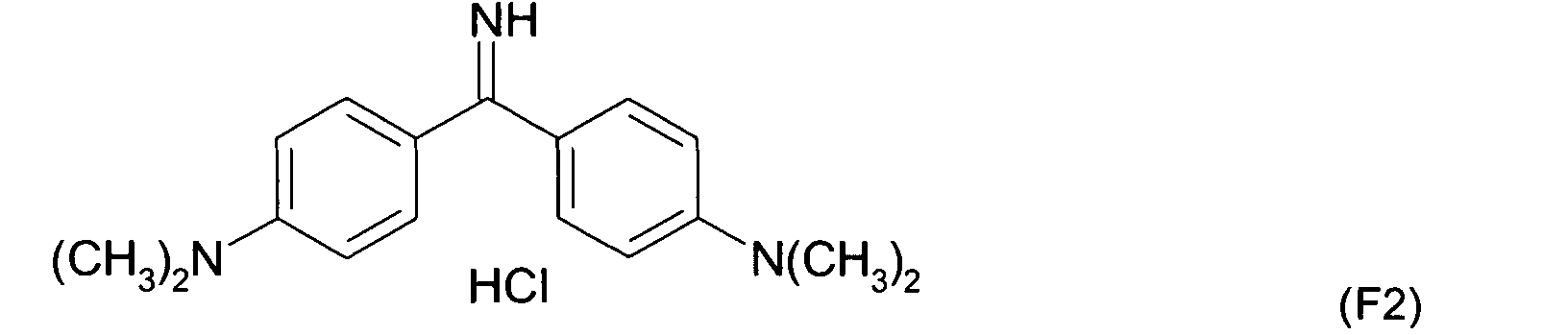
- le Basic Yellow 2, ou Auramine O commercialisé par les sociétés PROLABO, ALDRICH
ou CARLO ERBA et de structure suivante :
monochlorhydrate de 4,4'-(imidocarbonyl)bis(N,N-diméthylaniline) - CAS number 2465-27-2.

- un atome d'hydrogène ;
- un radical alkyle, linéaire ou ramifié, comprenant 1 à 10 atomes de carbone, de préférence de 1 à 4 atomes de carbone, éventuellement interrompu et/ou substitué par au moins un hétéroatome et/ou groupement comprenant au moins un hétéroatome et/ou substitué par au moins un atome d'halogène ;
- un radical aryle ou arylalkyle, le groupement aryle ayant 6 atomes de carbone et le radical alkyle ayant 1 à 4 atomes de carbone ; le radical aryle étant éventuellement substitué par un ou plusieurs radicaux alkyles linéaires ou ramifiés comprenant 1 à 4 atomes de carbone éventuellement interrompus et/ou substitués par au moins un hétéroatome et/ou groupement comprenant au moins un hétéroatome et/ou substitué par au moins un atome d'halogène ;
- R1 et R2 peuvent éventuellement être reliés de manière à former un hétérocycle avec l'atome d'azote et comprendre un ou plusieurs autres hétéroatomes, l'hétérocycle étant éventuellement substitué par au moins un radical alkyle linéaire ou ramifié, comprenant de préférence de 1 à 4 atomes de carbone et étant éventuellement interrompu et/ou substitué par au moins un hétéroatome et/ou groupement comprenant au moins un hétéroatome et/ou substitué par au moins un atome d'halogène ;
- R1 ou R2 peut éventuellement être engagé dans un hétérocycle comprenant l'atome d'azote et l'un des atomes de carbone du groupement phényle portant ledit atome d'azote ;
- un radical alkyle, linéaire ou ramifié comprenant 1 à 14 atomes de carbone, ou alcényle comprenant 2 à 14 atomes de carbone, éventuellement interrompu et/ou substitué par au moins un hétéroatome et/ou groupement comprenant au moins un hétéroatome et/ou substitué par au moins un atome d'halogène ;
- un radical hétérocyclique comprenant 5 ou 6 chaínons, éventuellement substitué par au moins un radical alkyle linéaire ou ramifié comprenant 1 à 14 atomes de carbone, éventuellement substitué par au moins un hétéroatome ; par au moins un radical aminoalkyle, linéaire ou ramifié, comprenant 1 à 4 atomes de carbone, éventuellement substitué par au moins un hétéroatome ; par au moins un atome d'halogène ;
- un radical aromatique ou diaromatique condensé ou non, séparé ou non par un radical alkyle comprenant 1 à 4 atomes de carbone, le ou les radicaux aryles étant éventuellement substitués par au moins un atome d'halogène ou par au moins un radical alkyle comprenant 1 à 10 atomes de carbone éventuellement substitué et/ou interrompu par au moins un hétéroatome et/ou groupement portant au moins un hétéroatome;
- un radical dicarbonyle ;
- le groupement X pouvant porter une ou plusieurs charges cationiques ;
Parmi les groupements porteurs de tels atomes, on peut citer entre autres les groupements hydroxyle, alcoxy, carbonyle, amino, ammonium, amido (-N-CO-), carboxyle (-O-CO- ou -CO-O-).
En ce qui concerne les groupements alcényles, ces derniers comprennent une ou plusieurs liaisons carbone-carbone insaturée (-C=C-), et de préférence une seule double liaison carbone-carbone.
- un atome d'hydrogène ;
- un radical alkyle comprenant 1 à 10 atomes de carbone, notamment 1 à 6 atomes de carbone, de préférence 1 à 4 atomes de carbone, éventuellement interrompu par un atome d'oxygène ou éventuellement substitué par au moins un radical hydroxyle, amino, ammonium, d'un atome de chlore ou de fluor ;
- un radical benzyle, phényle, éventuellement substitué par un radical alkyle ou alcoxy comprenant 1 à 4 atomes de carbone, de préférence 1 ou 2 atomes de carbone ;
- avec l'atome d'azote, un radical hétérocylique du type pyrrolo, pyrrolidino, imidazolino, imidazolo, imidazolium, pyrazolino, pipérazino, morpholino, morpholo, pyrazolo, triazolo, éventuellement substitué par au moins un radical alkyle linéaire
De préférence les radicaux R1 et R2, identiques ou non, et de préférence identiques, représentent un radical méthyle, un radical éthyle.

Il est précisé que le substituant R5, s'il est différent de l'hydrogène, se trouve avantageusement en position(s) 3 et/ou 5 par rapport au carbone du cycle portant l'azote substitué par les radicaux R1 et R2, et de préférence en position 3 par rapport à ce carbone.
Avantageusement, les radicaux R5, identiques ou non, représentent un atome d'hydrogène ; un radical alkyle linéaire ou ramifié en C1-C4 ; -O-R51 avec R51 représentant un radical alkyle linéaire en C1-C4 ; -R52-O-CH3 avec R52 représentant un radical alkyle linéaire en C2-C3 ; -R53 - N (R54)2 dans laquelle R53 représente un radical alkyle linéaire en C2-C3, R54, identiques ou différents, représentent un atome d'hydrogène ou un radical méthyle.
De préférence R5, identiques ou non, représentent l'hydrogène, un méthyle, un méthoxy, et de préférence, R5 représente un atome d'hydrogène.
Il est précisé que le substituant R6, s'il est différent de l'hydrogène, se trouve de préférence en position 2 et/ou 4 par rapport à l'atome d'azote du cycle pyridinium, et de préférence en position 4 par rapport à cet atome d'azote.
- un radical alkyle, linéaire ou ramifié comprenant 1 à 14 atomes de carbone, ou alcényle comprenant 2 à 14 atomes de carbone, éventuellement interrompu et/ou substitué par au moins un hétéroatome, par au moins un groupement porteur d'au moins un hétéroatome et/ou par au moins un atome d'halogène ;
- un radical hétérocyclique comprenant 5 ou 6 chaínons, éventuellement substitué par au moins un radical alkyle linéaire ou ramifié comprenant 1 à 14 atomes de carbone, par au moins un radical aminoalkyle, linéaire ou ramifié, comprenant 1 à 4 atomes de carbone, éventuellement substitué par au moins un hétéroatome ; par au moins un atome d'halogène ;
- un radical aromatique ou diaromatique condensé ou non, séparé ou non par un radical alkyle comprenant 1 à 4 atomes de carbone, le ou les radicaux aryles étant éventuellement substitués par au moins un atome d'halogène ou par au moins un radical alkyle comprenant 1 à 10 atomes de carbone éventuellement substitué et/ou interrompu par au moins un hétéroatome et/ou groupement comprenant au moins un hétéroatome ;
- un radical dicarbonyle.
Parmi les groupements de ce type, on peut citer tout particulièrement les groupements hydroxyle, alcoxy (avec notamment un radical R de type alkyle en C1-C4), amino, ammonium, amido, carbonyle, carboxyle (-COO-, -O-CO-) avec notamment un radical de type alkyloxy.
Notons que l'atome d'azote, s'il est présent, peut se trouver sous une forme quaternisée ou non. Dans ce cas, le ou les deux autres radicaux portés par l'atome d'azote quaternisé ou non, sont identiques ou non et peuvent être un atome d'hydrogène, un radical alkyle en C1-C4, de préférence le méthyle.
Il est à noter que le radical aromatique, de préférence un radical phényle, est relié aux groupements CR3R4 par l'intermédiaire de liaisons en positions 1,2 ; 1,3 ou 1;4, de préférence en positions 1,3 et 1,4. Si le radical phényle relié par l'intermédiaire de liaisons en positions 1,4, porte un ou deux substituants, ce ou ces derniers sont situés de préférence en position 1,4 par rapport à l'un des groupements CR3R4. Si le radical phényle relié par l'intermédiaire de liaisons en positions 1,3, porte un ou deux substituants, ce ou ces derniers sont situés de préférence en position 1 et/ou 3 par rapport à l'un des groupements CR3R4.
Il est à noter que ledit radical diaromatique est relié aux groupements CR3R4 par l'intermédiaire de liaisons en positions 4,4'.
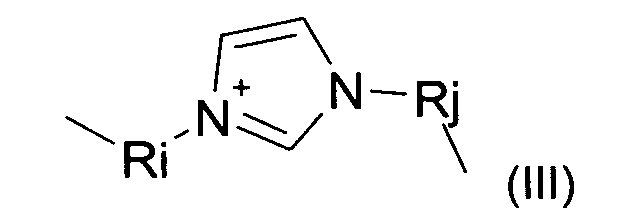


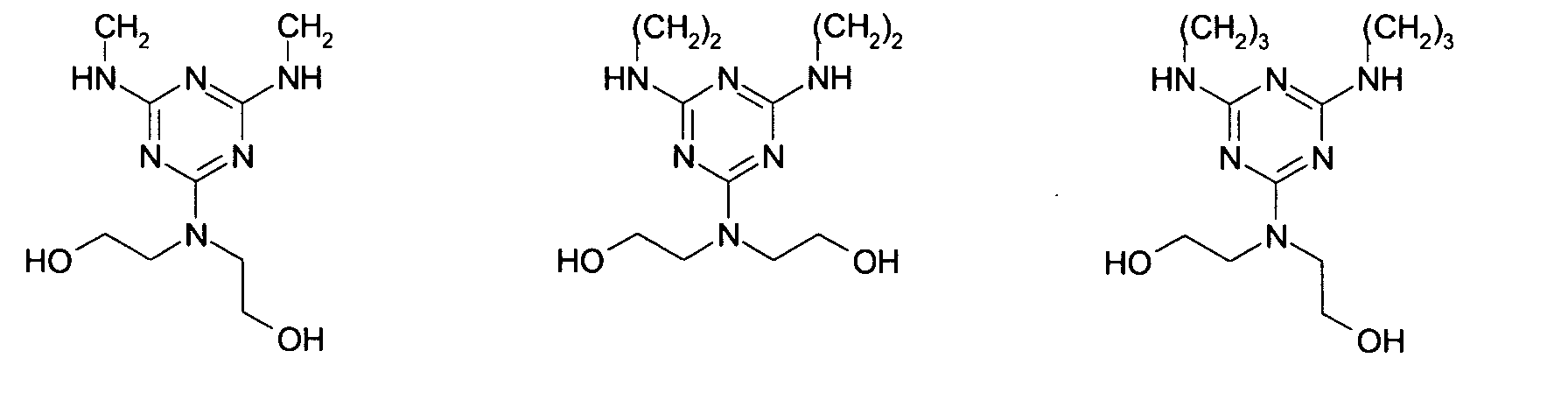





Parmi les anions d'origine organique, on peut citer les anions provenant des sels d'acides mono- ou polycarboxyliques, sulfoniques, sulfuriques, saturés ou non, aromatiques ou non, éventuellement substitués par au moins un radical hydroxyle, amino, ou atomes d'halogène. A titre d'exemples non limitatifs, conviennent les acétates, hydroxyactétates, aminoacétates, (tri)chloroacétates, benzoxyactétates, propionates et dérivés portant un atome de chlore, fumarates, oxalates, acrylates, malonates, succinates, lactates, tartrates, glycollates citrates, les benzoates et dérivés portant un radical méthyle ou amino, les alkylsulfates, les tosylates, les benzènesulfonates, toluènesulfonates, etc.
Cette première étape peut avoir lieu en présence d'un solvant, bien qu'il ne soit pas obligatoire, comme par exemple le diméthylformamide.
Le nombre de moles d'α-picoline est en général voisin de 2 pour une mole de réactif comprenant les groupes partant.
En outre, la réaction est habituellement mise en oeuvre au reflux du réactif et/ou du solvant s'il est présent.
Le produit issu de cette première étape est ensuite contacté avec un aldéhyde correspondant de formule suivante :

Là encore, la réaction peut être effectuée en présence d'un solvant approprié, de préférence au reflux.
Il est à noter que les radicaux R1 et R2 de l'aldéhyde peuvent avoir la signification indiquée dans la formule générale détaillée auparavant.
Il est aussi possible de mettre en oeuvre un aldéhyde pour lequel lesdits radicaux représentent des atomes d'hydrogène et effectuer conformément à des méthodes classiques, la substitution de ces atomes d'hydrogène par des radicaux appropriés tels que décrits dans la formule générale une fois la deuxième étape terminée.

A titre d'exemple de composé de ce type on peut citer le Photosensitiving Dye NK-557 commercialisé par la société UBICHEM, pour lequel R représente un radical éthyle, R' un radical méthyle et X- un iodure.
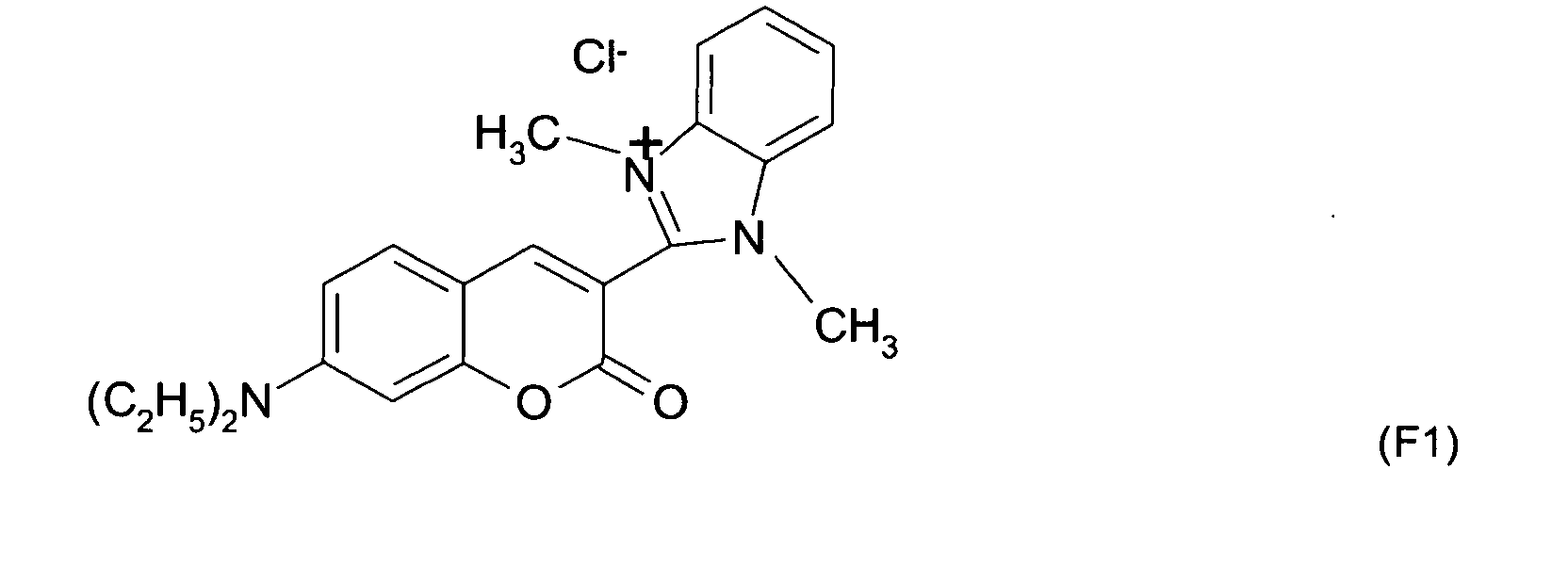
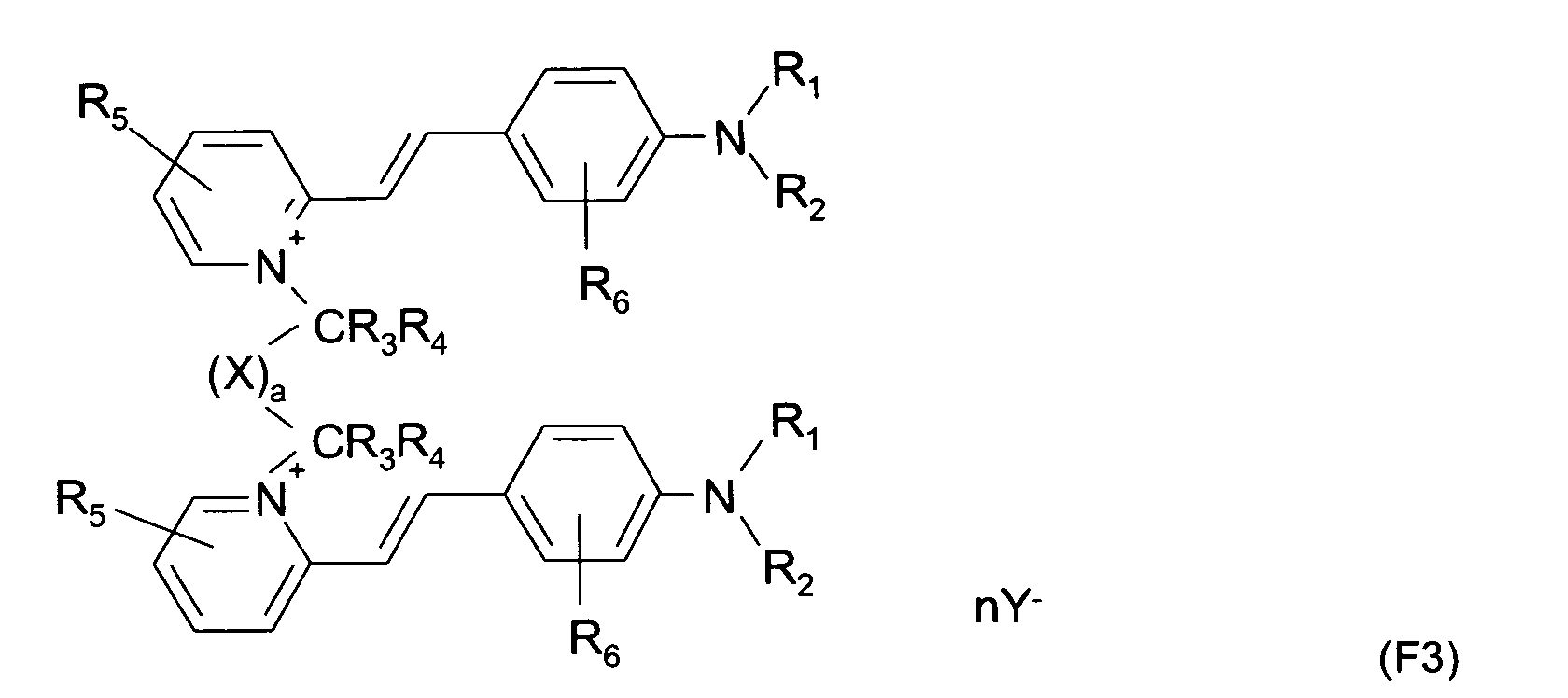
A titre d'exemples de tels composés, on peut citer les composés de formules (F1) à (F3). Selon une variante préférée, la composition ne comprend pas de composé de formule (F4).
De préférence l'agent conditionneur est choisi parmi les huiles de synthèse ; les huiles végétales ; les huiles animales ; les huiles fluorées ou perfluorées ; les cires naturelles ou synthétiques ; les esters d'acides carboxyliques ; les composés de formule R3CHOH-CH(NHCOR1)-CH2OR2 ; seuls ou en mélanges.
- de type polybutène, hydrogéné ou non, et de préférence polyisobutène,
hydrogéné ou non.
On utilise de préférence les oligomères d'isobutylène de masse moléculaire en poids inférieure à 1000 g/mol et leurs mélanges avec des polyisobutylènes de masse moléculaire en poids supérieure à 1000 g/mol et de préférence allant de 1000 et 15000 g/mol.
A titre d'exemples de poly-α-oléfines utilisables, on peut plus particulièrement mentionner les polyisobutènes vendus sous le nom de Permethyl® 99 A, 101 A , 102 A , 104 A (n=16) et 106 A (n=38) par la Société Presperse Inc, ou bien encore les produits vendus sous le nom de Arlamol® HD (n=3) par la Société ICI (n désignant le degré de polymérisation), - de type polydécène, hydrogéné ou non.
De tels produits sont vendus par exemple sous les dénominations Ethylflo® par la société Ethyl Corp., et d'Arlamol® Pao par la société ICI.
On peut également utiliser les huiles essentielles naturelles ou synthétiques telles que, par exemple, les huiles d'eucalyptus, de lavandin, de lavande, de vétivier, de litsea cubeba, de citron, de santal, de romarin, de camomille, de sarriette, de noix de muscade, de cannelle, d'hysope, de carvi, d'orange, de géraniol, de cade et de bergamote.
Sur la définition des cires, on peut citer par exemple P.D. Dorgan, Drug and Cosmetic Industry, Decembre 1983, pp. 30-33.
A titre d'exemple, on peut notamment citer les N-linoléyldihydrosphingosine, N-oléyldihydrosphingosine, N-palmitoyldihydrosphingosine, N-stéaroyldihydrosphingosine, la N-béhénoyldihydrosphingosine, ou leurs mélanges.
Les perfluoropolyéthers sont par exemple vendus sous les dénominations commerciales Fomblin par la société Montefluos et Krytox par la société Du Pont.
Il peut être ajusté à la valeur désirée au moyen d'agents acidifiants ou alcalinisants.

Conviennent notamment les colorants directs benzéniques nitrés rouges ou orangés suivants :
- le 1-hydroxy-3-nitro-4-N-(γ-hydroxypropyl)amino benzène,
- le N-(β-hydroxyéthyl)amino-3-nitro-4-amino benzène,
- le 1-amino-3-méthyl-4-N-(β-hydroxyéthyl)amino-6-nitro benzène,
- le 1-hydroxy-3-nitro-4-N-((β-hydroxyéthyl)amino benzène,
- le 1,4-diamino-2-nitrobenzène,
- le 1-amino-2-nitro-4-méthylamino benzène,
- la N-(β-hydroxyéthyl)-2-nitro-paraphénylènediamine,
- le 1-amino-2-nitro-4-(β-hydroxyéthyl)amino-5-chloro benzène,
- la 2-nitro-4-amino-diphénylamine,
- le 1-amino-3-nitro-6-hydroxybenzène.
- le 1-(β-aminoéthyl)amino-2-nitro-4-(β-hydroxyéthyloxy) benzène,
- le 1-(β, γ-dihydroxypropyl)oxy-3-nitro-4-(β-hydroxyéthyl)amino benzène,
- le 1-hydroxy-3-nitro-4-aminobenzène,
- le 1-hydroxy-2-amino-4,6-dinitrobenzène,
- le 1-méthoxy-3-nitro-4-(β-hydroxyéthyl)amino benzène,
- la 2-nitro-4'-hydroxydiphénylamine,
- le 1-amino-2-nitro-4-hydroxy-5-méthylbenzène.
- le 1-β-hydroxyéthyloxy-3-méthylamino-4-nitrobenzène,
- le 1-méthylamino-2-nitro-5-(β,γ-dihydroxypropyl)oxybenzène,
- le 1-(β-hydroxyéthyl)amino-2-méthoxy-4-nitrobenzène,
- le 1-(β-aminoéthyl)amino-2-nitro-5-méthoxy-benzène,
- le 1,3-di(β-hydroxyéthyl)amino-4-nitro-6-chlorobenzène,
- le 1-amino-2-nitro-6-méthyl-benzène,
- le 1-(β-hydroxyéthyl)amino-2-hydroxy-4-nitrobenzène,
- la N-(β-hydroxyéthyl)-2-nitro-4-trifluorométhylaniline,
- l'acide 4-(β-hydroxyéthyl)amino-3-nitro-benzènesulfonique,
- l'acide 4-éthylamino-3-nitro-benzoïque,
- le 4-(β-hydroxyéthyl)amino-3-nitro-chlorobenzène,
- le 4-((3-hydroxyéthyl)amino-3-nitro-méthylbenzène,
- le 4-(β,γ-dihydroxypropyl)amino-3-nitro-trifluorométhylbenzène,
- le 1-(β-uréidoéthyl)amino-4-nitrobenzène,
- le 1,3-diamino-4-nitrobenzène,
- le 1-hydroxy-2-amino-5-nitrobenzène,
- le 1-amino-2-[tris(hydroxyméthyl)méthyl]amino-5-nitro-benzène,
- le 1-(β-hydroxyéthyl)amino-2-nitrobenzène,
- le 4-(β-hydroxyéthyl)amino-3-nitrobenzamide.
- le 1-(β-hydroxyéthyl)amino-4-N,N-bis-(β-hydroxyéthyl)amino 2-nitrobenzène,
- le 1-(γ-hydroxypropyl)amino 4-N,N-bis-(β-hydroxyéthyl)amino 2-nitrobenzène,
- le 1-(β-hydroxyéthyl)amino 4-(N-méthyl, N-β-hydroxyéthyl)amino 2-nitrobenzène,
- le 1-(β-hydroxyéthyl)amino 4-(N-éthyl, N-β-hydroxyéthyl)amino 2-nitrobenzène,
- le 1-(β,γ-dihydroxypropyl)amino 4-(N-éthyl, N-β-hydroxyéthyl)amino 2-nitrobenzène,
- les 2-nitroparaphénylènediamines de formule suivante :

- R6 représente un radical alkyle en C1-C4, un radical β-hydroxyéthyle ou β-hydroxypropyle ou γ-hydroxypropyle ;
- R5 et R7, identiques ou différents, représentent un radical β-hydroxyéthyle, -β-hydroxypropyle, γ-hydroxypropyle, ou β,γ-dihydroxypropyle, l'un au moins des radicaux R6, R7 ou R5 représentant un radical γ-hydroxypropyle et R6 et R7 ne pouvant désigner simultanément un radical β-hydroxyéthyle lorsque R6 est un radical γ-hydroxypropyle, telles que celles décrits dans FR 2692572.
Les sels d'addition avec un agent alcalin utilisables dans le cadre des compositions de l'invention (bases d'oxydation et coupleurs) sont notamment choisis parmi les sels d'addition avec les métaux alcalins ou alcalino-terreux, avec l'ammoniaque, avec les amines organiques dont les alcanolamines et les composés de formule (A).
Dans ces shampooings, l'agent tensioactif est présent dans une proportion allant d'environ 4 à 30 % et de préférence d'environ 8 à 20% en poids par rapport au poids total de la composition de shampooing.
L'agent oxydant peut être choisi par exemple parmi le peroxyde d'hydrogène, le peroxyde d'urée, les bromates de métaux alcalins, les persels tels que les perborates et persulfates, et les enzymes telles que les peroxydases et les oxydo-réductases à deux
ou à quatre électrons. L'utilisation du peroxyde d'hydrogène ou des enzymes est particulièrement préférée.
Au sens de l'invention, on entend par cheveux pigmentés ou colorés artificiellement, des cheveux dont la hauteur de ton est inférieure ou égale à 6 (blond foncé) et de préférence inférieure ou égale à 4 (châtain).
L'éclaircissement des cheveux est évalué par la 'hauteur de ton" qui caractérise le degré
ou le niveau d'éclaircissement. La notion de "ton" repose sur la classification des nuances naturelles, un ton séparant chaque nuance de celle qui la suit ou la précède immédiatement. Cette définition et la classification des nuances naturelles sont bien connues des professionnels de la coiffure et publiée dans l'ouvrage "Sciences des traitements capillaires" de Charles ZVIAK 1988, Ed.Masson, pp.215 et 278.
Les hauteurs de ton s'échelonnent de 1 (noir) à 10 (blond clair), une unité correspondant à un ton ; plus le chiffre est élevé et plus la nuance est claire.
Plus particulièrement, les fibres qui peuvent être avantageusement traitées par le procédé selon l'invention, présentent une hauteur de ton est inférieure ou égale à 6 (blond foncé) et de préférence inférieure ou égale à 4 (châtain).
De plus, une peau foncée susceptible d'être traitée conformément à l'invention, présente une luminance L*, chiffrée dans le système C.I.E.L. L*a*b*, inférieure ou égale à 45 et de préférence inférieure ou égale à 40.
Dans le système C.I.E.L L*a*b*, a* et b* indiquent deux axes de couleurs, a* indique l'axe de couleur vert/rouge (+a* est rouge, -a* est vert) et b* l'axe de couleur bleu/jaune (+b* est jaune et -b* est bleu) ; des valeurs proches de zéro pour a* et b* correspondent à des nuances grises.

On récupère le produit précipité, et on le filtre.
On solubilise 109 g du produit obtenu précédemment dans du méthanol et l'on ajoute 82,82 g de p-diméthylaminobenzaldéhyde en deux fois, en présence de pyrrolidine.
On laisse ensuite pendant 30 minutes.
On récupère le produit sous forme précipitée.
Analyse élémentaire : C : 62,43 % ; H : 6,40 % ; Br : 23,07 % ; N : 8,09 %.
La formule est la suivante C36H44N4.2Br.
| Composition | 1 | 2 |
| Composé fluorescent | 0,6 % | 0,6 % |
| Myristate d'isopropyle | - | 0,25 % |
| Arlamol HD | 0,25 % | - |
| Lauryléther sulfate de sodium (2,2 OE) | 10 % | 10 % |
| Eau distillée | Qsp 100 % | Qsp 100 % |
Claims (28)
- Composition, caractérisée en ce qu'elle comprend, dans un milieu cosmétiquement acceptable, au moins un colorant fluorescent soluble dans ledit milieu, au moins un agent conditionneur insoluble dans ledit milieu, choisi parmi les huiles de synthèse ; les huiles minérales ; les huiles végétales ; les huiles animales ; les huiles fluorées ou perfluorées ; les cires naturelles ou synthétiques ; les esters d'acides carboxyliques ; les composés de formule R3CHOH-CH(NHCOR1)-CH2OR2 dans laquelle R1 est un radical alkyle en C14-C30, éventuellement substitué en position α par un radical hydroxyle, ou en position ω par un radical hydroxyle estérifié par un acide gras en C16-C30, R2 désigne un atome d'hydrogène ou un radical (glycosyle)n ou (galactosyle)m avec n variant de 1 à 4 et m de 1 à 8, R désigne un radical hydrocarboné en C15-C26 éventuellement substitué par un radical alkyle, ou un radical α-hydroxytalkyle en C15-C26 éventuellement estérifié par un α-hydroxyacide en C16-C30 ; seuls ou en mélanges.
- Composition selon l'une quelconque des revendications précédentes, caractérisée en ce que le colorant fluorescent conduit à un maximum de réflectance se situant dans la gamme de longueur d'onde allant de 500 à 650 nanomètres, et de préférence dans la gamme de longueur d'onde allant de 550 à 620 nanomètres.
- Composition l'une quelconque des revendications précédentes, caractérisée en ce que le composé fluorescent est choisi parmi les colorants fluorescents appartenant aux familles suivantes : les naphtalimides ; les coumarines cationiques ou non ; les xanthénodiquinolizines ; les azaxanthènes ; les naphtolactames ; les azlactones ; les oxazines ; les thiazines ; les dioxazines ; les colorants fluorescents monocationiques ou polycationiques de type azoïque, azométhinique, ou méthinique, seuls ou en mélanges.
- Composition l'une quelconque des revendications précédentes, caractérisée en ce que le composé fluorescent est de formule suivante :
 dans laquelle :
 R1, R2, identiques ou différents, représentent :un atome d'hydrogène ;un radical alkyle, linéaire ou ramifié, comprenant 1 à 10 atomes de carbone, de préférence de 1 à 4 atomes de carbone, éventuellement interrompu et/ou substitué par au moins un hétéroatome et/ou groupement comprenant au moins un hétéroatome et/ou substitué par au moins un atome d'halogène ;un radical aryle ou arylalkyle, le groupement aryle ayant 6 atomes de carbone et le radical alkyle ayant 1 à 4 atomes de carbone ; le radical aryle étant éventuellement substitué par un ou plusieurs radicaux alkyles linéaires ou ramifiés comprenant 1 à 4 atomes de carbone éventuellement interrompus et/ou substitués par au moins un hétéroatome et/ou groupement comprenant au moins un hétéroatome et/ou substitué par au moins un atome d'halogène ;R1 et R2 peuvent éventuellement être reliés de manière à former un hétérocycle avec l'atome d'azote et comprendre un ou plusieurs autres hétéroatomes, l'hétérocycle étant éventuellement substitué par au moins un radical alkyle linéaire ou ramifié, comprenant de préférence de 1 à 4 atomes de carbone et étant éventuellement interrompu et/ou substitué par au moins un hétéroatome et/ou groupement comprenant au moins un hétéroatome et/ou substitué par au moins un atome d'halogène ;R1 ou R2 peut éventuellement être engagé dans un hétérocycle comprenant l'atome d'azote et l'un des atomes de carbone du groupement phényle portant ledit atome d'azote ;R3, R4, identiques ou non, représentent un atome d'hydrogène, un radical alkyle comprenant 1 à 4 atomes de carbone ;R5, identiques ou non, représentent un atome d'hydrogène, un atome d'halogène, un radical alkyle linéaire ou ramifié comprenant 1 à 4 atomes de carbone éventuellement interrompu par au moins un hétéroatome ;R6, identiques ou non, représentent un atome d'hydrogène ; un atome d'halogène ; un radical alkyle linéaire ou ramifié comprenant 1 à 4 atomes de carbone, éventuellement substitué et/ou interrompu par au moins un hétéroatome et/ou groupement portant au moins un hétéroatome et/ou substitué par au moins un atome d'halogène ;X représente :un radical alkyle, linéaire ou ramifié comprenant 1 à 14 atomes de carbone, ou alcényle comprenant 2 à 14 atomes de carbone, éventuellement interrompu et/ou substitué par au moins un hétéroatome et/ou groupement comprenant au moins un hétéroatome et/ou substitué par au moins un atome d'halogène ;un radical hétérocyclique comprenant 5 ou 6 chaínons, éventuellement substitué par au moins un radical alkyle linéaire ou ramifié comprenant 1 à 14 atomes de carbone, éventuellement substitué par au moins un hétéroatome ; par au moins un radical aminoalkyle, linéaire ou ramifié, comprenant 1 à 4 atomes de carbone, éventuellement substitué par au moins un hétéroatome ; par au moins un atome d'halogène ;un radical aromatique ou diaromatique condensé ou non, séparé ou non par un radical alkyle comprenant 1 à 4 atomes de carbone, le ou les radicaux aryles étant éventuellement substitués par au moins un atome d'halogène ou par au moins un radical alkyle comprenant 1 à 10 atomes de carbone éventuellement substitué et/ou interrompu par au moins un hétéroatome et/ou groupement portant au moins un hétéroatome;un radical dicarbonyle ;le groupement X pouvant porter une ou plusieurs charges cationiques ;a étant égal à 0 ou 1 ;Y-, identiques ou non, représentant un anion organique ou minéral ;n étant un nombre entier au moins égal à 2 et au plus égal au nombre de charges cationiques présentes dans le composé fluorescent ;formule dans laquelle R représente un radical méthyle ou éthyle; R' représente un radical méthyle, X- un anion du type chlorure, iodure, sulfate, méthosulfate, acétate, perchlorate.
- Composition selon l'une quelconque des revendications précédentes, caractérisée en ce que le ou les colorants fluorescents sont présents dans une concentration pondérale comprise entre 0,01 et 20% en poids, plus particulièrement comprise entre 0,05 à 10% en poids, de préférence comprise entre 0,1 à 5% en poids, par rapport au poids total de la composition.
- Composition selon l'une quelconque des revendications précédentes, caractérisée en ce que l'agent conditionneur insoluble est choisi parmiseuls ou en mélange.Les huiles de synthèse comme les polyoléfines en particulier les poly-α-oléfines ;Les huiles animales ou végétales comme les huiles de tournesol, de maïs, de soja, d'avocat, de jojoba, de courge, de pépins de raisin, de sésame, de noisette, les huiles de poisson, le tricaprocaprylate de glycérol, les huiles végétales ou animales de formule R9COOR10 dans laquelle R9 représente le reste d'un acide gras en C7-C29 et R10 représente une chaíne hydrocarbonée linéaire ou ramifiée en C3-C30 ; les huiles essentielles naturelles ou synthétiques ;Les cires naturelles animales ou végétales, ou les cires synthétiques ;La N-linoléyldihydrosphingosine, la N-oléyldihydrosphingosine, la N-palmitoyldihydrosphingosine, la N-stéaroyldihydrosphingosine, la N-béhénoyldihydrosphingosine ;Les huiles fluorées comme les perfluoropolyéthers, les huiles fluorohydrocarbonées, les fluorocarbures, les hydrocarbures fluorés,Les alcools gras choisis parmi les alcools gras en C8-C22, linéaires ou ramifiés, éventuellement oxyalkylénés avec 1 à 15 moles d'oxyde d'alkylène ou polyglycérolés avec 1 à 6 moles de glycérol ;Les esters d'acides carboxyliques, comme les esters d'acides monocarboxyliques aliphatiques saturés ou insaturés, linéaires ou ramifiés en C1-C26 et d'alcools aliphatiques saturés, le nombre total de carbone des esters étant supérieur ou égal à 10 ; les mono-, di-, tri-, tétra ou penta- esters d'acides di- ou tricarboxyliques et d'alcools en C1-C22 ou d'alcools di-, tri-, tétra- ou penta-hydroxy en C2-C26 ;
- Composition selon l'une des revendications précédentes, caractérisée en ce que la teneur en agent conditionneur insoluble représente 0,01 à 20 % en poids par rapport au poids de la composition, plus particulièrement 0,1 à 10 % en poids par rapport à la même référence.
- Composition selon l'une des revendications précédentes, caractérisée en ce qu'elle comprend au moins un tensioactif non ionique, anionique ou amphotère.
- Composition selon la revendication précédente, caractérisée en ce que la teneur en tensioactif représente 0,01 à 30 % en poids par rapport au poids total de la composition.
- Composition selon l'une quelconque des revendications précédentes, caractérisée en ce qu'elle comprend en outre au moins un colorant direct non fluorescent additionnel de nature non ionique, cationique ou anionique.
- Composition selon la revendication 10, caractérisée par le fait que les colorants directs additionnels sont choisis parmi les colorants benzéniques nitrés, les colorants azoïques, anthraquinoniques, naphtoquinoniques, benzoquinoniques, phénotiaziniques, indigoïdes, xanthéniques, phénanthridiniques, phtalocyanines, ainsi que les colorants dérivés du triarylméthane, ou leurs mélanges.
- Composition selon l'une des revendications 10 ou 11, caractérisée en ce que le ou les colorants directs additionnels représentent de 0,0005 à 12 % en poids, de préférence de 0,005 à 6 % en poids, du poids total de la composition.
- Composition selon l'une quelconque des revendications précédentes, caractérisée en ce qu'elle se présente sous la forme d'un shampooing éclaircissant et colorant.
- Composition selon l'une quelconque des revendications précédentes, caractérisée en ce qu'elle comprend au moins une base d'oxydation choisie parmi les paraphénylènediamines, les bis-phénylalkylènediamines, les para-aminophénols, les ortho-aminophénols et les bases hétérocycliques ou leurs sels d'addition avec un acide ou avec un agent alcalin.
- Composition selon la revendication précédente, caractérisée en ce que la ou les bases d'oxydation représentent 0,0005 à 12 % en poids, plus particulièrement 0,005 à 6 % en poids, du poids total de la composition.
- Composition selon l'une quelconque des revendications 14 ou 15, caractérisée en ce qu'elle comprend au moins un coupleur choisi parmi les métaphénylène diamines, les méta-aminophénols, les métadiphénols et les coupleurs hétérocycliques ou leurs sels d'addition avec un acide ou avec un agent alcalin.
- Composition selon la revendication précédente, caractérisée en ce que le ou les coupleurs représentent de 0,0001 à 10 % en poids, plus particulièrement 0,005 à 5 % en poids, du poids total de la composition tinctoriale.
- Composition, caractérisée en ce qu'elle comprend la composition selon l'une des revendications 1 à 12 et 14 à 17, et au moins un agent oxydant.
- Composition selon la revendication précédente, caractérisée en ce que l'agent oxydant est choisi parmi le peroxyde d'hydrogène, le peroxyde d'urée, les bromates de métaux alcalins, les persels tels que les perborates et persulfates, et les enzymes telles que les peroxydases et les oxydo-réductases à deux ou quatre électrons, et de préférence le peroxyde d'hydrogène.
- Procédé pour colorer avec un effet éclaircissant les fibres kératiniques humaines, caractérisé en ce que l'on met en oeuvre les étapes suivantes :a) on applique sur lesdites fibres une composition telle que définie selon l'une quelconque des revendications 1 à 19, pendant un temps suffisant pour développer la coloration et l'éclaircissement désirés,b) on rince éventuellement les fibres,c) éventuellement on lave au shampooing et on rince les fibres,d) on sèche ou on laisse sécher les fibres.
- Procédé selon la revendication 20, caractérisé en ce qu'il comporte une étape préliminaire consistant à stocker sous forme séparée, d'une part, une composition selon l'une des revendications 1 à 12 et 14 à 17, et d'autre part, une composition renfermant, dans un milieu cosmétiquement acceptable, au moins un agent oxydant, puis à procéder à leur mélange au moment de l'emploi avant d'appliquer ce mélange sur les fibres pendant un temps suffisant pour développer la coloration désirée, après quoi on les rince, on les lave éventuellement au shampooing, on les rince à nouveau et on les sèche.
- Procédé selon l'une quelconque des revendications 20 ou 21, caractérisé par le fait que la composition est appliquée sur des cheveux présentant une hauteur de ton inférieure ou égale à 6 et de préférence inférieure ou égale à 4.
- Procédé selon l'une des revendications 20 à 22, caractérisé en ce que les fibres kératiniques humaines sont pigmentées ou colorées artificiellement.
- Procédé pour colorer avec un effet éclaircissant une peau foncée, caractérisé en ce que l'on applique sur la peau une composition selon l'une quelconque des revendications 1 à 12, puis on sèche ou on laisse sécher la peau.
- Dispositif à plusieurs compartiments pour la teinture et l'éclaircissement des fibres kératiniques, comprenant au moins un compartiment renfermant une composition selon l'une des revendications 1 à 12 et 14 à 17, et au moins un autre compartiment renfermant une composition renfermant au moins un agent oxydant.
- Utilisation d'une composition telle que définie dans l'une quelconque des revendications 1 à 19 pour la coloration avec effet éclaircissant de matières kératiniques.
- Utilisation selon la revendication 26, caractérisée par le fait que les matières kératiniques sont des fibres kératiniques pigmentées ou colorées artificiellement, en particulier des cheveux, ou de la peau foncée.
- Utilisation selon la revendication 27, caractérisée par le fait que les cheveux présentent une hauteur de ton inférieure ou égale à 6 et de préférence inférieure ou égale à 4.
Applications Claiming Priority (2)
| Application Number | Priority Date | Filing Date | Title |
|---|---|---|---|
| FR0304021A FR2853228B1 (fr) | 2003-04-01 | 2003-04-01 | Composition de coloration pour matieres keratiniques humaines comprenant un colorant fluorescent et un agent conditionneur insoluble, procede et utilisation |
| FR0304021 | 2003-04-01 |
Publications (2)
| Publication Number | Publication Date |
|---|---|
| EP1464328A1 true EP1464328A1 (fr) | 2004-10-06 |
| EP1464328B1 EP1464328B1 (fr) | 2008-06-04 |
Family
ID=32843111
Family Applications (1)
| Application Number | Title | Priority Date | Filing Date |
|---|---|---|---|
| EP04290871A Expired - Lifetime EP1464328B1 (fr) | 2003-04-01 | 2004-04-01 | Composition de coloration pour matières kéranitiques humaines comprenant un colorant fluorescent soluble et un agent conditionneur insoluble, procédé et utilisation |
Country Status (9)
| Country | Link |
|---|---|
| EP (1) | EP1464328B1 (fr) |
| JP (2) | JP2004307503A (fr) |
| AT (1) | ATE397478T1 (fr) |
| BR (1) | BRPI0401181A (fr) |
| DE (1) | DE602004014211D1 (fr) |
| ES (1) | ES2308123T3 (fr) |
| FR (1) | FR2853228B1 (fr) |
| MX (1) | MX257287B (fr) |
| PT (1) | PT1464328E (fr) |
Cited By (2)
| Publication number | Priority date | Publication date | Assignee | Title |
|---|---|---|---|---|
| WO2005075574A1 (fr) * | 2004-02-07 | 2005-08-18 | Wella Aktiengesellschaft | Derives naphtaliniques neutres et cationiques et matieres colorantes renfermant ces composes pour fibres keratiniques |
| FR2994651A1 (fr) * | 2012-08-23 | 2014-02-28 | Oreal | Composition de decoloration des fibres keratiniques sous forme comprimee avec persulfate et un colorant direct |
Families Citing this family (1)
| Publication number | Priority date | Publication date | Assignee | Title |
|---|---|---|---|---|
| EP2198838B1 (fr) * | 2008-12-19 | 2018-09-05 | L'Oréal | Procédé et dispositif d'éclaircissement ou de coloration directe éclaircissante ou d'oxydation des fibres kératiniques en présence d'une composition aqueuse riche en corps gras |
Citations (3)
| Publication number | Priority date | Publication date | Assignee | Title |
|---|---|---|---|---|
| US3658985A (en) * | 1969-07-28 | 1972-04-25 | Colgate Palmolive Co | Oil and fluorescent dye containing luster imparting liquid shampoo |
| EP0370470A2 (fr) * | 1988-11-23 | 1990-05-30 | Estee Lauder Inc. | Compositions cosmétiques fluorescentes |
| WO1999013828A1 (fr) * | 1997-09-17 | 1999-03-25 | The Procter & Gamble Company | Compositions de schampooings comprenant des azurants optiques et une matrice de tensioactif doux |
Family Cites Families (16)
| Publication number | Priority date | Publication date | Assignee | Title |
|---|---|---|---|---|
| CH390250A (de) * | 1958-06-19 | 1965-07-30 | Geigy Ag J R | Verfahren zur Herstellung von fluoreszierenden Farbstoffen |
| DE2754403A1 (de) * | 1977-12-07 | 1979-06-13 | Basf Ag | Methinfarbstoffe |
| US5188639A (en) * | 1990-11-13 | 1993-02-23 | Shiseido Co., Ltd. | Product for improved permanent waving of hair and simultaneously coloring and permanently waving hair and method therefor |
| KR960009640B1 (ko) * | 1992-10-16 | 1996-07-23 | 주식회사 태평양 | 헤어칼라린스 조성물 |
| JP3364627B2 (ja) * | 1993-01-29 | 2003-01-08 | 株式会社ダイゾー | 毛髪用着色料 |
| EP1011616A1 (fr) * | 1997-09-17 | 2000-06-28 | The Procter & Gamble Company | Compositions de soin capillaire contenant des azurants optiques et des solvants non volatils |
| PT1437123E (pt) * | 1997-10-22 | 2007-07-12 | Oreal | Composição de tintura das fibras queratínicas e processo de tintura utilizando esta composição |
| JP2899268B2 (ja) * | 1998-02-12 | 1999-06-02 | 協和醗酵工業株式会社 | 毛髪用化粧料組成物 |
| FR2776923B1 (fr) * | 1998-04-06 | 2003-01-10 | Oreal | Composition de teinture pour fibres keratiniques avec un colorant direct cationique et un polymere substantif |
| FR2778561B1 (fr) * | 1998-05-14 | 2001-04-20 | Oreal | Azurants optiques comme agents blanchissants |
| FR2800989B1 (fr) * | 1999-11-12 | 2003-05-30 | Oreal | Composition comprenant une substance fluorescente et une charge particuliere, utilisations |
| AU7207801A (en) * | 2000-02-25 | 2001-09-03 | Wella Aktiengesellschaft | Cationic pyrrolo-pyrrol derivatives, method for producing them and colorants for keratin fibres, containing these compounds |
| JP4150484B2 (ja) * | 2000-03-17 | 2008-09-17 | 花王株式会社 | 毛髪用染色剤組成物 |
| JP4139552B2 (ja) * | 2000-06-27 | 2008-08-27 | 花王株式会社 | 染毛剤組成物 |
| JP2002226338A (ja) * | 2001-02-05 | 2002-08-14 | Hoyu Co Ltd | 酸化染毛剤組成物 |
| JP2004059468A (ja) * | 2002-07-26 | 2004-02-26 | Kanebo Ltd | 酸化染毛剤第1剤組成物 |
-
2003
- 2003-04-01 FR FR0304021A patent/FR2853228B1/fr not_active Expired - Fee Related
-
2004
- 2004-04-01 PT PT04290871T patent/PT1464328E/pt unknown
- 2004-04-01 AT AT04290871T patent/ATE397478T1/de not_active IP Right Cessation
- 2004-04-01 MX MXPA04003092 patent/MX257287B/es active IP Right Grant
- 2004-04-01 DE DE602004014211T patent/DE602004014211D1/de not_active Expired - Lifetime
- 2004-04-01 BR BR0401181-3A patent/BRPI0401181A/pt not_active IP Right Cessation
- 2004-04-01 ES ES04290871T patent/ES2308123T3/es not_active Expired - Lifetime
- 2004-04-01 JP JP2004109536A patent/JP2004307503A/ja not_active Withdrawn
- 2004-04-01 EP EP04290871A patent/EP1464328B1/fr not_active Expired - Lifetime
-
2006
- 2006-06-27 JP JP2006176604A patent/JP2006335762A/ja not_active Withdrawn
Patent Citations (4)
| Publication number | Priority date | Publication date | Assignee | Title |
|---|---|---|---|---|
| US3658985A (en) * | 1969-07-28 | 1972-04-25 | Colgate Palmolive Co | Oil and fluorescent dye containing luster imparting liquid shampoo |
| AT302534B (de) * | 1969-07-28 | 1972-10-25 | Colgate Palmolive Co | Einphasiges, flüssiges Haarwaschmittel |
| EP0370470A2 (fr) * | 1988-11-23 | 1990-05-30 | Estee Lauder Inc. | Compositions cosmétiques fluorescentes |
| WO1999013828A1 (fr) * | 1997-09-17 | 1999-03-25 | The Procter & Gamble Company | Compositions de schampooings comprenant des azurants optiques et une matrice de tensioactif doux |
Cited By (3)
| Publication number | Priority date | Publication date | Assignee | Title |
|---|---|---|---|---|
| WO2005075574A1 (fr) * | 2004-02-07 | 2005-08-18 | Wella Aktiengesellschaft | Derives naphtaliniques neutres et cationiques et matieres colorantes renfermant ces composes pour fibres keratiniques |
| US7544215B2 (en) | 2004-02-07 | 2009-06-09 | Wella Ag | Neutral and cationic naphthalene and colorants for keratin fibers containing these compounds |
| FR2994651A1 (fr) * | 2012-08-23 | 2014-02-28 | Oreal | Composition de decoloration des fibres keratiniques sous forme comprimee avec persulfate et un colorant direct |
Also Published As
| Publication number | Publication date |
|---|---|
| EP1464328B1 (fr) | 2008-06-04 |
| ATE397478T1 (de) | 2008-06-15 |
| MX257287B (es) | 2008-05-22 |
| FR2853228A1 (fr) | 2004-10-08 |
| DE602004014211D1 (de) | 2008-07-17 |
| JP2006335762A (ja) | 2006-12-14 |
| ES2308123T3 (es) | 2008-12-01 |
| BRPI0401181A (pt) | 2005-01-18 |
| FR2853228B1 (fr) | 2006-07-14 |
| MXPA04003092A (es) | 2004-10-27 |
| PT1464328E (pt) | 2008-08-28 |
| JP2004307503A (ja) | 2004-11-04 |
Similar Documents
| Publication | Publication Date | Title |
|---|---|---|
| EP1622581B1 (fr) | Procede de coloration pour matieres keratiniques humaines avec effet eclaircissant, compose fluorescent particulier et composition le comprenant | |
| EP1432390B1 (fr) | Composition de teinture a effet eclaircissant pour cheveux | |
| EP1464327B1 (fr) | Composition de coloration pour matieres keratiniques humaines comprenant un colorant fluorescent et un polyol, procédé et utilisation | |
| EP1464320B1 (fr) | Composition de teinture a effect éclaircissant comprenent un colorant fluorescent et un polymère épaississant non associatif pour matières kératiniques humaines | |
| EP1464321B1 (fr) | Composition de coloration pour matières kératiniques humaines comprenant un colorant fluorescent et une silicone aminée, procédé et utilisation | |
| EP1464323B1 (fr) | Composition de coloration pour matières kératiniques humaines comprenant un colorant fluorescent | |
| EP1464324B1 (fr) | Composition de coloration pour matières kératiniques humaines comprenant un colorant fluorescent et un polymère conditionneur polyorganosiloxane insoluble, procédé et utilisation | |
| EP1464319B1 (fr) | Composition de coloration pour matières kératiniques humaines comprenant un colorant fluorescent et un polymèere cationique, procédé et utilisation | |
| FR2893842A1 (fr) | Utilisation d'au moins un derive cationique de cyanine pour la coloration capillaire, composition le contenant, procede de traitement des fibres keratiniques mettant en oeuvre ladite composition, dispositif et utilisation | |
| EP1464322B1 (fr) | Utilisation de compositions comprenant un colorant fluorescent et un tensioactif amphotère ou non ionique particuliers pour colorer avec un effet eclaircissant des matières kératiniques humaines | |
| EP1464328B1 (fr) | Composition de coloration pour matières kéranitiques humaines comprenant un colorant fluorescent soluble et un agent conditionneur insoluble, procédé et utilisation | |
| EP1464318B1 (fr) | Procédé de coloration avec effet eclaircissant de fibres keratiniques humaines ayant subi une déformation permanente, au moyen d'une composition comprenant un colorant fluorescent | |
| EP1433459A1 (fr) | Procédé pour teinter ou colorer des matières kératiniques humaines avec effet d'éclaircissement au moyen d'une composition comprenant un composé fluorescent et un azurant optique et composition | |
| EP1464325A1 (fr) | Composition de coloration des cheveux comprenant un colorant fluorescent et un acide | |
| EP1464326B9 (fr) | Composition de coloration des cheveux comprenant un colorant fluorescent et un polymère associatif | |
| WO1999033436A1 (fr) | Utilisation d'un colorant direct polycyclique pour la teinture directe ou d'oxydation des fibres keratiniques, compositions tinctoriales le contenant et procedes de teinture |
Legal Events
| Date | Code | Title | Description |
|---|---|---|---|
| PUAI | Public reference made under article 153(3) epc to a published international application that has entered the european phase |
Free format text: ORIGINAL CODE: 0009012 |
|
| AK | Designated contracting states |
Kind code of ref document: A1 Designated state(s): AT BE BG CH CY CZ DE DK EE ES FI FR GB GR HU IE IT LI LU MC NL PL PT RO SE SI SK TR |
|
| AX | Request for extension of the european patent |
Extension state: AL HR LT LV MK |
|
| 17P | Request for examination filed |
Effective date: 20050406 |
|
| AKX | Designation fees paid |
Designated state(s): AT BE BG CH CY CZ DE DK EE ES FI FR GB GR HU IE IT LI LU MC NL PL PT RO SE SI SK TR |
|
| 17Q | First examination report despatched |
Effective date: 20060201 |
|
| GRAP | Despatch of communication of intention to grant a patent |
Free format text: ORIGINAL CODE: EPIDOSNIGR1 |
|
| RIC1 | Information provided on ipc code assigned before grant |
Ipc: A61Q 5/02 20060101AFI20080204BHEP Ipc: A61K 8/49 20060101ALI20080204BHEP Ipc: A61Q 5/10 20060101ALI20080204BHEP Ipc: A61Q 5/08 20060101ALI20080204BHEP Ipc: A61K 8/37 20060101ALI20080204BHEP Ipc: A61Q 5/12 20060101ALI20080204BHEP Ipc: A61Q 5/06 20060101ALI20080204BHEP Ipc: A61K 8/92 20060101ALI20080204BHEP Ipc: A61K 8/31 20060101ALI20080204BHEP |
|
| RTI1 | Title (correction) |
Free format text: COMPOSITION FOR DYEING HUMAN KERATINIC FIBRES COMPRISING A SOLUBLE FLUORESCENT COLOURING AGENT AND AN INSOLUBLE CONDITIONING AGENT, PROCESS AND USE |
|
| GRAS | Grant fee paid |
Free format text: ORIGINAL CODE: EPIDOSNIGR3 |
|
| GRAA | (expected) grant |
Free format text: ORIGINAL CODE: 0009210 |
|
| AK | Designated contracting states |
Kind code of ref document: B1 Designated state(s): AT BE BG CH CY CZ DE DK EE ES FI FR GB GR HU IE IT LI LU MC NL PL PT RO SE SI SK TR |
|
| REG | Reference to a national code |
Ref country code: GB Ref legal event code: FG4D Free format text: NOT ENGLISH |
|
| REG | Reference to a national code |
Ref country code: CH Ref legal event code: EP |
|
| REF | Corresponds to: |
Ref document number: 602004014211 Country of ref document: DE Date of ref document: 20080717 Kind code of ref document: P |
|
| REG | Reference to a national code |
Ref country code: IE Ref legal event code: FG4D Free format text: LANGUAGE OF EP DOCUMENT: FRENCH |
|
| REG | Reference to a national code |
Ref country code: PT Ref legal event code: SC4A Free format text: AVAILABILITY OF NATIONAL TRANSLATION Effective date: 20080819 |
|
| PG25 | Lapsed in a contracting state [announced via postgrant information from national office to epo] |
Ref country code: SI Free format text: LAPSE BECAUSE OF FAILURE TO SUBMIT A TRANSLATION OF THE DESCRIPTION OR TO PAY THE FEE WITHIN THE PRESCRIBED TIME-LIMIT Effective date: 20080604 Ref country code: FI Free format text: LAPSE BECAUSE OF FAILURE TO SUBMIT A TRANSLATION OF THE DESCRIPTION OR TO PAY THE FEE WITHIN THE PRESCRIBED TIME-LIMIT Effective date: 20080604 |
|
| PG25 | Lapsed in a contracting state [announced via postgrant information from national office to epo] |
Ref country code: AT Free format text: LAPSE BECAUSE OF FAILURE TO SUBMIT A TRANSLATION OF THE DESCRIPTION OR TO PAY THE FEE WITHIN THE PRESCRIBED TIME-LIMIT Effective date: 20080604 Ref country code: PL Free format text: LAPSE BECAUSE OF FAILURE TO SUBMIT A TRANSLATION OF THE DESCRIPTION OR TO PAY THE FEE WITHIN THE PRESCRIBED TIME-LIMIT Effective date: 20080604 Ref country code: NL Free format text: LAPSE BECAUSE OF FAILURE TO SUBMIT A TRANSLATION OF THE DESCRIPTION OR TO PAY THE FEE WITHIN THE PRESCRIBED TIME-LIMIT Effective date: 20080604 |
|
| NLV1 | Nl: lapsed or annulled due to failure to fulfill the requirements of art. 29p and 29m of the patents act | ||
| REG | Reference to a national code |
Ref country code: ES Ref legal event code: FG2A Ref document number: 2308123 Country of ref document: ES Kind code of ref document: T3 |
|
| REG | Reference to a national code |
Ref country code: IE Ref legal event code: FD4D |
|
| PG25 | Lapsed in a contracting state [announced via postgrant information from national office to epo] |
Ref country code: IE Free format text: LAPSE BECAUSE OF FAILURE TO SUBMIT A TRANSLATION OF THE DESCRIPTION OR TO PAY THE FEE WITHIN THE PRESCRIBED TIME-LIMIT Effective date: 20080604 Ref country code: CZ Free format text: LAPSE BECAUSE OF FAILURE TO SUBMIT A TRANSLATION OF THE DESCRIPTION OR TO PAY THE FEE WITHIN THE PRESCRIBED TIME-LIMIT Effective date: 20080604 Ref country code: SE Free format text: LAPSE BECAUSE OF FAILURE TO SUBMIT A TRANSLATION OF THE DESCRIPTION OR TO PAY THE FEE WITHIN THE PRESCRIBED TIME-LIMIT Effective date: 20080904 |
|
| PG25 | Lapsed in a contracting state [announced via postgrant information from national office to epo] |
Ref country code: SK Free format text: LAPSE BECAUSE OF FAILURE TO SUBMIT A TRANSLATION OF THE DESCRIPTION OR TO PAY THE FEE WITHIN THE PRESCRIBED TIME-LIMIT Effective date: 20080604 Ref country code: RO Free format text: LAPSE BECAUSE OF FAILURE TO SUBMIT A TRANSLATION OF THE DESCRIPTION OR TO PAY THE FEE WITHIN THE PRESCRIBED TIME-LIMIT Effective date: 20080604 |
|
| PLBE | No opposition filed within time limit |
Free format text: ORIGINAL CODE: 0009261 |
|
| STAA | Information on the status of an ep patent application or granted ep patent |
Free format text: STATUS: NO OPPOSITION FILED WITHIN TIME LIMIT |
|
| PG25 | Lapsed in a contracting state [announced via postgrant information from national office to epo] |
Ref country code: DK Free format text: LAPSE BECAUSE OF FAILURE TO SUBMIT A TRANSLATION OF THE DESCRIPTION OR TO PAY THE FEE WITHIN THE PRESCRIBED TIME-LIMIT Effective date: 20080604 Ref country code: BG Free format text: LAPSE BECAUSE OF FAILURE TO SUBMIT A TRANSLATION OF THE DESCRIPTION OR TO PAY THE FEE WITHIN THE PRESCRIBED TIME-LIMIT Effective date: 20080904 Ref country code: EE Free format text: LAPSE BECAUSE OF FAILURE TO SUBMIT A TRANSLATION OF THE DESCRIPTION OR TO PAY THE FEE WITHIN THE PRESCRIBED TIME-LIMIT Effective date: 20080604 |
|
| 26N | No opposition filed |
Effective date: 20090305 |
|
| BERE | Be: lapsed |
Owner name: L'OREAL Effective date: 20090430 |
|
| REG | Reference to a national code |
Ref country code: CH Ref legal event code: PL |
|
| PG25 | Lapsed in a contracting state [announced via postgrant information from national office to epo] |
Ref country code: CH Free format text: LAPSE BECAUSE OF NON-PAYMENT OF DUE FEES Effective date: 20090430 Ref country code: LI Free format text: LAPSE BECAUSE OF NON-PAYMENT OF DUE FEES Effective date: 20090430 |
|
| PG25 | Lapsed in a contracting state [announced via postgrant information from national office to epo] |
Ref country code: MC Free format text: LAPSE BECAUSE OF NON-PAYMENT OF DUE FEES Effective date: 20090430 |
|
| PGFP | Annual fee paid to national office [announced via postgrant information from national office to epo] |
Ref country code: PT Payment date: 20100318 Year of fee payment: 7 |
|
| PG25 | Lapsed in a contracting state [announced via postgrant information from national office to epo] |
Ref country code: BE Free format text: LAPSE BECAUSE OF NON-PAYMENT OF DUE FEES Effective date: 20090430 |
|
| PGFP | Annual fee paid to national office [announced via postgrant information from national office to epo] |
Ref country code: GB Payment date: 20100325 Year of fee payment: 7 Ref country code: TR Payment date: 20100308 Year of fee payment: 7 |
|
| PGFP | Annual fee paid to national office [announced via postgrant information from national office to epo] |
Ref country code: ES Payment date: 20100505 Year of fee payment: 7 Ref country code: FR Payment date: 20100521 Year of fee payment: 7 |
|
| PGFP | Annual fee paid to national office [announced via postgrant information from national office to epo] |
Ref country code: DE Payment date: 20100430 Year of fee payment: 7 Ref country code: IT Payment date: 20100416 Year of fee payment: 7 |
|
| PG25 | Lapsed in a contracting state [announced via postgrant information from national office to epo] |
Ref country code: GR Free format text: LAPSE BECAUSE OF FAILURE TO SUBMIT A TRANSLATION OF THE DESCRIPTION OR TO PAY THE FEE WITHIN THE PRESCRIBED TIME-LIMIT Effective date: 20080905 |
|
| PG25 | Lapsed in a contracting state [announced via postgrant information from national office to epo] |
Ref country code: LU Free format text: LAPSE BECAUSE OF NON-PAYMENT OF DUE FEES Effective date: 20090401 |
|
| PG25 | Lapsed in a contracting state [announced via postgrant information from national office to epo] |
Ref country code: HU Free format text: LAPSE BECAUSE OF FAILURE TO SUBMIT A TRANSLATION OF THE DESCRIPTION OR TO PAY THE FEE WITHIN THE PRESCRIBED TIME-LIMIT Effective date: 20081205 |
|
| PG25 | Lapsed in a contracting state [announced via postgrant information from national office to epo] |
Ref country code: CY Free format text: LAPSE BECAUSE OF FAILURE TO SUBMIT A TRANSLATION OF THE DESCRIPTION OR TO PAY THE FEE WITHIN THE PRESCRIBED TIME-LIMIT Effective date: 20080604 |
|
| REG | Reference to a national code |
Ref country code: PT Ref legal event code: MM4A Free format text: LAPSE DUE TO NON-PAYMENT OF FEES Effective date: 20111003 |
|
| GBPC | Gb: european patent ceased through non-payment of renewal fee |
Effective date: 20110401 |
|
| REG | Reference to a national code |
Ref country code: FR Ref legal event code: ST Effective date: 20111230 |
|
| PG25 | Lapsed in a contracting state [announced via postgrant information from national office to epo] |
Ref country code: FR Free format text: LAPSE BECAUSE OF NON-PAYMENT OF DUE FEES Effective date: 20110502 Ref country code: DE Free format text: LAPSE BECAUSE OF NON-PAYMENT OF DUE FEES Effective date: 20111101 Ref country code: PT Free format text: LAPSE BECAUSE OF NON-PAYMENT OF DUE FEES Effective date: 20111003 |
|
| REG | Reference to a national code |
Ref country code: DE Ref legal event code: R119 Ref document number: 602004014211 Country of ref document: DE Effective date: 20111101 |
|
| PG25 | Lapsed in a contracting state [announced via postgrant information from national office to epo] |
Ref country code: GB Free format text: LAPSE BECAUSE OF NON-PAYMENT OF DUE FEES Effective date: 20110401 Ref country code: IT Free format text: LAPSE BECAUSE OF NON-PAYMENT OF DUE FEES Effective date: 20110401 |
|
| REG | Reference to a national code |
Ref country code: ES Ref legal event code: FD2A Effective date: 20131029 |
|
| PG25 | Lapsed in a contracting state [announced via postgrant information from national office to epo] |
Ref country code: TR Free format text: LAPSE BECAUSE OF NON-PAYMENT OF DUE FEES Effective date: 20110401 Ref country code: ES Free format text: LAPSE BECAUSE OF NON-PAYMENT OF DUE FEES Effective date: 20110402 |