EP1460880A2 - Lautsprechersanordnung - Google Patents
Lautsprechersanordnung Download PDFInfo
- Publication number
- EP1460880A2 EP1460880A2 EP04100774A EP04100774A EP1460880A2 EP 1460880 A2 EP1460880 A2 EP 1460880A2 EP 04100774 A EP04100774 A EP 04100774A EP 04100774 A EP04100774 A EP 04100774A EP 1460880 A2 EP1460880 A2 EP 1460880A2
- Authority
- EP
- European Patent Office
- Prior art keywords
- loudspeakers
- array
- line source
- line
- loudspeaker
- Prior art date
- Legal status (The legal status is an assumption and is not a legal conclusion. Google has not performed a legal analysis and makes no representation as to the accuracy of the status listed.)
- Ceased
Links
Images




Classifications
-
- H—ELECTRICITY
- H04—ELECTRIC COMMUNICATION TECHNIQUE
- H04R—LOUDSPEAKERS, MICROPHONES, GRAMOPHONE PICK-UPS OR LIKE ACOUSTIC ELECTROMECHANICAL TRANSDUCERS; ELECTRIC HEARING AIDS; PUBLIC ADDRESS SYSTEMS
- H04R1/00—Details of transducers, loudspeakers or microphones
- H04R1/20—Arrangements for obtaining desired frequency or directional characteristics
- H04R1/32—Arrangements for obtaining desired frequency or directional characteristics for obtaining desired directional characteristic only
- H04R1/40—Arrangements for obtaining desired frequency or directional characteristics for obtaining desired directional characteristic only by combining a number of identical transducers
- H04R1/403—Arrangements for obtaining desired frequency or directional characteristics for obtaining desired directional characteristic only by combining a number of identical transducers loud-speakers
-
- G—PHYSICS
- G10—MUSICAL INSTRUMENTS; ACOUSTICS
- G10K—SOUND-PRODUCING DEVICES; METHODS OR DEVICES FOR PROTECTING AGAINST, OR FOR DAMPING, NOISE OR OTHER ACOUSTIC WAVES IN GENERAL; ACOUSTICS NOT OTHERWISE PROVIDED FOR
- G10K11/00—Methods or devices for transmitting, conducting or directing sound in general; Methods or devices for protecting against, or for damping, noise or other acoustic waves in general
- G10K11/18—Methods or devices for transmitting, conducting or directing sound
- G10K11/26—Sound-focusing or directing, e.g. scanning
- G10K11/32—Sound-focusing or directing, e.g. scanning characterised by the shape of the source
-
- H—ELECTRICITY
- H04—ELECTRIC COMMUNICATION TECHNIQUE
- H04R—LOUDSPEAKERS, MICROPHONES, GRAMOPHONE PICK-UPS OR LIKE ACOUSTIC ELECTROMECHANICAL TRANSDUCERS; ELECTRIC HEARING AIDS; PUBLIC ADDRESS SYSTEMS
- H04R1/00—Details of transducers, loudspeakers or microphones
- H04R1/20—Arrangements for obtaining desired frequency or directional characteristics
- H04R1/22—Arrangements for obtaining desired frequency or directional characteristics for obtaining desired frequency characteristic only
- H04R1/26—Spatial arrangements of separate transducers responsive to two or more frequency ranges
-
- H—ELECTRICITY
- H04—ELECTRIC COMMUNICATION TECHNIQUE
- H04R—LOUDSPEAKERS, MICROPHONES, GRAMOPHONE PICK-UPS OR LIKE ACOUSTIC ELECTROMECHANICAL TRANSDUCERS; ELECTRIC HEARING AIDS; PUBLIC ADDRESS SYSTEMS
- H04R27/00—Public address systems
Definitions
- the present invention relates to a loudspeaker array and to a loudspeaker system comprising a plurality of such arrays.
- Such an array or system may be used in a sound reinforcement system or "PA" (public address) system to provide sound reinforcement in an enclosed or “open air” auditorium or arena of relatively large size.
- PA public address
- a known type of sound reinforcement system makes use of "line sources" of loudspeakers.
- Each loudspeaker comprises an electro-acoustic driver housed in some form of enclosure with the diaphragm of the driver radiating from a front of the enclosure directly into the environment.
- the individual loudspeakers are arranged as vertical one-dimensional arrays. Such arrays radiate sound throughout a very large angle in a horizontal plane.
- a typical line source radiates sound averagely through an angle of 90° and up to 130° in a horizontal plane.
- the vertical dispersion of a line source of this type is very narrow.
- the angle in a vertical plane between the sound propagation axes of adjacent pairs of loudspeakers in the array is increased in small increments of increasing amount towards the bottom of the array. This results in a graduated curve of "J" shape so that people located nearly underneath the line source also receive sound.
- US4862508 discloses an array of loudspeakers covering different frequency ranges.
- one embodiment comprises a low frequency loudspeaker with two drivers, a mid-range loudspeaker above the low frequency loud speaker, and a tweeter above the mid-range unit.
- Another embodiment comprises a tweeter with mid-range loudspeakers above and below it.
- US3637039 discloses a domestic loudspeaker having a two-dimensional array of drive units on a baffle.
- US4344504 discloses a straight line array of horn loudspeakers opening into a waveguide which is common to all of the loudspeakers.
- a loudspeaker array comprising at least one line source, the or each line source comprising a curved one-dimensional array of loudspeakers having propagation axes in a common plane which, in use, is substantially vertical, each adjacent pair of loudspeakers of the or each line source being physically time-aligned in a direction bisecting the propagation axes of the adjacent pair of loudspeakers, and each of the loudspeakers having a dispersion pattern angle of less than 60° in a plane which is perpendicular to the one-dimension at the loudspeaker.
- At least one of the loudspeakers may have a dispersion pattern angle of less than 50° in the plane perpendicular to the one dimension. At least one of the loudspeakers may have a dispersion pattern angle of less than 40° in the plane perpendicular to the one dimension. At least one of the loudspeakers may have a dispersion pattern angle of less than 30° in the plane perpendicular to the one dimension. At least one of the loudspeakers may have a dispersion pattern angle of less than 20° in the plane perpendicular to the one dimension.
- All of the loudspeakers of the or at least one line source may have the same dispersion pattern angle in the plane perpendicular to the one dimension.
- an upper one of the loudspeakers of the or at least one line source may have a narrower dispersion pattern angle in the plane perpendicular to the one dimension than a lower one thereof.
- All of the loudspeakers in the or at least one line source may have the same dispersion pattern angle in the plane containing the propagation axes.
- Each of the loudspeakers may be horn- loaded.
- Each of the loudspeakers may comprise inner and outer horn-loading members defining therebetween a single sound propagation channel whose shape perpendicular to the propagation axis is topologically equivalent (isomorphic?) to an annulus.
- Each of the loudspeakers may be arranged to produce a substantially plane wave throughout the frequency range of the loudspeaker.
- the or each line source may comprise at least three loudspeakers.
- the common plane may contain the one dimension.
- the propagation axes of adjacent pairs of loudspeakers in the or each line source may subtend an angle greater than 0° and less than or substantially equal to 12°.
- the propagation axes of an upper pair of loudspeakers of the or at least one line source may subtend a smaller angle than the propagation axes of a lower pair thereof.
- the curved one-dimensional array may be convex.
- the loudspeakers of the or each line source may be disposed on an arc which is part of one of a circle, a catenary, a parabola and a hyperbola.
- the loudspeakers of the or each line source may be arranged to radiate away from a centre of curvature of the arc.
- the loudspeakers of the or each line source may be of the same type.
- the array may have a frequency range from substantially 200Hz to substantially 8KHz.
- the array may comprise a plurality of line sources disposed laterally adjacent each other.
- the planes containing the sound propagation axes of the or each adjacent pair of line sources may subtend an angle substantially equal to half the sum of the dispersion angles, in the planes perpendicular to the one dimensions, of first and second loudspeakers in first and second ones, respectively, of the adjacent pair of the line sources.
- Adjacent pairs of the loudspeakers in different ones of the line sources may be physically time-aligned in a direction bisecting the propagation axes of the adjacent pairs of loudspeakers.
- the loudspeakers of the line sources may be of the same type.
- the line sources may comprise first and second sets, the loudspeakers of the or each line source of the first set having a first frequency range and the loudspeakers of the or each line source of the second set having a second frequency range different from the first frequency range.
- the first frequency range may be substantially contiguous with or may overlap the second frequency range.
- a loudspeaker system comprising a plurality of loudspeaker arrays, each according to the first aspect of the invention.
- the curvature of the or each line source of a first of the loudspeaker arrays may be different from the curvature of the or each line source of a second of the loudspeaker arrays.
- Each loudspeaker has a sound propagation axis which is generally the central axis of the three dimensional dispersion pattern and sometimes, but not always, corresponds to the direction of maximum sound output.
- the sound propagation axis is defined by the line at the intersection of the planes of symmetry.
- the sound pressure level In the case of a generally vertically extending line source, for off-axis listening in the horizontal plane, the sound pressure level generally falls as the angle relative to the sound propagation axis increases.
- the angle of a dispersion pattern is the angle between directions at which the sound pressure level has fallen to a predetermined level relative to a reference level.
- the sound pressure level on the sound propagation axis is taken as the reference level and the dispersion pattern angle is measured between the directions at which sound pressure level has dropped by three decibels (-3dB) relative to the reference level. This corresponds to half the reference loudness in audible terms.
- Physical time-alignment refers to the effective point source constituted by each loudspeaker.
- the diaphragm does not move as a rigid unit because of its finite flexibility.
- the effective point source of such a driver is therefore in the region where the former is fixed to the diaphragm since this is effectively the first point from which sound will be radiated.
- physical time-alignment is achieved by disposing the loudspeakers such that the sound propagation axes of each adjacent pair intersect each other at a point and the effective point sources of the pair are spaced by the same distance from this intersection point.
- the or each line source is "one dimensional" in the conventional sense of having no width and depth, but is curved in a plane containing the propagation axes of the loudspeakers.
- the effective point sources of the loudspeakers are arranged in a vertical plane with the one dimension and the sound propagation axes all being contained in that plane.
- the line source is arranged as a one dimensional curved line array and the curve may have the shape, for example, of a "J" or part of a circle, a catenary, a parabola or a hyperbola.
- the effective sound sources may, for example, be disposed on a surface, for example a spherical surface, with the sound propagation axes being directed radially outwardly.
- the angle between adjacent pairs of loudspeakers depends on the coverage required of the loudspeaker array. For example, in order to provide wide coverage of a relatively less distant region, the angles between adjacent pairs of loudspeakers may be several degrees and even 10 degrees or more. Conversely, where relatively narrow coverage is required and/or coverage of a relatively distant location is required, the angles between adjacent loudspeakers may be relatively small. For example, angles of a few tenths of a degree, such as half a degree, may be appropriate for specific examples of such situations.
- the curvature of the curved array is thus chosen according to the vertical dispersion which is required in any particular application. In particular, the narrow beaming effect of straight line arrays is avoided by the use of a curved array and the vertical dispersion angle of the array can be chosen as appropriate by selecting the line array curvature.
- the dispersion pattern perpendicular to the one dimension is such as to permit line sources to be located close together without undesirable mutual interference.
- an array may be provided for covering a relatively large area from one relatively small region, for example at the edge of the area to be covered.
- the sound dispersion provided by a system can be designed or arranged to provide a desired sound pressure level at substantially any point within a region to be covered.
- an advantage of embodiments having narrow dispersion, horn loaded curvilinear line sources is that a substantially ideal dispersion pattern can be generated in increments of 20 degrees horizontally akin to adding narrow slices of a pie together, thus avoiding coverage and reflection issues associated with a fixed wide dispersion device.
- a very compact loudspeaker system can be provided for achieving a desired sound pressure level at any point in "line-of-sight" within an arena or other venue.
- the loudspeaker system shown in Figures 1 to 3 comprises six loudspeaker arrays which are symmetrical about a central vertical plane and which cover a frequency range from about 250Hz to about 17KHz. Each of the arrays comprises mid range loudspeakers covering the frequency range from about 250Hz to about 7KHz and high frequency loudspeakers covering the frequency range from about 5.7KHz to about 17KHz.
- the loudspeaker system is intended, for example, for use in an arena of generally rectangular shape with a rectangular sports area and audience accommodation along two long sides and one short side of the rectangle. The system is intended for mounting generally at the middle of the other short side above audience level.
- the loudspeaker system occupies a very small region compared with the size of the arena and provides a desired and a sufficiently uniform sound pressure level throughout the whole of the audience accommodation.
- the loudspeaker system comprises a pair of first loudspeaker arrays 1 for directing sound to an opposite short side of the arena, a pair of symmetrically arranged second arrays 2 and 3 for providing coverage of much of the long sides, and a symmetrical pair of third arrays 4 and 5 for providing cover of the nearer ends of the long sides.
- the loudspeaker arrays 1 are shown in Figures 4 to 6 and comprise two pairs of line sources in the form of one-dimensional arrays of loudspeakers.
- the first pair comprises line sources 10 and 11 of mid-range loudspeakers whereas the second pair comprises line sources 12 and 13 of high frequency loudspeakers ("tweeters").
- Each of the mid-range loudspeakers comprises an electromagnetic 8 inch (20cm) diameter cone diaphragm driver such as 25 disposed at the rear of and directing sound into a "waveguide" for controlling, among other things, the sound dispersion pattern of the loudspeaker.
- the horizontal dispersion angle is about 20 degrees and the vertical dispersion angle is relatively small, for example less than 10 degrees.
- Each of the loudspeakers such as 14 produces a substantially plane wave and the dispersion patterns are such that the sound pressure level declines rapidly for angles greater than half the dispersion angle away from the sound propagation axis of the loudspeaker.
- the driver and the waveguide are both symmetrical about vertical and substantially horizontal planes and the intersection of these planes defines the sound propagation axis, about which the dispersion patterns vertically and horizontally are substantially symmetrical, as described in more detail hereinafter.
- Each of the loudspeakers of the line sources 12 and 13 comprises a one inch (2.5cm) diameter high frequency compression driver such as 15 directing sound into a horn such as 16.
- the drivers 15 and the horns 16 are also symmetrical about vertical and substantially horizontal planes, whose intersections define the sound propagation axes of the high frequency loudspeakers.
- Each of the loudspeakers 14 may be of the type disclosed in US Patent Application No. 08/199455.
- Each of the drivers such as 25 is horn-loaded or "waveguided" by inner and outer members such as 26 and 27.
- the loudspeakers of the arrays 1 are arranged such that their effective point sources are located on a convex surface with the sound propagation axes being directed radially outwardly.
- the line sources 10 and 11 are angled apart such that the vertical planes passing through the sound propagation axes of these line sources intersect at about 20 degrees.
- Such arrays thus produce substantially coherent wave fronts with well-defined and controllable directionality.
- the effective point sources may be disposed on the surface of any of a plurality of shapes or ranges of shapes according to the application.
- Such surfaces include the surface of a sphere, the surface of an ellipsoid and a surface having a first radius of curvature in the vertical plane and a second radius of curvature in the horizontal plane (such as a torus).
- each of the line sources 10 to 12 is curved in the vertical plane by providing an angle greater than zero degrees and generally less than about 12 degrees in the vertical plane between the sound propagation axes of adjacent pairs of loudspeakers.
- the curvature may be varied, for example to resemble a "J" in side view, and may be made infinite for part of the array to provide a partially straight line array depending on the specific requirement, such as the distance to the region to be covered by the line source and the size of that region.
- Disposing line sources of this type near to each other allows a system to be built and tuned to provide any desired pattern of sound pressure level within line-of-sight of the system. Interference between line sources is reduced or eliminated or acts constructively to allow line sources to be disposed adjacent each other.
- FIGs 7 to 9 illustrate the loudspeaker array 3 of Figure 1 from four different views.
- the array 2 is the mirror image of the array 3.
- the array 3 differs from the arrays 11 and 13 in that the mid-range array comprises four loudspeakers instead of six loudspeakers, the high range array comprises ten loudspeakers instead of fifteen, and the radius of curvature of the array 3 in the vertical plane is smaller so as to give a larger vertical dispersion angle for the array.
- the radius of curvature of the array 3 and its azimuth relative to the arrays 1 are determined by the "footprint" which the array 3 is required to cover and the number of loudspeakers is determined by distance to the footprint so as to provide a sufficiently uniform sound level at the audience area from all parts of the loudspeaker system.
- the line sources 4 and 5 differ from the line sources 2 and 3 in that each mid-range array comprises two loudspeakers and each high frequency array comprises five loudspeakers. Again, the radius of curvature in the vertical plane and the azimuth are determined according to the required footprint, which is relatively near to the loudspeaker system so that fewer loudspeakers are required to provide the desired sound pressure level.
- the arrays 1 to 5 cover the audible frequency range above about 250Hz. In order to provide a full-range system with a frequency range extending down to bass frequencies, these arrays may be augmented by further loudspeakers as illustrated in Figures 11 to 13.
- the lower-mid frequency range is handled by three curved line arrays of loudspeakers as illustrated at 20 whereas the low bass frequency range is handled by stacks of bass loudspeakers 21 and 22.
- Each of the loudspeakers 20 may be of the type disclosed, for example, in EP 1069803 and each of the bass loudspeakers may be of the type disclosed in EP 1164814.
- the dispersion patterns of the loudspeakers of the line arrays 20 are such that the same principles may be used in these line sources as in the line sources 1 to 5, the bass loudspeakers provide wider dispersion patterns so that the stacks 21 and 22 operate more like conventional line sources but with restricted frequency ranges.
- Figure 14 illustrates one of the loudspeakers 14 of the arrays 1 to 5.
- the loudspeaker 14 comprises a driver 25 which is horn-loaded by members 26 and 27.
- the members 26 and 27 also control the "vertical" and "horizontal" dispersion patterns of the loudspeaker 14 to provide a substantially symmetrical vertical dispersion with a dispersion pattern angle 30, for example of 10°, and a substantially symmetrical horizontal dispersion pattern angle 31, for example of 20°.
- the loudspeaker 14 and the horizontal dispersion pattern are substantially symmetrical about a plane containing lines 32 and 33.
- the vertical dispersion pattern and the loudspeaker 14 are substantially symmetrical about a horizontal plane containing lines 34 and 35.
- the planes of symmetry intersect at a line 36, which is the propagation axis of the loudspeaker 14.
- Figure 15 illustrates an example of part of a line source of generally "J" shape in side view.
- the line source is a one-dimensional array with the one-dimension being illustrated by the broken line 40, which passes through the effective point sources such as 41 of the loudspeakers 14a to 14c.
- the upper loudspeakers 14a and 14b are physically time-aligned with each other.
- the loudspeakers 14a and 14b have propagation axes 36a and 36b, respectively, which intersect at a point 42.
- the distances from the point of intersection 42 to the effective point sources 41 and 43 of the loudspeakers 14a and 14b are substantially equal to each other.
- the loudspeakers 14a and 14b may be said to be time-aligned on a line 44 bisecting the angle 45 between the propagation axes 36a and 36b.
- the loudspeakers 14b and 14c have propagation axes 36b and 36c, which intersect at a point 50.
- the loudspeakers 14b and 14c are physically time-aligned with each other so that the distances from the point of intersection 50 to the effective point sources 43 and 51 of the loudspeakers 14b and 14c are substantially equal to each other.
- the loudspeakers 14b and 14c may be said to be time-aligned on a line 52 bisecting the angle 53 between the propagation axes 36b and 36c.
- the angle 53 is greater than the angle 45 because the radius of curvature of the one dimension 40 decreases with location down the one dimension 40.
- the angles between loudspeakers at the upper part of the array are relatively small and, for the top part of the array, one or more pairs of loudspeakers may be arranged with the propagation axes parallel to each other.
- the upper loudspeakers project sound to more remote parts of a venue and the beaming effect may be used to ensure sufficient sound pressure level is provided to the more remote locations.
- the lower part of the array directs sound to closer parts of the venue so that a similar sound pressure level at such locations can be achieved without requiring as much or any interaction between adjacent loudspeakers.
- dispersion pattern angles perpendicular to the plane of Figure 15 may be the same for all of the loudspeakers of the array, this is not necessary for all applications.
- the lowermost loudspeaker 14c illustrated in Figure 15 may have a wider dispersion pattern angle so as to provide a similar sound pressure level nearer the array to that provided at more distant locations.
- Figure 16 illustrates an array which differs from that shown in Figure 15 in that the loudspeakers 14a to 14c are disposed with their effective point sources 41, 43, 51 on a circular arc constituting the one-dimension 40.
- the propagation axes 36a to 36c all intersect at a common point 55 and the loudspeakers are oriented with the same angles 45 and 53 in the vertical plane containing the one-dimension 40 and the propagation axes 36a to 36c.
- the one-dimension 40 has a substantially constant radius of curvature.
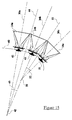
- the line sources may be arranged next to each other, for example as shown at 1 in Figure 1.
- Figure 17 illustrates the orientation of loudspeakers 14e and 14f which are adjacent each other in adjacent line sources.
- the propagation axes 36e and 36f intersect at a point 56.
- the planes containing the propagation axes of the line sources intersect at a line passing through the point 56 with an angle 57 between these planes.
- this line of intersection may be vertical or inclined at a small angle (for example less than 45°) to the vertical, but other applications may require different orientations of this line.
- the distances from the point of intersection 56 to the effective point sources 58 and 59 are substantially equal so as to provide physical time-alignment.
- the loudspeakers 14e and 14f may thus be said to be time-aligned on a line 60 bisecting the angle 57 between the propagation axes 36e and 36f.
- the loudspeakers 14e and 14f may be designed to have any "horizontal" dispersion pattern angle within a range of values (by appropriately designing the members or "waveguides" 26 and 27) to allow the angle 57 to be chosen in accordance with requirements for a specific application of the system.
- the angle 57 is chosen such that there is relatively little interaction between the adjacent line arrays. This may be achieved, for example, by making the angle 57 greater than or equal to half the sum of the "horizontal" dispersion angles of the loudspeakers 14e and 14f.
- the horizontal and vertical dispersion pattern angles of all of the loudspeakers of an array may be the same, this is not necessary and both angles may vary depending on the nature of the specific application.
- loudspeakers directed to closer parts of a venue may provide wider dispersion so that the same effective acoustic output is spread over a wider footprint to achieve improved matching of sound pressure levels at all distances within the "service area" of the system.
Landscapes
- Health & Medical Sciences (AREA)
- Otolaryngology (AREA)
- Physics & Mathematics (AREA)
- Engineering & Computer Science (AREA)
- Acoustics & Sound (AREA)
- Signal Processing (AREA)
- Multimedia (AREA)
- Circuit For Audible Band Transducer (AREA)
- Obtaining Desirable Characteristics In Audible-Bandwidth Transducers (AREA)
Applications Claiming Priority (2)
| Application Number | Priority Date | Filing Date | Title |
|---|---|---|---|
| GBGB0306415.1A GB0306415D0 (en) | 2003-03-20 | 2003-03-20 | Loudspeaker array |
| GB0306415 | 2003-03-20 |
Publications (2)
| Publication Number | Publication Date |
|---|---|
| EP1460880A2 true EP1460880A2 (de) | 2004-09-22 |
| EP1460880A3 EP1460880A3 (de) | 2006-08-16 |
Family
ID=9955170
Family Applications (1)
| Application Number | Title | Priority Date | Filing Date |
|---|---|---|---|
| EP04100774A Ceased EP1460880A3 (de) | 2003-03-20 | 2004-02-26 | Lautsprechersanordnung |
Country Status (3)
| Country | Link |
|---|---|
| US (1) | US7454029B2 (de) |
| EP (1) | EP1460880A3 (de) |
| GB (1) | GB0306415D0 (de) |
Cited By (7)
| Publication number | Priority date | Publication date | Assignee | Title |
|---|---|---|---|---|
| WO2007054709A3 (en) * | 2005-11-09 | 2007-08-16 | Martin Audio Ltd | Acoustic horn waveguides |
| GB2493922A (en) * | 2011-08-19 | 2013-02-27 | Flare Audio Holdings Ltd | Symmetric multi-horn loudspeaker system |
| CN103578461A (zh) * | 2012-07-31 | 2014-02-12 | 顾康 | 一种可调角度非对称高频声波控制器 |
| WO2016044616A1 (en) * | 2014-09-19 | 2016-03-24 | Dolby Laboratories Licensing Corporation | Loudspeaker with narrow dispersion |
| GB2538785A (en) * | 2015-05-28 | 2016-11-30 | Funktion One Res | Horn arrangement |
| CN108391210A (zh) * | 2017-02-03 | 2018-08-10 | 松下知识产权经营株式会社 | 扬声器设备 |
| EP3062536B1 (de) * | 2015-02-26 | 2024-01-31 | Yamaha Corporation | Lautsprecheranordnung |
Families Citing this family (24)
| Publication number | Priority date | Publication date | Assignee | Title |
|---|---|---|---|---|
| US7298860B2 (en) * | 2000-07-31 | 2007-11-20 | Harman International Industries, Incorporated | Rigging system for line array speakers |
| US8718310B2 (en) | 2001-10-19 | 2014-05-06 | Qsc Holdings, Inc. | Multiple aperture speaker assembly |
| US7177437B1 (en) | 2001-10-19 | 2007-02-13 | Duckworth Holding, Llc C/O Osc Audio Products, Inc. | Multiple aperture diffraction device |
| US20080085026A1 (en) * | 2005-10-05 | 2008-04-10 | Qsc Audio Products, Inc. | Curved line array with horizontal coverage control |
| US7606384B2 (en) * | 2005-10-05 | 2009-10-20 | Qsc Audio Products, Inc. | Spiral line array loudspeaker |
| US7606383B2 (en) * | 2005-10-05 | 2009-10-20 | Qsc Audio Products, Inc. | Curved line array loudspeaker |
| US7516932B2 (en) * | 2005-12-30 | 2009-04-14 | Harman International Industries, Incorporated | Suspension system |
| US9031267B2 (en) * | 2007-08-29 | 2015-05-12 | Microsoft Technology Licensing, Llc | Loudspeaker array providing direct and indirect radiation from same set of drivers |
| US8189822B2 (en) * | 2009-06-18 | 2012-05-29 | Robert Bosch Gmbh | Modular, line-array loudspeaker |
| US8917896B2 (en) * | 2009-09-11 | 2014-12-23 | Bose Corporation | Automated customization of loudspeakers |
| US9111521B2 (en) * | 2009-09-11 | 2015-08-18 | Bose Corporation | Modular acoustic horns and horn arrays |
| US9049519B2 (en) | 2011-02-18 | 2015-06-02 | Bose Corporation | Acoustic horn gain managing |
| CN103428603B (zh) * | 2012-05-16 | 2016-04-27 | 顾康 | 一种可调角度的高频声波导向槽 |
| US9215524B2 (en) | 2013-03-15 | 2015-12-15 | Loud Technologies Inc | Acoustic horn manifold |
| US9911406B2 (en) | 2013-03-15 | 2018-03-06 | Loud Audio, Llc | Method and system for large scale audio system |
| US9661418B2 (en) | 2013-03-15 | 2017-05-23 | Loud Technologies Inc | Method and system for large scale audio system |
| US9219954B2 (en) | 2013-03-15 | 2015-12-22 | Loud Technologies Inc | Acoustic horn manifold |
| KR101515618B1 (ko) * | 2014-03-20 | 2015-04-28 | 김태형 | 래티스 타입 스피커, 및 이를 구비한 래티스 어레이 스피커 시스템 |
| US9446559B2 (en) * | 2014-09-18 | 2016-09-20 | Sonos, Inc. | Speaker terminals |
| US9516413B1 (en) * | 2014-09-30 | 2016-12-06 | Apple Inc. | Location based storage and upload of acoustic environment related information |
| DE102017107092B4 (de) * | 2017-04-03 | 2020-04-23 | K & F Beteiligungen Gmbh | Gerät |
| FR3072840B1 (fr) * | 2017-10-23 | 2021-06-04 | L Acoustics | Arrangement spatial de dispositifs de diffusion sonore |
| US11166090B2 (en) * | 2018-07-06 | 2021-11-02 | Eric Jay Alexander | Loudspeaker design |
| FR3100680B1 (fr) * | 2019-09-09 | 2022-11-04 | L Acoustics | Dispositif de diffusion sonore a directivite large bande controlee |
Citations (1)
| Publication number | Priority date | Publication date | Assignee | Title |
|---|---|---|---|---|
| US4845759A (en) * | 1986-04-25 | 1989-07-04 | Intersonics Incorporated | Sound source having a plurality of drivers operating from a virtual point |
Family Cites Families (12)
| Publication number | Priority date | Publication date | Assignee | Title |
|---|---|---|---|---|
| US3637039A (en) * | 1971-04-19 | 1972-01-25 | Dathar Corp | Stereo speaker system |
| FR2478417A1 (fr) | 1980-03-11 | 1981-09-18 | Spiteri Ernest | Cellule emettrice et panneau electro-acoustique perfectionne constitue a l'aide de telles cellules |
| US4308932A (en) | 1980-05-06 | 1982-01-05 | James B. Lansing Sound, Inc. ("Jbl") | Loudspeaker horn |
| US4344504A (en) * | 1981-03-27 | 1982-08-17 | Community Light & Sound, Inc. | Directional loudspeaker |
| US4862508A (en) * | 1987-06-10 | 1989-08-29 | U.S. Sound, Inc. | Method for large-scale multiple source sound reinforcement |
| US5394223A (en) * | 1992-08-17 | 1995-02-28 | Xerox Corporation | Apparatus for image registration |
| JPH07143588A (ja) | 1993-11-12 | 1995-06-02 | Hisaji Nakamura | 垂直アレイ型スピーカ装置 |
| US5750943A (en) * | 1996-10-02 | 1998-05-12 | Renkus-Heinz, Inc. | Speaker array with improved phase characteristics |
| US6394223B1 (en) * | 1999-03-12 | 2002-05-28 | Clair Brothers Audio Enterprises, Inc. | Loudspeaker with differential energy distribution in vertical and horizontal planes |
| US6112847A (en) * | 1999-03-15 | 2000-09-05 | Clair Brothers Audio Enterprises, Inc. | Loudspeaker with differentiated energy distribution in vertical and horizontal planes |
| EP1358780A2 (de) * | 2000-05-30 | 2003-11-05 | Mark S. Ureda | Cross-fired multi-horn lautsprecherssystem |
| US7826622B2 (en) * | 2003-05-27 | 2010-11-02 | Harman International Industries, Incorporated | Constant-beamwidth loudspeaker array |
-
2003
- 2003-03-20 GB GBGB0306415.1A patent/GB0306415D0/en not_active Ceased
-
2004
- 2004-02-26 EP EP04100774A patent/EP1460880A3/de not_active Ceased
- 2004-02-27 US US10/788,893 patent/US7454029B2/en not_active Expired - Lifetime
Patent Citations (1)
| Publication number | Priority date | Publication date | Assignee | Title |
|---|---|---|---|---|
| US4845759A (en) * | 1986-04-25 | 1989-07-04 | Intersonics Incorporated | Sound source having a plurality of drivers operating from a virtual point |
Cited By (10)
| Publication number | Priority date | Publication date | Assignee | Title |
|---|---|---|---|---|
| WO2007054709A3 (en) * | 2005-11-09 | 2007-08-16 | Martin Audio Ltd | Acoustic horn waveguides |
| GB2446547A (en) * | 2005-11-09 | 2008-08-13 | Martin Audio Ltd | Acoustic horn waveguides |
| GB2446547B (en) * | 2005-11-09 | 2011-02-09 | Martin Audio Ltd | Acoustic horn waveguides |
| GB2493922A (en) * | 2011-08-19 | 2013-02-27 | Flare Audio Holdings Ltd | Symmetric multi-horn loudspeaker system |
| CN103578461A (zh) * | 2012-07-31 | 2014-02-12 | 顾康 | 一种可调角度非对称高频声波控制器 |
| WO2016044616A1 (en) * | 2014-09-19 | 2016-03-24 | Dolby Laboratories Licensing Corporation | Loudspeaker with narrow dispersion |
| EP3062536B1 (de) * | 2015-02-26 | 2024-01-31 | Yamaha Corporation | Lautsprecheranordnung |
| GB2538785A (en) * | 2015-05-28 | 2016-11-30 | Funktion One Res | Horn arrangement |
| CN108391210A (zh) * | 2017-02-03 | 2018-08-10 | 松下知识产权经营株式会社 | 扬声器设备 |
| CN108391210B (zh) * | 2017-02-03 | 2020-09-29 | 松下知识产权经营株式会社 | 扬声器设备 |
Also Published As
| Publication number | Publication date |
|---|---|
| GB0306415D0 (en) | 2003-04-23 |
| EP1460880A3 (de) | 2006-08-16 |
| US7454029B2 (en) | 2008-11-18 |
| US20040218773A1 (en) | 2004-11-04 |
Similar Documents
| Publication | Publication Date | Title |
|---|---|---|
| US7454029B2 (en) | Loudspeaker array | |
| US6118883A (en) | System for controlling low frequency acoustical directivity patterns and minimizing directivity discontinuities during frequency transitions | |
| US6394223B1 (en) | Loudspeaker with differential energy distribution in vertical and horizontal planes | |
| US6112847A (en) | Loudspeaker with differentiated energy distribution in vertical and horizontal planes | |
| AU2003208210B2 (en) | Loudspeaker with shaped sound field | |
| EP2096880B1 (de) | Lautsprechersystem | |
| CN108141662B (zh) | 条形音箱 | |
| EP1333698B1 (de) | Richtlautsprecher | |
| US20020014369A1 (en) | System for integrating mid-range and high frequency acoustic sources in multi-way loudspeakers | |
| US20090238383A1 (en) | Loudspeaker system and method for producing synthesized directional sound beam | |
| US20170251296A1 (en) | Loudspeaker with narrow dispersion | |
| JPH04505241A (ja) | 拡声器及びそのホーン | |
| CA2501162C (en) | Acoustic reproduction device with improved directional characteristics | |
| KR20110082583A (ko) | 오디오 스피커 장치 | |
| JP2018125818A (ja) | スピーカ装置 | |
| US6068080A (en) | Apparatus for the redistribution of acoustic energy | |
| JP2003023689A (ja) | 可変指向性超音波スピーカシステム | |
| US7577265B2 (en) | Loudspeaker system providing improved sound presence and frequency response in mid and high frequency ranges | |
| US6435301B1 (en) | Apparatus for the redistriabution of acoustic energy | |
| US7480389B2 (en) | Sound direction system | |
| JP2973677B2 (ja) | 反射型指向性スピーカ | |
| KR100260418B1 (ko) | 무지향스피커시스템을위한음향반사판장치 | |
| KR20190062144A (ko) | 라우드 스피커 및 이를 구비한 음향 출력 장치 | |
| WO2000056131A1 (en) | Loudspeaker with differentiated energy distribution in vertical and horizontal planes | |
| SEVERS et al. | THE MAGIC OF A LINE-ARRAY EXPLAINED |
Legal Events
| Date | Code | Title | Description |
|---|---|---|---|
| PUAI | Public reference made under article 153(3) epc to a published international application that has entered the european phase |
Free format text: ORIGINAL CODE: 0009012 |
|
| AK | Designated contracting states |
Kind code of ref document: A2 Designated state(s): AT BE BG CH CY CZ DE DK EE ES FI FR GB GR HU IE IT LI LU MC NL PT RO SE SI SK TR |
|
| AX | Request for extension of the european patent |
Extension state: AL LT LV MK |
|
| PUAL | Search report despatched |
Free format text: ORIGINAL CODE: 0009013 |
|
| AK | Designated contracting states |
Kind code of ref document: A3 Designated state(s): AT BE BG CH CY CZ DE DK EE ES FI FR GB GR HU IE IT LI LU MC NL PT RO SE SI SK TR |
|
| AX | Request for extension of the european patent |
Extension state: AL LT LV MK |
|
| RIC1 | Information provided on ipc code assigned before grant |
Ipc: G10K 11/26 20060101ALN20060711BHEP Ipc: H04R 1/40 20060101ALN20060711BHEP Ipc: H04R 27/00 20060101AFI20060711BHEP |
|
| 17P | Request for examination filed |
Effective date: 20070117 |
|
| 17Q | First examination report despatched |
Effective date: 20070314 |
|
| AKX | Designation fees paid |
Designated state(s): AT BE BG CH CY CZ DE DK EE ES FI FR GB GR HU IE IT LI LU MC NL PT RO SE SI SK TR |
|
| STAA | Information on the status of an ep patent application or granted ep patent |
Free format text: STATUS: EXAMINATION IS IN PROGRESS |
|
| RIC1 | Information provided on ipc code assigned before grant |
Ipc: H04R 1/26 20060101ALN20191015BHEP Ipc: H04R 1/40 20060101AFI20191015BHEP Ipc: G10K 11/26 20060101ALN20191015BHEP Ipc: H04R 27/00 20060101ALN20191015BHEP |
|
| STAA | Information on the status of an ep patent application or granted ep patent |
Free format text: STATUS: THE APPLICATION HAS BEEN REFUSED |
|
| 18R | Application refused |
Effective date: 20210205 |