EP1457538A1 - AQUEOUS INK COMPOSITION FOR BALL−POINT PEN - Google Patents
AQUEOUS INK COMPOSITION FOR BALL−POINT PEN Download PDFInfo
- Publication number
- EP1457538A1 EP1457538A1 EP02803499A EP02803499A EP1457538A1 EP 1457538 A1 EP1457538 A1 EP 1457538A1 EP 02803499 A EP02803499 A EP 02803499A EP 02803499 A EP02803499 A EP 02803499A EP 1457538 A1 EP1457538 A1 EP 1457538A1
- Authority
- EP
- European Patent Office
- Prior art keywords
- ink composition
- water
- ballpoint pen
- particles
- based ink
- Prior art date
- Legal status (The legal status is an assumption and is not a legal conclusion. Google has not performed a legal analysis and makes no representation as to the accuracy of the status listed.)
- Withdrawn
Links
Classifications
-
- C—CHEMISTRY; METALLURGY
- C09—DYES; PAINTS; POLISHES; NATURAL RESINS; ADHESIVES; COMPOSITIONS NOT OTHERWISE PROVIDED FOR; APPLICATIONS OF MATERIALS NOT OTHERWISE PROVIDED FOR
- C09D—COATING COMPOSITIONS, e.g. PAINTS, VARNISHES OR LACQUERS; FILLING PASTES; CHEMICAL PAINT OR INK REMOVERS; INKS; CORRECTING FLUIDS; WOODSTAINS; PASTES OR SOLIDS FOR COLOURING OR PRINTING; USE OF MATERIALS THEREFOR
- C09D11/00—Inks
- C09D11/16—Writing inks
- C09D11/18—Writing inks specially adapted for ball-point writing instruments
Definitions
- the present invention relates to a water-based ink composition for a ballpoint pen which can be used for a writing instrument and which is excellent in erasability by an eraser.
- an erasable ink composition in which a colorant contained in the ink is regulated around a certain size, that is, an erasable water-based ink composition comprising at least a colorant, wherein the above colorant has an average particle diameter of 2 ⁇ m or more, and the colorant having a particle diameter of 1.8 ⁇ m or less accounts for 1.6 % by weight or less based on the colorant.
- the ink composition described in the above gazette has erasability by an eraser, but it has the problems that the elimination of the colorant from a paper face only by light contact with the drawn lines so that the soiling of paper face is caused and that it does not stand actual use.
- Japanese Patent Application Laid-Open No. 136339/2000 is an eraser-erasable water-based ink composition for a ballpoint pen provided with a point contact-like sticking property on the drawn lines after drying by blending particles having a glass transition point or a minimum film-forming temperature which exceeds 0°C and is lower than 40°C for the purpose of improving the performance of the drawn lines against abrasion.
- an eraser-erasable water-based ink composition for a writing instrument having the purpose of improving the performance against abrasion by using adhesive colored resin particles provided with an adhesive property as a colorant.
- a problem resides in the point that when writing is carried out after left standing for a certain time with the cap taken off, starving is liable to be caused, so that the good drawn lines can not be obtained.
- an eraser-erasable water-based ink composition for a writing instrument containing a colorant comprising colored thermoplastic resin particles and adhesive resin particles.
- the water-based ink composition using such a colorant has problems that it is liable to be instable with the passage of time and that erasability by an eraser is reduced when the drawn lines are left standing at a temperature of room temperature or higher for a certain period.
- the present invention intends to solve the above problems, and an object thereof is to provide a water-based ink composition for a ballpoint which is stable with the passage of time and which is excellent in a writing performance and erasability by an eraser.
- the present invention comprises in the following items (1) to (5).
- the water-based ink composition for a ballpoint of the present invention is characterized by comprising at least colored resin particles which have an average particle diameter of 2 to 20 ⁇ m and which are non-thermoplastic in a proportion of 5 to 30 % by weight based on the total amount of the ink composition and non-colored particles having a glass transition point of 60°C or higher.
- the colored resin particles used in the present invention comprise colored resin particles and are non-thermoplastic, and they have to be colored resin particles having an average particle diameter of 2 to 20 ⁇ m.
- the colored resin particle used in the present invention includes, for example, a colored resin particle in which a colorant comprising a pigment is dispersed in a resin particle, a colored resin particle in which the surface of a resin particle is covered with a colorant comprising a pigment and a colored resin particle prepared by dying a resin particle with a colorant comprising a dye.
- the structure (hollow or non-hollow (dense)) and the form (spherical, polygonal, flat or fibrous) of a colored resin particle shall not specifically be restricted as long as the colored resin particle is non-thermoplastic and meets the average particle diameter described above, and a spherical colored resin particle having an average particle diameter of 3 to 15 ⁇ m in which a glass transition point is 150°C or higher and close to a thermal decomposition temperature and which has such intramolecular cross-linking that a melt flow index value is less than 0.1 and does not have an adhesive property is preferably used from the viewpoint of exhibiting excellent erasability by an eraser, a writing property and stability of the ink with the passage of time.
- the colored resin particle is thermoplastic and has an adhesive property, coagulation between the particles is liable to be caused, and the stability of the ink is damaged or starving of drawn lines is liable to be caused when a pen filled with the ink is left standing with the cap taken off. Accordingly, such a particle is not preferred.
- the colored resin particle has an average particle diameter of less than 2 ⁇ m, the particle is liable to get into a gap between paper fibers and reduced in an erasability, and therefore it is not preferred.
- the colored resin particle has an average particle diameter of exceeding 20 ⁇ m, the erasability is enhanced, but brought about are the defects that the ink is reduced in color density and that the colored resin particle is liable to be precipitated, so that the stability with the passage of time is damaged and the feeling in writing is deteriorated. Accordingly, such a particle is not preferred.
- the particles can stay in the vicinity of a paper surface without penetrating into the depth of the fibers of paper only by controlling an average particle diameter of the colored resin particles to 2 to 20 ⁇ m and using the non-thermoplastic particles, so that they can readily be removed by an eraser.
- the colorant used for the colored resin particles includes, for example, direct dyes such as Aizen Primula Red 4BH and Aizen Primula Yellow GCLH (manufactured by Aizen Co., Ltd.), acidic dyes such as Aizen Bonceau RH, Aizen Opal Pink BH and Aizen Opal Black WH Extra Conc. (manufactured by Aizen Co., Ltd.), Orient Solpul Blue OBX and Orient Solpul Blue OBB (manufactured by Orient Chemical Co., Ltd.), food dyes such as Tartrazine, Acid Red and Flokiron (manufactured by Aizen Co., Ltd.) and fluorescent dyes.
- direct dyes such as Aizen Primula Red 4BH and Aizen Primula Yellow GCLH (manufactured by Aizen Co., Ltd.)
- acidic dyes such as Aizen Bonceau RH, Aizen Opal Pink BH and Aizen Opal Black WH Extra Conc.
- the pigment includes, for example, inorganic pigments such as carbon black, titanium oxide and iron oxide, organic pigments such as phthalocyanine base pigments and azo base pigments, inorganic fluorescent pigments such as calcium sulfide and other fluorescent pigments.
- inorganic pigments such as carbon black, titanium oxide and iron oxide
- organic pigments such as phthalocyanine base pigments and azo base pigments
- inorganic fluorescent pigments such as calcium sulfide and other fluorescent pigments.
- the resin component includes, for example, at least one selected from polymers of acrylic acid, methacrylic acid, acrylates, methacrylates, styrene, acrylonitrile and butadiene and copolymers thereof, polyethylene, polyethylene terephthalate, polypropylene, phenol resins, epoxy resins and urethane resins, and reins subjected, if necessary, to treatment such as cross-linking may be used.
- Methods such as publicly known suspension polymerization and dispersion polymerization can be used as a coloring method for the above resins.
- the resin component for the colored resin particle is preferably acryl resins, urethane resins and benzoguanamine resins in terms of a price and a mixing and dying property with the colorant.
- the colored resin particle which does not have an adhesive property and which is not thermoplastic is preferred.
- An ink comprising the particle having an adhesive property is liable to cause starving when written after a pen filled with the ink is left standing for a certain time with the cap taken off, and the good drawn lines can not be obtained in a certain case.
- the thermoplastic particle is liable to be instable with the passage of time, and the drawn lines are reduced in erasability by an eraser in a certain case when left standing for a certain period at room temperature or higher.
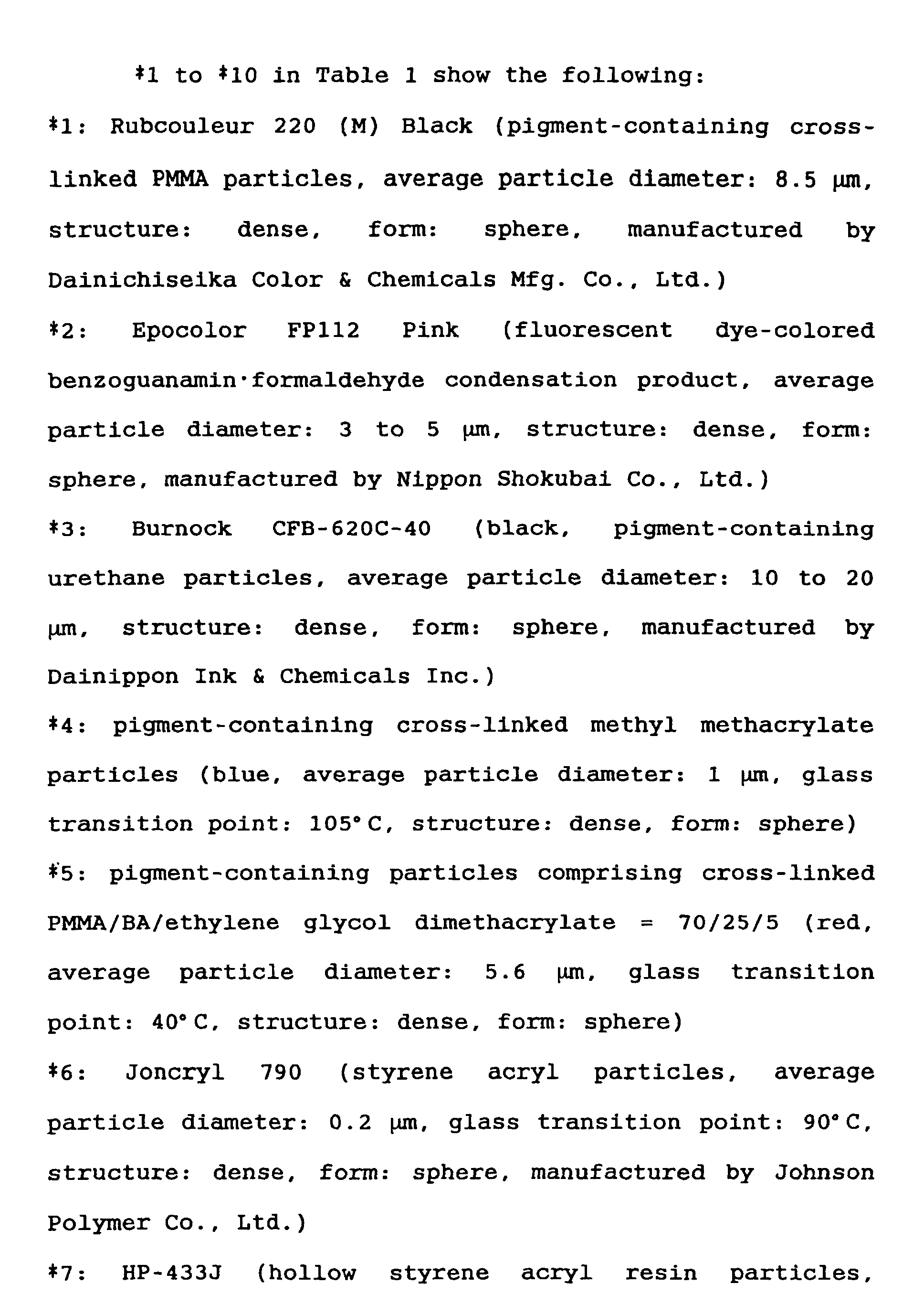
- the colored resin particle having the characteristics described above which can be used in the present invention includes, for example, commercially available Rubcouleur 220 (M) Black (pigment-containing cross-linked PMMA particles, average particle diameter: 8.5 ⁇ m, structure: dense, form: sphere, manufactured by Dainichiseika Color & Chemicals Mfg.
- M Rubcouleur 220
- Black pigment-containing cross-linked PMMA particles, average particle diameter: 8.5 ⁇ m, structure: dense, form: sphere, manufactured by Dainichiseika Color & Chemicals Mfg.
- Epocolor FP112 Pink (fluorescent dye-colored benzoguanamin ⁇ formaldehyde condensed product, average particle diameter: 3 to 5 ⁇ m, structure: dense, form: sphere)
- Epocolor FP113 Red (fluorescent dye-colored benzoguanamin ⁇ formaldehyde condensation product, average particle diameter: 3 to 5 ⁇ m, structure: dense, form: sphere)
- Epocolor FP114 Orange fluorescent dye-colored benzoguanamin ⁇ formaldehyde condensation product, average particle diameter: 3 to 5 ⁇ m, structure: dense, form: sphere)
- Epocolor FP117 Yellow (fluorescent dye-colored benzoguanamin ⁇ formaldehyde condensation product, average particle diameter: 3 to 5 ⁇ m, structure: dense, form: sphere)(manufactured by Nippon Shokubai Co., Ltd.) and Burnock CFB-620C-40 (black, pigment-containing urethane particles, average particle diameter: 10 to
- a content of the colored resin particle having the characteristics described above is desirably 5 to 30 % by weight, preferably 8 to 20 % by weight based on the total amount of the ink composition.
- the above content of the colored resin particle is less than 5 % by weight in the ink composition, the preferred drawn lines are not obtained, and if it exceeds 30 % by weight in the ink composition, the writing feeling is heavy or starving is liable to be caused in the drawn lines in writing by a pen filled with the composition. Accordingly, such ranges are not preferred.
- the non-colored particles used in the present invention are added in order to further provide both characteristics of erasability by an eraser and abrasion resistance, and the non-colored particles having a glass transition point of 60°C or higher have to be used.
- a weak adhesive property endowed to the particles reveals a sticking property to such extent that the erasability is not damaged by using the non-colored particles having a glass transition point of 60°C or higher, preferably 80°C, whereby the abrasion resistance is further improved. Further, a particle diameter of the non-colored particles exerts an effect as well on the sticking property.
- non-colored particles having a glass transition point of lower than 60°C are used, a film of the non-colored particles is sometimes formed depending on a temperature condition in writing, and the colored resin particle, which is the colorant is brought into face contact with a paper face, so that the erasability is lowered.
- the non-colored particles used in the present invention include, for example, non-colored styrene butadiene particles, styrene acryl resin particles, acrylate particles, methacrylate particles, silicone acryl particles and vinylpyridine particles, and the above non-colored particles may be modified.
- the styrene butadiene particles (modified or not modified), the styrene acryl resin particles (modified or not modified), the acrylate particles (modified or not modified) and the methacrylate particles (modified or not modified) are preferably used in terms of strength of a continuous coating film, a suitable adhesive property and stability of the ink.
- the above non-colored particles have an average particle diameter of preferably 0.01 to 10 ⁇ m, more preferably 0.1 to 2 ⁇ m.
- the non-colored resin particles have an average particle diameter of less than 0.01 ⁇ m, the particles are liable to get into the inner part of a gap between paper fibers, and therefore the eraser-erasing effect is less liable to be exerted.
- the non-colored resin particles have an average particle diameter of exceeding 10 ⁇ m, the abrasion resistance is inferior. This is considered to be attributable to the facts that a contact area between the particle and a paper face is reduced and that the particle is liable to be caught by virtue of abrasion because of a size thereof.
- the non-colored resin particles having the characteristics described above which can be used in the present invention include, for example, commercially available Joncryl 790 (styrene acryl particles, average particle diameter: 0.2 ⁇ m, glass transition point: 90° C, structure: dense, form: sphere), Joncryl 7640 (styrene acryl particles, average particle diameter: 0.12 ⁇ m, glass transition point: 85°C, structure: dense, form: sphere)(manufactured by Johnson Polymer Co., Ltd.), HP-433J (hollow styrene acryl resin particles, average particle diameter: 0.4 ⁇ m, glass transition point: 105°C, structure: hollow structure, form: sphere) and OP-84J (hollow styrene acryl resin particles, average particle diameter: 0.55 ⁇ m, glass transition point: 105°C, structure: hollow structure, form: sphere)(manufactured by Rohm & Haas Co., Ltd.). They can be used alone or in a mixture of
- a content of the non-colored resin particles having the characteristics described above is preferably 0.1 to 10 % by weight, more preferably 0.5 to 5 % by weight based on the total amount of the ink composition.
- a content of the colored resin particles is less than 0.1 % by weight, the erasability by an eraser and the abrasion resistance, which are the effects of the present invention can not be exerted.
- the adhesive property becomes stronger so that the abrasion resistance is improved, but the erasability is notably reduced. Accordingly, both ranges are not preferred.
- Water (refined water, ion-exchanged water, pure water and the like) is used as the principal solvent in the water-based ink composition for a ballpoint pen of the present invention, and a water-soluble polar solvent having a polar group which is compatible with water can further be used as the solvent in terms of providing the water holding property and improving the writing feeling.
- the water-soluble polar solvent which can be used includes, for example, ethylene glycol, diethylene glycol, triethylene glycol, polyethylene glycol, propylene glycol, ethylene glycol monomethyl ether, glycerin, pyrrolidone and triethanolamine, and they can be used alone or in a mixture of two or more kinds thereof.
- a water-soluble liquid medium other than water can be used.
- This water-soluble liquid medium includes at least one selected from the group consisting of ethylene oxide or propylene oxide adducts of glycerin and ethylene oxide or propylene oxide adducts of diglycerin, preferably diglycerin propylene oxide (4 to 30) mole adducts and diglycerin ethylene oxide (5 to 40) mole adducts.
- the above water-soluble liquid media makes it possible to prepare the ink composition which has better erasability by an eraser and which is excellent in drying resistance at a pen tip.
- desirably used are polyoxyethylene 13 mole-added diglyceryl ether, polyoxypropylene 9 mole-added diglyceryl ether, polyoxyethylene 10 mole-added glyceryl ether and polyoxypropylene 9 mole-added glyceryl ether.
- the above water-soluble liquid media have the above effects because they allow the colored resin particles to stay in the vicinity of the surface of paper fibers due to a high water holding property and good “separation", though the mechanism thereof is not clear, from the colored resin particles and the non-colored resin particles.
- a content of the above water-soluble liquid media is preferably 1 to 30 % by weight, more preferably 5 to 15 % by weight based on the total amount of the ink composition.
- a content of the water-soluble liquid media is less than 1 % by weight, the erasability by an eraser and drying resistance at a pen tip can not further be exhibited. On the other hand, if it exceeds 30 % by weight, a drying property of the drawn lines is reduced. Accordingly, both ranges are not preferred.
- additives which are usually used for water-based inks for a ballpoint pen can be used as a component other than those described above as long as the effects of the present invention are not damaged.
- a pH controlling agent includes, ammonia, urea, monoethanolamine, diethanolamine, triethanolamine, alkali metal salts of phosphoric acid such as sodium tripolyphosphate, sodium carbonate and hydroxides of alkali metals such as sodium hydroxide, and an antiseptic agent or a fungicide includes phenol, sodium omadine, sodium pentachlorophenol, 1,2-benzisothiazoline-3-one, 2,3,5,6-tetrachloro-4-(methylsulfonyl)pyridine, alkaline metal salts of benzoic acid, sorbitan acid and dehydroacetic acid such as sodium benzoate and benzimidazole base compounds.
- a rust preventive includes benzotriazole, dicyclohexylammonium nitrite, diisopropylammonium nitrite, tolyl triazole and saponins
- a lubricant includes polyalkylene glycol derivatives such as polyoxyethylene lauryl ether, fatty acid alkali salts, nonionic surfactants, fluorine base surfactants such as perfluoroalkyl ether phosphoric acid esters and polyether-modified silicone such as polyethylene glycol adducts of dimethylenepolysiloxane.
- the ink composition having more stability can be obtained by adding a water-soluble viscosity-controlling agent to the water-based ink composition for a ballpoint pen of the present invention.
- At least one selected from the group consisting of synthetic polymers, celluloses and polysaccharides can be used as the viscosity-controlling agent.
- the synthetic polymers include, for example, polyacrylic acids, polyvinyl alcohol, polyethylene oxide, polyvinylpyrrolidone, polyvinyl methyl ether and polyacrylamide; the celluloses include ethyl cellulose, methyl cellulose, hydroxymethyl cellulose and carboxymethyl cellulose; and the polysaccharides include xanthan gum, guar gum, casein, gum arabic, gelatin, carrageenan, alginic acid, tragacanth gum and locust bean gum.
- a viscosity value at 1 rpm which is measured under the condition of 25°C by means of an EMD type viscometer is desirably controlled to a range of preferably 100 to 1500 mPa ⁇ s, more preferably 500 to 1200 mPa ⁇ s by suitably adding the viscosity-controlling agent described above and the like.
- the viscosity value at 100 rpm which is measured under the condition of 25°C by means of the EMD type viscometer is desirably controlled to a range of preferably 10 to 90 mPa ⁇ s, more preferably 20 to 50 mPa ⁇ s.
- the water-based ink composition for a ballpoint pen of the present invention can be produced by blending the colored resin particles having the characteristics described above, the non-colored resin particles, water (and the water-soluble polar solvent), the water-soluble liquid medium and the additives in the same manner as in a production process for a publicly known water-based ink.
- the water-based ink composition for a ballpoint pen of the present invention has a pH which is controlled to 7.0 to 9.0 by a pH controlling agent in terms of usability, safety, corrosion resistance against a metal part of a ballpoint pen and a thickening power when using an alkali thickening type thickener.
- a water-based ballpoint pen filled with the water-based ink composition for a ballpoint pen of the present invention shall not specifically be restricted in a structure thereof and the like, and a ballpoint pen having a publicly known ballpoint pen structure using a water-based ink can be used.
- a particle diameter of the colored resin particle used as the colorant has been controlled to a range of 2 to 20 ⁇ m, and therefore the particles stay in the vicinity of the surface of paper without damaging the stability of the ink composition with the passage of time and the feeling in writing and getting into the depth of fibers of the paper, so that they can readily be removed with an eraser. Also, because the colored resin particle is non-thermoplastic, the erasability is not reduced, and the ink itself becomes excellent as well in stability with the passage of time.
- the particle scarcely has an adhesive property and the great part of the particles is removed from a paper face with erasing, and therefore the drawn lines can be erased well by an eraser as compared with those written with an ink comprising conventional colorant particles having an adhesive property.
- a weak adhesive property endowed to the particles results in revealing a sticking property to such extent that the erasability is not damaged by adding the non-colored particles having a glass transition point of 60°C or higher, whereby the abrasion resistance is further improved. Further, even if the temperature condition in writing fluctuates to a high temperature or a low temperature, the film of the non-colored particles is not formed, and the erasability is not reduced.
- a water-based ink composition for a ballpoint pen of the present invention provided is a water-based ink composition for a ballpoint pen which is stable with the passage of time and which is excellent in a writing performance, erasability by an eraser and abrasion resistance.
- a water-based ink composition for a ballpoint pen which has good erasability by an eraser and which is excellent in drying property at a pen tip is provided by further adding at least one selected from the group consisting of ethylene oxide or propylene oxide adducts of glycerin and ethylene oxide or propylene oxide adducts of diglycerin in a proportion of 1 to 30 % by weight based on the total amount of the ink composition.
- the water-based ink compositions obtained in the respective examples and comparative examples were measured for viscosities at 1 rpm and 100 rpm under the condition of 25°C according to the following method by means of an EMD type viscometer.
- VISCOMETER BE110R manufactured by Toki Sangyo Co., Ltd.
- the water-based ink compositions obtained in the respective examples and comparative examples were filled into an ink reservoir of a ballpoint pen (uni-ball Signo, manufactured by Mitsubishi Pencil Co., Ltd.) having the following structure.
- Ink reservoir form: cylinder, inner diameter: 4.0 mm, made of polypropylene, length: 115 mm Ball diameter: 0.7 mm, ball material: hard metal
- the respective water-based ballpoint pens thus obtained were evaluated for erasability by an eraser, abrasion resistance with a finger, stability of the ink with the passage of time, starving in the beginning of writing, drawn line erasability after left standing at 40°C for one month (1 M), drawn line density and drawn line quality by the following evaluating methods.
- Circles having a diameter of about 2 cm were helically written on a writing paper meeting an ISO standard by means of the respective pens, and after one minute passed, the drawn lines were erased by an eraser (EP-60, manufactured by Mitsubishi Pencil Co., Ltd.).
- Circles having a diameter of about 5 cm were helically written on a writing paper meeting the ISO standard in about 100 m in terms of a straight line distance by means of the respective pens and evaluated according to the following criteria (writing conditions: writing speed: 4.5 m/minute, writing angle: 60° and writing load: 100 g). Evaluation criteria:
- Comparative Example 1 is a case where the non-colored particles are not contained; Comparative Example 2 is a case where a content of the colored resin particles is small; Comparative Example 3 is a case where a content of the colored resin particles is large; Comparative Example 4 is a case where the colored resin particles have a small average particle diameter; and Comparative Example 5 is a case where adhesive colored resin particles are used. It can be found that in the above cases, incapable of being satisfied are all of the performances such as erasability by an eraser, abrasion resistance with a finger, stability of the ink with the passage of time, starving in the beginning of writing, drawn line erasability after left standing at 40°C for one month, drawn line density and drawn line quality.
- the water-based ink composition for a ballpoint pen of the present invention is stable with the passage of time, and it is excellent in a writing performance, erasability by an eraser and abrasion resistance.
- the ink composition containing at least one selected from ethylene oxide or propylene oxide adducts of glycerin and ethylene oxide or propylene oxide adducts of diglycerin in a proportion of 1 to 30 % by weight based on the total amount of the ink composition has a better erasability by an eraser and is excellent in drying resistance at a pen tip.
- the ink composition in which a viscosity value at 1 rpm measured under the condition of 25°C by means of an EMD type viscometer falls in a range of 100 to 1500 mPa ⁇ s and/or a viscosity value at 100 rpm falls in a range of 10 to 90 mPa ⁇ s is excellent in stability and writing performance.
Landscapes
- Chemical & Material Sciences (AREA)
- Life Sciences & Earth Sciences (AREA)
- Engineering & Computer Science (AREA)
- Materials Engineering (AREA)
- Wood Science & Technology (AREA)
- Organic Chemistry (AREA)
- Inks, Pencil-Leads, Or Crayons (AREA)
Abstract
Provided is a water-based ink composition for a
ballpoint pen characterized by comprising at least
colored resin particles which have an average particle
diameter of 2 to 20 µm and which are non-thermoplastic in
a proportion of 5 to 30 % by weight based on the total
amount of the ink composition and non-colored particles
having a glass transition point of 60°C or higher. The
average particle diameter of the non-colored particles
described above is controlled preferably to 0.01 to 10 µm.
The water-based ink composition for a ballpoint pen
described above further comprises preferably at least one
selected from ethylene oxide or propylene oxide adducts
of glycerin and ethylene oxide or propylene oxide adducts
of diglycerin in a proportion of 1 to 30 % by weight
based on the total amount of the ink composition.
The above water-based ink composition for a
ballpoint pen is further stable with the passage of time
and excellent in a writing performance, erasability by an
eraser and abrasion resistance.
Description
The present invention relates to a water-based ink
composition for a ballpoint pen which can be used for a
writing instrument and which is excellent in erasability
by an eraser.
A lot of water-based ink compositions which have
erasability by an eraser has so far been proposed.
For example, disclosed in Japanese Patent
Application Laid-Open No. 103997/2000 is an erasable ink
composition in which a colorant contained in the ink is
regulated around a certain size, that is, an erasable
water-based ink composition comprising at least a
colorant, wherein the above colorant has an average
particle diameter of 2 µm or more, and the colorant
having a particle diameter of 1.8 µm or less accounts for
1.6 % by weight or less based on the colorant.
The ink composition described in the above gazette
has erasability by an eraser, but it has the problems
that the elimination of the colorant from a paper face
only by light contact with the drawn lines so that the
soiling of paper face is caused and that it does not
stand actual use.
Further, disclosed in Japanese Patent Application
Laid-Open No. 136339/2000 is an eraser-erasable water-based
ink composition for a ballpoint pen provided with a
point contact-like sticking property on the drawn lines
after drying by blending particles having a glass
transition point or a minimum film-forming temperature
which exceeds 0°C and is lower than 40°C for the purpose
of improving the performance of the drawn lines against
abrasion. In the above ink composition, however, a film
is sometimes formed depending on a temperature condition
in writing, and therefore a problem resides in the points
that the erasability is reduced and that starving in the
beginning of writing due to film forming at a pen tip is
caused, so that the eraser-erasable water-based ink
composition for a ballpoint pen having stable quality is
not obtained.
Further, disclosed in Japanese Patent Application
Laid-Open No. 19888/2001 is an eraser-erasable water-based
ink composition for a writing instrument having the
purpose of improving the performance against abrasion by
using adhesive colored resin particles provided with an
adhesive property as a colorant. In the above water-based
ink composition, however, a problem resides in the
point that when writing is carried out after left
standing for a certain time with the cap taken off,
starving is liable to be caused, so that the good drawn
lines can not be obtained.
Further, disclosed in Japanese Patent Application
Laid-Open No. 19889/2001 is an eraser-erasable water-based
ink composition for a writing instrument containing
a colorant comprising colored thermoplastic resin
particles and adhesive resin particles. The water-based
ink composition using such a colorant has problems that
it is liable to be instable with the passage of time and
that erasability by an eraser is reduced when the drawn
lines are left standing at a temperature of room
temperature or higher for a certain period.
Further, in the water-based ink compositions
described in the respective gazettes described above, it
is not described that liquid media other than water are
used. In the water-based ink compositions described in
the respective gazettes described above, the colorants
have to stay in the vicinity of a paper face in order to
exhibit well erasability by an eraser. However, if a
conventional scarcely volatile solvent blended in a lot
of water-based ink compositions is used, the solvent
penetrates into the inside of a paper face together with
the colorant in a certain case without volatilizing, and
therefore a problem resides in the point that using such
a solvent is a cause by which the erasability is reduced.
Accordingly, the current situation is that a water-based
ink composition for a ballpoint pen which is excellent in
erasability by an eraser is intensively desired to appear.
In light of the problems and the current situation
of the conventional water-based ink compositions for a
ballpoint pen described above having erasability by an
eraser, the present invention intends to solve the above
problems, and an object thereof is to provide a water-based
ink composition for a ballpoint which is stable
with the passage of time and which is excellent in a
writing performance and erasability by an eraser.
Intensive investigations repeated by the present
inventors in order to solve the conventional problems
described above have resulted in successfully obtaining a
water-based ink composition for a ballpoint pen meeting
the object described above which is stable with the
passage of time and which is excellent in a total
performance in writing by adding a colorant which has a
specific particle diameter range and which is non-thermoplastic
and particles having a specific glass
transition point, and thus the present invention has come
to be completed.
That is, the present invention comprises in the
following items (1) to (5).
The embodiment of the invention shall specifically
be explained below.
The water-based ink composition for a ballpoint of
the present invention is characterized by comprising at
least colored resin particles which have an average
particle diameter of 2 to 20 µm and which are non-thermoplastic
in a proportion of 5 to 30 % by weight
based on the total amount of the ink composition and non-colored
particles having a glass transition point of 60°C
or higher.
The colored resin particles used in the present
invention comprise colored resin particles and are non-thermoplastic,
and they have to be colored resin
particles having an average particle diameter of 2 to 20
µm.
The colored resin particle used in the present
invention includes, for example, a colored resin particle
in which a colorant comprising a pigment is dispersed in
a resin particle, a colored resin particle in which the
surface of a resin particle is covered with a colorant
comprising a pigment and a colored resin particle
prepared by dying a resin particle with a colorant
comprising a dye.
In the present invention, the structure (hollow or
non-hollow (dense)) and the form (spherical, polygonal,
flat or fibrous) of a colored resin particle shall not
specifically be restricted as long as the colored resin
particle is non-thermoplastic and meets the average
particle diameter described above, and a spherical
colored resin particle having an average particle
diameter of 3 to 15 µm in which a glass transition point
is 150°C or higher and close to a thermal decomposition
temperature and which has such intramolecular cross-linking
that a melt flow index value is less than 0.1 and
does not have an adhesive property is preferably used
from the viewpoint of exhibiting excellent erasability by
an eraser, a writing property and stability of the ink
with the passage of time.
If the colored resin particle is thermoplastic and
has an adhesive property, coagulation between the
particles is liable to be caused, and the stability of
the ink is damaged or starving of drawn lines is liable
to be caused when a pen filled with the ink is left
standing with the cap taken off. Accordingly, such a
particle is not preferred.
If the colored resin particle has an average
particle diameter of less than 2 µm, the particle is
liable to get into a gap between paper fibers and reduced
in an erasability, and therefore it is not preferred. On
the other hand, if the colored resin particle has an
average particle diameter of exceeding 20 µm, the
erasability is enhanced, but brought about are the
defects that the ink is reduced in color density and that
the colored resin particle is liable to be precipitated,
so that the stability with the passage of time is damaged
and the feeling in writing is deteriorated. Accordingly,
such a particle is not preferred.
The particles can stay in the vicinity of a paper
surface without penetrating into the depth of the fibers
of paper only by controlling an average particle diameter
of the colored resin particles to 2 to 20 µm and using
the non-thermoplastic particles, so that they can readily
be removed by an eraser.
The colorant used for the colored resin particles
includes, for example, direct dyes such as Aizen Primula
Red 4BH and Aizen Primula Yellow GCLH (manufactured by
Aizen Co., Ltd.), acidic dyes such as Aizen Bonceau RH,
Aizen Opal Pink BH and Aizen Opal Black WH Extra Conc.
(manufactured by Aizen Co., Ltd.), Orient Solpul Blue OBX
and Orient Solpul Blue OBB (manufactured by Orient
Chemical Co., Ltd.), food dyes such as Tartrazine, Acid
Red and Flokiron (manufactured by Aizen Co., Ltd.) and
fluorescent dyes.
The pigment includes, for example, inorganic
pigments such as carbon black, titanium oxide and iron
oxide, organic pigments such as phthalocyanine base
pigments and azo base pigments, inorganic fluorescent
pigments such as calcium sulfide and other fluorescent
pigments.
The resin component includes, for example, at least
one selected from polymers of acrylic acid, methacrylic
acid, acrylates, methacrylates, styrene, acrylonitrile
and butadiene and copolymers thereof, polyethylene,
polyethylene terephthalate, polypropylene, phenol resins,
epoxy resins and urethane resins, and reins subjected, if
necessary, to treatment such as cross-linking may be used.
Methods such as publicly known suspension polymerization
and dispersion polymerization can be used as a coloring
method for the above resins.
The resin component for the colored resin particle
is preferably acryl resins, urethane resins and
benzoguanamine resins in terms of a price and a mixing
and dying property with the colorant.
The colored resin particle which does not have an
adhesive property and which is not thermoplastic is
preferred. An ink comprising the particle having an
adhesive property is liable to cause starving when
written after a pen filled with the ink is left standing
for a certain time with the cap taken off, and the good
drawn lines can not be obtained in a certain case.
Further, the thermoplastic particle is liable to be
instable with the passage of time, and the drawn lines
are reduced in erasability by an eraser in a certain case
when left standing for a certain period at room
temperature or higher.
The colored resin particle having the
characteristics described above which can be used in the
present invention includes, for example, commercially
available Rubcouleur 220 (M) Black (pigment-containing
cross-linked PMMA particles, average particle diameter:
8.5 µm, structure: dense, form: sphere, manufactured by
Dainichiseika Color & Chemicals Mfg. Co., Ltd.), Epocolor
FP112 Pink (fluorescent dye-colored
benzoguanamin·formaldehyde condensed product, average
particle diameter: 3 to 5 µm, structure: dense, form:
sphere), Epocolor FP113 Red (fluorescent dye-colored
benzoguanamin·formaldehyde condensation product, average
particle diameter: 3 to 5 µm, structure: dense, form:
sphere), Epocolor FP114 Orange (fluorescent dye-colored
benzoguanamin·formaldehyde condensation product, average
particle diameter: 3 to 5 µm, structure: dense, form:
sphere), Epocolor FP117 Yellow (fluorescent dye-colored
benzoguanamin·formaldehyde condensation product, average
particle diameter: 3 to 5 µm, structure: dense, form:
sphere)(manufactured by Nippon Shokubai Co., Ltd.) and
Burnock CFB-620C-40 (black, pigment-containing urethane
particles, average particle diameter: 10 to 20 µm,
structure: dense, form: sphere, manufactured by Dainippon
Ink & Chemicals Inc.). They can be used alone or in a
mixture of two or more kinds thereof.
A content of the colored resin particle having the
characteristics described above is desirably 5 to 30 % by
weight, preferably 8 to 20 % by weight based on the total
amount of the ink composition.
If the above content of the colored resin particle
is less than 5 % by weight in the ink composition, the
preferred drawn lines are not obtained, and if it exceeds
30 % by weight in the ink composition, the writing
feeling is heavy or starving is liable to be caused in
the drawn lines in writing by a pen filled with the
composition. Accordingly, such ranges are not preferred.
The non-colored particles used in the present
invention are added in order to further provide both
characteristics of erasability by an eraser and abrasion
resistance, and the non-colored particles having a glass
transition point of 60°C or higher have to be used.
In the present invention, a weak adhesive property
endowed to the particles reveals a sticking property to
such extent that the erasability is not damaged by using
the non-colored particles having a glass transition point
of 60°C or higher, preferably 80°C, whereby the abrasion
resistance is further improved. Further, a particle
diameter of the non-colored particles exerts an effect as
well on the sticking property.
If the non-colored particles having a glass
transition point of lower than 60°C are used, a film of
the non-colored particles is sometimes formed depending
on a temperature condition in writing, and the colored
resin particle, which is the colorant is brought into
face contact with a paper face, so that the erasability
is lowered.
The non-colored particles used in the present
invention include, for example, non-colored styrene
butadiene particles, styrene acryl resin particles,
acrylate particles, methacrylate particles, silicone
acryl particles and vinylpyridine particles, and the
above non-colored particles may be modified.
The styrene butadiene particles (modified or not
modified), the styrene acryl resin particles (modified or
not modified), the acrylate particles (modified or not
modified) and the methacrylate particles (modified or not
modified) are preferably used in terms of strength of a
continuous coating film, a suitable adhesive property and
stability of the ink.
The above non-colored particles have an average
particle diameter of preferably 0.01 to 10 µm, more
preferably 0.1 to 2 µm.
If the non-colored resin particles have an average
particle diameter of less than 0.01 µm, the particles are
liable to get into the inner part of a gap between paper
fibers, and therefore the eraser-erasing effect is less
liable to be exerted. On the other hand, if the non-colored
resin particles have an average particle diameter
of exceeding 10 µm, the abrasion resistance is inferior.
This is considered to be attributable to the facts that a
contact area between the particle and a paper face is
reduced and that the particle is liable to be caught by
virtue of abrasion because of a size thereof.
The non-colored resin particles having the
characteristics described above which can be used in the
present invention include, for example, commercially
available Joncryl 790 (styrene acryl particles, average
particle diameter: 0.2 µm, glass transition point: 90° C,
structure: dense, form: sphere), Joncryl 7640 (styrene
acryl particles, average particle diameter: 0.12 µm,
glass transition point: 85°C, structure: dense, form:
sphere)(manufactured by Johnson Polymer Co., Ltd.), HP-433J
(hollow styrene acryl resin particles, average
particle diameter: 0.4 µm, glass transition point: 105°C,
structure: hollow structure, form: sphere) and OP-84J
(hollow styrene acryl resin particles, average particle
diameter: 0.55 µm, glass transition point: 105°C,
structure: hollow structure, form: sphere)(manufactured
by Rohm & Haas Co., Ltd.). They can be used alone or in
a mixture of two or more kinds thereof.
A content of the non-colored resin particles having
the characteristics described above is preferably 0.1 to
10 % by weight, more preferably 0.5 to 5 % by weight
based on the total amount of the ink composition.
If a content of the colored resin particles is less
than 0.1 % by weight, the erasability by an eraser and
the abrasion resistance, which are the effects of the
present invention can not be exerted. On the other hand,
if it exceeds 10 % by weight, the adhesive property
becomes stronger so that the abrasion resistance is
improved, but the erasability is notably reduced.
Accordingly, both ranges are not preferred.
Water (refined water, ion-exchanged water, pure
water and the like) is used as the principal solvent in
the water-based ink composition for a ballpoint pen of
the present invention, and a water-soluble polar solvent
having a polar group which is compatible with water can
further be used as the solvent in terms of providing the
water holding property and improving the writing feeling.
The water-soluble polar solvent which can be used
includes, for example, ethylene glycol, diethylene glycol,
triethylene glycol, polyethylene glycol, propylene glycol,
ethylene glycol monomethyl ether, glycerin, pyrrolidone
and triethanolamine, and they can be used alone or in a
mixture of two or more kinds thereof.
In the water-based ink composition for a ballpoint
pen of the present invention, a water-soluble liquid
medium other than water can be used. This water-soluble
liquid medium includes at least one selected from the
group consisting of ethylene oxide or propylene oxide
adducts of glycerin and ethylene oxide or propylene oxide
adducts of diglycerin, preferably diglycerin propylene
oxide (4 to 30) mole adducts and diglycerin ethylene
oxide (5 to 40) mole adducts.
Use of the above water-soluble liquid media makes
it possible to prepare the ink composition which has
better erasability by an eraser and which is excellent in
drying resistance at a pen tip. From the viewpoint of
improving more the erasability by an eraser and the
drying resistance at a pen tip, desirably used are
polyoxyethylene 13 mole-added diglyceryl ether,
polyoxypropylene 9 mole-added diglyceryl ether,
polyoxyethylene 10 mole-added glyceryl ether and
polyoxypropylene 9 mole-added glyceryl ether.
It is estimated that the above water-soluble liquid
media have the above effects because they allow the
colored resin particles to stay in the vicinity of the
surface of paper fibers due to a high water holding
property and good "separation", though the mechanism
thereof is not clear, from the colored resin particles
and the non-colored resin particles.
A content of the above water-soluble liquid media
is preferably 1 to 30 % by weight, more preferably 5 to
15 % by weight based on the total amount of the ink
composition.
If a content of the water-soluble liquid media is
less than 1 % by weight, the erasability by an eraser and
drying resistance at a pen tip can not further be
exhibited. On the other hand, if it exceeds 30 % by
weight, a drying property of the drawn lines is reduced.
Accordingly, both ranges are not preferred.
In the water-based ink composition for a ballpoint
pen of the present invention, additives (optional
components) which are usually used for water-based inks
for a ballpoint pen can be used as a component other than
those described above as long as the effects of the
present invention are not damaged.
In respect to the additives, a pH controlling agent
includes, ammonia, urea, monoethanolamine, diethanolamine,
triethanolamine, alkali metal salts of phosphoric acid
such as sodium tripolyphosphate, sodium carbonate and
hydroxides of alkali metals such as sodium hydroxide, and
an antiseptic agent or a fungicide includes phenol,
sodium omadine, sodium pentachlorophenol, 1,2-benzisothiazoline-3-one,
2,3,5,6-tetrachloro-4-(methylsulfonyl)pyridine,
alkaline metal salts of benzoic
acid, sorbitan acid and dehydroacetic acid such as sodium
benzoate and benzimidazole base compounds.
Further, a rust preventive includes benzotriazole,
dicyclohexylammonium nitrite, diisopropylammonium nitrite,
tolyl triazole and saponins, and a lubricant includes
polyalkylene glycol derivatives such as polyoxyethylene
lauryl ether, fatty acid alkali salts, nonionic
surfactants, fluorine base surfactants such as
perfluoroalkyl ether phosphoric acid esters and
polyether-modified silicone such as polyethylene glycol
adducts of dimethylenepolysiloxane.
The ink composition having more stability can be
obtained by adding a water-soluble viscosity-controlling
agent to the water-based ink composition for a ballpoint
pen of the present invention.
For example, at least one selected from the group
consisting of synthetic polymers, celluloses and
polysaccharides can be used as the viscosity-controlling
agent.
The synthetic polymers include, for example,
polyacrylic acids, polyvinyl alcohol, polyethylene oxide,
polyvinylpyrrolidone, polyvinyl methyl ether and
polyacrylamide; the celluloses include ethyl cellulose,
methyl cellulose, hydroxymethyl cellulose and
carboxymethyl cellulose; and the polysaccharides include
xanthan gum, guar gum, casein, gum arabic, gelatin,
carrageenan, alginic acid, tragacanth gum and locust bean
gum.
In the water-based ink composition for a ballpoint
pen of the present invention, a viscosity value at 1 rpm
which is measured under the condition of 25°C by means of
an EMD type viscometer is desirably controlled to a range
of preferably 100 to 1500 mPa·s, more preferably 500 to
1200 mPa·s by suitably adding the viscosity-controlling
agent described above and the like.
Controlling of this viscosity value at 1 rpm to a
range of 100 to 1500 mPa·s makes it possible to prepare
an ink which does not cause separation with the passage
of time and which has a good writing feeling.
Further, the viscosity value at 100 rpm which is
measured under the condition of 25°C by means of the EMD
type viscometer is desirably controlled to a range of
preferably 10 to 90 mPa·s, more preferably 20 to 50 mPa·s.
Controlling of this viscosity value at 100 rpm to a
range of 10 to 90 mPa·s makes it possible to obtain good
drawn lines which do not cause starving.
The water-based ink composition for a ballpoint pen
of the present invention can be produced by blending the
colored resin particles having the characteristics
described above, the non-colored resin particles, water
(and the water-soluble polar solvent), the water-soluble
liquid medium and the additives in the same manner as in
a production process for a publicly known water-based ink.
The water-based ink composition for a ballpoint pen
of the present invention has a pH which is controlled to
7.0 to 9.0 by a pH controlling agent in terms of
usability, safety, corrosion resistance against a metal
part of a ballpoint pen and a thickening power when using
an alkali thickening type thickener.
A water-based ballpoint pen filled with the water-based
ink composition for a ballpoint pen of the present
invention shall not specifically be restricted in a
structure thereof and the like, and a ballpoint pen
having a publicly known ballpoint pen structure using a
water-based ink can be used.
Estimated as follows is the reason why the water-based
ink composition for a ballpoint pen of the present
invention is excellent in erasability by an eraser and
abrasion resistance of the drawn lines.
In the present invention, a particle diameter of
the colored resin particle used as the colorant has been
controlled to a range of 2 to 20 µm, and therefore the
particles stay in the vicinity of the surface of paper
without damaging the stability of the ink composition
with the passage of time and the feeling in writing and
getting into the depth of fibers of the paper, so that
they can readily be removed with an eraser. Also,
because the colored resin particle is non-thermoplastic,
the erasability is not reduced, and the ink itself
becomes excellent as well in stability with the passage
of time. Further, the particle scarcely has an adhesive
property and the great part of the particles is removed
from a paper face with erasing, and therefore the drawn
lines can be erased well by an eraser as compared with
those written with an ink comprising conventional
colorant particles having an adhesive property.
In the present invention, a weak adhesive property
endowed to the particles results in revealing a sticking
property to such extent that the erasability is not
damaged by adding the non-colored particles having a
glass transition point of 60°C or higher, whereby the
abrasion resistance is further improved. Further, even
if the temperature condition in writing fluctuates to a
high temperature or a low temperature, the film of the
non-colored particles is not formed, and the erasability
is not reduced.
Accordingly, in the water-based ink composition for
a ballpoint pen of the present invention, provided is a
water-based ink composition for a ballpoint pen which is
stable with the passage of time and which is excellent in
a writing performance, erasability by an eraser and
abrasion resistance.
Further, in the present invention, a water-based
ink composition for a ballpoint pen which has good
erasability by an eraser and which is excellent in drying
property at a pen tip is provided by further adding at
least one selected from the group consisting of ethylene
oxide or propylene oxide adducts of glycerin and ethylene
oxide or propylene oxide adducts of diglycerin in a
proportion of 1 to 30 % by weight based on the total
amount of the ink composition.
Next, the present invention shall be explained in
more details with reference to examples and comparative
examples, but the present invention shall not be
restricted to the following examples.
The respective water-based ink compositions (pH
8.3) for a ballpoint pen were prepared according to blend
formations shown in the following Table 1.
The water-based ink compositions obtained in the
respective examples and comparative examples were
measured for viscosities at 1 rpm and 100 rpm under the
condition of 25°C according to the following method by
means of an EMD type viscometer.
Measured under the condition described above by
means of VISCOMETER BE110R (manufactured by Toki Sangyo
Co., Ltd.).
The water-based ink compositions obtained in the
respective examples and comparative examples were filled
into an ink reservoir of a ballpoint pen (uni-ball Signo,
manufactured by Mitsubishi Pencil Co., Ltd.) having the
following structure.
Ink reservoir: form: cylinder, inner diameter: 4.0 mm, made of polypropylene, length: 115 mm
Ball diameter: 0.7 mm, ball material: hard metal
Ink reservoir: form: cylinder, inner diameter: 4.0 mm, made of polypropylene, length: 115 mm
Ball diameter: 0.7 mm, ball material: hard metal
The respective water-based ballpoint pens thus
obtained were evaluated for erasability by an eraser,
abrasion resistance with a finger, stability of the ink
with the passage of time, starving in the beginning of
writing, drawn line erasability after left standing at
40°C for one month (1 M), drawn line density and drawn
line quality by the following evaluating methods.
The results thereof are shown in the following
Table 1.
Circles having a diameter of about 2 cm were
helically written on a writing paper meeting an ISO
standard by means of the respective pens, and after one
minute passed, the drawn lines were erased by an eraser
(EP-60, manufactured by Mitsubishi Pencil Co., Ltd.).
This test was carried out under the environment of
25°C and 60 % RH and evaluated according to the following
criteria.
Evaluation criteria:
Evaluation criteria:
Twenty circles having a diameter of about 2 cm were
helically written on a writing paper meeting the ISO
standard by means of the respective pens, and after one
minute passed, the drawn lines were lightly abraded five
times with a finger.
This test was carried out under the environment of
25°C and 60 % RH and evaluated according to the following
criteria.
Evaluation criteria:
Evaluation criteria:
A bottle of 15 ml with a cover made of glass was
charged with each ink obtained above and tightly sealed,
and then it was stored under the condition of 50°C for
one month. Further, the separating states of the
respective inks were visually observed, and the viscosity
values at the initial time and after time passed were
measured as well under the same conditions as described
above and evaluated according to the following criteria.
Evaluation criteria:
Evaluation criteria:
The respective pens were left standing horizontally
for 3 minutes under the environment of 25°C and 60 % RH
with the caps taken off, and then writing was carried out
on a writing paper meeting the ISO standard and evaluated
according to the following criteria.
Evaluation criteria:
Evaluation criteria:
Twenty circles having a diameter of about 2 cm were
helically written on a writing paper meeting the ISO
standard by means of the respective pens, and the drawn
lines thus obtained were stored under the conditions of
40°C and 55 % RH. After one month passed, the drawn
lines were erased by the eraser (EP-60, manufactured by
Mitsubishi Pencil Co., Ltd.) and evaluated according to
the following criteria.
Evaluation criteria:
Evaluation criteria:
Twenty circles having a diameter of about 2 cm were
helically written on a writing paper meeting the ISO
standard by means of the respective pens and evaluated
according to the following criteria.
Evaluation criteria:
Evaluation criteria:
Circles having a diameter of about 5 cm were
helically written on a writing paper meeting the ISO
standard in about 100 m in terms of a straight line
distance by means of the respective pens and evaluated
according to the following criteria (writing conditions:
writing speed: 4.5 m/minute, writing angle: 60° and
writing load: 100 g).
Evaluation criteria:
Evaluation criteria:



As apparent from the results shown in Table 1
described above, it has become clear that the ink
compositions prepared in Examples 1 to 4 falling in the
scope of the present invention are excellent in
erasability by an eraser, abrasion resistance with a
finger and stability with the passage of time and do not
have starving in the beginning of writing as compared
with those prepared in Comparative Examples 1 to 5
falling outside the scope of the present invention and
that they are excellent as well in drawn line erasability
after left standing at 40°C for one month and are so
excellent that they can satisfy all of performances such
as drawn line density and drawn line quality.
Observing individually the comparative examples,
Comparative Example 1 is a case where the non-colored
particles are not contained; Comparative Example 2 is a
case where a content of the colored resin particles is
small; Comparative Example 3 is a case where a content of
the colored resin particles is large; Comparative Example
4 is a case where the colored resin particles have a
small average particle diameter; and Comparative Example
5 is a case where adhesive colored resin particles are
used. It can be found that in the above cases, incapable
of being satisfied are all of the performances such as
erasability by an eraser, abrasion resistance with a
finger, stability of the ink with the passage of time,
starving in the beginning of writing, drawn line
erasability after left standing at 40°C for one month,
drawn line density and drawn line quality.
The water-based ink composition for a ballpoint pen
of the present invention is stable with the passage of
time, and it is excellent in a writing performance,
erasability by an eraser and abrasion resistance.
Also, the ink composition containing at least one
selected from ethylene oxide or propylene oxide adducts
of glycerin and ethylene oxide or propylene oxide adducts
of diglycerin in a proportion of 1 to 30 % by weight
based on the total amount of the ink composition has a
better erasability by an eraser and is excellent in
drying resistance at a pen tip.
Further, the ink composition in which a viscosity
value at 1 rpm measured under the condition of 25°C by
means of an EMD type viscometer falls in a range of 100
to 1500 mPa·s and/or a viscosity value at 100 rpm falls
in a range of 10 to 90 mPa·s is excellent in stability
and writing performance.
Claims (5)
- A water-based ink composition for a ballpoint pen characterized by comprising at least colored resin particles which have an average particle diameter of 2 to 20 µm and which are non-thermoplastic in a proportion of 5 to 30 % by weight based on the total amount of the ink composition and non-colored particles having a glass transition point of 60°C or higher.
- The water-based ink composition for a ballpoint pen as described in claim 1, wherein the non-colored particles have an average particle diameter of 0.01 to 10 µm.
- The water-based ink composition for a ballpoint pen as described in claim 1 or 2, further comprising at least one selected from the group consisting of ethylene oxide or propylene oxide adducts of glycerin and ethylene oxide or propylene oxide adducts of diglycerin in a proportion of 1 to 30 % by weight based on the total amount of the ink composition.
- The water-based ink composition for a ballpoint pen as described in any of claims 1 to 3, wherein a viscosity value at 1 rpm which is measured under the condition of 25°C by means of an EMD type viscometer falls in a range of 100 to 1500 mPa·s.
- The water-based ink composition for a ballpoint pen as described in any of claims 1 to 4, wherein a viscosity value at 100 rpm which is measured under the condition of 25°C by means of the EMD type viscometer falls in a range of 10 to 90 mPa·s.
Applications Claiming Priority (3)
| Application Number | Priority Date | Filing Date | Title |
|---|---|---|---|
| JP2001353211A JP2003155435A (en) | 2001-11-19 | 2001-11-19 | Aqueous ballpoint pen ink composition |
| JP2001353211 | 2001-11-19 | ||
| PCT/JP2002/011629 WO2003044108A1 (en) | 2001-11-19 | 2002-11-07 | Aqueous ink composition for ball-point pen |
Publications (2)
| Publication Number | Publication Date |
|---|---|
| EP1457538A1 true EP1457538A1 (en) | 2004-09-15 |
| EP1457538A4 EP1457538A4 (en) | 2006-06-07 |
Family
ID=19165270
Family Applications (1)
| Application Number | Title | Priority Date | Filing Date |
|---|---|---|---|
| EP02803499A Withdrawn EP1457538A4 (en) | 2001-11-19 | 2002-11-07 | Aqueous ink composition for ball-point pen |
Country Status (5)
| Country | Link |
|---|---|
| US (1) | US7345100B2 (en) |
| EP (1) | EP1457538A4 (en) |
| JP (1) | JP2003155435A (en) |
| AU (1) | AU2002366016A1 (en) |
| WO (1) | WO2003044108A1 (en) |
Cited By (2)
| Publication number | Priority date | Publication date | Assignee | Title |
|---|---|---|---|---|
| EP1877506A1 (en) * | 2005-02-16 | 2008-01-16 | Centropen A.S. | Ink with increased resistance against drying |
| EP4053229A4 (en) * | 2019-10-30 | 2023-11-22 | Kabushiki Kaisha Pilot Corporation (also trading as Pilot Corporation) | INK COMPOSITION FOR OIL-BASED BALLPOINT PEN AND OIL-BASED BALLPOINT PEN USING SAME |
Families Citing this family (11)
| Publication number | Priority date | Publication date | Assignee | Title |
|---|---|---|---|---|
| JP4289041B2 (en) * | 2002-06-28 | 2009-07-01 | ぺんてる株式会社 | Oil-based ink composition for ballpoint pens |
| JP4762509B2 (en) * | 2004-07-16 | 2011-08-31 | 三菱鉛筆株式会社 | Ink composition for writing instruments |
| JP5459460B2 (en) * | 2007-12-05 | 2014-04-02 | セイコーエプソン株式会社 | Aqueous white ink composition for inkjet and recorded matter using the same |
| JP5247191B2 (en) * | 2008-03-13 | 2013-07-24 | 富士フイルム株式会社 | Ink composition and image recording method |
| JP5507822B2 (en) * | 2008-08-29 | 2014-05-28 | 株式会社パイロットコーポレーション | Water-based ink composition for writing instruments |
| JP6223764B2 (en) * | 2012-10-12 | 2017-11-01 | 三菱鉛筆株式会社 | Water-based ballpoint pen ink composition |
| JP6435202B2 (en) * | 2015-01-21 | 2018-12-05 | 三菱鉛筆株式会社 | Water-based ink composition for writing instruments |
| JP2019206118A (en) * | 2018-05-29 | 2019-12-05 | ゼブラ株式会社 | Water based ball point pen refill |
| JP7290430B2 (en) * | 2019-02-25 | 2023-06-13 | 三菱鉛筆株式会社 | Ink composition for water-based ballpoint pen |
| JP2020185713A (en) | 2019-05-14 | 2020-11-19 | 三菱鉛筆株式会社 | Aqueous ball-point pen |
| JP7743288B2 (en) * | 2021-11-26 | 2025-09-24 | 株式会社パイロットコーポレーション | Ink composition for water-based ballpoint pens and water-based ballpoint pens using the same |
Family Cites Families (14)
| Publication number | Priority date | Publication date | Assignee | Title |
|---|---|---|---|---|
| JPH04332776A (en) * | 1991-05-09 | 1992-11-19 | Sakura Color Prod Corp | Erasable ink composition |
| US5281262A (en) * | 1991-08-21 | 1994-01-25 | Mitsubishi Pencil Kabushiki Kaisha | Aqueous pigment ink composition for ball-point pens |
| US5621021A (en) * | 1992-02-07 | 1997-04-15 | Mitsubishi Pencil Kabushiki Kaisha | Erasable writing ink composition |
| GB9516575D0 (en) * | 1995-08-12 | 1995-10-11 | Zeneca Ltd | Compositions |
| JP3257391B2 (en) * | 1996-03-18 | 2002-02-18 | 東洋インキ製造株式会社 | Inkjet recording liquid |
| JP3967383B2 (en) * | 1996-03-27 | 2007-08-29 | 三菱鉛筆株式会社 | Water-based ink and water-based pigment ink for ballpoint pens having metallic gloss color |
| JP4230571B2 (en) * | 1997-10-28 | 2009-02-25 | 株式会社サクラクレパス | Water-based ballpoint pen |
| JP3454498B2 (en) * | 1998-09-25 | 2003-10-06 | 株式会社サクラクレパス | Erasable ink composition and water-based ballpoint pen using the same |
| JP4275225B2 (en) * | 1998-10-30 | 2009-06-10 | パイロットインキ株式会社 | Eraser erasable water-based ink composition for ballpoint pens |
| CA2291567C (en) * | 1998-12-03 | 2007-10-30 | The Pilot Ink Co., Ltd. | Rubber-erasable aqueous ink for writing material composition and writing materials using the same |
| JP4397484B2 (en) | 1998-12-03 | 2010-01-13 | パイロットインキ株式会社 | Eraser erasable water-based ink composition for ballpoint pen and ballpoint pen incorporating the same |
| JP4409718B2 (en) | 1999-05-06 | 2010-02-03 | パイロットインキ株式会社 | Eraser erasable water-based ink composition for writing and writing instrument incorporating the same |
| JP2001019890A (en) | 1999-07-08 | 2001-01-23 | Nippon Color Kogyo Kk | Aqueous ink composition for ballpoint |
| US6666913B2 (en) * | 2000-09-05 | 2003-12-23 | Sakura Color Products Corporation | Aqueous ink composition |
-
2001
- 2001-11-19 JP JP2001353211A patent/JP2003155435A/en active Pending
-
2002
- 2002-11-07 WO PCT/JP2002/011629 patent/WO2003044108A1/en not_active Ceased
- 2002-11-07 EP EP02803499A patent/EP1457538A4/en not_active Withdrawn
- 2002-11-07 US US10/495,228 patent/US7345100B2/en not_active Expired - Fee Related
- 2002-11-07 AU AU2002366016A patent/AU2002366016A1/en not_active Abandoned
Cited By (3)
| Publication number | Priority date | Publication date | Assignee | Title |
|---|---|---|---|---|
| EP1877506A1 (en) * | 2005-02-16 | 2008-01-16 | Centropen A.S. | Ink with increased resistance against drying |
| EP4053229A4 (en) * | 2019-10-30 | 2023-11-22 | Kabushiki Kaisha Pilot Corporation (also trading as Pilot Corporation) | INK COMPOSITION FOR OIL-BASED BALLPOINT PEN AND OIL-BASED BALLPOINT PEN USING SAME |
| US12600875B2 (en) | 2019-10-30 | 2026-04-14 | Kabushiki Kaisha Pilot Corporation | Oil-based ink composition for ballpoint pens and ballpoint pen employing the same |
Also Published As
| Publication number | Publication date |
|---|---|
| US20050143485A1 (en) | 2005-06-30 |
| AU2002366016A1 (en) | 2003-06-10 |
| JP2003155435A (en) | 2003-05-30 |
| US7345100B2 (en) | 2008-03-18 |
| EP1457538A4 (en) | 2006-06-07 |
| WO2003044108A1 (en) | 2003-05-30 |
Similar Documents
| Publication | Publication Date | Title |
|---|---|---|
| US4942185A (en) | Water base pigment ink compositions for use in marking pens | |
| US6120590A (en) | Water-base ink having metallic lustrous color for ballpoint pen | |
| US6037391A (en) | Water based dye ink composition for free ink rollerball pen | |
| US7201792B2 (en) | Water based ink composition for writing instrument | |
| JPWO1997035935A1 (en) | Water-based ink and water-based pigment ink for ballpoint pens with metallic luster color | |
| US7345100B2 (en) | Water-based ink composition for ball-point pen | |
| WO1998050473A1 (en) | Aqueous pigment-based ball-point ink having white color tone | |
| JP5599666B2 (en) | Water-based ink composition for ballpoint pen and ballpoint pen incorporating the same | |
| WO1999021926A1 (en) | Aqueous ballpoint ink composition | |
| US7279512B2 (en) | Water-based ink composition for ballpoint pen | |
| US6451099B1 (en) | Water based ink composition for ball point pen | |
| JP7145605B2 (en) | writing instrument | |
| KR20240041374A (en) | Water-based ink composition for writing instruments | |
| KR101524875B1 (en) | Ink composition for writing instrument and writing instrument | |
| JPS63243180A (en) | Water-based white ink | |
| JP2003231855A (en) | Erasable aqueous ink composition for ballpoint pen and ballpoint pen incorporating the same | |
| JP4925570B2 (en) | Erasable ink composition | |
| JP4297728B2 (en) | Water-based ballpoint pen | |
| JP2003155434A (en) | Aqueous ballpoint pen ink composition | |
| JP3338222B2 (en) | Direct liquid knock type water-based ballpoint pen ink | |
| JP2005132885A (en) | Water-based ink composition for ballpoint pen and water-based ballpoint pen incorporating the same | |
| JP2004142114A (en) | Aqueous ballpoint pen refill | |
| JP2003268285A (en) | Erasable ink composition for water-based felt-tip pens and water-based felt-tip pens incorporating the same | |
| JP2020109168A (en) | Ballpoint pen and ballpoint refill | |
| JP5651290B2 (en) | Erasable ink composition |
Legal Events
| Date | Code | Title | Description |
|---|---|---|---|
| PUAI | Public reference made under article 153(3) epc to a published international application that has entered the european phase |
Free format text: ORIGINAL CODE: 0009012 |
|
| 17P | Request for examination filed |
Effective date: 20040608 |
|
| AK | Designated contracting states |
Kind code of ref document: A1 Designated state(s): AT BE BG CH CY CZ DE DK EE ES FI FR GB GR IE IT LI LU MC NL PT SE SK TR |
|
| AX | Request for extension of the european patent |
Extension state: AL LT LV MK RO SI |
|
| A4 | Supplementary search report drawn up and despatched |
Effective date: 20060503 |
|
| 17Q | First examination report despatched |
Effective date: 20080326 |
|
| STAA | Information on the status of an ep patent application or granted ep patent |
Free format text: STATUS: THE APPLICATION IS DEEMED TO BE WITHDRAWN |
|
| 18D | Application deemed to be withdrawn |
Effective date: 20080807 |