EP1456829B1 - Verfahren und vorichtung zur echtzeitsüberwachung der position einer person oder eines gegestandes während der reise - Google Patents
Verfahren und vorichtung zur echtzeitsüberwachung der position einer person oder eines gegestandes während der reise Download PDFInfo
- Publication number
- EP1456829B1 EP1456829B1 EP02795348A EP02795348A EP1456829B1 EP 1456829 B1 EP1456829 B1 EP 1456829B1 EP 02795348 A EP02795348 A EP 02795348A EP 02795348 A EP02795348 A EP 02795348A EP 1456829 B1 EP1456829 B1 EP 1456829B1
- Authority
- EP
- European Patent Office
- Prior art keywords
- terminal
- journey
- station
- message
- delay
- Prior art date
- Legal status (The legal status is an assumption and is not a legal conclusion. Google has not performed a legal analysis and makes no representation as to the accuracy of the status listed.)
- Expired - Lifetime
Links
- 238000000034 method Methods 0.000 title claims abstract description 31
- 230000005540 biological transmission Effects 0.000 claims description 10
- 230000006870 function Effects 0.000 claims description 7
- 238000012544 monitoring process Methods 0.000 claims description 6
- 230000009471 action Effects 0.000 claims description 5
- 238000004891 communication Methods 0.000 claims description 3
- 238000012795 verification Methods 0.000 claims description 2
- 230000000977 initiatory effect Effects 0.000 claims 3
- 230000001960 triggered effect Effects 0.000 abstract description 3
- 230000001413 cellular effect Effects 0.000 description 5
- 230000004044 response Effects 0.000 description 5
- 239000000969 carrier Substances 0.000 description 3
- 230000001934 delay Effects 0.000 description 2
- 230000008569 process Effects 0.000 description 2
- 230000003213 activating effect Effects 0.000 description 1
- 230000008901 benefit Effects 0.000 description 1
- 230000008859 change Effects 0.000 description 1
- 238000001514 detection method Methods 0.000 description 1
- 238000012546 transfer Methods 0.000 description 1
Images

Classifications
-
- H—ELECTRICITY
- H04—ELECTRIC COMMUNICATION TECHNIQUE
- H04W—WIRELESS COMMUNICATION NETWORKS
- H04W4/00—Services specially adapted for wireless communication networks; Facilities therefor
- H04W4/02—Services making use of location information
- H04W4/029—Location-based management or tracking services
-
- G—PHYSICS
- G08—SIGNALLING
- G08G—TRAFFIC CONTROL SYSTEMS
- G08G1/00—Traffic control systems for road vehicles
- G08G1/20—Monitoring the location of vehicles belonging to a group, e.g. fleet of vehicles, countable or determined number of vehicles
-
- H—ELECTRICITY
- H04—ELECTRIC COMMUNICATION TECHNIQUE
- H04W—WIRELESS COMMUNICATION NETWORKS
- H04W4/00—Services specially adapted for wireless communication networks; Facilities therefor
- H04W4/02—Services making use of location information
-
- H—ELECTRICITY
- H04—ELECTRIC COMMUNICATION TECHNIQUE
- H04W—WIRELESS COMMUNICATION NETWORKS
- H04W4/00—Services specially adapted for wireless communication networks; Facilities therefor
- H04W4/18—Information format or content conversion, e.g. adaptation by the network of the transmitted or received information for the purpose of wireless delivery to users or terminals
-
- H—ELECTRICITY
- H04—ELECTRIC COMMUNICATION TECHNIQUE
- H04W—WIRELESS COMMUNICATION NETWORKS
- H04W8/00—Network data management
- H04W8/02—Processing of mobility data, e.g. registration information at HLR [Home Location Register] or VLR [Visitor Location Register]; Transfer of mobility data, e.g. between HLR, VLR or external networks
- H04W8/08—Mobility data transfer
- H04W8/14—Mobility data transfer between corresponding nodes
Definitions
- the present invention relates to the field of telecommunication services, and more particularly to a telecommunication service ensuring the tracking of the position of an object or a person during a trip provided by any means of transport.
- a mobile or cellular radiotelephone network it is known to use a mobile or cellular radiotelephone network to locate people with a mobile phone.
- a first method is simply to determine the cell in which the mobile phone is located.
- the precision offered by such a method is limited to the size of a cell of the cellular network.
- To more accurately determine the position of the mobile phone it is also known to use the amplitude or the propagation times of signals exchanged between the mobile phone to be located and the neighboring base stations.
- EP 0848 360 has proposed a system comprising terminals installed at the places of departure and destination of passenger transport means, for the purpose of calculating the amount of transport to be paid by travelers.
- travelers must call the terminal at the start and then at the arrival, to enter and exit respectively means of transport. This document does not plan to locate travelers during a trip, nor to determine any delays.
- the present invention aims to eliminate these disadvantages.
- This objective is achieved by the provision of a method for tracking the position of a person or an object during a journey, the person or the object being equipped with a terminal communicating with a tracking server by means of a device. intermediary of a telecommunication network.
- the journey comprises at least one step of determining the current position of the terminal, and determining a delay provided according to the position of the terminal relative to the planned path, and transmitting to the terminal a delay message containing the expected delay value.
- this method further comprises a step of verifying that the terminal is on the intended path during the journey, by comparing the current position of the terminal with respect to the planned path.
- the determination of the current position of the terminal is carried out using a mobile terminal communicating with the network, installed in the means of transport in which the person or object is transported. equipped with the terminal.
- this method further comprises, at beginning of the journey, a step of registering the terminal with the terminal installed in the means of transport, this step comprising a transmission of identification information between the terminal and the terminal, and the transmission to the tracking server a message containing the identification information of the terminal and the terminal.
- this method further comprises, at the beginning of the path, a step of verification by the tracking server that the terminal is in the intended means of transport, according to the identification information of the the terminal and the terminal.
- the detection of the actual arrival of the terminal at the intended destination is effected by means of a fixed terminal installed at the destination and broadcasting with a short range a message identification of the terminal to terminals located near the terminal.
- the terminal when it receives a terminal identification message containing a terminal identification information, the terminal transmits in response a terminal identification message, an arrival message containing a terminal identification message. terminal identification information and terminal identification information being transmitted to the tracking server which stores the time of receipt of the message as the arrival time and determines the delay.
- this method comprises a step of detecting the arrival of the terminal at the planned departure point using a fixed terminal installed at the starting point and broadcasting with a short range. an identification message of the terminal to terminals located near the terminal, and a step of transmitting to the tracking server of the identification message sent by the terminal associated with the identification number of the terminal, the tracking server triggering, upon receipt of the identification message, monitoring the delay of the terminal on the corresponding path.
- this method comprises a transmission step in the event of delay of a delay warning message to previously specified user terminals.
- the invention also relates to a system for tracking the position of a person or an object during a journey supported by a carrier on a means of transport, the person or the object being equipped with a terminal comprising means for establishing communications with a telecommunication network.
- this system comprises a monitoring server comprising means for implementing the method defined above.
- the invention further relates to a tracking server for tracking the position of people or objects during journeys supported by at least one carrier on at least one means of transport.
- the tracking server further comprises means for comparing the delay with a predefined threshold value, and for triggering a predetermined action when the delay is greater than the predefined value.
- the tracking server further comprises means for receiving via the telecommunications network messages comprising terminal identification information associated respectively with identification information of terminals, and means for storing the time of reception of each message as the arrival time to the associated terminal if the identification information of the terminal corresponds in the database to a terminal on the terminal. destination of the corresponding intended route.
- the tracking server further comprises means for receiving start-of-trip messages each comprising identification information of a terminal installed in a means of transport and identification of a terminal, and means for verifying upon receipt of a start-of-trip message that the terminal identified in the start-of-trip message is in the means of transport corresponding to the intended path of the terminal, and for transmitting a message error to the terminal when it is not in the means of transport corresponding to the planned path.
- the invention further relates to a terminal for tracking the position of persons or objects during journeys supported by at least one carrier on at least one means of transport, the terminal comprising short-range transmission means for receive identification information of terminals equipping people or objects to follow.
- this terminal further comprises means for transmitting to a tracking server messages containing the identification information received from the terminals respectively associated with identification information of the terminal.
- this terminal is intended to be installed in each means of transport and comprises a geographical location function.
- the tracking system represented in FIG. 1 comprises a tracking server 1 having access to a database 2 memorizing geographical information providing, in particular, the geographical coordinates of the places of departure and / or destination of transport lines provided by one or more carriers.
- the tracking server 1 has access to a cellular telecommunications network 3 to communicate with the passenger terminals 5.
- the network 3 is for example of the GSM, GPRS, UMTS type.
- the terminal 5 may consist of a mobile phone.
- the terminal 5 In an application to the tracking of goods, the terminal 5 consists of a communicating label.
- the references of the corresponding journey are transmitted to the tracking server 1, in association with traveler identification data, which can be constituted simply by the identification number of the terminal 5, for example the terminal call number.
- the references of the journey transmitted to the tracking server 1 include in particular the number or numbers of the means of transport used, and possibly the names of the places of departure and destination, and if necessary the places of change of means of transport, as well as the schedules planned departure and arrival.
- the database 2 includes all the schedule information of the carrier or carriers concerned. It thus makes it possible to establish the link between a date of departure and a number of means of transport, and the places and times of departure and destination.
- the tracking server 1 When the tracking server 1 receives the information relating to a travel ticket purchased by a traveler, it stores this information, for example in the database 2, and transmits in response to the traveler's terminal information about the journey (places departure and destination and schedules), for example in the form of a short message, SMS (Short Message Service) especially in the case where the network 3 is a GSM type cellular network.
- SMS Short Message Service
- the transmitted information is then displayed on the screen of the terminal, either upon receipt of the message or on request of the traveler who has previously been informed of the receipt of the message.
- the terminal 5 is provided with a program allowing during a trip to determine its position by calling upon a function provided for this purpose, provided by the network 3, and to transmit the position thus determined to the tracking server 1.
- the determination of position can be performed from the position of the cell in which the terminal is located, or by triangulation according to the respective amplitudes or respective propagation times of the signals transmitted by the base stations of the cellular network 3, adjacent to the terminal .
- the program installed in the terminal is activated manually by the traveler at the beginning of the trip. It can also be triggered automatically at the scheduled time of departure from the information transmitted in the message issued by the tracking server when purchasing the transport ticket.
- the position determination by the terminal 5 during the trip can be triggered automatically periodically, especially in the case of a communicating label, or manually by the traveler.
- the position transmission to the tracking server 1 can also be carried out in the form of a short message which also includes the identification number of the terminal 5.
- the tracking server 1 determines the position of the traveler in relation to the planned journey and compares the actual location of the traveler to that which he should have if the means of transport respected his schedule. He may therefore also verify that the means of transport taken by the traveler is at the intended destination by verifying that the position of the terminal is on the route between the intended places of departure and destination.
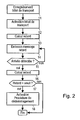
- the tracking server 1 determines the possible delay by calculating the difference between the theoretical duration and the actual duration of the trip. If this delay is greater than a predefined threshold, it informs the traveler, for example by transmitting 14 a short message containing the expected delay, this message is then displayed on the screen of the terminal.
- the terminal 5 may be provided with a delay calculation function designed to store the location information of the departure and destination points and the travel times, which were transmitted during the purchase of the transport ticket, to determine the geographical position of the terminal with respect to the planned path, as well as the delay with respect to the scheduled time, this information being displayed on the screen of the terminal.
- the tracking server 1 is only used to provide the geographical coordinates of the departure and destination points and the travel times.
- all the monitoring functions are performed by the tracking server 1 which interrogates the network 3 to ask for the position of the terminal 5 from the call number of the latter, periodically or on request of the traveler.
- the arrival at the destination of the means of transport can be determined by the terminal 5 or the tracking server 1, comparing the position of the terminal and that of the arrival point. To avoid the risk of dispute by the traveler, the arrival at destination may also be declared by the carrier who sends for this purpose a message to the tracking server 1 containing identification information of the means of transport. Upon receipt of such a message, the tracking server 1 stores the time of receipt of the message and determines the possible delay.
- the terminal 5 is equipped with a short-range transmitter / receiver, for example according to the "Bluetooth" standard, the destination places being equipped with fixed terminals 7 each provided with such a transmitter / receiver for periodically broadcasting messages. to potential passenger terminals that pass nearby.
- the terminals 5 are then programmed to, on receipt of such a message, send a message to the tracking server 1 containing for example an identification code received from the terminal. With the help of this identification code, the tracking server can identify the terminal in the database 2 and thus determine whether the traveler is at the intended destination point or not.
- the fixed terminals 7 are equipped with means for communicating with the tracking server 1.
- the terminal 5 of the traveler who receives the message from a fixed terminal 7 responds to it by giving him his number. Identification.
- the terminal 7 Upon receipt of such a response message, the terminal 7 transmits to the tracking server 1 the terminal identification number received to indicate that the traveler has arrived at their destination.
- the tracking server 1 triggers an 18 compensation procedure. For this, he sends a message to the terminal 5 of the traveler to inform him that he can be compensated for the delay by asking him to indicate in what form he wants to be compensated (transfer to a bank account, have to be worth on the price of a future trip, ).
- the fixed terminals 7 installed at the places of destination and therefore departure can also be used to declare travelers using a means of transport.
- the terminal 5 of a traveler receives a message identification of fixed terminal 7, he transmits in response his identification number.
- the terminal 7 transmits to the tracking server 1 the identification number received, as well as the identification number of the terminal.
- the tracking server identifies, using the ticket information sold sold, contained in the database 2, the path that will make the traveler and active 12 the corresponding trip.
- Activating a trip triggers a monitoring task on the tracking server. It can be expected that this task triggers the transmission of a message to the terminal 5 of the traveler indicating that his journey is under surveillance.
- the system according to the invention comprises at least one mobile terminal 6 installed in each transport means, provided with means of communication with the terminals 5 of the travelers located in the means of transport, for example a connection of the type "Bluetooth”.
- the mobile terminal 6 periodically transmits messages containing the identification number of the means of transport. Furthermore, the terminal 5 is programmed to, upon receipt of such a message, send a message to the tracking server 1 containing the identification number of the means of transport. In this way, the tracking server 1 can establish the relationship between a traveler (and his ticket) and a trip. In response, the tracking server 1 transmits to the terminal 5 of the traveler a message indicating that his ticket was "activated" and the arrival time. In addition, he can verify that the traveler is mounted in the means of transport corresponding to the ticket, and if this is not the case, warn him that he was wrong means of transport.
- each mobile terminal 6 installed in the transport means comprises means for communicating directly with the tracking server 1, for example via the network 3, and the traveler's location function is performed by relative to the position of the terminal 6, either by the terminal itself or by the tracking server 1, which interrogates the network 3 to obtain the position of each terminal 6.
- Travelers can then be kept informed in real time of the progress of the journey either via the tracking server 1 which can be called by travelers or periodically send follow-up messages to them, or directly by the terminal Mobile 6 which transmits this information in the messages it periodically broadcasts to all the passenger terminals located nearby and equipped with the tracking function.
- the tracking server 1 which can be called by travelers or periodically send follow-up messages to them, or directly by the terminal Mobile 6 which transmits this information in the messages it periodically broadcasts to all the passenger terminals located nearby and equipped with the tracking function.
- the mobile terminal 6 installed in each transport means can also be used to determine that the transport means has arrived at its destination, either manually by a command applied by an operator to the terminal, or automatically when it receives a message from a terminal.
- fixed terminal 7 installed at the destination.
- the terminal 6 determines that the means of transport has arrived at its destination, it sends an arrival message to the tracking server 1 which then determines the delay with respect to the scheduled time. If this delay is greater than a predefined threshold, the tracking server triggers the compensation procedure described above informing all travelers whose ticket corresponding to the trip has been activated.
- the carrier improves the quality of the service perceived by travelers, insofar as it undertakes to compensate travelers automatically in the event of delay. It also significantly reduces its management and operating costs as the compensation procedure is automatic.
- the tracking service may be coupled with a personal directory service, wherein the tracking server 1 has access to a personal directory of each registered traveler.
- Each traveler has the possibility to specify a list of people from his directory to prevent in case of delay.
- the tracking server determines that the traveler will arrive late at destination, it triggers a procedure to automatically send the delay information to the persons indicated by the traveler.
- the tracking service can also be coupled with a calendar service that the traveler keeps up to date.
- the tracking server triggers a procedure of update the traveler's calendar based on the expected delay and send late information to those concerned by appointments in the traveler's calendar, whose schedules have been updated.
Landscapes
- Engineering & Computer Science (AREA)
- Computer Networks & Wireless Communication (AREA)
- Signal Processing (AREA)
- Physics & Mathematics (AREA)
- General Physics & Mathematics (AREA)
- Mobile Radio Communication Systems (AREA)
- Radar Systems Or Details Thereof (AREA)
- Traffic Control Systems (AREA)
- Navigation (AREA)
- Image Analysis (AREA)
- Closed-Circuit Television Systems (AREA)
Claims (17)
- Verfahren zur Verfolgung der Position einer Person oder eines Objekts während einer Wegstrecke, wobei die Person oder das Objekt mit einem Endgerät (5) ausgestattet ist, das über ein Fernmeldenetz (3) mit einem Verfolgungsserver (1) in Verbindung steht, dadurch gekennzeichnet, dass es Schritte aufweist, die darin bestehen:- Parameter, die eine vorgesehene Wegstrecke zwischen einem Ausgangsort und einem Zielort definieren, sowie Ausgangs- und Zieldaten der Wegstrecke einzuspeichern (11),- die tatsächliche Ankunft des Endgeräts (5) am vorgesehenen Zielort zu erfassen und die tatsächliche Ankunftszeit zu speichern,- eine Verspätung zu bestimmen (16), indem die tatsächliche Ankunftszeit und die vorgesehene Ankunftszeit verglichen werden,- die Verspätung mit einem vordefinierten Schwellenwert zu vergleichen (17), und- eine vorbestimmte Aktion auszulösen (18), wenn die Verspätung größer ist als der vordefinierte Wert.
- Verfahren nach Anspruch 1, dadurch gekennzeichnet, dass es während der Wegstrecke mindestens einen Schritt der Bestimmung der laufenden Position des Endgeräts (5) und der Bestimmung (13) einer voraussichtlichen Verspätung in Abhängigkeit von der Position des Endgeräts bezüglich der vorgesehenen Wegstrecke, und des Sendens (14) einer Verspätungsmitteilung an das Endgerät aufweist, die die Größe der voraussichtlichen Verspätung enthält.
- Verfahren nach Anspruch 2, dadurch gekennzeichnet, dass es außerdem einen Schritt der Überprüfung aufweist, ob das Endgerät (5) sich während der Wegstrecke auf der vorgesehenen Wegstrecke befindet, indem die laufende Position des Endgeräts mit der vorgesehenen Wegstrecke verglichen wird.
- Verfahren nach Anspruch 2 oder 3, dadurch gekennzeichnet, dass die Bestimmung der laufenden Position des Endgeräts (5) mit Hilfe einer mit dem Netz (3) in Verbindung stehenden mobilen Station (6) durchgeführt wird, die in dem Verkehrsmittel (4) installiert ist, in dem die Person oder das Objekt befördert wird, die oder das mit dem Endgerät ausgestattet ist.
- Verfahren nach Anspruch 4, dadurch gekennzeichnet, dass es außerdem zu Beginn der Wegstrecke einen Schritt des Registrierens (12) des Endgeräts (5) mittels der in dem Verkehrsmittel (4) installierten Station (6) aufweist, wobei dieser Schritt eine Übertragung einer Identifikationsinformation zwischen der Station und dem Endgerät und das Senden einer Mitteilung an den Verfolgungsserver aufweist, die die Identifikationsinformationen der Station und des Endgeräts enthält.
- Verfahren nach Anspruch 5, dadurch gekennzeichnet, dass es außerdem zu Beginn der Wegstrecke einen Schritt der Überprüfung durch den Verfolgungsserver(1) aufweist, ob das Endgerät (5) sich im vorgesehenen Verkehrsmittel (4) befindet, abhängig von den Identifikationsinformationen der Station (6) und des Endgeräts.
- Verfahren nach einem der Ansprüche 1 bis 6, dadurch gekennzeichnet, dass die Erfassung der tatsächlichen Ankunft des Endgeräts (5) am vorgesehenen Zielort mit Hilfe einer festen Station (7) erfolgt, die am Zielort installiert ist und mit einer geringen Reichweite eine Identifikationsmitteilung der Station an Endgeräte sendet, die sich in der Nähe der Station befinden.
- Verfahren nach Anspruch 7, dadurch gekennzeichnet, dass das Endgerät (5), wenn es eine Identifikationsmitteilung einer Station (7) empfängt, die eine Station-Identifikationsinformation enthält, als Antwort eine Endgerät-Identifikationsmitteilung sendet, wobei eine Ankunftmitteilung, die die Station-Identifikationsinformation und eine Endgerät-Identifikationsinformation enthält, an den Verfolgungsserver (1) übertragen wird, der die Empfangszeit der Mitteilung als Ankunftszeit speichert und die Verspätung bestimmt (16).
- Verfahren nach einem der Ansprüche 1 bis 8, dadurch gekennzeichnet, dass es einen Schritt der Erfassung der Ankunft des Endgeräts (5) am vorgesehenen Ausgangsort mit Hilfe einer festen Station (7), die am Ausgangsort installiert ist und mit einer geringen Reichweite eine Identifikationsmitteilung der Station an Endgeräte sendet, die sich in der Nähe der Station befinden, und einen Schritt der Übertragung der von der Station gesendeten Identifikationsmitteilung an den Verfolgungsserver (1) aufweist, die der Identifikationsnummer des Endgeräts zugeordnet ist, wobei der Verfolgungsserver bei Empfang der Identifikationsmitteilung die Überwachung der Verspätung des Endgeräts auf der entsprechenden Wegstrecke auslöst.
- Verfahren nach einem der Ansprüche 1 bis 9, dadurch gekennzeichnet, dass es bei einer Verspätung einen Schritt des Sendens einer Verspätungswammeldung an Endgeräte (5) von vorher spezifizierten Personen aufweist.
- System zur Verfolgung der Position einer Person oder eines Objekts während einer Wegstrecke, die oder das von einem Transportunternehmer auf einem Verkehrsmittel (4) mitgenommen wird, wobei die Person oder das Objekt mit einem Endgerät (5) ausgestattet ist, das Mittel aufweist, um Verbindungen mit einem Fernmeldenetz (3) aufzubauen, dadurch gekennzeichnet, dass es einen Verfolgungsserver (1) aufweist, der Mittel zur Anwendung des Verfahrens nach einem der Ansprüche 1 bis 10 besitzt.
- Verfolgungsserver (1) zur Verfolgung der Position von Personen oder Objekten während Wegstrecken, die von mindestens einem Transportunternehmer auf mindestens einem Verkehrsmittel (4) mitgenommen werden, dadurch gekennzeichnet, dass er aufweist:- Zugriffsmittel zu einer Datenbasis (2) von Linien und Zeitplänen von Verkehrsleistungen, die vom Transportunternehmer geliefert werden, die die geographische Position der Orte enthält, die von den Verkehrslinien verbunden werden,- Mittel, um über ein Fernmeldenetz (3) mit Endgeräten (5) zu kommunizieren, mit denen die zu verfolgenden Personen oder Objekte ausgestattet sind,- Mittel, um Informationen über die von den Personen oder Objekten zu verfolgende Wegstrecke zu empfangen und zu speichern, zusammen mit einer Identifikationsinformation der Endgeräte,- Mittel, um die Position der Endgeräte zu erhalten, und- Rechenmittel, um die Position der Endgeräte bezüglich einer vorgesehenen und gespeicherten Wegstrecke zu bestimmen, und um eine Verspätung bezüglich eines einer vorgesehenen und gespeicherten Wegstrecke zugeordneten Zeitplans zu bestimmen.
- Verfolgungsserver nach Anspruch 12, dadurch gekennzeichnet, dass er außerdem Mittel aufweist, um die Verspätung mit einem vordefinierten Schwellenwert zu vergleichen (17), und um eine vorbestimmte Aktion auszulösen (18), wenn die Verspätung über dem vordefinierten Wert liegt.
- Verfolgungsserver nach Anspruch 12 oder 13, dadurch gekennzeichnet, dass er außerdem Mittel, um über das Fernmeldenetz (3) Mitteilungen zu empfangen, die Identifikationsinformationen von Stationen (7) enthalten, die je Identifikationsinformationen von Endgeräten (5) zugeordnet sind, und Mittel aufweist, um die Empfangszeit jeder Mitteilung als Zielankunftszeit des zugeordneten Endgeräts zu speichern, wenn die Identifikationsinformation der Station in der Datenbasis einer Station entspricht, die sich am Zielort der entsprechenden vorgesehenen Wegstrecke befindet.
- Verfolgungsserver nach einem der Ansprüche 12 bis 14, dadurch gekennzeichnet, dass er außerdem Mittel, um Wegstreckenanfangsmitteilungen zu empfangen, die je Identifikationsinformationen einer Station (6), die in einem Verkehrsmittel (4) installiert ist, und Identifikationsinformationen eines Endgeräts (5) enthalten, und Mittel aufweist, um bei Empfang einer Wegstreckenanfangsmitteilung zu überprüfen, ob das in der Wegstreckenanfangsmitteilung identifizierte Endgerät (5) sich in dem Verkehrsmittel (4) befindet, das der für das Endgerät vorgesehenen Wegstrecke entspricht, und um eine Fehlermeldung an das Endgerät zu senden, wenn dieses sich nicht in dem der vorgesehenen Wegstrecke entsprechenden Verkehrsmittel befindet.
- Station (6, 7) für die Verfolgung der Position von Personen oder Objekten während Wegstrecken, die von mindestens einem Transportunternehmer auf mindestens einem Verkehrsmittel (4) mitgenommen werden, wobei die Station Übertragungsmittel mit geringer Reichweite aufweist, um Identifikationsinformationen von Endgeräten (5) zu empfangen, mit denen die zu verfolgenden Personen oder Objekte ausgestattet sind, dadurch gekennzeichnet, dass sie außerdem Mittel aufweist, um Mitteilungen zu einem Verfolgungsserver (1) zu übertragen, die die von den Endgeräten (5) empfangenen Identifikationsinformationen enthalten, die je einer Identifikationsinformation der Station zugeordnet sind.
- Station (6) nach Anspruch 16, dadurch gekennzeichnet, dass sie dazu bestimmt ist, in jedem Verkehrsmittel (4) installiert zu werden, und eine Funktion der geographischen Lokalisierung aufweist.
Applications Claiming Priority (3)
| Application Number | Priority Date | Filing Date | Title |
|---|---|---|---|
| FR0116410A FR2833800B1 (fr) | 2001-12-18 | 2001-12-18 | Procede et dispositif pour le suivi en temps reel de la position d'une personne ou d'un objet durant un voyage |
| FR0116410 | 2001-12-18 | ||
| PCT/FR2002/003692 WO2003054828A1 (fr) | 2001-12-18 | 2002-10-28 | Procede et dispositif pour le suivi en temps reel de la position d'une personne ou d'un objet durant un voyage |
Publications (2)
| Publication Number | Publication Date |
|---|---|
| EP1456829A1 EP1456829A1 (de) | 2004-09-15 |
| EP1456829B1 true EP1456829B1 (de) | 2007-01-17 |
Family
ID=8870656
Family Applications (1)
| Application Number | Title | Priority Date | Filing Date |
|---|---|---|---|
| EP02795348A Expired - Lifetime EP1456829B1 (de) | 2001-12-18 | 2002-10-28 | Verfahren und vorichtung zur echtzeitsüberwachung der position einer person oder eines gegestandes während der reise |
Country Status (7)
| Country | Link |
|---|---|
| EP (1) | EP1456829B1 (de) |
| AT (1) | ATE352084T1 (de) |
| AU (1) | AU2002360147A1 (de) |
| DE (1) | DE60217716T2 (de) |
| ES (1) | ES2280613T3 (de) |
| FR (1) | FR2833800B1 (de) |
| WO (1) | WO2003054828A1 (de) |
Families Citing this family (3)
| Publication number | Priority date | Publication date | Assignee | Title |
|---|---|---|---|---|
| US9949267B2 (en) * | 2016-09-09 | 2018-04-17 | General Motors Llc | Vehicle telematics services in coordination with a handheld wireless device |
| CN112581761B (zh) * | 2020-12-07 | 2022-04-19 | 浙江宇视科技有限公司 | 5g移动物联网节点的协同分析方法、装置、设备和介质 |
| CN114926216A (zh) * | 2022-05-25 | 2022-08-19 | 新驱动重庆智能汽车有限公司 | 基于里程和时间结合的碳积分补偿方法、系统、存储介质 |
Family Cites Families (4)
| Publication number | Priority date | Publication date | Assignee | Title |
|---|---|---|---|---|
| US5570100A (en) * | 1994-03-10 | 1996-10-29 | Motorola, Inc. | Method for providing a communication unit's estimated time of arrival |
| US5924033A (en) * | 1996-05-03 | 1999-07-13 | Telefonaktiebolaget L/M Ericsson (Publ) | Communication control circuitry and method for a group of commonly-moving mobile transceiver units |
| DE19638070A1 (de) * | 1996-09-18 | 1998-03-19 | Deutsche Telekom Mobil | Verfahren zur Verkehrsdatenerfassung mittels Mobilfunkgeräten |
| DE19949146A1 (de) * | 1999-10-12 | 2001-04-19 | Julian Zeltinger | Verfahren zur Bestimmung einer Verkehrsverbindung zwischen einem Standort und einem Zielort |
-
2001
- 2001-12-18 FR FR0116410A patent/FR2833800B1/fr not_active Expired - Fee Related
-
2002
- 2002-10-28 AU AU2002360147A patent/AU2002360147A1/en not_active Abandoned
- 2002-10-28 EP EP02795348A patent/EP1456829B1/de not_active Expired - Lifetime
- 2002-10-28 DE DE60217716T patent/DE60217716T2/de not_active Expired - Lifetime
- 2002-10-28 AT AT02795348T patent/ATE352084T1/de not_active IP Right Cessation
- 2002-10-28 WO PCT/FR2002/003692 patent/WO2003054828A1/fr not_active Ceased
- 2002-10-28 ES ES02795348T patent/ES2280613T3/es not_active Expired - Lifetime
Also Published As
| Publication number | Publication date |
|---|---|
| AU2002360147A1 (en) | 2003-07-09 |
| FR2833800A1 (fr) | 2003-06-20 |
| DE60217716D1 (de) | 2007-03-08 |
| ES2280613T3 (es) | 2007-09-16 |
| EP1456829A1 (de) | 2004-09-15 |
| DE60217716T2 (de) | 2007-10-25 |
| FR2833800B1 (fr) | 2004-07-23 |
| WO2003054828A1 (fr) | 2003-07-03 |
| ATE352084T1 (de) | 2007-02-15 |
Similar Documents
| Publication | Publication Date | Title |
|---|---|---|
| US11879747B2 (en) | Method and system for providing travel time information | |
| KR100432268B1 (ko) | 좌표 경로점에서 메시지를 액세스하고 기록하는 시스템 및방법 | |
| US10547972B2 (en) | Method for requesting transportation services | |
| BE1003705A3 (fr) | Systeme de tarification et de perception proportionnelle dans les transports en commun. | |
| US6486801B1 (en) | Base station apparatus and method for monitoring travel of a mobile vehicle | |
| US20040219933A1 (en) | Transportation ordering system | |
| US20100057350A1 (en) | Method and system for automatically and directly establishing contact between a driver and at least one person to be transported | |
| US20030193414A1 (en) | User-definable communications methods and systems | |
| US20030193412A1 (en) | Business method associated with monitoring travel of a movable thing and providing a notification based upon travel status | |
| FR2969357A1 (fr) | Systeme et procede de gestion de covoiturage | |
| EP3516605A1 (de) | System zum fördern von gegenständen, implementierung eines systems zur gezielten verteilung von informationen | |
| US20160071172A1 (en) | System and method for location-aware parking expiration reminder and remote parking meter refill | |
| US20030193413A1 (en) | Business methods for notification systems | |
| US20170213261A1 (en) | Method for detecting riders and managing and optimizing their shared transport | |
| US20090248435A1 (en) | Method for locating just in time mobile services | |
| FR2703200A1 (fr) | Procédé et installation de communication pour flotte de taxis. | |
| WO2009013756A1 (en) | System for efficiently utilizing time during waiting for a service | |
| EP1456829A1 (de) | Verfahren und vorichtung zur echtzeitsüberwachung der position einer person oder eines gegestandes während der reise | |
| EP0978194B1 (de) | Mobiles funktelefonsystem und -verfahren und dazu verwendbares endgerät | |
| KR101709153B1 (ko) | 모바일 기반의 택시 콜 통합 배차시스템 및 서비스 방법 | |
| FR2782814A1 (fr) | Procede et dispositif pour la mise en relation d'une offre de service de transport avec une demande d'un tel service | |
| WO2001025980A1 (fr) | Procede et dispositif pour la mise en relation d'une offre de service de transport avec une demande d'un tel service | |
| FR2827965A1 (fr) | Procede permettant de selectionner un taxi parmi une flotte, en vue de lui attribuer une course a realiser | |
| FR2859348A1 (fr) | Solution de geolocalisation | |
| FR3105539A1 (fr) | Procédé de gestion d’un état de crise d’un premier véhicule et dispositif de gestion associé |
Legal Events
| Date | Code | Title | Description |
|---|---|---|---|
| PUAI | Public reference made under article 153(3) epc to a published international application that has entered the european phase |
Free format text: ORIGINAL CODE: 0009012 |
|
| 17P | Request for examination filed |
Effective date: 20040603 |
|
| AK | Designated contracting states |
Kind code of ref document: A1 Designated state(s): AT BE BG CH CY CZ DE DK EE ES FI FR GB GR IE IT LI LU MC NL PT SE SK TR |
|
| AX | Request for extension of the european patent |
Extension state: AL LT LV MK RO SI |
|
| RIN1 | Information on inventor provided before grant (corrected) |
Inventor name: REBILLON, JACQUES-OLIVIER Inventor name: FLAMANT, ERIC Inventor name: KERDRAON, ALAN Inventor name: BURY, EMMANUEL |
|
| GRAP | Despatch of communication of intention to grant a patent |
Free format text: ORIGINAL CODE: EPIDOSNIGR1 |
|
| GRAS | Grant fee paid |
Free format text: ORIGINAL CODE: EPIDOSNIGR3 |
|
| GRAA | (expected) grant |
Free format text: ORIGINAL CODE: 0009210 |
|
| AK | Designated contracting states |
Kind code of ref document: B1 Designated state(s): AT BE BG CH CY CZ DE DK EE ES FI FR GB GR IE IT LI LU MC NL PT SE SK TR |
|
| PG25 | Lapsed in a contracting state [announced via postgrant information from national office to epo] |
Ref country code: NL Free format text: LAPSE BECAUSE OF FAILURE TO SUBMIT A TRANSLATION OF THE DESCRIPTION OR TO PAY THE FEE WITHIN THE PRESCRIBED TIME-LIMIT Effective date: 20070117 Ref country code: FI Free format text: LAPSE BECAUSE OF FAILURE TO SUBMIT A TRANSLATION OF THE DESCRIPTION OR TO PAY THE FEE WITHIN THE PRESCRIBED TIME-LIMIT Effective date: 20070117 Ref country code: IE Free format text: LAPSE BECAUSE OF FAILURE TO SUBMIT A TRANSLATION OF THE DESCRIPTION OR TO PAY THE FEE WITHIN THE PRESCRIBED TIME-LIMIT Effective date: 20070117 Ref country code: AT Free format text: LAPSE BECAUSE OF FAILURE TO SUBMIT A TRANSLATION OF THE DESCRIPTION OR TO PAY THE FEE WITHIN THE PRESCRIBED TIME-LIMIT Effective date: 20070117 Ref country code: DK Free format text: LAPSE BECAUSE OF FAILURE TO SUBMIT A TRANSLATION OF THE DESCRIPTION OR TO PAY THE FEE WITHIN THE PRESCRIBED TIME-LIMIT Effective date: 20070117 |
|
| REG | Reference to a national code |
Ref country code: GB Ref legal event code: FG4D Free format text: NOT ENGLISH |
|
| REG | Reference to a national code |
Ref country code: CH Ref legal event code: EP |
|
| REG | Reference to a national code |
Ref country code: IE Ref legal event code: FG4D Free format text: LANGUAGE OF EP DOCUMENT: FRENCH |
|
| REF | Corresponds to: |
Ref document number: 60217716 Country of ref document: DE Date of ref document: 20070308 Kind code of ref document: P |
|
| PG25 | Lapsed in a contracting state [announced via postgrant information from national office to epo] |
Ref country code: SE Free format text: LAPSE BECAUSE OF FAILURE TO SUBMIT A TRANSLATION OF THE DESCRIPTION OR TO PAY THE FEE WITHIN THE PRESCRIBED TIME-LIMIT Effective date: 20070417 |
|
| PG25 | Lapsed in a contracting state [announced via postgrant information from national office to epo] |
Ref country code: BG Free format text: LAPSE BECAUSE OF THE APPLICANT RENOUNCES Effective date: 20070418 |
|
| GBT | Gb: translation of ep patent filed (gb section 77(6)(a)/1977) |
Effective date: 20070425 |
|
| PG25 | Lapsed in a contracting state [announced via postgrant information from national office to epo] |
Ref country code: PT Free format text: LAPSE BECAUSE OF FAILURE TO SUBMIT A TRANSLATION OF THE DESCRIPTION OR TO PAY THE FEE WITHIN THE PRESCRIBED TIME-LIMIT Effective date: 20070618 |
|
| NLV1 | Nl: lapsed or annulled due to failure to fulfill the requirements of art. 29p and 29m of the patents act | ||
| REG | Reference to a national code |
Ref country code: IE Ref legal event code: FD4D |
|
| REG | Reference to a national code |
Ref country code: ES Ref legal event code: FG2A Ref document number: 2280613 Country of ref document: ES Kind code of ref document: T3 |
|
| PLBE | No opposition filed within time limit |
Free format text: ORIGINAL CODE: 0009261 |
|
| STAA | Information on the status of an ep patent application or granted ep patent |
Free format text: STATUS: NO OPPOSITION FILED WITHIN TIME LIMIT |
|
| PG25 | Lapsed in a contracting state [announced via postgrant information from national office to epo] |
Ref country code: SK Free format text: LAPSE BECAUSE OF FAILURE TO SUBMIT A TRANSLATION OF THE DESCRIPTION OR TO PAY THE FEE WITHIN THE PRESCRIBED TIME-LIMIT Effective date: 20070117 |
|
| 26N | No opposition filed |
Effective date: 20071018 |
|
| PG25 | Lapsed in a contracting state [announced via postgrant information from national office to epo] |
Ref country code: CZ Free format text: LAPSE BECAUSE OF FAILURE TO SUBMIT A TRANSLATION OF THE DESCRIPTION OR TO PAY THE FEE WITHIN THE PRESCRIBED TIME-LIMIT Effective date: 20070117 |
|
| BERE | Be: lapsed |
Owner name: FRANCE TELECOM Effective date: 20071031 |
|
| PG25 | Lapsed in a contracting state [announced via postgrant information from national office to epo] |
Ref country code: GR Free format text: LAPSE BECAUSE OF FAILURE TO SUBMIT A TRANSLATION OF THE DESCRIPTION OR TO PAY THE FEE WITHIN THE PRESCRIBED TIME-LIMIT Effective date: 20070418 |
|
| PG25 | Lapsed in a contracting state [announced via postgrant information from national office to epo] |
Ref country code: MC Free format text: LAPSE BECAUSE OF NON-PAYMENT OF DUE FEES Effective date: 20071031 |
|
| REG | Reference to a national code |
Ref country code: CH Ref legal event code: PL |
|
| PG25 | Lapsed in a contracting state [announced via postgrant information from national office to epo] |
Ref country code: LI Free format text: LAPSE BECAUSE OF NON-PAYMENT OF DUE FEES Effective date: 20071031 Ref country code: CH Free format text: LAPSE BECAUSE OF NON-PAYMENT OF DUE FEES Effective date: 20071031 |
|
| PG25 | Lapsed in a contracting state [announced via postgrant information from national office to epo] |
Ref country code: BE Free format text: LAPSE BECAUSE OF NON-PAYMENT OF DUE FEES Effective date: 20071031 |
|
| PG25 | Lapsed in a contracting state [announced via postgrant information from national office to epo] |
Ref country code: EE Free format text: LAPSE BECAUSE OF FAILURE TO SUBMIT A TRANSLATION OF THE DESCRIPTION OR TO PAY THE FEE WITHIN THE PRESCRIBED TIME-LIMIT Effective date: 20070117 |
|
| PG25 | Lapsed in a contracting state [announced via postgrant information from national office to epo] |
Ref country code: CY Free format text: LAPSE BECAUSE OF FAILURE TO SUBMIT A TRANSLATION OF THE DESCRIPTION OR TO PAY THE FEE WITHIN THE PRESCRIBED TIME-LIMIT Effective date: 20070117 |
|
| PG25 | Lapsed in a contracting state [announced via postgrant information from national office to epo] |
Ref country code: LU Free format text: LAPSE BECAUSE OF NON-PAYMENT OF DUE FEES Effective date: 20071028 |
|
| PG25 | Lapsed in a contracting state [announced via postgrant information from national office to epo] |
Ref country code: TR Free format text: LAPSE BECAUSE OF FAILURE TO SUBMIT A TRANSLATION OF THE DESCRIPTION OR TO PAY THE FEE WITHIN THE PRESCRIBED TIME-LIMIT Effective date: 20070117 |
|
| PGFP | Annual fee paid to national office [announced via postgrant information from national office to epo] |
Ref country code: FR Payment date: 20131028 Year of fee payment: 12 |
|
| PGFP | Annual fee paid to national office [announced via postgrant information from national office to epo] |
Ref country code: GB Payment date: 20140924 Year of fee payment: 13 |
|
| PGFP | Annual fee paid to national office [announced via postgrant information from national office to epo] |
Ref country code: ES Payment date: 20141003 Year of fee payment: 13 Ref country code: DE Payment date: 20140924 Year of fee payment: 13 |
|
| PGFP | Annual fee paid to national office [announced via postgrant information from national office to epo] |
Ref country code: IT Payment date: 20140929 Year of fee payment: 13 |
|
| REG | Reference to a national code |
Ref country code: FR Ref legal event code: ST Effective date: 20150630 |
|
| PG25 | Lapsed in a contracting state [announced via postgrant information from national office to epo] |
Ref country code: FR Free format text: LAPSE BECAUSE OF NON-PAYMENT OF DUE FEES Effective date: 20141031 |
|
| REG | Reference to a national code |
Ref country code: DE Ref legal event code: R119 Ref document number: 60217716 Country of ref document: DE |
|
| GBPC | Gb: european patent ceased through non-payment of renewal fee |
Effective date: 20151028 |
|
| PG25 | Lapsed in a contracting state [announced via postgrant information from national office to epo] |
Ref country code: IT Free format text: LAPSE BECAUSE OF NON-PAYMENT OF DUE FEES Effective date: 20151028 Ref country code: GB Free format text: LAPSE BECAUSE OF NON-PAYMENT OF DUE FEES Effective date: 20151028 Ref country code: DE Free format text: LAPSE BECAUSE OF NON-PAYMENT OF DUE FEES Effective date: 20160503 |
|
| REG | Reference to a national code |
Ref country code: ES Ref legal event code: FD2A Effective date: 20161125 |
|
| PG25 | Lapsed in a contracting state [announced via postgrant information from national office to epo] |
Ref country code: ES Free format text: LAPSE BECAUSE OF NON-PAYMENT OF DUE FEES Effective date: 20151029 |