EP1456414B1 - Dna detektion unter verwendung von primern, welche mit nicht-fragmentierter dna hybridisieren - Google Patents
Dna detektion unter verwendung von primern, welche mit nicht-fragmentierter dna hybridisieren Download PDFInfo
- Publication number
- EP1456414B1 EP1456414B1 EP02793254A EP02793254A EP1456414B1 EP 1456414 B1 EP1456414 B1 EP 1456414B1 EP 02793254 A EP02793254 A EP 02793254A EP 02793254 A EP02793254 A EP 02793254A EP 1456414 B1 EP1456414 B1 EP 1456414B1
- Authority
- EP
- European Patent Office
- Prior art keywords
- dna
- biological sample
- extracted
- sample
- cells
- Prior art date
- Legal status (The legal status is an assumption and is not a legal conclusion. Google has not performed a legal analysis and makes no representation as to the accuracy of the status listed.)
- Expired - Lifetime
Links
- 238000001514 detection method Methods 0.000 title claims abstract description 10
- 108020004414 DNA Proteins 0.000 claims abstract description 81
- 238000000034 method Methods 0.000 claims abstract description 42
- 210000004027 cell Anatomy 0.000 claims abstract description 34
- 206010028980 Neoplasm Diseases 0.000 claims abstract description 22
- 239000012634 fragment Substances 0.000 claims abstract description 16
- 208000001333 Colorectal Neoplasms Diseases 0.000 claims abstract description 15
- 201000011510 cancer Diseases 0.000 claims abstract description 15
- 206010009944 Colon cancer Diseases 0.000 claims abstract description 14
- 230000004987 nonapoptotic effect Effects 0.000 claims abstract description 14
- 238000001962 electrophoresis Methods 0.000 claims abstract description 10
- 239000000523 sample Substances 0.000 claims description 27
- 238000003752 polymerase chain reaction Methods 0.000 claims description 24
- 239000012472 biological sample Substances 0.000 claims description 20
- 108091023043 Alu Element Proteins 0.000 claims description 11
- 239000000463 material Substances 0.000 claims description 10
- 210000001124 body fluid Anatomy 0.000 claims description 8
- 239000010839 body fluid Substances 0.000 claims description 8
- 210000000981 epithelium Anatomy 0.000 claims description 7
- 239000012530 fluid Substances 0.000 claims description 7
- 238000000926 separation method Methods 0.000 claims description 7
- 210000000941 bile Anatomy 0.000 claims description 6
- 210000001175 cerebrospinal fluid Anatomy 0.000 claims description 6
- 210000005260 human cell Anatomy 0.000 claims description 6
- 210000002700 urine Anatomy 0.000 claims description 6
- 108091081062 Repeated sequence (DNA) Proteins 0.000 claims description 5
- 230000006907 apoptotic process Effects 0.000 abstract description 7
- 230000035772 mutation Effects 0.000 abstract description 6
- 210000004881 tumor cell Anatomy 0.000 abstract description 6
- 238000012216 screening Methods 0.000 abstract description 5
- 230000009946 DNA mutation Effects 0.000 abstract description 2
- 230000010261 cell growth Effects 0.000 abstract description 2
- 239000003550 marker Substances 0.000 abstract description 2
- 201000010989 colorectal carcinoma Diseases 0.000 abstract 1
- 238000013467 fragmentation Methods 0.000 description 7
- 238000006062 fragmentation reaction Methods 0.000 description 7
- 230000003321 amplification Effects 0.000 description 6
- 238000003199 nucleic acid amplification method Methods 0.000 description 6
- 238000003745 diagnosis Methods 0.000 description 5
- 238000012360 testing method Methods 0.000 description 4
- 230000001413 cellular effect Effects 0.000 description 2
- 238000001356 surgical procedure Methods 0.000 description 2
- 238000007400 DNA extraction Methods 0.000 description 1
- 238000003782 apoptosis assay Methods 0.000 description 1
- 238000003556 assay Methods 0.000 description 1
- 210000003793 centrosome Anatomy 0.000 description 1
- 210000000349 chromosome Anatomy 0.000 description 1
- 230000001419 dependent effect Effects 0.000 description 1
- 238000011161 development Methods 0.000 description 1
- 201000010099 disease Diseases 0.000 description 1
- 208000037265 diseases, disorders, signs and symptoms Diseases 0.000 description 1
- 230000001747 exhibiting effect Effects 0.000 description 1
- 238000000605 extraction Methods 0.000 description 1
- 238000011835 investigation Methods 0.000 description 1
- 230000036210 malignancy Effects 0.000 description 1
- 208000037819 metastatic cancer Diseases 0.000 description 1
- 208000011575 metastatic malignant neoplasm Diseases 0.000 description 1
- 230000002265 prevention Effects 0.000 description 1
- 238000004393 prognosis Methods 0.000 description 1
- 230000005522 programmed cell death Effects 0.000 description 1
- 230000035945 sensitivity Effects 0.000 description 1
Images
Classifications
-
- C—CHEMISTRY; METALLURGY
- C12—BIOCHEMISTRY; BEER; SPIRITS; WINE; VINEGAR; MICROBIOLOGY; ENZYMOLOGY; MUTATION OR GENETIC ENGINEERING
- C12Q—MEASURING OR TESTING PROCESSES INVOLVING ENZYMES, NUCLEIC ACIDS OR MICROORGANISMS; COMPOSITIONS OR TEST PAPERS THEREFOR; PROCESSES OF PREPARING SUCH COMPOSITIONS; CONDITION-RESPONSIVE CONTROL IN MICROBIOLOGICAL OR ENZYMOLOGICAL PROCESSES
- C12Q1/00—Measuring or testing processes involving enzymes, nucleic acids or microorganisms; Compositions therefor; Processes of preparing such compositions
- C12Q1/68—Measuring or testing processes involving enzymes, nucleic acids or microorganisms; Compositions therefor; Processes of preparing such compositions involving nucleic acids
- C12Q1/6876—Nucleic acid products used in the analysis of nucleic acids, e.g. primers or probes
- C12Q1/6883—Nucleic acid products used in the analysis of nucleic acids, e.g. primers or probes for diseases caused by alterations of genetic material
- C12Q1/6886—Nucleic acid products used in the analysis of nucleic acids, e.g. primers or probes for diseases caused by alterations of genetic material for cancer
Definitions
- the present invention provides a generic test for use in the detection of cancer, and in particular colorectal cancer.
- a method of detecting the presence of non-apoptotic DNA in clinical samples, such as faecal samples is provided.
- Cancer is thought to arise through genetic mutations which result in uncontrolled and unregulated cell growth.
- Colorectal cancer is one of the most common forms of malignancy in the Western world. Colorectal cancers typically originate in the colorectal epithelium. The development from the initial stages to full blown metastatic cancer can take up to 10 years. The early detection and removal (by surgery) of the tumour can therefore result in prevention of the disease.
- US 5773649 describes a method of diagnosis and prognosis for tumour cells focussing or polymorphic loci so as to distinguish between tumour and non-tumour cells.
- WO 9707239 discloses methods of extracting DNA from tumour cells and is particular, from foecal samples.
- Apoptosis When undergoing programmed cell death (apoptosis), the DNA of the cell is broken down into small fragments. Apoptosis does not however occur in cancerous cells, such as the tumour cells of colorectal cancer which have been shed from the gut epithelial lining. DNA fragmentation does not occur in cancerous cells, and the DNA remains unfragmented.
- the present invention relates to the unexpected finding that the presence of specific fragments of DNA can be indicative of the presence of cancerous cells and further that the amplification of these fragments can serve to allow them to be used in the diagnosis of cancer.
- the identification of such fragments will allow diagnosis irrespective of the point of DNA mutation which causes the tumour.
- a method of detecting the presence of cancerous cells in a biological sample including the steps of;
- the biological sample is a faecal sample.
- the biological sample is urine, bile or cerebrospinal fluid or is obtained from any other body fluid where non-cancerous human cells are absent.
- the faecal sample includes any material, including fluid which is derived or extracted from stool.
- the method can be used to screen for the presence of cancerous cells derived from the gut epithelium.
- primers selected for use in the polymerase chain reaction amplify sequences of DNA consisting of alphoid repeat regions.
- primers selected for use in the polymerase chain reaction amplify sequences of DNA consisting of ALU repeat regions.
- the present invention further provides a method of detecting the presence of colorectal cancer, the method including the steps of;
- the faecal sample includes any material, including fluid which is derived or extracted from stool.
- the method can be used to screen for the presence of cancerous cells derived from the gut epithelium.
- primers selected for use in the polymerase chain reaction amplify sequences of DNA consisting of alphoid repeat regions.
- primers selected for use in the polymerase chain reaction amplify sequences of DNA consisting of ALU repeat regions.
- a yet further embodiment of the present invention provides a method of detecting the presence of cancerous cells in a biological sample, the method including the steps of;
- the biological sample is a faecal sample.
- the biological sample is urine, bile or cerebrospinal fluid or is obtained from any other body fluid where non-cancerous human cells are absent.
- the faecal sample includes any material, including fluid which is derived or extracted from stool.
- the method can be used to screen for the presence of cancerous cells derived from the gut epithelium.
- primers selected for use in the polymerase chain reaction amplify sequences of DNA consisting of alphoid repeat regions.
- primers selected for use in the polymerase chain reaction amplify sequences of DNA consisting of ALU repeat regions.
- a method of detecting the presence of cancerous cells in a biological sample including the steps of;
- the biological sample is a faecal sample.
- the biological sample is urine, bile or cerebrospinal fluid or is obtained from any other body fluid where non-cancerous human cells are absent.
- the faecal sample includes any material, including fluid which is derived or extracted from stool.
- the method can be used to screen for the presence of cancerous cells derived from the gut epithelium.
- primers selected for use in the polymerase chain reaction amplify sequences of DNA consisting of alphoid repeat regions.
- primers selected for use in the polymerase chain reaction amplify sequences of DNA consisting of ALU repeat regions.
- Alphoid sequences are repeat sequences found near the centrosomes on chromosomes. These alphoid repeats are generally around 170 bp in length and make up around 1% of human DNA and consist of up to a dozen evenly spaced repeats. Upon selection of appropriate primers, it is possible to generate a range of products, depending upon whether amplification has terminated at the first, second or subsequent repeats.
- the (non-apoptotic) cancerous cells which are shed from a tumour can have their DNA extracted and further can be run out on a size resolving gel in order to show the presence of a ladder of bands.
- This laddering relates to alphoid repeat sequences which are amplified from the DNA of the cancerous cell, this being possible as the DNA in the cell is non-fragmented as it has not undergone apoptosis.
- a.faecal sample is obtained and the DNA is extracted therefrom.
- DNA extraction may be effected by any suitable method known in the art. Cancerous cells will be present in the stool sample due to them being sloughed off of the epithelial wall.
- PCR polymerase chain reaction
- the PCR will produce a number of bands of differing sizes, the size being dependent on where amplification terminates.
- the product of the PCR is subsequently run out on a size resolving gel in order to show the different band lengths, this difference in length being indicative of a differing number of alphoid repeats in the band.
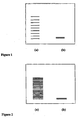
- Figure 1 shows an example of non-apoptotic DNA banding (labelled a) run out on a size resolving gel, following the extraction and amplification of the DNA.
- the distinct "laddering" like banding indicative of the presence of alphoid sequences can be seen.
- the bands (labelled b) show DNA from non-cancerous cells which have undergone apoptosis and thus where there has been DNA fragmentation.
- the detection of the ladder of bands on the gel indicates the presence of non-apoptotic cells in the sample. If the sample has been taken from a body fluid which does not normally contain live cells, then the assumption can be made that the non apoptotic cells are cancerous.
- Detection of these ladder like bands is potentially automatable and may be applied to detect any tumour from samples into which live (non-apoptotic) cancerous cells would be shed or present.
- DNA from a faecal sample is described above, it would also be possible to extract and amplify DNA from other body fluid samples such as bile, urine and cerebrospinal fluid or sample or material, including fluid, derived or extracted from stool, or any other material derived from the aerodigestive tract or any other suitable body fluid which does not contain living human cells.
- body fluid samples such as bile, urine and cerebrospinal fluid or sample or material, including fluid, derived or extracted from stool, or any other material derived from the aerodigestive tract or any other suitable body fluid which does not contain living human cells.
- the DNA extracted from a faecal (or other) sample can be screened for the presence of ALU repeat sequences.
- ALU repeat sequences occur at random positions within the DNA. In unfragmented DNA, this will lead to a plurality of bands of varying lengths being resolved by electrophoresis on a size-separating gel.
- the extent of DNA fragmentation in non-apoptotic cells is such that no short repeats are seen on amplification, as the fragmentation of the DNA produces bands which are too short to be detected.
- Figure 2 shows an example of a gel exhibiting such banding.
- the bands in column a representing the plurality of bands resolved for and indicative of the presence of unfragmented DNA.
- Column b shows bands of relatively short length where DNA fragmentation has occurred.
- the degree of DNA fragmentation is such that only very small fragments of DNA are present. These small fragments could in some cases run off the gel during electrophoresis. In such situations it may be difficult to establish whether the absence of banding is due to there being no DNA present in the sample or alternatively due to fragmentation being so extensive that the small fragments have run off the gel.
- the present invention therefore provides for a new method of screening for cancer which is particularly advantageous as it does not rely on the identification of a specific point mutation as an indicator of cancer. Further, the technique can be completely non-invasive, and thus has associated benefits to both the patient and the overall cost of screening.
- the screening method can therefore be widely used across the population to detect cancer, and in particular, colorectal cancer.
- the present invention exhibits the further advantage that a diagnosis of colorectal cancer can be made without knowledge of specific DNA cancer markers being required.
- the screening method of the present invention produces results which allow for a greater accuracy in diagnosis and thus accordingly result in more appropriate referrals for further clinical investigation in suspected cases of cancer. This in turn minimises costs in carrying out exploratory procedures where not required, and also minimises inconvenience to patients whom have been mis-diagnosed with the condition.
Landscapes
- Chemical & Material Sciences (AREA)
- Life Sciences & Earth Sciences (AREA)
- Health & Medical Sciences (AREA)
- Organic Chemistry (AREA)
- Proteomics, Peptides & Aminoacids (AREA)
- Engineering & Computer Science (AREA)
- Immunology (AREA)
- Pathology (AREA)
- Analytical Chemistry (AREA)
- Zoology (AREA)
- Wood Science & Technology (AREA)
- Genetics & Genomics (AREA)
- Hospice & Palliative Care (AREA)
- Biochemistry (AREA)
- Microbiology (AREA)
- Molecular Biology (AREA)
- Biophysics (AREA)
- Physics & Mathematics (AREA)
- Oncology (AREA)
- Biotechnology (AREA)
- Bioinformatics & Cheminformatics (AREA)
- General Engineering & Computer Science (AREA)
- General Health & Medical Sciences (AREA)
- Measuring Or Testing Involving Enzymes Or Micro-Organisms (AREA)
- Saccharide Compounds (AREA)
- Investigating Or Analysing Biological Materials (AREA)
Claims (12)
- Verfahren zur Detektion des Vorliegens krebsartiger Zellen in einer biologischen Probe über die Bestimmung des Vorliegens nicht-apoptotischer DNA, wobei man bei diesem Verfahren- aus einer biologischen Probe extrahierte DNA bereitstellt,- die extrahierte DNA unter Verwendung der Polymerase-Kettenreaktion und von Primern, die gegen Alphoid-Repeat-Sequenzen oder ALU-Repeat-Regionen menschlicher DNA gerichtet sind, amplifiziert,- mit den über PCR hergestellten Fragmenten eine Trennung über Elektrophorese durchführt, und- das Vorliegen oder Fehlen von Banden detektiert, die auf nicht-fragmentierte DNA hinweisen, welche auf nicht-apoptotische Zellen hinweist.
- Verfahren nach Anspruch 1, wobei man in einem weiteren Schritt eine biologische Probe bereitstellt und die DNA daraus extrahiert.
- Verfahren nach Anspruch 1 oder 2, wobei die biologische Probe eine Fäces-Probe, Urin, Gallenflüssigkeit oder Cerebrospinalflüssigkeit ist oder aus einer beliebigen anderen Körperflüssigkeit erhalten wird, in der nicht-krebsartige menschliche Zellen fehlen.
- Verfahren nach einem der Ansprüche 1 bis 3, wobei die Fäces-Probe beliebiges Material umfasst, einschließlich Flüssigkeit, die aus Stuhl stammt oder extrahiert ist.
- Verfahren nach Anspruch 4, wobei das Verfahren zum Screenen auf das Vorliegen von krebsartigen Zellen verwendet werden kann, die aus dem Darmepithel stammen.
- Verfahren zur Detektion des Vorliegens von kolorektalem Krebs in einer biologischen Probe über die Bestimmung des Vorliegens nicht-apoptotischer DNA, wobei man bei diesem Verfahren- aus einer Fäces-Probe extrahierte DNA nimmt,- die extrahierte DNA unter Verwendung der Polymerase-Kettenreaktion und von Primern, die gegen Alphoid-Repeat-Sequenzen oder ALU-Repeat-Regionen menschlicher DNA gerichtet sind, amplifiziert,- mit den über PCR hergestellten Fragmenten eine Trennung über Elektrophorese durchführt, und- das Vorliegen öder Fehlen von Bandenmustern detektiert, die auf nicht-fragmentierte DNA hinweisen, welche auf nicht-apoptotische Zellen hinweist.
- Verfahren nach Anspruch 6, wobei man in einem weiteren Schritt eine Fäces-Probe nimmt und die DNA daraus extrahiert.
- Verfahren nach Anspruch 6 oder 7, wobei die biologische Probe eine Fäces-Probe, Urin, Gallenflüssigkeit oder Cerebrospinalflüssigkeit ist oder aus einer beliebigen anderen Körperflüssigkeit erhalten wird, in der nicht-krebsartige menschliche Zellen fehlen.
- Verfahren nach einem der Ansprüche 6 bis 8, wobei die Fäces-Probe beliebiges Material umfasst, einschließlich Flüssigkeit, die aus Stuhl stammt oder extrahiert ist.
- Verfahren nach Anspruch 9, wobei das Verfahren zum Screenen auf das Vorliegen von krebsartigen Zellen verwendet werden kann, die aus dem Darmepithel stammen.
- Verwendung von Primern, die für Alphoid-Repeat-Sequenzen spezifisch sind, zur Detektion nicht-apoptotischer DNA ein einem Verfahren zur Detektion von Krebs in einer biologischen Probe.
- Verfahren von Primern, die für ALU-Repeat-Regionen spezifisch sind, zur Detektion von nicht-apoptotischer DNA in einem Verfahren zur Detektion von Krebs in einer biologischen Probe.
Applications Claiming Priority (3)
| Application Number | Priority Date | Filing Date | Title |
|---|---|---|---|
| GB0130821 | 2001-12-24 | ||
| GBGB0130821.2A GB0130821D0 (en) | 2001-12-24 | 2001-12-24 | DNA screening |
| PCT/GB2002/005918 WO2003060156A2 (en) | 2001-12-24 | 2002-12-24 | Dna detection using primers hybridizing to non-fragmentated dna |
Publications (2)
| Publication Number | Publication Date |
|---|---|
| EP1456414A2 EP1456414A2 (de) | 2004-09-15 |
| EP1456414B1 true EP1456414B1 (de) | 2008-07-16 |
Family
ID=9928304
Family Applications (1)
| Application Number | Title | Priority Date | Filing Date |
|---|---|---|---|
| EP02793254A Expired - Lifetime EP1456414B1 (de) | 2001-12-24 | 2002-12-24 | Dna detektion unter verwendung von primern, welche mit nicht-fragmentierter dna hybridisieren |
Country Status (10)
| Country | Link |
|---|---|
| US (1) | US20050042617A1 (de) |
| EP (1) | EP1456414B1 (de) |
| JP (1) | JP2005514073A (de) |
| AT (1) | ATE401420T1 (de) |
| AU (1) | AU2002358913A1 (de) |
| DE (1) | DE60227697D1 (de) |
| DK (1) | DK1456414T3 (de) |
| ES (1) | ES2310615T3 (de) |
| GB (1) | GB0130821D0 (de) |
| WO (1) | WO2003060156A2 (de) |
Families Citing this family (2)
| Publication number | Priority date | Publication date | Assignee | Title |
|---|---|---|---|---|
| JPWO2012014694A1 (ja) * | 2010-07-26 | 2013-09-12 | オリンパス株式会社 | 糞便由来核酸の合成方法 |
| CN108064273B (zh) * | 2015-01-30 | 2021-07-23 | 深圳华大生命科学研究院 | 结直肠癌相关疾病的生物标志物 |
Family Cites Families (7)
| Publication number | Priority date | Publication date | Assignee | Title |
|---|---|---|---|---|
| CA2149318A1 (en) * | 1992-11-13 | 1994-05-26 | Manuel Perucho | Identification of neoplasms by detection of genetic insertions and deletions |
| US5331973A (en) * | 1993-03-15 | 1994-07-26 | Fiedler Paul N | Method for obtaining stool samples for gastrointestinal cancer testing |
| DE19530132C2 (de) * | 1995-08-16 | 1998-07-16 | Max Planck Gesellschaft | Verfahren zur Reinigung, Stabilisierung oder Isolierung von Nukleinsäuren aus biologischen Materialien |
| US5773649A (en) * | 1996-06-10 | 1998-06-30 | Centre De Recherche De L'hopital Sainte-Justine | DNA markers to detect cancer cells expressing a mutator phenotype and method of diagnosis of cancer cells |
| EP1169479B1 (de) * | 1999-04-09 | 2006-06-28 | EXACT Sciences Corporation | Verfahren zur detektion von nukleinsäuren, welche auf krebs hinweisen |
| US20020004206A1 (en) * | 1999-04-09 | 2002-01-10 | Berger Barry M. | Methods of screening for disease |
| GB0015777D0 (en) * | 2000-06-28 | 2000-08-16 | Tayside University Hospitals N | DNA Extraction |
-
2001
- 2001-12-24 GB GBGB0130821.2A patent/GB0130821D0/en not_active Ceased
-
2002
- 2002-12-24 AU AU2002358913A patent/AU2002358913A1/en not_active Abandoned
- 2002-12-24 JP JP2003560238A patent/JP2005514073A/ja active Pending
- 2002-12-24 AT AT02793254T patent/ATE401420T1/de not_active IP Right Cessation
- 2002-12-24 US US10/499,549 patent/US20050042617A1/en not_active Abandoned
- 2002-12-24 DE DE60227697T patent/DE60227697D1/de not_active Expired - Fee Related
- 2002-12-24 DK DK02793254T patent/DK1456414T3/da active
- 2002-12-24 WO PCT/GB2002/005918 patent/WO2003060156A2/en not_active Ceased
- 2002-12-24 ES ES02793254T patent/ES2310615T3/es not_active Expired - Lifetime
- 2002-12-24 EP EP02793254A patent/EP1456414B1/de not_active Expired - Lifetime
Also Published As
| Publication number | Publication date |
|---|---|
| WO2003060156A3 (en) | 2003-11-06 |
| GB0130821D0 (en) | 2002-02-06 |
| WO2003060156A2 (en) | 2003-07-24 |
| DK1456414T3 (da) | 2008-11-17 |
| AU2002358913A8 (en) | 2003-07-30 |
| DE60227697D1 (de) | 2008-08-28 |
| US20050042617A1 (en) | 2005-02-24 |
| EP1456414A2 (de) | 2004-09-15 |
| ES2310615T3 (es) | 2009-01-16 |
| JP2005514073A (ja) | 2005-05-19 |
| ATE401420T1 (de) | 2008-08-15 |
| AU2002358913A1 (en) | 2003-07-30 |
Similar Documents
| Publication | Publication Date | Title |
|---|---|---|
| US6964846B1 (en) | Methods for detecting nucleic acids indicative of cancer | |
| CN101153336A (zh) | 检测dna甲基化程度的方法和试剂盒 | |
| US20120034605A1 (en) | Method for detection of colorectal tumor | |
| US9976187B2 (en) | Methylation biomarkers for prostate cancer | |
| CA2384368A1 (en) | Method of detecting or screening cancer or precancer by determining the amount and integrity of nucleic acids | |
| US7910300B2 (en) | Disease detection by protein truncation assays | |
| CN108866196A (zh) | 一种用于人结直肠肿瘤特异性甲基化检测的引物和探针、试剂盒及其应用 | |
| US20020004206A1 (en) | Methods of screening for disease | |
| EP1456414B1 (de) | Dna detektion unter verwendung von primern, welche mit nicht-fragmentierter dna hybridisieren | |
| JP2018139537A (ja) | 食道がんのリンパ節転移可能性のデータ取得方法 | |
| Swellam et al. | Diagnostic role of aberrant DNA promoter methylation in ovarian cancer | |
| EP2861764B1 (de) | Methylierungsbiomarker für prostatakrebs | |
| Seth et al. | Analysis of the HER2/neu gene amplification in microdissected breast cancer tumour samples | |
| Kitajima et al. | The correlation between lymph node metastasis and the depth of submucosal invasion in submucosal colorectal carcinoma in Japan ȁ A report from the Japanese Society for Cancer of the Colon and Rectum | |
| Van Heek et al. | Identification of osteopontin as a serum marker of ampullary carcinoma by gene expression profiling | |
| Fujiya et al. | Nucleosomal DNA hypermethylation detected in sera of colon cancer patients as a marker of cancer surveillance |
Legal Events
| Date | Code | Title | Description |
|---|---|---|---|
| PUAI | Public reference made under article 153(3) epc to a published international application that has entered the european phase |
Free format text: ORIGINAL CODE: 0009012 |
|
| 17P | Request for examination filed |
Effective date: 20040707 |
|
| AK | Designated contracting states |
Kind code of ref document: A2 Designated state(s): AT BE BG CH CY CZ DE DK EE ES FI FR GB GR IE IT LI LU MC NL PT SE SI SK TR |
|
| AX | Request for extension of the european patent |
Extension state: AL LT LV MK RO |
|
| 17Q | First examination report despatched |
Effective date: 20050216 |
|
| RAP1 | Party data changed (applicant data changed or rights of an application transferred) |
Owner name: TAYSIDE HEALTH BOARD |
|
| GRAP | Despatch of communication of intention to grant a patent |
Free format text: ORIGINAL CODE: EPIDOSNIGR1 |
|
| GRAS | Grant fee paid |
Free format text: ORIGINAL CODE: EPIDOSNIGR3 |
|
| GRAA | (expected) grant |
Free format text: ORIGINAL CODE: 0009210 |
|
| AK | Designated contracting states |
Kind code of ref document: B1 Designated state(s): AT BE BG CH CY CZ DE DK EE ES FI FR GB GR IE IT LI LU MC NL PT SE SI SK TR |
|
| REG | Reference to a national code |
Ref country code: GB Ref legal event code: FG4D |
|
| REG | Reference to a national code |
Ref country code: CH Ref legal event code: EP |
|
| REF | Corresponds to: |
Ref document number: 60227697 Country of ref document: DE Date of ref document: 20080828 Kind code of ref document: P |
|
| REG | Reference to a national code |
Ref country code: IE Ref legal event code: FG4D |
|
| REG | Reference to a national code |
Ref country code: CH Ref legal event code: NV Representative=s name: ISLER & PEDRAZZINI AG |
|
| REG | Reference to a national code |
Ref country code: SE Ref legal event code: TRGR |
|
| REG | Reference to a national code |
Ref country code: DK Ref legal event code: T3 |
|
| REG | Reference to a national code |
Ref country code: ES Ref legal event code: FG2A Ref document number: 2310615 Country of ref document: ES Kind code of ref document: T3 |
|
| PG25 | Lapsed in a contracting state [announced via postgrant information from national office to epo] |
Ref country code: PT Free format text: LAPSE BECAUSE OF FAILURE TO SUBMIT A TRANSLATION OF THE DESCRIPTION OR TO PAY THE FEE WITHIN THE PRESCRIBED TIME-LIMIT Effective date: 20081216 |
|
| PG25 | Lapsed in a contracting state [announced via postgrant information from national office to epo] |
Ref country code: BG Free format text: LAPSE BECAUSE OF FAILURE TO SUBMIT A TRANSLATION OF THE DESCRIPTION OR TO PAY THE FEE WITHIN THE PRESCRIBED TIME-LIMIT Effective date: 20081016 Ref country code: SI Free format text: LAPSE BECAUSE OF FAILURE TO SUBMIT A TRANSLATION OF THE DESCRIPTION OR TO PAY THE FEE WITHIN THE PRESCRIBED TIME-LIMIT Effective date: 20080716 |
|
| PG25 | Lapsed in a contracting state [announced via postgrant information from national office to epo] |
Ref country code: EE Free format text: LAPSE BECAUSE OF FAILURE TO SUBMIT A TRANSLATION OF THE DESCRIPTION OR TO PAY THE FEE WITHIN THE PRESCRIBED TIME-LIMIT Effective date: 20080716 |
|
| PLBE | No opposition filed within time limit |
Free format text: ORIGINAL CODE: 0009261 |
|
| STAA | Information on the status of an ep patent application or granted ep patent |
Free format text: STATUS: NO OPPOSITION FILED WITHIN TIME LIMIT |
|
| PG25 | Lapsed in a contracting state [announced via postgrant information from national office to epo] |
Ref country code: SK Free format text: LAPSE BECAUSE OF FAILURE TO SUBMIT A TRANSLATION OF THE DESCRIPTION OR TO PAY THE FEE WITHIN THE PRESCRIBED TIME-LIMIT Effective date: 20080716 Ref country code: CZ Free format text: LAPSE BECAUSE OF FAILURE TO SUBMIT A TRANSLATION OF THE DESCRIPTION OR TO PAY THE FEE WITHIN THE PRESCRIBED TIME-LIMIT Effective date: 20080716 |
|
| 26N | No opposition filed |
Effective date: 20090417 |
|
| BERE | Be: lapsed |
Owner name: TAYSIDE HEALTH BOARD Effective date: 20081231 |
|
| PG25 | Lapsed in a contracting state [announced via postgrant information from national office to epo] |
Ref country code: MC Free format text: LAPSE BECAUSE OF NON-PAYMENT OF DUE FEES Effective date: 20081231 Ref country code: FI Free format text: LAPSE BECAUSE OF NON-PAYMENT OF DUE FEES Effective date: 20081224 |
|
| REG | Reference to a national code |
Ref country code: CH Ref legal event code: PL |
|
| REG | Reference to a national code |
Ref country code: DK Ref legal event code: EBP |
|
| EUG | Se: european patent has lapsed | ||
| GBPC | Gb: european patent ceased through non-payment of renewal fee |
Effective date: 20081224 |
|
| NLV4 | Nl: lapsed or anulled due to non-payment of the annual fee |
Effective date: 20090701 |
|
| PG25 | Lapsed in a contracting state [announced via postgrant information from national office to epo] |
Ref country code: BE Free format text: LAPSE BECAUSE OF NON-PAYMENT OF DUE FEES Effective date: 20081231 |
|
| REG | Reference to a national code |
Ref country code: FR Ref legal event code: ST Effective date: 20090831 |
|
| PG25 | Lapsed in a contracting state [announced via postgrant information from national office to epo] |
Ref country code: IE Free format text: LAPSE BECAUSE OF NON-PAYMENT OF DUE FEES Effective date: 20081224 Ref country code: LI Free format text: LAPSE BECAUSE OF NON-PAYMENT OF DUE FEES Effective date: 20081231 Ref country code: CH Free format text: LAPSE BECAUSE OF NON-PAYMENT OF DUE FEES Effective date: 20081231 Ref country code: DE Free format text: LAPSE BECAUSE OF NON-PAYMENT OF DUE FEES Effective date: 20090701 |
|
| PG25 | Lapsed in a contracting state [announced via postgrant information from national office to epo] |
Ref country code: GB Free format text: LAPSE BECAUSE OF NON-PAYMENT OF DUE FEES Effective date: 20081224 Ref country code: NL Free format text: LAPSE BECAUSE OF NON-PAYMENT OF DUE FEES Effective date: 20090701 |
|
| PG25 | Lapsed in a contracting state [announced via postgrant information from national office to epo] |
Ref country code: DK Free format text: LAPSE BECAUSE OF NON-PAYMENT OF DUE FEES Effective date: 20090105 |
|
| REG | Reference to a national code |
Ref country code: ES Ref legal event code: FD2A Effective date: 20081226 |
|
| PG25 | Lapsed in a contracting state [announced via postgrant information from national office to epo] |
Ref country code: ES Free format text: LAPSE BECAUSE OF NON-PAYMENT OF DUE FEES Effective date: 20081226 Ref country code: FR Free format text: LAPSE BECAUSE OF NON-PAYMENT OF DUE FEES Effective date: 20081231 |
|
| PG25 | Lapsed in a contracting state [announced via postgrant information from national office to epo] |
Ref country code: AT Free format text: LAPSE BECAUSE OF NON-PAYMENT OF DUE FEES Effective date: 20081224 |
|
| PG25 | Lapsed in a contracting state [announced via postgrant information from national office to epo] |
Ref country code: SE Free format text: LAPSE BECAUSE OF NON-PAYMENT OF DUE FEES Effective date: 20081225 Ref country code: LU Free format text: LAPSE BECAUSE OF NON-PAYMENT OF DUE FEES Effective date: 20081224 Ref country code: CY Free format text: LAPSE BECAUSE OF FAILURE TO SUBMIT A TRANSLATION OF THE DESCRIPTION OR TO PAY THE FEE WITHIN THE PRESCRIBED TIME-LIMIT Effective date: 20080716 |
|
| PG25 | Lapsed in a contracting state [announced via postgrant information from national office to epo] |
Ref country code: TR Free format text: LAPSE BECAUSE OF FAILURE TO SUBMIT A TRANSLATION OF THE DESCRIPTION OR TO PAY THE FEE WITHIN THE PRESCRIBED TIME-LIMIT Effective date: 20080716 |
|
| PG25 | Lapsed in a contracting state [announced via postgrant information from national office to epo] |
Ref country code: GR Free format text: LAPSE BECAUSE OF FAILURE TO SUBMIT A TRANSLATION OF THE DESCRIPTION OR TO PAY THE FEE WITHIN THE PRESCRIBED TIME-LIMIT Effective date: 20081017 |
|
| PG25 | Lapsed in a contracting state [announced via postgrant information from national office to epo] |
Ref country code: IT Free format text: LAPSE BECAUSE OF NON-PAYMENT OF DUE FEES Effective date: 20081224 |