EP1455083A2 - Cooling structure for fuel injection valve - Google Patents
Cooling structure for fuel injection valve Download PDFInfo
- Publication number
- EP1455083A2 EP1455083A2 EP04003676A EP04003676A EP1455083A2 EP 1455083 A2 EP1455083 A2 EP 1455083A2 EP 04003676 A EP04003676 A EP 04003676A EP 04003676 A EP04003676 A EP 04003676A EP 1455083 A2 EP1455083 A2 EP 1455083A2
- Authority
- EP
- European Patent Office
- Prior art keywords
- fuel injection
- injection valve
- nozzle portion
- cooling structure
- heat conducting
- Prior art date
- Legal status (The legal status is an assumption and is not a legal conclusion. Google has not performed a legal analysis and makes no representation as to the accuracy of the status listed.)
- Granted
Links
Images


Classifications
-
- F—MECHANICAL ENGINEERING; LIGHTING; HEATING; WEAPONS; BLASTING
- F02—COMBUSTION ENGINES; HOT-GAS OR COMBUSTION-PRODUCT ENGINE PLANTS
- F02M—SUPPLYING COMBUSTION ENGINES IN GENERAL WITH COMBUSTIBLE MIXTURES OR CONSTITUENTS THEREOF
- F02M61/00—Fuel-injectors not provided for in groups F02M39/00 - F02M57/00 or F02M67/00
- F02M61/14—Arrangements of injectors with respect to engines; Mounting of injectors
-
- F—MECHANICAL ENGINEERING; LIGHTING; HEATING; WEAPONS; BLASTING
- F02—COMBUSTION ENGINES; HOT-GAS OR COMBUSTION-PRODUCT ENGINE PLANTS
- F02M—SUPPLYING COMBUSTION ENGINES IN GENERAL WITH COMBUSTIBLE MIXTURES OR CONSTITUENTS THEREOF
- F02M53/00—Fuel-injection apparatus characterised by having heating, cooling or thermally-insulating means
- F02M53/04—Injectors with heating, cooling, or thermally-insulating means
Definitions
- the present invention relates to a cooling structure for a fuel injection valve, and more particularly to a cooling structure for a fuel injection valve which injects fuel directly into a combustion chamber.
- a fuel injection valve for injecting fuel directly into a combustion chamber is installed through insertion into a valve installation hole in a cylinder head, and is sealed by a sealing member provided on the outer peripheral portion thereof such that combustion gas from the combustion chamber does not leak outside.
- heat from the combustion chamber causes the temperature of a nozzle portion positioned on the tip end side of the fuel injection valve and facing the combustion chamber to rise, whereby the small amount of residual fuel attached to an injection hole at the tip end of the nozzle portion is carbonized to produce a carbon deposit. Accumulation of this carbon deposit in the vicinity of the injection hole has an adverse effect on the injection characteristic and the injection amount.
- the aforementioned sealing member typically has a low thermal conductivity, and since the sealing member is installed in the valve installation hole between the fuel injection valve and cylinder head with a predetermined pressing force, a problem arises in that the heat of the nozzle portion on the fuel injection valve cannot easily be conducted outside of the cylinder head through the sealing member.
- the present invention has been designed in consideration of the problems described above, and it is an object thereof to provide a sealing structure for combustion gas from a combustion chamber and a cooling structure for a fuel injection valve which is capable of appropriately cooling the fuel injection valve.
- Another object of the present invention is to provide a cooling structure for a fuel injection valve which is capable of suppressing the generation of deposits on an injection hole of a nozzle portion of the fuel injection valve.
- a further object of the present invention is to provide a cooling structure for a fuel injection valve which is capable of actively releasing the heat of the nozzle portion of the fuel injection valve to a low temperature portion of the cylinder head.
- a first invention is a cooling structure for a fuel injection valve which is installed in a valve installation hole of a cylinder head via a sealing member and injects fuel into a combustion chamber, characterized in that a heat conducting member capable of performing thermal conduction between the nozzle portion of the fuel injection valve and the low temperature portion of the cylinder head is provided on an outer peripheral portion of the fuel injection valve.
- the aforementioned low temperature portion may be a cooling water passage provided in the cylinder head.
- the heat conducting member does not contact either the outer peripheral portion of the fuel injection valve or an inner wall surface of the valve installation hole, but at high temperatures, the heat conducting member is capable of contacting the outer peripheral portion and inner wall surface.
- the heat conducting member may be positioned further toward the combustion chamber side than the sealing portion or further outside than the sealing portion on the opposite side to the combustion chamber.
- a second invention is a cooling structure for a fuel injection valve which is installed in a cylinder head via a sealing member for sealing in combustion gas from a combustion chamber, characterized in that the fuel injection valve comprises a cylindrical nozzle portion, and is fixed in position by inserting this nozzle portion into a cylindrical valve installation hole formed in the cylinder head, whereupon fuel is injected into the combustion chamber from an injection hole provided on the tip end of the nozzle portion. Further, a heat conducting member is installed in an annular space formed between the inner wall surface of the valve installation hole and the outer peripheral surface of the nozzle portion so as to contact both the inner wall surface and outer peripheral surface.
- the heat conducting member may have a greater thermal conductivity than the sealing member.
- the heat conducting member may be constituted by a copper material.
- the heat conducting member is a substantially cylindrical member having a larger diameter on one end side than on the other end side.
- An outer peripheral surface of the large diameter part is capable of contacting the inner wall surface of the valve installation hole, and an inner peripheral surface of the small diameter part is capable of contacting the outer peripheral surface of the nozzle portion.
- the sealing member is provided between the valve installation hole and nozzle portion, and the heat conducting member may be positioned on the side that is further from the tip end of the nozzle portion than the sealing member.
- the sealing member is provided between the valve installation hole and the nozzle portion, and the heat conducting member may be positioned on the side that is closer to the tip end of the nozzle portion than the sealing member.
- a heat conducting member is provided for performing thermal conduction between a high temperature portion in the vicinity of the injection hole in the nozzle portion, which is the tip end portion of the fuel injection valve, and a low temperature portion in the cylinder head, and hence even when the sealing member is interposed between the fuel injection valve and the cylinder head, the high temperature of the nozzle portion of the fuel injection valve can be actively released to the low temperature portion of the cylinder head.
- the temperature of the nozzle portion particularly in the vicinity of the injection hole, decreases such that carbon deposits can be reduced.
- Cooling efficiency can be raised particularly when the heat conducting member is provided in the vicinity of the cooling water passage in the cylinder head.
- the heat conducting member when the heat conducting member is constituted by a shape memory alloy, a material with a high coefficient of thermal expansion, or similar, the heat conducting member does not contact the outer peripheral portion of the fuel injection valve and the inner wall surface of the valve installation hole at low temperatures, but becomes capable of contacting the outer peripheral portion and inner wall surface at high temperatures. Hence the heat transfer function of the heat conducting member can be ensured, and the installation and removal operations thereof can be improved in workability and ease.
- the heat conducting member is constituted by a material having a greater thermal conductivity than the sealing member, for example a copper material or the like, an even more efficient thermal conduction performance can be ensured.
- Fig. 1 is a sectional view of a fuel injection valve 3 part installed in a valve installation hole 2 of a cylinder head 1.
- the fuel injection valve 3 comprises a main body portion 3A, and a cylindrical nozzle portion 3B which is the tip end portion of the main body portion 3A and has a smaller diameter than the main body portion 3A.
- a cooling structure 4 for the fuel injection valve 3 according to the present invention is provided on the nozzle portion 3B part.
- Fig. 2 is a partially cut-away enlarged sectional view of the nozzle portion 3B part of the fuel injection valve 3, and shows the cooling structure 4 of the fuel injection valve 3.
- a combustion gas seal 6 (sealing member) of an arbitrary constitution is provided on a combustion chamber 5 side between the valve installation hole 2 and the nozzle portion 3B of the fuel injection valve 3.
- the fuel injection valve 3 injects fuel into the combustion chamber 5 from an injection hole 7 in a tip end 3C of the nozzle portion 3B.
- the cooling structure 4 comprises an annular copper ring 8 (heat conducting member), a cooling water passage 9, and cooling water 10 inside the cooling water passage 9.
- the copper ring 8 is positioned in the cylindrical valve installation hole 2 outside of the combustion gas seal 6 on the opposite side to the combustion chamber 5, and contacts both an outer peripheral surface of the fuel injection valve 3 (nozzle portion 3B) and an inner wall surface of the valve installation hole 2.
- the copper ring 8 is a substantially cylindrical member in which the diameter of the end side thereof (large diameter part 8A) that is furthest from the tip end 3C of the nozzle portion 3B is larger than the diameter of the other end side thereof (small diameter part 8B) that is near to the tip end 3C of the nozzle portion 3B.
- the outer peripheral surface of the large diameter part 8A contacts the inner wall surface of the valve installation hole 2
- the inner peripheral surface of the small diameter part 8B contacts the outer peripheral surface of the nozzle portion 3B.
- the combustion gas seal 6 seals in combustion gas from the combustion chamber 5, and the copper ring 8 conducts high temperatures from the vicinity of the injection hole 7 in the nozzle portion 3B of the fuel injection valve 3 to the cylinder head 1 and the cooling water 10 inside the cooling water passage 9.
- the copper ring 8 and cooling water passage 9 are positioned adjacent to each other via the wall surface of the cylinder head 1, heat from the vicinity of the injection hole 7 can be actively conducted to the cylinder head 1 from the fuel injection valve 3 and discharged efficiently even though the combustion gas seal 6 is positioned therebetween. In particular, by cooling the vicinity of the injection valve 7, the generation of carbon deposits can be suppressed.
- the heat conducting path from the nozzle portion 3B to the cylinder head 1 can be formed in the vicinity of the tip end 3C of the nozzle portion 3B, and thus the heat that is transmitted to the fuel injection valve 3 can be released to the cylinder head 1 efficiently.
- the combustion gas seal 6 also contacts both the inner wall surface of the valve installation hole 2 and the outer peripheral surface of the nozzle portion 3B, and although thermal conduction is also possible through the combustion gas seal 6, the constitution and material of the combustion gas seal 6 should be determined such that a good sealing property can be ensured. As a result, it is difficult to generate a high degree of thermal conductivity in the combustion gas seal 6.
- the material for the copper ring 8 may be selected with a comparative amount of freedom, and hence the copper ring 8 may be constituted by a material (a copper material, for example) having a higher degree of thermal conductivity than the material constituting the combustion gas seal 6, thereby ensuring a more efficient thermal conduction performance.
- a desired structure other than the copper ring 8 may be employed as the heat conducting member of the present invention.
- Fig. 3 shows an annular metallic spring 12 (heat conducting member), Fig. 3(1) being a perspective view thereof and Fig. 3(2) being a sectional view thereof.
- the metallic spring 12 is capable of thermal contact at a predetermined pressing force with both the fuel injection valve 3 and the valve installation hole 2 (cylinder head 1), and is also easy to remove and install.
- Fig. 4 shows a temperature-sensing ring 13 (heat conducting member), Fig. 4(1) being a sectional view thereof in a normal condition (at low temperature) , and Fig. 4 (2) being a sectional view thereof at high temperature.
- the temperature-sensing ring 13 is constituted by a bimetal, a shape memory alloy, or similar. At times such as the installation or removal of the fuel injection valve 3 and temperature-sensing ring 13 to or from the valve installation hole 2, the temperature-sensing ring 13 does not contact either the fuel injection valve 3 (nozzle portion 3B) or the valve installation hole 2, as shown in Fig. 4 (1) , and thus can be easily installed in and removed from the annular space 11 therebetween.
- the temperature-sensing ring 13 changes shape as shown in Fig. 4 (2) , thus enabling thermal conduction and heat discharge.
- thermal conduction efficiency can be further improved by ensuring that the temperature-sensing ring 13 changes shape such that the number of contact points and contact surfaces with the valve installation hole 2 and fuel injection valve 3 increases.
- Fig. 5 shows an expanding ring 14 (heat conducting member) , Fig. 5 (1) being a sectional view thereof in a normal condition (at low temperature), and Fig. 5(2) being a sectional view thereof at high temperature.
- the expanding ring 14 uses a material having a high coefficient of thermal expansion in order to utilize the expansion and contraction of the medium.
- the expanding ring 14 contracts at times such as the installation or removal of the fuel injection valve 3 and expanding ring 14 to or from the valve installation hole 2, and therefore does not contact either the fuel injection valve 3 or valve installation hole 2.
- the expanding ring 14 i can be easily installed in and removed from the annular space 11 therebetween.
- the expanding ring 14 expands so as to contact the valve installation hole 2 and fuel injection valve 3, thus enabling heat transfer.
- the combustion gas seal 6 is provided between the valve installation hole 2 and nozzle portion 3B, and the copper ring 8 is positioned on the side that is further from the tip end 3C (injection hole 7) of the nozzle portion 3B than the combustion gas seal 6.
- the copper ring 8 may be positioned on the side that is closer to the tip end 3C of the nozzle portion 3B than the combustion gas seal 6.
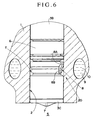
- Fig. 6 is a partially cut-away enlarged sectional view of a cooling structure 20 according to a second embodiment of the present invention.
- the cooling structure 20 contrary to the cooling structure 4 (Figs. 1, 2) according to the first embodiment, the copper ring 8 and cooling water passage 9 are positioned further toward the combustion chamber 5 side than the combustion gas seal 6.
- the heat of the nozzle portion 3B (injection hole 7) of the fuel injection valve 3 is transmitted efficiently to the cooling water 10 inside the cooling water passage 9 of the cylinder head 1, and thus the generation of carbon deposits in the vicinity of the injection hole 7 can be suppressed.
- the nozzle portion of the fuel injection valve can be cooled efficiently, and the generation of carbon deposits in the vicinity of the injection hole can be suppressed.
Landscapes
- Engineering & Computer Science (AREA)
- Chemical & Material Sciences (AREA)
- Combustion & Propulsion (AREA)
- Mechanical Engineering (AREA)
- General Engineering & Computer Science (AREA)
- Fuel-Injection Apparatus (AREA)
Abstract
Description
Claims (9)
- A cooling structure for a fuel injection valve which is installed in a valve installation hole of a cylinder head via a sealing member and injects fuel into a combustion chamber,
characterized in that a heat conducting member capable of performing thermal conduction between a nozzle portion of said fuel injection valve and a low temperature portion of said cylinder head is provided on an outer peripheral portion of said fuel injection valve. - The cooling structure for a fuel injection valve according to Claim 1, characterized in that said low temperature portion is a cooling water passage provided in said cylinder head.
- The cooling structure for a fuel injection valve according to Claim 1, characterized in that at low temperatures, said heat conducting member does not contact said outer peripheral portion of said fuel injection valve and an inner wall surface of said valve installation hole, but at high temperatures, said heat conducting member is capable of contacting said outer peripheral portion and said inner wall surface.
- A cooling structure for a fuel injection valve which is installed in a cylinder head via a sealing member for sealing in combustion gas from a combustion chamber,
characterized in that said fuel injection valve comprises a cylindrical nozzle portion, and is fixed in position by inserting said nozzle portion into a cylindrical valve installation hole formed in said cylinder head, whereupon fuel is injected into said combustion chamber from an injection hole provided on a tip end of said nozzle portion, and
a heat conducting member is installed in an annular space formed between an inner wall surface of said valve installation hole and an outer peripheral surface of said nozzle portion so as to contact both said inner wall surface and said outer peripheral surface. - The cooling structure for a fuel injection valve according to Claim 4, characterized in that said heat conducting member has a greater thermal conductivity than said sealing member.
- The cooling structure for a fuel injection valve according to Claim 5, characterized in that said heat conducting member is constituted by a copper material.
- The cooling structure for a fuel injection valve according to Claims 4 through 6, characterized in that said heat conducting member is a substantially cylindrical member having a larger diameter on one end side than on the other end side, whereby an outer peripheral surface of the large diameter part contacts said inner wall surface of said valve installation hole, and an inner peripheral surface of the small diameter part contacts said outer peripheral surface of said nozzle portion.
- The cooling structure for a fuel injection valve according to Claims 4 through 7, characterized in that said sealing member is provided between said valve installation hole and said nozzle portion, and
said heat conducting member is positioned on the side that is further from said tip end of said nozzle portion than said sealing member. - The cooling structure for a fuel injection valve according to Claims 4 through 7, characterized in that said sealing member is provided between said valve installation hole and said nozzle portion, and
said heat conducting member is positioned on the side that is closer to said tip end of said nozzle portion than said sealing member.
Applications Claiming Priority (2)
| Application Number | Priority Date | Filing Date | Title |
|---|---|---|---|
| JP2003061856 | 2003-03-07 | ||
| JP2003061856A JP4081716B2 (en) | 2003-03-07 | 2003-03-07 | Fuel injection valve cooling structure |
Publications (3)
| Publication Number | Publication Date |
|---|---|
| EP1455083A2 true EP1455083A2 (en) | 2004-09-08 |
| EP1455083A3 EP1455083A3 (en) | 2005-10-19 |
| EP1455083B1 EP1455083B1 (en) | 2008-09-03 |
Family
ID=32821241
Family Applications (1)
| Application Number | Title | Priority Date | Filing Date |
|---|---|---|---|
| EP20040003676 Expired - Lifetime EP1455083B1 (en) | 2003-03-07 | 2004-02-18 | Cooling structure for fuel injection valve |
Country Status (3)
| Country | Link |
|---|---|
| EP (1) | EP1455083B1 (en) |
| JP (1) | JP4081716B2 (en) |
| DE (1) | DE602004016235D1 (en) |
Cited By (4)
| Publication number | Priority date | Publication date | Assignee | Title |
|---|---|---|---|---|
| WO2006084915A1 (en) * | 2005-02-14 | 2006-08-17 | Siemens Aktiengesellschaft | Injection valve for injecting fuel and cylinder head |
| EP2305994A4 (en) * | 2008-12-11 | 2013-07-17 | Mitsubishi Heavy Ind Ltd | Cooling structure for fuel injection valve |
| DE102004048395B4 (en) * | 2004-10-05 | 2015-12-10 | Continental Automotive Gmbh | Piezo injector with contact elements for heat dissipation |
| WO2023237311A1 (en) * | 2022-06-09 | 2023-12-14 | Borgwarner Luxembourg Automotive Sytems S.A. | Fuel injector for direct injection of gaseous fuel |
Families Citing this family (1)
| Publication number | Priority date | Publication date | Assignee | Title |
|---|---|---|---|---|
| JP2011064124A (en) * | 2009-09-17 | 2011-03-31 | Hitachi Automotive Systems Ltd | Fuel injection valve |
Family Cites Families (4)
| Publication number | Priority date | Publication date | Assignee | Title |
|---|---|---|---|---|
| US2175450A (en) * | 1935-08-28 | 1939-10-10 | Atlas Diesel Ab | Internal combustion engine |
| JPH1089192A (en) * | 1996-09-10 | 1998-04-07 | Toyota Central Res & Dev Lab Inc | Low deposit fuel injection valve |
| DE19808068A1 (en) * | 1998-02-26 | 1999-09-02 | Bosch Gmbh Robert | Fuel injector |
| JP2001221123A (en) * | 2000-02-07 | 2001-08-17 | Nissan Diesel Motor Co Ltd | Cooling structure of fuel injection nozzle |
-
2003
- 2003-03-07 JP JP2003061856A patent/JP4081716B2/en not_active Expired - Fee Related
-
2004
- 2004-02-18 DE DE200460016235 patent/DE602004016235D1/en not_active Expired - Lifetime
- 2004-02-18 EP EP20040003676 patent/EP1455083B1/en not_active Expired - Lifetime
Cited By (4)
| Publication number | Priority date | Publication date | Assignee | Title |
|---|---|---|---|---|
| DE102004048395B4 (en) * | 2004-10-05 | 2015-12-10 | Continental Automotive Gmbh | Piezo injector with contact elements for heat dissipation |
| WO2006084915A1 (en) * | 2005-02-14 | 2006-08-17 | Siemens Aktiengesellschaft | Injection valve for injecting fuel and cylinder head |
| EP2305994A4 (en) * | 2008-12-11 | 2013-07-17 | Mitsubishi Heavy Ind Ltd | Cooling structure for fuel injection valve |
| WO2023237311A1 (en) * | 2022-06-09 | 2023-12-14 | Borgwarner Luxembourg Automotive Sytems S.A. | Fuel injector for direct injection of gaseous fuel |
Also Published As
| Publication number | Publication date |
|---|---|
| DE602004016235D1 (en) | 2008-10-16 |
| EP1455083A3 (en) | 2005-10-19 |
| EP1455083B1 (en) | 2008-09-03 |
| JP4081716B2 (en) | 2008-04-30 |
| JP2004270529A (en) | 2004-09-30 |
Similar Documents
| Publication | Publication Date | Title |
|---|---|---|
| US7238002B2 (en) | Damper seal system and method | |
| JP4308923B2 (en) | Fuel injection valve | |
| JP2005256661A (en) | Cylinder block cooling structure | |
| JP6756299B2 (en) | Spark plug sleeve | |
| US7556011B2 (en) | Valve structure for internal combustion | |
| EP1455083A2 (en) | Cooling structure for fuel injection valve | |
| JP4841619B2 (en) | Multi-spark plug with open chamber | |
| JP2005155394A (en) | Combustion gas seal for fuel injection valve | |
| WO2001033066A1 (en) | Exhaust port structure of internal combustion engine | |
| EP2636880A1 (en) | Injector tip seal | |
| CN100412423C (en) | Gasket | |
| JP4710944B2 (en) | Fuel injection valve | |
| US6990805B2 (en) | Waste heat recovery device for internal combustion engine | |
| JPH0486368A (en) | Nozzle top part heat insulating device of fuel injection nozzle for diesel engine | |
| JP6539860B2 (en) | Stab cooler | |
| CN101779034B (en) | Fuel injection valve device | |
| JP5207309B2 (en) | Spark plug | |
| JP2000170627A (en) | Mounting structure of fuel injection nozzle | |
| JP6250366B2 (en) | Fuel injection valve temperature suppression mechanism for internal combustion engine and internal combustion engine provided with the same | |
| KR102376470B1 (en) | Multiway valve apparatus | |
| JP2007107456A (en) | Thermal insulation sleeve for fuel injection valve | |
| JP2004156551A (en) | Seal structure of the fuel injection valve mounting part | |
| KR200373356Y1 (en) | Structure for Mounting Spark Plug | |
| JP3837583B2 (en) | Heat transfer tube cover structure of fluidized bed boiler | |
| JP5333750B2 (en) | Spark plug |
Legal Events
| Date | Code | Title | Description |
|---|---|---|---|
| PUAI | Public reference made under article 153(3) epc to a published international application that has entered the european phase |
Free format text: ORIGINAL CODE: 0009012 |
|
| 17P | Request for examination filed |
Effective date: 20040218 |
|
| AK | Designated contracting states |
Kind code of ref document: A2 Designated state(s): AT BE BG CH CY CZ DE DK EE ES FI FR GB GR HU IE IT LI LU MC NL PT RO SE SI SK TR |
|
| AX | Request for extension of the european patent |
Extension state: AL LT LV MK |
|
| PUAL | Search report despatched |
Free format text: ORIGINAL CODE: 0009013 |
|
| AK | Designated contracting states |
Kind code of ref document: A3 Designated state(s): AT BE BG CH CY CZ DE DK EE ES FI FR GB GR HU IE IT LI LU MC NL PT RO SE SI SK TR |
|
| AX | Request for extension of the european patent |
Extension state: AL LT LV MK |
|
| RAP1 | Party data changed (applicant data changed or rights of an application transferred) |
Owner name: BOSCH CORPORATION Owner name: NISSAN MOTOR COMPANY, LIMITED |
|
| AKX | Designation fees paid |
Designated state(s): DE FR GB |
|
| 17Q | First examination report despatched |
Effective date: 20060220 |
|
| 17Q | First examination report despatched |
Effective date: 20060220 |
|
| GRAP | Despatch of communication of intention to grant a patent |
Free format text: ORIGINAL CODE: EPIDOSNIGR1 |
|
| GRAS | Grant fee paid |
Free format text: ORIGINAL CODE: EPIDOSNIGR3 |
|
| GRAA | (expected) grant |
Free format text: ORIGINAL CODE: 0009210 |
|
| AK | Designated contracting states |
Kind code of ref document: B1 Designated state(s): DE FR GB |
|
| REG | Reference to a national code |
Ref country code: GB Ref legal event code: FG4D |
|
| REF | Corresponds to: |
Ref document number: 602004016235 Country of ref document: DE Date of ref document: 20081016 Kind code of ref document: P |
|
| PLBE | No opposition filed within time limit |
Free format text: ORIGINAL CODE: 0009261 |
|
| STAA | Information on the status of an ep patent application or granted ep patent |
Free format text: STATUS: NO OPPOSITION FILED WITHIN TIME LIMIT |
|
| 26N | No opposition filed |
Effective date: 20090604 |
|
| PGFP | Annual fee paid to national office [announced via postgrant information from national office to epo] |
Ref country code: DE Payment date: 20130426 Year of fee payment: 10 |
|
| PGFP | Annual fee paid to national office [announced via postgrant information from national office to epo] |
Ref country code: FR Payment date: 20140218 Year of fee payment: 11 |
|
| PGFP | Annual fee paid to national office [announced via postgrant information from national office to epo] |
Ref country code: GB Payment date: 20140220 Year of fee payment: 11 |
|
| REG | Reference to a national code |
Ref country code: DE Ref legal event code: R119 Ref document number: 602004016235 Country of ref document: DE |
|
| REG | Reference to a national code |
Ref country code: DE Ref legal event code: R119 Ref document number: 602004016235 Country of ref document: DE Effective date: 20140902 |
|
| PG25 | Lapsed in a contracting state [announced via postgrant information from national office to epo] |
Ref country code: DE Free format text: LAPSE BECAUSE OF NON-PAYMENT OF DUE FEES Effective date: 20140902 |
|
| GBPC | Gb: european patent ceased through non-payment of renewal fee |
Effective date: 20150218 |
|
| REG | Reference to a national code |
Ref country code: FR Ref legal event code: ST Effective date: 20151030 |
|
| PG25 | Lapsed in a contracting state [announced via postgrant information from national office to epo] |
Ref country code: GB Free format text: LAPSE BECAUSE OF NON-PAYMENT OF DUE FEES Effective date: 20150218 |
|
| PG25 | Lapsed in a contracting state [announced via postgrant information from national office to epo] |
Ref country code: FR Free format text: LAPSE BECAUSE OF NON-PAYMENT OF DUE FEES Effective date: 20150302 |