EP1455001A1 - Metal material coated with metal oxide and/or metal hydroxide coating film and method for production thereof - Google Patents
Metal material coated with metal oxide and/or metal hydroxide coating film and method for production thereof Download PDFInfo
- Publication number
- EP1455001A1 EP1455001A1 EP02781881A EP02781881A EP1455001A1 EP 1455001 A1 EP1455001 A1 EP 1455001A1 EP 02781881 A EP02781881 A EP 02781881A EP 02781881 A EP02781881 A EP 02781881A EP 1455001 A1 EP1455001 A1 EP 1455001A1
- Authority
- EP
- European Patent Office
- Prior art keywords
- metal
- metal oxide
- conductive material
- production
- ion
- Prior art date
- Legal status (The legal status is an assumption and is not a legal conclusion. Google has not performed a legal analysis and makes no representation as to the accuracy of the status listed.)
- Granted
Links
Images


Classifications
-
- C—CHEMISTRY; METALLURGY
- C23—COATING METALLIC MATERIAL; COATING MATERIAL WITH METALLIC MATERIAL; CHEMICAL SURFACE TREATMENT; DIFFUSION TREATMENT OF METALLIC MATERIAL; COATING BY VACUUM EVAPORATION, BY SPUTTERING, BY ION IMPLANTATION OR BY CHEMICAL VAPOUR DEPOSITION, IN GENERAL; INHIBITING CORROSION OF METALLIC MATERIAL OR INCRUSTATION IN GENERAL
- C23C—COATING METALLIC MATERIAL; COATING MATERIAL WITH METALLIC MATERIAL; SURFACE TREATMENT OF METALLIC MATERIAL BY DIFFUSION INTO THE SURFACE, BY CHEMICAL CONVERSION OR SUBSTITUTION; COATING BY VACUUM EVAPORATION, BY SPUTTERING, BY ION IMPLANTATION OR BY CHEMICAL VAPOUR DEPOSITION, IN GENERAL
- C23C22/00—Chemical surface treatment of metallic material by reaction of the surface with a reactive liquid, leaving reaction products of surface material in the coating, e.g. conversion coatings, passivation of metals
- C23C22/05—Chemical surface treatment of metallic material by reaction of the surface with a reactive liquid, leaving reaction products of surface material in the coating, e.g. conversion coatings, passivation of metals using aqueous solutions
- C23C22/06—Chemical surface treatment of metallic material by reaction of the surface with a reactive liquid, leaving reaction products of surface material in the coating, e.g. conversion coatings, passivation of metals using aqueous solutions using aqueous acidic solutions with pH less than 6
- C23C22/34—Chemical surface treatment of metallic material by reaction of the surface with a reactive liquid, leaving reaction products of surface material in the coating, e.g. conversion coatings, passivation of metals using aqueous solutions using aqueous acidic solutions with pH less than 6 containing fluorides or complex fluorides
-
- C—CHEMISTRY; METALLURGY
- C23—COATING METALLIC MATERIAL; COATING MATERIAL WITH METALLIC MATERIAL; CHEMICAL SURFACE TREATMENT; DIFFUSION TREATMENT OF METALLIC MATERIAL; COATING BY VACUUM EVAPORATION, BY SPUTTERING, BY ION IMPLANTATION OR BY CHEMICAL VAPOUR DEPOSITION, IN GENERAL; INHIBITING CORROSION OF METALLIC MATERIAL OR INCRUSTATION IN GENERAL
- C23C—COATING METALLIC MATERIAL; COATING MATERIAL WITH METALLIC MATERIAL; SURFACE TREATMENT OF METALLIC MATERIAL BY DIFFUSION INTO THE SURFACE, BY CHEMICAL CONVERSION OR SUBSTITUTION; COATING BY VACUUM EVAPORATION, BY SPUTTERING, BY ION IMPLANTATION OR BY CHEMICAL VAPOUR DEPOSITION, IN GENERAL
- C23C22/00—Chemical surface treatment of metallic material by reaction of the surface with a reactive liquid, leaving reaction products of surface material in the coating, e.g. conversion coatings, passivation of metals
- C23C22/05—Chemical surface treatment of metallic material by reaction of the surface with a reactive liquid, leaving reaction products of surface material in the coating, e.g. conversion coatings, passivation of metals using aqueous solutions
- C23C22/06—Chemical surface treatment of metallic material by reaction of the surface with a reactive liquid, leaving reaction products of surface material in the coating, e.g. conversion coatings, passivation of metals using aqueous solutions using aqueous acidic solutions with pH less than 6
-
- C—CHEMISTRY; METALLURGY
- C23—COATING METALLIC MATERIAL; COATING MATERIAL WITH METALLIC MATERIAL; CHEMICAL SURFACE TREATMENT; DIFFUSION TREATMENT OF METALLIC MATERIAL; COATING BY VACUUM EVAPORATION, BY SPUTTERING, BY ION IMPLANTATION OR BY CHEMICAL VAPOUR DEPOSITION, IN GENERAL; INHIBITING CORROSION OF METALLIC MATERIAL OR INCRUSTATION IN GENERAL
- C23C—COATING METALLIC MATERIAL; COATING MATERIAL WITH METALLIC MATERIAL; SURFACE TREATMENT OF METALLIC MATERIAL BY DIFFUSION INTO THE SURFACE, BY CHEMICAL CONVERSION OR SUBSTITUTION; COATING BY VACUUM EVAPORATION, BY SPUTTERING, BY ION IMPLANTATION OR BY CHEMICAL VAPOUR DEPOSITION, IN GENERAL
- C23C22/00—Chemical surface treatment of metallic material by reaction of the surface with a reactive liquid, leaving reaction products of surface material in the coating, e.g. conversion coatings, passivation of metals
- C23C22/05—Chemical surface treatment of metallic material by reaction of the surface with a reactive liquid, leaving reaction products of surface material in the coating, e.g. conversion coatings, passivation of metals using aqueous solutions
- C23C22/68—Chemical surface treatment of metallic material by reaction of the surface with a reactive liquid, leaving reaction products of surface material in the coating, e.g. conversion coatings, passivation of metals using aqueous solutions using aqueous solutions with pH between 6 and 8
-
- C—CHEMISTRY; METALLURGY
- C25—ELECTROLYTIC OR ELECTROPHORETIC PROCESSES; APPARATUS THEREFOR
- C25D—PROCESSES FOR THE ELECTROLYTIC OR ELECTROPHORETIC PRODUCTION OF COATINGS; ELECTROFORMING; APPARATUS THEREFOR
- C25D9/00—Electrolytic coating other than with metals
- C25D9/04—Electrolytic coating other than with metals with inorganic materials
Definitions
- the present invention relates to metal oxide and/or metal hydroxide coated metal materials and to a method for their production.
- Vapor phase methods such as sputtering or CVD and liquid phase methods such as sol-gel methods have been used as methods for producing various types of oxide films, but they have been limited in the following ways.
- Vapor phase methods accomplish film formation on substrates in the vapor phase and therefore require costly equipment in order to achieve a vacuum system. Means are also necessary for heating the substrate prior to film formation. It is also difficult to form films on substrates with irregularities or curved surfaces.
- Sol-gel methods as liquid phase methods, require firing after application and therefore result in generation of cracks and dispersion of metal from the substrate. Because of the volatile portion, it is difficult to form a dense coating.
- liquid phase deposition One liquid phase method wherein an aqueous fluorine compound solution such as fluoro-complex ion is used, known as liquid phase deposition, does not require costly equipment to achieve a vacuum, and allows film formation without heating the substrate to high temperature while also allowing formation of thin films on irregularly-shaped substrates.
- this method is mainly employed for substrates of non-metal materials, such as glass, polymer materials and ceramics.
- Japanese Unexamined Patent Publication SHO No. 64-8296 proposes forming a silicon dioxide film on a substrate of a metal, alloy, semiconductor substrate or the like which is at least partially conductive on the surface.
- the text merely states that "it is also possible to add boric acid or aluminum to the treatment solution in order to prevent etching", and this alone is insufficient.
- it is an object to rapidly form oxide and/or hydroxide films unachievable by the prior art, on metal materials with various surface shapes without heat treatment or with only low-temperature heat treatment, and to thereby provide metal oxide and/or metal hydroxide coated metal materials.
- liquid phase deposition wherein an aqueous fluorine compound solution such as fluoro-complex ion is used, the low film formation speed, resulting in a long time of several dozen minutes for film formation, has been a drawback as described in the examples of Japanese Patent No. 2828359 and elsewhere.
- a second aspect of the invention therefore, it is an object to rapidly form oxide and/or hydroxide films unachievable by the prior art, on conductive materials without heat treatment or with only low-temperature heat treatment, and to thereby provide metal oxide and/or metal hydroxide coated conductive materials.
- the present inventors have made the following discovery after conducting diligent research to achieve the objects stated above.
- consumption and reduction of fluorine ions and hydrogen ions is thought to promote the reaction of metal ions to oxides and/or hydroxides.
- metal ions when the metal material is immersed, local cells are formed on its surface causing metal elution and hydrogen generating reaction. Consumption of fluorine ions and reduction of hydrogen ions occurring by the eluted metal ions causes oxides and/or hydroxides to be deposited on the metal material surface. Either or both the metal elution reaction and hydrogen reduction reaction are necessary for the film forming reaction to proceed, but excessive metal elution reaction can cause deterioration of the substrate, while excessive hydrogen generation can also prevent complete film formation or inhibit the deposition reaction.
- the first aspect of the invention is therefore as follows:
- the metal ion elution reaction and hydrogen reduction reaction occur violently, causing corrosion of the substrate and inhibiting formation of the film by hydrogen generation, such that a complete film cannot be formed.
- the pH is greater than 7
- the solution becomes unstable or deposition of aggregates may occur, resulting in insufficient cohesion. Shorting between the substrate and the metal material having a lower standard electrode potential can cause hydrogen generating reaction on the substrate and metal elution reaction on the metal material having a lower standard electrode potential, and in this case as well it was found that the aforementioned pH range is ideal in order to suppress corrosion of the substrate metal material.
- the film formation rate can be increased by up to about 5-fold compared to simple immersion, although this depends on the conditions such as the combination of substrate and shorting metal, and the temperature. No deposition was seen when the molar ratio of fluorine ion with respect to the metal ion in the treatment solution was less than 4-fold. It was also found that the deposition rate can be controlled by the salt concentration, temperature and by addition of organic substances for the purpose of suppressing or promoting hydrogen generating reaction on the substrate surface.
- Metal ions to be used according to the first aspect of the invention include Ti, Si, Zr, Fe, Sn, Nd and the like, but are not limited thereto.
- the concentration of the metal ion in the treatment solution depends on the kind of metal ion but the reasons therefor are not clear.
- the fluorine ion used according to the first aspect of the invention may be hydrofluoric acid or a salt thereof, for example, an ammonium, potassium or sodium salt, but is not limited thereto.
- a salt is used, the saturation solubility depends on the kind of cation, and selection should be made considering the film formation concentration range.
- Complex ions with a metal and fluorine in a 4-fold molar ratio with respect to the metal may be provided by, for example, hexafluorotitanic acid, hexafluorozirconic acid, hexafluorosilicic acid, or their salts, such as ammonium, potassium and sodium salts, but are not limited thereto.
- This complex ion may be "a complex ion bonding at least a metal ion and a compound containing fluorine. in a 4-fold molar ratio with respect to the metal ion". That is, the complex ion may contain, in addition to a metal and fluorine, other element or atom or ion.
- the saturation solubility depends on the kind of cation, selection should be made considering the film formation concentration range.
- the adjustment of the pH of the solution can be made by known method but, when fluoric acid is used, the ratio between the metal ion and the fluorine ion is also varied and the final fluorine ion concentration in the treatment aqueous solution should be controlled.
- reaction temperature and reaction time may be selected appropriately. Increase in temperature causes increase in film formation rate.
- film thickness film formation amount
- reaction time period can be controlled by reaction time period.
- the film thickness of the metal oxide and/or hydroxide coating formed on the surface of the metal material according to the first aspect of the invention may be selected depending on the applications and from a range by characteristics and economy.
- any variety of oxide coatings that can be formed by all conventional oxide coating formation methods (liquid methods and gaseous methods) can be formed.
- the metal material used for the first aspect of the invention is not particularly restricted, and for example, various metals, alloys or metal surface treated materials and the like may be employed. It may be in the form of a plate, foil, wire, rod or the like, or even worked into a complex shape such as mesh or etched surface.
- the metal oxide and/or metal hydroxide coated metal material may be used for a variety of purposes, including an oxide catalyst electrode for a capacitor formed on the surface of a stainless steel foil, various types of steel sheets with improved corrosion resistance, various types of steel sheets with improved resin/metal cohesion, various substrates with imparted photocatalytic properties, insulating films formed on stainless steel foils for solar cells, EL displays, electron papers, designed coatings, and metal materials with slidability for improved workability.
- An equilibrium reaction between the metal ion and oxygen and/or hydroxide in which fluorine ion participates occurs in the aqueous solution containing metal ion and fluorine ion in a 4-fold molar ratio with respect the metal ion, and/or in the aqueous solution containing a complex of a metal ion and fluorine in a 4-fold molar ratio with respect to the metal ion. Consumption and reduction of the fluorine ion and hydrogen ion is thought to promote the reaction of metal ions to oxides and/or hydroxides.
- the treatment solution pH is less than 2, formation of the film tends to be inhibited by hydrogen generation, such that control of the potential for formation of a complete film becomes difficult.
- the pH is greater than 7, the solution becomes unstable or deposition of aggregates may occur, resulting in insufficient cohesion. No deposition was seen when the molar ratio of fluorine ion with respect to the metal ion in the treatment solution was less than 4-fold. It was also found that the deposition rate can be controlled by the salt concentration, temperature and by addition of organic substances for the purpose of suppressing or promoting hydrogen generating reaction on the substrate surface.
- the metal ion, fluorine ion, fluorine-containing complex ion, pH adjustment, deposition conditions, film thickness and he like used in the second aspect of the present invention can be similar to those of the first aspect of the present invention.
- the electrolysis conditions according to the invention can be any ones which allow cathod electrolysis of a substrate. The details are described in Examples or other places.
- the film formation rate can be controlled by current.
- the film thickness can be controlled by the product of the current and the time period, i.e., the quantity of electricity. The optimum and upper limits of the current and voltage differ depending on the type of oxide and concentration.
- the conductive material used for the second aspect of the invention is not particularly restricted, and for example, conductive polymers, conductive ceramics, various metals or alloys, and various metal surface treated materials may be used. It may be in the form of a sheet, foil, wire, rod or the like, or may be worked into a complex shape such as mesh or etched surface. A film can be formed on the substrate so long as there is conductivity, but the conductivity is preferably at 0.1 S/cm. With a lower conductivity the resistance increases, resulting in lower deposition efficiency.
- Fig. 1 is a schematic view of an apparatus for continuous formation of a metal oxide and/or metal hydroxide film on a material having an electrolytic mask (not shown) on the surface of one side and conductive on the surface of the other side. It will be appreciated that the apparatus will in fact be more complex than shown in this illustration.
- the major construction has an electrolyte solution 3 filled between conductor rolls 11, 12 in contact with the surface of a continuously transported conductive material 1 having an electrolytic mask selectively formed on the surface of the other side and an electrode 6 set opposite the conductive surface of the conductive material 1, while a direct current power device 7 is situated between the conductor rolls 11,12 and electrode 6 with the conductor rolls side as the negative electrode and the electrode side as the positive electrode.
- a switch 9 is set between the current power device 7 and the conductor rolls 11,12, and closing of the switch 9 applies a voltage between the conductor rolls 11,12 and the electrode 6. Opening the switch 9 cuts off the voltage application.
- a ringer roll (not shown) is situated at the introduction side of the electrolyte bath 2 as a transport roll for the conductive material 1 for control of the flow of the electrolyte solution 3 out of the bath, while sink rolls 15,16 are situated in the bath to maintain a constant distance between the electrode 6 and the conductive material 1.
- Fig. 2 shows a schematic of an apparatus for formation of a metal oxide and/or metal hydroxide film on a material which is conductive on both surfaces. The explanation is the same as for Fig. 1, except that electrodes are set mutually opposite each other on the front and back sides of the conductive material 1.
- Fig. 3 shows a schematic of an apparatus for continuous formation of a metal oxide and/or metal hydroxide film on a material having an electrolytic mask (not shown) on the surface of one side and being conductive on the surface of the other side. It will be appreciated that the apparatus will in fact be more complex than shown in this illustration.
- the major construction has electrodes 5 and 6 successively situated along the direction of movement of a conductive material 1 opposite the conductive surface of a continuously transported conductive material 1 having an electrolytic mask selectively formed on the surface of the other side, with an electrolyte solution 3 filled between the conductive material 1 and the electrodes 5 and 6, while a direct current power device 7 is situated between the electrodes 5 and 6 with the electrode 5 side as the negative electrode and the electrode 6 side as the positive electrode.
- a switch 9 is set between the current power device 7 and the electrode 6, and closing of the switch 9 applies a voltage between the electrode 5 and the electrode 6. Opening the switch 9 cuts off the voltage application.
- ringer rolls 13,14 are situated at the introduction side of the electrolyte bath 2 as transport rolls for the conductive material 1 for control of the flow of the electrolyte solution 3 out of the bath, while sink rolls 15,16 are situated in the bath to maintain a constant distance between the electrodes 5 and 6 and the conductive material 1.
- Fig. 4 shows a schematic of an apparatus for formation of a metal oxide and/or metal hydroxide film on a material which is conductive on both surfaces. The explanation is the same as for Fig. 3, except that electrodes are set mutually opposite each other on the front and back sides of the conductive material 1.
- the metal oxide and/or metal hydroxide coated conductive material may be used for a variety of purposes, including improved corrosion resistance of capacitor oxide catalyst electrodes formed on conductive rubber or stainless steel foil surfaces or of various types of steel sheets, improved resin/metal cohesion, for imparting photocatalytic properties to substrates, or for improving workability by providing slidability for insulating films, design coatings or metal materials formed on stainless steel foils, such as in solar cells, EL displays, electron paper substrates and the like.
- This example illustrates the first aspect of the invention.
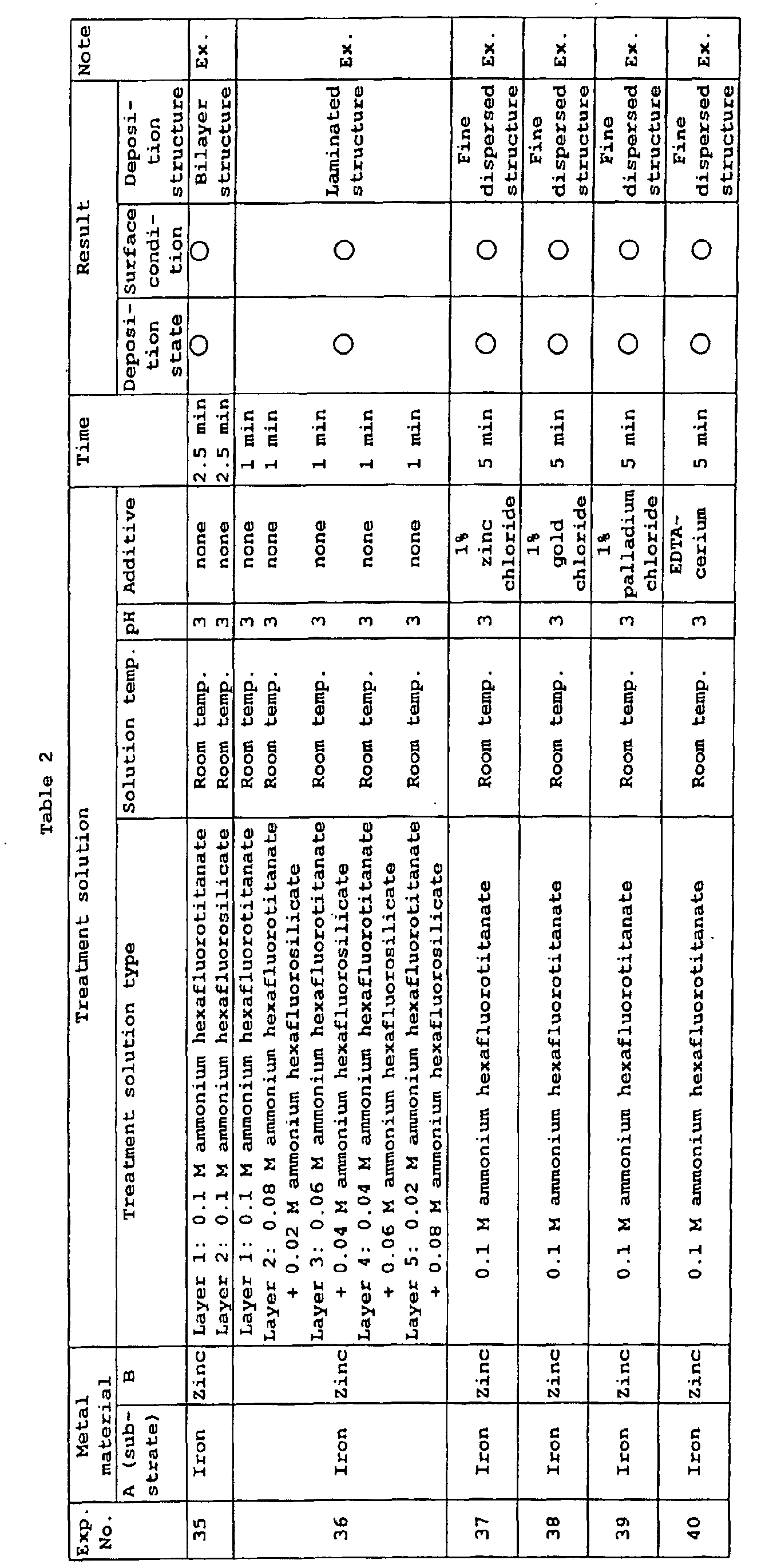
- the deposition state was evaluated by visual observation of the condition after film formation and after 90° bending, with ⁇ indicating absence of peeling, and ⁇ indicating presence of peeling.
- the surface condition was evaluated by scanning electron microscope observation at 5000x magnification, and evaluation was made based on 4 arbitrarily selected locations, with ⁇ indicating cracks at 2 or more locations, ⁇ indicating a crack at 1 location, and o ⁇ indicating no cracks. When necessary, the cross-section was observed to examine the coating structure.
- metal material A The substrate for film formation was designated as metal material A, and the metal with a lower standard electrode potential than metal material A was designated as metal material B.
- the treatment solutions used were mixed 0.1 M aqueous solutions of titanium chloride and ammonium hydrogen fluoride at titanium ion/fluorine ion molar ratios of 1:1, 1:2, 1:3, 1:4, 1:5 and 1:6, with the pH adjusted to 3 using hydrofluoric acid and ammonia water.
- Aluminum was used as the substrate metal material A.
- the film formation was carried out for 5 minutes at room temperature, and the film formation was followed by water rinsing and air drying.
- the treatment solutions used were 0.1 M aqueous solutions of ammonium hexafluorotitanate, with the pH adjusted to 1, 3, 5, 7 and 9 using hydrofluoric acid and ammonia water.
- Aluminum was used as the substrate metal material A.
- the film formation was carried out for 5 minutes at room temperature, and the film formation was followed by water rinsing and air drying. Adjustment to pH 3 was carried out at bath temperatures of 50°C and 80°C.
- the treatment solutions used were 0.1 M aqueous solutions of ammonium hexafluorozirconate, with the pH adjusted to 1, 3, 5, 7 and 9 using hydrofluoric acid and ammonia water.
- Aluminum was used as the substrate metal material A.
- the film formation was carried out for 5 minutes at room temperature, and the film formation was followed by water rinsing and air drying.
- the treatment solutions used were mixed 0.1 M aqueous solutions of titanium chloride and ammonium hydrogen fluoride at titanium ion/fluorine ion molar ratios of 1:1, 1:2, 1:3, 1:4, 1:5 and 1:6, with the pH adjusted to 3 using hydrofluoric acid and ammonia water.
- Stainless steel (SUS304) was used as the substrate metal material A, and aluminum was used as metal material B.
- the film formation was carried out for 5 minutes at room temperature, and the film formation was followed by water rinsing and air drying.
- the treatment solutions used were 0.1 M aqueous solutions of ammonium hexafluorotitanate, with the pH adjusted to 1, 3, 5, 7 and 9 using hydrofluoric acid and ammonia water.
- Stainless steel (SUS304) was used as the substrate metal material A, and aluminum was used as metal material B.
- the film formation was carried out for 5 minutes at room temperature, and the film formation was followed by water rinsing and air drying.
- the treatment solutions used were 0.1 M aqueous solutions of ammonium hexafluorosilicate, with the pH adjusted to 1, 3, 5, 7 and 9 using hydrofluoric acid and ammonia water.
- Stainless steel (SUS304) was used as the substrate metal material A, and aluminum was used as metal material B.
- the film formation was carried out for 5 minutes at room temperature, and the film formation was followed by water rinsing and air drying.
- the first layer treatment solution used was an aqueous solution of 0.1 M ammonium hexafluorotitanate with the pH adjusted to 3. Pure iron was used as the substrate metal material A, and zinc was used as metal material B. The film formation was carried out for 2.5 minutes at room temperature, and the film formation was followed by water rinsing and air drying.
- the second layer treatment solution used was an aqueous solution of 0.1 M ammonium hexafluorosilicate with the pH adjusted to 3. Likewise, zinc was used as metal material B. The film formation was carried out for 2.5 minutes at room temperature, and the film formation was followed by water rinsing and air drying.
- the first layer treatment solution used was an aqueous solution of 0.1 M ammonium hexafluorotitanate with the pH adjusted to 3. Pure iron was used as the substrate metal material A, and zinc was used as metal material B.
- the film formation was carried out for 1 minute at room temperature, and the film formation was followed by water rinsing and air drying.
- the 2nd, 3rd, 4th and 5th layer treatment solutions used were, respectively, an aqueous solution of 0.08 M ammonium hexafluorotitanate and 0.02 M ammonium hexafluorosilicate, an aqueous solution of 0.06 M ammonium hexafluorotitanate and 0.04 M ammonium hexafluorosilicate, an aqueous solution of 0.04 M ammonium hexafluorotitanate and 0.06 M ammonium hexafluorosilicate and an aqueous solution of 0.02 M ammonium hexafluorotitanate and 0.08 M ammonium hexafluorosilicate, each with the pH adjusted to 3.
- zinc was used as metal material B.
- the film formation was carried out for 1 minute at room temperature, and the film formation was followed by water rinsing and air drying.
- aqueous EDTA-cerium complex solution in which reaction with fluorine ion is masked by ethylenediamine tetraacetic acid (EDTA) was added to a 0.1 M-ammonium hexafluorotitanate aqueous solution for use as the treatment solution.
- Pure iron was used as the substrate metal material A and zinc was used as the metal material B.
- the film formation was carried out for 5 minutes at room temperature, and the film formation was followed by water rinsing and air drying.
- This example illustrates the second aspect of the invention.
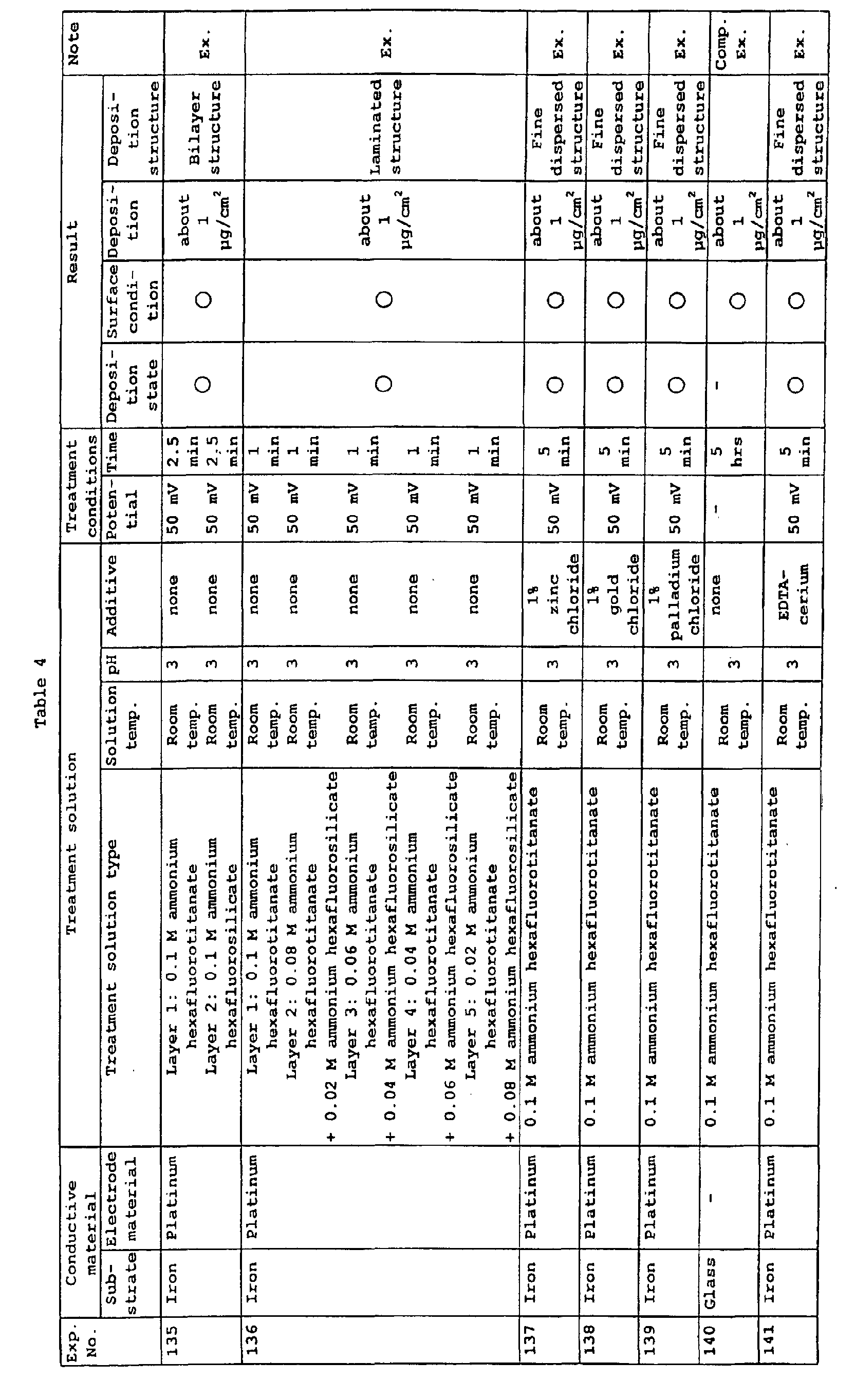
- the deposition state was evaluated by visual observation of the condition after film formation and after 90° bending, with ⁇ indicating absence of peeling, and ⁇ indicating presence of peeling.
- the surface condition was evaluated by scanning electron microscope observation at 5000x magnification, and evaluation was made based on 4 arbitrarily selected locations, with ⁇ indicating cracks at 2 or more locations, ⁇ indicating a crack at 1 location, and o ⁇ indicating no cracks.
- the mass was measured before and after deposition, and the difference was divided by the deposition area to calculate the amount of deposition per unit area. When necessary, the cross-section was observed to examine the coating structure.
- the treatment solutions used were mixed 0.1 M aqueous solutions of titanium chloride and ammonium hydrogen fluoride at titanium ion/fluorine ion molar ratios of 1:1, 1:2, 1:3, 1:4, 1:5 and 1:6, with the pH adjusted to 3 using hydrofluoric acid and ammonia water.
- Conductive rubber was used as the substrate, and platinum was used as the electrode material.
- the electrolysis film formation was carried out for 5 minutes at room temperature, and the film formation was followed by water rinsing and air drying (see Table 3).
- the treatment solutions used were 0.1 M aqueous solutions of ammonium hexafluorotitanate, with the pH adjusted to 1, 3, 5, 7 and 9 using hydrofluoric acid and ammonia water.
- Conductive rubber was used as the substrate, and platinum was used as the electrode material.
- the film formation was carried out for 5 minutes at room temperature, and the film formation was followed by water rinsing and air drying. Adjustment to pH 3 was carried out at bath temperatures of 50°C and 80°C.
- the treatment solutions used were 0.1 M aqueous solutions of ammonium hexafluorozirconate, with the pH adjusted to 1, 3, 5, 7 and 9 using hydrofluoric acid and ammonia water.
- Conductive rubber was used as the substrate, and platinum was used as the electrode material.
- the film formation was carried out for 5 minutes at room temperature, and the film formation was followed by water rinsing and air drying.
- the treatment solutions used were mixed 0.1 M aqueous solutions of titanium chloride and ammonium hydrogen fluoride at titanium ion/fluorine ion molar ratios of 1:1, 1:2, 1:3, 1:4, 1:5 and 1:6, with the pH adjusted to 3 using hydrofluoric acid and ammonia water.
- Stainless steel (SUS304) was used as the substrate, and platinum was used as the electrode material.
- the film formation was carried out for 5 minutes at room temperature, and the film formation was followed by water rinsing and air drying.
- the treatment solutions used were 0.1 M aqueous solutions of ammonium hexafluorotitanate, with the pH adjusted to 1, 3, 5, 7 and 9 using hydrofluoric acid and ammonia water.
- Stainless steel (SUS304) was used as the substrate, and platinum was used as the electrode material.
- the film formation was carried out for 5 minutes at room temperature, and the film formation was followed by water rinsing and air drying.
- the treatment solutions used were 0.1 M aqueous solutions of ammonium hexafluorosilicate, with the pH adjusted to 1, 3, 5, 7 and 9 using hydrofluoric acid and ammonia water.
- Stainless steel (SUS304) was used as the substrate, and platinum was used as the electrode material.
- the film formation was carried out for 5 minutes at room temperature, and the film formation was followed by water rinsing and air drying.
- the first layer treatment solution used was an aqueous solution of 0.1 M ammonium hexafluorotitanate with the pH adjusted to 3. Pure iron was used as the substrate, and platinum was used as the electrode material. The film formation was carried out for 2.5 minutes at room temperature, and the film formation was followed by water rinsing and air drying.
- the second layer treatment solution used was an aqueous solution of 0.1 M ammonium hexafluorosilicate with the pH adjusted to 3. Each film formation was carried out for 2.5 minutes at room temperature, and the film formation was followed by water rinsing and air drying.
- the first layer treatment solution used was an aqueous solution of 0.1 M ammonium hexafluorotitanate with the pH adjusted to 3. Pure iron was used as the substrate, and platinum was used as the electrode material.
- the film formation was carried out for 1 minute at room temperature, and the film formation was followed by water rinsing and air drying.
- the 2nd, 3rd, 4th and 5th layer treatment solutions used were, respectively, an aqueous solution of 0.08 M ammonium hexafluorotitanate and 0.02 M ammonium hexafluorosilicate, an aqueous solution of 0.06 M ammonium hexafluorotitanate and 0.04 M ammonium hexafluorosilicate, an aqueous solution of 0.04 M ammonium hexafluorotitanate and 0.06 M ammonium hexafluorosilicate and an aqueous solution of 0.02 M ammonium hexafluorotitanate and 0.08 M ammonium hexafluorosilicate, each with the pH adjusted to 3.
- Each film formation was carried out for 1 minute at room temperature, and the film formation was followed by water rinsing and air drying.
- Films were formed by immersion of various plated steel sheets as the base materials in aqueous solutions of ammonium hexafluorosilicate, ammonium hexafluorotitanate and ammonium hexafluorozirconate. The film formation was carried out for 5 minutes at room temperature, and the film formation was followed by water rinsing and air drying (see Table 5).
- Films were formed on various plated steel sheets as the base materials in aqueous solutions of ammonium hexafluorosilicate, ammonium hexafluorotitanate and ammonium hexafluorozirconate, by cathode electrolysis using platinum as the counter electrode. The film formation was carried out for 5 minutes at room temperature, and the film formation was followed by water rinsing and air drying (see Table 6).
- Films were formed on various plated steel sheets as the base materials in aqueous solutions of ammonium hexafluorosilicate, ammonium hexafluorotitanate and ammonium hexafluorozirconate, by cathode electrolysis using aluminum as the counter electrode. The film formation was carried out for 5 minutes at room temperature, and the film formation was followed by water rinsing and air drying (see Table 7).
- the primary coating adhesion was determined using a bar coater to coat a melamine alkyd resin paint (Amylaq #1000, product of Kansai Paint Co., Ltd.) to a dry film thickness of 30 ⁇ m, and then baking at a furnace temperature of 130°C for 20 minutes. After allowing it to stand overnight, it was then subjected to 7 mm Erichsen working.
- Adhesive tape (Cellotape, trade name of Nichiban Co., Ltd.) was pasted to the worked section and peeled off by rapidly pulling at a 45° angle, and the following evaluation was made based on the peel area.
- the secondary coating was determined in the same manner as the primary coating adhesion, with coating of a melamine alkyd paint, standing overnight and then immersion in boiling water for 30 minutes. After 7 mm Erichsen working, adhesive tape (Cellotape, trade name of Nichiban Co., Ltd.) was pasted to the worked section and peeled off by rapidly pulling at a 45° angle, and the following evaluation was made based on the peel area.
- the plate corrosion resistance was determined according to the salt water spray test method described in JIS Z 2371, blowing a 5% NaCl solution onto the test sheet at an atmosphere temperature of 35°C, and evaluating the white rust generation after 240 hours based on the following.
- the working section corrosion resistance was determined by 7 mm Erichsen working, followed by a test according to the salt water spray test method described in JIS Z 2371, blowing a 5% NaCl solution onto the test sheet at an atmosphere temperature of 35°C, and evaluating the white rust generation on the worked section after 72 hours based on the following.
- Films were formed by immersion of stainless steel sheets and pure iron as the base materials in aqueous solutions of ammonium hexafluorosilicate, ammonium hexafluorotitanate and ammonium hexafluorozirconate, using the electrolysis apparatuses shown in Figs. 1 to 4 (see Table 8).
- the method of producing a metal oxide and/or metal hydroxide coating on metal materials from aqueous solutions according to the invention allows rapid fabrication of various oxide or hydroxide coatings with various functions and constructions, including corrosion resistance and insulating properties, with the use of simple equipment, and the metal materials having such oxide or hydroxide coatings are suitable for a variety of purposes and are therefore of great industrial significance.
Landscapes
- Chemical & Material Sciences (AREA)
- Metallurgy (AREA)
- Engineering & Computer Science (AREA)
- Chemical Kinetics & Catalysis (AREA)
- Materials Engineering (AREA)
- Organic Chemistry (AREA)
- General Chemical & Material Sciences (AREA)
- Mechanical Engineering (AREA)
- Electrochemistry (AREA)
- Inorganic Chemistry (AREA)
- Chemical Treatment Of Metals (AREA)
- Other Surface Treatments For Metallic Materials (AREA)
- Chemically Coating (AREA)
Abstract
Description
Nevertheless, when the pH of the treatment solution was further lowered to promote this gas generation, no coating was formed or only a non-uniform or low-cohesion coating could be formed. The pH of the treatment solution was therefore examined with particular interest, and as a result it was found that a treatment solution pH of 2-7 is preferred, and a pH of 3-4 is more preferred. If the treatment solution pH is less than 2, formation of the film tends to be inhibited by hydrogen generation, such that control of the potential for formation of a complete film becomes difficult. On the other hand, if the pH is greater than 7, the solution becomes unstable or deposition of aggregates may occur, resulting in insufficient cohesion. No deposition was seen when the molar ratio of fluorine ion with respect to the metal ion in the treatment solution was less than 4-fold. It was also found that the deposition rate can be controlled by the salt concentration, temperature and by addition of organic substances for the purpose of suppressing or promoting hydrogen generating reaction on the substrate surface.






Claims (26)
- A method for production of a metal oxide and/or metal hydroxide coated metal material characterized by immersing a metal material in an aqueous treatment solution at pH 2-7 containing a metal ion and a fluorine ion in a 4-fold molar ratio with respect to said metal ion, and/or containing a complex ion comprising at least a metal and fluorine in a 4-fold molar ratio with respect to said metal, to form on the surface of said metal material a metal oxide and/or metal hydroxide coating containing said metal ion.
- A method for production of a metal oxide and/or metal hydroxide coated metal material according to claim 1, wherein a plurality of aqueous treatment solutions containing different metal ions are used to form a coating composed of a plurality of metal oxide and/or metal hydroxide coatings.
- A method for production of a metal oxide and/or metal hydroxide coated metal material according to claim 1 or 2, wherein said aqueous treatment solution contains a plurality of metal ions.
- A method for production of a metal oxide and/or metal hydroxide coated metal material according to any one of claims 1 to 3, wherein a plurality of aqueous treatment solutions with different concentrations of said plurality of metal ions are used to form a graded concentration coating.
- A method for production of a metal oxide and/or metal hydroxide coated metal material according to any one of claims 1 to 4, wherein said aqueous treatment solution further contains a metal ion that does not form or is modified not to form a complex with fluorine.
- A method for production of a metal oxide and/or metal hydroxide coated metal material according to any one of claims 1 to 5, wherein said aqueous treatment solution is an aqueous solution containing a fluoro-metal complex compound.
- A method for production of a metal oxide and/or metal hydroxide coated metal material according to any one of claims 1 to 6, wherein the pH of said aqueous treatment solution is 3-4.
- A method for production of a metal oxide and/or metal hydroxide coated metal material according to any one of claims 1 to 7, wherein said metal material is immersed in said aqueous treatment solution with shorting a metal material having a lower standard electrode potential than said metal material.
- A metal oxide and/or metal hydroxide coated metal material characterized by having a metal oxide and/or metal hydroxide coating obtained by the method of any one of claims 1 to 8, on a metal material surface.
- A metal oxide and/or metal hydroxide coated metal sheet according to claim 9, wherein said metal material is a stainless steel sheet with a sheet thickness of 10 µm or greater.
- A metal oxide and/or metal hydroxide coated metal according to claim 9, wherein said metal material is a steel sheet or plated steel sheet.
- A metal oxide and/or metal hydroxide coated metal sheet according to claim 11, wherein said plated steel sheet is a plated steel sheet with a plating layer composed mainly of zinc and/or aluminum.
- A method for production of a metal oxide and/or metal hydroxide coated conductive material characterized by electrolyzing a conductive material in an aqueous treatment solution at pH 2-7 containing a metal ion and a fluorine ion in a 4-fold molar ratio with respect to said metal ion, and/or containing a complex ion comprising at least a metal and fluorine in a 4-fold molar ratio with respect to said metal, to form on the surface of said conductive material a metal oxide and/or metal hydroxide coating containing said metal ion.
- A method for production of a metal oxide and/or metal hydroxide coated conductive material according to claim 13, wherein a plurality of aqueous treatment solutions containing different metal ions are used to form a coating composed of a plurality of metal oxide and/or metal hydroxide coating.
- A method for production of a metal oxide and/or metal hydroxide coated conductive material according to claim 13 or 14, wherein said aqueous treatment solution contains a plurality of metal ions.
- A method for production of a metal oxide and/or metal hydroxide coated conductive material according to any one of claims 13 to 15, wherein a plurality of aqueous treatment solutions with different concentrations of said plurality of metal ions are used to form a graded concentration coating.
- A method for production of a metal oxide and/or metal hydroxide coated conductive material according to any one of claims 13 to 16, wherein said aqueous treatment solution further contains a metal ion that does not form or is modified not to form a complex with fluorine.
- A method for production of a metal oxide and/or metal hydroxide coated conductive material according to any one of claims 13 to 17, wherein said aqueous treatment solution is an aqueous solution containing a fluoro-metal complex compound.
- A method for production of a metal oxide and/or metal hydroxide coated conductive material according to any one of claims 13 to 18, wherein the pH of said aqueous treatment solution is 3-4.
- A method for continuous production of a metal oxide and/or metal hydroxide coating on a conductive material according to any one of claims 13 to 19, wherein the method of electrolysis of said conductive material comprises filling an electrode solution between the conductive surface of said conductive material and an electrode set opposite thereto, contacting conductor rolls with the conductive surface of the conductive material and applying a voltage with said conductor roll side as the negative electrode and said electrode side as the positive electrode.
- A method for continuous production of a metal oxide and/or metal hydroxide coating on a conductive material according to any one of claims 13 to 19, wherein the method of electrolysis of said conductive material comprises setting two systems of electrodes opposing the conductive surface of said conductive material, in the direction of movement of the conductive material, filling an electrode solution between said conductive material and said electrode group and applying a voltage with the one electrode system side as the negative electrode and the other system electrode side as the positive electrode.
- A metal oxide and/or metal hydroxide coated conductive material characterized by having a metal oxide and/or metal hydroxide coating obtained by the method of any one of claims 13 to 21, on a conductive material surface.
- A metal oxide and/or metal hydroxide coated conductive material according to claim 22, wherein the electrical conductivity of said conductive material is at least 0.1 S/cm.
- A metal oxide and/or metal hydroxide coated conductive material according to claim 22, wherein said metal material is a stainless steel sheet with a sheet thickness of 10 µm or greater.
- A metal oxide and/or metal hydroxide coated conductive material according to claim 22, wherein said metal material is a steel sheet or plated steel sheet.
- A metal oxide and/or metal hydroxide coated conductive material sheet according to claim 25, wherein said metal material is a plated steel sheet with a plating layer composed mainly of zinc and/or aluminum.
Applications Claiming Priority (5)
| Application Number | Priority Date | Filing Date | Title |
|---|---|---|---|
| JP2001370382 | 2001-12-04 | ||
| JP2001370382 | 2001-12-04 | ||
| JP2001370498 | 2001-12-04 | ||
| JP2001370498 | 2001-12-04 | ||
| PCT/JP2002/012682 WO2003048416A1 (en) | 2001-12-04 | 2002-12-03 | Metal material coated with metal oxide and/or metal hydroxide coating film and method for production thereof |
Publications (3)
| Publication Number | Publication Date |
|---|---|
| EP1455001A1 true EP1455001A1 (en) | 2004-09-08 |
| EP1455001A4 EP1455001A4 (en) | 2005-05-18 |
| EP1455001B1 EP1455001B1 (en) | 2013-09-25 |
Family
ID=26624874
Family Applications (1)
| Application Number | Title | Priority Date | Filing Date |
|---|---|---|---|
| EP02781881.4A Expired - Lifetime EP1455001B1 (en) | 2001-12-04 | 2002-12-03 | Metal material coated with metal oxide and/or metal hydroxide and method for production thereof |
Country Status (7)
| Country | Link |
|---|---|
| US (1) | US7883616B2 (en) |
| EP (1) | EP1455001B1 (en) |
| JP (4) | JPWO2003048416A1 (en) |
| KR (1) | KR100697354B1 (en) |
| CN (1) | CN1306064C (en) |
| TW (1) | TWI280988B (en) |
| WO (1) | WO2003048416A1 (en) |
Cited By (7)
| Publication number | Priority date | Publication date | Assignee | Title |
|---|---|---|---|---|
| WO2007066796A1 (en) * | 2005-12-06 | 2007-06-14 | Nippon Steel Corporation | Composite coated metal sheet, treatment agent and method of manufacturing composite coated metal sheet |
| WO2007121898A1 (en) * | 2006-04-19 | 2007-11-01 | Ropal Ag | Process for producing a corrosion-protected and high-gloss substrate |
| DE102007046925A1 (en) | 2007-09-28 | 2009-04-09 | Ropal Ag | Method for producing a metallic and/or non-metallic substrate, which is protected against corrosion in regions and/or is shiny, comprises provisioning a substrate or a carrier layer having a surface, which is coated in regions |
| WO2009039842A3 (en) * | 2007-09-28 | 2010-04-15 | Ropal Ag | Plastic substrate comprising metal pigments and method for the production thereof and corrosion-protected metal pigments and method for the production thereof |
| EP1693192A4 (en) * | 2003-12-08 | 2010-06-16 | Nippon Steel Corp | Coated metal plate with excellent corrosion resistance and reduced environmental impact |
| EP1690676A4 (en) * | 2003-12-03 | 2010-06-16 | Nippon Steel Corp | COATED METAL SHEET WITH LOW IMPACT ON THE ENVIRONMENT |
| US10400337B2 (en) | 2012-08-29 | 2019-09-03 | Ppg Industries Ohio, Inc. | Zirconium pretreatment compositions containing lithium, associated methods for treating metal substrates, and related coated metal substrates |
Families Citing this family (17)
| Publication number | Priority date | Publication date | Assignee | Title |
|---|---|---|---|---|
| EP1808229A1 (en) * | 2006-01-12 | 2007-07-18 | L'AIR LIQUIDE, Société Anonyme pour l'Etude et l'Exploitation des Procédés Georges Claude | Process for the preparation of a catalytic specie using electro-deposition. |
| JP2007262488A (en) * | 2006-03-28 | 2007-10-11 | Nippon Steel Corp | Metal (water) oxide coated wire |
| JP4753809B2 (en) * | 2006-07-27 | 2011-08-24 | 三洋電機株式会社 | Electrolytic capacitor manufacturing method |
| JP4531777B2 (en) * | 2007-01-18 | 2010-08-25 | 日本メクトロン株式会社 | Pre-plating method for printed wiring boards |
| JP5309385B2 (en) * | 2007-04-27 | 2013-10-09 | 日本金属株式会社 | Stainless steel conductive member and manufacturing method thereof |
| JP4933481B2 (en) * | 2008-05-12 | 2012-05-16 | 新日本製鐵株式会社 | Method for producing chemical conversion treated steel sheet |
| ES2568227T3 (en) | 2008-10-08 | 2016-04-28 | Nippon Steel & Sumitomo Metal Corporation | Metallic material that has excellent corrosion resistance |
| EP2578727B1 (en) * | 2010-05-28 | 2019-06-26 | Toyo Seikan Group Holdings, Ltd. | Method of manufacturing surface-treated steel plate using a surface treatment bath, and surface-treated steel plate formed with said manufacturing method |
| JP5215509B1 (en) * | 2011-11-30 | 2013-06-19 | 日本パーカライジング株式会社 | Replenisher, surface-treated steel plate manufacturing method |
| PL2890830T3 (en) | 2012-08-29 | 2019-01-31 | Ppg Industries Ohio, Inc. | Zirconium pretreatment compositions containing molybdenum, associated methods for treating metal substrates, and related coated metal substrates |
| JP5901835B2 (en) | 2013-02-22 | 2016-04-13 | インターナショナル・ビジネス・マシーンズ・コーポレーションInternational Business Machines Corporation | Abort reduction method, abort reduction device, and abort reduction program |
| JP5671566B2 (en) | 2013-02-27 | 2015-02-18 | 東洋鋼鈑株式会社 | Manufacturing method of surface-treated steel sheet |
| JP6081224B2 (en) | 2013-02-27 | 2017-02-15 | 東洋鋼鈑株式会社 | Manufacturing method of surface-treated steel sheet |
| US11518960B2 (en) | 2016-08-24 | 2022-12-06 | Ppg Industries Ohio, Inc. | Alkaline molybdenum cation and phosphonate-containing cleaning composition |
| US12152306B2 (en) | 2019-01-03 | 2024-11-26 | The Boeing Company | Titanium-based coatings and methods for making coatings |
| CN113235143B (en) * | 2021-05-08 | 2022-04-15 | 重庆大学 | Method for continuously synthesizing metal oxide or metal deposit micro/nano structure on electrode by mobile in-situ thin layer electrolysis method |
| EP4442858A1 (en) * | 2023-04-06 | 2024-10-09 | Henkel AG & Co. KGaA | Composition for the corrosion-protective pretreatment and cleaning of metal surfaces in one step of the process |
Family Cites Families (48)
| Publication number | Priority date | Publication date | Assignee | Title |
|---|---|---|---|---|
| GB129969A (en) | 1918-07-17 | 1919-10-09 | Arent Augestad | Improvements in or relating to Foot-protectors, or Socks for use in Boots and Shoes. |
| US2738294A (en) * | 1951-09-13 | 1956-03-13 | Diamond Alkali Co | Salt bath system and method for treating metals |
| US3531384A (en) * | 1962-02-24 | 1970-09-29 | Katsuya Inouye | Process of treating surfaces of metallic articles |
| NL129365C (en) * | 1962-11-10 | |||
| GB1130358A (en) | 1964-11-12 | 1968-10-16 | Toyo Kohan Co Ltd | Process for treating electrolytically chromated metal surfaces |
| FR1450726A (en) | 1965-07-12 | 1966-06-24 | Toyo Kohan Co Ltd | Process and solutions of alkaline compounds for the treatment of electrolytically chromated metal surfaces |
| US3539403A (en) | 1966-12-07 | 1970-11-10 | Collardin Gmbh Gerhard | Solutions for the deposition of protective layers on zinc surfaces and process therefor |
| DE1933013C3 (en) * | 1969-06-28 | 1978-09-21 | Gerhard Collardin Gmbh, 5000 Koeln | Process for the production of protective layers on aluminum, iron and zinc by means of solutions containing complex fluorides |
| ZA711298B (en) * | 1970-04-06 | 1971-11-24 | M & T Chemicals Inc | Formation of chromium oxide deposits |
| ZA723659B (en) | 1971-06-30 | 1973-03-28 | M & T Chemicals Inc | Lubricating coating for metal sheet |
| JPS5834178A (en) * | 1981-08-21 | 1983-02-28 | Nisshin Steel Co Ltd | Chromate treatment for plated steel plate |
| JPS5983775A (en) | 1982-11-02 | 1984-05-15 | Nippon Paint Co Ltd | Chemical conversion of metal surface |
| JPS59215421A (en) * | 1983-05-20 | 1984-12-05 | Nippon Steel Corp | Method for forming film containing zirconia on surface of silicon steel sheet |
| US4470853A (en) * | 1983-10-03 | 1984-09-11 | Coral Chemical Company | Coating compositions and method for the treatment of metal surfaces |
| AU4295885A (en) | 1984-05-04 | 1985-11-28 | Amchem Products Inc. | Metal treatment |
| JPS61183496A (en) * | 1985-02-08 | 1986-08-16 | Nagoyashi | Coloring method by low current density electrolysis of stainless steel or metallic titanium |
| JPS61291980A (en) * | 1985-06-18 | 1986-12-22 | Mitsubishi Electric Corp | Surface treatment of magnesium or magnesium alloy |
| JPS63100194A (en) * | 1986-10-16 | 1988-05-02 | Kawasaki Steel Corp | Galvanized steel sheet subjected to chemical conversion treatment by electrolysis and production thereof |
| JPS648296U (en) | 1987-07-03 | 1989-01-18 | ||
| EP0516700B1 (en) | 1990-02-21 | 1994-07-27 | Henkel Corporation | Conversion treatment method and composition for aluminum and aluminum alloys |
| AU662758B2 (en) * | 1991-08-30 | 1995-09-14 | Henkel Corporation | Process for treating metal with aqueous acidic composition that is substantially free from chromium (VI) |
| JP2828359B2 (en) | 1991-09-20 | 1998-11-25 | 日本板硝子株式会社 | Method for producing vanadium oxide having fiber structure |
| US5143562A (en) * | 1991-11-01 | 1992-09-01 | Henkel Corporation | Broadly applicable phosphate conversion coating composition and process |
| JPH05163584A (en) | 1991-12-12 | 1993-06-29 | Nippon Parkerizing Co Ltd | Surface treating liquid for di can of tin plate |
| JPH0676676B2 (en) * | 1992-01-30 | 1994-09-28 | 名古屋市 | Coloring of metallic titanium by low current density electrolysis. |
| DE4317217A1 (en) * | 1993-05-24 | 1994-12-01 | Henkel Kgaa | Chrome-free conversion treatment of aluminum |
| US5427632A (en) * | 1993-07-30 | 1995-06-27 | Henkel Corporation | Composition and process for treating metals |
| US5380374A (en) | 1993-10-15 | 1995-01-10 | Circle-Prosco, Inc. | Conversion coatings for metal surfaces |
| JPH07216556A (en) | 1994-01-28 | 1995-08-15 | Nippon Parkerizing Co Ltd | Aluminum chromate treatment method to suppress sludge generation |
| JPH07292493A (en) * | 1994-04-22 | 1995-11-07 | Nippon Steel Corp | Anodized aluminum plate with excellent adhesion |
| JPH08260164A (en) * | 1995-03-20 | 1996-10-08 | Nippon Steel Corp | Plated aluminum plate with excellent powdering resistance |
| US5879816A (en) | 1995-11-30 | 1999-03-09 | Nihon Parkerizing Co., Ltd. | Metallic sliding material |
| JP3255862B2 (en) | 1995-11-30 | 2002-02-12 | 日本パーカライジング株式会社 | Sliding member and manufacturing method thereof |
| JP3573574B2 (en) | 1996-07-01 | 2004-10-06 | 日本パーカライジング株式会社 | Method for producing metal material coated with titanium oxide |
| US6592738B2 (en) | 1997-01-31 | 2003-07-15 | Elisha Holding Llc | Electrolytic process for treating a conductive surface and products formed thereby |
| JP3867374B2 (en) | 1997-11-25 | 2007-01-10 | 株式会社村田製作所 | Aqueous solution for preparing titanium oxide film and method for producing titanium oxide film |
| DE19754108A1 (en) | 1997-12-05 | 1999-06-10 | Henkel Kgaa | Chromium-free anti-corrosion agent and anti-corrosion process |
| US5964928A (en) | 1998-03-12 | 1999-10-12 | Natural Coating Systems, Llc | Protective coatings for metals and other surfaces |
| JP3792054B2 (en) | 1998-08-17 | 2006-06-28 | 日本ペイント株式会社 | Metal surface treatment method |
| US6312812B1 (en) * | 1998-12-01 | 2001-11-06 | Ppg Industries Ohio, Inc. | Coated metal substrates and methods for preparing and inhibiting corrosion of the same |
| JP4053683B2 (en) | 1999-03-29 | 2008-02-27 | 日本ペイント株式会社 | Anti-corrosion treatment agent for aluminum with high corrosion resistance |
| DE19933189A1 (en) | 1999-07-15 | 2001-01-18 | Henkel Kgaa | Process for the protection against corrosion or aftertreatment of metal surfaces |
| JP2001131792A (en) | 1999-11-05 | 2001-05-15 | Nkk Corp | Manufacturing method of galvanized steel sheet |
| JP3851482B2 (en) * | 2000-02-18 | 2006-11-29 | 株式会社神戸製鋼所 | Galvanized steel sheet with excellent white rust resistance and coating adhesion |
| TWI268965B (en) | 2001-06-15 | 2006-12-21 | Nihon Parkerizing | Treating solution for surface treatment of metal and surface treatment method |
| US20030075453A1 (en) * | 2001-10-19 | 2003-04-24 | Dolan Shawn E. | Light metal anodization |
| US20030070935A1 (en) * | 2001-10-02 | 2003-04-17 | Dolan Shawn E. | Light metal anodization |
| JP2003155578A (en) * | 2001-11-20 | 2003-05-30 | Toyota Motor Corp | Chemical conversion treating agent for iron and / or zinc base |
-
2002
- 2002-12-03 TW TW091135086A patent/TWI280988B/en not_active IP Right Cessation
- 2002-12-03 US US10/497,616 patent/US7883616B2/en not_active Expired - Fee Related
- 2002-12-03 KR KR1020047007984A patent/KR100697354B1/en not_active Expired - Fee Related
- 2002-12-03 EP EP02781881.4A patent/EP1455001B1/en not_active Expired - Lifetime
- 2002-12-03 CN CNB028193601A patent/CN1306064C/en not_active Expired - Fee Related
- 2002-12-03 WO PCT/JP2002/012682 patent/WO2003048416A1/en not_active Ceased
- 2002-12-03 JP JP2003549591A patent/JPWO2003048416A1/en active Pending
-
2008
- 2008-04-21 JP JP2008110760A patent/JP4757893B2/en not_active Expired - Fee Related
- 2008-04-21 JP JP2008110762A patent/JP4673903B2/en not_active Expired - Fee Related
-
2010
- 2010-03-12 JP JP2010056233A patent/JP5171865B2/en not_active Expired - Fee Related
Cited By (11)
| Publication number | Priority date | Publication date | Assignee | Title |
|---|---|---|---|---|
| EP1690676A4 (en) * | 2003-12-03 | 2010-06-16 | Nippon Steel Corp | COATED METAL SHEET WITH LOW IMPACT ON THE ENVIRONMENT |
| EP1693192A4 (en) * | 2003-12-08 | 2010-06-16 | Nippon Steel Corp | Coated metal plate with excellent corrosion resistance and reduced environmental impact |
| WO2007066796A1 (en) * | 2005-12-06 | 2007-06-14 | Nippon Steel Corporation | Composite coated metal sheet, treatment agent and method of manufacturing composite coated metal sheet |
| US8475930B2 (en) | 2005-12-06 | 2013-07-02 | Nippon Steel & Sumitomo Metal Corporation | Composite coated metal sheet, treatment agent and method of manufacturing composite coated metal sheet |
| WO2007121898A1 (en) * | 2006-04-19 | 2007-11-01 | Ropal Ag | Process for producing a corrosion-protected and high-gloss substrate |
| EP1870489A1 (en) * | 2006-04-19 | 2007-12-26 | Ropal AG | Method to obtain a corrosion-resistant and shiny substrate |
| RU2487190C2 (en) * | 2006-04-19 | 2013-07-10 | Ропаль Аг | Method to manufacture substrate protected against corrosion and having mirror shine |
| US8993119B2 (en) | 2006-04-19 | 2015-03-31 | Ropal Europe Ag | Process for producing a corrosion-protected and high-gloss substrate |
| DE102007046925A1 (en) | 2007-09-28 | 2009-04-09 | Ropal Ag | Method for producing a metallic and/or non-metallic substrate, which is protected against corrosion in regions and/or is shiny, comprises provisioning a substrate or a carrier layer having a surface, which is coated in regions |
| WO2009039842A3 (en) * | 2007-09-28 | 2010-04-15 | Ropal Ag | Plastic substrate comprising metal pigments and method for the production thereof and corrosion-protected metal pigments and method for the production thereof |
| US10400337B2 (en) | 2012-08-29 | 2019-09-03 | Ppg Industries Ohio, Inc. | Zirconium pretreatment compositions containing lithium, associated methods for treating metal substrates, and related coated metal substrates |
Also Published As
| Publication number | Publication date |
|---|---|
| WO2003048416A1 (en) | 2003-06-12 |
| JP2010121218A (en) | 2010-06-03 |
| US7883616B2 (en) | 2011-02-08 |
| US20050067056A1 (en) | 2005-03-31 |
| JP4673903B2 (en) | 2011-04-20 |
| JPWO2003048416A1 (en) | 2005-04-14 |
| CN1306064C (en) | 2007-03-21 |
| JP2008214758A (en) | 2008-09-18 |
| CN1561406A (en) | 2005-01-05 |
| JP5171865B2 (en) | 2013-03-27 |
| KR20050044602A (en) | 2005-05-12 |
| EP1455001B1 (en) | 2013-09-25 |
| JP2008208464A (en) | 2008-09-11 |
| EP1455001A4 (en) | 2005-05-18 |
| JP4757893B2 (en) | 2011-08-24 |
| TWI280988B (en) | 2007-05-11 |
| TW200300803A (en) | 2003-06-16 |
| KR100697354B1 (en) | 2007-03-20 |
Similar Documents
| Publication | Publication Date | Title |
|---|---|---|
| EP1455001A1 (en) | Metal material coated with metal oxide and/or metal hydroxide coating film and method for production thereof | |
| Jiang et al. | Corrosion resistance of nickel-phosphorus/nano-ZnO composite multilayer coating electrodeposited on carbon steel in acidic chloride environments | |
| Kong et al. | Influence of titanium or aluminum doping on the electrochemical properties of CrN coatings in artificial seawater | |
| 知识点 et al. | Corrosion behavior and surface treatment of superlight Mg-Li alloys | |
| US5545262A (en) | Method of preparing a metal substrate of improved surface morphology | |
| Singh et al. | Development of corrosion-resistant electroplating on AZ91 Mg alloy by employing air and water-stable eutectic based ionic liquid bath | |
| MXPA03011389A (en) | Treating solution for surface treatment of metal and surface treatment method. | |
| JP2018135569A (en) | Sn-plated steel sheet and method for producing Sn-plated steel sheet | |
| Guo et al. | Characterization of highly corrosion-resistant nanocrystalline Ni coating electrodeposited on Mg–Nd–Zn–Zr alloy from a eutectic-based ionic liquid | |
| Wang et al. | Effect of cerium on the microstructure and anti-corrosion performance of Al-Zn coatings | |
| EP0407349B1 (en) | Electrode for use in electrolytic processes and process for manufacturing it | |
| JP6806152B2 (en) | Sn-based alloy plated steel sheet | |
| JP2002030495A (en) | Electrode characterized by surface catalytic layer having extremely high adhesive property | |
| JP5334499B2 (en) | Surface-treated metal plate with excellent paint adhesion and method for producing the same | |
| AU1339183A (en) | Method of coating steel strip with nickel alloy | |
| Ye et al. | Ductility and crystallographic structure of zinc foils electrodeposited from acid zinc sulfate solutions | |
| Näther et al. | Electrochemical deposition of iridium and iridium-nickel-alloys | |
| US5167788A (en) | Metal substrate of improved surface morphology | |
| Kumari et al. | In-depth analysis of corrosion-resistance and dynamic stability of superhydrophobic copper developed by a green approach | |
| US5262040A (en) | Method of using a metal substrate of improved surface morphology | |
| Shibli et al. | Development of zinc oxide-rich inner layers in hot-dip zinc coating for barrier protection | |
| JP3818723B2 (en) | Roughening method for stainless steel plate surface | |
| Chai et al. | Pretreatment behaviors and improved corrosion resistance for Cu/Co-Ni-Cu coating electrodeposition on Magnesium alloy | |
| RU2263163C1 (en) | Method of plasma electrolytic oxidation of rectifying metals and their alloys | |
| JPWO2016125911A1 (en) | Sn-plated steel sheet, chemical conversion-treated steel sheet, and production methods thereof |
Legal Events
| Date | Code | Title | Description |
|---|---|---|---|
| PUAI | Public reference made under article 153(3) epc to a published international application that has entered the european phase |
Free format text: ORIGINAL CODE: 0009012 |
|
| 17P | Request for examination filed |
Effective date: 20040316 |
|
| AK | Designated contracting states |
Kind code of ref document: A1 Designated state(s): AT BE BG CH CY CZ DE DK EE ES FI FR GB GR IE IT LI LU MC NL PT SE SI SK TR |
|
| RIC1 | Information provided on ipc code assigned before grant |
Ipc: 7C 23C 22/34 A Ipc: 7C 25D 9/04 B |
|
| RIC1 | Information provided on ipc code assigned before grant |
Ipc: 7C 23C 22/34 A Ipc: 7C 25D 9/04 B Ipc: 7C 25D 11/00 B |
|
| A4 | Supplementary search report drawn up and despatched |
Effective date: 20050306 |
|
| RA4 | Supplementary search report drawn up and despatched (corrected) |
Effective date: 20050406 |
|
| 17Q | First examination report despatched |
Effective date: 20071123 |
|
| GRAP | Despatch of communication of intention to grant a patent |
Free format text: ORIGINAL CODE: EPIDOSNIGR1 |
|
| RAP1 | Party data changed (applicant data changed or rights of an application transferred) |
Owner name: NIPPON STEEL & SUMITOMO METAL CORPORATION |
|
| GRAS | Grant fee paid |
Free format text: ORIGINAL CODE: EPIDOSNIGR3 |
|
| GRAP | Despatch of communication of intention to grant a patent |
Free format text: ORIGINAL CODE: EPIDOSNIGR1 |
|
| INTG | Intention to grant announced |
Effective date: 20130724 |
|
| GRAA | (expected) grant |
Free format text: ORIGINAL CODE: 0009210 |
|
| AK | Designated contracting states |
Kind code of ref document: B1 Designated state(s): DE |
|
| REG | Reference to a national code |
Ref country code: DE Ref legal event code: R096 Ref document number: 60245587 Country of ref document: DE Effective date: 20131121 |
|
| PLBI | Opposition filed |
Free format text: ORIGINAL CODE: 0009260 |
|
| 26 | Opposition filed |
Opponent name: HENKEL AG & CO. KGAA Effective date: 20140625 |
|
| PLAX | Notice of opposition and request to file observation + time limit sent |
Free format text: ORIGINAL CODE: EPIDOSNOBS2 |
|
| REG | Reference to a national code |
Ref country code: DE Ref legal event code: R026 Ref document number: 60245587 Country of ref document: DE Effective date: 20140625 |
|
| PLAF | Information modified related to communication of a notice of opposition and request to file observations + time limit |
Free format text: ORIGINAL CODE: EPIDOSCOBS2 |
|
| PLAF | Information modified related to communication of a notice of opposition and request to file observations + time limit |
Free format text: ORIGINAL CODE: EPIDOSCOBS2 |
|
| PLBB | Reply of patent proprietor to notice(s) of opposition received |
Free format text: ORIGINAL CODE: EPIDOSNOBS3 |
|
| PLAB | Opposition data, opponent's data or that of the opponent's representative modified |
Free format text: ORIGINAL CODE: 0009299OPPO |
|
| R26 | Opposition filed (corrected) |
Opponent name: HENKEL AG & CO. KGAA Effective date: 20140625 |
|
| REG | Reference to a national code |
Ref country code: DE Ref legal event code: R100 Ref document number: 60245587 Country of ref document: DE |
|
| PLCK | Communication despatched that opposition was rejected |
Free format text: ORIGINAL CODE: EPIDOSNREJ1 |
|
| PLBN | Opposition rejected |
Free format text: ORIGINAL CODE: 0009273 |
|
| STAA | Information on the status of an ep patent application or granted ep patent |
Free format text: STATUS: OPPOSITION REJECTED |
|
| 27O | Opposition rejected |
Effective date: 20160623 |
|
| PGFP | Annual fee paid to national office [announced via postgrant information from national office to epo] |
Ref country code: DE Payment date: 20181120 Year of fee payment: 17 |
|
| REG | Reference to a national code |
Ref country code: DE Ref legal event code: R082 Ref document number: 60245587 Country of ref document: DE Representative=s name: VOSSIUS & PARTNER PATENTANWAELTE RECHTSANWAELT, DE Ref country code: DE Ref legal event code: R081 Ref document number: 60245587 Country of ref document: DE Owner name: NIPPON STEEL CORPORATION, JP Free format text: FORMER OWNER: NIPPON STEEL & SUMITOMO METAL CORPORATION, TOKYO, JP |
|
| REG | Reference to a national code |
Ref country code: DE Ref legal event code: R119 Ref document number: 60245587 Country of ref document: DE |
|
| PG25 | Lapsed in a contracting state [announced via postgrant information from national office to epo] |
Ref country code: DE Free format text: LAPSE BECAUSE OF NON-PAYMENT OF DUE FEES Effective date: 20200701 |