EP1454786A2 - Commande d'une machine électrique d'un véhicule hybride série - Google Patents
Commande d'une machine électrique d'un véhicule hybride série Download PDFInfo
- Publication number
- EP1454786A2 EP1454786A2 EP04300099A EP04300099A EP1454786A2 EP 1454786 A2 EP1454786 A2 EP 1454786A2 EP 04300099 A EP04300099 A EP 04300099A EP 04300099 A EP04300099 A EP 04300099A EP 1454786 A2 EP1454786 A2 EP 1454786A2
- Authority
- EP
- European Patent Office
- Prior art keywords
- charge
- state
- electric machine
- battery
- soc
- Prior art date
- Legal status (The legal status is an assumption and is not a legal conclusion. Google has not performed a legal analysis and makes no representation as to the accuracy of the status listed.)
- Withdrawn
Links
Images
Classifications
-
- B—PERFORMING OPERATIONS; TRANSPORTING
- B60—VEHICLES IN GENERAL
- B60W—CONJOINT CONTROL OF VEHICLE SUB-UNITS OF DIFFERENT TYPE OR DIFFERENT FUNCTION; CONTROL SYSTEMS SPECIALLY ADAPTED FOR HYBRID VEHICLES; ROAD VEHICLE DRIVE CONTROL SYSTEMS FOR PURPOSES NOT RELATED TO THE CONTROL OF A PARTICULAR SUB-UNIT
- B60W10/00—Conjoint control of vehicle sub-units of different type or different function
- B60W10/04—Conjoint control of vehicle sub-units of different type or different function including control of propulsion units
- B60W10/08—Conjoint control of vehicle sub-units of different type or different function including control of propulsion units including control of electric propulsion units, e.g. motors or generators
-
- B—PERFORMING OPERATIONS; TRANSPORTING
- B60—VEHICLES IN GENERAL
- B60K—ARRANGEMENT OR MOUNTING OF PROPULSION UNITS OR OF TRANSMISSIONS IN VEHICLES; ARRANGEMENT OR MOUNTING OF PLURAL DIVERSE PRIME-MOVERS IN VEHICLES; AUXILIARY DRIVES FOR VEHICLES; INSTRUMENTATION OR DASHBOARDS FOR VEHICLES; ARRANGEMENTS IN CONNECTION WITH COOLING, AIR INTAKE, GAS EXHAUST OR FUEL SUPPLY OF PROPULSION UNITS IN VEHICLES
- B60K6/00—Arrangement or mounting of plural diverse prime-movers for mutual or common propulsion, e.g. hybrid propulsion systems comprising electric motors and internal combustion engines
- B60K6/20—Arrangement or mounting of plural diverse prime-movers for mutual or common propulsion, e.g. hybrid propulsion systems comprising electric motors and internal combustion engines the prime-movers consisting of electric motors and internal combustion engines, e.g. HEVs
- B60K6/42—Arrangement or mounting of plural diverse prime-movers for mutual or common propulsion, e.g. hybrid propulsion systems comprising electric motors and internal combustion engines the prime-movers consisting of electric motors and internal combustion engines, e.g. HEVs characterised by the architecture of the hybrid electric vehicle
- B60K6/48—Parallel type
- B60K6/485—Motor-assist type
-
- B—PERFORMING OPERATIONS; TRANSPORTING
- B60—VEHICLES IN GENERAL
- B60K—ARRANGEMENT OR MOUNTING OF PROPULSION UNITS OR OF TRANSMISSIONS IN VEHICLES; ARRANGEMENT OR MOUNTING OF PLURAL DIVERSE PRIME-MOVERS IN VEHICLES; AUXILIARY DRIVES FOR VEHICLES; INSTRUMENTATION OR DASHBOARDS FOR VEHICLES; ARRANGEMENTS IN CONNECTION WITH COOLING, AIR INTAKE, GAS EXHAUST OR FUEL SUPPLY OF PROPULSION UNITS IN VEHICLES
- B60K6/00—Arrangement or mounting of plural diverse prime-movers for mutual or common propulsion, e.g. hybrid propulsion systems comprising electric motors and internal combustion engines
- B60K6/20—Arrangement or mounting of plural diverse prime-movers for mutual or common propulsion, e.g. hybrid propulsion systems comprising electric motors and internal combustion engines the prime-movers consisting of electric motors and internal combustion engines, e.g. HEVs
- B60K6/50—Architecture of the driveline characterised by arrangement or kind of transmission units
- B60K6/54—Transmission for changing ratio
-
- B—PERFORMING OPERATIONS; TRANSPORTING
- B60—VEHICLES IN GENERAL
- B60L—PROPULSION OF ELECTRICALLY-PROPELLED VEHICLES; SUPPLYING ELECTRIC POWER FOR AUXILIARY EQUIPMENT OF ELECTRICALLY-PROPELLED VEHICLES; ELECTRODYNAMIC BRAKE SYSTEMS FOR VEHICLES IN GENERAL; MAGNETIC SUSPENSION OR LEVITATION FOR VEHICLES; MONITORING OPERATING VARIABLES OF ELECTRICALLY-PROPELLED VEHICLES; ELECTRIC SAFETY DEVICES FOR ELECTRICALLY-PROPELLED VEHICLES
- B60L50/00—Electric propulsion with power supplied within the vehicle
- B60L50/10—Electric propulsion with power supplied within the vehicle using propulsion power supplied by engine-driven generators, e.g. generators driven by combustion engines
- B60L50/16—Electric propulsion with power supplied within the vehicle using propulsion power supplied by engine-driven generators, e.g. generators driven by combustion engines with provision for separate direct mechanical propulsion
-
- B—PERFORMING OPERATIONS; TRANSPORTING
- B60—VEHICLES IN GENERAL
- B60L—PROPULSION OF ELECTRICALLY-PROPELLED VEHICLES; SUPPLYING ELECTRIC POWER FOR AUXILIARY EQUIPMENT OF ELECTRICALLY-PROPELLED VEHICLES; ELECTRODYNAMIC BRAKE SYSTEMS FOR VEHICLES IN GENERAL; MAGNETIC SUSPENSION OR LEVITATION FOR VEHICLES; MONITORING OPERATING VARIABLES OF ELECTRICALLY-PROPELLED VEHICLES; ELECTRIC SAFETY DEVICES FOR ELECTRICALLY-PROPELLED VEHICLES
- B60L58/00—Methods or circuit arrangements for monitoring or controlling batteries or fuel cells, specially adapted for electric vehicles
- B60L58/10—Methods or circuit arrangements for monitoring or controlling batteries or fuel cells, specially adapted for electric vehicles for monitoring or controlling batteries
- B60L58/12—Methods or circuit arrangements for monitoring or controlling batteries or fuel cells, specially adapted for electric vehicles for monitoring or controlling batteries responding to state of charge [SoC]
- B60L58/13—Maintaining the SoC within a determined range
-
- B—PERFORMING OPERATIONS; TRANSPORTING
- B60—VEHICLES IN GENERAL
- B60W—CONJOINT CONTROL OF VEHICLE SUB-UNITS OF DIFFERENT TYPE OR DIFFERENT FUNCTION; CONTROL SYSTEMS SPECIALLY ADAPTED FOR HYBRID VEHICLES; ROAD VEHICLE DRIVE CONTROL SYSTEMS FOR PURPOSES NOT RELATED TO THE CONTROL OF A PARTICULAR SUB-UNIT
- B60W50/00—Details of control systems for road vehicle drive control not related to the control of a particular sub-unit, e.g. process diagnostic or vehicle driver interfaces
- B60W2050/0001—Details of the control system
- B60W2050/0002—Automatic control, details of type of controller or control system architecture
- B60W2050/0008—Feedback, closed loop systems or details of feedback error signal
- B60W2050/001—Proportional integral [PI] controller
-
- B—PERFORMING OPERATIONS; TRANSPORTING
- B60—VEHICLES IN GENERAL
- B60W—CONJOINT CONTROL OF VEHICLE SUB-UNITS OF DIFFERENT TYPE OR DIFFERENT FUNCTION; CONTROL SYSTEMS SPECIALLY ADAPTED FOR HYBRID VEHICLES; ROAD VEHICLE DRIVE CONTROL SYSTEMS FOR PURPOSES NOT RELATED TO THE CONTROL OF A PARTICULAR SUB-UNIT
- B60W50/00—Details of control systems for road vehicle drive control not related to the control of a particular sub-unit, e.g. process diagnostic or vehicle driver interfaces
- B60W2050/0001—Details of the control system
- B60W2050/0019—Control system elements or transfer functions
- B60W2050/0022—Gains, weighting coefficients or weighting functions
-
- B—PERFORMING OPERATIONS; TRANSPORTING
- B60—VEHICLES IN GENERAL
- B60W—CONJOINT CONTROL OF VEHICLE SUB-UNITS OF DIFFERENT TYPE OR DIFFERENT FUNCTION; CONTROL SYSTEMS SPECIALLY ADAPTED FOR HYBRID VEHICLES; ROAD VEHICLE DRIVE CONTROL SYSTEMS FOR PURPOSES NOT RELATED TO THE CONTROL OF A PARTICULAR SUB-UNIT
- B60W2510/00—Input parameters relating to a particular sub-units
- B60W2510/24—Energy storage means
- B60W2510/242—Energy storage means for electrical energy
- B60W2510/244—Charge state
-
- Y—GENERAL TAGGING OF NEW TECHNOLOGICAL DEVELOPMENTS; GENERAL TAGGING OF CROSS-SECTIONAL TECHNOLOGIES SPANNING OVER SEVERAL SECTIONS OF THE IPC; TECHNICAL SUBJECTS COVERED BY FORMER USPC CROSS-REFERENCE ART COLLECTIONS [XRACs] AND DIGESTS
- Y02—TECHNOLOGIES OR APPLICATIONS FOR MITIGATION OR ADAPTATION AGAINST CLIMATE CHANGE
- Y02T—CLIMATE CHANGE MITIGATION TECHNOLOGIES RELATED TO TRANSPORTATION
- Y02T10/00—Road transport of goods or passengers
- Y02T10/60—Other road transportation technologies with climate change mitigation effect
- Y02T10/62—Hybrid vehicles
-
- Y—GENERAL TAGGING OF NEW TECHNOLOGICAL DEVELOPMENTS; GENERAL TAGGING OF CROSS-SECTIONAL TECHNOLOGIES SPANNING OVER SEVERAL SECTIONS OF THE IPC; TECHNICAL SUBJECTS COVERED BY FORMER USPC CROSS-REFERENCE ART COLLECTIONS [XRACs] AND DIGESTS
- Y02—TECHNOLOGIES OR APPLICATIONS FOR MITIGATION OR ADAPTATION AGAINST CLIMATE CHANGE
- Y02T—CLIMATE CHANGE MITIGATION TECHNOLOGIES RELATED TO TRANSPORTATION
- Y02T10/00—Road transport of goods or passengers
- Y02T10/60—Other road transportation technologies with climate change mitigation effect
- Y02T10/70—Energy storage systems for electromobility, e.g. batteries
-
- Y—GENERAL TAGGING OF NEW TECHNOLOGICAL DEVELOPMENTS; GENERAL TAGGING OF CROSS-SECTIONAL TECHNOLOGIES SPANNING OVER SEVERAL SECTIONS OF THE IPC; TECHNICAL SUBJECTS COVERED BY FORMER USPC CROSS-REFERENCE ART COLLECTIONS [XRACs] AND DIGESTS
- Y02—TECHNOLOGIES OR APPLICATIONS FOR MITIGATION OR ADAPTATION AGAINST CLIMATE CHANGE
- Y02T—CLIMATE CHANGE MITIGATION TECHNOLOGIES RELATED TO TRANSPORTATION
- Y02T10/00—Road transport of goods or passengers
- Y02T10/60—Other road transportation technologies with climate change mitigation effect
- Y02T10/7072—Electromobility specific charging systems or methods for batteries, ultracapacitors, supercapacitors or double-layer capacitors
Definitions
- the present invention relates to a method and a device for controlling an electric machine in a hybrid vehicle series.
- a series hybrid vehicle has a heat engine coupled in series with an electric machine, the heat engine and the electric machine can each provide a couple participating in the driving of the vehicle wheels.
- the machine electric assists the heat engine in its different operating phases and generally reduces the fuel consumption of the engine.
- a series hybrid vehicle generally has a high voltage battery, or power battery, in addition to conventional low voltage battery.
- the high voltage battery generally supports the low-voltage battery via a DC / DC converter. She can possibly also directly supply equipment of the vehicle requiring high voltage.
- the high voltage battery is charged by the machine electric which then works as a driven alternator by the heat engine.
- the electric machine operating as an alternator can also supply power directly vehicle electrical equipment.
- Part of the fuel consumed by the engine thermal is used for the supply of the drive torque of the electric machine functioning as an alternator.
- the amount of additional consumption depends on control of the electrical power supplied by the machine electric when recharging the high voltage battery and also times when the operation of the electric machine as alternator is allowed.
- the present invention aims to control the machine electric for recharging a high voltage battery of a series hybrid vehicle allowing, when recharging, to minimize the fuel consumption of the engine and ensure efficient battery charging.
- the present invention also relates to a control of the electric machine for optimally fixing the times when the machine can operate as alternator for recharging a high voltage battery of so as to minimize the overall consumption of the heat engine and ensure efficient battery charging.
- the present invention also aims to optimize energy exchanges of a hybrid vehicle comprising a heat engine, electric machine and high batteries and low voltage taking into account the different yields of these elements to determine at what optimal times can be charged to the high voltage battery via the electric machine and when it is best not to not charge and then use the high battery voltage to supply electrical energy, i.e. use the high voltage battery as an "alternator" the yield is very much higher than a mechanical system.
- the present invention aims optimizing energy exchanges from a hybrid vehicle to two alternators, comprising a mechanical alternator and a "chemical" alternator.
- the present invention provides a method for controlling an electric machine of a vehicle coupled to a motor shaft driven by a motor thermal and connected to the vehicle wheels, said machine electric being capable of providing a couple of assistance for driving the motor shaft or being driven by the motor shaft to charge a battery, in which the electric power required from the electric machine for the battery charge is controlled by linear control quadratic adaptive according to the state of charge of the battery and at least one gain which varies depending on vehicle operating conditions.
- control of the electrical power requested from the machine electric charge for the battery corresponds to the sum discrete state of charge of the battery multiplied by one first gain and the discrete integral of the difference between the state of charge and an objective state of charge multiplied by a second gain.
- the first and second winnings vary discreetly.
- the operating conditions include engine efficiency thermal.
- the operating conditions include the performance of the electric machine.
- the operating conditions include the temperature of the drums.
- the electric power required from the electric machine for the battery charge is zero when the state of charge exceeds a higher state of charge.
- the electric power required from the electric machine for the battery charge is zero when the engine performance thermal is lower than a determined minimum yield.
- the present invention also provides a device for controlling an electric machine of a vehicle comprising a heat engine capable of supplying engine torque to a motor shaft connected to the vehicle wheels, the electric machine being coupled to the motor shaft and being capable of providing a couple of assistance for driving the motor shaft or to be driven by the motor shaft to charge a battery with electric charging power, and comprising means for measuring the state of charge of the battery, comprising a means of providing at least one gain dependent on conditions vehicle operation; and a means to determine the value of the electrical load power to be supplied by the electric machine according to a quadratic linear control adaptive defined from the state of charge measured by the measuring means and said at least one gain provided by the means of supply.
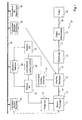
- the vehicle hybrid 10 includes a heat engine 11 associated with a flywheel motor 12.
- An electric machine 13 is coupled to the shaft engine 14.
- the engine shaft 14 is connected to a clutch 16 which, when activated, couples the motor shaft 14 to a shaft input 17 of a transmission chain 18.
- the transmission chain transmission 18 includes, for example, a gearbox and a divider bridge.
- the speed of rotation of the output shaft 19 of the transmission chain 18 corresponds to the speed of rotation of the input shaft 17 multiplied by the ratio of overall reduction of the chain 18.
- the output shaft 19 drives the wheels 20 of the vehicle.
- the gearbox can be a classic manual gearbox, a robotic gearbox, a automatic gearbox, continuously variable gearbox, etc.
- the clutch 16 can, depending on the type of gearbox, be automatic or actuated by the driver.
- the hybrid vehicle 10 may include, on the exhaust line for evacuation exhaust gases from the heat engine 11, a catalyst or a particle filter not shown.
- the electric machine 13 is connected to a battery high voltage 22 via a DC-AC converter 24.
- the electric machine 13 can operate as an alternator, driven by the engine 11, and charge the high-voltage battery 22, or else function as a electric motor, powered by the high-voltage battery 22, and drive the motor shaft 14.
- the high-voltage battery 22 is connected to a battery low voltage 26 via a DC-DC converter 28.
- the low voltage battery 26 supplies a network of low voltage vehicle edge (not shown) for the supply of conventional equipment to the vehicle 10 (by example of air conditioning means, wiping means, etc.).
- the low-voltage battery 26 can also supply a conventional starter 27 which can drive the motor shaft 14.
- the high-voltage battery 22 can in turn supply the network of low voltage onboard and can optionally supply a network high voltage on-board for powering specific equipment of the vehicle that require high power, such as example of heating resistors, power steering, electric heating of the catalyst, etc.
- the low voltage battery 26 has an average voltage of 12 volts
- the high-voltage battery 22 is a battery of NimH (Nickel-metal-Hydride) type power of medium voltage of 42 volts.
- the hybrid vehicle 10 includes several computers 30, 32, 34, 36 which control the different elements of the hybrid vehicle.
- the computers 30, 32, 34, 36 can exchange data between them via a bus data exchange 38.
- a motor control computer 30 thermal is suitable for controlling for example the injection into the combustion chambers of the heat engine 11 from operating parameters of the heat engine 11.
- a control unit 32 of the electric machine 13 is suitable for transmitting a command to the electric machine 13 torque or an electric power control to be supplied according to that the electric machine 13 works like an electric motor or an alternator.
- the computer 32 can also send an alarm signal on the data bus 38 when it detects a malfunction of the electric machine 13, dc-dc converter 24 or dc-dc converter 28.
- a computer 34 for controlling the batteries 22, 26 is adapted from the operating parameters of the high voltage batteries 22 and low voltage batteries 26, to, among others, send an alarm signal on the data bus 38 when certain conditions of correct operation of the batteries 22, 26 are not met.
- a supervision computer 36 can control the computers 30, 32, 34 in order to ensure special services.
- the different signals used by the computers 30, 32, 34, 36 are supplied by sensors, not shown, equipping the hybrid vehicle 10.
- Each sensor can be connected directly to one of the computers 30, 32, 34, 36, and / or to a other computer, not shown, itself connected to the bus data 38 or to one of the computers 30, 32, 34, 36.
- the heat engine 11 supplies the motor shaft 14 with a torque wheel drive 20.
- the computer 36 sets the torques to be supplied by the motor 11 and the electrical machine 13 by transmitting control signals adapted to the engine ECU 30 and to the electrical machine computer 32 via the data bus 38.
- the electric machine 13 operating as an alternator can supply a resistive torque which opposes the couple of drive in order to produce energy electric to charge the high voltage battery 22 or supply directly from the vehicle equipment.
- the calculator 36 then sets the electrical power to be supplied by the electric machine 13, and therefore the resistive torque of the electric machine 13, and the torque to be supplied by the motor 11. Finally, according to another mode of operation, the electric machine 13 does not take or supply torque to the heat engine 11.
- the method according to the invention proposes to control the electric power supplied by the electric machine 13 according to a quadratic linear control.
- Equation (1) makes it possible to consider the power P BT as a disturbance that must be "rejected", that is to say that it is imperative to satisfy, as will be described in more detail below.
- the power P Elec is positive if the electric machine 13 provides assistance to the heat engine 11 and is negative if the electric machine 13 recharges the high voltage battery 22.
- the state of charge SOC is a variable without unit which varies between 0 and 1. It is equal to 0 when the high voltage battery 22 is completely discharged and is equal to 1 when the high voltage battery 22 is fully charged. For security and availability reasons, it is preferable that the SOC state of charge never drops below a determined value. For reasons of efficiency of the high-voltage battery 22, the state of charge SOC must also not exceed a determined value, for example 0.9.
- the low voltage power P BT is considered in equation (1) as a disturbance which it is sought to reject.
- the estimation of this disturbance makes it possible to eliminate the sensors on the on-board networks since the control method "reconstructs" the disturbance.
- the control of the electrical machine power P Elec tends to converge the state of charge error e SOC towards zero, that is to say to converge the state of charge SOC of the high voltage battery 22 to the SOC Obj objective charge state which may be variable.
- the control therefore tends to converge the electrical power P Elec supplied by the electrical machine 13 towards the opposite of the low voltage power P BT requested by the electrical equipment of the vehicle.
- the low voltage power P BT is represented by steps. This constitutes a relatively close representation of reality since the power demanded by the electrical equipment of the vehicle generally changes in stages as the various electrical equipment of the vehicle are activated or deactivated.
- the modeling by a step therefore imposes a term that can be integrated into the defined state system for obtaining control of the electrical machine power P Elec in order to reject the low voltage power P BT .
- the state system is then as follows:
- the quadratic linear command is determined so as to minimize a quadratic criterion J given by the following relation: where N is the rank of the matrix A, Q and R are weighting matrices which determine a compromise between the minimization of the instantaneous electric machine power P Elec , which is linked to the fuel consumption of the heat engine 11, and the speed of convergence of the state of charge error e SOC in order to have more quickly the energy supplied by the high voltage battery 22 used by all of the members of the vehicle.
- the state of charge SOC naturally converges towards the objective state of charge SOC Obj .
- the command does not cause jolts which could occur with a command using a sensor of the power of the low voltage battery 26.
- the command is in the following form: where g 1 and g 2 are the gains of the gain matrix G.
- gain matrices G are defined from different Q and R weighting matrices depending on whether one wishes to favor the speed of convergence of the SOC state of charge or the minimization of fuel consumption. This command will be called adaptive quadratic command.
- the different possible gain matrices G are grouped together in a global gain matrix K each row of which corresponds to a pair of gains g 1 and g 2 associated with given Q and R weighting matrices.
- the gains g 1 and g 2 are distributed from the first line of the global gain matrix K to the last line of the matrix according to whether they ensure an increasingly slow convergence of the state of charge SOC towards l 'SOC Obj objective state of charge and therefore promotes fuel consumption.
- Each line of the global gain matrix K corresponds to a control zone of the electric machine 13.
- the first zone is associated with the first line of the matrix K and therefore corresponds to an electric machine power P Elec for charging the highest possible high voltage battery 22.
- the eleventh zone is associated with the eleventh row of the matrix K and corresponds to zero gains g 1 and g 2 . This means that in the eleventh zone, the electric machine 13 does not supply electric recharging power to the high voltage battery 22. It is the high voltage battery 22 which then supplies the power necessary to satisfy the electrical needs of the vehicle. It is the choice of the zone which will make it possible to determine the electric recharging power supplied by the electric machine 13.
- control zones and the choice of passage from one control zone to another are defined by a order strategy.
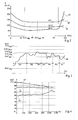
- FIG. 2 represents three curves 40, 41, 42 each illustrating the variation of the internal resistance R of a high voltage battery as a function of the depth of discharge P for three different examples of high voltage battery temperature 22, respectively 0 ° C. , 20 ° C and 40 ° C.
- the depth of discharge P is equal to the unit minus the state of charge SOC of the high-voltage battery 22. It appears in FIG. 2 that for most of the high-voltage battery technologies currently used, the resistance R is minimal for discharge depths varying between 25% and 90%.
- objective SOC Obj state of charge a value close to 75%.
- a higher state of charge SOC Sup is defined equal to the reference state of charge SOC Obj increased by a margin, for example of 5%.
- We also define a lower state of charge SOC Inf equal to the objective state of charge SOC Obj minus a margin, for example of 10%.
- first, second and third ST1, ST2 and ST3 control strategies for the choice of z zones control of the overall gain matrix K.
- FIG. 3 represents a theoretical example of an evolution curve 43 of the state of charge SOC of a high voltage battery 22 so as to illustrate the criteria defining the transition between the different strategies.
- the SOC Max and SOC Min references represent the state of charge limits imposed by the high voltage battery technology 22 and which cannot or must not be exceeded.
- the first strategy ST1 is activated when the state of charge of the high-voltage battery 22 goes below the lower state of charge SOC Inf and is deactivated when the state of charge goes above the state of charge SOC objective Obj .
- the second strategy ST2 is activated when the state of charge goes above the objective state of charge SOC Obj and is deactivated when the state of charge goes below the lower state of charge SOC Inf or goes to - above SOC Sup .
- the third strategy ST3 is activated when the state of charge goes above the higher state of charge SOC Sup and is deactivated when the state of charge goes below the objective state of charge SOC Obj .
- a first parameter Rend MTME is associated with the yields of the heat engine 11 and of the electric machine 13.
- a second parameter Evol_Batt is associated with the evolution of the operating characteristics of the vehicle's electrical equipment (in particular the temperature of the high-voltage battery 22 and the temperature of the electric machine 13).
- a third parameter VV is associated with the will of the driver and the speed of the vehicle.
- the VV parameter is defined for example from data representative of the vehicle speed and of the acceleration of the "acceleration" pedal (to evaluate the "aggressiveness" of the driver).
- the electric machine 13 therefore supplies the high voltage battery 22 with electric power substantially permanently and possibly even when the efficiency of the electric machine 13 or the efficiency of the heat engine 11 is low.
- the weighting gains ⁇ , ⁇ and ⁇ are modified when the power supplied by the heat engine 11 is greater than a determined value.
- the control zone z to be taken into account corresponds to zero gains for the gain matrix K.
- the high efficiency domain can be defined by the rotation speed of l motor shaft 14 which must be less than a maximum speed of rotation and greater than a minimum speed of rotation and by the torque supplied by the heat engine 11 which must be less than a maximum torque.
- the second strategy ST2 therefore authorizes charging of the high voltage battery 22 only when the heat engine 11 has a high efficiency. This therefore makes it possible to participate in the reduction of the fuel consumption of the heat engine 11 since the electric machine 13 does not take any torque from the motor shaft 14 to recharge the high voltage battery 22 when the efficiency of the heat engine 11 deteriorates.
- the second strategy ST2 ensures charging of the high-voltage battery 22 only for determined durations. When the high voltage battery 22 is not supplied by the electric machine 22, it may be discharged in the low voltage battery 26.
- the second strategy ST2 must therefore be used only in the case of the state of charge SOC of the battery high voltage 22 is high. This is why there is a switch over to the first strategy ST1 as soon as the state of charge SOC of the high-voltage battery 22 goes below the lower state of charge SOC Inf .
- the control zone z to be taken into account corresponds to zero gains for the gain matrix K.
- the high voltage battery 22 is therefore not supplied by the electric machine 13 and is discharged in the low battery voltage 26 to power the vehicle's electrical equipment.
- the high-voltage battery 22 can be considered as an alternator and directly supply electrical power to the electrical equipment of the vehicle.
- the third strategy ST3 can only be implemented when the state of charge SOC of the high-voltage battery 22 exceeds the higher state of charge SOC Sup .
- Such high states of charge can in particular be reached in the case where the hybrid vehicle has an energy recovery service during braking.
- Such a service can be implemented in addition to the method for controlling the electric machine 13 according to the invention and provide that when the vehicle is braking, the electric machine operates as an alternator and supplies the high-voltage battery 22.
- a first example of modification results from the structure of the high voltage batteries currently used. In fact, an excessively large difference can occur between the partial voltages of the various electrical elements constituting a high voltage battery. It is then desirable to impose a strong charge on the high voltage battery 22 in order to readjust the partial voltages of the electrical elements constituting it.
- the SOC Obj objective state of charge is then set at 80% thus allowing a large forced charge of the high voltage battery 22.
- a second example of modification of the SOC Obj objective state of charge appears when the state of charge of the high voltage battery 22 drops below a determined threshold, for example 50%, or when the state of charge of the high voltage battery 22 is no longer correctly measured by the battery computer 34.
- a priority charge of the battery high voltage 22 is then produced.
- the SOC Obj objective charge state increases to 140%.
- the charge is therefore imposed at the expense of minimizing the fuel consumption of the hybrid vehicle.
- the gains chosen for the gain matrix K impose a high electrical machine power P Elec .
- An additional strategy can be envisaged to take into account a particle filter which requires a high load from the on-board network.
- the particulate filter may require high exhaust gas temperatures to facilitate the combustion of particles and therefore an increase in engine torque.
- the value of the objective state of charge SOC Obj is increased in order to charge the high voltage battery 22 more quickly via the electric machine 13 and thus to increase the power required to be supplied by the heat engine 11.
- FIG. 4 represents curves 44, 45, 46 illustrating the variation of the state of charge SOC of a high voltage battery 22 for initial states of charge of 90%, 75% and 50% respectively.
- the curves 44, 45, 46 were obtained by simulation and validated on a vehicle with a gain in consumption of more than 5% for a series hybrid vehicle performing a standardized route corresponding to a cycle 93-116 according to the European standard. We notice the convergence of the three curves 44, 45, 46 towards a SOC Obj objective state of charge value of 75%.
- the first or second strategy ST1, ST2 being activated it may be desirable to interrupt the withdrawal of a torque on the motor shaft 14 by the electric machine 13 to avoid stalling of the heat engine 11 when the speed of rotation of the motor shaft 14 is close to a speed of idle rotation or idle speed.
- a first example can occur when the speed of rotation of the motor shaft 14 quickly changes to the speed idle when the driver releases the accelerator pedal.
- the torque supplied by the engine 11 at idle speed can then not be sufficient to compensate for the torque drawn by the electric machine 13.
- the first case can be detected when the derivative of the speed of rotation of the motor shaft 14 is less than a determined threshold, when the speed of rotation of the motor shaft 14 is less than a threshold determined and when a parameter associated with the will of the driver is below a certain threshold.
- thresholds can be defined by hysteresis.
- a second example can occur during a recovery of the heat engine 11 during which it is generally desired apply significant torque to the wheel drive. Now, the part of the torque supplied by the heat engine 11 taken by the electric machine 13 for charging the high battery voltage 22 decreases the torque available for training by the same amount wheels.
- a recovery can be detected when the parameter associated with the driver's will is greater than one determined threshold and when the shaft rotation speed motor 14 is less than a determined threshold. These thresholds can also be defined by hysteresis.
- a first example occurs when the power electric to be supplied by the electric machine 13 to the battery high voltage 22 drops below a determined threshold.
- the threshold is set at values from 1200 to 2000 watts. This threshold can be defined by a hysteresis.
- a second example occurs when the electrical machine power P Elec passes above a determined maximum electrical machine power. Indeed, it appears that when the SOC state of charge is relatively low, the control of the electric machine 13 according to the invention would tend to impose a high electrical machine power P Elec which limits the torque that can be supplied by the heat engine 11 and which may possibly be the cause of the emission of an alarm signal by the computer 34 for controlling the batteries 22, 26. It is possible to plan to implement a map indicating a maximum electrical machine power which increases with the speed of rotation of the motor shaft 14 in order to allow a higher charge of the high voltage battery 22 for a speed of rotation of the high motor shaft 14.
- the present invention can therefore provide for imposing maximum increase and decrease rates of the electrical machine power P Elec which may depend on the speed of rotation of the motor shaft 14.
- the present invention provides a time constant filtering in the order of a second.
- a machine control can be provided. electric to ensure a suitable transition from torque drawn by the electric machine operating as a alternator or torque supplied by the electric machine operating as an electric motor between the different services implemented on the hybrid vehicle.
Landscapes
- Engineering & Computer Science (AREA)
- Transportation (AREA)
- Mechanical Engineering (AREA)
- Chemical & Material Sciences (AREA)
- Combustion & Propulsion (AREA)
- Power Engineering (AREA)
- Life Sciences & Earth Sciences (AREA)
- Sustainable Development (AREA)
- Sustainable Energy (AREA)
- Electric Propulsion And Braking For Vehicles (AREA)
Abstract
Description
- un capteur de la vitesse de rotation (régime) de l'arbre moteur 14 ;
- un capteur de la température de l'eau de refroidissement du moteur thermique 11 ;
- un capteur de la température de la batterie haute tension 22 ;
- un capteur de détection de rapport de vitesse, adapté à fournir un signal indiquant si le point mort de la boíte de vitesses est enclenché ;
- un capteur indiquant si la pédale d'accélérateur du véhicule 10 est actionnée par le conducteur ;
- un capteur de la vitesse instantanée du véhicule 10 ;
- un capteur de la température du catalyseur ;
- des moyens pour indiquer un besoin en énergie électrique spécifique d'équipements du véhicule 10. De tels moyens peuvent consister en un calculateur qui contrôle les équipements du véhicule ;
- des moyens pour déterminer l'état de charge des batteries 22, 26. L'état de charge d'une batterie 22, 26 peut être déterminé par le calculateur batterie 34 à partir de la mesure du courant fourni par la batterie 22, 26.




Claims (9)
- Procédé de commande d'une machine électrique (13) d'un véhicule (10) couplée à un arbre moteur (14) entraíné par un moteur thermique (11) et relié aux roues du véhicule (20), ladite machine électrique étant susceptible de fournir un couple d'assistance pour l'entraínement de l'arbre moteur ou d'être entraínée par l'arbre moteur pour charger une batterie (22), caractérisé en ce que la puissance électrique demandée à la machine électrique pour la charge de la batterie est contrôlée selon une commande linéaire quadratique adaptative en fonction de l'état de charge (SOC) de la batterie et d'au moins un gain qui varie en fonction de conditions de fonctionnement du véhicule.
- Procédé selon la revendication 1, dans lequel la commande de la puissance électrique demandée à la machine électrique pour la charge de la batterie correspond à la somme discrète de l'état de charge (SOC) de la batterie (22) multipliée par un premier gain et de l'intégrale discrète de l'écart entre l'état de charge et un état de charge objectif (SOCObj) multipliée par un second gain.
- Procédé selon la revendication 1, dans lequel les premier et second gains varient de façon discrète.
- Procédé selon la revendication 1, dans lequel les conditions de fonctionnement comprennent le rendement du moteur thermique (11).
- Procédé selon la revendication 1, dans lequel les conditions de fonctionnement comprennent le rendement de la machine électrique (13).
- Procédé selon la revendication 1, dans lequel les conditions de fonctionnement comprennent la température de la batterie (22).
- Procédé selon la revendication 1, dans lequel la puissance électrique demandée à la machine électrique (13) pour la charge de la batterie (22) est nulle lorsque l'état de charge (SOC) dépasse un état de charge supérieur (SOCSup).
- Procédé selon la revendication 2, dans lequel lorsque l'état de charge (SOC) dépasse l'état de charge objectif (SOCObj) et tant qu'il ne descend pas en dessous d'un état de charge inférieur (SOCInf), la puissance électrique demandée à la machine électrique (13) pour la charge de la batterie (22) est nulle lorsque le rendement du moteur thermique (11) est inférieur à un rendement minimum déterminé.
- Dispositif de commande d'une machine électrique (13) d'un véhicule (10) comprenant un moteur thermique (11) susceptible de fournir un couple moteur à un arbre moteur (14) relié aux roues (20) du véhicule, la machine électrique étant couplée à l'arbre moteur et étant susceptible de fournir un couple d'assistance pour l'entraínement de l'arbre moteur ou d'être entraínée par l'arbre moteur pour charger une batterie (22) avec une puissance électrique de charge, et comprenant un moyen de mesure de l'état de charge (SOC) de la batterie, caractérisé en ce qu'il comprend :un moyen de fourniture d'au moins un gain dépendant de conditions de fonctionnement du véhicule ; etun moyen pour déterminer la valeur de la puissance électrique de charge à fournir par la machine électrique selon une commande linéaire quadratique adaptative définie à partir de l'état de charge mesuré par le moyen de mesure et dudit au moins gain fourni par le moyen de fourniture.
Applications Claiming Priority (2)
| Application Number | Priority Date | Filing Date | Title |
|---|---|---|---|
| FR0302419 | 2003-02-27 | ||
| FR0302419A FR2851856B1 (fr) | 2003-02-27 | 2003-02-27 | Commande d'une machine electrique d'un vehicule hybride serie |
Publications (2)
| Publication Number | Publication Date |
|---|---|
| EP1454786A2 true EP1454786A2 (fr) | 2004-09-08 |
| EP1454786A3 EP1454786A3 (fr) | 2006-11-15 |
Family
ID=32799608
Family Applications (1)
| Application Number | Title | Priority Date | Filing Date |
|---|---|---|---|
| EP04300099A Withdrawn EP1454786A3 (fr) | 2003-02-27 | 2004-02-26 | Commande d'une machine électrique d'un véhicule hybride série |
Country Status (2)
| Country | Link |
|---|---|
| EP (1) | EP1454786A3 (fr) |
| FR (1) | FR2851856B1 (fr) |
Cited By (3)
| Publication number | Priority date | Publication date | Assignee | Title |
|---|---|---|---|---|
| FR2983653A1 (fr) * | 2011-12-06 | 2013-06-07 | Renault Sa | Procede de gestion d'un alternateur associe a au moins une batterie d'alimentation et entraine par un moteur thermique. |
| US8637528B2 (en) | 2007-03-27 | 2014-01-28 | Omeros Corporation | Use of PDE7 inhibitors for the treatment of movement disorders |
| EP3604011A4 (fr) * | 2017-03-31 | 2021-01-20 | BYD Company Limited | Véhicule électrique hybride, système d'alimentation électrique associé et procédé de commande de production d'énergie électrique associé |
Family Cites Families (5)
| Publication number | Priority date | Publication date | Assignee | Title |
|---|---|---|---|---|
| JP3050073B2 (ja) * | 1994-12-22 | 2000-06-05 | トヨタ自動車株式会社 | ハイブリッド電気自動車用発電制御装置 |
| JPH08289407A (ja) * | 1995-02-13 | 1996-11-01 | Nippon Soken Inc | ハイブリッド車の発電制御装置 |
| JP3395708B2 (ja) * | 1999-04-27 | 2003-04-14 | 株式会社日立製作所 | ハイブリッド車両 |
| JP3560867B2 (ja) * | 1999-08-31 | 2004-09-02 | 本田技研工業株式会社 | ハイブリッド車両のバッテリ制御装置 |
| JP3967043B2 (ja) * | 1999-09-02 | 2007-08-29 | 日産自動車株式会社 | ハイブリッド車両の制御装置 |
-
2003
- 2003-02-27 FR FR0302419A patent/FR2851856B1/fr not_active Expired - Fee Related
-
2004
- 2004-02-26 EP EP04300099A patent/EP1454786A3/fr not_active Withdrawn
Cited By (8)
| Publication number | Priority date | Publication date | Assignee | Title |
|---|---|---|---|---|
| US8637528B2 (en) | 2007-03-27 | 2014-01-28 | Omeros Corporation | Use of PDE7 inhibitors for the treatment of movement disorders |
| FR2983653A1 (fr) * | 2011-12-06 | 2013-06-07 | Renault Sa | Procede de gestion d'un alternateur associe a au moins une batterie d'alimentation et entraine par un moteur thermique. |
| WO2013083409A2 (fr) | 2011-12-06 | 2013-06-13 | Renault Sas | Procede de gestion d'un alternateur associe a au moins une batterie d'alimentation et entraine par un moteur thermique |
| WO2013083409A3 (fr) * | 2011-12-06 | 2013-08-22 | Renault Sas | Procede de gestion d'un alternateur associe a au moins une batterie d'alimentation et entraine par un moteur thermique |
| CN103974850A (zh) * | 2011-12-06 | 2014-08-06 | 雷诺股份公司 | 用于管理组合有至少一个供电电池并且由热力发动机驱动的交流发电机的方法 |
| CN103974850B (zh) * | 2011-12-06 | 2016-11-16 | 雷诺股份公司 | 用于管理组合有至少一个供电电池并且由热力发动机驱动的交流发电机的方法 |
| US9682629B2 (en) | 2011-12-06 | 2017-06-20 | Renault S.A.S. | Method for managing an alternator combined with at least one power battery and driven by a heat engine |
| EP3604011A4 (fr) * | 2017-03-31 | 2021-01-20 | BYD Company Limited | Véhicule électrique hybride, système d'alimentation électrique associé et procédé de commande de production d'énergie électrique associé |
Also Published As
| Publication number | Publication date |
|---|---|
| FR2851856B1 (fr) | 2006-03-03 |
| EP1454786A3 (fr) | 2006-11-15 |
| FR2851856A1 (fr) | 2004-09-03 |
Similar Documents
| Publication | Publication Date | Title |
|---|---|---|
| EP0782941B1 (fr) | Procédé et dispositif pour régler la répartition de la puissance électrique dans un véhicule automobile, notamment à propulsion hybride | |
| EP1428712B1 (fr) | Chaîne de traction et procedé de réglage pour véhicule hybride série | |
| EP0652835B1 (fr) | Vehicule automobile a traction electrique | |
| FR2898742A1 (fr) | Dispositif de commande permettant une commande economique et fiable d'un generateur electrique. | |
| FR2851516A1 (fr) | Procede de commande de systeme electrique de vehicule | |
| FR2834941A1 (fr) | Appareil de commande pour un dispositif de stockage d'energie dans un vehicule a moteur | |
| FR2966412A1 (fr) | Appareil de commande de production d'energie de vehicule | |
| FR2994546A1 (fr) | Procede de limitation de couple d'une machine electrique de vehicule hybride comportant un systeme de controle de vitesse | |
| FR2856109A1 (fr) | Systeme de commande de puissance pour un vehicule sur lequel est monte un moteur avec turbocompresseur | |
| EP1224092B1 (fr) | Procede de commande d'un vehicule hybride | |
| EP1369285A1 (fr) | Procédé et dispositif de démarrage d'un moteur thermique dans un véhicule hybride série | |
| WO2021043682A1 (fr) | Procédé de gestion de la répartition de couple dans un véhicule hybride | |
| FR2811268A1 (fr) | Procede et systeme de gestion de l'energie dans un vehicule a moyen de propulsion hybride | |
| EP2318249B1 (fr) | Systeme de commande d'un groupe motopropulseur hybride pour vehicule automobile, et procede associe | |
| EP1454786A2 (fr) | Commande d'une machine électrique d'un véhicule hybride série | |
| EP3313687B1 (fr) | Procédé de gestion de la température d'une batterie d'un véhicule hybride | |
| WO2012056135A1 (fr) | Procede de limitation du couple maximum que peut delivrer ou recevoir une machine electrique alimentee par une batterie et chaîne de traction pour vehicule hybride mettant en oeuvre le procede | |
| WO2019068981A1 (fr) | Contrôle des couplages/découplages d'une machine motrice non-thermique d'un véhicule en fonction d'un couple cible ou de consigne | |
| WO2019012193A1 (fr) | Procede de démarrage d'un véhicule hybride avec une puissance de batterie augmentée | |
| FR3015411A1 (fr) | Procede de calcul de consigne de couple pour une machine electrique couplee a un moteur thermique d'un vehicule hybride | |
| EP1431623B1 (fr) | Récupération d'énergie lors d'un changement de rapport montant sur un véhicule hybride série | |
| EP1369281A1 (fr) | Procédé et dispositif de supervision du démarrage et de l'arrêt d'un moteur thermique dans un véhicule hybride série | |
| FR3114555A1 (fr) | Groupe motopropulseur hybride et procédé de contrôle associé | |
| FR3099972A1 (fr) | Procédé de gestion d’un couple à fournir par un moteur électrique | |
| FR3067185A1 (fr) | Dispositif de commande de generation d'energie |
Legal Events
| Date | Code | Title | Description |
|---|---|---|---|
| PUAI | Public reference made under article 153(3) epc to a published international application that has entered the european phase |
Free format text: ORIGINAL CODE: 0009012 |
|
| AK | Designated contracting states |
Kind code of ref document: A2 Designated state(s): AT BE BG CH CY CZ DE DK EE ES FI FR GB GR HU IE IT LI LU MC NL PT RO SE SI SK TR |
|
| AX | Request for extension of the european patent |
Extension state: AL HR LT LV MK |
|
| PUAL | Search report despatched |
Free format text: ORIGINAL CODE: 0009013 |
|
| AK | Designated contracting states |
Kind code of ref document: A3 Designated state(s): AT BE BG CH CY CZ DE DK EE ES FI FR GB GR HU IE IT LI LU MC NL PT RO SE SI SK TR |
|
| AX | Request for extension of the european patent |
Extension state: AL LT LV MK |
|
| 17P | Request for examination filed |
Effective date: 20070417 |
|
| AKX | Designation fees paid |
Designated state(s): AT BE BG CH CY CZ DE DK EE ES FI FR GB GR HU IE IT LI LU MC NL PT RO SE SI SK TR |
|
| 17Q | First examination report despatched |
Effective date: 20120228 |
|
| STAA | Information on the status of an ep patent application or granted ep patent |
Free format text: STATUS: THE APPLICATION IS DEEMED TO BE WITHDRAWN |
|
| 18D | Application deemed to be withdrawn |
Effective date: 20120710 |