EP1454619A1 - Kosmetische und dermatologische Emulsionen - Google Patents
Kosmetische und dermatologische Emulsionen Download PDFInfo
- Publication number
- EP1454619A1 EP1454619A1 EP04003572A EP04003572A EP1454619A1 EP 1454619 A1 EP1454619 A1 EP 1454619A1 EP 04003572 A EP04003572 A EP 04003572A EP 04003572 A EP04003572 A EP 04003572A EP 1454619 A1 EP1454619 A1 EP 1454619A1
- Authority
- EP
- European Patent Office
- Prior art keywords
- emulsions
- advantageous
- peg
- acid
- cosmetic
- Prior art date
- Legal status (The legal status is an assumption and is not a legal conclusion. Google has not performed a legal analysis and makes no representation as to the accuracy of the status listed.)
- Granted
Links
- 0 *c1ccc2[o]c(-c(cc3)ccc3Nc3nc(N*)nc(Nc(cc4)ccc4-c4nc5cc(*)ccc5[o]4)n3)nc2c1 Chemical compound *c1ccc2[o]c(-c(cc3)ccc3Nc3nc(N*)nc(Nc(cc4)ccc4-c4nc5cc(*)ccc5[o]4)n3)nc2c1 0.000 description 1
- FDATWRLUYRHCJE-UHFFFAOYSA-N CCCCCCOC(c(cccc1)c1C(c(ccc(N(CC)CC)c1)c1O)=O)=O Chemical compound CCCCCCOC(c(cccc1)c1C(c(ccc(N(CC)CC)c1)c1O)=O)=O FDATWRLUYRHCJE-UHFFFAOYSA-N 0.000 description 1
Classifications
-
- A—HUMAN NECESSITIES
- A61—MEDICAL OR VETERINARY SCIENCE; HYGIENE
- A61Q—SPECIFIC USE OF COSMETICS OR SIMILAR TOILETRY PREPARATIONS
- A61Q19/00—Preparations for care of the skin
-
- A—HUMAN NECESSITIES
- A61—MEDICAL OR VETERINARY SCIENCE; HYGIENE
- A61K—PREPARATIONS FOR MEDICAL, DENTAL OR TOILETRY PURPOSES
- A61K8/00—Cosmetics or similar toiletry preparations
- A61K8/02—Cosmetics or similar toiletry preparations characterised by special physical form
- A61K8/04—Dispersions; Emulsions
- A61K8/06—Emulsions
-
- A—HUMAN NECESSITIES
- A61—MEDICAL OR VETERINARY SCIENCE; HYGIENE
- A61K—PREPARATIONS FOR MEDICAL, DENTAL OR TOILETRY PURPOSES
- A61K8/00—Cosmetics or similar toiletry preparations
- A61K8/02—Cosmetics or similar toiletry preparations characterised by special physical form
- A61K8/04—Dispersions; Emulsions
- A61K8/06—Emulsions
- A61K8/062—Oil-in-water emulsions
-
- A—HUMAN NECESSITIES
- A61—MEDICAL OR VETERINARY SCIENCE; HYGIENE
- A61K—PREPARATIONS FOR MEDICAL, DENTAL OR TOILETRY PURPOSES
- A61K8/00—Cosmetics or similar toiletry preparations
- A61K8/18—Cosmetics or similar toiletry preparations characterised by the composition
- A61K8/30—Cosmetics or similar toiletry preparations characterised by the composition containing organic compounds
- A61K8/55—Phosphorus compounds
-
- A—HUMAN NECESSITIES
- A61—MEDICAL OR VETERINARY SCIENCE; HYGIENE
- A61Q—SPECIFIC USE OF COSMETICS OR SIMILAR TOILETRY PREPARATIONS
- A61Q17/00—Barrier preparations; Preparations brought into direct contact with the skin for affording protection against external influences, e.g. sunlight, X-rays or other harmful rays, corrosive materials, bacteria or insect stings
- A61Q17/04—Topical preparations for affording protection against sunlight or other radiation; Topical sun tanning preparations
Definitions
- the present invention relates to cosmetic and dermatological emulsions with a Content of organic solids and surfactants and a method for stabilization of such emulsions.
- Cosmetic preparations are mainly used to care for the skin.
- the human skin performs numerous vital functions. With an average surface area of around 2 m 2 in adults, it has an outstanding role as a protective and sensory organ. Among its many functions (for example for heat regulation), the most important is the barrier function that prevents the skin (and ultimately the entire organism) from drying out.
- the skin acts as a protective device against the penetration and absorption of external substances (e.g. dirt, chemicals, microorganisms). It also has an important role as a regulatory and target organ in human metabolism.
- Cosmetic skin care primarily serves the natural function of the skin as a barrier against environmental influences and against the loss of the body's own substances (in addition to water also to strengthen or restore natural fats, electrolytes etc.).
- the aim of skin care is also to reduce the fat and fat caused by daily washing Compensate for skin water loss. This is especially important when the natural Regeneration capacity is not sufficient.
- skin care products should protect against environmental influences, protect from the sun and wind in particular and delay skin aging.
- UV-C radiation with a Wavelength that is less than 290 nm is from the ozone layer in the earth's atmosphere absorbed and has no physiological meaning.
- UV-B range rays in the Range between 290 nm and 320 nm, the so-called UV-B range, an erythema, a simple sunburn or even more or less severe burns.
- UV-A radiation (320 to 400 nm) is more photodynamic in terms of triggering, special phototoxic reactions and chronic changes in the skin more dangerous than UV-B radiation. So even the UV-A radiation is sufficient under normal Everyday conditions in order to quickly reduce the collagen and elastin fibers damage.
- the damaging influence of UV-B radiation can also be caused by UV-A radiation to be reinforced.
- Medical topical compositions typically contain one or more drugs in effective concentration.
- cosmetic and medical application and corresponding Products referred to the legal provisions of the Federal Republic of Germany (e.g. cosmetics regulation, food and drug law).
- Emulsions are by far the most important product type in the area of skin care products emulsions are disperse two- or multi-phase systems, with cosmetic Emulsions from at least one fat phase (fats and mineral oils, fatty acid esters, Fatty alcohols etc.) and at least one water phase (water, glycerin, glycols etc.) exist, which are distributed with the help of emulsifiers in the form of very fine droplets become.
- the oil phase is finely distributed in the water phase, it is an oil-in-water emulsion (O / W emulsion, e.g. milk).
- O / W emulsion oil-in-water emulsion
- the basic character of an O / W emulsion is shaped by the water, d. H. it is less greasy on the skin rather matting and absorbs into the skin faster than a W / O emulsion.
- emulsions are considered from a thermodynamic point of view, unstable systems are able to produce cosmetic emulsions that have been stable for years.
- An emulsion is said to be stable if it stays for a given period of time no measurable temporal and local changes in the droplet size distribution have it determined.
- the stability or instability of emulsions depends on various factors.
- the water phase of a W / O emulsion for example, tends because water and Oil phase have different densities for sedimentation.
- the oil phase of an O / W emulsion accordingly has a tendency to cream.
- emulsions are stabilized over a longer period of time Tools needed to prevent the two phases from separating, at least but delay until the emulsion has reached its destination.
- these tools are intended to stabilize the interface by preventing that the droplets of the disperse phase flow together. Ideally, this will have an effect Substances also repel the droplets, which prevents them approximate so that agglomeration (aggregate formation) can be avoided.
- auxiliaries are used for creaming or sedimentation to counteract the phases.
- Emulsifiers are surface-active substances that are able to control the interfacial tension to decrease between oil and water phase by preferring deposit at the interface between these two. This is due to their amphipile Molecular structure enables: emulsifiers have at least one polar (hydrophilic) Group and at least one non-polar (lipophilic) group. So that they are both in the hydrophilic as well as soluble in the lipophilic phase. The one in the corresponding phase the more soluble part protrudes into it and thereby lowers the interfacial tension between the two phases.
- emulsifiers also stabilize through the formation of interfacial films and thus "physical" barriers, causing aggregation and coalescence of the emulsified particles is prevented.
- the emulsifier By attaching the emulsifier to the At the interface, the droplets are either charged so that they are mutual repel, or it becomes a stable, often highly viscous or even solid protective layer formed around the droplets.
- the emulsifier system must therefore usually be in addition to the actual emulsifier contain another component as a co-emulsifier, stabilizer or depending on the mechanism of action also referred to as a consistency agent, thickener or protective colloid etc. becomes.
- Stabilizers do not have to be surface-active but be amphiphilic connections.
- the viscosity of the outer phase can be adjusted, for example, by adding thickeners increase which z. B. form gels and / or lamellar liquid crystals.
- emulsifiers are also able to form emulsifier gel networks to increase the viscosity of a liquid.
- Breaking an emulsion can also be done by choosing a suitable phase volume ratio prevent.
- a suitable phase volume ratio prevent To clarify this fact, imagine one Emulsion as a system of metal balls of the same diameter (inner phase) and one Liquid (outer phase). Sedimentation or creaming can - in this simple model - then no longer take place when all the liquid with Metal balls is filled. This is - if you take a densest packing of balls as a distribution on - the case especially at a ratio of 1: 2, d. H. if the emulsion is too 2/3 consists of an inner phase. It is obvious that the viscosity of an emulsion is increasing proportion of the inner phase increases, as a result of which the mobility of the dispersed droplets is restricted.
- a disadvantage of emulsions is their lack of stability towards higher ones Concentrations of surfactants, which manifests itself, for example, in a phase separation.
- the prior art knows surfactant-containing preparations based on emulsions. However, these are usually formulated in such a way that the emulsion initially stabilized with emulsifiers and then a surfactant system is adjusted. There Emulsions are generally destroyed by the addition of surfactants of the surfactant system is severely restricted, and the preparations obtained are expensive and complicated recipes.
- Emulsion-destroying effect of the surfactants is often caused by other components of the Emulsion - such as (organic) solids and the like - still increased.
- An object of the present invention was therefore cosmetic or dermatological To find emulsions - especially O / W emulsions - which are compared to surfactants - especially in combination with other emulsion-destroying substances - are stable.
- the preparations according to the present invention are outstanding in every respect satisfactory preparations, which are not limited to the selection of raw materials are limited. Accordingly, they are particularly suitable to be used as a basis for Forms of preparation to serve a variety of uses.
- the preparations according to the present invention show very good sensory and cosmetic properties, such as the spreadability on the skin or the absorption capacity into the skin.
- pentasodium-ethylenediaminetetramethylenephosphonate is also in accordance with the invention to achieve or increase the stability of emulsions the presence of surfactants, especially to achieve or increase the Stability of O / W emulsions against the presence of surfactants.
- Pentasodium ethylenediaminetetramethylene phosphonate (INCI: Pentasodium ethylenediamine tetramethylene phosphonate) has the following structure
- cosmetic or dermatological preparations contain 0.001 to 15% by weight, advantageously 0.005 to 5% by weight, very particularly preferably 0.01 to 1% by weight Pentasodium ethylenediamine.
- Pigmentary organic substances in the sense of the present Invention are, for example, organic UV filter substances that are used in the finished cosmetic or dermatological preparation as solids.
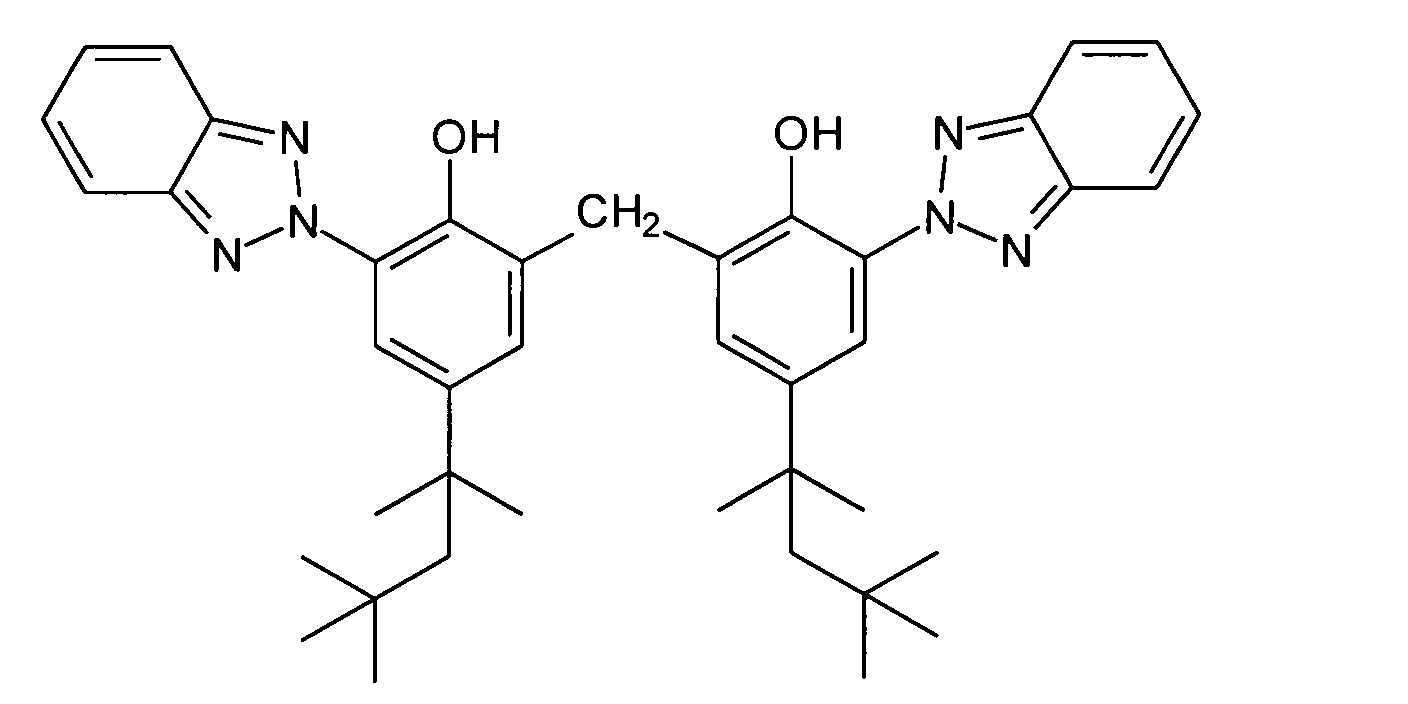
- An advantageous organic pigment for the purposes of the present invention is 2,2'-methylene-bis- (6- (2H-benzotriazol-2-yl) -4- (1,1,3,3-tetramethylbutyl) phenol) [INCI : Methylene Bis-Benztriazolyl Tetramethylbutylphenol], which is characterized by the chemical structural formula and is available under the trade name Tinosorb® M from CIBA-Chemicals GmbH.
- cosmetic or dermatological preparations contain 0.001 to 30% by weight, advantageously 0.05 to 15% by weight, very particularly preferably 0.1 to 10% by weight pigmentary organic substances.
- surfactant denotes amphiphilic substances, which organic, non-polar substances can dissolve in water. You worry due to their specific molecular structure with at least one hydrophilic and a hydrophobic part of the molecule, for reducing the surface tension of the Water. There are anionic, cationic, amphoteric and non-ionic surfactants that have different functional groups.
- Anionic surfactants generally have carboxylate, sulfate or sulfonate groups as functional groups. In an aqueous solution they form negatively charged organic ions in an acidic or neutral environment. Cationic surfactants are characterized almost exclusively by the presence of a quaternary ammonium group. In aqueous solution they form positively charged organic ions in an acidic or neutral environment. Amphoteric surfactants contain both anionic and cationic groups and accordingly behave like anionic or cationic surfactants in aqueous solution depending on the pH. They have a positive charge in a strongly acidic environment and a negative charge in an alkaline environment.
- Non-ionic surfactants do not form ions in an aqueous medium.
- Non-ionic surfactants are particularly advantageous for the purposes of the present invention.
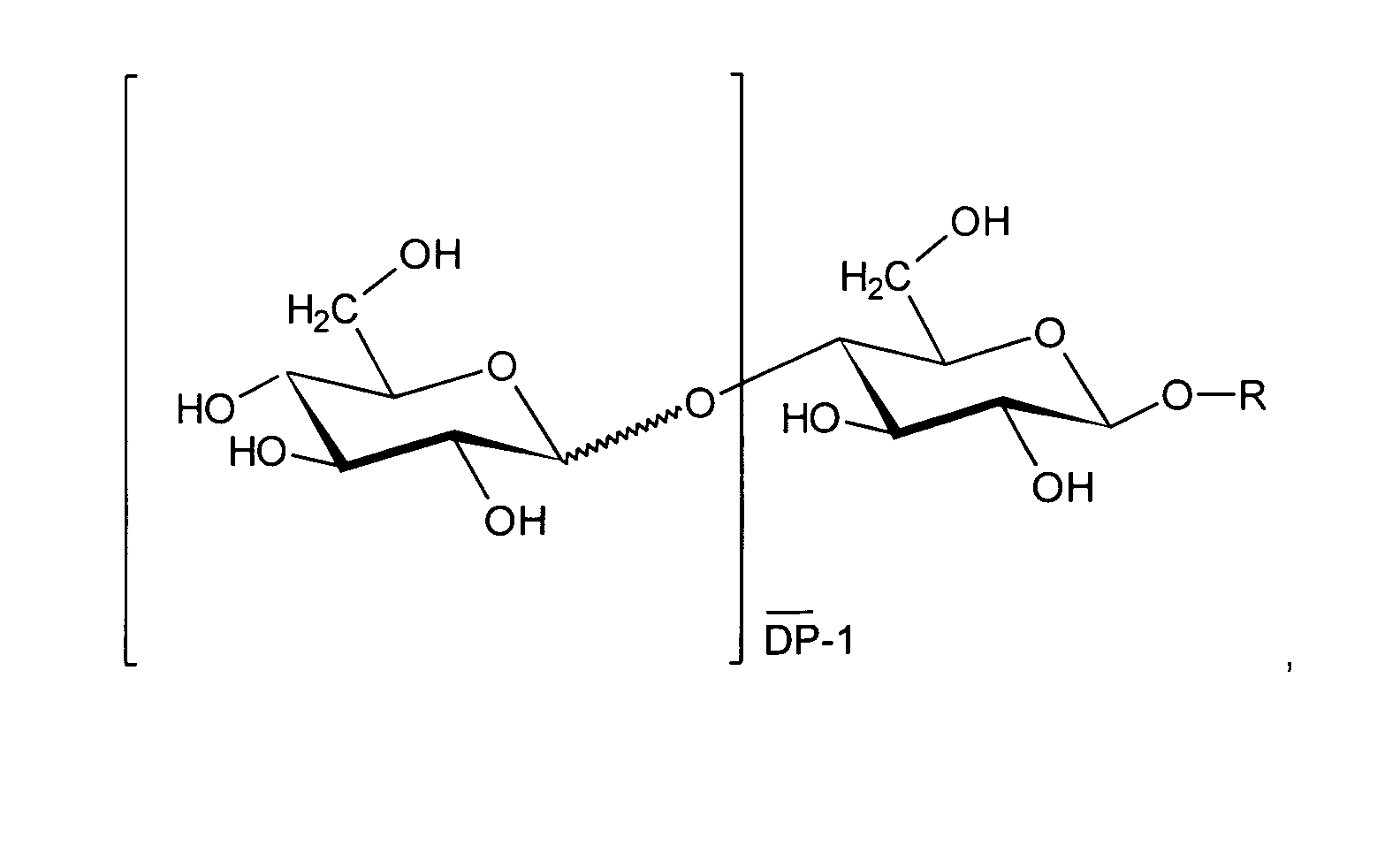
- Non-ionic surfactants which are particularly advantageous according to the invention are characterized by the following chemical structure wherein R represents a branched or unbranched alkyl radical having 4 to 24 carbon atoms and wherein DP means an average degree of glucosylation of up to 2.
- the value DP represents the degree of glucosylation of the alkyl glucosides used according to the invention and is defined as
- P 1 , p 2 , p 3 ... and, p i represent the proportion of single, double, triple ... i-fold glucosylated products in percentages by weight.
- products with degrees of glucosylation of 1-2 are particularly advantageous, particularly advantageous from 1.1 to 1.5, very particularly advantageously selected from approximately 1.3.
- the value DP takes into account the fact that alkyl glucosides are usually mixtures of mono- and oligoglucosides due to their production.
- R is advantageously selected from the group of unbranched alkyl radicals, the myristyl radical, the cetyl group, the stearyl group and the eicosyl group are preferred.
- Prefers are lauryl glucoside and cocoglucoside. Decyl glucoside is particularly preferred.
- Alkyl glucosides also: alkyl polyglycosides
- Alkyl glucosides used according to the invention are available by methods such as those described in DE-OS 40 40 655 and other documents to be discribed. They are commercially available from various manufacturers.
- cosmetic or dermatological preparations contain 0.001 to 15% by weight, advantageously 0.005 to 5% by weight, very particularly preferably 0.01 to 1% by weight of surfactants.
- the preparations within the meaning of the present invention can preferably be in addition to a or more oil phases additionally contain one or more water phases and for example in the form of W / O, O / W, W / O / W or O / W / O emulsions.
- Such Formulations can preferably also contain microemulsions, sticks, foams (so-called Mousse), solid emulsions (i.e., emulsions stabilized by solids are, e.g. B. Pickering emulsions) or sprayable emulsions.
- “Macroscopic) two-phase or multi-phase systems are also advantageous according to the invention.
- “Two-phase or multi-phase” in the sense of the present invention means that two or more phases are present separately layered one above the other. It is particularly advantageous for the purposes of the present invention if at least one of the macroscopically visible phases is a (W / O, O / W, micro) emulsion. In this (macroscopic) observation, the emulsion is perceived as one phase, although it is of course known to the person skilled in the art that emulsions per se are formed from two or more phases homogenized with one another.
- the "emulsion phase” is stable over the long term, so that segregation or phase separation within the emulsion does not occur even over a longer period (months, years).
- the macroscopically visible phases or layers can advantageously be emulsified for a short time - for example by shaking - to form a homogeneous emulsion which, however, is not stable over the long term, but rather separates again into two or more layers layered over a period of minutes, hours or days ,
- at least one of the macroscopically visible phases is a microemulsion and at least one other of the macroscopically visible phases is an oil phase.
- Sprayable emulsions especially microemulsions
- Sprayable O / W emulsions are particularly advantageous for the purposes of the present invention. especially O / W microemulsions.
- the droplet diameters of the usual "simple”, ie non-multiple emulsions are in the range of approx. 1 ⁇ m to approx. 50 ⁇ m.
- Such "macro emulsions” are without other coloring additives, milky white colored and opaque.
- Such "macro emulsions” usually have a high viscosity.
- microemulsions in the sense of the present invention on the other hand is in the range from about 50 to about 500 nm.
- Such microemulsions are bluish white colored to translucent and mostly low viscosity.
- the viscosity of many microemulsions of the O / W type is comparable to that of water.
- microemulsions are that active substances are much finer in the disperse phase can be dispersed than in the disperse phase of "macroemulsions". Another The advantage is that they are sprayable due to their low viscosity. Become microemulsions Used as cosmetics, corresponding products are characterized high cosmetic elegance.
- Advantageous emulsifiers A are e.g. B. polyethoxylated fatty acids (PEG-100 stearate, PEG-20 Stearate, PEG-150 Laurath, PEG-8 distearate and the like) and / or polyethoxylated Fatty alcohols (Cetearath-12, Cetearath-20, Isoceteth-20, Beheneth-20, Laureth-9 etc.) and / or alkyl polyglycosides (cetearyl glycosides, stearyl glycosides, palmityl glycosides Etc.).
- PEG-100 stearate PEG-20 Stearate, PEG-150 Laurath, PEG-8 distearate and the like
- polyethoxylated Fatty alcohols Cetearath-12, Cetearath-20, Isoceteth-20, Beheneth-20, Laureth-9 etc.
- alkyl polyglycosides cetearyl glycosides, stearyl glycoside
- the Size of the oil droplets essentially by the concentration of the one or more Emulsifiers is determined in such a way that a higher emulsifier concentration smaller Droplets causes and lower emulsifier concentration to larger droplets leads.
- the droplet sizes are usually between 20 and 500 nm.
- alkyl methicone copolyols and / or alkyl dimethicone copolyols (in particular cetyl dimethicone copolyol, lauryl methicone copolyol), W / O emulsifiers (such as, for example, sorbitan stearate, glyceryl stearate, glycerol stearate, sorbitan oleate, lecithin, glyceryl isostearate 3-polyglycerol, polyglyceryl glyceryl, polyglyceryl glyceryl, polyglyceryl glyceryl, polyglyceryl glyceryl) -3 diisostearate, PEG-7 hydrogenated castor oil, polyglyceryl 4-isostearate, acrylate / C 10-30 alkyl acrylate crosspolymer, sorbitan isostearate, poloxamer 101, polyglyceryl-2-dipoly
- Further advantageous sprayable O / W emulsions in the sense of the present invention are low-viscosity cosmetic or dermatological hydrodispersions, which at least contain an oil phase and at least one water phase, the preparation is stabilized by at least one gel former and not necessarily Must contain emulsifiers, but can contain one or more emulsifiers.
- Advantageous gel formers for such preparations are, for example, copolymers of C 10-30 alkyl acrylates and one or more monomers of acrylic acid, methacrylic acid or their esters.
- the INCI name for such compounds is "Acrylates / C 10-30 Alkyl Acrylate Crosspolymer”.
- the Pemulen® types TR 1, TR 2 and TRZ from Goodrich (Noveon) are particularly advantageous.
- Carbopole are also advantageous gel formers for such preparations.
- advantageous Carbopols are, for example, types 907, 910, 934, 940, 941, 951, 954, 980, 981, 1342, 1382, 2984 and 5984.
- Other advantageous gelling agents for such preparations are xanthan Gum, cellulose derivatives and locust bean gum.
- Possible (optional) emulsifiers are ethoxylated fatty alcohols or ethoxylated Fatty acids (especially PEG-100 stearate, ceteareth-20) and / or other nonionic surface-active substances are used.
- the silicone emulsifier (s) can advantageously be selected from the group of alkyl methicon copolyols and / or alkyl dimethicone copolyols can be selected (e.g. dimethicone copolyols, which from Goldschmidt AG under the trade names ABIL® B 8842, ABIL® B 8843, ABIL® B 8847, ABIL® B 8851, ABIL® B 8852, ABIL® B 8863, ABIL® B 8873 and ABIL® B 88183 are sold, cetyl dimethicone copolyol [Goldschmidt AG / ABIL® EM 90], cyclomethicone dimethicone copolyol [Goldschmidt AG / ABIL® EM 97], lauryl methicone copolyol [Dow Corning Ltd. / Dow Corning® 5200 Formulation Aid], octyl dim
- the W / O emulsifier (s) with an HLB value of ⁇ 7 can advantageously be selected from the following group: sorbitan stearate, sorbitan oleate, lecithin, glyceryl alcoholate, lanolin, hydrogenated castor oil, glyceryl isostearate, polyglyceryl 3-oleate, pentaerythrithyl isostearate, methylglucose dioleate Mixture with hydroxystearate and beeswax, PEG-7 hydrogenated castor oil, polyglyceryl 4-isostearate, hexyl laurate, acrylate / C 10-30 alkyl acrylate cross-polymer, sorbitan isostearate, polyglyceryl 2-dipolyhydroxystearate, polyglyceryl-3-diisostearate, PEG dipolyhydroxystearate, diisostearoylpolyglyceryl-3-diisostearate, polyglyce
- the O / W emulsifier (s) with an HLB value> 10 can advantageously be obtained from the following Group can be selected: glyceryl stearate in a mixture with ceteareth-20, ceteareth-25, Ceteareth-6 in a mixture with stearyl alcohol, cetylstearyl alcohol in a mixture with PEG-40 castor oil and sodium cetyl stearyl sulfate, triceteareth-4 phosphate, glyceryl stearate, sodium cetyl stearyl sulfate, Lecithin trilaureth-4 phosphate, laureth-4 phosphate, stearic acid, Propylene glycol stearate SE, PEG-9 stearate, PEG-20 stearate, PEG-30 stearate, PEG-40 stearate, PEG-100 stearate, Ceteth-2, Ceteth-20, Polysorbate-20, Polysorbate-60, Polysorbate-65, Polysorbate-100
- the preparations according to the present invention can advantageously also be cosmetic or dermatological impregnation solutions with which in particular water-insoluble Substrates - such as B. woven or non-woven wipes - are moistened, be used.
- Such impregnation solutions are preferably thin, in particular sprayable (such as PIT emulsions, W / O emulsions etc.) and preferably a viscosity of less than 2000 mPa ⁇ s, especially less than 1,500 mPas (measuring device: Haake Viscotester VT-02 at 25 ° C).
- sprayable such as PIT emulsions, W / O emulsions etc.
- a viscosity of less than 2000 mPa ⁇ s especially less than 1,500 mPas (measuring device: Haake Viscotester VT-02 at 25 ° C).
- With their help for example cosmetic sun protection wipes, wipes and the like are available
- foam-like ",” post-foaming "or” foamable are To understand preparations from which foams - be it during the manufacturing process, be it by the consumer or in any other way - Can be produced by introducing one or more gases in principle.
- the gas bubbles are distributed (arbitrarily) in one (or more) liquid Phase (s) before, where the (foamed) preparations are not necessarily macroscopic must have the appearance of a foam.
- foams can, for.
- the foam character can, for example, only become visible under a (light) microscope.
- foams according to the invention especially when the gas bubbles are too small to be recognized under a light microscope - also at the significant increase in volume of the system can be seen.
- the emulsifier (s) A are preferably selected from the group of fatty acids, which are wholly or partly with common alkalis (such as sodium and / or potassium hydroxide, Sodium and / or potassium carbonate and mono- and / or triethanolamine) are neutralized.
- alkalis such as sodium and / or potassium hydroxide, Sodium and / or potassium carbonate and mono- and / or triethanolamine
- stearic acid and stearates are particularly advantageous. Isostearic acid and isostearates, palmitic acid and palmitates as well as myristic acid and Myristate.
- the emulsifier (s) B are preferably selected from the following group: PEG-9 stearate, PEG-8 distearate, PEG-20 stearate, PEG-8 stearate, PEG-8 oleate, PEG-25 glyceryl trioleate, PEG-40 sorbitan lanolate, PEG-15 glyceryl ricinoleate, PEG-20 glyceryl stearate, PEG-20 glyceryl isostearate, PEG-20 glyceryl oleate, PEG-20 stearate, PEG-20 methyl glucose sesquistearate, PEG 30 glyceryl isostearate, PEG 20 glyceryl laurate, PEG-30 stearate, PEG-30 glyceryl stearate, PEG-40 stearate, PEG-30 glyceryl laurate, PEG-50 stearate, PEG-100 stearate, PEG-150 laurate.
- the co-emulsifier (s) C are preferably selected from the following group: behenyl alcohol (C 22 H 45 OH), cetearyl alcohol [a mixture of cetyl alcohol (C 16 H 33 OH) and stearyl alcohol (C 18 H 37 OH)], lanolin alcohols (wool wax alcohols) , which represent the unsaponifiable alcohol fraction of the wool wax which is obtained after the saponification of wool wax). Cetyl and cetylstearyl alcohol are particularly preferred.
- weight ratios of emulsifier A to emulsifier B can represent rational numbers from 1 to 5, preferably from 1 to 3.
- a weight ratio of approximately 1: 1: 1 is particularly preferred.
- the total amount of emulsifiers A and B and the co-emulsifier C from the range of 2 to 20 wt .-%, advantageous from 5 to 15% by weight, in particular from 7 to 13% by weight, in each case based on the total weight the wording to choose.
- Such "emulsifier free" emulsions are also called Pickering emulsions designated.
- the solid substance In Pickering emulsions, the solid substance accumulates at the phase boundary "Oil / water in the form of a layer, which causes the disperse to flow together Phases is prevented.
- the Surface properties of the solid particles which are both hydrophilic and lipophilic Should show properties.
- the stabilizing solid particles can advantageously also be water-repellent on the surface treated ("coated"), with an amphiphilic character of these solid particles should be formed or preserved.
- the surface treatment can be in it exist that the solid particles by a known method with a thin hydrophobic or hydrophilic layer are provided.
- the average particle diameter of the microfine solid particles used as a stabilizer is preferably less than 100 microns, particularly advantageously less than 50 microns selected. It is essentially irrelevant in what form (platelets, sticks, Beads etc.) or modification of the solid particles used.
- microfine solid particles from the following Group can be selected: boron nitride, starch derivatives (Tapioca Starch, Sodium Corn Starch Octynyl succinate etc.), talc, latex particles.
- the solid-stabilized emulsions are clear contain less than 0.5% by weight of one or more emulsifiers or even entirely are free of emulsifiers.
- water-containing stick-like preparations are known per se, these also in Form of W / O emulsions may be present.
- the cosmetic or dermatological formulations according to the invention can be composed as usual and the cosmetic or dermatological light protection, also for the treatment, care and cleaning of the skin and / or hair and serve as a make-up product in decorative cosmetics.
- cosmetic or topical dermatological compositions for the purposes of the present invention, for example as skin protection cream, cleansing milk, day or night cream, etc. It may be possible and advantageous, the compositions according to the invention as a basis to use for pharmaceutical formulations.
- the cosmetic and dermatological preparations are used in the for cosmetics usual way on the skin and / or the hair in sufficient quantity applied.
- the cosmetic and dermatological preparations according to the invention can Contain cosmetic auxiliaries, as they are usually used in such preparations be, e.g. B. preservatives, preservation aids, complexing agents, bactericides, Perfumes, substances to prevent or increase foaming, dyes, Pigments that have a coloring effect, thickeners, moisturizing and / or moisturizing substances, fillers that improve the feeling on the skin, fats, Oils, waxes or other common components of a cosmetic or dermatological Formulation such as alcohols, polyols, polymers, foam stabilizers, electrolytes, organic solvents or silicone derivatives.
- cosmetic auxiliaries e.g. B. preservatives, preservation aids, complexing agents, bactericides, Perfumes, substances to prevent or increase foaming, dyes, Pigments that have a coloring effect, thickeners, moisturizing and / or moisturizing substances, fillers that improve the feeling on the skin, fats, Oils, waxes or other
- Advantageous preservatives for the purposes of the present invention are, for example Formaldehyde releaser (such as DMDM hydantoin, which, for example, under the trade name Glydant TM is available from Lonza), iodopropyl butyl carbamate (e.g. from the company under the trade names Glycacil-L, Glycacil-S Lonza and / or Dekaben LMB from Jan Dekker), parabens (i.e. p-hydroxybenzoic acid alkyl esters, such as methyl, ethyl, propyl and / or butyl paraben), phenoxyethanol, Ethanol, benzoic acid and the like.
- the preservation system includes according to the invention also advantageously preservation aids such as Octoxyglycerin, glycine soy etc.
- Advantageous complexing agents in the sense of the present invention are, for example EDTA, [S, S] -Ethylenediamindisuccinat (EDDS), which for example under the trade name Octaquest is available from Octel and / or iminodisuccinic acid, which u. a. from Bayer AG under the trade names Iminodisuccinat VP OC 370 (approx. 30% solution) and Baypure CX 100 is available.
- compositions are also obtained when added or Active ingredients antioxidants are used.
- the preparations contain advantageously one or more antioxidants.
- As cheap, but still optional Antioxidants to be used can all be for cosmetic and / or dermatological Applications suitable or customary antioxidants can be used.
- Water-soluble antioxidants can be particularly advantageous for the purposes of the present invention are used, such as vitamins, for. B. ascorbic acid and its Derivatives.
- Preferred antioxidants are also vitamin E and its derivatives and vitamin A. and its derivatives.
- the amount of antioxidants (one or more compounds) in the preparations is preferably 0.001 to 30% by weight, particularly preferably 0.05 to 20% by weight, in particular 0.1 to 10 wt .-%, based on the total weight of the preparation.
- vitamin E and / or its derivatives are the antioxidant (s) advantageous, the respective concentrations of which range from 0.001 to 10% by weight, based on the total weight of the formulation.
- vitamin A or vitamin A derivatives, or carotenes or their derivatives, the or which are antioxidants is advantageous, their respective concentrations out of the range from 0.001 to 10% by weight, based on the total weight of the formulation choose.
- cosmetic preparations according to the present Invention contain cosmetic or dermatological active ingredients
- preferred Active ingredients are antioxidants that protect the skin from oxidative stress can protect.
- active substances in the sense of the present invention are natural active substances and / or their derivatives, such as.
- Recipes according to the invention which, for. B. known anti-wrinkle agents such as flavone glycosides (in particular ⁇ -glycosyl rutin), coenzyme Q10, vitamin C and / or derivatives, Contain vitamin A and / or derivatives, vitamin E and / or derivatives and the like, are particularly advantageous for the prophylaxis and treatment of cosmetic or dermatological skin changes, such as z. B. occur with skin aging (like for example dryness, roughness and the formation of dry lines, itching, reduced regreasing (e.g.
- the water phase of the preparations according to the present invention can be advantageous Contain conventional cosmetic auxiliaries, such as alcohols, in particular such a low C number, preferably ethanol and / or isopropanol, diols or polyols low C number and their ethers, preferably propylene glycol, glycerol, butylene glycol, Ethylene glycol, ethylene glycol monoethyl or monobutyl ether, propylene glycol monomethyl, monoethyl or monobutyl ether, diethylene glycol monomethyl or monoethyl ether and analog products, polymers, foam stabilizers, electrolytes and in particular one or more thickeners, which one or which is advantageously chosen can be selected from the group consisting of silicon dioxide, aluminum silicates, polysaccharides and their derivatives, e.g.
- conventional cosmetic auxiliaries such as alcohols, in particular such a low C number, preferably ethanol and / or isopropanol, diol
- B. hyaluronic acid, xanthan gum, hydroxypropylmethyl cellulose especially advantageously from the group of polyacrylates, preferably a polyacrylate from the Group of the so-called carbopoles [from Bf. Goodrich], for example carbopols Types 980, 981, 1382, 2984, 5984, ETD 2020, ETD 2050, Ultrez 10, each individually or in combination.
- the preparations according to the present invention can also advantageously also Contain self-tanning substances, such as dihydroxyacteon and / or Melanin derivatives in concentrations of 1% by weight to 8% by weight, based on the Total weight of the preparation.
- Contain self-tanning substances such as dihydroxyacteon and / or Melanin derivatives in concentrations of 1% by weight to 8% by weight, based on the Total weight of the preparation.
- the preparations according to the present invention can also be advantageous Repellents to protect against mosquitoes, ticks and spiders and the like are included.
- Z are advantageous.
- B N, N-diethyl-3-methylbenzamide (trade name: Metadelphene, "DEET"), dimethyl phthalate (trade name: Palatinol M, DMP) and in particular 3- (N-n-Butyl-N-acetylamino) propionic acid ethyl ester (under the trade name Insect Repellent® 3535 available from Merck).
- the repellents can both can be used individually or in combination.
- moisturizers for the purposes of the present invention are, for example, glycerol, lactic acid and / or lactates, in particular sodium lactate, butylene glycol, propylene glycol, biosaccaride gum-1, glycine soya, ethylhexyloxyglycerol, pyrrolidonecarboxylic acid and urea.
- polymeric moisturizers from the group of water-soluble and / or water-swellable and / or water-gellable polysaccharides.
- Particularly advantageous are, for example, hyaluronic acid, chitosan and / or a fucose-rich polysaccharide, which is filed in the Chemical Abstracts under the registration number 178463-23-5 and z. B. is available under the name Fucogel®1000 from the company SOLABIA SA.
- Moisturizers can also advantageously be used as anti-wrinkle active ingredients for the prophylaxis and treatment of cosmetic or dermatological skin changes, such as those described, for example, in US Pat. B. occur in skin aging, are used.
- the cosmetic or dermatological preparations according to the invention can further advantageous, although not mandatory, contain fillers which, for. B. the sensory and further improve the cosmetic properties of the formulations and, for example create or intensify a velvety or silky feeling on the skin.
- advantageous Fillers for the purposes of the present invention are starch and starch derivatives (such as z. B. tapioca starch, distarch phosphate, aluminum or sodium starch octenyl succinate and the like), pigments that have neither primarily UV filter nor coloring effect have (such as boron nitride etc.) and / or Aerosile® (CAS No. 7631-86-9).
- the oil phase of the formulations according to the invention is advantageously chosen from the Group of polar oils, for example from the group of lecithins and fatty acid triglycerides, namely the triglycerol esters saturated and / or unsaturated, branched and / or unbranched alkane carboxylic acids with a chain length of 8 to 24, in particular 12 to 18 carbon atoms.
- the fatty acid triglycerides can, for example, advantageously be selected are from the group of synthetic, semi-synthetic and natural oils, such as B.
- cocoglyceride olive oil, sunflower oil, soybean oil, peanut oil, rapeseed oil, almond oil, Palm oil, coconut oil, castor oil, wheat germ oil, grape seed oil, safflower oil, evening primrose oil, macadamia nut oil and the like.
- z. B. natural animal and vegetable waxes Origin such as beeswax and other insect waxes as well Berry wax, shea butter and / or lanolin (wool wax).
- polar oil components can be used for the purposes of the present invention furthermore selected from the group of the esters from saturated and / or unsaturated, branched and / or unbranched alkane carboxylic acids with a chain length of 3 to 30 C atoms and saturated and / or unsaturated, branched and / or unbranched Alcohols with a chain length of 3 to 30 carbon atoms and from the group of esters aromatic carboxylic acids and saturated and / or unsaturated, branched and / or unbranched alcohols with a chain length of 3 to 30 carbon atoms.
- Ester oils can then advantageously be selected from the group octyl palmitate, octyl cocoate, Octyl isostearate, octyldodeceyl myristate, octyldodekanol, cetearyl isononanoate, Isopropyl myristate, isopropyl palmitate, isopropyl stearate, isopropyl oleate, n-butyl stearate, n-hexyl laurate, n-decyl oleate, isooctyl stearate, isononyl stearate, isononyl isononanoate, 2-ethylhexyl palmitate, 2-ethylhexyl laurate, 2-hexyldecyl stearate, 2-octyldodecyl palmitate, stearylheptanoate, Oleyl
- the oil phase can advantageously be selected from the group of dialkyl ethers and dialkyl carbonates.
- oil components from the group consisting of isoeicosane, neopentyl glycol, propylene glycol dicaprylate / dicaprate, caprylic / capric / diglyceryl succinate, butylene glycol dicaprylate / dicaprate, C 12-13 alkyl lactate, di-C 12-13 -Alkyltartrat, triisostearin, Dipentaerythrityl Hexacaprylat / Hexacaprat To use propylene glycol monoisostearate, tricaprylin, dimethyl isosorbide. It is particularly advantageous if the oil phase of the formulations according to the invention has a content of C 12-15 alkyl benzoate.
- Advantageous oil components are also e.g. B. butyl octyl salicylate (for example that available under the trade name Hallbrite BHB from CP Hall), hexadecyl benzoate and butyl octyl benzoate and mixtures thereof ( Hallstar AB ) and / or diethyl hexyl naphthalate ( Hallbrite TQ or Corapan TQ from H&R ).
- B. butyl octyl salicylate for example that available under the trade name Hallbrite BHB from CP Hall
- Hallstar AB hexadecyl benzoate and butyl octyl benzoate and mixtures thereof
- Hallstar AB diethyl hexyl naphthalate
- Hallbrite TQ or Corapan TQ from H&R diethyl hexyl naphthalate
- Particularly advantageous wax components which can additionally increase the water resistance, especially of light protection formulations, are also acetylated glycol stearate with tristearin (e.g. Unitwix from ISP with the INCI: Acetylated Glycol Stearate and Tristearin), C 18-36 fatty acid triglyceride (e.g.: Syncrowax HGLC from Crode GmbH with INCI: C18-36 Acid Triglyceride) as well as those under the trade names "Performa V 1608" (INCI: C30-38 olefin / isopropyl maleate / MA copolymer) and "Perfroma V 825" (synergic wax ) substances available from New Phase Technologies.
- tristearin e.g. Unitwix from ISP with the INCI: Acetylated Glycol Stearate and Tristearin
- C 18-36 fatty acid triglyceride e.g.: Syncrowax HGLC
- the oil phase may also advantageously contain non-polar oils, for example those that are selected from the group of branched and unbranched Hydrocarbons and waxes, especially mineral oil, petroleum jelly (petrolatum), Paraffin oil, squalane and squalene, polyolefins, hydrogenated polyisobutenes and isohexadecane.
- non-polar oils for example those that are selected from the group of branched and unbranched Hydrocarbons and waxes, especially mineral oil, petroleum jelly (petrolatum), Paraffin oil, squalane and squalene, polyolefins, hydrogenated polyisobutenes and isohexadecane.
- polyolefins polydecenes are the preferred substances.
- the oil phase can also advantageously contain cyclic or linear silicone oils have or consist entirely of such oils, although it is preferred in addition to the silicone oil or the silicone oils an additional content of other oil phase components to use.
- Silicone oils are high-molecular synthetic polymeric compounds in which silicon atoms are linked in a chain and / or network-like manner via oxygen atoms and the remaining valences of silicon by hydrocarbon residues (mostly methyl, more rarely ethyl, propyl, phenyl groups etc.) are saturated.
- the silicone oils are systematically referred to as polyorganosiloxanes.
- the methyl-substituted polyorganosiloxanes which are the most important compounds of this group in terms of quantity and are characterized by the following structural formula are also known as polydimethylsiloxane or dimethicone (INCI). Dimethicone is available in different chain lengths or with different molecular weights.
- Particularly advantageous polyorganosiloxanes for the purposes of the present invention are, for example Dimethylpolysiloxane [poly (dimethylsiloxane)], which, for example, under the trade names Abil 10 to 10,000 are available from Th. Goldschmidt.
- Further Phenylmethylpolysiloxanes (INCI: Phenyl Dimethicone, Phenyl Trimethicone) are advantageous, cyclic silicones (octamethylcyclotetrasiloxane or decamethylcyclopentasiloxane), which are also called cyclomethicones according to INCI Silicones (INCI: Amodimethicone) and silicone waxes, e.g. B.
- polysiloxane-polyalkylene copolymers (INCI: Stearyl Dimethicone and Cetyl Dimethicone) and Dialkoxydimethylpolysiloxane (Stearoxy Dimethicone and Behenoxy Stearyl Dimethicone), which as different Abil wax types are available from Th. Goldschmidt.
- silicone oils are to be used advantageously for the purposes of the present invention, for example Cetyldimethicone, hexamethylcyclotrisiloxane, polydimethylsiloxane, poly (methylphenylsiloxane).
- siloxane elastomer (s) are advantageous In the form of spherical powder or in the form of gels.
- siloxane elastomers in the form of spherical powder according to the invention are those with the INCI name Dimethicone / Vinyl Dimethicone Crosspolymer, for example that of DOW CORNING under the trade name DOW CORNING 9506 powder available.
- siloxane elastomer is combined with oils Hydrocarbons of animal and / or vegetable origin, synthetic oils, synthetic Esters, synthetic ethers or mixtures thereof is used.
- siloxane elastomer in combination with unbranched at room temperature liquid or pasty silicone oils or cyclic silicone oils or mixtures thereof are used.
- Organopolysiloxane elastomers are particularly advantageous with the INCI name Dimethicone / Polysilicone-11, whole especially the Gransil types GCM, GCM-5, available from Grant Industries Inc. DMG-6, CSE Gel, PM-Gel, LTX, ININ Gel, AM-18 Gel and / or DMCM-5.
- the siloxane elastomer is in the form of a gel from siloxane elastomer and a lipid phase is used, the content of the siloxane elastomer in the gel is 1 to 80% by weight, preferably 0.1 to 60% by weight, in each case based on the total weight of the gel.
- the total amount of the siloxane elastomers (Active content) from the range from 0.01 to 10% by weight, advantageously from 0.1 up to 5% by weight, based in each case on the total weight of the formulation.
- the cosmetic and dermatological preparations according to the invention can contain dyes and / or color pigments, in particular if they are in the form of decorative cosmetics.
- the dyes and pigments can be selected from the corresponding positive list in the Cosmetics Ordinance or the EC list of cosmetic colorants. In most cases, they are identical to the colorants approved for food.
- Advantageous color pigments are, for example, titanium dioxide, mica, iron oxides (for example Fe 2 O 3 , Fe 3 O 4 , FeO (OH)) and / or tin oxide.
- Advantageous dyes are, for example, carmine, Berlin blue, chrome oxide green, ultramarine blue and / or manganese violet. It is particularly advantageous to choose the dyes and / or color pigments from the Rowe Color Index, 3rd edition, Society of Dyers and Colorists, Bradford, England, 1971 .
- formulations according to the invention are in the form of products which applied to the face, it is beneficial to dye one or more substances select from the following group: 2,4-dihydroxyazobenzene, 1- (2'-chloro-4'-nitro-1'phenylazo) -2-hydroxynaphthalene, Ceres red, 2- (sulfo-1-naphthylazo) -1-naphthol-4-sulfonic acid, Calcium salt of 2-hydroxy-1,2'-azonaphthalene-1'-sulfonic acid, calcium and barium salts 1- (2-sulfo-4-methyl-1-phenylazo) -2-naphthylcarboxylic acid, calcium salt of 1- (2-sulfo-1-naphthylazo) -2-hydroxynaphthalene-3-carboxylic acid, aluminum salt of 1- (4-sulfo-1-phenylazo) -2-naphthol-6-sulfonic acid, Aluminum salt of 1- (4-s
- oil-soluble natural dyes such as. B. paprika extracts, ⁇ -carotene or Cochineal.
- Pearlescent pigments are based, for example, on powdered pigments or castor oil dispersions of bismuth oxychloride and / or titanium dioxide and bismuth oxychloride and / or
- Titanium dioxide on mica Particularly advantageous is e.g. B. that listed under CIN 77163 Luster pigment.
- pearlescent pigment types based on mica / metal oxide are also advantageous: group Coverage / layer thickness colour
- Silver-white pearlescent pigments TiO 2 : 40-60 nm silver interference pigments TiO 2 : 60-80 nm yellow TiO 2 : 80-100 nm red
- TiO 2 100-140 nm blue
- TiO 2 120-160 nm
- Color Luster Pigments Fe 2 O 3 bronze Fe 2 O 3 copper Fe 2 O 3 red Fe 2 O 3 rotviolett Fe 2 O 3 Red Green Fe 2 O 3 black combination pigments
- B from Merck under the trade names Timiron, Colorona or Dichrona available pearlescent pigments.
- pearlescent pigments which are advantageous in the sense of the present invention can be obtained in numerous ways known per se.
- other substrates besides mica can be coated with other metal oxides, such as. B. silica and the like.
- Z are advantageous.
- Iron pearlescent pigments which are without the use, are particularly preferred made by mica.
- Such pigments are e.g. B. under the trade name Sicopearl Kupfer 1000 available from BASF.
- Effect pigments which are sold under the trade name are also particularly advantageous Metasomes Standard / Glitter in different colors (yello, red, green, blue) from are available from Flora Tech.
- the glitter particles are mixed with them various auxiliaries and dyes (such as the dyes with the color Index (CI) numbers 19140, 77007, 77289, 77491).
- the dyes and pigments can be present both individually and in a mixture and can be mutually coated, different color effects generally being produced by different coating thicknesses.
- the total amount of dyes and coloring pigments is advantageously from the range of z. B. 0.1 wt .-% to 30 wt .-%, preferably from 0.5 to 15 wt .-%, in particular from 1.0 to 10 wt .-%, each based on the total weight of the preparations. It is also advantageous for the purposes of the present invention to produce cosmetic and dermatological preparations, the main purpose of which is not to protect against sunlight, but which nevertheless contain other UV protection substances. So z. B. in day creams or makeup products usually incorporated UV-A or UV-B filter substances. UV protection substances, like antioxidants and, if desired, preservatives, also provide effective protection for the preparations themselves against spoilage. Cosmetic and dermatological preparations which are in the form of a sunscreen are also favorable.
- the preparations in the sense of the present invention preferably contain at least one further UV-A, UV-B and / or broadband filter substance.
- the Formulations although not necessary, may be in addition to the above.
- organic pigment substance also one or more organic and / or inorganic Contain pigments as UV filter substances, which in the water and / or Oil phase can be present.
- the preparations according to the present invention can also advantageously in In the form of so-called oil-free cosmetic or dermatological emulsions, which has a water phase and at least one UV filter substance that is liquid at room temperature included as a further phase and which particularly advantageously also free of other oil components.
- Particularly advantageous UV filter substances liquid at room temperature in the sense of The present invention is homomenthyl salicylate (INCI: homosalate), 2-ethylhexyl-2-cyano-3,3-diphenyl acrylate (INCI: octocrylene), 2-ethylhexyl-2-hydroxybenzoate (2-ethylhexyl salicylate, Octyl salicylate, INCI: ethylhexyl salicylate) and esters of cinnamic acid, preferably 4-methoxycinnamic acid (2-ethylhexyl) ester (2-ethylhexyl-4-methoxycinnamate, INCI: ethylhexyl methoxycinnamate) and isopentyl 4-methoxycinnamate (isopentyl 4-methoxycinnamate, INCI: isoamyl p-methoxycinnamate), 3- (4- (2,2-
- Preferred inorganic pigments are metal oxides and / or other metal compounds which are sparingly soluble or insoluble in water, in particular oxides of titanium (TiO 2 ), zinc (ZnO), iron (e.g. Fe 2 O 3 ), zirconium (ZrO 2 ), silicon ( SiO 2 ), manganese (e.g. MnO), aluminum (Al 2 O 3 ), cerium (e.g. Ce 2 O 3 ), mixed oxides of the corresponding metals as well as mixtures of such oxides and the sulfate of barium (BaSO 4 ).
- the pigments can advantageously also be used commercially in the sense of the present invention available oily or aqueous predispersions are used. This Predispersions can advantageously be dispersants and / or solubilizers be clogged.
- the pigments can advantageously be surface-treated ("coated") be formed, for example, a hydrophilic, amphiphilic or hydrophobic character will or should be preserved.
- This surface treatment can consist of that the pigments according to known methods with a thin hydrophilic and / or hydrophobic inorganic and / or organic layer.
- the various surface coatings can be used for the purposes of the present invention also contain water.
- Inorganic surface coatings in the sense of the present invention can consist of aluminum oxide (Al 2 O 3 ), aluminum hydroxide Al (OH) 3 , or aluminum oxide hydrate (also: alumina, CAS no .: 1333-84-2), sodium hexametaphosphate (NaPO 3 ) 6 , sodium metaphosphate (NaPO 3 ) n , silicon dioxide (SiO 2 ) (also: silica, CAS No .: 7631-86-9), or iron oxide (Fe 2 O 3 ).
- Al 2 O 3 aluminum oxide
- Al aluminum hydroxide Al
- Al oxide hydrate also: alumina, CAS no .: 1333-84-2
- sodium hexametaphosphate (NaPO 3 ) 6 sodium metaphosphate (NaPO 3 ) n
- silicon dioxide SiO 2
- silica also: silica, CAS No .: 7631-86-9
- iron oxide Fe 2 O 3
- Organic surface coatings in the sense of the present invention can consist of vegetable or animal aluminum stearate, vegetable or animal Stearic acid, lauric acid, dimethylpolysiloxane (also: Dimethicone), methylpolysiloxane (Methicone), Simethicone (a mixture of dimethylpolysiloxane with an average Chain length from 200 to 350 dimethylsiloxane units and silica gel) or Alginic acid.
- These organic surface coatings can be used alone, in combination and / or occur in combination with inorganic coating materials.
- Zinc oxide particles and predispersions of zinc oxide particles suitable according to the invention are available under the following trade names from the listed companies: trade name coating Manufacturer Z-Cote HP1 2% dimethicone BASF Z-Cote / BASF ZnO NDM 5% dimethicone MR MZ-303S 3% methicone Tayca Corporation MZ-505S 5% methicone Tayca Corporation
- Suitable titanium dioxide particles and predispersions of titanium dioxide particles are available under the following trade names from the companies listed: trade name coating Manufacturer MT-100TV Aluminum hydroxide / stearic acid Tayca Corporation MT-100Z Aluminum hydroxide / stearic acid Tayca Corporation Eusolex T-2000 Alumina / Simethicone Merck KgaA Titanium dioxide T805 (Uvinul TiO 2 ) octyltrimethylsilane Degussa Tioveil AQ 10PG Alumina / silica Solaveil / Uniquema Eusolex T-aqua Water / alumina / sodium metaphosphate Merck
- Latex particles advantageous according to the invention are those described in the following documents: US 5,663,213 and EP 0 761 201. Particularly advantageous latex particles are those which consist of water and styrene / acrylate copolymers be formed and z. B. under the trade name "Alliance SunSphere "are available from Rohm & Haas.
- UV-A filter substances for the purposes of the present invention are dibenzoylmethane derivatives, especially the 4- (tert-butyl) -4'-methoxydibenzoylmethane (CAS no. 70356-09-1), which is available from Givaudan under the Parsol® 1789 brand and from Merck under the trade name Eusolex® 9020 is sold.
- dibenzoylmethane derivatives especially the 4- (tert-butyl) -4'-methoxydibenzoylmethane (CAS no. 70356-09-1), which is available from Givaudan under the Parsol® 1789 brand and from Merck under the trade name Eusolex® 9020 is sold.
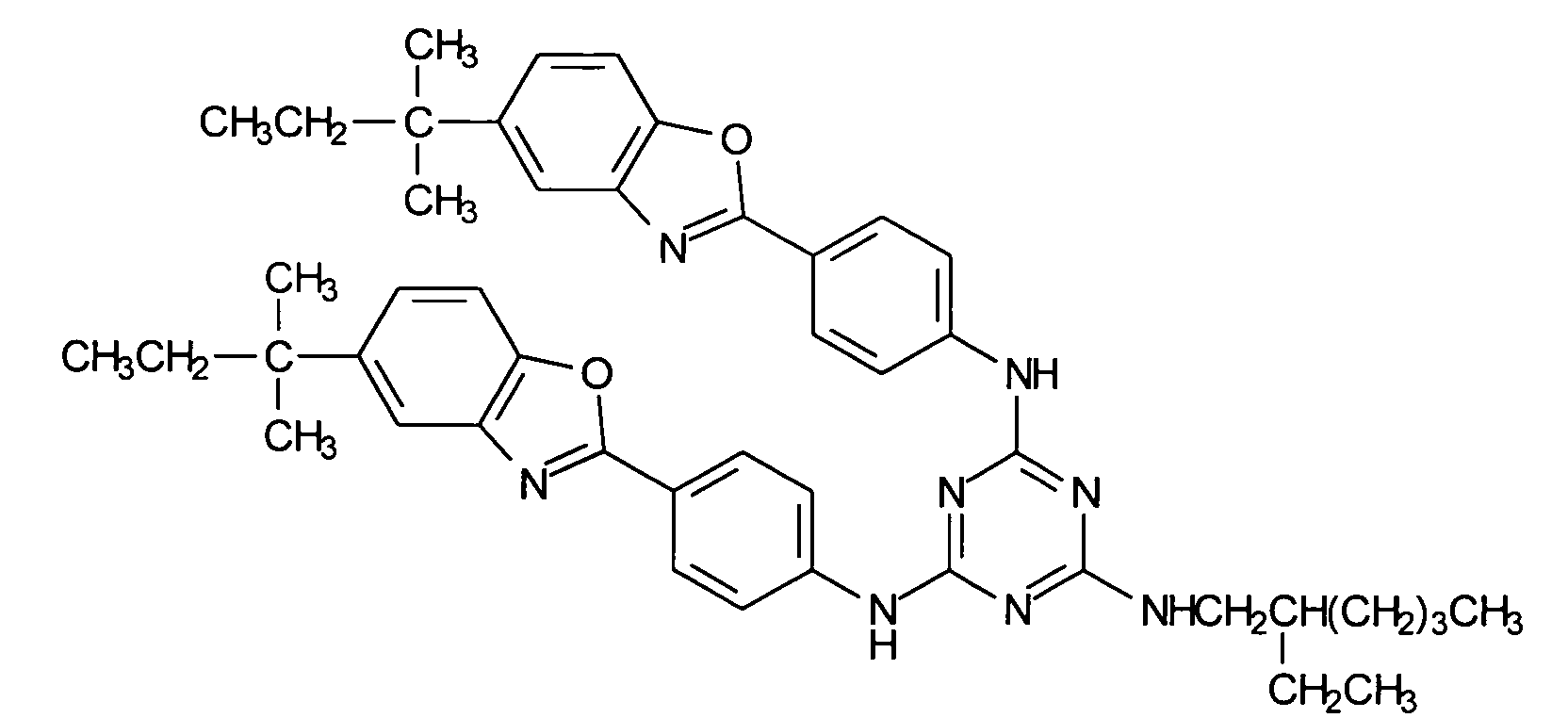
- Advantageous UV filter substances in the sense of the present invention are also benzoxazole derivatives, which are characterized by the following structural formula, wherein R 1 , R 2 and R 3 are independently selected from the group of branched or unbranched, saturated or unsaturated alkyl radicals having 1 to 10 carbon atoms. It is particularly advantageous according to the invention to choose the radicals R 1 and R 2 identically, in particular from the group of the branched alkyl radicals having 3 to 5 carbon atoms. It is furthermore particularly advantageous for the purposes of the present invention if R 3 is an unbranched or branched alkyl radical having 8 carbon atoms, in particular the 2-ethylhexyl radical.
- Benzoxazole derivative which is particularly preferred according to the invention is 2,4-bis- [5-1 (dimethylpropyl) benzoxazol-2-yl- (4-phenyl) -imino] -6- (2-ethylhexyl) -imino-1,3, 5-triazine with CAS No. 288254-16-0, which is characterized by the structural formula distinguished and is available from 3V Sigma under the trade name Uvasorb® K2A.
- the one or more benzoxazole derivatives are advantageously in dissolved form in the inventive cosmetic preparations. However, it may also be advantageous if if the or the benzoxazole derivatives in pigmentary, d. H. undissolved form - for example in particle sizes from 10 nm to 300 nm.
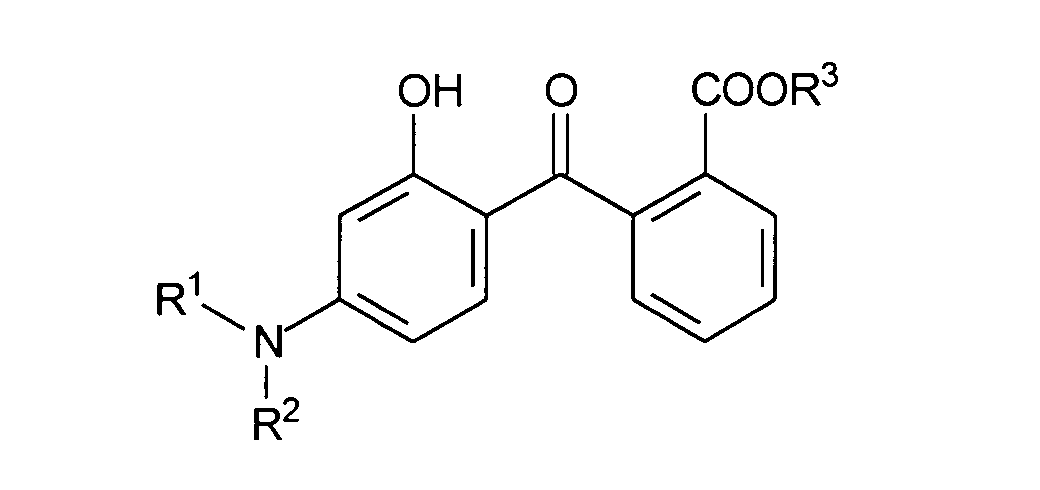
- a particularly advantageous hydroxybenzophenone in the context of the present invention is 2- (4'-diethylamino-2'-hydoxybenzoyl) benzoic acid hexyl ester (also: aminobenzophenone), which is distinguished by the following structure: and is available under the Uvinul A Plus from BASF.
- UV filter substances in the sense of the present invention are also so-called Broadband filter, i.e. Filter substances that contain both UV-A and UV-B radiation absorb.
- Another advantageous broadband filter for the purposes of the present invention is 2- (2H-benzotriazol-2-yl) -4-methyl-6- [2-methyl-3- [1,3,3,3-tetramethyl-1 - [(trimethylsilyl) oxy] disiloxanyl] propyl] phenol (CAS No .: 155633-54-8) with the INCI name Drometrizole Trisiloxane.
- Sulfonic acid derivatives of 3-benzylidene camphor such as. B. 4- (2-oxo-3-bornylidenemethyl) benzenesulfonic acid, 2-methyl-5- (2-oxo-3-bornylidenemethyl) sulfonic acid and their Salts.
- a further light protection filter substance to be used advantageously according to the invention is the ethylhexyl-2-cyano-3,3-diphenylacrylate (octocrylene), which is available from BASF under the Name Uvinul® N 539 T is available.
- octocrylene ethylhexyl-2-cyano-3,3-diphenylacrylate
- Particularly advantageous preparations in the sense of the present invention are: characterized by a high or very high UV-A protection, contained in addition to the or the filter substance (s) according to the invention preferably further UV-A and / or Broadband filters, especially dibenzoylmethane derivatives [for example the 4- (tert-butyl) -4'-methoxydibenzoylmethane] and / or the 2,4-bis - ⁇ [4- (2-ethylhexyloxy) -2-hydroxy] phenyl ⁇ -6- (4-methoxyphenyl) -1,3,5-triazine and / or phenylene-1,4-bis (2-benzimidazyl) -3,3'-5,5'-tetrasulfonic acid bis-sodium salt individually or in any combination together.
- dibenzoylmethane derivatives for example the 4- (tert-butyl) -4'-methoxydibenzoylmethane
- UV filters mentioned used in the sense of the present invention of course, should not be limiting.
- the preparations according to the present invention advantageously contain the substances absorb the UV radiation in the UV-A and / or UV-B range, in a total amount from Z. B. 0.1 wt .-% to 30 wt .-%, preferably 0.5 to 20 wt .-%, in particular 1.0 to 15.0% by weight, based in each case on the total weight of the preparations, to provide cosmetic preparations that protect the hair or skin protect the entire range of ultraviolet radiation.
Landscapes
- Health & Medical Sciences (AREA)
- Life Sciences & Earth Sciences (AREA)
- Veterinary Medicine (AREA)
- Animal Behavior & Ethology (AREA)
- General Health & Medical Sciences (AREA)
- Public Health (AREA)
- Chemical & Material Sciences (AREA)
- Birds (AREA)
- Epidemiology (AREA)
- Dermatology (AREA)
- Dispersion Chemistry (AREA)
- Oil, Petroleum & Natural Gas (AREA)
- Cosmetics (AREA)
- Acyclic And Carbocyclic Compounds In Medicinal Compositions (AREA)
Abstract
Description
- feinste Verteilung der beiden Phasen ineinander Je kleiner die dispergierten Teilchen sind, umso stabiler ist die Emulsion.
- hohe Viskosität der äußeren Phase
- ein stabiler Grenzflächenfilm
- ein ausgewogenes Phasenvolumenverhältnis

| RNH2 +CH2CH2COOH X- | (bei pH=2) | X- = beliebiges Anion, z.B. Cl- |
| RNH2 +CH2CH2COO- | (bei pH=7) | |
| RNHCH2CH2COO- B+ | (bei pH=12) | B+ = beliebiges Kation, z.B. Na+ |

Die makroskopisch sichtbaren Phasen bzw. Schichten lassen sich vorteilhaft - zum Beispiel durch Schütteln - kurzfristig zu einer homogenen Emulsion emulgieren, welche aber nicht langzeitstabil ist, sondern sich vielmehr über einen Zeitraum von Minuten, Stunden oder Tagen wieder zu zwei oder mehr übereinander geschichteten Phasen entmischt. Es ist besonders vorteilhaft im Sinne der vorliegenden Erfindung, wenn mindestens eine der makroskopisch sichtbaren Phasen eine Mikroemulsion und mindestens eine andere der makroskopisch sichtbaren Phasen eine Ölphase darstellt.
- ihre Lipophilie ist abhängig von der Temperatur, dergestalt daß durch Erhöhung der Temperatur die Lipophilie zunimmt und durch Senkung der Temperatur die Lipophilie des Emulgators abnimmt.
- mindestens einen Silikonemulgator (W/S) mit einem HLB-Wert ≤ 8 und/oder mindestens einen W/O-Emulgator mit einem HLB-Wert < 7 und
- mindestens einen O/W-Emulgator mit einem HLB-Wert > 10 enthalten.
- Titandioxide (gecoatet und ungecoatet): z. B. Eusolex T-2000 von der Fa. Merck, Titandioxid MT-100 Z von der Fa. Tayca Corporation
- Zinkoxide z. B. Z-Cote und Z-Cote HP1 von der BASF AG, MZ -300, MZ -500 und MZ-505M von der Fa. Tayca Corporation
- Eisenoxide
Vorteilhafte Moisturizer im Sinne der vorliegenden Erfindung sind beispielsweise Glycerin, Milchsäure und/oder Lactate, insbesondere Natriumlactat, Butylenglykol, Propylenglykol, Biosaccaride Gum-1, Glycine Soja, Ethylhexyloxyglycerin, Pyrrolidoncarbonsäure und Harnstoff. Ferner ist es insbesondere von Vorteil, polymere Moisturizer aus der Gruppe der wasserlöslichen und/oder in Wasser quellbaren und/oder mit Hilfe von Wasser gelierbaren Polysaccharide zu verwenden. Insbesondere vorteilhaft sind beispielsweise Hyaluronsäure, Chitosan und/oder ein fucosereiches Polysaccharid, welches in den Chemical Abstracts unter der Registraturnummer 178463-23-5 abgelegt und z. B. unter der Bezeichnung Fucogel®1000 von der Gesellschaft SOLABIA S.A. erhältlich ist. Moisturizer können vorteilhaft auch als Antifaltenwirkstoffe zur Prophylaxe und Behandlung kosmetischer oder dermatologischer Hautveränderungen, wie sie z. B. bei der Hautalterung auftreten, verwendet werden.

wobei die einzelnen Reste R jeweils unabhängig voneinander Wasserstoff, C1-24-Alkyl (wie beispielsweise Methyl, Ethyl, Propyl) oder Aryl (wie beispielsweise Phenyl oder Tolyl), Alkenyl (wie beispielsweise Vinyl) bedeuten und das Gewichtsverhältnis der Einheiten R2SiO zu RSiO1,5 aus dem Bereich von 1 : 1 bis 30 : 1 gewählt wird;
- im Bereich von 1 bis 20 mol-% liegt, wenn das Organopolysiloxan nicht cyclisch ist und
- im Bereich von 1 bis 50 mol-% liegt, wenn das Organopolysiloxan cyclisch ist.
- "Fischsilber" (Guanin/Hypoxanthin-Mischkristalle aus Fischschuppen) und
- "Perlmutt" (vermahlene Muschelschalen)
| Gruppe | Belegung / Schichtdicke | Farbe |
| Silberweiße Perlglanzpigmente | TiO2: 40 - 60 nm | silber |
| Interferenzpigmente | TiO2: 60 - 80 nm | gelb |
| TiO2: 80 - 100 nm | rot | |
| TiO2: 100 - 140 nm | blau | |
| TiO2: 120 - 160 nm | grün | |
| Farbglanzpigmente | Fe2O3 | bronze |
| Fe2O3 | kupfer | |
| Fe2O3 | rot | |
| Fe2O3 | rotviolett | |
| Fe2O3 | rotgrün | |
| Fe2O3 | schwarz | |
| Kombinationspigmente | TiO2 / Fe2O3 | Goldtöne |
| TiO2 / Cr2O3 | grün | |
| TiO2 / Berliner Blau | tiefblau | |
| TiO2 / Carmin | rot |
Es ist auch vorteilhaft im Sinne der vorliegenden Erfindung, kosmetische und dermatologische Zubereitungen zu erstellen, deren hauptsächlicher Zweck nicht der Schutz vor Sonnenlicht ist, die aber dennoch einen Gehalt an weiteren UV-Schutzsubstanzen enthalten. So werden z. B. in Tagescrèmes oder Makeup-Produkten gewöhnlich UV-A- bzw. UV-B-Filtersubstanzen eingearbeitet. Auch stellen UV-Schutzsubstanzen, ebenso wie Antioxidantien und, gewünschtenfalls, Konservierungsstoffe, einen wirksamen Schutz der Zubereitungen selbst gegen Verderb dar. Günstig sind ferner kosmetische und dermatologische Zubereitungen, die in der Form eines Sonnenschutzmittels vorliegen.
| Handelsname | Coating | Hersteller |
| Z- Cote HP1 | 2% Dimethicone | BASF |
| Z- Cote | / | BASF |
| ZnO NDM | 5% Dimethicone | H&R |
| MZ- 303S | 3% Methicone | Tayca Corporation |
| MZ- 505S | 5% Methicone | Tayca Corporation |
| Handelsname | Coating | Hersteller |
| MT-100TV | Aluminiumhydroxid / Stearinsäure | Tayca Corporation |
| MT-100Z | Aluminiumhydroxid / Stearinsäure | Tayca Corporation |
| Eusolex T-2000 | Alumina / Simethicone | Merck KgaA |
| Titandioxid T805 (Uvinul TiO2) | Octyltrimethylsilan | Degussa |
| Tioveil AQ 10PG | Alumina / Silica | Solaveil / Uniquema |
| Eusolex T-aqua | Wasser/Alumina/Natriummetaphosphat | Merck |
- Phenylen-1,4-bis-(2-benzimidazyl)-3,3'-5,5'-tetrasulfonsäure und ihre Salze, besonders die entsprechenden Natrium-, Kalium- oder Triethanolammonium-Salze, insbesondere das Phenylen-1,4-bis-(2-benzimidazyl)-3,3'-5,5'-tetrasulfonsäure-bis-natriumsalz mit der INCI-Bezeichnung Disodium Phenyl Dibenzimidazol Tetrasulfonat (CAS-Nr.: 180898-37-7), welches beispielsweise unter der Handelsbezeichnung Neo Heliopan AP bei Haarmann & Reimer erhältlich ist;
- Salze der 2-Phenylbenzimidazol-5-sulfonsäure, wie ihr Natrium-, Kalium- oder ihr Triethanolammonium-Salz sowie die Sulfonsäure selbst mit der INCI Bezeichnung Phenylbenzimidazole Sulfonsäure (CAS.-Nr. 27503-81-7), welches beispielsweise unter der Handelsbezeichnung Eusolex 232 bei Merck oder unter Neo Heliopan Hydro bei Haarmann & Reimer erhältlich ist;
- 1,4-di(2-oxo-10-Sulfo-3-bornylidenmethyl)-Benzol (auch: 3,3'-(1,4-Phenylendimethylene)-bis-(7,7-dimethyl-2-oxo-bicyclo-[2.2.1]hept-1-ylmethan Sulfonsäure) und dessen Salze (besonders die entprechenden 10-Sulfato-verbindungen, insbesondere das entsprechende Natrium-, Kalium- oder Triethanolammonium-Salz), das auch als Benzol-1,4-di(2-oxo-3-bornylidenmethyl-10-sulfonsäure) bezeichnet wird. Benzol-1,4-di(2-oxo-3-bornylidenmethyl-10-sulfonsäure) hat die INCI-Bezeichnung Terephtalidene Dicampher Sulfonsäure (CAS.-Nr.: 90457-82-2) und ist beispielsweise unter dem Handelsnamen Mexoryl SX von der Fa. Chimex erhältlich;
- Sulfonsäure-Derivate des 3-Benzylidencamphers, wie z. B. 4-(2-Oxo-3-bornylidenmethyl)benzolsulfonsäure, 2-Methyl-5-(2-oxo-3-bornylidenmethyl)sulfonsäure und deren Salze.

- R1 und R2 unabhängig voneinander Wasserstoff, C1-C20-Alkyl, C3-C10-Cycloalkyl oder C3-C10-Cycloalkenyl bedeuten, wobei die Substituenten R1 und R2 gemeinsam mit dem Stickstoffatom, an das sie gebunden sind, einen 5- oder 6-Ring bilden können und
- R3 einen C1-C20-Alkyl Rest bedeutet.

- 2,4-Bis-{[4-(2-Ethyl-hexyloxy)-2-hydroxy]-phenyl}-6-(4-methoxyphenyl)-1,3,5-triazin (INCI: Bis-Ethylhexyloxylphenol Methoxyphenyl Triazin), welches unter der Handelsbezeichnung Tinosorb® S bei der CIBA-Chemikalien GmbH erhältlich ist;
- Dioctylbutylamidotriazon (INCI: Diethylhexyl Butamido Triazone), welches unter der Handelsbezeichnung UVASORB HEB bei Sigma 3V erhältlich ist;
- 4,4',4"-(1,3,5-Triazin-2,4,6-triyltriimino)-tris-benzoësäure-tris(2-ethylhexylester), auch: 2,4,6-Tris-[anilino-(p-carbo-2'-ethyl-1'-hexyloxy)]-1,3,5-triazin (INCI: Ethylhexyl Triazone), welches von der BASF Aktiengesellschaft unter der Warenbezeichnung UVI-NUL® T 150 vertrieben wird;
- 2-[4,6-Bis(2,4-dimethylphenyl)-1,3,5-triazin-2-yl]-5-(octyloxy)phenol (CAS Nr.: 2725-22-6).
- 3-Benzylidencampher-Derivate, vorzugsweise 3-(4-Methylbenzyliden)campher, 3-Benzylidencampher;
- 4-Aminobenzoesäure-Derivate, vorzugsweise 4-(Dimethylamino)-benzoesäure(2-ethylhexyl)ester, 4-(Dimethylamino)benzoesäureamylester;
- 2,4,6-Trianilino-(p-carbo-2'-ethyl-1'-hexyloxy)-1,3,5-triazin;
- Ester der Benzalmalonsäure, vorzugsweise 4-Methoxybenzalmalonsäuredi(2-ethylhexyl)ester;
- Ester der Zimtsäure, vorzugsweise 4-Methoxyzimtsäure(2-ethylhexyl)ester, 4-Methoxyzimtsäureisopentylester;
- Derivate des Benzophenons, vorzugsweise 2-Hydroxy-4-methoxybenzophenon, 2-Hydroxy-4-methoxy-4'-methylbenzophenon, 2,2'-Dihydroxy-4-methoxybenzophenon sowie
- an Polymere gebundene UV-Filter.
| 1. PIT - Emulsionen (Spray) | ||||||||
| 1 | 2 | 3 | 4 | 5 | 6 | 7 | 8 | |
| Glycerinmonostearat SE | 0,50 | 2,00 | 3,00 | 5,00 | 0,50 | 4,00 | ||
| Glyceryl lsostearat | 3,50 | 4,00 | 2,00 | |||||
| Isoceteth-20 | 0,50 | 2,00 | ||||||
| Ceteareth-12 | 5,00 | 1,00 | 3,50 | |||||
| Ceteareth-20 | 2,00 | 2,50 | 3,00 | |||||
| PEG-100 Stearat | 5,00 | 1,00 | 1,00 | 0,50 | ||||
| Cetyl Alkohol | 2,50 | 1,00 | 1,50 | 0,50 | 1,50 | |||
| Cetyl Palmitat | 0,50 | 1,00 | ||||||
| Cetyl Dimethicon Copolyol | 0,50 | 0,50 | 1,00 | |||||
| Polyglyceryl-2 Dipolyhydroxystearat | 0,75 | 0,25 | ||||||
| Aniso Triazin | 0,50 | 2,00 | 3,00 | |||||
| Butyl Methoxydibenzoylmethan | 1,50 | 1,00 | 5,00 | |||||
| Bisimidazylat | 2,00 | 1,00 | ||||||
| Terephthaliden Dicampher Sulfonsäure | 0,50 | 1,00 | ||||||
| Drometrizol Trisiloxan n | 2,00 | 3,00 | 1,00 | |||||
| Ethylhexyl Methoxycinnamat | 8,00 | 4,50 | 5,00 | 8,00 | ||||
| Ethylhexyl Salicylat | 4,00 | 3,50 | 4,00 | |||||
| Dioctyl Butamidotriazon | 3,00 | 2,00 | 2,00 | 1,50 | ||||
| Ethylhexyl Triazon | 2,00 | 4,00 | 1,50 | 3,00 | ||||
| Dimethicon Diethylbenzalmalonat | ||||||||
| 4-Methylbenzyliden Campher | 3,00 | |||||||
| Octocrylen | 5,00 | 8,00 | 7,50 | |||||
| Phenylbenzimidazol Sulfonsäure | 1,00 | 5,00 | 3,00 | 1,00 | ||||
| Decylglucosid | 0,01 | 0,10 | 1,00 | 0,20 | 0,20 | 0,20 | 0,50 | 0,10 |
| Methylen Bis-Benzotriazolyl Tetramethylbutylphenol | 1,00 | 5,00 | 10,0 | 3,00 | 1,00 | 3,00 | 3,00 | 0,50 |
| Pentanatrium-Ethylendiamin- | 0,05 | 0,10 | 1,00 | 0,01 | 0,10 | 0,50 | 0,50 | 0,10 |
| tetramethylenphosphonat | ||||||||
| Al-Stearat + TiO2 | 1,50 | |||||||
| C12-15 Alkyl Benzoat | 4,00 | |||||||
| Cocoglyceride | 3,00 | 3,00 | 2,50 | 3,50 | ||||
| Dicaprylyl Ether | 4,00 | |||||||
| Butylenglycol Dicaprylat/Dicaprat | 4,00 | 3,00 | ||||||
| Dicaprylyl Carbonat | 0,50 | 6,00 | ||||||
| Dibutyl Adipate | 2,50 | 3,00 | 1,00 | |||||
| Phenyltrimethicon | 2,00 | 3,00 | ||||||
| Cyclomethicon | 3,00 | 4,00 | ||||||
| PVP Hexadecen Copolymer | 1,00 | 1,50 | ||||||
| Glycerin | 10,0 | 5,00 | 7,50 | |||||
| Tocopherol | 1,00 | 0,75 | 0,50 | 1,00 | ||||
| Shea Butter | 2,00 | 0,50 | ||||||
| lodopropyl Butylcarbamat | 0,12 | 0,20 | 0,15 | |||||
| DMDM Hydantoin | 0,10 | |||||||
| Methylparaben | 0,50 | 0,25 | 0,45 | |||||
| Phenoxyethanol | 0,50 | 0,40 | 1,00 | 1,00 | ||||
| Octoxyglycerin | 0,30 | 1,00 | ||||||
| Ethanol | 2,00 | 7,50 | 4,00 | |||||
| Parfüm | 0,20 | 0,20 | 0,20 | 0,45 | 0,20 | |||
| Wasser | ad. 100 | ad. 100 | ad. 100 | ad. 100 | ad. 100 | ad. 100 | ad. 100 | ad. 100 |
| 2. ùHydrodispersions- und O/W - Sprays | ||||||||
| 1 | 2 | 3 | 4 | 5 | 6 | 7 | 8 | |
| Sodium Carbomer | 0,7 | 0,2 | 0,4 | 1,5 | ||||
| Acrylates/C10-30 Alky Acrylate Crosspolymer | 0,5 | 0,3 | 0,2 | 1,0 | 1,5 | |||
| Hydroxypropyl Cellulose | 0,5 | 1,0 | 0,5 | |||||
| Ceteareth-20 | 1,0 | 2,0 | ||||||
| PEG-40 Stearat | 2,0 | 1,0 | ||||||
| Cetyl Alkohol | 0,5 | 1,0 | ||||||
| Hydrogenated Cocoglyceride | 0,5 | 1,0 | ||||||
| Polyglyceryl-2 Dipolyhydroxystearat | 0,2 | 0,5 | ||||||
| Decylglucosid | 0,01 | 0,10 | 1,00 | 0,20 | 0,20 | 0,20 | 0,50 | 0,10 |
| Methylen Bis-Benzotriazolyl Tetramethylbutylphenol | 1,00 | 5,00 | 10,0 | 3,00 | 1,00 | 3,00 | 3,00 | 0,50 |
| Pentanatrium-Ethylendiamintetramethylen phosphonat | 0,05 | 0,10 | 1,00 | 0,01 | 0,10 | 0,50 | 0,50 | 0,10 |
| Aniso Triazin | 2,0 | 3,0 | 2,0 | 0,5 | ||||
| Butyl Methoxydibenzoylmethan | 0,5 | 1,0 | 0,5 | |||||
| Bisimidazylat | 0,5 | 0,5 | 3,0 | 0,5 | ||||
| Terephthaliden Dicampher Sulfonsäure | 0,5 | 0,5 | 0,5 | |||||
| Drometrizol Trisiloxan | 3,0 | 1,0 | 4,0 | |||||
| Ethylhexyl Methoxycinnamat | 10,0 | 7,5 | 5,0 | |||||
| Ethylhexyl Salicylat | 5,0 | 0,5 | 1,0 | |||||
| Homosalat | 4,0 | |||||||
| Octocrylen | 6,0 | 4,0 | 2,0 | 7,5 | 10,0 | |||
| Dimethicon Diethylbenzalmalonat | 4,0 | 6,0 | ||||||
| Dioctyl Butamidotriazon | 1,0 | 2,5 | 3,5 | |||||
| Ethylhexyl Triazon | 3,0 | 2,0 | 1,5 | 4,0 | ||||
| 4-Methylbenzyliden Campher | 2,0 | 2,0 | ||||||
| Phenylbenzmidazol Sulfonsäure | 1,0 | 2,0 | ||||||
| Titandioxid | 2,0 | 3,0 | 0,5 | 4,0 | 1,5 | |||
| Zinkoxid | 3,0 | 1,0 | ||||||
| C12-15 Alkyl Benzoat | 5,0 | 5,0 | ||||||
| Cocoglyceride | 2,5 | 8,0 | 4,0 | |||||
| Dicaprylyl Ether | 5,0 | |||||||
| Butylenglycol Dicaprylat/Dicaprat | 7,5 | 6,0 | ||||||
| Dicaprylyl Carbonat | 4,0 | 10,0 | ||||||
| Paraffinöl | 7,0 | |||||||
| Dimethicon | 5,0 | 2,5 | 1,0 | |||||
| PVP Hexadecen Copolymer | 0,75 | 0,5 | 1,0 | 1,0 | ||||
| Glycerin | 0,3 | 10,0 | 7,5 | 5,0 | 5,0 | 7,5 | ||
| Vitamin E -Acetat | 0,5 | 0,75 | 1,0 | 1,5 | ||||
| Ascorbyl - Palmitat | 0,5 | 0,25 | 0,75 | |||||
| Vaseline | 2,0 | 1,0 | ||||||
| DMDM Hydantoin | 0,12 | 0,2 | ||||||
| lodopropyl Butylcarbamat | 0,18 | 0,2 | ||||||
| Glycin Soja | 1,5 | 2,0 | ||||||
| Propylparaben | 0,02 | 0,1 | ||||||
| Phenoxyethanol | 1,0 | 1,0 | 0,75 | |||||
| Ethanol | 3,0 | 7,5 | 5,0 | 3,5 | ||||
| Trisodium EDTA | 0,1 | 0,3 | 0,5 | 0,2 | 0,15 | |||
| Farbstoff wasserlöslich | 0,02 | 0,10 | ||||||
| Parfüm | 0,4 | 0,2 | 0,3 | 0,3 | 0,1 | |||
| Wasser | ad. 100 | ad. 100 | ad. 100 | ad. 100 | ad. 100 | ad. 100 | ad. 100 | ad. 100 |
| 3. W/O-Emulsion | ||||||
| 1 | 2 | 3 | 4 | 5 | 6 | |
| Polyglyceryl-3 Diisostearat | 6,0 | |||||
| Polyglyceryl-2 Dipolyhydroxystearat | 5,0 | 6,0 | 3,0 | |||
| PEG-30 Dipolyhydroxystearat | 5,5 | |||||
| Cetyl Dimethicon Copolyol | 1,5 | 4,0 | ||||
| Laurylmethicon Copolyol | 4,0 | |||||
| Aminobenzophenon | 5,0 | |||||
| Aniso Triazin | 2,0 | 0,5 | ||||
| Dioctyl Butamidotriazon | 1,0 | 2,5 | 2,0 | |||
| Ethylhexyl Triazon | 2,0 | |||||
| Bisoctyltriazol | 1,5 | 4,0 | ||||
| Drometrizol Trisiloxan | 2,0 | 3,0 | ||||
| Phenylbenzmidazole Sulfonsäure | 1,0 | |||||
| Bisimidazylate | 2,5 | 2,0 | 2,0 | |||
| Terephthalylidene Dicamphor Sulfonic Acid | 0,75 | |||||
| Ethylhexyl Methoxycinnamat | 7,5 | 5,0 | ||||
| Octocrylen | 5,0 | 10,0 | ||||
| Dimethicone-diethylbenzalmalonat | 7,0 | |||||
| Ethylhexyl Salicylate | 5,0 | |||||
| Homosalate | 3,5 | |||||
| Butyl Methoxydibenzoylmethan | 1,5 | |||||
| 4-Methylbenzylidene Campher | 3,0 | |||||
| Methylen Bis-Benzotriazolyl Tetramethylbutylphenol | 1,00 | 5,00 | 10,0 | 3,00 | 3,00 | 3,00 |
| Decylglucosid | 0,01 | 0,10 | 1,00 | 0,20 | 0,20 | 0,50 |
| Pentanatrium-Ethylendiamintetramethylenphosphonat | 0,05 | 0,10 | 1,00 | 0,01 | 0,50 | 0,50 |
| Mikronisiertes Titandioxid | 3,0 | 6,0 | 2,0 | 2,0 | ||
| Mikronisiertes Zinkoxid | 7,0 | |||||
| Paraffinöl | 20,0 | 15,0 | 10,0 | 15,0 | ||
| Vaseline | 2,0 | 5,0 | ||||
| Cyclomethicon | 10,0 | |||||
| Dimethicon | 4,0 | 3,0 | ||||
| Dicaprylylcarbonat | 10,0 | 9,0 | 10,0 | |||
| C12-15 Alkyl Benzoat | 5,0 | 10,0 | 9,0 | |||
| Butylen Glycol Dicaprylat/Dicaprat | 10,0 | 10,0 | ||||
| Octyldodecanol | 10,0 | 15,0 | 5,0 | |||
| Magnesiumsulfat | 0,7 | 0,5 | 0,4 | 1,0 | ||
| Glycerin | 10,0 | 5,0 | 7,5 | 3,0 | ||
| Parfum | 0,45 | 0,2 | 0,3 | 0,4 | ||
| Ethanol | 3,5 | 5,0 | ||||
| Octoxyglycerin | 0,5 | 1,0 | ||||
| Tocopherol oder Tocopherolacetat | 0,5 | 0,75 | 0,3 | 0,5 | ||
| Trisodium EDTA | 0,1 1 | 0,2 | 0,1 | 0,3 | ||
| Phenonip ® | 0,4 | 0,5 | 0,5 | |||
| DMDM Hydantoin | 0,1 | 0,2 | ||||
| Wasser | ad 100 | ad 100 | ad 100 | ad 100 | ad 100 | ad 100 |
| 4. W/O - Sonnenschutzemulsionen | ||||||
| 7 | 8 | 9 | 10 | 11 | 12 | |
| PEG-7 Hydrogenated Castor Oil | 5,0 | |||||
| Polyglyceryl-2 Dipolyhydroxystearat | 6,0 | 4,0 | 2,0 | |||
| PEG-30 Dipolyhydroxystearat | 5,0 | 1,0 | ||||
| Cetyl Dimethicon Copolyol | 0,5 | 1,0 | ||||
| Polyglyceryl Polyricinoleat | 5,0 | 1,5 | ||||
| Aminobenzophenon | 5,0 | 2 5 | ||||
| Aniso Triazin | 2,0 | 2,0 | 1,0 | 0,5 | 3,0 | |
| Dioctyl Butamidotriazon | 2 0 | 1,0 | 3,0 | |||
| Ethylhexyl Triazon | 2,0 | 4,0 | ||||
| Bisoctyltriazol | 4,0 | 4,0 | ||||
| Drometrizol Trisiloxan | 3,0 | 4,0 | ||||
| Phenylbenzmidazole Sulfonsäure | 2,5 | 0,5 | 2,0 | 1,0 | ||
| Bisimidazylate | 2,0 | 1,5 | ||||
| Terephthalylidene Dicamphor Sulfonic Acid | 0,5 | |||||
| Ethylhexyl Methoxycinnamat | 10,0 | |||||
| Octocrylen | 5,0 | 7,5 | ||||
| Dimethicone-diethylbenzalmalonat | 4,0 | |||||
| Ethylhexyl Salicylate | 3,0 | |||||
| Homosalate | 4,0 | 5,0 | ||||
| Butyl Methoxydibenzoylmethan | 3,0 | 1,0 | 2,5 | |||
| Methylen Bis-Benzotriazolyl Tetramethylbutylphenol | 1,00 | 10,0 | 3,00 | 1,00 | 3,00 | 0,50 |
| Decylglucosid | 0,01 | 1,00 | 0,20 | 0,20 | 0,50 | 0,10 |
| Pentanatrium-Ethylendiamintetramethylenphosphonat | 0,05 | 1,00 | 0,01 | 0,10 | 0,50 | 0,10 |
| Mikronisiertes Titandioxid | 5,0 | 3,0 | ||||
| Mikronisiertes Zinkoxid | 5,0 | 3,0 | 8,0 | |||
| Isohexadecen | 10,0 | 5,0 | 15,0 | |||
| Coco-Caprylat/Caprat | 6,0 | 5,0 | 10,0 | 4,5 | ||
| Cetyl Dimethicon | 1,0 | 0,75 | ||||
| Dimethicon | 2,5 | 4,0 | 5,5 | |||
| Polydecen | 10,0 | 7,0 | ||||
| C12-15 Alkyl Benzoat | 9,0 | 4,0 | 10,0 | |||
| Polyisobuten | 0,5 | 2,0 | 1,0 | |||
| Natriumchlorid | 0,45 | 0,55 | 0,6 | 1,5 | ||
| Butylen Glycol | 10,0 | 7,5 | 15,0 | 5,0 | ||
| Parfum | 0,4 | 0,15 | 0,5 | |||
| Glycin Soja | 2,0 | 1,0 | 1,0 | |||
| Ethanol | 5,0 | 5,0 | ||||
| Tocopherol oder Tocopherolacetat | 0,5 | 0,75 | 0,3 | 1,0 | ||
| Trisodium EDTA | 0,2 | 0,4 | 0,2 | |||
| Phenoxyethanol | 0,5 | 1,0 | 1,0 | |||
| DMDM Hydantoin | 0,05 | 0,1 | 0,2 | |||
| Wasser | ad 100 | ad 100 | ad 100 | ad 100 | ad 100 | ad 100 |
| 5. O/W-Emulsionen | ||||||
| 1 | 2 | 3 | 4 | 5 | 6 | |
| Glycerylstearat Citrat | 2.00 | 1.50 | 3.00 | |||
| Glycerylstearat SE | 2.00 | |||||
| Glycerylstearat | 2.00 | 2.00 | ||||
| PEG-40 Stearat | 2.00 | |||||
| Stearinsäure | 3.00 | 2.00 | ||||
| Caprylic/Capric Triglycerid | 0.50 | 1.00 | 1.50 | |||
| Cetearyl Alkohol | 3.00 | 1.00 | 2.00 | |||
| Cetyl Alkohol | 3.00 | 2.00 | ||||
| Stearyl Alkohol | 1.00 | 0.50 | 2.00 | |||
| Lanolin Alkohol | 0.50 | 0.50 | 0.50 | |||
| Myristyl Alkohol | 3.00 | 2.00 | ||||
| Octyldodecanol | 1.50 | |||||
| Mineralöl | 2.00 | |||||
| Methylen Bis-Benzotriazolyl Tetramethylbutylphenol | 1,00 | 10,0 | 3,00 | 1,00 | 3,00 | 3,00 |
| Decylglucosid | 0,01 | 1,00 | 0,20 | 0,20 | 0,20 | 0,50 |
| Pentanatrium-Ethylendiamintetramethylenphosphonat | 0,05 | 1,00 | 0,01 | 0,10 | 0,50 | 0,50 |
| Dimethicodiethylbenzalmalonat | 5,00 | |||||
| Ethylhexyl Methoxycinnamat | 6,50 | 5,00 | 10,00 | |||
| Bis-Ethylhexyloxyphenol methoxyphenyl Triazin | 2,50 | 2,00 | 1,50 | 1,00 | ||
| Butyl Methoxydibenzoylmethan | 1,10 | 1,00 | 2,00 | |||
| Phenyl Dibenzimidazol Tetrasulfonsäure | 0,50 | 2,00 | ||||
| Ethylhexyl Triazon | 2,20 | |||||
| 4-Methylbenzyliden Campher | 2,00 | |||||
| Octocrylen | 5,00 | 3,50 | ||||
| Diethylhexyl Butamido Triazon | 1,00 | 3,00 | 1,50 | |||
| Phenylbenzmidazol Sulfonsäure | 1,00 | 2,00 | ||||
| Drometrizol Trisiloxan | 2,00 | |||||
| Terephthaliden Dicamphor Sulfonsäure | 0,50 | |||||
| Benzophenon-3 | 2,00 | |||||
| Ethylhexyl Salicylat | 5,00 | |||||
| Homosalat | 3,00 | |||||
| Isoamyl p-Methoxycinnamat | 1,00 | |||||
| Titandioxid Aluminiumhydroxid/Stearinsäure coating | 2,00 | 1,50 | 3,00 | 1,00 | ||
| Zinkoxid HP1 | 1,00 | |||||
| C12-C15 Alkyl Benzoat | 2.00 | 1.50 | 2.50 | 0.80 | ||
| Dicaprylyl Carbonat | 3.00 | 2.00 | ||||
| Butylenglycol Dicaprylat/Dicaprat | 5.00 | 6.50 | 4.50 | 3.00 | ||
| Butylenglycol | 7.50 | 4.50 | 5.00 | |||
| Carbomer | 0.30 | 0.10 | 0.20 | 0.30 | 0.35 | |
| Dicaprylyl Ether | 2.50 | 0.50 | 2.00 | 1.50 | ||
| PVP/Hexadecen Copolymer | 1.00 | 0.80 | 1.00 | 0,50 | ||
| Xanthan Gum | 0.20 | 0.40 | 0.60 | 0.30 | ||
| Dimethicon | 2.00 | 1.00 | ||||
| Cyclomethicon | 2.50 | |||||
| Tocopheryl Acetat | 1.00 | 0.50 | ||||
| Glycerin | 5.00 | 7.50 | 3.50 | 2.00 | ||
| Farbstoff (wasser- und/oder öllöslich) | 0.25 | 0.15 | ||||
| DMDM Hydantoin | 0.20 | 0.40 | ||||
| Propylparaben | 0.40 | 0.25 | ||||
| Methylparaben | 0.60 | 0.30 | ||||
| Ethanol | 1.50 | |||||
| Konkaben LMB ® | 0.20 | |||||
| Trinatrium EDTA | 1.00 | 1.00 | ||||
| Phenoxyethanol | 0.15 | 0.30 | 0.50 | 0.40 | ||
| Parfüm | q.s. | q.s. | q.s. | q.s. | q.s. | q.s. |
| Aqua | Ad 100 | Ad 100 | Ad 100 | Ad 100 | Ad 100 | Ad 100 |
| 6. O/W-Emulsionen | |||||||
| 7 | 8 | 9 | 10 | 11 | 12 | 13 | |
| Polyglyceryl 3-Methylglucose Distearat | 3.00 | ||||||
| Glycerylstearat Citrat | 2.50 | ||||||
| Glycerylstearat SE | 3.00 | 2.00 | 3.00 | ||||
| PEG-40 Stearat | 1.00 | ||||||
| PEG-100 Stearat | 1.00 | ||||||
| Sorbitan Stearat | 1.00 | ||||||
| Natrium Cetearyl Sulfat | 1.00 | 0.50 | |||||
| Cetearylpolyglucosid | 2.00 | ||||||
| Caprylic/Capric Triglycerid | 1.50 | 1.00 | |||||
| Cetearyl Alkohol | 2.00 | ||||||
| Cetyl Alkohol | 1.00 | 1.00 | |||||
| Stearyl Alkohol | 5.00 | ||||||
| Behenyl Alkohol | 1.00 | ||||||
| Octyldodecanol | 2.00 | ||||||
| Mineralöl | 1.50 | ||||||
| Ethylhexyl Methoxycinnamat | 8,00 | 3.00 | 4,00 | ||||
| Bis-Ethylhexyloxyphenol methoxyphenyl Triazin | 2,00 | 1,50 | 2.00 | 2,00 | |||
| Butyl Methoxydibenzoylmethan | 3,00 | 1,00 | |||||
| Phenyl Dibenzimidazol Tetrasulfonsäure | 1,50 | 0,50 | |||||
| Ethylhexyl Triazon | 2,50 | 4,00 | 2,00 | ||||
| 4-Methylbenzyliden Camphor | 2,00 | ||||||
| Octocrylen | 5,00 | ||||||
| Diethylhexyl Butamido Triazon | 2,50 | 1,50 | 1,00 | ||||
| Phenylbenzmidazol Sulfonsäure | 2,00 | 1,00 | |||||
| Methylen Bis-Benzotriazolyl Tetramethylbutylphenol | 1,00 | 10,0 | 3,00 | 1,00 | 1,00 | 3,00 | 0,50 |
| Decylglucosid | 0,01 | 1,00 | 0,20 | 0,20 | 0,10 | 0,50 | 0,10 |
| Pentanatrium-Ethylendiamintetramethylenphosphonat | 0,05 | 1,00 | 0,01 | 0,10 | 0,50 | 0,50 | 0,10 |
| Ethylhexyl Salicylat | 4,00 | ||||||
| Homosalat | 4,50 | ||||||
| Titandioxid Silikon coating | 3,00 | 2,00 | 1,00 | 2,00 | |||
| Zinkoxid HP-1 | 2,00 | 3,00 | |||||
| C12-C15 Alkyl Benzoat | 2.00 | 1.50 | 2.50 | 0.80 | |||
| Dicaprylyl Carbonat | 3.00 | 2.00 | |||||
| Butylenglycol Dicaprylat/Dicaprat | 5.00 | 6.50 | 4.50 | 3.00 | |||
| Butylenglycol | 7.50 | 4.50 | 9.00 | 5.00 | |||
| Carbomer | 0.30 | 0.10 | 0.20 | 0.30 | 0.35 | ||
| Tocopheryl Acetat | 0.30 | 0.50 | 0.50 | 0.80 | |||
| Dicaprylyl Ether | 2.50 | 0.50 | 2.00 | 1.50 | |||
| PVP/Hexadecen Copolymer | 1.00 | 0.80 | 1.00 | 0,50 | |||
| Xanthan Gum | 0.20 | 0.40 | 1,00 | 0.60 | 0.30 | ||
| Dimethicon | 2.00 | 1.00 | |||||
| Cyclomethicon | 2.50 | 5.00 | |||||
| Glycerin | 5.00 | 7.50 | 4,00 | 3.50 | 2.00 | ||
| Farbstoff (wasser- und/oder öllöslich) | 0.15 | 0.25 | 0.20 | 0.10 | |||
| DMDM Hydantoin | 0.20 | 0.40 | |||||
| Parabene | 0.60 | 0.30 | |||||
| Ethanol | 5,00 | 1.50 | |||||
| Konkaben LMB ® | 0.20 | ||||||
| Trinatrium EDTA | 1.00 | 0,50 | |||||
| Phenoxyethanol | 0.15 | 0.30 | 0.50 | 0.40 | |||
| Parfüm | q.s. | q.s. | q.s. | q.s. | q.s. | q.s. | q.s. |
| Aqua | Ad 100 | Ad 100 | Ad 100 | Ad 100 | Ad 100 | Ad 100 | Ad 100 |
| 7. schäumende Emulsionen | ||||
| 1 | 2 | 3 | 4 | |
| Stearinsäure | 2,00 | |||
| Cetylalkohol | 2,00 | |||
| PEG-40 Stearat | 1.50 | |||
| Sorbitan Stearat | 0,50 | |||
| Hydrogenated Polyisobuten | 2,50 | |||
| Beheneth-9 | 4,50 | |||
| Dicaprylyl Ether | 8,00 | 7,00 | ||
| Butylenglycol Dicaprylat/Caprat | 4,00 | |||
| Cetearyl Isononanoat | 4,00 | |||
| Glyceryl Stearat | 2,00 | |||
| Octyl Palmitate | 8,00 | |||
| Ceteareth 20 | 1,50 | 2,00 | ||
| Ceteareth 12 | 3,00 | |||
| Ethylhexyl Methoxycinnamat | 4,00 | 6,80 | ||
| Bis-Ethylhexyloxyphenol methoxyphenyl Triazin | 2,60 | 2,00 | ||
| Butyl Methoxydibenzoylmethan | 2,00 | |||
| Phenyl Dibenzimidazol Tetrasulfonsäure | 1,00 | 1,50 | ||
| Ethylhexyl Triazon | 1,80 | 2,50 | ||
| 4-Methylbenzyliden Camphor | 3,00 | |||
| Octocrylen | 6,00 | 8,50 | ||
| Diethylhexyl Butamido Triazon | 1,50 | 3,00 | ||
| Phenylbenzmidazol Sulfonsäure | 1,00 | |||
| Methylen Bis-Benzotriazolyl Tetramethylbutylphenol | 1,00 | 10,0 | 3,00 | 1,00 |
| Decylglucosid | 0,01 | 1,00 | 0,20 | 0,20 |
| Pentanatrium-Ethylendiamintetramethylenphosphonat | 0,05 | 1,00 | 0,01 | 0,10 |
| Ethylhexyl Salicylat | 6,00 | |||
| Homosalat | 5,00 | |||
| Titandioxid Aluminium/Stearinsäure coating | 1,50 | |||
| Zinkoxid HP-1 | 2,00 | |||
| Cocoyl amidopropyl Betain | 4.00 | 2.00 | ||
| Dimethicone Copolyol | 1.50 | |||
| Decyl Glycoside | 2.50 | 2.00 | ||
| Natrium Laurylethersulfat SLES | 4,00 | 3,00 | ||
| Glycerin | 5,00 | 2.00 | 3.20 | |
| PVP/Hexadecen Copolymer | 1.00 | |||
| Farbstoff (wasser- und/oder öllöslich) | 0.20 | 0.10 | ||
| Cyclomethicon | 3,00 | |||
| Parabene | 1,50 | |||
| Phenoxyethanol | 0.20 | 0.15 | 0.10 | |
| DMDM Hydantoin | 0.40 | |||
| Natronlauge | q.s. | |||
| Parfüm | q.s. | q.s. | q.s. | q.s. |
| Aqua | Ad 100 | Ad 100 | Ad 100 | Ad 100 |
Claims (8)
- Kosmetische und dermatologische Emulsionen, enthaltendA. ein oder mehrere Tenside,B. eine oder mehrere pigmentäre organische Substanzen undC. Pentanatrium-Ethylendiamintetramethylenphosphonat.
- Verwendung von Pentanatrium-Ethylendiamintetramethylenphosphonat zum Erzielen oder Erhöhen der Stabilität von Emulsionen gegenüber der Gegenwart von Tensiden.
- Emulsionen nach Anspruch 1 oder Verwendung nach Anspruch 2, dadurch gekennzeichnet, daß die Emulsion eine O/W-Formulierung ist.
- Emulsionen nach Anspruch 1 oder Verwendung nach Anspruch 2, dadurch gekennzeichnet, daß die Zubereitung mindestens eine UV-Filtersubstanz, gewählt aus der Gruppe Triazine, Campherderivate und organische und/oder anorganische Pigmente, enthält.
- Emulsionen nach Anspruch 1 oder Verwendung nach Anspruch 2, dadurch gekennzeichnet, daß die Zubereitung mindestens eine UV-A-Filtersubstanz und/oder einen Breitbandfilter, gewählt aus der Gruppe Dibenzoylmethanderivate [insbesondere das 4-(tert.-Butyl)-4'-methoxydibenzoylmethan], 2,2'-Methylen-bis-(6-(2H-benzotriazol-2-yl)-4-(1,1,3,3-tetramethylbutyl)-phenol), 1 ,4-di(2-oxo-1 0-Sulfo-3-bornylidenmethyl)-Benzol und dessen Salze und 2,4-Bis-{[4-(2-Ethyl-hexyloxy)-2-hydroxy]-phenyl}-6-(4-methoxyphenyl)-1,3,5-triazin, enthält, wobei die weiteren Filtersubstanzen jeweils einzeln oder in beliebigen Kombinationen miteinander vorliegen können.
- Emulsionen nach Anspruch 1 oder Verwendung nach Anspruch 2, dadurch gekennzeichnet, daß die Zubereitung mindestens ein Flavonglycosid, insbesondere α-Glucosylrutin, und/oder Vitamin E und/oder dessen Derivate enthält.
- Verwendung von Zubereitungen nach Anspruch 5 oder 6 zum Schutz der Haut vor vorzeitiger Alterung.
- Verwendung von Zubereitungen nach einem der vorhergehenden Ansprüche zur Hautbefeuchtung.
Applications Claiming Priority (2)
| Application Number | Priority Date | Filing Date | Title |
|---|---|---|---|
| DE10307468 | 2003-02-21 | ||
| DE10307468A DE10307468A1 (de) | 2003-02-21 | 2003-02-21 | Kosmetische und dermatologische Emulsionen |
Publications (2)
| Publication Number | Publication Date |
|---|---|
| EP1454619A1 true EP1454619A1 (de) | 2004-09-08 |
| EP1454619B1 EP1454619B1 (de) | 2008-02-20 |
Family
ID=32797622
Family Applications (1)
| Application Number | Title | Priority Date | Filing Date |
|---|---|---|---|
| EP04003572A Expired - Lifetime EP1454619B1 (de) | 2003-02-21 | 2004-02-18 | Kosmetische und dermatologische Emulsionen |
Country Status (4)
| Country | Link |
|---|---|
| EP (1) | EP1454619B1 (de) |
| AT (1) | ATE386572T1 (de) |
| DE (2) | DE10307468A1 (de) |
| ES (1) | ES2301891T3 (de) |
Cited By (8)
| Publication number | Priority date | Publication date | Assignee | Title |
|---|---|---|---|---|
| FR2871686A1 (fr) * | 2004-06-17 | 2005-12-23 | Lcw Les Colorants Wackherr Sa | Composition anti-decoloration |
| DE102004060314A1 (de) * | 2004-12-08 | 2006-08-31 | Beiersdorf Ag | Wirkstoffkombinationen aus einem oder mehreren Isoflavonoiden und Carnitin und/oder einem oder mehreren Acyl-Carnitinen |
| WO2010007077A3 (en) * | 2008-07-16 | 2010-07-22 | Dsm Ip Assets B.V. | Cosmetic composition comprising pentasodium (ethylenediamine) tetramethylenephosphonate |
| WO2013113746A2 (en) | 2012-01-31 | 2013-08-08 | Pierre Fabre Dermo-Cosmetique | Composition and combination of bmdbm photostabilizers and sunscreens |
| WO2015165713A1 (de) * | 2014-04-28 | 2015-11-05 | Beiersdorf Ag | Sonnenschutzmittel mit reduzierter neigung zur textilverfleckung iv |
| WO2015165711A1 (de) * | 2014-04-28 | 2015-11-05 | Beiersdorf Ag | Sonnenschutzmittel mit reduzierter neigung zur textilverfleckung i |
| WO2015165710A1 (de) * | 2014-04-28 | 2015-11-05 | Beiersdorf Ag | Sonnenschutzmittel mit reduzierter neigung zur textilverfleckung ii |
| CN115137671A (zh) * | 2022-04-29 | 2022-10-04 | 山东花物堂生物科技有限公司 | 一种奶盖质地的精华液及其制备方法 |
Families Citing this family (2)
| Publication number | Priority date | Publication date | Assignee | Title |
|---|---|---|---|---|
| DE102004003435A1 (de) * | 2004-01-21 | 2005-08-11 | Beiersdorf Ag | Dünnflüssige O/W-Emulsion |
| DE102004047286B4 (de) * | 2004-09-27 | 2006-11-23 | Beiersdorf Ag | Kosmetische Lichtschutzzubereitung auf Basis von Mikropigmenten |
Citations (5)
| Publication number | Priority date | Publication date | Assignee | Title |
|---|---|---|---|---|
| US5352438A (en) * | 1991-05-03 | 1994-10-04 | L'oreal | Anti-free radical topical composition based on dismutase superoxide and a phosphonic derivative |
| EP0754446A2 (de) * | 1995-07-20 | 1997-01-22 | L'oreal | Verwendung von einem Antioxidant und/oder einem Antiradikal in einer filtrierende kosmetische oder dermatologische Zusammensetzung |
| US6174520B1 (en) * | 1995-07-20 | 2001-01-16 | Societe L'oreal S.A. | UVA photoprotective cosmetic/dermatological compositions comprising iron chelating agents |
| US6239174B1 (en) * | 1997-09-02 | 2001-05-29 | L'oreal | Emulsion containing ascorbic acid and its uses in the cosmetics and dermatological fields |
| EP1310239A1 (de) * | 2001-11-09 | 2003-05-14 | Beiersdorf AG | Kosmetische und dermatologische Lichtschutzformulierungen mit einem Gehalt an Hydroxybenzophenonen und Pentanatrium-Ethylendiamintetramethylenphosphonat |
Family Cites Families (1)
| Publication number | Priority date | Publication date | Assignee | Title |
|---|---|---|---|---|
| FR2674748B1 (fr) * | 1991-04-03 | 1995-01-13 | Oreal | Utilisation de sphingolipides dans la preparation d'une composition cosmetique ou dermopharmaceutique protegeant la peau et les cheveux contre les effets nocifs de la pollution atmospherique. |
-
2003
- 2003-02-21 DE DE10307468A patent/DE10307468A1/de not_active Withdrawn
-
2004
- 2004-02-18 ES ES04003572T patent/ES2301891T3/es not_active Expired - Lifetime
- 2004-02-18 EP EP04003572A patent/EP1454619B1/de not_active Expired - Lifetime
- 2004-02-18 DE DE502004006232T patent/DE502004006232D1/de not_active Expired - Lifetime
- 2004-02-18 AT AT04003572T patent/ATE386572T1/de not_active IP Right Cessation
Patent Citations (5)
| Publication number | Priority date | Publication date | Assignee | Title |
|---|---|---|---|---|
| US5352438A (en) * | 1991-05-03 | 1994-10-04 | L'oreal | Anti-free radical topical composition based on dismutase superoxide and a phosphonic derivative |
| EP0754446A2 (de) * | 1995-07-20 | 1997-01-22 | L'oreal | Verwendung von einem Antioxidant und/oder einem Antiradikal in einer filtrierende kosmetische oder dermatologische Zusammensetzung |
| US6174520B1 (en) * | 1995-07-20 | 2001-01-16 | Societe L'oreal S.A. | UVA photoprotective cosmetic/dermatological compositions comprising iron chelating agents |
| US6239174B1 (en) * | 1997-09-02 | 2001-05-29 | L'oreal | Emulsion containing ascorbic acid and its uses in the cosmetics and dermatological fields |
| EP1310239A1 (de) * | 2001-11-09 | 2003-05-14 | Beiersdorf AG | Kosmetische und dermatologische Lichtschutzformulierungen mit einem Gehalt an Hydroxybenzophenonen und Pentanatrium-Ethylendiamintetramethylenphosphonat |
Cited By (23)
| Publication number | Priority date | Publication date | Assignee | Title |
|---|---|---|---|---|
| EP2985018A1 (de) * | 2004-06-17 | 2016-02-17 | Sensient Cosmetic Technologies | Verfärbungen verhindernde zusammensetzung |
| WO2006005846A1 (fr) * | 2004-06-17 | 2006-01-19 | Lcw - Les Colorants Wackherr | Composition anti-decoloration |
| FR2871686A1 (fr) * | 2004-06-17 | 2005-12-23 | Lcw Les Colorants Wackherr Sa | Composition anti-decoloration |
| DE102004060314A1 (de) * | 2004-12-08 | 2006-08-31 | Beiersdorf Ag | Wirkstoffkombinationen aus einem oder mehreren Isoflavonoiden und Carnitin und/oder einem oder mehreren Acyl-Carnitinen |
| WO2010007077A3 (en) * | 2008-07-16 | 2010-07-22 | Dsm Ip Assets B.V. | Cosmetic composition comprising pentasodium (ethylenediamine) tetramethylenephosphonate |
| US20110182836A1 (en) * | 2008-07-16 | 2011-07-28 | Christine Mendrok-Edinger | Cosmetic composition |
| CN102099008B (zh) * | 2008-07-16 | 2013-11-20 | 帝斯曼知识产权资产管理有限公司 | 包含(乙二胺)四亚甲基磷酸戊钠的化妆品组合物 |
| WO2013113746A2 (en) | 2012-01-31 | 2013-08-08 | Pierre Fabre Dermo-Cosmetique | Composition and combination of bmdbm photostabilizers and sunscreens |
| EP2809295B1 (de) | 2012-01-31 | 2017-11-15 | Pierre Fabre Dermo-Cosmétique | Zusammensetzung und mischung aus uv-filter zur stabilizierung von butyl methoxydibenzoylmethane (bmdbm) |
| EP4623905A3 (de) * | 2012-01-31 | 2025-12-31 | Pierre Fabre Dermo-Cosmétique | Zusammensetzung und kombination von sonnenschutzmitteln zur photostabilisierung von butylmethoxydibenzoylmethan (bmdbm) |
| EP3299009B1 (de) | 2012-01-31 | 2025-08-13 | Pierre Fabre Dermo-Cosmétique | Zusammensetzung und kombination von butyl methoxydibenzoylethane (bmdbm)-fotostabilisatoren und sonnenschutz |
| EP3299009A1 (de) * | 2012-01-31 | 2018-03-28 | Pierre Fabre Dermo-Cosmétique | Zusammensetzung und kombination von butyl methoxydibenzoylethane (bmdbm)-fotostabilisatoren und sonnenschutz |
| CN106255489A (zh) * | 2014-04-28 | 2016-12-21 | 拜尔斯道夫股份有限公司 | 污染织物倾向性降低的防晒制剂iv |
| CN106456496A (zh) * | 2014-04-28 | 2017-02-22 | 拜尔斯道夫股份有限公司 | 污染织物倾向性降低的防晒制剂ii |
| WO2015165711A1 (de) * | 2014-04-28 | 2015-11-05 | Beiersdorf Ag | Sonnenschutzmittel mit reduzierter neigung zur textilverfleckung i |
| EP3137041B1 (de) | 2014-04-28 | 2019-11-06 | Beiersdorf AG | Sonnenschutzmittel mit reduzierter neigung zur textilverfleckung |
| EP3137043B1 (de) | 2014-04-28 | 2019-11-20 | Beiersdorf AG | Sonnenschutzmittel mit reduzierter neigung zur textilverfleckung iv |
| AU2015252336B2 (en) * | 2014-04-28 | 2019-12-12 | Beiersdorf Ag | Sunscreen having reduced tendency to stain textiles II |
| AU2015252337B2 (en) * | 2014-04-28 | 2020-07-23 | Beiersdorf Ag | Sunscreen having reduced tendency to stain textiles I |
| EP3137043B2 (de) † | 2014-04-28 | 2022-10-19 | Beiersdorf AG | Sonnenschutzmittel mit reduzierter neigung zur textilverfleckung iv |
| WO2015165713A1 (de) * | 2014-04-28 | 2015-11-05 | Beiersdorf Ag | Sonnenschutzmittel mit reduzierter neigung zur textilverfleckung iv |
| WO2015165710A1 (de) * | 2014-04-28 | 2015-11-05 | Beiersdorf Ag | Sonnenschutzmittel mit reduzierter neigung zur textilverfleckung ii |
| CN115137671A (zh) * | 2022-04-29 | 2022-10-04 | 山东花物堂生物科技有限公司 | 一种奶盖质地的精华液及其制备方法 |
Also Published As
| Publication number | Publication date |
|---|---|
| ES2301891T3 (es) | 2008-07-01 |
| DE502004006232D1 (de) | 2008-04-03 |
| ATE386572T1 (de) | 2008-03-15 |
| DE10307468A1 (de) | 2004-09-02 |
| EP1454619B1 (de) | 2008-02-20 |
Similar Documents
| Publication | Publication Date | Title |
|---|---|---|
| EP1458340A1 (de) | Kosmetische und dermatologische lichtschutzformulierungen mit einem gehalt an bis-resorcinyltriazinderivaten und benzoxazol-derivaten | |
| DE10162840A1 (de) | Kosmetische und dermatologische Lichtschutzformulierungen mit einem Gehalt an wasserlöslichen UV-Filtersubstanzen und Benzoxazol-Derivaten | |
| DE10162842A1 (de) | Kosmetische und dermatologische Lichtschutzformulierungen mit einem Gehalt an Benzotriazolen und Benzoxazol-Derivaten | |
| EP1352639A1 (de) | Kosmetische und dermatologische Formulierungen mit einem Gehalt an Hydroxybenzophenonen und einem oder mehreren vorgelatinisierten, quervernetzten Stärkederivaten | |
| EP1380288A1 (de) | Kosmetische und dermatologische Lichtschutzformulierungen an einem Gehalt an hydrophobisierten Acrylamidomethylpropylsulfonsäure-Polymeren | |
| EP1458339A1 (de) | Kosmetische und dermatologische lichtschutzformulierungen mit einem gehalt an benzoxazol-derivaten | |
| EP1458342A1 (de) | Komestiche und dermatologische lichtschutzformulierungen mit einem gehalt an hydroxybenzophenonen und benzoxazol-derivaten | |
| EP1454619B1 (de) | Kosmetische und dermatologische Emulsionen | |
| EP1449516A1 (de) | Kosmetische und dermatologische Emulsionen Phosphorsäureester enthaltend | |
| DE10214054A1 (de) | Wasserfeste kosmetische und dermatologische Lichtschutzformulierungen mit einem Gehalt an Alpha Olefin/Maleinsäureanhydrid-Copolymeren | |
| DE10214058A1 (de) | Wasserfeste kosmetische und dermatologische Lichtschutzformulierungen mit einem Gehalt an Polyoxyethylen-Polydodecylglykol-Blockpolymeren | |
| DE10214053A1 (de) | Wasserfeste kosmetische und dermatologische Lichtschutzformulierungen mit einem Gehalt an Acrylat-Alkylmethacrylat-Copolymeren | |
| DE10214052A1 (de) | Wasserfeste kosmetische und dermatologische Lichtschutzformulierungen mit einem Gehalt an acetylierten Stearinsäureestern | |
| DE10307467A1 (de) | Kosmetische und dermatologische Emulsionen | |
| DE102004002612A1 (de) | Visualisierung von Sonnenschutzmitteln auf der Haut | |
| DE10214059A1 (de) | Wasserfeste kosmetische und dermatologische Lichtschutzformulierungen mit einem Gehalt an Polyoxyethylen-Polyoxypropylen-Blockpolymeren | |
| DE102004002602A1 (de) | Visualisierung von Sonnenschutzmitteln auf der Haut | |
| DE102004002600A1 (de) | Visualisierung von Sonnenschutzmitteln auf der Haut | |
| DE10249367A1 (de) | Kosmetische und dermatologische Lichtschutzformulierungen mit einem Gehalt an Hydroxybenzophenonen und Benzoxazol-Derivaten | |
| DE102004002601A1 (de) | Visualisierung von Sonnenschutzmitteln auf der Haut | |
| DE102004002606A1 (de) | Visualisierung von Sonnenschutzmitteln auf der Haut | |
| DE102004002608A1 (de) | Visualisierung von Sonnenschutzmitteln auf der Haut | |
| DE102004002609A1 (de) | Visualisierung von Sonnenschutzmitteln auf der Haut | |
| DE102004002607A1 (de) | Visualisierung von Sonnenschutzmitteln auf der Haut | |
| WO2005067882A1 (de) | Visualisierung von sonnenschutzmitteln auf der haut |
Legal Events
| Date | Code | Title | Description |
|---|---|---|---|
| PUAI | Public reference made under article 153(3) epc to a published international application that has entered the european phase |
Free format text: ORIGINAL CODE: 0009012 |
|
| AK | Designated contracting states |
Kind code of ref document: A1 Designated state(s): AT BE BG CH CY CZ DE DK EE ES FI FR GB GR HU IE IT LI LU MC NL PT RO SE SI SK TR |
|
| AX | Request for extension of the european patent |
Extension state: AL LT LV MK |
|
| 17P | Request for examination filed |
Effective date: 20050308 |
|
| AKX | Designation fees paid |
Designated state(s): AT BE BG CH CY CZ DE DK EE ES FI FR GB GR HU IE IT LI LU MC NL PT RO SE SI SK TR |
|
| 17Q | First examination report despatched |
Effective date: 20060310 |
|
| GRAP | Despatch of communication of intention to grant a patent |
Free format text: ORIGINAL CODE: EPIDOSNIGR1 |
|
| RIC1 | Information provided on ipc code assigned before grant |
Ipc: A61Q 17/04 20060101AFI20070813BHEP Ipc: A61K 8/55 20060101ALI20070813BHEP Ipc: A61Q 19/08 20060101ALI20070813BHEP Ipc: A61K 8/06 20060101ALI20070813BHEP |
|
| GRAS | Grant fee paid |
Free format text: ORIGINAL CODE: EPIDOSNIGR3 |
|
| GRAA | (expected) grant |
Free format text: ORIGINAL CODE: 0009210 |
|
| AK | Designated contracting states |
Kind code of ref document: B1 Designated state(s): AT BE BG CH CY CZ DE DK EE ES FI FR GB GR HU IE IT LI LU MC NL PT RO SE SI SK TR |
|
| REG | Reference to a national code |
Ref country code: GB Ref legal event code: FG4D Free format text: NOT ENGLISH |
|
| RTI1 | Title (correction) |
Free format text: COSMETIC AND DERMATOLOGICAL EMULSIONS |
|
| REG | Reference to a national code |
Ref country code: CH Ref legal event code: EP |
|
| REG | Reference to a national code |
Ref country code: IE Ref legal event code: FG4D Free format text: LANGUAGE OF EP DOCUMENT: GERMAN |
|
| REF | Corresponds to: |
Ref document number: 502004006232 Country of ref document: DE Date of ref document: 20080403 Kind code of ref document: P |
|
| REG | Reference to a national code |
Ref country code: CH Ref legal event code: NV Representative=s name: BOVARD AG PATENTANWAELTE |
|
| REG | Reference to a national code |
Ref country code: ES Ref legal event code: FG2A Ref document number: 2301891 Country of ref document: ES Kind code of ref document: T3 |
|
| PG25 | Lapsed in a contracting state [announced via postgrant information from national office to epo] |
Ref country code: FI Free format text: LAPSE BECAUSE OF FAILURE TO SUBMIT A TRANSLATION OF THE DESCRIPTION OR TO PAY THE FEE WITHIN THE PRESCRIBED TIME-LIMIT Effective date: 20080220 |
|
| NLV1 | Nl: lapsed or annulled due to failure to fulfill the requirements of art. 29p and 29m of the patents act | ||
| ET | Fr: translation filed | ||
| PG25 | Lapsed in a contracting state [announced via postgrant information from national office to epo] |
Ref country code: SI Free format text: LAPSE BECAUSE OF FAILURE TO SUBMIT A TRANSLATION OF THE DESCRIPTION OR TO PAY THE FEE WITHIN THE PRESCRIBED TIME-LIMIT Effective date: 20080220 |
|
| REG | Reference to a national code |
Ref country code: IE Ref legal event code: FD4D |
|
| PG25 | Lapsed in a contracting state [announced via postgrant information from national office to epo] |
Ref country code: SE Free format text: LAPSE BECAUSE OF FAILURE TO SUBMIT A TRANSLATION OF THE DESCRIPTION OR TO PAY THE FEE WITHIN THE PRESCRIBED TIME-LIMIT Effective date: 20080520 Ref country code: CZ Free format text: LAPSE BECAUSE OF FAILURE TO SUBMIT A TRANSLATION OF THE DESCRIPTION OR TO PAY THE FEE WITHIN THE PRESCRIBED TIME-LIMIT Effective date: 20080220 Ref country code: DK Free format text: LAPSE BECAUSE OF FAILURE TO SUBMIT A TRANSLATION OF THE DESCRIPTION OR TO PAY THE FEE WITHIN THE PRESCRIBED TIME-LIMIT Effective date: 20080220 Ref country code: IE Free format text: LAPSE BECAUSE OF FAILURE TO SUBMIT A TRANSLATION OF THE DESCRIPTION OR TO PAY THE FEE WITHIN THE PRESCRIBED TIME-LIMIT Effective date: 20080220 Ref country code: SK Free format text: LAPSE BECAUSE OF FAILURE TO SUBMIT A TRANSLATION OF THE DESCRIPTION OR TO PAY THE FEE WITHIN THE PRESCRIBED TIME-LIMIT Effective date: 20080220 Ref country code: NL Free format text: LAPSE BECAUSE OF FAILURE TO SUBMIT A TRANSLATION OF THE DESCRIPTION OR TO PAY THE FEE WITHIN THE PRESCRIBED TIME-LIMIT Effective date: 20080220 Ref country code: PT Free format text: LAPSE BECAUSE OF FAILURE TO SUBMIT A TRANSLATION OF THE DESCRIPTION OR TO PAY THE FEE WITHIN THE PRESCRIBED TIME-LIMIT Effective date: 20080721 |
|
| PG25 | Lapsed in a contracting state [announced via postgrant information from national office to epo] |
Ref country code: RO Free format text: LAPSE BECAUSE OF FAILURE TO SUBMIT A TRANSLATION OF THE DESCRIPTION OR TO PAY THE FEE WITHIN THE PRESCRIBED TIME-LIMIT Effective date: 20080220 |
|
| PLBE | No opposition filed within time limit |
Free format text: ORIGINAL CODE: 0009261 |
|
| STAA | Information on the status of an ep patent application or granted ep patent |
Free format text: STATUS: NO OPPOSITION FILED WITHIN TIME LIMIT |
|
| 26N | No opposition filed |
Effective date: 20081121 |
|
| PG25 | Lapsed in a contracting state [announced via postgrant information from national office to epo] |
Ref country code: BG Free format text: LAPSE BECAUSE OF FAILURE TO SUBMIT A TRANSLATION OF THE DESCRIPTION OR TO PAY THE FEE WITHIN THE PRESCRIBED TIME-LIMIT Effective date: 20080520 Ref country code: EE Free format text: LAPSE BECAUSE OF FAILURE TO SUBMIT A TRANSLATION OF THE DESCRIPTION OR TO PAY THE FEE WITHIN THE PRESCRIBED TIME-LIMIT Effective date: 20080220 |
|
| PG25 | Lapsed in a contracting state [announced via postgrant information from national office to epo] |
Ref country code: CY Free format text: LAPSE BECAUSE OF FAILURE TO SUBMIT A TRANSLATION OF THE DESCRIPTION OR TO PAY THE FEE WITHIN THE PRESCRIBED TIME-LIMIT Effective date: 20080220 |
|
| BERE | Be: lapsed |
Owner name: BEIERSDORF A.G. Effective date: 20090228 |
|
| PG25 | Lapsed in a contracting state [announced via postgrant information from national office to epo] |
Ref country code: IT Free format text: LAPSE BECAUSE OF FAILURE TO SUBMIT A TRANSLATION OF THE DESCRIPTION OR TO PAY THE FEE WITHIN THE PRESCRIBED TIME-LIMIT Effective date: 20080220 |
|
| PG25 | Lapsed in a contracting state [announced via postgrant information from national office to epo] |
Ref country code: MC Free format text: LAPSE BECAUSE OF NON-PAYMENT OF DUE FEES Effective date: 20090228 |
|
| PG25 | Lapsed in a contracting state [announced via postgrant information from national office to epo] |
Ref country code: BE Free format text: LAPSE BECAUSE OF NON-PAYMENT OF DUE FEES Effective date: 20090228 |
|
| PG25 | Lapsed in a contracting state [announced via postgrant information from national office to epo] |
Ref country code: AT Free format text: LAPSE BECAUSE OF NON-PAYMENT OF DUE FEES Effective date: 20090218 |
|
| PG25 | Lapsed in a contracting state [announced via postgrant information from national office to epo] |
Ref country code: GR Free format text: LAPSE BECAUSE OF FAILURE TO SUBMIT A TRANSLATION OF THE DESCRIPTION OR TO PAY THE FEE WITHIN THE PRESCRIBED TIME-LIMIT Effective date: 20080521 |
|
| REG | Reference to a national code |
Ref country code: CH Ref legal event code: PFA Owner name: BEIERSDORF AG Free format text: BEIERSDORF AG#UNNASTRASSE 48#20245 HAMBURG (DE) -TRANSFER TO- BEIERSDORF AG#UNNASTRASSE 48#20245 HAMBURG (DE) |
|
| PG25 | Lapsed in a contracting state [announced via postgrant information from national office to epo] |
Ref country code: LU Free format text: LAPSE BECAUSE OF NON-PAYMENT OF DUE FEES Effective date: 20090218 |
|
| PG25 | Lapsed in a contracting state [announced via postgrant information from national office to epo] |
Ref country code: HU Free format text: LAPSE BECAUSE OF FAILURE TO SUBMIT A TRANSLATION OF THE DESCRIPTION OR TO PAY THE FEE WITHIN THE PRESCRIBED TIME-LIMIT Effective date: 20080821 |
|
| PG25 | Lapsed in a contracting state [announced via postgrant information from national office to epo] |
Ref country code: TR Free format text: LAPSE BECAUSE OF FAILURE TO SUBMIT A TRANSLATION OF THE DESCRIPTION OR TO PAY THE FEE WITHIN THE PRESCRIBED TIME-LIMIT Effective date: 20080220 |
|
| REG | Reference to a national code |
Ref country code: FR Ref legal event code: PLFP Year of fee payment: 13 |
|
| REG | Reference to a national code |
Ref country code: FR Ref legal event code: PLFP Year of fee payment: 14 |
|
| REG | Reference to a national code |
Ref country code: FR Ref legal event code: PLFP Year of fee payment: 15 |
|
| PGFP | Annual fee paid to national office [announced via postgrant information from national office to epo] |
Ref country code: FR Payment date: 20230220 Year of fee payment: 20 Ref country code: CH Payment date: 20230307 Year of fee payment: 20 |
|
| PGFP | Annual fee paid to national office [announced via postgrant information from national office to epo] |
Ref country code: GB Payment date: 20230220 Year of fee payment: 20 Ref country code: DE Payment date: 20230228 Year of fee payment: 20 |
|
| PGFP | Annual fee paid to national office [announced via postgrant information from national office to epo] |
Ref country code: ES Payment date: 20230424 Year of fee payment: 20 |
|
| REG | Reference to a national code |
Ref country code: DE Ref legal event code: R071 Ref document number: 502004006232 Country of ref document: DE |
|
| REG | Reference to a national code |
Ref country code: ES Ref legal event code: FD2A Effective date: 20240226 |
|
| REG | Reference to a national code |
Ref country code: CH Ref legal event code: PL |
|
| REG | Reference to a national code |
Ref country code: DE Ref legal event code: R081 Ref document number: 502004006232 Country of ref document: DE Owner name: BEIERSDORF AKTIENGESELLSCHAFT, DE Free format text: FORMER OWNER: BEIERSDORF AG, 20253 HAMBURG, DE |
|
| REG | Reference to a national code |
Ref country code: GB Ref legal event code: PE20 Expiry date: 20240217 |
|
| PG25 | Lapsed in a contracting state [announced via postgrant information from national office to epo] |
Ref country code: ES Free format text: LAPSE BECAUSE OF EXPIRATION OF PROTECTION Effective date: 20240219 |
|
| PG25 | Lapsed in a contracting state [announced via postgrant information from national office to epo] |
Ref country code: ES Free format text: LAPSE BECAUSE OF EXPIRATION OF PROTECTION Effective date: 20240219 Ref country code: GB Free format text: LAPSE BECAUSE OF EXPIRATION OF PROTECTION Effective date: 20240217 |