EP1454337B1 - Massenspektrometrisches verfahren - Google Patents
Massenspektrometrisches verfahren Download PDFInfo
- Publication number
- EP1454337B1 EP1454337B1 EP02785654.1A EP02785654A EP1454337B1 EP 1454337 B1 EP1454337 B1 EP 1454337B1 EP 02785654 A EP02785654 A EP 02785654A EP 1454337 B1 EP1454337 B1 EP 1454337B1
- Authority
- EP
- European Patent Office
- Prior art keywords
- mbar
- ions
- charges
- mass
- ion
- Prior art date
- Legal status (The legal status is an assumption and is not a legal conclusion. Google has not performed a legal analysis and makes no representation as to the accuracy of the status listed.)
- Expired - Lifetime
Links
- 238000000034 method Methods 0.000 title claims description 41
- 238000004949 mass spectrometry Methods 0.000 title claims description 12
- 150000002500 ions Chemical class 0.000 claims description 551
- 238000005040 ion trap Methods 0.000 claims description 25
- 108090000623 proteins and genes Proteins 0.000 claims description 17
- 239000012634 fragment Substances 0.000 claims description 15
- 102000004169 proteins and genes Human genes 0.000 claims description 15
- 239000000203 mixture Substances 0.000 claims description 13
- 108090000765 processed proteins & peptides Proteins 0.000 claims description 13
- 238000000816 matrix-assisted laser desorption--ionisation Methods 0.000 claims description 10
- 102000004196 processed proteins & peptides Human genes 0.000 claims description 10
- 230000005405 multipole Effects 0.000 claims description 8
- 238000000132 electrospray ionisation Methods 0.000 claims description 5
- 238000010265 fast atom bombardment Methods 0.000 claims description 4
- 238000009616 inductively coupled plasma Methods 0.000 claims description 4
- 238000001698 laser desorption ionisation Methods 0.000 claims description 4
- 230000000717 retained effect Effects 0.000 claims description 4
- 108091032973 (ribonucleotides)n+m Proteins 0.000 claims description 3
- 108090000790 Enzymes Proteins 0.000 claims description 3
- 102000004190 Enzymes Human genes 0.000 claims description 3
- 108010015899 Glycopeptides Proteins 0.000 claims description 3
- 102000002068 Glycopeptides Human genes 0.000 claims description 3
- 102000003886 Glycoproteins Human genes 0.000 claims description 3
- 108090000288 Glycoproteins Proteins 0.000 claims description 3
- 102000006382 Ribonucleases Human genes 0.000 claims description 3
- 108010083644 Ribonucleases Proteins 0.000 claims description 3
- 235000001014 amino acid Nutrition 0.000 claims description 3
- 150000001413 amino acids Chemical class 0.000 claims description 3
- 229920001222 biopolymer Polymers 0.000 claims description 3
- 150000001720 carbohydrates Chemical class 0.000 claims description 3
- 235000014633 carbohydrates Nutrition 0.000 claims description 3
- 239000002299 complementary DNA Substances 0.000 claims description 3
- 238000001816 cooling Methods 0.000 claims description 3
- 235000014113 dietary fatty acids Nutrition 0.000 claims description 3
- 230000002708 enhancing effect Effects 0.000 claims description 3
- 229930195729 fatty acid Natural products 0.000 claims description 3
- 239000000194 fatty acid Substances 0.000 claims description 3
- 150000004665 fatty acids Chemical class 0.000 claims description 3
- 150000004676 glycans Chemical class 0.000 claims description 3
- 239000005556 hormone Substances 0.000 claims description 3
- 229940088597 hormone Drugs 0.000 claims description 3
- 150000002632 lipids Chemical class 0.000 claims description 3
- 108020004999 messenger RNA Proteins 0.000 claims description 3
- 239000002207 metabolite Substances 0.000 claims description 3
- 229920001184 polypeptide Polymers 0.000 claims description 3
- 229920001282 polysaccharide Polymers 0.000 claims description 3
- 239000005017 polysaccharide Substances 0.000 claims description 3
- 150000003431 steroids Chemical class 0.000 claims description 3
- 235000000346 sugar Nutrition 0.000 claims description 3
- 150000008163 sugars Chemical class 0.000 claims description 3
- 239000011782 vitamin Substances 0.000 claims description 3
- 229940088594 vitamin Drugs 0.000 claims description 3
- 229930003231 vitamin Natural products 0.000 claims description 3
- 235000013343 vitamin Nutrition 0.000 claims description 3
- 102100022704 Amyloid-beta precursor protein Human genes 0.000 claims description 2
- 238000004252 FT/ICR mass spectrometry Methods 0.000 claims description 2
- 101000823051 Homo sapiens Amyloid-beta precursor protein Proteins 0.000 claims description 2
- DZHSAHHDTRWUTF-SIQRNXPUSA-N amyloid-beta polypeptide 42 Chemical compound C([C@@H](C(=O)N[C@@H](C)C(=O)N[C@@H](CCC(O)=O)C(=O)N[C@@H](CC(O)=O)C(=O)N[C@H](C(=O)NCC(=O)N[C@@H](CO)C(=O)N[C@@H](CC(N)=O)C(=O)N[C@@H](CCCCN)C(=O)NCC(=O)N[C@@H](C)C(=O)N[C@H](C(=O)N[C@@H]([C@@H](C)CC)C(=O)NCC(=O)N[C@@H](CC(C)C)C(=O)N[C@@H](CCSC)C(=O)N[C@@H](C(C)C)C(=O)NCC(=O)NCC(=O)N[C@@H](C(C)C)C(=O)N[C@@H](C(C)C)C(=O)N[C@@H]([C@@H](C)CC)C(=O)N[C@@H](C)C(O)=O)[C@@H](C)CC)C(C)C)NC(=O)[C@H](CC=1C=CC=CC=1)NC(=O)[C@@H](NC(=O)[C@H](CC(C)C)NC(=O)[C@H](CCCCN)NC(=O)[C@H](CCC(N)=O)NC(=O)[C@H](CC=1N=CNC=1)NC(=O)[C@H](CC=1N=CNC=1)NC(=O)[C@@H](NC(=O)[C@H](CCC(O)=O)NC(=O)[C@H](CC=1C=CC(O)=CC=1)NC(=O)CNC(=O)[C@H](CO)NC(=O)[C@H](CC(O)=O)NC(=O)[C@H](CC=1N=CNC=1)NC(=O)[C@H](CCCNC(N)=N)NC(=O)[C@H](CC=1C=CC=CC=1)NC(=O)[C@H](CCC(O)=O)NC(=O)[C@H](C)NC(=O)[C@@H](N)CC(O)=O)C(C)C)C(C)C)C1=CC=CC=C1 DZHSAHHDTRWUTF-SIQRNXPUSA-N 0.000 claims description 2
- 239000012491 analyte Substances 0.000 claims description 2
- 238000000065 atmospheric pressure chemical ionisation Methods 0.000 claims description 2
- 238000000451 chemical ionisation Methods 0.000 claims description 2
- 238000003795 desorption Methods 0.000 claims description 2
- 238000004992 fast atom bombardment mass spectroscopy Methods 0.000 claims description 2
- 239000007788 liquid Substances 0.000 claims description 2
- 239000011159 matrix material Substances 0.000 claims description 2
- 108010022337 Leucine Enkephalin Proteins 0.000 description 45
- URLZCHNOLZSCCA-UHFFFAOYSA-N leu-enkephalin Chemical compound C=1C=C(O)C=CC=1CC(N)C(=O)NCC(=O)NCC(=O)NC(C(=O)NC(CC(C)C)C(O)=O)CC1=CC=CC=C1 URLZCHNOLZSCCA-UHFFFAOYSA-N 0.000 description 45
- 230000000694 effects Effects 0.000 description 24
- 102000004881 Angiotensinogen Human genes 0.000 description 22
- 108090001067 Angiotensinogen Proteins 0.000 description 22
- 238000001819 mass spectrum Methods 0.000 description 22
- 238000005086 pumping Methods 0.000 description 12
- 230000001965 increasing effect Effects 0.000 description 7
- 238000011144 upstream manufacturing Methods 0.000 description 7
- 230000035945 sensitivity Effects 0.000 description 5
- 238000001514 detection method Methods 0.000 description 4
- 238000005381 potential energy Methods 0.000 description 4
- 230000001133 acceleration Effects 0.000 description 3
- 238000004458 analytical method Methods 0.000 description 3
- 230000002829 reductive effect Effects 0.000 description 3
- 238000000926 separation method Methods 0.000 description 3
- 239000000126 substance Substances 0.000 description 3
- 238000004885 tandem mass spectrometry Methods 0.000 description 3
- 230000005540 biological transmission Effects 0.000 description 2
- AIYUHDOJVYHVIT-UHFFFAOYSA-M caesium chloride Chemical compound [Cl-].[Cs+] AIYUHDOJVYHVIT-UHFFFAOYSA-M 0.000 description 2
- 238000010586 diagram Methods 0.000 description 2
- 230000005684 electric field Effects 0.000 description 2
- 238000001228 spectrum Methods 0.000 description 2
- 101100204059 Caenorhabditis elegans trap-2 gene Proteins 0.000 description 1
- 102000036675 Myoglobin Human genes 0.000 description 1
- 108010062374 Myoglobin Proteins 0.000 description 1
- 108091034117 Oligonucleotide Proteins 0.000 description 1
- 108091005804 Peptidases Proteins 0.000 description 1
- 101800001442 Peptide pr Proteins 0.000 description 1
- 239000004365 Protease Substances 0.000 description 1
- 108010026552 Proteome Proteins 0.000 description 1
- 241000149788 Pseudophryne major Species 0.000 description 1
- 102100037486 Reverse transcriptase/ribonuclease H Human genes 0.000 description 1
- JLCPHMBAVCMARE-UHFFFAOYSA-N [3-[[3-[[3-[[3-[[3-[[3-[[3-[[3-[[3-[[3-[[3-[[5-(2-amino-6-oxo-1H-purin-9-yl)-3-[[3-[[3-[[3-[[3-[[3-[[5-(2-amino-6-oxo-1H-purin-9-yl)-3-[[5-(2-amino-6-oxo-1H-purin-9-yl)-3-hydroxyoxolan-2-yl]methoxy-hydroxyphosphoryl]oxyoxolan-2-yl]methoxy-hydroxyphosphoryl]oxy-5-(5-methyl-2,4-dioxopyrimidin-1-yl)oxolan-2-yl]methoxy-hydroxyphosphoryl]oxy-5-(6-aminopurin-9-yl)oxolan-2-yl]methoxy-hydroxyphosphoryl]oxy-5-(6-aminopurin-9-yl)oxolan-2-yl]methoxy-hydroxyphosphoryl]oxy-5-(6-aminopurin-9-yl)oxolan-2-yl]methoxy-hydroxyphosphoryl]oxy-5-(6-aminopurin-9-yl)oxolan-2-yl]methoxy-hydroxyphosphoryl]oxyoxolan-2-yl]methoxy-hydroxyphosphoryl]oxy-5-(5-methyl-2,4-dioxopyrimidin-1-yl)oxolan-2-yl]methoxy-hydroxyphosphoryl]oxy-5-(4-amino-2-oxopyrimidin-1-yl)oxolan-2-yl]methoxy-hydroxyphosphoryl]oxy-5-(5-methyl-2,4-dioxopyrimidin-1-yl)oxolan-2-yl]methoxy-hydroxyphosphoryl]oxy-5-(5-methyl-2,4-dioxopyrimidin-1-yl)oxolan-2-yl]methoxy-hydroxyphosphoryl]oxy-5-(6-aminopurin-9-yl)oxolan-2-yl]methoxy-hydroxyphosphoryl]oxy-5-(6-aminopurin-9-yl)oxolan-2-yl]methoxy-hydroxyphosphoryl]oxy-5-(4-amino-2-oxopyrimidin-1-yl)oxolan-2-yl]methoxy-hydroxyphosphoryl]oxy-5-(4-amino-2-oxopyrimidin-1-yl)oxolan-2-yl]methoxy-hydroxyphosphoryl]oxy-5-(4-amino-2-oxopyrimidin-1-yl)oxolan-2-yl]methoxy-hydroxyphosphoryl]oxy-5-(6-aminopurin-9-yl)oxolan-2-yl]methoxy-hydroxyphosphoryl]oxy-5-(4-amino-2-oxopyrimidin-1-yl)oxolan-2-yl]methyl [5-(6-aminopurin-9-yl)-2-(hydroxymethyl)oxolan-3-yl] hydrogen phosphate Polymers Cc1cn(C2CC(OP(O)(=O)OCC3OC(CC3OP(O)(=O)OCC3OC(CC3O)n3cnc4c3nc(N)[nH]c4=O)n3cnc4c3nc(N)[nH]c4=O)C(COP(O)(=O)OC3CC(OC3COP(O)(=O)OC3CC(OC3COP(O)(=O)OC3CC(OC3COP(O)(=O)OC3CC(OC3COP(O)(=O)OC3CC(OC3COP(O)(=O)OC3CC(OC3COP(O)(=O)OC3CC(OC3COP(O)(=O)OC3CC(OC3COP(O)(=O)OC3CC(OC3COP(O)(=O)OC3CC(OC3COP(O)(=O)OC3CC(OC3COP(O)(=O)OC3CC(OC3COP(O)(=O)OC3CC(OC3COP(O)(=O)OC3CC(OC3COP(O)(=O)OC3CC(OC3COP(O)(=O)OC3CC(OC3COP(O)(=O)OC3CC(OC3CO)n3cnc4c(N)ncnc34)n3ccc(N)nc3=O)n3cnc4c(N)ncnc34)n3ccc(N)nc3=O)n3ccc(N)nc3=O)n3ccc(N)nc3=O)n3cnc4c(N)ncnc34)n3cnc4c(N)ncnc34)n3cc(C)c(=O)[nH]c3=O)n3cc(C)c(=O)[nH]c3=O)n3ccc(N)nc3=O)n3cc(C)c(=O)[nH]c3=O)n3cnc4c3nc(N)[nH]c4=O)n3cnc4c(N)ncnc34)n3cnc4c(N)ncnc34)n3cnc4c(N)ncnc34)n3cnc4c(N)ncnc34)O2)c(=O)[nH]c1=O JLCPHMBAVCMARE-UHFFFAOYSA-N 0.000 description 1
- 238000009825 accumulation Methods 0.000 description 1
- 238000013459 approach Methods 0.000 description 1
- 230000002238 attenuated effect Effects 0.000 description 1
- 230000009286 beneficial effect Effects 0.000 description 1
- 238000004891 communication Methods 0.000 description 1
- 238000013016 damping Methods 0.000 description 1
- 230000007423 decrease Effects 0.000 description 1
- 230000003247 decreasing effect Effects 0.000 description 1
- 230000004069 differentiation Effects 0.000 description 1
- 230000029087 digestion Effects 0.000 description 1
- 238000006073 displacement reaction Methods 0.000 description 1
- 238000002330 electrospray ionisation mass spectrometry Methods 0.000 description 1
- 238000011156 evaluation Methods 0.000 description 1
- 238000002474 experimental method Methods 0.000 description 1
- 239000000796 flavoring agent Substances 0.000 description 1
- 235000019634 flavors Nutrition 0.000 description 1
- 238000013467 fragmentation Methods 0.000 description 1
- 238000006062 fragmentation reaction Methods 0.000 description 1
- 238000011835 investigation Methods 0.000 description 1
- 230000000670 limiting effect Effects 0.000 description 1
- 238000004811 liquid chromatography Methods 0.000 description 1
- 238000013508 migration Methods 0.000 description 1
- 230000005012 migration Effects 0.000 description 1
- 239000002243 precursor Substances 0.000 description 1
- 241000894007 species Species 0.000 description 1
- 230000003595 spectral effect Effects 0.000 description 1
- 238000013517 stratification Methods 0.000 description 1
Images








Classifications
-
- H—ELECTRICITY
- H01—ELECTRIC ELEMENTS
- H01J—ELECTRIC DISCHARGE TUBES OR DISCHARGE LAMPS
- H01J49/00—Particle spectrometers or separator tubes
- H01J49/02—Details
- H01J49/06—Electron- or ion-optical arrangements
- H01J49/062—Ion guides
Definitions
- Mass spectrometry has firmly established itself as the primary technique for identifying proteins due to its unparalleled speed, sensitivity and specificity. Strategies can involve either analysis of the intact protein or more commonly digestion of the protein using a specific protease that cleaves at predictable residues along the peptide backbone. This provides smaller stretches of peptide sequence which are more amenable to analysis via mass spectrometry.
- the mass spectrometry technique providing the highest degree of specificity and sensitivity is Electrospray Ionisation ("ESI") interfaced to a tandem mass spectrometer allowing fragmentation studies by low energy MS/MS.
- ESI Electrospray Ionisation
- These experiments involve separation of the complex digest mixture by microcapillary liquid chromatography with on-line mass spectral detection using automated acquisition modes whereby conventional MS and MS/MS spectra are collected in a data dependant manner.
- This information can be used directly to search databases for matching sequences leading to identification of the parent protein.
- This approach has recently allowed the identification of proteins that are present at low endogenous concentrations.
- the limiting factor for identification of the protein is not the quality of the MS/MS spectrum produced but is the initial identification of the multiply charged peptide precursor ion in the MS mode.
- Fig. 1 shows a conventional mass spectrum and shows how doubly charged species may be obscured in a singly charged background.
- ESD-oaTOF Electrospray Ionisation orthogonal acceleration Time of flight
- TDC Time to Digital Converter
- MCP Microchannel Plate detector
- Fig. 2A shows a conventional mass spectrum obtained with an orthogonal acceleration Time of Flight mass spectrometer and Fig. 2B shows a corresponding mass spectrum obtained by lowering the gain of the ion detector.
- Figs. 2A and 2B one of the disadvantages of this technique is that lowering the gain and/or increasing the discriminator level decreases the detection efficiency for the desired charge state and hence the sensitivity is reduced.
- it is impossibly pick out an individual charge state according to this method. All that can be done is to reduce the efficiency of detection of lower charge states with respect to higher charge states.
- the product P x T is at least 2, 3, 4, 5, 6, 7, 8, 9, 10, 20, 30, 40, 50, 60, 70, 80, 90, 100, 110, 120, 130, 140, 150, 160, 170, 180, 190, 200, 210, 220, 230, 240, 250, 260, 270, 280, 290, 300, 310, 320, 330, 340, 350, 360, 370, 380, 390, 400,
- the product P x T is less than 2, 3, 4, 5, 6, 7, 8, 9, 10, 20, 30, 40, 50, 60, 70, 80, 90, 100, 110, 120, 130, 140, 150, 160, 170, 180, 190, 200, 210, 220, 230, 240, 250, 260, 270, 280, 290, 300, 310, 320, 330, 340, 350, 360, 370, 380, 390, 400, 410, 420, 430, 440, 450, 460, 470, 480, 490, 500, 550, 600, 650, 700, 750, 800, 850, 900, 950 or 1000, 1100, 1200, 1300, 1400, 1500, 1600, 1700, 1800, 1900, 2000, 2500, 3000, 3500, 4000, 4500, 5000, 5500, 6000, 6500, 7000, 7500, 8000, 8500, 9000, 9500 or 10000 mbar-ms.
- T falls within a range selected from the group consisting of: (i) 50-100 ⁇ s; (ii) 100-150 ⁇ s; (iii) 150-200 ⁇ s; (iv) 200-250 ⁇ s; (v) 250-300 ⁇ s; (vi) 300-350 ⁇ s; (vii) 350-400 ⁇ s; (viii) 400-450 ⁇ s; (ix) 450-500 ⁇ s; (x) 500-550 ⁇ s; (xi) 550-600 ⁇ s; (xii) 600-650 ⁇ s; (xiii) 650-700 ⁇ s; (xiv) 700-750 ⁇ s; (xv) 750-800 ⁇ s (xvi) 800-850 ⁇ s; (xvii) 850-900 ⁇ s; (xviii) 900-950 ⁇ s; and (xix) 950-1000 ⁇ s.
- T falls within a range selected from the group consisting of: (i) 1-2 ms; (ii) 2-3 ms; (iii) 3-4 ms; (iv) 4-5 ms; (v) 5-6 ms; (vi) 6-7 ms; (vii) 7-8 ms; (viii) 8-9 ms; and (ix) 9-10 ms.
- T falls within a range selected from the group consisting of: (i) 10-15 ms; (ii) 15-20 ms; (iii) 20-25 ms; (iv) 25-30 ms; (v) 30-35 ms; (vi) 35-40 ms; (vii) 40-45 ms; (viii) 45-50 ms; (ix) 50-55 ms; (x) 55-60 ms; (xi) 60-65 ms; (xii) 65-70 ms; (xiii) 70-75 ms; (xiv) 75-80 ms; (xv) 80-85 ms; (xvi) 85-90 ms; (xvii) 90-95 ms; and (xviii) 95-100 ms.
- T falls within a range selected from the group consisting of: (i) 100-110 ms; (ii) 110-120 ms; (iii) 120-130 ms; (iv) 130-140 ms; (v) 140-150 ms; (vi) 150-160 ms; (vii) 160-170 ms; (viii) 170-180 ms; (ix) 180-190 ms; and (x) 190-200 ms.
- T falls within a range selected from the group consisting of: (i) 200-250 ms; (ii) 250-300 ms; (iii) 300-350 ms; (iv) 350-400 ms; (v) 400-450 ms; (vi) 450-500 ms; (vii) 500-550 ms; (viii) 550-600 ms; (ix) 600-650 ms; (x) 650-700 ms; (xi) 700-750 ms; (xii) 750-800 ms; (xiii) 800-850 ms; (xiv) 850-900 ms; (xv) 900-950 ms; and (xvi) 950-1000 ms.
- T is at least than: (i) 50 ⁇ s; (ii) 60 ⁇ s (iii) 70 ⁇ s; (iv) 80 ⁇ s; (v) 90 ⁇ s; or (vi) 100 ⁇ s.
- T is at least: (i) 200 ⁇ s; (ii) 300 ⁇ s (iii) 400 ⁇ s; (iv) 500 ⁇ s; (v) 600 ⁇ s; (vi) 700 ⁇ s; (vii) 800 ⁇ s; (viii) 900 ⁇ s; or (ix) 1000 ⁇ s.
- T is at least: (i) 2 ms; (ii) 3 ms (iii) 4 ms; (iv) 5 ms; (v) 6 ms; (vi) 7 ms; (vii) 8 ms; (viii) 9 ms; or (ix) 10 ms.
- T is at least: (i) 20 ms; (ii) 30 ms (iii) 40 ms; (iv) 50 ms; (v) 60 ms; (vi) 70 ms; (vii) 80 ms; (viii) 90 ms; or (ix) 100 ms.
- T is at least: (i) 100 ms; (ii) 200ms (iii) 300 ms; (iv) 400 ms; (v) 500 ms; (vi) 600 ms; (vii) 700 ms; (viii) 800 ms; or (ix) 900 ms.
- T is at least: (i) 1s; (ii) 2s; (iii) 3s; (iv) 4s; (v) 5s; (vi) 6s; (vii) 8s; (viii) 9s; or (ix) 10s.
- T is less than: (i) 10s; (ii) 9s; (iii) 8s; (iv) 7s; (v) 6s; (vi) 5s; (vii) 4s; (viii) 3s; or (ix) 2s.
- T is less than: (i) 1000 ms; (ii) 900ms (iii) 800 ms; (iv) 700 ms; (v) 600 ms; (vi) 500 ms; (vii) 400 ms; (viii) 300 ms; or (ix) 200 ms.
- T is less than: (i) 100 ms; (ii) 90ms (iii) 80 ms; (iv) 70 ms; (v) 60 ms; (vi) 50 ms; (vii) 40 ms; (viii) 30 ms; or (ix) 20 ms.
- T is less than: (i) 10 ms; (ii) 9 ms (iii) 8 ms; (iv) 7 ms; (v) 6 ms; (vi) 5 ms; (vii) 4 ms; (viii) 3 ms; or (ix) 2 ms.
- T is less than: (i) 1000 ⁇ s; (ii) 900 ⁇ s (iii) 800 ⁇ s; (iv) 700 ⁇ s; (v) 600 ⁇ s; (vi) 500 ⁇ s; (vii) 400 ⁇ s; (viii) 300 ⁇ s; or (ix) 200 ⁇ s.
- T is less than: (i) 100 ⁇ s; (ii) 90 ⁇ s (iii) 80 ⁇ s; (iv) 70 ⁇ s; (v) 60 ⁇ s; or (vi) 50 ⁇ s.
- P falls within a range selected from the group consisting of: (i) 0.01-0.02 mbar; (ii) 0.02-0.03 mbar; (iii) 0.03-0.04 mbar; (iv) 0.04-0.05 mbar; (v) 0.05-0.06 mbar; (vi) 0.06-0.07 mbar; (vii) 0.07-0.08 mbar; (viii) 0.08-0.09 mbar; and (ix) 0.09-0.10 mbar.
- P falls within a range selected from the group consisting of: (i) 0.1-0.2 mbar; (ii) 0.2-0.3 mbar; (iii) 0.3-0.4 mbar; (iv) 0.4-0.5 mbar; (v) 0.5-0.6 mbar; (vi) 0.6-0.7 mbar; (vii) 0.7-0.8 mbar; (viii) 0.8-0.9 mbar; and (ix) 0.9-1.0 mbar.
- P falls within a range selected from the group consisting of: (i) 1-2 mbar; (ii) 2-3 mbar; (iii) 3-4 mbar; (iv) 4-5 mbar; (v) 5-6 mbar; (vi) 6-7 mbar; (vii) 7-8 mbar; (viii) 8-9 mbar; and (ix) 9-10 mbar.
- P falls within a range selected from the group consisting of: (i) 10-20 mbar; (ii) 20-30 mbar; (iii) 30-40 mbar; (iv) 40-50 mbar; (v) 50-60 mbar; (vi) 60-70 mbar; (vii) 70-80 mbar; (viii) 80-90 mbar; and (ix) 90-100 mbar.
- P is at least: (i) 0.01 mbar; (ii) 0.02 mbar; (iii) 0.03 mbar; (iv) 0.04 mbar; (v) 0.05 mbar; (vi) 0.06 mbar; (vii) 0.07 mbar; (viii) 0.08 mbar; or (ix) 0.09 mbar.
- P is at least: (i) 0.1 mbar; (ii) 0.2 mbar; (iii) 0.3 mbar; (iv) 0.4 mbar; (v) 0.5 mbar; (vi) 0.6 mbar; (vii) 0.7 mbar; (viii) 0.8 mbar; or (ix) 0.9 mbar.
- P is at least: (i) 1 mbar; (ii) 2 mbar; (iii) 3 mbar; (iv) 4 mbar; (v) 5 mbar; (vi) 6 mbar; (vii) 7 mbar; (viii) 8 mbar; or (ix) 9 mbar.
- P is at least: (i) 10 mbar; (ii) 20 mbar; (iii) 30 mbar; (iv) 40 mbar; (v) 50 mbar; (vi) 60 mbar; (vii) 70 mbar; (viii) 80 mbar; (ix) 90 mbar; or (x) 100 mbar.
- P is less than: (i) 100 mbar; (ii) 90 mbar; (iii) 80 mbar; (iv) 70 mbar; (v) 60 mbar; (vi) 50 mbar; (vii) 40 mbar; (viii) 30 mbar; or (ix) 20 mbar.
- P is less than: (i) 10 mbar; (ii) 9 mbar; (iii) 8 mbar; (iv) 7 mbar; (v) 6 mbar; (vi) 5 mbar; (vii) 4 mbar; (viii) 3 mbar; or (ix) 2 mbar.
- P is less than: (i) 1 mbar; (ii) 0.9 mbar; (iii) 0.8 mbar; (iv) 0.7 mbar; (v) 0.6 mbar; (vi) 0.5 mbar; (vii) 0.4 mbar; (viii) 0.3 mbar; or (ix) 0.2 mbar.
- P is less than: (i) 0.10 mbar; (ii) 0.09 mbar; (iii) 0.08 mbar; (iv) 0.07 mbar; (v) 0.06 mbar; (vi) 0.05 mbar; (vii) 0.04 mbar; (viii) 0.03 mbar; or (ix) 0.02 mbar.
- P is selected from the group consisting of: (i) > 0.01 mbar; (ii) > 0.05 mbar; (iii) > 0.1 mbar; (iv) > 0.2 mbar; (v) > 0.5 mbar; (vi) > 1 mbar; (vii) > 2 mbar; (viii) > 5 mbar; and (ix) > 10 mbar.
- the sample of ions preferably comprises at least some ions having similar or substantially the same mass to charge ratios but different charge states.
- the at least some ions may have similar or substantially the same mass to charge ratios preferably wherein the mass to charge ratios differ by less than: (i) 20 mass to charge units; (ii) 15 mass to charge units; (iii) 10 mass to charge units; (iv) 5 mass to charge units; (v) 4 mass to charge units; (vi) 3 mass to charge units; (vii) 2 mass to charge units; and (viii) 1 mass to charge unit, wherein 1 mass to charge unit equals 1 dalton per unit of electronic charge.
- the sample of ions may comprise a plurality of ionised molecules, the molecules comprising a plurality of different biopolymers, proteins, peptides, polypeptides, oligonucleotides, oligionucleosidas, amino acids, carbohydrates, sugars, lipids, fatty acids, vitamins, hormones, portions or fragments of DNA, portions or fragments of cDNA, portions or fragments of RNA, portions or fragments of mRNA, portions or fragments of TRNA, polyclonal antibodies, monoclonal antibodies, ribonucleases, enzymes, metabolites, polysaccharides, phosphorolated peptides, phosphorolated proteins, glycopeptides, glycoproteins or steroids.
- a method of mass spectrometry comprising:
- the AC or RF ion guide comprises electrodes and the AC or RF ion guide has a central longitudinal axis, and wherein the combination of pressure and trapping time is such that singly charged ions are forced radially outwards from the central longitudinal axis whereas multiply charged ions are caused to forced towards the central longitudinal axis.
- the singly charged ions are preferably substantially ejected from or lost from the AC or RF ion guide, whereas at least some preferably a majority of the multiply charged ions are substantially retained within the AC or RF ion guide.
- one or more of the following groups of ions are substantially ejected from or lost from the AC or RF ion guide: (i) ions having 2 charges; (ii) ions having 3 charges; (iii) ions having 4 charges; (iv) ions having 5 charges; (v) ions having 6 charges; (vi) ions having 7 charges; (vii) ions having 8 charges; (viii) ions having 9 charges; (ix) ions having 10 charges; (x) ions having 11 charges; (xi) ions having 12 charges; (xii) ions having 13 charges; (xiii) ions having 14 charges; (xiv) ions having 15 charges; (xv) ions having 16 charges; (xvi) ions having 17 charges; (xvii) ions having 18 charges; (xviii) ions having 19 charges; (xix) ions having 20 charges; (xx) ions having 21 charges; (xxi) ions having 22 charges; and (xxii) ions having more than 22
- one or more of the following groups of ions are substantially retained with the AC or RF ion guide: (i) ions having 2 charges; (ii) ions having 3 charges; (iii) ions having 4 charges; (iv) ions having 5 charges; (v) ions having 6 charges; (vi) ions having 7 charges; (vii) ions having 8 charges; (viii) ions having 9 charges; (ix) ions having 10 charges; (x) ions having 11 charges; (xi) ions having 12 charges; (xii) ions having 13 charges; (xiii) ions having 14 charges; (xiv) ions having 15 charges; (xv) ions having 16 charges; (xvi) ions having 17 charges; (xvii) ions having 18 charges; (xviii) ions having 19 charges; (xix) ions having 20 charges; (xx) ions having 21 charges; (xxi) ions having 22 charges; and (xxii) ions having more than 22 charges.
- unwanted singly charged background ions are removed from a mixture of singly charged background ions and multiply charged analyte ions, the method comprising:
- a method of removing or attenuating singly and/or doubly charged ions from a mixture of at least singly, doubly and triply charged ions is provided.
- the mass spectrometer preferably further comprises an ion source for generating mainly molecular or pseudo-molecular ions.
- the ion source may comprise an atmospheric pressure ionization source such as an ion source selected from the group comprising: (i) an Electrospray ionisation (“EST”) ion source; (ii) an Atmospheric Pressure Chemical Ionisation (“APCI”) ion source; (iii) an Atmospheric Pressure Photo Ionisation (“APPI”) ion source; (iv) an atmospheric pressure Matrix Assisted Laser Desorption Ionisation (“MALDI”) ion source; and (v) an Inductively Coupled Plasma (“ICP”) ion source.
- an ion source selected from the group comprising: (i) an Electrospray ionisation (“EST”) ion source; (ii) an Atmospheric Pressure Chemical Ionisation (“APCI”) ion source; (iii) an Atmospheric Pressure Photo Ionisation (“APPI”) ion source; (iv) an atmospheric pressure Matrix Assisted Laser Desorption Ionisation (“MALDI”) i
- the ion source may comprise a non-atmospheric pressure ionization source such as an ion source selected from the group consisting of: (i) a Fast Atom Bombardment (“FAB”) ion source; (ii) a Liquid Secondary Ions Mass Spectrometry (“LSIMS”) ion source; (iii) a Matrix Assisted Laser Desorption Ionisation (“MALDI”) ion source; (iv) a Matrix Assisted Laser Desorption (“MALDI”) ion source in combination with a collision cell for collisionally cooling ions; (v) a Laser Desorption Ionisation (“LDI”) ion source; (vi) an Electron Impact (“EI”) ion source; and (vii) a Chemical Ionization (“CI”) ion source.
- FAB Fast Atom Bombardment
- LIMS Liquid Secondary Ions Mass Spectrometry
- MALDI Matrix Assisted Laser Desorption Ionisation
- MALDI Matr
- the AC or RF ion guide comprises a multipole rod set e.g. a quadrupole rod set, a hexapole rod set, an octopole rod set or a rod set having ten or more rods.
- a multipole rod set e.g. a quadrupole rod set, a hexapole rod set, an octopole rod set or a rod set having ten or more rods.
- the AC or RF ion guide may comprise a plurality of electrodes having apertures through which the ions are transmitted.
- the AC or RF ion guide may comprise an ion tunnel having a plurality of electrodes each having substantially the same size aperture or an ion funnel having a plurality of electrodes wherein the size of the apertures becomes progressively smaller or larger.
- the AC or RF ion guide may comprises a double helix arrangement of electrodes.
- the AC or RF ion guide may comprise a plurality of plates stacked adjacent to each other.
- the mass spectrometer preferably comprises a mass analyzer such as a Time of Flight mass analyzer, a quadrupole mass analyzer, a 2D or 3D ion trap, a Fourier Transform mass spectrometer or a Fourier Transform Ion Cyclotron Resonance mass spectrometer.
- a mass analyzer such as a Time of Flight mass analyzer, a quadrupole mass analyzer, a 2D or 3D ion trap, a Fourier Transform mass spectrometer or a Fourier Transform Ion Cyclotron Resonance mass spectrometer.
- the mass spectrometer preferably further comprises a further AC or RF ion guide arranged in a further vacuum chamber.
- a quadrupole mass filter and/or a collision cell may be arranged in a yet further vacuum chamber intermediate the vacuum chamber(s) housing the AC or RF ion guide(s) and the vacuum chamber housing the mass analyzer.
- the ion source may comprise an atmospheric pressure ion source and the mass analyzer may comprise a Time of Flight mass analyzer.
- the further AC or RF ion guide comprises: (i) a multipole rod set; (ii) an, ion funnel comprising a plurality of electrodes having apertures therein through which ions are transmitted, wherein the diameter of the apertures becomes progressively smaller or larger; (iii) an ion tunnel comprising a plurality of electrodes having apertures therein through which ions are transmitted, wherein the diameter of the apertures remains substantially constant; (iv) a double helix arrangement of electrodes; and (v) a stack of plates wherein adjacent electrodes are connected to opposite phases of an AC or RF supply.
- a mass spectrometer comprising:
- the AC or RF ion guide and/or the further AC or RF ion guide comprises: (i) a multipole rod set; (ii) an ion funnel comprising a plurality of electrodes having apertures therein through which ions are transmitted, wherein the diameter of the apertures becomes progressively smaller or larger; (iii) an ion tunnel comprising a plurality of electrodes having apertures therein through which ions are transmitted, wherein the diameter of the apertures remains substantially constant; (iv) a double helix arrangement of electrodes; and (v) a stack of plates wherein adjacent electrodes are connected to opposite phases of an AC or RF supply.
- a method of mass spectrometry comprising:
- the period of time T is a continuous or substantially continuous period of time.
- the period of time T is an accumulative period of time.
- ions having a chosen charge state are selected from a mixture of ions having differing charge states by trapping the ions in an RF device for a period of time and in the presence of a buffer gas at a particular pressure.
- Ions generated from an Electrospray Ionisation source typically contain a mixture of charge states. These ions are usually generated at atmospheric pressure and admitted to the mass spectrometer through means of a pumping aperture that forms part of a differentially pumped vacuum system. In normal operation these ions continually stream through an RF device into regions of lower pressure by means of further differentially pumped regions which lead in turn to a mass analyser housed in an analyser vacuum chamber. The resulting mass spectrum therefore contains ions of all the charge states generated in the ionisation region of the instrument.
- ions can be trapped by raising the potential of this gate electrode higher than the body or reference DC potential of the AC or RF device.
- ions are preferably still able to enter the device at the upstream end through the differential pumping aperture and hence ions can build up in concentration. If the electrode voltage is reduced then the accumulated ions will be released.
- a preferred AC or RF ion guide/ion trap 5 will now be described in relation to Fig. 3A .
- Ions from an ion source 1 enter an upstream vacuum chamber 2 which may have an optional RF ion guide 3 arranged therein. However, such an ion guide 3 is not essential and may be omitted.
- the upstream vacuum chamber 2 is pumped by a pump. Ions pass through a differential pumping aperture 9 into an intermediate vacuum chamber 4.
- Another RF ion guide 5 is preferably provided in the intermediate vacuum chamber 4 and according to one embodiment this AC or RF ion guide 5 may be operated in one mode of operation as an ion trap.
- Ions may, for example, be trapped in the guide 5 by raising the potential of a differential pumping aperture 6 which separates the intermediate vacuum chamber from a downstream vacuum chamber 7 preferably housing another RF ion guide 8.
- the electric field resulting from the voltage applied to the differential pumping aperture 6 preferably extends into the downstream region of the intermediate ion guide 5 and hence has the effect of preventing ions from exiting the ion guide 5.
- a voltage may or may not be applied to an electrode adjacent an upstream end of the intermediate AC or RF ion guide 5.
- the differential pumping aperture 9 is preferably maintained at a higher DC potential than the reference DC potential of the intermediate AC or RF ion guide 5 then ions are effectively prevented from exiting the AC or RF ion guide 5 via the entrance.
- Ions entering the AC or RF ion guide 5 quickly become thermalised i.e. lose their kinetic energy and when a trapping voltage is removed the ions preferably exit the intermediate AC or RF ion guide 5 by the repulsive space-charge effect of further ions entering the ion guide 5.
- Other embodiments are also contemplated especially in relation to ion tunnel ion guides wherein an axial voltage gradient is used to encourage ions to travel through and/or leave the ion guide(s).
- ions may exit the ion guide 5 and pass through the differential pumping aperture 6 into the downstream vacuum chamber 7 which preferably houses a downstream AC or RF ion guide 8. Ions are preferably guided through the downstream vacuum chamber 7 by the ion guide 8 and may then pass through a further differential pumping aperture 10 into an analyser vacuum chamber (not shown) housing a mass analyser (not shown).
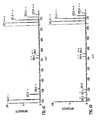
- a timing diagram of the voltage applied to the differential pumping aperture 6 or more generally to an exit electrode of the AC or RF ion trap 5 is shown in Fig. 3B .
- V trap When the differential pumping aperture 6 or the exit to the ion trap 4 is at a voltage V trap then ions are unable to exit the AC or RF ion trap 5 and hence accumulate in the device 5.
- V extract When the voltage applied to the exit differential pumping aperture 6 or the exit electrode of the AC or RF ion trap 5 falls to V extract then ions are allowed to the exit the ion trap 5 and pass to the next stages and subsequently to the ion detector (not shown).
- the AC or RF ion guide/ion trap 5 is maintained in the intermediate vacuum chamber 4 at a pressure in the range 1-3 mbar.
- the upstream AC or RF ion guide 3 and/or the downstream AC or RF ion guide 8 may also be used to trap ions therein.
- FIGs. 4A and 4B show the mass spectra obtained when the AC or RF device 5 is operated as an ion guide substantially without trapping ions therein (e.g. the voltage applied to the exit of the AC or RF device 5 is maintained at V extract .
- Fig. 4A shows the mass spectrum obtained when the AC or RF device 5 was maintained at a pressure of 1.4 mbar and
- Fig. 4B shows the mass spectrum obtained when the AC or RF device 5 was maintained at a pressure of 2.7 mbar. In both cases the AC or RF device 5 acted as an ion guide without trapping ions.
- An ion tunnel comprises a plurality of electrodes having preferably circular apertures through which ions are transmitted in use.
- the ion tunnel may therefore be considered to comprise a plurality of stacked rings.
- the ion tunnel comprises two interleaved combed arrangements of electrodes. Adjacent electrodes in the ion tunnel device are supplied with opposite phases of an AC or RF voltage supply.
- the voltage supply is preferably sinusoidal but other embodiments are contemplated wherein, for example, a square wave or other non-sinusoidal waveform may be applied to the device.
- the ion tunnel device preferably comprises 10-20, 20-30, 30-40, 40-50, 50-60, 60-70, 70-80, 80-90, 90-100 or more than 100 electrodes.
- the vast majority of the electrodes have substantially similar size apertures in contrast to an ion funnel.
- at least 75%, 80%, 85%, 90%, 95% or 99% of the electrodes forming the ion tunnel have substantially the same size and/or area internal apertures.
- the present invention is not limited to using an ion tunnel ion guide and other AC or RF devices are intended to fall within the scope of the present invention.
- Figs. 4C and 4D show mass spectra obtained when the RF device 5 was operated as an ion trap. Ions were trapped within the ion trap 2 for 60 ms in both cases.
- Fig. 4C shows the mass spectrum obtained when the ions were trapped for 60 ms in the ion trap 5 at a pressure of 1.4 mbar. As is apparent, Fig. 4C is substantially similar to the mass spectra shown in Figs. 4A and 4B .
- Fig. 4D illustrates an embodiment of the present invention and shows the mass spectrum which resulted from mass analysing the ions which emerged from the ion trap 5 when the ion trap 5 was maintained at a pressure of 2.7 mbar and ions were trapped within the ion trap 5 for 60 ms.
- Fig. 5A corresponds with the data shown in Fig. 4B and shows the mass spectrum for ions in the mass to charge ratio range 290-580 (as opposed to ions having mass to charge ratios in the range 556-573 as shown in Fig. 4B ).
- Fig. 5B corresponds with the data shown in Fig. 4D and shows the mass spectrum for ions in the mass to charge ratio range 290-580 (as opposed to ions having mass to charge ratios in the range 556-573 as shown in Fig. 4D ).
- the maximum kinetic energy in the micro-motion of the ion is equivalent to the pseudo-potential energy e ⁇ .
- ⁇ R Z z ⁇ e ⁇ V 0 2 4 ⁇ m ⁇ ⁇ 2 ⁇ Z 0 2 ⁇ I ⁇ 1 2 R Z 0 ⁇ cos 2 Z Z 0 + I ⁇ 0 2 R Z 0 ⁇ sin 2 Z Z 0 I ⁇ 0 2 R Z 0
- R 0 is the inscribed radius of the rings
- nZ 0 is the ring centre to ring centre separation in the axial direction
- I1 is a first order modified Bessel function of the first kind
- IO is a zeroth order modified Bessel function of the first kind.
- the experimental results presented in the present application show that there is an abundance of doubly charged ions relative to that of singly charged ions following the accumulation of ions in a 2D stacked ring ion guide at a pressures of 2.7 mbar (2 torr) for a trapping period of 60 ms.
- the data shows enhancement of ions with higher charge states (z values) but with the same m/z values as the product of pressure and storage time is increased.
- ⁇ R - N 2 ⁇ N - 1 ⁇ z ⁇ e ⁇ V 0 2 2 ⁇ m ⁇ ⁇ 2 ⁇ R 0 2 R R 0 2.
- Ions with the lower z values will occupy larger radial positions. Hence, these ions are more likely to be lost through collisions with the rods or rings of the ion guide, or not be transmitted through any small orifice arranged along the axis of the ion guide after its exit.
- a method for enhancing the signal from doubly, triply or more highly charged ions from that of background singly charged ions is particularly advantageous for the study of protein digests.
- the peptides from protein digests when ionised by electrospray, often yield an abundance of doubly charged, triply or more highly charged ions.
- the method, as described above, of first storing ions at elevated pressures in an ion guide or ion trap employing inhomogeneous RF fields provides a means of enhancing the relative abundance of multiply charged ions to that of singly charged ions having the same m/z values.
- This method can therefore be employed before mass analysis so as to enhance the relative abundance of multiply charged ions to that of singly charged ions at equivalent m/z values within the mass spectrum.
- the relative enhancement of doubly charged ion abundance to that of singly charged ion abundance becomes very pronounced at pressures above 1.4 mbar (1 torr) for storage times of the order of 60 ms.
- the enhancement of doubly charged ion abundance to that of singly charged ion abundance becomes very pronounced when the product of pressure and storage or transit time is greater than 8.4 x 10 -2 mbar-seconds (6 x 10 -2 torr-seconds).
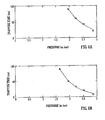
- Figs. 6A and 6B show the results of further investigations into the relationship between trapping time and pressure.
- Fig. 6A shows a plot of trapping time (ms) against pressure (mbar) for which the ratio of the intensity of doubly charged ions from Gramacidin-S (m/z 571) to that of the singly charged ions from Leucine Enkephalin (m/z 556) is doubled over that for no trapping.
- Fig. 6B shows a plot of trapping time (ms) against pressure (mbar) for which the ratio of the intensity of the triply charged ions from Renin Substrate (m/z 586) to that of the singly charged ions from Leucine Enkephalin (m/z 556) is doubled over that for no trapping.
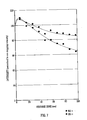
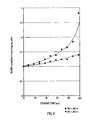
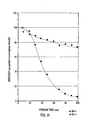
- Fig. 7 shows the effect of storage or trapping time on the intensity of doubly charged Gramacidin-S (m/z 571) ions and singly charged Leucine Enkephalin (m/z 556) ions at 1.64 mbar
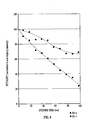
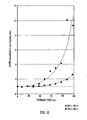
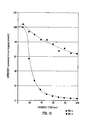
- Fig. 8 shows the effect of storage or trapping time on the intensity of triply charged Renin Substrate (m/z 586) ions and singly charged Leucine Enkephalin (m/z 556) ions at 1.64 mbar
- Fig. 8 shows the effect of storage or trapping time on the intensity of triply charged Renin Substrate (m/z 586) ions and singly charged Leucine Enkephalin (m/z 556) ions at 1.64 mbar
- Fig. 7 shows the effect of storage or trapping time on the intensity of doubly charged Gramacidin-S (m/z 571) ions and singly charged Leucine Enkephalin (m/z 556) ions at 1.64 mbar
- Fig. 8 shows the effect of
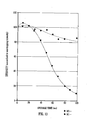
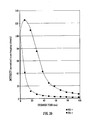
- Fig. 10 shows the effect of storage or trapping time on the intensity of doubly charged Gramacidin-S (m/z 571) ions and singly charged Leucine Enkephalin (m/z 556) ions at 1.95 mbar
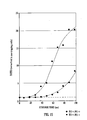
- Fig. 11 shows the effect of storage or trapping time on the intensity of triply charged Renin Substrate (m/z 586) ions and singly charged Leucine Enkephalin (m/z 556) ions at 1.95 mbar
- Fig. 11 shows the effect of storage or trapping time on the intensity of triply charged Renin Substrate (m/z 586) ions and singly charged Leucine Enkephalin (m/z 556) ions at 1.95 mbar
- Fig. 10 shows the effect of storage or trapping time on the intensity of doubly charged Gramacidin-S (m/z 571) ions and singly charged Leucine Enkephalin (m/z 556) ions at 1.95 mbar
- Fig. 11 shows the effect of
- Fig. 13 shows the effect of storage or trapping time on the intensity of doubly charged Gramacidin-S (m/z 571) ions and singly charged Leucine Enkephalin (m/z 556) ions at 2.23 mbar
- Fig. 14 shows the effect of storage or trapping time on the intensity of triply charged Renin Substrate (m/z 586) ions and singly charged Leucine Enkephalin (m/z 556) ions at 2.23 mbar
- Fig. 14 shows the effect of storage or trapping time on the intensity of triply charged Renin Substrate (m/z 586) ions and singly charged Leucine Enkephalin (m/z 556) ions at 2.23 mbar and Fig.
- Fig. 16 shows the effect of storage or trapping time on the intensity of doubly charged Gramacidin-S (m/z 571) ions and singly charged Leucine Enkephalin,(m/z 556) ions at 2.51 mbar
- Fig. 17 shows the effect of storage or trapping time on the intensity of triply charged Renin Substrate (m/z 586) ions and singly charged Leucine Enkephalin (m/z 556) ions at 2.51 mbar
- Fig. 17 shows the effect of storage or trapping time on the intensity of triply charged Renin Substrate (m/z 586) ions and singly charged Leucine Enkephalin (m/z 556) ions at 2.51 mbar and Fig.
- Fig. 19 shows the effect of storage or trapping time on the intensity of doubly charged Gramacidin-S (m/z 571) ions and singly charged Leucine Enkephalin (m/z 556) ions at 2.86 mbar
- Fig. 20 shows the effect of storage or trapping time on the intensity of triply charged Renin Substrate (m/z 586) ions and singly charged Leucine Enkephalin (m/z 556) ions at 2.86 mbar and Fig.
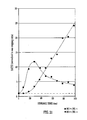
- 21 shows the ratio of intensities of: (i) doubly charged Gramacidin-S ions (m/z 571) to singly charged Leucine Enkephalin (m/z 556) ions; and (ii) triply charged Renin Substrate (m/z 586) ions to singly charge Leucine Enkephalin (m/z 556) ions, as a function of storage or trapping time at 2.86 mbar.
- the ion signal can first increase before eventually decreasing as the trapping time is increased. This effect can be observed to a greater or lesser extent in Figs, 7 , 10 , 13 , 14 , 17 , 19 and 20 . It is thought that the increase in signal intensity is due to ions beginning to migrate towards the centre of the pseudo-potential well as a result of frequent collisions with the lighter gas molecules. This ion migration is likely to be the precursor to the process in which ions with higher values of z 2 /m eventually displace ions which have lower values of z 2 /m and occupy the central space. Ions that accumulate in the central region are more likely to be transmitted through the exit of the ion guide and to the ion detection system.
- ions that initially collapse into the centre of the pseudo-potential well may be expected to show a corresponding increase in signal intensity.
- pressure and trapping time it is possible to enhance the ratio of the intensity of the multiply charged ions with respect to that of singly charged ions with similar m/z values and simultaneously increase the absolute intensity of the multiply charged ions.
- ions may advantageously be trapped in the AC or RF ion guide/ion trap and then released when the mass spectrometer is ready to accept these ions thereby gaining the advantage of the extra sensitivity that is observed when ions are trapped according to the preferred embodiment described above.
- the preferred embodiment also looks particularly useful for preferentially transmitting ions having a large number of charges.
- horse heart myoglobin has a molecular mass of 16951.48 and ions may in some conditions have 8 or 9 charges or in other conditions the ions may have between 10-28 charges.
- Experimental data suggests that with highly charged ions preferentially transmission of multiply charged ions in favour of lower or singly charged ions occurs down to pressures P and trapping times T wherein the product P x T is 1 mbar-ms.
- Experimental data suggests that at or above the product of P x T equalling 1 mbar-ms the beneficial effect of the selective enhancement of multiply charged ions is observed.
- the preferred embodiment can be used for removing background ions from a mixture of ions, wherein the mixture of ions comprises a plurality of different biopolymers, proteins, peptides, polypeptides, oligionucleotides, oligionucleosides, amino acids, carbohydrates, sugars, lipids, fatty acids, vitamins, hormones, portions or fragments of DNA, portions or fragments of cDNA, portions or fragments of RNA, portions or fragments of mRNA, portions or fragments of tRNA, polyclonal antibodies, monoclonal antibodies, ribonucleases, enzymes, metabolites, polysaccharides, phosphorolated peptides, phosphorolated proteins, glycopeptides, glycoproteins or steroids.
Landscapes
- Chemical & Material Sciences (AREA)
- Analytical Chemistry (AREA)
- Other Investigation Or Analysis Of Materials By Electrical Means (AREA)
- Electron Tubes For Measurement (AREA)
Claims (42)
- Massenspektrometrisches Verfahren, das einen Schritt des Einfangens einer Probe von Ionen in einer Ionenführung (5) mittels Wechselspannung oder mittels Hochfrequenz in der Gegenwart eines Gases bei einem Druck P während einer Zeitdauer T umfasst, wobei das Verfahren dadurch gekennzeichnet ist, dass es einen Schritt enthält, um den relativen Anteil oder die relative Häufigkeit von mehrfach geladenen Ionen gegenüber einfach geladenen Ionen in der Probe von Ionen zu erhöhen, wobei das Produkt P x T mindestens 1 mbar-ms beträgt.
- Verfahren nach Anspruch 1, wobei das Produkt P x T mindestens beträgt: 2 mbar-ms; 3 mbar-ms; 4 mbar-ms; 5 mbar-ms; 6 mbar-ms; 7 mbar-ms; 8 mbar-ms; 9 mbar-ms; 10 mbar-ms; 15 mbar-ms; 20 mbar-ms; 25 mbar-ms; 30 mbar-ms; 35 mbar-ms; 40 mbar-ms; 45 mbar-ms; 50 mbar-ms; 55 mbar-ms; 60 mbar-ms;65 mbar-ms; 70 mbar-ms; 75 mbar-ms; 80 mbar-ms; 85 mbar-ms; 90 mbar-ms; 95 mbar-ms; 100 mbar-ms; 110 mbar-ms; 120 mbar-ms; 130 mbar-ms; 140 mbar-ms; 150 mbar-ms; 160 mbar-ms; 170 mbar-ms; 180 mbar-ms; 190 mbar-ms; 200 mbar-ms; 210 mbar-ms; 220 mbar-ms; 230 mbar-ms; 240 mbar-ms; 250 mbar-ms; 260 mbar-ms; 270 mbar-ms; 280 mbar-ms; 290 mbar-ms; 300 mbar-ms; 310 mbar-ms; 320 mbar-ms; 330 mbar-ms; 340 mbar-ms; 350 mbar-ms; 360 mbar-ms; 370 mbar-ms; 380 mbar-ms; 390 mbar-ms; 400 mbar-ms; 410 mbar-ms; 420 mbar-ms; 430 mbar-ms; 440 mbar-ms; 450 mbar-ms; 460 mbar-ms; 470 mbar-ms; 480 mbar-ms; 490 mbar-ms; 500 mbar-ms; 550 mbar-ms; 600 mbar-ms; 650 mbar-ms; 700 mbar-ms; 750 mbar-ms; 800 mbar-ms; 850 mbar-ms; 900 mbar-ms; 950 mbar-ms; 1000 mbar-ms; 1100 mbar-ms; 1200 mbar-ms; 1300 mbar-ms; 1400 mbar-ms; 1500 mbar-ms; 1600 mbar-ms; 1700 mbar-ms; 1800 mbar-ms; 1900 mbar-ms; 2000 mbar-ms; 2500 mbar-ms; 3000 mbar-ms; 3500 mbar-ms; 4000 mbar-ms; 4500 mbar-ms; 5000 mbar-ms; 5500 mbar-ms; 6000 mbar-ms; 6500 mbar-ms; 7000 mbar-ms; 7500 mbar-ms; 8000 mbar-ms; 8500 mbar-ms; 9000 mbar-ms; 9500 mbar-ms; oder 10000 mbar-ms.
- Verfahren nach Anspruch 1 oder 2, wobei das Produkt P x T kleiner ist als: 2 mbar-ms; 3 mbar-ms; 4 mbar-ms; 5 mbar-ms; 6 mbar-ms; 7 mbar-ms; 8 mbar-ms; 9 mbar-ms; 10 mbar-ms; 15 mbar-ms; 20 mbar-ms; 25 mbar-ms; 30 mbar-ms; 35 mbar-ms; 40 mbar-ms; 45 mbar-ms; 50 mbar-ms; 55 mbar-ms; 60 mbar-ms;65 mbar-ms; 70 mbar-ms; 75 mbar-ms; 80 mbar-ms; 85 mbar-ms; 90 mbar-ms; 95 mbar-ms; 100 mbar-ms; 110 mbar-ms; 120 mbar-ms; 130 mbar-ms; 140 mbar-ms; 150 mbar-ms; 160 mbar-ms; 170 mbar-ms; 180 mbar-ms; 190 mbar-ms; 200 mbar-ms; 210 mbar-ms; 220 mbar-ms; 230 mbar-ms; 240 mbar-ms; 250 mbar-ms; 260 mbar-ms; 270 mbar-ms; 280 mbar-ms; 290 mbar-ms; 300 mbar-ms; 310 mbar-ms; 320 mbar-ms; 330 mbar-ms; 340 mbar-ms; 350 mbar-ms; 360 mbar-ms; 370 mbar-ms; 380 mbar-ms; 390 mbar-ms; 400 mbar-ms; 410 mbar-ms; 420 mbar-ms; 430 mbar-ms; 440 mbar-ms; 450 mbar-ms; 460 mbar-ms; 470 mbar-ms; 480 mbar-ms; 490 mbar-ms; 500 mbar-ms; 550 mbar-ms; 600 mbar-ms; 650 mbar-ms; 700 mbar-ms; 750 mbar-ms; 800 mbar-ms; 850 mbar-ms; 900 mbar-ms; 950 mbar-ms; 1000 mbar-ms; 1100 mbar-ms; 1200 mbar-ms; 1300 mbar-ms; 1400 mbar-ms; 1500 mbar-ms; 1600 mbar-ms; 1700 mbar-ms; 1800 mbar-ms; 1900 mbar-ms; 2000 mbar-ms; 2500 mbar-ms; 3000 mbar-ms; 3500 mbar-ms; 4000 mbar-ms; 4500 mbar-ms; 5000 mbar-ms; 5500 mbar-ms; 6000 mbar-ms; 6500 mbar-ms; 7000 mbar-ms; 7500 mbar-ms; 8000 mbar-ms; 8500 mbar-ms; 9000 mbar-ms; 9500 mbar-ms; oder 10000 mbar-ms.
- Verfahren nach Anspruch 1, 2 oder 3, wobei T innerhalb eines Bereiches fällt, der ausgewählt ist aus der Gruppe, die besteht aus: 50-100 µs; 100-150 µs; 150-200 µs; 200-250 µs; 250-300 µs; 300-350 µs; 350-400 µs; 400-450 µs; 450-500 µs; 500-550 µs; 550-600 µs; 600-650 µs; 650-700 µs; 700-750 µs; 750-800 µs; 800-850 µs; 850-900 µs; 900-950 µs; 950-1000 µs; 1-2 ms; 2-3 ms; 3-4 ms; 4-5 ms; 5-6 ms; 6-7 ms; 7-8 ms; 8-9 ms; 9-10 ms; 10-15 ms; 15-20 ms; 20-25 ms; 25-30 ms; 30-35 ms; 35-40 ms; 40-45 ms; 45-50 ms; 50-55 ms; 55-60 ms; 60-65 ms; 65-70 ms; 70-75 ms; 75-80 ms; 80-85 ms; 85-90 ms; 90-95 ms; 95-100 ms; 100-110 ms; 110-120 ms; 120-130 ms; 130-140 ms; 140-150 ms; 150-160 ms; 160-170 ms; 170-180 ms; 180-190 ms; 190-200 ms; 200-250 ms; 250-300 ms; 300-350 ms; 350-400 ms; 400-450 ms; 450-500 ms; 500-550 ms; 550-600 ms; 600-650 ms; 650-700 ms; 700-750 ms; 750-800 ms; 800-850 ms; 850-900 ms; 900-950 ms; und 950-1000 ms.
- Verfahren nach Anspruch 1, 2 oder 3, wobei T mindestens ist: 50 µs; 60 µs; 70 µs; 80 µs; 90 µs; 100 µs; 200 µs; 300 µs; 400 µs; 500 µs; 600 µs; 700 µs; 800 µs; 900 µs; 1000 µs; 2 ms; 3 ms; 4 ms; 5 ms; 6 ms; 7 ms; 8 ms; 9 ms; 10 ms; 20 ms; 30 ms; 40 ms; 50 ms; 60 ms; 70 ms; 80 ms; 90 ms; 100 ms; 200 ms; 300 ms; 400 ms; 500 ms; 600 ms; 700 ms; 800 ms; 900 ms; 1 s; 2 s; 3 s; 4 s; 5 s; 6 s; 8 s; 9 s; oder 10 s.
- Verfahren nach Anspruch 1, 2, 3 oder 5, wobei T kleiner ist als: 10 s; 9 s; 8 s; 7 s; 6 s; 5 s; 4 s; 3 s; 2 s; 1000 ms; 900 ms; 800 ms; 700 ms; 600 ms; 500 ms; 400 ms; 300 ms; 200 ms; 100 ms; 90 ms; 80 ms; 70 ms; 60 ms; 50 ms; 40 ms; 30 ms; 20 ms; 10 ms; 9 ms; 8 ms; 7 ms; 6 ms; 5 ms; 4 ms; 3 ms; 2 ms; 1000 µs; 900 µs; 800 µs; 700 µs; 600 µs; 500 µs; 400 µs; 300 µs; 200 µs; 100 µs; 90 µs; 80 µs; 70 µs; 60 µs; oder 50 µs.
- Verfahren nach einem vorhergehenden Anspruch, wobei P innerhalb eines Bereiches fällt, der ausgewählt ist aus der Gruppe, die besteht aus: 0,01-0,02 mbar; 0,01-0,02 mbar; 0,02-0,03 mbar; 0,03-0,04 mbar; 0,04-0,05 mbar; 0,05-0,06 mbar; 0,06-0,07 mbar; 0,07-0,08 mbar; 0,08-0,09 mbar; 0,09-0,10 mbar; 0,1-0,2 mbar; 0,2-0,3 mbar; 0,3-0,4 mbar; 0,4-0,5 mbar; 0,5-0,6 mbar; 0,6-0,7 mbar; 0,7-0,8 mbar; 0,8-0,9 mbar; 0,9-1,0 mbar; 1-2 mbar; 2-3 mbar; 3-4 mbar; 4-5 mbar; 5-6 mbar; 6-7 mbar; 7-8 mbar; 8-9 mbar; 9-10 mbar; 10-20 mbar; 20-30 mbar; 30-40 mbar; 40-50 mbar; 50-60 mbar; 60-70 mbar; 70-80 mbar; 80-90 mbar; und 90-100 mbar.
- Verfahren nach einem der Ansprüche 1 bis 6, wobei P mindestens ist: 0,01 mbar; 0,02 mbar; 0,03 mbar; 0,04 mbar; 0,05 mbar; 0,06 mbar; 0,07 mbar; 0,08 mbar; 0,09 mbar; 0,1 mbar; 0,2 mbar; 0,3 mbar; 0,4 mbar; 0,5 mbar; 0,6 mbar; 0,7 mbar; 0,8 mbar; 0,9 mbar; 1 mbar; 2 mbar; 3 mbar; 4 mbar; 5 mbar; 6 mbar; 7 mbar; 8 mbar; 9 mbar; 10 mbar; 20 mbar; 30 mbar; 40 mbar; 50 mbar; 60 mbar; 70 mbar; 80 mbar; 90 mbar; oder 100 mbar.
- Verfahren nach einem vorhergehenden Anspruch, wobei P kleiner ist als: 100 mbar; 90 mbar; 80 mbar; 70 mbar; 60 mbar; 50 mbar; 40 mbar; 30 mbar; 20 mbar; 10 mbar; 9 mbar; 8 mbar; 7 mbar; 6 mbar; 5 mbar; 4 mbar; 3 mbar; 2 mbar; 1 mbar; 0,9 mbar; 0,8 mbar; 0,7 mbar; 0,6 mbar; 0, 5 mbar; 0,4 mbar; 0, 3 mbar; 0, 2 mbar; 0,1 mbar; 0,09 mbar; 0,08 mbar; 0,07 mbar; 0,06 mbar; 0,05 mbar; 0,04 mbar; 0,03 mbar; oder 0,02 mbar.
- Verfahren nach einem vorhergehenden Anspruch, wobei P ausgewählt ist aus der Gruppe, die besteht aus: (i) > 0,01 mbar; (ii) > 0,05 mbar; (iii) > 0,1 mbar; (iv) > 0,2 mbar; (v) > 0,5 mbar; (vi) > 1 mbar; (vii) > 2 mbar; (viii) > 5 mbar; und (ix) > 10 mbar.
- Verfahren nach einem vorhergehenden Anspruch, wobei die Probe von Ionen mindestens einige Ionen umfasst, die ähnliche oder im Wesentlichen dieselben Verhältnisse Masse zu Ladung, aber verschiedene Ladungszustände aufweisen.
- Verfahren nach Anspruch 11, wobei mindestens einige der Ionen, die ähnliche oder im Wesentlichen dieselben Verhältnisse Masse zu Ladung aufweisen, Verhältnisse Masse zu Ladung aufweisen, die sich um weniger als Folgendes unterscheiden: (i) 20 Masse- zu Ladungseinheiten; (ii) 15 Masse- zu Ladungseinheiten; (iii) 10 Masse- zu Ladungseinheiten; (iv) 5 Masse- zu Ladungseinheiten; (v) 4 Masse- zu Ladungseinheiten; (vi) 3 Masse- zu Ladungseinheiten; (vii) 2 Masse- zu Ladungseinheiten; und (viii) 1 Masse- zu Ladungseinheit, wobei 1 Masse- zu Ladungseinheit der Einheit 1 Dalton pro elektronischer Ladungseinheit gleicht.
- Verfahren nach einem vorhergehenden Anspruch, wobei die Probe von Ionen mehrere ionisierte Moleküle umfasst, wobei die Moleküle mehrere verschiedene Biopolymere, Proteine, Peptide, Polypeptide, Oligonukleotide, Oligonukleoside, Aminosäuren, Kohlenhydrate, Zucker, Lipide, Fettsäuren, Vitamine, Hormone, Abschnitte oder Fragmente von DNA, Abschnitte oder Fragmente von cDNA, Abschnitte oder Fragmente von RNA, Abschnitte oder Fragmente von mRNA, Abschnitte oder Fragmente von tRNA, polyklonale Antikörper, monoklonale Antikörper, Ribonukleasen, Enzyme, Metabolite, Polysaccharide, phosphorisierte Peptide, phosphorisierte Proteine, Glycopeptide, Glycoproteine oder Steroide umfassen
- Verfahren nach einem vorhergehenden Anspruch, wobei die Ionenführung mittels Wechselspannung oder mittels Hochfrequenz Elektroden umfasst und wobei die Ionenführung mittels Wechselspannung oder mittels Hochfrequenz eine zentrale Längsachse aufweist und wobei die Kombination von Druck und Einfangzeit derart ist, dass einfach geladene Ionen von der zentralen Längsachse radial nach außen gezwungen werden, während mehrfach geladene Ionen in Richtung der zentralen Längsachse gezwungen werden.
- Verfahren nach einem vorhergehenden Anspruch, wobei die einfach geladenen Ionen im Wesentlichen von der Ionenführung (5) mittels Wechselspannung oder mittels Hochfrequenz ausgeworfen werden oder verloren gehen.
- Verfahren nach einem vorhergehenden Anspruch, wobei mindestens einige oder eine Mehrzahl der mehrfach geladenen Ionen im Wesentlichen innerhalb der Ionenführung (5) mittels Wechselspannung oder mittels Hochfrequenz zurückgehalten werden.
- Verfahren nach einem der Ansprüche 1 bis 15, wobei eine oder mehrere der folgenden Gruppen von Ionen im Wesentlichen von der Ionenführung mittels Wechselspannung oder mittels Hochfrequenz ausgeworfen werden oder verloren gehen: (i) Ionen mit 2 Ladungen; (ii) Ionen mit 3 Ladungen; (iii) Ionen mit 4 Ladungen; (iv) Ionen mit 5 Ladungen; (v) Ionen mit 6 Ladungen; (vi) Ionen mit 7 Ladungen; (vii) Ionen mit 8 Ladungen; (viii) Ionen mit 9 Ladungen; (ix) Ionen mit 10 Ladungen; (x) Ionen mit 11 Ladungen; (xi) Ionen mit 12 Ladungen; (xii) Ionen mit 13 Ladungen; (xiii) Ionen mit 14 Ladungen; (xiv) Ionen mit 15 Ladungen; (xv) Ionen mit 16 Ladungen; (xvi) Ionen mit 17 Ladungen; (xvii) Ionen mit 18 Ladungen; (xviii) Ionen mit 19 Ladungen; (xix) Ionen mit 20 Ladungen; (xx) Ionen mit 21 Ladungen; (xxi) Ionen mit 22 Ladungen; und (xxii) Ionen mit mehr als 22 Ladungen.
- Verfahren nach einem der Ansprüche 1 bis 15, wobei eine oder mehrere der folgenden Gruppen von Ionen im Wesentlichen von der Ionenführung mittels Wechselspannung oder mittels Hochfrequenz zurückgehalten werden: (i) Ionen mit 2 Ladungen; (ii) Ionen mit 3 Ladungen; (iii) Ionen mit 4 Ladungen; (iv) Ionen mit 5 Ladungen; (v) Ionen mit 6 Ladungen; (vi) Ionen mit 7 Ladungen; (vii) Ionen mit 8 Ladungen; (viii) Ionen mit 9 Ladungen; (ix) Ionen mit 10 Ladungen; (x) Ionen mit 11 Ladungen; (xi) Ionen mit 12 Ladungen; (xii) Ionen mit 13 Ladungen; (xiii) Ionen mit 14 Ladungen; (xiv) Ionen mit 15 Ladungen; (xv) Ionen mit 16 Ladungen; (xvi) Ionen mit 17 Ladungen; (xvii) Ionen mit 18 Ladungen; (xviii) Ionen mit 19 Ladungen; (xix) Ionen mit 20 Ladungen; (xx) Ionen mit 21 Ladungen; (xxi) Ionen mit 22 Ladungen; und (xxii) Ionen mit mehr als 22 Ladungen.
- Verfahren nach Anspruch 1, wobei unerwünschte, einfach geladene Hintergrundionen aus einer Mischung von einfach geladenen Hintergrundionen und mehrfach geladenen Analytionen entfernt werden, wobei das Verfahren umfasst:Übertragen der Mischung von Ionen an die Ionenführung (5) auf der Basis von Wechselspannung oder Hochfrequenz;Einfangen der Ionen innerhalb der Ionenführung mittels Wechselspannung oder mittels Hochfrequenz, wobei die Ionenführung bei dem Druck P gehalten wird; und Festsetzen einer Zeitdauer T, während derer die Ionen innerhalb der Ionenführung mittels Wechselspannung oder mittels Hochfrequenz gefangen werden, auf einen Wert derart, dass mindestens 50 %, 60 %, 70 %, 80 %, 90 % oder mehr al 90 % der einfach geladenen Ionen im Wesentlichen von der Ionenführung mittels Wechselspannung oder mittels Hochfrequenz ausgeworfen werden oder verloren gehen, während 50 %, 60 %, 70 %, 80 %, 90 % oder mehr al 90 % der mehrfach geladenen Ionen im Wesentlichen innerhalb der Ionenführung mittels Wechselspannung oder mittels Hochfrequenz gehalten werden.
- Verfahren nach Anspruch 1, das ein Entfernen oder ein (quantitatives) Verdünnen einfach und/oder doppelt geladener Ionen aus einer Mischung von mindestens einfach, doppelt und dreifach geladenen Ionen umfasst.
- Verfahren nach Anspruch 1, das umfasst:Bereitstellen einer Probe einfach geladener Ionen und doppelt geladener Ionen, die ähnliche Verhältnisse Masse zu Ladung aufweisen;fortschreitendes Übertragen der doppelt geladenen Ionen, während mindestens teilweise die einfach geladenen Ionen relativ verdünnt werden; undMassenanalyse der doppelt geladenen Ionen.
- Verfahren nach Anspruch 1, das umfasst:Betreiben der Ionenführung (5) mittels Wechselspannung oder mittels Hochfrequenz in einer ersten Betriebsart, um im Wesentlichen Ionen, die an einem Eingang zu der Ionenführung empfangen worden sind, hindurch zu einem Ausgang der Ionenführung zu übertragen; undBetreiben der Ionenführung mittels Wechselspannung oder mittels Hochfrequenz in einer zweiten Betriebsart, wobei die Ionenführung als eine Ionenfalle wirkt, um im Wesentlichen Ionen innerhalb der Ionenführung einzufangen und um im Wesentlichen zu verhindern, dass die Ionen die Ionenführung verlassen, wobei in der zweiten Betriebsart die Ionenführung mittels Wechselspannung oder mittels Hochfrequenz den relativen Anteil oder die relative Häufigkeit von mehrfach geladenen Ionen in der Probe erhöht.
- Verfahren nach Anspruch 22, wobei die Zeitdauer T eine kontinuierliche oder im Wesentlichen kontinuierliche Zeitdauer ist.
- Verfahren nach Anspruch 22, wobei die Zeitdauer T eine kumulative Zeitdauer ist.
- Massenspektrometer, das umfasst:eine Ionenquelle (1);eine Vakuumkammer (4), die die Ionenführung (5) mittels Wechselspannung oder mittels Hochfrequenz, die im Gebrauch bei einem Druck P gehalten wird, beherbergt;eine Elektrode (6), wobei in einer ersten Betriebsart ein Potential an die Elektrode (6) angelegt wird, das ein Probe von Ionen veranlasst, im Wesentlichen innerhalb der Ionenführung (5) mittels Wechselspannung oder mittels Hochfrequenz gefangen zu sein, und wobei in einer zweiten Betriebsart das Potential an die Elektrode (6) angelegt wird, um Ionen zu ermöglichen, sich aus der Ionenführung (5) mittels Wechselspannung oder mittels Hochfrequenz zu befreien und zu entweichen;eine weitere Vakuumkammer (4), die einen Massenanalysator beherbergt; undwobei das Massenspektrometer dadurch gekennzeichnet ist, dass es außerdem umfasst:Steuermittel, die angeordnet sind, um den relativen Anteil oder die relative Häufigkeit von mehrfach geladenen Ionen gegenüber einfach geladenen Ionen in der Probe von Ionen zu erhöhen, indem eine Zeitdauer T gesteuert wird, während der die Ionen innerhalb der Ionenführung (5) mittels Wechselspannung oder mittels Hochfrequenz derart gefangen sind, dass das Produkt P x T mindestens 1 mbar-ms beträgt.
- Massenspektrometer nach Anspruch 25, das eine Ionenquelle (1) umfasst, um hauptsächlich molekulare oder pseudo-molekulare Ionen zu erzeugen.
- Massenspektrometer nach Anspruch 25 oder 26, wobei die Ionenquelle (1) eine Ionisationsquelle bei Atmosphärendruck umfasst.
- Massenspektrometer nach Anspruch 27, wobei die Ionenquelle (1) ausgewählt ist aus der Gruppe, die besteht aus: (i) einer Ionenquelle mittels Elektrospray-Ionisation ("ESI"); (ii) einer Ionenquelle mittels chemischer Ionisation bei Atmosphärendruck ("APCI"); (iii) einer Ionenquelle mittels Photoionisation bei Atmosphärendruck ("APPI"); (iv) einer Ionenquelle mittels einer matrixunterstützten Laser-Desorption/Ionisation ("MALDI") bei Atmosphärendruck; und (v) einer Ionenquelle mittels eines induktiv gekoppelten Plasmas ("ICP").
- Massenspektrometer nach Anspruch 25 oder 26, wobei die Ionenquelle (1) eine Ionisationsquelle bei Nicht-Atmosphärendruck umfasst.
- Massenspektrometer nach Anspruch 29, wobei die Ionenquelle (1) ausgewählt ist aus der Gruppe, die besteht aus: (i) einer Ionenquelle mittels eines schnellen Atombombardements ("FAB"); (ii) einer Ionenquelle mittels einer Flüssigkeits-Sekundärionen-Massenspektrometrie ("LSIMS"); (iii) einer Ionenquelle mittels einer matrixunterstützten Laser-Desorption/Ionisation ("MALDI"); (iv) einer Ionenquelle mittels einer matrixunterstützten Laser-Desorption ("MALDI") in Kombination mit einer Kollisionszelle, um durch Kollision Ionen zu kühlen; (v) einer Ionenquelle mittels einer Laser-Desorption/Ionisation ("LDI"); (vi) einer Ionenquelle mittels einer Elektronenstoßionisation ("EI"); und (vii) einer Ionenquelle mittels chemischer Ionisation ("CI").
- Massenspektrometer nach einem der Ansprüche 25 bis 30, wobei die Ionenführung (5) mittels Wechselspannung oder mittels Hochfrequenz einen Multipolstabsatz umfasst.
- Massenspektrometer nach Anspruch 31, wobei der Multipolstabsatz einen Quadrupolstabsatz, einen Hexapolstabsatz, einen Oktopolstabsatz oder einen Stabsatz mit zehn oder mehr Stäben umfasst.
- Massenspektrometer nach einem der Ansprüche 25 bis 30, wobei die Ionenführung (5) mittels Wechselspannung oder mittels Hochfrequenz mehrere Elektroden umfasst, die Öffnungen aufweisen, durch die die Ionen übertragen werden.
- Massenspektrometer nach Anspruch 33, wobei die Ionenführung (5) mittels Wechselspannung oder mittels Hochfrequenz einen Tunnel mit mehreren Elektroden umfasst, von denen jede im Wesentlichen dieselbe Größe der Öffnung aufweist.
- Massenspektrometer nach Anspruch 33, wobei die Ionenführung (5) mittels Wechselspannung oder mittels Hochfrequenz einen Ionentrichter umfasst, der mehrere Elektroden aufweist, wobei die Größe der Öffnungen fortschreitend kleiner oder größer wird.
- Massenspektrometer nach einem der Ansprüche 25 bis 30, wobei die Ionenführung (5) mittels Wechselspannung oder mittels Hochfrequenz eine Doppelhelix-Anordnung von Elektroden umfasst.
- Massenspektrometer nach einem der Ansprüche 25 bis 30, wobei die Ionenführung (5) mittels Wechselspannung oder mittels Hochfrequenz mehrere Platten umfasst, die benachbart zueinander aufgeschichtet sind.
- Massenspektrometer nach einem der Ansprüche 25 bis 37, das ferner einen Massenanalysator umfasst.
- Massenspektrometer nach Anspruch 38, wobei der Massenanalysator ausgewählt ist aus der Gruppe, die besteht aus: (i) einem Flugzeit-Massenanalysator; (ii) einem Quadrupol-Massenanalysator; (iii) einer 2D- oder einer 3D-Ionenfalle; (iv) einem Fouriertransformations-Massenspektrometer; und (v) aus einem Fouriertransformations-Ionenzyklotronresonanz-Massenspektrometer.
- Massenspektrometer nach einem der Ansprüche 25 bis 39, das ferner eine weitere Ionenführung (8) mittels Wechselspannung oder mittels Hochfrequenz umfasst, die in einer weiteren Vakuumkammer (7) angeordnet ist.
- Massenspektrometer nach einem der Ansprüche 25 bis 40, das ferner einen Quadrupolmassenfilter und/oder eine Kollisionszelle umfasst, die in noch einer weiteren Vakuumkammer, die dazwischen liegt, angeordnet ist, wobei die Vakuumkammer(n) (4,7) die Ionenführung(en) (5,8) mittels Wechselspannung oder mittels Hochfrequenz beherbergen und wobei die Vakuumkammer den Massenanalysator beherbergt.
- Massenspektrometer nach Anspruch 40, wobei die weitere Ionenführung (8) mittels Wechselspannung oder mittels Hochfrequenz umfasst: (i) einen Multipolstabsatz; (ii) einen Ionentrichter, der mehrere Elektroden umfasst, die Öffnungen darin aufweisen, durch die Ionen übertragen werden, wobei der Durchmesser der Öffnungen fortschreitend kleiner oder größer wird; (iii) einen Tunnel, der mehrere Elektroden umfasst, die Öffnungen darin aufweisen, durch die Ionen übertragen werden, wobei der Durchmesser der Öffnungen im Wesentlichen konstant bleibt; (iv) eine Doppelhelix-Anordnung von Elektroden; und (v) einen Schichtstapel von Platten, wobei benachbarte Elektroden mit entgegengesetzten Phasen einer Wechselspannungs- oder einer Hochfrequenzversorgung verbunden sind.
Applications Claiming Priority (9)
| Application Number | Priority Date | Filing Date | Title |
|---|---|---|---|
| GB0129693A GB0129693D0 (en) | 2001-12-12 | 2001-12-12 | Mass spectrometer |
| GB0129693 | 2001-12-12 | ||
| GB0215626A GB0215626D0 (en) | 2001-12-12 | 2002-07-05 | Mass spectrometer |
| GB0215626 | 2002-07-05 | ||
| GB0217217 | 2002-07-25 | ||
| GB0217217A GB0217217D0 (en) | 2001-12-12 | 2002-07-25 | Mass spectrometer |
| US40151702P | 2002-08-07 | 2002-08-07 | |
| US401517P | 2002-08-07 | ||
| PCT/GB2002/005628 WO2003050843A2 (en) | 2001-12-12 | 2002-12-12 | Method of mass spectrometry |
Publications (2)
| Publication Number | Publication Date |
|---|---|
| EP1454337A2 EP1454337A2 (de) | 2004-09-08 |
| EP1454337B1 true EP1454337B1 (de) | 2015-12-02 |
Family
ID=27448008
Family Applications (1)
| Application Number | Title | Priority Date | Filing Date |
|---|---|---|---|
| EP02785654.1A Expired - Lifetime EP1454337B1 (de) | 2001-12-12 | 2002-12-12 | Massenspektrometrisches verfahren |
Country Status (3)
| Country | Link |
|---|---|
| EP (1) | EP1454337B1 (de) |
| CA (1) | CA2468142C (de) |
| WO (1) | WO2003050843A2 (de) |
Cited By (2)
| Publication number | Priority date | Publication date | Assignee | Title |
|---|---|---|---|---|
| US11114290B1 (en) | 2020-05-07 | 2021-09-07 | Thermo Finnigan Llc | Ion funnels and systems incorporating ion funnels |
| US11581179B2 (en) | 2020-05-07 | 2023-02-14 | Thermo Finnigan Llc | Ion funnels and systems incorporating ion funnels |
Families Citing this family (1)
| Publication number | Priority date | Publication date | Assignee | Title |
|---|---|---|---|---|
| US12089932B2 (en) | 2018-06-05 | 2024-09-17 | Trace Matters Scientific Llc | Apparatus, system, and method for transferring ions |
Family Cites Families (2)
| Publication number | Priority date | Publication date | Assignee | Title |
|---|---|---|---|---|
| DE19511333C1 (de) * | 1995-03-28 | 1996-08-08 | Bruker Franzen Analytik Gmbh | Verfahren und Vorrichtung für orthogonalen Einschuß von Ionen in ein Flugzeit-Massenspektrometer |
| US7041967B2 (en) * | 2001-05-25 | 2006-05-09 | Mds Inc. | Method of mass spectrometry, to enhance separation of ions with different charges |
-
2002
- 2002-12-12 CA CA2468142A patent/CA2468142C/en not_active Expired - Fee Related
- 2002-12-12 WO PCT/GB2002/005628 patent/WO2003050843A2/en not_active Ceased
- 2002-12-12 EP EP02785654.1A patent/EP1454337B1/de not_active Expired - Lifetime
Non-Patent Citations (2)
| Title |
|---|
| SHIRKOV G D ET AL: "A classical model of ion confinement and losses in ECR ion sources", PLASMA SOURCES SCIENCE AND TECHNOLOGY, INSTITUTE OF PHYSICS PUBLISHING, BRISTOL, GB, vol. 2, no. 4, 1 November 1993 (1993-11-01), pages 250 - 257, XP020070446, ISSN: 0963-0252, DOI: 10.1088/0963-0252/2/4/004 * |
| TOLMACHEV A V ET AL: "Radial stratification of ions as a function of mass to charge ratio in collisional cooling radio frequency multipoles used as ion guides or ion traps", RAPID COMMUNICATIONS IN MASS SPECTROMETRY, JOHN WILEY & SONS, GB, vol. 14, no. 20, 1 January 2000 (2000-01-01), pages 1907 - 1913, XP002370070, ISSN: 0951-4198, DOI: 10.1002/1097-0231(20001030)14:20<1907::AID-RCM111>3.0.CO;2-M * |
Cited By (2)
| Publication number | Priority date | Publication date | Assignee | Title |
|---|---|---|---|---|
| US11114290B1 (en) | 2020-05-07 | 2021-09-07 | Thermo Finnigan Llc | Ion funnels and systems incorporating ion funnels |
| US11581179B2 (en) | 2020-05-07 | 2023-02-14 | Thermo Finnigan Llc | Ion funnels and systems incorporating ion funnels |
Also Published As
| Publication number | Publication date |
|---|---|
| CA2468142A1 (en) | 2003-06-19 |
| EP1454337A2 (de) | 2004-09-08 |
| WO2003050843A2 (en) | 2003-06-19 |
| WO2003050843A3 (en) | 2003-10-16 |
| CA2468142C (en) | 2011-05-17 |
Similar Documents
| Publication | Publication Date | Title |
|---|---|---|
| US7635841B2 (en) | Method of mass spectrometry | |
| US10319577B2 (en) | Combined mass-to-charge ratio and charge state selection in tandem mass spectrometry | |
| JP5198467B2 (ja) | 質量分析計 | |
| EP2581928B1 (de) | Massenspektrometer | |
| EP2637018B1 (de) | Asymmetrische Feldionenmobilität in einer Ionenfalle mit linearer Geometrie | |
| GB2522495A (en) | Ion guide with orthogonal sampling | |
| CA2905307C (en) | A dda experiment with reduced data processing | |
| EP3069376B1 (de) | Verfahren zur isolierung von ionen | |
| CA2900739C (en) | Device allowing improved reaction monitoring of gas phase reactions in mass spectrometers using an auto ejection ion trap | |
| EP1454337B1 (de) | Massenspektrometrisches verfahren | |
| GB2467466A (en) | An ion trap with radially dependent axial ejection | |
| GB2389227A (en) | Method of mass spectrometry | |
| GB2513973A (en) | A DDA experiment with reduced data processing | |
| GB2461204A (en) | An ion trap with radially dependent axial ejection | |
| GB2523221A (en) | Method of isolating ions |
Legal Events
| Date | Code | Title | Description |
|---|---|---|---|
| PUAI | Public reference made under article 153(3) epc to a published international application that has entered the european phase |
Free format text: ORIGINAL CODE: 0009012 |
|
| 17P | Request for examination filed |
Effective date: 20040519 |
|
| AK | Designated contracting states |
Kind code of ref document: A2 Designated state(s): AT BE BG CH CY CZ DE DK EE ES FI FR GB GR IE IT LI LU MC NL PT SE SI SK TR |
|
| 17Q | First examination report despatched |
Effective date: 20080205 |
|
| RAP1 | Party data changed (applicant data changed or rights of an application transferred) |
Owner name: MICROMASS UK LIMITED |
|
| GRAP | Despatch of communication of intention to grant a patent |
Free format text: ORIGINAL CODE: EPIDOSNIGR1 |
|
| INTG | Intention to grant announced |
Effective date: 20150713 |
|
| GRAS | Grant fee paid |
Free format text: ORIGINAL CODE: EPIDOSNIGR3 |
|
| GRAA | (expected) grant |
Free format text: ORIGINAL CODE: 0009210 |
|
| RBV | Designated contracting states (corrected) |
Designated state(s): AT BE BG CH CY CZ DE DK EE ES FI FR GR IE IT LI LU MC NL PT SE SI SK TR |
|
| AK | Designated contracting states |
Kind code of ref document: B1 Designated state(s): AT BE BG CH CY CZ DE DK EE ES FI FR GR IE IT LI LU MC NL PT SE SI SK TR |
|
| REG | Reference to a national code |
Ref country code: AT Ref legal event code: REF Ref document number: 763959 Country of ref document: AT Kind code of ref document: T Effective date: 20151215 Ref country code: CH Ref legal event code: EP |
|
| REG | Reference to a national code |
Ref country code: FR Ref legal event code: PLFP Year of fee payment: 14 |
|
| REG | Reference to a national code |
Ref country code: IE Ref legal event code: FG4D |
|
| REG | Reference to a national code |
Ref country code: DE Ref legal event code: R096 Ref document number: 60247654 Country of ref document: DE |
|
| REG | Reference to a national code |
Ref country code: NL Ref legal event code: MP Effective date: 20160302 |
|
| REG | Reference to a national code |
Ref country code: AT Ref legal event code: MK05 Ref document number: 763959 Country of ref document: AT Kind code of ref document: T Effective date: 20151202 |
|
| PG25 | Lapsed in a contracting state [announced via postgrant information from national office to epo] |
Ref country code: ES Free format text: LAPSE BECAUSE OF FAILURE TO SUBMIT A TRANSLATION OF THE DESCRIPTION OR TO PAY THE FEE WITHIN THE PRESCRIBED TIME-LIMIT Effective date: 20151202 |
|
| PG25 | Lapsed in a contracting state [announced via postgrant information from national office to epo] |
Ref country code: GR Free format text: LAPSE BECAUSE OF FAILURE TO SUBMIT A TRANSLATION OF THE DESCRIPTION OR TO PAY THE FEE WITHIN THE PRESCRIBED TIME-LIMIT Effective date: 20160303 Ref country code: NL Free format text: LAPSE BECAUSE OF FAILURE TO SUBMIT A TRANSLATION OF THE DESCRIPTION OR TO PAY THE FEE WITHIN THE PRESCRIBED TIME-LIMIT Effective date: 20151202 Ref country code: AT Free format text: LAPSE BECAUSE OF FAILURE TO SUBMIT A TRANSLATION OF THE DESCRIPTION OR TO PAY THE FEE WITHIN THE PRESCRIBED TIME-LIMIT Effective date: 20151202 Ref country code: SE Free format text: LAPSE BECAUSE OF FAILURE TO SUBMIT A TRANSLATION OF THE DESCRIPTION OR TO PAY THE FEE WITHIN THE PRESCRIBED TIME-LIMIT Effective date: 20151202 Ref country code: FI Free format text: LAPSE BECAUSE OF FAILURE TO SUBMIT A TRANSLATION OF THE DESCRIPTION OR TO PAY THE FEE WITHIN THE PRESCRIBED TIME-LIMIT Effective date: 20151202 Ref country code: BE Free format text: LAPSE BECAUSE OF NON-PAYMENT OF DUE FEES Effective date: 20151231 |
|
| PG25 | Lapsed in a contracting state [announced via postgrant information from national office to epo] |
Ref country code: CZ Free format text: LAPSE BECAUSE OF FAILURE TO SUBMIT A TRANSLATION OF THE DESCRIPTION OR TO PAY THE FEE WITHIN THE PRESCRIBED TIME-LIMIT Effective date: 20151202 Ref country code: IT Free format text: LAPSE BECAUSE OF FAILURE TO SUBMIT A TRANSLATION OF THE DESCRIPTION OR TO PAY THE FEE WITHIN THE PRESCRIBED TIME-LIMIT Effective date: 20151202 |
|
| REG | Reference to a national code |
Ref country code: CH Ref legal event code: PL |
|
| PG25 | Lapsed in a contracting state [announced via postgrant information from national office to epo] |
Ref country code: PT Free format text: LAPSE BECAUSE OF FAILURE TO SUBMIT A TRANSLATION OF THE DESCRIPTION OR TO PAY THE FEE WITHIN THE PRESCRIBED TIME-LIMIT Effective date: 20160404 Ref country code: EE Free format text: LAPSE BECAUSE OF FAILURE TO SUBMIT A TRANSLATION OF THE DESCRIPTION OR TO PAY THE FEE WITHIN THE PRESCRIBED TIME-LIMIT Effective date: 20151202 Ref country code: SK Free format text: LAPSE BECAUSE OF FAILURE TO SUBMIT A TRANSLATION OF THE DESCRIPTION OR TO PAY THE FEE WITHIN THE PRESCRIBED TIME-LIMIT Effective date: 20151202 |
|
| REG | Reference to a national code |
Ref country code: DE Ref legal event code: R097 Ref document number: 60247654 Country of ref document: DE |
|
| REG | Reference to a national code |
Ref country code: IE Ref legal event code: MM4A |
|
| PG25 | Lapsed in a contracting state [announced via postgrant information from national office to epo] |
Ref country code: MC Free format text: LAPSE BECAUSE OF FAILURE TO SUBMIT A TRANSLATION OF THE DESCRIPTION OR TO PAY THE FEE WITHIN THE PRESCRIBED TIME-LIMIT Effective date: 20151202 |
|
| PLBE | No opposition filed within time limit |
Free format text: ORIGINAL CODE: 0009261 |
|
| STAA | Information on the status of an ep patent application or granted ep patent |
Free format text: STATUS: NO OPPOSITION FILED WITHIN TIME LIMIT |
|
| PG25 | Lapsed in a contracting state [announced via postgrant information from national office to epo] |
Ref country code: CH Free format text: LAPSE BECAUSE OF NON-PAYMENT OF DUE FEES Effective date: 20151231 Ref country code: DK Free format text: LAPSE BECAUSE OF FAILURE TO SUBMIT A TRANSLATION OF THE DESCRIPTION OR TO PAY THE FEE WITHIN THE PRESCRIBED TIME-LIMIT Effective date: 20151202 Ref country code: IE Free format text: LAPSE BECAUSE OF NON-PAYMENT OF DUE FEES Effective date: 20151212 Ref country code: LI Free format text: LAPSE BECAUSE OF NON-PAYMENT OF DUE FEES Effective date: 20151231 |
|
| 26N | No opposition filed |
Effective date: 20160905 |
|
| PG25 | Lapsed in a contracting state [announced via postgrant information from national office to epo] |
Ref country code: SI Free format text: LAPSE BECAUSE OF FAILURE TO SUBMIT A TRANSLATION OF THE DESCRIPTION OR TO PAY THE FEE WITHIN THE PRESCRIBED TIME-LIMIT Effective date: 20151202 |
|
| REG | Reference to a national code |
Ref country code: FR Ref legal event code: PLFP Year of fee payment: 15 |
|
| PG25 | Lapsed in a contracting state [announced via postgrant information from national office to epo] |
Ref country code: BE Free format text: LAPSE BECAUSE OF FAILURE TO SUBMIT A TRANSLATION OF THE DESCRIPTION OR TO PAY THE FEE WITHIN THE PRESCRIBED TIME-LIMIT Effective date: 20151202 |
|
| PG25 | Lapsed in a contracting state [announced via postgrant information from national office to epo] |
Ref country code: BG Free format text: LAPSE BECAUSE OF FAILURE TO SUBMIT A TRANSLATION OF THE DESCRIPTION OR TO PAY THE FEE WITHIN THE PRESCRIBED TIME-LIMIT Effective date: 20151202 |
|
| PG25 | Lapsed in a contracting state [announced via postgrant information from national office to epo] |
Ref country code: CY Free format text: LAPSE BECAUSE OF FAILURE TO SUBMIT A TRANSLATION OF THE DESCRIPTION OR TO PAY THE FEE WITHIN THE PRESCRIBED TIME-LIMIT Effective date: 20151202 |
|
| PG25 | Lapsed in a contracting state [announced via postgrant information from national office to epo] |
Ref country code: TR Free format text: LAPSE BECAUSE OF FAILURE TO SUBMIT A TRANSLATION OF THE DESCRIPTION OR TO PAY THE FEE WITHIN THE PRESCRIBED TIME-LIMIT Effective date: 20151202 |
|
| PG25 | Lapsed in a contracting state [announced via postgrant information from national office to epo] |
Ref country code: LU Free format text: LAPSE BECAUSE OF NON-PAYMENT OF DUE FEES Effective date: 20151212 |
|
| REG | Reference to a national code |
Ref country code: FR Ref legal event code: PLFP Year of fee payment: 16 |
|
| PGFP | Annual fee paid to national office [announced via postgrant information from national office to epo] |
Ref country code: FR Payment date: 20181127 Year of fee payment: 17 |
|
| PG25 | Lapsed in a contracting state [announced via postgrant information from national office to epo] |
Ref country code: FR Free format text: LAPSE BECAUSE OF NON-PAYMENT OF DUE FEES Effective date: 20191231 |
|
| REG | Reference to a national code |
Ref country code: DE Ref legal event code: R082 Ref document number: 60247654 Country of ref document: DE |
|
| PGFP | Annual fee paid to national office [announced via postgrant information from national office to epo] |
Ref country code: DE Payment date: 20211117 Year of fee payment: 20 |
|
| REG | Reference to a national code |
Ref country code: DE Ref legal event code: R071 Ref document number: 60247654 Country of ref document: DE |