EP1451835B1 - Verfahren zum herstellen eines elektrets - Google Patents
Verfahren zum herstellen eines elektrets Download PDFInfo
- Publication number
- EP1451835B1 EP1451835B1 EP02759321A EP02759321A EP1451835B1 EP 1451835 B1 EP1451835 B1 EP 1451835B1 EP 02759321 A EP02759321 A EP 02759321A EP 02759321 A EP02759321 A EP 02759321A EP 1451835 B1 EP1451835 B1 EP 1451835B1
- Authority
- EP
- European Patent Office
- Prior art keywords
- substrate
- solvent
- charge
- electret
- web
- Prior art date
- Legal status (The legal status is an assumption and is not a legal conclusion. Google has not performed a legal analysis and makes no representation as to the accuracy of the status listed.)
- Expired - Lifetime
Links
- 238000004519 manufacturing process Methods 0.000 title claims description 6
- 239000000654 additive Substances 0.000 claims abstract description 70
- 230000000996 additive effect Effects 0.000 claims abstract description 53
- 239000000758 substrate Substances 0.000 claims abstract description 51
- 229920000642 polymer Polymers 0.000 claims abstract description 36
- YXFVVABEGXRONW-UHFFFAOYSA-N Toluene Chemical compound CC1=CC=CC=C1 YXFVVABEGXRONW-UHFFFAOYSA-N 0.000 claims description 93
- 239000002904 solvent Substances 0.000 claims description 74
- -1 2,2,6,6-tetramethyl-4-piperidyl Chemical group 0.000 claims description 64
- 239000000203 mixture Substances 0.000 claims description 56
- 238000000034 method Methods 0.000 claims description 51
- 229920001410 Microfiber Polymers 0.000 claims description 38
- 239000003658 microfiber Substances 0.000 claims description 38
- 239000004743 Polypropylene Substances 0.000 claims description 36
- 229920001155 polypropylene Polymers 0.000 claims description 36
- 239000000835 fiber Substances 0.000 claims description 30
- IMNFDUFMRHMDMM-UHFFFAOYSA-N N-Heptane Chemical compound CCCCCCC IMNFDUFMRHMDMM-UHFFFAOYSA-N 0.000 claims description 26
- XLYOFNOQVPJJNP-UHFFFAOYSA-N water Substances O XLYOFNOQVPJJNP-UHFFFAOYSA-N 0.000 claims description 19
- VLKZOEOYAKHREP-UHFFFAOYSA-N n-Hexane Chemical compound CCCCCC VLKZOEOYAKHREP-UHFFFAOYSA-N 0.000 claims description 17
- ZSIAUFGUXNUGDI-UHFFFAOYSA-N hexan-1-ol Chemical compound CCCCCCO ZSIAUFGUXNUGDI-UHFFFAOYSA-N 0.000 claims description 10
- RHQDFWAXVIIEBN-UHFFFAOYSA-N Trifluoroethanol Chemical compound OCC(F)(F)F RHQDFWAXVIIEBN-UHFFFAOYSA-N 0.000 claims description 8
- 125000001841 imino group Chemical group [H]N=* 0.000 claims description 8
- 238000002791 soaking Methods 0.000 claims description 8
- 150000001335 aliphatic alkanes Chemical class 0.000 claims description 7
- 238000005507 spraying Methods 0.000 claims description 7
- ZWEHNKRNPOVVGH-UHFFFAOYSA-N 2-Butanone Chemical compound CCC(C)=O ZWEHNKRNPOVVGH-UHFFFAOYSA-N 0.000 claims description 6
- 238000001704 evaporation Methods 0.000 claims description 6
- IZXIZTKNFFYFOF-UHFFFAOYSA-N 2-Oxazolidone Chemical class O=C1NCCO1 IZXIZTKNFFYFOF-UHFFFAOYSA-N 0.000 claims description 5
- 230000008961 swelling Effects 0.000 claims description 5
- 239000008096 xylene Substances 0.000 claims description 5
- CTQNGGLPUBDAKN-UHFFFAOYSA-N O-Xylene Chemical compound CC1=CC=CC=C1C CTQNGGLPUBDAKN-UHFFFAOYSA-N 0.000 claims description 4
- 239000004698 Polyethylene Substances 0.000 claims description 4
- 150000001412 amines Chemical class 0.000 claims description 4
- 150000002148 esters Chemical class 0.000 claims description 4
- 150000002170 ethers Chemical class 0.000 claims description 4
- 125000004836 hexamethylene group Chemical group [H]C([H])([*:2])C([H])([H])C([H])([H])C([H])([H])C([H])([H])C([H])([H])[*:1] 0.000 claims description 4
- 229920000573 polyethylene Polymers 0.000 claims description 4
- 229920000098 polyolefin Polymers 0.000 claims description 4
- 125000002924 primary amino group Chemical group [H]N([H])* 0.000 claims description 4
- 239000004793 Polystyrene Substances 0.000 claims description 3
- 150000001298 alcohols Chemical class 0.000 claims description 3
- 150000001336 alkenes Chemical class 0.000 claims description 3
- 150000001345 alkine derivatives Chemical class 0.000 claims description 3
- 150000001350 alkyl halides Chemical class 0.000 claims description 3
- 150000001408 amides Chemical class 0.000 claims description 3
- 150000002576 ketones Chemical class 0.000 claims description 3
- 150000004885 piperazines Chemical class 0.000 claims description 3
- 239000004417 polycarbonate Substances 0.000 claims description 3
- 229920000515 polycarbonate Polymers 0.000 claims description 3
- 229920000728 polyester Polymers 0.000 claims description 3
- 229920000306 polymethylpentene Polymers 0.000 claims description 3
- 239000011116 polymethylpentene Substances 0.000 claims description 3
- 229920002223 polystyrene Polymers 0.000 claims description 3
- 229920002554 vinyl polymer Polymers 0.000 claims description 3
- 238000001035 drying Methods 0.000 claims description 2
- 229930195733 hydrocarbon Natural products 0.000 abstract description 11
- 150000002430 hydrocarbons Chemical class 0.000 abstract description 11
- 239000004215 Carbon black (E152) Substances 0.000 abstract description 10
- 239000012530 fluid Substances 0.000 description 34
- MQIUGAXCHLFZKX-UHFFFAOYSA-N Di-n-octyl phthalate Natural products CCCCCCCCOC(=O)C1=CC=CC=C1C(=O)OCCCCCCCC MQIUGAXCHLFZKX-UHFFFAOYSA-N 0.000 description 29
- BJQHLKABXJIVAM-UHFFFAOYSA-N bis(2-ethylhexyl) phthalate Chemical compound CCCCC(CC)COC(=O)C1=CC=CC=C1C(=O)OCC(CC)CCCC BJQHLKABXJIVAM-UHFFFAOYSA-N 0.000 description 29
- 230000035515 penetration Effects 0.000 description 29
- CURLTUGMZLYLDI-UHFFFAOYSA-N Carbon dioxide Chemical compound O=C=O CURLTUGMZLYLDI-UHFFFAOYSA-N 0.000 description 22
- ORECYURYFJYPKY-UHFFFAOYSA-N n,n'-bis(2,2,6,6-tetramethylpiperidin-4-yl)hexane-1,6-diamine;2,4,6-trichloro-1,3,5-triazine;2,4,4-trimethylpentan-2-amine Chemical compound CC(C)(C)CC(C)(C)N.ClC1=NC(Cl)=NC(Cl)=N1.C1C(C)(C)NC(C)(C)CC1NCCCCCCNC1CC(C)(C)NC(C)(C)C1 ORECYURYFJYPKY-UHFFFAOYSA-N 0.000 description 21
- 229920000307 polymer substrate Polymers 0.000 description 17
- 229910002092 carbon dioxide Inorganic materials 0.000 description 11
- 239000001569 carbon dioxide Substances 0.000 description 11
- 238000001914 filtration Methods 0.000 description 11
- 239000007921 spray Substances 0.000 description 11
- IJGRMHOSHXDMSA-UHFFFAOYSA-N nitrogen Substances N#N IJGRMHOSHXDMSA-UHFFFAOYSA-N 0.000 description 9
- 238000012360 testing method Methods 0.000 description 9
- 239000000443 aerosol Substances 0.000 description 8
- 239000007788 liquid Substances 0.000 description 8
- 239000006184 cosolvent Substances 0.000 description 6
- 238000000354 decomposition reaction Methods 0.000 description 6
- 229910052757 nitrogen Inorganic materials 0.000 description 5
- 239000002245 particle Substances 0.000 description 5
- CSCPPACGZOOCGX-UHFFFAOYSA-N Acetone Chemical compound CC(C)=O CSCPPACGZOOCGX-UHFFFAOYSA-N 0.000 description 4
- ATUOYWHBWRKTHZ-UHFFFAOYSA-N Propane Chemical compound CCC ATUOYWHBWRKTHZ-UHFFFAOYSA-N 0.000 description 4
- 239000007789 gas Substances 0.000 description 4
- 238000002360 preparation method Methods 0.000 description 4
- 239000011877 solvent mixture Substances 0.000 description 4
- 229910001220 stainless steel Inorganic materials 0.000 description 4
- 239000010935 stainless steel Substances 0.000 description 4
- 239000000126 substance Substances 0.000 description 4
- 238000010998 test method Methods 0.000 description 4
- 229920001169 thermoplastic Polymers 0.000 description 4
- CLZAEVAEWSHALL-UHFFFAOYSA-N 1,1,1,2,2,3,3-heptafluoropropane Chemical compound F[C](F)C(F)(F)C(F)(F)F CLZAEVAEWSHALL-UHFFFAOYSA-N 0.000 description 3
- UHOVQNZJYSORNB-UHFFFAOYSA-N Benzene Chemical compound C1=CC=CC=C1 UHOVQNZJYSORNB-UHFFFAOYSA-N 0.000 description 3
- RTZKZFJDLAIYFH-UHFFFAOYSA-N Diethyl ether Chemical compound CCOCC RTZKZFJDLAIYFH-UHFFFAOYSA-N 0.000 description 3
- LFQSCWFLJHTTHZ-UHFFFAOYSA-N Ethanol Chemical compound CCO LFQSCWFLJHTTHZ-UHFFFAOYSA-N 0.000 description 3
- XEKOWRVHYACXOJ-UHFFFAOYSA-N Ethyl acetate Chemical compound CCOC(C)=O XEKOWRVHYACXOJ-UHFFFAOYSA-N 0.000 description 3
- OKKJLVBELUTLKV-UHFFFAOYSA-N Methanol Chemical compound OC OKKJLVBELUTLKV-UHFFFAOYSA-N 0.000 description 3
- 230000002708 enhancing effect Effects 0.000 description 3
- 230000008020 evaporation Effects 0.000 description 3
- 238000011068 loading method Methods 0.000 description 3
- 239000000463 material Substances 0.000 description 3
- 229920005989 resin Polymers 0.000 description 3
- 239000011347 resin Substances 0.000 description 3
- 239000007787 solid Substances 0.000 description 3
- 238000011144 upstream manufacturing Methods 0.000 description 3
- XMGQYMWWDOXHJM-JTQLQIEISA-N (+)-α-limonene Chemical compound CC(=C)[C@@H]1CCC(C)=CC1 XMGQYMWWDOXHJM-JTQLQIEISA-N 0.000 description 2
- HEDRZPFGACZZDS-UHFFFAOYSA-N Chloroform Chemical compound ClC(Cl)Cl HEDRZPFGACZZDS-UHFFFAOYSA-N 0.000 description 2
- IAZDPXIOMUYVGZ-UHFFFAOYSA-N Dimethylsulphoxide Chemical compound CS(C)=O IAZDPXIOMUYVGZ-UHFFFAOYSA-N 0.000 description 2
- OTMSDBZUPAUEDD-UHFFFAOYSA-N Ethane Chemical compound CC OTMSDBZUPAUEDD-UHFFFAOYSA-N 0.000 description 2
- RRHGJUQNOFWUDK-UHFFFAOYSA-N Isoprene Chemical compound CC(=C)C=C RRHGJUQNOFWUDK-UHFFFAOYSA-N 0.000 description 2
- KFZMGEQAYNKOFK-UHFFFAOYSA-N Isopropanol Chemical compound CC(C)O KFZMGEQAYNKOFK-UHFFFAOYSA-N 0.000 description 2
- GQPLMRYTRLFLPF-UHFFFAOYSA-N Nitrous Oxide Chemical compound [O-][N+]#N GQPLMRYTRLFLPF-UHFFFAOYSA-N 0.000 description 2
- 241001529734 Ocimum Species 0.000 description 2
- 235000010676 Ocimum basilicum Nutrition 0.000 description 2
- OFBQJSOFQDEBGM-UHFFFAOYSA-N Pentane Chemical compound CCCCC OFBQJSOFQDEBGM-UHFFFAOYSA-N 0.000 description 2
- WYURNTSHIVDZCO-UHFFFAOYSA-N Tetrahydrofuran Chemical compound C1CCOC1 WYURNTSHIVDZCO-UHFFFAOYSA-N 0.000 description 2
- 230000032683 aging Effects 0.000 description 2
- 125000004432 carbon atom Chemical group C* 0.000 description 2
- 239000003795 chemical substances by application Substances 0.000 description 2
- AFYPFACVUDMOHA-UHFFFAOYSA-N chlorotrifluoromethane Chemical compound FC(F)(F)Cl AFYPFACVUDMOHA-UHFFFAOYSA-N 0.000 description 2
- 239000000428 dust Substances 0.000 description 2
- 230000001747 exhibiting effect Effects 0.000 description 2
- 238000001125 extrusion Methods 0.000 description 2
- 239000011521 glass Substances 0.000 description 2
- 238000005259 measurement Methods 0.000 description 2
- 239000000155 melt Substances 0.000 description 2
- 239000002184 metal Substances 0.000 description 2
- UAEPNZWRGJTJPN-UHFFFAOYSA-N methylcyclohexane Chemical compound CC1CCCCC1 UAEPNZWRGJTJPN-UHFFFAOYSA-N 0.000 description 2
- QJGQUHMNIGDVPM-UHFFFAOYSA-N nitrogen group Chemical group [N] QJGQUHMNIGDVPM-UHFFFAOYSA-N 0.000 description 2
- 239000004745 nonwoven fabric Substances 0.000 description 2
- 239000013618 particulate matter Substances 0.000 description 2
- RVZRBWKZFJCCIB-UHFFFAOYSA-N perfluorotributylamine Chemical compound FC(F)(F)C(F)(F)C(F)(F)C(F)(F)N(C(F)(F)C(F)(F)C(F)(F)C(F)(F)F)C(F)(F)C(F)(F)C(F)(F)C(F)(F)F RVZRBWKZFJCCIB-UHFFFAOYSA-N 0.000 description 2
- 150000002989 phenols Chemical class 0.000 description 2
- 239000002952 polymeric resin Substances 0.000 description 2
- 239000001294 propane Substances 0.000 description 2
- 230000000241 respiratory effect Effects 0.000 description 2
- 230000003381 solubilizing effect Effects 0.000 description 2
- 230000000087 stabilizing effect Effects 0.000 description 2
- 229920003002 synthetic resin Polymers 0.000 description 2
- VZGDMQKNWNREIO-UHFFFAOYSA-N tetrachloromethane Chemical compound ClC(Cl)(Cl)Cl VZGDMQKNWNREIO-UHFFFAOYSA-N 0.000 description 2
- 239000004416 thermosoftening plastic Substances 0.000 description 2
- YFMFNYKEUDLDTL-UHFFFAOYSA-N 1,1,1,2,3,3,3-heptafluoropropane Chemical compound FC(F)(F)C(F)C(F)(F)F YFMFNYKEUDLDTL-UHFFFAOYSA-N 0.000 description 1
- LVGUZGTVOIAKKC-UHFFFAOYSA-N 1,1,1,2-tetrafluoroethane Chemical compound FCC(F)(F)F LVGUZGTVOIAKKC-UHFFFAOYSA-N 0.000 description 1
- JYEUMXHLPRZUAT-UHFFFAOYSA-N 1,2,3-triazine Chemical group C1=CN=NN=C1 JYEUMXHLPRZUAT-UHFFFAOYSA-N 0.000 description 1
- AVFZOVWCLRSYKC-UHFFFAOYSA-N 1-methylpyrrolidine Chemical compound CN1CCCC1 AVFZOVWCLRSYKC-UHFFFAOYSA-N 0.000 description 1
- VOPWNXZWBYDODV-UHFFFAOYSA-N Chlorodifluoromethane Chemical compound FC(F)Cl VOPWNXZWBYDODV-UHFFFAOYSA-N 0.000 description 1
- XDTMQSROBMDMFD-UHFFFAOYSA-N Cyclohexane Chemical compound C1CCCCC1 XDTMQSROBMDMFD-UHFFFAOYSA-N 0.000 description 1
- VGGSQFUCUMXWEO-UHFFFAOYSA-N Ethene Chemical compound C=C VGGSQFUCUMXWEO-UHFFFAOYSA-N 0.000 description 1
- 239000005977 Ethylene Substances 0.000 description 1
- 108010076282 Factor IX Proteins 0.000 description 1
- PXGOKWXKJXAPGV-UHFFFAOYSA-N Fluorine Chemical compound FF PXGOKWXKJXAPGV-UHFFFAOYSA-N 0.000 description 1
- FXHOOIRPVKKKFG-UHFFFAOYSA-N N,N-Dimethylacetamide Chemical compound CN(C)C(C)=O FXHOOIRPVKKKFG-UHFFFAOYSA-N 0.000 description 1
- SECXISVLQFMRJM-UHFFFAOYSA-N N-Methylpyrrolidone Chemical compound CN1CCCC1=O SECXISVLQFMRJM-UHFFFAOYSA-N 0.000 description 1
- AHVYPIQETPWLSZ-UHFFFAOYSA-N N-methyl-pyrrolidine Natural products CN1CC=CC1 AHVYPIQETPWLSZ-UHFFFAOYSA-N 0.000 description 1
- 229910018503 SF6 Inorganic materials 0.000 description 1
- QAOWNCQODCNURD-UHFFFAOYSA-L Sulfate Chemical compound [O-]S([O-])(=O)=O QAOWNCQODCNURD-UHFFFAOYSA-L 0.000 description 1
- 239000004809 Teflon Substances 0.000 description 1
- 229920006362 Teflon® Polymers 0.000 description 1
- 239000012963 UV stabilizer Substances 0.000 description 1
- 238000004378 air conditioning Methods 0.000 description 1
- 238000007605 air drying Methods 0.000 description 1
- 239000003963 antioxidant agent Substances 0.000 description 1
- 239000002216 antistatic agent Substances 0.000 description 1
- 238000000149 argon plasma sintering Methods 0.000 description 1
- 125000003118 aryl group Chemical group 0.000 description 1
- 238000009835 boiling Methods 0.000 description 1
- 238000004364 calculation method Methods 0.000 description 1
- 230000015556 catabolic process Effects 0.000 description 1
- 239000007795 chemical reaction product Substances 0.000 description 1
- 150000001875 compounds Chemical class 0.000 description 1
- 238000001816 cooling Methods 0.000 description 1
- 229920001577 copolymer Polymers 0.000 description 1
- 230000007423 decrease Effects 0.000 description 1
- 230000003247 decreasing effect Effects 0.000 description 1
- 238000006731 degradation reaction Methods 0.000 description 1
- 239000003989 dielectric material Substances 0.000 description 1
- 235000014113 dietary fatty acids Nutrition 0.000 description 1
- 238000009792 diffusion process Methods 0.000 description 1
- 230000005684 electric field Effects 0.000 description 1
- LYCAIKOWRPUZTN-UHFFFAOYSA-N ethylene glycol Natural products OCCO LYCAIKOWRPUZTN-UHFFFAOYSA-N 0.000 description 1
- 238000000605 extraction Methods 0.000 description 1
- 229930195729 fatty acid Natural products 0.000 description 1
- 239000000194 fatty acid Substances 0.000 description 1
- 150000004665 fatty acids Chemical class 0.000 description 1
- 239000000706 filtrate Substances 0.000 description 1
- 229910052731 fluorine Inorganic materials 0.000 description 1
- 239000011737 fluorine Substances 0.000 description 1
- 239000004811 fluoropolymer Substances 0.000 description 1
- 229920002313 fluoropolymer Polymers 0.000 description 1
- 239000006260 foam Substances 0.000 description 1
- 230000009477 glass transition Effects 0.000 description 1
- 238000010438 heat treatment Methods 0.000 description 1
- 239000001307 helium Substances 0.000 description 1
- 229910052734 helium Inorganic materials 0.000 description 1
- SWQJXJOGLNCZEY-UHFFFAOYSA-N helium atom Chemical group [He] SWQJXJOGLNCZEY-UHFFFAOYSA-N 0.000 description 1
- WGCNASOHLSPBMP-UHFFFAOYSA-N hydroxyacetaldehyde Natural products OCC=O WGCNASOHLSPBMP-UHFFFAOYSA-N 0.000 description 1
- 238000003780 insertion Methods 0.000 description 1
- 230000037431 insertion Effects 0.000 description 1
- PDJAZCSYYQODQF-UHFFFAOYSA-N iodine monofluoride Chemical class IF PDJAZCSYYQODQF-UHFFFAOYSA-N 0.000 description 1
- 230000002045 lasting effect Effects 0.000 description 1
- 239000011159 matrix material Substances 0.000 description 1
- 238000000816 matrix-assisted laser desorption--ionisation Methods 0.000 description 1
- 238000001840 matrix-assisted laser desorption--ionisation time-of-flight mass spectrometry Methods 0.000 description 1
- 238000010128 melt processing Methods 0.000 description 1
- GYNNXHKOJHMOHS-UHFFFAOYSA-N methyl-cycloheptane Natural products CC1CCCCCC1 GYNNXHKOJHMOHS-UHFFFAOYSA-N 0.000 description 1
- 239000003595 mist Substances 0.000 description 1
- 238000012544 monitoring process Methods 0.000 description 1
- 239000001272 nitrous oxide Substances 0.000 description 1
- 230000001473 noxious effect Effects 0.000 description 1
- QYSGYZVSCZSLHT-UHFFFAOYSA-N octafluoropropane Chemical compound FC(F)(F)C(F)(F)C(F)(F)F QYSGYZVSCZSLHT-UHFFFAOYSA-N 0.000 description 1
- 238000000643 oven drying Methods 0.000 description 1
- 239000010702 perfluoropolyether Substances 0.000 description 1
- 229960004065 perflutren Drugs 0.000 description 1
- 239000003348 petrochemical agent Substances 0.000 description 1
- 239000003208 petroleum Substances 0.000 description 1
- 239000000049 pigment Substances 0.000 description 1
- 239000010665 pine oil Substances 0.000 description 1
- 229920001084 poly(chloroprene) Polymers 0.000 description 1
- 229920000139 polyethylene terephthalate Polymers 0.000 description 1
- 239000005020 polyethylene terephthalate Substances 0.000 description 1
- 229920002959 polymer blend Polymers 0.000 description 1
- 239000004800 polyvinyl chloride Substances 0.000 description 1
- 229920000915 polyvinyl chloride Polymers 0.000 description 1
- 239000000843 powder Substances 0.000 description 1
- 230000002035 prolonged effect Effects 0.000 description 1
- QQONPFPTGQHPMA-UHFFFAOYSA-N propylene Natural products CC=C QQONPFPTGQHPMA-UHFFFAOYSA-N 0.000 description 1
- 125000004805 propylene group Chemical group [H]C([H])([H])C([H])([*:1])C([H])([H])[*:2] 0.000 description 1
- 238000011160 research Methods 0.000 description 1
- 230000029058 respiratory gaseous exchange Effects 0.000 description 1
- 150000003839 salts Chemical class 0.000 description 1
- 238000005464 sample preparation method Methods 0.000 description 1
- 238000005070 sampling Methods 0.000 description 1
- 229910052594 sapphire Inorganic materials 0.000 description 1
- 239000010980 sapphire Substances 0.000 description 1
- 238000000926 separation method Methods 0.000 description 1
- 238000004611 spectroscopical analysis Methods 0.000 description 1
- 238000001228 spectrum Methods 0.000 description 1
- 230000006641 stabilisation Effects 0.000 description 1
- 238000011105 stabilization Methods 0.000 description 1
- SFZCNBIFKDRMGX-UHFFFAOYSA-N sulfur hexafluoride Chemical compound FS(F)(F)(F)(F)F SFZCNBIFKDRMGX-UHFFFAOYSA-N 0.000 description 1
- 229960000909 sulfur hexafluoride Drugs 0.000 description 1
- 150000003505 terpenes Chemical class 0.000 description 1
- 235000007586 terpenes Nutrition 0.000 description 1
- YLQBMQCUIZJEEH-UHFFFAOYSA-N tetrahydrofuran Natural products C=1C=COC=1 YLQBMQCUIZJEEH-UHFFFAOYSA-N 0.000 description 1
- 238000002076 thermal analysis method Methods 0.000 description 1
- 238000002411 thermogravimetry Methods 0.000 description 1
- 229920005992 thermoplastic resin Polymers 0.000 description 1
- 150000003918 triazines Chemical class 0.000 description 1
- CYRMSUTZVYGINF-UHFFFAOYSA-N trichlorofluoromethane Chemical compound FC(Cl)(Cl)Cl CYRMSUTZVYGINF-UHFFFAOYSA-N 0.000 description 1
- 229940029284 trichlorofluoromethane Drugs 0.000 description 1
- 238000005292 vacuum distillation Methods 0.000 description 1
- 238000009423 ventilation Methods 0.000 description 1
- 125000000391 vinyl group Chemical group [H]C([*])=C([H])[H] 0.000 description 1
- 238000005303 weighing Methods 0.000 description 1
- 230000004580 weight loss Effects 0.000 description 1
- 150000003738 xylenes Chemical class 0.000 description 1
Images
Classifications
-
- H—ELECTRICITY
- H01—ELECTRIC ELEMENTS
- H01G—CAPACITORS; CAPACITORS, RECTIFIERS, DETECTORS, SWITCHING DEVICES, LIGHT-SENSITIVE OR TEMPERATURE-SENSITIVE DEVICES OF THE ELECTROLYTIC TYPE
- H01G7/00—Capacitors in which the capacitance is varied by non-mechanical means; Processes of their manufacture
- H01G7/02—Electrets, i.e. having a permanently-polarised dielectric
-
- D—TEXTILES; PAPER
- D06—TREATMENT OF TEXTILES OR THE LIKE; LAUNDERING; FLEXIBLE MATERIALS NOT OTHERWISE PROVIDED FOR
- D06M—TREATMENT, NOT PROVIDED FOR ELSEWHERE IN CLASS D06, OF FIBRES, THREADS, YARNS, FABRICS, FEATHERS OR FIBROUS GOODS MADE FROM SUCH MATERIALS
- D06M23/00—Treatment of fibres, threads, yarns, fabrics or fibrous goods made from such materials, characterised by the process
- D06M23/10—Processes in which the treating agent is dissolved or dispersed in organic solvents; Processes for the recovery of organic solvents thereof
-
- B—PERFORMING OPERATIONS; TRANSPORTING
- B01—PHYSICAL OR CHEMICAL PROCESSES OR APPARATUS IN GENERAL
- B01D—SEPARATION
- B01D39/00—Filtering material for liquid or gaseous fluids
- B01D39/14—Other self-supporting filtering material ; Other filtering material
- B01D39/16—Other self-supporting filtering material ; Other filtering material of organic material, e.g. synthetic fibres
- B01D39/1607—Other self-supporting filtering material ; Other filtering material of organic material, e.g. synthetic fibres the material being fibrous
- B01D39/1623—Other self-supporting filtering material ; Other filtering material of organic material, e.g. synthetic fibres the material being fibrous of synthetic origin
-
- D—TEXTILES; PAPER
- D04—BRAIDING; LACE-MAKING; KNITTING; TRIMMINGS; NON-WOVEN FABRICS
- D04H—MAKING TEXTILE FABRICS, e.g. FROM FIBRES OR FILAMENTARY MATERIAL; FABRICS MADE BY SUCH PROCESSES OR APPARATUS, e.g. FELTS, NON-WOVEN FABRICS; COTTON-WOOL; WADDING ; NON-WOVEN FABRICS FROM STAPLE FIBRES, FILAMENTS OR YARNS, BONDED WITH AT LEAST ONE WEB-LIKE MATERIAL DURING THEIR CONSOLIDATION
- D04H1/00—Non-woven fabrics formed wholly or mainly of staple fibres or like relatively short fibres
- D04H1/40—Non-woven fabrics formed wholly or mainly of staple fibres or like relatively short fibres from fleeces or layers composed of fibres without existing or potential cohesive properties
- D04H1/54—Non-woven fabrics formed wholly or mainly of staple fibres or like relatively short fibres from fleeces or layers composed of fibres without existing or potential cohesive properties by welding together the fibres, e.g. by partially melting or dissolving
- D04H1/56—Non-woven fabrics formed wholly or mainly of staple fibres or like relatively short fibres from fleeces or layers composed of fibres without existing or potential cohesive properties by welding together the fibres, e.g. by partially melting or dissolving in association with fibre formation, e.g. immediately following extrusion of staple fibres
-
- D—TEXTILES; PAPER
- D06—TREATMENT OF TEXTILES OR THE LIKE; LAUNDERING; FLEXIBLE MATERIALS NOT OTHERWISE PROVIDED FOR
- D06M—TREATMENT, NOT PROVIDED FOR ELSEWHERE IN CLASS D06, OF FIBRES, THREADS, YARNS, FABRICS, FEATHERS OR FIBROUS GOODS MADE FROM SUCH MATERIALS
- D06M11/00—Treating fibres, threads, yarns, fabrics or fibrous goods made from such materials, with inorganic substances or complexes thereof; Such treatment combined with mechanical treatment, e.g. mercerising
- D06M11/01—Treating fibres, threads, yarns, fabrics or fibrous goods made from such materials, with inorganic substances or complexes thereof; Such treatment combined with mechanical treatment, e.g. mercerising with hydrogen, water or heavy water; with hydrides of metals or complexes thereof; with boranes, diboranes, silanes, disilanes, phosphines, diphosphines, stibines, distibines, arsines, or diarsines or complexes thereof
- D06M11/05—Treating fibres, threads, yarns, fabrics or fibrous goods made from such materials, with inorganic substances or complexes thereof; Such treatment combined with mechanical treatment, e.g. mercerising with hydrogen, water or heavy water; with hydrides of metals or complexes thereof; with boranes, diboranes, silanes, disilanes, phosphines, diphosphines, stibines, distibines, arsines, or diarsines or complexes thereof with water, e.g. steam; with heavy water
-
- D—TEXTILES; PAPER
- D06—TREATMENT OF TEXTILES OR THE LIKE; LAUNDERING; FLEXIBLE MATERIALS NOT OTHERWISE PROVIDED FOR
- D06M—TREATMENT, NOT PROVIDED FOR ELSEWHERE IN CLASS D06, OF FIBRES, THREADS, YARNS, FABRICS, FEATHERS OR FIBROUS GOODS MADE FROM SUCH MATERIALS
- D06M23/00—Treatment of fibres, threads, yarns, fabrics or fibrous goods made from such materials, characterised by the process
- D06M23/06—Processes in which the treating agent is dispersed in a gas, e.g. aerosols
-
- D—TEXTILES; PAPER
- D06—TREATMENT OF TEXTILES OR THE LIKE; LAUNDERING; FLEXIBLE MATERIALS NOT OTHERWISE PROVIDED FOR
- D06M—TREATMENT, NOT PROVIDED FOR ELSEWHERE IN CLASS D06, OF FIBRES, THREADS, YARNS, FABRICS, FEATHERS OR FIBROUS GOODS MADE FROM SUCH MATERIALS
- D06M23/00—Treatment of fibres, threads, yarns, fabrics or fibrous goods made from such materials, characterised by the process
- D06M23/10—Processes in which the treating agent is dissolved or dispersed in organic solvents; Processes for the recovery of organic solvents thereof
- D06M23/105—Processes in which the solvent is in a supercritical state
-
- H—ELECTRICITY
- H01—ELECTRIC ELEMENTS
- H01G—CAPACITORS; CAPACITORS, RECTIFIERS, DETECTORS, SWITCHING DEVICES, LIGHT-SENSITIVE OR TEMPERATURE-SENSITIVE DEVICES OF THE ELECTROLYTIC TYPE
- H01G7/00—Capacitors in which the capacitance is varied by non-mechanical means; Processes of their manufacture
- H01G7/02—Electrets, i.e. having a permanently-polarised dielectric
- H01G7/021—Electrets, i.e. having a permanently-polarised dielectric having an organic dielectric
- H01G7/023—Electrets, i.e. having a permanently-polarised dielectric having an organic dielectric of macromolecular compounds
-
- Y—GENERAL TAGGING OF NEW TECHNOLOGICAL DEVELOPMENTS; GENERAL TAGGING OF CROSS-SECTIONAL TECHNOLOGIES SPANNING OVER SEVERAL SECTIONS OF THE IPC; TECHNICAL SUBJECTS COVERED BY FORMER USPC CROSS-REFERENCE ART COLLECTIONS [XRACs] AND DIGESTS
- Y10—TECHNICAL SUBJECTS COVERED BY FORMER USPC
- Y10T—TECHNICAL SUBJECTS COVERED BY FORMER US CLASSIFICATION
- Y10T442/00—Fabric [woven, knitted, or nonwoven textile or cloth, etc.]
- Y10T442/20—Coated or impregnated woven, knit, or nonwoven fabric which is not [a] associated with another preformed layer or fiber layer or, [b] with respect to woven and knit, characterized, respectively, by a particular or differential weave or knit, wherein the coating or impregnation is neither a foamed material nor a free metal or alloy layer
- Y10T442/2418—Coating or impregnation increases electrical conductivity or anti-static quality
-
- Y—GENERAL TAGGING OF NEW TECHNOLOGICAL DEVELOPMENTS; GENERAL TAGGING OF CROSS-SECTIONAL TECHNOLOGIES SPANNING OVER SEVERAL SECTIONS OF THE IPC; TECHNICAL SUBJECTS COVERED BY FORMER USPC CROSS-REFERENCE ART COLLECTIONS [XRACs] AND DIGESTS
- Y10—TECHNICAL SUBJECTS COVERED BY FORMER USPC
- Y10T—TECHNICAL SUBJECTS COVERED BY FORMER US CLASSIFICATION
- Y10T442/00—Fabric [woven, knitted, or nonwoven textile or cloth, etc.]
- Y10T442/60—Nonwoven fabric [i.e., nonwoven strand or fiber material]
- Y10T442/68—Melt-blown nonwoven fabric
Definitions
- the invention relates to a method of making an electret.
- Electrets are dielectric articles that exhibit a lasting charge, that is, a charge that is at least quasi-permanent.
- the charged nature of the electret enhances the electret's ability to attract and retain particles such as dust, dirt, and fibers that are present in the air.
- Electrets have been found to be useful in a variety of applications including air, furnace and respiratory filters, face masks, and electro-acoustic devices, such as microphones, headphones, and electrostatic recorders.
- US-A-6,123,752 refers to a high efficiency filtration medium comprised of a nonwoven filter web of electret charged fibers of a nonconductive thermoplastic resin having a resistivity greater than 10 14 ohm-cm.
- the nonwoven filter web has a basis weight (BW) of less than 60 grams/m 2 , an effective fiber diameter (EFD) of less than 5 ⁇ m and a penetration (PEN) of less than 0.03%, wherein the ratio BW/(EFD.PEN) is greater than 200.
- US-A-6,110,588 discloses highly oriented, melt processed polymeric microfibers having an effective average diameter of less than 20 ⁇ m, which are substantially rectangular in cross section, having a transverse aspect ratio (width to thickness) of from 1.5:1 to 20:1.
- nonwoven fibrous electrets Over the years, various methods of making and improving the performance of nonwoven fibrous electrets have been developed. These methods include, for example, bombarding fibers with electrically charged particles as the fibers issue from a die orifice, corona charging a nonwoven fibrous web and hydrocharging a nonwoven fibrous web.
- Another method of improving the performance of a nonwoven fibrous electret includes adding a charge additive to a polymer melt, extruding the polymer blend in the form of a microfiber web, and then charging the web.
- the charge additive can increase the level of charge on the electret and improve the filtering performance of the electret.
- Such charge additives must be melt processable, i.e., suffer substantially no degradation under the melt processing conditions used to form microfibers of the nonwoven web. This criterion limits the number and type of chemicals that may be used as charge additives in such processes.
- the invention features a method of making an electret that includes contacting a porous substrate that includes polymer with a composition that includes solvent capable of swelling the polymer, evaporating the solvent from the substrate, and contacting the substrate with water in a manner sufficient to impart an electret charge to the substrate.
- contacting with water includes impinging jets of water or a stream of water droplets on the substrate at a pressure and for a period sufficient to impart an electret charge to the substrate, and the method further includes drying the substrate.
- the composition further includes a second solvent.
- the solvent is selected from the group consisting of alcohols, alkyl halides, amines, amides, aromatics, esters, ethers, alkanes, alkenes, alkynes, ketones, organosilicones, alkyl pyrrolidones, paraffins, and combinations thereof
- the solvent is selected from the group consisting of toluene, heptane, hexane, hexyl alcohol, xylene, trifluoroethanol, 2-butanone, and combinations thereof.
- the substrate is contacted with the composition at a pressure greater than atmospheric pressure.
- the composition further includes charge additive.
- the charge additive is selected from the group consisting of fluorinated oxazolidinones, fluorinated piperazines, perfluorinated alkanes, and combinations thereof.
- the charge additive includes poly[[6-(1,1,3,3,-tetramethylbutyl)amino]-s-triazine-2,4-diyl][[(2,2,6,b-tetramethyl-4-piperidyl)imino] hexamethylene [(2,2,6,6-tetramethyl-4-piperidyl)imino]].
- contacting the substrate with the composition includes spraying. In other embodiments, contacting the substrate with the composition includes soaking.
- the solvent exhibits a temperature greater than 30 °C during contacting of the substrate with the composition. In some embodiments, the solvent exhibits a temperature greater than 60 °C during contacting of the substrate with the composition.
- the electret exhibits a Quality Factor of at least 1/mm H 2 O. In some embodiments, the electret exhibits a Quality Factor of at least 1.5/mm H 2 O. In another embodiment, the electret exhibits a Quality Factor of at least 2/mm H 2 O.
- the substrate includes a nonwoven fibrous web.
- the nonwoven fibrous web includes fibers selected from the group consisting of polycarbonate, polyolefin, polyester, halogenated polyvinyl, polystyrene, and combinations thereof.
- the nonwoven fibrous web includes fibers selected from the group consisting of polypropylene, poly-(4-methyl-1-pentene), and combinations thereof.
- the electret includes a porous substrate that includes polymer and no greater than 0.75 % by weight extractable hydrocarbon based on the weight of polymer in the substrate.
- the electret includes charge additive.
- the polymer includes no greater than 0.5 % by weight extractable hydrocarbon. In another embodiment, the polymer includes no greater than 0.2 % by weight extractable hydrocarbon.
- the electret is a nonwoven fibrous web that includes meltblown microfibers.
- the melt-blown microfibers have an effective fiber diameter of 1 ⁇ m to 50 ⁇ m.
- the melt-blown microfibers include polyolefin, for example, polypropylene.
- the nonwoven web has a basis weight of 10 g/m 2 to 500 g/m 2 .
- An electret includes polypropylene fibers and charge additive that exhibits a decomposition temperature no greater than 235 °C.
- the charge additive exhibits a decomposition temperature no greater than 200°C.
- a respiration is disclosed that includes an above-described electret.
- a filter that includes an above-described electret is also described.
- a face mask is disclosed that includes an above-described electret.
- the invention features a method of preparing an electret in which the electret properties of a polymer substrate are enhanced in the absence of a charge-enhancing additive.
- the invention also features a method that enables a wide variety of charge-enhancing additives to be incorporated into the polymer substrate of the electret including charge-enhancing additives having a decomposition temperature less than the extrusion temperature of the polymer of the substrate.
- the electrets produced by these methods exhibit good filter properties including oily mist resistance, charge stability over time and high quality factors.
- the electrets also exhibit good charge stability and filtering performance after aging at elevated temperature over extended periods of time.
- the methods can also produce electrets having relatively low levels of extractable hydrocarbon.
- electrostatic means a dielectric material exhibiting a quasi-permanent electrical charge.
- quasi-permanent means that the time constants characteristic for the decay of the charge are much longer than the time period over which the electret is used.
- the method of preparing an electret includes contacting a porous substrate comprising polymer with a composition comprising solvent capable of swelling said polymer, evaporating said solvent from said substrate; and contacting said substrate with water in a manner sufficient to impart an electret charge to said substrate.
- the composition for treating the polymer substrate includes a solvent capable of swelling the polymer of the substrate and, optionally, a charge additive.
- the solvent is selected to be sufficiently soluble in the polymer to swell the polymer, solubilize low molecular weight components of the polymer, and allow the solvent and charge additive (when present) to coat, penetrate, or a combination thereof, the polymer and/or the polymer substrate.
- the degree of solubility of the solvent in the polymer is such that the polymer maintains its form, that is, does not dissolve substantially into the solvent Solvent solubility parameters and Hansen parameter solubility values can be used to determine whether and to what degree a solvent will swell a predetermined polymer.
- solubility parameters and Hansen parameters can be used by the skilled artisan to select appropriate solvents for the polymer substrate.
- the solvent or solvent mixture
- the solvent is selected from the group of solvents whose solubility parameter or Hansen parameter is sufficiently near the solubility parameter or Hansen parameter of the polymer such that the solvent will swell the predetermined polymer.
- preferred solvents include, for example, toluene, heptane, hexane, hexyl alcohol, xylene, 2-butanone, and combinations thereof.
- the solvent (alone or in combination with other solvents) is further selected to be capable of dissolving or being miscible with the predetermined charge additive.
- solvents examples include alcohols (for example, methanol, ethanol, isopropanol and hexyl alcohol); alkyl halides (for example, chlorotrifluoromethane, trichlorofluoromethane, perfluoropropane and chlorodifluoromethane); sulfur hexafluoride; dimethyl sulfoxide; amines (for example, N-methylpyrrolidine); amides (for example, N,N-dimethylacetamide); aromatics (for example, benzene, toluene and xylenes); esters (for example, ethyl acetate, dibasic esters and lactate esters); ethers (for example, diethyl ether, tetrahydrofuran and glycol ethers); alkanes (for example, ethane, propane, n-pentane, hexanes, heptane, cylcohexane, methyl
- FLUORAD FC77 fluorinated solvent
- the charge additive is capable of altering the charged nature of the electret by improving the ability of a polymer substrate treated therewith to maintain a charge after being hydrocharged (that is, increasing the charge stability of a treated electret relative to an untreated electret), increasing the amount of charge exhibited by a treated substrate after hydrocharging relative to the untreated substrate, and combinations thereof.
- the charge additive is soluble in the solvent and preferably remains with the polymer substrate when the solvent is removed.
- the method enables the use of charge additives exhibiting a decomposition temperature (that is, the temperature at which the charge additive exhibits a 5 % loss in weight in air as determined by thermogravimetric analysis with a 10 °C/minute sweep rate) that is less than the extrusion temperature of the polymer substrate including, for example, charge additives having a decomposition temperature less than 235 °C, and charge additives having a decomposition temperature less than 200 °C.
- a decomposition temperature that is, the temperature at which the charge additive exhibits a 5 % loss in weight in air as determined by thermogravimetric analysis with a 10 °C/minute sweep rate
- Suitable charge additives include fluorochemical additives including, for example, fluorinated oxazolidinones, fluorinated piperazines, perfluorinated alkanes (preferably perfluorinated alkanes having from 10 to 50 carbon atoms, more preferably from 15 to 30 carbon atoms) and fluorochemical additives disclosed in U.S. Patent No. 5,411,576 (Jones et al.).
- Useful fluorinated oxazolidinones include, for example, Additives A and D described in U.S. Patent No. 5,411,576 (Jones et al.), and those fluorinated oxazolidinones disclosed in U.S. Patent Nos. 5,025,052 (Crater et al.) and 5,099,026 (Crater et al.).
- Examples of other useful charge stabilizing additives include fatty acid metal salts, hindered amines, nitrogen-containing hindered phenols, metal-containing hindered phenols, thermally stable organic triazine compounds and oligomers containing at least one nitrogen in addition to the nitrogen in the triazine groups as described in U.S. Patent No. 5,976,208 (Rousseau et al.).
- Other suitable charge stabilizing additives include Color Index Solvent Blue 124 in its highly crystalline sulfate state and trichlorotriphenylmethyl tetrachloroaluminate, which are described in U.S. Patent No.
- One useful commercially available charge additive is poly[[6-(1,1,3,3,-tetramethylbutyl) amino]-s-triazine-2,4-diyl][[(2,2,6,6-tetramethyl-4-piperidyl)imino] hexamethylene [(2,2,6,6-tetramethyl-4-piperidyl)imino]], which is available under the trade designation CHIMASSORB 944 from Ciba Spezialitatenchemi AG (Basil, Switzerland).
- the actual amount of charge additive present in the composition can vary depending upon the desired properties of the resulting electret.
- the charge additive may be present in the composition in an amount, for example, sufficient to provide an electret having from about 0.1 % by weight to about 10 % by weight charge additive.
- Another useful composition for treating the polymer substrate includes compressed fluid and charge additive.
- the compressed fluid has sufficient solubility to swell the polymer matrix.
- the degree of solubility of the compressed fluid in the polymer is preferably such that the polymer maintains its form, that is, does not dissolve substantially into the compressed fluid.
- the compressed fluid is capable of solubilizing the charge additive.
- the compressed fluid may be present in the supercritical state or the liquid state.
- the physical state of compressed fluid depends on temperature and pressure, which can be altered as necessary to achieve the desired state.
- Carbon dioxide for example, may be in a liquid or gaseous state at temperatures below about 31 °C and pressures below about 1070 psi (7.4 Mpa) and in the supercritical state at temperatures above about 31 °C and pressures above about 1070 psi (7.4 MPa) .
- a supercritical fluid is a fluid that is maintained at or above its critical temperature (Tc) and critical pressure (Pc) (that is, above its critical point (Cp)), to place the fluid in a supercritical fluid state.
- Many commonly used supercritical solvents are gases at ambient temperature (about 22 °C) and atmospheric pressure (approximately 145 psi; 1MPa).
- the supercritical fluid displays properties of both a gas and a liquid.
- Such a supercritical fluid has the solvent characteristics of a liquid and the low surface tension of a gas. As in the case of a gas, the supercritical fluid can readily diffuse into a selected solute material, for example, a polymer.
- a preferred compressed fluid is carbon dioxide.
- suitable compressed fluids include nitrogen, nitrous oxide, ethane, propane, chlorotrifluoromethane, 1,1,1,2-tetrafluoroethane, 1,1,1,2,3,3,3-heptafluoropropane, ethylene, propylene, and combinations thereof.
- the composition can also include a solvent capable of solubilizing, that is, dissolving or miscibilizing, the charge additive and, optionally, capable of swelling the polymeric substrate.
- a solvent is herein referred to as a "co-solvent "co-solvent "co-solvents”
- co-solvents include the solvents set forth above and trifluoroethanol.
- FC-77 fluorinated co-solvent is available under the trade designation FC-77 from 3M Company (St. Paul, Minnesota).
- Treating the substrate with the composition includes contacting the substrate with the composition.
- Compressed fluids and other low boiling point solvents and co-solvents present in the composition may evaporate prior to contact with the substrate.
- the treating compositions can be heated to improve the solubility of the charge additive in the composition and the rate at which the solvent, supercritical fluid, charge additive or a combination thereof, diffuse into the polymer substrate.
- the treating composition is preferably heated to a temperature greater than room temperature, and can be heated to a temperatures greater than 30 °C and greater than 60 °C, prior to contacting the polymer substrate.
- Methods for treating a polymer substrate with a composition that includes supercritical fluid preferably maintain the supercritical fluid at or above the supercritical temperature and supercritical pressure of the supercritical fluid.
- Supercritical carbon dioxide for example, is preferably pressurized to from about 1000 psi (6.9 MPa) to about 4000 psi (27.6 MPa) (more preferably from about 1800 psi (12.4 MPa) to about 4000 psi (27.6 MPa)) at a temperature of from about 30 °C to about 90 °C (preferably from about 35 °C to about 85 °C).
- One example of a useful compressed fluid soaking method includes placing the substrate in a chamber for which pressure and temperature can be controlled, introducing supercritical fluid into the chamber at a temperature greater than the critical temperature, under pressure greater than the critical pressure and for a period sufficient to allow the charge additive to penetrate the substrate and then releasing the pressure causing the supercritical fluid to evaporate.
- the chamber includes the charge additive and may include other components of the treating composition.
- One example of a useful compressed fluid spray method includes positioning the substrate to receive a spray of the treating composition from a chamber pressurized with supercritical fluid.
- the treating composition exits the pressurized chamber at an outlet and contacts the substrate in the form of a spray.
- the pressure of the spray is maintained by the flow of pressurized supercritical fluid to the chamber.
- Useful polymer substrates are nonconductive, that is, a polymeric material having a resistivity greater than 10 14 ohm-cm, and include, for example, films such as porous films disclosed in U.S. Patent No. 4,539,256 (Shipman); nonwoven webs, see, for example, U.S. Patent No. 5,976,208 (Rousseau et al.); microstructures, for example, films that include layered structures having open passageways, see, for example, pending application U.S.S.N. 09/106,506, entitled, "Structured Surface Filtration Media, " (Insley et al.), filed June 18, 1998; foams and sponges.
- the method is particularly useful for making electrets from nonwoven polymeric fibrous webs that include fibers such as, for example, meltblown microfibers, staple fibers, fibrillated films, and combinations thereof.
- meltblown microfibers preferably have an effective fiber diameter of from about 1 to 50 micrometers ( ⁇ m) as calculated according to the method set forth in Davies, C.N., “The Separation of Airborne Dust and Particles, " Institution of Mechanical Engineers, London, Proceedings 1B, 1952.
- the fibers preferably have an effective fiber diameter of from about 1 ⁇ m to 25 ⁇ m.
- staple fibers may provide a more lofty, less dense web than a web constructed solely of meltblown microfibers.
- Some useful electrets include more than 70 % by weight staple fibers.
- Webs that contain staple fibers are disclosed, for example, in U.S. Patent No. 4,118,531 (Hauser).
- Nonwoven polymeric fibrous electret webs used for filtration applications, particularly in respirators, preferably have a basis weight in the range of from about 10 to 500 g/m 2 , more preferably from about 10 to 100 g/m 2 .
- the fibers of the nonwoven web are formed from polymers.
- the polymer used to form the fibers should be substantially free of materials such as antistatic agents that could increase the electrical conductivity or otherwise interfere with the ability of the fibers to accept and hold electrostatic charges.
- thermoplastic polymers include, for example, nonconductive polymers that are capable of retaining a high quantity of trapped charge and capable of being formed into fibers, and fluoropolymers.
- useful thermoplastic polymers include polyolefins including, for example, polypropylene, polyethylene, poly-(4-methyl-1-pentene), blends or copolymers containing one or more of these polymers, and combinations thereof, halogenated vinyl polymers (for example, polyvinyl chloride), polychloroprene, polystyrene, polycarbonates, polyesters such as polyethylene terephthalate, and combinations thereof.
- the polymer melt can also include fluorochemical additives prior to contact with the solvent.
- Fluorochemical additives can be blended with the polymer resin prior to forming an article, for example, fibers, as described in U.S. Patent Nos. 5,099,026 (Crater et al.), 5,025,052 (Crater et al.), and 5,411,576 (Jones et al.), and PCT Publication WO 97/07272 (Rousseau et al.).
- additives can be blended with the polymer resin including, for example, pigment, UV stabilizers, antioxidants, and combinations thereof.
- the polymer substrate can also include particulate matter as disclosed, for example, in U.S. Patent Nos. 3,971,373 (Braun), 4,100,324 (Anderson), and 4,429,001 (Kolpin et al.). Particulate matter is useful for removing noxious vapors from air.
- Various methods can be used to evaporate the solvent, supercritical fluid or combination thereof from the treated substrate including, for example, air drying, oven drying, decreasing pressure, and combinations thereof.
- Hydrocharging includes impinging jets of water or a stream of water droplets on the substrate at a pressure sufficient to impart an electret charge to the polymer substrate.
- the substrate is then dried.
- Useful hydrocharging methods are described, for example, in U.S. Patent Nos. 5,968,635 (Rousseau et aL), 5,496,507 (Angadjivand et al.) and PCT Publication WO 97/07272 (Rousseau et al.).
- the method preferably provides electrets having low levels of extractable hydrocarbon, preferably no greater than 0.75 % by weight extractable hydrocarbon, more preferably no greater than 0.5 % by weight, most preferably no greater than 0.2 % by weight extractable hydrocarbon based on the weight of polymer in the substrate.
- the methods are particularly well suited for imparting electret properties to nonwovens and enhancing the filtering performance of nonwovens.
- One measure of filtering performance is obtained from the dioctyl phthalate ("DOP") initial penetration test (“the DOP test”).
- the DOP test also provides a relative measure of the charge state of the filter.
- the DOP test procedure involves forcing DOP aerosol across a sample at a predetermined face velocity, measuring the pressure drop across the sample (Pressure Drop measured in mm H 2 O) with a differential manometer, and measuring the percent DOP penetration (DOPPen %).
- DOPPen % of the charged sample is less than the DOPPen % of the uncharged sample.
- Q Quality Factor
- Electrets can be prepared having a wide range of Quality Factors including, for example, Quality Factors of at least about 0.25/mm H 2 O, at least about 0.5/mm H 2 O, preferably at least about 1/mm H 2 O, more preferably at least about 1.5/mm H 2 O, most preferably at least about 2/mm H 2 O.
- the electrets are suitable for use in a variety of applications including, for example, filtering, for example, air filters (for example, heating, ventilation, and air conditioning applications), fluid filters, and respiratory filters, for example, face masks and respirators (for example, prefilters, canisters and replaceable cartridges), electrostatic elements in electro-acoustic devices such as microphones, headphones and speakers, and in, for example, high voltage electrostatic generators and electrostatic recorders.
- filtering for example, air filters (for example, heating, ventilation, and air conditioning applications), fluid filters, and respiratory filters, for example, face masks and respirators (for example, prefilters, canisters and replaceable cartridges), electrostatic elements in electro-acoustic devices such as microphones, headphones and speakers, and in, for example, high voltage electrostatic generators and electrostatic recorders.
- air filters for example, heating, ventilation, and air conditioning applications
- fluid filters for example, face masks and respirators (for example, prefilters, canisters and replaceable cartridges)
- Test procedures used in the examples include the following.
- the dioctyl phthalate (DOP) loading measurements are performed by monitoring the penetration of DOP aerosol through a sample during prolonged exposure to a controlled DOP aerosol.
- the measurements are made using an automated filter tester ("AFT") model 8130 (TSI Incorporated, St. Paul, Minnesota) adapted for DOP aerosol.
- AFT automated filter tester
- the DOP aerosol generated by the 8130 AFT instrument is nominally a monodisperse 0.3 micrometers mass median diameter having an upstream concentration of 85 mg/m 3 to 110 mg/m 3 as measured using a standard filter.
- the samples are tested with the aerosol ionizer turned off and at a flow rate through the sample of 42.5 liters per minute (L/min).
- Samples are cut and mounted in a sample holder such that a 11.45 cm (4.5 inch) diameter portion of the sample is exposed to aerosol.
- the face velocity is 6.9 centimeters/second (cm/sec).
- the DOP penetration and Pressure Drop Test are performed by forcing an aerosol of dioctylphthalate (DOP) particles through an 11.45 cm (4.5 inch) diameter sample of nonwoven web at a flow rate of 32.5 L/minute for a period of 4 seconds rise time and 20 seconds for sampling.
- the DOP particles have a median diameter of 0.3 ⁇ m and are generated at a concentration of between 85 and about 110 mg/m 3 , using a TSI CertiTest Model No. 8130 automated filter tester (TSI Incorporated, St. Paul, Minnesota) with four orifices and 207 kiloPascals (kPa) (30 psi) of clean air.
- Duplicate 9 cm x 15 cm samples are cut from a control web and a test web. The samples are weighed and the weight is recorded. Each sample is placed in a clean 40 ml glass vial, which is then filled to the top with hexane.
- a solvent control is prepared by placing the same volume of solvent in an empty vial. The vials are then sealed with Teflon lined screw cap tops and placed on a circular rotator at room temperature for one hour. After one hour, the solvent is transferred to a second clean glass vial ("the evaporation vial") and evaporated under a stream of nitrogen at room temperature. The vials containing the web are refilled with fresh solvent and rotated for an additional hour.
- the solvent is transferred to the evaporation vials.
- the solvent is transferred from the evaporation vials, using two rinses of hexane to clean, tared, 8 ml vials.
- the vials are then dried until a constant weight is obtained.
- the % residue is determined by dividing the residue weight by the sample weight and multiplying by 100. Values for duplicate samples are averaged.
- TSDC Thermally Stimulated Discharge Current
- TSDC studies are conducted using a Solomat TSC/RMA model 91000 with a pivot electrode ("the TSDC apparatus") (TherMold Partners, L.P., Thermal Analysis Instruments of Stanford, Connecticut). Samples are cut and placed between electrodes in the Solomat TSC/RMA. A thermometer is disposed adjacent to, but not touching, the sample. The samples should be optically dense, for example, there should not be visible holes through the sample web. The samples should be large enough to completely cover the top contact electrode. Since the electrode is about 7 mm in diameter, the samples are cut larger than 7 mm in diameter. To ensure good electrical contact with the electrodes, the samples are compressed in thickness by a factor of about 10. Air is evacuated from the sample chamber and replaced with helium at a pressure of about 1100 millibar. Liquid nitrogen cooling is used.
- An article is poled at 100 °C for 1 minute in an applied electric field of 2.5 kilovolts per millimeter (kV/mm) in the TSDC apparatus. With the field on, the sample is cooled rapidly (at a maximum rate of the instrument) to -50 °C. The sample is held at - 50 °C for 5 minutes with the field off and then heated at 3 °C/min while the discharge current is measured. Charge densities can be calculated from each peak of the TSDC spectra by drawing a baseline between the minima on each side of a selected peak and integrating the area under the peak.
- Solvent composition was uniformly applied to both sides of an approximately 10-13 g polypropylene web at a distance of 9 inches (23 cm) using a PREVAL sprayer (Precision Valve Corp., Yonkers, New York). The web was then air dried overnight at room temperature.
- PREVAL sprayer Precision Valve Corp., Yonkers, New York
- a pre-weighed 6 inch x 6 inch (15cm x 15cm) web was folded in half, rolled into a tube, and placed in the 50 mL stainless steel view cell. The web was bent as necessary to get the web in the cell.
- the cell was sealed and pressurized with carbon dioxide to tank pressure (approximately 1700 psig; 11.7 MPa.
- the cell was then heated to 80 °C and held at 80 °C for 5 minutes.
- the cell was then quickly vented via a needle valve on the exit line and the web was removed immediately and weighed. The immediate weight and weight after stabilization at ambient conditions were measured. A slight weight loss was observed due to the diffusion of carbon dioxide out of the web.
- a 6 inch x 6 inch (15cm x 15cm) web was secured to a support, for example, cardboard, and placed in front of a 1/16 inch (1.6 mm) stainless steel exit line of a 10 ml stainless steel high pressure cell (equipped as described above for the 50 ml cell used in the soaking technique).
- the 10 mL cell contained additive(s) and co-solvent(s) (where present) maintained at approximately 40 °C, under an initial pressure of from 1200 psi (8.3 MPa) to 1500 psi (10.3 MPa) and, when heated to 40 °C, under pressure of from 1800 psi (12.4 MPa) to 2000 psi (13.8 MPa).
- the needle valve on the exit line was then carefully opened allowing the contents of the cell to "spray" onto the webs, which were passed in front of the spray stream to cover the entire web on both sides.
- the cell pressure was maintained during spray by providing back pressure from the carbon dioxide cylinder. In this batch spray process, the concentration of additive in the cell decreases as the spray process proceeds.
- Hydrocharging was carried out by impinging jets of water or a stream of water droplets onto the web at a pressure sufficient to provide the web with filtration enhancing electret charge. Samples were passed twice through the jets of water, once on each side of the sample. The jets of water were generated by a pump assisted water sprayer operating at 120 psi (0.8 MPa) water pressure. Samples were placed on a mesh belt support and moved under the water jets at a belt speed of approximately 4 inches/second (10.2 cm/sec).
- the sample was then passed over a vacuum to remove additional moisture and then allowed to air-dry overnight before proceeding with testing.
- the nonwoven webs were prepared generally as described by Van A. Wente, Industrial and Engineering Chemistry, Vol. 48, pp. 1342-1346 (1956).
- a polypropylene blown microfiber web was prepared by extruding Exxon PP3505 polypropylene resin (Exxon Chemical International, Houston, Texas) at an extruder temperature of 270 °C and a collector distance of 11.5 inches (2.8 cm).
- the basis weight of the blown microfiber web was 50 g/m 2 and the effective fiber diameter (EFD) was 10 ⁇ m.
- a polypropylene blown microfiber web was prepared by extruding Exxon PP3505 polypropylene resin at an extruder temperature of 280 °C and a collector distance of 14 inches (35.6 cm).
- the basis weight of the blown microfiber web was 62 g/m 2 and the effective fiber diameter (EFD) was 8 ⁇ m.
- a Type A blown polypropylene microfiber web was hydrocharged and dried.
- a blown microfiber web was prepared according to the method of preparing Type A blown polypropylene microfiber web with the exception that the melt used to form the fibers of the web included Exxon PP3505 polypropylene resin and 0.8 % by weight Chimassorb 944 melt additive. The web was hydrocharged and dried.
- Example 1 The web of Example 1 was prepared by placing approximately 28 g of the Type A blown polypropylene microfiber web in a one liter insulated container containing 969 ml of a solvent mixture consisting of 75 % by weight heptane and 25 % by weight toluene. The web was folded back and forth upon itself (that is, festooned) prior to insertion into the one liter container to expose the web to the solvent composition. The web was soaked for 10 minutes at room temperature, rinsed with 300 ml heptane, squeezed to remove the remaining solvent and then air dried overnight. The web was then charged according to the above-described hydrocharging method and air dried overnight.
- Example 2-8 The webs of Examples 2-8 were prepared as described above in Example 1, with the following exceptions: where indicated in Table 1, the solvent mixture further included Chimassorb 944 poly[[6-(1,1,3,3,-tetramethylbutyl) amino]-s-triazine-2,4-diyl][[(2,2,6,6-tetramethyl-4-piperidyl)imino] hexamethylene [(2,2,6,6-tetramethyl-4-piperidyl)imino]] (Ciba Spezialitatenchemi AG, Basil, Switzerland) in the amounts indicated in Table 1, and the soak time varied as indicated in Table 1.
- Control 3 consisted of Type A polypropylene blown microfiber web.
- a web was prepared according to the method of Example 5 with the exception that the blown polypropylene microfiber web was not hydrocharged.
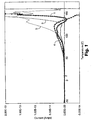
- Controls 1, 3, 4, and Example 5 were measured by Thermally Stimulated Current Spectroscopy to determine the level of trapped charge. TSC curves for each of the samples are set forth in Fig. 1, where 1, 3, 4, and 5 correspond to Controls 1, 3, 4, and Example 5, respectively.
- Type A polypropylene blown microfiber webs were treated according to Example 1 with the exception that the solvent composition was heated to 45 °C for 15 minutes prior to being introduced to the insulated container and the amount of Chimassorb 944 present in the composition was varied as indicated in Table 2.
- the webs were soaked for 10 minutes at 40 °C, rinsed, dried, and hydrocharged as described in Example 1.
- Type A polypropylene blown microfiber webs were prepared as described above in Example 1 with the exception that the solvent composition was heated to 45 °C for 15 minutes prior to being introduced to the insulated container, the solvent composition varied as indicated in Table 3, and each solvent composition included 0.3 % by weight Chimassorb 944.
- a TM07-27-98-02 meltblown polyethylene fibrous web (TransWeb, LLC, Vineland, New Jersey) having a basis weight of 86 g/m 2 and weighing 33.4 g, was soaked for 10 minutes at 40 °C in a solvent composition that consisted of 838 g toluene and 1.41 g Chimassorb 944. The web was rinsed in heptane, air dried, hydrocharged, and tested as previously described.
- the web exhibited a Quality Factor of 0.61 and 38.4 % penetration.
- Control 5 consisted of a hydrocharged TM07-27-98-02 meltblown polyethylene fibrous web (TransWeb). The web exhibited a Quality Factor of 0.41 and 59 % penetration.
- Type A polypropylene blown microfiber web prepared as described in Example 1, was soaked for 10 minutes at 40 °C in the solvent compositions set forth in Table 4.
- the solvent composition of Example 25 also included 0.2 % by weight Chimassorb 944.
- Control 6 consisted of a hydrocharged Type A polypropylene blown microfiber web.
- Examples 26-29 were prepared as described for Examples 19, 21, 23, 25, and Control 6, respectively. Prior to charging, the samples were extracted according to the Method of Determining Extractable Hydrocarbon. The % residue was determined and the results are set forth in Table 5. Table 5 Example % Residue Control 6 0.90 26 0.26 27 0.26 28 0.17 29 0.66
- Type A polypropylene blown microfiber webs were treated according to the above-described supercritical fluid soaking method in compositions that included supercritical carbon dioxide and, where indicated in Table 6, charge additive and co-solvent.
- Example 30 The web of Example 30 was annealed at 150 °C for 5 minutes after treatment in carbon dioxide.
- Control 7 consisted of a hydrocharged Type A polypropylene blown microfiber web.
- Type B polypropylene blown microfiber web was used as the web of Examples 34-42.
- compositions used to treat the webs included supercritical carbon dioxide and, where indicated in Table 7, charge additive and co-solvent. The webs were then dried, hydrocharged and dried again.
- Control 8 consisted of a hydrocharged Type A polypropylene blown microfiber web.
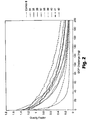
- Fig. 2 illustrates the Quality Factor of each of webs of Examples 34-42 and Control 8 over a period of 200 minutes, where the lines indicated as 8 and 34-42 correspond to Control 8 and Examples 34-42, respectively.
- Type A polypropylene blown microfiber webs were treated according to the solvent spray method with a composition that included solvent and charge additive. The webs were then dried, hydrocharged and dried again. The webs of Examples 45, 47, and 48 were annealed at 100 °C for 5 minutes prior to hydrocharging.
- Controls 9 and 10 consisted of hydrocharged blown polypropylene microfiber web.
- the web of Control 10 was annealed at 100 °C for 5 minutes prior to hydrocharging.
- Controls 11-13 consisted of hydrocharged Type B polypropylene blown microfiber webs.
- Type B polypropylene blown microfiber webs were treated according to the solvent spray method with a composition that included solvent and charge additive. The webs were then dried, hydrocharged, and dried again.
- Example 55 and Control 12 were annealed at 150°C for 5 minutes prior to hydrocharging.
- the webs of Example 57 and Control 13 were annealed at 125 °C for 5 minutes prior to hydrocharging.
Landscapes
- Engineering & Computer Science (AREA)
- Textile Engineering (AREA)
- Chemical & Material Sciences (AREA)
- Power Engineering (AREA)
- Dispersion Chemistry (AREA)
- Microelectronics & Electronic Packaging (AREA)
- Chemical Kinetics & Catalysis (AREA)
- Spectroscopy & Molecular Physics (AREA)
- Physics & Mathematics (AREA)
- Filtering Materials (AREA)
- Chemical Or Physical Treatment Of Fibers (AREA)
- Nonwoven Fabrics (AREA)
- Manufacture Of Porous Articles, And Recovery And Treatment Of Waste Products (AREA)
- Treatment Of Fiber Materials (AREA)
- Treatments For Attaching Organic Compounds To Fibrous Goods (AREA)
- Compounds Of Unknown Constitution (AREA)
- Electrostatic, Electromagnetic, Magneto- Strictive, And Variable-Resistance Transducers (AREA)
Claims (16)
- Verfahren zum Herstellen eines Elektrets, umfassend:Inkontaktbringen eines porösen Substrates, das Polymer umfasst, mit einer Zusammensetzung, die Lösungsmittel umfasst, das fähig ist, das Polymer zu quellen;Abdampfen des Lösungsmittels von dem Substrat; undInkontaktbringen des Substrates mit Wasser in einer Weise, die ausreichend ist, um dem Substrat eine Elektretladung zu verleihen.
- Verfahren nach Anspruch 1, wobei die Zusammensetzung ferner Ladungsadditiv umfasst.
- Verfahren nach Anspruch 2, wobei das Ladungsadditiv aus der Gruppe ausgewählt ist, die aus fluorierten Oxazolidinonen, fluorierten Piperazinen, perfluorierten Alkanen und Kombinationen daraus besteht.
- Verfahren nach Anspruch 2, wobei das Ladungsadditiv Poly[[6-(1,1,3,3-tetramethylbutyl)amino]-s-triazin-2,4-diyl] [[(2,2,6,6-tetramethyl-4-piperidyl)imino]hexamethylen[(2,2,6,6-tetramethyl-4-piperidyl)imino]] umfasst.
- Verfahren nach einem der Ansprüche 1 bis 4, wobei die Zusammensetzung ferner ein zweites Lösungsmittel umfasst.
- Verfahren nach einem der Ansprüche 1 bis 4, wobei das Lösungsmittel aus der Gruppe ausgewählt ist, die aus Alkoholen, Alkylhalogeniden, Aminen, Amiden, Aromaten, Estern, Ethern, Alkanen, Alkenen, Alkinen, Ketonen, Organosiliconen, Alkylpyrrolidonen, Paraffinen und Kombinationen daraus besteht.
- Verfahren nach einem der Ansprüche 1 bis 4, wobei das Lösungsmittel aus der Gruppe ausgewählt ist, die aus Toluol, Heptan, Hexan, Hexylalkohol, Xylol, Trifluorethanol, 2-Butanon und Kombinationen daraus besteht.
- Verfahren nach einem der vorhergehenden Ansprüche, wobei das Elektret einen Gütefaktor von mindestens 1/mm H2O umfasst.
- Verfahren nach einem der vorhergehenden Ansprüche, wobei das Substrat eine Faservliesbahn umfasst.
- Verfahren nach Anspruch 9, wobei die Faservliesbahn Fasern umfasst, die aus der Gruppe ausgewählt sind, die aus Polycarbonat, Polyolefin, Polyester, halogeniertem Polyvinyl, Polystyrol und Kombinationen daraus besteht.
- Verfahren nach Anspruch 9, wobei die Faservliesbahn Fasern umfasst, die aus der Gruppe ausgewählt sind, die aus Polyethylen, Polypropylen, Poly(4-methyl-1-penten) und Kombinationen daraus besteht.
- Verfahren nach Anspruch 9, wobei die Faservliesbahn im Schmelzblasverfahren hergestellte Mikrofasern umfasst.
- Verfahren nach Anspruch 12, wobei die im Schmelzblasverfahren hergestellten Mikrofasern einen effektiven Faserdurchmesser von 1 µm bis 50 µm umfassen.
- Verfahren nach einem der vorhergehenden Ansprüche, wobei das Inkontaktbringen mit Wasser das Beaufschlagen des Substrates mit Wasserstrahlen oder einem Strom von Wassertröpfchen bei einem Druck und während eines Zeitraumes umfasst, die ausreichend sind, um dem. Substrat eine Elektretladung zu verleihen, wobei das Verfahren ferner das Trocknen des Substrats umfasst.
- Verfahren nach einem der vorhergehenden Ansprüche, wobei das Inkontaktbringen des Substrats mit der Zusammensetzung unter einem Druck erfolgt, der größer als Atmosphärendruck ist.
- Verfahren nach einem der Ansprüche 1 bis 14, wobei das Inkontaktbringen des Substrats mit der Zusammensetzung das Besprühen oder Einweichen umfasst.
Priority Applications (1)
| Application Number | Priority Date | Filing Date | Title |
|---|---|---|---|
| EP06003481A EP1670007A1 (de) | 2001-09-07 | 2002-08-12 | Elektret aus gering extrahierbaren Kohlenwasserstoffen |
Applications Claiming Priority (3)
| Application Number | Priority Date | Filing Date | Title |
|---|---|---|---|
| US09/949,387 US20030054716A1 (en) | 2001-09-07 | 2001-09-07 | Method of making an electret |
| US949387 | 2001-09-07 | ||
| PCT/US2002/025422 WO2003023796A2 (en) | 2001-09-07 | 2002-08-12 | Method of making an electret |
Related Child Applications (1)
| Application Number | Title | Priority Date | Filing Date |
|---|---|---|---|
| EP06003481A Division EP1670007A1 (de) | 2001-09-07 | 2002-08-12 | Elektret aus gering extrahierbaren Kohlenwasserstoffen |
Publications (2)
| Publication Number | Publication Date |
|---|---|
| EP1451835A2 EP1451835A2 (de) | 2004-09-01 |
| EP1451835B1 true EP1451835B1 (de) | 2006-03-15 |
Family
ID=25489004
Family Applications (2)
| Application Number | Title | Priority Date | Filing Date |
|---|---|---|---|
| EP06003481A Withdrawn EP1670007A1 (de) | 2001-09-07 | 2002-08-12 | Elektret aus gering extrahierbaren Kohlenwasserstoffen |
| EP02759321A Expired - Lifetime EP1451835B1 (de) | 2001-09-07 | 2002-08-12 | Verfahren zum herstellen eines elektrets |
Family Applications Before (1)
| Application Number | Title | Priority Date | Filing Date |
|---|---|---|---|
| EP06003481A Withdrawn EP1670007A1 (de) | 2001-09-07 | 2002-08-12 | Elektret aus gering extrahierbaren Kohlenwasserstoffen |
Country Status (8)
| Country | Link |
|---|---|
| US (1) | US20030054716A1 (de) |
| EP (2) | EP1670007A1 (de) |
| JP (1) | JP2005503013A (de) |
| KR (1) | KR20040034695A (de) |
| AT (1) | ATE320658T1 (de) |
| AU (1) | AU2002324663A1 (de) |
| DE (1) | DE60209918T2 (de) |
| WO (1) | WO2003023796A2 (de) |
Families Citing this family (11)
| Publication number | Priority date | Publication date | Assignee | Title |
|---|---|---|---|---|
| US7524527B2 (en) * | 2003-05-19 | 2009-04-28 | Boston Scientific Scimed, Inc. | Electrostatic coating of a device |
| TWI257402B (en) * | 2003-11-14 | 2006-07-01 | Ind Tech Res Inst | Electret material and composite thereof |
| US7244292B2 (en) * | 2005-05-02 | 2007-07-17 | 3M Innovative Properties Company | Electret article having heteroatoms and low fluorosaturation ratio |
| US7244291B2 (en) * | 2005-05-02 | 2007-07-17 | 3M Innovative Properties Company | Electret article having high fluorosaturation ratio |
| US7553440B2 (en) * | 2005-05-12 | 2009-06-30 | Leonard William K | Method and apparatus for electric treatment of substrates |
| US20080138248A1 (en) * | 2006-12-11 | 2008-06-12 | Institut Curie | Method for improving the bonding properties of microstructured substrates, and devices prepared with this method |
| JP5437213B2 (ja) * | 2010-09-28 | 2014-03-12 | 日本ポリプロ株式会社 | 溶融紡糸型エレクトロスピニング用プロピレン系樹脂組成物及びそれによる極細繊維の溶融紡糸方法 |
| US20140123854A1 (en) * | 2012-11-05 | 2014-05-08 | William K. Leonard | Method and apparatus for electric treatment of substrates |
| KR101679714B1 (ko) * | 2013-09-02 | 2016-11-25 | 주식회사 엘지화학 | 고분자의 팽윤 현상 평가 지수를 계산하는 방법 및 이를 이용한 시스템 |
| CN111848885B (zh) * | 2020-06-19 | 2022-09-02 | 上海鲁聚聚合物技术有限公司 | 一种含氟有机驻极剂及其制备方法和在驻极母料中的应用 |
| US20230398478A1 (en) * | 2020-11-10 | 2023-12-14 | Neenah Gessner Gmbh | Filter medium comprising a nonwoven electret |
Family Cites Families (11)
| Publication number | Priority date | Publication date | Assignee | Title |
|---|---|---|---|---|
| AU565762B2 (en) * | 1983-02-04 | 1987-09-24 | Minnesota Mining And Manufacturing Company | Method and apparatus for manufacturing an electret filter medium |
| US4734227A (en) * | 1983-09-01 | 1988-03-29 | Battelle Memorial Institute | Method of making supercritical fluid molecular spray films, powder and fibers |
| US4650506A (en) * | 1986-02-25 | 1987-03-17 | Donaldson Company, Inc. | Multi-layered microfiltration medium |
| US5441550A (en) * | 1992-03-26 | 1995-08-15 | The University Of Tennessee Research Corporation | Post-treatment of laminated nonwoven cellulosic fiber webs |
| US5906743A (en) * | 1995-05-24 | 1999-05-25 | Kimberly Clark Worldwide, Inc. | Filter with zeolitic adsorbent attached to individual exposed surfaces of an electret-treated fibrous matrix |
| US5908598A (en) * | 1995-08-14 | 1999-06-01 | Minnesota Mining And Manufacturing Company | Fibrous webs having enhanced electret properties |
| US6213122B1 (en) * | 1997-10-01 | 2001-04-10 | 3M Innovative Properties Company | Electret fibers and filter webs having a low level of extractable hydrocarbons |
| US6123752A (en) * | 1998-09-03 | 2000-09-26 | 3M Innovative Properties Company | High efficiency synthetic filter medium |
| US6110588A (en) * | 1999-02-05 | 2000-08-29 | 3M Innovative Properties Company | Microfibers and method of making |
| US6406657B1 (en) * | 1999-10-08 | 2002-06-18 | 3M Innovative Properties Company | Method and apparatus for making a fibrous electret web using a wetting liquid and an aqueous polar liquid |
| NL1014395C2 (nl) * | 2000-02-16 | 2001-08-20 | Stork Brabant Bv | Werkwijze voor het verven van textielmaterialen in een superkritisch flu´dum. |
-
2001
- 2001-09-07 US US09/949,387 patent/US20030054716A1/en not_active Abandoned
-
2002
- 2002-08-12 JP JP2003527752A patent/JP2005503013A/ja not_active Withdrawn
- 2002-08-12 AU AU2002324663A patent/AU2002324663A1/en not_active Abandoned
- 2002-08-12 KR KR10-2004-7003305A patent/KR20040034695A/ko not_active Withdrawn
- 2002-08-12 WO PCT/US2002/025422 patent/WO2003023796A2/en not_active Ceased
- 2002-08-12 DE DE2002609918 patent/DE60209918T2/de not_active Expired - Fee Related
- 2002-08-12 EP EP06003481A patent/EP1670007A1/de not_active Withdrawn
- 2002-08-12 EP EP02759321A patent/EP1451835B1/de not_active Expired - Lifetime
- 2002-08-12 AT AT02759321T patent/ATE320658T1/de not_active IP Right Cessation
Also Published As
| Publication number | Publication date |
|---|---|
| EP1451835A2 (de) | 2004-09-01 |
| US20030054716A1 (en) | 2003-03-20 |
| JP2005503013A (ja) | 2005-01-27 |
| KR20040034695A (ko) | 2004-04-28 |
| AU2002324663A1 (en) | 2003-03-24 |
| WO2003023796A2 (en) | 2003-03-20 |
| WO2003023796A3 (en) | 2004-06-17 |
| DE60209918T2 (de) | 2006-12-07 |
| EP1670007A1 (de) | 2006-06-14 |
| DE60209918D1 (de) | 2006-05-11 |
| ATE320658T1 (de) | 2006-04-15 |
Similar Documents
| Publication | Publication Date | Title |
|---|---|---|
| US6562112B2 (en) | Fluorinated electret | |
| DE60219070T2 (de) | Plasma- fluorinierungsbehandlung von pörösem material | |
| EP1451835B1 (de) | Verfahren zum herstellen eines elektrets | |
| KR100627757B1 (ko) | 습윤 액체 및 수성 극성 액체를 이용한 섬유상 일렉트리트웹의 제조 방법 및 장치 | |
| EP1273018B1 (de) | Herstellungsverfahren von elektreten durch dampfkondensation | |
| US6454986B1 (en) | Method of making a fibrous electret web using a nonaqueous polar liquid | |
| EP1877476B1 (de) | Elektretartikel mit hohem fluorsättigungsverhältnis | |
| JP2001518569A (ja) | 低レベルの抽出性炭化水素を有するエレクトレット繊維およびフィルターウェブ |
Legal Events
| Date | Code | Title | Description |
|---|---|---|---|
| PUAI | Public reference made under article 153(3) epc to a published international application that has entered the european phase |
Free format text: ORIGINAL CODE: 0009012 |
|
| 17P | Request for examination filed |
Effective date: 20040406 |
|
| AK | Designated contracting states |
Kind code of ref document: A2 Designated state(s): AT BE BG CH CY CZ DE DK EE ES FI FR GB GR IE IT LI LU MC NL PT SE SK TR |
|
| AX | Request for extension of the european patent |
Extension state: AL LT LV MK RO SI |
|
| 17Q | First examination report despatched |
Effective date: 20050209 |
|
| GRAP | Despatch of communication of intention to grant a patent |
Free format text: ORIGINAL CODE: EPIDOSNIGR1 |
|
| GRAS | Grant fee paid |
Free format text: ORIGINAL CODE: EPIDOSNIGR3 |
|
| GRAA | (expected) grant |
Free format text: ORIGINAL CODE: 0009210 |
|
| AK | Designated contracting states |
Kind code of ref document: B1 Designated state(s): AT BE BG CH CY CZ DE DK EE ES FI FR GB GR IE IT LI LU MC NL PT SE SK TR |
|
| PG25 | Lapsed in a contracting state [announced via postgrant information from national office to epo] |
Ref country code: IT Free format text: LAPSE BECAUSE OF FAILURE TO SUBMIT A TRANSLATION OF THE DESCRIPTION OR TO PAY THE FEE WITHIN THE PRESCRIBED TIME-LIMIT;WARNING: LAPSES OF ITALIAN PATENTS WITH EFFECTIVE DATE BEFORE 2007 MAY HAVE OCCURRED AT ANY TIME BEFORE 2007. THE CORRECT EFFECTIVE DATE MAY BE DIFFERENT FROM THE ONE RECORDED. Effective date: 20060315 Ref country code: FI Free format text: LAPSE BECAUSE OF FAILURE TO SUBMIT A TRANSLATION OF THE DESCRIPTION OR TO PAY THE FEE WITHIN THE PRESCRIBED TIME-LIMIT Effective date: 20060315 Ref country code: CH Free format text: LAPSE BECAUSE OF FAILURE TO SUBMIT A TRANSLATION OF THE DESCRIPTION OR TO PAY THE FEE WITHIN THE PRESCRIBED TIME-LIMIT Effective date: 20060315 Ref country code: NL Free format text: LAPSE BECAUSE OF FAILURE TO SUBMIT A TRANSLATION OF THE DESCRIPTION OR TO PAY THE FEE WITHIN THE PRESCRIBED TIME-LIMIT Effective date: 20060315 Ref country code: AT Free format text: LAPSE BECAUSE OF FAILURE TO SUBMIT A TRANSLATION OF THE DESCRIPTION OR TO PAY THE FEE WITHIN THE PRESCRIBED TIME-LIMIT Effective date: 20060315 Ref country code: BE Free format text: LAPSE BECAUSE OF FAILURE TO SUBMIT A TRANSLATION OF THE DESCRIPTION OR TO PAY THE FEE WITHIN THE PRESCRIBED TIME-LIMIT Effective date: 20060315 Ref country code: LI Free format text: LAPSE BECAUSE OF FAILURE TO SUBMIT A TRANSLATION OF THE DESCRIPTION OR TO PAY THE FEE WITHIN THE PRESCRIBED TIME-LIMIT Effective date: 20060315 Ref country code: SK Free format text: LAPSE BECAUSE OF FAILURE TO SUBMIT A TRANSLATION OF THE DESCRIPTION OR TO PAY THE FEE WITHIN THE PRESCRIBED TIME-LIMIT Effective date: 20060315 |
|
| REG | Reference to a national code |
Ref country code: CH Ref legal event code: EP Ref country code: GB Ref legal event code: FG4D |
|
| REG | Reference to a national code |
Ref country code: IE Ref legal event code: FG4D |
|
| REF | Corresponds to: |
Ref document number: 60209918 Country of ref document: DE Date of ref document: 20060511 Kind code of ref document: P |
|
| PG25 | Lapsed in a contracting state [announced via postgrant information from national office to epo] |
Ref country code: DK Free format text: LAPSE BECAUSE OF FAILURE TO SUBMIT A TRANSLATION OF THE DESCRIPTION OR TO PAY THE FEE WITHIN THE PRESCRIBED TIME-LIMIT Effective date: 20060615 Ref country code: BG Free format text: LAPSE BECAUSE OF FAILURE TO SUBMIT A TRANSLATION OF THE DESCRIPTION OR TO PAY THE FEE WITHIN THE PRESCRIBED TIME-LIMIT Effective date: 20060615 Ref country code: SE Free format text: LAPSE BECAUSE OF FAILURE TO SUBMIT A TRANSLATION OF THE DESCRIPTION OR TO PAY THE FEE WITHIN THE PRESCRIBED TIME-LIMIT Effective date: 20060615 |
|
| PG25 | Lapsed in a contracting state [announced via postgrant information from national office to epo] |
Ref country code: ES Free format text: LAPSE BECAUSE OF FAILURE TO SUBMIT A TRANSLATION OF THE DESCRIPTION OR TO PAY THE FEE WITHIN THE PRESCRIBED TIME-LIMIT Effective date: 20060626 |
|
| PG25 | Lapsed in a contracting state [announced via postgrant information from national office to epo] |
Ref country code: IE Free format text: LAPSE BECAUSE OF NON-PAYMENT OF DUE FEES Effective date: 20060814 |
|
| PG25 | Lapsed in a contracting state [announced via postgrant information from national office to epo] |
Ref country code: PT Free format text: LAPSE BECAUSE OF FAILURE TO SUBMIT A TRANSLATION OF THE DESCRIPTION OR TO PAY THE FEE WITHIN THE PRESCRIBED TIME-LIMIT Effective date: 20060816 |
|
| PGFP | Annual fee paid to national office [announced via postgrant information from national office to epo] |
Ref country code: GB Payment date: 20060825 Year of fee payment: 5 |
|
| PG25 | Lapsed in a contracting state [announced via postgrant information from national office to epo] |
Ref country code: MC Free format text: LAPSE BECAUSE OF NON-PAYMENT OF DUE FEES Effective date: 20060831 |
|
| PGFP | Annual fee paid to national office [announced via postgrant information from national office to epo] |
Ref country code: FR Payment date: 20060831 Year of fee payment: 5 |
|
| NLV1 | Nl: lapsed or annulled due to failure to fulfill the requirements of art. 29p and 29m of the patents act | ||
| REG | Reference to a national code |
Ref country code: CH Ref legal event code: PL |
|
| PGFP | Annual fee paid to national office [announced via postgrant information from national office to epo] |
Ref country code: DE Payment date: 20061002 Year of fee payment: 5 |
|
| ET | Fr: translation filed | ||
| PLBE | No opposition filed within time limit |
Free format text: ORIGINAL CODE: 0009261 |
|
| STAA | Information on the status of an ep patent application or granted ep patent |
Free format text: STATUS: NO OPPOSITION FILED WITHIN TIME LIMIT |
|
| 26N | No opposition filed |
Effective date: 20061218 |
|
| GBPC | Gb: european patent ceased through non-payment of renewal fee |
Effective date: 20070812 |
|
| PG25 | Lapsed in a contracting state [announced via postgrant information from national office to epo] |
Ref country code: GR Free format text: LAPSE BECAUSE OF FAILURE TO SUBMIT A TRANSLATION OF THE DESCRIPTION OR TO PAY THE FEE WITHIN THE PRESCRIBED TIME-LIMIT Effective date: 20060616 Ref country code: CZ Free format text: LAPSE BECAUSE OF FAILURE TO SUBMIT A TRANSLATION OF THE DESCRIPTION OR TO PAY THE FEE WITHIN THE PRESCRIBED TIME-LIMIT Effective date: 20060315 |
|
| PG25 | Lapsed in a contracting state [announced via postgrant information from national office to epo] |
Ref country code: EE Free format text: LAPSE BECAUSE OF FAILURE TO SUBMIT A TRANSLATION OF THE DESCRIPTION OR TO PAY THE FEE WITHIN THE PRESCRIBED TIME-LIMIT Effective date: 20060315 |
|
| REG | Reference to a national code |
Ref country code: FR Ref legal event code: ST Effective date: 20080430 |
|
| PG25 | Lapsed in a contracting state [announced via postgrant information from national office to epo] |
Ref country code: DE Free format text: LAPSE BECAUSE OF NON-PAYMENT OF DUE FEES Effective date: 20080301 Ref country code: LU Free format text: LAPSE BECAUSE OF NON-PAYMENT OF DUE FEES Effective date: 20060812 Ref country code: TR Free format text: LAPSE BECAUSE OF FAILURE TO SUBMIT A TRANSLATION OF THE DESCRIPTION OR TO PAY THE FEE WITHIN THE PRESCRIBED TIME-LIMIT Effective date: 20060315 |
|
| PG25 | Lapsed in a contracting state [announced via postgrant information from national office to epo] |
Ref country code: FR Free format text: LAPSE BECAUSE OF NON-PAYMENT OF DUE FEES Effective date: 20070831 |
|
| PG25 | Lapsed in a contracting state [announced via postgrant information from national office to epo] |
Ref country code: GB Free format text: LAPSE BECAUSE OF NON-PAYMENT OF DUE FEES Effective date: 20070812 Ref country code: CY Free format text: LAPSE BECAUSE OF FAILURE TO SUBMIT A TRANSLATION OF THE DESCRIPTION OR TO PAY THE FEE WITHIN THE PRESCRIBED TIME-LIMIT Effective date: 20060315 |