EP1450721B1 - Method for the enhancement of orthodontic treatments - Google Patents
Method for the enhancement of orthodontic treatments Download PDFInfo
- Publication number
- EP1450721B1 EP1450721B1 EP02766443A EP02766443A EP1450721B1 EP 1450721 B1 EP1450721 B1 EP 1450721B1 EP 02766443 A EP02766443 A EP 02766443A EP 02766443 A EP02766443 A EP 02766443A EP 1450721 B1 EP1450721 B1 EP 1450721B1
- Authority
- EP
- European Patent Office
- Prior art keywords
- midline
- space
- crowding
- chart
- data
- Prior art date
- Legal status (The legal status is an assumption and is not a legal conclusion. Google has not performed a legal analysis and makes no representation as to the accuracy of the status listed.)
- Expired - Lifetime
Links
- 238000011282 treatment Methods 0.000 title claims abstract description 35
- 238000000034 method Methods 0.000 title claims description 17
- 230000003466 anti-cipated effect Effects 0.000 claims abstract description 22
- 210000003464 cuspid Anatomy 0.000 claims abstract description 17
- 210000004283 incisor Anatomy 0.000 abstract description 31
- 210000004763 bicuspid Anatomy 0.000 abstract description 23
- 241000282465 Canis Species 0.000 description 39
- 238000000605 extraction Methods 0.000 description 29
- 210000001847 jaw Anatomy 0.000 description 28
- 238000012937 correction Methods 0.000 description 18
- 208000006650 Overbite Diseases 0.000 description 3
- 238000004458 analytical method Methods 0.000 description 3
- 210000002455 dental arch Anatomy 0.000 description 3
- 238000013461 design Methods 0.000 description 3
- 238000012986 modification Methods 0.000 description 3
- 230000004048 modification Effects 0.000 description 3
- 206010061274 Malocclusion Diseases 0.000 description 2
- 238000004590 computer program Methods 0.000 description 2
- 210000003298 dental enamel Anatomy 0.000 description 2
- 238000003745 diagnosis Methods 0.000 description 2
- 238000011269 treatment regimen Methods 0.000 description 2
- 102100026310 Probable E3 ubiquitin-protein ligase MID2 Human genes 0.000 description 1
- 101710119937 Probable E3 ubiquitin-protein ligase MID2 Proteins 0.000 description 1
- 210000000988 bone and bone Anatomy 0.000 description 1
- 238000004364 calculation method Methods 0.000 description 1
- 238000011161 development Methods 0.000 description 1
- 238000010586 diagram Methods 0.000 description 1
- 238000004519 manufacturing process Methods 0.000 description 1
- 238000005259 measurement Methods 0.000 description 1
- 230000003340 mental effect Effects 0.000 description 1
- 238000002203 pretreatment Methods 0.000 description 1
Images


Classifications
-
- A—HUMAN NECESSITIES
- A61—MEDICAL OR VETERINARY SCIENCE; HYGIENE
- A61C—DENTISTRY; APPARATUS OR METHODS FOR ORAL OR DENTAL HYGIENE
- A61C7/00—Orthodontics, i.e. obtaining or maintaining the desired position of teeth, e.g. by straightening, evening, regulating, separating, or by correcting malocclusions
-
- A—HUMAN NECESSITIES
- A61—MEDICAL OR VETERINARY SCIENCE; HYGIENE
- A61C—DENTISTRY; APPARATUS OR METHODS FOR ORAL OR DENTAL HYGIENE
- A61C7/00—Orthodontics, i.e. obtaining or maintaining the desired position of teeth, e.g. by straightening, evening, regulating, separating, or by correcting malocclusions
- A61C7/12—Brackets; Arch wires; Combinations thereof; Accessories therefor
- A61C7/14—Brackets; Fixing brackets to teeth
- A61C7/146—Positioning or placement of brackets; Tools therefor
-
- G—PHYSICS
- G16—INFORMATION AND COMMUNICATION TECHNOLOGY [ICT] SPECIALLY ADAPTED FOR SPECIFIC APPLICATION FIELDS
- G16H—HEALTHCARE INFORMATICS, i.e. INFORMATION AND COMMUNICATION TECHNOLOGY [ICT] SPECIALLY ADAPTED FOR THE HANDLING OR PROCESSING OF MEDICAL OR HEALTHCARE DATA
- G16H10/00—ICT specially adapted for the handling or processing of patient-related medical or healthcare data
- G16H10/60—ICT specially adapted for the handling or processing of patient-related medical or healthcare data for patient-specific data, e.g. for electronic patient records
-
- G—PHYSICS
- G16—INFORMATION AND COMMUNICATION TECHNOLOGY [ICT] SPECIALLY ADAPTED FOR SPECIFIC APPLICATION FIELDS
- G16H—HEALTHCARE INFORMATICS, i.e. INFORMATION AND COMMUNICATION TECHNOLOGY [ICT] SPECIALLY ADAPTED FOR THE HANDLING OR PROCESSING OF MEDICAL OR HEALTHCARE DATA
- G16H20/00—ICT specially adapted for therapies or health-improving plans, e.g. for handling prescriptions, for steering therapy or for monitoring patient compliance
- G16H20/40—ICT specially adapted for therapies or health-improving plans, e.g. for handling prescriptions, for steering therapy or for monitoring patient compliance relating to mechanical, radiation or invasive therapies, e.g. surgery, laser therapy, dialysis or acupuncture
Definitions
- the present invention relates to a method which is useful in orthodontically treating patients.
- Orthodontics is a branch of dentistry that involves the movement of malpositioned teeth to orthodontically correct positions. Before prescribing an orthodontic treatment, X-rays and photographs of the patient's teeth and jaw structure are usually taken. Also, a mold of the patient's teeth is typically made. This mold along with the X-rays and photographs provide a model of the positions of the patient's teeth and dental arches prior to treatment.
- the orthodontist also frequently relies on a post treatment model of the desired positions of the patient's teeth and dental arches.
- This post-treatment model has typically been a mental model formulated in the mind of the orthodontist based on the orthodontist's experience and skill.
- computer programs are also known to assist the orthodontist in the development of a computerized post-treatment model. The orthodontist then devises a treatment strategy to move the patient's teeth and/or dental arches from their positions as represented by the pre-treatment model to the desired positions as represented by the post-treatment model.
- Cephalometric analyses are also an important part of orthodontic diagnosis and treatment planning. Most of these cephalometric analyses measure maxillary (upper jaw) and mandibular (lower jaw) skeletal relationships in the vertical and horizontal planes, as well as the positions and angulations of the incisors. Few cephalometric analyses provide information about the direction and amount of dental movements required in the maxillary and mandibular arches.
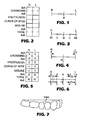
- the chart of Figure 1 is used to record the patient's initial midline and first molar relationships on the right and left sides.
- the exemplary data in Figure 4 indicate that the upper dental midline of the patient is symmetrical and that the lower dental midline deviates from the upper dental midline 1 mm to the right.
- the molar relationship data of Figure 4 indicate a 4 mm Class II deviation between the upper and lower first molars of the patient on the right side and a 3.5 mm Class II deviation between the upper and lower first molars of the patient on the left side.
- the chart of Figure 2 is used to record the lower arch discrepancy.
- Four primary arch factors are used.
- the space required for relief of crowding between the canine and the midline (3x3) and the space required for relief of crowding between the first molar to the midline (6x6) are recorded for each side, right and left.
- the space required to correct protrusion or intrusion of the lower incisors is also recorded as is the space required to level the curve of Spee.
- the space required for correction of the midline is further recorded. Finally, these space requirements are totaled.
- the exemplary data in Figure 5 indicate that the lower arch has 3 mm of crowding on the right side, all of which is mesial to the lower right canine. In other words, there is 3 mm of crowding between the lower right canine and the midline.
- the chart in Figure 5 indicates that, on the lower right side, the crowding between the first molar and the midline is also 3 mm, meaning that all of the crowding on the lower right side is between the canine and the midline.
- the lower arch has only 1 mm of crowding on the left side, all of which is mesial to the lower left canine.
- the chart in Figure 5 indicates that, on the lower left side, the crowding between the first molar and the midline is also 1 mm, meaning that all of the crowding on the lower left side is between the canine and the midline.
- the curve of Spee depth is measured from a line extending from the distal cusps of the second molars to the incisal edges of the central incisors. It is generally believed that leveling a curve of Spee that is 2 mm deep requires 1 mm of space. Thus, the exemplary data of Figure 5 indicates that 1 mm of space is needed in order to level the curve of Spee.
- the lower midline is deviated 1 mm to the right. Because the lower midline is deviated 1 mm to the right, correction of the lower midline requires 1 mm of space on the left side so that the midline can be moved 1 mm to the left. On the other hand, movement of the midline 1 mm to the left creates 1 mm of the space on the right side. Accordingly, the 1 mm of created space on the right side is shown as +1 in the chart of Figure 5, and the 1 mm of required space on the left side is shown as -1 in the chart of Figure 5.
- the space requirements are totaled in each region (3x3 and 6x6).
- 5 mm of space is needed between the canine and the midline to alleviate the crowding, to retract the lower incisor protrusion, and to level the curve of Spee.
- this space requirement is 6 mm (3+2+1).
- the total space requirement is recorded in the chart of Figure 5 as -5, where the minus sign indicates required space rather than created space.
- the same total space requirement applies to the 6x6 region.
- An upper arch discrepancy chart would not ordinarily be done for the patient because it is generally assumed that correct positioning of the lower teeth will align the lower teeth with the upper teeth. However, an upper arch discrepancy chart can be useful to the orthodontist such as in surgical cases.
- the extraction of the four first premolars normally creates 7 mm of space in each quadrant (upper right, upper left, lower right, and lower left). These spaces are recorded in the chart of Figure 6 as (7) in each quadrant. Because the total lower arch discrepancy from midline to canine on each side is 5 mm as shown by the chart in Figure 5, the lower left and right canines can be retracted into the extraction sites to correct this discrepancy. These 5 mm movements are recorded in the chart of Figure 6 as 5 with arrows pointing distally in the lower right and left quadrants.
- the lower midline is deviated 1 mm to the right and, therefore, the lower midline is moved 1 mm to the left.
- This 1 mm movement is recorded in the chart of Figure 6 as 1 with an arrow pointing to the left in the lower jaw.
- the total upper arch discrepancy from midline to canine on the right side is 9 mm and the total upper arch discrepancy from midline to canine on the left side is 8.5 mm. Correction of these discrepancies requires the upper right canine to be retracted by 9 mm into the upper right extraction site and the upper left canine to be retracted by 8.5 mm into the upper left extraction site.
- 9 mm and 8.5 mm movements are recorded in the chart of Figure 6 as 9 and 8.5, respectively, with corresponding arrows pointing distally in the upper right and left quadrants.
- custom orthodontic appliances can be automatically fabricated by deriving final positions of the teeth of a patient from digitized information of the anatomical shape of the patient's mouth, and by using the digitized shape information and the derived tooth final positions in the design of the appliances.
- the digitized information is generated from measurements of the mouth of the patient, and includes information of the shapes of the individual teeth of the patient and of the patient's lower jaw.
- the final tooth positions include an archform defined by the shape of the lower jaw, and the appliance is configured in accordance with this archform.
- An archwire forming machine reads input data related to the shape of the patient's jaw and teeth, derives the tooth final positions as well as archwire and bracket designs that will move the teeth to the calculated final positions, and generates code to produce the archwire in accordance with the design.
- a bracket fabrication machine fabricates the brackets based on the final tooth position calculations and digitized tooth shape data, and determines positions on the teeth to receive archwires.
- the method comprises the following: entering first crowding/spacing data in first and second tables, wherein the first table relates only to cuspid to midline regions of a patient's jaw, wherein the second table relates to second molar to midline regions of the patient's jaw, and wherein the first crowding/spacing data relates to the right and left cuspid to midline regions of the patient's jaw; entering second crowding/spacing data in the second table but not the first table, wherein the second crowding/spacing data relates to bicuspid regions of the patient's jaw; entering third crowding/spacing data in the second table but not the first table, wherein the third crowding/spacing data relates to molar regions of the patient's jaw; entering curve of Spee spacing data in the first and second tables, wherein the curve of Spee spacing data relates to space required to correct a curve of Spee of the patient's jaw; entering midline spacing data in the first and second tables, where
- the method comprises the following: entering first crowding/spacing data in first and second tables, wherein the first table contains data related only to cuspid to midline regions of a patient's jaw, wherein the second table relates to second molar to midline regions of the patient's jaw and includes the data related to the cuspid to midline regions of the patient's jaw, and wherein the first crowding/spacing data relates to cuspid to midline regions of the patient's jaw; entering second crowding/spacing data in the second table, wherein the second crowding/spacing data relates to bicuspid regions of the patient's jaw; entering third crowding/spacing data in the second table, wherein the third crowding/spacing data relates to molar regions of the patient's jaw; entering curve of Spee spacing data in the first and second tables, wherein the curve of Spee spacing data relates to space required to correct a curve of Spee of the patient's jaw; entering midline spacing data in the
- the method to comprises the following: entering midline and molar relationships into a midline chart; entering first, second, third, fourth, fifth, and sixth crowding/spacing data into a discrepancy chart having first and second tables, wherein the first table contains data related only to cuspid to midline regions of a patient's jaw, wherein the second table relates to second molar to midline regions of the patient's jaw and includes the cuspid to midline regions of the patient's jaw, wherein the first crowding/spacing data relates to cuspid to midline regions of the patient's jaw, wherein the second crowding/spacing data relates to bicuspid regions of the patient's jaw, wherein the third crowding/spacing data relates to molar regions of the patient's jaw, wherein the fourth crowding/spacing data relates to a curve of Spee, wherein the fifth crowding/spacing data relates to midline position, and wherein the sixth crowding/
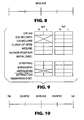
- the chart of Figure 8 is used to record the patient's initial midline and first molar relationships on the right and left sides.
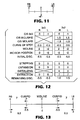
- the exemplary data in Figure 11 indicate that the upper dental midline of the patient is symmetrical and that the lower dental midline deviates from the upper dental midline by 2 mm to the right.
- the molar relationship data of Figure 11 indicate a 3 mm Class II deviation between the upper and lower first molars of the patient on the right and left side. Any overjet, overbite, and crossbite of a patient may also be recorded under the chart of Figure 8.
- a chart having 3x3 and 7x7 tables is illustrated in Figure 9 and is used to record the lower arch discrepancy.
- the 3x3 chart covers the regions between the right canine and the midline and between the left canine and the midline.
- the 7x7 chart covers the regions between the right second molar and the midline and between the left second molar and the midline.
- the spaces required for relief of crowding between the right canine and the midline and between the left canine and the midline (3x3) are recorded in both the 3x3 table and the 7x7 table.
- the spaces required for the relief of crowding of the right premolars (bicuspids) and the left premolars are recorded only in the 7x7 table.
- the chart of Figure 9 is used to enter space requirements to alleviate crowding, to permit correction of the curve of Spee, and to permit correction of incisor positions.
- space may also exist or be created on one or both sides of the jaw. For example, when the lower midline is moved, space is created on one side of the jaw, and this created space is recorded in the chart of Figure 9 as shown by the data in Figure 12.
- space may exist in the canine to midline, premolar, and/or molar regions of the arch. If so, these existing spaces would be entered into the chart of Figure 9 as positive numbers.
- the chart of Figure 9 allows entries of such other created space.
- the chart includes entries for interproximal reduction (stripping of enamel), for lower arch expansion (widening), and for distalization of lower molars (movement of the lower molars toward the back of the jaw), and for extractions.
- the differences between the total created spaces and the total space requirements are entered into both tables of the chart of Figure 9 as remaining discrepancies.
- the exemplary data in the C/S 3x3 row of the 3x3 table of Figure 12 indicate that the lower arch has 5 mm of crowding on the right side. This crowding is mesial to the lower right canine. This 5 mm of crowding between the lower right canine and the midline is also entered into the same row of the 7x7 table of Figure 12. Similarly, the lower arch has only 1 mm of crowding on the left side. This crowding is likewise mesial to the lower left canine. This 1 mm of crowding between the lower right canine and the midline is entered into the C/S 3x3 row of the 3x3 and 7x7 tables of Figure 12.
- the exemplary data in the C/S Bicuspid/E row of the 7x7 table shown in Figure 12 indicate that the lower arch has 1.5 mm of available space in the bicuspid region of the lower right quadrant. This 1.5 mm of available space is entered as a positive number into the 7x7 table of Figure 12. Similarly, the exemplary data indicate that the lower arch has 1.5 mm of available space in the bicuspid region of the lower left quadrant. This 1.5 mm of available space is also entered as a positive number into the 7x7 table of Figure 12. These available spaces in the premolar regions are not entered into the 3x3 table because they are outside of the coverage of the 3x3 table.
- the exemplary data in the C/S Molars row of the 7x7 table of Figure 12 further indicate that the lower arch requires 1.5 mm of space in the molar region of the lower right quadrant to alleviate crowding. This 1.5 mm of required space is entered as a negative number into the 7x7 table of Figure 12.
- the exemplary data indicate that the lower arch requires 1.5 mm of space in the molar region of the lower left quadrant to alleviate crowding. This 1.5 mm of required space is also entered as a negative number into the 7x7 table of Figure 12.
- the 2 mm of created space on the right side is shown as a positive number in the Midline row of the chart of Figure 12, and the 2 mm of required space on the left side is shown as a negative number in Midline row of the chart of Figure 12.
- 2 mm of space is required on the lower right and lefts sides in order to correct the positions of the lower incisors. This 2 mm of required space is entered as a negative number into the Incisor Pos. row of the 3x3 and 7x7 tables of Figure 12.
- Charts similar to that shown in Figure 12 can be completed for the upper arch such as in surgical cases.
- FIG. 13 is a reproduction of Figure 10 but containing the pertinent data relating to the anticipated treatment changes.
- the anticipated treatment based upon the exemplary data shown in Figures 11 and 12 includes extractions in the upper and lower, right and left quadrants. These extractions create 7 mm of space in the upper right and left quadrants and 7 mm of space in the lower right and left quadrants.
- the upper extractions are recorded in the chart of Figure 13 as (7) in the upper right and left quadrants.
- the lower extractions are also recorded in the chart of Figure 13.
- the lower arch also gains 1.5 mm of leeway (E) space in the lower right and left bicuspid areas
- the space created by the lower extractions (7) are added to the leeway space (1.5) in the region of the lower bicuspids and the total is recorded as (8.5) in the lower right and left quadrants.
- the 10.5 mm of space created in the lower right quadrant (i.e., 7 mm from the extraction + the 2 mm resulting from moving the midline to the left + 1.5 mm of leeway space in the bicuspid region) permits the teeth in the lower right quadrant to be correctly positioned.
- This correction in the lower right quadrant uses 5 mm of space to relieve crowding between the canine and the midline, uses 0.5 mm of space to level the curve of Spee, uses 1.5 mm of space to relieve crowding in the molar region, and uses 2 mm of space for incisor position correction. This correction leaves 1.5 mm of unused space. As a result, the rear molars in the lower right quadrant are moved forward (mesially) to take up this unused space.
- the entries into the chart of Figure 13 show the 2 mm movement of the midline and the net 5.5 mm of distal movement of the teeth between the canine and the midline in the lower right quadrant.
- the chart of Figure 13 also shows the 8.5 mm of available space in the lower right quadrant.
- the difference (3 mm) between the net 5.5 mm of distal tooth movement and the 8.5 mm of available space is recorded in the chart of Figure 13 as a net of 3 mm mesially in the molar region of the lower right quadrant.
- the 10 mm of space created in the lower left quadrant permits the teeth in the lower left quadrant to be correctly positioned.
- This correction in the lower right quadrant uses 1 mm of space to relieve crowding between the canine and the midline, uses 0.5 mm of space to level the curve of Spee, uses 1.5 mm of space to relieve crowding in the molar region, uses 2 mm of space for midline correction, and uses 2 mm of space for incisor position correction.
- This correction leaves 1.5 mm of unused space.
- the rear molars in the lower left quadrant are moved forward to take up this unused space.
- the entries into the chart of Figure 13 show the 2 mm movement of the midline and the net 5.5 mm of movement of the teeth between the canine and the midline in the lower left quadrant.
- the chart of Figure 13 also shows the 8.5 mm of available space in the lower left quadrant.
- the difference (3 mm) between the net 5.5 mm of distal tooth movement and the 8.5 mm of available space is recorded in the chart of Figure 13 as a net of 3 mm mesially in the molar region of the lower left quadrant.
- the 7 mm of space created in the upper right quadrant from the extraction permits the teeth in the upper right quadrant to be correctly positioned.
- This correction in the upper right quadrant uses all 7 mm of space to relieve crowding between the canine and the midline.
- the 7 mm of space created in the upper left quadrant from the extraction permits the teeth in the upper left quadrant to be correctly positioned.
- This correction in the upper left quadrant uses all 7 mm of space to relieve crowding between the canine and the midline.
- the entries into the chart of Figure 13 show the net 7 mm of movement of the teeth between the canine and the midline in the upper right quadrant, and the net 7 mm of movement of the teeth between the canine and the midline in the upper left quadrant.
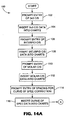
- a computer program 100 which is shown in Figures 14A-14C by way of a flow chart and which is executed by a computer, may be used to implement the present invention.
- a block 102 Upon start up of the program 100, a block 102 prompts the user to enter 3x3 crowding as a negative number or 3x3 available spacing as a positive number.
- a block 104 Upon entry of this data, a block 104 causes this data to be inserted into the C/S 3x3 row of the arch discrepancy chart ( Figure 9).
- the block 104 inserts -5 in the R columns and -1 in the L columns of the 3x3 and 7x7 tables, as shown in Figure 12.
- a block 106 prompts the user to enter crowding as a negative number or available spacing as a positive number for the bicuspid regions.
- a block 108 causes this data to be inserted into the C/S Bicuspid/E row of the arch discrepancy chart.
- the block 108 inserts 1.5 in the R and L columns of the 7x7 table, as shown in Figure 12.
- a block 110 prompts the user to enter crowding as a negative number or available spacing as a positive number for the molar regions.
- a block 112 causes this data to be inserted into the C/S Molars row of the arch discrepancy chart.
- the block 112 inserts -1.5 in the R and L columns of the 7x7 table, as shown in Figure 12.
- a block 114 prompts the user to enter crowding as a negative number for any correction of the curve of Spee.
- a block 116 causes this data to be inserted into the Curve of Spee row of the arch discrepancy chart.
- the block 116 inserts -0.5 in the R and L columns of the 3x3 table and the 7x7 table, as shown in Figure 12.
- a block 118 prompts the user to enter crowding as a negative number or available spacing as a positive number resulting from correction of the midline deviation.
- a block 120 causes this data to be inserted into the Midline row of the arch discrepancy chart.
- the block 120 inserts 2 in the R columns of the 3x3 table and the 7x7 table and inserts -2 in the L columns of the 3x3 table and the 7x7 table, all as shown in Figure 12.
- the block 120 also inserts the midline deviation into the midline chart ( Figure 8).
- the block 120 accordingly inserts 2 for the midline deviation, as shown in Figure 11.
- a block 122 prompts the user to enter crowding as a negative number resulting from correction of the incisor positions.
- a block 124 causes this data to be inserted into the Incisor Position row of the arch discrepancy chart.
- the block 124 inserts -2 in the R and L columns of the 3x3 table and the 7x7 table, as shown in Figure 12.
- a block 126 totals (sums) the entries into R and L columns discussed so far and enters these totals as an initial discrepancy into the Initial Discrepancy row of the arch discrepancy chart.
- the block 126 inserts -5.5 in the R and L columns of the 3x3 table and the 7x7 table, as shown in Figure 12.
- a block 128 prompts the user to enter space created by stripping, expansion, and distalizing as a positive number, assuming that stripping, expansion, and distalizing are contemplated in the anticipated treatment.
- a block 130 causes the stripping data to be inserted into the Stripping row of the arch discrepancy chart.
- the block 130 inserts 0 in the R and L columns of the 3x3 table and the 7x7 table, as shown in Figure 12.
- the block 130 also causes the expansion data to be inserted into the Expansion row of the arch discrepancy chart.
- the block 130 inserts 0 in the R and L columns of the 3x3 table and the 7x7 table, as shown in Figure 12.
- the block 130 further causes the distalizing data to be inserted into the Distalizing row of the arch discrepancy chart.
- the block 130 inserts 0 in the R and L columns of the 7x7 table, as shown in Figure 12.
- a block 132 prompts the user to enter the available space resulting from extractions, assuming that extractions are contemplated in the anticipated treatment.
- a block 134 causes this data to be inserted into the Extraction row of the arch discrepancy chart.
- the block 124 inserts 7 in the R and L columns of the 7x7 table, as shown in Figure 12.
- a block 136 totals (sums) the initial discrepancy with the other space created by stripping, expansion, distalizing, and extraction, and inserts these totals as a remaining discrepancy into the Remaining Discrepancy row of the arch discrepancy chart.
- the block 136 inserts -5.5 in the R and L columns of the 3x3 table and inserts 1.5 in the R and L columns of the 7x7 table, as shown in Figure 12.
- a block 138 inserts the anticipated treatment into the chart of Figure 10.
- the block 138 inserts into the chart of Figure 10 the movement of the midline, the space created by extractions (if any), the movement of the teeth in the cuspid to midline region, and the movement of the teeth in the molar region.
- the block 138 inserts -2 to show the midline movement, inserts the 5.5 mm distal movement of the teeth in the cuspid to midline regions on the right and left sides, inserts the 3 mm mesial movement of the teeth in the molar regions on the right and left sides, and inserts the 8.5 mm of combined extraction and leeway space.
- the block 138 inserts into the chart of Figure 10 the movement of the midline, the space created by extractions (if any), the movement of the teeth in the cuspid to midline region, and the movement of the teeth in the molar region.
- the block 138 inserts 0 to show the upper midline movement, inserts the 7 mm distal movement of the teeth in the cuspid to midline regions on the right and left sides, inserts the 0 mm movement of the teeth in the molar regions on the right and left sides, and inserts the 7 mm of extraction space.
- a block 140 prompts the user to enter the molar relationships indicating the deviation between the upper and lower first molars of the patient on the right and left sides.
- a block 142 causes this data to be inserted into the midline chart.
- the block 142 inserts 3 for the right and left molar relationships, as shown in Figure 11.
- a block 144 causes the completed charts to be displayed to the user on a monitor. Alternatively, or additionally, the block 140 causes the completed charts to be printed for the user. The presentation of the information in these charts permits the orthodontist to more effectively treat patients.
- the block 138 automatically inserts the anticipated treatment into the chart of Figure 10.
- the block 138 could instead be arranged to prompt the user to manually enter the anticipated treatment into the chart of Figure 10 and/or to edit the anticipated treatment automatically and/or manually entered into the chart of Figure 10.
Landscapes
- Health & Medical Sciences (AREA)
- Epidemiology (AREA)
- Public Health (AREA)
- General Health & Medical Sciences (AREA)
- Oral & Maxillofacial Surgery (AREA)
- Dentistry (AREA)
- Veterinary Medicine (AREA)
- Medical Informatics (AREA)
- Primary Health Care (AREA)
- Animal Behavior & Ethology (AREA)
- Life Sciences & Earth Sciences (AREA)
- Engineering & Computer Science (AREA)
- Nuclear Medicine, Radiotherapy & Molecular Imaging (AREA)
- Surgery (AREA)
- Urology & Nephrology (AREA)
- Dental Tools And Instruments Or Auxiliary Dental Instruments (AREA)
- Lasers (AREA)
- Arrangement And Driving Of Transmission Devices (AREA)
- Glass Compositions (AREA)
- Paper (AREA)
Applications Claiming Priority (3)
| Application Number | Priority Date | Filing Date | Title |
|---|---|---|---|
| US09/995,456 US20030101079A1 (en) | 2001-11-27 | 2001-11-27 | Method for the enhancement of orthodontic treatments |
| US995456 | 2001-11-27 | ||
| PCT/US2002/031237 WO2003045267A1 (en) | 2001-11-27 | 2002-10-03 | Method for the enhancement of orthodontic treatments |
Publications (2)
| Publication Number | Publication Date |
|---|---|
| EP1450721A1 EP1450721A1 (en) | 2004-09-01 |
| EP1450721B1 true EP1450721B1 (en) | 2007-01-03 |
Family
ID=25541831
Family Applications (1)
| Application Number | Title | Priority Date | Filing Date |
|---|---|---|---|
| EP02766443A Expired - Lifetime EP1450721B1 (en) | 2001-11-27 | 2002-10-03 | Method for the enhancement of orthodontic treatments |
Country Status (7)
| Country | Link |
|---|---|
| US (1) | US20030101079A1 (enExample) |
| EP (1) | EP1450721B1 (enExample) |
| JP (2) | JP2005510290A (enExample) |
| AT (1) | ATE349965T1 (enExample) |
| AU (1) | AU2002330179A1 (enExample) |
| DE (1) | DE60217396T2 (enExample) |
| WO (1) | WO2003045267A1 (enExample) |
Families Citing this family (63)
| Publication number | Priority date | Publication date | Assignee | Title |
|---|---|---|---|---|
| US20040083395A1 (en) * | 2002-08-01 | 2004-04-29 | Elain Blechman | Client-centric e-health system and method with applications to long-term health and community care consumers, insurers, and regulators |
| US9492245B2 (en) | 2004-02-27 | 2016-11-15 | Align Technology, Inc. | Method and system for providing dynamic orthodontic assessment and treatment profiles |
| JP5188179B2 (ja) * | 2004-06-18 | 2013-04-24 | デンツプライ インターナショナル インコーポレーテッド | 処方歯列矯正アクチベータ |
| US7384266B2 (en) * | 2004-11-02 | 2008-06-10 | Align Technology, Inc. | Method and apparatus for manufacturing and constructing a physical dental arch model |
| US7878805B2 (en) | 2007-05-25 | 2011-02-01 | Align Technology, Inc. | Tabbed dental appliance |
| US8738394B2 (en) | 2007-11-08 | 2014-05-27 | Eric E. Kuo | Clinical data file |
| US8108189B2 (en) | 2008-03-25 | 2012-01-31 | Align Technologies, Inc. | Reconstruction of non-visible part of tooth |
| US9492243B2 (en) | 2008-05-23 | 2016-11-15 | Align Technology, Inc. | Dental implant positioning |
| US8172569B2 (en) | 2008-06-12 | 2012-05-08 | Align Technology, Inc. | Dental appliance |
| US8292617B2 (en) | 2009-03-19 | 2012-10-23 | Align Technology, Inc. | Dental wire attachment |
| US8765031B2 (en) | 2009-08-13 | 2014-07-01 | Align Technology, Inc. | Method of forming a dental appliance |
| US8805048B2 (en) | 2010-04-01 | 2014-08-12 | Mark Batesole | Method and system for orthodontic diagnosis |
| US9211166B2 (en) | 2010-04-30 | 2015-12-15 | Align Technology, Inc. | Individualized orthodontic treatment index |
| US9241774B2 (en) | 2010-04-30 | 2016-01-26 | Align Technology, Inc. | Patterned dental positioning appliance |
| US9403238B2 (en) | 2011-09-21 | 2016-08-02 | Align Technology, Inc. | Laser cutting |
| US9375300B2 (en) | 2012-02-02 | 2016-06-28 | Align Technology, Inc. | Identifying forces on a tooth |
| US9220580B2 (en) * | 2012-03-01 | 2015-12-29 | Align Technology, Inc. | Determining a dental treatment difficulty |
| US9414897B2 (en) | 2012-05-22 | 2016-08-16 | Align Technology, Inc. | Adjustment of tooth position in a virtual dental model |
| US10449016B2 (en) | 2014-09-19 | 2019-10-22 | Align Technology, Inc. | Arch adjustment appliance |
| US9610141B2 (en) | 2014-09-19 | 2017-04-04 | Align Technology, Inc. | Arch expanding appliance |
| US9744001B2 (en) | 2014-11-13 | 2017-08-29 | Align Technology, Inc. | Dental appliance with cavity for an unerupted or erupting tooth |
| US10504386B2 (en) | 2015-01-27 | 2019-12-10 | Align Technology, Inc. | Training method and system for oral-cavity-imaging-and-modeling equipment |
| US11931222B2 (en) | 2015-11-12 | 2024-03-19 | Align Technology, Inc. | Dental attachment formation structures |
| US11554000B2 (en) | 2015-11-12 | 2023-01-17 | Align Technology, Inc. | Dental attachment formation structure |
| US11596502B2 (en) | 2015-12-09 | 2023-03-07 | Align Technology, Inc. | Dental attachment placement structure |
| US11103330B2 (en) | 2015-12-09 | 2021-08-31 | Align Technology, Inc. | Dental attachment placement structure |
| EP3471599B1 (en) | 2016-06-17 | 2025-11-19 | Align Technology, Inc. | Intraoral appliances with sensing |
| EP3988048B1 (en) | 2016-06-17 | 2024-01-17 | Align Technology, Inc. | Orthodontic appliance performance monitor |
| CN115869098A (zh) | 2016-07-27 | 2023-03-31 | 阿莱恩技术有限公司 | 具有牙科诊断能力的口内扫描仪 |
| US10507087B2 (en) | 2016-07-27 | 2019-12-17 | Align Technology, Inc. | Methods and apparatuses for forming a three-dimensional volumetric model of a subject's teeth |
| WO2018085718A2 (en) | 2016-11-04 | 2018-05-11 | Align Technology, Inc. | Methods and apparatuses for dental images |
| PL3547952T3 (pl) | 2016-12-02 | 2021-05-31 | Align Technology, Inc. | Ekspander podniebienny |
| WO2018102770A1 (en) | 2016-12-02 | 2018-06-07 | Align Technology, Inc. | Force control, stop mechanism, regulating structure of removable arch adjustment appliance |
| US11026831B2 (en) | 2016-12-02 | 2021-06-08 | Align Technology, Inc. | Dental appliance features for speech enhancement |
| WO2018102811A1 (en) | 2016-12-02 | 2018-06-07 | Align Technology, Inc. | Methods and apparatuses for customizing rapid palatal expanders using digital models |
| US10548700B2 (en) | 2016-12-16 | 2020-02-04 | Align Technology, Inc. | Dental appliance etch template |
| US10779718B2 (en) | 2017-02-13 | 2020-09-22 | Align Technology, Inc. | Cheek retractor and mobile device holder |
| WO2018183358A1 (en) | 2017-03-27 | 2018-10-04 | Align Technology, Inc. | Apparatuses and methods assisting in dental therapies |
| US10613515B2 (en) | 2017-03-31 | 2020-04-07 | Align Technology, Inc. | Orthodontic appliances including at least partially un-erupted teeth and method of forming them |
| US11045283B2 (en) | 2017-06-09 | 2021-06-29 | Align Technology, Inc. | Palatal expander with skeletal anchorage devices |
| WO2019005808A1 (en) | 2017-06-26 | 2019-01-03 | Align Technology, Inc. | BIOCAPTOR PERFORMANCE INDICATOR FOR INTRABUCCAL DEVICES |
| US10885521B2 (en) | 2017-07-17 | 2021-01-05 | Align Technology, Inc. | Method and apparatuses for interactive ordering of dental aligners |
| WO2019018784A1 (en) | 2017-07-21 | 2019-01-24 | Align Technology, Inc. | ANCHOR OF CONTOUR PALATIN |
| EP3658070B1 (en) | 2017-07-27 | 2025-11-26 | Align Technology, Inc. | Tooth shading, transparency and glazing |
| US12274597B2 (en) | 2017-08-11 | 2025-04-15 | Align Technology, Inc. | Dental attachment template tray systems |
| WO2019035979A1 (en) | 2017-08-15 | 2019-02-21 | Align Technology, Inc. | EVALUATION AND CALCULATION OF BUCCAL CORRIDOR |
| US11123156B2 (en) | 2017-08-17 | 2021-09-21 | Align Technology, Inc. | Dental appliance compliance monitoring |
| WO2019071019A1 (en) | 2017-10-04 | 2019-04-11 | Align Technology, Inc. | INTRAORAL APPARATUS FOR SAMPLING MOUTH TISSUE |
| US10813720B2 (en) | 2017-10-05 | 2020-10-27 | Align Technology, Inc. | Interproximal reduction templates |
| CN111565668B (zh) | 2017-10-27 | 2022-06-07 | 阿莱恩技术有限公司 | 替代咬合调整结构 |
| CN111295153B (zh) | 2017-10-31 | 2023-06-16 | 阿莱恩技术有限公司 | 具有选择性牙合负荷和受控牙尖交错的牙科器具 |
| EP4545041A3 (en) | 2017-11-01 | 2025-07-09 | Align Technology, Inc. | Automatic treatment planning |
| US11534974B2 (en) | 2017-11-17 | 2022-12-27 | Align Technology, Inc. | Customized fabrication of orthodontic retainers based on patient anatomy |
| CN118948478A (zh) | 2017-11-30 | 2024-11-15 | 阿莱恩技术有限公司 | 用于监测口腔矫治器的传感器 |
| WO2019118876A1 (en) | 2017-12-15 | 2019-06-20 | Align Technology, Inc. | Closed loop adaptive orthodontic treatment methods and apparatuses |
| US10980613B2 (en) | 2017-12-29 | 2021-04-20 | Align Technology, Inc. | Augmented reality enhancements for dental practitioners |
| EP3743010B1 (en) | 2018-01-26 | 2022-01-12 | Align Technology, Inc. | Diagnostic intraoral scanning and tracking |
| US11937991B2 (en) | 2018-03-27 | 2024-03-26 | Align Technology, Inc. | Dental attachment placement structure |
| AU2019251474B2 (en) | 2018-04-11 | 2024-09-12 | Align Technology, Inc. | Releasable palatal expanders |
| CN112932695B (zh) * | 2019-12-10 | 2023-07-11 | 杭州朝厚信息科技有限公司 | 计算机执行的判断邻面去釉时机的方法 |
| FR3111065B1 (fr) * | 2020-06-09 | 2024-07-19 | Dental Monitoring | PROCEDE de SUIVI D’UN MOUVEMENT DENTAIRE |
| CN112022383A (zh) * | 2020-08-28 | 2020-12-04 | 北京大学口腔医学院 | 牙齿正畸所需间隙的确定方法、装置及存储介质 |
| KR102849610B1 (ko) * | 2022-12-01 | 2025-08-25 | 오스템임플란트 주식회사 | 교정과 관련된 문제 해결 정보를 제공하는 방법 및 디바이스 |
Family Cites Families (13)
| Publication number | Priority date | Publication date | Assignee | Title |
|---|---|---|---|---|
| US3660900A (en) * | 1969-11-10 | 1972-05-09 | Lawrence F Andrews | Method and apparatus for improved orthodontic bracket and arch wire technique |
| US4551098A (en) * | 1983-07-01 | 1985-11-05 | Dentsply Research & Development Corp. | Method and apparatus to produce artificial dentures |
| US5447432A (en) * | 1990-01-19 | 1995-09-05 | Ormco Corporation | Custom orthodontic archwire forming method and apparatus |
| JP3380553B2 (ja) * | 1992-11-09 | 2003-02-24 | オルムコ コーポレイション | 注文歯科矯正器具形成方法及び装置 |
| FR2709413B1 (fr) * | 1993-09-03 | 1995-11-17 | Arnaud Delahaye | Prothèse dentaire, et matériau pour sa réalisation. |
| JP3542646B2 (ja) * | 1994-01-27 | 2004-07-14 | セイコーエプソン株式会社 | 歯科医療用材料及びその製造方法 |
| US5951498A (en) * | 1997-10-16 | 1999-09-14 | Arnett Facial Reconstruction Courses, Inc. | Soft tissue cephalometric analysis for diagnosis and cephalometric treatment planning of facial imbalance |
| US6227851B1 (en) * | 1998-12-04 | 2001-05-08 | Align Technology, Inc. | Manipulable dental model system for fabrication of a dental appliance |
| US7068825B2 (en) * | 1999-03-08 | 2006-06-27 | Orametrix, Inc. | Scanning system and calibration method for capturing precise three-dimensional information of objects |
| US6632089B2 (en) * | 1999-11-30 | 2003-10-14 | Orametrix, Inc. | Orthodontic treatment planning with user-specified simulation of tooth movement |
| US6648640B2 (en) * | 1999-11-30 | 2003-11-18 | Ora Metrix, Inc. | Interactive orthodontic care system based on intra-oral scanning of teeth |
| US7027642B2 (en) * | 2000-04-28 | 2006-04-11 | Orametrix, Inc. | Methods for registration of three-dimensional frames to create three-dimensional virtual models of objects |
| US6497574B1 (en) * | 2000-09-08 | 2002-12-24 | Align Technology, Inc. | Modified tooth positioning appliances and methods and systems for their manufacture |
-
2001
- 2001-11-27 US US09/995,456 patent/US20030101079A1/en not_active Abandoned
-
2002
- 2002-10-03 EP EP02766443A patent/EP1450721B1/en not_active Expired - Lifetime
- 2002-10-03 JP JP2003546774A patent/JP2005510290A/ja not_active Withdrawn
- 2002-10-03 DE DE60217396T patent/DE60217396T2/de not_active Expired - Lifetime
- 2002-10-03 AU AU2002330179A patent/AU2002330179A1/en not_active Abandoned
- 2002-10-03 AT AT02766443T patent/ATE349965T1/de not_active IP Right Cessation
- 2002-10-03 WO PCT/US2002/031237 patent/WO2003045267A1/en not_active Ceased
-
2009
- 2009-10-09 JP JP2009235464A patent/JP2010012306A/ja not_active Withdrawn
Also Published As
| Publication number | Publication date |
|---|---|
| ATE349965T1 (de) | 2007-01-15 |
| WO2003045267A1 (en) | 2003-06-05 |
| US20030101079A1 (en) | 2003-05-29 |
| AU2002330179A1 (en) | 2003-06-10 |
| JP2010012306A (ja) | 2010-01-21 |
| DE60217396T2 (de) | 2007-10-25 |
| DE60217396D1 (de) | 2007-02-15 |
| JP2005510290A (ja) | 2005-04-21 |
| EP1450721A1 (en) | 2004-09-01 |
Similar Documents
| Publication | Publication Date | Title |
|---|---|---|
| EP1450721B1 (en) | Method for the enhancement of orthodontic treatments | |
| US20240225787A1 (en) | Orthodontic appliances that accommodate incremental and continuous tooth movement, systems and methods | |
| Nguyen et al. | 3D technologies for precision in orthodontics | |
| Tseng et al. | Diagnosis and conservative treatment of skeletal Class III malocclusion with anterior crossbite and asymmetric maxillary crowding | |
| Rebellato et al. | Treatment of a patient with an impacted transmigrant mandibular canine and a palatally impacted maxillary canine | |
| Kokich Jr | Treatment of a Class I malocclusion with a carious mandibular incisor and no Bolton discrepancy | |
| McLaughlin et al. | Finishing with the preadjusted orthodontic appliance | |
| Kumar et al. | Invisalign: a transparent braces | |
| Zawawi | Orthodontic treatment of a mandibular incisor extraction case with invisalign | |
| Fillion | Clinical advantages of the Orapix-straight wire lingual technique | |
| Kirschen et al. | The Royal London Space Planning: an integration of space analysis and treatment planning: Part II: The effect of other treatment procedures on space | |
| Anh et al. | In-office indirect lingual bracket positioning and lingual straight archwire forming: a clinical technique | |
| Zapata et al. | Finishing analysis of dental outcome (FADO) as a new guide in orthodontic treatment | |
| Pereira et al. | Retreatment of a patient: orthognathic surgery-first approach with customized lingual appliances combined with miniplate anchorage | |
| Moro et al. | Treatment of Class II malocclusion with a customized lingual appliance combined with a Class II corrector | |
| Fontinha et al. | How efficient is customized lingual orthodontics? An assessment of treatment outcome | |
| Park et al. | Long-term follow-up of a patient with deepbite and severely resorbed maxillary central incisors treated by maxillary premolar and mandibular incisor extraction | |
| Geron | Finishing with lingual appliances, problems, and solutions | |
| Agrawal et al. | A thorough analysis of the impact of nonextraction and extraction methods in orthodontic therapy–A review | |
| Galletti et al. | Treatment of class III malocclusions in adults using the Incognito® lingual technique | |
| Narmada et al. | Multidisciplinary treatment of Class I Angle Malocclusion with severe crowding and peg lateral incisor: A case report | |
| Mancini et al. | Simplicity and reliability of invisalign® system | |
| Bansal et al. | Management of multiple impacted teeth | |
| Salloum et al. | Lingual Orthodontics Appliance, An Overview | |
| Melsen et al. | Treatment planning: the 3D VTO |
Legal Events
| Date | Code | Title | Description |
|---|---|---|---|
| PUAI | Public reference made under article 153(3) epc to a published international application that has entered the european phase |
Free format text: ORIGINAL CODE: 0009012 |
|
| 17P | Request for examination filed |
Effective date: 20040625 |
|
| AK | Designated contracting states |
Kind code of ref document: A1 Designated state(s): AT BE BG CH CY CZ DE DK EE ES FI FR GB GR IE IT LI LU MC NL PT SE SK TR |
|
| AX | Request for extension of the european patent |
Extension state: AL LT LV MK RO SI |
|
| 17Q | First examination report despatched |
Effective date: 20040826 |
|
| GRAP | Despatch of communication of intention to grant a patent |
Free format text: ORIGINAL CODE: EPIDOSNIGR1 |
|
| GRAS | Grant fee paid |
Free format text: ORIGINAL CODE: EPIDOSNIGR3 |
|
| GRAA | (expected) grant |
Free format text: ORIGINAL CODE: 0009210 |
|
| AK | Designated contracting states |
Kind code of ref document: B1 Designated state(s): AT BE BG CH CY CZ DE DK EE ES FI FR GB GR IE IT LI LU MC NL PT SE SK TR |
|
| PG25 | Lapsed in a contracting state [announced via postgrant information from national office to epo] |
Ref country code: AT Free format text: LAPSE BECAUSE OF FAILURE TO SUBMIT A TRANSLATION OF THE DESCRIPTION OR TO PAY THE FEE WITHIN THE PRESCRIBED TIME-LIMIT Effective date: 20070103 Ref country code: FI Free format text: LAPSE BECAUSE OF FAILURE TO SUBMIT A TRANSLATION OF THE DESCRIPTION OR TO PAY THE FEE WITHIN THE PRESCRIBED TIME-LIMIT Effective date: 20070103 Ref country code: LI Free format text: LAPSE BECAUSE OF FAILURE TO SUBMIT A TRANSLATION OF THE DESCRIPTION OR TO PAY THE FEE WITHIN THE PRESCRIBED TIME-LIMIT Effective date: 20070103 Ref country code: DK Free format text: LAPSE BECAUSE OF FAILURE TO SUBMIT A TRANSLATION OF THE DESCRIPTION OR TO PAY THE FEE WITHIN THE PRESCRIBED TIME-LIMIT Effective date: 20070103 Ref country code: NL Free format text: LAPSE BECAUSE OF FAILURE TO SUBMIT A TRANSLATION OF THE DESCRIPTION OR TO PAY THE FEE WITHIN THE PRESCRIBED TIME-LIMIT Effective date: 20070103 Ref country code: CH Free format text: LAPSE BECAUSE OF FAILURE TO SUBMIT A TRANSLATION OF THE DESCRIPTION OR TO PAY THE FEE WITHIN THE PRESCRIBED TIME-LIMIT Effective date: 20070103 |
|
| REG | Reference to a national code |
Ref country code: GB Ref legal event code: FG4D |
|
| REF | Corresponds to: |
Ref document number: 60217396 Country of ref document: DE Date of ref document: 20070215 Kind code of ref document: P |
|
| REG | Reference to a national code |
Ref country code: IE Ref legal event code: FG4D |
|
| PG25 | Lapsed in a contracting state [announced via postgrant information from national office to epo] |
Ref country code: SE Free format text: LAPSE BECAUSE OF FAILURE TO SUBMIT A TRANSLATION OF THE DESCRIPTION OR TO PAY THE FEE WITHIN THE PRESCRIBED TIME-LIMIT Effective date: 20070403 |
|
| PG25 | Lapsed in a contracting state [announced via postgrant information from national office to epo] |
Ref country code: BG Free format text: LAPSE BECAUSE OF THE APPLICANT RENOUNCES Effective date: 20070404 |
|
| PG25 | Lapsed in a contracting state [announced via postgrant information from national office to epo] |
Ref country code: ES Free format text: LAPSE BECAUSE OF FAILURE TO SUBMIT A TRANSLATION OF THE DESCRIPTION OR TO PAY THE FEE WITHIN THE PRESCRIBED TIME-LIMIT Effective date: 20070414 |
|
| PG25 | Lapsed in a contracting state [announced via postgrant information from national office to epo] |
Ref country code: PT Free format text: LAPSE BECAUSE OF FAILURE TO SUBMIT A TRANSLATION OF THE DESCRIPTION OR TO PAY THE FEE WITHIN THE PRESCRIBED TIME-LIMIT Effective date: 20070604 |
|
| NLV1 | Nl: lapsed or annulled due to failure to fulfill the requirements of art. 29p and 29m of the patents act | ||
| REG | Reference to a national code |
Ref country code: CH Ref legal event code: PL |
|
| ET | Fr: translation filed | ||
| PLBE | No opposition filed within time limit |
Free format text: ORIGINAL CODE: 0009261 |
|
| STAA | Information on the status of an ep patent application or granted ep patent |
Free format text: STATUS: NO OPPOSITION FILED WITHIN TIME LIMIT |
|
| PG25 | Lapsed in a contracting state [announced via postgrant information from national office to epo] |
Ref country code: SK Free format text: LAPSE BECAUSE OF FAILURE TO SUBMIT A TRANSLATION OF THE DESCRIPTION OR TO PAY THE FEE WITHIN THE PRESCRIBED TIME-LIMIT Effective date: 20070103 |
|
| 26N | No opposition filed |
Effective date: 20071005 |
|
| PG25 | Lapsed in a contracting state [announced via postgrant information from national office to epo] |
Ref country code: CZ Free format text: LAPSE BECAUSE OF FAILURE TO SUBMIT A TRANSLATION OF THE DESCRIPTION OR TO PAY THE FEE WITHIN THE PRESCRIBED TIME-LIMIT Effective date: 20070103 Ref country code: BE Free format text: LAPSE BECAUSE OF FAILURE TO SUBMIT A TRANSLATION OF THE DESCRIPTION OR TO PAY THE FEE WITHIN THE PRESCRIBED TIME-LIMIT Effective date: 20070103 |
|
| PG25 | Lapsed in a contracting state [announced via postgrant information from national office to epo] |
Ref country code: GR Free format text: LAPSE BECAUSE OF FAILURE TO SUBMIT A TRANSLATION OF THE DESCRIPTION OR TO PAY THE FEE WITHIN THE PRESCRIBED TIME-LIMIT Effective date: 20070404 |
|
| PG25 | Lapsed in a contracting state [announced via postgrant information from national office to epo] |
Ref country code: MC Free format text: LAPSE BECAUSE OF NON-PAYMENT OF DUE FEES Effective date: 20071031 |
|
| PG25 | Lapsed in a contracting state [announced via postgrant information from national office to epo] |
Ref country code: IE Free format text: LAPSE BECAUSE OF NON-PAYMENT OF DUE FEES Effective date: 20071003 |
|
| PG25 | Lapsed in a contracting state [announced via postgrant information from national office to epo] |
Ref country code: EE Free format text: LAPSE BECAUSE OF FAILURE TO SUBMIT A TRANSLATION OF THE DESCRIPTION OR TO PAY THE FEE WITHIN THE PRESCRIBED TIME-LIMIT Effective date: 20070103 |
|
| PG25 | Lapsed in a contracting state [announced via postgrant information from national office to epo] |
Ref country code: CY Free format text: LAPSE BECAUSE OF FAILURE TO SUBMIT A TRANSLATION OF THE DESCRIPTION OR TO PAY THE FEE WITHIN THE PRESCRIBED TIME-LIMIT Effective date: 20070103 |
|
| PG25 | Lapsed in a contracting state [announced via postgrant information from national office to epo] |
Ref country code: LU Free format text: LAPSE BECAUSE OF NON-PAYMENT OF DUE FEES Effective date: 20071003 |
|
| PG25 | Lapsed in a contracting state [announced via postgrant information from national office to epo] |
Ref country code: TR Free format text: LAPSE BECAUSE OF FAILURE TO SUBMIT A TRANSLATION OF THE DESCRIPTION OR TO PAY THE FEE WITHIN THE PRESCRIBED TIME-LIMIT Effective date: 20070103 |
|
| PGFP | Annual fee paid to national office [announced via postgrant information from national office to epo] |
Ref country code: FR Payment date: 20091029 Year of fee payment: 8 Ref country code: GB Payment date: 20091026 Year of fee payment: 8 Ref country code: IT Payment date: 20091026 Year of fee payment: 8 |
|
| PGFP | Annual fee paid to national office [announced via postgrant information from national office to epo] |
Ref country code: DE Payment date: 20100929 Year of fee payment: 9 |
|
| GBPC | Gb: european patent ceased through non-payment of renewal fee |
Effective date: 20101003 |
|
| PG25 | Lapsed in a contracting state [announced via postgrant information from national office to epo] |
Ref country code: FR Free format text: LAPSE BECAUSE OF NON-PAYMENT OF DUE FEES Effective date: 20101102 |
|
| REG | Reference to a national code |
Ref country code: FR Ref legal event code: ST Effective date: 20110630 |
|
| PG25 | Lapsed in a contracting state [announced via postgrant information from national office to epo] |
Ref country code: GB Free format text: LAPSE BECAUSE OF NON-PAYMENT OF DUE FEES Effective date: 20101003 |
|
| PG25 | Lapsed in a contracting state [announced via postgrant information from national office to epo] |
Ref country code: IT Free format text: LAPSE BECAUSE OF NON-PAYMENT OF DUE FEES Effective date: 20101003 |
|
| PG25 | Lapsed in a contracting state [announced via postgrant information from national office to epo] |
Ref country code: DE Free format text: LAPSE BECAUSE OF NON-PAYMENT OF DUE FEES Effective date: 20120501 |
|
| REG | Reference to a national code |
Ref country code: DE Ref legal event code: R119 Ref document number: 60217396 Country of ref document: DE Effective date: 20120501 |