EP1450243A2 - Elektronische Vorrichtung mit einem bild-basierten Dateneingabesystem - Google Patents
Elektronische Vorrichtung mit einem bild-basierten Dateneingabesystem Download PDFInfo
- Publication number
- EP1450243A2 EP1450243A2 EP03023654A EP03023654A EP1450243A2 EP 1450243 A2 EP1450243 A2 EP 1450243A2 EP 03023654 A EP03023654 A EP 03023654A EP 03023654 A EP03023654 A EP 03023654A EP 1450243 A2 EP1450243 A2 EP 1450243A2
- Authority
- EP
- European Patent Office
- Prior art keywords
- input
- image sensor
- window
- indicia
- contact surface
- Prior art date
- Legal status (The legal status is an assumption and is not a legal conclusion. Google has not performed a legal analysis and makes no representation as to the accuracy of the status listed.)
- Withdrawn
Links
Images


Classifications
-
- G—PHYSICS
- G06—COMPUTING OR CALCULATING; COUNTING
- G06F—ELECTRIC DIGITAL DATA PROCESSING
- G06F3/00—Input arrangements for transferring data to be processed into a form capable of being handled by the computer; Output arrangements for transferring data from processing unit to output unit, e.g. interface arrangements
- G06F3/01—Input arrangements or combined input and output arrangements for interaction between user and computer
- G06F3/03—Arrangements for converting the position or the displacement of a member into a coded form
- G06F3/041—Digitisers, e.g. for touch screens or touch pads, characterised by the transducing means
- G06F3/042—Digitisers, e.g. for touch screens or touch pads, characterised by the transducing means by opto-electronic means
- G06F3/0425—Digitisers, e.g. for touch screens or touch pads, characterised by the transducing means by opto-electronic means using a single imaging device like a video camera for tracking the absolute position of a single or a plurality of objects with respect to an imaged reference surface, e.g. video camera imaging a display or a projection screen, a table or a wall surface, on which a computer generated image is displayed or projected
- G06F3/0426—Digitisers, e.g. for touch screens or touch pads, characterised by the transducing means by opto-electronic means using a single imaging device like a video camera for tracking the absolute position of a single or a plurality of objects with respect to an imaged reference surface, e.g. video camera imaging a display or a projection screen, a table or a wall surface, on which a computer generated image is displayed or projected tracking fingers with respect to a virtual keyboard projected or printed on the surface
-
- G—PHYSICS
- G06—COMPUTING OR CALCULATING; COUNTING
- G06F—ELECTRIC DIGITAL DATA PROCESSING
- G06F2203/00—Indexing scheme relating to G06F3/00 - G06F3/048
- G06F2203/041—Indexing scheme relating to G06F3/041 - G06F3/045
- G06F2203/04109—FTIR in optical digitiser, i.e. touch detection by frustrating the total internal reflection within an optical waveguide due to changes of optical properties or deformation at the touch location
Definitions
- the number of different portable electronic devices is proliferating rapidly.
- portable devices that have been developed are cellular telephones, two-way radios, cordless telephones, handheld computers (e.g., personal digital assistants), and handheld audio players (e.g., MP3 players).
- manufacturers increasingly are incorporating additional functionality into portable electronic devices. For example, cameras recently have been incorporated into cellular telephones.
- a cellular telephone typically includes an alphanumeric keypad in which a number and three or four letters are assigned to each key. To dial a number, a user simply depresses the key assigned to the desired number. To input a letter, on the other hand, a user must depress the key corresponding to the desired letter one or more times until the desired letter appears on the cellular telephone display screen.
- Some portable electronic devices include a touch screen display that displays an output and receive a touch input. Software may be used to display on the touch screen display icons, which may represent buttons or keys. A user may activate a desired function by touching the touch screen display region displaying the button corresponding to the desired function.
- the invention features electronic devices that leverage the functionality of an on-board image sensor to provide an image-based data input system that may be implemented with a relatively small area.
- the invention features an electronic device that includes a window, multiple indicia, an image sensor, and a data input processor.
- the window has a contact surface with an input region.
- the multiple indicia are viewable in the input region of the contact surface.
- the image sensor is constructed and arranged to produce image signals corresponding to images of the input region.
- the data input processor is coupled to the image sensor and is operable to produce input signals based on image signals produced by the image sensor and a mapping between areas of the input region images and locations of the input indicia.
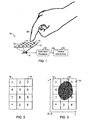
- a data input system 10 for an electronic device includes a window 12 having a contact surface 14 with an input region 15, multiple indicia 16 that are viewable in the input region 15, an image sensor 18, and a data input processor 20.
- the indicia 16 may resemble data input keys (e.g., numeric keys, alphanumeric keys, or other input keys, such as keys controlling a specific functionality of the electronic device).
- the indicia 16 may be implemented as markings that are made on the top of contact surface 14. Alternatively, indicia 16 may be implemented as markings that are made on another surface of window 12 and are viewable through window 12.
- window 12 is substantially transparent to light within a target wavelength range (e.g., visible or infrared light) and image sensor 18 detects light within the target wavelength range.
- Image sensor 18 is constructed and arranged to produce image signals corresponding to images of the input region.
- Data input processor 20 is coupled to the image sensor 18 and operates to produce input signals 22 based on image signals produced by image sensor 18 and a mapping between areas of the input region images and locations of the displayed indicia.
- the input signals 22 are passed to device electronics 24, which respond to the input signals 22 in a conventional way.
- the field of view of image sensor 18 is large enough to encompass the input region.
- image sensor 18 is implemented as a conventional miniature camera module that has a focal point located a distance (e.g., on the order of 1 meter or more) beyond contact surface 14 that is sufficient to capture images of a scene of interest.
- the indicia 16 are out of focus and, therefore, only insubstantially affect the quality of the captured images.
- window 12 is movable (e.g., on a hinge or in a slot) into and out of the field of view of the image sensor 18.
- a user contacts an area of the input region with an object (e.g., a finger 26 or a stylus).
- Image sensor 18 captures an image of the input region 15 and transmits the image signals to data input processor 20.
- data input processor 20 operates to process the input region image to determine the location of the contacted area even though the image captured by image sensor 18 is out of focus in some embodiments.
- data input processor 20 operates to transmit to device electronics 24 signals indicative of the indicium 16 most likely to have been selected by the user.
- the device electronics 24 may respond to a numeric or alphanumeric input by displaying the corresponding number or letter on a display screen. If incorporated into a cellular telephone, device electronics 24 may respond to a "call" input button by placing a cellular telephone call.
- indicia 16 resemble keys of a cellular telephone keypad.
- the touched locations of the contact surface 14 are distinguishable from other input region areas based on pixel intensity differences in the input region images captured by image sensor 18.
- the contacting area of finger 26 blocks ambient light from reaching image sensor 18.
- the contacted area 28 of input region 15 appears darker than other areas of the input region 15.
- data processor 20 determines the indicium that is most likely to have been selected by the user based on a "center of mass" calculation as follows. Initially, pixel values (e.g., gray level values) in the input region 15 are acquired from image sensor 18. The pixel values then are segmented into two groups based on a threshold. For example, in the case of gray level pixel values, pixels with values that are less than 128 are assigned to a "black" pixel group, and pixels with values greater than or equal to 128 are assigned to a "white” pixel group. The threshold value that provides the most accurate results may be determined experimentally.
- pixel values e.g., gray level values
- the threshold value that provides the most accurate results may be determined experimentally.
- the x cm , and y cm coordinates corresponding to the center of mass of the contacted area 28 are computed as follows: where x n and y n are the x and y coordinate values for the black pixels and N BlackPixels is the number of black pixels.
- Data processor 20 compares the center of mass coordinates ( x cm, y cm ) to the pixel locations of the indicia 16 to determine which indicium 16 is the most likely to correspond to the selected indicium. For example, in some embodiments, distances between the center coordinates of each indicium 16 and the computed center of mass coordinates (x cm , y cm ) are computed, and the indicium corresponding to the shortest distance is selected as the mostly likely to have been selected by the user.
- the mapping between center coordinates for the indicia and input image regions may be stored, for example, in a pre-generated look-up table.
- data processor 20 determines the indicium that is most likely to have been selected by the user based on an "edge detection" process as follows. Initially, pixel values (e.g., gray level values) in the input region 15 are acquired from image sensor 18. Next, horizontal (x-coordinate) and vertical (y-coordinate) gradient values ( g x (x) , g y (y)) are computed as follows: where I(x, y) is the pixel value at pixel location (x, y). Peaks in the horizontal and vertical gradient values may be used to find the left, right, top, and bottom edges of contact area 28. Coordinates for a pixel that is representative of the most likely selected contact area may be computed based on the detected gradient peaks.
- the x coordinate of the representative pixel may be located midway between the two horizontal gradient peaks and the y coordinate of the representative pixel may be located midway between the two vertical gradient peaks.
- the location of the representative peak relative to the computed horizontal and vertical gradient peaks may be determined experimentally.
- Data processor 20 then compares the coordinates of the representative pixel to the pixel locations of the indicia 16 to determine which indicium 16 is the most likely to correspond to the selected indicium. For example, in some embodiments, distances between the center coordinates of each indicium 16 and the computed representative pixel coordinates are computed, and the indicium corresponding to the shortest distance is selected as the mostly likely to have been selected by the user.
- the mapping between center coordinates for the indicia and input image regions may be stored, for example, in a pre-generated look-up table.
- a training algorithm is used to identify the indicium that is most likely to have been selected by the user.
- a user may be prompted to select each of the indicia in sequence.
- the x and y coordinates for the center of mass or the representative pixel (or both) are computed as described above. These coordinates are stored in a lookup table. After the training session has been completed, these stored coordinates may be used to determine the indicium most likely to have been selected by the user.
- distances between the stored coordinates associated with each indicium 16 and the computed center of mass or representative pixel coordinates (or both) are computed, and the indicium corresponding to the shortest distance is selected as the mostly likely to have been selected by the user.
- two or more of the above-described methods of identifying indicia most likely to have been selected by a user may be used in combination.
- input region 15 may be implemented with an area that is substantially smaller than the key-based data input systems of most conventional electronic devices.
- each indicium 16 may occupy an area in the input region 15 that is on the order of about 2 mm ⁇ 2 mm (or 4 square millimeters).
- the indicia 16 are substantially smaller than the contact area 28 between finger 26 and contact surface 14.
- the contact area 28 overlaps the areas corresponding to multiple indicia 16 at the same time.
- a unique indicium still may be identified using one of the above-described data input processing techniques.
- indicia 16 may correspond to the keys of a computer keyboard.
- one or more of the above-described techniques may be used alone or in combination to determine the indicia that have been selected by a user.
- multiple image sensors 18, each configured to capture images of a respective area of input region 15, may be required to image the entire input region 15.
- contact surface 14 of window 12 may include one or more orientation features that tactilely guide the user to different areas of input region 15.
- the embodiment of FIGS. 5A and 5B for example, includes multiple perceptible depressions 30 in contact surface 14. Each depression 30 may be centered at a location corresponding to a respective indicium.
- the embodiment of FIGS. 6A and 6B on the other hand, includes a single bump 32 that is located in the center of input region 15. Other orientation feature implementations are possible.
- data input system 10 may include a light source 34 (e.g., a light emitting diode).
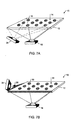
- light source 34 is configured to illuminate contact surface 14 through window 12. In this embodiment, light passes through window 12 except in areas where an object (e.g., a finger tip) is in contact with contact surface 14. The reflected light is captured by image sensor 18.
- light source 34 is configured to inject light into an edge of window 12.
- An optical element 36 e.g., a cylindrical lens may be used to obtain a uniform injection of light into window 12.
- the injected light is retained within window 12 by total internal reflection except in an area where an object (e.g., a finger tip) is in contact with contact surface 14.
- An object e.g., a finger tip
- Contact between an object and contact surface 14 disrupts the total internal reflection in the contact area, causing injected light from the contact area to be directed toward image sensor 18.
- FIGS. 7A and 7B The above-described methods of identifying indicia most likely to have been selected by a user may be used with the embodiments of FIGS. 7A and 7B. However, these methods should be modified to account for the fact that areas of contact between an object and contact surface 14 will appear lighter than other areas of the input region 15 in the images captured by image sensor 18.
- Each of the embodiments of FIGS. 7A and 7B may include other optical elements.
- light source may emit light within a narrow wavelength range and image sensor 18 may include a filter that selectively allows light within the narrow wavelength range to be detected. In this way, contrast in the input region images that are captured by image sensor 18 may be enhanced.
- data input system 10 may be incorporated in a cellular telephone 40 that includes a wireless communication system 42 that has an antenna 44, a receiver 46, a frequency synthesizer 48, and a transmitter 50.
- Cellular telephone 40 also may have a voice/data system 52, a memory 54, a display 56, a battery power supply 58, and a controller 60 that choreographs the operation of cellular telephone 40.
- Wireless communication system 42 is configured to establish communication links with a wireless network in accordance with a conventional wireless protocol (e.g., a conventional analog cellular protocol or a digital wireless protocol, such as WAP).
- data input system 10 may be incorporated into a handheld computer 70 (e.g., a personal digital assistant).
- Handheld computer 70 includes a screen 72 that displays a graphical user interface, which may present one or more user options for controlling the operation of handheld computer 70.
- Handheld computer 70 has an output port 74 for connecting to an input jack of an audio output device (e.g., headphones), and a cable port 76 for connecting to a computer or other hardware system.
- Handheld computer 70 further includes a wireless communication port 78, for example, an IrDA (Infrared Data Association) port, through which handheld computer 70 may wirelessly communicate with other similarly configured devices.
- Some embodiments may include an RF antenna 80 instead of, or in addition to, wireless communication port 78.
- the exemplary methods of identifying areas of contact between an object and contact surface 14 that are described above may be modified or replaced by other known image processing techniques.
- data input processor 20 may be incorporated into image sensor 18 or into device electronics 24.
- data input system 10 may be incorporated into a digital audio player, a CD player, an MCD player, a game pad, a cordless telephone, a pager, a laptop computer, or other portable or non-portable electronic device.
Landscapes
- Engineering & Computer Science (AREA)
- General Engineering & Computer Science (AREA)
- Theoretical Computer Science (AREA)
- Multimedia (AREA)
- Human Computer Interaction (AREA)
- Physics & Mathematics (AREA)
- General Physics & Mathematics (AREA)
- Position Input By Displaying (AREA)
- Input From Keyboards Or The Like (AREA)
- Telephone Function (AREA)
- Image Input (AREA)
Applications Claiming Priority (2)
| Application Number | Priority Date | Filing Date | Title |
|---|---|---|---|
| US368717 | 2003-02-19 | ||
| US10/368,717 US7176905B2 (en) | 2003-02-19 | 2003-02-19 | Electronic device having an image-based data input system |
Publications (2)
| Publication Number | Publication Date |
|---|---|
| EP1450243A2 true EP1450243A2 (de) | 2004-08-25 |
| EP1450243A3 EP1450243A3 (de) | 2005-11-16 |
Family
ID=32736410
Family Applications (1)
| Application Number | Title | Priority Date | Filing Date |
|---|---|---|---|
| EP03023654A Withdrawn EP1450243A3 (de) | 2003-02-19 | 2003-10-17 | Elektronische Vorrichtung mit einem bild-basierten Dateneingabesystem |
Country Status (3)
| Country | Link |
|---|---|
| US (1) | US7176905B2 (de) |
| EP (1) | EP1450243A3 (de) |
| JP (1) | JP2004252965A (de) |
Cited By (20)
| Publication number | Priority date | Publication date | Assignee | Title |
|---|---|---|---|---|
| WO2009012586A1 (en) * | 2007-07-23 | 2009-01-29 | Smart Technologies Ulc | Touchscreen based on frustrated total internal reflection |
| US7619617B2 (en) | 2002-11-15 | 2009-11-17 | Smart Technologies Ulc | Size/scale and orientation determination of a pointer in a camera-based touch system |
| US7643006B2 (en) | 2003-09-16 | 2010-01-05 | Smart Technologies Ulc | Gesture recognition method and touch system incorporating the same |
| USRE42794E1 (en) | 1999-12-27 | 2011-10-04 | Smart Technologies Ulc | Information-inputting device inputting contact point of object on recording surfaces as information |
| US8055022B2 (en) | 2000-07-05 | 2011-11-08 | Smart Technologies Ulc | Passive touch system and method of detecting user input |
| US8089462B2 (en) | 2004-01-02 | 2012-01-03 | Smart Technologies Ulc | Pointer tracking across multiple overlapping coordinate input sub-regions defining a generally contiguous input region |
| USRE43084E1 (en) | 1999-10-29 | 2012-01-10 | Smart Technologies Ulc | Method and apparatus for inputting information including coordinate data |
| US8115753B2 (en) | 2007-04-11 | 2012-02-14 | Next Holdings Limited | Touch screen system with hover and click input methods |
| US8120596B2 (en) | 2004-05-21 | 2012-02-21 | Smart Technologies Ulc | Tiled touch system |
| US8149221B2 (en) | 2004-05-07 | 2012-04-03 | Next Holdings Limited | Touch panel display system with illumination and detection provided from a single edge |
| US8274496B2 (en) | 2004-04-29 | 2012-09-25 | Smart Technologies Ulc | Dual mode touch systems |
| US8339378B2 (en) | 2008-11-05 | 2012-12-25 | Smart Technologies Ulc | Interactive input system with multi-angle reflector |
| US8456451B2 (en) | 2003-03-11 | 2013-06-04 | Smart Technologies Ulc | System and method for differentiating between pointers used to contact touch surface |
| US8456418B2 (en) | 2003-10-09 | 2013-06-04 | Smart Technologies Ulc | Apparatus for determining the location of a pointer within a region of interest |
| US8692768B2 (en) | 2009-07-10 | 2014-04-08 | Smart Technologies Ulc | Interactive input system |
| US8902193B2 (en) | 2008-05-09 | 2014-12-02 | Smart Technologies Ulc | Interactive input system and bezel therefor |
| US8907889B2 (en) | 2005-01-12 | 2014-12-09 | Thinkoptics, Inc. | Handheld vision based absolute pointing system |
| US8913003B2 (en) | 2006-07-17 | 2014-12-16 | Thinkoptics, Inc. | Free-space multi-dimensional absolute pointer using a projection marker system |
| US9176598B2 (en) | 2007-05-08 | 2015-11-03 | Thinkoptics, Inc. | Free-space multi-dimensional absolute pointer with improved performance |
| US9442607B2 (en) | 2006-12-04 | 2016-09-13 | Smart Technologies Inc. | Interactive input system and method |
Families Citing this family (74)
| Publication number | Priority date | Publication date | Assignee | Title |
|---|---|---|---|---|
| GB9722766D0 (en) | 1997-10-28 | 1997-12-24 | British Telecomm | Portable computers |
| US9164654B2 (en) * | 2002-12-10 | 2015-10-20 | Neonode Inc. | User interface for mobile computer unit |
| US9052771B2 (en) * | 2002-11-04 | 2015-06-09 | Neonode Inc. | Touch screen calibration and update methods |
| US9778794B2 (en) | 2001-11-02 | 2017-10-03 | Neonode Inc. | Light-based touch screen |
| US9471170B2 (en) * | 2002-11-04 | 2016-10-18 | Neonode Inc. | Light-based touch screen with shift-aligned emitter and receiver lenses |
| US9213443B2 (en) | 2009-02-15 | 2015-12-15 | Neonode Inc. | Optical touch screen systems using reflected light |
| US8339379B2 (en) * | 2004-04-29 | 2012-12-25 | Neonode Inc. | Light-based touch screen |
| US9052777B2 (en) | 2001-11-02 | 2015-06-09 | Neonode Inc. | Optical elements with alternating reflective lens facets |
| US8674966B2 (en) | 2001-11-02 | 2014-03-18 | Neonode Inc. | ASIC controller for light-based touch screen |
| US7009663B2 (en) * | 2003-12-17 | 2006-03-07 | Planar Systems, Inc. | Integrated optical light sensitive active matrix liquid crystal display |
| US7053967B2 (en) * | 2002-05-23 | 2006-05-30 | Planar Systems, Inc. | Light sensitive display |
| US7408598B2 (en) | 2002-02-20 | 2008-08-05 | Planar Systems, Inc. | Light sensitive display with selected interval of light sensitive elements |
| US8587562B2 (en) * | 2002-11-04 | 2013-11-19 | Neonode Inc. | Light-based touch screen using elliptical and parabolic reflectors |
| US8896575B2 (en) * | 2002-11-04 | 2014-11-25 | Neonode Inc. | Pressure-sensitive touch screen |
| US8416217B1 (en) | 2002-11-04 | 2013-04-09 | Neonode Inc. | Light-based finger gesture user interface |
| US9389730B2 (en) * | 2002-12-10 | 2016-07-12 | Neonode Inc. | Light-based touch screen using elongated light guides |
| US8902196B2 (en) * | 2002-12-10 | 2014-12-02 | Neonode Inc. | Methods for determining a touch location on a touch screen |
| US8403203B2 (en) * | 2002-12-10 | 2013-03-26 | Neonoda Inc. | Component bonding using a capillary effect |
| US9195344B2 (en) * | 2002-12-10 | 2015-11-24 | Neonode Inc. | Optical surface using a reflected image for determining three-dimensional position information |
| US8456447B2 (en) | 2003-02-14 | 2013-06-04 | Next Holdings Limited | Touch screen signal processing |
| US8508508B2 (en) | 2003-02-14 | 2013-08-13 | Next Holdings Limited | Touch screen signal processing with single-point calibration |
| US7629967B2 (en) | 2003-02-14 | 2009-12-08 | Next Holdings Limited | Touch screen signal processing |
| US20080048995A1 (en) * | 2003-02-20 | 2008-02-28 | Planar Systems, Inc. | Light sensitive display |
| US20080084374A1 (en) * | 2003-02-20 | 2008-04-10 | Planar Systems, Inc. | Light sensitive display |
| US7310090B2 (en) * | 2004-03-25 | 2007-12-18 | Avago Technologies Ecbm Ip (Singapore) Pte Ltd. | Optical generic switch panel |
| US7773139B2 (en) * | 2004-04-16 | 2010-08-10 | Apple Inc. | Image sensor with photosensitive thin film transistors |
| US7359564B2 (en) * | 2004-10-29 | 2008-04-15 | Microsoft Corporation | Method and system for cancellation of ambient light using light frequency |
| US20060227129A1 (en) * | 2005-03-30 | 2006-10-12 | Cheng Peng | Mobile communication terminal and method |
| RU2007144817A (ru) * | 2005-05-04 | 2009-06-10 | Конинклейке Филипс Электроникс, Н.В. (Nl) | Система и способ проецирования управляющей графики |
| US7265749B2 (en) * | 2005-08-29 | 2007-09-04 | Avago Technologies Ecbu Ip (Singapore) Pte. Ltd. | Optical generic switch panel |
| US20070109239A1 (en) * | 2005-11-14 | 2007-05-17 | Den Boer Willem | Integrated light sensitive liquid crystal display |
| KR101357496B1 (ko) * | 2006-07-05 | 2014-02-03 | 엘지전자 주식회사 | 냉장고의 입력장치 |
| US7351949B2 (en) * | 2006-07-10 | 2008-04-01 | Avago Technologies General Ip Pte Ltd | Optical generic switch panel |
| US7969410B2 (en) * | 2006-08-23 | 2011-06-28 | Avago Technologies General Ip (Singapore) Pte. Ltd. | Optically detecting click events |
| US7843427B2 (en) * | 2006-09-06 | 2010-11-30 | Apple Inc. | Methods for determining a cursor position from a finger contact with a touch screen display |
| US8564544B2 (en) * | 2006-09-06 | 2013-10-22 | Apple Inc. | Touch screen device, method, and graphical user interface for customizing display of content category icons |
| US7844915B2 (en) | 2007-01-07 | 2010-11-30 | Apple Inc. | Application programming interfaces for scrolling operations |
| US8471830B2 (en) * | 2007-07-06 | 2013-06-25 | Neonode Inc. | Scanning of a touch screen |
| AU2008280953A1 (en) | 2007-08-30 | 2009-03-19 | Next Holdings Ltd | Optical touchscreen with improved illumination |
| WO2009029764A1 (en) | 2007-08-30 | 2009-03-05 | Next Holdings, Inc. | Low profile touch panel systems |
| US8063879B2 (en) | 2007-12-20 | 2011-11-22 | Research In Motion Limited | Method and handheld electronic device including first input component and second touch sensitive input component |
| US20090165121A1 (en) * | 2007-12-21 | 2009-06-25 | Nvidia Corporation | Touch Pad based Authentication of Users |
| US8405636B2 (en) | 2008-01-07 | 2013-03-26 | Next Holdings Limited | Optical position sensing system and optical position sensor assembly |
| US8754851B2 (en) * | 2008-09-03 | 2014-06-17 | Wuhan Splendid Optronics Technology Co., Ltd. | Remote controls for electronic display board |
| US8237684B2 (en) * | 2008-09-26 | 2012-08-07 | Avago Technologies Ecbu Ip (Singapore) Pte. Ltd. | User input device with planar light guide illumination plate |
| US20100155575A1 (en) * | 2008-12-19 | 2010-06-24 | Sony Ericsson Mobile Communications Ab | Arrangement and method in an electronic device for detecting a user input to a key |
| US8775023B2 (en) | 2009-02-15 | 2014-07-08 | Neanode Inc. | Light-based touch controls on a steering wheel and dashboard |
| US9063614B2 (en) | 2009-02-15 | 2015-06-23 | Neonode Inc. | Optical touch screens |
| KR20100121257A (ko) * | 2009-05-08 | 2010-11-17 | 삼성전자주식회사 | 멀티 인식 터치 패널 및 이를 적용한 디스플레이 장치 |
| US9310923B2 (en) | 2010-12-03 | 2016-04-12 | Apple Inc. | Input device for touch sensitive devices |
| US8638320B2 (en) | 2011-06-22 | 2014-01-28 | Apple Inc. | Stylus orientation detection |
| US8928635B2 (en) | 2011-06-22 | 2015-01-06 | Apple Inc. | Active stylus |
| US9329703B2 (en) | 2011-06-22 | 2016-05-03 | Apple Inc. | Intelligent stylus |
| WO2013081671A1 (en) * | 2011-11-30 | 2013-06-06 | TransluSense, LLC | Compensating for interference and contamination for multi-touch input devices |
| US9176604B2 (en) | 2012-07-27 | 2015-11-03 | Apple Inc. | Stylus device |
| US9557845B2 (en) | 2012-07-27 | 2017-01-31 | Apple Inc. | Input device for and method of communication with capacitive devices through frequency variation |
| US9652090B2 (en) | 2012-07-27 | 2017-05-16 | Apple Inc. | Device for digital communication through capacitive coupling |
| US10282034B2 (en) | 2012-10-14 | 2019-05-07 | Neonode Inc. | Touch sensitive curved and flexible displays |
| US9164625B2 (en) | 2012-10-14 | 2015-10-20 | Neonode Inc. | Proximity sensor for determining two-dimensional coordinates of a proximal object |
| US9207800B1 (en) | 2014-09-23 | 2015-12-08 | Neonode Inc. | Integrated light guide and touch screen frame and multi-touch determination method |
| US9921661B2 (en) | 2012-10-14 | 2018-03-20 | Neonode Inc. | Optical proximity sensor and associated user interface |
| US8949735B2 (en) | 2012-11-02 | 2015-02-03 | Google Inc. | Determining scroll direction intent |
| US9092093B2 (en) | 2012-11-27 | 2015-07-28 | Neonode Inc. | Steering wheel user interface |
| US12032817B2 (en) | 2012-11-27 | 2024-07-09 | Neonode Inc. | Vehicle user interface |
| US10048775B2 (en) | 2013-03-14 | 2018-08-14 | Apple Inc. | Stylus detection and demodulation |
| US9939935B2 (en) | 2013-07-31 | 2018-04-10 | Apple Inc. | Scan engine for touch controller architecture |
| DE102014007036B4 (de) * | 2014-05-13 | 2017-07-27 | Diehl Ako Stiftung & Co. Kg | Bedienvorrichtung, insbesondere für ein elektronisches Haushaltsgerät |
| US10061450B2 (en) | 2014-12-04 | 2018-08-28 | Apple Inc. | Coarse scan and targeted active mode scan for touch |
| US10474277B2 (en) | 2016-05-31 | 2019-11-12 | Apple Inc. | Position-based stylus communication |
| US11429230B2 (en) | 2018-11-28 | 2022-08-30 | Neonode Inc | Motorist user interface sensor |
| JP2023504590A (ja) | 2019-12-31 | 2023-02-03 | ネオノード インコーポレイテッド | 非接触型タッチ入力システム |
| US12153764B1 (en) | 2020-09-25 | 2024-11-26 | Apple Inc. | Stylus with receive architecture for position determination |
| US11669210B2 (en) | 2020-09-30 | 2023-06-06 | Neonode Inc. | Optical touch sensor |
| GB2602336B (en) * | 2020-12-23 | 2024-08-14 | Uniphy Ltd | Optical touch screen |
Family Cites Families (22)
| Publication number | Priority date | Publication date | Assignee | Title |
|---|---|---|---|---|
| FR2615941B1 (fr) | 1987-05-25 | 1991-12-06 | Sfena | Dispositif de detection de position d'un organe de commande sur une tablette tactile |
| US5584054A (en) | 1994-07-18 | 1996-12-10 | Motorola, Inc. | Communication device having a movable front cover for exposing a touch sensitive display |
| US5942761A (en) | 1995-06-07 | 1999-08-24 | Tuli; Raja Singh | Enhancement methods and devices for reading a fingerprint image |
| FI961459A0 (fi) * | 1996-04-01 | 1996-04-01 | Kyoesti Veijo Olavi Maula | Arrangemang foer optisk fjaerrstyrning av en anordning |
| CA2256335A1 (en) * | 1996-05-29 | 1997-12-04 | Deutsche Telekom Ag | A device for inputting data |
| KR100260760B1 (ko) * | 1996-07-31 | 2000-07-01 | 모리 하루오 | 터치패널을 병설한 정보표시장치 |
| US6061177A (en) * | 1996-12-19 | 2000-05-09 | Fujimoto; Kenneth Noboru | Integrated computer display and graphical input apparatus and method |
| DE19708240C2 (de) * | 1997-02-28 | 1999-10-14 | Siemens Ag | Anordnung und Verfahren zur Detektion eines Objekts in einem von Wellen im nichtsichtbaren Spektralbereich angestrahlten Bereich |
| US6512507B1 (en) * | 1998-03-31 | 2003-01-28 | Seiko Epson Corporation | Pointing position detection device, presentation system, and method, and computer-readable medium |
| US6198485B1 (en) * | 1998-07-29 | 2001-03-06 | Intel Corporation | Method and apparatus for three-dimensional input entry |
| US6710770B2 (en) * | 2000-02-11 | 2004-03-23 | Canesta, Inc. | Quasi-three-dimensional method and apparatus to detect and localize interaction of user-object and virtual transfer device |
| EP1316055A4 (de) | 2000-05-29 | 2006-10-04 | Vkb Inc | Einrichtung zur eingabe virtueller daten und verfahren zum eingeben alphanumerischer und anderer daten |
| JP2001350586A (ja) | 2000-06-09 | 2001-12-21 | Keio Gijuku | 位置入力装置 |
| US6462941B1 (en) * | 2000-06-30 | 2002-10-08 | Palm, Inc. | Method and apparatus for backlighting a handwriting input area for a portable computing device |
| US6803906B1 (en) * | 2000-07-05 | 2004-10-12 | Smart Technologies, Inc. | Passive touch system and method of detecting user input |
| AU2002213017A1 (en) | 2000-10-10 | 2002-04-22 | Motorola Inc., A Corporation Of The State Of Delaware | Data entry device |
| WO2002050636A2 (en) * | 2000-12-21 | 2002-06-27 | Cirque Corporation | Touchpad code entry system |
| KR20030072591A (ko) | 2001-01-08 | 2003-09-15 | 브이케이비 인코포레이티드 | 데이터 입력 디바이스 |
| US6677932B1 (en) * | 2001-01-28 | 2004-01-13 | Finger Works, Inc. | System and method for recognizing touch typing under limited tactile feedback conditions |
| JP3708508B2 (ja) * | 2001-08-23 | 2005-10-19 | 株式会社アイム | 指先触覚入力装置及びそれを用いた携帯情報端末 |
| JP2003152851A (ja) * | 2001-11-14 | 2003-05-23 | Nec Corp | 携帯端末装置 |
| US7151530B2 (en) * | 2002-08-20 | 2006-12-19 | Canesta, Inc. | System and method for determining an input selected by a user through a virtual interface |
-
2003
- 2003-02-19 US US10/368,717 patent/US7176905B2/en not_active Expired - Fee Related
- 2003-10-17 EP EP03023654A patent/EP1450243A3/de not_active Withdrawn
-
2004
- 2004-01-28 JP JP2004020105A patent/JP2004252965A/ja active Pending
Cited By (25)
| Publication number | Priority date | Publication date | Assignee | Title |
|---|---|---|---|---|
| USRE43084E1 (en) | 1999-10-29 | 2012-01-10 | Smart Technologies Ulc | Method and apparatus for inputting information including coordinate data |
| USRE42794E1 (en) | 1999-12-27 | 2011-10-04 | Smart Technologies Ulc | Information-inputting device inputting contact point of object on recording surfaces as information |
| US8203535B2 (en) | 2000-07-05 | 2012-06-19 | Smart Technologies Ulc | Passive touch system and method of detecting user input |
| US8055022B2 (en) | 2000-07-05 | 2011-11-08 | Smart Technologies Ulc | Passive touch system and method of detecting user input |
| US8378986B2 (en) | 2000-07-05 | 2013-02-19 | Smart Technologies Ulc | Passive touch system and method of detecting user input |
| US7619617B2 (en) | 2002-11-15 | 2009-11-17 | Smart Technologies Ulc | Size/scale and orientation determination of a pointer in a camera-based touch system |
| US8228304B2 (en) | 2002-11-15 | 2012-07-24 | Smart Technologies Ulc | Size/scale orientation determination of a pointer in a camera-based touch system |
| US8456451B2 (en) | 2003-03-11 | 2013-06-04 | Smart Technologies Ulc | System and method for differentiating between pointers used to contact touch surface |
| US7643006B2 (en) | 2003-09-16 | 2010-01-05 | Smart Technologies Ulc | Gesture recognition method and touch system incorporating the same |
| US8456418B2 (en) | 2003-10-09 | 2013-06-04 | Smart Technologies Ulc | Apparatus for determining the location of a pointer within a region of interest |
| US8089462B2 (en) | 2004-01-02 | 2012-01-03 | Smart Technologies Ulc | Pointer tracking across multiple overlapping coordinate input sub-regions defining a generally contiguous input region |
| US8274496B2 (en) | 2004-04-29 | 2012-09-25 | Smart Technologies Ulc | Dual mode touch systems |
| US8149221B2 (en) | 2004-05-07 | 2012-04-03 | Next Holdings Limited | Touch panel display system with illumination and detection provided from a single edge |
| US8120596B2 (en) | 2004-05-21 | 2012-02-21 | Smart Technologies Ulc | Tiled touch system |
| US8907889B2 (en) | 2005-01-12 | 2014-12-09 | Thinkoptics, Inc. | Handheld vision based absolute pointing system |
| US8913003B2 (en) | 2006-07-17 | 2014-12-16 | Thinkoptics, Inc. | Free-space multi-dimensional absolute pointer using a projection marker system |
| US9442607B2 (en) | 2006-12-04 | 2016-09-13 | Smart Technologies Inc. | Interactive input system and method |
| US8115753B2 (en) | 2007-04-11 | 2012-02-14 | Next Holdings Limited | Touch screen system with hover and click input methods |
| US9176598B2 (en) | 2007-05-08 | 2015-11-03 | Thinkoptics, Inc. | Free-space multi-dimensional absolute pointer with improved performance |
| CN101743527B (zh) * | 2007-07-23 | 2013-04-03 | 智能技术Ulc公司 | 基于受抑全内反射的触摸屏 |
| WO2009012586A1 (en) * | 2007-07-23 | 2009-01-29 | Smart Technologies Ulc | Touchscreen based on frustrated total internal reflection |
| US8094137B2 (en) | 2007-07-23 | 2012-01-10 | Smart Technologies Ulc | System and method of detecting contact on a display |
| US8902193B2 (en) | 2008-05-09 | 2014-12-02 | Smart Technologies Ulc | Interactive input system and bezel therefor |
| US8339378B2 (en) | 2008-11-05 | 2012-12-25 | Smart Technologies Ulc | Interactive input system with multi-angle reflector |
| US8692768B2 (en) | 2009-07-10 | 2014-04-08 | Smart Technologies Ulc | Interactive input system |
Also Published As
| Publication number | Publication date |
|---|---|
| US7176905B2 (en) | 2007-02-13 |
| EP1450243A3 (de) | 2005-11-16 |
| JP2004252965A (ja) | 2004-09-09 |
| US20040160420A1 (en) | 2004-08-19 |
Similar Documents
| Publication | Publication Date | Title |
|---|---|---|
| US7176905B2 (en) | Electronic device having an image-based data input system | |
| US8665223B2 (en) | Display device and method providing display contact information based on an amount of received light | |
| JP4897596B2 (ja) | 入力装置、記憶媒体、情報入力方法及び電子機器 | |
| CN105446646B (zh) | 基于虚拟键盘的内容输入方法、装置及触控设备 | |
| US8050721B2 (en) | Mobile information terminal having operation keys and a display on opposite sides | |
| US6809723B2 (en) | Pushbutton optical screen pointing device | |
| US9760165B2 (en) | Mobile terminal device and input operation receiving method for switching input methods | |
| US10289238B2 (en) | Electronic device having multi-functional human interface | |
| US20040125078A1 (en) | Input device | |
| US20030048257A1 (en) | Telephone set having a touch pad device | |
| US20130191741A1 (en) | Methods and Apparatus for Providing Feedback from an Electronic Device | |
| US20070165002A1 (en) | User interface for an electronic device | |
| US20080055266A1 (en) | Imaging and display apparatus, information input apparatus, object detection medium, and object detection method | |
| EP1589408A2 (de) | Anzeigevorrichtung mit einer optischen Eingabefunktion | |
| KR20130027371A (ko) | 표시장치용 윈도우 부재 및 이를 포함하는 표시장치 | |
| US20220253209A1 (en) | Accommodative user interface for handheld electronic devices | |
| CN107566628B (zh) | 显示模组及其显示方法、终端 | |
| CN113253908B (zh) | 按键功能执行方法、装置、设备及存储介质 | |
| US20150253971A1 (en) | Electronic apparatus and display control method | |
| JP2018038469A (ja) | 情報処理システム、拡張入力装置、および情報処理方法 | |
| CN107959752B (zh) | 显示屏状态控制方法、装置、存储介质及终端 | |
| EP2541383B1 (de) | Kommunikationsvorrichtung und -verfahren | |
| US20120270597A1 (en) | Mobile phone with mouse and keyboard function | |
| EP3832446A1 (de) | Verfahren und vorrichtung zur fingerabdruckerfassung und touchpad | |
| US20190129609A1 (en) | Electronic apparatus |
Legal Events
| Date | Code | Title | Description |
|---|---|---|---|
| PUAI | Public reference made under article 153(3) epc to a published international application that has entered the european phase |
Free format text: ORIGINAL CODE: 0009012 |
|
| AK | Designated contracting states |
Kind code of ref document: A2 Designated state(s): AT BE BG CH CY CZ DE DK EE ES FI FR GB GR HU IE IT LI LU MC NL PT RO SE SI SK TR |
|
| AX | Request for extension of the european patent |
Extension state: AL LT LV MK |
|
| PUAL | Search report despatched |
Free format text: ORIGINAL CODE: 0009013 |
|
| AK | Designated contracting states |
Kind code of ref document: A3 Designated state(s): AT BE BG CH CY CZ DE DK EE ES FI FR GB GR HU IE IT LI LU MC NL PT RO SE SI SK TR |
|
| AX | Request for extension of the european patent |
Extension state: AL LT LV MK |
|
| 17P | Request for examination filed |
Effective date: 20051215 |
|
| AKX | Designation fees paid |
Designated state(s): DE FR GB |
|
| RAP1 | Party data changed (applicant data changed or rights of an application transferred) |
Owner name: AGILENT TECHNOLOGIES, INC. |
|
| STAA | Information on the status of an ep patent application or granted ep patent |
Free format text: STATUS: THE APPLICATION IS DEEMED TO BE WITHDRAWN |
|
| 18D | Application deemed to be withdrawn |
Effective date: 20080503 |