EP1449942A1 - Polybenzazole fiber - Google Patents
Polybenzazole fiber Download PDFInfo
- Publication number
- EP1449942A1 EP1449942A1 EP02801539A EP02801539A EP1449942A1 EP 1449942 A1 EP1449942 A1 EP 1449942A1 EP 02801539 A EP02801539 A EP 02801539A EP 02801539 A EP02801539 A EP 02801539A EP 1449942 A1 EP1449942 A1 EP 1449942A1
- Authority
- EP
- European Patent Office
- Prior art keywords
- fiber
- carbon nanotube
- polybenzazole
- polymer
- polybenzazole fiber
- Prior art date
- Legal status (The legal status is an assumption and is not a legal conclusion. Google has not performed a legal analysis and makes no representation as to the accuracy of the status listed.)
- Granted
Links
Classifications
-
- D—TEXTILES; PAPER
- D01—NATURAL OR MAN-MADE THREADS OR FIBRES; SPINNING
- D01F—CHEMICAL FEATURES IN THE MANUFACTURE OF ARTIFICIAL FILAMENTS, THREADS, FIBRES, BRISTLES OR RIBBONS; APPARATUS SPECIALLY ADAPTED FOR THE MANUFACTURE OF CARBON FILAMENTS
- D01F1/00—General methods for the manufacture of artificial filaments or the like
- D01F1/02—Addition of substances to the spinning solution or to the melt
-
- D—TEXTILES; PAPER
- D01—NATURAL OR MAN-MADE THREADS OR FIBRES; SPINNING
- D01F—CHEMICAL FEATURES IN THE MANUFACTURE OF ARTIFICIAL FILAMENTS, THREADS, FIBRES, BRISTLES OR RIBBONS; APPARATUS SPECIALLY ADAPTED FOR THE MANUFACTURE OF CARBON FILAMENTS
- D01F6/00—Monocomponent artificial filaments or the like of synthetic polymers; Manufacture thereof
- D01F6/88—Monocomponent artificial filaments or the like of synthetic polymers; Manufacture thereof from mixtures of polycondensation products as major constituent with other polymers or low-molecular-weight compounds
- D01F6/94—Monocomponent artificial filaments or the like of synthetic polymers; Manufacture thereof from mixtures of polycondensation products as major constituent with other polymers or low-molecular-weight compounds of other polycondensation products
-
- B—PERFORMING OPERATIONS; TRANSPORTING
- B82—NANOTECHNOLOGY
- B82Y—SPECIFIC USES OR APPLICATIONS OF NANOSTRUCTURES; MEASUREMENT OR ANALYSIS OF NANOSTRUCTURES; MANUFACTURE OR TREATMENT OF NANOSTRUCTURES
- B82Y30/00—Nanotechnology for materials or surface science, e.g. nanocomposites
-
- D—TEXTILES; PAPER
- D01—NATURAL OR MAN-MADE THREADS OR FIBRES; SPINNING
- D01F—CHEMICAL FEATURES IN THE MANUFACTURE OF ARTIFICIAL FILAMENTS, THREADS, FIBRES, BRISTLES OR RIBBONS; APPARATUS SPECIALLY ADAPTED FOR THE MANUFACTURE OF CARBON FILAMENTS
- D01F6/00—Monocomponent artificial filaments or the like of synthetic polymers; Manufacture thereof
- D01F6/58—Monocomponent artificial filaments or the like of synthetic polymers; Manufacture thereof from homopolycondensation products
- D01F6/74—Monocomponent artificial filaments or the like of synthetic polymers; Manufacture thereof from homopolycondensation products from polycondensates of cyclic compounds, e.g. polyimides, polybenzimidazoles
-
- B—PERFORMING OPERATIONS; TRANSPORTING
- B82—NANOTECHNOLOGY
- B82Y—SPECIFIC USES OR APPLICATIONS OF NANOSTRUCTURES; MEASUREMENT OR ANALYSIS OF NANOSTRUCTURES; MANUFACTURE OR TREATMENT OF NANOSTRUCTURES
- B82Y40/00—Manufacture or treatment of nanostructures
-
- Y—GENERAL TAGGING OF NEW TECHNOLOGICAL DEVELOPMENTS; GENERAL TAGGING OF CROSS-SECTIONAL TECHNOLOGIES SPANNING OVER SEVERAL SECTIONS OF THE IPC; TECHNICAL SUBJECTS COVERED BY FORMER USPC CROSS-REFERENCE ART COLLECTIONS [XRACs] AND DIGESTS
- Y10—TECHNICAL SUBJECTS COVERED BY FORMER USPC
- Y10S—TECHNICAL SUBJECTS COVERED BY FORMER USPC CROSS-REFERENCE ART COLLECTIONS [XRACs] AND DIGESTS
- Y10S977/00—Nanotechnology
- Y10S977/70—Nanostructure
- Y10S977/734—Fullerenes, i.e. graphene-based structures, such as nanohorns, nanococoons, nanoscrolls or fullerene-like structures, e.g. WS2 or MoS2 chalcogenide nanotubes, planar C3N4, etc.
- Y10S977/753—Fullerenes, i.e. graphene-based structures, such as nanohorns, nanococoons, nanoscrolls or fullerene-like structures, e.g. WS2 or MoS2 chalcogenide nanotubes, planar C3N4, etc. with polymeric or organic binder
-
- Y—GENERAL TAGGING OF NEW TECHNOLOGICAL DEVELOPMENTS; GENERAL TAGGING OF CROSS-SECTIONAL TECHNOLOGIES SPANNING OVER SEVERAL SECTIONS OF THE IPC; TECHNICAL SUBJECTS COVERED BY FORMER USPC CROSS-REFERENCE ART COLLECTIONS [XRACs] AND DIGESTS
- Y10—TECHNICAL SUBJECTS COVERED BY FORMER USPC
- Y10T—TECHNICAL SUBJECTS COVERED BY FORMER US CLASSIFICATION
- Y10T428/00—Stock material or miscellaneous articles
- Y10T428/29—Coated or structually defined flake, particle, cell, strand, strand portion, rod, filament, macroscopic fiber or mass thereof
- Y10T428/2904—Staple length fiber
-
- Y—GENERAL TAGGING OF NEW TECHNOLOGICAL DEVELOPMENTS; GENERAL TAGGING OF CROSS-SECTIONAL TECHNOLOGIES SPANNING OVER SEVERAL SECTIONS OF THE IPC; TECHNICAL SUBJECTS COVERED BY FORMER USPC CROSS-REFERENCE ART COLLECTIONS [XRACs] AND DIGESTS
- Y10—TECHNICAL SUBJECTS COVERED BY FORMER USPC
- Y10T—TECHNICAL SUBJECTS COVERED BY FORMER US CLASSIFICATION
- Y10T428/00—Stock material or miscellaneous articles
- Y10T428/29—Coated or structually defined flake, particle, cell, strand, strand portion, rod, filament, macroscopic fiber or mass thereof
- Y10T428/2913—Rod, strand, filament or fiber
-
- Y—GENERAL TAGGING OF NEW TECHNOLOGICAL DEVELOPMENTS; GENERAL TAGGING OF CROSS-SECTIONAL TECHNOLOGIES SPANNING OVER SEVERAL SECTIONS OF THE IPC; TECHNICAL SUBJECTS COVERED BY FORMER USPC CROSS-REFERENCE ART COLLECTIONS [XRACs] AND DIGESTS
- Y10—TECHNICAL SUBJECTS COVERED BY FORMER USPC
- Y10T—TECHNICAL SUBJECTS COVERED BY FORMER US CLASSIFICATION
- Y10T428/00—Stock material or miscellaneous articles
- Y10T428/29—Coated or structually defined flake, particle, cell, strand, strand portion, rod, filament, macroscopic fiber or mass thereof
- Y10T428/2913—Rod, strand, filament or fiber
- Y10T428/2927—Rod, strand, filament or fiber including structurally defined particulate matter
-
- Y—GENERAL TAGGING OF NEW TECHNOLOGICAL DEVELOPMENTS; GENERAL TAGGING OF CROSS-SECTIONAL TECHNOLOGIES SPANNING OVER SEVERAL SECTIONS OF THE IPC; TECHNICAL SUBJECTS COVERED BY FORMER USPC CROSS-REFERENCE ART COLLECTIONS [XRACs] AND DIGESTS
- Y10—TECHNICAL SUBJECTS COVERED BY FORMER USPC
- Y10T—TECHNICAL SUBJECTS COVERED BY FORMER US CLASSIFICATION
- Y10T428/00—Stock material or miscellaneous articles
- Y10T428/29—Coated or structually defined flake, particle, cell, strand, strand portion, rod, filament, macroscopic fiber or mass thereof
- Y10T428/2913—Rod, strand, filament or fiber
- Y10T428/2933—Coated or with bond, impregnation or core
- Y10T428/2964—Artificial fiber or filament
- Y10T428/2967—Synthetic resin or polymer
Definitions
- the present invention relates to a polybenzazole fiber markedly superior in compression strength, which is preferable as an industrial material.
- Polybenzazole fibers have not less than twice the strength and elastic modulus of polyparaphenylene terephthalamide fiber, which is a representative super fiber currently on the market, and is expected to be a super fiber of the next generation.
- the compression strength of high strength polybenzazole fibers according to the above-mentioned conventional production methods is generally 0.4 GPa at most. This has become a threshold in applying a polybenzazole fiber to composite materials used in aircraft and the like.
- the present inventor has conducted intensive studies in an attempt to develop a technique to easily produce a polybenzazole fiber having an ultimate elastic modulus as an organic fiber material.
- rigid polymers such as so-called ladder polymer have been considered.
- ladder polymer As a means to realize ultimate physical property of the fiber, rigid polymers such as so-called ladder polymer have been considered.
- rigid polymers lack flexibility, and therefore, it is essential to use a linear polymer to afford soft touch as organic fiber and workability.
- the polymer is fiberized according to the methods described in US Patent No. 5296185 and US Patent No. 5385102, and the heat treatment is performed according to the methods proposed in US Patent No. 5296185, but a yarn obtained according to these methods has a compression strength of 0.4 GPa at most. Therefore, the necessity of research of modification of these methods was keenly realized and the present inventor has found that the expected physical properties can be easily achieved industrially by the method shown below.
- the present invention has the following constitution.
- the point of the present invention can be realized by a comparatively simple method shown in the following.
- an extraction (coagulation) bath which yarn was obtained by extruding, from a spinneret, a dope of a polymer made from polyparaphenylene benzobisoxazole for a fiber comprising carbon nanotube uniformly dispersed therein, into a non-coagulative gas, the yarn is dried and wound up.
- an elastic modulus of the fiber needs to be increased, it can be achieved by further applying a heat treatment under tension at a temperature of not lower than 500°C.
- a polybenzazole fiber refers to a polybenzoxazole (PBO) homopolymer, random, sequential or block copolymers with polybenzazoles (PBZ) that substantially contain not less than 85% of a PBO component, and the like.
- PBO polybenzoxazole
- PBZ polybenzazole
- the polybenzazole (PBZ) polymer is described in, for example, Wolf et al., "Liquid Crystalline Polymer Compositions, Process and Products", US Patent No. 4703103 (October 27, 1987), “Liquid Crystalline Polymer Compositions, Process and Products” US Patent No. 4533692 (August 6, 1985), “Liquid Crystalline Poly(2,6-Benzothiazole) Compositions, Process and Products", US Patent No.
- the carbon nanotube mentioned here is a tubular compound substantially made of carbon, wherein the layer may be a monolayer or multi-layer and the number of layers is not limited.
- arc discharge methods, vapor growth methods and the like are known (JP-A-2001-80913), but a carbon nanotube used may be obtained by any method.
- the outer diameter is not more than 20 nm and the length is not less than 0.5 ⁇ m and not more than 10 ⁇ m, preferably not less than 1 ⁇ m and not more than 5 ⁇ m.
- the outer diameter is 20 nm or the length is 10 ⁇ m, uniform dispersion in a fiber is difficult to achieve as mentioned below, which in turn unpreferably causes lower strength of completed yarn.
- the length is 0.5 ⁇ m, the carbon nanotube is not sufficiently oriented in the fiber axis direction in the spinning step and does not contribute to the improvement of the compression strength, which is not preferable.
- the structural unit contained in the PBZ polymer is preferably selected from lyotropic liquid crystal polymers.
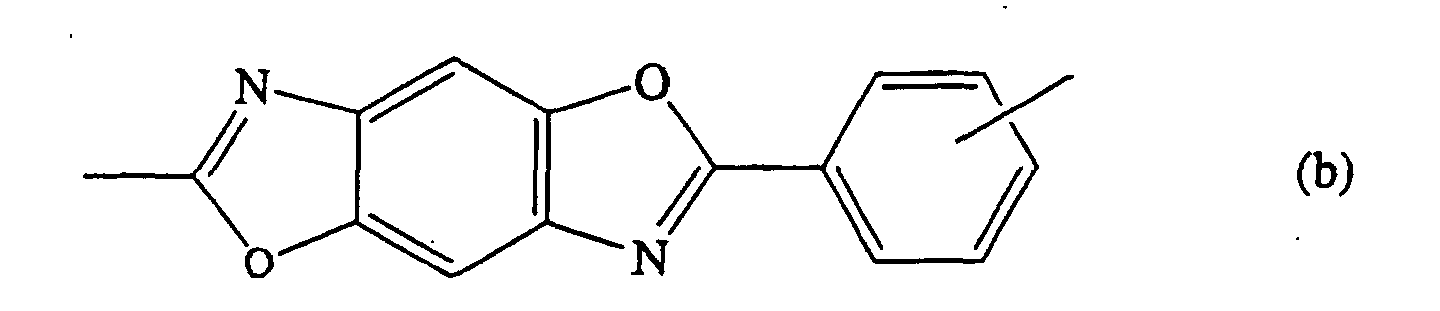
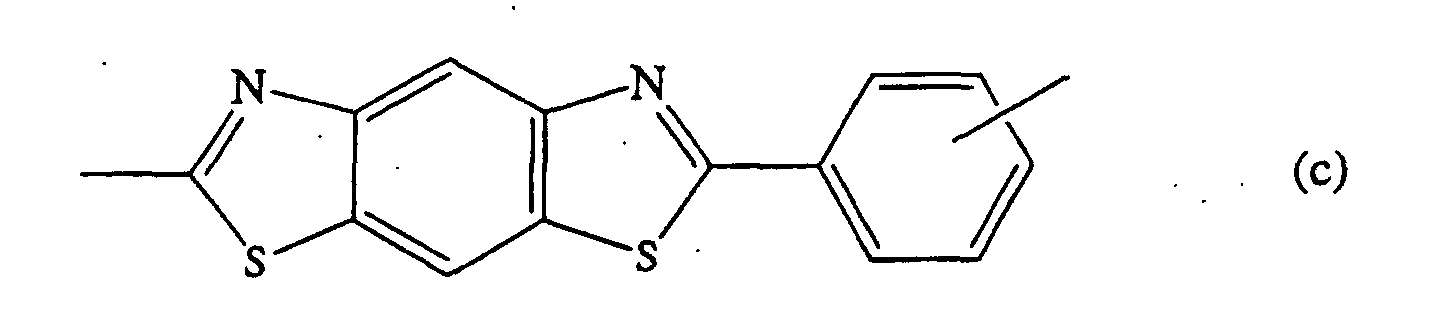
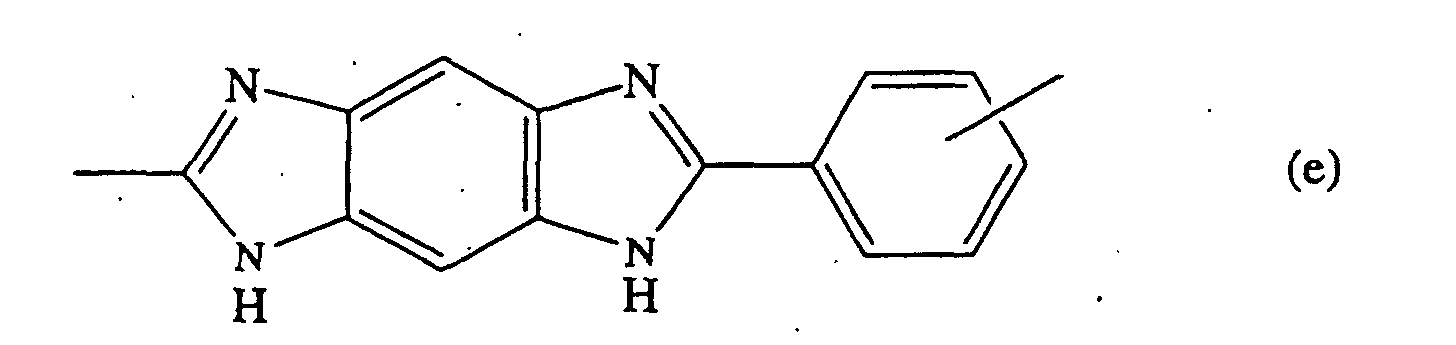
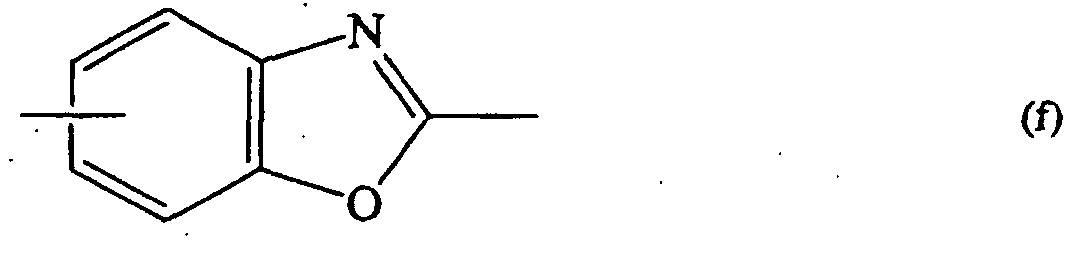
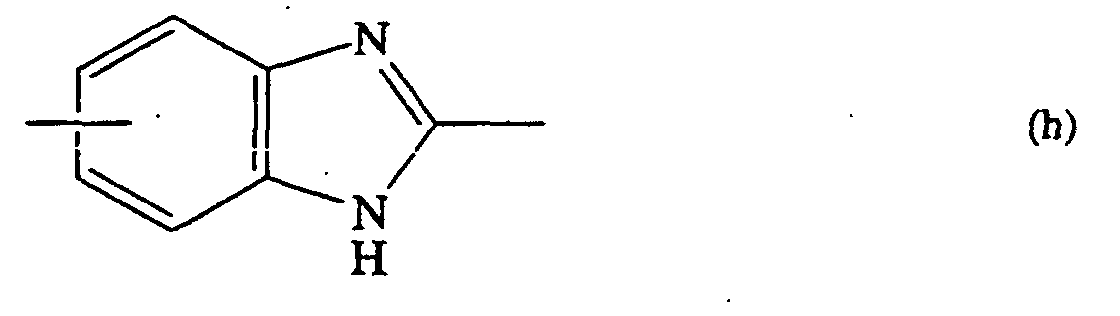
- the monomer unit comprises a monomer unit described in any of the structural formulas (a)-(h), more preferably a monomer unit essentially selected from the structural formulas (a)-(d).
- a preferable solvent for forming a dope of a polymer substantially made from PBO includes creosol and non-oxidative acids capable of dissolving the polymer.
- preferable acid solvents include polyphosphoric acid, methanesulfonic acid, high concentration sulfuric acid and a mixture thereof. More suitable solvents include polyphosphoric acid and methanesulfonic acid. The most suitable solvent is polyphosphoric acid.
- the polymer concentration of the solvent is preferably at least about 7 weight %, more preferably at least 10 weight %, most preferably 14 weight %.
- the highest concentration is limited by practical handling property such as solubility of polymer and viscosity of dope. Due to such limiting factors, the polymer concentration does not exceed 20 weight %.
- Preferable polymers and copolymer or dope are/is synthesized by known methods. For example, synthesis is performed according to the methods described in US Patent No. 4533693 (August 6, 1985) to Wolfe et al., US Patent No. 4772678 (September 20, 1988) to Sybert et al. and US Patent No. 4847350 (July 11, 1989) to Harris. According to US Patent No. 5089591 (February 18, 1992) to Gregory et al., a polymer substantially made from PBO can be made to have a high molecular weight at a high reaction speed in a dehydrative acid solvent at comparatively high temperature under high shear condition.
- the carbon nanotube to be added is simultaneously mixed with dope materials when the dope is synthesized.
- dope materials For the expression of fine fiber dynamic physical property, uniform mixing and dispersion of carbon nanotube in a dope is necessary. It is preferable to place the materials before polymerizing the dope, once stir to mix the starting materials at a temperature not higher than 80°C and prepare the dope according to the information.
- the amount of addition is 1-15%, preferably not less than 3% and less than 10% in weight proportion relative to the amount of monomer charged. When the amount is smaller, the amount of the carbon nanotube contained in the completed yarn becomes smaller and improvement of compression strength cannot be expected. When the amount is too much, dispersing property of the carbon nanotube in the fiber becomes poor and unpreferably decreases the strength of the completed yarn.
- the dope thus polymerized is fed to a spinning part and discharged from a spinneret generally at a temperature of not lower than 100°C.
- the arrangement of the holes of a spinneret is generally circular or lattice in plurality, but may be a different arrangement. While the number of the holes of a spinneret is not particularly limited, the density of the holes of a spinneret needs to be one that is free from welding and the like of the discharged yarns.
- the spun yarn requires a draw zone having a sufficient length to achieve a sufficient draw ratio (SDR) and desires uniform cooling with a rectified cooling air having a comparatively high temperature (not less than solidification temperature of dope and not higher than spinning temperature), as described in US Patent No. 5296185.
- the length (L) of the draw zone needs to be sufficient to allow completion of solidification in a non-coagulative gas and is largely determined based on discharge volume (Q) of one hole.
- take-up stress of the draw zone needs to be not less than 2 g/d based on polymer (assuming that the stress is applied on polymer alone).
- the yarn drawn in the draw zone is then led to an extraction (coagulation) bath.
- any type of extraction bath can be used.
- a funnel type, a tank type, an aspirator type, a cascade type and the like can be used.
- an aqueous phosphoric acid solution and water are desirable.
- not less than 99.0%, preferably not less than 99.5% of the phosphoric acid contained in the yarn is extracted in an extraction bath.
- the liquid to be used as an extraction medium in the present invention is not particularly limited, water, methanol, ethanol, acetone and the like, which are substantially incompatible with polybenzoxazole, are preferable.
- the longer axis of the carbon nanotube should be oriented in the fiber axis direction in a fiber, as well as uniformly dispersed therein. Only then the carbon nanotube functions as a support relative to the deformation in the compression direction. As a result of intensive investigation, it has been found that this structure generally develops spontaneously when carbon nanotube is uniformly dispersed in a dope, by undergoing a conventional spinning step. Whether the carbon nanotube functions as a dynamic support can be examined by Raman scattering method.
- a Raman shift factor ascribed to A 1g of carbon nanotube is not more than -0.5 cm -1 /GPa, preferably not more than -1.0 cm -1 /GPa.
- the Raman band of A 1g is also called a D' band, and observed near 2610 cm -1 .
- the Raman shift factor is meant a Raman band shift that varies upon application of lGPa stress on the fiber.
- the Raman scattering spectrum was measured by the following method.
- a Raman measurement instrument spectrometer
- system 1000 of Renishaw plc was used.
- the light source helium-neon laser (wavelength 633 nm) was used, and the fiber was set such that the fiber axis is in parallel to the direction of polarization and measurement was done.
- a monofilament was split and picked up from a yarn, put on the center part of a rectangular (length 50 mm width 10 mm) hole placed in a cardboard, so that the longer axis can be identical to the fiber axis, the both ends were adhered with an epoxy adhesive (Araldite), and left standing for two days or longer.
- the fiber was set on an apparatus capable of adjusting the length with a micrometer.
- the cardboard carrying the monofilament was carefully cut out and a deformation was applied to the fiber.
- the fiber was placed on a microscope stage of the Raman spectrometer and the Raman spectrum was measured. The stress acting on the fiber was
- the compression strength was measured using the Raman scattering mentioned above. The detail of the measurement followed the method of Young et al., such as Polymer 40, 3421 (1999). The compression strength was determined by monitoring changes in the 1619 cm -1 band due to the stretching of benzene ring of PBO.
- the pressure was raised, the polymer solution was spun out from a spinneret having 166 holes at 170°C while maintaining the temperature of the solution at 170°C, the discharged yarn was cooled with a cooling air at 60°C, wound around a godet roll to give a spinning speed, and introduced into an extraction (coagulation) bath containing a 20% aqueous phosphoric acid solution maintained at 20 ⁇ 2°C.
- the yarn was washed with ion exchange water in a second extraction bath, immersed in a 0.1N sodium hydroxide solution to allow for neutralization.
- the yarn was washed with water in a water washing bath, wound up and dried in a drying oven at 80°C.
- Fibers were prepared by the same method as in Comparative Example 1 except that carbon nanotube was added along with the materials of polybenzazole fiber, uniformly mixed in advance and then the dope was polymerized. The uniformity of mixing was visually judged. That is, the mixture was stirred until the black color of carbon nanotube became uniform. To increase elastic modulus, the dried fiber was treated at a temperature 600°C, tension of 7.0 g/d for 1.4 sec as necessary. The results are shown in Table 1.
- a polybenzazole fiber having a specific fine fiber structure, and conventionally unavailable high strength and high elastic modulus at the same time can be industrially produced with ease, and a great effect of increasing the practical utility as an industrial material and expanding the fields of utilization can be afforded.
- its high compression characteristic its use as a composite material for aircraft materials and space exploitation can be expected.
- the fiber can be used for a wide range of uses, inclusive of tension members such as cable, electric wire, optical fiber and the like, tendon such as rope and the like, aviation and space materials such as rocket insulation, rocket casing, pressure container, string of space suit, planet probe balloon and the like; impact resistant materials such as bulletproof material and the like; cutproof materials such as gloves and the like; heat resistant flame resistant materials such as fire resistant suit, heat resistant felt, gasket for plant, heat resistant knit fabric, various sealings, heat resistant cushion, filter and the like; rubber reinforcing materials for belt, tire, sole, rope, hose and the like; sport-related materials such as fishing line, fishing rod, tennis racket, table tennis racket, badminton racket, golf shaft, club head, gut, string, sail cloth, athletic (running) shoes, spiked shoes, athletic bicycle and wheel thereof, spoke, braking wire, transmission wire, sports-specific (running) wheelchair and wheel thereof, ski, stock, helmet and the like; friction resistant materials such as advance belt, clutch facing and the like; reinfor
Landscapes
- Engineering & Computer Science (AREA)
- Chemical & Material Sciences (AREA)
- Chemical Kinetics & Catalysis (AREA)
- General Chemical & Material Sciences (AREA)
- Textile Engineering (AREA)
- Nanotechnology (AREA)
- Physics & Mathematics (AREA)
- Composite Materials (AREA)
- Condensed Matter Physics & Semiconductors (AREA)
- General Physics & Mathematics (AREA)
- Materials Engineering (AREA)
- Crystallography & Structural Chemistry (AREA)
- Manufacturing & Machinery (AREA)
- Artificial Filaments (AREA)
- Macromolecular Compounds Obtained By Forming Nitrogen-Containing Linkages In General (AREA)
Abstract
Description
The polybenzazole (PBZ) polymer is described in, for example, Wolf et al., "Liquid Crystalline Polymer Compositions, Process and Products", US Patent No. 4703103 (October 27, 1987), "Liquid Crystalline Polymer Compositions, Process and Products" US Patent No. 4533692 (August 6, 1985), "Liquid Crystalline Poly(2,6-Benzothiazole) Compositions, Process and Products", US Patent No. 4533724 (August 6, 1985), "Liquid Crystalline Polymer Compositions, Process and Products", US Patent No. 4533693 (August 6, 1985), Evers, "Thermooxidatively Stable Articulated p-Benzobisoxazole and p-Benzobisoxazole Polymers", US Patent No. 4539567 (November 16, 1982), Tsai et al., "Method for Making Heterocyclic Block Copolymer", US Patent No. 4578432 (March 25, 1986), and the like.
The monomer unit comprises a monomer unit described in any of the structural formulas (a)-(h), more preferably a monomer unit essentially selected from the structural formulas (a)-(d).



| Heat treatment | Carbon nanotube | Fiber properties | |||||
| Amount added % | Outer diameter nm | Length µm | Fiber strength GPa | Elastic modulus GPa | Compression strength GPa | ||
| Com.Ex.1 | None | 0.0 | 14.1 | 4.2 | 5.8 | 178 | 0.35 |
| Com.Ex.2 | Yes | 0.0 | 14.1 | 4.2 | 5.8 | 283 | 0.34 |
| Ex.1 | None | 5.1 | 14.1 | 4.2 | 5.7 | 177 | 0.71 |
| Ex.2 | None | 9.2 | 14.1 | 4.2 | 5.4 | 176 | 0.98 |
| Ex.3 | None | 13.8 | 14.1 | 4.2 | 5.5 | 183 | 0.75 |
| Com.Ex.3 | None | 17.9 | 14.1 | 4.2 | 5.6 | 184 | 0.41 |
| Com.Ex.4 | None | 9.2 | 0.3 | 4.2 | 5.3 | 175 | 0.38 |
| Ex.6 | None | 9.2 | 9.4 | 4.2 | 5.4 | 178 | 1.34 |
| Ex.7 | None | 9.2 | 17.3 | 4.2 | 5.9 | 189 | 0.96 |
| Com.Ex.5 | None | 9.2 | 24.4 | 4.2 | 5.7 | 187 | 0.35 |
| Com.Ex.6 | None | 9.2 | 14.1 | 0.41 | 5.8 | 183 | 0.39 |
| Ex.8 | None | 9.2 | 14.1 | 8.1 | 5.3 | 185 | 1.24 |
| Com.Ex.7 | None | 9.2 | 14.1 | 12.3 | 5.4 | 180 | 0.42 |
| Ex.9 | Yes | 9.2 | 9.4 | 4.2 | 5.4 | 281 | 1.64 |
Claims (5)
- A polybenzazole fiber comprising a carbon nanotube inside the fiber.
- The polybenzazole fiber of claim 1, wherein the content of the carbon nanotube is 1-15% in weight proportion.
- The polybenzazole fiber of claim 1, wherein the carbon nanotube has an outer diameter of not more than 20 nm and a length of 0.5 µm - 10 µm.
- The polybenzazole fiber of claim 1, wherein the Raman shift factor ascribed to A1g of the carbon nanotube is not more than -0.5 cm-1/GPa.
- The polybenzazole fiber of claim 1, wherein the compression strength is not less than 0.5 GPa.
Applications Claiming Priority (3)
| Application Number | Priority Date | Filing Date | Title |
|---|---|---|---|
| JP2001315784 | 2001-10-12 | ||
| JP2001315784A JP3852681B2 (en) | 2001-10-12 | 2001-10-12 | Polybenzazole fiber |
| PCT/JP2002/010570 WO2003033785A1 (en) | 2001-10-12 | 2002-10-11 | Polybenzazole fiber |
Publications (3)
| Publication Number | Publication Date |
|---|---|
| EP1449942A1 true EP1449942A1 (en) | 2004-08-25 |
| EP1449942A4 EP1449942A4 (en) | 2005-09-14 |
| EP1449942B1 EP1449942B1 (en) | 2007-12-12 |
Family
ID=19133901
Family Applications (1)
| Application Number | Title | Priority Date | Filing Date |
|---|---|---|---|
| EP02801539A Expired - Lifetime EP1449942B1 (en) | 2001-10-12 | 2002-10-11 | Polybenzazole fiber |
Country Status (8)
| Country | Link |
|---|---|
| US (1) | US6884506B2 (en) |
| EP (1) | EP1449942B1 (en) |
| JP (1) | JP3852681B2 (en) |
| KR (1) | KR100866465B1 (en) |
| CN (1) | CN1280461C (en) |
| AT (1) | ATE380893T1 (en) |
| DE (1) | DE60224085T2 (en) |
| WO (1) | WO2003033785A1 (en) |
Cited By (2)
| Publication number | Priority date | Publication date | Assignee | Title |
|---|---|---|---|---|
| US6884506B2 (en) * | 2001-10-12 | 2005-04-26 | Toyo Boseki Kabushiki Kaisha | Polybenzazole fiber |
| WO2006023697A1 (en) * | 2004-08-20 | 2006-03-02 | Massachusetts Institute Of Technology | Filler-enhanced polymeric fibers with improved mechanical properties and method for making |
Families Citing this family (17)
| Publication number | Priority date | Publication date | Assignee | Title |
|---|---|---|---|---|
| DE60229955D1 (en) * | 2001-08-29 | 2009-01-02 | Georgia Tech Res Inst | COMPOSITIONS COMPRISING STAINLESS POLYMERS AND NANOROUS STRUCTURES, AND METHOD FOR MANUFACTURING THE SAME |
| PL201205B1 (en) * | 2003-03-10 | 2009-03-31 | Inst Wlokien Naturalnych | Method for manufacture of modified cellulose fibres |
| US7262266B2 (en) * | 2003-10-24 | 2007-08-28 | William Marsh Rice University | Copolymerization of polybenzazoles and other aromatic polymers with carbon nanotubes |
| US20070104948A1 (en) * | 2003-12-11 | 2007-05-10 | Kohei Kiriyama | Polybenzazole fiber and article comprising the same |
| JP4660215B2 (en) * | 2004-03-10 | 2011-03-30 | 株式会社ゴーセン | Racket string |
| CN1298898C (en) * | 2004-08-05 | 2007-02-07 | 清华大学 | Polyfiber containing structure of nano carbon tubes |
| US20080287598A1 (en) * | 2006-11-29 | 2008-11-20 | Kiu-Seung Lee | Method of preparing aramid polymers incorporating carbon nanotubes |
| US20080145302A1 (en) * | 2006-12-15 | 2008-06-19 | Peter Henry Renteln | High strength low density fiber |
| US20090326128A1 (en) * | 2007-05-08 | 2009-12-31 | Javier Macossay-Torres | Fibers and methods relating thereto |
| US9247368B2 (en) | 2007-09-13 | 2016-01-26 | Harman International Industries, Incorporated | Loudspeaker cone body |
| US8629597B2 (en) * | 2010-03-03 | 2014-01-14 | Remy Technologies, Llc | Airflow passage arrangement for claw-pole electric machines |
| JP5829544B2 (en) * | 2012-02-13 | 2015-12-09 | ニッタ株式会社 | Carbon nanotube aggregate and method for producing the same |
| KR101325606B1 (en) * | 2012-06-26 | 2013-11-20 | 영풍화성(주) | Method of manufacturing coated sailcloth comprising ultra high milecular weight polyethylene fiber and high strength polyester fiber |
| CN103243416A (en) * | 2013-05-17 | 2013-08-14 | 天津工业大学 | Preparation method of polyindole/carbon nanotube composite nanofiber membrane |
| JP6657784B2 (en) * | 2014-10-30 | 2020-03-04 | Dic株式会社 | Composite resin composition, molded body, heat conductive material and heat conductive material |
| KR101716242B1 (en) * | 2015-11-10 | 2017-03-14 | 금오공과대학교 산학협력단 | Poly(p-phenylene benzobisoxazole) fiber improved uv resistnat and compression strength, and method for preparing the same |
| KR101734895B1 (en) * | 2015-12-11 | 2017-05-12 | 금오공과대학교 산학협력단 | Poly(p-phenylene benzobisoxazole) nanocomposite fiber improved uv resistnat and compression strength, and method for preparing the same using modified polyhedral oligomeric silsesquioxane(poss) |
Family Cites Families (9)
| Publication number | Priority date | Publication date | Assignee | Title |
|---|---|---|---|---|
| US5286833A (en) * | 1992-12-03 | 1994-02-15 | The Dow Chemical Company | Polybenzazole fiber with ultra-high physical properties |
| US5512368A (en) * | 1995-03-16 | 1996-04-30 | E. I. Du Pont De Nemours And Company | Fibers reinforced with inorganic whiskers |
| JPH09111135A (en) * | 1995-10-23 | 1997-04-28 | Mitsubishi Materials Corp | Conductive polymer composition |
| EP1054036A1 (en) * | 1999-05-18 | 2000-11-22 | Fina Research S.A. | Reinforced polymers |
| JP2001098160A (en) | 1999-09-30 | 2001-04-10 | Sumitomo Bakelite Co Ltd | Resin composition for insulating material and insulating material using the same |
| DE60229955D1 (en) * | 2001-08-29 | 2009-01-02 | Georgia Tech Res Inst | COMPOSITIONS COMPRISING STAINLESS POLYMERS AND NANOROUS STRUCTURES, AND METHOD FOR MANUFACTURING THE SAME |
| JP3852681B2 (en) * | 2001-10-12 | 2006-12-06 | 東洋紡績株式会社 | Polybenzazole fiber |
| JP4524060B2 (en) * | 2002-02-08 | 2010-08-11 | 東洋紡績株式会社 | Antistatic polybenzazole composition for industrial materials |
| JP2003327722A (en) * | 2002-05-14 | 2003-11-19 | Toyobo Co Ltd | Polybenzazole film |
-
2001
- 2001-10-12 JP JP2001315784A patent/JP3852681B2/en not_active Expired - Fee Related
-
2002
- 2002-10-11 DE DE60224085T patent/DE60224085T2/en not_active Expired - Lifetime
- 2002-10-11 AT AT02801539T patent/ATE380893T1/en not_active IP Right Cessation
- 2002-10-11 KR KR1020047005198A patent/KR100866465B1/en not_active Expired - Fee Related
- 2002-10-11 CN CNB028174771A patent/CN1280461C/en not_active Expired - Fee Related
- 2002-10-11 US US10/492,480 patent/US6884506B2/en not_active Expired - Fee Related
- 2002-10-11 WO PCT/JP2002/010570 patent/WO2003033785A1/en not_active Ceased
- 2002-10-11 EP EP02801539A patent/EP1449942B1/en not_active Expired - Lifetime
Cited By (2)
| Publication number | Priority date | Publication date | Assignee | Title |
|---|---|---|---|---|
| US6884506B2 (en) * | 2001-10-12 | 2005-04-26 | Toyo Boseki Kabushiki Kaisha | Polybenzazole fiber |
| WO2006023697A1 (en) * | 2004-08-20 | 2006-03-02 | Massachusetts Institute Of Technology | Filler-enhanced polymeric fibers with improved mechanical properties and method for making |
Also Published As
| Publication number | Publication date |
|---|---|
| CN1551934A (en) | 2004-12-01 |
| EP1449942B1 (en) | 2007-12-12 |
| EP1449942A4 (en) | 2005-09-14 |
| US20050045545A1 (en) | 2005-03-03 |
| DE60224085D1 (en) | 2008-01-24 |
| JP3852681B2 (en) | 2006-12-06 |
| DE60224085T2 (en) | 2008-11-06 |
| WO2003033785A1 (en) | 2003-04-24 |
| ATE380893T1 (en) | 2007-12-15 |
| JP2003119622A (en) | 2003-04-23 |
| CN1280461C (en) | 2006-10-18 |
| US6884506B2 (en) | 2005-04-26 |
| KR100866465B1 (en) | 2008-10-31 |
| KR20040051603A (en) | 2004-06-18 |
Similar Documents
| Publication | Publication Date | Title |
|---|---|---|
| EP1449942B1 (en) | Polybenzazole fiber | |
| EP0885987B1 (en) | Polybenzazole fiber having high tensile modulus and process of manufacture thereof | |
| JP2003221778A (en) | Polybenzazole fiber and method for producing the same | |
| EP1300490B1 (en) | Polybenzazole fiber and use of the same | |
| JP2003234013A (en) | Electrical conductor | |
| JP4524060B2 (en) | Antistatic polybenzazole composition for industrial materials | |
| JPH0246688B2 (en) | ||
| JPS61108711A (en) | Production of polyvinyl alcohol fiber of high strength and high elastic modulus | |
| KR20220094640A (en) | Method for producing para-aramid fibers and para-aramid fibers producted thereform | |
| JP2003303516A (en) | Thin wire cord | |
| JP4009885B2 (en) | High modulus polybenzazole fiber and process for producing the same | |
| JP3918989B2 (en) | Polybenzazole fiber and method for producing the same | |
| JP3480128B2 (en) | Method for producing high modulus polyparaphenylene benzobisoxazole multifilament | |
| JP3508876B2 (en) | High modulus polybenzazole fiber | |
| JP3063064B2 (en) | High-speed spinning method of polybenzazole fiber | |
| JPH11335926A (en) | High-modulus polybenzazole fiber and its production | |
| JP3801734B2 (en) | High modulus polybenzazole fiber and process for producing the same | |
| JPH02216211A (en) | Production of improved poly-p-phenylene terephthalamide fiber | |
| JPH0820651A (en) | Fiber reinforced composite material | |
| JPH0849156A (en) | Method for producing non-woven fabric of polybenzazole fiber | |
| JP2006057214A (en) | Polybenzazole fiber | |
| JPS6233820A (en) | Production of poly(p-phenylene terephthalamide) fiber | |
| KR20000061085A (en) | High elastic modulus polybenzazole filer and method for production thereof | |
| JPH10110330A (en) | Polybenzazole fiber | |
| JP2006348441A (en) | Polybenzazole fiber and method for producing the same |
Legal Events
| Date | Code | Title | Description |
|---|---|---|---|
| PUAI | Public reference made under article 153(3) epc to a published international application that has entered the european phase |
Free format text: ORIGINAL CODE: 0009012 |
|
| 17P | Request for examination filed |
Effective date: 20040423 |
|
| AK | Designated contracting states |
Kind code of ref document: A1 Designated state(s): AT BE BG CH CY CZ DE DK EE ES FI FR GB GR IE IT LI LU MC NL PT SE SK TR |
|
| A4 | Supplementary search report drawn up and despatched |
Effective date: 20050803 |
|
| 17Q | First examination report despatched |
Effective date: 20060928 |
|
| GRAP | Despatch of communication of intention to grant a patent |
Free format text: ORIGINAL CODE: EPIDOSNIGR1 |
|
| GRAS | Grant fee paid |
Free format text: ORIGINAL CODE: EPIDOSNIGR3 |
|
| GRAA | (expected) grant |
Free format text: ORIGINAL CODE: 0009210 |
|
| AK | Designated contracting states |
Kind code of ref document: B1 Designated state(s): AT BE BG CH CY CZ DE DK EE ES FI FR GB GR IE IT LI LU MC NL PT SE SK TR |
|
| REG | Reference to a national code |
Ref country code: GB Ref legal event code: FG4D |
|
| REG | Reference to a national code |
Ref country code: CH Ref legal event code: EP |
|
| REG | Reference to a national code |
Ref country code: IE Ref legal event code: FG4D |
|
| REF | Corresponds to: |
Ref document number: 60224085 Country of ref document: DE Date of ref document: 20080124 Kind code of ref document: P |
|
| PG25 | Lapsed in a contracting state [announced via postgrant information from national office to epo] |
Ref country code: SE Free format text: LAPSE BECAUSE OF FAILURE TO SUBMIT A TRANSLATION OF THE DESCRIPTION OR TO PAY THE FEE WITHIN THE PRESCRIBED TIME-LIMIT Effective date: 20080312 Ref country code: LI Free format text: LAPSE BECAUSE OF FAILURE TO SUBMIT A TRANSLATION OF THE DESCRIPTION OR TO PAY THE FEE WITHIN THE PRESCRIBED TIME-LIMIT Effective date: 20071212 Ref country code: CH Free format text: LAPSE BECAUSE OF FAILURE TO SUBMIT A TRANSLATION OF THE DESCRIPTION OR TO PAY THE FEE WITHIN THE PRESCRIBED TIME-LIMIT Effective date: 20071212 |
|
| PG25 | Lapsed in a contracting state [announced via postgrant information from national office to epo] |
Ref country code: FI Free format text: LAPSE BECAUSE OF FAILURE TO SUBMIT A TRANSLATION OF THE DESCRIPTION OR TO PAY THE FEE WITHIN THE PRESCRIBED TIME-LIMIT Effective date: 20071212 |
|
| REG | Reference to a national code |
Ref country code: CH Ref legal event code: PL |
|
| PG25 | Lapsed in a contracting state [announced via postgrant information from national office to epo] |
Ref country code: AT Free format text: LAPSE BECAUSE OF FAILURE TO SUBMIT A TRANSLATION OF THE DESCRIPTION OR TO PAY THE FEE WITHIN THE PRESCRIBED TIME-LIMIT Effective date: 20071212 |
|
| PG25 | Lapsed in a contracting state [announced via postgrant information from national office to epo] |
Ref country code: ES Free format text: LAPSE BECAUSE OF FAILURE TO SUBMIT A TRANSLATION OF THE DESCRIPTION OR TO PAY THE FEE WITHIN THE PRESCRIBED TIME-LIMIT Effective date: 20080323 Ref country code: CZ Free format text: LAPSE BECAUSE OF FAILURE TO SUBMIT A TRANSLATION OF THE DESCRIPTION OR TO PAY THE FEE WITHIN THE PRESCRIBED TIME-LIMIT Effective date: 20071212 |
|
| PG25 | Lapsed in a contracting state [announced via postgrant information from national office to epo] |
Ref country code: BE Free format text: LAPSE BECAUSE OF FAILURE TO SUBMIT A TRANSLATION OF THE DESCRIPTION OR TO PAY THE FEE WITHIN THE PRESCRIBED TIME-LIMIT Effective date: 20071212 Ref country code: SK Free format text: LAPSE BECAUSE OF FAILURE TO SUBMIT A TRANSLATION OF THE DESCRIPTION OR TO PAY THE FEE WITHIN THE PRESCRIBED TIME-LIMIT Effective date: 20071212 |
|
| EN | Fr: translation not filed | ||
| PG25 | Lapsed in a contracting state [announced via postgrant information from national office to epo] |
Ref country code: PT Free format text: LAPSE BECAUSE OF FAILURE TO SUBMIT A TRANSLATION OF THE DESCRIPTION OR TO PAY THE FEE WITHIN THE PRESCRIBED TIME-LIMIT Effective date: 20080512 |
|
| PLBE | No opposition filed within time limit |
Free format text: ORIGINAL CODE: 0009261 |
|
| STAA | Information on the status of an ep patent application or granted ep patent |
Free format text: STATUS: NO OPPOSITION FILED WITHIN TIME LIMIT |
|
| PG25 | Lapsed in a contracting state [announced via postgrant information from national office to epo] |
Ref country code: FR Free format text: LAPSE BECAUSE OF FAILURE TO SUBMIT A TRANSLATION OF THE DESCRIPTION OR TO PAY THE FEE WITHIN THE PRESCRIBED TIME-LIMIT Effective date: 20080926 Ref country code: DK Free format text: LAPSE BECAUSE OF FAILURE TO SUBMIT A TRANSLATION OF THE DESCRIPTION OR TO PAY THE FEE WITHIN THE PRESCRIBED TIME-LIMIT Effective date: 20071212 |
|
| 26N | No opposition filed |
Effective date: 20080915 |
|
| PG25 | Lapsed in a contracting state [announced via postgrant information from national office to epo] |
Ref country code: GR Free format text: LAPSE BECAUSE OF FAILURE TO SUBMIT A TRANSLATION OF THE DESCRIPTION OR TO PAY THE FEE WITHIN THE PRESCRIBED TIME-LIMIT Effective date: 20080313 |
|
| PG25 | Lapsed in a contracting state [announced via postgrant information from national office to epo] |
Ref country code: EE Free format text: LAPSE BECAUSE OF FAILURE TO SUBMIT A TRANSLATION OF THE DESCRIPTION OR TO PAY THE FEE WITHIN THE PRESCRIBED TIME-LIMIT Effective date: 20071212 Ref country code: BG Free format text: LAPSE BECAUSE OF FAILURE TO SUBMIT A TRANSLATION OF THE DESCRIPTION OR TO PAY THE FEE WITHIN THE PRESCRIBED TIME-LIMIT Effective date: 20080312 |
|
| PG25 | Lapsed in a contracting state [announced via postgrant information from national office to epo] |
Ref country code: MC Free format text: LAPSE BECAUSE OF NON-PAYMENT OF DUE FEES Effective date: 20081031 |
|
| PG25 | Lapsed in a contracting state [announced via postgrant information from national office to epo] |
Ref country code: CY Free format text: LAPSE BECAUSE OF FAILURE TO SUBMIT A TRANSLATION OF THE DESCRIPTION OR TO PAY THE FEE WITHIN THE PRESCRIBED TIME-LIMIT Effective date: 20071212 |
|
| PG25 | Lapsed in a contracting state [announced via postgrant information from national office to epo] |
Ref country code: IE Free format text: LAPSE BECAUSE OF NON-PAYMENT OF DUE FEES Effective date: 20081013 |
|
| PG25 | Lapsed in a contracting state [announced via postgrant information from national office to epo] |
Ref country code: LU Free format text: LAPSE BECAUSE OF NON-PAYMENT OF DUE FEES Effective date: 20081011 |
|
| PG25 | Lapsed in a contracting state [announced via postgrant information from national office to epo] |
Ref country code: TR Free format text: LAPSE BECAUSE OF FAILURE TO SUBMIT A TRANSLATION OF THE DESCRIPTION OR TO PAY THE FEE WITHIN THE PRESCRIBED TIME-LIMIT Effective date: 20071212 |
|
| PG25 | Lapsed in a contracting state [announced via postgrant information from national office to epo] |
Ref country code: IT Free format text: LAPSE BECAUSE OF NON-PAYMENT OF DUE FEES Effective date: 20081031 |
|
| PGFP | Annual fee paid to national office [announced via postgrant information from national office to epo] |
Ref country code: DE Payment date: 20121003 Year of fee payment: 11 |
|
| PGFP | Annual fee paid to national office [announced via postgrant information from national office to epo] |
Ref country code: GB Payment date: 20121010 Year of fee payment: 11 |
|
| PGFP | Annual fee paid to national office [announced via postgrant information from national office to epo] |
Ref country code: NL Payment date: 20121016 Year of fee payment: 11 |
|
| REG | Reference to a national code |
Ref country code: NL Ref legal event code: V1 Effective date: 20140501 |
|
| GBPC | Gb: european patent ceased through non-payment of renewal fee |
Effective date: 20131011 |
|
| PG25 | Lapsed in a contracting state [announced via postgrant information from national office to epo] |
Ref country code: GB Free format text: LAPSE BECAUSE OF NON-PAYMENT OF DUE FEES Effective date: 20131011 |
|
| REG | Reference to a national code |
Ref country code: DE Ref legal event code: R119 Ref document number: 60224085 Country of ref document: DE Effective date: 20140501 |
|
| PG25 | Lapsed in a contracting state [announced via postgrant information from national office to epo] |
Ref country code: NL Free format text: LAPSE BECAUSE OF NON-PAYMENT OF DUE FEES Effective date: 20140501 Ref country code: DE Free format text: LAPSE BECAUSE OF NON-PAYMENT OF DUE FEES Effective date: 20140501 |