EP1449936A1 - Process for producing metal wire rod for plastic working - Google Patents
Process for producing metal wire rod for plastic working Download PDFInfo
- Publication number
- EP1449936A1 EP1449936A1 EP02779915A EP02779915A EP1449936A1 EP 1449936 A1 EP1449936 A1 EP 1449936A1 EP 02779915 A EP02779915 A EP 02779915A EP 02779915 A EP02779915 A EP 02779915A EP 1449936 A1 EP1449936 A1 EP 1449936A1
- Authority
- EP
- European Patent Office
- Prior art keywords
- wire rod
- metal wire
- group
- seconds
- treatment
- Prior art date
- Legal status (The legal status is an assumption and is not a legal conclusion. Google has not performed a legal analysis and makes no representation as to the accuracy of the status listed.)
- Withdrawn
Links
Images
Classifications
-
- B—PERFORMING OPERATIONS; TRANSPORTING
- B21—MECHANICAL METAL-WORKING WITHOUT ESSENTIALLY REMOVING MATERIAL; PUNCHING METAL
- B21C—MANUFACTURE OF METAL SHEETS, WIRE, RODS, TUBES, PROFILES OR LIKE SEMI-MANUFACTURED PRODUCTS OTHERWISE THAN BY ROLLING; AUXILIARY OPERATIONS USED IN CONNECTION WITH METAL-WORKING WITHOUT ESSENTIALLY REMOVING MATERIAL
- B21C43/00—Devices for cleaning metal products combined with or specially adapted for use with machines or apparatus provided for in this subclass
- B21C43/02—Devices for cleaning metal products combined with or specially adapted for use with machines or apparatus provided for in this subclass combined with or specially adapted for use in connection with drawing or winding machines or apparatus
-
- B—PERFORMING OPERATIONS; TRANSPORTING
- B21—MECHANICAL METAL-WORKING WITHOUT ESSENTIALLY REMOVING MATERIAL; PUNCHING METAL
- B21C—MANUFACTURE OF METAL SHEETS, WIRE, RODS, TUBES, PROFILES OR LIKE SEMI-MANUFACTURED PRODUCTS OTHERWISE THAN BY ROLLING; AUXILIARY OPERATIONS USED IN CONNECTION WITH METAL-WORKING WITHOUT ESSENTIALLY REMOVING MATERIAL
- B21C9/00—Cooling, heating or lubricating drawing material
-
- B—PERFORMING OPERATIONS; TRANSPORTING
- B21—MECHANICAL METAL-WORKING WITHOUT ESSENTIALLY REMOVING MATERIAL; PUNCHING METAL
- B21C—MANUFACTURE OF METAL SHEETS, WIRE, RODS, TUBES, PROFILES OR LIKE SEMI-MANUFACTURED PRODUCTS OTHERWISE THAN BY ROLLING; AUXILIARY OPERATIONS USED IN CONNECTION WITH METAL-WORKING WITHOUT ESSENTIALLY REMOVING MATERIAL
- B21C9/00—Cooling, heating or lubricating drawing material
- B21C9/02—Selection of compositions therefor
-
- C—CHEMISTRY; METALLURGY
- C10—PETROLEUM, GAS OR COKE INDUSTRIES; TECHNICAL GASES CONTAINING CARBON MONOXIDE; FUELS; LUBRICANTS; PEAT
- C10M—LUBRICATING COMPOSITIONS; USE OF CHEMICAL SUBSTANCES EITHER ALONE OR AS LUBRICATING INGREDIENTS IN A LUBRICATING COMPOSITION
- C10M169/00—Lubricating compositions characterised by containing as components a mixture of at least two types of ingredient selected from base-materials, thickeners or additives, covered by the preceding groups, each of these compounds being essential
- C10M169/04—Mixtures of base-materials and additives
-
- C—CHEMISTRY; METALLURGY
- C10—PETROLEUM, GAS OR COKE INDUSTRIES; TECHNICAL GASES CONTAINING CARBON MONOXIDE; FUELS; LUBRICANTS; PEAT
- C10M—LUBRICATING COMPOSITIONS; USE OF CHEMICAL SUBSTANCES EITHER ALONE OR AS LUBRICATING INGREDIENTS IN A LUBRICATING COMPOSITION
- C10M173/00—Lubricating compositions containing more than 10% water
- C10M173/02—Lubricating compositions containing more than 10% water not containing mineral or fatty oils
-
- C—CHEMISTRY; METALLURGY
- C23—COATING METALLIC MATERIAL; COATING MATERIAL WITH METALLIC MATERIAL; CHEMICAL SURFACE TREATMENT; DIFFUSION TREATMENT OF METALLIC MATERIAL; COATING BY VACUUM EVAPORATION, BY SPUTTERING, BY ION IMPLANTATION OR BY CHEMICAL VAPOUR DEPOSITION, IN GENERAL; INHIBITING CORROSION OF METALLIC MATERIAL OR INCRUSTATION IN GENERAL
- C23C—COATING METALLIC MATERIAL; COATING MATERIAL WITH METALLIC MATERIAL; SURFACE TREATMENT OF METALLIC MATERIAL BY DIFFUSION INTO THE SURFACE, BY CHEMICAL CONVERSION OR SUBSTITUTION; COATING BY VACUUM EVAPORATION, BY SPUTTERING, BY ION IMPLANTATION OR BY CHEMICAL VAPOUR DEPOSITION, IN GENERAL
- C23C22/00—Chemical surface treatment of metallic material by reaction of the surface with a reactive liquid, leaving reaction products of surface material in the coating, e.g. conversion coatings, passivation of metals
- C23C22/05—Chemical surface treatment of metallic material by reaction of the surface with a reactive liquid, leaving reaction products of surface material in the coating, e.g. conversion coatings, passivation of metals using aqueous solutions
- C23C22/06—Chemical surface treatment of metallic material by reaction of the surface with a reactive liquid, leaving reaction products of surface material in the coating, e.g. conversion coatings, passivation of metals using aqueous solutions using aqueous acidic solutions with pH less than 6
-
- C—CHEMISTRY; METALLURGY
- C23—COATING METALLIC MATERIAL; COATING MATERIAL WITH METALLIC MATERIAL; CHEMICAL SURFACE TREATMENT; DIFFUSION TREATMENT OF METALLIC MATERIAL; COATING BY VACUUM EVAPORATION, BY SPUTTERING, BY ION IMPLANTATION OR BY CHEMICAL VAPOUR DEPOSITION, IN GENERAL; INHIBITING CORROSION OF METALLIC MATERIAL OR INCRUSTATION IN GENERAL
- C23C—COATING METALLIC MATERIAL; COATING MATERIAL WITH METALLIC MATERIAL; SURFACE TREATMENT OF METALLIC MATERIAL BY DIFFUSION INTO THE SURFACE, BY CHEMICAL CONVERSION OR SUBSTITUTION; COATING BY VACUUM EVAPORATION, BY SPUTTERING, BY ION IMPLANTATION OR BY CHEMICAL VAPOUR DEPOSITION, IN GENERAL
- C23C22/00—Chemical surface treatment of metallic material by reaction of the surface with a reactive liquid, leaving reaction products of surface material in the coating, e.g. conversion coatings, passivation of metals
- C23C22/05—Chemical surface treatment of metallic material by reaction of the surface with a reactive liquid, leaving reaction products of surface material in the coating, e.g. conversion coatings, passivation of metals using aqueous solutions
- C23C22/60—Chemical surface treatment of metallic material by reaction of the surface with a reactive liquid, leaving reaction products of surface material in the coating, e.g. conversion coatings, passivation of metals using aqueous solutions using alkaline aqueous solutions with pH greater than 8
-
- C—CHEMISTRY; METALLURGY
- C23—COATING METALLIC MATERIAL; COATING MATERIAL WITH METALLIC MATERIAL; CHEMICAL SURFACE TREATMENT; DIFFUSION TREATMENT OF METALLIC MATERIAL; COATING BY VACUUM EVAPORATION, BY SPUTTERING, BY ION IMPLANTATION OR BY CHEMICAL VAPOUR DEPOSITION, IN GENERAL; INHIBITING CORROSION OF METALLIC MATERIAL OR INCRUSTATION IN GENERAL
- C23C—COATING METALLIC MATERIAL; COATING MATERIAL WITH METALLIC MATERIAL; SURFACE TREATMENT OF METALLIC MATERIAL BY DIFFUSION INTO THE SURFACE, BY CHEMICAL CONVERSION OR SUBSTITUTION; COATING BY VACUUM EVAPORATION, BY SPUTTERING, BY ION IMPLANTATION OR BY CHEMICAL VAPOUR DEPOSITION, IN GENERAL
- C23C22/00—Chemical surface treatment of metallic material by reaction of the surface with a reactive liquid, leaving reaction products of surface material in the coating, e.g. conversion coatings, passivation of metals
- C23C22/05—Chemical surface treatment of metallic material by reaction of the surface with a reactive liquid, leaving reaction products of surface material in the coating, e.g. conversion coatings, passivation of metals using aqueous solutions
- C23C22/68—Chemical surface treatment of metallic material by reaction of the surface with a reactive liquid, leaving reaction products of surface material in the coating, e.g. conversion coatings, passivation of metals using aqueous solutions using aqueous solutions with pH between 6 and 8
-
- C—CHEMISTRY; METALLURGY
- C10—PETROLEUM, GAS OR COKE INDUSTRIES; TECHNICAL GASES CONTAINING CARBON MONOXIDE; FUELS; LUBRICANTS; PEAT
- C10M—LUBRICATING COMPOSITIONS; USE OF CHEMICAL SUBSTANCES EITHER ALONE OR AS LUBRICATING INGREDIENTS IN A LUBRICATING COMPOSITION
- C10M2201/00—Inorganic compounds or elements as ingredients in lubricant compositions
- C10M2201/04—Elements
- C10M2201/041—Carbon; Graphite; Carbon black
-
- C—CHEMISTRY; METALLURGY
- C10—PETROLEUM, GAS OR COKE INDUSTRIES; TECHNICAL GASES CONTAINING CARBON MONOXIDE; FUELS; LUBRICANTS; PEAT
- C10M—LUBRICATING COMPOSITIONS; USE OF CHEMICAL SUBSTANCES EITHER ALONE OR AS LUBRICATING INGREDIENTS IN A LUBRICATING COMPOSITION
- C10M2201/00—Inorganic compounds or elements as ingredients in lubricant compositions
- C10M2201/04—Elements
- C10M2201/041—Carbon; Graphite; Carbon black
- C10M2201/0413—Carbon; Graphite; Carbon black used as base material
-
- C—CHEMISTRY; METALLURGY
- C10—PETROLEUM, GAS OR COKE INDUSTRIES; TECHNICAL GASES CONTAINING CARBON MONOXIDE; FUELS; LUBRICANTS; PEAT
- C10M—LUBRICATING COMPOSITIONS; USE OF CHEMICAL SUBSTANCES EITHER ALONE OR AS LUBRICATING INGREDIENTS IN A LUBRICATING COMPOSITION
- C10M2201/00—Inorganic compounds or elements as ingredients in lubricant compositions
- C10M2201/06—Metal compounds
- C10M2201/065—Sulfides; Selenides; Tellurides
- C10M2201/066—Molybdenum sulfide
-
- C—CHEMISTRY; METALLURGY
- C10—PETROLEUM, GAS OR COKE INDUSTRIES; TECHNICAL GASES CONTAINING CARBON MONOXIDE; FUELS; LUBRICANTS; PEAT
- C10M—LUBRICATING COMPOSITIONS; USE OF CHEMICAL SUBSTANCES EITHER ALONE OR AS LUBRICATING INGREDIENTS IN A LUBRICATING COMPOSITION
- C10M2201/00—Inorganic compounds or elements as ingredients in lubricant compositions
- C10M2201/06—Metal compounds
- C10M2201/065—Sulfides; Selenides; Tellurides
- C10M2201/066—Molybdenum sulfide
- C10M2201/0663—Molybdenum sulfide used as base material
-
- C—CHEMISTRY; METALLURGY
- C10—PETROLEUM, GAS OR COKE INDUSTRIES; TECHNICAL GASES CONTAINING CARBON MONOXIDE; FUELS; LUBRICANTS; PEAT
- C10M—LUBRICATING COMPOSITIONS; USE OF CHEMICAL SUBSTANCES EITHER ALONE OR AS LUBRICATING INGREDIENTS IN A LUBRICATING COMPOSITION
- C10M2201/00—Inorganic compounds or elements as ingredients in lubricant compositions
- C10M2201/08—Inorganic acids or salts thereof
-
- C—CHEMISTRY; METALLURGY
- C10—PETROLEUM, GAS OR COKE INDUSTRIES; TECHNICAL GASES CONTAINING CARBON MONOXIDE; FUELS; LUBRICANTS; PEAT
- C10M—LUBRICATING COMPOSITIONS; USE OF CHEMICAL SUBSTANCES EITHER ALONE OR AS LUBRICATING INGREDIENTS IN A LUBRICATING COMPOSITION
- C10M2201/00—Inorganic compounds or elements as ingredients in lubricant compositions
- C10M2201/08—Inorganic acids or salts thereof
- C10M2201/0803—Inorganic acids or salts thereof used as base material
-
- C—CHEMISTRY; METALLURGY
- C10—PETROLEUM, GAS OR COKE INDUSTRIES; TECHNICAL GASES CONTAINING CARBON MONOXIDE; FUELS; LUBRICANTS; PEAT
- C10M—LUBRICATING COMPOSITIONS; USE OF CHEMICAL SUBSTANCES EITHER ALONE OR AS LUBRICATING INGREDIENTS IN A LUBRICATING COMPOSITION
- C10M2201/00—Inorganic compounds or elements as ingredients in lubricant compositions
- C10M2201/08—Inorganic acids or salts thereof
- C10M2201/084—Inorganic acids or salts thereof containing sulfur, selenium or tellurium
-
- C—CHEMISTRY; METALLURGY
- C10—PETROLEUM, GAS OR COKE INDUSTRIES; TECHNICAL GASES CONTAINING CARBON MONOXIDE; FUELS; LUBRICANTS; PEAT
- C10M—LUBRICATING COMPOSITIONS; USE OF CHEMICAL SUBSTANCES EITHER ALONE OR AS LUBRICATING INGREDIENTS IN A LUBRICATING COMPOSITION
- C10M2201/00—Inorganic compounds or elements as ingredients in lubricant compositions
- C10M2201/085—Phosphorus oxides, acids or salts
-
- C—CHEMISTRY; METALLURGY
- C10—PETROLEUM, GAS OR COKE INDUSTRIES; TECHNICAL GASES CONTAINING CARBON MONOXIDE; FUELS; LUBRICANTS; PEAT
- C10M—LUBRICATING COMPOSITIONS; USE OF CHEMICAL SUBSTANCES EITHER ALONE OR AS LUBRICATING INGREDIENTS IN A LUBRICATING COMPOSITION
- C10M2201/00—Inorganic compounds or elements as ingredients in lubricant compositions
- C10M2201/085—Phosphorus oxides, acids or salts
- C10M2201/0853—Phosphorus oxides, acids or salts used as base material
-
- C—CHEMISTRY; METALLURGY
- C10—PETROLEUM, GAS OR COKE INDUSTRIES; TECHNICAL GASES CONTAINING CARBON MONOXIDE; FUELS; LUBRICANTS; PEAT
- C10M—LUBRICATING COMPOSITIONS; USE OF CHEMICAL SUBSTANCES EITHER ALONE OR AS LUBRICATING INGREDIENTS IN A LUBRICATING COMPOSITION
- C10M2201/00—Inorganic compounds or elements as ingredients in lubricant compositions
- C10M2201/087—Boron oxides, acids or salts
-
- C—CHEMISTRY; METALLURGY
- C10—PETROLEUM, GAS OR COKE INDUSTRIES; TECHNICAL GASES CONTAINING CARBON MONOXIDE; FUELS; LUBRICANTS; PEAT
- C10M—LUBRICATING COMPOSITIONS; USE OF CHEMICAL SUBSTANCES EITHER ALONE OR AS LUBRICATING INGREDIENTS IN A LUBRICATING COMPOSITION
- C10M2201/00—Inorganic compounds or elements as ingredients in lubricant compositions
- C10M2201/087—Boron oxides, acids or salts
- C10M2201/0873—Boron oxides, acids or salts used as base material
-
- C—CHEMISTRY; METALLURGY
- C10—PETROLEUM, GAS OR COKE INDUSTRIES; TECHNICAL GASES CONTAINING CARBON MONOXIDE; FUELS; LUBRICANTS; PEAT
- C10M—LUBRICATING COMPOSITIONS; USE OF CHEMICAL SUBSTANCES EITHER ALONE OR AS LUBRICATING INGREDIENTS IN A LUBRICATING COMPOSITION
- C10M2201/00—Inorganic compounds or elements as ingredients in lubricant compositions
- C10M2201/10—Compounds containing silicon
- C10M2201/102—Silicates
-
- C—CHEMISTRY; METALLURGY
- C10—PETROLEUM, GAS OR COKE INDUSTRIES; TECHNICAL GASES CONTAINING CARBON MONOXIDE; FUELS; LUBRICANTS; PEAT
- C10M—LUBRICATING COMPOSITIONS; USE OF CHEMICAL SUBSTANCES EITHER ALONE OR AS LUBRICATING INGREDIENTS IN A LUBRICATING COMPOSITION
- C10M2201/00—Inorganic compounds or elements as ingredients in lubricant compositions
- C10M2201/10—Compounds containing silicon
- C10M2201/102—Silicates
- C10M2201/1023—Silicates used as base material
-
- C—CHEMISTRY; METALLURGY
- C10—PETROLEUM, GAS OR COKE INDUSTRIES; TECHNICAL GASES CONTAINING CARBON MONOXIDE; FUELS; LUBRICANTS; PEAT
- C10M—LUBRICATING COMPOSITIONS; USE OF CHEMICAL SUBSTANCES EITHER ALONE OR AS LUBRICATING INGREDIENTS IN A LUBRICATING COMPOSITION
- C10M2205/00—Organic macromolecular hydrocarbon compounds or fractions, whether or not modified by oxidation as ingredients in lubricant compositions
-
- C—CHEMISTRY; METALLURGY
- C10—PETROLEUM, GAS OR COKE INDUSTRIES; TECHNICAL GASES CONTAINING CARBON MONOXIDE; FUELS; LUBRICANTS; PEAT
- C10M—LUBRICATING COMPOSITIONS; USE OF CHEMICAL SUBSTANCES EITHER ALONE OR AS LUBRICATING INGREDIENTS IN A LUBRICATING COMPOSITION
- C10M2205/00—Organic macromolecular hydrocarbon compounds or fractions, whether or not modified by oxidation as ingredients in lubricant compositions
- C10M2205/003—Organic macromolecular hydrocarbon compounds or fractions, whether or not modified by oxidation as ingredients in lubricant compositions used as base material
-
- C—CHEMISTRY; METALLURGY
- C10—PETROLEUM, GAS OR COKE INDUSTRIES; TECHNICAL GASES CONTAINING CARBON MONOXIDE; FUELS; LUBRICANTS; PEAT
- C10M—LUBRICATING COMPOSITIONS; USE OF CHEMICAL SUBSTANCES EITHER ALONE OR AS LUBRICATING INGREDIENTS IN A LUBRICATING COMPOSITION
- C10M2207/00—Organic non-macromolecular hydrocarbon compounds containing hydrogen, carbon and oxygen as ingredients in lubricant compositions
- C10M2207/10—Carboxylix acids; Neutral salts thereof
- C10M2207/12—Carboxylix acids; Neutral salts thereof having carboxyl groups bound to acyclic or cycloaliphatic carbon atoms
- C10M2207/125—Carboxylix acids; Neutral salts thereof having carboxyl groups bound to acyclic or cycloaliphatic carbon atoms having hydrocarbon chains of eight up to twenty-nine carbon atoms, i.e. fatty acids
-
- C—CHEMISTRY; METALLURGY
- C10—PETROLEUM, GAS OR COKE INDUSTRIES; TECHNICAL GASES CONTAINING CARBON MONOXIDE; FUELS; LUBRICANTS; PEAT
- C10M—LUBRICATING COMPOSITIONS; USE OF CHEMICAL SUBSTANCES EITHER ALONE OR AS LUBRICATING INGREDIENTS IN A LUBRICATING COMPOSITION
- C10M2207/00—Organic non-macromolecular hydrocarbon compounds containing hydrogen, carbon and oxygen as ingredients in lubricant compositions
- C10M2207/10—Carboxylix acids; Neutral salts thereof
- C10M2207/12—Carboxylix acids; Neutral salts thereof having carboxyl groups bound to acyclic or cycloaliphatic carbon atoms
- C10M2207/125—Carboxylix acids; Neutral salts thereof having carboxyl groups bound to acyclic or cycloaliphatic carbon atoms having hydrocarbon chains of eight up to twenty-nine carbon atoms, i.e. fatty acids
- C10M2207/1253—Carboxylix acids; Neutral salts thereof having carboxyl groups bound to acyclic or cycloaliphatic carbon atoms having hydrocarbon chains of eight up to twenty-nine carbon atoms, i.e. fatty acids used as base material
-
- C—CHEMISTRY; METALLURGY
- C10—PETROLEUM, GAS OR COKE INDUSTRIES; TECHNICAL GASES CONTAINING CARBON MONOXIDE; FUELS; LUBRICANTS; PEAT
- C10M—LUBRICATING COMPOSITIONS; USE OF CHEMICAL SUBSTANCES EITHER ALONE OR AS LUBRICATING INGREDIENTS IN A LUBRICATING COMPOSITION
- C10M2213/00—Organic macromolecular compounds containing halogen as ingredients in lubricant compositions
- C10M2213/06—Perfluoro polymers
- C10M2213/062—Polytetrafluoroethylene [PTFE]
-
- C—CHEMISTRY; METALLURGY
- C10—PETROLEUM, GAS OR COKE INDUSTRIES; TECHNICAL GASES CONTAINING CARBON MONOXIDE; FUELS; LUBRICANTS; PEAT
- C10M—LUBRICATING COMPOSITIONS; USE OF CHEMICAL SUBSTANCES EITHER ALONE OR AS LUBRICATING INGREDIENTS IN A LUBRICATING COMPOSITION
- C10M2213/00—Organic macromolecular compounds containing halogen as ingredients in lubricant compositions
- C10M2213/06—Perfluoro polymers
- C10M2213/062—Polytetrafluoroethylene [PTFE]
- C10M2213/0623—Polytetrafluoroethylene [PTFE] used as base material
-
- C—CHEMISTRY; METALLURGY
- C10—PETROLEUM, GAS OR COKE INDUSTRIES; TECHNICAL GASES CONTAINING CARBON MONOXIDE; FUELS; LUBRICANTS; PEAT
- C10N—INDEXING SCHEME ASSOCIATED WITH SUBCLASS C10M RELATING TO LUBRICATING COMPOSITIONS
- C10N2040/00—Specified use or application for which the lubricating composition is intended
- C10N2040/20—Metal working
- C10N2040/24—Metal working without essential removal of material, e.g. forming, gorging, drawing, pressing, stamping, rolling or extruding; Punching metal
-
- C—CHEMISTRY; METALLURGY
- C10—PETROLEUM, GAS OR COKE INDUSTRIES; TECHNICAL GASES CONTAINING CARBON MONOXIDE; FUELS; LUBRICANTS; PEAT
- C10N—INDEXING SCHEME ASSOCIATED WITH SUBCLASS C10M RELATING TO LUBRICATING COMPOSITIONS
- C10N2040/00—Specified use or application for which the lubricating composition is intended
- C10N2040/32—Wires, ropes or cables lubricants
-
- C—CHEMISTRY; METALLURGY
- C10—PETROLEUM, GAS OR COKE INDUSTRIES; TECHNICAL GASES CONTAINING CARBON MONOXIDE; FUELS; LUBRICANTS; PEAT
- C10N—INDEXING SCHEME ASSOCIATED WITH SUBCLASS C10M RELATING TO LUBRICATING COMPOSITIONS
- C10N2050/00—Form in which the lubricant is applied to the material being lubricated
- C10N2050/015—Dispersions of solid lubricants
- C10N2050/02—Dispersions of solid lubricants dissolved or suspended in a carrier which subsequently evaporates to leave a lubricant coating
-
- C—CHEMISTRY; METALLURGY
- C10—PETROLEUM, GAS OR COKE INDUSTRIES; TECHNICAL GASES CONTAINING CARBON MONOXIDE; FUELS; LUBRICANTS; PEAT
- C10N—INDEXING SCHEME ASSOCIATED WITH SUBCLASS C10M RELATING TO LUBRICATING COMPOSITIONS
- C10N2050/00—Form in which the lubricant is applied to the material being lubricated
- C10N2050/08—Solids
-
- C—CHEMISTRY; METALLURGY
- C10—PETROLEUM, GAS OR COKE INDUSTRIES; TECHNICAL GASES CONTAINING CARBON MONOXIDE; FUELS; LUBRICANTS; PEAT
- C10N—INDEXING SCHEME ASSOCIATED WITH SUBCLASS C10M RELATING TO LUBRICATING COMPOSITIONS
- C10N2080/00—Special pretreatment of the material to be lubricated, e.g. phosphatising or chromatising of a metal
Definitions
- the present invention relates to a method for inline preparation of metal wire rod used for plastic processing which provides excellent lubricity to the surface of metal wire rod such as steel, stainless steel, titanium or aluminum without carrying out chemical conversion treatment. More in detail, the present invention relates to the method for inline preparation of film having excellent lubricity on the surface of metal wire rod such as steel, stainless steel, titanium or aluminum without carrying out chemical conversion treatment when the cold plastic processing such as header processing is carried out.
- lubricious film is generated on the surface of metal aiming to prevent from burning and sticking or scoring caused by the metal contact between a material to be processed and a tool.
- a type which makes lubricant physically stick on the surface of metal or a type which use lubricant after generation of chemical conversion treatment film on the surface of metal.
- the type which makes lubricant physically stick on the surface of metal is inferior in adhesion to the type which uses lubricant after generation of chemical conversion treatment film on the surface of metal, therefore generally this type is used for the light processing.
- the lubricants used on chemical conversion treatment film can be divided to two groups according to the method for use.
- One is the group to stick lubricant physically to the chemical conversion treatment film
- another one is the group to stick lubricant to the chemical conversion treatment film by means of chemical reaction.
- a lubricant using mineral oil, vegetable oil and synthetic oil as the base oil and to which an extreme-pressure additive is added or a lubricant prepared by dispersing solid lubricant such as graphite or molybdenum disulfide in water with binder component, which is used in the sticking or the drying process can be mentioned.
- these lubricant can be simply used by spray coating or by dipping coating, have a merit that the preservation management of liquid is not necessary, however, because of the lubricity, is mainly used for light lubrication.
- the lubricants belonging to the latter group the reaction type soap such as sodium stearate is used and is used only in the case that requires strong lubricity.
- the lubrication treatment of metal wire rod is carried out on the strand of coil prepared by winding the metal wire rod by step by step.
- the lubrication treatment is carried out by batch processing.
- the strand of approximately 2 tons is dipped into a processing tank having 10 several ton volume and treated.
- a washing bath containing hydrochloric acid or sulfuric acid so as to remove scale.
- the temperature of this treatment is from ordinary temperature to 60°C and the time is several 10 minutes. Then washed by water, dipped into a chemical conversion bath and carry out the phosphate film treatment or oxalate film treatment.
- the treating temperature is approximately 80°C and treating time is approximately 10 minutes. After that, washed by water, dipped into soap treating bath and carry out the soap treatment.
- the treating temperature of this soap treatment is approximately 80°C and treating time is approximately 10 minutes.
- the conventional method for treating is carried out by batch processing and several tanks of 10 several tons volume are necessary. Therefore, large space is needed for the treatment. Still more, since the treating temperature is high, the large energy is required for the temperature elevation and keeping the temperature. Furthermore, the treating time for each process is long, and about one hour is needed for the treatment of one strand.
- the inventors of the present invention already proposed the aqueous lubricant for cold plastic processing on metal in which solid lubricant and oil are respectively dispersed and emulsifted homogeneously comprising, (A) water soluble inorganic salt, (B) solid lubricant and (C) at least one oil component selected from the group consisting of mineral oil, animal oil, vegetable oil and synthesized oil, (D) surfactant and (E) water (JP Laid open publication 10-8085).
- the lubricant by said invention since the oil component is emulated, is not stable at the industrial use, and the excellent lubricity is not displayed stable.
- the inventors of the present invention also proposed the lubricant composition for plastic processing of metal comprising, (A) synthetic resin, (B) water soluble inorganic salt, wherein solid weight ratio (A)/(B) is from 0.25/1 to 9/1 and said synthetic resin is dissolved or dispersed (JP Laid open publication 2000-63880).
- the lubricant of this invention is mainly composed of synthetic resin and can not display stable the sufficient lubricity by serious processing condition.
- there is a description about lubricity however, the illustration about continuous inline treatment of metal wire rod is not complete.
- the present invention is to dissolve the above mentioned problems, and the object of the present invention is to provide the method for preparation of metal wire rod for plastic processing which has excellent lubricity, concerning environmental maintenance of earth and can be processed in short time, by lower energy and in narrow space, further can be applied to various metal materials.
- the inventors of the present invention carried out the intensive study to dissolve the above mentioned object and found out the novel method to prepare the metal wire rod whose surface is coated by lubricious film of specific amount by inline, by carrying out following processes continuously, that is, after specific cleaning treatment is carried out on the surface of said metal wire rod, the aqueous treating liquid containing specific component is contacted and coated then dried, thus the present invention is accomplished.
- the present invention is the method for preparation of the metal wire rod for plastic processing comprising, carrying out cleaning treatment by at least one kind of cleaning treatment method selected from the group consisting of shot blast, sand blast, bending and acid cleaning of cathode and anode on the surface of metal wire rod of 0.3-50 mm diameter for 20 seconds or less, contacting with aqueous lubricious film formation treating solution which contains at least one kind of inorganic salt selected from the group consisting of phosphate, sulfate, borate, silicate, molybdate or tungstate and at least one kind of slipping agent selected from the group consisting of metal soap, wax, polytetrafluoroethylene, molybdenum disulfate and graphite, wherein the weight ratio of solid of said slipping agent/inorganic salt is within the limit from 0.1 to 4.0, for 5 seconds or less, drying immediately and forming lubricious film of adhesion amount from 0.5 to 20 g/m 2 on the surface of the wire rod by continuous inline
- the cleaning treated metal wire rod can be contacted with the aqueous lubricious film formation treating solution after previously heated by means of heating method such as high frequency heating, hot air heating, hot water heating, steam heating, direct heating or superheated steam heating.
- heating method such as high frequency heating, hot air heating, hot water heating, steam heating, direct heating or superheated steam heating.
- the metal wire rod selected from the group consisting of iron, steel, stainless steel, aluminum, aluminum alloy, magnesium, magnesium alloy, titanium, titanium alloy, copper and copper alloy can be desirably used.
- the linear velocity of metal wire rod at the continuous treatment is from 10 to 150 m/minute.
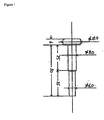
- Fig.1 is the cross-sectional view of the bolt which is used at the test of header processability of the metal wire rod for plastic processing prepared by the method of the present invention.
- the present invention will be illustrated in more detail with accordance to the following description.
- the term of cold plastic processing of the present invention mainly means the header processing.
- the preparation of a bolt can be mentioned.
- the wire rod is cut and process it as a bolt. Further, parts of car or machine are cut from wire rod and processed.
- the metal material of the present invention is used for these cold processing, and the desirably to be one selected from the group consisting of iron, steel, stainless steel, aluminum, aluminum alloy, magnesium, magnesium alloy, titanium, titanium alloy, copper and copper alloy.
- the treatment of the metal wire rod is not carried out by the state of a coil shaped strand, that is, bundled shape (above mentioned batch system), but carried out by inline system which treat the metal wire rod continuously by individual state.
- the desirable diameter of the metal wire rod is in the limit from 0.3 to 50 mm. When the diameter is under 0.3 mm, the wire is too thin to form homogeneous coating by the present invention and causes a problem in the plastic processing. And when the diameter is thicker than 50 mm, there is no technical problem, but the unwinding or winding of the wire are very hard work, and is meaningless from the view point of the industrial use.
- the cleaning treatment of the metal wire rod is necessary to be carried out by at least one kind of cleaning treatment method selected from the group consisting of shot blast, sand blast, bending and acid cleaning of cathode and anode.
- the term of cleaning treatment of the present invention means to remove the oxidation scale grown by annealing or various kind of stain (such as oil). By this cleaning treatment, the followed lubricious film formation can be carried out smoothly.
- the reduction of the load to the wasted water treating equipment is desired from the view point of the environmental problem, and from this view point, the method so called mechanical de-scaling, by which no wasted water is discharged, that is, inline shot blast or bending are useful.
- the acid cleaning of cathode and anode using electrolysis is used for the purpose to shorten the treating time.
- the acid cleaning of anode uses acid such as sulfuric acid, uses wire rod as an anode and use counter electrode (platinum plate) as a cathode, and electrolyzes for several seconds by applied voltage 2-50V and current density 2-100 A/dm 2 , so as to dissolve metal material partially and remove scale.
- the acid cleaning of cathode uses acid such as sulfuric acid, uses wire rod as a cathode and use counter electrode (platinum plate) as an anode, and electrolyzes for several seconds by applied voltage 2-50V and current density 2-100 A/dm 2 , and remove scale by utilizing the effect of hydrogen gas which generates at the metal surface.
- acid such as sulfuric acid
- counter electrode platinum plate
- the metal wire rod is contacted with aqueous lubricious film forming treatment solution.
- aqueous lubricious film forming treatment solution Before the contact with this aqueous lubricious film forming treatment solution, it is desirable to preheat the metal wire rod.
- the time for drying can be shortened, because the drying of the aqueous lubricious film forming treatment solution can be accelerated by preheating.
- the effect of shortening of drying time becomes more remarkable, because the space for this treating equipment can be reduced when the treating speed becomes higher,
- this preheating high-frequency heating, hot air heating, hot water bath heating, steam heating, direct heating or superheated steam heating can be applied.
- This preheating is carried out so as the temperature of metal wire rod to be from 70°C to 150°C.
- the temperature of the metal wire rod is under 70°C, it is difficult to accelerate the drying after contacted with the lubricious film forming treatment solution, further, when the temperature of metal wire rod exceeds 150°C, since vapor generates by contacting the lubricious film forming treatment solution with the metal wire rod, normal lubricious film can not be formed.
- the effect of shortening of drying time by said preheating becomes more remarkable, because the space for this treating equipment can be reduced when the treating speed becomes higher.
- the aqueous lubricious film forming treating solution used in the present invention contains inorganic salt and a slipping gent as main components.
- the lubricious film which is the object of the present invention, is required to be good at follow-up ability during the plastic processing, to have hardness and strength against burning and sticking with a mold, to have good slipping ability and to reduce frictional coefficient. And for realization of these subjects, it is very important to use inorganic salt and a slipping agent in combination.
- the inorganic salt at least one selected from the group consisting of phosphate, sulfate, borate, molybdate and tungstate can be desirably used.
- zinc phosphate, calcium phosphate, sodium sulfate, potassium sulfate, potassium silicate, sodium borate (sodium tetra borate), potassium borate (potassium tetra borate), ammonium borate (ammonium tetra borate) ammonium molybdate, sodium molybdate and sodium tungstate can be mentioned.
- sodium borate sodium tetra borate
- potassium borate potassium borate (potassium tetra borate)
- ammonium borate ammonium tetra borate ammonium molybdate, sodium molybdate and sodium tungstate
- metal soap As the slipping agent, metal soap, wax, fluororesin such as polytetrafluoroethylene, molybdenum disulfate and graphite are desirably used. These compounds can be used together with.
- metal soap compound obtained by reacting saturated fatty acid of carbon number from 12 to 26 with at least one metal selected from the group consisting of zinc, calcium, barium, aluminum, magnesium and lithium, for example, calcium stearate, zinc stearate, barium stearate, magnesium stearate and lithium stearate, can be mentioned.
- wax micro crystalline wax, polyethylene wax, polypropylene wax and camauba wax can be mentioned. While, regarding PTFE, molybdenum disulfide and graphite, there is no limitation in average particle size or molecule weight.
- the mixing ratio of slipping agent and inorganic salt in the lubricious film forming treatment solution it is necessary to limit the ratio of slipping agent/inorganic salt within from 0.1 to 4.0 by solid weight ratio.
- this solid weight ratio is less than 0.1, the slipping property is inferior and sufficient lubricity can not be obtained. And when the solid weight ratio excesses 4.0, since indent scratches are easily generated, it is not desirable. Desirable solid weight ratio is from 0.2 to 1.5.
- the slipping agent and the inorganic salt are used as the aqueous treating solution which are dissolved or dispersed in water.
- the public known surfactant or stabilizer can be used.
- the surfactant nonionic surfactant, anionic surfactant or cationic surfactant can be used.
- nonionic surfactant for example, polyoxyethylenealkylester prepared by polyoxyethylenealkylether, polyoxyalkylene(ethylene and/or propylene)alkylphenylether or polyethyleneglycol (or ethylene oxide) and high fatty acid (e.g. carbon number 12-18) or polyoxyethylenesorbitane alkyl ester prepared by sorbitane, polyethyleneglycol and high fatty acid (e.g. carbon number 12-18) can be mentioned, however, not intending to be limited to them.
- anionic surfactant for example, fatty acid salt, sulfate salt, sulfonate salt, phosphate salt or dithio phosphate salt can be mentioned, however, not intending to be limited to them.
- amphoteric surfactant for example, amino acid type and betaine type carboxylate salt, sulfate salt, sulfonate salt or phosphate salt can be mentioned, however, not intending to be limited to them.
- cationic surfactant for example, fatty acid amine salt or tertiary ammonium salt can be mentioned, however, not intending to be limited to them.
- viscosity improving agent aiming to support the formation of film, if necessary, For example, in the case when it is necessary to improve smoothness and to control the unevenness of film, addition of a viscosity improving agent is effective. Further, it is possible to add polymer compound as the binder component, for the purpose to improve the adhesion of the film.
- the blending amount or a kind of these components are not specifically limited.
- inorganic substance such as smectite clay mineral (montmolillonite, sauconite, beidelite or hectorite) and organic substance such as urethanes (polymer of polyol and polyisocyanate), poly carboxylic acid salts (polymer of acrylic acid, methacrylic acid, maleic acid or itaconic acid), polyolefins (polyvinyl alcohol), polyethers (polyethylene glycol, or polypropylene gricol) and polysaccharide (methyl cellulose, methyl starch or methyl guagum) can be mentioned.
- urethanes polymer of polyol and polyisocyanate
- poly carboxylic acid salts polymer of acrylic acid, methacrylic acid, maleic acid or itaconic acid
- polyolefins polyvinyl alcohol
- polyethers polyethylene glycol, or polypropylene gricol
- polysaccharide methyl cellulose, methyl starch or methyl gua
- the contact time with this aqueous lubricious film forming treatment solution it is necessary to limit the contact time with this aqueous lubricious film forming treatment solution within 5 seconds.
- the contact time is over than 5 seconds, the treating zone becomes too long and the space reduction, which is one of the objects of the present invention can not be accomplished.
- the adhering amount of the lubricious film of the present invention is necessary to be limited within the limit of 0.5 to 20 g/m 2 .
- the adhering amount is smaller than 0.5 g/m 2 , the sufficient lubricity can not be displayed. Further, when the adhering amount exceeds 20 g/m 2 , the film becomes too thicker and causes indent scratches or surplus refuse, and is not desirable.
- the adhering amount of the lubricious film is adjusted to the desired adhering amount by regulating the coating amount and the concentration of the lubricant.
- the adhering amount can be easily calculated as follows. That is, cut the treated wire rod to the specific length and weight, then peel of the film. Calculate the adhering amount from the weight difference and the surface area (calculated from the cut length).
- the wire rod to which lubricious film forming treating solution is adhered is dried, thus the lubricious film is formed on the surface of the wire rod.
- the method for drying is not specifically restricted, however, the drying by hot air is simple and desirable.
- the treated worn rod can be wound up, or can be continuously processed by drawing process, skinpath process or header process.
- the linear velocity of the metal wire rod at the continuous treatment is desirable to be in the limit from 10 to 150 m/min. When the linear velocity is less than 10 m/minute, since the sufficient productivity can not be obtained, not meets to the industrial use. In the meanwhile, when the linear velocity exceeds 150 m/min, since the uniformity after coating treatment of the lubricious film becomes deteriorated, it is not desirable.
- Skinpath process is carried out on wire rod for a bolt processing (to ⁇ 8.3), then 200 pieces of bolt shown in Table 1 are produced continuously by a conventional header machine using former oil. Whether there is an imperfection on the top portion of the bolt or not is inspected by eyes of the inspector, and the numbers of pieces which have an imperfection and the degree of the imperfection is checked.
- Evaluation is performed by considering the numbers of process and the space of the equipment. Smaller numbers of process and narrower space are desirable.
- the Examples 1 to 12 which depend on the method for preparation of the metal wire rod for plastic processing of the present invention display excellent lubricity, the occupancy space for equipment is small and superior in environmental protection.
- the occupancy space of the treating equipment can be reduced.
- the treating speed is 2.5 times to that of Examples 4 and 5
- the occupancy space of the treating equipment is only 1.5 times to that of Examples 4 and 5. This is basically the effect of shortening of treating time caused by the previous heating process.
- Comparative Examples 1 and 2 whose lubricant/inorganic salt ratio is out of the limit of the present invention, are inferior in lubricity and cause partial burning and sticking with the mold at the drawing process, further it is difficult to carry out the header process. And, in the case of Comparative Example 3, which omit the cleaning treatment, the lubricity is not sufficient so as to carry out the processing is impossible. Still further, in the case of Comparative Example, whose adhering amount is out of the limit of the present invention, the lubricity is not sufficient and is impossible to carry out the processing. Regarding the cases of Comparative Examples 4 to 7, which are the conventional art, although the lubricity is good, there are problems from the view point of the occupancy space and the environmental protection.
Landscapes
- Chemical & Material Sciences (AREA)
- Engineering & Computer Science (AREA)
- Mechanical Engineering (AREA)
- General Chemical & Material Sciences (AREA)
- Chemical Kinetics & Catalysis (AREA)
- Organic Chemistry (AREA)
- Materials Engineering (AREA)
- Metallurgy (AREA)
- Oil, Petroleum & Natural Gas (AREA)
- Lubricants (AREA)
- Metal Extraction Processes (AREA)
- Chemical Treatment Of Metals (AREA)
Abstract
Description
S45C spherical annealed steel: 3 mm diameter, 20 m length
SUS430: 3 mm diameter, 20 m length
β alloy Ti-15V-3Cr-3Sn-3Al: 3 mm diameter, 20 m length
SCM435: 9 mm diameter, 300 m length
- 1 ○ Acid cleaning of anode: 20% sulfuric acid, temperature 80°C, time 1 second, current density 30A/dm2.
- 2 ○ Acid cleaning of cathode: 20% sulfuric acid, temperature 60°C, time 4 seconds, current density 40A/dm2.
- 3 ○ Washing by water: By city water, 60°C, dipping time 5 minutes.
- 4 ○ Surface treatment: Treating solution 6 (Comparative Example 1) or 7 (Comparative Example 2) were used. 60°C, dipping time 2 seconds.
- 5 ○ Drying: Hot air of 140°C was blown, 15 seconds.

Further, in the cases of Examples 11 and 12, although the treating speed is 2.5 times to that of Examples 4 and 5, the occupancy space of the treating equipment is only 1.5 times to that of Examples 4 and 5. This is basically the effect of shortening of treating time caused by the previous heating process.
Claims (4)
- A method for preparation of the metal wire rod for plastic processing comprising, carrying out cleaning treatment by at least one kind of cleaning treatment method selected from the group consisting of shot blast, sand blast, bending and acid cleaning of cathode and anode on the surface of metal wire rod of 0.3-50 mm diameter for 20 seconds or less, contacting with aqueous lubricious film formation treating solution which contains at least one kind of inorganic salt selected from the group consisting of phosphate, sulfate, borate, silicate, molybdate or tungstate and at least one kind of slipping agent selected from the group consisting of metal soap, wax, polytetrafluoroethylene, molybdenum disulfate and graphite, wherein the weight ratio of solid of said slipping agent/inorganic salt is within the limit from 0.1 to 4.0, for 5 seconds or less, drying immediately and forming lubricious film of adhesion amount from 0.5 to 20 g/m2 on the surface of the wire rod by continuous inline system.
- A method for preparation of the metal wire rod for plastic processing comprising, carrying out cleaning treatment by at least one kind of cleaning treatment method selected from the group consisting of shot blast, sand blast, bending and acid cleaning of cathode and anode on the surface of metal wire rod of 0.3-50 mm diameter for 20 seconds or less, carrying out previous heat treatment, then contacting with aqueous lubricious film formation treating solution which contains at least one kind of inorganic salt selected from the group consisting of phosphate, sulfate. borate, silicate, molybdate or tungstate and at least one kind of slipping agent selected from the group consisting of metal soap, wax, polytetrafluoroethylene, molybdenum disulfate and graphite, wherein the weight ratio of solid of said slipping agent/inorganic salt is within the limit from 0.1 to 4.0, for 6 seconds or less, drying immediately and forming lubricious film of adhesion amount from 0.5 to 20 g/m2 on the surface of the wire rod by continuous inline system.
- The method for preparation of the metal wire rod for plastic processing of claim 1 or claim 2, wherein the metal wire rod is selected from the group consisting of iron, steel stainless steel, aluminum, aluminum alloy, magnesium, magnesium alloy, titanium, titanium alloy, copper or copper alloy.
- The method for preparation of the metal wire rod for plastic processing according to anyone of claims 1 to 3, wherein the linear velocity of metal wire rod at the continuous treatment is from 10 to 150 m/minute.
Applications Claiming Priority (3)
| Application Number | Priority Date | Filing Date | Title |
|---|---|---|---|
| JP2001322574 | 2001-10-19 | ||
| JP2001322574 | 2001-10-19 | ||
| PCT/JP2002/010750 WO2003035929A1 (en) | 2001-10-19 | 2002-10-16 | Process for producing metal wire rod for plastic working |
Publications (2)
| Publication Number | Publication Date |
|---|---|
| EP1449936A1 true EP1449936A1 (en) | 2004-08-25 |
| EP1449936A4 EP1449936A4 (en) | 2010-06-16 |
Family
ID=19139601
Family Applications (1)
| Application Number | Title | Priority Date | Filing Date |
|---|---|---|---|
| EP02779915A Withdrawn EP1449936A4 (en) | 2001-10-19 | 2002-10-16 | PROCESS FOR PRODUCING METAL WIRE ROD FOR WORKING PLASTICS |
Country Status (7)
| Country | Link |
|---|---|
| US (1) | US20050019496A1 (en) |
| EP (1) | EP1449936A4 (en) |
| JP (1) | JP4271573B2 (en) |
| CN (1) | CN1302153C (en) |
| CA (1) | CA2463786A1 (en) |
| TW (1) | TW571000B (en) |
| WO (1) | WO2003035929A1 (en) |
Families Citing this family (26)
| Publication number | Priority date | Publication date | Assignee | Title |
|---|---|---|---|---|
| CN101208160B (en) * | 2005-03-31 | 2010-05-19 | 住友金属工业株式会社 | Manufacturing method of seamless pipe |
| JP4836170B2 (en) * | 2005-08-11 | 2011-12-14 | 住友金属工業株式会社 | Surface-treated steel strip |
| KR100792278B1 (en) * | 2007-02-27 | 2008-01-07 | 고려상사주식회사 | Phosphate Film Cold Rolling Stainless Steel Wire and Direct Screw Using It |
| JP5245400B2 (en) * | 2007-12-27 | 2013-07-24 | 新日鐵住金株式会社 | Treatment liquid for insulating film formation of electrical steel sheets |
| WO2010036892A2 (en) * | 2008-09-26 | 2010-04-01 | Greengold Lubricants, Llc | Lubricant composition and methods of manufacture thereof |
| JP5181393B2 (en) * | 2008-11-20 | 2013-04-10 | 日本パーカライジング株式会社 | Steel wire rod for fastening parts |
| EP2450423B1 (en) | 2009-06-29 | 2019-05-15 | Nihon Parkerizing Co., Ltd. | Water-based lubricant for plastic processing having excellent corrosion resistance and metal material having excellent plastic processability |
| JP5541575B2 (en) * | 2010-03-18 | 2014-07-09 | 新日鐵住金ステンレス株式会社 | Stainless steel wire rod for warm forging and its plastic working method |
| JP5450892B2 (en) * | 2011-03-28 | 2014-03-26 | 日本パーカライジング株式会社 | Lubricating coating agent for plastic working and method for producing the same |
| JP2013209625A (en) * | 2012-02-27 | 2013-10-10 | Kobe Steel Ltd | Water-soluble lubricating agent for plastic working, metal material for plastic working, and worked metal article |
| JP6245833B2 (en) * | 2013-04-11 | 2017-12-13 | 株式会社不二機販 | Wire saw manufacturing method |
| ITMI20131926A1 (en) | 2013-11-20 | 2015-05-21 | Danieli Off Mecc | TUBE DRAWING MACHINE |
| CN103736763A (en) * | 2014-02-12 | 2014-04-23 | 芜湖鑫力管道技术有限公司 | Stainless steel composite tube cold-drawing liquid and temperature control system thereof |
| CN104454881A (en) * | 2014-09-26 | 2015-03-25 | 无锡市天力五金弹簧厂 | Raw materials and process for manufacturing hexagon bolts |
| CN104476139A (en) * | 2014-12-17 | 2015-04-01 | 常熟市华星精密铸件有限公司 | Processing process of anti-theft screw for ATM (Automatic Teller Machine) |
| CN105256303A (en) * | 2015-12-02 | 2016-01-20 | 常熟市惠一机电有限公司 | Metal stamping part surface treatment process |
| WO2019003640A1 (en) * | 2017-06-30 | 2019-01-03 | 兼房株式会社 | Cutlery |
| CN107695117A (en) * | 2017-11-09 | 2018-02-16 | 中铁隆昌铁路器材有限公司 | A kind of saponification process technique for bolt class product |
| CN108993845A (en) * | 2018-09-04 | 2018-12-14 | 北京北机机电工业有限责任公司 | A kind of graphite jelly spraying process method |
| CN109338352A (en) * | 2018-12-10 | 2019-02-15 | 南通盛立德金属材料科技有限公司 | A kind of process of surface treatment of stainless steel tube |
| DE102019204225A1 (en) * | 2019-03-27 | 2020-10-01 | Robert Bosch Gmbh | Pretreatment process for pretreating components prior to electroplating |
| CN111849600B (en) * | 2020-08-05 | 2022-06-07 | 陕西高精尖新材料科技有限责任公司 | Titanium alloy wire high-temperature drawing dry-type lubricant and preparation method thereof |
| CN112453098A (en) * | 2020-11-05 | 2021-03-09 | 王太平 | Stainless steel wire deep punching technological process |
| CN113210448B (en) * | 2021-05-17 | 2022-06-03 | 西北有色金属研究院 | Cold drawing preparation method of TB9 titanium alloy disc wire with lubricating coating |
| JP7428746B2 (en) * | 2022-04-19 | 2024-02-06 | 日本パーカライジング株式会社 | Lubrication treatment method for metal wire |
| CN115786901B (en) * | 2022-09-09 | 2024-08-09 | 常熟市常沪螺母制造有限公司 | Processing technology of metal cold heading wire coating |
Family Cites Families (11)
| Publication number | Priority date | Publication date | Assignee | Title |
|---|---|---|---|---|
| JPS5194436A (en) * | 1975-02-19 | 1976-08-19 | Kozaino reikankakoyoboseijunkatsushorizai | |
| JPS5220967A (en) * | 1975-08-12 | 1977-02-17 | Nippon Shii Bii Kemikaru Kk | Composite lubrication coating for steel or alloy steel |
| GB1576195A (en) * | 1977-03-22 | 1980-10-01 | Sumitomo Metal Ind | Apparatus for continuous electrolytic descaling of steel wire with mill scales |
| US4350034A (en) * | 1979-06-21 | 1982-09-21 | Wayne Chemical Products Company | Metal drawing compound composition and method of use |
| JPS5848029B2 (en) * | 1979-09-25 | 1983-10-26 | 住友電気工業株式会社 | Line surface treatment method |
| DE3571562D1 (en) * | 1984-05-21 | 1989-08-24 | Sumitomo Metal Ind | Method for continuous drawing of wire rod |
| JPS61269929A (en) * | 1985-05-24 | 1986-11-29 | Nippon Parkerizing Co Ltd | Lubricating treatment of metallic material |
| DE4122224A1 (en) * | 1991-07-04 | 1993-01-07 | Patent Treuhand Ges Fuer Elektrische Gluehlampen Mbh | METHOD FOR PRETREATING TREADED WIRE |
| JP3517522B2 (en) * | 1996-06-21 | 2004-04-12 | 日本パーカライジング株式会社 | Water-based lubricant for cold plastic working of metallic materials |
| JP3881129B2 (en) * | 1998-06-09 | 2007-02-14 | 日本パーカライジング株式会社 | Lubricant composition for plastic working of metal materials |
| IN192718B (en) * | 1998-06-09 | 2004-05-15 | Nihon Parkerizing |
-
2002
- 2002-09-17 TW TW091121278A patent/TW571000B/en active
- 2002-10-16 CN CNB028206991A patent/CN1302153C/en not_active Expired - Fee Related
- 2002-10-16 JP JP2003538425A patent/JP4271573B2/en not_active Expired - Fee Related
- 2002-10-16 CA CA002463786A patent/CA2463786A1/en not_active Abandoned
- 2002-10-16 EP EP02779915A patent/EP1449936A4/en not_active Withdrawn
- 2002-10-16 WO PCT/JP2002/010750 patent/WO2003035929A1/en not_active Ceased
-
2004
- 2004-04-19 US US10/827,174 patent/US20050019496A1/en not_active Abandoned
Also Published As
| Publication number | Publication date |
|---|---|
| WO2003035929A1 (en) | 2003-05-01 |
| US20050019496A1 (en) | 2005-01-27 |
| JP4271573B2 (en) | 2009-06-03 |
| CN1571864A (en) | 2005-01-26 |
| EP1449936A4 (en) | 2010-06-16 |
| TW571000B (en) | 2004-01-11 |
| JPWO2003035929A1 (en) | 2005-02-10 |
| CA2463786A1 (en) | 2003-05-01 |
| CN1302153C (en) | 2007-02-28 |
Similar Documents
| Publication | Publication Date | Title |
|---|---|---|
| EP1449936A1 (en) | Process for producing metal wire rod for plastic working | |
| EP0917559B1 (en) | Waterborne lubricant for the cold plastic working of metals | |
| KR100621693B1 (en) | Water-based lubricant for plastic working of metal materials and processing method of lubricating film | |
| CA2713541C (en) | A process for the coating of metallic surfaces with a phosphate layer and then with a polymeric lubricant layer | |
| TWI457431B (en) | Process for coating a metallic surface with a lubricant composition | |
| KR101633016B1 (en) | Method for coating metal surfaces with a wax-containing lubricant composition | |
| JP3984159B2 (en) | Water-based lubricant for metal material plastic working and method for forming lubricating film | |
| JPWO2002012419A1 (en) | Water-based lubricant for plastic working of metal materials and method for treating lubricating film | |
| JP2000309793A (en) | Water-based lubricant for plastic working of metal materials | |
| JPWO2002012420A1 (en) | Water-based lubricant for plastic working of metal materials and method for forming lubricating film | |
| JPWO2002020704A1 (en) | Water-based one-step type lubricant for high efficiency cold forging | |
| JPS638489A (en) | Lubricant for metal cold working | |
| WO2007132851A1 (en) | Lubricant for steel pipe cold working and relevant method of cold working | |
| JP3778026B2 (en) | Lubricant for cold wire drawing, cold wire drawing material and method for producing the same | |
| JP4939172B2 (en) | Water-soluble lubricant for plastic processing, metal materials for plastic processing and metal processed products | |
| JP6694769B2 (en) | Steel wire rod with excellent corrosion resistance and appearance after processing | |
| JP2009185311A (en) | Metal material for plastic working | |
| JP2002361302A (en) | Method for rolling metal material plate | |
| JP3948572B2 (en) | Lubricated aluminum sheet for forming | |
| JP5458396B2 (en) | Water-based lubricating coating agent for plastic working and metallic materials with excellent plastic workability | |
| JPH043800B2 (en) |
Legal Events
| Date | Code | Title | Description |
|---|---|---|---|
| PUAI | Public reference made under article 153(3) epc to a published international application that has entered the european phase |
Free format text: ORIGINAL CODE: 0009012 |
|
| 17P | Request for examination filed |
Effective date: 20040505 |
|
| AK | Designated contracting states |
Kind code of ref document: A1 Designated state(s): AT BE BG CH CY CZ DE DK EE ES FI FR GB GR IE IT LI LU MC NL PT SE SK TR |
|
| AX | Request for extension of the european patent |
Extension state: AL LT LV MK RO SI |
|
| RAP1 | Party data changed (applicant data changed or rights of an application transferred) |
Owner name: HENKEL KOMMANDITGESELLSCHAFT AUF AKTIEN |
|
| RAP1 | Party data changed (applicant data changed or rights of an application transferred) |
Owner name: HENKEL AG & CO. KGAA |
|
| A4 | Supplementary search report drawn up and despatched |
Effective date: 20100519 |
|
| STAA | Information on the status of an ep patent application or granted ep patent |
Free format text: STATUS: THE APPLICATION IS DEEMED TO BE WITHDRAWN |
|
| 18D | Application deemed to be withdrawn |
Effective date: 20100818 |