EP1449896A1 - Resin composition for primer - Google Patents
Resin composition for primer Download PDFInfo
- Publication number
- EP1449896A1 EP1449896A1 EP02781848A EP02781848A EP1449896A1 EP 1449896 A1 EP1449896 A1 EP 1449896A1 EP 02781848 A EP02781848 A EP 02781848A EP 02781848 A EP02781848 A EP 02781848A EP 1449896 A1 EP1449896 A1 EP 1449896A1
- Authority
- EP
- European Patent Office
- Prior art keywords
- weight
- hydroxyl
- resin composition
- primer
- resin
- Prior art date
- Legal status (The legal status is an assumption and is not a legal conclusion. Google has not performed a legal analysis and makes no representation as to the accuracy of the status listed.)
- Granted
Links
Classifications
-
- C—CHEMISTRY; METALLURGY
- C09—DYES; PAINTS; POLISHES; NATURAL RESINS; ADHESIVES; COMPOSITIONS NOT OTHERWISE PROVIDED FOR; APPLICATIONS OF MATERIALS NOT OTHERWISE PROVIDED FOR
- C09D—COATING COMPOSITIONS, e.g. PAINTS, VARNISHES OR LACQUERS; FILLING PASTES; CHEMICAL PAINT OR INK REMOVERS; INKS; CORRECTING FLUIDS; WOODSTAINS; PASTES OR SOLIDS FOR COLOURING OR PRINTING; USE OF MATERIALS THEREFOR
- C09D151/00—Coating compositions based on graft polymers in which the grafted component is obtained by reactions only involving carbon-to-carbon unsaturated bonds; Coating compositions based on derivatives of such polymers
- C09D151/06—Coating compositions based on graft polymers in which the grafted component is obtained by reactions only involving carbon-to-carbon unsaturated bonds; Coating compositions based on derivatives of such polymers grafted on to homopolymers or copolymers of aliphatic hydrocarbons containing only one carbon-to-carbon double bond
-
- C—CHEMISTRY; METALLURGY
- C09—DYES; PAINTS; POLISHES; NATURAL RESINS; ADHESIVES; COMPOSITIONS NOT OTHERWISE PROVIDED FOR; APPLICATIONS OF MATERIALS NOT OTHERWISE PROVIDED FOR
- C09D—COATING COMPOSITIONS, e.g. PAINTS, VARNISHES OR LACQUERS; FILLING PASTES; CHEMICAL PAINT OR INK REMOVERS; INKS; CORRECTING FLUIDS; WOODSTAINS; PASTES OR SOLIDS FOR COLOURING OR PRINTING; USE OF MATERIALS THEREFOR
- C09D123/00—Coating compositions based on homopolymers or copolymers of unsaturated aliphatic hydrocarbons having only one carbon-to-carbon double bond; Coating compositions based on derivatives of such polymers
- C09D123/26—Coating compositions based on homopolymers or copolymers of unsaturated aliphatic hydrocarbons having only one carbon-to-carbon double bond; Coating compositions based on derivatives of such polymers modified by chemical after-treatment
- C09D123/28—Coating compositions based on homopolymers or copolymers of unsaturated aliphatic hydrocarbons having only one carbon-to-carbon double bond; Coating compositions based on derivatives of such polymers modified by chemical after-treatment by reaction with halogens or compounds containing halogen
-
- C—CHEMISTRY; METALLURGY
- C08—ORGANIC MACROMOLECULAR COMPOUNDS; THEIR PREPARATION OR CHEMICAL WORKING-UP; COMPOSITIONS BASED THEREON
- C08L—COMPOSITIONS OF MACROMOLECULAR COMPOUNDS
- C08L51/00—Compositions of graft polymers in which the grafted component is obtained by reactions only involving carbon-to-carbon unsaturated bonds; Compositions of derivatives of such polymers
- C08L51/06—Compositions of graft polymers in which the grafted component is obtained by reactions only involving carbon-to-carbon unsaturated bonds; Compositions of derivatives of such polymers grafted on to homopolymers or copolymers of aliphatic hydrocarbons containing only one carbon-to-carbon double bond
-
- C—CHEMISTRY; METALLURGY
- C08—ORGANIC MACROMOLECULAR COMPOUNDS; THEIR PREPARATION OR CHEMICAL WORKING-UP; COMPOSITIONS BASED THEREON
- C08L—COMPOSITIONS OF MACROMOLECULAR COMPOUNDS
- C08L57/00—Compositions of unspecified polymers obtained by reactions only involving carbon-to-carbon unsaturated bonds
- C08L57/02—Copolymers of mineral oil hydrocarbons
Definitions
- the present invention relates to a resin composition for a primer that has excellent adhesion to substrates of polypropylene and like polyolefin resins and to melamine and various like coatings and has excellent low-temperature storage stability.
- plastics are used these days in a wide variety of applications for automotive parts, electronic parts, building materials and the like.
- polyolefin resins are inexpensive and have excellent moldability, chemical resistance, water resistance, impact resistance, and electrical properties, they have been widely used as industrial materials and are one of the types of material for which demand is expected to further increase in the future.
- polyolefin resins have drawbacks due to their crystallinity and nonpolarity, i.e., it is difficult to coat or bond them.
- Primers containing weakly chlorinated polyolefins that are chlorinated to 10-40 wt.% as a binder have heretofore been used to coat or bond such low-adhesion polyolefin resins.
- primers When the cost of transportation or the amount of solvent used is considered, primers should preferably have a large solids content.
- an excessive solids content results in decreased flowability or increased viscosity at low temperatures, adversely affecting primers in practical applications, for example, impaired solubility in coatings and workability during spray coating.
- the storage stability at low temperatures is also adversely affected.
- To control viscosity if the molecular weight of the resins is lowered by degradation or like methods, or low-molecular-weight rosin ester resins are added, the initial adhesion and gasohol resistance are significantly impaired.
- An object of the present invention is to provide a resin composition for a primer that has excellent adhesion to polyolefin resin substrates and melamine coatings and has enhanced low-temperature storage stability and gasohol resistance.
- the inventors conducted extensive research and found that the combination of a specific chlorinated polyolefin and a specific hydroxyl-containing petroleum resin can attain the objects described above. The inventors thereby accomplished the present invention.
- the present invention provides the resin compositions for primers described below:
- Chlorinated polyolefins usable herein may be produced by chlorinating polyolefins. Examples thereof include those that are further acid-modified and contain carboxyl group(s). Such chlorinated polyolefins can be readily produced according to known methods. For example, acid-modified chlorinated polyolefins can be obtained by graft-copolymerizing starting polyolefins with at least one member selected from the group consisting of ⁇ , ⁇ -unsaturated carboxylic acids and their acid anhydrides, and then injecting chlorine gas in the presence of a solvent.
- They can also be obtained by chlorinating starting polyolefins and then graft-copolymerizing the chlorinated polyolefins with at least one member selected from the group consisting of ⁇ , ⁇ -unsaturated carboxylic acids and their acid anhydrides.
- starting polyolefins examples include propylene-based polyolefins including crystalline polypropylenes, noncrystalline polypropylenes and propylene-ethylene copolymers. Such polymers can be used alone or in combination. Among these, preferable are crystalline polypropylenes such as isotactic polypropylene and syndiotactic polypropylene, with isotactic polypropylene being particularly preferable.
- Examples of ⁇ , ⁇ -unsaturated carboxylic acids and their acid anhydrides to be graft-copolymerized with starting polyolefins or chlorinated polyolefins are maleic acid, maleic anhydride, itaconic acid, itaconic anhydride, fumaric acid, etc.
- acid anhydrides with maleic anhydride being particularly preferable.
- the amount to be graft-copolymerized is preferably 1-10 wt.% and more preferably 1-6 wt.%.
- starting polyolefins or chlorinated polyolefins are dissolved in an aromatic organic solvent such as toluene, xylene or the like, or thermally fused without a solvent; and reacted with at least one member selected from the group consisting of ⁇ , ⁇ -unsaturated carboxylic acids and their acid anhydrides in the presence of a radical generator.
- aromatic organic solvent such as toluene, xylene or the like
- radical generators usable in the graft copolymerization include peroxides such as di-tert-butyl peroxide, tert-butyl hydroperoxide, dicumyl peroxide, benzoyl peroxide, methyl ethyl ketone peroxide, etc.
- starting polyolefins or acid-modified polyolefins are dispersed or dissolved in a chlorinated solvent such as chloroform, carbon tetrachloride, tetrachloroethylene or the like, and reacted in the presence of a catalyst by injecting chlorine gas under ambient or increased pressure at 80-120°C.
- a chlorinated solvent such as chloroform, carbon tetrachloride, tetrachloroethylene or the like
- the chlorine content of the chlorinated polyolefins is 5-50 wt.%, preferably 10-40 wt.%.
- the weight-average molecular weight of the chlorinated polyolefins is 30000-120000, preferably 40000-80000.
- Hydroxyl-containing petroleum resins usable herein refer to petroleum resins containing hydroxyl group(s) in their molecular structure due to some chemical bonding. Methods for producing such hydroxyl-containing petroleum resins are not limited. In view of industrial convenience, such petroleum resins are usually those that can be obtained by reacting polymerizable monomers contained in petroleum fractions with hydroxyl-containing compounds.
- polymerizable monomers contained in petroleum fractions are isoprene, n-pentene, methylbutene, pentadiene, cyclopentene and like monomers of the C5 fraction; styrene, vinyltoluene, ⁇ -methylstyrene, indene, methyl indene and like monomers of the C9 fraction; cyclopentadiene, methylcyclopentadiene, ethylcyclopentadiene and like monomers of the cyclopentadiene portion including the dimers, trimers and codimers thereof; etc.
- Hydroxyl-containing compounds refer to phenolic compounds and hydroxyl-containing olefins. Examples thereof include phenols; cresol, xylenol, p-tert- butylphenol, p -octylphenol, nonylphenol, vinylphenol and like alkyl-substituted phenols; allyl alcohol, crotyl alcohol, 1,4-butenediol, hydroxyethyl acrylate, hydroxyethyl methacrylate; 3-methyl-2-propene-1-ol, 2-methyl-2-propene-1-ol and like alkyl-substituted allyl alcohols; etc.
- Methods for producing the hydroxyl-containing petroleum resins are not limited, and known methods can be employed. Examples include a method wherein a polymerizable monomer and a hydroxyl-containing compound are polymerized in the presence of a Friedel-Crafts catalyst; a method wherein a polymerizable monomer and a hydroxyl-containing compound are polymerized in the presence of a radical polymerization initiator; a method wherein a polymerizable monomer and a hydroxyl-containing compound are thermally polymerized in an autoclave; and like methods.
- hydroxyl-containing petroleum resins are alcohol-modified dicyclopentadiene resins, alcohol-modified C9-dicyclopentadiene resins, phenol-modified C9-dicyclopentadiene resins, phenol-modified dicyclopentadiene resins, phenol-modified C9 petroleum resins, etc.
- the olefin portion of the hydroxyl-containing petroleum resins may be stabilized as necessary by hydrogenation, hydration, oxidation, hydroboration, hydrohalogenation, halogenation, etc.
- hydrogenation is preferable since it is industrially convenient and can improve the color, odor and stability of the resin.
- Hydrogenation can be carried out according to conventional methods.
- the extent of hydrogenation of the aromatic portion or olefinic portion of the hydroxyl-containing hydrogenated petroleum resins is not limited, it is preferable to completely hydrogenate the olefinic portion to improve color and stability.
- the stability and color of the hydroxyl-containing petroleum resins may be improved by adding antioxidants, UV absorbers, reducing agents, etc.
- the softening point of the hydroxyl-containing petroleum resins usable herein is preferably 60-200°C. Although it depends on the application, the softening point is preferably 70°C or greater, particularly preferably 80-130°C, since excessively low softening points result in decreased heat resistance.
- the weight-average molecular weight of the hydroxyl-containing petroleum resins is preferably 200-3000, more preferably 200-2000.
- the hydroxyl value of the hydroxyl-containing petroleum resins is preferably 10-250 mgKOH/g, more preferably 20-220 mgKOH/g.
- the ratio of (b) the hydroxyl-containing petroleum resin to (a) the chlorinated polyolefin is 15-80 parts by weight, preferably 20-75 parts by weight, of hydroxyl-containing petroleum resin relative to 100 parts by weight of chlorinated polyolefin.
- the hydroxyl-containing petroleum resin is used in less than 15 parts by weight, the effect of using the hydroxyl-containing petroleum resin is barely obtained.
- it is used in more than 80 parts by weight the adhesion and gasohol resistance of the resulting resin composition for a primer tend to be impaired.
- the resin composition for a primer of the present invention is usually dissolved in (c) an organic solvent for use.
- organic solvents are toluene, xylene and like aromatic hydrocarbons; cyclohexane, methylcyclohexane, ethylcyclohexane and like alicyclic hydrocarbons; ethyl acetate, butyl acetate and like esters; and methyl ethyl ketone, methyl isobutyl ketone and like ketones. These solvents may be used alone or in combination.
- the amount of organic solvent to be used is preferably 100-10000 parts by weight, more preferably 100-1000 parts by weight, per 100 parts by weight of chlorinated polyolefin.
- the resin composition for a primer of the present invention can be obtained either by mixing an organic solvent solution of (a) the chlorinated polyolefin with an organic solvent solution of (b) the hydroxyl-containing petroleum resin, or by kneading (a) the chlorinated polyolefin and (b) the hydroxyl-containing petroleum resin by an extruder to pelletize and dissolving the pellets in an organic solvent.
- Stabilizers, thickeners, surfactants, etc. can be added as necessary to the resin composition for a primer of the present invention insofar as its properties are not impaired.
- the resin composition for a primer of the present invention exhibits excellent adhesion to polyolefin resin substrates and various coatings such as melamine coatings and has enhanced low-temperature storage stability and gasohol resistance.
- Isotactic polypropylene (weight-average molecular weight: 50000, 275 parts by weight), 19.3 parts by weight of maleic anhydride, 5.5 parts by weight of dicumyl peroxide, and 412.5 parts by weight of toluene were introduced into an autoclave equipped with an stirrer, and, after 5 minutes of nitrogen charging, reacted while stirring for 5 hours at 140°C. After this reaction, the reaction solution was introduced into an excess of methyl ethyl ketone to precipitate a resin. This resin was further washed with methyl ethyl ketone several times to remove unreacted maleic anhydride, thereby giving maleic anhydride-modified polypropylene.
- Chlorinated Polyolefin A maleic anhydride-modified chlorinated polypropylene
- Chlorinated Polyolefin A weight-average molecular weight: 40000, chlorine content: 21 wt.%, amount of graft-copolymerized maleic anhydride: 1.7 wt.% in toluene.
- a cracked distillate fraction with a boiling range of 140-280°C generated during the steam-cracking of naphtha was used as 100 parts by weight of starting oil.
- polymerization was carried out for 3 hours at 30°C in the presence of 3 parts by weight of phenol.
- Calcium hydroxide (3 parts by weight) was added to the polymerized oil thus obtained, and the mixture was stirred for 1 hour at 70°C to neutralize, and 3 parts by weight of activated clay was further added and the mixture was stirred for 30 more minutes.
- Dicyclopentadiene 100 parts by weight
- 100 parts by weight of phenol and 80 parts by weight of xylene were introduced into an autoclave and reacted for 4 hours at 260°C in a nitrogen atmosphere, thereby giving a polymerized oil.
- This polymerized oil was distilled at 200°C at 2.7 kPa for 15 minutes to remove unreacted monomers, oligomers and the solvent, thereby giving Hydroxyl-Containing Petroleum Resin B having a softening point of 111°C, a color of 10 Gardner, a hydroxyl value of 157 mgKOH/g, and a weight-average molecular weight of 580 (polystyrene equivalent obtained by GPC).
- Dicyclopentadiene 100 parts by weight
- 100 parts by weight of allyl alcohol and 80 parts by weight of xylene were introduced into an autoclave and reacted for 2 hours at 270°C in a nitrogen atmosphere, thereby giving a polymerized oil.
- This polymerized oil was distilled to remove unreacted monomers, oligomers and the solvent at 200°C at 2.7 kPa for 15 minutes, thereby giving Hydroxyl-Containing Petroleum Resin C having a softening point of 97.5°C, a color of 8 Gardner, a hydroxyl value of 210 mgKOH/g, and a weight-average molecular weight of 540. (polystyrene equivalent obtained by GPC).
- Hydroxyl-Containing Petroleum Resin C as obtained in Production Example 4 100 parts by weight
- 100 parts by weight of cyclohexane and 0.4 parts by weight of a stabilized nickel catalyst manufactured by Nikki Chemical Co., Ltd., trade name: "N-113"
- N-113 stabilized nickel catalyst
- the reaction mixture was distilled at 200°C at 2.7 kPa for 15 minutes, thereby giving Hydroxyl-Containing Petroleum Resin D having a softening point of 93°C, a color of 1 Gardner or less (200 Hazen), a hydroxyl value of 143 mgKOH/g, and a weight-average molecular weight of 530 (polystyrene equivalent obtained by GPC).
- Hydroxyl-Containing Petroleum Resin C as obtained in Production Example 4 100 parts by weight
- 100 parts by weight of cyclohexane and 2.0 parts by weight of a stabilized nickel catalyst manufactured by Nikki Chemical Co., Ltd., trade name: "N-113"
- N-113 a stabilized nickel catalyst
- the reaction mixture was distilled at 220°C at 0.27 kPa for 30 minutes, thereby giving Hydroxyl-Containing Petroleum Resin E having a softening point of 118°C, a color of 1 Gardner or less (300 Hazen), a hydroxyl value of 190 mgKOH/g, and a weight-average molecular weight of 600 (polystyrene equivalent obtained by GPC).
- Chlorinated Polyolefin A was used as the chlorinated polyolefin and Hydroxyl-Containing Petroleum Resin A was used as the hydroxyl-containing petroleum resin.
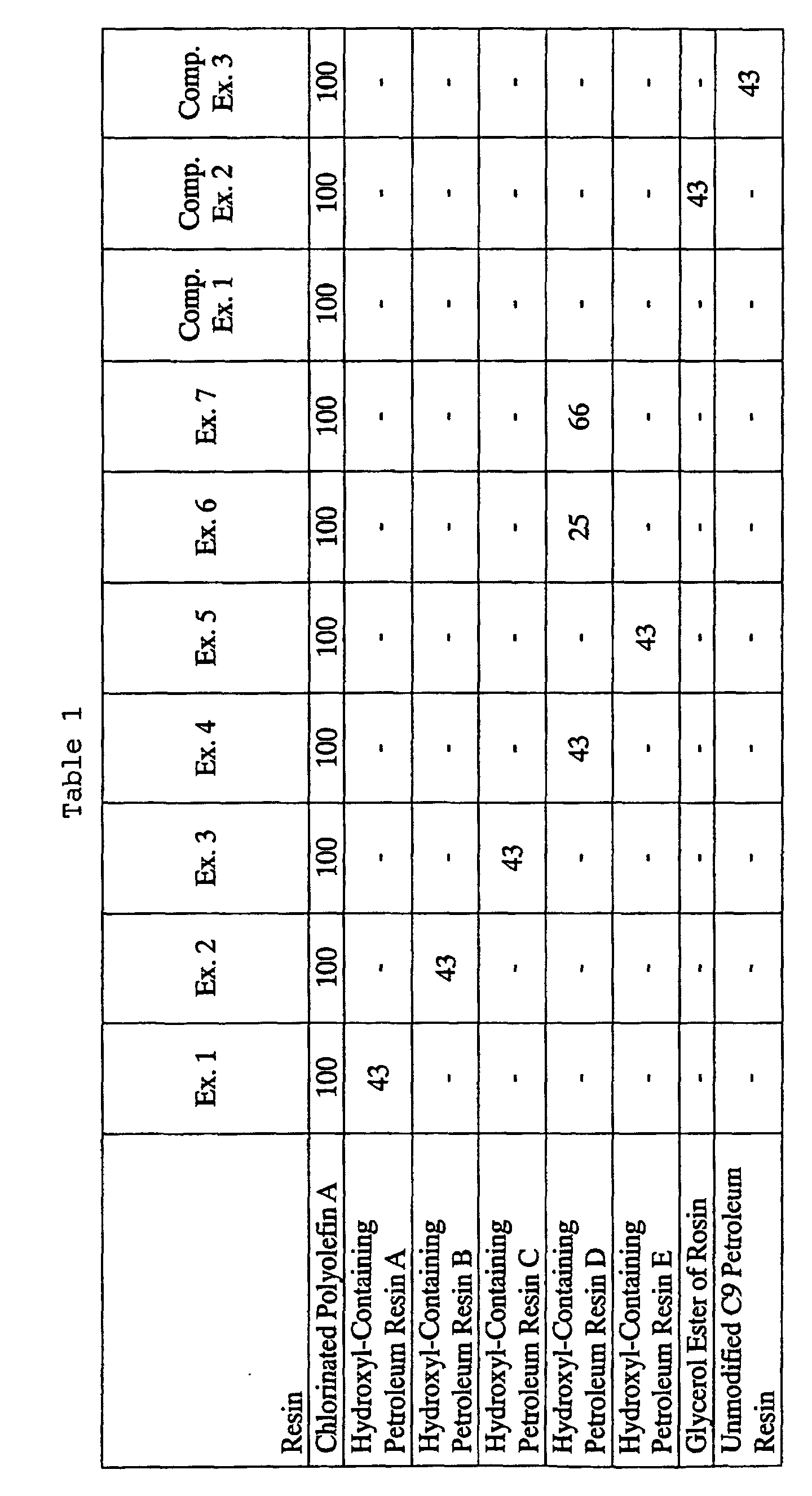
- Twenty-wt.% toluene solutions were prepared for the chlorinated polyolefin and the hydroxyl-containing petroleum resin respectively. Both toluene solutions were mixed using the formulation (parts by weight) shown in Table 1 and sufficiently stirred, thereby giving a resin composition for a primer.
- This resin composition for a primer was sprayed in an amount to attain a solid content of 6 g/m 2 onto a polypropylene substrate (manufactured by Mitsui Toatsu Chemicals, Inc.) degreased by isopropyl alcohol and left to stand for 10 minutes at room temperature to dry.
- a two-component urethane coating (manufactured by Kansai Paint Co., Ltd., "Retan PG80") was further spray-coated thereon in an amount of 60 g/m 2 , and the substrate was dried for 30 minutes at 80°C.
- a polypropylene substrate coated with the aforementioned resin composition for a primer was coated with a one-component melamine coating (manufactured by Kansai Paint Co., Ltd.) in the same manner as above, and the substrate was dried for 30 minutes at 120°C.
- the resin composition for a primer was left to stand at -5°C for up to 30 days. During that period, the number of days was counted until the resin composition started to gelate.
- the coated surfaces of the test pieces were provided with a grid pattern of a hundred 1-mm squares by a cutter that reached through to the underlying polypropylene substrate.
- An adhesive cellophane tape was securely placed on the coated surfaces, and the tape was quickly peeled horizontal to the surface. This procedure was repeated 10 times.
- the test pieces were graded according to how many times the tape peeling was conducted before a square created on the coated surfaces was removed, i.e., if square(s) were removed the first time the tape peeling was conducted, this test piece was given 0 points, and if square(s) were removed the second time the tape peeling was conducted, this test piece was given 1 point. If a test piece exhibited no removal after ten rounds of tape peeling, this test piece was given 10 points, with 10 being full marks.
- Coated test pieces were immersed in 40°C warm water for 240 hours. The condition of the coated surface was visually observed and evaluated.
- the evaluation scale consists of A: excellent, B: good, and C: poor.
- resin compositions for a primer were prepared in the same manner as in Example 1 except that Hydroxyl-Containing Petroleum Resin A was replaced with Hydroxyl-Containing Petroleum Resin B, C, D or E. These resin compositions were evaluated and the results are shown in Table 2.
- a resin composition for a primer was prepared in the same manner as in Example 4 except that the amount of the toluene solution of Hydroxyl-Containing Petroleum Resin D was altered to 25 parts by weight. This resin composition was evaluated and the results are shown in Table 2.
- a resin composition for a primer was prepared in the same manner as in Example 4 except that the amount of the toluene solution of Hydroxyl-Containing Petroleum Resin D was altered to 66 parts by weight. This resin composition was evaluated and the results are shown in Table 2.
- a resin composition for a primer was prepared in the same manner as in Example 1 except that Hydroxyl-Containing Petroleum Resin A was replaced with a glycerol ester of rosin (weight-average molecular weight: 920, softening point: 100°C). This resin composition was evaluated and the results are shown in Table 2.
- a resin composition for a primer was prepared in the same manner as in Example 1 except that Hydroxyl-Containing Petroleum Resin A was replaced with an unmodified C9 petroleum resin that contained no hydroxyl groups (weight-average molecular weight: 1100, softening point: 100°C). This resin composition was evaluated and the results are shown in Table 2.
- the resin compositions for a primer of Examples 1-7 exhibit increased low-temperature storage stability and, with respect to the melamine coating, enhanced gasohol resistance. Furthermore, compared with the resin compositions for a primer of Comparative Examples 2 and 3, the resin compositions for a primer of Examples 1-7 exhibit increased adhesion and gasohol resistance.
Landscapes
- Chemical & Material Sciences (AREA)
- Chemical Kinetics & Catalysis (AREA)
- Life Sciences & Earth Sciences (AREA)
- Engineering & Computer Science (AREA)
- Materials Engineering (AREA)
- Wood Science & Technology (AREA)
- Organic Chemistry (AREA)
- General Chemical & Material Sciences (AREA)
- Paints Or Removers (AREA)
Abstract
Description

Claims (7)
- A resin composition for a primer comprising (a) 100 parts by weight of a chlorinated polyolefin having a chlorine content of 5-50 wt.% and a weight-average molecular weight of 30000-120000, and (b) 15-80 parts by weight of a hydroxyl-containing petroleum resin.
- The resin composition for a primer according to Claim 1 further comprising (c) an organic solvent.
- The resin composition for a primer according to Claim 1 or 2, wherein the chlorinated polyolefin is an acid-modified chlorinated polyolefin produced by graft-copolymerization with 1-10 wt.% of at least one member selected from the group consisting of α,β-unsaturated carboxylic acids and their acid anhydrides.
- The resin composition for a primer according to any one of Claims 1-3, wherein the hydroxyl-containing petroleum resin has a hydroxyl value of 10-250 mgKOH/g.
- The resin composition for a primer according to any one of Claims 1-4, wherein the hydroxyl-containing petroleum resin has a softening point of 60-200°C and a weight-average molecular weight of 200-3000.
- The resin composition for a primer according to any one of Claims 1-5, wherein the hydroxyl-containing petroleum resin is hydrogenated.
- The resin composition for a primer according to any one of Claims 2-6, wherein the organic solvent is at least one member selected from the group consisting of aromatic hydrocarbons, alicyclic hydrocarbons, esters and ketones.
Applications Claiming Priority (3)
| Application Number | Priority Date | Filing Date | Title |
|---|---|---|---|
| JP2001367092 | 2001-11-30 | ||
| JP2001367092A JP4164632B2 (en) | 2001-11-30 | 2001-11-30 | Composition for primer |
| PCT/JP2002/012354 WO2003046094A1 (en) | 2001-11-30 | 2002-11-27 | Resin composition for primer |
Publications (4)
| Publication Number | Publication Date |
|---|---|
| EP1449896A1 true EP1449896A1 (en) | 2004-08-25 |
| EP1449896A4 EP1449896A4 (en) | 2005-01-05 |
| EP1449896B1 EP1449896B1 (en) | 2006-03-01 |
| EP1449896B8 EP1449896B8 (en) | 2006-06-28 |
Family
ID=19176890
Family Applications (1)
| Application Number | Title | Priority Date | Filing Date |
|---|---|---|---|
| EP02781848A Expired - Lifetime EP1449896B8 (en) | 2001-11-30 | 2002-11-27 | Resin composition for primer |
Country Status (5)
| Country | Link |
|---|---|
| US (1) | US7019077B2 (en) |
| EP (1) | EP1449896B8 (en) |
| JP (1) | JP4164632B2 (en) |
| DE (1) | DE60209530T2 (en) |
| WO (1) | WO2003046094A1 (en) |
Cited By (1)
| Publication number | Priority date | Publication date | Assignee | Title |
|---|---|---|---|---|
| CN101914337A (en) * | 2010-08-13 | 2010-12-15 | 广东省石油化工研究院 | Environment friendly chlorinated polypropylene modified acrylic acid resin primer and preparation method thereof |
Families Citing this family (5)
| Publication number | Priority date | Publication date | Assignee | Title |
|---|---|---|---|---|
| JP4164632B2 (en) * | 2001-11-30 | 2008-10-15 | 東洋化成工業株式会社 | Composition for primer |
| JPWO2013047831A1 (en) * | 2011-09-29 | 2015-03-30 | 富士フイルム株式会社 | Cellulose acylate film, polarizing plate and liquid crystal display device |
| KR102285718B1 (en) * | 2013-09-19 | 2021-08-04 | 닛산 가가쿠 가부시키가이샤 | Composition for forming underlayer film of self-assembling film including aliphatic polycyclic structure |
| KR102477254B1 (en) * | 2017-08-31 | 2022-12-14 | 코오롱인더스트리 주식회사 | Rubber composition |
| CN114402045A (en) * | 2019-09-19 | 2022-04-26 | 东洋纺株式会社 | Polyolefin coating composition |
Family Cites Families (10)
| Publication number | Priority date | Publication date | Assignee | Title |
|---|---|---|---|---|
| US4511687A (en) * | 1981-06-03 | 1985-04-16 | Daicel Chemical Industries, Ltd. | Polycaprolactone composition |
| JPS588734A (en) * | 1981-07-08 | 1983-01-18 | Sanyo Kokusaku Pulp Co Ltd | Primer composition for polypropylene resin |
| JPS58152024A (en) * | 1982-03-04 | 1983-09-09 | Nippon Oil & Fats Co Ltd | Coating material composition for polypropylene resin |
| JPS61152755A (en) * | 1984-12-27 | 1986-07-11 | Dainippon Ink & Chem Inc | Primer composition for polypropylene resin |
| JPS61111375A (en) * | 1985-10-30 | 1986-05-29 | Sanyo Kokusaku Pulp Co Ltd | Primer composition for polypropylene resin |
| JP3292903B2 (en) * | 1994-10-18 | 2002-06-17 | ダイハツ工業株式会社 | Method for coating polyolefin resin molded body |
| JPH08183941A (en) * | 1994-12-27 | 1996-07-16 | Arakawa Chem Ind Co Ltd | Tackifier for ethylene-based copolymer and hot melt adhesive composition |
| US5863646A (en) * | 1996-03-25 | 1999-01-26 | Ppg Industries, Inc. | Coating composition for plastic substrates and coated plastic articles |
| JP3489613B2 (en) * | 1999-03-04 | 2004-01-26 | 荒川化学工業株式会社 | Modifier for polyolefin resin and polyolefin resin composition |
| JP4164632B2 (en) * | 2001-11-30 | 2008-10-15 | 東洋化成工業株式会社 | Composition for primer |
-
2001
- 2001-11-30 JP JP2001367092A patent/JP4164632B2/en not_active Expired - Fee Related
-
2002
- 2002-11-27 US US10/496,582 patent/US7019077B2/en not_active Expired - Fee Related
- 2002-11-27 EP EP02781848A patent/EP1449896B8/en not_active Expired - Lifetime
- 2002-11-27 DE DE60209530T patent/DE60209530T2/en not_active Expired - Lifetime
- 2002-11-27 WO PCT/JP2002/012354 patent/WO2003046094A1/en not_active Ceased
Cited By (1)
| Publication number | Priority date | Publication date | Assignee | Title |
|---|---|---|---|---|
| CN101914337A (en) * | 2010-08-13 | 2010-12-15 | 广东省石油化工研究院 | Environment friendly chlorinated polypropylene modified acrylic acid resin primer and preparation method thereof |
Also Published As
| Publication number | Publication date |
|---|---|
| US7019077B2 (en) | 2006-03-28 |
| EP1449896A4 (en) | 2005-01-05 |
| JP4164632B2 (en) | 2008-10-15 |
| DE60209530D1 (en) | 2006-04-27 |
| US20040266928A1 (en) | 2004-12-30 |
| JP2003165944A (en) | 2003-06-10 |
| WO2003046094A1 (en) | 2003-06-05 |
| DE60209530T2 (en) | 2007-02-15 |
| EP1449896B1 (en) | 2006-03-01 |
| EP1449896B8 (en) | 2006-06-28 |
Similar Documents
| Publication | Publication Date | Title |
|---|---|---|
| KR101027194B1 (en) | Coating material | |
| CN1055487C (en) | Chlorine-free, zero VOC, waterborne adhesion promoter for polyolefinic substrates | |
| JP6569827B2 (en) | Polyolefin coating composition | |
| US4692357A (en) | Primer composition for olefin resin | |
| US20050003220A1 (en) | Composite molding with adhesive composition layer comprising conjugated diene polymer having cyclic structure, and coating material | |
| KR102260657B1 (en) | Chlorinated polyolefin resin composition | |
| GB2243366A (en) | Modified chlorinated polyolefin composition | |
| EP1449896B1 (en) | Resin composition for primer | |
| KR20060015594A (en) | Solvent Dispersion of Composite Resin and Uses thereof | |
| KR100441647B1 (en) | Primer composition | |
| JPH06306227A (en) | Binder resin solution composition having good fluidity at low temperature | |
| KR102939485B1 (en) | Polyolefin-based paint composition | |
| JPH01174536A (en) | Surface-treating agent | |
| JPH0742380B2 (en) | Paint composition | |
| WO1992008764A1 (en) | Elastomeric composition | |
| JP2004161952A (en) | Binder resin composition and use thereof | |
| JPH05222320A (en) | Primer composition | |
| JP4126536B2 (en) | Binder resin and coating material | |
| KR20040061208A (en) | Primer resin composition for Polyolefin and method for preparing the same | |
| JPH0747657B2 (en) | Surface treatment agent | |
| JPH0725913B2 (en) | Surface treatment agent | |
| JP2511432B2 (en) | Halogenated modified ethylene-based random copolymer, coating adhesion promoter and vehicle | |
| JPH11217537A (en) | Primer composition | |
| HK40071096A (en) | Polyolefin-based coating composition |
Legal Events
| Date | Code | Title | Description |
|---|---|---|---|
| PUAI | Public reference made under article 153(3) epc to a published international application that has entered the european phase |
Free format text: ORIGINAL CODE: 0009012 |
|
| 17P | Request for examination filed |
Effective date: 20040527 |
|
| AK | Designated contracting states |
Kind code of ref document: A1 Designated state(s): AT BE BG CH CY CZ DE DK EE ES FI FR GB GR IE IT LI LU MC NL PT SE SK TR |
|
| A4 | Supplementary search report drawn up and despatched |
Effective date: 20041123 |
|
| 17Q | First examination report despatched |
Effective date: 20050121 |
|
| GRAP | Despatch of communication of intention to grant a patent |
Free format text: ORIGINAL CODE: EPIDOSNIGR1 |
|
| GRAS | Grant fee paid |
Free format text: ORIGINAL CODE: EPIDOSNIGR3 |
|
| GRAA | (expected) grant |
Free format text: ORIGINAL CODE: 0009210 |
|
| AK | Designated contracting states |
Kind code of ref document: B1 Designated state(s): DE FR GB IT |
|
| PG25 | Lapsed in a contracting state [announced via postgrant information from national office to epo] |
Ref country code: IT Free format text: LAPSE BECAUSE OF FAILURE TO SUBMIT A TRANSLATION OF THE DESCRIPTION OR TO PAY THE FEE WITHIN THE PRESCRIBED TIME-LIMIT;WARNING: LAPSES OF ITALIAN PATENTS WITH EFFECTIVE DATE BEFORE 2007 MAY HAVE OCCURRED AT ANY TIME BEFORE 2007. THE CORRECT EFFECTIVE DATE MAY BE DIFFERENT FROM THE ONE RECORDED. Effective date: 20060301 |
|
| REG | Reference to a national code |
Ref country code: GB Ref legal event code: FG4D |
|
| REF | Corresponds to: |
Ref document number: 60209530 Country of ref document: DE Date of ref document: 20060427 Kind code of ref document: P |
|
| RIN2 | Information on inventor provided after grant (corrected) |
Inventor name: MASUDA, TAKAFUMITOYO KASEI KOGYO CO. LTD. Inventor name: YOSHIKAWA, SATOSHITOYO KASEI KOGYO CO. LTD. Inventor name: ISHIMOTO TSUKASAR&D CNTR ARAKAWA CHEMICAL IND LTD Inventor name: MAEKAWA, SHOJITOYO KASEI KOGYO CO. LTD. Inventor name: OKAZAKI TAKUMIR&D CNTR ARAKAWA CHEMICAL IND. LTD. |
|
| ET | Fr: translation filed | ||
| PLBE | No opposition filed within time limit |
Free format text: ORIGINAL CODE: 0009261 |
|
| STAA | Information on the status of an ep patent application or granted ep patent |
Free format text: STATUS: NO OPPOSITION FILED WITHIN TIME LIMIT |
|
| 26N | No opposition filed |
Effective date: 20061204 |
|
| PGFP | Annual fee paid to national office [announced via postgrant information from national office to epo] |
Ref country code: DE Payment date: 20091126 Year of fee payment: 8 |
|
| PGFP | Annual fee paid to national office [announced via postgrant information from national office to epo] |
Ref country code: FR Payment date: 20091113 Year of fee payment: 8 Ref country code: GB Payment date: 20091125 Year of fee payment: 8 Ref country code: IT Payment date: 20091114 Year of fee payment: 8 |
|
| REG | Reference to a national code |
Ref country code: GB Ref legal event code: 732E Free format text: REGISTERED BETWEEN 20101118 AND 20101124 |
|
| REG | Reference to a national code |
Ref country code: DE Ref legal event code: R081 Ref document number: 60209530 Country of ref document: DE Owner name: TOYO BOSEKI K.K., JP Free format text: FORMER OWNER: ARAKAWA CHEMICAL INDUSTRIES, LT, TOYO KASEI KOGYO COMPANY LIMITE, , JP Effective date: 20110415 Ref country code: DE Ref legal event code: R081 Ref document number: 60209530 Country of ref document: DE Owner name: ARAKAWA CHEMICAL INDUSTRIES, LTD., JP Free format text: FORMER OWNER: ARAKAWA CHEMICAL INDUSTRIES, LT, TOYO KASEI KOGYO COMPANY LIMITE, , JP Effective date: 20110415 Ref country code: DE Ref legal event code: R081 Ref document number: 60209530 Country of ref document: DE Owner name: TOYO BOSEKI K.K., JP Free format text: FORMER OWNERS: ARAKAWA CHEMICAL INDUSTRIES, LTD., OSAKA, JP; TOYO KASEI KOGYO COMPANY LIMITED, OSAKA, JP Effective date: 20110415 Ref country code: DE Ref legal event code: R081 Ref document number: 60209530 Country of ref document: DE Owner name: ARAKAWA CHEMICAL INDUSTRIES, LTD., JP Free format text: FORMER OWNERS: ARAKAWA CHEMICAL INDUSTRIES, LTD., OSAKA, JP; TOYO KASEI KOGYO COMPANY LIMITED, OSAKA, JP Effective date: 20110415 |
|
| REG | Reference to a national code |
Ref country code: FR Ref legal event code: TP |
|
| GBPC | Gb: european patent ceased through non-payment of renewal fee |
Effective date: 20101127 |
|
| REG | Reference to a national code |
Ref country code: FR Ref legal event code: ST Effective date: 20110801 |
|
| REG | Reference to a national code |
Ref country code: DE Ref legal event code: R119 Ref document number: 60209530 Country of ref document: DE Effective date: 20110601 Ref country code: DE Ref legal event code: R119 Ref document number: 60209530 Country of ref document: DE Effective date: 20110531 |
|
| PG25 | Lapsed in a contracting state [announced via postgrant information from national office to epo] |
Ref country code: FR Free format text: LAPSE BECAUSE OF NON-PAYMENT OF DUE FEES Effective date: 20101130 |
|
| PG25 | Lapsed in a contracting state [announced via postgrant information from national office to epo] |
Ref country code: GB Free format text: LAPSE BECAUSE OF NON-PAYMENT OF DUE FEES Effective date: 20101127 |
|
| PG25 | Lapsed in a contracting state [announced via postgrant information from national office to epo] |
Ref country code: IT Free format text: LAPSE BECAUSE OF NON-PAYMENT OF DUE FEES Effective date: 20101127 |
|
| PG25 | Lapsed in a contracting state [announced via postgrant information from national office to epo] |
Ref country code: DE Free format text: LAPSE BECAUSE OF NON-PAYMENT OF DUE FEES Effective date: 20110531 |