EP1449854A1 - Solid catalyst component for olefin polymerization catalyst for olefin polymerization and process for producing olefin polymer - Google Patents
Solid catalyst component for olefin polymerization catalyst for olefin polymerization and process for producing olefin polymer Download PDFInfo
- Publication number
- EP1449854A1 EP1449854A1 EP02778037A EP02778037A EP1449854A1 EP 1449854 A1 EP1449854 A1 EP 1449854A1 EP 02778037 A EP02778037 A EP 02778037A EP 02778037 A EP02778037 A EP 02778037A EP 1449854 A1 EP1449854 A1 EP 1449854A1
- Authority
- EP
- European Patent Office
- Prior art keywords
- compound
- catalyst component
- solid catalyst
- halogen
- olefin polymerization
- Prior art date
- Legal status (The legal status is an assumption and is not a legal conclusion. Google has not performed a legal analysis and makes no representation as to the accuracy of the status listed.)
- Withdrawn
Links
Images


Classifications
-
- C—CHEMISTRY; METALLURGY
- C08—ORGANIC MACROMOLECULAR COMPOUNDS; THEIR PREPARATION OR CHEMICAL WORKING-UP; COMPOSITIONS BASED THEREON
- C08F—MACROMOLECULAR COMPOUNDS OBTAINED BY REACTIONS ONLY INVOLVING CARBON-TO-CARBON UNSATURATED BONDS
- C08F110/00—Homopolymers of unsaturated aliphatic hydrocarbons having only one carbon-to-carbon double bond
- C08F110/04—Monomers containing three or four carbon atoms
- C08F110/06—Propene
-
- C—CHEMISTRY; METALLURGY
- C08—ORGANIC MACROMOLECULAR COMPOUNDS; THEIR PREPARATION OR CHEMICAL WORKING-UP; COMPOSITIONS BASED THEREON
- C08F—MACROMOLECULAR COMPOUNDS OBTAINED BY REACTIONS ONLY INVOLVING CARBON-TO-CARBON UNSATURATED BONDS
- C08F4/00—Polymerisation catalysts
- C08F4/42—Metals; Metal hydrides; Metallo-organic compounds; Use thereof as catalyst precursors
- C08F4/44—Metals; Metal hydrides; Metallo-organic compounds; Use thereof as catalyst precursors selected from light metals, zinc, cadmium, mercury, copper, silver, gold, boron, gallium, indium, thallium, rare earths or actinides
- C08F4/60—Metals; Metal hydrides; Metallo-organic compounds; Use thereof as catalyst precursors selected from light metals, zinc, cadmium, mercury, copper, silver, gold, boron, gallium, indium, thallium, rare earths or actinides together with refractory metals, iron group metals, platinum group metals, manganese, rhenium technetium or compounds thereof
- C08F4/62—Refractory metals or compounds thereof
- C08F4/64—Titanium, zirconium, hafnium or compounds thereof
- C08F4/65—Pretreating the metal or compound covered by group C08F4/64 before the final contacting with the metal or compound covered by group C08F4/44
- C08F4/652—Pretreating with metals or metal-containing compounds
- C08F4/654—Pretreating with metals or metal-containing compounds with magnesium or compounds thereof
Definitions
- the present invention relates to a solid catalyst component for olefin polymerization for producing an ⁇ -olefin homopolymer or copolymer, a catalyst for olefin polymerization and a process for producing an olefin polymer.
- an olefin polymer is produced by polymerization in the presence of a Ziegler-Natta catalyst containing a titanium compound and an organic aluminum compound.
- a Ziegler-Natta catalyst containing a titanium compound and an organic aluminum compound for example, in the production of a polypropylene that is one of olefin polymers, an isotactic polypropylene is obtained mainly in the presence of a catalyst containing a solid catalyst component formed mainly from titanium, magnesium, chlorine and an electron-donating compound and containing an organic aluminum compound as a co-catalyst component and an organosilicon compound having an alkoxy group as a stereoregularity improver.
- olefin polymers obtained by the above methods have certain performances, particularly, the above methods or the olefin polymers are not fully satisfactory in polymerization activity, stereoregularity, residual Cl, and the like.
- JP-A-58-000811 discloses a method in which a magnesium compound is once dissolved in a solvent such as an alcohol and then re-precipitated and the thus-obtained precipitate is used.
- the above method however, it is essential to carry out the procedures of supporting, dissolving and precipitation of a magnesium compound, so that there are defects that steps thereof are complicated and that a catalyst is poor in stability of performances. Further, the above method also has another defect that the catalyst activity during polymerization and the stereoregularity of an olefin polymer are not sufficient.
- JP-A-2-02-413883 discloses a method in which metal magnesium, an alcohol and a specific amount of a halogen reaction product are used as a support for a catalyst
- JP-B-07-025822 discloses a method of producing an olefin polymer in the presence of a Ziegler-Natta catalyst containing a solid catalyst component obtained by adding an organic acid ester to a reaction product from alkoxymagnesium, a halogenating agent and alkoxytitanium and further reacting a titanium halide with the resultant mixture.
- JP-A-11-269218 discloses a solid catalyst component for olefin polymerization, obtained by bringing a magnesium compound and a titanium compound into contact with each other in the presence of an electron-donating compound at a temperature of 120°C or higher but 150°C or lower and'then washing the reaction mixture with an inert solvent at a temperature of 100°C or higher but 150°C or lower.
- the present inventors have made diligent studies and as a result have found that a solid catalyst component for olefin polymerization, of which the residual alkoxy-group content is remarkably decreased, can be obtained by a specific production method, and that the above problems can be thereby overcome.
- the present invention has been accordingly completed.
- a solid catalyst component for olefin polymerization which is a reaction product from the following compounds (a1), (b1), (c1), (d1) and (e), and which is obtained by reacting the following compound (a1) with the following compound (b1) at a hydroxyl group/magnesium molar ratio of 1.0 or more, then, reacting the following compound (a1) with the following compound (c1) at a halogen/magnesium molar ratio of 0.20 or more, reacting a reaction product from the following compounds (a1), (b1) and (c1) with the following compound (d1) and the following compound (e) at a temperature of 120°C or higher but 150°C or lower, washing the resultant reaction mixture with an inert solvent, then, reacting the following compound (e) again at a temperature of 120°C or higher but 150°C or lower and washing the resultant reaction mixture with an inert solvent,
- the crystallizability of a halogen-containing magnesium compound supported on an oxide of at least one of Group IT to Group IV elements can be decreased, and there can be produced a support for supporting an effective active species.
- halogen/magnesium molar ratio is adjusted to 0.20 or more, an alcohol component that forms a complex, or reacts, with a halogen-containing magnesium compound supported on an oxide of at least one of the Group II to Group II elements can be efficiently extracted from the solid surface.
- the above preparation method promotes a reaction of an alcohol or an alkoxy group contained in a reaction product from the compounds (a1) and (b1) with the compounds (c1) and (e), so that the alkoxy group imparted directly to the magnesium compound is decreased, and alkoxytitanium, etc., produced as by-products come to be easily extracted from the solid surface.
- the above “again” means once or more. That is, after the compounds (a1) to (e) are allowed to react, the resultant reaction mixture and the compound (e) may be further reacted at least once (e.g., once, twice or more).
- the temperature for washing the reaction mixture obtained after the first reaction of the compounds (a1) to (e) with an inert solvent is preferably at 100°C or higher, but 150°C or lower.
- the molar ratio (RO/Ti) of residual alkoxy groups (RO) to the supported titanium (Ti) is preferably 0.60 or less.
- a solid catalyst component for olefin polymerization which is a reaction product from the following compounds (a1), (b1), (c1), (d1) and (e) and in which the molar ratio (RO/Ti) of residual alkoxy groups (RO) to supported titanium (Ti) is 0.60 or less,
- the alcohol (b1) is preferably ethanol.
- halogen-containing silicon compound (c1) is preferably silicon tetrachloride.
- the rate and reaction ratio of halogenation and dealkoxylation of a reaction product, which is from the compound (a1) and the compound (b1), with silicon tetrachloride can be fully controlled presumably due to the use of silicon tetrachloride.
- the molar ratio (RO/Ti) is preferably 0.45 or less.
- the content of the residual alkoxy group (RO) is preferably 0.40 mmol/g or less.
- the amount of the supported titanium is preferably 1.0 % by weight or more.
- a solid catalyst component for olefin polymerization which is a reaction product obtained by reacting the following compounds (a2) and (b2-1), reacting the reaction mixture with the following compounds (c2) and (d2) at a temperature of 120°C or higher but 150°C or lower, washing the reaction product with an inert solvent, then, reacting the following compound (d2) again at a temperature of 120°C or higher but 150°C or lower and washing the reaction product with an inert solvent,
- a solid catalyst component When a solid catalyst component is prepared in the above manner, the content of residual alkoxy groups can be decreased, the solid catalyst component has high polymerization activity, and there can be obtained an olefin polymer having a less residual Cl content and having excellence in stereoregularity and a powder form.
- the amount, as a halogen/magnesium molar ratio, of the compound (b2-1) is adjusted to 0.20 or more, alkoxy groups or an alcohol in the alkoxy-group-containing magnesium compound or the alcohol complex of the halogen-containing magnesium compound can be efficiently extracted from the solid surface of the (a2) component.
- the above “again” means once or more. That is, after the compounds (a2) to (d2) are reacted, the resultant reaction product and the compound (d2) may be further reacted at least once (e.g., once, twice or more).
- the temperature for the washing with the inert solvent after the first reaction of the compounds (a2) to (d2) is 100°C or higher but 150°C or lower.
- the molar ratio (RO/Ti) of residual alkoxy groups (RO) to the supported titanium (Ti) is preferably 0.70 or less.
- a solid catalyst component for olefin polymerization which is a reaction product obtained by reacting
- each of the halogen-containing silicon compounds (b2) and (b2-1) is preferably silicon tetrachloride.
- the rate and reaction ratio of halogenation and dealkoxylation reaction of the (a2) component with silicon tetrachloride can be fully controlled presumably due to the use of silicon tetrachloride.
- the molar ratio (RO/Ti) is preferably 0.50 or less.
- the content of the residual alkoxy groups (RO) is preferably 0.5 mmol/g or less.
- the amount of the supported titanium is preferably 1.0 % by weight or more.
- a solid catalyst component for olefin polymerization which is a reaction product obtained by reacting the following compounds (a3) to (c3-1) (that is, compound (a3), compound (b3) and compound (c3-1)) or the following compounds (a3) to (d3) (that is, compound (a3), compound (b3), compound (c3-1) and compound (d3)) at a temperature of 120°C or higher but 150°C or lower, washing the reaction mixture with an inert solvent, further reacting the reaction mixture with the following halogen-containing titanium compound (a3) at least once (e.g., once, twice, or the like) at a temperature of 120°C or higher but 150°C or lower, and washing the reaction mixture with an inert solvent,
- the solid catalyst component When the solid catalyst component is prepared in the above manner, the content of residual alkoxy groups can be decreased, the solid catalyst component has high polymerization activity, and an olefin polymer excellent in the form of a powder can be obtained.
- a solid catalyst component for olefin polymerization which is obtained by reacting the following compounds (a3) to (c3) (that is, compound (a3), compound (b3) and compound (c3)) or the following compounds (a3) to (d3) (that is, compound (a3), compound (b3), compound (c3) and compound (d3)) and in which the molar ratio (RO/Ti) of residual alkoxy groups (RO) to supported titanium (Ti) is 0.30 or less,
- the solid catalyst component When the molar ratio (RO/Ti) is adjusted to 0.30 or less, the solid catalyst component has high polymerization activity; and an olefin polymer excellent in the form of a powder can be obtained.
- the molar ratio of the halogen of the compound (c3) to the alkoxy group of the compound (b3) is 0.50 or more.
- the halogenation of the compound (b3) with the compound (c3) proceeds in preference to the halogenation of the compound (b3) with the compound (a3), so that the halogenation rate of the compound (b3) is decreased, and that the formation of a finer catalyst, and the like are inhibited, whereby the solid catalyst component is excellent in a powder form.
- the compound (b3) is preferably a compound obtained by reacting metal magnesium, an alcohol and a halogen and/or a halogen-containing compound containing at least 0.0001 gram atom, per mole of the metal magnesium, of halogen atoms.
- the compound (b3) When the amount of the halogen and/or halogen-containing compound is smaller than the above amount, the compound (b3) may come to have large and broad particle diameters, and the halogenation degree of the compound (b3) may be suppressed, and the extraction efficiency of alkoxytitanium, etc., may be decreased.
- the use of the above compound (b3) can improve an olefin polymer in morphology.
- the above-prepared compound (b3) is nearly spherical and requires no classification procedures.
- the electron-donating compound (d3) is used as required.
- the solid catalyst component obtained without the electron-donating compound (d3) is particularly suitable as a catalyst for the production of an ethylene homopolymer or an ethylene copolymer and has high polymerization activity.
- a solid catalyst component for olefin polymerization which is a reaction product obtained by reacting the following compounds (a4) and (b4) or the following compounds (a4), (b4) and (c4) in the presence of an aromatic hydrocarbon solvent at a temperature of 120°C or higher but 150°C or lower, washing the reaction mixture with an inert solvent, further reacting the following halogen-containing titanium compound (a4) at least once (e.g., once, twice, etc.) at a temperature of 120°C or higher but 150°C or lower and washing the reaction mixture with an inert solvent,
- the solid catalyst component When the solid catalyst component is prepared in the above manner, the content of residual alkoxy groups in the solid catalyst component can be decreased, the solid catalyst component has high polymerization activity, and an olefin polymer excellent in a powder form can be obtained.
- a solid catalyst component for olefin polymerization which is a reaction product obtained by reacting the following compounds (a4) and (b4) or the following compounds (a4), (b4) and (c4) in the presence of an aromatic hydrocarbon solvent and in which the molar ratio (RO/Ti) of residual alkoxy groups (RO) to supported titanium (Ti) is 0.25 or less,
- the electron-donating compound (c4) is used as required.
- the solid catalyst component obtained without the electron-donating compound (c4) is particularly suitable as a catalyst for the production of an ethylene homopolymer or an ethylene copolymer and has high polymerization activity.
- the compound (b4) is an alkoxy-group-containing magnesium compound obtained by reacting metal magnesium, an alcohol and a halogen and/or halogen-containing compound containing at least 0.0001 gram atom, per mole of the above metal magnesium, of halogen atoms.
- the amount of the halogen and/or halogen-containing compound for use in the preparation of the compound (b4) is smaller than the above amount, the compound (b4) may come to have large and broad particle diameters, and the halogenation degree of the compound (b4) with the compound (a4) may be decreased, and the efficiency of extraction of alkoxytitanium adsorbed on the compound (b4) may be decreased.
- the use of the above alkoxy-group-containing magnesium compound (b4) can improve an olefin polymer in morphology.
- the above-prepared alkoxy-group-containing magnesium compound (b4) is nearly spherical and requires no classification procedures.
- a catalyst for olefin polymerization containing the following components [A] and [B] or the following components [A], [B] and [C].
- the electron-donating compound [C] is incorporated as required.
- an olefin polymer can be sometimes improved in stereoregularity and/or the catalyst can be sometimes improved in polymerization activity.
- a process for producing an olefin polymer which comprises polymerizing an olefin in the presence of the above catalyst for olefin polymerization.
- the oxides of Group II to Group IV elements include solid oxides containing at least one of these elements each and solid composite inorganic oxides thereof.
- Mg, Ca, B, Al, Si and Sn are preferred, Al and Si are more preferred, and Si is particularly preferred.
- the solid oxide includes, for example, MgO, CaO, B 2 O 3 , SiO 2 , SnO 2 and Al 2 O 3 .
- the solid composite inorganic oxide include, for example, SiO 2 -Al 2 O 3 , SiO 2 -MgO, SiO 2 -TiO 2 , SiO 2 -V 2 O 5 , SiO 2 -Cr2O 3 and SiO 2 -TiO 2 -MgO.
- solid oxides and solid composite inorganic oxides may be used alone, or two or more solid oxides or solid composite inorganic oxides of these may be simultaneously used in combination. Further, solid oxide(s) and solid composite inorganic oxide(s) of these may be simultaneously used in combination.
- the above solid oxide component constitutes a basic element of a catalyst support. Therefore, when the solid oxide component is defined from the viewpoint of properties of a support, desirably, it has an average particle diameter D50 of 0.1 to 1,000 ⁇ m, particularly desirably, 5 to 100 ⁇ m, a specific surface area of 10 to 1,000 m 2 /g, particularly desirably, 100 to 800 m 2 /g and a pore volume of 0.1 to 5 cm 3 /g, particularly desirably, 1 to 2.5 cm 3 /g.
- the above average particle diameter (D50) is defined to be a particle diameter corresponding to 50 % of a cumulative weight percentage. That is, it shows that the total sum of weight of particles smaller than a particle diameter expressed by D50 is 50 % of the total sum of weight of the entire particles.
- SiO 2 that can have the above properties is particularly preferred.
- the alcohol-free halogen-containing magnesium compound includes magnesium dihalides such as magnesium chloride, magnesium bromide and magnesium iodide, alkoxymagnesium halides such as butoxymagnesium chloride, cyclohexyloxymagnesium chloride, phenoxymagnesium chloride, ethoxymagnesium chloride, ethoxymagnesium bromide, butoxymagnesium bromide and ethoxymagnesium iodide, allyloxymagnesium halide, alkylmagnesium halides such as butylmagnesium chloride, cyclohexylmagnesium chloride, phenylmagnesium chloride, ethylmagnesium chloride, ethylmagnesium bromide, butylmagnesium bromide and ethylmagnesium iodide and allylmagnesium halide.
- magnesium chloride is particularly preferred in view of catalyst performances.
- the alcohol-free halogen-containing magnesium compound is not specially limited in composition.
- the magnesium/oxide (a1) weight ratio is generally 0.1 to 20 wt%, preferably 1 to 15 wt%, particularly preferably 4 to 12 wt%.
- the method of allowing the above oxide to support the alcohol-free halogen-containing magnesium compound can be selected from a method in which the solid oxide and magnesium dihalide, alkoxymagnesium halide, allyloxymagnesium halide, alkylmagnesium halide or allymagnesium halide are directly brought into contact with each other, or a method in which the solid oxide and dialkylmagnesium or dialkoxymagnesium are once brought into contact with each other and then a halogenation agent such as hydrogen chloride is brought into contact with them, to partially or completely halogenate the dialkylmagnesium or dialkoxymagnesium,'and so on.
- the alcohol is preferably selected from lower alcohols having 1 to 8 carbon atoms. It is particularly preferred to use ethanol, since a solid product that remarkably improves a catalyst in performances can be obtained. While the purity and water content of the alcohol are not critical, a catalyst is degraded in performances such as activity when an alcohol having a large water content is used. It is therefore preferred to use an alcohol having a water content of 1 % or less, particularly preferably, 2,000 ppm or less. Further, for attaining better catalyst performances, the smaller the water content, the more preferred it is, and the water content is desirably 200 ppm or less.
- the halogen-containing silicon compound can be selected from compounds represented by the following general formula (I). S i (OR 1 ) r X 1 4-r
- the catalyst activity during polymerization can be sometimes improved, a polymer can be sometimes improved in stereoregularity, and the content of a fine particle in a polymer can be sometimes decreased.
- X 1 is a halogen atom, and the halogen atom is preferably a chlorine or bromine atom, particularly preferably a chlorine atom.
- R 1 is a hydrocarbon group, and may be a saturated group or an unsaturated group. It may be linear or branched, or it may be cyclic, and it may contain a hetero atom such as sulfur, nitrogen, oxygen, silicon or phosphorus. Of these, R 1 is preferably a hydrocarbon group having 1 to 10 carbon atoms, particularly preferably an alkyl group, an alkenyl group, a cycloalkenyl group, an aryl group or an aralkyl group.
- R 1 When a plurality of groups as OR 1 are present, one of these may be the same as, or different from, the other or every other one.
- R 1 include methyl, ethyl, n-propyl, isopropyl, n-butyl, sec-butyl, isobutyl, n-pentyl, n-hexyl, n-heptyl, n-octyl, n-decyl, allyl, butenyl, cyclopentyl, cyclohexyl, cyclohexenyl, phenyl, tolyl, benzyl and phenethyl.
- r is an integer of 0 to 3.
- halogen-containing silicon compounds of the above general formula (I) include silicon tetrachloride, methoxytrichlorosilane, dimethoxydichlorosilane, trimethoxychlorosilane, ethoxytrichlorosilane, diethoxydichlorosilane, triethoxychlorosilane, propoxytrichlorosilane, dipropoxydichlorosilane and tripropoxychlorosilane.
- silicon tetrachloride is particularly preferred.
- the above halogen-containing silicon compounds may be used solely, or two or more compounds of them may be used in combination.
- the electron-donating compound includes oxygen-containing compounds such as alcohols, phenols, ketones, aldehydes, carboxylic acids, malonic acid, esters of organic acids or inorganic acids and ethers such as monoether, diether and polyether, and nitrogen-containing compounds such as ammonia, amine, nitrile and isocyanate.
- oxygen-containing compounds such as alcohols, phenols, ketones, aldehydes, carboxylic acids, malonic acid, esters of organic acids or inorganic acids and ethers such as monoether, diether and polyether, and nitrogen-containing compounds such as ammonia, amine, nitrile and isocyanate.
- esters of polyhydric carboxylic acids are preferred, and esters of aromatic polyhydric carboxylic acids are more preferred.
- a monoester and/or a diester of aromatic dicarboxylic acid are/is particularly preferred in view of catalyst activity during polymerization.
- the organic group of an ester portion is preferably a linear,
- the electron-donating compound include dialkyl esters such as methyl, ethyl, n-propyl, isopropyl, n-butyl, isobutyl, t-butyl, n-pentyl, 1-methylbutyl, 2-methylbutyl, 3-methylbutyl, 1,1-dimethylpropyl, 1-methylpentyl, 2-methylpentyl, 3-methylpentyl, 4-methylpentyl, 1-ethylbutyl, 2-ethylbutyl, n-hexyl, cyclohexyl, n-heptyl, n-octyl, n-nonyl, 2-methylhexyl, 3-methylhexyl, 4-methylhexyl, 2-ethylhexyl, 3-ethylhexyl, 4-ethylhexyl, 2-methylpentyl, 3-methylpentyl, 2-ethylpentyl, 2-
- phthalic acid diesters are preferred, and phthalic acid diesters in which the organic group of an ester portion is a linear or branched aliphatic hydrocarbon group having 4 or more carbon atoms are particularly preferred.
- Specific examples of these include di-n-butyl phthalate, diisobutyl phthalate, di-n-heptyl phthalate and diethyl phthalate. These compounds may be used solely, or two or more compounds of them may be used in combination.
- the halogen-containing titanium compound can be preferably selected from compounds represented by the following general formula (II). T i X 2 p (OR 2 ) 4-p
- X 2 is a halogen atom, and the halogen atom is preferably a chlorine or bromine atom, particularly preferably a chlorine atom.
- R 2 is a hydrocarbon group, and may be a saturated group or an unsaturated group. It may be linear or branched, or it may be cyclic, and it may contain a hetero atom such as sulfur, nitrogen, oxygen, silicon or phosphorus. Of these, R 2 is preferably a hydrocarbon group having 1 to 10 carbon atoms, particularly preferably an alkyl group, an alkenyl group, a cycloalkenyl group, an aryl group or an aralkyl group.
- R 2 is particularly preferably a linear or branched alkyl group. When a plurality of groups as OR 2 are present, one of these may be the same as, or different from, the other or every other one. Specific examples of R 2 include methyl, ethyl, n-propyl, isopropyl, n-butyl, sec-butyl, isobutyl, n-pentyl, n-hexyl, n-heptyl, n-octyl, n-decyl, allyl, butenyl, cyclopentyl, cyclohexyl, cyclohexenyl, phenyl, tolyl, benzyl and phenethyl. And, p is an integer of 1 to 4.
- halogen-containing titanium compounds of the above general formula (II) include titanium tetrahalides such as titanium tetrachloride, titanium tetrabromide and titanium tetraiodide; alkoxytitanium trihalides such as methoxytitanium trichloride, ethoxytitanium trichloride, propoxytitanium trichloride, n-butoxytitanium trichloride and ethoxytitanium tribromide; dialkoxytitanium dihalides such as dimethoxytitanium dichloride, diethoxytitanium dichloride, diisopropoxytitanium dichloride, di-n-propoxytitanium dichloride and diethoxytitanium dibromide; and trialkoxytitanium monohalides such as trimethoxytitanium chloride, triethoxytitanium chloride, triisopropoxytitanium
- the oxide of at least one element selected from the Group II to Group IV elements and the halogen-containing magnesium compound are as explained with regard to the above oxide (a1), so that their explanations are omitted.
- the alkoxy-group-containing magnesium compound includes dialkoxymagnesium compounds such as dimethoxymagnesium, diethoxymagnesium, dipropoxymagnesium, dibutoxymagnesium, dihexyloxymagnesium, dioctoxymagnesium, diphenoxymagnesium and dicyclohexyloxymagnesium, diallyloxymagnesium; alkoxyalkylmagnesium compounds such as ethoxyethylmagnesium, phenoxymethylmagnesium, ethoxyphenylmagnesium, cyclohexyloxyphenylmagnesium, allyloxyalkylmagnesiu, alkoxyallylmagnesium, allyloxyallylmagnesium; alkoxymagnesium halides such as butoxymagnesium chloride, cyclohexyloxymagnesium chloride, phenoxymagnesium chloride, ethoxymagnesium chloride, ethoxymagnesium bromide, butoxymagnesium bromid
- the alcohol is preferably selected from lower alcohols having 1 to 8 carbon atoms, such as methanol, ethanol, propanol, butanol, and the like. Of these, ethanol is particularly preferred.
- the magnesium/oxide (a2) weight ratio is generally 0.1 to 20 wt%, preferably 1 to 15 wt%, particularly preferably 2 to 12 wt %, in view of activity, and the like.
- the method of allowing the above oxide to support the alkoxy-group-containing magnesium compound can be selected from a method in which the solid oxide and the dialkoxymagnesium, diallyloxymagnesium, alkoxyalkylmagnesium, allyloxyalkylmagnesium, alkoxymagnesium halide or allyloxymagnesium halide are directly brought into contact with each other, or a method in which the solid oxide and the dialkylmagnesium are once brought into contact with each other and then an alcohol is brought into contact to partially or completely alkoxylate the dialkylmagnesium .
- the method of allowing the above oxide to support the alcohol complex of the halogen-containing magnesium compound can be selected from a method in which the solid oxide and the alcohol complex of the magnesium dihalide, the alcohol complex of the alkoxymagnesium halide or the alcohol complex of the allyloxymagnesium halide are directly brought into contact with each other or a method in which the solid oxide and the magnesium dihalide, alkoxymagnesium halide or allyloxymagnesium halide are once brought into contact with each other and then the alcohol is brought into contact to form the corresponding alcohol complex.
- the halogen-containing silicon compound (b2) is as explained with regard to the halogen-containing silicon compound (c1) for use in the solid catalyst component [Al], so that its explanation is omitted.
- the electron-donating compound (c2) is as explained with regard to the electron-donating compound (d1) for use in the solid catalyst component [A1], so that its explanation is omitted.
- the halogen-containing titanium compound (d2) is as explained with regard to the halogen-containing titanium compound (e) for use in the solid catalyst component [A1], so that its explanation is omitted.
- the halogen-containing titanium compound (a3) is as explained with regard to the halogen-containing titanium compound (e) for use in the solid catalyst component [A1], so that its explanation is omitted.
- the alkoxy-group-containing magnesium compound can be preferably selected from compounds represented by the following general formula (III). Mg (OR 3 ) q R 4 2-q
- R 3 is a hydrocarbon group
- R 4 is a hydrocarbon group or a halogen atom.
- Each of the hydrocarbon group represented by R 3 and the hydrocarbon group represented by R 4 includes an alkyl group having 1 to 12 carbon atoms, a cycloalkyl group, an aryl group and an aralkyl group, and these hydrocarbon groups may be the same as, or different from, each other.
- the halogen atom represented by R 4 includes chlorine, bromine, iodine and fluorine.
- q is an integer of 1 to 2.
- alkoxy-group-containing magnesium compounds of the above general formula (III) include dialkoxymagnesium compounds such as dimethoxymagnesium, diethoxymagnesium, dipropoxymagnesium, dibutoxymagnesium, dihexyloxymagnesium, dioctoxymagnesium, diphenoxymagnesium, dicyclohexyloxymagnesium, diallyloxymagnesium; alkoxyalkylmagnesium compounds such as ethoxyethylmagnesium, phenoxymethylmagnesium ethoxyphenylmagnesium and cyclohexyloxyphenylmagnesium, allyloxyalkylmagnesium, alkoxyallylmagnesium, allyloxyallylmagnesium; alkoxymagnesium halides such as butoxymagnesium chloride, cyclohexyloxymagnesium chloride, phenoxymagnesium chloride, ethoxymagnesium chloride, ethoxymagnesium bromide
- dialkoxymagnesium compounds are preferred, and diethoxymagnesium is particularly preferred, in view of polymerization activity and stereoregularity.
- the alkoxy-group-containing magnesium compound (b3) is obtained by reacting metal magnesium, an alcohol and a halogen or halogen-containing compound containing 0.0001 gram atom, per mole of the metal magnesium, of a halogen.
- the above metal magnesium is not critical with regard to its form, and the like. Therefore, a metal magnesium having any particle diameter, for example, a metal magnesium having a granular, ribbon-shaped or powdery form, may be used. While the surface state of the metal magnesium is not critical, either, a metal magnesium having a surface free of a coating of magnesium hydroxide, or the like is preferred.
- the alcohol is preferably selected from lower alcohols having 1 to 6 carbon atoms. Ethanol is particularly preferred, since ethanol serves to give a solid product that remarkably improves the exhibition of catalytic performances. While the purity and water content of the alcohol are not critical, either. When an alcohol having a large water content is used, however, magnesium hydroxide is formed on the metal magnesium surface, so that it is preferred to use an alcohol having a water content of 1 % or less, and it is particularly preferred to use an alcohol having a water content of 2,000 ppm or less. Further, for attaining better morphology, a smaller water content is preferred, and the water content is generally desirably 200 ppm or less.
- the halogen is selected from chlorine, bromine or iodine, and iodine is particularly suitably used.
- the halogen atom of the halogen-containing compound is preferably chlorine, bromine or iodine.
- the halogen-containing compound is particularly preferably a halogen-containing metal compound.
- the halogen-containing compound can be preferably selected from MgCl 2 , Mgl 2 , Mg(OEt)Cl, Mg(OEt)I, MgBr 2 , CaCl 2 , NaCl or KBr etc. Of these, MgCl 2 is particularly preferred.
- the state, form and particle size of these compounds are not limited, and a compound being in any state and having any form and any particle size can be used. For example, a solution of such a compound in an alcohol solvent (e.g., ethanol) can be used.
- the amount of the alcohol per mole of the metal magnesium is preferably 2 to 100 mol, particularly preferably 5 to 50 mol.
- the amount of the alcohol is too large, the yield of the alkoxy-group-containing magnesium compound (b3) having excellent morphology may decrease in some cases.
- stirring in a reaction vessel may not smoothly proceed in some cases, while it is not limited by the molar ratio.
- the amount of the halogen as a halogen atom per mole of the metal magnesium is 0.0001 gram atom or more, preferably 0.0005 gram atom or more, more preferably 0.001 gram atom or more.
- the amount of the halogen is less than 0.0001 gram atom, there is no difference from a case where no halogen is used as a reaction initiator, and when the thus-obtained alkoxy-group-containing magnesium compound (b3) is used as a catalyst support, the catalyst may be poor in catalyst activity or an olefin polymer may be defective in morphology, and the like.
- the amount of the halogen-containing compound, as a halogen atom in the halogen-containing compound per mole of the metal magnesium, is at least 0.0001 gram atom or more, preferably 0.0005 gram atom or more, more preferably 0.001 gram atom or more.
- the above amount is less than 0.0001 gram atom, there is no difference from a case where no halogen-containing compound is used as a reaction initiator, and when the thus-obtained alkoxy-group-containing magnesium compound (b3) is used as a catalyst support, the catalyst may be poor in catalyst activity, or an olefin polymer may be defective in morphology, and the like.
- the halogens or the halogen-containing compounds may be used solely each, and two or more halogens or halogen-containing compounds of these may be used in combination. Further, the halogen and the halogen-containing compound may be used in combination.
- the amount of total halogen atoms in the halogen and the halogen-containing compound per mole of the metal magnesium is 0.0001 gram atom or more, preferably 0.0005 gram atom or more, more preferably 0.001 gram atom or more.
- the upper limit of the amount(s) of the halogen and/or the halogen-containing compound is not specially limited, the upper limit may be set as required so long as the alkoxy-group-containing magnesium compound (b3) for use in the present invention can be obtained. Generally, the above upper limit is preferably less than 0.06 gram atom.
- the amount of the halogen and/or the halogen-containing compound is determined as required, whereby the particle diameter of the alkoxy-group-containing magnesium compound (b3) can be controlled as required.
- the alkoxy-group-containing magnesium compound (b3) is carried out until the generation of hydrogen gas is no longer observed (generally, for 1 to 30 hours).
- the alkoxy-group-containing magnesium compound (b3) can be prepared by a method in which iodine in the form of a solid is charged into the metal magnesium and the alcohol and then the mixture is allowed to react under heat, a method in which a solution of iodine in an alcohol is dropwise added to the metal magnesium and the alcohol and the mixture is allowed to react under heat, or a method in which, while the metal magnesium and an alcohol solution are heated, a solution of iodine in an alcohol is dropwise added to allow the mixture to react.
- Each method is preferably carried out in the atmosphere of an inert gas (e.g., nitrogen gas or argon gas) and optionally in the presence of an inert organic solvent (e.g., saturated hydrocarbon such as n-hexane).
- an inert gas e.g., nitrogen gas or argon gas
- an inert organic solvent e.g., saturated hydrocarbon such as n-hexane
- each of the metal magnesium, the alcohol and the halogen it is not required to charge the entire amount of each of the metal magnesium, the alcohol and the halogen at once from the beginning, and they may be divided and partially charged.
- the alcohol is entirely charged in the beginning, the metal magnesium is divided into several portions and such portions are charged separately.
- the generation of a large amount of hydrogen gas can be prevented, which is desirable in view of safety.
- the size of a reaction vessel can be decreased.
- reaction may be carried out by any one of a batch method and a continuous method. Further, there may be employed a variant method in which the entire amount of the alcohol is charged in the beginning, a small amount of the metal magnesium is added to the alcohol, a product formed by a reaction is removed by separating it into other vessel, then, a small amount of the metal magnesium is charged, and these procedures are repeated.
- the metal magnesium, the alcohol and the halogen and/or the halogen-containing compound are allowed to react at 30 to 60°C, more preferably at 40 to 55°C, thereby to adjust the average particle diameter (D50) of the thus-obtained alkoxy-group-containing magnesium compound (b3) to 50 ⁇ m or less, more preferably 40 ⁇ m or less.
- the average particle diameter (D50) is preferably 1 ⁇ m or more.
- the average particle diameter (D50) is defined to be a particle diameter corresponding to 50 % of a cumulative weight percentage. That is, it shows that the total sum of weight of particles having a smaller diameter than the particle diameter expressed by D50 is 50 % of the total weight of the entire particles.
- the compound (b3) decreases in particle diameter while retaining the properties that it is spherical and has a narrow particle size distribution, the halogenation of the compound (b3) proceeds, and the amount of a residual alkoxy group content in the solid catalyst component can be decreased.
- the reaction temperature is higher than the above temperature range, the decrease in particle diameter does not efficiently proceed.
- the rate of formation of the compound (b3) greatly decreases, which results in a decrease in productivity.
- the compound (b3) is improved in halogenation degree, and an alkoxytitanium compound and the like, which are predictably formed as a byproduct, come to be easily extracted from the solid surface.
- the alkoxy-group-containing magnesium compound (b3) When the alkoxy-group-containing magnesium compound (b3) is used for the preparation of the solid catalyst component [A3], a dry product may be used, or a product obtained by washing a filtered product with heptane, or the like, may be used.
- the alkoxy-group-containing magnesium compound (b3) can be used in a step to follow, without any pulverization or any sieving procedure for attaining a uniform particle diameter distribution.
- the alkoxy-group-containing magnesium compound (b3) is nearly spherical and has a sharp particle diameter distribution.
- the alkoxy-group-containing magnesium compound (b3) as individual particles has a small variability of sphericity.
- alkoxy-group-containing magnesium compounds (b3) may be used solely, or two or more of them may be used in combination. Further, the alkoxy-group-containing magnesium compound (b3) may be used in a state where it is supported on a support such as silica, alumina or polystyrene, or it may be used in the form of a mixture with a halogen and the like.
- the halogen-containing silicon compound (c3) is similar to the halogen-containing silicon compound (c1) for use in the solid catalyst component [A1] so that a duplicate explanation will be omitted.
- the halogen-containing silicon compound (c3) is particularly preferably silicon tetrachloride.
- silicon tetrachloride can fully control the reaction rate of the halogenation, and the conversion, of the compound (b3) with silicon tetrachloride.
- the compound (c3) is preferably a halogen-containing silicon compound (c3-1) in which the molar ratio of a halogen to the alkoxy group of the compound (b3) is 0.50 or more.
- the halogenation of the compound (b3) proceeds, and the amount of residual alkoxy groups in the solid catalyst component can be decreased.
- the compound (c3) is a halogen-containing silicon compound in which the molar ratio of a halogen to the alkoxy group of the compound (b3) is 0.80 or more.
- the electron-donating compound (d3) for optional use in the preparation of the solid catalyst component [A3] is as explained with regard to the electron-donating compound (d1) for use in the solid catalyst component [A1], so that its explanation is omitted.
- the halogen-containing titanium compound (a4) is as explained with regard to the halogen-containing titanium compound (e) for use in the solid catalyst component [A1], so that its explanation is omitted.
- the alkoxy-group-containing magnesium compound (b4) is as explained with regard to the alkoxy-group-containing magnesium compound (b3) for use in the solid catalyst component [A3], so that its explanation is omitted.
- the electron-donating compound (c4) for optional use in the preparation of the solid catalyst component [A4] is as explained with regard to the electron-donating compound (d1) for use in the solid catalyst component [A1], so that its explanation is omitted.
- the organic aluminum compound [B] can be preferably selected from an organic aluminum compound having an alkyl group, a halogen atom, a hydrogen atom and an alkoxy group, aluminoxane, or a mixture of these.
- trialkylaluminum compounds such as trimethylaluminum, triethylaluminum, triisopropylaluminum, triisobutylaluminum and trioctylaluminum
- dialkylaluminum monochlorides such as diethylaluminum monochloride, diisopropylaluminum monochloride, diisobutylaluminum monochloride and dioctylaluminum monochloride
- alkylaluminum sesquihalides such as ethylaluminum sesquichloride
- linear aluminoxanes such as methylaluminoxane.
- organic aluminum compounds trialkylaluminum having a lower alkyl group having 1 to 5 carbon atoms is preferred, and trimethylaluminum, triethylaluminum, tripropylaluminum and triisobutylaluminum are particularly preferred. These organic aluminum compounds may be used solely, or two or more compounds of these may be used in combination.
- the electron-donating compound [C] is used as required.
- the electron-donating compound [C] can be selected from an organosilicon compound having an alkoxy group, a nitrogen-containing compound, a phosphorus-containing compound or an oxygen-containing compound. Of these, it is particularly preferred to use an organosilicon compound having an alkoxy group.
- organosilicon compound having an alkoxy group examples include trimethylmethoxysilane, trimethylethoxysilane, triethylmethoxysilane, triethylethoxysilane, dimethyldimethoxysilane, dimethyldiethoxysilane, ethylisopropyldimethoxysilane, propylisopropyldimethoxysilane, diisopropyldimethoxysilane, diisobutyldimethoxysilane, isopropylisobutyldimethoxysilane, di-t-butyldimethoxysilane, t-butylmethyldimethoxysilane, t-butylethyldimethoxysilane, t-butylpropyldimethoxysilane, t-butylisopropyldimethoxysilane, t-butylbutyldimethoxysilane,
- the above organosilicon compound also includes a compound obtained by reacting a silicon compound having no Si-O-C bond with an organic compound having an O-C bond in advance or by reacting these compounds during the polymerization of an ⁇ -olefin. Specifically, a compound obtained by reacting silicon tetrachloride and an alcohol is included.
- nitrogen-containing compound examples include 2,6-substituted piperidines such as 2,6-diisopropylpiperidine, 2,6-diisopropyl-4-methylpiperidine and N-methyl-2,2,6,6-tetramethylpiperidine; 2,5-substituted azolidines such as 2,5-diisopropylazolidine and N-methyl-2,2,5,5-tetramethylazolidine; substituted methylenediamines such as N,N,N',N'-tetramethylmethylenediamine and N,N,N',N'-tetraethylmethylenediamine; and substituted imidazolidines such as 1,3-dibenzylimidazolidine and 1,3-dibenzyl-2-phenylimidazolidine.
- piperidines such as 2,6-diisopropylpiperidine, 2,6-diisopropyl-4-methylpiperidine and N-methyl-2,2,6,6-
- the phosphorus-containing compound include phosphorous acid esters such as triethyl phosphite, tri-n-propyl phosphite, triisopropyl phosphite, tri-n-butyl phosphite, triisobutyl phosphite, diethyl-n-butyl phosphite and diethylphenyl phosphite.
- phosphorous acid esters such as triethyl phosphite, tri-n-propyl phosphite, triisopropyl phosphite, tri-n-butyl phosphite, triisobutyl phosphite, diethyl-n-butyl phosphite and diethylphenyl phosphite.
- oxygen-containing compound examples include 2,5-substituted tetrahydrofurans such as 2,2,5,5-tetramethyltetrahydrofuran and 2,2,5,5-tetraethyltetrahydrofuran; and dimethoxymethane derivatives such as 1,1-dimethoxy-2,3,4,5-tetrachlorocyclopentadiene, 9,9-dimethoxyfluorene and diphenyldimethoxymethane.
- 2,5-substituted tetrahydrofurans such as 2,2,5,5-tetramethyltetrahydrofuran and 2,2,5,5-tetraethyltetrahydrofuran
- dimethoxymethane derivatives such as 1,1-dimethoxy-2,3,4,5-tetrachlorocyclopentadiene, 9,9-dimethoxyfluorene and diphenyldimethoxymethane.
- the method of preparing the solid catalyst component [A1] can be a method in which the oxide (a1) of at least one element of Groups II to IV elements, the oxide (a1) supporting the above alcohol-free halogen-containing magnesium compound, and a predetermined amount of the alcohol (b1) are brought into contact, and reacted, with each other, then, the reaction mixture is brought into contact, and reacted, with a predetermined amount of the halogen-containing silicon compound (c1), the reaction mixture is reacted with the electron-donating compound (d1) and the halogen-containing titanium compound (e) at a temperature of 120°C or higher but 150°C or lower, and the reaction product is washed with an inert solvent, and then is brought into contact, and allowed to react, with the halogen-containing titanium compound (e) again (at least once) at a temperature of 120°C or higher but 150°C or lower.
- the order of other contacts is not critical.
- the halogen-containing titanium compound (e) is brought into contact with a reaction mixture obtained by bringing the compounds (a1) to (c1) into contact with one another, and then the electron-donating compound (d1) is brought into contact with the reaction mixture, since the solid catalyst component in this case can be sometimes improved in polymerization activity.
- each component may be brought into contact in the presence of an inert solvent such as a hydrocarbon, or each component may be diluted with an inert solvent such as a hydrocarbon before they are brought into contact.
- inert solvent include aliphatic or alicyclic hydrocarbons such as octane, decane and ethylcyclohexane, aromatic hydrocarbons such as toluene, ethylbenzene and xylene, halogenated hydrocarbons such as chlorobenzene, tetrachloroethane and chlorofluorocarbon, and mixtures of these.
- an aliphatic hydrocarbon and aromatic hydrocarbon are preferred, and an aliphatic hydrocarbon is particularly preferred.
- the amount of the above halogen-containing titanium compound (e) per mole of magnesium of the above halogen-containing magnesium compound is generally 0.5 to 100 mol, preferably 1 to 50 mol. When the above molar ratio is outside the above range, the catalyst activity is sometimes insufficient.
- the amount of the electron-donating compound (d1) per mole of the above halogen-containing magnesium compound is generally 0.01 to 10 mol, preferably 0.05 to 1.0 mol.
- the catalyst activity is sometimes insufficient or an olefin polymer sometimes has insufficient stereoregularity.
- the halogen-containing silicon compound (c1) is used in such an amount that the molar ratio of the halogen to the magnesium of the above halogen-containing magnesium compound is 0.20 or more, preferably from 0.4 to 4.0, more preferably from 1.0 to 2.5.
- the above amount is smaller than the above range, the catalyst activity or the effect on improvement in stereoregularity is not fully exhibited, and a formed polymer is caused to have an increased amount of a fine powder and is caused to have a decreased bulk density.
- the above amount is too large, there is produced no further effect on these improvements.
- the alcohol (b1) is used in such an amount that the molar ratio of the hydroxy group to the magnesium of the above halogen-containing magnesium compound is 1 or more, preferably from 2 to 5, more preferably from 2.5 to 4.
- the above amount is smaller than the above range, the catalyst activity or the effect on improvement in stereoregularity is not fully exhibited. When it is too large, there is not any further effect on these improvements.
- the above compounds (a1) to (e) are brought into contact and allowed to react preferably in a temperature range of 120 to 150°C, particularly preferably 125 to 140°C.
- the above contact temperature is outside the above range, the catalyst activity or the effect on improvement in stereoregularity is sometimes not fully exhibited.
- the above contact is carried out generally for 1 minute to 24 hours, preferably 10 minutes to 6 hours. Differing depending upon a type of a solvent when it is used and a contact temperature,etc., the pressure for the contact is generally in the range of atmospheric pressure to 5 MPa, preferably atmospheric pressure to 1 MPa.
- the contacting procedures preferably, they are stirred in view of the uniformity and efficiency of the contact.
- These contact conditions are also applicable to the contact reaction that is carried out for the second time or more with regard to the halogen-containing titanium compound (e).
- the amount of the solvent per mole of the halogen-containing titanium compound (e) is generally 5,000 milliliters or less, preferably 10 to 1,000 milliliters.
- the above ratio is outside the above range, the uniformity or efficiency of the contact may be sometimes degraded.
- a reaction product which is from the first contact reaction of the halogen-containing titanium compound (e), with an inert solvent at a temperature of 100 to 150°C, particularly preferably 120 to 140°C.
- an inert solvent can be selected from the already explained solvents.
- the washing is preferably carried out with an inert solvent at a temperature of 100 to 150°C, particularly preferably 120 to 140°C, in view of stereoregularity.
- the washing method is preferably selected from a decantation or filtering method.
- the amount of the inert solvent, the washing time period and the number of times of the washing are not critical, the washing is carried out generally with a solvent in an amount, per mole of the magnesium compound, of 100 to 100,000 milliliters, preferably 500 to 50,000 milliliters, generally for 1 minute to 24 hours, preferably 10 minutes to 6 hours.
- the washing may be incomplete.
- the pressure in the above case differs depending upon the type of the solvent, the washing temperature, and the like, the pressure is generally in the range of atmospheric pressure to 5 MPa, preferably atmospheric pressure to 1 MPa.
- the pressure is preferred to stir the reaction mixture during the washing.
- the thus-obtained solid catalyst component can be stored in a dry state or in an inert solvent such as a hydrocarbon.
- the molar ratio (RO/Ti) of the residual alkoxy group (RO) to the supported titanium (Ti) is 0.60 or less. That is because when the molar ratio exceeds 0.60, no intended catalyst may be obtained.
- the above molar ratio is more preferably 0.45 or less, still more preferably 0.35 or less.
- the residual alkoxy group content (RO) is preferably 0.40 mmol/g or less. The reason therefore is that when the residual alkoxy group content exceeds 0.40 mmol/g, the catalyst is poor in activity, the catalyst cost increases and the amount of catalyst residues such as Cl, etc., in a powder increases, so that a product quality may be sometimes degraded.
- the residual alkoxy group content is more preferably 0.25 mmol/g, still more preferably 0.15 mmol/g.
- the residual alkoxy group content can be controlled.
- the order of contacting the chemicals, the amount of the compound (c1) and the reaction temperature of the compound (e) are essential.
- the amount of the supported titanium is preferably 1.0 % by weight or more.
- the reason therefor is that when the amount of the supported titanium is less than 1.0 % by weight, the activity per the catalyst is sometimes decreased even if the activity per titanium is high (even if the RO/Ti is low).
- the amount of the supported titanium is more preferably 1.2 % by weight or more, still more preferably 1.5 % by weight or more.
- the amount of the supported titanium can be controlled when the component (a1) having the specific composition is selected or when the catalyst is prepared under the specific reaction conditions.
- the component (a1) the composition of the oxide and the content of the magnesium compound are considered to be essential.
- the reaction conditions the reaction temperature of the compound (e) and the washing temperature after the reaction of the compound (e) are essential.
- the method of the solid catalyst component [A2] can be a method in which the oxide (a2) of at least one element of the Groups II to IV elements, the oxide supporting the above alkoxy-group-containing magnesium compound or the alcohol complex of the halogen-containing magnesium compound, and the predetermined amount of the halogen-containing silicon compound (b2) are brought into contact, and reacted, with each other, the reaction mixture is brought into contact, and reacted, with the electron-donating compound (c2) and the halogen-containing titanium compound (d2) at a temperature of 120°C or higher but 150°C or lower, the reaction mixture is washed with an inert solvent, and the halogen-containing titanium compound (d2) is reacted with the reaction product again (at least once) at a temperature of 120°C or higher but 150°C or lower.
- the order of other contacts is not critical.
- the halogen-containing titanium compound (d2) is brought into contact with a reaction mixture obtained by bringing the compound (a2) and the halogen-containing silicon compound (b2) into contact with each other, and then the electron-donating compound (c2) is brought into contact with the reaction mixture, since the solid catalyst component in this case can be sometimes improved in polymerization activity.
- each component may be brought into contact in the presence of an inert solvent such as a hydrocarbon, or each component may be diluted with an inert solvent such as a hydrocarbon before they are brought into contact.
- the inert solvent can be selected from those explained with regard to the preparation of the solid catalyst component [A1].
- the amount of the above halogen-containing titanium compound (d2) per mole of magnesium of the above alkoxy-group-containing magnesium compound or the alcohol complex of the halogen-containing magnesium compound is generally 0.5 to 100 mol, preferably 1 to 50 mol. When the above molar ratio is outside the above range, the catalyst activity is sometimes insufficient.
- the amount of the electron-donating compound (c2) per mole of magnesium of the above alkoxy-group-containing magnesium compound or the alcohol complex of the halogen-containing magnesium compound is generally 0.01 to 10 mol, preferably 0.05 to 1.0 mol.
- the catalyst activity is sometimes insufficient or an olefin polymer sometimes has insufficient stereoregularity.
- the halogen-containing silicon compound (b2) is used in such an amount that the molar ratio of the halogen to the magnesium of the alkoxy-group-containing magnesium compound or the alcohol complex of the halogen-containing magnesium compound is generally 0.20 or more, preferably from 0.4 to 4.0, more preferably from 1.0 to 2.5.
- the catalyst activity or the effect on improvement in stereoregularity is not fully exhibited, and a formed polymer is caused to have an increased amount of a fine powder and a decreased bulk density. When it is too large, there is produced no further effect on these improvements.
- the amount of the solvent per mole of the halogen-containing titanium compound (d2) is generally 5,000 milliliters or less, preferably 10 to 1,000 milliliters.
- the above ratio is outside the above range, the uniformity of the contact or the contact efficiency is sometimes degraded.
- the reaction mixture After the first contact reaction of the halogen-containing titanium compound (d2), it is sometimes desirable to wash the reaction mixture with an inert solvent at a temperature of 100 to 150°C, particularly preferably 120 to 140°C. When the above washing temperature is outside the above range, the catalyst activity or the effect on improvement in stereoregularity is sometimes not fully exhibited.
- the inert solvent can be selected from those explained in the preparation of the solid catalyst component [A1].
- the thus-obtained solid catalyst component [A2] can be stored in a dry state or in an inert solvent such as a hydrocarbon.
- the molar ratio (RO/Ti) of the residual alkoxy group content (RO) to the supported titanium (Ti) is preferably 0.70 or less. That is because when the molar ratio exceeds 0.70, no intended catalyst may be obtained.
- the above molar ratio is preferably 0.50 or less, more preferably 0.45 or less.
- the residual alkoxy group content (RO) is preferably 0.50 mmol/g or less.
- the reason therefor is that when the residual alkoxy group content exceeds 0.50 mmol/g, the catalyst activity is low, the catalyst cost increases, and the amount of catalyst residues such as Cl, etc., in a powder increases, so that a product quality is sometimes degraded.
- the residual alkoxy group content is more preferably 0.35 mmol/g or less, still more preferably 0.20 mmol/g or less.
- the residual alkoxy group content can be controlled.
- the contact order of the compounds (a2) to (d2), the amount of the compound (b2) and the reaction temperature of the compound (d2) are essential.
- the amount of the supported titanium is preferably 1.0 % by weight or more. The reason therefor is that when the amount of the supported titanium is less than 1.0 % by weight, the activity per the catalyst is sometimes low even if the activity per titanium is high (even if the RO/Ti is low).
- the amount of the supported titanium is more preferably 1.2 % by weight or more, still more preferably 1.5 % by weight or more.
- the amount of the supported titanium can be controlled when the component (a2) having the specific composition is selected or when the catalyst is prepared under the specific reaction conditions.
- the component (a2) the composition of the oxide, the content of the magnesium compound and the like are considered to be essential.
- the reaction conditions the reaction temperature of the compound (d2) and the washing temperature after the reaction of the compound (d2) are essential.
- the above halogen-containing titanium compound (a3), the alkoxy-group-containing magnesium compound (b3), the halogen-containing silicon compound (c3) and optionally the electron-donating compound (d3) are allowed to react.
- the method of preparing the solid catalyst component [A3] is preferably a method in which the above halogen-containing titanium compound (a3), the alkoxy-group-containing magnesium compound (b3), the halogen-containing silicon compound (c3) and optionally the electron-donating compound (d3) are allowed to react at a temperature of 120°C or higher but 150°C or lower, the reaction mixture is washed with an inert solvent, the halogen-containing titanium compound (a3) is further reacted with the reaction product at least once at a temperature of 120°C or higher but 150°C or lower, and the reaction product is washed with an inert solvent.
- the compound (c3) is a halogen-containing silicon compound (c3-1) in which the molar ratio of halogen to the alkoxy group in the compound (b3) is 0.50 or more.
- the compounds (a3) to (c3) or the compounds (a3) to (d3) are allowed to react at the specific temperature and then the halogen-containing titanium compound (a3) is reacted with the reaction mixture again (at least once) at the specific temperature, whereby a polymer activity may be improved.
- the above components may be allowed to react in the presence of an inert solvent such as a hydrocarbon, or each component may be diluted with an inert solvent such as a hydrocarbon beforehand.
- the inert solvent can be selected from those inert solvents explained with regard to the preparation of the solid catalyst component [A1].
- the order of contact of the compounds (a3) to (c3) or the compounds (a3) to (d3) is not specially limited, preferably, the alkoxy-group-containing magnesium compound (b3) and the halogen-containing silicon compound (c3) are first brought into contact with each other, then, the halogen-containing titanium compound (a3) is brought into contact, the electron-donating compound (d3) is finally brought into contact, and the halogen-containing titanium compound (a3) is further brought into contact, since the polymerization activity in this case can be improved.
- the amount of the halogen-containing titanium compound (a3) per mole of magnesium of the alkoxy-group-containing magnesium compound (b3) is generally 0.5 to 100 mol, preferably 1 to 50 mol. When the above molar ratio is outside the above range, the catalyst activity may be sometimes insufficient.
- the amount of the electron-donating compound (d3) per mole of magnesium of the alkoxy-group-containing magnesium compound (b3) is generally 0.01 to 10 mol, preferably 0.05 to 1.0 mol.
- the catalyst activity or the stereoregularity may be sometimes insufficient.
- the halogen-containing silicon compound (c3) is used in such an amount that the molar ratio of the halogen to the alkoxy group of the alkoxy-group-containing magnesium compound (b3) is 0.50 or more, preferably 0.60 to 4.0, more preferably 1.0 to 2.5.
- the catalyst activity or the effect on improvement in stereoregularity is not fully exhibited, and a formed polymer is caused to have an increased amount of a fine powder and a decreased bulk density. Even when the above amount is too large, there is no further effect produced on these improvements.
- the amount of the solvent per mole of the halogen-containing titanium compound (a3) is generally 5,000 milliliters or less, preferably 10 to 1,000 milliliters.
- the contact uniformity and the contact efficiency may be degraded.
- the temperature for the washing with an inert solvent after the contact reaction of the above halogen-containing titanium compound (a3) it is preferred to carry out the washing with the inert solvent at a temperature of 100 to 150°C, particularly preferably 120 to 140°C, after the first contact reaction of the halogen-containing titanium compound (a3), since a larger effect is sometimes produced on improvements in the catalyst activity and stereoregularity in this case.
- the above inert solvent can be selected from those inert solvents explained with regard to the preparation of the solid catalyst component [A1] .
- the washing temperature, the washing method, the amount of the inert solvent, the washing time period, the number of times of the washing, the washing pressure and the stirring during the washing are as explained with regard to the preparation of the solid catalyst component [A1].
- the thus-obtained solid catalyst component [A3] can be stored in a dry state or in an inert solvent such as a hydrocarbon.
- the molar ratio of the residual alkoxy group to the supported titanium is 0.30 or less.
- the above molar ratio is more preferably 0.20 or less, still more preferably 0.15 or less.
- the residual alkoxy group content (RO) is preferably 0.13 mmol/g or less.
- the reason therefor is that when the residual alkoxy group content exceeds 0.13 mmol/g, the polymerization activity is low, the catalyst cost increases and the content of catalyst residues such as Cl, etc., in a powder increases, so that the product quality is sometimes degraded.
- the residual alkoxy group content is more preferably 0.10 mmol/g, still more preferably 0.08 mmol/g.
- the amount of the supported titanium is preferably 1.5 % by weight or more. The reason therefor is that when the amount of the supported titanium is less than 1.5 % by weight, the activity per the catalyst is sometimes low even if the activity per titanium is high (even if the RO/Ti is low).
- the amount of the supported titanium is more preferably 1.8 % by weight or more, still more preferably 2.0 % by weight or more.
- the electron-donating compound (d3) is used for preparing the solid catalyst component [A3]
- residual alkoxy group content can be controlled when the specific support is selected as such or when the catalyst preparation conditions are controlled.
- the amount of the supported titanium can be controlled when the catalyst preparation conditions, particularly, the reaction temperature of the compound (a3) with each component and the temperature for the washing after the reaction of the compound (a3) are set at the specific temperatures.
- the method of preparing the solid catalyst component [A4] is a method in which the above halogen-containing titanium compound (a4), the alkoxy-group-containing magnesium compound (b4) and optionally, the electron-donating compound (c4) are allowed to react in the presence of an aromatic hydrocarbon solvent.
- the halogen-containing titanium compound (a4), the alkoxy-group-containing magnesium compound (b4) and optionally, the electron-donating compound (c4) are allowed to react in the presence of an aromatic hydrocarbon solvent at a temperature of 120°C or higher but 150°C or lower, the reaction mixture is washed with an inert solvent, the halogen-containing titanium compound (a4) is allowed to react further at least once at a temperature of 120°C or higher but 150°C or lower and the reaction product is washed with an inert solvent.
- the compounds (a4) to (c4) are brought into contact and reacted at the specific temperature and then the halogen-containing titanium compound (a4) is again (at least once) brought into contact and reacted at the specific temperature, whereby the polymer activity can be improved.
- the electron-donating compound (c4) into contact after the halogen-containing titanium compound (a4) and the alkoxy-group-containing magnesium compound (b4) are brought into contact with an aromatic hydrocarbon solvent , since the polymerization activity in this case can be improved.
- Any aromatic hydrocarbon solvent can be used so long as it is in a liquid state at room temperature.
- aromatic hydrocarbon solvent examples thereof include benzene, toluene, xylene, ethylbenzene, propylbenzene and trimethylbenzene. Of these, toluene, xylene and ethylbenzene are preferred.
- the amount of the halogen-containing titanium compound (a4) per mole of magnesium of the above alkoxy-group-containing magnesium compound (b4) is generally 0.5 to 100 mol, preferably 1 to 50 mol. When the above molar ratio is outside the above range, the catalyst activity is sometimes insufficient.
- the amount of the electron-donating compound (c4) per mole of magnesium of the above alkoxy-group-containing magnesium compound (b4) is generally 0.01 to 10 mol, preferably 0.05 to 1.0 mol.
- the catalyst activity or the stereoregularity is sometimes insufficient.
- the solvent for use in the above first reaction for supporting the halogen-containing titanium compound (a4) is essentially an aromatic hydrocarbon.
- an aliphatic or alicyclic hydrocarbon such as octane, decane or ethylcyclohexane or halogenated hydrocarbon such as chlorobenzene, tetrachloroethane or chlorofluorocarbon, no sufficient performances can be attained with regard to the polymerization activity, and the like.
- the above compounds (a4) and (b4) or the above compounds (a4) to (c4) are all added, they are brought into contact and reacted preferably in the temperature range of 120 to 150°C, particularly preferably 125 to 140°C.
- the above contact temperature is outside the above range, the catalyst activity or the effect on improvement in stereoregularity is sometimes not fully exhibited.
- the contact time period, the pressure during the contact and the stirring during the contact procedures are as explained with regard to the preparation of the solid catalyst component [A1]. These contact conditions are also applicable to the contact reaction that is carried out for the second time or more with regard to the halogen-containing titanium compound (a).
- the amount of the aromatic hydrocarbon solvent per mole of the halogen-containing titanium compound (a) is generally 5,000 milliliters or less, preferably 10 to 1,000 milliliters.
- the contact uniformity or the contact efficiency may be degraded.
- the reaction product from the contact reaction of the above halogen-containing titanium compound (a4) is washed with an inert solvent preferably at a temperature of100 to 150°C, particularly preferably 120 to 140°C, whereby the catalyst activity or the effect on improvement in stereoregularity is sometimes improved.
- an inert solvent preferably at a temperature of100 to 150°C, particularly preferably 120 to 140°C, whereby the catalyst activity or the effect on improvement in stereoregularity is sometimes improved.
- the above inert solvent can be selected from those inert solvents explained with regard to the preparation of the solid catalyst component [A1].
- the washing temperature, the washing method, the amount of the inert solvent, the washing time period, the number of times of washing, the washing pressure and the stirring during the washing are as explained with regard to the preparation of the solid catalyst component [A1].
- the thus-obtained solid catalyst component [A4] can be stored in a dry state or in an inert solvent such as a hydrocarbon.
- the molar ratio (RO/Ti) of the residual alkoxy group content (RO) to the supported titanium (Ti) is preferably 0.25 or less.
- the above molar ratio is more preferably 0.15 or less, still more preferably 0.13 or less.
- the residual alkoxy group content (RO) is preferably 0.15 mmol/g or less.
- the reason therefor is that when the residual alkoxy group content exceeds 0.15 mmol/g, the polymerization activity is low, the catalyst cost is increased, and the amount of catalyst residues such as Cl, etc., in a powder increases, so that the product quality is sometimes degraded.
- the residual alkoxy group content is more preferably 0.09 mmol/g or less, still more preferably 0.07 mmol/g or less.
- the amount of the supported titanium is preferably 1.5 % by weight or more. The reason therefor is that when the amount of the supported titanium is less than 1.5 % by weight, the activity per the catalyst is sometimes low even if the activity per titanium is high (even if the RO/Ti is low).
- the amount of the supported titanium is more preferably 1.8 % by weight or more, still more preferably 2.0 % by weight or more.
- the electron-donating compound (c4) is used for preparing the solid catalyst component [A4], it is easier to satisfy the above preferred values with regard to the molar ratio, the residual alkoxy content and the amount of the supported titanium.
- the residual alkoxy group content can be controlled when the specific support is used or when the catalyst preparation conditions are set at the specific conditions.
- the amount of the supported titanium can be controlled when the catalyst preparation conditions, particularly, the reaction temperature of the compound (a4) with each component and the temperature for the washing after the reaction of the compound (a4) are set at the specific temperatures.
- each of the solid catalyst components [A1] to [A4] is used in such an amount that the titanium atom amount per liter of a reaction volume is generally in the range of 0.00005 to 1 mmol.
- the organic aluminum compound [B] is used in such an amount that the aluminum/titanium (atomic ratio) is generally in the range of 1 to 1,000, preferably 10 to 500. When the above atomic ratio is outside the above range, the catalyst activity is sometimes insufficient.
- the electron-donating compound [C] is used in such an amount that the [C]/[B] (molar ratio) is generally in the range of 0.001 to 5.0, preferably 0.01 to 2.0, more preferably 0.05 to 1.0. When the above molar ratio is outside the above range, the sufficient catalyst activity or the stereoregularity sometimes cannot be obtained. When a preliminary polymerization is carried out, however, the amount of the electron-donating compound [C] can be further decreased.
- the olefin for use in the present invention is preferably an ⁇ -olefin of the following general formula (IV) .
- R 5 -CH CH 2
- R 5 is a hydrogen atom or a hydrocarbon group, and the hydrocarbon group may be saturated or unsaturated, may be linear or branched, or may be cyclic.
- the olefin include ethylene, propylene, 1-butene, 1-pentene, 1-hexene, 1-heptene, 1-octene, 1-decene, 3-methyl-1-pentene, 4-methyl-1-pentene, vinylcyclohexane, butadiene, isoprene, piperylene, and the like. These olefins may be used solely, or two or more olefins of these may be used in combination. Of the above olefins, ethylene and propylene are particularly preferred.
- the preliminary polymerization of an olefin may be carried out as required before the regular polymerization thereof in view of the catalyst activity during the polymerization and the stereoregularity and power form of an olefin polymer.
- the preliminary polymerization of an olefin is carried out in the presence of a catalyst that is a mixture of predetermined amounts of one of the solid catalyst components [A1] to [A4], the organic aluminum compound [B] and optionally the electron-donating compound [C] generally in the temperature range of 1 to 100°C under a pressure of atmospheric pressure to approximately 5 MPa, and then the main polymerization of the olefin is carried out in the presence of the catalyst and the preliminary polymerization product.
- any one of solution polymerization, slurry polymerization, gaseous phase polymerization, bulk polymerization, etc. can be employed. Further, any one a batch method polymerization and a continuous polymerization can be employed, and there can be employed two-step polymerization or multi-step polymerization that is carried out under different conditions.
- the polymerization pressure therefor is generally selected from the range of atmospheric pressure to 8 MPa, preferably 0.2 to 5 MPa
- the polymerization temperature is generally selected from the range of 0 to 200°C, preferably 30 to 100°C, as required in view of polymerization activity.
- the polymerization time period is generally 5 minutes to 20 hours, preferably approximately 10 minutes to 10 hours.
- the molecular weight of an olefin polymer can be adjusted by adding a chain transfer agent, preferably, hydrogen. Further, an inert gas such as nitrogen may be present. Further, as far as the catalyst component in the present invention is concerned, there may be employed a constitution in which one of the solid catalyst components [A1] to [A4], the organic aluminum compound [B] and the electron-donating compound [C] are mixed in predetermined amounts, and immediately thereafter, an olefin is introduced for polymerization. Alternatively, there may be employed a constitution in which the above mixture is aged for approximately 0.2 to 3 hours after the contact, and then an olefin is introduced for polymerization.
- the above catalyst component may be suspended in an inert solvent, an olefin, or the like and fed.
- the post treatment after the polymerization can be carried out according to a conventional method. That is, in a gaseous phase polymerization method, a nitrogen current may be allowed to pass through particles of a polymer powder introduced out of a polymerizer after the polymerization, for removing an olefin contained therein. Further, a polymer may be pelletized with an extruder as required, and in this case, a small amount of water, an alcohol or the like may be added for deactivating the catalyst completely. In a bulk polymerization method, a polymer that is withdrawn from a polymerizer after the polymerization can be pelletized after a monomer is completely separated from the polymer.
- the residual Cl content in an olefin polymer obtained in the presence of the catalyst for olefin polymerization is 35 ppm or less.
- the reason therefor is that when the residual Cl content exceeds 35 ppm, not only the neutralizer cost increases, but also it sometimes induces the corrosion of a mold and foaming during molding and the formation of a foreign matter.
- the residual Cl content is more preferably 30 ppm or less, still more preferably 25 ppm or less.
- Average particle diameters (D50) of oxides (a1) and (a2) and alkoxy-group-containing magnesium compounds (b3) and (b4), residual alkoxy group contents in solid catalyst components, amounts of supported Ti, bulk densities, average particle diameters (D50) and fine and coarse powder amounts of polymer powders and intrinsic viscosities [ ⁇ ], stereoregularity [mmmm] and Cl contents of polymers were determined as follows.
- silica gel Si: 0.666 mmol
- reaction product was washed with 200 milliliters of dehydrated heptane three times at room temperature, and the thus-obtained solid was analyzed for components to show that it had a magnesium content of 7.9 wt% and a chlorine content of 22.5 wt% (Cl/Mg molar ratio: 1.95).
- the mixture was cooled to 5°C, 9.15 milliliters (0.156 mol) of dehydrated ethanol was dropwise added over 15 minutes, and the mixture was heated at 80°C for 1.5 hours.
- the resultant suspension was cooled to 40°C, 2.97 milliliters (0.026 mol) of silicon tetrachloride was added, and the mixture was stirred for 4 hours.
- a solid catalyst component was obtained in the same manner as in Example 1 except that the temperature for the washing with the octane after the titanium-tetrachloride-supporting reaction carried out for the second time in Example 1(2) was changed to room temperature, and the thus-obtained solid catalyst component was evaluated. Table 1 shows the results.
- Propylene was polymerized in the same manner as in Example 1 except that the procedures in Example 1(3) were modified so that the dicyclopentyldimethoxysilane was replaced with 0.5 mmol of cyclohexylmethyldimethoxysilane, that 0.005 mmol, as Ti atom, of the solid catalyst component prepared in the above (1) was added and that hydrogen was introduced up to 0.05 MPa.
- the thus-obtained polypropylene was evaluated. Table 1 shows the results.
- the mixture was cooled to 5°C, 9.15 milliliters (0.156 mol) of dehydrated ethanol was dropwise added over 15 minutes, and the mixture was heated at 80°C for 1.5 hours.
- the resultant suspension was cooled to 40°C, 2.97 milliliters (0.026 mol) of silicon tetrachloride was added, the mixture was stirred for 4 hours, and then 77 milliliters (0.702 mol) of titanium tetrachloride was dropwise added.
- the resultant solution was temperature-increased up to 65°C, and 1.39 milliliters (0.0052 mol) of di-n-butyl phthalate was added. Then, the mixture was stirred at an internal temperature of 125°C for 1 hour to carry out a contacting procedure. The stirring was stopped to precipitate a solid, and a supernatant was withdrawn.
- Propylene was polymerized in the same manner as in Example 1 except that the solid catalyst component prepared in the above (1) was used in Example 1(3). The thus-obtained polypropylene was evaluated. Table 1 shows the results.
- a solid catalyst component was prepared in the same manner as in Example 1 except that the procedures in Example 1(2) were modified so that the octane was replaced with decane and that the temperatures for the supporting reaction and the washing were changed to 135°C. The thus-obtained solid catalyst component was evaluated. Table 1 shows the results.
- Propylene was polymerized in the same manner as in Example 1 except that the solid catalyst component prepared in the above (1) was used in Example 1(2). The thus-obtained polypropylene was evaluated. Table 1 shows the results.
- the mixture was cooled to 5°C, 9.15 milliliters (0.156 mol) of dehydrated ethanol was dropwise added over 15 minutes, and the mixture was heated at 80°C for 1.5 hours.
- the resultant suspension was cooled to 70°C, and 1.39 milliliters (0.0052 mol) of di-n-butyl phthalate was added.
- the resultant solution was temperature-increased up to 80°C, then, 77 milliliters (0.70 mol) of titanium tetrachloride was dropwise added, and the mixture was stirred at an internal temperature of 110°C for 2 hours to carry out a contacting procedure. Then, the stirring was stopped to precipitate a solid, and a supernatant was withdrawn. To the remaining reaction mixture was added 100 milliliter of dehydrated heptane, and the mixture was temperature-increased up to 90°C with stirring and maintained for 1 minute. The stirring was stopped to precipitate a solid, and a supernatant was withdrawn. The above washing procedure was repeated 7 times.
- Propylene was polymerized in the same manner as in Example 1 except that the solid catalyst component prepared in the above (1) was used in Example 1(2). The thus-obtained polypropylene was evaluated. Table 1 shows the results.
- the mixture was cooled to 5°C, 9.15 milliliters (0.156 mol) of dehydrated ethanol was dropwise added over 15 minutes, and the mixture was heated at 80°C for 1.5 hours.
- the resultant suspension was cooled to 40°C, 0.89 milliliters (0.0078 mol) of silicon tetrachloride was added and the mixture was stirred for 40 minutes.
- the mixture was temperature-increased up to 70°C, then, 1.39 milliliters (0.0052 mol) of di-n-butyl phthalate was added.
- the resultant solution was temperature-increased up to 80°C, then, 77 milliliters (0.70 mol) of titanium tetrachloride was dropwise added, the mixture was stirred at an internal temperature of 110°C for 2 hours, to carry out a contacting procedure. Then, the stirring was stopped to precipitate a solid, and a supernatant was withdrawn.
- To the remaining reaction mixture was added 100 milliliters of dehydrated heptane, and the mixture was temperature-increased up to 90°C with stirring and maintained for 1 minute.
- Propylene was polymerized in the same manner as in Example 1 except that the solid catalyst component prepared in the above (1) was used in Example 1(2). The thus-obtained polypropylene was evaluated. Table 1 shows the results.
- the solid catalyst components have high polymerization activity, and there can be obtained olefin polymers whose residual Cl content is small and which are excellent in stereoregularity and a powder form.
- reaction product was washed with 200 milliliter of dehydrated heptane at room temperature 3 times, and the thus-obtained solid was analyzed for a composition to show that it had a magnesium content of 6.9 wt% and an ethoxy content of 23.7 wt% (OEt/Mg molar ratio: 1.85).
- propylene was introduced, the autoclave was temperature-increased to 80°C and pressure-increased to a total pressure of 0.8 MPa, followed by polymerization for 1 hour.
- a solid catalyst component was obtained in the same manner as in Example 5 except that the temperature for the washing with the octane after the titanium-tetrachloride-supporting reaction carried out for the second time in Example 5(2) was changed to room temperature, and the thus-obtained solid catalyst component was evaluated. Table 2 shows the results.
- Propylene was polymerized in the same manner as in Example 5 except that the procedures in Example 5(3) were modified so that the dicyclopentyldimethoxysilane was replaced with 0.5 mmol of cyclohexylmethyldimethoxysilane, that 0.005 mmol, as Ti atom, of the solid catalyst component prepared in the above (1) was added and that hydrogen was introduced up to 0.05 MPa.
- the thus-obtained polypropylene was evaluated. Table 2 shows the results.
- Propylene was polymerized in the same manner as in Example 5 except that the solid catalyst component prepared in the above (1) was used in Example 5(3). The thus-obtained polypropylene was evaluated. Table 2 shows the results.
- a solid catalyst component was prepared in the same manner as in Example 5 except that the procedures in Example 5(2) were modified so that the octane was replaced with decane as preparation and washing solvent and that the reaction temperature and the washing temperature were changed to 135°C. The thus-obtained solid catalyst component was evaluated. Table 2 shows the results.
- Propylene was polymerized in the same manner as in Example 5 except that the solid catalyst component prepared in the above (1) was used in Example 5(3). The thus-obtained polypropylene was evaluated. Table 2 shows the results.
- reaction mixture was cooled to 70°C, 40 g (667 mmol) of silica gel having an average particle diameter D50 of 50 ⁇ m, a specific surface area of 300 m 2 /g and a pore volume of 1.6 cm 3 /g was added, the mixture was stirred for 0.5 hour. Further, the reaction product was washed with 200 milliliters of dehydrated heptane at room temperature 3 times, and the thus-obtained solid component was analyzed to show that it had a magnesium content of 4.0 wt%, a chlorine content of 11.3 wt% and a butoxy group content of 39.1 wt% (Cl/Mg molar ratio: 1.93, OBu/Mg molar ratio: 3.25).
- At 40°C 1.51 milliliters (13.2 mmol) of silicon tetrachloride was dropwise added, and the mixture was stirred for 4 hours.
- Propylene was polymerized in the same manner as in Example 5 except that the solid catalyst component prepared in the above (2) was used in Example 5(3). The thus-obtained polypropylene was evaluated. Table 2 shows the results.
- Propylene was polymerized in the same manner as in Example 5 except that the solid catalyst component prepared in the above (1) was used in Example 5(3). The thus-obtained polypropylene was evaluated. Table 2 shows the results.
- the mixture was heated up to 70°C, and 1.21 milliliters (4.54 mmol) of di-n-butyl phthalate was added.
- the resultant solution was temperature-increased up to 80°C, then, 77 milliliters (702 mmol) of titanium tetrachloride was dropwise added, and the mixture was stirred at an internal temperature of 110°C for 2 hours to carry out a contacting procedure. Then, the stirring was stopped to precipitate a solid, and a supernatant was withdrawn. To the remaining reaction mixture was added 100 milliliters of dehydrated heptan, and the mixture was temperature-increased up to 90°C with stirring and maintained for 1 minute. The stirring was stopped to precipitate a solid, and a supernatant was withdrawn. This washing procedure was repeated 7 times.
- Propylene was polymerized in the same manner as in Example 5 except that the solid catalyst component prepared in the above (1) was used in Example 5(3). The thus-obtained polypropylene was evaluated. Table 2 shows the results.
- the solid catalyst components have high polymerization activity, and there can be obtained olefin polymers whose residual Cl content is small and which are excellent in stereoregularity and a powder form.
- the mixture was heated to 40°C, 8.0 milliliters of silicon tetrachloride (halogen/alkoxy group: 1.0) was added, the mixture was stirred for 4 hours, and then 3.4 milliliters of di-n-butyl phthalate was added.
- the resultant solution was temperature-increased up to 65°C, then, 77 milliliters of titanium tetrachloride was dropwise added, and the mixture was stirred at an internal temperature of 125°C for 1 hour to carry out a contacting procedure. Then, the stirring was stopped to precipitate a solid, and a supernatant was withdrawn.
- propylene was introduced, the autoclave was temperature-increased to 80°C and pressure-increased to a total pressure of 0.8 MPa, followed by polymerization for 1 hour.
- a solid catalyst component was obtained in the same manner as in Example 10 except that the temperature for the washing with the octane after the titanium-tetrachloride-supporting reaction carried out for the second time in Example 10(1) was changed to room temperature, and the thus-obtained solid catalyst component was evaluated. Table 3 shows the results.
- Propylene was polymerized in the same manner as in Example 10 except that the procedures in Example 10(2) were modified so that the dicyclopentyldimethoxysilane was replaced with 0.5 mmol of cyclohexylmethyldimethoxysilane, that 0.005 mmol, as Ti atom, of the solid catalyst component prepared in the above (1) was added and that hydrogen was introduced up to 0.05 MPa.
- the thus-obtained polypropylene was evaluated. Table 3 shows the results.
- a solid catalyst component was obtained in the same manner as in Example 10 except that diethoxymagnesium having an average particle diameter (D50) of 10 ⁇ m, which was obtained at an iodine/Mg gram atomic ratio of 0.00019 at a reaction temperature of 50°C, was used. The thus-obtained solid catalyst component was evaluated. Table 3 shows the results.
- Propylene was polymerized in the same manner as in Example 10 except that the solid catalyst component prepared in the above (1) was used in Example 10(2). The thus-obtained polypropylene was evaluated. Table 3 shows the results.
- a solid catalyst component was obtained in the same manner as in Example 10 except that diethoxymagnesium having an average particle diameter (D50) of 70 ⁇ m, which was obtained at an iodine/Mg gram atomic ratio of 0.019 at a reaction temperature of 78°C, was used in Example 10 (1).
- the thus-obtained solid catalyst component was evaluated. Table 3 shows the results.
- Propylene was polymerized in the same manner as in Example 10 except that the solid catalyst component prepared in the above (1) was used in Example 10(2). The thus-obtained polypropylene was evaluated. Table 3 shows the results.
- the mixture was stirred for 4 hours, and then 47 milliliters of titanium tetrachloride was dropwise added.
- the resultant solution was temperature-increased up to 65°C, 3.4 milliliters of di-n-butyl phthalate was added, and the mixture was temperature-increased up to 125°C.
- the mixture was stirred at an internal temperature of 125°C for 1 hour to carry out a contacting procedure. Then, the stirring was stopped to precipitate a solid, and a supernatant was withdrawn.
- To the remaining reaction mixture was added 100 milliliters of dehydrated octane, and the mixture was temperature-increased up to 125°C with stirring and maintained for 1 minute.
- Propylene was polymerized in the same manner as in Example 11 except that the solid catalyst component prepared in the above (1) was used in Example 11(2). The thus-obtained polypropylene was evaluated. Table 3 shows the results.
- the mixture was stirred for 4 hours, and then 3.4 milliliters of di-n-butyl phthalate was added.
- the resultant solution was temperature-increased up to 65°C, and 47 milliliters of titanium tetrachloride was dropwise added, and the mixture was stirred at an internal temperature of 125°C for 1 hour to carry out a contacting procedure. Then, the stirring was stopped to precipitate a solid, and a supernatant was withdrawn.
- To the remaining reaction mixture was added 100 milliliters of dehydrated octane, and the mixture was temperature-increased up to 125°C with stirring and maintained for 1 minute. The stirring was stopped to precipitate a solid, and a supernatant was withdrawn.
- Propylene was polymerized in the same manner as in Example 11 except that the solid catalyst component prepared in the above (1) was used in Example 11(2). The thus-obtained polypropylene was evaluated. Table 3 shows the results.
- the mixture was stirred for 4 hours, and then 3.4 milliliters of di-n-butyl phthalate was added, and the mixture was temperature-increased up to 65°C. Then, 47 milliliter of titanium tetrachloride was dropwise added, and the mixture was stirred at an internal temperature of 125°C for 1 hour to carry out a contacting procedure. Then, the stirring was stopped to precipitate a solid, and a supernatant was withdrawn. To the remaining reaction mixture was added 100 milliliters of dehydrated octane, and the mixture was temperature-increased up to 125°C with stirring and maintained for 1 minute. Then, the stirring was stopped to precipitate a solid, and a supernatant was withdrawn.
- This washing procedure was repeated 7 times. Then, 77 milliliters of titanium tetrachloride was added, and the mixture was stirred at an internal temperature of 125°C for 1 hour to carry out a contacting procedure. The stirring was stopped to precipitate a solid, and a supernatant was withdrawn. The above washing with dehydrated octane at 125°C was repeated 7 times. Further, 77 milliliters of titanium tetrachloride was added again, and the mixture was stirred at an internal temperature of 125°C for 2 hours to carry out a contacting procedure. Then, the stirring was stopped to precipitate a solid, and a supernatant was withdrawn.
- Propylene was polymerized in the same manner as in Example 11 except that the solid catalyst component prepared in the above (1) was used in Example 11(2). The thus-obtained polypropylene was evaluated. Table 3 shows the results.
- Propylene was polymerized in the same manner as in Example 11 except that the solid catalyst component prepared in the above (1) was used in Example 11(2). The thus-obtained polypropylene was evaluated. Table 3 shows the results.
- a solid catalyst component was prepared in the same manner as in Example 14 except that the step of treatment with silicon tetrachloride in Example 14(1) was omitted. The thus-obtained solid catalyst component was evaluated. Table 3 shows the results.
- Propylene was polymerized in the same manner as in Example 11 except that the solid catalyst component prepared in the above (1) was used in Example 11(2). The thus-obtained polypropylene was evaluated. Table 3 shows the results.
- a solid catalyst component was prepared in the same manner as in Example 14 except that 0.8 milliliter of silicon tetrachloride (halogen/alkoxy group: 0.10) was used in Example 14(1). The thus-obtained solid catalyst component was evaluated. Table 3 shows the results.
- Propylene was polymerized in the same manner as in Example 11 except that the solid catalyst component prepared in the above (1) was used in Example 11(2). The thus-obtained polypropylene was evaluated. Table 3 shows the results.
- the resultant solution was temperature-increased up to 70°C, and then 47 milliliter of titanium tetrachloride was dropwise added.
- the mixture was stirred at an internal temperature of 110°C for 2 hours to carry out a contacting procedure. Then, the stirring was stopped to precipitate a solid, and a supernatant was withdrawn.
- To the remaining reaction mixture was added 100 milliliters of dehydrated octane, and the mixture was temperature-increased up to 90°C with stirring and maintained for 1 minute. Then, the stirring was stopped to precipitate a solid, and a supernatant was withdrawn. This washing procedure was repeated 7 times.
- Propylene was polymerized in the same manner as in Example 11 except that the solid catalyst component prepared in the above (1) was used in Example 11(2). The thus-obtained polypropylene was evaluated. Table 3 shows the results.
- a solid catalyst component was prepared in the same manner as in Comparative Example 6 except that a support prepared by synthesizing diethoxymagnesium having an average particle diameter (D50) of 540 ⁇ m at a reaction temperature of 78°C without using iodine and pulverizing the diethoxymagnesium with a ball mill for 24 hours was used in Comparative Example 6(1).
- the thus-obtained solid catalyst component was evaluated. Table 3 shows the results.
- Propylene was polymerized in the same manner as in Example 11 except that the solid catalyst component prepared in the above (1) was used in Example 11(2). The thus-obtained polypropylene was evaluated. Table 3 shows the results.
- a solid catalyst component was prepared in the same manner as in Example 13 except that 2.4 milliliters of silicon tetrachloride (halogen/alkoxy group: 0.30) was used in Example 13(1). The thus-obtained solid catalyst component was evaluated. Table 3 shows the results.
- Propylene was polymerized in the same manner as in Example 10 except that the solid catalyst component prepared in the above (1) was used in Example 10(2). The thus-obtained polypropylene was evaluated. Table 3 shows the results.
- the solid catalyst components have high polymerization activity, and there can be obtained olefin polymers excellent in powder form.
- the resultant solution was further temperature-increased and stirred at an internal temperature of 125°C for 2 hours to carry out a contacting procedure. Then, the stirring was stopped to precipitate a solid, and a supernatant was withdrawn. To the remaining reaction mixture was added 240 milliliters of dehydrated ethylbenzene, and the mixture was temperature-increased up to 125°C with stirring and maintained for 1 minute. Then, the stirring was stopped to precipitate a solid, and a supernatant was withdrawn. This washing procedure was repeated twice.
- a solid catalyst component was obtained in the same manner as in Example 17 except that the temperature for the washing with the octane after the titanium-tetrachloride-supporting reaction carried out for the second time in Example 17(1) was changed to room temperature, and the thus-obtained solid catalyst component was evaluated. Table 4 shows the results.
- Propylene was polymerized in the same manner as in Example 17 except that the procedures in Example 17(2) were modified so that the dicyclopentyldimethoxysilane was replaced with 0.5 mmol of cyclohexylmethyldimethoxysilane, that 0.005 mmol, as Ti atom, of the solid catalyst component prepared in the above (1) was added and that hydrogen was introduced up to 0.05 MPa.
- the thus-obtained polypropylene was evaluated. Table 4 shows the results.
- a solid catalyst component was obtained in the same manner as in Example 17 except that diethoxymagnesium having an average particle diameter (D50) of 10 ⁇ m, prepared at an iodine/Mg gram atom ratio of 0.00019 at a reaction temperature of 50°C, was used in Example 17(1).
- the thus-obtained solid catalyst component was evaluated. Table 4 shows the results.
- Propylene was polymerized in the same manner as in Example 17 except that the solid catalyst component prepared in the above (1) was used in Example 17(2). The thus-obtained polypropylene was evaluated. Table 4 shows the results.
- a solid catalyst component was obtained in the same manner as in Example 17 except that diethoxymagnesium having an average particle diameter (D50) of 70 ⁇ m, prepared at an iodine/Mg gram atom ratio of 0.019 at a reaction temperature of 78°C, was used In Example 17(1). The thus-obtained solid catalyst component was evaluated. Table 4 shows the results.
- Propylene was polymerized in the same manner as in Example 17 except that the solid catalyst component prepared in the above (1) was used in Example 17(2). The thus-obtained polypropylene was evaluated. Table 4 shows the results.
- the resultant solution was further temperature-increased and stirred at 130°C for 2 hours to carry out a contacting procedure. Then, the stirring was stopped to precipitate a solid, and a supernatant was withdrawn. To the remaining reaction mixture was added 240 milliliters of dehydrated p-xylene, and the mixture was temperature-increased up to 130°C with stirring and maintained for 1 minute. Then, the stirring was stopped to precipitate a solid, and a supernatant was withdrawn. This washing procedure was repeated twice.
- Propylene was polymerized in the same manner as in Example 17 except that the solid catalyst component prepared in the above (1) was used in Example 17(2). The thus-obtained polypropylene was evaluated. Table 4 shows the results.
- a solid catalyst component was obtained in the same manner as in Example 17 except that the procedures in Example 17(1) were modified so that diethoxymagnesium having an average particle diameter (D50) of 70 ⁇ m, prepared at an iodine/Mg gram atom ratio of 0.019 at a reaction temperature of 78°C, was used and that the temperature for the washing with the octane after the titanium-tetrachloride-supporting reaction carried out for the second time was changed to room temperature. The thus-obtained solid catalyst component was evaluated. Table 4 shows the results.
- Propylene was polymerized in the same manner as in Example 17 except that the solid catalyst component prepared in the above (1) was used in Example 17(2). The thus-obtained polypropylene was evaluated. Table 4 shows the results.
- the resultant solution was further temperature-increased and stirred at an internal temperature of 125°C for 2 hours to carry out a contacting procedure. Then, the stirring was stopped to precipitate a solid, and a supernatant was withdrawn. To the remaining reaction mixture was added 240 milliliters of dehydrated ethylbenzene, and the mixture was temperature-increased up to 125°C with stirring and maintained for 1 minute. Then, the stirring was stopped to precipitate a solid, and a supernatant was withdrawn. This washing procedure was repeated twice.
- Propylene was polymerized in the same manner as in Example 18 except that the solid catalyst component prepared in the above (1) was used in Example 18(2). The thus-obtained polypropylene was evaluated. Table 4 shows the results.
- the resultant solution was further temperature-increased and stirred at 125°C for 2 hours to carry out a contacting procedure. Then, the stirring was stopped to precipitate a solid, and a supernatant was withdrawn. To the remaining reaction mixture was added 240 milliliters of dehydrated ethylbenzene, and the mixture was temperature-increased up to 125°C with stirring and maintained for 1 minute. Then, the stirring was stopped to precipitate a solid, and a supernatant was withdrawn. This washing procedure was repeated twice. Further, 100 milliliters of dehydrated octane was added, and the mixture was stirred at room temperature. The stirring was stopped to precipitate a solid, and a supernatant was withdrawn. This washing procedure was repeated four times. The thus-obtained solid catalyst component was evaluated. Table 4 shows the results.
- Propylene was polymerized in the same manner as in Example 18 except that the solid catalyst component prepared in the above (1) was used in Example 18(2). The thus-obtained polypropylene was evaluated. Table 4 shows the results.
- the mixture was temperature-increased up to 125°C and then stirred at an internal temperature of 125°C for 1 hour to carry out a contacting procedure. Then, the stirring was stopped to precipitate a solid, and a supernatant was withdrawn. To the remaining reaction mixture was added 100 milliliters of dehydrated octane, and the mixture was temperature-increased up to 125°C with stirring and maintained for 1 minute. Then, the stirring was stopped to precipitate a solid, and a supernatant was withdrawn. This washing procedure was repeated 7 times.
- Propylene was polymerized in the same manner as in Example 18 except that the solid catalyst component prepared in the above (1) was used in Example 18(2). The thus-obtained polypropylene was evaluated. Table 4 shows the results.
- the resultant solution was temperature-increased up to 70°C, then, 47 milliliters of titanium tetrachloride was dropwise added, and the mixture was stirred at an internal temperature of 110°C for 2 hours to carry out a contacting procedure. Then, the stirring was stopped to precipitate a solid, a supernatant was withdrawn, 100 milliliters of dehydrated octane was added, and the mixture was temperature-increased up to 90°C with stirring and maintained for 1 minute. Then, the stirring was stopped to precipitate a solid, and a supernatant was withdrawn. This washing procedure was repeated 7 times.
- Propylene was polymerized in the same manner as in Example 18 except that the solid catalyst component prepared in the above (1) was used in Example 18(2). The thus-obtained polypropylene was evaluated. Table 4 shows the results.
- the resultant solution was temperature-increased and stirred at an internal temperature of 115°C for 2 hours to carry out a contacting procedure. Then, the stirring was stopped to precipitate a solid, and a supernatant was withdrawn. To the remaining reaction mixture was added 160 milliliters of dehydrated ethylbenzene, and the mixture was temperature-increased up to 115°C with stirring and maintained for 1 minute. Then, the stirring was stopped to precipitate a solid, and a supernatant was withdrawn. This washing procedure was repeated twice.
- Propylene was polymerized in the same manner as in Example 18 except that the solid catalyst component prepared in the above (1) was used in Example 18(2). The thus-obtained polypropylene was evaluated. Table 4 shows the results.
- a solid catalyst component was prepared in the same manner as in Comparative Example 14 except that a support prepared by synthesizing diethoxymagnesium having an average particle diameter (D50) of 540 ⁇ m at a reaction temperature of 78°C without using iodine and pulverizing the diethoxymagnesium with a ball mill for 24 hours was used in Comparative Example 14(1).
- the thus-obtained solid catalyst component was evaluated. Table 4 shows the results.
- Propylene was polymerized in the same manner as in Example 18 except that the solid catalyst component prepared in the above (1) was used in Example 18(2). The thus-obtained polypropylene was evaluated. Table 4 shows the results.
- the solid catalyst components have high polymerization activity, and there can be obtained olefin polymers excellent in powder form.
- a solid catalyst component and a solid catalyst for olefin polymerization which has high polymerization activity and can give an olefin polymer whose residual Cl content is small and which is excellent in stereoregularity and powder form, and a process for producing an olefin polymer.
Landscapes
- Chemical & Material Sciences (AREA)
- Health & Medical Sciences (AREA)
- Chemical Kinetics & Catalysis (AREA)
- Medicinal Chemistry (AREA)
- Polymers & Plastics (AREA)
- Organic Chemistry (AREA)
- Engineering & Computer Science (AREA)
- Materials Engineering (AREA)
- Transition And Organic Metals Composition Catalysts For Addition Polymerization (AREA)
Abstract
A solid catalyst component for olefin
polymerization in which the molar ratio of residual alkoxy
groups to supported titanium is 0.60 or less is obtained by
reacting the following compound (a1) with the following
compound (b1) at a hydroxyl group/magnesium molar ratio of
1.0 or more, reacting the reaction mixture with the
following compound (c1) at a halogen/magnesium molar ratio
of 0.20 or more, reacting the resultant reaction mixture
with the following compounds (d1) and (e) at a temperature
of 120°C or higher but 150°C or lower, washing the reaction
mixture with an inert solvent, reacting the reaction
mixture with the following compound (e) again at the above
temperature and washing the reaction mixture with an inert
solvent, whereby there can be provided the solid catalyst
component for olefin polymerization and a catalyst for
olefin polymerization which have high polymerization
activity and give an olefin polymer having a less residual
Cl content and being excellent in stereoregularity and
powder form and a process for producing an olefin polymer,
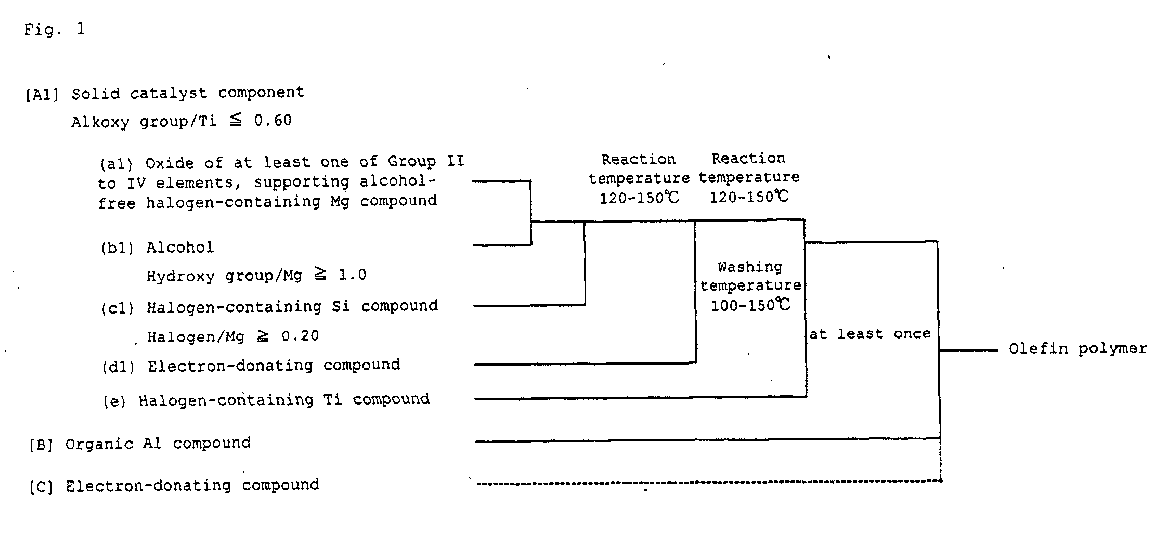
Description
The present invention relates to a solid catalyst
component for olefin polymerization for producing an α-olefin
homopolymer or copolymer, a catalyst for olefin
polymerization and a process for producing an olefin
polymer.
Generally, an olefin polymer is produced by
polymerization in the presence of a Ziegler-Natta catalyst
containing a titanium compound and an organic aluminum
compound. For example, in the production of a polypropylene
that is one of olefin polymers, an isotactic polypropylene
is obtained mainly in the presence of a catalyst containing
a solid catalyst component formed mainly from titanium,
magnesium, chlorine and an electron-donating compound and
containing an organic aluminum compound as a co-catalyst
component and an organosilicon compound having an alkoxy
group as a stereoregularity improver. Attempts are
presently made to attain an improvement in the catalytic
activity during polymerization, an improvement in
stereoregularity of an olefin polymer, an improvement in
the form of a polymer powder for stable production of an
olefin polymer and a reduction in residual Cl in the
polymer.
When the above residual Cl in a polymer is large in
amount, for example, the Cl corrodes a mold for injection
molding, a polymer absorbs water during the production of a
biaxially oriented film or its spinning to cause foaming,
or a foreign matter containing an additive is formed, which
makes high-speed molding difficult, so that it is a big
issue to decrease the amount of residual Cl in a polymer.
As means for overcoming the problem of residual Cl
in a polymer, first, it is general practice to employ a
method in which a catalyst is improved in activity. In the
second place, it is also general practice to employ a
method in which a non-organic material such as silica is
allowed to support a magnesium compound to substantially
decrease a magnesium chloride content, i.e., a Cl content
in a catalyst.
For example, there is known a method in which
silica, butyl octyl magnesium and hydrogen chloride gas are
brought into contact to form a magnesium-chloride-supporting
silica support, the thus-prepared support is
treated with an alcohol and then the support is allowed to
carry titanium tetrachloride and an electron-donating
compound (JP-A-63-280707) or a method in which a mixture of
silicon tetrachloride with silane trichloride is brought
into contact with a product prepared by bringing silica and
butyl octyl magnesium into contact, then, the resultant
mixture is washed with an inert solvent to form a
magnesium-chloride-supporting silica support, and the thus-prepared
support is treated with an alcohol and then
allowed to carry titanium tetrachloride and an electron-donating
compound (Japanese Specification Publication No.
4-506833 of PCT Application).
Further, there is also known a method in which
silica, butyl ethyl magnesium and ethanol are brought into
contact to form a magnesium-ethoxide-supporting silica
support, the thus-formed support is reacted with silicon
tetrachloride and then washed with heptane, and the thus-prepared
support is further reacted with an electron-donating
compound at 50°C and with titanium tetrachloride at
90°C once each (JP-A-61-174206), a method in which silica is
impregnated with a mixture of magnesium chloride with
butanol to form a silica support supporting a butanol
complex of magnesium chloride and the silica support is
allowed to carry titanium tetrachloride and an electron-donating
compound (JP-A-63-168413), or a method in which
silica pre-treated with trimethyl chlorosilane is allowed
to carry diethoxymagnesium and then allowed to carry
titanium tetrachloride and an electron-donating compound
(JP-B-7-17695).
However, while olefin polymers obtained by the
above methods have certain performances, particularly, the
above methods or the olefin polymers are not fully
satisfactory in polymerization activity, stereoregularity,
residual Cl, and the like.
On the other hand, as a method of improving olefin
polymers in the morphology including a particle diameter
and a form, JP-A-58-000811 discloses a method in which a
magnesium compound is once dissolved in a solvent such as
an alcohol and then re-precipitated and the thus-obtained
precipitate is used.
In the above method, however, it is essential to
carry out the procedures of supporting, dissolving and
precipitation of a magnesium compound, so that there are
defects that steps thereof are complicated and that a
catalyst is poor in stability of performances. Further, the
above method also has another defect that the catalyst
activity during polymerization and the stereoregularity of
an olefin polymer are not sufficient.
As a method of overcoming the above defects,
therefore, JP-A-2-02-413883 discloses a method in which
metal magnesium, an alcohol and a specific amount of a
halogen reaction product are used as a support for a
catalyst, and JP-B-07-025822 discloses a method of
producing an olefin polymer in the presence of a Ziegler-Natta
catalyst containing a solid catalyst component
obtained by adding an organic acid ester to a reaction
product from alkoxymagnesium, a halogenating agent and
alkoxytitanium and further reacting a titanium halide with
the resultant mixture.
Further, there is known a method of producing an
olefin polymer in the presence of a solid catalyst
component obtained by suspending diethoxymagnesium in
alkylbenzene, reacting the diethoxymagnesium with
predetermined amounts of titanium tetrachloride and
phthalic acid diester at a temperature of 80°C or higher but
120°C or lower, to obtain a solid substance, washing the
solid substance with alkylbenzene and reacting the solid
substance with a predetermined amount of titanium
tetrachloride in the presence of alkylbenzene (JP-A-64-69608).
In these methods, however, the catalytic activity
during polymerization and the stereoregularity of olefin
polymers are not yet sufficient.
Further, JP-A-11-269218 discloses a solid catalyst
component for olefin polymerization, obtained by bringing a
magnesium compound and a titanium compound into contact
with each other in the presence of an electron-donating
compound at a temperature of 120°C or higher but 150°C or
lower and'then washing the reaction mixture with an inert
solvent at a temperature of 100°C or higher but 150°C or
lower. There are produced effects that a decrease in the
catalytic activity with the passage of time during
polymerization is suppressed and that an olefin polymer is
improved in stereoregularity.
Since, however, the polymerization activity of the
above catalyst is not necessarily fully satisfactory, the
catalyst needs a further improvement in this activity.
It is an object of the present invention to provide
a solid catalyst component for olefin polymerization, which
has high polymerization activity and which gives an olefin
polymer excellent in stereoregularity, residual Cl and the
state of a powder, a catalyst for olefin polymerization and
a process for producing an olefin polymer.
For achieving the above object, the present
inventors have made diligent studies and as a result have
found that a solid catalyst component for olefin
polymerization, of which the residual alkoxy-group content
is remarkably decreased, can be obtained by a specific
production method, and that the above problems can be
thereby overcome. The present invention has been
accordingly completed.
According to the present invention, there is
provided a solid catalyst component for olefin
polymerization, which is a reaction product from the
following compounds (a1), (b1), (c1), (d1) and (e), and
which is obtained by reacting the following compound (a1)
with the following compound (b1) at a hydroxyl
group/magnesium molar ratio of 1.0 or more, then, reacting
the following compound (a1) with the following compound
(c1) at a halogen/magnesium molar ratio of 0.20 or more,
reacting a reaction product from the following compounds
(a1), (b1) and (c1) with the following compound (d1) and
the following compound (e) at a temperature of 120°C or
higher but 150°C or lower, washing the resultant reaction
mixture with an inert solvent, then, reacting the following
compound (e) again at a temperature of 120°C or higher but
150°C or lower and washing the resultant reaction mixture
with an inert solvent,
When prepared in the above manner, there can be
obtained a solid catalyst component that has high
polymerization activity and which can give an olefin
polymer having a less residual Cl content and having
excellence in stereoregularity and a powder form.
Particularly, when the hydroxyl group/magnesium
molar ratio is adjusted to 1.0 or more, the
crystallizability of a halogen-containing magnesium
compound supported on an oxide of at least one of Group IT
to Group IV elements can be decreased, and there can be
produced a support for supporting an effective active
species.
Further, when the halogen/magnesium molar ratio is
adjusted to 0.20 or more, an alcohol component that forms a
complex, or reacts, with a halogen-containing magnesium
compound supported on an oxide of at least one of the Group
II to Group II elements can be efficiently extracted from
the solid surface.
Presumably, the above preparation method promotes a
reaction of an alcohol or an alkoxy group contained in a
reaction product from the compounds (a1) and (b1) with the
compounds (c1) and (e), so that the alkoxy group imparted
directly to the magnesium compound is decreased, and
alkoxytitanium, etc., produced as by-products come to be
easily extracted from the solid surface.
The above "again" means once or more. That is,
after the compounds (a1) to (e) are allowed to react, the
resultant reaction mixture and the compound (e) may be
further reacted at least once (e.g., once, twice or more).
Further, the temperature for washing the reaction
mixture obtained after the first reaction of the compounds
(a1) to (e) with an inert solvent is preferably at 100°C or
higher, but 150°C or lower.
Further, the molar ratio (RO/Ti) of residual alkoxy
groups (RO) to the supported titanium (Ti) is preferably
0.60 or less.
According to another aspect of the present
invention, there is provided a solid catalyst component for
olefin polymerization, which is a reaction product from the
following compounds (a1), (b1), (c1), (d1) and (e) and in
which the molar ratio (RO/Ti) of residual alkoxy groups
(RO) to supported titanium (Ti) is 0.60 or less,
When the molar ratio (RO/Ti) is adjusted to 0.60 or
less, there can be obtained a solid catalyst component that
has high polymerization activity and which can give an
olefin polymer having a less residual Cl content and having
excellence in stereoregularity and a powder form.
Further, the alcohol (b1) is preferably ethanol.
Further, the halogen-containing silicon compound
(c1) is preferably silicon tetrachloride.
The rate and reaction ratio of halogenation and
dealkoxylation of a reaction product, which is from the
compound (a1) and the compound (b1), with silicon
tetrachloride can be fully controlled presumably due to the
use of silicon tetrachloride.
Further, the molar ratio (RO/Ti) is preferably 0.45
or less.
The content of the residual alkoxy group (RO) is
preferably 0.40 mmol/g or less.
The amount of the supported titanium is preferably
1.0 % by weight or more.
According to the present invention, there is
provided a solid catalyst component for olefin
polymerization, which is a reaction product obtained by
reacting the following compounds (a2) and (b2-1), reacting
the reaction mixture with the following compounds (c2) and
(d2) at a temperature of 120°C or higher but 150°C or lower,
washing the reaction product with an inert solvent, then,
reacting the following compound (d2) again at a temperature
of 120°C or higher but 150°C or lower and washing the
reaction product with an inert solvent,
When a solid catalyst component is prepared in the
above manner, the content of residual alkoxy groups can be
decreased, the solid catalyst component has high
polymerization activity, and there can be obtained an
olefin polymer having a less residual Cl content and having
excellence in stereoregularity and a powder form.
Particularly, when the amount, as a
halogen/magnesium molar ratio, of the compound (b2-1) is
adjusted to 0.20 or more, alkoxy groups or an alcohol in
the alkoxy-group-containing magnesium compound or the
alcohol complex of the halogen-containing magnesium
compound can be efficiently extracted from the solid
surface of the (a2) component.
When the above preparation method is employed,
presumably, the reaction of the alkoxy groups or alcohol
contained in the reaction product from the compound (a2)
and the compound (b2-1) with the compound (d2) is promoted,
the content of the alkoxy groups bonded to and contained in
the magnesium compound or the alcohol forming a complex
therewith is decreased, and alkoxytitanium etc.formed as a
by-product comes to be easily extracted from the solid
surface.
The above "again" means once or more. That is,
after the compounds (a2) to (d2) are reacted, the resultant
reaction product and the compound (d2) may be further
reacted at least once (e.g., once, twice or more).
Further, preferably, the temperature for the
washing with the inert solvent after the first reaction of
the compounds (a2) to (d2) is 100°C or higher but 150°C or
lower.
The molar ratio (RO/Ti) of residual alkoxy groups
(RO) to the supported titanium (Ti) is preferably 0.70 or
less.
According to another aspect of the present
invention, there is provided a solid catalyst component for
olefin polymerization, which is a reaction product obtained
by reacting
When the molar ratio (RO/Ti) is adjusted to 0.70 or
less, there can be obtained a solid catalyst component that
has high polymerization activity and which can give an
olefin polymer having a less residual Cl content and having
excellence in stereoregularity and a powder form.
Further, each of the halogen-containing silicon
compounds (b2) and (b2-1) is preferably silicon
tetrachloride.
The rate and reaction ratio of halogenation and
dealkoxylation reaction of the (a2) component with silicon
tetrachloride can be fully controlled presumably due to the
use of silicon tetrachloride.
Further, the molar ratio (RO/Ti) is preferably 0.50
or less.
The content of the residual alkoxy groups (RO) is
preferably 0.5 mmol/g or less.
The amount of the supported titanium is preferably
1.0 % by weight or more.
According to the present invention, there is
provided a solid catalyst component for olefin
polymerization, which is a reaction product obtained by
reacting the following compounds (a3) to (c3-1) (that is,
compound (a3), compound (b3) and compound (c3-1)) or the
following compounds (a3) to (d3) (that is, compound (a3),
compound (b3), compound (c3-1) and compound (d3)) at a
temperature of 120°C or higher but 150°C or lower, washing
the reaction mixture with an inert solvent, further
reacting the reaction mixture with the following halogen-containing
titanium compound (a3) at least once (e.g., once,
twice, or the like) at a temperature of 120°C or higher but
150°C or lower, and washing the reaction mixture with an
inert solvent,
When the solid catalyst component is prepared in
the above manner, the content of residual alkoxy groups can
be decreased, the solid catalyst component has high
polymerization activity, and an olefin polymer excellent in
the form of a powder can be obtained.
According to another aspect of the present
invention, there is provided a solid catalyst component for
olefin polymerization, which is obtained by reacting the
following compounds (a3) to (c3) (that is, compound (a3),
compound (b3) and compound (c3)) or the following compounds
(a3) to (d3) (that is, compound (a3), compound (b3),
compound (c3) and compound (d3)) and in which the molar
ratio (RO/Ti) of residual alkoxy groups (RO) to supported
titanium (Ti) is 0.30 or less,
When the molar ratio (RO/Ti) is adjusted to 0.30 or
less, the solid catalyst component has high polymerization
activity; and an olefin polymer excellent in the form of a
powder can be obtained.
In the compound (c3), preferably, the molar ratio
of the halogen of the compound (c3) to the alkoxy group of
the compound (b3) is 0.50 or more.
When the molar ratio is adjusted to 0.50 or more,
presumably, the halogenation of the compound (b3) with the
compound (c3) effectively proceeds; so that the
halogenation degree of the compound (b3) is finally
improved and that the formation of an alkoxytitanium
compound expectably formed as a byproduct is inhibited,
whereby the solid catalyst component is improved in
polymerization activity.
In some cases, presumably, the halogenation of the
compound (b3) with the compound (c3) proceeds in preference
to the halogenation of the compound (b3) with the compound
(a3), so that the halogenation rate of the compound (b3) is
decreased, and that the formation of a finer catalyst, and
the like are inhibited, whereby the solid catalyst
component is excellent in a powder form.
By the above preparation method, presumably, the
halogenation of the compound (b) with the compounds (a3)
and (c3) is promoted, and an alkoxytitanium compound, etc.,
which are assumed to be formed as a byproduct, come to be
easily extracted from a solid surface.
Further, the compound (b3) is preferably a compound
obtained by reacting metal magnesium, an alcohol and a
halogen and/or a halogen-containing compound containing at
least 0.0001 gram atom, per mole of the metal magnesium, of
halogen atoms.
When the amount of the halogen and/or halogen-containing
compound is smaller than the above amount, the
compound (b3) may come to have large and broad particle
diameters, and the halogenation degree of the compound (b3)
may be suppressed, and the extraction efficiency of
alkoxytitanium, etc., may be decreased.
The use of the above compound (b3) can improve an
olefin polymer in morphology. The above-prepared compound
(b3) is nearly spherical and requires no classification
procedures.
In the preparation of the solid catalyst component
of the present invention, the electron-donating compound
(d3) is used as required. The solid catalyst component
obtained without the electron-donating compound (d3) is
particularly suitable as a catalyst for the production of
an ethylene homopolymer or an ethylene copolymer and has
high polymerization activity.
According to the present invention, there is
provided a solid catalyst component for olefin
polymerization, which is a reaction product obtained by
reacting the following compounds (a4) and (b4) or the
following compounds (a4), (b4) and (c4) in the presence of
an aromatic hydrocarbon solvent at a temperature of 120°C or
higher but 150°C or lower, washing the reaction mixture with
an inert solvent, further reacting the following halogen-containing
titanium compound (a4) at least once (e.g., once,
twice, etc.) at a temperature of 120°C or higher but 150°C
or lower and washing the reaction mixture with an inert
solvent,
When the solid catalyst component is prepared in
the above manner, the content of residual alkoxy groups in
the solid catalyst component can be decreased, the solid
catalyst component has high polymerization activity, and an
olefin polymer excellent in a powder form can be obtained.
According to another aspect of the present
invention, there is provided a solid catalyst component for
olefin polymerization, which is a reaction product obtained
by reacting the following compounds (a4) and (b4) or the
following compounds (a4), (b4) and (c4) in the presence of
an aromatic hydrocarbon solvent and in which the molar
ratio (RO/Ti) of residual alkoxy groups (RO) to supported
titanium (Ti) is 0.25 or less,
When the molar ratio (RO/Ti) is adjusted to 0.25 or
less, there can be prepared a solid catalyst component
having high polymerization activity and being capable of
giving an olefin polymer excellent in a powder form.
In the preparation of the solid catalyst component
of the present invention, the electron-donating compound
(c4) is used as required. The solid catalyst component
obtained without the electron-donating compound (c4) is
particularly suitable as a catalyst for the production of
an ethylene homopolymer or an ethylene copolymer and has
high polymerization activity.
Further, preferably, the compound (b4) is an
alkoxy-group-containing magnesium compound obtained by
reacting metal magnesium, an alcohol and a halogen and/or
halogen-containing compound containing at least 0.0001 gram
atom, per mole of the above metal magnesium, of halogen
atoms.
In this case, when the amount of the halogen and/or
halogen-containing compound for use in the preparation of
the compound (b4) is smaller than the above amount, the
compound (b4) may come to have large and broad particle
diameters, and the halogenation degree of the compound (b4)
with the compound (a4) may be decreased, and the efficiency
of extraction of alkoxytitanium adsorbed on the compound
(b4) may be decreased.
The use of the above alkoxy-group-containing
magnesium compound (b4) can improve an olefin polymer in
morphology. The above-prepared alkoxy-group-containing
magnesium compound (b4) is nearly spherical and requires no
classification procedures.
By the above preparation method, presumably, the
halogenation of the compound (b4) with the compound (a4) is
promoted, and an alkoxytitanium compound, etc., which are
assumed to be formed as a byproduct, come to be easily
extracted from the surface of a solid that constitutes the
solid catalyst component.
According to still another aspect of the present
invention, there is provided a catalyst for olefin
polymerization, containing the following components [A] and
[B] or the following components [A], [B] and [C].
The electron-donating compound [C] is incorporated
as required. When this compound is incorporated, an olefin
polymer can be sometimes improved in stereoregularity
and/or the catalyst can be sometimes improved in
polymerization activity.
According to further another aspect of the present
invention, there is provided a process for producing an
olefin polymer, which comprises polymerizing an olefin in
the presence of the above catalyst for olefin
polymerization.
The catalyst components, preparation methods
thereof, the polymerization process, and the like in the
present invention will be explained hereinafter.
Embodiments shown hereinafter are preferred embodiments,
and the present invention shall not be limited by them so
long as it satisfies the requirements of claims.
(a1) The oxide of at least one element that is
selected from Group II to Group IV elements and which
supports an alcohol-free halogen-containing magnesium
compound.
The oxides of Group II to Group IV elements include
solid oxides containing at least one of these elements each
and solid composite inorganic oxides thereof. As Group II
to Group IV elements, Mg, Ca, B, Al, Si and Sn are
preferred, Al and Si are more preferred, and Si is
particularly preferred.
The solid oxide includes, for example, MgO, CaO,
B2O3, SiO2, SnO2 and Al2O3.
Further, the solid composite inorganic oxide
include, for example, SiO2-Al2O3, SiO2-MgO, SiO2-TiO2, SiO2-V2O5,
SiO2-Cr2O3 and SiO2-TiO2-MgO.
These various solid oxides and solid composite
inorganic oxides may be used alone, or two or more solid
oxides or solid composite inorganic oxides of these may be
simultaneously used in combination. Further, solid oxide(s)
and solid composite inorganic oxide(s) of these may be
simultaneously used in combination.
The above solid oxide component constitutes a basic
element of a catalyst support. Therefore, when the solid
oxide component is defined from the viewpoint of properties
of a support, desirably, it has an average particle
diameter D50 of 0.1 to 1,000 µm, particularly desirably, 5
to 100 µm, a specific surface area of 10 to 1,000 m2/g,
particularly desirably, 100 to 800 m2/g and a pore volume of
0.1 to 5 cm3/g, particularly desirably, 1 to 2.5 cm3/g. The
above average particle diameter (D50) is defined to be a
particle diameter corresponding to 50 % of a cumulative
weight percentage. That is, it shows that the total sum of
weight of particles smaller than a particle diameter
expressed by D50 is 50 % of the total sum of weight of the
entire particles.
Of the solid oxide components, SiO2 that can have
the above properties is particularly preferred.
The alcohol-free halogen-containing magnesium
compound includes magnesium dihalides such as magnesium
chloride, magnesium bromide and magnesium iodide,
alkoxymagnesium halides such as butoxymagnesium chloride,
cyclohexyloxymagnesium chloride, phenoxymagnesium chloride,
ethoxymagnesium chloride, ethoxymagnesium bromide,
butoxymagnesium bromide and ethoxymagnesium iodide,
allyloxymagnesium halide, alkylmagnesium halides such as
butylmagnesium chloride, cyclohexylmagnesium chloride,
phenylmagnesium chloride, ethylmagnesium chloride,
ethylmagnesium bromide, butylmagnesium bromide and
ethylmagnesium iodide and allylmagnesium halide. Of these
halogen-containing magnesium compounds, magnesium chloride
is particularly preferred in view of catalyst performances.
The alcohol-free halogen-containing magnesium
compound is not specially limited in composition. Desirably,
in view of activity etc., the magnesium/oxide (a1) weight
ratio is generally 0.1 to 20 wt%, preferably 1 to 15 wt%,
particularly preferably 4 to 12 wt%.
The method of allowing the above oxide to support
the alcohol-free halogen-containing magnesium compound can
be selected from a method in which the solid oxide and
magnesium dihalide, alkoxymagnesium halide,
allyloxymagnesium halide, alkylmagnesium halide or
allymagnesium halide are directly brought into contact with
each other, or a method in which the solid oxide and
dialkylmagnesium or dialkoxymagnesium are once brought into
contact with each other and then a halogenation agent such
as hydrogen chloride is brought into contact with them, to
partially or completely halogenate the dialkylmagnesium or
dialkoxymagnesium,'and so on.
The alcohol is preferably selected from lower
alcohols having 1 to 8 carbon atoms. It is particularly
preferred to use ethanol, since a solid product that
remarkably improves a catalyst in performances can be
obtained. While the purity and water content of the alcohol
are not critical, a catalyst is degraded in performances
such as activity when an alcohol having a large water
content is used. It is therefore preferred to use an
alcohol having a water content of 1 % or less, particularly
preferably, 2,000 ppm or less. Further, for attaining
better catalyst performances, the smaller the water content,
the more preferred it is, and the water content is
desirably 200 ppm or less.
The halogen-containing silicon compound can be
selected from compounds represented by the following
general formula (I).
S i (OR1) rX1 4-r
When the halogen-containing silicon compound (c1)
is used, the catalyst activity during polymerization can be
sometimes improved, a polymer can be sometimes improved in
stereoregularity, and the content of a fine particle in a
polymer can be sometimes decreased.
In the above general formula (I), X1 is a halogen
atom, and the halogen atom is preferably a chlorine or
bromine atom, particularly preferably a chlorine atom. R1
is a hydrocarbon group, and may be a saturated group or an
unsaturated group. It may be linear or branched, or it may
be cyclic, and it may contain a hetero atom such as sulfur,
nitrogen, oxygen, silicon or phosphorus. Of these, R1 is
preferably a hydrocarbon group having 1 to 10 carbon atoms,
particularly preferably an alkyl group, an alkenyl group, a
cycloalkenyl group, an aryl group or an aralkyl group. When
a plurality of groups as OR1 are present, one of these may
be the same as, or different from, the other or every other
one. Specific examples of R1 include methyl, ethyl, n-propyl,
isopropyl, n-butyl, sec-butyl, isobutyl, n-pentyl,
n-hexyl, n-heptyl, n-octyl, n-decyl, allyl, butenyl,
cyclopentyl, cyclohexyl, cyclohexenyl, phenyl, tolyl,
benzyl and phenethyl. And, r is an integer of 0 to 3.
Specific examples of the halogen-containing silicon
compounds of the above general formula (I) include silicon
tetrachloride, methoxytrichlorosilane,
dimethoxydichlorosilane, trimethoxychlorosilane,
ethoxytrichlorosilane, diethoxydichlorosilane,
triethoxychlorosilane, propoxytrichlorosilane,
dipropoxydichlorosilane and tripropoxychlorosilane. Of
these, silicon tetrachloride is particularly preferred. The
above halogen-containing silicon compounds may be used
solely, or two or more compounds of them may be used in
combination.
The electron-donating compound includes oxygen-containing
compounds such as alcohols, phenols, ketones,
aldehydes, carboxylic acids, malonic acid, esters of
organic acids or inorganic acids and ethers such as
monoether, diether and polyether, and nitrogen-containing
compounds such as ammonia, amine, nitrile and isocyanate.
Of these, esters of polyhydric carboxylic acids are
preferred, and esters of aromatic polyhydric carboxylic
acids are more preferred. Of these, a monoester and/or a
diester of aromatic dicarboxylic acid are/is particularly
preferred in view of catalyst activity during
polymerization. Further, the organic group of an ester
portion is preferably a linear, branched or cyclic
aliphatic hydrocarbon group.
Specific examples of the electron-donating compound
include dialkyl esters such as methyl, ethyl, n-propyl,
isopropyl, n-butyl, isobutyl, t-butyl, n-pentyl, 1-methylbutyl,
2-methylbutyl, 3-methylbutyl, 1,1-dimethylpropyl,
1-methylpentyl, 2-methylpentyl, 3-methylpentyl,
4-methylpentyl, 1-ethylbutyl, 2-ethylbutyl,
n-hexyl, cyclohexyl, n-heptyl, n-octyl, n-nonyl, 2-methylhexyl,
3-methylhexyl, 4-methylhexyl, 2-ethylhexyl, 3-ethylhexyl,
4-ethylhexyl, 2-methylpentyl, 3-methylpentyl,
2-ethylpentyl or 3-ethylpentyl dicarboxylates such as
phthalate, naphthalene-1,2-dicarboxylate, naphthalene-2,3-dicarboxylate,
5,6,7,8-tetrahydronaphthalene-1,2-dicarboxylate,
5,6,7,8-tetrahydronaphthalene-2,3-dicarboxylate,
indan-4,5-dicarboxylate and indan-5,6-dicarboxylate.
Of these, phthalic acid diesters are
preferred, and phthalic acid diesters in which the organic
group of an ester portion is a linear or branched aliphatic
hydrocarbon group having 4 or more carbon atoms are
particularly preferred. Specific examples of these include
di-n-butyl phthalate, diisobutyl phthalate, di-n-heptyl
phthalate and diethyl phthalate. These compounds may be
used solely, or two or more compounds of them may be used
in combination.
The halogen-containing titanium compound can be
preferably selected from compounds represented by the
following general formula (II).
T i X2 p (OR2) 4-p
In the above general formula (II), X2 is a halogen
atom, and the halogen atom is preferably a chlorine or
bromine atom, particularly preferably a chlorine atom. R2
is a hydrocarbon group, and may be a saturated group or an
unsaturated group. It may be linear or branched, or it may
be cyclic, and it may contain a hetero atom such as sulfur,
nitrogen, oxygen, silicon or phosphorus. Of these, R2 is
preferably a hydrocarbon group having 1 to 10 carbon atoms,
particularly preferably an alkyl group, an alkenyl group, a
cycloalkenyl group, an aryl group or an aralkyl group. R2
is particularly preferably a linear or branched alkyl group.
When a plurality of groups as OR2 are present, one of these
may be the same as, or different from, the other or every
other one. Specific examples of R2 include methyl, ethyl,
n-propyl, isopropyl, n-butyl, sec-butyl, isobutyl, n-pentyl,
n-hexyl, n-heptyl, n-octyl, n-decyl, allyl, butenyl,
cyclopentyl, cyclohexyl, cyclohexenyl, phenyl, tolyl,
benzyl and phenethyl. And, p is an integer of 1 to 4.
Specific examples of the halogen-containing
titanium compounds of the above general formula (II)
include titanium tetrahalides such as titanium
tetrachloride, titanium tetrabromide and titanium
tetraiodide; alkoxytitanium trihalides such as
methoxytitanium trichloride, ethoxytitanium trichloride,
propoxytitanium trichloride, n-butoxytitanium trichloride
and ethoxytitanium tribromide; dialkoxytitanium dihalides
such as dimethoxytitanium dichloride, diethoxytitanium
dichloride, diisopropoxytitanium dichloride, di-n-propoxytitanium
dichloride and diethoxytitanium dibromide;
and trialkoxytitanium monohalides such as
trimethoxytitanium chloride, triethoxytitanium chloride,
triisopropoxytitanium chloride, tri-n-propoxytitanium
chloride and tri-n-butoxytitanium chloride. Of these, high-halogenated
titanium compounds are preferred, and titanium
tetrachloride is particularly preferred, in view of
polymerization activity. These halogen-containing titanium
compounds may be used solely, or two or more compounds of
these may be used in combination.
(a2) Oxide of at least one element selected from
the Group II to Group IV elements, the oxide supporting an
alkoxy-group-containing magnesium compound or an alcohol
complex of a halogen-containing magnesium compound.
The oxide of at least one element selected from the
Group II to Group IV elements and the halogen-containing
magnesium compound are as explained with regard to the
above oxide (a1), so that their explanations are omitted.
The alkoxy-group-containing magnesium compound
includes dialkoxymagnesium compounds such as
dimethoxymagnesium, diethoxymagnesium, dipropoxymagnesium,
dibutoxymagnesium, dihexyloxymagnesium, dioctoxymagnesium,
diphenoxymagnesium and dicyclohexyloxymagnesium,
diallyloxymagnesium; alkoxyalkylmagnesium compounds such as
ethoxyethylmagnesium, phenoxymethylmagnesium,
ethoxyphenylmagnesium, cyclohexyloxyphenylmagnesium,
allyloxyalkylmagnesiu, alkoxyallylmagnesium,
allyloxyallylmagnesium; alkoxymagnesium halides such as
butoxymagnesium chloride, cyclohexyloxymagnesium chloride,
phenoxymagnesium chloride, ethoxymagnesium chloride,
ethoxymagnesium bromide, butoxymagnesium bromide and
ethoxymagnesium iodide, and allyloxymagnesium halides. Of
these alkoxy-group-containing magnesium compounds,
dialkoxymagnesium compounds are preferred, and
diethoxymagnesium is particularly preferred, in view of
catalyst performances.
The alcohol is preferably selected from lower
alcohols having 1 to 8 carbon atoms, such as methanol,
ethanol, propanol, butanol, and the like. Of these, ethanol
is particularly preferred.
While the alkoxy-group-containing magnesium
compound or the alcohol complex of the halogen-containing
magnesium compound is not specially limited concerning its
composition, the magnesium/oxide (a2) weight ratio is
generally 0.1 to 20 wt%, preferably 1 to 15 wt%,
particularly preferably 2 to 12 wt %, in view of activity,
and the like.
The method of allowing the above oxide to support
the alkoxy-group-containing magnesium compound can be
selected from a method in which the solid oxide and the
dialkoxymagnesium, diallyloxymagnesium,
alkoxyalkylmagnesium, allyloxyalkylmagnesium,
alkoxymagnesium halide or allyloxymagnesium halide are
directly brought into contact with each other, or a method
in which the solid oxide and the dialkylmagnesium are once
brought into contact with each other and then an alcohol is
brought into contact to partially or completely alkoxylate
the dialkylmagnesium .
The method of allowing the above oxide to support
the alcohol complex of the halogen-containing magnesium
compound can be selected from a method in which the solid
oxide and the alcohol complex of the magnesium dihalide,
the alcohol complex of the alkoxymagnesium halide or the
alcohol complex of the allyloxymagnesium halide are
directly brought into contact with each other or a method
in which the solid oxide and the magnesium dihalide,
alkoxymagnesium halide or allyloxymagnesium halide are once
brought into contact with each other and then the alcohol
is brought into contact to form the corresponding alcohol
complex.
The halogen-containing silicon compound (b2) is as
explained with regard to the halogen-containing silicon
compound (c1) for use in the solid catalyst component [Al],
so that its explanation is omitted.
The electron-donating compound (c2) is as explained
with regard to the electron-donating compound (d1) for use
in the solid catalyst component [A1], so that its
explanation is omitted.
The halogen-containing titanium compound (d2) is as
explained with regard to the halogen-containing titanium
compound (e) for use in the solid catalyst component [A1],
so that its explanation is omitted.
The halogen-containing titanium compound (a3) is as
explained with regard to the halogen-containing titanium
compound (e) for use in the solid catalyst component [A1],
so that its explanation is omitted.
The alkoxy-group-containing magnesium compound can
be preferably selected from compounds represented by the
following general formula (III).
Mg (OR3) qR4 2-q
In the above general formula (III), R3 is a
hydrocarbon group, and R4 is a hydrocarbon group or a
halogen atom. Each of the hydrocarbon group represented by
R3 and the hydrocarbon group represented by R4 includes an
alkyl group having 1 to 12 carbon atoms, a cycloalkyl group,
an aryl group and an aralkyl group, and these hydrocarbon
groups may be the same as, or different from, each other.
The halogen atom represented by R4 includes chlorine,
bromine, iodine and fluorine. And, q is an integer of 1 to
2.
Specific examples of the alkoxy-group-containing
magnesium compounds of the above general formula (III)
include dialkoxymagnesium compounds such as
dimethoxymagnesium, diethoxymagnesium, dipropoxymagnesium,
dibutoxymagnesium, dihexyloxymagnesium, dioctoxymagnesium,
diphenoxymagnesium, dicyclohexyloxymagnesium,
diallyloxymagnesium; alkoxyalkylmagnesium compounds such as
ethoxyethylmagnesium, phenoxymethylmagnesium
ethoxyphenylmagnesium and cyclohexyloxyphenylmagnesium,
allyloxyalkylmagnesium, alkoxyallylmagnesium,
allyloxyallylmagnesium; alkoxymagnesium halides such as
butoxymagnesium chloride, cyclohexyloxymagnesium chloride,
phenoxymagnesium chloride, ethoxymagnesium chloride,
ethoxymagnesium bromide, butoxymagnesium bromide and
ethoxymagnesium iodide, and allyloxymagnesium halide.
Of these, dialkoxymagnesium compounds are preferred,
and diethoxymagnesium is particularly preferred, in view of
polymerization activity and stereoregularity.
In view of the polymerization activity of the
catalyst and the powder form and stereoregularity of an
olefin polymer, preferably, the alkoxy-group-containing
magnesium compound (b3) is obtained by reacting metal
magnesium, an alcohol and a halogen or halogen-containing
compound containing 0.0001 gram atom, per mole of the metal
magnesium, of a halogen.
The above metal magnesium is not critical with
regard to its form, and the like. Therefore, a metal
magnesium having any particle diameter, for example, a
metal magnesium having a granular, ribbon-shaped or powdery
form, may be used. While the surface state of the metal
magnesium is not critical, either, a metal magnesium having
a surface free of a coating of magnesium hydroxide, or the
like is preferred.
The alcohol is preferably selected from lower
alcohols having 1 to 6 carbon atoms. Ethanol is
particularly preferred, since ethanol serves to give a
solid product that remarkably improves the exhibition of
catalytic performances. While the purity and water content
of the alcohol are not critical, either. When an alcohol
having a large water content is used, however, magnesium
hydroxide is formed on the metal magnesium surface, so that
it is preferred to use an alcohol having a water content of
1 % or less, and it is particularly preferred to use an
alcohol having a water content of 2,000 ppm or less.
Further, for attaining better morphology, a smaller water
content is preferred, and the water content is generally
desirably 200 ppm or less.
The halogen is selected from chlorine, bromine or
iodine, and iodine is particularly suitably used.
Further, the halogen atom of the halogen-containing
compound is preferably chlorine, bromine or iodine. The
halogen-containing compound is particularly preferably a
halogen-containing metal compound. Specifically, the
halogen-containing compound can be preferably selected from
MgCl2, Mgl2, Mg(OEt)Cl, Mg(OEt)I, MgBr2, CaCl2, NaCl or KBr
etc. Of these, MgCl2 is particularly preferred. The state,
form and particle size of these compounds are not limited,
and a compound being in any state and having any form and
any particle size can be used. For example, a solution of
such a compound in an alcohol solvent (e.g., ethanol) can
be used.
The amount of the alcohol per mole of the metal
magnesium is preferably 2 to 100 mol, particularly
preferably 5 to 50 mol. When the amount of the alcohol is
too large, the yield of the alkoxy-group-containing
magnesium compound (b3) having excellent morphology may
decrease in some cases. When it is too small, stirring in a
reaction vessel may not smoothly proceed in some cases,
while it is not limited by the molar ratio.
The amount of the halogen as a halogen atom per
mole of the metal magnesium is 0.0001 gram atom or more,
preferably 0.0005 gram atom or more, more preferably 0.001
gram atom or more. When the amount of the halogen is less
than 0.0001 gram atom, there is no difference from a case
where no halogen is used as a reaction initiator, and when
the thus-obtained alkoxy-group-containing magnesium
compound (b3) is used as a catalyst support, the catalyst
may be poor in catalyst activity or an olefin polymer may
be defective in morphology, and the like.
The amount of the halogen-containing compound, as a
halogen atom in the halogen-containing compound per mole of
the metal magnesium, is at least 0.0001 gram atom or more,
preferably 0.0005 gram atom or more, more preferably 0.001
gram atom or more. When the above amount is less than
0.0001 gram atom, there is no difference from a case where
no halogen-containing compound is used as a reaction
initiator, and when the thus-obtained alkoxy-group-containing
magnesium compound (b3) is used as a catalyst
support, the catalyst may be poor in catalyst activity, or
an olefin polymer may be defective in morphology, and the
like.
In the present invention, the halogens or the
halogen-containing compounds may be used solely each, and
two or more halogens or halogen-containing compounds of
these may be used in combination. Further, the halogen and
the halogen-containing compound may be used in combination.
When the halogen and the halogen-containing compound are
used in combination, the amount of total halogen atoms in
the halogen and the halogen-containing compound per mole of
the metal magnesium is 0.0001 gram atom or more, preferably
0.0005 gram atom or more, more preferably 0.001 gram atom
or more.
While the upper limit of the amount(s) of the
halogen and/or the halogen-containing compound is not
specially limited, the upper limit may be set as required
so long as the alkoxy-group-containing magnesium compound
(b3) for use in the present invention can be obtained.
Generally, the above upper limit is preferably less than
0.06 gram atom.
In the process for the production of an olefin
polymer, provided by the present invention, the amount of
the halogen and/or the halogen-containing compound is
determined as required, whereby the particle diameter of
the alkoxy-group-containing magnesium compound (b3) can be
controlled as required.
The preparation of the alkoxy-group-containing
magnesium compound (b3) is carried out until the generation
of hydrogen gas is no longer observed (generally, for 1 to
30 hours). Specifically, when iodine is used as a halogen,
the alkoxy-group-containing magnesium compound (b3) can be
prepared by a method in which iodine in the form of a solid
is charged into the metal magnesium and the alcohol and
then the mixture is allowed to react under heat, a method
in which a solution of iodine in an alcohol is dropwise
added to the metal magnesium and the alcohol and the
mixture is allowed to react under heat, or a method in
which, while the metal magnesium and an alcohol solution
are heated, a solution of iodine in an alcohol is dropwise
added to allow the mixture to react.
Each method is preferably carried out in the
atmosphere of an inert gas (e.g., nitrogen gas or argon
gas) and optionally in the presence of an inert organic
solvent (e.g., saturated hydrocarbon such as n-hexane).
Further, it is not required to charge the entire
amount of each of the metal magnesium, the alcohol and the
halogen at once from the beginning, and they may be divided
and partially charged. In a particularly preferred
embodiment, the alcohol is entirely charged in the
beginning, the metal magnesium is divided into several
portions and such portions are charged separately. In this
embodiment, the generation of a large amount of hydrogen
gas can be prevented, which is desirable in view of safety.
Further, the size of a reaction vessel can be decreased.
Further, it is also made possible to prevent the
dissipation of alcohol and halogen caused by the momentary
generation of a large amount of hydrogen gas. While the
number of the divisional portions can be determined by
taking account of the size of the reaction vessel and is
not specially limited, suitably, each is generally divided
into five to ten portions in view of complicatedness of
procedures.
Further, the reaction may be carried out by any one
of a batch method and a continuous method. Further, there
may be employed a variant method in which the entire amount
of the alcohol is charged in the beginning, a small amount
of the metal magnesium is added to the alcohol, a product
formed by a reaction is removed by separating it into other
vessel, then, a small amount of the metal magnesium is
charged, and these procedures are repeated.
Further, in view of the catalyst activity during
polymerization and the powder form of an olefin polymer,
the metal magnesium, the alcohol and the halogen and/or the
halogen-containing compound are allowed to react at 30 to
60°C, more preferably at 40 to 55°C, thereby to adjust the
average particle diameter (D50) of the thus-obtained
alkoxy-group-containing magnesium compound (b3) to 50 µm or
less, more preferably 40 µm or less. The average particle
diameter (D50) is preferably 1 µm or more.
The average particle diameter (D50) is defined to
be a particle diameter corresponding to 50 % of a
cumulative weight percentage. That is, it shows that the
total sum of weight of particles having a smaller diameter
than the particle diameter expressed by D50 is 50 % of the
total weight of the entire particles.
When the reaction temperature is adjusted to 30 to
60°C, the compound (b3) decreases in particle diameter while
retaining the properties that it is spherical and has a
narrow particle size distribution, the halogenation of the
compound (b3) proceeds, and the amount of a residual alkoxy
group content in the solid catalyst component can be
decreased. When the reaction temperature is higher than the
above temperature range, the decrease in particle diameter
does not efficiently proceed. When it is lower than the
above temperature range, the rate of formation of the
compound (b3) greatly decreases, which results in a
decrease in productivity.
When the average particle diameter (D50) is
decreased to a smaller diameter of as small as 50 µm or
less, presumably, the compound (b3) is improved in
halogenation degree, and an alkoxytitanium compound and the
like, which are predictably formed as a byproduct, come to
be easily extracted from the solid surface.
When the alkoxy-group-containing magnesium compound
(b3) is used for the preparation of the solid catalyst
component [A3], a dry product may be used, or a product
obtained by washing a filtered product with heptane, or the
like, may be used. In any case, the alkoxy-group-containing
magnesium compound (b3) can be used in a step to follow,
without any pulverization or any sieving procedure for
attaining a uniform particle diameter distribution. Further,
the alkoxy-group-containing magnesium compound (b3) is
nearly spherical and has a sharp particle diameter
distribution. Furthermore, the alkoxy-group-containing
magnesium compound (b3) as individual particles has a small
variability of sphericity.
These alkoxy-group-containing magnesium compounds
(b3) may be used solely, or two or more of them may be used
in combination. Further, the alkoxy-group-containing
magnesium compound (b3) may be used in a state where it is
supported on a support such as silica, alumina or
polystyrene, or it may be used in the form of a mixture
with a halogen and the like.
The halogen-containing silicon compound (c3) is
similar to the halogen-containing silicon compound (c1) for
use in the solid catalyst component [A1] so that a
duplicate explanation will be omitted.
The halogen-containing silicon compound (c3) is
particularly preferably silicon tetrachloride.
Presumably, the use of silicon tetrachloride can
fully control the reaction rate of the halogenation, and
the conversion, of the compound (b3) with silicon
tetrachloride.
Further, the compound (c3) is preferably a halogen-containing
silicon compound (c3-1) in which the molar ratio
of a halogen to the alkoxy group of the compound (b3) is
0.50 or more. When such a halogen-containing silicon
compound is used, the halogenation of the compound (b3)
proceeds, and the amount of residual alkoxy groups in the
solid catalyst component can be decreased. More preferably,
the compound (c3) is a halogen-containing silicon compound
in which the molar ratio of a halogen to the alkoxy group
of the compound (b3) is 0.80 or more.
The electron-donating compound (d3) for optional
use in the preparation of the solid catalyst component [A3]
is as explained with regard to the electron-donating
compound (d1) for use in the solid catalyst component [A1],
so that its explanation is omitted.
The halogen-containing titanium compound (a4) is as
explained with regard to the halogen-containing titanium
compound (e) for use in the solid catalyst component [A1],
so that its explanation is omitted.
The alkoxy-group-containing magnesium compound (b4)
is as explained with regard to the alkoxy-group-containing
magnesium compound (b3) for use in the solid catalyst
component [A3], so that its explanation is omitted.
The electron-donating compound (c4) for optional
use in the preparation of the solid catalyst component [A4]
is as explained with regard to the electron-donating
compound (d1) for use in the solid catalyst component [A1],
so that its explanation is omitted.
Although not specially limited, the organic
aluminum compound [B] can be preferably selected from an
organic aluminum compound having an alkyl group, a halogen
atom, a hydrogen atom and an alkoxy group, aluminoxane, or
a mixture of these. Specific examples thereof include
trialkylaluminum compounds such as trimethylaluminum,
triethylaluminum, triisopropylaluminum, triisobutylaluminum
and trioctylaluminum; dialkylaluminum monochlorides such as
diethylaluminum monochloride, diisopropylaluminum
monochloride, diisobutylaluminum monochloride and
dioctylaluminum monochloride; alkylaluminum sesquihalides
such as ethylaluminum sesquichloride; and linear
aluminoxanes such as methylaluminoxane. Of these organic
aluminum compounds, trialkylaluminum having a lower alkyl
group having 1 to 5 carbon atoms is preferred, and
trimethylaluminum, triethylaluminum, tripropylaluminum and
triisobutylaluminum are particularly preferred. These
organic aluminum compounds may be used solely, or two or
more compounds of these may be used in combination.
In the present invention of the catalyst for olefin
polymerization, provided by the present invention, the
electron-donating compound [C] is used as required. The
electron-donating compound [C] can be selected from an
organosilicon compound having an alkoxy group, a nitrogen-containing
compound, a phosphorus-containing compound or an
oxygen-containing compound. Of these, it is particularly
preferred to use an organosilicon compound having an alkoxy
group.
Specific examples of the organosilicon compound
having an alkoxy group include trimethylmethoxysilane,
trimethylethoxysilane, triethylmethoxysilane,
triethylethoxysilane, dimethyldimethoxysilane,
dimethyldiethoxysilane, ethylisopropyldimethoxysilane,
propylisopropyldimethoxysilane, diisopropyldimethoxysilane,
diisobutyldimethoxysilane, isopropylisobutyldimethoxysilane,
di-t-butyldimethoxysilane, t-butylmethyldimethoxysilane, t-butylethyldimethoxysilane,
t-butylpropyldimethoxysilane, t-butylisopropyldimethoxysilane,
t-butylbutyldimethoxysilane,
t-butylisobutyldimethoxysilane, t-butyl(s-butyl)dimethoxysilane,
t-butylamyldimethoxysilane, t-butylhexyldimethoxysilane,
t-butylheptyldimethoxysilane, t-butyloctyldimethoxysilane,
t-butylnonyldimethoxysilane, t-butyldecyldimethoxysilane,
t-butyl(3,3,3-trifluromethylpropyl)dimethoxysilane,
cyclohexylmethyldimethoxysilane,
cyclohexylethyldimethoxysilane,
cyclohexylpropyldimethoxysilane,
cyclohexylisobutyldimethoxysilane,
dicyclohexyldimethoxysilane, cyclohexyl-t-butyldimethoxysilane,
cyclopentylmethyldimethoxysilane,
cyclopentylethyldimethoxysilane,
cyclopentylpropyldimethoxysilane, cyclopentyl-t-butyldimethoxysilane,
dicyclopentyldimethoxysilane,
cyclopentylcyclohexyldimethoxysilane, bis(2-methylcyclopentyl)dimethoxysilane,
bis(2,3-dimethylcyclopentyl)dimethoxysilane,
α-naphthyl-1,1,2-trimethylpropyldimethoxysilane,
n-tetradecanyl-1,1,2-trimethylpropyldimethoxysilane,
1,1,2-trimethylpropylmethyldimethoxysilane,
1,1,2-trimethylpropylethyldimethoxysilane,
1,1,2-trimethylpropylisopropyldimethoxysilane,
1,1,2-trimethylpropylcyclopentyldimethoxysilane,
1,1,2-trimethylpropylcyclohexyldimethoxysilane,
1,1,2-trimethylpropylmyristyldimethoxysilane,
diphenyldimethoxysilane, diphenyldiethoxysilane,
phenyltriethoxysilane, methyltrimethoxysilane,
methyltriethoxysilane, ethyltrimethoxysilane,
ethyltriethoxysilane, propyltrimethoxysilane,
isopropyltrimethoxysilane, butyltrimethoxysilane,
butyltriethoxysilane, isobutyltrimethoxysilane, t-butyltrimethoxysilane,
s-butyltrimethoxysilane,
amyltrimethoxysilane, isoamyltrimethoxysilane,
cyclopentyltrimethoxysilane, cyclohexyl trimethoxysilane,
norbornenetrimethoxysilane, indenyl trimethoxysilane, 2-methylcyclopentyl
trimethoxysilane,
ethyltriisopropoxysilane, methylcyclopentyl(t-butoxy)dimethoxysilane,
isopropyl(t-butoxy)dimethoxysilane,
t-butyl(t-butoxy)dimethoxysilane,
(isobutoxy)dimethoxysilane, vinyltriethoxysialen,
vinyltributoxysilane, chlorotriethoxysilane, γ-chloropropyltrimethoxysilane,
γ-aminopropyltriethoxysilane,
1,1,2-trimethylpropyltrimethoxysilane, 1,1,2-trimethylpropylisopropoxydimethoxysilane,
1,1,2-trimethylpropyl(t-butoxy)dimethoxysilane,
tetramethoxysilane, tetraethoxysilane, tetrabutoxysilane,
tetraisobutoxysilane, ethyl silicate, butyl silicate,
trimethylphenoxysilane, methyltriallyloxysilane,
vinyltris(β-methoxyethoxy)silane, vinyltrisacetoxysilane
and dimethyltetraethoxydisiloxane. These organosilicon
compounds may be used solely, or two or more compounds of
these may be used in combination.
Further, the above organosilicon compound also
includes a compound obtained by reacting a silicon compound
having no Si-O-C bond with an organic compound having an O-C
bond in advance or by reacting these compounds during the
polymerization of an α-olefin. Specifically, a compound
obtained by reacting silicon tetrachloride and an alcohol
is included.
Specific examples of the nitrogen-containing
compound include 2,6-substituted piperidines such as 2,6-diisopropylpiperidine,
2,6-diisopropyl-4-methylpiperidine
and N-methyl-2,2,6,6-tetramethylpiperidine; 2,5-substituted
azolidines such as 2,5-diisopropylazolidine and N-methyl-2,2,5,5-tetramethylazolidine;
substituted methylenediamines
such as N,N,N',N'-tetramethylmethylenediamine and
N,N,N',N'-tetraethylmethylenediamine; and substituted
imidazolidines such as 1,3-dibenzylimidazolidine and 1,3-dibenzyl-2-phenylimidazolidine.
Specific examples of the phosphorus-containing
compound include phosphorous acid esters such as triethyl
phosphite, tri-n-propyl phosphite, triisopropyl phosphite,
tri-n-butyl phosphite, triisobutyl phosphite, diethyl-n-butyl
phosphite and diethylphenyl phosphite.
Specific examples of the oxygen-containing compound
include 2,5-substituted tetrahydrofurans such as 2,2,5,5-tetramethyltetrahydrofuran
and 2,2,5,5-tetraethyltetrahydrofuran;
and dimethoxymethane derivatives
such as 1,1-dimethoxy-2,3,4,5-tetrachlorocyclopentadiene,
9,9-dimethoxyfluorene and diphenyldimethoxymethane.
The method of preparing the solid catalyst
component [A1] can be a method in which the oxide (a1) of
at least one element of Groups II to IV elements, the oxide
(a1) supporting the above alcohol-free halogen-containing
magnesium compound, and a predetermined amount of the
alcohol (b1) are brought into contact, and reacted, with
each other, then, the reaction mixture is brought into
contact, and reacted, with a predetermined amount of the
halogen-containing silicon compound (c1), the reaction
mixture is reacted with the electron-donating compound (d1)
and the halogen-containing titanium compound (e) at a
temperature of 120°C or higher but 150°C or lower, and the
reaction product is washed with an inert solvent, and then
is brought into contact, and allowed to react, with the
halogen-containing titanium compound (e) again (at least
once) at a temperature of 120°C or higher but 150°C or lower.
The order of other contacts is not critical.
Preferably, the halogen-containing titanium
compound (e) is brought into contact with a reaction
mixture obtained by bringing the compounds (a1) to (c1)
into contact with one another, and then the electron-donating
compound (d1) is brought into contact with the
reaction mixture, since the solid catalyst component in
this case can be sometimes improved in polymerization
activity.
Further, these components may be brought into
contact in the presence of an inert solvent such as a
hydrocarbon, or each component may be diluted with an inert
solvent such as a hydrocarbon before they are brought into
contact. Examples of the above inert solvent include
aliphatic or alicyclic hydrocarbons such as octane, decane
and ethylcyclohexane, aromatic hydrocarbons such as toluene,
ethylbenzene and xylene, halogenated hydrocarbons such as
chlorobenzene, tetrachloroethane and chlorofluorocarbon,
and mixtures of these. Of these, an aliphatic hydrocarbon
and aromatic hydrocarbon are preferred, and an aliphatic
hydrocarbon is particularly preferred.
The amount of the above halogen-containing titanium
compound (e) per mole of magnesium of the above halogen-containing
magnesium compound is generally 0.5 to 100 mol,
preferably 1 to 50 mol. When the above molar ratio is
outside the above range, the catalyst activity is sometimes
insufficient.
Further, the amount of the electron-donating
compound (d1) per mole of the above halogen-containing
magnesium compound is generally 0.01 to 10 mol, preferably
0.05 to 1.0 mol. When the above molar ratio is outside the
above range, the catalyst activity is sometimes
insufficient or an olefin polymer sometimes has
insufficient stereoregularity.
The halogen-containing silicon compound (c1) is
used in such an amount that the molar ratio of the halogen
to the magnesium of the above halogen-containing magnesium
compound is 0.20 or more, preferably from 0.4 to 4.0, more
preferably from 1.0 to 2.5. When the above amount is
smaller than the above range, the catalyst activity or the
effect on improvement in stereoregularity is not fully
exhibited, and a formed polymer is caused to have an
increased amount of a fine powder and is caused to have a
decreased bulk density. When the above amount is too large,
there is produced no further effect on these improvements.
The alcohol (b1) is used in such an amount that the
molar ratio of the hydroxy group to the magnesium of the
above halogen-containing magnesium compound is 1 or more,
preferably from 2 to 5, more preferably from 2.5 to 4. When
the above amount is smaller than the above range, the
catalyst activity or the effect on improvement in
stereoregularity is not fully exhibited. When it is too
large, there is not any further effect on these
improvements.
After the above compounds (a1) to (e) are all added,
they are brought into contact and allowed to react
preferably in a temperature range of 120 to 150°C,
particularly preferably 125 to 140°C. When the above
contact temperature is outside the above range, the
catalyst activity or the effect on improvement in
stereoregularity is sometimes not fully exhibited. Further,
the above contact is carried out generally for 1 minute to
24 hours, preferably 10 minutes to 6 hours. Differing
depending upon a type of a solvent when it is used and a
contact temperature,etc., the pressure for the contact is
generally in the range of atmospheric pressure to 5 MPa,
preferably atmospheric pressure to 1 MPa. During the
contacting procedures, preferably, they are stirred in view
of the uniformity and efficiency of the contact. These
contact conditions are also applicable to the contact
reaction that is carried out for the second time or more
with regard to the halogen-containing titanium compound (e).
When a solvent is used in the contact procedure of
the halogen-containing titanium compound (e), the amount of
the solvent per mole of the halogen-containing titanium
compound (e) is generally 5,000 milliliters or less,
preferably 10 to 1,000 milliliters. When the above ratio is
outside the above range, the uniformity or efficiency of
the contact may be sometimes degraded.
Further, it is sometimes desirable to wash a
reaction product, which is from the first contact reaction
of the halogen-containing titanium compound (e), with an
inert solvent at a temperature of 100 to 150°C, particularly
preferably 120 to 140°C. When the above washing temperature
is outside the above range, the catalyst activity or the
effect on improvement in stereoregularity is sometimes not
exhibited. The inert solvent can be selected from the
already explained solvents.
With regard to the washing temperature after the
contact reaction which is carried out for the second time
or more with the halogen-containing titanium compound (e),
the washing is preferably carried out with an inert solvent
at a temperature of 100 to 150°C, particularly preferably
120 to 140°C, in view of stereoregularity.
The washing method is preferably selected from a
decantation or filtering method. Although the amount of the
inert solvent, the washing time period and the number of
times of the washing are not critical, the washing is
carried out generally with a solvent in an amount, per mole
of the magnesium compound, of 100 to 100,000 milliliters,
preferably 500 to 50,000 milliliters, generally for 1
minute to 24 hours, preferably 10 minutes to 6 hours. When
the above ratio is outside the above range, the washing may
be incomplete.
While the pressure in the above case differs
depending upon the type of the solvent, the washing
temperature, and the like, the pressure is generally in the
range of atmospheric pressure to 5 MPa, preferably
atmospheric pressure to 1 MPa. For the uniformity of the
washing and the washing efficiency, it is preferred to stir
the reaction mixture during the washing. The thus-obtained
solid catalyst component can be stored in a dry state or in
an inert solvent such as a hydrocarbon.
In the above-obtained solid catalyst component [A1],
preferably, the molar ratio (RO/Ti) of the residual alkoxy
group (RO) to the supported titanium (Ti) is 0.60 or less.
That is because when the molar ratio exceeds 0.60, no
intended catalyst may be obtained.
Further, the above molar ratio is more preferably
0.45 or less, still more preferably 0.35 or less.
Further, the residual alkoxy group content (RO) is
preferably 0.40 mmol/g or less. The reason therefore is
that when the residual alkoxy group content exceeds 0.40
mmol/g, the catalyst is poor in activity, the catalyst cost
increases and the amount of catalyst residues such as Cl,
etc., in a powder increases, so that a product quality may
be sometimes degraded.
Further, the residual alkoxy group content is more
preferably 0.25 mmol/g, still more preferably 0.15 mmol/g.
When the catalyst is prepared under the specific
reaction conditions, the residual alkoxy group content can
be controlled. In this case, the order of contacting the
chemicals, the amount of the compound (c1) and the reaction
temperature of the compound (e) are essential.
The amount of the supported titanium is preferably
1.0 % by weight or more. The reason therefor is that when
the amount of the supported titanium is less than 1.0 % by
weight, the activity per the catalyst is sometimes
decreased even if the activity per titanium is high (even
if the RO/Ti is low).
Further, the amount of the supported titanium is
more preferably 1.2 % by weight or more, still more
preferably 1.5 % by weight or more.
The amount of the supported titanium can be
controlled when the component (a1) having the specific
composition is selected or when the catalyst is prepared
under the specific reaction conditions. In this case, with
regard to the component (a1), the composition of the oxide
and the content of the magnesium compound are considered to
be essential. With regard to the reaction conditions, the
reaction temperature of the compound (e) and the washing
temperature after the reaction of the compound (e) are
essential.
The method of the solid catalyst component [A2] can
be a method in which the oxide (a2) of at least one element
of the Groups II to IV elements, the oxide supporting the
above alkoxy-group-containing magnesium compound or the
alcohol complex of the halogen-containing magnesium
compound, and the predetermined amount of the halogen-containing
silicon compound (b2) are brought into contact,
and reacted, with each other, the reaction mixture is
brought into contact, and reacted, with the electron-donating
compound (c2) and the halogen-containing titanium
compound (d2) at a temperature of 120°C or higher but 150°C
or lower, the reaction mixture is washed with an inert
solvent, and the halogen-containing titanium compound (d2)
is reacted with the reaction product again (at least once)
at a temperature of 120°C or higher but 150°C or lower. The
order of other contacts is not critical.
Preferably, the halogen-containing titanium
compound (d2) is brought into contact with a reaction
mixture obtained by bringing the compound (a2) and the
halogen-containing silicon compound (b2) into contact with
each other, and then the electron-donating compound (c2) is
brought into contact with the reaction mixture, since the
solid catalyst component in this case can be sometimes
improved in polymerization activity.
Further, these components may be brought into
contact in the presence of an inert solvent such as a
hydrocarbon, or each component may be diluted with an inert
solvent such as a hydrocarbon before they are brought into
contact. The inert solvent can be selected from those
explained with regard to the preparation of the solid
catalyst component [A1].
The amount of the above halogen-containing titanium
compound (d2) per mole of magnesium of the above alkoxy-group-containing
magnesium compound or the alcohol complex
of the halogen-containing magnesium compound is generally
0.5 to 100 mol, preferably 1 to 50 mol. When the above
molar ratio is outside the above range, the catalyst
activity is sometimes insufficient.
Further, the amount of the electron-donating
compound (c2) per mole of magnesium of the above alkoxy-group-containing
magnesium compound or the alcohol complex
of the halogen-containing magnesium compound is generally
0.01 to 10 mol, preferably 0.05 to 1.0 mol. When the above
molar ratio is outside the above range, the catalyst
activity is sometimes insufficient or an olefin polymer
sometimes has insufficient stereoregularity.
The halogen-containing silicon compound (b2) is
used in such an amount that the molar ratio of the halogen
to the magnesium of the alkoxy-group-containing magnesium
compound or the alcohol complex of the halogen-containing
magnesium compound is generally 0.20 or more, preferably
from 0.4 to 4.0, more preferably from 1.0 to 2.5. When the
above amount is much smaller than the above range, the
catalyst activity or the effect on improvement in
stereoregularity is not fully exhibited, and a formed
polymer is caused to have an increased amount of a fine
powder and a decreased bulk density. When it is too large,
there is produced no further effect on these improvements.
After the above compounds (a2) to (d2) are all
added, they are brought into contact and allowed to react
preferably in a temperature range of 120 to 150°C,
particularly preferably 125 to 140°C. When the above
contact temperature is outside the above range, the
catalyst activity or the effect on improvement in
stereoregularity is sometimes not fully exhibited. The
contact time period, the pressure during the contacting and
the stirring during the contacting procedures are as
explained with regard to the solid catalyst component [A1].
These contact conditions are also applicable to the contact
reaction that is carried out for the second time or more
with the halogen-containing titanium compound (d2).
When a solvent is used in the contact procedures of
the halogen-containing titanium compound (d2), the amount
of the solvent per mole of the halogen-containing titanium
compound (d2) is generally 5,000 milliliters or less,
preferably 10 to 1,000 milliliters. When the above ratio is
outside the above range, the uniformity of the contact or
the contact efficiency is sometimes degraded.
Further, after the first contact reaction of the
halogen-containing titanium compound (d2), it is sometimes
desirable to wash the reaction mixture with an inert
solvent at a temperature of 100 to 150°C, particularly
preferably 120 to 140°C. When the above washing temperature
is outside the above range, the catalyst activity or the
effect on improvement in stereoregularity is sometimes not
fully exhibited. The inert solvent can be selected from
those explained in the preparation of the solid catalyst
component [A1].
After the contact reaction that is carried out for
the second time and thereafter with the halogen-containing
titanium compound (d2), the washing temperature, the
washing method, the amount of the inert solvent, the
washing time period, the number of times of the washing,
the washing pressure and the stirring during the washing
procedure are as explained with regard to the preparation
of the solid catalyst component [A1]. The thus-obtained
solid catalyst component [A2] can be stored in a dry state
or in an inert solvent such as a hydrocarbon.
In the above-obtained solid catalyst component [A2],
the molar ratio (RO/Ti) of the residual alkoxy group
content (RO) to the supported titanium (Ti) is preferably
0.70 or less. That is because when the molar ratio exceeds
0.70, no intended catalyst may be obtained.
Further, the above molar ratio is preferably 0.50
or less, more preferably 0.45 or less.
Further, the residual alkoxy group content (RO) is
preferably 0.50 mmol/g or less. The reason therefor is that
when the residual alkoxy group content exceeds 0.50 mmol/g,
the catalyst activity is low, the catalyst cost increases,
and the amount of catalyst residues such as Cl, etc., in a
powder increases, so that a product quality is sometimes
degraded.
Further, the residual alkoxy group content is more
preferably 0.35 mmol/g or less, still more preferably 0.20
mmol/g or less.
When the catalyst is prepared under the specific
conditions, the residual alkoxy group content can be
controlled. In this case, particularly, the contact order
of the compounds (a2) to (d2), the amount of the compound
(b2) and the reaction temperature of the compound (d2) are
essential.
Further, the amount of the supported titanium is
preferably 1.0 % by weight or more. The reason therefor is
that when the amount of the supported titanium is less than
1.0 % by weight, the activity per the catalyst is sometimes
low even if the activity per titanium is high (even if the
RO/Ti is low).
Further, the amount of the supported titanium is
more preferably 1.2 % by weight or more, still more
preferably 1.5 % by weight or more.
The amount of the supported titanium can be
controlled when the component (a2) having the specific
composition is selected or when the catalyst is prepared
under the specific reaction conditions. In this case, with
regard to the component (a2), the composition of the oxide,
the content of the magnesium compound and the like are
considered to be essential. With regard to the reaction
conditions, the reaction temperature of the compound (d2)
and the washing temperature after the reaction of the
compound (d2) are essential.
In the method of preparing the solid catalyst
component [A3], the above halogen-containing titanium
compound (a3), the alkoxy-group-containing magnesium
compound (b3), the halogen-containing silicon compound (c3)
and optionally the electron-donating compound (d3) are
allowed to react.
The method of preparing the solid catalyst
component [A3] is preferably a method in which the above
halogen-containing titanium compound (a3), the alkoxy-group-containing
magnesium compound (b3), the halogen-containing
silicon compound (c3) and optionally the
electron-donating compound (d3) are allowed to react at a
temperature of 120°C or higher but 150°C or lower, the
reaction mixture is washed with an inert solvent, the
halogen-containing titanium compound (a3) is further
reacted with the reaction product at least once at a
temperature of 120°C or higher but 150°C or lower, and the
reaction product is washed with an inert solvent. In this
case, the compound (c3) is a halogen-containing silicon
compound (c3-1) in which the molar ratio of halogen to the
alkoxy group in the compound (b3) is 0.50 or more.
As described above, the compounds (a3) to (c3) or
the compounds (a3) to (d3) are allowed to react at the
specific temperature and then the halogen-containing
titanium compound (a3) is reacted with the reaction mixture
again (at least once) at the specific temperature, whereby
a polymer activity may be improved.
Other contact orders are not critical. For example,
the above components may be allowed to react in the
presence of an inert solvent such as a hydrocarbon, or each
component may be diluted with an inert solvent such as a
hydrocarbon beforehand. The inert solvent can be selected
from those inert solvents explained with regard to the
preparation of the solid catalyst component [A1].
While the order of contact of the compounds (a3) to
(c3) or the compounds (a3) to (d3) is not specially limited,
preferably, the alkoxy-group-containing magnesium compound
(b3) and the halogen-containing silicon compound (c3) are
first brought into contact with each other, then, the
halogen-containing titanium compound (a3) is brought into
contact, the electron-donating compound (d3) is finally
brought into contact, and the halogen-containing titanium
compound (a3) is further brought into contact, since the
polymerization activity in this case can be improved.
The amount of the halogen-containing titanium
compound (a3) per mole of magnesium of the alkoxy-group-containing
magnesium compound (b3) is generally 0.5 to 100
mol, preferably 1 to 50 mol. When the above molar ratio is
outside the above range, the catalyst activity may be
sometimes insufficient.
The amount of the electron-donating compound (d3)
per mole of magnesium of the alkoxy-group-containing
magnesium compound (b3) is generally 0.01 to 10 mol,
preferably 0.05 to 1.0 mol. When the above molar ratio is
outside the above range, the catalyst activity or the
stereoregularity may be sometimes insufficient.
The halogen-containing silicon compound (c3) is
used in such an amount that the molar ratio of the halogen
to the alkoxy group of the alkoxy-group-containing
magnesium compound (b3) is 0.50 or more, preferably 0.60 to
4.0, more preferably 1.0 to 2.5. When the above amount is
much smaller than the above range, the catalyst activity or
the effect on improvement in stereoregularity is not fully
exhibited, and a formed polymer is caused to have an
increased amount of a fine powder and a decreased bulk
density. Even when the above amount is too large, there is
no further effect produced on these improvements.
After the above compounds (a3) to (c3) or the
compounds (a3) to (d3) are all added, they are brought into
contact and reacted preferably in a temperature range of
120 to 150°C, particularly preferably 125 to 140°C. When
the contact temperature is outside the above range, the
catalyst activity or the effect on improvement in
stereoregularity is sometimes not fully exhibited. The
contact time period, the pressure during the contacting and
the stirring during the contacting procedures are as
explained with regard to the preparation of the solid
catalyst component [A1]. These contact conditions are also
applicable to the contact reaction that is carried out with
the halogen-containing titanium compound (a3) for the
second time or more.
When a solvent is used in the contact procedure of
the halogen-containing titanium compound (a3), the amount
of the solvent per mole of the halogen-containing titanium
compound (a3) is generally 5,000 milliliters or less,
preferably 10 to 1,000 milliliters. When the above ratio is
outside the above range, the contact uniformity and the
contact efficiency may be degraded.
Concerning the temperature for the washing with an
inert solvent after the contact reaction of the above
halogen-containing titanium compound (a3), it is preferred
to carry out the washing with the inert solvent at a
temperature of 100 to 150°C, particularly preferably 120 to
140°C, after the first contact reaction of the halogen-containing
titanium compound (a3), since a larger effect is
sometimes produced on improvements in the catalyst activity
and stereoregularity in this case. The above inert solvent
can be selected from those inert solvents explained with
regard to the preparation of the solid catalyst component
[A1] .
Further, after the contact reaction that is carried
out for the second time or more with the halogen-containing
titanium compound (a3), the washing temperature, the
washing method, the amount of the inert solvent, the
washing time period, the number of times of the washing,
the washing pressure and the stirring during the washing
are as explained with regard to the preparation of the
solid catalyst component [A1]. The thus-obtained solid
catalyst component [A3] can be stored in a dry state or in
an inert solvent such as a hydrocarbon.
In the above-obtained solid catalyst component [A3],
preferably, the molar ratio of the residual alkoxy group to
the supported titanium is 0.30 or less.
Further, the above molar ratio is more preferably
0.20 or less, still more preferably 0.15 or less.
The residual alkoxy group content (RO) is
preferably 0.13 mmol/g or less. The reason therefor is that
when the residual alkoxy group content exceeds 0.13 mmol/g,
the polymerization activity is low, the catalyst cost
increases and the content of catalyst residues such as Cl,
etc., in a powder increases, so that the product quality is
sometimes degraded.
Further, the residual alkoxy group content is more
preferably 0.10 mmol/g, still more preferably 0.08 mmol/g.
Further, the amount of the supported titanium is
preferably 1.5 % by weight or more. The reason therefor is
that when the amount of the supported titanium is less than
1.5 % by weight, the activity per the catalyst is sometimes
low even if the activity per titanium is high (even if the
RO/Ti is low).
Further, the amount of the supported titanium is
more preferably 1.8 % by weight or more, still more
preferably 2.0 % by weight or more.
When the electron-donating compound (d3) is used
for preparing the solid catalyst component [A3], it is
easier to satisfy the above preferred values with regard to
the molar ratio, the residual alkoxy content and the amount
of the supported titanium.
Further, the residual alkoxy group content can be
controlled when the specific support is selected as such or
when the catalyst preparation conditions are controlled.
The amount of the supported titanium can be
controlled when the catalyst preparation conditions,
particularly, the reaction temperature of the compound (a3)
with each component and the temperature for the washing
after the reaction of the compound (a3) are set at the
specific temperatures.
The method of preparing the solid catalyst
component [A4] is a method in which the above halogen-containing
titanium compound (a4), the alkoxy-group-containing
magnesium compound (b4) and optionally, the
electron-donating compound (c4) are allowed to react in the
presence of an aromatic hydrocarbon solvent.
In a preferred embodiment of the preparation method,
the halogen-containing titanium compound (a4), the alkoxy-group-containing
magnesium compound (b4) and optionally,
the electron-donating compound (c4) are allowed to react in
the presence of an aromatic hydrocarbon solvent at a
temperature of 120°C or higher but 150°C or lower, the
reaction mixture is washed with an inert solvent, the
halogen-containing titanium compound (a4) is allowed to
react further at least once at a temperature of 120°C or
higher but 150°C or lower and the reaction product is washed
with an inert solvent.
As described above, the compounds (a4) to (c4) are
brought into contact and reacted at the specific
temperature and then the halogen-containing titanium
compound (a4) is again (at least once) brought into contact
and reacted at the specific temperature, whereby the
polymer activity can be improved.
Further, it is preferred to bring the electron-donating
compound (c4) into contact after the halogen-containing
titanium compound (a4) and the alkoxy-group-containing
magnesium compound (b4) are brought into contact
with an aromatic hydrocarbon solvent , since the
polymerization activity in this case can be improved.
Any aromatic hydrocarbon solvent can be used so
long as it is in a liquid state at room temperature.
Examples thereof include benzene, toluene, xylene,
ethylbenzene, propylbenzene and trimethylbenzene. Of these,
toluene, xylene and ethylbenzene are preferred.
The amount of the halogen-containing titanium
compound (a4) per mole of magnesium of the above alkoxy-group-containing
magnesium compound (b4) is generally 0.5
to 100 mol, preferably 1 to 50 mol. When the above molar
ratio is outside the above range, the catalyst activity is
sometimes insufficient.
Further, the amount of the electron-donating
compound (c4) per mole of magnesium of the above alkoxy-group-containing
magnesium compound (b4) is generally 0.01
to 10 mol, preferably 0.05 to 1.0 mol. When the above molar
ratio is outside the above range, the catalyst activity or
the stereoregularity is sometimes insufficient.
The solvent for use in the above first reaction for
supporting the halogen-containing titanium compound (a4) is
essentially an aromatic hydrocarbon. When the above solvent
is replaced, for example, with an aliphatic or alicyclic
hydrocarbon such as octane, decane or ethylcyclohexane or
halogenated hydrocarbon such as chlorobenzene,
tetrachloroethane or chlorofluorocarbon, no sufficient
performances can be attained with regard to the
polymerization activity, and the like.
After the above compounds (a4) and (b4) or the
above compounds (a4) to (c4) are all added, they are
brought into contact and reacted preferably in the
temperature range of 120 to 150°C, particularly preferably
125 to 140°C. The above contact temperature is outside the
above range, the catalyst activity or the effect on
improvement in stereoregularity is sometimes not fully
exhibited. The contact time period, the pressure during the
contact and the stirring during the contact procedures are
as explained with regard to the preparation of the solid
catalyst component [A1]. These contact conditions are also
applicable to the contact reaction that is carried out for
the second time or more with regard to the halogen-containing
titanium compound (a).
In the procedure of bringing the halogen-containing
titanium compound (a) into contact, the amount of the
aromatic hydrocarbon solvent per mole of the halogen-containing
titanium compound (a) is generally 5,000
milliliters or less, preferably 10 to 1,000 milliliters.
When the above molar ratio is outside the above range, the
contact uniformity or the contact efficiency may be
degraded.
After the first contact reaction of the halogen-containing
titanium compound (a4), the reaction product
from the contact reaction of the above halogen-containing
titanium compound (a4) is washed with an inert solvent
preferably at a temperature of100 to 150°C, particularly
preferably 120 to 140°C, whereby the catalyst activity or
the effect on improvement in stereoregularity is sometimes
improved. The above inert solvent can be selected from
those inert solvents explained with regard to the
preparation of the solid catalyst component [A1].
Further, after the contact reaction that is carried
out with the halogen-containing titanium compound (a4) for
the second time or more, the washing temperature, the
washing method, the amount of the inert solvent, the
washing time period, the number of times of washing, the
washing pressure and the stirring during the washing are as
explained with regard to the preparation of the solid
catalyst component [A1]. The thus-obtained solid catalyst
component [A4] can be stored in a dry state or in an inert
solvent such as a hydrocarbon.
In the above-obtained solid catalyst component [A4],
the molar ratio (RO/Ti) of the residual alkoxy group
content (RO) to the supported titanium (Ti) is preferably
0.25 or less.
The above molar ratio is more preferably 0.15 or
less, still more preferably 0.13 or less.
Further, the residual alkoxy group content (RO) is
preferably 0.15 mmol/g or less. The reason therefor is that
when the residual alkoxy group content exceeds 0.15 mmol/g,
the polymerization activity is low, the catalyst cost is
increased, and the amount of catalyst residues such as Cl,
etc., in a powder increases, so that the product quality is
sometimes degraded.
Further, the residual alkoxy group content is more
preferably 0.09 mmol/g or less, still more preferably 0.07
mmol/g or less.
Further, the amount of the supported titanium is
preferably 1.5 % by weight or more. The reason therefor is
that when the amount of the supported titanium is less than
1.5 % by weight, the activity per the catalyst is sometimes
low even if the activity per titanium is high (even if the
RO/Ti is low).
Further, the amount of the supported titanium is
more preferably 1.8 % by weight or more, still more
preferably 2.0 % by weight or more.
When the electron-donating compound (c4) is used
for preparing the solid catalyst component [A4], it is
easier to satisfy the above preferred values with regard to
the molar ratio, the residual alkoxy content and the amount
of the supported titanium.
Further, the residual alkoxy group content can be
controlled when the specific support is used or when the
catalyst preparation conditions are set at the specific
conditions.
The amount of the supported titanium can be
controlled when the catalyst preparation conditions,
particularly, the reaction temperature of the compound (a4)
with each component and the temperature for the washing
after the reaction of the compound (a4) are set at the
specific temperatures.
Concerning the amount of each of the catalysts for
olefin polymerization, provided by the present invention,
each of the solid catalyst components [A1] to [A4] is used
in such an amount that the titanium atom amount per liter
of a reaction volume is generally in the range of 0.00005
to 1 mmol.
The organic aluminum compound [B] is used in such
an amount that the aluminum/titanium (atomic ratio) is
generally in the range of 1 to 1,000, preferably 10 to 500.
When the above atomic ratio is outside the above range, the
catalyst activity is sometimes insufficient.
Further, the electron-donating compound [C] is used
in such an amount that the [C]/[B] (molar ratio) is
generally in the range of 0.001 to 5.0, preferably 0.01 to
2.0, more preferably 0.05 to 1.0. When the above molar
ratio is outside the above range, the sufficient catalyst
activity or the stereoregularity sometimes cannot be
obtained. When a preliminary polymerization is carried out,
however, the amount of the electron-donating compound [C]
can be further decreased.
The olefin for use in the present invention is
preferably an α-olefin of the following general formula
(IV) .
R5-CH=CH2
In the above general formula (IV), R5 is a hydrogen
atom or a hydrocarbon group, and the hydrocarbon group may
be saturated or unsaturated, may be linear or branched, or
may be cyclic. Specific examples of the olefin include
ethylene, propylene, 1-butene, 1-pentene, 1-hexene, 1-heptene,
1-octene, 1-decene, 3-methyl-1-pentene, 4-methyl-1-pentene,
vinylcyclohexane, butadiene, isoprene,
piperylene, and the like. These olefins may be used solely,
or two or more olefins of these may be used in combination.
Of the above olefins, ethylene and propylene are
particularly preferred.
In the polymerization of an olefin in the present
invention, the preliminary polymerization of an olefin may
be carried out as required before the regular
polymerization thereof in view of the catalyst activity
during the polymerization and the stereoregularity and
power form of an olefin polymer. In this case, the
preliminary polymerization of an olefin is carried out in
the presence of a catalyst that is a mixture of
predetermined amounts of one of the solid catalyst
components [A1] to [A4], the organic aluminum compound [B]
and optionally the electron-donating compound [C] generally
in the temperature range of 1 to 100°C under a pressure of
atmospheric pressure to approximately 5 MPa, and then the
main polymerization of the olefin is carried out in the
presence of the catalyst and the preliminary polymerization
product.
In the polymerization procedure of the above main
polymerization, any one of solution polymerization, slurry
polymerization, gaseous phase polymerization, bulk
polymerization, etc., can be employed. Further, any one a
batch method polymerization and a continuous polymerization
can be employed, and there can be employed two-step
polymerization or multi-step polymerization that is carried
out under different conditions.
Concerning the reaction conditions, further, the
polymerization pressure therefor is generally selected from
the range of atmospheric pressure to 8 MPa, preferably 0.2
to 5 MPa, and the polymerization temperature is generally
selected from the range of 0 to 200°C, preferably 30 to
100°C, as required in view of polymerization activity.
Although differing depending upon olefins and the
polymerization temperature, the polymerization time period
is generally 5 minutes to 20 hours, preferably
approximately 10 minutes to 10 hours.
The molecular weight of an olefin polymer can be
adjusted by adding a chain transfer agent, preferably,
hydrogen. Further, an inert gas such as nitrogen may be
present. Further, as far as the catalyst component in the
present invention is concerned, there may be employed a
constitution in which one of the solid catalyst components
[A1] to [A4], the organic aluminum compound [B] and the
electron-donating compound [C] are mixed in predetermined
amounts, and immediately thereafter, an olefin is
introduced for polymerization. Alternatively, there may be
employed a constitution in which the above mixture is aged
for approximately 0.2 to 3 hours after the contact, and
then an olefin is introduced for polymerization. Further,
the above catalyst component may be suspended in an inert
solvent, an olefin, or the like and fed. In the present
invention, the post treatment after the polymerization can
be carried out according to a conventional method. That is,
in a gaseous phase polymerization method, a nitrogen
current may be allowed to pass through particles of a
polymer powder introduced out of a polymerizer after the
polymerization, for removing an olefin contained therein.
Further, a polymer may be pelletized with an extruder as
required, and in this case, a small amount of water, an
alcohol or the like may be added for deactivating the
catalyst completely. In a bulk polymerization method, a
polymer that is withdrawn from a polymerizer after the
polymerization can be pelletized after a monomer is
completely separated from the polymer.
In the present invention, preferably, the residual
Cl content in an olefin polymer obtained in the presence of
the catalyst for olefin polymerization is 35 ppm or less.
The reason therefor is that when the residual Cl content
exceeds 35 ppm, not only the neutralizer cost increases,
but also it sometimes induces the corrosion of a mold and
foaming during molding and the formation of a foreign
matter.
The residual Cl content is more preferably 30 ppm
or less, still more preferably 25 ppm or less.
The present invention will be explained with
reference to Examples hereinafter, while the present
invention shall not be limited to the following Examples.
Average particle diameters (D50) of oxides (a1) and (a2)
and alkoxy-group-containing magnesium compounds (b3) and
(b4), residual alkoxy group contents in solid catalyst
components, amounts of supported Ti, bulk densities,
average particle diameters (D50) and fine and coarse powder
amounts of polymer powders and intrinsic viscosities [η],
stereoregularity [mmmm] and Cl contents of polymers were
determined as follows.
A three-necked flask with a stirrer, having an
internal volume of 0.5 liter, was subjected to replacement
of an atmosphere therein with nitrogen gas, and then, 200
milliliters of dehydrated heptane, 40 g of silica gel (Si:
0.666 mmol) having an average particle diameter D50 of 50
µm, a specific surface area of 300 m2/g and a pore volume of
1.6 cm3/g and 0.166 mmol of butyloctylmagnesium were mixed
and heated at 90°C for 1.5 hours. Then, the mixture was
cooled to 20°C, and a hydrogen chloride gas (1.66 mmol) was
allowed to pass to carry out chlorination for 30 minutes.
Then, the reaction product was washed with 200 milliliters
of dehydrated heptane three times at room temperature, and
the thus-obtained solid was analyzed for components to show
that it had a magnesium content of 7.9 wt% and a chlorine
content of 22.5 wt% (Cl/Mg molar ratio: 1.95).
A three-necked flask with a stirrer, having an
internal volume of 0.5 liter, was subjected to replacement
of an atmosphere therein with nitrogen gas, and then the
flask was charged with 80 milliliters of dehydrated octane
and 16 g (Mg: 0.052 mol) of the silica support supporting
magnesium chloride, prepared in the above (1). The mixture
was cooled to 5°C, 9.15 milliliters (0.156 mol) of
dehydrated ethanol was dropwise added over 15 minutes, and
the mixture was heated at 80°C for 1.5 hours. The resultant
suspension was cooled to 40°C, 2.97 milliliters (0.026 mol)
of silicon tetrachloride was added, and the mixture was
stirred for 4 hours. Then, 77 milliliters (0.702 mol) of
titanium tetrachloride was dropwise added, the solution
thereof was temperature-increased to 65°C, and 1.39
milliliters (0.0052 mol) of di-n-butyl phthalate was added.
Then, the mixture was stirred at an internal temperature of
125°C for 1 hour to carry out a contacting procedure, the
stirring was stopped to precipitate a solid, and a
supernatant was withdrawn. To the remaining reaction
product was added 100 milliliters of dehydrated octane, and
the mixture was temperature-increased to 125°C with stirring
and maintained for 1 minute. The stirring was stopped to
precipitate a solid, and a supernatant was withdrawn. This
washing procedure was repeated 7 times. Then, 122
milliliters (1.11 mol) of titanium tetrachloride was added,
the mixture was stirred at an internal temperature of 125°C
for 2 hours to carry out a contacting procedure, and the
above washing with dehydrated octane at 125°C was carried
out 7 times, to give a solid catalyst component. Table 1
shows the evaluation results thereof.
An autoclave made of stainless steel with a stirrer,
having an internal volume of 1 liter, was fully dried and
then subjected to replacement of an atmosphere therein with
nitrogen, and then the autoclave was charged with 400
milliliters of dehydrated heptane at room temperature. The
autoclave was further charged with 2.0 mmol of
triethylaluminum, 0.25 mmol of dicyclopentyldimethoxysilane
and 0.0025 mmol, as Ti atom, of the solid catalyst
component prepared in the above (2), and hydrogen was
introduced up to 0.1 MPa. Then, while propylene was
introduced, the autoclave was temperature-increased to 80°C
and pressure-increased to a total pressure of 0.8 MPa,
followed by polymerization for 1 hour. Then, the
temperature and the pressure in the autoclave were
decreased, and the reaction product was taken out and
poured into 2 liters of methanol to deactivate the catalyst.
The product was separated by filtration and vacuum-dried to
give a polypropylene. Table 1 shows the evaluation results
thereof.
A solid catalyst component was obtained in the same
manner as in Example 1 except that the temperature for the
washing with the octane after the titanium-tetrachloride-supporting
reaction carried out for the second time in
Example 1(2) was changed to room temperature, and the thus-obtained
solid catalyst component was evaluated. Table 1
shows the results.
Propylene was polymerized in the same manner as in
Example 1 except that the procedures in Example 1(3) were
modified so that the dicyclopentyldimethoxysilane was
replaced with 0.5 mmol of cyclohexylmethyldimethoxysilane,
that 0.005 mmol, as Ti atom, of the solid catalyst
component prepared in the above (1) was added and that
hydrogen was introduced up to 0.05 MPa. The thus-obtained
polypropylene was evaluated. Table 1 shows the results.
A three-necked flask with a stirrer, having an
internal volume of 0.5 liter, was subjected to replacement
of an atmosphere therein with nitrogen gas, and then the
flask was charged with 80 milliliters of dehydrated octane
and 16 g (Mg: 0.052 mol) of the magnesium-chloride-supporting
silica support prepared in Example 1(1). The
mixture was cooled to 5°C, 9.15 milliliters (0.156 mol) of
dehydrated ethanol was dropwise added over 15 minutes, and
the mixture was heated at 80°C for 1.5 hours. The resultant
suspension was cooled to 40°C, 2.97 milliliters (0.026 mol)
of silicon tetrachloride was added, the mixture was stirred
for 4 hours, and then 77 milliliters (0.702 mol) of
titanium tetrachloride was dropwise added. The resultant
solution was temperature-increased up to 65°C, and 1.39
milliliters (0.0052 mol) of di-n-butyl phthalate was added.
Then, the mixture was stirred at an internal temperature of
125°C for 1 hour to carry out a contacting procedure. The
stirring was stopped to precipitate a solid, and a
supernatant was withdrawn. To the remaining reaction
product was added 100 milliliters of dehydrated octane, and
the mixture was temperature-increased to 125°C with stirring
and maintained for 1 minute. The stirring was stopped to
precipitate a solid, and a supernatant was withdrawn. This
washing procedure was repeated 7 times. Then, 122
milliliters (1.11 mol) of titanium tetrachloride was added,
the mixture was stirred at an internal temperature of 125°C
for 2 hours to carry out a contacting procedure, and the
above washing with dehydrated octane at 125°C was repeated 7
times. Further, 122 milliliters (1.11 mol) of titanium
tetrachloride was added, the mixture was stirred at an
internal temperature of 125°C for 2 hours to carry out a
contacting procedure, and the above washing with dehydrated
octane at 125°C was repeated 7 times. The thus-obtained
solid catalyst component was evaluated. Table 1 shows the
results.
Propylene was polymerized in the same manner as in
Example 1 except that the solid catalyst component prepared
in the above (1) was used in Example 1(3). The thus-obtained
polypropylene was evaluated. Table 1 shows the
results.
A solid catalyst component was prepared in the same
manner as in Example 1 except that the procedures in
Example 1(2) were modified so that the octane was replaced
with decane and that the temperatures for the supporting
reaction and the washing were changed to 135°C. The thus-obtained
solid catalyst component was evaluated. Table 1
shows the results.
Propylene was polymerized in the same manner as in
Example 1 except that the solid catalyst component prepared
in the above (1) was used in Example 1(2). The thus-obtained
polypropylene was evaluated. Table 1 shows the
results.
A three-necked flask with a stirrer, having an
internal volume of 0.5 liter, was subjected to replacement
of an atmosphere therein with nitrogen gas, and then
charged with 80 milliliters of dehydrated octane and 16 g
(Mg: 0.052 mol) of the magnesium-chloride-supporting silica
support prepared in Example 1(1). The mixture was cooled to
5°C, 9.15 milliliters (0.156 mol) of dehydrated ethanol was
dropwise added over 15 minutes, and the mixture was heated
at 80°C for 1.5 hours. The resultant suspension was cooled
to 70°C, and 1.39 milliliters (0.0052 mol) of di-n-butyl
phthalate was added. The resultant solution was
temperature-increased up to 80°C, then, 77 milliliters (0.70
mol) of titanium tetrachloride was dropwise added, and the
mixture was stirred at an internal temperature of 110°C for
2 hours to carry out a contacting procedure. Then, the
stirring was stopped to precipitate a solid, and a
supernatant was withdrawn. To the remaining reaction
mixture was added 100 milliliter of dehydrated heptane, and
the mixture was temperature-increased up to 90°C with
stirring and maintained for 1 minute. The stirring was
stopped to precipitate a solid, and a supernatant was
withdrawn. The above washing procedure was repeated 7 times.
Then, 122 milliliters (1.11 mol) of titanium tetrachloride
was added, the mixture was stirred at an internal
temperature of 110°C for 2 hours to carry out a contacting
procedure, the stirring was stopped to precipitate a solid,
and a supernatant was withdrawn. Then, the above washing
with heptane at 90°C was repeated 7 times, and the thus-obtained
solid catalyst component was evaluated. Table 1
shows the results.
Propylene was polymerized in the same manner as in
Example 1 except that the solid catalyst component prepared
in the above (1) was used in Example 1(2). The thus-obtained
polypropylene was evaluated. Table 1 shows the
results.
A three-necked flask with a stirrer, having an
internal volume of 0.5 liter, was subjected to replacement
of an atmosphere therein with nitrogen gas, and then
charged with 80 milliliters of dehydrated octane and 16 g
(Mg: 0.052 mol) of the magnesium-chloride-supporting silica
support prepared in Example 1(1). The mixture was cooled to
5°C, 9.15 milliliters (0.156 mol) of dehydrated ethanol was
dropwise added over 15 minutes, and the mixture was heated
at 80°C for 1.5 hours. The resultant suspension was cooled
to 40°C, 0.89 milliliters (0.0078 mol) of silicon
tetrachloride was added and the mixture was stirred for 40
minutes. The mixture was temperature-increased up to 70°C,
then, 1.39 milliliters (0.0052 mol) of di-n-butyl phthalate
was added. The resultant solution was temperature-increased
up to 80°C, then, 77 milliliters (0.70 mol) of titanium
tetrachloride was dropwise added, the mixture was stirred
at an internal temperature of 110°C for 2 hours, to carry
out a contacting procedure. Then, the stirring was stopped
to precipitate a solid, and a supernatant was withdrawn. To
the remaining reaction mixture was added 100 milliliters of
dehydrated heptane, and the mixture was temperature-increased
up to 90°C with stirring and maintained for 1
minute. Then, the stirring was stopped to precipitate a
solid, and a supernatant was withdrawn. The above washing
procedure was repeated 7 times. Then, 122 milliliters (1.11
mol) of titanium tetrachloride was added, the mixture was
stirred at an internal temperature of 110°C for 2 hours to
carry out a contacting procedure, the stirring was stopped
to precipitate a solid, and a supernatant was withdrawn.
Then, the above washing procedure at 90°C with heptane was
repeated 7 times, and the thus-obtained solid catalyst
component was evaluated. Table 1 shows the results.
Propylene was polymerized in the same manner as in
Example 1 except that the solid catalyst component prepared
in the above (1) was used in Example 1(2). The thus-obtained
polypropylene was evaluated. Table 1 shows the
results.
As is clearly shown in Table, according to Examples,
the solid catalyst components have high polymerization
activity, and there can be obtained olefin polymers whose
residual Cl content is small and which are excellent in
stereoregularity and a powder form.

A three-necked flask with a stirrer, having an
internal volume of 0.5 liter, was subjected to replacement
of an atmosphere therein with nitrogen gas, and 200
milliliters of dehydrated heptane, 40 g (667 mmol) of
silica gel having an average particle diameter D50 of 50 µm,
a specific surface area of 300 m2/g and a pore volume of 1.6
cm3/g and butylethylmagnesium (222 mmol) were mixed,
followed by heating at 90°C for 1.5 hours. Then, the
reaction mixture was cooled to 5°C, 28.6 milliliters (489
mmol) of ethanol was dropwise added, and the mixture was
heated at 80°C for 1 hour. Then, the reaction product was
washed with 200 milliliter of dehydrated heptane at room
temperature 3 times, and the thus-obtained solid was
analyzed for a composition to show that it had a magnesium
content of 6.9 wt% and an ethoxy content of 23.7 wt%
(OEt/Mg molar ratio: 1.85).
A three-necked flask with a stirrer, having an
internal volume of 0.5 liter, was subjected to replacement
of an atmosphere therein with nitrogen gas and charged with
80 milliliters of dehydrated octane and 16 g (Mg: 45.4
mmol) of the silica support supporting magnesium ethoxide
prepared in the above (1). At 40°C, 2.60 milliliters (22.7
mmol) of silicon tetrachloride was dropwise added, and the
mixture was stirred for 4 hours. Then, 77 milliliters (702
mmol) of titanium tetrachloride was dropwise added, the
resultant solution was temperature-increased up to 65°C, and
then 1.21 milliliters (4.54 mmol) of di-n-butyl phthalate
was added. Then, the mixture was stirred at an internal
temperature of 125°C for 1 hour to carry out a contacting
procedure, the stirring was stopped to precipitate a solid,
and a supernatant was withdrawn. To the remaining reaction
mixture was added 100 milliliters of dehydrated octane, and
the mixture was temperature-increased up to 125°C with
stirring and maintained for 1 minute. The stirring was
stopped to precipitate a solid, and a supernatant was
withdrawn. The above washing procedure was repeated 7 times.
Then, 122 milliliters (1.11 mol) of titanium tetrachloride
was added, the mixture was stirred at an internal
temperature of 125°C for 2 hours to carry out a contacting
procedure, and then the above washing with dehydrated
octane at 125°C was carried out 7 times to give a solid
catalyst component. The thus-obtained solid catalyst
component was evaluated. Table 2 shows the results.
An autoclave made of stainless steel with a stirrer,
having an internal volume of 1 liter, was fully dried and
then subjected to replacement of an atmosphere therein with
nitrogen, and then the autoclave was charged with 400
milliliters of dehydrated heptane at room temperature. The
autoclave was further charged with 2.0 mmol of
triethylaluminum, 0.25 mmol of dicyclopentyldimethoxysilane
and 0.0025 mmol, as Ti atom, of the solid catalyst
component prepared in the above (2), and hydrogen was
introduced up to 0.1 MPa. Then, while propylene was
introduced, the autoclave was temperature-increased to 80°C
and pressure-increased to a total pressure of 0.8 MPa,
followed by polymerization for 1 hour.
Then, the temperature and the pressure in the
autoclave were decreased, and the reaction product was
taken out and poured into 2 liters of methanol to
deactivate the catalyst. The product was separated by
filtration and vacuum-dried to give a polypropylene. Table
1 shows the evaluation results thereof.
A solid catalyst component was obtained in the same
manner as in Example 5 except that the temperature for the
washing with the octane after the titanium-tetrachloride-supporting
reaction carried out for the second time in
Example 5(2) was changed to room temperature, and the thus-obtained
solid catalyst component was evaluated. Table 2
shows the results.
Propylene was polymerized in the same manner as in
Example 5 except that the procedures in Example 5(3) were
modified so that the dicyclopentyldimethoxysilane was
replaced with 0.5 mmol of cyclohexylmethyldimethoxysilane,
that 0.005 mmol, as Ti atom, of the solid catalyst
component prepared in the above (1) was added and that
hydrogen was introduced up to 0.05 MPa. The thus-obtained
polypropylene was evaluated. Table 2 shows the results.
A three-necked flask with a stirrer, having an
internal volume of 0.5 liter, was subjected to replacement
of an atmosphere therein with nitrogen gas and charged with
80 milliliters of dehydrated octane and 16 g (Mg: 45.4
mmol) of the silica support supporting magnesium ethoxide
prepared in Example 5(1). At 40°C, 2.60 milliliters (22.7
mmol) of silicon tetrachloride was dropwise added, and the
mixture was stirred for 4 hours. Then, 77 milliliters (702
mmol) of titanium tetrachloride was dropwise added, the
resultant solution was temperature-increased up to 65°C, and
then 1.21 milliliters (4.54 mmol) of di-n-butyl phthalate
was added. Then, the mixture was stirred at an internal
temperature of 125°C for 1 hour to carry out a contacting
procedure, the stirring was stopped to precipitate a solid,
and a supernatant was withdrawn. To the remaining reaction
mixture was added 100 milliliters of dehydrated octane, and
the mixture was temperature-increased up to 125°C with
stirring and maintained for 1 minute. The stirring was
stopped to precipitate a solid, and a supernatant was
withdrawn. The above washing procedure was repeated 7 times.
Then, 122 milliliters (1.11 mol) of titanium tetrachloride
was added, the mixture was stirred at an internal
temperature of 125°C for 2 hours to carry out a contacting
procedure, and then the above washing with dehydrated
octane at 125°C was repeated 7 times. Further, 122
milliliters (1.11 mol) of titanium tetrachloride was added,
the mixture was stirred at an internal temperature of 125°C
for 2 hours to carry out a contacting procedure, and then
the above washing with dehydrated octane at 125°C was
repeated 7 times, to give a solid catalyst component. The
thus-obtained solid catalyst component was evaluated. Table
2 shows the results.
Propylene was polymerized in the same manner as in
Example 5 except that the solid catalyst component prepared
in the above (1) was used in Example 5(3). The thus-obtained
polypropylene was evaluated. Table 2 shows the
results.
A solid catalyst component was prepared in the same
manner as in Example 5 except that the procedures in
Example 5(2) were modified so that the octane was replaced
with decane as preparation and washing solvent and that the
reaction temperature and the washing temperature were
changed to 135°C. The thus-obtained solid catalyst
component was evaluated. Table 2 shows the results.
Propylene was polymerized in the same manner as in
Example 5 except that the solid catalyst component prepared
in the above (1) was used in Example 5(3). The thus-obtained
polypropylene was evaluated. Table 2 shows the
results.
A three-necked flask with a stirrer, having an
internal volume of 0.5 liter, was subjected to replacement
of an atmosphere therein with nitrogen gas, then, 12.7 g
(133 mmol) of magnesium chloride was suspended in 127
milliliters of heptane, 73.4 milliliters (800 mmol) of
butanol was dropwise added at 40°C, and the mixture was
heated at 98°C for 1 hour. Then, the reaction mixture was
cooled to 70°C, 40 g (667 mmol) of silica gel having an
average particle diameter D50 of 50 µm, a specific surface
area of 300 m2/g and a pore volume of 1.6 cm3/g was added,
the mixture was stirred for 0.5 hour. Further, the reaction
product was washed with 200 milliliters of dehydrated
heptane at room temperature 3 times, and the thus-obtained
solid component was analyzed to show that it had a
magnesium content of 4.0 wt%, a chlorine content of 11.3
wt% and a butoxy group content of 39.1 wt% (Cl/Mg molar
ratio: 1.93, OBu/Mg molar ratio: 3.25).
A three-necked flask with a stirrer, having an
internal volume of 0.5 liter, was subjected to replacement
of an atmosphere therein with nitrogen gas and charged with
80 milliliters of dehydrated octane and 16 g (Mg: 26.3
mmol) of the silica support supporting the butanol complex
of magnesium chloride prepared in the above (1). At 40°C,
1.51 milliliters (13.2 mmol) of silicon tetrachloride was
dropwise added, and the mixture was stirred for 4 hours.
Then, 77 milliliters (702 mmol) of titanium tetrachloride
was dropwise added, the resultant solution was temperature-increased
up to 65°C, and then 0.70 milliliters (2.63 mmol)
of di-n-butyl phthalate was added. Then, the mixture was
stirred at an internal temperature of 125°C for 1 hour to
carry out a contacting procedure, the stirring was stopped
to precipitate a solid, and a supernatant was withdrawn. To
the remaining reaction mixture was added 100 milliliters of
dehydrated octane, and the mixture was temperature-increased
up to 125°C with stirring and maintained for 1
minute. The stirring was stopped to precipitate a solid,
and a supernatant was withdrawn. The above washing
procedure was repeated 7 times. Then, 122 milliliters (1.11
mol) of titanium tetrachloride was added, the mixture was
stirred at an internal temperature of 125°C for 2 hours to
carry out a contacting procedure, and then the above
washing with dehydrated octane at 125°C was carried out 7
times to give a solid catalyst component. The thus-obtained
solid catalyst component was evaluated. Table 2 shows the
results.
Propylene was polymerized in the same manner as in
Example 5 except that the solid catalyst component prepared
in the above (2) was used in Example 5(3). The thus-obtained
polypropylene was evaluated. Table 2 shows the
results.
A three-necked flask with a stirrer, having an
internal volume of 0.5 liter, was subjected to replacement
of an atmosphere therein with nitrogen gas, and then
charged with 80 milliliters of dehydrated octane and 16 g
(Mg: 45.4 mmol) of the magnesium-ethoxide-supporting silica
support prepared in Example 5(1). At 40°C, 2.60 milliliters
(22.7 mmol) of silicon tetrachloride was dropwise added,
and the mixture was stirred for 4 hours. Then, 77
milliliters (702 mmol) of titanium tetrachloride was
dropwise added, the resultant solution was temperature-increased
up to 65°C, and then 1.21 milliliters (4.54 mmol)
of di-n-butyl phthalate was added. Then, the mixture was
stirred at an internal temperature of 125°C for 1 hour to
carry out a contacting procedure, the stirring was stopped
to precipitate a solid, and a supernatant was withdrawn.
Further, 100 milliliters of dehydrated octane was added,
and the mixture was stirred at room temperature. The
stirring was stopped to precipitate a solid, and a
supernatant was withdrawn. This washing procedure was
repeated 7 times, and the thus-obtained solid catalyst
component was evaluated. Table 2 shows the results.
Propylene was polymerized in the same manner as in
Example 5 except that the solid catalyst component prepared
in the above (1) was used in Example 5(3). The thus-obtained
polypropylene was evaluated. Table 2 shows the
results.
A three-necked flask with a stirrer, having an
internal volume of 0.5 liter, was subjected to replacement
of an atmosphere therein with nitrogen gas, and then
charged with 80 milliliters of dehydrated heptan and 16 g
(Mg: 45.4 mmol) of the magnesium-ethoxide-supporting silica
support prepared in Example 5(1). The mixture was heated up
to 70°C, and 1.21 milliliters (4.54 mmol) of di-n-butyl
phthalate was added. The resultant solution was
temperature-increased up to 80°C, then, 77 milliliters (702
mmol) of titanium tetrachloride was dropwise added, and the
mixture was stirred at an internal temperature of 110°C for
2 hours to carry out a contacting procedure. Then, the
stirring was stopped to precipitate a solid, and a
supernatant was withdrawn. To the remaining reaction
mixture was added 100 milliliters of dehydrated heptan, and
the mixture was temperature-increased up to 90°C with
stirring and maintained for 1 minute. The stirring was
stopped to precipitate a solid, and a supernatant was
withdrawn. This washing procedure was repeated 7 times.
Then, 122 milliliters (1.11 mol) of titanium tetrachloride
was added, the mixture was stirred at an internal
temperature of 110°C for 2 hours to carry out a contacting
procedure, the stirring was stopped to precipitate a solid,
and a supernatant was withdrawn. Then, the above washing
with heptane at 90°C was repeated 7 times, and the thus-obtained
solid catalyst component was evaluated. Table 2
shows the results.
Propylene was polymerized in the same manner as in
Example 5 except that the solid catalyst component prepared
in the above (1) was used in Example 5(3). The thus-obtained
polypropylene was evaluated. Table 2 shows the
results.
As is clearly shown in Table, according to Examples,
the solid catalyst components have high polymerization
activity, and there can be obtained olefin polymers whose
residual Cl content is small and which are excellent in
stereoregularity and a powder form.
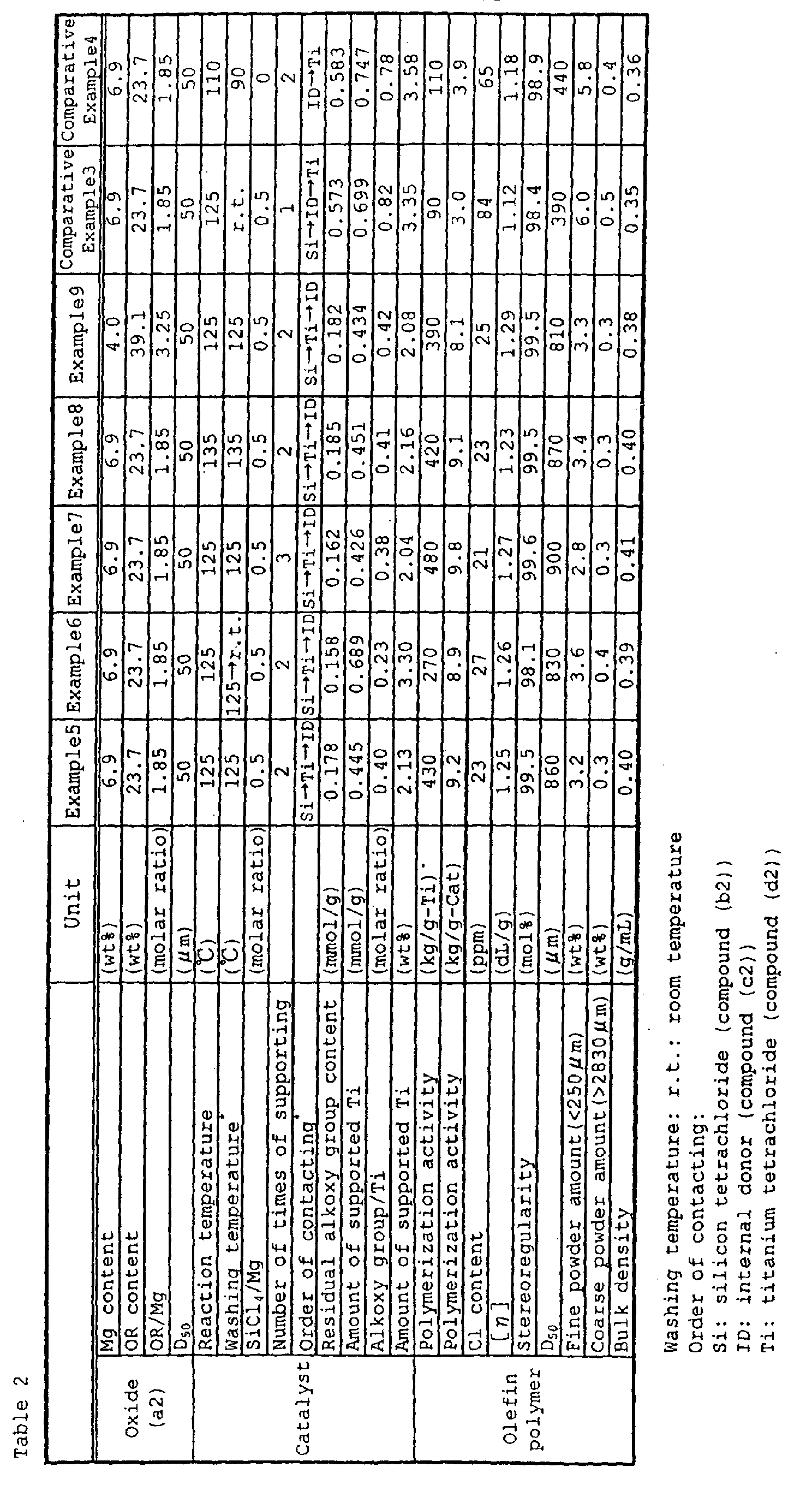
A three-necked flask with a stirrer, having an
internal volume of 0.5 liter, was subjected to replacement
of an atmosphere therein with nitrogen gas, and then
charged with 80 milliliters of dehydrated octane and 16 g
of diethoxymagnesium (prepared by reacting metal magnesium,
ethanol and iodine at an iodine/Mg gram atom ratio of
0.0057 at a reaction temperature of 50°C; D50: 35 µm). The
mixture was heated to 40°C, 8.0 milliliters of silicon
tetrachloride (halogen/alkoxy group: 1.0) was added, the
mixture was stirred for 4 hours, and then 3.4 milliliters
of di-n-butyl phthalate was added. The resultant solution
was temperature-increased up to 65°C, then, 77 milliliters
of titanium tetrachloride was dropwise added, and the
mixture was stirred at an internal temperature of 125°C for
1 hour to carry out a contacting procedure. Then, the
stirring was stopped to precipitate a solid, and a
supernatant was withdrawn. To the remaining reaction
mixture was added 100 milliliters of dehydrated octane, and
the mixture was temperature-increased up to 125°C with
stirring and maintained for 1 minute. Then, the stirring
was stopped to precipitate a solid, and a supernatant was
withdrawn. The above washing procedure was repeated 7 times.
Then, 122 milliliters of titanium tetrachloride was added,
the mixture was stirred at an internal temperature of 125°C
for 2 hours to carry out a contacting procedure, and then
the above washing with dehydrated octane at 125°C was
carried out 6 times to give a solid catalyst component.
Table 3 shows the evaluation results thereof.
An autoclave made of stainless steel with a stirrer,
having an internal volume of 1 liter, was fully dried and
subjected to replacement of an atmosphere therein with
nitrogen, and then the autoclave was charged with 400
milliliters of dehydrated heptane at room temperature. The
autoclave was further charged with 2.0 mmol of
triethylaluminum, 0.25 mmol of dicyclopentyldimethoxysilane
and 0.0025 mmol, as Ti atom, of the solid catalyst
component prepared in the above (1), and hydrogen was
introduced up to 0.1 MPa. Then, while propylene was
introduced, the autoclave was temperature-increased to 80°C
and pressure-increased to a total pressure of 0.8 MPa,
followed by polymerization for 1 hour.
Then, the temperature and the pressure in the
autoclave were decreased, and the reaction product was
taken out and poured into 2 liters of methanol to
deactivate the catalyst. The product was separated by
filtration and vacuum-dried to give a polypropylene. Table
3 shows the evaluation results thereof.
A solid catalyst component was obtained in the same
manner as in Example 10 except that the temperature for the
washing with the octane after the titanium-tetrachloride-supporting
reaction carried out for the second time in
Example 10(1) was changed to room temperature, and the
thus-obtained solid catalyst component was evaluated. Table
3 shows the results.
Propylene was polymerized in the same manner as in
Example 10 except that the procedures in Example 10(2) were
modified so that the dicyclopentyldimethoxysilane was
replaced with 0.5 mmol of cyclohexylmethyldimethoxysilane,
that 0.005 mmol, as Ti atom, of the solid catalyst
component prepared in the above (1) was added and that
hydrogen was introduced up to 0.05 MPa. The thus-obtained
polypropylene was evaluated. Table 3 shows the results.
A solid catalyst component was obtained in the same
manner as in Example 10 except that diethoxymagnesium
having an average particle diameter (D50) of 10 µm, which
was obtained at an iodine/Mg gram atomic ratio of 0.00019
at a reaction temperature of 50°C, was used. The thus-obtained
solid catalyst component was evaluated. Table 3
shows the results.
Propylene was polymerized in the same manner as in
Example 10 except that the solid catalyst component
prepared in the above (1) was used in Example 10(2). The
thus-obtained polypropylene was evaluated. Table 3 shows
the results.
A solid catalyst component was obtained in the same
manner as in Example 10 except that diethoxymagnesium
having an average particle diameter (D50) of 70 µm, which
was obtained at an iodine/Mg gram atomic ratio of 0.019 at
a reaction temperature of 78°C, was used in Example 10 (1).
The thus-obtained solid catalyst component was evaluated.
Table 3 shows the results.
Propylene was polymerized in the same manner as in
Example 10 except that the solid catalyst component
prepared in the above (1) was used in Example 10(2). The
thus-obtained polypropylene was evaluated. Table 3 shows
the results.
A three-necked flask with a stirrer, having an
internal volume of 0.5 liter, was subjected to replacement
of an atmosphere therein with nitrogen gas, and then
charged with 80 milliliters of dehydrated octane and 16 g
of diethoxymagnesium (prepared by reacting metal magnesium,
ethanol and iodine at an iodine/Mg gram atom ratio of 0.019
at a reaction temperature of 78°C, D50: 70 µm). The mixture
was heated to 40°C, and 8.0 milliliters of silicon
tetrachloride (halogen/alkoxy group: 1.0) was added. The
mixture was stirred for 4 hours, and then 47 milliliters of
titanium tetrachloride was dropwise added. The resultant
solution was temperature-increased up to 65°C, 3.4
milliliters of di-n-butyl phthalate was added, and the
mixture was temperature-increased up to 125°C. Then, the
mixture was stirred at an internal temperature of 125°C for
1 hour to carry out a contacting procedure. Then, the
stirring was stopped to precipitate a solid, and a
supernatant was withdrawn. To the remaining reaction
mixture was added 100 milliliters of dehydrated octane, and
the mixture was temperature-increased up to 125°C with
stirring and maintained for 1 minute. The stirring was
stopped to precipitate a solid, and a supernatant was
withdrawn. This washing procedure was repeated 7 times.
Then, 77 milliliters of titanium tetrachloride was added,
and the mixture was stirred at an internal temperature of
125°C for 2 hours to carry out a contacting procedure. The
stirring was stopped to precipitate a solid, and a
supernatant was withdrawn. Further, 100 milliliters of
dehydrated octane was added, and the mixture was stirred at
room temperature. The stirring was stopped to precipitate a
solid, and a supernatant was withdrawn. This washing
procedure was repeated 7 times, to give a solid catalyst
component. Table 3 shows the evaluation results thereof.
Propylene was polymerized in the same manner as in
Example 11 except that the solid catalyst component
prepared in the above (1) was used in Example 11(2). The
thus-obtained polypropylene was evaluated. Table 3 shows
the results.
A three-necked flask with a stirrer, having an
internal volume of 0.5 liter, was subjected to replacement
of an atmosphere therein with nitrogen gas, and then
charged with 80 milliliters of dehydrated octane and 16 g
of diethoxymagnesium (prepared by reacting metal magnesium,
ethanol and iodine at an iodine/Mg gram atom ratio of 0.019
at a reaction temperature of 78°C, D50: 70 µm). The mixture
was heated to 40°C, and 8.0 milliliters of silicon
tetrachloride (halogen/alkoxy group: 1.0) was added. The
mixture was stirred for 4 hours, and then 3.4 milliliters
of di-n-butyl phthalate was added. The resultant solution
was temperature-increased up to 65°C, and 47 milliliters of
titanium tetrachloride was dropwise added, and the mixture
was stirred at an internal temperature of 125°C for 1 hour
to carry out a contacting procedure. Then, the stirring was
stopped to precipitate a solid, and a supernatant was
withdrawn. To the remaining reaction mixture was added 100
milliliters of dehydrated octane, and the mixture was
temperature-increased up to 125°C with stirring and
maintained for 1 minute. The stirring was stopped to
precipitate a solid, and a supernatant was withdrawn. This
washing procedure was repeated 7 times. Then, 77
milliliters of titanium tetrachloride was added, and the
mixture was stirred at an internal temperature of 125°C for
2 hours to carry out a contacting procedure. The stirring
was stopped to precipitate a solid, and a supernatant was
withdrawn. Further, 100 milliliters of dehydrated octane
was added, and the mixture was stirred at room temperature.
The stirring was stopped to precipitate a solid, and a
supernatant was withdrawn. This washing procedure was
repeated 7 times, to give a solid catalyst component. Table
3 shows the evaluation results thereof.
Propylene was polymerized in the same manner as in
Example 11 except that the solid catalyst component
prepared in the above (1) was used in Example 11(2). The
thus-obtained polypropylene was evaluated. Table 3 shows
the results.
A three-necked flask with a stirrer, having an
internal volume of 0.5 liter, was subjected to replacement
of an atmosphere therein with nitrogen gas, and then
charged with 80 milliliters of dehydrated octane and 16 g
of diethoxymagnesium (prepared by reacting metal magnesium,
ethanol and iodine at an iodine/Mg gram atom ratio of 0.019
at a reaction temperature of 78°C, D50: 70 µm). The mixture
was heated to 40°C, and 8.0 milliliters of silicon
tetrachloride (halogen/alkoxy group: 1.0) was added. The
mixture was stirred for 4 hours, and then 3.4 milliliters
of di-n-butyl phthalate was added, and the mixture was
temperature-increased up to 65°C. Then, 47 milliliter of
titanium tetrachloride was dropwise added, and the mixture
was stirred at an internal temperature of 125°C for 1 hour
to carry out a contacting procedure. Then, the stirring was
stopped to precipitate a solid, and a supernatant was
withdrawn. To the remaining reaction mixture was added 100
milliliters of dehydrated octane, and the mixture was
temperature-increased up to 125°C with stirring and
maintained for 1 minute. Then, the stirring was stopped to
precipitate a solid, and a supernatant was withdrawn. This
washing procedure was repeated 7 times. Then, 77
milliliters of titanium tetrachloride was added, and the
mixture was stirred at an internal temperature of 125°C for
1 hour to carry out a contacting procedure. The stirring
was stopped to precipitate a solid, and a supernatant was
withdrawn. The above washing with dehydrated octane at
125°C was repeated 7 times. Further, 77 milliliters of
titanium tetrachloride was added again, and the mixture was
stirred at an internal temperature of 125°C for 2 hours to
carry out a contacting procedure. Then, the stirring was
stopped to precipitate a solid, and a supernatant was
withdrawn. Further, 100 milliliters of dehydrated octane
was added, and the mixture was stirred at room temperature.
The stirring was stopped to precipitate a solid, and a
supernatant was withdrawn. This washing procedure was
repeated 7 times to give a solid catalyst component. Table
3 shows the evaluation results thereof.
Propylene was polymerized in the same manner as in
Example 11 except that the solid catalyst component
prepared in the above (1) was used in Example 11(2). The
thus-obtained polypropylene was evaluated. Table 3 shows
the results.
A three-necked flask with a stirrer, having an
internal volume of 0.5 liter, was subjected to replacement
of an atmosphere therein with nitrogen gas, and then
charged with 80 milliliters of dehydrated octane and 16 g
of diethoxymagnesium (prepared by reacting metal magnesium,
ethanol and iodine at an iodine/Mg gram atom ratio of 0.019
at a reaction temperature of 78°C, D50: 70 µm). The mixture
was heated to 40°C, and 8.0 milliliters of silicon
tetrachloride (halogen/alkoxy group: 1.0) was added. The
mixture was stirred for 4 hours, and then 3.4 milliliters
of di-n-butyl phthalate was added. The resultant solution
was temperature-increased up to 65°C, and then 47 milliliter
of titanium tetrachloride was dropwise added. The mixture
was stirred at an internal temperature of 125°C for 1 hour
to carry out a contacting procedure. Then, the stirring was
stopped to precipitate a solid, and a supernatant was
withdrawn. Further, 100 milliliters of dehydrated octane
was added, and the mixture was stirred at room temperature.
The stirring was stopped to precipitate a solid, and a
supernatant was withdrawn. This washing procedure was
repeated 7 times to give a solid catalyst component. Table
3 shows the evaluation results thereof.
Propylene was polymerized in the same manner as in
Example 11 except that the solid catalyst component
prepared in the above (1) was used in Example 11(2). The
thus-obtained polypropylene was evaluated. Table 3 shows
the results.
A solid catalyst component was prepared in the same
manner as in Example 14 except that the step of treatment
with silicon tetrachloride in Example 14(1) was omitted.
The thus-obtained solid catalyst component was evaluated.
Table 3 shows the results.
Propylene was polymerized in the same manner as in
Example 11 except that the solid catalyst component
prepared in the above (1) was used in Example 11(2). The
thus-obtained polypropylene was evaluated. Table 3 shows
the results.
A solid catalyst component was prepared in the same
manner as in Example 14 except that 0.8 milliliter of
silicon tetrachloride (halogen/alkoxy group: 0.10) was used
in Example 14(1). The thus-obtained solid catalyst
component was evaluated. Table 3 shows the results.
Propylene was polymerized in the same manner as in
Example 11 except that the solid catalyst component
prepared in the above (1) was used in Example 11(2). The
thus-obtained polypropylene was evaluated. Table 3 shows
the results.
A three-necked flask with a stirrer, having an
internal volume of 0.5 liter, was subjected to replacement
of an atmosphere therein with nitrogen gas, and then
charged with 80 milliliters of dehydrated octane and 16 g
of diethoxymagnesium (prepared by reacting metal magnesium,
ethanol and iodine at an iodine/Mg gram atom ratio of 0.019
at a reaction temperature of 78°C, D50: 70 µm). The mixture
was heated to 50°C, and 4.8 milliliters of silicon
tetrachloride (halogen/alkoxy group: 0.60) was added. The
mixture was stirred for 20 minutes, and then 2.5
milliliters of diethyl phthalate was added. The resultant
solution was temperature-increased up to 70°C, and then 47
milliliter of titanium tetrachloride was dropwise added.
The mixture was stirred at an internal temperature of 110°C
for 2 hours to carry out a contacting procedure. Then, the
stirring was stopped to precipitate a solid, and a
supernatant was withdrawn. To the remaining reaction
mixture was added 100 milliliters of dehydrated octane, and
the mixture was temperature-increased up to 90°C with
stirring and maintained for 1 minute. Then, the stirring
was stopped to precipitate a solid, and a supernatant was
withdrawn. This washing procedure was repeated 7 times.
Then, 77 milliliters of titanium tetrachloride was added,
and the mixture was stirred at an internal temperature of
110°C for 2 hours to carry out a contacting procedure. The
stirring was stopped to precipitate a solid, and a
supernatant was withdrawn. Then, 100 milliliters of
dehydrated octane was added, and the mixture was stirred at
room temperature. The stirring was stopped to precipitate a
solid, and a supernatant was withdrawn. This washing
procedure was repeated 7 times to give a solid catalyst
component. Table 3 shows the evaluation results thereof.
Propylene was polymerized in the same manner as in
Example 11 except that the solid catalyst component
prepared in the above (1) was used in Example 11(2). The
thus-obtained polypropylene was evaluated. Table 3 shows
the results.
A solid catalyst component was prepared in the same
manner as in Comparative Example 6 except that a support
prepared by synthesizing diethoxymagnesium having an
average particle diameter (D50) of 540 µm at a reaction
temperature of 78°C without using iodine and pulverizing the
diethoxymagnesium with a ball mill for 24 hours was used in
Comparative Example 6(1). The thus-obtained solid catalyst
component was evaluated. Table 3 shows the results.
Propylene was polymerized in the same manner as in
Example 11 except that the solid catalyst component
prepared in the above (1) was used in Example 11(2). The
thus-obtained polypropylene was evaluated. Table 3 shows
the results.
A solid catalyst component was prepared in the same
manner as in Example 13 except that 2.4 milliliters of
silicon tetrachloride (halogen/alkoxy group: 0.30) was used
in Example 13(1). The thus-obtained solid catalyst
component was evaluated. Table 3 shows the results.
Propylene was polymerized in the same manner as in
Example 10 except that the solid catalyst component
prepared in the above (1) was used in Example 10(2). The
thus-obtained polypropylene was evaluated. Table 3 shows
the results.
As is clearly shown in Table, according to Examples,
the solid catalyst components have high polymerization
activity, and there can be obtained olefin polymers
excellent in powder form.

A three-necked flask with a stirrer, having an
internal volume of 0.5 liter, was subjected to replacement
of an atmosphere therein with nitrogen gas, and then
charged with 128 milliliters of dehydrated ethylbenzene and
16 g of diethoxymagnesium (prepared by reacting metal
magnesium, ethanol and iodine at an iodine/Mg gram atom
ratio of 0.0057 at a reaction temperature of 50°C, D50: 35
µm). At 5°C, 64 milliliters of titanium tetrachloride was
dropwise added, the mixture was temperature-increased up to
90°C, and then, 4.3 milliliters of di-n-butyl phthalate was
added. The resultant solution was further temperature-increased
and stirred at an internal temperature of 125°C
for 2 hours to carry out a contacting procedure. Then, the
stirring was stopped to precipitate a solid, and a
supernatant was withdrawn. To the remaining reaction
mixture was added 240 milliliters of dehydrated
ethylbenzene, and the mixture was temperature-increased up
to 125°C with stirring and maintained for 1 minute. Then,
the stirring was stopped to precipitate a solid, and a
supernatant was withdrawn. This washing procedure was
repeated twice. Further, 96 milliliters of dehydrated
ethylbenzene and 64 milliliters of titanium tetrachloride
were added, and the mixture was stirred at an internal
temperature of 125°C for 2 hours to carry out a contacting
procedure. The stirring was stopped to precipitate a solid,
and a supernatant was withdrawn. The above washing
procedure was repeated twice. Then, 100 milliliters of
dehydrated octane was added, and the mixture was
temperature-increased up to 125°C with stirring and
maintained for 1 minute. Then, the stirring was stopped to
precipitate a solid, and a supernatant was withdrawn. This
washing procedure was repeated four times, and the
resultant solid catalyst component was evaluated. Table 4
shows the results.
An autoclave made of stainless steel with a stirrer,
having an internal volume of 1 liter, was fully dried and
subjected to replacement of an atmosphere therein with
nitrogen, and then the autoclave was charged with 400
milliliters of dehydrated heptane at room temperature. The
autoclave was further charged with 2.0 mmol of
triethylaluminum, 0.25 mmol of dicyclopentyldimethoxysilane
and 0.0025 mmol, as Ti atom, of the solid catalyst
component prepared in the above (1), and hydrogen was
introduced up to 0.1 MPa. Then, while propylene was
introduced, the autoclave was temperature-increased to 80°C
and pressure-increased to a total pressure of 0.8 MPa,
followed by polymerization for 1 hour. Then, the
temperature and the pressure in the autoclave were
decreased, and the reaction product was taken out and
poured into 2 liters of methanol to deactivate the catalyst.
The product was separated by filtration and vacuum-dried to
give a polypropylene. Table 4 shows the evaluation results
thereof.
A solid catalyst component was obtained in the same
manner as in Example 17 except that the temperature for the
washing with the octane after the titanium-tetrachloride-supporting
reaction carried out for the second time in
Example 17(1) was changed to room temperature, and the
thus-obtained solid catalyst component was evaluated. Table
4 shows the results.
Propylene was polymerized in the same manner as in
Example 17 except that the procedures in Example 17(2) were
modified so that the dicyclopentyldimethoxysilane was
replaced with 0.5 mmol of cyclohexylmethyldimethoxysilane,
that 0.005 mmol, as Ti atom, of the solid catalyst
component prepared in the above (1) was added and that
hydrogen was introduced up to 0.05 MPa. The thus-obtained
polypropylene was evaluated. Table 4 shows the results.
A solid catalyst component was obtained in the same
manner as in Example 17 except that diethoxymagnesium
having an average particle diameter (D50) of 10 µm,
prepared at an iodine/Mg gram atom ratio of 0.00019 at a
reaction temperature of 50°C, was used in Example 17(1).
The thus-obtained solid catalyst component was evaluated.
Table 4 shows the results.
Propylene was polymerized in the same manner as in
Example 17 except that the solid catalyst component
prepared in the above (1) was used in Example 17(2). The
thus-obtained polypropylene was evaluated. Table 4 shows
the results.
A solid catalyst component was obtained in the same
manner as in Example 17 except that diethoxymagnesium
having an average particle diameter (D50) of 70 µm,
prepared at an iodine/Mg gram atom ratio of 0.019 at a
reaction temperature of 78°C, was used In Example 17(1).
The thus-obtained solid catalyst component was evaluated.
Table 4 shows the results.
Propylene was polymerized in the same manner as in
Example 17 except that the solid catalyst component
prepared in the above (1) was used in Example 17(2). The
thus-obtained polypropylene was evaluated. Table 4 shows
the results.
A three-necked flask with a stirrer, having an
internal volume of 0.5 liter, was subjected to replacement
of an atmosphere therein with nitrogen gas, and then
charged with 128 milliliters of dehydrated p-xylene and 16
g of diethoxymagnesium (prepared by reacting metal
magnesium, ethanol and iodine at an iodine/Mg gram atom
ratio of 0.019 at a reaction temperature of 78°C, D50: 70
µm). At 5°C, 64 milliliters of titanium tetrachloride was
dropwise added, the mixture was temperature-increased up to
90°C, and then 4.3 milliliters of di-n-butyl phthalate was
added. The resultant solution was further temperature-increased
and stirred at 130°C for 2 hours to carry out a
contacting procedure. Then, the stirring was stopped to
precipitate a solid, and a supernatant was withdrawn. To
the remaining reaction mixture was added 240 milliliters of
dehydrated p-xylene, and the mixture was temperature-increased
up to 130°C with stirring and maintained for 1
minute. Then, the stirring was stopped to precipitate a
solid, and a supernatant was withdrawn. This washing
procedure was repeated twice. Further, 96 milliliters of
dehydrated p-xylene and 64 milliliters of titanium
tetrachloride were added, and the mixture was stirred at an
internal temperature of 130°C for 2 hours to carry out a
contacting procedure. Then, the stirring was stopped to
precipitate a solid, and a supernatant was withdrawn. The
above washing procedure was carried out twice. Then, 100
milliliters of dehydrated octane was added, and the mixture
was temperature-increased up to 130°C with stirring and
maintained for 1 minute. Then, the stirring was stopped to
precipitate a solid, and a supernatant was withdrawn. This
washing procedure was repeated four times. The thus-obtained
solid catalyst component was evaluated. Table 4
shows the results.
Propylene was polymerized in the same manner as in
Example 17 except that the solid catalyst component
prepared in the above (1) was used in Example 17(2). The
thus-obtained polypropylene was evaluated. Table 4 shows
the results.
A solid catalyst component was obtained in the same
manner as in Example 17 except that the procedures in
Example 17(1) were modified so that diethoxymagnesium
having an average particle diameter (D50) of 70 µm,
prepared at an iodine/Mg gram atom ratio of 0.019 at a
reaction temperature of 78°C, was used and that the
temperature for the washing with the octane after the
titanium-tetrachloride-supporting reaction carried out for
the second time was changed to room temperature. The thus-obtained
solid catalyst component was evaluated. Table 4
shows the results.
Propylene was polymerized in the same manner as in
Example 17 except that the solid catalyst component
prepared in the above (1) was used in Example 17(2). The
thus-obtained polypropylene was evaluated. Table 4 shows
the results.
A three-necked flask with a stirrer, having an
internal volume of 0.5 liter, was subjected to replacement
of an atmosphere therein with nitrogen gas, and then
charged with 128 milliliters of dehydrated ethylbenzene and
16 g of diethoxymagnesium (prepared by reacting metal
magnesium, ethanol and iodine at an iodine/Mg gram atom
ratio of 0.019 at a reaction temperature of 78°C, D50: 70
µm). At 5°C, 64 milliliters of titanium tetrachloride was
dropwise added, the mixture was temperature-increased up to
90°C, and then 4.3 milliliters of di-n-butyl phthalate was
added. The resultant solution was further temperature-increased
and stirred at an internal temperature of 125°C
for 2 hours to carry out a contacting procedure. Then, the
stirring was stopped to precipitate a solid, and a
supernatant was withdrawn. To the remaining reaction
mixture was added 240 milliliters of dehydrated
ethylbenzene, and the mixture was temperature-increased up
to 125°C with stirring and maintained for 1 minute. Then,
the stirring was stopped to precipitate a solid, and a
supernatant was withdrawn. This washing procedure was
repeated twice. Then, 96 milliliters of dehydrated
ethylbenzene and 64 milliliters of titanium tetrachloride
were added, and the mixture was stirred at an internal
temperature of 125°C for 2 hours to carry out a contacting
procedure. The stirring was stopped to precipitate a solid,
and a supernatant was withdrawn. The above washing
procedure was carried out twice. Further, 96 milliliters of
dehydrated ethylbenzene and 64 milliliters of titanium
tetrachloride were added, and the mixture was stirred at an
internal temperature of 125°C for 2 hours to carry out a
contacting procedure. The stirring was stopped to
precipitate a solid, and a supernatant was withdrawn. The
above washing procedure was carried out twice. Then, 100
milliliters of dehydrated octane was added, and the mixture
was stirred at room temperature. The stirring was stopped
to precipitate a solid, and a supernatant was withdrawn.
This washing procedure was repeated four times. The thus-obtained
solid catalyst component was evaluated. Table 4
shows the results.
Propylene was polymerized in the same manner as in
Example 18 except that the solid catalyst component
prepared in the above (1) was used in Example 18(2). The
thus-obtained polypropylene was evaluated. Table 4 shows
the results.
A three-necked flask with a stirrer, having an
internal volume of 0.5 liter, was subjected to replacement
of an atmosphere therein with nitrogen gas, and then
charged with 128 milliliters of dehydrated ethylbenzene and
16 g of diethoxymagnesium (prepared by reacting metal
magnesium, ethanol and iodine at an iodine/Mg gram atom
ratio of 0.019 at a reaction temperature of 78°C, D50: 70
µm). At 5°C, 64 milliliters of titanium tetrachloride was
dropwise added, the mixture was temperature-increased up to
90°C, and then 4.3 milliliters of di-n-butyl phthalate was
added. The resultant solution was further temperature-increased
and stirred at 125°C for 2 hours to carry out a
contacting procedure. Then, the stirring was stopped to
precipitate a solid, and a supernatant was withdrawn. To
the remaining reaction mixture was added 240 milliliters of
dehydrated ethylbenzene, and the mixture was temperature-increased
up to 125°C with stirring and maintained for 1
minute. Then, the stirring was stopped to precipitate a
solid, and a supernatant was withdrawn. This washing
procedure was repeated twice. Further, 100 milliliters of
dehydrated octane was added, and the mixture was stirred at
room temperature. The stirring was stopped to precipitate a
solid, and a supernatant was withdrawn. This washing
procedure was repeated four times. The thus-obtained solid
catalyst component was evaluated. Table 4 shows the results.
Propylene was polymerized in the same manner as in
Example 18 except that the solid catalyst component
prepared in the above (1) was used in Example 18(2). The
thus-obtained polypropylene was evaluated. Table 4 shows
the results.
A three-necked flask with a stirrer, having an
internal volume of 0.5 liter, was subjected to replacement
of an atmosphere therein with nitrogen gas, and then
charged with 80 milliliters of dehydrated octane and 16 g
of diethoxymagnesium (prepared by reacting metal magnesium,
ethanol and iodine at an iodine/Mg gram atom ratio of 0.019
at a reaction temperature of 78°C, D50: 70 µm), and 47
milliliters of titanium tetrachloride was dropwise added at
40°C. The resultant solution was further temperature-increased
up to 65°C, and 3.4 milliliters of di-n-butyl
phthalate was added. Then, the mixture was temperature-increased
up to 125°C and then stirred at an internal
temperature of 125°C for 1 hour to carry out a contacting
procedure. Then, the stirring was stopped to precipitate a
solid, and a supernatant was withdrawn. To the remaining
reaction mixture was added 100 milliliters of dehydrated
octane, and the mixture was temperature-increased up to
125°C with stirring and maintained for 1 minute. Then, the
stirring was stopped to precipitate a solid, and a
supernatant was withdrawn. This washing procedure was
repeated 7 times. Then, 77 milliliters of titanium
tetrachloride was added, and the mixture was stirred at an
internal temperature of 125°C for 2 hours to carry out a
contacting procedure. The stirring was stopped to
precipitate a solid, and a supernatant was withdrawn.
Further, 100 milliliters of dehydrated octane was added,
and the mixture was stirred at room temperature. The
stirring was stopped to precipitate a solid, and a
supernatant was withdrawn. This washing procedure was
repeated 7 times. The thus-obtained solid catalyst
component was evaluated. Table 4 shows the results.
Propylene was polymerized in the same manner as in
Example 18 except that the solid catalyst component
prepared in the above (1) was used in Example 18(2). The
thus-obtained polypropylene was evaluated. Table 4 shows
the results.
A three-necked flask with a stirrer, having an
internal volume of 0.5 liter, was subjected to replacement
of an atmosphere therein with nitrogen gas, and then
charged with 80 milliliters of dehydrated octane and 16 g
of diethoxymagnesium (prepared by reacting metal magnesium,
ethanol and iodine at an iodine/Mg gram atom ratio of 0.019
at a reaction temperature of 78°C, D50: 70 µm). The mixture
was heated to 50°C, and 2.4 milliliters of silicon
tetrachloride was added. The mixture was stirred for 20
minutes, and then 2.5 milliliters of diethyl phthalate was
added. The resultant solution was temperature-increased up
to 70°C, then, 47 milliliters of titanium tetrachloride was
dropwise added, and the mixture was stirred at an internal
temperature of 110°C for 2 hours to carry out a contacting
procedure. Then, the stirring was stopped to precipitate a
solid, a supernatant was withdrawn, 100 milliliters of
dehydrated octane was added, and the mixture was
temperature-increased up to 90°C with stirring and
maintained for 1 minute. Then, the stirring was stopped to
precipitate a solid, and a supernatant was withdrawn. This
washing procedure was repeated 7 times. Then, 77
milliliters of titanium tetrachloride was added, and the
mixture was stirred at an internal temperature of 110°C for
2 hours to carry out a contacting procedure. The stirring
was stopped to precipitate a solid, and a supernatant was
withdrawn. Then, 100 milliliters of dehydrated octane was
added, the mixture was stirred at room temperature, the
stirring was stopped to precipitate a solid, and a
supernatant was withdrawn. This washing procedure was
repeated 7 times, and the thus-obtained solid catalyst
component was evaluated. Table 4 shows the results.
Propylene was polymerized in the same manner as in
Example 18 except that the solid catalyst component
prepared in the above (1) was used in Example 18(2). The
thus-obtained polypropylene was evaluated. Table 4 shows
the results.
A three-necked flask with a stirrer, having an
internal volume of 0.5 liter, was subjected to replacement
of an atmosphere therein with nitrogen gas, and then
charged with 128 milliliters of dehydrated ethylbenzene and
16 g of diethoxymagnesium (prepared by reacting metal
magnesium, ethanol and iodine at an iodine/Mg gram atom
ratio of 0.019 at a reaction temperature of 78°C, D50: 70
µm). At 5°C, 32 milliliters of titanium tetrachloride was
dropwise added, the mixture was temperature-increased up to
90°C, and then 4.3 milliliters of di-n-butyl phthalate was
added. The resultant solution was temperature-increased and
stirred at an internal temperature of 115°C for 2 hours to
carry out a contacting procedure. Then, the stirring was
stopped to precipitate a solid, and a supernatant was
withdrawn. To the remaining reaction mixture was added 160
milliliters of dehydrated ethylbenzene, and the mixture was
temperature-increased up to 115°C with stirring and
maintained for 1 minute. Then, the stirring was stopped to
precipitate a solid, and a supernatant was withdrawn. This
washing procedure was repeated twice. Further, 96
milliliters of dehydrated ethylbenzene and 32 milliliters
of titanium tetrachloride were added, and the mixture was
stirred at an internal temperature of 115°C for 2 hours to
carry out a contacting procedure. The stirring was stopped
to precipitate a solid, and a supernatant was withdrawn.
Then, 200 milliliters of dehydrated octane was added, the
mixture was stirred at room temperature, the stirring was
stopped to precipitate a solid, and a supernatant was
withdrawn. This washing procedure was repeated 10 times,
and the thus-obtained solid catalyst component was
evaluated. Table 4 shows the results.
Propylene was polymerized in the same manner as in
Example 18 except that the solid catalyst component
prepared in the above (1) was used in Example 18(2). The
thus-obtained polypropylene was evaluated. Table 4 shows
the results.
A solid catalyst component was prepared in the same
manner as in Comparative Example 14 except that a support
prepared by synthesizing diethoxymagnesium having an
average particle diameter (D50) of 540 µm at a reaction
temperature of 78°C without using iodine and pulverizing the
diethoxymagnesium with a ball mill for 24 hours was used in
Comparative Example 14(1). The thus-obtained solid catalyst
component was evaluated. Table 4 shows the results.
Propylene was polymerized in the same manner as in
Example 18 except that the solid catalyst component
prepared in the above (1) was used in Example 18(2). The
thus-obtained polypropylene was evaluated. Table 4 shows
the results.
As is clearly shown in Table, according to
Examples, the solid catalyst components have high
polymerization activity, and there can be obtained olefin
polymers excellent in powder form.
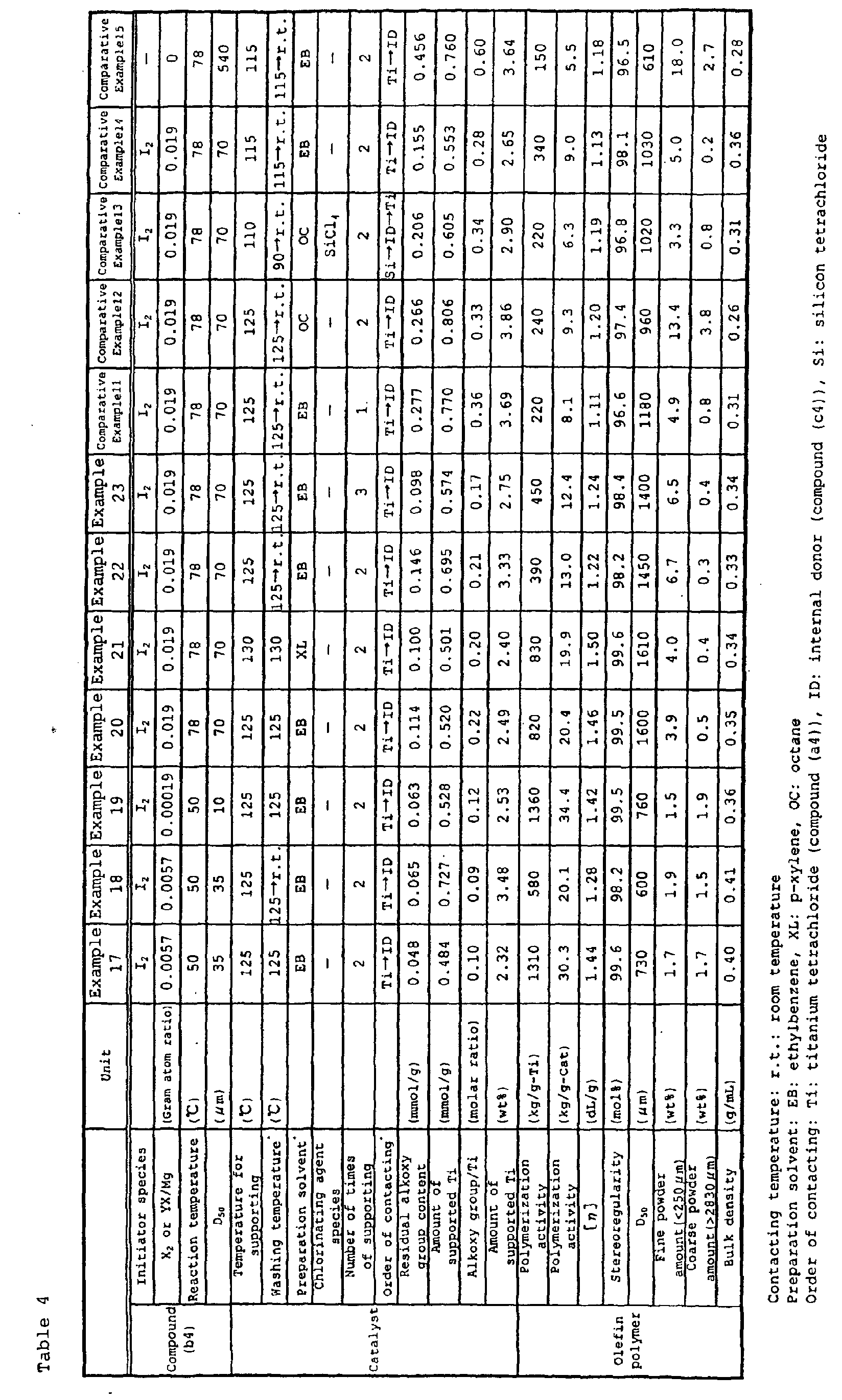
According to the present invention, there can be
provided a solid catalyst component and a solid catalyst
for olefin polymerization which has high polymerization
activity and can give an olefin polymer whose residual Cl
content is small and which is excellent in stereoregularity
and powder form, and a process for producing an olefin
polymer.
Claims (43)
- A solid catalyst component for olefin polymerization, which is a reaction product from the following compounds (a1), (b1), (c1), (d1) and (e), and
which is obtained by reacting the following compound (a1) with the following compound (b1) at a hydroxyl group/magnesium molar ratio of 1.0 or more, then reacting the compound (a1) with the following compound (c1) at a halogen/magnesium molar ratio of 0.20 or more,
reacting a reaction product from the compounds (a1), (b1) and (c1) with the following compound (d1) and the following compound (e) at a temperature of 120°C or higher but 150°C or lower, washing the resultant reaction mixture with an inert solvent, then, reacting the compound (e) again at a temperature of 120°C or higher but 150°C or lower and washing the resultant reaction mixture with an inert solvent,(a1) an oxide of at least one element that is selected from Group II to Group IV elements and that supports an alcohol-free halogen-containing magnesium compound,(b1) an alcohol,(c1) a halogen-containing silicon compound,(d1) an electron-donating compound, and(e) a halogen-containing titanium compound. - The solid catalyst component for olefin polymerization as recited in claim 1, which is the reaction product obtained by carrying out the first washing of the reaction mixture from said compounds (a1) to (e) at a temperature of 100°C or higher but 150°C or lower.
- The solid catalyst component for olefin polymerization as recited in claim 1, wherein the molar ratio (RO/Ti) of residual alkoxy groups (RO) to supported titanium (Ti) is 0.60 or less.
- A solid catalyst component for olefin polymerization, which is a reaction product from the following compounds (a1), (b1), (c1), (d1) and (e) and in which the molar ratio (RO/Ti) of residual alkoxy groups (RO) to supported titanium (Ti) is 0.60 or less,(a1) an oxide of at least one element that is selected from Group II to Group IV elements and that supports an alcohol-free halogen-containing magnesium compound,(b1) an alcohol,(c1) a halogen-containing silicon compound,(d1) an electron-donating compound, and(e) a halogen-containing titanium compound.
- The solid catalyst component for olefin polymerization as recited in claim 1 or 4, wherein said alcohol (b1) is ethanol.
- The solid catalyst component for olefin polymerization as recited in claim 1 or 4, wherein said halogen-containing silicon compound (c1) is silicon tetrachloride.
- The solid catalyst component for olefin polymerization as recited in claim 3 or 4, wherein said molar ratio (RO/Ti) is 0.45 or less.
- The solid catalyst component for olefin polymerization as recited in claim 1 or 4, which has a residual alkoxy group (RO) content of 0.40 mmol/g or less.
- The solid catalyst component for olefin polymerization as recited in claim 1 or 4, which has a supported-titanium amount of 1.0 % by weight or more.
- A solid catalyst component for olefin polymerization, which is a reaction product obtained by reacting the following compounds (a2) and (b2-1), reacting the reaction mixture with the following compounds (c2) and (d2) at a temperature of 120°C or higher but 150°C or lower, washing the reaction product with an inert solvent, then, reacting the following compound (d2) again at a temperature of 120°C or higher but 150°C or lower and washing the reaction product with an inert solvent,(a2) an oxide of at least one element selected from the Group II to Group IV elements, the oxide supporting an alkoxy-group-containing magnesium compound or an alcohol complex of a halogen-containing magnesium compound,(b2-1) a halogen-containing silicon compound whose amount as a halogen/magnesium molar ratio is at least 0.20 based on the oxide (a2),(c2) an electron-donating compound, and(d2) a halogen-containing titanium compound.
- The solid catalyst component for olefin polymerization as recited in claim 10, which is the reaction product obtained by carrying out the first washing of the reaction product from the compounds (a2) to (d2)with an inert solvent at a temperature of 100°C or higher but 150°C or lower.
- The solid catalyst component for olefin polymerization as recited in claim 10, wherein the molar ratio (RO/Ti) of residual alkoxy groups (RO) to supported titanium (Ti) is 0.70 or less.
- A solid catalyst component for olefin polymerization, which is a reaction product obtained by reactingand in which the molar ratio (RO/Ti) of residual alkoxy groups (RO) to supported titanium (Ti) is 0.70 or less.(a2) an oxide of at least one element selected from the Group II to Group IV elements, the oxide supporting an alkoxy-group-containing magnesium compound or an alcohol complex of a halogen-containing magnesium compound,(b2) a halogen-containing silicon compound,(c2) an electron-donating compound, and(d2) a halogen-containing titanium compound,
- The solid catalyst component for olefin polymerization as recited in claim 10 or 13, wherein said halogen-containing silicon compound (b2) or (b2-1) is silicon tetrachloride.
- The solid catalyst component for olefin polymerization as recited in claim 12 or 13, wherein said molar ratio (RO/Ti) is 0.50 or less.
- The solid catalyst component for olefin polymerization as recited in claim 10 or 13, which has a residual alkoxy group (RO) content of 0.50 mmol/g or less.
- The solid catalyst component for olefin polymerization as recited in claim 10 or 13, which has a supported-titanium amount of 1.0 % by weight or more.
- A solid catalyst component for olefin polymerization, which is a reaction product obtained by reacting the following compounds (a3) to (c3-1) or the following compounds (a3) to (d3) at a temperature of 120°C or higher but 150°C or lower, washing the reaction mixture with an inert solvent, further reacting the reaction mixture with the following halogen-containing titanium compound (a3) at least once at a temperature of 120°C or higher but 150°C or lower, and washing the reaction mixture with an inert solvent,(a3) a halogen-containing titanium compound,(b3) an alkoxy-group-containing magnesium compound,(c3-1) a halogen-containing silicon compound in which the molar ratio of halogen to the alkoxy group of the alkoxy-group-containing magnesium compound (b3) is 0.50 or more,(d3) an electron-donating compound.
- The solid catalyst component for olefin polymerization as recited in claim 18, which is the reaction product obtained by carrying out the first washing of the reaction mixture with an inert solvent at a temperature of 100°C or higher but 150°C or lower.
- The solid catalyst component for olefin polymerization as recited in claim 18, wherein the molar ratio (RO/Ti) of residual alkoxy groups (RO) to supported titanium (Ti) is 0.30 or less.
- A solid catalyst component for olefin polymerization, which is a reaction product obtained by reacting the following compounds (a3) to (c3) or the following compounds (a3) to (d3) and in which the molar ratio (RO/Ti) of residual alkoxy groups (RO) to supported titanium (Ti) is 0.30 or less,(a3) a halogen-containing titanium compound,(b3) an alkoxy-group-containing magnesium compound,(c3) a halogen-containing silicon compound,(d3) an electron-donating compound.
- The solid catalyst component for olefin polymerization as recited in claim 21, wherein said compound (a3) is a halogen-containing silicon compound whose amount, as a molar ratio of the halogen thereof to the alkoxy group of said compound (b3), is 0.50 or more.
- The solid catalyst component for olefin polymerization as recited in claim 18 or 21, wherein said compound (b3) is a compound obtained by reacting metal magnesium, an alcohol and a halogen and/or halogen-containing compound containing at least 0.0001 gram atom of halogen atom per mole of said metal magnesium.
- The solid catalyst component for olefin polymerization as recited in claim 23, wherein the metal magnesium, the alcohol and the halogen and/or halogen-containing compound are reacted at a temperature of 30 to 60°C.
- The solid catalyst component for olefin polymerization as recited in claim 18 or 21, wherein said compound (b3) has an average particle diameter (D50) of 50 µm or less.
- The solid catalyst component for olefin polymerization as recited in claim 18 or 21, wherein said compound (b3) is dialkoxymagnesium.
- The solid catalyst component for olefin polymerization as recited in claim 18 or 21, wherein said compound (c3) or (c3-1) is silicon tetrachloride.
- The solid catalyst component for olefin polymerization as recited in claim 20 or 21, wherein said molar ratio (RO/Ti) is 0.20 or less.
- The solid catalyst component for olefin polymerization as recited in claim 18 or 21, which has a residual alkoxy group (RO) content of 0.13 mmol/g or less.
- The solid catalyst component for olefin polymerization as recited in claim 18 or 21, which has a supported-titanium amount of at least 1.5 % by weight.
- A solid catalyst component for olefin polymerization, which is a reaction product obtained by reacting the following compounds (a4) and (b4) or the following compounds (a4), (b4) and (c4) in the presence of an aromatic hydrocarbon solvent at a temperature of 120°C or higher but 150°C or lower, washing the reaction mixture with an inert solvent, further reacting the following halogen-containing titanium compound (a4) at least once at a temperature of 120°C or higher but 150°C or lower and washing the reaction product with an inert solvent,(a4) a halogen-containing titanium compound,(b4) an alkoxy-group-containing magnesium compound,(c4) an electron-donating compound.
- The solid catalyst component for olefin polymerization as recited in claim 31, which is the reaction product obtained by carrying out the first washing of the reaction mixture with an inert solvent at a temperature of 100°C or higher but 150°C or lower.
- The solid catalyst component for olefin polymerization as recited in claim 31, wherein the molar ratio (RO/Ti) of residual alkoxy groups (RO) to supported titanium (Ti) is 0.25 or less.
- A solid catalyst component for olefin polymerization, which is a reaction product obtained by reacting the following compounds (a4) and (b4) or the following compounds (a4), (b4) and (c4) in the presence of an aromatic hydrocarbon solvent and in which the molar ratio (RO/Ti) of residual alkoxy groups (RO) to supported titanium (Ti) is 0.25 or less,(a4) a halogen-containing titanium compound,(b4) an alkoxy-group-containing magnesium compound,(c4) an electron-donating compound.
- The solid catalyst component for olefin polymerization as recited in claim 31 or 34, wherein said compound (b4) is an alkoxy-group-containing magnesium compound obtained by reacting metal magnesium, an alcohol and a halogen and/or halogen-containing compound containing at least 0.0001 gram atom of halogen atom per mole of said metal magnesium.
- The solid catalyst component for olefin polymerization as recited in claim 35, wherein said metal magnesium, said alcohol and said halogen and/or halogen-containing compound are reacted at a temperature of 30 to 60°C.
- The solid catalyst component for olefin polymerization as recited in claim 31 or 34, wherein said compound (b4) is dialkoxymagnesium.
- The solid catalyst component for olefin polymerization as recited in claim 31 or 34, wherein said compound (b4) has an average particle diameter (D50) of 50 µm or less.
- The solid catalyst component for olefin polymerization as recited in claim 33 or 34, wherein said molar ratio (RO/Ti) is 0.15 or less.
- The solid catalyst component for olefin polymerization as recited in claim 31 or 34, which has a residual alkoxy group content (RO) of 0.15 mmol/g or less.
- The solid catalyst component for olefin polymerization as recited in claim 31 or 34, which has a supported-titanium amount of at least 1.5 % by weight.
- A catalyst for olefin polymerization, comprising the following components [A] and [B] or the following components [A], [B] and [C],[A] the solid catalyst component for olefin polymerization as recited in any one of claims 1, 4, 10, 13, 21, 31 and 34,[B] an organic aluminum compound,[C] an electron-donating compound.
- A process for producing an olefin polymer, comprising polymerizing an olefin in the presence of the catalyst for olefin polymerization as recited in claim 42.
Priority Applications (2)
| Application Number | Priority Date | Filing Date | Title |
|---|---|---|---|
| EP09166338.5A EP2112174B1 (en) | 2001-11-01 | 2002-11-01 | Solid catalyst component for olefin polymerization, catalyst for olefin polymerization and process for producing olefin polymer |
| EP09166340.1A EP2113520B1 (en) | 2001-11-01 | 2002-11-01 | Solid catalyst component for olefin polymerization, catalyst for olefin polymerization and process for producing olefin polymer |
Applications Claiming Priority (13)
| Application Number | Priority Date | Filing Date | Title |
|---|---|---|---|
| JP2001336662A JP4123466B2 (en) | 2001-11-01 | 2001-11-01 | Solid catalyst component for olefin polymerization, catalyst for olefin polymerization, and method for producing olefin polymer |
| JP2001336663 | 2001-11-01 | ||
| JP2001336660 | 2001-11-01 | ||
| JP2001336662 | 2001-11-01 | ||
| JP2001336661 | 2001-11-01 | ||
| JP2001336660 | 2001-11-01 | ||
| JP2001336663 | 2001-11-01 | ||
| JP2001336661A JP4123465B2 (en) | 2001-11-01 | 2001-11-01 | Solid catalyst component for olefin polymerization, catalyst for olefin polymerization, and method for producing olefin polymer |
| JP2002135229 | 2002-05-10 | ||
| JP2002135228A JP4079686B2 (en) | 2001-11-01 | 2002-05-10 | Solid catalyst component for olefin polymerization, catalyst for olefin polymerization, and method for producing olefin polymer |
| JP2002135228 | 2002-05-10 | ||
| JP2002135229A JP2003201311A (en) | 2001-11-01 | 2002-05-10 | Solid catalyst component for olefin polymerization, catalyst for olefin polymerization, and method for producing olefin polymer |
| PCT/JP2002/011429 WO2003037939A1 (en) | 2001-11-01 | 2002-11-01 | Solid catalyst component for olefin polymerization, catalyst for olefin polymerization, and process for producing olefin polymer |
Related Child Applications (2)
| Application Number | Title | Priority Date | Filing Date |
|---|---|---|---|
| EP09166338.5A Division EP2112174B1 (en) | 2001-11-01 | 2002-11-01 | Solid catalyst component for olefin polymerization, catalyst for olefin polymerization and process for producing olefin polymer |
| EP09166340.1A Division EP2113520B1 (en) | 2001-11-01 | 2002-11-01 | Solid catalyst component for olefin polymerization, catalyst for olefin polymerization and process for producing olefin polymer |
Publications (2)
| Publication Number | Publication Date |
|---|---|
| EP1449854A1 true EP1449854A1 (en) | 2004-08-25 |
| EP1449854A4 EP1449854A4 (en) | 2009-01-21 |
Family
ID=27555011
Family Applications (3)
| Application Number | Title | Priority Date | Filing Date |
|---|---|---|---|
| EP02778037A Withdrawn EP1449854A4 (en) | 2001-11-01 | 2002-11-01 | SOLID CATALYST ELEMENT FOR POLYMERIZATION OF OLEFINS, CATALYST FOR OLEFIN POLYMERIZATION AND PROCESS FOR OBTAINING OLEFIN POLYMER |
| EP09166340.1A Expired - Lifetime EP2113520B1 (en) | 2001-11-01 | 2002-11-01 | Solid catalyst component for olefin polymerization, catalyst for olefin polymerization and process for producing olefin polymer |
| EP09166338.5A Expired - Lifetime EP2112174B1 (en) | 2001-11-01 | 2002-11-01 | Solid catalyst component for olefin polymerization, catalyst for olefin polymerization and process for producing olefin polymer |
Family Applications After (2)
| Application Number | Title | Priority Date | Filing Date |
|---|---|---|---|
| EP09166340.1A Expired - Lifetime EP2113520B1 (en) | 2001-11-01 | 2002-11-01 | Solid catalyst component for olefin polymerization, catalyst for olefin polymerization and process for producing olefin polymer |
| EP09166338.5A Expired - Lifetime EP2112174B1 (en) | 2001-11-01 | 2002-11-01 | Solid catalyst component for olefin polymerization, catalyst for olefin polymerization and process for producing olefin polymer |
Country Status (7)
| Country | Link |
|---|---|
| US (5) | US7071138B2 (en) |
| EP (3) | EP1449854A4 (en) |
| KR (1) | KR101088945B1 (en) |
| CN (1) | CN1298749C (en) |
| ES (2) | ES2558431T3 (en) |
| TW (1) | TW200300144A (en) |
| WO (1) | WO2003037939A1 (en) |
Cited By (4)
| Publication number | Priority date | Publication date | Assignee | Title |
|---|---|---|---|---|
| EP1829900A4 (en) * | 2004-11-19 | 2008-11-05 | Mitsui Chemicals Inc | FINE PARTICLES OF AN ETHYLENE POLYMER, FINE PARTICLES OF AN ETHYLENE POLYMER CONTAINING FUNCTIONAL GROUPS, AND CATALYST SUPPORT FOR THE PRODUCTION THEREOF |
| EP2139926A4 (en) * | 2007-04-25 | 2013-06-12 | Samsung Total Petrochemicals | CATALYST FOR POLYMERIZATION OF PROPYLENE AND PROCESS FOR POLYMERIZING PROPYLENE USING THE CATALYST |
| EP1875961B1 (en) * | 2005-04-07 | 2018-08-29 | Mitsui Chemicals, Inc. | Capsular fine particle comprising olefinic polymer |
| EP4155324A3 (en) * | 2021-09-22 | 2023-05-03 | Sumitomo Chemical Company, Limited | Method for producing solid catalyst component for olefin polymerization, method for producing catalyst for olefin polymerization, and method for producing olefin polymer |
Families Citing this family (11)
| Publication number | Priority date | Publication date | Assignee | Title |
|---|---|---|---|---|
| CN100424099C (en) * | 2005-09-28 | 2008-10-08 | 北京金鼎科化工科技有限公司 | A kind of catalyst active component and preparation method thereof, and the catalyst comprising the active component |
| US20070213204A1 (en) * | 2006-03-10 | 2007-09-13 | Novolen Technology Holdings C.V. | Ziegler-Natta catalyst with in situ-generated donor |
| SG172665A1 (en) * | 2007-12-27 | 2011-07-28 | Sumitomo Chemical Co | Production process of olefin polymerization catalyst component, of olefin polymerization catalyst, and of olefin polymer |
| KR101115677B1 (en) * | 2008-01-30 | 2012-02-15 | 주식회사 엘지화학 | Process for producing titanium catalyst for polyolefin production |
| IN2010DN07192A (en) * | 2008-03-14 | 2015-07-24 | Saudi Basic Ind Corp | |
| KR101140112B1 (en) * | 2009-05-22 | 2012-04-30 | 삼성토탈 주식회사 | A preparation method of dialkoxymagnesium support for catalyst for olefin polymerization, a preparation method of catalyst for olefin polymerization using the same and a polymerization method of olefin using the same |
| EP3157894A4 (en) | 2014-05-22 | 2018-01-03 | Reliance Industries Limited | A shape controlled pro-catalyst and a process for preparing the same |
| KR20170012387A (en) | 2014-05-22 | 2017-02-02 | 릴라이언스 인더스트리즈 리미티드 | A shape controlled pro-catalyst and a single pot process for preparing the same |
| CN116769077B (en) * | 2022-03-10 | 2025-11-11 | 中国石油化工股份有限公司 | Titanium-containing solid catalyst component and olefin polymerization catalyst |
| US20250109218A1 (en) | 2023-09-29 | 2025-04-03 | Formosa Plastics Corporation, U.S.A. | Method for preparing catalyst component for polymerization of polyolefin without the use of internal electron donors |
| US20250115687A1 (en) | 2023-10-06 | 2025-04-10 | Formosa Plastics Corporation, U.S.A. | Production method for solid catalyst component for polymerizing olefins, and catalyst for polymerizaing olefins |
Family Cites Families (35)
| Publication number | Priority date | Publication date | Assignee | Title |
|---|---|---|---|---|
| IT1042711B (en) * | 1975-09-19 | 1980-01-30 | Montedison Spa | COMPONENTS OF CATALYSTS FOR THE POLYMERIZATION OF OLEFINS |
| GB1569228A (en) * | 1976-12-13 | 1980-06-11 | Mitsubishi Chem Ind | Process for the polymerisation of olefins and catalyst therefor |
| JPS5373279A (en) * | 1976-12-13 | 1978-06-29 | Mitsubishi Chem Ind Ltd | Preparation of olefin polymer |
| JPS5624408A (en) | 1979-08-08 | 1981-03-09 | Idemitsu Kosan Co Ltd | Polymerization of olefin |
| JPS56104907A (en) | 1980-01-25 | 1981-08-21 | Mitsui Petrochem Ind Ltd | Olefin polymerization catalyst |
| JPS58811A (en) | 1981-06-20 | 1983-01-06 | 佐々木農機株式会社 | Pick-up part lift apparatus in baler |
| JPS6049005A (en) | 1983-08-30 | 1985-03-18 | Toa Nenryo Kogyo Kk | Catalytic component for olefin polymerization |
| US4497905A (en) * | 1983-10-13 | 1985-02-05 | Shell Oil Company | Olefin polymerization catalyst compositions and polymerization process |
| JPS61151208A (en) * | 1984-12-26 | 1986-07-09 | Toa Nenryo Kogyo Kk | Polymerization of butene-1 |
| JPH072777B2 (en) | 1985-01-28 | 1995-01-18 | 東燃株式会社 | Olefin polymerization catalyst component |
| JPH06104692B2 (en) | 1985-06-17 | 1994-12-21 | 出光石油化学株式会社 | Method for producing catalyst carrier for olefin polymerization |
| JPH0717695B2 (en) | 1985-11-22 | 1995-03-01 | 出光石油化学株式会社 | Method for producing catalyst carrier for olefin polymerization |
| JPH06104693B2 (en) * | 1986-01-06 | 1994-12-21 | 東邦チタニウム株式会社 | Catalyst for olefin polymerization |
| DE3644368A1 (en) | 1986-12-24 | 1988-07-07 | Basf Ag | Process for the preparation of homopolymers and copolymers of propene by means of a Ziegler-Natta catalyst system |
| DE3713943A1 (en) | 1987-04-25 | 1988-11-03 | Basf Ag | METHOD FOR PRODUCING HOMO AND COPOLYMERISATES OF PROPEN BY MEANS OF A ZIEGLER-NATTA CATALYST SYSTEM |
| US4948770A (en) * | 1987-06-29 | 1990-08-14 | Shell Oil Company | Method for crystallizing magnesium chloride and method for using in a catalyst composition |
| JP2587247B2 (en) | 1987-09-09 | 1997-03-05 | 東邦チタニウム株式会社 | Olefin polymerization catalyst |
| US5034365A (en) | 1990-05-09 | 1991-07-23 | Quantum Chemical Corporation | Silica supported polymerization catalyst |
| JPH0725822B2 (en) | 1987-12-07 | 1995-03-22 | 出光石油化学株式会社 | Process for producing olefin polymer |
| US4839988A (en) * | 1988-04-06 | 1989-06-20 | Thomas Industries Inc. | Panic exit device |
| JP2624578B2 (en) | 1989-12-28 | 1997-06-25 | 出光石油化学株式会社 | Olefin polymerization catalyst component and method for producing polyolefin |
| JP2582192B2 (en) | 1991-06-17 | 1997-02-19 | 出光石油化学株式会社 | Olefin polymerization catalyst component and method for producing polyolefin |
| US5104837A (en) * | 1990-03-16 | 1992-04-14 | Phillips Petroleum Company | Catalyst and polymerization of olefins |
| JP2958923B2 (en) * | 1990-04-27 | 1999-10-06 | 東邦チタニウム株式会社 | Solid catalyst components and catalysts for olefin polymerization |
| US5126302A (en) * | 1990-04-30 | 1992-06-30 | Quantum Chemical Corporation | Olefin polymerization catalyst and methods |
| JP3167417B2 (en) | 1992-04-24 | 2001-05-21 | 東邦チタニウム株式会社 | Olefin polymerization catalyst and polymerization method |
| JPH0717695A (en) | 1993-07-01 | 1995-01-20 | Toyota Autom Loom Works Ltd | Hood opening / closing mechanism for industrial vehicles |
| JPH0725822A (en) | 1993-07-15 | 1995-01-27 | Mitsui Petrochem Ind Ltd | Method for producing glycol monoesters |
| JP3898832B2 (en) * | 1998-03-20 | 2007-03-28 | 出光興産株式会社 | Solid catalyst component for producing olefin polymer, catalyst for producing olefin polymer, and method for producing olefin polymer |
| EP0952162A1 (en) * | 1998-04-24 | 1999-10-27 | Fina Research S.A. | Production of Ziegler-Natta catalysts |
| EP1108730A1 (en) * | 1999-12-15 | 2001-06-20 | Idemitsu Petrochemical Co., Ltd. | Magnesium compound, olefin polymerization catalyst and method for producing olefin polymer |
| JP4009203B2 (en) * | 2001-04-23 | 2007-11-14 | 出光興産株式会社 | Solid catalyst component for olefin polymerization |
| JP4370104B2 (en) | 2002-03-05 | 2009-11-25 | シャープ株式会社 | Semiconductor memory device |
| JP4506833B2 (en) | 2005-06-17 | 2010-07-21 | コニカミノルタビジネステクノロジーズ株式会社 | Electrophotographic charging member and electrophotographic image forming apparatus using the same |
| JP4506985B2 (en) | 2006-04-06 | 2010-07-21 | 住友金属工業株式会社 | Extra heavy steel material and method for manufacturing the same |
-
2002
- 2002-11-01 EP EP02778037A patent/EP1449854A4/en not_active Withdrawn
- 2002-11-01 EP EP09166340.1A patent/EP2113520B1/en not_active Expired - Lifetime
- 2002-11-01 ES ES09166340.1T patent/ES2558431T3/en not_active Expired - Lifetime
- 2002-11-01 KR KR1020047006697A patent/KR101088945B1/en not_active Expired - Lifetime
- 2002-11-01 TW TW091132440A patent/TW200300144A/en not_active IP Right Cessation
- 2002-11-01 ES ES09166338.5T patent/ES2567259T3/en not_active Expired - Lifetime
- 2002-11-01 CN CNB028213556A patent/CN1298749C/en not_active Expired - Lifetime
- 2002-11-01 WO PCT/JP2002/011429 patent/WO2003037939A1/en not_active Ceased
- 2002-11-01 US US10/493,550 patent/US7071138B2/en not_active Expired - Lifetime
- 2002-11-01 EP EP09166338.5A patent/EP2112174B1/en not_active Expired - Lifetime
-
2005
- 2005-12-29 US US11/319,701 patent/US7524790B2/en not_active Expired - Lifetime
-
2009
- 2009-03-12 US US12/382,269 patent/US7989382B2/en not_active Expired - Fee Related
-
2011
- 2011-05-11 US US13/067,124 patent/US8546289B2/en not_active Expired - Fee Related
- 2011-05-11 US US13/067,125 patent/US8293672B2/en not_active Expired - Fee Related
Cited By (5)
| Publication number | Priority date | Publication date | Assignee | Title |
|---|---|---|---|---|
| EP1829900A4 (en) * | 2004-11-19 | 2008-11-05 | Mitsui Chemicals Inc | FINE PARTICLES OF AN ETHYLENE POLYMER, FINE PARTICLES OF AN ETHYLENE POLYMER CONTAINING FUNCTIONAL GROUPS, AND CATALYST SUPPORT FOR THE PRODUCTION THEREOF |
| US7601423B2 (en) | 2004-11-19 | 2009-10-13 | Mitsui Chemicals, Inc. | Ethylene-based polymer microparticles, functional group-containing ethylene-based polymer microparticles, and catalyst carriers for manufacture thereof |
| EP1875961B1 (en) * | 2005-04-07 | 2018-08-29 | Mitsui Chemicals, Inc. | Capsular fine particle comprising olefinic polymer |
| EP2139926A4 (en) * | 2007-04-25 | 2013-06-12 | Samsung Total Petrochemicals | CATALYST FOR POLYMERIZATION OF PROPYLENE AND PROCESS FOR POLYMERIZING PROPYLENE USING THE CATALYST |
| EP4155324A3 (en) * | 2021-09-22 | 2023-05-03 | Sumitomo Chemical Company, Limited | Method for producing solid catalyst component for olefin polymerization, method for producing catalyst for olefin polymerization, and method for producing olefin polymer |
Also Published As
| Publication number | Publication date |
|---|---|
| TWI304817B (en) | 2009-01-01 |
| WO2003037939A1 (en) | 2003-05-08 |
| US20110275508A1 (en) | 2011-11-10 |
| US20060105907A1 (en) | 2006-05-18 |
| US7989382B2 (en) | 2011-08-02 |
| ES2567259T3 (en) | 2016-04-21 |
| US8546289B2 (en) | 2013-10-01 |
| CN1575304A (en) | 2005-02-02 |
| EP2113520A2 (en) | 2009-11-04 |
| KR101088945B1 (en) | 2011-12-01 |
| EP2112174B1 (en) | 2016-01-27 |
| US20040266609A1 (en) | 2004-12-30 |
| KR20040062613A (en) | 2004-07-07 |
| EP2113520B1 (en) | 2015-10-07 |
| US7071138B2 (en) | 2006-07-04 |
| EP2113520A3 (en) | 2010-03-03 |
| US7524790B2 (en) | 2009-04-28 |
| CN1298749C (en) | 2007-02-07 |
| EP2112174A2 (en) | 2009-10-28 |
| EP2112174A3 (en) | 2010-03-03 |
| ES2558431T3 (en) | 2016-02-04 |
| US20110218098A1 (en) | 2011-09-08 |
| US20090197762A1 (en) | 2009-08-06 |
| TW200300144A (en) | 2003-05-16 |
| US8293672B2 (en) | 2012-10-23 |
| EP1449854A4 (en) | 2009-01-21 |
Similar Documents
| Publication | Publication Date | Title |
|---|---|---|
| US8293672B2 (en) | Solid catalyst component for olefin polymerization, catalyst for olefin polymerization and process for producing olefin polymer | |
| US7871951B2 (en) | Magnesium compound, solid catalyst component, catalyst for olefin polymerization and method of producing polyolefin | |
| US20080188687A1 (en) | Magnesium compound, solid catalyst component for olefin polymerization, catalyst for olefin polymerization and method for producing polyolefin | |
| US7723254B2 (en) | Magnesium compound, solid catalyst component, olefin polymerization catalyst, and method for producing olefin polymer | |
| EP1505084A1 (en) | Solid catalyst component for olefin polymerization, catalyst for olefin polymerization and method for producing olefin polymer | |
| JP3898832B2 (en) | Solid catalyst component for producing olefin polymer, catalyst for producing olefin polymer, and method for producing olefin polymer | |
| JP2003137919A (en) | Solid catalyst component for olefin polymerization, catalyst for olefin polymerization, and method for producing olefin polymer | |
| JP4079686B2 (en) | Solid catalyst component for olefin polymerization, catalyst for olefin polymerization, and method for producing olefin polymer | |
| JP4879931B2 (en) | Solid catalyst component for olefin polymerization, catalyst for olefin polymerization, and method for producing olefin polymer | |
| JP4018893B2 (en) | Solid catalyst component for olefin polymerization, catalyst for olefin polymerization, and method for producing olefin polymer | |
| JP4123465B2 (en) | Solid catalyst component for olefin polymerization, catalyst for olefin polymerization, and method for producing olefin polymer | |
| JP2003342215A (en) | Magnesium compound, solid catalyst component for olefin polymerization, catalyst for olefin polymerization, and method for producing polyolefin | |
| JP2003201311A (en) | Solid catalyst component for olefin polymerization, catalyst for olefin polymerization, and method for producing olefin polymer | |
| JP4223738B2 (en) | Magnesium compound, solid catalyst component for olefin polymerization, catalyst for olefin polymerization, and method for producing polyolefin | |
| JP2003327615A (en) | Solid catalyst component for olefin polymerization, catalyst for olefin polymerization, and method for producing olefin polymer |
Legal Events
| Date | Code | Title | Description |
|---|---|---|---|
| PUAI | Public reference made under article 153(3) epc to a published international application that has entered the european phase |
Free format text: ORIGINAL CODE: 0009012 |
|
| 17P | Request for examination filed |
Effective date: 20040504 |
|
| AK | Designated contracting states |
Kind code of ref document: A1 Designated state(s): AT BE BG CH CY CZ DE DK EE ES FI FR GB GR IE IT LI LU MC NL PT SE SK TR |
|
| RAP1 | Party data changed (applicant data changed or rights of an application transferred) |
Owner name: IDEMITSU KOSAN CO., LTD. |
|
| A4 | Supplementary search report drawn up and despatched |
Effective date: 20081229 |
|
| 17Q | First examination report despatched |
Effective date: 20090408 |
|
| STAA | Information on the status of an ep patent application or granted ep patent |
Free format text: STATUS: THE APPLICATION IS DEEMED TO BE WITHDRAWN |
|
| 18D | Application deemed to be withdrawn |
Effective date: 20090819 |